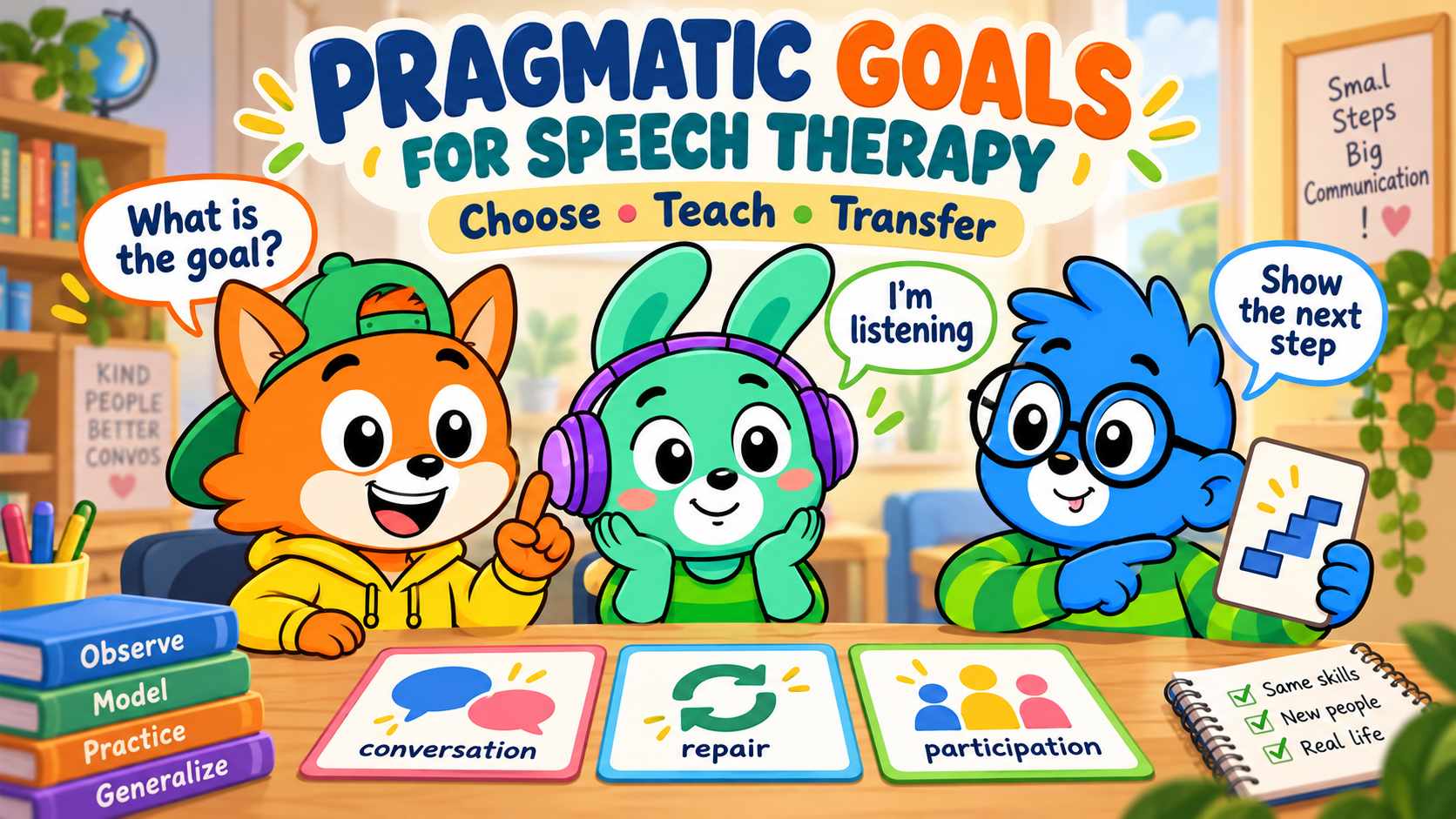
Pragmatic speech goals are most useful when they describe a communication job in a real interaction. Starting an exchange, responding to a partner, maintaining a topic, asking for clarification, repairing a misunderstanding, and participating in a shared activity may all be relevant, but each goal needs a different teaching routine and visual support.
This guide helps SLPs, teachers, caregivers, and support partners move from a broad pragmatic concern to a focused resource decision. It explains how to define the goal, compare visual formats, use supports without over-prompting, and decide when a paid teaching aid is worth reviewing. The ASHA Social Communication Disorder Practice Portal provides broader professional context for social interaction, language processing, and individualized support.
Table of Contents
- Define the communication job before choosing materials
- Match common goals to resource formats
- Check whether a visual resource fits the learner
- Use and adapt the routine with a partner
- Compare relevant SLP Study Center resources
- Track progress and transfer
- Frequently asked questions
Define the Communication Job Before Choosing Materials
“Improve pragmatic language” is too broad to tell a team what to teach next. Start with the interaction the learner wants or needs to manage. The target might be entering a peer activity, answering and adding a related comment, asking a follow-up question, telling a partner when the message was misunderstood, choosing a repair, or closing an exchange.
Common communication jobs include:
- Starting: greeting, joining, requesting participation, sharing information, or introducing a topic;
- Building: answering, adding a related comment, asking a question, taking turns, or maintaining a topic;
- Shifting and closing: signaling a topic change, ending an exchange, or moving to the next activity;
- Repairing: repeating, rephrasing, adding a detail, requesting clarification, or correcting a misunderstanding;
- Perspective: noticing a partner’s information, intention, feeling, or possible point of view; and
- Transferring: using a communication strategy with a new person, activity, setting, or mode.
The partner is part of the goal. Record who is listening, what the partner already knows, how much wait time is available, and which response modes are accepted. Speech, AAC, writing, sign, gesture, drawing, eye gaze, and combinations can all carry a pragmatic message. The goal should describe shared meaning and participation rather than quietly require one output style.
Match Common Goals to Resource Formats
Different pragmatic targets benefit from different visual structures. Choose a format that makes the communication job visible without adding unrelated complexity.
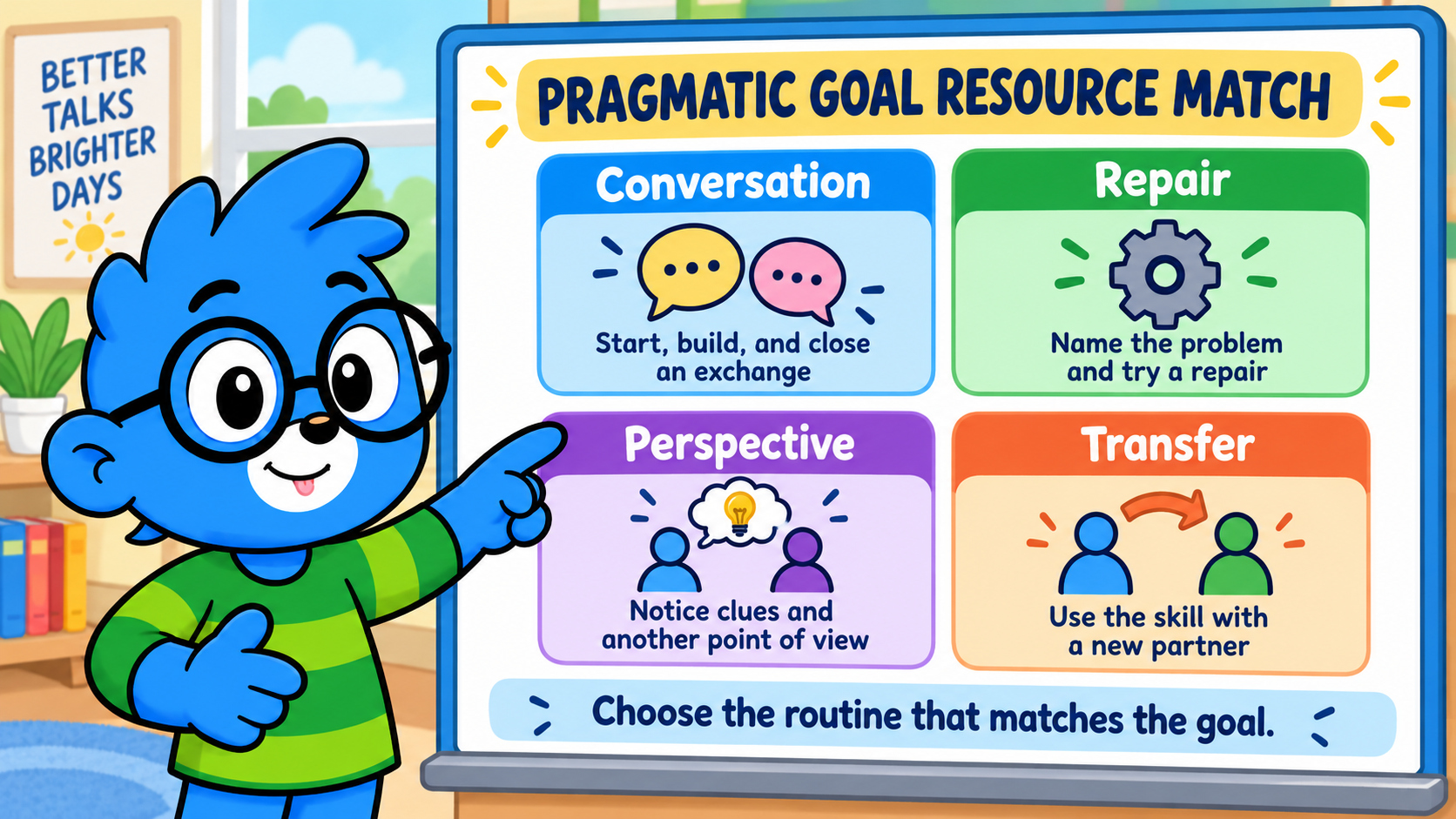
For conversation-entry and topic goals, look for a routine that shows an entry move, topic options, a response, a follow-up question, turn-taking, and a closing move. The visual should help the learner communicate with a real partner, not simply answer a sequence of adult prompts.
For repair goals, choose a format that separates what happened, what the partner may have understood, and what the learner can try next. Useful repair options might include repeating, rephrasing, adding a detail, asking for clarification, pointing, showing, pausing, or requesting help.
For perspective and friendship problem solving, keep the evidence visible. A learner can notice what each person said or did, consider more than one possible interpretation, and choose a response that fits the context. Avoid presenting every social situation as having one universal answer.
For transfer goals, choose a visual frame that can travel across people and routines. The same broad steps might support a therapy conversation, a classroom group, a family activity, or a community interaction. Track what changes when the partner, topic, language, or communication mode changes.
Check Whether a Visual Resource Fits the Learner
Before choosing a worksheet, card set, or visual routine, ask five questions:
- What communication job does it support? The title and pages should make the intended target clear.
- What does the learner do? The resource should show how to notice, choose, communicate, and respond.
- What does the partner do? The partner may pause, model, acknowledge, ask for clarification, or honor a refusal.
- How can access change? The learner should be able to point, select, speak, sign, write, gesture, use AAC, or combine modes when appropriate.
- How will progress be observed? The routine should support notes about purpose, message, support, partner understanding, and transfer.
Also check age-respectful topics, language and cultural fit, page scope, symbol meaning, visual density, reading demand, and physical access. A polished page is helpful, but page count does not determine whether the resource fits the goal. Choose the smallest set that lets the team teach and observe the interaction.
Use and Adapt the Routine With a Partner
Use a simple cycle: notice the context, choose a communication move, practice with a partner, and check whether the message worked. Model the routine while keeping the learner’s control visible.
Start by describing the situation without demanding a response. “Your partner is looking at the same game” creates an opportunity to join. Point to a possible entry move, then pause. If the learner chooses a different move, respond to that communication and adapt the routine.
Use models that demonstrate options instead of scripts that must be copied. For an entry goal, a model might be “Can I play?” “What are you making?” or a gesture toward the activity. For a repair goal, a model might be “I meant…,” “Can you say that again?,” “Show me,” or a request for a break. If the learner uses AAC, model on the established system when possible and keep access available during the entire exchange.
Fade prompts deliberately. Reduce a direct verbal cue before removing a visual that the learner can use independently. Record whether the learner initiated, responded, repaired, or transferred the strategy. A successful interaction may include a pause, refusal, different communication mode, or partner adjustment.
Compare Relevant SLP Study Center Resources
Once the goal is clear, a focused visual collection may reduce the time needed to assemble prompts and examples. Two verified resources are especially relevant to the communication jobs above.
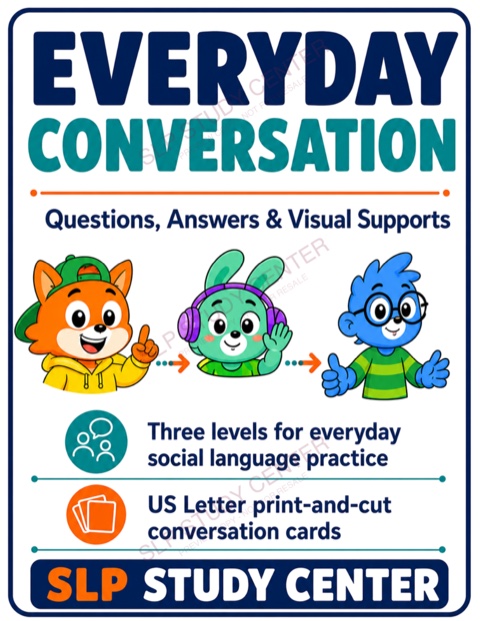
For goals about starting, building, and closing everyday exchanges, Everyday Conversation Visuals is the more direct resource to review. It fits a plan that needs reusable visual prompts for conversation entry, topic paths, responses, follow-up questions, and closing moves. Review the current product page for format, previews, scope, price, and access details before choosing it for a learner.
For goals about friendship problems, perspective, negotiation, boundaries, and repairing an interaction, Friendship Problem-Solving & Repair Conversation Set is the more direct resource to review. It fits a routine in which the learner notices a problem, names what happened, chooses a response, communicates a need, and checks what to try next. Use it only when the learner’s access, age, language, and real interaction context match the format.
These are product matches, not automatic recommendations for every learner. Compare the current pages with the communication job, response mode, partner support, learner interests, and setting. A focused set may be enough for one target. A broader collection may make sense only when related participation needs are being taught together.
Track Progress and Transfer
Practice the goal in an interaction that has a real reason to communicate. An entry goal can be used while choosing a game, planning a project, sharing an interest, or joining a group. A repair goal can be used after a low-stakes misunderstanding during a collaborative task. Give the learner a way to pause, refuse, request help, or choose another mode.
Record the context, partner, target move, communication mode, prompt, partner response, and transfer. Ask:
- Did the learner communicate the intended purpose?
- Was the message understood, and how did the partner respond?
- Which visual, model, pause, or access support helped?
- Did the learner choose a repair or another way to clarify?
- Could the learner use the routine with a new partner or activity?
- What single condition should change next time?
Do not reduce a pragmatic goal to eye contact, body position, or one exact sentence. Measure shared meaning, agency, and participation. Progress may appear as a more independent initiation, a clearer boundary, a successful repair, a partner-directed message, or communication through AAC.
Compare similar opportunities first, then vary one condition at a time. Keep the partner stable while changing the topic, or keep the routine stable while introducing a new partner. Note language, cultural, sensory, motor, and access factors that affect the interaction.
Frequently Asked Questions
What are pragmatic speech goals?
They are functional communication targets related to using language and other communication modes with people, such as starting an interaction, responding, maintaining a topic, repairing a misunderstanding, interpreting context, or participating with a partner.
How do I choose a pragmatic resource?
Name the communication job first, then choose a format that shows the learner and partner what to do. Check age fit, access, communication modes, page scope, partner support, and how progress will be observed.
Should pragmatic goals use scripted sentences?
Scripts can provide an entry point or repair model, but they should not become the only acceptable response. Offer multiple ways to communicate the same purpose and let the learner adapt the message to the partner and context.
When is a paid teaching aid worth reviewing?
Review one when it matches a defined communication job, provides reusable structure, supports the learner’s access, and saves meaningful preparation time. Compare the current product scope and format with the actual goal before purchasing or implementing it.
Pragmatic speech goals become more actionable when the communication job, partner, access route, and next decision are visible. Define the purpose, select a focused resource, practice in real interactions, and use the result to decide what to repeat or change.