
practice questions for speech language pathology praxis are most useful when they teach a repeatable way to read evidence and choose a proportionate action. A question set should do more than produce a percentage. It should show whether you can identify the decision verb, account for context, compare close options, protect professional boundaries, and explain the choice after the clock stops.
Use the current ASHA Speech-Language Pathology 5331 content page for the study frame and the live ETS 5331 page for current exam context. The ASHA Practice Portal offers clinical topic context. The questions, rationales, and visual maps below are original educational material, separate from live test material and not individualized clinical advice.
Before starting, decide what you are measuring: content recall, evidence reading, pacing, confidence, access checks, or transfer. Then record enough detail to make the next session different. This small setup keeps a practice set from becoming an isolated score and gives you a clear reason to review each item.
What practice questions for speech language pathology Praxis should teach
A good practice question is a small decision laboratory. It gives you a person, activity, context, evidence, and professional boundary, then asks for an action. Your review should identify which detail changes the answer and why the closest alternative is less fitting.
| Signal | What to ask | What to record |
|---|---|---|
| Decision | What action does the verb request? | Clarify, assess, treat, monitor, refer, or document. |
| Evidence | Which fact changes the interpretation? | One evidence-to-action sentence. |
| Context | Where, with whom, and under what conditions? | Language, mode, partner, setting, and support. |
| Function | What activity or participation outcome matters? | The real-world task named in the stem. |
| Boundary | What must happen first or be handed off? | Safety, consent, privacy, competence, or local process. |
| Transfer | Would the reasoning survive one changed variable? | A paired question for later review. |
This approach turns practice questions into feedback about your process. A wrong answer may reflect a content gap, but it may also reflect a rushed read, an overlooked context detail, an answer at the wrong level, or a sequence error.
Start with the current 5331 frame
Separate current exam information from durable clinical reasoning. The ASHA content page and ETS page are the places to check when you write notes about exam identity, content framing, administration, or preparation resources. Add a checked date to details that can change.
For clinical reasoning, the ASHA Multilingual Service Delivery resource and ASHA Cultural Responsiveness resource can help you notice language history, communication access, collaboration, and person-centered context. Use them as context for original cases, not as a substitute for the question’s evidence.
Keep practice items clearly labeled as original. Avoid material presented as restricted live-test content or as a substitute for current public guidance. Ethical preparation teaches a reasoning habit and respects the boundary between public study guidance and protected material.
Build a mixed question set
Choose a mix that makes you switch reasoning modes. Include evaluation, treatment, foundations, communication access, safety, and professional practice. A set that repeats one familiar format can hide the moment when a new context changes the appropriate action.
| Lane | Core question | Review lens |
|---|---|---|
| Evaluation | What should be clarified or measured next? | Evidence, validity, access, and interpretation. |
| Treatment | What update best fits the response and goal? | Cue, target, partner, activity, and outcome. |
| Foundations | Which concept explains the pattern? | Mechanism, contrast, and limits of inference. |
| Access | What condition affects opportunity to communicate? | Language, dialect, mode, hearing, vision, environment, and support. |
| Safety | What changes the order of action? | Stop rule, escalation, communication, and follow-up. |
| Professional | What protects the person and the process? | Consent, privacy, competence, supervision, and handoff. |
Write the set’s purpose at the top of the page. If you are checking pacing, use a time boundary and a return rule. If you are repairing clinical reasoning, reserve enough time to compare the answer with the closest distractor.
Use a five-pass reading method
A consistent reading sequence reduces the chance that a vivid technical term will outrun the question itself. Try five passes. The sequence is deliberately plain: it helps you see the decision before you decide which technical concept belongs in the explanation.
- Person: identify who is communicating and what matters to them.
- Activity: name the task, partner, setting, and participation outcome.
- Verb: underline whether the question asks you to clarify, assess, treat, monitor, refer, or document.
- Evidence: mark the contrast, response, measure, limitation, or missing information that controls the choice.
- Boundary: check access, safety, consent, role, competence, and sequence before committing.
After the five passes, predict the kind of answer you need before scanning the options. This keeps you from choosing the first option that contains a familiar intervention or assessment name.
Separate evidence from assumptions
Practice questions often include enough detail to support a next step, but not enough to support a sweeping conclusion. When information is missing, write “gather” or “confirm” rather than silently filling the gap.
- Label what the case states directly.
- Label what you infer and whether the inference is necessary.
- Notice whether the answer choice adds a conclusion that the evidence does not support.
- Ask whether the setting or partner changes the meaning of the result.
- Choose a proportionate action that creates the next useful information.
This is especially important when a question moves between a structured task and a natural activity. Performance can change with noise, fatigue, cueing, language, partner familiarity, rate, or communication mode. The difference is information to interpret, not a reason to ignore one condition.
Compare the best answer with its neighbor
After selecting an answer, identify the closest distractor. Then write one sentence for each: “This fits because…” and “That misses because…”. A distractor may be clinically plausible but premature, too broad, unsupported, inaccessible, or outside the role described in the stem.
- Does the answer match the decision verb?
- Does it use the decisive clue rather than a background detail?
- Does it preserve language, dialect, mode, hearing, partner, and environmental access?
- Does it connect a measure or target to activity and participation?
- Does it put safety and professional sequence in the right order?
- Does it stay within the information and role provided?
Do not judge an option only by whether it sounds technically sophisticated. Judge whether it is the best action now, for this person, in this context, with this evidence. A concise option can be stronger than a complicated one when it respects the information and the timing given in the stem.
Bring access and function into the rationale
Access is part of the evidence. Consider how language history, dialect, hearing, vision, motor access, technology, fatigue, noise, partner behavior, and response mode affect an observation. Then connect the decision to what the person is trying to do in daily life, school, work, or community participation.
- Describe the condition that made a response possible or difficult.
- Distinguish communication difference from a disorder conclusion.
- Keep supports visible when they improve opportunity, accuracy, effort, or participation.
- Use the activity named in the case to test whether the plan transfers.
- State when consent, privacy, safety, competence, or collaboration changes the sequence.
A rationale that names only a test or technique is incomplete when the stem gives you a person and a context. The best explanation shows the bridge from evidence to action. It also makes clear what you would monitor or confirm next, so the reasoning remains connected to the person rather than ending at a label.
MAP PRACTICE QUESTIONS TO CLINICAL DECISIONS
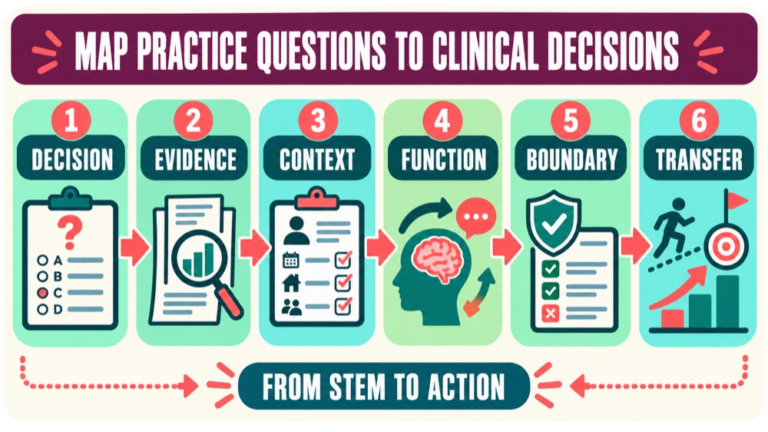
The map helps you connect a question format to the clinical decision underneath it. Use the first read to locate the decision, the evidence, the context, the function, and the boundary. Then write a transfer variation so the rule is not tied to one exact sentence.
| Map point | Prompt | Output |
|---|---|---|
| Question | What action is requested? | A one-line decision. |
| Evidence | Which clue changes the choice? | An evidence-to-action sentence. |
| Context | What condition shapes access or interpretation? | A context note. |
| Function | What activity should change? | A participation outcome. |
| Boundary | What must happen first or be handed off? | A sequence note. |
| Transfer | What if one variable changes? | A paired prompt. |
If the map feels too long, keep only the fields that explain the miss. The goal is a repeatable study tool, not a second essay for every item. A short note that identifies the controlling clue and the next repair is more useful than a complete rewrite that you will not repeat.
REVIEW EACH QUESTION WITH A FOUR-PART CHECK
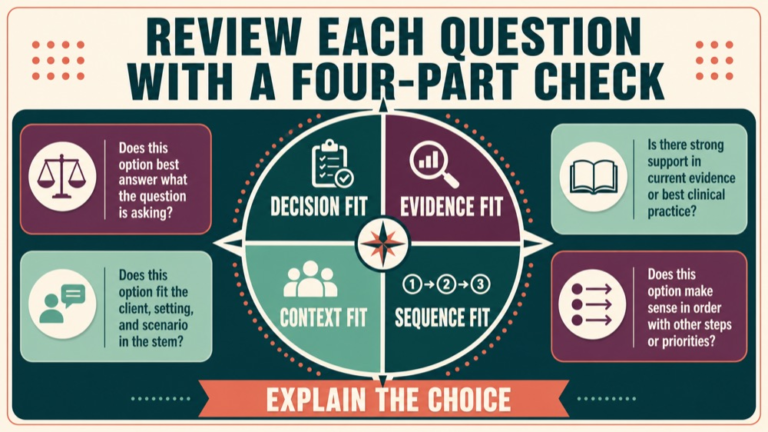
Use the four-part check after every uncertain answer: decision fit, evidence fit, context fit, and sequence fit. A correct answer that you cannot explain deserves the same short review as a missed answer because confidence and reasoning need to meet.
| Check | Ask | Repair if weak |
|---|---|---|
| Decision fit | Did I answer the verb? | Rewrite the requested action. |
| Evidence fit | Did I use the controlling clue? | Circle the contrast or limitation. |
| Context fit | Did I include access and setting? | Add person, partner, mode, or environment. |
| Sequence fit | Is this the right action now? | Put clarify, act, communicate, and follow up in order. |
Finish by naming the closest distractor and the reason it loses. This single comparison often reveals whether the problem was knowledge, reading, context, confidence, or timing.
Question 1: clarify before selecting a measure
Practice Question 1. A bilingual preschooler follows familiar routines in the home language but is quiet during an English-only screening. The referral asks whether the child needs speech-language services. What is the best next step?
- A. Use the English-only result as the primary basis for a disorder conclusion.
- B. Ask the family to stop using the home language while more data are collected.
- C. Gather language history, use appropriate multilingual assessment supports, and compare communication across people, languages, and routines.
- D. Delay all communication with the family until a standardized score is available.
Correct Answer: C. The screening condition does not represent the whole communication question. Language history, culturally and linguistically appropriate procedures, multiple informants, and functional observations provide a fairer basis for deciding what information is needed next.
Why the Other Options Are Wrong: A treats one access-limited result as a broad conclusion. B removes a language resource rather than examining communication fairly. D delays useful collaboration without a reason. C defines the evidence before interpreting it.
Exam Trap: When a case includes language history, do not confuse performance in one language or one setting with a complete description of communication.
Question 2: move from accuracy to participation
Practice Question 2. An adult with aphasia names pictured objects more accurately after a semantic cue but still cannot order a meal at a familiar café. Which treatment update best connects the result to function?
- A. End treatment because the cue produced higher naming accuracy.
- B. Remove all cues so the next session measures unaided naming only.
- C. Keep the helpful cue and practice supported ordering with the partner, tracking cue level, message success, and participation.
- D. Switch to a different impairment drill without observing the ordering task.
Correct Answer: C. The cue result is useful information, but the named activity remains difficult. A functional update keeps the support that helps and measures how it affects the communication partner, message completion, effort, and participation in the real task.
Why the Other Options Are Wrong: A turns a structured result into a complete functional conclusion. B discards a possible access support before testing its value. D changes targets without answering the activity concern. C links evidence, support, partner, and outcome.
Exam Trap: A cue is not automatically a failure or a crutch. Ask what opportunity it creates and whether the person can use the strategy in a meaningful activity.
Question 3: protect the professional sequence
Practice Question 3. During a facility-approved communication screen, a patient becomes drowsy and coughs repeatedly. The local protocol says to stop and notify the responsible team when this change occurs. What should the answer prioritize?
- A. Continue until the planned number of observations is complete.
- B. Use the first observations as a final conclusion and resume the routine.
- C. Stop according to the protocol, communicate the change, document conditions and response, and arrange appropriate follow-up.
- D. Ask a support person to continue the screen while the clinician completes paperwork.
Correct Answer: C. The new condition activates the stated stop rule. The proportionate sequence is to stop, communicate, document what happened and under what conditions, and arrange qualified follow-up within the local process.
Why the Other Options Are Wrong: A ignores the safety boundary. B treats earlier observations as final after the condition changed. D transfers a safety-sensitive task without appropriate competence or authorization. C protects sequence, communication, and continuity.
Exam Trap: A stop rule is usually testing what happens next. More data are not the priority when the case has introduced a safety change.
Turn missed questions into targeted repairs
Do not respond to every miss by restarting the entire content outline. Assign one category and one repair. A pacing error may need checkpoints; an access error may need a context-first reading habit; a sequence error may need a written handoff order.
| Miss type | Typical signal | Next repair |
|---|---|---|
| Pacing | Accuracy drops late or return items are not reviewed. | Use a checkpoint and a marked-return rule. |
| Verb | The explanation answers a neighboring question. | Underline the requested action. |
| Evidence | A key contrast or limitation was missed. | Write the clue and its implication. |
| Access | Language, mode, partner, or environment disappears. | Add the access condition to the first read. |
| Function | The answer stops at a drill or score. | Name the activity and participation outcome. |
| Sequence | The action is reasonable but premature. | Write what must happen before it. |
| Boundary | Role, privacy, consent, or safety is overlooked. | Add the communication or handoff step. |
| Transfer | The rule fails when a detail changes. | Solve a paired case after a delay. |
Track patterns across several sets. One difficult item is a prompt for review; a repeated category is evidence for changing the study process.
Use delayed transfer practice
Return to a question after a delay, but change one variable: the communication partner, setting, language, support, urgency, response mode, or activity. Then solve it without looking at the first rationale.
- Write the original decision and decisive clue.
- Change one contextual variable.
- Predict what should stay stable and what should change.
- Explain the new action and its boundary.
- Compare both cases and schedule another short review.
Transfer practice helps you avoid memorizing a phrase instead of learning the relationship between evidence, context, action, and function. Keep the variation modest so you can see which variable did the work.
Practice-question checklist
Use this checklist before you close the study session:
- Did I verify current exam context with ASHA and ETS?
- Did I define the purpose and mix of the question set?
- Did I identify the person, activity, verb, evidence, and boundary?
- Did I account for language, dialect, culture, mode, hearing, partner, and environment when relevant?
- Did I compare the best answer with the closest distractor?
- Did I connect the reasoning to function and participation?
- Did I classify each miss instead of changing every resource?
- Did I write one evidence-to-action sentence?
- Did I create a changed-variable transfer prompt?
- Did I schedule delayed review?
A short, specific log is enough. The value comes from using it to choose the next action.
Sources and next steps
For the current study frame, review the ASHA Speech-Language Pathology 5331 content page and the live ETS 5331 page. For clinical context, use the ASHA Practice Portal, including its Multilingual Service Delivery and Cultural Responsiveness resources.
Use the ETS practice-test page for current preparation-resource context. The original questions and visual maps on this page are educational material separate from live test content. Recheck current requirements before relying on administrative, professional, state, school, agency, or facility details.
For your next session, choose a mixed set, use the five-pass read, compare one closest distractor per item, and solve one changed-context question after a delay.
Continue your preparation: Explore the SLP Study Center learning resources.