Motor speech disorders Praxis practice questions are easier to solve when you identify the speech system, the pattern across tasks, and the action the stem requests. A case may include weakness, reduced range, inconsistent errors, groping, altered prosody, imprecise consonants, or reduced intelligibility. The strongest answer links those clues to an evidence source and a clinical stage.
ASHA’s Practice Portal pages on dysarthria in adults and acquired apraxia of speech frame motor-speech assessment around speech subsystems, functional communication, differential reasoning, and appropriate collaboration. Use the current ASHA and ETS pages for changing information, then use the original systems map below to review concepts without treating one speech feature as a complete explanation.
What motor-speech questions are testing
A motor-speech item may ask you to identify a subsystem pattern, choose an assessment task, distinguish dysarthria from apraxia or another communication disorder, select a referral or collaboration step, plan support, or monitor functional change. The label motor speech does not determine the answer by itself. The final request sets the decision stage.
| Question task | What to locate | Review output |
|---|---|---|
| Identify a pattern | Respiration, phonation, resonance, articulation, or prosody clues | Subsystem note |
| Choose assessment | Speech tasks, oral-motor information, intelligibility, or context evidence | Next data step |
| Differentiate | Consistency, weakness, planning, programming, and language evidence | Cautious comparison |
| Plan support | Person’s goal, communication partner, and access needs | Functional plan |
| Monitor change | Speech performance and participation under a defined condition | Outcome measure |
Rewrite the action word before reading the choices. If the stem asks what should be assessed next, a treatment technique may be relevant later but may not answer the question. If the stem asks for a functional outcome, a subsystem label alone may be too narrow.
Use the details that change the decision: onset, neurologic history, fatigue, consistency, rate, prosody, strength, range, groping, error type, intelligibility, communication partner, and response to cueing. A familiar term should organize the evidence, not replace it.
Anchor review to the ASHA 5331 scope
ASHA’s current Speech-Language Pathology 5331 content page places voice, resonance, and motor speech within assessment procedures and treatment. The broad exam structure also includes foundations and professional practice, screening, assessment, evaluation and diagnosis, treatment planning, implementation, and treatment evaluation.
| 5331 lens | Motor-speech question example | Study tag |
|---|---|---|
| Foundations | What motor-speech process or subsystem is described? | Concept and anatomy |
| Assessment | What task adds evidence about the speech pattern? | Data source and sequence |
| Differential reasoning | Which pattern is supported and what remains uncertain? | Comparison boundary |
| Treatment planning | What goal, support, or activity fits the person? | Function and implementation |
| Treatment evaluation | How will speech and participation be monitored? | Measure and generalization |
Map the item to one primary lens. A case can contain a neurologic history, imprecise consonants, slowed rate, and a comprehension concern, but the question may ask you to select a speech task or a language measure. The stage and requested domain keep the answer focused.
Use ASHA for clinical concepts and ETS for current exam logistics. Third-party practice pages can show the language learners search, but their labels and question wording are not a substitute for responsible source material.
Separate motor speech, language, and speech-sound clues
Motor speech concerns involve the planning, programming, execution, or physiologic support of speech. Language concerns involve comprehension or formulation, and speech-sound concerns may involve linguistic patterns or production errors. A person can have more than one area of need, so the question is asking you to identify the layer that controls the decision.
| Layer | Clues to review | Question filter |
|---|---|---|
| Motor execution | Weakness, range, speed, coordination, or subsystem changes | What movement or support is affected? |
| Motor planning or programming | Inconsistent errors, groping, initiation or sequencing difficulty | What changes with task, length, or cueing? |
| Language | Word finding, comprehension, syntax, semantics, or discourse | What language process is affected? |
| Speech sound | Phonological pattern, articulation error, or sound-specific production | Which sound or rule is involved? |
| Participation | Intelligibility, message efficiency, partner access, or confidence | What communication activity matters? |
An imprecise consonant can appear in several clinical contexts. Do not assign the cause from the error alone. Examine consistency, oral and speech motor findings, language status, task demands, and the question’s requested action.
Use a two-line note: describe the speech behavior, then state which system or decision remains uncertain. This keeps a vivid symptom from becoming an unsupported differential conclusion.
Organize the speech subsystems
Subsystem thinking helps you turn a long motor-speech stem into a usable pattern. Respiration contributes to breath support and phrasing, phonation contributes to voicing, resonance shapes the sound, articulation creates segmental detail, and prosody carries rate, stress, rhythm, and intonation. A question may target one subsystem or the interaction among several.
- Respiration: note breath support, phrase length, coordination, and whether the task changes with speaking demand.
- Phonation: note loudness, quality, pitch, voicing onset, and stability during connected speech.
- Resonance: note oral or nasal balance and how the vocal tract shapes the speech signal.
- Articulation: note precision, range, speed, consistency, and the effect on intelligibility.
- Prosody: note rate, stress, rhythm, intonation, pauses, and naturalness.
- Interaction: ask whether a pattern across subsystems changes the functional communication result.
Do not count subsystem clues without connecting them to the task. Reduced loudness during a short vowel and reduced loudness during a classroom presentation are related observations, but they support different questions about endurance, demand, and participation.
For practice, highlight each clue by subsystem and then write one sentence describing the dominant pattern. If the stem contains a language or hearing issue, place that information beside the motor-speech pattern rather than blending the domains together.
Read dysarthria patterns as a system
Dysarthria questions often ask you to connect impaired strength, range, speed, coordination, or control with speech subsystems and intelligibility. ASHA’s adult dysarthria guidance emphasizes assessment of the speech mechanism and the subsystems that contribute to speech production, along with differential diagnosis, collaboration, and functional goals.
| Pattern clue | What to ask | Study caution |
|---|---|---|
| Weakness or reduced range | Which movement or subsystem shows the limitation? | Do not infer a neurologic cause from one sign. |
| Imprecise articulation | Does precision change with rate, length, or support? | Connect speech clarity to task. |
| Altered phonation | How do loudness, quality, or stability affect communication? | Consider voice and motor-speech interaction. |
| Prosodic change | What happens to rate, stress, rhythm, or intonation? | Sample connected speech. |
| Intelligibility impact | Who needs access to which message? | Include partner and setting. |
When a question gives a broad cluster, look for an answer that assesses or describes multiple relevant subsystems rather than one isolated exercise. When it gives one narrow clue, answer the narrow question and avoid adding an unsupported syndrome or etiology.
Remember that motor-speech assessment can coexist with language, cognition, hearing, swallowing, or other concerns. The correct review plan may include collaboration or referral when the case points beyond speech production alone.
Read apraxia patterns as a planning problem
Apraxia questions often emphasize speech-motor planning or programming, such as inconsistent errors, difficulty with initiation or sequencing, groping, disrupted prosody, or a difference between automatic and volitional speech. The pattern must be interpreted across tasks and in relation to language, cognition, and execution evidence.
| Clue | Review question | Boundary |
|---|---|---|
| Inconsistent errors | Do errors vary across repeated attempts or contexts? | Check the task and sample before interpreting. |
| Groping or initiation effort | What happens as the speaker searches for a movement sequence? | Describe rather than over-label. |
| Length or complexity effect | How does performance change as the utterance grows? | Compare tasks in a consistent way. |
| Prosodic disruption | How do stress, rate, and segmentation change? | Include connected speech. |
| Cueing response | What changes with a supported production? | Use cueing as evidence, not a stand-alone diagnosis. |
A practice answer should not treat one inconsistent sound as enough to label apraxia. Look for the pattern, the task conditions, and the interaction with other communication findings. If the question asks what assessment adds evidence, choose tasks that sample planning, sequencing, consistency, and connected speech as appropriate.
Keep language and motor planning separate in your notes. Word retrieval difficulty may change the utterance a person attempts, while a speech-motor planning issue may affect how the selected word is produced. The case may require evidence about both.
Choose assessment evidence across tasks
A motor-speech assessment question is easier when you ask what uncertainty the next task will reduce. Case history, oral mechanism information, speech samples, repeated productions, diadochokinetic tasks, connected speech, intelligibility measures, prosody, language assessment, cognition, hearing, and collaboration can contribute different evidence.
| Evidence source | What it can add | Review caution |
|---|---|---|
| Case history | Onset, neurologic context, change, prior care, and daily needs | History guides the assessment plan. |
| Oral mechanism | Structure, movement, strength, speed, and range information | Interpret findings with speech performance. |
| Single-word tasks | Segmental precision, consistency, and complexity response | Do not generalize to conversation without sampling it. |
| Connected speech | Intelligibility, prosody, rate, phonation, and functional integration | Record partner, topic, and support. |
| Repeated productions | Consistency and response to cueing or task change | Use a defined comparison. |
| Language or cognition data | Co-occurring communication factors | Keep domains distinct in interpretation. |
Choose the evidence that matches the item. A question about inconsistent speech errors may call for repeated productions across comparable tasks. A question about intelligibility may need connected speech and partner context. A question about oral movement may need a mechanism examination alongside speech data.
Do not turn a long list of possible procedures into a generic answer. State the question, select the smallest useful set of evidence, and record which uncertainty remains after the task.
Use differential and referral boundaries
Motor-speech questions can include neurologic history, sudden change, swallowing concern, cognitive change, or other signs that affect assessment sequence and collaboration. The responsible answer describes what the speech evidence supports and recognizes when another professional or additional evaluation is needed.
| Case signal | Reasoning move | Boundary |
|---|---|---|
| New or changing speech | Clarify onset and coordinate the appropriate care pathway | Do not infer cause from speech alone. |
| Speech plus swallowing concern | Document the communication and feeding questions separately | Use relevant collaboration. |
| Motor and language clues | Assess each domain and examine their interaction | Do not collapse them into one label. |
| Known diagnosis | Use supplied findings to plan communication support | Do not reinterpret the medical diagnosis. |
| Unclear pattern | Gather converging evidence across tasks | State what remains uncertain. |
The strongest answer is not necessarily the one with the most technical vocabulary. It is the one that respects the evidence boundary, identifies the next useful action, and keeps the person’s safety and communication needs in view.
For exam review, write one boundary sentence after every differential item: this pattern is compatible with the described concern, but the available evidence does not explain the full cause or all related domains. That sentence keeps your rationale clinically cautious.
Connect motor speech to function
Motor-speech planning should connect to the person’s communication partners, settings, and priorities. A client may want to be understood during a family conversation, return to work calls, participate in school, use a preferred communication mode, or communicate efficiently with care partners. The goal should name the activity and the condition.
| Demand | Question to ask | Possible outcome |
|---|---|---|
| Conversation | Can the speaker share and repair a message? | Partner-rated message access |
| Work or school | Can the speaker participate in the required task? | Participation under task demand |
| Phone or noise | What support improves listener access? | Intelligibility with defined support |
| Fatigue | How does speech change over time? | Performance and endurance condition |
| Multimodal communication | Which mode best supports the person’s message? | Efficient access and choice |
A treatment question may include a familiar drill, but the answer should connect the activity to the person’s communication goal, current evidence, and generalization plan. A clinic change is useful when it helps the real task the person values.
Use a function sentence in your tracker: who needs to understand what message, in which setting, under what demand, with which support, and how will success be observed? This turns an abstract motor-speech target into an evaluable plan.
Consider language and cultural context
Motor-speech assessment must account for the languages, dialects, communication modes, and cultural contexts used by the person. A sound pattern may differ across languages, and an assessment task may place unequal demands on unfamiliar phonology or vocabulary. The item may be testing whether you gather relevant language history before interpreting the speech pattern.
- Record the languages and dialects used, the person’s proficiency, and the contexts in which each is needed.
- Choose speech materials that are appropriate for the language or dialect being assessed.
- Distinguish language or phonological differences from motor-speech execution or planning evidence.
- Use qualified collaboration or interpretation when language access is needed for fair assessment.
- Include the person’s preferred communication mode and partner priorities in functional planning.
Do not treat performance on an unfamiliar language task as a complete motor-speech profile. The responsible answer connects the sample to the language, task, partner, and communication purpose before drawing a broader interpretation.
When the case includes an accent, dialect, or multilingual history, avoid imposing one speech norm as the goal. Focus on intelligibility, participation, identity, and the person’s chosen communication outcomes.
Map a motor-speech question from evidence to plan
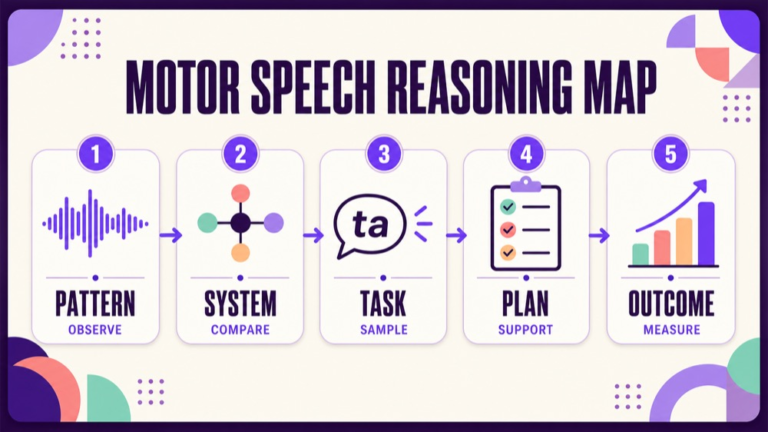
Use a five-field map for motor-speech questions: speech pattern, subsystem, task evidence, plan, and outcome. Start with what was observed, identify the system involved, select the task that reduces uncertainty, choose the stage-appropriate action, and define the communication condition in which change will be checked.
| Map field | Prompt | Example review note |
|---|---|---|
| Speech pattern | What behavior is described? | Errors vary as word length increases. |
| Subsystem | Which speech system is implicated? | Articulation and prosody need review. |
| Task evidence | What sample or comparison is missing? | Repeated productions and connected speech. |
| Plan | What assessment, support, or referral fits? | Gather converging evidence before interpreting. |
| Outcome | How will the communication result be observed? | Message access with a familiar partner. |
The map prevents a pattern label from becoming the whole answer. If the case lacks consistency data, the plan may be repeated comparable productions. If the goal is functional participation, the outcome should include a partner, task, or setting rather than a clinic score alone.
Change one field for transfer practice. Keep the speech pattern stable but change the language, task complexity, partner, or communication mode. Then explain which evidence or outcome condition must change. This tests whether the rationale survives a new case.
Use a motor-speech systems review board
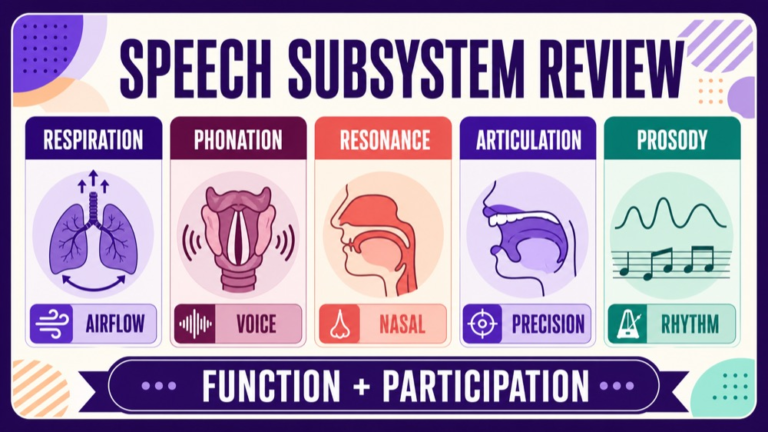
A review board separates the speech subsystems from the differential question and the functional result. Put respiration, phonation, resonance, articulation, and prosody in the first columns, then add task, participation, decision stage, and measure. This structure helps when a stem includes several motor-speech clues.
| Board column | Write | Check |
|---|---|---|
| Respiration | Breath support, phrasing, coordination, and endurance | What demand was present? |
| Phonation | Loudness, quality, pitch, onset, and stability | What did the voice contribute? |
| Resonance | Oral or nasal balance and vocal-tract shaping | What sound pattern was heard? |
| Articulation | Precision, consistency, range, and intelligibility | Which task changed performance? |
| Prosody | Rate, stress, rhythm, pauses, and intonation | How did the message sound? |
| Decision | Assess, differentiate, refer, plan, or monitor | What did the item ask? |
| Outcome | Speech plus participation under a defined condition | How will change be checked? |
Use the board after a mixed question set. Group misses by subsystem description, dysarthria reasoning, apraxia reasoning, language distinction, assessment sequence, functional planning, or outcome evaluation. The group with the most misses becomes the next targeted study block.
Keep the board in your own words. It is a reasoning tool, not a place to copy flashcards, screenshots, or protected question-bank material. A concise pattern-subsystem-task summary is enough to create an original transfer item.
Question 1: subsystem assessment
Question 1: An adult with a neurologic history has reduced loudness, imprecise consonants, and short phrases during conversation. The practice item asks which assessment approach would best clarify the speech pattern and its communication effect. Which option fits the question?
- A. Measure one isolated vowel and use it as the complete motor-speech profile.
- B. Sample relevant speech tasks while examining respiration, phonation, articulation, prosody, intelligibility, and functional communication context.
- C. Assign a language-only worksheet because reduced loudness cannot affect message access.
- D. Choose a treatment drill before checking the speech subsystems or the person’s priorities.
Correct Answer: B. The stem includes clues across phonation, articulation, phrasing, and conversation. A broader task-based assessment can clarify the subsystem pattern and connect it to intelligibility and communication participation without treating one measure as the whole answer.
Why the Other Options Are Wrong: A narrows a multidimensional pattern to one vowel. C ignores the speech-production and functional clues. D moves to treatment before the evidence and priorities are sufficiently described.
Exam Trap: When a stem supplies several subsystem clues, choose an assessment plan that samples their interaction and the real communication task rather than one isolated observation.
Question 2: dysarthria and apraxia reasoning
Question 2: A speaker produces different consonant errors across repeated attempts and shows visible searching movements on longer words. The practice item asks what information would most help the clinician interpret the pattern. Which next step is most appropriate?
- A. Label the disorder from one long-word attempt without comparing tasks.
- B. Compare repeated productions across controlled and connected tasks, noting consistency, sequencing, prosody, cueing response, and other speech or language findings.
- C. Attribute every error to weakness without examining movement, consistency, or task effects.
- D. Ignore the searching movements because only the final consonant accuracy can be interpreted.
Correct Answer: B. Inconsistent errors, searching movements, and length effects raise a motor-planning question, but the pattern needs task-based evidence and comparison with other findings. Repeated and connected samples can add information about consistency, sequencing, prosody, and response to support.
Why the Other Options Are Wrong: A makes a broad conclusion from one attempt. C assumes an execution explanation without checking the evidence. D discards a relevant observation and reduces the question to one accuracy score.
Exam Trap: A feature that suggests apraxia is not the same as a complete differential conclusion. Look for the answer that gathers comparable evidence across tasks and domains.
Question 3: functional motor-speech planning
Question 3: A client wants familiar conversation partners to understand short messages during family meals. Assessment shows reduced intelligibility when background noise increases, and the client prefers to use speech with supportive multimodal cues. Which planning choice best matches the stated goal?
- A. Set a clinic-only articulation score as the sole outcome and omit the meal context.
- B. Practice message production and repair in graded meal-like conditions while monitoring intelligibility, partner access, and the client’s preferred support.
- C. Replace speech with a communication mode the clinician prefers without discussing the client’s choice.
- D. Require a single speech rate target even when it reduces the client’s ability to share the message.
Correct Answer: B. The plan preserves the client’s stated communication mode while using the relevant noise and partner context. It also defines an outcome that includes message access and repair, not just a clinic accuracy score.
Why the Other Options Are Wrong: A omits the real participation condition. C removes the client’s choice from planning. D treats one rate variable as more important than the person’s ability to communicate the message in the setting that matters.
Exam Trap: A motor-speech plan should connect the exercise, support, partner, setting, and outcome. A technically neat drill is not a functional plan unless it serves the stated communication goal.
Review common motor-speech distractors
Motor-speech distractors often place a true observation in the wrong domain or make a broad conclusion from one task. An imprecise consonant can attract an articulation-only answer even when the stem describes weakness, prosody, and intelligibility. An inconsistent error can attract a label without the repeated evidence needed to interpret it.
| Distractor pattern | Why it attracts attention | Review test |
|---|---|---|
| One-task diagnosis | The example is vivid | What changes across comparable tasks? |
| Subsystem shortcut | The label is easy to recall | Which other systems and functions are involved? |
| Language substitution | Words are part of the message | Is the clue formulation or speech production? |
| Technique too early | The drill sounds practical | Are assessment and priorities established? |
| Clinic-only outcome | The score is simple to collect | What partner and setting matter? |
Write the closest distractor mismatch in one sentence. It may confuse execution with planning, language with motor speech, speech sound with subsystem interaction, or a medical boundary with an SLP treatment choice. Specific mismatch language turns a missed item into a reusable rule.
Use the final action word as the last filter. If the item asks what evidence is missing, do not choose the most familiar exercise. If it asks for an outcome, include the activity and communication condition that make the result meaningful.
Build a motor-speech practice block
Use a small block that mixes subsystem identification, dysarthria patterns, apraxia patterns, differential reasoning, assessment, functional planning, and evaluation. Include speech tasks that vary in length, complexity, context, partner, and support when the question supports those comparisons.
| Block part | Example prompt | Review product |
|---|---|---|
| Subsystem | What system contributes to the described pattern? | Speech-systems note |
| Consistency | What changes across repeated attempts? | Comparison plan |
| Task | What sample would reduce uncertainty? | Assessment choice |
| Differential | Which explanation is supported and what is missing? | Boundary statement |
| Function | Who needs access to which message? | Participation goal |
| Outcome | How will speech or access be monitored? | Measure and condition |
Keep the block small enough to review eight to fifteen questions carefully. For each item, record the requested action, the decisive speech clue, the missing evidence, the closest distractor, and the functional consequence. This reveals the source of a miss more clearly than a percentage alone.
Create one changed-context prompt after the block. Change the speaking partner, language, word length, background noise, communication mode, or cueing support and explain which evidence or outcome field should change.
Track reasoning and confidence
A motor-speech tracker should include the source, date, question task, original answer, confidence, speech pattern, subsystem, task condition, differential boundary, closest distractor, and next action. These fields show whether the miss came from noticing the clue, separating domains, selecting evidence, or planning the outcome.
| Tracker field | Prompt | Example |
|---|---|---|
| Requested action | What did the item ask me to do? | Choose a task that adds evidence. |
| Speech pattern | What was observed? | Errors vary as length increases. |
| Subsystem | Which systems may contribute? | Articulation and prosody. |
| Task condition | When did performance change? | Connected speech with noise. |
| Boundary | What is not established by the sample? | Cause requires broader evidence. |
| Next action | What will I practice? | Compare planning and execution clues. |
Review high-confidence misses and low-confidence correct answers. A correct letter without a rationale may reflect recognition, while a confident miss may reveal a domain distinction that needs to be rebuilt from the case and responsible source.
Use the ASHA Practice Portal when a motor-speech concept needs clarification and use the live ETS page for exam details that can change. The tracker supports preparation; it does not replace individualized assessment or qualified professional judgment.
Motor speech disorders Praxis practice questions checklist
Use this checklist for each small motor-speech practice set.
- I identified whether the item asked for a pattern, screening, assessment, differential reasoning, referral, treatment planning, or monitoring.
- I separated motor execution, motor planning or programming, language, speech sound, voice, and participation clues.
- I organized respiration, phonation, resonance, articulation, prosody, intelligibility, and task evidence.
- I checked onset, neurologic context, fatigue, consistency, length effects, cueing response, and connected speech.
- I selected evidence that matches the uncertainty instead of choosing every possible procedure.
- I recognized when language, cognition, hearing, swallowing, or other collaboration may be relevant.
- I kept dysarthria and apraxia reasoning tied to patterns across tasks rather than one salient sign.
- I considered language, dialect, cultural context, communication mode, and the person’s preferred outcomes.
- I connected the plan to the partner, setting, message, support, and participation goal.
- I explained why the selected answer fits the clinical stage and evidence.
- I named the closest distractor and its specific mismatch.
- I wrote the rationale in my own words without copying protected source material.
- I created one changed-context transfer prompt.
- I specified a speech or participation outcome and the condition under which it will be checked.
The checklist keeps motor-speech questions connected to systems, evidence, boundaries, and function. The goal is not to assign a broad explanation from one error or score. The goal is to explain what the case supports, what remains uncertain, what action fits, and how the result will be evaluated.
Sources and next steps
Use the ASHA Dysarthria in Adults Practice Portal for speech-subsystem assessment, differential reasoning, collaboration, treatment planning, and functional communication outcomes. Use the ASHA Acquired Apraxia of Speech Practice Portal for speech-motor planning and programming assessment and treatment framing.
Use the ASHA Speech-Language Pathology Exam 5331 Content page to map motor-speech, voice, resonance, assessment, and treatment questions to broad exam areas. Use the live ETS Speech-Language Pathology 5331 page for current exam identity and administration information.
Use the ETS practice-test selector for current preparation options and read each resource’s access terms. For a structured preparation path, see the SLP Study Center Complete Prep resource. On your next study block, answer a small mixed motor-speech set, build three pattern-subsystem-task cards, and write one transfer question with a functional outcome condition.