Language disorders Praxis practice questions become more useful when each answer is tied to a language dimension, an evidence source, a functional context, and a next clinical decision. Instead of memorizing a list of terms, ask whether the item is testing comprehension, expression, language form, meaning, use, assessment selection, intervention planning, or outcome monitoring.
ASHA’s Speech-Language Pathology (5331) content page includes receptive and expressive language in both assessment and treatment topics. ASHA’s Spoken Language Disorders Practice Portal supplies a professional frame for language assessment, intervention, collaboration, and culturally responsive service delivery. Use the live ETS and ASHA pages for changing exam or professional information, and use the original review system below to organize practice.
What language-disorder questions are testing
A language item may ask you to identify the skill, choose an assessment procedure, interpret a case, prioritize an intervention, or select an outcome measure. The topic label is only the doorway. The final request tells you whether the item wants information, interpretation, a goal, an activity, or an evaluation step.
| Question task | What to locate | Review output |
|---|---|---|
| Identify a skill | Comprehension, expression, form, meaning, or use | Language-dimension note |
| Choose assessment | Missing evidence and appropriate data source | Next information step |
| Interpret performance | Pattern across tasks and contexts | Evidence-based statement |
| Plan treatment | Functional goal and support level | Goal or activity rationale |
| Evaluate progress | Measure, setting, and return point | Monitoring plan |
Start the review by writing the requested action in your own words. If the item asks what should be assessed next, an intervention activity may be reasonable later but still fail the current task. If the item asks for a functional goal, a test label alone may not answer the question.
Use the evidence supplied by the case. A score, a language sample, a caregiver report, a classroom observation, and a response to support each answer a different question. Do not give one data source more authority than the item makes relevant.
Anchor review to the ASHA 5331 scope
ASHA’s 5331 content page organizes the exam into foundations and professional practice, screening assessment evaluation and diagnosis, and planning implementation and evaluation of treatment. Receptive and expressive language appear within assessment procedures and treatment topics, while a case may also involve development, etiology, documentation, collaboration, or culturally responsive service delivery.
| 5331 lens | Language question example | Study tag |
|---|---|---|
| Foundations | Typical language performance or communication factors | Knowledge and context |
| Assessment | What language evidence should be gathered? | Data source and sequence |
| Diagnosis | What interpretation is supported? | Pattern boundary |
| Treatment planning | What goal or activity fits the need? | Function and implementation |
| Treatment evaluation | How should progress be monitored? | Measure and outcome |
Use the live ASHA and ETS pages for current content and administration information. A practice resource may use different headings, so map its label to the broad lens in your tracker. The map helps you see whether a miss came from language knowledge, assessment sequence, functional reasoning, or treatment evaluation.
Do not assume that every language question is a vocabulary question. Receptive and expressive language can involve phonology, morphology, syntax, semantics, pragmatics, and communication across listening and speaking. Read the case for the dimension and requested decision.
Define the language dimension before answering
ASHA describes language as a communication system that can involve comprehension and use across spoken, written, and signed modalities. For the spoken-language questions in this study set, identify whether the case emphasizes understanding, formulation, language form, meaning, social use, or the interaction among them.
- Mark receptive language when the case centers on understanding messages or directions.
- Mark expressive language when the case centers on formulating words, phrases, or narratives.
- Mark morphology or syntax when word endings or sentence structure control the task.
- Mark semantics when vocabulary, concepts, or relationships carry the decision.
- Mark pragmatics when language use changes with a partner, purpose, or context.
- Mark literacy or another modality when the item explicitly expands beyond spoken language.
| Dimension | Question to ask | Example review note |
|---|---|---|
| Receptive | What does the person understand? | Needs support for multi-step directions. |
| Expressive | How does the person formulate language? | Uses short phrases during conversation. |
| Form | How are words and sentences built? | Sentence structure varies by task. |
| Meaning | What concepts or relationships are expressed? | Word knowledge affects explanation. |
| Use | How does language serve the interaction? | Repair is difficult with a partner. |
Keep the dimension connected to the task. A child can show difficulty with several dimensions, but the practice question may ask you to isolate one for assessment or planning. The best review note names the dimension and the evidence that supports it.
Read the task before the language label
Language questions can use broad labels such as language disorder, developmental language, vocabulary, or grammar. Those labels do not replace the final request. Read the action word and then summarize the case in one sentence that includes the goal, context, and stage.
| Action word | Review prompt | Common wrong turn |
|---|---|---|
| Assess | What information is missing? | Choosing an activity too early |
| Identify | What pattern is described? | Adding facts not in the case |
| Prioritize | Which need matters first? | Picking the easiest skill |
| Recommend | What fits the goal and context? | Ignoring setting or partner |
| Monitor | How will progress be checked? | Using a vague outcome |
Record your first answer and confidence before reading the rationale. Then compare the option you chose with the closest distractor. A familiar language term can still appear in an answer that is too early, too broad, or poorly matched to the requested action.
Use the smallest number of case details that changes the decision. That might be phrase length, comprehension under a condition, narrative organization, caregiver concern, classroom demand, or response to a support.
Choose assessment evidence with purpose
An assessment question should be reviewed by asking what uncertainty the next step will reduce. Case history, language sampling, observation, standardized measures, dynamic assessment, hearing information, and collaboration can contribute different kinds of evidence. Choose the source that matches the question and the person’s context.
| Evidence source | Useful question | Review caution |
|---|---|---|
| Case history | What developmental, medical, educational, or language factors matter? | History guides the plan but does not replace direct data. |
| Language sample | How is language used in connected communication? | Consider task, partner, and context. |
| Observation | What happens in a natural activity? | Describe the demand and support. |
| Standardized measure | What skill does the tool sample? | Check appropriateness and interpretation. |
| Dynamic assessment | How does performance respond to teaching or support? | Use it with other evidence. |
| Collaboration | What do caregivers, teachers, or partners observe? | Connect reports to the functional goal. |
When a question asks about phrase length, for example, a connected language sample may provide more relevant information than a task that only measures naming. When a question asks about response to support, a teaching-and-retest format may be more informative than a single score.
Do not turn one assessment tool into a universal answer. The best choice depends on what the stem has already established, what remains unclear, and how the information will be used.
Review receptive language questions
Receptive language questions focus on understanding words, concepts, sentences, directions, narratives, or interactional messages. Look for the level of support, the length or complexity of the input, the response expected, and the context in which understanding matters.
| Receptive clue | Review question | Possible next step |
|---|---|---|
| Single-step versus multi-step | Does complexity change performance? | Sample direction following across levels |
| Vocabulary in context | Does meaning change by topic? | Check comprehension and use in context |
| Story understanding | Can the listener identify key relationships? | Use narrative comprehension prompts |
| Classroom demand | Which instruction features create difficulty? | Observe and modify the task |
| Support response | Does visual or verbal support change access? | Document the support and response |
Separate comprehension from performance on a task that also requires memory, attention, motor response, or a specific cultural experience. The question may ask you to gather more information rather than assign the difficulty to language alone.
Use a review sentence that includes input, response, and context. For example, the learner follows a short direction with visual support but loses the sequence when the instruction includes more steps. That sentence points toward a targeted assessment question.
Review expressive language questions
Expressive language questions focus on how a person selects and organizes words, phrases, sentences, narratives, or messages. Note whether the issue concerns vocabulary, grammar, sentence length, story structure, word retrieval, or communication repair.
| Expressive clue | Review question | Useful evidence |
|---|---|---|
| Phrase length | How long and varied are spontaneous utterances? | Language sample across activities |
| Grammar | Which forms are used or omitted? | Connected speech and elicited probes |
| Vocabulary | Can words be retrieved and used flexibly? | Naming plus contextual use |
| Narrative | Are events and relationships organized? | Story retell or personal narrative |
| Repair | Can the speaker clarify a message? | Conversation with a communication partner |
Phrase length is best reviewed in relation to the task that produced it. A single imitation response does not describe spontaneous language use. A naming score does not settle narrative organization. Match the data source to the claim the question asks you to make.
When the item names a functional goal, include the listener and setting in your review. An expressive language activity should connect to what the person needs to communicate, not only to the form that is easiest to count.
Use language samples and functional context
Language sampling and observation help connect a practice question to communication outside a test page. Record who was speaking, what the task required, what support was available, and whether the person could participate or repair a breakdown. Those fields keep the interpretation grounded.
| Context field | Question to ask | Why it matters |
|---|---|---|
| Partner | Who was listening or responding? | Language demand changes with the partner. |
| Purpose | Why did the person need to communicate? | Connects data to function. |
| Task | What had to be understood or expressed? | Defines the language demand. |
| Support | What cue or visual was available? | Shows response to access. |
| Repair | Could the person clarify or request help? | Shows functional communication. |
| Setting | Where did the sample occur? | Supports transfer planning. |
A language sample can show how skills operate together. A practice answer should still respect the question’s scope. If the item asks for one next assessment step, do not turn the response into a complete diagnostic protocol.
Use a changed-context prompt after review. Keep the language target stable while changing the partner, activity, topic, or support. Then ask which evidence or goal would need to be updated.
Consider multilingual and dialect context
A language difference is not the same as a disorder. ASHA’s Spoken Language Disorders Practice Portal points clinicians toward culturally responsive service delivery, collaboration, and attention to the languages used by the person. In a practice question, look for language exposure, dialect, interpreter or cultural broker needs, assessment language, and functional impact.
| Context clue | Review question | Responsible study note |
|---|---|---|
| Home language | Which language systems are used? | Gather relevant language history. |
| Dialect | Is the feature expected in the dialect? | Do not treat difference as sufficient evidence. |
| Assessment language | Does the tool sample the person’s skills fairly? | Check validity and access. |
| Partner support | Who can contribute accurate communication information? | Plan collaboration or interpretation. |
| Functional concern | What participation outcome is affected? | Keep the goal person-centered. |
Do not infer a broad language disorder from performance in one unfamiliar language without the context the case requires. The best answer may be to gather information across languages, collaborate with an appropriately qualified partner, or use a procedure that helps distinguish language difference from disorder.
For exam review, write the boundary rather than a slogan: interpret language performance in the relevant linguistic and functional context, then choose assessment or support that fits the evidence.
Map a language question from evidence to plan
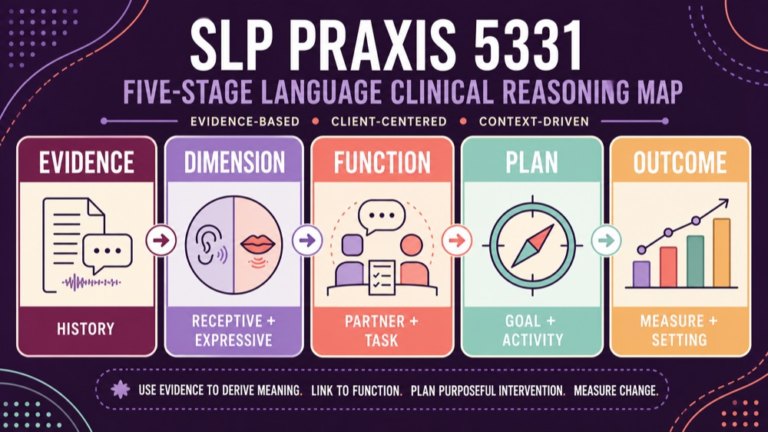
Use a five-field map for language questions: evidence, language dimension, function, plan, and outcome. Start with what the person understands or expresses, identify the dimension involved, connect it to the communication demand, select the next action, and decide how progress will be monitored.
| Map field | Prompt | Example note |
|---|---|---|
| Evidence | What data does the case provide? | Directions are missed as steps increase. |
| Dimension | What language process is involved? | Receptive understanding of sequence. |
| Function | Where does the difficulty matter? | Classroom routines and home tasks. |
| Plan | What step fits the question and stage? | Sample comprehension under varied demands. |
| Outcome | How will the change be checked? | Independent response in a relevant activity. |
The map prevents a vocabulary label from becoming the whole answer. If the case lacks context, the plan may be additional assessment. If the goal is functional participation, the outcome should include an activity or partner that reflects that goal.
Change one meaningful detail for transfer practice. Change the language, partner, task complexity, or support, then state which map field changes and why. This is a concise way to practice clinical reasoning without copying a question source.
Use a receptive-expressive review board
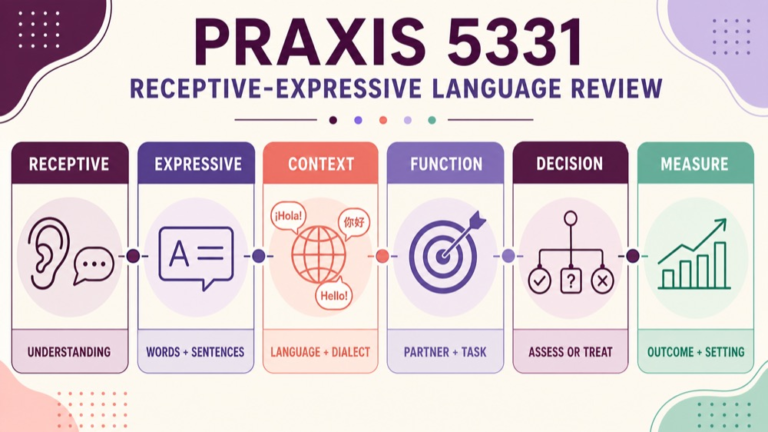
A review board separates what the case says from what you infer and what you plan. Put receptive evidence and expressive evidence in the first columns, add context and function, then choose a decision and a measure. This structure is useful when a question includes more than one language behavior.
| Board column | Write | Check |
|---|---|---|
| Receptive | Understanding of words, concepts, sentences, or directions | What input and support were present? |
| Expressive | Words, phrases, grammar, narratives, or repair | What communication output was required? |
| Context | Language, dialect, partner, task, and setting | Is the interpretation fair and relevant? |
| Function | Participation goal and communication consequence | What matters to the person? |
| Decision | Assessment, goal, intervention, or outcome | Does it answer the final request? |
| Measure | Observable result and return condition | How will progress be checked? |
Use the board after a mixed practice block. Group misses by dimension, evidence source, context, treatment planning, or evaluation. Then select one repair group for the next study session.
Keep the board in your own words and do not reproduce protected question text or screenshots. A paraphrased case, a language dimension, an evidence note, and an original transfer prompt are enough for active review.
Question 1: assessment and phrase length
Question 1: A child uses short spontaneous utterances during play, but the practice set provides no information about connected language outside a naming task. The item asks which procedure would best add information about phrase length in functional language use.
- A. Complete only a divergent naming task with pictured objects.
- B. Collect and analyze a language sample during an appropriate connected communication activity.
- C. Use an isolated speech-sound imitation task as the primary language measure.
- D. Choose a treatment activity before gathering more expressive-language data.
Correct Answer: B. A connected language sample can show the length and variety of spontaneous utterances in context. The review should still record the activity, partner, supports, and analysis method because those details affect interpretation.
Why the Other Options Are Wrong: A may sample naming but does not directly answer the question about spontaneous phrase length. C targets a different domain. D moves to treatment before the missing expressive-language evidence is gathered.
Exam Trap: A task that produces words is not automatically a measure of connected language. Match the procedure to the language behavior named in the question.
Question 2: functional treatment planning
Question 2: A student follows classroom directions when a visual checklist is available but misses the sequence during a routine without the checklist. The stated goal is more independent participation in classroom routines. Which review action best fits?
- A. Remove the classroom goal and practice unrelated single-word naming.
- B. Plan graded practice of the direction sequence in relevant routines while monitoring support and independence.
- C. Conclude that the student cannot understand directions in any setting.
- D. Measure only vocabulary size because all direction-following problems are vocabulary problems.
Correct Answer: B. The case shows a difference between supported and less-supported performance in a functional context. A graded plan can preserve access while examining whether independent participation increases.
Why the Other Options Are Wrong: A removes the stated functional goal. C generalizes from one condition to every setting. D narrows the problem to vocabulary without evidence. The best option connects activity, support, and outcome to the classroom routine.
Exam Trap: A support can reveal access needs rather than settle the underlying interpretation. Review what changes when the support is present and how the goal is defined.
Question 3: multilingual assessment context
Question 3: A multilingual child uses fewer English words in a school sample than expected by a monolingual comparison, but the case gives no information about the child’s home language, exposure, or communication in that language. Which next step is most responsible?
- A. Label a language disorder from the English sample alone.
- B. Gather language history and appropriate information across the child’s communication systems, using qualified collaboration when needed.
- C. Treat the English vocabulary count as a complete measure of overall language ability.
- D. Skip assessment because multilingual children cannot have language needs.
Correct Answer: B. The case lacks linguistic and functional context needed for fair interpretation. Gathering relevant history and information across the child’s communication systems supports a more responsible assessment decision.
Why the Other Options Are Wrong: A and C treat one language sample as a complete picture. D makes an unsupported conclusion in the opposite direction. The best response adds context and collaboration before interpretation.
Exam Trap: A difference from a monolingual comparison is not enough by itself. Check language exposure, dialect, assessment access, and functional communication before assigning a disorder interpretation.
Review common language-question distractors
Language distractors often use a real term in the wrong task, context, or stage. A naming task may be relevant to vocabulary but not to spontaneous phrase length. A grammar activity may be useful but not the answer when the question asks for receptive comprehension. A functional support may help access without settling the diagnosis.
| Distractor pattern | Why it attracts attention | Review test |
|---|---|---|
| Familiar assessment | The tool name is easy to recall | Does it sample the requested skill? |
| Single-language shortcut | The score looks concrete | What language context is missing? |
| Premature treatment | The activity sounds practical | Has the assessment question been answered? |
| Broad conclusion | It simplifies a complex case | What evidence limits the claim? |
| Vague goal | It sounds supportive | What person, task, and outcome are named? |
Write the closest distractor mismatch in one sentence. The option is weaker because it measures naming instead of connected language, ignores the learner’s linguistic context, or chooses an activity without defining the functional outcome. Specific language turns a missed item into a reusable rule.
Use the final request as the last filter. If the question asks what should be assessed, do not choose a treatment activity just because it might be useful later.
Build a language practice block
Use a small block that mixes language dimensions and question tasks. Include receptive, expressive, form, meaning, use, assessment, treatment planning, and outcome monitoring when the resource provides those categories. Review every item with the evidence-to-plan map.
| Block part | Example question | Review product |
|---|---|---|
| Receptive | What input or support changes understanding? | Evidence and context note |
| Expressive | What data show language formulation? | Sample choice |
| Form | Which grammar feature is described? | Dimension and example |
| Meaning | How does vocabulary affect the task? | Functional connection |
| Use | What communication purpose matters? | Partner and setting |
| Plan | What activity fits the goal and stage? | Goal and measure |
Keep the block small enough to review eight to fifteen questions carefully. A short set with clear rationales can reveal whether the problem is language knowledge, evidence selection, context, treatment sequencing, or outcome definition.
Create one changed-case prompt after the block. Change the partner, language, setting, support, or task complexity and explain which answer field changes. This supports transfer beyond the original wording.
Track reasoning and confidence
A language-question tracker should include the source, date, original answer, confidence, requested action, language dimension, evidence, closest distractor, and next step. These fields make a score more interpretable and help you choose a targeted study block.
| Tracker field | Prompt | Example |
|---|---|---|
| Task | What did the item ask me to do? | Choose the next assessment procedure. |
| Dimension | What language process is central? | Expressive phrase length. |
| Evidence | Which clue controls? | Spontaneous language is not sampled. |
| Confidence | How certain was I before feedback? | Low, two choices remained. |
| Distractor | Why was the nearest choice weaker? | It measured naming instead of connected use. |
| Next action | What will I practice? | Three assessment-source comparisons. |
Review high-confidence misses and low-confidence correct answers. A correct letter without a rationale may reflect recognition, while a confident miss may reveal a language rule that needs to be rebuilt from the case evidence.
Use ASHA’s Practice Portal as a professional reference point when a clinical concept is unclear, and keep individual case decisions tied to the information supplied. The practice card teaches reasoning; it does not replace appropriate professional judgment.
Language disorders Praxis practice questions checklist
Use this checklist for each small language-disorders practice set.
- I identified whether the item asked for assessment, interpretation, treatment, or monitoring.
- I mapped the case to a 5331 lens and noted the language dimension.
- I separated receptive, expressive, form, meaning, and use clues when relevant.
- I recorded the evidence source: history, sample, observation, measure, dynamic response, or collaboration.
- I connected the language behavior to a partner, task, setting, or participation goal.
- I considered language exposure, dialect, assessment language, and qualified collaboration.
- I explained why the best option fits the stage and the stated request.
- I named the closest distractor and its specific mismatch.
- I wrote the rationale in my own words without copying protected source material.
- I reviewed high-confidence misses and low-confidence correct answers.
- I created one changed-context transfer prompt.
- I specified an observable outcome and return condition.
- I used clear, compressed images and lazy loading on the study page.
- I rechecked changing exam and professional information with the responsible source.
The checklist keeps language questions connected to evidence and function. Your goal is not to assign a broad label from one phrase or score. Your goal is to explain what the case supports, what information is missing, what action fits, and how the result would be checked.
Sources and next steps
Use the ASHA Speech-Language Pathology Exam (5331) Content page for the current content categories and receptive and expressive language topics. Use the ASHA Spoken Language Disorders Practice Portal and Language in Brief for professional language dimensions, assessment, intervention, collaboration, and culturally responsive context.
Use the live ETS Speech-Language Pathology (5331) page for current exam identity, format, duration, question count, and changing test information. Use the ETS practice-test selector to identify current preparation options and read each resource’s access terms.
For a structured preparation path, see the SLP Study Center Complete Prep resource. On your next study block, choose one language dimension, complete a small mixed set, build three evidence-to-plan cards, and test one changed context.