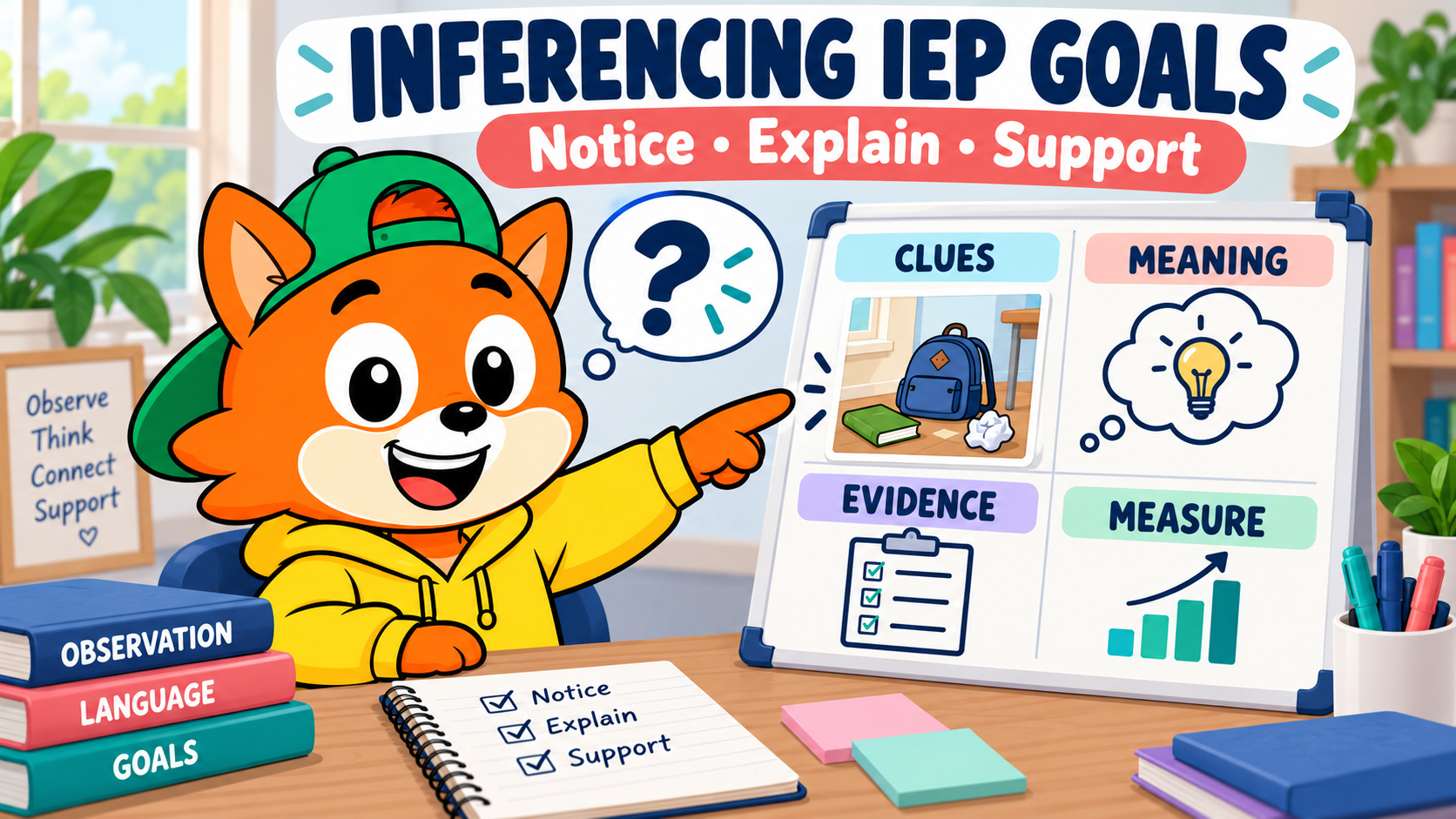
Inferencing goals IEP teams write are strongest when they describe what the learner will do with available clues, communication supports, and a meaningful context. “Improve inferencing” is a useful area of need, but it does not tell the team what the learner will observe, explain, communicate, or transfer to a classroom activity.
This guide explains how to make inferencing goals more observable and functional, how to choose clues and supports, and how to review progress across stories, pictures, conversations, and academic routines. Goal language should be individualized by the qualified SLP and IEP team. The ASHA Practice Portal overview for spoken language disorders offers broader context for functional, individualized, and culturally responsive language planning.
Table of Contents
- What an inferencing goal should describe
- Separate clue noticing from explanation
- Write the condition, response, and support
- Teach a flexible inference routine
- Collect data across contexts and communication modes
- Review transfer and revise the goal
- Frequently asked questions
What an Inferencing Goal Should Describe
An inference connects available information with a reasonable interpretation. The learner may use a picture clue to predict what will happen, combine a character’s action with a feeling, identify an unstated cause, interpret a short conversation, or explain what evidence supports an answer. The exact goal depends on the learner’s communication purpose and the contexts where inferencing matters.
A useful goal description makes several parts visible:
- the type of text, picture, event, or conversation;
- the clue or evidence the learner can use;
- the inference or interpretation to be communicated;
- the response mode, such as speech, AAC, writing, sign, or gesture;
- the level and type of support available; and
- the setting or partner where the skill should be useful.
The goal does not need to predict every possible story. It should identify a repeatable class of opportunities. For example, the team might target explaining a likely feeling from an action and context, predicting a next event from two visual clues, or answering a why question with one relevant piece of evidence.
Avoid making the goal depend on a single worksheet or one fixed answer. A learner can make a reasonable inference with different wording, response modes, or culturally familiar examples. Score the relationship between clue, interpretation, and explanation rather than the adult’s preferred sentence.
Separate Clue Noticing From Explanation
Inferencing often feels difficult because several steps are bundled together. First the learner needs to notice or access relevant information. Next the learner connects the clue to prior knowledge or context. Finally the learner communicates a plausible interpretation and, when appropriate, explains the evidence.
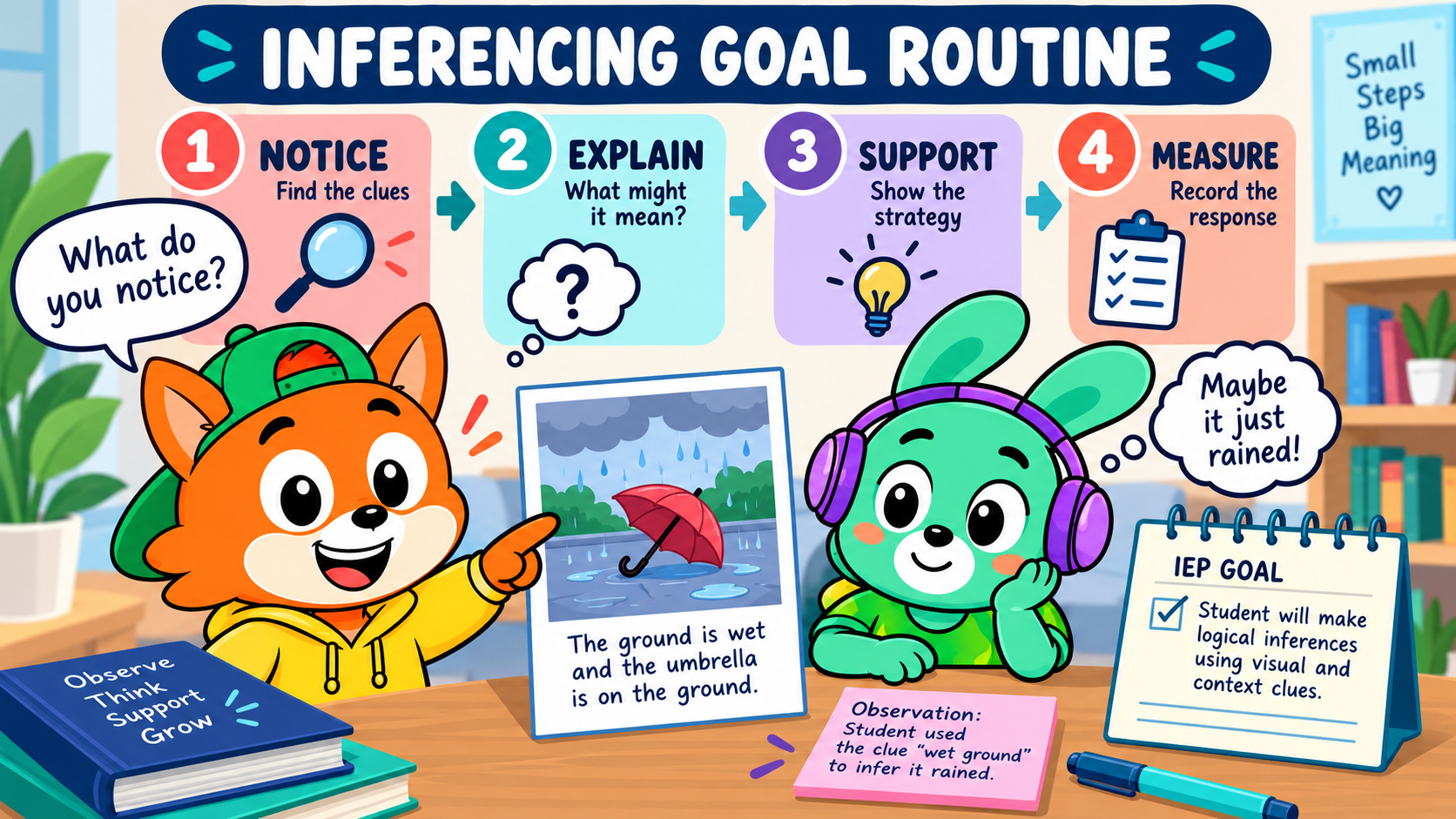
Teach and observe the steps separately when needed:
- Notice: What people, actions, objects, words, or changes are present?
- Connect: What does the clue relate to from the story, conversation, or routine?
- Interpret: What might be happening, feeling, intending, or happening next?
- Explain: Which clue supports that interpretation?
- Repair or revise: What could change the answer if new information appears?
Separating these steps helps the team identify the actual barrier. A learner may notice the clue but need a response route. Another may give a plausible answer but not explain the evidence. A third may explain a picture but struggle when a peer’s perspective or unfamiliar context is introduced.
Use language that keeps the inference open when the evidence allows more than one interpretation. Words such as might, could, probably, and because can support reasoning without implying that every picture has only one acceptable answer. Teach the learner to revise when a new clue changes the situation.
Write the Condition, Response, and Support
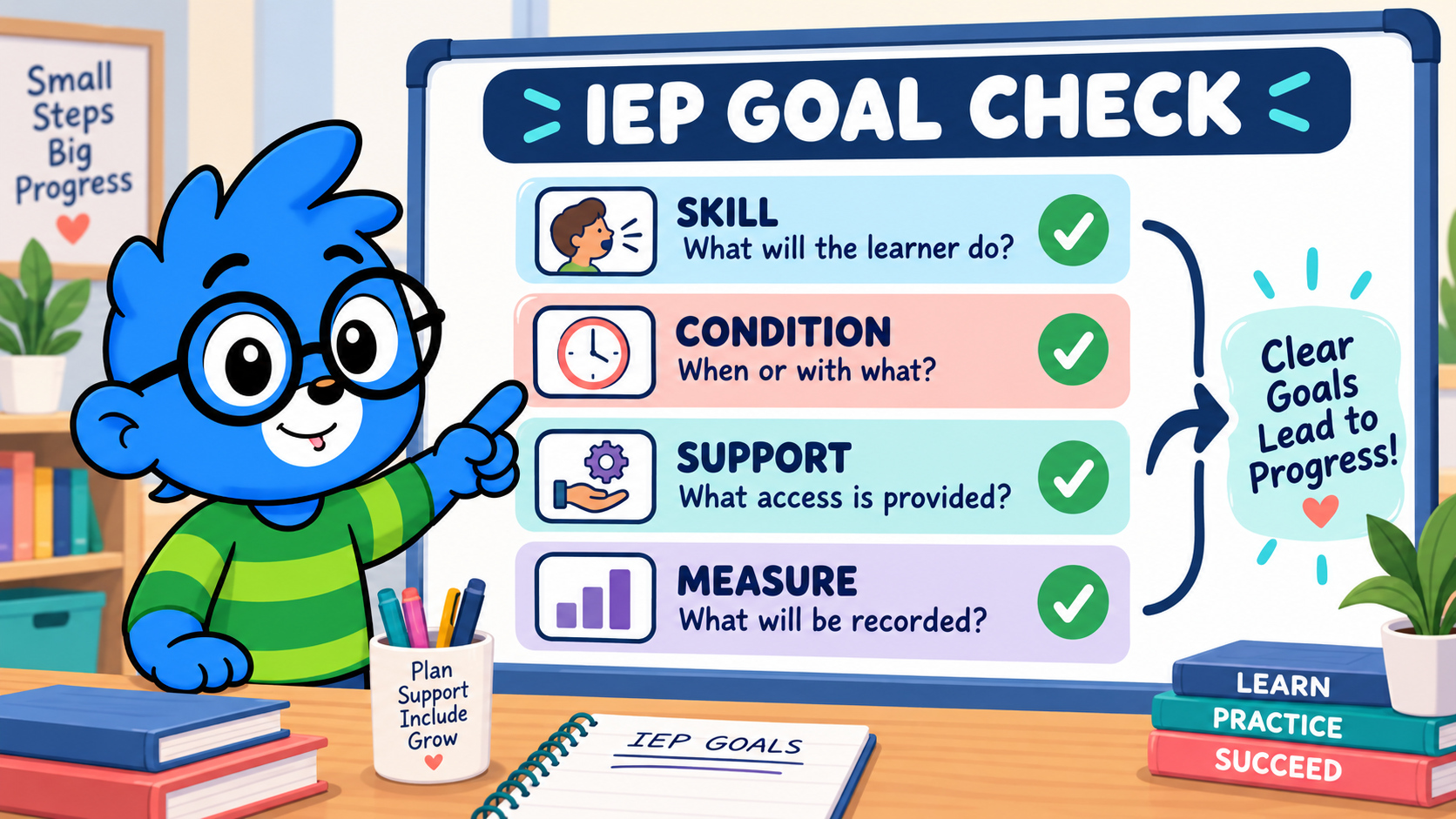
An IEP goal becomes more useful when the condition clarifies what the learner will have access to and what the team will observe. The condition may include a picture scene, short narrative, classroom discussion, social situation, video clip, or functional event. It can also name the number or type of clues available without limiting the learner to a narrow script.
Describe the response in observable terms. Examples include identifying a likely feeling and one clue, predicting a next event and explaining why, answering an unstated cause question with evidence, or revising an interpretation after a partner adds information. Include the response mode that gives the learner access to the communication purpose.
Describe support honestly. A visual story frame, highlighted clue, choice of two interpretations, partner model, wait time, AAC vocabulary, or verbal prompt can be part of the condition. If the goal is to monitor a change in support, define the starting support and what variation will be tested. Do not hide access supports in the data record.
A planning frame can include:
- When: after hearing, seeing, or participating in a defined event;
- Given: relevant clues, access supports, and a communication partner;
- The learner will: communicate the inference and evidence in an available mode;
- Measured by: a defined response, explanation, revision, or participation behavior; and
- Across: selected stories, routines, partners, settings, or levels of support.
This frame is not a replacement for the team’s required IEP format. It is a way to check whether the goal tells another adult what to present, what to observe, and how the result will inform instruction.
Teach a Flexible Inference Routine
A predictable routine can make reasoning visible without turning inferencing into answer guessing. Use the same broad steps across a picture, story, conversation, or classroom event, then change the content and partner as the learner gains control.
Notice the clue. Point to or describe the relevant information. If the learner uses AAC or visual supports, make the clue and needed vocabulary accessible before asking for an inference.
Name the question. Clarify whether the learner is predicting, explaining a cause, interpreting a feeling, identifying a perspective, or deciding what someone might do next. Different questions can require different evidence.
Make a possible meaning. Offer time for the learner to communicate an interpretation. Accept a word, phrase, symbol sequence, sign, gesture, drawing, written response, or combination when it conveys the intended relationship.
Connect the evidence. Invite the learner to show or state the clue that supports the answer. A visual arrow, highlighted detail, or sentence frame may help, but do not require a single sentence form when the reasoning is clear through another mode.
Check and revise. Add a new clue, ask what might change, or let the partner respond. The learner can confirm, revise, add a detail, or explain that more information is needed.
Prompt from least to more support. Start with wait time and a visual clue, then add a choice, a short model, or a direct question when needed. Track the prompt so the team can decide whether to keep the support as access, vary it for transfer, or fade one part while preserving the communication route.
Collect Data Across Contexts and Communication Modes
Data should answer what the learner can infer under the recorded condition. Note the type of inference, the clues available, the response mode, the support, the partner, and whether the explanation was connected to the evidence. A percentage without those details can hide a change in task demand.
Possible data fields include:
- inference type and communication purpose;
- clue or evidence available;
- interpretation communicated;
- explanation or evidence link;
- response mode and access support;
- prompt level and wait time;
- partner, setting, and text or activity type; and
- whether the learner revised, repaired, or transferred the skill.
Count opportunities only when the response rule is defined. “Four of five” means something different for four identical pictures than for five new classroom situations. Include a brief note when the learner makes a meaningful inference that does not fit a narrow trial format, such as interpreting a peer’s intention or predicting a change in a familiar routine.
Respect multimodal and multilingual communication. A learner may reason in one language and communicate the explanation through another, or use a combination of speech, AAC, gesture, and writing. The team should interpret the inference and evidence relationship rather than treating grammar, accent, or one output mode as the whole construct.
Review Transfer and Revise the Goal
Review the goal across more than one task when the learner has enough access to show the skill. Start with a familiar context, then vary one condition: new picture, different story, new partner, less visual support, classroom routine, or functional conversation. This helps the team see whether the learner is learning a reasoning pattern or memorizing one response.
If the learner notices clues but gives unrelated interpretations, return to connecting the clue to the question and use a smaller set of choices. If the learner gives a plausible interpretation but cannot explain the evidence, teach an evidence frame and model pointing back to the clue. If the learner explains in therapy but not in class, plan a partner-supported transfer routine rather than rewriting the goal immediately.
Use the end of the review period to decide whether to continue, refine, generalize, or replace the target. A goal may need a different inference type, clearer evidence rule, more accessible response mode, or a setting that better reflects participation. The data should make that decision easier.
Frequently Asked Questions
What is an example of an inferencing goal area?
An example area is communicating a plausible interpretation and one supporting clue after a short story, picture scene, or classroom event. The exact wording should specify the inference type, response mode, support, setting, and measure for the individual learner.
Should an inferencing goal require one correct answer?
Not when the available evidence supports more than one reasonable interpretation. Define what makes a response relevant to the clue and communication purpose, and allow the learner to explain, revise, or request more information.
How can I measure inferencing with AAC or other modes?
Record the inference, evidence link, response mode, access support, and partner response. A complete message may combine AAC selections, speech, gesture, writing, pointing, or a visual choice. Measure reasoning and participation rather than only spoken sentence form.
When should I change an inferencing goal?
Review it when the learner has enough access and repeated opportunities for the data to show a pattern. Change the inference type, support, context, or measure when the current goal no longer answers the team’s planning question or does not reflect the learner’s meaningful participation needs.
Inferencing goals IEP teams develop are most useful when they make the reasoning path visible: notice a clue, connect it to context, communicate a plausible meaning, explain the evidence, and revise when information changes. A clear condition and thoughtful data plan give the team a practical way to support transfer.