Infant communication development is not a single staircase that moves from crying to words in the same way for every child. It is a changing, multimodal process: an infant regulates a state, notices a partner, looks, moves, gestures, vocalizes, takes a turn, responds to meaning, and gradually shows what they want to share or obtain. The important unit is the interaction, not one isolated behavior.
This guide gives caregivers and SLP students a practical way to observe early communication without turning broad developmental patterns into rigid pass-or-fail cutoffs. It explains what to look for across routines, how hearing and multilingual experience affect interpretation, when a concern deserves professional follow-up, and how to apply the concept to a short SLP Praxis study scenario. The current NIDCD developmental resource and ASHA public communication milestones resource are useful starting points, but neither a general article nor one observation can interpret an individual infant by itself.
Table of Contents
- Infant communication development as a multimodal system
- What early communication can look like across routines
- How to observe communication without turning it into a rigid checklist
- Important distinctions and common confusions
- Hearing, multilingual development, and access boundaries
- When to consider professional evaluation
- Short SLP Praxis application
- Common traps in infant communication development
- Quick review
Infant communication development as a multimodal system
Communication begins before an infant uses recognizable words. A cry, change in body movement, shift in gaze, smile, pause, coo, reach, or vocal burst can affect what a caregiver does next. Over repeated interactions, the infant experiences that signals can be noticed, answered, and extended. The caregiver’s response is part of the communication environment, so early development is better understood as a relationship between the infant, the partner, the activity, and the surrounding conditions.
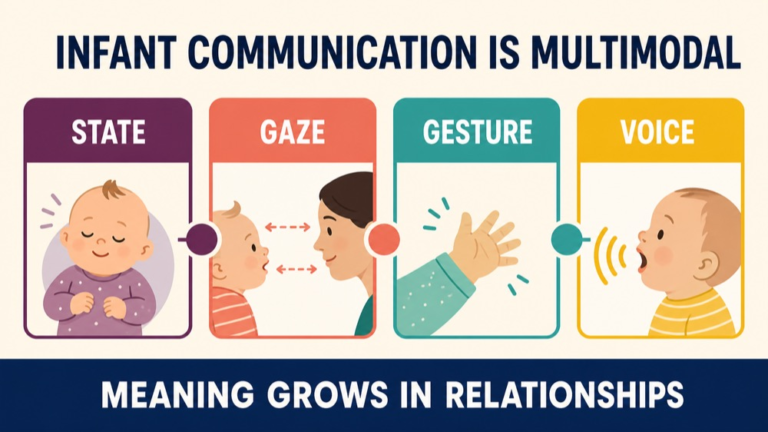
Multimodal means that communication is carried through several channels at once. An infant may look toward a caregiver, lean toward a toy, make a sound, and wait for a response in one short exchange. Another infant may communicate mainly through movement, facial expression, changes in state, or vocal play in that moment. The question is not whether every channel appears on a fixed date; the question is how the infant accesses interaction, responds to a partner, and adds information over time.
| Communication lens | What an observer might notice | What the observation can help you ask | What it does not establish alone |
|---|---|---|---|
| State regulation | Settling, alerting, pausing, or becoming overwhelmed during a routine | Is the infant available for a social exchange right now? | A stable communication profile across all settings |
| Social engagement | Orienting toward a partner, sharing enjoyment, or returning to an interaction | How does the infant participate with another person? | A conclusion about social development from one quiet or active moment |
| Gaze and attention | Looking toward a face, object, movement, or location connected to the activity | What seems to draw attention, and can attention shift with a partner? | A binary measure of social connection |
| Turn-taking | Pausing after a partner speaks or vocalizes, then adding a sound or movement | Does the exchange have a back-and-forth rhythm? | A requirement for identical timing in every interaction |
| Gestures and movement | Reaching, showing, giving, pushing away, waving, or changing body position | Is the infant using the body to direct, protest, request, or share? | A fixed interpretation without knowing the routine and partner response |
| Vocal play | Cooing, babbling-like strings, squeals, raspberries, or changes in pitch and loudness | How does the infant explore sound and use it in an exchange? | Speech clarity, word knowledge, or a diagnosis |
| Understanding and intent | Anticipating a familiar routine, responding to a cue, or repeating a signal for an effect | What meaning might the infant be learning, and what outcome are they seeking? | Complete comprehension or a settled cause from one response |
These lenses overlap. A reach can be movement, request, or an invitation for a partner to act. A pause can reflect turn-taking, fatigue, uncertainty, or processing time. Describe the whole exchange rather than labeling the most visible behavior.
What early communication can look like across routines
Broad developmental resources often organize early observations by approximate periods, but those periods are orientation points rather than deadlines. Communication may appear uneven: a child may vocalize richly during floor play, use fewer sounds when tired, and show strong anticipation during a familiar song. Skills can also emerge in overlapping layers, with regulation, attention, movement, vocal play, and understanding supporting one another.
Consider feeding or holding. An infant may settle when a familiar partner speaks, turn toward a voice, pause during the exchange, or change facial expression when the routine changes. The meaningful question is not whether the infant produced one particular sound. It is whether the infant and partner are building a pattern in which signals, responses, and shared activity influence each other.
During floor play, the infant might look from a toy to a caregiver, vocalize after the caregiver imitates a sound, reach toward an object, or shift body position to continue the activity. A caregiver can respond by pausing, copying the sound or movement, naming the object, and waiting. That response creates another opportunity for the infant to notice the turn and add something new.
During a book, song, or peekaboo routine, the infant may anticipate a repeated part, smile before the familiar action, vocalize when the partner pauses, or move closer when the activity resumes. Emerging understanding can be visible in anticipation and participation before it is visible as spoken language. The routine provides context for interpreting what the infant knows and intends.
Across routines, useful patterns include the following. They should be considered together, with attention to the infant’s state and opportunities rather than used as a checklist that assigns a result.
- The infant has more than one way to signal comfort, interest, protest, or a need for help.
- The infant notices or responds to a partner in at least some familiar activities.
- The infant participates in short exchanges through sound, gaze, movement, facial expression, or gesture.
- The infant’s communication changes when the partner pauses, imitates, offers a choice, or changes the activity.
- The infant shows anticipation or response to familiar people, routines, sounds, or actions.
- The infant gradually adds variation, persistence, or clearer direction to a signal.
- Communication can be observed in more than one setting, partner relationship, or daily routine.
This pattern-based view is more useful than asking whether an infant has checked off a single milestone. It also helps explain why two infants with similar abilities may look different: they may have different temperaments, opportunities, access conditions, languages, routines, or ways of engaging with people.
How to observe communication without turning it into a rigid checklist
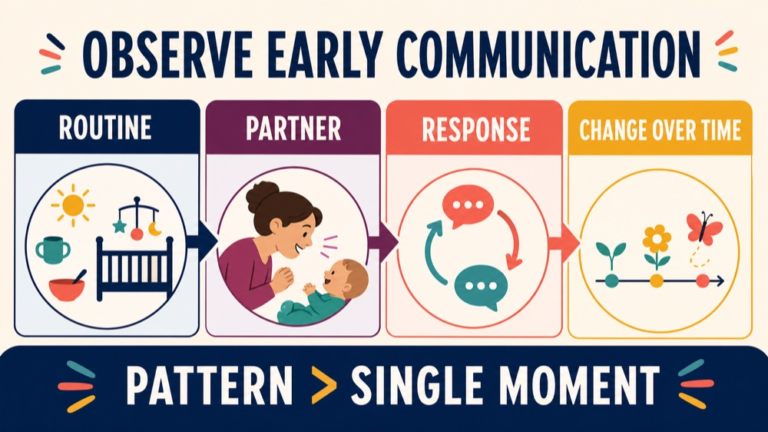
A good observation begins with a real routine, not a performance demand. Choose a short period such as feeding, dressing, play, a song, or looking at a book. Note what happened before the signal, what the infant did, how the partner responded, and what happened next. This sequence protects the observer from treating a behavior as meaningful without its context.
For caregivers, the goal is not to run a home test. For students, the goal is to practice neutral description before interpretation. Instead of writing that an infant was not social, write that the infant looked toward the caregiver twice during floor play, turned away when the room became noisy, and resumed vocalizing after the caregiver moved closer and paused. The second description preserves evidence and uncertainty.
- Name the routine. Record whether the observation occurred during feeding, play, dressing, a song, a book, or another familiar activity.
- Describe the state. Note whether the infant seemed alert, sleepy, hungry, distressed, excited, or settled, because availability can change the exchange.
- Record the partner action. Write down whether the adult spoke, paused, imitated, offered a choice, moved an object, or changed the pace.
- Describe the infant signal. Use observable language such as looked, reached, vocalized, paused, smiled, pushed away, or shifted posture.
- Look for the next turn. Ask whether the partner responded and whether the infant changed, repeated, repaired, or extended the signal.
- Compare opportunities. Consider whether a similar pattern appears with another routine, partner, language, time of day, or noise level.
- Mark what is missing. Separate what was not observed in this short sample from what has not occurred across repeated opportunities.
- Share the pattern. If concern continues, bring concrete observations and questions to the appropriate health or early-intervention professional rather than a conclusion.
Important distinctions and common confusions
Infant communication development is easy to oversimplify because several related behaviors can look similar on the surface. A stronger interpretation separates the behavior from the construct and then asks what evidence would support the next step.
| Common confusion | More precise distinction | Better question |
|---|---|---|
| Quiet means no communication | An infant may communicate through gaze, movement, facial expression, changes in state, or small sounds. | Which modes are available, and in which routines? |
| Looking at a face equals social communication | Gaze is one part of attention and engagement; its meaning depends on timing, partner response, and activity. | Does the infant use attention in a shared exchange or to direct an activity? |
| Babbling equals spoken language | Vocal play shows exploration and exchange, while words involve more stable sound-meaning relationships. | How are sounds changing, and is the infant using them in a purposeful context? |
| Reaching is requesting | Reaching can obtain, explore, share, protest, or move the body toward an object. | What happened before and after the reach, and how did the partner respond? |
| Not waving means not understanding | A gesture may depend on opportunity, imitation, motor planning, culture, and the infant’s interest in the routine. | How does the infant show recognition or participation through other modes? |
| One language sample represents all language | A multilingual infant’s communication should be considered across languages, partners, and meaningful routines. | What does the infant understand and express across the full language environment? |
| One response to sound settles hearing | Response varies with distance, background noise, attention, state, and the nature of the sound. | What hearing information or professional follow-up is still needed? |
Hearing, multilingual development, and access boundaries
Hearing access is part of the communication context. If an infant responds inconsistently to voices or environmental sounds, the observation may be affected by distance, visual attention, background noise, fatigue, or a hearing difference. A single response cannot identify the reason. When hearing is a concern, hearing-focused follow-up with an audiology or health professional is an important part of deciding what information is needed.
Multilingual development adds another boundary: do not judge the infant’s communication by looking at only one language or one speaker. Count communication across the languages and modes used in the family. A child may hear one language from one caregiver, another language from a grandparent, and gestures or vocal play across both. Moving between languages or using a family language in a routine is context to understand, not a reason to remove that language.
For a multilingual observation, ask:
- Which languages does the infant hear, from whom, and in which routines?
- Which communication modes are available across those routines?
- Does the infant respond differently with familiar versus unfamiliar partners?
- Are the concerns present across the language environment or only in one interaction?
- Could the assessment include the family’s meaningful language and a qualified interpreter or bilingual professional when needed?
These questions do not replace assessment. They keep language exposure, partner expectations, hearing access, and opportunity visible. A general milestone chart cannot determine an individual pattern.
When to consider professional evaluation
A caregiver does not need to wait for a perfect checklist pattern before asking a qualified professional how to proceed. At the same time, this article cannot decide whether an individual infant needs a particular service. The useful middle ground is to notice persistent, growing, or meaningful concerns and bring clear observations to the appropriate local health, hearing, or early-intervention pathway.
Examples of concerns worth discussing include a loss of communication behaviors that were previously present, little change in the infant’s ways of signaling over time, repeated difficulty accessing voices or other sounds, limited opportunity for reciprocal exchange across many familiar routines, or difficulty communicating comfort, interest, protest, or help through any available mode. A caregiver’s concern is also relevant information, especially when it is based on repeated observations rather than a single difficult day.
When seeking guidance, ask the professional to clarify the next question rather than asking for a label from one behavior. Depending on the concern and local system, the next step may involve hearing follow-up, developmental history, observation across routines, speech-language evaluation, or coordination with other providers. The pathway should fit the evidence and the infant’s context.
- What communication behaviors have we noticed, and in which routines do they occur?
- What changed, if anything, from the infant’s earlier pattern?
- How does the infant respond to familiar voices, visual cues, gestures, and touch?
- Which languages and communication modes should be included in the history?
- Would a hearing check help clarify access to communication?
- What kind of evaluation is appropriate for the question we are asking?
- What should we observe or record before the next appointment?
Early consultation is a way to gather better information and support participation; it is not an admission that a diagnosis is already known. Evaluation findings should be interpreted with history, hearing, language environment, development, and the family’s priorities in view.
Short SLP Praxis application
For a short SLP Praxis application, treat infant communication as a clinical-reasoning problem rather than a memorization list. Use the current ETS Speech-Language Pathology 5331 page and its current linked materials for exam scope and changing logistics. This article does not state current exam numbers and does not reproduce a test item.
- Identify the construct. Decide whether the scenario emphasizes regulation, hearing access, social engagement, receptive understanding, expressive communication, gesture, or turn-taking.
- Separate observation from inference. Write what the infant did before deciding what it might mean.
- Check context. Consider state, noise, distance, partner behavior, language exposure, and the routine.
- Find the missing evidence. Ask whether the best next step is more observation, hearing information, history, or a communication evaluation.
- Match the answer to the question. Do not select a diagnosis or treatment plan when the stem only supports a cautious next-information decision.
Original study scenario, written for this guide and not from an exam: During a familiar floor-play routine, an infant alternates gaze between a caregiver and a toy, vocalizes after the caregiver pauses, reaches toward the toy, and responds less when the room becomes noisy. The strongest reasoning is to recognize a multimodal pattern, preserve the effect of context, and consider what hearing or broader observation information is still needed. The scenario does not identify a diagnosis, and one noisy-room response should not be treated as a complete developmental conclusion.
Common traps in infant communication development
These traps can affect both caregiver interpretation and exam preparation. Each one replaces a pattern-based question with a shortcut that the evidence does not support.
- Turning an age range into a deadline: broad milestones orient observation but do not create a pass-or-fail date for one infant.
- Making one behavior carry the whole interpretation: a single gaze, sound, reach, or missed gesture needs context and repetition.
- Equating communication with clear speech: early communication includes body movement, attention, facial expression, gesture, and vocal play.
- Ignoring state and environment: sleep, hunger, noise, illness, novelty, and partner pacing can change an interaction.
- Using gaze as a binary test: the timing and function of attention are more informative than a simple present-or-absent judgment.
- Viewing multilingual experience through one language: include the infant’s full language environment and communication modes.
- Jumping to a treatment answer before checking access: hearing, history, context, and evaluation may need attention first.
- Calling a caregiver observation a diagnosis: observations are evidence to share with qualified professionals, not a substitute for evaluation.
The repair is usually simple but disciplined: describe the routine, record the infant’s state, identify the partner response, compare patterns across opportunities, and state what remains unknown. That process produces a better clinical question and a better study answer.
Quick review
Use this checklist to review the concept or to organize a conversation with a supervisor, caregiver, or professional. The goal is to remember the framework while keeping the interpretation appropriately cautious.
- Can I explain why early communication is multimodal rather than speech-only?
- Can I name the roles of state regulation, social engagement, gaze, turn-taking, gesture, vocal play, understanding, and intent?
- Can I describe a concrete interaction without turning my description into a diagnosis?
- Can I distinguish vocal play from a stable word-meaning relationship?
- Can I explain why hearing access, noise, and partner behavior matter?
- Can I describe a multilingual infant across the full language environment rather than one language sample?
- Can I identify a pattern that deserves professional follow-up without imposing a rigid cutoff?
- For an SLP Praxis scenario, can I separate observed evidence, missing information, and the best next decision?
If you want to compare a broader study resource with your own review plan, you can visit the SLP Study Center Complete Prep page and use the current details on that page to decide whether it fits your needs. This article is a clinical learning guide, not an individualized evaluation or a promise about an exam result.
References and source boundaries
The following links were supplied by the research packet or the named source plan. They support the article’s broad teaching boundaries rather than a conclusion about any individual infant.
- NIDCD: Speech and Language Developmental Milestones — early communication, broad development, and hearing context.
- ASHA: Communication Milestones, Birth to 1 Year — public developmental observations and caregiver-facing examples.
- ASHA Evidence Maps — evidence-oriented context for locating current clinical sources.
- ETS Speech-Language Pathology 5331 — current exam scope and logistics entry point for the short application section.
Checked date: the local research packet was timestamped 2026-08-22 and the local queue and workflow contract were reviewed on 2026-08-23. Recheck the linked pages before publication, before a new study cycle, or whenever the relevant developmental, evidence, or exam source changes.