
how many questions are on the slp praxis is a useful planning question, but the answer should be tied to the current ETS listing rather than a permanent memory. At the time this article was checked, the current Speech-Language Pathology Praxis 5331 listing displayed 132 questions and a 150-minute testing time. Treat those details as a current snapshot: ETS can revise test information, and your live account and current test page should be checked before test day.
The count matters because it gives you a frame for pacing, practice sets, and review. It does not tell you which question will be difficult, guarantee a particular score, or replace the current content description. This guide shows how to verify the count, connect it with timing, and use practice evidence to build a calm plan without turning one number into a complete study strategy.
Table of Contents
- The short answer and its boundary
- Read the current ETS test information
- Connect question count with time and format
- Use the count to plan practice
- Review errors instead of chasing a number
- Common question-count mistakes
- Quick question-count review
The Short Answer and Its Boundary
The current ETS listing checked for this guide displayed 132 questions for the Speech-Language Pathology Praxis 5331. Because question counts, time limits, formats, and other test details are administrative information, verify the live listing and account again when you register and before you test. A study article can explain how to use the information, but it should not freeze a changing policy as if it were timeless.
| Fact or planning input | What it helps you do | What it cannot decide |
|---|---|---|
| Displayed question count | Estimate pacing and build representative practice blocks. | Which questions you will see or how hard they will feel. |
| Displayed testing time | Practice reading, deciding, and moving through a timed session. | Your individual score or readiness by itself. |
| Content domains | Organize retrieval and application across the exam scope. | A shortcut around learning the concepts. |
| Practice result | Identify patterns in knowledge and reasoning. | A promise about the live test or credential outcome. |
This distinction is important for both SEO and study quality. A page that answers “how many” should answer it promptly, then add the context a learner needs to act responsibly. It should not bury the answer under unrelated product copy or present an old count without a verification note.
Read the Current ETS Test Information
Start with the current ETS Speech-Language Pathology 5331 listing. Look for the test title, code, displayed number of questions, testing time, delivery or appointment information, and links to any current preparation material. Read the page as a connected set of facts. A question count without a time, format, or scope frame is less useful than a short, current planning record.
- Confirm the title and code. Make sure the page is for Speech-Language Pathology Praxis 5331 rather than a neighboring test or a third-party practice product.
- Record the displayed count and time. Write down the values and the date you checked them. Add a note that they should be verified again before test day.
- Review the format language. Determine whether the listing describes selected-response work or another displayed testing condition, then adapt practice to the current information.
- Open the study companion. Use the ETS study companion to organize content review and domain coverage.
- Separate current facts from study advice. ETS controls the test information; your study method is a planning choice that should respond to your own evidence.
The same habit helps with other questions that contain a number. If a page says “how many,” “how long,” “what score,” or “when,” ask whether the value is current, who owns it, and what decision it supports. That prevents a memorized number from becoming an unsupported claim in a study note or an answer explanation.
Connect Question Count With Time and Format
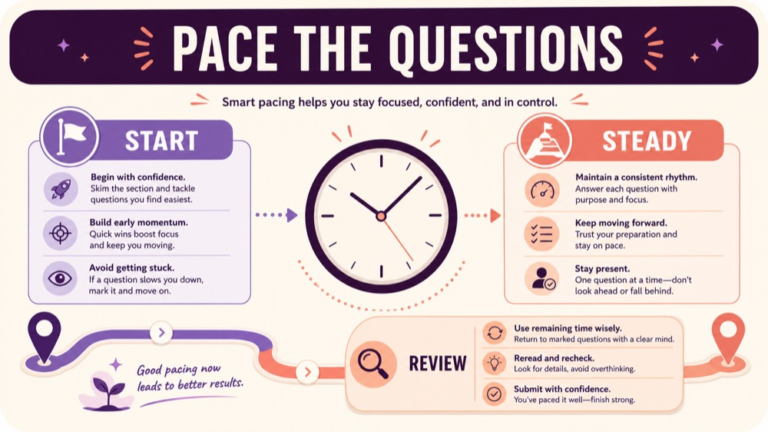
If the current listing continues to display 132 questions and 150 minutes, a simple average is about 1.14 minutes per question. That average is a planning frame, not a rule for every item. Some questions may take less time, some may require careful reading, and your movement through a real session will include transitions in attention. Use the average to practice pacing, then use error review to decide where your time is actually going.
A timed block should imitate the decision demands without pretending to reproduce the live exam. Mix topics, avoid arranging every item by the same concept, and make a note when you change an answer. Afterward, compare your pace with the quality of your reasoning. Fast work that relies on a guess and slow work that rereads every option point to different study needs.
- Content frame: divide practice across the current domains instead of building a set from one comfortable topic.
- Timing frame: use shorter sets first, then longer mixed blocks as your endurance develops.
- Decision frame: mark questions that required comparison, referral reasoning, assessment selection, or professional judgment.
- Review frame: protect time after practice to explain the correct choice and the distractors.
- Verification frame: recheck the current ETS information if a practice source gives a conflicting count or time.
Use the Count to Plan Practice
A displayed count can help you choose the size of a study block. Early in preparation, a learner may use short sets to practice retrieval and explanation. Later, longer mixed sets can test whether the learner can shift among content domains without losing the question’s actual task. The goal is not to make every session exactly 132 items. The goal is to build enough variety and duration that the pacing frame becomes familiar.
For a long block, define the purpose before you start. One session may test content recall. Another may test clinical application. Another may focus on professional practice, ethics, or the ability to identify what evidence is missing. Labeling the purpose keeps the count from becoming the only measure of progress.
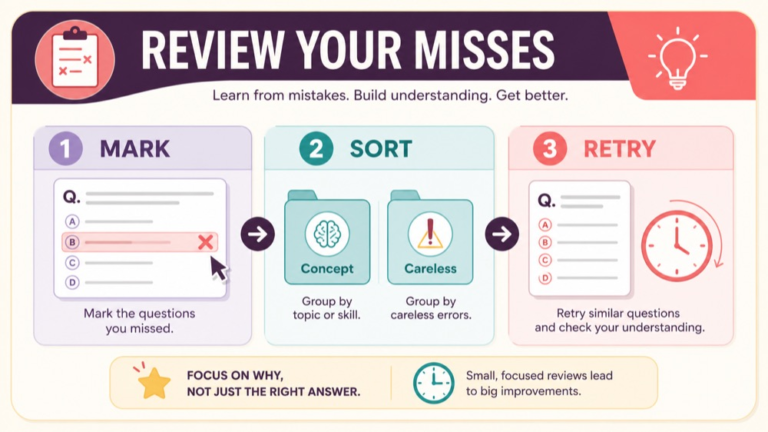
Use a simple record with four fields: item topic, decision requested, evidence used, and next review action. If you miss a question because you rushed the stem, the fix may be a reading routine. If you miss it because two options seemed plausible, the fix may be a comparison note. If you miss it because a current administrative fact was outdated, the fix is source verification rather than more flashcards.
Review Errors Instead of Chasing a Number
Question count is a useful constraint, but learning comes from what you do with the decisions inside the set. After a timed block, review correct guesses as well as incorrect answers. A correct answer supported by the wrong reason is unstable. Write a one-sentence rationale for the selected option and one sentence for the most attractive distractor. That practice turns a score report into a study decision.
Return to the current ETS scope when a practice explanation goes beyond what the test or source plan supports. For clinical topics, use appropriate professional sources and maintain boundaries around individual diagnosis or treatment. For credential questions, keep ASHA, program, state, and employer requirements distinct. The question count organizes time; it does not define professional scope.
Common Question-Count Mistakes
- Quoting an old question count without checking the current ETS listing.
- Treating the displayed count as a permanent promise about every future administration.
- Dividing total minutes by questions and assuming every item should take exactly the average.
- Using a practice score as proof of a live-test result or certification outcome.
- Practicing only one content domain because it feels efficient.
- Skipping explanations after a timed set because the count feels like the achievement.
- Ignoring changed-answer patterns, reading speed, fatigue, or attention during review.
- Confusing the Praxis count with the number of questions in a commercial practice product.
These mistakes reduce a useful planning input to a slogan. Correct the habit by writing the current source, the date checked, the decision the number supports, and the limit of the inference. That four-part note is compact enough to use in a study planner and strong enough to prevent accidental overstatement.
Quick Praxis Question-Count Review
Use this checklist when you revisit the question-count topic:
- Current ETS title and 5331 code confirmed.
- Displayed question count and testing time recorded with the check date.
- Current scope and study companion reviewed.
- Practice sets include both short retrieval blocks and longer mixed work.
- Pacing is interpreted with reasoning quality, fatigue, and error patterns.
- Conflicting numbers are resolved through the current ETS source.
Then write the transfer sentence: “The current count helps me plan ___, but I still need evidence about ___.” A good completion might mention pacing while leaving readiness, score outcome, and credential decisions open for the evidence that actually answers them.
Sources and Next Steps
Verify the current value on the ETS Speech-Language Pathology 5331 page and use the ETS study companion for preparation framing. ASHA’s exam-context guidance helps keep a Praxis result distinct from the broader certification pathway. Recheck current facts before registration and test day.
Continue your preparation: Explore the SLP Study Center learning resources.