
How long is the SLP Praxis exam? The current ETS page checked for this guide lists a 150-minute computer-delivered test with 132 selected-response questions. That answer is the starting point, not the whole pacing plan. You also need a way to distribute time across straightforward items, slower clinical-reasoning items, and a final review without turning the clock into a second source of stress.
This guide shows how to translate the current test details into a flexible practice routine. It does not treat the average time per question as a rigid rule, and it does not replace the live ETS page, current test-taker instructions, or your own content preparation.
Start with the current ETS details
Use the current ETS Speech-Language Pathology (5331) page as the administration reference. On the page checked on August 23, 2026, ETS displayed a 150-minute test, 132 questions, selected-response format, and computer delivery. ETS also describes the test as covering foundational knowledge, professional practice, and specialized knowledge across the scope of speech-language pathology.
| Current detail | What it means for planning | What to verify again |
|---|---|---|
| 150 minutes | You need a plan for the full testing window, not just a content checklist. | The current time limit shown by ETS. |
| 132 questions | Your practice should include both accuracy and movement through the set. | The current question count and test form information. |
| Selected-response format | Read the stem, identify the decision, compare options, and commit. | The current format and test-day instructions. |
| Computer delivered | Practice reading and reviewing on the same general screen-based medium. | Delivery details, tools, and testing requirements. |
Administration details are time-sensitive. A search result, old study companion, or discussion post can be useful for locating a topic, but the current ETS page and account instructions are the final checkpoint for the test you will take.
Turn the test length into a pacing baseline
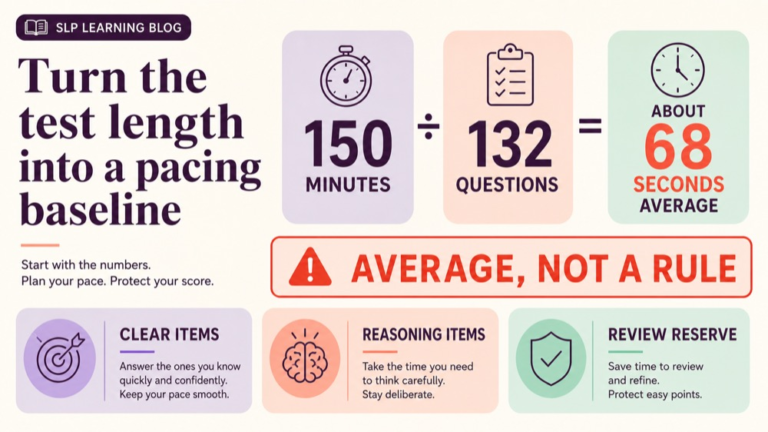
Dividing 150 minutes by 132 questions produces about 1.14 minutes per question, or roughly 68 seconds per question. Treat that number as an average planning baseline. It is not a demand to stop every item at the same second, because selected-response items differ in reading load, clinical context, and reasoning complexity.
- Use less than the average: for a familiar definition, clear professional-practice principle, or item where the evidence strongly supports one option.
- Use close to the average: for an item that needs careful reading and a short comparison among plausible options.
- Use more than the average: for a dense scenario or a distinction that requires you to connect assessment, intervention, ethics, or functional impact.
- Protect a review reserve: keep some time available for flagged items, unanswered questions, and a final scan.
The baseline becomes useful when you compare it with your own behavior. If a 68-second average feels impossible, identify where the time goes: rereading stems, debating two options without evidence, calculating, searching memory for a term, or changing answers late. The pattern tells you what to practice.
Use a three-pass timing plan
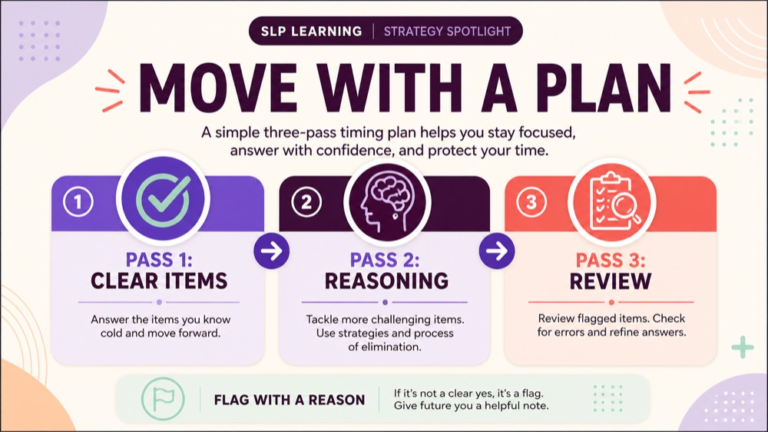
A three-pass plan creates movement without forcing every question into one identical time box. The exact split can change during practice; the value is having a default response when an item becomes sticky.
- Pass one: answer the clear items. Read the question, identify the tested concept, choose the best-supported option, and move on. Flag only when you have a concrete reason to return.
- Pass two: work the reasoning items. Return to scenarios that need a domain distinction, a clinical priority, or a closer comparison. State the decision rule in your head before rereading every sentence.
- Pass three: review strategically. Check unanswered items, confirm that your selected option matches the stem, and revisit flagged items with the strongest evidence first.
This method is not an invitation to rush. It is a way to stop one difficult question from consuming the time needed for several questions you can answer. The exam rewards accurate decisions across the set, so pacing should preserve access to the full set.
Practice pacing with representative questions
Pacing improves when the practice environment asks you to make the same kind of decisions you will make under a clock. Use representative, original practice questions and record more than a percentage score. For each item, note whether the issue was knowledge, reading, reasoning, confidence, or time management.
- Begin with a small timed set so you can observe your default pace without exhausting yourself.
- Increase the set length until you can sustain attention across several content domains.
- Use a visible timer during practice, but review the reasoning after the timer stops.
- Mark the items that took unusually long even when you got them correct.
- Separate slow-but-productive reasoning from circular doubt.
- Repeat a similar set later and check whether the time problem changed.
A useful review note sounds specific: “I spent two minutes because I did not distinguish screening from assessment,” or “I reread the stem because I did not identify the patient priority.” A vague note such as “I am too slow” does not tell you what to change.
Decide when to move on
Moving on is a clinical reasoning skill as well as a timing skill. Before you commit to an answer, ask what evidence in the stem determines the choice. If you can name the decisive feature and eliminate the weaker options, select the best answer and continue. If you are rereading without adding evidence, flag the item and use the next pass.
- Move on when the stem has been read accurately and one option best fits the stated priority.
- Move on when the remaining uncertainty is preference rather than evidence.
- Return later when a second option requires a real comparison that you can make with a decision rule.
- Do not spend review time polishing an answer that already matches the stem and principle.
- Use the final review for unanswered or genuinely uncertain items before minor wording changes.
Practice this decision in low-stakes sets. The goal is not to eliminate uncertainty; it is to recognize the difference between productive analysis and circular hesitation.
Avoid common timing mistakes
- Using the 68-second average as a hard cutoff for every question.
- Spending the first part of a timed set on one difficult item.
- Reading every option repeatedly before identifying the tested concept.
- Ignoring unanswered or flagged items until the last few seconds.
- Practicing only short sets and assuming stamina will appear automatically.
- Measuring only correct answers and not measuring decision time.
- Changing a supported answer because of late anxiety rather than new evidence.
- Using an old time limit without checking the current ETS page.
These errors have different solutions. A hard cutoff may require a flexible pass system. Slow reading may require stem annotation. Weak domain knowledge may require a content review block. Late answer changes may require an evidence rule for review.
Connect pacing to content review
The current ETS description emphasizes knowledge and its application across speech sound production, fluency, voice and resonance, motor speech, language, social communication, cognition, augmentative and alternative communication, hearing, and feeding and swallowing. Use that breadth to organize practice sets rather than letting timing work become a generic speed drill.
- Choose a content domain and a small set of original questions.
- Answer with a time plan and mark the items that consume disproportionate attention.
- Review the decisive concept behind each miss and each unusually slow correct answer.
- Write one transferable rule in plain language.
- Mix the domain with another topic in the next set to test retrieval and switching.
For example, a slow item about swallowing may reflect content uncertainty, but it may also reflect a failure to identify the question’s priority or the patient’s immediate risk. Reviewing both the content and the decision process produces a stronger pacing change than simply attempting the same type of item faster.
Sources and next steps
How long is the SLP Praxis exam? Use the current ETS page for the answer that can change, then use a flexible pacing baseline and a three-pass routine to practice how you will move through the set. Keep the average time per question as a planning signal, not a rigid rule.
Read the current ETS 5331 test page and the ASHA overview of the Speech-Language Pathology Praxis before finalizing your test-day plan. Recheck administration details whenever the source pages change.
Continue your preparation: Explore the SLP Study Center learning resources.