
If you are asking how is the praxis scored, you are probably trying to answer two different questions at once: what your performance means and what you should do next. Those questions are connected, but they are not identical. A score report is a result record; it is not a complete study diagnosis, a universal license rule, or a shortcut for predicting a future attempt.
The most useful way to understand Praxis scoring is to keep four ideas separate: the points earned on scored responses, the reported scale used by the assessment, the qualifying requirement attached to your pathway, and the study evidence you collect from practice. Once those layers are separated, score language becomes much less mysterious and your review plan becomes more specific.
What the question is really asking
Searchers often use the word score to mean several things. One person may want to know whether a practice set result is encouraging. Another may be looking at a score report and wondering how it was produced. A third may be checking whether a result meets a state, agency, or certification requirement. These are different decisions and require different evidence.
For Speech-Language Pathology Praxis 5331, start with the current ETS test page and the current requirement for the pathway that will use your result. ETS explains the scoring vocabulary and reporting process; the relevant state, agency, or certification body determines how a qualifying score is applied. ASHA can provide professional context, but a general article cannot replace the rule for your exact jurisdiction or pathway.
- Scoring question: How were responses counted and reported?
- Requirement question: What result does my pathway currently require?
- Study question: Which concepts should I review before the next practice set?
Confusion usually begins when one answer is used as if it answered all three questions. A practice percentage may help with the third question, but it is not the answer to the first or second.
Three layers to keep separate
The phrase “my score” is easier to interpret when you name the layer you mean. The following comparison is a study framework, not a substitute for the current ETS explanation or a pathway-specific requirement.
| Layer | What it describes | What it can help you decide | What it cannot establish by itself |
|---|---|---|---|
| Raw performance | The scored responses you answered correctly in a particular form or practice set. | Which items and concepts need review. | A universal reported score or a credential outcome. |
| Reported scale | The score format used to communicate performance for the assessment. | How to read the result in the reporting system. | A simple public conversion from any practice percentage. |
| Qualifying requirement | The threshold or rule used by a named state, agency, or pathway. | Which current rule you must verify before submitting a result. | A universal number that applies to every learner and jurisdiction. |
| Study evidence | Your pattern across original practice, timing, explanations, and repeated review. | How to allocate the next study block. | A prediction or guarantee of the next reported result. |
This distinction matters because the same learner can have a strong practice percentage in one narrow topic and still have an uneven profile across the blueprint. Conversely, a single difficult practice set can expose a gap without defining the learner’s overall readiness. Treat each data point as evidence with a limited job.
From raw points to a reported score
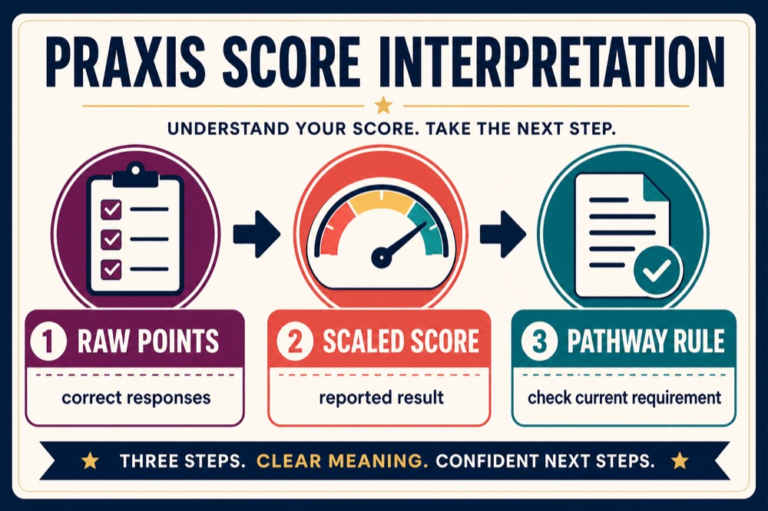
In a selected-response assessment, a correct scored response contributes a raw point. That is the intuitive part. The reported result uses a scale that allows performance to be communicated in a standardized way. The scale is useful because a raw total on one form should not be treated as if it were automatically interchangeable with a raw total on another form.
That does not mean a learner can reverse-engineer a personal formula from a few practice results. The reported score is tied to the assessment and its scoring rules, while a commercial practice set has its own item pool, difficulty, explanations, and possible flaws. A practice set can approximate the decision-making experience you need to build; it cannot promise the number that will appear on a future report.
A helpful mental model is:
- Count: What did I answer correctly on this set?
- Interpret: What concept or reasoning pattern does that result represent?
- Verify: Which current ETS or pathway rule applies to my real result?
For example, imagine a learner completes an original 40-item set and answers 30 items correctly. “30 out of 40” is a description of that set. It is useful for identifying missed topics, but it is not a claim that the learner would receive a particular Praxis scale result. The correct next step is to examine the ten misses, classify the reason for each miss, and compare the resulting study need with the current blueprint.
Why practice percentages do not convert cleanly
Practice percentages feel precise because they are easy to calculate. Their limitation is not arithmetic; it is comparability. A percentage depends on the set’s content mix, item wording, distractor quality, difficulty, timing, and scoring key. Two sets with the same percentage can represent very different learning situations.
Consider two original 20-item sets. On Set A, a learner misses four items because the terms were unfamiliar. On Set B, the learner misses four items after narrowing the choices correctly but overlooking a decisive clinical detail. The percentages match, but the instructional response should not. Set A may call for concept retrieval and vocabulary mapping. Set B may call for slower comparison of evidence, better attention to the task demand, and a second attempt with a written rationale.
- Do not multiply a practice percentage by a guessed scale range.
- Do not treat a difficult third-party set as a calibrated ETS form.
- Do not use one timed score as the entire readiness picture.
- Do not ignore the reason for a miss just because the answer key is available.
Use percentages as trend signals instead. If performance improves on comparable sets while your error categories narrow and your timing becomes steadier, that is useful evidence for study planning. It still deserves cautious interpretation, especially when the content mix changes.
How to turn a score report into a study decision
A score report can tell you what was reported. Your study process has to explain what to do with that information. Begin by recording the report date, test identity, score fields, recipient or pathway context, and the current requirement you are checking. Keep those administrative facts separate from your personal interpretation.
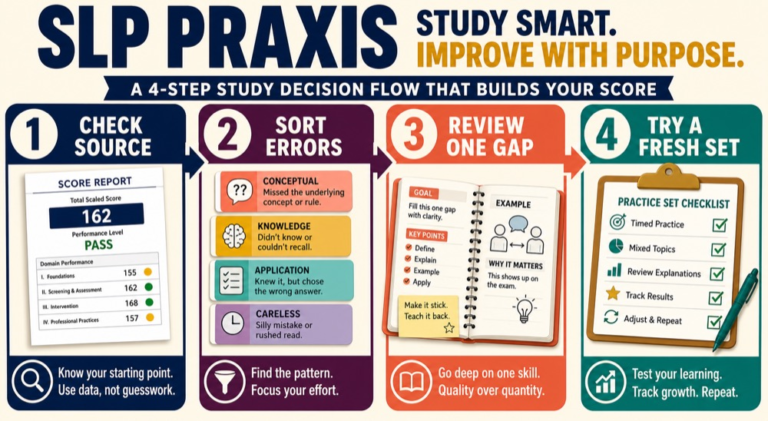
Then use a short evidence review:
- Confirm the source. Read the current score-reporting language in your ETS account or the current ETS guidance for the relevant test.
- Confirm the rule. Check the state, agency, or certification source that will actually use the result. Record the page date or revision information if provided.
- Map the study evidence. Compare your practice error log with the blueprint domains and the explanations you trusted.
- Choose one action. Select a narrow review target, such as assessment selection, intervention principles, professional practice, or another blueprint-aligned concept.
- Recheck with retrieval. After review, answer a fresh set and explain why each distractor is less defensible.
This workflow protects you from two opposite errors. A learner who is disappointed by a result may study everything again without prioritization. A learner who is pleased by a result may stop checking the specific domain or reasoning pattern that remains fragile. A report is most useful when it leads to a concrete, limited next action.
Common scoring mistakes
Confusing a raw total with a reported scale
A raw total tells you how many scored responses contributed points in a particular context. It does not, by itself, explain the reported scale or the current qualifying rule. Use the current ETS explanation for the reporting vocabulary.
Using a universal passing number
Requirements can vary by state, agency, certification route, and effective policy. A number remembered from a study group or an older page may not be the rule that applies to you. Verify the exact pathway before you submit a score or make a timeline decision.
Reading a practice percentage as a prediction
A practice result is a sample of your preparation under specific conditions. Its best use is to reveal what to revisit, not to forecast a guaranteed outcome. Track several comparable samples and describe the limits of each.
Studying only the missed answer
Correct answers can also be guesses. For each item, record the deciding evidence, the tempting distractor, and the rule you want to transfer to a new scenario. This turns scoring information into learning rather than a simple tally.
A simple review loop
Use this loop after each practice block:
- Sort items into secure, uncertain, and missed.
- Label the reason: knowledge gap, task misread, distractor comparison, timing, or careless execution.
- Write one transferable rule for every uncertain or missed item.
- Review the source concept, then explain it without looking at the answer key.
- Return to the same concept in a new context rather than repeating the exact item.
- Record the next check date and the evidence you will use to judge improvement.
The loop is intentionally modest. A clear error category is more useful than a dramatic score claim. Over several blocks, you can see whether the same concept keeps returning, whether errors shift from knowledge to application, and whether timing is changing the quality of your decisions.
Sources and next steps
For current score explanations and reporting language, review the ETS Understanding Scores page and the ETS Score Reporting guidance. For the current test identity and administration boundary, use the ETS Speech-Language Pathology 5331 page. For professional context, consult ASHA’s Praxis scores resource and verify the requirement for the state, agency, or pathway that will use your result.
The short answer to how is the praxis scored is therefore: scored responses are counted within the assessment’s reporting system, but your study percentage and your pathway requirement are separate kinds of evidence. Keep those layers separate, verify current first-party rules, and use the score information to choose the next review action.
Continue your preparation: Explore the SLP Study Center learning resources.