A goal bank for speech therapy can help a team organize sample targets across speech sounds, language, AAC, fluency, voice, social communication, and functional participation. The most useful goal bank is not the longest list. It is a decision tool that connects a broad need to a meaningful communication purpose, an observable response, an access route, and a measure that can guide the next step.
This guide presents a practical way to build or use a goal bank matrix. It focuses on sorting goals by communication job, checking baseline and access, selecting measurable conditions, and revising the bank as the learner’s priorities change. Individual goals should be developed and interpreted by the qualified SLP and relevant team. The ASHA Practice Portal provides topic-specific context for assessment and intervention planning.
Table of Contents
- What a goal bank matrix should contain
- Sort goals by communication job and domain
- Move from a broad need to a candidate goal
- Add baseline, access, and measurement fields
- Review a goal bank with the team
- Build a reusable goal-bank workflow
- Frequently asked questions
What a Goal Bank Matrix Should Contain
A goal bank matrix is easier to use when every sample goal can be viewed through the same planning fields. Suggested columns include communication purpose, target domain, condition, learner action, response definition, access support, measure, and next decision. The fields can live in a spreadsheet, document, planning board, or clinical note system.
Useful goal-bank fields include:
- Communication job: what the learner needs to communicate, understand, produce, or participate in;
- Target domain: speech sound, language, AAC, social communication, fluency, voice, or functional routine;
- Condition: the activity, partner, materials, setting, and available clues;
- Learner action: the observable action or message;
- Access route: speech, AAC, sign, gesture, writing, drawing, pointing, or a combination;
- Measure: accuracy, frequency, duration, latency, independence, support, intelligibility, listener understanding, or transfer; and
- Review decision: repeat, vary, generalize, change, or retire the goal.
These fields prevent a sample phrase from looking more individualized than it is. “Improve expressive language” is a domain label. “Communicate a relevant message to explain what happened during a classroom routine using available modes and a defined support” gives the team a place to define the opportunity and response.
Sort Goals by Communication Job and Domain
Sort the bank first by the learner’s communication job, then by clinical domain. This keeps the goal connected to participation. A speech sound target may support being understood when requesting help. A narrative target may support telling a partner what happened. An AAC target may support making a choice, refusing, or repairing a message.
Possible communication jobs include:
- request an item, action, or change;
- reject, stop, wait, or set a boundary;
- answer or ask a question;
- describe, explain, or retell an event;
- enter, maintain, or close an interaction;
- repair a misunderstanding or ask for clarification;
- produce a target pattern in meaningful words or connected speech; and
- participate in a routine with less support or a new partner.
After naming the job, identify the domain that contributes to it. Avoid treating the domain as the purpose. “Pragmatic language” or “phonology” can guide assessment and intervention, but the team still needs to say what participation the learner is working toward.
Move From a Broad Need to a Candidate Goal
Use a funnel process. Start with the concern, identify a functional communication job, define a skill that supports the job, and then write the condition and measure. A goal bank entry is a candidate until it passes through this process.
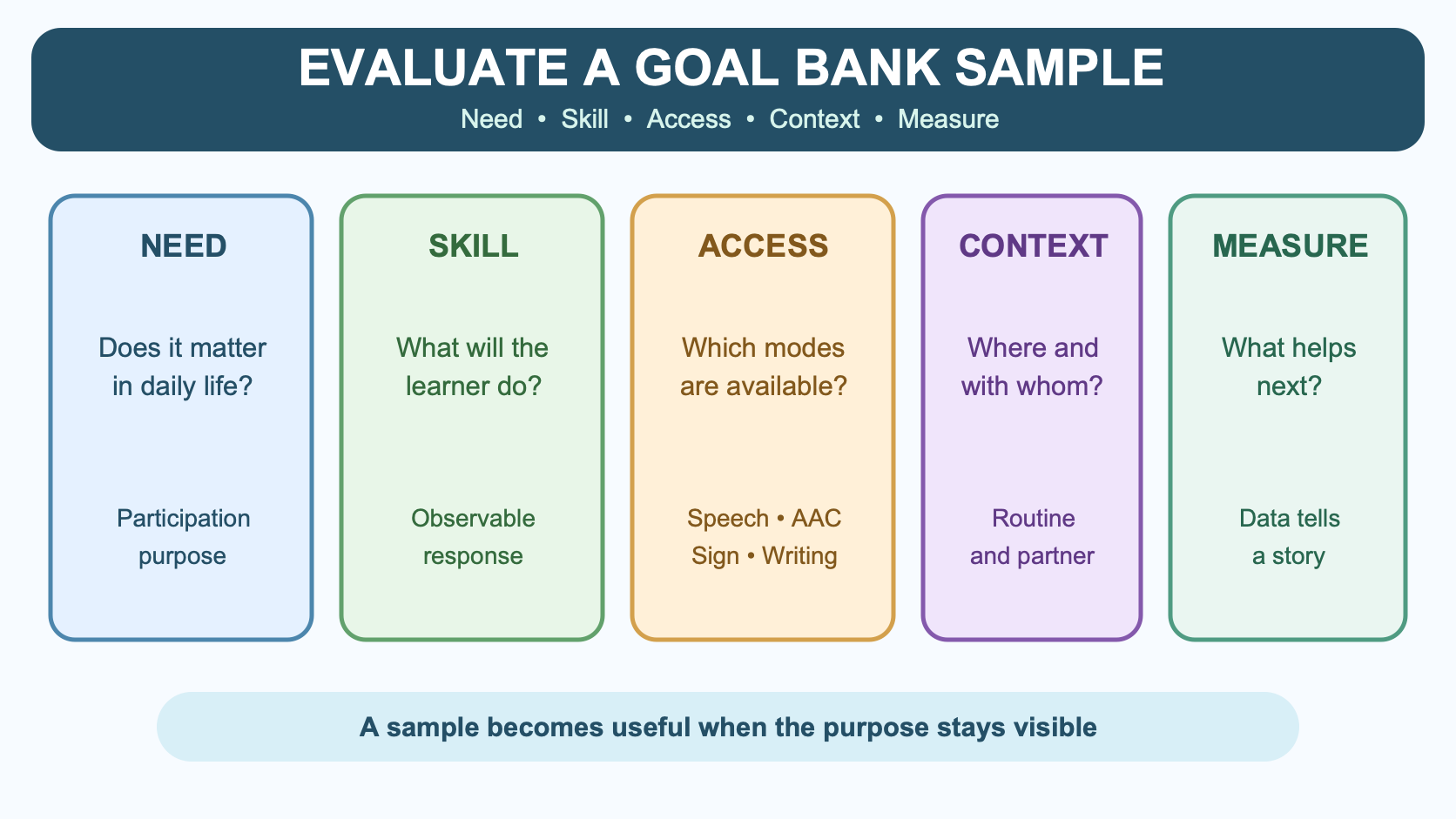
Step one: name the concern. Describe what the team is noticing without assuming the cause; the concern might be low intelligibility, difficulty explaining, limited initiation, missed repair opportunities, or inconsistent access to communication. Step two: name the job. Identify what the learner wants or needs to do with a partner so the target is relevant to a routine rather than an isolated skill label. Step three: choose the supporting skill. Decide whether the target involves speech production, vocabulary, syntax, narrative organization, inferencing, AAC access, conversation, partner response, or another component. Step four: define the opportunity. State when, where, with whom, and with what support the learner will show the skill, including an accessible response route. Step five: select the measure. Choose a measure that answers the team’s question; a trial count, frequency note, support scale, listener report, or descriptive sample may be appropriate depending on the goal.
This funnel makes it easier to reject a sample that sounds polished but cannot guide observation. It also helps the team create multiple candidate goals without losing the communication purpose.
Add Baseline, Access, and Measurement Fields
Baseline is not just a number. Record what the learner does under a defined condition, the support available, the communication mode, and the partner or setting. The same learner may show different performance in a structured task, a preferred routine, and an unfamiliar group.
Choose measurement fields carefully. Accuracy can fit a stable speech or language response. Frequency can fit initiations, questions, repairs, or message purposes. Duration can fit participation. Latency can fit time to respond. Independence or support level can show whether the learner needs fewer direct prompts. Listener understanding can be important when the communication job is being understood.
Define the opportunity before counting. “Four of five” does not have the same meaning across five repeated picture items and five new classroom interactions. Record the denominator and the condition when a percentage is used, and add a brief note for meaningful events that do not fit a trial structure.
Access should be part of the bank. A sample goal that expects spoken sentences may need to be rewritten for a learner who communicates through AAC, sign, gesture, writing, or multiple modes. A visual, wait time, partner model, stable surface, or relevant vocabulary can be an access support rather than a flaw in the goal.
Review a Goal Bank With the Team
Review the bank before and after a planning period. Ask whether the entries are age-respectful, understandable to partners, culturally and linguistically responsive, and connected to current routines. Remove samples that repeatedly require a response mode or social behavior that does not match the learner’s communication purpose.
Use a short review checklist:
- Does the goal describe a meaningful communication job?
- Can another team member create the opportunity and recognize the response?
- Is the access route available before the learner must communicate?
- Does the measure include context and support?
- Can the goal be adapted across partners or settings?
- Will the result guide a concrete next decision?
Invite the learner and family to explain which communication situations matter. Educators and support partners can identify routines that do not appear in a clinic sample. A shared goal bank can improve consistency across adults, but it should not flatten individual preferences or communication styles.
Build a Reusable Goal-Bank Workflow
Keep the workflow simple enough to repeat:
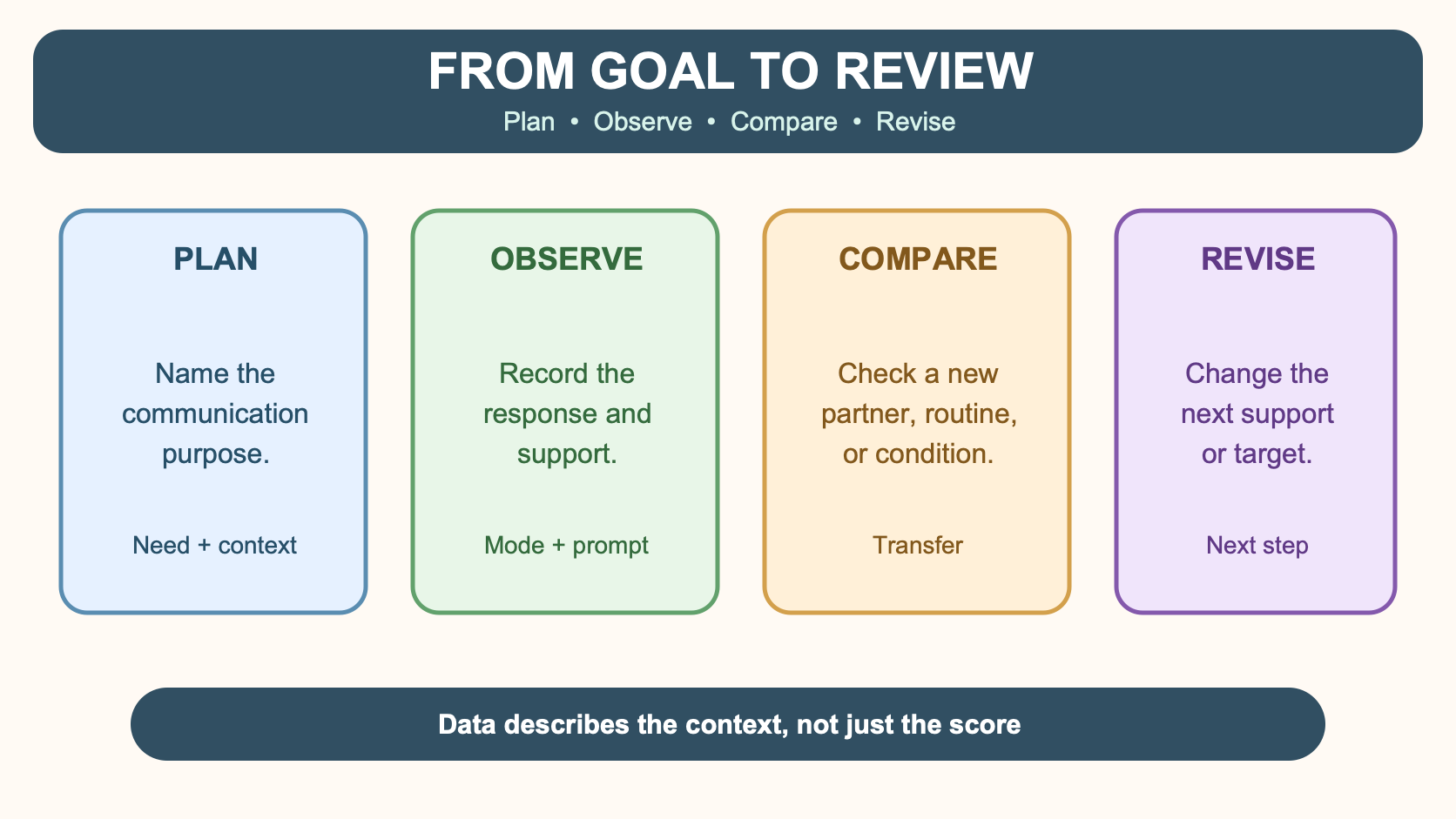
Collect: Add sample wording only when it comes from a clear target area or recurring planning need, and record what the sample is intended to support. Sort: Tag it by communication job, domain, access route, age range, context, and likely measure; a tag is a prompt for review, not a final recommendation. Adapt: Rewrite the condition, learner action, response definition, support, and measure for the learner and routine, removing assumptions about one output mode. Try: Create a small number of defined opportunities and record what happened, including the partner, setting, and support. Review: Decide whether to repeat, vary, generalize, revise, or retire the goal, and update the bank when a sample repeatedly creates confusion or when a more useful formulation emerges.
This workflow keeps a goal bank from becoming a static list. It also creates a record of why a goal was selected and what the team learned from using it.
Frequently Asked Questions
What should be included in a goal bank for speech therapy?
Include communication job, target domain, condition, learner action, response definition, access route, measure, and review decision. Add age, setting, partner, or specialized fields when they change how the goal is interpreted, and remove fields that do not guide a real planning choice.
Can I copy goals from a goal bank into an IEP or treatment plan?
Use sample language as a starting point, then individualize it. The final goal should reflect the learner’s priorities, baseline, communication modes, supports, context, measure, and team requirements, with an opportunity another adult can create and recognize.
How do I make a goal bank more useful for AAC users?
Add response modes, message purposes, access supports, partner behaviors, and repair options to the bank. Avoid making spoken output the only successful response when the purpose is broader communication, and record how partners will honor the learner’s established system.
When should I remove a goal from the bank?
Remove or revise an entry when it is too broad, cannot be observed reliably, depends on an inaccessible response mode, does not guide a decision, or no longer reflects the learners and routines the team supports. A smaller, current bank is easier to use than a large archive of generic wording.
A goal bank for speech therapy works best as a living decision tool. Sort by communication job, individualize the condition and access route, choose a measure that answers a real question, and update the bank based on what learners and partners actually communicate.