A full length slp praxis practice test is useful when you know what you are trying to observe. It can show how content knowledge, clinical reasoning, pacing, attention, and review habits interact across a long session. It cannot tell you what to do next unless you record the conditions and analyze the pattern behind the result.
The current ETS Speech-Language Pathology (5331) page describes a computer-delivered selected-response test with 132 questions and 150 minutes. Use the live ETS page and your account for changing details. ASHA preparation guidance also encourages practice questions, timed work, and a plan based on individual strengths and weaknesses.
What a full-length SLP Praxis practice test can show
A long practice session can answer a process question that a short quiz cannot: how does your approach behave when questions accumulate and the three broad content lanes are mixed? The result is most useful when you decide in advance whether you are measuring stamina, pacing, content retrieval, transfer, or a combination.
| Practice target | Evidence to record | Interpretation to avoid |
|---|---|---|
| Content | Lane and decision type for missed items. | Assuming a total score identifies every gap. |
| Transfer | Rationale quality on changed scenarios. | Equating familiar wording with application. |
| Pacing | Checkpoints, skips, rereads, and answer changes. | Calling every late error a knowledge gap. |
| Stamina | Confidence and process across the session. | Calling fatigue evidence about one topic. |
Full-length does not mean that every resource mirrors the official exam. A long bank may use different item writing, explanations, navigation, or timing. Treat it as a structured rehearsal and describe its limits. Its value comes from the question it helps you answer, not from the label alone.
Use confidence labels with the result. Stable means you selected and explained the answer. Uncertain means you were correct but the rationale was thin or recognition carried the choice. Unresolved includes incorrect, skipped, or rushed work that needs a specific repair.
Confirm the current 5331 boundary
Start with the current ETS Speech-Language Pathology (5331) page. Use it for the subject identity, current delivery and timing information, broad content direction, question count, duration, and official preparation links. The page currently lists 132 questions and 150 minutes for a computer-delivered selected-response exam. Date your note because the live source controls changing details.
Use the ETS practice-test page to locate current practice options by subject. Read the resource description before calling it full-length. A sample, topic drill, practice test, and simulation may have different jobs and conditions.
- Verify the subject: confirm Speech-Language Pathology (5331).
- Record the source: save provider, title, date, and format.
- Check the scope: identify which broad decisions the material represents.
- Separate official facts: use the current ETS source for administration and changing logistics.
- Protect originality: avoid purported live or confidential content.
For planning ideas, review ASHA’s Praxis preparation guidance. Keep its preparation guidance distinct from current ETS administration facts. Use the two sources for their separate jobs when you update your study record.
Plan the full-length run before you begin

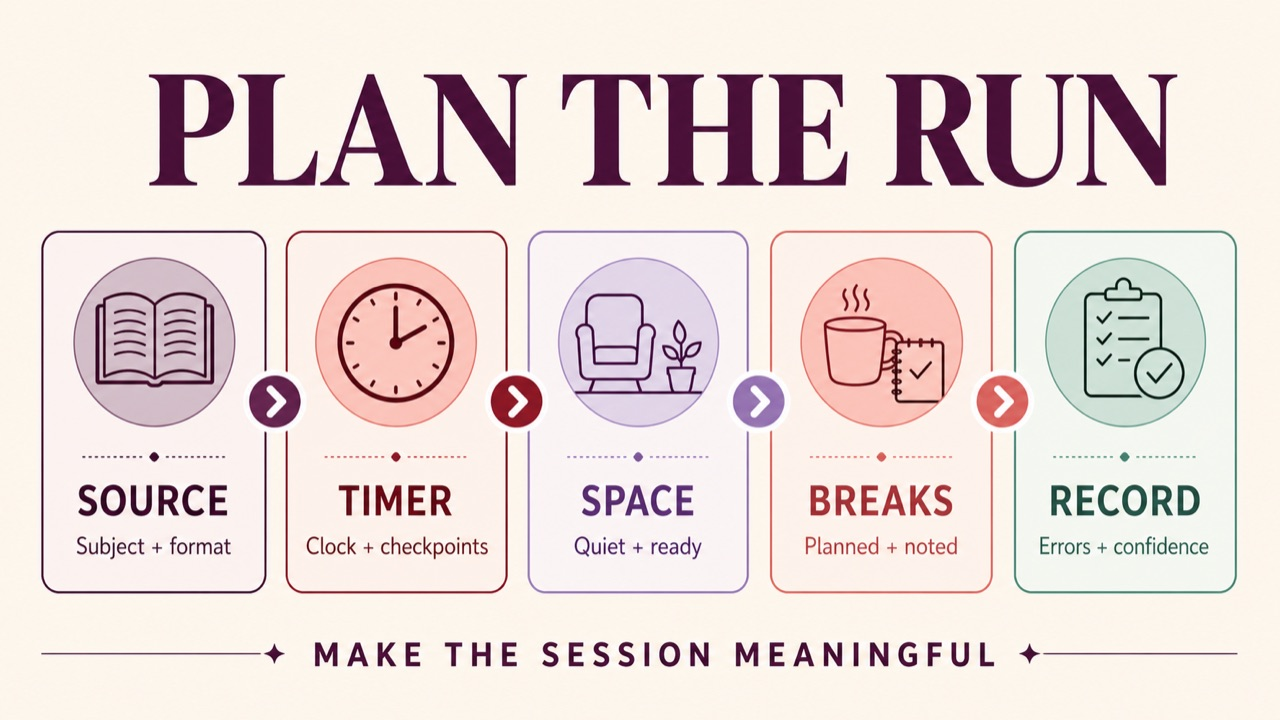
Write a run plan before the timer starts. Choose the source, date, start time, timer, environment, breaks, permitted materials, tracking method, and review rule. Decide whether explanations will remain hidden until the run ends. These details determine what your result can tell you.
| Plan field | Choice to record | Why it matters |
|---|---|---|
| Source | Named practice set and version or date. | Lets you compare like with like. |
| Timer | Learning, timed, or simulation mode. | Defines the meaning of the percentage. |
| Space | Desk, device, notifications, and interruptions. | Explains process changes. |
| Breaks | Planned pause and return point. | Separates fatigue from topic difficulty. |
| Record | Uncertain marks, skips, and checkpoints. | Preserves reasoning and pacing evidence. |
A full-length run is often best after you have completed at least one smaller lane-based cycle. If the content is still unfamiliar, a long session can mix concept gaps with fatigue and make the result difficult to act on. Use a shorter block first when you need to learn how a resource is written.
Prepare the record before starting. A simple sheet can have columns for item, lane, decision, confidence, and review note. If you cannot tag every item during a timed run, use a small mark for uncertain answers and complete the detailed log after the session.
Choose a source and label its role
Not every practice source needs to play the same role. Use an official practice option when you want to understand how the responsible provider describes the subject. Use a third-party bank for additional original practice when its explanations and limits are clear. Use a short drill for one decision type rather than asking it to simulate the entire exam.
| Source role | Best use | Record its limit |
|---|---|---|
| Current ETS page | Subject, scope, format, and changing details. | It is a source page, not your personal result. |
| Official practice option | Review responsible-source sample material and format. | Check its current description and access terms. |
| Third-party bank | Add original questions and explanations. | Provider scope, writing style, and conditions. |
| Targeted drill | Repair one concept or decision type. | Short format does not measure full-session stamina. |
Label a question set honestly in your notes. “Full-length practice session using a third-party bank” is more useful than a bare “mock exam” label because it preserves what happened. If a source makes a claim about current administration, verify that claim through the live responsible source before relying on it.
Map the three broad content lanes
Organize the run around three broad lanes that follow the current 5331 content direction: foundations and professional practice; screening, assessment, evaluation, and diagnosis; and planning, implementation, and evaluation of treatment. Questions can overlap, so record the primary lane and add a secondary note when it clarifies the error.
| Lane | Decision prompts | Evidence to capture |
|---|---|---|
| Foundations | What principle, role, or boundary applies? | Concept, contrast, and context. |
| Assessment | What information or sequence supports the purpose? | Referral question, evidence, and missing detail. |
| Treatment | What plan fits the goal and how is change observed? | Target, activity, support, and measure. |
Tag the decision inside the lane: retrieval, interpretation, sequence, planning, or measurement. A full-length result that contains many retrieval items and few sequence items may still be useful, but it has a coverage limit you should state.
Use the map to plan the next review block. Add missing decision types instead of simply adding more familiar questions. This makes the next run more informative and gives you a reason to change the next question mix deliberately.
Record foundations patterns
Foundations items may ask about terminology, underlying knowledge, professional role, communication context, or a boundary. Review the contrast in the stem and the context in which the principle is being applied.
- Restate the concept without copying an answer choice.
- Identify the boundary or setting detail that matters.
- Explain why the selected option fits the task.
- Explain why the closest option is less fit here.
- Write a changed example for transfer.
Use a narrow repair label. “Review foundations” is broad; “explain the principle and its boundary in two new settings” tells you what to do. A narrow task is easier to complete and compare on the next run.
Record assessment patterns
Assessment questions become clearer when you name the referral purpose before reading the choices. Separate what the stem establishes from what remains missing, then decide whether the requested action concerns screening, evaluation, measure selection, interpretation, or sequence.
| Assessment note | Question to ask | Repair idea |
|---|---|---|
| Purpose | What decision should the information support? | Rewrite the referral question. |
| Context | Where and with whom does performance matter? | Add a changed setting. |
| Evidence | Which fact controls the next step? | Underline and explain it. |
| Sequence | What information should come before the choice? | Order a fresh scenario. |
A named measure can distract you from a question about purpose or sequence. Tag the action word first. Then explain what evidence supports the choice and what fact would make a different option appropriate.
Record treatment patterns
Treatment questions can be reviewed as a chain: functional goal, activity, support, and outcome. If one link is missing, a choice may sound useful without answering the question asked.
| Link | Review prompt | Evidence |
|---|---|---|
| Goal | What meaningful behavior should change? | Target and functional context. |
| Activity | How does practice address the target? | Demand and rationale. |
| Support | What cue, partner, or setting matters? | Conditions of performance. |
| Outcome | What observation will show change? | Measure, criterion, and time. |
Compare activity data with functional outcome data. A drill count can describe process, while a workplace or classroom observation may better match a functional goal. The correct review depends on the task in the stem and the evidence it supplies.
Review the run before taking another
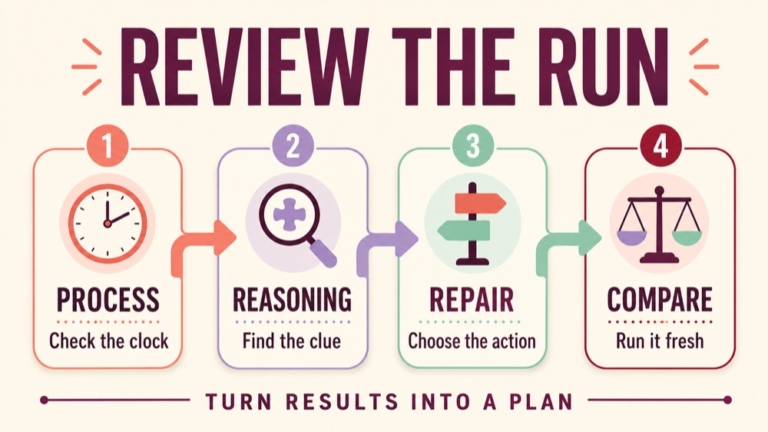
Use three review passes before scheduling another full-length session. Start with process, move to reasoning, and finish with action. This order prevents a late-session fatigue pattern from swallowing the content information you need.
- Process pass: review checkpoints, breaks, skips, rereads, answer changes, and interruptions.
- Reasoning pass: choose repeated misses and uncertain correct answers for task, evidence, answer, distractor, and boundary analysis.
- Action pass: choose two or three repairs and create fresh checks with changed wording.
Prioritize patterns, not isolated drama. Repeated errors in assessment sequence or treatment measurement deserve more attention than one unusual miss. Also prioritize decision types missing from your coverage map. That keeps review tied to repeated evidence and clear study choices.
A review is complete when it changes the next study action. If you cannot state what will be practiced, under what conditions, and how you will check it, keep analyzing before taking another long run.
Try three original full-length practice examples
The following items are original study examples created for this article. They are not copied from ETS and are not presented as live test material. Answer each item first, then record its lane, task, evidence, distractor, and transfer check.
Question 1: Keep the sequence evidence-based
Scenario: A referral describes reduced participation in group discussion but gives no information about communication partners, classroom demands, or when the difficulty occurs. What is the strongest next move?
Correct Answer: B. Why This Answer Is Correct: The missing context can change the purpose, sequence, and interpretation of assessment. Clarifying the demand and referral purpose gives the next step a stronger evidence base.
Why the Other Options Are Wrong: A moves to treatment before the concern is sufficiently described. C discounts information that can affect measure choice. D treats a broad label as a functional description. B matches the requested sequence to the evidence still needed.
Question 2: Connect the outcome to the goal
Scenario: The goal is for a client to use a communication strategy during a workplace conversation. Which outcome record best matches that goal?
Correct Answer: B. Why This Answer Is Correct: The observation occurs in a context related to the functional goal and records the target behavior. It connects the outcome to the communication demand.
Why the Other Options Are Wrong: A and C measure activity or completion without directly observing the functional target. D gives scoring convenience priority over alignment. B links observation to the stated goal.
Question 3: Interpret a late-session pattern
Scenario: A learner is accurate early in a full-length run, then makes rushed errors late in the session while explanations remain strong during review. What should the next study action test first?
Correct Answer: B. Why This Answer Is Correct: The pattern points toward process or stamina under the recorded conditions, while strong explanations during review suggest a separate content question. A shorter timed block can test pacing behavior without adding an unrelated resource.
Why the Other Options Are Wrong: A adds a source before testing the observed pattern. C makes a broad content conclusion from late-session behavior. D removes the switching skill the run was meant to observe. B targets the process evidence directly.
Interpret section results with care
Use section results as signals, not verdicts. Compare accuracy, confidence, rationale quality, and process by lane. A lane with a lower percentage may contain harder decision types, fewer represented items, or a late-session position. The record should show which explanation fits the evidence.
| Pattern | What it may suggest | Next check |
|---|---|---|
| Low lane result, clear rationale | Retrieval may need strengthening. | Concept retrieval without notes. |
| Correct, thin rationale | Recognition may exceed transfer. | Changed scenario after a delay. |
| Late rushing across lanes | Pacing or stamina deserves a process check. | Short timed block with checkpoints. |
| One decision type absent | Coverage is incomplete for that task. | Targeted fresh questions. |
Keep a practice percentage separate from official score information, passing requirements, or licensing decisions. Use the live responsible source for external requirements. A full-length practice result describes one session under one set of conditions.
Separate stamina from content
The current ETS page lists 132 questions and 150 minutes. Use that official scale to understand the exam context, then label your own run conditions. If your session includes an unplanned interruption, visible explanations, or a different interface, record it instead of hiding it.
- Content evidence: lane, task, deciding fact, and rationale.
- Process evidence: checkpoint, skip, reread, answer change, and interruption.
- Stamina evidence: confidence and error pattern across the session.
- Transfer evidence: performance on fresh wording after a delay.
When the next action is process practice, use a manageable block. When it is a content repair, return to the relevant lane. A longer session is not a universal repair for either issue.
Build the next run from repeated patterns
Use the first run to choose the next run’s purpose. Keep some conditions stable when you want a comparison, and change conditions deliberately when you want adaptation practice.
- Select two or three repeated patterns.
- Assign each pattern a content, transfer, or process repair.
- Write fresh items or scenarios for the repair.
- Keep source or timing stable when comparison matters.
- Define what improved reasoning will look like before starting.
Do not schedule another full-length session simply because the first percentage felt uncomfortable. Schedule it when the review record shows what you want to observe and the repair block has had a chance to work.
Avoid full-length practice-test traps
- Assuming every long question set mirrors the official exam experience.
- Using a resource without confirming Speech-Language Pathology (5331) alignment.
- Ignoring source, date, format, timer, environment, breaks, or interruptions.
- Reading explanations during a measured run without labeling the change.
- Using one percentage to explain content, transfer, pacing, and stamina together.
- Counting uncertain correct answers as stable evidence.
- Using a practice result as an official scaled score.
- Relying on a practice page for changing appointment requirements.
- Copying purported live or confidential content into public notes.
- Repeating a full run before repairing the pattern it exposed.
The correction is a clear sequence: define the purpose, label the conditions, map the lanes, review process and reasoning separately, then build the next check from repeated evidence.
Full-length SLP Praxis practice-test checklist
Use this checklist before and after a full length slp praxis practice test:
- Did I confirm the Speech-Language Pathology (5331) subject through the current ETS page?
- Did I label the source and its role?
- Did I define whether the run measures learning, timing, transfer, stamina, or comparison?
- Did I record timer, space, breaks, materials, and interruptions?
- Did I mark uncertain, skipped, rushed, and changed answers?
- Did I tag lane and decision type?
- Did I record the evidence that controlled important choices?
- Did I compare the closest distractor?
- Did I separate process patterns from content patterns?
- Did I choose two or three repairs?
- Did I test the repair with fresh wording?
- Did I keep practice evidence separate from official score and logistics claims?
A full-length SLP Praxis practice test is most useful when it leaves you with a clearer next move. The number matters less than the pattern it represents and the quality of the repair you test afterward.
Sources and next steps
Use the current ETS Speech-Language Pathology (5331) page for subject identity, format, duration, question count, content areas, and official preparation links. Search the ETS Praxis practice-test page for current subject options. Review ASHA’s Praxis preparation guidance for preparation materials, practice questions, timed work, and using strengths and weaknesses to guide review.
Continue your preparation: Explore the SLP Study Center learning resources after you have completed the run record and chosen the next repair. Keep that action visible so the next session has a clear comparison point.