
free speech language pathology praxis questions can help you practice the reasoning that sits behind a selected answer. The word “free” describes access to the material; it does not turn a short quiz into a current exam specification or a promise about an individual result. Use original scenarios, complete rationales, and transfer prompts to make each item teach more than one answer letter.
For the current study frame, check the ASHA Speech-Language Pathology 5331 content page and the live ETS 5331 page. Use the ASHA Practice Portal for topic-specific clinical context. The original questions, rationales, maps, and checklist in this guide are educational material, separate from live test material and not individualized clinical advice.
A strong session asks you to identify the decision, use the case evidence, compare distractors, protect language and communication access, connect action to function, and record a next review. Recheck live sources when an exam detail, professional requirement, or clinical recommendation may have changed.
How free speech language pathology Praxis questions support preparation
Free practice is most useful when it gives you a small case and asks for a defensible decision. You should be able to state what the stem asks, identify the detail that matters most, explain why the selected choice fits, describe why the alternatives are weaker, and apply the rule to a changed setting. That sequence turns a quiz into a reasoning exercise.
| Practice layer | What to do | What to save |
|---|---|---|
| Evaluation lane | Referral purpose, representative samples, language and hearing context, measure limits, interpretation. | A question-to-evidence explanation. |
| Treatment lane | Functional goal, target, cue, activity, partner, dosage, outcome, and adaptation. | An action linked to participation. |
| Professional lane | Consent, privacy, competence, supervision, collaboration, safety, documentation, and handoff. | A safe sequence with a boundary. |
| Cross-lane review | Change the setting, language, mode, partner, support, or decision verb. | A transfer rule in your own words. |
Use this layered approach when a free set has mixed topics. A correct response with no explanation is a starting point; a clear rationale and a transfer answer provide stronger evidence that the concept is becoming usable. The aim is deliberate review, not maximum item volume.
Confirm the current 5331 study frame
Before building a question schedule, confirm which exam and content frame you are studying. The ASHA and ETS pages are the source checks for the current identity and preparation context. Search snippets and third-party quiz pages can reveal the language learners use, but they should not be treated as the authority for clinical truth, current scoring, or professional obligations.
Save a checked date beside any administrative fact. If the page discusses time, scoring, registration, or resource availability, return to the live source when you revise your notes. Keep durable reasoning rules separate from details that may change with an updated handbook or testing arrangement.
This guide uses cross-domain scenarios because the decision process matters across foundations, evaluation, treatment, access, and professional practice. It does not claim to reproduce a live test or to represent its item distribution. Use the current source frame to decide which lane deserves more of your own review.
Build three study lanes from free questions
Sort questions into evaluation, treatment, and professional practice. Then add a cross-lane transfer step. Sorting is not about creating rigid silos; it helps you notice which kind of decision you tend to answer with a familiar but mismatched action.
| Lane | Core question | Watch for |
|---|---|---|
| Evaluation | What evidence answers the defined concern under representative conditions? | Tool-first choices, missing context, and broad conclusions. |
| Treatment | What supported action connects the target to the person’s activity and outcome? | Drill gains with no transfer condition or partner plan. |
| Professional practice | What is the safe, competent, collaborative, and documented sequence? | Ignored stop rules, role boundaries, or missing handoff. |
| Transfer | What changes when the setting, language, mode, partner, support, or verb changes? | Memorizing a rule without testing its limits. |
Choose the lane before opening the rationale. If you miss an item, record the lane and the error category. A pattern such as repeated evaluation misses caused by access assumptions points to a more specific review than a general instruction to “study assessment.”
Use a question quality filter
Not every free question deserves equal study time. Check whether the item gives enough information to compare choices and whether its explanation teaches a reasoning pattern. A question that depends on a hidden fact or an extreme claim can make the wrong habit feel efficient.
| Filter | Ask | Response |
|---|---|---|
| Clear purpose | The item asks for one decision rather than several unrelated facts. | Underline the decision verb. |
| Case detail | The stem includes enough context to compare the options fairly. | List person, activity, setting, and evidence. |
| Plausible choices | The distractors represent recognizable mistakes rather than silly wording. | Name the mismatch for each choice. |
| Rationale | The explanation connects evidence, action, and limits. | Rewrite it without looking at the key. |
| Access | Language, mode, hearing, culture, partner, and environment are considered when relevant. | Ask how the person could show the skill. |
| Transfer | One condition can change while the core decision remains visible. | Solve a paired version later. |
Keep a boundary between study material and care. An educational case does not establish an individual diagnosis, treatment plan, scope decision, or legal requirement. When a question depends on a local process, write that the process must be confirmed in the relevant setting rather than turning it into a universal shortcut.
Read for the decision before the answer choice
Start with the stem, not the choices. On the first read, identify the overall situation. On the second, write the action, person, activity, context, evidence, and boundary. Then compare the options. This reduces the chance that a technical word in a distractor will define the question for you.
| Stem field | Question to ask | Why it matters |
|---|---|---|
| Action | What is the question asking me to do? | Clarify, assess, interpret, treat, refer, monitor, or document. |
| Person | Who is affected by the decision? | Keep strengths, priorities, health, and communication needs visible. |
| Activity | What does the person need or want to do? | Use the functional outcome to judge fit. |
| Condition | Where, with whom, in what language or mode, and under what demand? | Notice what changes access or performance. |
| Evidence | What is reported, observed, measured, or missing? | Stay within the information the case provides. |
| Boundary | Is there a safety, consent, privacy, role, or local-process clue? | Put the boundary in the correct sequence. |
When the case omits a history or condition, treat the omission as information about the next step rather than filling it with a guess. You can say that hearing, language, consent, or safety information needs to be gathered without claiming what the result will be.
Compare the best answer with the best distractor
The strongest distractor is usually a real action used at the wrong time or under the wrong condition. Compare the top two choices with five questions: Which one answers the requested verb? Which uses the decisive clue? Which is proportionate to the evidence? Which protects access and function? Which respects safety, role, and sequence?
- Name the fit: write one sentence connecting the chosen action to the case.
- Name the mismatch: state the specific reason the strongest distractor is weaker.
- State the limit: record what the evidence does not establish.
- Change one variable: ask whether the same choice survives a new context.
- Schedule review: return later without looking at the answer letter.
A technical word is not a substitute for a good fit. If the option sounds sophisticated but skips clarification, access, safety, or function, describe that omission in your rationale. That sentence is often the part that transfers to the next item.
Make access and function part of the answer
Communication is observed through a task, partner, language, mode, environment, and support. Read for language history, dialect, culture, hearing, vision, motor access, technology, fatigue, noise, rate, and partner expectations when they are relevant. These conditions can alter both performance and interpretation.
The ASHA Multilingual Service Delivery resource supports attention to language history, exposure, use, dialect, access, and collaboration. The ASHA Cultural Responsiveness resource supports reflective, accessible, and person-centered interaction. Use the current ASHA topic page for clinical context and avoid turning one study note into a universal rule.
- Ask whether the directions and response mode were accessible.
- Separate language difference, dialect, and communication mode from a disorder conclusion.
- Connect the measure or treatment to the activity the person cares about.
- Record what a cue or support changes in opportunity, effort, accuracy, or participation.
- Keep the partner, environment, culture, and preferred communication visible.
- Pause when consent, privacy, safety, competence, supervision, or handoff changes the sequence.
These checks belong inside the answer rationale. They are not decorative additions after the technical choice. A response is stronger when it explains how the person can participate and what the evidence can reasonably support.
Use a rationale and a transfer version
Write the rationale in your own words before reading the explanation. Include the decision, decisive clue, best-answer fit, distractor mismatch, evidence limit, and transfer condition. Then change one variable such as the partner, setting, language, support level, urgency, or decision verb.
| Rationale line | Sentence starter | Check |
|---|---|---|
| Decision | The question asks me to… | Did I answer the requested action? |
| Clue | The detail that changes the decision is… | Did I use a fact from the stem? |
| Fit | This option fits because… | Did I connect evidence to action? |
| Distractor | The strongest alternative is weaker because… | Did I identify a specific mismatch? |
| Boundary | The case still does not establish… | Did I avoid a conclusion larger than the evidence? |
| Transfer | If the context changed to…, I would reconsider… | Can I apply the rule again? |
Keep the transfer change small enough to learn from. Changing every detail creates a new case rather than testing the original reasoning. One changed condition lets you see what is stable and what must be adapted.
SORT FREE QUESTIONS BY STUDY LANE
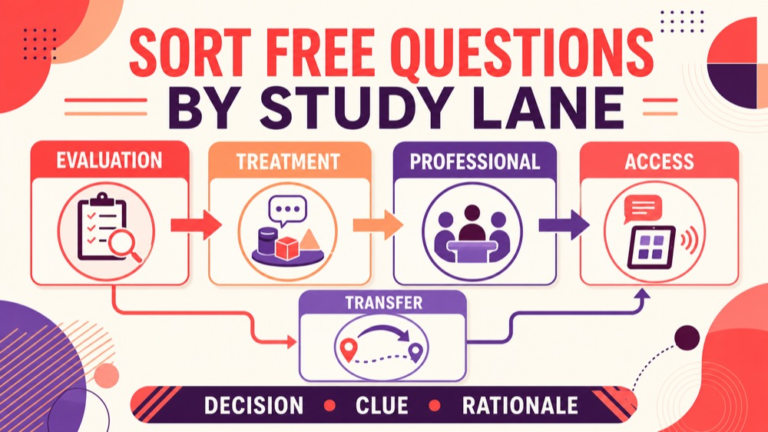
Use the three-lane map to sort your free questions before you review them. Put each item in evaluation, treatment, professional practice, or cross-lane transfer. Then note the decision verb and one context condition. This makes a mixed question bank easier to navigate and shows whether a missed answer comes from content or from decision type.
| Map label | Write | Review prompt |
|---|---|---|
| EVALUATION | Concern, evidence, measure, and interpretation limit. | What must be clarified or observed next? |
| TREATMENT | Goal, target, cue, activity, partner, and outcome. | How will the action reach participation? |
| PROFESSIONAL | Role, consent, privacy, safety, competence, and handoff. | What boundary controls sequence? |
| ACCESS | Language, mode, hearing, culture, environment, and support. | How can the person show the skill? |
| TRANSFER | One changed condition and the revised action. | What changes and what remains stable? |
Do not use the map to label a person or a clinical result. It is a study organizer. Its value is that it makes the reason for an answer visible enough to revisit later.
CHECK THE ANSWER BEFORE YOU MOVE ON
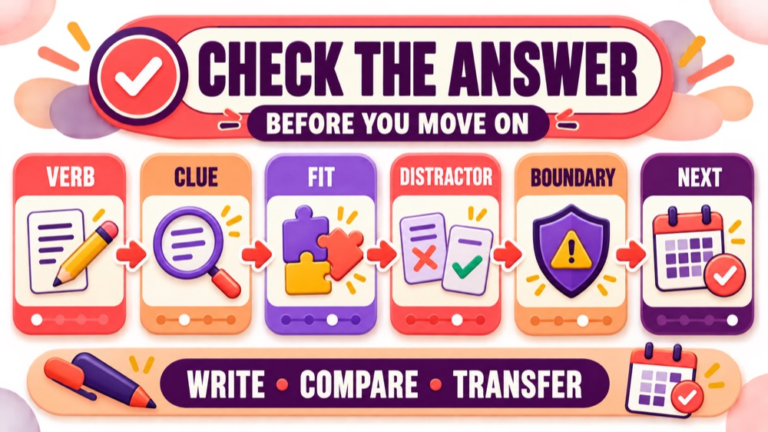
Before moving to the next free item, run a short answer check. Confirm the verb, decisive clue, evidence fit, distractor error, access condition, function, and boundary. If the rationale takes one or two sentences, add a transfer sentence so the question produces a reusable rule.
| Check | Quick question | Record |
|---|---|---|
| Verb | What action was requested? | One action word. |
| Clue | Which fact matters most? | One quoted or paraphrased detail. |
| Fit | Why does the answer match? | One evidence-to-action sentence. |
| Distractor | Why is the closest alternative weaker? | One mismatch. |
| Boundary | What safety, access, or role condition matters? | One limit or handoff. |
| Next | What changed-case question will I solve later? | One variable and a review date. |
This check keeps free practice from becoming a speed contest. You can shorten the session by doing fewer questions and writing better rationales. The review record then tells you what to revisit instead of leaving you with a vague feeling about performance.
Question 1: selecting evaluation evidence
Practice Question 1. A school team reports that a student answers familiar questions in a quiet one-to-one setting but misses directions during a noisy group activity. The team asks for a language score without describing hearing history or the student’s language background. What is the best first move?
- A. Select a broad language measure immediately because the request already names the test purpose.
- B. Interpret the group difficulty as evidence of a global language disorder.
- C. Clarify the participation concern, gather relevant language and hearing context, observe the group demand, and choose evidence that answers the refined question.
- D. Use only the quiet one-to-one sample because it is easier to score consistently.
Correct Answer: C. The difference between quiet individual work and noisy group participation is the decisive clue. Clarifying the question and examining language, hearing, partner, rate, noise, and representative demand protects the interpretation before a broad measure or conclusion is selected.
Why the Other Options Are Wrong: A chooses a tool before the referral question is defined. B turns a context-specific report into a global conclusion. D removes the condition in which the concern appears. C connects the evidence to a proportionate evaluation plan.
Exam Trap: A request for a score may hide an activity or access problem. Identify what the team needs the learner to do before choosing the measure.
Question 2: connecting treatment to participation
Practice Question 2. An adult increases target accuracy during structured practice when a visual cue is available, but does not use the target during a weekly family meeting. Which treatment response best uses the free-question case evidence?
- A. Treat structured accuracy as proof that the functional goal is complete.
- B. Remove the visual cue before practicing the family meeting so the task is more difficult.
- C. Keep the useful support while adding supported family-meeting practice and tracking target performance, cueing, effort, and participation.
- D. Replace the target with a new exercise without reviewing the meeting demand.
Correct Answer: C. The structured result shows that the cue may help, while the unchanged meeting behavior shows that the activity and partner conditions need practice. A functional plan can retain access support and gradually shape the target within a meaningful participation context.
Why the Other Options Are Wrong: A treats one measure as the entire outcome. B removes an effective support before examining its role. D changes direction without addressing the named activity. C connects the target, support, activity, and outcome.
Exam Trap: A support is not automatically a failure. Ask what the support makes possible and how transfer can be practiced.
Question 3: responding to a professional boundary
Practice Question 3. A clinician begins a facility-approved swallowing screen, then notices a new change in alertness and voice after a trial. The facility process says to stop and notify the team. Which response best fits the professional-practice question?
- A. Continue until enough trials have been collected for a detailed conclusion.
- B. Keep the earlier result as final and continue the meal without a handoff.
- C. Stop under the stated process, communicate the change, document the conditions and response, and arrange qualified follow-up for the broader concern.
- D. Ask an untrained helper to finish the remaining trials while the clinician documents.
Correct Answer: C. The stated stop process and the changed clinical condition control the sequence. Stopping, communicating, documenting, and arranging qualified follow-up respects safety, role, and continuity without expanding a screen into a different evaluation.
Why the Other Options Are Wrong: A disregards the local stop rule. B treats earlier performance as final after conditions changed. D assigns a safety-sensitive task without appropriate competence or oversight. C follows the boundary and makes the next communication visible.
Exam Trap: The most complete data set is not the goal when a safety boundary has been reached. Sequence comes before additional observation.
Repair missed questions by error type
After each item, choose one error type rather than writing “I need to study everything.” A narrow label gives you a practical next move. Use the table for the first classification, then create a paired question that keeps the same decision while changing one condition.
| Error | What it looks like | Repair |
|---|---|---|
| Reading | The answer addressed a nearby topic instead of the requested action. | Rewrite the question as one decision sentence. |
| Evidence | A key contrast, limitation, or missing history was overlooked. | Circle the detail that changes the answer. |
| Access | The task was interpreted without considering language, mode, hearing, or environment. | Add the condition needed for fair participation. |
| Sequence | A later action was chosen before clarification, safety, or referral. | Put the options on a before-and-after timeline. |
| Function | The choice sounded technical but did not connect to the person’s activity. | Name the participation outcome. |
| Boundary | Consent, privacy, competence, supervision, or handoff was omitted. | Write who must communicate what and when. |
| Transfer | The original wording was familiar but the rule did not work in a changed case. | Change one variable and keep the rest stable. |
Review both incorrect and low-confidence answers. A correct answer selected for the wrong reason can produce the same study need as a missed answer. Track the clue and the explanation, not only the result.
Create a one-week free-question rotation
Use a weekly rotation to distribute attention without claiming a fixed exam weighting. Complete a manageable number of questions and reserve time for rationales. The current ASHA and ETS pages should guide any update to exam-specific notes.
- Day 1: referral questions, communication goals, and evaluation purpose.
- Day 2: language, dialect, culture, hearing, mode, and accessible directions.
- Day 3: treatment targets, cues, activities, partners, and outcomes.
- Day 4: screening, safety signals, stop rules, referral, and documentation.
- Day 5: professional role, consent, privacy, competence, supervision, and collaboration.
- Day 6: a cross-lane item with one changed context variable.
- Day 7: delayed review of misses, lucky answers, and transfer rationales.
Change the order if your review log shows a repeated weakness. The rotation is a flexible study structure, not a prediction of item distribution or a report about your likely outcome.
Free question session checklist
Use this final checklist to close a session with a useful record.
- Did I identify the decision verb before reading the choices?
- Did I write the person, activity, setting, partner, language or mode, and urgency?
- Did I mark the decisive clue and distinguish evidence from assumption?
- Did I compare the best answer with the strongest distractor?
- Did I connect the action to participation or communication?
- Did I check language, dialect, culture, hearing, mode, environment, and support?
- Did I notice safety, consent, privacy, competence, supervision, and handoff boundaries?
- Did I state what the evidence does not establish?
- Did I write a rationale in my own words?
- Did I change one variable for transfer?
- Did I record an error type and schedule delayed review?
- Did I recheck live ETS or ASHA sources for date-sensitive details?
A productive free-question session leaves a small trail: one clear decision, one decisive clue, one rationale, one transfer condition, and one next review. That trail is more useful than a page of unchecked answers because it shows how to improve the next decision.
Sources and next steps
For the current exam frame, review the ASHA Speech-Language Pathology 5331 content page and the live ETS 5331 page. For clinical topic context, use the ASHA Practice Portal. For language and cultural context, review ASHA Multilingual Service Delivery and ASHA Cultural Responsiveness.
For current preparation-resource information, check the ETS practice-test page. The questions, choices, rationales, maps, and checklist here are original educational material, separate from live test material. Recheck current source pages before relying on administrative, scoring, state, school, agency, facility, or professional requirements.
For the next session, select one missed item, place it in a study lane, write the evidence-to-action sentence, compare the closest distractor, and solve a paired version after a delay.
Continue your preparation: Explore the SLP Study Center learning resources.