A free slp praxis practice test can give you a useful starting point without adding cost, but free does not automatically mean current, aligned, complete, or well explained. The value comes from how you verify the source, label the attempt, and turn the result into a specific next study action.
The current ETS Speech-Language Pathology (5331) page describes a computer-delivered selected-response test with 132 questions and 150 minutes. Use the live ETS page and your account for changing administrative details. ASHA’s preparation guidance also encourages candidates to become familiar with content and format, make a plan around their knowledge, and use practice questions to guide review.
What a free SLP Praxis practice test is good for
Free practice is especially useful when you give it a narrow job. It can help you learn how a source frames questions, retrieve a concept without notes, identify a reasoning gap, or test whether a repaired idea works in a new scenario. It is less useful when you expect one free quiz to represent every part of preparation.
| Purpose | How to use a free set | What not to claim |
|---|---|---|
| Orientation | Inspect wording, task types, and the explanation style. | Do not treat a short quiz as a full exam simulation. |
| Retrieval | Answer a small set without notes, then label confidence. | Do not treat an answer letter as proof of mastery. |
| Repair | Target one concept or distinction and review each cause. | Do not add volume before you understand the miss. |
| Transfer | Use fresh wording or a changed setting after a delay. | Do not use familiar repetition as transfer evidence. |
| Pacing | Run a clearly labeled timed block with checkpoints. | Do not compare unlike timing conditions. |
Free access removes a financial barrier, but it does not remove the need for source judgment. The best question is not “How many items are free?” It is “What will this set teach me, and what evidence will show whether I learned it?”
Verify a free practice source before you rely on it
Start with the current ETS Speech-Language Pathology (5331) page and the ETS practice-test selector. Confirm the test subject, current preparation links, and format information before you judge a free provider’s claims. Search results can mix official practice products, commercial pages, library guides, videos, flashcards, and generic quizzes.
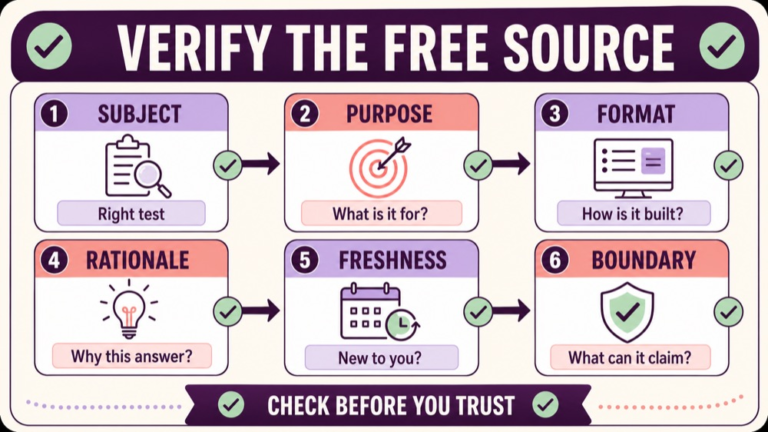
- Identify the subject: look for Speech-Language Pathology (5331), not a general Praxis label without a clear subject.
- Read the purpose: determine whether the free material is a quiz, sample set, trial, study guide, or simulation.
- Check the update context: note a visible update date or record the date you reviewed the page.
- Sample the rationales: see whether explanations connect the best choice to the task and evidence.
- Notice the boundaries: distinguish source teaching claims from current ETS administrative facts.
- Protect original work: avoid resources that imply access to confidential or purported live content.
A free page can still be useful when it is transparent about what it provides. If the page does not identify the SLP subject, explain how answers are reviewed, or show what the score means inside its own conditions, use it cautiously and keep the learning job narrow.
Check scope, format, and explanation quality
Use a three-part first screen: scope, format, and explanation. Scope asks whether the set is meant for the test you are preparing for. Format asks how the items are presented and timed. Explanation asks whether the material teaches you why one answer fits better than the alternatives.
| Check | Evidence to look for | Reason to pause |
|---|---|---|
| Scope | Clear Speech-Language Pathology (5331) identity and stated coverage | Generic Praxis language with no subject boundary |
| Format | Item type, set length, timing, and instructions are visible | A short quiz is called a full simulation without conditions |
| Explanation | Rationale identifies the task, evidence, and close distractor | Only an answer letter or broad label is shown |
| Freshness | Examples are new to you or the source explains its reuse limits | Repeated exposure makes recognition look like application |
| Feedback | Result points to a concept, distinction, or process repair | The result offers a dramatic readiness claim with no review path |
Do not demand that every free resource perform every job. A short quiz may be a good retrieval warm-up even if it is not suitable for a long pacing session. A detailed sample may be a good explanation check even if it does not provide enough fresh items for measurement.
- Use for orientation: read several items and inspect how the source frames the task.
- Use for retrieval: hide notes and record confidence before checking answers.
- Use for repair: write why the closest distractor was less appropriate.
- Use for transfer: create a changed scenario instead of repeating the same item immediately.
- Use for pacing: record timing and interruptions rather than relying on a score alone.
Choose the right mode for a free set
The same free practice test can create different evidence depending on how you use it. Decide whether the session is learning mode, timed skill mode, transfer mode, or a measured simulation. Write the mode at the top of the record before answering so a later percentage has a clear meaning.
- Learning mode: pause, look up a concept, and read the rationale while your goal is understanding.
- Timed skill mode: use a smaller time boundary to practice reading, elimination, or a move-on decision.
- Transfer mode: answer fresh or rewritten scenarios that preserve the principle but change the surface details.
- Simulation mode: protect the measured portion from explanations and record every interruption or changed condition.
Free practice is often too short to support a full endurance conclusion. That is not a flaw if you label it correctly. Use a short set to answer a short question, then choose a longer resource only when the next learning job actually requires one.
Try three original free practice-style questions
The following items are original study examples created for this article. They are not copied from ETS or presented as live test material. Answer before reading the rationale, and use the exercise to practice choosing a source, interpreting evidence, and building a review action.
Question 1: Evaluate a free source by its feedback
Scenario: A free quiz identifies the test subject and gives an answer letter, but it does not explain why the other choices are weaker. A second source has fewer items but provides task-based rationales. Which source is the stronger first choice for learning from mistakes?
Correct Answer: B. Why This Answer Is Correct: A first learning source should help you confirm relevance and understand the decision behind an answer. A rationale that addresses close alternatives creates a path for repair that a bare answer letter does not provide.
Why the Other Options Are Wrong: A confuses volume with learning value. C treats marketing language as evidence of preparation. D treats length as a proxy for alignment and explanation quality. B connects the source boundary to a usable review process.
Question 2: Label a short timed attempt
Scenario: A learner completes a free 20-item set under a timer, pauses twice to read explanations, and then receives a percentage. Which label best describes the result?
Correct Answer: C. Why This Answer Is Correct: The set was short, timed, and interrupted by explanation reading. Those conditions can still teach you something about the process, but they do not support the labels in the other choices. Recording the conditions preserves the useful evidence.
Why the Other Options Are Wrong: A overstates the length and ignores the interruptions. B confuses a provider percentage with the official score process. D treats a practice result as an administrative or licensing conclusion that it cannot establish.
Question 3: Decide what to do after a familiar high result
Scenario: A learner performs well on a free quiz after repeating it three times but hesitates on new scenarios that test the same concept. Which next action is most useful?
Correct Answer: B. Why This Answer Is Correct: Repetition can improve recognition of a familiar set without showing flexible application. Fresh wording and a distractor explanation reveal whether the learner can use the principle when the surface details change.
Why the Other Options Are Wrong: A adds familiarity rather than new evidence. C makes a broad conclusion from a narrow condition. D removes the explanation that would show whether the reasoning is understood. B tests transfer and creates a concrete review record.
Turn a free test into a useful study plan
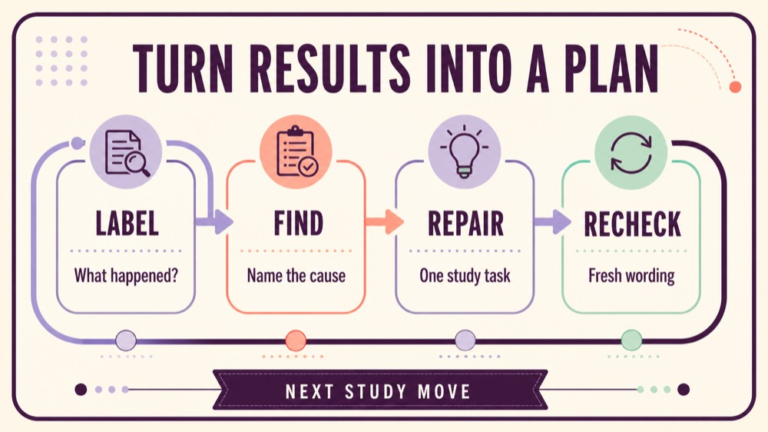
After the set, sort the responses before choosing another resource. Mark confident correct, uncertain correct, incorrect, skipped, and rushed. Then identify the cause: knowledge, distinction, task reading, evidence weighting, timing, source confusion, or fatigue.
| Pattern | What it may suggest | Next study action |
|---|---|---|
| Incorrect, low confidence | A concept may not be available yet. | Review a trusted explanation and retrieve it without notes. |
| Incorrect, high confidence | A tempting rule or assumption may have overridden the evidence. | Compare the best answer with the closest distractor. |
| Correct, low confidence | The response may have been a guess or recognition. | Explain the task and retest with changed wording. |
| Late misses | Fatigue, breaks, or pacing may have changed performance. | Run a smaller timed block and record the process. |
| Source conflict | The explanation or logistics claim may need verification. | Return to ETS or ASHA before saving the claim as guidance. |
Make the next action small enough to complete and specific enough to evaluate. “Study assessment” is broad. “Write a compare-and-contrast note for two next-assessment choices, then answer three fresh scenarios” gives you a visible repair and a way to check it.
- Save the raw result and the conditions before reading more explanations.
- Choose the two or three error patterns that deserve attention first.
- Assign one repair task to each pattern.
- Schedule a fresh check after a delay.
- Decide whether the free resource still fits the next learning job.
Review rationales and distractors carefully
A useful explanation connects the question’s task, the evidence in the scenario, and the boundary of the conclusion. It also explains why an attractive distractor answers another question, skips a needed step, or requires information that is not present. Rewrite the explanation in your own words before adding it to a study note.
- What decision did the item request?
- Which detail carried the most weight?
- What does the correct choice support?
- What does it not establish by itself?
- Why was the closest alternative less appropriate for this task?
- How would the answer change if the setting, age, timing, or support changed?
If a free source offers an explanation that conflicts with current ETS scope or authoritative clinical material, mark the conflict instead of forcing the explanation into memory. A free practice item can still be a prompt for investigation, but unresolved source claims should remain clearly labeled.
Use free practice with other resources
Free practice works best as part of a small resource system. Use the current ETS pages for scope and changing test details, ASHA preparation guidance for planning principles, and a practice source that gives explanations you can analyze. Your own error log then connects these resources to the next action.
| Resource job | Keep it responsible for | How free practice connects |
|---|---|---|
| ETS current page | Test identity, current scope, format, and administrative links | Verify whether the free material is aimed at the right subject. |
| ASHA preparation guidance | Preparation orientation and study-plan principles | Use practice results to choose topic-area review and timed work. |
| Free quiz or sample | Orientation, retrieval, or a narrow repair block | Record conditions and review value. |
| Longer practice source | Fresh applications, endurance, or broader mixed practice | Use only when the next question requires more coverage. |
| Error log | Cause, repair, and transfer evidence | Keep your conclusions tied to what happened. |
Using several sources does not require collecting every free quiz. Choose enough variety to test transfer and enough consistency to see whether your process changed. If the mix becomes difficult to interpret, pause the search and complete a review cycle with one clearly labeled source.
Keep current logistics out of old quiz notes
Free pages and practice explanations can age at different rates from the official source. Keep registration, appointment, delivery, identification, accommodations, and score-reporting notes in a dated logistics record. Check the live ETS page or account when a changing detail matters to your plan.
- Confirm the exact Speech-Language Pathology (5331) subject and code.
- Check the current appointment or delivery information that applies to you.
- Review current test-day identification and arrival requirements from the responsible source.
- Record accommodation steps through the relevant channel when needed.
- Verify current score-reporting or recipient instructions separately from practice results.
- Date the verification so you know when to check again.
This separation keeps a free quiz in its proper role. It can help you practice and review; it should not quietly become the authority for administrative facts that may change.
Avoid common free Praxis test mistakes
Check for these problems before trusting a free set or interpreting its score:
- Using a generic Praxis quiz without confirming the SLP 5331 subject.
- Assuming free means current or complete.
- Choosing item count before reading sample rationales.
- Calling a short quiz a full simulation without recording conditions.
- Repeating familiar questions and calling the result transfer evidence.
- Reading explanations during a measured attempt without labeling the interruption.
- Comparing percentages from sources with different scoring or timing.
- Using a third-party paragraph as the source for current appointment rules.
- Copying proprietary or purported live material into notes or public content.
- Adding another resource before deciding what the last result showed.
The practical correction is to narrow the job. Verify the subject, inspect the explanation, choose the mode, record the conditions, review the reasoning, and test the repair with fresh wording. A free resource becomes more valuable when every attempt answers a question you can act on.
Free SLP Praxis practice-test checklist
Use this checklist before and after a free slp praxis practice test. Keep it with the raw result so you can distinguish source quality, conditions, familiarity, and actual reasoning change.
- Did I verify Speech-Language Pathology (5331) through the current ETS source?
- Did I identify whether the free set is a quiz, sample, trial, or simulation?
- Did I read enough rationales to judge explanation quality?
- Did I write the purpose and mode before starting?
- Did I record timing, environment, breaks, and interruptions?
- Did I label confident, uncertain, incorrect, skipped, and rushed responses?
- Did I explain the closest distractor for important items?
- Did I separate practice evidence from an official score?
- Did I turn the main error pattern into one small study action?
- Did I schedule a fresh transfer check after a delay?
- Did I verify changing logistics from the live responsible source?
A good free slp praxis practice test does not need to answer every preparation question. It needs to help you ask a better next question: what concept, distinction, process behavior, or current source should I work on now?
Sources and next steps
Use the current ETS Speech-Language Pathology (5331) page for test identity, format, duration, question count, content areas, and official preparation links. Search the ETS Praxis practice-test page for current subject options. Review ASHA’s Praxis preparation guidance for study planning, practice questions, timed practice, and topic-area review.
Continue your preparation: Explore the SLP Study Center learning resources after you have recorded the free set’s conditions and selected the next repair task.