Free SLP materials can make planning easier when they help a learner practice a meaningful communication skill in a real routine. A printable, picture set, visual, data form, or activity idea is only a starting point. The resource still needs a clear purpose, an accessible response route, a responsive partner, and a way to decide what to do next.
This guide shows how to sort free speech-language materials, check whether a resource fits the learner, adapt it without losing the target, and use it with useful progress notes. It does not endorse an unverified download or replace individualized clinical judgment. For broader professional context, review the relevant ASHA Practice Portal topics.
Table of Contents
- What free SLP materials can include
- Match a resource to one communication purpose
- Check access, age, and context before use
- Use a simple prepare-practice-review routine
- Adapt materials for common target areas
- Decide whether a resource is worth keeping
- Frequently asked questions
What Free SLP Materials Can Include
“Free” can describe many different formats: a worksheet, picture scene, story map, visual schedule, cue card, data sheet, word list, activity outline, or low-tech communication support. The format does not determine whether the material is useful. Start by asking what the learner should be able to communicate, understand, produce, or participate in after using it.
A practical resource may support:
- speech sound practice inside meaningful words or activities;
- vocabulary, comprehension, narrative, or sentence formulation;
- social communication, perspective, conversation, or repair;
- AAC access, message building, choice, refusal, or partner interaction;
- fluency, voice, or motor-speech practice when individualized guidance is available;
- classroom participation, routines, self-advocacy, or functional communication; and
- observation, data collection, and a decision about the next support.
Sort resources by the communication job they help with rather than by appearance. A bright worksheet may be less useful than a plain visual that gives the learner a meaningful way to request help. A story picture may support sequencing, vocabulary, conversation, or inferencing depending on the prompts and the listener.
Match a Resource to One Communication Purpose
Choose one main purpose before opening the material. “Work on language” is too broad to guide an activity. A more useful purpose might be tell a partner what happened, choose between two activities, repair a misunderstanding, describe a picture, practice a target sound in a phrase, or answer a question with access to AAC.
Write the purpose in plain language, then identify the smallest observable response that would show useful participation. The response might be a word, phrase, symbol selection, gesture, sign, written message, sequence of pictures, or multimodal combination. A resource can support more than one response mode when the purpose is communication rather than a single output form.
Ask these planning questions:
- What does the learner need the listener or partner to understand?
- Is the activity connected to a routine, interest, or real participation need?
- Which vocabulary, symbols, cues, or materials are necessary for access?
- What will the partner do while the learner communicates?
- What observation will guide the next teaching or support decision?
If the answer to these questions is unclear, save the material for later rather than forcing it into the current session. A resource should reduce preparation or improve access, not create a second planning problem.
Check Access, Age, and Context Before Use
Preview every free resource before showing it to the learner. Check the language, images, instructions, cultural assumptions, reading demand, symbol meaning, and age-respectful presentation. Remove distracting text or replace examples that do not match the learner’s life. Adaptation is part of responsible use, not evidence that the original resource failed.
Check physical and communication access. Can the learner see the page, reach the symbols, turn the page, use the writing tool, hear the directions, or access the relevant AAC vocabulary? Can the partner wait, model, accept a different response mode, and respond to a refusal or repair? A printable page may need larger symbols, fewer items, a stable surface, a digital version, or partner-assisted access.
Check the context too. A resource designed for a one-to-one table activity may not work in a noisy classroom. A picture set that supports a familiar routine may not transfer to a new partner without additional modeling. Keep the target stable while changing one condition at a time so you can see what the learner can do with a new support or setting.
Use a Prepare-Practice-Review Routine
A short routine makes a free material easier to use without turning it into a script. Prepare the access and communication purpose, practice the target with a responsive partner, then review what the learner communicated and what should change next.
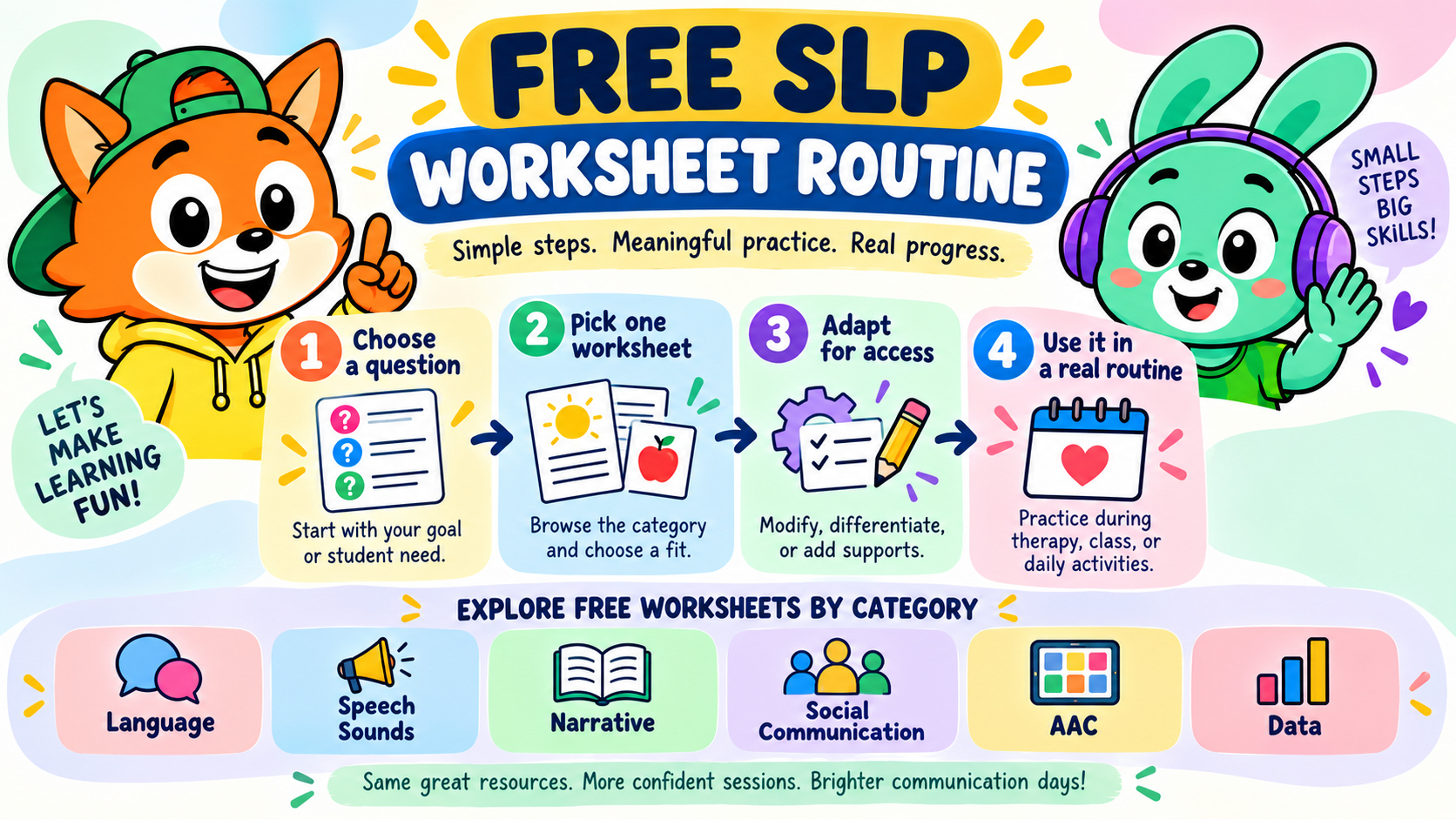
Prepare: Select only the pages, pictures, symbols, or examples needed for the current purpose. Add the learner’s response modes, key vocabulary, partner plan, and a simple observation field. Keep a backup activity if interest, regulation, or access changes.
Connect: Introduce the material through a real situation. Explain why the learner or partner might use it, and make sure the learner can see, handle, point to, select, speak, sign, write, or otherwise access the relevant information.
Practice: Model the communication or skill, pause, and allow the learner to contribute. Use the least intrusive prompt likely to help, then vary support based on the learner’s response. Accept meaningful multimodal communication when it fits the purpose.
Review: Record the response, support, context, and partner response. Decide whether to repeat the same routine, change one condition, add an access support, or choose a different resource. The review step turns a free download into part of a thoughtful plan.
Do not measure a worksheet only by how many items were completed. A learner may complete a page with heavy prompting but communicate more independently during a connected activity. Include the response mode, purpose, and listener understanding in the review.
Adapt Materials for Common Target Areas
For speech sound practice, connect a word list or picture page to meaningful words, phrases, play, reading, or conversation. Note the target, word position, cue, response, and context. Avoid treating a long list of repetitions as the only evidence of useful communication.
For language and narrative, use pictures, story maps, or sequencing cards to help the learner connect people, actions, problems, and outcomes. Ask what information a listener needs, and allow the learner to communicate through speech, AAC, gesture, drawing, writing, or a combination.
For social communication, adapt cards and scenarios so the learner can notice a situation, choose a possible action, express a preference, repair a misunderstanding, or set a boundary. Keep the interaction flexible; social communication is more than selecting the adult’s preferred answer.
For AAC, make the relevant vocabulary available before the activity. Model messages without requiring imitation, honor yes and no, preserve access to refusal and repair, and record the learner’s purpose and communication mode. A free visual should complement the learner’s broader communication system rather than replace it without assessment.
For classroom and functional participation, connect the material to a routine that matters. A visual can support a transition, a checklist can support a handoff, and a picture sequence can support explaining what happened. Include the partner and setting in the plan so the skill has a path beyond the therapy table.
Decide Whether a Resource Is Worth Keeping
After using a free resource, ask whether it saved preparation time, improved access, created a meaningful communication opportunity, or clarified the next decision. If it did none of these, remove it from the active folder. A large collection is not the same as a useful resource system.
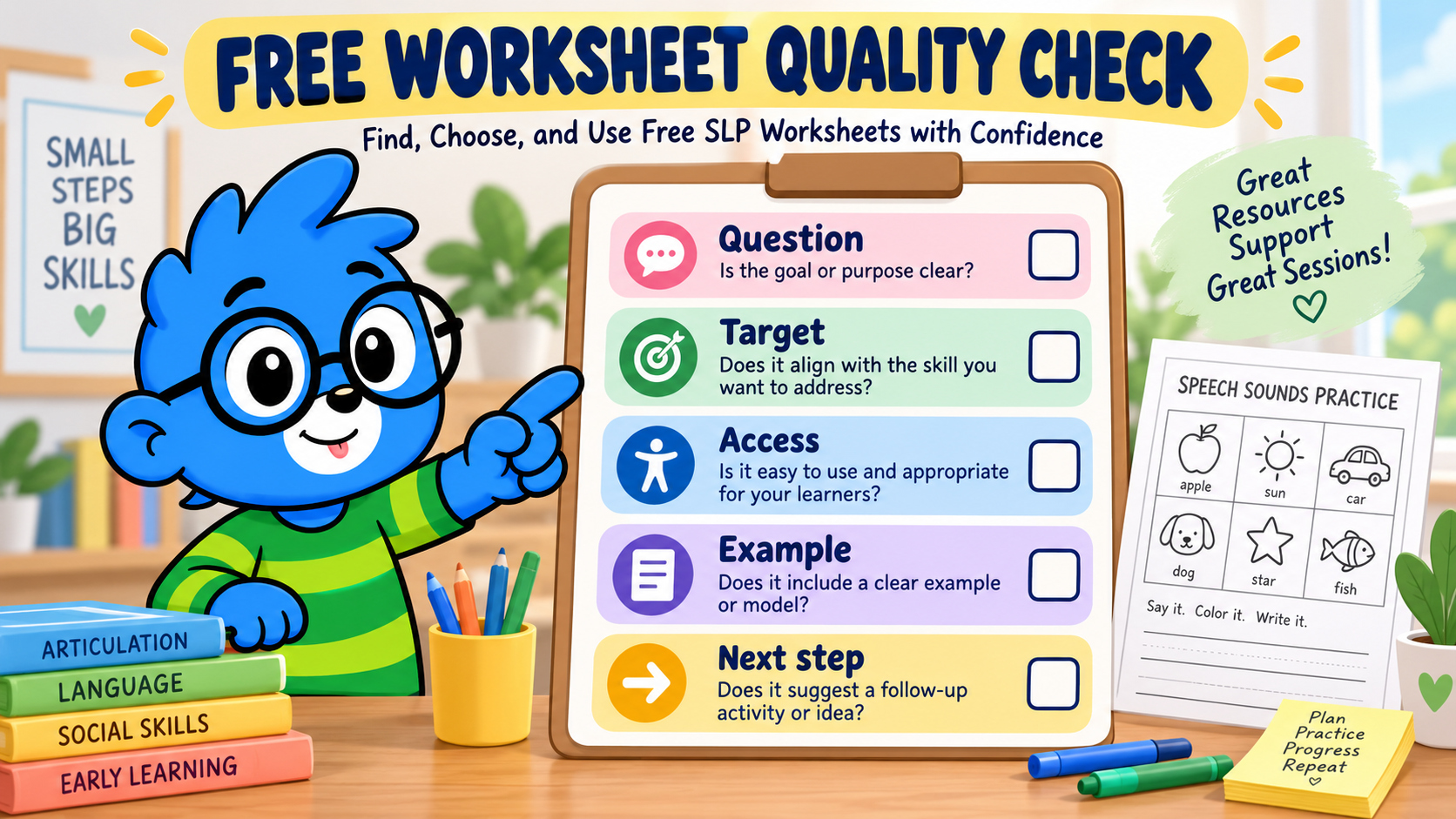
Use a short quality check:
- Is the communication purpose clear?
- Is the target observable without forcing one response mode?
- Can the learner access the material and the needed vocabulary?
- Does the example fit the learner’s age, language, culture, and context?
- Can a partner respond meaningfully to the learner’s message?
- Does the material lead to a useful next step or adaptation?
Keep the resource when the answers are mostly yes and the material can be adapted without changing its purpose. Store a brief note with the file describing the target, access change, successful routine, and next variation. That note will be more valuable than downloading another similar page.
Frequently Asked Questions
Where should I start with free SLP materials?
Start with one learner need and one recurring routine. Choose a resource that supports a clear communication purpose, preview its access and language, and decide what observation will guide the next step before using it.
How can I tell whether a free worksheet is appropriate?
Check age respect, language, cultural fit, reading demand, symbol meaning, physical access, response modes, and partner support. Adapt or replace a page when it creates barriers or expects a response that does not match the communication purpose.
Can free materials be used with AAC?
Yes, when the relevant vocabulary and access method are available and the partner models without pressure. Keep AAC, speech, sign, gesture, writing, and other modes available, and measure the message and participation rather than only spoken output.
How many free resources should I collect?
Collect enough to support the current targets and common routines, not every file you find. A small, organized set with notes about access and next steps is easier to use than a large folder with no selection criteria.
Free SLP materials work best as adaptable tools inside a clear communication plan. Start with purpose, check access and context, practice with a responsive partner, and keep only the resources that help the learner participate or help the team make a better next decision.