
ets speech language pathology praxis is a useful starting point when you need one reliable place to check what the assessment is, how it is delivered, and what to verify before you build a study calendar. The current ETS page identifies the Speech-Language Pathology test as 5331 and lists key details such as timing, question count, selected-response format, and computer delivery. Those details give your preparation a factual frame, but they should still be checked against the live page before test day.
This guide teaches you how to read the ETS page without treating every line as permanent. Separate test identity and blueprint information from prices, appointment availability, score-recipient rules, and registration policies. Then turn the stable information into a study map and use the changing information as a short pre-registration and pre-test checklist.
Start with the right source
Begin with the current ETS Speech-Language Pathology 5331 page rather than a search snippet, an old screenshot, or a study product description. Search results can help you find the page, but the live ETS page is the stronger reference for current administrative details. Open the page directly, note the date you checked it, and save the URL in your study notes.
Use the ETS Study Companion for a deeper view of the test-at-a-glance information and study topics. Use ASHA for the broader certification context and for understanding why the Praxis examination appears in the professional pathway. These sources answer different questions, so keeping them in separate notes prevents a registration detail from being mistaken for a clinical learning objective.
- ETS test page: current exam identity, delivery details, timing, question count, and page-level purchasing or scheduling information.
- ETS Study Companion: content categories, study topics, question-format orientation, planning suggestions, and score explanations.
- ASHA Praxis information: certification context and the relationship between the examination and the broader professional process.
- Your program or licensing authority: the requirement, deadline, or score policy that applies to your own pathway.
Read the page in layers
A quick page read becomes more useful when you move from identity to structure, then from structure to logistics. First confirm that the page is for Speech-Language Pathology and that the test code is 5331. Next record the test length, number of questions, format, and delivery method. Only after that should you review price, score recipients, test-center choices, at-home requirements, or preparation products.
This order matters because the first group describes what you are preparing to take, while the second group helps you decide when and where to take it. If you start with a price or a date, you may overlook a test-code mismatch. If you start with a prep-course offer, you may confuse a product feature with the assessment blueprint.
Build a source-of-truth snapshot
Make a one-page snapshot in your study folder. At the top, write the page title, test code, URL, and date checked. Under that, create two columns: current test facts and details to recheck. The first column can anchor your study plan; the second column should be revisited when you register, reschedule, or move into the final week.
| Information group | What to record | How to use it |
|---|---|---|
| Test identity | Speech-Language Pathology and code 5331 | Confirm every study resource and registration selection. |
| Format and timing | Selected response, computer delivered, 150 minutes, 132 questions on the current page | Design timed practice and pacing checks. |
| Content structure | Three broad categories in the Study Companion | Balance review across foundations, assessment, and treatment. |
| Changing logistics | Price, location, delivery availability, policies, and score-recipient details | Recheck before payment and before test day. |
The snapshot is not a substitute for the source. Its purpose is to make source checking easier and to keep your study decisions visible. When the ETS page changes, update the snapshot instead of allowing several old notes to compete with the current information.
How to use the ETS speech language pathology praxis page
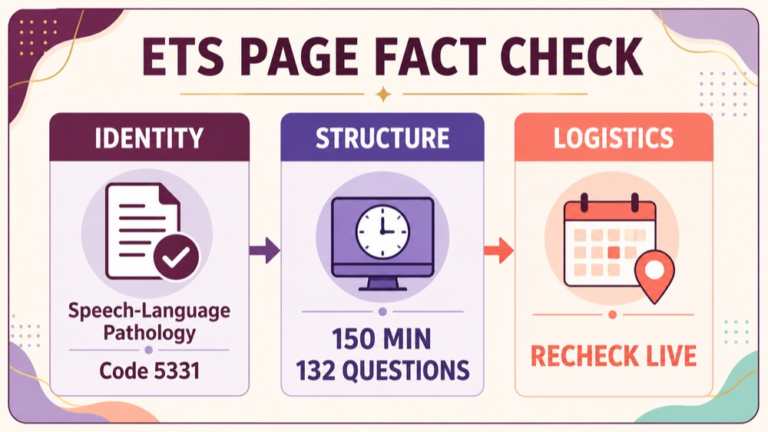
Use the page as a fact-checking hub, not as your entire study curriculum. The page can tell you what assessment you are looking at and can point you toward official preparation materials. It cannot replace deliberate review of the domains, clinical reasoning practice, or the requirements supplied by your program and licensing authority.
For each important line on the page, ask one of three questions: Does this tell me what the test measures? Does it tell me how the test is administered? Or does it tell me what I must verify before booking? Labeling the line this way creates a clean boundary between learning content and appointment logistics.
- Confirm the page title and test code.
- Record the current timing, question count, format, and delivery method.
- Open the Study Companion and compare the high-level content structure.
- Write down any current price or score-recipient information with the date checked.
- Check your school, state, or licensing authority for its own requirement.
- Build practice blocks from the content structure rather than from the page layout.
- Reopen the live ETS pages before registration and before test day.
- Keep your confirmation and source snapshot together in a secure study folder.
Separate the blueprint from logistics
The current ETS page reports 150 minutes and 132 questions, with selected-response questions delivered by computer. The Study Companion presents three broad content categories, each shown with an approximate one-third share: foundations and professional practice; screening, assessment, evaluation, and diagnosis; and planning, implementation, and evaluation of treatment. Use those categories as an organizing framework, not as a promise that every future form will look identical in every detail.
Logistics require a different kind of attention. The current page checked for this article lists a $146 test price, options for testing at home or at a test center, and four free score recipients. These are time-sensitive page details. Record them for planning, but verify them again in the live ETS flow because prices, availability, eligibility checks, and policies can change.
A useful note-taking pattern is to put a small label beside each fact: study, verify, or ask. Study facts become review tasks. Verify facts are checked again at a defined date. Ask facts are questions for ETS, your program, or your licensing authority when the published pages do not resolve your situation.
Turn page facts into a study plan
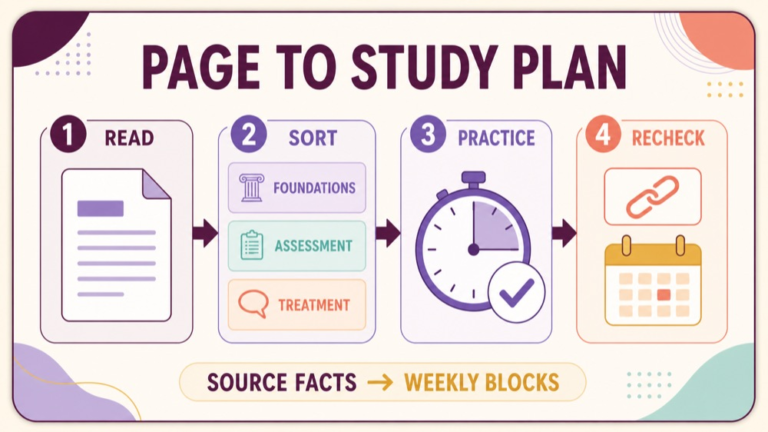
Once the page snapshot is complete, turn it into a calendar with three layers. The first layer is coverage: rotate through all three broad content categories. The second layer is application: use cases, tables, and short explanations to practice choosing the best next step. The third layer is pacing: complete timed sets that fit the current length and question-count frame, then review the reasoning behind missed or uncertain items.
Do not let a one-page overview dictate every hour of preparation. It is a map of the assessment, not a personalized diagnosis of your readiness. Your performance data, course feedback, and program guidance should help you decide which topics need more time. If a practice set exposes a weakness, add a targeted review block while keeping the other categories in rotation.
- Week 1 or start point: read the ETS page and Study Companion, then mark familiar and unfamiliar domains.
- Coverage block: review foundations and professional practice with emphasis on ethics, documentation, evidence, and collaboration.
- Assessment block: practice linking referral questions, history, screening, evaluation, and differential reasoning to the available evidence.
- Treatment block: review goal selection, planning, implementation, outcome monitoring, and follow-up.
- Application block: explain why one action fits the case while nearby choices miss the stated purpose or context.
- Timed block: use the current 150-minute and 132-question frame as a pacing rehearsal, then note where time was lost.
- Source check: compare any uncertain administrative fact with the live ETS page rather than an old study note.
- Final block: reduce new material, review error patterns, and confirm appointment instructions.
Map the three content categories
The first category, foundations and professional practice, is broader than memorizing terminology. Build notes about typical development, communication and swallowing factors, common disorders, ethics, culturally and linguistically appropriate service delivery, documentation, research methodology, and collaboration. When you review a topic, add the professional decision it supports and the context that could change the decision.
The second category covers screening, assessment, evaluation, and diagnosis. Practice matching the referral question to a reasonable information-gathering sequence. Ask what the history contributes, what a screening result can and cannot establish, when a more complete assessment is needed, and how anatomy, physiology, language, hearing, cognition, culture, and setting affect interpretation.
The third category focuses on planning, implementation, and evaluation of treatment. Organize it around priorities, measurable goals, treatment details, prognosis, communication of recommendations, progress monitoring, outcomes, and follow-up. A strong study note explains how the plan responds to assessment findings and how the clinician would revise it when the data do not support the original direction.
Use page details during practice
Page details are most useful when they shape a behavior you can observe. The 150-minute frame can prompt a pacing rehearsal. The selected-response format can prompt practice with eliminating choices and checking whether the chosen answer responds to the exact question. The three-category structure can reveal whether your practice calendar has neglected one major area.
After each timed block, record more than the score. Write down the question type, the evidence you noticed, the distractor that attracted you, the reason your first choice changed or stayed, and the time cost. This turns practice into a feedback loop. It also keeps a difficult result from becoming a vague judgment about your ability.
Keep administrative notes separate from clinical reasoning notes. A change in registration policy should update your logistics checklist; it should not cause you to rewrite your understanding of assessment or treatment. Likewise, a weak domain result should change your study schedule; it should not be treated as a prediction about your certification outcome.
Common reading errors
- Using a search-result snippet as the final source for price, timing, or delivery information.
- Confusing the test name with the name of an ETS preparation product.
- Writing down the code without confirming that the full test title matches the required assessment.
- Treating approximate content percentages as a guarantee about the exact distribution on every form.
- Building a study calendar around a remembered policy from a different Praxis test.
- Assuming an at-home appointment follows the same instructions as a test-center appointment.
- Ignoring the requirements supplied by a state board, school, or other receiving organization.
- Saving a page snapshot without recording the date checked or the link to the live source.
The fix is a dated source routine. Open the current ETS page, compare the page title and code, record the stable study facts, flag the changing logistics, and set a reminder for the next check. This small habit is more reliable than adding more unverified detail to a crowded study document.
Quick review checklist
Before you close the ETS page, confirm that you can answer these questions in your own notes:
- What is the full name of the assessment I am preparing to take?
- What test code is shown on the current ETS page?
- What timing, question count, format, and delivery details should shape practice?
- Which facts come from the ETS Study Companion rather than the product page?
- What are the three broad content categories I need to rotate through?
- Which logistics must be checked again before I register?
- Which requirement comes from my program or licensing authority?
- Where will I store the live links, date checked, and appointment confirmation?
The best use of the ETS page is a disciplined starting point: identify the assessment, establish a current fact base, build a balanced study plan, and revisit changeable details at the right time. That approach supports focused preparation without turning an administrative page into a substitute for professional learning.
Sources and next steps
Review the current ETS Speech-Language Pathology 5331 page for live test information. Use the ETS Speech-Language Pathology Study Companion for the test-at-a-glance structure and study topics. For certification context, read ASHA’s Speech-Language Pathology Praxis information, and check the ETS test-center page when appointment logistics matter.
Continue your preparation: Explore the SLP Study Center learning resources.