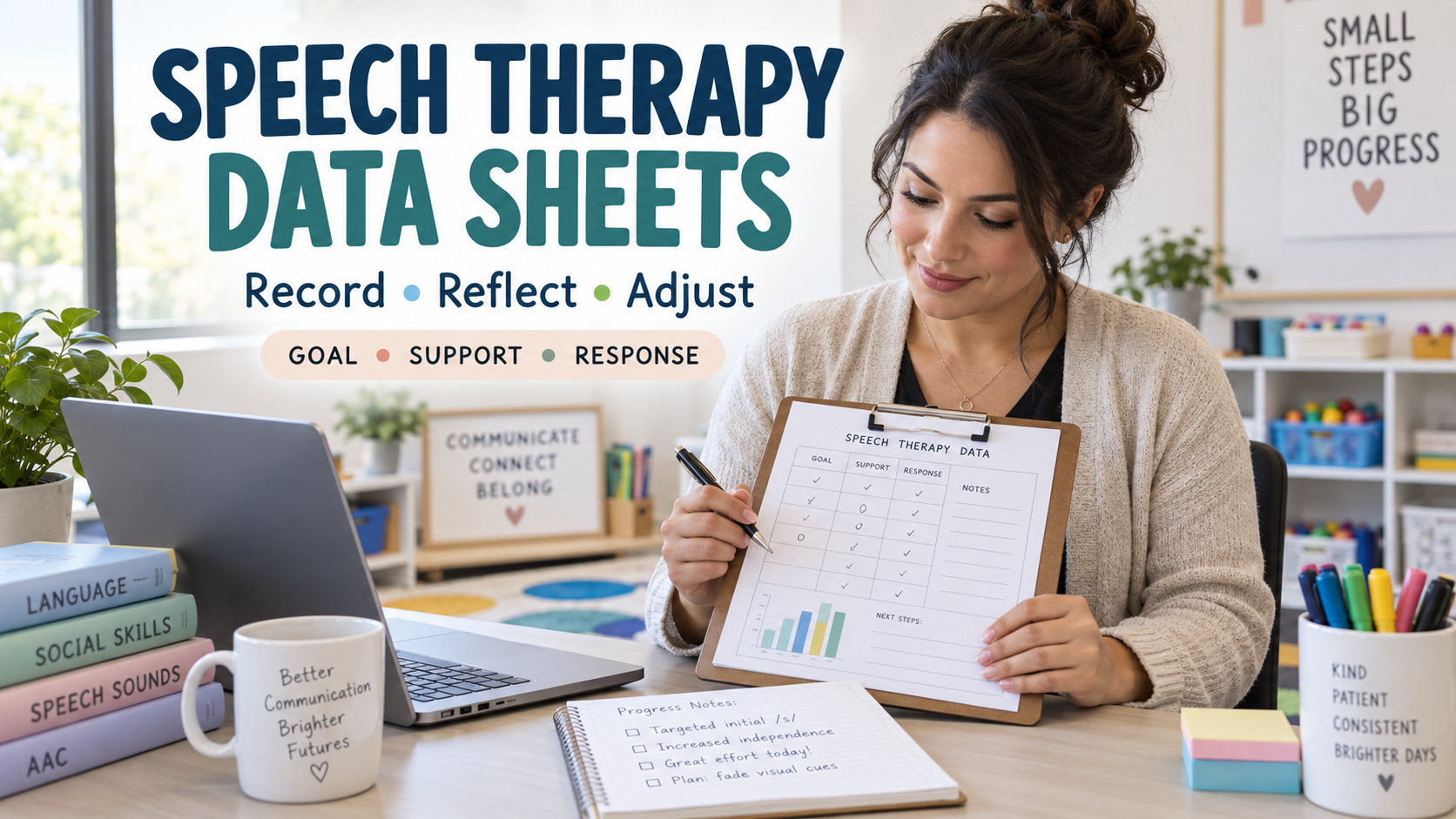
Data collection sheets speech therapy teams use are most helpful when they connect an observation to a decision. A page can record accuracy, prompts, communication mode, listener understanding, or participation, but the form should make clear what opportunity was measured and what the team will do with the information.
This guide explains how to choose fields for a speech therapy data collection sheet, match the measure to the goal, record context without creating unnecessary paperwork, and review patterns across sessions. It is an educational planning guide rather than an individualized evaluation or documentation requirement. The ASHA documentation guidance and relevant practice resources provide broader context for connecting records with services, progress, and functional outcomes.
Table of Contents
- Start with the decision the data should support
- Choose the right opportunity and measure
- Build a data sheet from useful fields
- Record prompts, modes, and context
- Review patterns instead of isolated percentages
- Adapt data collection to common therapy targets
- Frequently asked questions
Start With the Decision the Data Should Support
Before opening a template, finish this sentence: “After reviewing the data, the team may decide to…” The answer might be repeat the routine, change a prompt, add an access support, vary the partner, move to a harder context, or gather more information. If the page cannot help with a decision, it may contain more fields than the session needs.
Possible data questions include:
- Can the learner perform the target under a defined condition?
- Does a support make access or participation easier?
- Is the learner communicating in more than one mode?
- Does performance transfer to a new partner, activity, or setting?
- Is the learner initiating, repairing, refusing, or directing as well as responding?
- Which part of the routine creates a barrier or opportunity?
Different questions call for different data. A trial count may be appropriate for a carefully defined speech sound opportunity, while a narrative note may better capture an AAC initiation, a conversational repair, or a successful classroom participation moment. The purpose of the sheet should guide the measure rather than the other way around.
Choose the Right Opportunity and Measure
Define the opportunity before recording a result. “Worked on requesting” is too broad to compare across sessions. A more useful description might identify the activity, communication partner, available supports, and what counted as a response. The definition can be short, but it should be clear enough that another trained adult could understand the observation.
For a structured target, the opportunity may be one sound in a word position, one response to a story question, or one chance to describe a picture. For a functional target, it may be an initiation during snack, a repair after a partner misunderstanding, or a message used to request a change. Write the condition around the response so a percentage does not hide the context.
Choose a measure that fits the target:
- frequency for initiations, repairs, or message purposes;
- duration for participation, wait, turn, or sustained communication;
- latency for time between an opportunity and a response;
- accuracy when the response and scoring rule are clearly defined;
- level of support when prompt changes are central to the decision; and
- descriptive notes when the event is complex, meaningful, or uncommon.
One sheet can include more than one measure, but avoid recording everything by default. If a target needs accuracy and prompt level, include both. If the clinical question is whether a learner can participate with a new partner, add partner and setting rather than collecting a larger number of repetitive trials.
Build a Data Sheet From Useful Fields
Most speech therapy data collection sheets can be built from a small set of fields. The exact layout may be a table, checklist, digital form, running note, or combination. Choose the format that can be used while the clinician or partner is also supporting the learner.
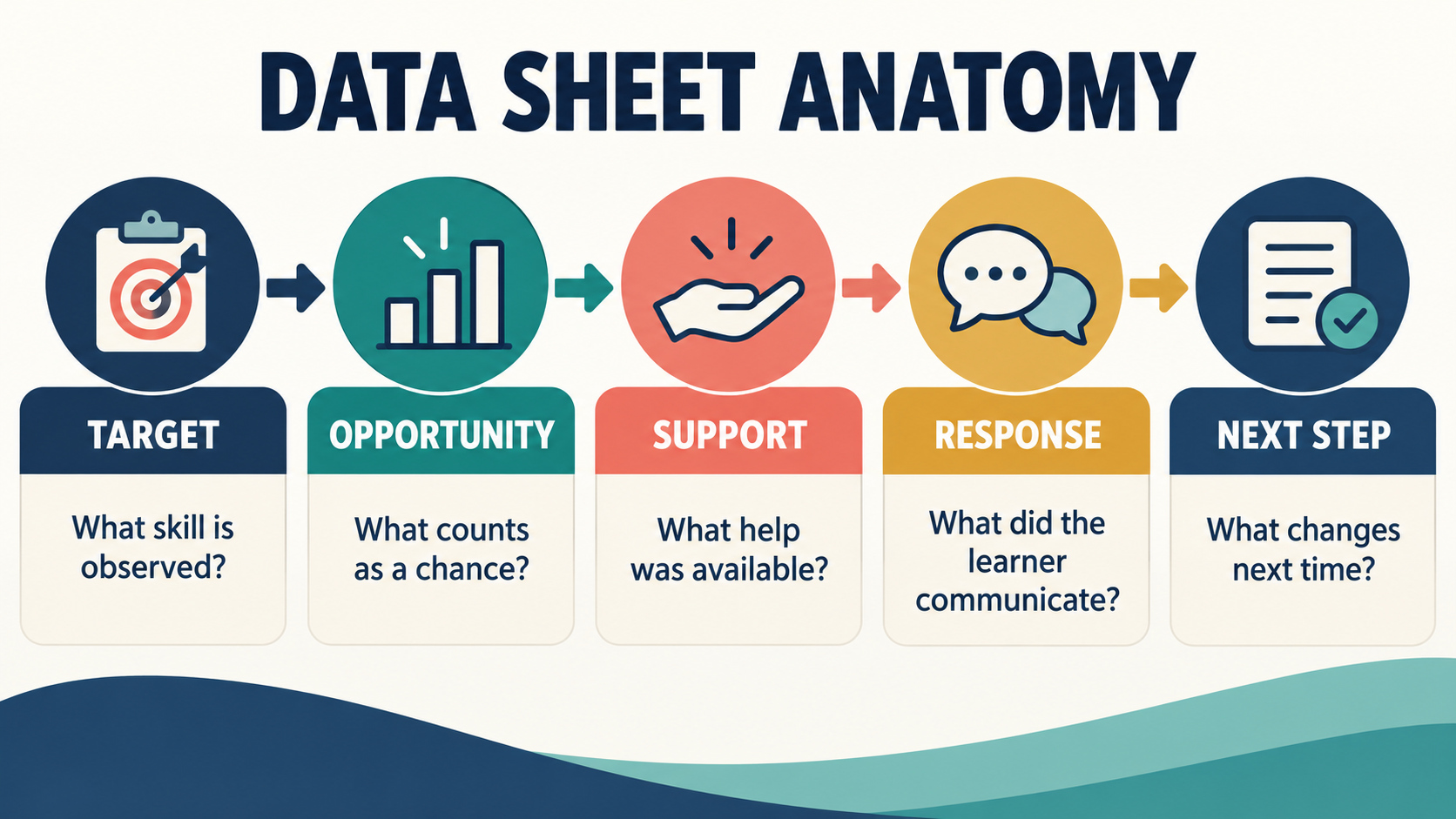
Target and purpose: State the skill and why it matters in the activity. “Use a repair message when a partner does not understand” is more useful than “social language.”
Opportunity or condition: Describe what happened before the response, who the partner was, and what materials or cues were available. This makes comparisons more meaningful.
Response: Record the learner’s action or message using the relevant scoring rule. Include speech, AAC, sign, gesture, writing, drawing, pointing, or a multimodal combination when those modes are part of the learner’s communication.
Support: Note the prompt, model, wait time, visual, positioning, partner response, or other access support. A response without its support level can be difficult to interpret.
Outcome and next step: Record whether the message was understood, whether the task continued, and what should be repeated, changed, generalized, or supported differently.
Keep specialized fields optional. An articulation sheet may need word position and cue type. An AAC sheet may need access method and message purpose. A fluency, voice, feeding, or language activity may need a different set of observations. One universal form should not force every goal into the same scoring system.
Record Prompts, Modes, and Context
Prompt level is more than a checkbox. Note what the partner actually did and whether the support changed the learner’s access. A verbal question, a visual cue, a model, a gesture, a choice, and a partner-assisted scan do not represent the same condition. Use a short code only when the team has defined what the code means.
Response mode matters too. A learner may communicate a complete message through speech plus gesture, an AAC selection plus eye gaze, sign plus vocalization, or writing plus pointing. If the sheet records only spoken words, it can undercount meaningful communication and misrepresent the learner’s participation.
Context fields should be selective. Useful context may include the routine, partner, setting, activity, language, materials, sensory or physical access, and whether the learner had a real reason to communicate. Record the context that could change the interpretation, not every detail that happened during the session.
A short note can preserve information that a trial count cannot. For example, “initiated help with AAC during group art; partner waited; learner repaired after the first message was not understood” may guide the next plan more effectively than “1/1.” The format should serve clinical reasoning and functional participation.
Review Patterns Instead of Isolated Percentages
Review the sheet after the activity, not only at a reporting deadline. Look for a pattern across opportunities, partners, settings, supports, and response modes. One result may be affected by fatigue, unfamiliar materials, a change in communication partner, or a meaningful event that does not repeat on demand.
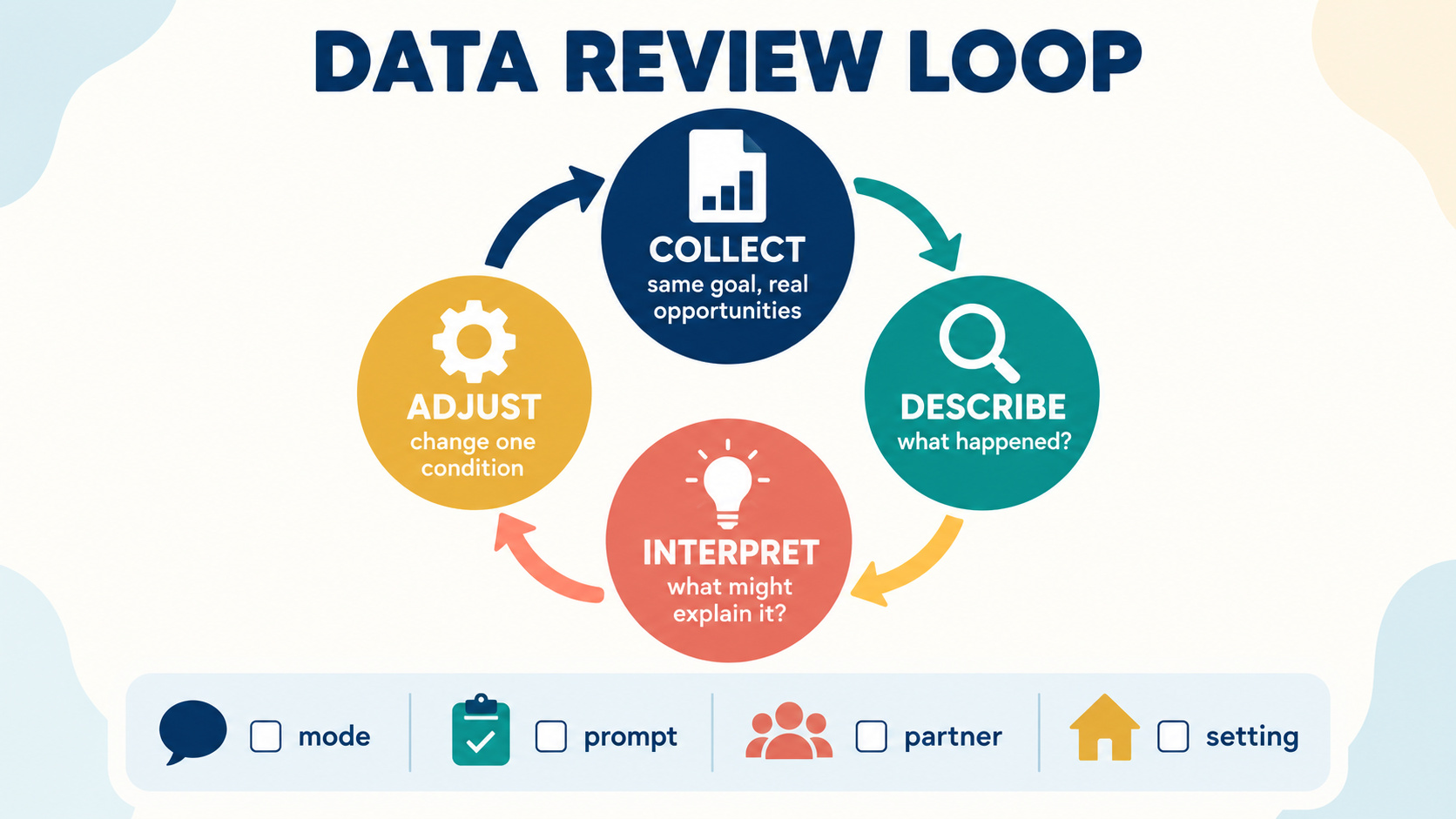
Ask four review questions:
- What happened under the recorded condition?
- Which support or context seemed to change access?
- What did the learner communicate, not only what was scored?
- What is the smallest useful change to try next?
If performance improves with a visual but drops when the visual is removed, decide whether the visual is an access support that should remain, a teaching support to vary, or a design that needs adjustment. If a learner performs with a familiar clinician but not a classroom partner, plan a supported partner variation rather than concluding that the target is absent.
Avoid presenting a percentage without its denominator and condition. “80%” may describe five structured trials, twenty repeated items, or a mix of very different opportunities. Include the number of opportunities, scoring rule, support level, and relevant context when a numeric summary is used.
Adapt Data Collection to Common Therapy Targets
For speech sound work, define the sound, word position, response type, and cue condition. Decide whether the team is measuring a selected target in structured practice, connected speech, or a functional communication context. Note meaningful changes in intelligibility or listener understanding when they are part of the goal.
For language and narrative work, record the information communicated, sequence, vocabulary, grammar, response mode, and support. A learner may communicate a complete idea with fewer spoken words when AAC, gesture, or pictures are available. The measure should reflect the purpose of the activity.
For AAC and social communication, track initiation, message purpose, repair, partner response, access, and transfer. Record refusals, boundaries, choices, and comments rather than treating only requested items as successful communication. A responsive partner is part of the condition.
For fluency, voice, feeding, or other specialized areas, use the current goal definition and professional guidance for the target. Include safety, comfort, participation, and context when those factors affect the interpretation. A general data sheet should not replace specialized clinical judgment.
For educational collaboration, make the form readable to the people who will use it. A short shared definition, example, and next-step field can make a sheet more useful than a complex scoring system that only one person understands.
Frequently Asked Questions
What should a speech therapy data collection sheet include?
Start with the target and purpose, opportunity or condition, learner response, support or prompt, context, and next step. Add specialized fields only when they answer the question the team is trying to resolve.
Do I need to collect data on every trial?
Not necessarily. The appropriate amount depends on the target, opportunity, setting, and decision. Structured targets may use trial data, while functional communication, participation, and repair may be better captured through frequency, duration, or descriptive notes.
How do I record AAC or multimodal communication?
Record the message purpose and the modes used, such as AAC, speech, sign, gesture, writing, drawing, or pointing. Include access supports and partner response so the data describe communication rather than one output mode.
What makes data useful for progress decisions?
Useful data connect the response to a defined condition and lead to a next action. Review patterns across time and context, include supports, and avoid interpreting an isolated percentage without its denominator and opportunity definition.
Data collection sheets speech therapy teams use should make observation easier, not turn every session into paperwork. Define the question, record the condition and communication mode, preserve meaningful context, and let the pattern guide the next support or practice opportunity.