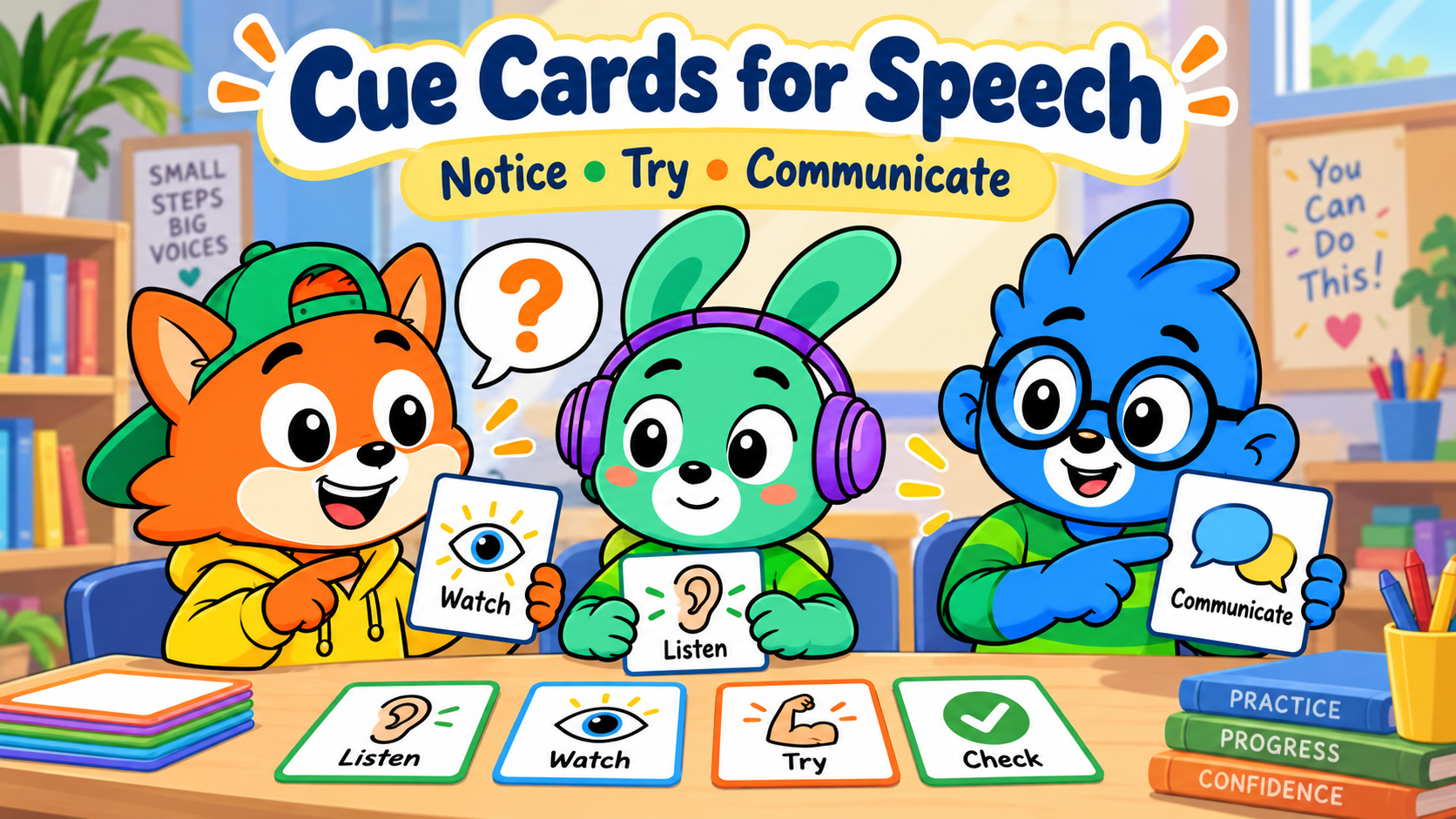
Cue cards for speech can help make a target, model, action, or repair option visible during practice. They may support speech sound production, language, AAC, conversation, fluency, or functional communication, depending on what the card shows and how the partner uses it. A card is a support, not a script that should replace the learner’s message.
This guide explains how to choose cue cards, connect them to a communication purpose, use a notice-model-try-repair routine, adapt the cards for access, and track progress. Individual targets and cueing decisions should be coordinated with the qualified SLP and team. The ASHA Practice Portal provides broader professional context for individualized assessment and intervention.
Table of Contents
- What cue cards can support
- Choose the cue for the actual communication job
- Use a notice-model-try-repair routine
- Adapt cards for access and age
- Record support, response, and transfer
- Common mistakes and frequently asked questions
What Cue Cards Can Support
A cue card can show a mouth or movement cue, target word, visual sequence, question prompt, communication option, or repair phrase. The right format depends on the target and the learner’s access. A speech sound card may highlight a placement or sound feature, while a conversation card may show how to enter, respond, ask, or repair.
Possible uses include:
- noticing a target sound or meaningful word;
- connecting a model to a phrase or activity;
- choosing a communication message or response mode;
- remembering the steps in a speech or language routine;
- requesting help, a pause, repetition, or a different example;
- repairing a message after a listener does not understand; and
- carrying practice from a structured activity into conversation or participation.
The card should answer a planning question. Is the learner learning what to notice, what to say, how to access a message, how to organize a response, or how to try a different strategy? A visually attractive card with no clear job can add clutter without improving access.
Choose the Cue for the Actual Communication Job
Start with the communication purpose or clinical target rather than the card category. For speech sound practice, define the target, word position, context, and cue type. For language, define the information, relationship, or response the learner needs to communicate. For AAC or conversation, define the message purpose and partner response.
Ask:
- What should the learner notice or communicate?
- Which part of the task is creating the barrier?
- What cue is most likely to make that part accessible?
- Can the learner use speech, AAC, sign, gesture, writing, or a combination?
- What will the partner do after the learner responds?
- What observation will show whether the card helped?
Keep the card connected to a real routine. A target word can be practiced in a shared book, game, classroom activity, personal message, or conversation. A repair card can be used when a partner asks for clarification. A visual response card can support choosing, refusing, asking for help, or explaining a problem.
Do not add every possible cue to one page. Too much information can make it harder to find the next action. Select the smallest card set that answers the current teaching or communication question, and keep a way to request a change or break.
Use a Notice-Model-Try-Repair Routine
A four-part routine gives the learner a predictable path without requiring a fixed script. Use the same broad sequence across activities, then vary the target word, listener, materials, or communication purpose one condition at a time.
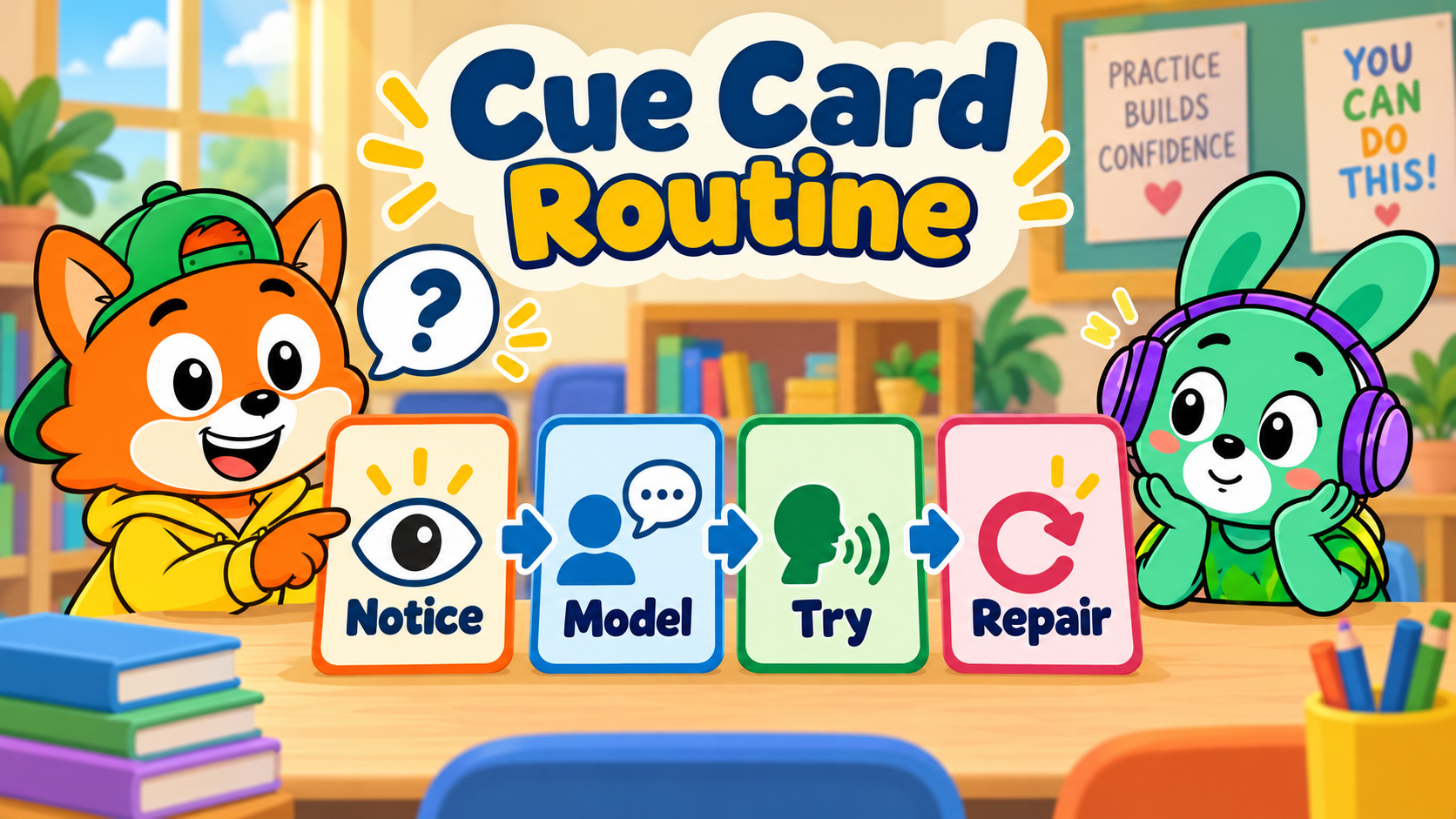
Notice: Identify the target, picture, action, partner message, or communication problem. Point to the relevant part of the card and allow the learner to look, select, or indicate another focus.
Model: Give a short example that shows how the cue works. A model can be a sound, word, phrase, AAC message, gesture, repair option, or partner response. Keep the model connected to the activity and do not demand immediate imitation.
Try: Give the learner time to use the cue in an accessible mode. The learner may produce a word, choose a symbol, point, sign, write, gesture, or combine modes. Record the response and the support rather than treating one output style as the only success.
Repair: If the message or production does not work for the listener, offer a way to try again, add a detail, choose another mode, request a model, or ask for help. Repair is a meaningful communication skill, not merely a correction step.
After one supported round, change a small condition. Use a new word, partner, picture, activity, or amount of visual support. Keep the communication purpose stable so the team can see what the change did.
Adapt Cards for Access and Age
Check the card’s symbol meaning, print size, contrast, reading load, physical format, and position. A learner may need a larger card, fewer items, a stable surface, a digital display, object cues, partner-assisted scanning, or access to established AAC vocabulary. Make the card available before the learner has to communicate urgently.
For early communicators, use familiar objects, photos, gestures, and a short routine. Accept looking, reaching, sounds, signs, symbols, or words when they serve the communication purpose. Model without pressure and respond to refusals or changes in attention.
For school-age learners, connect cards to classroom tasks, stories, games, or peer interactions. A card can support a target sound in meaningful words, a question routine, a story sequence, or a repair move. Gradually invite the learner to choose which cue is useful rather than presenting every card automatically.
For adolescents and adults, use age-respectful contexts such as a personal experience, appointment, community task, work routine, or collaborative project. A card can support a handoff, self-advocacy message, clarification, or speech strategy without making the activity feel childish.
For multilingual and multimodal communicators, consider the languages and modes used in real life. The learner may understand the cue in one language and communicate the response through another. Preserve the response route that gives access to the purpose, and coordinate interpretation with the broader team.
Record Support, Response, and Transfer
Data should describe what the card was intended to support and what happened under the recorded condition. Note the target, activity, response mode, cue level, partner, listener response, and next variation.
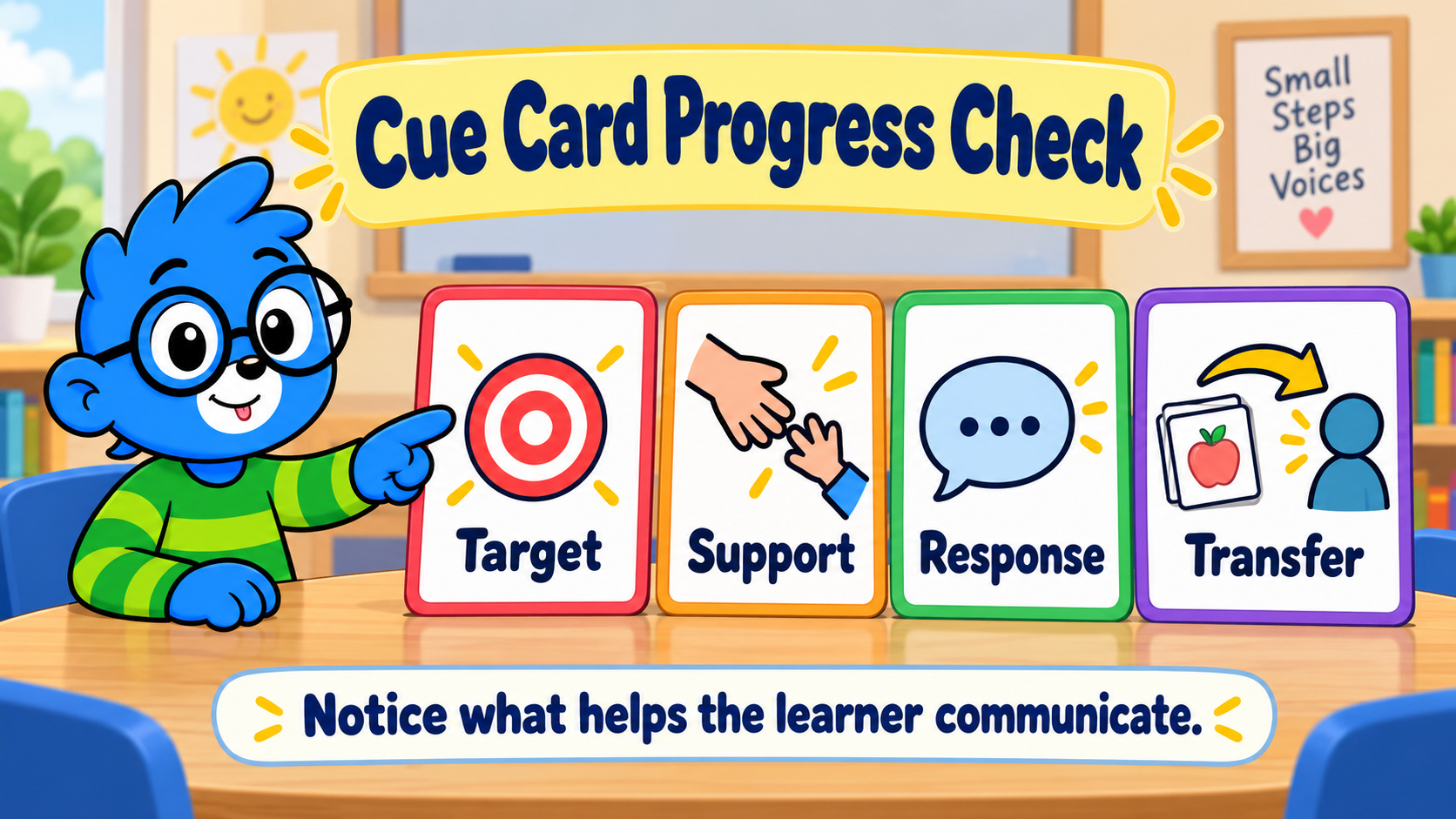
Possible data fields include:
- target sound, word, language move, or communication purpose;
- opportunity and activity context;
- card or cue used;
- learner response and communication mode;
- prompt, model, wait time, and access support;
- listener understanding, repair, or partner response; and
- transfer to a new word, partner, routine, or setting.
Define the opportunity before counting. A structured production trial, a target word in a story, and a repair during conversation are different opportunities. Record meaningful events that do not fit a narrow trial count, such as the learner choosing a new cue, rejecting an unhelpful model, or independently asking for clarification.
Review patterns across more than one activity. If the learner uses the card independently but not without it, decide whether the card is an access support to maintain, a teaching cue to vary, or a design that needs adjustment. If the learner improves in therapy but not with a classroom partner, practice the partner response and transfer routine.
Common Mistakes and Practical Fixes
The card becomes a script. Offer choices and response modes, and accept the learner’s own wording when it meets the communication purpose. Use the card as a route to a message rather than the message itself.
The partner prompts too quickly. Add wait time, point to one relevant part of the card, and allow the learner to navigate or formulate a response. Record the support that actually helped.
The card is removed when the learner uses another mode. Keep access available. Speech, AAC, sign, gesture, writing, and behavior can work together, and the learner may need more than one route to communicate.
Practice never reaches a real routine. Connect the cue to a partner who has a reason to listen, then vary one condition at a time. Transfer may require new materials, partner modeling, and repeated opportunities.
Frequently Asked Questions
What are cue cards for speech used for?
They can support speech sound production, language, AAC, conversation, repair, fluency, or functional communication. The card should match a defined target and make the next response or communication move more accessible.
Should a learner repeat the model exactly?
Not automatically. A model can show a possible sound, word, message, or strategy. The learner may communicate through another mode or use different wording when that better fits the purpose.
How do I know if a cue card is helping?
Track the target, card, response, support, mode, partner response, and transfer. Look for more relevant communication, improved access, stronger repair, or reduced support in meaningful contexts rather than only completed card items.
When should I fade a cue card?
Vary or fade it when the learner has another reliable way to access the same purpose, but keep it when it functions as a useful access support. The decision should follow data about independence, transfer, and participation.
Cue cards for speech work best when they support a real communication job. Choose the smallest useful cue, model without pressure, preserve multimodal access, record the conditions around the response, and let the learner’s participation guide the next change.