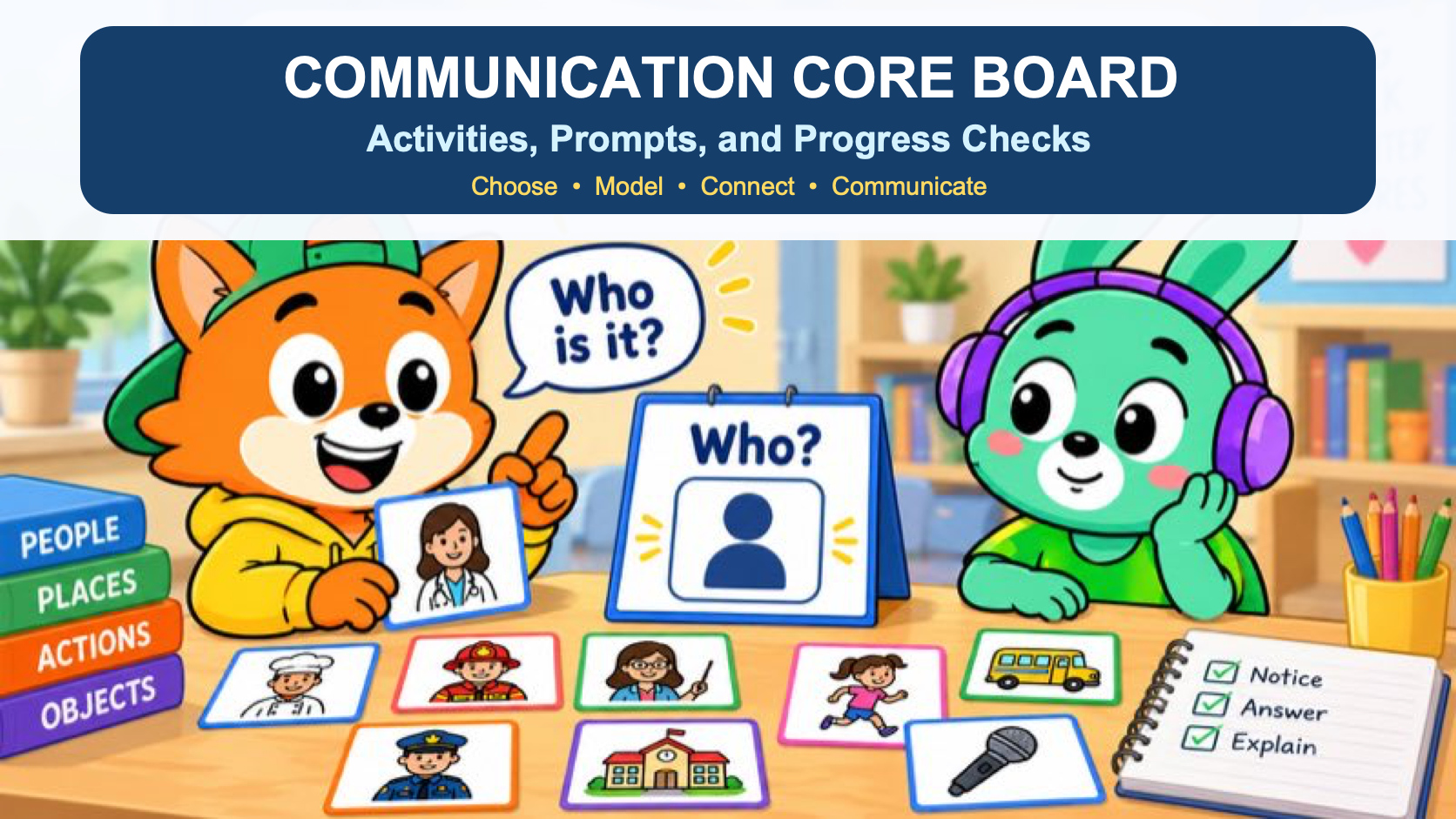
A core board printable can give a learner a low-tech way to communicate across routines when it is visible, reachable, and paired with responsive partners. Printing the page is only the setup step. The board also needs meaningful vocabulary, a reliable access method, opportunities to combine messages, and a plan for what partners will do when the learner communicates.
This guide explains how to choose and prepare a printable core board, model language without pressure, adapt it for routines and access, and record meaningful progress. It is educational information rather than an individualized AAC assessment. The ASHA Augmentative and Alternative Communication Practice Portal provides broader professional context for communication access and collaborative decision-making.
Table of Contents
- What a printable core board should support
- Check layout, vocabulary, and access before printing
- Introduce the board through real routines
- Model messages and support autonomy
- Adapt for partners, settings, and languages
- Track access, meaning, and transfer
- Frequently asked questions
What a Printable Core Board Should Support
Core vocabulary refers to words that can be useful across many activities, partners, and topics. A printable core board may include actions, descriptors, people, question words, pronouns, social words, yes, no, help, more, stop, finished, and other high-use messages. Activity-specific words can be added when they help the learner communicate about the current topic.
A board should support more than requesting. Possible communication purposes include:
- asking for an item, action, person, or change;
- rejecting, stopping, waiting, or setting a boundary;
- asking for help, information, or a turn;
- commenting on an object, event, feeling, or idea;
- greeting, directing, choosing, or sharing attention;
- answering or asking a question; and
- repairing a message when a partner does not understand.
The page does not need to be crowded to be useful. A smaller board may be a good starting point when the learner needs larger symbols, a stable surface, or a simple visual field. A larger board may offer more combinations but require a different positioning or access plan. Choose the layout based on the learner, not on how much vocabulary can fit on paper.
Check Layout, Vocabulary, and Access Before Printing
Preview the board before using it. Check symbol meaning, print size, contrast, page orientation, word labels, language, cultural fit, and whether the vocabulary reflects the learner’s daily partners and routines. If the learner uses more than one language or mode, consider how the board can represent that communication life.
Check the physical access route:
- Can the learner see the symbols in the available lighting?
- Can the learner reach, point, touch, look, or scan without an adult moving the page?
- Is the board stable on the table, wall, lap, or wheelchair tray?
- Are symbols large enough for the learner’s vision and motor access?
- Is the board available in the places where communication happens?
- Can the learner indicate yes, no, stop, help, and a repair message?
Print a backup copy and keep it where the routine occurs. A board stored in a drawer is not available communication. If the learner uses a speech-generating device, sign, gesture, writing, or another system, the printable board can be a backup or partner-supported option rather than a replacement.
Introduce the Board Through Real Routines
Choose one routine that happens often and has a genuine reason to communicate. Snack, play, art, a shared book, a classroom transition, a household task, and a community activity can all work. Watch what the learner already communicates and what partners tend to guess or ask on the learner’s behalf.
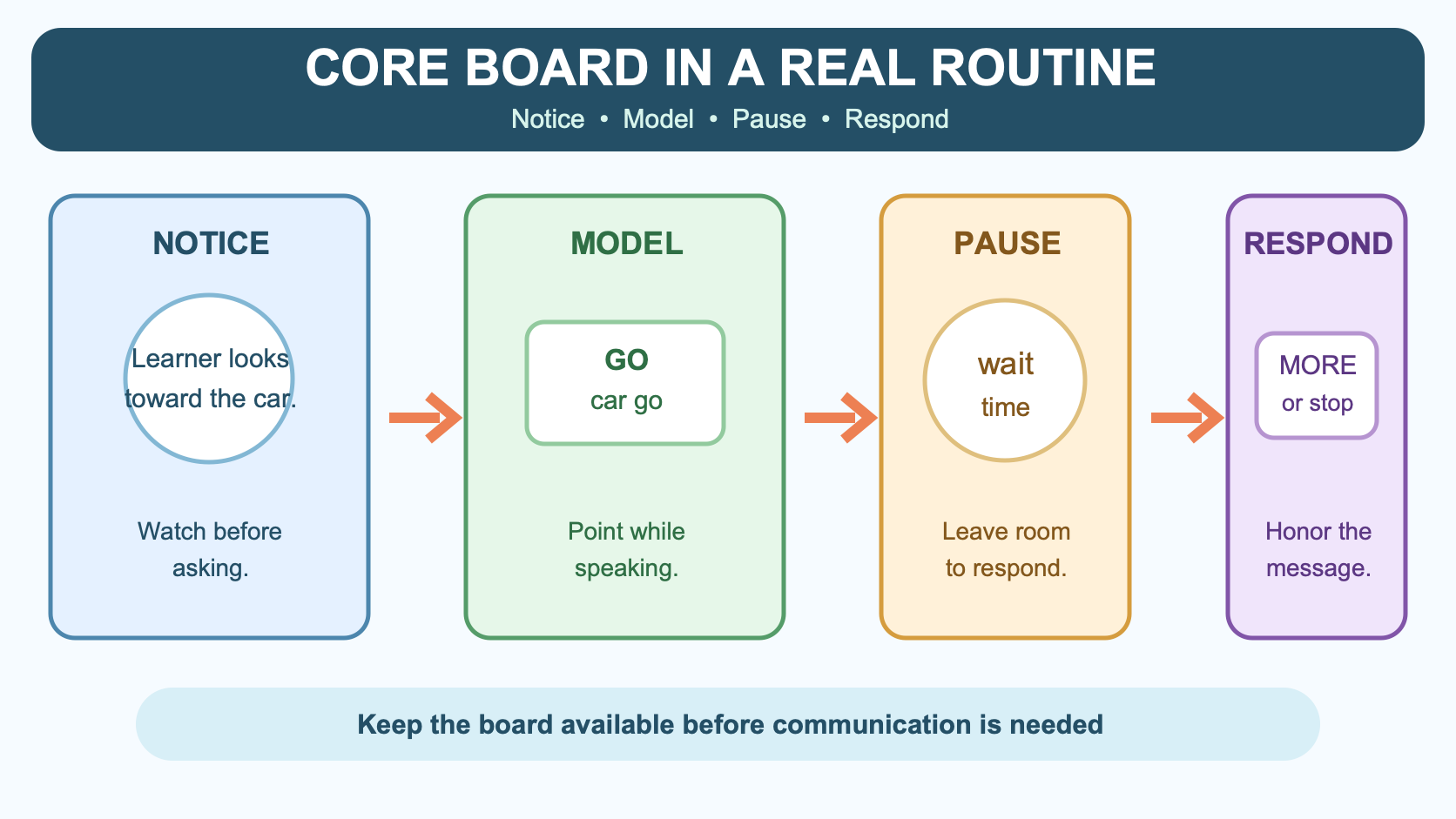
Use a simple routine:
Notice: Observe the activity and the learner’s focus. A closed container, a paused game, a partner’s question, or a change in the routine can create an opportunity.
Model: Point to one or two symbols while speaking naturally. Model a short message such as help open, want more, my turn, go outside, or different please. The model shows how the board can work; it does not require immediate imitation.
Pause: Give the learner time to look, navigate, select, reject, or create another message. A pause supports planning and access rather than testing whether the learner remembers the page.
Respond: Honor the message when possible, explain a limit, or offer a repair opportunity. Partners should respond to the learner’s communication even when the selection is approximate or combined with gesture, speech, or behavior.
Repeat the routine across activities. The word help can work during dressing, opening a package, joining a game, or solving a technology problem. A core board becomes more useful when the learner sees that the same word can carry meaning in different contexts.
Model Messages and Support Autonomy
Modeling should increase access, not create pressure. Point to symbols while saying a message, then leave space for the learner to respond in the available mode. The learner may select one symbol, combine several, use speech, sign, gesture, writing, eye gaze, or reject the model.
Keep vocabulary for refusal, boundaries, and repair visible. No, stop, wait, not that, finished, again, different, show me, and help can matter as much as preferred-item words. Do not require the learner to use the board to earn food, comfort, movement, a break, or a preferred activity.
Use partner prompts that open possibilities:
- “What could you tell me?”
- “Do you want more, finished, or something different?”
- “You showed help. What should we do next?”
- “I do not understand yet. Can you show me another way?”
- “Who else could use this message?”
Fade support thoughtfully. Reduce a direct verbal prompt before removing a visual the learner can use independently. A board can remain an access support even when the learner becomes more independent. Independence may mean initiating access, combining symbols, correcting a partner, choosing another mode, or communicating a refusal.
Adapt for Partners, Settings, and Languages
Partners need instruction too. Show them how to keep the board visible, point while speaking, wait, accept multiple modes, respond to refusals, and avoid taking the page away because the learner used speech or gesture. A board is part of an interaction, not a test administered by one adult.
For classroom use, place the board near group activities, transitions, and materials. For home use, keep it in the routines where the learner communicates most often. For community use, consider a portable copy or a small backup card, but do not reduce the learner’s available messages to requests only.
For multilingual learners, include languages and words used with the relevant partners. Photos, drawings, written labels, symbols, or more than one language may be useful. Ask the learner and family which words are natural and meaningful, and coordinate language support when the team does not share the learner’s language.
Track Access, Meaning, and Transfer
Data should describe what the learner communicated and the conditions around it. Record the routine, partner, message purpose, mode, access support, prompt, partner response, and whether the learner repaired or extended the message.
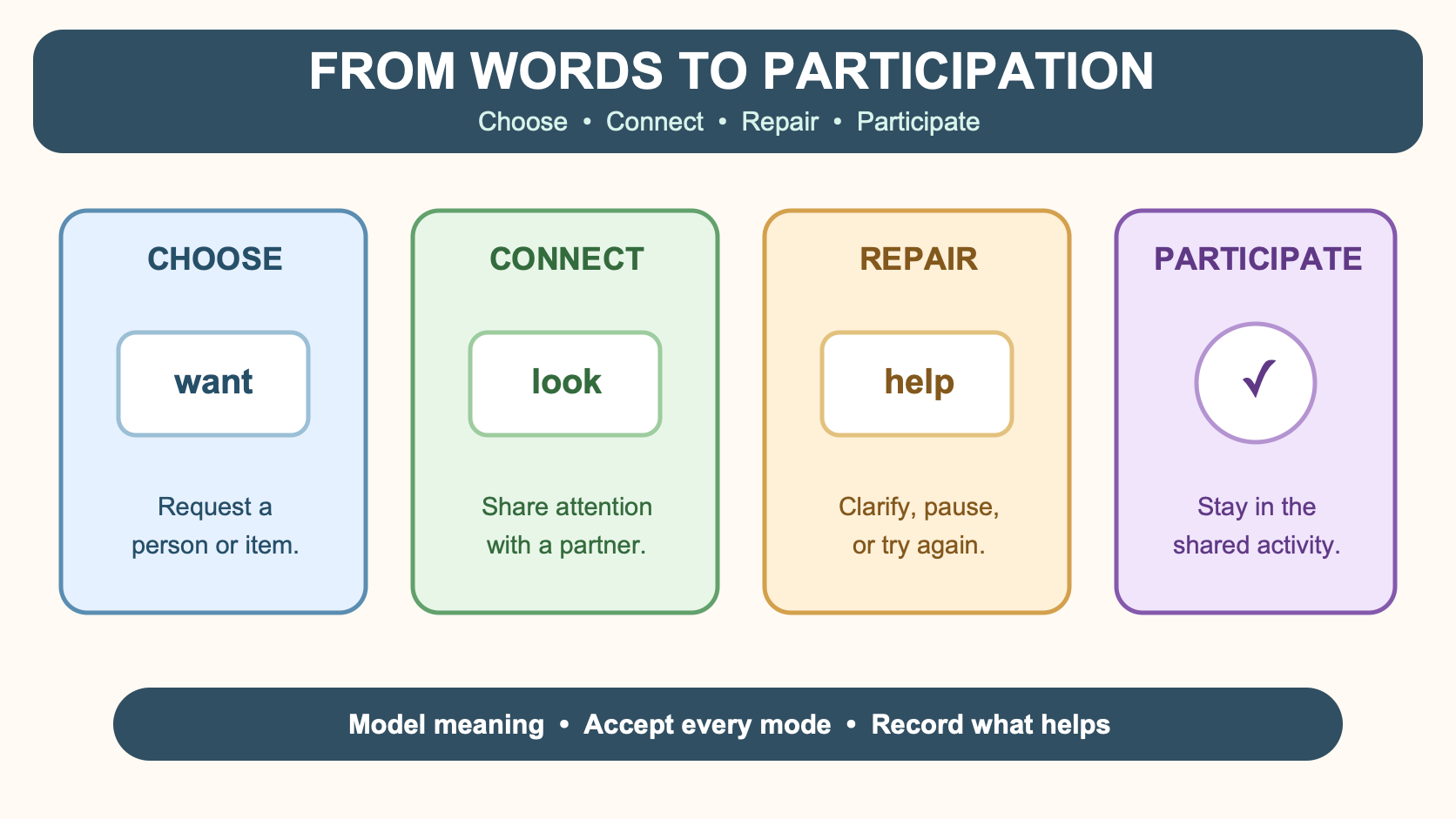
Possible review questions include:
- Could the learner access the board in time to use it?
- Did the vocabulary support the learner’s likely communication purposes?
- Was the message understood, and how did the partner respond?
- Did the learner initiate, reject, request, comment, ask, or repair?
- Did the learner combine symbols or add meaning through another mode?
- Could the same message work with a new partner or routine?
Compare similar opportunities before changing the board. Then vary one condition at a time, such as partner, activity, page position, symbol set, or amount of prompting. Progress may appear as more message purposes, quicker access, stronger repair, fewer partner guesses, broader partner use, or greater participation.
Do not interpret a low selection count without checking access and opportunity. The learner may communicate through another mode, have no reason to use the page, or be unable to reach it. Review the interaction before changing the vocabulary or drawing a conclusion about readiness.
Frequently Asked Questions
What should be on a core board printable?
Include high-use words that support requests, comments, questions, choices, refusal, help, repair, social interaction, and the learner’s current routines. Add activity-specific words when they help the learner communicate about the topic.
Can a printable core board replace a speech-generating device?
Not automatically. It can be a low-tech system, backup, or partner-supported option, but the appropriate AAC approach depends on access, communication needs, environments, languages, and goals. Coordinate decisions with the learner, family, SLP, and team.
How do I teach a learner to use a core board?
Keep it available, model useful messages, pause, respond to selections, and practice across real routines. Do not require immediate imitation or remove the board when the learner communicates through another mode.
How do I know if the board is helping?
Track access, message purpose, mode, support, partner response, repair, and transfer. A board is helping when it increases the learner’s ability to share meaning, make choices, set boundaries, and participate with responsive partners.
A core board printable is most useful when it is available before communication is urgent and when partners respond to what the learner communicates. Choose a manageable layout, model across real routines, preserve autonomy, and let context-rich notes guide the next change.