SLP Praxis Question of the Day: 4 Original Questions
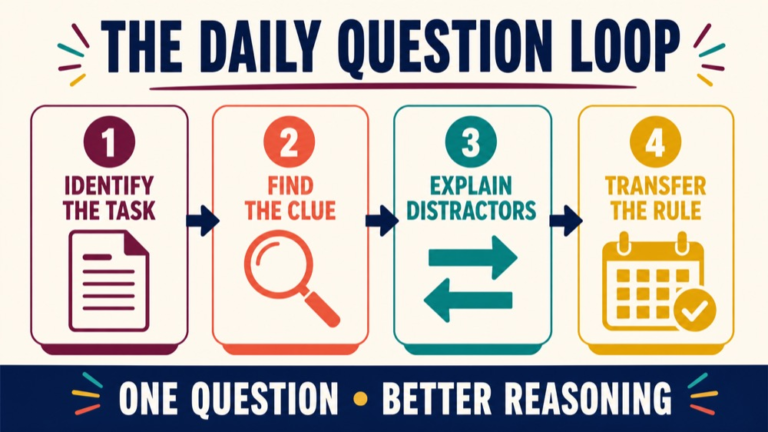
Using an slp praxis question of the day can make exam preparation more consistent, but the value is not in collecting another answer letter. The value is a small reasoning loop: identify the task, find decisive evidence, compare nearby concepts, explain distractors, and record the next repair.
This article uses that one-question-per-day rhythm. It gives you four original A-D mini questions with full rationales and an exam-trap takeaway. The questions are original practice content, not official ETS material and not recalled content. For current exam scope or administration details, check the current ETS Speech-Language Pathology 5331 page. For clinical boundaries, use the relevant topic guidance in the ASHA Practice Portal.
This is study content, not individual medical advice. A short vignette cannot replace a complete history, assessment, collaboration, referral, or local safety protocol, but it can help you practice disciplined reasoning and notice where a real clinical decision would require more information.
A daily practice question is a small retrieval-and-reasoning unit. It asks for one bounded decision and then lets you inspect the path you took. That differs from a full practice test, whose learning jobs may include endurance, pacing, broad content sampling, and performance review. A daily item should be narrow enough to finish carefully and rich enough to expose a repeatable thinking error.
For an SLP learner, identify the decision class before naming a sophisticated diagnosis. Is the stem about screening, comprehensive evaluation, a motor-speech pattern, a safety-focused next step, communication access, or intervention planning? Once the purpose is clear, test every option against the same question.
A concerning observation may raise a hypothesis while the question tests whether you recognize the need for follow-up data. Another stem may provide enough functional context for a treatment or access decision. Ask what the evidence supports, not what the most memorable term suggests.
A productive question-of-the-day session therefore has four features:
One primary decision: the item should make clear what kind of judgment is required.
One decisive evidence path: the best answer should follow from stated facts, not an unstated assumption.
Specific distractor analysis: each wrong option should fail for a named reason, such as a scope leap, mismatched purpose, or unsafe sequence.
A transfer rule: the learner should leave with a sentence that applies to a new vignette.
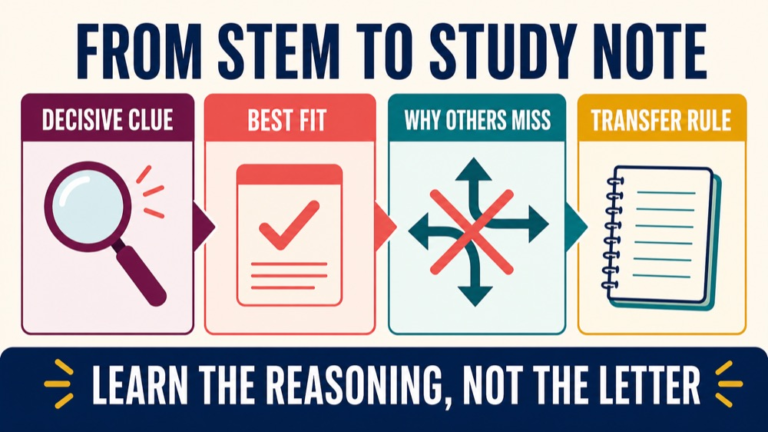
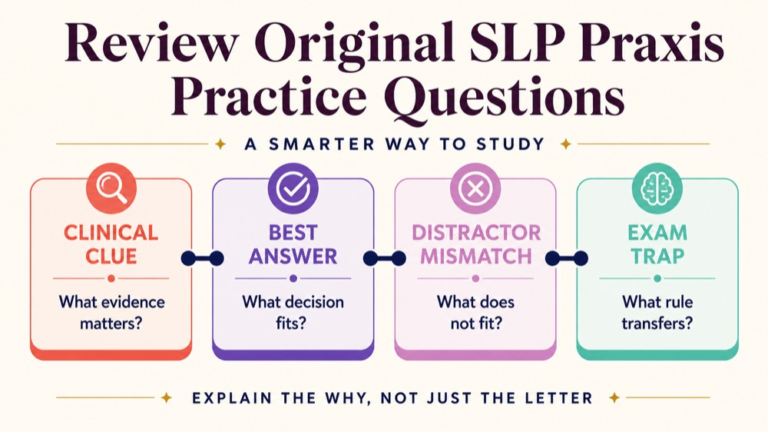
If you cannot explain why the correct answer wins and each alternative loses, the item is not finished when you circle a letter. The explanation is the learning asset.
How to Use an SLP Praxis Question of the Day
Use the same routine each day. It can take 10 to 20 focused minutes; the important part is the order: commit before reading the rationale, then use feedback to repair your reasoning.
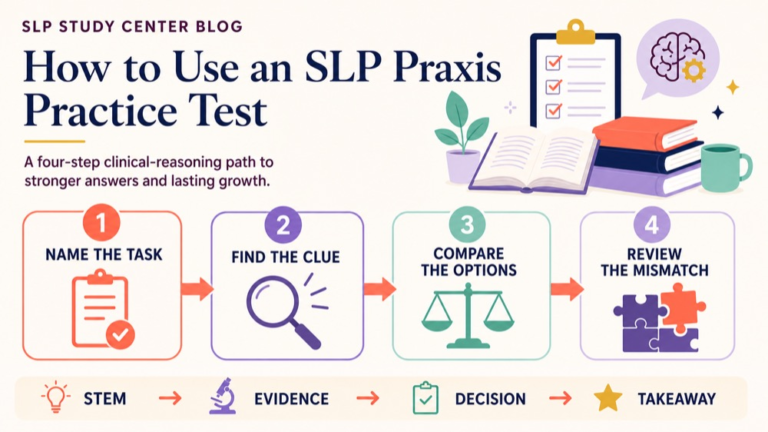
Read for the task. Restate the question in your own words and write a label such as screening interpretation, assessment next step, motor-speech distinction, safety follow-up, or communication-access planning.
Find the strongest cue. Note the one or two facts that should control the answer, separating them from background details. Explain why a repeated pattern, safety sign, communication goal, or data limit matters.
Commit to one option. Choose A, B, C, or D before reading the explanation. Add one sentence beginning with because; if unsure, record the uncertainty.
Defend and reject. For every distractor, name the exact mismatch. Is it too definitive, too early, too narrow, aimed at the wrong purpose, or dependent on missing information?
Transfer the rule. Write one variation that would change the answer, such as additional evidence or missing context that would alter the assessment decision.
Pass
Question to ask yourself
What to record
Task
What decision class is being tested?
A short task label
Evidence
Which stated fact carries the most weight?
One decisive cue and why it matters
Choice
Which option best fits without adding assumptions?
Letter plus a because sentence
Distractors
What specific mismatch eliminates each alternative?
One reason for A, B, C, and D
Transfer
What change in the case would change the answer?
A portable rule or follow-up prompt
Keep the first attempt separate from the explanation. Reading the rationale first can create recognition without retrieval; committing first makes the explanation feedback on a real decision. On a difficult day, reduce content rather than skipping reasoning. On an easier day, add a transfer variation or teach the item aloud.
How to Record Reasoning Errors
A score tells you whether the final letter matched the key; an error log tells you why. Record the date, topic, chosen answer, correct answer, decisive evidence, error code, and repair action. Consistent codes make patterns visible after several days.
Task miss: You answered a nearby question, such as naming a disorder when the stem asked for the safest next step.
Evidence miss: You noticed an important cue but gave more weight to a vivid background detail.
Concept blend: You mixed related constructs, such as screening and comprehensive evaluation or speech output and language comprehension.
Scope leap: You turned a suggestive pattern into a diagnosis, definitive finding, or complete treatment decision without enough information.
Sequence error: You selected an intervention, device, or diet change before the assessment, collaboration, trial, or protocol step.
Distractor attraction: You chose an option because it sounded familiar, advanced, or compassionate even though it missed the stated purpose.
Explanation gap: You chose the correct letter but could not state the decisive evidence or eliminate every other option.
A learner might mark the swallowing item correct but log an explanation gap if the reason was simply cough equals aspiration. The repair is to distinguish a concerning screening observation from a definitive conclusion and review the follow-up step supported by context. At week’s end, count error codes: use the most common one to choose the next review target.
Original Questions: Four Mini Cases
These four items are original practice content. They use A-D formatting to rehearse clinical reasoning, but they are not official or recalled material and do not predict a live test item. Read each scenario, commit to one answer, and then study the complete rationale.
Question 1: Screening or Comprehensive Evaluation?
Scenario: A preschool teacher reports that Maya frequently misses multi-step classroom directions. A brief language screener is administered, and her score falls just above the screener cutoff. The teacher reports the concern across several routines, and a parent describes similar difficulty at home. What is the best next step?
A. Conclude that Maya has no language concern because she was above the screening cutoff.
B. Use the consistent concerns across contexts to justify follow-up and, as appropriate, a comprehensive evaluation rather than treating the screener as the final decision.
C. Begin a specific language treatment protocol immediately without collecting further information.
D. Diagnose a receptive language disorder from the teacher report alone.
Correct Answer: B. Use the consistent concerns across contexts to justify follow-up and, as appropriate, a comprehensive evaluation rather than treating the screener as the final decision.
Why This Answer Is Correct: A screening tool helps identify whether further attention may be warranted; it is not a complete diagnostic evaluation. The strongest evidence is the repeated functional concern across school routines and home, not only the score. That pattern supports follow-up and consideration of a comprehensive evaluation that can examine history, communication across contexts, relevant language domains, and other explanations. B selects the next reasoning step without declaring a disorder.
Why the Other Options Are Wrong:
A. A score just above a cutoff cannot erase consistent concerns or convert a brief screen into a full evaluation. It treats a screening result as final clearance.
C. Immediate treatment protocol selection skips information needed to define the communication need, goals, context, and supports. Follow-up data should shape the decision.
D. A teacher report is valuable referral information, but one report does not establish a diagnosis. The option leaps from concern to label.
Exam Trap: Do not make the cutoff do more work than the tool was designed to do. Portable rule: a screening result informs the need for follow-up; it does not, by itself, close the evaluation question.
Question 2: Motor-Speech Pattern or Language Conclusion?
Scenario: An adult recovering from a left-hemisphere stroke produces slow, effortful speech. Across repeated attempts, some multisyllabic words are accurate and others are inconsistent. The clinician also notes visible groping and disrupted prosody, while the scenario does not describe a primary weakness pattern. Which interpretation and action are best?
A. Treat the pattern as a confirmed diagnosis based on groping alone.
B. Consider possible motor-planning or motor-programming involvement and complete a comprehensive motor-speech assessment while interpreting the pattern in context.
C. Classify the pattern as a phonological disorder because the errors vary across attempts.
D. Assume that language comprehension is impaired because the person’s speech is effortful.
Correct Answer: B. Consider possible motor-planning or motor-programming involvement and complete a comprehensive motor-speech assessment while interpreting the pattern in context.
Why This Answer Is Correct: Effort, inconsistency across attempts, groping, and prosodic disruption can raise a motor-speech hypothesis. B preserves that hypothesis as an assessment direction rather than presenting it as confirmed from one sign. A comprehensive motor-speech evaluation can examine the pattern across tasks and consider co-occurring language, cognitive, neurologic, and functional factors. The option connects evidence to the right decision class without claiming excess certainty.
Why the Other Options Are Wrong:
A. Groping is a clue, not a stand-alone diagnostic conclusion. The option skips pattern analysis and contextual interpretation.
C. Variable errors do not automatically make the problem phonological. The stem emphasizes motor-speech features and a post-stroke context, so this selects a nearby but mismatched construct.
D. Effortful speech describes output and motor execution; it does not establish a comprehension problem. The option confuses speech production evidence with receptive-language evidence.
Exam Trap: A memorable sign can make a label feel obvious. Portable rule: use a cluster of task-relevant features to select the next assessment direction, but keep a suggestive pattern distinct from a confirmed diagnosis.
Question 3: Swallowing Screening and Safety
Scenario: During a clinical swallowing screen, an older adult coughs repeatedly after thin liquids, and the voice sounds wet. Which next step best fits a safety-focused clinical reasoning question?
A. Continue offering thin liquids until the person adapts to the task.
B. Treat the cough as proof of aspiration and document a definitive swallowing diagnosis.
C. Stop or modify the screening according to the local protocol and arrange timely comprehensive swallowing evaluation or appropriate medical follow-up.
D. Recommend a permanent thickened-liquid diet without further assessment.
Correct Answer: C. Stop or modify the screening according to the local protocol and arrange timely comprehensive swallowing evaluation or appropriate medical follow-up.
Why This Answer Is Correct: Repeated coughing and wet vocal quality during a screen are concerning observations that should change the immediate safety response and prompt follow-up. They do not establish physiology, severity, cause, or a long-term plan. C respects both parts of the scenario: act within the applicable safety protocol and obtain the fuller assessment or medical follow-up needed for an individualized decision. It is a process answer, not a universal diet order.
Why the Other Options Are Wrong:
A. Continuing the same challenge despite repeated concerning signs ignores the immediate safety implication and does not provide a reasoned next step.
B. Coughing and wet voice may raise concern, but the vignette lacks enough evidence for a definitive physiologic conclusion. This is a scope leap.
D. A texture modification has benefits and tradeoffs and should be considered with a complete evaluation, goals, preferences, and medical factors. It is not a substitute for assessment.
Exam Trap: Do not confuse a warning sign with a completed diagnosis or an immediate safety response with a permanent intervention plan. Portable rule: follow the relevant protocol and obtain the assessment needed for the next individualized decision.
Question 4: AAC as Communication Access
Scenario: A school team is discussing AAC for an eight-year-old whose speech is difficult for unfamiliar listeners to understand. The child is motivated to communicate, understands classroom language, and has sufficient hand control for direct selection. Which next step best reflects person-centered AAC reasoning?
A. Wait until the child’s spoken speech becomes intelligible before offering AAC.
B. Select the most expensive device because price predicts better language growth.
C. Conduct a collaborative AAC assessment of communication needs, contexts, language, access, and partner supports, then match and trial options.
D. Limit AAC to requesting because spoken output is limited.
Correct Answer: C. Conduct a collaborative AAC assessment of communication needs, contexts, language, access, and partner supports, then match and trial options.
Why This Answer Is Correct: AAC reasoning starts with communication access and the person’s purposes, partners, environments, language, and access method. The stem shows a current need, motivation, and possible access route, but it does not identify one universal device or finished system. A collaborative assessment and trial process can compare options against meaningful communication functions and support needs. C keeps the person and communication contexts at the center.
Why the Other Options Are Wrong:
A. Waiting makes current communication access depend on a future change in speech and ignores present participation needs.
B. Cost is not a clinical decision rule. A useful match depends on access, language, environments, communication partners, and functional goals, not price alone.
D. Requesting is one possible function, but limiting AAC to requests narrows communication and omits comments, questions, social interaction, repair, and classroom participation.
Exam Trap: Device-first and last-resort thinking can miss the decision: how will this person communicate across contexts? Portable rule: assess the person, purposes, partners, environments, and access method before matching and trialing AAC options.
Common Confusions That Change the Answer
Many difficult items place two related ideas in the options. The answer turns on the boundary between them.
Screening versus evaluation: screening helps identify risk or the need for more attention; evaluation gathers fuller information for characterization, diagnosis, planning, or eligibility decisions.
Suggestive pattern versus diagnosis: observations can guide the next assessment question without proving a disorder from a short vignette.
Immediate safety response versus long-term plan: a concerning sign may require a protocol-based change now, while the durable intervention decision still depends on assessment and context.
Speech output versus language knowledge: effort, intelligibility, or motor execution does not by itself reveal receptive-language ability.
Communication access versus device selection: AAC is a participation and communication decision before it is a product decision.
Familiar wording versus decisive evidence: an option can sound sophisticated and still answer a different question from the one in the stem.
When two answers remain plausible, return to the question verb: identify, interpret, screen, evaluate, recommend, follow up, or select. Defend the option using only the information supplied; the best match is usually purpose, evidence, sequence, and scope.
Quick Review and the Next Daily Step
Before you close today’s question, complete this checklist:
State the decision class in five words or fewer.
Name the strongest cue in the stem.
Write the correct letter and the complete option.
Explain why the correct option fits the stated purpose.
Give one specific mismatch for each distractor.
Mark your reasoning error code, even if you selected the correct answer.
Write one portable rule without using an unsupported absolute claim.
Write one new fact that would change the answer.
Schedule a short revisit and a later transfer question.
Tomorrow, start with the most recent error code. If today tested a scope boundary, change the available evidence in a new question. If it tested a clinical distinction, explain the two concepts in opposite directions. That is how one question becomes a learning loop instead of a daily score.
If you want a more structured preparation routine beyond this free resource, you can explore the SLP Study Center Complete Prep page and decide whether it fits your study needs. This article does not promise a score outcome.
Sources and Review Boundary
For changing exam information, consult the ETS Speech-Language Pathology 5331 source. For clinical concepts and professional boundaries, consult the relevant pages in the ASHA Practice Portal. Competitor pages in the local research packet informed search-intent coverage only; no competitor wording, questions, examples, illustrations, or proprietary structure was used here.
Independent human academic review remains pending. Before publication, a qualified reviewer should verify the four original items, rationales, clinical scope language, and current exam references against the live source pages. The reviewer should also confirm that changing exam facts are not implied by the article.
SLP Praxis Practice Questions: 4 Clinical Reasoning Items
slp praxis practice questions are most useful when they train a decision rather than reward fast recall. This set gives you four original practice items built around clinical reasoning: identify the referral question, use the strongest evidence in the stem, choose the next action that matches the problem, and explain why the other options miss the task. The items are written for learners preparing for Praxis 5331 or strengthening speech-language pathology review habits.
Use each question in two passes. First, answer without looking ahead and name the evidence that changed your mind. Then read the rationale and compare your reasoning with the explanation for every option. The current ETS page should control changing exam scope and logistics, while current ASHA topic guidance should control clinical claims. This article intentionally does not freeze a current question count, testing time, score rule, or section weighting; verify those details at the source before publication and before test day.
A practice question is a small clinical decision model. The stem gives you a referral context, selected observations, and a task. Your job is not to diagnose from one attractive sign or choose the most elaborate intervention. Your job is to determine what the question is asking, decide which evidence is decisive, and select the response that is specific enough to address the problem without claiming more than the data support.
That makes this page different from a broad practice-test overview. The four items below stay close to clinical reasoning and show the full path from evidence to action. They sample different kinds of decisions so you can notice the reasoning pattern underneath the topic:
Question focus
Decision you must make
Common reasoning error
Screening and hearing
What information or referral should come before interpretation?
Starting treatment or assigning a label before a missing foundational factor is checked.
Motor speech
Which assessment plan best tests a clinical hypothesis?
Letting one speech feature stand in for a complete differential assessment.
Swallowing
What can bedside observations support, and what needs further evaluation?
Treating a clinical sign as a definitive physiologic finding.
Narrative treatment
Which goal and outcome measure match the functional construct?
Choosing an easy-to-count activity that does not measure the stated target.
Keep the distinction between exam practice and patient care clear. A correct answer on a study item does not replace a full evaluation, consultation, or individualized plan. In an exam stem, the available facts define the decision boundary. In practice, the SLP integrates history, observation, measurement, client priorities, collaboration, and the current evidence base.
A Clinical Reasoning Method for SLP Praxis Practice Questions
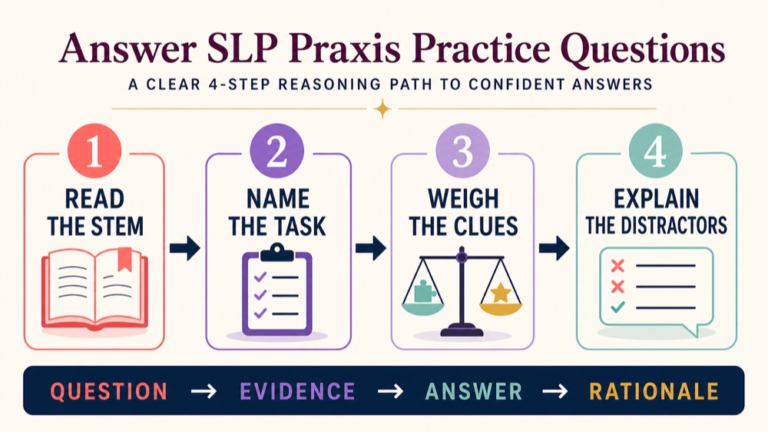
Before you compare A through D, translate the question into a short decision sentence. For example, say, The task is to choose the next assessment step when hearing information is missing, or, The task is to select an outcome measure for narrative macrostructure. That sentence keeps a familiar clinical fact from pulling you toward an answer that solves a different problem.
Identify the task. Decide whether the stem asks for a screening action, assessment plan, diagnosis-related interpretation, treatment choice, outcome measure, referral, or professional boundary.
Sort the evidence. Separate direct observations from assumptions. Note whether the stem gives a pattern across contexts, a single sign, a missing history element, or a response to an earlier procedure.
Choose the decision class. A question about the next evaluation step is not asking for the final diagnosis. A question about treatment measurement is not asking for the most interesting activity.
Test each option against the evidence. Ask what the option would clarify, what it assumes, and whether it addresses the stated referral question. A plausible fact can still be the wrong answer if it is not the best match.
State the portable rule. After choosing, write one sentence that could help on a new item. Examples include check hearing before interpreting speech-language performance, or measure the target construct across meaningful contexts.
When two options sound clinically reasonable, look for the one that respects sequence and scope. The best answer often supplies a missing foundation, tests the hypothesis directly, or links the goal to a functional outcome. Be cautious with options that jump from one sign to a label, prescribe a broad intervention before assessment, or use a measure that counts behavior without capturing the intended skill.
Original Practice Questions With Full Rationales
Original practice content: All four items in this section were newly written for this learning article. Work each one before reading the explanation. The source-grounded rationales teach the clinical distinction being tested, but they are not a substitute for the current ETS scope or topic-specific ASHA guidance.
Original Practice Question 1: Screening, Hearing, and the Next Step
Question 1: A preschool child is referred after a community speech screening because unfamiliar listeners understand little of the child's speech. The caregiver also reports several recent ear infections, and no current hearing evaluation is available in the record. Which action is the best next step before interpreting the child's speech-language profile?
A. Begin an articulation treatment cycle focused on the least intelligible sounds.
B. Administer a language test and assign a developmental language diagnosis from the result.
C. Refer for an audiologic evaluation and incorporate the findings into the broader assessment plan.
D. Give the caregiver home speech drills and wait to see whether intelligibility improves.
Correct Answer: C. Refer for an audiologic evaluation and incorporate the findings into the broader assessment plan. Why This Answer Is Correct: The decisive evidence is the combination of a speech concern, a history that raises hearing questions, and missing current hearing information. Hearing status can affect access to speech and language input, so the SLP should address that foundational variable before interpreting the full profile or selecting a disorder-specific treatment path.
Why the Other Options Are Wrong: A moves directly to treatment without resolving a factor that could be contributing to the speech pattern. B may collect useful language data, but assigning a diagnosis from one test while hearing information is missing overstates what the evidence can support. D gives a home activity without confirming the child's hearing status or defining the referral need, so it delays the information needed for responsible planning.
Exam Trap: The trap is confusing a screening concern with a completed evaluation. When the stem highlights missing hearing information, treat that gap as decisive. A referral for the appropriate assessment is different from assigning a diagnosis, and the best next step may come before the final test battery or intervention plan.
Original Practice Question 2: Motor-Speech Differential Reasoning
Question 2: An adult after a left-hemisphere stroke produces effortful speech with inconsistent sound errors across repeated attempts, visible groping, and disrupted prosody. A brief non-speech oral examination does not show a clear pattern of weakness. Which evaluation plan best addresses the clinical hypothesis raised by these observations?
A. Use the brief strength screen as the main evidence and label the problem dysarthria.
B. Examine speech motor planning and programming with repeated productions, sequencing tasks, prosody, and intelligibility across contexts.
C. Use a confrontation-naming task alone to determine whether the speech problem is language based.
D. Begin voice treatment because effortful speech is primarily a loudness problem.
Correct Answer: B. Examine speech motor planning and programming with repeated productions, sequencing tasks, prosody, and intelligibility across contexts. Why This Answer Is Correct: Inconsistent errors, groping, and prosodic disruption raise a motor-planning hypothesis, while the limited weakness finding makes a strength-only explanation incomplete. An assessment that samples repeated speech movements and connected speech can test whether the pattern is consistent with a motor-planning or programming difficulty and can also help distinguish neighboring motor-speech explanations.
Why the Other Options Are Wrong: A treats the absence of a clear weakness pattern as if it proved a different disorder and does not examine the planning features in the stem. C measures lexical retrieval and naming, not the full speech motor pattern. D narrows effortful speech to loudness even though the decisive observations concern sound consistency, groping, sequencing, and prosody rather than a primary voice complaint.
Exam Trap: The trap is turning one recognizable sign into a final label. Use the whole pattern and choose an assessment that tests the suspected mechanism. When the stem gives repeated productions, groping, and prosody, an answer limited to strength, naming, or loudness is too narrow for the clinical question.
Original Practice Question 3: Dysphagia Assessment and Physiologic Evidence
Question 3: A patient recovering from a stroke coughs during a bedside water trial and has a wet-sounding voice afterward. The patient is alert and able to follow directions, but no instrumental swallowing assessment has been completed. Which recommendation is the best next step?
A. Conclude that aspiration has occurred and prescribe permanent thickened liquids immediately.
B. Stop the evaluation because the cough shows that airway protection is working.
C. Complete a clinical swallowing assessment and consider instrumental assessment to visualize physiology and guide recommendations.
D. Focus only on articulation because swallowing complaints fall outside the SLP role.
Correct Answer: C. Complete a clinical swallowing assessment and consider instrumental assessment to visualize physiology and guide recommendations. Why This Answer Is Correct: Coughing and a wet voice are clinically important observations that justify careful follow-up, but they do not by themselves show the complete swallow physiology or establish the safest long-term diet. A clinical assessment can organize the history and observed performance, while an instrumental study may be considered when direct visualization is needed to answer the remaining physiologic question.
Why the Other Options Are Wrong: A converts bedside signs into a definitive aspiration finding and a permanent recommendation without enough information about physiology, risk, goals, or response. B assumes that a cough resolves the safety question and ignores the wet voice and the need to interpret the entire swallow pattern. D incorrectly removes swallowing from the relevant SLP clinical scope and fails to address the referral concern described in the stem.
Exam Trap: The trap is treating a bedside sign as the same thing as an instrumental finding. On a question about swallowing, separate what the observation raises concern about from what the next assessment can establish. Choose the answer that gathers the information needed for a safe, individualized recommendation.
Original Practice Question 4: Narrative Treatment and a Matched Outcome
Question 4: An eight-year-old student produces grammatically correct individual sentences but tells stories that regularly omit the setting, initiating event, and consequence. The teacher wants a progress measure that reflects classroom communication. Which plan best matches the stated target?
A. Drill isolated articulation sounds and count correct productions in single words.
B. Teach narrative macrostructure through retell and story-generation tasks, then measure key story elements across more than one meaningful context.
C. Have the student memorize definitions of setting, event, and consequence without collecting narrative samples.
D. Track words per minute as the primary outcome because a longer story is automatically a better story.
Correct Answer: B. Teach narrative macrostructure through retell and story-generation tasks, then measure key story elements across more than one meaningful context. Why This Answer Is Correct: The stem identifies a story-organization target rather than a sentence-grammar, articulation, or speaking-rate problem. A matched plan teaches the missing narrative elements and measures whether the student uses them in connected communication. Sampling more than one context helps show whether the skill is becoming functional rather than appearing only in one practiced task.
Why the Other Options Are Wrong: A measures articulation accuracy, which is not the target described. C may teach vocabulary about story parts but does not show whether the student can organize a connected narrative. D counts output speed without capturing the presence, sequence, or relevance of the story elements, so it can change while the target remains weak.
Exam Trap: The trap is choosing the easiest variable to count instead of the construct named in the stem. Match the goal, teaching activity, and outcome measure. If the concern is narrative macrostructure, the evidence should come from narrative performance and the story elements that define that construct.
How to Review Each Answer Instead of Chasing a Score
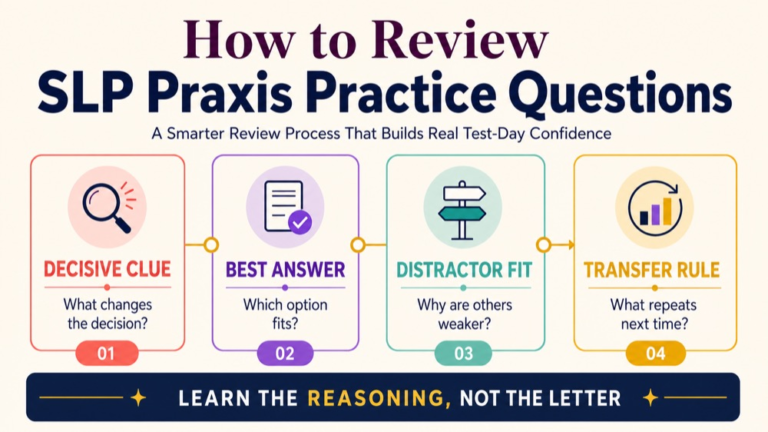
A practice percentage is only a starting signal. The useful information is the type of reasoning error underneath each response. After every item, write the answer you selected, the decisive cue you noticed or missed, the clinical decision class, and one sentence explaining each distractor. This turns a question set into a targeted review tool instead of a series of isolated wins and losses.
Error pattern
What to ask yourself
Repair move
Task mismatch
Did I answer the diagnosis when the stem asked for the next step?
Rewrite the question as a decision sentence before rereading options.
Single-sign overreach
Did one observation carry more weight than the full pattern?
List what the sign supports and what it still cannot establish.
Sequence error
Did I start treatment before the missing assessment or referral step?
Put the clinical actions in order: clarify, assess, interpret, plan, measure.
Construct mismatch
Does my chosen outcome measure capture the skill named in the goal?
Replace a convenient proxy with a measure of the target behavior in context.
Source drift
Am I relying on an old exam fact or a memorized rule without checking?
Mark current-source questions for review against ETS or ASHA before publication or use.
Name the clinical domain before you explain the answer.
State the referral question in your own words.
Underline the strongest observation and any missing information.
Separate what the evidence supports from what it does not establish.
Explain why the correct option is the best match for the task.
State the specific mismatch in every distractor.
Write one portable rule that can transfer to a new stem.
Retry the item later without looking at the options first.
If the same error repeats, review the concept before adding more questions. For example, repeated confusion between screening and assessment calls for a decision map, while repeated confusion between a target and a proxy measure calls for practice writing goals and outcomes. More items do not automatically repair a reasoning gap; deliberate explanation does.
Quick Review Checklist for Your Next Practice Set
Before you start another set of SLP Praxis practice questions, decide what you want the set to teach. A focused block might cover assessment sequencing, motor-speech distinctions, swallowing evidence, or treatment measurement. Keep the block small enough that you can explain every missed item, then use the checklist below to decide whether the review is complete.
I answered each item before reading its rationale.
I identified whether the task was assessment, treatment, outcome measurement, referral, or interpretation.
I used the entire clinical pattern rather than one memorable sign.
I distinguished a screening result from a complete evaluation.
I matched the assessment plan to the hypothesis in the stem.
I separated bedside observations from physiologic conclusions that may need more evaluation.
I matched the goal and outcome measure to the same functional construct.
I explained why every A-D option was right or wrong for that particular task.
I recorded which claims need current ETS or ASHA verification.
I chose the next review topic from my error pattern, not from a random score reaction.
For structured preparation beyond a single practice set, the SLP Study Center Complete Prep learning resources can help you connect question review with blueprint study, concept retrieval, and repeated application. Use the product scope and the current ETS source together when deciding what to study next.
References and Current-Source Check
Use these sources as the verification trail for this article. ETS controls current Praxis 5331 scope and logistics. ASHA topic guidance supports clinical reasoning, but the relevant page and evidence should be checked for the learner's setting and question before relying on a claim.
ETS Speech-Language Pathology 5331 – current test identity, scope, and logistics; verify the live page and Study Companion before using changing exam facts.
ASHA Practice Portal – clinical practice guidance and topic entry points for assessment, motor speech, swallowing, and treatment planning; confirm the current topic-specific guidance.
SLP Praxis Practice Test: Questions, Answers, and Rationales
Preparing with an slp praxis practice test is most useful when you review the reasoning behind each answer, not just the letter you selected. A strong practice session asks you to identify the clinical task, find the decisive evidence, separate nearby concepts, and explain why the other choices do not fit.
This focused set includes four original single-best-answer questions for learners reviewing speech-language pathology concepts. The scenarios cover motor speech, aphasia and dysarthria, swallowing evaluation, and phonological patterns. They are written for learning and review, not as a substitute for current ETS instructions, ASHA guidance, supervised clinical judgment, or a complete evaluation of any person.
Start with a deliberate attempt. Read the whole stem, name the decision the question is asking for, and choose one answer before opening the rationale. If you look at the explanation first, you may recognize a familiar term without practicing the retrieval and discrimination that a selected-response item requires.
For each question, write a short evidence note. One useful format is: task, decisive clue, best concept, boundary. For example, a stem may ask for the next assessment step rather than a diagnosis. The decisive clue may be inconsistency across repeated productions, while the boundary is that the clue guides further assessment but does not settle the case by itself.
Identify the task: Decide whether the item asks for an interpretation, an assessment step, a treatment principle, a measurement choice, or a professional action.
Mark the evidence: Notice timing, pattern, consistency, modality, setting, communication partner, and the information the stem deliberately gives you.
Classify the distinction: Ask whether the choices contrast language with speech, screening with evaluation, risk with confirmed physiology, or a pattern with an isolated sound error.
Reject overreach: Remove answers that convert one observation into a diagnosis, a universal recommendation, or a promise about outcome.
Review the mismatch: Explain what each distractor would require that the stem does not provide, or which question the distractor answers instead.
For timing practice, use the current ETS Speech-Language Pathology 5331 page to verify the present test format, administration details, and other time-sensitive facts. The goal of a home practice set is to rehearse decisions under realistic attention demands while keeping the facts about the live examination tied to the current source.
Clinical Distinctions This Practice Set Tests
Many challenging SLP exam items place two reasonable ideas next to each other. The winning answer is usually the one that fits the level of the question. Screening can identify a need for more evaluation, but it is not the same as a comprehensive evaluation. A motor speech clue can justify a targeted assessment, but it does not erase the need to consider language, hearing, cognition, participation, and context.
Distinction
Decisive clue to look for
Boundary to remember
Screening vs. evaluation
A brief screen asks whether more information is needed.
A screen does not answer every diagnostic or treatment-planning question.
Aphasia vs. dysarthria
Aphasia concerns language processing; dysarthria concerns motor execution of speech.
One person may have more than one communication disorder after neurologic injury.
Apraxia concern vs. confirmed diagnosis
Inconsistent sequencing, groping, or prosodic disruption can guide motor-speech assessment.
A few speech samples do not replace a complete, differential assessment.
Phonological pattern vs. isolated articulation error
Predictable substitutions across a sound class suggest a pattern-level question.
Target selection still depends on the learner, stimulability, intelligibility, and functional context.
Swallowing risk vs. aspiration finding
Coughing, wet voice, history, and respiratory status can raise a management question.
Clinical signs alone may not answer every physiologic question; instrumental assessment may be warranted.
Use the table as a reading lens rather than a list of automatic rules. The same behavior can have different meaning depending on the population, task, reliability of the sample, and purpose of the decision. On a practice item, first identify what the stem lets you conclude, then select the option that makes the smallest justified leap.
Original SLP Praxis Practice Test Questions
Attempt each item before reading its explanation. Every question below is newly written for this learning page and uses four answer choices with one best response. The rationales model how to connect a clinical clue to a decision without treating a vignette as a complete case record.
Practice Question 1: Motor-Speech Assessment
Scenario: A 7-year-old produces the same multisyllabic word differently across three attempts. Errors become more noticeable as word length increases, and lexical stress is inconsistent. A brief oral mechanism check does not reveal an obvious strength problem. The clinician is deciding what information to collect next, not assigning a diagnosis from this short observation.
Question: Which next step best matches the clinical question?
A. Begin isolated /k/ articulation drills because the child has a speech sound error.
B. Collect structured motor-speech samples that vary word length, repeated productions, transitions, and prosody, alongside broader assessment data.
C. Conclude that a phonological disorder is ruled out because the errors are inconsistent.
D. Use a hearing screen as the sole follow-up because hearing status explains the speech pattern.
Correct Answer: B. Collect structured motor-speech samples that vary word length, repeated productions, transitions, and prosody, alongside broader assessment data.
Why This Answer Is Correct: The decisive evidence is inconsistency across repeated attempts, increasing difficulty with length, and disrupted stress. Those observations make a targeted motor-speech assessment a logical next step because it can examine planning and sequencing demands across tasks. The wording still matters: it asks for information to collect, so the answer preserves the need for a broader differential assessment instead of naming a disorder from three productions.
Why the Other Options Are Wrong: A narrows the problem to one sound and skips the sequencing and prosody question. C treats one feature as a rule-out for an entire disorder class, which the stem does not support. D makes hearing screening the whole response; hearing information may be relevant, but it cannot answer the motor-speech assessment question by itself.
Exam Trap: Do not turn a supporting feature into a final diagnosis. When the stem asks what to do next, choose the assessment that directly tests the observed pattern while keeping the clinical differential open.
Practice Question 2: Aphasia and Dysarthria
Scenario: An adult is three weeks after a left-hemisphere stroke. The person follows multistep directions and names common objects accurately, but conversational speech is slow, imprecise, and difficult to understand. The same imprecise articulation pattern appears across repeated productions of familiar words. The question is about the most appropriate assessment emphasis.
Question: Which interpretation best fits the evidence provided?
A. A primary receptive-language impairment is the best explanation because intelligibility is reduced.
B. A voice disorder alone explains the pattern because the person had a neurologic event.
C. A dysarthria-focused motor-speech evaluation is appropriate while language and cognition continue to be considered.
D. Apraxia of speech can be diagnosed from the stroke history without additional speech or language assessment.
Correct Answer: C. A dysarthria-focused motor-speech evaluation is appropriate while language and cognition continue to be considered.
Why This Answer Is Correct: The stem gives preserved comprehension and naming, plus slow, imprecise, relatively consistent articulation. Those clues point toward a speech-motor execution question, so a dysarthria-focused evaluation is the best emphasis. The answer also avoids an artificial either-or choice: a neurologic event can affect several communication domains, and the full assessment should continue to examine language, cognition, function, and the person’s communication priorities.
Why the Other Options Are Wrong: A confuses reduced speech intelligibility with impaired receptive language and ignores the preserved direction-following information. B treats a broad neurologic history as if it were a voice diagnosis and does not address articulation precision. D substitutes a label for assessment; stroke history alone cannot distinguish apraxia, dysarthria, aphasia, or co-occurring conditions.
Exam Trap: Match the impairment class to the evidence. Speech execution clues support a motor-speech assessment, while language clues involve comprehension, naming, formulation, or discourse; reduced intelligibility by itself does not settle the distinction.
Practice Question 3: Swallowing Evaluation
Scenario: An older adult recovering from pneumonia coughs twice during a water trial and has a wet-sounding voice afterward. The person is alert and can follow directions. The clinician must decide how to respond to the possible safety concern and what information is needed for management.
Question: Which action is the best next step?
A. Complete a comprehensive clinical swallowing evaluation and determine whether instrumental assessment is warranted for the management question.
B. State that aspiration has been confirmed and document the airway event as established.
C. Place the person on thickened liquids for every meal without further assessment or discussion of goals.
D. Begin oral-motor exercises and postpone swallowing-safety evaluation until the exercises are complete.
Correct Answer: A. Complete a comprehensive clinical swallowing evaluation and determine whether instrumental assessment is warranted for the management question.
Why This Answer Is Correct: Coughing and a wet voice after a trial are clinically important signals that should prompt careful evaluation, especially alongside a recent pneumonia history. A comprehensive clinical swallowing evaluation gathers history, respiratory status, oral findings, alertness, functional goals, and observed performance. If the remaining question concerns physiology or management that a clinical exam cannot answer, an instrumental study may be appropriate.
Why the Other Options Are Wrong: B overstates what the bedside signs establish and skips the assessment process. C applies a restrictive intervention to every meal without confirming the person’s needs, goals, tolerance, or the question that must be answered. D starts an exercise before addressing immediate safety and does not show that the exercise matches the suspected impairment.
Exam Trap: Separate a risk signal from a confirmed physiologic finding. The best answer often names the evaluation and the reason for considering instrumental information instead of jumping from one sign to a universal diet order.
Practice Question 4: Phonological Pattern Analysis
Scenario: A preschooler consistently says /t/ for /k/ and /d/ for /g/ in many words. The substitutions occur across contexts, and a recent hearing screen was passed. The family asks the clinician to work on one incorrect word at a time, but the clinician is selecting an assessment-informed treatment direction.
Question: Which interpretation best guides the next planning step?
A. Analyze the pattern as a likely fronting contrast and consider targets that address the sound distinction in functional words.
B. Treat every word-specific substitution as an unrelated motor problem because the sounds are produced at different places.
C. Choose nonspeech oral-motor strengthening as the primary response to the substitutions.
D. Delay speech assessment because passing a hearing screen rules out a speech sound disorder.
Correct Answer: A. Analyze the pattern as a likely fronting contrast and consider targets that address the sound distinction in functional words.
Why This Answer Is Correct: Replacing velar sounds /k, g/ with alveolar sounds /t, d/ across many words is a pattern-level contrast commonly described as fronting. The repeated relationship matters more than the individual word list, so analysis should inform target selection and activities that help the learner hear and produce the contrast. Stimulability, intelligibility, development, participation, and the learner’s response still guide the individualized plan.
Why the Other Options Are Wrong: B treats a predictable sound-class relationship as unrelated word errors and misses the value of phonological analysis. C proposes a nonspeech exercise without showing that it addresses the speech sound contrast or the learner’s functional need. D confuses a passed hearing screen with the absence of a speech sound disorder; hearing is one part of assessment, not a rule-out for every speech difficulty.
Exam Trap: When substitutions follow a repeatable relationship, ask whether the question is about a phonological pattern rather than an isolated articulation placement error. Then check that the proposed plan remains assessment-informed and functional.
Score Your Reasoning, Not a Pass Prediction
A practice result is most useful as a map of reasoning habits. It can show whether you missed the task, overlooked a decisive clue, confused neighboring constructs, or selected an answer that sounded familiar but exceeded the evidence. It should not be treated as a promise about performance on a future administration or as an individual clinical conclusion.
After each item, record the answer you chose, the evidence you used, the concept that controlled the correct answer, and the boundary you missed. This turns a four-question set into a reusable review loop. If your answer was clinically plausible but answered a different question, write that difference in one sentence; that is often the most valuable correction.
Task error: You answered with a treatment choice when the stem asked for an assessment step.
Evidence error: You noticed a background detail but missed the clue that separated language, speech, swallowing, or voice.
Level error: You chose a diagnosis when the available evidence supported only a screening result, risk statement, or next-step recommendation.
Scope error: You selected a universal action without considering the person, setting, goals, safety, or need for referral.
Transfer error: You knew a definition but could not apply it to a new pattern, repeated production, or functional decision.
For the live examination’s current content outline, registration rules, timing, and score-related information, use the current ETS and ASHA pages linked below. If a page, course, or study schedule contains a dated number, verify it at the source before relying on it. This keeps your practice reasoning stable while allowing time-sensitive administration facts to be refreshed.
Quick Review Checklist
Use this checklist after completing the questions or when building the next study block. The purpose is to make your review specific enough to change the next attempt. A correct answer without an explanation is fragile; a wrong answer with a precise mismatch can become a durable learning point.
Can I state the question’s decision in plain language before looking at the options?
Can I point to the single most decisive clue and explain why it outweighs the background details?
Can I separate screening, evaluation, diagnosis, treatment planning, and outcome measurement?
Can I distinguish language impairment from speech-motor execution and motor planning concerns?
Can I recognize a repeatable phonological pattern instead of treating each substitution as unrelated?
Can I explain why a swallowing sign raises a safety question without overclaiming the physiology?
Can I name the missing information that would change the next clinical decision?
Can I explain why every distractor answers a different question or requires evidence not present in the stem?
Can I verify changing ETS and ASHA facts from the current source rather than an old study note?
The portable rule is simple: read for the decision, anchor the answer to evidence, and keep the conclusion proportional to the information provided. Repeat the process with new original items and revisit the distinction that caused the error instead of memorizing a letter pattern.
This learning page is designed for study and review. It does not replace the current source pages, an individualized evaluation, supervision, or professional judgment in a specific setting.
How Long Is the SLP Praxis Exam? Time, Questions, and Pacing
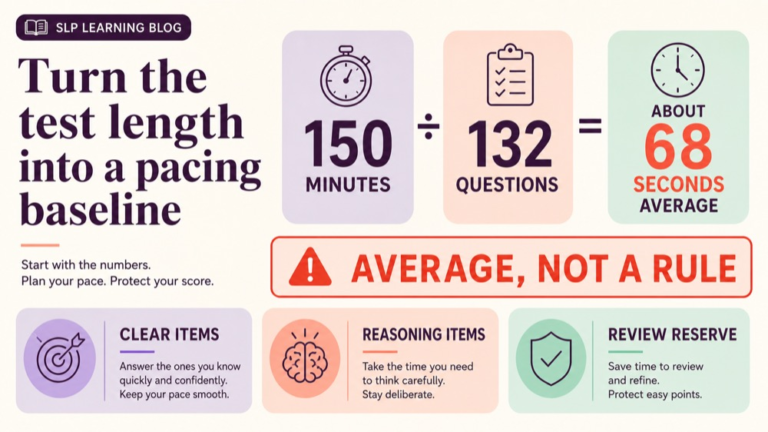
How long is the SLP Praxis exam? The current ETS page checked for this guide lists a 150-minute computer-delivered test with 132 selected-response questions. That answer is the starting point, not the whole pacing plan. You also need a way to distribute time across straightforward items, slower clinical-reasoning items, and a final review without turning the clock into a second source of stress.
This guide shows how to translate the current test details into a flexible practice routine. It does not treat the average time per question as a rigid rule, and it does not replace the live ETS page, current test-taker instructions, or your own content preparation.
Start with the current ETS details
Use the current ETS Speech-Language Pathology (5331) page as the administration reference. On the page checked on August 23, 2026, ETS displayed a 150-minute test, 132 questions, selected-response format, and computer delivery. ETS also describes the test as covering foundational knowledge, professional practice, and specialized knowledge across the scope of speech-language pathology.
Current detail
What it means for planning
What to verify again
150 minutes
You need a plan for the full testing window, not just a content checklist.
The current time limit shown by ETS.
132 questions
Your practice should include both accuracy and movement through the set.
The current question count and test form information.
Selected-response format
Read the stem, identify the decision, compare options, and commit.
The current format and test-day instructions.
Computer delivered
Practice reading and reviewing on the same general screen-based medium.
Delivery details, tools, and testing requirements.
Administration details are time-sensitive. A search result, old study companion, or discussion post can be useful for locating a topic, but the current ETS page and account instructions are the final checkpoint for the test you will take.
Turn the test length into a pacing baseline
Dividing 150 minutes by 132 questions produces about 1.14 minutes per question, or roughly 68 seconds per question. Treat that number as an average planning baseline. It is not a demand to stop every item at the same second, because selected-response items differ in reading load, clinical context, and reasoning complexity.
Use less than the average: for a familiar definition, clear professional-practice principle, or item where the evidence strongly supports one option.
Use close to the average: for an item that needs careful reading and a short comparison among plausible options.
Use more than the average: for a dense scenario or a distinction that requires you to connect assessment, intervention, ethics, or functional impact.
Protect a review reserve: keep some time available for flagged items, unanswered questions, and a final scan.
The baseline becomes useful when you compare it with your own behavior. If a 68-second average feels impossible, identify where the time goes: rereading stems, debating two options without evidence, calculating, searching memory for a term, or changing answers late. The pattern tells you what to practice.
Use a three-pass timing plan
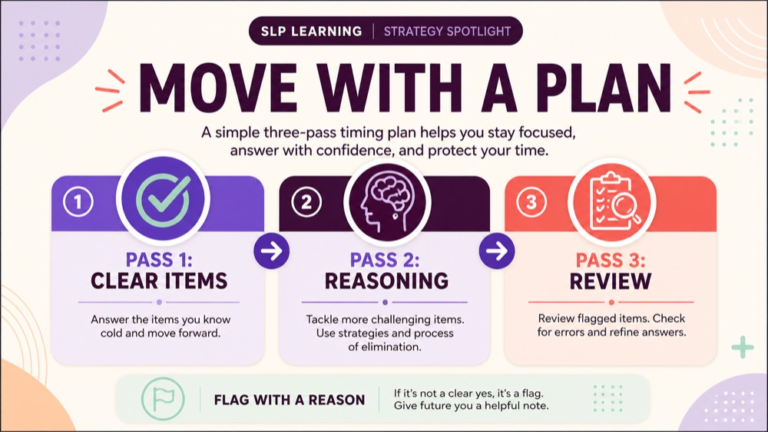
A three-pass plan creates movement without forcing every question into one identical time box. The exact split can change during practice; the value is having a default response when an item becomes sticky.
Pass one: answer the clear items. Read the question, identify the tested concept, choose the best-supported option, and move on. Flag only when you have a concrete reason to return.
Pass two: work the reasoning items. Return to scenarios that need a domain distinction, a clinical priority, or a closer comparison. State the decision rule in your head before rereading every sentence.
Pass three: review strategically. Check unanswered items, confirm that your selected option matches the stem, and revisit flagged items with the strongest evidence first.
This method is not an invitation to rush. It is a way to stop one difficult question from consuming the time needed for several questions you can answer. The exam rewards accurate decisions across the set, so pacing should preserve access to the full set.
Practice pacing with representative questions
Pacing improves when the practice environment asks you to make the same kind of decisions you will make under a clock. Use representative, original practice questions and record more than a percentage score. For each item, note whether the issue was knowledge, reading, reasoning, confidence, or time management.
Begin with a small timed set so you can observe your default pace without exhausting yourself.
Increase the set length until you can sustain attention across several content domains.
Use a visible timer during practice, but review the reasoning after the timer stops.
Mark the items that took unusually long even when you got them correct.
Separate slow-but-productive reasoning from circular doubt.
Repeat a similar set later and check whether the time problem changed.
A useful review note sounds specific: “I spent two minutes because I did not distinguish screening from assessment,” or “I reread the stem because I did not identify the patient priority.” A vague note such as “I am too slow” does not tell you what to change.
Decide when to move on
Moving on is a clinical reasoning skill as well as a timing skill. Before you commit to an answer, ask what evidence in the stem determines the choice. If you can name the decisive feature and eliminate the weaker options, select the best answer and continue. If you are rereading without adding evidence, flag the item and use the next pass.
Move on when the stem has been read accurately and one option best fits the stated priority.
Move on when the remaining uncertainty is preference rather than evidence.
Return later when a second option requires a real comparison that you can make with a decision rule.
Do not spend review time polishing an answer that already matches the stem and principle.
Use the final review for unanswered or genuinely uncertain items before minor wording changes.
Practice this decision in low-stakes sets. The goal is not to eliminate uncertainty; it is to recognize the difference between productive analysis and circular hesitation.
Avoid common timing mistakes
Using the 68-second average as a hard cutoff for every question.
Spending the first part of a timed set on one difficult item.
Reading every option repeatedly before identifying the tested concept.
Ignoring unanswered or flagged items until the last few seconds.
Practicing only short sets and assuming stamina will appear automatically.
Measuring only correct answers and not measuring decision time.
Changing a supported answer because of late anxiety rather than new evidence.
Using an old time limit without checking the current ETS page.
These errors have different solutions. A hard cutoff may require a flexible pass system. Slow reading may require stem annotation. Weak domain knowledge may require a content review block. Late answer changes may require an evidence rule for review.
Connect pacing to content review
The current ETS description emphasizes knowledge and its application across speech sound production, fluency, voice and resonance, motor speech, language, social communication, cognition, augmentative and alternative communication, hearing, and feeding and swallowing. Use that breadth to organize practice sets rather than letting timing work become a generic speed drill.
Choose a content domain and a small set of original questions.
Answer with a time plan and mark the items that consume disproportionate attention.
Review the decisive concept behind each miss and each unusually slow correct answer.
Write one transferable rule in plain language.
Mix the domain with another topic in the next set to test retrieval and switching.
For example, a slow item about swallowing may reflect content uncertainty, but it may also reflect a failure to identify the question’s priority or the patient’s immediate risk. Reviewing both the content and the decision process produces a stronger pacing change than simply attempting the same type of item faster.
Sources and next steps
How long is the SLP Praxis exam? Use the current ETS page for the answer that can change, then use a flexible pacing baseline and a three-pass routine to practice how you will move through the set. Keep the average time per question as a planning signal, not a rigid rule.
How to Register for the Speech-Language Pathology Praxis 5331
Register for praxis speech pathology is a search phrase that usually hides several different decisions: finding the correct ETS test, choosing an appointment, preparing acceptable information, and understanding what registration does and does not accomplish. A clear process matters because a registration error can create a deadline problem even when your academic preparation is strong.
This guide focuses on the Speech-Language Pathology Praxis 5331 exam. It explains the registration path, the information to gather first, and the distinctions among test registration, a passing score, ASHA certification, state licensure, and graduate-program requirements. It does not freeze a fee or promise that a particular date, location, or delivery option will be available. Those details belong to the current ETS account and should be verified before payment.
Praxis registration is an administrative decision with academic consequences. The account transaction determines which test you are scheduling, where and when you will take it, how your name and contact information are recorded, and which reporting choices you make at that point. It does not decide whether a graduate program accepts your timing, whether a state board has a particular application rule, or whether you have completed every requirement for the Certificate of Clinical Competence in Speech-Language Pathology.
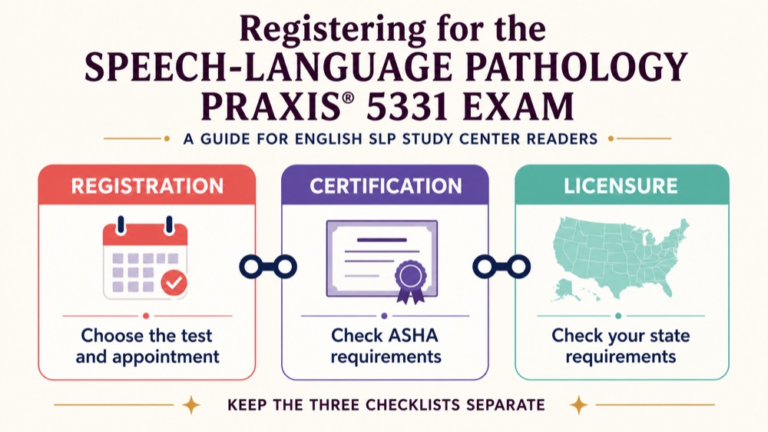
Start by separating the four questions below. Keeping them separate prevents a common form of confusion: treating an appointment confirmation as proof that every credential requirement has been satisfied.
Decision
What it controls
Who or what to verify
Test registration
Your appointment for the Speech-Language Pathology Praxis 5331.
The live ETS account, test code, date, format, location, and confirmation.
Exam result
The score report produced after you take the test.
Current ETS score-reporting information and the recipient instructions for your pathway.
ASHA certification
A broader professional credential pathway.
Current ASHA requirements, including education, clinical fellowship, and other applicable steps.
State licensure
Permission to practice under a state or jurisdiction’s rules.
The relevant state licensing authority and your program or employer guidance.
The research packet checked on August 22, 2026, captured an ETS result that listed the 5331 test as 150 minutes with 132 questions. Use that as a planning snapshot only, then confirm the live ETS page because exam specifications can change. The same caution applies to appointment windows, delivery formats, registration fees, rescheduling charges, refund rules, and score-recipient policies.
Register for Praxis Speech Pathology: The 5331 Registration Path
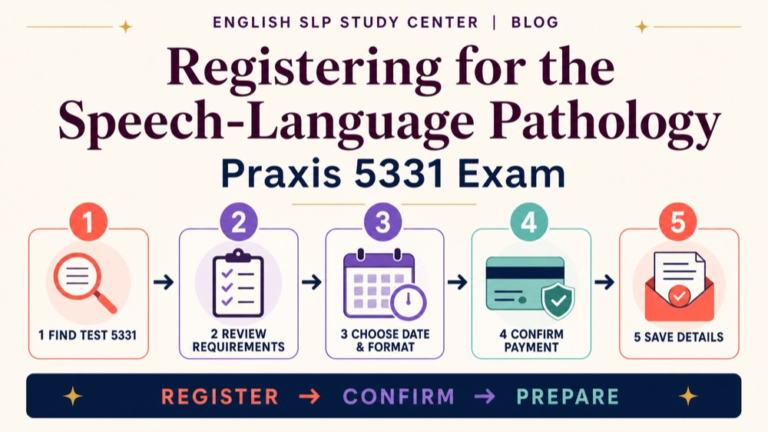
The safest registration process follows the order used by ETS: identify the test, review availability, choose the appointment, enter accurate information, review the transaction, and save the confirmation. Open the ETS registration process page first, then use the live account for the actual choices. The page is a process guide; it is not a guarantee that a particular center, time, fee, or delivery mode will appear for every candidate.
Confirm the test identity. Search for Speech-Language Pathology and confirm the 5331 designation before moving through checkout. Similar words in a search box are not enough; the test title and code should match the requirement you are trying to meet.
Check your timing. Compare your intended test date with graduate-course completion, clinical-practicum timing, application deadlines, score-report deadlines, and any state or employer process that matters to you. ASHA advises candidates to register and take the exam no earlier than completion of relevant graduate coursework and graduate clinical practicum; read the current ASHA exam guidance and verify your program’s rule.
Review the displayed availability. Use ETS to see the current appointment choices. Availability is a live inventory, so a search result is only a possible option until the registration is completed and confirmed.
Choose the delivery setting and location. Select a test-center appointment or another displayed option only after checking the environment, identification requirements, technology or room requirements, travel time, and your own ability to complete the session there. The ETS test-center page can help you understand the location search, but the account controls the current appointment.
Enter your identity details carefully. Use the name and personal information that align with the identification you expect to present. If your legal name has changed or your documents do not match, resolve the issue through the applicable ETS support process before test day.
Review score-recipient choices. Decide which program, agency, or credential pathway needs the result, and check its current instructions before selecting recipients. Do not guess a code from an old form or assume that registration and score reporting are the same action.
Read the payment and change terms. Before submitting payment, inspect the amount shown, accepted payment method, rescheduling or cancellation language, deadline, and any accommodation or identification notes. Fees and policies are time-sensitive; this article intentionally does not substitute a fixed dollar amount for the current ETS screen.
Complete the transaction and save proof. Save the confirmation number, test title, date, time, delivery setting, location, recipient information, and any follow-up instructions. A screenshot can help you remember the details, but the confirmation email and current ETS account remain the stronger records.
That sequence also gives you a practical stopping point. If the test title is wrong, the name does not match your expected identification, or the date does not protect your deadline, pause and resolve the issue before completing payment. Registration speed is less important than a correct, documented appointment.
Choose a Test Date, Delivery Format, and Location
The best appointment is not automatically the earliest appointment. It is the option that fits your preparation, required deadlines, travel or technical conditions, and the current rules for changing the appointment. Treat scheduling as a small risk-management exercise rather than a race to click the first available slot.
Choice
Questions to ask
Evidence to save
Date
Will there be enough study time? Does the score timeline fit my application or program deadline?
The selected date, time zone, and the deadline it protects.
Test center
Can I reach it reliably? Does the current ETS listing show the session I need?
Center name, address, appointment time, and travel plan.
At-home or other displayed option
Do I meet the current technical, room, identity, and monitoring conditions?
The option’s current ETS instructions and any system check or appointment notice.
Change protection
What are the current reschedule, cancellation, refund, and deadline rules?
The policy shown at registration and the support path for a problem.
Build backward from the date that matters. If a university or state process asks for a score by a certain point, allow time for the test appointment, score processing, possible administrative questions, and the receiving organization to update its record. The exact score-release schedule is a current-policy question, so verify it with ETS and the receiving program instead of relying on a study-group estimate.
Also consider the difference between a convenient location and a workable testing environment. A short commute may still be a poor choice if the appointment conflicts with required clinical responsibilities. An at-home option may be attractive for travel reasons, but it can carry specific room, equipment, identity, and monitoring requirements. Read the current instructions before assuming that an option is available or suitable.
Prepare the Information You Need Before Registration
Preparing the details before opening the payment screen makes the process calmer and reduces the chance of entering a rushed error. Keep your information in one place, but protect account credentials and personal identifiers. The goal is not to memorize every policy; it is to know which details require a deliberate check.
Test identity: confirm Speech-Language Pathology Praxis 5331, not a neighboring Praxis title.
Legal name: compare the account entry with the identification you plan to present.
Contact information: use an email address and phone number you can monitor for appointment notices.
Academic timeline: note graduate-course completion, clinical-practicum timing, and program deadlines.
Credential or state instructions: identify what your program, ASHA pathway, or state authority currently asks you to do.
Score-recipient information: obtain current recipient directions from the organization rather than an old shared spreadsheet.
Payment plan: have an accepted method ready, while checking the current amount and terms in ETS.
Accommodation needs: review the current ETS process early if you need testing accommodations or another supported arrangement.
Location plan: estimate travel, parking, arrival time, or the technical and room conditions for a displayed remote option.
Study runway: decide what you will study between registration and test day, including full-length timing practice.
This preparation list also reveals when registration should wait for clarification. If your program has not explained when it wants the score, if your identification is changing, or if an accommodation request needs lead time, use the relevant ETS or institutional support channel before treating the appointment as final. The decision is administrative, but the consequences are personal and deadline-sensitive.
Verify the Confirmation and Build the Right Study Timeline
After registration, read the confirmation as if you were checking a clinical referral: compare the documented details with the decision you intended to make. Confirm the test title and 5331 code, appointment date and time, time zone, location or delivery setting, identification instructions, score-recipient choices, and any steps that remain open. If one of those details is missing or inconsistent, contact the appropriate ETS support channel while the transaction is easy to trace.
Next, turn the appointment into a study timeline. Registration should change your preparation from a vague intention into a sequence of decisions. Reserve time for blueprint review, content retrieval, application practice, timed sets, error analysis, and a final logistics check. The current ETS page and the valid blueprint should control the exam scope; an old calendar or a competitor’s summary is not enough evidence for a current test fact.
Use the time between registration and test day to strengthen distinctions, not only to accumulate practice scores. For example, ask whether a question is testing anatomy and physiology, assessment reasoning, treatment selection, professional practice, or the interpretation of evidence. Then explain why the decisive fact supports one option and why the nearby alternatives do not. That habit is more transferable than recording a percentage without reviewing the reasoning behind each missed item.
Before test day, perform one final administrative check using current ETS instructions. Reconfirm the appointment, identification, arrival or technical requirements, and any change policy that could affect your plan. Registration evidence should make the final check easier, not replace it.
Registration, Certification, Licensure, and School Requirements Are Different
Many registration questions are really credential questions. The words sound connected, but they refer to different decisions. The ASHA Praxis registration guidance and the ETS-hosted ASHA overview are useful starting points, while your university and state authority remain important for pathway-specific instructions.
Term
Plain-language meaning
What it does not establish
Registering
Scheduling the 5331 test through the ETS process.
It does not establish that you meet every credential or state requirement.
Passing the Praxis
Meeting a score rule that applies to a particular pathway at a particular time.
It does not automatically complete a clinical fellowship, education review, or state application.
ASHA certification
A professional credential with its own current requirements and documentation.
It is not created by an appointment confirmation alone.
State licensure
A jurisdiction-specific authorization to practice.
It cannot be inferred from a general national exam page.
School or employer requirement
An institution’s deadline, documentation rule, or onboarding condition.
It may not match another school’s or employer’s timeline.
This distinction matters when deciding whether to register now. ASHA’s exam-context guidance discusses timing after graduate coursework and clinical practicum, but an individual candidate still needs to verify the rule that applies to the candidate’s program and credential pathway. If two sources appear to conflict, record the exact question, ask the responsible institution or authority, and keep the answer with your registration records.
Common Registration Mistakes and Practical Fixes
Most registration problems are avoidable when the learner checks the right evidence at the right moment. These are the mistakes worth screening for before submitting the transaction:
Searching by a loose phrase: select the full Speech-Language Pathology 5331 title and code shown by ETS.
Choosing the earliest date automatically: compare the date with coursework, practicum, preparation time, and score deadlines.
Assuming a listed center is reserved: save the appointment only after the transaction produces a confirmation.
Using a name that will not match identification: resolve the mismatch through the current ETS support route before test day.
Copying an old fee or policy: read the amount and change terms displayed in the current account.
Guessing a score-recipient instruction: ask the receiving program or authority for its current direction.
Ignoring accommodation lead time: review the current ETS process early and preserve the approval or support record.
Treating registration as certification: keep the appointment, score, ASHA, state, and school requirements in separate checklists.
Saving only a screenshot: retain the confirmation email and account record as the primary evidence.
These fixes are also useful exam habits. The same reasoning pattern appears in many Praxis questions: identify the exact task, separate the decision from the outcome, locate the decisive evidence, and avoid filling a gap with an assumption. Administrative accuracy and clinical reasoning are different skills, but both improve when the learner defines the decision before acting.
Quick Review: Your Praxis 5331 Registration Checklist
Before you consider the process complete, you should be able to answer each question below from a current source or your own confirmation record:
Did I select Speech-Language Pathology Praxis 5331?
Does the name in my ETS account align with the identification I expect to use?
Does the appointment fit my coursework, practicum, preparation, and submission deadlines?
Did I check the current delivery and location requirements?
Did I review the current fee, rescheduling, cancellation, and refund language?
Did I confirm any accommodation steps early enough for the appointment?
Did I review score-recipient instructions with the receiving organization?
Did I save the confirmation number, date, time, location, and follow-up instructions?
Do I know which claims need a final ETS check before test day?
Have I separated exam registration from ASHA certification and state licensure tasks?
If you can answer those questions, you have a usable administrative foundation for your study plan. For structured preparation after the appointment is confirmed, the SLP Study Center Complete Prep resources can help you organize blueprint review, application practice, and review of the distinctions that make exam decisions clearer.