Neural Pathways for Speech and Language: Input, Meaning, and Output
neural pathways for speech and language is easier to study when it is treated as a coordinated system rather than a memorized list of labels. Neural pathways for speech and language are best studied as interacting networks rather than one wire from one area to another. Auditory and visual input, phonological analysis, meaning, motor planning, feedback, attention, and memory all contribute to communication.
This learning guide is written for SLP students and other learners reviewing clinical concepts. It uses broad patterns to organize observation, not to make an individualized diagnosis or promise one outcome. Interpretation depends on the person, task, language, culture, hearing, access, health, context, and communication goals.
What neural pathways for speech and language includes
Begin by separating the concept into domains. A learner who can name the domains is less likely to collapse a structure, function, motor, language, access, or participation question into one explanation. The useful unit of analysis is the task: what the person was asked to understand, produce, remember, organize, or communicate, with whom, under which conditions, and with what support.
Domain or structure
What to notice
Question to carry forward
Input systems
Auditory, visual, and other perceptual systems provide information that must be selected and analyzed.
What input was available and what did the task require the person to notice?
Phonological analysis
Speech sounds and word forms are organized so that messages can be recognized, stored, and produced.
Is the difficulty about sound structure, access, sequencing, or another level?
Lexical-semantic processing
Word forms connect with concepts, relationships, context, and intended meaning.
Can the person recognize, retrieve, explain, and use the concept?
Dorsal-style mapping
A conceptual sound-to-articulation route supports sensory-motor integration for speech.
Does the task require repetition, imitation, or precise speech sequencing?
Ventral-style mapping
A conceptual sound-to-meaning route supports comprehension and interpretation.
Does the person understand the message when form and context change?
Motor and feedback systems
Planning, execution, auditory feedback, somatosensory feedback, and self-monitoring shape output.
What changes when feedback, rate, cueing, or communication mode changes?
These domains interact, but they should remain distinguishable. A named structure may contribute to more than one function, and a single function may depend on several structures and control systems. A study map organizes the next observation; it does not answer every assessment question.
Keep the first pass descriptive and close to the communication or swallowing event. Note the task, the response, the partner, the setting, the timing, the available support, and the consequence for participation. This gives the learner a stable record to compare across tasks and prevents a familiar anatomy or localization term from doing too much explanatory work before the evidence has been separated.
For Praxis-style review, a vignette may include several true anatomical details but ask for one best interpretation or next step. The strongest answer usually respects the task, identifies the relevant function, checks the most important missing information, and avoids treating one performance sample as the whole profile.
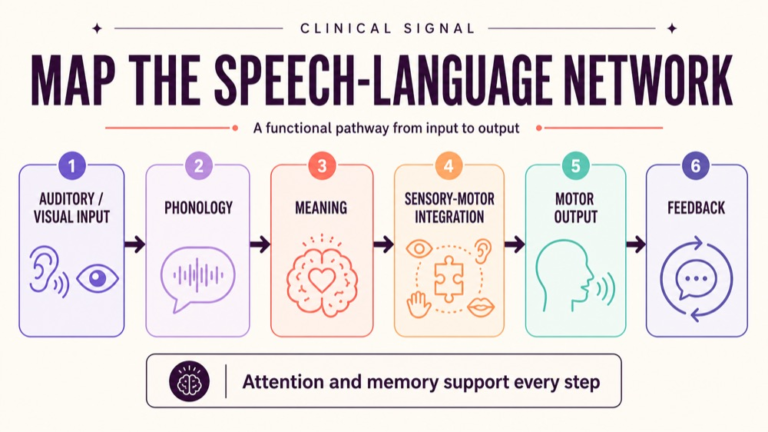
Map the speech-language network
For study purposes, describe the structure-function relationship before naming a disorder. Record what moved, what was sensed, what was produced, what timing changed, and what the listener or communication partner experienced. Then note whether the task was familiar, how much context was shared, and which support changed the response.
Perceptual input: hearing, vision, attention, and the quality of the signal entering the system.
Phonological and word-form processing: organizing sound patterns and word forms for recognition and production.
Meaning and context: connecting words and sentences with concepts, prior knowledge, discourse, and communicative intent.
Sensory-motor integration: linking speech perception with the movements needed to plan and produce speech.
Motor planning and execution: selecting, sequencing, and carrying out speech movements with feedback.
Control and participation: memory, executive function, partner support, fatigue, emotion, and communication demands alter performance.
A strong description is specific enough that another learner could picture the event. Instead of writing “the structure is weak,” describe the demand, the observable movement or signal, the partner, the context, and the result. This protects clinical reasoning from labels that are broader than the evidence.
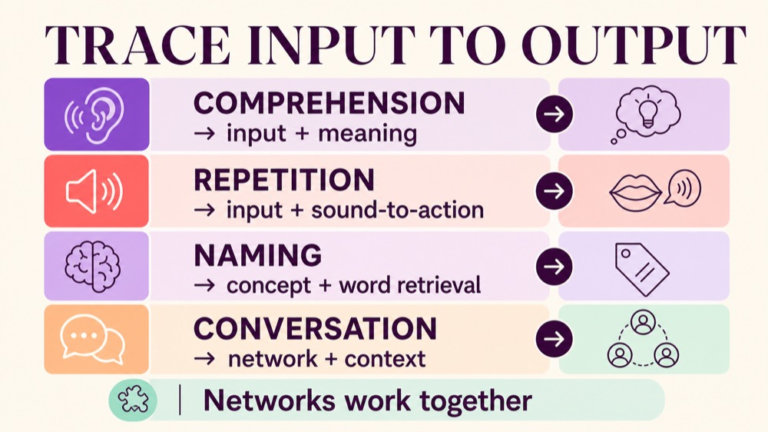
Trace input to output
Context changes what a structure or pathway must do. A sustained vowel, a connected conversation, a single bite, a full meal, a repetition task, and a story retell place different demands on timing, sensation, motor control, memory, and partner support. Hearing access, fatigue, alertness, posture, visual supports, language experience, and the opportunity to request clarification should be part of the observation.
Repetition, naming, conversation, reading aloud, following directions, and storytelling place different demands on the network. A person may repeat a word accurately but struggle to retrieve it in conversation, or understand a sentence only when visual context is available. The contrast helps identify which processing relationship deserves the next question.
Observation layer
Example question
Task
What did the person need to understand, produce, coordinate, remember, or protect?
Function
Which movement, sensation, signal, or processing relationship was observable?
Access
Were hearing, visual, motor, sensory, language, respiratory, or environmental supports available?
Participation
What meaningful routine became easier or harder because of the pattern?
Context is not an afterthought added once a label has been selected. It is part of the question itself. If performance changes with a quieter room, extra processing time, a familiar partner, a different material, a different communication mode, or a changed task, that change is useful evidence about access and demand. It does not by itself identify a cause, but it tells you which conditions should be carried into the next observation.
Apply the concept in clinical reasoning
When a Praxis-style scenario or clinical discussion presents neural pathways for speech and language, use a disciplined sequence. The goal is to select the next clinical question or action that matches the evidence, the person’s priorities, and the communication or swallowing context.
Define the task in plain language.
Identify the structure, function, or network domain involved without assuming it is interchangeable with the whole system.
Separate observation from interpretation and write down what remains unknown.
Check hearing, language experience, culture, communication mode, environment, partner support, alertness, respiration, and task familiarity.
Choose the assessment, collaboration, or observation step that answers the specific question.
State the boundary of the conclusion and keep the person’s participation goal visible.
Repetition, naming, conversation, reading aloud, following directions, and storytelling place different demands on the network. A person may repeat a word accurately but struggle to retrieve it in conversation, or understand a sentence only when visual context is available. The contrast helps identify which processing relationship deserves the next question. In a learning answer, the decisive evidence is usually the relationship among the task, the observed function, and the next needed information—not a single isolated anatomy label.
Common study mistakes
Treating the classical dorsal and ventral labels as complete anatomical maps.
Assuming one impaired task identifies one damaged pathway.
Collapsing speech motor planning, language formulation, and articulation into the same construct.
Ignoring input quality, hearing, vision, attention, memory, and task familiarity.
Using repetition success to suggest that spontaneous language is intact.
Describing comprehension without checking sentence meaning, context, inference, and response demands.
Overlooking feedback and self-monitoring when interpreting speech errors.
Treating a network model as a bedside lesion-localization rule.
Most of these mistakes come from replacing a multidomain question with a fast label. Correct the habit by returning to the same sequence: describe, connect structure to function, contextualize, ask what is missing, and choose a proportionate next step. A short rationale can make the habit visible: identify the evidence, name the uncertainty, and explain why the selected next step fits both.
Build a quick review map
Use this compact map when reviewing a missed question, a lecture note, or a clinical vignette:
Step 1: State the input, message, output, and response format in the task.
Step 2: Separate sound structure, word meaning, syntax, motor planning, and execution.
Step 3: Use the dorsal and ventral concepts as functional study maps, not one-to-one diagnoses.
Step 4: Compare supported, repeated, named, conversational, and written performance.
Step 6: Choose the observation that best tests the processing relationship still in doubt.
Then write one transfer sentence: “When I see this structure-function pattern, I will first check ___ because ___.” The sentence should identify a decision rule, not repeat a definition. Revisit it after a delay and test whether you can apply the rule to a different task, age group, or communication mode.
Sources and next steps
neural pathways for speech and language is best learned as a context-sensitive relationship among structure, function, access, and participation. Use the current authority pages to refine the concept, then return to practice scenarios that require you to explain what the evidence supports and what it leaves open.
Cranial Nerves for Speech and Swallowing: A Functional Study Map
cranial nerves for speech and swallowing is easier to study when it is treated as a coordinated system rather than a memorized list of labels. Cranial nerves for speech and swallowing are easier to remember when each nerve is tied to a functional question. The exam-relevant habit is not reciting numbers alone; it is connecting sensation, movement, voice, airway protection, and tongue control to the task being observed.
This learning guide is written for SLP students and other learners reviewing clinical concepts. It uses broad patterns to organize observation, not to make an individualized diagnosis or promise one outcome. Interpretation depends on the person, task, language, culture, hearing, access, health, context, and communication goals.
What cranial nerves for speech and swallowing includes
Begin by separating the concept into domains. A learner who can name the domains is less likely to collapse a structure, function, motor, language, access, or participation question into one explanation. The useful unit of analysis is the task: what the person was asked to understand, produce, remember, organize, or communicate, with whom, under which conditions, and with what support.
Domain or structure
What to notice
Question to carry forward
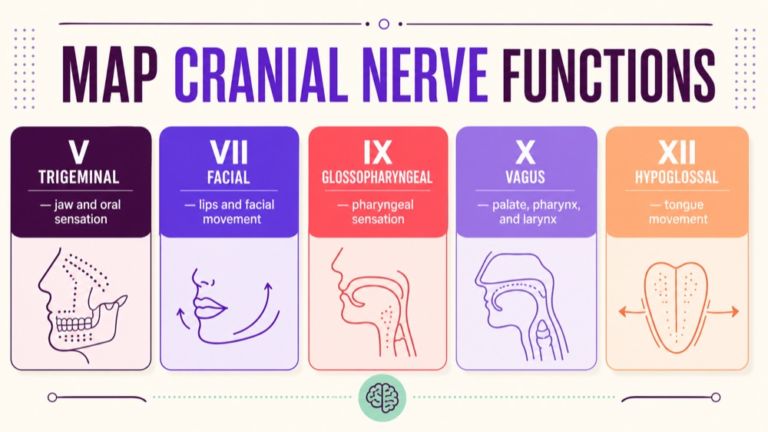
CN V: trigeminal
Supports jaw movement, mastication, facial and oral sensation, and selected oral motor functions.
What do jaw control and oral sensation contribute to this task?
CN VII: facial
Supports facial movement, lip closure, and facial expression, with additional sensory and autonomic roles.
Can the person contain material and shape the intended facial or labial movement?
CN IX: glossopharyngeal
Contributes to pharyngeal sensation and movement-related swallowing information.
What does the person sense and respond to as material reaches the pharynx?
CN X: vagus
Supports pharyngeal and laryngeal functions, velopharyngeal movement, voice, and airway-related coordination.
How do voice, palate, pharynx, and larynx work together?
CN XII: hypoglossal
Controls important tongue movements used for speech shaping and oral bolus control.
Which tongue movement, range, speed, or precision is required?
Integrated network
Sensory feedback, central planning, motor execution, and breathing make nerve functions meaningful in context.
What broader exam is needed before interpreting one finding?
These domains interact, but they should remain distinguishable. A named structure may contribute to more than one function, and a single function may depend on several structures and control systems. A study map organizes the next observation; it does not answer every assessment question.
Keep the first pass descriptive and close to the communication or swallowing event. Note the task, the response, the partner, the setting, the timing, the available support, and the consequence for participation. This gives the learner a stable record to compare across tasks and prevents a familiar anatomy or localization term from doing too much explanatory work before the evidence has been separated.
For Praxis-style review, a vignette may include several true anatomical details but ask for one best interpretation or next step. The strongest answer usually respects the task, identifies the relevant function, checks the most important missing information, and avoids treating one performance sample as the whole profile.
Map cranial nerve functions
For study purposes, describe the structure-function relationship before naming a disorder. Record what moved, what was sensed, what was produced, what timing changed, and what the listener or communication partner experienced. Then note whether the task was familiar, how much context was shared, and which support changed the response.
Motor output: observe the movement that matters rather than treating a nerve name as the final answer.
Sensation: ask how oral or pharyngeal sensory information affects initiation, timing, response, and learning.
Speech subsystems: connect jaw, lips, palate, larynx, tongue, breathing, and prosody to the speech sample.
Swallowing functions: connect containment, propulsion, pharyngeal response, airway protection, and clearance to the relevant structures.
Laterality and symmetry: describe the side, range, speed, strength, or coordination observed without over-localizing.
Clinical integration: combine cranial nerve observations with history, cognition, sensation, respiration, and participation.
A strong description is specific enough that another learner could picture the event. Instead of writing “the structure is weak,” describe the demand, the observable movement or signal, the partner, the context, and the result. This protects clinical reasoning from labels that are broader than the evidence.
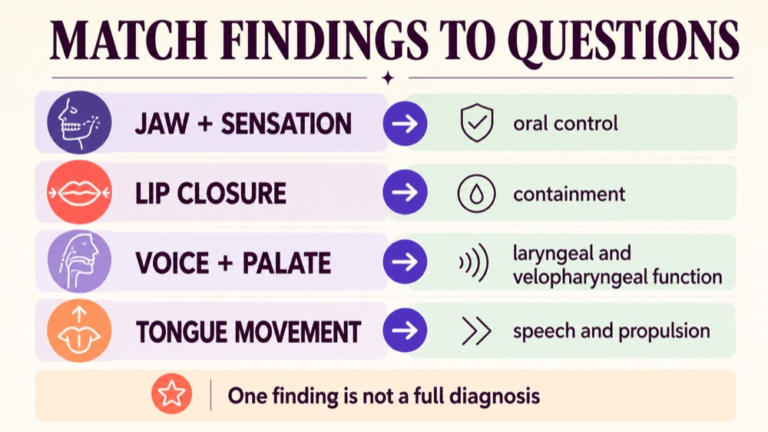
Match findings to questions
Context changes what a structure or pathway must do. A sustained vowel, a connected conversation, a single bite, a full meal, a repetition task, and a story retell place different demands on timing, sensation, motor control, memory, and partner support. Hearing access, fatigue, alertness, posture, visual supports, language experience, and the opportunity to request clarification should be part of the observation.
A learner may show reduced lip closure during a feeding task, imprecise tongue movement during speech, or a changed voice after neurologic injury. Each observation raises a functional question, but none should be converted into a lesion location from one sign alone. The larger examination and the person’s communication and swallowing goals determine what the finding means.
Observation layer
Example question
Task
What did the person need to understand, produce, coordinate, remember, or protect?
Function
Which movement, sensation, signal, or processing relationship was observable?
Access
Were hearing, visual, motor, sensory, language, respiratory, or environmental supports available?
Participation
What meaningful routine became easier or harder because of the pattern?
Context is not an afterthought added once a label has been selected. It is part of the question itself. If performance changes with a quieter room, extra processing time, a familiar partner, a different material, a different communication mode, or a changed task, that change is useful evidence about access and demand. It does not by itself identify a cause, but it tells you which conditions should be carried into the next observation.
Apply the concept in clinical reasoning
When a Praxis-style scenario or clinical discussion presents cranial nerves for speech and swallowing, use a disciplined sequence. The goal is to select the next clinical question or action that matches the evidence, the person’s priorities, and the communication or swallowing context.
Define the task in plain language.
Identify the structure, function, or network domain involved without assuming it is interchangeable with the whole system.
Separate observation from interpretation and write down what remains unknown.
Check hearing, language experience, culture, communication mode, environment, partner support, alertness, respiration, and task familiarity.
Choose the assessment, collaboration, or observation step that answers the specific question.
State the boundary of the conclusion and keep the person’s participation goal visible.
A learner may show reduced lip closure during a feeding task, imprecise tongue movement during speech, or a changed voice after neurologic injury. Each observation raises a functional question, but none should be converted into a lesion location from one sign alone. The larger examination and the person’s communication and swallowing goals determine what the finding means. In a learning answer, the decisive evidence is usually the relationship among the task, the observed function, and the next needed information—not a single isolated anatomy label.
Common study mistakes
Memorizing nerve numbers without remembering the movement or sensation being tested.
Assuming one nerve has only one function or operates independently of other systems.
Treating an asymmetry as a diagnosis or lesion location without a broader examination.
Ignoring sensory information while focusing only on visible motor movement.
Confusing speech articulation with swallowing propulsion even when the same structure is involved differently.
Using a cranial nerve screen as a substitute for a comprehensive speech or swallowing assessment.
Overlooking respiratory status, cognition, alertness, fatigue, and communication mode.
Writing a treatment decision before stating the functional problem and the evidence for it.
Most of these mistakes come from replacing a multidomain question with a fast label. Correct the habit by returning to the same sequence: describe, connect structure to function, contextualize, ask what is missing, and choose a proportionate next step. A short rationale can make the habit visible: identify the evidence, name the uncertainty, and explain why the selected next step fits both.
Build a quick review map
Use this compact map when reviewing a missed question, a lecture note, or a clinical vignette:
Step 1: Name the task: speech, oral preparation, pharyngeal swallow, voice, or another function.
Step 2: Identify the movement or sensory event that is actually observable.
Step 3: Link that event to the most relevant cranial nerve contributions.
Step 5: Separate a screening observation from a diagnostic conclusion.
Step 6: Choose the next part of the broader examination or collaboration that reduces uncertainty.
Then write one transfer sentence: “When I see this structure-function pattern, I will first check ___ because ___.” The sentence should identify a decision rule, not repeat a definition. Revisit it after a delay and test whether you can apply the rule to a different task, age group, or communication mode.
Sources and next steps
cranial nerves for speech and swallowing is best learned as a context-sensitive relationship among structure, function, access, and participation. Use the current authority pages to refine the concept, then return to practice scenarios that require you to explain what the evidence supports and what it leaves open.
Anatomy of Swallowing: Oral, Pharyngeal, and Esophageal Systems
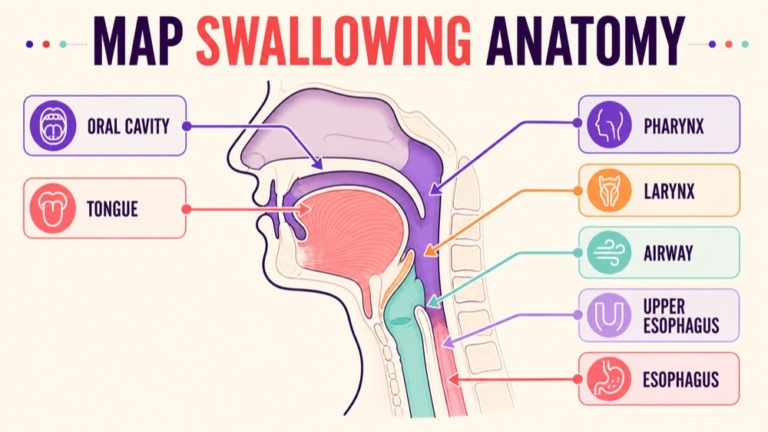
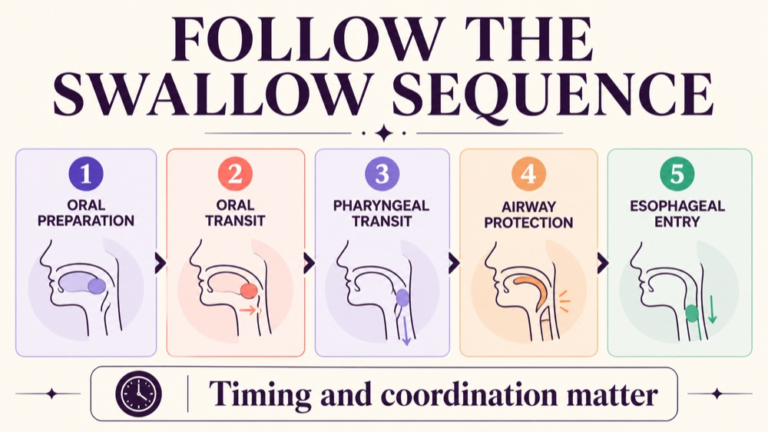
anatomy of swallowing is easier to study when it is treated as a coordinated system rather than a memorized list of labels. The anatomy of swallowing is easiest to learn as a timed movement system. Oral structures prepare and transport a bolus, pharyngeal structures direct it while protecting the airway, and the upper esophageal region supports entry into the digestive tract.
This learning guide is written for SLP students and other learners reviewing clinical concepts. It uses broad patterns to organize observation, not to make an individualized diagnosis or promise one outcome. Interpretation depends on the person, task, language, culture, hearing, access, health, context, and communication goals.
What anatomy of swallowing includes
Begin by separating the concept into domains. A learner who can name the domains is less likely to collapse a structure, function, motor, language, access, or participation question into one explanation. The useful unit of analysis is the task: what the person was asked to understand, produce, remember, organize, or communicate, with whom, under which conditions, and with what support.
Domain or structure
What to notice
Question to carry forward
Oral preparation
The lips, teeth, tongue, jaw, and oral sensation help contain, shape, and prepare material.
What must be controlled before the swallow is initiated?
Oral transit
The tongue and oral structures move the bolus posteriorly while timing and containment matter.
Is the issue preparation, propulsion, timing, or residue?
Pharyngeal transit
Pharyngeal contraction and coordinated movement help direct the bolus toward the esophagus.
Which event and timing relationship needs to be observed?
Airway protection
Laryngeal closure, elevation, and related coordination help separate swallowing from breathing.
What evidence supports airway entry, protection, or response?
Upper esophageal entry
The upper esophageal region opens to permit passage and then participates in the transition onward.
Is the question about opening, flow, clearance, or referral?
Respiratory coordination
Breathing and swallowing are closely timed, and the person’s alertness and respiratory status matter.
How do fatigue, posture, rate, or respiratory demands change the event?
These domains interact, but they should remain distinguishable. A named structure may contribute to more than one function, and a single function may depend on several structures and control systems. A study map organizes the next observation; it does not answer every assessment question.
Keep the first pass descriptive and close to the communication or swallowing event. Note the task, the response, the partner, the setting, the timing, the available support, and the consequence for participation. This gives the learner a stable record to compare across tasks and prevents a familiar anatomy or localization term from doing too much explanatory work before the evidence has been separated.
For Praxis-style review, a vignette may include several true anatomical details but ask for one best interpretation or next step. The strongest answer usually respects the task, identifies the relevant function, checks the most important missing information, and avoids treating one performance sample as the whole profile.
Map swallowing anatomy
For study purposes, describe the structure-function relationship before naming a disorder. Record what moved, what was sensed, what was produced, what timing changed, and what the listener or communication partner experienced. Then note whether the task was familiar, how much context was shared, and which support changed the response.
Oral containment: lip closure, tongue control, jaw stability, sensation, and material management before propulsion.
Oral propulsion: tongue movement and timing transport the bolus toward the pharynx.
Pharyngeal movement: constriction, laryngeal elevation, and coordinated passage support efficient transit.
Airway protection: laryngeal structures and timing help keep material out of the airway during the swallow.
Esophageal transition: the upper esophageal opening and downstream clearance are part of the larger swallow pathway.
Function and participation: meals, hydration, alertness, posture, fatigue, caregiver support, and the person’s goals shape clinical meaning.
A strong description is specific enough that another learner could picture the event. Instead of writing “the structure is weak,” describe the demand, the observable movement or signal, the partner, the context, and the result. This protects clinical reasoning from labels that are broader than the evidence.
Follow the swallow sequence
Context changes what a structure or pathway must do. A sustained vowel, a connected conversation, a single bite, a full meal, a repetition task, and a story retell place different demands on timing, sensation, motor control, memory, and partner support. Hearing access, fatigue, alertness, posture, visual supports, language experience, and the opportunity to request clarification should be part of the observation.
A diagram can show where structures are, but it cannot by itself answer whether a person is safe or efficient during a real meal. The useful reasoning move is to connect the suspected structure or phase to an observable event, the person’s respiratory and alertness status, and the assessment method that can answer the question.
Observation layer
Example question
Task
What did the person need to understand, produce, coordinate, remember, or protect?
Function
Which movement, sensation, signal, or processing relationship was observable?
Access
Were hearing, visual, motor, sensory, language, respiratory, or environmental supports available?
Participation
What meaningful routine became easier or harder because of the pattern?
Context is not an afterthought added once a label has been selected. It is part of the question itself. If performance changes with a quieter room, extra processing time, a familiar partner, a different material, a different communication mode, or a changed task, that change is useful evidence about access and demand. It does not by itself identify a cause, but it tells you which conditions should be carried into the next observation.
Apply the concept in clinical reasoning
When a Praxis-style scenario or clinical discussion presents anatomy of swallowing, use a disciplined sequence. The goal is to select the next clinical question or action that matches the evidence, the person’s priorities, and the communication or swallowing context.
Define the task in plain language.
Identify the structure, function, or network domain involved without assuming it is interchangeable with the whole system.
Separate observation from interpretation and write down what remains unknown.
Check hearing, language experience, culture, communication mode, environment, partner support, alertness, respiration, and task familiarity.
Choose the assessment, collaboration, or observation step that answers the specific question.
State the boundary of the conclusion and keep the person’s participation goal visible.
A diagram can show where structures are, but it cannot by itself answer whether a person is safe or efficient during a real meal. The useful reasoning move is to connect the suspected structure or phase to an observable event, the person’s respiratory and alertness status, and the assessment method that can answer the question. In a learning answer, the decisive evidence is usually the relationship among the task, the observed function, and the next needed information—not a single isolated anatomy label.
Common study mistakes
Treating the oral, pharyngeal, and esophageal regions as independent stages with no timing relationship.
Assuming a cough is the only meaningful sign of airway entry or swallowing difficulty.
Confusing an anatomy label with direct evidence about physiology during a swallow.
Ignoring respiration, alertness, posture, fatigue, positioning, and meal context.
Calling a clinical observation an instrumental finding when the relevant structures were not visualized.
Overlooking the difference between safety, efficiency, comfort, nutrition, hydration, and participation.
Applying an adult anatomy explanation to a child without considering development and feeding context.
Jumping to a treatment recommendation before identifying the diagnostic question.
Most of these mistakes come from replacing a multidomain question with a fast label. Correct the habit by returning to the same sequence: describe, connect structure to function, contextualize, ask what is missing, and choose a proportionate next step. A short rationale can make the habit visible: identify the evidence, name the uncertainty, and explain why the selected next step fits both.
Build a quick review map
Use this compact map when reviewing a missed question, a lecture note, or a clinical vignette:
Step 1: Name the swallow phase or transition that the question actually targets.
Step 2: Map the relevant structures to movement, timing, sensation, or airway protection.
Step 3: Separate what a non-instrumental observation can suggest from what requires visualization.
Step 6: Select the next assessment or collaborative action that answers the specific uncertainty.
Then write one transfer sentence: “When I see this structure-function pattern, I will first check ___ because ___.” The sentence should identify a decision rule, not repeat a definition. Revisit it after a delay and test whether you can apply the rule to a different task, age group, or communication mode.
Sources and next steps
anatomy of swallowing is best learned as a context-sensitive relationship among structure, function, access, and participation. Use the current authority pages to refine the concept, then return to practice scenarios that require you to explain what the evidence supports and what it leaves open.
Anatomy of the Vocal Tract: Structures, Functions, and Context
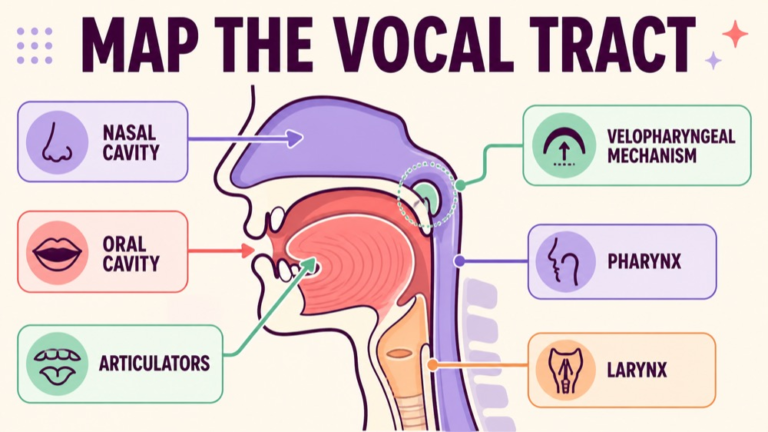
anatomy of the vocal tract is easier to study when it is treated as a coordinated system rather than a memorized list of labels. The vocal tract is not a single organ or a static tube. It is a coordinated system in which airflow, vocal-fold vibration, resonance, and articulatory movement shape a speech signal for a listener.
This learning guide is written for SLP students and other learners reviewing clinical concepts. It uses broad patterns to organize observation, not to make an individualized diagnosis or promise one outcome. Interpretation depends on the person, task, language, culture, hearing, access, health, context, and communication goals.
What anatomy of the vocal tract includes
Begin by separating the concept into domains. A learner who can name the domains is less likely to collapse a structure, function, motor, language, access, or participation question into one explanation. The useful unit of analysis is the task: what the person was asked to understand, produce, remember, organize, or communicate, with whom, under which conditions, and with what support.
Domain or structure
What to notice
Question to carry forward
Larynx and vocal folds
Provide the voiced sound source and help regulate airflow through laryngeal valving.
Is the task about phonation, protection, airflow, or all three?
Pharynx
Acts as a shared passage and resonating space whose shape can change the acoustic result.
How does pharyngeal configuration interact with the task?
Velopharyngeal mechanism
Manages coupling between the oral and nasal cavities during speech and other functions.
Does the intended sound require oral, nasal, or changing airflow?
Oral cavity and articulators
Use the tongue, lips, jaw, teeth, and palate to shape vowels, consonants, and transitions.
Which movement or place relationship carries the contrast?
Nasal cavity
Provides a resonating pathway when nasal coupling is intended and contributes to airway functions.
Is resonance changing because of airflow, structure, timing, or context?
Coordination
Links breathing, phonation, resonance, articulation, rate, and prosody during connected speech.
Which subsystem interaction is visible in the sample?
These domains interact, but they should remain distinguishable. A named structure may contribute to more than one function, and a single function may depend on several structures and control systems. A study map organizes the next observation; it does not answer every assessment question.
Keep the first pass descriptive and close to the communication or swallowing event. Note the task, the response, the partner, the setting, the timing, the available support, and the consequence for participation. This gives the learner a stable record to compare across tasks and prevents a familiar anatomy or localization term from doing too much explanatory work before the evidence has been separated.
For Praxis-style review, a vignette may include several true anatomical details but ask for one best interpretation or next step. The strongest answer usually respects the task, identifies the relevant function, checks the most important missing information, and avoids treating one performance sample as the whole profile.
Map the vocal tract
For study purposes, describe the structure-function relationship before naming a disorder. Record what moved, what was sensed, what was produced, what timing changed, and what the listener or communication partner experienced. Then note whether the task was familiar, how much context was shared, and which support changed the response.
Respiratory power: airflow and pressure support the speech-breathing pattern and phrase length.
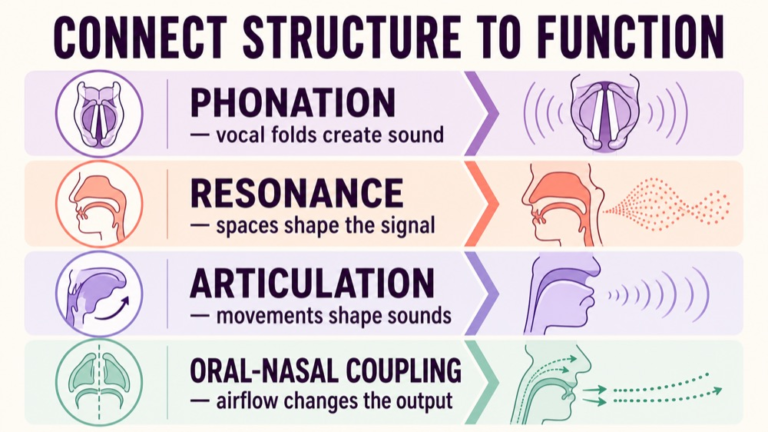
Phonation: laryngeal valving and vocal-fold vibration create the primary voiced sound source.
Resonance: the pharyngeal, oral, and nasal spaces filter and shape the signal after it is generated.
Velopharyngeal control: the soft palate and pharyngeal walls help manage oral-nasal coupling for different sounds.
Articulation: the tongue, lips, jaw, teeth, and palate make rapid movements that create sound contrasts.
Timing and participation: rate, stress, coordination, hearing, partner expectations, and environment affect what a listener receives.
A strong description is specific enough that another learner could picture the event. Instead of writing “the structure is weak,” describe the demand, the observable movement or signal, the partner, the context, and the result. This protects clinical reasoning from labels that are broader than the evidence.
Connect structure to function
Context changes what a structure or pathway must do. A sustained vowel, a connected conversation, a single bite, a full meal, a repetition task, and a story retell place different demands on timing, sensation, motor control, memory, and partner support. Hearing access, fatigue, alertness, posture, visual supports, language experience, and the opportunity to request clarification should be part of the observation.
A sustained vowel, a pressure-loaded consonant, a nasal sound, and a conversation do not test the vocal tract in the same way. If the signal changes across tasks, examine the structure-function relationship, movement demands, airflow, rate, hearing, and context before treating the difference as one global problem.
Observation layer
Example question
Task
What did the person need to understand, produce, coordinate, remember, or protect?
Function
Which movement, sensation, signal, or processing relationship was observable?
Access
Were hearing, visual, motor, sensory, language, respiratory, or environmental supports available?
Participation
What meaningful routine became easier or harder because of the pattern?
Context is not an afterthought added once a label has been selected. It is part of the question itself. If performance changes with a quieter room, extra processing time, a familiar partner, a different material, a different communication mode, or a changed task, that change is useful evidence about access and demand. It does not by itself identify a cause, but it tells you which conditions should be carried into the next observation.
Apply the concept in clinical reasoning
When a Praxis-style scenario or clinical discussion presents anatomy of the vocal tract, use a disciplined sequence. The goal is to select the next clinical question or action that matches the evidence, the person’s priorities, and the communication or swallowing context.
Define the task in plain language.
Identify the structure, function, or network domain involved without assuming it is interchangeable with the whole system.
Separate observation from interpretation and write down what remains unknown.
Check hearing, language experience, culture, communication mode, environment, partner support, alertness, respiration, and task familiarity.
Choose the assessment, collaboration, or observation step that answers the specific question.
State the boundary of the conclusion and keep the person’s participation goal visible.
A sustained vowel, a pressure-loaded consonant, a nasal sound, and a conversation do not test the vocal tract in the same way. If the signal changes across tasks, examine the structure-function relationship, movement demands, airflow, rate, hearing, and context before treating the difference as one global problem. In a learning answer, the decisive evidence is usually the relationship among the task, the observed function, and the next needed information—not a single isolated anatomy label.
Common study mistakes
Memorizing structure names without attaching each structure to an observable function.
Treating the vocal folds as if they explain resonance, articulation, or language by themselves.
Confusing the pharynx, larynx, and oral cavity because they are close together in a diagram.
Assuming a visible structure predicts function without an appropriate task or examination.
Ignoring oral-nasal coupling when describing resonance or speech sound production.
Using an anatomy label to imply a medical diagnosis or lesion without evidence.
Separating breathing, voice, resonance, and articulation so completely that coordination disappears.
Failing to connect an observed subsystem difference to intelligibility or participation.
Most of these mistakes come from replacing a multidomain question with a fast label. Correct the habit by returning to the same sequence: describe, connect structure to function, contextualize, ask what is missing, and choose a proportionate next step. A short rationale can make the habit visible: identify the evidence, name the uncertainty, and explain why the selected next step fits both.
Build a quick review map
Use this compact map when reviewing a missed question, a lecture note, or a clinical vignette:
Step 1: Start with the speech task and the acoustic or communicative output required.
Step 2: Map airflow, phonation, resonance, velopharyngeal control, and articulation.
Step 3: Link each named structure to a function and an observable question.
Step 4: Separate anatomy, physiology, sound description, and diagnostic interpretation.
Step 5: Check rate, phrase length, hearing, posture, partner, environment, and communication mode.
Step 6: Choose the next observation or professional collaboration that addresses the remaining uncertainty.
Then write one transfer sentence: “When I see this structure-function pattern, I will first check ___ because ___.” The sentence should identify a decision rule, not repeat a definition. Revisit it after a delay and test whether you can apply the rule to a different task, age group, or communication mode.
Sources and next steps
anatomy of the vocal tract is best learned as a context-sensitive relationship among structure, function, access, and participation. Use the current authority pages to refine the concept, then return to practice scenarios that require you to explain what the evidence supports and what it leaves open.
Start with asha vocal tract, asha voice, ets 5331 current. These sources support the learning frame; they do not replace current topic-specific guidance or an individualized evaluation.
Anatomy of Speech Production: Systems, Structures, and Function
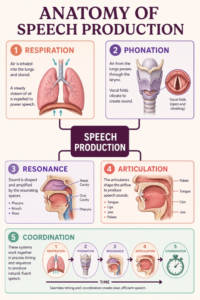
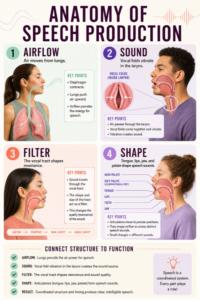
anatomy of speech production is easiest to study when it is treated as a connected pattern rather than a single checklist item. The anatomy of speech production is easiest to remember as a coordinated system: respiratory power, laryngeal sound generation, resonance, and articulatory shaping work together to create intelligible speech.
This learning guide is written for SLP students and other learners reviewing clinical concepts. It uses broad patterns to organize observation, not to make an individualized diagnosis or promise one outcome. Interpretation depends on language, culture, hearing, access, health, opportunity, context, task, and the person’s communication goals.
What anatomy of speech production includes
Begin by separating the concept into domains. A learner who can name the domains is less likely to collapse a sound, language, motor, access, or participation question into one explanation. The useful unit of analysis is the task: what the person was asked to understand, produce, remember, organize, or communicate, with whom, under which conditions, and with what support.
Domain
What to notice
Question to carry forward
Respiratory system
Provides airflow and pressure that support speech breathing and the energy for phonation.
What power and breath pattern does the speech task require?
Laryngeal system
Uses vocal-fold vibration and laryngeal valving to create a voiced sound source.
Is the question about sound generation, protection, or control?
Resonatory tract
The pharynx, oral cavity, and nasal cavity shape the sound through filtering and coupling.
How might the resonating spaces change the signal?
Articulators
The tongue, lips, jaw, palate, and related structures shape consonants, vowels, and transitions.
Which movement or place feature carries the contrast?
Coordination
Timing and interaction across systems support rate, prosody, intelligibility, and connected speech.
Which subsystem interaction is the task exposing?
These domains interact, but they should remain distinguishable. A learner may show strength in one area and need support in another. A broad learning label organizes the next observation; it does not answer every assessment question.
Keep the first pass descriptive and close to the communication event. Note the message, the listener, the setting, the response format, the task demand, and the support that was available. This gives the learner a stable record to compare across tasks and prevents a familiar term from doing too much explanatory work before the evidence has been separated into observable parts.
For exam review, a vignette may include several true details but ask for one best next step. The strongest answer usually respects the task and the person’s participation, checks the most relevant missing information, and avoids treating one performance sample as the whole profile.
Map speech production anatomy
For study purposes, describe the pattern before naming a condition. Record what the person understood, produced, initiated, repaired, or participated in. Then note whether the task was familiar, how much context was shared, what communication mode was available, and which support changed the response.
Respiration: airflow, pressure, speech breathing, and the relationship between inhalation, exhalation, and phrase length.
Phonation: laryngeal valving and vocal-fold vibration that create the voiced sound source.
Resonance: the pharyngeal, oral, and nasal cavities that filter and shape the sound signal.
Articulation: coordinated movement of the tongue, lips, jaw, palate, and other structures for speech contrasts.
Prosody and timing: rate, stress, pitch, loudness, pauses, and transitions across connected speech.
Clinical observation: separating anatomy, physiology, movement, sound, communication impact, and the need for medical collaboration.
A strong description is specific enough that another learner could picture the event. Instead of writing “the skill is weak,” describe the demand, the observable response, the partner, the context, and the result. This protects clinical reasoning from labels that are broader than the evidence.
Connect structures to speech function
Context changes what communication requires. A quiet one-to-one task, a noisy group, a classroom explanation, a book-sharing routine, a peer exchange, and a work task can place different demands on the same underlying skills. Hearing access, fatigue, visual supports, partner rate, cultural expectations, language exposure, and the opportunity to request clarification should be part of the observation.
A sustained vowel, a multisyllabic word, and a conversation do not place the same demand on the speech-production system. A useful anatomy answer links the structure to its function and then asks how the task, rate, posture, hearing, motor control, or environment changes the observable speech signal.
Observation layer
Example question
Task
What did the person need to understand, express, remember, organize, or repair?
Partner
Who was listening, and how did the partner respond or support the exchange?
Access
Were hearing, visual, motor, sensory, language, or environmental supports available?
Participation
What meaningful routine became easier or harder because of the pattern?
Context is not an afterthought added once a label has been selected. It is part of the question itself. If performance changes with a quieter room, visual supports, extra processing time, a familiar partner, a different communication mode, or a changed task, that change is useful evidence about access and demand. It does not by itself identify a cause, but it tells you which conditions should be carried into the next observation.
Apply the concept in clinical reasoning
When a Praxis-style scenario or clinical discussion presents anatomy of speech production, use a disciplined sequence. The goal is to select the next clinical question or action that matches the evidence, the person’s priorities, and the communication context.
Define the task in plain language.
Identify the domain or domains involved without assuming they are interchangeable.
Separate observation from interpretation and write down what remains unknown.
Check hearing, language experience, culture, communication mode, environment, partner support, and task familiarity.
Choose the assessment, collaboration, or observation step that answers the specific question.
State the boundary of the conclusion and keep the person’s participation goal visible.
A sustained vowel, a multisyllabic word, and a conversation do not place the same demand on the speech-production system. A useful anatomy answer links the structure to its function and then asks how the task, rate, posture, hearing, motor control, or environment changes the observable speech signal. In a learning answer, the decisive evidence is usually the relationship among the task, the observed pattern, and the next needed information—not a single isolated behavior.
Common study mistakes
Memorizing structures without linking each one to function.
Treating respiration, phonation, resonance, and articulation as isolated systems.
Confusing the vocal folds with the entire laryngeal or vocal tract mechanism.
Assuming a visible structure tells you how it functions during speech.
Ignoring timing, coordination, prosody, rate, and connected speech.
Using anatomy terms to imply a medical diagnosis without examination evidence.
Overlooking the difference between voice, resonance, articulation, and language.
Failing to connect a subsystem observation to communication participation.
Most of these mistakes come from replacing a multidomain question with a fast label. Correct the habit by returning to the same sequence: describe, separate, contextualize, ask what is missing, and choose a proportionate next step. A short rationale can make the habit visible: identify the evidence, name the uncertainty, and explain why the selected next step fits both.
Build a quick review map
Use this compact map when reviewing a missed question, a lecture note, or a clinical vignette:
Step 1: Start with the speech task and the output that must be produced.
Step 2: Map respiratory power, phonation, resonance, articulation, and coordination.
Step 3: Link each structure to a function rather than memorizing a label alone.
Step 4: Separate an observation from a medical or diagnostic conclusion.
Step 5: Check rate, phrase length, posture, partner, environment, and communication impact.
Step 6: Choose the next professional or instrumental question that fits the evidence.
Then write one transfer sentence: “When I see this pattern, I will first check ___ because ___.” The sentence should identify a decision rule, not repeat a definition. Revisit it after a delay and test whether you can apply the rule to a different context or communication mode.
Sources and next steps
anatomy of speech production is best learned as a context-sensitive pattern across structure, function, access, and participation. Use the current authority pages to refine the concept, then return to practice scenarios that require you to explain what the evidence supports and what it leaves open.
Start with asha voice, asha vocal tract, asha speech sound. These sources support the learning frame; they do not replace current topic-specific guidance or an individualized evaluation.
Narrative Development: Story Structure, Cohesion, and Perspective
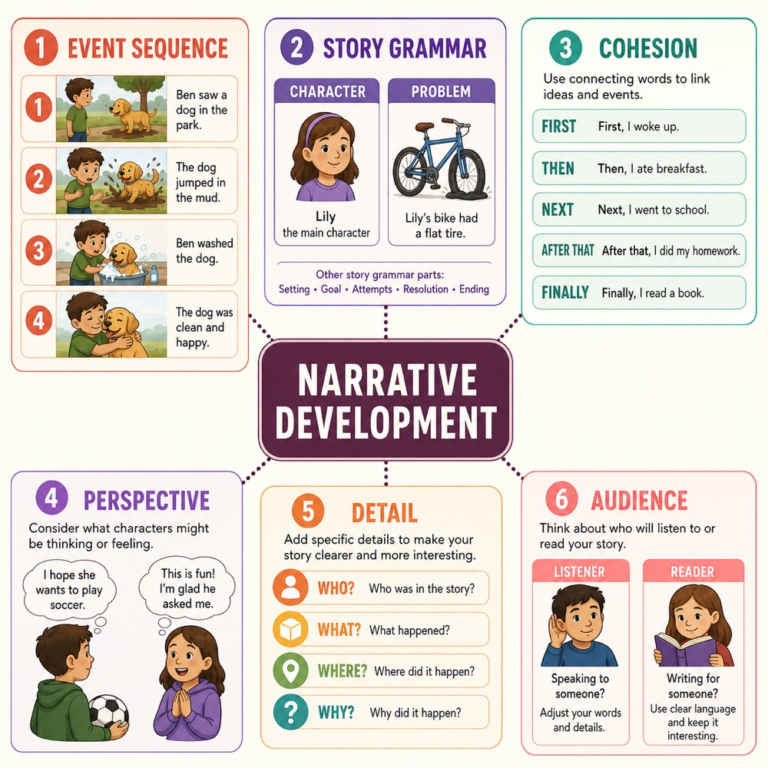
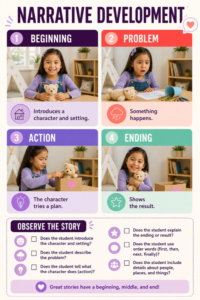
narrative development is easiest to study when it is treated as a connected pattern rather than a single checklist item. Narrative development is the growth of organizing experiences, stories, and explanations so another person can follow the message. It draws on language form, vocabulary, memory, perspective, discourse, and the shared context.
This learning guide is written for SLP students and other learners reviewing clinical concepts. It uses broad patterns to organize observation, not to make an individualized diagnosis or promise one outcome. Interpretation depends on language, culture, hearing, access, health, opportunity, context, task, and the person’s communication goals.
What narrative development includes
Begin by separating the concept into domains. A learner who can name the domains is less likely to collapse a sound, language, motor, access, or participation question into one explanation. The useful unit of analysis is the task: what the person was asked to understand, produce, remember, organize, or communicate, with whom, under which conditions, and with what support.
Domain
What to notice
Question to carry forward
Organization
Sequencing events or ideas with a beginning, relevant actions, consequence, and ending.
Can the listener identify how the message is organized?
Story grammar
Representing characters, setting, initiating event, internal response, plan, attempts, and outcome when relevant.
Which elements are present, connected, or missing?
Cohesion
Using pronouns, conjunctions, temporal words, references, and repeated ideas to connect the message.
How does one sentence connect to the next?
Perspective
Explaining thoughts, feelings, intentions, beliefs, and information that the listener may not share.
What does the listener need to know to understand the point?
Audience and mode
Adjusting detail and organization for conversation, retell, written text, classroom explanation, or AAC.
What does this audience and format require?
These domains interact, but they should remain distinguishable. A learner may show strength in one area and need support in another. A broad learning label organizes the next observation; it does not answer every assessment question.
Keep the first pass descriptive and close to the communication event. Note the message, the listener, the setting, the response format, the task demand, and the support that was available. This gives the learner a stable record to compare across tasks and prevents a familiar term from doing too much explanatory work before the evidence has been separated into observable parts.
For exam review, a vignette may include several true details but ask for one best next step. The strongest answer usually respects the task and the person’s participation, checks the most relevant missing information, and avoids treating one performance sample as the whole profile.
Map narrative development
For study purposes, describe the pattern before naming a condition. Record what the person understood, produced, initiated, repaired, or participated in. Then note whether the task was familiar, how much context was shared, what communication mode was available, and which support changed the response.
Event sequence: ordering what happened and using temporal or causal relationships.
Story structure: representing the people, place, problem, plan, attempts, consequence, and resolution when relevant.
Cohesion and reference: connecting sentences through pronouns, conjunctions, lexical links, and clear references.
Mental-state and perspective language: explaining beliefs, intentions, feelings, uncertainty, and points of view.
Detail and inference: selecting information that helps a listener infer what is not directly stated.
Narrative context: comparing personal stories, fictional retells, explanations, written language, and culturally meaningful discourse.
A strong description is specific enough that another learner could picture the event. Instead of writing “the skill is weak,” describe the demand, the observable response, the partner, the context, and the result. This protects clinical reasoning from labels that are broader than the evidence.
Read stories in context
Context changes what communication requires. A quiet one-to-one task, a noisy group, a classroom explanation, a book-sharing routine, a peer exchange, and a work task can place different demands on the same underlying skills. Hearing access, fatigue, visual supports, partner rate, cultural expectations, language exposure, and the opportunity to request clarification should be part of the observation.
A learner may tell a familiar personal experience with rich detail but produce a sparse retell of a story with unfamiliar vocabulary. The contrast invites analysis of memory, story structure, background knowledge, language demands, visual support, and the amount of shared context.
Observation layer
Example question
Task
What did the person need to understand, express, remember, organize, or repair?
Partner
Who was listening, and how did the partner respond or support the exchange?
Access
Were hearing, visual, motor, sensory, language, or environmental supports available?
Participation
What meaningful routine became easier or harder because of the pattern?
Context is not an afterthought added once a label has been selected. It is part of the question itself. If performance changes with a quieter room, visual supports, extra processing time, a familiar partner, a different communication mode, or a changed task, that change is useful evidence about access and demand. It does not by itself identify a cause, but it tells you which conditions should be carried into the next observation.
Apply the concept in clinical reasoning
When a Praxis-style scenario or clinical discussion presents narrative development, use a disciplined sequence. The goal is to select the next clinical question or action that matches the evidence, the person’s priorities, and the communication context.
Define the task in plain language.
Identify the domain or domains involved without assuming they are interchangeable.
Separate observation from interpretation and write down what remains unknown.
Check hearing, language experience, culture, communication mode, environment, partner support, and task familiarity.
Choose the assessment, collaboration, or observation step that answers the specific question.
State the boundary of the conclusion and keep the person’s participation goal visible.
A learner may tell a familiar personal experience with rich detail but produce a sparse retell of a story with unfamiliar vocabulary. The contrast invites analysis of memory, story structure, background knowledge, language demands, visual support, and the amount of shared context. In a learning answer, the decisive evidence is usually the relationship among the task, the observed pattern, and the next needed information—not a single isolated behavior.
Common study mistakes
Scoring the number of words without analyzing organization and listener understanding.
Treating a retell and a personal narrative as the same task.
Ignoring cohesion, reference, temporal links, and causal language.
Expecting one fixed story structure across cultures, genres, and communities.
Overlooking perspective and the information needed by the listener.
Assuming a visual sequence removes all language and planning demands.
Confusing memory for events with the language needed to tell them.
Writing a narrative conclusion without identifying the task, partner, and support.
Most of these mistakes come from replacing a multidomain question with a fast label. Correct the habit by returning to the same sequence: describe, separate, contextualize, ask what is missing, and choose a proportionate next step. A short rationale can make the habit visible: identify the evidence, name the uncertainty, and explain why the selected next step fits both.
Build a quick review map
Use this compact map when reviewing a missed question, a lecture note, or a clinical vignette:
Step 1: Name the narrative task, genre, and audience.
Step 2: Map sequence, structure, cohesion, detail, and perspective separately.
Step 3: Check shared context, background knowledge, memory, and language load.
Step 4: Compare personal, fictional, expository, spoken, and written samples cautiously.
Step 5: Record the support that helps the listener follow the message.
Step 6: Choose a next observation that isolates organization, language, or access.
Then write one transfer sentence: “When I see this pattern, I will first check ___ because ___.” The sentence should identify a decision rule, not repeat a definition. Revisit it after a delay and test whether you can apply the rule to a different context or communication mode.
Sources and next steps
narrative development is best learned as a context-sensitive pattern across structure, function, access, and participation. Use the current authority pages to refine the concept, then return to practice scenarios that require you to explain what the evidence supports and what it leaves open.
Syntax Development: Sentence Structure, Meaning, and Use
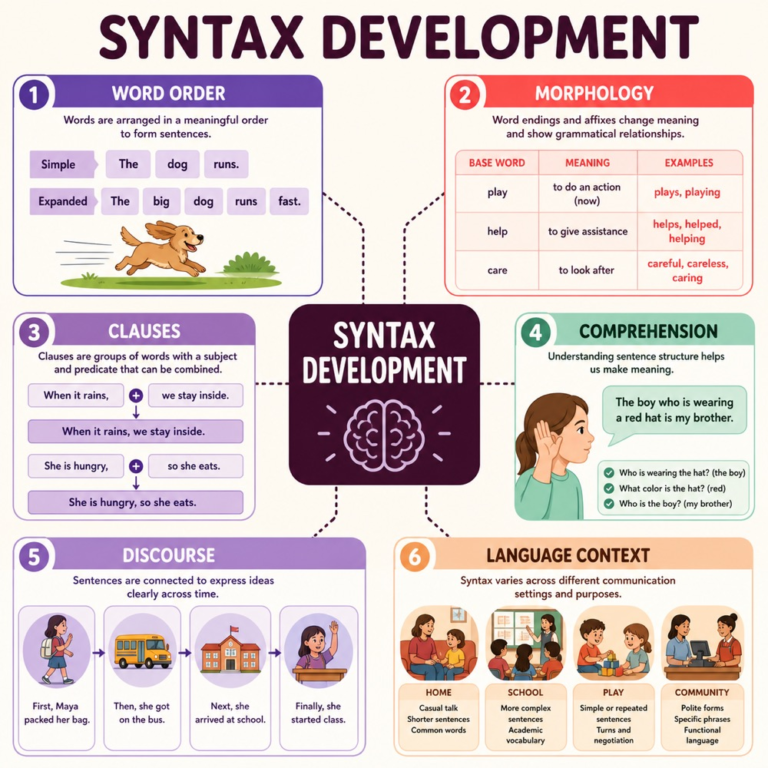
syntax development is easiest to study when it is treated as a connected pattern rather than a single checklist item. Syntax development is the growth of using and understanding sentence structure to organize meaning. It includes word order, function words, morphology, clause relationships, and the fit between a sentence and its purpose.
This learning guide is written for SLP students and other learners reviewing clinical concepts. It uses broad patterns to organize observation, not to make an individualized diagnosis or promise one outcome. Interpretation depends on language, culture, hearing, access, health, opportunity, context, task, and the person’s communication goals.
What syntax development includes
Begin by separating the concept into domains. A learner who can name the domains is less likely to collapse a sound, language, motor, access, or participation question into one explanation. The useful unit of analysis is the task: what the person was asked to understand, produce, remember, organize, or communicate, with whom, under which conditions, and with what support.
Domain
What to notice
Question to carry forward
Word order
Arranging words and phrases so the listener or reader can identify relationships and roles.
Which relationships depend on the order of the words?
Morphosyntax
Using word forms, tense, agreement, plurality, pronouns, and function words to mark meaning.
Which form changes the interpretation of the sentence?
Clause structure
Combining ideas through coordination, subordination, relative clauses, conditionals, and embedding.
How many relationships must be held and integrated?
Comprehension
Understanding sentence structures during listening, reading, conversation, and classroom instruction.
Does production or comprehension carry the greater demand?
Use
Selecting sentence forms that fit the topic, audience, discourse, and communication mode.
Does the structure support the intended message?
These domains interact, but they should remain distinguishable. A learner may show strength in one area and need support in another. A broad learning label organizes the next observation; it does not answer every assessment question.
Keep the first pass descriptive and close to the communication event. Note the message, the listener, the setting, the response format, the task demand, and the support that was available. This gives the learner a stable record to compare across tasks and prevents a familiar term from doing too much explanatory work before the evidence has been separated into observable parts.
For exam review, a vignette may include several true details but ask for one best next step. The strongest answer usually respects the task and the person’s participation, checks the most relevant missing information, and avoids treating one performance sample as the whole profile.
Map syntax development
For study purposes, describe the pattern before naming a condition. Record what the person understood, produced, initiated, repaired, or participated in. Then note whether the task was familiar, how much context was shared, what communication mode was available, and which support changed the response.
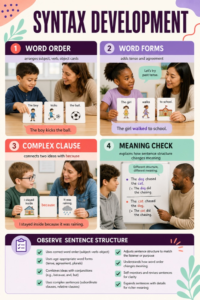
Basic sentence structure: using participants, actions, states, locations, and relationships in an organized clause.
Function words and morphology: marking tense, agreement, number, pronouns, auxiliaries, articles, and other grammatical relations.
Complex sentences: connecting clauses with coordination, subordination, relative clauses, conditionals, and causal language.
Comprehension and interpretation: understanding how word order, negation, passive forms, and embedded clauses change meaning.
Discourse and writing: using sentence variety, cohesion, and punctuation to build a connected message for a reader or listener.
Language-specific context: interpreting syntax through the learner’s language, dialect, culture, modality, and communication purpose.
A strong description is specific enough that another learner could picture the event. Instead of writing “the skill is weak,” describe the demand, the observable response, the partner, the context, and the result. This protects clinical reasoning from labels that are broader than the evidence.
Read sentence structure in context
Context changes what communication requires. A quiet one-to-one task, a noisy group, a classroom explanation, a book-sharing routine, a peer exchange, and a work task can place different demands on the same underlying skills. Hearing access, fatigue, visual supports, partner rate, cultural expectations, language exposure, and the opportunity to request clarification should be part of the observation.
A learner may use simple sentences successfully in conversation but need more time for a passive sentence, embedded clause, or written explanation. The useful question is which structure and task demand changed, not whether the learner can or cannot do syntax in general.
Observation layer
Example question
Task
What did the person need to understand, express, remember, organize, or repair?
Partner
Who was listening, and how did the partner respond or support the exchange?
Access
Were hearing, visual, motor, sensory, language, or environmental supports available?
Participation
What meaningful routine became easier or harder because of the pattern?
Context is not an afterthought added once a label has been selected. It is part of the question itself. If performance changes with a quieter room, visual supports, extra processing time, a familiar partner, a different communication mode, or a changed task, that change is useful evidence about access and demand. It does not by itself identify a cause, but it tells you which conditions should be carried into the next observation.
Apply the concept in clinical reasoning
When a Praxis-style scenario or clinical discussion presents syntax development, use a disciplined sequence. The goal is to select the next clinical question or action that matches the evidence, the person’s priorities, and the communication context.
Define the task in plain language.
Identify the domain or domains involved without assuming they are interchangeable.
Separate observation from interpretation and write down what remains unknown.
Check hearing, language experience, culture, communication mode, environment, partner support, and task familiarity.
Choose the assessment, collaboration, or observation step that answers the specific question.
State the boundary of the conclusion and keep the person’s participation goal visible.
A learner may use simple sentences successfully in conversation but need more time for a passive sentence, embedded clause, or written explanation. The useful question is which structure and task demand changed, not whether the learner can or cannot do syntax in general. In a learning answer, the decisive evidence is usually the relationship among the task, the observed pattern, and the next needed information—not a single isolated behavior.
Common study mistakes
Equating one grammatical form with the entire syntax system.
Counting utterance length without examining sentence relationships and meaning.
Ignoring comprehension while focusing only on spoken production.
Treating dialect or multilingual grammar as an error against one variety.
Using a complex sentence prompt without checking processing and background knowledge.
Separating syntax from morphology, semantics, discourse, and writing.
Assuming a correct imitation proves spontaneous use.
Describing missing forms without noting which structures are already functional.
Most of these mistakes come from replacing a multidomain question with a fast label. Correct the habit by returning to the same sequence: describe, separate, contextualize, ask what is missing, and choose a proportionate next step. A short rationale can make the habit visible: identify the evidence, name the uncertainty, and explain why the selected next step fits both.
Build a quick review map
Use this compact map when reviewing a missed question, a lecture note, or a clinical vignette:
Step 1: Identify the sentence relationship the task requires.
Step 2: Separate word order, morphology, clause structure, and meaning.
Step 3: Compare comprehension, imitation, supported production, and spontaneous use.
Step 4: Check language variety, modality, processing time, and task familiarity.
Step 5: Connect sentence structure to the discourse purpose.
Step 6: Write the next focused observation rather than a global grammar label.
Then write one transfer sentence: “When I see this pattern, I will first check ___ because ___.” The sentence should identify a decision rule, not repeat a definition. Revisit it after a delay and test whether you can apply the rule to a different context or communication mode.
Sources and next steps
syntax development is best learned as a context-sensitive pattern across structure, function, access, and participation. Use the current authority pages to refine the concept, then return to practice scenarios that require you to explain what the evidence supports and what it leaves open.
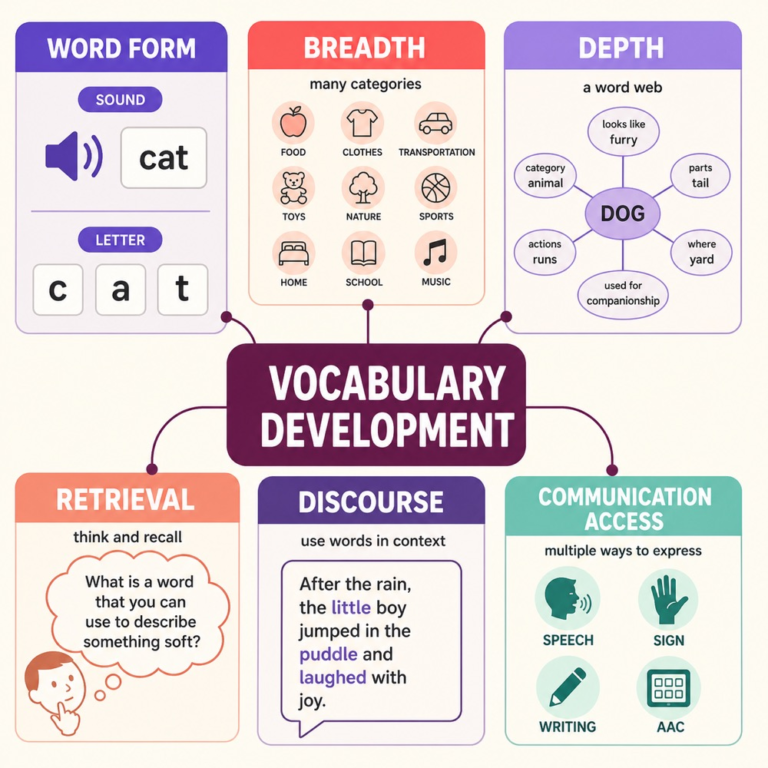
vocabulary development is easiest to study when it is treated as a connected pattern rather than a single checklist item. Vocabulary development is more than counting how many words a person can name. It includes learning meanings, relationships, forms, uses, and flexible access to words across people, tasks, and communication modes.
This learning guide is written for SLP students and other learners reviewing clinical concepts. It uses broad patterns to organize observation, not to make an individualized diagnosis or promise one outcome. Interpretation depends on language, culture, hearing, access, health, opportunity, context, task, and the person’s communication goals.
What vocabulary development includes
Begin by separating the concept into domains. A learner who can name the domains is less likely to collapse a sound, language, motor, access, or participation question into one explanation. The useful unit of analysis is the task: what the person was asked to understand, produce, remember, organize, or communicate, with whom, under which conditions, and with what support.
Domain
What to notice
Question to carry forward
Breadth
The range of words available across people, actions, objects, concepts, academic topics, and routines.
Which areas of experience and language are represented?
Depth
The richness of a word’s meaning, features, associations, forms, and relationships.
Can the learner explain, compare, categorize, or use the word flexibly?
Access
Finding and using a word during listening, speaking, reading, writing, sign, gesture, or AAC.
Does the mode or task change retrieval and expression?
Context
Using words for a purpose with a partner, topic, discourse structure, and shared background.
Does the word work in a meaningful message?
Learning
Inferring, storing, retrieving, and revising word meanings through repeated meaningful experiences.
What support made the new word easier to learn or retrieve?
These domains interact, but they should remain distinguishable. A learner may show strength in one area and need support in another. A broad learning label organizes the next observation; it does not answer every assessment question.
Keep the first pass descriptive and close to the communication event. Note the message, the listener, the setting, the response format, the task demand, and the support that was available. This gives the learner a stable record to compare across tasks and prevents a familiar term from doing too much explanatory work before the evidence has been separated into observable parts.
For exam review, a vignette may include several true details but ask for one best next step. The strongest answer usually respects the task and the person’s participation, checks the most relevant missing information, and avoids treating one performance sample as the whole profile.
Map vocabulary development
For study purposes, describe the pattern before naming a condition. Record what the person understood, produced, initiated, repaired, or participated in. Then note whether the task was familiar, how much context was shared, what communication mode was available, and which support changed the response.
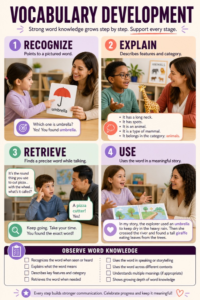
Word form: noticing sound, syllable, spelling, morphology, sign, or symbol form.
Word meaning: connecting labels to features, categories, functions, actions, relationships, and multiple meanings.
Breadth and depth: expanding the range of known words while making each meaning more precise and connected.
Word retrieval: accessing a word in conversation, explanation, reading, writing, or an aided communication system.
Discourse and academic language: using vocabulary to tell, explain, compare, infer, persuade, and learn.
Language experience and access: including home languages, culture, hearing, partner input, literacy, and opportunity.
A strong description is specific enough that another learner could picture the event. Instead of writing “the skill is weak,” describe the demand, the observable response, the partner, the context, and the result. This protects clinical reasoning from labels that are broader than the evidence.
Read word knowledge in context
Context changes what communication requires. A quiet one-to-one task, a noisy group, a classroom explanation, a book-sharing routine, a peer exchange, and a work task can place different demands on the same underlying skills. Hearing access, fatigue, visual supports, partner rate, cultural expectations, language exposure, and the opportunity to request clarification should be part of the observation.
A learner may recognize a word in a picture task but not retrieve it during a story, or may know a label but not explain how two concepts relate. The difference is useful: it points toward the interaction among meaning depth, retrieval demands, discourse, background knowledge, and the communication mode.
Observation layer
Example question
Task
What did the person need to understand, express, remember, organize, or repair?
Partner
Who was listening, and how did the partner respond or support the exchange?
Access
Were hearing, visual, motor, sensory, language, or environmental supports available?
Participation
What meaningful routine became easier or harder because of the pattern?
Context is not an afterthought added once a label has been selected. It is part of the question itself. If performance changes with a quieter room, visual supports, extra processing time, a familiar partner, a different communication mode, or a changed task, that change is useful evidence about access and demand. It does not by itself identify a cause, but it tells you which conditions should be carried into the next observation.
Apply the concept in clinical reasoning
When a Praxis-style scenario or clinical discussion presents vocabulary development, use a disciplined sequence. The goal is to select the next clinical question or action that matches the evidence, the person’s priorities, and the communication context.
Define the task in plain language.
Identify the domain or domains involved without assuming they are interchangeable.
Separate observation from interpretation and write down what remains unknown.
Check hearing, language experience, culture, communication mode, environment, partner support, and task familiarity.
Choose the assessment, collaboration, or observation step that answers the specific question.
State the boundary of the conclusion and keep the person’s participation goal visible.
A learner may recognize a word in a picture task but not retrieve it during a story, or may know a label but not explain how two concepts relate. The difference is useful: it points toward the interaction among meaning depth, retrieval demands, discourse, background knowledge, and the communication mode. In a learning answer, the decisive evidence is usually the relationship among the task, the observed pattern, and the next needed information—not a single isolated behavior.
Common study mistakes
Treating a raw word count as the whole vocabulary profile.
Confusing recognition with flexible use and explanation.
Ignoring word relationships, morphology, and multiple meanings.
Separating vocabulary from comprehension, discourse, literacy, and classroom learning.
Overlooking words known in another language or communication mode.
Using decontextualized naming as the only word-learning sample.
Assuming a retrieval pause means that the meaning is absent.
Writing a vocabulary conclusion without noting the partner, topic, and support.
Most of these mistakes come from replacing a multidomain question with a fast label. Correct the habit by returning to the same sequence: describe, separate, contextualize, ask what is missing, and choose a proportionate next step. A short rationale can make the habit visible: identify the evidence, name the uncertainty, and explain why the selected next step fits both.
Build a quick review map
Use this compact map when reviewing a missed question, a lecture note, or a clinical vignette:
Step 1: Define whether the task tests breadth, depth, retrieval, or use.
Step 2: Check word form, meaning, relationships, and context separately.
Step 3: Include all languages and communication modes that matter.
Step 4: Compare recognition, explanation, and spontaneous use carefully.
Step 5: Record the support that opens access to the word.
Step 6: Choose a next step that matches the missing vocabulary dimension.
Then write one transfer sentence: “When I see this pattern, I will first check ___ because ___.” The sentence should identify a decision rule, not repeat a definition. Revisit it after a delay and test whether you can apply the rule to a different context or communication mode.
Sources and next steps
vocabulary development is best learned as a context-sensitive pattern across structure, function, access, and participation. Use the current authority pages to refine the concept, then return to practice scenarios that require you to explain what the evidence supports and what it leaves open.
Phonological Development: Sound Systems, Patterns, and Context
phonological development is easiest to study when it is treated as a connected pattern rather than a single checklist item. Phonological development is the learning of how a language organizes sounds and sound sequences to carry meaning. Study it as a developing system, not as a list of isolated consonants.
This learning guide is written for SLP students and other learners reviewing clinical concepts. It uses broad patterns to organize observation, not to make an individualized diagnosis or promise one outcome. Interpretation depends on language, culture, hearing, access, health, opportunity, context, task, and the person’s communication goals.
What phonological development includes
Begin by separating the concept into domains. A learner who can name the domains is less likely to collapse a sound, language, motor, access, or participation question into one explanation. The useful unit of analysis is the task: what the person was asked to understand, produce, remember, organize, or communicate, with whom, under which conditions, and with what support.
Domain
What to notice
Question to carry forward
Sound contrasts
Learning which sound differences change meaning and how contrasts are used across words.
Which contrast or pattern is the task actually testing?
Syllable structure
Building and coordinating simple and complex syllable shapes, stress patterns, and word sequences.
Does performance change with word shape or position?
Error patterns
Describing substitutions, omissions, distortions, or patterns without assuming one cause.
Is the pattern consistent, variable, or context dependent?
Phonological awareness
Thinking about syllables and sounds for segmentation, blending, manipulation, spelling, and reading.
What is the relationship between speech production and sound awareness?
Language and dialect
Interpreting production in the speaker’s language, dialect, community, and communication context.
Could the observed form be language difference rather than disorder?
These domains interact, but they should remain distinguishable. A learner may show strength in one area and need support in another. A broad learning label organizes the next observation; it does not answer every assessment question.
Keep the first pass descriptive and close to the communication event. Note the message, the listener, the setting, the response format, the task demand, and the support that was available. This gives the learner a stable record to compare across tasks and prevents a familiar term from doing too much explanatory work before the evidence has been separated into observable parts.
For exam review, a vignette may include several true details but ask for one best next step. The strongest answer usually respects the task and the person’s participation, checks the most relevant missing information, and avoids treating one performance sample as the whole profile.
Map phonological development
For study purposes, describe the pattern before naming a condition. Record what the person understood, produced, initiated, repaired, or participated in. Then note whether the task was familiar, how much context was shared, what communication mode was available, and which support changed the response.
Phoneme contrasts: distinguishing sound categories that change word meaning in the language being used.
Syllable shapes and sequences: tracking complexity, stress, clusters, and the position of a sound within a word.
Pattern description: recording omissions, substitutions, distortions, variability, and intelligibility without jumping to cause.
Word and connected speech: comparing single-word production with phrases, conversation, and classroom participation.
Phonological awareness: connecting spoken sound structure with segmentation, blending, manipulation, spelling, and decoding.
Context and identity: including language exposure, dialect, multilingual experience, hearing, motor access, and communication goals.
A strong description is specific enough that another learner could picture the event. Instead of writing “the skill is weak,” describe the demand, the observable response, the partner, the context, and the result. This protects clinical reasoning from labels that are broader than the evidence.
Read sound patterns in context
Context changes what communication requires. A quiet one-to-one task, a noisy group, a classroom explanation, a book-sharing routine, a peer exchange, and a work task can place different demands on the same underlying skills. Hearing access, fatigue, visual supports, partner rate, cultural expectations, language exposure, and the opportunity to request clarification should be part of the observation.
A learner may produce a target sound in a familiar word but not in a cluster, connected speech, or a fast classroom exchange. That contrast tells the reviewer to examine word shape, position, complexity, rate, partner, hearing, and opportunity before describing a global production problem.
Observation layer
Example question
Task
What did the person need to understand, express, remember, organize, or repair?
Partner
Who was listening, and how did the partner respond or support the exchange?
Access
Were hearing, visual, motor, sensory, language, or environmental supports available?
Participation
What meaningful routine became easier or harder because of the pattern?
Context is not an afterthought added once a label has been selected. It is part of the question itself. If performance changes with a quieter room, visual supports, extra processing time, a familiar partner, a different communication mode, or a changed task, that change is useful evidence about access and demand. It does not by itself identify a cause, but it tells you which conditions should be carried into the next observation.
Apply the concept in clinical reasoning
When a Praxis-style scenario or clinical discussion presents phonological development, use a disciplined sequence. The goal is to select the next clinical question or action that matches the evidence, the person’s priorities, and the communication context.
Define the task in plain language.
Identify the domain or domains involved without assuming they are interchangeable.
Separate observation from interpretation and write down what remains unknown.
Check hearing, language experience, culture, communication mode, environment, partner support, and task familiarity.
Choose the assessment, collaboration, or observation step that answers the specific question.
State the boundary of the conclusion and keep the person’s participation goal visible.
A learner may produce a target sound in a familiar word but not in a cluster, connected speech, or a fast classroom exchange. That contrast tells the reviewer to examine word shape, position, complexity, rate, partner, hearing, and opportunity before describing a global production problem. In a learning answer, the decisive evidence is usually the relationship among the task, the observed pattern, and the next needed information—not a single isolated behavior.
Common study mistakes
Treating one sound error as a complete phonological profile.
Confusing phonetic placement with the broader organization of a sound system.
Ignoring syllable shape, stress, word position, and connected speech.
Calling a dialect or multilingual difference an error without language-specific context.
Assuming variability automatically indicates one clinical cause.
Separating phonological awareness from speech and literacy demands entirely.
Using a developmental age reference as a rigid cutoff for one person.
Describing intelligibility without asking who the listener was and what support was available.
Most of these mistakes come from replacing a multidomain question with a fast label. Correct the habit by returning to the same sequence: describe, separate, contextualize, ask what is missing, and choose a proportionate next step. A short rationale can make the habit visible: identify the evidence, name the uncertainty, and explain why the selected next step fits both.
Build a quick review map
Use this compact map when reviewing a missed question, a lecture note, or a clinical vignette:
Step 1: Name the language, dialect, and communication context.
Step 2: Describe the sound or pattern and its word position.
Step 3: Compare word, phrase, and connected-speech demands.
Step 4: Separate phonetic, phonological, hearing, and access questions.
Step 5: Connect sound structure to literacy or participation only when the task supports it.
Step 6: Choose the next observation that reduces the specific uncertainty.
Then write one transfer sentence: “When I see this pattern, I will first check ___ because ___.” The sentence should identify a decision rule, not repeat a definition. Revisit it after a delay and test whether you can apply the rule to a different context or communication mode.
Sources and next steps
phonological development is best learned as a context-sensitive pattern across structure, function, access, and participation. Use the current authority pages to refine the concept, then return to practice scenarios that require you to explain what the evidence supports and what it leaves open.
Pragmatic Language Development: A Clinical Learning Guide
pragmatic language development is easiest to study when it is treated as a connected pattern rather than a single checklist item. Pragmatic language development concerns how language is used with people, purposes, topics, and contexts. It includes far more than one preferred style of eye contact or conversation; it is studied through meaning, agency, relationship, access, and participation.
This learning guide is written for SLP students and other learners reviewing clinical concepts. It uses broad developmental patterns to organize observation, not to make an individualized diagnosis or promise one outcome. Communication varies with language experience, culture, hearing, access, health, opportunity, context, and the person’s full communication repertoire.
What pragmatic language development includes
Begin by separating the concept into domains. A learner who can name the domains is less likely to collapse a language difference, a speech difference, a social interaction, and an access barrier into one explanation. The useful unit of analysis is the communication task: what the person was asked to understand or express, with whom, under which conditions, and with what support.
Domain
What to notice
Question to carry forward
Social purpose
Requesting, informing, greeting, negotiating, sharing emotion, solving a problem, and building connection.
What is the person trying to accomplish with communication?
Partner and audience
Adjusting information, timing, tone, topic, and mode for a communication partner.
What does this partner know, need, prefer, or make possible?
Interaction
Taking turns, maintaining a topic, responding, initiating, interpreting, and repairing a breakdown.
What happens before, during, and after the communication breakdown?
Participation and culture
Using communication in routines, relationships, learning, work, and community life within a cultural context.
Is the difference a barrier to the person’s goals or simply a difference in style?
These domains interact, but they should remain distinguishable. A learner may show strength in one area and need support in another. A broad learning label helps organize the next observation; it does not answer every assessment question.
Keep the first pass descriptive and close to the communication event. Note the message, the listener, the setting, the response format, and the support that was available. This gives the learner a stable record to compare across tasks and prevents a familiar term from doing too much explanatory work before the evidence has been separated into observable parts.
For exam review, a vignette may include several true details but ask for one best next step. The strongest answer usually respects the task and the person’s participation, checks the most relevant missing information, and avoids treating one performance sample as the whole communication profile.
Map pragmatic language development
For study purposes, describe the pattern before naming a condition. Record what the person understood, produced, initiated, repaired, or participated in. Then note whether the task was familiar, how much context was shared, what communication mode was available, and which support changed the response.
Communicative functions: using language to request, comment, question, explain, protest, connect, and self-advocate.
Turn-taking and topic: starting, responding, maintaining, shifting, and closing an interaction.
Perspective and inference: considering what a partner knows, means, feels, or may misunderstand.
Repair and comprehension monitoring: noticing a breakdown, clarifying, rephrasing, and checking understanding.
Discourse and nonverbal communication: organizing a message with relevant words, gestures, tone, and timing.
Culture, identity, and participation: respecting linguistic diversity, neurodiversity, autonomy, and preferred interaction.
A strong description is specific enough that another learner could picture the interaction. Instead of writing “language is weak” or “communication is poor,” describe the message, the demand, the partner, the context, and the result. This protects clinical reasoning from labels that are broader than the evidence.
Read pragmatics across partners
Context changes what communication requires. A quiet one-to-one conversation, a noisy group, a classroom explanation, a book-sharing routine, a peer exchange, and a work task can place different demands on the same underlying skills. Hearing access, fatigue, visual supports, partner rate, cultural expectations, language exposure, and the opportunity to request clarification should be part of the observation.
A person may communicate effectively with a familiar partner and need a different support in a new group, fast conversation, classroom discussion, or workplace routine. The clinical question is not whether the person matches one social style; it is whether communication access and participation are supported in the context that matters.
Observation layer
Example question
Task
What did the person need to understand, express, remember, organize, or repair?
Partner
Who was listening, and how did the partner respond or support the exchange?
Access
Were hearing, visual, motor, sensory, language, or environmental supports available?
Participation
What meaningful routine became easier or harder because of the communication pattern?
Context is not an afterthought added once a label has been selected. It is part of the question itself. If a performance changes with a quieter room, visual supports, extra processing time, a familiar partner, or a different communication mode, that change is useful evidence about access and task demand. It does not by itself identify a cause, but it tells you which conditions should be carried into the next observation.
Apply the concept in clinical reasoning
When a Praxis-style scenario or clinical discussion presents pragmatic language development, use a disciplined sequence. The goal is to select the next clinical question or action that matches the evidence, the person’s priorities, and the communication context.
Define the communication task in plain language.
Identify the language domain or domains involved without assuming they are interchangeable.
Separate observation from interpretation and write down what remains unknown.
Check hearing, language exposure, culture, communication mode, environment, and partner support.
Choose the assessment, collaboration, or observation step that answers the specific clinical question.
State the boundary of the conclusion and keep the person’s participation goal visible.
A person may communicate effectively with a familiar partner and need a different support in a new group, fast conversation, classroom discussion, or workplace routine. The clinical question is not whether the person matches one social style; it is whether communication access and participation are supported in the context that matters. In a learning answer, the decisive evidence is usually the relationship among the task, the observed pattern, and the next needed information—not a single isolated behavior.
Common study mistakes
Treating pragmatic language as compliance with one preferred interaction style.
Ignoring culture, dialect, language, neurodiversity, identity, and autonomy.
Focusing on eye contact while missing message, access, and participation.
Describing a social difference without observing the partner or environment.
Leaving repair and comprehension monitoring out of the profile.
Assuming a quiet one-to-one interaction represents every setting.
Writing goals around adult convenience instead of the person’s purpose.
Overlooking strengths, preferred modes, and successful communication partners.
Most of these mistakes come from replacing a multidomain question with a fast label. Correct the habit by returning to the same sequence: describe, separate, contextualize, ask what is missing, and choose a proportionate next step. A short written rationale can make this habit visible: identify the evidence, name the uncertainty, and explain why the selected next step fits both.
Build a quick review map
Use this compact map when reviewing a missed question, a lecture note, or a clinical vignette:
Step 1: Name the communication purpose and partner.
Step 2: Describe turn-taking, topic, inference, and repair in context.
Step 3: Check culture, language, identity, and preferred communication mode.
Step 4: Separate a participation barrier from a difference in style.
Step 5: Record the support or partner change that makes access easier.
Step 6: Keep the person’s goals and agency visible in the next step.
Then write one transfer sentence: “When I see this pattern, I will first check ___ because ___.” The sentence should identify a decision rule, not repeat a definition. Revisit it after a delay and test whether you can apply the rule to a different context or communication mode.
Sources and next steps
pragmatic language development is best learned as a context-sensitive pattern across language domains, access, and participation. Use the current authority pages to refine the concept, then return to practice scenarios that require you to explain what the evidence supports and what it leaves open.