Free Praxis Practice Test Speech Pathology: Check 5331 Coverage
A free praxis practice test speech pathology resource is most useful when you treat it as a coverage check, not as a complete preparation system. The set can show which broad decisions you recognize, where the explanations are thin, and which current-scope areas need a separate review block.
The current ETS Speech-Language Pathology (5331) page describes a computer-delivered selected-response test with 132 questions and 150 minutes. Use the live ETS page and your account for changing details. ASHA’s preparation guidance also points candidates toward the exam content, topic-area knowledge, preparation materials, practice questions, and a plan built around the learner’s needs.
What a free Praxis practice test speech pathology can check
A free set can answer a narrow question about your preparation. It may reveal whether you recognize a domain, can distinguish assessment from treatment, can identify the strongest evidence in a clinical scenario, or can explain why a tempting choice is weaker. It cannot show every part of readiness by itself.
Coverage question
Evidence to capture
What it can lead to
Is the subject aligned?
The page names Speech-Language Pathology (5331) and explains its scope.
Keep the source for the intended learning job.
Which domain feels thin?
Items missed or answered with low confidence by broad area.
Build a targeted concept or distinction block.
Can I apply the concept?
Performance on a fresh scenario rather than a definition prompt.
Write a new example and explain the transfer.
Is the process causing errors?
Timing, skipped items, interruptions, or repeated task misreads.
Practice reading and pacing separately from content review.
Coverage is not the same as quantity. A large set can repeat one area while leaving another untouched. A smaller set can be useful if it shows the task, evidence, explanation, and boundary clearly enough for you to plan the next step.
Start with the current 5331 source
Use the current ETS Speech-Language Pathology (5331) page as the control point for test identity, current format information, broad content scope, and official preparation links. The ETS practice-test selector can help you look for current options by subject. Record the date you checked the page because administrative details and resource availability can change.
Search results for speech pathology practice can include free quizzes, commercial study products, university library guides, videos, flashcards, and official practice options. Those sources may be useful for different jobs, but their presence in one results page does not make their claims interchangeable.
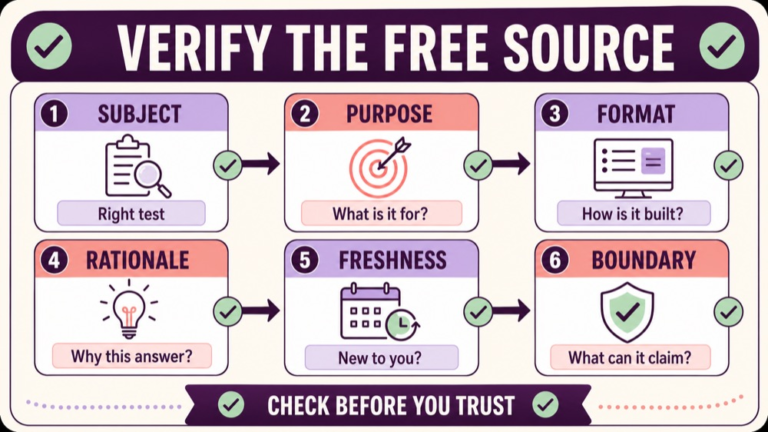
Confirm the subject: verify that the material is intended for Speech-Language Pathology (5331).
Read the format: note whether the set is a short quiz, sample, targeted drill, timed block, or longer simulation.
Inspect the coverage: identify which broad areas and decision types appear in the free material.
Sample explanations: check whether rationales explain the answer and the closest alternatives.
Mark the boundary: separate a provider’s study advice from current ETS test or appointment information.
Protect originality: avoid material that implies access to confidential or purported live content.
A source can be a useful supplement even when it covers only one learning job. The important distinction is whether your notes describe what the set actually supports instead of letting a free label imply comprehensive coverage.
Build a 5331 coverage map from a free test
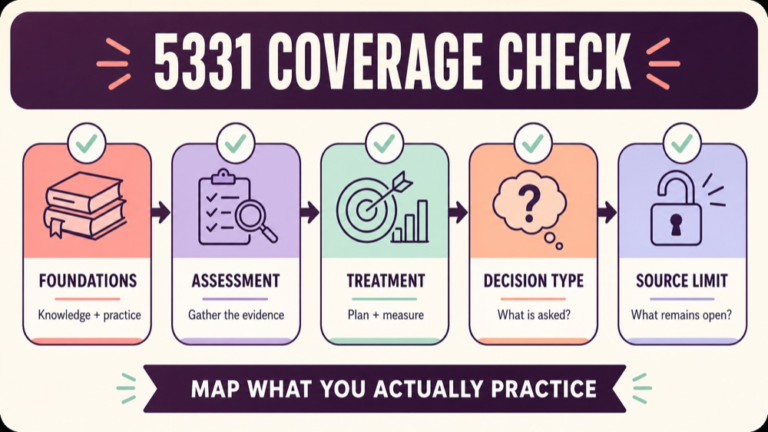
Turn each free practice item into a map entry. Instead of recording only right or wrong, note the broad domain, the decision type, the evidence that controlled the choice, and the reason for uncertainty. This creates a coverage picture that can guide review even when the set is short.
Map field
Example question
Review use
Broad area
Foundations and professional practice, assessment, or treatment planning
See which part of the current scope needs representation.
Decision type
Define, interpret, choose a next step, select a measure, or apply a boundary
Practice the kind of reasoning that was requested.
Deciding evidence
Client goal, setting, time course, performance pattern, or missing information
Explain why one option fits the stem.
Answer status
Confident correct, uncertain correct, incorrect, skipped, or rushed
Separate stable reasoning from recognition and timing.
Source limit
Free set is a sample, not the full current test boundary
Prevent a narrow result from becoming a broad conclusion.
Use broad labels as organizing categories, not as a substitute for the live ETS scope. A question may touch more than one area, and the map is allowed to record that overlap. The point is to see what the free resource represented and what it left unresolved.
Foundations and professional practice: record whether the item asks about a professional decision, communication context, or underlying knowledge.
Screening, assessment, evaluation, and diagnosis: record the referral question, missing information, and sequence of evidence gathering.
Planning, implementation, and evaluation of treatment: record the goal, intervention choice, support, and outcome measure.
Cross-domain reasoning: record when the best choice depends on a distinction that crosses broad categories.
Current-source verification: mark any format or logistics statement that needs a fresh ETS check.
Separate topic coverage from question count
Question count is easy to advertise and easy to overread. A free resource may contain many items that test one vocabulary cluster, while a smaller set may expose a useful distinction across different contexts. Count what the items ask you to decide, not just how many screens you completed.
If you see
Ask
Do next
Many similar stems
Am I learning the principle or memorizing the pattern?
Rewrite the concept in a new setting.
Several broad labels
Which decision type is actually represented?
Tag the item as definition, interpretation, sequence, application, or measurement.
One thin area
Is the gap in knowledge, practice, or source coverage?
Choose a targeted review action and then a fresh check.
Mixed, vague feedback
Can the score explain what to review?
Build your own error and coverage record.
A coverage map also helps you choose between free resources. Keep a set that adds a missing decision type or a useful explanation. Set aside a resource that only increases familiar wording without helping you see what the answer means or why alternatives fail.
Label the conditions before you answer
Write the conditions at the top of the free-set record: source, date, mode, timing, environment, permitted materials, breaks, and interruptions. If you pause to investigate an answer, label the session learning mode. If you protect the timer, label the measured portion accordingly.
Orientation: inspect the source and learn its question language.
Learning: pause to read explanations and connect each item to the coverage map.
Timed skill: use a short clocked block to practice reading and triage.
Transfer: answer fresh or rewritten scenarios after a delay.
Coverage audit: tag broad area and decision type regardless of the score.
A free set is not invalid because it is short or interrupted. It simply answers a different question from a clean long simulation. Honest labels let you use the evidence without making the source carry a claim it cannot support.
Try three original coverage-review questions
The following items are original study examples created for this article. They are not copied from ETS or presented as live test material. Answer before reading the rationale, then tag the broad area, decision type, and evidence that controls the answer.
Question 1: Identify a coverage gap
Scenario: A free quiz contains many terminology questions but no items asking you to choose an assessment sequence or match an outcome measure to a functional goal. What is the strongest conclusion?
A. The quiz does not show that assessment and outcome measurement are part of preparation.
B. The quiz may be useful for terminology retrieval, but its coverage is incomplete for those decision types.
C. The quiz’s item count alone does not establish broad coverage without those tasks.
D. The missing tasks should be replaced by more terminology repetition.
Correct Answer: B. Why This Answer Is Correct: The evidence describes what the quiz represented and what it did not represent. It can serve a terminology job while leaving assessment sequencing and outcome measurement unresolved. The appropriate next move is to add practice for the missing decisions.
Why the Other Options Are Wrong: A makes a broad claim from a narrow sample. C treats quantity as coverage. D repeats the represented task instead of addressing the gap. B keeps the conclusion matched to the evidence and gives the learner a useful next action.
Exam Trap: A free quiz can be helpful and incomplete at the same time. Do not turn its topic mix into a statement about the entire current exam scope.
Question 2: Tag a clinical decision type
Scenario: A question describes a client goal, a setting, and a missing performance detail, then asks what information should be gathered before selecting treatment. Which map tag is most useful?
A. Vocabulary recognition only.
B. Assessment sequencing and evidence gathering.
C. Timing endurance only.
D. Administrative appointment logistics.
Correct Answer: B. Why This Answer Is Correct: The item asks what information should come before treatment selection. The task is about sequencing and evidence, even though the eventual clinical setting could involve treatment. Tagging the requested decision prevents the topic label from hiding the reasoning being tested.
Why the Other Options Are Wrong: A ignores the decision requested. C would apply only if the stem focused on time or pacing. D confuses a clinical planning question with appointment information. B captures the purpose of the item and makes the coverage map more useful.
Exam Trap: Tag the task the question asks for, not just the clinical topic mentioned in the scenario.
Question 3: Interpret a free-set result
Scenario: A learner answers many free questions correctly but cannot explain why the closest alternative is weaker on a new scenario. Which next step best tests the unresolved issue?
A. Repeat the same questions until the percentage rises.
B. Write the deciding evidence, compare the closest alternatives, and answer a fresh scenario after a delay.
C. Stop reviewing because the percentage appears to reflect flexible application.
D. Remove all clinical scenarios and study only answer letters.
Correct Answer: B. Why This Answer Is Correct: The unresolved issue is explanation and transfer, not simple answer recognition. A fresh scenario and distractor comparison show whether the learner can use the underlying principle when the wording changes.
Why the Other Options Are Wrong: A increases familiarity with the same material. C makes a broad conclusion from a narrow result. D removes the evidence needed to evaluate clinical reasoning. B creates a direct check of the missing skill.
Exam Trap: Correct answers without a defensible explanation deserve a lower-confidence label until a fresh check confirms the reasoning.
Turn a coverage gap into a study action
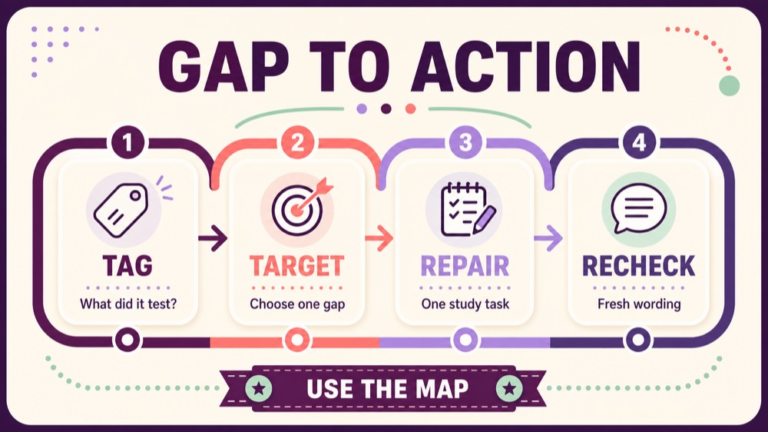
Once the map shows a thin area, choose one repair action instead of opening every available resource. The repair should match the gap. A missing concept needs explanation and retrieval; a missing decision type needs fresh applications; a process problem needs a timed or structured behavior check.
Gap
Repair action
Fresh check
Scope gap
Return to the current ETS page and update the map.
Explain which source controls the boundary.
Knowledge gap
Write a plain-language concept note with a boundary and example.
Retrieve it without notes.
Decision gap
Compare two plausible choices using task and evidence.
Answer a changed scenario.
Explanation gap
Write why the closest distractor fails for the question asked.
Defend the answer before seeing choices.
Pacing gap
Run a short timed block with a defined move-on rule.
Compare checkpoint behavior, not only percentage.
Keep the repair observable. “Review treatment” is not enough to tell whether the work changed your reasoning. “Choose an outcome measure that matches a functional goal in three fresh scenarios and explain the closest alternative” gives you a task, a boundary, and a way to check the result.
Record the free source and the coverage it actually represented.
Choose no more than three priority gaps for the next study cycle.
Assign one repair task to each gap.
Use fresh wording after a delay.
Update the coverage map before choosing another large set.
Review the question task and the evidence
When an item is difficult, write the final task sentence in your own words. Then identify the evidence that carries the most weight and the information that remains missing. This method helps you see whether the difficulty came from the concept, the task, the sequence, or the source’s explanation.
What decision did the item request?
Which client, setting, timing, or performance fact changed the choice?
What does the evidence support?
What conclusion would be too broad?
Why is the closest alternative less fit for this question?
How could a changed scenario test the same principle?
If the explanation conflicts with the current ETS scope or authoritative clinical guidance, record the conflict and verify it before making the claim part of your study notes. Free practice can point to a question worth investigating without becoming the final authority on every answer.
Combine free coverage checks with deeper study
A balanced preparation system uses the free set as one input. Use current ETS pages for test identity and changing details, ASHA preparation guidance for planning principles, targeted concept study for knowledge gaps, and original practice for transfer. Your coverage map connects those inputs without forcing them into one score.
Layer
Job
Evidence to keep
Current boundary
Define the subject and scope.
Dated source note and link.
Concept study
Build accurate knowledge and boundaries.
Plain-language notes and retrieval prompts.
Free practice
Check represented topics and decision types.
Coverage tags, conditions, and confidence.
Fresh practice
Test application when wording changes.
Rationales and distractor comparisons.
Process practice
Train pacing, reading, and review behavior.
Checkpoint and error-pattern notes.
Use a free source repeatedly only when repetition has a defined job, such as correcting a misconception. When your goal is transfer, change the wording or scenario. When your goal is coverage, change the source or map the missing task. The label should determine the next move.
Keep changing logistics in a separate note
Registration, appointment, delivery, identification, accommodations, and score reporting belong in a dated logistics record based on current ETS information. A free practice page may contain helpful context, but it should not be the only source for an administrative decision that can change.
Confirm the exact Speech-Language Pathology (5331) subject and code in the current account or source.
Check the current appointment and delivery instructions that apply to you.
Review current identification and arrival requirements through the responsible source.
Record accommodation steps through the relevant channel when needed.
Keep practice percentages separate from official score or licensing requirements.
Date each logistics note so it has a clear recheck point.
This separation makes the coverage map cleaner. The map tells you what the free set represented. The logistics note tells you what the current responsible source says about the appointment. Neither record needs to carry the other’s job.
Avoid free-test coverage mistakes
Check for these patterns before you use a free set to make a study decision:
Assuming a generic Praxis quiz covers Speech-Language Pathology (5331).
Equating item count with broad topic coverage.
Ignoring the decision type because the clinical topic sounds familiar.
Counting uncertain correct responses as fully secure without reviewing the reasoning.
Repeating familiar wording and calling the result transfer evidence.
Reading explanations during a measured block without recording the interruption.
Using a third-party score label as an official scaled result.
Using a free page as the authority for changing appointment logistics.
Copying proprietary or purported live material into notes or public content.
Adding a new resource before turning the last coverage gap into an action.
The correction is straightforward: verify the subject, map the represented tasks, label the conditions, review the evidence, and add fresh practice for what the free set did not show. That process turns free access into usable study information.
Free coverage checklist for speech pathology
Use this checklist with a free praxis practice test speech pathology resource. Keep the completed record so you can tell whether a later change came from broader coverage, better reasoning, different conditions, or familiarity with the same source.
Did I verify the Speech-Language Pathology (5331) identity through the current ETS source?
Did I identify whether the free material is a quiz, sample, drill, trial, or simulation?
Did I tag broad area and decision type for important items?
Did I record source, date, mode, timing, environment, breaks, and interruptions?
Did I separate confident correct from uncertain correct responses?
Did I identify the evidence that controlled each important answer?
Did I explain why the closest distractor was weaker?
Did I mark which current claims need ETS or ASHA verification?
Did I choose a repair task for each priority coverage gap?
Did I test the repair with fresh wording after a delay?
Did I keep practice evidence separate from official score and licensing claims?
A strong free praxis practice test speech pathology session does not need to cover everything at once. It needs to show what it covered, what it left open, and what you will do next. That is enough to make a free resource a disciplined part of preparation.
A free slp praxis practice test can give you a useful starting point without adding cost, but free does not automatically mean current, aligned, complete, or well explained. The value comes from how you verify the source, label the attempt, and turn the result into a specific next study action.
The current ETS Speech-Language Pathology (5331) page describes a computer-delivered selected-response test with 132 questions and 150 minutes. Use the live ETS page and your account for changing administrative details. ASHA’s preparation guidance also encourages candidates to become familiar with content and format, make a plan around their knowledge, and use practice questions to guide review.
What a free SLP Praxis practice test is good for
Free practice is especially useful when you give it a narrow job. It can help you learn how a source frames questions, retrieve a concept without notes, identify a reasoning gap, or test whether a repaired idea works in a new scenario. It is less useful when you expect one free quiz to represent every part of preparation.
Purpose
How to use a free set
What not to claim
Orientation
Inspect wording, task types, and the explanation style.
Do not treat a short quiz as a full exam simulation.
Retrieval
Answer a small set without notes, then label confidence.
Do not treat an answer letter as proof of mastery.
Repair
Target one concept or distinction and review each cause.
Do not add volume before you understand the miss.
Transfer
Use fresh wording or a changed setting after a delay.
Do not use familiar repetition as transfer evidence.
Pacing
Run a clearly labeled timed block with checkpoints.
Do not compare unlike timing conditions.
Free access removes a financial barrier, but it does not remove the need for source judgment. The best question is not “How many items are free?” It is “What will this set teach me, and what evidence will show whether I learned it?”
Verify a free practice source before you rely on it
Start with the current ETS Speech-Language Pathology (5331) page and the ETS practice-test selector. Confirm the test subject, current preparation links, and format information before you judge a free provider’s claims. Search results can mix official practice products, commercial pages, library guides, videos, flashcards, and generic quizzes.
Identify the subject: look for Speech-Language Pathology (5331), not a general Praxis label without a clear subject.
Read the purpose: determine whether the free material is a quiz, sample set, trial, study guide, or simulation.
Check the update context: note a visible update date or record the date you reviewed the page.
Sample the rationales: see whether explanations connect the best choice to the task and evidence.
Notice the boundaries: distinguish source teaching claims from current ETS administrative facts.
Protect original work: avoid resources that imply access to confidential or purported live content.
A free page can still be useful when it is transparent about what it provides. If the page does not identify the SLP subject, explain how answers are reviewed, or show what the score means inside its own conditions, use it cautiously and keep the learning job narrow.
Check scope, format, and explanation quality
Use a three-part first screen: scope, format, and explanation. Scope asks whether the set is meant for the test you are preparing for. Format asks how the items are presented and timed. Explanation asks whether the material teaches you why one answer fits better than the alternatives.
Check
Evidence to look for
Reason to pause
Scope
Clear Speech-Language Pathology (5331) identity and stated coverage
Generic Praxis language with no subject boundary
Format
Item type, set length, timing, and instructions are visible
A short quiz is called a full simulation without conditions
Explanation
Rationale identifies the task, evidence, and close distractor
Only an answer letter or broad label is shown
Freshness
Examples are new to you or the source explains its reuse limits
Repeated exposure makes recognition look like application
Feedback
Result points to a concept, distinction, or process repair
The result offers a dramatic readiness claim with no review path
Do not demand that every free resource perform every job. A short quiz may be a good retrieval warm-up even if it is not suitable for a long pacing session. A detailed sample may be a good explanation check even if it does not provide enough fresh items for measurement.
Use for orientation: read several items and inspect how the source frames the task.
Use for retrieval: hide notes and record confidence before checking answers.
Use for repair: write why the closest distractor was less appropriate.
Use for transfer: create a changed scenario instead of repeating the same item immediately.
Use for pacing: record timing and interruptions rather than relying on a score alone.
Choose the right mode for a free set
The same free practice test can create different evidence depending on how you use it. Decide whether the session is learning mode, timed skill mode, transfer mode, or a measured simulation. Write the mode at the top of the record before answering so a later percentage has a clear meaning.
Learning mode: pause, look up a concept, and read the rationale while your goal is understanding.
Timed skill mode: use a smaller time boundary to practice reading, elimination, or a move-on decision.
Transfer mode: answer fresh or rewritten scenarios that preserve the principle but change the surface details.
Simulation mode: protect the measured portion from explanations and record every interruption or changed condition.
Free practice is often too short to support a full endurance conclusion. That is not a flaw if you label it correctly. Use a short set to answer a short question, then choose a longer resource only when the next learning job actually requires one.
Try three original free practice-style questions
The following items are original study examples created for this article. They are not copied from ETS or presented as live test material. Answer before reading the rationale, and use the exercise to practice choosing a source, interpreting evidence, and building a review action.
Question 1: Evaluate a free source by its feedback
Scenario: A free quiz identifies the test subject and gives an answer letter, but it does not explain why the other choices are weaker. A second source has fewer items but provides task-based rationales. Which source is the stronger first choice for learning from mistakes?
A. The larger bank, because item count is the only important signal.
B. The source with clear scope and explanations that address the best choice and close alternatives.
C. The source with the most confident readiness label.
D. The source with the longest individual question stem.
Correct Answer: B. Why This Answer Is Correct: A first learning source should help you confirm relevance and understand the decision behind an answer. A rationale that addresses close alternatives creates a path for repair that a bare answer letter does not provide.
Why the Other Options Are Wrong: A confuses volume with learning value. C treats marketing language as evidence of preparation. D treats length as a proxy for alignment and explanation quality. B connects the source boundary to a usable review process.
Exam Trap: A free resource can be useful even when it is small, but a large item count cannot replace a clear subject boundary and explanations that teach the reasoning.
Question 2: Label a short timed attempt
Scenario: A learner completes a free 20-item set under a timer, pauses twice to read explanations, and then receives a percentage. Which label best describes the result?
A. An uninterrupted full-length simulation result.
B. An official scaled score.
C. A timed learning attempt with interruptions that should be reviewed inside its recorded conditions.
D. A licensing decision.
Correct Answer: C. Why This Answer Is Correct: The set was short, timed, and interrupted by explanation reading. Those conditions can still teach you something about the process, but they do not support the labels in the other choices. Recording the conditions preserves the useful evidence.
Why the Other Options Are Wrong: A overstates the length and ignores the interruptions. B confuses a provider percentage with the official score process. D treats a practice result as an administrative or licensing conclusion that it cannot establish.
Exam Trap: The timer alone does not make a session a clean simulation. Length, explanation access, breaks, and interruptions belong in the result label.
Question 3: Decide what to do after a familiar high result
Scenario: A learner performs well on a free quiz after repeating it three times but hesitates on new scenarios that test the same concept. Which next action is most useful?
A. Repeat the same quiz until the percentage is even higher.
B. Move to fresh wording, explain the decisive evidence, and review the closest alternative.
C. Stop preparing because repetition proves the concept transfers.
D. Memorize the answer letters and skip the rationales.
Correct Answer: B. Why This Answer Is Correct: Repetition can improve recognition of a familiar set without showing flexible application. Fresh wording and a distractor explanation reveal whether the learner can use the principle when the surface details change.
Why the Other Options Are Wrong: A adds familiarity rather than new evidence. C makes a broad conclusion from a narrow condition. D removes the explanation that would show whether the reasoning is understood. B tests transfer and creates a concrete review record.
Exam Trap: A free quiz can be repeated for correction, but a repeated high percentage should not be treated as evidence of broad readiness without a fresh check.
Turn a free test into a useful study plan
After the set, sort the responses before choosing another resource. Mark confident correct, uncertain correct, incorrect, skipped, and rushed. Then identify the cause: knowledge, distinction, task reading, evidence weighting, timing, source confusion, or fatigue.
Pattern
What it may suggest
Next study action
Incorrect, low confidence
A concept may not be available yet.
Review a trusted explanation and retrieve it without notes.
Incorrect, high confidence
A tempting rule or assumption may have overridden the evidence.
Compare the best answer with the closest distractor.
Correct, low confidence
The response may have been a guess or recognition.
Explain the task and retest with changed wording.
Late misses
Fatigue, breaks, or pacing may have changed performance.
Run a smaller timed block and record the process.
Source conflict
The explanation or logistics claim may need verification.
Return to ETS or ASHA before saving the claim as guidance.
Make the next action small enough to complete and specific enough to evaluate. “Study assessment” is broad. “Write a compare-and-contrast note for two next-assessment choices, then answer three fresh scenarios” gives you a visible repair and a way to check it.
Save the raw result and the conditions before reading more explanations.
Choose the two or three error patterns that deserve attention first.
Assign one repair task to each pattern.
Schedule a fresh check after a delay.
Decide whether the free resource still fits the next learning job.
Review rationales and distractors carefully
A useful explanation connects the question’s task, the evidence in the scenario, and the boundary of the conclusion. It also explains why an attractive distractor answers another question, skips a needed step, or requires information that is not present. Rewrite the explanation in your own words before adding it to a study note.
What decision did the item request?
Which detail carried the most weight?
What does the correct choice support?
What does it not establish by itself?
Why was the closest alternative less appropriate for this task?
How would the answer change if the setting, age, timing, or support changed?
If a free source offers an explanation that conflicts with current ETS scope or authoritative clinical material, mark the conflict instead of forcing the explanation into memory. A free practice item can still be a prompt for investigation, but unresolved source claims should remain clearly labeled.
Use free practice with other resources
Free practice works best as part of a small resource system. Use the current ETS pages for scope and changing test details, ASHA preparation guidance for planning principles, and a practice source that gives explanations you can analyze. Your own error log then connects these resources to the next action.
Resource job
Keep it responsible for
How free practice connects
ETS current page
Test identity, current scope, format, and administrative links
Verify whether the free material is aimed at the right subject.
ASHA preparation guidance
Preparation orientation and study-plan principles
Use practice results to choose topic-area review and timed work.
Free quiz or sample
Orientation, retrieval, or a narrow repair block
Record conditions and review value.
Longer practice source
Fresh applications, endurance, or broader mixed practice
Use only when the next question requires more coverage.
Error log
Cause, repair, and transfer evidence
Keep your conclusions tied to what happened.
Using several sources does not require collecting every free quiz. Choose enough variety to test transfer and enough consistency to see whether your process changed. If the mix becomes difficult to interpret, pause the search and complete a review cycle with one clearly labeled source.
Keep current logistics out of old quiz notes
Free pages and practice explanations can age at different rates from the official source. Keep registration, appointment, delivery, identification, accommodations, and score-reporting notes in a dated logistics record. Check the live ETS page or account when a changing detail matters to your plan.
Confirm the exact Speech-Language Pathology (5331) subject and code.
Check the current appointment or delivery information that applies to you.
Review current test-day identification and arrival requirements from the responsible source.
Record accommodation steps through the relevant channel when needed.
Verify current score-reporting or recipient instructions separately from practice results.
Date the verification so you know when to check again.
This separation keeps a free quiz in its proper role. It can help you practice and review; it should not quietly become the authority for administrative facts that may change.
Avoid common free Praxis test mistakes
Check for these problems before trusting a free set or interpreting its score:
Using a generic Praxis quiz without confirming the SLP 5331 subject.
Assuming free means current or complete.
Choosing item count before reading sample rationales.
Calling a short quiz a full simulation without recording conditions.
Repeating familiar questions and calling the result transfer evidence.
Reading explanations during a measured attempt without labeling the interruption.
Comparing percentages from sources with different scoring or timing.
Using a third-party paragraph as the source for current appointment rules.
Copying proprietary or purported live material into notes or public content.
Adding another resource before deciding what the last result showed.
The practical correction is to narrow the job. Verify the subject, inspect the explanation, choose the mode, record the conditions, review the reasoning, and test the repair with fresh wording. A free resource becomes more valuable when every attempt answers a question you can act on.
Free SLP Praxis practice-test checklist
Use this checklist before and after a free slp praxis practice test. Keep it with the raw result so you can distinguish source quality, conditions, familiarity, and actual reasoning change.
Did I verify Speech-Language Pathology (5331) through the current ETS source?
Did I identify whether the free set is a quiz, sample, trial, or simulation?
Did I read enough rationales to judge explanation quality?
Did I write the purpose and mode before starting?
Did I record timing, environment, breaks, and interruptions?
Did I label confident, uncertain, incorrect, skipped, and rushed responses?
Did I explain the closest distractor for important items?
Did I separate practice evidence from an official score?
Did I turn the main error pattern into one small study action?
Did I schedule a fresh transfer check after a delay?
Did I verify changing logistics from the live responsible source?
A good free slp praxis practice test does not need to answer every preparation question. It needs to help you ask a better next question: what concept, distinction, process behavior, or current source should I work on now?
Praxis Practice Test SLP: Choose the Right Study Set
A praxis practice test slp resource can be a useful study tool, but the label alone does not tell you whether the set will improve your preparation. The better question is what the source helps you practice: current scope recognition, clinical reasoning, pacing, transfer, or review of a specific gap.
The current ETS Speech-Language Pathology (5331) page describes a computer-delivered selected-response test with 132 questions and 150 minutes. Use the live ETS page and your account for changing test details. ASHA’s preparation guidance also points candidates toward the exam content, topic-area knowledge, preparation materials, practice questions, and a plan that fits the learner.
What a Praxis practice test SLP source should help you do
A good practice source gives you a way to rehearse a decision and learn from it. It may be a short quiz, a longer simulation, a set of clinical scenarios, or a source-linked practice product. Its value depends on the match between the source and the learning job you need right now.
Use a different standard for different stages. Early practice can help you recognize question language and identify knowledge gaps. Middle-stage practice can test distinctions and application. Later practice can examine pacing and endurance. The same set may be useful in one mode and weak in another, so label the purpose before judging the result.
Learning job
What the set should provide
What to review afterward
Orientation
Clear test identity, question format, and readable explanations
Which task words and response patterns were unfamiliar?
Concept application
Fresh scenarios that require more than a definition
Which evidence changed the answer?
Clinical distinction
Plausible alternatives with a reason one choice fits better
Why did the closest distractor fail for this task?
Pacing
A defined time condition and a record of checkpoints
What behavior consumed time?
Transfer
New wording, setting, age, or communication demand
Did the principle survive the change in context?
The goal is not to find a source that feels difficult in every way. The goal is to find a source that produces information you can act on. A confusing interface, vague rationale, or unstable topic mix can add noise without improving the next study decision.
Start with the current ETS boundary
Begin with the current ETS Speech-Language Pathology (5331) page. Confirm the subject identity, the current format information, the broad content scope, and the preparation links before you evaluate a practice provider. The official ETS practice-test page can help you search for current practice options by test subject.
This boundary matters because search results often mix official practice products, third-party materials, libraries, flashcards, videos, and generic quizzes. They may all use the word Praxis while serving different purposes. A source that does not identify which SLP Praxis test it supports should not be your only preparation anchor.
Verify the subject: look for Speech-Language Pathology (5331), not a neighboring Praxis subject or a generic teacher test.
Record the current facts: note the date checked for format, question count, duration, and other time-sensitive details.
Read the source purpose: identify whether the material is official practice, a study guide, a quiz, a full simulation, or a review product.
Check the explanation promise: look for rationales that explain the best choice and the tempting alternatives.
Keep the claims separate: do not turn a provider’s marketing language into a statement about the official exam.
A source can be helpful without being official, and an official practice option can still require thoughtful review. The practical question is whether the material is transparent about its identity and whether it helps you perform the learning job you selected.
Compare a practice-test source on six signals
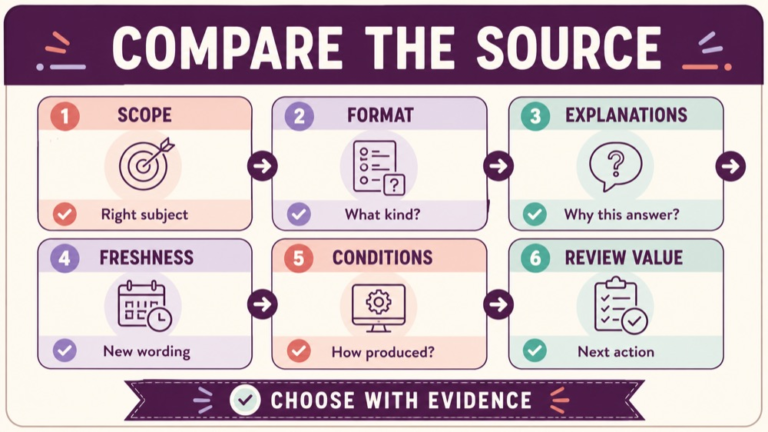
Use six signals when comparing a praxis practice test slp source: scope, format, explanations, freshness, conditions, and review value. Give each signal a simple note such as clear, partly clear, or unresolved. This prevents a large question count or attractive score report from dominating the decision.
Signal
Questions to ask
Warning sign
Scope
Does the source name Speech-Language Pathology (5331) and describe its boundary?
It uses a generic Praxis label with no subject explanation.
Format
Does it explain whether the set is short, mixed, timed, or full-length?
The source calls every quiz a simulation.
Explanations
Does each rationale connect the answer to the task and evidence?
The page gives an answer letter with little reasoning.
Freshness
Are the examples new to you, and is the source date or update context visible?
Repeated wording makes recognition look like transfer.
Conditions
Can you record timing, breaks, environment, and interruptions?
The score has no information about how it was produced.
Review value
Can the result point to a specific concept, distinction, or process repair?
The only feedback is a broad readiness label.
Use the six signals as a decision aid rather than a universal rating. A short source with excellent explanations may be ideal for repairing a distinction. A longer source with weak rationales may be useful only for practicing endurance, and only if you keep the purpose narrow.
Scope note: write the exact test subject and the source page used to verify it.
Format note: record the number of items, time condition, and whether the set was mixed or targeted.
Rationale note: sample several explanations before committing to the resource.
Freshness note: mark whether you had seen the item, phrase, or answer pattern before.
Condition note: save the environment, break, fatigue, and interruption details.
Action note: state what the result will change in your next study block.
Separate official options from third-party study sets
Official and third-party resources can play different roles. The current ETS practice-test selector is the place to check current official options. Third-party sources may offer more explanations, different teaching sequences, or additional practice volume. Treat the source identity and its claims as part of your notes so you know what a result represents.
Do not assume that a third-party percentage is comparable with an official score. Practice providers can use different content, item difficulty, scoring conventions, and explanations. A result can still be useful when it is interpreted inside its own conditions, but it should not be used to announce a pass decision or a licensing conclusion.
Source role
Best use
Boundary to keep
Current ETS page
Verify test identity, scope, format, and changing logistics.
Use the live source for current administrative facts.
Official ETS practice option
Become familiar with the available practice format and source context.
Read the product description and current terms carefully.
Third-party question set
Increase original applications, explanations, and varied scenarios.
Keep its percentage inside the provider’s own conditions.
Study group or flashcard set
Retrieve concepts and discuss confusing distinctions.
Verify contested claims against authoritative material.
SLP Study Center resource
Connect practice review with structured learning and repair.
Use the current ETS source for changing exam facts.
The best resource mix is often small. Choose one source for current boundaries, one source that explains reasoning well, and one method for fresh transfer checks. Adding every available quiz can make review less consistent and make it harder to identify what actually changed your performance.
Set conditions before you compare results
Practice results become more informative when you record how they were produced. Before starting, write the purpose, source, date, format, timing, environment, planned break, permitted materials, and answer labels. This takes a few minutes and prevents later comparisons from turning into guesses.
Learning mode: pause to investigate concepts and read explanations while the purpose is understanding.
Timed skill mode: use a smaller clocked set to practice reading, elimination, or move-on behavior.
Simulation mode: protect the measured portion from explanations and record any interruption.
Transfer mode: choose new wording or a changed context to test whether the principle travels.
Review mode: revisit familiar items only to explain a misconception, not to inflate a readiness label.
Label an interrupted attempt rather than discarding it or quietly comparing it with a clean session. The interruption may still reveal something about attention or recovery, but it answers a different question from a controlled simulation.
Try three original source-selection questions
The following questions are original study examples created for this article. They are not copied from ETS or presented as live test material. Answer before reading the rationale, then write the selection signal or review behavior that the item is testing.
Question 1: Choose the strongest source signal
Scenario: Two SLP Praxis study sets contain a similar number of items. Set A names Speech-Language Pathology (5331), explains its format, and gives rationales for the best answer and close alternatives. Set B advertises a large question count but gives only answer letters. Which signal should carry more weight when choosing a first study source?
A. The largest question count, regardless of explanation quality.
B. The source that clearly identifies scope and teaches the reasoning behind the answer.
C. The source with the most dramatic readiness label.
D. The source that uses the most technical vocabulary in its stems.
Correct Answer: B. Why This Answer Is Correct: A first source should help you confirm the test boundary and understand why an answer fits the task. Explanations for close alternatives create review value that a large item count or technical wording cannot provide by itself.
Why the Other Options Are Wrong: A measures volume without showing whether the material is aligned or teachable. C treats marketing feedback as evidence about learning. D confuses difficult language with relevant, well-explained practice. B combines scope transparency with a path for correcting reasoning.
Exam Trap: A bigger bank can sound more complete, but question count is not the same as coverage, explanation quality, or transfer value.
Question 2: Respond to a source conflict
Scenario: A third-party explanation gives a logistics detail that conflicts with the current ETS page. You are about to use that detail in your appointment plan. What is the strongest next action?
A. Use the third-party detail because it appears in a practice explanation.
B. Average the two statements and record the midpoint.
C. Return to the live ETS source or account, verify the current detail, and date your note.
D. Ignore the conflict because administrative details do not affect preparation.
Correct Answer: C. Why This Answer Is Correct: ETS is the responsible source for current Praxis test identity and changing administrative details. A dated verification note keeps the appointment plan connected to the source that controls the information instead of to a stale practice explanation.
Why the Other Options Are Wrong: A gives a third-party teaching page authority over a changing administrative fact. B invents a compromise that may not describe any real rule. D leaves a known conflict unresolved and can create an avoidable appointment problem.
Exam Trap: Do not treat a practice explanation as the authority for a current registration, appointment, or test-day rule when the responsible live source says something different.
Question 3: Interpret repeated high results
Scenario: A learner scores well on the same practice set several times but cannot explain why close alternatives are weaker on a new set. Which next study action is most useful?
A. Repeat the same set until the percentage increases again.
B. Switch to a fresh set, label the task and evidence, and review the closest distractor.
C. Stop reviewing because repeated accuracy proves broad readiness.
D. Memorize the answer letters from the familiar set.
Correct Answer: B. Why This Answer Is Correct: Familiar wording can support recognition without showing flexible reasoning. Fresh stems and distractor explanations reveal whether the learner can identify the task, use the deciding evidence, and transfer the principle beyond the original set.
Why the Other Options Are Wrong: A can increase familiarity without adding new evidence. C treats a repeated practice result as a broad conclusion. D stores answer patterns rather than the clinical or test-taking reasoning needed for a changed scenario.
Exam Trap: Repetition is useful for correcting a misconception, but a high repeated percentage should not be mistaken for proof that the reasoning transfers.
Use results to choose your next study action
Once a set is complete, sort the result before deciding what to buy, read, or schedule next. Separate confident correct, uncertain correct, incorrect, skipped, and rushed responses. Then identify the cause: knowledge, distinction, task reading, evidence weighting, sequence, pacing, or source confusion.
Result pattern
Likely question
Next action
Incorrect and low confidence
Was the concept missing or inaccessible?
Review a trusted explanation and retrieve it without notes.
Incorrect and high confidence
Did a tempting rule or assumption override the evidence?
Compare the best choice with the closest distractor.
Correct and low confidence
Was the answer a guess or a weak recognition?
Explain the task and evidence, then retry with fresh wording.
Late-session misses
Did fatigue, breaks, or time pressure change the process?
Run a smaller timed block and inspect the pacing behavior.
Source-specific strength
Did familiar phrasing make the set easier?
Mix a new source or new cases before drawing a conclusion.
A practice result is most valuable when it changes one observable action. “Study more” is too broad. “Compare two next-assessment decisions using the missing history in the stem” or “complete ten fresh items with a two-minute checkpoint” gives the next block a clear purpose.
Name the result: record accuracy, confidence, timing, breaks, and interruptions.
Locate the cause: identify the most likely reasoning or process gap.
Choose one repair: select a source check, concept review, comparison note, or fresh mini-case.
Schedule transfer: revisit the principle after a delay with changed wording.
Reassess the source: keep or replace the practice resource based on its review value, not on frustration alone.
Review rationales for transfer, not answer memory
A rationale should answer more than “Why is B correct?” It should connect the prompt’s task to the evidence, explain the boundary of the conclusion, and show why the other choices are less appropriate for that specific question. Read it actively and rewrite the reasoning in your own words.
State the decision the item requested.
Underline the fact that changed the choice.
Explain why the correct option fits both the task and the evidence.
Explain what each close alternative would require or answer instead.
Write one boundary describing what the scenario does not establish.
Create a new example that keeps the principle but changes the surface wording.
If an explanation is vague, contradictory, or built on a current administrative claim that cannot be verified, mark it for a source check. A practice set can still provide a useful prompt, but the explanation should not become a permanent study note until the conflict is resolved.
Use the “fresh wording” test after review. Hide the original answer choices, state the principle, and explain how it would apply to a changed client, setting, communication demand, or time condition. The ability to explain the change is stronger evidence of learning than remembering the answer letter.
Choose free, paid, and mixed practice intentionally
Free and paid resources are not automatically different in learning value. A free set may be useful for orientation or a quick retrieval check. A paid set may provide longer simulations, source-specific explanations, or organized progress tracking. Evaluate the learning job and review quality before treating price as a proxy for alignment.
Resource choice
Good reason to use it
Question to ask first
Free short set
Quickly test a concept or learn how a source explains its items.
Can I see the subject scope and a useful rationale?
Paid practice product
Need structured volume, longer sessions, or detailed review.
Does the product explain its format, freshness, and feedback?
Official practice option
Want to inspect current official practice availability and source context.
Have I checked the current ETS subject selector?
Mixed source plan
Need fresh wording after a familiar bank or want to separate pacing from reasoning.
Can I label which source produced each result?
Keep the mix small enough to analyze. If every source uses different labels, timing, and scoring, record the conditions in a single review sheet. The purpose is not to create a perfect aggregate score; it is to see which learning action produces better reasoning on fresh material.
Verify logistics away from practice-score notes
Administrative preparation deserves its own source trail. Confirm registration, appointment, delivery setting, identification, accommodations, score reporting, and other changing details through the current ETS page or account. Do not let a practice provider’s old paragraph become the only record for an appointment decision.
Write the exact test subject and code shown in your account.
Check the current appointment date, time, location, or at-home instructions that apply to you.
Review identification and arrival requirements from the current responsible source.
Record accommodation steps and lead times through the relevant channel when needed.
Keep score-reporting and recipient instructions separate from third-party practice percentages.
Date every logistics note so you know when it needs a fresh check.
This separation also improves study clarity. Your practice record can focus on reasoning, timing, confidence, and transfer. Your logistics record can focus on what the current source says you must do for the appointment. The two records support each other without pretending to measure the same thing.
Avoid common Praxis practice-test SLP mistakes
Review these patterns before choosing another resource or scheduling another long set:
Searching for a generic Praxis quiz without confirming Speech-Language Pathology (5331) scope.
Choosing the largest question bank without reading sample rationales.
Treating a score label as more important than the reason behind each answer.
Repeating familiar items until recognition replaces fresh application.
Comparing percentages from sources with different timing, formats, or scoring.
Reading explanations during a measured session and then calling the result timed.
Using a third-party paragraph as the authority for current appointment logistics.
Copying proprietary or purported live content into notes or public material.
Adding another resource before deciding what the current result actually showed.
The repair is usually a narrower choice. Define the learning job, compare sources on the six signals, run the set under labeled conditions, review the closest alternatives, and use fresh wording before deciding whether the resource belongs in the next cycle.
Practice-test selection checklist
Use this checklist when you are comparing a new praxis practice test slp resource. Save the answers with your first result so you can tell whether the source helped because of its explanations, its freshness, its format, or simply because you became familiar with it.
Does the source clearly identify Speech-Language Pathology (5331)?
Did I verify current format and scope through the live ETS source?
Do I know whether the set is short, targeted, timed, mixed, or full-length?
Can I record purpose, source, date, environment, breaks, and interruptions?
Have I read enough rationales to judge explanation quality?
Does the source explain why close alternatives are weaker?
Are the items fresh enough to test application rather than memory?
Can the result point to a specific concept, distinction, or process repair?
Will I separate confident correct from uncertain correct responses?
Will I test the repair with changed wording after a delay?
Am I keeping practice percentages separate from official score and licensing claims?
Will I verify changing appointment details from the current responsible source?
A well-chosen praxis practice test slp resource should leave you with better questions, not just a bigger number. You should know which evidence you missed, which explanation changed your thinking, and what fresh practice will test the repair. That is the information that makes the next study block worthwhile.
SLP Praxis Practice Exam: Build a Full-Length Simulation Plan
slp praxis practice exam preparation becomes more useful when a full-length rehearsal has a job beyond producing a percentage. The simulation should show how you manage the current test boundary, retrieve clinical knowledge, protect pacing, respond to uncertainty, and review the decisions that need repair.
The current ETS Speech-Language Pathology (5331) page describes a computer-delivered selected-response test with 132 questions and 150 minutes. The live ETS page and account should control changing registration and appointment details. ASHA also recommends becoming familiar with the exam format and content, making a plan around your topic knowledge, and using practice questions to guide preparation.
What a full-length SLP Praxis practice exam can show
A long practice session is a measurement of a particular preparation condition. It can reveal how you combine recall and judgment when the questions are mixed, how fatigue affects reading, whether your move-on rule is usable, and which topics or decision types deserve another study block. It cannot turn a third-party percentage into an official scaled score.
Before choosing a source, define the question your rehearsal should answer. You may want to know whether a content map is broad enough, whether you can sustain attention across a long session, whether you are losing time to a particular item type, or whether a repaired concept transfers when the scenario changes.
Rehearsal question
Evidence to capture
Useful follow-up
Do I recognize the scope?
Items that felt outside the source boundary or used unfamiliar terminology
Check the current ETS scope before adding new material.
Can I sustain the process?
Time, breaks, fatigue, rushed sections, and unanswered or uncertain responses
Adjust the process rather than simply adding volume.
Can I make clinical distinctions?
Close options, missing evidence, and the task each distractor seemed to answer
Build a compare-and-contrast repair block.
Does knowledge transfer?
Performance on fresh stems versus familiar wording
Use a new case after a delay and explain the reasoning.
A useful full-length session therefore has three outputs: a result label tied to the conditions, a set of error causes, and a short list of next actions. If it produces only a percentage, it has not yet completed the learning part of the rehearsal.
Map the current ETS boundary before building a simulation
Start with the current ETS Speech-Language Pathology (5331) page and its official preparation links. Record the date you checked the source, the test identity, the current format information, and the content areas you plan to represent. The ETS practice-test page can then help you locate current practice options by subject.
Do not let a provider’s chapter order define the entire simulation automatically. A commercial outline may be a useful navigation aid, but your rehearsal should still reflect the current responsible source and your own learning goals. Keep a note of what the practice resource covers, what it does not cover, and what it claims about its own format.
Set the boundary: write the exact test subject and current code you are preparing for.
List the learning jobs: include recall, clinical interpretation, assessment sequencing, treatment planning, professional judgment, and outcome measurement as relevant to your map.
Choose a representation: decide which topics or decision classes should appear in the rehearsal and why.
Mark uncertainty: flag claims that depend on changing ETS logistics instead of treating an old note as permanent.
Protect originality: use newly written study examples and explanations rather than copying proprietary or purported live content.
The boundary is also a safeguard against overfitting. If every practice block repeats the same vocabulary, you may be measuring recognition of the source rather than flexible clinical reasoning. A full-length plan should contain enough variety to require task identification before answer selection.
Build repeatable conditions before you start
Write the conditions before opening the first item. Include the resource name, date, mode, start time, planned breaks, permitted materials, timing method, and the labels you will use for answers. Repeatable conditions make later comparisons more informative, even when the practice source or question mix changes.
Purpose: learning, pacing, endurance, transfer, or a broad readiness check.
Environment: quiet desk, device, notifications, water, and materials within reach.
Timing: full-session clock, section checkpoints, and a rule for returning to a sticky item.
Breaks: planned location and length, with the interruption recorded if it changes the attempt.
Response labels: confident correct, uncertain correct, incorrect, skipped, or rushed.
Review boundary: no answer explanations or searches during the measured portion unless the session is explicitly learning mode.
Recovery: what you will do if fatigue, technology, or an interruption changes the conditions.
Separate “simulation” from “learning mode.” In learning mode, pausing to read an explanation may be the point. In a measured rehearsal, that pause changes the evidence. Neither mode is wrong, but the result should be labeled honestly so you do not compare unlike sessions.
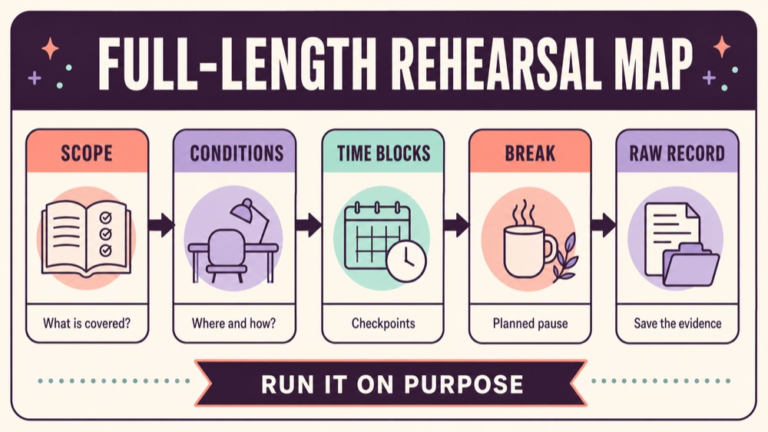
Map the full-length rehearsal
A full-length rehearsal can mirror the current 5331 time and item frame while still using a practical review record. ETS currently describes 132 selected-response questions and 150 minutes; use that information as a planning anchor and verify the live page before you begin. The exact resource may use a different number or format, so record what you actually completed.
Phase
What to do
What to record
Launch
Confirm source, purpose, conditions, and timer.
Start time, resource, mode, and expected finish.
Block one
Answer mixed items using task, evidence, and constraint.
Checkpoint time and any recurring distractor pattern.
Break
Take the planned break and note the actual interruption.
Break length, fatigue, and any changed condition.
Block two
Continue with the same decision process and a defined return rule.
Skipped, uncertain, rushed, and changed answers.
Close
Stop the measured session before reading explanations.
Raw result, confidence pattern, and immediate observations.
If your practice source does not contain a full-length form, use a clearly labeled composite. Combine fresh blocks only when you can preserve the source, timing, topic mix, and review boundary. Calling a collection of short quizzes a full simulation without recording the difference can make the result harder to interpret.
Use pacing blocks and a move-on rule
The current ETS frame gives you a useful planning reference, but the average time per question is not a command to spend identical seconds on every stem. Calculate a rough checkpoint for your session, then observe what actually consumes time: rereading, comparing close choices, retrieving a concept, recording notes, or returning to a sticky item.
Read the final task sentence so you know what decision the item requests.
Locate the client, setting, timing, performance, or professional detail that changes the choice.
Eliminate options that answer a different question or require information the stem does not provide.
Choose the best-supported response when the evidence is sufficient for the stated task.
Mark an item for return only when a return is permitted and you have a concrete reason to revisit it.
Protect the next checkpoint instead of allowing one difficult stem to consume the session.
After the rehearsal, compare planned and actual checkpoints. If you were slow early and rushed late, the repair may involve reading and triage. If pacing was stable but explanations were weak, the repair may involve concept distinctions or clinical reasoning. A faster clock is not the only possible solution.
Try four original mini exam questions
The following items are original study examples created for this article. They are not copied from ETS or presented as live test content. Answer each one before reading the rationale, then record the task, deciding evidence, answer confidence, and one reason the closest alternative did not fit.
Question 1: Match the review action to the missed task
Scenario: During a practice exam, a learner chooses a treatment technique even though the stem asks for the next assessment step. Which review action is most useful?
A. Memorize the selected treatment term and move to a larger set.
B. Rewrite the requested decision, identify the missing information, and explain why treatment was premature.
C. Remove all assessment items from future practice so the error cannot recur.
D. Count the response as correct because the treatment technique could be clinically useful.
Correct Answer: B. Why This Answer Is Correct: The error is a task-and-sequence mismatch, not simply a missing treatment fact. Rewriting the requested decision and the information needed before acting makes the repair portable to a new stem with different clinical content.
Why the Other Options Are Wrong: A memorizes a word without correcting the decision process. C removes the very task that needs practice. D changes the scoring rule because an option sounds reasonable, even though it does not answer the question asked.
Exam Trap: A clinically sensible action can still be the wrong response when it comes before the assessment or clarification step requested by the scenario.
Question 2: Use the missing evidence in a hearing-related referral
Scenario: A child is referred for unclear speech, and the referral notes inconsistent responses to spoken directions but gives no recent hearing information. Which next planning move is strongest?
A. Assign a speech-sound diagnosis from the referral description alone.
B. Begin a home articulation program before clarifying the hearing-related information.
C. Address the missing hearing information through the appropriate evaluation pathway before interpreting the full speech profile.
D. Ignore the referral concern and test only written language.
Correct Answer: C. Why This Answer Is Correct: The stem highlights a missing variable that can affect access to spoken input and interpretation of speech performance. Addressing that gap supports a more responsible assessment sequence without pretending that the referral alone establishes a diagnosis.
Why the Other Options Are Wrong: A overstates what limited referral information can establish. B starts intervention before clarifying a factor that may change the interpretation. D replaces the stated concern with an unrelated testing path and leaves the decisive information unresolved.
Exam Trap: Do not confuse identifying a needed evaluation step with assigning a final label. When the question emphasizes missing foundational information, that gap often controls the sequence.
Question 3: Match AAC access evidence to the recommendation
Scenario: An adult selects symbols accurately during a short trial but loses accuracy after extended communication. Before finalizing an access recommendation, which evidence should be added?
A. Performance across time, position, task length, and realistic communication partners.
B. The device model most familiar to the clinic staff.
C. A longer vocabulary list without observing endurance or access demands.
D. A recommendation copied from another client with a similar diagnosis.
Correct Answer: A. Why This Answer Is Correct: The decisive issue is whether access remains functional under the conditions that cause fatigue and accuracy loss. Sampling time, position, task length, and partners helps connect the recommendation to individual performance rather than to device popularity or diagnosis similarity.
Why the Other Options Are Wrong: B substitutes clinic familiarity for client fit. C adds content without examining the access problem. D transfers another person’s experience without confirming this client’s performance, context, or support needs.
Exam Trap: A strong short trial is not the same as evidence that the access method will remain usable during the longer communication routine named in the scenario.
Question 4: Match the outcome to a narrative goal
Scenario: A student produces grammatically correct sentences but tells stories that omit the setting, initiating event, and consequence. Which outcome best matches the stated concern?
A. Count articulation accuracy in isolated words.
B. Measure the presence and sequence of key story elements across more than one narrative context.
C. Count words per minute as the primary indicator of narrative quality.
D. Ask the student to define narrative terms without collecting a connected sample.
Correct Answer: B. Why This Answer Is Correct: The stated concern is narrative organization, so the outcome should capture the story elements and their use in connected communication. More than one context helps test whether the skill is portable instead of appearing only in a rehearsed example.
Why the Other Options Are Wrong: A measures a different construct. C treats speed as a substitute for story organization. D may show vocabulary about narrative parts but does not show whether the student can use them in an actual connected sample.
Exam Trap: Choose the measure that matches the construct named in the stem, not the variable that is easiest to count.
Score decisions, not just correct answers
Start with the raw result, but do not stop there. For every incorrect, uncertain, rushed, or unexpectedly correct response, write the decision the item required and the evidence that should have carried the most weight. A review record makes a full-length practice exam useful even when the source does not provide a trustworthy way to generalize its percentage.
Record field
Example entry
Why it matters
Answer status
Confident correct, uncertain correct, incorrect, skipped, or rushed
Separates stable reasoning from recognition or time pressure.
Task
Choose the next assessment, interpretation, treatment, or outcome
Shows whether the response addressed the question.
Deciding evidence
Client goal, timing, setting, performance pattern, or missing history
Connects the choice to the facts in the stem.
Cause
Knowledge, distinction, task reading, sequence, distractor, or pacing
Points to a specific repair rather than broad rereading.
Next check
New scenario after a delay
Tests transfer instead of immediate answer recall.
Do not compare a practice percentage with the current ASHA or state passing requirement as if they were the same measurement. Passing requirements and score rules belong to the responsible current sources and pathway. The practice result is best used to choose what to review next.
Review each miss with four labels
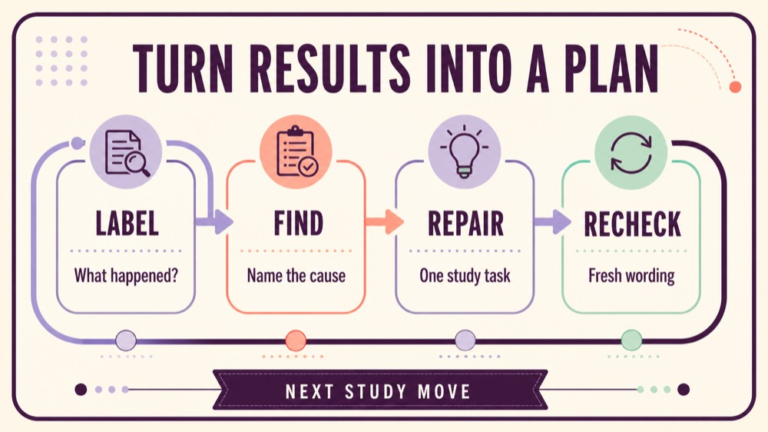
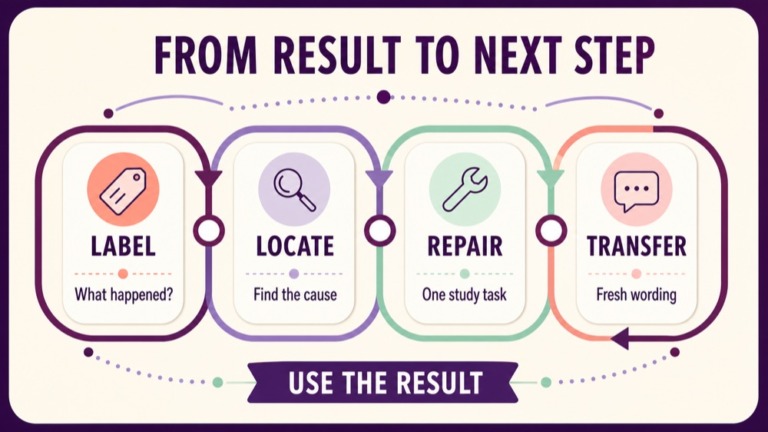
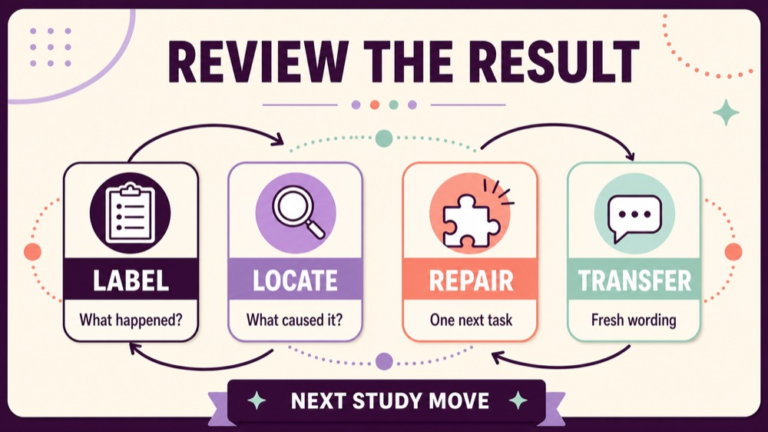
A four-label review keeps the post-exam conversation concrete. Name what happened, identify the cause, choose a repair, and schedule a fresh transfer check. The sequence helps you avoid a common response to a difficult rehearsal: buying or completing another large set before understanding why the first one went poorly.
What happened? Label the response as incorrect, uncertain correct, rushed, skipped, or confident correct.
What caused it? Decide whether the gap involved knowledge, distinction, task reading, evidence weighting, sequence, distractor appeal, or timing.
What repairs it? Choose one action such as a concept card, comparison table, retrieval prompt, fresh mini-case, or source verification.
What proves transfer? Schedule a new scenario that changes the wording or context and ask for an explanation before checking the answer.
When the same cause appears across several topics, repair the process first. When one concept recurs inside different tasks, repair the distinction. When errors appear only late in the session, review fatigue, breaks, and move-on behavior before deciding that the entire content map is weak.
Knowledge repair: explain the concept in plain language, add a boundary, and retrieve it without notes.
Distinction repair: compare the closest choices using purpose, evidence, timing, and limitation.
Sequence repair: place clarification, assessment, interpretation, planning, intervention, and measurement in the order supported by the stem.
Pacing repair: use a smaller timed block with one observable move-on rule.
Transfer repair: write a fresh case with a changed setting, age, partner, or communication demand.
Turn the review into a seven-day plan
A seven-day cycle is long enough to include explanation, retrieval, application, and a new check without treating one practice exam as a verdict. Adjust the days around your schedule, but keep the learning jobs in order so your next full-length rehearsal has a reason to exist.
Day
Study job
Evidence of completion
Day 1
Protect the raw record and classify the largest error patterns.
A short list of three priority causes.
Day 2
Review the highest-impact concept or distinction from a trusted source.
A plain-language explanation and boundary.
Day 3
Complete a small retrieval block without notes.
Answers plus confidence labels.
Day 4
Apply the repair to fresh mini-cases.
Written rationales for the best choice and close distractor.
Day 5
Practice one pacing or sequence behavior in a timed block.
Checkpoint time and observed process change.
Day 6
Mix repaired topics with one or two older areas.
Evidence that you can identify the task before the topic.
Day 7
Run a fresh check or decide whether another full-length session is justified.
A next decision based on evidence, not anxiety.
If the review shows that your source coverage is incomplete, update the map before adding more timed work. If the map is broad but your answers are slow, train reading and triage. If the result looks strong but confidence is low, use fresh wording to test whether recognition has become portable reasoning.
Verify logistics separately from content readiness
Content readiness and appointment readiness are related but different jobs. Use the current ETS account and pages for registration, delivery, identification, appointment, accommodations, score reporting, and other changing details. A practice exam can rehearse attention and pacing; it cannot update an administrative record for you.
Confirm the exact test subject and code shown in your account.
Check the current appointment date, time, delivery setting, and location or at-home requirements.
Review the current identification and arrival instructions that apply to your appointment.
Verify accommodation steps and timing through the responsible channel when relevant.
Record the current rescheduling, cancellation, refund, and score-reporting instructions separately from study notes.
Use the live ETS page rather than an old practice-provider paragraph when a detail conflicts.
Keeping a dated logistics note prevents an old simulation worksheet from becoming an accidental source of administrative advice. It also lets you focus the full-length rehearsal on learning behavior while a separate checklist handles the appointment details that can change.
Avoid full-length practice exam traps
Long practice sessions can feel authoritative because they are tiring. That feeling is not evidence by itself. Review the design for these traps before treating a result as meaningful:
Calling a short or interrupted quiz a full-length simulation without recording the difference.
Using a familiar question bank repeatedly and mistaking recognition for transfer.
Changing timing, source, break pattern, and environment at the same time.
Reading explanations during a measured session and then comparing the result with an uninterrupted attempt.
Spending so long on one difficult stem that later sections become rushed.
Counting uncertain correct responses as fully secure without reviewing the reasoning.
Calling a third-party percentage an official scaled score or licensing decision.
Copying proprietary or purported live content into a study file or public page.
Adding another large practice set before classifying the errors from the first one.
The strongest correction is usually small and observable. Change one process variable, test it in a short fresh block, and then decide whether a new full-length rehearsal will answer a question you still have. That sequence keeps practice connected to learning rather than fatigue.
Full-length simulation checklist
Use this checklist before and after the next rehearsal. Keep the completed version with the raw result so you can tell whether a later change came from new knowledge, different conditions, better pacing, or simple familiarity with the source.
I verified the current Speech-Language Pathology (5331) test identity and source boundary.
I wrote the purpose of the session before starting the timer.
I recorded the resource, date, mode, environment, timing method, and planned breaks.
I separated measured simulation from learning mode.
I used a defined move-on and return rule.
I labeled confident, uncertain, incorrect, skipped, and rushed responses.
I recorded the task and deciding evidence for important items.
I classified causes instead of writing only “need to study more.”
I explained the closest distractor rather than memorizing the answer letter.
I assigned one repair task to each priority pattern.
I scheduled a fresh transfer check after a delay.
I kept practice evidence separate from current score or licensing requirements.
I verified appointment logistics from the live responsible source.
A good slp praxis practice exam is a controlled question about your preparation process. It tells you what to review, what behavior to change, and what evidence would justify another full-length rehearsal. That is enough to make the next study decision more precise.
praxis slp practice test work is most valuable when each item trains a clinical decision, not just a memorized definition. A useful set asks you to identify the task, notice the evidence that changes the decision, compare plausible choices, and explain what would make the next step appropriate.
The current ETS Speech-Language Pathology (5331) page describes a computer-delivered selected-response test with 132 questions and a 150-minute duration. ETS also points candidates to the official Study Companion and Study Plan, while ASHA recommends using the exam content, your topic-area knowledge, preparation materials, and practice questions to build a plan. The mini items in this article are original teaching examples, not official ETS questions.
What this Praxis SLP practice-test set is for
A practice set is a rehearsal for making decisions with limited information. It can show whether you recognize the relevant content, select the best evidence, prioritize the next step, and explain why a tempting alternative does not fit. That is different from reading a chapter and feeling familiar with its vocabulary.
Use the set for one of four purposes, and choose the label before you begin so your notes show what the result is supposed to teach you rather than turning every percentage into a broad readiness judgment about the full examination:
Orientation: learn how selected-response stems ask you to apply knowledge.
Diagnosis of your study process: identify knowledge, reading, prioritization, or timing issues.
Repair: practice one weak decision with new examples after reviewing the cause of an error.
Transfer: test whether a repaired idea works when the setting, age, or communication need changes.
A practice result is evidence about the conditions under which you practiced. It is not a promise about the official result and it does not replace the current ETS scope or the requirements of your program, state, or certification pathway.
Choose the right question set before you start
Begin with the current ETS boundary. The 5331 page identifies the test, describes the broad practice areas, and links to official preparation material. The current ETS practice-test page lets candidates search by test subject, including Speech-Language Pathology (5331). Use those pages to verify that a resource is aimed at the exam you are preparing for.
When you compare an outside set, inspect more than the number of questions. Look for current test identity, explanations, content coverage, and original teaching material. Avoid resources that imply access to confidential or purported live items. A trustworthy practice source should help you learn how to reason when the wording changes.
Question-set feature
What to check
Why it helps
Scope
Does it identify Speech-Language Pathology (5331) and its content boundary?
Prevents study time from drifting to another Praxis exam.
Rationale
Does it explain the best answer and the weaker choices?
Supports correction instead of simple answer matching.
Freshness
Are the items new to you, or have you seen them repeatedly?
Shows whether the result measures transfer or recognition.
Conditions
Can you label the set untimed, timed, partial, or longer simulation?
Makes later comparisons more honest.
Purpose
Is the set for learning, measurement, or review?
Lets you choose the right response to the result.
Keep the source and form name in your notes. If a later percentage changes, you need to know whether the content, difficulty, timing, or familiarity changed with it.
Set up a clinical reasoning baseline
Before you begin, write down what you want the set to show. A baseline can be a full session or a shorter representative group. The important part is to preserve the conditions and review the evidence instead of rushing to a label.
Confirm the set is intended for Speech-Language Pathology (5331) or record its limits.
Decide whether this attempt is learning mode, timed skill mode, or measurement mode.
Remove notes, answer keys, and search tools from immediate reach.
Use a simple record for topic, answer status, confidence, and timing.
Mark correct, incorrect, and correct-but-uncertain responses separately.
Note the question task and the fact that made one choice stronger.
Save your raw notes before reading rationales or searching for explanations.
Baseline field
Example
Next use
Question task
Choose the next assessment, treatment, or evaluation decision
Practice that task in new wording.
Evidence
Setting, timing, communication partner, or stated constraint
Underline the detail that changed the choice.
Answer status
Confident correct, uncertain correct, incorrect, or rushed
Separate stable reasoning from recognition.
Cause
Knowledge gap, task misread, priority confusion, or timing
Assign a specific repair action.
Follow-up date
Fresh question check after a delay
Measure transfer rather than immediate recall.
If the baseline is interrupted, keep the record and label the interruption. A partial set with clear conditions can still guide a next step; an unlabeled result can mislead you.
Read the stem for task, evidence, and constraints
Clinical reasoning questions often include more information than you need for the first decision. Read the final question sentence first when that helps you identify the task, then return to the scenario and locate the facts that change the answer. The task may ask for an initial action, the best next step, the most appropriate goal, or the strongest explanation.
Task: what kind of decision does the item require?
Evidence: which client, setting, timing, or performance detail carries the most weight?
Constraint: what limits the choice, such as available information, current support, or the stated setting?
Alternatives: which choices answer a different task or skip an earlier step?
Confidence: what would you need to verify if two choices still appear plausible?
Write a one-sentence paraphrase before selecting an answer: “I need the next information-gathering step,” or “I need a measurable way to evaluate carryover.” That sentence reduces the chance that a familiar term will pull you toward a choice that does not answer the question.
Try three original clinical reasoning questions
These are original study examples created for this guide. They are not recalled, copied, or official ETS questions. Answer each one before reading the rationale, then add the deciding fact to your error log.
Question 1: Connect the measure to the real goal
A client improves on a structured naming drill, but the stated goal is to communicate needs during workplace conversations. Which next evaluation step gives the clearest information about progress toward the goal?
A. Repeat the same drill and count only the items named correctly.
B. Collect a structured sample of workplace-relevant communication and define how performance will be measured.
C. Replace the goal with a list of every language skill that could be involved.
D. Stop measuring because improvement on the drill confirms functional carryover.
Correct Answer: B
Why the Other Options Are Wrong: A measures the drill rather than the stated workplace communication goal. C expands the target instead of making progress clearer. D assumes transfer without collecting functional evidence. B connects the measure to the context and behavior the goal describes.
Exam Trap: Improvement on a structured task may be useful evidence, but it does not answer a question about carryover unless the measure includes the relevant communication demand.
Question 2: Match access information to an AAC decision
A client can select symbols accurately for a short period but develops fatigue during longer communication routines. Before finalizing an access recommendation, which information is most important to add?
A. The client’s performance across time, position, task length, and communication partners.
B. The name of the device most commonly used in the clinic.
C. A longer vocabulary list without observing access under realistic demands.
D. A recommendation based on a different client with a similar diagnosis.
Correct Answer: A
Why the Other Options Are Wrong: B substitutes popularity for individual fit. C adds content without testing the access problem. D transfers another person’s experience without confirming the client’s needs. A adds the performance and context information needed to judge whether the access method remains usable.
Exam Trap: Strong performance in a short trial can sound decisive, but the question may be testing whether you notice endurance and context before finalizing a recommendation.
Question 3: Prioritize the next step from incomplete information
A referral asks for a treatment plan but gives no clear description of the client’s current communication environment, partner supports, or previous response to intervention. What is the strongest first reasoning move?
A. Select a familiar treatment protocol so the plan can begin immediately.
B. Identify the missing history and performance information that could change the treatment priorities.
C. Choose the most severe-sounding symptom as the only treatment target.
D. Use a plan copied from a similar referral without collecting new information.
Correct Answer: B
Why the Other Options Are Wrong: A chooses an intervention before the relevant baseline is clear. C confuses severity language with a complete priority decision. D ignores individual context and response history. B keeps the plan tied to the information needed to select and evaluate appropriate priorities.
Exam Trap: “Start treatment now” can feel efficient, but a question about the first reasoning move often rewards identifying the information that controls the later plan.
Use the answer-to-action review loop
After a question set, do not stop at the answer key. Move each important response through a four-step loop: name what happened, find the cause, repair the reasoning, and check it with fresh wording. The loop is what turns a practice percentage into a study plan.
Review step
Question to ask
Output
Name
Was the answer incorrect, uncertain, rushed, or confidently correct?
An honest answer-status label.
Find
Did I miss knowledge, task, evidence, priority, distractor, or timing?
One likely cause rather than a vague “bad question.”
Repair
What source, comparison, retrieval, or new case will address the cause?
A task that fits one study block.
Check
Can I use the principle in a fresh scenario after a delay?
Transfer evidence and a next decision.
When you read the rationale, explain it in your own words. Include why the best choice fits the task and why the attractive alternatives do not. Keep your notes short enough to revisit and specific enough to guide the next question.
If the explanation conflicts with the current ETS scope or authoritative clinical material, record the conflict and verify it with the appropriate source or instructor. Do not force a confusing rationale into your notes just because it came from a practice provider.
Turn each error into a practice task
An error log is useful only when it changes the next session. Replace broad labels with observable actions. “Review AAC” is a topic; “compare two access decisions using fatigue, position, and task demands” is a practice task.
Knowledge: make a concise distinction and retrieve it without notes.
Assessment: list the missing information that would change the next decision.
Treatment: connect the goal, activity, support, and measure.
Evaluation: choose an outcome that matches the stated behavior and setting.
Professional practice: identify the relevant communication, consent, privacy, or scope constraint in the scenario.
Timing: run a shorter set with a clear move-on rule and review the pacing notes.
Summarize the item in your own words rather than copying the full question.
Write the choice you made and the choice best supported by the evidence.
Underline the deciding fact or missing information.
Explain why the most tempting alternative did not fit.
Create one new example that would test the same principle.
Schedule that new example after a delay.
Do not use the original answer wording as your only memory cue. A fresh example is a better check of whether the reasoning became portable.
Build a mixed set after targeted repair
Targeted repair should eventually return to mixed practice. When all the questions are from one area, you know what concept is coming before you read the stem. A mixed set asks you to identify the relevant content while the context changes, which better tests retrieval and prioritization.
Stage
Practice design
What to watch
Repair
Several new examples of one error type or decision
Can you explain the rule without the original item?
Bridge
Current topic mixed with one earlier topic
Can you identify which evidence matters?
Transfer
Different age, setting, or communication demand
Does the reasoning survive a changed context?
Simulation
Longer mixed session with a time boundary
Can you protect pacing and review quality?
Change one variable at a time when you are testing a repair. If you change the source, timing, format, and topic simultaneously, a better or worse result is harder to interpret.
Practice timing without losing reasoning
The current ETS page describes 132 questions and 150 minutes for the 5331. That makes the average time per question a rough planning reference, not a rule that every item must receive identical seconds. Use timing practice to learn which behavior consumes time and which questions need a move-on decision.
Read the task before investing in every detail.
Identify the evidence that changes the choice.
Eliminate options that answer a different task.
Choose the best-supported response when the evidence is sufficient.
Mark a sticky question if the interface permits and move with a defined return plan.
Review timing notes after the set rather than guessing why the clock felt difficult.
A timed result with weak reasoning is a process signal. Slow down during the repair phase, then reintroduce a smaller time boundary. A fast result filled with guesses needs confidence and retrieval work, not a faster timer.
Separate practice evidence from an official score
Practice providers can use different content, difficulty, scoring, and explanations. Their percentages are useful only inside the conditions you recorded. The official ETS score is connected to the real appointment and current score-reporting process; a practice percentage is not a scaled score or a licensing decision.
Use careful labels in your notes so a practice percentage stays tied to its purpose and conditions. This distinction makes later comparisons more useful and keeps third-party results separate from official score reports, certification requirements, and licensing decisions after the real examination:
“Untimed learning set” for questions used while learning a reasoning pattern.
“Timed skill set” for a smaller group used to inspect pacing.
“Fresh mixed set” for new questions used to check transfer.
“Repeated review” for familiar items used to explain a misconception.
“Official result” only for the score reported through the current ETS process after the real test.
This language keeps your next decision grounded. A low practice result may identify a repair target, while a high repeated result may show recognition rather than broad readiness.
Avoid common Praxis SLP practice-test mistakes
Practice is easiest to misuse when the test becomes the goal. Check for these patterns before you schedule another set.
Choosing a generic Praxis quiz without verifying the Speech-Language Pathology (5331) scope.
Taking a test without deciding what evidence to record.
Reading rationales during the timed attempt.
Counting only incorrect answers and ignoring uncertain correct responses.
Repeating the same questions until the wording feels familiar.
Copying proprietary or purported live question content into notes or posts.
Writing “study more” instead of a specific repair action.
Changing several study variables at once and then overinterpreting the result.
Taking long simulations so often that no time remains for repair.
Calling a third-party percentage an official scaled score or pass decision.
Ignoring a source conflict instead of checking current authoritative guidance.
The repair is a consistent loop: choose the right source, label the conditions, answer from task and evidence, review the cause, and test the repair with fresh wording.
Praxis SLP practice-test checklist
Before and after your next set, confirm:
Did I verify that the material is aimed at Speech-Language Pathology (5331)?
Did I write whether the set is for learning, timing, measurement, or transfer?
Did I record source, form, date, conditions, breaks, and fatigue?
Did I label incorrect, uncertain, rushed, and confident responses?
Did I identify the task, deciding evidence, and stated constraints?
Did I review the reasoning behind every incorrect and uncertain response?
Did I explain why the tempting distractor did not fit?
Did I turn important errors into one-block repair tasks?
Did I schedule a fresh check after a delay?
Did I return targeted repair to mixed practice?
Am I treating the result as practice evidence rather than an official score?
A strong praxis slp practice test gives you more than a number. It shows how you make clinical decisions, what evidence you overlook, and which next practice task can make your reasoning more reliable.
slp praxis practice test preparation is most useful when the practice test changes what you do next. A single percentage can feel important, but the richer information is inside the answers: which topics were uncertain, which choices looked similar, where timing broke down, and which errors repeat after review.
The current ETS Speech-Language Pathology (5331) page describes a computer-delivered, selected-response exam with 132 questions and a 150-minute test length. ETS also points candidates to official preparation resources, and the Praxis practice-test page lets users search by test subject. This guide explains how to choose, take, and review a practice test without treating an unofficial result as an official score.
What an SLP Praxis practice test can tell you
A practice test is a structured sample of your current preparation. It can reveal content gaps, uncertain reasoning, question-reading habits, pacing patterns, and the effect of fatigue. It cannot guarantee a future result, reproduce every feature of the live test, or replace the current ETS Study Companion and instructions.
Use the result as a set of decisions. If you miss a question because the concept is unfamiliar, you need targeted learning. If you know the concept but select the wrong priority, you need application and comparison. If you select the best answer but cannot explain why, you need retrieval and another later check. If you rush, you need a pacing experiment rather than a larger pile of notes.
Content evidence: which broad practice areas and subtopics need attention?
Reasoning evidence: did you miss the task, the key fact, the priority, or the distinction between choices?
Timing evidence: where did the clock change your reading or decision quality?
Confidence evidence: which correct answers were guesses or lucky recognitions?
Transfer evidence: can you use a repaired concept in a new scenario?
That evidence is more useful than labeling yourself “ready” or “not ready” after one sitting. Your next study block should be traceable to something the practice test showed you.
Choose a practice source that matches your goal
Start with the official source boundary. The current ETS 5331 page links to official preparation materials and says the Study Companion helps candidates understand test content, practice sample questions, and gather guidance for different question types. The current ETS Praxis practice-test page invites candidates to search by test subject, including Speech-Language Pathology (5331).
Other resources can be useful, but compare them before you use the result to make a major decision. Check whether the material identifies the current test code, reflects selected-response practice, explains answers, and separates original teaching material from claims about the live exam. A resource that promises recalled or “actual” test questions is not a trustworthy preparation boundary.
Practice source feature
Why it matters
What to record
Current test identity
Content and format can differ across Praxis tests.
Test name, code, and date checked.
Explanations
An answer key alone does not show how to repair reasoning.
Whether rationales explain the best choice and distractors.
Scope alignment
A long quiz can still miss the target exam.
Which official content areas the set covers.
Fresh application
Recognition of repeated items can overstate readiness.
Whether questions are new to you and how often you reused them.
Timing fit
Pacing practice needs a clear time boundary.
Untimed, section-timed, or full-session conditions.
Keep one primary practice source for a cycle when possible. Switching sources after every low result makes it difficult to know whether your knowledge changed or the question style changed.
Set up a valid baseline before you study
Take your baseline before a major review cycle so the result can guide your priorities. Choose a quiet window, use material you have not recently memorized, and set a time boundary that matches the purpose of the exercise. If a full-length session is not realistic, use a shorter representative set and label it honestly as a partial baseline.
Verify that the practice set is intended for Speech-Language Pathology (5331) or clearly state what it covers.
Write down whether the attempt will be timed, partly timed, or untimed.
Remove notes and answer explanations from immediate reach.
Use the same reading and marking habits you want to test.
Record each answer as correct, incorrect, or correct-but-uncertain.
Note where you lost focus, reread a stem, or spent unusually long on one choice.
Stop and save the raw evidence before opening the explanations.
Baseline field
Example record
Why to keep it
Source and date
Provider, form or set name, date used
Shows whether a later result is a fresh comparison.
Conditions
Timed, quiet room, breaks used
Explains differences between attempts.
Answer status
Correct, incorrect, or uncertain
Separates confident knowledge from recognition.
Topic
Broad area plus the narrower decision
Turns a missed item into a study target.
Next action
Review, retrieve, compare, or retest later
Creates the bridge to the schedule.
Do not spend the baseline session searching for the perfect test. A consistent, well-labeled first attempt is more useful than a delayed attempt surrounded by endless setup research.
Simulate the test without creating a false crisis
Simulation has levels. A full practice session can help you rehearse stamina, navigation, pacing, and the emotional experience of not knowing every answer. A shorter timed set can isolate a question type or content area. An untimed set can help you learn a new reasoning pattern. Use the level that matches your current goal.
The current ETS 5331 page describes 132 selected-response questions in 150 minutes. If you use that as a full-session reference, remember that the average time per question is only a rough planning calculation. Your practice should also include reading, navigation, and review habits, and the official appointment interface can differ from a third-party worksheet.
Learning mode: pause to explain the question and compare choices.
Skill mode: time a smaller set to isolate reading or pacing behavior.
Mixed mode: combine several areas and keep an error log.
Simulation mode: use a longer uninterrupted session with limited help.
Review mode: return to marked and uncertain items after a delay.
Do not use simulation as punishment. If the first full-length attempt produces fatigue and scattered notes but no actionable analysis, shorten the next session, repair the process, and try again under clearer conditions.
Review every question, not only the wrong ones
Reviewing a practice test is where most of the learning value appears. Begin with incorrect answers, but include correct answers that were guesses, rushed, or based on a fragile association. A correct answer with weak reasoning can become a future miss when the scenario changes.
Answer status
Review question
Record
Incorrect
What fact, task, or comparison caused the miss?
Cause and one repair action.
Correct but uncertain
Could I explain the answer without looking?
Retrieval date and confidence check.
Correct and confident
Did I use the relevant evidence rather than a shortcut?
One sentence explaining the decision.
Changed answer
What evidence caused the change?
Whether the change improved the reasoning.
Skipped or rushed
Was the issue timing, attention, or content?
Pacing or content experiment for next time.
Write the rationale in your own words before reading the explanation when possible. Then compare your reasoning with the source. Notice not only what the best answer says, but why the other choices are less appropriate under the facts in the question.
If an answer explanation conflicts with the current ETS scope or authoritative clinical guidance, pause. Record the source conflict and verify it with the appropriate authority or instructor instead of forcing your notes to match a questionable key.
Try three original mini practice questions
These three items are original teaching examples, not recalled or official ETS questions. Use them to practice the same evidence-and-reasoning process that you use when reviewing a larger slp praxis practice test. Write your choice before opening the answer and rationale.
Question 1: Identify the next information to gather
A school-age child is referred because listeners have difficulty understanding the child in class. The referral note gives a brief speech sample but does not include hearing information or a description of communication across settings. What is the best next preparation decision?
A. Choose an intensive articulation treatment sequence before gathering more information.
B. Identify the missing background and screening information that could change the assessment plan.
C. Select one sound target based only on the referral label.
D. Compare the child with a classmate of the same age.
Correct Answer: B
Why the Other Options Are Wrong: A moves to treatment before the available information supports the plan. C narrows the decision from a label without confirming the pattern or context. D is not a substitute for relevant assessment information. B keeps the next step connected to the missing evidence and the referral question.
Exam Trap: A familiar treatment action can feel efficient, but the item may be testing whether you notice the information needed before choosing an intervention.
Question 2: Match the tool to the communication need
An adult with a new communication impairment uses gestures and a few spoken words but has not been asked how communication works at home, at work, or with familiar partners. Which preparation choice best supports an individualized plan?
A. Select a single communication method without asking about the person’s routines or access.
B. Gather information about communication goals, environments, partners, and access needs before finalizing recommendations.
C. Delay all communication attempts until spoken language is fully characterized.
D. Use the same recommendation that worked for a different adult with a similar diagnosis.
Correct Answer: B
Why the Other Options Are Wrong: A skips the person’s context. C treats one mode as a reason to postpone supported communication. D transfers another person’s plan without confirming fit. B keeps the decision person-centered and links the recommendation to real communication demands.
Exam Trap: Diagnosis or impairment type may be important context, but it does not by itself answer a question about the person’s goals, partners, or access.
Question 3: Choose the clearest treatment-evaluation link
A clinician writes a goal for a client to communicate more effectively but does not specify the behavior, support level, or setting. Which revision would make the goal easier to evaluate?
A. Make the goal sound more encouraging without adding an observable behavior.
B. Add an observable communication behavior, the relevant conditions or supports, and a way to measure change.
C. Replace the goal with a list of every skill the client may need.
D. Keep the wording broad so any future outcome can count as progress.
Correct Answer: B
Why the Other Options Are Wrong: A changes tone but not measurability. C makes the target harder to prioritize and evaluate. D makes the outcome too vague to interpret. B connects the target, conditions, supports, and measurement so progress can be reviewed.
Exam Trap: A broad goal may sound flexible, but the best answer often makes the action and evidence more observable rather than less specific.
After each item, add the question’s deciding fact to your error log. The point is not to memorize these examples; it is to transfer the reasoning pattern to fresh wording.
Turn errors into specific repair tasks
An error log should make the next action obvious. Avoid categories so broad that they become labels rather than guidance. “Language” is a content area; “differentiate the next assessment priority when receptive and expressive language findings point in different directions” is a study task you can practice.
Error type
Diagnostic question
Repair task
Knowledge gap
Could I define or explain the concept?
Read a focused source, create a distinction, and retrieve it later.
Stem-reading gap
Did I answer the question that was asked?
Rewrite the task in plain language before choosing.
Priority gap
Why was one action better at this time?
Compare two options in a new scenario and state the deciding fact.
Distractor gap
Why did a plausible wrong choice attract me?
Write the condition that would make it appropriate and the condition that does not.
Timing gap
Where did the clock change my process?
Run a shorter timed set with a move-on rule.
Confidence gap
Was the answer correct because I knew it or recognized a phrase?
Retrieve the principle without the original item.
Copy the topic and question type, not the full copyrighted item.
Record your answer and the best answer in brief, original language.
Name the deciding evidence or concept.
Write why the attractive distractor did not fit.
Create a next action that can be completed in one study block.
Schedule a fresh application check after a delay.
Keeping your own paraphrase also reduces dependence on memorizing one question’s wording. The goal is transferable reasoning, not recognition of a repeated page.
Use practice results to build your next week
After review, sort the error log into a short priority list. Pick one or two repair targets for the next week, then maintain older material through a mixed revisit. If you assign every error to the next day, the practice test becomes a source of overload instead of a planning tool.
Result pattern
Next-week emphasis
Keep in rotation
Many errors in one area
Focused review plus new application examples
One mixed question from another area.
Errors spread across areas
Prioritize reasoning and question reading
Short content refreshers tied to each error.
Good untimed, weak timed performance
Practice pacing, reading, and move-on decisions
Untimed repair work so speed does not replace learning.
Good score, many uncertain answers
Retrieval and explanation practice
Fresh scenarios instead of repeated forms.
Low score with high fatigue
Shorter cycles, breaks, and schedule capacity check
Gradually longer sessions after the process improves.
Use a simple weekly loop: review one priority, retrieve it, apply it, analyze errors, and revisit an older area. Repeat the loop before taking another larger practice test. The interval between tests gives you a chance to see whether the repair transferred.
Keep a record of practice-test dates and forms. A later result is easier to interpret when you know whether the questions were fresh, repeated, timed, and reviewed.
Practice pacing without chasing a single number
Pacing is a skill made of smaller behaviors. You may lose time by rereading the stem, comparing choices without naming the task, overworking one difficult item, or failing to mark a question for later. Identify the behavior before you choose a pacing rule.
Read the task before analyzing every detail.
Identify the facts that change the professional decision.
Eliminate choices that answer a different task or ignore a stated constraint.
Choose the best-supported answer when the evidence is sufficient.
Mark and move when another minute is adding repetition rather than insight.
Return to marked items with a specific question, not a general feeling of doubt.
Use the clock as feedback, not as a verdict. A practice score can rise because you guessed faster, or fall because the set covered a weak area. Pair the number with timing notes, confidence, and error type before changing your whole study plan.
ETS’s current preparation guidance emphasizes familiarity with the format, a written plan, practice tests, and identifying strengths and improvement areas. Those recommendations support an evidence-based practice cycle, not a promise that one test can predict the official result.
Avoid repeated exposure and unofficial-score confusion
Repeating the same practice test too soon can make you remember the answer rather than understand the principle. Use a fresh form or a new set for measurement, and reserve familiar items for deliberate teaching or review. Label each attempt so you know whether the result measures learning, recall, or transfer.
Do not describe a third-party practice score as an ETS score. Practice providers can use different difficulty, coverage, scoring, and explanations. The official score is handled through the current ETS reporting process for the real appointment, not through a practice-site percentage.
Fresh measurement: use new questions when evaluating a change in readiness.
Teaching review: reuse an old item only to examine a reasoning step or misconception.
Source check: verify clinical or administrative claims against current authoritative material.
Privacy: avoid copying or publishing proprietary question content in your notes or posts.
Score language: call an unofficial result a practice result and record its conditions.
If a practice resource uses sensational claims about “real” exam items, skip those claims and return to the official scope and original learning work. Reliable preparation should make your reasoning stronger even when the wording changes.
Avoid common SLP Praxis practice-test mistakes
A practice test becomes less useful when it is treated as a ceremony. Check for these patterns before scheduling another one.
Taking a test before deciding what evidence you will record.
Choosing a generic Praxis or teacher test that does not match Speech-Language Pathology (5331).
Using a remembered or repeated form as proof of current readiness.
Looking at the answer key while the timed attempt is still in progress.
Counting only incorrect answers and ignoring guessed or uncertain correct answers.
Copying the entire question instead of writing an original summary and the deciding concept.
Reviewing answers without explaining why the distractors did not fit.
Changing the study plan after one score without checking timing, fatigue, and error type.
Taking full-length sessions so often that there is no time for repair.
Calling a practice percentage an official scaled score or pass decision.
Ignoring current ETS instructions because an old practice resource says something different.
The repair is a documented cycle: choose the right source, set the conditions, record the evidence, repair specific errors, and measure transfer with fresh practice.
SLP Praxis practice-test checklist
Before and after your next practice test, confirm:
Did I verify that the material is for Speech-Language Pathology (5331) or clearly label its scope?
Did I record the source, form, date, timing condition, and breaks?
Did I use material I had not recently memorized for the baseline?
Did I record incorrect, uncertain-correct, confident-correct, rushed, and skipped answers?
Did I note where timing or fatigue changed my process?
Did I review every incorrect and uncertain answer?
Did I write the deciding evidence and why the distractors did not fit?
Did I turn each priority error into a study action that fits one block?
Did I schedule a fresh application check after a delay?
Did I keep a mixed revisit so older areas remain available?
Am I describing the result as practice evidence rather than an official score?
A useful slp praxis practice test does more than give you a number. It shows what to repair, what to retrieve, what to practice under time, and what to revisit with fresh wording.
SLP Praxis What to Bring: ID and Test-Center Checklist
slp praxis what to bring is a practical question with a high-stakes answer: bring the correct physical identification, follow the current appointment instructions, and do not assume that a familiar item is allowed in the testing room. A short checklist can prevent a last-minute trip, an avoidable delay, or a problem at check-in.
This U.S.-focused guide is built around current ETS identification and test-center guidance for Praxis candidates. The current pages say ID requirements depend on testing location and citizenship, the name on your registration must match the primary ID, original physical documents are required, and personal items are restricted. Your Praxis account and the instructions for your exact delivery mode control on test day.
The short answer: what to bring to the SLP Praxis
For a U.S. test-center appointment, start with one acceptable and valid physical photo ID that meets the current ETS requirements. The current ETS test-day page also says to bring a calculator only if it is allowed for your test and a face mask if required. For the 5331, do not add personal study supplies simply because you used them at home; the center controls what enters the room.
Bring: an original, valid, physical ID that meets the current name, photograph, and signature requirements.
Bring only when allowed: a calculator or other test-specific item named by the current instructions.
Prepare in advance: a route, arrival buffer, appointment confirmation, and a plan for storing personal items.
Ask before registering: if you need equipment, beverages, snacks, or extra or extended breaks for a health-related reason.
Do not rely on: a phone image of your ID, a photocopy, an expired document, or an old checklist from another exam.
That short list is intentionally conservative. Before leaving, open your Praxis account and read the current details for the exact appointment. The current ETS guidance says candidates should verify the test location in the account and review the important items to bring.
Make an allowed-items checklist
Use a three-column checklist: bring, leave outside, and ask first. This keeps “I might need it” separate from “the current rules permit it.” At a test center, personal items other than ID documents are not allowed in the testing room or during breaks according to the current ETS page. Items you cannot use may need to be stored, and the center may not take responsibility for what you choose to bring.
Category
What to do
Why it matters
Required ID
Bring the original physical document and check validity, photo, signature, and name match.
Admission depends on meeting the current ID rules.
Test-specific item
Bring a calculator only if the current instructions allow it for your test.
“Helpful for studying” does not mean “permitted in the room.”
Personal items
Leave phone, watch, notes, bags, and valuables at home when practical.
Restricted items may need storage and are not available during the test.
Health-related item
Ask about accommodations before registering if the item or break changes the testing conditions.
Approval may be required for equipment, beverages, snacks, or extra breaks.
Appointment record
Keep the current details accessible for travel and check-in, without assuming it replaces ID.
It helps you verify where and when to go; it is not a substitute for required identification.
Do not pack a large “just in case” bag. A smaller bag makes the storage step simpler and lowers the chance that you forget a restricted item in a pocket.
Check your primary ID before test day
The current ETS ID requirements page says the document used for admission must be acceptable and valid, with your name, signature, and a recognizable photograph. Documents must be original, not copies, and the ID must be physical rather than displayed on a cell phone or another electronic device. The document cannot be expired or damaged in a way ETS treats as invalid.
For testing in your country of citizenship, ETS currently says one primary ID with your name, photograph, and signature is generally needed. The page lists examples such as a passport, a U.S. passport card with supplemental ID, a valid government-issued driver’s license, a state ID issued by a motor vehicle agency, a national ID, a qualifying provisional driver’s license, and a military ID with limitations for at-home testing. Use the live list for your situation.
ID check
Question to ask yourself
Action before test day
Original
Is this the physical document issued by the authority?
Take the physical card or passport; do not bring a copy.
Validity
Is it current and undamaged?
Replace or clarify an expired, cracked, hole-punched, or altered document.
Photo
Is the photograph recognizable and current enough under the rules?
Use an alternate acceptable ID or contact ETS if uncertain.
Signature
Does the document carry a signature, or will a supplemental ID be needed?
Check the current primary and supplemental ID instructions.
Physical format
Am I bringing the document itself rather than a phone image?
Put the physical ID in the same safe place you will use on the day.
If you are testing outside your country of citizenship, the current ETS page says a valid passport is required as the primary ID, with limited additional options in specified situations. That is a different branch from the usual U.S. citizen testing-in-country checklist.
Match your registration name to your ID
Name matching is one of the most important parts of what to bring because a valid document can still create a problem if the registration record uses a different name. ETS says the name used when creating the account and registering must exactly match the name on the primary ID presented on test day. The current page warns that a mismatch can prevent admission and forfeit test fees.
Check the entire first name, last name, hyphenation, and two-part surname. Do not shorten a given name because friends use a nickname. If the ID has two last names, enter them as they appear. The ETS page also describes how a very long name may display in shortened form in the registration system, so read the current explanation before assuming a display difference is an error.
Compare the registration record with the physical ID character by character.
Check hyphens, spaces, suffixes, and two-part family names.
Do not expect a student ID or another document to repair a primary-ID last-name mismatch.
If your name changed, read the current ETS name-change instructions before the appointment.
Save the date you checked the account and contact ETS when the records do not match.
Do this check before test day, not at the center desk. A last-minute discovery leaves fewer options, and a different piece of ID may not solve the registration-record problem.
Know when supplemental ID may be needed
A supplemental ID is not a universal extra item that every candidate must bring. It can become relevant when the test administrator questions the primary document or when an otherwise acceptable primary ID lacks a required name, photograph, or signature element. The current ETS page says supplemental ID must contain your name, a clear recent photo, and your signature, with additional restrictions on resolving last-name discrepancies.
If your primary ID does not contain a signature, ETS says you may sign the document or present an acceptable supplemental ID. If the supplemental ID also lacks a signature, a second government-issued photo ID may be required. Check the current list and bring a qualifying backup when your document situation makes that prudent.
Situation
What the current guidance suggests
Planning move
Primary ID has name, photo, and signature
One primary document may meet the ordinary in-country requirement.
Still verify validity, physical format, and exact name match.
Primary ID lacks a signature
You may need to sign it or provide an acceptable supplemental ID.
Resolve the question before the appointment.
Administrator may question the document
A current supplemental ID may be required.
Bring a qualifying backup if the live rules support it.
Primary ID has a last-name discrepancy
Supplemental ID does not solve every mismatch.
Contact ETS and correct the registration issue before test day.
Document renewal is in progress
Special renewal or extension documents may apply in limited cases.
Read the current ETS rule for the exact document type.
If you cannot meet the ordinary requirements because of a protected or unusual status, the ETS page gives a separate Office of Testing Integrity process. Follow that process before registering rather than arriving and hoping the center can grant an exception.
Know what stays outside the testing room
Knowing what not to bring is just as useful as packing the ID. The current ETS test-center page says personal items other than ID documents are not allowed in the testing room or permitted during breaks. You will be instructed where to store restricted items, and access to them is limited while the test is in progress.
Leave study notes, flashcards, books, and printed outlines at home.
Do not plan to use a phone, smartwatch, earbuds, or other electronic device in the room.
Do not bring a personal pencil or scratch paper for use unless the current instructions specifically allow it.
Do not assume a water bottle, snack, medication, or equipment can enter the room without an accommodation or explicit permission.
Leave valuables at home when possible because the test center and ETS state they assume no responsibility for personal items brought to the center.
There is a difference between carrying an item into the building and being allowed to use it during the test. Follow the storage instructions and ask staff before making an assumption. A question at check-in is safer than an unapproved item in the testing room.
If you need a health-related item or a special break, do not treat the storage area as a workaround. The current ETS guidance directs candidates to request accommodations before registering when health needs affect equipment, beverages, snacks, or break length.
Plan arrival, check-in, and storage
What to bring works only if you arrive with enough time to complete the steps. The current ETS test-center guidance says to arrive 30 minutes before the appointment and plan to be at the center up to an hour longer than the actual test duration. Build that time into travel, parking, work notifications, childcare, and any ride home.
Open the Praxis account and verify the test location and appointment details.
Check the route, building entrance, parking, public transit, and a backup route.
Place the required ID in an easy-to-reach but secure location.
Arrive at least 30 minutes early under the current center guidance.
Follow the administrator’s check-in, photo, visual inspection, sign-in, and storage instructions.
Ask for help immediately if the computer, room, appointment, or ID process is unclear.
Test-center staff may assign your seat and control the storage area. During check-in, ETS says candidates can expect routine visual inspections, a photograph, and an ID check. Testing security rules begin at sign-in and continue through sign-out, including breaks.
Time point
Bring or do
Keep in mind
Day before
Check account, ID, route, and current rules.
Do not rely on an old appointment screen.
Leaving home
Take the physical ID and only permitted test-specific items.
Keep restricted personal items to a minimum.
Arrival
Reach the center 30 minutes early under the current guidance.
The visit may last longer than the test itself.
Check-in
Follow staff instructions for inspection, photo, seat, and storage.
Ask rather than improvising.
Departure
Retrieve belongings and sign out as directed.
Return any testing materials first.
Handle calculators, scratch paper, and breaks
Calculator, scratch-paper, and break rules are test-specific. The current ETS center guidance says to bring a calculator if it is allowed for your test, use only the scratch paper provided by the administrator during the test, and ask for help when you have a computer problem. Do not bring your own materials expecting them to be accepted.
The SLP Praxis 5331 is currently described by ETS as a computer-delivered selected-response test. That does not by itself answer every question about what you may hold, use, or access at a center. Use the current appointment instructions and test-center staff directions for the exact experience.
Calculator: verify permission for the exact test before bringing or using one.
Scratch paper: use only what the administrator provides under the current procedure.
Restroom break: read the current break rule and follow sign-in, sign-out, and storage instructions.
Food, drink, medication, or equipment: confirm the current allowance or accommodation before registering.
Technical issue: raise your hand and let the administrator manage the computer problem.
Preparing the rules in advance helps you keep your attention on the questions. It also prevents a familiar study habit, such as reaching for your own notes or paper, from becoming a security issue during the appointment.
Plan for accommodations or special needs
If you need a testing condition that changes what you bring or how you use breaks, start with the current ETS accommodations process. The test-center page specifically says health-related equipment, beverages, snacks, and extra or extended breaks require an accommodation request before registering. The page also links to the current accommodations information.
Write down the question you need answered: “Can I bring this item?” may actually mean “What approval do I need, when must I request it, and where will the approved condition appear in my appointment?” Ask early enough to receive and save the response. Do not rely on a verbal assumption from a friend who tested under different conditions.
Identify the item, break, or room condition you need.
Read the current ETS accommodations requirements and lead-time instructions.
Request approval before registering when the current process requires it.
Keep the approval or appointment note with your private test record.
Confirm how the approved condition will be handled at check-in.
For a delivery mode other than a physical test center, use the instructions attached to that appointment. A center checklist is not automatically an at-home checklist, and the current delivery rules control.
Avoid common what-to-bring mistakes
The most common packing mistakes come from using a generic exam list. Praxis tests can have different rules, and identification requirements can depend on location and citizenship. Check these patterns before the night before the appointment.
Bringing a photo of an ID on a phone instead of the physical document.
Using a photocopy, expired ID, or damaged document.
Assuming a credit card, employee ID, birth certificate, or student ID can replace the required primary ID.
Failing to compare the registration name with the full name on the primary ID.
Bringing a calculator without checking whether the exact test permits it.
Packing personal notes, a smartwatch, or other restricted items because they were useful while studying.
Bringing food, drinks, medication, or equipment without checking the current accommodation or center rules.
Arriving exactly at the appointment time instead of following the current early-arrival guidance.
Forgetting that check-in, storage, and sign-out add time to the visit.
Assuming a backup ID can repair a registration-record last-name mismatch.
Using a test-center checklist for an at-home appointment without reading the delivery-specific instructions.
The repair is simple: open the current ETS page, compare it with your appointment, and pack only after the ID and allowed-item questions are answered.
SLP Praxis what-to-bring checklist
Use this checklist the day before a U.S. test-center appointment:
Did I open my Praxis account and verify the exact test, date, time, and location?
Is my primary ID original, physical, valid, undamaged, and acceptable under the current ETS rules?
Does the full name on my registration match the primary ID, including hyphens and two-part surnames?
Does the ID show the required photograph and signature, or do I need to resolve a supplemental-ID question?
Am I testing in my country of citizenship, or does the current passport rule apply?
Have I checked whether a calculator is allowed for this exact test?
Have I left study materials, electronics, and unnecessary valuables at home?
Have I confirmed the current rule for scratch paper, breaks, food, drinks, medication, or equipment?
Have I requested any needed accommodation before registering when required?
Do I have a route and arrival plan that gets me to the center 30 minutes early?
Do I know where to ask for help if check-in, the room, the computer, or the appointment details are unclear?
Have I planned enough time for storage, the test, sign-out, and the trip home?
The safest answer to slp praxis what to bring is not a giant bag. It is the correct physical ID, a verified appointment, only permitted test-specific items, and a clear plan for everything else.
Sources and next steps
Read the current ETS Identification Requirements for physical ID, name matching, primary and supplemental documents, and country-of-citizenship rules. Review ETS test-center test-day guidance for what to bring, personal-item storage, arrival, check-in, scratch paper, breaks, security, and end-of-test procedures. Confirm the current test context on the ETS Speech-Language Pathology (5331) page, and use the appointment-specific instructions in your Praxis account.
SLP Praxis Test Day Strategies: A Calm Execution Plan
slp praxis test day strategies are about executing a plan when the clock, instructions, and nerves are all present at once. The goal is not to learn an entire field on the morning of the exam. It is to remove avoidable friction, protect your attention, and use a repeatable routine for each selected-response question.
Current ETS guidance says test-center candidates should verify the location in the Praxis account, bring acceptable identification, arrive 30 minutes before the appointment, expect the visit to last longer than the test itself, follow security procedures, and ask the administrator for help when a computer problem occurs. Use your own appointment instructions for delivery-specific details. This guide turns those requirements into a calm execution plan; it does not replace the current ETS rules.
What test-day strategies can control
Test-day tactics cannot replace preparation, and they cannot change the current exam content or a required score. They can control the number of decisions you have to make under pressure. A clear arrival plan, a practiced way to read a stem, and a reset routine can keep one unexpected moment from taking over the whole session.
Think of your plan in three layers. The first layer is logistics: appointment, location, identity documents, permitted items, travel, and check-in. The second is attention: sleep, food, breaks, breathing, and a way to restart after distraction. The third is question execution: read the task, identify the key evidence, compare choices, and manage time.
Verify: use the current Praxis account and appointment details, not an old email or remembered location.
Prepare: gather only items allowed by the current instructions and plan the arrival route.
Practice: rehearse your reading, pacing, marking, and reset routines before test day.
Protect: keep your attention on the current question instead of predicting what the next section will feel like.
Decide: use the current score and cancellation instructions carefully before submitting or viewing an unofficial result.
Write the plan on one small page. The page is a prompt for actions, not a substitute for the official bulletin, account, or administrator’s instructions.
Build your test-day control panel
Use a control panel to convert a vague “be ready” goal into five visible checks. Review it the day before and once more before leaving. If you are testing at a center, the current ETS test-day page is the authority for what to bring, arrival timing, check-in, storage, scratch paper, and security. If you are testing at home, follow the current at-home instructions shown for your appointment.
Confirm: open the Praxis account and verify the test, date, time, delivery mode, and location or launch instructions.
Pack: prepare the acceptable and valid identification documents and only the other items the current instructions permit.
Route: plan travel, parking, building entry, or the at-home testing space with extra time.
Reset: choose a short breathing, stretch, or attention routine that you have already practiced.
Start: decide how you will read the first instructions and settle into the question routine rather than rushing to feel ahead.
Control-panel area
Question to answer
Evidence to keep
Appointment
What exact details does the account show today?
Current confirmation and account view.
Identity
Which valid ID documents will I present?
Documents checked against current ETS rules.
Arrival
How will I arrive 30 minutes early or meet the delivery check-in?
Route, parking, login, or room plan.
Allowed items
What can enter the testing room or be used during breaks?
Current test-day instructions.
Help
How will I signal a computer or appointment problem?
Administrator or support channel shown by ETS.
Keep a second plan for ordinary disruptions: a delayed train, a full parking lot, a missing building sign, a weak internet connection, or a question about identification. The backup does not need to solve every possibility. It needs to tell you the next safe action and whom to ask.
Prepare your body and attention before check-in
Good test-day preparation begins with a normal evening, not a late attempt to replace weeks of study. Use the last night to reduce decisions. Set out the documents, confirm the appointment, prepare a familiar meal or snack if allowed, and choose a sleep window that gives you a chance to arrive alert. A new supplement, an unfamiliar meal, or an all-night review can add uncertainty.
Plan for the fact that the appointment can take longer than the test duration. ETS currently tells test-center candidates to arrive 30 minutes early and plan to be at the center up to an hour longer than the actual test duration. Add travel and building time to that estimate. Tell the person who expects you afterward that the end time may move.
Use a familiar breakfast or pre-test meal that fits your own routine.
Bring water, food, medication, or other items only when the current rules and any approved accommodation allow them.
Wear practical clothing for the room and travel conditions.
Set one alarm for waking and another for leaving or beginning the check-in process.
Review your first two question steps, not an entire textbook.
Plan a calm transition after the appointment instead of stacking an urgent commitment immediately afterward.
If your body feels activated, label the sensation as a cue to use the routine, not as evidence that you are unprepared. A slow exhale, a sip of water when permitted, or a brief grounding exercise can create enough space to read the next instruction accurately.
Use the check-in and tutorial time wisely
Check-in is part of the exam experience. Follow the staff’s instructions, complete the required agreements, and ask a concrete question if something is unclear. ETS states that security procedures begin at sign-in and continue through sign-out, including breaks. Personal items may need to be stored, and staff control the testing-room process.
At a test center, the current ETS guidance says candidates can use the allotted 30 minutes of practice time for the tutorial and other untimed sections before the test. Use that time to learn the navigation, confirm how to move through the screen, and settle your posture. Follow the instructions on your screen and from the administrator; do not assume a tutorial or scratch-paper rule from a different exam.
Moment
Useful action
What to avoid
Before entering
Check the appointment and have the required ID ready.
Searching for old screenshots while the line moves.
During check-in
Listen for room, storage, and sign-in instructions.
Arguing from a remembered rule for another test.
During the tutorial
Practice navigation and notice how the screen marks questions.
Using the tutorial time to panic about one difficult topic.
When the test begins
Read the task and start with the routine you practiced.
Racing through the first item to create a false sense of speed.
If the computer, room, or appointment details create a problem, raise your hand or use the current support path. A silent technical problem can cost more attention than a short request for help.
Use a question-pacing routine
A pacing routine gives each question the same starting structure. The current 5331 page describes a 150-minute, 132-question selected-response exam. That works out to roughly 68 seconds per question as a broad planning reference, but it is not a command to spend exactly the same time on every item. Some questions will be quicker, some will require comparison, and navigation or review also uses time.
Read the task: identify what the question is asking you to choose, prioritize, infer, or evaluate.
Find the evidence: notice the client details, setting, time point, goal, or constraint that changes the decision.
Compare the choices: remove choices that do not answer the task, then compare the remaining options against the evidence.
Decide or mark: select the best-supported answer, or mark it and move when continued reading is no longer adding value.
Return with purpose: if time remains, revisit marked questions using the task and evidence rather than a new wave of guessing.
Practice the routine before test day with a timer that is less important than your review notes. After each set, record where the process broke: did you miss the task, overlook a constraint, overvalue a familiar phrase, or spend too long on one choice? Repair the specific step.
Clock signal
Question behavior
Strategy
Early in the session
You are reading carefully but moving slowly.
Use the task-and-evidence routine and avoid unnecessary rereading.
Middle of the session
You are choosing quickly but confidence is dropping.
Pause for one evidence check before selecting.
One item feels sticky
You are repeating the same comparison without new information.
Mark it, choose a next step, and protect the rest of the block.
Final review
You see unanswered or marked items.
Follow the current interface and review with a clear reason for changing an answer.
The best answer is the one that fits the question’s task and evidence. Familiar wording, a dramatic detail, or an answer that sounds compassionate is not enough by itself; connect the choice to the professional decision the item asks you to make.
Handle a difficult question without losing the block
One difficult item can trigger a chain reaction: rereading, self-criticism, time pressure, and rushed choices on the next several questions. Use a three-pass approach. First, identify the task. Second, make the best comparison you can from the available evidence. Third, decide whether another pass is likely to add information. If not, mark it and continue.
Underline the mental task: best next step, most appropriate, initial action, or strongest explanation.
Separate the important client or professional facts from decorative details.
Eliminate options that answer a different question or ignore a stated constraint.
Compare the remaining options against safety, scope, assessment, treatment, or evaluation logic as appropriate.
Choose the best-supported option when the item requires a decision, rather than waiting for certainty that the test cannot provide.
Mark the item only if a later review has a defined purpose, such as checking a missed detail.
ETS’s current test-taking guidance says there is no penalty for guessing on the Praxis exam and advises answering every question. Follow the instructions for your specific appointment and interface, but do not intentionally leave a selected-response item unanswered when the current rules give you an opportunity to respond.
Do not turn a marked question into a personal referendum. It is one decision inside a long session. The strategy is to make the best evidence-based choice, record or mark it as allowed, and keep the next question from inheriting the previous question’s stress.
Protect focus through breaks and interruptions
Read the break rules for your exact exam and delivery mode. The current ETS test-center page says most tests do not include a scheduled break, but candidates have the option of an unscheduled 5-to-10-minute restroom break. It also explains that security rules continue during breaks and that personal items are restricted. Your appointment instructions and administrator’s directions control what you may do.
If you take an allowed break, make it a reset rather than a post-mortem. Use the restroom if needed, breathe, stretch, and return to the next instruction. Avoid reconstructing every prior answer or checking a phone that the current rules do not permit.
Planned interruption: use the break procedure shown for the exam and return with a short reset phrase.
Technical problem: raise your hand or use the listed support channel immediately.
Noise or room issue: follow the center’s process and ask staff for help instead of silently losing focus.
Weather or delay: listen to the center or ETS instructions and save any new appointment information.
Attention drift: place both feet on the floor, exhale slowly, reread the task, and continue.
A short interruption is a problem to manage, not a reason to abandon the routine. If the event changes your appointment, document what happened and follow the current rescheduling or support instructions after the session.
Use a quick reset when anxiety rises
Anxiety often becomes more disruptive when you treat it as a question that must be solved before you can continue. Use a 20-second reset that returns attention to the next observable action. The exact length is flexible; the sequence matters more than the number.
Stop moving the mouse or reading for a moment when the instructions allow it.
Let your exhale run a little longer than your inhale without forcing a large breath.
Relax your jaw and shoulders and feel your feet or seat.
Name the task in plain language: “I need the best next step” or “I need to compare these choices.”
Read the stem again from the task, then use the evidence and choice routine.
Practice the reset during timed question sets so it feels familiar. A reset does not promise that the item will become easy. It reduces the chance that a physical stress response will choose your pacing strategy for you.
Use supportive self-talk that is specific and credible: “I can follow the next step,” “I can mark and return,” or “I have a process for this.” Avoid adding a new performance demand such as needing to feel completely calm before you answer.
Finish the session and make the posttest decision
As the session ends, follow the current screen and administrator instructions. Return scratch paper as directed, retrieve stored items, sign out when required, and make sure you know whether you are being shown an unofficial result before you click through a decision screen.
The current ETS test-center page says a candidate may have the option to cancel scores at the end of the test but before viewing the unofficial score. The current score guidance explains that a canceled score cannot be reinstated and that a score report is not refundable. This is a high-consequence choice. Read the live wording, pause, and make the decision based on the current policy rather than on a feeling from one difficult item.
After the last question
Check
Why it matters
Before submitting
Review unanswered or marked items if time and the interface allow.
Avoid losing an answer through an avoidable navigation step.
At the result screen
Read whether the next screen shows an unofficial result or a cancellation choice.
Know the consequence before selecting an option.
At sign-out
Return materials and follow staff instructions.
Testing security continues through the end of the appointment.
After leaving
Record the date, delivery mode, and any follow-up question.
Use accurate details when checking score reporting or contacting support.
Do not try to estimate an official outcome from your emotions immediately afterward. Follow the current ETS score-reporting instructions for the report date and use the account to check the official result when it becomes available.
Avoid common Praxis test-day mistakes
Most avoidable test-day problems happen before the first scored question or between two questions. Run this list during your final preparation so the exam session is not the first time you think through the issue.
Relying on a saved location or appointment email without checking the current Praxis account.
Bringing an ID that does not match the current acceptable-document rules.
Arriving at the appointment time instead of planning for the current early-arrival guidance.
Assuming the test center, at-home, or another Praxis exam uses identical procedures.
Carrying personal items into a restricted area or ignoring a staff instruction.
Using scratch paper, a calculator, or a break in a way the current rules do not allow.
Spending so long on one question that the next several answers become rushed.
Changing an answer without identifying the evidence that changed your reasoning.
Using a break to replay the entire exam instead of resetting attention.
Clicking a score-cancellation or result option before reading the current wording.
Leaving without recording a support or score-reporting question that still needs an answer.
The repair is a small pre-test control panel and a practiced question routine. You are trying to make the important actions ordinary before the appointment starts.
SLP Praxis test-day strategies checklist
Use this checklist with the current ETS instructions for your appointment:
Did I verify the exact test, date, time, delivery mode, and location or launch details in my Praxis account?
Did I confirm the current acceptable identification requirements?
Did I check what items, breaks, scratch paper, calculator, and accommodations are permitted?
Do I have a travel, parking, building-entry, or at-home check-in plan with extra time?
Have I practiced a short breathing or grounding reset?
Do I know the first step in my question routine: read the task and find the evidence?
Have I practiced marking and returning without letting one item control the session?
Do I know how to ask staff for help with a technical or room problem?
Have I planned how to review unanswered or marked items if the interface allows?
Will I read the current score or cancellation wording before selecting an option?
Do I know how I will check the official score-reporting information after test day?
The most useful slp praxis test day strategies are simple enough to use under pressure: verify the logistics, follow the rules, read the task, compare the evidence, manage the clock, reset when needed, and make post-test choices only after reading the current instructions.
SLP Praxis Exam Study Schedule: Build a Weekly System
slp praxis exam study schedule planning works best when it turns a large exam into repeatable weekly actions. Instead of waiting for a free weekend or rereading every topic in order, build a schedule that shows what you will study, how you will practice, and how you will use mistakes to choose the next week’s work.
The current ETS Speech-Language Pathology (5331) page describes a 132-question, 150-minute, computer-delivered selected-response exam and points candidates to the official Study Companion and Study Plan. ASHA also recommends becoming familiar with the format and content, developing a plan around your knowledge by topic area, and using preparation materials and practice questions. This guide turns those principles into a flexible weekly system; it is not an official ETS timetable.
What a useful study schedule must do
A good schedule answers three questions every week: what deserves attention, when will you practice it, and what evidence will tell you to adjust? It should be specific enough to start without another planning session, but flexible enough to survive a busy clinic week, a difficult class, or a study block that takes longer than expected.
The schedule is a container for decisions, not a promise that every day will be perfect. Your goal is to create a repeatable rhythm that moves from understanding to application. Reading a definition can feel productive, but Praxis preparation also requires choosing the best next action in a professional scenario and explaining why the alternatives are weaker.
Scope: connect each week to the current ETS test description and official preparation materials.
Priority: give more time to weak or high-confusion areas instead of dividing every topic equally.
Practice: include selected-response questions and timed work before the final week.
Feedback: record why an answer was missed so the next block has a clear purpose.
Recovery: leave a reset path for a missed session instead of doubling every later assignment.
If your schedule contains only reading assignments, add application practice. If it contains only practice tests, add targeted review that repairs the reasoning behind repeated errors. The balance changes as your exam date approaches.
Start with your baseline and weekly capacity
Before choosing a study calendar, take a short baseline using material that reflects the current exam scope. The purpose is not to predict a final score from one sitting. It is to identify topics that feel familiar but produce uncertain decisions, topics you have not reviewed recently, and timing or concentration issues that need a separate response.
Then count the study blocks you can repeat during an ordinary week. A schedule based on five ideal evenings is fragile if your actual semester provides three dependable blocks. Put fixed classes, practicum, work, commute, caregiving, sleep, and recovery on the calendar first. Schedule preparation inside the remaining capacity.
Baseline question
What to record
How it changes the schedule
Which areas feel least secure?
Topic, question type, and the reason for uncertainty
Place targeted review earlier and revisit it later.
What kind of mistake repeats?
Knowledge gap, misread stem, distractor choice, or rushed decision
Assign a correction task, not just more questions.
How long can you focus?
Realistic block length and break need
Use shorter cycles if attention fades before the content does.
What time is dependable?
Days and windows that survive a normal week
Build the core schedule around those windows.
What deadline controls you?
Test date, score date, application, or program requirement
Reserve review and administrative buffer before the deadline.
Keep the baseline notes in one place. A simple record of date, source, topic, confidence, and next action is enough. You are designing a feedback loop, not building a perfect data set.
Build your weekly study system
Start each week with one anchor session and two or three supporting sessions. The anchor session sets the topic and the week’s application goal. Supporting sessions make the knowledge usable through retrieval, case decisions, error review, and a short cumulative revisit. This structure is more durable than assigning a new topic to every day.
Choose one primary target: select a content area or decision skill based on your baseline and the official scope.
Set one application outcome: define what you should be able to recognize, compare, prioritize, or explain by week’s end.
Schedule the anchor block: read or watch the focused material, create a compact concept map, and note open questions.
Add retrieval blocks: close the source and recall key distinctions before checking your notes.
Add practice: answer a manageable set of questions, then review every uncertain choice.
Reserve a cumulative revisit: mix the current topic with one earlier topic so older material stays available.
End with a reset: mark what is complete, what needs another pass, and what the next week should start with.
A weekly system can be expressed as a small menu:
Block
Primary job
Useful finish line
Anchor review
Learn or organize one focused area
One page of distinctions and open questions
Retrieval
Recall without looking at the source
Brief answers corrected against the source
Application
Work through case-based or scenario questions
Reason for the best answer and distractors
Error repair
Fix the cause of missed or uncertain answers
One corrected rule plus a new example
Cumulative revisit
Mix current and earlier content
Short mixed set with a confidence check
Do not assign every available minute. A schedule with one protected catch-up window is easier to maintain than a full calendar that turns one missed block into a crisis. If a week goes well, use spare capacity for a second application set or deeper error repair.
Use an eight-week template without forcing eight weeks
An eight-week outline is a useful organizing frame because it shows how preparation can change over time. It is not a universal requirement and should not be treated as an official ETS recommendation. Some candidates need longer because of school, clinical work, accommodations, or a long gap from coursework. Others may have less time and need a narrower, more selective plan.
Phase
Schedule emphasis
Evidence to collect
Weeks 1–2: map
Review the scope, take a baseline, and identify weak decisions
Topic priorities and a realistic weekly capacity
Weeks 3–4: build
Use focused review, retrieval, and short practice sets
Fewer repeated concept errors
Weeks 5–6: connect
Mix content areas and apply knowledge to new scenarios
Better transfer across settings and question types
Week 7: simulate
Use timed mixed work and analyze pacing without cramming
Timing patterns and a short repair list
Week 8: consolidate
Review the repair list, protect sleep, and confirm logistics
Confidence in the plan, not a brand-new content pile
If you have twelve weeks, expand the map and build phases rather than repeating the same full practice test every weekend. If you have four weeks, combine map and build, choose the most important repair targets, and keep at least one mixed and timed practice opportunity. In either case, preserve the feedback cycle.
Use the scheduled exam date and reporting deadline to work backward, but let your baseline determine the intensity inside each phase. A calendar can tell you how many weeks remain; it cannot tell you how quickly a particular concept will become reliable.
Divide the big nine without overstuffing your calendar
The current ETS 5331 description organizes the test around nine broad areas of practice: speech sound production; fluency; voice, resonance, and motor speech; receptive and expressive language; social aspects of communication, including pragmatics; cognitive aspects of communication; augmentative and alternative communication; hearing; and feeding and swallowing. Use those areas as a coverage map, not as nine equal boxes that must receive identical hours.
List the nine areas on one page using the current official wording.
Under each area, add the decisions you expect to make rather than a long list of isolated terms.
Mark each area as strong, developing, or uncertain after the baseline.
Pair one uncertain area with one retrieval or application block each week.
Return to earlier areas through mixed practice instead of waiting until the end.
Keep a separate list for cross-area questions, such as a case that touches hearing, language, and treatment planning.
Use a priority ratio instead of a fixed equal split. For example, a week may contain two blocks for a developing area, one shorter block for a strong area, and a mixed session that touches both. The exact ratio should follow your evidence and available time.
Priority label
Meaning
Next schedule move
Strong
You can explain the distinction and apply it with reasonable confidence.
Maintain with retrieval and mixed questions.
Developing
You recognize the concept but hesitate or miss related distractors.
Add focused review and a new application set.
Uncertain
You cannot yet explain the rule or select consistently.
Break the topic into smaller decisions and seek clarification when needed.
Coverage is not the same as readiness. The schedule should show both what you have touched and whether you can use it in a new question.
Structure one study block
A study block does not need to be long to be useful. Define the finish line before you begin, keep the source list small, and stop when the learning objective is complete. If you have a longer window, use two cycles with a real break rather than pretending that uninterrupted attention is unlimited.
Orient: write the topic, the decision skill, and the one question you want the block to answer.
Retrieve: spend a few minutes recalling what you already know before opening the material.
Learn and apply: review the targeted material, then use a case, explanation, or selected-response question to test transfer.
Close: write one rule, one example, one unresolved question, and the next review date.
For a 60-minute block, you might use 5 minutes to orient, 15 minutes to retrieve and review, 25 minutes to work through application, 10 minutes to analyze errors, and 5 minutes to set the next action. Those minutes are a planning example, not a required formula. Adjust them to your concentration and the difficulty of the topic.
Keep notes decision-focused. “Review swallowing” is too broad to guide a session. “Differentiate the next assessment or treatment priority in a swallowing scenario” gives you something you can practice and check.
Turn practice questions into schedule feedback
Practice questions are most valuable when they change the next block. ASHA identifies practice questions and timed practice as useful preparation tools, including for time management. Do not treat a practice set as a score announcement or complete it only to collect a percentage. Review the reasoning behind correct, incorrect, and guessed answers.
What happened
Possible cause
Schedule response
Incorrect because the concept was unfamiliar
Knowledge gap
Return to the source, make a distinction, and answer a new example.
Incorrect because two choices looked similar
Comparison or prioritization gap
Write why the best choice fits and why the distractors do not.
Correct but uncertain
Recognition without stable reasoning
Mark it for retrieval and a later mixed question.
Incorrect after rushing
Pacing, reading, or attention issue
Add timed practice and a stem-reading routine.
Correct with a clear explanation
Stable performance
Maintain with a cumulative revisit rather than overstudying it.
Use a small error log with five columns: question or topic, your choice, best answer, reason for the difference, and next action. The next action should be observable. “Study more” is vague; “compare two assessment priorities and answer three new scenarios” can be scheduled.
When you practice under time, record where the time went. Did you reread stems, overanalyze familiar content, or lose minutes on one difficult question? The repair might be a pacing rule, a shorter review cycle, or more practice with that question type. It may not be another full-length test.
Adjust the plan around school, clinical work, and life
A schedule has to work in the weeks you actually live. ASHA notes that candidates should consider when to take the exam in relation to graduate coursework and clinical practicum, and that many candidates are better positioned after completing that preparation. Your own program, state, certification pathway, and current responsibilities may add requirements, so use the responsible organization’s instructions for decisions that are not purely study-related.
Place the anchor block on the most dependable day, not necessarily the day with the most theoretical free time.
Keep a 20-minute fallback task for a week when a full study block disappears.
Move unfinished work to the reset window before adding it to the next day.
Protect sleep and clinical documentation time so the study plan does not create a second crisis.
Use audio review, flashcard retrieval, or a short error-log pass only when that format genuinely helps you learn.
Mark high-load weeks early and reduce new content during them.
If accommodations or testing logistics are part of your plan, begin the administrative questions early and follow current ETS instructions.
Two dependable blocks completed every week can produce more useful feedback than seven ambitious blocks completed once. Consistency makes it easier to see whether the problem is knowledge, application, timing, or the calendar itself.
Use the final seven days to taper and check logistics
The final week is for consolidation and readiness, not for opening an entirely new resource. Use the official scope, your repair list, and the questions that exposed uncertainty. Reduce the size of new study tasks as the appointment approaches, and reserve time for the practical details shown in your current ETS account.
Final-week window
Study action
Practical action
Seven to five days before
Complete a mixed set and update the repair list.
Confirm date, time, delivery mode, location, and account details.
Four to three days before
Review high-yield distinctions and one or two representative examples.
Check identification, check-in, equipment, travel, or room requirements.
Two days before
Use light retrieval; stop expanding the content list.
Prepare the route or testing space and set a realistic sleep plan.
Day before
Brief confidence review only if it helps; avoid a late cramming marathon.
Save confirmation details and plan food, breaks, and arrival or login time.
Test day
Use the pacing routine you practiced.
Follow the current appointment instructions and ask for help through the listed channel if needed.
The current ETS page identifies the 5331 test as 150 minutes with 132 selected-response questions. Use the live test page and your appointment instructions for current logistics. The final-week plan should protect your ability to use what you know under the actual testing conditions.
Avoid common study-schedule mistakes
Most schedule problems are design problems rather than motivation problems. A plan becomes difficult to follow when it has no priority, no finish line, or no mechanism for responding to evidence. Check for these patterns before blaming yourself for a missed week.
Planning by hours only, without naming the decision or skill each block should build.
Giving equal time to every topic even after the baseline shows different needs.
Reading the same notes repeatedly while postponing application practice.
Using one practice percentage as proof that the whole plan is working.
Recording a missed question but not recording why it was missed.
Filling every open window and leaving no catch-up or recovery space.
Saving mixed or timed practice for the night before the test.
Changing resources every week before completing a feedback cycle.
Ignoring school, clinical, work, accommodation, or score-reporting constraints.
Extending a late study session until the next day’s dependable block becomes impossible.
The repair is usually small: choose one primary target, define an observable finish line, and schedule the next action from the evidence you already have.
SLP Praxis exam study schedule checklist
Before you start the next week of preparation, confirm:
Did I verify the current Speech-Language Pathology Praxis test and code required by my pathway?
Did I review the current ETS content description and official preparation materials?
Did I take a baseline that shows both topic gaps and reasoning or timing patterns?
Did I count dependable weekly study blocks after fixed obligations?
Does each block have one clear learning or application finish line?
Have I scheduled retrieval, practice questions, error review, and a cumulative revisit?
Am I giving extra attention to developing or uncertain areas without abandoning strong areas?
Do I have a catch-up path if one block disappears?
Have I included mixed and timed practice before the final week?
Have I reserved final logistics, recovery, and score-reporting follow-up time?
A strong slp praxis exam study schedule is a weekly feedback system: choose a priority, practice it, analyze the evidence, and let that evidence shape the next block. Keep the plan realistic enough to repeat and specific enough to tell you what to do when you sit down.
slp praxis exam date planning starts with a deadline and ends with a date that you can realistically support. An open appointment is not automatically a good appointment. You need enough time for current-scope review, application practice, school or clinical responsibilities, score reporting, and any recipient or licensing step that follows.
Use the live ETS registration flow for the dates and delivery options actually available to you. ETS currently identifies Speech-Language Pathology 5331 as a computer-delivered, selected-response exam with a 150-minute test length. This guide gives you a decision process for comparing dates; it does not decide your eligibility or replace the current instructions in your Praxis account.
What good exam-date planning must fit
A date decision has more parts than the appointment itself. You are matching an exam date to preparation capacity, a required score or application deadline, the reporting date shown by ETS, the delivery method you can use, and a backup plan if ordinary life interrupts the calendar. Write those parts down before choosing the first slot the search screen offers.
The current ETS registration page says candidates review test availability, choose at-home or test-center delivery when available, and select a preferred date and time slot. The current test-center page also says availability varies by exam and that real-time locations and time slots appear in the registration process. Use the live account for your actual options rather than a general availability claim.
Preparation: how much focused review and application practice can fit before the date?
Deadline: when must a school, state, agency, or certification pathway receive or process the result?
Reporting: what score-reporting date does ETS show for the selected test and delivery method?
Logistics: can you meet the check-in, identification, equipment, location, or travel requirements?
Buffer: what space remains if a class, placement, illness, or appointment change affects the plan?
A date is strong when the plan still works after a normal difficult week. If one missed study session makes the entire runway collapse, the date may be too early for your current capacity.
Start with the deadline that controls you
First identify the deadline with the greatest consequence. It may be a graduate-program milestone, an application cycle, a state licensing step, an employer onboarding requirement, or a certification submission. Ask the organization whether it needs the exam completed, the official score reported, or the score matched to an application by that date. Those are different events.
Write the deadline in the time zone and format used by the receiving organization. Then confirm the required score, test code, documentation, and delivery route. ASHA explains that the Praxis is part of the certification pathway, while states determine their own licensure and teacher-credentialing requirements. Your date must respect the pathway you are actually pursuing.
Deadline question
Why it matters
Record to save
What must be complete?
Testing, score release, submission, and processing are not identical.
Written instruction from the organization.
Which test is required?
A date for the wrong test does not solve the application task.
Test name and code, including 5331 when confirmed.
Who owns the requirement?
ASHA, a state, a school, and an employer can differ.
Agency or program contact and page date.
How much buffer is needed?
Reporting and internal matching may take separate time.
Personal target date before the official deadline.
What is the consequence of missing it?
The answer changes how conservative your date choice should be.
Written policy or support answer.
If no one can give you a clear processing timeline, choose an earlier personal target and ask the office how it handles a report that arrives close to the deadline. Keep the answer with your appointment record.
Build your exam-date decision map
Use a short decision map before you compare calendar slots. Begin with the application or score deadline, subtract the time needed for the report to be available and processed, then reserve a final review period and a preparation runway. Only after that should you compare appointment dates and locations.
Do not treat the map as a rigid mathematical formula. It is a way to expose hidden dependencies. If you need testing accommodations, the approval and scheduling process may need to begin earlier. If you are choosing a retake after a completed attempt, the current ETS same-test waiting rule may change the earliest permissible date. If you missed an appointment, the current missed-test instructions are a different branch.
Name the exact Praxis test and current code required by your pathway.
Record the application, score, or school deadline that controls the decision.
Check the ETS score calendar for the selected test and delivery method.
Reserve time for official-report access and the receiving organization’s matching process.
Count backward to create a preparation start date and final review date.
Compare available appointments only after the earlier steps are visible.
Save the appointment and the date-specific confirmation in your private record.
If no appointment satisfies the full map, do not hide the conflict. Ask the program, agency, or ETS which condition can change and what documentation it needs. A date chosen without that clarification can create a larger problem than a delayed booking.
Count backward from the date
Once you have a candidate date, build the calendar backward in phases. The first phase establishes the current scope and a baseline. The middle phases repair concepts and practice new case decisions. The final phase integrates the blueprint, uses timed practice, checks logistics, and protects recovery. The length of each phase depends on your baseline and weekly capacity.
Count study blocks, not only weeks. A seven-day week with three usable blocks is different from a seven-day week with ten. Put fixed school, clinical, work, and caregiving commitments on the calendar first. Then place the minimum repeatable study rhythm. If the plan needs every remaining evening, use a later date or reduce the scope of each session.
Backward phase
Purpose
Checkpoint
Final days
Source, appointment, identification, delivery, and recovery check
All open logistics questions have an owner.
Final practice
Mixed and timed application with error review
Timing and reasoning patterns are visible.
Repair cycle
Targeted content review plus new cases
Repeated errors are shrinking or clearly defined.
Orientation
Current ETS scope, baseline, and study-map setup
First targets and weekly blocks are scheduled.
Before the runway
Confirm the date, deadline, delivery, and support needs
The selected appointment is compatible with the pathway.
Use the current ETS Study Companion and test page for the content map. The calendar tells you when to work; the official scope tells you what belongs in the work.
Compare delivery and location constraints
When the same test offers different delivery choices, compare the full experience rather than choosing only by convenience. At-home testing may require a suitable environment and equipment that meet current instructions. A test center may require travel, a specific check-in time, and a route plan. Availability, accommodations, and support procedures may also differ.
Use the current ETS registration flow and test-center page to see the options tied to your account. Check the address, time, time zone, identification instructions, arrival or check-in expectations, and any equipment or room requirement shown for the selected mode. A date that looks good on a calendar can be poor if travel or setup makes the start stressful.
Can you reach the test center with a predictable travel plan and backup route?
If testing at home, can you meet the current environment, equipment, and check-in requirements?
Does the selected mode align with an approved accommodation?
Does the score calendar show a reporting date that fits the receiving deadline?
Will school, work, or clinical duties make the selected time unusually difficult?
What support channel will you use if the appointment or delivery details are unclear?
Save the confirmation after selecting the date and mode. Recheck the live instructions as the appointment approaches because logistics pages and account details can change.
Compare dates with a practical checklist
If two or three dates appear possible, score them with the same criteria. A simple comparison reduces the pull of the earliest available slot and makes the tradeoff visible. You do not need a complicated spreadsheet; five or six consistent questions are enough.
Comparison factor
Date A
Date B
What to decide
Usable study blocks
Number of realistic blocks
Number of realistic blocks
Does the runway support repair and practice?
Score-reporting date
ETS calendar result
ETS calendar result
Which date leaves processing room?
Delivery fit
Home or center details
Home or center details
Which setting is workable and supported?
School or clinical load
Known conflicts
Known conflicts
Which date avoids the hardest week?
Recovery and buffer
Space for ordinary disruptions
Space for ordinary disruptions
Which plan can absorb a missed block?
Choose the date that supports the whole pathway, not just the date that satisfies the first step. If the later date conflicts with a deadline, ask the receiving organization whether an earlier test with a smaller but still realistic runway is acceptable. Document the answer.
Leave a buffer for scores and next steps
Score reporting is part of date planning because the exam result may be needed after test day. The current ETS Getting Your Scores page says the official report is posted in the Praxis account on a score-reporting date that varies by test type and delivery method. It also provides a calendar tool and shows where a pending score report appears in the account.
Build at least two buffers in your personal plan: one before the test for preparation and logistics, and one after the test for official-report access and recipient follow-up. The right size depends on the deadline and the receiving office. Do not promise a school or agency a reporting date copied from a different appointment.
Write the official deadline supplied by the organization.
Check the ETS reporting date for the exact test, date, and delivery mode.
Add time for your own account review and secure report saving.
Ask the receiving office how it confirms or matches score information.
Set a personal target earlier than the formal deadline when the pathway allows.
Keep a follow-up action in the calendar rather than ending the plan on test day.
The buffer is also useful if you need to ask an administrative question. A calm question asked before the appointment is easier to resolve than an urgent request after the deadline has passed.
Understand change and retake boundaries
The current ETS Manage Your Praxis Test Appointment page says rescheduling must be completed at least three days before the scheduled test date, excluding the test day, and describes a current rescheduling fee. It separately describes cancellation, missed-test re-registration, and the 28-day waiting period for a completed retake of the same test. Because these rules carry financial and scheduling consequences, read the live page before changing an appointment.
A missed appointment and a completed test are not the same branch. ETS currently says a candidate who did not take the scheduled test may re-register through the account after the timing shown on the live page, while the 28-day rule applies to a completed attempt at the same test. Do not choose an earlier date by assuming which branch applies; confirm the appointment status first.
Before booking: check availability, deadline, delivery, and preparation runway.
Before changing: read the current rescheduling and cancellation timing and fee language.
After a missed appointment: follow the current missed-test re-registration branch.
After a completed attempt: apply the current same-test retake waiting rule.
After any change: recalculate score reporting, recipient, school, and study-plan dates.
Policy details can change with the testing year or appointment type. Keep the date you checked the current source and save the new confirmation after any change.
Plan around school, clinical work, and accommodations
A strong date plan includes the weeks when your attention will be limited. Graduate exams, practicum evaluations, documentation deadlines, onboarding, travel, and family commitments can all compete with preparation. Put those events on the calendar before selecting a Praxis date, then look for a runway that includes ordinary recovery rather than only ideal study days.
If you need accommodations, begin with the current ETS accommodations process before selecting a date that depends on an approval. The appointment and support process may have its own lead time. Ask ETS or the responsible program when a general page does not answer your individual question, and keep the response with your appointment record.
Mark high-load school and clinical weeks in a different color.
Protect two or three repeatable study blocks instead of filling every open hour.
Keep a short fallback task for weeks when a long session is not possible.
Schedule a weekly reset to move unfinished work without doubling the next day.
Place the logistics and recovery check before the final study session.
Record support or accommodation questions early enough to receive an answer.
When the date is compatible with your real responsibilities, the calendar becomes a support system. When it depends on a perfect month, it is a risk signal worth revisiting.
Avoid common date-planning mistakes
Date errors often come from solving only the appointment problem. Candidates pick the first open slot, forget that score reporting follows test day, count a deadline from the wrong event, or assume a missed appointment follows the completed-test retake rule. Look for these patterns before you submit payment.
Choosing the earliest slot without checking usable study blocks.
Using a generic score-release expectation instead of the ETS date for the appointment.
Ignoring the difference between test completion, score posting, and application processing.
Planning around the state where you test rather than the state or agency that evaluates you.
Leaving no room for a class, placement, illness, travel, or support question.
Assuming at-home and test-center logistics are interchangeable.
Changing an appointment without reading the current deadline and fee terms.
Applying the 28-day completed-retake rule to an appointment that was never taken.
Leaving accommodations or recipient questions until the final week.
The repair is a dated comparison: deadline, report date, preparation runway, delivery fit, and buffer. If the date still looks good after those checks, save the confirmation and build the study plan around it.
SLP Praxis exam date planning checklist
Before you finalize an SLP Praxis appointment, confirm:
Did I identify the correct Speech-Language Pathology Praxis test and code?
What does my program, state, agency, or certification pathway need, and by when?
Did I check the ETS availability and score calendar for this exact test and date?
How many realistic study blocks fit before the appointment?
Does the delivery mode fit my location, equipment, check-in, and support needs?
Does the date avoid my heaviest school, clinical, work, or travel conflicts?
Did I reserve a final logistics and recovery window?
Did I leave room for the official score report and recipient processing?
Have I checked current change, cancellation, missed-test, or retake rules?
Did I save the appointment confirmation and the date I checked the live policies?
The best exam date is the one that lets the full pathway work: prepare, test, receive the official result, and complete the required follow-up. Use the live ETS account for availability and current rules, and use your own calendar to make the decision sustainable.