Traumatic Brain Injury Communication Assessment: Speech, Cognition, and Participation
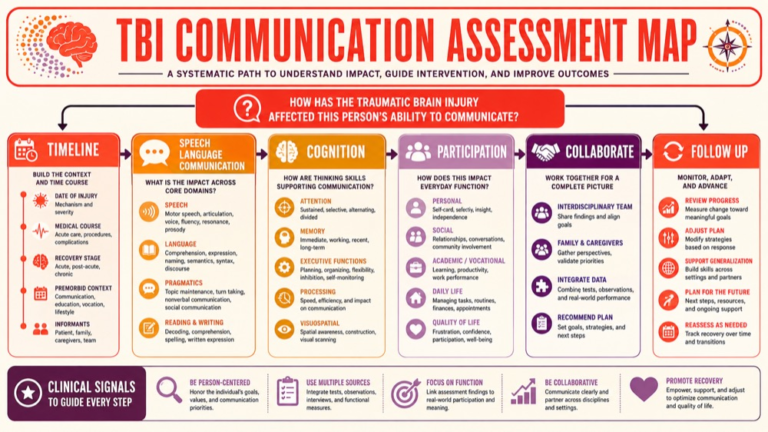
traumatic brain injury communication assessment is easier to study when it is treated as a connected clinical reasoning problem rather than a label to memorize. Traumatic brain injury communication assessment is not a single test of one skill. A person may speak clearly in a quiet session and still miss information during a fast team meeting, organize a complex explanation poorly when fatigued, or need support to monitor a social interaction. The SLP describes speech, language, cognition, swallowing, and participation evidence within the available medical history and collaborates on questions that require medical or team expertise.
This learning guide is written for SLP students and other learners reviewing U.S. speech-language pathology concepts. It organizes purpose, assessment, access, evidence, function, and professional judgment; it does not make an individualized diagnosis or replace current guidance. Interpretation depends on the person, task, language, culture, health, access, partner, context, and communication goals.
What traumatic brain injury communication assessment means
Begin by separating the concept into domains. A learner who can name the domains is less likely to collapse a score, task, symptom, access barrier, partner effect, or professional boundary into one explanation. The useful unit of analysis is the activity: what the person was asked to understand, express, organize, coordinate, remember, produce, or decide, with whom, under which conditions, and with what support.
Domain or system
What to notice
Question to carry forward
Medical timeline
Injury history, recovery stage, symptoms, medications, sleep, pain, hearing, and prior communication establish the assessment context.
What baseline and current conditions matter?
Communication domains
Speech, language, cognitive-communication, social communication, and swallowing may each require targeted questions.
Which domain is limiting the activity?
Cognitive demands
Attention, memory, processing speed, organization, inhibition, self-monitoring, and problem solving affect communication.
What does the task require the person to manage?
Functional sample
Conversation, education, work, health care, home, and community tasks show the relationship between impairment and participation.
Where does the change create a meaningful barrier?
Collaboration and referral
The SLP works with medical, rehabilitation, educational, vocational, family, and other team perspectives as indicated.
Which question belongs to another professional or shared team?
Follow-up
Recovery and context can change; repeated observation and functional monitoring may be more informative than one snapshot.
What should be monitored and when?
These domains interact, but they should remain distinguishable. A learner may show strength in one context and need support in another. A study map organizes the next observation; it does not answer every assessment question or establish a universal treatment, goal, legal conclusion, or medical explanation.
Keep the first pass descriptive and close to the communication event. Note the task, response, partner, setting, timing, available support, language or mode, and consequence for participation. This gives the learner a stable record to compare across tasks and prevents a familiar term from doing too much explanatory work before the evidence has been separated.
For Praxis-style review, a vignette may include several true details but ask for one best interpretation or next step. The strongest answer usually respects the task, identifies the relevant function or boundary, checks the most important missing information, and avoids treating one performance sample or policy phrase as the whole profile.
Map traumatic brain injury communication assessment
For study purposes, describe the target skill, response, or measurement before naming a disorder, selecting a goal, or deciding that a tool fits. Record what the person understood, expressed, initiated, repaired, coordinated, produced, or participated in. Then note whether the task was familiar, how much context was shared, and which support changed the response.
Timeline: document injury information available, prior abilities, current symptoms, recovery stage, fatigue, sleep, pain, and medication context.
Domains: screen and assess speech, language, cognition, social communication, swallowing, and access according to the referral question.
Demand: map attention, memory, speed, organization, inhibition, self-monitoring, and partner demands in the activity.
Function: sample home, school, work, health-care, community, and self-advocacy routines that matter to the person.
Collaboration: distinguish SLP communication findings from medical diagnosis and coordinate referrals, supports, and consent.
Monitoring: record change, context, support, fatigue, and participation over time so follow-up answers a real question.
A strong description is specific enough that another learner could picture the event. Instead of writing “the score is low” or “the clinician can do this,” describe the construct, task, response, language or mode, partner, context, competence or access condition, and result. This protects clinical reasoning from labels that are broader than the evidence.
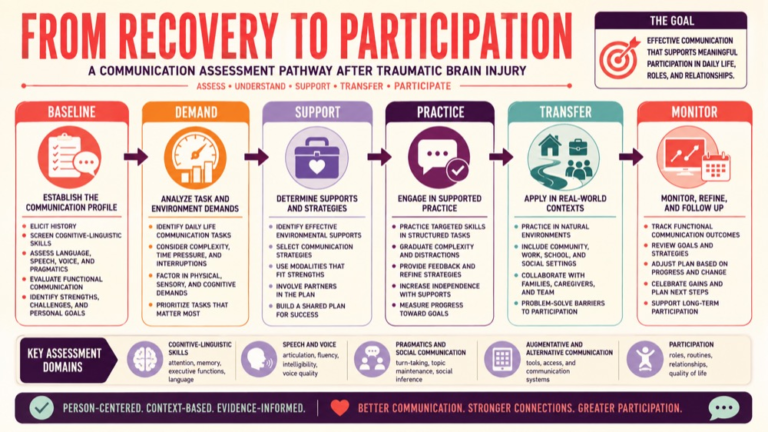
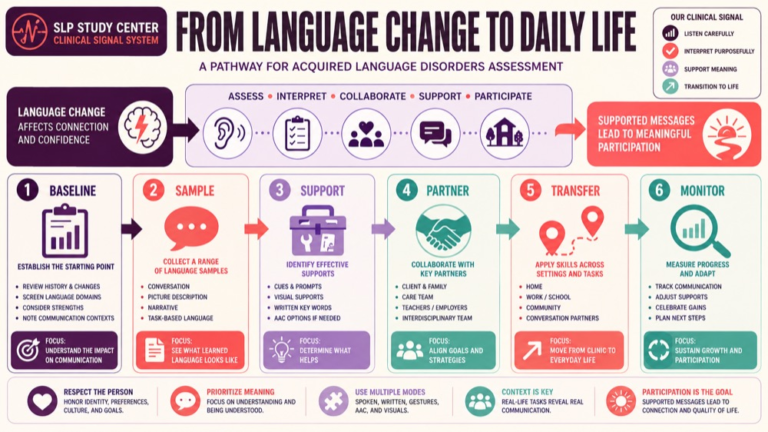
From assessment findings to recovery and participation support
Context changes what assessment and professional decisions require. A direct question, long explanation, group exchange, classroom task, health-care interaction, family story, noisy routine, supervised procedure, or referral decision places different demands on processing, language, memory, hearing, access, partner behavior, competence, and regulation. Language experience, visual information, fatigue, health literacy, and the opportunity to request clarification should be part of the observation.
Traumatic brain injury communication assessment is not a single test of one skill. A person may speak clearly in a quiet session and still miss information during a fast team meeting, organize a complex explanation poorly when fatigued, or need support to monitor a social interaction. The SLP describes speech, language, cognition, swallowing, and participation evidence within the available medical history and collaborates on questions that require medical or team expertise.
Interpretation layer
Example question
Task and construct
What did the person need to understand, express, organize, coordinate, produce, decide, or provide?
Language and access
Which language, dialect, mode, hearing condition, tool, support, or communication partner was available?
Measurement and context
What score type, norm, cutoff, reference, administration, setting, or partner factor affects meaning?
Participation and safety
What meaningful routine, role, outcome, or risk became easier or harder because of the pattern?
Context is not an afterthought added once a label has been selected. It is part of the question itself. If performance or decision quality changes with a quieter room, extra processing time, a familiar partner, a different language or mode, an interpreter, visual information, supervision, collaboration, a changed task, or a changed routine, that change is useful evidence about access and demand. It does not identify a cause by itself, but it tells you which conditions should be carried into the next observation.
Apply traumatic brain injury communication assessment reasoning
When a Praxis-style scenario or clinical discussion presents traumatic brain injury communication assessment, use a disciplined sequence. The goal is to select the next clinical question or action that matches the evidence, the person’s priorities, the communication context, the measurement limits, and the relevant professional boundary.
Define the task, construct, language, mode, communication purpose, or service responsibility in plain language.
Identify the relevant domain: language, speech, voice, swallowing, cognition, access, partner, participation, assessment, competence, collaboration, ethics, or regulation.
Separate observation from interpretation and write down what remains unknown.
Check history, exposure, dialect, culture, identity, interpreter access, environment, sensory load, memory, task familiarity, training, supervision, and local requirements as relevant.
Choose the assessment, collaboration, accommodation, goal, training, referral, or documentation step that answers the specific question.
State the boundary of the conclusion and keep the person’s safety, autonomy, access, and participation visible.
Traumatic brain injury communication assessment is not a single test of one skill. A person may speak clearly in a quiet session and still miss information during a fast team meeting, organize a complex explanation poorly when fatigued, or need support to monitor a social interaction. The SLP describes speech, language, cognition, swallowing, and participation evidence within the available medical history and collaborates on questions that require medical or team expertise. In a learning answer, the decisive evidence is usually the relationship among the task, the observed or measured pattern, the context, and the next needed information—not a single isolated behavior, score, label, or broad permission statement.
Common study mistakes
Choosing a tool or task before stating the decision it is meant to inform.
Treating one score, cutoff, symptom, or observation as the complete profile.
Failing to document language, dialect, culture, hearing, access, fatigue, partner, setting, or task conditions.
Confusing a screening result with a comprehensive assessment or a medical explanation.
Reporting a number without its score type, norm group, construct, reliability, error, or reference conditions.
Ignoring the person's communication mode, preferences, participation priorities, or caregiver and team perspective.
Using a measure outside its intended population or transferring research evidence without checking applicability.
Writing a conclusion that exceeds the evidence instead of naming the next question and its boundary.
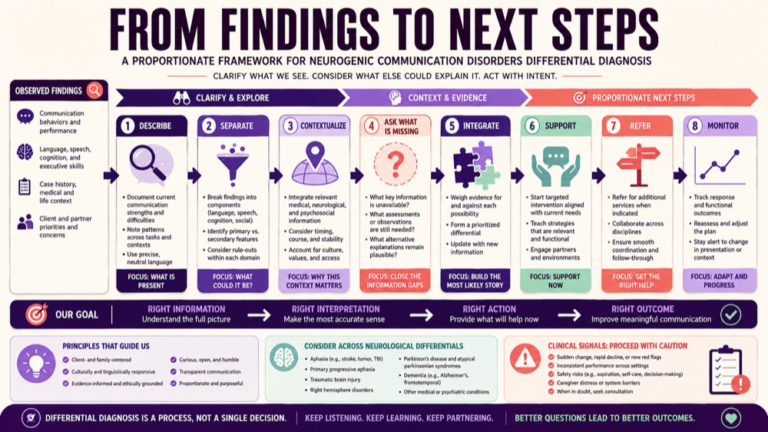
Most of these mistakes come from replacing a multidomain question with a fast label. Correct the habit by returning to the same sequence: describe, separate, contextualize, ask what is missing, and choose a proportionate next step. A short rationale can make the habit visible: identify the evidence, name the uncertainty, and explain why the selected next step fits the person, setting, and responsibility.
Build a quick review map
Use this compact map when reviewing a missed question, lecture note, or clinical vignette:
Step 1: Name the person, task, referral question, setting, and decision.
Step 2: Separate the construct or domain from broader function, cause, diagnosis, and participation.
Step 3: Record language, dialect, culture, hearing, access, partner, fatigue, support, and administration conditions.
Step 4: Identify what the selected tool or observation can show and what it cannot answer.
Step 6: Choose the next assessment, support, collaboration, referral, or monitoring step and state its rationale.
Then write one transfer sentence: “When I see this pattern, I will first check ___ because ___.” The sentence should identify a decision rule, not repeat a definition. Revisit it after a delay and test whether you can apply the rule to a different task, age group, partner, language, setting, or professional responsibility.
Sources and next steps
traumatic brain injury communication assessment is best learned as a context-sensitive pattern across assessment, access, identity, function, participation, evidence, and professional judgment. Use the current authority pages to refine the concept, then return to practice scenarios that require you to explain what the evidence supports and what it leaves open.
Right Hemisphere Disorder Assessment: Attention, Pragmatics, Discourse, and Participation
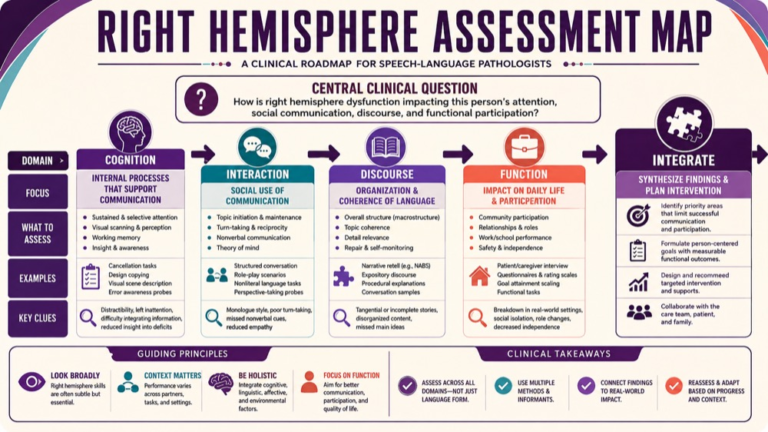
right hemisphere disorder assessment is easier to study when it is treated as a connected clinical reasoning problem rather than a label to memorize. Right hemisphere disorder assessment often requires the clinician to look beyond isolated naming or sentence tasks. A person may produce grammatically adequate sentences while missing an implied meaning, losing a topic, overlooking a listener's perspective, or failing to monitor how a message lands in conversation. The assessment should describe the task and partner conditions, include cognitive-communication and discourse evidence, and leave room for motor speech, hearing, language, mood, and environmental contributors.
This learning guide is written for SLP students and other learners reviewing U.S. speech-language pathology concepts. It organizes purpose, assessment, access, evidence, function, and professional judgment; it does not make an individualized diagnosis or replace current guidance. Interpretation depends on the person, task, language, culture, health, access, partner, context, and communication goals.
What right hemisphere disorder assessment means
Begin by separating the concept into domains. A learner who can name the domains is less likely to collapse a score, task, symptom, access barrier, partner effect, or professional boundary into one explanation. The useful unit of analysis is the activity: what the person was asked to understand, express, organize, coordinate, remember, produce, or decide, with whom, under which conditions, and with what support.
Domain or system
What to notice
Question to carry forward
Attention and awareness
Assessment may examine attention, awareness, organization, self-monitoring, and how these processes affect communication tasks.
What cognitive-communication demand is present?
Pragmatics
Turn-taking, topic maintenance, inference, humor, perspective, prosody, and repair may need observation across partners and settings.
How is the interaction working for both partners?
Discourse
Narratives, explanations, conversation, and problem solving can reveal organization, relevance, cohesion, and listener support needs.
What does the discourse sample require?
Speech and oral motor
Speech subsystems, prosody, oral motor observations, and diadochokinetic tasks may complement the cognitive-communication profile.
Which motor-speech question is actually being asked?
Functional context
Home, work, health-care, community, and family routines create different demands for self-monitoring and partner coordination.
Where does the communication difference matter?
Team interpretation
Findings are integrated with history, report, observation, standardized or informal measures, and participation goals.
What support or collaboration follows?
These domains interact, but they should remain distinguishable. A learner may show strength in one context and need support in another. A study map organizes the next observation; it does not answer every assessment question or establish a universal treatment, goal, legal conclusion, or medical explanation.
Keep the first pass descriptive and close to the communication event. Note the task, response, partner, setting, timing, available support, language or mode, and consequence for participation. This gives the learner a stable record to compare across tasks and prevents a familiar term from doing too much explanatory work before the evidence has been separated.
For Praxis-style review, a vignette may include several true details but ask for one best interpretation or next step. The strongest answer usually respects the task, identifies the relevant function or boundary, checks the most important missing information, and avoids treating one performance sample or policy phrase as the whole profile.
Map right hemisphere assessment
For study purposes, describe the target skill, response, or measurement before naming a disorder, selecting a goal, or deciding that a tool fits. Record what the person understood, expressed, initiated, repaired, coordinated, produced, or participated in. Then note whether the task was familiar, how much context was shared, and which support changed the response.
Attention: observe alertness, selective or sustained attention, shifting, divided demands, and the effect on a communication activity.
Discourse: sample conversation, narrative, explanation, and problem solving with meaningful content and clear conditions.
Motor speech: include oral motor, prosody, phonation, articulation, and rate observations when the question warrants them.
Context: compare familiar and less familiar partners, quiet and busy routines, and supported and less supported tasks.
Participation: translate the pattern into communication supports, partner strategies, referral, and monitoring.
A strong description is specific enough that another learner could picture the event. Instead of writing “the score is low” or “the clinician can do this,” describe the construct, task, response, language or mode, partner, context, competence or access condition, and result. This protects clinical reasoning from labels that are broader than the evidence.
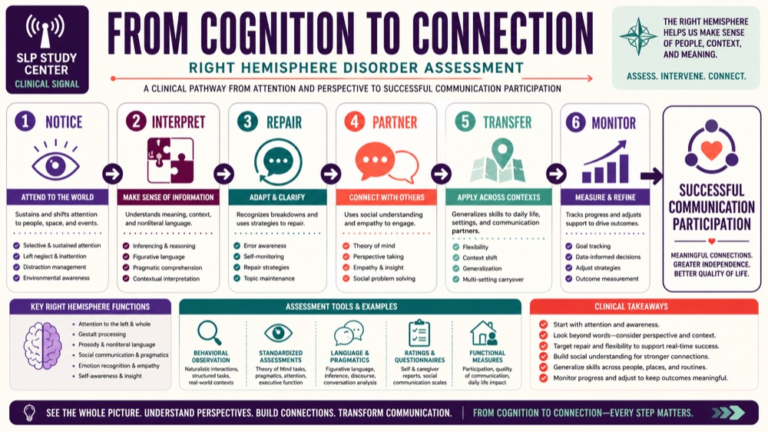
From cognitive-communication findings to participation support
Context changes what assessment and professional decisions require. A direct question, long explanation, group exchange, classroom task, health-care interaction, family story, noisy routine, supervised procedure, or referral decision places different demands on processing, language, memory, hearing, access, partner behavior, competence, and regulation. Language experience, visual information, fatigue, health literacy, and the opportunity to request clarification should be part of the observation.
Right hemisphere disorder assessment often requires the clinician to look beyond isolated naming or sentence tasks. A person may produce grammatically adequate sentences while missing an implied meaning, losing a topic, overlooking a listener's perspective, or failing to monitor how a message lands in conversation. The assessment should describe the task and partner conditions, include cognitive-communication and discourse evidence, and leave room for motor speech, hearing, language, mood, and environmental contributors.
Interpretation layer
Example question
Task and construct
What did the person need to understand, express, organize, coordinate, produce, decide, or provide?
Language and access
Which language, dialect, mode, hearing condition, tool, support, or communication partner was available?
Measurement and context
What score type, norm, cutoff, reference, administration, setting, or partner factor affects meaning?
Participation and safety
What meaningful routine, role, outcome, or risk became easier or harder because of the pattern?
Context is not an afterthought added once a label has been selected. It is part of the question itself. If performance or decision quality changes with a quieter room, extra processing time, a familiar partner, a different language or mode, an interpreter, visual information, supervision, collaboration, a changed task, or a changed routine, that change is useful evidence about access and demand. It does not identify a cause by itself, but it tells you which conditions should be carried into the next observation.
Apply right hemisphere disorder assessment reasoning
When a Praxis-style scenario or clinical discussion presents right hemisphere disorder assessment, use a disciplined sequence. The goal is to select the next clinical question or action that matches the evidence, the person’s priorities, the communication context, the measurement limits, and the relevant professional boundary.
Define the task, construct, language, mode, communication purpose, or service responsibility in plain language.
Identify the relevant domain: language, speech, voice, swallowing, cognition, access, partner, participation, assessment, competence, collaboration, ethics, or regulation.
Separate observation from interpretation and write down what remains unknown.
Check history, exposure, dialect, culture, identity, interpreter access, environment, sensory load, memory, task familiarity, training, supervision, and local requirements as relevant.
Choose the assessment, collaboration, accommodation, goal, training, referral, or documentation step that answers the specific question.
State the boundary of the conclusion and keep the person’s safety, autonomy, access, and participation visible.
Right hemisphere disorder assessment often requires the clinician to look beyond isolated naming or sentence tasks. A person may produce grammatically adequate sentences while missing an implied meaning, losing a topic, overlooking a listener's perspective, or failing to monitor how a message lands in conversation. The assessment should describe the task and partner conditions, include cognitive-communication and discourse evidence, and leave room for motor speech, hearing, language, mood, and environmental contributors. In a learning answer, the decisive evidence is usually the relationship among the task, the observed or measured pattern, the context, and the next needed information—not a single isolated behavior, score, label, or broad permission statement.
Common study mistakes
Choosing a tool or task before stating the decision it is meant to inform.
Treating one score, cutoff, symptom, or observation as the complete profile.
Failing to document language, dialect, culture, hearing, access, fatigue, partner, setting, or task conditions.
Confusing a screening result with a comprehensive assessment or a medical explanation.
Reporting a number without its score type, norm group, construct, reliability, error, or reference conditions.
Ignoring the person's communication mode, preferences, participation priorities, or caregiver and team perspective.
Using a measure outside its intended population or transferring research evidence without checking applicability.
Writing a conclusion that exceeds the evidence instead of naming the next question and its boundary.
Most of these mistakes come from replacing a multidomain question with a fast label. Correct the habit by returning to the same sequence: describe, separate, contextualize, ask what is missing, and choose a proportionate next step. A short rationale can make the habit visible: identify the evidence, name the uncertainty, and explain why the selected next step fits the person, setting, and responsibility.
Build a quick review map
Use this compact map when reviewing a missed question, lecture note, or clinical vignette:
Step 1: Name the person, task, referral question, setting, and decision.
Step 2: Separate the construct or domain from broader function, cause, diagnosis, and participation.
Step 3: Record language, dialect, culture, hearing, access, partner, fatigue, support, and administration conditions.
Step 4: Identify what the selected tool or observation can show and what it cannot answer.
Step 6: Choose the next assessment, support, collaboration, referral, or monitoring step and state its rationale.
Then write one transfer sentence: “When I see this pattern, I will first check ___ because ___.” The sentence should identify a decision rule, not repeat a definition. Revisit it after a delay and test whether you can apply the rule to a different task, age group, partner, language, setting, or professional responsibility.
Sources and next steps
right hemisphere disorder assessment is best learned as a context-sensitive pattern across assessment, access, identity, function, participation, evidence, and professional judgment. Use the current authority pages to refine the concept, then return to practice scenarios that require you to explain what the evidence supports and what it leaves open.
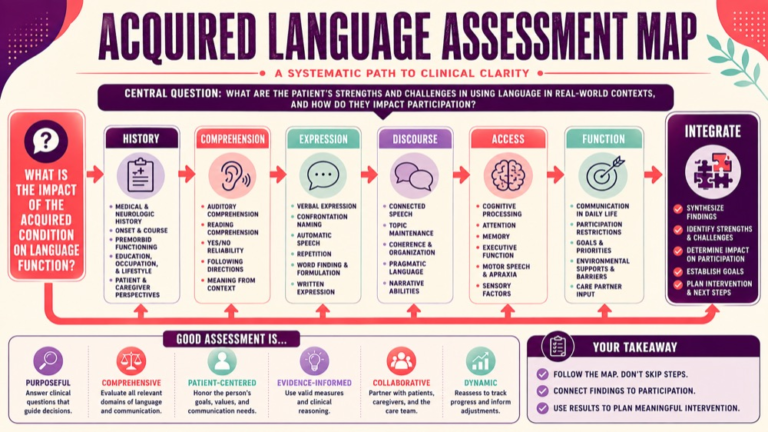
Acquired Language Disorders Assessment: History, Language Profile, and Function
acquired language disorders assessment is easier to study when it is treated as a connected clinical reasoning problem rather than a label to memorize. Acquired language disorders assessment is strongest when it reconstructs both the change and the communication life around it. A short naming task may reveal one part of access to words, while conversation, reading, writing, discourse, and supported communication show how the person manages real messages. History, language exposure, literacy, hearing, fatigue, and partner expectations can alter performance. The SLP uses this pattern to prioritize meaningful questions and document what remains uncertain.
This learning guide is written for SLP students and other learners reviewing U.S. speech-language pathology concepts. It organizes purpose, assessment, access, evidence, function, and professional judgment; it does not make an individualized diagnosis or replace current guidance. Interpretation depends on the person, task, language, culture, health, access, partner, context, and communication goals.
What acquired language disorders assessment means
Begin by separating the concept into domains. A learner who can name the domains is less likely to collapse a score, task, symptom, access barrier, partner effect, or professional boundary into one explanation. The useful unit of analysis is the activity: what the person was asked to understand, express, organize, coordinate, remember, produce, or decide, with whom, under which conditions, and with what support.
Domain or system
What to notice
Question to carry forward
Onset and history
Acquired language concerns are interpreted with timing, medical events, prior communication, education, languages, and recovery or change over time.
What changed, when, and against which baseline?
Language domains
Comprehension, expression, naming, repetition, discourse, reading, writing, and symbolic communication can reveal different patterns.
Which domains were actually sampled?
Task and support
Response may vary with cueing, visual information, written choices, partner style, time, fatigue, and communication mode.
What support changed access or performance?
Functional communication
Conversation, medical decisions, work, family roles, self-advocacy, and daily routines show why the profile matters.
Which participation outcome is most important?
Language and culture
Multilingual history, dialect, literacy, cultural routines, and interpreter access influence fair assessment and interpretation.
Is the assessment representative and accessible?
Dynamic integration
A comprehensive profile combines standardized or informal measures, samples, observation, report, and response to support.
What next question does the combined evidence create?
These domains interact, but they should remain distinguishable. A learner may show strength in one context and need support in another. A study map organizes the next observation; it does not answer every assessment question or establish a universal treatment, goal, legal conclusion, or medical explanation.
Keep the first pass descriptive and close to the communication event. Note the task, response, partner, setting, timing, available support, language or mode, and consequence for participation. This gives the learner a stable record to compare across tasks and prevents a familiar term from doing too much explanatory work before the evidence has been separated.
For Praxis-style review, a vignette may include several true details but ask for one best interpretation or next step. The strongest answer usually respects the task, identifies the relevant function or boundary, checks the most important missing information, and avoids treating one performance sample or policy phrase as the whole profile.
Map acquired language assessment
For study purposes, describe the target skill, response, or measurement before naming a disorder, selecting a goal, or deciding that a tool fits. Record what the person understood, expressed, initiated, repaired, coordinated, produced, or participated in. Then note whether the task was familiar, how much context was shared, and which support changed the response.
History: establish onset, health, baseline communication, education, work, languages, literacy, services, and change over time.
Access: vary support, response mode, time, visual information, partner, language, and environment when clinically appropriate.
Function: connect findings to conversation, health care, work, family, community, self-advocacy, and daily routines.
Perspective: include the person, communication partners, interpreters, and team members without treating one viewpoint as complete.
Integration: distinguish a descriptive language profile from etiology, prognosis, treatment response, and participation planning.
A strong description is specific enough that another learner could picture the event. Instead of writing “the score is low” or “the clinician can do this,” describe the construct, task, response, language or mode, partner, context, competence or access condition, and result. This protects clinical reasoning from labels that are broader than the evidence.
From language findings to functional communication planning
Context changes what assessment and professional decisions require. A direct question, long explanation, group exchange, classroom task, health-care interaction, family story, noisy routine, supervised procedure, or referral decision places different demands on processing, language, memory, hearing, access, partner behavior, competence, and regulation. Language experience, visual information, fatigue, health literacy, and the opportunity to request clarification should be part of the observation.
Acquired language disorders assessment is strongest when it reconstructs both the change and the communication life around it. A short naming task may reveal one part of access to words, while conversation, reading, writing, discourse, and supported communication show how the person manages real messages. History, language exposure, literacy, hearing, fatigue, and partner expectations can alter performance. The SLP uses this pattern to prioritize meaningful questions and document what remains uncertain.
Interpretation layer
Example question
Task and construct
What did the person need to understand, express, organize, coordinate, produce, decide, or provide?
Language and access
Which language, dialect, mode, hearing condition, tool, support, or communication partner was available?
Measurement and context
What score type, norm, cutoff, reference, administration, setting, or partner factor affects meaning?
Participation and safety
What meaningful routine, role, outcome, or risk became easier or harder because of the pattern?
Context is not an afterthought added once a label has been selected. It is part of the question itself. If performance or decision quality changes with a quieter room, extra processing time, a familiar partner, a different language or mode, an interpreter, visual information, supervision, collaboration, a changed task, or a changed routine, that change is useful evidence about access and demand. It does not identify a cause by itself, but it tells you which conditions should be carried into the next observation.
Apply acquired language disorders assessment reasoning
When a Praxis-style scenario or clinical discussion presents acquired language disorders assessment, use a disciplined sequence. The goal is to select the next clinical question or action that matches the evidence, the person’s priorities, the communication context, the measurement limits, and the relevant professional boundary.
Define the task, construct, language, mode, communication purpose, or service responsibility in plain language.
Identify the relevant domain: language, speech, voice, swallowing, cognition, access, partner, participation, assessment, competence, collaboration, ethics, or regulation.
Separate observation from interpretation and write down what remains unknown.
Check history, exposure, dialect, culture, identity, interpreter access, environment, sensory load, memory, task familiarity, training, supervision, and local requirements as relevant.
Choose the assessment, collaboration, accommodation, goal, training, referral, or documentation step that answers the specific question.
State the boundary of the conclusion and keep the person’s safety, autonomy, access, and participation visible.
Acquired language disorders assessment is strongest when it reconstructs both the change and the communication life around it. A short naming task may reveal one part of access to words, while conversation, reading, writing, discourse, and supported communication show how the person manages real messages. History, language exposure, literacy, hearing, fatigue, and partner expectations can alter performance. The SLP uses this pattern to prioritize meaningful questions and document what remains uncertain. In a learning answer, the decisive evidence is usually the relationship among the task, the observed or measured pattern, the context, and the next needed information—not a single isolated behavior, score, label, or broad permission statement.
Common study mistakes
Choosing a tool or task before stating the decision it is meant to inform.
Treating one score, cutoff, symptom, or observation as the complete profile.
Failing to document language, dialect, culture, hearing, access, fatigue, partner, setting, or task conditions.
Confusing a screening result with a comprehensive assessment or a medical explanation.
Reporting a number without its score type, norm group, construct, reliability, error, or reference conditions.
Ignoring the person's communication mode, preferences, participation priorities, or caregiver and team perspective.
Using a measure outside its intended population or transferring research evidence without checking applicability.
Writing a conclusion that exceeds the evidence instead of naming the next question and its boundary.
Most of these mistakes come from replacing a multidomain question with a fast label. Correct the habit by returning to the same sequence: describe, separate, contextualize, ask what is missing, and choose a proportionate next step. A short rationale can make the habit visible: identify the evidence, name the uncertainty, and explain why the selected next step fits the person, setting, and responsibility.
Build a quick review map
Use this compact map when reviewing a missed question, lecture note, or clinical vignette:
Step 1: Name the person, task, referral question, setting, and decision.
Step 2: Separate the construct or domain from broader function, cause, diagnosis, and participation.
Step 3: Record language, dialect, culture, hearing, access, partner, fatigue, support, and administration conditions.
Step 4: Identify what the selected tool or observation can show and what it cannot answer.
Step 6: Choose the next assessment, support, collaboration, referral, or monitoring step and state its rationale.
Then write one transfer sentence: “When I see this pattern, I will first check ___ because ___.” The sentence should identify a decision rule, not repeat a definition. Revisit it after a delay and test whether you can apply the rule to a different task, age group, partner, language, setting, or professional responsibility.
Sources and next steps
acquired language disorders assessment is best learned as a context-sensitive pattern across assessment, access, identity, function, participation, evidence, and professional judgment. Use the current authority pages to refine the concept, then return to practice scenarios that require you to explain what the evidence supports and what it leaves open.
Start with asha aphasia, asha assessment tools, asha culture, asha tbi, ets 5331. These sources support the learning frame; they do not replace current topic-specific guidance, an individualized evaluation, or applicable state and setting requirements.
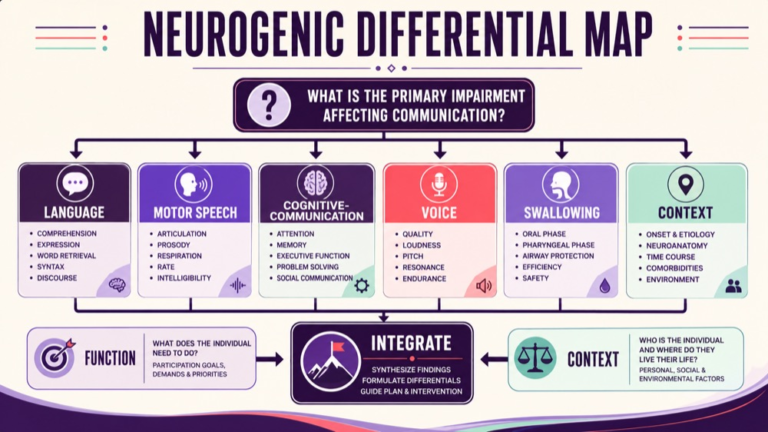
Neurogenic Communication Disorders Differential Diagnosis: A Structured SLP Reasoning Map
neurogenic communication disorders differential diagnosis is easier to study when it is treated as a connected clinical reasoning problem rather than a label to memorize. A person with a new communication change may have more than one relevant domain. Word-finding difficulty can coexist with motor-speech changes, cognitive-communication demands, hearing differences, fatigue, or reduced access to a familiar communication routine. A broad referral label should therefore open the assessment rather than finish it. The SLP describes the observed task, samples relevant domains, asks which missing evidence would change the decision, and collaborates when the medical or functional question extends beyond one discipline.
This learning guide is written for SLP students and other learners reviewing U.S. speech-language pathology concepts. It organizes purpose, assessment, access, evidence, function, and professional judgment; it does not make an individualized diagnosis or replace current guidance. Interpretation depends on the person, task, language, culture, health, access, partner, context, and communication goals.
What neurogenic communication disorders differential diagnosis means
Begin by separating the concept into domains. A learner who can name the domains is less likely to collapse a score, task, symptom, access barrier, partner effect, or professional boundary into one explanation. The useful unit of analysis is the activity: what the person was asked to understand, express, organize, coordinate, remember, produce, or decide, with whom, under which conditions, and with what support.
Domain or system
What to notice
Question to carry forward
Referral question
The referral may describe a broad change, but the assessment question should identify the communication or swallowing activity that needs explanation.
What decision must the evidence inform?
Language profile
Aphasia-related evidence can include comprehension, expression, naming, repetition, reading, writing, discourse, and functional communication.
Which language processes and contexts are involved?
Motor speech
Dysarthria and apraxia questions use speech subsystems, planning or programming observations, intelligibility, and connected speech.
Is the task asking about execution, planning, language, or an interaction?
Cognitive-communication
Attention, memory, executive function, discourse, pragmatics, and self-monitoring can change communication without reducing the problem to one label.
What cognitive-communication demand is visible?
Medical and access context
Neurologic history, hearing, language, fatigue, medications, environment, partner behavior, and communication mode shape the sample.
What context changes the meaning of the performance?
Integration
Differential reasoning links descriptive findings to the next assessment, collaboration, referral, support, or monitoring step.
What remains open, and who should answer it?
These domains interact, but they should remain distinguishable. A learner may show strength in one context and need support in another. A study map organizes the next observation; it does not answer every assessment question or establish a universal treatment, goal, legal conclusion, or medical explanation.
Keep the first pass descriptive and close to the communication event. Note the task, response, partner, setting, timing, available support, language or mode, and consequence for participation. This gives the learner a stable record to compare across tasks and prevents a familiar term from doing too much explanatory work before the evidence has been separated.
For Praxis-style review, a vignette may include several true details but ask for one best interpretation or next step. The strongest answer usually respects the task, identifies the relevant function or boundary, checks the most important missing information, and avoids treating one performance sample or policy phrase as the whole profile.
Map the neurogenic communication differential
For study purposes, describe the target skill, response, or measurement before naming a disorder, selecting a goal, or deciding that a tool fits. Record what the person understood, expressed, initiated, repaired, coordinated, produced, or participated in. Then note whether the task was familiar, how much context was shared, and which support changed the response.
Question: define the referral concern, communication activity, person, setting, and decision before selecting a label.
Language: examine comprehension, expression, naming, repetition, discourse, reading, writing, and functional message exchange as relevant.
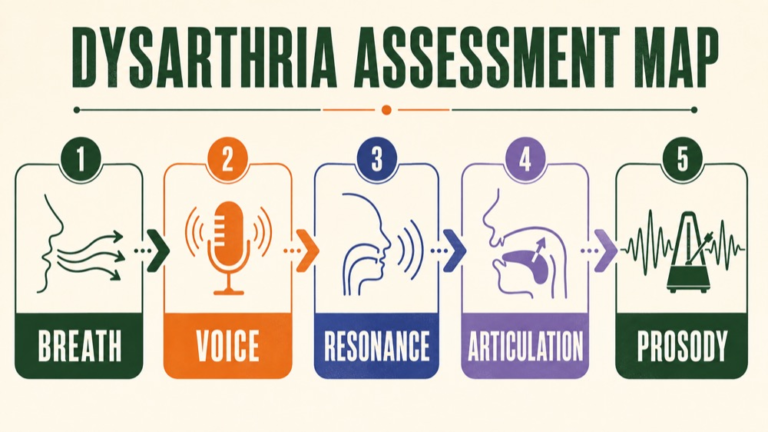
Motor speech: separate respiration, phonation, resonance, articulation, prosody, planning, programming, and execution observations.
Cognition and pragmatics: consider attention, memory, organization, self-monitoring, discourse, social inference, and partner demands.
Integration: state what the evidence supports, what it cannot answer, and the proportionate next clinical or team step.
A strong description is specific enough that another learner could picture the event. Instead of writing “the score is low” or “the clinician can do this,” describe the construct, task, response, language or mode, partner, context, competence or access condition, and result. This protects clinical reasoning from labels that are broader than the evidence.
From findings to a coordinated neurogenic communication plan
Context changes what assessment and professional decisions require. A direct question, long explanation, group exchange, classroom task, health-care interaction, family story, noisy routine, supervised procedure, or referral decision places different demands on processing, language, memory, hearing, access, partner behavior, competence, and regulation. Language experience, visual information, fatigue, health literacy, and the opportunity to request clarification should be part of the observation.
A person with a new communication change may have more than one relevant domain. Word-finding difficulty can coexist with motor-speech changes, cognitive-communication demands, hearing differences, fatigue, or reduced access to a familiar communication routine. A broad referral label should therefore open the assessment rather than finish it. The SLP describes the observed task, samples relevant domains, asks which missing evidence would change the decision, and collaborates when the medical or functional question extends beyond one discipline.
Interpretation layer
Example question
Task and construct
What did the person need to understand, express, organize, coordinate, produce, decide, or provide?
Language and access
Which language, dialect, mode, hearing condition, tool, support, or communication partner was available?
Measurement and context
What score type, norm, cutoff, reference, administration, setting, or partner factor affects meaning?
Participation and safety
What meaningful routine, role, outcome, or risk became easier or harder because of the pattern?
Context is not an afterthought added once a label has been selected. It is part of the question itself. If performance or decision quality changes with a quieter room, extra processing time, a familiar partner, a different language or mode, an interpreter, visual information, supervision, collaboration, a changed task, or a changed routine, that change is useful evidence about access and demand. It does not identify a cause by itself, but it tells you which conditions should be carried into the next observation.
Apply neurogenic communication disorders differential diagnosis reasoning
When a Praxis-style scenario or clinical discussion presents neurogenic communication disorders differential diagnosis, use a disciplined sequence. The goal is to select the next clinical question or action that matches the evidence, the person’s priorities, the communication context, the measurement limits, and the relevant professional boundary.
Define the task, construct, language, mode, communication purpose, or service responsibility in plain language.
Identify the relevant domain: language, speech, voice, swallowing, cognition, access, partner, participation, assessment, competence, collaboration, ethics, or regulation.
Separate observation from interpretation and write down what remains unknown.
Check history, exposure, dialect, culture, identity, interpreter access, environment, sensory load, memory, task familiarity, training, supervision, and local requirements as relevant.
Choose the assessment, collaboration, accommodation, goal, training, referral, or documentation step that answers the specific question.
State the boundary of the conclusion and keep the person’s safety, autonomy, access, and participation visible.
A person with a new communication change may have more than one relevant domain. Word-finding difficulty can coexist with motor-speech changes, cognitive-communication demands, hearing differences, fatigue, or reduced access to a familiar communication routine. A broad referral label should therefore open the assessment rather than finish it. The SLP describes the observed task, samples relevant domains, asks which missing evidence would change the decision, and collaborates when the medical or functional question extends beyond one discipline. In a learning answer, the decisive evidence is usually the relationship among the task, the observed or measured pattern, the context, and the next needed information—not a single isolated behavior, score, label, or broad permission statement.
Common study mistakes
Choosing a tool or task before stating the decision it is meant to inform.
Treating one score, cutoff, symptom, or observation as the complete profile.
Failing to document language, dialect, culture, hearing, access, fatigue, partner, setting, or task conditions.
Confusing a screening result with a comprehensive assessment or a medical explanation.
Reporting a number without its score type, norm group, construct, reliability, error, or reference conditions.
Ignoring the person's communication mode, preferences, participation priorities, or caregiver and team perspective.
Using a measure outside its intended population or transferring research evidence without checking applicability.
Writing a conclusion that exceeds the evidence instead of naming the next question and its boundary.
Most of these mistakes come from replacing a multidomain question with a fast label. Correct the habit by returning to the same sequence: describe, separate, contextualize, ask what is missing, and choose a proportionate next step. A short rationale can make the habit visible: identify the evidence, name the uncertainty, and explain why the selected next step fits the person, setting, and responsibility.
Build a quick review map
Use this compact map when reviewing a missed question, lecture note, or clinical vignette:
Step 1: Name the person, task, referral question, setting, and decision.
Step 2: Separate the construct or domain from broader function, cause, diagnosis, and participation.
Step 3: Record language, dialect, culture, hearing, access, partner, fatigue, support, and administration conditions.
Step 4: Identify what the selected tool or observation can show and what it cannot answer.
Step 6: Choose the next assessment, support, collaboration, referral, or monitoring step and state its rationale.
Then write one transfer sentence: “When I see this pattern, I will first check ___ because ___.” The sentence should identify a decision rule, not repeat a definition. Revisit it after a delay and test whether you can apply the rule to a different task, age group, partner, language, setting, or professional responsibility.
Sources and next steps
neurogenic communication disorders differential diagnosis is best learned as a context-sensitive pattern across assessment, access, identity, function, participation, evidence, and professional judgment. Use the current authority pages to refine the concept, then return to practice scenarios that require you to explain what the evidence supports and what it leaves open.
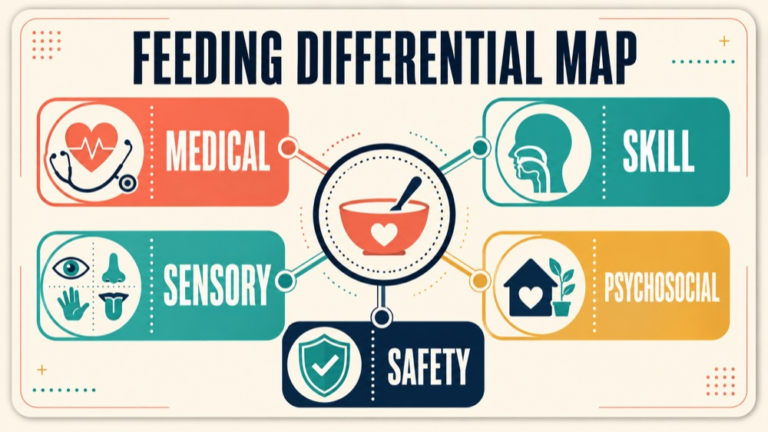
Pediatric Feeding Differential Diagnosis: Medical, Skill, and Psychosocial Clues
pediatric feeding differential diagnosis is a way to organize why a child may have difficulty eating or drinking without forcing every sign into one explanation. It separates the feeding event, the swallowing question, the child’s development, the medical and nutritional context, the feeding skills involved, the psychosocial environment, and the next information needed. Pediatric feeding disorder and dysphagia are distinct diagnoses that may co-occur, so a useful differential map keeps both the overlap and the distinction visible.
This guide is for SLP students and other learners reviewing clinical concepts. It does not make an individualized diagnosis, select a diet, or replace current professional guidance. A child’s communication, culture, family routines, sensory experiences, health, development, and participation all affect how feeding evidence should be interpreted.
What pediatric feeding differential diagnosis means
Start by separating feeding from the narrower question of swallowing. Feeding includes the broader experience of eating and drinking, including accepting food, preparing it, chewing or sucking, moving it through the mouth, swallowing, managing the mealtime routine, and obtaining enough nourishment and hydration. Dysphagia focuses on swallowing impairment, while pediatric feeding disorder can involve impaired oral intake that is not age appropriate and may be related to medical, nutritional, feeding-skill, or psychosocial factors. The categories help organize assessment; they do not turn one behavior into a diagnosis.
Question area
What to examine
What the learner should avoid
Medical
Medical history, gastrointestinal or aerodigestive concerns, structural findings, respiratory status, neurologic conditions, cardiac history, medications, and current stability.
Assuming the mealtime pattern identifies one medical cause without medical and team evidence.
Nutritional
Nutrition and hydration, growth or intake concerns, metabolic factors, appetite, medication effects, energy needs, and access to sufficient intake across settings.
Treating intake quantity as the only measure of feeding function or choosing a plan without the appropriate team.
Calling every refusal a skill deficit or inferring pharyngeal physiology from behavior alone.
Psychosocial and environment
Child and caregiver stress, mealtime interaction, routines, distractions, expectations, hunger and satiety cues, family practice, and participation with peers.
Describing food avoidance as bad behavior or ignoring the context that may maintain or reduce difficulty.
The same observable event can lead to different questions. A child who turns away from a spoon may be communicating satiety, discomfort, sensory sensitivity, lack of readiness, pain, fatigue, a learned expectation, or a preference. A prolonged meal may reflect feeding skill, endurance, positioning, distraction, scheduling, medical status, or the time available at school. The observation matters, but the interpretation must stay proportional to the evidence.
For Praxis 5331 study, remember the relationship among age and developmental status, medical or surgical history, assessment method, differential diagnosis, interpretation of data, and referral. A strong answer names the decision being made and selects the information that can answer it. It does not substitute a memorized label for a child-specific assessment question.
Map pediatric feeding differential diagnosis
A practical map begins with the child’s usual feeding event. Note what is offered, how it is offered, how the child responds, who is present, what support is available, and what happens to safety, efficiency, nutrition, hydration, comfort, and participation. Then sort the evidence into the four contributing areas while allowing more than one area to be relevant.
Psychosocial: consider stress, anxiety, caregiver–child interaction, expectations, routines, distractions, and the meaning of food avoidance.
Development: compare feeding skills with the child’s developmental level and current medical or motor status rather than age alone.
Culture and family practice: include familiar foods, utensils, positioning, dietary beliefs, religious practice, language, and family priorities.
Environment: examine seating, posture, schedule, sensory load, television or devices, peer context, and the time available for eating.
Function and participation: connect the pattern with comfort, meals, school access, peer inclusion, caregiver burden, autonomy, and quality of life.
This map is useful because it prevents a narrow answer. Medical and feeding-skill factors may coexist. A child may have a swallowing impairment and also experience stress around meals. A child may eat a limited range of foods because of sensory or skill factors, a medical history, family routines, or a combination of influences. The learner’s job is to describe what is known, identify what is uncertain, and choose the next proportionate assessment or referral.
From feeding evidence to a coordinated plan
Clinical evaluation should resemble the child’s meaningful feeding context as closely as safety and competence allow. Case history and record review can clarify birth, medical, developmental, growth, respiratory, gastrointestinal, allergy, medication, and feeding history. Interviews with caregivers and professionals can show how the pattern changes across people, foods, settings, and routines. Observation of eating or being fed can reveal what happens with familiar foods, typical utensils, usual positioning, and the supports the family actually uses.
Assessment layer
Question it can help answer
History and interview
When did the concern begin, what changes it, and how does it affect health, routines, family interaction, and participation?
Clinical observation
What happens with alertness, posture, oral structures, chewing, bolus control, secretion management, respiration, and fatigue?
Trial of support
Does a carefully selected change in positioning, utensil, texture, pacing, schedule, or cueing change the observed task, and what remains unknown?
Team and referral
Which medical, nutrition, occupational therapy, physical therapy, behavioral health, educational, or family perspective is needed?
Instrumental evaluation
Is more information needed about anatomy or swallowing physiology after clinical evaluation to determine the plan of care?
Instrumental assessment is not a default response to every feeding concern. ASHA describes VFSS and FEES as common pediatric instrumental evaluations when more information is needed about the presence and pathophysiology of dysphagia. The decision depends on the clinical question, suspected or documented impairment, medical stability, participation skills, and whether the findings are needed to determine care. A repeat study should be tied to a change in status or a new information need rather than an arbitrary schedule.
Referral boundaries matter in differential reasoning. An SLP may assess feeding and swallowing and collaborate with the team, but suspected eating disorders such as avoidant/restrictive food intake disorder require referral to appropriate behavioral health professionals. Medical, nutrition, respiratory, dental, occupational therapy, physical therapy, nursing, educational, and psychosocial questions may require other professionals. The best plan makes the handoff visible instead of treating one discipline as the explanation for every domain.
When a Praxis-style scenario presents a child with feeding or swallowing difficulty, work through the decision in sequence. The question is often not simply what the child has; it is which evidence, assessment, referral, or team action best fits the concern and the child’s current condition.
Define the event: state whether the concern involves accepting food, oral preparation, swallowing, intake, nutrition, hydration, mealtime interaction, or participation.
Locate the pattern: identify the medical, nutritional, feeding-skill, psychosocial, developmental, cultural, or environmental clues without forcing a single category.
Check safety and stability: consider alertness, respiratory status, posture, fatigue, secretion management, and the child’s ability to participate.
Separate observation from inference: record what was seen or reported and identify whether anatomy, physiology, etiology, or eating-disorder expertise remains outside the current evidence.
Choose the next information: select history, interview, observation, tool, dynamic trial, instrumental evaluation, medical examination, nutrition review, or referral that answers the specific question.
Keep function visible: connect the plan with nourishment, hydration, comfort, family routines, school access, peer inclusion, caregiver support, autonomy, and quality of life.
Imagine a child who takes a long time to finish lunch and occasionally holds food in the mouth. The strongest first step is not to label the child from those two observations. Ask about the child’s developmental level, typical foods, oral skills, posture, alertness, fatigue, medical history, respiratory changes, school schedule, caregiver report, and whether the pattern is consistent across settings. Then decide whether clinical assessment, team referral, or more specific swallowing information is needed. The reasoning remains open until the evidence supports a narrower conclusion.
For exam review, compare answer choices by asking which one matches the level of certainty. A broad educational suggestion may be premature if the stem signals a medical or safety question. An instrumental procedure may be excessive if the stem asks about an initial feeding history. A behavior-focused explanation may miss the child’s communication, sensory, developmental, or medical context. The best choice is usually the one that answers the stated question while respecting safety, scope, and referral boundaries.
Common study mistakes
Using pediatric feeding disorder and dysphagia as interchangeable terms when the distinction matters to the question.
Assuming one food refusal, cough, prolonged meal, or oral-motor behavior identifies one cause.
Ignoring the four contributing areas by focusing only on oral motor skill or only on caregiver behavior.
Interpreting a child’s feeding pattern without considering development, medical stability, nutrition, hydration, fatigue, posture, or respiratory status.
Replacing the family’s familiar foods, utensils, positioning, language, and routines with an artificial task and then treating the result as the whole profile.
Assuming a clinical observation can answer every question about pharyngeal anatomy or swallowing physiology.
Using an adult dysphagia framework without adapting the assessment to pediatric development, caregiver participation, and family context.
Failing to refer or collaborate when the concern includes medical, nutrition, behavioral health, occupational therapy, physical therapy, educational, or other professional needs.
These mistakes come from treating a multidomain feeding problem as a quick label. Correct the habit by returning to the event, the evidence, the context, the uncertainty, and the next responsible action. A good study explanation can be concise while still naming what is observed, what is suspected, what needs confirmation, and who should be involved.
Build a quick review map
Use this compact map when reviewing a missed feeding and swallowing question:
Step 1: Define the concern and the child’s feeding, swallowing, nutrition, hydration, comfort, or participation outcome.
Step 2: Sort clues into medical, nutritional, feeding-skill, psychosocial, developmental, cultural, environmental, and functional domains.
Step 3: Compare the report with a safe observation of typical foods, utensils, positioning, caregivers, schedule, and setting.
Step 4: Decide what clinical evaluation can answer and what requires instrumental, medical, nutritional, behavioral health, or other professional input.
Step 5: Check whether a support changes the task while keeping the child’s communication, autonomy, family priorities, and safety in view.
Step 6: Write the next step and its boundary: what will be assessed, who will collaborate, what remains uncertain, and how the plan will be monitored.
Then write one transfer sentence: When I see this pattern, I will first check ___ because ___. The sentence should identify a decision rule rather than repeat a definition. Revisit it with a different age, food texture, caregiver, medical history, cultural routine, or setting so that the reasoning remains flexible.
Sources and next steps
pediatric feeding differential diagnosis is best learned as a structured but flexible way to connect feeding events with development, health, skills, family context, participation, assessment, and referral. Use the current authority pages below to deepen the concept, then practice explaining why a particular next step fits the evidence and why a tempting shortcut does not.
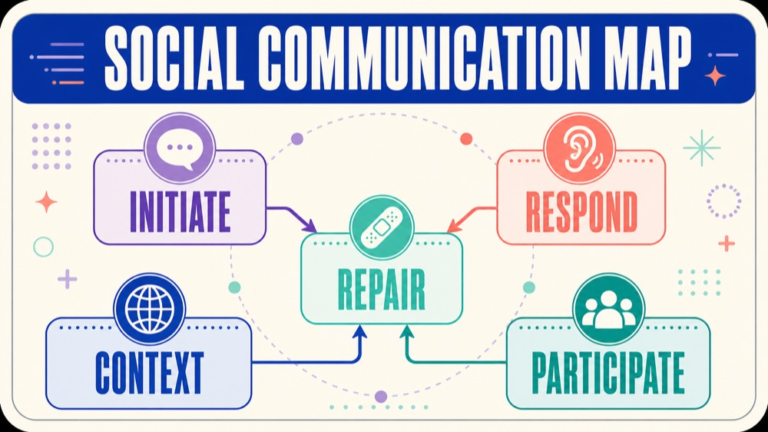
Social Communication Assessment: Interaction, Pragmatics, Context, and Participation
social communication assessment is easier to study when it is treated as a connected clinical reasoning problem rather than a label to memorize. Social communication assessment examines how a person uses and understands communication with other people in context. The SLP considers social interaction, social cognition, pragmatics, language processing, conversation, nonliteral language, prosody, gesture, topic management, repair, and participation across settings. Interviews, observations, report measures, language samples, formal tools, hearing information, and dynamic response may answer different questions. The goal is a fair description of communication effectiveness and support needs, not a universal checklist of social behavior.
This learning guide is written for SLP students and other learners reviewing clinical concepts. It organizes observation, access, assessment, function, and professional judgment; it does not make an individualized diagnosis or replace current professional guidance. Interpretation depends on the person, task, language, culture, health, access, partner, context, and communication goals.
What social communication assessment means
Begin by separating the concept into domains. A learner who can name the domains is less likely to collapse language, access, partner, participation, competence, regulation, and clinical judgment into one explanation. The useful unit of analysis is the task: what the person was asked to understand, express, organize, coordinate, remember, or communicate, with whom, under which conditions, and with what support.
Domain or system
What to notice
Question to carry forward
Social interaction
Initiating, responding, sharing attention, turn-taking, reciprocity, and adapting to a partner shape the exchange.
What happens between the person, partner, and activity?
Social cognition
Interpreting perspectives, emotions, intentions, context, and implied meaning can change how a message is understood.
Which interpretation demand is present?
Pragmatics
Language choices, conversational organization, repair, topic management, and communicative functions connect form with purpose.
What is the person trying to accomplish with communication?
Language processing
Vocabulary, grammar, discourse, inference, rate, memory, and comprehension may affect social communication without being identical to pragmatics.
Which language process changes the interaction?
Context and norms
Culture, language, dialect, identity, power, partner, setting, familiarity, and sensory access shape what communication means.
Which norm and environment should guide interpretation?
Functional evidence
Observation, interview, self-report, caregiver or teacher report, dynamic tasks, and participation data show where support matters.
What changes in real routines and relationships?
These domains interact, but they should remain distinguishable. A learner may show strength in one context and need support in another. A study map organizes the next observation; it does not answer every assessment question or establish a universal treatment, goal, or legal conclusion.
Keep the first pass descriptive and close to the communication event. Note the task, response, partner, setting, timing, available support, language or mode, and consequence for participation. This gives the learner a stable record to compare across tasks and prevents a familiar term from doing too much explanatory work before the evidence has been separated.
For Praxis-style review, a vignette may include several true details but ask for one best interpretation or next step. The strongest answer usually respects the task, identifies the relevant function or boundary, checks the most important missing information, and avoids treating one performance sample or policy phrase as the whole profile.
Map social communication assessment
For study purposes, describe the communication relationship before naming a disorder, judging a partner, selecting a goal, or deciding that a task is within scope. Record what the person understood, expressed, initiated, repaired, coordinated, or participated in. Then note whether the task was familiar, how much context was shared, and which support changed the response.
Interaction: observe initiation, response, reciprocity, joint attention, turn-taking, partner adaptation, and communication repair.
Social cognition: consider perspective, emotion, intention, inference, nonliteral language, and the information available in context.
Pragmatics: examine topic management, communicative functions, language choice, prosody, gesture, narrative, and conversational fit.
Language processing: sample vocabulary, grammar, discourse, comprehension, rate, memory, and the language demand embedded in the task.
Context: account for culture, language, dialect, identity, power, familiarity, sensory access, partner, environment, and opportunity.
Function: connect formal and informal evidence with school, work, family, peer, community, self-advocacy, and participation goals.
A strong description is specific enough that another learner could picture the event. Instead of writing “the communication is impaired” or “the clinician can do this,” describe the demand, observable response, language or mode, partner, context, competence or access condition, and result. This protects clinical reasoning from labels that are broader than the evidence.
From a social communication profile to a functional plan
Context changes what communication and professional decisions require. A direct question, long explanation, group exchange, classroom task, health-care interaction, family story, noisy routine, supervised procedure, or referral decision places different demands on processing, language, memory, hearing, access, partner behavior, competence, and regulation. Language experience, visual information, fatigue, health literacy, and the opportunity to request clarification should be part of the observation.
A student may answer direct questions accurately but struggle to maintain a shared topic during group work. Another person may communicate effectively with a familiar partner while finding an unfamiliar health-care conversation difficult because the context, power relationship, rate, and repair demands change. A person may also use a communication style that differs from a clinician’s expectations but works well within the person’s community. The assessment should describe the task, partner, purpose, and outcome before deciding which support or additional question is needed.
Observation layer
Example question
Task
What did the person or clinician need to understand, express, organize, coordinate, decide, or provide?
Language and access
Which language, dialect, mode, hearing condition, tool, support, or communication partner was available?
Context and responsibility
Who was involved, what did they know, and which role, policy, ethical, or environmental factor mattered?
Participation and safety
What meaningful routine, role, outcome, or risk became easier or harder because of the pattern?
Context is not an afterthought added once a label has been selected. It is part of the question itself. If performance or decision quality changes with a quieter room, extra processing time, a familiar partner, a different language or mode, an interpreter, visual information, supervision, collaboration, a changed task, or a changed routine, that change is useful evidence about access and demand. It does not identify a cause by itself, but it tells you which conditions should be carried into the next observation.
Apply social communication assessment reasoning
When a Praxis-style scenario or clinical discussion presents social communication assessment, use a disciplined sequence. The goal is to select the next clinical question or action that matches the evidence, the person’s priorities, the communication context, and the relevant professional boundary.
Define the task, language, mode, communication purpose, or service responsibility in plain language.
Identify the relevant domain: language, access, partner, participation, assessment, competence, collaboration, ethics, or regulation.
Separate observation from interpretation and write down what remains unknown.
Check history, exposure, dialect, culture, identity, interpreter access, environment, sensory load, memory, task familiarity, training, supervision, and local requirements as relevant.
Choose the assessment, collaboration, accommodation, goal, training, referral, or documentation step that answers the specific question.
State the boundary of the conclusion and keep the person’s safety, autonomy, access, and participation visible.
A student may answer direct questions accurately but struggle to maintain a shared topic during group work. Another person may communicate effectively with a familiar partner while finding an unfamiliar health-care conversation difficult because the context, power relationship, rate, and repair demands change. A person may also use a communication style that differs from a clinician’s expectations but works well within the person’s community. The assessment should describe the task, partner, purpose, and outcome before deciding which support or additional question is needed. In a learning answer, the decisive evidence is usually the relationship among the task, the observed pattern, the context, and the next needed information—not a single isolated behavior, score, label, or broad permission statement.
Common study mistakes
Reducing social communication assessment to eye contact, one conversational rule, or a list of isolated behaviors.
Treating social interaction, social cognition, pragmatics, and language processing as interchangeable constructs.
Ignoring culture, language, dialect, identity, power, community norms, partner familiarity, and communication purpose.
Using a structured test without observing natural interaction, functional routines, self-report, or partner perspectives.
Treating a correct response as sufficient evidence of perspective-taking or an unusual response as evidence of a disorder without examining the task and context.
Skipping hearing, language, attention, memory, speech, AAC, sensory access, and other factors that change social communication opportunities.
Choosing goals that make a person appear more typical instead of improving access, autonomy, relationships, and meaningful participation.
Failing to state what is observed, what is inferred, what remains uncertain, and which support changes the exchange.
Most of these mistakes come from replacing a multidomain question with a fast label. Correct the habit by returning to the same sequence: describe, separate, contextualize, ask what is missing, and choose a proportionate next step. A short rationale can make the habit visible: identify the evidence, name the uncertainty, and explain why the selected next step fits the person, setting, and responsibility.
Build a quick review map
Use this compact map when reviewing a missed question, lecture note, or clinical vignette:
Step 1: Define the communication purpose, partner, setting, culture, language, and participation decision.
Step 2: Map interaction, social cognition, pragmatics, language processing, speech, and access without collapsing the domains.
Step 3: Combine observation, interview, report, self-report, formal or informal measures, language samples, and dynamic response.
Step 5: Describe what changes across settings and which supports improve communication effectiveness or autonomy.
Step 6: Choose a person-centered intervention, accommodation, monitoring, collaboration, or referral next step.
Then write one transfer sentence: “When I see this pattern, I will first check ___ because ___.” The sentence should identify a decision rule, not repeat a definition. Revisit it after a delay and test whether you can apply the rule to a different task, age group, partner, language, setting, or professional responsibility.
Sources and next steps
social communication assessment is best learned as a context-sensitive pattern across communication, access, identity, function, participation, competence, and professional judgment. Use the current authority pages to refine the concept, then return to practice scenarios that require you to explain what the evidence supports and what it leaves open.
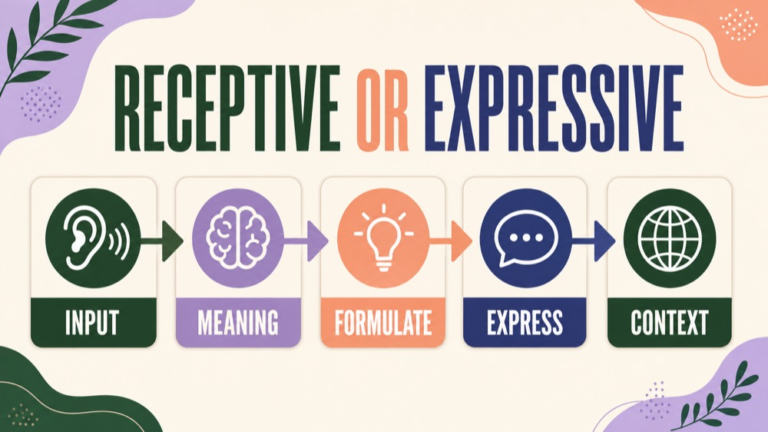
Receptive vs Expressive Language Disorder Assessment: Understanding and Expression
receptive vs expressive language disorder assessment is easier to study when it is treated as a connected clinical reasoning problem rather than a label to memorize. Receptive vs expressive language disorder assessment separates what a learner understands from what the learner communicates while recognizing that the two systems interact. The SLP examines phonology, semantics, morphology, syntax, pragmatics, discourse, comprehension, expression, task demands, language history, hearing, access, culture, and functional participation. A learner may understand more than can be expressed, express familiar ideas but miss complex directions, or show variable performance across contexts; the assessment should describe that pattern rather than rely on one task.
This learning guide is written for SLP students and other learners reviewing clinical concepts. It organizes observation, access, assessment, function, and professional judgment; it does not make an individualized diagnosis or replace current professional guidance. Interpretation depends on the person, task, language, culture, health, access, partner, context, and communication goals.
What receptive vs expressive language disorder assessment means
Begin by separating the concept into domains. A learner who can name the domains is less likely to collapse language, access, partner, participation, competence, regulation, and clinical judgment into one explanation. The useful unit of analysis is the task: what the person was asked to understand, express, organize, coordinate, remember, or communicate, with whom, under which conditions, and with what support.
Domain or system
What to notice
Question to carry forward
Receptive language
Understanding words, grammar, sentences, directions, questions, discourse, and implied meaning depends on task and context.
What message or language form was available to understand?
Expressive language
Selecting words, combining forms, organizing sentences, telling stories, explaining, and repairing communicate meaning to another person.
What does the learner need to express, and how?
Language domains
Phonology, semantics, morphology, syntax, pragmatics, discourse, and narrative can contribute to comprehension and expression.
Which domain is driving the task demand?
Access and conditions
Hearing, vision, attention, memory, language, dialect, mode, time, partner, and visual information alter opportunity and response.
Which conditions changed performance?
Evidence sources
Formal measures, observation, report, language samples, dynamic assessment, and functional tasks answer different questions.
Which source best fits this decision?
Function and integration
The result connects with classroom, home, work, peer, health-care, self-advocacy, literacy, and participation needs.
What support or next assessment is meaningful?
These domains interact, but they should remain distinguishable. A learner may show strength in one context and need support in another. A study map organizes the next observation; it does not answer every assessment question or establish a universal treatment, goal, or legal conclusion.
Keep the first pass descriptive and close to the communication event. Note the task, response, partner, setting, timing, available support, language or mode, and consequence for participation. This gives the learner a stable record to compare across tasks and prevents a familiar term from doing too much explanatory work before the evidence has been separated.
For Praxis-style review, a vignette may include several true details but ask for one best interpretation or next step. The strongest answer usually respects the task, identifies the relevant function or boundary, checks the most important missing information, and avoids treating one performance sample or policy phrase as the whole profile.
Map receptive versus expressive language assessment
For study purposes, describe the communication relationship before naming a disorder, judging a partner, selecting a goal, or deciding that a task is within scope. Record what the person understood, expressed, initiated, repaired, coordinated, or participated in. Then note whether the task was familiar, how much context was shared, and which support changed the response.
Receptive: examine word, sentence, discourse, question, narrative, instruction, and implied-meaning understanding.
Expressive: examine vocabulary, grammar, sentence formulation, narrative, explanation, discourse, repair, and communication mode.
Language system: connect phonology, semantics, morphology, syntax, pragmatics, literacy, and context rather than treating one score as the system.
Access: check hearing, vision, attention, memory, fatigue, language, dialect, culture, partner, time, mode, and support.
Assessment fit: combine formal, informal, report, observation, sample, dynamic, and functional evidence for the question.
A strong description is specific enough that another learner could picture the event. Instead of writing “the communication is impaired” or “the clinician can do this,” describe the demand, observable response, language or mode, partner, context, competence or access condition, and result. This protects clinical reasoning from labels that are broader than the evidence.
From language evidence to a functional support plan
Context changes what communication and professional decisions require. A direct question, long explanation, group exchange, classroom task, health-care interaction, family story, noisy routine, supervised procedure, or referral decision places different demands on processing, language, memory, hearing, access, partner behavior, competence, and regulation. Language experience, visual information, fatigue, health literacy, and the opportunity to request clarification should be part of the observation.
A student may follow a familiar one-step direction but lose the meaning of a long, abstract classroom explanation. Another may understand the teacher’s question but use short or incomplete language when explaining the answer. A child may also communicate more effectively with a familiar partner, visual support, extra time, or a different language. Receptive and expressive labels help organize evidence, but the meaningful conclusion describes which forms, tasks, partners, and supports change communication.
Observation layer
Example question
Task
What did the person or clinician need to understand, express, organize, coordinate, decide, or provide?
Language and access
Which language, dialect, mode, hearing condition, tool, support, or communication partner was available?
Context and responsibility
Who was involved, what did they know, and which role, policy, ethical, or environmental factor mattered?
Participation and safety
What meaningful routine, role, outcome, or risk became easier or harder because of the pattern?
Context is not an afterthought added once a label has been selected. It is part of the question itself. If performance or decision quality changes with a quieter room, extra processing time, a familiar partner, a different language or mode, an interpreter, visual information, supervision, collaboration, a changed task, or a changed routine, that change is useful evidence about access and demand. It does not identify a cause by itself, but it tells you which conditions should be carried into the next observation.
Apply receptive and expressive reasoning
When a Praxis-style scenario or clinical discussion presents receptive vs expressive language disorder assessment, use a disciplined sequence. The goal is to select the next clinical question or action that matches the evidence, the person’s priorities, the communication context, and the relevant professional boundary.
Define the task, language, mode, communication purpose, or service responsibility in plain language.
Identify the relevant domain: language, access, partner, participation, assessment, competence, collaboration, ethics, or regulation.
Separate observation from interpretation and write down what remains unknown.
Check history, exposure, dialect, culture, identity, interpreter access, environment, sensory load, memory, task familiarity, training, supervision, and local requirements as relevant.
Choose the assessment, collaboration, accommodation, goal, training, referral, or documentation step that answers the specific question.
State the boundary of the conclusion and keep the person’s safety, autonomy, access, and participation visible.
A student may follow a familiar one-step direction but lose the meaning of a long, abstract classroom explanation. Another may understand the teacher’s question but use short or incomplete language when explaining the answer. A child may also communicate more effectively with a familiar partner, visual support, extra time, or a different language. Receptive and expressive labels help organize evidence, but the meaningful conclusion describes which forms, tasks, partners, and supports change communication. In a learning answer, the decisive evidence is usually the relationship among the task, the observed pattern, the context, and the next needed information—not a single isolated behavior, score, label, or broad permission statement.
Common study mistakes
Treating receptive and expressive language as completely separate systems with no interaction or shared context.
Assuming a correct answer demonstrates complete comprehension or an incomplete response demonstrates a broad expressive disorder.
Using vocabulary or sentence imitation alone to represent all phonology, semantics, morphology, syntax, pragmatics, and discourse.
Testing only one language, mode, setting, or partner and generalizing to every communication routine.
Confusing limited opportunity, unfamiliar content, response mode, or motor access with a language impairment.
Treating a score or label as a prediction of classroom, home, peer, work, or health-care participation.
Failing to describe strengths, variability, functional impact, and a support or assessment step that the learner can use.
Most of these mistakes come from replacing a multidomain question with a fast label. Correct the habit by returning to the same sequence: describe, separate, contextualize, ask what is missing, and choose a proportionate next step. A short rationale can make the habit visible: identify the evidence, name the uncertainty, and explain why the selected next step fits the person, setting, and responsibility.
Build a quick review map
Use this compact map when reviewing a missed question, lecture note, or clinical vignette:
Step 1: Define whether the question concerns understanding, expression, or the interaction of both in a meaningful task.
Step 2: Map the phonology, semantics, morphology, syntax, pragmatics, discourse, and literacy demand.
Step 3: Sample comprehension and expression across formal, informal, conversational, narrative, and functional contexts.
Step 4: Check language, dialect, culture, hearing, access, memory, attention, partner, time, and support conditions.
Step 5: Compare performance with report, observation, language samples, dynamic response, and participation priorities.
Step 6: Choose a focused support, intervention, monitoring, collaboration, or referral step that matches the pattern.
Then write one transfer sentence: “When I see this pattern, I will first check ___ because ___.” The sentence should identify a decision rule, not repeat a definition. Revisit it after a delay and test whether you can apply the rule to a different task, age group, partner, language, setting, or professional responsibility.
Sources and next steps
receptive vs expressive language disorder assessment is best learned as a context-sensitive pattern across communication, access, identity, function, participation, competence, and professional judgment. Use the current authority pages to refine the concept, then return to practice scenarios that require you to explain what the evidence supports and what it leaves open.
Language Disorder vs Speech Sound Disorder Assessment: What the Pattern Shows
language disorder vs speech sound disorder assessment is easier to study when it is treated as a connected clinical reasoning problem rather than a label to memorize. Language disorder vs speech sound disorder assessment compares listening and speaking skills with perception and production of speech sounds while recognizing that both can occur together. The SLP considers phonology, semantics, morphology, syntax, pragmatics, comprehension, expression, speech-sound patterns, intelligibility, hearing, oral structure and function, language history, dialect, and multilingual development. The purpose is to identify the pattern and participation impact, not to force every communication concern into one category.
This learning guide is written for SLP students and other learners reviewing clinical concepts. It organizes observation, access, assessment, function, and professional judgment; it does not make an individualized diagnosis or replace current professional guidance. Interpretation depends on the person, task, language, culture, health, access, partner, context, and communication goals.
What language disorder vs speech sound disorder assessment means
Begin by separating the concept into domains. A learner who can name the domains is less likely to collapse language, access, partner, participation, competence, regulation, and clinical judgment into one explanation. The useful unit of analysis is the task: what the person was asked to understand, express, organize, coordinate, remember, or communicate, with whom, under which conditions, and with what support.
Domain or system
What to notice
Question to carry forward
Language domains
Comprehension and expression can involve phonology, semantics, morphology, syntax, pragmatics, discourse, and narrative.
What does the learner understand and communicate?
Speech sounds
Perception, motor production, individual sound errors, contrasts, word shapes, and connected speech describe speech-sound performance.
Which sound or sound-system pattern is present?
Hearing and oral factors
Hearing screening and oral structure and function help identify contributing or co-occurring questions.
What access or mechanism information is needed?
Sampling
Formal and informal measures, language samples, single words, connected speech, observation, and dynamic response each sample a different question.
Which method fits the decision?
Language difference
Dialect, multilingual development, culture, and language history shape what is expected and how a difference should be interpreted.
Is the pattern unexpected within the person’s linguistic community?
Integrated outcome
Assessment may describe one disorder, both, another concern, or a need for monitoring or referral while connecting with function.
What next step supports participation?
These domains interact, but they should remain distinguishable. A learner may show strength in one context and need support in another. A study map organizes the next observation; it does not answer every assessment question or establish a universal treatment, goal, or legal conclusion.
Keep the first pass descriptive and close to the communication event. Note the task, response, partner, setting, timing, available support, language or mode, and consequence for participation. This gives the learner a stable record to compare across tasks and prevents a familiar term from doing too much explanatory work before the evidence has been separated.
For Praxis-style review, a vignette may include several true details but ask for one best interpretation or next step. The strongest answer usually respects the task, identifies the relevant function or boundary, checks the most important missing information, and avoids treating one performance sample or policy phrase as the whole profile.
Map language versus speech sound assessment
For study purposes, describe the communication relationship before naming a disorder, judging a partner, selecting a goal, or deciding that a task is within scope. Record what the person understood, expressed, initiated, repaired, coordinated, or participated in. Then note whether the task was familiar, how much context was shared, and which support changed the response.
Speech sounds: examine perception, individual production, sound contrasts, patterns, word positions, syllable shapes, and connected speech.
Access and mechanism: consider hearing, oral structure and function, motor speech, vision, language mode, and task familiarity.
Context: compare formal and informal measures, report, observation, language samples, single words, conversation, and dynamic response.
Linguistic profile: account for dialect, multilingual development, language exposure, culture, identity, and interpreter or language access.
Integration: connect the pattern with intelligibility, learning, literacy, participation, intervention, monitoring, collaboration, and referral.
A strong description is specific enough that another learner could picture the event. Instead of writing “the communication is impaired” or “the clinician can do this,” describe the demand, observable response, language or mode, partner, context, competence or access condition, and result. This protects clinical reasoning from labels that are broader than the evidence.
From a communication pattern to an integrated plan
Context changes what communication and professional decisions require. A direct question, long explanation, group exchange, classroom task, health-care interaction, family story, noisy routine, supervised procedure, or referral decision places different demands on processing, language, memory, hearing, access, partner behavior, competence, and regulation. Language experience, visual information, fatigue, health literacy, and the opportunity to request clarification should be part of the observation.
A child may use age-appropriate sentence structures but be difficult to understand because of a speech-sound pattern, or may produce many sounds clearly while struggling to understand directions, organize a story, or use grammar. Another child may show both patterns, and hearing or oral factors may add a separate question. Single-word naming and sound testing cannot answer every language or participation question. The assessment becomes more useful when language and speech-sound evidence are compared without treating them as mutually exclusive.
Observation layer
Example question
Task
What did the person or clinician need to understand, express, organize, coordinate, decide, or provide?
Language and access
Which language, dialect, mode, hearing condition, tool, support, or communication partner was available?
Context and responsibility
Who was involved, what did they know, and which role, policy, ethical, or environmental factor mattered?
Participation and safety
What meaningful routine, role, outcome, or risk became easier or harder because of the pattern?
Context is not an afterthought added once a label has been selected. It is part of the question itself. If performance or decision quality changes with a quieter room, extra processing time, a familiar partner, a different language or mode, an interpreter, visual information, supervision, collaboration, a changed task, or a changed routine, that change is useful evidence about access and demand. It does not identify a cause by itself, but it tells you which conditions should be carried into the next observation.
Apply language and speech-sound reasoning
When a Praxis-style scenario or clinical discussion presents language disorder vs speech sound disorder assessment, use a disciplined sequence. The goal is to select the next clinical question or action that matches the evidence, the person’s priorities, the communication context, and the relevant professional boundary.
Define the task, language, mode, communication purpose, or service responsibility in plain language.
Identify the relevant domain: language, access, partner, participation, assessment, competence, collaboration, ethics, or regulation.
Separate observation from interpretation and write down what remains unknown.
Check history, exposure, dialect, culture, identity, interpreter access, environment, sensory load, memory, task familiarity, training, supervision, and local requirements as relevant.
Choose the assessment, collaboration, accommodation, goal, training, referral, or documentation step that answers the specific question.
State the boundary of the conclusion and keep the person’s safety, autonomy, access, and participation visible.
A child may use age-appropriate sentence structures but be difficult to understand because of a speech-sound pattern, or may produce many sounds clearly while struggling to understand directions, organize a story, or use grammar. Another child may show both patterns, and hearing or oral factors may add a separate question. Single-word naming and sound testing cannot answer every language or participation question. The assessment becomes more useful when language and speech-sound evidence are compared without treating them as mutually exclusive. In a learning answer, the decisive evidence is usually the relationship among the task, the observed pattern, the context, and the next needed information—not a single isolated behavior, score, label, or broad permission statement.
Common study mistakes
Treating unclear speech as proof of a language disorder or treating a language formulation difficulty as an articulation problem.
Testing only single words and missing comprehension, connected speech, discourse, narrative, intelligibility, and participation.
Ignoring co-occurrence and assuming the learner must have either a language disorder or a speech sound disorder, but not both.
Skipping hearing screening, oral examination, language sampling, or dynamic assessment when the question requires it.
Comparing a dialect or multilingual pattern with one English norm and calling the difference a disorder.
Using a score without checking the construct, language, culture, access, administration, and functional relevance.
Ignoring literacy, classroom demand, family communication, peer interaction, and the learner’s strengths.
Failing to translate the integrated profile into a clear intervention, monitoring, collaboration, or referral plan.
Most of these mistakes come from replacing a multidomain question with a fast label. Correct the habit by returning to the same sequence: describe, separate, contextualize, ask what is missing, and choose a proportionate next step. A short rationale can make the habit visible: identify the evidence, name the uncertainty, and explain why the selected next step fits the person, setting, and responsibility.
Build a quick review map
Use this compact map when reviewing a missed question, lecture note, or clinical vignette:
Step 1: Separate the question about language comprehension or expression from the question about speech-sound perception or production.
Step 2: Sample language domains and speech sounds across the tasks that matter to participation.
Step 3: Check hearing, oral structure and function, motor speech, access, language history, dialect, and multilingual development.
Step 5: Allow for co-occurring patterns and state what the evidence supports within the learner’s linguistic community.
Step 6: Choose an integrated support, intervention, monitoring, collaboration, or referral next step.
Then write one transfer sentence: “When I see this pattern, I will first check ___ because ___.” The sentence should identify a decision rule, not repeat a definition. Revisit it after a delay and test whether you can apply the rule to a different task, age group, partner, language, setting, or professional responsibility.
Sources and next steps
language disorder vs speech sound disorder assessment is best learned as a context-sensitive pattern across communication, access, identity, function, participation, competence, and professional judgment. Use the current authority pages to refine the concept, then return to practice scenarios that require you to explain what the evidence supports and what it leaves open.
Speech-Language Diagnosis: How SLPs Connect Evidence to a Communication Profile
speech language diagnosis is easier to study when it is treated as a connected clinical reasoning problem rather than a label to memorize. Speech language diagnosis is a reasoned description of a communication disorder or difference based on an appropriate assessment process, not a label attached to one missed item. The SLP begins with the referral question, selects evidence that fits the person and purpose, separates screening from comprehensive assessment, and considers speech, language, cognition, motor speech, hearing, swallowing, access, and participation. The conclusion should state what the communication evidence supports, what remains uncertain, and when collaboration or referral is needed.
This learning guide is written for SLP students and other learners reviewing clinical concepts. It organizes observation, access, assessment, function, and professional judgment; it does not make an individualized diagnosis or replace current professional guidance. Interpretation depends on the person, task, language, culture, health, access, partner, context, and communication goals.
What speech language diagnosis means
Begin by separating the concept into domains. A learner who can name the domains is less likely to collapse language, access, partner, participation, competence, regulation, and clinical judgment into one explanation. The useful unit of analysis is the task: what the person was asked to understand, express, organize, coordinate, remember, or communicate, with whom, under which conditions, and with what support.
Domain or system
What to notice
Question to carry forward
Referral question
The concern, setting, communication partner, and decision determine what evidence is relevant.
What decision should this assessment inform?
Screening and assessment
Screening identifies possible need for further evaluation; assessment describes communication in enough depth for the decision.
Is this a screen, focused assessment, or comprehensive evaluation?
Communication domains
Speech, language, cognition, motor speech, hearing, voice, fluency, feeding, and swallowing may interact but remain distinguishable.
Which domain is directly supported by the observed pattern?
Evidence and fit
History, interview, observation, samples, formal and informal measures, dynamic response, and functional tasks are interpreted within language, culture, and access.
Does the method fit the person and purpose?
Function and participation
A diagnosis should connect with meaningful communication, safety, autonomy, learning, work, relationships, and care.
How does the communication profile affect daily participation?
Scope and collaboration
SLPs diagnose communication disorders within competence and collaborate or refer when a question exceeds the available evidence or role.
What must be shared, referred, or kept open?
These domains interact, but they should remain distinguishable. A learner may show strength in one context and need support in another. A study map organizes the next observation; it does not answer every assessment question or establish a universal treatment, goal, or legal conclusion.
Keep the first pass descriptive and close to the communication event. Note the task, response, partner, setting, timing, available support, language or mode, and consequence for participation. This gives the learner a stable record to compare across tasks and prevents a familiar term from doing too much explanatory work before the evidence has been separated.
For Praxis-style review, a vignette may include several true details but ask for one best interpretation or next step. The strongest answer usually respects the task, identifies the relevant function or boundary, checks the most important missing information, and avoids treating one performance sample or policy phrase as the whole profile.
Map speech language diagnosis
For study purposes, describe the communication relationship before naming a disorder, judging a partner, selecting a goal, or deciding that a task is within scope. Record what the person understood, expressed, initiated, repaired, coordinated, or participated in. Then note whether the task was familiar, how much context was shared, and which support changed the response.
Question: define the communication concern, context, decision, and person’s priorities before choosing a test.
Evidence: combine history, report, observation, samples, formal and informal measures, dynamic response, and functional tasks.
Differential: separate speech, language, cognition, motor speech, hearing, voice, fluency, feeding, swallowing, access, and language-difference explanations.
Fit: check language, dialect, culture, identity, hearing, vision, motor access, interpreter needs, fatigue, health, and task familiarity.
Function: describe impact on participation, safety, relationships, education, work, health care, self-advocacy, and autonomy.
Boundary: state what the communication evidence supports, what remains open, and when collaboration, referral, or more assessment is appropriate.
A strong description is specific enough that another learner could picture the event. Instead of writing “the communication is impaired” or “the clinician can do this,” describe the demand, observable response, language or mode, partner, context, competence or access condition, and result. This protects clinical reasoning from labels that are broader than the evidence.
From assessment evidence to a defensible communication profile
Context changes what communication and professional decisions require. A direct question, long explanation, group exchange, classroom task, health-care interaction, family story, noisy routine, supervised procedure, or referral decision places different demands on processing, language, memory, hearing, access, partner behavior, competence, and regulation. Language experience, visual information, fatigue, health literacy, and the opportunity to request clarification should be part of the observation.
A referral for unclear speech may lead to a speech-sound or motor-speech question, while a concern about following classroom directions may require language, hearing, attention, or instructional analysis. A communication profile may also coexist with a medical, developmental, neurologic, or sensory condition. The SLP’s conclusion should describe the communication evidence and coordinate the unanswered medical or related-service question instead of treating a communication label as an explanation for every part of the person’s history.
Observation layer
Example question
Task
What did the person or clinician need to understand, express, organize, coordinate, decide, or provide?
Language and access
Which language, dialect, mode, hearing condition, tool, support, or communication partner was available?
Context and responsibility
Who was involved, what did they know, and which role, policy, ethical, or environmental factor mattered?
Participation and safety
What meaningful routine, role, outcome, or risk became easier or harder because of the pattern?
Context is not an afterthought added once a label has been selected. It is part of the question itself. If performance or decision quality changes with a quieter room, extra processing time, a familiar partner, a different language or mode, an interpreter, visual information, supervision, collaboration, a changed task, or a changed routine, that change is useful evidence about access and demand. It does not identify a cause by itself, but it tells you which conditions should be carried into the next observation.
Apply speech-language diagnostic reasoning
When a Praxis-style scenario or clinical discussion presents speech language diagnosis, use a disciplined sequence. The goal is to select the next clinical question or action that matches the evidence, the person’s priorities, the communication context, and the relevant professional boundary.
Define the task, language, mode, communication purpose, or service responsibility in plain language.
Identify the relevant domain: language, access, partner, participation, assessment, competence, collaboration, ethics, or regulation.
Separate observation from interpretation and write down what remains unknown.
Check history, exposure, dialect, culture, identity, interpreter access, environment, sensory load, memory, task familiarity, training, supervision, and local requirements as relevant.
Choose the assessment, collaboration, accommodation, goal, training, referral, or documentation step that answers the specific question.
State the boundary of the conclusion and keep the person’s safety, autonomy, access, and participation visible.
A referral for unclear speech may lead to a speech-sound or motor-speech question, while a concern about following classroom directions may require language, hearing, attention, or instructional analysis. A communication profile may also coexist with a medical, developmental, neurologic, or sensory condition. The SLP’s conclusion should describe the communication evidence and coordinate the unanswered medical or related-service question instead of treating a communication label as an explanation for every part of the person’s history. In a learning answer, the decisive evidence is usually the relationship among the task, the observed pattern, the context, and the next needed information—not a single isolated behavior, score, label, or broad permission statement.
Common study mistakes
Treating speech language diagnosis as a single test score or a label selected before the referral question is defined.
Calling a screening result a diagnosis or using a brief observation as a complete communication evaluation.
Collapsing speech, language, cognition, motor speech, hearing, voice, fluency, feeding, swallowing, and access into one undifferentiated problem.
Ignoring language history, dialect, culture, identity, interpreter access, hearing, vision, motor access, fatigue, or task familiarity.
Describing impairment without connecting the communication pattern to function, participation, safety, autonomy, or the person’s goals.
Using a communication assessment to claim an underlying medical etiology or prognosis that requires another professional or more evidence.
Assuming the profession-wide scope means every individual SLP is prepared or authorized for every population, method, and setting.
Failing to document uncertainty, collaboration, referral, consent, privacy, setting requirements, and the next question.
Most of these mistakes come from replacing a multidomain question with a fast label. Correct the habit by returning to the same sequence: describe, separate, contextualize, ask what is missing, and choose a proportionate next step. A short rationale can make the habit visible: identify the evidence, name the uncertainty, and explain why the selected next step fits the person, setting, and responsibility.
Build a quick review map
Use this compact map when reviewing a missed question, lecture note, or clinical vignette:
Step 1: Define the referral question, person, setting, communication partner, and decision.
Step 2: Choose evidence that fits the domain, language, culture, access, purpose, and participation concern.
Step 3: Separate screening, assessment, communication diagnosis, medical etiology, and prognosis.
Step 4: Compare formal and informal findings with history, reports, observations, samples, dynamic response, and function.
Step 5: Check competence, collaboration, referral, consent, privacy, and current jurisdiction or setting requirements.
Step 6: Write what the evidence supports, what remains open, and which proportionate next action protects participation.
Then write one transfer sentence: “When I see this pattern, I will first check ___ because ___.” The sentence should identify a decision rule, not repeat a definition. Revisit it after a delay and test whether you can apply the rule to a different task, age group, partner, language, setting, or professional responsibility.
Sources and next steps
speech language diagnosis is best learned as a context-sensitive pattern across communication, access, identity, function, participation, competence, and professional judgment. Use the current authority pages to refine the concept, then return to practice scenarios that require you to explain what the evidence supports and what it leaves open.
Dysarthria Assessment: Speech Subsystems, Intelligibility, and Function
dysarthria assessment is easier to study when it is treated as a connected clinical reasoning problem rather than a label to memorize. Dysarthria assessment describes how neuromotor changes affect speech production and communication. The SLP considers respiration, phonation, resonance, articulation, prosody, oral and nonspeech movement, speech samples, intelligibility, comprehensibility, efficiency, language, cognition, swallowing, hearing, and participation. The goal is not to attach a type from one sound; it is to integrate perceptual, functional, historical, and collaborative evidence and define a proportionate next step.
This learning guide is written for SLP students and other learners reviewing clinical concepts. It organizes observation, access, assessment, function, and professional judgment; it does not make an individualized diagnosis or replace current professional guidance. Interpretation depends on the person, task, language, culture, health, access, partner, context, and communication goals.
What dysarthria assessment means
Begin by separating the concept into domains. A learner who can name the domains is less likely to collapse language, access, partner, participation, competence, regulation, and clinical judgment into one explanation. The useful unit of analysis is the task: what the person was asked to understand, express, organize, coordinate, remember, or communicate, with whom, under which conditions, and with what support.
Domain or system
What to notice
Question to carry forward
Case history
Onset, course, medical context, medications, associated language, cognition, swallowing, hearing, and communication needs frame the assessment.
What changed and what matters to the person?
Speech subsystems
Respiration, phonation, resonance, articulation, and prosody interact and may show different strengths and weaknesses.
Which subsystems contribute to the observed speech?
Words, phrases, sentences, reading, spontaneous speech, stress, and connected speech reveal different perceptual and functional features.
What sample best answers the question?
Listener access
Intelligibility, comprehensibility, efficiency, naturalness, partner familiarity, context, and support describe communication impact.
Who understands what, where, and with what support?
Integration and referral
Assessment can inform communication planning, AAC, treatment, collaboration, monitoring, and referral for related services or etiology.
What action fits the supported pattern?
These domains interact, but they should remain distinguishable. A learner may show strength in one context and need support in another. A study map organizes the next observation; it does not answer every assessment question or establish a universal treatment, goal, or legal conclusion.
Keep the first pass descriptive and close to the communication event. Note the task, response, partner, setting, timing, available support, language or mode, and consequence for participation. This gives the learner a stable record to compare across tasks and prevents a familiar term from doing too much explanatory work before the evidence has been separated.
For Praxis-style review, a vignette may include several true details but ask for one best interpretation or next step. The strongest answer usually respects the task, identifies the relevant function or boundary, checks the most important missing information, and avoids treating one performance sample or policy phrase as the whole profile.
Map dysarthria assessment
For study purposes, describe the communication relationship before naming a disorder, judging a partner, selecting a goal, or deciding that a task is within scope. Record what the person understood, expressed, initiated, repaired, coordinated, or participated in. Then note whether the task was familiar, how much context was shared, and which support changed the response.
History: review onset, course, medical and rehabilitation history, medications, associated conditions, communication needs, and person or partner report.
Subsystems: describe respiration, phonation, resonance, articulation, prosody, rate, loudness, pitch, quality, and coordination as relevant.
Oral and nonspeech: consider cranial nerve, oral structure, posture, breathing, tone, speed, range, strength, steadiness, and symmetry within the question.
Speech: sample words, phrases, sentences, reading, spontaneous speech, intelligibility, comprehensibility, efficiency, and change with demand.
Co-occurring factors: assess or refer for language, cognition, swallowing, hearing, vision, fatigue, access, and other communication needs.
Integration: connect speech evidence with participation, quality of life, partner support, AAC, intervention, referral, and culturally responsive interpretation.
A strong description is specific enough that another learner could picture the event. Instead of writing “the communication is impaired” or “the clinician can do this,” describe the demand, observable response, language or mode, partner, context, competence or access condition, and result. This protects clinical reasoning from labels that are broader than the evidence.
From speech subsystems to an integrated dysarthria plan
Context changes what communication and professional decisions require. A direct question, long explanation, group exchange, classroom task, health-care interaction, family story, noisy routine, supervised procedure, or referral decision places different demands on processing, language, memory, hearing, access, partner behavior, competence, and regulation. Language experience, visual information, fatigue, health literacy, and the opportunity to request clarification should be part of the observation.
A speaker may be understood by a familiar family member in a quiet room but difficult to follow in a noisy group or during a longer explanation. Speech may also change with fatigue, medication timing, stress, posture, respiratory demand, or communication pressure. One perceptual sign such as reduced loudness or imprecise articulation can reflect more than one subsystem. Dysarthria assessment makes the speech pattern visible across samples and conditions, then relates it to language, cognition, swallowing, hearing, context, and the person’s communication goals.
Observation layer
Example question
Task
What did the person or clinician need to understand, express, organize, coordinate, decide, or provide?
Language and access
Which language, dialect, mode, hearing condition, tool, support, or communication partner was available?
Context and responsibility
Who was involved, what did they know, and which role, policy, ethical, or environmental factor mattered?
Participation and safety
What meaningful routine, role, outcome, or risk became easier or harder because of the pattern?
Context is not an afterthought added once a label has been selected. It is part of the question itself. If performance or decision quality changes with a quieter room, extra processing time, a familiar partner, a different language or mode, an interpreter, visual information, supervision, collaboration, a changed task, or a changed routine, that change is useful evidence about access and demand. It does not identify a cause by itself, but it tells you which conditions should be carried into the next observation.
Apply dysarthria-assessment reasoning
When a Praxis-style scenario or clinical discussion presents dysarthria assessment, use a disciplined sequence. The goal is to select the next clinical question or action that matches the evidence, the person’s priorities, the communication context, and the relevant professional boundary.
Define the task, language, mode, communication purpose, or service responsibility in plain language.
Identify the relevant domain: language, access, partner, participation, assessment, competence, collaboration, ethics, or regulation.
Separate observation from interpretation and write down what remains unknown.
Check history, exposure, dialect, culture, identity, interpreter access, environment, sensory load, memory, task familiarity, training, supervision, and local requirements as relevant.
Choose the assessment, collaboration, accommodation, goal, training, referral, or documentation step that answers the specific question.
State the boundary of the conclusion and keep the person’s safety, autonomy, access, and participation visible.
A speaker may be understood by a familiar family member in a quiet room but difficult to follow in a noisy group or during a longer explanation. Speech may also change with fatigue, medication timing, stress, posture, respiratory demand, or communication pressure. One perceptual sign such as reduced loudness or imprecise articulation can reflect more than one subsystem. Dysarthria assessment makes the speech pattern visible across samples and conditions, then relates it to language, cognition, swallowing, hearing, context, and the person’s communication goals. In a learning answer, the decisive evidence is usually the relationship among the task, the observed pattern, the context, and the next needed information—not a single isolated behavior, score, label, or broad permission statement.
Common study mistakes
Assigning a dysarthria type from one perceptual feature without considering the full speech subsystem and neurologic profile.
Treating a screening result, isolated oral movement, or one speech sample as a complete diagnosis or severity description.
Failing to assess language, cognition, swallowing, hearing, vision, fatigue, medication effects, or other co-occurring communication needs.
Assuming a familiar listener’s understanding represents all partners, contexts, communication demands, and participation outcomes.
Using English-only expectations or ignoring dialect, accent, multilingual communication, culture, identity, and interpretation access.
Claiming that an SLP speech assessment independently establishes a neurologic or medical etiology beyond communication-disorder scope.
Failing to connect the profile with AAC, partner training, referral, safety, autonomy, function, quality of life, and the person’s goals.
Most of these mistakes come from replacing a multidomain question with a fast label. Correct the habit by returning to the same sequence: describe, separate, contextualize, ask what is missing, and choose a proportionate next step. A short rationale can make the habit visible: identify the evidence, name the uncertainty, and explain why the selected next step fits the person, setting, and responsibility.
Build a quick review map
Use this compact map when reviewing a missed question, lecture note, or clinical vignette:
Step 1: Define the person’s communication concern, onset, context, and functional priorities.
Step 2: Map the five speech subsystems and describe the perceptual and physiologic evidence relevant to the question.
Step 3: Sample speech at more than one meaningful level or condition when the concern requires it.
Step 5: Separate communication diagnosis from medical etiology and identify when interprofessional referral is needed.
Step 6: Create an integrated support, treatment, AAC, collaboration, referral, or monitoring plan that preserves participation.
Then write one transfer sentence: “When I see this pattern, I will first check ___ because ___.” The sentence should identify a decision rule, not repeat a definition. Revisit it after a delay and test whether you can apply the rule to a different task, age group, partner, language, setting, or professional responsibility.
Sources and next steps
dysarthria assessment is best learned as a context-sensitive pattern across communication, access, identity, function, participation, competence, and professional judgment. Use the current authority pages to refine the concept, then return to practice scenarios that require you to explain what the evidence supports and what it leaves open.