Low-Tech vs High-Tech AAC: Matching Tools to Communication Access
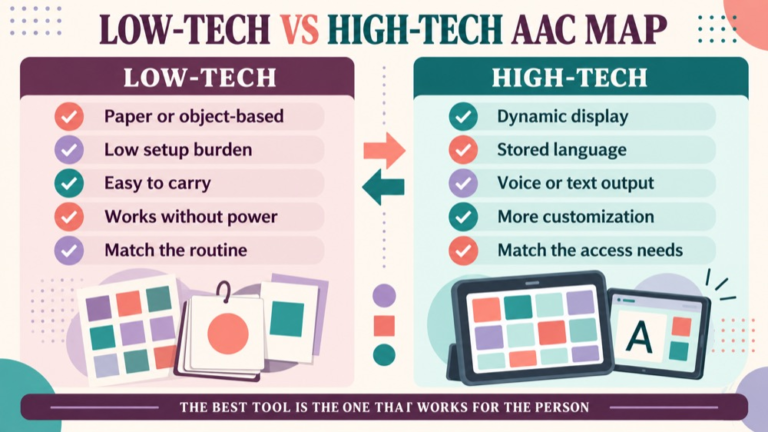
low tech vs high tech aac is easier to study when it is treated as a connected clinical reasoning problem rather than a label to memorize. low-tech and high-tech AAC is a planning decision, not a universal recipe. The clinician connects which AAC option or combination best matches access, communication needs, context, and user choice with assessment, baseline, research evidence, expertise, person and family values, language, culture, access, resources, competence, consent, and the setting. A defensible plan is specific enough to implement and flexible enough to change when response, health, participation, burden, or priorities change. Monitoring makes the decision accountable.
This learning guide is written for SLP students and other learners reviewing U.S. speech-language pathology concepts. It organizes purpose, assessment, access, evidence, function, and professional judgment; it does not make an individualized diagnosis or replace current guidance. Interpretation depends on the person, task, language, culture, health, access, partner, context, and communication goals.
What low tech vs high tech aac means
Begin by separating the concept into domains. A learner who can name the domains is less likely to collapse a score, task, symptom, access barrier, partner effect, or professional boundary into one explanation. The useful unit of analysis is the activity: what the person was asked to understand, express, organize, coordinate, remember, produce, or decide, with whom, under which conditions, and with what support.
Domain or system
What to notice
Question to carry forward
Outcome and purpose
Start with which AAC option or combination best matches access, communication needs, context, and user choice rather than a generic label or activity.
What meaningful change is being planned?
Baseline and target
Describe the starting response, conditions, supports, variability, and target represented by low-tech and high-tech AAC.
What is the starting point and intended change?
Evidence and fit
Match the approach to assessment, research, expertise, person values, culture, access, and low-tech and high-tech AAC.
Why is this plan a reasonable fit?
Implementation
Specify task, support, partner, language or mode, dosage, setting, consent, documentation, and competence.
Who will do what, under which conditions?
Measurement and participation
Use data and participation feedback that show quality, access, independence, transfer, and response—not one number alone.
How will meaningful change be recognized?
Review and adjustment
Continue, adapt, collaborate, refer, or change the plan when evidence, health, access, or priorities change.
What evidence triggers a new decision?
These domains interact, but they should remain distinguishable. A learner may show strength in one context and need support in another. A study map organizes the next observation; it does not answer every assessment question or establish a universal treatment, goal, legal conclusion, or medical explanation.
Keep the first pass descriptive and close to the communication event. Note the task, response, partner, setting, timing, available support, language or mode, and consequence for participation. This gives the learner a stable record to compare across tasks and prevents a familiar term from doing too much explanatory work before the evidence has been separated.
For Praxis-style review, a vignette may include several true details but ask for one best interpretation or next step. The strongest answer usually respects the task, identifies the relevant function or boundary, checks the most important missing information, and avoids treating one performance sample or policy phrase as the whole profile.
Map Low-Tech vs High-Tech AAC
For study purposes, describe the target skill, response, or measurement before naming a disorder, selecting a goal, or deciding that a tool fits. Record what the person understood, expressed, initiated, repaired, coordinated, produced, or participated in. Then note whether the task was familiar, how much context was shared, and which support changed the response.
Outcome: connect which AAC option or combination best matches access, communication needs, context, and user choice to a meaningful participation, access, safety, autonomy, or role outcome.
Baseline: define the target, starting response, conditions, supports, variability, and limits of the sample.
Fit: weigh research, clinical expertise, client and family values, culture, access, resources, readiness, and scope.
Implementation: specify tasks, partners, language or mode, dosage, setting, consent, documentation, and competence.
Measurement: monitor target performance together with quality, independence, transfer, participation, burden, and safety.
Revision: use response and new information to continue, adapt, collaborate, refer, or change the plan.
A strong description is specific enough that another learner could picture the event. Instead of writing “the score is low” or “the clinician can do this,” describe the construct, task, response, language or mode, partner, context, competence or access condition, and result. This protects clinical reasoning from labels that are broader than the evidence.
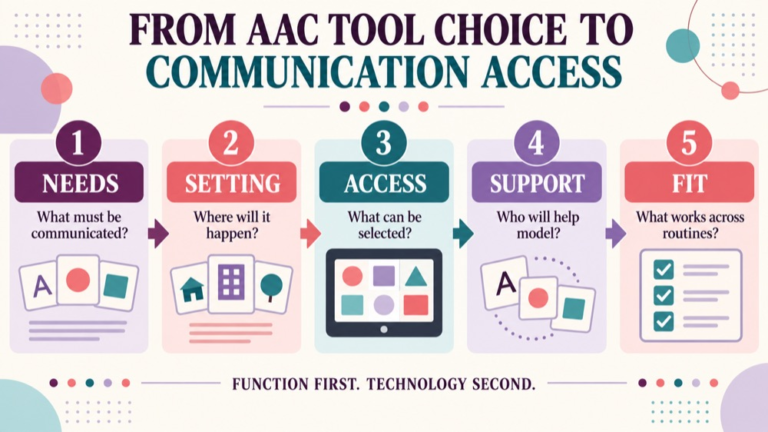
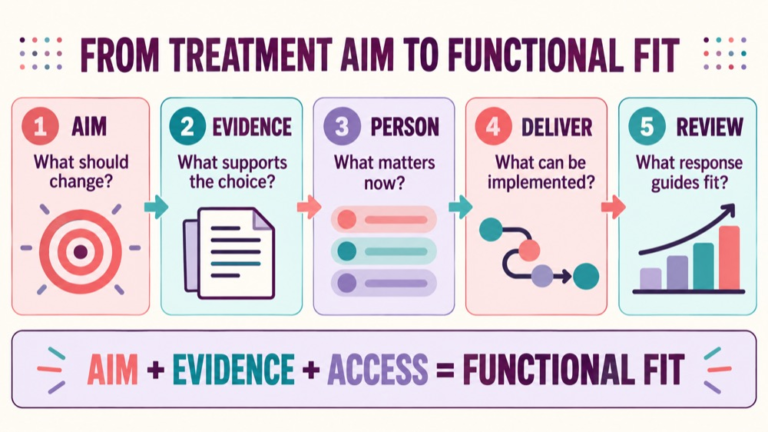
From AAC Tool Choice to Communication Access
Context changes what assessment and professional decisions require. A direct question, long explanation, group exchange, classroom task, health-care interaction, family story, noisy routine, supervised procedure, or referral decision places different demands on processing, language, memory, hearing, access, partner behavior, competence, and regulation. Language experience, visual information, fatigue, health literacy, and the opportunity to request clarification should be part of the observation.
low-tech and high-tech AAC is a planning decision, not a universal recipe. The clinician connects which AAC option or combination best matches access, communication needs, context, and user choice with assessment, baseline, research evidence, expertise, person and family values, language, culture, access, resources, competence, consent, and the setting. A defensible plan is specific enough to implement and flexible enough to change when response, health, participation, burden, or priorities change. Monitoring makes the decision accountable.
Interpretation layer
Example question
Task and construct
What did the person need to understand, express, organize, coordinate, produce, decide, or provide?
Language and access
Which language, dialect, mode, hearing condition, tool, support, or communication partner was available?
Measurement and context
What score type, norm, cutoff, reference, administration, setting, or partner factor affects meaning?
Participation and safety
What meaningful routine, role, outcome, or risk became easier or harder because of the pattern?
Context is not an afterthought added once a label has been selected. It is part of the question itself. If performance or decision quality changes with a quieter room, extra processing time, a familiar partner, a different language or mode, an interpreter, visual information, supervision, collaboration, a changed task, or a changed routine, that change is useful evidence about access and demand. It does not identify a cause by itself, but it tells you which conditions should be carried into the next observation.
Apply low tech vs high tech aac reasoning
When a Praxis-style scenario or clinical discussion presents low tech vs high tech aac, use a disciplined sequence. The goal is to select the next clinical question or action that matches the evidence, the person’s priorities, the communication context, the measurement limits, and the relevant professional boundary.
Define the task, construct, language, mode, communication purpose, or service responsibility in plain language.
Identify the relevant domain: language, speech, voice, swallowing, cognition, access, partner, participation, assessment, competence, collaboration, ethics, or regulation.
Separate observation from interpretation and write down what remains unknown.
Check history, exposure, dialect, culture, identity, interpreter access, environment, sensory load, memory, task familiarity, training, supervision, and local requirements as relevant.
Choose the assessment, collaboration, accommodation, goal, training, referral, or documentation step that answers the specific question.
State the boundary of the conclusion and keep the person’s safety, autonomy, access, and participation visible.
low-tech and high-tech AAC is a planning decision, not a universal recipe. The clinician connects which AAC option or combination best matches access, communication needs, context, and user choice with assessment, baseline, research evidence, expertise, person and family values, language, culture, access, resources, competence, consent, and the setting. A defensible plan is specific enough to implement and flexible enough to change when response, health, participation, burden, or priorities change. Monitoring makes the decision accountable. In a learning answer, the decisive evidence is usually the relationship among the task, the observed or measured pattern, the context, and the next needed information—not a single isolated behavior, score, label, or broad permission statement.
Common study mistakes
Choosing a tool or task before stating the decision it is meant to inform.
Treating one score, cutoff, symptom, or observation as the complete profile.
Failing to document language, dialect, culture, hearing, access, fatigue, partner, setting, or task conditions.
Confusing a screening result with a comprehensive assessment or a medical explanation.
Reporting a number without its score type, norm group, construct, reliability, error, or reference conditions.
Ignoring the person's communication mode, preferences, participation priorities, or caregiver and team perspective.
Using a measure outside its intended population or transferring research evidence without checking applicability.
Writing a conclusion that exceeds the evidence instead of naming the next question and its boundary.
Most of these mistakes come from replacing a multidomain question with a fast label. Correct the habit by returning to the same sequence: describe, separate, contextualize, ask what is missing, and choose a proportionate next step. A short rationale can make the habit visible: identify the evidence, name the uncertainty, and explain why the selected next step fits the person, setting, and responsibility.
Build a quick review map
Use this compact map when reviewing a missed question, lecture note, or clinical vignette:
Step 1: Name the person, task, referral question, setting, and decision.
Step 2: Separate the construct or domain from broader function, cause, diagnosis, and participation.
Step 3: Record language, dialect, culture, hearing, access, partner, fatigue, support, and administration conditions.
Step 4: Identify what the selected tool or observation can show and what it cannot answer.
Step 6: Choose the next assessment, support, collaboration, referral, or monitoring step and state its rationale.
Then write one transfer sentence: “When I see this pattern, I will first check ___ because ___.” The sentence should identify a decision rule, not repeat a definition. Revisit it after a delay and test whether you can apply the rule to a different task, age group, partner, language, setting, or professional responsibility.
Sources and next steps
low tech vs high tech aac is best learned as a context-sensitive pattern across assessment, access, identity, function, participation, evidence, and professional judgment. Use the current authority pages to refine the concept, then return to practice scenarios that require you to explain what the evidence supports and what it leaves open.
Aided vs Unaided AAC: Access, Modality, and Functional Communication
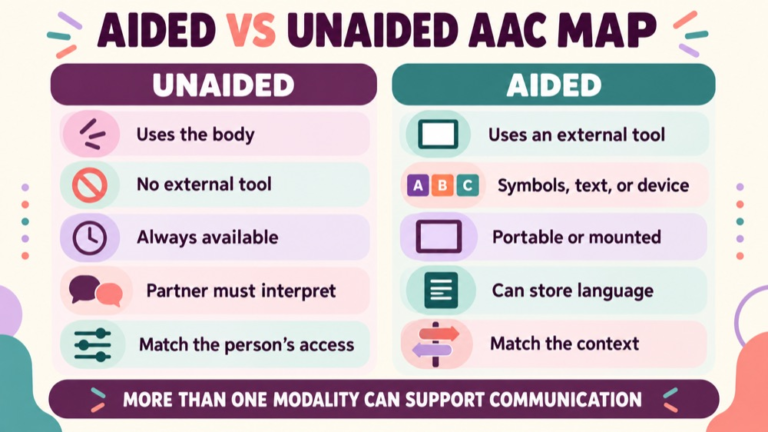
aided vs unaided aac is easier to study when it is treated as a connected clinical reasoning problem rather than a label to memorize. aided and unaided AAC is a planning decision, not a universal recipe. The clinician connects whether communication is best supported through unaided signals, aided tools, both, or a broader access plan with assessment, baseline, research evidence, expertise, person and family values, language, culture, access, resources, competence, consent, and the setting. A defensible plan is specific enough to implement and flexible enough to change when response, health, participation, burden, or priorities change. Monitoring makes the decision accountable.
This learning guide is written for SLP students and other learners reviewing U.S. speech-language pathology concepts. It organizes purpose, assessment, access, evidence, function, and professional judgment; it does not make an individualized diagnosis or replace current guidance. Interpretation depends on the person, task, language, culture, health, access, partner, context, and communication goals.
What aided vs unaided aac means
Begin by separating the concept into domains. A learner who can name the domains is less likely to collapse a score, task, symptom, access barrier, partner effect, or professional boundary into one explanation. The useful unit of analysis is the activity: what the person was asked to understand, express, organize, coordinate, remember, produce, or decide, with whom, under which conditions, and with what support.
Domain or system
What to notice
Question to carry forward
Outcome and purpose
Start with whether communication is best supported through unaided signals, aided tools, both, or a broader access plan rather than a generic label or activity.
What meaningful change is being planned?
Baseline and target
Describe the starting response, conditions, supports, variability, and target represented by aided and unaided AAC.
What is the starting point and intended change?
Evidence and fit
Match the approach to assessment, research, expertise, person values, culture, access, and aided and unaided AAC.
Why is this plan a reasonable fit?
Implementation
Specify task, support, partner, language or mode, dosage, setting, consent, documentation, and competence.
Who will do what, under which conditions?
Measurement and participation
Use data and participation feedback that show quality, access, independence, transfer, and response—not one number alone.
How will meaningful change be recognized?
Review and adjustment
Continue, adapt, collaborate, refer, or change the plan when evidence, health, access, or priorities change.
What evidence triggers a new decision?
These domains interact, but they should remain distinguishable. A learner may show strength in one context and need support in another. A study map organizes the next observation; it does not answer every assessment question or establish a universal treatment, goal, legal conclusion, or medical explanation.
Keep the first pass descriptive and close to the communication event. Note the task, response, partner, setting, timing, available support, language or mode, and consequence for participation. This gives the learner a stable record to compare across tasks and prevents a familiar term from doing too much explanatory work before the evidence has been separated.
For Praxis-style review, a vignette may include several true details but ask for one best interpretation or next step. The strongest answer usually respects the task, identifies the relevant function or boundary, checks the most important missing information, and avoids treating one performance sample or policy phrase as the whole profile.
Map Aided vs Unaided AAC
For study purposes, describe the target skill, response, or measurement before naming a disorder, selecting a goal, or deciding that a tool fits. Record what the person understood, expressed, initiated, repaired, coordinated, produced, or participated in. Then note whether the task was familiar, how much context was shared, and which support changed the response.
Outcome: connect whether communication is best supported through unaided signals, aided tools, both, or a broader access plan to a meaningful participation, access, safety, autonomy, or role outcome.
Baseline: define the target, starting response, conditions, supports, variability, and limits of the sample.
Fit: weigh research, clinical expertise, client and family values, culture, access, resources, readiness, and scope.
Implementation: specify tasks, partners, language or mode, dosage, setting, consent, documentation, and competence.
Measurement: monitor target performance together with quality, independence, transfer, participation, burden, and safety.
Revision: use response and new information to continue, adapt, collaborate, refer, or change the plan.
A strong description is specific enough that another learner could picture the event. Instead of writing “the score is low” or “the clinician can do this,” describe the construct, task, response, language or mode, partner, context, competence or access condition, and result. This protects clinical reasoning from labels that are broader than the evidence.
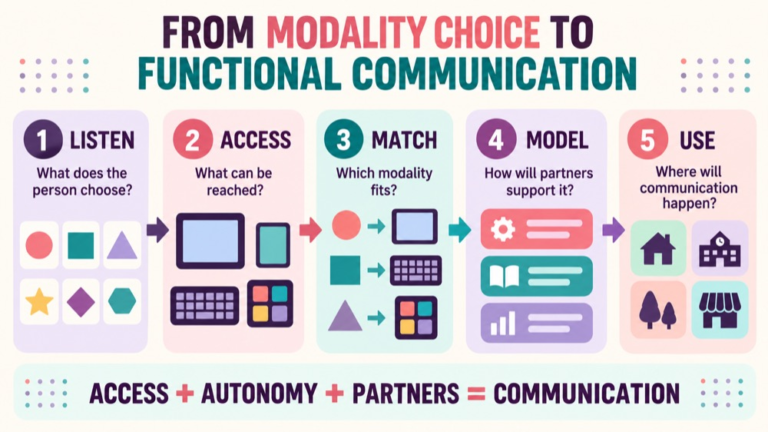
From Modality Choice to Functional Communication
Context changes what assessment and professional decisions require. A direct question, long explanation, group exchange, classroom task, health-care interaction, family story, noisy routine, supervised procedure, or referral decision places different demands on processing, language, memory, hearing, access, partner behavior, competence, and regulation. Language experience, visual information, fatigue, health literacy, and the opportunity to request clarification should be part of the observation.
aided and unaided AAC is a planning decision, not a universal recipe. The clinician connects whether communication is best supported through unaided signals, aided tools, both, or a broader access plan with assessment, baseline, research evidence, expertise, person and family values, language, culture, access, resources, competence, consent, and the setting. A defensible plan is specific enough to implement and flexible enough to change when response, health, participation, burden, or priorities change. Monitoring makes the decision accountable.
Interpretation layer
Example question
Task and construct
What did the person need to understand, express, organize, coordinate, produce, decide, or provide?
Language and access
Which language, dialect, mode, hearing condition, tool, support, or communication partner was available?
Measurement and context
What score type, norm, cutoff, reference, administration, setting, or partner factor affects meaning?
Participation and safety
What meaningful routine, role, outcome, or risk became easier or harder because of the pattern?
Context is not an afterthought added once a label has been selected. It is part of the question itself. If performance or decision quality changes with a quieter room, extra processing time, a familiar partner, a different language or mode, an interpreter, visual information, supervision, collaboration, a changed task, or a changed routine, that change is useful evidence about access and demand. It does not identify a cause by itself, but it tells you which conditions should be carried into the next observation.
Apply aided vs unaided aac reasoning
When a Praxis-style scenario or clinical discussion presents aided vs unaided aac, use a disciplined sequence. The goal is to select the next clinical question or action that matches the evidence, the person’s priorities, the communication context, the measurement limits, and the relevant professional boundary.
Define the task, construct, language, mode, communication purpose, or service responsibility in plain language.
Identify the relevant domain: language, speech, voice, swallowing, cognition, access, partner, participation, assessment, competence, collaboration, ethics, or regulation.
Separate observation from interpretation and write down what remains unknown.
Check history, exposure, dialect, culture, identity, interpreter access, environment, sensory load, memory, task familiarity, training, supervision, and local requirements as relevant.
Choose the assessment, collaboration, accommodation, goal, training, referral, or documentation step that answers the specific question.
State the boundary of the conclusion and keep the person’s safety, autonomy, access, and participation visible.
aided and unaided AAC is a planning decision, not a universal recipe. The clinician connects whether communication is best supported through unaided signals, aided tools, both, or a broader access plan with assessment, baseline, research evidence, expertise, person and family values, language, culture, access, resources, competence, consent, and the setting. A defensible plan is specific enough to implement and flexible enough to change when response, health, participation, burden, or priorities change. Monitoring makes the decision accountable. In a learning answer, the decisive evidence is usually the relationship among the task, the observed or measured pattern, the context, and the next needed information—not a single isolated behavior, score, label, or broad permission statement.
Common study mistakes
Choosing a tool or task before stating the decision it is meant to inform.
Treating one score, cutoff, symptom, or observation as the complete profile.
Failing to document language, dialect, culture, hearing, access, fatigue, partner, setting, or task conditions.
Confusing a screening result with a comprehensive assessment or a medical explanation.
Reporting a number without its score type, norm group, construct, reliability, error, or reference conditions.
Ignoring the person's communication mode, preferences, participation priorities, or caregiver and team perspective.
Using a measure outside its intended population or transferring research evidence without checking applicability.
Writing a conclusion that exceeds the evidence instead of naming the next question and its boundary.
Most of these mistakes come from replacing a multidomain question with a fast label. Correct the habit by returning to the same sequence: describe, separate, contextualize, ask what is missing, and choose a proportionate next step. A short rationale can make the habit visible: identify the evidence, name the uncertainty, and explain why the selected next step fits the person, setting, and responsibility.
Build a quick review map
Use this compact map when reviewing a missed question, lecture note, or clinical vignette:
Step 1: Name the person, task, referral question, setting, and decision.
Step 2: Separate the construct or domain from broader function, cause, diagnosis, and participation.
Step 3: Record language, dialect, culture, hearing, access, partner, fatigue, support, and administration conditions.
Step 4: Identify what the selected tool or observation can show and what it cannot answer.
Step 6: Choose the next assessment, support, collaboration, referral, or monitoring step and state its rationale.
Then write one transfer sentence: “When I see this pattern, I will first check ___ because ___.” The sentence should identify a decision rule, not repeat a definition. Revisit it after a delay and test whether you can apply the rule to a different task, age group, partner, language, setting, or professional responsibility.
Sources and next steps
aided vs unaided aac is best learned as a context-sensitive pattern across assessment, access, identity, function, participation, evidence, and professional judgment. Use the current authority pages to refine the concept, then return to practice scenarios that require you to explain what the evidence supports and what it leaves open.
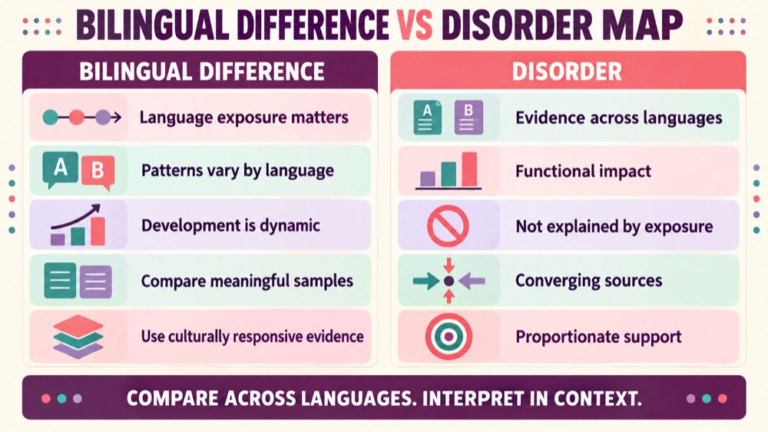
Bilingual Difference vs Disorder: Language Development, Access, and Context
bilingual difference vs disorder is easier to study when it is treated as a connected clinical reasoning problem rather than a label to memorize. bilingual difference and disorder is most useful when it shows how a person understands or expresses meaningful messages across tasks and contexts. Vocabulary, grammar, discourse, literacy, topic, memory load, language history, dialect, culture, hearing, response mode, cueing, and partner support can change access. The clinician describes the task rather than treating one answer as the whole profile, then connects the evidence to learning, work, health care, family, self-advocacy, and daily participation.
This learning guide is written for SLP students and other learners reviewing U.S. speech-language pathology concepts. It organizes purpose, assessment, access, evidence, function, and professional judgment; it does not make an individualized diagnosis or replace current guidance. Interpretation depends on the person, task, language, culture, health, access, partner, context, and communication goals.
What bilingual difference vs disorder means
Begin by separating the concept into domains. A learner who can name the domains is less likely to collapse a score, task, symptom, access barrier, partner effect, or professional boundary into one explanation. The useful unit of analysis is the activity: what the person was asked to understand, express, organize, coordinate, remember, produce, or decide, with whom, under which conditions, and with what support.
Domain or system
What to notice
Question to carry forward
Referral and purpose
Define whether a pattern reflects bilingual development, a disorder across languages, access effects, or another explanation before choosing a task or label.
What decision must the assessment inform?
Construct and task
Separate bilingual difference and disorder from broader language, speech, cognition, access, or participation.
What exactly is being sampled?
Evidence and sample
Use tasks, samples, interview, observation, report, and dynamic response that match bilingual difference and disorder.
Which evidence represents the concern?
Access and context
Language, dialect, culture, hearing, mode, partner, fatigue, setting, and support can change the meaning of bilingual difference and disorder.
Which conditions must stay visible?
Functional meaning
Connect the finding to communication, learning, work, health care, relationships, safety, or participation.
Where does the pattern matter?
Integration and limits
State what the evidence supports, what it cannot answer, and the proportionate next step.
What remains open, and who should help answer it?
These domains interact, but they should remain distinguishable. A learner may show strength in one context and need support in another. A study map organizes the next observation; it does not answer every assessment question or establish a universal treatment, goal, legal conclusion, or medical explanation.
Keep the first pass descriptive and close to the communication event. Note the task, response, partner, setting, timing, available support, language or mode, and consequence for participation. This gives the learner a stable record to compare across tasks and prevents a familiar term from doing too much explanatory work before the evidence has been separated.
For Praxis-style review, a vignette may include several true details but ask for one best interpretation or next step. The strongest answer usually respects the task, identifies the relevant function or boundary, checks the most important missing information, and avoids treating one performance sample or policy phrase as the whole profile.
Map Bilingual Difference vs Disorder
For study purposes, describe the target skill, response, or measurement before naming a disorder, selecting a goal, or deciding that a tool fits. Record what the person understood, expressed, initiated, repaired, coordinated, produced, or participated in. Then note whether the task was familiar, how much context was shared, and which support changed the response.
Construct: separate bilingual difference and disorder from vocabulary, grammar, discourse, literacy, hearing, and response-mode demands.
History: record language exposure, dialect, culture, education, literacy, hearing, and communication partners.
Samples: compare meaningful comprehension or expression tasks, conversation, narrative, writing, gesture, or AAC as relevant.
Support: document cueing, visual information, repetition, extra time, partner scaffolding, and repair.
Function: connect the pattern to learning, work, health care, family, community, self-advocacy, and relationships.
Integration: combine samples, history, observation, report, dynamic response, context, and the person's priorities.
A strong description is specific enough that another learner could picture the event. Instead of writing “the score is low” or “the clinician can do this,” describe the construct, task, response, language or mode, partner, context, competence or access condition, and result. This protects clinical reasoning from labels that are broader than the evidence.
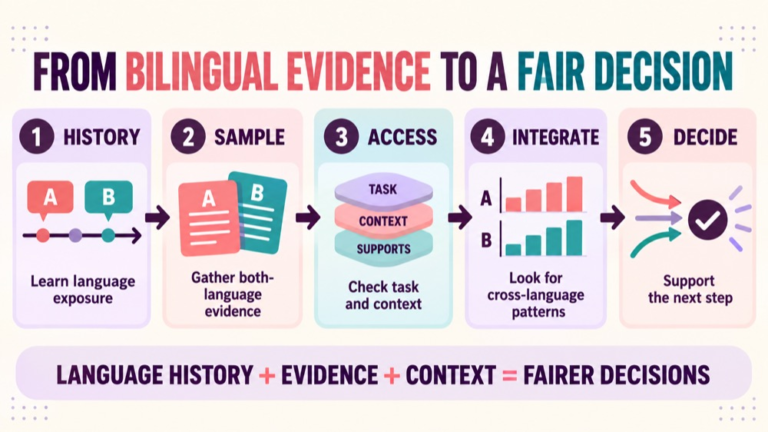
From Bilingual Evidence to a Fair Decision
Context changes what assessment and professional decisions require. A direct question, long explanation, group exchange, classroom task, health-care interaction, family story, noisy routine, supervised procedure, or referral decision places different demands on processing, language, memory, hearing, access, partner behavior, competence, and regulation. Language experience, visual information, fatigue, health literacy, and the opportunity to request clarification should be part of the observation.
bilingual difference and disorder is most useful when it shows how a person understands or expresses meaningful messages across tasks and contexts. Vocabulary, grammar, discourse, literacy, topic, memory load, language history, dialect, culture, hearing, response mode, cueing, and partner support can change access. The clinician describes the task rather than treating one answer as the whole profile, then connects the evidence to learning, work, health care, family, self-advocacy, and daily participation.
Interpretation layer
Example question
Task and construct
What did the person need to understand, express, organize, coordinate, produce, decide, or provide?
Language and access
Which language, dialect, mode, hearing condition, tool, support, or communication partner was available?
Measurement and context
What score type, norm, cutoff, reference, administration, setting, or partner factor affects meaning?
Participation and safety
What meaningful routine, role, outcome, or risk became easier or harder because of the pattern?
Context is not an afterthought added once a label has been selected. It is part of the question itself. If performance or decision quality changes with a quieter room, extra processing time, a familiar partner, a different language or mode, an interpreter, visual information, supervision, collaboration, a changed task, or a changed routine, that change is useful evidence about access and demand. It does not identify a cause by itself, but it tells you which conditions should be carried into the next observation.
Apply bilingual difference vs disorder reasoning
When a Praxis-style scenario or clinical discussion presents bilingual difference vs disorder, use a disciplined sequence. The goal is to select the next clinical question or action that matches the evidence, the person’s priorities, the communication context, the measurement limits, and the relevant professional boundary.
Define the task, construct, language, mode, communication purpose, or service responsibility in plain language.
Identify the relevant domain: language, speech, voice, swallowing, cognition, access, partner, participation, assessment, competence, collaboration, ethics, or regulation.
Separate observation from interpretation and write down what remains unknown.
Check history, exposure, dialect, culture, identity, interpreter access, environment, sensory load, memory, task familiarity, training, supervision, and local requirements as relevant.
Choose the assessment, collaboration, accommodation, goal, training, referral, or documentation step that answers the specific question.
State the boundary of the conclusion and keep the person’s safety, autonomy, access, and participation visible.
bilingual difference and disorder is most useful when it shows how a person understands or expresses meaningful messages across tasks and contexts. Vocabulary, grammar, discourse, literacy, topic, memory load, language history, dialect, culture, hearing, response mode, cueing, and partner support can change access. The clinician describes the task rather than treating one answer as the whole profile, then connects the evidence to learning, work, health care, family, self-advocacy, and daily participation. In a learning answer, the decisive evidence is usually the relationship among the task, the observed or measured pattern, the context, and the next needed information—not a single isolated behavior, score, label, or broad permission statement.
Common study mistakes
Choosing a tool or task before stating the decision it is meant to inform.
Treating one score, cutoff, symptom, or observation as the complete profile.
Failing to document language, dialect, culture, hearing, access, fatigue, partner, setting, or task conditions.
Confusing a screening result with a comprehensive assessment or a medical explanation.
Reporting a number without its score type, norm group, construct, reliability, error, or reference conditions.
Ignoring the person's communication mode, preferences, participation priorities, or caregiver and team perspective.
Using a measure outside its intended population or transferring research evidence without checking applicability.
Writing a conclusion that exceeds the evidence instead of naming the next question and its boundary.
Most of these mistakes come from replacing a multidomain question with a fast label. Correct the habit by returning to the same sequence: describe, separate, contextualize, ask what is missing, and choose a proportionate next step. A short rationale can make the habit visible: identify the evidence, name the uncertainty, and explain why the selected next step fits the person, setting, and responsibility.
Build a quick review map
Use this compact map when reviewing a missed question, lecture note, or clinical vignette:
Step 1: Name the person, task, referral question, setting, and decision.
Step 2: Separate the construct or domain from broader function, cause, diagnosis, and participation.
Step 3: Record language, dialect, culture, hearing, access, partner, fatigue, support, and administration conditions.
Step 4: Identify what the selected tool or observation can show and what it cannot answer.
Step 6: Choose the next assessment, support, collaboration, referral, or monitoring step and state its rationale.
Then write one transfer sentence: “When I see this pattern, I will first check ___ because ___.” The sentence should identify a decision rule, not repeat a definition. Revisit it after a delay and test whether you can apply the rule to a different task, age group, partner, language, setting, or professional responsibility.
Sources and next steps
bilingual difference vs disorder is best learned as a context-sensitive pattern across assessment, access, identity, function, participation, evidence, and professional judgment. Use the current authority pages to refine the concept, then return to practice scenarios that require you to explain what the evidence supports and what it leaves open.
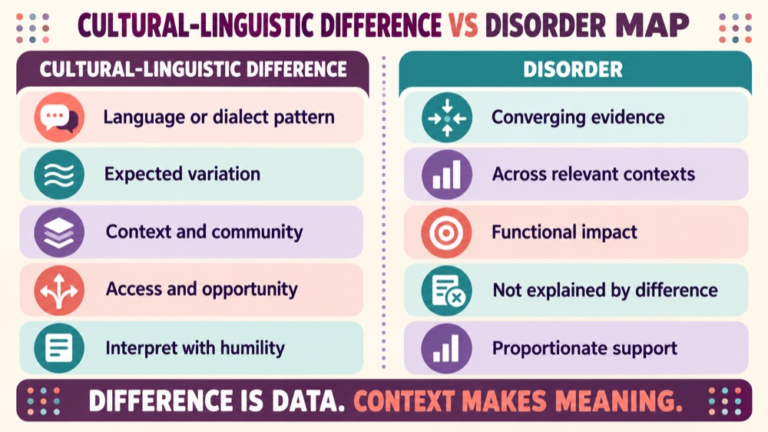
Cultural-Linguistic Difference vs Disorder: Fair Interpretation in SLP
cultural linguistic difference vs disorder is easier to study when it is treated as a connected clinical reasoning problem rather than a label to memorize. cultural-linguistic difference and disorder is strongest when it is treated as a purposeful clinical reasoning process rather than a label to memorize. The clinician identifies whether a pattern reflects language or cultural experience, a communication disorder, access effects, or another question, describes the task and conditions, gathers more than one relevant source of evidence, and connects the pattern to function and participation. Language, dialect, culture, hearing, mode, fatigue, partner, environment, and access are part of interpretation. A useful assessment states what it supports, what remains uncertain, and which next question is proportionate.
This learning guide is written for SLP students and other learners reviewing U.S. speech-language pathology concepts. It organizes purpose, assessment, access, evidence, function, and professional judgment; it does not make an individualized diagnosis or replace current guidance. Interpretation depends on the person, task, language, culture, health, access, partner, context, and communication goals.
What cultural linguistic difference vs disorder means
Begin by separating the concept into domains. A learner who can name the domains is less likely to collapse a score, task, symptom, access barrier, partner effect, or professional boundary into one explanation. The useful unit of analysis is the activity: what the person was asked to understand, express, organize, coordinate, remember, produce, or decide, with whom, under which conditions, and with what support.
Domain or system
What to notice
Question to carry forward
Referral and purpose
Define whether a pattern reflects language or cultural experience, a communication disorder, access effects, or another question before choosing a task or label.
What decision must the assessment inform?
Construct and task
Separate cultural-linguistic difference and disorder from broader language, speech, cognition, access, or participation.
What exactly is being sampled?
Evidence and sample
Use tasks, samples, interview, observation, report, and dynamic response that match cultural-linguistic difference and disorder.
Which evidence represents the concern?
Access and context
Language, dialect, culture, hearing, mode, partner, fatigue, setting, and support can change the meaning of cultural-linguistic difference and disorder.
Which conditions must stay visible?
Functional meaning
Connect the finding to communication, learning, work, health care, relationships, safety, or participation.
Where does the pattern matter?
Integration and limits
State what the evidence supports, what it cannot answer, and the proportionate next step.
What remains open, and who should help answer it?
These domains interact, but they should remain distinguishable. A learner may show strength in one context and need support in another. A study map organizes the next observation; it does not answer every assessment question or establish a universal treatment, goal, legal conclusion, or medical explanation.
Keep the first pass descriptive and close to the communication event. Note the task, response, partner, setting, timing, available support, language or mode, and consequence for participation. This gives the learner a stable record to compare across tasks and prevents a familiar term from doing too much explanatory work before the evidence has been separated.
For Praxis-style review, a vignette may include several true details but ask for one best interpretation or next step. The strongest answer usually respects the task, identifies the relevant function or boundary, checks the most important missing information, and avoids treating one performance sample or policy phrase as the whole profile.
Map Cultural-Linguistic Difference vs Disorder
For study purposes, describe the target skill, response, or measurement before naming a disorder, selecting a goal, or deciding that a tool fits. Record what the person understood, expressed, initiated, repaired, coordinated, produced, or participated in. Then note whether the task was familiar, how much context was shared, and which support changed the response.
Question: define whether a pattern reflects language or cultural experience, a communication disorder, access effects, or another question before selecting a tool, task, or label.
Construct: separate cultural-linguistic difference and disorder from broader communication, cognition, access, and participation.
Evidence: combine tasks, samples, report, observation, interview, and dynamic response as relevant.
Function: connect the pattern to communication, learning, work, health care, relationships, safety, and participation.
Limits: state what the evidence supports, what it cannot answer, and the proportionate next step.
A strong description is specific enough that another learner could picture the event. Instead of writing “the score is low” or “the clinician can do this,” describe the construct, task, response, language or mode, partner, context, competence or access condition, and result. This protects clinical reasoning from labels that are broader than the evidence.
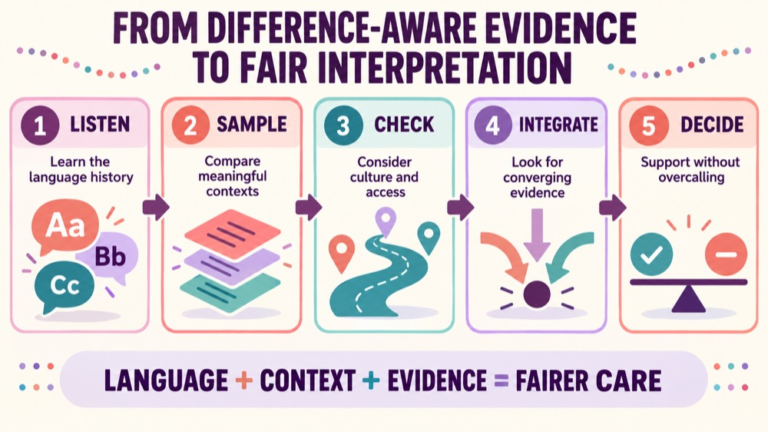
From Difference-Aware Evidence to Fair Interpretation
Context changes what assessment and professional decisions require. A direct question, long explanation, group exchange, classroom task, health-care interaction, family story, noisy routine, supervised procedure, or referral decision places different demands on processing, language, memory, hearing, access, partner behavior, competence, and regulation. Language experience, visual information, fatigue, health literacy, and the opportunity to request clarification should be part of the observation.
cultural-linguistic difference and disorder is strongest when it is treated as a purposeful clinical reasoning process rather than a label to memorize. The clinician identifies whether a pattern reflects language or cultural experience, a communication disorder, access effects, or another question, describes the task and conditions, gathers more than one relevant source of evidence, and connects the pattern to function and participation. Language, dialect, culture, hearing, mode, fatigue, partner, environment, and access are part of interpretation. A useful assessment states what it supports, what remains uncertain, and which next question is proportionate.
Interpretation layer
Example question
Task and construct
What did the person need to understand, express, organize, coordinate, produce, decide, or provide?
Language and access
Which language, dialect, mode, hearing condition, tool, support, or communication partner was available?
Measurement and context
What score type, norm, cutoff, reference, administration, setting, or partner factor affects meaning?
Participation and safety
What meaningful routine, role, outcome, or risk became easier or harder because of the pattern?
Context is not an afterthought added once a label has been selected. It is part of the question itself. If performance or decision quality changes with a quieter room, extra processing time, a familiar partner, a different language or mode, an interpreter, visual information, supervision, collaboration, a changed task, or a changed routine, that change is useful evidence about access and demand. It does not identify a cause by itself, but it tells you which conditions should be carried into the next observation.
Apply cultural linguistic difference vs disorder reasoning
When a Praxis-style scenario or clinical discussion presents cultural linguistic difference vs disorder, use a disciplined sequence. The goal is to select the next clinical question or action that matches the evidence, the person’s priorities, the communication context, the measurement limits, and the relevant professional boundary.
Define the task, construct, language, mode, communication purpose, or service responsibility in plain language.
Identify the relevant domain: language, speech, voice, swallowing, cognition, access, partner, participation, assessment, competence, collaboration, ethics, or regulation.
Separate observation from interpretation and write down what remains unknown.
Check history, exposure, dialect, culture, identity, interpreter access, environment, sensory load, memory, task familiarity, training, supervision, and local requirements as relevant.
Choose the assessment, collaboration, accommodation, goal, training, referral, or documentation step that answers the specific question.
State the boundary of the conclusion and keep the person’s safety, autonomy, access, and participation visible.
cultural-linguistic difference and disorder is strongest when it is treated as a purposeful clinical reasoning process rather than a label to memorize. The clinician identifies whether a pattern reflects language or cultural experience, a communication disorder, access effects, or another question, describes the task and conditions, gathers more than one relevant source of evidence, and connects the pattern to function and participation. Language, dialect, culture, hearing, mode, fatigue, partner, environment, and access are part of interpretation. A useful assessment states what it supports, what remains uncertain, and which next question is proportionate. In a learning answer, the decisive evidence is usually the relationship among the task, the observed or measured pattern, the context, and the next needed information—not a single isolated behavior, score, label, or broad permission statement.
Common study mistakes
Choosing a tool or task before stating the decision it is meant to inform.
Treating one score, cutoff, symptom, or observation as the complete profile.
Failing to document language, dialect, culture, hearing, access, fatigue, partner, setting, or task conditions.
Confusing a screening result with a comprehensive assessment or a medical explanation.
Reporting a number without its score type, norm group, construct, reliability, error, or reference conditions.
Ignoring the person's communication mode, preferences, participation priorities, or caregiver and team perspective.
Using a measure outside its intended population or transferring research evidence without checking applicability.
Writing a conclusion that exceeds the evidence instead of naming the next question and its boundary.
Most of these mistakes come from replacing a multidomain question with a fast label. Correct the habit by returning to the same sequence: describe, separate, contextualize, ask what is missing, and choose a proportionate next step. A short rationale can make the habit visible: identify the evidence, name the uncertainty, and explain why the selected next step fits the person, setting, and responsibility.
Build a quick review map
Use this compact map when reviewing a missed question, lecture note, or clinical vignette:
Step 1: Name the person, task, referral question, setting, and decision.
Step 2: Separate the construct or domain from broader function, cause, diagnosis, and participation.
Step 3: Record language, dialect, culture, hearing, access, partner, fatigue, support, and administration conditions.
Step 4: Identify what the selected tool or observation can show and what it cannot answer.
Step 6: Choose the next assessment, support, collaboration, referral, or monitoring step and state its rationale.
Then write one transfer sentence: “When I see this pattern, I will first check ___ because ___.” The sentence should identify a decision rule, not repeat a definition. Revisit it after a delay and test whether you can apply the rule to a different task, age group, partner, language, setting, or professional responsibility.
Sources and next steps
cultural linguistic difference vs disorder is best learned as a context-sensitive pattern across assessment, access, identity, function, participation, evidence, and professional judgment. Use the current authority pages to refine the concept, then return to practice scenarios that require you to explain what the evidence supports and what it leaves open.
Statistical vs Clinical Significance: Numbers, Meaning, and Change
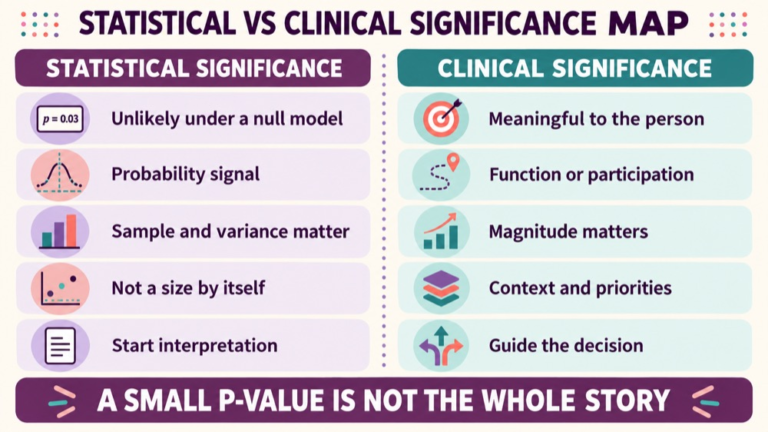
statistical vs clinical significance is easier to study when it is treated as a connected clinical reasoning problem rather than a label to memorize. statistical and clinical significance is strongest when it is treated as a purposeful clinical reasoning process rather than a label to memorize. The clinician identifies whether a result is unlikely to reflect chance, meaningful to the person, both, or not sufficient for a clinical decision, describes the task and conditions, gathers more than one relevant source of evidence, and connects the pattern to function and participation. Language, dialect, culture, hearing, mode, fatigue, partner, environment, and access are part of interpretation. A useful assessment states what it supports, what remains uncertain, and which next question is proportionate.
This learning guide is written for SLP students and other learners reviewing U.S. speech-language pathology concepts. It organizes purpose, assessment, access, evidence, function, and professional judgment; it does not make an individualized diagnosis or replace current guidance. Interpretation depends on the person, task, language, culture, health, access, partner, context, and communication goals.
What statistical vs clinical significance means
Begin by separating the concept into domains. A learner who can name the domains is less likely to collapse a score, task, symptom, access barrier, partner effect, or professional boundary into one explanation. The useful unit of analysis is the activity: what the person was asked to understand, express, organize, coordinate, remember, produce, or decide, with whom, under which conditions, and with what support.
Domain or system
What to notice
Question to carry forward
Referral and purpose
Define whether a result is unlikely to reflect chance, meaningful to the person, both, or not sufficient for a clinical decision before choosing a task or label.
What decision must the assessment inform?
Construct and task
Separate statistical and clinical significance from broader language, speech, cognition, access, or participation.
What exactly is being sampled?
Evidence and sample
Use tasks, samples, interview, observation, report, and dynamic response that match statistical and clinical significance.
Which evidence represents the concern?
Access and context
Language, dialect, culture, hearing, mode, partner, fatigue, setting, and support can change the meaning of statistical and clinical significance.
Which conditions must stay visible?
Functional meaning
Connect the finding to communication, learning, work, health care, relationships, safety, or participation.
Where does the pattern matter?
Integration and limits
State what the evidence supports, what it cannot answer, and the proportionate next step.
What remains open, and who should help answer it?
These domains interact, but they should remain distinguishable. A learner may show strength in one context and need support in another. A study map organizes the next observation; it does not answer every assessment question or establish a universal treatment, goal, legal conclusion, or medical explanation.
Keep the first pass descriptive and close to the communication event. Note the task, response, partner, setting, timing, available support, language or mode, and consequence for participation. This gives the learner a stable record to compare across tasks and prevents a familiar term from doing too much explanatory work before the evidence has been separated.
For Praxis-style review, a vignette may include several true details but ask for one best interpretation or next step. The strongest answer usually respects the task, identifies the relevant function or boundary, checks the most important missing information, and avoids treating one performance sample or policy phrase as the whole profile.
Map Statistical vs Clinical Significance
For study purposes, describe the target skill, response, or measurement before naming a disorder, selecting a goal, or deciding that a tool fits. Record what the person understood, expressed, initiated, repaired, coordinated, produced, or participated in. Then note whether the task was familiar, how much context was shared, and which support changed the response.
Question: define whether a result is unlikely to reflect chance, meaningful to the person, both, or not sufficient for a clinical decision before selecting a tool, task, or label.
Construct: separate statistical and clinical significance from broader communication, cognition, access, and participation.
Evidence: combine tasks, samples, report, observation, interview, and dynamic response as relevant.
Function: connect the pattern to communication, learning, work, health care, relationships, safety, and participation.
Limits: state what the evidence supports, what it cannot answer, and the proportionate next step.
A strong description is specific enough that another learner could picture the event. Instead of writing “the score is low” or “the clinician can do this,” describe the construct, task, response, language or mode, partner, context, competence or access condition, and result. This protects clinical reasoning from labels that are broader than the evidence.
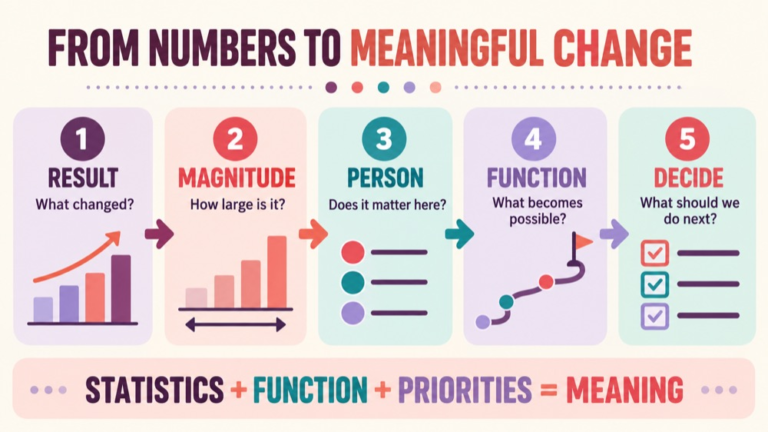
From Numbers to Meaningful Change
Context changes what assessment and professional decisions require. A direct question, long explanation, group exchange, classroom task, health-care interaction, family story, noisy routine, supervised procedure, or referral decision places different demands on processing, language, memory, hearing, access, partner behavior, competence, and regulation. Language experience, visual information, fatigue, health literacy, and the opportunity to request clarification should be part of the observation.
statistical and clinical significance is strongest when it is treated as a purposeful clinical reasoning process rather than a label to memorize. The clinician identifies whether a result is unlikely to reflect chance, meaningful to the person, both, or not sufficient for a clinical decision, describes the task and conditions, gathers more than one relevant source of evidence, and connects the pattern to function and participation. Language, dialect, culture, hearing, mode, fatigue, partner, environment, and access are part of interpretation. A useful assessment states what it supports, what remains uncertain, and which next question is proportionate.
Interpretation layer
Example question
Task and construct
What did the person need to understand, express, organize, coordinate, produce, decide, or provide?
Language and access
Which language, dialect, mode, hearing condition, tool, support, or communication partner was available?
Measurement and context
What score type, norm, cutoff, reference, administration, setting, or partner factor affects meaning?
Participation and safety
What meaningful routine, role, outcome, or risk became easier or harder because of the pattern?
Context is not an afterthought added once a label has been selected. It is part of the question itself. If performance or decision quality changes with a quieter room, extra processing time, a familiar partner, a different language or mode, an interpreter, visual information, supervision, collaboration, a changed task, or a changed routine, that change is useful evidence about access and demand. It does not identify a cause by itself, but it tells you which conditions should be carried into the next observation.
Apply statistical vs clinical significance reasoning
When a Praxis-style scenario or clinical discussion presents statistical vs clinical significance, use a disciplined sequence. The goal is to select the next clinical question or action that matches the evidence, the person’s priorities, the communication context, the measurement limits, and the relevant professional boundary.
Define the task, construct, language, mode, communication purpose, or service responsibility in plain language.
Identify the relevant domain: language, speech, voice, swallowing, cognition, access, partner, participation, assessment, competence, collaboration, ethics, or regulation.
Separate observation from interpretation and write down what remains unknown.
Check history, exposure, dialect, culture, identity, interpreter access, environment, sensory load, memory, task familiarity, training, supervision, and local requirements as relevant.
Choose the assessment, collaboration, accommodation, goal, training, referral, or documentation step that answers the specific question.
State the boundary of the conclusion and keep the person’s safety, autonomy, access, and participation visible.
statistical and clinical significance is strongest when it is treated as a purposeful clinical reasoning process rather than a label to memorize. The clinician identifies whether a result is unlikely to reflect chance, meaningful to the person, both, or not sufficient for a clinical decision, describes the task and conditions, gathers more than one relevant source of evidence, and connects the pattern to function and participation. Language, dialect, culture, hearing, mode, fatigue, partner, environment, and access are part of interpretation. A useful assessment states what it supports, what remains uncertain, and which next question is proportionate. In a learning answer, the decisive evidence is usually the relationship among the task, the observed or measured pattern, the context, and the next needed information—not a single isolated behavior, score, label, or broad permission statement.
Common study mistakes
Choosing a tool or task before stating the decision it is meant to inform.
Treating one score, cutoff, symptom, or observation as the complete profile.
Failing to document language, dialect, culture, hearing, access, fatigue, partner, setting, or task conditions.
Confusing a screening result with a comprehensive assessment or a medical explanation.
Reporting a number without its score type, norm group, construct, reliability, error, or reference conditions.
Ignoring the person's communication mode, preferences, participation priorities, or caregiver and team perspective.
Using a measure outside its intended population or transferring research evidence without checking applicability.
Writing a conclusion that exceeds the evidence instead of naming the next question and its boundary.
Most of these mistakes come from replacing a multidomain question with a fast label. Correct the habit by returning to the same sequence: describe, separate, contextualize, ask what is missing, and choose a proportionate next step. A short rationale can make the habit visible: identify the evidence, name the uncertainty, and explain why the selected next step fits the person, setting, and responsibility.
Build a quick review map
Use this compact map when reviewing a missed question, lecture note, or clinical vignette:
Step 1: Name the person, task, referral question, setting, and decision.
Step 2: Separate the construct or domain from broader function, cause, diagnosis, and participation.
Step 3: Record language, dialect, culture, hearing, access, partner, fatigue, support, and administration conditions.
Step 4: Identify what the selected tool or observation can show and what it cannot answer.
Step 6: Choose the next assessment, support, collaboration, referral, or monitoring step and state its rationale.
Then write one transfer sentence: “When I see this pattern, I will first check ___ because ___.” The sentence should identify a decision rule, not repeat a definition. Revisit it after a delay and test whether you can apply the rule to a different task, age group, partner, language, setting, or professional responsibility.
Sources and next steps
statistical vs clinical significance is best learned as a context-sensitive pattern across assessment, access, identity, function, participation, evidence, and professional judgment. Use the current authority pages to refine the concept, then return to practice scenarios that require you to explain what the evidence supports and what it leaves open.
Sensitivity vs Specificity: Screening Accuracy and Clinical Meaning
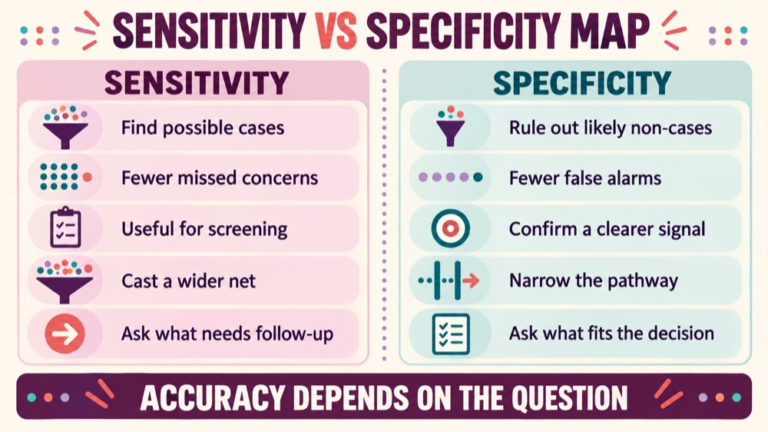
sensitivity vs specificity is easier to study when it is treated as a connected clinical reasoning problem rather than a label to memorize. sensitivity and specificity is strongest when it is treated as a purposeful clinical reasoning process rather than a label to memorize. The clinician identifies whether a tool is better at detecting possible cases, ruling out concern, or supporting a proportionate next step, describes the task and conditions, gathers more than one relevant source of evidence, and connects the pattern to function and participation. Language, dialect, culture, hearing, mode, fatigue, partner, environment, and access are part of interpretation. A useful assessment states what it supports, what remains uncertain, and which next question is proportionate.
This learning guide is written for SLP students and other learners reviewing U.S. speech-language pathology concepts. It organizes purpose, assessment, access, evidence, function, and professional judgment; it does not make an individualized diagnosis or replace current guidance. Interpretation depends on the person, task, language, culture, health, access, partner, context, and communication goals.
What sensitivity vs specificity means
Begin by separating the concept into domains. A learner who can name the domains is less likely to collapse a score, task, symptom, access barrier, partner effect, or professional boundary into one explanation. The useful unit of analysis is the activity: what the person was asked to understand, express, organize, coordinate, remember, produce, or decide, with whom, under which conditions, and with what support.
Domain or system
What to notice
Question to carry forward
Referral and purpose
Define whether a tool is better at detecting possible cases, ruling out concern, or supporting a proportionate next step before choosing a task or label.
What decision must the assessment inform?
Construct and task
Separate sensitivity and specificity from broader language, speech, cognition, access, or participation.
What exactly is being sampled?
Evidence and sample
Use tasks, samples, interview, observation, report, and dynamic response that match sensitivity and specificity.
Which evidence represents the concern?
Access and context
Language, dialect, culture, hearing, mode, partner, fatigue, setting, and support can change the meaning of sensitivity and specificity.
Which conditions must stay visible?
Functional meaning
Connect the finding to communication, learning, work, health care, relationships, safety, or participation.
Where does the pattern matter?
Integration and limits
State what the evidence supports, what it cannot answer, and the proportionate next step.
What remains open, and who should help answer it?
These domains interact, but they should remain distinguishable. A learner may show strength in one context and need support in another. A study map organizes the next observation; it does not answer every assessment question or establish a universal treatment, goal, legal conclusion, or medical explanation.
Keep the first pass descriptive and close to the communication event. Note the task, response, partner, setting, timing, available support, language or mode, and consequence for participation. This gives the learner a stable record to compare across tasks and prevents a familiar term from doing too much explanatory work before the evidence has been separated.
For Praxis-style review, a vignette may include several true details but ask for one best interpretation or next step. The strongest answer usually respects the task, identifies the relevant function or boundary, checks the most important missing information, and avoids treating one performance sample or policy phrase as the whole profile.
Map Sensitivity vs Specificity
For study purposes, describe the target skill, response, or measurement before naming a disorder, selecting a goal, or deciding that a tool fits. Record what the person understood, expressed, initiated, repaired, coordinated, produced, or participated in. Then note whether the task was familiar, how much context was shared, and which support changed the response.
Question: define whether a tool is better at detecting possible cases, ruling out concern, or supporting a proportionate next step before selecting a tool, task, or label.
Construct: separate sensitivity and specificity from broader communication, cognition, access, and participation.
Evidence: combine tasks, samples, report, observation, interview, and dynamic response as relevant.
Function: connect the pattern to communication, learning, work, health care, relationships, safety, and participation.
Limits: state what the evidence supports, what it cannot answer, and the proportionate next step.
A strong description is specific enough that another learner could picture the event. Instead of writing “the score is low” or “the clinician can do this,” describe the construct, task, response, language or mode, partner, context, competence or access condition, and result. This protects clinical reasoning from labels that are broader than the evidence.
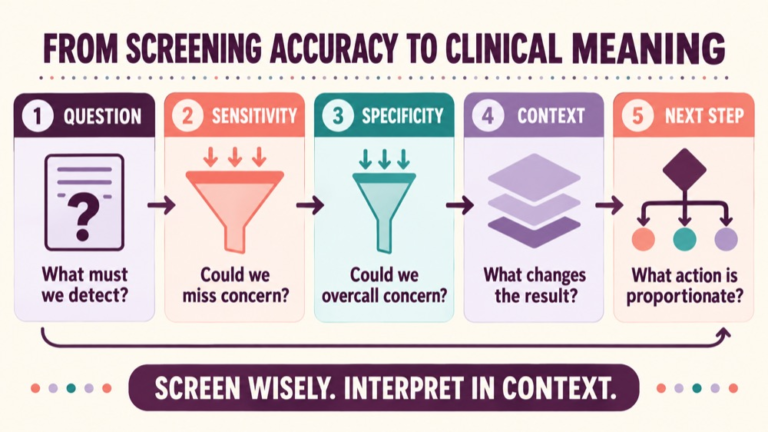
From Screening Accuracy to Clinical Meaning
Context changes what assessment and professional decisions require. A direct question, long explanation, group exchange, classroom task, health-care interaction, family story, noisy routine, supervised procedure, or referral decision places different demands on processing, language, memory, hearing, access, partner behavior, competence, and regulation. Language experience, visual information, fatigue, health literacy, and the opportunity to request clarification should be part of the observation.
sensitivity and specificity is strongest when it is treated as a purposeful clinical reasoning process rather than a label to memorize. The clinician identifies whether a tool is better at detecting possible cases, ruling out concern, or supporting a proportionate next step, describes the task and conditions, gathers more than one relevant source of evidence, and connects the pattern to function and participation. Language, dialect, culture, hearing, mode, fatigue, partner, environment, and access are part of interpretation. A useful assessment states what it supports, what remains uncertain, and which next question is proportionate.
Interpretation layer
Example question
Task and construct
What did the person need to understand, express, organize, coordinate, produce, decide, or provide?
Language and access
Which language, dialect, mode, hearing condition, tool, support, or communication partner was available?
Measurement and context
What score type, norm, cutoff, reference, administration, setting, or partner factor affects meaning?
Participation and safety
What meaningful routine, role, outcome, or risk became easier or harder because of the pattern?
Context is not an afterthought added once a label has been selected. It is part of the question itself. If performance or decision quality changes with a quieter room, extra processing time, a familiar partner, a different language or mode, an interpreter, visual information, supervision, collaboration, a changed task, or a changed routine, that change is useful evidence about access and demand. It does not identify a cause by itself, but it tells you which conditions should be carried into the next observation.
Apply sensitivity vs specificity reasoning
When a Praxis-style scenario or clinical discussion presents sensitivity vs specificity, use a disciplined sequence. The goal is to select the next clinical question or action that matches the evidence, the person’s priorities, the communication context, the measurement limits, and the relevant professional boundary.
Define the task, construct, language, mode, communication purpose, or service responsibility in plain language.
Identify the relevant domain: language, speech, voice, swallowing, cognition, access, partner, participation, assessment, competence, collaboration, ethics, or regulation.
Separate observation from interpretation and write down what remains unknown.
Check history, exposure, dialect, culture, identity, interpreter access, environment, sensory load, memory, task familiarity, training, supervision, and local requirements as relevant.
Choose the assessment, collaboration, accommodation, goal, training, referral, or documentation step that answers the specific question.
State the boundary of the conclusion and keep the person’s safety, autonomy, access, and participation visible.
sensitivity and specificity is strongest when it is treated as a purposeful clinical reasoning process rather than a label to memorize. The clinician identifies whether a tool is better at detecting possible cases, ruling out concern, or supporting a proportionate next step, describes the task and conditions, gathers more than one relevant source of evidence, and connects the pattern to function and participation. Language, dialect, culture, hearing, mode, fatigue, partner, environment, and access are part of interpretation. A useful assessment states what it supports, what remains uncertain, and which next question is proportionate. In a learning answer, the decisive evidence is usually the relationship among the task, the observed or measured pattern, the context, and the next needed information—not a single isolated behavior, score, label, or broad permission statement.
Common study mistakes
Choosing a tool or task before stating the decision it is meant to inform.
Treating one score, cutoff, symptom, or observation as the complete profile.
Failing to document language, dialect, culture, hearing, access, fatigue, partner, setting, or task conditions.
Confusing a screening result with a comprehensive assessment or a medical explanation.
Reporting a number without its score type, norm group, construct, reliability, error, or reference conditions.
Ignoring the person's communication mode, preferences, participation priorities, or caregiver and team perspective.
Using a measure outside its intended population or transferring research evidence without checking applicability.
Writing a conclusion that exceeds the evidence instead of naming the next question and its boundary.
Most of these mistakes come from replacing a multidomain question with a fast label. Correct the habit by returning to the same sequence: describe, separate, contextualize, ask what is missing, and choose a proportionate next step. A short rationale can make the habit visible: identify the evidence, name the uncertainty, and explain why the selected next step fits the person, setting, and responsibility.
Build a quick review map
Use this compact map when reviewing a missed question, lecture note, or clinical vignette:
Step 1: Name the person, task, referral question, setting, and decision.
Step 2: Separate the construct or domain from broader function, cause, diagnosis, and participation.
Step 3: Record language, dialect, culture, hearing, access, partner, fatigue, support, and administration conditions.
Step 4: Identify what the selected tool or observation can show and what it cannot answer.
Step 6: Choose the next assessment, support, collaboration, referral, or monitoring step and state its rationale.
Then write one transfer sentence: “When I see this pattern, I will first check ___ because ___.” The sentence should identify a decision rule, not repeat a definition. Revisit it after a delay and test whether you can apply the rule to a different task, age group, partner, language, setting, or professional responsibility.
Sources and next steps
sensitivity vs specificity is best learned as a context-sensitive pattern across assessment, access, identity, function, participation, evidence, and professional judgment. Use the current authority pages to refine the concept, then return to practice scenarios that require you to explain what the evidence supports and what it leaves open.
Reliability vs Validity: Consistency, Meaning, and Fit
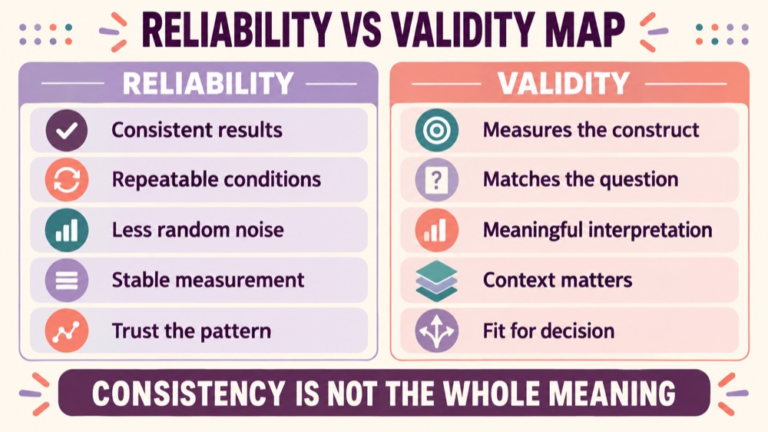
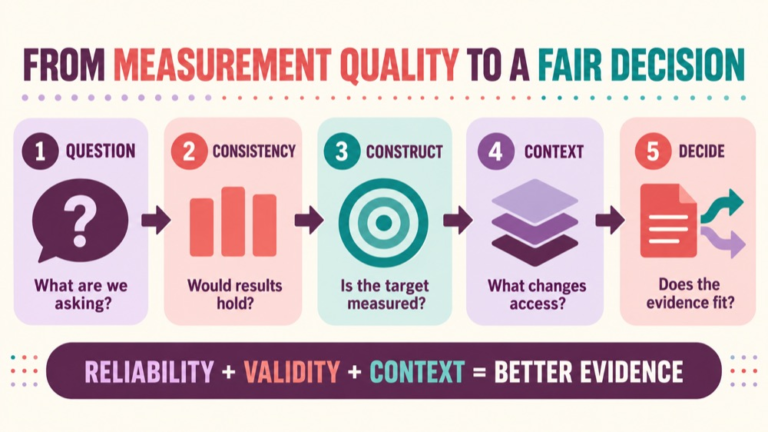
reliability vs validity is easier to study when it is treated as a connected clinical reasoning problem rather than a label to memorize. reliability and validity is strongest when it is treated as a purposeful clinical reasoning process rather than a label to memorize. The clinician identifies whether a measure is consistent, measures the intended construct, both, or needs contextual interpretation, describes the task and conditions, gathers more than one relevant source of evidence, and connects the pattern to function and participation. Language, dialect, culture, hearing, mode, fatigue, partner, environment, and access are part of interpretation. A useful assessment states what it supports, what remains uncertain, and which next question is proportionate.
This learning guide is written for SLP students and other learners reviewing U.S. speech-language pathology concepts. It organizes purpose, assessment, access, evidence, function, and professional judgment; it does not make an individualized diagnosis or replace current guidance. Interpretation depends on the person, task, language, culture, health, access, partner, context, and communication goals.
What reliability vs validity means
Begin by separating the concept into domains. A learner who can name the domains is less likely to collapse a score, task, symptom, access barrier, partner effect, or professional boundary into one explanation. The useful unit of analysis is the activity: what the person was asked to understand, express, organize, coordinate, remember, produce, or decide, with whom, under which conditions, and with what support.
Domain or system
What to notice
Question to carry forward
Referral and purpose
Define whether a measure is consistent, measures the intended construct, both, or needs contextual interpretation before choosing a task or label.
What decision must the assessment inform?
Construct and task
Separate reliability and validity from broader language, speech, cognition, access, or participation.
What exactly is being sampled?
Evidence and sample
Use tasks, samples, interview, observation, report, and dynamic response that match reliability and validity.
Which evidence represents the concern?
Access and context
Language, dialect, culture, hearing, mode, partner, fatigue, setting, and support can change the meaning of reliability and validity.
Which conditions must stay visible?
Functional meaning
Connect the finding to communication, learning, work, health care, relationships, safety, or participation.
Where does the pattern matter?
Integration and limits
State what the evidence supports, what it cannot answer, and the proportionate next step.
What remains open, and who should help answer it?
These domains interact, but they should remain distinguishable. A learner may show strength in one context and need support in another. A study map organizes the next observation; it does not answer every assessment question or establish a universal treatment, goal, legal conclusion, or medical explanation.
Keep the first pass descriptive and close to the communication event. Note the task, response, partner, setting, timing, available support, language or mode, and consequence for participation. This gives the learner a stable record to compare across tasks and prevents a familiar term from doing too much explanatory work before the evidence has been separated.
For Praxis-style review, a vignette may include several true details but ask for one best interpretation or next step. The strongest answer usually respects the task, identifies the relevant function or boundary, checks the most important missing information, and avoids treating one performance sample or policy phrase as the whole profile.
Map Reliability vs Validity
For study purposes, describe the target skill, response, or measurement before naming a disorder, selecting a goal, or deciding that a tool fits. Record what the person understood, expressed, initiated, repaired, coordinated, produced, or participated in. Then note whether the task was familiar, how much context was shared, and which support changed the response.
Question: define whether a measure is consistent, measures the intended construct, both, or needs contextual interpretation before selecting a tool, task, or label.
Construct: separate reliability and validity from broader communication, cognition, access, and participation.
Evidence: combine tasks, samples, report, observation, interview, and dynamic response as relevant.
Function: connect the pattern to communication, learning, work, health care, relationships, safety, and participation.
Limits: state what the evidence supports, what it cannot answer, and the proportionate next step.
A strong description is specific enough that another learner could picture the event. Instead of writing “the score is low” or “the clinician can do this,” describe the construct, task, response, language or mode, partner, context, competence or access condition, and result. This protects clinical reasoning from labels that are broader than the evidence.
From Measurement Quality to a Fair Decision
Context changes what assessment and professional decisions require. A direct question, long explanation, group exchange, classroom task, health-care interaction, family story, noisy routine, supervised procedure, or referral decision places different demands on processing, language, memory, hearing, access, partner behavior, competence, and regulation. Language experience, visual information, fatigue, health literacy, and the opportunity to request clarification should be part of the observation.
reliability and validity is strongest when it is treated as a purposeful clinical reasoning process rather than a label to memorize. The clinician identifies whether a measure is consistent, measures the intended construct, both, or needs contextual interpretation, describes the task and conditions, gathers more than one relevant source of evidence, and connects the pattern to function and participation. Language, dialect, culture, hearing, mode, fatigue, partner, environment, and access are part of interpretation. A useful assessment states what it supports, what remains uncertain, and which next question is proportionate.
Interpretation layer
Example question
Task and construct
What did the person need to understand, express, organize, coordinate, produce, decide, or provide?
Language and access
Which language, dialect, mode, hearing condition, tool, support, or communication partner was available?
Measurement and context
What score type, norm, cutoff, reference, administration, setting, or partner factor affects meaning?
Participation and safety
What meaningful routine, role, outcome, or risk became easier or harder because of the pattern?
Context is not an afterthought added once a label has been selected. It is part of the question itself. If performance or decision quality changes with a quieter room, extra processing time, a familiar partner, a different language or mode, an interpreter, visual information, supervision, collaboration, a changed task, or a changed routine, that change is useful evidence about access and demand. It does not identify a cause by itself, but it tells you which conditions should be carried into the next observation.
Apply reliability vs validity reasoning
When a Praxis-style scenario or clinical discussion presents reliability vs validity, use a disciplined sequence. The goal is to select the next clinical question or action that matches the evidence, the person’s priorities, the communication context, the measurement limits, and the relevant professional boundary.
Define the task, construct, language, mode, communication purpose, or service responsibility in plain language.
Identify the relevant domain: language, speech, voice, swallowing, cognition, access, partner, participation, assessment, competence, collaboration, ethics, or regulation.
Separate observation from interpretation and write down what remains unknown.
Check history, exposure, dialect, culture, identity, interpreter access, environment, sensory load, memory, task familiarity, training, supervision, and local requirements as relevant.
Choose the assessment, collaboration, accommodation, goal, training, referral, or documentation step that answers the specific question.
State the boundary of the conclusion and keep the person’s safety, autonomy, access, and participation visible.
reliability and validity is strongest when it is treated as a purposeful clinical reasoning process rather than a label to memorize. The clinician identifies whether a measure is consistent, measures the intended construct, both, or needs contextual interpretation, describes the task and conditions, gathers more than one relevant source of evidence, and connects the pattern to function and participation. Language, dialect, culture, hearing, mode, fatigue, partner, environment, and access are part of interpretation. A useful assessment states what it supports, what remains uncertain, and which next question is proportionate. In a learning answer, the decisive evidence is usually the relationship among the task, the observed or measured pattern, the context, and the next needed information—not a single isolated behavior, score, label, or broad permission statement.
Common study mistakes
Choosing a tool or task before stating the decision it is meant to inform.
Treating one score, cutoff, symptom, or observation as the complete profile.
Failing to document language, dialect, culture, hearing, access, fatigue, partner, setting, or task conditions.
Confusing a screening result with a comprehensive assessment or a medical explanation.
Reporting a number without its score type, norm group, construct, reliability, error, or reference conditions.
Ignoring the person's communication mode, preferences, participation priorities, or caregiver and team perspective.
Using a measure outside its intended population or transferring research evidence without checking applicability.
Writing a conclusion that exceeds the evidence instead of naming the next question and its boundary.
Most of these mistakes come from replacing a multidomain question with a fast label. Correct the habit by returning to the same sequence: describe, separate, contextualize, ask what is missing, and choose a proportionate next step. A short rationale can make the habit visible: identify the evidence, name the uncertainty, and explain why the selected next step fits the person, setting, and responsibility.
Build a quick review map
Use this compact map when reviewing a missed question, lecture note, or clinical vignette:
Step 1: Name the person, task, referral question, setting, and decision.
Step 2: Separate the construct or domain from broader function, cause, diagnosis, and participation.
Step 3: Record language, dialect, culture, hearing, access, partner, fatigue, support, and administration conditions.
Step 4: Identify what the selected tool or observation can show and what it cannot answer.
Step 6: Choose the next assessment, support, collaboration, referral, or monitoring step and state its rationale.
Then write one transfer sentence: “When I see this pattern, I will first check ___ because ___.” The sentence should identify a decision rule, not repeat a definition. Revisit it after a delay and test whether you can apply the rule to a different task, age group, partner, language, setting, or professional responsibility.
Sources and next steps
reliability vs validity is best learned as a context-sensitive pattern across assessment, access, identity, function, participation, evidence, and professional judgment. Use the current authority pages to refine the concept, then return to practice scenarios that require you to explain what the evidence supports and what it leaves open.
Baseline vs Progress Monitoring: Starting Point, Response, and Decision Use
baseline vs progress monitoring is easier to study when it is treated as a connected clinical reasoning problem rather than a label to memorize. baseline and progress monitoring is strongest when it is treated as a purposeful clinical reasoning process rather than a label to memorize. The clinician identifies whether the task is to define a starting point, track change over time, or revise the plan, describes the task and conditions, gathers more than one relevant source of evidence, and connects the pattern to function and participation. Language, dialect, culture, hearing, mode, fatigue, partner, environment, and access are part of interpretation. A useful assessment states what it supports, what remains uncertain, and which next question is proportionate.
This learning guide is written for SLP students and other learners reviewing U.S. speech-language pathology concepts. It organizes purpose, assessment, access, evidence, function, and professional judgment; it does not make an individualized diagnosis or replace current guidance. Interpretation depends on the person, task, language, culture, health, access, partner, context, and communication goals.
What baseline vs progress monitoring means
Begin by separating the concept into domains. A learner who can name the domains is less likely to collapse a score, task, symptom, access barrier, partner effect, or professional boundary into one explanation. The useful unit of analysis is the activity: what the person was asked to understand, express, organize, coordinate, remember, produce, or decide, with whom, under which conditions, and with what support.
Domain or system
What to notice
Question to carry forward
Referral and purpose
Define whether the task is to define a starting point, track change over time, or revise the plan before choosing a task or label.
What decision must the assessment inform?
Construct and task
Separate baseline and progress monitoring from broader language, speech, cognition, access, or participation.
What exactly is being sampled?
Evidence and sample
Use tasks, samples, interview, observation, report, and dynamic response that match baseline and progress monitoring.
Which evidence represents the concern?
Access and context
Language, dialect, culture, hearing, mode, partner, fatigue, setting, and support can change the meaning of baseline and progress monitoring.
Which conditions must stay visible?
Functional meaning
Connect the finding to communication, learning, work, health care, relationships, safety, or participation.
Where does the pattern matter?
Integration and limits
State what the evidence supports, what it cannot answer, and the proportionate next step.
What remains open, and who should help answer it?
These domains interact, but they should remain distinguishable. A learner may show strength in one context and need support in another. A study map organizes the next observation; it does not answer every assessment question or establish a universal treatment, goal, legal conclusion, or medical explanation.
Keep the first pass descriptive and close to the communication event. Note the task, response, partner, setting, timing, available support, language or mode, and consequence for participation. This gives the learner a stable record to compare across tasks and prevents a familiar term from doing too much explanatory work before the evidence has been separated.
For Praxis-style review, a vignette may include several true details but ask for one best interpretation or next step. The strongest answer usually respects the task, identifies the relevant function or boundary, checks the most important missing information, and avoids treating one performance sample or policy phrase as the whole profile.
Map Baseline vs Progress Monitoring
For study purposes, describe the target skill, response, or measurement before naming a disorder, selecting a goal, or deciding that a tool fits. Record what the person understood, expressed, initiated, repaired, coordinated, produced, or participated in. Then note whether the task was familiar, how much context was shared, and which support changed the response.
Question: define whether the task is to define a starting point, track change over time, or revise the plan before selecting a tool, task, or label.
Construct: separate baseline and progress monitoring from broader communication, cognition, access, and participation.
Evidence: combine tasks, samples, report, observation, interview, and dynamic response as relevant.
Function: connect the pattern to communication, learning, work, health care, relationships, safety, and participation.
Limits: state what the evidence supports, what it cannot answer, and the proportionate next step.
A strong description is specific enough that another learner could picture the event. Instead of writing “the score is low” or “the clinician can do this,” describe the construct, task, response, language or mode, partner, context, competence or access condition, and result. This protects clinical reasoning from labels that are broader than the evidence.
From Starting Point to Treatment Decision
Context changes what assessment and professional decisions require. A direct question, long explanation, group exchange, classroom task, health-care interaction, family story, noisy routine, supervised procedure, or referral decision places different demands on processing, language, memory, hearing, access, partner behavior, competence, and regulation. Language experience, visual information, fatigue, health literacy, and the opportunity to request clarification should be part of the observation.
baseline and progress monitoring is strongest when it is treated as a purposeful clinical reasoning process rather than a label to memorize. The clinician identifies whether the task is to define a starting point, track change over time, or revise the plan, describes the task and conditions, gathers more than one relevant source of evidence, and connects the pattern to function and participation. Language, dialect, culture, hearing, mode, fatigue, partner, environment, and access are part of interpretation. A useful assessment states what it supports, what remains uncertain, and which next question is proportionate.
Interpretation layer
Example question
Task and construct
What did the person need to understand, express, organize, coordinate, produce, decide, or provide?
Language and access
Which language, dialect, mode, hearing condition, tool, support, or communication partner was available?
Measurement and context
What score type, norm, cutoff, reference, administration, setting, or partner factor affects meaning?
Participation and safety
What meaningful routine, role, outcome, or risk became easier or harder because of the pattern?
Context is not an afterthought added once a label has been selected. It is part of the question itself. If performance or decision quality changes with a quieter room, extra processing time, a familiar partner, a different language or mode, an interpreter, visual information, supervision, collaboration, a changed task, or a changed routine, that change is useful evidence about access and demand. It does not identify a cause by itself, but it tells you which conditions should be carried into the next observation.
Apply baseline vs progress monitoring reasoning
When a Praxis-style scenario or clinical discussion presents baseline vs progress monitoring, use a disciplined sequence. The goal is to select the next clinical question or action that matches the evidence, the person’s priorities, the communication context, the measurement limits, and the relevant professional boundary.
Define the task, construct, language, mode, communication purpose, or service responsibility in plain language.
Identify the relevant domain: language, speech, voice, swallowing, cognition, access, partner, participation, assessment, competence, collaboration, ethics, or regulation.
Separate observation from interpretation and write down what remains unknown.
Check history, exposure, dialect, culture, identity, interpreter access, environment, sensory load, memory, task familiarity, training, supervision, and local requirements as relevant.
Choose the assessment, collaboration, accommodation, goal, training, referral, or documentation step that answers the specific question.
State the boundary of the conclusion and keep the person’s safety, autonomy, access, and participation visible.
baseline and progress monitoring is strongest when it is treated as a purposeful clinical reasoning process rather than a label to memorize. The clinician identifies whether the task is to define a starting point, track change over time, or revise the plan, describes the task and conditions, gathers more than one relevant source of evidence, and connects the pattern to function and participation. Language, dialect, culture, hearing, mode, fatigue, partner, environment, and access are part of interpretation. A useful assessment states what it supports, what remains uncertain, and which next question is proportionate. In a learning answer, the decisive evidence is usually the relationship among the task, the observed or measured pattern, the context, and the next needed information—not a single isolated behavior, score, label, or broad permission statement.
Common study mistakes
Choosing a tool or task before stating the decision it is meant to inform.
Treating one score, cutoff, symptom, or observation as the complete profile.
Failing to document language, dialect, culture, hearing, access, fatigue, partner, setting, or task conditions.
Confusing a screening result with a comprehensive assessment or a medical explanation.
Reporting a number without its score type, norm group, construct, reliability, error, or reference conditions.
Ignoring the person's communication mode, preferences, participation priorities, or caregiver and team perspective.
Using a measure outside its intended population or transferring research evidence without checking applicability.
Writing a conclusion that exceeds the evidence instead of naming the next question and its boundary.
Most of these mistakes come from replacing a multidomain question with a fast label. Correct the habit by returning to the same sequence: describe, separate, contextualize, ask what is missing, and choose a proportionate next step. A short rationale can make the habit visible: identify the evidence, name the uncertainty, and explain why the selected next step fits the person, setting, and responsibility.
Build a quick review map
Use this compact map when reviewing a missed question, lecture note, or clinical vignette:
Step 1: Name the person, task, referral question, setting, and decision.
Step 2: Separate the construct or domain from broader function, cause, diagnosis, and participation.
Step 3: Record language, dialect, culture, hearing, access, partner, fatigue, support, and administration conditions.
Step 4: Identify what the selected tool or observation can show and what it cannot answer.
Step 6: Choose the next assessment, support, collaboration, referral, or monitoring step and state its rationale.
Then write one transfer sentence: “When I see this pattern, I will first check ___ because ___.” The sentence should identify a decision rule, not repeat a definition. Revisit it after a delay and test whether you can apply the rule to a different task, age group, partner, language, setting, or professional responsibility.
Sources and next steps
baseline vs progress monitoring is best learned as a context-sensitive pattern across assessment, access, identity, function, participation, evidence, and professional judgment. Use the current authority pages to refine the concept, then return to practice scenarios that require you to explain what the evidence supports and what it leaves open.
Cueing vs Prompting: Support, Fading, and Independence
cueing vs prompting is easier to study when it is treated as a connected clinical reasoning problem rather than a label to memorize. cueing and prompting is a planning decision, not a universal recipe. The clinician connects what level of support changes access without obscuring the response, and how support should fade with assessment, baseline, research evidence, expertise, person and family values, language, culture, access, resources, competence, consent, and the setting. A defensible plan is specific enough to implement and flexible enough to change when response, health, participation, burden, or priorities change. Monitoring makes the decision accountable.
This learning guide is written for SLP students and other learners reviewing U.S. speech-language pathology concepts. It organizes purpose, assessment, access, evidence, function, and professional judgment; it does not make an individualized diagnosis or replace current guidance. Interpretation depends on the person, task, language, culture, health, access, partner, context, and communication goals.
What cueing vs prompting means
Begin by separating the concept into domains. A learner who can name the domains is less likely to collapse a score, task, symptom, access barrier, partner effect, or professional boundary into one explanation. The useful unit of analysis is the activity: what the person was asked to understand, express, organize, coordinate, remember, produce, or decide, with whom, under which conditions, and with what support.
Domain or system
What to notice
Question to carry forward
Outcome and purpose
Start with what level of support changes access without obscuring the response, and how support should fade rather than a generic label or activity.
What meaningful change is being planned?
Baseline and target
Describe the starting response, conditions, supports, variability, and target represented by cueing and prompting.
What is the starting point and intended change?
Evidence and fit
Match the approach to assessment, research, expertise, person values, culture, access, and cueing and prompting.
Why is this plan a reasonable fit?
Implementation
Specify task, support, partner, language or mode, dosage, setting, consent, documentation, and competence.
Who will do what, under which conditions?
Measurement and participation
Use data and participation feedback that show quality, access, independence, transfer, and response—not one number alone.
How will meaningful change be recognized?
Review and adjustment
Continue, adapt, collaborate, refer, or change the plan when evidence, health, access, or priorities change.
What evidence triggers a new decision?
These domains interact, but they should remain distinguishable. A learner may show strength in one context and need support in another. A study map organizes the next observation; it does not answer every assessment question or establish a universal treatment, goal, legal conclusion, or medical explanation.
Keep the first pass descriptive and close to the communication event. Note the task, response, partner, setting, timing, available support, language or mode, and consequence for participation. This gives the learner a stable record to compare across tasks and prevents a familiar term from doing too much explanatory work before the evidence has been separated.
For Praxis-style review, a vignette may include several true details but ask for one best interpretation or next step. The strongest answer usually respects the task, identifies the relevant function or boundary, checks the most important missing information, and avoids treating one performance sample or policy phrase as the whole profile.
Map Cueing vs Prompting
For study purposes, describe the target skill, response, or measurement before naming a disorder, selecting a goal, or deciding that a tool fits. Record what the person understood, expressed, initiated, repaired, coordinated, produced, or participated in. Then note whether the task was familiar, how much context was shared, and which support changed the response.
Outcome: connect what level of support changes access without obscuring the response, and how support should fade to a meaningful participation, access, safety, autonomy, or role outcome.
Baseline: define the target, starting response, conditions, supports, variability, and limits of the sample.
Fit: weigh research, clinical expertise, client and family values, culture, access, resources, readiness, and scope.
Implementation: specify tasks, partners, language or mode, dosage, setting, consent, documentation, and competence.
Measurement: monitor target performance together with quality, independence, transfer, participation, burden, and safety.
Revision: use response and new information to continue, adapt, collaborate, refer, or change the plan.
A strong description is specific enough that another learner could picture the event. Instead of writing “the score is low” or “the clinician can do this,” describe the construct, task, response, language or mode, partner, context, competence or access condition, and result. This protects clinical reasoning from labels that are broader than the evidence.
From Support to Independent Response
Context changes what assessment and professional decisions require. A direct question, long explanation, group exchange, classroom task, health-care interaction, family story, noisy routine, supervised procedure, or referral decision places different demands on processing, language, memory, hearing, access, partner behavior, competence, and regulation. Language experience, visual information, fatigue, health literacy, and the opportunity to request clarification should be part of the observation.
cueing and prompting is a planning decision, not a universal recipe. The clinician connects what level of support changes access without obscuring the response, and how support should fade with assessment, baseline, research evidence, expertise, person and family values, language, culture, access, resources, competence, consent, and the setting. A defensible plan is specific enough to implement and flexible enough to change when response, health, participation, burden, or priorities change. Monitoring makes the decision accountable.
Interpretation layer
Example question
Task and construct
What did the person need to understand, express, organize, coordinate, produce, decide, or provide?
Language and access
Which language, dialect, mode, hearing condition, tool, support, or communication partner was available?
Measurement and context
What score type, norm, cutoff, reference, administration, setting, or partner factor affects meaning?
Participation and safety
What meaningful routine, role, outcome, or risk became easier or harder because of the pattern?
Context is not an afterthought added once a label has been selected. It is part of the question itself. If performance or decision quality changes with a quieter room, extra processing time, a familiar partner, a different language or mode, an interpreter, visual information, supervision, collaboration, a changed task, or a changed routine, that change is useful evidence about access and demand. It does not identify a cause by itself, but it tells you which conditions should be carried into the next observation.
Apply cueing vs prompting reasoning
When a Praxis-style scenario or clinical discussion presents cueing vs prompting, use a disciplined sequence. The goal is to select the next clinical question or action that matches the evidence, the person’s priorities, the communication context, the measurement limits, and the relevant professional boundary.
Define the task, construct, language, mode, communication purpose, or service responsibility in plain language.
Identify the relevant domain: language, speech, voice, swallowing, cognition, access, partner, participation, assessment, competence, collaboration, ethics, or regulation.
Separate observation from interpretation and write down what remains unknown.
Check history, exposure, dialect, culture, identity, interpreter access, environment, sensory load, memory, task familiarity, training, supervision, and local requirements as relevant.
Choose the assessment, collaboration, accommodation, goal, training, referral, or documentation step that answers the specific question.
State the boundary of the conclusion and keep the person’s safety, autonomy, access, and participation visible.
cueing and prompting is a planning decision, not a universal recipe. The clinician connects what level of support changes access without obscuring the response, and how support should fade with assessment, baseline, research evidence, expertise, person and family values, language, culture, access, resources, competence, consent, and the setting. A defensible plan is specific enough to implement and flexible enough to change when response, health, participation, burden, or priorities change. Monitoring makes the decision accountable. In a learning answer, the decisive evidence is usually the relationship among the task, the observed or measured pattern, the context, and the next needed information—not a single isolated behavior, score, label, or broad permission statement.
Common study mistakes
Choosing a tool or task before stating the decision it is meant to inform.
Treating one score, cutoff, symptom, or observation as the complete profile.
Failing to document language, dialect, culture, hearing, access, fatigue, partner, setting, or task conditions.
Confusing a screening result with a comprehensive assessment or a medical explanation.
Reporting a number without its score type, norm group, construct, reliability, error, or reference conditions.
Ignoring the person's communication mode, preferences, participation priorities, or caregiver and team perspective.
Using a measure outside its intended population or transferring research evidence without checking applicability.
Writing a conclusion that exceeds the evidence instead of naming the next question and its boundary.
Most of these mistakes come from replacing a multidomain question with a fast label. Correct the habit by returning to the same sequence: describe, separate, contextualize, ask what is missing, and choose a proportionate next step. A short rationale can make the habit visible: identify the evidence, name the uncertainty, and explain why the selected next step fits the person, setting, and responsibility.
Build a quick review map
Use this compact map when reviewing a missed question, lecture note, or clinical vignette:
Step 1: Name the person, task, referral question, setting, and decision.
Step 2: Separate the construct or domain from broader function, cause, diagnosis, and participation.
Step 3: Record language, dialect, culture, hearing, access, partner, fatigue, support, and administration conditions.
Step 4: Identify what the selected tool or observation can show and what it cannot answer.
Step 6: Choose the next assessment, support, collaboration, referral, or monitoring step and state its rationale.
Then write one transfer sentence: “When I see this pattern, I will first check ___ because ___.” The sentence should identify a decision rule, not repeat a definition. Revisit it after a delay and test whether you can apply the rule to a different task, age group, partner, language, setting, or professional responsibility.
Sources and next steps
cueing vs prompting is best learned as a context-sensitive pattern across assessment, access, identity, function, participation, evidence, and professional judgment. Use the current authority pages to refine the concept, then return to practice scenarios that require you to explain what the evidence supports and what it leaves open.
Restorative vs Compensatory Treatment: Capacity, Access, and Functional Fit
restorative vs compensatory treatment is easier to study when it is treated as a connected clinical reasoning problem rather than a label to memorize. restorative and compensatory treatment is a planning decision, not a universal recipe. The clinician connects whether the plan aims to change underlying performance, support function now, combine both, or monitor a different need with assessment, baseline, research evidence, expertise, person and family values, language, culture, access, resources, competence, consent, and the setting. A defensible plan is specific enough to implement and flexible enough to change when response, health, participation, burden, or priorities change. Monitoring makes the decision accountable.
This learning guide is written for SLP students and other learners reviewing U.S. speech-language pathology concepts. It organizes purpose, assessment, access, evidence, function, and professional judgment; it does not make an individualized diagnosis or replace current guidance. Interpretation depends on the person, task, language, culture, health, access, partner, context, and communication goals.
What restorative vs compensatory treatment means
Begin by separating the concept into domains. A learner who can name the domains is less likely to collapse a score, task, symptom, access barrier, partner effect, or professional boundary into one explanation. The useful unit of analysis is the activity: what the person was asked to understand, express, organize, coordinate, remember, produce, or decide, with whom, under which conditions, and with what support.
Domain or system
What to notice
Question to carry forward
Outcome and purpose
Start with whether the plan aims to change underlying performance, support function now, combine both, or monitor a different need rather than a generic label or activity.
What meaningful change is being planned?
Baseline and target
Describe the starting response, conditions, supports, variability, and target represented by restorative and compensatory treatment.
What is the starting point and intended change?
Evidence and fit
Match the approach to assessment, research, expertise, person values, culture, access, and restorative and compensatory treatment.
Why is this plan a reasonable fit?
Implementation
Specify task, support, partner, language or mode, dosage, setting, consent, documentation, and competence.
Who will do what, under which conditions?
Measurement and participation
Use data and participation feedback that show quality, access, independence, transfer, and response—not one number alone.
How will meaningful change be recognized?
Review and adjustment
Continue, adapt, collaborate, refer, or change the plan when evidence, health, access, or priorities change.
What evidence triggers a new decision?
These domains interact, but they should remain distinguishable. A learner may show strength in one context and need support in another. A study map organizes the next observation; it does not answer every assessment question or establish a universal treatment, goal, legal conclusion, or medical explanation.
Keep the first pass descriptive and close to the communication event. Note the task, response, partner, setting, timing, available support, language or mode, and consequence for participation. This gives the learner a stable record to compare across tasks and prevents a familiar term from doing too much explanatory work before the evidence has been separated.
For Praxis-style review, a vignette may include several true details but ask for one best interpretation or next step. The strongest answer usually respects the task, identifies the relevant function or boundary, checks the most important missing information, and avoids treating one performance sample or policy phrase as the whole profile.
Map Restorative vs Compensatory Treatment
For study purposes, describe the target skill, response, or measurement before naming a disorder, selecting a goal, or deciding that a tool fits. Record what the person understood, expressed, initiated, repaired, coordinated, produced, or participated in. Then note whether the task was familiar, how much context was shared, and which support changed the response.
Outcome: connect whether the plan aims to change underlying performance, support function now, combine both, or monitor a different need to a meaningful participation, access, safety, autonomy, or role outcome.
Baseline: define the target, starting response, conditions, supports, variability, and limits of the sample.
Fit: weigh research, clinical expertise, client and family values, culture, access, resources, readiness, and scope.
Implementation: specify tasks, partners, language or mode, dosage, setting, consent, documentation, and competence.
Measurement: monitor target performance together with quality, independence, transfer, participation, burden, and safety.
Revision: use response and new information to continue, adapt, collaborate, refer, or change the plan.
A strong description is specific enough that another learner could picture the event. Instead of writing “the score is low” or “the clinician can do this,” describe the construct, task, response, language or mode, partner, context, competence or access condition, and result. This protects clinical reasoning from labels that are broader than the evidence.
From Treatment Aim to Functional Fit
Context changes what assessment and professional decisions require. A direct question, long explanation, group exchange, classroom task, health-care interaction, family story, noisy routine, supervised procedure, or referral decision places different demands on processing, language, memory, hearing, access, partner behavior, competence, and regulation. Language experience, visual information, fatigue, health literacy, and the opportunity to request clarification should be part of the observation.
restorative and compensatory treatment is a planning decision, not a universal recipe. The clinician connects whether the plan aims to change underlying performance, support function now, combine both, or monitor a different need with assessment, baseline, research evidence, expertise, person and family values, language, culture, access, resources, competence, consent, and the setting. A defensible plan is specific enough to implement and flexible enough to change when response, health, participation, burden, or priorities change. Monitoring makes the decision accountable.
Interpretation layer
Example question
Task and construct
What did the person need to understand, express, organize, coordinate, produce, decide, or provide?
Language and access
Which language, dialect, mode, hearing condition, tool, support, or communication partner was available?
Measurement and context
What score type, norm, cutoff, reference, administration, setting, or partner factor affects meaning?
Participation and safety
What meaningful routine, role, outcome, or risk became easier or harder because of the pattern?
Context is not an afterthought added once a label has been selected. It is part of the question itself. If performance or decision quality changes with a quieter room, extra processing time, a familiar partner, a different language or mode, an interpreter, visual information, supervision, collaboration, a changed task, or a changed routine, that change is useful evidence about access and demand. It does not identify a cause by itself, but it tells you which conditions should be carried into the next observation.
Apply restorative vs compensatory treatment reasoning
When a Praxis-style scenario or clinical discussion presents restorative vs compensatory treatment, use a disciplined sequence. The goal is to select the next clinical question or action that matches the evidence, the person’s priorities, the communication context, the measurement limits, and the relevant professional boundary.
Define the task, construct, language, mode, communication purpose, or service responsibility in plain language.
Identify the relevant domain: language, speech, voice, swallowing, cognition, access, partner, participation, assessment, competence, collaboration, ethics, or regulation.
Separate observation from interpretation and write down what remains unknown.
Check history, exposure, dialect, culture, identity, interpreter access, environment, sensory load, memory, task familiarity, training, supervision, and local requirements as relevant.
Choose the assessment, collaboration, accommodation, goal, training, referral, or documentation step that answers the specific question.
State the boundary of the conclusion and keep the person’s safety, autonomy, access, and participation visible.
restorative and compensatory treatment is a planning decision, not a universal recipe. The clinician connects whether the plan aims to change underlying performance, support function now, combine both, or monitor a different need with assessment, baseline, research evidence, expertise, person and family values, language, culture, access, resources, competence, consent, and the setting. A defensible plan is specific enough to implement and flexible enough to change when response, health, participation, burden, or priorities change. Monitoring makes the decision accountable. In a learning answer, the decisive evidence is usually the relationship among the task, the observed or measured pattern, the context, and the next needed information—not a single isolated behavior, score, label, or broad permission statement.
Common study mistakes
Choosing a tool or task before stating the decision it is meant to inform.
Treating one score, cutoff, symptom, or observation as the complete profile.
Failing to document language, dialect, culture, hearing, access, fatigue, partner, setting, or task conditions.
Confusing a screening result with a comprehensive assessment or a medical explanation.
Reporting a number without its score type, norm group, construct, reliability, error, or reference conditions.
Ignoring the person's communication mode, preferences, participation priorities, or caregiver and team perspective.
Using a measure outside its intended population or transferring research evidence without checking applicability.
Writing a conclusion that exceeds the evidence instead of naming the next question and its boundary.
Most of these mistakes come from replacing a multidomain question with a fast label. Correct the habit by returning to the same sequence: describe, separate, contextualize, ask what is missing, and choose a proportionate next step. A short rationale can make the habit visible: identify the evidence, name the uncertainty, and explain why the selected next step fits the person, setting, and responsibility.
Build a quick review map
Use this compact map when reviewing a missed question, lecture note, or clinical vignette:
Step 1: Name the person, task, referral question, setting, and decision.
Step 2: Separate the construct or domain from broader function, cause, diagnosis, and participation.
Step 3: Record language, dialect, culture, hearing, access, partner, fatigue, support, and administration conditions.
Step 4: Identify what the selected tool or observation can show and what it cannot answer.
Step 6: Choose the next assessment, support, collaboration, referral, or monitoring step and state its rationale.
Then write one transfer sentence: “When I see this pattern, I will first check ___ because ___.” The sentence should identify a decision rule, not repeat a definition. Revisit it after a delay and test whether you can apply the rule to a different task, age group, partner, language, setting, or professional responsibility.
Sources and next steps
restorative vs compensatory treatment is best learned as a context-sensitive pattern across assessment, access, identity, function, participation, evidence, and professional judgment. Use the current authority pages to refine the concept, then return to practice scenarios that require you to explain what the evidence supports and what it leaves open.