Toddler Language Development: A Clinical Learning Guide
Toddler language development is not a single ladder that every child climbs in exactly the same order. It is a changing pattern of understanding, expressing, sharing attention, using gestures, playing, and participating with other people. A toddler may communicate an idea with a look, a point, a sound, a sign, a word, a word combination, or a coordinated group of these modes.
For clinical learning, the most useful question is not simply how many words a child says. It is what the child understands, how the child makes meaning visible, whether communication is growing across routines, and how hearing, language access, interaction partners, and opportunities shape what an observer sees. Broad developmental guides can organize observation, but one missed milestone does not diagnose a condition or explain an entire communication profile.
Toddler language development: a multidomain framework
Language is the shared system people use to understand and express meaning. In toddler learning, that meaning may be expressed through speech, signs, gestures, pictures, aided communication, body movement, or combinations of modes. Speech is one way to transmit a message; it is not the same thing as language. A child may understand a great deal but use few spoken words, or may speak often while having difficulty understanding a new message or coordinating communication with a partner.
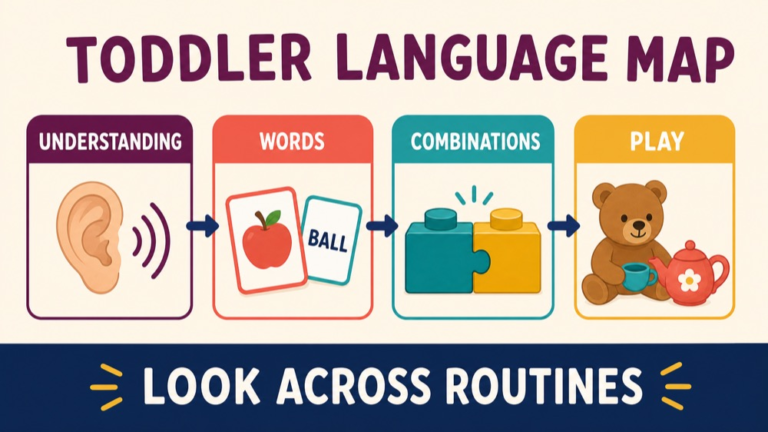
A practical framework separates related questions without pretending that development occurs in isolated boxes. When observing a toddler, consider these connected domains:
Receptive language: What does the child understand about people, objects, actions, routines, and relationships?
Expressive vocabulary: What meanings does the child communicate, and which words, signs, sounds, or other symbols carry those meanings?
Word combinations: Does the child combine meaningful units to request, comment, reject, describe, or direct another person?
Gestures: Does the child point, show, give, reach, wave, nod, imitate, or use another movement intentionally?
Play: Does the child explore, imitate actions, use objects flexibly, and build simple pretend or shared play sequences?
Social communication: Does the child initiate, respond, share attention, take turns, and repair a message when a partner does not understand?
These domains influence one another. A toddler asking for help may look, hand over an object, vocalize, wait, and later add a word. That sequence shows gesture, expressive intent, social communication, and learning; a word count alone would miss much of it.
What to observe in real routines
Language is easiest to understand when it is observed in activities that have a purpose for the child. The same toddler may show different abilities during snack, a picture book, outdoor play, dressing, or a transition. Routine context supplies clues, but it can also hide difficulty if a child has memorized a familiar sequence. Observe several activities and note both independent communication and responses to a supportive partner.
Routine
Possible observation
Question the observation raises
Snack
The child points to a choice, reaches, labels a food, rejects an item, or asks for more through a word, sign, or gesture.
Can the child communicate a preference and understand a partner’s response?
Picture book
The child looks where a partner points, turns pages, labels a familiar picture, imitates a sound, or brings the book back for another turn.
Does the child share attention, understand familiar language, and use the book socially?
Getting dressed
The child responds to a familiar direction, anticipates the next step, names clothing, or asks for help.
Is the response based on language, routine memory, visual cues, or a combination?
Play with objects
The child gives an object to a partner, imitates an action, combines toys, pretends, or changes a play plan.
How flexible are the child’s symbolic, social, and problem-solving messages?
Transition
The child protests, follows a clean-up cue, seeks a partner, or uses a gesture or word to repair a misunderstanding.
Can the child communicate when the routine changes or the first message fails?
A useful observation note records more than a successful answer. Note the partner’s wording, available cues, the child’s mode, and what followed. This helps distinguish prompted imitation from independent, spontaneous use.
Record whether the child initiated or only responded.
Note whether the message was understood by familiar partners, unfamiliar partners, or both.
Compare a highly familiar routine with a new but meaningful activity.
Describe what the child did when a partner misunderstood.
Look for growth over repeated observations instead of relying on one performance.
Receptive language, expressive vocabulary, and word combinations
Receptive language concerns understanding. In a toddler routine, it may appear when a child recognizes a named object, anticipates a phrase, follows a meaningful direction, or shows understanding through action. Context, gesture, object placement, and routine knowledge can support a response, so following a familiar snack sequence does not automatically show the same understanding for a new direction in another setting.
Expressive vocabulary concerns the meanings a child communicates. Spoken words are important, but a clinical description should also notice meaningful signs, consistent word approximations, gestures, and other communication modes. The useful question is whether the child is using symbols intentionally and whether the range of meanings is expanding: people, actions, objects, locations, social routines, rejection, help, and comments all matter.
Word combinations are meaningful units used together to make a more specific message: a request, description, rejection, possession, or comment. A child may move from a single word or gesture for a ball to a message combining the object with an action, location, or partner-directed request. The key is growing ability to build and vary messages, not a phrase memorized from an adult.
These distinctions prevent two opposite mistakes: overlooking strong understanding because speech is limited, or overestimating language from a repeated phrase without flexible comprehension. Examine meaning, independence, variety, and transfer.
Ask what the child understands without a gesture and what becomes clear with a gesture or object.
Separate labels from action words, social words, questions, refusals, and repair messages.
Notice whether a phrase changes when the object, partner, or routine changes.
Count communication across the child’s languages and modes rather than treating English words as the whole profile.
Look at how the child responds after an adult expands or models a message.
Gestures, play, and social communication carry meaning
Gestures are not merely a waiting room for speech. Pointing, showing, giving, waving, or nodding can communicate a relationship among the child, a partner, and an idea. Gesture becomes especially informative when coordinated with looking, vocalizing, a word, or a turn.
Play creates a natural setting for language because it gives a child something to notice and a reason to communicate. A toddler may first explore how an object works, then imitate a familiar action, then combine actions into a short sequence. In shared play, an adult can observe whether the child accepts a partner’s idea, changes the plan, waits for a turn, asks for help, or uses an object to represent something else. Play is not a test of personality; it is one context for seeing communication in action.
Social communication includes initiation, response, shared attention, turn exchange, activity management, and repair. A toddler who brings a toy to an adult, waits for the adult to look, and continues the game is communicating even without naming it. Frustration after a misunderstanding may signal a need for more accessible repair, but the emotion alone does not identify the cause.
When observing a shared activity, follow the sequence rather than scoring one isolated behavior:
What attracted the child’s attention?
How did the child make the message available to a partner?
Did the partner recognize the message and respond?
Did the child continue, change, or repair the communication?
Could the child use a similar strategy in another routine?
Broad developmental patterns without rigid cutoffs
Public developmental guides help when they organize observation, not when they turn a broad range into a pass-or-fail test. Across the toddler period, communication may become more intentional, varied, partner-directed, and flexible; understanding, combinations, imitation, sequencing, and shared participation may expand. The pace and order are not identical for every child.
Broad period
Communication may be expanding
Keep checking
Early toddler period
Intentional gestures, vocal or word attempts, recognition of familiar people and routines, and more purposeful requests or comments may be emerging.
Hearing and visual access, consistency across partners, understanding with and without context, and the child’s available communication modes.
Middle toddler period
Functional vocabulary, action messages, shared attention, imitation, and early combinations may become more varied across daily activities.
Whether the child understands new language, communicates for more than requesting, and uses the same idea across languages, partners, and settings.
Later toddler period
Longer or more flexible combinations, questions, negation, pretend sequences, social routines, and repair attempts may be developing.
Speech clarity, language form and meaning, participation with peers and adults, and the effect of hearing, access, or context.
These descriptions are orientation points, not promises. Variation can reflect communication opportunities, temperament, attention, available languages, hearing access, motor or sensory factors, and setting demands. A quiet child may use other modes effectively; a talkative child may still struggle with unfamiliar language. Patterns over time and across contexts matter more than one comparison.
Use developmental guides to decide what to observe next.
Ask whether a skill is present, emerging, consistent, and transferable.
Compare the child’s own pattern over time instead of ranking children against one another.
Include communication that is spoken, signed, gestural, aided, or multimodal.
Common confusions in toddler language development
Early communication questions become confusing when one visible behavior is treated as a complete explanation. These distinctions help organize observation and family conversations.
Common confusion
More useful question
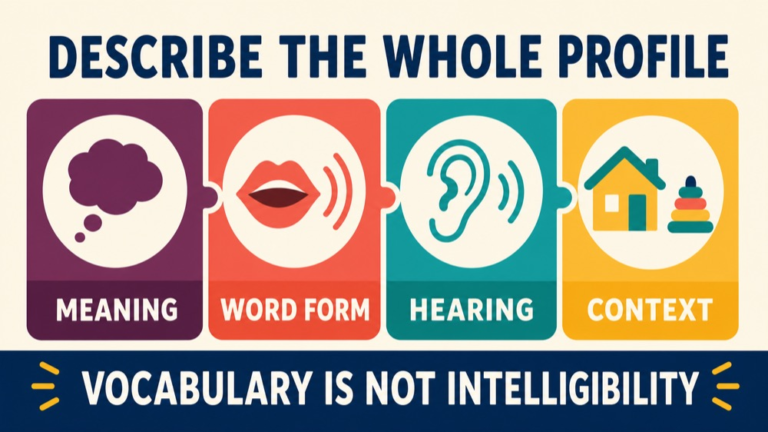
Vocabulary versus intelligibility
How many meanings does the child communicate, and how understandable is the speech in different contexts? A child can have many words that are difficult for unfamiliar listeners to understand, or clear words with a smaller expressive repertoire.
Bilingual development versus disorder
What does the child understand and express across the full linguistic repertoire and with familiar partners? Exposure to more than one language is not, by itself, evidence of a disorder. Evaluation should not treat one language in isolation as the whole child.
Quiet versus noncommunicative
Does the child initiate or respond with gaze, gesture, movement, signs, sounds, words, or other modes? Low speech volume or few spoken words does not answer every question about intent and understanding.
Routine compliance versus broad comprehension
Can the child respond when wording, objects, partners, or settings change? A familiar action may be supported by memory and context as well as language.
One missed milestone versus a developmental profile
Is there a pattern across time, settings, communication partners, access, and participation? One observation cannot determine cause or diagnosis.
For bilingual toddlers, the languages should not be made to compete. A child may know a concept in one language, use a family expression in another, and use gesture in both. Evaluation considers opportunities, partners, comprehension, expression, and participation across languages, separating language difference from possible communication difficulty.
Vocabulary and intelligibility also answer different questions. Vocabulary concerns meanings; intelligibility concerns how much spoken message a listener understands. Context, familiarity, sound development, rate, noise, and listener experience can change intelligibility, so one adult impression is not a full communication observation.
Hearing and communication access come before interpretation
Language learning depends on access to a usable communication system. Hearing access can vary with background noise, distance, attention, ear health, equipment, or the quality of the signal. Visual access, partner positioning, lighting, and the availability of a signed, aided, or multimodal system can also influence what a toddler is able to notice and use. A child who misses a spoken cue may be showing an access problem, an understanding problem, an attention shift, or more than one factor; the observation alone does not decide which.
For that reason, hearing is not an optional footnote in a toddler language discussion. When caregivers or professionals are concerned about inconsistent responses to sound, difficulty noticing speech, changes in communication, or access to a hearing device or communication system, the appropriate next step is a context-sensitive conversation with the relevant health, hearing, and speech-language professionals. This article does not determine hearing status or device function.
Ask what the child can access in quiet and noisy environments.
Note distance, partner position, visual cues, and whether the message was repeated.
Consider whether communication partners expect speech only or accept the child’s available modes.
Check whether a skill appears with a familiar partner but not in a less supported setting.
Separate a change in access from a conclusion about language ability.
When to seek an evaluation and what it should cover
A family does not need to wait for a perfect checklist before asking a qualified professional about a concern. Discussion or evaluation may be appropriate with little progress over time, loss of previously used communication, persistent difficulty understanding, limited initiation or repair, participation-limiting frustration, hearing-access concern, or concern across routines.
That list is a reason to gather better information, not a diagnostic formula. It is also appropriate to ask about evaluation when the concern is present in any language or mode. An English-only snapshot can miss a child’s strengths and can confuse language exposure with language ability.
A thoughtful evaluation looks at the whole communication system. Depending on the concern and setting, it may consider:
hearing history and current access to speech or other communication signals;
receptive language in familiar and less familiar routines;
expressive vocabulary, combinations, gestures, signs, and other modes;
speech production and intelligibility when spoken communication is part of the concern;
play, shared attention, initiation, turn exchange, and repair;
the languages used by the child and partners, with appropriate language support;
communication demands, participation, and family priorities.
The result should describe abilities, supports, uncertainties, and follow-up questions, not reduce the child to one score or milestone. For learners, assessment is a reasoning process: define the question, collect contextual information, consider alternatives, and choose a next step within scope.
A short SLP Praxis application
The current ETS test page and applicable blueprint should control any changing Praxis scope or logistics. For concept application, an original practice scenario can be useful without pretending to reproduce an exam item: a toddler uses a few spoken words, several gestures, and familiar routines to request help; the child follows some routine directions but is less consistent when the wording or setting changes; caregivers also report that unfamiliar listeners understand little of the speech.
The strongest first interpretation is not a label based on the word count or on intelligibility alone. It is to separate the evidence into receptive language, expressive communication, speech clarity, social communication, hearing or access, and participation. Then ask what information is missing and what evaluation pathway would clarify it. This reasoning respects the difference between a developmental guide and a diagnosis.
Identify the exact communication question: understanding, expression, speech clarity, interaction, access, or participation.
Look for evidence across routines, partners, settings, and the child’s full linguistic repertoire.
Check hearing and communication access before interpreting an inconsistent response as a language limitation.
Use the observed pattern to select assessment questions, not to infer certainty from one milestone.
Choose an answer that protects scope, context, and the need for appropriate professional evaluation.
This is original practice content for reasoning, not an official, recalled, actual, leaked, or guaranteed-pass question. The point is the decision process: distinguish constructs, weigh context, and avoid overclaiming.
Quick review: what to carry forward
When you review toddler language development, use this compact checklist:
Receptive language asks what the child understands, not only whether the child complies with a familiar routine.
Expressive vocabulary includes the meanings communicated through available spoken and nonspoken modes.
Word combinations show growing message-building, but a memorized phrase is not the same as flexible language use.
Gestures can carry intentional meaning and should be observed alongside speech.
Play reveals opportunities for imitation, symbolism, shared attention, and social problem solving.
Social communication includes initiation, response, turn exchange, and repair.
Vocabulary and intelligibility are related but different clinical questions.
Bilingual experience should be considered across languages and should not be treated as a disorder by itself.
Hearing and communication access affect interpretation and belong in the evaluation picture.
Broad milestones guide observation; patterns across time and routines guide professional reasoning.
If this topic is part of a broader review plan, you can explore the SLP Study Center Complete Prep page as a next learning step. The article itself remains a general clinical learning guide, not individualized medical advice or a substitute for an evaluation.
Infant Communication Development: A Multimodal Clinical Guide
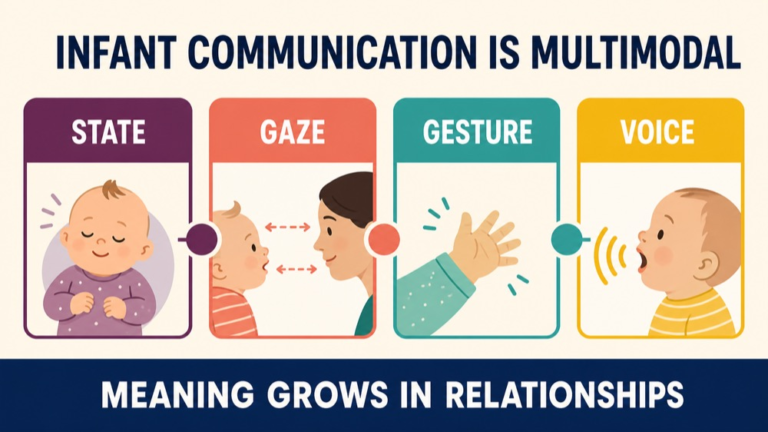
Infant communication development is not a single staircase that moves from crying to words in the same way for every child. It is a changing, multimodal process: an infant regulates a state, notices a partner, looks, moves, gestures, vocalizes, takes a turn, responds to meaning, and gradually shows what they want to share or obtain. The important unit is the interaction, not one isolated behavior.
This guide gives caregivers and SLP students a practical way to observe early communication without turning broad developmental patterns into rigid pass-or-fail cutoffs. It explains what to look for across routines, how hearing and multilingual experience affect interpretation, when a concern deserves professional follow-up, and how to apply the concept to a short SLP Praxis study scenario. The current NIDCD developmental resource and ASHA public communication milestones resource are useful starting points, but neither a general article nor one observation can interpret an individual infant by itself.
Infant communication development as a multimodal system
Communication begins before an infant uses recognizable words. A cry, change in body movement, shift in gaze, smile, pause, coo, reach, or vocal burst can affect what a caregiver does next. Over repeated interactions, the infant experiences that signals can be noticed, answered, and extended. The caregiver’s response is part of the communication environment, so early development is better understood as a relationship between the infant, the partner, the activity, and the surrounding conditions.
Multimodal means that communication is carried through several channels at once. An infant may look toward a caregiver, lean toward a toy, make a sound, and wait for a response in one short exchange. Another infant may communicate mainly through movement, facial expression, changes in state, or vocal play in that moment. The question is not whether every channel appears on a fixed date; the question is how the infant accesses interaction, responds to a partner, and adds information over time.
Communication lens
What an observer might notice
What the observation can help you ask
What it does not establish alone
State regulation
Settling, alerting, pausing, or becoming overwhelmed during a routine
Is the infant available for a social exchange right now?
A stable communication profile across all settings
Social engagement
Orienting toward a partner, sharing enjoyment, or returning to an interaction
How does the infant participate with another person?
A conclusion about social development from one quiet or active moment
Gaze and attention
Looking toward a face, object, movement, or location connected to the activity
What seems to draw attention, and can attention shift with a partner?
A binary measure of social connection
Turn-taking
Pausing after a partner speaks or vocalizes, then adding a sound or movement
Does the exchange have a back-and-forth rhythm?
A requirement for identical timing in every interaction
Gestures and movement
Reaching, showing, giving, pushing away, waving, or changing body position
Is the infant using the body to direct, protest, request, or share?
A fixed interpretation without knowing the routine and partner response
Vocal play
Cooing, babbling-like strings, squeals, raspberries, or changes in pitch and loudness
How does the infant explore sound and use it in an exchange?
Speech clarity, word knowledge, or a diagnosis
Understanding and intent
Anticipating a familiar routine, responding to a cue, or repeating a signal for an effect
What meaning might the infant be learning, and what outcome are they seeking?
Complete comprehension or a settled cause from one response
These lenses overlap. A reach can be movement, request, or an invitation for a partner to act. A pause can reflect turn-taking, fatigue, uncertainty, or processing time. Describe the whole exchange rather than labeling the most visible behavior.
What early communication can look like across routines
Broad developmental resources often organize early observations by approximate periods, but those periods are orientation points rather than deadlines. Communication may appear uneven: a child may vocalize richly during floor play, use fewer sounds when tired, and show strong anticipation during a familiar song. Skills can also emerge in overlapping layers, with regulation, attention, movement, vocal play, and understanding supporting one another.
Consider feeding or holding. An infant may settle when a familiar partner speaks, turn toward a voice, pause during the exchange, or change facial expression when the routine changes. The meaningful question is not whether the infant produced one particular sound. It is whether the infant and partner are building a pattern in which signals, responses, and shared activity influence each other.
During floor play, the infant might look from a toy to a caregiver, vocalize after the caregiver imitates a sound, reach toward an object, or shift body position to continue the activity. A caregiver can respond by pausing, copying the sound or movement, naming the object, and waiting. That response creates another opportunity for the infant to notice the turn and add something new.
During a book, song, or peekaboo routine, the infant may anticipate a repeated part, smile before the familiar action, vocalize when the partner pauses, or move closer when the activity resumes. Emerging understanding can be visible in anticipation and participation before it is visible as spoken language. The routine provides context for interpreting what the infant knows and intends.
Across routines, useful patterns include the following. They should be considered together, with attention to the infant’s state and opportunities rather than used as a checklist that assigns a result.
The infant has more than one way to signal comfort, interest, protest, or a need for help.
The infant notices or responds to a partner in at least some familiar activities.
The infant participates in short exchanges through sound, gaze, movement, facial expression, or gesture.
The infant’s communication changes when the partner pauses, imitates, offers a choice, or changes the activity.
The infant shows anticipation or response to familiar people, routines, sounds, or actions.
The infant gradually adds variation, persistence, or clearer direction to a signal.
Communication can be observed in more than one setting, partner relationship, or daily routine.
This pattern-based view is more useful than asking whether an infant has checked off a single milestone. It also helps explain why two infants with similar abilities may look different: they may have different temperaments, opportunities, access conditions, languages, routines, or ways of engaging with people.
How to observe communication without turning it into a rigid checklist
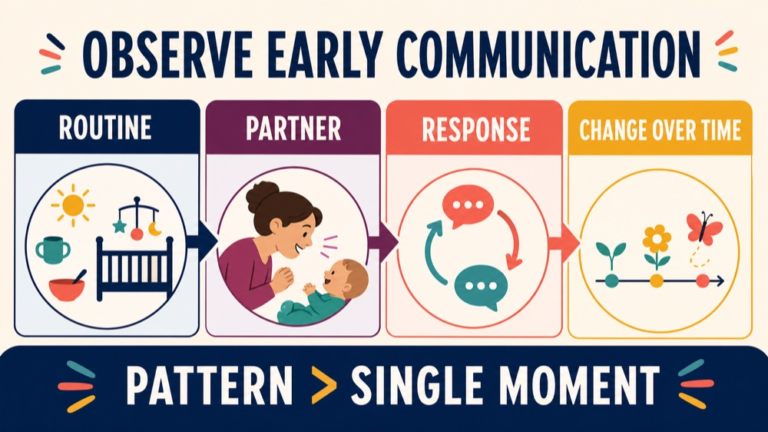
A good observation begins with a real routine, not a performance demand. Choose a short period such as feeding, dressing, play, a song, or looking at a book. Note what happened before the signal, what the infant did, how the partner responded, and what happened next. This sequence protects the observer from treating a behavior as meaningful without its context.
For caregivers, the goal is not to run a home test. For students, the goal is to practice neutral description before interpretation. Instead of writing that an infant was not social, write that the infant looked toward the caregiver twice during floor play, turned away when the room became noisy, and resumed vocalizing after the caregiver moved closer and paused. The second description preserves evidence and uncertainty.
Name the routine. Record whether the observation occurred during feeding, play, dressing, a song, a book, or another familiar activity.
Describe the state. Note whether the infant seemed alert, sleepy, hungry, distressed, excited, or settled, because availability can change the exchange.
Record the partner action. Write down whether the adult spoke, paused, imitated, offered a choice, moved an object, or changed the pace.
Describe the infant signal. Use observable language such as looked, reached, vocalized, paused, smiled, pushed away, or shifted posture.
Look for the next turn. Ask whether the partner responded and whether the infant changed, repeated, repaired, or extended the signal.
Compare opportunities. Consider whether a similar pattern appears with another routine, partner, language, time of day, or noise level.
Mark what is missing. Separate what was not observed in this short sample from what has not occurred across repeated opportunities.
Share the pattern. If concern continues, bring concrete observations and questions to the appropriate health or early-intervention professional rather than a conclusion.
Important distinctions and common confusions
Infant communication development is easy to oversimplify because several related behaviors can look similar on the surface. A stronger interpretation separates the behavior from the construct and then asks what evidence would support the next step.
Common confusion
More precise distinction
Better question
Quiet means no communication
An infant may communicate through gaze, movement, facial expression, changes in state, or small sounds.
Which modes are available, and in which routines?
Looking at a face equals social communication
Gaze is one part of attention and engagement; its meaning depends on timing, partner response, and activity.
Does the infant use attention in a shared exchange or to direct an activity?
Babbling equals spoken language
Vocal play shows exploration and exchange, while words involve more stable sound-meaning relationships.
How are sounds changing, and is the infant using them in a purposeful context?
Reaching is requesting
Reaching can obtain, explore, share, protest, or move the body toward an object.
What happened before and after the reach, and how did the partner respond?
Not waving means not understanding
A gesture may depend on opportunity, imitation, motor planning, culture, and the infant’s interest in the routine.
How does the infant show recognition or participation through other modes?
One language sample represents all language
A multilingual infant’s communication should be considered across languages, partners, and meaningful routines.
What does the infant understand and express across the full language environment?
One response to sound settles hearing
Response varies with distance, background noise, attention, state, and the nature of the sound.
What hearing information or professional follow-up is still needed?
Hearing, multilingual development, and access boundaries
Hearing access is part of the communication context. If an infant responds inconsistently to voices or environmental sounds, the observation may be affected by distance, visual attention, background noise, fatigue, or a hearing difference. A single response cannot identify the reason. When hearing is a concern, hearing-focused follow-up with an audiology or health professional is an important part of deciding what information is needed.
Multilingual development adds another boundary: do not judge the infant’s communication by looking at only one language or one speaker. Count communication across the languages and modes used in the family. A child may hear one language from one caregiver, another language from a grandparent, and gestures or vocal play across both. Moving between languages or using a family language in a routine is context to understand, not a reason to remove that language.
For a multilingual observation, ask:
Which languages does the infant hear, from whom, and in which routines?
Which communication modes are available across those routines?
Does the infant respond differently with familiar versus unfamiliar partners?
Are the concerns present across the language environment or only in one interaction?
Could the assessment include the family’s meaningful language and a qualified interpreter or bilingual professional when needed?
These questions do not replace assessment. They keep language exposure, partner expectations, hearing access, and opportunity visible. A general milestone chart cannot determine an individual pattern.
When to consider professional evaluation
A caregiver does not need to wait for a perfect checklist pattern before asking a qualified professional how to proceed. At the same time, this article cannot decide whether an individual infant needs a particular service. The useful middle ground is to notice persistent, growing, or meaningful concerns and bring clear observations to the appropriate local health, hearing, or early-intervention pathway.
Examples of concerns worth discussing include a loss of communication behaviors that were previously present, little change in the infant’s ways of signaling over time, repeated difficulty accessing voices or other sounds, limited opportunity for reciprocal exchange across many familiar routines, or difficulty communicating comfort, interest, protest, or help through any available mode. A caregiver’s concern is also relevant information, especially when it is based on repeated observations rather than a single difficult day.
When seeking guidance, ask the professional to clarify the next question rather than asking for a label from one behavior. Depending on the concern and local system, the next step may involve hearing follow-up, developmental history, observation across routines, speech-language evaluation, or coordination with other providers. The pathway should fit the evidence and the infant’s context.
What communication behaviors have we noticed, and in which routines do they occur?
What changed, if anything, from the infant’s earlier pattern?
How does the infant respond to familiar voices, visual cues, gestures, and touch?
Which languages and communication modes should be included in the history?
Would a hearing check help clarify access to communication?
What kind of evaluation is appropriate for the question we are asking?
What should we observe or record before the next appointment?
Early consultation is a way to gather better information and support participation; it is not an admission that a diagnosis is already known. Evaluation findings should be interpreted with history, hearing, language environment, development, and the family’s priorities in view.
Short SLP Praxis application
For a short SLP Praxis application, treat infant communication as a clinical-reasoning problem rather than a memorization list. Use the current ETS Speech-Language Pathology 5331 page and its current linked materials for exam scope and changing logistics. This article does not state current exam numbers and does not reproduce a test item.
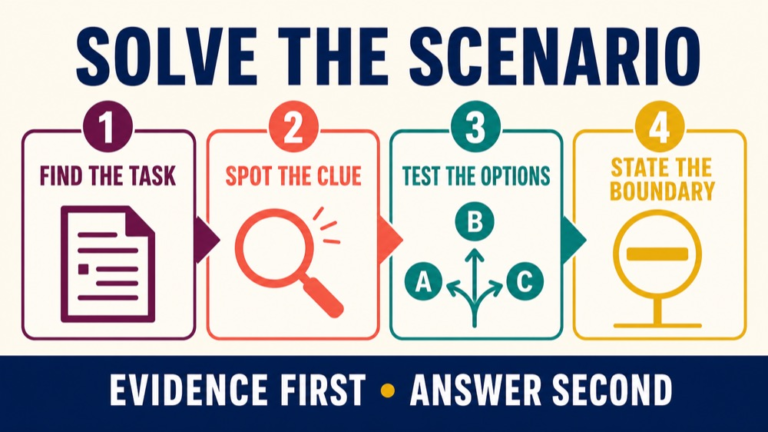
Identify the construct. Decide whether the scenario emphasizes regulation, hearing access, social engagement, receptive understanding, expressive communication, gesture, or turn-taking.
Separate observation from inference. Write what the infant did before deciding what it might mean.
Check context. Consider state, noise, distance, partner behavior, language exposure, and the routine.
Find the missing evidence. Ask whether the best next step is more observation, hearing information, history, or a communication evaluation.
Match the answer to the question. Do not select a diagnosis or treatment plan when the stem only supports a cautious next-information decision.
Original study scenario, written for this guide and not from an exam: During a familiar floor-play routine, an infant alternates gaze between a caregiver and a toy, vocalizes after the caregiver pauses, reaches toward the toy, and responds less when the room becomes noisy. The strongest reasoning is to recognize a multimodal pattern, preserve the effect of context, and consider what hearing or broader observation information is still needed. The scenario does not identify a diagnosis, and one noisy-room response should not be treated as a complete developmental conclusion.
Common traps in infant communication development
These traps can affect both caregiver interpretation and exam preparation. Each one replaces a pattern-based question with a shortcut that the evidence does not support.
Turning an age range into a deadline: broad milestones orient observation but do not create a pass-or-fail date for one infant.
Making one behavior carry the whole interpretation: a single gaze, sound, reach, or missed gesture needs context and repetition.
Equating communication with clear speech: early communication includes body movement, attention, facial expression, gesture, and vocal play.
Ignoring state and environment: sleep, hunger, noise, illness, novelty, and partner pacing can change an interaction.
Using gaze as a binary test: the timing and function of attention are more informative than a simple present-or-absent judgment.
Viewing multilingual experience through one language: include the infant’s full language environment and communication modes.
Jumping to a treatment answer before checking access: hearing, history, context, and evaluation may need attention first.
Calling a caregiver observation a diagnosis: observations are evidence to share with qualified professionals, not a substitute for evaluation.
The repair is usually simple but disciplined: describe the routine, record the infant’s state, identify the partner response, compare patterns across opportunities, and state what remains unknown. That process produces a better clinical question and a better study answer.
Quick review
Use this checklist to review the concept or to organize a conversation with a supervisor, caregiver, or professional. The goal is to remember the framework while keeping the interpretation appropriately cautious.
Can I explain why early communication is multimodal rather than speech-only?
Can I name the roles of state regulation, social engagement, gaze, turn-taking, gesture, vocal play, understanding, and intent?
Can I describe a concrete interaction without turning my description into a diagnosis?
Can I distinguish vocal play from a stable word-meaning relationship?
Can I explain why hearing access, noise, and partner behavior matter?
Can I describe a multilingual infant across the full language environment rather than one language sample?
Can I identify a pattern that deserves professional follow-up without imposing a rigid cutoff?
For an SLP Praxis scenario, can I separate observed evidence, missing information, and the best next decision?
If you want to compare a broader study resource with your own review plan, you can visit the SLP Study Center Complete Prep page and use the current details on that page to decide whether it fits your needs. This article is a clinical learning guide, not an individualized evaluation or a promise about an exam result.
References and source boundaries
The following links were supplied by the research packet or the named source plan. They support the article’s broad teaching boundaries rather than a conclusion about any individual infant.
Checked date: the local research packet was timestamped 2026-08-22 and the local queue and workflow contract were reviewed on 2026-08-23. Recheck the linked pages before publication, before a new study cycle, or whenever the relevant developmental, evidence, or exam source changes.
Speech Language Development Across the Lifespan: A Clinical Guide
Speech language development across the lifespan is broader than a list of first words or sound milestones. It includes how people acquire, organize, express, understand, and adapt communication from infancy through later life. A useful clinical view also asks whether a person can access communication, use it with other people, and participate in the routines that matter to them.
This guide uses broad age patterns as orientation points rather than rigid cutoffs. Speech, language, cognition-communication, hearing access, social communication, and functional participation overlap, but each lens asks a different question. One behavior can be meaningful without explaining the whole profile, and a developmental difference can have more than one possible contributor.
Speech language development across the lifespan: the framework
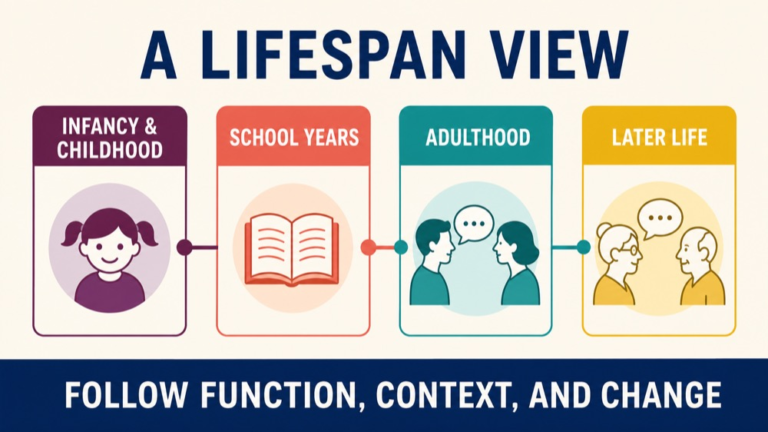
In a learning context, speech language development across the lifespan describes changing communication abilities and demands over time. Infants begin with early regulation, sound awareness, vocal exchange, and interaction. Children build spoken, signed, written, and multimodal language. Adolescents refine abstract language and social judgment. Adults adapt communication to work, relationships, health care, and community life. Later-life communication may include maintenance, accommodation, rehabilitation, or response to acquired change.
Speech refers to the production of spoken messages, including sound patterns, voice, and fluency. Language concerns meaning and the shared system used to understand and express it through speech, writing, signing, gestures, or other modes. A person can have a strong idea with speech that is difficult to understand, or clear speech with difficulty understanding a complex message. Keeping those questions separate prevents a visible behavior from standing in for the whole communication profile.
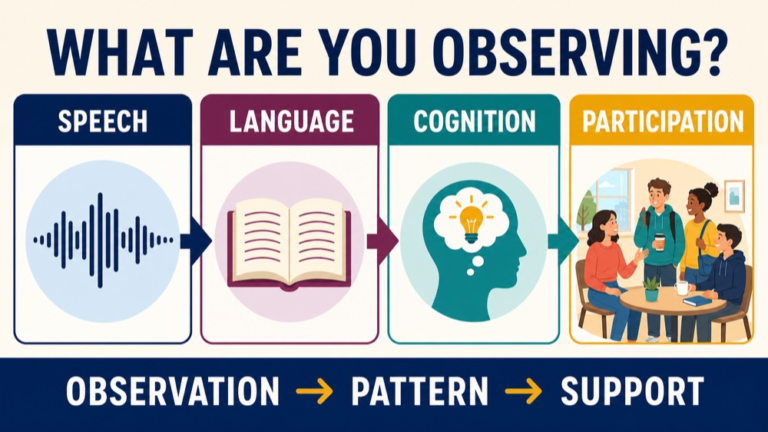
Cognition-communication describes cognitive processes as they operate in communication, such as attention, learning, memory, processing, organization, problem solving, and self-monitoring. Hearing access asks whether relevant speech and environmental information is available under the conditions in which communication occurs. Social communication asks how a person shares meaning with partners, including initiation, turn exchange, inference, topic management, repair, and adaptation. Functional participation asks what happens in real routines: joining a classroom discussion, completing a work task, managing a medical conversation, maintaining a relationship, or communicating a need safely.
Developmental acquisition: new abilities emerge through interaction, learning, experience, and access to communication.
Refinement: messages become more precise, efficient, flexible, and appropriate for different partners and settings.
Adaptation: people use strategies, technology, partner support, or environmental changes when demands shift.
Maintenance: familiar communication abilities are practiced and supported in meaningful activities.
Change: a new pattern may reflect context, health, hearing, neurological, emotional, or other factors that require careful history.
Participation: the practical outcome is not only what a person can do in a test, but whether communication supports valued activities.
The life-span lens therefore has two safeguards. It avoids reducing communication to early childhood checklists, and it avoids treating every later-life change as a simple consequence of age. Interpretation depends on the person, the communication mode, the setting, the partner, the time course, and the effect on participation.
A comparison map: related domains, different questions
Clinical reasoning improves when an observation is first assigned to the question it can actually answer. The map below is not a set of isolated boxes. A hearing-access issue can affect language learning, a language difficulty can affect classroom participation, and cognitive-communication demands can make an otherwise familiar message harder to manage. The boundaries help organize follow-up rather than close the inquiry.
Lens
Core question
Concrete observation
Important boundary
Speech
How is a spoken message produced?
Sound patterns, voice quality, rate, or fluency during conversation.
Speech clarity does not by itself describe vocabulary, comprehension, or social intent.
Language
What meaning is understood and expressed?
Following directions, choosing words, combining ideas, telling a story, or reading and writing.
Spoken output is one route for language; gestures, signs, writing, and AAC can also carry meaning.
Cognition-communication
How do cognitive processes support communication?
Holding a topic in mind, remembering instructions, organizing a narrative, or monitoring a breakdown.
A difficult task may reflect demand, fatigue, access, or context; it is not a direct measure of general ability.
Hearing access
What speech and sound information is available?
Understanding a speaker in quiet and noise, with or without visual or device support.
Responding to a familiar voice in one setting does not settle hearing status in every setting.
Social communication
How is meaning shared with a partner?
Initiating, taking turns, interpreting an implied message, changing topic, or repairing a misunderstanding.
Quietness, eye gaze, or talkativeness alone cannot explain social communication.
Functional participation
What can the person do in valued routines?
Joining play, learning in class, contributing at work, managing appointments, or staying connected.
Participation is shaped by the environment and partner supports as well as individual skills.
Broad lifespan patterns from infancy through later life
Age bands make a life-span topic easier to study, but they can create false precision. The patterns below are broad guides assembled from the source boundaries in this article. They describe useful observations to consider, not a checklist that every person completes on one date. Individual pathways may be uneven, multilingual, multimodal, or shaped by hearing and other access conditions.
Life period
Communication patterns to consider
Context and participation questions
Infancy and toddlerhood
Early attention to voices and sounds, vocal play, turn-taking, gestures, babbling, emerging words, comprehension of familiar routines, and growing intentional communication.
Does the infant have reliable access to communication? How do caregivers respond? What happens during play, transitions, books, and feeding? Are skills expanding, uneven, or changing?
Preschool and school age
Vocabulary, grammar, speech-sound patterns, intelligibility, narratives, questions, classroom language, early literacy, and increasingly flexible social communication.
Can the child follow instruction, explain an idea, learn from language, participate with peers, and repair a breakdown? Which supports make communication easier?
Adolescence
Abstract vocabulary, inferencing, perspective taking, expository and narrative discourse, metalinguistic awareness, self-advocacy, and communication across changing peer and academic settings.
Can the student shift register, interpret indirect language, organize a complex task, and communicate preferences or accommodations? Which demands are linguistic, cognitive, social, or environmental?
Adulthood
Communication is adapted for work, relationships, parenting, health care, community participation, literacy, multilingual settings, and specialized expertise.
What does the person need to explain, remember, negotiate, or understand? Are breakdowns linked to noise, time pressure, fatigue, unfamiliar partners, or a change from baseline?
Later life
People may continue to learn and communicate effectively while also experiencing changing hearing access, retrieval speed, processing demands, or the effects of acquired conditions.
Compare communication across meaningful routines and over time. Ask about hearing, health history, medication, fatigue, partner support, and a new loss of function without assigning a cause from age alone.
For early development, NIDCD describes a progression from responses to voices and sounds toward babbling, gestures, words, combinations, stories, and increasingly understandable communication. Those examples are useful because they connect sound access, language, interaction, and daily routines. They still need to be interpreted with the person's communication mode, opportunities, and history in view.
Concrete example: one communication event, several clinical questions
Consider a preschool child describing a visit to a park. The child produces a long sequence of speech, uses gestures to show where an event occurred, names several objects, and becomes difficult for an unfamiliar listener to understand. The observation contains several possible study targets: speech intelligibility, language formulation, narrative organization, social communication, and the partner's ability to support the exchange. It does not answer all of those questions at once.
Now consider a teenager in a group project. The student understands the assignment and has strong content knowledge, but misses an implied change in the group's plan and needs the teacher to restate the next step. The relevant analysis might include language comprehension, executive organization, memory for instructions, social inference, hearing access in a noisy room, and the supports available. A single missed cue should be described before it is interpreted.
An adult may follow a one-to-one conversation in a quiet office but miss key details in a fast meeting with several speakers. That pattern raises questions about hearing access, visual information, processing demand, fatigue, and the communication environment. An older adult who has a new, persistent difficulty following familiar conversations or expressing previously easy ideas presents a different kind of question because change from baseline and functional impact matter. The example calls for appropriate professional evaluation, not a conclusion from one conversation.
Describe the event: who spoke, what the task required, which language or mode was used, and where the breakdown occurred.
Name the observable form: sound production, word choice, sentence structure, memory for steps, turn exchange, listening access, or participation.
Identify the demand: noise, speed, abstraction, topic shift, unfamiliar partner, fatigue, visual load, or emotional pressure.
Record the support: repetition, written information, gesture, captioning, device use, extra time, partner modeling, or a quieter setting.
Describe the outcome: whether the person repaired the message, completed the activity, withdrew, or needed another route.
Common confusions that make age patterns misleading
Many errors occur because a visible communication behavior is treated as a shortcut for a broader construct. The following distinctions are useful for learners and for anyone reading a milestone chart.
Speech is not language. A person may understand and formulate a message while producing speech that is hard to understand. Another person may speak clearly but struggle with comprehension, word finding, grammar, or discourse.
Expressive output is not the whole language profile. Spoken words are only one source of evidence. Comprehension, gestures, signs, writing, AAC, imitation, and communication purpose also matter.
Hearing access is not the same as attention. A person may listen well in one room and miss information in noise, from a distance, or without visual support. A hearing question deserves hearing-focused follow-up.
Social communication is not a score for eye gaze or talkativeness. Look at how meaning is initiated, shared, interpreted, repaired, and adapted with partners across settings.
Cognition-communication is not a direct measure of intelligence. Communication performance is affected by task structure, memory load, processing time, fatigue, language, hearing, and environmental support.
A multilingual difference is not automatically a disorder. The whole language repertoire, exposure history, opportunities, and communication across languages must be considered.
An age band is not a deadline. Use patterns over time and functional impact instead of treating one range as a pass-or-fail rule.
Food preference is not the same question as swallowing safety. Mealtime selection, chewing, drinking, airway signs, comfort, and participation should be described separately.
Context, multilingualism, and access
Developmental descriptions are shaped by the language and communication environment. A multilingual child may distribute vocabulary and functions across languages, use code-switching, or show different levels of confidence with different partners. A learner who is developing an additional language may appear less expressive in that language while communicating richly in another. Interpretation should consider the entire repertoire rather than applying a monolingual expectation to one language sample.
The same principle applies to communication mode and hearing access. Deaf and hard-of-hearing people may use spoken language, sign language, written language, visual communication, AAC, or combinations of modes. The clinical question is whether the person has meaningful access to language and can participate in important routines, not whether one spoken-language pathway is the only acceptable route. ASHA's Practice Portal points learners toward topic-specific resources for hearing, multilingual service delivery, social communication, and other clinical questions.
Culture, dialect, accent, identity, family interaction style, and opportunity also shape what communication looks like. A difference from a classroom or clinic norm is not sufficient evidence of a disorder. Ask whether a pattern is shared within the person's linguistic or cultural community, whether it interferes with the person's goals, and whether the evaluator has enough relevant language and contextual information to interpret it responsibly.
Which languages, dialects, modes, and communication partners are part of daily life?
Where is communication easiest, and where does the breakdown occur?
Does the pattern appear across languages or only in one learning context?
What access supports are present, missing, or inconsistent?
What strengths does the person use to understand, express, repair, and participate?
Has the pattern changed over time, and what activities are affected?
Application to evaluation and participation
A strong evaluation begins with a meaningful concern and a clear communication question. The question might involve speech sound production, language learning, listening access, narrative organization, social inference, memory for instructions, or participation in a specific routine. The selected methods should match that question and the person's language, mode, age, cultural context, and communication environment.
Define the concern in observable terms: describe what happens, where it happens, how often it appears, and who notices it.
Separate the domains: distinguish speech, language, cognition-communication, hearing access, social communication, and participation before connecting them.
Sample meaningful contexts: include conversation, learning, work, play, reading, health care, or another routine that reflects the person's goals.
Consider access and language: account for hearing, devices, communication modes, multilingual experience, partner behavior, noise, speed, and visual information.
Use converging evidence: combine history, observation, interview, appropriate measures, and collaboration rather than relying on one behavior.
Plan for function: connect support to a real activity, such as explaining, remembering, joining, advocating, repairing, or understanding information.
Monitor change: review whether communication and participation improve, remain stable, or change when the context or support changes.
Intervention planning follows the same logic. A clinician may work on a communication skill, change the environment, coach a partner, add a visual or auditory support, or combine these approaches. The appropriate plan depends on evaluation findings, goals, consent, safety, professional scope, and the person's context. A general article can teach the reasoning framework, but it cannot determine an individualized service plan.
Functional participation is the bridge between domain knowledge and daily life. A student may need to explain a science idea, an employee may need to summarize a meeting, a parent may need to manage a child's appointment, and an older adult may need to understand medication instructions. The same underlying communication process can look different across those tasks, so assessment and support should be tied to the activity rather than to a decontextualized label.
Short SLP Praxis 5331 application
For SLP Praxis 5331 study, this topic is useful as a domain-separation and clinical-reasoning framework. Use the current ETS Speech-Language Pathology 5331 page and applicable current blueprint for exam scope and logistics. This article intentionally avoids changing test specifications and does not reproduce a test item.
When a developmental or lifespan scenario appears, work through the evidence in this order:
Identify the primary construct: Is the stem mainly about speech, language, cognition-communication, hearing, social communication, or functional participation?
Find the decisive evidence: Which behavior, time pattern, access condition, or task demand actually supports the answer?
Separate what is known from what is missing: Do not infer hearing status, diagnosis, or cause from one observation when the stem has not provided that information.
Choose the action that matches the question: A hearing concern, a language sample, a communication-partner observation, and a participation support answer address different problems.
Check the boundary: Broad milestones organize reasoning, but they do not establish a fixed outcome or a label from one sign.
Original study scenario, written for this guide and not from an exam: An older adult who previously managed familiar conversations now needs repeated explanations during a routine appointment and has difficulty organizing a short message. The best first reasoning move is to describe the change from baseline, examine hearing and communication conditions, gather relevant history, and consider appropriate professional evaluation. The scenario does not identify a cause or diagnosis by itself. The teaching point is to connect time course, access, cognition-communication, and participation instead of selecting an age-based shortcut.
Quick review: questions to carry forward
Use this checklist when reviewing a developmental resource, discussing a communication concern, or studying a clinical scenario. The goal is not to memorize a rigid staircase. The goal is to ask a more precise question and connect the evidence to participation.
What communication domain is the observation actually describing?
What does the person understand, express, produce, access, or do with a partner?
Which language, mode, setting, partner, and task demand are involved?
Is the pattern new, longstanding, uneven, or changing from the person's own baseline?
Could hearing access, fatigue, noise, memory load, culture, or multilingual experience change the observation?
What support helps the person communicate or participate?
What information is still missing before a clinical conclusion could be considered?
Would the next step involve hearing-focused follow-up, speech-language evaluation, broader history, environmental support, or collaboration?
Does the explanation avoid treating one behavior or age range as diagnostic by itself?
For exam study, does the selected answer match the decisive evidence and the scope of the question?
If you want to organize this framework into a broader review routine, you can explore the SLP Study Center Complete Prep page and decide whether it fits your own study plan. Keep the current ETS page and the linked authoritative clinical resources as the basis for changing exam and practice guidance.
References and source boundaries
The following links support the article's teaching boundaries. Recheck them before publication or before using this page to make a registration, evaluation, or service decision.
Typical Speech and Language Development: A Clinical Guide
Typical speech and language development is easiest to understand as a pattern across communication, hearing, interaction, and everyday participation—not as a single score or a checklist that every child completes on one exact date. This guide offers a broad birth-to-five framework for caregivers, students, and clinicians who want to observe development carefully without turning one milestone into a diagnosis.
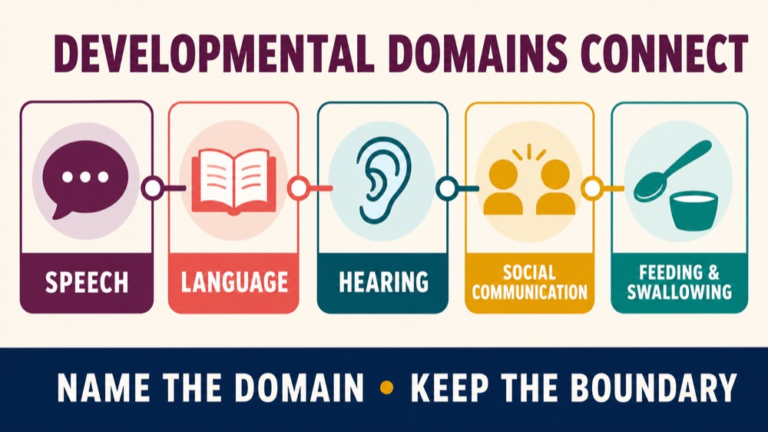
Speech, language, hearing, social communication, and feeding or swallowing influence one another, but they are not interchangeable. A child may have strong language ideas with speech that is still difficult to understand, or communicate socially with gestures while spoken words are emerging. The most useful interpretation considers the whole profile, the child’s languages and routines, change over time, and the effect on participation.
What Typical Speech and Language Development Includes
In a clinical learning context, typical speech and language development describes common ways children develop the ability to receive, organize, express, and share messages. “Typical” describes a broad pattern, not a promise that every child will show the same behavior at the same age. Children can reach related skills in different orders, show uneven strengths, or need more time in one area while moving quickly in another.
Speech concerns spoken sound production, voice, and fluency. Language concerns meaning: understanding words and sentences, choosing vocabulary, combining words, using grammar, and communicating to request, comment, explain, or repair a misunderstanding. Social communication concerns how a child uses available communication with people, including turn-taking, shared attention, gesture, topic shifts, and adapting a message to a partner or situation.
Hearing is an access system rather than a speech or language skill. Consistent access to speech and meaningful sounds can support learning, but hearing status is one part of a developmental profile. Feeding and swallowing involve the safe, coordinated management of food, liquid, and saliva, including oral movements, chewing, drinking, and mealtime participation. The domains can interact while still requiring separate clinical questions.
Understanding: responses to familiar words, routines, gestures, and increasingly complex messages.
Expression: sounds, gestures, signs, words, combinations, and other reliable communication forms.
Hearing access: reactions to voices and environmental sounds, followed by hearing-focused follow-up when needed.
Mealtime function: chewing, drinking, textures, pacing, comfort, and safety rather than feeding preference as speech data.
This whole-profile approach is why a milestone chart works best as an observation aid. It can prompt a useful conversation with a pediatrician, audiologist, or speech-language pathologist, but it cannot answer every clinical question. Development is better interpreted through repeated observations across people, activities, and communication opportunities.
How the Developmental Domains Fit Together
Imagine a three-year-old who points to a toy, uses a few spoken words and longer strings of unclear speech, follows familiar play routines, and eats a narrow range of textures without coughing. Several questions must remain separate: What language does the child understand? How is intent communicated? How understandable is the speech? Is hearing access adequate? Are feeding safety and nutrition affected?
Domain
Clinical question
Everyday observation
Boundary
Speech
How is spoken communication produced?
Sound patterns, voice, fluency, and intelligibility in context.
Clarity does not describe vocabulary, comprehension, or social intent.
Language
What meaning is understood and expressed?
Words, combinations, grammar, directions, answers, and stories.
Spoken output is one part; gestures and other modes also carry meaning.
Hearing
Does the child have access to relevant sound?
Responses to voices, names, environmental sounds, and listening conditions.
Observation cannot replace a hearing assessment when access is uncertain.
Social communication
How is communication used with people?
Initiating, shared attention, turn-taking, topic shifts, and message adjustment.
One behavior such as eye gaze or quietness needs context.
Feeding and swallowing
How safely and efficiently are food and liquid managed?
Chewing, drinking, textures, pacing, comfort, and airway signs.
Food preference and speech development are different questions.
The domains interact: limited hearing access may affect access to speech models, language difficulty may affect play participation, and oral-motor or structural factors may influence feeding and speech. These are pathways to investigate, not conclusions from a chart. Describe the observation first, identify its domain, and then examine the connections.
A Cautious Birth-to-Five Overview
The following broad age bands organize common observations. They overlap on purpose because development is continuous. Use them to notice patterns and changes in daily life, not to decide that a child passes or fails because one item appears earlier or later.
Broad period
Communication and hearing
Social communication and feeding
Birth to about 6 months
Many infants respond to voices or meaningful sounds, vary cries, begin cooing, and join early vocal exchanges.
Facial expression, movement, vocal play, and shared routines grow. Feeding includes coordinating sucking, swallowing, breathing, and comfort.
About 6 to 12 months
Babbling may become varied; responses to familiar voices, names, or words and intentional vocalizations may increase.
Turn-taking, shared enjoyment, reaching, showing, and pointing may emerge. Observe textures, chewing practice, drinking, and difficulty with complementary foods.
About 12 to 18 months
Children may understand familiar routines, use gestures and meaningful words, imitate, and communicate requests or protests.
They may seek help, share objects, and join social routines. Mealtime skills continue to develop with varied age-appropriate experiences.
About 18 to 24 months
Understanding often exceeds spoken output while vocabulary, imitation, and early combinations grow. Familiar directions may be easier with context.
Requesting, commenting, refusing, and bringing an adult into an activity may increase. Watch comfort and safety during meals.
About 2 to 3 years
Children often combine more words, use growing grammar, understand more questions, and join short conversations. Familiar listeners may understand more than unfamiliar listeners.
More turns in play and simple social problem-solving may appear. Food variety, utensils, pacing, and independence can change.
About 3 to 4 years
Longer sentences, descriptions, questions, and simple narratives may develop. Speech often becomes more understandable, though some sound differences remain.
Children may negotiate pretend-play roles and explain ideas. Observe mealtime participation in the context of comfort and safety.
About 4 to 5 years
Connected stories, explanations, complex language, and conversations with less adult support may grow. Speech is often increasingly understandable outside the family.
Children may maintain topics, interpret a partner’s needs, and repair misunderstandings. Feeding efficiency and preferences still vary.
These examples are descriptive rather than numerical. A child may show a later skill early, use another communication route, or need support in one domain while showing strengths in another. ASHA and NIDCD resources frame what to watch; an evaluation considers history, hearing, languages, motor factors, interaction, and functional impact.
Regression deserves separate attention from a slow or uneven trajectory. A child who loses a reliable communication, social, or feeding skill should be discussed with a qualified health or developmental professional. The concern is the change in the child’s own pattern, not comparison with a rigid chart.
How to Observe Development in Everyday Routines
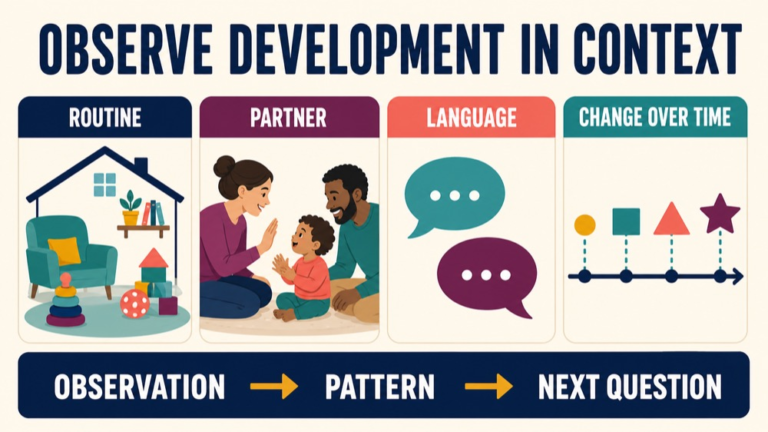
Milestone information becomes more useful when attached to a routine. Observe play, dressing, book sharing, snack, bath time, or a transition instead of testing with a series of questions. Note what the child noticed, how the child communicated, what the partner did, and whether the message worked. This captures comprehension, expression, interaction, hearing access, and participation together.
During book sharing, one child may turn pages, point, make a sound, and look toward an adult for a response. Another may label a picture, answer a question, and add a detail about a familiar experience. Both examples contain meaningful communication but invite different follow-up questions. Record the behavior before choosing a skill label.
Context: activity, people, language, and sensory conditions.
Initiation: whether the child starts a message, responds, or does both.
Form: movement, gesture, sign, sound, word, phrase, sentence, or combination.
Meaning: requesting, refusing, sharing, asking, describing, pretending, or repairing.
Understanding: what is followed without a gesture, repetition, or extra context.
Partner response: whether the message is understood and receives a useful response.
Participation: whether communication supports joining, problem-solving, or staying engaged.
Change: whether the pattern expands, stays uneven, or shows loss of a previous skill.
A short record can be more informative than a word count: “During snack, the child pointed to the cup, vocalized, accepted a modeled word, and drank without coughing; during book time, the child followed a familiar instruction with a gesture but did not respond to a new question.” This separates communication intent, language understanding, speech output, and swallowing observations.
Common Confusions: Related Does Not Mean Identical
These domains support the shared goal of connecting with other people, so they can sound interchangeable. The distinctions below help prevent overinterpretation when reviewing a milestone chart.
Speech is not language. A child may know what to say and understand a conversation while sound production makes the message hard to understand. Another may pronounce words clearly but have difficulty understanding directions or combining ideas. Ask separate questions about meaning and form.
Hearing is not listening behavior. A child may respond in a quiet room but miss speech in noise, or follow visual cues without consistent access to spoken information. A home observation can raise a hearing question but cannot settle it.
Social communication is not a score for eye gaze or talkativeness. It describes how a child shares meaning with a partner through available modes. A quiet child can communicate intentionally, while a highly verbal child can need support with turn-taking, topic maintenance, or interpreting a partner.
Feeding preference is not automatically a swallowing problem. Selectivity can have many contributors. Coughing, choking, wet or gurgly vocal quality after eating, breathing changes, or prolonged stressful meals raise a different safety question from refusing one food.
Age range as deadline: look for patterns across skills, contexts, and time.
Word count as language profile: include understanding, gestures, purpose, combinations, and interaction.
Speech difference as total explanation: examine speech, language, hearing, and social use separately.
One quiet behavior as social conclusion: compare people, activities, cultures, and sensory conditions.
Food preference as swallowing inference: consider safety, efficiency, comfort, nutrition, hydration, and change.
The practical rule is to name the observation, name the domain, and describe the boundary of what it supports. That sequence keeps developmental education useful without turning it into an unsupported label.
When to Seek an Evaluation: Red Flags With Context
A red flag is a reason to seek timely professional discussion, not a diagnosis. A pediatrician, audiologist, speech-language pathologist, or feeding and swallowing team may need different information. Age, languages, health history, hearing access, and daily impact all affect interpretation.
A child loses a communication, social, or feeding skill that had been reliable.
Caregivers notice inconsistent responses to voices or important environmental sounds, or have a specific hearing concern.
Understanding or expressing messages limits ordinary routines, play, learning, or relationships.
Communication attempts are limited, difficult to interpret, or accompanied by persistent frustration that affects participation.
Speech remains hard for familiar or unfamiliar partners to understand, especially when progress and context do not explain the pattern.
A child has difficulty coordinating breathing, chewing, or swallowing, or shows coughing, choking, wet vocal quality, or breathing changes around meals.
Mealtimes are prolonged, exhausting, painful, or associated with concerns about nutrition, hydration, or growth.
A caregiver, teacher, or clinician continues to have a concern even though one milestone appears present.
One missed skill on one day may reflect fatigue, unfamiliarity, limited opportunity, a hearing or sensory condition, or another communication route. A cluster, persistent functional effect, regression, or safety concern deserves more attention than one comparison. If eating or breathing safety is in question, seek appropriate medical guidance promptly rather than relying on an online chart.
An evaluation is a structured way to understand strengths, access needs, communication partners, and possible supports. Families can bring routine observations, hearing questions, examples from every language used, and notes about change over time. This helps the professional ask a more precise question.
Multilingual Development and Individual Variation
A child who hears or uses more than one language should be understood across the full communication environment. Looking only at English words can undercount concepts, interaction, or communication with family. Ask what the child understands and expresses in each language, who uses each language, and which routines provide meaningful opportunities. A bilingual SLP or qualified interpreter can support access to evaluation.
Multilingual development can look uneven because exposure, vocabulary topics, and conversational partners differ across languages. That unevenness is not, by itself, evidence of a disorder. A persistent concern across languages and settings should still be examined rather than dismissed as bilingualism. Interpretation should reflect the whole profile and functional participation.
Individual variation also includes temperament, culture, opportunity, motor development, sensory experience, health history, family routines, and the match between a child and a setting. A milestone chart starts questions; it cannot account for every pathway or replace listening to the family and observing meaningful routines.
Which languages and communication modes does the child hear and use?
Which people and routines make communication easiest or hardest?
Are concerns present across languages, partners, and settings?
What strengths does the child use to make meaning, solve problems, or connect?
Has the pattern changed, and does it affect participation or safety?
These questions reduce the risk of confusing limited opportunity in one language with a broad language difficulty, or a culturally shaped interaction style with a lack of social communication.
A Short SLP Praxis 5331 Application
For SLP Praxis 5331 study, this topic is useful as a domain-separation and clinical-reasoning framework. Use the current ETS Speech-Language Pathology 5331 page and applicable current blueprint for exam scope and logistics; this article does not freeze changing test specifications. For a developmental scenario:
Name the domain: speech, language, hearing, social communication, feeding or swallowing, or a connection.
Describe the evidence: behavior, context, partner, language, and time pattern rather than a label such as “late talker.”
Separate conclusion from next question: state what the observation supports and what requires hearing assessment, broader evaluation, or more history.
Protect the boundary: broad milestones guide observation; they do not establish a diagnosis or fixed outcome from one item.
Original study example: A preschool child uses detailed gestures and long strings of speech, but unfamiliar listeners understand only part of the message. Separate language formulation from speech intelligibility, then consider hearing access, context, and communication partners. The observation does not identify a disorder or determine treatment by itself. This teaching scenario was created for this article and is not a reproduction of an exam item.
This reasoning prevents selecting an answer based on the most visible behavior while overlooking the domain the scenario actually tests. Explain both the best-supported interpretation and the information that remains unknown.
Quick Review: What to Remember
Use this checklist when reviewing a developmental chart, discussing a concern, or studying a clinical scenario. The goal is careful observation and a fitting next question, not memorization of a rigid staircase.
Typical development describes broad patterns, not identical timing for every child.
Speech describes spoken production; language describes meaning, understanding, and expression.
Hearing provides access information and deserves follow-up when concern is present.
Social communication describes how a child connects and shares meaning with partners.
Feeding and swallowing require separate attention to safety, efficiency, comfort, and participation.
Birth-to-five age bands are orientation tools, not pass-or-fail cutoffs.
Observe routines, partners, languages, change over time, and functional impact.
Regression, hearing concerns, participation limits, or feeding safety signs warrant professional discussion.
Multilingual interpretation should include the child’s whole language environment.
For SLP Praxis study, identify the domain, decisive evidence, boundary, and next question.
If you want a structured way to turn this framework into review notes, you can explore the SLP Study Center Complete Prep resources and decide whether they fit your own study plan. Keep the current ETS page and authoritative clinical resources as the source of changing exam and developmental guidance.
SLP Praxis Prep: Build a Flexible Preparation System
Short answer:slp praxis prep is most useful when it names a learning system rather than a single book, course, calendar, or practice-score target. A strong system connects six jobs: mapping the current ETS scope, learning concepts, separating nearby clinical decisions, completing original practice, reviewing errors, and verifying test-day logistics.
This guide is designed for learners at different starting points. You may be beginning with a blank page, returning after an uneven first pass, or already doing practice items but not learning enough from the misses. The sequence can flex around that starting point. It is not a fixed study plan, a substitute for the current ETS information, or a prediction of an individual result.
Use the current ETS Speech-Language Pathology 5331 page as the control point for scope and time-sensitive logistics. ASHA’s Praxis preparation guidance can help you orient to preparation resources, but the live ETS page and account remain the place to verify details that can change.
Preparation is not simply the amount of time you spend with SLP material. It is the chain between an exam requirement and a learner action. If you cannot say what a resource is helping you do, it is difficult to tell whether you are building coverage, retrieving knowledge, practicing judgment, or just accumulating pages and percentages.
A practical prep system has six connected jobs:
Scope mapping: translate the current ETS information and blueprint into a visible list of content areas, decisions, and review priorities.
Concept learning: build an accurate explanation of each important idea, including what it is used for and what it does not answer.
Clinical distinctions: compare nearby concepts, assessment choices, evidence patterns, and professional decisions so that a plausible distractor has a clear reason for being less appropriate.
Original practice: use newly written scenarios or practice prompts to apply a concept without relying on memorized wording.
Error review: classify the reason for a miss and assign a small corrective action instead of merely recording a score.
Logistics verification: check the current test identity, registration details, delivery requirements, and deadlines from the responsible source.
Map the Current ETS Scope Before Choosing Materials
The current ETS page and its associated scope information should be the first checkpoint in your map. Start by recording the page date you reviewed and the version or document that controls your preparation. Avoid building your entire plan from a book’s chapter order or a search-result summary. Those may be useful navigation aids, but they are not a reliable substitute for the current ETS source.
Mapping does not require you to freeze every exam detail in a spreadsheet. It means turning the authoritative scope into a set of learnable questions. For each broad area named by the current source, ask what a learner must recognize, explain, compare, apply, or verify. A map is valuable when it changes what you do next.
Capture the source: save the current ETS page and any associated blueprint or preparation document with the date checked.
Break broad labels into decisions: turn a heading into smaller prompts such as purpose, evidence, interpretation, next action, or professional boundary.
Mark your evidence: label each prompt as secure, partly retrievable, confusing with a nearby concept, or not yet studied.
Attach a learning job: choose concept review, comparison practice, original application, error repair, or logistics verification.
Schedule a recheck: note what must be verified again because it can change, especially test-day and registration details.
For example, suppose the current scope contains a broad assessment-related area. A weak map would simply repeat the word “assessment.” A stronger map would ask: What decision is the assessment meant to support? Which evidence is relevant to that decision? What limitation should prevent overinterpretation? Which neighboring choice could look reasonable but answer a different question? Those prompts create study actions without pretending that one label contains the entire reasoning process.
Learn Concepts, Then Train Clinical Distinctions
Concept learning answers, “What is this?” Distinction learning answers, “How is this different from the nearby answer that could also sound reasonable?” Both matter in speech-language pathology preparation, because many difficult decisions are not between an obviously correct answer and an unrelated one. They are between options that fit part of the situation but differ in purpose, timing, evidence, or scope.
Begin with a compact concept card or note. Include the definition, the job the concept performs, one concrete example, and one boundary. Then add a comparison note for the closest concept. This creates a bridge from recall to judgment. The boundary is especially important: it keeps a learner from treating a single observation as enough to support a broad conclusion.
Use questions like these when building a distinction:
What exact decision is the prompt asking me to make?
Which fact in the scenario carries the most weight for that decision?
What would make the nearby option less appropriate, even if it is generally useful?
What context, timing, or client goal changes the choice?
What information is missing, and what can I responsibly conclude without it?
Which professional or scope boundary limits the action?
Original practice example—not an ETS item
Scenario: A learner chooses an intervention technique after reading a prompt whose main task is to identify the next assessment decision. Two answer choices sound professionally reasonable, but only one addresses the decision requested in the scenario.
Original practice question: Which review action is most useful after this miss?
Read another unrelated chapter before reviewing the item.
Record the task, decisive evidence, and why the selected alternative answered a different question.
Memorize the wording of the answer choices for later recognition.
Complete a larger number of random items without writing an explanation.
Best review action: B. This is original practice content, not an ETS item. The point is not to memorize a particular scenario; it is to identify the mismatch between the question’s decision and the learner’s response. That explanation can transfer to a new item with different wording and content.
Use Original Practice to Expose Reasoning Gaps
Practice is most useful when it reveals how you are deciding. A percentage can show that something happened during a set, but it does not tell you whether the miss came from missing knowledge, a confused distinction, rushed reading, weak retrieval, or an unverified assumption about the test. Original practice content gives you a clean place to rehearse the reasoning process without treating a copied item or a familiar phrase as proof of readiness.
Use a three-pass approach. First, answer without looking at notes and state the task in your own words. Second, identify the evidence that made your choice stronger than the alternatives. Third, review the explanation and write what you would notice next time. If your answer was correct for the wrong reason, record that as a review need rather than counting it as fully secure.
Tag the scope: connect the prompt to the map row or learning job it tests.
Name the task: decide whether the prompt asks for definition, interpretation, comparison, application, or professional judgment.
Choose with evidence: write the clue that supports the answer before checking the rationale.
Compare alternatives: explain why the closest distractor answers another question or requires evidence not present.
Set the next action: assign a short concept review, distinction drill, fresh scenario, or source check.
Do not let practice volume outrun explanation quality. If you can complete many items but cannot explain your misses, add a review block before adding another large set. The objective is not to create a dramatic number of attempts; it is to make the reasoning behind the next attempt more precise.
Turn Errors Into a Review Loop
Error review is the part of preparation that turns practice into learning. A missed item is not one kind of event. Classifying it prevents you from prescribing the same remedy for every problem. More reading may help a concept gap, but it will not automatically repair a habit of answering the wrong task. More timed practice may help pacing, but it will not replace a missing distinction.
Error type
What it looks like
Repair action
Knowledge gap
You cannot explain the concept even after rereading the prompt.
Return to a trusted explanation, write a plain-language definition, and create one new example.
Distinction gap
You know both options but cannot state why one fits the task better.
Build a compare-and-contrast note using the decisive evidence and boundary.
Task-reading gap
Your answer addresses a different question from the one asked.
Underline the requested decision in your own notes and restate it before answering.
Retrieval or timing gap
You understand the reasoning later but could not access it under the practice condition.
Use shorter retrieval sets, then repeat the same concept in a new context.
Logistics gap
You relied on an old assumption about registration, timing, delivery, or reporting.
Return to the live responsible source and record the date of verification.
A simple review loop has five moves: capture the miss, classify it, explain the decisive evidence, assign one repair, and revisit the concept in a new form. The last move matters. A correction that is never retrieved again may feel clear on the day it is written and disappear later.
Use these review prompts after a practice block:
Which misses were caused by missing information, and which were caused by choosing between close options?
Did I select any answer correctly for a weak or accidental reason?
Which distractor was most tempting, and what specific evidence made it less fit?
What one sentence would I want to remember before seeing a new scenario?
What small practice task will test the repair without repeating the same wording?
Does any part of my note depend on a current ETS or ASHA page that needs a new check?
Choose a Flexible Sequence for Your Starting Point
A flexible sequence begins with evidence about your current state. It does not assume that every learner should begin with a full content review or follow the same number of weeks. Choose the first job that removes the biggest uncertainty, then cycle through concept learning, distinction practice, original application, and error review as the map changes.
Starting point
First useful move
What to do next
New or unstructured
Build a dated map from the current ETS scope.
Learn the highest-priority concepts, add distinctions, then begin small original practice sets.
Some coursework, uneven recall
Run a short readiness audit and mark secure versus uncertain map rows.
Repair high-risk concepts and use comparison prompts before increasing practice volume.
Already practicing often
Analyze the error log instead of starting another random set.
Confirm current logistics and identify the few learning jobs with the highest uncertainty.
Use targeted review, timed application, error repair, and a final source recheck.
Think in study blocks rather than a rigid calendar. One block might map a topic and write two distinctions. Another might use original practice and complete an error loop. A later block might mix areas so that you must identify the task before choosing a response. The block is complete when it produces evidence, not simply when the clock stops.
ASHA’s preparation guidance points candidates toward preparation information and ETS materials. That supports a useful sequence rule: begin with the current authoritative scope, then choose resources that make the next learning job easier to perform. If a resource cannot be connected to a map row, a concept explanation, a distinction, a practice rationale, an error repair, or a logistics check, pause before adding it to the stack.
Verify Logistics Without Freezing Current Exam Numbers
Logistics are part of preparation because a learner can study from an accurate concept map and still work from an outdated administrative assumption. The research packet’s search results included time-sensitive exam details, but this article intentionally does not convert those snippets into fixed statements. Check the current ETS page and account for the information that controls your own registration.
Before treating the logistics side as complete, verify the following from the live responsible source:
The exact test title and code selected in the account.
The current registration and appointment information available to you.
The displayed test length, item format, and any other current test specifications.
The delivery setting, location, identification, arrival, technology, or room requirements that apply to your appointment.
The current score-reporting or recipient instructions relevant to your pathway.
Accommodation procedures and any lead time that applies to your situation.
Fees, rescheduling, cancellation, refund, and change rules shown at the time of registration.
The deadlines set by your program, employer, credential pathway, or state authority.
Choose Resources by Learning Job, Not by Marketing Label
Books, courses, flashcards, question sets, videos, and checklists can all be useful, but their labels do not tell you what they will change. Choose by output. A resource is a better fit when you can describe the evidence it should produce after a study session.
Learning job
Look for
Evidence after use
Warning sign
Scope mapping
Current source references and clear coverage labels.
You can point to what is covered and what still needs work.
An undated outline treated as the current exam.
Concept learning
Explanations, examples, limits, and retrieval prompts.
You can explain the idea without copying the source sentence.
Definition-only pages with no application.
Clinical distinctions
Comparisons, scenarios, and rationale that identifies decisive evidence.
You can explain why a nearby alternative is less fit.
Lists of terms with no decision context.
Original practice
Fresh prompts and complete reasoning feedback.
Your answer includes the task and supporting evidence.
A score with no explanation of misses.
Error review
A way to classify misses and assign repairs.
Recurring gaps become specific next actions.
More random practice used to avoid review.
Logistics verification
Links to current responsible sources and dated checks.
You can confirm the details that apply to your appointment.
Fixed numbers or policies without a recheck date.
If you want to continue with a structured set of preparation materials, you can review the SLP Study Center Complete Prep page. Treat it as one possible resource within the system, check its current contents, and match it to the learning job you need next.
Readiness Audit: Can You Show Evidence of Preparation?
A readiness audit is a snapshot of evidence, not a promise about what will happen on test day. It asks whether your preparation system is producing the outputs that matter. Complete it with your current map, a recent original practice set, your error log, and the live logistics pages you have checked.
I can identify the current ETS scope or blueprint source I used and the date I checked it.
I can explain the major concepts I reviewed in plain language, with an example and a boundary.
I can distinguish close options by naming the decisive evidence rather than relying on familiarity.
I can state the task a practice prompt is asking before choosing an answer.
I can explain why my answer fits and why the closest alternative is less appropriate.
I can classify a miss as a knowledge, distinction, task-reading, retrieval, timing, or logistics problem.
I have assigned a concrete repair to recurring errors and revisited at least some repairs in new contexts.
I can work through mixed original practice without depending on memorized wording.
I have verified current registration and test-day details from the source that controls them.
I know the next learning job for my next study block and the evidence that will show progress.
If several answers are uncertain, that is useful information. Return to the map and choose the smallest next task that will make the uncertainty visible. For example, write one comparison, complete one fresh scenario, or verify one current logistics question. A readiness audit is valuable because it turns a vague feeling into a list of decisions you can act on.
Common Traps and Quick Review
Preparation can look busy while leaving the important reasoning untouched. Watch for these common traps:
Confusing volume with coverage: many pages or items do not show that the current scope has been mapped.
Memorizing old exam facts: a saved number or policy is not a current verification.
Using a fixed plan for every learner: the right first job depends on your evidence and starting point.
Studying definitions without distinctions: knowing two terms is different from choosing between them in context.
Increasing practice before reviewing errors: new attempts can reproduce the same reasoning gap.
Counting a lucky answer as secure: correct reasoning should be explainable, not merely correct.
Letting a resource label make the decision: choose the material by the learning output it produces.
Leaving logistics until the end: verify current administrative details early enough to act on them.
For a final quick review, ask yourself five questions:
What current source controls my exam scope and logistics?
Which concept or distinction is most uncertain right now?
Can I explain the decisive evidence in a new scenario?
What error pattern will my next study block repair?
Which current detail must I verify again before registration or test day?
That is the core of a flexible SLP Praxis preparation system: source first, learn for understanding, practice for decisions, review errors for transfer, and verify logistics when the facts can change. Keep the process evidence-based and adaptable, and let the current ETS and ASHA pages—not an old summary—settle time-sensitive questions.
slp praxis study guide is a useful starting phrase, but a useful guide is more than a long outline of speech-language pathology terms. It should show what the current exam scope includes, explain the underlying concept, demonstrate how that concept changes in a case, and help you find what you still cannot explain. The strongest guide is a learning tool with an evidence trail, not simply the document with the most pages.
This article explains how to evaluate and use a guide for Speech-Language Pathology Praxis 5331 preparation. It focuses on blueprint mapping, concept notes, application, practice-question review, source currency, and the choice among a guide, flashcards, practice questions, and a full course. The current ETS page controls changing exam scope; ASHA preparation guidance supports the planning principles. No study format can promise a particular result, and no general article can replace a current source check or individualized academic advice.
What a Useful SLP Praxis Study Guide Should Contain
A study guide earns its place when it reduces the distance between knowing a term and making a defensible decision. It should help you identify an objective, understand the concept, recognize it in context, distinguish it from a nearby idea, and retrieve the reasoning later. A page that only lists definitions may feel productive while reading, but it gives little evidence that you can use the information when the wording or case changes.
Think of the guide as a feedback system. The content tells you what to learn, the example shows what the idea looks like, the distinction protects you from a mix-up, and the review check reveals whether you can retrieve the rule without leaning on the page. When you inspect a candidate guide, look for:
Scope alignment: the chapter map can be compared with the current ETS test page and Study Companion.
Clear definitions: important terms are explained precisely and in plain language.
Concrete examples: concepts appear in profiles, observations, or decision situations rather than only vocabulary lists.
Distinction teaching: nearby concepts are compared by the evidence that separates them.
Application: the learner must use the concept, not only recognize a matching phrase.
Retrieval: brief checks or practice expose uncertainty.
Error repair: missed items lead back to a concept, source, or reasoning step.
Source currency: the guide records what was checked, when, and what needs another review.
A guide is doing the full job when you can close one section, explain its rule, apply it to a new scenario, and name the nearby confusion. If you cannot, keep the page as a reference but mark the missing learning action.
Map the Guide to the Current ETS Blueprint
The current ETS Speech-Language Pathology 5331 page is the starting point for scope. Use the ETS 5331 test page and its current linked materials to capture the exact objective labels for your study cycle. Do not substitute a remembered chapter list, shared spreadsheet, or undated guide for that check. ASHA’s Praxis preparation guidance also supports planning from exam content and your knowledge in each topic area.
Mapping creates a traceable connection between an ETS objective and the pages, examples, practice items, and review actions that support it. The blueprint tells you what belongs in the map; your baseline, missed-item log, available time, and confidence ratings help you decide where to spend more effort.
Capture objective labels. Copy the wording or a faithful short label from the current ETS material and record the check date.
Mark teaching locations. Add page or section references for the definition, example, distinction, and review check.
Separate knowledge from performance. Mark whether the guide offers a concept note, application example, original practice item, retrieval check, or only a mention.
Test uncovered rows. If an objective appears in the blueprint but not in the guide, label the gap instead of guessing from a familiar heading.
Prioritize from evidence. Use practice errors and confidence ratings to choose another explanation, example, or timed application.
Recheck the map. Confirm before the study cycle ends that the scope, source note, and study action still agree.
Blueprint connection
What the guide should provide
How the learner checks it
Boundary to record
Current ETS objective
A page or section that names and teaches the objective.
Explain it without looking, then locate it in a new case or task.
Current ETS materials control scope; an old guide may need revision.
Core concept
Definition, plain-language meaning, and a concrete example.
State the rule and identify the decisive detail.
A study note is not topic-specific clinical guidance.
Nearby distinction
A comparison that explains why plausible interpretations lead to different choices.
Name the feature that would change your decision.
A single sign or phrase is not enough for individualized interpretation.
Application and retrieval
Original practice content, a rationale, and a review action.
Record the objective, evidence, reasoning, and repair step.
Original practice content is illustrative and not from ETS.
For an illustrative study-design model, imagine an ETS objective involving an evaluation or intervention decision. A useful guide would define the relevant concept, give a short profile, identify the evidence that matters, show a nearby alternative, and ask you to justify the choice. This model does not claim that a particular current question uses that wording.
Turn Concept Notes Into Application
Concept notes are valuable when they are compact enough to review and rich enough to support transfer. Build each note in a repeatable sequence: definition, plain-language meaning, concrete example, distinction, application, and quick retrieval. If you can define a term but cannot distinguish it from a neighbor, the repair is different from a missing definition.
In an SLP learning context, a concrete example might describe an observation, a communication demand, the relevant context, and the decision that still needs more information. Keep the example educational rather than diagnostic. A finding can matter without settling the whole interpretation, so the learner should ask what evidence is missing, what source applies, and what professional boundary matters.
Original practice content — written for illustration and not from ETS: A page defines three related terms and lists their features. A learner can repeat the list but misses a new scenario because the decisive evidence is not identified. Which repair most directly supports transfer?
A. Read the same definition several more times.
B. Add another list while leaving the comparison unchanged.
C. Add a new scenario, identify the decisive evidence, compare the nearest alternative, and explain the choice.
D. Replace the page with a longer glossary entry.
Answer and reasoning: C is the best repair because it connects the concept to evidence, distinction, and a decision. A may improve familiarity, B adds vocabulary without improving discrimination, and D adds reference detail without testing transfer. This is a study-design illustration, not a clinical conclusion or a test item.
Keep the note and application task together. Read the note, close it, state the rule from memory, and complete the scenario. If you cannot explain the choice, label the break as vocabulary, concept, distinction, evidence selection, or reasoning. That label makes the next review shorter and more useful.
Use Practice Questions as Decision Checks
Practice questions are most useful after the guide has given you a concept to apply. They should not become a separate collection of scores. Before answering, identify the objective or learning job. After answering, explain the evidence for your choice and the mismatch in each nearby alternative.
Use original practice content with a clear label, source boundary, and full explanation. A credible item explains why the selected answer fits the presented evidence and why the other options do not. It should not imitate protected wording or imply that a familiar-looking item represents the live exam. If an item depends on a clinical claim, check that claim against the relevant current ASHA source.
Attempt the item without opening the notes.
Write the blueprint objective or concept family it tests.
Restate the decisive evidence in the scenario.
Explain why the selected answer fits.
Explain why the nearest alternative does not fit as well.
Record whether the error was knowledge, discrimination, reading, or reasoning.
Return to the smallest source-backed note that repairs the error.
Try a changed scenario later to test transfer.
A low practice percentage is not a complete readiness judgment, and a high percentage on repeated items does not establish transfer. Review the pattern behind the result. Choosing by familiar wording suggests a distinction gap; knowing the concept but overlooking the task suggests stem-reading practice; running out of time suggests a different scheduling and application routine.
Audit Source Currency Before You Trust a Page
A guide can be well written and still be out of date. The research packet for this article was checked on August 22, 2026. That date shows when the links were reviewed, not a permanent edition label. Before a new study cycle, revisit the current ETS page and the relevant ASHA guidance.
Use three source layers. ETS controls exam scope and changing test information. ASHA Praxis preparation guidance supports planning around content and personal knowledge gaps. Topic-specific ASHA Practice Portal, policy, or evidence resources should support clinical and professional statements. The general ASHA Practice Portal is a starting index; open the relevant current topic page rather than treating a broad landing page as support for every detail.
Audit question
What to record
Boundary
What source controls the claim?
Source ID, direct URL, page title, and supported claim.
One source does not support an unsourced neighboring claim.
When was it checked?
Checked date and version or page state if available.
A prior check does not guarantee the page is unchanged.
When should it be checked again?
Before publication, a new exam cycle, or a source update.
A review date does not create personal advice.
What is the claim boundary?
Exam scope, planning, clinical context, policy, or evidence role.
It does not permit a diagnosis or individualized treatment decision.
Flag a page with no source list, a current claim without a check date, frozen exam logistics, copied clinical statements, or a practice item that cannot identify its decisive evidence. This article teaches a way to audit a resource; it does not settle individual eligibility, credential, clinical, or accommodation questions. Use the responsible current authority or qualified professional for those decisions.
Choose the Right Format for the Learning Job
A guide, flashcards, practice questions, and a full course solve different problems. If you are missing the map, start with a guide. If you know the material but cannot retrieve it quickly, flashcards may help. If you can recite rules but cannot use them in a case, application practice matters more. If you need a sequenced path with instruction, practice, and review, a full course may organize that work.
Format
Best learning job
Common limitation
Useful companion
Study guide
Build a source-aligned map of concepts, distinctions, examples, and review.
Reading alone can create familiarity without transfer.
Original application practice and an error log.
Flashcards
Retrieve terms, short rules, contrasts, and compact facts.
Cards can flatten context or hide decision evidence.
A guide page and changed scenarios.
Practice questions
Test discrimination, evidence selection, reasoning, and timing.
A score without rationale can hide the cause of an error.
Concept notes and source review.
Full course
Follow a sequence combining explanation, guided application, and review.
The learner still needs to verify current scope and retrieve actively.
A blueprint matrix and weak-area log.
Choose the format that addresses the biggest bottleneck. When you cannot tell what to study, map the blueprint. When you cannot explain it, strengthen the note. When you explain it but miss the case, use application. When you forget after several days, add spaced retrieval. Collecting every format at once can hide the real problem.
If you are comparing structured next steps, you can review the SLP Study Center Complete Prep option and use the current inclusion details on that page to decide whether its format matches the work you need. The product page should not replace the ETS or ASHA source check.
Common Study-Guide Traps
Even a polished resource can become inefficient when it is used for the wrong job. Screen for these traps:
Page-count thinking: assuming a longer guide covers current scope more accurately.
Chapter-title confidence: treating a familiar heading as proof that an objective is fully taught.
Definition-only review: memorizing a term without an example or nearby distinction.
Score chasing: repeating questions without identifying the evidence or error type.
Blueprint drift: studying an old domain arrangement because it is easy to remember.
Source blending: combining scope, planning, and clinical claims without recording support.
Format collecting: opening several resources before identifying the bottleneck.
Unlabeled practice: failing to mark original practice content as illustrative.
Clinical overreach: turning a teaching example into a conclusion about a real person.
Late auditing: waiting until the final week to review sources and objectives.
The repair for most traps is a small record: objective, source, check date, evidence rule, and next action. A missing example needs an example; a stale scope claim needs a source check.
Quick Evaluation Checklist
Use this checklist before committing to a guide. A yes answer is useful evidence, not a promise about a future score.
Can I trace the guide’s scope to the current ETS 5331 page or linked blueprint material?
Does each major unit include a definition, plain-language explanation, and concrete example?
Does it teach a nearby confusion by comparing decisive evidence?
Can I find application or original practice content for the concepts I must use?
Does each practice item include a rationale and next repair action?
Are source IDs, direct links, checked dates, and update triggers visible?
Does the guide separate exam-scope claims from clinical or professional claims?
Can I mark an objective as learned only after retrieving and applying it?
Does the resource fit my biggest bottleneck and available study time?
Do I know which details must be rechecked before my study cycle?
For a final source review, open the current ETS page, read the ASHA Praxis preparation guidance, and check the relevant ASHA topic source for any clinical statement you plan to retain. If the guide conflicts with a current authoritative source, record the conflict and resolve it before using the claim as a study rule.
Quick Review and Next Step
A useful SLP Praxis study guide defines the target, maps it to current ETS scope, shows an example, teaches a distinction, asks for application, and closes with retrieval and error repair. Its source trail tells you what was checked and when it must be checked again. Its value comes from the decisions it helps you make, not from page count.
Keep the formats separate: the guide builds the map, flashcards strengthen retrieval, practice questions test reasoning, and a full course organizes a broader sequence. Choose the tool that addresses the next bottleneck, label original practice content clearly, and preserve a source-review boundary for changing exam and clinical claims.
ASHA Praxis Preparation — planning guidance based on exam content and personal topic knowledge.
ASHA Practice Portal — starting point for current topic-specific clinical guidance and source review.
How Long Does It Take to Get Praxis Scores?
If you are asking, how long does it take to get praxis scores, the most accurate answer is not a single number of days. ETS says that an official score report is posted in your Praxis account on the score reporting date, and that date varies by the test type and the delivery method, such as At Home or Test Center. The current ETS score-date tool is therefore more useful than a general estimate: select the test, testing date, and delivery method, then use the report date it displays.
This distinction matters when a school, state agency, or credentialing body has given you a deadline. Your test date is the day you test. The ETS score reporting date is the date ETS identifies for posting the report. The time a receiving organization takes to review or record that result is a separate question. This guide focuses on timing and troubleshooting, not on every field inside a Praxis score report.
Short answer: Check the current ETS score reporting calendar and your Praxis account. The ETS tool currently phrases availability as after 5 p.m. ET on the displayed report date. ETS also notes a Tuesday-and-Friday reporting pattern and a holiday adjustment, but that pattern should not be turned into a universal promise that every test will appear on the next reporting day.
Scope note: ETS pages change. The links and wording described here were checked on August 23, 2026. Before you register, schedule around a deadline, or contact a receiving authority, recheck the live ETS page for your test and date.
Table of Contents
The answer to: how long does it take to get praxis scores
A score reporting date is the date ETS assigns for making the official report available in the test taker’s Praxis account. It is not simply a conversion of the test date into a standard waiting period. Two people who test on the same calendar day may still need to verify the correct test and delivery method in the ETS tool, and a person who tests on a different day should not borrow another person’s date.
Think of the process as a chain with separate checkpoints. First, you take the test under a named delivery method. Next, ETS maps that test and date to a score reporting schedule. On the reporting date, the account is the place to look for the official report. After that, a school, state, or agency may need to retrieve, match, review, or record the result under its own process.
Term or event
What it means for timing
What not to assume
Test date
The date on which you sit for the selected Praxis test.
It is not automatically the date your official report appears.
Score reporting date
The ETS date tied to the selected test, test date, and delivery method.
It is not a universal number of days for every Praxis test.
Official score report
The report ETS posts in the Praxis account on the reporting date.
An end-of-session unofficial result is not the same account report.
Recipient processing
The separate work a school, state, or agency performs after receiving or accessing score information.
ETS’s account-posting time does not establish that organization’s internal deadline.
Many timing worries come from blending these events together. A candidate may say, I have been waiting since my test date, while ETS is actually directing that person to a later report date. Another candidate may see a result in the account and still need to confirm that a school or licensing authority has the result in the format it accepts.
Use the test-specific report date as your first planning anchor.
Use the Praxis account to verify the official report.
Ask the receiving organization what it considers received or complete.
Keep the time zone visible when the ETS tool gives a time-based instruction.
How to read ETS score-reporting language
ETS’s current Getting Your Scores page uses several pieces of language that are easy to skim past. Reading them together gives you a more reliable answer than searching for a generic waiting period. The page says the official report will be posted in the Praxis account on the score reporting date, and it tells users to check the score reporting calendar according to the test and the day they are testing.
Varies by test type and delivery method: Do not apply one test’s timing to another. At Home and Test Center are separate choices in the current calendar workflow.
Score reporting date: This is the date to place in your planning notes. It is tied to the test information you select, not just to a broad exam name.
After 5 p.m. ET: The current ETS score-date tool uses this phrase for the selected test and date. If you live outside Eastern Time, check the conversion before deciding that a date has passed locally.
Tuesdays and Fridays: ETS currently says Praxis reports scores on those days. It also says that a holiday falling on one of those days moves reporting to the following Tuesday or Friday. This is context, not a substitute for the date shown for your test.
The safest interpretation is conditional: for this test, on this test date, using this delivery method, ETS currently lists this report date and time. Removing the test, the date, or the delivery method turns a specific calendar result into a guess. Removing the time zone can also make a correct date look wrong when you compare it with a local clock.
Planned visual only: a test-specific ETS score-date lookup showing the test, test date, delivery method, report date, and Eastern Time note. No image asset was generated or uploaded.
For the live wording, review ETS’s Getting Your Scores page and, when you need to calculate a date, use the ETS score-date tool. The result for your selected inputs is more relevant than a remembered answer from a previous testing cycle.
Where to find your own applicable date
There are two useful places to look: the scheduling flow and the Praxis account. ETS says that during registration the estimated score reporting date appears on the scheduling screen after you select your test date. The current account instructions point to the Score Reports page and the pending score reports card. These locations help you plan before the test and verify after it.
Identify the exact test. Use the name or code shown in your registration rather than a broad label such as SLP exam.
Confirm the test date. If you rescheduled, compare the current account date with an old confirmation message.
Select the delivery method. In the ETS score-date tool, choose the relevant At Home or Test Center option.
Read the generated result. The current tool states that the report will be available in the Praxis account after 5 p.m. ET on the displayed report date. Record the date, time zone, and test inputs.
Check the account location. Go to the Praxis account’s Score Reports page and look for the pending score reports card. An email may notify you, but ETS identifies the account page for the report.
Here is a concrete example without inventing a release interval. Jordan registers for the Speech-Language Pathology (5331) test, chooses a test date, and selects At Home. Instead of counting from the appointment date, Jordan uses the ETS calendar with those inputs. The result supplies a score reporting date. Jordan plans school paperwork around that date, remembers the after-5-p.m.-ET wording, and checks the Score Reports page when the date arrives.
If Jordan changes the appointment to a Test Center date, the earlier lookup is no longer the right planning record. The correct action is to run the lookup again with the new date and delivery method. If the test does not appear in the score-date tool, ETS’s current page directs test takers to contact customer service rather than substitute a date from a similar test.
Why timing varies by test and reporting schedule
The ETS pages use a more careful model than a generic waiting-period answer. They identify the test and delivery method as variables, provide a date-specific calendar, and describe a reporting cadence. Scoring method is related but should not be used to reverse-engineer a date: ETS explains that selected-response answer sheets are scored by machine and constructed responses are evaluated by trained scorers, while the reporting schedule remains test-specific.
Situation
What ETS supports
Planning lesson
At Home versus Test Center
The score reporting date varies by delivery method.
Run the calendar using the method you selected.
No unofficial score after a selected-response session
ETS says further analysis may be needed; this does not indicate an administration problem or create a delay in the official report.
Do not turn an absent unofficial display into a score prediction.
Constructed-response test
ETS says an unofficial score is not provided because responses require rating time.
Look for the official date and account report.
Tuesday or Friday holiday
ETS says reporting moves to the following corresponding Tuesday or Friday.
Check the current calendar before a deadline.
For score-method detail, see ETS Score Reporting. The useful distinction is that scoring information explains the kind of result you may see, while the current calendar supplies the operational report date.
Unofficial score, official report, and recipient processing
Three events are commonly called a score result even though they answer different questions. Keeping them separate helps you decide what to do next.
Unofficial score: For some selected-response tests, ETS may show an opportunity to view an unofficial result at the end of the session. ETS says test centers cannot provide printed or emailed copies of unofficial scores.
Official score report: ETS says the report is posted in the Praxis account on the score reporting date, with the score-date tool describing availability after 5 p.m. ET on the displayed date.
Institution or agency processing: ETS says score information is also sent to selected institutions or agencies, and automatic score reporting may apply in some states. The supplied ETS pages do not give one processing time for every recipient.
This is why a timing article should stay distinct from a field-by-field guide to a Praxis score report. Here, the practical questions are when to look, where to look, what kind of result you are seeing, and whom to contact if the expected report is not there. An empty screen by itself does not tell you the score outcome; it tells you to verify the schedule, account, test status, and communication path.
What to do when a Praxis score is not visible
If the expected date has arrived and you do not see a report, work through these checks in order. This can separate a date or account mismatch from a test-status question or a receiving organization’s separate processing issue.
Recheck the inputs. Confirm the exact test, test date, and delivery method in the current ETS calendar. If you changed an appointment, use the new record.
Check the time zone. The ETS tool currently uses after 5 p.m. ET. Compare that with the relevant reporting window before treating the date as incomplete.
Open the account page. Sign in to the Praxis account, go to Score Reports, and look for the pending score reports card instead of relying only on a dashboard preview or old email.
Check test status. ETS says cancelled or held tests will not show in the Pending Scores section. That status needs a different follow-up from an ordinary posting question.
Contact ETS if the test is not listed. ETS directs users to customer service when the needed test does not appear in the score-date tool. Do not borrow a date from another test.
Escalate after the listed time. Keep the test, date, delivery method, and expected report wording together, then contact ETS. If a school, state agency, or credentialing body is waiting, contact it too and ask what temporary evidence or revised timeline it accepts.
Planned visual only: a troubleshooting path from the ETS date and time-zone check to the Score Reports page, status check, and follow-up contacts. No image asset was generated or uploaded.
Use the evidence that belongs to each checkpoint. The ETS calendar answers when the report is scheduled. The account answers whether the report is visible. ETS customer service answers an account or test-status question. The school, state, or credentialing body answers what it needs for its own deadline.
If the report is visible in the account but the receiving body says it has not arrived, that is not the same problem as an absent account report. Ask whether the organization wants you to send a report, retrieves scores electronically, or bases its deadline on submission or internal processing. Those are questions for the receiving body because ETS’s general timing page does not define every organization’s workflow.
How to plan around school, state, and credential deadlines
Deadline planning works best when you work backward from the rule that governs your application. A test date alone is not enough. The relevant deadline may concern application submission, an official score being visible, an agency receiving a report, or staff finishing a file review.
Name the receiving body. Write down the school, state board, credentialing organization, employer, or agency.
Ask what counts as complete. Does it accept an ETS account report, or must it receive the score through a designated channel? Does the deadline concern submission, receipt, or internal review?
Work from the ETS report date. Use the live calendar for the selected test, test date, and delivery method.
Build a contingency window. Choose a test date with practical room for a holiday adjustment, changed appointment, account question, or recipient processing. ETS does not provide one universal buffer for every organization.
Record the time zone and evidence. Keep the report date, after-5-p.m.-ET wording, test inputs, and contact instructions together.
Confirm the pathway separately. The current ETS Speech-Language Pathology (5331) page tells examinees to make sure the certifying state accepts the test and to obtain complete certification or licensure information from the relevant authority.
Deadline situation
Question to ask
Planning record
School or graduate-program file
Does the school need the score submitted, visible, or reviewed by a specific office?
Written deadline, contact, and ETS report date.
State licensing or school credential
Which current state requirement and score-delivery method apply?
State instruction, test code, report date, and accepted evidence.
Certification or agency file
Does the recipient receive scores automatically, or must the candidate select or send a report?
Recipient instruction and follow-up record.
If the deadline is close, contact the receiving body before the deadline. Ask a precise question: the ETS calendar gives this report date; if the account report appears after the listed time, what evidence or revised submission route will you accept? This is a planning conversation, not a request for ETS to set the organization’s rule.
For current test-specific administrative context, review the ETS Speech-Language Pathology (5331) page and verify the exact state or agency requirement with that authority. Requirements can change independently of the general score-reporting page.
Common timing traps
Most confusion comes from a useful shortcut being applied outside the situation where it belonged. Replace these shortcuts with direct checks:
Counting a standard number of days: ETS directs candidates to a test-specific calendar, so a generic interval is not the displayed date.
Using a friend’s date: A different test, test date, or delivery method can produce a different result.
Reading 5 p.m. locally: The ETS tool uses Eastern Time.
Treating Tuesday and Friday as the date: The cadence is context; the current calendar result is the planning reference.
Equating unofficial and official: An end-of-session display and the account report have different roles.
Checking only email: ETS identifies the Score Reports page as the place for the official report.
Reading an absent pending card as an outcome: Held or cancelled tests do not show in Pending Scores, according to ETS.
Assuming account posting equals recipient completion: Ask the school, state, or agency how it receives and processes score information.
Quick review checklist
Before you tell a school, state agency, or credentialing body when your result will arrive, answer these questions from the current first-party pages:
What is the exact Praxis test name or code?
What test date is currently scheduled?
Did I select At Home or Test Center?
What report date does the ETS tool display?
Does the result say availability after 5 p.m. ET?
Have I checked the Score Reports page and pending score reports card?
Am I looking for the official account report?
Was the test held or cancelled, or is that status unclear?
What does the receiving organization consider submitted, received, and complete?
What follow-up contact will I use if the report is not visible after the listed time?
The central rule is simple: use ETS’s current test-specific reporting date, then verify the account and the receiving body’s requirement separately. That gives you a defensible plan without inventing a fixed release interval or reading more certainty into a calendar than the source provides.
If you are also organizing your broader SLP Praxis preparation, you can explore the SLP Study Center Complete Prep page. Confirm the current product details and access terms on that page before making a purchase.
Authoritative sources and scope
This article was checked against the following first-party ETS pages on August 23, 2026:
Getting Your Praxis Scores for score-reporting dates, account location, delivery variation, reporting cadence, unofficial scores, and pending-score instructions.
ETS Score Reporting for scoring-method and unofficial-versus-official distinctions.
Speech-Language Pathology (5331) for the current test page and the reminder to verify pathway requirements with the relevant authority.
Praxis Score Report: Where It Appears and What to Verify
If you searched for praxis score report, you are probably trying to locate one page, understand a result, or check whether a score can be used for a professional requirement. The most useful way to read the report is to separate three questions: Where is the record posted? What information does it contain? Which organization decides whether that information satisfies its rule?
ETS says the official score report is posted in your Praxis account on the Score Reports page on the score reporting date. ETS also gives timing language that depends on the test and delivery method, so a general promise about a fixed number of days is not a safe shortcut. For current Speech-Language Pathology Praxis 5331 candidates, the report should be read alongside the requirements of the state, agency, or certifying authority that will use it.
This guide explains what to verify, how to interpret timing, where pass/no-pass information fits, and how to reconcile the report with a state or agency checklist. It does not determine an individual credential decision or turn a practice result into a reported score.
At a basic level, a score report is a record of a test result, not a study estimate. ETS’s current score-reporting guidance describes the test-taker score report as also called a Designated Institution Score Report when it is sent to institutions or agencies selected during registration. That naming difference matters because the same underlying result can be viewed by the learner and by a designated recipient in different administrative settings.
ETS lists the test taker’s name, score or scores, pass/not passed score information for recipients designated at registration, background and educational information, and detailed content-category performance. Each field answers a different question. The name helps confirm identity, the score identifies the reported result, and content-category details can guide review after the result is available.
Report element
What to verify
What not to infer from it alone
Test taker name
That the record belongs to the correct account holder.
That every document connected to the account uses the same pathway.
Score or scores
That the displayed result is connected to the intended test.
That the number is a raw question count, practice percentage, or universal threshold.
Pass/not passed information
Which designated recipient or qualifying context the status relates to.
That one status settles every state, agency, or certification requirement.
Content-category performance
Which areas may deserve targeted review.
That one category line is a separate credential, clinical judgment, or diagnosis.
Background and educational information
Whether profile details are accurate for the intended record.
That profile data replaces an application, transcript, or other required document.
A practical reading order is to identify the candidate, identify the test, read the score, then inspect the recipient and status context. Only after those checks should you use detailed performance information for study planning. This keeps a descriptive field from being treated as a decision that belongs to another organization.
Also separate the report from three nearby terms. The Score Reports page is the account location. The score reporting date is the date ETS assigns through its current timing system. The score itself is the reported result. A learner can be looking at the right account page while still needing to confirm whether the report is pending, available, unofficial, or connected to the intended recipient.
Where ETS says the score report appears
ETS gives the primary location plainly on its test-taker page: the official score report is posted in the Praxis account, in the Score Reports page, on the score reporting date. ETS also says an email will notify the learner when the report is available. The account is therefore the central place to verify the record rather than relying on a screenshot, forwarded message, or search snippet.
The current instructions describe several delivery surfaces, and they should not be treated as interchangeable proof:
Praxis account: Open the Score Reports page and read the record attached to the account. ETS also points learners to a pending score reports card when checking an estimated reporting date.
Institutions and agencies: ETS sends score information to institutions or agencies selected during registration. Their receipt and processing steps can occur separately from the account view.
Automatic state reporting: ETS notes that scores are sent automatically in a state that uses automatic score reporting. That transmission does not show that an application or agency review is complete.
Saved account copy: ETS recommends downloading available online scores for future reference. Save the report with the access date and pathway being checked.
When you open the account, begin with the page containing the report rather than stopping at a registration confirmation or email subject line. A notification tells you to look; it does not supply the context needed for a state or agency reconciliation. If the report is not visible, follow the current ETS support instructions and ask the receiving organization about its processing status when relevant.
Use this access sequence when the result should be available:
Sign in to the Praxis account used for registration.
Open the Score Reports page, not only the registration or scheduling screen.
Check the pending or available report area and read the test identity and date.
Open or download the report so the score, status context, and detailed performance fields can be reviewed together.
Save the report with the date you accessed it and the recipient or pathway you are checking.
Praxis score report timing: how to read ETS language
Timing is where score-report searches can become overconfident. ETS’s current guidance does not provide one universal release interval for every test taker. It says the official report will be posted on the score reporting date, and that date varies based on test type and delivery method, including at-home testing versus a test center.
ETS directs learners to a score reporting calendar that uses the test and day of testing. Its separate score-date tool uses conditional language: after a learner selects a test and date, it states that the report will be available in the Praxis account after 5 p.m. Eastern Time on the displayed report date. Read that as an output for selected inputs, not a blanket promise that every report appears at the same hour or after the same number of days.
The test-taker page also notes that Praxis reports scores on Tuesdays and Fridays. If a holiday falls on one of those days, ETS says the report moves to the following Tuesday or Friday. This is useful scheduling guidance, but the current calendar and account remain the right places to check an individual report. Do not build a deadline around a generic date copied from another test or testing mode.
The current Speech-Language Pathology 5331 page identifies the test as computer-delivered and selected-response. ETS’s general score guidance says selected-response-only tests may offer an opportunity to view an unofficial score at the end of the testing session. That preliminary screen is separate from the later account report. If an unofficial score is not provided, ETS says further analysis may be needed and that its absence does not indicate a problem with administration or a delay in the official report.
Counting calendar days: Use the test-specific reporting calendar rather than a generic interval from a friend or forum.
Mixing delivery methods: An at-home date and a test-center date may not use the same reporting line.
Confusing email with posting: The notice is helpful, but the report is found in the Praxis account Score Reports page.
Reading a pending card as a result: Pending means the report is not yet available in the account; it is not a pass/no-pass decision.
Equating unofficial and official: An end-of-session result, when offered, is preliminary and should not replace the report used for verification.
Assuming every pending item appears: ETS notes that cancelled or held tests do not appear in the Pending Scores section, so check the current support path instead of inferring a result.
The safest timing sentence is conditional: check the current ETS calendar for the exact test, date, and delivery method, then verify the report in the account when the reporting date arrives. This gives the learner useful planning information without promising a release date that may not apply.
Pass/no-pass context and professional requirements
A pass/no-pass field answers a narrower question than many learners expect. It describes how the reported score relates to a qualifying score in the recipient or pathway context described by ETS. ETS states that passing scores are not set by ETS and vary by state or agency, and it provides a comparison tool for selecting the relevant state or agency and test.
That distinction matters for Speech-Language Pathology Praxis 5331 because the current ETS test page says the test is used in more than one professional setting. ETS describes it as one of several requirements for the Certificate of Clinical Competence issued by ASHA, and it also says the test is used by state boards and state agencies that license speech-language pathologists for school settings. The page directs examinees to the authority or state or local agency from which certification or licensure is sought.
Question
Who or what can answer it
What to record
Where is my report posted?
ETS’s current test-taker account instructions.
Score Reports page, report status, and access date.
What score or status is shown?
The report connected to the learner account and designated recipients.
Test identity, score or scores, and pass/not passed context.
What qualifying score applies?
The named state, agency, or certifying authority.
Jurisdiction, test code, current threshold, and effective context.
Is the pathway complete?
The organization reviewing the complete application or credential file.
Documentation, application, transmission, and remaining requirements.
A report can show a score and a pass/not passed status without settling every question about a license, certificate, school credential, employment file, or agency onboarding process. A passing status is meaningful only when the recipient, test, and current rule line up. The report is evidence to reconcile, not a substitute for the receiving authority’s checklist.
Original example: reconciling a report with a state or agency
Consider Maya, a fictional SLP candidate who opens a new report in her Praxis account. She sees her name, a score, detailed content-category performance, and a pass/not passed line associated with a recipient selected during registration. Maya is preparing both a state licensure file and a school-agency application, so she does not treat one screenshot as proof that both processes are finished.
Maya uses this reconciliation sequence:
Lock the identity. Record the test name, Speech-Language Pathology 5331 code, testing date, and report date.
Name the pathway. Keep a separate line for the state licensure file and school-agency file because they may request the result through different procedures.
Check the current rule. Open the ETS state or agency comparison tool and the responsible organization’s instructions. Record the qualifying-score language and effective context.
Match the result. Compare the report score with the rule for the exact test code and pathway. Do not substitute a number from another jurisdiction, test, or old handbook.
Verify transmission. Check the selected recipient, any additional report requirement, and the organization’s receipt or processing step.
Check the rest of the file. Read application, documentation, fee, background, or supervised-practice instructions outside the score report, then save the report, source URLs, and access dates.
This original administrative example is not a score prediction. Maya needs the exact test identity, receiving pathway, and current evidence from the organization that will use the result. If two sources conflict, the responsible authority should resolve the conflict before she relies on either number.
Using content-category performance for study planning
Detailed content-category performance can be useful after the administrative checks are complete. It gives a learner a structured way to decide what to revisit, but it should be read as performance feedback rather than as a separate pass/fail exam. The report can guide preparation choices; it does not replace a course of study, source review, or credentialing decision.
Locate patterns: Mark categories that are lower, uncertain, or inconsistent with your practice record.
Separate causes: Ask whether the issue was missing knowledge, misreading, pacing, uncertainty between choices, or a careless response.
Return to a source: Relearn the concept from a trustworthy study source rather than memorizing a category label.
Write a transferable rule: State the distinction or decision rule you want to recognize in a new scenario.
Recheck with new practice content: See whether the rule transfers beyond the report wording.
Keep records separate: Store the score report as test-result evidence and the practice log as preparation evidence.
For example, a learner may notice that category performance and practice errors both point toward review of clinical decision-making. The useful response is to examine the reasoning behind missed items, review the concept, and test the rule again. It is not to reverse-engineer a score conversion or treat one category line as a measure of professional competence.
Common traps when reading a Praxis score report
Most confusion comes from moving a statement from one context into another. Check these traps before you email a result or mark a credential task complete:
Trap 1: Treating the email as the report. The email is a notification. Open the account and review the report fields and status context.
Trap 2: Treating the score date as a guaranteed release moment. ETS uses a test-specific calendar and conditional timing language.
Trap 3: Treating an unofficial score as the final record. An end-of-session screen, when available, is preliminary.
Trap 4: Treating pass as a universal credential decision. The qualifying rule belongs to the state, agency, or certifying authority, and other requirements can remain.
Trap 5: Treating content-category performance as a separate cutoff. Detailed performance can guide review, but a category line is not a stand-alone credential or clinical conclusion.
Trap 6: Mixing test codes. Confirm Speech-Language Pathology 5331 before comparing the report with a requirement.
Trap 7: Relying on an old screenshot. Score pages, delivery options, report fields, and agency rules can change.
Trap 8: Assuming one recipient’s status covers every recipient. A state, employer, school agency, and certifying body can have different receipt or review processes.
When a trap appears, write the unresolved question in plain language. For example: Is this status tied to the state agency I am applying to, or only to a recipient selected at registration? A precise question is easier for ETS or the responsible organization to answer than a cropped screenshot.
Quick review checklist
Before relying on a Praxis score report for registration, certification, licensure, employment, or an agency file, confirm each item:
Open the report from the Praxis account Score Reports page.
Confirm the name and Speech-Language Pathology 5331 test identity.
Record the score or scores exactly as displayed.
Read pass/not passed information with its designated-recipient or qualifying context.
Review content-category performance separately from the credential decision.
Check the ETS score reporting date and the conditions used to calculate it.
Identify the state, agency, certifying authority, or other recipient that will use the result.
Verify the current qualifying-score or receipt rule for that pathway.
Check application, documentation, transmission, and other requirements outside the report.
Save the report, source URLs, access date, and any clarification you receive.
The short version is simple: find the report in the account, verify what each field means, read timing as conditional, and match the result to the organization that will use it. A score report documents an important test result, but the complete professional pathway is determined by the current requirements of the responsible authority.
If you want a structured next step for organizing ongoing preparation, you can review the SLP Study Center Complete Prep page and decide whether it fits your plan. The product page is a study-resource option; ETS and the relevant state, agency, or certifying authority remain the sources for score and pathway decisions.
Source links used for this guide
The following first-party pages were checked for this article. Reopen them before publication or before a time-sensitive score, registration, certification, licensure, or agency decision because page content and requirements can change.
ETS: Getting your Scores for account location, timing variation, score calendar, and unofficial-score guidance.
ETS: Score Reporting for report fields, recipient context, and qualifying-score explanation.
SLP Praxis Passing Score: ASHA, State, and Practice-Test Context
If you have searched for slp praxis passing score, you are probably trying to answer a practical question: what number do I need, and how should I read the percentages on my practice tests? The safest answer starts by separating four ideas that are often blended together: the ASHA certification standard, a state or agency requirement, a raw performance result, and a scaled score.
For the current Speech-Language Pathology Praxis test identified as 5331, ASHA’s score page lists a passing score of 162 for purposes of ASHA certification. That is a scaled-score threshold, not a claim that a learner must answer 162 questions correctly. ETS also warns that qualifying scores vary by state or agency, so a candidate’s final verification step belongs with the agency or state that will use the score. This article explains the distinction, gives an original example, and turns the information into a study workflow.
The goal is not to make a practice percentage sound more precise than it is. A practice result can be very useful when it is treated as evidence about preparation, but it cannot be treated as a direct translation of an official reported score.
What the SLP Praxis passing score actually describes
A passing score is a threshold used by a credentialing or regulatory pathway. On the current ASHA Praxis Scores and Score Reports page, the Speech-Language Pathology test, code 5331, is listed with a passing score of 162. The page presents this under current passing scores for ASHA certification. In practical terms, a reported score at or above that threshold meets the score portion of that particular ASHA requirement, subject to the rest of the certification process.
That wording matters. The number 162 is not a percentage, a percentile rank, a number of correct answers, or a guarantee that every state or agency uses the same cutoff. It is a point on the reported score scale. The scale and the threshold answer the question What reported score is being used for this pathway? They do not answer the question How many items can I miss on my particular form?
ASHA’s page also explains that the SLP score is reported on a 100–200 scale in one-point increments. The scale gives the reported result a common frame, but it does not turn the score into a simple percentage. A learner who sees 162 should first identify the test code and the purpose of the requirement before comparing that number with any practice result.
One source detail deserves special attention because it can create a misleading search snippet. The ASHA page has a 170 footnote for older Audiology test codes 5342 and 0342 when that version is required by a state licensing agency. That footnote is not the SLP 5331 passing line. Do not move the 170 figure into an SLP study plan simply because both numbers appear on the same page. Read the test name and code beside the number.
For certification, the score is also only one checkpoint. The ETS-hosted ASHA requirements overview describes receiving a passing SLP Praxis score along with submitting the certification application, required documentation, and dues or fees. The exact pathway should be confirmed with the current certifying body. A passing score is important, but it is not a complete credential decision by itself.
ASHA certification, state boards, and agencies are different checkpoints
Many score questions become confusing because the same Praxis test can be used in more than one professional pathway. ASHA certification, state licensure, and a school-setting agency may all refer to the SLP Praxis, but the controlling requirement is the organization that is evaluating the candidate. A score page or a study guide cannot replace that organization’s current rule.
ETS makes this boundary explicit on its Passing Score Requirements page: passing scores vary by state or agency and are not set by ETS. The page provides a comparison tool where a learner selects a state or agency and a test. That is a better starting point than assuming a number found in a general search result applies to every pathway.
Checkpoint
What the score question means
What to verify
ASHA certification
Does the reported SLP 5331 score meet the current ASHA certification standard?
ASHA’s current score page and the remaining application, documentation, and fee requirements.
State board or licensing agency
Does the score meet the jurisdiction’s qualifying requirement for the license being sought?
The relevant state or agency entry, test code, effective date, and any additional licensing conditions.
School-setting or other agency pathway
Does the score satisfy the agency’s rule for the role or credential?
The agency’s current requirement rather than a score borrowed from another state or credential.
These checkpoints can happen to use the same threshold, but that coincidence is not a reason to stop checking. A state may adopt the ASHA number, display a different qualifying score, or place the score inside a broader set of requirements. The correct question is not Is 162 the universal answer? It is Which organization is reviewing my result, for which test, and under which current rule?
This distinction also helps when a learner is comparing advice from a university page, a state board page, an agency handbook, and a test-preparation site. Those documents may be answering different questions. Use third-party pages to find terms to investigate, then confirm the requirement at ASHA, ETS, or the relevant state or agency. Keep a record of the page and date you checked.
Raw performance and scaled score are not the same number
Raw performance is the number of points earned from questions answered correctly. ASHA explains that only questions answered correctly count toward the exam score, and that raw points are the number of correct answers. A raw result can therefore be described as a count or a proportion for a particular set of items.
A scaled score is the reported result after the raw points are converted using a scoring process that adjusts for question difficulty. The ASHA explanation is the key boundary: the raw points and the scaled score are related, but they are not interchangeable labels. The 100–200 reported scale is not a 100–200 question count.
The current ETS Speech-Language Pathology 5331 page describes the test as selected-response and notes that some questions may not count toward the score. That is another reason a learner should not build a personal formula from a visible question total, a guessed percentage, and the 162 threshold. The scoring rules belong to the test program, not to a shortcut invented from one practice form.
Term
Useful definition
What it cannot tell you alone
Raw points
The number of scoring points earned from correct responses in a particular test context.
The final reported score without the relevant scoring process.
Practice percentage
A proportion correct on a particular learning set under particular conditions.
A guaranteed translation to the SLP Praxis scaled score.
Scaled score
The reported score on the program’s score scale after the scoring process is applied.
Whether the learner has completed every certification or state requirement.
Passing standard
The threshold used by a named certification, state, or agency pathway.
A universal rule for every jurisdiction or test version.
Consider an original study example. Jordan completes a 100-item practice set and answers 78 correctly. The 78% is a useful description of Jordan’s performance on that set. It can support a review conversation: Which content areas produced the misses? Were the errors caused by unfamiliar knowledge, misreading, rushed selection, or changing a first answer without evidence? It cannot establish that Jordan would receive a 178, a 162, or any other reported Praxis score.
Jordan might later score 78% on a different practice set and feel either better or worse depending on the item mix. If the second set emphasizes a different domain, uses a different difficulty level, or is completed under different timing conditions, the two percentages are not perfectly equivalent measurements. The disciplined interpretation is to compare like with like and then inspect the missed concepts, not to force both results through a single conversion chart.
Why a practice-test percentage is not a score conversion
A practice percentage describes what happened on a learning instrument. The official reported score describes what the test program reports after applying its own item and scoring rules. The two measures can inform one another, but the first does not become the second merely because both use numbers.
There are several reasons a fixed conversion is unsafe. A practice provider may use a different item pool, different content balance, different difficulty distribution, different directions, and different scoring conventions. Even when two sets both report a percentage, they may not measure the same sample of knowledge or the same response process. The ETS and ASHA pages explain the raw-versus-scaled distinction, but they do not authorize a universal practice-percentage formula.
That means a sentence such as A certain percentage always equals 162 should be treated as an unsupported shortcut unless the score program itself provides a specific, current conversion for the exact form and conditions. A range can be a private study benchmark, but it should be labeled as a planning rule, not as a prediction of the reported score.
Use practice results as evidence for decisions that the practice set can actually support. For example, a stable pattern of missed questions in swallowing safety may justify more review of that topic. A large swing between timed and untimed sets may justify studying reading speed, pacing, or decision discipline. Neither pattern gives a state board a score, and neither replaces the score report used by the credentialing pathway.
What your practice result can support
What it cannot support by itself
A list of concepts to revisit.
A precise prediction of the reported SLP Praxis score.
A comparison of your performance across similar sets and conditions.
A claim that one percentage meets every state or agency cutoff.
A decision about whether to change your study sequence or review method.
A conclusion that the certification or licensure process is complete.
A conversation with a faculty member, tutor, or study partner about reasoning errors.
A replacement for the current source or the score report.
The most useful question after a practice set is therefore not What number does this convert to? Ask What does this result tell me about the next study decision? That wording preserves the value of the data while keeping the boundary between preparation evidence and credential evidence clear.
A practical verification checklist before you rely on a number
Before you register, send a score, or tell someone that you have met a requirement, use this checklist. It is intentionally repetitive because score confusion often comes from a small label being dropped between documents.
Identify the exact test. Confirm that the requirement names Speech-Language Pathology and code 5331, rather than Audiology or a different Praxis test.
Name the pathway. Decide whether you are checking ASHA certification, a state license, a school-setting credential, or another agency requirement.
Open the current controlling page. Start with ASHA for the certification standard and use the ETS state or agency comparison page for jurisdiction-specific qualifying scores.
Read the score label. Note whether the document says passing score, qualifying score, minimum score, or another term. Do not treat a raw count or practice percentage as the same field.
Check the date and version. Record the page date or your access date and look for language about a revised test, a new rule, or an effective date.
Read beyond the number. Confirm application, documentation, recipient, licensure, or agency steps that may sit beside the score requirement.
Resolve a conflict directly. If a university page, search snippet, or handbook disagrees with the current state or agency source, ask the responsible organization which rule applies to your pathway.
A source check is complete only when the test code, pathway, threshold, and effective context match. A screenshot that shows a number without those labels is a lead for further checking, not sufficient evidence for a credential decision.
How to interpret practice results for studying
Practice percentages become more useful when they are part of a small learning record rather than a one-time verdict. Record the set name, date, conditions, percentage, unanswered items, and the reason for each miss. Then connect that record to a content plan. The aim is to learn which kind of problem is recurring, not to make the percentage carry a meaning it was never designed to carry.
A practical review cycle can look like this:
Describe the result. Write the percentage and the conditions, including whether the set was timed, untimed, interrupted, or completed after a review session.
Sort the misses. Separate knowledge gaps, evidence-selection errors, question-reading errors, pacing problems, and avoidable changes of answer.
Return to the concept. Use a trusted source or course note to explain why the best answer fits and why the alternatives do not.
Write a transferable rule. State the clue or distinction you want to recognize in a new scenario rather than copying an answer key.
Recheck with new items. Use a different set or a later session to see whether the rule can be applied beyond the original wording.
Review the trend. Compare similar sets over time, but keep the state or agency verification task separate from the study trend.
The pattern often matters more than a single percentage. A low but stable result may suggest that foundational content needs a planned pass. A high result with many guessed answers may signal fragile recall rather than secure understanding. A large difference between timed and untimed work may point to pacing or reading decisions. A stable percentage with repeated misses in one domain suggests that overall improvement should be paired with targeted review.
Practice pattern
Study interpretation
Next move
Repeated misses in the same concept family
The learner may need a clearer rule, contrast, or retrieval routine.
Relearn the distinction, create a short explanation, and apply it to new items.
High percentage with frequent guessing
The total may overstate confidence in the underlying knowledge.
Mark uncertain answers and review the reasoning that would make the choice defensible.
Large timed-versus-untimed swing
Content knowledge and test-taking conditions may be producing different results.
Practice pacing in smaller blocks while continuing content review.
Different results across different sets
Item mix, difficulty, topic coverage, or conditions may differ.
Compare like with like and inspect the errors before changing the study plan.
Keep two separate notes in your study file. One note can say, My practice evidence suggests I should review motor speech and clinical decision-making. The other can say, I verified the current score requirement for my named pathway on a particular date. Combining those notes into one predicted score creates false precision and makes it harder to notice when a requirement has changed.
If you use 162 as a planning reference for ASHA certification, treat it as a minimum reported-score target to understand, not as a practice percentage to reverse-engineer. A sensible study plan builds knowledge, reasoning, and consistency; the final score decision remains with the test program and the credentialing or regulatory body that accepts it.
Common traps about the passing score
Trap 1: Treating 162 as 162 correct answers. The number is on the scaled score framework. Raw points are a different quantity, and the conversion depends on the scoring process.
Trap 2: Copying a fixed percentage rule. A percentage on one practice form is not a universal line for the reported score. Use it to guide review, then verify the requirement from the named source.
Trap 3: Assuming ASHA and every state use one identical rule. ASHA’s current certification page and the ETS state or agency tool answer related but different questions. Confirm the organization that will evaluate your score.
Trap 4: Transferring the 170 footnote. The ASHA page’s 170 note is tied to older Audiology codes 5342 and 0342. It is not the SLP 5331 passing line.
Trap 5: Treating a practice result as a score report. A provider’s percentage or label may be useful for learning, but it does not replace the reported result used by the relevant pathway.
Trap 6: Treating the passing score as the whole credential. The score may be one requirement among an application, documentation, and other pathway conditions. Read the current requirements instead of stopping at the number.
Trap 7: Trusting an old snippet without checking the page. Search snippets can combine text from different sections or versions. Open the source, read the test code, and record the access date.
Quick review: what to remember
Use these statements as a final self-check:
For the current SLP Praxis test 5331, ASHA lists 162 as the passing score for ASHA certification when checked on 2026-08-23.
That 162 is a scaled-score threshold, not a raw count of correct questions and not a percentage.
ETS says qualifying scores vary by state or agency, so the relevant jurisdiction or agency must be checked separately.
The 170 footnote on the ASHA page belongs to older Audiology codes, not the SLP 5331 line.
A practice percentage describes performance on a particular learning set; it does not convert into a definite reported score.
Use practice results to identify content, reasoning, pacing, and confidence patterns.
Recheck ASHA, ETS, and the responsible state or agency before making a registration or credential decision.
For a structured next step, you can review the SLP Study Center Complete Prep page and decide whether its learning resources fit your own preparation plan. The source check and the study decision remain yours.
SLP Praxis Clinical Scenario Questions: Practice Set
If you are using slp praxis clinical scenario questions to prepare, the most useful practice is not memorizing a label after seeing one symptom. It is learning to identify the clinical purpose, select the strongest evidence, and explain why the other choices do not fit the whole case. This original practice set uses four short scenarios to make that reasoning visible.
Read each stem once for the client, setting, and task. Then read it again for the detail that changes the decision. The explanations use general SLP clinical reasoning and source boundaries; they are not a substitute for checking current ETS exam information or the relevant ASHA guidance before you study from this page.
SLP Praxis Clinical Scenario Questions: Read the Task Before the Label
Clinical scenarios compress a referral question, a client profile, a setting, and a possible decision into a few lines. The first question to ask is not, “What disorder does this remind me of?” Ask, “What is the item asking the clinician to decide right now?” A next-step question, an interpretation question, a treatment-selection question, and a safety question can use similar facts but require different answers.
Name the task: Decide whether the stem asks for screening, assessment, diagnosis, treatment planning, measurement, referral, or immediate safety action.
Locate the client: Note age, onset, medical history, communication profile, participation needs, and any factor that changes the risk or interpretation.
Locate the setting: Acute care, school, outpatient, and community scenarios carry different timelines, team roles, and functional priorities.
Underline the decisive evidence: Look for a pattern across tasks, modalities, consistency, timing, and context rather than grabbing the most memorable symptom.
Test the answer against the purpose: The best choice should solve the stated clinical problem and stay within the information available in the stem.
A technically reasonable action can still be the wrong answer when it is premature, too narrow, or mismatched to the question. For example, a screening may identify a need for further evaluation, but it does not replace a comprehensive assessment. A treatment technique may be useful later, but the best first step may be to establish a baseline or clarify the communication goal.
Build the Clinical Pattern Before Looking at the Options
Strong clinical reasoning connects the observed behavior to a construct and then checks that connection against context. In language assessment, consider comprehension, expression, repetition, reading, writing, discourse, and functional communication. In speech assessment, separate speech sound patterns, motor execution, motor planning features, voice, fluency, and language. In swallowing, consider alertness, respiratory status, oral and pharyngeal signs, meal context, and the question the evaluation must answer.
Stem clue
Reasoning move
Common mismatch
A single unusual symptom
Look for repeated patterns across tasks and contexts.
Assigning a disorder label from one sign.
A request for the next step
Choose the action that gathers or protects the information needed next.
Starting a favorite treatment before evaluation.
A change in safety or alertness
Prioritize immediate risk management and team communication.
Continuing a trial to collect extra data without reassessing risk.
A participation limitation
Include functional goals, access, and communication partners.
Reducing the plan to an impairment drill alone.
Patterns also need boundaries. Inconsistent speech errors and disrupted prosody may justify a motor-speech-focused assessment, but they do not by themselves settle a diagnosis. Effortful speech after a neurological event may involve language, motor speech, or both, so the evaluation should sample the relevant modalities. Coughing during a meal is a warning sign that changes the immediate plan, not a complete explanation of the swallowing physiology.
When an option sounds confident because it uses specialized vocabulary, pause and ask whether the stem supplied enough evidence for that level of certainty. A careful answer can still be decisive: it may recommend a focused evaluation, protect safety, gather a functional sample, or collaborate with the appropriate team member.
Choose the Assessment or Intervention That Fits the Purpose
Many practice items are really asking you to match a tool or action to a purpose. Screening answers a brief identification question. A comprehensive evaluation describes strengths and needs across relevant domains. A diagnostic interpretation integrates history, observations, formal and informal measures, and differential considerations. Treatment planning then uses that information to select measurable targets and a way to monitor change.
Clarify the referral question: What does the team, client, or family need to know or do?
Choose evidence that can answer it: Combine appropriate tasks with observation, interview, records, and functional communication information when relevant.
Respect access and participation: Consider hearing, vision, language background, motor access, fatigue, partner support, and the communication environments that matter.
Plan the next decision: Explain how the result will affect referral, intervention, accommodations, safety, or outcome measurement.
That sequence helps across clinical domains. For aphasia, a naming score alone cannot describe the person’s ability to understand, converse, read, write, or communicate with partners. For a child with possible motor-speech differences, repeated productions, prosody, connected speech, and broader language information may be more informative than one isolated word. For AAC planning, access, vocabulary functions, partner modeling, and use across settings belong in the conversation from the start.
In a dysphagia scenario, the setting and immediate risk matter. A bedside observation can identify signs that require a safer plan and further evaluation, while an instrumental assessment may be selected when the clinical question requires visualization of swallowing physiology. The correct answer should respect the clinician’s role, collaboration needs, and the evidence available at that moment.
Original Practice Questions: Clinical Reasoning in Action
Original practice content: The four items below were written for this learning article. They are single-best-answer exercises, not a source of live test content. Choose an answer before reading the explanation, then identify the exact stem detail that made the answer stronger than its distractors.
Original Practice Question 1: Adult language assessment
Scenario: A 68-year-old right-handed adult is three weeks post left-hemisphere stroke. Conversation is effortful, phrases are short, and grammatical words are frequently omitted. The person follows simple and two-step directions with occasional repetition, but has difficulty naming, explaining a recent event, reading a short paragraph, and writing a message. The referral asks the SLP to characterize communication needs and plan the next phase of care. What is the best next step?
A. Label the presentation as dysarthria and begin oral-motor strengthening before collecting more language data.
B. Complete a comprehensive language evaluation that samples relevant modalities and functional communication, using history and communication-partner information as appropriate.
C. Start confrontation-naming drills immediately and postpone evaluation until the person can name more pictured objects.
D. Treat the pattern as a hearing problem and use a hearing screen as the sole explanation for the communication changes.
Correct Answer: B. The referral asks for characterization of communication needs, and the stem describes changes across naming, discourse, reading, and writing. A comprehensive language evaluation can organize those findings, examine comprehension and expression more fully, and connect impairment results to functional communication. The effortful speech pattern may raise a language or motor-speech question, but the broader profile calls for information across modalities before a narrow interpretation or treatment plan.
Why the Other Options Are Wrong: Each distractor either labels too early, begins treatment before establishing needs, or narrows a broad communication profile to one possible contributor. The important mismatch is between the option’s limited action and the referral’s comprehensive purpose.
A. Dysarthria concerns speech-motor execution, while this stem also describes naming, reading, writing, and discourse changes. Oral-motor strengthening would not characterize the language profile.
C. Naming treatment may become one component of care, but starting it before a broader evaluation ignores the stated need to characterize communication and establish priorities.
D. Hearing status can affect communication and should be considered, yet a hearing screen alone cannot explain or characterize changes across language modalities.
Exam Trap: An effortful speech description can pull you toward a motor-speech label. When the stem lists problems in several language modalities and asks for characterization, choose the evaluation that samples the full communication profile rather than the first familiar label.
Original Practice Question 2: Child motor-speech assessment
Scenario: A 6-year-old child has hearing results within expected limits and age-appropriate comprehension during a brief interaction. Across repeated attempts at the same multisyllabic words, consonant errors are inconsistent, stress patterns vary, and the child sometimes appears to search for the articulatory placement. The family wants to know why intelligibility changes from one attempt to the next. Which next step is most defensible?
A. Assign a definitive motor-speech diagnosis from the visible searching movement and begin one fixed treatment protocol.
B. Complete a motor-speech-focused assessment with repeated productions, consistency and prosody measures, connected speech, and consideration of language and hearing information.
C. Use a minimal-pair activity as the only assessment because all inconsistent errors represent a phonological contrast problem.
D. Prescribe nonspeech oral exercises to build speech strength before examining speech movement and prosody.
Correct Answer: B. The decisive evidence is a pattern across repeated productions, consistency, prosody, and apparent movement planning, not one isolated observation. A focused assessment can test those features in a controlled and connected-speech context while keeping language, hearing, and other contributors in view. The result can guide a treatment decision without claiming more certainty than the stem supports.
Why the Other Options Are Wrong: The distractors turn a reason for further assessment into a settled diagnosis or select a treatment method before the relevant pattern has been described. The best next step preserves diagnostic caution while collecting the evidence needed for a useful clinical decision.
A. Searching can be clinically meaningful, but it is not enough by itself to establish a diagnosis or justify one predetermined protocol.
C. Minimal pairs may help when a contrast-based phonological pattern is the treatment target, but using them as the only assessment misses repeated-production and prosody questions.
D. Speech planning and sequencing concerns are not resolved by assuming a generalized strength problem; nonspeech exercises would bypass the speech evidence in the stem.
Exam Trap: When several motor-speech clues appear together, the tempting answer is a confident label. The stronger answer often names the targeted assessment that can confirm or refine the pattern before treatment is selected.
Original Practice Question 3: Dysphagia safety and next steps
Scenario: During an acute-care bedside meal observation, an adult recovering from stroke coughs twice after thin liquid, develops a wet vocal quality, and becomes noticeably drowsier than at the start of the trial. The referral asks whether oral intake can be advanced safely. What is the most appropriate immediate SLP response?
A. Continue the same trial until enough coughs occur to calculate a reliable percentage.
B. Stop the current oral trial, prioritize immediate safety, document the observations, notify the medical team, and arrange further evaluation as indicated by the clinical question and setting.
C. Independently prescribe thickened liquids as the permanent plan and close the swallowing evaluation.
D. Teach larger sips and a chin-tuck strategy without reassessing alertness or gathering more information.
Correct Answer: B. New coughing, wet vocal quality, and reduced alertness change the risk picture during the observation. The immediate priority is to stop the current trial and communicate the change so the team can protect safety and decide what additional clinical or instrumental information is needed. The answer does not assume that one bedside sign explains the physiology; it chooses a safe, collaborative next step.
Why the Other Options Are Wrong: The distractors continue exposure despite a change in alertness, prescribe a restriction without the needed assessment and collaboration, or apply a strategy without checking whether the patient can safely participate. Each option skips the immediate safety question that the stem makes central.
A. Collecting more trials is not the priority after the patient’s alertness changes and airway-protection warning signs appear; the plan should be reassessed first.
C. Thickening may have a role in some individualized plans, but an SLP should not treat it as a permanent independent order or substitute it for evaluation.
D. A compensatory strategy may be considered after assessment, yet larger sips and chin tuck are not a safe universal response to drowsiness and observed changes.
Exam Trap: A question that includes an airway-related sign and a new safety change is testing priority, not your ability to name a favorite strategy. Protect the immediate situation, communicate, and match the next evaluation to the clinical question.
Original Practice Question 4: AAC treatment planning
Scenario: An 8-year-old student uses pointing, eye gaze, and vocalizations but cannot reliably communicate pain, refuse an activity, answer a classroom question, or tell a partner what happened at recess. The student has consistent visual access and can select large targets with a supported hand position. The team asks for a communication plan that can be used across school routines. Which recommendation is best?
A. Require a spoken approximation before giving access to aided communication so speech remains the primary goal.
B. Provide multimodal AAC with an access evaluation, partner modeling, and vocabulary for requesting, refusing, social interaction, information sharing, and repair.
C. Limit the system to a few preferred objects until the student demonstrates readiness for a larger vocabulary.
D. Delay AAC until formal testing shows that the student has sufficient language and cognition to benefit from it.
Correct Answer: B. The scenario describes a participation need, an available access method, and communication functions that extend beyond requesting. A multimodal plan can support immediate communication while the team evaluates access, teaches partners to model use, and expands vocabulary for real routines. AAC planning should be responsive to the student’s current communication needs rather than contingent on a speech or readiness prerequisite.
Why the Other Options Are Wrong: The distractors make aided communication conditional, restrict the student’s communicative purposes, or postpone support until after an artificial threshold. Those choices conflict with the stated need for reliable communication across routines and do not use the access information supplied in the stem.
A. Requiring speech before communication access can increase frustration and removes a needed means of expressing refusal, pain, and information.
C. A small starting set may be one design decision, but limiting the system to preferred objects omits social, academic, repair, and self-advocacy functions.
D. Assessment should inform access and teaching, not delay communication until a readiness label is achieved; the stem already supplies a clear functional need.
Exam Trap: Some options sound cautious because they promise to wait for more testing. When the stem shows a functional communication gap and a workable access route, choose the plan that provides communication while continuing individualized assessment and teaching.
Common Traps in Clinical-Scenario Questions
The most difficult distractors are rarely absurd. They are often appropriate actions placed at the wrong time, actions that fit only one part of the case, or actions that ignore the setting. Compare each choice with the task, the strongest evidence, and the client’s participation or safety needs.
Label before purpose: A diagnostic-sounding answer may be premature when the item asks for an evaluation step.
Single sign reasoning: One symptom can guide a hypothesis, but a broader pattern and context are needed for a defensible interpretation.
Screening versus evaluation: A screen identifies whether more information is needed; it does not answer every diagnostic or treatment question.
Favorite-treatment bias: Do not choose drills, strategies, or restrictions before the stem establishes the target and immediate priorities.
Impairment-only planning: Functional communication, access, partners, and participation can determine whether a plan is clinically useful.
Ignoring setting: Acute-care safety, school participation, outpatient rehabilitation, and community support involve different next steps.
Overreading confidence: Specialized vocabulary does not make an option correct if the stem lacks the evidence it requires.
Missing the timing word: Terms such as immediate, initial, next, and best can change the priority even when several actions could eventually be reasonable.
Quick Review Checklist
Before you commit to an answer, use this short checklist. It keeps the reasoning anchored to the case rather than to a memorized association, and it gives you a repeatable way to review a missed item.
What exact decision does the question ask me to make?
What client, setting, timeline, and risk details constrain that decision?
Which finding is a pattern-level clue, and which finding is only a hypothesis starter?
Is the answer proposing screening, assessment, interpretation, treatment, measurement, referral, or safety action?
Does the answer match the information available now, or does it assume unprovided evidence?
Does it address function, participation, access, partners, or safety when the stem makes those central?
Can I state in one sentence why each distractor is less appropriate?
What current ETS or ASHA source should I verify before relying on a changing exam or practice claim?
For review, write the decisive evidence beside the question rather than copying the full rationale. If you miss an item, classify the error: did you miss the task, the clinical pattern, the setting, the timing, or the boundary of the answer? That diagnosis of your reasoning process is more useful than simply marking the letter and moving on.
This page is a learning aid built from original examples. Confirm the source version, setting, client factors, and applicable professional requirements before transferring a general explanation to a real clinical decision.