Expressive Language Development: A Clinical Learning Guide
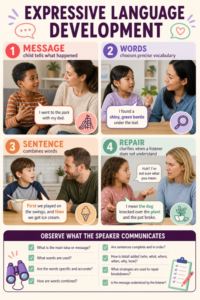
expressive language development is easiest to study when it is treated as a connected pattern rather than a single checklist item. Expressive language development is the growth of sharing meaning through speaking, writing, signing, gestures, pictures, AAC, and other modes. A useful study approach examines message purpose, organization, language form, and the partner’s access to meaning.
This learning guide is written for SLP students and other learners reviewing clinical concepts. It uses broad developmental patterns to organize observation, not to make an individualized diagnosis or promise one outcome. Communication varies with language experience, culture, hearing, access, health, opportunity, context, and the person’s full communication repertoire.
What expressive language development includes
Begin by separating the concept into domains. A learner who can name the domains is less likely to collapse a language difference, a speech difference, a social interaction, and an access barrier into one explanation. The useful unit of analysis is the communication task: what the person was asked to understand or express, with whom, under which conditions, and with what support.
Domain
What to notice
Question to carry forward
Message formulation
Choosing words and combining meanings to express requests, ideas, experiences, explanations, and opinions.
What does the person want the partner to understand or do?
Language form
Vocabulary, morphology, syntax, cohesion, and sentence structure that carry the intended meaning.
Which form supports or limits the message?
Discourse and audience
Organizing a story, explanation, conversation, or written message for a listener or reader.
How does the message change with purpose and audience?
Communication mode
Using speech, writing, sign, gesture, pictures, AAC, or combinations of modes.
Does the available mode provide a reliable path to expression?
These domains interact, but they should remain distinguishable. A learner may show strength in one area and need support in another. A broad learning label helps organize the next observation; it does not answer every assessment question.
Keep the first pass descriptive and close to the communication event. Note the message, the listener, the setting, the response format, and the support that was available. This gives the learner a stable record to compare across tasks and prevents a familiar term from doing too much explanatory work before the evidence has been separated into observable parts.
For exam review, a vignette may include several true details but ask for one best next step. The strongest answer usually respects the task and the person’s participation, checks the most relevant missing information, and avoids treating one performance sample as the whole communication profile.
Map expressive language development
For study purposes, describe the pattern before naming a condition. Record what the person understood, produced, initiated, repaired, or participated in. Then note whether the task was familiar, how much context was shared, what communication mode was available, and which support changed the response.
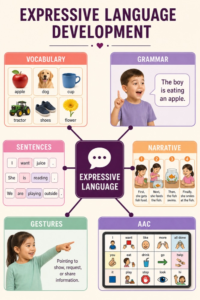
Vocabulary and semantics: selecting precise words, categories, relationships, and meanings.
Morphology and syntax: combining word forms and sentence structures to express relationships.
Cohesion and discourse: connecting ideas, sequencing events, explaining evidence, and staying on topic.
Narrative and expository language: telling experiences and explaining information for a listener.
Pragmatic expression: adapting the message, taking a turn, repairing, and communicating a social purpose.
Multimodal expression: using speech, writing, sign, gesture, AAC, and visual supports as meaningful resources.
A strong description is specific enough that another learner could picture the interaction. Instead of writing “language is weak” or “communication is poor,” describe the message, the demand, the partner, the context, and the result. This protects clinical reasoning from labels that are broader than the evidence.
Connect expression to purpose and audience
Context changes what communication requires. A quiet one-to-one conversation, a noisy group, a classroom explanation, a book-sharing routine, a peer exchange, and a work task can place different demands on the same underlying skills. Hearing access, fatigue, visual supports, partner rate, cultural expectations, language exposure, and the opportunity to request clarification should be part of the observation.
A learner may produce short answers in a structured task but communicate a richer message during a familiar activity. That contrast can reveal the effects of topic knowledge, planning time, partner support, communication mode, and the difference between naming and connected expression.
Observation layer
Example question
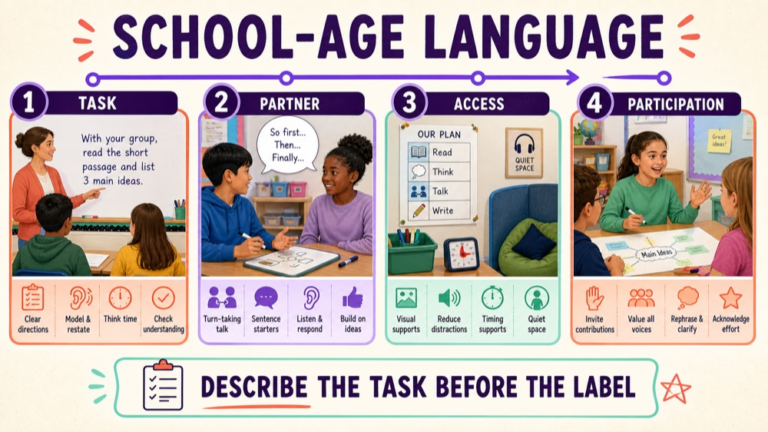
Task
What did the person need to understand, express, remember, organize, or repair?
Partner
Who was listening, and how did the partner respond or support the exchange?
Access
Were hearing, visual, motor, sensory, language, or environmental supports available?
Participation
What meaningful routine became easier or harder because of the communication pattern?
Context is not an afterthought added once a label has been selected. It is part of the question itself. If a performance changes with a quieter room, visual supports, extra processing time, a familiar partner, or a different communication mode, that change is useful evidence about access and task demand. It does not by itself identify a cause, but it tells you which conditions should be carried into the next observation.
Apply the concept in clinical reasoning
When a Praxis-style scenario or clinical discussion presents expressive language development, use a disciplined sequence. The goal is to select the next clinical question or action that matches the evidence, the person’s priorities, and the communication context.
Define the communication task in plain language.
Identify the language domain or domains involved without assuming they are interchangeable.
Separate observation from interpretation and write down what remains unknown.
Check hearing, language exposure, culture, communication mode, environment, and partner support.
Choose the assessment, collaboration, or observation step that answers the specific clinical question.
State the boundary of the conclusion and keep the person’s participation goal visible.
A learner may produce short answers in a structured task but communicate a richer message during a familiar activity. That contrast can reveal the effects of topic knowledge, planning time, partner support, communication mode, and the difference between naming and connected expression. In a learning answer, the decisive evidence is usually the relationship among the task, the observed pattern, and the next needed information—not a single isolated behavior.
Common study mistakes
Counting sentence length without examining message meaning and organization.
Treating vocabulary quantity as the whole expressive profile.
Ignoring writing, sign, gesture, AAC, and multimodal expression.
Confusing limited opportunity with limited language capacity.
Overlooking audience, discourse, cohesion, and repair.
Assuming a structured prompt shows spontaneous communication.
Describing errors without asking which supports improve expression.
Using one topic or one language context to generalize broadly.
Most of these mistakes come from replacing a multidomain question with a fast label. Correct the habit by returning to the same sequence: describe, separate, contextualize, ask what is missing, and choose a proportionate next step. A short written rationale can make this habit visible: identify the evidence, name the uncertainty, and explain why the selected next step fits both.
Build a quick review map
Use this compact map when reviewing a missed question, a lecture note, or a clinical vignette:
Step 1: Define the message purpose and communication mode.
Step 2: Separate word choice, grammar, discourse, and pragmatic use.
Step 3: Compare structured and naturalistic expression carefully.
Step 4: Record planning time, topic knowledge, partner, and access.
Step 5: Note successful supports and alternative ways to express meaning.
Step 6: State the next focused question instead of assigning a broad label.
Then write one transfer sentence: “When I see this pattern, I will first check ___ because ___.” The sentence should identify a decision rule, not repeat a definition. Revisit it after a delay and test whether you can apply the rule to a different context or communication mode.
Sources and next steps
expressive language development is best learned as a context-sensitive pattern across language domains, access, and participation. Use the current authority pages to refine the concept, then return to practice scenarios that require you to explain what the evidence supports and what it leaves open.
Receptive Language Development: A Clinical Learning Guide
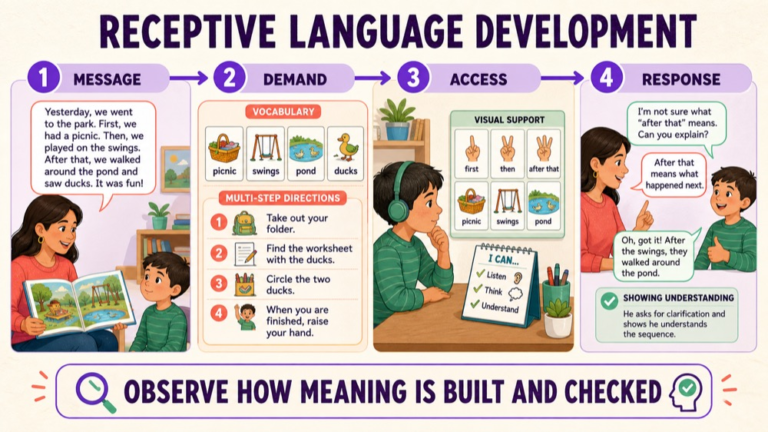
receptive language development is easiest to study when it is treated as a connected pattern rather than a single checklist item. Receptive language development is the growth of understanding across listening, reading, watching, signing, and other communication modes. It is best studied by examining what the message requires and how the learner shows understanding.
This learning guide is written for SLP students and other learners reviewing clinical concepts. It uses broad developmental patterns to organize observation, not to make an individualized diagnosis or promise one outcome. Communication varies with language experience, culture, hearing, access, health, opportunity, context, and the person’s full communication repertoire.
What receptive language development includes
Begin by separating the concept into domains. A learner who can name the domains is less likely to collapse a language difference, a speech difference, a social interaction, and an access barrier into one explanation. The useful unit of analysis is the communication task: what the person was asked to understand or express, with whom, under which conditions, and with what support.
Domain
What to notice
Question to carry forward
Message meaning
Understanding words, sentences, concepts, relationships, and the speaker’s intended point.
Which part of the message carries the comprehension demand?
Task and discourse
Following directions, answering questions, learning from stories, and integrating connected information.
Does understanding change when context, length, or organization changes?
Monitoring
Noticing confusion, using context, asking for clarification, and checking whether the message makes sense.
What does the learner do when meaning is uncertain?
These domains interact, but they should remain distinguishable. A learner may show strength in one area and need support in another. A broad learning label helps organize the next observation; it does not answer every assessment question.
Keep the first pass descriptive and close to the communication event. Note the message, the listener, the setting, the response format, and the support that was available. This gives the learner a stable record to compare across tasks and prevents a familiar term from doing too much explanatory work before the evidence has been separated into observable parts.
For exam review, a vignette may include several true details but ask for one best next step. The strongest answer usually respects the task and the person’s participation, checks the most relevant missing information, and avoids treating one performance sample as the whole communication profile.
Map receptive language development
For study purposes, describe the pattern before naming a condition. Record what the person understood, produced, initiated, repaired, or participated in. Then note whether the task was familiar, how much context was shared, what communication mode was available, and which support changed the response.
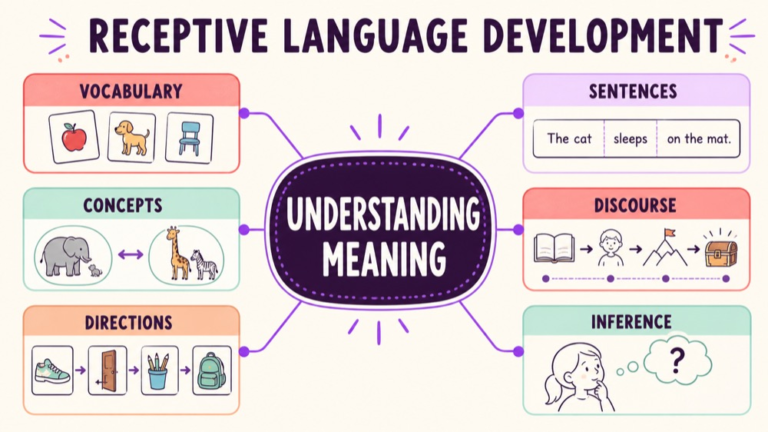
Vocabulary comprehension: recognizing word meanings, categories, relationships, and multiple meanings.
Sentence comprehension: interpreting word order, morphology, clauses, negation, and embedded ideas.
Concepts and directions: understanding time, space, quantity, sequence, comparison, and conditional language.
Discourse and narrative: following the main idea, event sequence, cause, perspective, and supporting details.
Higher-order comprehension: making inferences, interpreting nonliteral language, and integrating information.
Comprehension access: hearing, visual information, processing time, language experience, and partner support.
A strong description is specific enough that another learner could picture the interaction. Instead of writing “language is weak” or “communication is poor,” describe the message, the demand, the partner, the context, and the result. This protects clinical reasoning from labels that are broader than the evidence.
Separate comprehension demands in context
Context changes what communication requires. A quiet one-to-one conversation, a noisy group, a classroom explanation, a book-sharing routine, a peer exchange, and a work task can place different demands on the same underlying skills. Hearing access, fatigue, visual supports, partner rate, cultural expectations, language exposure, and the opportunity to request clarification should be part of the observation.
A learner may follow a short, familiar direction but lose important information in a fast multi-step explanation. The observation should vary one demand at a time when possible: length, vocabulary, syntax, background knowledge, noise, visual support, or time to respond.
Observation layer
Example question
Task
What did the person need to understand, express, remember, organize, or repair?
Partner
Who was listening, and how did the partner respond or support the exchange?
Access
Were hearing, visual, motor, sensory, language, or environmental supports available?
Participation
What meaningful routine became easier or harder because of the communication pattern?
Context is not an afterthought added once a label has been selected. It is part of the question itself. If a performance changes with a quieter room, visual supports, extra processing time, a familiar partner, or a different communication mode, that change is useful evidence about access and task demand. It does not by itself identify a cause, but it tells you which conditions should be carried into the next observation.
Apply the concept in clinical reasoning
When a Praxis-style scenario or clinical discussion presents receptive language development, use a disciplined sequence. The goal is to select the next clinical question or action that matches the evidence, the person’s priorities, and the communication context.
Define the communication task in plain language.
Identify the language domain or domains involved without assuming they are interchangeable.
Separate observation from interpretation and write down what remains unknown.
Check hearing, language exposure, culture, communication mode, environment, and partner support.
Choose the assessment, collaboration, or observation step that answers the specific clinical question.
State the boundary of the conclusion and keep the person’s participation goal visible.
A learner may follow a short, familiar direction but lose important information in a fast multi-step explanation. The observation should vary one demand at a time when possible: length, vocabulary, syntax, background knowledge, noise, visual support, or time to respond. In a learning answer, the decisive evidence is usually the relationship among the task, the observed pattern, and the next needed information—not a single isolated behavior.
Common study mistakes
Equating an incorrect answer with one specific language cause.
Testing vocabulary without checking sentence or discourse comprehension.
Ignoring hearing, noise, rate, visual access, and processing time.
Assuming silence means the message was understood.
Treating inferencing as a simple memory task.
Failing to distinguish language comprehension from task familiarity.
Overlooking clarification, repetition, and self-monitoring strategies.
Using one decontextualized sample to describe receptive language globally.
Most of these mistakes come from replacing a multidomain question with a fast label. Correct the habit by returning to the same sequence: describe, separate, contextualize, ask what is missing, and choose a proportionate next step. A short written rationale can make this habit visible: identify the evidence, name the uncertainty, and explain why the selected next step fits both.
Build a quick review map
Use this compact map when reviewing a missed question, a lecture note, or a clinical vignette:
Step 1: State what the learner had to understand.
Step 2: Separate word, sentence, discourse, and inference demands.
Step 3: Check language experience, hearing, environment, and supports.
Step 4: Observe how the learner responds to clarification or repetition.
Step 5: Compare comprehension across meaningful contexts.
Step 6: Choose the next observation that isolates the uncertain demand.
Then write one transfer sentence: “When I see this pattern, I will first check ___ because ___.” The sentence should identify a decision rule, not repeat a definition. Revisit it after a delay and test whether you can apply the rule to a different context or communication mode.
Sources and next steps
receptive language development is best learned as a context-sensitive pattern across language domains, access, and participation. Use the current authority pages to refine the concept, then return to practice scenarios that require you to explain what the evidence supports and what it leaves open.
Early Language Learning: A Clinical Learning Guide
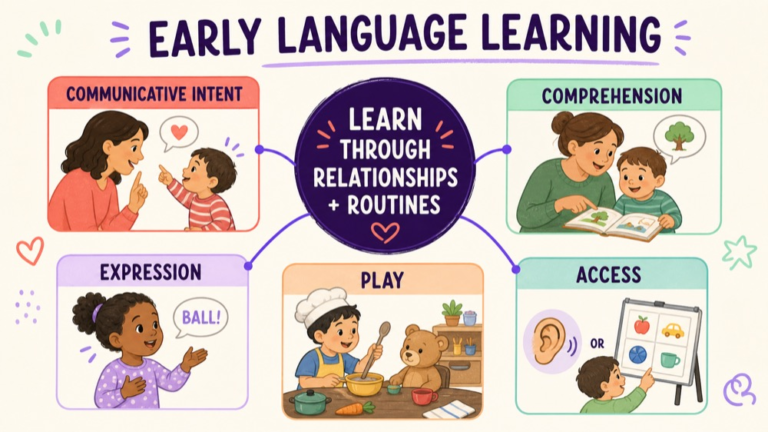
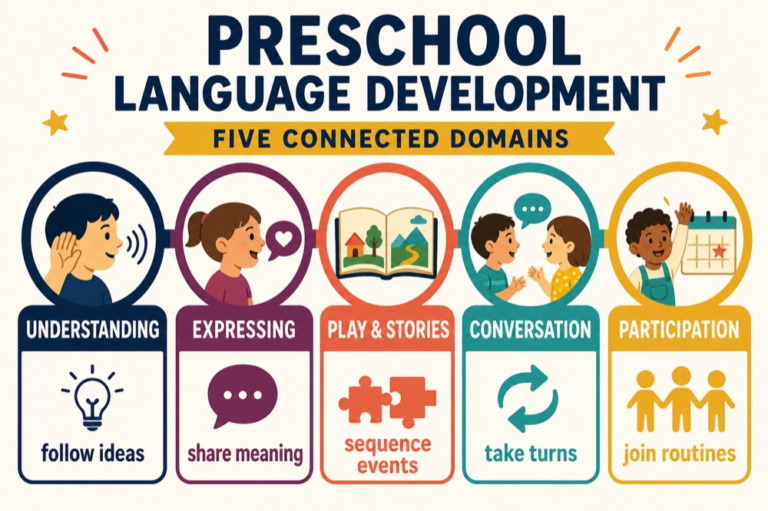
early language learning is easiest to study when it is treated as a connected pattern rather than a single checklist item. Early language learning grows through responsive interaction, shared attention, play, routines, and opportunities to understand and express meaning. A clinical study frame looks at the whole communication system rather than counting words alone.
This learning guide is written for SLP students and other learners reviewing clinical concepts. It uses broad developmental patterns to organize observation, not to make an individualized diagnosis or promise one outcome. Communication varies with language experience, culture, hearing, access, health, opportunity, context, and the person’s full communication repertoire.
What early language learning includes
Begin by separating the concept into domains. A learner who can name the domains is less likely to collapse a language difference, a speech difference, a social interaction, and an access barrier into one explanation. The useful unit of analysis is the communication task: what the person was asked to understand or express, with whom, under which conditions, and with what support.
Domain
What to notice
Question to carry forward
Interaction
Shared attention, turn-taking, gestures, vocalizations, and communication for a purpose.
How does the child start, respond to, and sustain the exchange?
Comprehension
Understanding familiar people, routines, words, gestures, and increasingly varied messages.
What does the child understand with and without context?
Expression
Using sounds, words, combinations, gestures, signs, pictures, or AAC to share meaning.
What functions and communication modes are available?
Play and routine
Learning language through repeated activities, pretend play, books, songs, and daily participation.
Which routine creates a natural opportunity to observe learning?
These domains interact, but they should remain distinguishable. A learner may show strength in one area and need support in another. A broad learning label helps organize the next observation; it does not answer every assessment question.
Keep the first pass descriptive and close to the communication event. Note the message, the listener, the setting, the response format, and the support that was available. This gives the learner a stable record to compare across tasks and prevents a familiar term from doing too much explanatory work before the evidence has been separated into observable parts.
For exam review, a vignette may include several true details but ask for one best next step. The strongest answer usually respects the task and the person’s participation, checks the most relevant missing information, and avoids treating one performance sample as the whole communication profile.
Map early language learning
For study purposes, describe the pattern before naming a condition. Record what the person understood, produced, initiated, repaired, or participated in. Then note whether the task was familiar, how much context was shared, what communication mode was available, and which support changed the response.
Communicative intent: requesting, protesting, commenting, greeting, sharing attention, and repairing.
Receptive language: understanding words, routines, simple directions, and the partner’s communicative cues.
Expressive vocabulary: using meaningful words, approximations, gestures, signs, pictures, or other modes.
Word combinations and grammar: combining meanings and gradually adding relationships and word forms.
Play and social communication: symbolic play, shared routines, imitation, turn-taking, and affective connection.
Language experience and access: home languages, hearing, opportunity, partner responsiveness, and communication supports.
A strong description is specific enough that another learner could picture the interaction. Instead of writing “language is weak” or “communication is poor,” describe the message, the demand, the partner, the context, and the result. This protects clinical reasoning from labels that are broader than the evidence.
Read early language in everyday routines
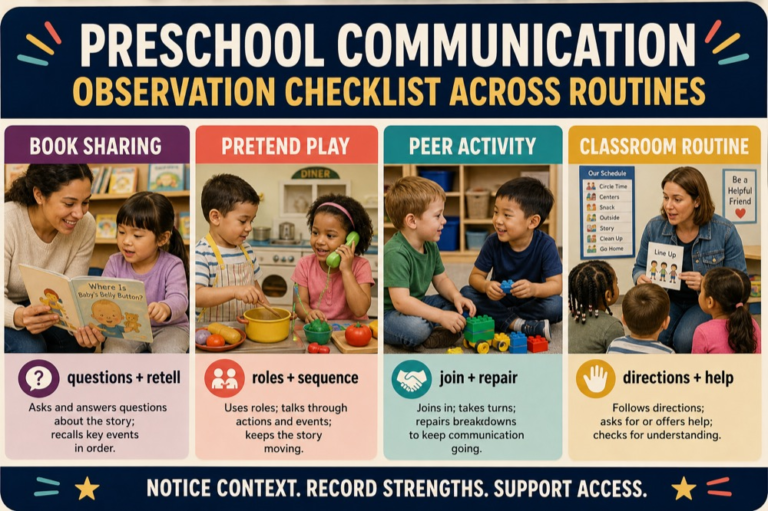
Context changes what communication requires. A quiet one-to-one conversation, a noisy group, a classroom explanation, a book-sharing routine, a peer exchange, and a work task can place different demands on the same underlying skills. Hearing access, fatigue, visual supports, partner rate, cultural expectations, language exposure, and the opportunity to request clarification should be part of the observation.
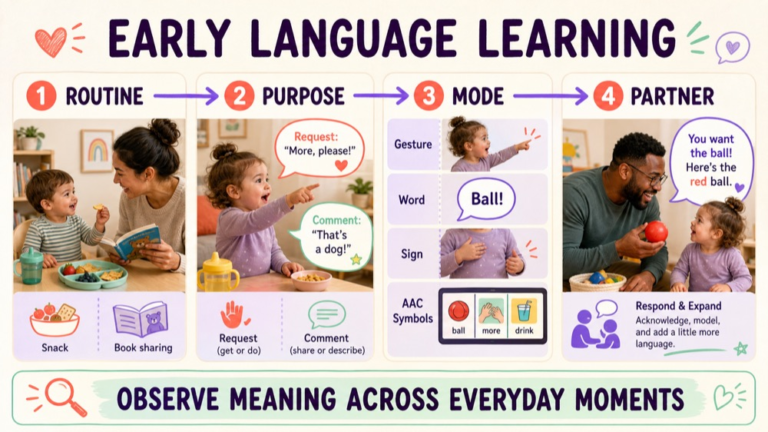
A young child may communicate more during a familiar snack routine than during a decontextualized naming task. That contrast is useful because it shows how motivation, partner support, sensory conditions, language exposure, and the communication mode affect what can be observed.
Observation layer
Example question
Task
What did the person need to understand, express, remember, organize, or repair?
Partner
Who was listening, and how did the partner respond or support the exchange?
Access
Were hearing, visual, motor, sensory, language, or environmental supports available?
Participation
What meaningful routine became easier or harder because of the communication pattern?
Context is not an afterthought added once a label has been selected. It is part of the question itself. If a performance changes with a quieter room, visual supports, extra processing time, a familiar partner, or a different communication mode, that change is useful evidence about access and task demand. It does not by itself identify a cause, but it tells you which conditions should be carried into the next observation.
Apply the concept in clinical reasoning
When a Praxis-style scenario or clinical discussion presents early language learning, use a disciplined sequence. The goal is to select the next clinical question or action that matches the evidence, the person’s priorities, and the communication context.
Define the communication task in plain language.
Identify the language domain or domains involved without assuming they are interchangeable.
Separate observation from interpretation and write down what remains unknown.
Check hearing, language exposure, culture, communication mode, environment, and partner support.
Choose the assessment, collaboration, or observation step that answers the specific clinical question.
State the boundary of the conclusion and keep the person’s participation goal visible.
A young child may communicate more during a familiar snack routine than during a decontextualized naming task. That contrast is useful because it shows how motivation, partner support, sensory conditions, language exposure, and the communication mode affect what can be observed. In a learning answer, the decisive evidence is usually the relationship among the task, the observed pattern, and the next needed information—not a single isolated behavior.
Common study mistakes
Treating a word count as the complete picture of early language learning.
Ignoring gestures, signs, pictures, AAC, vocalizations, and communication functions.
Assuming a quiet test task represents everyday communication.
Leaving hearing history and listening access out of the interpretation.
Confusing multilingual development with a language disorder.
Using a milestone chart as a screening or diagnostic tool.
Overlooking play, joint attention, and partner responsiveness.
Writing a deficit description without documenting successful routines.
Most of these mistakes come from replacing a multidomain question with a fast label. Correct the habit by returning to the same sequence: describe, separate, contextualize, ask what is missing, and choose a proportionate next step. A short written rationale can make this habit visible: identify the evidence, name the uncertainty, and explain why the selected next step fits both.
Build a quick review map
Use this compact map when reviewing a missed question, a lecture note, or a clinical vignette:
Step 1: Describe the routine and the child’s communicative purpose.
Step 2: Record understanding, expression, and communication mode separately.
Step 3: Include gestures, play, joint attention, and partner response.
Step 4: Check hearing, language exposure, culture, and access.
Step 5: Compare familiar and less familiar contexts cautiously.
Step 6: State what needs comprehensive follow-up rather than inferring a diagnosis.
Then write one transfer sentence: “When I see this pattern, I will first check ___ because ___.” The sentence should identify a decision rule, not repeat a definition. Revisit it after a delay and test whether you can apply the rule to a different context or communication mode.
Sources and next steps
early language learning is best learned as a context-sensitive pattern across language domains, access, and participation. Use the current authority pages to refine the concept, then return to practice scenarios that require you to explain what the evidence supports and what it leaves open.
Normal Language Development: Context, Meaning, and Access
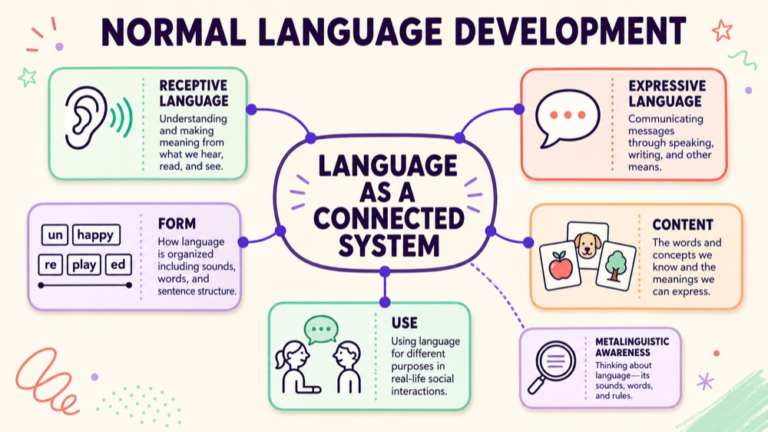
normal language development is easiest to study when it is treated as a connected pattern rather than a single checklist item. Normal language development is not one fixed checklist. It is a changing system of understanding and expression shaped by language experience, interaction, culture, access, and opportunities to communicate.
This learning guide is written for SLP students and other learners reviewing clinical concepts. It uses broad developmental patterns to organize observation, not to make an individualized diagnosis or promise one outcome. Communication varies with language experience, culture, hearing, access, health, opportunity, context, and the person’s full communication repertoire.
What normal language development includes
Begin by separating the concept into domains. A learner who can name the domains is less likely to collapse a language difference, a speech difference, a social interaction, and an access barrier into one explanation. The useful unit of analysis is the communication task: what the person was asked to understand or express, with whom, under which conditions, and with what support.
Domain
What to notice
Question to carry forward
Receptive language
Understanding spoken, written, signed, or aided messages, including concepts, relationships, and implied meaning.
What did the person need to understand, and what support was available?
Expressive language
Sharing ideas through speaking, writing, signing, gestures, or AAC with enough organization for the partner.
How did the person formulate and repair the message?
Language domains
Phonology, morphology, syntax, semantics, and pragmatics work together across modalities.
Which domain is carrying the demand, and which domains remain strengths?
These domains interact, but they should remain distinguishable. A learner may show strength in one area and need support in another. A broad learning label helps organize the next observation; it does not answer every assessment question.
Keep the first pass descriptive and close to the communication event. Note the message, the listener, the setting, the response format, and the support that was available. This gives the learner a stable record to compare across tasks and prevents a familiar term from doing too much explanatory work before the evidence has been separated into observable parts.
For exam review, a vignette may include several true details but ask for one best next step. The strongest answer usually respects the task and the person’s participation, checks the most relevant missing information, and avoids treating one performance sample as the whole communication profile.
Map normal language development domains
For study purposes, describe the pattern before naming a condition. Record what the person understood, produced, initiated, repaired, or participated in. Then note whether the task was familiar, how much context was shared, what communication mode was available, and which support changed the response.
Receptive language: understanding directions, questions, concepts, relationships, and connected messages.
Expressive language: selecting words, combining forms, organizing ideas, and communicating across modes.
Phonology and morphology: noticing sound patterns and meaningful word parts in spoken and written language.
Syntax and semantics: building sentences and selecting meanings that fit the message and context.
Pragmatics and discourse: using language for a purpose, a partner, a topic, and a shared activity.
Metalinguistic awareness: thinking about language, monitoring comprehension, and explaining how a message works.
A strong description is specific enough that another learner could picture the interaction. Instead of writing “language is weak” or “communication is poor,” describe the message, the demand, the partner, the context, and the result. This protects clinical reasoning from labels that are broader than the evidence.
Interpret language across contexts
Context changes what communication requires. A quiet one-to-one conversation, a noisy group, a classroom explanation, a book-sharing routine, a peer exchange, and a work task can place different demands on the same underlying skills. Hearing access, fatigue, visual supports, partner rate, cultural expectations, language exposure, and the opportunity to request clarification should be part of the observation.
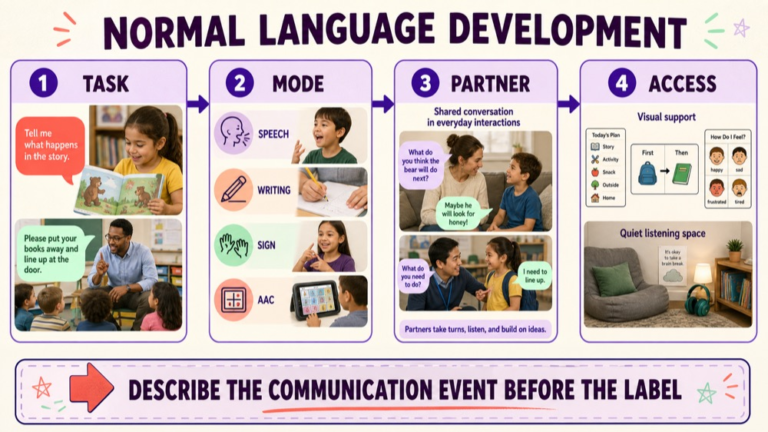
A learner may understand a familiar story but need more support for a dense classroom explanation, or may explain an idea well aloud but struggle to organize it in writing. The difference invites a closer look at task, modality, language experience, hearing, and communication partner rather than a quick label.
Observation layer
Example question
Task
What did the person need to understand, express, remember, organize, or repair?
Partner
Who was listening, and how did the partner respond or support the exchange?
Access
Were hearing, visual, motor, sensory, language, or environmental supports available?
Participation
What meaningful routine became easier or harder because of the communication pattern?
Context is not an afterthought added once a label has been selected. It is part of the question itself. If a performance changes with a quieter room, visual supports, extra processing time, a familiar partner, or a different communication mode, that change is useful evidence about access and task demand. It does not by itself identify a cause, but it tells you which conditions should be carried into the next observation.
Apply the concept in clinical reasoning
When a Praxis-style scenario or clinical discussion presents normal language development, use a disciplined sequence. The goal is to select the next clinical question or action that matches the evidence, the person’s priorities, and the communication context.
Define the communication task in plain language.
Identify the language domain or domains involved without assuming they are interchangeable.
Separate observation from interpretation and write down what remains unknown.
Check hearing, language exposure, culture, communication mode, environment, and partner support.
Choose the assessment, collaboration, or observation step that answers the specific clinical question.
State the boundary of the conclusion and keep the person’s participation goal visible.
A learner may understand a familiar story but need more support for a dense classroom explanation, or may explain an idea well aloud but struggle to organize it in writing. The difference invites a closer look at task, modality, language experience, hearing, and communication partner rather than a quick label. In a learning answer, the decisive evidence is usually the relationship among the task, the observed pattern, and the next needed information—not a single isolated behavior.
Common study mistakes
Treating normal language development as a single universal sequence.
Counting vocabulary without considering depth, use, comprehension, and context.
Separating receptive and expressive language as if they never influence each other.
Ignoring written, signed, aided, or multimodal communication.
Using a milestone or norm as a rigid cutoff for an individual learner.
Overlooking culture, dialect, multilingual experience, and opportunity.
Describing a difficulty without noting the supports that make access easier.
Treating one sample as the whole language profile.
Most of these mistakes come from replacing a multidomain question with a fast label. Correct the habit by returning to the same sequence: describe, separate, contextualize, ask what is missing, and choose a proportionate next step. A short written rationale can make this habit visible: identify the evidence, name the uncertainty, and explain why the selected next step fits both.
Build a quick review map
Use this compact map when reviewing a missed question, a lecture note, or a clinical vignette:
Step 1: Define the communication task and modality.
Step 2: Separate understanding from expression.
Step 3: Map form, content, and use without collapsing them.
Step 4: Record language experience, culture, hearing, and access.
Step 5: Identify strengths and supports before interpreting a difference.
Step 6: State what additional observation would answer the question.
Then write one transfer sentence: “When I see this pattern, I will first check ___ because ___.” The sentence should identify a decision rule, not repeat a definition. Revisit it after a delay and test whether you can apply the rule to a different context or communication mode.
Sources and next steps
normal language development is best learned as a context-sensitive pattern across language domains, access, and participation. Use the current authority pages to refine the concept, then return to practice scenarios that require you to explain what the evidence supports and what it leaves open.
Normal Speech Development: A Clinical Learning Guide
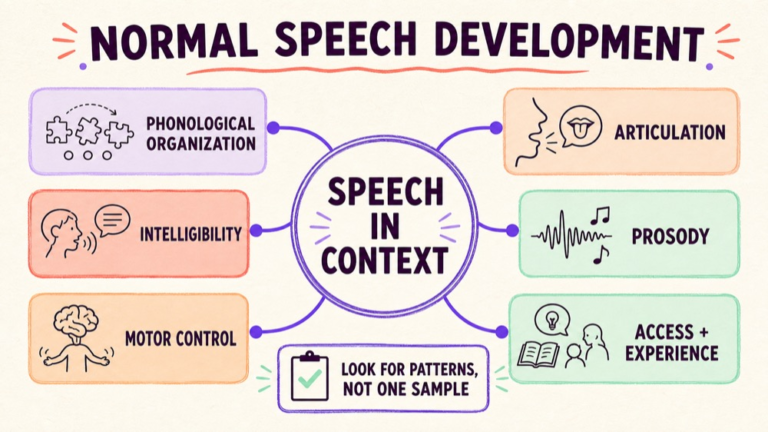
normal speech development is easiest to study when it is treated as a connected pattern rather than a single checklist item. Normal speech development is a pattern of growth, refinement, and variation rather than a single age cutoff. An SLP learner considers speech sound organization, motor control, intelligibility, rate, prosody, hearing access, language experience, and the listener’s context together.
This learning guide is written for SLP students and other learners reviewing clinical concepts. It uses broad developmental or functional patterns to organize observation, not to make an individualized diagnosis or promise one outcome. Communication varies with language experience, culture, hearing, access, health, opportunity, context, and the person’s full communication repertoire.
What normal speech development includes
Begin by separating the concept into domains. A learner who can name the domains is less likely to collapse a speech difference, a language demand, a social interaction, and an access barrier into one explanation. The useful unit of analysis is the communication task: what the person was asked to understand or express, with whom, under which conditions, and with what support.
Domain
What to notice
Question to carry forward
Speech sound system
Children gradually organize contrasts and sound patterns as their speech system becomes more refined.
Which pattern is present, and how does it compare across words and contexts?
Intelligibility
Listeners may understand speech differently depending on familiarity, topic, rate, and environment.
Who understands the message, in which setting, and with what effort?
Motor and access factors
Growth, coordination, hearing, language exposure, and communication supports influence what is heard.
What additional information would change the interpretation?
These domains interact, but they should remain distinguishable. A person may perform well in one domain and need support in another. A broad learning label helps organize the next observation; it does not answer every assessment question.
Keep the first pass descriptive and close to the communication event. Note the message, the listener, the setting, the response format, and the support that was available. This gives the learner a stable record to compare across tasks. It also prevents a familiar term from doing too much explanatory work before the evidence has been separated into observable parts.
For exam review, this distinction matters because a vignette may include several true details but ask for one best next step. The strongest answer usually respects the task and the person’s participation, checks the most relevant missing information, and avoids treating one performance sample as the whole communication profile.
Separate the normal speech development domains
For study purposes, describe the pattern before naming a condition. Record what the person understood, produced, initiated, repaired, or participated in. Then note whether the task was familiar, how much context was shared, what communication mode was available, and which support changed the response.
Phonological organization: contrasts, patterns, syllable shapes, and consistency across words.
Articulatory learning: placement, movement, coarticulation, and the demands of connected speech.
Intelligibility: listener understanding across familiar and unfamiliar partners and contexts.
Prosody and rate: stress, rhythm, phrasing, pauses, and the way speech supports meaning.
Motor and sensory access: coordination, hearing, vision, fatigue, and the environment for communication.
Language and multilingual context: sound systems, vocabulary, grammar, dialect, and the full linguistic repertoire.
A strong description is specific enough that another learner could picture the interaction. Instead of writing “language is weak” or “speech is delayed,” describe the message, the demand, the partner, the context, and the result. This protects clinical reasoning from labels that are broader than the evidence.
Interpret speech across listeners and contexts
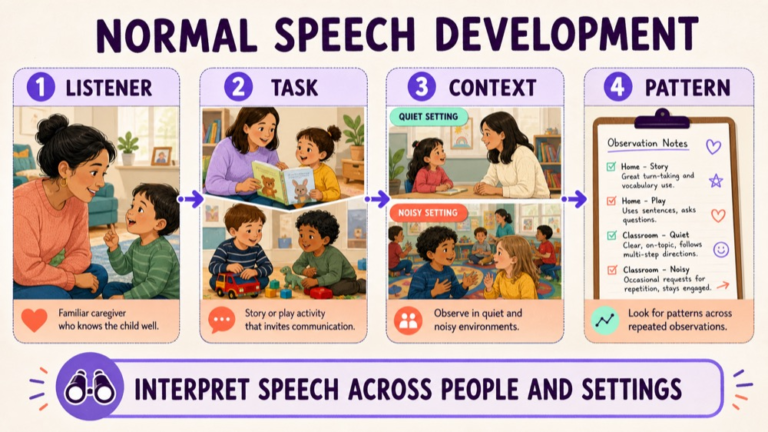
Context changes what communication requires. A quiet one-to-one conversation, a noisy group, a classroom explanation, a medical visit, a peer exchange, and a work routine can place different demands on the same underlying skills. Hearing access, fatigue, visual supports, partner rate, cultural expectations, language exposure, and the opportunity to request clarification should be part of the observation.
A child may be understood by a familiar caregiver during a routine and be harder to understand by an unfamiliar listener in a noisy room. That difference is not a contradiction; it is information about the interaction among speech production, listener familiarity, topic, rate, and environment. Norms organize questions, while samples and context help explain the pattern.
Observation layer
Example question
Task
What did the person need to understand, express, remember, organize, or repair?
Partner
Who was listening, and how did the partner respond or support the exchange?
Access
Were hearing, visual, motor, sensory, language, or environmental supports available?
Participation
What meaningful routine became easier or harder because of the communication pattern?
Context is not an afterthought added once a label has been selected. It is part of the question itself. If a performance changes with a quieter room, visual supports, extra processing time, a familiar partner, or a different communication mode, that change is useful evidence about access and task demand. It does not by itself identify a cause, but it tells you which conditions should be carried into the next observation.
Apply the concept in clinical reasoning
When a Praxis-style scenario or clinical discussion presents normal speech development, use a disciplined sequence. The goal is to select the next clinical question or action that matches the evidence, the person’s priorities, and the communication context.
Define the communication task in plain language.
Identify the domain or domains involved without assuming they are interchangeable.
Separate observation from interpretation and write down what remains unknown.
Check hearing, language exposure, culture, communication mode, environment, and partner support.
Choose the assessment, collaboration, or observation step that answers the specific clinical question.
State the boundary of the conclusion and keep the person’s participation goal visible.
A child may be understood by a familiar caregiver during a routine and be harder to understand by an unfamiliar listener in a noisy room. That difference is not a contradiction; it is information about the interaction among speech production, listener familiarity, topic, rate, and environment. Norms organize questions, while samples and context help explain the pattern. In a learning answer, the decisive evidence is usually the relationship among the task, the observed pattern, and the next needed information—not a single isolated behavior.
Common study mistakes
Using one sound-age chart as a pass-fail rule.
Confusing phonological pattern analysis with a list of isolated errors.
Treating intelligibility as a fixed number without naming the listener and context.
Ignoring hearing history, language exposure, dialect, and communication mode.
Assuming motor speech, articulation, and phonology are interchangeable terms.
Measuring only single words when connected speech changes the picture.
Overlooking the child’s strengths and repair strategies.
Making a treatment or eligibility conclusion from a norm alone.
Most of these mistakes come from replacing a multidomain question with a fast label. Correct the habit by returning to the same sequence: describe, separate, contextualize, ask what is missing, and choose a proportionate next step. A short written rationale can make this habit visible: identify the evidence, name the uncertainty, and explain why the selected next step fits both.
Build a quick review map
Use this compact map when reviewing a missed question, a lecture note, or a clinical vignette:
Step 1: Describe the speech sample and context.
Step 2: Separate sound pattern, articulation, motor, prosody, and intelligibility questions.
Step 3: Check hearing, language, dialect, and multilingual context.
Step 4: Compare familiar and unfamiliar listener perspectives.
Step 5: Use norms as one evidence source rather than the whole interpretation.
Step 6: State the next assessment question and the boundary of the conclusion.
Then write one transfer sentence: “When I see this pattern, I will first check ___ because ___.” The sentence should identify a decision rule, not repeat a definition. Revisit it after a delay and test whether you can apply the rule to a different context or communication mode.
Sources and next steps
normal speech development is best learned as a context-sensitive pattern across communication domains, access, and participation. Use the current authority pages to refine the concept, then return to practice scenarios that require you to explain what the evidence supports and what it leaves open.
Aging and Communication: A Clinical Learning Guide
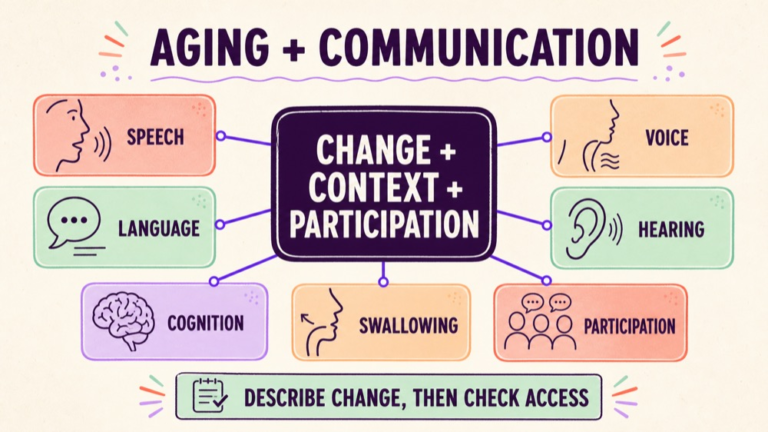
aging and communication is easiest to study when it is treated as a connected pattern rather than a single checklist item. Aging and communication should be studied through patterns, function, and context. Some changes may occur with age, while a new or functionally important change can call for closer attention. The SLP learner separates speech, voice, language, hearing, cognition, swallowing, environment, and participation before drawing a conclusion.
This learning guide is written for SLP students and other learners reviewing clinical concepts. It uses broad developmental or functional patterns to organize observation, not to make an individualized diagnosis or promise one outcome. Communication varies with language experience, culture, hearing, access, health, opportunity, context, and the person’s full communication repertoire.
What aging and communication includes
Begin by separating the concept into domains. A learner who can name the domains is less likely to collapse a speech difference, a language demand, a social interaction, and an access barrier into one explanation. The useful unit of analysis is the communication task: what the person was asked to understand or express, with whom, under which conditions, and with what support.
Domain
What to notice
Question to carry forward
Speech and voice
Changes in loudness, quality, pitch, rate, endurance, or articulatory precision may affect a conversation.
Is the change mild and context-specific, or does it disrupt valued routines?
Language and cognition
Word retrieval, processing speed, memory, discourse, and organization may interact with communication.
What does the person understand, express, remember, and successfully use?
Hearing, swallowing, and environment
Hearing access, nutrition, fatigue, noise, lighting, and partner support can change performance.
Which access or health factor should be considered next?
These domains interact, but they should remain distinguishable. A person may perform well in one domain and need support in another. A broad learning label helps organize the next observation; it does not answer every assessment question.
Keep the first pass descriptive and close to the communication event. Note the message, the listener, the setting, the response format, and the support that was available. This gives the learner a stable record to compare across tasks. It also prevents a familiar term from doing too much explanatory work before the evidence has been separated into observable parts.
For exam review, this distinction matters because a vignette may include several true details but ask for one best next step. The strongest answer usually respects the task and the person’s participation, checks the most relevant missing information, and avoids treating one performance sample as the whole communication profile.
Map aging and communication domains
For study purposes, describe the pattern before naming a condition. Record what the person understood, produced, initiated, repaired, or participated in. Then note whether the task was familiar, how much context was shared, what communication mode was available, and which support changed the response.
Speech and voice: clarity, loudness, resonance, pitch, rate, and vocal effort.
Word retrieval and language: naming, discourse, comprehension, reading, writing, and conversational repair.
Cognition-communication: attention, memory, processing speed, planning, and self-monitoring.
Swallowing and oral function: effort, safety, nutrition, hydration, and the need for current clinical evaluation.
Participation: independence, relationships, health-care communication, work, hobbies, and community routines.
A strong description is specific enough that another learner could picture the interaction. Instead of writing “language is weak” or “speech is delayed,” describe the message, the demand, the partner, the context, and the result. This protects clinical reasoning from labels that are broader than the evidence.
Read change through function and access
Context changes what communication requires. A quiet one-to-one conversation, a noisy group, a classroom explanation, a medical visit, a peer exchange, and a work routine can place different demands on the same underlying skills. Hearing access, fatigue, visual supports, partner rate, cultural expectations, language exposure, and the opportunity to request clarification should be part of the observation.
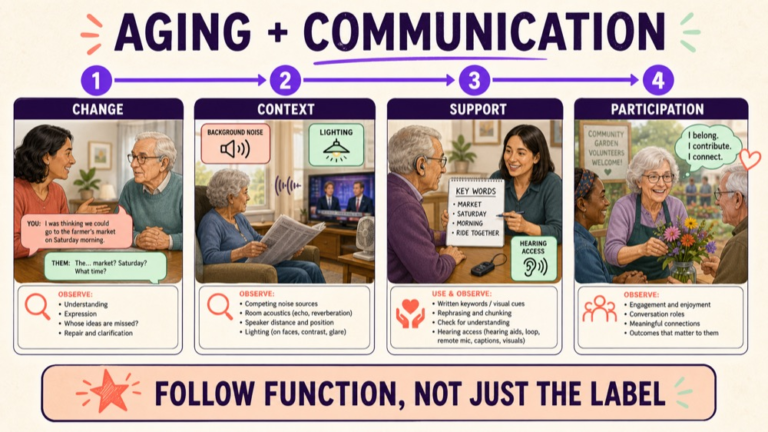
An older adult may have occasional word-retrieval pauses and still communicate effectively, while a new pattern that interferes with medication instructions, conversations, or familiar routines deserves a more careful question. The learning point is to describe change and impact, not to equate age with a disorder or dismiss a meaningful change as ordinary.
Observation layer
Example question
Task
What did the person need to understand, express, remember, organize, or repair?
Partner
Who was listening, and how did the partner respond or support the exchange?
Access
Were hearing, visual, motor, sensory, language, or environmental supports available?
Participation
What meaningful routine became easier or harder because of the communication pattern?
Context is not an afterthought added once a label has been selected. It is part of the question itself. If a performance changes with a quieter room, visual supports, extra processing time, a familiar partner, or a different communication mode, that change is useful evidence about access and task demand. It does not by itself identify a cause, but it tells you which conditions should be carried into the next observation.
Apply the concept in clinical reasoning
When a Praxis-style scenario or clinical discussion presents aging and communication, use a disciplined sequence. The goal is to select the next clinical question or action that matches the evidence, the person’s priorities, and the communication context.
Define the communication task in plain language.
Identify the domain or domains involved without assuming they are interchangeable.
Separate observation from interpretation and write down what remains unknown.
Check hearing, language exposure, culture, communication mode, environment, and partner support.
Choose the assessment, collaboration, or observation step that answers the specific clinical question.
State the boundary of the conclusion and keep the person’s participation goal visible.
An older adult may have occasional word-retrieval pauses and still communicate effectively, while a new pattern that interferes with medication instructions, conversations, or familiar routines deserves a more careful question. The learning point is to describe change and impact, not to equate age with a disorder or dismiss a meaningful change as ordinary. In a learning answer, the decisive evidence is usually the relationship among the task, the observed pattern, and the next needed information—not a single isolated behavior.
Common study mistakes
Treating every communication change as an expected part of aging.
Treating any pause or word search as evidence of a disorder.
Ignoring hearing access and listening conditions.
Leaving voice, swallowing, or nutrition out of a relevant history.
Using a screening score without considering daily function and context.
Speaking about the older adult without including the person’s priorities.
Assuming family report and self-report answer the same question.
Using an older public handout as the only current clinical source.
Most of these mistakes come from replacing a multidomain question with a fast label. Correct the habit by returning to the same sequence: describe, separate, contextualize, ask what is missing, and choose a proportionate next step. A short written rationale can make this habit visible: identify the evidence, name the uncertainty, and explain why the selected next step fits both.
Build a quick review map
Use this compact map when reviewing a missed question, a lecture note, or a clinical vignette:
Step 1: Describe the communication change and its time course.
Step 2: Identify the routines and partners affected.
Step 3: Separate communication domains and access factors.
Step 4: Record strengths, strategies, and the person’s goals.
Step 5: Choose the next history, referral, or assessment question.
Step 6: Check current topic-specific guidance before making a clinical recommendation.
Then write one transfer sentence: “When I see this pattern, I will first check ___ because ___.” The sentence should identify a decision rule, not repeat a definition. Revisit it after a delay and test whether you can apply the rule to a different context or communication mode.
Sources and next steps
aging and communication is best learned as a context-sensitive pattern across communication domains, access, and participation. Use the current authority pages to refine the concept, then return to practice scenarios that require you to explain what the evidence supports and what it leaves open.
Adult Communication Changes: A Clinical Learning Guide
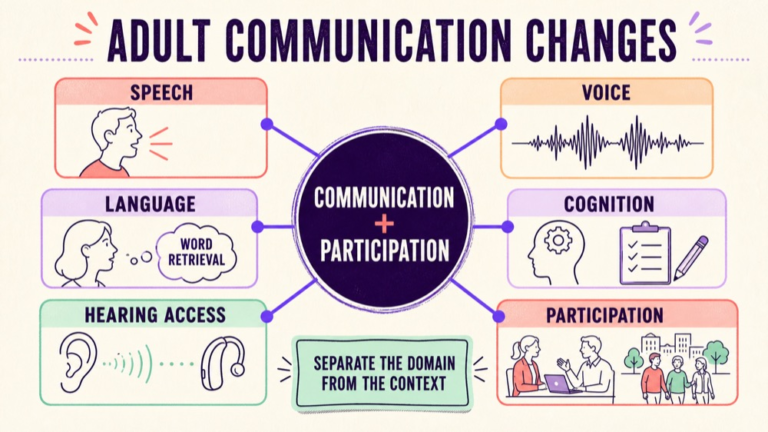
adult communication changes is easiest to study when it is treated as a connected pattern rather than a single checklist item. Adult communication changes are best understood as changes in function and context, not as one uniform life-stage pattern. An SLP learner considers speech, voice, language, hearing, cognition, swallowing when relevant, communication partners, and the demands of work, health care, family, and community life.
This learning guide is written for SLP students and other learners reviewing clinical concepts. It uses broad developmental or functional patterns to organize observation, not to make an individualized diagnosis or promise one outcome. Communication varies with language experience, culture, hearing, access, health, opportunity, context, and the person’s full communication repertoire.
What adult communication changes includes
Begin by separating the concept into domains. A learner who can name the domains is less likely to collapse a speech difference, a language demand, a social interaction, and an access barrier into one explanation. The useful unit of analysis is the communication task: what the person was asked to understand or express, with whom, under which conditions, and with what support.
Domain
What to notice
Question to carry forward
Speech and voice
Changes in clarity, loudness, fluency, resonance, rate, or vocal effort may affect participation.
What changed, in which tasks, and with what impact?
Language and cognition
Word retrieval, processing speed, discourse organization, memory, and executive demands may interact.
Which communication process is difficult, and which supports help?
Access and participation
Hearing, environment, fatigue, partner behavior, technology, and health routines shape performance.
Is the barrier inside the skill, the environment, or both?
These domains interact, but they should remain distinguishable. A person may perform well in one domain and need support in another. A broad learning label helps organize the next observation; it does not answer every assessment question.
Keep the first pass descriptive and close to the communication event. Note the message, the listener, the setting, the response format, and the support that was available. This gives the learner a stable record to compare across tasks. It also prevents a familiar term from doing too much explanatory work before the evidence has been separated into observable parts.
For exam review, this distinction matters because a vignette may include several true details but ask for one best next step. The strongest answer usually respects the task and the person’s participation, checks the most relevant missing information, and avoids treating one performance sample as the whole communication profile.
Separate the adult communication domains
For study purposes, describe the pattern before naming a condition. Record what the person understood, produced, initiated, repaired, or participated in. Then note whether the task was familiar, how much context was shared, what communication mode was available, and which support changed the response.
Speech production: intelligibility, rate, articulation, motor planning, and listener effort.
Voice and resonance: loudness, quality, pitch, endurance, and the demands of the communication setting.
Language: word retrieval, sentence formulation, comprehension, discourse, reading, and writing.
Cognition-communication: attention, memory, processing, organization, initiation, and self-monitoring.
Hearing and access: listening conditions, devices, fatigue, visual information, and environmental noise.
A strong description is specific enough that another learner could picture the interaction. Instead of writing “language is weak” or “speech is delayed,” describe the message, the demand, the partner, the context, and the result. This protects clinical reasoning from labels that are broader than the evidence.
Connect change to participation
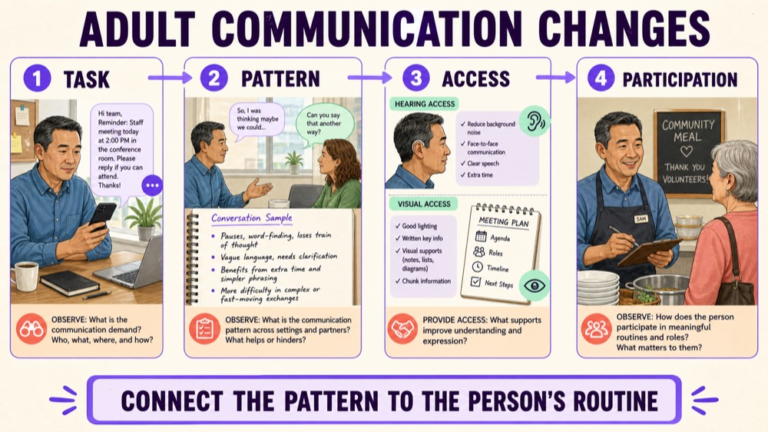
Context changes what communication requires. A quiet one-to-one conversation, a noisy group, a classroom explanation, a medical visit, a peer exchange, and a work routine can place different demands on the same underlying skills. Hearing access, fatigue, visual supports, partner rate, cultural expectations, language exposure, and the opportunity to request clarification should be part of the observation.
A person may communicate effectively in a quiet conversation and struggle during a noisy meeting, a fast medical visit, or a multitasking routine. That contrast is clinically meaningful because it links the communication change to task demands and supports. It does not, by itself, identify an underlying condition.
Observation layer
Example question
Task
What did the person need to understand, express, remember, organize, or repair?
Partner
Who was listening, and how did the partner respond or support the exchange?
Access
Were hearing, visual, motor, sensory, language, or environmental supports available?
Participation
What meaningful routine became easier or harder because of the communication pattern?
Context is not an afterthought added once a label has been selected. It is part of the question itself. If a performance changes with a quieter room, visual supports, extra processing time, a familiar partner, or a different communication mode, that change is useful evidence about access and task demand. It does not by itself identify a cause, but it tells you which conditions should be carried into the next observation.
Apply the concept in clinical reasoning
When a Praxis-style scenario or clinical discussion presents adult communication changes, use a disciplined sequence. The goal is to select the next clinical question or action that matches the evidence, the person’s priorities, and the communication context.
Define the communication task in plain language.
Identify the domain or domains involved without assuming they are interchangeable.
Separate observation from interpretation and write down what remains unknown.
Check hearing, language exposure, culture, communication mode, environment, and partner support.
Choose the assessment, collaboration, or observation step that answers the specific clinical question.
State the boundary of the conclusion and keep the person’s participation goal visible.
A person may communicate effectively in a quiet conversation and struggle during a noisy meeting, a fast medical visit, or a multitasking routine. That contrast is clinically meaningful because it links the communication change to task demands and supports. It does not, by itself, identify an underlying condition. In a learning answer, the decisive evidence is usually the relationship among the task, the observed pattern, and the next needed information—not a single isolated behavior.
Common study mistakes
Treating adult communication as one age-based category.
Describing word-finding difficulty without asking about frequency and function.
Ignoring hearing, fatigue, medication, environment, and partner behavior.
Separating communication from work, safety, and health-care participation.
Assuming a quiet conversation represents every communication context.
Using a cognitive label before describing the observable communication task.
Overlooking strengths, compensatory strategies, and preferred supports.
Forgetting that adults should participate in decisions about goals and access.
Most of these mistakes come from replacing a multidomain question with a fast label. Correct the habit by returning to the same sequence: describe, separate, contextualize, ask what is missing, and choose a proportionate next step. A short written rationale can make this habit visible: identify the evidence, name the uncertainty, and explain why the selected next step fits both.
Build a quick review map
Use this compact map when reviewing a missed question, a lecture note, or a clinical vignette:
Step 1: Describe the change in observable communication terms.
Step 2: Identify the task, partner, setting, and participation consequence.
Step 3: Separate speech, voice, language, cognition, hearing, and access questions.
Step 4: Record strategies that improve performance.
Step 5: Check which additional history or assessment would change the interpretation.
Step 6: Keep the adult’s priorities visible in the next-step plan.
Then write one transfer sentence: “When I see this pattern, I will first check ___ because ___.” The sentence should identify a decision rule, not repeat a definition. Revisit it after a delay and test whether you can apply the rule to a different context or communication mode.
Sources and next steps
adult communication changes is best learned as a context-sensitive pattern across communication domains, access, and participation. Use the current authority pages to refine the concept, then return to practice scenarios that require you to explain what the evidence supports and what it leaves open.
Adolescent Communication Development: A Clinical Learning Guide
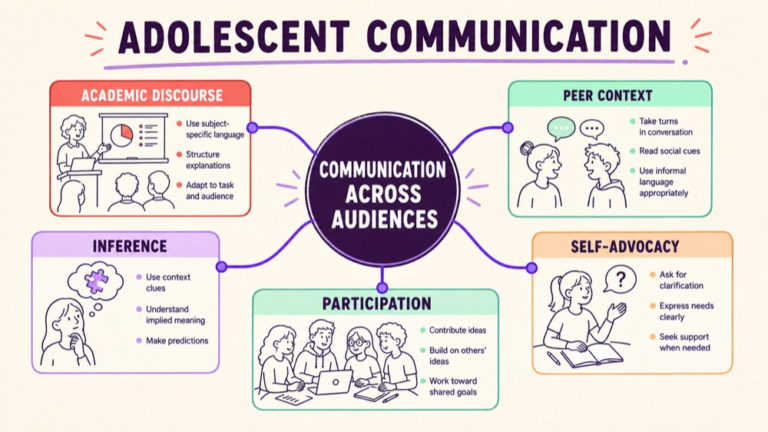
adolescent communication development is easiest to study when it is treated as a connected pattern rather than a single checklist item. Adolescent communication development involves changing language, cognition, social identity, self-advocacy, and participation demands. A useful SLP learning frame looks beyond sentence form to how a young person explains, negotiates, infers, repairs, and communicates across school, work, peers, and family.
This learning guide is written for SLP students and other learners reviewing clinical concepts. It uses broad developmental or functional patterns to organize observation, not to make an individualized diagnosis or promise one outcome. Communication varies with language experience, culture, hearing, access, health, opportunity, context, and the person’s full communication repertoire.
What adolescent communication development includes
Begin by separating the concept into domains. A learner who can name the domains is less likely to collapse a speech difference, a language demand, a social interaction, and an access barrier into one explanation. The useful unit of analysis is the communication task: what the person was asked to understand or express, with whom, under which conditions, and with what support.
Adjusting tone, topic, timing, perspective, and repair across changing partners.
How does the communication goal change with the audience?
Self-advocacy
Requesting clarification, describing access needs, expressing preferences, and participating in decisions.
Does the environment make the communication demand visible and negotiable?
These domains interact, but they should remain distinguishable. A person may perform well in one domain and need support in another. A broad learning label helps organize the next observation; it does not answer every assessment question.
Keep the first pass descriptive and close to the communication event. Note the message, the listener, the setting, the response format, and the support that was available. This gives the learner a stable record to compare across tasks. It also prevents a familiar term from doing too much explanatory work before the evidence has been separated into observable parts.
For exam review, this distinction matters because a vignette may include several true details but ask for one best next step. The strongest answer usually respects the task and the person’s participation, checks the most relevant missing information, and avoids treating one performance sample as the whole communication profile.
Map the adolescent communication demands
For study purposes, describe the pattern before naming a condition. Record what the person understood, produced, initiated, repaired, or participated in. Then note whether the task was familiar, how much context was shared, what communication mode was available, and which support changed the response.
Complex language: using precise vocabulary, embedded ideas, and language for comparison or argument.
Perspective and inference: considering what a listener knows, feels, assumes, or may misunderstand.
Discourse: organizing explanations, narratives, discussions, presentations, and written messages.
Social communication: adapting communication while maintaining identity and authentic preferences.
Self-advocacy: asking for clarification, access, pacing, or a different communication route.
Participation: connecting communication skills to school, relationships, work exploration, and community life.
A strong description is specific enough that another learner could picture the interaction. Instead of writing “language is weak” or “speech is delayed,” describe the message, the demand, the partner, the context, and the result. This protects clinical reasoning from labels that are broader than the evidence.
Read communication across real audiences
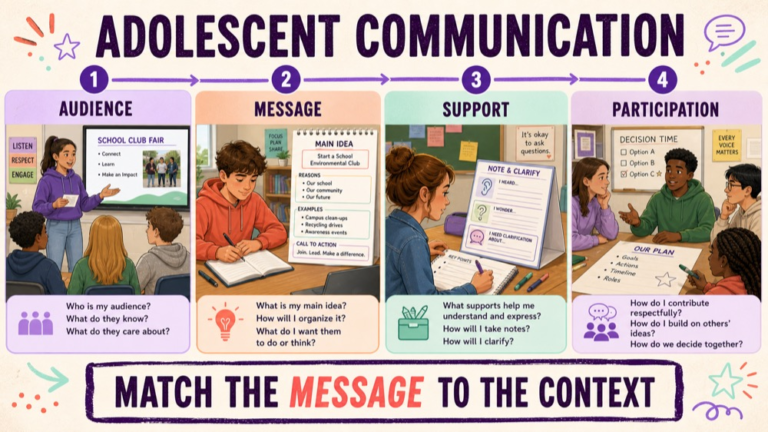
Context changes what communication requires. A quiet one-to-one conversation, a noisy group, a classroom explanation, a medical visit, a peer exchange, and a work routine can place different demands on the same underlying skills. Hearing access, fatigue, visual supports, partner rate, cultural expectations, language exposure, and the opportunity to request clarification should be part of the observation.
An adolescent may understand a concept in one-to-one conversation but struggle to enter a fast group discussion, explain a position in writing, or repair a misunderstanding with a peer. The observation becomes more useful when the learner identifies the partner, purpose, time pressure, language load, and access supports rather than treating the difference as a fixed personal trait.
Observation layer
Example question
Task
What did the person need to understand, express, remember, organize, or repair?
Partner
Who was listening, and how did the partner respond or support the exchange?
Access
Were hearing, visual, motor, sensory, language, or environmental supports available?
Participation
What meaningful routine became easier or harder because of the communication pattern?
Context is not an afterthought added once a label has been selected. It is part of the question itself. If a performance changes with a quieter room, visual supports, extra processing time, a familiar partner, or a different communication mode, that change is useful evidence about access and task demand. It does not by itself identify a cause, but it tells you which conditions should be carried into the next observation.
Apply the concept in clinical reasoning
When a Praxis-style scenario or clinical discussion presents adolescent communication development, use a disciplined sequence. The goal is to select the next clinical question or action that matches the evidence, the person’s priorities, and the communication context.
Define the communication task in plain language.
Identify the domain or domains involved without assuming they are interchangeable.
Separate observation from interpretation and write down what remains unknown.
Check hearing, language exposure, culture, communication mode, environment, and partner support.
Choose the assessment, collaboration, or observation step that answers the specific clinical question.
State the boundary of the conclusion and keep the person’s participation goal visible.
An adolescent may understand a concept in one-to-one conversation but struggle to enter a fast group discussion, explain a position in writing, or repair a misunderstanding with a peer. The observation becomes more useful when the learner identifies the partner, purpose, time pressure, language load, and access supports rather than treating the difference as a fixed personal trait. In a learning answer, the decisive evidence is usually the relationship among the task, the observed pattern, and the next needed information—not a single isolated behavior.
Common study mistakes
Treating adolescence as a smaller version of early childhood.
Equating social communication with compliance or one preferred interaction style.
Ignoring the adolescent’s own goals, identity, and communication preferences.
Focusing on grammar while missing discourse, inference, and audience demands.
Assuming peer difficulty has one explanation without observing the interaction.
Leaving self-advocacy out of the communication profile.
Using a benchmark as a rigid standard across cultures and languages.
Writing goals that describe adult convenience instead of meaningful participation.
Most of these mistakes come from replacing a multidomain question with a fast label. Correct the habit by returning to the same sequence: describe, separate, contextualize, ask what is missing, and choose a proportionate next step. A short written rationale can make this habit visible: identify the evidence, name the uncertainty, and explain why the selected next step fits both.
Build a quick review map
Use this compact map when reviewing a missed question, a lecture note, or a clinical vignette:
Step 1: Identify the adolescent’s communication purpose.
Step 2: Name the audience, partner, and context.
Step 3: Separate language form, discourse organization, and social adaptation.
Step 4: Include the adolescent’s perspective and preferred communication mode.
Step 5: Ask which support would change participation.
Step 6: Link the observation to a focused, collaborative question.
Then write one transfer sentence: “When I see this pattern, I will first check ___ because ___.” The sentence should identify a decision rule, not repeat a definition. Revisit it after a delay and test whether you can apply the rule to a different context or communication mode.
Sources and next steps
adolescent communication development is best learned as a context-sensitive pattern across communication domains, access, and participation. Use the current authority pages to refine the concept, then return to practice scenarios that require you to explain what the evidence supports and what it leaves open.
School-Age Language Development: A Clinical Learning Guide
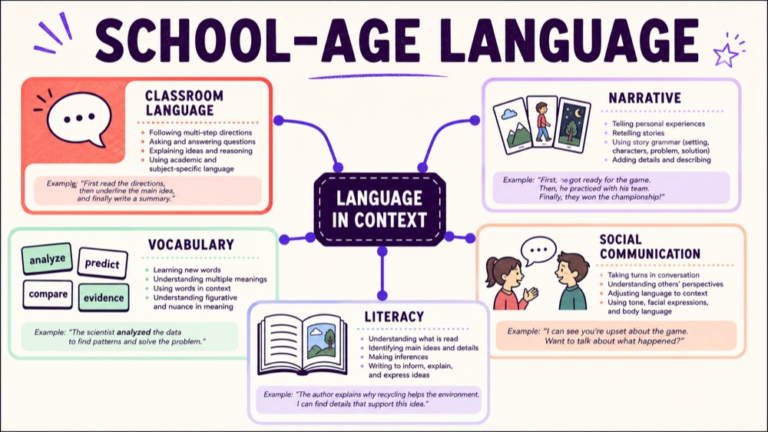
school age language development is easiest to study when it is treated as a connected pattern rather than a single checklist item. School-age language development is more than longer sentences. It includes the growing ability to understand instruction, organize information, explain relationships, adjust language to a listener, and use communication for learning and participation.
This learning guide is written for SLP students and other learners reviewing clinical concepts. It uses broad developmental or functional patterns to organize observation, not to make an individualized diagnosis or promise one outcome. Communication varies with language experience, culture, hearing, access, health, opportunity, context, and the person’s full communication repertoire.
What school age language development includes
Begin by separating the concept into domains. A learner who can name the domains is less likely to collapse a speech difference, a language demand, a social interaction, and an access barrier into one explanation. The useful unit of analysis is the communication task: what the person was asked to understand or express, with whom, under which conditions, and with what support.
Domain
What to notice
Question to carry forward
Classroom language
Following directions, learning new terms, explaining work, and understanding increasingly dense instruction.
Which language demand is affecting access to the lesson?
Narrative and discourse
Sequencing events, explaining causes, summarizing, and keeping the listener oriented.
Can the learner organize a message for someone who does not share the context?
Social and metalinguistic language
Maintaining a topic, repairing a breakdown, interpreting a perspective, and thinking about how language works.
Does communication change with partner, task, and social purpose?
These domains interact, but they should remain distinguishable. A person may perform well in one domain and need support in another. A broad learning label helps organize the next observation; it does not answer every assessment question.
Keep the first pass descriptive and close to the communication event. Note the message, the listener, the setting, the response format, and the support that was available. This gives the learner a stable record to compare across tasks. It also prevents a familiar term from doing too much explanatory work before the evidence has been separated into observable parts.
For exam review, this distinction matters because a vignette may include several true details but ask for one best next step. The strongest answer usually respects the task and the person’s participation, checks the most relevant missing information, and avoids treating one performance sample as the whole communication profile.
Map the school-age language domains
For study purposes, describe the pattern before naming a condition. Record what the person understood, produced, initiated, repaired, or participated in. Then note whether the task was familiar, how much context was shared, what communication mode was available, and which support changed the response.
Receptive language: understanding directions, concepts, relationships, and classroom explanations.
Expressive language: selecting words, building sentences, explaining ideas, and producing connected discourse.
Narrative language: organizing events, characters, settings, causes, and conclusions for a listener.
Vocabulary and word learning: building depth, categories, multiple meanings, and academic terms.
Social communication: maintaining topics, repairing misunderstandings, and adapting to partners.
Literacy-linked language: using sound awareness, oral language, reading, writing, and comprehension together.
A strong description is specific enough that another learner could picture the interaction. Instead of writing “language is weak” or “speech is delayed,” describe the message, the demand, the partner, the context, and the result. This protects clinical reasoning from labels that are broader than the evidence.
Read language in classroom context
Context changes what communication requires. A quiet one-to-one conversation, a noisy group, a classroom explanation, a medical visit, a peer exchange, and a work routine can place different demands on the same underlying skills. Hearing access, fatigue, visual supports, partner rate, cultural expectations, language exposure, and the opportunity to request clarification should be part of the observation.
A student may follow a short direction in a quiet room but lose the thread during a multi-step classroom explanation. That difference does not identify one cause by itself; it tells the learner to examine language load, attention, hearing access, working memory, visual supports, and the opportunity to ask for clarification.
Observation layer
Example question
Task
What did the person need to understand, express, remember, organize, or repair?
Partner
Who was listening, and how did the partner respond or support the exchange?
Access
Were hearing, visual, motor, sensory, language, or environmental supports available?
Participation
What meaningful routine became easier or harder because of the communication pattern?
Context is not an afterthought added once a label has been selected. It is part of the question itself. If a performance changes with a quieter room, visual supports, extra processing time, a familiar partner, or a different communication mode, that change is useful evidence about access and task demand. It does not by itself identify a cause, but it tells you which conditions should be carried into the next observation.
Apply the concept in clinical reasoning
When a Praxis-style scenario or clinical discussion presents school age language development, use a disciplined sequence. The goal is to select the next clinical question or action that matches the evidence, the person’s priorities, and the communication context.
Define the communication task in plain language.
Identify the domain or domains involved without assuming they are interchangeable.
Separate observation from interpretation and write down what remains unknown.
Check hearing, language exposure, culture, communication mode, environment, and partner support.
Choose the assessment, collaboration, or observation step that answers the specific clinical question.
State the boundary of the conclusion and keep the person’s participation goal visible.
A student may follow a short direction in a quiet room but lose the thread during a multi-step classroom explanation. That difference does not identify one cause by itself; it tells the learner to examine language load, attention, hearing access, working memory, visual supports, and the opportunity to ask for clarification. In a learning answer, the decisive evidence is usually the relationship among the task, the observed pattern, and the next needed information—not a single isolated behavior.
Common study mistakes
Reducing school-age language to vocabulary size alone.
Treating grade-level expectations as a rigid deadline for every learner.
Ignoring listening comprehension because the learner speaks in complete sentences.
Separating oral language from reading and writing demands.
Assuming a classroom difficulty has one explanation without observing the task.
Overlooking narrative organization, inferencing, and repair.
Counting only spoken output when a learner uses visual, written, signed, or aided communication.
Describing a deficit without recording successful supports and participation strengths.
Most of these mistakes come from replacing a multidomain question with a fast label. Correct the habit by returning to the same sequence: describe, separate, contextualize, ask what is missing, and choose a proportionate next step. A short written rationale can make this habit visible: identify the evidence, name the uncertainty, and explain why the selected next step fits both.
Build a quick review map
Use this compact map when reviewing a missed question, a lecture note, or a clinical vignette:
Step 1: Name the classroom or social demand.
Step 2: Separate understanding from expression.
Step 3: Map the vocabulary, syntax, discourse, and social pieces.
Step 4: Record the context and support that changed performance.
Step 5: Connect the pattern to a focused assessment question.
Step 6: State what remains unknown before choosing a next step.
Then write one transfer sentence: “When I see this pattern, I will first check ___ because ___.” The sentence should identify a decision rule, not repeat a definition. Revisit it after a delay and test whether you can apply the rule to a different context or communication mode.
Sources and next steps
school age language development is best learned as a context-sensitive pattern across communication domains, access, and participation. Use the current authority pages to refine the concept, then return to practice scenarios that require you to explain what the evidence supports and what it leaves open.
Preschool Language Development: A Clinical Learning Guide
Preschool language development is broader than a count of words. It includes how a child understands language, expresses ideas, uses play and stories, joins conversations, communicates with different partners, and participates in routines. A careful SLP learning framework notices the whole pattern and asks what supports access, rather than treating one missing skill as a diagnosis.
Preschoolers can show rapid and uneven growth. Language experience, culture, hearing, disability, communication mode, opportunities for interaction, and the demands of a setting all matter. This guide uses broad developmental orientation points, not rigid age cutoffs. When concerns persist across routines or affect participation, the appropriate next step is careful observation and qualified evaluation.
What preschool language development includes
Preschool communication is a network of related abilities. Vocabulary matters, but it is only one part of the picture. A child may know many words yet struggle to understand a complex direction, tell a coherent story, enter peer play, or repair a misunderstanding. Another child may use fewer spoken words while communicating effectively through gestures, signs, symbols, or a device.
Domain
What to notice
Helpful question
Receptive language
Understanding words, directions, concepts, questions, and relationships.
What does the child understand with and without context?
Expressive language
Words, sentences, grammar, meanings, and communication through available modes.
How does the child share ideas, needs, and experiences?
Speech access
How understandable the spoken message is to familiar and unfamiliar partners.
What supports make the message easier to access?
Play and narrative
Pretend actions, sequences, characters, explanations, and story structure.
Can the child build meaning across connected events?
Conversation
Turns, questions, topic maintenance, repair, and adjustment to a partner.
How does the child join and sustain interaction?
Participation
Engagement in classroom, home, peer, and community routines.
Which communication demands affect daily access?
The domains influence one another, but they should not be collapsed into one score. The best observation names the domain, the context, the support available, and the child’s strength as well as the challenge.
Understanding and expression are both important
Receptive and expressive language can develop at different rates. A preschooler may understand more than they can say, or use familiar scripts while finding it difficult to generate a new message. Look at both sides of communication and include gestures, signs, symbols, drawings, and other modes when they are part of the child’s repertoire.
Notice whether the child follows familiar and unfamiliar directions.
Check how context, visual support, repetition, and partner cues change understanding.
Listen for words, combinations, grammar, explanations, questions, and communication repairs.
Observe whether the child can communicate for different purposes: requesting, commenting, protesting, imagining, and sharing.
Record what the child initiates, not only what an adult asks.
Describe how the child uses all available communication modes.
A short language sample can be more informative than a single impressive or disappointing sentence. Ask what the child was trying to communicate, which words or forms were available, how much support was needed, and whether the message worked with the partner.
Play, narrative, and conversation show language in use
Play creates opportunities to observe meaning beyond isolated vocabulary. In pretend play, notice whether a child assigns roles, sequences actions, uses objects symbolically, and responds to another person’s idea. In stories, notice event order, character goals, causal language, references to time, and whether the listener can follow the message. In conversation, notice turn-taking, topic shifts, questions, repair, and the flexibility to speak with different partners.
These observations should remain descriptive. A child may tell a rich story at home and speak less in a new setting. A peer interaction may be difficult because the environment is noisy, the rules are unfamiliar, or the child lacks an accessible communication method. Context helps explain performance; it should be recorded rather than assumed away.
Choose a routine that is familiar enough for the child to participate.
Observe a second routine with different language and partner demands.
Record the child’s initiations, responses, repairs, and successful supports.
Compare the communication demand with the opportunity the child was given.
Ask what additional information would change your interpretation.
Observe the child across routines and partners
Preschool language development is easier to interpret when you look across people and activities. Book sharing may show vocabulary, comprehension, prediction, and narrative. Play may show symbolic language and negotiation. A classroom transition may show understanding of group directions, self-advocacy, and participation. A meal or dressing routine may reveal functional communication and repair.
Routine
Possible language evidence
Context to record
Book sharing
Labels, questions, predictions, retell, and connections.
Adult prompts, shared attention, and interest in the topic.
Pretend play
Role language, sequences, negotiation, and flexible ideas.
Partner familiarity, materials, and play rules.
Peer activity
Joining, turn-taking, repair, and topic maintenance.
Noise, group size, pace, and peer support.
Classroom routine
Following directions, asking for help, and explaining needs.
Visuals, repetition, movement, and language load.
Include hearing and communication access in the observation. Ask whether the child can see or hear the partner, access the device or symbols, and receive enough processing time. The same child may appear more capable in one environment because the environment offers better access.
Multilingual development needs a full-language view
For a child who uses more than one language, gather information across the full linguistic repertoire and the contexts where each language is used. Vocabulary may be distributed across languages. A child may understand a family language well but have less experience using it in a preschool setting, or may use a school language for one function and another language for a different relationship.
Do not interpret multilingual experience by counting one language alone or treating an accent, code-switch, or language preference as evidence of disorder. Ask about exposure, opportunity, communication partners, cultural routines, and the child’s available modes. Use qualified bilingual assessment or interpretation support when needed.
When a pattern merits closer evaluation
A pattern deserves closer attention when concerns are consistent across settings, communication access is uncertain, skills are lost, participation is becoming difficult, or the child cannot show expected communication even with appropriate support and opportunity. The next step is to gather history, hearing information when relevant, language samples, partner reports, and other assessment evidence. A milestone chart alone cannot determine a cause or a plan.
Separate the referral question from the conclusion. “How can we understand this child’s communication across routines?” is a constructive question. “One quiet activity establishes a disorder” is not. Clinical reasoning should include strengths, context, language experience, disability, access, and family priorities.
Use the concept in clinical reasoning
When a learning scenario asks about preschool language development, work through this sequence:
Identify whether the prompt is asking about understanding, expression, speech, social communication, play, or participation.
Describe the behavior in its routine and communication context.
Separate what is observed from what is inferred.
Consider hearing, language exposure, communication mode, culture, and partner support.
Choose the next information or collaboration step that answers the question.
State the boundary of your conclusion.
For example, if a child uses short spoken phrases but creates elaborate pretend scenes with gestures and symbols, the decision should not be based on spoken length alone. Ask how the child understands, communicates intent, combines modes, and participates with partners. The point of the concept is to improve the question and the observation.
Common interpretation mistakes
Reducing language development to vocabulary count.
Ignoring receptive language because a child can repeat words.
Observing only adult-led questions and not child-initiated communication.
Using one routine or one language as the entire sample.
Ignoring hearing, device, motor, sensory, or environmental access.
Calling a pattern a diagnosis without appropriate evaluation.
Confusing speech intelligibility with the full language profile.
Describing weaknesses without documenting strengths and useful supports.
Use the ASHA Practice Portal and ASHA Evidence Maps for topic-specific clinical learning, and review the NIDCD speech and language resource for broad developmental context. The goal is not to force a child into a chart. It is to understand communication well enough to support access and participation.
Sources and next steps
Preschool language development is a connected pattern of understanding, expression, play, stories, conversation, access, and participation. Study the domains separately, observe them together, and keep the boundaries visible. Broad milestones can guide attention; qualified assessment and current evidence guide individual decisions.