Language Processing Models: Input, Meaning, and Output
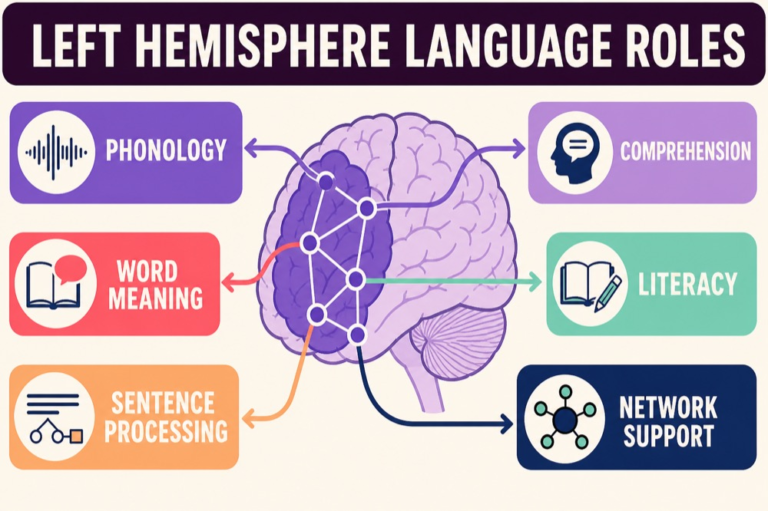
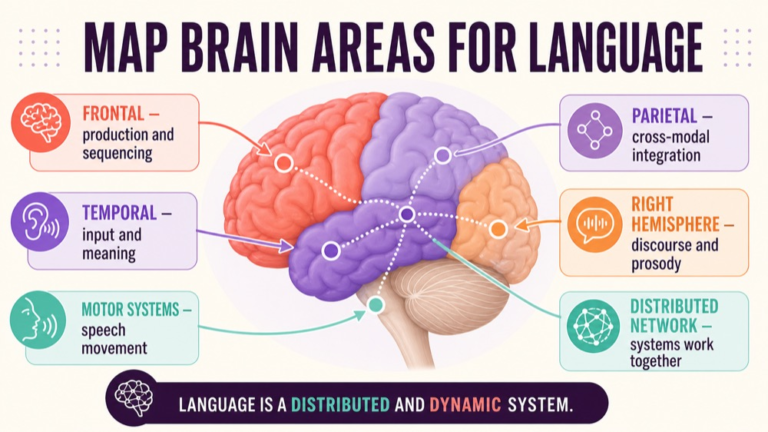
language processing models is easier to study when it is treated as a connected system rather than a single label. Language processing models give SLP learners a way to organize how input becomes an understood message and how an intention becomes language output. They are explanatory frameworks, not rigid maps that predict every individual performance.
This learning guide is written for SLP students and other learners reviewing clinical concepts. It uses broad patterns to organize observation, not to make an individualized diagnosis or promise one outcome. Interpretation depends on the person, task, language, culture, hearing, access, health, context, and communication goals.
What language processing models includes
Begin by separating the concept into domains. A learner who can name the domains is less likely to collapse signal access, language, speech motor, voice, cognitive, or participation questions into one explanation. The useful unit of analysis is the task: what the person was asked to understand, produce, remember, organize, coordinate, or communicate, with whom, under which conditions, and with what support.
Domain or system
What to notice
Question to carry forward
Input and access
Auditory, visual, signed, or written input must be available and attended to before language analysis can proceed.
Was the message accessible, detected, attended to, and encoded?
Phonological processing
Sound patterns and word forms are analyzed, held, and connected with recognition or output.
Does the task change when sound structure, repetition, or nonwords are involved?
Lexical-semantic processing
Word forms connect with concepts, categories, relationships, and intended meaning.
Is the difficulty recognition, retrieval, meaning, or flexible use?
Sentence processing
Words are combined with morphology, syntax, memory, and context to build a proposition.
Which sentence demand changed: structure, memory, inference, or knowledge?
Discourse and inference
Messages are integrated across sentences with topic, gist, perspective, and unstated meaning.
Can the person identify the point and connect it with the context?
Production and monitoring
A message is formulated, organized, produced, and monitored across speech, writing, signing, or AAC.
Which stage or modality changes when the person must express the idea?
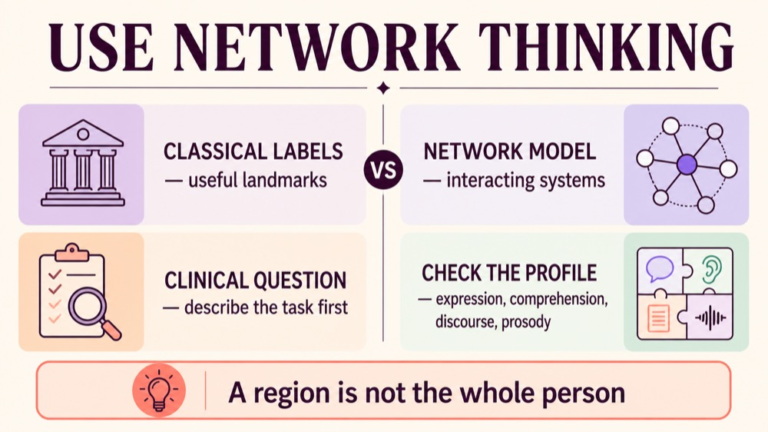
These domains interact, but they should remain distinguishable. A learner may show strength in one task and need support in another. A study map organizes the next observation; it does not answer every assessment question or replace current professional guidance.
Keep the first pass descriptive and close to the communication event. Note the task, the response, the partner, the setting, the timing, the available support, and the consequence for participation. This gives the learner a stable record to compare across tasks and prevents a familiar term from doing too much explanatory work before the evidence has been separated.
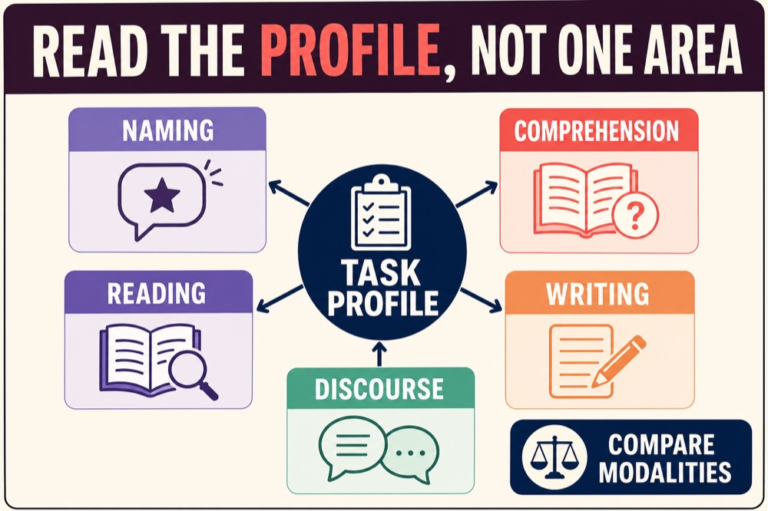
For Praxis-style review, a vignette may include several true details but ask for one best interpretation or next step. The strongest answer usually respects the task, identifies the relevant function, checks the most important missing information, and avoids treating one performance sample as the whole profile.
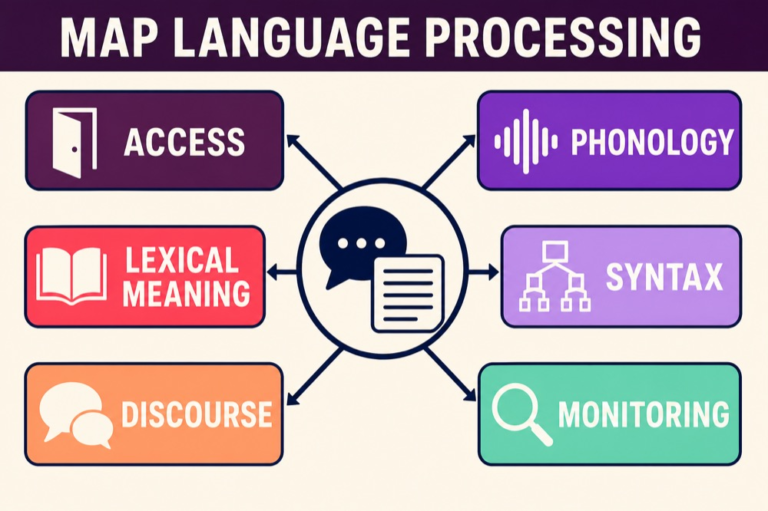
Map language processing
For study purposes, describe the system-function relationship before naming a disorder. Record what the person understood, produced, initiated, repaired, coordinated, or participated in. Then note whether the task was familiar, how much context was shared, and which support changed the response.
Access: hearing, vision, communication mode, attention, and task presentation influence the available input.
Phonology: sound or word-form processing links input, repetition, reading, and spoken output.
Lexical semantics: concepts, word meaning, categories, relations, and retrieval interact rather than acting as isolated boxes.
Syntax and morphology: sentence structure and grammatical marking organize relationships across words.
Discourse: topic, gist, cohesion, inference, perspective, and partner context connect sentences into communication.
Production and monitoring: formulation, output, feedback, repair, and modality shape the observable result.
A strong description is specific enough that another learner could picture the event. Instead of writing “the system is weak,” describe the demand, the observable response, the partner, the context, and the result. This protects clinical reasoning from labels that are broader than the evidence.
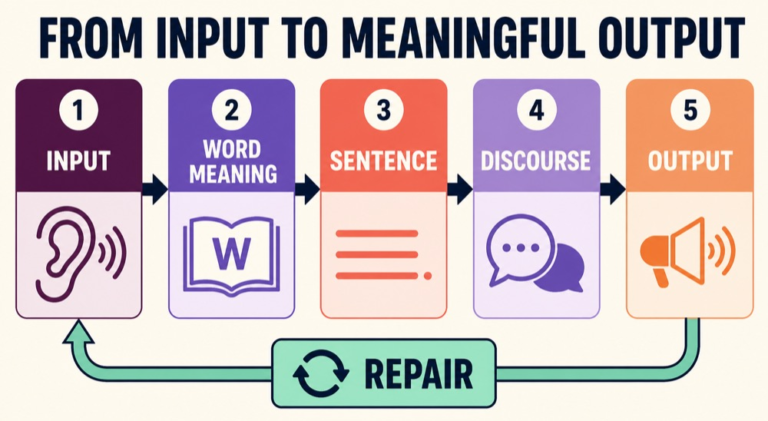
From input to meaningful output
Context changes what communication requires. A speech-sound task, an acoustic sample, a novel sequence, a long explanation, a listening activity, and a workplace exchange place different demands on processing, motor control, memory, rate, and partner support. Hearing access, fatigue, posture, visual supports, language experience, and the opportunity to request clarification should be part of the observation.
A person may recognize a word but not use it flexibly, repeat a sentence but miss its implication, or understand a short instruction but lose the main idea in a long explanation. These contrasts help the learner ask which task, modality, level of processing, memory demand, or context changed. A model organizes that question; it does not replace a broad language profile.
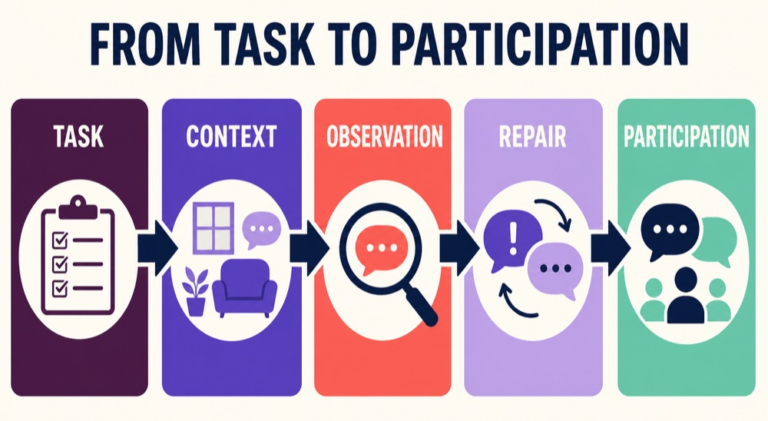
Observation layer
Example question
Task
What did the person need to understand, produce, organize, coordinate, or repair?
Function
Which speech, language, auditory, motor, voice, cognitive, or access relationship was observable?
Access
Were hearing, visual, motor, sensory, language, respiratory, or environmental supports available?
Participation
What meaningful routine became easier or harder because of the pattern?
Context is not an afterthought added once a label has been selected. It is part of the question itself. If performance changes with a quieter room, extra processing time, a familiar partner, a different communication mode, a changed speaking rate, or a changed task, that change is useful evidence about access and demand. It does not identify a cause by itself, but it tells you which conditions should be carried into the next observation.
Apply the concept in clinical reasoning
When a Praxis-style scenario or clinical discussion presents language processing models, use a disciplined sequence. The goal is to select the next clinical question or action that matches the evidence, the person’s priorities, and the communication context.
Define the task in plain language.
Identify the domain or domains involved without assuming they are interchangeable.
Separate observation from interpretation and write down what remains unknown.
Check hearing, language experience, culture, communication mode, environment, partner support, alertness, respiration, memory, and task familiarity.
Choose the assessment, collaboration, or observation step that answers the specific question.
State the boundary of the conclusion and keep the person’s participation goal visible.
A person may recognize a word but not use it flexibly, repeat a sentence but miss its implication, or understand a short instruction but lose the main idea in a long explanation. These contrasts help the learner ask which task, modality, level of processing, memory demand, or context changed. A model organizes that question; it does not replace a broad language profile. In a learning answer, the decisive evidence is usually the relationship among the task, the observed pattern, and the next needed information—not a single isolated behavior or label.
Common study mistakes
Treating a processing model as a literal sequence that never interacts across levels.
Confusing access to the signal with understanding the language message.
Equating word retrieval, word meaning, sentence syntax, and discourse inference.
Using repetition success as evidence that comprehension or spontaneous language is intact.
Ignoring modality, literacy, hearing, vision, attention, memory, culture, and language experience.
Assuming one model explains every language, speaker, task, or communication system.
Overlooking partner support, repair, context, and the participation consequence.
Writing a global processing conclusion when the evidence covers only one level or task.
Most of these mistakes come from replacing a multidomain question with a fast label. Correct the habit by returning to the same sequence: describe, separate, contextualize, ask what is missing, and choose a proportionate next step. A short rationale can make the habit visible: identify the evidence, name the uncertainty, and explain why the selected next step fits both.
Build a quick review map
Use this compact map when reviewing a missed question, a lecture note, or a clinical vignette:
Step 1: Define the input, output, modality, task, partner, and communication purpose.
Step 2: Separate access, phonology, lexical meaning, syntax, discourse, production, and monitoring.
Step 5: Use models to generate questions rather than to over-localize or over-diagnose.
Step 6: State what the current task supports and what a cross-task comparison must clarify.
Then write one transfer sentence: “When I see this pattern, I will first check ___ because ___.” The sentence should identify a decision rule, not repeat a definition. Revisit it after a delay and test whether you can apply the rule to a different task, age group, or communication mode.
Sources and next steps
language processing models is best learned as a context-sensitive pattern across structure, function, access, and participation. Use the current authority pages to refine the concept, then return to practice scenarios that require you to explain what the evidence supports and what it leaves open.
Speech Motor Control: Planning, Execution, and Feedback
speech motor control is easier to study when it is treated as a connected system rather than a single label. Speech motor control is the coordination of planning, programming, execution, sensory feedback, timing, and task adaptation. For SLP exam review, the key is to ask which part of the movement system the evidence actually describes.
This learning guide is written for SLP students and other learners reviewing clinical concepts. It uses broad patterns to organize observation, not to make an individualized diagnosis or promise one outcome. Interpretation depends on the person, task, language, culture, hearing, access, health, context, and communication goals.
What speech motor control includes
Begin by separating the concept into domains. A learner who can name the domains is less likely to collapse signal access, language, speech motor, voice, cognitive, or participation questions into one explanation. The useful unit of analysis is the task: what the person was asked to understand, produce, remember, organize, coordinate, or communicate, with whom, under which conditions, and with what support.
Domain or system
What to notice
Question to carry forward
Planning
The speaker determines the intended movement sequence and its relationship to the message.
Is the difficulty linked to the speech plan, the language message, or another demand?
Programming
A learned movement pattern is organized for the sound sequence, rate, stress, and context.
Does changing complexity, length, or cueing alter the response?
Execution
Muscles and structures carry out the planned movement with timing, force, speed, and range.
What is observable about strength, coordination, consistency, and movement?
Feedback
Auditory, visual, tactile, and proprioceptive information can guide monitoring and adjustment.
Does feedback or cueing change accuracy, stability, or self-correction?
Timing and coordination
Speech requires rapid coordination across respiration, phonation, resonance, articulation, and prosody.
Which transition, rate, stress, or subsystem demand changes performance?
Learning and practice
Practice conditions, feedback, task variation, and transfer affect how a motor pattern is learned.
What is practiced, under which conditions, and how is transfer checked?
These domains interact, but they should remain distinguishable. A learner may show strength in one task and need support in another. A study map organizes the next observation; it does not answer every assessment question or replace current professional guidance.
Keep the first pass descriptive and close to the communication event. Note the task, the response, the partner, the setting, the timing, the available support, and the consequence for participation. This gives the learner a stable record to compare across tasks and prevents a familiar term from doing too much explanatory work before the evidence has been separated.
For Praxis-style review, a vignette may include several true details but ask for one best interpretation or next step. The strongest answer usually respects the task, identifies the relevant function, checks the most important missing information, and avoids treating one performance sample as the whole profile.
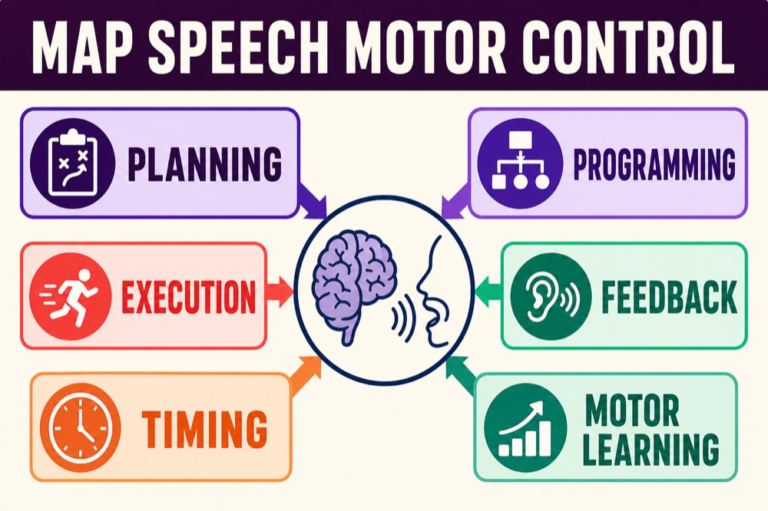
Map speech motor control
For study purposes, describe the system-function relationship before naming a disorder. Record what the person understood, produced, initiated, repaired, coordinated, or participated in. Then note whether the task was familiar, how much context was shared, and which support changed the response.
Planning: deciding the intended movement sequence and its relationship to the linguistic message.
Programming: organizing a learned speech movement pattern for a particular sequence and context.
Execution: producing the movement with appropriate force, speed, range, stability, and timing.
Feedback: using auditory, visual, tactile, and proprioceptive information to monitor and adjust output.
Coordination: linking respiration, phonation, resonance, articulation, prosody, and language demands.
Motor learning: matching practice, feedback, variability, and transfer to the communication goal.
A strong description is specific enough that another learner could picture the event. Instead of writing “the system is weak,” describe the demand, the observable response, the partner, the context, and the result. This protects clinical reasoning from labels that are broader than the evidence.
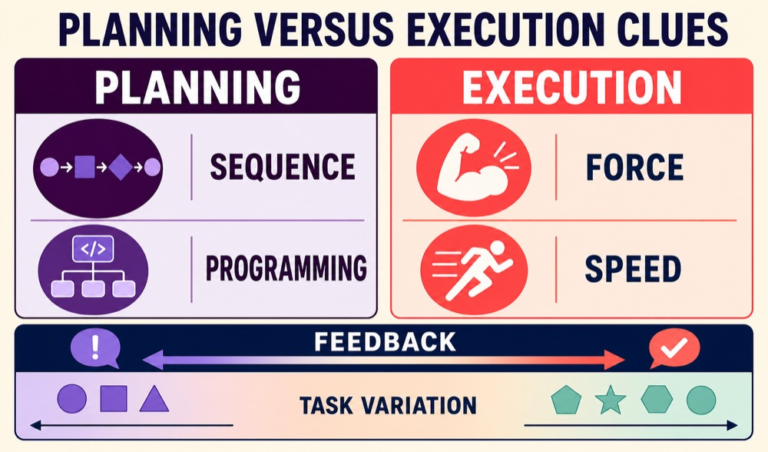
Planning versus execution clues
Context changes what communication requires. A speech-sound task, an acoustic sample, a novel sequence, a long explanation, a listening activity, and a workplace exchange place different demands on processing, motor control, memory, rate, and partner support. Hearing access, fatigue, posture, visual supports, language experience, and the opportunity to request clarification should be part of the observation.
A speaker may be accurate with a familiar short word but less consistent with a longer sequence, faster rate, or changing stress pattern. Another speaker may improve with a model or altered feedback. Those observations are useful clues about task demand and support, but they do not identify a single mechanism by themselves. Compare planning, programming, execution, feedback, fatigue, and language demands before drawing a conclusion.
Observation layer
Example question
Task
What did the person need to understand, produce, organize, coordinate, or repair?
Function
Which speech, language, auditory, motor, voice, cognitive, or access relationship was observable?
Access
Were hearing, visual, motor, sensory, language, respiratory, or environmental supports available?
Participation
What meaningful routine became easier or harder because of the pattern?
Context is not an afterthought added once a label has been selected. It is part of the question itself. If performance changes with a quieter room, extra processing time, a familiar partner, a different communication mode, a changed speaking rate, or a changed task, that change is useful evidence about access and demand. It does not identify a cause by itself, but it tells you which conditions should be carried into the next observation.
Apply the concept in clinical reasoning
When a Praxis-style scenario or clinical discussion presents speech motor control, use a disciplined sequence. The goal is to select the next clinical question or action that matches the evidence, the person’s priorities, and the communication context.
Define the task in plain language.
Identify the domain or domains involved without assuming they are interchangeable.
Separate observation from interpretation and write down what remains unknown.
Check hearing, language experience, culture, communication mode, environment, partner support, alertness, respiration, memory, and task familiarity.
Choose the assessment, collaboration, or observation step that answers the specific question.
State the boundary of the conclusion and keep the person’s participation goal visible.
A speaker may be accurate with a familiar short word but less consistent with a longer sequence, faster rate, or changing stress pattern. Another speaker may improve with a model or altered feedback. Those observations are useful clues about task demand and support, but they do not identify a single mechanism by themselves. Compare planning, programming, execution, feedback, fatigue, and language demands before drawing a conclusion. In a learning answer, the decisive evidence is usually the relationship among the task, the observed pattern, and the next needed information—not a single isolated behavior or label.
Common study mistakes
Using planning, programming, and execution as if they were interchangeable explanations.
Treating an inconsistent response as sufficient evidence for one diagnosis.
Ignoring the linguistic message while analyzing the movement sequence.
Assuming a strong isolated movement predicts connected-speech performance.
Overlooking auditory, visual, tactile, proprioceptive, and partner feedback.
Changing the task, cue, and feedback at the same time so the useful variable is unclear.
Confusing motor speech control with muscle strength alone.
Choosing practice conditions without naming the desired transfer and participation outcome.
Most of these mistakes come from replacing a multidomain question with a fast label. Correct the habit by returning to the same sequence: describe, separate, contextualize, ask what is missing, and choose a proportionate next step. A short rationale can make the habit visible: identify the evidence, name the uncertainty, and explain why the selected next step fits both.
Build a quick review map
Use this compact map when reviewing a missed question, a lecture note, or a clinical vignette:
Step 1: Define the message, speech task, movement sequence, listener, and participation goal.
Step 2: Separate planning, programming, execution, feedback, timing, and language formulation.
Step 3: Compare familiar and novel sequences, short and long utterances, and changing rates.
Step 4: Record how cueing, feedback, fatigue, and task structure change the response.
Step 5: Keep the observation descriptive and avoid treating one clue as a complete diagnosis.
Step 6: Match the next question or practice condition to the specific uncertainty.
Then write one transfer sentence: “When I see this pattern, I will first check ___ because ___.” The sentence should identify a decision rule, not repeat a definition. Revisit it after a delay and test whether you can apply the rule to a different task, age group, or communication mode.
Sources and next steps
speech motor control is best learned as a context-sensitive pattern across structure, function, access, and participation. Use the current authority pages to refine the concept, then return to practice scenarios that require you to explain what the evidence supports and what it leaves open.
Acoustic Properties of Speech: Signal, Listener, and Context
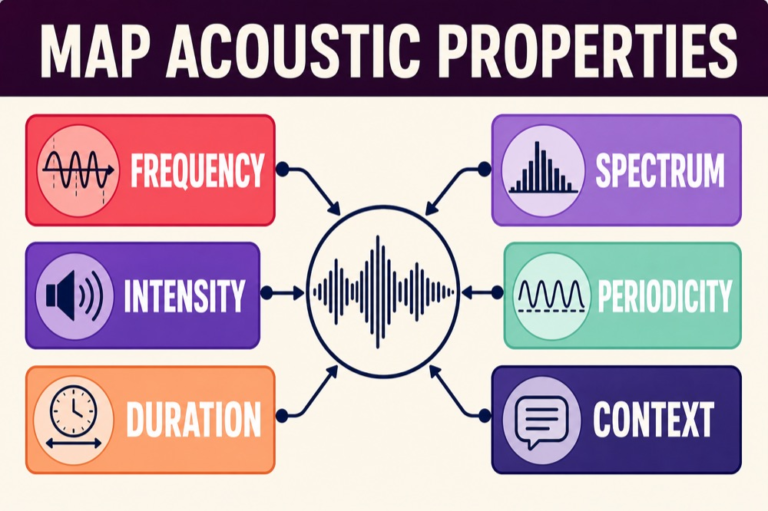
acoustic properties of speech is easier to study when it is treated as a connected system rather than a single label. Acoustic properties of speech are measurable features of a signal, but a measurement is not the same as a listener’s experience or a diagnosis. Study frequency, intensity, duration, spectral shape, periodicity, and context as connected layers.
This learning guide is written for SLP students and other learners reviewing clinical concepts. It uses broad patterns to organize observation, not to make an individualized diagnosis or promise one outcome. Interpretation depends on the person, task, language, culture, hearing, access, health, context, and communication goals.
What acoustic properties of speech includes
Begin by separating the concept into domains. A learner who can name the domains is less likely to collapse signal access, language, speech motor, voice, cognitive, or participation questions into one explanation. The useful unit of analysis is the task: what the person was asked to understand, produce, remember, organize, coordinate, or communicate, with whom, under which conditions, and with what support.
Domain or system
What to notice
Question to carry forward
Frequency
Repetition rate relates to perceived pitch, while task, speaker, and context shape how the signal is heard.
Is the question about frequency, perceived pitch, range, or a change across tasks?
Intensity
Signal energy relates to perceived loudness, but distance, room, microphone, and listener access also matter.
What changed in the sound source and what changed in the listening environment?
Duration and timing
Length, pauses, rate, voice onset, and segment timing organize speech and connected communication.
Does timing change with phrase length, rate, stress, or motor demand?
Spectral shape
Energy distribution across frequencies contributes to vowel quality, consonant cues, and resonance.
Which frequency region or spectral pattern is relevant to the speech task?
Periodicity and noise
Regular and irregular components can contribute to perceptual descriptions such as periodic, rough, or breathy.
Is the observed feature stable, variable, task-specific, or affected by recording conditions?
Measurement context
Acoustic measures, auditory-perceptual judgment, case history, and instrumental data answer different questions.
What evidence is available, and what limitation should be stated?
These domains interact, but they should remain distinguishable. A learner may show strength in one task and need support in another. A study map organizes the next observation; it does not answer every assessment question or replace current professional guidance.
Keep the first pass descriptive and close to the communication event. Note the task, the response, the partner, the setting, the timing, the available support, and the consequence for participation. This gives the learner a stable record to compare across tasks and prevents a familiar term from doing too much explanatory work before the evidence has been separated.
For Praxis-style review, a vignette may include several true details but ask for one best interpretation or next step. The strongest answer usually respects the task, identifies the relevant function, checks the most important missing information, and avoids treating one performance sample as the whole profile.
Map acoustic properties
For study purposes, describe the system-function relationship before naming a disorder. Record what the person understood, produced, initiated, repaired, coordinated, or participated in. Then note whether the task was familiar, how much context was shared, and which support changed the response.
Frequency: a physical property related to cycles per second and perceptual pitch, with speaker and task variation.
Intensity: a physical signal property related to perceived loudness, interpreted with distance, room, and equipment in mind.
Duration: timing of vowels, consonants, pauses, phrase length, and voice onset can change intelligibility and effort.
Spectrum: energy distribution helps describe vowel structure, consonant cues, resonance, and voice quality.
Periodicity: regularity and noise components can contribute to auditory-perceptual impressions.
Context: recording setup, task, language, speaker, listener, fatigue, and communication goal shape interpretation.
A strong description is specific enough that another learner could picture the event. Instead of writing “the system is weak,” describe the demand, the observable response, the partner, the context, and the result. This protects clinical reasoning from labels that are broader than the evidence.
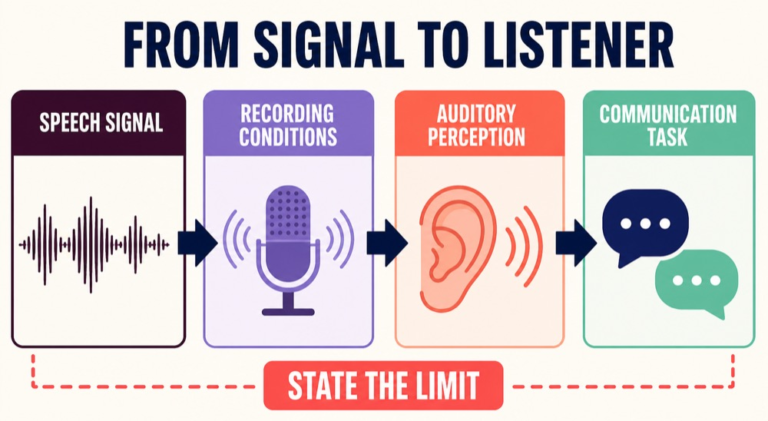
From signal to listener
Context changes what communication requires. A speech-sound task, an acoustic sample, a novel sequence, a long explanation, a listening activity, and a workplace exchange place different demands on processing, motor control, memory, rate, and partner support. Hearing access, fatigue, posture, visual supports, language experience, and the opportunity to request clarification should be part of the observation.
The same speaker can show different acoustic patterns during a sustained vowel, a sentence, reading, conversation, or a task that requires increased loudness. A microphone trace may also change with distance or room noise. The useful interpretation links the signal feature to the task, the listener, the recording conditions, and the evidence boundary rather than treating one number as the whole communication profile.
Observation layer
Example question
Task
What did the person need to understand, produce, organize, coordinate, or repair?
Function
Which speech, language, auditory, motor, voice, cognitive, or access relationship was observable?
Access
Were hearing, visual, motor, sensory, language, respiratory, or environmental supports available?
Participation
What meaningful routine became easier or harder because of the pattern?
Context is not an afterthought added once a label has been selected. It is part of the question itself. If performance changes with a quieter room, extra processing time, a familiar partner, a different communication mode, a changed speaking rate, or a changed task, that change is useful evidence about access and demand. It does not identify a cause by itself, but it tells you which conditions should be carried into the next observation.
Apply the concept in clinical reasoning
When a Praxis-style scenario or clinical discussion presents acoustic properties of speech, use a disciplined sequence. The goal is to select the next clinical question or action that matches the evidence, the person’s priorities, and the communication context.
Define the task in plain language.
Identify the domain or domains involved without assuming they are interchangeable.
Separate observation from interpretation and write down what remains unknown.
Check hearing, language experience, culture, communication mode, environment, partner support, alertness, respiration, memory, and task familiarity.
Choose the assessment, collaboration, or observation step that answers the specific question.
State the boundary of the conclusion and keep the person’s participation goal visible.
The same speaker can show different acoustic patterns during a sustained vowel, a sentence, reading, conversation, or a task that requires increased loudness. A microphone trace may also change with distance or room noise. The useful interpretation links the signal feature to the task, the listener, the recording conditions, and the evidence boundary rather than treating one number as the whole communication profile. In a learning answer, the decisive evidence is usually the relationship among the task, the observed pattern, and the next needed information—not a single isolated behavior or label.
Common study mistakes
Treating frequency as identical to pitch or intensity as identical to loudness in every context.
Assuming one acoustic measure directly names a disorder or medical cause.
Ignoring microphone placement, room noise, calibration, sampling, and recording quality.
Using a sustained vowel as if it represents connected speech and participation.
Confusing spectral shape, resonance, voice quality, articulation, and language content.
Treating a perceptual description as interchangeable with an acoustic measurement.
Reporting a number without stating the comparison, reference task, and limitation.
Most of these mistakes come from replacing a multidomain question with a fast label. Correct the habit by returning to the same sequence: describe, separate, contextualize, ask what is missing, and choose a proportionate next step. A short rationale can make the habit visible: identify the evidence, name the uncertainty, and explain why the selected next step fits both.
Build a quick review map
Use this compact map when reviewing a missed question, a lecture note, or a clinical vignette:
Step 1: Name the signal property and the perceptual or communication question.
Step 2: Separate frequency, intensity, duration, spectrum, periodicity, and task timing.
Step 3: Check the recording conditions, equipment, speaker, listener, and comparison sample.
Step 4: Compare sustained, repeated, reading, and spontaneous speech where appropriate.
Step 5: Describe what the listener hears without turning one measure into a diagnosis.
Step 6: State the next evidence source that matches the question and its boundary.
Then write one transfer sentence: “When I see this pattern, I will first check ___ because ___.” The sentence should identify a decision rule, not repeat a definition. Revisit it after a delay and test whether you can apply the rule to a different task, age group, or communication mode.
Sources and next steps
acoustic properties of speech is best learned as a context-sensitive pattern across structure, function, access, and participation. Use the current authority pages to refine the concept, then return to practice scenarios that require you to explain what the evidence supports and what it leaves open.
Articulatory Phonetics for Speech Pathology: Sound, Place, and Movement
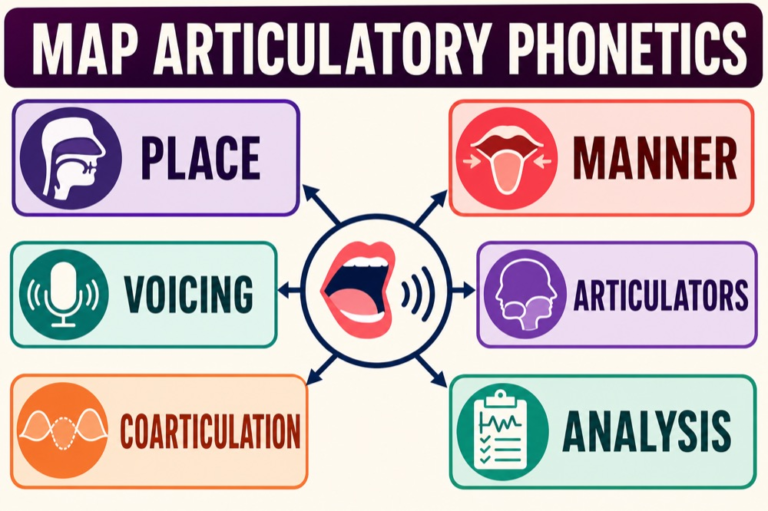
articulatory phonetics for speech pathology is easier to study when it is treated as a connected system rather than a single label. Articulatory phonetics for speech pathology connects the physical shaping of speech sounds with what a listener hears. A useful study map separates place, manner, voicing, timing, coarticulation, and the difference between a sound pattern and a language-system rule.
This learning guide is written for SLP students and other learners reviewing clinical concepts. It uses broad patterns to organize observation, not to make an individualized diagnosis or promise one outcome. Interpretation depends on the person, task, language, culture, hearing, access, health, context, and communication goals.
What articulatory phonetics for speech pathology includes
Begin by separating the concept into domains. A learner who can name the domains is less likely to collapse signal access, language, speech motor, voice, cognitive, or participation questions into one explanation. The useful unit of analysis is the task: what the person was asked to understand, produce, remember, organize, coordinate, or communicate, with whom, under which conditions, and with what support.
Domain or system
What to notice
Question to carry forward
Place of articulation
The location of a constriction or approximation helps describe how a speech sound is shaped.
Where is the primary constriction, and what structures make it possible?
Manner of articulation
The degree and type of airflow restriction distinguish stops, fricatives, nasals, liquids, glides, and other categories.
How is airflow controlled or released during the target sound?
Voicing
Vocal-fold vibration adds a laryngeal dimension that interacts with oral shaping and timing.
Is the contrast about vibration, oral placement, timing, or more than one feature?
Articulators
The lips, tongue, jaw, palate, and related structures coordinate rapid changes in position and force.
Which structure, movement, range, or timing demand is observable?
Coarticulation
Neighboring sounds influence one another as the speaker prepares and transitions between targets.
Does the pattern change in isolation, a word, a phrase, or connected speech?
Phonetics and phonology
Phonetics describes physical speech production and signal detail; phonology concerns a language system and its contrasts.
Is the question about a physical production feature or a rule-like sound pattern?
These domains interact, but they should remain distinguishable. A learner may show strength in one task and need support in another. A study map organizes the next observation; it does not answer every assessment question or replace current professional guidance.
Keep the first pass descriptive and close to the communication event. Note the task, the response, the partner, the setting, the timing, the available support, and the consequence for participation. This gives the learner a stable record to compare across tasks and prevents a familiar term from doing too much explanatory work before the evidence has been separated.
For Praxis-style review, a vignette may include several true details but ask for one best interpretation or next step. The strongest answer usually respects the task, identifies the relevant function, checks the most important missing information, and avoids treating one performance sample as the whole profile.
Map articulatory phonetics
For study purposes, describe the system-function relationship before naming a disorder. Record what the person understood, produced, initiated, repaired, coordinated, or participated in. Then note whether the task was familiar, how much context was shared, and which support changed the response.
Place: labial, dental, alveolar, palatal, velar, glottal, and other location descriptions are study labels for constriction location.
Manner: airflow may be stopped, narrowed, redirected, or shaped with changing degrees of constriction.
Voicing: laryngeal vibration and timing interact with the oral gesture rather than replacing it.
Movement: range, speed, direction, force, stability, and coordination shape the observed production.
Coarticulation: speech sounds occur in sequences, so neighboring gestures alter preparation and transition.
Analysis: transcription, listener judgment, acoustic detail, and task context answer different questions.
A strong description is specific enough that another learner could picture the event. Instead of writing “the system is weak,” describe the demand, the observable response, the partner, the context, and the result. This protects clinical reasoning from labels that are broader than the evidence.
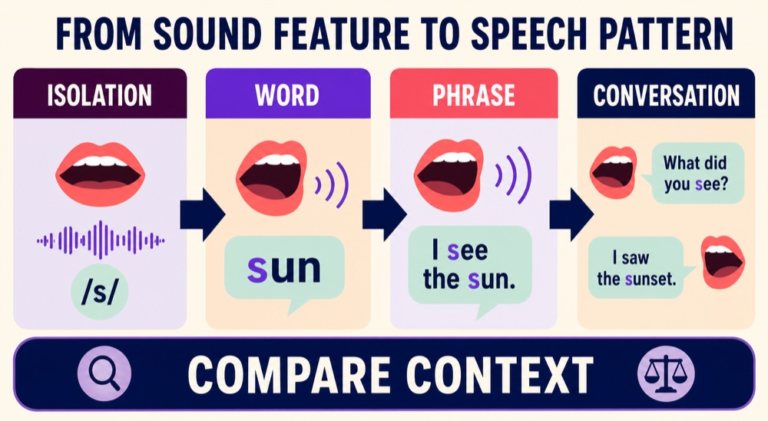
From sound feature to speech pattern
Context changes what communication requires. A speech-sound task, an acoustic sample, a novel sequence, a long explanation, a listening activity, and a workplace exchange place different demands on processing, motor control, memory, rate, and partner support. Hearing access, fatigue, posture, visual supports, language experience, and the opportunity to request clarification should be part of the observation.
A speaker may produce a target accurately in isolation but show a different pattern in a word, a rapid sequence, or conversation. That difference does not identify one cause by itself. Compare the sound, the linguistic context, the movement demand, the listener, the speaker’s language or dialect, and the task before deciding what the next observation should clarify.
Observation layer
Example question
Task
What did the person need to understand, produce, organize, coordinate, or repair?
Function
Which speech, language, auditory, motor, voice, cognitive, or access relationship was observable?
Access
Were hearing, visual, motor, sensory, language, respiratory, or environmental supports available?
Participation
What meaningful routine became easier or harder because of the pattern?
Context is not an afterthought added once a label has been selected. It is part of the question itself. If performance changes with a quieter room, extra processing time, a familiar partner, a different communication mode, a changed speaking rate, or a changed task, that change is useful evidence about access and demand. It does not identify a cause by itself, but it tells you which conditions should be carried into the next observation.
Apply the concept in clinical reasoning
When a Praxis-style scenario or clinical discussion presents articulatory phonetics for speech pathology, use a disciplined sequence. The goal is to select the next clinical question or action that matches the evidence, the person’s priorities, and the communication context.
Define the task in plain language.
Identify the domain or domains involved without assuming they are interchangeable.
Separate observation from interpretation and write down what remains unknown.
Check hearing, language experience, culture, communication mode, environment, partner support, alertness, respiration, memory, and task familiarity.
Choose the assessment, collaboration, or observation step that answers the specific question.
State the boundary of the conclusion and keep the person’s participation goal visible.
A speaker may produce a target accurately in isolation but show a different pattern in a word, a rapid sequence, or conversation. That difference does not identify one cause by itself. Compare the sound, the linguistic context, the movement demand, the listener, the speaker’s language or dialect, and the task before deciding what the next observation should clarify. In a learning answer, the decisive evidence is usually the relationship among the task, the observed pattern, and the next needed information—not a single isolated behavior or label.
Common study mistakes
Treating every pronunciation difference as a disorder without considering language, dialect, age, and context.
Memorizing a place label without connecting it to the movement and airflow that create the sound.
Confusing a phonetic description with a phonological process or rule.
Assuming one error in one word represents the whole speech sound system.
Ignoring coarticulation, rate, stress, fatigue, hearing, and task familiarity.
Using an articulatory label to explain a pattern that may involve planning, execution, perception, or language.
Forgetting that multilingual speakers may use different sound inventories and phonotactic rules.
Choosing a conclusion before describing the listener’s actual difficulty and participation impact.
Most of these mistakes come from replacing a multidomain question with a fast label. Correct the habit by returning to the same sequence: describe, separate, contextualize, ask what is missing, and choose a proportionate next step. A short rationale can make the habit visible: identify the evidence, name the uncertainty, and explain why the selected next step fits both.
Build a quick review map
Use this compact map when reviewing a missed question, a lecture note, or a clinical vignette:
Step 1: Name the target sound, word position, task, listener, and communication purpose.
Step 2: Separate place, manner, voicing, timing, movement, and language-system questions.
Step 4: Check language, dialect, hearing, perception, motor demand, and contextual support.
Step 5: Describe the observable pattern before selecting a label or next assessment step.
Step 6: State what the sample supports and which comparison would reduce the uncertainty.
Then write one transfer sentence: “When I see this pattern, I will first check ___ because ___.” The sentence should identify a decision rule, not repeat a definition. Revisit it after a delay and test whether you can apply the rule to a different task, age group, or communication mode.
Sources and next steps
articulatory phonetics for speech pathology is best learned as a context-sensitive pattern across structure, function, access, and participation. Use the current authority pages to refine the concept, then return to practice scenarios that require you to explain what the evidence supports and what it leaves open.
Phonation and Resonance: Sound Source, Vocal Tract, and Context
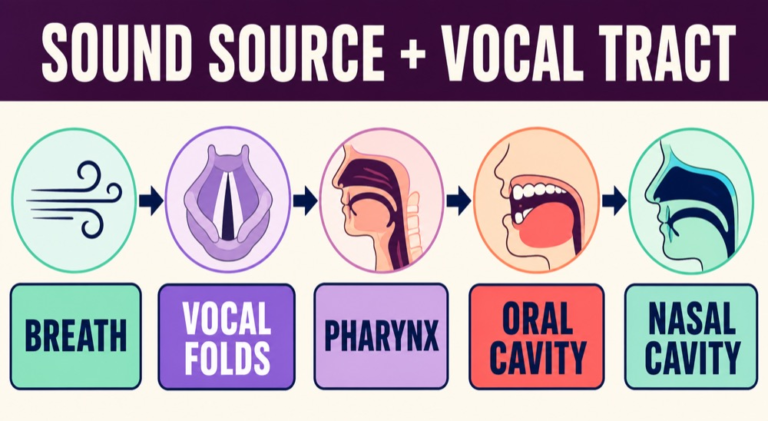
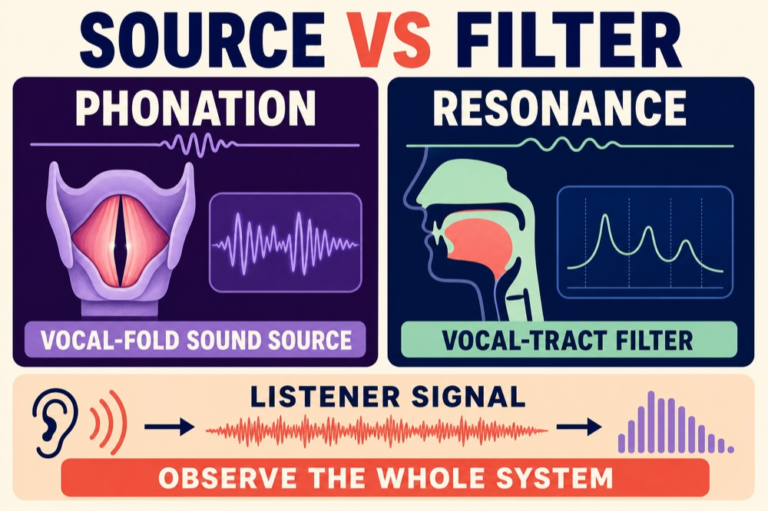
phonation and resonance is easier to study when it is treated as a connected system rather than a single label. Phonation and resonance answer two connected but different questions: how a voiced sound source is generated, and how the vocal tract filters and shapes that source. Keeping the two concepts distinct makes voice and speech reasoning more precise.
This learning guide is written for SLP students and other learners reviewing clinical concepts. It uses broad patterns to organize observation, not to make an individualized diagnosis or promise one outcome. Interpretation depends on the person, task, language, culture, hearing, access, health, context, and communication goals.
What phonation and resonance includes
Begin by separating the concept into domains. A learner who can name the domains is less likely to collapse language, speech motor, voice, cognitive, access, or participation questions into one explanation. The useful unit of analysis is the task: what the person was asked to understand, produce, remember, organize, or communicate, with whom, under which conditions, and with what support.
Domain or system
What to notice
Question to carry forward
Sound source
Airflow and vocal-fold vibration create the primary voiced signal.
Is the question about voice onset, periodicity, loudness, or source quality?
Glottal valving
The larynx regulates airflow and contributes to voicing and airway-related functions.
What happens when the folds open, close, or do not coordinate as expected?
Vocal-tract filter
The pharynx, oral cavity, and nasal cavity alter the sound through shape and coupling.
Which space or configuration changes the perceptual result?
Oral-nasal coupling
The velopharyngeal mechanism helps direct airflow and resonance for different speech sounds.
Does the task require oral, nasal, or changing coupling?
Perceptual result
Listeners hear changes in pitch, loudness, quality, resonance, and intelligibility.
What does the listener notice and under which speaking condition?
Assessment context
Case history, auditory-perceptual tasks, instruments, and collaboration answer different questions.
What evidence is available and what requires an appropriate referral or procedure?
These domains interact, but they should remain distinguishable. A learner may show strength in one task and need support in another. A study map organizes the next observation; it does not answer every assessment question or replace current professional guidance.
Keep the first pass descriptive and close to the communication event. Note the task, the response, the partner, the setting, the timing, the available support, and the consequence for participation. This gives the learner a stable record to compare across tasks and prevents a familiar term from doing too much explanatory work before the evidence has been separated.
For Praxis-style review, a vignette may include several true details but ask for one best interpretation or next step. The strongest answer usually respects the task, identifies the relevant function, checks the most important missing information, and avoids treating one performance sample as the whole profile.
Map phonation and resonance
For study purposes, describe the system-function relationship before naming a disorder. Record what the person understood, produced, initiated, repaired, coordinated, or participated in. Then note whether the task was familiar, how much context was shared, and which support changed the response.
Phonation: airflow, vocal-fold vibration, voice onset, loudness, and source quality.
Laryngeal valving: opening, closing, vibration, and coordination across voice and speech tasks.
Resonance: the vocal tract shapes the source through the pharyngeal, oral, and nasal spaces.
Velopharyngeal function: oral-nasal coupling changes the signal according to the intended sound.
Auditory-perceptual listening: pitch, loudness, quality, resonance, rate, and intelligibility are described in context.
Clinical evidence: history, observation, instrumental information, medical collaboration, and participation goals answer different questions.
A strong description is specific enough that another learner could picture the event. Instead of writing “the system is weak,” describe the demand, the observable response, the partner, the context, and the result. This protects clinical reasoning from labels that are broader than the evidence.
Separate source from filter
Context changes what communication requires. A naming task, a conversation, a sustained vowel, a long explanation, a reading sample, and a workplace exchange place different demands on processing, motor control, memory, rate, and partner support. Hearing access, fatigue, posture, visual supports, language experience, and the opportunity to request clarification should be part of the observation.
A voice may sound different on a sustained vowel, a sentence with pressure-loaded consonants, singing, conversation, or a task with increased loudness. A resonance difference may also change with oral-nasal demands. The useful interpretation links the perceptual feature to the source, filter, task, and evidence—not to a label pulled from one sample.
Observation layer
Example question
Task
What did the person need to understand, produce, organize, coordinate, or repair?
Function
Which language, motor, voice, cognitive, or access relationship was observable?
Access
Were hearing, visual, motor, sensory, language, respiratory, or environmental supports available?
Participation
What meaningful routine became easier or harder because of the pattern?
Context is not an afterthought added once a label has been selected. It is part of the question itself. If performance changes with a quieter room, extra processing time, a familiar partner, a different communication mode, a changed speaking rate, or a changed task, that change is useful evidence about access and demand. It does not identify a cause by itself, but it tells you which conditions should be carried into the next observation.
Apply the concept in clinical reasoning
When a Praxis-style scenario or clinical discussion presents phonation and resonance, use a disciplined sequence. The goal is to select the next clinical question or action that matches the evidence, the person’s priorities, and the communication context.
Define the task in plain language.
Identify the domain or domains involved without assuming they are interchangeable.
Separate observation from interpretation and write down what remains unknown.
Check hearing, language experience, culture, communication mode, environment, partner support, alertness, respiration, memory, and task familiarity.
Choose the assessment, collaboration, or observation step that answers the specific question.
State the boundary of the conclusion and keep the person’s participation goal visible.
A voice may sound different on a sustained vowel, a sentence with pressure-loaded consonants, singing, conversation, or a task with increased loudness. A resonance difference may also change with oral-nasal demands. The useful interpretation links the perceptual feature to the source, filter, task, and evidence—not to a label pulled from one sample. In a learning answer, the decisive evidence is usually the relationship among the task, the observed pattern, and the next needed information—not a single isolated behavior or brain-area label.
Common study mistakes
Using phonation and resonance as interchangeable words.
Treating the vocal folds as the entire explanation for the listener’s perceived voice.
Ignoring the vocal-tract filter and oral-nasal coupling.
Assuming one sustained vowel represents every speaking condition.
Using an auditory description to imply a medical laryngeal diagnosis.
Overlooking loudness, pitch, rate, prosody, intelligibility, and partner context.
Confusing resonance with articulation or language formulation.
Choosing an assessment or intervention without stating the clinical question.
Most of these mistakes come from replacing a multidomain question with a fast label. Correct the habit by returning to the same sequence: describe, separate, contextualize, ask what is missing, and choose a proportionate next step. A short rationale can make the habit visible: identify the evidence, name the uncertainty, and explain why the selected next step fits both.
Build a quick review map
Use this compact map when reviewing a missed question, a lecture note, or a clinical vignette:
Step 1: Name the perceptual feature and the speech or voice task.
Step 2: Separate source generation, laryngeal valving, vocal-tract filtering, and coupling.
Step 3: Compare vowels, sentences, connected speech, and context-specific demands.
Step 4: Describe what is observed before selecting a diagnostic or medical interpretation.
Step 6: Choose the next evidence source or collaboration that matches the question.
Then write one transfer sentence: “When I see this pattern, I will first check ___ because ___.” The sentence should identify a decision rule, not repeat a definition. Revisit it after a delay and test whether you can apply the rule to a different task, age group, or communication mode.
Sources and next steps
phonation and resonance is best learned as a context-sensitive pattern across structure, function, access, and participation. Use the current authority pages to refine the concept, then return to practice scenarios that require you to explain what the evidence supports and what it leaves open.
Start with asha voice, asha vocal tract, ets 5331 current. These sources support the learning frame; they do not replace current topic-specific guidance or an individualized evaluation.
Respiratory Support for Speech: Airflow, Pressure, and Phrase Planning
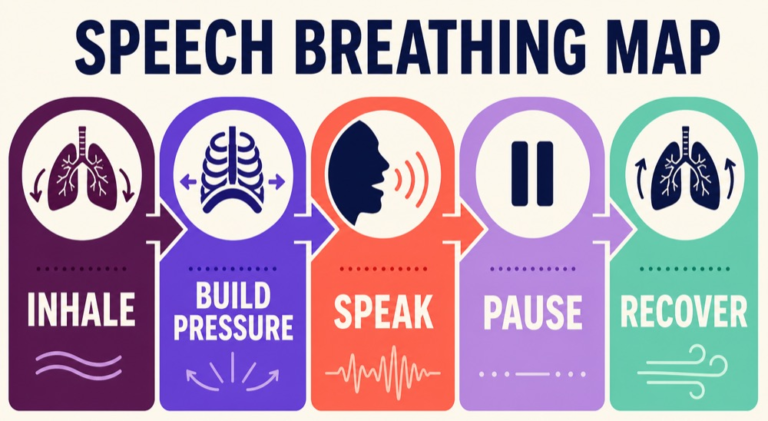
respiratory support for speech is easier to study when it is treated as a connected system rather than a single label. Respiratory support for speech is the coordinated use of airflow and pressure to sustain phonation and organize phrases. Study it through what the speaker needs to do, how the breathing pattern changes, and what the listener hears.
This learning guide is written for SLP students and other learners reviewing clinical concepts. It uses broad patterns to organize observation, not to make an individualized diagnosis or promise one outcome. Interpretation depends on the person, task, language, culture, hearing, access, health, context, and communication goals.
What respiratory support for speech includes
Begin by separating the concept into domains. A learner who can name the domains is less likely to collapse language, speech motor, voice, cognitive, access, or participation questions into one explanation. The useful unit of analysis is the task: what the person was asked to understand, produce, remember, organize, or communicate, with whom, under which conditions, and with what support.
Domain or system
What to notice
Question to carry forward
Inspiration
The speaker prepares an inhalation that supplies the air needed for the next phrase.
Does the person have enough time and opportunity to inhale?
Expiratory flow
Controlled exhalation provides the airflow that supports speech across a phrase.
Is flow steady, interrupted, reduced, or poorly matched to the task?
Subglottal pressure
Pressure below the vocal folds interacts with phonation and loudness.
What does the task require in loudness, duration, and voice onset?
Phrase planning
Linguistic planning and breathing work together to decide where a speaker pauses.
Are pauses driven by meaning, respiratory need, rate, or coordination?
Speech breathing
Breathing for speech differs from quiet breathing because timing and phrase demands change.
What happens during connected speech rather than a single vowel?
Health and context
Fatigue, posture, respiratory status, anxiety, environment, and partner demands alter performance.
Which contextual factor should be checked before interpreting the sound?
These domains interact, but they should remain distinguishable. A learner may show strength in one task and need support in another. A study map organizes the next observation; it does not answer every assessment question or replace current professional guidance.
Keep the first pass descriptive and close to the communication event. Note the task, the response, the partner, the setting, the timing, the available support, and the consequence for participation. This gives the learner a stable record to compare across tasks and prevents a familiar term from doing too much explanatory work before the evidence has been separated.
For Praxis-style review, a vignette may include several true details but ask for one best interpretation or next step. The strongest answer usually respects the task, identifies the relevant function, checks the most important missing information, and avoids treating one performance sample as the whole profile.
Map speech breathing
For study purposes, describe the system-function relationship before naming a disorder. Record what the person understood, produced, initiated, repaired, coordinated, or participated in. Then note whether the task was familiar, how much context was shared, and which support changed the response.
Breath preparation: timing and volume of inhalation before an intended phrase.
Airflow control: regulating exhalation so the speaker can sustain and shape the signal.
Pressure and phonation: coordinating subglottal pressure with vocal-fold vibration and loudness.
Phrase organization: aligning linguistic planning, pauses, rate, and breath groups.
Speech breathing: comparing quiet breathing with the changing demands of connected speech.
Context and participation: posture, fatigue, health, environment, listener, and communication purpose matter.
A strong description is specific enough that another learner could picture the event. Instead of writing “the system is weak,” describe the demand, the observable response, the partner, the context, and the result. This protects clinical reasoning from labels that are broader than the evidence.
Read respiratory support in context
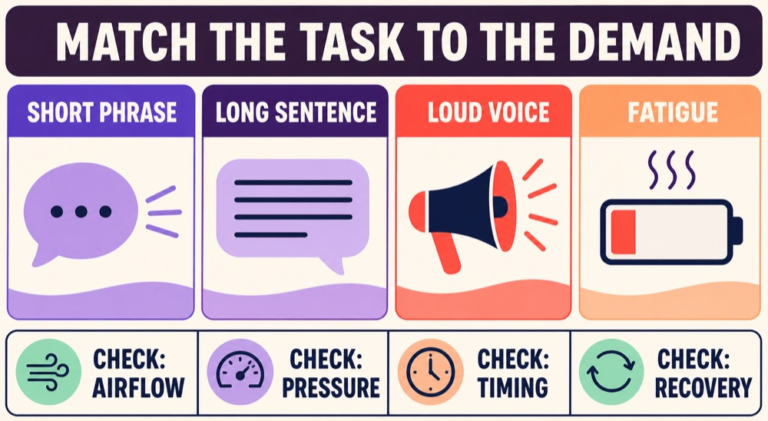
Context changes what communication requires. A naming task, a conversation, a sustained vowel, a long explanation, a reading sample, and a workplace exchange place different demands on processing, motor control, memory, rate, and partner support. Hearing access, fatigue, posture, visual supports, language experience, and the opportunity to request clarification should be part of the observation.
A speaker may sustain a vowel but lose support during a long explanation, or may speak in short phrases when the environment is noisy or stressful. That pattern does not identify one cause by itself. Compare task length, rate, posture, respiratory status, linguistic planning, and partner demands before deciding what the next observation should be.
Observation layer
Example question
Task
What did the person need to understand, produce, organize, coordinate, or repair?
Function
Which language, motor, voice, cognitive, or access relationship was observable?
Access
Were hearing, visual, motor, sensory, language, respiratory, or environmental supports available?
Participation
What meaningful routine became easier or harder because of the pattern?
Context is not an afterthought added once a label has been selected. It is part of the question itself. If performance changes with a quieter room, extra processing time, a familiar partner, a different communication mode, a changed speaking rate, or a changed task, that change is useful evidence about access and demand. It does not identify a cause by itself, but it tells you which conditions should be carried into the next observation.
Apply the concept in clinical reasoning
When a Praxis-style scenario or clinical discussion presents respiratory support for speech, use a disciplined sequence. The goal is to select the next clinical question or action that matches the evidence, the person’s priorities, and the communication context.
Define the task in plain language.
Identify the domain or domains involved without assuming they are interchangeable.
Separate observation from interpretation and write down what remains unknown.
Check hearing, language experience, culture, communication mode, environment, partner support, alertness, respiration, memory, and task familiarity.
Choose the assessment, collaboration, or observation step that answers the specific question.
State the boundary of the conclusion and keep the person’s participation goal visible.
A speaker may sustain a vowel but lose support during a long explanation, or may speak in short phrases when the environment is noisy or stressful. That pattern does not identify one cause by itself. Compare task length, rate, posture, respiratory status, linguistic planning, and partner demands before deciding what the next observation should be. In a learning answer, the decisive evidence is usually the relationship among the task, the observed pattern, and the next needed information—not a single isolated behavior or brain-area label.
Common study mistakes
Treating respiratory support as a single measure such as maximum duration.
Confusing airflow, pressure, phonation, loudness, and phrase planning.
Assuming a sustained vowel represents the demands of connected speech.
Ignoring posture, fatigue, health, anxiety, environment, and communication purpose.
Assuming every pause is a respiratory failure rather than examining meaning and planning.
Using a breathing observation to make a medical conclusion outside the evidence.
Overlooking the listener’s role and the need for communication repair.
Choosing a technique before identifying the functional speech problem and safety boundary.
Most of these mistakes come from replacing a multidomain question with a fast label. Correct the habit by returning to the same sequence: describe, separate, contextualize, ask what is missing, and choose a proportionate next step. A short rationale can make the habit visible: identify the evidence, name the uncertainty, and explain why the selected next step fits both.
Build a quick review map
Use this compact map when reviewing a missed question, a lecture note, or a clinical vignette:
Step 1: Name the speech task, phrase demand, listener, and communication goal.
Step 2: Separate inhalation, expiratory flow, pressure, phonation, rate, and pause planning.
Step 3: Compare sustained, repeated, reading, and spontaneous speech samples.
Step 5: Describe what the listener hears and what the speaker needs to communicate.
Step 6: Select the next observation or collaboration that answers the specific uncertainty.
Then write one transfer sentence: “When I see this pattern, I will first check ___ because ___.” The sentence should identify a decision rule, not repeat a definition. Revisit it after a delay and test whether you can apply the rule to a different task, age group, or communication mode.
Sources and next steps
respiratory support for speech is best learned as a context-sensitive pattern across structure, function, access, and participation. Use the current authority pages to refine the concept, then return to practice scenarios that require you to explain what the evidence supports and what it leaves open.
Start with asha voice, asha dysarthria, ets 5331 current. These sources support the learning frame; they do not replace current topic-specific guidance or an individualized evaluation.
Motor Speech Anatomy: Systems, Movement, and Coordination
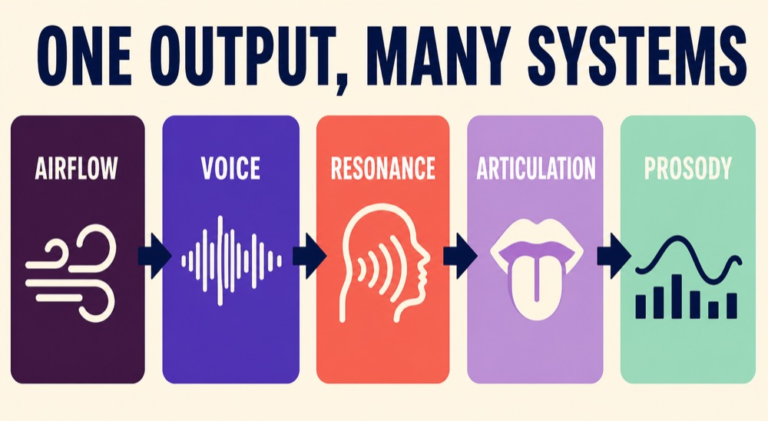
motor speech anatomy is easier to study when it is treated as a connected system rather than a single label. Motor speech anatomy is a coordination problem as much as a structure problem. Respiratory power, laryngeal sound generation, resonance, articulatory movement, prosody, planning, and feedback must work together for a listener to receive a clear message.
This learning guide is written for SLP students and other learners reviewing clinical concepts. It uses broad patterns to organize observation, not to make an individualized diagnosis or promise one outcome. Interpretation depends on the person, task, language, culture, hearing, access, health, context, and communication goals.
What motor speech anatomy includes
Begin by separating the concept into domains. A learner who can name the domains is less likely to collapse language, speech motor, voice, cognitive, access, or participation questions into one explanation. The useful unit of analysis is the task: what the person was asked to understand, produce, remember, organize, or communicate, with whom, under which conditions, and with what support.
Domain or system
What to notice
Question to carry forward
Respiratory system
Airflow and pressure provide the energy and timing framework for speech breathing.
How does phrase length or respiratory demand change the sample?
Phonatory system
The larynx and vocal folds create and regulate the voiced sound source.
Is the observation about voicing, loudness, quality, or valving?
Resonatory system
Pharyngeal, oral, and nasal spaces filter the sound and alter its quality.
How does oral-nasal coupling affect the signal?
Articulatory system
The tongue, lips, jaw, palate, and related structures shape rapid sound transitions.
Which movement, range, speed, or precision is required?
Prosody and timing
Stress, pitch, rate, pauses, and rhythm organize the message and its social meaning.
What changes when the task requires contrastive emphasis or a longer utterance?
Planning and feedback
Motor planning, execution, auditory feedback, and sensory monitoring coordinate output.
Is the limitation about planning, execution, feedback, or language formulation?
These domains interact, but they should remain distinguishable. A learner may show strength in one task and need support in another. A study map organizes the next observation; it does not answer every assessment question or replace current professional guidance.
Keep the first pass descriptive and close to the communication event. Note the task, the response, the partner, the setting, the timing, the available support, and the consequence for participation. This gives the learner a stable record to compare across tasks and prevents a familiar term from doing too much explanatory work before the evidence has been separated.
For Praxis-style review, a vignette may include several true details but ask for one best interpretation or next step. The strongest answer usually respects the task, identifies the relevant function, checks the most important missing information, and avoids treating one performance sample as the whole profile.
Map motor speech anatomy
For study purposes, describe the system-function relationship before naming a disorder. Record what the person understood, produced, initiated, repaired, coordinated, or participated in. Then note whether the task was familiar, how much context was shared, and which support changed the response.
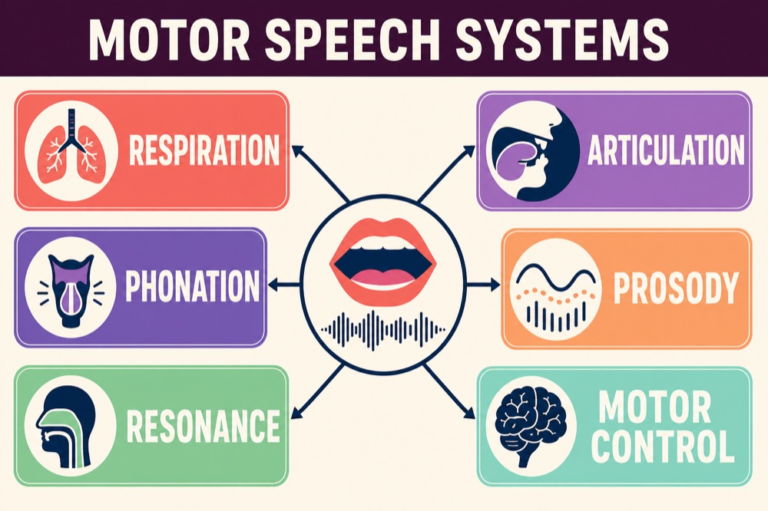
Respiratory support: airflow, pressure, inhalation, exhalation, and phrase planning.
Phonation: vocal-fold vibration, laryngeal valving, loudness, and voice onset.
Resonance: the vocal tract filter and oral-nasal coupling that shape the sound signal.
Articulation: coordinated tongue, lip, jaw, palate, and dental relationships for speech contrasts.
Prosody: rate, stress, pitch, intensity, pauses, and rhythm across connected speech.
Motor control: planning, sequencing, execution, feedback, fatigue, and communication participation.
A strong description is specific enough that another learner could picture the event. Instead of writing “the system is weak,” describe the demand, the observable response, the partner, the context, and the result. This protects clinical reasoning from labels that are broader than the evidence.
Read subsystem clues
Context changes what communication requires. A naming task, a conversation, a sustained vowel, a long explanation, a reading sample, and a workplace exchange place different demands on processing, motor control, memory, rate, and partner support. Hearing access, fatigue, posture, visual supports, language experience, and the opportunity to request clarification should be part of the observation.
A speaker may sound clearer in a short familiar phrase than in a long explanation, or may show different errors during rapid alternating movements and conversation. That contrast invites a system-level question: which subsystem, timing demand, feedback condition, or communication context changed? Anatomy is the start of the reasoning chain, not its conclusion.
Observation layer
Example question
Task
What did the person need to understand, produce, organize, coordinate, or repair?
Function
Which language, motor, voice, cognitive, or access relationship was observable?
Access
Were hearing, visual, motor, sensory, language, respiratory, or environmental supports available?
Participation
What meaningful routine became easier or harder because of the pattern?
Context is not an afterthought added once a label has been selected. It is part of the question itself. If performance changes with a quieter room, extra processing time, a familiar partner, a different communication mode, a changed speaking rate, or a changed task, that change is useful evidence about access and demand. It does not identify a cause by itself, but it tells you which conditions should be carried into the next observation.
Apply the concept in clinical reasoning
When a Praxis-style scenario or clinical discussion presents motor speech anatomy, use a disciplined sequence. The goal is to select the next clinical question or action that matches the evidence, the person’s priorities, and the communication context.
Define the task in plain language.
Identify the domain or domains involved without assuming they are interchangeable.
Separate observation from interpretation and write down what remains unknown.
Check hearing, language experience, culture, communication mode, environment, partner support, alertness, respiration, memory, and task familiarity.
Choose the assessment, collaboration, or observation step that answers the specific question.
State the boundary of the conclusion and keep the person’s participation goal visible.
A speaker may sound clearer in a short familiar phrase than in a long explanation, or may show different errors during rapid alternating movements and conversation. That contrast invites a system-level question: which subsystem, timing demand, feedback condition, or communication context changed? Anatomy is the start of the reasoning chain, not its conclusion. In a learning answer, the decisive evidence is usually the relationship among the task, the observed pattern, and the next needed information—not a single isolated behavior or brain-area label.
Common study mistakes
Memorizing the speech subsystems without learning how they coordinate.
Treating a visible articulator as an explanation for every motor speech feature.
Confusing a motor speech limitation with a language formulation problem.
Ignoring respiration, fatigue, posture, rate, hearing, and communication environment.
Assuming a clear isolated sound predicts connected-speech intelligibility.
Using one subsystem observation to name a disorder or lesion without broader evidence.
Overlooking prosody and timing because the segmental sounds are easier to count.
Choosing treatment before stating the movement, task, and participation problem.
Most of these mistakes come from replacing a multidomain question with a fast label. Correct the habit by returning to the same sequence: describe, separate, contextualize, ask what is missing, and choose a proportionate next step. A short rationale can make the habit visible: identify the evidence, name the uncertainty, and explain why the selected next step fits both.
Build a quick review map
Use this compact map when reviewing a missed question, a lecture note, or a clinical vignette:
Step 1: Describe the message, task, listener, and motor demand.
Step 2: Map respiration, phonation, resonance, articulation, prosody, and timing.
Step 3: Separate planning, execution, feedback, language, and access questions.
Step 4: Compare isolated movements, words, phrases, and connected speech.
Step 6: Choose the next observation that tests the suspected subsystem relationship.
Then write one transfer sentence: “When I see this pattern, I will first check ___ because ___.” The sentence should identify a decision rule, not repeat a definition. Revisit it after a delay and test whether you can apply the rule to a different task, age group, or communication mode.
Sources and next steps
motor speech anatomy is best learned as a context-sensitive pattern across structure, function, access, and participation. Use the current authority pages to refine the concept, then return to practice scenarios that require you to explain what the evidence supports and what it leaves open.
Start with asha dysarthria, asha vocal tract, asha voice. These sources support the learning frame; they do not replace current topic-specific guidance or an individualized evaluation.
Right Hemisphere Communication Functions: Prosody, Discourse, and Context
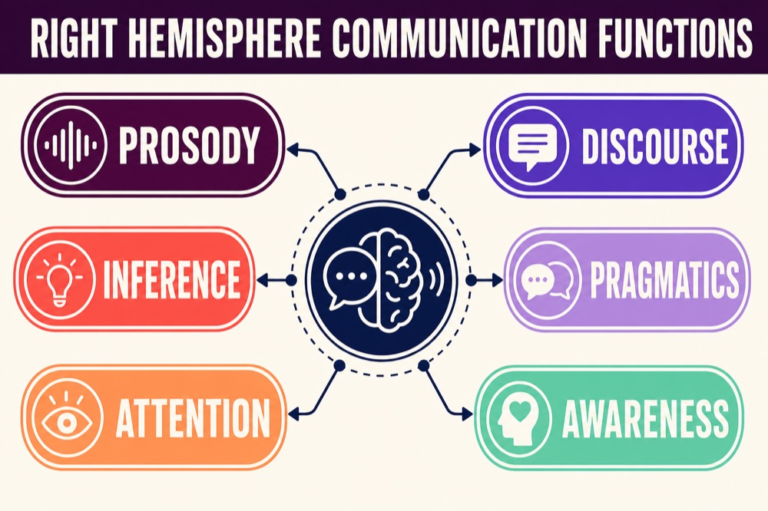
right hemisphere communication functions is easier to study when it is treated as a connected system rather than a single label. Right hemisphere communication functions extend beyond word and sentence form. Prosody, discourse, inference, pragmatics, attention, awareness, and the ability to integrate a big picture can shape how a message is understood and used.
This learning guide is written for SLP students and other learners reviewing clinical concepts. It uses broad patterns to organize observation, not to make an individualized diagnosis or promise one outcome. Interpretation depends on the person, task, language, culture, hearing, access, health, context, and communication goals.
What right hemisphere communication functions includes
Begin by separating the concept into domains. A learner who can name the domains is less likely to collapse language, speech motor, voice, cognitive, access, or participation questions into one explanation. The useful unit of analysis is the task: what the person was asked to understand, produce, remember, organize, or communicate, with whom, under which conditions, and with what support.
Domain or system
What to notice
Question to carry forward
Prosody
Pitch, rate, stress, and intensity can convey emotion, emphasis, attitude, and sentence meaning.
What meaning is carried by the sound pattern beyond the words?
Discourse and gist
Listeners and speakers organize information into a topic, main idea, sequence, and coherent message.
Can the person identify and communicate the point of the exchange?
Inference and nonliteral language
Context helps people interpret implied meaning, ambiguity, humor, metaphor, and sarcasm.
Which contextual cues are available and which must be inferred?
Pragmatics
Turn-taking, topic maintenance, repair, perspective, and social boundaries support participation.
How does the communication behavior fit the partner and situation?
Attention and neglect
Attention, visual-spatial awareness, memory, and organization can alter communication access.
What environmental or attention demand is affecting the task?
Awareness and executive control
Insight, planning, monitoring, and problem solving influence self-correction and daily communication.
Can the person notice the breakdown and choose a repair?
These domains interact, but they should remain distinguishable. A learner may show strength in one task and need support in another. A study map organizes the next observation; it does not answer every assessment question or replace current professional guidance.
Keep the first pass descriptive and close to the communication event. Note the task, the response, the partner, the setting, the timing, the available support, and the consequence for participation. This gives the learner a stable record to compare across tasks and prevents a familiar term from doing too much explanatory work before the evidence has been separated.
For Praxis-style review, a vignette may include several true details but ask for one best interpretation or next step. The strongest answer usually respects the task, identifies the relevant function, checks the most important missing information, and avoids treating one performance sample as the whole profile.
Map right hemisphere functions
For study purposes, describe the system-function relationship before naming a disorder. Record what the person understood, produced, initiated, repaired, coordinated, or participated in. Then note whether the task was familiar, how much context was shared, and which support changed the response.
Paralinguistic prosody: using and interpreting pitch, rate, stress, intensity, and emotional tone.
Discourse: organizing stories, explanations, conversations, and written messages around a relevant point.
Inference: combining literal language with context, world knowledge, perspective, and unstated meaning.
Pragmatics: adjusting turn-taking, topic, repair, boundaries, and message form for the communication partner.
Cognitive-communication: attention, memory, executive function, visual perception, and awareness support communication.
Participation: work, relationships, education, safety, and community routines reveal the functional impact.
A strong description is specific enough that another learner could picture the event. Instead of writing “the system is weak,” describe the demand, the observable response, the partner, the context, and the result. This protects clinical reasoning from labels that are broader than the evidence.
From injury to communication profile
Context changes what communication requires. A naming task, a conversation, a sustained vowel, a long explanation, a reading sample, and a workplace exchange place different demands on processing, motor control, memory, rate, and partner support. Hearing access, fatigue, posture, visual supports, language experience, and the opportunity to request clarification should be part of the observation.
A person may answer literal questions accurately yet miss sarcasm, fail to state the main idea, or use an unexpectedly flat or exaggerated prosody. The useful distinction is not simply “language intact” versus “language impaired.” Examine the task, context, partner, attention, awareness, and the communication consequence.
Observation layer
Example question
Task
What did the person need to understand, produce, organize, coordinate, or repair?
Function
Which language, motor, voice, cognitive, or access relationship was observable?
Access
Were hearing, visual, motor, sensory, language, respiratory, or environmental supports available?
Participation
What meaningful routine became easier or harder because of the pattern?
Context is not an afterthought added once a label has been selected. It is part of the question itself. If performance changes with a quieter room, extra processing time, a familiar partner, a different communication mode, a changed speaking rate, or a changed task, that change is useful evidence about access and demand. It does not identify a cause by itself, but it tells you which conditions should be carried into the next observation.
Apply the concept in clinical reasoning
When a Praxis-style scenario or clinical discussion presents right hemisphere communication functions, use a disciplined sequence. The goal is to select the next clinical question or action that matches the evidence, the person’s priorities, and the communication context.
Define the task in plain language.
Identify the domain or domains involved without assuming they are interchangeable.
Separate observation from interpretation and write down what remains unknown.
Check hearing, language experience, culture, communication mode, environment, partner support, alertness, respiration, memory, and task familiarity.
Choose the assessment, collaboration, or observation step that answers the specific question.
State the boundary of the conclusion and keep the person’s participation goal visible.
A person may answer literal questions accurately yet miss sarcasm, fail to state the main idea, or use an unexpectedly flat or exaggerated prosody. The useful distinction is not simply “language intact” versus “language impaired.” Examine the task, context, partner, attention, awareness, and the communication consequence. In a learning answer, the decisive evidence is usually the relationship among the task, the observed pattern, and the next needed information—not a single isolated behavior or brain-area label.
Common study mistakes
Reducing right hemisphere communication to one vague idea such as social skills.
Assuming normal word retrieval or syntax rules out a communication disorder.
Treating a prosody difference as only an emotional issue without examining meaning and context.
Ignoring gist, discourse organization, inference, and nonliteral language.
Overlooking left-side neglect, attention, memory, planning, and awareness.
Judging pragmatics without considering premorbid style, culture, language, and partner expectations.
Using one structured task to predict dynamic conversation or workplace communication.
Confusing a reduced insight into the problem with a lack of motivation.
Most of these mistakes come from replacing a multidomain question with a fast label. Correct the habit by returning to the same sequence: describe, separate, contextualize, ask what is missing, and choose a proportionate next step. A short rationale can make the habit visible: identify the evidence, name the uncertainty, and explain why the selected next step fits both.
Build a quick review map
Use this compact map when reviewing a missed question, a lecture note, or a clinical vignette:
Step 1: Name the communication meaning or participation goal at stake.
Step 2: Separate prosody, discourse, inference, pragmatics, attention, and awareness.
Step 3: Compare structured performance with conversation and other dynamic tasks.
Step 5: Look for repair, monitoring, and support that changes participation.
Step 6: Write a functional profile rather than a single hemispheric stereotype.
Then write one transfer sentence: “When I see this pattern, I will first check ___ because ___.” The sentence should identify a decision rule, not repeat a definition. Revisit it after a delay and test whether you can apply the rule to a different task, age group, or communication mode.
Sources and next steps
right hemisphere communication functions is best learned as a context-sensitive pattern across structure, function, access, and participation. Use the current authority pages to refine the concept, then return to practice scenarios that require you to explain what the evidence supports and what it leaves open.
Left Hemisphere Language Functions: A Network-Based Study Guide
left hemisphere language functions is easier to study when it is treated as a connected system rather than a single label. Left hemisphere language functions are best understood as interacting roles within a language network, not as a single speech center. Word meaning, phonology, sentence processing, comprehension, reading, and writing depend on relationships among regions and support systems.
This learning guide is written for SLP students and other learners reviewing clinical concepts. It uses broad patterns to organize observation, not to make an individualized diagnosis or promise one outcome. Interpretation depends on the person, task, language, culture, hearing, access, health, context, and communication goals.
What left hemisphere language functions includes
Begin by separating the concept into domains. A learner who can name the domains is less likely to collapse language, speech motor, voice, cognitive, access, or participation questions into one explanation. The useful unit of analysis is the task: what the person was asked to understand, produce, remember, organize, or communicate, with whom, under which conditions, and with what support.
Domain or system
What to notice
Question to carry forward
Word meaning and retrieval
Frontal and temporal language systems support access to concepts, word forms, and intended messages.
Is the task recognition, retrieval, explanation, or flexible use?
Phonological processing
Speech sounds and word forms are analyzed, maintained, and connected with language output.
Does the task change when sound structure or repetition is required?
Sentence processing
Multiple regions work together to organize relationships, grammar, and meaning across a sentence.
Which sentence demand changed: structure, memory, inference, or background knowledge?
Comprehension
Auditory input is integrated with words, syntax, context, attention, and prior knowledge.
Was the message heard, recognized, understood, and linked to the situation?
Reading and writing
Visual word forms interact with phonology, meaning, spelling, motor output, and language experience.
Which modality is affected and which modality remains accessible?
Network variability
Language functions are distributed and can be supported by interacting systems and changing conditions.
What does the individual profile show beyond a regional shorthand?
These domains interact, but they should remain distinguishable. A learner may show strength in one task and need support in another. A study map organizes the next observation; it does not answer every assessment question or replace current professional guidance.
Keep the first pass descriptive and close to the communication event. Note the task, the response, the partner, the setting, the timing, the available support, and the consequence for participation. This gives the learner a stable record to compare across tasks and prevents a familiar term from doing too much explanatory work before the evidence has been separated.
For Praxis-style review, a vignette may include several true details but ask for one best interpretation or next step. The strongest answer usually respects the task, identifies the relevant function, checks the most important missing information, and avoids treating one performance sample as the whole profile.
Map left hemisphere language roles
For study purposes, describe the system-function relationship before naming a disorder. Record what the person understood, produced, initiated, repaired, coordinated, or participated in. Then note whether the task was familiar, how much context was shared, and which support changed the response.
Phonology: organizing speech sounds and word forms for recognition, repetition, reading, and production.
Lexical-semantic access: connecting words with concepts, categories, relationships, and intended meaning.
Sentence-level language: integrating word order, morphology, syntax, memory, and inference.
Comprehension: combining auditory input, attention, language knowledge, context, and response demands.
Literacy: coordinating visual word forms with phonology, meaning, spelling, writing, and learning.
Network support: memory, executive control, perception, motor systems, and communication context interact with language.
A strong description is specific enough that another learner could picture the event. Instead of writing “the system is weak,” describe the demand, the observable response, the partner, the context, and the result. This protects clinical reasoning from labels that are broader than the evidence.
Read the profile, not one area
Context changes what communication requires. A naming task, a conversation, a sustained vowel, a long explanation, a reading sample, and a workplace exchange place different demands on processing, motor control, memory, rate, and partner support. Hearing access, fatigue, posture, visual supports, language experience, and the opportunity to request clarification should be part of the observation.
An acquired language profile may include word-retrieval pauses, reduced sentence comprehension, reading changes, writing changes, or a mixture of strengths and needs. A naming score alone cannot represent the whole language network. Compare modalities and tasks so the interpretation reflects what the person can understand, express, repair, and participate in.
Observation layer
Example question
Task
What did the person need to understand, produce, organize, coordinate, or repair?
Function
Which language, motor, voice, cognitive, or access relationship was observable?
Access
Were hearing, visual, motor, sensory, language, respiratory, or environmental supports available?
Participation
What meaningful routine became easier or harder because of the pattern?
Context is not an afterthought added once a label has been selected. It is part of the question itself. If performance changes with a quieter room, extra processing time, a familiar partner, a different communication mode, a changed speaking rate, or a changed task, that change is useful evidence about access and demand. It does not identify a cause by itself, but it tells you which conditions should be carried into the next observation.
Apply the concept in clinical reasoning
When a Praxis-style scenario or clinical discussion presents left hemisphere language functions, use a disciplined sequence. The goal is to select the next clinical question or action that matches the evidence, the person’s priorities, and the communication context.
Define the task in plain language.
Identify the domain or domains involved without assuming they are interchangeable.
Separate observation from interpretation and write down what remains unknown.
Check hearing, language experience, culture, communication mode, environment, partner support, alertness, respiration, memory, and task familiarity.
Choose the assessment, collaboration, or observation step that answers the specific question.
State the boundary of the conclusion and keep the person’s participation goal visible.
An acquired language profile may include word-retrieval pauses, reduced sentence comprehension, reading changes, writing changes, or a mixture of strengths and needs. A naming score alone cannot represent the whole language network. Compare modalities and tasks so the interpretation reflects what the person can understand, express, repair, and participate in. In a learning answer, the decisive evidence is usually the relationship among the task, the observed pattern, and the next needed information—not a single isolated behavior or brain-area label.
Common study mistakes
Treating the left hemisphere as one uniform language center.
Using a classical area label as if it predicts the complete communication profile.
Confusing word retrieval with loss of word meaning or with a speech-motor limitation.
Ignoring comprehension, reading, writing, discourse, and communication partner support.
Treating repetition success as evidence that spontaneous language is intact.
Overlooking attention, memory, hearing, vision, education, language, and culture.
Interpreting a scan location before describing the actual task and observable behavior.
Writing a global conclusion when the evidence supports only one modality or level of language.
Most of these mistakes come from replacing a multidomain question with a fast label. Correct the habit by returning to the same sequence: describe, separate, contextualize, ask what is missing, and choose a proportionate next step. A short rationale can make the habit visible: identify the evidence, name the uncertainty, and explain why the selected next step fits both.
Build a quick review map
Use this compact map when reviewing a missed question, a lecture note, or a clinical vignette:
Step 1: Describe the task, modality, response format, and communication purpose.
Step 2: Separate phonology, word meaning, sentence processing, comprehension, and literacy.
Step 3: Use regional labels as landmarks within a distributed network model.
Step 4: Compare expression, comprehension, reading, writing, naming, and discourse.
Step 5: Check attention, memory, hearing, vision, language experience, culture, and support.
Step 6: State what the profile supports and what a next observation must still clarify.
Then write one transfer sentence: “When I see this pattern, I will first check ___ because ___.” The sentence should identify a decision rule, not repeat a definition. Revisit it after a delay and test whether you can apply the rule to a different task, age group, or communication mode.
Sources and next steps
left hemisphere language functions is best learned as a context-sensitive pattern across structure, function, access, and participation. Use the current authority pages to refine the concept, then return to practice scenarios that require you to explain what the evidence supports and what it leaves open.
Brain Areas for Language: Network Roles, Variability, and Clinical Reasoning
brain areas for language is easier to study when it is treated as a coordinated system rather than a memorized list of labels. Brain areas for language are useful study landmarks, but language does not live in one isolated spot. A contemporary SLP learning map connects frontal, temporal, parietal, motor, memory, attention, and right-hemisphere systems with the task and the person’s communication profile.
This learning guide is written for SLP students and other learners reviewing clinical concepts. It uses broad patterns to organize observation, not to make an individualized diagnosis or promise one outcome. Interpretation depends on the person, task, language, culture, hearing, access, health, context, and communication goals.
What brain areas for language includes
Begin by separating the concept into domains. A learner who can name the domains is less likely to collapse a structure, function, motor, language, access, or participation question into one explanation. The useful unit of analysis is the task: what the person was asked to understand, produce, remember, organize, or communicate, with whom, under which conditions, and with what support.
Domain or structure
What to notice
Question to carry forward
Left inferior frontal regions
Often participate in speech production, sequencing, controlled retrieval, and aspects of sentence processing.
Which production, sequencing, or grammatical demand is present?
Posterior temporal regions
Often participate in auditory-linguistic analysis, word meaning, and comprehension within a larger network.
Is the message heard, recognized, understood, and integrated with context?
Temporo-parietal integration
Supports relationships among phonology, meaning, reading, writing, and multimodal language processing.
Which input and output modalities converge or separate?
Right-hemisphere systems
Contribute to prosody, discourse, inference, attention, awareness, and broader cognitive-communication.
Does the task require gist, perspective, emotion, or nonliteral meaning?
Motor and subcortical systems
Support speech movement, timing, initiation, coordination, and interaction with language planning.
Is the limitation linguistic, motor, or a combination?
Distributed network
Language works with memory, executive function, perception, learning, and social context rather than in isolation.
What does the whole task require beyond a named brain region?
These domains interact, but they should remain distinguishable. A named structure may contribute to more than one function, and a single function may depend on several structures and control systems. A study map organizes the next observation; it does not answer every assessment question.
Keep the first pass descriptive and close to the communication or swallowing event. Note the task, the response, the partner, the setting, the timing, the available support, and the consequence for participation. This gives the learner a stable record to compare across tasks and prevents a familiar anatomy or localization term from doing too much explanatory work before the evidence has been separated.
For Praxis-style review, a vignette may include several true anatomical details but ask for one best interpretation or next step. The strongest answer usually respects the task, identifies the relevant function, checks the most important missing information, and avoids treating one performance sample as the whole profile.
Map brain areas for language
For study purposes, describe the structure-function relationship before naming a disorder. Record what moved, what was sensed, what was produced, what timing changed, and what the listener or communication partner experienced. Then note whether the task was familiar, how much context was shared, and which support changed the response.
Frontal language roles: speech production, controlled retrieval, sequencing, and sentence-level demands within a broader network.
Temporal language roles: processing speech and word meaning while integrating input with context and knowledge.
Parietal and cross-modal roles: connecting phonology, reading, writing, spatial attention, and multimodal information.
Right-hemisphere communication: prosody, discourse organization, inference, perspective, attention, and awareness.
Motor and support systems: speech movement, timing, memory, executive control, learning, and self-monitoring.
Clinical interpretation: use a task-based profile rather than assigning a whole person to one named area.
A strong description is specific enough that another learner could picture the event. Instead of writing “the structure is weak,” describe the demand, the observable movement or signal, the partner, the context, and the result. This protects clinical reasoning from labels that are broader than the evidence.
Use network thinking
Context changes what a structure or pathway must do. A sustained vowel, a connected conversation, a single bite, a full meal, a repetition task, and a story retell place different demands on timing, sensation, motor control, memory, and partner support. Hearing access, fatigue, alertness, posture, visual supports, language experience, and the opportunity to request clarification should be part of the observation.
A person with an acquired brain injury may have difficulty naming, understanding, reading, telling a story, using prosody, or organizing a conversation. Those tasks overlap but are not interchangeable. A careful interpretation asks what modality, level of language, cognitive support, and participation demand changed before using a regional label as shorthand.
Observation layer
Example question
Task
What did the person need to understand, produce, coordinate, remember, or protect?
Function
Which movement, sensation, signal, or processing relationship was observable?
Access
Were hearing, visual, motor, sensory, language, respiratory, or environmental supports available?
Participation
What meaningful routine became easier or harder because of the pattern?
Context is not an afterthought added once a label has been selected. It is part of the question itself. If performance changes with a quieter room, extra processing time, a familiar partner, a different material, a different communication mode, or a changed task, that change is useful evidence about access and demand. It does not by itself identify a cause, but it tells you which conditions should be carried into the next observation.
Apply the concept in clinical reasoning
When a Praxis-style scenario or clinical discussion presents brain areas for language, use a disciplined sequence. The goal is to select the next clinical question or action that matches the evidence, the person’s priorities, and the communication or swallowing context.
Define the task in plain language.
Identify the structure, function, or network domain involved without assuming it is interchangeable with the whole system.
Separate observation from interpretation and write down what remains unknown.
Check hearing, language experience, culture, communication mode, environment, partner support, alertness, respiration, and task familiarity.
Choose the assessment, collaboration, or observation step that answers the specific question.
State the boundary of the conclusion and keep the person’s participation goal visible.
A person with an acquired brain injury may have difficulty naming, understanding, reading, telling a story, using prosody, or organizing a conversation. Those tasks overlap but are not interchangeable. A careful interpretation asks what modality, level of language, cognitive support, and participation demand changed before using a regional label as shorthand. In a learning answer, the decisive evidence is usually the relationship among the task, the observed function, and the next needed information—not a single isolated anatomy label.
Common study mistakes
Treating Broca’s area or Wernicke’s area as a complete map of all language.
Assuming the same named brain area produces the same profile in every person.
Confusing language impairment with speech motor impairment or cognitive-communication difficulty.
Ignoring right-hemisphere contributions to prosody, discourse, inference, and attention.
Using a normal repetition or naming result to dismiss difficulties in discourse or participation.
Treating a scan location as a direct explanation for a functional communication result.
Overlooking language, culture, education, hearing, vision, and modality in assessment interpretation.
Choosing a localization label before describing the task and the observable communication behavior.
Most of these mistakes come from replacing a multidomain question with a fast label. Correct the habit by returning to the same sequence: describe, connect structure to function, contextualize, ask what is missing, and choose a proportionate next step. A short rationale can make the habit visible: identify the evidence, name the uncertainty, and explain why the selected next step fits both.
Build a quick review map
Use this compact map when reviewing a missed question, a lecture note, or a clinical vignette:
Step 1: Describe the communication task and the modality before naming a brain area.
Step 2: Separate language, speech motor, cognitive, perceptual, and participation demands.
Step 3: Use regional labels as study landmarks inside a distributed network model.
Step 5: Check attention, memory, executive control, hearing, vision, culture, and communication mode.
Step 6: Write a task-based conclusion that states what the evidence supports and what remains open.
Then write one transfer sentence: “When I see this structure-function pattern, I will first check ___ because ___.” The sentence should identify a decision rule, not repeat a definition. Revisit it after a delay and test whether you can apply the rule to a different task, age group, or communication mode.
Sources and next steps
brain areas for language is best learned as a context-sensitive relationship among structure, function, access, and participation. Use the current authority pages to refine the concept, then return to practice scenarios that require you to explain what the evidence supports and what it leaves open.