Global Aphasia: Multimodal Language Impairment and Communication Access
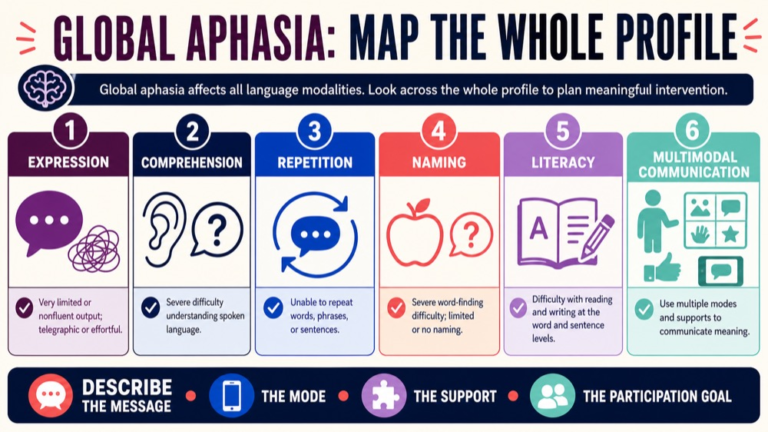
global aphasia is easier to study when it is treated as a connected system rather than a single label. Global aphasia is a severe aphasia pattern that can affect multiple language modalities, but a label should never replace a careful profile. For exam review, connect spoken and written comprehension, expression, repetition, naming, reading, writing, nonverbal communication, support, and participation.
This learning guide is written for SLP students and other learners reviewing clinical concepts. It uses broad patterns to organize observation, not to make an individualized diagnosis or promise one outcome. Interpretation depends on the person, task, language, culture, hearing, access, health, context, and communication goals.
What global aphasia includes
Begin by separating the concept into domains. A learner who can name the domains is less likely to collapse cognition, language, speech, auditory access, memory, attention, or participation questions into one explanation. The useful unit of analysis is the task: what the person was asked to understand, produce, remember, organize, coordinate, or communicate, with whom, under which conditions, and with what support.
Domain or system
What to notice
Question to carry forward
Expression
Spoken output may be limited, effortful, inconsistent, or supplemented by gesture, writing, drawing, AAC, or other modes.
What message can the person express, in which mode, and with what support?
Comprehension
Understanding may vary with words, sentences, discourse, rate, context, hearing, vision, and the communication partner.
Which input, level, or support changes access to meaning?
Repetition
Repeating words or sentences places demands on auditory access, language, phonology, memory, and speech output.
What happens when material is shortened, supported, written, or made meaningful?
Naming and word access
Confrontation naming may be limited, but functional word access can look different with cues, gesture, writing, or AAC.
Which route to the intended concept is available?
Literacy and multimodal communication
Reading and writing may show related or different access, and nonverbal communication can preserve intent.
What does each modality add to the profile and the person’s goal?
Participation and support
Communication partners, routines, environmental changes, and supported conversation can alter successful participation.
Which support improves meaningful communication without taking over the message?
These domains interact, but they should remain distinguishable. A learner may show strength in one task and need support in another. A study map organizes the next observation; it does not answer every assessment question or replace current professional guidance.
Keep the first pass descriptive and close to the communication event. Note the task, the response, the partner, the setting, the timing, the available support, and the consequence for participation. This gives the learner a stable record to compare across tasks and prevents a familiar term from doing too much explanatory work before the evidence has been separated.
For Praxis-style review, a vignette may include several true details but ask for one best interpretation or next step. The strongest answer usually respects the task, identifies the relevant function, checks the most important missing information, and avoids treating one performance sample as the whole profile.
Map global aphasia
For study purposes, describe the system-function relationship before naming a disorder or subtype. Record what the person understood, produced, initiated, repaired, coordinated, or participated in. Then note whether the task was familiar, how much context was shared, and which support changed the response.
Expression: describe amount, effort, message content, consistency, and available speech and nonspeech modes.
Comprehension: compare words, sentences, discourse, speed, context, spoken input, and written input.
Repetition: separate auditory access, comprehension, phonology, working memory, and speech-motor demands.
Naming: examine concept access, semantic and phonological routes, cueing, gesture, writing, and AAC.
Literacy and multimodal communication: include reading, writing, drawing, pointing, gesture, and communication technology.
Participation: connect the profile with partners, routines, safety, self-advocacy, relationships, and the person’s priorities.
A strong description is specific enough that another learner could picture the event. Instead of writing “the system is weak,” describe the demand, the observable response, the partner, the context, and the result. This protects clinical reasoning from labels that are broader than the evidence.
Access routes beyond a label
Context changes what communication requires. A naming task, a listening activity, a multi-step instruction, a narrative, a conversation, and a workplace exchange place different demands on processing, memory, attention, language, motor control, and partner support. Hearing access, fatigue, posture, visual supports, language experience, and the opportunity to request clarification should be part of the observation.
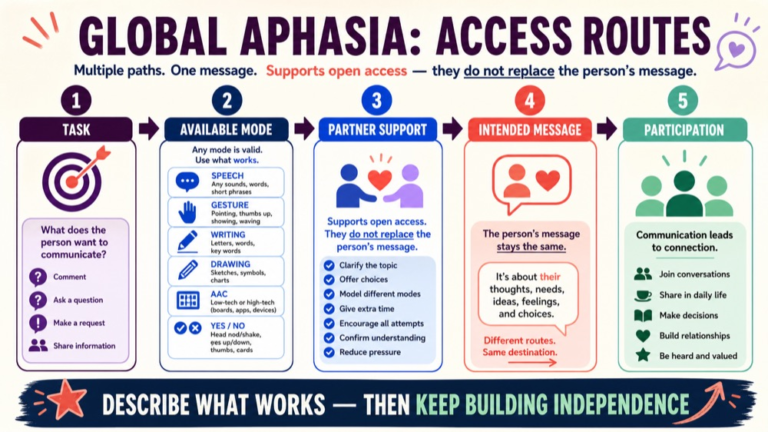
A person with a broad aphasia pattern may understand a familiar routine better than a novel explanation, communicate a choice through gesture, or show a different response when a partner adds written keywords or visual context. These contrasts do not erase the severity of the language impairment; they identify access routes that matter for assessment, counseling, and participation. Describe what is possible, what is not yet clear, and what support changes the exchange.
Observation layer
Example question
Task
What did the person need to understand, produce, organize, coordinate, or repair?
Function
Which cognitive, language, speech, auditory, motor, or access relationship was observable?
Access
Were hearing, visual, motor, sensory, language, respiratory, or environmental supports available?
Participation
What meaningful routine became easier or harder because of the pattern?
Context is not an afterthought added once a label has been selected. It is part of the question itself. If performance changes with a quieter room, extra processing time, a familiar partner, a different communication mode, a changed speaking rate, or a changed task, that change is useful evidence about access and demand. It does not identify a cause by itself, but it tells you which conditions should be carried into the next observation.
Apply the concept in clinical reasoning
When a Praxis-style scenario or clinical discussion presents global aphasia, use a disciplined sequence. The goal is to select the next clinical question or action that matches the evidence, the person’s priorities, and the communication context.
Define the task in plain language.
Identify the domain or domains involved without assuming they are interchangeable.
Separate observation from interpretation and write down what remains unknown.
Check hearing, language experience, culture, communication mode, environment, partner support, alertness, respiration, memory, and task familiarity.
Choose the assessment, collaboration, or observation step that answers the specific question.
State the boundary of the conclusion and keep the person’s participation goal visible.
A person with a broad aphasia pattern may understand a familiar routine better than a novel explanation, communicate a choice through gesture, or show a different response when a partner adds written keywords or visual context. These contrasts do not erase the severity of the language impairment; they identify access routes that matter for assessment, counseling, and participation. Describe what is possible, what is not yet clear, and what support changes the exchange. In a learning answer, the decisive evidence is usually the relationship among the task, the observed pattern, and the next needed information—not a single isolated behavior or label.
Common study mistakes
Treating global aphasia as total absence of communication or understanding.
Using a single bedside response to represent every language modality and context.
Confusing aphasia with hearing loss, visual access, dysarthria, acquired apraxia of speech, or cognitive-communication change.
Assuming a person’s best supported response is the same as independent communication.
Overlooking language background, literacy, culture, premorbid communication, and personal goals.
Describing severity without considering safety, relationships, routines, and self-advocacy.
Choosing treatment or counseling before the communication profile and priorities are clear.
Most of these mistakes come from replacing a multidomain question with a fast label. Correct the habit by returning to the same sequence: describe, separate, contextualize, ask what is missing, and choose a proportionate next step. A short rationale can make the habit visible: identify the evidence, name the uncertainty, and explain why the selected next step fits both.
Build a quick review map
Use this compact map when reviewing a missed question, a lecture note, or a clinical vignette:
Step 1: Describe the person’s message, partner, context, language modes, and participation goal.
Step 2: Separate expression, comprehension, repetition, naming, literacy, and nonverbal communication.
Step 3: Compare structured tasks with familiar routines and supported conversation.
Step 4: Check hearing, vision, motor speech, cognition, language background, literacy, and fatigue.
Step 5: Record which supports increase access and which barriers remain.
Step 6: State the next observation or collaboration that would reduce the most important uncertainty.
Then write one transfer sentence: “When I see this pattern, I will first check ___ because ___.” The sentence should identify a decision rule, not repeat a definition. Revisit it after a delay and test whether you can apply the rule to a different task, age group, or communication mode.
Sources and next steps
global aphasia is best learned as a context-sensitive pattern across structure, function, access, and participation. Use the current authority pages to refine the concept, then return to practice scenarios that require you to explain what the evidence supports and what it leaves open.
Anomic Aphasia: Word Retrieval, Naming, and Functional Communication
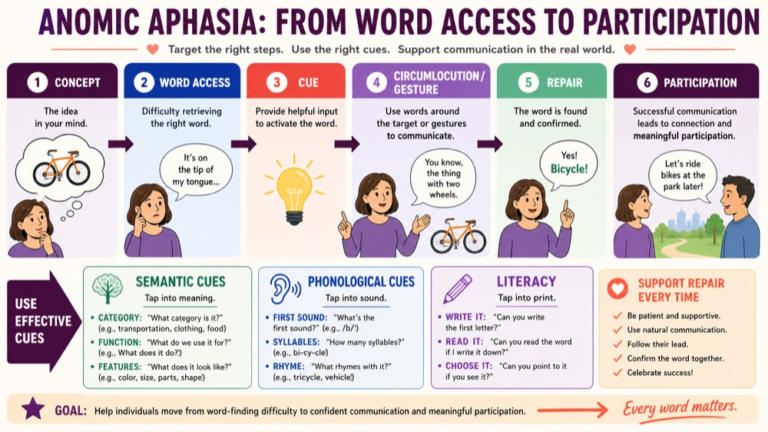
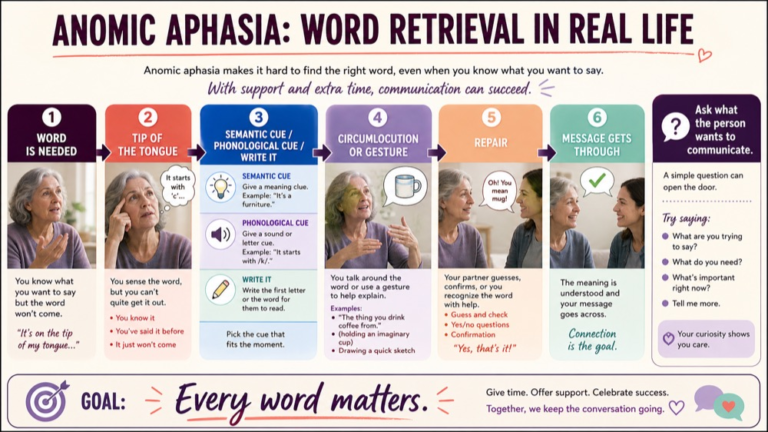
anomic aphasia is easier to study when it is treated as a connected system rather than a single label. Anomic aphasia is often associated with word-retrieval difficulty, but naming accuracy alone does not describe the person’s language profile. Study confrontation naming, discourse, circumlocution, cueing, comprehension, repetition, reading, writing, and the communication situations in which word access matters.
This learning guide is written for SLP students and other learners reviewing clinical concepts. It uses broad patterns to organize observation, not to make an individualized diagnosis or promise one outcome. Interpretation depends on the person, task, language, culture, hearing, access, health, context, and communication goals.
What anomic aphasia includes
Begin by separating the concept into domains. A learner who can name the domains is less likely to collapse cognition, language, speech, auditory access, memory, attention, or participation questions into one explanation. The useful unit of analysis is the task: what the person was asked to understand, produce, remember, organize, coordinate, or communicate, with whom, under which conditions, and with what support.
Domain or system
What to notice
Question to carry forward
Word retrieval
A person may know the intended concept but have slow or incomplete access to the spoken or written word.
Does the response improve with semantic, phonological, written, or contextual support?
Naming
Confrontation naming is compared with naming in conversation, description, narrative, and functional messages.
Does the task or context change the naming pattern?
Circumlocution and repair
Describing features, using gestures, substituting, or asking for help can preserve the message while a word is unavailable.
Which repair communicates the intended meaning most effectively?
Comprehension and repetition
Word retrieval should be interpreted alongside comprehension, repetition, sentence processing, and discourse.
Is the difficulty isolated to access, or part of a broader language pattern?
Literacy and modality
Reading, writing, typing, gesture, and AAC can reveal alternative access routes or related language needs.
Which modality supports independent communication?
Participation
The impact depends on the words, partners, settings, roles, and goals that matter to the person.
Where does word access limit learning, work, relationships, or self-advocacy?
These domains interact, but they should remain distinguishable. A learner may show strength in one task and need support in another. A study map organizes the next observation; it does not answer every assessment question or replace current professional guidance.
Keep the first pass descriptive and close to the communication event. Note the task, the response, the partner, the setting, the timing, the available support, and the consequence for participation. This gives the learner a stable record to compare across tasks and prevents a familiar term from doing too much explanatory work before the evidence has been separated.
For Praxis-style review, a vignette may include several true details but ask for one best interpretation or next step. The strongest answer usually respects the task, identifies the relevant function, checks the most important missing information, and avoids treating one performance sample as the whole profile.
Map anomic aphasia
For study purposes, describe the system-function relationship before naming a disorder or subtype. Record what the person understood, produced, initiated, repaired, coordinated, or participated in. Then note whether the task was familiar, how much context was shared, and which support changed the response.
Word retrieval: distinguish concept access, semantic access, phonological access, response speed, and cueing.
Naming: compare confrontation naming with conversation, description, narrative, and functional messages.
Circumlocution and repair: describe how gestures, features, substitutions, and partner support preserve meaning.
Comprehension and repetition: interpret naming alongside broader language processes rather than in isolation.
Literacy and modality: compare reading, writing, typing, gesture, AAC, and spoken output as access routes.
Participation: connect word access with the person’s roles, partners, settings, goals, and self-advocacy.
A strong description is specific enough that another learner could picture the event. Instead of writing “the system is weak,” describe the demand, the observable response, the partner, the context, and the result. This protects clinical reasoning from labels that are broader than the evidence.
From word retrieval to participation
Context changes what communication requires. A naming task, a listening activity, a multi-step instruction, a narrative, a conversation, and a workplace exchange place different demands on processing, memory, attention, language, motor control, and partner support. Hearing access, fatigue, posture, visual supports, language experience, and the opportunity to request clarification should be part of the observation.
A person may name a pictured object after a delay, produce a useful circumlocution in conversation, retrieve a word with a cue, or show different access through writing or gesture. These contrasts help distinguish a word-retrieval pattern from a broader comprehension, phonological, motor-speech, or access issue. The functional question is not only whether a word is named, but whether the person can communicate the intended message in the situations that matter.
Observation layer
Example question
Task
What did the person need to understand, produce, organize, coordinate, or repair?
Function
Which cognitive, language, speech, auditory, motor, or access relationship was observable?
Access
Were hearing, visual, motor, sensory, language, respiratory, or environmental supports available?
Participation
What meaningful routine became easier or harder because of the pattern?
Context is not an afterthought added once a label has been selected. It is part of the question itself. If performance changes with a quieter room, extra processing time, a familiar partner, a different communication mode, a changed speaking rate, or a changed task, that change is useful evidence about access and demand. It does not identify a cause by itself, but it tells you which conditions should be carried into the next observation.
Apply the concept in clinical reasoning
When a Praxis-style scenario or clinical discussion presents anomic aphasia, use a disciplined sequence. The goal is to select the next clinical question or action that matches the evidence, the person’s priorities, and the communication context.
Define the task in plain language.
Identify the domain or domains involved without assuming they are interchangeable.
Separate observation from interpretation and write down what remains unknown.
Check hearing, language experience, culture, communication mode, environment, partner support, alertness, respiration, memory, and task familiarity.
Choose the assessment, collaboration, or observation step that answers the specific question.
State the boundary of the conclusion and keep the person’s participation goal visible.
A person may name a pictured object after a delay, produce a useful circumlocution in conversation, retrieve a word with a cue, or show different access through writing or gesture. These contrasts help distinguish a word-retrieval pattern from a broader comprehension, phonological, motor-speech, or access issue. The functional question is not only whether a word is named, but whether the person can communicate the intended message in the situations that matter. In a learning answer, the decisive evidence is usually the relationship among the task, the observed pattern, and the next needed information—not a single isolated behavior or label.
Common study mistakes
Treating confrontation naming as a complete measure of language or communication.
Assuming a correct cued response proves independent word access in conversation.
Ignoring circumlocution, gesture, writing, typing, AAC, discourse, and partner repair.
Confusing word retrieval with comprehension, semantic knowledge, phonology, or motor speech.
Using response speed without considering familiarity, culture, bilingual language use, and task context.
Overlooking the words and routines that are personally important to the learner or client.
Describing naming errors without connecting them to the intended message and participation.
Choosing a cueing hierarchy before identifying the person’s preferred access route and goal.
Most of these mistakes come from replacing a multidomain question with a fast label. Correct the habit by returning to the same sequence: describe, separate, contextualize, ask what is missing, and choose a proportionate next step. A short rationale can make the habit visible: identify the evidence, name the uncertainty, and explain why the selected next step fits both.
Build a quick review map
Use this compact map when reviewing a missed question, a lecture note, or a clinical vignette:
Step 1: Define the word, task, modality, partner, context, and participation goal.
Step 2: Separate concept, semantic access, phonological access, retrieval speed, cueing, and repair.
Step 3: Compare confrontation naming with conversation, description, narrative, writing, and gesture.
Step 4: Check comprehension, repetition, motor speech, hearing, language background, literacy, and culture.
Step 5: Record which supports preserve the intended message and which create independence.
Step 6: Choose the next observation or strategy around the person’s real communication priorities.
Then write one transfer sentence: “When I see this pattern, I will first check ___ because ___.” The sentence should identify a decision rule, not repeat a definition. Revisit it after a delay and test whether you can apply the rule to a different task, age group, or communication mode.
Sources and next steps
anomic aphasia is best learned as a context-sensitive pattern across structure, function, access, and participation. Use the current authority pages to refine the concept, then return to practice scenarios that require you to explain what the evidence supports and what it leaves open.
Start with asha aphasia, ets 5331 study companion. These sources support the learning frame; they do not replace current topic-specific guidance or an individualized evaluation.
Conduction Aphasia: Repetition, Phonology, and Language Profile
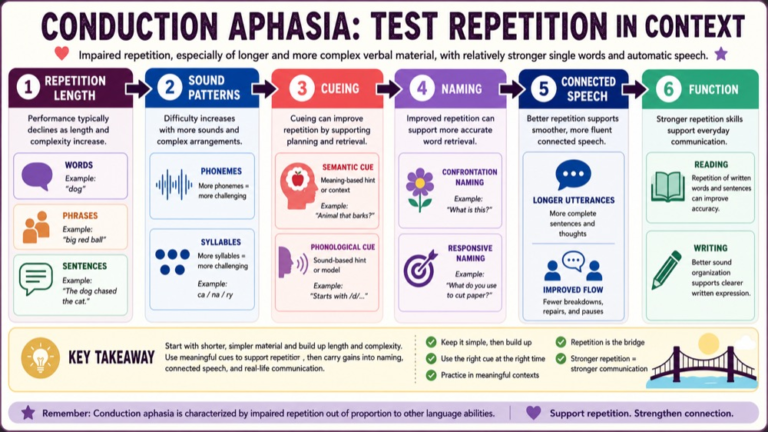
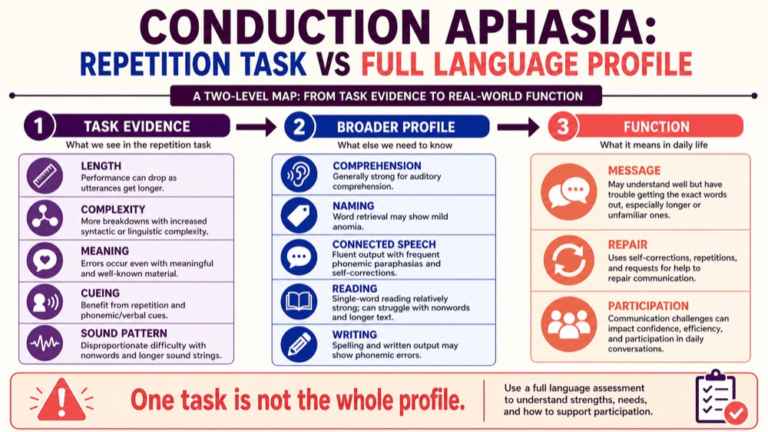
conduction aphasia is easier to study when it is treated as a connected system rather than a single label. Conduction aphasia is commonly studied through a disproportionate repetition difficulty alongside other language findings, but the pattern must be tested across tasks. Compare connected speech, comprehension, naming, phonology, repetition length, cueing, literacy, and functional communication.
This learning guide is written for SLP students and other learners reviewing clinical concepts. It uses broad patterns to organize observation, not to make an individualized diagnosis or promise one outcome. Interpretation depends on the person, task, language, culture, hearing, access, health, context, and communication goals.
What conduction aphasia includes
Begin by separating the concept into domains. A learner who can name the domains is less likely to collapse cognition, language, speech, auditory access, memory, attention, or participation questions into one explanation. The useful unit of analysis is the task: what the person was asked to understand, produce, remember, organize, coordinate, or communicate, with whom, under which conditions, and with what support.
Domain or system
What to notice
Question to carry forward
Repetition
Repeating words and sentences can expose difficulty coordinating auditory input, phonological access, working memory, and output.
How does performance change with length, complexity, meaning, and cueing?
Phonological errors
Sound-based errors may appear in naming, repetition, reading, or connected speech and may vary with support.
Is the error phonological, semantic, motor-speech, auditory, or mixed?
Comprehension
Understanding is compared across words, sentences, discourse, spoken input, written input, and task context.
Which comprehension demands are secure and which remain uncertain?
Naming and self-correction
Word retrieval, phonological assembly, and awareness can interact during naming and repair.
Can the person detect and correct an error with a useful cue?
Connected speech and literacy
Conversation, narrative, reading, and writing show whether the pattern extends beyond a repetition task.
What does the broader profile add to the classification?
Participation
Communication partners and strategies can reduce the impact of repetition and phonological demands.
Which support helps the person communicate the intended message?
These domains interact, but they should remain distinguishable. A learner may show strength in one task and need support in another. A study map organizes the next observation; it does not answer every assessment question or replace current professional guidance.
Keep the first pass descriptive and close to the communication event. Note the task, the response, the partner, the setting, the timing, the available support, and the consequence for participation. This gives the learner a stable record to compare across tasks and prevents a familiar term from doing too much explanatory work before the evidence has been separated.
For Praxis-style review, a vignette may include several true details but ask for one best interpretation or next step. The strongest answer usually respects the task, identifies the relevant function, checks the most important missing information, and avoids treating one performance sample as the whole profile.
Map conduction aphasia
For study purposes, describe the system-function relationship before naming a disorder or subtype. Record what the person understood, produced, initiated, repaired, coordinated, or participated in. Then note whether the task was familiar, how much context was shared, and which support changed the response.
Phonology: compare sound-based errors across naming, repetition, reading, writing, and connected speech.
Comprehension: test words, sentences, discourse, spoken input, written input, and context.
Naming and self-correction: observe word retrieval, phonological assembly, awareness, and cue response.
Connected speech and literacy: use conversation, narrative, reading, and writing to avoid a single-task label.
Participation: connect strategies and partner behavior with the person’s message, goals, and repair.
A strong description is specific enough that another learner could picture the event. Instead of writing “the system is weak,” describe the demand, the observable response, the partner, the context, and the result. This protects clinical reasoning from labels that are broader than the evidence.
Repetition task versus full language profile
Context changes what communication requires. A naming task, a listening activity, a multi-step instruction, a narrative, a conversation, and a workplace exchange place different demands on processing, memory, attention, language, motor control, and partner support. Hearing access, fatigue, posture, visual supports, language experience, and the opportunity to request clarification should be part of the observation.
A repetition difficulty can be informative, but it does not stand alone. Performance may vary with phonological length, sentence structure, meaning, auditory access, cueing, working memory, speech-motor demands, and the person’s ability to self-correct. A full study profile therefore compares repetition with comprehension, naming, connected speech, literacy, and functional communication.
Observation layer
Example question
Task
What did the person need to understand, produce, organize, coordinate, or repair?
Function
Which cognitive, language, speech, auditory, motor, or access relationship was observable?
Access
Were hearing, visual, motor, sensory, language, respiratory, or environmental supports available?
Participation
What meaningful routine became easier or harder because of the pattern?
Context is not an afterthought added once a label has been selected. It is part of the question itself. If performance changes with a quieter room, extra processing time, a familiar partner, a different communication mode, a changed speaking rate, or a changed task, that change is useful evidence about access and demand. It does not identify a cause by itself, but it tells you which conditions should be carried into the next observation.
Apply the concept in clinical reasoning
When a Praxis-style scenario or clinical discussion presents conduction aphasia, use a disciplined sequence. The goal is to select the next clinical question or action that matches the evidence, the person’s priorities, and the communication context.
Define the task in plain language.
Identify the domain or domains involved without assuming they are interchangeable.
Separate observation from interpretation and write down what remains unknown.
Check hearing, language experience, culture, communication mode, environment, partner support, alertness, respiration, memory, and task familiarity.
Choose the assessment, collaboration, or observation step that answers the specific question.
State the boundary of the conclusion and keep the person’s participation goal visible.
A repetition difficulty can be informative, but it does not stand alone. Performance may vary with phonological length, sentence structure, meaning, auditory access, cueing, working memory, speech-motor demands, and the person’s ability to self-correct. A full study profile therefore compares repetition with comprehension, naming, connected speech, literacy, and functional communication. In a learning answer, the decisive evidence is usually the relationship among the task, the observed pattern, and the next needed information—not a single isolated behavior or label.
Common study mistakes
Treating repetition as an isolated test rather than a task with interacting language and access demands.
Assuming every sound-based error is the same across naming, repetition, reading, writing, and conversation.
Ignoring comprehension, connected speech, literacy, cueing, and self-correction.
Confusing phonological errors with hearing loss, dysarthria, or acquired apraxia of speech.
Using one sentence length or one cueing condition to represent the whole language profile.
Overlooking language background, bilingual use, culture, literacy, and communication mode.
Describing accuracy without stating the effect on the intended message and participation.
Choosing a strategy before identifying the specific phonological, language, or access demand.
Most of these mistakes come from replacing a multidomain question with a fast label. Correct the habit by returning to the same sequence: describe, separate, contextualize, ask what is missing, and choose a proportionate next step. A short rationale can make the habit visible: identify the evidence, name the uncertainty, and explain why the selected next step fits both.
Build a quick review map
Use this compact map when reviewing a missed question, a lecture note, or a clinical vignette:
Step 1: Define the repetition material, modality, partner, task, and communication goal.
Step 2: Separate repetition, phonology, comprehension, naming, connected speech, and literacy.
Step 4: Check hearing, motor speech, language background, cognition, fatigue, and context.
Step 5: Compare structured performance with conversation and functional messages.
Step 6: State what the next observation needs to distinguish before assigning a pattern label.
Then write one transfer sentence: “When I see this pattern, I will first check ___ because ___.” The sentence should identify a decision rule, not repeat a definition. Revisit it after a delay and test whether you can apply the rule to a different task, age group, or communication mode.
Sources and next steps
conduction aphasia is best learned as a context-sensitive pattern across structure, function, access, and participation. Use the current authority pages to refine the concept, then return to practice scenarios that require you to explain what the evidence supports and what it leaves open.
Start with asha aphasia, ets 5331 study companion. These sources support the learning frame; they do not replace current topic-specific guidance or an individualized evaluation.
Wernicke Aphasia: Fluent Language, Comprehension, and Meaning
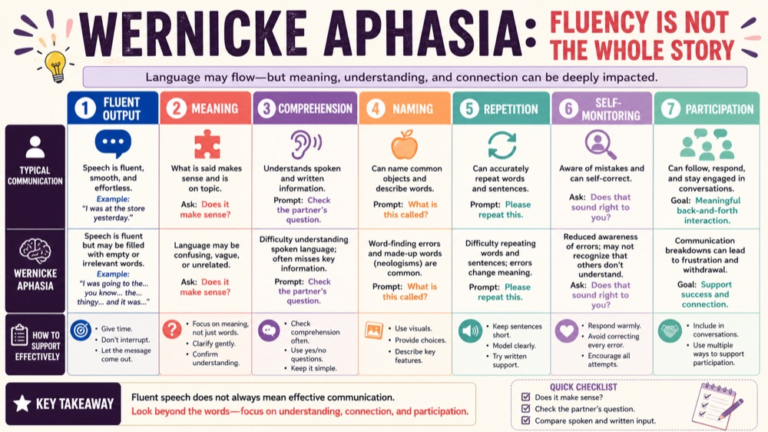
wernicke aphasia is easier to study when it is treated as a connected system rather than a single label. Wernicke aphasia is often introduced through fluent expression with reduced comprehension or meaningful language, but a study answer must look beyond fluency. Examine message content, auditory and reading comprehension, naming, repetition, self-monitoring, literacy, and the communication context.
This learning guide is written for SLP students and other learners reviewing clinical concepts. It uses broad patterns to organize observation, not to make an individualized diagnosis or promise one outcome. Interpretation depends on the person, task, language, culture, hearing, access, health, context, and communication goals.
What wernicke aphasia includes
Begin by separating the concept into domains. A learner who can name the domains is less likely to collapse cognition, language, speech, auditory access, memory, attention, or participation questions into one explanation. The useful unit of analysis is the task: what the person was asked to understand, produce, remember, organize, coordinate, or communicate, with whom, under which conditions, and with what support.
Domain or system
What to notice
Question to carry forward
Fluent expression
Rate, phrase length, prosody, grammar, and amount of speech may appear preserved while meaning and relevance vary.
Is the output fluent, meaningful, informative, and responsive to the partner?
Comprehension
Understanding can differ across single words, syntax, discourse, spoken input, written input, and contextual support.
Which modality, level, or context changes the response?
Naming
Word retrieval and semantic access may affect conversation, description, repetition, reading, and writing.
Does a cue support meaning, phonology, or only a selected response?
Repetition
Repetition may show the interaction of auditory access, language comprehension, phonology, working memory, and speech.
What happens as the material becomes longer, less meaningful, or more complex?
Self-monitoring
Awareness of a message mismatch may vary across tasks, partners, modalities, and levels of support.
Can the person detect, explain, or repair the communication breakdown?
Functional communication
Partner scaffolding, written keywords, visuals, and environmental context may change successful participation.
Which support makes the message and the person’s goal more accessible?
These domains interact, but they should remain distinguishable. A learner may show strength in one task and need support in another. A study map organizes the next observation; it does not answer every assessment question or replace current professional guidance.
Keep the first pass descriptive and close to the communication event. Note the task, the response, the partner, the setting, the timing, the available support, and the consequence for participation. This gives the learner a stable record to compare across tasks and prevents a familiar term from doing too much explanatory work before the evidence has been separated.
For Praxis-style review, a vignette may include several true details but ask for one best interpretation or next step. The strongest answer usually respects the task, identifies the relevant function, checks the most important missing information, and avoids treating one performance sample as the whole profile.
Map Wernicke aphasia
For study purposes, describe the system-function relationship before naming a disorder or subtype. Record what the person understood, produced, initiated, repaired, coordinated, or participated in. Then note whether the task was familiar, how much context was shared, and which support changed the response.
Comprehension: compare words, syntax, discourse, spoken input, written input, and contextual support.
Naming: examine semantic and phonological access across conversation, description, reading, and writing.
Repetition: separate auditory access, comprehension, phonology, working memory, and speech demands.
Self-monitoring: observe whether the person notices, explains, and repairs a mismatch across contexts.
Participation: use partner scaffolding, written keywords, visuals, and environmental support to preserve access.
A strong description is specific enough that another learner could picture the event. Instead of writing “the system is weak,” describe the demand, the observable response, the partner, the context, and the result. This protects clinical reasoning from labels that are broader than the evidence.
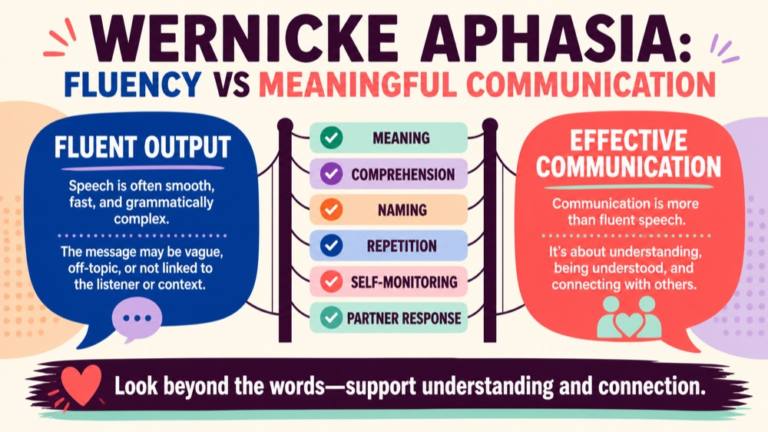
Fluency versus meaningful communication
Context changes what communication requires. A naming task, a listening activity, a multi-step instruction, a narrative, a conversation, and a workplace exchange place different demands on processing, memory, attention, language, motor control, and partner support. Hearing access, fatigue, posture, visual supports, language experience, and the opportunity to request clarification should be part of the observation.
Fluent speech does not automatically mean effective communication. A person may produce a large amount of speech while missing the partner’s question, losing meaning, or showing different performance in quiet conversation, written tasks, or supported interaction. Compare the message, comprehension, cueing, modality, awareness, and participation consequence before treating the pattern as complete.
Observation layer
Example question
Task
What did the person need to understand, produce, organize, coordinate, or repair?
Function
Which cognitive, language, speech, auditory, motor, or access relationship was observable?
Access
Were hearing, visual, motor, sensory, language, respiratory, or environmental supports available?
Participation
What meaningful routine became easier or harder because of the pattern?
Context is not an afterthought added once a label has been selected. It is part of the question itself. If performance changes with a quieter room, extra processing time, a familiar partner, a different communication mode, a changed speaking rate, or a changed task, that change is useful evidence about access and demand. It does not identify a cause by itself, but it tells you which conditions should be carried into the next observation.
Apply the concept in clinical reasoning
When a Praxis-style scenario or clinical discussion presents wernicke aphasia, use a disciplined sequence. The goal is to select the next clinical question or action that matches the evidence, the person’s priorities, and the communication context.
Define the task in plain language.
Identify the domain or domains involved without assuming they are interchangeable.
Separate observation from interpretation and write down what remains unknown.
Check hearing, language experience, culture, communication mode, environment, partner support, alertness, respiration, memory, and task familiarity.
Choose the assessment, collaboration, or observation step that answers the specific question.
State the boundary of the conclusion and keep the person’s participation goal visible.
Fluent speech does not automatically mean effective communication. A person may produce a large amount of speech while missing the partner’s question, losing meaning, or showing different performance in quiet conversation, written tasks, or supported interaction. Compare the message, comprehension, cueing, modality, awareness, and participation consequence before treating the pattern as complete. In a learning answer, the decisive evidence is usually the relationship among the task, the observed pattern, and the next needed information—not a single isolated behavior or label.
Common study mistakes
Equating fluent output with intact comprehension, meaning, or functional communication.
Using one conversational impression without testing words, sentences, discourse, reading, and writing.
Treating poor repetition as a single deficit without separating auditory access, comprehension, phonology, and memory.
Ignoring self-monitoring, repair, partner questions, and the person’s communication priorities.
Confusing language errors with hearing, cognitive-communication, motor-speech, or environmental factors.
Overlooking bilingual language use, culture, literacy, and the effects of context.
Assuming a support that improves one task generalizes to every communication setting.
Selecting a treatment conclusion before the language profile is broad enough to support it.
Most of these mistakes come from replacing a multidomain question with a fast label. Correct the habit by returning to the same sequence: describe, separate, contextualize, ask what is missing, and choose a proportionate next step. A short rationale can make the habit visible: identify the evidence, name the uncertainty, and explain why the selected next step fits both.
Build a quick review map
Use this compact map when reviewing a missed question, a lecture note, or a clinical vignette:
Step 2: Separate comprehension, naming, repetition, literacy, discourse, and self-monitoring.
Step 3: Compare spoken and written input, structured tasks, conversation, and supported interaction.
Step 4: Check hearing, language background, cognition, fatigue, context, and cueing.
Step 5: Record what the person notices, repairs, and communicates successfully.
Step 6: Choose the next observation that clarifies the language or access question.
Then write one transfer sentence: “When I see this pattern, I will first check ___ because ___.” The sentence should identify a decision rule, not repeat a definition. Revisit it after a delay and test whether you can apply the rule to a different task, age group, or communication mode.
Sources and next steps
wernicke aphasia is best learned as a context-sensitive pattern across structure, function, access, and participation. Use the current authority pages to refine the concept, then return to practice scenarios that require you to explain what the evidence supports and what it leaves open.
Start with asha aphasia, ets 5331 study companion. These sources support the learning frame; they do not replace current topic-specific guidance or an individualized evaluation.
Broca Aphasia: Nonfluent Language Patterns and Clinical Context
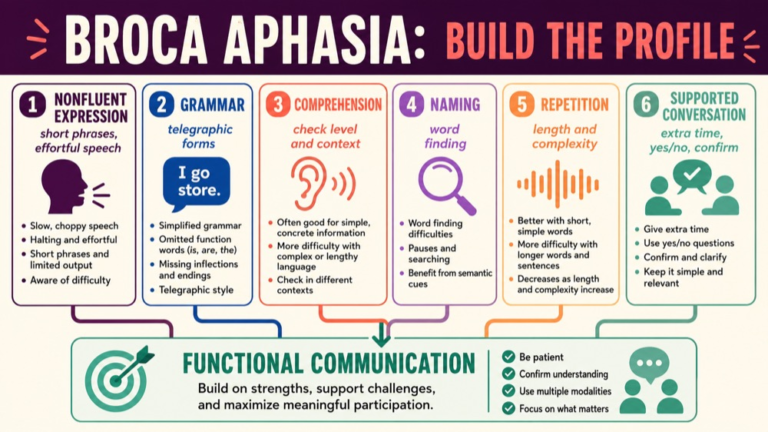
broca aphasia is easier to study when it is treated as a connected system rather than a single label. Broca aphasia is commonly studied through a nonfluent language pattern, but the label does not predict every person’s strengths or needs. Examine connected speech, grammar, naming, comprehension, repetition, reading, writing, motor speech, and functional communication together.
This learning guide is written for SLP students and other learners reviewing clinical concepts. It uses broad patterns to organize observation, not to make an individualized diagnosis or promise one outcome. Interpretation depends on the person, task, language, culture, hearing, access, health, context, and communication goals.
What broca aphasia includes
Begin by separating the concept into domains. A learner who can name the domains is less likely to collapse cognition, language, speech, auditory access, memory, attention, or participation questions into one explanation. The useful unit of analysis is the task: what the person was asked to understand, produce, remember, organize, coordinate, or communicate, with whom, under which conditions, and with what support.
Domain or system
What to notice
Question to carry forward
Connected expression
Speech may be effortful or reduced in phrase length, grammar, rate, or prosody, while meaningful intent may remain strong.
What does the sample show about language form, effort, and message content?
Comprehension
Understanding may vary with sentence length, syntax, discourse, speed, context, and the person’s access to the message.
Which comprehension demands are supported, and which remain uncertain?
Naming and word retrieval
Naming may be slow, cue-responsive, circumlocutory, or affected across spoken and written modalities.
Does cueing change access to the word or only the response format?
Repetition
Repetition can be affected by language formulation, phonology, working memory, auditory access, or speech-motor demands.
What does length and complexity reveal about the breakdown?
Motor speech and literacy
Coexisting motor-speech or reading and writing changes can alter how the language pattern appears.
What should be separated before attributing every error to aphasia?
Functional communication
Supported conversation, writing, gesture, AAC, and partner behavior may change participation substantially.
Which mode and partner support the person’s real communication goal?
These domains interact, but they should remain distinguishable. A learner may show strength in one task and need support in another. A study map organizes the next observation; it does not answer every assessment question or replace current professional guidance.
Keep the first pass descriptive and close to the communication event. Note the task, the response, the partner, the setting, the timing, the available support, and the consequence for participation. This gives the learner a stable record to compare across tasks and prevents a familiar term from doing too much explanatory work before the evidence has been separated.
For Praxis-style review, a vignette may include several true details but ask for one best interpretation or next step. The strongest answer usually respects the task, identifies the relevant function, checks the most important missing information, and avoids treating one performance sample as the whole profile.
Map Broca aphasia
For study purposes, describe the system-function relationship before naming a disorder or subtype. Record what the person understood, produced, initiated, repaired, coordinated, or participated in. Then note whether the task was familiar, how much context was shared, and which support changed the response.
Connected expression: describe phrase length, grammar, effort, rate, prosody, and meaning rather than relying on the word nonfluent.
Comprehension: compare words, sentences, discourse, speed, syntax, context, and modality.
Naming: test retrieval with description, semantic cues, phonological cues, written choices, and functional messages.
Repetition: separate language, phonology, auditory access, working memory, and speech-motor demands.
Motor speech and literacy: examine dysarthria, acquired apraxia of speech, reading, and writing as related but distinct questions.
Participation: use supported conversation, writing, gesture, AAC, and partner strategies to preserve communication access.
A strong description is specific enough that another learner could picture the event. Instead of writing “the system is weak,” describe the demand, the observable response, the partner, the context, and the result. This protects clinical reasoning from labels that are broader than the evidence.
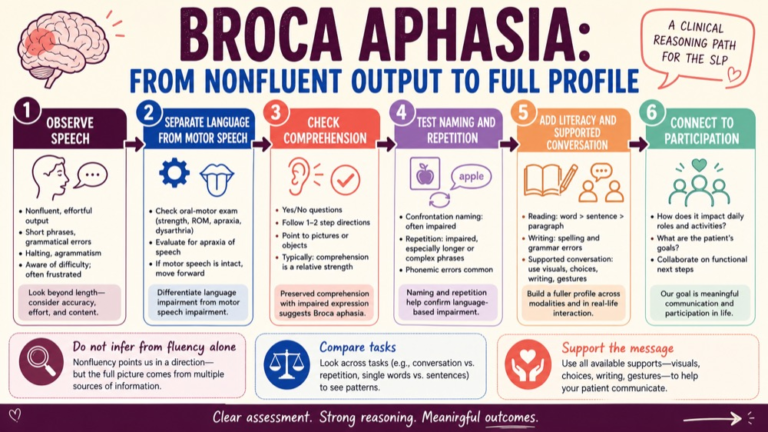
From nonfluent output to full profile
Context changes what communication requires. A naming task, a listening activity, a multi-step instruction, a narrative, a conversation, and a workplace exchange place different demands on processing, memory, attention, language, motor control, and partner support. Hearing access, fatigue, posture, visual supports, language experience, and the opportunity to request clarification should be part of the observation.
An effortful speech sample may coexist with useful comprehension, strong communicative intent, naming variability, reading and writing differences, or a motor-speech component. The pattern can also change with sentence complexity, cueing, fatigue, partner support, and communication mode. Treat the label as a hypothesis that organizes the next observation, not as a complete prediction of the person’s profile.
Observation layer
Example question
Task
What did the person need to understand, produce, organize, coordinate, or repair?
Function
Which cognitive, language, speech, auditory, motor, or access relationship was observable?
Access
Were hearing, visual, motor, sensory, language, respiratory, or environmental supports available?
Participation
What meaningful routine became easier or harder because of the pattern?
Context is not an afterthought added once a label has been selected. It is part of the question itself. If performance changes with a quieter room, extra processing time, a familiar partner, a different communication mode, a changed speaking rate, or a changed task, that change is useful evidence about access and demand. It does not identify a cause by itself, but it tells you which conditions should be carried into the next observation.
Apply the concept in clinical reasoning
When a Praxis-style scenario or clinical discussion presents broca aphasia, use a disciplined sequence. The goal is to select the next clinical question or action that matches the evidence, the person’s priorities, and the communication context.
Define the task in plain language.
Identify the domain or domains involved without assuming they are interchangeable.
Separate observation from interpretation and write down what remains unknown.
Check hearing, language experience, culture, communication mode, environment, partner support, alertness, respiration, memory, and task familiarity.
Choose the assessment, collaboration, or observation step that answers the specific question.
State the boundary of the conclusion and keep the person’s participation goal visible.
An effortful speech sample may coexist with useful comprehension, strong communicative intent, naming variability, reading and writing differences, or a motor-speech component. The pattern can also change with sentence complexity, cueing, fatigue, partner support, and communication mode. Treat the label as a hypothesis that organizes the next observation, not as a complete prediction of the person’s profile. In a learning answer, the decisive evidence is usually the relationship among the task, the observed pattern, and the next needed information—not a single isolated behavior or label.
Common study mistakes
Equating nonfluent output with absent comprehension or absent communicative intent.
Assuming every articulation-like error is aphasia without considering acquired apraxia of speech or dysarthria.
Using one short phrase to represent connected discourse, conversation, or functional communication.
Treating a historical label as more important than the current language sample and goals.
Overlooking bilingual language use, literacy, culture, and communication access.
Choosing an intervention before identifying the specific language or motor-speech barrier.
Assuming a supported response proves independent communication is intact.
Most of these mistakes come from replacing a multidomain question with a fast label. Correct the habit by returning to the same sequence: describe, separate, contextualize, ask what is missing, and choose a proportionate next step. A short rationale can make the habit visible: identify the evidence, name the uncertainty, and explain why the selected next step fits both.
Build a quick review map
Use this compact map when reviewing a missed question, a lecture note, or a clinical vignette:
Step 1: Describe connected speech, message content, partner, task, and communication goal.
Step 2: Separate fluency, grammar, naming, comprehension, repetition, literacy, and motor speech.
Step 3: Compare spontaneous language with structured tasks and supported conversation.
Step 4: Check cueing, hearing, language background, fatigue, motor speech, and context.
Step 5: Record which communication modes increase access and which barriers remain.
Step 6: Use the next observation to test the specific uncertainty rather than the label as a whole.
Then write one transfer sentence: “When I see this pattern, I will first check ___ because ___.” The sentence should identify a decision rule, not repeat a definition. Revisit it after a delay and test whether you can apply the rule to a different task, age group, or communication mode.
Sources and next steps
broca aphasia is best learned as a context-sensitive pattern across structure, function, access, and participation. Use the current authority pages to refine the concept, then return to practice scenarios that require you to explain what the evidence supports and what it leaves open.
Start with asha aphasia, ets 5331 study companion. These sources support the learning frame; they do not replace current topic-specific guidance or an individualized evaluation.
Aphasia Classification: Fluency, Comprehension, and Repetition
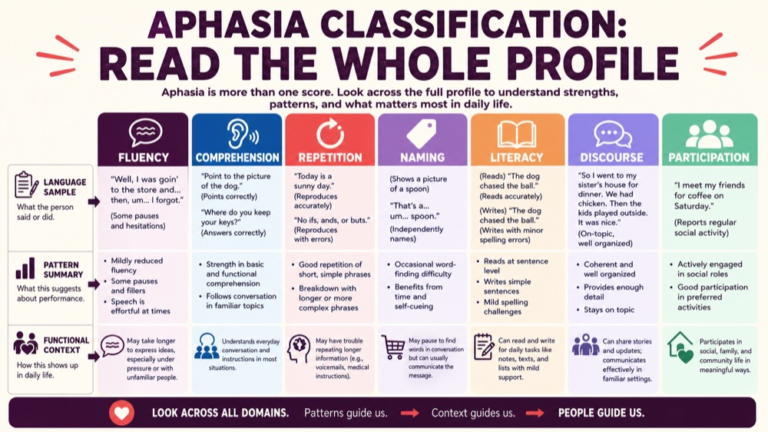
aphasia classification is easier to study when it is treated as a connected system rather than a single label. Aphasia classification is a way to organize language patterns across connected speech, comprehension, repetition, naming, reading, writing, and discourse. It is a study map, not a rigid box: the full profile, the communication context, and the person’s priorities matter more than a single label.
This learning guide is written for SLP students and other learners reviewing clinical concepts. It uses broad patterns to organize observation, not to make an individualized diagnosis or promise one outcome. Interpretation depends on the person, task, language, culture, hearing, access, health, context, and communication goals.
What aphasia classification includes
Begin by separating the concept into domains. A learner who can name the domains is less likely to collapse cognition, language, speech, auditory access, memory, attention, or participation questions into one explanation. The useful unit of analysis is the task: what the person was asked to understand, produce, remember, organize, coordinate, or communicate, with whom, under which conditions, and with what support.
Domain or system
What to notice
Question to carry forward
Fluency
Connected speech is described by phrase length, effort, grammar, rate, prosody, and meaningful content.
What does the language sample show beyond the amount of speech?
Comprehension
Understanding is compared across words, sentences, discourse, spoken input, written input, and contextual support.
Which level, modality, or support changes comprehension?
Repetition
Words and sentences place interacting demands on auditory access, language, phonology, working memory, and speech.
What changes with length, complexity, meaning, and cueing?
Naming
Word retrieval can be examined through confrontation naming, discourse, description, cues, and alternative modalities.
Is the barrier semantic access, phonological access, retrieval, or motor speech?
Literacy and discourse
Reading, writing, narrative, conversation, and functional messages may reveal related or modality-specific patterns.
What does the broader language sample add to the classification?
Function and participation
Partners, goals, environment, repair, and communication access determine the practical impact of the profile.
How does the pattern affect meaningful communication?
These domains interact, but they should remain distinguishable. A learner may show strength in one task and need support in another. A study map organizes the next observation; it does not answer every assessment question or replace current professional guidance.
Keep the first pass descriptive and close to the communication event. Note the task, the response, the partner, the setting, the timing, the available support, and the consequence for participation. This gives the learner a stable record to compare across tasks and prevents a familiar term from doing too much explanatory work before the evidence has been separated.
For Praxis-style review, a vignette may include several true details but ask for one best interpretation or next step. The strongest answer usually respects the task, identifies the relevant function, checks the most important missing information, and avoids treating one performance sample as the whole profile.
Map aphasia classification
For study purposes, describe the system-function relationship before naming a disorder or subtype. Record what the person understood, produced, initiated, repaired, coordinated, or participated in. Then note whether the task was familiar, how much context was shared, and which support changed the response.
Fluency: describe connected speech amount, phrase length, effort, grammar, rate, prosody, and meaning together.
Comprehension: compare words, sentences, discourse, spoken input, written input, and contextual support.
Repetition: consider length, complexity, meaning, phonology, auditory access, working memory, and speech-motor demands.
Naming: examine word retrieval, semantic access, phonological access, cueing, and modality.
Literacy and discourse: use reading, writing, narrative, conversation, and functional messages to broaden the profile.
Participation: connect the language pattern with partners, goals, repair, environment, culture, and communication access.
A strong description is specific enough that another learner could picture the event. Instead of writing “the system is weak,” describe the demand, the observable response, the partner, the context, and the result. This protects clinical reasoning from labels that are broader than the evidence.
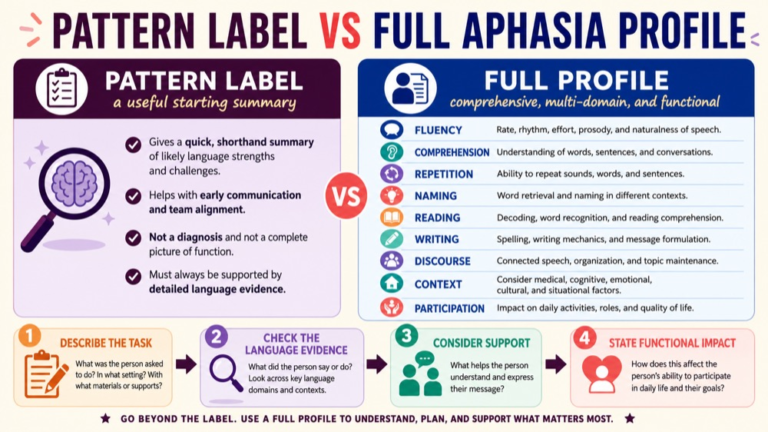
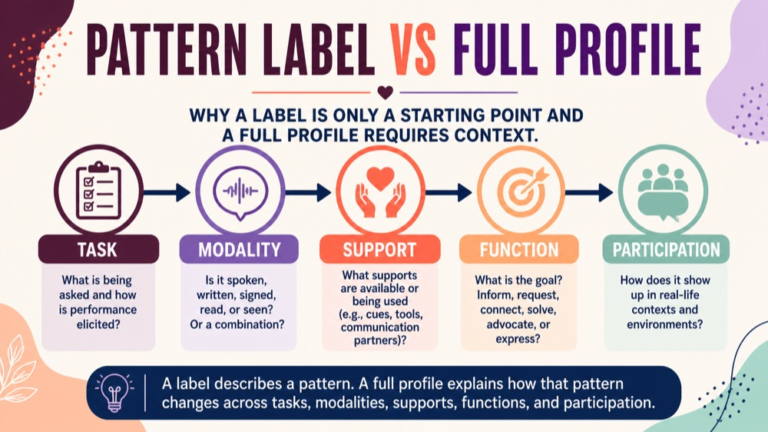
Pattern label versus full profile
Context changes what communication requires. A naming task, a listening activity, a multi-step instruction, a narrative, a conversation, and a workplace exchange place different demands on processing, memory, attention, language, motor control, and partner support. Hearing access, fatigue, posture, visual supports, language experience, and the opportunity to request clarification should be part of the observation.
A person may have relatively fluent output with reduced meaning, effortful output with stronger single-word comprehension, or a mixed profile that does not fit one neat category. Repetition, naming, reading, writing, and discourse may also diverge. These contrasts are why a classification should be anchored to a broad language profile and revisited when new task or participation evidence appears.
Observation layer
Example question
Task
What did the person need to understand, produce, organize, coordinate, or repair?
Function
Which cognitive, language, speech, auditory, motor, or access relationship was observable?
Access
Were hearing, visual, motor, sensory, language, respiratory, or environmental supports available?
Participation
What meaningful routine became easier or harder because of the pattern?
Context is not an afterthought added once a label has been selected. It is part of the question itself. If performance changes with a quieter room, extra processing time, a familiar partner, a different communication mode, a changed speaking rate, or a changed task, that change is useful evidence about access and demand. It does not identify a cause by itself, but it tells you which conditions should be carried into the next observation.
Apply the concept in clinical reasoning
When a Praxis-style scenario or clinical discussion presents aphasia classification, use a disciplined sequence. The goal is to select the next clinical question or action that matches the evidence, the person’s priorities, and the communication context.
Define the task in plain language.
Identify the domain or domains involved without assuming they are interchangeable.
Separate observation from interpretation and write down what remains unknown.
Check hearing, language experience, culture, communication mode, environment, partner support, alertness, respiration, memory, and task familiarity.
Choose the assessment, collaboration, or observation step that answers the specific question.
State the boundary of the conclusion and keep the person’s participation goal visible.
A person may have relatively fluent output with reduced meaning, effortful output with stronger single-word comprehension, or a mixed profile that does not fit one neat category. Repetition, naming, reading, writing, and discourse may also diverge. These contrasts are why a classification should be anchored to a broad language profile and revisited when new task or participation evidence appears. In a learning answer, the decisive evidence is usually the relationship among the task, the observed pattern, and the next needed information—not a single isolated behavior or label.
Common study mistakes
Treating aphasia classifications as mutually exclusive boxes that describe every person completely.
Using fluency alone to assign a classification without examining meaning, comprehension, and language form.
Confusing aphasia with dysarthria, acquired apraxia of speech, hearing loss, or cognitive-communication change.
Assuming repetition performance represents spontaneous language or functional conversation.
Ignoring reading, writing, gestures, AAC, discourse, partners, and communication environment.
Overlooking language background, bilingual use, culture, literacy, education, and personal goals.
Using a label without describing severity, variability, facilitators, and participation impact.
Choosing treatment or counseling before the language profile and priorities are clear.
Most of these mistakes come from replacing a multidomain question with a fast label. Correct the habit by returning to the same sequence: describe, separate, contextualize, ask what is missing, and choose a proportionate next step. A short rationale can make the habit visible: identify the evidence, name the uncertainty, and explain why the selected next step fits both.
Build a quick review map
Use this compact map when reviewing a missed question, a lecture note, or a clinical vignette:
Step 1: Describe the language sample, modality, partner, task, and participation goal.
Step 2: Separate fluency, comprehension, repetition, naming, discourse, reading, and writing.
Step 3: Compare structured tasks with spontaneous communication and supported conversation.
Step 4: Check hearing, vision, motor speech, cognition, language background, culture, and literacy.
Step 5: Use classifications as provisional pattern summaries rather than complete explanations.
Step 6: State the functional impact, helpful supports, and next needed evidence.
Then write one transfer sentence: “When I see this pattern, I will first check ___ because ___.” The sentence should identify a decision rule, not repeat a definition. Revisit it after a delay and test whether you can apply the rule to a different task, age group, or communication mode.
Sources and next steps
aphasia classification is best learned as a context-sensitive pattern across structure, function, access, and participation. Use the current authority pages to refine the concept, then return to practice scenarios that require you to explain what the evidence supports and what it leaves open.
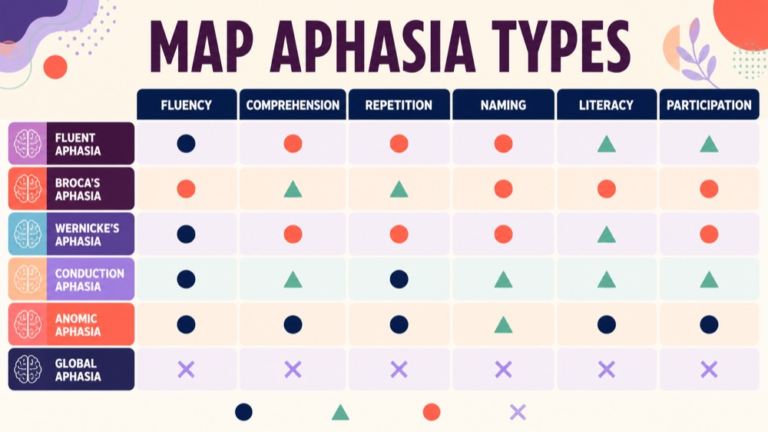
Aphasia Types: Language Patterns, Limits, and Functional Context
aphasia types is easier to study when it is treated as a connected system rather than a single label. Aphasia types are study labels for patterns across language expression and comprehension, but no label replaces a complete profile. For SLP exam review, compare fluency, comprehension, repetition, naming, discourse, reading, writing, and functional communication.
This learning guide is written for SLP students and other learners reviewing clinical concepts. It uses broad patterns to organize observation, not to make an individualized diagnosis or promise one outcome. Interpretation depends on the person, task, language, culture, hearing, access, health, context, and communication goals.
What aphasia types includes
Begin by separating the concept into domains. A learner who can name the domains is less likely to collapse cognition, language, speech, auditory access, memory, attention, or participation questions into one explanation. The useful unit of analysis is the task: what the person was asked to understand, produce, remember, organize, coordinate, or communicate, with whom, under which conditions, and with what support.
Domain or system
What to notice
Question to carry forward
Fluency
Speech output may vary in phrase length, effort, grammatical form, rate, and melodic pattern.
What does the connected sample show beyond the amount of speech?
Comprehension
Understanding must be checked across words, sentences, discourse, spoken and written input, and context.
Which level, modality, or contextual support changes comprehension?
Repetition
Repeating words, sentences, and connected material tests several interacting language and speech demands.
What changes with length, complexity, meaning, or cueing?
Naming and word retrieval
Word access may be slow, circumlocutory, cue-responsive, or affected across modalities.
Is the issue retrieval, meaning, phonology, access, or motor speech?
Reading and writing
Written language can show related, different, or modality-specific strengths and needs.
What does the written modality add to the language profile?
Functional communication
The person’s goals, partners, environment, and strategies shape the impact of the language pattern.
How does the profile affect meaningful participation and repair?
These domains interact, but they should remain distinguishable. A learner may show strength in one task and need support in another. A study map organizes the next observation; it does not answer every assessment question or replace current professional guidance.
Keep the first pass descriptive and close to the communication event. Note the task, the response, the partner, the setting, the timing, the available support, and the consequence for participation. This gives the learner a stable record to compare across tasks and prevents a familiar term from doing too much explanatory work before the evidence has been separated.
For Praxis-style review, a vignette may include several true details but ask for one best interpretation or next step. The strongest answer usually respects the task, identifies the relevant function, checks the most important missing information, and avoids treating one performance sample as the whole profile.
Map aphasia types
For study purposes, describe the system-function relationship before naming a disorder or subtype. Record what the person understood, produced, initiated, repaired, coordinated, or participated in. Then note whether the task was familiar, how much context was shared, and which support changed the response.
Fluency: connected speech amount, phrase length, effort, grammar, rate, and prosody are described together.
Comprehension: words, sentences, discourse, spoken input, written input, and contextual support are compared.
Repetition: length, complexity, meaning, phonology, auditory access, and speech-motor demands can interact.
Naming: word retrieval, semantic access, phonological access, cueing, and modality are examined.
Literacy: reading and writing may reveal related, different, or modality-specific language patterns.
Participation: partners, goals, repair, environment, culture, and communication access define functional impact.
A strong description is specific enough that another learner could picture the event. Instead of writing “the system is weak,” describe the demand, the observable response, the partner, the context, and the result. This protects clinical reasoning from labels that are broader than the evidence.
Pattern label versus full profile
Context changes what communication requires. A naming task, a listening activity, a multi-step instruction, a narrative, a conversation, and a workplace exchange place different demands on processing, memory, attention, language, motor control, and partner support. Hearing access, fatigue, posture, visual supports, language experience, and the opportunity to request clarification should be part of the observation.
A person may have fluent output with reduced meaning, effortful output with relatively strong single-word comprehension, or a mixed profile that does not fit a neat category. Repetition, naming, reading, writing, and discourse may also diverge. These contrasts are why type labels should be treated as provisional study maps and anchored to a broad, person-centered language profile.
Observation layer
Example question
Task
What did the person need to understand, produce, organize, coordinate, or repair?
Function
Which cognitive, language, speech, auditory, motor, or access relationship was observable?
Access
Were hearing, visual, motor, sensory, language, respiratory, or environmental supports available?
Participation
What meaningful routine became easier or harder because of the pattern?
Context is not an afterthought added once a label has been selected. It is part of the question itself. If performance changes with a quieter room, extra processing time, a familiar partner, a different communication mode, a changed speaking rate, or a changed task, that change is useful evidence about access and demand. It does not identify a cause by itself, but it tells you which conditions should be carried into the next observation.
Apply the concept in clinical reasoning
When a Praxis-style scenario or clinical discussion presents aphasia types, use a disciplined sequence. The goal is to select the next clinical question or action that matches the evidence, the person’s priorities, and the communication context.
Define the task in plain language.
Identify the domain or domains involved without assuming they are interchangeable.
Separate observation from interpretation and write down what remains unknown.
Check hearing, language experience, culture, communication mode, environment, partner support, alertness, respiration, memory, and task familiarity.
Choose the assessment, collaboration, or observation step that answers the specific question.
State the boundary of the conclusion and keep the person’s participation goal visible.
A person may have fluent output with reduced meaning, effortful output with relatively strong single-word comprehension, or a mixed profile that does not fit a neat category. Repetition, naming, reading, writing, and discourse may also diverge. These contrasts are why type labels should be treated as provisional study maps and anchored to a broad, person-centered language profile. In a learning answer, the decisive evidence is usually the relationship among the task, the observed pattern, and the next needed information—not a single isolated behavior or label.
Common study mistakes
Treating aphasia types as mutually exclusive boxes that describe every person completely.
Using fluency alone to determine a type without examining meaning, comprehension, and language form.
Confusing aphasia with dysarthria, acquired apraxia of speech, hearing loss, or cognitive-communication change.
Assuming repetition performance represents spontaneous language or functional conversation.
Ignoring reading, writing, gestures, AAC, discourse, partners, and communication environment.
Overlooking language background, bilingual use, culture, literacy, education, and personal goals.
Using a label without describing severity, variability, facilitators, and participation impact.
Choosing treatment or counseling before the language profile and priorities are clear.
Most of these mistakes come from replacing a multidomain question with a fast label. Correct the habit by returning to the same sequence: describe, separate, contextualize, ask what is missing, and choose a proportionate next step. A short rationale can make the habit visible: identify the evidence, name the uncertainty, and explain why the selected next step fits both.
Build a quick review map
Use this compact map when reviewing a missed question, a lecture note, or a clinical vignette:
Step 1: Describe the language sample, modality, partner, task, and participation goal.
Step 2: Separate fluency, comprehension, repetition, naming, discourse, reading, and writing.
Step 3: Compare structured tasks with spontaneous communication and supported conversation.
Step 4: Check hearing, vision, motor speech, cognition, language background, culture, and literacy.
Step 5: Use type labels as provisional pattern summaries rather than complete explanations.
Step 6: State the functional impact, helpful supports, and next needed evidence.
Then write one transfer sentence: “When I see this pattern, I will first check ___ because ___.” The sentence should identify a decision rule, not repeat a definition. Revisit it after a delay and test whether you can apply the rule to a different task, age group, or communication mode.
Sources and next steps
aphasia types is best learned as a context-sensitive pattern across structure, function, access, and participation. Use the current authority pages to refine the concept, then return to practice scenarios that require you to explain what the evidence supports and what it leaves open.
Memory and Language: Encoding, Retrieval, and Context
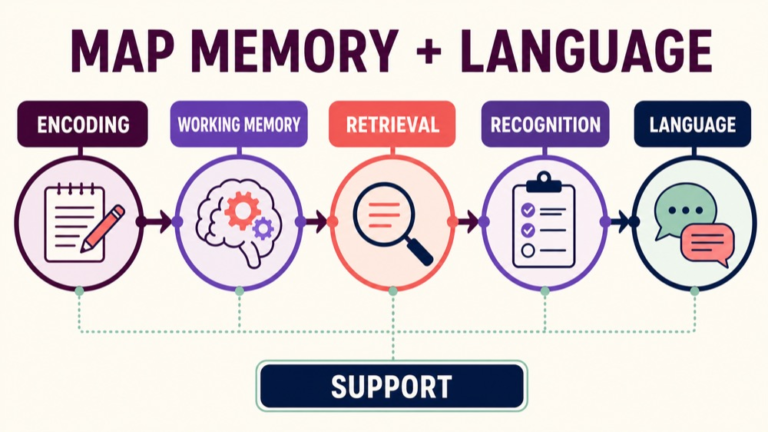
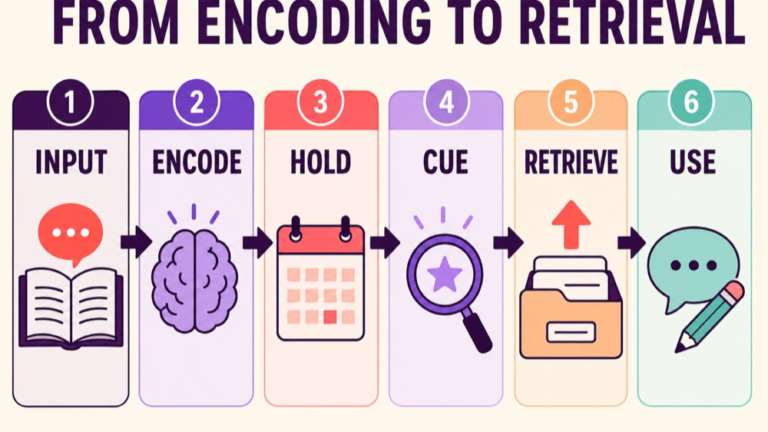
memory and language is easier to study when it is treated as a connected system rather than a single label. Memory and language interact whenever a person must hold a sound, word, sentence, story, instruction, or conversation thread long enough to use it. A strong study map distinguishes encoding, working memory, retrieval, recognition, language representation, and the context that supports access.
This learning guide is written for SLP students and other learners reviewing clinical concepts. It uses broad patterns to organize observation, not to make an individualized diagnosis or promise one outcome. Interpretation depends on the person, task, language, culture, hearing, access, health, context, and communication goals.
What memory and language includes
Begin by separating the concept into domains. A learner who can name the domains is less likely to collapse cognition, language, speech, auditory access, memory, attention, or participation questions into one explanation. The useful unit of analysis is the task: what the person was asked to understand, produce, remember, organize, coordinate, or communicate, with whom, under which conditions, and with what support.
Domain or system
What to notice
Question to carry forward
Encoding
Attention and meaning help information become available for later use.
Was the message noticed, understood, organized, and connected to prior knowledge?
Working memory
Sounds, words, steps, and relationships are held and manipulated while the task continues.
How much information must be held, updated, reordered, or integrated?
Retrieval
A person accesses a word, fact, sequence, or strategy when it is needed.
Is the information unavailable, slow to retrieve, or accessible with a cue?
Recognition
A cue or choice may make previously encountered information easier to identify than to produce freely.
Does recognition exceed free recall, and what does that comparison show?
Language representation
Phonology, vocabulary, syntax, semantics, and discourse use memory in different ways.
Which language level and modality carry the memory demand?
Context and support
Repetition, visual cues, written information, routines, and partner support can change access.
Which support improves participation without hiding the communication goal?
These domains interact, but they should remain distinguishable. A learner may show strength in one task and need support in another. A study map organizes the next observation; it does not answer every assessment question or replace current professional guidance.
Keep the first pass descriptive and close to the communication event. Note the task, the response, the partner, the setting, the timing, the available support, and the consequence for participation. This gives the learner a stable record to compare across tasks and prevents a familiar term from doing too much explanatory work before the evidence has been separated.
For Praxis-style review, a vignette may include several true details but ask for one best interpretation or next step. The strongest answer usually respects the task, identifies the relevant function, checks the most important missing information, and avoids treating one performance sample as the whole profile.
Map memory and language
For study purposes, describe the system-function relationship before naming a disorder or subtype. Record what the person understood, produced, initiated, repaired, coordinated, or participated in. Then note whether the task was familiar, how much context was shared, and which support changed the response.
Encoding: attending to, organizing, and connecting information so it can be used later.
Working memory: holding and manipulating sounds, words, steps, and relationships during communication.
Retrieval: accessing a word, fact, sequence, story element, or strategy when needed.
Recognition: identifying information with a cue or choice and comparing it with free recall.
Language representation: using memory across phonology, vocabulary, syntax, semantics, discourse, reading, and writing.
Support and context: repetition, visuals, written language, routines, partners, and environmental conditions alter access.
A strong description is specific enough that another learner could picture the event. Instead of writing “the system is weak,” describe the demand, the observable response, the partner, the context, and the result. This protects clinical reasoning from labels that are broader than the evidence.
From encoding to retrieval
Context changes what communication requires. A naming task, a listening activity, a multi-step instruction, a narrative, a conversation, and a workplace exchange place different demands on processing, memory, attention, language, motor control, and partner support. Hearing access, fatigue, posture, visual supports, language experience, and the opportunity to request clarification should be part of the observation.
A person may understand a short instruction but lose the last step, recognize a word when shown a choice but not retrieve it freely, or remember a routine better than a novel conversation. These contrasts help define the memory and language demand. They do not identify a cause by themselves. Compare length, delay, cueing, modality, meaning, attention, and participation before interpreting the pattern.
Observation layer
Example question
Task
What did the person need to understand, produce, organize, coordinate, or repair?
Function
Which cognitive, language, speech, auditory, motor, or access relationship was observable?
Access
Were hearing, visual, motor, sensory, language, respiratory, or environmental supports available?
Participation
What meaningful routine became easier or harder because of the pattern?
Context is not an afterthought added once a label has been selected. It is part of the question itself. If performance changes with a quieter room, extra processing time, a familiar partner, a different communication mode, a changed speaking rate, or a changed task, that change is useful evidence about access and demand. It does not identify a cause by itself, but it tells you which conditions should be carried into the next observation.
Apply the concept in clinical reasoning
When a Praxis-style scenario or clinical discussion presents memory and language, use a disciplined sequence. The goal is to select the next clinical question or action that matches the evidence, the person’s priorities, and the communication context.
Define the task in plain language.
Identify the domain or domains involved without assuming they are interchangeable.
Separate observation from interpretation and write down what remains unknown.
Check hearing, language experience, culture, communication mode, environment, partner support, alertness, respiration, memory, and task familiarity.
Choose the assessment, collaboration, or observation step that answers the specific question.
State the boundary of the conclusion and keep the person’s participation goal visible.
A person may understand a short instruction but lose the last step, recognize a word when shown a choice but not retrieve it freely, or remember a routine better than a novel conversation. These contrasts help define the memory and language demand. They do not identify a cause by themselves. Compare length, delay, cueing, modality, meaning, attention, and participation before interpreting the pattern. In a learning answer, the decisive evidence is usually the relationship among the task, the observed pattern, and the next needed information—not a single isolated behavior or label.
Common study mistakes
Treating memory as one ability rather than encoding, working memory, retrieval, recognition, and learning.
Confusing a language formulation problem with failure to store or retrieve information.
Assuming a cue-dependent success proves independent communication is intact.
Ignoring attention, hearing, vision, fatigue, anxiety, sleep, and environmental distraction.
Using one list-learning task to predict narrative, classroom, work, or conversation performance.
Overlooking the effects of language, culture, literacy, familiarity, and communication mode.
Describing recall without asking what the person needs to participate safely and effectively.
Adding external supports without naming the target and the intended transfer.
Most of these mistakes come from replacing a multidomain question with a fast label. Correct the habit by returning to the same sequence: describe, separate, contextualize, ask what is missing, and choose a proportionate next step. A short rationale can make the habit visible: identify the evidence, name the uncertainty, and explain why the selected next step fits both.
Build a quick review map
Use this compact map when reviewing a missed question, a lecture note, or a clinical vignette:
Step 1: Define the message, delay, modality, cue, partner, and communication goal.
Step 2: Separate encoding, working memory, retrieval, recognition, language representation, and support.
Step 5: Describe the participation consequence and the person’s preferred support.
Step 6: Choose the next comparison that distinguishes memory access from language access.
Then write one transfer sentence: “When I see this pattern, I will first check ___ because ___.” The sentence should identify a decision rule, not repeat a definition. Revisit it after a delay and test whether you can apply the rule to a different task, age group, or communication mode.
Sources and next steps
memory and language is best learned as a context-sensitive pattern across structure, function, access, and participation. Use the current authority pages to refine the concept, then return to practice scenarios that require you to explain what the evidence supports and what it leaves open.
Start with asha tbi adults, asha aphasia, asha spoken language. These sources support the learning frame; they do not replace current topic-specific guidance or an individualized evaluation.
Executive Function and Communication: Plan, Monitor, and Repair
executive function and communication is easier to study when it is treated as a connected system rather than a single label. Executive function and communication meet whenever a person must set a goal, start an exchange, organize information, shift with a partner, monitor the message, and repair a breakdown. Study the observable behavior and task demand rather than reducing executive function to one vague label.
This learning guide is written for SLP students and other learners reviewing clinical concepts. It uses broad patterns to organize observation, not to make an individualized diagnosis or promise one outcome. Interpretation depends on the person, task, language, culture, hearing, access, health, context, and communication goals.
What executive function and communication includes
Begin by separating the concept into domains. A learner who can name the domains is less likely to collapse cognition, language, speech, auditory access, memory, attention, or participation questions into one explanation. The useful unit of analysis is the task: what the person was asked to understand, produce, remember, organize, coordinate, or communicate, with whom, under which conditions, and with what support.
Domain or system
What to notice
Question to carry forward
Initiation
The person begins a message, task, response, or strategy without losing the goal.
Is the barrier starting, understanding the goal, accessing language, or acting?
Inhibition
Competing responses, impulses, or irrelevant details are managed so the message remains useful.
What competing response or distraction changes the outcome?
Planning and organization
Ideas, steps, materials, and time are arranged toward a communication goal.
Can the person generate a plan and keep the important sequence visible?
Shifting
The person adjusts when the topic, rule, listener, or task demand changes.
What changes when the partner introduces new information?
Monitoring
The speaker or listener notices whether the message is clear, relevant, accurate, and complete.
Can the person detect a mismatch between the goal and the message?
Repair and participation
Clarification, rephrasing, checking, and strategy use keep communication moving.
Which repair helps in the real environment and with the real partner?
These domains interact, but they should remain distinguishable. A learner may show strength in one task and need support in another. A study map organizes the next observation; it does not answer every assessment question or replace current professional guidance.
Keep the first pass descriptive and close to the communication event. Note the task, the response, the partner, the setting, the timing, the available support, and the consequence for participation. This gives the learner a stable record to compare across tasks and prevents a familiar term from doing too much explanatory work before the evidence has been separated.
For Praxis-style review, a vignette may include several true details but ask for one best interpretation or next step. The strongest answer usually respects the task, identifies the relevant function, checks the most important missing information, and avoids treating one performance sample as the whole profile.
Map executive function
For study purposes, describe the system-function relationship before naming a disorder or subtype. Record what the person understood, produced, initiated, repaired, coordinated, or participated in. Then note whether the task was familiar, how much context was shared, and which support changed the response.
Initiation: starting the task, response, message, or strategy in relation to a goal.
Inhibition: suppressing competing responses and maintaining relevance to the listener and situation.
Planning: setting a goal, sequencing steps, predicting demands, and selecting a strategy.
Shifting: changing topic, rule, perspective, strategy, or response when the situation changes.
Monitoring: checking accuracy, relevance, clarity, completion, and the listener’s response.
Repair: asking for clarification, rephrasing, checking, and adapting communication for participation.
A strong description is specific enough that another learner could picture the event. Instead of writing “the system is weak,” describe the demand, the observable response, the partner, the context, and the result. This protects clinical reasoning from labels that are broader than the evidence.
Plan, monitor, and repair
Context changes what communication requires. A naming task, a listening activity, a multi-step instruction, a narrative, a conversation, and a workplace exchange place different demands on processing, memory, attention, language, motor control, and partner support. Hearing access, fatigue, posture, visual supports, language experience, and the opportunity to request clarification should be part of the observation.
A person may plan a message successfully in a quiet structured task but fail to shift when a partner changes the topic, or may notice a breakdown only after the conversation has moved on. These patterns are clues about task demands and supports, not standalone explanations. Compare initiation, monitoring, shifting, memory, language, and environmental load across meaningful routines.
Observation layer
Example question
Task
What did the person need to understand, produce, organize, coordinate, or repair?
Function
Which cognitive, language, speech, auditory, motor, or access relationship was observable?
Access
Were hearing, visual, motor, sensory, language, respiratory, or environmental supports available?
Participation
What meaningful routine became easier or harder because of the pattern?
Context is not an afterthought added once a label has been selected. It is part of the question itself. If performance changes with a quieter room, extra processing time, a familiar partner, a different communication mode, a changed speaking rate, or a changed task, that change is useful evidence about access and demand. It does not identify a cause by itself, but it tells you which conditions should be carried into the next observation.
Apply the concept in clinical reasoning
When a Praxis-style scenario or clinical discussion presents executive function and communication, use a disciplined sequence. The goal is to select the next clinical question or action that matches the evidence, the person’s priorities, and the communication context.
Define the task in plain language.
Identify the domain or domains involved without assuming they are interchangeable.
Separate observation from interpretation and write down what remains unknown.
Check hearing, language experience, culture, communication mode, environment, partner support, alertness, respiration, memory, and task familiarity.
Choose the assessment, collaboration, or observation step that answers the specific question.
State the boundary of the conclusion and keep the person’s participation goal visible.
A person may plan a message successfully in a quiet structured task but fail to shift when a partner changes the topic, or may notice a breakdown only after the conversation has moved on. These patterns are clues about task demands and supports, not standalone explanations. Compare initiation, monitoring, shifting, memory, language, and environmental load across meaningful routines. In a learning answer, the decisive evidence is usually the relationship among the task, the observed pattern, and the next needed information—not a single isolated behavior or label.
Common study mistakes
Treating executive function as a single frontal skill with one predictable presentation.
Confusing lack of initiation with lack of comprehension, language access, motivation, or opportunity.
Ignoring the listener, social context, culture, and communication purpose.
Assuming a checklist performance predicts dynamic conversation or workplace behavior.
Changing multiple supports at once so the useful strategy cannot be identified.
Overlooking fatigue, stress, pain, medication, hearing, and environmental distraction.
Describing the behavior without linking it to repair, safety, learning, work, or relationships.
Choosing a strategy before stating the goal and the observable barrier.
Most of these mistakes come from replacing a multidomain question with a fast label. Correct the habit by returning to the same sequence: describe, separate, contextualize, ask what is missing, and choose a proportionate next step. A short rationale can make the habit visible: identify the evidence, name the uncertainty, and explain why the selected next step fits both.
Build a quick review map
Use this compact map when reviewing a missed question, a lecture note, or a clinical vignette:
Step 1: Name the goal, partner, task, context, and consequence of the communication behavior.
Step 2: Separate initiation, inhibition, planning, shifting, monitoring, and repair.
Step 3: Compare structured tasks with conversation, collaboration, and real-world routines.
Step 5: Describe what support changes the behavior and what remains difficult.
Step 6: Match the next assessment or strategy to the specific executive demand.
Then write one transfer sentence: “When I see this pattern, I will first check ___ because ___.” The sentence should identify a decision rule, not repeat a definition. Revisit it after a delay and test whether you can apply the rule to a different task, age group, or communication mode.
Sources and next steps
executive function and communication is best learned as a context-sensitive pattern across structure, function, access, and participation. Use the current authority pages to refine the concept, then return to practice scenarios that require you to explain what the evidence supports and what it leaves open.
Start with asha executive function, asha tbi adults, asha rhd. These sources support the learning frame; they do not replace current topic-specific guidance or an individualized evaluation.
Auditory Processing and Language: Listening, Decoding, and Meaning
auditory processing and language is easier to study when it is treated as a connected system rather than a single label. Auditory processing and language overlap but are not the same question. A learner should separate access to sound, discrimination, temporal and binaural processing, attention, auditory memory, language decoding, comprehension, and the environmental demands on listening.
This learning guide is written for SLP students and other learners reviewing clinical concepts. It uses broad patterns to organize observation, not to make an individualized diagnosis or promise one outcome. Interpretation depends on the person, task, language, culture, hearing, access, health, context, and communication goals.
What auditory processing and language includes
Begin by separating the concept into domains. A learner who can name the domains is less likely to collapse signal access, language, speech motor, voice, cognitive, or participation questions into one explanation. The useful unit of analysis is the task: what the person was asked to understand, produce, remember, organize, coordinate, or communicate, with whom, under which conditions, and with what support.
Domain or system
What to notice
Question to carry forward
Sound access
Hearing sensitivity and access to the signal affect what information is available for further processing.
Was the signal detected and accessible under the actual listening conditions?
Discrimination
The listener distinguishes changes in speech sounds, patterns, voices, or competing signals.
Which contrast or listening condition makes the task difficult?
Temporal and binaural processing
Timing and use of information across ears can support speech perception in complex conditions.
Does performance change with rate, competing sound, location, or timing cues?
Attention and auditory memory
The listener must select, hold, sequence, and update information across a message.
Is the demand on sustained attention, working memory, sequencing, or language?
Language decoding
Auditory input is connected with phonology, words, syntax, and prior knowledge.
Is the problem in signal processing, language representation, or their interaction?
Comprehension and participation
Meaning is built in context and used in classroom, work, relationships, safety, and daily routines.
What communication consequence appears outside the isolated task?
These domains interact, but they should remain distinguishable. A learner may show strength in one task and need support in another. A study map organizes the next observation; it does not answer every assessment question or replace current professional guidance.
Keep the first pass descriptive and close to the communication event. Note the task, the response, the partner, the setting, the timing, the available support, and the consequence for participation. This gives the learner a stable record to compare across tasks and prevents a familiar term from doing too much explanatory work before the evidence has been separated.
For Praxis-style review, a vignette may include several true details but ask for one best interpretation or next step. The strongest answer usually respects the task, identifies the relevant function, checks the most important missing information, and avoids treating one performance sample as the whole profile.
Map auditory processing and language
For study purposes, describe the system-function relationship before naming a disorder. Record what the person understood, produced, initiated, repaired, coordinated, or participated in. Then note whether the task was familiar, how much context was shared, and which support changed the response.
Access: hearing status, signal quality, room acoustics, distance, visual information, and communication mode shape listening.
Discrimination: the listener compares speech and nonspeech features across sounds, patterns, voices, and conditions.
Timing and binaural integration: rate, temporal cues, competing signals, and information from both ears affect complex listening.
Attention and memory: selecting, holding, sequencing, and updating auditory information support a longer message.
Language decoding: phonology, vocabulary, syntax, semantics, and discourse connect the signal to meaning.
Participation: the real impact may appear in learning, conversation, work, safety, or requests for clarification.
A strong description is specific enough that another learner could picture the event. Instead of writing “the system is weak,” describe the demand, the observable response, the partner, the context, and the result. This protects clinical reasoning from labels that are broader than the evidence.
From signal access to participation
Context changes what communication requires. A speech-sound task, an acoustic sample, a novel sequence, a long explanation, a listening activity, and a workplace exchange place different demands on processing, motor control, memory, rate, and partner support. Hearing access, fatigue, posture, visual supports, language experience, and the opportunity to request clarification should be part of the observation.
A listener may perform well in quiet and struggle when speech is fast, distant, competing, unfamiliar, or embedded in a long explanation. That pattern could involve signal access, auditory processing, attention, memory, language, fatigue, or room demands. The useful study move is to change one relevant condition at a time and describe what improves, what remains difficult, and what assessment or collaboration is appropriate.
Observation layer
Example question
Task
What did the person need to understand, produce, organize, coordinate, or repair?
Function
Which speech, language, auditory, motor, voice, cognitive, or access relationship was observable?
Access
Were hearing, visual, motor, sensory, language, respiratory, or environmental supports available?
Participation
What meaningful routine became easier or harder because of the pattern?
Context is not an afterthought added once a label has been selected. It is part of the question itself. If performance changes with a quieter room, extra processing time, a familiar partner, a different communication mode, a changed speaking rate, or a changed task, that change is useful evidence about access and demand. It does not identify a cause by itself, but it tells you which conditions should be carried into the next observation.
Apply the concept in clinical reasoning
When a Praxis-style scenario or clinical discussion presents auditory processing and language, use a disciplined sequence. The goal is to select the next clinical question or action that matches the evidence, the person’s priorities, and the communication context.
Define the task in plain language.
Identify the domain or domains involved without assuming they are interchangeable.
Separate observation from interpretation and write down what remains unknown.
Check hearing, language experience, culture, communication mode, environment, partner support, alertness, respiration, memory, and task familiarity.
Choose the assessment, collaboration, or observation step that answers the specific question.
State the boundary of the conclusion and keep the person’s participation goal visible.
A listener may perform well in quiet and struggle when speech is fast, distant, competing, unfamiliar, or embedded in a long explanation. That pattern could involve signal access, auditory processing, attention, memory, language, fatigue, or room demands. The useful study move is to change one relevant condition at a time and describe what improves, what remains difficult, and what assessment or collaboration is appropriate. In a learning answer, the decisive evidence is usually the relationship among the task, the observed pattern, and the next needed information—not a single isolated behavior or label.
Common study mistakes
Using auditory processing and language processing as interchangeable terms.
Assuming a listening difficulty has one cause without checking hearing and signal access.
Confusing auditory memory, attention, working memory, comprehension, and vocabulary.
Treating performance in quiet as a complete picture of complex listening.
Overlooking multilingual learning, language exposure, culture, and communication mode.
Using an isolated auditory task to predict classroom, work, or conversation participation.
Recommending a support before stating which listening demand and functional barrier it addresses.
Most of these mistakes come from replacing a multidomain question with a fast label. Correct the habit by returning to the same sequence: describe, separate, contextualize, ask what is missing, and choose a proportionate next step. A short rationale can make the habit visible: identify the evidence, name the uncertainty, and explain why the selected next step fits both.
Build a quick review map
Use this compact map when reviewing a missed question, a lecture note, or a clinical vignette:
Step 1: Describe the signal, setting, listener, message, partner, and participation goal.
Step 2: Separate access, discrimination, timing, binaural information, attention, memory, and language.
Step 3: Compare quiet and noise, slow and fast speech, short and long messages, and familiar and novel content.
Step 4: Check hearing, room acoustics, visual support, language experience, fatigue, and task familiarity.
Step 5: Describe the communication consequence and the person’s repair or clarification options.
Step 6: Choose the next audiologic, language, educational, or environmental question that fits the evidence.
Then write one transfer sentence: “When I see this pattern, I will first check ___ because ___.” The sentence should identify a decision rule, not repeat a definition. Revisit it after a delay and test whether you can apply the rule to a different task, age group, or communication mode.
Sources and next steps
auditory processing and language is best learned as a context-sensitive pattern across structure, function, access, and participation. Use the current authority pages to refine the concept, then return to practice scenarios that require you to explain what the evidence supports and what it leaves open.