Ataxic Dysarthria: Coordination, Stress, and Speech Pattern Analysis
ataxic dysarthria is easier to study when it is treated as a connected system rather than a single label. Ataxic dysarthria is studied through a coordination pattern in which timing, scaling, and stability of speech movements can affect stress, articulation, vowels, loudness, and rate. The useful exam move is to describe the irregular pattern across tasks rather than memorize one isolated sign.
This learning guide is written for SLP students and other learners reviewing clinical concepts. It uses broad patterns to organize observation, not to make an individualized diagnosis or promise one outcome. Interpretation depends on the person, task, language, culture, hearing, access, health, context, and communication goals.
What ataxic dysarthria includes
Begin by separating the concept into domains. A learner who can name the domains is less likely to collapse cognition, language, speech, auditory access, memory, attention, or participation questions into one explanation. The useful unit of analysis is the task: what the person was asked to understand, produce, remember, organize, coordinate, or communicate, with whom, under which conditions, and with what support.
Domain or system
What to notice
Question to carry forward
Stress pattern
Excess or equal stress can make syllables sound unusually prominent and reduce natural prosodic organization.
What changes in stress, rhythm, and emphasis across words, sentences, and conversation?
Articulatory breakdowns
Irregular articulatory breakdowns may affect timing, sequencing, and the listener’s ability to identify the intended message.
Are breakdowns irregular, predictable, task-specific, or influenced by rate?
Vowels and resonance
Distorted vowels and variable resonance can contribute to reduced clarity and naturalness.
Which speech sounds or resonant features are affected, and under what demand?
Motion rates
Alternating or sequential motion tasks may reveal irregular timing or coordination, but a task result is not a full diagnosis.
What does the task show about coordination, and what does it leave unknown?
Loudness and movement
Excessive loudness variation, dysmetria, or head tremor may accompany the broader pattern.
Which physical and perceptual features converge across the sample?
Participation
Conversation, prosody, listener familiarity, and environmental demands determine the real communication effect.
Where does irregular speech limit participation or require support?
These domains interact, but they should remain distinguishable. A learner may show strength in one task and need support in another. A study map organizes the next observation; it does not answer every assessment question or replace current professional guidance.
Keep the first pass descriptive and close to the communication event. Note the task, the response, the partner, the setting, the timing, the available support, and the consequence for participation. This gives the learner a stable record to compare across tasks and prevents a familiar term from doing too much explanatory work before the evidence has been separated.
For Praxis-style review, a vignette may include several true details but ask for one best interpretation or next step. The strongest answer usually respects the task, identifies the relevant function, checks the most important missing information, and avoids treating one performance sample as the whole profile.
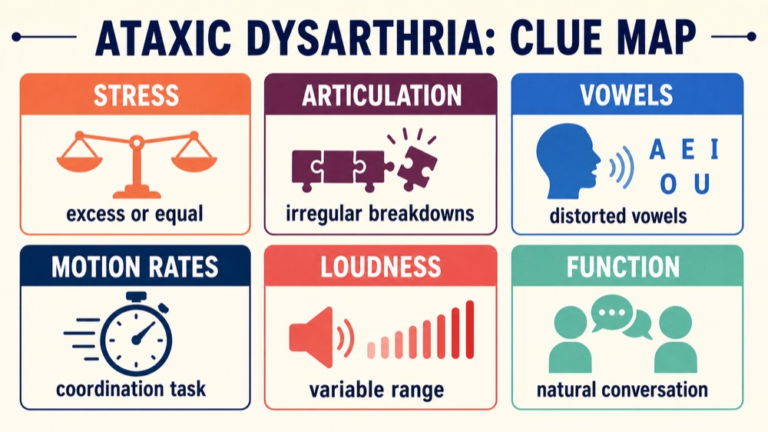
Map ataxic dysarthria clues
For study purposes, describe the system-function relationship before naming a disorder or subtype. Record what the person understood, produced, initiated, repaired, coordinated, or participated in. Then note whether the task was familiar, how much context was shared, and which support changed the response.
Stress: describe excess or equal stress, rhythm, emphasis, and how the pattern affects naturalness.
Articulation: examine irregular breakdowns, timing, sequencing, and clarity in words and connected speech.
Vowels and resonance: listen for distorted vowels and variable resonance across tasks.
Motion rates: use alternating and sequential tasks as observations of coordination, not as stand-alone labels.
Loudness and physical signs: compare loudness variation, dysmetria, head tremor, and other documented findings.
Participation: connect irregular speech with listener access, conversation, effort, relationships, and communication goals.
A strong description is specific enough that another learner could picture the event. Instead of writing “the system is weak,” describe the demand, the observable response, the partner, the context, and the result. This protects clinical reasoning from labels that are broader than the evidence.
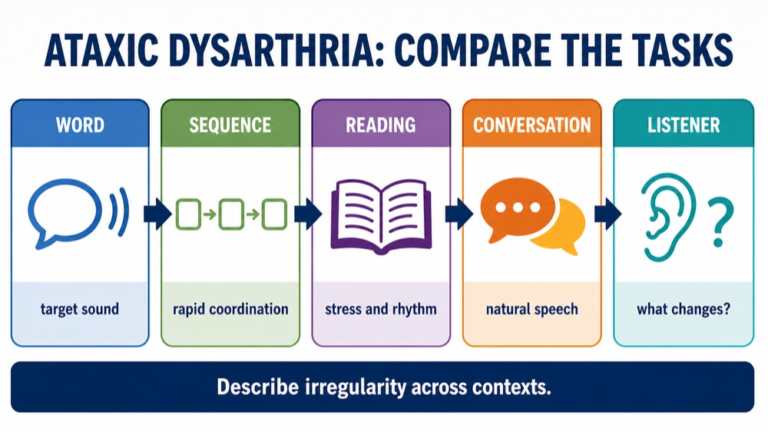
Coordination across speech tasks
Context changes what communication requires. A naming task, a listening activity, a multi-step instruction, a narrative, a conversation, and a workplace exchange place different demands on processing, memory, attention, language, motor control, and partner support. Hearing access, fatigue, posture, visual supports, language experience, and the opportunity to request clarification should be part of the observation.
A speaker may show irregular articulatory breakdowns on a rapid sequence, distorted vowels in connected speech, or unusual stress that is more obvious to an unfamiliar listener. The pattern may change with rate, task complexity, fatigue, and communication support. Compare perceptual speech, physical findings, and functional communication before selecting a subtype description; an ataxic label organizes the next question but does not replace the whole profile.
Observation layer
Example question
Task
What did the person need to understand, produce, organize, coordinate, or repair?
Function
Which cognitive, language, speech, auditory, motor, or access relationship was observable?
Access
Were hearing, visual, motor, sensory, language, respiratory, or environmental supports available?
Participation
What meaningful routine became easier or harder because of the pattern?
Context is not an afterthought added once a label has been selected. It is part of the question itself. If performance changes with a quieter room, extra processing time, a familiar partner, a different communication mode, a changed speaking rate, or a changed task, that change is useful evidence about access and demand. It does not identify a cause by itself, but it tells you which conditions should be carried into the next observation.
Apply the concept in clinical reasoning
When a Praxis-style scenario or clinical discussion presents ataxic dysarthria, use a disciplined sequence. The goal is to select the next clinical question or action that matches the evidence, the person’s priorities, and the communication context.
Define the task in plain language.
Identify the domain or domains involved without assuming they are interchangeable.
Separate observation from interpretation and write down what remains unknown.
Check hearing, language experience, culture, communication mode, environment, partner support, alertness, respiration, memory, and task familiarity.
Choose the assessment, collaboration, or observation step that answers the specific question.
State the boundary of the conclusion and keep the person’s participation goal visible.
A speaker may show irregular articulatory breakdowns on a rapid sequence, distorted vowels in connected speech, or unusual stress that is more obvious to an unfamiliar listener. The pattern may change with rate, task complexity, fatigue, and communication support. Compare perceptual speech, physical findings, and functional communication before selecting a subtype description; an ataxic label organizes the next question but does not replace the whole profile. In a learning answer, the decisive evidence is usually the relationship among the task, the observed pattern, and the next needed information—not a single isolated behavior or label.
Common study mistakes
Reducing ataxic dysarthria to slurred speech or one unusual stress pattern.
Treating one rapid alternating motion result as a complete diagnostic conclusion.
Confusing irregular speech with apraxia, phonological error, language formulation, or hearing access.
Failing to compare words, reading, conversation, rate, stress, and fatigue.
Overlooking the listener and participation effect of unusual prosody and timing.
Assuming support for rate or context proves the underlying cause.
Choosing a treatment or prognosis claim without the person’s goals and full assessment.
Most of these mistakes come from replacing a multidomain question with a fast label. Correct the habit by returning to the same sequence: describe, separate, contextualize, ask what is missing, and choose a proportionate next step. A short rationale can make the habit visible: identify the evidence, name the uncertainty, and explain why the selected next step fits both.
Build a quick review map
Use this compact map when reviewing a missed question, a lecture note, or a clinical vignette:
Step 2: Compare isolated tasks with phrases, reading, conversation, rapid sequences, and changing rate.
Step 3: Record whether the pattern is irregular, consistent, fatigue-sensitive, or context-sensitive.
Step 4: Separate execution and coordination from language, planning, cognition, hearing, and access.
Step 5: Use the subtype as a provisional pattern map and note the evidence that does not fit.
Step 6: Connect the next question to intelligibility, naturalness, listener access, and participation.
Then write one transfer sentence: “When I see this pattern, I will first check ___ because ___.” The sentence should identify a decision rule, not repeat a definition. Revisit it after a delay and test whether you can apply the rule to a different task, age group, or communication mode.
Sources and next steps
ataxic dysarthria is best learned as a context-sensitive pattern across structure, function, access, and participation. Use the current authority pages to refine the concept, then return to practice scenarios that require you to explain what the evidence supports and what it leaves open.
Spastic Dysarthria: Speech Pattern, Tone, and Differential Reasoning
spastic dysarthria is easier to study when it is treated as a connected system rather than a single label. Spastic dysarthria is studied as a pattern associated with bilateral upper motor neuron involvement, with speech and physical findings that must be interpreted together. For Praxis review, compare rate, voice, articulation, reflexes, tone, task demands, and the broader communication profile.
This learning guide is written for SLP students and other learners reviewing clinical concepts. It uses broad patterns to organize observation, not to make an individualized diagnosis or promise one outcome. Interpretation depends on the person, task, language, culture, hearing, access, health, context, and communication goals.
What spastic dysarthria includes
Begin by separating the concept into domains. A learner who can name the domains is less likely to collapse cognition, language, speech, auditory access, memory, attention, or participation questions into one explanation. The useful unit of analysis is the task: what the person was asked to understand, produce, remember, organize, coordinate, or communicate, with whom, under which conditions, and with what support.
Domain or system
What to notice
Question to carry forward
Rate and articulation
Speech may be slow, with imprecise articulation or reduced flexibility across connected speech.
Does the rate change with task length, cueing, or the need for rapid transitions?
Voice quality
A strained or harsh voice and pitch breaks can contribute to reduced naturalness and intelligibility.
What voice features are stable, variable, or linked with effort and task demand?
Movement and tone
Hypertonia and reduced movement flexibility may affect the speech mechanism and non-speech oral tasks.
What physical findings are observed rather than inferred from the voice?
Reflex findings
Pathologic oral reflexes or a hyperactive gag reflex may be part of the broader physical profile.
Which reflex or neurologic finding supports the description, and what remains unknown?
Subsystem interaction
Respiration, phonation, resonance, articulation, and prosody may interact rather than fail in isolation.
Which subsystem relationship best explains the listener’s experience?
Differential and function
The pattern must be separated from other dysarthria types, aphasia, apraxia, voice, cognition, and access barriers.
How does the pattern affect intelligibility, effort, naturalness, and participation?
These domains interact, but they should remain distinguishable. A learner may show strength in one task and need support in another. A study map organizes the next observation; it does not answer every assessment question or replace current professional guidance.
Keep the first pass descriptive and close to the communication event. Note the task, the response, the partner, the setting, the timing, the available support, and the consequence for participation. This gives the learner a stable record to compare across tasks and prevents a familiar term from doing too much explanatory work before the evidence has been separated.
For Praxis-style review, a vignette may include several true details but ask for one best interpretation or next step. The strongest answer usually respects the task, identifies the relevant function, checks the most important missing information, and avoids treating one performance sample as the whole profile.
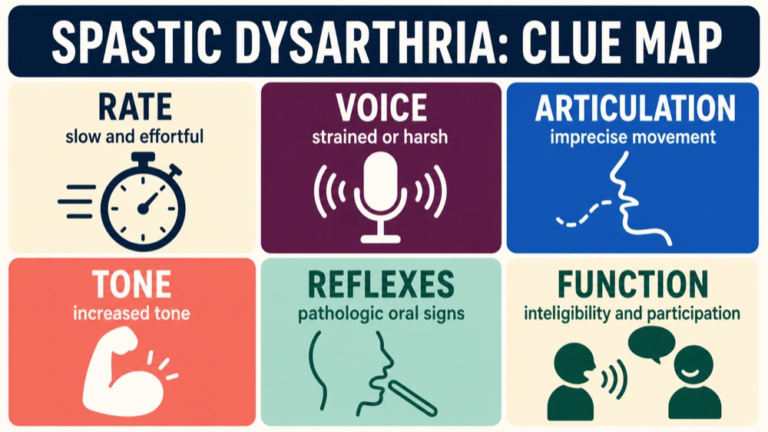
Map spastic dysarthria clues
For study purposes, describe the system-function relationship before naming a disorder or subtype. Record what the person understood, produced, initiated, repaired, coordinated, or participated in. Then note whether the task was familiar, how much context was shared, and which support changed the response.
Rate and articulation: observe slow rate, articulatory precision, transitions, and connected-speech flexibility.
Voice quality: listen for strained or harsh quality, pitch breaks, loudness, and effort across tasks.
Tone and movement: consider hypertonia, reduced range, movement flexibility, and related physical findings.
Reflexes: record pathologic oral reflexes or hyperactive reflex findings only when actually observed or documented.
Subsystem interaction: connect respiration, phonation, resonance, articulation, and prosody rather than isolating one clue.
Function: link the speech pattern to intelligibility, communication effort, listener access, and participation.
A strong description is specific enough that another learner could picture the event. Instead of writing “the system is weak,” describe the demand, the observable response, the partner, the context, and the result. This protects clinical reasoning from labels that are broader than the evidence.
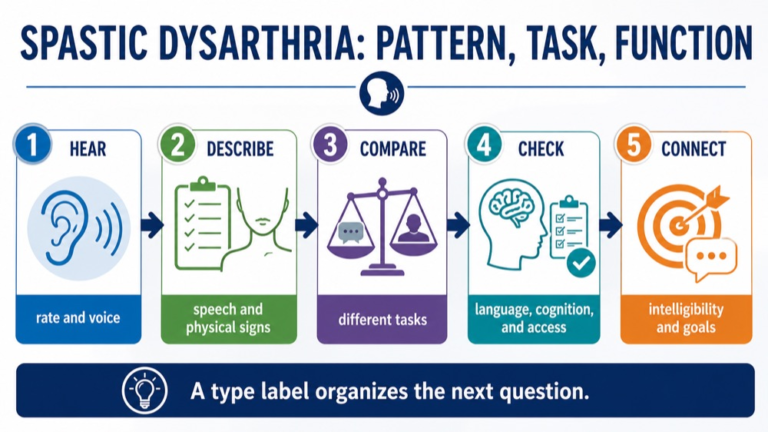
Pattern, task, and function
Context changes what communication requires. A naming task, a listening activity, a multi-step instruction, a narrative, a conversation, and a workplace exchange place different demands on processing, memory, attention, language, motor control, and partner support. Hearing access, fatigue, posture, visual supports, language experience, and the opportunity to request clarification should be part of the observation.
A speaker may sound strained and slow in a reading task but show a different level of effort in conversation, or may become less intelligible when the message is long and the listener needs rapid turn-taking. These differences should be described with the task, partner, fatigue, and communication goal. A spastic pattern is a study framework supported by converging perceptual and physical findings, not a shortcut from one voice quality to a medical diagnosis.
Observation layer
Example question
Task
What did the person need to understand, produce, organize, coordinate, or repair?
Function
Which cognitive, language, speech, auditory, motor, or access relationship was observable?
Access
Were hearing, visual, motor, sensory, language, respiratory, or environmental supports available?
Participation
What meaningful routine became easier or harder because of the pattern?
Context is not an afterthought added once a label has been selected. It is part of the question itself. If performance changes with a quieter room, extra processing time, a familiar partner, a different communication mode, a changed speaking rate, or a changed task, that change is useful evidence about access and demand. It does not identify a cause by itself, but it tells you which conditions should be carried into the next observation.
Apply the concept in clinical reasoning
When a Praxis-style scenario or clinical discussion presents spastic dysarthria, use a disciplined sequence. The goal is to select the next clinical question or action that matches the evidence, the person’s priorities, and the communication context.
Define the task in plain language.
Identify the domain or domains involved without assuming they are interchangeable.
Separate observation from interpretation and write down what remains unknown.
Check hearing, language experience, culture, communication mode, environment, partner support, alertness, respiration, memory, and task familiarity.
Choose the assessment, collaboration, or observation step that answers the specific question.
State the boundary of the conclusion and keep the person’s participation goal visible.
A speaker may sound strained and slow in a reading task but show a different level of effort in conversation, or may become less intelligible when the message is long and the listener needs rapid turn-taking. These differences should be described with the task, partner, fatigue, and communication goal. A spastic pattern is a study framework supported by converging perceptual and physical findings, not a shortcut from one voice quality to a medical diagnosis. In a learning answer, the decisive evidence is usually the relationship among the task, the observed pattern, and the next needed information—not a single isolated behavior or label.
Common study mistakes
Treating a strained voice alone as proof of spastic dysarthria.
Ignoring slow rate, pitch breaks, articulation, tone, reflexes, and the rest of the speech profile.
Using upper motor neuron shorthand as a complete lesion-localization or medical diagnosis.
Confusing strained voice or slow speech with a voice disorder, aphasia, or apraxia of speech.
Failing to compare reading, repetition, conversation, rate, stress, and fatigue.
Describing impairment without stating its effect on intelligibility, naturalness, or effort.
Assuming the same pattern has the same treatment priority for every person.
Choosing an answer from a single familiar symptom rather than the full vignette.
Most of these mistakes come from replacing a multidomain question with a fast label. Correct the habit by returning to the same sequence: describe, separate, contextualize, ask what is missing, and choose a proportionate next step. A short rationale can make the habit visible: identify the evidence, name the uncertainty, and explain why the selected next step fits both.
Build a quick review map
Use this compact map when reviewing a missed question, a lecture note, or a clinical vignette:
Step 1: List the perceptual speech features and the physical or neurologic findings separately.
Step 3: Check how the pattern changes with task length, rate, stress, fatigue, and communication partner.
Step 4: Separate speech execution from language, planning, cognition, hearing, swallowing, and access.
Step 5: Keep the type description provisional and state evidence that does not fit.
Step 6: Connect the next question to intelligibility, effort, naturalness, and participation.
Then write one transfer sentence: “When I see this pattern, I will first check ___ because ___.” The sentence should identify a decision rule, not repeat a definition. Revisit it after a delay and test whether you can apply the rule to a different task, age group, or communication mode.
Sources and next steps
spastic dysarthria is best learned as a context-sensitive pattern across structure, function, access, and participation. Use the current authority pages to refine the concept, then return to practice scenarios that require you to explain what the evidence supports and what it leaves open.
Flaccid Dysarthria: Weakness, Speech Subsystems, and Differential Reasoning
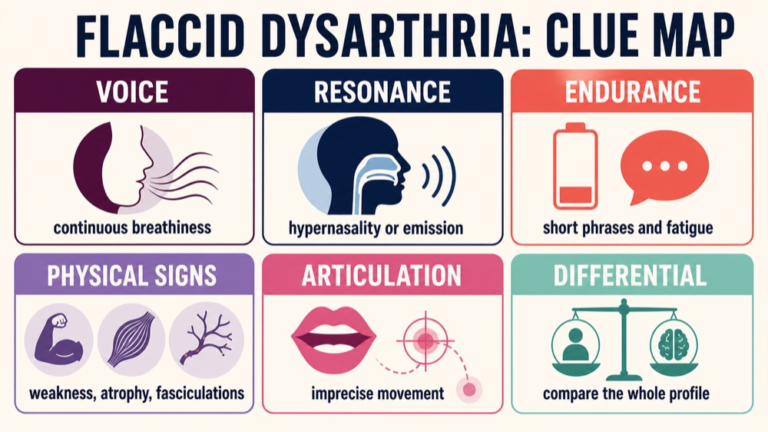
flaccid dysarthria is easier to study when it is treated as a connected system rather than a single label. Flaccid dysarthria is studied through a pattern of weakness or flaccidity associated with lower motor neuron pathways and motor units. For SLP exam review, connect perceptual speech signs with physical findings, task changes, related swallowing or voice questions, and the communication consequence.
This learning guide is written for SLP students and other learners reviewing clinical concepts. It uses broad patterns to organize observation, not to make an individualized diagnosis or promise one outcome. Interpretation depends on the person, task, language, culture, hearing, access, health, context, and communication goals.
What flaccid dysarthria includes
Begin by separating the concept into domains. A learner who can name the domains is less likely to collapse cognition, language, speech, auditory access, memory, attention, or participation questions into one explanation. The useful unit of analysis is the task: what the person was asked to understand, produce, remember, organize, coordinate, or communicate, with whom, under which conditions, and with what support.
Domain or system
What to notice
Question to carry forward
Perceptual voice
Continuous breathiness, diplophonia, audible inspiration, or reduced control of voice may affect the signal.
What voice quality or laryngeal feature is heard, and how stable is it across tasks?
Resonance
Hypernasality, nasal emission, or nasal backflow may reflect velopharyngeal weakness and should be interpreted in context.
What resonance feature is present, and what physical or swallowing signs accompany it?
Phrase length and endurance
Short phrases, speaking on inhalation, rapid deterioration, and improvement after rest may be important observations.
Does performance weaken with use and recover with rest?
Physical findings
Weakness, flaccidity, atrophy, fasciculations, hypoactive reflexes, or related signs can add to the speech description.
Which physical signs are actually observed rather than assumed from the voice?
Speech production
Imprecise alternating motion rates and reduced articulatory strength can affect intelligibility and naturalness.
How do rate, repetition, force, and task length change the speech output?
Differential and function
Flaccid-pattern clues must be separated from other dysarthria types, aphasia, apraxia, voice, swallowing, and medical questions.
What evidence supports the pattern and what additional evaluation or collaboration is needed?
These domains interact, but they should remain distinguishable. A learner may show strength in one task and need support in another. A study map organizes the next observation; it does not answer every assessment question or replace current professional guidance.
Keep the first pass descriptive and close to the communication event. Note the task, the response, the partner, the setting, the timing, the available support, and the consequence for participation. This gives the learner a stable record to compare across tasks and prevents a familiar term from doing too much explanatory work before the evidence has been separated.
For Praxis-style review, a vignette may include several true details but ask for one best interpretation or next step. The strongest answer usually respects the task, identifies the relevant function, checks the most important missing information, and avoids treating one performance sample as the whole profile.
Map flaccid dysarthria clues
For study purposes, describe the system-function relationship before naming a disorder or subtype. Record what the person understood, produced, initiated, repaired, coordinated, or participated in. Then note whether the task was familiar, how much context was shared, and which support changed the response.
Voice: listen for continuous breathiness, diplophonia, audible inspiration, and reduced voice control.
Resonance: consider hypernasality, nasal emission, and related velopharyngeal or swallowing observations.
Endurance: compare phrase length, speaking on inhalation, deterioration with use, and recovery after rest.
Physical signs: document weakness, flaccidity, atrophy, fasciculations, reflex findings, and other observed features.
Articulation: examine imprecise alternating motion rates, reduced force, timing, and intelligibility across tasks.
Differential and function: distinguish a flaccid pattern from other speech, language, swallowing, medical, and access questions.
A strong description is specific enough that another learner could picture the event. Instead of writing “the system is weak,” describe the demand, the observable response, the partner, the context, and the result. This protects clinical reasoning from labels that are broader than the evidence.
Weakness, fatigue, and speech access
Context changes what communication requires. A naming task, a listening activity, a multi-step instruction, a narrative, a conversation, and a workplace exchange place different demands on processing, memory, attention, language, motor control, and partner support. Hearing access, fatigue, posture, visual supports, language experience, and the opportunity to request clarification should be part of the observation.
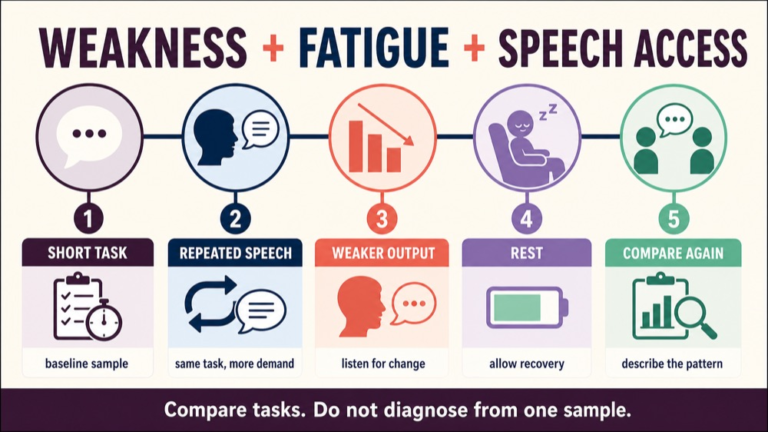
A speaker with a flaccid pattern may sound breathy or hypernasal, use short phrases, weaken rapidly with repeated speech, and recover with rest. These observations are useful because they connect the speech sample with endurance and physical findings, but they do not independently identify the underlying medical condition. Compare structured speech, connected speech, rate, repeated movement, voice, resonance, swallowing, case history, and the person’s communication priorities.
Observation layer
Example question
Task
What did the person need to understand, produce, organize, coordinate, or repair?
Function
Which cognitive, language, speech, auditory, motor, or access relationship was observable?
Access
Were hearing, visual, motor, sensory, language, respiratory, or environmental supports available?
Participation
What meaningful routine became easier or harder because of the pattern?
Context is not an afterthought added once a label has been selected. It is part of the question itself. If performance changes with a quieter room, extra processing time, a familiar partner, a different communication mode, a changed speaking rate, or a changed task, that change is useful evidence about access and demand. It does not identify a cause by itself, but it tells you which conditions should be carried into the next observation.
Apply the concept in clinical reasoning
When a Praxis-style scenario or clinical discussion presents flaccid dysarthria, use a disciplined sequence. The goal is to select the next clinical question or action that matches the evidence, the person’s priorities, and the communication context.
Define the task in plain language.
Identify the domain or domains involved without assuming they are interchangeable.
Separate observation from interpretation and write down what remains unknown.
Check hearing, language experience, culture, communication mode, environment, partner support, alertness, respiration, memory, and task familiarity.
Choose the assessment, collaboration, or observation step that answers the specific question.
State the boundary of the conclusion and keep the person’s participation goal visible.
A speaker with a flaccid pattern may sound breathy or hypernasal, use short phrases, weaken rapidly with repeated speech, and recover with rest. These observations are useful because they connect the speech sample with endurance and physical findings, but they do not independently identify the underlying medical condition. Compare structured speech, connected speech, rate, repeated movement, voice, resonance, swallowing, case history, and the person’s communication priorities. In a learning answer, the decisive evidence is usually the relationship among the task, the observed pattern, and the next needed information—not a single isolated behavior or label.
Common study mistakes
Treating breathiness or hypernasality alone as proof of flaccid dysarthria.
Ignoring weakness, atrophy, fasciculations, reflexes, endurance, and recovery when reviewing the pattern.
Confusing a flaccid pattern with a voice disorder, velopharyngeal disorder, apraxia, or another dysarthria type.
Forgetting that speech and swallowing questions may coexist and require appropriate evaluation.
Using a sustained vowel or one word as the whole profile instead of comparing connected speech and fatigue.
Assuming a pattern identifies a specific neurologic disease or lesion without medical collaboration.
Describing the type without stating its effect on intelligibility, naturalness, effort, or participation.
Choosing treatment or prognosis claims that exceed the evidence in the vignette.
Most of these mistakes come from replacing a multidomain question with a fast label. Correct the habit by returning to the same sequence: describe, separate, contextualize, ask what is missing, and choose a proportionate next step. A short rationale can make the habit visible: identify the evidence, name the uncertainty, and explain why the selected next step fits both.
Build a quick review map
Use this compact map when reviewing a missed question, a lecture note, or a clinical vignette:
Step 1: List the perceptual features, physical signs, task demands, and communication consequence.
Step 2: Separate voice, resonance, articulation, respiration, endurance, swallowing, and language questions.
Step 3: Compare short and long speech, repeated movement, rate, connected speech, and rest or fatigue effects.
Step 4: Check whether the observed pattern is consistent with weakness and whether other features complicate it.
Step 5: Keep the type description provisional and do not infer a medical diagnosis from speech alone.
Step 6: Choose the next assessment or collaboration that matches the speech, safety, access, and participation concern.
Then write one transfer sentence: “When I see this pattern, I will first check ___ because ___.” The sentence should identify a decision rule, not repeat a definition. Revisit it after a delay and test whether you can apply the rule to a different task, age group, or communication mode.
Sources and next steps
flaccid dysarthria is best learned as a context-sensitive pattern across structure, function, access, and participation. Use the current authority pages to refine the concept, then return to practice scenarios that require you to explain what the evidence supports and what it leaves open.
Types of Dysarthria: Compare Perceptual and Physiologic Patterns
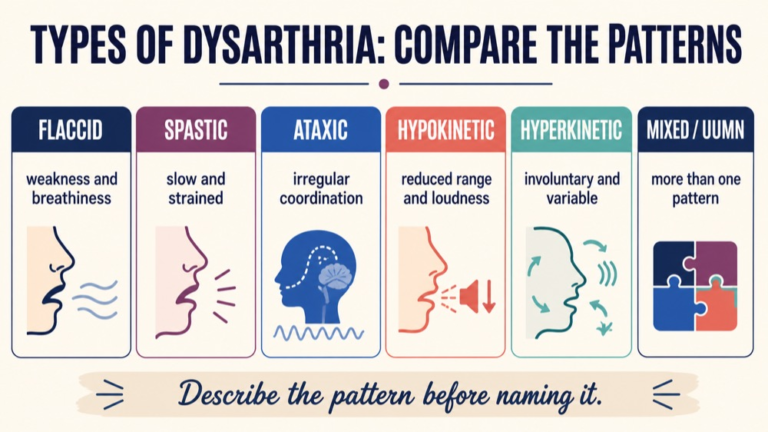
types of dysarthria is easier to study when it is treated as a connected system rather than a single label. Types of dysarthria are pattern descriptions that help learners compare perceptual speech characteristics with physiologic findings and possible motor-system context. The exam-safe habit is to recognize the pattern while remembering that overlap, mixed presentations, and the full assessment matter.
This learning guide is written for SLP students and other learners reviewing clinical concepts. It uses broad patterns to organize observation, not to make an individualized diagnosis or promise one outcome. Interpretation depends on the person, task, language, culture, hearing, access, health, context, and communication goals.
What types of dysarthria includes
Begin by separating the concept into domains. A learner who can name the domains is less likely to collapse cognition, language, speech, auditory access, memory, attention, or participation questions into one explanation. The useful unit of analysis is the task: what the person was asked to understand, produce, remember, organize, coordinate, or communicate, with whom, under which conditions, and with what support.
Domain or system
What to notice
Question to carry forward
Flaccid
Weakness or lower-motor-neuron involvement may be associated with breathiness, hypernasality, nasal emission, short phrases, and rapid fatigue.
Do the perceptual and physical findings point toward weakness, flaccidity, atrophy, or fasciculations?
Spastic
Bilateral upper-motor-neuron involvement may be associated with slow rate, strained or harsh quality, and pitch breaks.
Are tone, reflex, rate, and voice findings consistent across the sample?
Ataxic
Cerebellar-control disruption may be associated with excess or equal stress, irregular breakdowns, distorted vowels, and variable loudness.
Do timing, coordination, stress, and irregularity change together?
Hypokinetic
Basal-ganglia circuit involvement may be associated with monopitch, monoloudness, loudness decay, reduced stress, or rapid rate.
What happens to range, loudness, rate, and repeated movement?
Hyperkinetic or UUMN
Involuntary movement patterns or unilateral upper-motor-neuron findings may contribute to variable voice, rate, articulation, or loudness changes.
Which involuntary or unilateral signs are present, and in which tasks?
Mixed or undetermined
Multiple patterns may combine, or the features may support dysarthria without clearly fitting one category.
What evidence supports a provisional description and what remains unresolved?
These domains interact, but they should remain distinguishable. A learner may show strength in one task and need support in another. A study map organizes the next observation; it does not answer every assessment question or replace current professional guidance.
Keep the first pass descriptive and close to the communication event. Note the task, the response, the partner, the setting, the timing, the available support, and the consequence for participation. This gives the learner a stable record to compare across tasks and prevents a familiar term from doing too much explanatory work before the evidence has been separated.
For Praxis-style review, a vignette may include several true details but ask for one best interpretation or next step. The strongest answer usually respects the task, identifies the relevant function, checks the most important missing information, and avoids treating one performance sample as the whole profile.
Compare the dysarthria types
For study purposes, describe the system-function relationship before naming a disorder or subtype. Record what the person understood, produced, initiated, repaired, coordinated, or participated in. Then note whether the task was familiar, how much context was shared, and which support changed the response.
Flaccid: study weakness, flaccidity, atrophy, fasciculations, breathiness, hypernasality, and rapid fatigue with recovery after rest.
Spastic: study slow rate, strained or harsh voice, pitch breaks, tone, and pathologic reflex findings.
Ataxic: study excess or equal stress, irregular articulatory breakdowns, distorted vowels, and coordination.
Hypokinetic: study monopitch, monoloudness, loudness decay, reduced stress, accelerated rate, and reduced movement range.
Hyperkinetic and UUMN: study involuntary movements, variable voice, intermittent resonance, unilateral weakness, and imprecise articulation.
Mixed and undetermined: keep the description provisional when multiple systems or unclear patterns are present.
A strong description is specific enough that another learner could picture the event. Instead of writing “the system is weak,” describe the demand, the observable response, the partner, the context, and the result. This protects clinical reasoning from labels that are broader than the evidence.
Pattern label versus full profile
Context changes what communication requires. A naming task, a listening activity, a multi-step instruction, a narrative, a conversation, and a workplace exchange place different demands on processing, memory, attention, language, motor control, and partner support. Hearing access, fatigue, posture, visual supports, language experience, and the opportunity to request clarification should be part of the observation.
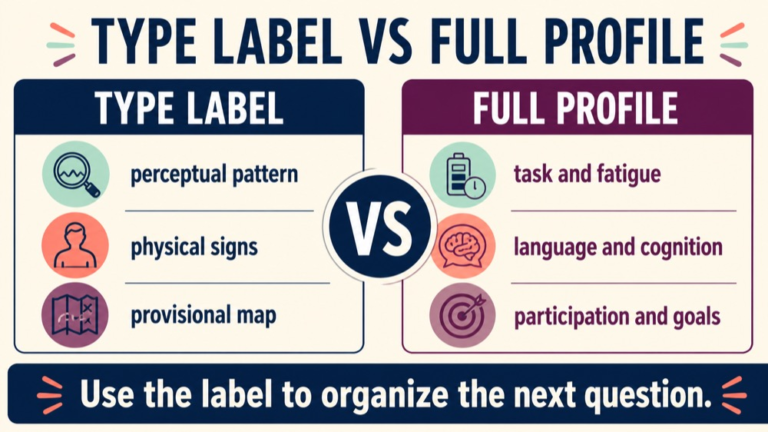
Dysarthria types are not just vocabulary labels. The same speaker may show overlapping features, a mixed pattern, a change with rate or fatigue, or a speech profile that does not fit one category cleanly. Compare perceptual speech characteristics with physical signs, case history, associated language or cognitive changes, swallowing, and the communication task. A type label is useful when it organizes the next question; it becomes risky when it replaces the evidence.
Observation layer
Example question
Task
What did the person need to understand, produce, organize, coordinate, or repair?
Function
Which cognitive, language, speech, auditory, motor, or access relationship was observable?
Access
Were hearing, visual, motor, sensory, language, respiratory, or environmental supports available?
Participation
What meaningful routine became easier or harder because of the pattern?
Context is not an afterthought added once a label has been selected. It is part of the question itself. If performance changes with a quieter room, extra processing time, a familiar partner, a different communication mode, a changed speaking rate, or a changed task, that change is useful evidence about access and demand. It does not identify a cause by itself, but it tells you which conditions should be carried into the next observation.
Apply the concept in clinical reasoning
When a Praxis-style scenario or clinical discussion presents types of dysarthria, use a disciplined sequence. The goal is to select the next clinical question or action that matches the evidence, the person’s priorities, and the communication context.
Define the task in plain language.
Identify the domain or domains involved without assuming they are interchangeable.
Separate observation from interpretation and write down what remains unknown.
Check hearing, language experience, culture, communication mode, environment, partner support, alertness, respiration, memory, and task familiarity.
Choose the assessment, collaboration, or observation step that answers the specific question.
State the boundary of the conclusion and keep the person’s participation goal visible.
Dysarthria types are not just vocabulary labels. The same speaker may show overlapping features, a mixed pattern, a change with rate or fatigue, or a speech profile that does not fit one category cleanly. Compare perceptual speech characteristics with physical signs, case history, associated language or cognitive changes, swallowing, and the communication task. A type label is useful when it organizes the next question; it becomes risky when it replaces the evidence. In a learning answer, the decisive evidence is usually the relationship among the task, the observed pattern, and the next needed information—not a single isolated behavior or label.
Common study mistakes
Memorizing one symptom per dysarthria type and ignoring the broader perceptual pattern.
Treating type names as exact lesion-localization or medical-diagnosis rules.
Assuming all speakers with the same label sound the same across tasks and stages.
Ignoring mixed and undetermined presentations when the evidence does not fit one category.
Confusing dysarthria type with aphasia, apraxia of speech, or a voice disorder alone.
Failing to compare speech subsystems, physical findings, fatigue, rate, and task context.
Using a type label without describing intelligibility, naturalness, effort, and participation.
Choosing the answer with the most familiar label rather than the one supported by the full vignette.
Most of these mistakes come from replacing a multidomain question with a fast label. Correct the habit by returning to the same sequence: describe, separate, contextualize, ask what is missing, and choose a proportionate next step. A short rationale can make the habit visible: identify the evidence, name the uncertainty, and explain why the selected next step fits both.
Build a quick review map
Use this compact map when reviewing a missed question, a lecture note, or a clinical vignette:
Step 1: Start with the speech characteristics and physical signs, not the type name.
Step 3: Check whether the pattern is consistent, variable, mixed, fatigue-sensitive, or task-specific.
Step 4: Separate speech execution from language, planning, cognition, hearing, swallowing, and access.
Step 5: Use the type as a provisional organizing label and state what evidence does not fit.
Step 6: Connect the classification question to intelligibility, naturalness, communication access, and participation.
Then write one transfer sentence: “When I see this pattern, I will first check ___ because ___.” The sentence should identify a decision rule, not repeat a definition. Revisit it after a delay and test whether you can apply the rule to a different task, age group, or communication mode.
Sources and next steps
types of dysarthria is best learned as a context-sensitive pattern across structure, function, access, and participation. Use the current authority pages to refine the concept, then return to practice scenarios that require you to explain what the evidence supports and what it leaves open.
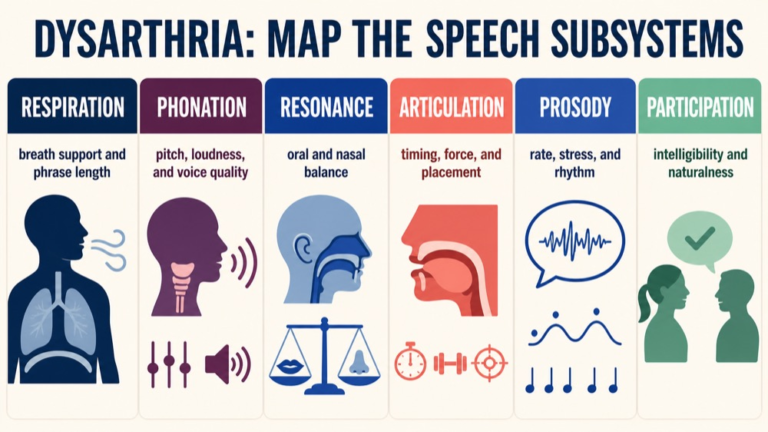
Dysarthria: Speech Subsystems, Assessment, and Participation
dysarthria is easier to study when it is treated as a connected system rather than a single label. Dysarthria is a neurogenic speech disorder concept built from the interaction of speech subsystems and motor control. For Praxis review, organize the observable speech characteristics, the physical and neurologic context, the differential questions, and the person’s real communication goals.
This learning guide is written for SLP students and other learners reviewing clinical concepts. It uses broad patterns to organize observation, not to make an individualized diagnosis or promise one outcome. Interpretation depends on the person, task, language, culture, hearing, access, health, context, and communication goals.
What dysarthria includes
Begin by separating the concept into domains. A learner who can name the domains is less likely to collapse cognition, language, speech, auditory access, memory, attention, or participation questions into one explanation. The useful unit of analysis is the task: what the person was asked to understand, produce, remember, organize, coordinate, or communicate, with whom, under which conditions, and with what support.
Domain or system
What to notice
Question to carry forward
Respiration
Breath support and coordination influence phrase length, loudness, speaking on inhalation, and endurance.
What changes in breath support, phrase length, rate, or performance over time?
Phonation
Vocal-fold vibration and laryngeal control contribute to pitch, loudness, voice quality, onset, offset, and stability.
What perceptual voice feature is present, and does it vary by task or effort?
Resonance
Velopharyngeal control affects oral and nasal resonance, nasal emission, and the listener’s access to the signal.
What resonance pattern is observable, and what other subsystem evidence accompanies it?
Articulation
Timing, direction, force, speed, and placement shape consonants, vowels, clarity, and articulatory breakdowns.
Are errors consistent, irregular, blurred, distorted, or influenced by task complexity?
Prosody
Rate, stress, pitch variation, rhythm, pauses, and intonation contribute to naturalness and meaning.
Which prosodic feature changes and how does it affect intelligibility or social meaning?
Differential and participation
Dysarthria must be considered alongside aphasia, apraxia of speech, cognition, swallowing, hearing, and the communication environment.
What evidence separates speech execution from language, planning, access, and partner barriers?
These domains interact, but they should remain distinguishable. A learner may show strength in one task and need support in another. A study map organizes the next observation; it does not answer every assessment question or replace current professional guidance.
Keep the first pass descriptive and close to the communication event. Note the task, the response, the partner, the setting, the timing, the available support, and the consequence for participation. This gives the learner a stable record to compare across tasks and prevents a familiar term from doing too much explanatory work before the evidence has been separated.
For Praxis-style review, a vignette may include several true details but ask for one best interpretation or next step. The strongest answer usually respects the task, identifies the relevant function, checks the most important missing information, and avoids treating one performance sample as the whole profile.
Map the speech subsystems
For study purposes, describe the system-function relationship before naming a disorder or subtype. Record what the person understood, produced, initiated, repaired, coordinated, or participated in. Then note whether the task was familiar, how much context was shared, and which support changed the response.
Respiration: observe breath support, phrase length, loudness, coordination, and endurance.
Phonation: describe pitch, loudness, quality, voice onset and offset, stability, and task variation.
Resonance: consider hypernasality, hyponasality, nasal emission, and the interaction with other speech subsystems.
Prosody: include rate, stress, pitch, rhythm, pauses, intonation, and naturalness.
Differential and participation: distinguish dysarthria from aphasia, apraxia, cognition, hearing, swallowing, and environmental barriers.
A strong description is specific enough that another learner could picture the event. Instead of writing “the system is weak,” describe the demand, the observable response, the partner, the context, and the result. This protects clinical reasoning from labels that are broader than the evidence.
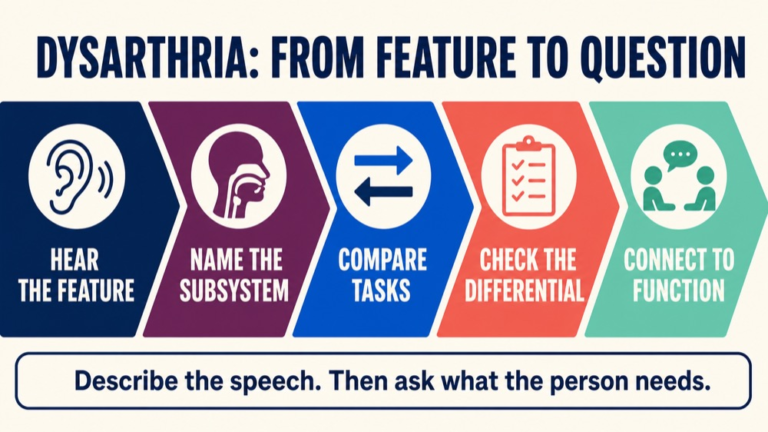
From speech feature to differential question
Context changes what communication requires. A naming task, a listening activity, a multi-step instruction, a narrative, a conversation, and a workplace exchange place different demands on processing, memory, attention, language, motor control, and partner support. Hearing access, fatigue, posture, visual supports, language experience, and the opportunity to request clarification should be part of the observation.
A speaker may be intelligible in a quiet short exchange but less clear during a long conversation, rapid response, fatigue, or a topic that requires increased effort. A perceptual feature such as breathiness, imprecise consonants, reduced loudness, or irregular rate is a clue to describe and compare, not a stand-alone diagnosis. The useful reasoning sequence is to connect the speech signal with the subsystem, task, listener, context, and functional communication goal.
Observation layer
Example question
Task
What did the person need to understand, produce, organize, coordinate, or repair?
Function
Which cognitive, language, speech, auditory, motor, or access relationship was observable?
Access
Were hearing, visual, motor, sensory, language, respiratory, or environmental supports available?
Participation
What meaningful routine became easier or harder because of the pattern?
Context is not an afterthought added once a label has been selected. It is part of the question itself. If performance changes with a quieter room, extra processing time, a familiar partner, a different communication mode, a changed speaking rate, or a changed task, that change is useful evidence about access and demand. It does not identify a cause by itself, but it tells you which conditions should be carried into the next observation.
Apply the concept in clinical reasoning
When a Praxis-style scenario or clinical discussion presents dysarthria, use a disciplined sequence. The goal is to select the next clinical question or action that matches the evidence, the person’s priorities, and the communication context.
Define the task in plain language.
Identify the domain or domains involved without assuming they are interchangeable.
Separate observation from interpretation and write down what remains unknown.
Check hearing, language experience, culture, communication mode, environment, partner support, alertness, respiration, memory, and task familiarity.
Choose the assessment, collaboration, or observation step that answers the specific question.
State the boundary of the conclusion and keep the person’s participation goal visible.
A speaker may be intelligible in a quiet short exchange but less clear during a long conversation, rapid response, fatigue, or a topic that requires increased effort. A perceptual feature such as breathiness, imprecise consonants, reduced loudness, or irregular rate is a clue to describe and compare, not a stand-alone diagnosis. The useful reasoning sequence is to connect the speech signal with the subsystem, task, listener, context, and functional communication goal. In a learning answer, the decisive evidence is usually the relationship among the task, the observed pattern, and the next needed information—not a single isolated behavior or label.
Common study mistakes
Treating dysarthria as a single voice problem instead of a motor speech disorder involving multiple subsystems.
Assigning a dysarthria type from one perceptual feature without a comprehensive profile.
Confusing dysarthria with aphasia, acquired apraxia of speech, cognitive-communication, or hearing access.
Ignoring rate, stress, fatigue, task length, listener familiarity, and communication environment.
Reporting intelligibility without describing the task, listener, message, and communication consequence.
Assuming a strong isolated oral movement predicts connected-speech performance.
Treating an intervention technique as universally appropriate without considering the person and goal.
Turning a study taxonomy into a medical diagnosis or lesion-localization rule.
Most of these mistakes come from replacing a multidomain question with a fast label. Correct the habit by returning to the same sequence: describe, separate, contextualize, ask what is missing, and choose a proportionate next step. A short rationale can make the habit visible: identify the evidence, name the uncertainty, and explain why the selected next step fits both.
Build a quick review map
Use this compact map when reviewing a missed question, a lecture note, or a clinical vignette:
Step 1: Define the speech task, message, listener, setting, onset or course, and participation goal.
Step 2: Separate respiration, phonation, resonance, articulation, prosody, language, cognition, and access.
Step 4: Check aphasia, apraxia, cognition, hearing, swallowing, medical history, and communication partners.
Step 5: Describe the perceptual and physical evidence with its uncertainty and context.
Step 6: Choose the next assessment or support that matches the intelligibility, naturalness, or participation question.
Then write one transfer sentence: “When I see this pattern, I will first check ___ because ___.” The sentence should identify a decision rule, not repeat a definition. Revisit it after a delay and test whether you can apply the rule to a different task, age group, or communication mode.
Sources and next steps
dysarthria is best learned as a context-sensitive pattern across structure, function, access, and participation. Use the current authority pages to refine the concept, then return to practice scenarios that require you to explain what the evidence supports and what it leaves open.
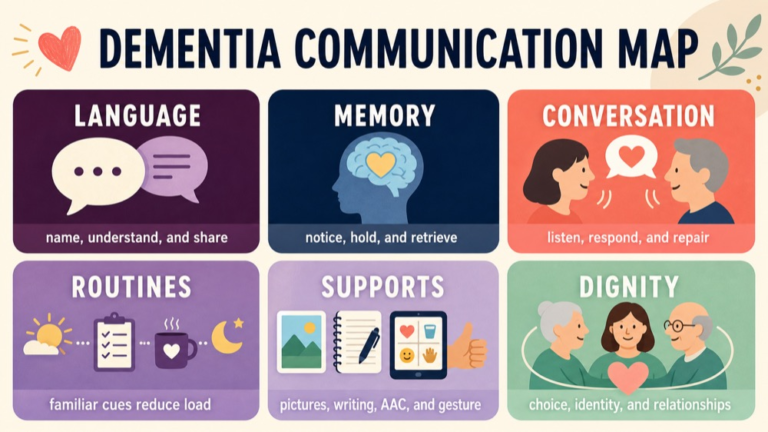
Dementia Communication Disorders: Language, Cognition, and Support
dementia communication disorders is easier to study when it is treated as a connected system rather than a single label. Dementia communication disorders are not one fixed language profile. A useful SLP study map follows the person’s changing communication abilities, the task and partner demands, available supports, and the participation goals that matter in daily life.
This learning guide is written for SLP students and other learners reviewing clinical concepts. It uses broad patterns to organize observation, not to make an individualized diagnosis or promise one outcome. Interpretation depends on the person, task, language, culture, hearing, access, health, context, and communication goals.
What dementia communication disorders includes
Begin by separating the concept into domains. A learner who can name the domains is less likely to collapse cognition, language, speech, auditory access, memory, attention, or participation questions into one explanation. The useful unit of analysis is the task: what the person was asked to understand, produce, remember, organize, coordinate, or communicate, with whom, under which conditions, and with what support.
Domain or system
What to notice
Question to carry forward
Language access
Word finding, comprehension, discourse, reading, writing, and use of familiar information may change in different ways.
Which language task and modality changed, and what remains available?
Memory and learning
New information may be harder to encode, hold, retrieve, or apply, especially when the message is long or unfamiliar.
Is the barrier noticing, retaining, retrieving, recognizing, or using the message?
Conversation
Topic maintenance, turn taking, repair, inference, and response to a partner may shift across stages and settings.
What does the partner need to do so the exchange remains reciprocal and meaningful?
Routines and context
Familiar people, places, objects, written cues, visual supports, and predictable routines can change access.
Which context, cue, or routine supports the person’s intended communication?
Communication supports
Writing, pictures, gesture, communication books, AAC, repetition, and partner strategies may support expression and understanding.
Is the support usable, valued, and matched to the current and changing goal?
Participation and dignity
Communication affects relationships, choice, safety, identity, care routines, and quality of life.
What meaningful decision, relationship, or daily activity should guide the plan?
These domains interact, but they should remain distinguishable. A learner may show strength in one task and need support in another. A study map organizes the next observation; it does not answer every assessment question or replace current professional guidance.
Keep the first pass descriptive and close to the communication event. Note the task, the response, the partner, the setting, the timing, the available support, and the consequence for participation. This gives the learner a stable record to compare across tasks and prevents a familiar term from doing too much explanatory work before the evidence has been separated.
For Praxis-style review, a vignette may include several true details but ask for one best interpretation or next step. The strongest answer usually respects the task, identifies the relevant function, checks the most important missing information, and avoids treating one performance sample as the whole profile.
Map dementia communication
For study purposes, describe the system-function relationship before naming a disorder or subtype. Record what the person understood, produced, initiated, repaired, coordinated, or participated in. Then note whether the task was familiar, how much context was shared, and which support changed the response.
Language access: compare naming, comprehension, discourse, reading, writing, gesture, and other communication modes.
Memory and learning: separate encoding, working memory, retrieval, recognition, and use of information in routines.
Conversation: observe topic, turn taking, repair, inference, partner response, and the person’s preferred ways to communicate.
Routines and context: examine familiarity, visual and written cues, environmental load, time, fatigue, and partner behavior.
Communication supports: consider low- and high-tech AAC, writing, pictures, gesture, objects, repetition, and partner training.
Participation and dignity: keep choice, relationships, safety, identity, autonomy, and quality of life visible in the learning map.
A strong description is specific enough that another learner could picture the event. Instead of writing “the system is weak,” describe the demand, the observable response, the partner, the context, and the result. This protects clinical reasoning from labels that are broader than the evidence.
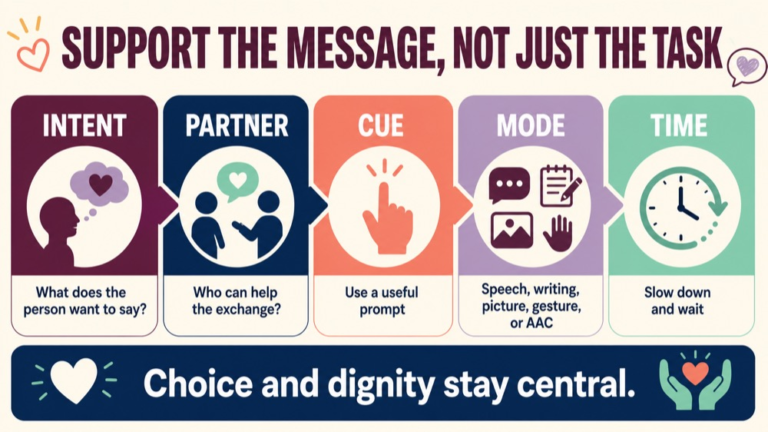
Support the message, not just the task
Context changes what communication requires. A naming task, a listening activity, a multi-step instruction, a narrative, a conversation, and a workplace exchange place different demands on processing, memory, attention, language, motor control, and partner support. Hearing access, fatigue, posture, visual supports, language experience, and the opportunity to request clarification should be part of the observation.
A person may communicate a familiar preference with a gesture or routine cue but have difficulty answering an abstract question, following a long explanation, or finding a word under pressure. A partner’s pace, phrasing, visual support, and willingness to wait can change the interaction. These observations should be described without assuming that one moment represents every stage or setting. The study priority is to match communication supports to the person’s current abilities, preferences, relationships, and meaningful routines.
Observation layer
Example question
Task
What did the person need to understand, produce, organize, coordinate, or repair?
Function
Which cognitive, language, speech, auditory, motor, or access relationship was observable?
Access
Were hearing, visual, motor, sensory, language, respiratory, or environmental supports available?
Participation
What meaningful routine became easier or harder because of the pattern?
Context is not an afterthought added once a label has been selected. It is part of the question itself. If performance changes with a quieter room, extra processing time, a familiar partner, a different communication mode, a changed speaking rate, or a changed task, that change is useful evidence about access and demand. It does not identify a cause by itself, but it tells you which conditions should be carried into the next observation.
Apply the concept in clinical reasoning
When a Praxis-style scenario or clinical discussion presents dementia communication disorders, use a disciplined sequence. The goal is to select the next clinical question or action that matches the evidence, the person’s priorities, and the communication context.
Define the task in plain language.
Identify the domain or domains involved without assuming they are interchangeable.
Separate observation from interpretation and write down what remains unknown.
Check hearing, language experience, culture, communication mode, environment, partner support, alertness, respiration, memory, and task familiarity.
Choose the assessment, collaboration, or observation step that answers the specific question.
State the boundary of the conclusion and keep the person’s participation goal visible.
A person may communicate a familiar preference with a gesture or routine cue but have difficulty answering an abstract question, following a long explanation, or finding a word under pressure. A partner’s pace, phrasing, visual support, and willingness to wait can change the interaction. These observations should be described without assuming that one moment represents every stage or setting. The study priority is to match communication supports to the person’s current abilities, preferences, relationships, and meaningful routines. In a learning answer, the decisive evidence is usually the relationship among the task, the observed pattern, and the next needed information—not a single isolated behavior or label.
Common study mistakes
Treating dementia communication as a single predictable sequence for every person.
Assuming a word-finding problem explains every difficulty with memory, comprehension, discourse, or behavior.
Speaking about the person instead of preserving their participation, choices, identity, and preferred communication.
Using rapid questioning, correction, or testing that increases pressure and reduces the quality of the exchange.
Choosing an AAC or cueing system without checking whether it is usable and meaningful in the person’s routines.
Assuming a structured response predicts communication with family, care partners, or community members.
Presenting educational material as a diagnosis, stage determination, or individualized care plan.
Most of these mistakes come from replacing a multidomain question with a fast label. Correct the habit by returning to the same sequence: describe, separate, contextualize, ask what is missing, and choose a proportionate next step. A short rationale can make the habit visible: identify the evidence, name the uncertainty, and explain why the selected next step fits both.
Build a quick review map
Use this compact map when reviewing a missed question, a lecture note, or a clinical vignette:
Step 1: Define the person’s message, communication partner, routine, setting, and meaningful goal.
Step 2: Separate language, memory, attention, executive function, hearing, vision, motor speech, and access.
Step 3: Compare familiar and novel information, short and long messages, supported and unsupported exchanges.
Step 4: Ask what the person prefers, what the partner observes, and which support changes the interaction.
Step 5: Protect autonomy, dignity, safety, relationships, and opportunities for the person to be heard.
Step 6: Choose the next assessment, partner strategy, or environmental change that fits the real routine.
Then write one transfer sentence: “When I see this pattern, I will first check ___ because ___.” The sentence should identify a decision rule, not repeat a definition. Revisit it after a delay and test whether you can apply the rule to a different task, age group, or communication mode.
Sources and next steps
dementia communication disorders is best learned as a context-sensitive pattern across structure, function, access, and participation. Use the current authority pages to refine the concept, then return to practice scenarios that require you to explain what the evidence supports and what it leaves open.
Traumatic Brain Injury Communication Disorders: A Clinical Study Map
traumatic brain injury communication disorders is easier to study when it is treated as a connected system rather than a single label. Traumatic brain injury communication disorders are best reviewed as a changing interaction among cognition, language, speech, social communication, access, and daily participation. For Praxis study, connect the observable communication event with the person’s history, task demands, supports, and goals.
This learning guide is written for SLP students and other learners reviewing clinical concepts. It uses broad patterns to organize observation, not to make an individualized diagnosis or promise one outcome. Interpretation depends on the person, task, language, culture, hearing, access, health, context, and communication goals.
What traumatic brain injury communication disorders includes
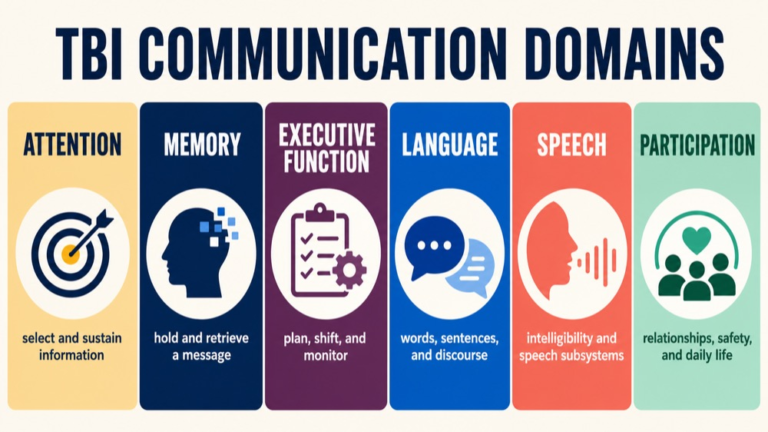
Begin by separating the concept into domains. A learner who can name the domains is less likely to collapse cognition, language, speech, auditory access, memory, attention, or participation questions into one explanation. The useful unit of analysis is the task: what the person was asked to understand, produce, remember, organize, coordinate, or communicate, with whom, under which conditions, and with what support.
Domain or system
What to notice
Question to carry forward
Attention and processing
The person may need to select, sustain, shift, or organize information across listening, speaking, reading, and conversation.
What information was available, selected, missed, or lost as the task became more complex?
Memory and learning
Encoding, working memory, retrieval, and learning can affect instructions, conversations, routines, and new strategies.
Is the demand on noticing, holding, retrieving, recognizing, or applying information?
Executive function
Initiation, inhibition, planning, shifting, monitoring, and problem solving can shape message organization and repair.
Can the person start, organize, adjust, monitor, and complete the communication goal?
Language and discourse
A person may show aphasia-like language changes, discourse organization changes, or difficulty integrating meaning across a message.
Which language level and discourse demand changed, and what evidence separates it from cognition?
Speech and voice
Dysarthria, apraxia, and changes in respiration, phonation, articulation, resonance, or prosody may affect intelligibility.
What speech subsystem and task condition are observable?
Social communication and participation
Conversation partners, social perception, routines, environmental supports, and self-advocacy affect functional communication.
Where does the pattern change safety, relationships, work, learning, or independence?
These domains interact, but they should remain distinguishable. A learner may show strength in one task and need support in another. A study map organizes the next observation; it does not answer every assessment question or replace current professional guidance.
Keep the first pass descriptive and close to the communication event. Note the task, the response, the partner, the setting, the timing, the available support, and the consequence for participation. This gives the learner a stable record to compare across tasks and prevents a familiar term from doing too much explanatory work before the evidence has been separated.
For Praxis-style review, a vignette may include several true details but ask for one best interpretation or next step. The strongest answer usually respects the task, identifies the relevant function, checks the most important missing information, and avoids treating one performance sample as the whole profile.
Map TBI communication domains
For study purposes, describe the system-function relationship before naming a disorder or subtype. Record what the person understood, produced, initiated, repaired, coordinated, or participated in. Then note whether the task was familiar, how much context was shared, and which support changed the response.
Attention and processing: selecting, sustaining, shifting, and organizing information across a communication event.
Memory and learning: encoding, holding, retrieving, recognizing, and applying information in routines and conversations.
Executive function: initiating, inhibiting, planning, shifting, monitoring, solving problems, and completing communication tasks.
Language and discourse: separating word, sentence, discourse, inference, and message-organization demands from broader cognition.
Speech and voice: describing respiration, phonation, resonance, articulation, prosody, motor planning, intelligibility, and effort.
Participation: connecting communication changes with partners, safety, work, education, relationships, independence, and personal goals.
A strong description is specific enough that another learner could picture the event. Instead of writing “the system is weak,” describe the demand, the observable response, the partner, the context, and the result. This protects clinical reasoning from labels that are broader than the evidence.
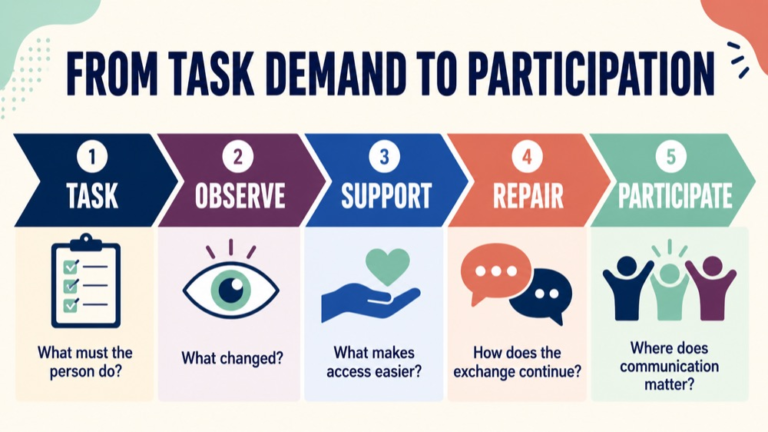
From task demand to participation
Context changes what communication requires. A naming task, a listening activity, a multi-step instruction, a narrative, a conversation, and a workplace exchange place different demands on processing, memory, attention, language, motor control, and partner support. Hearing access, fatigue, posture, visual supports, language experience, and the opportunity to request clarification should be part of the observation.
A person may communicate effectively in a familiar routine but lose the thread of a long explanation, miss a partner’s implied meaning, or become less intelligible when fatigue and motor demands rise. Another person may improve when a partner slows the exchange, writes key words, reduces distractions, or provides a collaborative repair. Those changes identify task and access variables; they do not establish one cause by themselves. Compare cognition, language, speech, hearing, mood, fatigue, medication, and context before drawing a conclusion.
Observation layer
Example question
Task
What did the person need to understand, produce, organize, coordinate, or repair?
Function
Which cognitive, language, speech, auditory, motor, or access relationship was observable?
Access
Were hearing, visual, motor, sensory, language, respiratory, or environmental supports available?
Participation
What meaningful routine became easier or harder because of the pattern?
Context is not an afterthought added once a label has been selected. It is part of the question itself. If performance changes with a quieter room, extra processing time, a familiar partner, a different communication mode, a changed speaking rate, or a changed task, that change is useful evidence about access and demand. It does not identify a cause by itself, but it tells you which conditions should be carried into the next observation.
Apply the concept in clinical reasoning
When a Praxis-style scenario or clinical discussion presents traumatic brain injury communication disorders, use a disciplined sequence. The goal is to select the next clinical question or action that matches the evidence, the person’s priorities, and the communication context.
Define the task in plain language.
Identify the domain or domains involved without assuming they are interchangeable.
Separate observation from interpretation and write down what remains unknown.
Check hearing, language experience, culture, communication mode, environment, partner support, alertness, respiration, memory, and task familiarity.
Choose the assessment, collaboration, or observation step that answers the specific question.
State the boundary of the conclusion and keep the person’s participation goal visible.
A person may communicate effectively in a familiar routine but lose the thread of a long explanation, miss a partner’s implied meaning, or become less intelligible when fatigue and motor demands rise. Another person may improve when a partner slows the exchange, writes key words, reduces distractions, or provides a collaborative repair. Those changes identify task and access variables; they do not establish one cause by themselves. Compare cognition, language, speech, hearing, mood, fatigue, medication, and context before drawing a conclusion. In a learning answer, the decisive evidence is usually the relationship among the task, the observed pattern, and the next needed information—not a single isolated behavior or label.
Common study mistakes
Treating every post-TBI communication difficulty as one global cognitive disorder.
Assuming a discourse problem is aphasia without checking attention, executive function, pragmatics, awareness, and context.
Confusing dysarthria, apraxia, aphasia, cognitive-communication, hearing, and environmental barriers.
Using a quiet structured task to predict performance in a fast conversation or busy workplace.
Describing impairment without connecting it to the person’s routines, relationships, safety, or priorities.
Choosing a support before identifying the specific communication demand it changes.
Treating a learning guide as a diagnosis or as a substitute for appropriate interdisciplinary evaluation.
Most of these mistakes come from replacing a multidomain question with a fast label. Correct the habit by returning to the same sequence: describe, separate, contextualize, ask what is missing, and choose a proportionate next step. A short rationale can make the habit visible: identify the evidence, name the uncertainty, and explain why the selected next step fits both.
Build a quick review map
Use this compact map when reviewing a missed question, a lecture note, or a clinical vignette:
Step 1: Define the injury history, communication task, message, partner, setting, and participation goal.
Step 2: Separate attention, memory, executive function, language, discourse, speech, social communication, and access.
Step 3: Compare familiar and novel tasks, short and long messages, structured and natural communication.
Step 4: Check hearing, vision, fatigue, medication, mood, motor speech, language background, and environmental load.
Step 5: Record which partner or environmental supports change access, repair, intelligibility, or participation.
Step 6: Choose the next assessment or collaboration that answers the most important remaining question.
Then write one transfer sentence: “When I see this pattern, I will first check ___ because ___.” The sentence should identify a decision rule, not repeat a definition. Revisit it after a delay and test whether you can apply the rule to a different task, age group, or communication mode.
Sources and next steps
traumatic brain injury communication disorders is best learned as a context-sensitive pattern across structure, function, access, and participation. Use the current authority pages to refine the concept, then return to practice scenarios that require you to explain what the evidence supports and what it leaves open.
Right Hemisphere Disorder: Pragmatics, Discourse, and Cognitive Communication
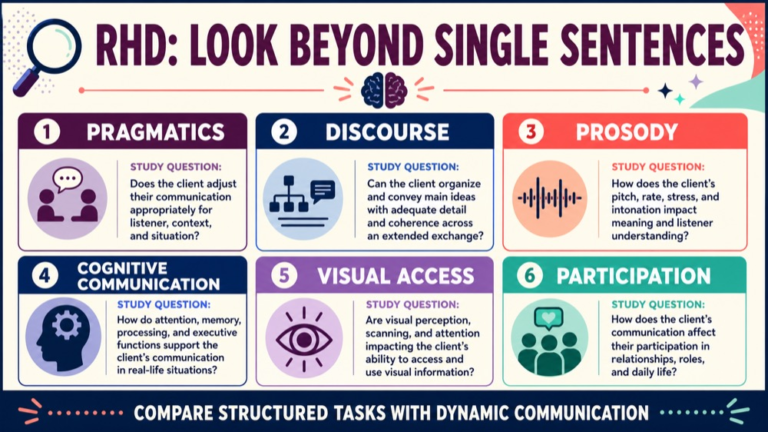
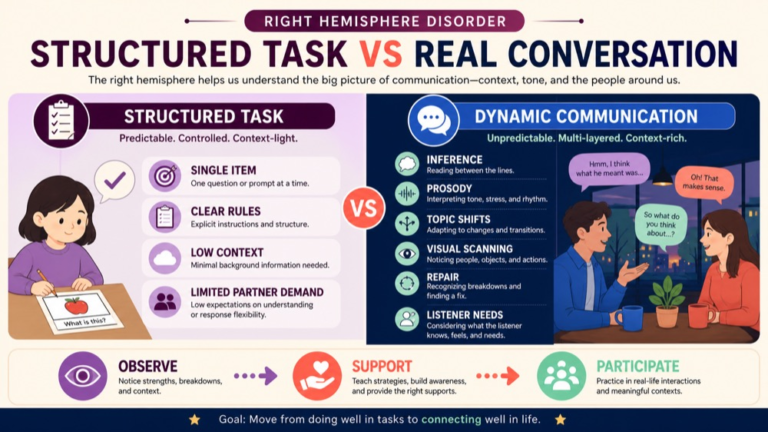
right hemisphere disorder is easier to study when it is treated as a connected system rather than a single label. Right hemisphere disorder is best studied as a constellation involving pragmatics, discourse, prosody, cognitive-communication, visual-perceptual access, and awareness. A strong SLP learning map separates these domains from aphasia and connects them to conversation, relationships, work, and daily participation.
This learning guide is written for SLP students and other learners reviewing clinical concepts. It uses broad patterns to organize observation, not to make an individualized diagnosis or promise one outcome. Interpretation depends on the person, task, language, culture, hearing, access, health, context, and communication goals.
What right hemisphere disorder includes
Begin by separating the concept into domains. A learner who can name the domains is less likely to collapse cognition, language, speech, auditory access, memory, attention, or participation questions into one explanation. The useful unit of analysis is the task: what the person was asked to understand, produce, remember, organize, coordinate, or communicate, with whom, under which conditions, and with what support.
Domain or system
What to notice
Question to carry forward
Pragmatics and meaning
The person may have difficulty conveying or interpreting intent, inference, humor, figurative language, or context-dependent meaning.
What meaning is explicit, implied, emotional, or shaped by the partner?
Discourse
Stories, explanations, conversations, and other language units longer than a sentence may reveal organization and relevance changes.
Does the person maintain the topic, gist, sequence, and listener needs?
Prosody and emotion
Pitch, stress, rhythm, loudness, facial expression, and gesture can contribute to meaning and emotion.
What paralinguistic or nonverbal cue changes interpretation?
Cognitive communication
Attention, memory, executive function, awareness, reasoning, and problem solving may affect communication in dynamic contexts.
Which cognitive demand is observable in the communication task?
Visual and spatial access
Neglect, visual field changes, or visual-perceptual factors can affect reading, scanning, navigation, and communication.
What access condition must be checked before interpreting the response?
Participation
Subtle deficits can affect relationships, social roles, work, safety, and independence even when structured tasks look strong.
Where does the communication pattern matter most in daily life?
These domains interact, but they should remain distinguishable. A learner may show strength in one task and need support in another. A study map organizes the next observation; it does not answer every assessment question or replace current professional guidance.
Keep the first pass descriptive and close to the communication event. Note the task, the response, the partner, the setting, the timing, the available support, and the consequence for participation. This gives the learner a stable record to compare across tasks and prevents a familiar term from doing too much explanatory work before the evidence has been separated.
For Praxis-style review, a vignette may include several true details but ask for one best interpretation or next step. The strongest answer usually respects the task, identifies the relevant function, checks the most important missing information, and avoids treating one performance sample as the whole profile.
Map right hemisphere disorder
For study purposes, describe the system-function relationship before naming a disorder or subtype. Record what the person understood, produced, initiated, repaired, coordinated, or participated in. Then note whether the task was familiar, how much context was shared, and which support changed the response.
Prosody and emotion: include pitch, stress, rhythm, loudness, facial expression, gesture, and emotional meaning.
Cognitive communication: separate attention, memory, executive function, awareness, reasoning, and language demands.
Visual and spatial access: check neglect, visual fields, visual perception, reading, scanning, and environmental access.
Participation: connect the profile with relationships, work, community, safety, independence, and communication partners.
A strong description is specific enough that another learner could picture the event. Instead of writing “the system is weak,” describe the demand, the observable response, the partner, the context, and the result. This protects clinical reasoning from labels that are broader than the evidence.
Structured task versus real conversation
Context changes what communication requires. A naming task, a listening activity, a multi-step instruction, a narrative, a conversation, and a workplace exchange place different demands on processing, memory, attention, language, motor control, and partner support. Hearing access, fatigue, posture, visual supports, language experience, and the opportunity to request clarification should be part of the observation.
A person with right hemisphere disorder may perform adequately on a short structured task but struggle to infer the gist of a conversation, notice a partner’s emotional cue, scan a page, or stay relevant during a complex exchange. These differences are why dynamic discourse, partner report, and functional observation matter. Do not reduce the profile to a single hemisphere shortcut or assume that a language difficulty is aphasia without examining the broader pattern.
Observation layer
Example question
Task
What did the person need to understand, produce, organize, coordinate, or repair?
Function
Which cognitive, language, speech, auditory, motor, or access relationship was observable?
Access
Were hearing, visual, motor, sensory, language, respiratory, or environmental supports available?
Participation
What meaningful routine became easier or harder because of the pattern?
Context is not an afterthought added once a label has been selected. It is part of the question itself. If performance changes with a quieter room, extra processing time, a familiar partner, a different communication mode, a changed speaking rate, or a changed task, that change is useful evidence about access and demand. It does not identify a cause by itself, but it tells you which conditions should be carried into the next observation.
Apply the concept in clinical reasoning
When a Praxis-style scenario or clinical discussion presents right hemisphere disorder, use a disciplined sequence. The goal is to select the next clinical question or action that matches the evidence, the person’s priorities, and the communication context.
Define the task in plain language.
Identify the domain or domains involved without assuming they are interchangeable.
Separate observation from interpretation and write down what remains unknown.
Check hearing, language experience, culture, communication mode, environment, partner support, alertness, respiration, memory, and task familiarity.
Choose the assessment, collaboration, or observation step that answers the specific question.
State the boundary of the conclusion and keep the person’s participation goal visible.
A person with right hemisphere disorder may perform adequately on a short structured task but struggle to infer the gist of a conversation, notice a partner’s emotional cue, scan a page, or stay relevant during a complex exchange. These differences are why dynamic discourse, partner report, and functional observation matter. Do not reduce the profile to a single hemisphere shortcut or assume that a language difficulty is aphasia without examining the broader pattern. In a learning answer, the decisive evidence is usually the relationship among the task, the observed pattern, and the next needed information—not a single isolated behavior or label.
Common study mistakes
Treating right hemisphere disorder as a single language deficit or as a synonym for aphasia.
Ignoring pragmatics, discourse, prosody, emotion, awareness, and cognitive-communication.
Using structured item accuracy to predict dynamic conversation, work, or community participation.
Overlooking neglect, visual field changes, visual perception, hearing, fatigue, and environmental access.
Assuming a person who speaks fluently has no meaningful communication impairment.
Ignoring culture, language background, relationship expectations, and communication partner behavior.
Describing a symptom without asking how it affects safety, relationships, work, or independence.
Choosing a treatment target before the functional communication profile is clear.
Most of these mistakes come from replacing a multidomain question with a fast label. Correct the habit by returning to the same sequence: describe, separate, contextualize, ask what is missing, and choose a proportionate next step. A short rationale can make the habit visible: identify the evidence, name the uncertainty, and explain why the selected next step fits both.
Build a quick review map
Use this compact map when reviewing a missed question, a lecture note, or a clinical vignette:
Step 1: Define the partner, task, setting, message, and participation consequence.
Step 2: Separate pragmatics, discourse, prosody, cognition, awareness, visual access, and language.
Step 3: Compare structured tasks with conversation, narrative, inference, and real-world routines.
Step 5: Record what the person notices, repairs, and changes with support.
Step 6: Choose the next observation or collaboration that matches the functional communication question.
Then write one transfer sentence: “When I see this pattern, I will first check ___ because ___.” The sentence should identify a decision rule, not repeat a definition. Revisit it after a delay and test whether you can apply the rule to a different task, age group, or communication mode.
Sources and next steps
right hemisphere disorder is best learned as a context-sensitive pattern across structure, function, access, and participation. Use the current authority pages to refine the concept, then return to practice scenarios that require you to explain what the evidence supports and what it leaves open.
Start with asha rhd, asha aphasia, ets 5331 study companion. These sources support the learning frame; they do not replace current topic-specific guidance or an individualized evaluation.
Primary Progressive Aphasia: Language Change, Variability, and Context
primary progressive aphasia is easier to study when it is treated as a connected system rather than a single label. Primary progressive aphasia is a language-centered neurodegenerative syndrome studied through change over time, but an exam answer must respect both the language profile and the diagnostic boundary. Review progressive language change, affected modalities, communication supports, variant descriptions, and the need for appropriate medical and interdisciplinary evaluation.
This learning guide is written for SLP students and other learners reviewing clinical concepts. It uses broad patterns to organize observation, not to make an individualized diagnosis or promise one outcome. Interpretation depends on the person, task, language, culture, hearing, access, health, context, and communication goals.
What primary progressive aphasia includes
Begin by separating the concept into domains. A learner who can name the domains is less likely to collapse cognition, language, speech, auditory access, memory, attention, or participation questions into one explanation. The useful unit of analysis is the task: what the person was asked to understand, produce, remember, organize, coordinate, or communicate, with whom, under which conditions, and with what support.
Domain or system
What to notice
Question to carry forward
Progressive language change
The defining learning question is a pattern of language decline over time rather than a single static language sample.
What changed, when did it change, and how was the change documented?
Language domains
Naming, word meaning, grammar, speech sounds, comprehension, repetition, reading, writing, and discourse may show different trajectories.
Which language domain is changing, and which remains relatively available?
Variant reasoning
Variant labels organize recurring language patterns but do not replace a comprehensive neurologic and communication profile.
Which evidence supports the pattern, and what evidence remains missing?
Differential boundaries
Language-led change must be distinguished from stroke-related aphasia, psychiatric factors, hearing loss, motor speech, and broader cognitive change.
What history, examination, or collaboration is needed before interpreting the pattern?
Communication supports
Writing, communication books, AAC, partner strategies, routines, and environmental supports can preserve participation as needs change.
Which support is usable now and adaptable over time?
Participation and counseling
The person’s identity, relationships, work, safety, autonomy, and preferences remain central to planning.
How will the plan protect communication and participation across change?
These domains interact, but they should remain distinguishable. A learner may show strength in one task and need support in another. A study map organizes the next observation; it does not answer every assessment question or replace current professional guidance.
Keep the first pass descriptive and close to the communication event. Note the task, the response, the partner, the setting, the timing, the available support, and the consequence for participation. This gives the learner a stable record to compare across tasks and prevents a familiar term from doing too much explanatory work before the evidence has been separated.
For Praxis-style review, a vignette may include several true details but ask for one best interpretation or next step. The strongest answer usually respects the task, identifies the relevant function, checks the most important missing information, and avoids treating one performance sample as the whole profile.
Map primary progressive aphasia
For study purposes, describe the system-function relationship before naming a disorder or subtype. Record what the person understood, produced, initiated, repaired, coordinated, or participated in. Then note whether the task was familiar, how much context was shared, and which support changed the response.
Progression: document the timeline, change, stability, variability, and functional consequences of language symptoms.
Language domains: compare naming, semantics, grammar, speech sounds, comprehension, repetition, literacy, and discourse.
Variant reasoning: use variant labels as study maps and keep the full language and neurologic profile visible.
Differential boundaries: separate acquired aphasia, motor speech, hearing, mood, medication, and broader cognitive questions.
Communication supports: plan writing, AAC, partner training, routines, visuals, and environmental changes that can evolve.
Participation: connect assessment and counseling with identity, relationships, work, safety, autonomy, and personal goals.
A strong description is specific enough that another learner could picture the event. Instead of writing “the system is weak,” describe the demand, the observable response, the partner, the context, and the result. This protects clinical reasoning from labels that are broader than the evidence.
Language change across time
Context changes what communication requires. A naming task, a listening activity, a multi-step instruction, a narrative, a conversation, and a workplace exchange place different demands on processing, memory, attention, language, motor control, and partner support. Hearing access, fatigue, posture, visual supports, language experience, and the opportunity to request clarification should be part of the observation.
A person may have a slowly changing word-finding problem, speech-sound difficulty, or comprehension pattern while other abilities remain useful for a period of time. The trajectory, language profile, medical history, and functional impact must be considered together. A study article can organize the reasoning, but it should not diagnose a neurodegenerative condition from a keyword, a single symptom, or one online checklist.
Observation layer
Example question
Task
What did the person need to understand, produce, organize, coordinate, or repair?
Function
Which cognitive, language, speech, auditory, motor, or access relationship was observable?
Access
Were hearing, visual, motor, sensory, language, respiratory, or environmental supports available?
Participation
What meaningful routine became easier or harder because of the pattern?
Context is not an afterthought added once a label has been selected. It is part of the question itself. If performance changes with a quieter room, extra processing time, a familiar partner, a different communication mode, a changed speaking rate, or a changed task, that change is useful evidence about access and demand. It does not identify a cause by itself, but it tells you which conditions should be carried into the next observation.
Apply the concept in clinical reasoning
When a Praxis-style scenario or clinical discussion presents primary progressive aphasia, use a disciplined sequence. The goal is to select the next clinical question or action that matches the evidence, the person’s priorities, and the communication context.
Define the task in plain language.
Identify the domain or domains involved without assuming they are interchangeable.
Separate observation from interpretation and write down what remains unknown.
Check hearing, language experience, culture, communication mode, environment, partner support, alertness, respiration, memory, and task familiarity.
Choose the assessment, collaboration, or observation step that answers the specific question.
State the boundary of the conclusion and keep the person’s participation goal visible.
A person may have a slowly changing word-finding problem, speech-sound difficulty, or comprehension pattern while other abilities remain useful for a period of time. The trajectory, language profile, medical history, and functional impact must be considered together. A study article can organize the reasoning, but it should not diagnose a neurodegenerative condition from a keyword, a single symptom, or one online checklist. In a learning answer, the decisive evidence is usually the relationship among the task, the observed pattern, and the next needed information—not a single isolated behavior or label.
Common study mistakes
Treating primary progressive aphasia as a synonym for any word-finding complaint.
Using one language symptom without documenting change over time and functional impact.
Assuming a variant label explains every language, cognitive, motor, or behavioral feature.
Confusing progressive language change with stroke-related aphasia, hearing loss, mood, or medication effects.
Ignoring reading, writing, discourse, gesture, AAC, conversation, and partner reports.
Overlooking the person’s language background, literacy, culture, identity, and preferences.
Presenting educational content as a diagnosis or a substitute for medical and communication evaluation.
Planning supports without considering how communication needs may change over time.
Most of these mistakes come from replacing a multidomain question with a fast label. Correct the habit by returning to the same sequence: describe, separate, contextualize, ask what is missing, and choose a proportionate next step. A short rationale can make the habit visible: identify the evidence, name the uncertainty, and explain why the selected next step fits both.
Build a quick review map
Use this compact map when reviewing a missed question, a lecture note, or a clinical vignette:
Step 1: Define the timeline, language change, communication partner, and functional concern.
Step 2: Separate naming, semantics, grammar, speech sounds, comprehension, repetition, literacy, and discourse.
Step 3: Compare current performance with prior baseline and document meaningful change.
Step 4: Check hearing, motor speech, cognition, mood, medication, language background, and medical history.
Step 5: Treat variant labels as provisional maps and state the diagnostic boundary clearly.
Step 6: Choose supports and collaboration that protect communication, safety, autonomy, and participation over time.
Then write one transfer sentence: “When I see this pattern, I will first check ___ because ___.” The sentence should identify a decision rule, not repeat a definition. Revisit it after a delay and test whether you can apply the rule to a different task, age group, or communication mode.
Sources and next steps
primary progressive aphasia is best learned as a context-sensitive pattern across structure, function, access, and participation. Use the current authority pages to refine the concept, then return to practice scenarios that require you to explain what the evidence supports and what it leaves open.
Start with asha ppa, asha aphasia, ets 5331 study companion. These sources support the learning frame; they do not replace current topic-specific guidance or an individualized evaluation.
Transcortical Aphasia: Repetition, Language Patterns, and Context
transcortical aphasia is easier to study when it is treated as a connected system rather than a single label. Transcortical aphasia is studied through language patterns in which repetition can be relatively stronger than other language tasks, but the distinction is not a shortcut to a complete diagnosis. Compare repetition with spontaneous expression, comprehension, naming, discourse, literacy, cueing, and participation.
This learning guide is written for SLP students and other learners reviewing clinical concepts. It uses broad patterns to organize observation, not to make an individualized diagnosis or promise one outcome. Interpretation depends on the person, task, language, culture, hearing, access, health, context, and communication goals.
What transcortical aphasia includes
Begin by separating the concept into domains. A learner who can name the domains is less likely to collapse cognition, language, speech, auditory access, memory, attention, or participation questions into one explanation. The useful unit of analysis is the task: what the person was asked to understand, produce, remember, organize, coordinate, or communicate, with whom, under which conditions, and with what support.
Domain or system
What to notice
Question to carry forward
Repetition
Repetition is interpreted in relation to length, meaning, auditory access, phonology, working memory, and the rest of the language profile.
Is repetition relatively preserved, and what happens as the task changes?
Spontaneous expression
Connected speech may be effortful, reduced, fluent, empty, or otherwise different from performance on repetition.
How does self-generated language compare with repeated language?
Comprehension
Understanding may vary across words, sentences, discourse, rate, modality, and contextual support.
Which comprehension level and support reveal the clearest pattern?
Naming and retrieval
Naming can be affected by semantic access, phonological access, cueing, or the demand to generate language independently.
Does a cue change access to meaning, sound, or response format?
Subtype reasoning
Motor, sensory, and mixed descriptions organize patterns but should be tested against the whole language sample.
Which evidence supports the pattern, and which evidence does not fit it?
Participation
Conversation, literacy, partner support, and communication modes determine the functional meaning of a repetition pattern.
What does the person need to communicate in real routines?
These domains interact, but they should remain distinguishable. A learner may show strength in one task and need support in another. A study map organizes the next observation; it does not answer every assessment question or replace current professional guidance.
Keep the first pass descriptive and close to the communication event. Note the task, the response, the partner, the setting, the timing, the available support, and the consequence for participation. This gives the learner a stable record to compare across tasks and prevents a familiar term from doing too much explanatory work before the evidence has been separated.
For Praxis-style review, a vignette may include several true details but ask for one best interpretation or next step. The strongest answer usually respects the task, identifies the relevant function, checks the most important missing information, and avoids treating one performance sample as the whole profile.
Map transcortical aphasia
For study purposes, describe the system-function relationship before naming a disorder or subtype. Record what the person understood, produced, initiated, repaired, coordinated, or participated in. Then note whether the task was familiar, how much context was shared, and which support changed the response.
Comprehension: compare words, sentences, discourse, spoken input, written input, and contextual support.
Naming and retrieval: examine semantic and phonological access, cue response, and independent generation.
Subtype reasoning: use motor, sensory, or mixed pattern terms as provisional study maps rather than complete explanations.
Participation: connect repetition and language performance with partners, literacy, work, relationships, and self-advocacy.
A strong description is specific enough that another learner could picture the event. Instead of writing “the system is weak,” describe the demand, the observable response, the partner, the context, and the result. This protects clinical reasoning from labels that are broader than the evidence.
Repetition versus self-generated language
Context changes what communication requires. A naming task, a listening activity, a multi-step instruction, a narrative, a conversation, and a workplace exchange place different demands on processing, memory, attention, language, motor control, and partner support. Hearing access, fatigue, posture, visual supports, language experience, and the opportunity to request clarification should be part of the observation.
A person may repeat a sentence more accurately than they generate a similar message independently, or may show a different pattern when the material is meaningful, written, delayed, or embedded in conversation. Relative repetition strength is informative only when it is compared with comprehension, expression, naming, discourse, and literacy. The study question is not merely whether repetition is correct; it is what the comparison reveals about the person’s language system and access.
Observation layer
Example question
Task
What did the person need to understand, produce, organize, coordinate, or repair?
Function
Which cognitive, language, speech, auditory, motor, or access relationship was observable?
Access
Were hearing, visual, motor, sensory, language, respiratory, or environmental supports available?
Participation
What meaningful routine became easier or harder because of the pattern?
Context is not an afterthought added once a label has been selected. It is part of the question itself. If performance changes with a quieter room, extra processing time, a familiar partner, a different communication mode, a changed speaking rate, or a changed task, that change is useful evidence about access and demand. It does not identify a cause by itself, but it tells you which conditions should be carried into the next observation.
Apply the concept in clinical reasoning
When a Praxis-style scenario or clinical discussion presents transcortical aphasia, use a disciplined sequence. The goal is to select the next clinical question or action that matches the evidence, the person’s priorities, and the communication context.
Define the task in plain language.
Identify the domain or domains involved without assuming they are interchangeable.
Separate observation from interpretation and write down what remains unknown.
Check hearing, language experience, culture, communication mode, environment, partner support, alertness, respiration, memory, and task familiarity.
Choose the assessment, collaboration, or observation step that answers the specific question.
State the boundary of the conclusion and keep the person’s participation goal visible.
A person may repeat a sentence more accurately than they generate a similar message independently, or may show a different pattern when the material is meaningful, written, delayed, or embedded in conversation. Relative repetition strength is informative only when it is compared with comprehension, expression, naming, discourse, and literacy. The study question is not merely whether repetition is correct; it is what the comparison reveals about the person’s language system and access. In a learning answer, the decisive evidence is usually the relationship among the task, the observed pattern, and the next needed information—not a single isolated behavior or label.
Common study mistakes
Treating repetition as proof of intact language or as a complete definition of a transcortical pattern.
Ignoring the difference between repeated output and self-generated connected speech.
Assigning a motor or sensory subtype from one task without a broad language profile.
Confusing repetition difficulty with hearing, phonological, working-memory, dysarthric, or apraxic factors.
Failing to vary sentence length, meaning, syntax, delay, cueing, and response mode.
Overlooking reading, writing, discourse, gesture, AAC, bilingual language use, and culture.
Assuming one strong repetition response generalizes to conversation or functional communication.
Choosing treatment before identifying the language, access, and participation demand.
Most of these mistakes come from replacing a multidomain question with a fast label. Correct the habit by returning to the same sequence: describe, separate, contextualize, ask what is missing, and choose a proportionate next step. A short rationale can make the habit visible: identify the evidence, name the uncertainty, and explain why the selected next step fits both.
Build a quick review map
Use this compact map when reviewing a missed question, a lecture note, or a clinical vignette:
Step 1: Define the repeated material, spontaneous task, partner, context, and communication goal.
Step 2: Separate repetition, expression, comprehension, naming, discourse, literacy, and cueing.
Step 3: Compare meaningful and meaningless material, short and long material, and structured and natural tasks.
Step 4: Check hearing, phonology, working memory, motor speech, language background, and fatigue.
Step 5: Use subtype descriptions as provisional pattern summaries and note mismatching evidence.
Step 6: State the next comparison that would clarify the language or access question.
Then write one transfer sentence: “When I see this pattern, I will first check ___ because ___.” The sentence should identify a decision rule, not repeat a definition. Revisit it after a delay and test whether you can apply the rule to a different task, age group, or communication mode.
Sources and next steps
transcortical aphasia is best learned as a context-sensitive pattern across structure, function, access, and participation. Use the current authority pages to refine the concept, then return to practice scenarios that require you to explain what the evidence supports and what it leaves open.
Start with asha aphasia, ets 5331 study companion. These sources support the learning frame; they do not replace current topic-specific guidance or an individualized evaluation.