Articulation Disorders: Sound Placement, Movement, and Context
articulation disorders is easier to study when it is treated as a connected system rather than a single label. Articulation disorders are studied through how a speaker shapes individual speech sounds, but an articulation question still requires language, dialect, hearing, motor, structural, and functional context. Describe the sound and task before deciding what it means.
This learning guide is written for SLP students and other learners reviewing clinical concepts. It uses broad patterns to organize observation, not to make an individualized diagnosis or promise one outcome. Interpretation depends on the person, task, language, culture, hearing, access, health, context, and communication goals.
What articulation disorders includes
Begin by separating the concept into domains. A learner who can name the domains is less likely to collapse perception, production, language, motor, voice, fluency, hearing, or participation questions into one explanation. The useful unit of analysis is the task: what the person was asked to understand, produce, organize, coordinate, remember, or communicate, with whom, under which conditions, and with what support.
Domain or system
What to notice
Question to carry forward
Place
The location of the primary constriction or approximation helps describe how a sound is formed.
Where is the movement or constriction occurring?
Manner
Airflow may be stopped, narrowed, redirected, or shaped in different ways.
What airflow and oral movement pattern is observable?
Voicing
Vocal-fold vibration interacts with oral placement and timing in the sound contrast.
Is the difference about vibration, placement, timing, or several features?
Word position
Initial, medial, final, stressed, unstressed, and cluster contexts place different demands on production.
Does the sound change with position or neighboring sounds?
Stability
A production may be consistent, variable, stimulable, or affected by rate and complexity.
What happens across repeated attempts and tasks?
Function
Listener understanding and the speaker’s goals matter beyond the presence of an error.
What communication situation needs support?
These domains interact, but they should remain distinguishable. A learner may show strength in one task and need support in another. A study map organizes the next observation; it does not answer every assessment question or replace current professional guidance.
Keep the first pass descriptive and close to the communication event. Note the task, the response, the partner, the setting, the timing, the available support, and the consequence for participation. This gives the learner a stable record to compare across tasks and prevents a familiar term from doing too much explanatory work before the evidence has been separated.
For Praxis-style review, a vignette may include several true details but ask for one best interpretation or next step. The strongest answer usually respects the task, identifies the relevant function, checks the most important missing information, and avoids treating one performance sample as the whole profile.
Map articulation disorders
For study purposes, describe the sound, voice, fluency, or communication relationship before naming a disorder. Record what the person understood, produced, initiated, repaired, coordinated, or participated in. Then note whether the task was familiar, how much context was shared, and which support changed the response.
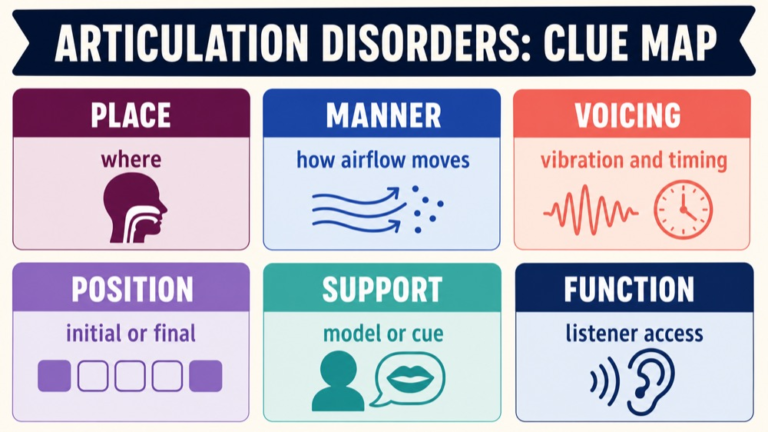
Place and manner: connect the label to the actual articulatory movement, airflow, and sound signal.
Voicing and timing: observe laryngeal vibration, release, duration, and coordination with the oral gesture.
Position and context: compare initial, medial, final, cluster, stressed, and connected-speech demands.
Stimulability and support: record what changes with a model, cue, visual, tactile, or slower rate.
Differential context: consider phonology, motor speech, structure, hearing, language, dialect, and development.
Function: describe who understands the speaker, when the breakdown occurs, and what matters to the speaker.
A strong description is specific enough that another learner could picture the event. Instead of writing “the system is impaired,” describe the demand, the observable response, the partner, the context, and the result. This protects clinical reasoning from labels that are broader than the evidence.
Read the sound in context
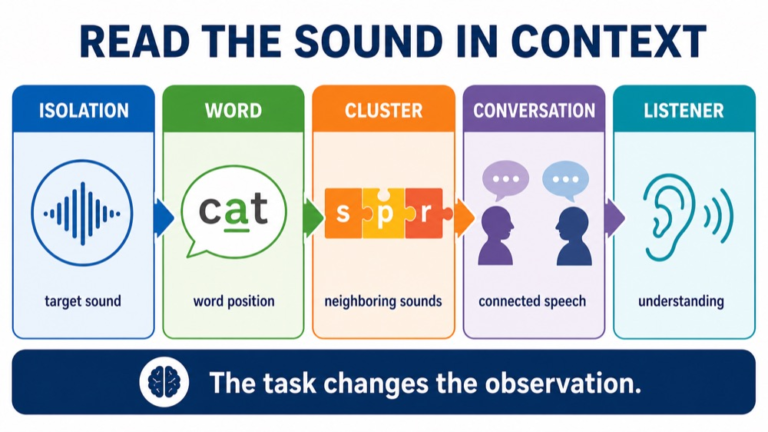
Context changes what communication requires. A sound in isolation, a word pattern, a long explanation, a conversation, a classroom exchange, a workplace voice demand, and a noisy interaction place different demands on production, processing, rate, memory, and partner support. Hearing access, fatigue, visual supports, language experience, and the opportunity to request clarification should be part of the observation.
A speaker may produce a sound accurately in a familiar word but not in a cluster or fast conversation. Another speaker may respond to a visual cue or model. These contrasts help organize the production question, but they do not name one disorder without the language, hearing, motor, structural, developmental, and functional profile.
Observation layer
Example question
Task
What did the person need to understand, produce, organize, coordinate, or repair?
Pattern
Which sound, voice, fluency, language, motor, or access relationship was observable?
Access
Were hearing, visual, motor, sensory, language, respiratory, or environmental supports available?
Participation
What meaningful routine became easier or harder because of the pattern?
Context is not an afterthought added once a label has been selected. It is part of the question itself. If performance changes with a quieter room, extra processing time, a familiar partner, a different communication mode, a changed speaking rate, or a changed task, that change is useful evidence about access and demand. It does not identify a cause by itself, but it tells you which conditions should be carried into the next observation.
Apply the concept in clinical reasoning
When a Praxis-style scenario or clinical discussion presents articulation disorders, use a disciplined sequence. The goal is to select the next clinical question or action that matches the evidence, the person’s priorities, and the communication context.
Define the task in plain language.
Identify the domain or domains involved without assuming they are interchangeable.
Separate observation from interpretation and write down what remains unknown.
Check hearing, language experience, culture, communication mode, environment, partner support, alertness, respiration, memory, and task familiarity.
Choose the assessment, collaboration, or observation step that answers the specific question.
State the boundary of the conclusion and keep the person’s participation goal visible.
A speaker may produce a sound accurately in a familiar word but not in a cluster or fast conversation. Another speaker may respond to a visual cue or model. These contrasts help organize the production question, but they do not name one disorder without the language, hearing, motor, structural, developmental, and functional profile. In a learning answer, the decisive evidence is usually the relationship among the task, the observed pattern, and the next needed information—not a single isolated behavior or label.
Common study mistakes
Treating place of articulation as the whole explanation for a speech pattern.
Confusing an individual sound production with a phonological rule.
Ignoring word position, stress, neighboring sounds, rate, and complexity.
Using a developmental reference as a rigid conclusion for one speaker.
Overlooking language, dialect, multilingual experience, and listener expectations.
Assuming a cue response identifies one underlying mechanism by itself.
Reporting a correct sound without checking connected speech and participation.
Choosing an intervention or diagnosis without describing the communication goal.
Most of these mistakes come from replacing a multidomain question with a fast label. Correct the habit by returning to the same sequence: describe, separate, contextualize, ask what is missing, and choose a proportionate next step. A short rationale can make the habit visible: identify the evidence, name the uncertainty, and explain why the selected next step fits both.
Build a quick review map
Use this compact map when reviewing a missed question, a lecture note, or a clinical vignette:
Step 1: Name the target sound, place, manner, voicing, position, and task.
Step 2: Compare isolated, word, phrase, repeated, and connected-speech samples.
Step 4: Record stimulability, cueing, rate, fatigue, and partner effects.
Step 5: Describe listener understanding and the meaningful communication consequence.
Step 6: State which next sample would clarify the production question.
Then write one transfer sentence: “When I see this pattern, I will first check ___ because ___.” The sentence should identify a decision rule, not repeat a definition. Revisit it after a delay and test whether you can apply the rule to a different task, age group, or communication mode.
Sources and next steps
articulation disorders is best learned as a context-sensitive pattern across structure, function, access, and participation. Use the current authority pages to refine the concept, then return to practice scenarios that require you to explain what the evidence supports and what it leaves open.
Speech Sound Disorders: Perception, Production, and Patterns
speech sound disorders is easier to study when it is treated as a connected system rather than a single label. Speech sound disorders can involve perception, motor production, phonological representation, or combinations of these questions. A strong SLP study map separates the observable sound pattern from language, hearing, motor, dialect, and participation context.
This learning guide is written for SLP students and other learners reviewing clinical concepts. It uses broad patterns to organize observation, not to make an individualized diagnosis or promise one outcome. Interpretation depends on the person, task, language, culture, hearing, access, health, context, and communication goals.
What speech sound disorders includes
Begin by separating the concept into domains. A learner who can name the domains is less likely to collapse perception, production, language, motor, voice, fluency, hearing, or participation questions into one explanation. The useful unit of analysis is the task: what the person was asked to understand, produce, organize, coordinate, remember, or communicate, with whom, under which conditions, and with what support.
Domain or system
What to notice
Question to carry forward
Perception
The learner must hear, compare, and represent speech contrasts before production can be interpreted in context.
What sound information is available and how is it being perceived?
Motor production
Lips, tongue, jaw, palate, and laryngeal structures coordinate movement, timing, and airflow.
Which movement or timing demand is observable?
Phonological representation
The sound system organizes contrasts and permissible sequences in a language.
Is the pattern about one production or a broader sound-system rule?
Pattern and context
Word position, syllable shape, rate, complexity, language, dialect, and task can change the response.
Where does the pattern appear and where does it not appear?
Assessment
Single-word, connected-speech, stimulability, hearing, oral-motor, and language tasks answer different questions.
Which next sample reduces the uncertainty?
Function
Intelligibility, classroom learning, relationships, identity, and communication participation give the pattern meaning.
Who is affected, in which routine, and with what support?
These domains interact, but they should remain distinguishable. A learner may show strength in one task and need support in another. A study map organizes the next observation; it does not answer every assessment question or replace current professional guidance.
Keep the first pass descriptive and close to the communication event. Note the task, the response, the partner, the setting, the timing, the available support, and the consequence for participation. This gives the learner a stable record to compare across tasks and prevents a familiar term from doing too much explanatory work before the evidence has been separated.
For Praxis-style review, a vignette may include several true details but ask for one best interpretation or next step. The strongest answer usually respects the task, identifies the relevant function, checks the most important missing information, and avoids treating one performance sample as the whole profile.
Map speech sound disorders
For study purposes, describe the sound, voice, fluency, or communication relationship before naming a disorder. Record what the person understood, produced, initiated, repaired, coordinated, or participated in. Then note whether the task was familiar, how much context was shared, and which support changed the response.
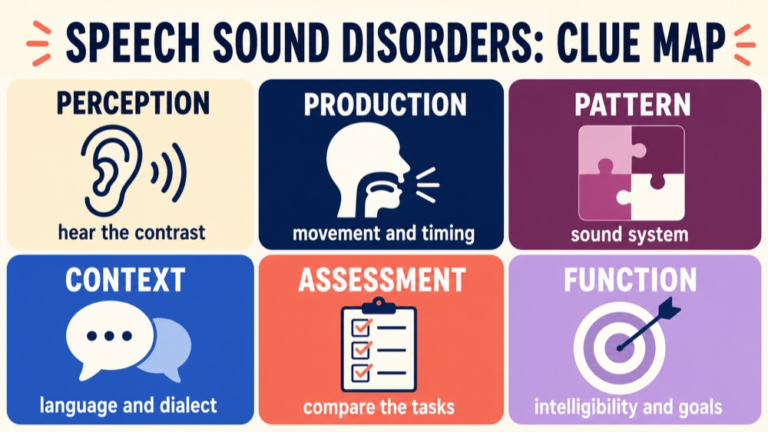
Sound access and perception: consider hearing, contrast perception, attention, language experience, and the listening context.
Production: describe place, manner, voicing, timing, coordination, range, and consistency without assuming one cause.
Phonological representation: examine contrasts, syllable structures, phonotactic patterns, and generalization across words.
Language and dialect: include language variety, multilingual experience, cultural context, and community speech patterns.
Task comparison: compare single words, phrases, conversation, repetition, stimulability, and changing complexity.
Function: connect intelligibility and access to the speaker’s partners, learning, identity, goals, and participation.
A strong description is specific enough that another learner could picture the event. Instead of writing “the system is impaired,” describe the demand, the observable response, the partner, the context, and the result. This protects clinical reasoning from labels that are broader than the evidence.
From sound pattern to function
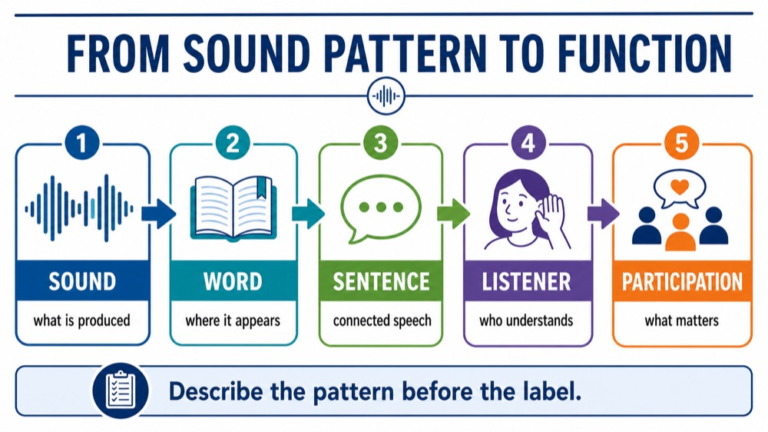
Context changes what communication requires. A sound in isolation, a word pattern, a long explanation, a conversation, a classroom exchange, a workplace voice demand, and a noisy interaction place different demands on production, processing, rate, memory, and partner support. Hearing access, fatigue, visual supports, language experience, and the opportunity to request clarification should be part of the observation.
A child may produce a sound in isolation but use a different pattern in clusters, connected speech, or a less familiar word. That difference tells the learner to examine word shape, position, complexity, rate, language, dialect, hearing, motor demand, and partner support before making a broad statement about the speech system.
Observation layer
Example question
Task
What did the person need to understand, produce, organize, coordinate, or repair?
Pattern
Which sound, voice, fluency, language, motor, or access relationship was observable?
Access
Were hearing, visual, motor, sensory, language, respiratory, or environmental supports available?
Participation
What meaningful routine became easier or harder because of the pattern?
Context is not an afterthought added once a label has been selected. It is part of the question itself. If performance changes with a quieter room, extra processing time, a familiar partner, a different communication mode, a changed speaking rate, or a changed task, that change is useful evidence about access and demand. It does not identify a cause by itself, but it tells you which conditions should be carried into the next observation.
Apply the concept in clinical reasoning
When a Praxis-style scenario or clinical discussion presents speech sound disorders, use a disciplined sequence. The goal is to select the next clinical question or action that matches the evidence, the person’s priorities, and the communication context.
Define the task in plain language.
Identify the domain or domains involved without assuming they are interchangeable.
Separate observation from interpretation and write down what remains unknown.
Check hearing, language experience, culture, communication mode, environment, partner support, alertness, respiration, memory, and task familiarity.
Choose the assessment, collaboration, or observation step that answers the specific question.
State the boundary of the conclusion and keep the person’s participation goal visible.
A child may produce a sound in isolation but use a different pattern in clusters, connected speech, or a less familiar word. That difference tells the learner to examine word shape, position, complexity, rate, language, dialect, hearing, motor demand, and partner support before making a broad statement about the speech system. In a learning answer, the decisive evidence is usually the relationship among the task, the observed pattern, and the next needed information—not a single isolated behavior or label.
Common study mistakes
Treating one sound error as a complete speech sound profile.
Confusing a phonetic production description with a phonological pattern.
Ignoring hearing, perception, language exposure, dialect, and multilingual experience.
Using a single-word task as if it represented connected-speech intelligibility.
Assuming an oral-motor observation explains the entire sound pattern.
Calling a community or dialect form an error without language-specific context.
Separating speech sound production from literacy, learning, and participation.
Choosing a label before identifying the task and the next needed comparison.
Most of these mistakes come from replacing a multidomain question with a fast label. Correct the habit by returning to the same sequence: describe, separate, contextualize, ask what is missing, and choose a proportionate next step. A short rationale can make the habit visible: identify the evidence, name the uncertainty, and explain why the selected next step fits both.
Build a quick review map
Use this compact map when reviewing a missed question, a lecture note, or a clinical vignette:
Step 1: Name the language, dialect, age, task, listener, and communication purpose.
Step 2: Separate perception, production, phonological representation, and access.
Step 5: Describe intelligibility and participation rather than only error counts.
Step 6: Choose the next observation that tests the specific uncertainty.
Then write one transfer sentence: “When I see this pattern, I will first check ___ because ___.” The sentence should identify a decision rule, not repeat a definition. Revisit it after a delay and test whether you can apply the rule to a different task, age group, or communication mode.
Sources and next steps
speech sound disorders is best learned as a context-sensitive pattern across structure, function, access, and participation. Use the current authority pages to refine the concept, then return to practice scenarios that require you to explain what the evidence supports and what it leaves open.
Motor Speech Disorders: Dysarthria, Apraxia, and Differential Reasoning
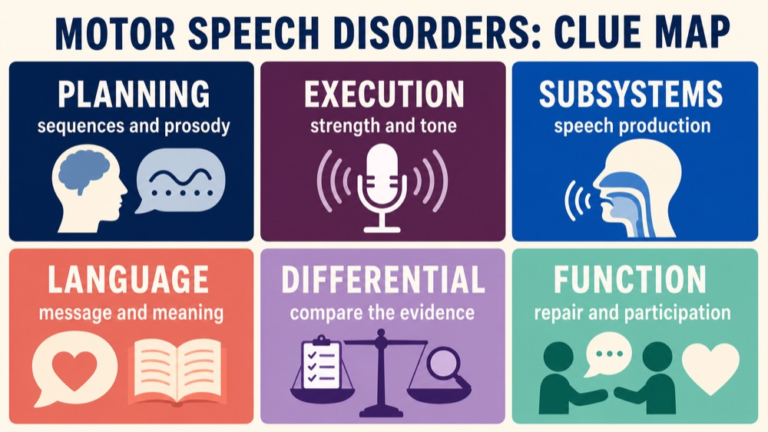
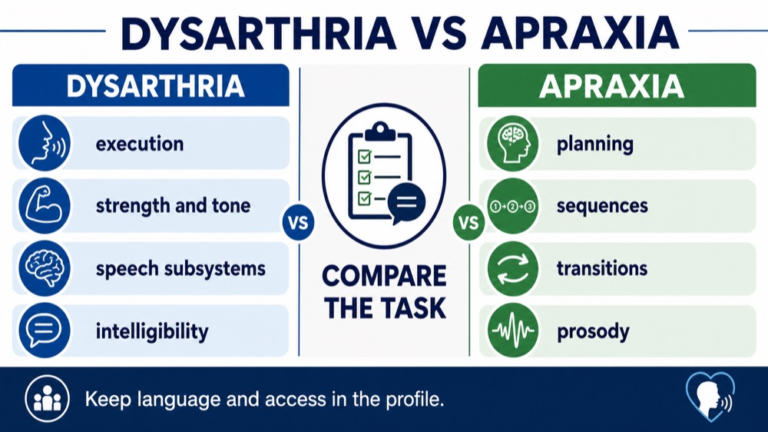
motor speech disorders is easier to study when it is treated as a connected speech-motor and communication profile rather than a single label. Motor speech disorders are easier to study when the learner separates planning and programming from execution, then connects both with language, cognition, hearing, access, and participation. Dysarthria and apraxia are related motor-speech topics, not interchangeable labels.
This learning guide is written for SLP students and other learners reviewing clinical concepts. It uses broad patterns to organize observation, not to make an individualized diagnosis or promise one outcome. Interpretation depends on the person, task, language, culture, hearing, access, health, context, and communication goals.
What motor speech disorders means in SLP study
Begin by separating the speech-motor concept into domains. A learner who can name the domains is less likely to collapse planning, execution, language, cognition, hearing, or participation questions into one explanation. The useful unit of analysis is the task: what the person was asked to understand, formulate, produce, repeat, coordinate, or communicate, with whom, under which conditions, and with what support.
Domain or system
What to notice
Question to carry forward
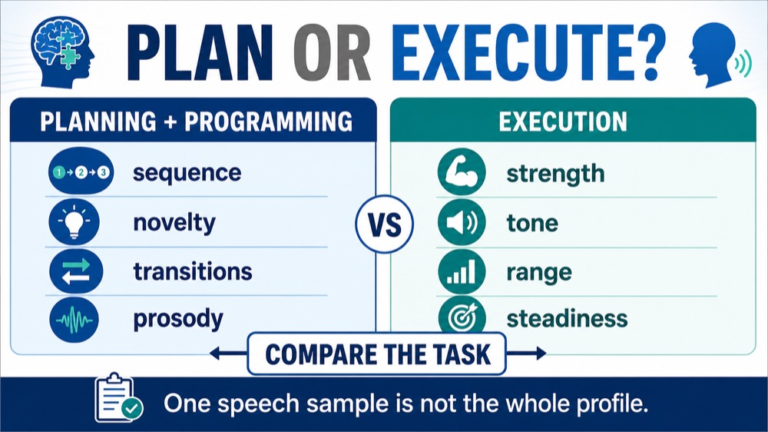
Planning and programming
Apraxia-focused questions ask how phonetic and prosodic speech movements are organized for the message.
Does sequence, novelty, repetition, transition, or cueing change the response?
Execution
Dysarthria-focused questions ask how strength, speed, range, steadiness, tone, or accuracy affect speech subsystems.
Which physical and perceptual features appear across respiration, phonation, resonance, articulation, and prosody?
Language
A person can have speech impairment, language impairment, both, or another communication difference.
Can the person understand, formulate, and communicate the message in another mode?
Subsystem interaction
Respiration, phonation, resonance, articulation, and prosody interact during connected speech.
Which subsystem or interaction changes intelligibility and naturalness?
Task and context
Automatic phrases, novel sequences, reading, conversation, fatigue, and listener demands reveal different information.
What condition changed and what did that change show?
Function and access
The profile should include communication repair, AAC, partner support, identity, safety, and participation.
What communication outcome matters to the person?
These domains interact, but they should remain distinguishable. A learner may show strength in one task and need support in another. A study map organizes the next observation; it does not answer every assessment question or replace current professional guidance.
Keep the first pass descriptive and close to the communication event. Note the task, the response, the partner, the setting, the timing, the available support, and the consequence for participation. This gives the learner a stable record to compare across tasks and prevents a familiar term from doing too much explanatory work before the evidence has been separated.
For Praxis-style review, a vignette may include several true details but ask for one best interpretation or next step. The strongest answer usually respects the task, identifies the relevant function, checks the most important missing information, and avoids treating one performance sample as the whole profile.
Map motor speech disorders
For study purposes, describe the motor-speech and communication relationship before naming a disorder. Record what the person understood, formulated, produced, initiated, repaired, coordinated, or participated in. Then note whether the task was familiar, how much context was shared, and which support changed the response.
Motor planning: organize phonetic and prosodic sequences, transitions, novelty, repetition, and cueing questions.
Motor execution: examine strength, speed, range, steadiness, tone, accuracy, and subsystem interaction.
Speech subsystems: connect respiration, phonation, resonance, articulation, and prosody to intelligibility and naturalness.
Language and cognition: separate aphasia, formulation, comprehension, memory, attention, discourse, and cognitive-communication questions.
Differential evidence: compare tasks, repeated attempts, automaticity, novel material, physical findings, and communication modes.
Function and participation: describe listener access, repair, AAC, partner support, environment, identity, and meaningful goals.
A strong description is specific enough that another learner could picture the event. Instead of writing “the speech system is impaired,” describe the demand, the observable response, the partner, the context, and the result. This protects clinical reasoning from labels that are broader than the evidence.
Dysarthria versus apraxia
Context changes what speech and communication require. Automatic phrases, novel sequences, reading, conversation, a long explanation, and a noisy exchange place different demands on planning, execution, memory, rate, language, and partner support. Hearing access, fatigue, posture, visual supports, language experience, and the opportunity to request clarification should be part of the observation.
A speaker may have imprecise articulation because movement execution is affected, because a speech sequence is difficult to plan, because language formulation is disrupted, or because hearing and access change the task. The same person may show more than one contribution. The exam-safe move is to identify the decisive evidence in the vignette and keep the alternatives open until the relevant comparison is made.
Observation layer
Example question
Task
What did the person need to understand, formulate, produce, organize, coordinate, or repair?
Motor speech
Which planning, execution, subsystem, timing, or prosody relationship was observable?
Access
Were hearing, visual, motor, sensory, language, respiratory, or environmental supports available?
Participation
What meaningful routine became easier or harder because of the pattern?
Context is not an afterthought added once a label has been selected. It is part of the question itself. If performance changes with a quieter room, extra processing time, a familiar partner, a different communication mode, a changed speaking rate, or a changed task, that change is useful evidence about access and demand. It does not identify a cause by itself, but it tells you which conditions should be carried into the next observation.
Separate the motor-speech question
When a Praxis-style scenario or clinical discussion presents motor speech disorders, use a disciplined sequence. The goal is to select the next clinical question or action that matches the evidence, the person’s priorities, and the communication context.
Define the task in plain language.
Identify the domain or domains involved without assuming they are interchangeable.
Separate observation from interpretation and write down what remains unknown.
Check hearing, language experience, culture, communication mode, environment, partner support, alertness, respiration, memory, swallowing, and task familiarity.
Choose the assessment, collaboration, or observation step that answers the specific question.
State the boundary of the conclusion and keep the person’s participation goal visible.
A speaker may have imprecise articulation because movement execution is affected, because a speech sequence is difficult to plan, because language formulation is disrupted, or because hearing and access change the task. The same person may show more than one contribution. The exam-safe move is to identify the decisive evidence in the vignette and keep the alternatives open until the relevant comparison is made. In a learning answer, the decisive evidence is usually the relationship among the task, the observed pattern, and the next needed information—not a single isolated behavior or label.
Common study mistakes
Using motor speech disorders, dysarthria, and apraxia as interchangeable terms.
Treating an articulation error as proof of a speech-motor diagnosis.
Ignoring the difference between planning and execution evidence.
Reducing dysarthria to one subsystem such as voice or articulation.
Separating motor speech from aphasia, cognition, hearing, language, and access without checking the profile.
Choosing a label before describing the speech pattern and physical findings.
Leaving intelligibility, naturalness, repair, AAC, and participation out of the answer.
Most of these mistakes come from replacing a multidomain question with a fast label. Correct the habit by returning to the same sequence: describe, separate, contextualize, ask what is missing, and choose a proportionate next step. A short rationale can make the habit visible: identify the evidence, name the uncertainty, and explain why the selected next step fits both.
Build a quick review map
Use this compact map when reviewing a missed question, a lecture note, or a clinical vignette:
Step 1: Identify the message, speech task, population, history, listener, and goal.
Step 2: Separate planning, programming, execution, language, cognition, hearing, and access.
Step 3: Compare speech subsystems and task conditions rather than one isolated sign.
Step 4: Use repeated, automatic, novel, reading, and conversational samples when relevant.
Step 5: Name the evidence for the leading interpretation and the evidence still missing.
Step 6: Connect the conclusion to communication repair and participation.
Then write one transfer sentence: “When I see this pattern, I will first check ___ because ___.” The sentence should identify a decision rule, not repeat a definition. Revisit it after a delay and test whether you can apply the rule to a different task, age group, or communication mode.
Sources and next steps
motor speech disorders is best learned as a context-sensitive pattern across speech planning, execution, language, access, and participation. Use the current authority pages to refine the concept, then return to practice scenarios that require you to explain what the evidence supports and what it leaves open.
Acquired Apraxia of Speech: Adult Speech-Motor Planning Clues
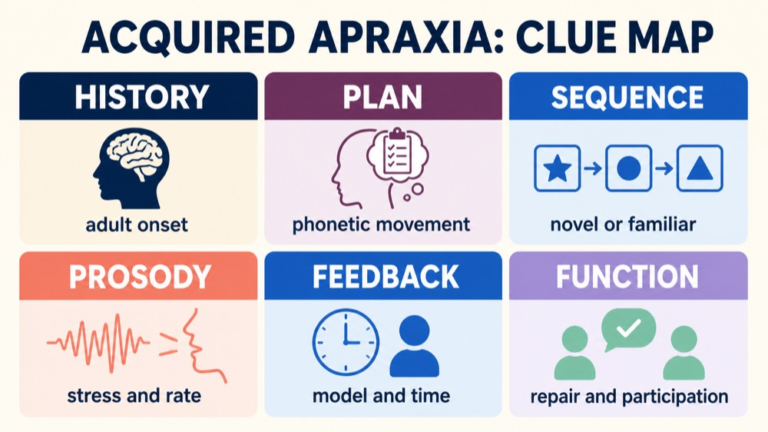
acquired apraxia of speech is easier to study when it is treated as a connected speech-motor and communication profile rather than a single label. Acquired apraxia of speech is an adult neurologic speech topic involving impaired planning or programming of phonetic and prosodic processes. For Praxis review, compare speech-motor output with language, execution, cognition, hearing, and functional communication evidence.
This learning guide is written for SLP students and other learners reviewing clinical concepts. It uses broad patterns to organize observation, not to make an individualized diagnosis or promise one outcome. Interpretation depends on the person, task, language, culture, hearing, access, health, context, and communication goals.
What acquired apraxia of speech means in SLP study
Begin by separating the speech-motor concept into domains. A learner who can name the domains is less likely to collapse planning, execution, language, cognition, hearing, or participation questions into one explanation. The useful unit of analysis is the task: what the person was asked to understand, formulate, produce, repeat, coordinate, or communicate, with whom, under which conditions, and with what support.
Domain or system
What to notice
Question to carry forward
Adult acquired context
A new or changed speech profile must be interpreted with history, neurologic context, language, cognition, and participation.
What changed, when did it change, and what other communication systems are involved?
Phonetic sequences
The person may show difficulty organizing or transitioning through speech movements in a target sequence.
Which sequence, length, novelty, or transition changes performance?
Prosody
Stress, rate, rhythm, and phrasing are part of the speech plan and the listener’s understanding.
What does the listener hear about timing and naturalness?
Execution
Weakness, tone, incoordination, range, and subsystem findings can complicate the interpretation.
Which evidence points to execution, planning, or both?
Language and cognition
Aphasia, cognitive-communication change, memory, attention, and discourse can affect a speech task.
Can the person formulate and communicate the message in another mode?
Function
The meaningful outcome includes self-advocacy, relationships, work, safety, and communication repair.
Which communication situation should guide the next observation?
These domains interact, but they should remain distinguishable. A learner may show strength in one task and need support in another. A study map organizes the next observation; it does not answer every assessment question or replace current professional guidance.
Keep the first pass descriptive and close to the communication event. Note the task, the response, the partner, the setting, the timing, the available support, and the consequence for participation. This gives the learner a stable record to compare across tasks and prevents a familiar term from doing too much explanatory work before the evidence has been separated.
For Praxis-style review, a vignette may include several true details but ask for one best interpretation or next step. The strongest answer usually respects the task, identifies the relevant function, checks the most important missing information, and avoids treating one performance sample as the whole profile.
Map acquired apraxia clues
For study purposes, describe the motor-speech and communication relationship before naming a disorder. Record what the person understood, formulated, produced, initiated, repaired, coordinated, or participated in. Then note whether the task was familiar, how much context was shared, and which support changed the response.
History and onset: describe the acquired context, change over time, associated conditions, and communication priorities.
Planning and programming: compare phonetic sequences, repeated attempts, novel words, length, transitions, and prosody.
Language and cognition: separate formulation, naming, comprehension, memory, attention, reading, writing, and discourse.
Feedback and support: record the effect of models, cueing, rate changes, written choices, gesture, AAC, and familiar partners.
Function: connect speech performance to participation, repair, identity, autonomy, and the person’s own communication goals.
A strong description is specific enough that another learner could picture the event. Instead of writing “the speech system is impaired,” describe the demand, the observable response, the partner, the context, and the result. This protects clinical reasoning from labels that are broader than the evidence.
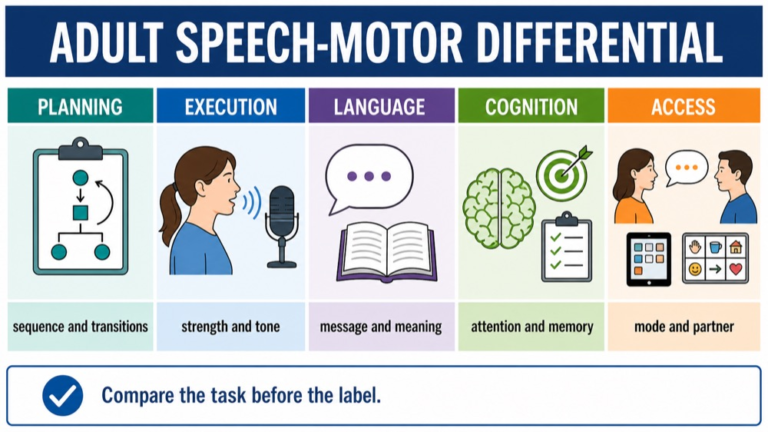
Adult speech-motor differential
Context changes what speech and communication require. Automatic phrases, novel sequences, reading, conversation, a long explanation, and a noisy exchange place different demands on planning, execution, memory, rate, language, and partner support. Hearing access, fatigue, posture, visual supports, language experience, and the opportunity to request clarification should be part of the observation.
An adult may have a stronger performance on a familiar automatic phrase than on a novel sentence, or may change with a model, extra time, written support, or a different rate. Those observations help organize the planning and programming question. They must still be interpreted with dysarthria, aphasia, cognition, hearing, fatigue, and access in view, because co-occurring changes can shape the same speech sample.
Observation layer
Example question
Task
What did the person need to understand, formulate, produce, organize, coordinate, or repair?
Motor speech
Which planning, execution, subsystem, timing, or prosody relationship was observable?
Access
Were hearing, visual, motor, sensory, language, respiratory, or environmental supports available?
Participation
What meaningful routine became easier or harder because of the pattern?
Context is not an afterthought added once a label has been selected. It is part of the question itself. If performance changes with a quieter room, extra processing time, a familiar partner, a different communication mode, a changed speaking rate, or a changed task, that change is useful evidence about access and demand. It does not identify a cause by itself, but it tells you which conditions should be carried into the next observation.
Separate the motor-speech question
When a Praxis-style scenario or clinical discussion presents acquired apraxia of speech, use a disciplined sequence. The goal is to select the next clinical question or action that matches the evidence, the person’s priorities, and the communication context.
Define the task in plain language.
Identify the domain or domains involved without assuming they are interchangeable.
Separate observation from interpretation and write down what remains unknown.
Check hearing, language experience, culture, communication mode, environment, partner support, alertness, respiration, memory, swallowing, and task familiarity.
Choose the assessment, collaboration, or observation step that answers the specific question.
State the boundary of the conclusion and keep the person’s participation goal visible.
An adult may have a stronger performance on a familiar automatic phrase than on a novel sentence, or may change with a model, extra time, written support, or a different rate. Those observations help organize the planning and programming question. They must still be interpreted with dysarthria, aphasia, cognition, hearing, fatigue, and access in view, because co-occurring changes can shape the same speech sample. In a learning answer, the decisive evidence is usually the relationship among the task, the observed pattern, and the next needed information—not a single isolated behavior or label.
Common study mistakes
Confusing acquired apraxia of speech with childhood apraxia of speech or dysarthria.
Treating one articulatory error as evidence for the whole adult speech profile.
Ignoring onset, neurologic history, progression, fatigue, and associated communication changes.
Using a repetition or imitation task as if it measured spontaneous communication alone.
Separating speech planning from language formulation, cognition, and discourse without evidence.
Overlooking weakness, tone, incoordination, voice, resonance, respiration, and swallowing questions.
Leaving writing, gesture, AAC, partner support, and repair out of the functional analysis.
Writing a mechanism or treatment conclusion without stating the observed task and uncertainty.
Most of these mistakes come from replacing a multidomain question with a fast label. Correct the habit by returning to the same sequence: describe, separate, contextualize, ask what is missing, and choose a proportionate next step. A short rationale can make the habit visible: identify the evidence, name the uncertainty, and explain why the selected next step fits both.
Build a quick review map
Use this compact map when reviewing a missed question, a lecture note, or a clinical vignette:
Step 1: Define the acquired context, history, task, listener, and communication purpose.
Step 2: Separate planning, programming, execution, language, cognition, and access.
Step 4: Record cueing, feedback, time, fatigue, partner, and environmental effects.
Step 5: Connect the speech observation to repair and participation.
Step 6: State what additional assessment or collaboration is needed before a stronger conclusion.
Then write one transfer sentence: “When I see this pattern, I will first check ___ because ___.” The sentence should identify a decision rule, not repeat a definition. Revisit it after a delay and test whether you can apply the rule to a different task, age group, or communication mode.
Sources and next steps
acquired apraxia of speech is best learned as a context-sensitive pattern across speech planning, execution, language, access, and participation. Use the current authority pages to refine the concept, then return to practice scenarios that require you to explain what the evidence supports and what it leaves open.
Childhood Apraxia of Speech: Consistency, Transitions, and Prosody
childhood apraxia of speech is easier to study when it is treated as a connected speech-motor and communication profile rather than a single label. Childhood apraxia of speech is a pediatric speech-motor planning and programming topic that must be separated from other speech sound, language, motor, and access questions. The strongest review map connects repeated productions, transitions, prosody, task complexity, and functional communication.
This learning guide is written for SLP students and other learners reviewing clinical concepts. It uses broad patterns to organize observation, not to make an individualized diagnosis or promise one outcome. Interpretation depends on the person, task, language, culture, hearing, access, health, context, and communication goals.
What childhood apraxia of speech means in SLP study
Begin by separating the speech-motor concept into domains. A learner who can name the domains is less likely to collapse planning, execution, language, cognition, hearing, or participation questions into one explanation. The useful unit of analysis is the task: what the person was asked to understand, formulate, produce, repeat, coordinate, or communicate, with whom, under which conditions, and with what support.
Domain or system
What to notice
Question to carry forward
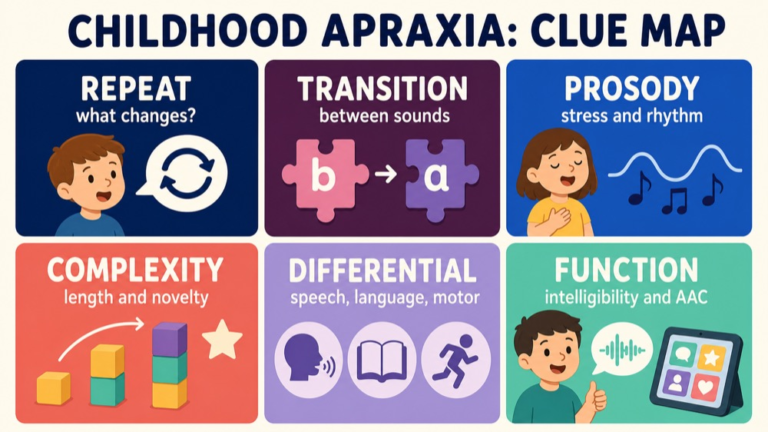
Repeated productions
Inconsistent consonant or vowel errors may appear when syllables or words are produced more than once.
What changes across attempts, and what task or support is held constant?
Transitions
Lengthened or disrupted transitions can affect smooth movement between sounds, syllables, or words.
Is the challenge in the movement transition, the sound target, the sequence, or the language task?
Prosody
Stress, rhythm, and phrasing affect how natural and understandable a child’s speech sounds.
What prosodic pattern is expected in the child’s language and context?
Complexity
Age, word length, syllable shape, rate, and novelty can change the observed pattern.
How does the response change as the speech-motor demand increases?
Differential profile
Dysarthria, speech sound disorder, language disorder, hearing, and other motor factors may overlap or co-occur.
Which evidence supports each plausible contribution?
Functional communication
Intelligibility, participation, partner support, and AAC may be part of the child’s communication plan.
What helps the child communicate a meaningful message now?
These domains interact, but they should remain distinguishable. A learner may show strength in one task and need support in another. A study map organizes the next observation; it does not answer every assessment question or replace current professional guidance.
Keep the first pass descriptive and close to the communication event. Note the task, the response, the partner, the setting, the timing, the available support, and the consequence for participation. This gives the learner a stable record to compare across tasks and prevents a familiar term from doing too much explanatory work before the evidence has been separated.
For Praxis-style review, a vignette may include several true details but ask for one best interpretation or next step. The strongest answer usually respects the task, identifies the relevant function, checks the most important missing information, and avoids treating one performance sample as the whole profile.
Map childhood apraxia clues
For study purposes, describe the motor-speech and communication relationship before naming a disorder. Record what the person understood, formulated, produced, initiated, repaired, coordinated, or participated in. Then note whether the task was familiar, how much context was shared, and which support changed the response.
Consistency: record repeated productions of the same target and the exact context, rather than relying on one attempt.
Transitions: observe movement between sounds, syllables, and words, including segmentation and timing when relevant.
Prosody: listen to lexical or phrasal stress, rhythm, rate, and phrasing through the child’s linguistic and cultural context.
Complexity: compare simple and complex syllables, short and long words, familiar and novel sequences, and different rates.
Differential reasoning: keep speech-motor planning, execution, phonology, language, hearing, and other motor factors distinguishable.
Function and access: include intelligibility, communication partners, AAC, gestures, classroom routines, and the child’s priorities.
A strong description is specific enough that another learner could picture the event. Instead of writing “the speech system is impaired,” describe the demand, the observable response, the partner, the context, and the result. This protects clinical reasoning from labels that are broader than the evidence.
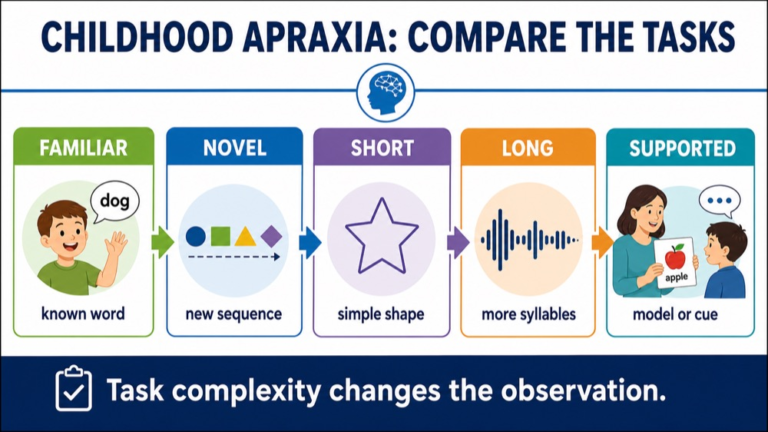
Compare task complexity
Context changes what speech and communication require. Automatic phrases, novel sequences, reading, conversation, a long explanation, and a noisy exchange place different demands on planning, execution, memory, rate, language, and partner support. Hearing access, fatigue, posture, visual supports, language experience, and the opportunity to request clarification should be part of the observation.
A child may show different productions of the same word, more disrupted transitions as word length grows, or a prosodic pattern that changes with task complexity. ASHA’s current guidance also places an important boundary on interpretation: no validated feature set alone separates CAS from all other childhood speech sound disorders. The observation must therefore be integrated with history, language, motor, hearing, development, and functional communication.
Observation layer
Example question
Task
What did the person need to understand, formulate, produce, organize, coordinate, or repair?
Motor speech
Which planning, execution, subsystem, timing, or prosody relationship was observable?
Access
Were hearing, visual, motor, sensory, language, respiratory, or environmental supports available?
Participation
What meaningful routine became easier or harder because of the pattern?
Context is not an afterthought added once a label has been selected. It is part of the question itself. If performance changes with a quieter room, extra processing time, a familiar partner, a different communication mode, a changed speaking rate, or a changed task, that change is useful evidence about access and demand. It does not identify a cause by itself, but it tells you which conditions should be carried into the next observation.
Separate the motor-speech question
When a Praxis-style scenario or clinical discussion presents childhood apraxia of speech, use a disciplined sequence. The goal is to select the next clinical question or action that matches the evidence, the person’s priorities, and the communication context.
Define the task in plain language.
Identify the domain or domains involved without assuming they are interchangeable.
Separate observation from interpretation and write down what remains unknown.
Check hearing, language experience, culture, communication mode, environment, partner support, alertness, respiration, memory, swallowing, and task familiarity.
Choose the assessment, collaboration, or observation step that answers the specific question.
State the boundary of the conclusion and keep the person’s participation goal visible.
A child may show different productions of the same word, more disrupted transitions as word length grows, or a prosodic pattern that changes with task complexity. ASHA’s current guidance also places an important boundary on interpretation: no validated feature set alone separates CAS from all other childhood speech sound disorders. The observation must therefore be integrated with history, language, motor, hearing, development, and functional communication. In a learning answer, the decisive evidence is usually the relationship among the task, the observed pattern, and the next needed information—not a single isolated behavior or label.
Common study mistakes
Treating a short list of features as a stand-alone diagnostic test.
Ignoring repeated productions and focusing on one attractive example.
Confusing a sound error with a disrupted transition or a prosodic difference.
Using adult acquired-apraxia language without adapting the population and developmental context.
Overlooking phonological, language, hearing, motor, sensory, and developmental contributors.
Ignoring the child’s language, dialect, culture, communication mode, and partner expectations.
Treating intelligibility as the only functional outcome while omitting participation and AAC.
Choosing a conclusion before comparing complexity, novelty, repetition, and support.
Most of these mistakes come from replacing a multidomain question with a fast label. Correct the habit by returning to the same sequence: describe, separate, contextualize, ask what is missing, and choose a proportionate next step. A short rationale can make the habit visible: identify the evidence, name the uncertainty, and explain why the selected next step fits both.
Build a quick review map
Use this compact map when reviewing a missed question, a lecture note, or a clinical vignette:
Step 1: Name the child’s age, language context, history, task, and communication goal.
Step 2: Compare repeated productions, transitions, prosody, and complexity separately.
Step 4: Use evidence boundaries instead of a checklist-based conclusion.
Step 5: Include AAC, gestures, partner support, intelligibility, and participation.
Step 6: Select the next observation or collaboration that reduces the most important uncertainty.
Then write one transfer sentence: “When I see this pattern, I will first check ___ because ___.” The sentence should identify a decision rule, not repeat a definition. Revisit it after a delay and test whether you can apply the rule to a different task, age group, or communication mode.
Sources and next steps
childhood apraxia of speech is best learned as a context-sensitive pattern across speech planning, execution, language, access, and participation. Use the current authority pages to refine the concept, then return to practice scenarios that require you to explain what the evidence supports and what it leaves open.
Apraxia of Speech: Planning, Programming, and Speech Movement
apraxia of speech is easier to study when it is treated as a connected speech-motor and communication profile rather than a single label. Apraxia of speech is a speech-motor planning and programming concept that must be interpreted with age, history, language, motor execution, task complexity, and communication context. Study it as a reasoning map rather than as a checklist of one sign.
This learning guide is written for SLP students and other learners reviewing clinical concepts. It uses broad patterns to organize observation, not to make an individualized diagnosis or promise one outcome. Interpretation depends on the person, task, language, culture, hearing, access, health, context, and communication goals.
What apraxia of speech means in SLP study
Begin by separating the speech-motor concept into domains. A learner who can name the domains is less likely to collapse planning, execution, language, cognition, hearing, or participation questions into one explanation. The useful unit of analysis is the task: what the person was asked to understand, formulate, produce, repeat, coordinate, or communicate, with whom, under which conditions, and with what support.
Domain or system
What to notice
Question to carry forward
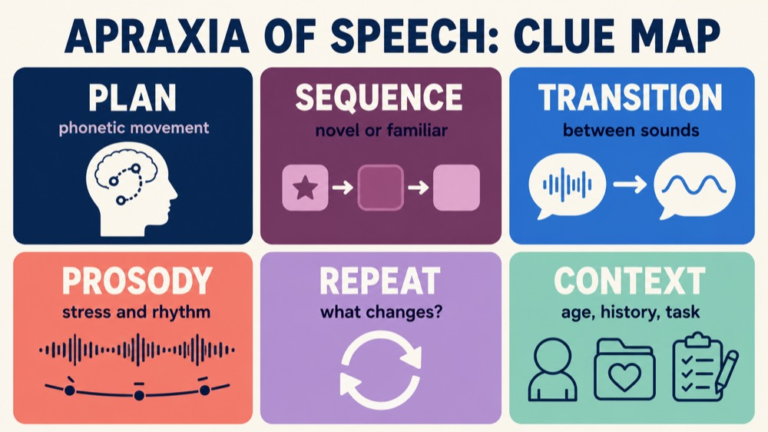
Planning and programming
The speaker organizes phonetic and prosodic movement sequences for a spoken message.
Which part of the speech task changes when the sequence or context changes?
Consistency
Repeated productions may show different errors or different levels of success across attempts and tasks.
Is the variation systematic, task-linked, or affected by cueing and fatigue?
Transitions
Movement between sounds and syllables may be disrupted, lengthened, or segmented.
Does the difficulty appear during transitions, sequences, or changing targets?
Prosody
Stress, rhythm, rate, and phrasing contribute to the naturalness and clarity of the message.
What prosodic demand is present, and what does the listener need?
Execution
Planning and execution are related but distinct questions; weakness, tone, range, and coordination can also affect speech.
What physical and subsystem findings support or complicate the planning hypothesis?
Age and context
Acquired and childhood apraxia are distinct study contexts with different histories and assessment boundaries.
What population and evidence boundary does the question specify?
These domains interact, but they should remain distinguishable. A learner may show strength in one task and need support in another. A study map organizes the next observation; it does not answer every assessment question or replace current professional guidance.
Keep the first pass descriptive and close to the communication event. Note the task, the response, the partner, the setting, the timing, the available support, and the consequence for participation. This gives the learner a stable record to compare across tasks and prevents a familiar term from doing too much explanatory work before the evidence has been separated.
For Praxis-style review, a vignette may include several true details but ask for one best interpretation or next step. The strongest answer usually respects the task, identifies the relevant function, checks the most important missing information, and avoids treating one performance sample as the whole profile.
Map apraxia of speech clues
For study purposes, describe the motor-speech and communication relationship before naming a disorder. Record what the person understood, formulated, produced, initiated, repaired, coordinated, or participated in. Then note whether the task was familiar, how much context was shared, and which support changed the response.
Speech plan: identify the intended phonetic sequence, syllable structure, stress pattern, and message purpose.
Programming demand: compare familiar and novel sequences, short and long utterances, repetition, and changing prosody.
Consistency and transitions: describe repeated productions, groping or segmentation when observed, and the exact task that elicited them.
Execution and subsystems: check strength, range, tone, coordination, respiration, phonation, resonance, and articulation rather than assuming a planning cause.
Language and cognition: distinguish speech-motor output from formulation, comprehension, word retrieval, memory, and discourse demands.
Context and participation: include age, developmental or acquired history, language, partner, environment, AAC, and communication goal.
A strong description is specific enough that another learner could picture the event. Instead of writing “the speech system is impaired,” describe the demand, the observable response, the partner, the context, and the result. This protects clinical reasoning from labels that are broader than the evidence.
Planning versus execution
Context changes what speech and communication require. Automatic phrases, novel sequences, reading, conversation, a long explanation, and a noisy exchange place different demands on planning, execution, memory, rate, language, and partner support. Hearing access, fatigue, posture, visual supports, language experience, and the opportunity to request clarification should be part of the observation.
A speaker may repeat a familiar word accurately but struggle with a novel multisyllabic sequence, or may change with a model, slowed rate, or altered stress. These contrasts are useful observations about task demand and support. They do not stand alone as a diagnosis, especially when dysarthria, speech sound disorder, language, hearing, cognition, or access may also contribute.
Observation layer
Example question
Task
What did the person need to understand, formulate, produce, organize, coordinate, or repair?
Motor speech
Which planning, execution, subsystem, timing, or prosody relationship was observable?
Access
Were hearing, visual, motor, sensory, language, respiratory, or environmental supports available?
Participation
What meaningful routine became easier or harder because of the pattern?
Context is not an afterthought added once a label has been selected. It is part of the question itself. If performance changes with a quieter room, extra processing time, a familiar partner, a different communication mode, a changed speaking rate, or a changed task, that change is useful evidence about access and demand. It does not identify a cause by itself, but it tells you which conditions should be carried into the next observation.
Separate the motor-speech question
When a Praxis-style scenario or clinical discussion presents apraxia of speech, use a disciplined sequence. The goal is to select the next clinical question or action that matches the evidence, the person’s priorities, and the communication context.
Define the task in plain language.
Identify the domain or domains involved without assuming they are interchangeable.
Separate observation from interpretation and write down what remains unknown.
Check hearing, language experience, culture, communication mode, environment, partner support, alertness, respiration, memory, swallowing, and task familiarity.
Choose the assessment, collaboration, or observation step that answers the specific question.
State the boundary of the conclusion and keep the person’s participation goal visible.
A speaker may repeat a familiar word accurately but struggle with a novel multisyllabic sequence, or may change with a model, slowed rate, or altered stress. These contrasts are useful observations about task demand and support. They do not stand alone as a diagnosis, especially when dysarthria, speech sound disorder, language, hearing, cognition, or access may also contribute. In a learning answer, the decisive evidence is usually the relationship among the task, the observed pattern, and the next needed information—not a single isolated behavior or label.
Common study mistakes
Using apraxia of speech as if acquired and childhood contexts were interchangeable.
Treating one inconsistent error as sufficient evidence for a planning or programming disorder.
Ignoring the sequence, syllable, transition, stress, rate, and task that produced the pattern.
Confusing speech-motor planning with muscle weakness or general clumsiness.
Overlooking dysarthria, language, cognition, hearing, literacy, and communication access.
Assuming a supported imitation task predicts spontaneous conversation.
Turning a consensus feature into a necessary-and-sufficient diagnostic rule.
Writing a treatment conclusion without stating the person’s communication goal and evidence boundary.
Most of these mistakes come from replacing a multidomain question with a fast label. Correct the habit by returning to the same sequence: describe, separate, contextualize, ask what is missing, and choose a proportionate next step. A short rationale can make the habit visible: identify the evidence, name the uncertainty, and explain why the selected next step fits both.
Build a quick review map
Use this compact map when reviewing a missed question, a lecture note, or a clinical vignette:
Step 1: Identify the population, history, speech task, and communication purpose.
Step 2: Separate planning, programming, execution, language, cognition, and access.
Step 5: Check for co-occurring speech, language, motor, sensory, and cognitive factors.
Step 6: State the next observation that best tests the specific uncertainty.
Then write one transfer sentence: “When I see this pattern, I will first check ___ because ___.” The sentence should identify a decision rule, not repeat a definition. Revisit it after a delay and test whether you can apply the rule to a different task, age group, or communication mode.
Sources and next steps
apraxia of speech is best learned as a context-sensitive pattern across speech planning, execution, language, access, and participation. Use the current authority pages to refine the concept, then return to practice scenarios that require you to explain what the evidence supports and what it leaves open.
Anarthria: Severe Speech Motor Impairment and What to Separate
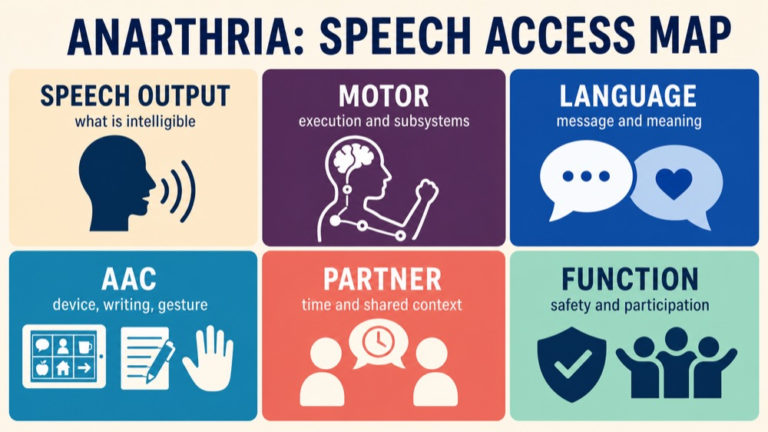
anarthria is easier to study when it is treated as a connected speech-motor and communication profile rather than a single label. Anarthria is best handled as a severe speech-output descriptor within a broader motor-speech and communication profile. For Praxis review, separate what the person can understand and formulate from what speech movement, voice, access, and partner support make possible.
This learning guide is written for SLP students and other learners reviewing clinical concepts. It uses broad patterns to organize observation, not to make an individualized diagnosis or promise one outcome. Interpretation depends on the person, task, language, culture, hearing, access, health, context, and communication goals.
What anarthria means in SLP study
Begin by separating the speech-motor concept into domains. A learner who can name the domains is less likely to collapse planning, execution, language, cognition, hearing, or participation questions into one explanation. The useful unit of analysis is the task: what the person was asked to understand, formulate, produce, repeat, coordinate, or communicate, with whom, under which conditions, and with what support.
Domain or system
What to notice
Question to carry forward
Speech output
Describe how much intelligible speech is available, the consistency of the output, and the task in which it was observed.
What can the speaker produce, under which conditions, and for which message?
Motor execution
Speech may be limited by weakness, incoordination, tone, range, speed, or other execution demands.
Which speech subsystems and movement features are observable?
Planning and programming
A severe output limitation can coexist with or be confused with a planning or programming difficulty.
What changes with sequencing, cueing, repetition, or task complexity?
Language
Speech output does not equal language comprehension, formulation, reading, writing, signing, or AAC ability.
Can the person communicate the intended message in another mode?
Access and participation
Communication may depend on partner supports, technology, time, fatigue, environment, and shared context.
What meaningful interaction is blocked or opened by the available support?
Assessment boundary
A descriptive label organizes observation but does not name lesion, cause, prognosis, or an individualized plan.
What evidence and collaboration are needed before a stronger conclusion?
These domains interact, but they should remain distinguishable. A learner may show strength in one task and need support in another. A study map organizes the next observation; it does not answer every assessment question or replace current professional guidance.
Keep the first pass descriptive and close to the communication event. Note the task, the response, the partner, the setting, the timing, the available support, and the consequence for participation. This gives the learner a stable record to compare across tasks and prevents a familiar term from doing too much explanatory work before the evidence has been separated.
For Praxis-style review, a vignette may include several true details but ask for one best interpretation or next step. The strongest answer usually respects the task, identifies the relevant function, checks the most important missing information, and avoids treating one performance sample as the whole profile.
Map anarthria and speech access
For study purposes, describe the motor-speech and communication relationship before naming a disorder. Record what the person understood, formulated, produced, initiated, repaired, coordinated, or participated in. Then note whether the task was familiar, how much context was shared, and which support changed the response.
Speech availability: document intelligibility, consistency, rate, voice, articulation, resonance, prosody, and the task rather than using severity as a complete description.
Motor execution: examine strength, coordination, range, speed, steadiness, tone, and subsystem interaction when the task supports those observations.
Planning and programming: compare familiar and novel sequences, repeated attempts, transitions, stress, and cueing without treating one response as decisive.
Language and cognition: keep comprehension, message formulation, lexical access, literacy, attention, memory, and discourse distinct from speech output.
Communication modes: include gesture, writing, typing, sign, AAC, facial expression, and partner-supported communication when relevant.
Function: connect the profile to safety, relationships, education, work, self-advocacy, and the person’s chosen communication priorities.
A strong description is specific enough that another learner could picture the event. Instead of writing “the speech system is impaired,” describe the demand, the observable response, the partner, the context, and the result. This protects clinical reasoning from labels that are broader than the evidence.
Separate speech from communication
Context changes what speech and communication require. Automatic phrases, novel sequences, reading, conversation, a long explanation, and a noisy exchange place different demands on planning, execution, memory, rate, language, and partner support. Hearing access, fatigue, posture, visual supports, language experience, and the opportunity to request clarification should be part of the observation.
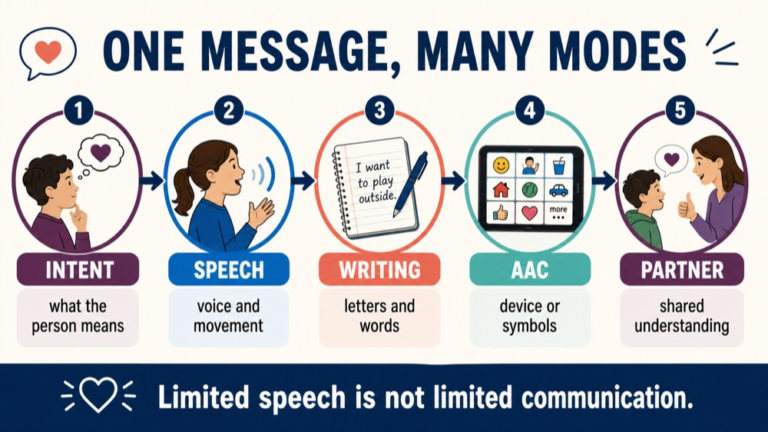
A person may have very limited intelligible speech but communicate a complex idea through writing, gesture, a device, or a familiar partner. Another person may have limited output because a task places unusually high demands on planning, execution, language, alertness, or access. The useful study move is to describe the communication profile across modes and tasks before assigning a mechanism.
Observation layer
Example question
Task
What did the person need to understand, formulate, produce, organize, coordinate, or repair?
Motor speech
Which planning, execution, subsystem, timing, or prosody relationship was observable?
Access
Were hearing, visual, motor, sensory, language, respiratory, or environmental supports available?
Participation
What meaningful routine became easier or harder because of the pattern?
Context is not an afterthought added once a label has been selected. It is part of the question itself. If performance changes with a quieter room, extra processing time, a familiar partner, a different communication mode, a changed speaking rate, or a changed task, that change is useful evidence about access and demand. It does not identify a cause by itself, but it tells you which conditions should be carried into the next observation.
Separate the motor-speech question
When a Praxis-style scenario or clinical discussion presents anarthria, use a disciplined sequence. The goal is to select the next clinical question or action that matches the evidence, the person’s priorities, and the communication context.
Define the task in plain language.
Identify the domain or domains involved without assuming they are interchangeable.
Separate observation from interpretation and write down what remains unknown.
Check hearing, language experience, culture, communication mode, environment, partner support, alertness, respiration, memory, swallowing, and task familiarity.
Choose the assessment, collaboration, or observation step that answers the specific question.
State the boundary of the conclusion and keep the person’s participation goal visible.
A person may have very limited intelligible speech but communicate a complex idea through writing, gesture, a device, or a familiar partner. Another person may have limited output because a task places unusually high demands on planning, execution, language, alertness, or access. The useful study move is to describe the communication profile across modes and tasks before assigning a mechanism. In a learning answer, the decisive evidence is usually the relationship among the task, the observed pattern, and the next needed information—not a single isolated behavior or label.
Common study mistakes
Treating anarthria as a complete explanation of language, cognition, or communication ability.
Assuming limited speech output identifies one lesion, etiology, or motor pathway.
Confusing severe execution difficulty with a planning or programming difficulty.
Ignoring writing, gesture, AAC, sign, partner support, and extra response time.
Using one brief speech sample to describe every setting and message type.
Separating intelligibility from the person’s actual participation and communication priorities.
Treating a descriptive term as a prognosis or an individualized intervention prescription.
Forgetting to check hearing, language, cognition, fatigue, respiration, swallowing, and access.
Most of these mistakes come from replacing a multidomain question with a fast label. Correct the habit by returning to the same sequence: describe, separate, contextualize, ask what is missing, and choose a proportionate next step. A short rationale can make the habit visible: identify the evidence, name the uncertainty, and explain why the selected next step fits both.
Build a quick review map
Use this compact map when reviewing a missed question, a lecture note, or a clinical vignette:
Step 1: Describe the message, task, listener, setting, and available communication mode.
Step 2: Separate speech output, motor execution, planning, language, cognition, and access.
Step 3: Compare familiar and novel tasks, repeated attempts, fatigue, cueing, and response time.
Step 4: Record what the person can communicate even when speech is limited.
Step 5: Connect the observation to participation and the person’s priorities.
Step 6: State what the evidence supports and what assessment or collaboration remains needed.
Then write one transfer sentence: “When I see this pattern, I will first check ___ because ___.” The sentence should identify a decision rule, not repeat a definition. Revisit it after a delay and test whether you can apply the rule to a different task, age group, or communication mode.
Sources and next steps
anarthria is best learned as a context-sensitive pattern across speech planning, execution, language, access, and participation. Use the current authority pages to refine the concept, then return to practice scenarios that require you to explain what the evidence supports and what it leaves open.
Unilateral Upper Motor Neuron Dysarthria: Speech and Physical Clues
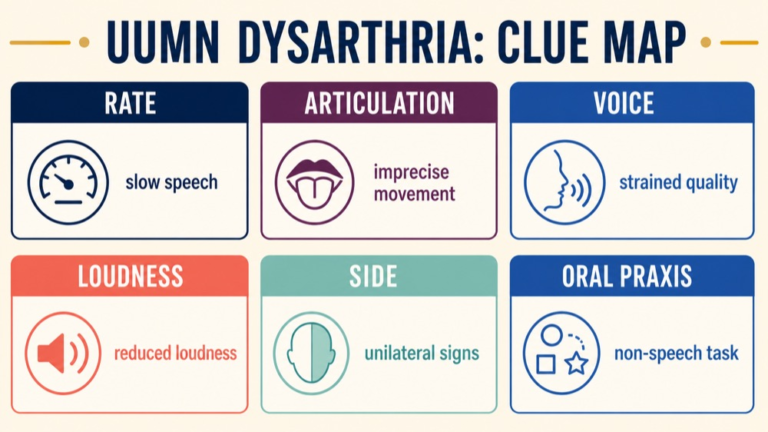
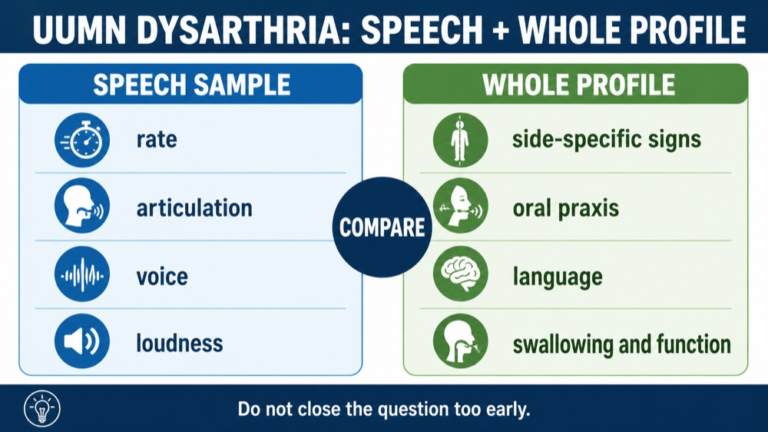
unilateral upper motor neuron dysarthria is easier to study when it is treated as a connected system rather than a single label. Unilateral upper motor neuron dysarthria is reviewed through a speech pattern and physical findings associated with unilateral upper motor neuron involvement. The exam-safe approach is to compare articulation, rate, voice, loudness, irregularity, unilateral signs, and the broader communication profile.
This learning guide is written for SLP students and other learners reviewing clinical concepts. It uses broad patterns to organize observation, not to make an individualized diagnosis or promise one outcome. Interpretation depends on the person, task, language, culture, hearing, access, health, context, and communication goals.
What unilateral upper motor neuron dysarthria includes
Begin by separating the concept into domains. A learner who can name the domains is less likely to collapse cognition, language, speech, auditory access, memory, attention, or participation questions into one explanation. The useful unit of analysis is the task: what the person was asked to understand, produce, remember, organize, coordinate, or communicate, with whom, under which conditions, and with what support.
Domain or system
What to notice
Question to carry forward
Rate and articulation
Slow rate, imprecise articulation, and irregular articulatory breakdowns may affect clarity.
Are the errors consistent, irregular, unilateral, or linked with rate and task complexity?
Voice and loudness
A strained voice and reduced loudness may contribute to reduced intelligibility and naturalness.
What changes in voice, loudness, and effort across speech tasks?
Facial and lingual weakness
Unilateral lower-face weakness or unilateral lingual weakness without atrophy or fasciculations can add to the physical description.
Which side and movement are actually observed?
Oral praxis
Nonverbal oral apraxia may be part of the observed profile and should be distinguished from speech execution.
Does a non-speech task reveal a planning or movement question?
Subsystem comparison
Respiration, phonation, resonance, articulation, and prosody may show different levels of involvement.
Which subsystem and task best explain the listener’s difficulty?
Function and differential
The pattern must be considered alongside aphasia, apraxia, cognition, swallowing, hearing, and participation.
What additional evidence and collaboration would make the conclusion safer?
These domains interact, but they should remain distinguishable. A learner may show strength in one task and need support in another. A study map organizes the next observation; it does not answer every assessment question or replace current professional guidance.
Keep the first pass descriptive and close to the communication event. Note the task, the response, the partner, the setting, the timing, the available support, and the consequence for participation. This gives the learner a stable record to compare across tasks and prevents a familiar term from doing too much explanatory work before the evidence has been separated.
For Praxis-style review, a vignette may include several true details but ask for one best interpretation or next step. The strongest answer usually respects the task, identifies the relevant function, checks the most important missing information, and avoids treating one performance sample as the whole profile.
Map UUMN dysarthria clues
For study purposes, describe the system-function relationship before naming a disorder or subtype. Record what the person understood, produced, initiated, repaired, coordinated, or participated in. Then note whether the task was familiar, how much context was shared, and which support changed the response.
Rate and articulation: observe slow rate, imprecise consonants, irregular breakdowns, and task effects.
Voice and loudness: describe strained quality, reduced loudness, and effort without overinterpreting one feature.
Facial and lingual signs: document unilateral lower-face or lingual weakness and note whether atrophy or fasciculations are present.
Oral praxis: separate nonverbal oral apraxia observations from speech planning, execution, and language questions.
Subsystem comparison: connect respiration, phonation, resonance, articulation, and prosody across tasks.
Function and differential: relate the pattern to intelligibility, swallowing, language, cognition, hearing, and participation.
A strong description is specific enough that another learner could picture the event. Instead of writing “the system is weak,” describe the demand, the observable response, the partner, the context, and the result. This protects clinical reasoning from labels that are broader than the evidence.
Speech, side, and whole profile
Context changes what communication requires. A naming task, a listening activity, a multi-step instruction, a narrative, a conversation, and a workplace exchange place different demands on processing, memory, attention, language, motor control, and partner support. Hearing access, fatigue, posture, visual supports, language experience, and the opportunity to request clarification should be part of the observation.
A person may show a mildly imprecise or slow speech pattern that is more obvious in conversation than in a short repetition task, especially when the listener needs clear loudness and rapid turn-taking. Unilateral physical signs can help organize the description, but they do not replace a full neurologic or communication evaluation. Compare speech and non-speech oral tasks, language, cognition, swallowing, hearing, fatigue, and the person’s everyday goals.
Observation layer
Example question
Task
What did the person need to understand, produce, organize, coordinate, or repair?
Function
Which cognitive, language, speech, auditory, motor, or access relationship was observable?
Access
Were hearing, visual, motor, sensory, language, respiratory, or environmental supports available?
Participation
What meaningful routine became easier or harder because of the pattern?
Context is not an afterthought added once a label has been selected. It is part of the question itself. If performance changes with a quieter room, extra processing time, a familiar partner, a different communication mode, a changed speaking rate, or a changed task, that change is useful evidence about access and demand. It does not identify a cause by itself, but it tells you which conditions should be carried into the next observation.
Apply the concept in clinical reasoning
When a Praxis-style scenario or clinical discussion presents unilateral upper motor neuron dysarthria, use a disciplined sequence. The goal is to select the next clinical question or action that matches the evidence, the person’s priorities, and the communication context.
Define the task in plain language.
Identify the domain or domains involved without assuming they are interchangeable.
Separate observation from interpretation and write down what remains unknown.
Check hearing, language experience, culture, communication mode, environment, partner support, alertness, respiration, memory, and task familiarity.
Choose the assessment, collaboration, or observation step that answers the specific question.
State the boundary of the conclusion and keep the person’s participation goal visible.
A person may show a mildly imprecise or slow speech pattern that is more obvious in conversation than in a short repetition task, especially when the listener needs clear loudness and rapid turn-taking. Unilateral physical signs can help organize the description, but they do not replace a full neurologic or communication evaluation. Compare speech and non-speech oral tasks, language, cognition, swallowing, hearing, fatigue, and the person’s everyday goals. In a learning answer, the decisive evidence is usually the relationship among the task, the observed pattern, and the next needed information—not a single isolated behavior or label.
Common study mistakes
Treating mild imprecision alone as proof of unilateral upper motor neuron dysarthria.
Confusing unilateral weakness, nonverbal oral apraxia, and speech motor execution.
Using the pattern as a shortcut to lesion location or medical diagnosis.
Failing to compare repetition, reading, conversation, oral praxis, and functional tasks.
Overlooking aphasia, cognition, hearing, swallowing, fatigue, and environmental access.
Describing the type without stating intelligibility, naturalness, effort, and participation.
Choosing a next step before identifying the most important unresolved differential question.
Most of these mistakes come from replacing a multidomain question with a fast label. Correct the habit by returning to the same sequence: describe, separate, contextualize, ask what is missing, and choose a proportionate next step. A short rationale can make the habit visible: identify the evidence, name the uncertainty, and explain why the selected next step fits both.
Build a quick review map
Use this compact map when reviewing a missed question, a lecture note, or a clinical vignette:
Step 1: List the speech characteristics, physical signs, non-speech oral findings, and functional consequence.
Step 3: Check unilateral signs and whether atrophy, fasciculations, or other findings are present.
Step 4: Separate motor speech from aphasia, cognition, hearing, swallowing, language, and access.
Step 5: Use the type as a provisional description and state the limits of the current evidence.
Step 6: Connect the next question to intelligibility, safety, communication access, and participation.
Then write one transfer sentence: “When I see this pattern, I will first check ___ because ___.” The sentence should identify a decision rule, not repeat a definition. Revisit it after a delay and test whether you can apply the rule to a different task, age group, or communication mode.
Sources and next steps
unilateral upper motor neuron dysarthria is best learned as a context-sensitive pattern across structure, function, access, and participation. Use the current authority pages to refine the concept, then return to practice scenarios that require you to explain what the evidence supports and what it leaves open.
Hyperkinetic Dysarthria: Variable Movement, Voice, and Task Context
hyperkinetic dysarthria is easier to study when it is treated as a connected system rather than a single label. Hyperkinetic dysarthria is studied through involuntary or excessive movement patterns that can make speech features variable across time and tasks. For exam review, connect voice, resonance, articulation, prosody, physical movement, and the communication context without treating variability as noise.
This learning guide is written for SLP students and other learners reviewing clinical concepts. It uses broad patterns to organize observation, not to make an individualized diagnosis or promise one outcome. Interpretation depends on the person, task, language, culture, hearing, access, health, context, and communication goals.
What hyperkinetic dysarthria includes
Begin by separating the concept into domains. A learner who can name the domains is less likely to collapse cognition, language, speech, auditory access, memory, attention, or participation questions into one explanation. The useful unit of analysis is the task: what the person was asked to understand, produce, remember, organize, coordinate, or communicate, with whom, under which conditions, and with what support.
Domain or system
What to notice
Question to carry forward
Involuntary movement
Head, jaw, face, tongue, velar, laryngeal, or respiratory movements may affect speech production.
Which movement is present, and when does it change the speech task?
Voice variability
Transient breathiness, strain, voice tremor, stoppages, arrests, or aphonic segments may appear intermittently.
Is the voice change stable, intermittent, triggered, or influenced by rate?
Respiration and rate
Sudden forced inspiration or expiration and marked deterioration with increased rate may affect phrase production.
What happens when rate, phrase length, or effort changes?
Resonance and articulation
Intermittent hypernasality, distorted vowels, and variable articulatory output can affect intelligibility.
Which speech subsystem changes and what remains stable?
Physical pattern
Tics, myoclonus, tremor, grimacing, and other involuntary movements may add to the description.
What physical evidence is observed and what requires further evaluation?
Function and support
Predictable supports, pacing, partner behavior, and communication modes may help maintain participation.
Which support can increase access without assuming the cause?
These domains interact, but they should remain distinguishable. A learner may show strength in one task and need support in another. A study map organizes the next observation; it does not answer every assessment question or replace current professional guidance.
Keep the first pass descriptive and close to the communication event. Note the task, the response, the partner, the setting, the timing, the available support, and the consequence for participation. This gives the learner a stable record to compare across tasks and prevents a familiar term from doing too much explanatory work before the evidence has been separated.
For Praxis-style review, a vignette may include several true details but ask for one best interpretation or next step. The strongest answer usually respects the task, identifies the relevant function, checks the most important missing information, and avoids treating one performance sample as the whole profile.
Map hyperkinetic dysarthria clues
For study purposes, describe the system-function relationship before naming a disorder or subtype. Record what the person understood, produced, initiated, repaired, coordinated, or participated in. Then note whether the task was familiar, how much context was shared, and which support changed the response.
Voice: listen for transient breathiness, strain, tremor, stoppages, arrests, or aphonic segments.
Respiration and rate: compare forced inspiration or expiration, phrase length, and deterioration with speed.
Resonance and articulation: examine intermittent hypernasality, distorted vowels, and variable precision.
Physical pattern: document tics, myoclonus, tremor, grimacing, and other observed movement signs.
Function: connect variability with intelligibility, pacing, partner support, communication modes, and participation.
A strong description is specific enough that another learner could picture the event. Instead of writing “the system is weak,” describe the demand, the observable response, the partner, the context, and the result. This protects clinical reasoning from labels that are broader than the evidence.
Variability across tasks and time
Context changes what communication requires. A naming task, a listening activity, a multi-step instruction, a narrative, a conversation, and a workplace exchange place different demands on processing, memory, attention, language, motor control, and partner support. Hearing access, fatigue, posture, visual supports, language experience, and the opportunity to request clarification should be part of the observation.
A speaker may sound relatively clear in one moment and show a voice arrest, breathy segment, or articulatory change in another. The useful clinical reasoning move is to document when the feature appears, what task and rate were involved, and what the listener needed. Variable output should prompt comparison across time and context, not a rushed conclusion that the speaker is inconsistent or that one subtype label explains every change.
Observation layer
Example question
Task
What did the person need to understand, produce, organize, coordinate, or repair?
Function
Which cognitive, language, speech, auditory, motor, or access relationship was observable?
Access
Were hearing, visual, motor, sensory, language, respiratory, or environmental supports available?
Participation
What meaningful routine became easier or harder because of the pattern?
Context is not an afterthought added once a label has been selected. It is part of the question itself. If performance changes with a quieter room, extra processing time, a familiar partner, a different communication mode, a changed speaking rate, or a changed task, that change is useful evidence about access and demand. It does not identify a cause by itself, but it tells you which conditions should be carried into the next observation.
Apply the concept in clinical reasoning
When a Praxis-style scenario or clinical discussion presents hyperkinetic dysarthria, use a disciplined sequence. The goal is to select the next clinical question or action that matches the evidence, the person’s priorities, and the communication context.
Define the task in plain language.
Identify the domain or domains involved without assuming they are interchangeable.
Separate observation from interpretation and write down what remains unknown.
Check hearing, language experience, culture, communication mode, environment, partner support, alertness, respiration, memory, and task familiarity.
Choose the assessment, collaboration, or observation step that answers the specific question.
State the boundary of the conclusion and keep the person’s participation goal visible.
A speaker may sound relatively clear in one moment and show a voice arrest, breathy segment, or articulatory change in another. The useful clinical reasoning move is to document when the feature appears, what task and rate were involved, and what the listener needed. Variable output should prompt comparison across time and context, not a rushed conclusion that the speaker is inconsistent or that one subtype label explains every change. In a learning answer, the decisive evidence is usually the relationship among the task, the observed pattern, and the next needed information—not a single isolated behavior or label.
Common study mistakes
Treating hyperkinetic dysarthria as simply fast speech or an occasional tremor.
Assuming variability means the speech sample is unreliable or that no pattern can be studied.
Confusing hyperkinetic features with stuttering, voice disorder, apraxia, or anxiety without comparison.
Failing to document triggers, rate, fatigue, task, listener, and time course.
Using one observed movement to infer an etiology or medical diagnosis.
Overlooking communication partner support and the person’s preferred way to participate.
Choosing a strategy without defining the exact speech or participation barrier.
Most of these mistakes come from replacing a multidomain question with a fast label. Correct the habit by returning to the same sequence: describe, separate, contextualize, ask what is missing, and choose a proportionate next step. A short rationale can make the habit visible: identify the evidence, name the uncertainty, and explain why the selected next step fits both.
Build a quick review map
Use this compact map when reviewing a missed question, a lecture note, or a clinical vignette:
Step 1: Describe the involuntary movement and the perceptual speech feature separately.
Step 3: Record triggers, variability, fatigue, cueing, partner response, and environmental load.
Step 4: Separate motor speech variability from language, cognition, hearing, fluency, and access.
Step 5: Use a subtype label to organize comparisons rather than to close the differential.
Step 6: Connect the next observation to intelligibility, repair, pacing, autonomy, and participation.
Then write one transfer sentence: “When I see this pattern, I will first check ___ because ___.” The sentence should identify a decision rule, not repeat a definition. Revisit it after a delay and test whether you can apply the rule to a different task, age group, or communication mode.
Sources and next steps
hyperkinetic dysarthria is best learned as a context-sensitive pattern across structure, function, access, and participation. Use the current authority pages to refine the concept, then return to practice scenarios that require you to explain what the evidence supports and what it leaves open.
Hypokinetic Dysarthria: Loudness, Rate, Range, and Naturalness
hypokinetic dysarthria is easier to study when it is treated as a connected system rather than a single label. Hypokinetic dysarthria is reviewed through reduced or limited movement patterns that can affect pitch, loudness, stress, rate, articulation, and naturalness. A strong study answer separates the perceptual pattern from the physical and neurologic context and from the person’s functional communication goal.
This learning guide is written for SLP students and other learners reviewing clinical concepts. It uses broad patterns to organize observation, not to make an individualized diagnosis or promise one outcome. Interpretation depends on the person, task, language, culture, hearing, access, health, context, and communication goals.
What hypokinetic dysarthria includes
Begin by separating the concept into domains. A learner who can name the domains is less likely to collapse cognition, language, speech, auditory access, memory, attention, or participation questions into one explanation. The useful unit of analysis is the task: what the person was asked to understand, produce, remember, organize, coordinate, or communicate, with whom, under which conditions, and with what support.
Domain or system
What to notice
Question to carry forward
Pitch and loudness
Monopitch, monoloudness, reduced stress, and loudness decay can reduce prosodic contrast and listener access.
Which range or change is reduced, and does it vary with task or cueing?
Rate and pauses
Speech may be rapid or accelerated, with inappropriate silences or reduced control of timing.
What happens when the speaker changes rate, phrase length, or turn-taking demand?
Articulation
Rapid or blurred alternating motion rates and reduced movement range can affect precision.
Are imprecisions linked with speed, range, force, or another subsystem?
Automatic repetitions
Palilalia or repeated phonemes may be part of the observed perceptual pattern in some presentations.
Is the repetition automatic, task-dependent, variable, or associated with another communication demand?
Physical context
Masked facial expression, tremor, rigidity, and reduced range may add to the motor profile.
Which physical findings are documented and how do they relate to speech?
Naturalness and participation
The functional effect includes being heard, expressing emotion, taking turns, and communicating in daily routines.
Which communication situation should guide the next observation or support?
These domains interact, but they should remain distinguishable. A learner may show strength in one task and need support in another. A study map organizes the next observation; it does not answer every assessment question or replace current professional guidance.
Keep the first pass descriptive and close to the communication event. Note the task, the response, the partner, the setting, the timing, the available support, and the consequence for participation. This gives the learner a stable record to compare across tasks and prevents a familiar term from doing too much explanatory work before the evidence has been separated.
For Praxis-style review, a vignette may include several true details but ask for one best interpretation or next step. The strongest answer usually respects the task, identifies the relevant function, checks the most important missing information, and avoids treating one performance sample as the whole profile.
Map hypokinetic dysarthria clues
For study purposes, describe the system-function relationship before naming a disorder or subtype. Record what the person understood, produced, initiated, repaired, coordinated, or participated in. Then note whether the task was familiar, how much context was shared, and which support changed the response.
Pitch and loudness: listen for monopitch, monoloudness, reduced stress, and loudness decay.
Rate and pauses: compare normal, rapid, accelerated, and supported speaking rates and silence patterns.
Articulation: examine blurred or rapidly repeated movements, precision, range, force, and timing.
Automatic repetitions: describe palilalia or repeated phonemes only when they are actually observed in context.
A strong description is specific enough that another learner could picture the event. Instead of writing “the system is weak,” describe the demand, the observable response, the partner, the context, and the result. This protects clinical reasoning from labels that are broader than the evidence.
Range, rate, and listener access
Context changes what communication requires. A naming task, a listening activity, a multi-step instruction, a narrative, a conversation, and a workplace exchange place different demands on processing, memory, attention, language, motor control, and partner support. Hearing access, fatigue, posture, visual supports, language experience, and the opportunity to request clarification should be part of the observation.
A speaker may be understood in a quiet one-to-one exchange but become difficult to follow when speech accelerates, loudness decays, or the listener depends on prosody to interpret emphasis. A cue or environmental change may support access without identifying a single cause. Compare rate, loudness, pitch, stress, articulation, pauses, task length, listener familiarity, and the person’s preferred communication goals.
Observation layer
Example question
Task
What did the person need to understand, produce, organize, coordinate, or repair?
Function
Which cognitive, language, speech, auditory, motor, or access relationship was observable?
Access
Were hearing, visual, motor, sensory, language, respiratory, or environmental supports available?
Participation
What meaningful routine became easier or harder because of the pattern?
Context is not an afterthought added once a label has been selected. It is part of the question itself. If performance changes with a quieter room, extra processing time, a familiar partner, a different communication mode, a changed speaking rate, or a changed task, that change is useful evidence about access and demand. It does not identify a cause by itself, but it tells you which conditions should be carried into the next observation.
Apply the concept in clinical reasoning
When a Praxis-style scenario or clinical discussion presents hypokinetic dysarthria, use a disciplined sequence. The goal is to select the next clinical question or action that matches the evidence, the person’s priorities, and the communication context.
Define the task in plain language.
Identify the domain or domains involved without assuming they are interchangeable.
Separate observation from interpretation and write down what remains unknown.
Check hearing, language experience, culture, communication mode, environment, partner support, alertness, respiration, memory, and task familiarity.
Choose the assessment, collaboration, or observation step that answers the specific question.
State the boundary of the conclusion and keep the person’s participation goal visible.
A speaker may be understood in a quiet one-to-one exchange but become difficult to follow when speech accelerates, loudness decays, or the listener depends on prosody to interpret emphasis. A cue or environmental change may support access without identifying a single cause. Compare rate, loudness, pitch, stress, articulation, pauses, task length, listener familiarity, and the person’s preferred communication goals. In a learning answer, the decisive evidence is usually the relationship among the task, the observed pattern, and the next needed information—not a single isolated behavior or label.
Common study mistakes
Reducing hypokinetic dysarthria to quiet speech or a single loudness problem.
Ignoring monopitch, reduced stress, loudness decay, rate, pauses, articulation, and movement range.
Treating rapid speech as the only relevant finding or assuming slow speech rules it out.
Confusing reduced prosody with language, mood, personality, or a voice disorder alone.
Failing to compare automatic speech, reading, conversation, rate, stress, and cueing.
Overlooking listener access, emotional meaning, turn-taking, and participation.
Using a perceptual pattern to infer a specific disease without appropriate medical context.
Choosing a strategy without stating the target communication barrier and functional goal.
Most of these mistakes come from replacing a multidomain question with a fast label. Correct the habit by returning to the same sequence: describe, separate, contextualize, ask what is missing, and choose a proportionate next step. A short rationale can make the habit visible: identify the evidence, name the uncertainty, and explain why the selected next step fits both.
Build a quick review map
Use this compact map when reviewing a missed question, a lecture note, or a clinical vignette:
Step 1: List pitch, loudness, stress, rate, pauses, articulation, and physical findings separately.
Step 2: Compare short and long speech, automatic and spontaneous tasks, and different rates.
Step 3: Check what changes with cueing, environment, fatigue, listener, and communication purpose.
Step 4: Separate speech motor findings from language, cognition, hearing, mood, and access.
Step 5: Use the type description as a provisional pattern summary with clear evidence limits.
Step 6: Connect the next question to being heard, understood, natural, and able to participate.
Then write one transfer sentence: “When I see this pattern, I will first check ___ because ___.” The sentence should identify a decision rule, not repeat a definition. Revisit it after a delay and test whether you can apply the rule to a different task, age group, or communication mode.
Sources and next steps
hypokinetic dysarthria is best learned as a context-sensitive pattern across structure, function, access, and participation. Use the current authority pages to refine the concept, then return to practice scenarios that require you to explain what the evidence supports and what it leaves open.