AAC Access Methods: Selection, Reliability, and Participation
aac access methods is easier to study when it is treated as a connected system rather than a single tool. AAC access methods describe how a communicator selects symbols, letters, words, or stored messages. Study the method through reliability, motor and sensory demands, rate, fatigue, positioning, language, partner support, and the person’s real communication routines.
This learning guide is written for SLP students and other learners reviewing clinical concepts. It uses broad patterns to organize observation, not to make an individualized diagnosis or promise one outcome. Interpretation depends on the person, task, language, culture, hearing, access, health, context, and communication goals.
What aac access methods includes
Begin by separating the concept into domains. A learner who can name the domains is less likely to collapse language, access, motor, sensory, technology, partner, and participation questions into one explanation. The useful unit of analysis is the task: what the person was asked to understand, express, organize, coordinate, remember, or communicate, with whom, under which conditions, and with what support.
Domain or system
What to notice
Question to carry forward
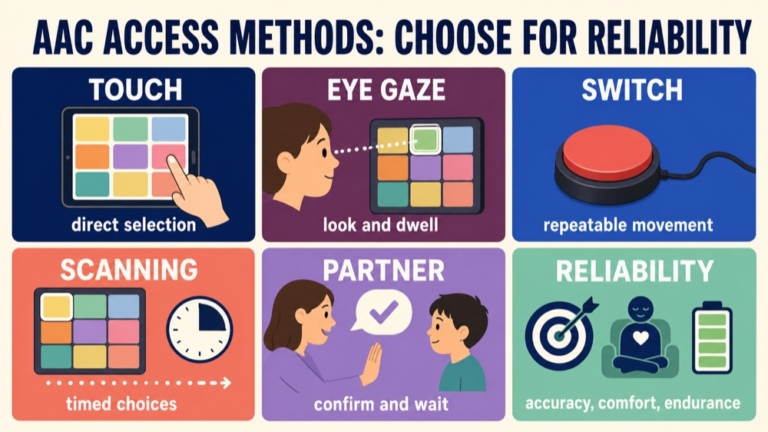
Direct selection
The person points, touches, looks, or uses another direct movement to select a target.
Is the target easy to see, reach, isolate, and select?
Eye gaze
Gaze-based selection may use visual targets, calibration, dwell, or partner confirmation.
How do vision, fatigue, positioning, and visual demand affect access?
Switch access
A switch or set of switches can support selection when direct movement is not reliable for the task.
Which movement can be repeated consistently and comfortably?
Scanning
Items are presented in an organized sequence while the communicator signals a choice.
Does the timing, grouping, and rate fit the communicator?
Partner-assisted
A trained partner may present choices, confirm messages, or support access while preserving authorship.
How can the partner support without making the message for the person?
Does the method work for the messages and routines that matter?
These domains interact, but they should remain distinguishable. A learner may show strength in one task and need support in another. A study map organizes the next observation; it does not answer every assessment question or replace current professional guidance.
Keep the first pass descriptive and close to the communication event. Note the task, the message, the partner, the setting, the timing, the available support, and the consequence for participation. This gives the learner a stable record to compare across tasks and prevents a familiar technology term from doing too much explanatory work before the evidence has been separated.
For Praxis-style review, a vignette may include several true details but ask for one best interpretation or next step. The strongest answer usually respects the task, identifies the relevant function, checks the most important missing information, and avoids treating one performance sample as the whole profile.
Map AAC access methods
For study purposes, describe the communication relationship before choosing a tool or method. Record what the person understood, expressed, initiated, repaired, coordinated, or participated in. Then note whether the task was familiar, how much context was shared, and which support changed the response.
Direct selection: consider touch, pointing, head movement, eye gaze, target size, spacing, reach, and visual field.
Switch access: match switch placement, movement, activation, release, timing, and endurance to the communicator.
Scanning: examine row-column or linear organization, rate, auditory or visual cues, and signal reliability.
Positioning and sensory access: record body alignment, vision, hearing, lighting, noise, fatigue, and device placement.
Partner support: use confirmation, wait time, modeling, and repair while keeping authorship and choice with the communicator.
Functional testing: measure access during real messages, conversations, transitions, safety routines, and changing energy.
A strong description is specific enough that another learner could picture the event. Instead of writing “the device is appropriate,” describe the message, the access demand, the partner, the context, and the result. This protects clinical reasoning from technology labels that are broader than the evidence.
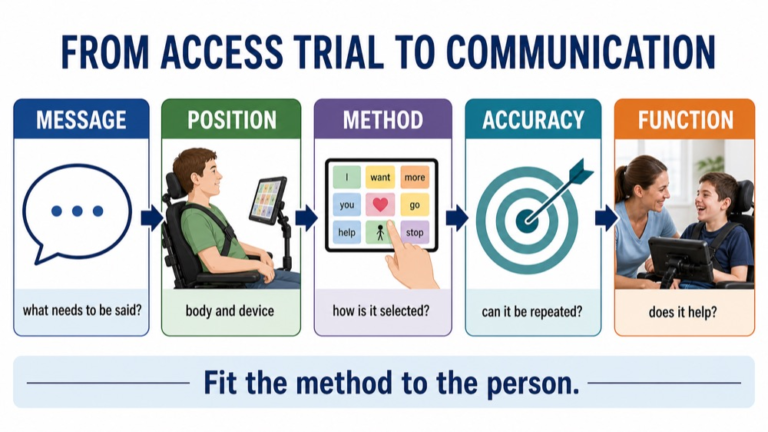
From access trial to reliable communication
Context changes what communication requires. A quick choice, a long explanation, a conversation, a classroom exchange, a workplace interaction, a transition, and a noisy routine place different demands on language, memory, motor access, sensory access, and partner support. Hearing access, fatigue, visual supports, language experience, and the opportunity to request clarification should be part of the observation.
A touch method may be efficient at a table but unreliable when the person is moving, tired, or positioned differently. Eye gaze may work well for some messages but require changes in lighting, calibration, or dwell time. A switch or scanning method may be slower but more reliable for the person’s goals. Access selection is a fit question, not a speed contest detached from function.
Observation layer
Example question
Message
What did the person need to express, understand, combine, clarify, or repair?
Access
Were motor, sensory, visual, auditory, language, literacy, or positioning supports available?
Partner
Did the partner model, wait, confirm, interpret, expand, or make assumptions?
Participation
What meaningful routine became easier or harder because of the system?
Context is not an afterthought added once a tool has been selected. It is part of the question itself. If performance changes with a different layout, a quieter room, extra processing time, a familiar partner, a different mode, a visual support, a changed task, or a changed routine, that change is useful evidence about access and demand. It does not identify a cause by itself, but it tells you which conditions should be carried into the next observation.
Apply the concept in clinical reasoning
When a Praxis-style scenario or clinical discussion presents aac access methods, use a disciplined sequence. The goal is to select the next clinical question or action that matches the evidence, the person’s priorities, and the communication context.
Define the message and task in plain language.
Identify the language, access, output, partner, or environment domain involved.
Separate observation from interpretation and write down what remains unknown.
Check hearing, vision, motor control, language, literacy, culture, sensory load, positioning, fatigue, and task familiarity.
Choose the assessment, collaboration, training, or observation step that answers the specific question.
State the boundary of the conclusion and keep the person’s participation goal visible.
A touch method may be efficient at a table but unreliable when the person is moving, tired, or positioned differently. Eye gaze may work well for some messages but require changes in lighting, calibration, or dwell time. A switch or scanning method may be slower but more reliable for the person’s goals. Access selection is a fit question, not a speed contest detached from function. In a learning answer, the decisive evidence is usually the relationship among the message, the access conditions, the observed pattern, and the next needed information—not a single device feature or label.
Common study mistakes
Choosing the fastest method in a short trial without checking comfort, endurance, and message needs.
Ignoring positioning, target size, visual field, lighting, motor range, and fatigue.
Treating a failed access trial as a failed communicator rather than a mismatch to change.
Using a partner to guess or complete messages without confirmation and authorship.
Testing only single selections instead of messages, repair, conversation, and real routines.
Assuming one access method must serve every setting, device, partner, and energy state.
Forgetting backup access when hardware, software, power, or positioning changes.
Measuring speed without including accuracy, independence, comfort, and participation.
Most of these mistakes come from replacing a multidomain question with a fast tool choice. Correct the habit by returning to the same sequence: describe, separate, contextualize, ask what is missing, and choose a proportionate next step. A short rationale can make the habit visible: identify the evidence, name the uncertainty, and explain why the selected next step fits both.
Build a quick review map
Use this compact map when reviewing a missed question, a lecture note, or a clinical vignette:
Step 1: Describe the message, task, partner, setting, and access demand.
Step 2: Compare direct selection, eye gaze, switches, scanning, and partner-assisted access.
Step 3: Check positioning, vision, hearing, motor control, timing, endurance, and sensory load.
Step 4: Test accuracy, reliability, comfort, speed, repair, and authorship across messages.
Step 5: Plan training, partner confirmation, customization, and a usable backup.
Step 6: Select the method that supports the person’s meaningful communication and autonomy.
Then write one transfer sentence: “When I see this pattern, I will first check ___ because ___.” The sentence should identify a decision rule, not repeat a definition. Revisit it after a delay and test whether you can apply the rule to a different task, age group, partner, or communication mode.
Sources and next steps
aac access methods is best learned as a context-sensitive pattern across communication, access, function, and participation. Use the current authority pages to refine the concept, then return to practice scenarios that require you to explain what the evidence supports and what it leaves open.
Start with asha aac, ets 5331 study companion. These sources support the learning frame; they do not replace current topic-specific guidance or an individualized evaluation.
AAC Communication Systems: Components, Access, and Function
aac communication systems is easier to study when it is treated as a connected system rather than a single tool. AAC communication systems are more than a device or a page of symbols. They are coordinated systems that include the communicator, language representation, access method, output, vocabulary, partners, environments, and routines that make messages possible.
This learning guide is written for SLP students and other learners reviewing clinical concepts. It uses broad patterns to organize observation, not to make an individualized diagnosis or promise one outcome. Interpretation depends on the person, task, language, culture, hearing, access, health, context, and communication goals.
What aac communication systems includes
Begin by separating the concept into domains. A learner who can name the domains is less likely to collapse language, access, motor, sensory, technology, partner, and participation questions into one explanation. The useful unit of analysis is the task: what the person was asked to understand, express, organize, coordinate, remember, or communicate, with whom, under which conditions, and with what support.
Domain or system
What to notice
Question to carry forward
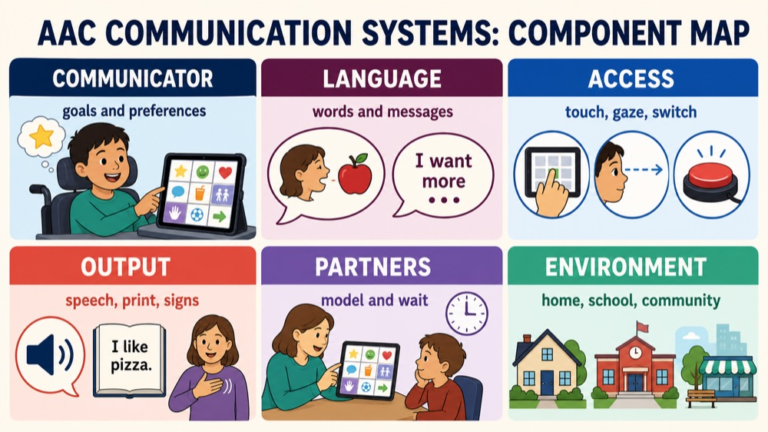
Communicator
The person’s goals, modes, preferences, motor and sensory access, language, literacy, and routines shape the system.
What does this person need and want to communicate?
Language
Vocabulary, grammar, message organization, literacy, and rate determine what the system can express.
Can the system support more than a single request?
Access
Direct touch, eye gaze, switches, pointing, partner assistance, and other methods connect the person to the system.
What access method is reliable in this setting?
Output
Speech-generating devices, printed text, signs, gestures, pictures, and partner interpretation carry the message.
How will the message reach the listener?
Partners
Modeling, wait time, confirmation, repair, training, and shared vocabulary influence communication success.
What does the partner need to do for access to be usable?
Environment
Home, school, work, community, noise, positioning, time, and device availability change the communication demand.
Where must the system work and what changes across routines?
These domains interact, but they should remain distinguishable. A learner may show strength in one task and need support in another. A study map organizes the next observation; it does not answer every assessment question or replace current professional guidance.
Keep the first pass descriptive and close to the communication event. Note the task, the message, the partner, the setting, the timing, the available support, and the consequence for participation. This gives the learner a stable record to compare across tasks and prevents a familiar technology term from doing too much explanatory work before the evidence has been separated.
For Praxis-style review, a vignette may include several true details but ask for one best interpretation or next step. The strongest answer usually respects the task, identifies the relevant function, checks the most important missing information, and avoids treating one performance sample as the whole profile.
Map AAC communication systems
For study purposes, describe the communication relationship before choosing a tool or method. Record what the person understood, expressed, initiated, repaired, coordinated, or participated in. Then note whether the task was familiar, how much context was shared, and which support changed the response.
Communicator: document goals, preferences, modes, motor and sensory profile, language, literacy, and important routines.
Language system: include vocabulary, grammar, message building, literacy, rate, and social language beyond one-word requests.
Output: consider speech generation, print, signs, gestures, pictures, text, and partner interpretation for different listeners.
Partner practice: plan aided modeling, wait time, confirmation, repair, vocabulary updates, and training across people.
Environment and function: test the system in home, school, work, community, safety, relationships, and self-advocacy routines.
A strong description is specific enough that another learner could picture the event. Instead of writing “the device is appropriate,” describe the message, the access demand, the partner, the context, and the result. This protects clinical reasoning from technology labels that are broader than the evidence.
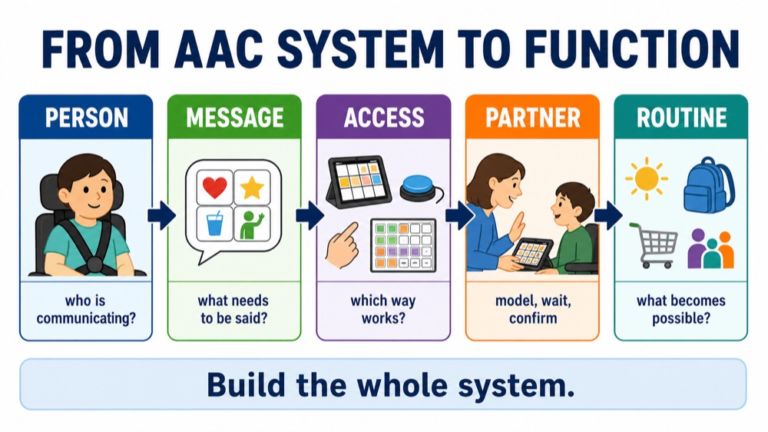
From system components to function
Context changes what communication requires. A quick choice, a long explanation, a conversation, a classroom exchange, a workplace interaction, a transition, and a noisy routine place different demands on language, memory, motor access, sensory access, and partner support. Hearing access, fatigue, visual supports, language experience, and the opportunity to request clarification should be part of the observation.
A person may use a paper board for a quick classroom response, a speech-generating device for a detailed message, and gestures with a familiar partner. The system works when its language, access, output, partner supports, and environment fit together. A device feature alone cannot show whether the person has reliable communication access.
Observation layer
Example question
Message
What did the person need to express, understand, combine, clarify, or repair?
Access
Were motor, sensory, visual, auditory, language, literacy, or positioning supports available?
Partner
Did the partner model, wait, confirm, interpret, expand, or make assumptions?
Participation
What meaningful routine became easier or harder because of the system?
Context is not an afterthought added once a tool has been selected. It is part of the question itself. If performance changes with a different layout, a quieter room, extra processing time, a familiar partner, a different mode, a visual support, a changed task, or a changed routine, that change is useful evidence about access and demand. It does not identify a cause by itself, but it tells you which conditions should be carried into the next observation.
Apply the concept in clinical reasoning
When a Praxis-style scenario or clinical discussion presents aac communication systems, use a disciplined sequence. The goal is to select the next clinical question or action that matches the evidence, the person’s priorities, and the communication context.
Define the message and task in plain language.
Identify the language, access, output, partner, or environment domain involved.
Separate observation from interpretation and write down what remains unknown.
Check hearing, vision, motor control, language, literacy, culture, sensory load, positioning, fatigue, and task familiarity.
Choose the assessment, collaboration, training, or observation step that answers the specific question.
State the boundary of the conclusion and keep the person’s participation goal visible.
A person may use a paper board for a quick classroom response, a speech-generating device for a detailed message, and gestures with a familiar partner. The system works when its language, access, output, partner supports, and environment fit together. A device feature alone cannot show whether the person has reliable communication access. In a learning answer, the decisive evidence is usually the relationship among the message, the access conditions, the observed pattern, and the next needed information—not a single device feature or label.
Common study mistakes
Calling a single device the communication system while ignoring language, access, partners, and environment.
Designing only for requesting and leaving out comments, questions, emotions, relationships, and repair.
Selecting vocabulary before observing real routines and meaningful communication priorities.
Ignoring positioning, vision, hearing, motor control, fatigue, rate, and sensory conditions.
Expecting independent use without partner modeling, wait time, training, and confirmation.
Testing the system in one quiet session and assuming it will work across home, school, work, and community.
Treating speech, gesture, writing, signs, and AAC as mutually exclusive modes.
Measuring technology use rather than message variety, autonomy, repair, and participation.
Most of these mistakes come from replacing a multidomain question with a fast tool choice. Correct the habit by returning to the same sequence: describe, separate, contextualize, ask what is missing, and choose a proportionate next step. A short rationale can make the habit visible: identify the evidence, name the uncertainty, and explain why the selected next step fits both.
Build a quick review map
Use this compact map when reviewing a missed question, a lecture note, or a clinical vignette:
Step 1: Name the person, communication goals, partners, settings, and important routines.
Step 5: Plan modeling, wait time, repair, customization, training, and backup options.
Step 6: Judge success through reliable messages, autonomy, relationships, and participation.
Then write one transfer sentence: “When I see this pattern, I will first check ___ because ___.” The sentence should identify a decision rule, not repeat a definition. Revisit it after a delay and test whether you can apply the rule to a different task, age group, partner, or communication mode.
Sources and next steps
aac communication systems is best learned as a context-sensitive pattern across communication, access, function, and participation. Use the current authority pages to refine the concept, then return to practice scenarios that require you to explain what the evidence supports and what it leaves open.
Start with asha aac, ets 5331 study companion. These sources support the learning frame; they do not replace current topic-specific guidance or an individualized evaluation.
Augmentative and Alternative Communication: Access, Modes, and Function
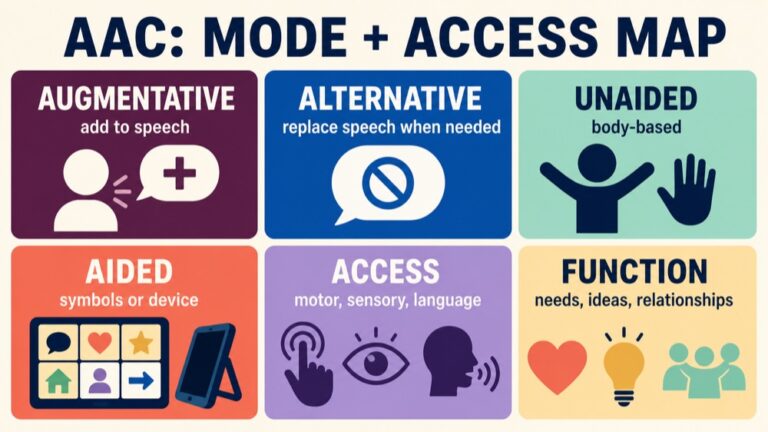
augmentative and alternative communication is easier to study when it is treated as a connected system rather than a single label. Augmentative and alternative communication, or AAC, includes tools and strategies that supplement or replace speech and writing when communication needs are not being met. The SLP study frame centers access, multimodal communication, partner support, language, literacy, autonomy, and participation.
This learning guide is written for SLP students and other learners reviewing clinical concepts. It uses broad patterns to organize observation, not to make an individualized diagnosis or promise one outcome. Interpretation depends on the person, task, language, culture, hearing, access, health, context, and communication goals.
What augmentative and alternative communication includes
Begin by separating the concept into domains. A learner who can name the domains is less likely to collapse language, social, motor, sensory, access, partner, and participation questions into one explanation. The useful unit of analysis is the task: what the person was asked to understand, express, organize, coordinate, remember, or communicate, with whom, under which conditions, and with what support.
Domain or system
What to notice
Question to carry forward
Augmentative
A communication mode supplements existing speech, writing, signs, gestures, or other expression.
What does the person already communicate and what could make it more effective?
Alternative
A mode may be used in place of speech or writing when those modes are absent or not functional for the task.
Which mode gives the person a reliable way to express the message?
Unaided
Gestures, body movement, facial expression, manual signs, and finger spelling use the person’s body.
What body-based access is available, understood, and preferred?
Aided
Objects, pictures, symbols, letter boards, books, tablets, and speech-generating devices add a transmission system.
Which symbol and hardware features fit the person and environment?
Access
Positioning, motor control, vision, hearing, language, cognition, literacy, timing, and partner support affect use.
What access barrier should be changed before judging the system?
Function
AAC supports needs and wants, social closeness, information exchange, literacy, safety, and participation.
What meaningful communication opportunity should the system open?
These domains interact, but they should remain distinguishable. A learner may show strength in one task and need support in another. A study map organizes the next observation; it does not answer every assessment question or replace current professional guidance.
Keep the first pass descriptive and close to the communication event. Note the task, the response, the partner, the setting, the timing, the available support, and the consequence for participation. This gives the learner a stable record to compare across tasks and prevents a familiar term from doing too much explanatory work before the evidence has been separated.
For Praxis-style review, a vignette may include several true details but ask for one best interpretation or next step. The strongest answer usually respects the task, identifies the relevant function, checks the most important missing information, and avoids treating one performance sample as the whole profile.
Map augmentative and alternative communication
For study purposes, describe the communication relationship before naming a disorder. Record what the person understood, expressed, initiated, repaired, coordinated, or participated in. Then note whether the task was familiar, how much context was shared, and which support changed the response.
Mode: describe speech, writing, gesture, signs, pictures, objects, letter access, devices, and partner-supported communication.
Aided and unaided access: compare body-based options with systems that require symbols, hardware, software, or transmission.
Motor and sensory access: consider positioning, vision, hearing, touch, movement, fatigue, timing, and reliable selection.
Language and literacy: provide vocabulary, grammar, literacy, rate, and message-building opportunities rather than isolated requesting only.
Partner support: include aided language modeling, wait time, confirmation, repair, training, and communication across environments.
Function and participation: connect AAC to relationships, autonomy, safety, learning, work, community, and self-advocacy.
A strong description is specific enough that another learner could picture the event. Instead of writing “the communication system is impaired,” describe the demand, the observable response, the partner, the context, and the result. This protects clinical reasoning from labels that are broader than the evidence.
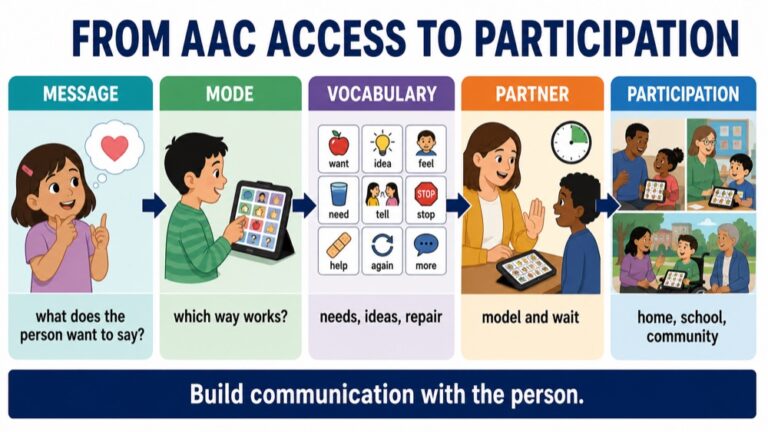
From access method to participation
Context changes what communication requires. A direct question, a long explanation, a conversation, a classroom exchange, a workplace interaction, a transition, and a noisy routine place different demands on processing, language, memory, motor access, and partner support. Hearing access, fatigue, visual supports, language experience, and the opportunity to request clarification should be part of the observation.
One person may use a picture board for quick choices, a speech-generating device for longer messages, gestures with family, and writing at school. Another may need a different access method when fatigue or motor demands change. The question is not which device is universally best; it is which combination of modes, vocabulary, access features, partner supports, and routines lets this person communicate reliably and with agency.
Observation layer
Example question
Task
What did the person need to understand, express, organize, coordinate, or repair?
Pattern
Which language, social, access, motor, sensory, or partner relationship was observable?
Access
Were hearing, visual, motor, sensory, language, cognitive, or environmental supports available?
Participation
What meaningful routine became easier or harder because of the pattern?
Context is not an afterthought added once a label has been selected. It is part of the question itself. If performance changes with a quieter room, extra processing time, a familiar partner, a different communication mode, a visual support, a changed task, or a changed routine, that change is useful evidence about access and demand. It does not identify a cause by itself, but it tells you which conditions should be carried into the next observation.
Apply the concept in clinical reasoning
When a Praxis-style scenario or clinical discussion presents augmentative and alternative communication, use a disciplined sequence. The goal is to select the next clinical question or action that matches the evidence, the person’s priorities, and the communication context.
Define the task in plain language.
Identify the domain or domains involved without assuming they are interchangeable.
Separate observation from interpretation and write down what remains unknown.
Check hearing, language experience, culture, communication mode, environment, partner support, alertness, sensory load, memory, and task familiarity.
Choose the assessment, collaboration, or observation step that answers the specific question.
State the boundary of the conclusion and keep the person’s participation goal visible.
One person may use a picture board for quick choices, a speech-generating device for longer messages, gestures with family, and writing at school. Another may need a different access method when fatigue or motor demands change. The question is not which device is universally best; it is which combination of modes, vocabulary, access features, partner supports, and routines lets this person communicate reliably and with agency. In a learning answer, the decisive evidence is usually the relationship among the task, the observed pattern, and the next needed information—not a single isolated behavior or label.
Common study mistakes
Treating AAC as a last resort instead of considering communication access early.
Assuming speech must be absent before AAC can supplement it.
Choosing a device or symbol set before evaluating motor, sensory, language, literacy, and environment.
Limiting AAC to requesting and withholding vocabulary for social, emotional, and informational messages.
Failing to model the system while expecting the learner to use it independently.
Treating one access method as permanent when needs, settings, and fatigue can change.
Measuring button presses instead of message variety, autonomy, communication repair, and participation.
Most of these mistakes come from replacing a multidomain question with a fast label. Correct the habit by returning to the same sequence: describe, separate, contextualize, ask what is missing, and choose a proportionate next step. A short rationale can make the habit visible: identify the evidence, name the uncertainty, and explain why the selected next step fits both.
Build a quick review map
Use this compact map when reviewing a missed question, a lecture note, or a clinical vignette:
Step 1: Describe the person’s current modes, messages, partners, settings, and communication priorities.
Step 2: Separate augmentative, alternative, aided, unaided, and multimodal options.
Step 4: Plan vocabulary for needs, relationships, information, self-advocacy, safety, and repair.
Step 5: Include partner modeling, wait time, training, customization, and opportunities across routines.
Step 6: Evaluate success through reliable communication, autonomy, and meaningful participation.
Then write one transfer sentence: “When I see this pattern, I will first check ___ because ___.” The sentence should identify a decision rule, not repeat a definition. Revisit it after a delay and test whether you can apply the rule to a different task, age group, partner, or communication mode.
Sources and next steps
augmentative and alternative communication is best learned as a context-sensitive pattern across communication, access, function, and participation. Use the current authority pages to refine the concept, then return to practice scenarios that require you to explain what the evidence supports and what it leaves open.
Start with asha aac, asha autism. These sources support the learning frame; they do not replace current topic-specific guidance or an individualized evaluation.
Echolalia and Communication: Timing, Function, and Context
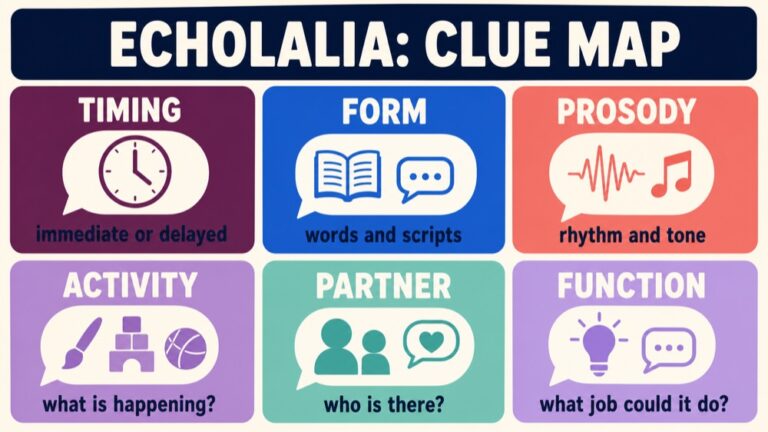
echolalia and communication is easier to study when it is treated as a connected system rather than a single label. Echolalia and communication are best studied by asking what the repeated language is doing in context. Timing, partner, prosody, activity, access to language, and the person’s other communication modes help distinguish a repeated form from the communicative function it may serve.
This learning guide is written for SLP students and other learners reviewing clinical concepts. It uses broad patterns to organize observation, not to make an individualized diagnosis or promise one outcome. Interpretation depends on the person, task, language, culture, hearing, access, health, context, and communication goals.
What echolalia and communication includes
Begin by separating the concept into domains. A learner who can name the domains is less likely to collapse language, social, motor, sensory, access, partner, and participation questions into one explanation. The useful unit of analysis is the task: what the person was asked to understand, express, organize, coordinate, remember, or communicate, with whom, under which conditions, and with what support.
Domain or system
What to notice
Question to carry forward
Timing
Immediate and delayed repetitions occur at different points relative to the original utterance or event.
When did the repetition occur and what was happening around it?
Form
A repeated word, phrase, script, song, or intonation may carry information beyond its literal wording.
What exact form was repeated and what features were preserved or changed?
Function
Echolalia may participate in turn-taking, requesting, labeling, affirming, protesting, regulating, or connecting.
What communicative job could the repetition be doing?
Context
Meaning is shaped by activity, partner, shared history, sensory state, and the question or demand.
Which contextual clues make the interpretation more or less likely?
Multimodal access
Speech may work together with gesture, AAC, writing, objects, signs, or partner modeling.
What other mode clarifies, expands, or supports the message?
Support
Language models, visual context, wait time, choice, and responsive partners can support autonomy and comprehension.
Which support increases meaningful communication without taking over?
These domains interact, but they should remain distinguishable. A learner may show strength in one task and need support in another. A study map organizes the next observation; it does not answer every assessment question or replace current professional guidance.
Keep the first pass descriptive and close to the communication event. Note the task, the response, the partner, the setting, the timing, the available support, and the consequence for participation. This gives the learner a stable record to compare across tasks and prevents a familiar term from doing too much explanatory work before the evidence has been separated.
For Praxis-style review, a vignette may include several true details but ask for one best interpretation or next step. The strongest answer usually respects the task, identifies the relevant function, checks the most important missing information, and avoids treating one performance sample as the whole profile.
Map echolalia and communication
For study purposes, describe the communication relationship before naming a disorder. Record what the person understood, expressed, initiated, repaired, coordinated, or participated in. Then note whether the task was familiar, how much context was shared, and which support changed the response.
Timing: distinguish immediate from delayed repetition and record the distance from the original model or event.
Form and prosody: write the repeated language, intonation, rhythm, gesture, and changes that may carry meaning.
Context: document the activity, partner, question, shared history, sensory state, and communication demand.
Multimodal communication: include AAC, gesture, signs, writing, objects, facial expression, and partner response.
Responsive support: use wait time, visual context, language modeling, choices, and confirmation without assuming intent.
A strong description is specific enough that another learner could picture the event. Instead of writing “the communication system is impaired,” describe the demand, the observable response, the partner, the context, and the result. This protects clinical reasoning from labels that are broader than the evidence.
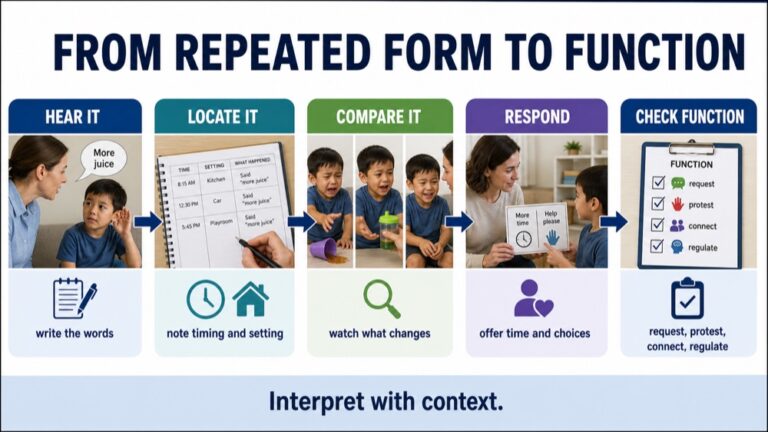
From repeated form to communicative function
Context changes what communication requires. A direct question, a long explanation, a conversation, a classroom exchange, a workplace interaction, a transition, and a noisy routine place different demands on processing, language, memory, motor access, and partner support. Hearing access, fatigue, visual supports, language experience, and the opportunity to request clarification should be part of the observation.
A child may repeat a question before answering, quote a familiar line during a transition, or use a script when a partner’s request is difficult to process. The repeated form is only one piece of evidence. Timing, activity, prosody, gesture, partner response, and later communication can show whether the moment functioned as a request, protest, affirmation, turn, regulation strategy, or connection.
Observation layer
Example question
Task
What did the person need to understand, express, organize, coordinate, or repair?
Pattern
Which language, social, access, motor, sensory, or partner relationship was observable?
Access
Were hearing, visual, motor, sensory, language, cognitive, or environmental supports available?
Participation
What meaningful routine became easier or harder because of the pattern?
Context is not an afterthought added once a label has been selected. It is part of the question itself. If performance changes with a quieter room, extra processing time, a familiar partner, a different communication mode, a visual support, a changed task, or a changed routine, that change is useful evidence about access and demand. It does not identify a cause by itself, but it tells you which conditions should be carried into the next observation.
Apply the concept in clinical reasoning
When a Praxis-style scenario or clinical discussion presents echolalia and communication, use a disciplined sequence. The goal is to select the next clinical question or action that matches the evidence, the person’s priorities, and the communication context.
Define the task in plain language.
Identify the domain or domains involved without assuming they are interchangeable.
Separate observation from interpretation and write down what remains unknown.
Check hearing, language experience, culture, communication mode, environment, partner support, alertness, sensory load, memory, and task familiarity.
Choose the assessment, collaboration, or observation step that answers the specific question.
State the boundary of the conclusion and keep the person’s participation goal visible.
A child may repeat a question before answering, quote a familiar line during a transition, or use a script when a partner’s request is difficult to process. The repeated form is only one piece of evidence. Timing, activity, prosody, gesture, partner response, and later communication can show whether the moment functioned as a request, protest, affirmation, turn, regulation strategy, or connection. In a learning answer, the decisive evidence is usually the relationship among the task, the observed pattern, and the next needed information—not a single isolated behavior or label.
Common study mistakes
Labeling all repetition as meaningless or automatically as a language deficit.
Ignoring timing, prosody, gesture, activity, partner, and shared history.
Assuming the literal wording is the only possible message.
Using a forced replacement phrase without checking the person’s communicative purpose.
Failing to provide AAC, visual, written, object, or gesture-based communication options.
Treating one script or repeated phrase as proof of a single developmental explanation.
Ignoring the person’s regulation, processing time, sensory load, and autonomy.
Measuring only reduction in repetition instead of increased communication access and function.
Most of these mistakes come from replacing a multidomain question with a fast label. Correct the habit by returning to the same sequence: describe, separate, contextualize, ask what is missing, and choose a proportionate next step. A short rationale can make the habit visible: identify the evidence, name the uncertainty, and explain why the selected next step fits both.
Build a quick review map
Use this compact map when reviewing a missed question, a lecture note, or a clinical vignette:
Step 1: Record the exact language, timing, prosody, partner, activity, and communication demand.
Step 2: Ask what changed before and after the repetition and what response followed.
Step 3: Compare speech with gesture, AAC, writing, signs, objects, and other modes.
Step 4: Generate more than one possible function and identify the evidence for each.
Step 5: Use responsive support that preserves choice, autonomy, and communication access.
Step 6: Describe the outcome in terms of message success, participation, and partner understanding.
Then write one transfer sentence: “When I see this pattern, I will first check ___ because ___.” The sentence should identify a decision rule, not repeat a definition. Revisit it after a delay and test whether you can apply the rule to a different task, age group, partner, or communication mode.
Sources and next steps
echolalia and communication is best learned as a context-sensitive pattern across communication, access, function, and participation. Use the current authority pages to refine the concept, then return to practice scenarios that require you to explain what the evidence supports and what it leaves open.
Start with asha autism, asha social communication. These sources support the learning frame; they do not replace current topic-specific guidance or an individualized evaluation.
Autism Communication Profile: Multimodal Strengths, Needs, and Context
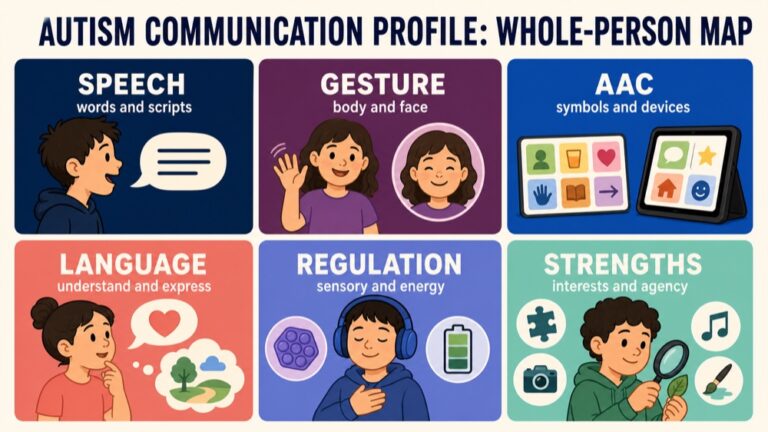
autism communication profile is easier to study when it is treated as a connected system rather than a single label. An autism communication profile is not a single score or a fixed list of behaviors. SLP study requires a multimodal view of speech, language, gesture, AAC, echolalia, play, interaction, literacy, regulation, partner support, and participation across settings.
This learning guide is written for SLP students and other learners reviewing clinical concepts. It uses broad patterns to organize observation, not to make an individualized diagnosis or promise one outcome. Interpretation depends on the person, task, language, culture, hearing, access, health, context, and communication goals.
What autism communication profile includes
Begin by separating the concept into domains. A learner who can name the domains is less likely to collapse language, social, motor, sensory, access, partner, and participation questions into one explanation. The useful unit of analysis is the task: what the person was asked to understand, express, organize, coordinate, remember, or communicate, with whom, under which conditions, and with what support.
Domain or system
What to notice
Question to carry forward
Modalities
Communication may include speech, gesture, facial expression, signs, writing, pictures, AAC, and behavior with communicative meaning.
Which modes does the person use, understand, prefer, and need access to?
Language
Vocabulary, grammar, narratives, scripts, echolalia, comprehension, and topic flexibility may vary by context.
What language is spontaneous, supported, familiar, or context-bound?
Social communication
Interaction, social understanding, perspective, repair, and partner coordination are observed within real routines.
What does the person communicate with partners and for which purposes?
Regulation and access
Sensory, motor, attention, predictability, fatigue, and environmental factors can change communication access.
What conditions support the person’s ability to communicate?
Strengths and identity
Interests, expertise, humor, memory, visual learning, and preferred routines can support communication and autonomy.
Which strengths can partners build on without erasing identity?
What communication opportunity or barrier matters most to the person?
These domains interact, but they should remain distinguishable. A learner may show strength in one task and need support in another. A study map organizes the next observation; it does not answer every assessment question or replace current professional guidance.
Keep the first pass descriptive and close to the communication event. Note the task, the response, the partner, the setting, the timing, the available support, and the consequence for participation. This gives the learner a stable record to compare across tasks and prevents a familiar term from doing too much explanatory work before the evidence has been separated.
For Praxis-style review, a vignette may include several true details but ask for one best interpretation or next step. The strongest answer usually respects the task, identifies the relevant function, checks the most important missing information, and avoids treating one performance sample as the whole profile.
Map an autism communication profile
For study purposes, describe the communication relationship before naming a disorder. Record what the person understood, expressed, initiated, repaired, coordinated, or participated in. Then note whether the task was familiar, how much context was shared, and which support changed the response.
Language profile: compare comprehension, spontaneous language, scripts, echolalia, narratives, literacy, and topic flexibility.
Social communication: observe initiation, response, shared attention, repair, perspective, and interaction in natural settings.
Access and regulation: record sensory, motor, attention, predictability, fatigue, and environmental supports.
Strengths and preferences: include interests, expertise, memory, visual supports, humor, autonomy, and self-advocacy.
Participation: connect communication to relationships, learning, safety, community access, work, and quality of life.
A strong description is specific enough that another learner could picture the event. Instead of writing “the communication system is impaired,” describe the demand, the observable response, the partner, the context, and the result. This protects clinical reasoning from labels that are broader than the evidence.
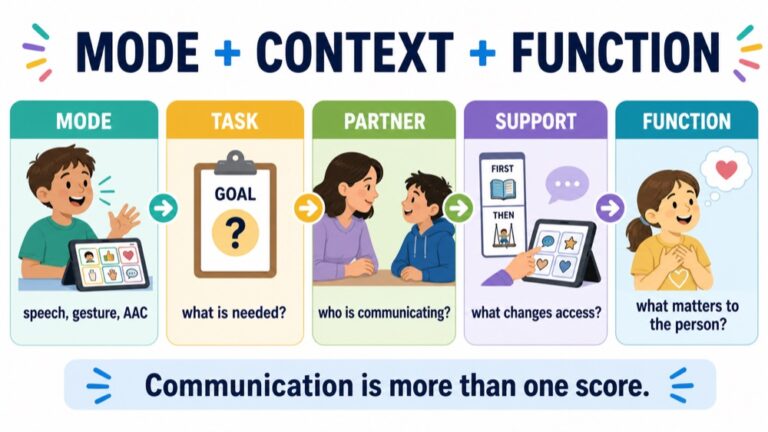
From mode and context to function
Context changes what communication requires. A direct question, a long explanation, a conversation, a classroom exchange, a workplace interaction, a transition, and a noisy routine place different demands on processing, language, memory, motor access, and partner support. Hearing access, fatigue, visual supports, language experience, and the opportunity to request clarification should be part of the observation.
A child may use scripted language during play, gesture to request help, communicate more through AAC when tired, or show rich knowledge about a preferred topic while needing support with a less familiar classroom task. Each observation is useful when the task, partner, mode, regulation, and purpose are documented. The goal is to understand communication access and function, not to force every communicator into one profile.
Observation layer
Example question
Task
What did the person need to understand, express, organize, coordinate, or repair?
Pattern
Which language, social, access, motor, sensory, or partner relationship was observable?
Access
Were hearing, visual, motor, sensory, language, cognitive, or environmental supports available?
Participation
What meaningful routine became easier or harder because of the pattern?
Context is not an afterthought added once a label has been selected. It is part of the question itself. If performance changes with a quieter room, extra processing time, a familiar partner, a different communication mode, a visual support, a changed task, or a changed routine, that change is useful evidence about access and demand. It does not identify a cause by itself, but it tells you which conditions should be carried into the next observation.
Apply the concept in clinical reasoning
When a Praxis-style scenario or clinical discussion presents autism communication profile, use a disciplined sequence. The goal is to select the next clinical question or action that matches the evidence, the person’s priorities, and the communication context.
Define the task in plain language.
Identify the domain or domains involved without assuming they are interchangeable.
Separate observation from interpretation and write down what remains unknown.
Check hearing, language experience, culture, communication mode, environment, partner support, alertness, sensory load, memory, and task familiarity.
Choose the assessment, collaboration, or observation step that answers the specific question.
State the boundary of the conclusion and keep the person’s participation goal visible.
A child may use scripted language during play, gesture to request help, communicate more through AAC when tired, or show rich knowledge about a preferred topic while needing support with a less familiar classroom task. Each observation is useful when the task, partner, mode, regulation, and purpose are documented. The goal is to understand communication access and function, not to force every communicator into one profile. In a learning answer, the decisive evidence is usually the relationship among the task, the observed pattern, and the next needed information—not a single isolated behavior or label.
Common study mistakes
Treating an autism communication profile as a deficit-only checklist.
Ignoring AAC, gesture, writing, signs, behavior, and partner-supported communication.
Calling echolalia meaningless without examining timing, context, and communicative function.
Assuming a strong vocabulary or a preferred-topic monologue represents the whole language profile.
Separating communication from sensory access, regulation, motor demands, and predictability.
Using one structured test or one observer as if it captured every setting.
Overgeneralizing one intervention theory or developmental sequence to every autistic person.
Setting goals around appearing typical rather than access, autonomy, relationships, and participation.
Most of these mistakes come from replacing a multidomain question with a fast label. Correct the habit by returning to the same sequence: describe, separate, contextualize, ask what is missing, and choose a proportionate next step. A short rationale can make the habit visible: identify the evidence, name the uncertainty, and explain why the selected next step fits both.
Build a quick review map
Use this compact map when reviewing a missed question, a lecture note, or a clinical vignette:
Step 1: List every communication mode and the purposes each mode serves.
Step 2: Compare spontaneous, scripted, supported, familiar, and unfamiliar language.
Step 3: Observe the person across partners, routines, regulation states, and environments.
Step 4: Ask what sensory, motor, language, AAC, visual, or partner support changes access.
Step 5: Name strengths, interests, preferences, identity, and self-advocacy priorities.
Step 6: Choose a next step that improves meaningful communication rather than surface conformity.
Then write one transfer sentence: “When I see this pattern, I will first check ___ because ___.” The sentence should identify a decision rule, not repeat a definition. Revisit it after a delay and test whether you can apply the rule to a different task, age group, partner, or communication mode.
Sources and next steps
autism communication profile is best learned as a context-sensitive pattern across communication, access, function, and participation. Use the current authority pages to refine the concept, then return to practice scenarios that require you to explain what the evidence supports and what it leaves open.
Start with asha autism, asha social communication. These sources support the learning frame; they do not replace current topic-specific guidance or an individualized evaluation.
Pragmatic Language Disorder: Meaning, Interaction, and Context
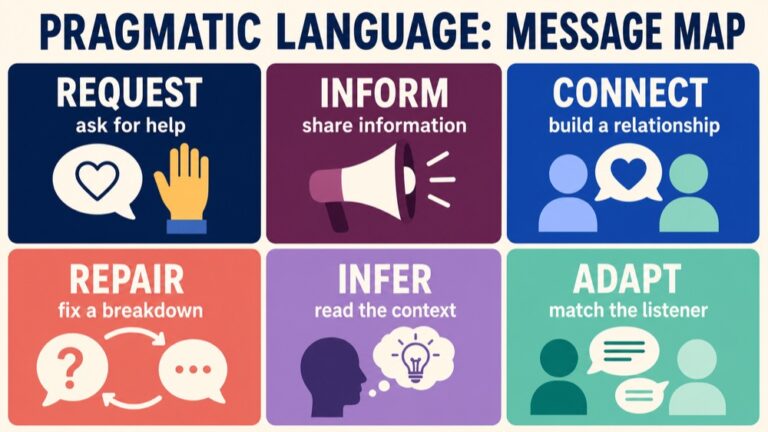
pragmatic language disorder is easier to study when it is treated as a connected system rather than a single label. Pragmatic language disorder is a study topic about goal-consistent language use in social contexts. The key reasoning move is to examine meaning, listener needs, conversation structure, inference, and context together while respecting language, culture, identity, and the communicator’s own priorities.
This learning guide is written for SLP students and other learners reviewing clinical concepts. It uses broad patterns to organize observation, not to make an individualized diagnosis or promise one outcome. Interpretation depends on the person, task, language, culture, hearing, access, health, context, and communication goals.
What pragmatic language disorder includes
Begin by separating the concept into domains. A learner who can name the domains is less likely to collapse language, social, motor, sensory, access, partner, and participation questions into one explanation. The useful unit of analysis is the task: what the person was asked to understand, express, organize, coordinate, remember, or communicate, with whom, under which conditions, and with what support.
Domain or system
What to notice
Question to carry forward
Purpose
A message can request, inform, protest, connect, explain, negotiate, or repair a misunderstanding.
What social purpose was the message meant to serve?
Listener
A communicator adjusts information, wording, and explanation based on what the listener knows and needs.
What did the listener need for the message to work?
Conversation
Initiation, response, turn-taking, topic maintenance, and repair create a shared exchange.
Where did coordination become difficult or effective?
Inference
People often interpret information that is implied, ambiguous, figurative, or dependent on context.
What information had to be inferred rather than directly stated?
Language form
Vocabulary, grammar, discourse organization, and narrative structure can support or constrain pragmatic use.
Is the issue social use, language form, processing, or an interaction among them?
Function
Communication is evaluated through access, relationships, learning, autonomy, and participation.
What real-world routine gives the observation priority?
These domains interact, but they should remain distinguishable. A learner may show strength in one task and need support in another. A study map organizes the next observation; it does not answer every assessment question or replace current professional guidance.
Keep the first pass descriptive and close to the communication event. Note the task, the response, the partner, the setting, the timing, the available support, and the consequence for participation. This gives the learner a stable record to compare across tasks and prevents a familiar term from doing too much explanatory work before the evidence has been separated.
For Praxis-style review, a vignette may include several true details but ask for one best interpretation or next step. The strongest answer usually respects the task, identifies the relevant function, checks the most important missing information, and avoids treating one performance sample as the whole profile.
Map pragmatic language disorder
For study purposes, describe the communication relationship before naming a disorder. Record what the person understood, expressed, initiated, repaired, coordinated, or participated in. Then note whether the task was familiar, how much context was shared, and which support changed the response.
Purpose and message: identify whether the person is requesting, explaining, informing, protesting, connecting, or repairing.
Listener adaptation: observe shared knowledge, perspective, topic choice, amount of detail, and clarification.
Conversation structure: record initiation, response, turn-taking, topic shifts, breakdowns, and repair strategies.
Inference and ambiguity: examine implied meaning, nonliteral language, context clues, and flexible interpretation.
Language organization: include vocabulary, grammar, narrative cohesion, discourse, memory, and processing load.
Participation: connect pragmatic language to friendships, classroom discourse, work, family, self-advocacy, and choice.
A strong description is specific enough that another learner could picture the event. Instead of writing “the communication system is impaired,” describe the demand, the observable response, the partner, the context, and the result. This protects clinical reasoning from labels that are broader than the evidence.
From message purpose to participation
Context changes what communication requires. A direct question, a long explanation, a conversation, a classroom exchange, a workplace interaction, a transition, and a noisy routine place different demands on processing, language, memory, motor access, and partner support. Hearing access, fatigue, visual supports, language experience, and the opportunity to request clarification should be part of the observation.
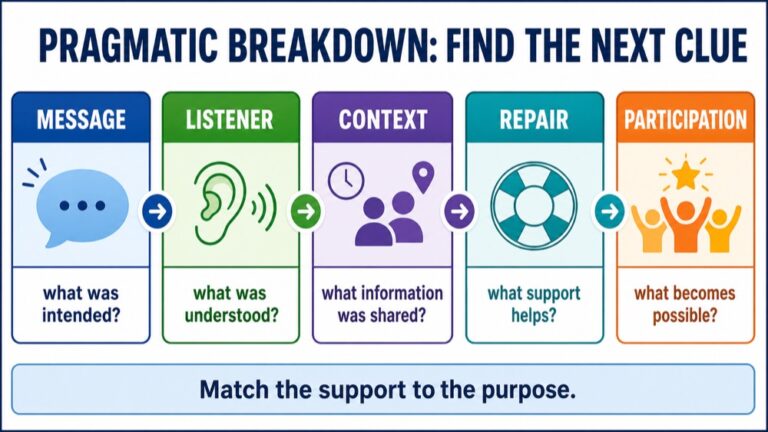
A person may know the words needed for a conversation but give too little shared context, miss a topic shift, or interpret an indirect request differently. The same pattern may change with a familiar partner, a visual schedule, extra processing time, or a topic of strong interest. The study question is how purpose, language, partner, and context interact—not whether one style matches a single social script.
Observation layer
Example question
Task
What did the person need to understand, express, organize, coordinate, or repair?
Pattern
Which language, social, access, motor, sensory, or partner relationship was observable?
Access
Were hearing, visual, motor, sensory, language, cognitive, or environmental supports available?
Participation
What meaningful routine became easier or harder because of the pattern?
Context is not an afterthought added once a label has been selected. It is part of the question itself. If performance changes with a quieter room, extra processing time, a familiar partner, a different communication mode, a visual support, a changed task, or a changed routine, that change is useful evidence about access and demand. It does not identify a cause by itself, but it tells you which conditions should be carried into the next observation.
Apply the concept in clinical reasoning
When a Praxis-style scenario or clinical discussion presents pragmatic language disorder, use a disciplined sequence. The goal is to select the next clinical question or action that matches the evidence, the person’s priorities, and the communication context.
Define the task in plain language.
Identify the domain or domains involved without assuming they are interchangeable.
Separate observation from interpretation and write down what remains unknown.
Check hearing, language experience, culture, communication mode, environment, partner support, alertness, sensory load, memory, and task familiarity.
Choose the assessment, collaboration, or observation step that answers the specific question.
State the boundary of the conclusion and keep the person’s participation goal visible.
A person may know the words needed for a conversation but give too little shared context, miss a topic shift, or interpret an indirect request differently. The same pattern may change with a familiar partner, a visual schedule, extra processing time, or a topic of strong interest. The study question is how purpose, language, partner, and context interact—not whether one style matches a single social script. In a learning answer, the decisive evidence is usually the relationship among the task, the observed pattern, and the next needed information—not a single isolated behavior or label.
Common study mistakes
Equating pragmatic language with politeness or compliance.
Assuming a conversation breakdown comes from social use rather than language processing or memory.
Ignoring what the communicator intended, understood, preferred, or was trying to repair.
Treating indirect language, eye gaze, or personal space as culturally neutral expectations.
Using decontextualized picture tasks as the only evidence for natural communication.
Overlooking strengths in preferred topics, written communication, AAC, gesture, or familiar routines.
Making a broad label from one conversational partner or one setting.
Writing goals around appearance instead of message success, autonomy, and participation.
Most of these mistakes come from replacing a multidomain question with a fast label. Correct the habit by returning to the same sequence: describe, separate, contextualize, ask what is missing, and choose a proportionate next step. A short rationale can make the habit visible: identify the evidence, name the uncertainty, and explain why the selected next step fits both.
Build a quick review map
Use this compact map when reviewing a missed question, a lecture note, or a clinical vignette:
Step 1: State the purpose, listener, shared knowledge, setting, and language demand.
Step 2: Separate message form, pragmatic use, inference, processing, and partner response.
Step 3: Compare natural conversation with structured tasks and supported communication.
Step 5: Describe the repair or support that helped the communication work.
Step 6: Tie the learning point to an authentic routine and the communicator’s priorities.
Then write one transfer sentence: “When I see this pattern, I will first check ___ because ___.” The sentence should identify a decision rule, not repeat a definition. Revisit it after a delay and test whether you can apply the rule to a different task, age group, partner, or communication mode.
Sources and next steps
pragmatic language disorder is best learned as a context-sensitive pattern across communication, access, function, and participation. Use the current authority pages to refine the concept, then return to practice scenarios that require you to explain what the evidence supports and what it leaves open.
Social Communication Disorder: Pragmatics, Context, and Participation
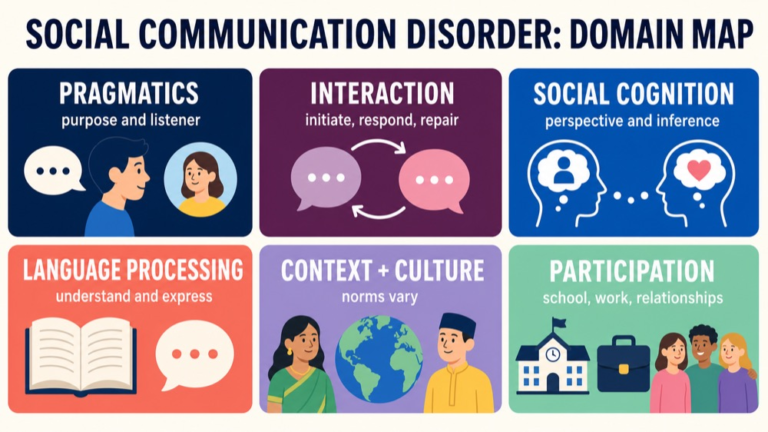
social communication disorder is easier to study when it is treated as a connected system rather than a single label. Social communication disorder is studied through how a person uses verbal and nonverbal language for social purposes. A useful SLP map separates pragmatics, social interaction, social cognition, language processing, cultural context, and participation rather than treating one conversation behavior as the whole profile.
This learning guide is written for SLP students and other learners reviewing clinical concepts. It uses broad patterns to organize observation, not to make an individualized diagnosis or promise one outcome. Interpretation depends on the person, task, language, culture, hearing, access, health, context, and communication goals.
What social communication disorder includes
Begin by separating the concept into domains. A learner who can name the domains is less likely to collapse language, social, motor, sensory, access, partner, and participation questions into one explanation. The useful unit of analysis is the task: what the person was asked to understand, express, organize, coordinate, remember, or communicate, with whom, under which conditions, and with what support.
Domain or system
What to notice
Question to carry forward
Pragmatics
Goal-consistent language use changes with the social context, listener, purpose, and shared information.
What was the communicator trying to accomplish and what did the context require?
Social interaction
Communication occurs between people and includes initiation, response, turn-taking, repair, and relationship.
How did the partners coordinate the interaction?
Social cognition
Perspective taking, emotional states, inference, and social knowledge shape interpretation and response.
Which perspective or unstated meaning mattered in the event?
Language processing
Receptive and expressive language support comprehension, organization, vocabulary, grammar, and discourse.
Was the breakdown social, linguistic, processing-related, or shared across domains?
Context and culture
Social norms vary across communities, languages, families, identities, and environments.
Which norms and communication expectations are relevant here?
Participation
School, work, relationships, self-advocacy, and daily routines show why the communication pattern matters.
What meaningful activity became easier or harder?
These domains interact, but they should remain distinguishable. A learner may show strength in one task and need support in another. A study map organizes the next observation; it does not answer every assessment question or replace current professional guidance.
Keep the first pass descriptive and close to the communication event. Note the task, the response, the partner, the setting, the timing, the available support, and the consequence for participation. This gives the learner a stable record to compare across tasks and prevents a familiar term from doing too much explanatory work before the evidence has been separated.
For Praxis-style review, a vignette may include several true details but ask for one best interpretation or next step. The strongest answer usually respects the task, identifies the relevant function, checks the most important missing information, and avoids treating one performance sample as the whole profile.
Map social communication disorder
For study purposes, describe the communication relationship before naming a disorder. Record what the person understood, expressed, initiated, repaired, coordinated, or participated in. Then note whether the task was familiar, how much context was shared, and which support changed the response.
Pragmatics: identify how wording, tone, nonverbal behavior, and message structure fit the purpose and listener.
Social cognition: consider perspective, emotion, inference, shared attention, and the information that was implicit.
Language processing: compare comprehension, expression, vocabulary, syntax, discourse, and processing demands.
Context and culture: learn the person’s community norms, language background, identity, environment, and preferred communication style.
Participation: connect observations to classroom discussion, friendships, work, family routines, autonomy, and self-advocacy.
A strong description is specific enough that another learner could picture the event. Instead of writing “the communication system is impaired,” describe the demand, the observable response, the partner, the context, and the result. This protects clinical reasoning from labels that are broader than the evidence.
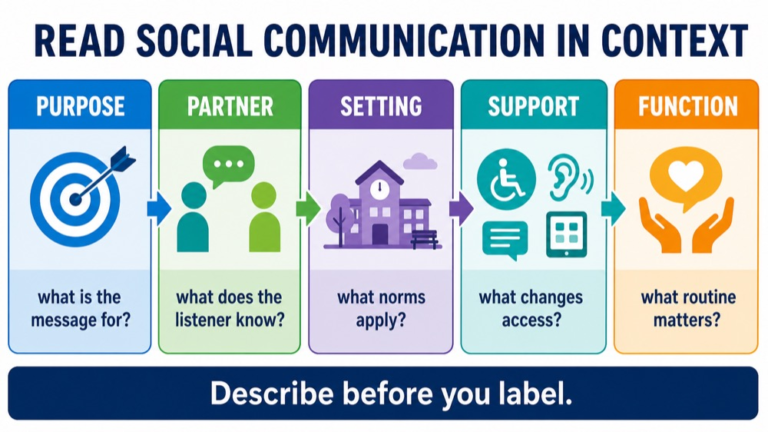
Read communication in context
Context changes what communication requires. A direct question, a long explanation, a conversation, a classroom exchange, a workplace interaction, a transition, and a noisy routine place different demands on processing, language, memory, motor access, and partner support. Hearing access, fatigue, visual supports, language experience, and the opportunity to request clarification should be part of the observation.
A learner may answer a direct question accurately but struggle when the listener expects an implied meaning, a topic shift, or a repair. Another learner may communicate differently across a familiar family setting, a classroom, and a workplace. Those differences are clues about task, language, partner, context, and access; they do not name a disorder by themselves.
Observation layer
Example question
Task
What did the person need to understand, express, organize, coordinate, or repair?
Pattern
Which language, social, access, motor, sensory, or partner relationship was observable?
Access
Were hearing, visual, motor, sensory, language, cognitive, or environmental supports available?
Participation
What meaningful routine became easier or harder because of the pattern?
Context is not an afterthought added once a label has been selected. It is part of the question itself. If performance changes with a quieter room, extra processing time, a familiar partner, a different communication mode, a visual support, a changed task, or a changed routine, that change is useful evidence about access and demand. It does not identify a cause by itself, but it tells you which conditions should be carried into the next observation.
Apply the concept in clinical reasoning
When a Praxis-style scenario or clinical discussion presents social communication disorder, use a disciplined sequence. The goal is to select the next clinical question or action that matches the evidence, the person’s priorities, and the communication context.
Define the task in plain language.
Identify the domain or domains involved without assuming they are interchangeable.
Separate observation from interpretation and write down what remains unknown.
Check hearing, language experience, culture, communication mode, environment, partner support, alertness, sensory load, memory, and task familiarity.
Choose the assessment, collaboration, or observation step that answers the specific question.
State the boundary of the conclusion and keep the person’s participation goal visible.
A learner may answer a direct question accurately but struggle when the listener expects an implied meaning, a topic shift, or a repair. Another learner may communicate differently across a familiar family setting, a classroom, and a workplace. Those differences are clues about task, language, partner, context, and access; they do not name a disorder by themselves. In a learning answer, the decisive evidence is usually the relationship among the task, the observed pattern, and the next needed information—not a single isolated behavior or label.
Common study mistakes
Treating eye contact, gesture, silence, or turn-taking as universal rules without context.
Reducing social communication to manners instead of communication purpose and access.
Ignoring receptive language, discourse, inference, memory, attention, and processing demands.
Using one structured test as if it represented every social setting and partner.
Confusing cultural, linguistic, neurodivergent, or individual differences with disorder.
Assuming a social behavior has one meaning without asking the communicator or observing the routine.
Describing deficits without naming strengths, supports, preferences, and participation goals.
Choosing a diagnosis or intervention before separating the communication question from the context.
Most of these mistakes come from replacing a multidomain question with a fast label. Correct the habit by returning to the same sequence: describe, separate, contextualize, ask what is missing, and choose a proportionate next step. A short rationale can make the habit visible: identify the evidence, name the uncertainty, and explain why the selected next step fits both.
Build a quick review map
Use this compact map when reviewing a missed question, a lecture note, or a clinical vignette:
Step 1: Name the communication purpose, partner, setting, language, and expected norm.
Step 2: Separate pragmatics, interaction, social cognition, and language processing.
Step 3: Compare structured tasks, natural conversation, familiar partners, and less familiar contexts.
Step 4: Ask what hearing, language, culture, sensory, cognitive, and environmental factors affect access.
Step 5: Describe the person’s strengths, preferences, and meaningful participation priority.
Step 6: Choose the next observation or collaboration step that reduces the specific uncertainty.
Then write one transfer sentence: “When I see this pattern, I will first check ___ because ___.” The sentence should identify a decision rule, not repeat a definition. Revisit it after a delay and test whether you can apply the rule to a different task, age group, partner, or communication mode.
Sources and next steps
social communication disorder is best learned as a context-sensitive pattern across communication, access, function, and participation. Use the current authority pages to refine the concept, then return to practice scenarios that require you to explain what the evidence supports and what it leaves open.
Voice Disorders: Quality, Pitch, Loudness, and Daily Needs
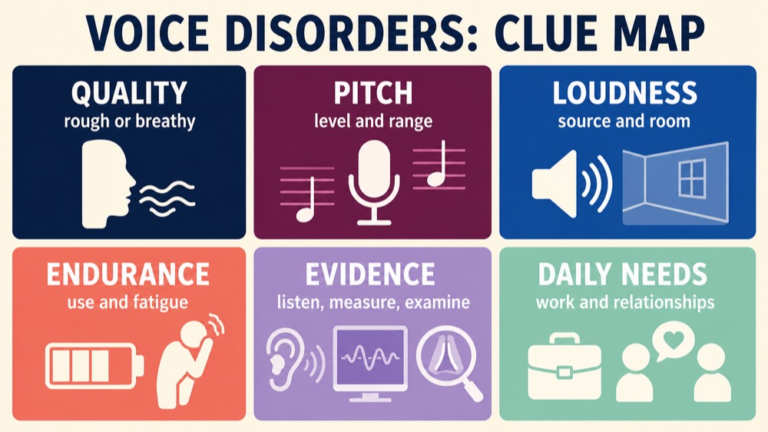
voice disorders is easier to study when it is treated as a connected system rather than a single label. Voice disorders are studied through quality, pitch, loudness, endurance, and the person’s ability to meet daily communication needs. A clear review map separates what the listener hears from etiology, medical findings, compensation, context, and function.
This learning guide is written for SLP students and other learners reviewing clinical concepts. It uses broad patterns to organize observation, not to make an individualized diagnosis or promise one outcome. Interpretation depends on the person, task, language, culture, hearing, access, health, context, and communication goals.
What voice disorders includes
Begin by separating the concept into domains. A learner who can name the domains is less likely to collapse perception, production, language, motor, voice, fluency, hearing, or participation questions into one explanation. The useful unit of analysis is the task: what the person was asked to understand, produce, organize, coordinate, remember, or communicate, with whom, under which conditions, and with what support.
Domain or system
What to notice
Question to carry forward
Quality
Roughness, breathiness, strain, instability, or other perceptual features may change the listener’s experience.
What quality is heard, during which task, and with what variability?
Pitch
Pitch and pitch range are shaped by vocal-fold vibration, physiology, age, language, culture, and communication context.
Is the issue pitch level, range, change, or listener expectation?
Loudness
Loudness depends on the voice source and also on distance, room, hearing, effort, and the communication task.
What does the speaker need the voice to accomplish?
Endurance
Voice may change with length of use, fatigue, hydration, respiratory demand, or occupational load.
When does the voice change and what demand precedes it?
Assessment
Auditory-perceptual, acoustic, medical, instrumental, history, and functional information answer different questions.
Which evidence source fits the clinical question?
Daily needs
A voice concern is shaped by the speaker’s own experience, identity, culture, work, relationships, and communication goals.
What daily communication need matters to the person?
These domains interact, but they should remain distinguishable. A learner may show strength in one task and need support in another. A study map organizes the next observation; it does not answer every assessment question or replace current professional guidance.
Keep the first pass descriptive and close to the communication event. Note the task, the response, the partner, the setting, the timing, the available support, and the consequence for participation. This gives the learner a stable record to compare across tasks and prevents a familiar term from doing too much explanatory work before the evidence has been separated.
For Praxis-style review, a vignette may include several true details but ask for one best interpretation or next step. The strongest answer usually respects the task, identifies the relevant function, checks the most important missing information, and avoids treating one performance sample as the whole profile.
Map voice disorders
For study purposes, describe the sound, voice, fluency, or communication relationship before naming a disorder. Record what the person understood, produced, initiated, repaired, coordinated, or participated in. Then note whether the task was familiar, how much context was shared, and which support changed the response.
Perceptual quality: describe rough, breathy, strained, unstable, or other features with the task and listener in view.
Pitch and range: consider vocal-fold vibration, physiology, age, language, culture, identity, and communication purpose.
Loudness and projection: separate voice source, respiratory support, room, distance, hearing, effort, and partner access.
Endurance and load: record duration, fatigue, occupational demand, hydration, illness, stress, and recovery pattern.
Evidence sources: distinguish history, auditory-perceptual judgment, acoustic data, medical findings, and instrumental assessment.
Function and identity: center daily needs, self-perception, participation, safety, work, relationships, and the speaker’s goals.
A strong description is specific enough that another learner could picture the event. Instead of writing “the system is impaired,” describe the demand, the observable response, the partner, the context, and the result. This protects clinical reasoning from labels that are broader than the evidence.
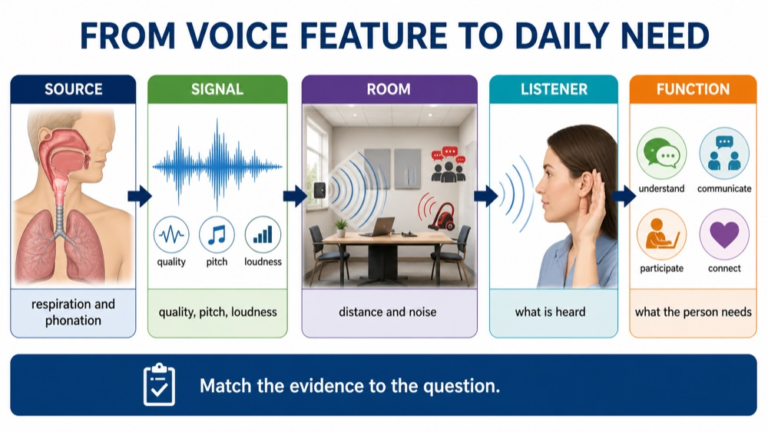
From voice feature to daily need
Context changes what communication requires. A sound in isolation, a word pattern, a long explanation, a conversation, a classroom exchange, a workplace voice demand, and a noisy interaction place different demands on production, processing, rate, memory, and partner support. Hearing access, fatigue, visual supports, language experience, and the opportunity to request clarification should be part of the observation.
A speaker may sound clear in a short conversation but become breathy or strained after prolonged use, or may be heard differently in a quiet room and a noisy workplace. The listener’s impression and the speaker’s own concern both matter. A perceptual feature organizes the next question; it does not by itself identify laryngeal pathology or one cause.
Observation layer
Example question
Task
What did the person need to understand, produce, organize, coordinate, or repair?
Pattern
Which sound, voice, fluency, language, motor, or access relationship was observable?
Access
Were hearing, visual, motor, sensory, language, respiratory, or environmental supports available?
Participation
What meaningful routine became easier or harder because of the pattern?
Context is not an afterthought added once a label has been selected. It is part of the question itself. If performance changes with a quieter room, extra processing time, a familiar partner, a different communication mode, a changed speaking rate, or a changed task, that change is useful evidence about access and demand. It does not identify a cause by itself, but it tells you which conditions should be carried into the next observation.
Apply the concept in clinical reasoning
When a Praxis-style scenario or clinical discussion presents voice disorders, use a disciplined sequence. The goal is to select the next clinical question or action that matches the evidence, the person’s priorities, and the communication context.
Define the task in plain language.
Identify the domain or domains involved without assuming they are interchangeable.
Separate observation from interpretation and write down what remains unknown.
Check hearing, language experience, culture, communication mode, environment, partner support, alertness, respiration, memory, and task familiarity.
Choose the assessment, collaboration, or observation step that answers the specific question.
State the boundary of the conclusion and keep the person’s participation goal visible.
A speaker may sound clear in a short conversation but become breathy or strained after prolonged use, or may be heard differently in a quiet room and a noisy workplace. The listener’s impression and the speaker’s own concern both matter. A perceptual feature organizes the next question; it does not by itself identify laryngeal pathology or one cause. In a learning answer, the decisive evidence is usually the relationship among the task, the observed pattern, and the next needed information—not a single isolated behavior or label.
Common study mistakes
Treating one perceptual voice feature as a medical diagnosis.
Confusing pitch with loudness, quality, resonance, or respiratory support.
Using a sustained vowel as the whole voice and communication profile.
Overlooking the speaker’s own concern when the listener hears little difference.
Assuming an acoustic number replaces history, perceptual listening, medical, and functional evidence.
Ignoring language, culture, age, identity, and the person’s desired voice experience.
Writing a treatment or pathology conclusion without the appropriate professional collaboration.
Most of these mistakes come from replacing a multidomain question with a fast label. Correct the habit by returning to the same sequence: describe, separate, contextualize, ask what is missing, and choose a proportionate next step. A short rationale can make the habit visible: identify the evidence, name the uncertainty, and explain why the selected next step fits both.
Build a quick review map
Use this compact map when reviewing a missed question, a lecture note, or a clinical vignette:
Step 1: Name the quality, pitch, loudness, task, listener, and communication need.
Step 2: Separate source, respiration, resonance, environment, fatigue, and perception.
Step 3: Compare short and long use, quiet and noise, reading, conversation, and occupational demand.
Step 4: Check the speaker’s own concern, identity, culture, and participation priorities.
Step 5: Match auditory, acoustic, medical, instrumental, and functional evidence to the question.
Step 6: State the evidence boundary and the next appropriate professional step.
Then write one transfer sentence: “When I see this pattern, I will first check ___ because ___.” The sentence should identify a decision rule, not repeat a definition. Revisit it after a delay and test whether you can apply the rule to a different task, age group, or communication mode.
Sources and next steps
voice disorders is best learned as a context-sensitive pattern across structure, function, access, and participation. Use the current authority pages to refine the concept, then return to practice scenarios that require you to explain what the evidence supports and what it leaves open.
Start with asha voice, ets 5331 study companion. These sources support the learning frame; they do not replace current topic-specific guidance or an individualized evaluation.
Fluency Disorders: Continuity, Stuttering, Cluttering, and Context
fluency disorders is easier to study when it is treated as a connected system rather than a single label. Fluency refers to continuity, smoothness, rate, and effort in speech production. Fluency disorders are best studied through speech behaviors, listener and speaker reactions, context, communication effectiveness, and participation—not through a count alone.
This learning guide is written for SLP students and other learners reviewing clinical concepts. It uses broad patterns to organize observation, not to make an individualized diagnosis or promise one outcome. Interpretation depends on the person, task, language, culture, hearing, access, health, context, and communication goals.
What fluency disorders includes
Begin by separating the concept into domains. A learner who can name the domains is less likely to collapse perception, production, language, motor, voice, fluency, hearing, or participation questions into one explanation. The useful unit of analysis is the task: what the person was asked to understand, produce, organize, coordinate, remember, or communicate, with whom, under which conditions, and with what support.
Domain or system
What to notice
Question to carry forward
Continuity
Speech may include repetitions, prolongations, blocks, pauses, fillers, or other disruptions in flow.
What type of disruption occurred and how did it affect the message?
Rate and rhythm
Rate, pausing, stress, rhythm, and syllable organization shape how fluent speech is perceived.
Is the listener experiencing a flow, timing, or clarity breakdown?
Stuttering
Stuttering-like disfluencies and internal or listener reactions can affect communication and willingness to speak.
What behaviors, reactions, and participation effects are present?
Cluttering
Rapid or irregular delivery, nonstuttering-like disfluencies, pausing, and over-coarticulation may affect clarity.
What does the speaker and listener experience across contexts?
Context
Fluency and reactions can vary with audience, topic, setting, monitoring, fatigue, and communication demand.
Which environment or partner changes the pattern?
Function
Communication effectiveness, efficiency, identity, choice, and willingness to speak are central to interpretation.
What communication priority should guide the next step?
These domains interact, but they should remain distinguishable. A learner may show strength in one task and need support in another. A study map organizes the next observation; it does not answer every assessment question or replace current professional guidance.
Keep the first pass descriptive and close to the communication event. Note the task, the response, the partner, the setting, the timing, the available support, and the consequence for participation. This gives the learner a stable record to compare across tasks and prevents a familiar term from doing too much explanatory work before the evidence has been separated.
For Praxis-style review, a vignette may include several true details but ask for one best interpretation or next step. The strongest answer usually respects the task, identifies the relevant function, checks the most important missing information, and avoids treating one performance sample as the whole profile.
Map fluency disorders
For study purposes, describe the sound, voice, fluency, or communication relationship before naming a disorder. Record what the person understood, produced, initiated, repaired, coordinated, or participated in. Then note whether the task was familiar, how much context was shared, and which support changed the response.
Speech flow: describe repetitions, prolongations, blocks, pauses, fillers, revisions, and other disfluencies without moral judgment.
Rate and rhythm: observe continuity, smoothness, rate, effort, pausing, stress, syllable organization, and listener clarity.
Stuttering context: include internal reactions, physical tension, listener responses, avoidance, and communication choice.
Cluttering context: examine perceived rapid or irregular rate, nonstuttering-like disfluencies, pausing, over-coarticulation, and awareness.
Variation: compare formal and informal settings, familiar and unfamiliar partners, topics, tasks, and communication modes.
Function and identity: center effectiveness, efficiency, participation, self-advocacy, and the speaker’s own view of communication.
A strong description is specific enough that another learner could picture the event. Instead of writing “the system is impaired,” describe the demand, the observable response, the partner, the context, and the result. This protects clinical reasoning from labels that are broader than the evidence.
Read fluency in context
Context changes what communication requires. A sound in isolation, a word pattern, a long explanation, a conversation, a classroom exchange, a workplace voice demand, and a noisy interaction place different demands on production, processing, rate, memory, and partner support. Hearing access, fatigue, visual supports, language experience, and the opportunity to request clarification should be part of the observation.
A speaker may show more disfluency in one setting and less in another, while a listener’s reaction changes the communication experience. A person who clutters may have a measured rate that is not high but still sound rapid or irregular to listeners. These observations need context, respect, and functional interpretation rather than a simple fluency score.
Observation layer
Example question
Task
What did the person need to understand, produce, organize, coordinate, or repair?
Pattern
Which sound, voice, fluency, language, motor, or access relationship was observable?
Access
Were hearing, visual, motor, sensory, language, respiratory, or environmental supports available?
Participation
What meaningful routine became easier or harder because of the pattern?
Context is not an afterthought added once a label has been selected. It is part of the question itself. If performance changes with a quieter room, extra processing time, a familiar partner, a different communication mode, a changed speaking rate, or a changed task, that change is useful evidence about access and demand. It does not identify a cause by itself, but it tells you which conditions should be carried into the next observation.
Apply the concept in clinical reasoning
When a Praxis-style scenario or clinical discussion presents fluency disorders, use a disciplined sequence. The goal is to select the next clinical question or action that matches the evidence, the person’s priorities, and the communication context.
Define the task in plain language.
Identify the domain or domains involved without assuming they are interchangeable.
Separate observation from interpretation and write down what remains unknown.
Check hearing, language experience, culture, communication mode, environment, partner support, alertness, respiration, memory, and task familiarity.
Choose the assessment, collaboration, or observation step that answers the specific question.
State the boundary of the conclusion and keep the person’s participation goal visible.
A speaker may show more disfluency in one setting and less in another, while a listener’s reaction changes the communication experience. A person who clutters may have a measured rate that is not high but still sound rapid or irregular to listeners. These observations need context, respect, and functional interpretation rather than a simple fluency score. In a learning answer, the decisive evidence is usually the relationship among the task, the observed pattern, and the next needed information—not a single isolated behavior or label.
Common study mistakes
Treating every disfluency as a disorder or every fluent moment as evidence that no difficulty exists.
Reducing fluency to a syllable count without describing behavior, reaction, and function.
Confusing stuttering-like disfluencies with all nonstuttering-like disfluencies.
Assuming cluttering is only fast speech and ignoring clarity, pausing, and awareness.
Ignoring listener reactions, internal reactions, avoidance, identity, and willingness to speak.
Assuming one formal sample represents informal, classroom, work, or family communication.
Using language that frames fluency as a personality or effort problem.
Choosing a goal without centering the speaker’s communication priorities and participation.
Most of these mistakes come from replacing a multidomain question with a fast label. Correct the habit by returning to the same sequence: describe, separate, contextualize, ask what is missing, and choose a proportionate next step. A short rationale can make the habit visible: identify the evidence, name the uncertainty, and explain why the selected next step fits both.
Build a quick review map
Use this compact map when reviewing a missed question, a lecture note, or a clinical vignette:
Step 1: Describe the disfluency type, rate, rhythm, effort, listener, and communication task.
Step 2: Separate stuttering, cluttering, typical disfluency, reactions, and context.
Step 3: Compare settings, partners, topics, monitoring, fatigue, and communication modes.
Step 4: Record internal experience, listener response, avoidance, and willingness to speak.
Step 5: Keep the speaker’s identity, choices, and participation central.
Step 6: Choose the next question that supports communication effectiveness and autonomy.
Then write one transfer sentence: “When I see this pattern, I will first check ___ because ___.” The sentence should identify a decision rule, not repeat a definition. Revisit it after a delay and test whether you can apply the rule to a different task, age group, or communication mode.
Sources and next steps
fluency disorders is best learned as a context-sensitive pattern across structure, function, access, and participation. Use the current authority pages to refine the concept, then return to practice scenarios that require you to explain what the evidence supports and what it leaves open.
Start with asha fluency, ets 5331 study companion. These sources support the learning frame; they do not replace current topic-specific guidance or an individualized evaluation.
Phonological Disorders: Sound Systems, Patterns, and Generalization
phonological disorders is easier to study when it is treated as a connected system rather than a single label. Phonological disorders are studied at the level of a language’s sound system: contrasts, patterns, syllable structures, and permissible sequences. The key distinction is between describing a single production and understanding how a pattern organizes across words and contexts.
This learning guide is written for SLP students and other learners reviewing clinical concepts. It uses broad patterns to organize observation, not to make an individualized diagnosis or promise one outcome. Interpretation depends on the person, task, language, culture, hearing, access, health, context, and communication goals.
What phonological disorders includes
Begin by separating the concept into domains. A learner who can name the domains is less likely to collapse perception, production, language, motor, voice, fluency, hearing, or participation questions into one explanation. The useful unit of analysis is the task: what the person was asked to understand, produce, organize, coordinate, remember, or communicate, with whom, under which conditions, and with what support.
Domain or system
What to notice
Question to carry forward
Sound contrast
A contrast distinguishes meaning within the language and may be used across many words.
Which contrast is present, absent, merged, or unstable?
Pattern
Substitutions, omissions, or changes may recur across positions, classes, syllables, or words.
Does the pattern generalize beyond one sound or example?
Syllable structure
Clusters, final consonants, weak syllables, stress, and word length change the sound-system demand.
Which word shape or sequence changes the response?
Generalization
A change in one set of targets may carry into untreated words, contexts, or contrasts.
What evidence shows transfer across the system?
Language and dialect
Sound inventories and phonotactic rules vary by language, dialect, and multilingual experience.
Is the form different from the comparison variety or disordered within it?
Function
The impact is shaped by intelligibility, listener familiarity, learning demands, and communication purpose.
What participation outcome gives the pattern priority?
These domains interact, but they should remain distinguishable. A learner may show strength in one task and need support in another. A study map organizes the next observation; it does not answer every assessment question or replace current professional guidance.
Keep the first pass descriptive and close to the communication event. Note the task, the response, the partner, the setting, the timing, the available support, and the consequence for participation. This gives the learner a stable record to compare across tasks and prevents a familiar term from doing too much explanatory work before the evidence has been separated.
For Praxis-style review, a vignette may include several true details but ask for one best interpretation or next step. The strongest answer usually respects the task, identifies the relevant function, checks the most important missing information, and avoids treating one performance sample as the whole profile.
Map phonological disorders
For study purposes, describe the sound, voice, fluency, or communication relationship before naming a disorder. Record what the person understood, produced, initiated, repaired, coordinated, or participated in. Then note whether the task was familiar, how much context was shared, and which support changed the response.
Contrast system: identify sound differences that carry meaning and the contexts in which they are used.
Recurring pattern: record substitutions, omissions, distortions, and variability across words and sound classes.
Syllable and word shape: examine clusters, final sounds, weak syllables, stress, length, and phonotactic complexity.
Generalization: compare treated or practiced targets with new words, positions, contrasts, and connected speech.
Language context: include dialect, multilingual exposure, community norms, hearing, and communication opportunity.
Function: connect the sound-system pattern to listeners, classroom learning, relationships, confidence, and goals.
A strong description is specific enough that another learner could picture the event. Instead of writing “the system is impaired,” describe the demand, the observable response, the partner, the context, and the result. This protects clinical reasoning from labels that are broader than the evidence.
From sound pattern to generalization
Context changes what communication requires. A sound in isolation, a word pattern, a long explanation, a conversation, a classroom exchange, a workplace voice demand, and a noisy interaction place different demands on production, processing, rate, memory, and partner support. Hearing access, fatigue, visual supports, language experience, and the opportunity to request clarification should be part of the observation.
A learner may simplify several clusters, omit final sounds, or neutralize a contrast across many words. Another learner may show a form that belongs to a different dialect or language. The study task is to identify the pattern, its distribution, its effect on meaning and intelligibility, and the context needed to interpret it fairly.
Observation layer
Example question
Task
What did the person need to understand, produce, organize, coordinate, or repair?
Pattern
Which sound, voice, fluency, language, motor, or access relationship was observable?
Access
Were hearing, visual, motor, sensory, language, respiratory, or environmental supports available?
Participation
What meaningful routine became easier or harder because of the pattern?
Context is not an afterthought added once a label has been selected. It is part of the question itself. If performance changes with a quieter room, extra processing time, a familiar partner, a different communication mode, a changed speaking rate, or a changed task, that change is useful evidence about access and demand. It does not identify a cause by itself, but it tells you which conditions should be carried into the next observation.
Apply the concept in clinical reasoning
When a Praxis-style scenario or clinical discussion presents phonological disorders, use a disciplined sequence. The goal is to select the next clinical question or action that matches the evidence, the person’s priorities, and the communication context.
Define the task in plain language.
Identify the domain or domains involved without assuming they are interchangeable.
Separate observation from interpretation and write down what remains unknown.
Check hearing, language experience, culture, communication mode, environment, partner support, alertness, respiration, memory, and task familiarity.
Choose the assessment, collaboration, or observation step that answers the specific question.
State the boundary of the conclusion and keep the person’s participation goal visible.
A learner may simplify several clusters, omit final sounds, or neutralize a contrast across many words. Another learner may show a form that belongs to a different dialect or language. The study task is to identify the pattern, its distribution, its effect on meaning and intelligibility, and the context needed to interpret it fairly. In a learning answer, the decisive evidence is usually the relationship among the task, the observed pattern, and the next needed information—not a single isolated behavior or label.
Common study mistakes
Treating a phonological disorder as a list of unrelated articulation errors.
Calling one sound substitution a system-wide pattern without distribution evidence.
Ignoring contrasts, syllable structure, stress, clusters, and word position.
Confusing dialect or multilingual transfer with a disorder.
Assuming one practiced word shows generalization to the whole sound system.
Using age expectations without considering language, opportunity, hearing, and context.
Separating phonology from intelligibility, literacy, and classroom participation.
Choosing a target or conclusion without stating the pattern and functional priority.
Most of these mistakes come from replacing a multidomain question with a fast label. Correct the habit by returning to the same sequence: describe, separate, contextualize, ask what is missing, and choose a proportionate next step. A short rationale can make the habit visible: identify the evidence, name the uncertainty, and explain why the selected next step fits both.
Build a quick review map
Use this compact map when reviewing a missed question, a lecture note, or a clinical vignette:
Step 1: Name the language, dialect, sound contrast, and word contexts.
Step 2: Describe the recurring pattern and its distribution across the system.
Step 4: Check language experience, hearing, perception, motor production, and opportunity.
Step 5: Look for generalization and listener impact rather than one correct item.
Step 6: Connect the decision rule to a meaningful communication or learning goal.
Then write one transfer sentence: “When I see this pattern, I will first check ___ because ___.” The sentence should identify a decision rule, not repeat a definition. Revisit it after a delay and test whether you can apply the rule to a different task, age group, or communication mode.
Sources and next steps
phonological disorders is best learned as a context-sensitive pattern across structure, function, access, and participation. Use the current authority pages to refine the concept, then return to practice scenarios that require you to explain what the evidence supports and what it leaves open.