Communication Partner Training: Strategies, Roles, and Function
communication partner training is easier to study when it is treated as a connected clinical reasoning problem rather than a label to memorize. Communication partner training helps family members, educators, caregivers, peers, and staff make communication more accessible and effective. The SLP study task is to match partner strategies to the person, message, mode, environment, relationship, and participation goal rather than treat training as a generic list of prompts.
This learning guide is written for SLP students and other learners reviewing clinical concepts. It organizes observation, access, assessment, function, and professional judgment; it does not make an individualized diagnosis or replace current professional guidance. Interpretation depends on the person, task, language, culture, health, access, partner, context, and communication goals.
What communication partner training includes
Begin by separating the concept into domains. A learner who can name the domains is less likely to collapse language, access, partner, participation, competence, regulation, and clinical judgment into one explanation. The useful unit of analysis is the task: what the person was asked to understand, express, organize, coordinate, remember, or communicate, with whom, under which conditions, and with what support.
Domain or system
What to notice
Question to carry forward
Partner role
Partners may provide access, language models, wait time, clarification, confirmation, repair, environmental changes, and advocacy.
What does the partner need to do for communication to work?
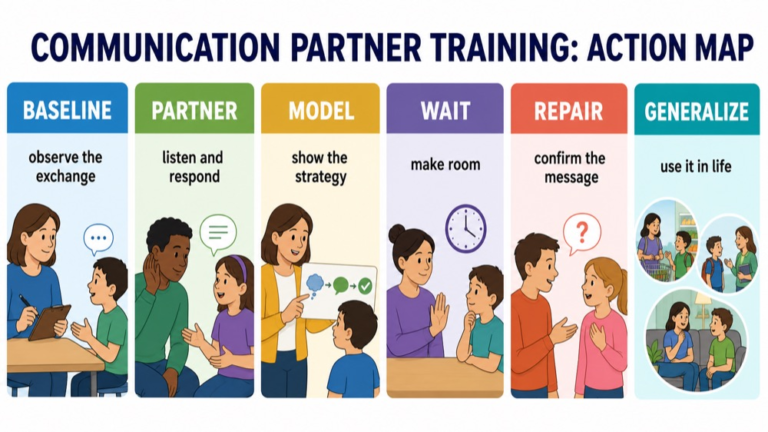
Baseline
Observe the interaction before training: who initiates, who repairs, who controls the topic, and what support changes the exchange.
What is happening now and for whom is it difficult?
Strategy fit
Modeling, reduced rate, visual supports, open questions, written choices, and partner-assisted communication fit different needs.
Which strategy matches the task and communication mode?
Learning
Training includes explanation, demonstration, practice, feedback, reflection, and adaptation to the partner’s routine.
Can the partner explain and use the strategy in context?
Repair and autonomy
Partners support clarification while preserving the communicator’s authorship, choice, turn, and message intent.
Does support make access more reliable without taking over?
Generalization
Strategies must travel across people, rooms, routines, demands, and communication modes to affect daily participation.
Where else should the strategy work and how will it be checked?
These domains interact, but they should remain distinguishable. A learner may show strength in one context and need support in another. A study map organizes the next observation; it does not answer every assessment question or establish a universal treatment, goal, or legal conclusion.
Keep the first pass descriptive and close to the communication event. Note the task, response, partner, setting, timing, available support, language or mode, and consequence for participation. This gives the learner a stable record to compare across tasks and prevents a familiar term from doing too much explanatory work before the evidence has been separated.
For Praxis-style review, a vignette may include several true details but ask for one best interpretation or next step. The strongest answer usually respects the task, identifies the relevant function or boundary, checks the most important missing information, and avoids treating one performance sample or policy phrase as the whole profile.
Map communication partner training
For study purposes, describe the communication relationship before naming a disorder, judging a partner, selecting a goal, or deciding that a task is within scope. Record what the person understood, expressed, initiated, repaired, coordinated, or participated in. Then note whether the task was familiar, how much context was shared, and which support changed the response.
Interaction baseline: record initiations, turn-taking, topic control, breakdowns, repair, partner behavior, and communication success.
Partner behaviors: consider wait time, modeling, aided input, rate, visual support, confirmation, open choices, and environmental change.
Communicator access: match training to speech, signs, gestures, writing, AAC, hearing, vision, motor access, language, and cognition.
Training process: explain, demonstrate, practice, coach, give feedback, invite reflection, and revise for the partner’s real routine.
Autonomy and repair: keep message authorship with the communicator and build ways to clarify, reject, correct, and change a message.
Generalization: observe home, school, work, health care, community, low-demand, and high-demand communication after training.
A strong description is specific enough that another learner could picture the event. Instead of writing “the communication is impaired” or “the clinician can do this,” describe the demand, observable response, language or mode, partner, context, competence or access condition, and result. This protects clinical reasoning from labels that are broader than the evidence.
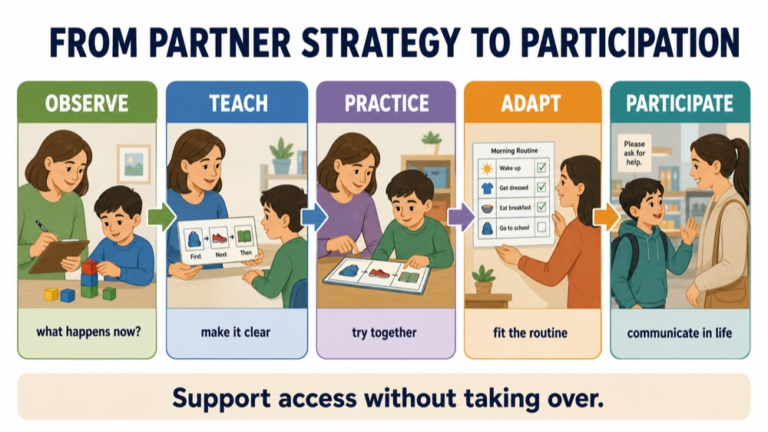
From partner strategy to participation
Context changes what communication and professional decisions require. A direct question, long explanation, group exchange, classroom task, health-care interaction, family story, noisy routine, supervised procedure, or referral decision places different demands on processing, language, memory, hearing, access, partner behavior, competence, and regulation. Language experience, visual information, fatigue, health literacy, and the opportunity to request clarification should be part of the observation.
A partner may unintentionally ask only yes/no questions, fill silence too quickly, move an AAC device away, or interpret a gesture without confirmation. Another partner may learn to wait, model language, offer visual choices, confirm the message, reduce noise, and support repair. The goal is not to make the partner speak for the person; it is to change the interaction so the communicator has more reliable access, control, and participation.
Observation layer
Example question
Task
What did the person or clinician need to understand, express, organize, coordinate, decide, or provide?
Language and access
Which language, dialect, mode, hearing condition, tool, support, or communication partner was available?
Context and responsibility
Who was involved, what did they know, and which role, policy, ethical, or environmental factor mattered?
Participation and safety
What meaningful routine, role, outcome, or risk became easier or harder because of the pattern?
Context is not an afterthought added once a label has been selected. It is part of the question itself. If performance or decision quality changes with a quieter room, extra processing time, a familiar partner, a different language or mode, an interpreter, visual information, supervision, collaboration, a changed task, or a changed routine, that change is useful evidence about access and demand. It does not identify a cause by itself, but it tells you which conditions should be carried into the next observation.
Apply partner-training reasoning
When a Praxis-style scenario or clinical discussion presents communication partner training, use a disciplined sequence. The goal is to select the next clinical question or action that matches the evidence, the person’s priorities, the communication context, and the relevant professional boundary.
Define the task, language, mode, communication purpose, or service responsibility in plain language.
Identify the relevant domain: language, access, partner, participation, assessment, competence, collaboration, ethics, or regulation.
Separate observation from interpretation and write down what remains unknown.
Check history, exposure, dialect, culture, identity, interpreter access, environment, sensory load, memory, task familiarity, training, supervision, and local requirements as relevant.
Choose the assessment, collaboration, accommodation, goal, training, referral, or documentation step that answers the specific question.
State the boundary of the conclusion and keep the person’s safety, autonomy, access, and participation visible.
A partner may unintentionally ask only yes/no questions, fill silence too quickly, move an AAC device away, or interpret a gesture without confirmation. Another partner may learn to wait, model language, offer visual choices, confirm the message, reduce noise, and support repair. The goal is not to make the partner speak for the person; it is to change the interaction so the communicator has more reliable access, control, and participation. In a learning answer, the decisive evidence is usually the relationship among the task, the observed pattern, the context, and the next needed information—not a single isolated behavior, score, label, or broad permission statement.
Common study mistakes
Treating partner training as a generic handout without observing the actual interaction.
Training the partner while ignoring the communicator’s language, access method, preferences, and goals.
Confusing a partner’s compliance with improved communication or participation.
Using prompts, guesses, or forced choices that take authorship away from the communicator.
Teaching a strategy without modeling, practice, feedback, reflection, or a plan for adaptation.
Measuring partner behavior only in a quiet clinic and assuming it will generalize to daily routines.
Leaving out repair, refusal, topic change, privacy, and communication of complex messages.
Calling a strategy evidence based without matching it to the person, partner, context, and outcome.
Most of these mistakes come from replacing a multidomain question with a fast label. Correct the habit by returning to the same sequence: describe, separate, contextualize, ask what is missing, and choose a proportionate next step. A short rationale can make the habit visible: identify the evidence, name the uncertainty, and explain why the selected next step fits the person, setting, and responsibility.
Build a quick review map
Use this compact map when reviewing a missed question, lecture note, or clinical vignette:
Step 1: Describe the communicator, partner, mode, message, setting, and interaction goal.
Step 2: Observe the baseline and identify the partner behavior or environmental barrier that matters.
Step 3: Choose a strategy that preserves access, autonomy, language, turn-taking, and message intent.
Step 4: Teach through explanation, demonstration, practice, feedback, and partner reflection.
Step 5: Measure meaningful communication, repair, independence, and participation rather than compliance alone.
Step 6: Check generalization across partners, routines, demands, and environments.
Then write one transfer sentence: “When I see this pattern, I will first check ___ because ___.” The sentence should identify a decision rule, not repeat a definition. Revisit it after a delay and test whether you can apply the rule to a different task, age group, partner, language, setting, or professional responsibility.
Sources and next steps
communication partner training is best learned as a context-sensitive pattern across communication, access, identity, function, participation, competence, and professional judgment. Use the current authority pages to refine the concept, then return to practice scenarios that require you to explain what the evidence supports and what it leaves open.
Multilingual Language Disorder: Differential Diagnosis and Language Access
multilingual language disorder is easier to study when it is treated as a connected clinical reasoning problem rather than a label to memorize. Multilingual language disorder is a differential-diagnosis question, not a synonym for bilingualism or multilingualism. Strong SLP reasoning separates language exposure, use, dialect, transfer, access, culture, assessment conditions, and patterns that persist across the person’s relevant languages and contexts.
This learning guide is written for SLP students and other learners reviewing clinical concepts. It organizes observation, access, assessment, function, and professional judgment; it does not make an individualized diagnosis or replace current professional guidance. Interpretation depends on the person, task, language, culture, health, access, partner, context, and communication goals.
What multilingual language disorder requires you to separate
Begin by separating the concept into domains. A learner who can name the domains is less likely to collapse language, access, partner, participation, competence, regulation, and clinical judgment into one explanation. The useful unit of analysis is the task: what the person was asked to understand, express, organize, coordinate, remember, or communicate, with whom, under which conditions, and with what support.
Domain or system
What to notice
Question to carry forward
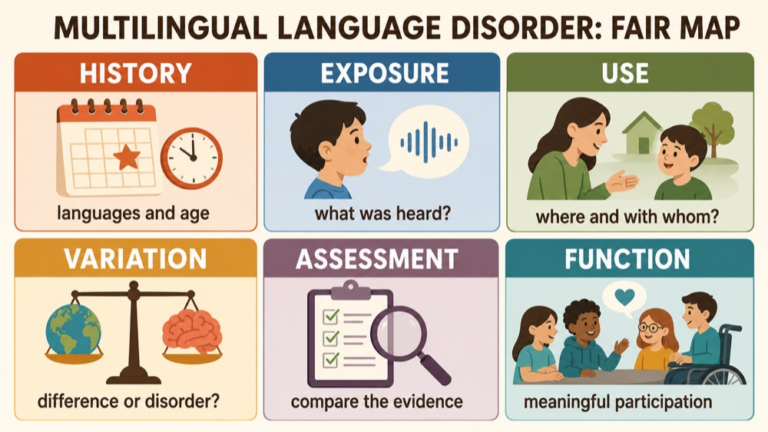
Language history
Age of acquisition, languages, modes, migration, schooling, family routines, and changes in exposure shape the profile.
What language experience has the person actually had?
Exposure and use
A language may be understood, spoken, signed, read, or written differently across home, school, work, and community.
Where and with whom is each language used?
Cross-linguistic patterns
Transfer, language-specific grammar, dialect, and vocabulary differences may be expected features of multilingual development.
Does the pattern fit the languages and varieties involved?
Assessment
Samples, interviews, interpreters, dynamic tasks, language-matched methods, and multiple contexts add evidence beyond one test score.
What evidence is needed across the communication profile?
Family and culture
Family values, identity, heritage language, culture, community, and educational goals influence meaningful communication.
Which language goals matter to the person and family?
Functional impact
A disorder claim should connect to communication difficulty in meaningful activities, relationships, learning, or safety.
What participation problem is documented across contexts?
These domains interact, but they should remain distinguishable. A learner may show strength in one context and need support in another. A study map organizes the next observation; it does not answer every assessment question or establish a universal treatment, goal, or legal conclusion.
Keep the first pass descriptive and close to the communication event. Note the task, response, partner, setting, timing, available support, language or mode, and consequence for participation. This gives the learner a stable record to compare across tasks and prevents a familiar term from doing too much explanatory work before the evidence has been separated.
For Praxis-style review, a vignette may include several true details but ask for one best interpretation or next step. The strongest answer usually respects the task, identifies the relevant function or boundary, checks the most important missing information, and avoids treating one performance sample or policy phrase as the whole profile.
Map multilingual language disorder
For study purposes, describe the communication relationship before naming a disorder, judging a partner, selecting a goal, or deciding that a task is within scope. Record what the person understood, expressed, initiated, repaired, coordinated, or participated in. Then note whether the task was familiar, how much context was shared, and which support changed the response.
History: document languages, communication modes, age of acquisition, exposure, schooling, migration, family routines, and change over time.
Use: compare comprehension and expression across home, school, work, community, formal, informal, spoken, signed, and written contexts.
Variation: identify language-specific structures, dialect, transfer, accent, opportunity, and unfamiliar tasks before calling a pattern disordered.
Assessment: combine language samples, caregiver interview, trained interpreter support, dynamic assessment, and language-specific knowledge.
Partnership: include the person, family, community, educators, interpreters, and other professionals in interpretation and planning.
Function: connect the conclusion to meaningful communication, learning, relationships, self-advocacy, and participation across contexts.
A strong description is specific enough that another learner could picture the event. Instead of writing “the communication is impaired” or “the clinician can do this,” describe the demand, observable response, language or mode, partner, context, competence or access condition, and result. This protects clinical reasoning from labels that are broader than the evidence.
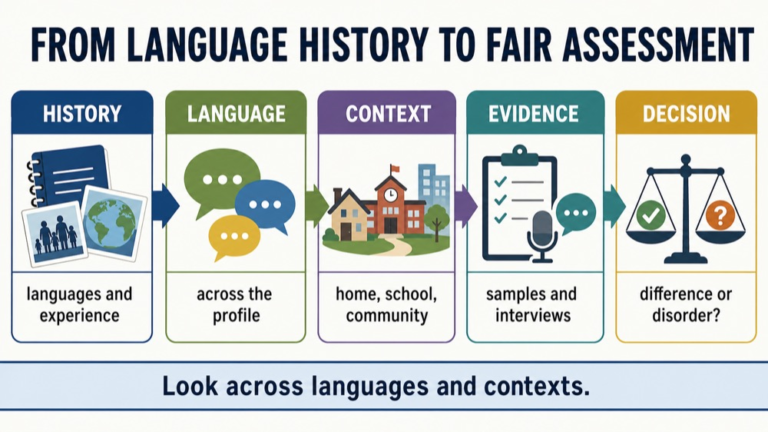
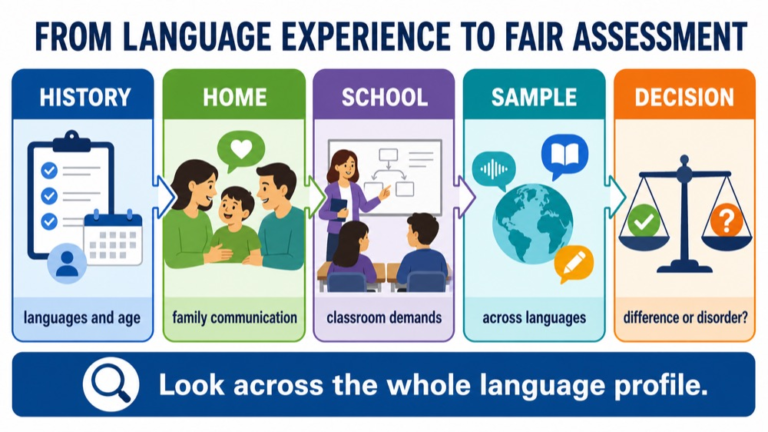
From language history to fair assessment
Context changes what communication and professional decisions require. A direct question, long explanation, group exchange, classroom task, health-care interaction, family story, noisy routine, supervised procedure, or referral decision places different demands on processing, language, memory, hearing, access, partner behavior, competence, and regulation. Language experience, visual information, fatigue, health literacy, and the opportunity to request clarification should be part of the observation.
A child may use a heritage language for family stories, a school language for academic tasks, and gestures or another mode with peers. A concept or word may be represented in one language but not another, while a language-specific grammar pattern may be expected. The clinical question is whether there is consistent evidence of a communication disorder across the person’s language experience and functional contexts, not whether one language sample matches an English-only norm.
Observation layer
Example question
Task
What did the person or clinician need to understand, express, organize, coordinate, decide, or provide?
Language and access
Which language, dialect, mode, hearing condition, tool, support, or communication partner was available?
Context and responsibility
Who was involved, what did they know, and which role, policy, ethical, or environmental factor mattered?
Participation and safety
What meaningful routine, role, outcome, or risk became easier or harder because of the pattern?
Context is not an afterthought added once a label has been selected. It is part of the question itself. If performance or decision quality changes with a quieter room, extra processing time, a familiar partner, a different language or mode, an interpreter, visual information, supervision, collaboration, a changed task, or a changed routine, that change is useful evidence about access and demand. It does not identify a cause by itself, but it tells you which conditions should be carried into the next observation.
Apply multilingual differential reasoning
When a Praxis-style scenario or clinical discussion presents multilingual language disorder, use a disciplined sequence. The goal is to select the next clinical question or action that matches the evidence, the person’s priorities, the communication context, and the relevant professional boundary.
Define the task, language, mode, communication purpose, or service responsibility in plain language.
Identify the relevant domain: language, access, partner, participation, assessment, competence, collaboration, ethics, or regulation.
Separate observation from interpretation and write down what remains unknown.
Check history, exposure, dialect, culture, identity, interpreter access, environment, sensory load, memory, task familiarity, training, supervision, and local requirements as relevant.
Choose the assessment, collaboration, accommodation, goal, training, referral, or documentation step that answers the specific question.
State the boundary of the conclusion and keep the person’s safety, autonomy, access, and participation visible.
A child may use a heritage language for family stories, a school language for academic tasks, and gestures or another mode with peers. A concept or word may be represented in one language but not another, while a language-specific grammar pattern may be expected. The clinical question is whether there is consistent evidence of a communication disorder across the person’s language experience and functional contexts, not whether one language sample matches an English-only norm. In a learning answer, the decisive evidence is usually the relationship among the task, the observed pattern, the context, and the next needed information—not a single isolated behavior, score, label, or broad permission statement.
Common study mistakes
Treating bilingualism or multilingualism as the cause of a language disorder.
Testing only the school language and interpreting limited exposure as limited overall language.
Ignoring language-specific grammar, vocabulary, phonology, dialect, transfer, and communication opportunities.
Assuming equal proficiency, exposure, use, literacy, or cultural meaning across languages.
Using an untrained interpreter or bilingual helper as if clinical interpreting expertise were unnecessary.
Removing the heritage language from intervention without discussing identity, family values, and participation.
Generalizing from a single structured task to the person’s whole multilingual communication profile.
Writing a disorder conclusion without describing functional impact and the limits of the evidence.
Most of these mistakes come from replacing a multidomain question with a fast label. Correct the habit by returning to the same sequence: describe, separate, contextualize, ask what is missing, and choose a proportionate next step. A short rationale can make the habit visible: identify the evidence, name the uncertainty, and explain why the selected next step fits the person, setting, and responsibility.
Build a quick review map
Use this compact map when reviewing a missed question, lecture note, or clinical vignette:
Step 1: List the languages, modes, age of acquisition, exposure, use, partners, and settings.
Step 2: Separate language-specific patterns, transfer, dialect, opportunity, access, and possible disorder.
Step 3: Combine evidence across languages, samples, interviews, dynamic tasks, and meaningful routines.
Step 4: Include family identity, heritage language, culture, schooling, and communication priorities.
Step 5: Use appropriate language-matched providers or trained interpreters and document the method.
Step 6: Connect any conclusion to persistent functional impact and state what remains unknown.
Then write one transfer sentence: “When I see this pattern, I will first check ___ because ___.” The sentence should identify a decision rule, not repeat a definition. Revisit it after a delay and test whether you can apply the rule to a different task, age group, partner, language, setting, or professional responsibility.
Sources and next steps
multilingual language disorder is best learned as a context-sensitive pattern across communication, access, identity, function, participation, competence, and professional judgment. Use the current authority pages to refine the concept, then return to practice scenarios that require you to explain what the evidence supports and what it leaves open.
Linguistic Diversity in Speech Pathology: Difference, Disorder, and Access
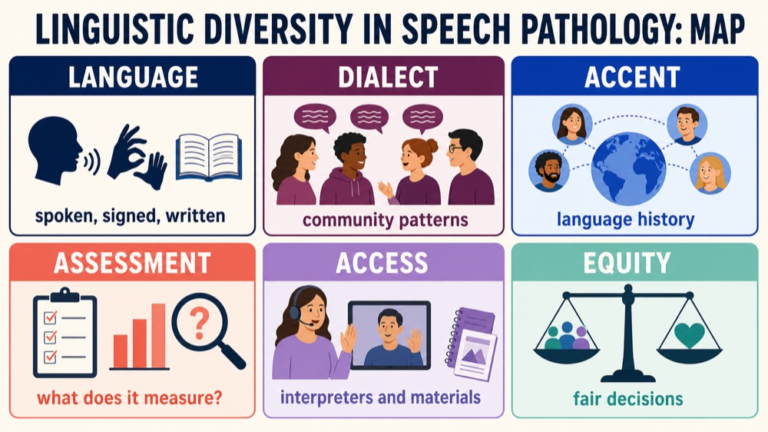
linguistic diversity in speech pathology is easier to study when it is treated as a connected access and communication system rather than a single label. Linguistic diversity in speech pathology includes languages, dialects, accents, signed languages, communication modes, and the varied ways people use language across communities. The central exam and clinical distinction is whether the evidence reflects difference, access, opportunity, or disorder.
This learning guide is written for SLP students and other learners reviewing clinical concepts. It uses broad patterns to organize observation, not to make an individualized diagnosis or promise one outcome. Interpretation depends on the person, task, language, culture, hearing, access, health, context, and communication goals.
What linguistic diversity in speech pathology includes
Begin by separating the concept into domains. A learner who can name the domains is less likely to collapse hearing, language, culture, access, identity, partner, and participation questions into one explanation. The useful unit of analysis is the task: what the person was asked to understand, express, organize, coordinate, remember, or communicate, with whom, under which conditions, and with what support.
Domain or system
What to notice
Question to carry forward
Language
People may use one or more spoken, signed, written, or visual languages across relationships and settings.
Which language or mode is relevant to this task and goal?
Dialect
Community language patterns may differ in sound, grammar, vocabulary, discourse, and interaction without indicating disorder.
Is the pattern expected within the person’s language variety?
Accent
Pronunciation differences reflect language history, identity, and experience and should not be treated as impairment by default.
What communication outcome is actually affected?
Assessment
Language-specific tools, interviews, samples, interpreters, dynamic assessment, and multiple contexts support better reasoning.
What evidence is needed across the person’s communication life?
Service access
Language-matched providers, trained interpreters, translated materials, plain language, and accessible formats support participation.
How will the person and family understand and contribute?
Equity
Fair practice requires avoiding bias, advocating for language access, and recognizing disproportionality and systemic barriers.
What barrier or assumption should the clinician address?
These domains interact, but they should remain distinguishable. A learner may show strength in one task and need support in another. A study map organizes the next observation; it does not answer every assessment question or replace current professional guidance.
Keep the first pass descriptive and close to the communication event. Note the task, the response, the partner, the setting, the timing, the available support, and the consequence for participation. This gives the learner a stable record to compare across tasks and prevents a familiar term from doing too much explanatory work before the evidence has been separated.
For Praxis-style review, a vignette may include several true details but ask for one best interpretation or next step. The strongest answer usually respects the task, identifies the relevant function, checks the most important missing information, and avoids treating one performance sample as the whole profile.
Map linguistic diversity in speech pathology
For study purposes, describe the communication relationship before naming a disorder, judging a modality, or selecting an assessment. Record what the person understood, expressed, initiated, repaired, coordinated, or participated in. Then note whether the task was familiar, how much context was shared, and which support changed the response.
Language and mode: document spoken, signed, written, visual, AAC, heritage, school, work, and community communication.
Dialect and accent: learn the relevant variety and distinguish difference from a breakdown in communication or language structure.
Service access: plan language-matched care, trained interpreters, translated or plain-language information, and accessible formats.
Family and community: invite communication history, values, goals, community norms, and lived expertise into interpretation.
Equity and action: identify bias, disproportionality, institutional barriers, referral patterns, and the next advocacy step.
A strong description is specific enough that another learner could picture the event. Instead of writing “the communication is delayed,” describe the demand, the observable response, the language or mode, the partner, the context, and the result. This protects clinical reasoning from labels that are broader than the evidence.
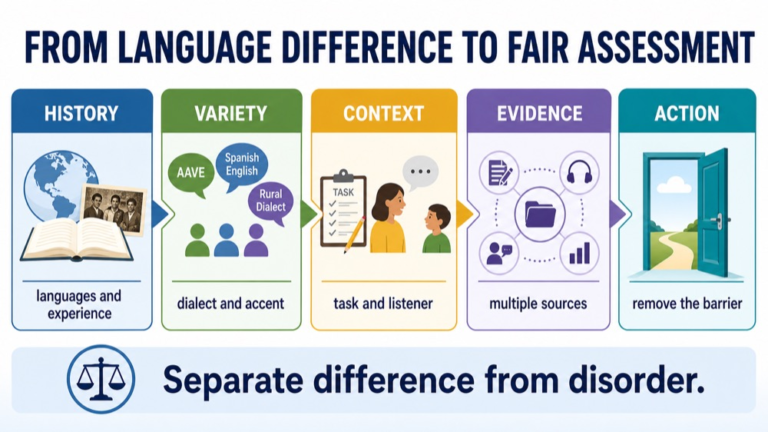
From language difference to fair assessment
Context changes what communication requires. A direct question, a long explanation, a conversation, a classroom exchange, a workplace interaction, a family story, and a noisy routine place different demands on processing, language, memory, hearing, access, and partner support. Language experience, visual information, fatigue, health literacy, and the opportunity to request clarification should be part of the observation.
A bilingual speaker may use one grammar pattern at home and another at school, while a dialect speaker may use a community form that differs from the test norm. A person with an accent may be fully intelligible to familiar listeners but face unfair expectations in a new setting. The study question is what evidence shows a communication disorder, what reflects linguistic variation, and what access or context needs to change.
Observation layer
Example question
Task
What did the person need to understand, express, organize, coordinate, or repair?
Language and access
Which language, dialect, mode, hearing condition, or support was available?
Partner and context
Who was involved, what did they know, and which norms or accommodations mattered?
Participation
What meaningful routine became easier or harder because of the pattern?
Context is not an afterthought added once a label has been selected. It is part of the question itself. If performance changes with a quieter room, extra processing time, a familiar partner, a different language or mode, an interpreter, visual information, a changed task, or a changed routine, that change is useful evidence about access and demand. It does not identify a cause by itself, but it tells you which conditions should be carried into the next observation.
Apply the concept in clinical reasoning
When a Praxis-style scenario or clinical discussion presents linguistic diversity in speech pathology, use a disciplined sequence. The goal is to select the next clinical question or action that matches the evidence, the person’s priorities, and the communication context.
Define the task, language, mode, and communication purpose in plain language.
Identify the hearing, language, cultural, access, partner, or participation domain involved.
Separate observation from interpretation and write down what remains unknown.
Check hearing, language exposure, dialect, culture, identity, interpreter access, environment, sensory load, memory, and task familiarity.
Choose the assessment, collaboration, accommodation, or observation step that answers the specific question.
State the boundary of the conclusion and keep the person’s participation goal visible.
A bilingual speaker may use one grammar pattern at home and another at school, while a dialect speaker may use a community form that differs from the test norm. A person with an accent may be fully intelligible to familiar listeners but face unfair expectations in a new setting. The study question is what evidence shows a communication disorder, what reflects linguistic variation, and what access or context needs to change. In a learning answer, the decisive evidence is usually the relationship among the task, the observed pattern, the access conditions, and the next needed information—not a single isolated behavior or label.
Common study mistakes
Treating English as the only valid comparison language or dialect.
Calling dialect, accent, code-switching, translanguaging, or signed language use a disorder.
Using norms from a different language community without explaining their limits.
Testing one language or one setting and generalizing to the full communication profile.
Relying on family members as interpreters without planning for accuracy, privacy, and roles.
Ignoring language access, health literacy, disability, identity, and power in service delivery.
Confusing listener bias or unfamiliarity with reduced communication ability.
Identifying inequity without changing assessment, referral, materials, collaboration, or advocacy.
Most of these mistakes come from replacing a multidomain question with a fast label. Correct the habit by returning to the same sequence: describe, separate, contextualize, ask what is missing, and choose a proportionate next step. A short rationale can make the habit visible: identify the evidence, name the uncertainty, and explain why the selected next step fits both.
Build a quick review map
Use this compact map when reviewing a missed question, a lecture note, or a clinical vignette:
Step 1: List languages, dialects, accents, modes, settings, partners, and communication goals.
Step 2: Separate variation, transfer, access barriers, listener bias, and disorder evidence.
Step 3: Use language-specific knowledge, samples, dynamic assessment, and appropriate interpretation.
Step 4: Plan language access through matched providers, trained interpreters, and accessible materials.
Step 5: Include family and community expertise, identity, values, and participation priorities.
Step 6: State the equity action that makes the clinical decision more accurate and fair.
Then write one transfer sentence: “When I see this pattern, I will first check ___ because ___.” The sentence should identify a decision rule, not repeat a definition. Revisit it after a delay and test whether you can apply the rule to a different task, age group, partner, language, or communication mode.
Sources and next steps
linguistic diversity in speech pathology is best learned as a context-sensitive pattern across communication, access, identity, function, and participation. Use the current authority pages to refine the concept, then return to practice scenarios that require you to explain what the evidence supports and what it leaves open.
Culturally Responsive Practice: Self-Reflection, Access, and Partnership
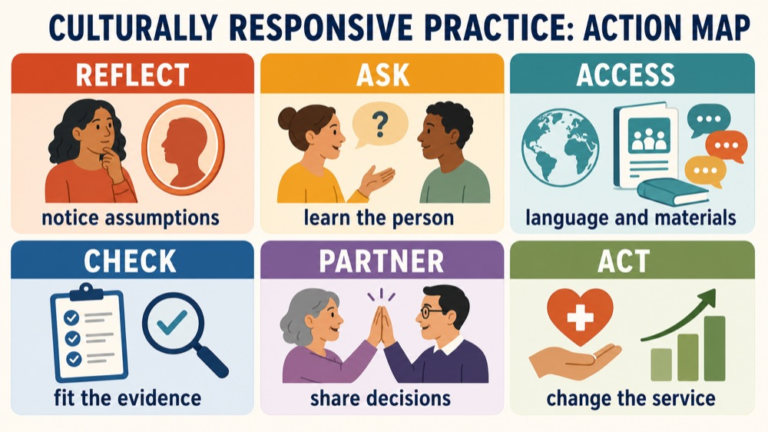
culturally responsive practice is easier to study when it is treated as a connected access and communication system rather than a single label. Culturally responsive practice is an ongoing clinical process that includes self-reflection, cultural humility, language access, bias awareness, individual context, health literacy, partnership, and action. It asks the SLP to understand the person and family rather than apply assumptions about a group.
This learning guide is written for SLP students and other learners reviewing clinical concepts. It uses broad patterns to organize observation, not to make an individualized diagnosis or promise one outcome. Interpretation depends on the person, task, language, culture, hearing, access, health, context, and communication goals.
What culturally responsive practice includes
Begin by separating the concept into domains. A learner who can name the domains is less likely to collapse hearing, language, culture, access, identity, partner, and participation questions into one explanation. The useful unit of analysis is the task: what the person was asked to understand, express, organize, coordinate, remember, or communicate, with whom, under which conditions, and with what support.
Domain or system
What to notice
Question to carry forward
Self-reflection
The clinician examines beliefs, experiences, knowledge, power, and possible bias before interpreting communication.
What assumptions might shape this interaction or decision?
Individual context
Culture, language, dialect, identity, family, community, history, and circumstance are understood together.
What does this person’s own context tell us?
Language access
Preferred languages, interpreters, translators, signed languages, plain language, and accessible materials support participation.
How will the person and family access this interaction?
Assessment
Tools, tasks, norms, instructions, response formats, and interpretation may need careful adaptation and boundaries.
Does this measure what we think it measures for this person?
Partnership
Families and communities contribute knowledge, priorities, values, and definitions of meaningful outcomes.
Whose expertise and goals are present in the plan?
Action
Responsiveness becomes visible through changed materials, collaboration, advocacy, communication, and service decisions.
What will the clinician do differently because of what was learned?
These domains interact, but they should remain distinguishable. A learner may show strength in one task and need support in another. A study map organizes the next observation; it does not answer every assessment question or replace current professional guidance.
Keep the first pass descriptive and close to the communication event. Note the task, the response, the partner, the setting, the timing, the available support, and the consequence for participation. This gives the learner a stable record to compare across tasks and prevents a familiar term from doing too much explanatory work before the evidence has been separated.
For Praxis-style review, a vignette may include several true details but ask for one best interpretation or next step. The strongest answer usually respects the task, identifies the relevant function, checks the most important missing information, and avoids treating one performance sample as the whole profile.
Map culturally responsive practice
For study purposes, describe the communication relationship before naming a disorder, judging a modality, or selecting an assessment. Record what the person understood, expressed, initiated, repaired, coordinated, or participated in. Then note whether the task was familiar, how much context was shared, and which support changed the response.
Self-reflection: identify personal beliefs, cultural position, training limits, power, assumptions, and possible bias.
Individual context: learn the person’s language, dialect, identity, family, community, history, values, and communication routines.
Language access: use preferred languages, trained interpreters, translators, signed communication, and health-literate materials as needed.
Assessment fit: examine norms, task experience, instructions, response format, accommodations, dynamic evidence, and score boundaries.
Partnership: treat the person, family, community members, cultural brokers, and other professionals as sources of relevant expertise.
Action and advocacy: change the environment, materials, communication, collaboration, and service plan in response to the evidence.
A strong description is specific enough that another learner could picture the event. Instead of writing “the communication is delayed,” describe the demand, the observable response, the language or mode, the partner, the context, and the result. This protects clinical reasoning from labels that are broader than the evidence.
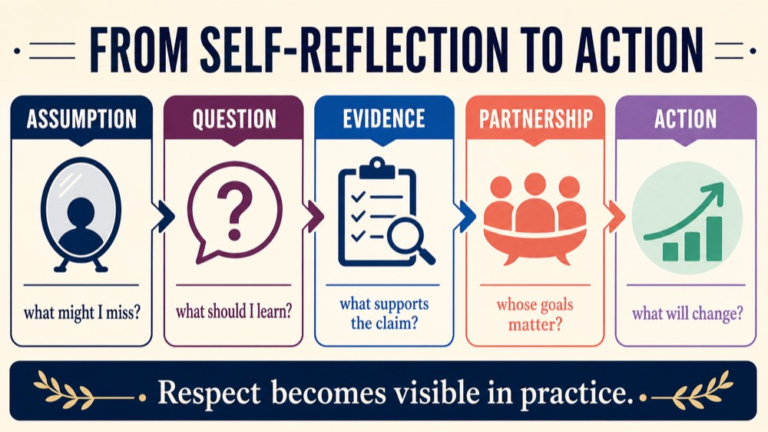
From self-reflection to action
Context changes what communication requires. A direct question, a long explanation, a conversation, a classroom exchange, a workplace interaction, a family story, and a noisy routine place different demands on processing, language, memory, hearing, access, and partner support. Language experience, visual information, fatigue, health literacy, and the opportunity to request clarification should be part of the observation.
A test task may appear neutral but still assume a particular story style, eye gaze pattern, family role, food routine, language, or interaction norm. A culturally responsive clinician asks what the task means to this person, offers language access, checks interpretation, and explains the limits of the evidence. The goal is not to memorize every culture; it is to practice curiosity, humility, and individualized action.
Observation layer
Example question
Task
What did the person need to understand, express, organize, coordinate, or repair?
Language and access
Which language, dialect, mode, hearing condition, or support was available?
Partner and context
Who was involved, what did they know, and which norms or accommodations mattered?
Participation
What meaningful routine became easier or harder because of the pattern?
Context is not an afterthought added once a label has been selected. It is part of the question itself. If performance changes with a quieter room, extra processing time, a familiar partner, a different language or mode, an interpreter, visual information, a changed task, or a changed routine, that change is useful evidence about access and demand. It does not identify a cause by itself, but it tells you which conditions should be carried into the next observation.
Apply the concept in clinical reasoning
When a Praxis-style scenario or clinical discussion presents culturally responsive practice, use a disciplined sequence. The goal is to select the next clinical question or action that matches the evidence, the person’s priorities, and the communication context.
Define the task, language, mode, and communication purpose in plain language.
Identify the hearing, language, cultural, access, partner, or participation domain involved.
Separate observation from interpretation and write down what remains unknown.
Check hearing, language exposure, dialect, culture, identity, interpreter access, environment, sensory load, memory, and task familiarity.
Choose the assessment, collaboration, accommodation, or observation step that answers the specific question.
State the boundary of the conclusion and keep the person’s participation goal visible.
A test task may appear neutral but still assume a particular story style, eye gaze pattern, family role, food routine, language, or interaction norm. A culturally responsive clinician asks what the task means to this person, offers language access, checks interpretation, and explains the limits of the evidence. The goal is not to memorize every culture; it is to practice curiosity, humility, and individualized action. In a learning answer, the decisive evidence is usually the relationship among the task, the observed pattern, the access conditions, and the next needed information—not a single isolated behavior or label.
Common study mistakes
Treating cultural responsiveness as a completed checklist or a set of facts about groups.
Assuming a person’s values, language, family role, or communication style from group membership.
Ignoring clinician power, implicit bias, history, and limitations in knowledge.
Using assessment tools or materials without checking language, experience, health literacy, and access.
Treating dialect, accent, multilingualism, or cultural communication as disorder evidence.
Using family members as interpreters when trained language support or another option is needed.
Asking for family input but making the plan without sharing decisions or checking understanding.
Naming respect as a value without changing the environment, materials, collaboration, or action.
Most of these mistakes come from replacing a multidomain question with a fast label. Correct the habit by returning to the same sequence: describe, separate, contextualize, ask what is missing, and choose a proportionate next step. A short rationale can make the habit visible: identify the evidence, name the uncertainty, and explain why the selected next step fits both.
Build a quick review map
Use this compact map when reviewing a missed question, a lecture note, or a clinical vignette:
Step 1: Name the person’s language, dialect, culture, identity, family, community, history, and goals.
Step 2: Identify the clinician’s assumptions, knowledge gaps, power, and possible bias.
Step 3: Check language access, interpreter needs, health literacy, materials, and environment.
Step 4: Separate communication difference, language variation, access barriers, and disorder evidence.
Step 5: Invite the person, family, community, and team into interpretation and planning.
Step 6: State the concrete action that makes the service more responsive and equitable.
Then write one transfer sentence: “When I see this pattern, I will first check ___ because ___.” The sentence should identify a decision rule, not repeat a definition. Revisit it after a delay and test whether you can apply the rule to a different task, age group, partner, language, or communication mode.
Sources and next steps
culturally responsive practice is best learned as a context-sensitive pattern across communication, access, identity, function, and participation. Use the current authority pages to refine the concept, then return to practice scenarios that require you to explain what the evidence supports and what it leaves open.
Bilingual Language Development: Exposure, Use, and Clinical Reasoning
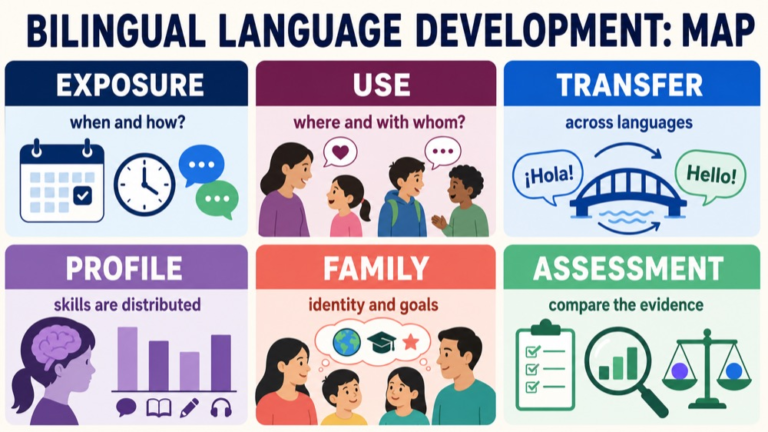
bilingual language development is easier to study when it is treated as a connected access and communication system rather than a single label. Bilingual language development is shaped by when, where, with whom, and why each language is used. SLP study requires a whole-language view that includes exposure, opportunities, proficiency, transfer, literacy, family goals, culture, and assessment in the languages that matter to the person.
This learning guide is written for SLP students and other learners reviewing clinical concepts. It uses broad patterns to organize observation, not to make an individualized diagnosis or promise one outcome. Interpretation depends on the person, task, language, culture, hearing, access, health, context, and communication goals.
What bilingual language development includes
Begin by separating the concept into domains. A learner who can name the domains is less likely to collapse hearing, language, culture, access, identity, partner, and participation questions into one explanation. The useful unit of analysis is the task: what the person was asked to understand, express, organize, coordinate, remember, or communicate, with whom, under which conditions, and with what support.
Domain or system
What to notice
Question to carry forward
Exposure
Amount, quality, timing, and consistency of input influence development in each language.
What language experience has the person actually had?
Use and opportunity
A language may be understood more than spoken or used differently across home, school, work, and community.
Where and with whom is each language used?
Transfer
Features from one language can influence another as part of multilingual development and communication history.
Is the pattern expected for the languages or concerning across them?
Language profile
Vocabulary, grammar, discourse, speech, literacy, and comprehension may be distributed across languages.
What is the combined communication profile across languages?
Family and culture
Family values, identity, community, schooling, migration, and language goals shape communication choices.
Which language goals are meaningful to the person and family?
Assessment
Language sampling, interpreters, dynamic assessment, and language-specific knowledge help distinguish difference from disorder.
What evidence is needed in the relevant languages and contexts?
These domains interact, but they should remain distinguishable. A learner may show strength in one task and need support in another. A study map organizes the next observation; it does not answer every assessment question or replace current professional guidance.
Keep the first pass descriptive and close to the communication event. Note the task, the response, the partner, the setting, the timing, the available support, and the consequence for participation. This gives the learner a stable record to compare across tasks and prevents a familiar term from doing too much explanatory work before the evidence has been separated.
For Praxis-style review, a vignette may include several true details but ask for one best interpretation or next step. The strongest answer usually respects the task, identifies the relevant function, checks the most important missing information, and avoids treating one performance sample as the whole profile.
Map bilingual language development
For study purposes, describe the communication relationship before naming a disorder, judging a modality, or selecting an assessment. Record what the person understood, expressed, initiated, repaired, coordinated, or participated in. Then note whether the task was familiar, how much context was shared, and which support changed the response.
Exposure: document age of acquisition, amount, quality, contexts, partners, and changes in each language.
Use and opportunity: compare home, school, work, community, formal, informal, spoken, signed, written, and digital communication.
Transfer and variation: identify language-specific features before treating a cross-language pattern as a disorder.
Combined profile: consider vocabulary, grammar, discourse, speech, literacy, comprehension, and strengths across languages.
Family and identity: include heritage language, family relationships, cultural values, community, schooling, and language goals.
Assessment and intervention: use language-matched or interpreter-supported methods, dynamic evidence, and functional contexts.
A strong description is specific enough that another learner could picture the event. Instead of writing “the communication is delayed,” describe the demand, the observable response, the language or mode, the partner, the context, and the result. This protects clinical reasoning from labels that are broader than the evidence.
From language experience to assessment
Context changes what communication requires. A direct question, a long explanation, a conversation, a classroom exchange, a workplace interaction, a family story, and a noisy routine place different demands on processing, language, memory, hearing, access, and partner support. Language experience, visual information, fatigue, health literacy, and the opportunity to request clarification should be part of the observation.
A child may know a concept in one language, use a school language for academic tasks, and use a heritage language for family stories. A word that is absent in one language may be present in another, while a language-specific grammar pattern may be expected. The strongest interpretation looks across languages and contexts instead of judging one language in isolation.
Observation layer
Example question
Task
What did the person need to understand, express, organize, coordinate, or repair?
Language and access
Which language, dialect, mode, hearing condition, or support was available?
Partner and context
Who was involved, what did they know, and which norms or accommodations mattered?
Participation
What meaningful routine became easier or harder because of the pattern?
Context is not an afterthought added once a label has been selected. It is part of the question itself. If performance changes with a quieter room, extra processing time, a familiar partner, a different language or mode, an interpreter, visual information, a changed task, or a changed routine, that change is useful evidence about access and demand. It does not identify a cause by itself, but it tells you which conditions should be carried into the next observation.
Apply the concept in clinical reasoning
When a Praxis-style scenario or clinical discussion presents bilingual language development, use a disciplined sequence. The goal is to select the next clinical question or action that matches the evidence, the person’s priorities, and the communication context.
Define the task, language, mode, and communication purpose in plain language.
Identify the hearing, language, cultural, access, partner, or participation domain involved.
Separate observation from interpretation and write down what remains unknown.
Check hearing, language exposure, dialect, culture, identity, interpreter access, environment, sensory load, memory, and task familiarity.
Choose the assessment, collaboration, accommodation, or observation step that answers the specific question.
State the boundary of the conclusion and keep the person’s participation goal visible.
A child may know a concept in one language, use a school language for academic tasks, and use a heritage language for family stories. A word that is absent in one language may be present in another, while a language-specific grammar pattern may be expected. The strongest interpretation looks across languages and contexts instead of judging one language in isolation. In a learning answer, the decisive evidence is usually the relationship among the task, the observed pattern, the access conditions, and the next needed information—not a single isolated behavior or label.
Common study mistakes
Treating bilingualism or multilingualism as the cause of a communication disorder.
Testing only English and interpreting limited English exposure as limited overall language.
Ignoring language-specific grammar, vocabulary, speech patterns, and transfer.
Assuming equal exposure, proficiency, use, or literacy across languages.
Using family language loss as a treatment goal without discussing family values and identity.
Relying on an untrained interpreter or bilingual helper as if interpreting expertise were unnecessary.
Separating assessment from family, school, community, migration, and language history.
Writing intervention goals in only one language when the person’s communication life is multilingual.
Most of these mistakes come from replacing a multidomain question with a fast label. Correct the habit by returning to the same sequence: describe, separate, contextualize, ask what is missing, and choose a proportionate next step. A short rationale can make the habit visible: identify the evidence, name the uncertainty, and explain why the selected next step fits both.
Build a quick review map
Use this compact map when reviewing a missed question, a lecture note, or a clinical vignette:
Step 1: List languages, modes, age of acquisition, exposure, use, partners, and settings.
Step 2: Separate language-specific patterns, transfer, dialect, opportunity, and possible disorder.
Step 3: Combine evidence across languages, tasks, language samples, literacy, and dynamic assessment.
Step 4: Include family identity, heritage language, culture, schooling, and communication priorities.
Step 5: Use appropriate language-matched providers or trained interpreters and document the method.
Step 6: Connect goals to the person’s real multilingual participation and relationships.
Then write one transfer sentence: “When I see this pattern, I will first check ___ because ___.” The sentence should identify a decision rule, not repeat a definition. Revisit it after a delay and test whether you can apply the rule to a different task, age group, partner, language, or communication mode.
Sources and next steps
bilingual language development is best learned as a context-sensitive pattern across communication, access, identity, function, and participation. Use the current authority pages to refine the concept, then return to practice scenarios that require you to explain what the evidence supports and what it leaves open.
Auditory Verbal Communication: Listening Access, Language, and Context
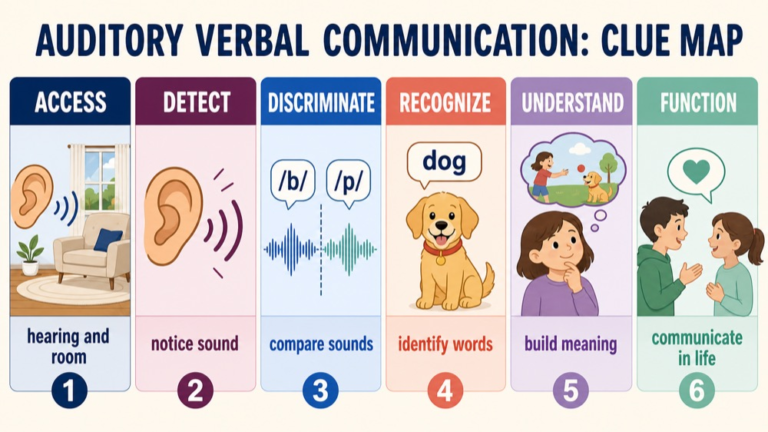
auditory verbal communication is easier to study when it is treated as a connected access and communication system rather than a single label. Auditory verbal communication is studied through how a person accesses spoken language, understands it, uses it, and participates with listeners. The SLP reasoning task is to connect hearing information, listening conditions, language experience, speech perception, production, family choices, and functional goals without assuming one pathway fits everyone.
This learning guide is written for SLP students and other learners reviewing clinical concepts. It uses broad patterns to organize observation, not to make an individualized diagnosis or promise one outcome. Interpretation depends on the person, task, language, culture, hearing, access, health, context, and communication goals.
What auditory verbal communication includes
Begin by separating the concept into domains. A learner who can name the domains is less likely to collapse hearing, language, culture, access, identity, partner, and participation questions into one explanation. The useful unit of analysis is the task: what the person was asked to understand, express, organize, coordinate, remember, or communicate, with whom, under which conditions, and with what support.
Domain or system
What to notice
Question to carry forward
Listening access
Hearing technology, distance, noise, visual information, and room acoustics change what spoken language is available.
What could the person actually access in this listening condition?
Language models
Frequent, meaningful, and understandable language interactions support comprehension and expression.
Who provides language models and in which languages or modes?
Speech perception
Auditory discrimination, recognition, comprehension, and memory answer different questions.
Was the task detection, discrimination, recognition, or meaning?
Speech and language
Vocabulary, grammar, narratives, speech production, and literacy depend on access and experience.
Which language outcome is being observed and what support was available?
Family routines
Caregivers and partners create opportunities for communication, listening, repair, and learning in daily activities.
How can a routine provide meaningful practice and choice?
Functional communication
Participation, relationships, school learning, safety, and self-advocacy define the value of listening access.
What does the person need spoken language to accomplish?
These domains interact, but they should remain distinguishable. A learner may show strength in one task and need support in another. A study map organizes the next observation; it does not answer every assessment question or replace current professional guidance.
Keep the first pass descriptive and close to the communication event. Note the task, the response, the partner, the setting, the timing, the available support, and the consequence for participation. This gives the learner a stable record to compare across tasks and prevents a familiar term from doing too much explanatory work before the evidence has been separated.
For Praxis-style review, a vignette may include several true details but ask for one best interpretation or next step. The strongest answer usually respects the task, identifies the relevant function, checks the most important missing information, and avoids treating one performance sample as the whole profile.
Map auditory verbal communication
For study purposes, describe the communication relationship before naming a disorder, judging a modality, or selecting an assessment. Record what the person understood, expressed, initiated, repaired, coordinated, or participated in. Then note whether the task was familiar, how much context was shared, and which support changed the response.
Listening environment: record distance, noise, reverberation, visual cues, speaker position, fatigue, and technology.
Language models: include the language or languages, communication partners, interaction quality, and meaningful routines.
Speech and literacy: connect spoken access to speech production, vocabulary, grammar, narrative, reading, and writing without assuming a single sequence.
Family and team: include family priorities, audiology, SLP, education, technology, interpreters, and other communication supports.
Function: define the listening and communication outcome in relationships, learning, work, safety, and self-advocacy.
A strong description is specific enough that another learner could picture the event. Instead of writing “the communication is delayed,” describe the demand, the observable response, the language or mode, the partner, the context, and the result. This protects clinical reasoning from labels that are broader than the evidence.
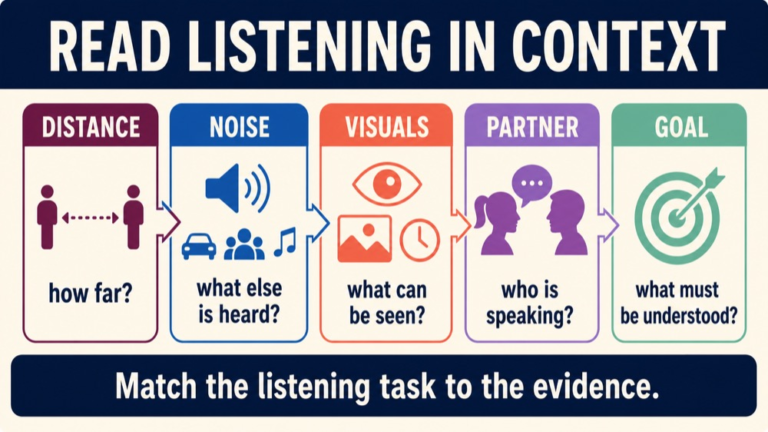
Read listening access in context
Context changes what communication requires. A direct question, a long explanation, a conversation, a classroom exchange, a workplace interaction, a family story, and a noisy routine place different demands on processing, language, memory, hearing, access, and partner support. Language experience, visual information, fatigue, health literacy, and the opportunity to request clarification should be part of the observation.
A listener may recognize a familiar phrase in a quiet room but miss the same phrase when the speaker is distant or background noise is present. Another person may use speech effectively with visual information and benefit from a signed or written support as well. Auditory verbal communication is interpreted through the full access profile and the person’s goals, not through a single listening trial.
Observation layer
Example question
Task
What did the person need to understand, express, organize, coordinate, or repair?
Language and access
Which language, dialect, mode, hearing condition, or support was available?
Partner and context
Who was involved, what did they know, and which norms or accommodations mattered?
Participation
What meaningful routine became easier or harder because of the pattern?
Context is not an afterthought added once a label has been selected. It is part of the question itself. If performance changes with a quieter room, extra processing time, a familiar partner, a different language or mode, an interpreter, visual information, a changed task, or a changed routine, that change is useful evidence about access and demand. It does not identify a cause by itself, but it tells you which conditions should be carried into the next observation.
Apply the concept in clinical reasoning
When a Praxis-style scenario or clinical discussion presents auditory verbal communication, use a disciplined sequence. The goal is to select the next clinical question or action that matches the evidence, the person’s priorities, and the communication context.
Define the task, language, mode, and communication purpose in plain language.
Identify the hearing, language, cultural, access, partner, or participation domain involved.
Separate observation from interpretation and write down what remains unknown.
Check hearing, language exposure, dialect, culture, identity, interpreter access, environment, sensory load, memory, and task familiarity.
Choose the assessment, collaboration, accommodation, or observation step that answers the specific question.
State the boundary of the conclusion and keep the person’s participation goal visible.
A listener may recognize a familiar phrase in a quiet room but miss the same phrase when the speaker is distant or background noise is present. Another person may use speech effectively with visual information and benefit from a signed or written support as well. Auditory verbal communication is interpreted through the full access profile and the person’s goals, not through a single listening trial. In a learning answer, the decisive evidence is usually the relationship among the task, the observed pattern, the access conditions, and the next needed information—not a single isolated behavior or label.
Common study mistakes
Treating auditory verbal communication as a single skill instead of separating access, perception, language, speech, and function.
Confusing detection of sound with recognition or comprehension of spoken language.
Ignoring distance, noise, reverberation, visual cues, fatigue, and technology status.
Assuming a speech sample shows what the person can hear or understand.
Leaving families and the person out of communication planning and modality decisions.
Treating signed, visual, AAC, or written supports as evidence of failure rather than access options.
Using one quiet clinic task to represent classroom, home, work, or community listening.
Measuring speech form without asking whether communication was effective and meaningful.
Most of these mistakes come from replacing a multidomain question with a fast label. Correct the habit by returning to the same sequence: describe, separate, contextualize, ask what is missing, and choose a proportionate next step. A short rationale can make the habit visible: identify the evidence, name the uncertainty, and explain why the selected next step fits both.
Build a quick review map
Use this compact map when reviewing a missed question, a lecture note, or a clinical vignette:
Step 1: Name the listening task, language, speaker, environment, technology, and support.
Step 2: Separate access, detection, discrimination, recognition, comprehension, language, and speech.
Step 4: Include the person’s and family’s language, communication, identity, and participation priorities.
Step 5: Identify the team collaboration or environmental change that answers the uncertainty.
Step 6: Connect the listening goal to functional communication, autonomy, and choice.
Then write one transfer sentence: “When I see this pattern, I will first check ___ because ___.” The sentence should identify a decision rule, not repeat a definition. Revisit it after a delay and test whether you can apply the rule to a different task, age group, partner, language, or communication mode.
Sources and next steps
auditory verbal communication is best learned as a context-sensitive pattern across communication, access, identity, function, and participation. Use the current authority pages to refine the concept, then return to practice scenarios that require you to explain what the evidence supports and what it leaves open.
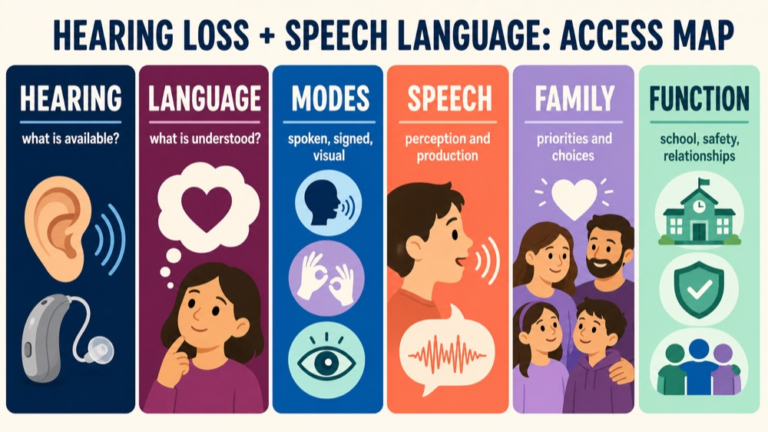
Hearing Loss and Speech Language: Access, Development, and Support
hearing loss and speech language is easier to study when it is treated as a connected access and communication system rather than a single label. Hearing loss and speech language are connected through access to language, communication partners, learning environments, technology, and family choices. A strong SLP study map separates hearing information from language outcomes and keeps the person’s communication mode, identity, family priorities, and participation visible.
This learning guide is written for SLP students and other learners reviewing clinical concepts. It uses broad patterns to organize observation, not to make an individualized diagnosis or promise one outcome. Interpretation depends on the person, task, language, culture, hearing, access, health, context, and communication goals.
What hearing loss and speech language includes
Begin by separating the concept into domains. A learner who can name the domains is less likely to collapse hearing, language, culture, access, identity, partner, and participation questions into one explanation. The useful unit of analysis is the task: what the person was asked to understand, express, organize, coordinate, remember, or communicate, with whom, under which conditions, and with what support.
Domain or system
What to notice
Question to carry forward
Hearing access
Thresholds, configuration, consistency, technology, listening conditions, and monitoring affect access to spoken information.
What hearing information and listening condition are relevant to the task?
Language exposure
Early and consistent access to a language or languages supports communication, literacy, learning, and relationships.
Which language or communication opportunities are available and understood?
Communication modes
Spoken languages, signed languages, visual supports, AAC, gestures, and multimodal systems may contribute to access.
Which modes fit the person, family, identity, and routine?
Speech and language
Speech perception, production, vocabulary, grammar, discourse, and literacy can be shaped by access and experience.
Which skill was observed and what access conditions surrounded it?
Family and team
Families, children, audiologists, SLPs, educators, and other professionals contribute different information and decisions.
Who needs to collaborate for the next decision?
Participation
Classroom learning, peer relationships, safety, self-advocacy, and community access show the functional impact.
What communication routine matters most to the person?
These domains interact, but they should remain distinguishable. A learner may show strength in one task and need support in another. A study map organizes the next observation; it does not answer every assessment question or replace current professional guidance.
Keep the first pass descriptive and close to the communication event. Note the task, the response, the partner, the setting, the timing, the available support, and the consequence for participation. This gives the learner a stable record to compare across tasks and prevents a familiar term from doing too much explanatory work before the evidence has been separated.
For Praxis-style review, a vignette may include several true details but ask for one best interpretation or next step. The strongest answer usually respects the task, identifies the relevant function, checks the most important missing information, and avoids treating one performance sample as the whole profile.
Map hearing loss and speech language
For study purposes, describe the communication relationship before naming a disorder, judging a modality, or selecting an assessment. Record what the person understood, expressed, initiated, repaired, coordinated, or participated in. Then note whether the task was familiar, how much context was shared, and which support changed the response.
Hearing information: record type, degree, configuration, consistency, monitoring, devices, and the actual listening environment.
Language access: identify the spoken, signed, written, visual, or multimodal languages available to the person and family.
Speech and language: separate perception, production, vocabulary, grammar, discourse, literacy, and communication opportunity.
Technology and supports: include amplification, hearing technology, classroom acoustics, visual information, and communication partners.
Family and identity: include child and family preferences, culture, language, identity, goals, and decision-making roles.
Participation: connect the profile to school, work, relationships, safety, self-advocacy, and daily communication access.
A strong description is specific enough that another learner could picture the event. Instead of writing “the communication is delayed,” describe the demand, the observable response, the language or mode, the partner, the context, and the result. This protects clinical reasoning from labels that are broader than the evidence.
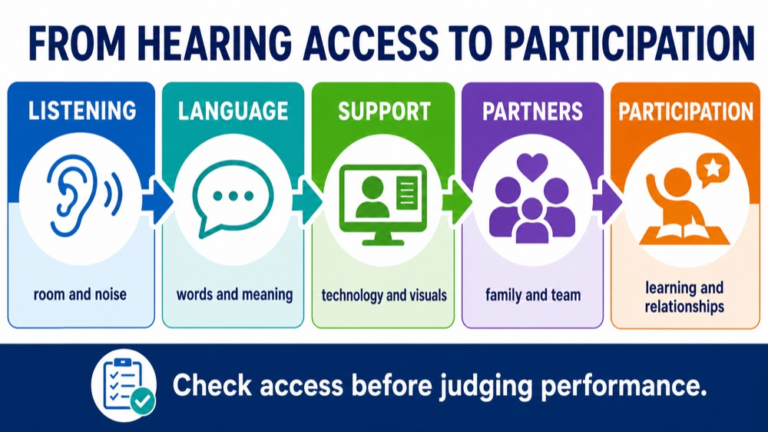
From hearing access to participation
Context changes what communication requires. A direct question, a long explanation, a conversation, a classroom exchange, a workplace interaction, a family story, and a noisy routine place different demands on processing, language, memory, hearing, access, and partner support. Language experience, visual information, fatigue, health literacy, and the opportunity to request clarification should be part of the observation.
A child may hear well in a quiet one-to-one conversation but miss information in a noisy classroom, or may show strong language in a familiar mode and need support in another. A speech sample cannot be interpreted without considering hearing access, language exposure, technology, environment, partner behavior, and the person’s communication history.
Observation layer
Example question
Task
What did the person need to understand, express, organize, coordinate, or repair?
Language and access
Which language, dialect, mode, hearing condition, or support was available?
Partner and context
Who was involved, what did they know, and which norms or accommodations mattered?
Participation
What meaningful routine became easier or harder because of the pattern?
Context is not an afterthought added once a label has been selected. It is part of the question itself. If performance changes with a quieter room, extra processing time, a familiar partner, a different language or mode, an interpreter, visual information, a changed task, or a changed routine, that change is useful evidence about access and demand. It does not identify a cause by itself, but it tells you which conditions should be carried into the next observation.
Apply the concept in clinical reasoning
When a Praxis-style scenario or clinical discussion presents hearing loss and speech language, use a disciplined sequence. The goal is to select the next clinical question or action that matches the evidence, the person’s priorities, and the communication context.
Define the task, language, mode, and communication purpose in plain language.
Identify the hearing, language, cultural, access, partner, or participation domain involved.
Separate observation from interpretation and write down what remains unknown.
Check hearing, language exposure, dialect, culture, identity, interpreter access, environment, sensory load, memory, and task familiarity.
Choose the assessment, collaboration, accommodation, or observation step that answers the specific question.
State the boundary of the conclusion and keep the person’s participation goal visible.
A child may hear well in a quiet one-to-one conversation but miss information in a noisy classroom, or may show strong language in a familiar mode and need support in another. A speech sample cannot be interpreted without considering hearing access, language exposure, technology, environment, partner behavior, and the person’s communication history. In a learning answer, the decisive evidence is usually the relationship among the task, the observed pattern, the access conditions, and the next needed information—not a single isolated behavior or label.
Common study mistakes
Treating hearing loss as a complete explanation for every speech or language difference.
Ignoring the child’s access to a consistent language and proficient language models.
Assuming one communication modality or technology is appropriate for every family.
Using English-only information to interpret a multilingual or signed-language communicator.
Separating audiology, SLP, education, family, and child perspectives instead of collaborating.
Testing language in a quiet clinic and ignoring classroom acoustics, fatigue, distance, and noise.
Describing deficits without including strengths, identity, preferences, and self-advocacy.
Making a developmental conclusion without documenting access conditions and language experience.
Most of these mistakes come from replacing a multidomain question with a fast label. Correct the habit by returning to the same sequence: describe, separate, contextualize, ask what is missing, and choose a proportionate next step. A short rationale can make the habit visible: identify the evidence, name the uncertainty, and explain why the selected next step fits both.
Build a quick review map
Use this compact map when reviewing a missed question, a lecture note, or a clinical vignette:
Step 1: Name the hearing information, communication mode, language, task, listener, and environment.
Step 2: Separate hearing access, language exposure, speech, language, literacy, and participation.
Step 3: Compare quiet and noisy settings, familiar and unfamiliar partners, and available supports.
Step 4: Include child and family preferences, identity, culture, language, and goals.
Step 5: Identify the audiology, SLP, education, technology, or family collaboration needed.
Step 6: Choose the next step that improves meaningful communication access and participation.
Then write one transfer sentence: “When I see this pattern, I will first check ___ because ___.” The sentence should identify a decision rule, not repeat a definition. Revisit it after a delay and test whether you can apply the rule to a different task, age group, partner, language, or communication mode.
Sources and next steps
hearing loss and speech language is best learned as a context-sensitive pattern across communication, access, identity, function, and participation. Use the current authority pages to refine the concept, then return to practice scenarios that require you to explain what the evidence supports and what it leaves open.
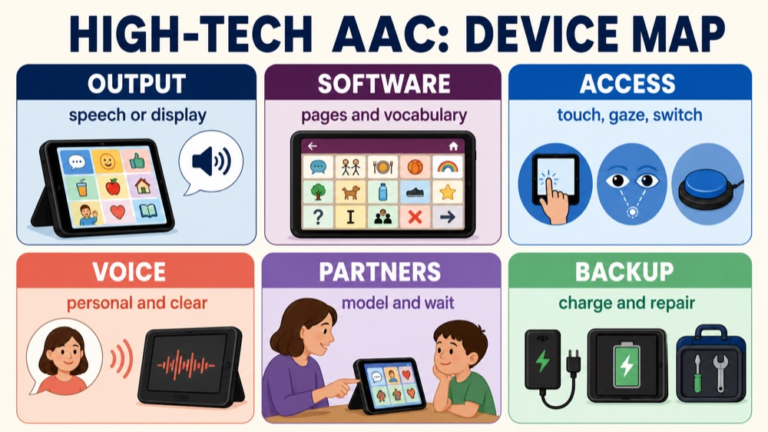
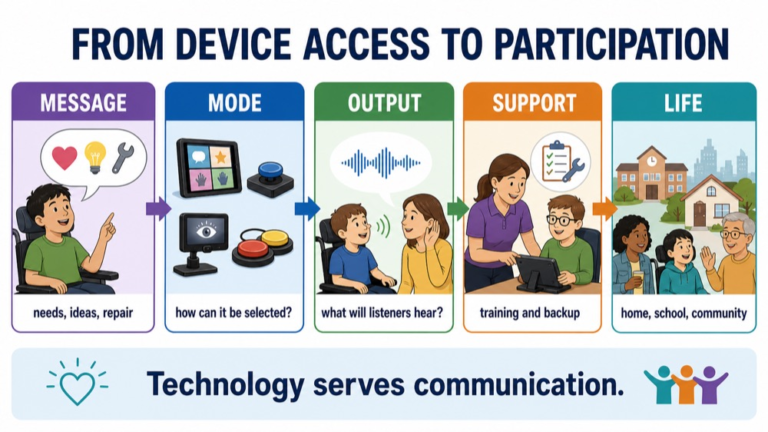
High-Tech AAC: Speech-Generating Devices, Access, and Support
high tech aac is easier to study when it is treated as a connected system rather than a single tool. High-tech AAC includes powered systems such as speech-generating devices, tablets with communication software, and other electronic tools. Study the technology as one part of a larger communication system that also includes language, access, partners, routines, maintenance, and backup options.
This learning guide is written for SLP students and other learners reviewing clinical concepts. It uses broad patterns to organize observation, not to make an individualized diagnosis or promise one outcome. Interpretation depends on the person, task, language, culture, hearing, access, health, context, and communication goals.
What high tech aac includes
Begin by separating the concept into domains. A learner who can name the domains is less likely to collapse language, access, motor, sensory, technology, partner, and participation questions into one explanation. The useful unit of analysis is the task: what the person was asked to understand, express, organize, coordinate, remember, or communicate, with whom, under which conditions, and with what support.
Domain or system
What to notice
Question to carry forward
Speech output
A device may convert selected symbols, letters, or stored messages into synthesized or recorded speech.
What output supports this person and these listeners?
These domains interact, but they should remain distinguishable. A learner may show strength in one task and need support in another. A study map organizes the next observation; it does not answer every assessment question or replace current professional guidance.
Keep the first pass descriptive and close to the communication event. Note the task, the message, the partner, the setting, the timing, the available support, and the consequence for participation. This gives the learner a stable record to compare across tasks and prevents a familiar technology term from doing too much explanatory work before the evidence has been separated.
For Praxis-style review, a vignette may include several true details but ask for one best interpretation or next step. The strongest answer usually respects the task, identifies the relevant function, checks the most important missing information, and avoids treating one performance sample as the whole profile.
Map high-tech AAC
For study purposes, describe the communication relationship before choosing a tool or method. Record what the person understood, expressed, initiated, repaired, coordinated, or participated in. Then note whether the task was familiar, how much context was shared, and which support changed the response.
Output: compare synthesized speech, recorded messages, text, display, volume, rate, and listener access.
Software and language: examine vocabulary, grammar, navigation, literacy, message generation, rate enhancement, and personalization.
Access: test touch, eye gaze, switches, scanning, positioning, target size, calibration, fatigue, and changing environments.
Customization: include voice, language, names, topics, interests, identity, culture, relationships, and self-advocacy.
Partner and team support: plan modeling, wait time, confirmation, repair, training, updates, and collaborative decision making.
Continuity: provide charging, protection, technical support, low-tech backup, and communication options during interruptions.
A strong description is specific enough that another learner could picture the event. Instead of writing “the device is appropriate,” describe the message, the access demand, the partner, the context, and the result. This protects clinical reasoning from technology labels that are broader than the evidence.
From device access to participation
Context changes what communication requires. A quick choice, a long explanation, a conversation, a classroom exchange, a workplace interaction, a transition, and a noisy routine place different demands on language, memory, motor access, sensory access, and partner support. Hearing access, fatigue, visual supports, language experience, and the opportunity to request clarification should be part of the observation.
A high-tech device may support a detailed classroom explanation but require a backup board during a dead battery, a noisy activity, or a repair. A strong system is not judged by its number of features. It is judged by whether the person can access language, express varied messages, control the output, and participate across routines with appropriate partner and technical support.
Observation layer
Example question
Message
What did the person need to express, understand, combine, clarify, or repair?
Access
Were motor, sensory, visual, auditory, language, literacy, or positioning supports available?
Partner
Did the partner model, wait, confirm, interpret, expand, or make assumptions?
Participation
What meaningful routine became easier or harder because of the system?
Context is not an afterthought added once a tool has been selected. It is part of the question itself. If performance changes with a different layout, a quieter room, extra processing time, a familiar partner, a different mode, a visual support, a changed task, or a changed routine, that change is useful evidence about access and demand. It does not identify a cause by itself, but it tells you which conditions should be carried into the next observation.
Apply the concept in clinical reasoning
When a Praxis-style scenario or clinical discussion presents high tech aac, use a disciplined sequence. The goal is to select the next clinical question or action that matches the evidence, the person’s priorities, and the communication context.
Define the message and task in plain language.
Identify the language, access, output, partner, or environment domain involved.
Separate observation from interpretation and write down what remains unknown.
Check hearing, vision, motor control, language, literacy, culture, sensory load, positioning, fatigue, and task familiarity.
Choose the assessment, collaboration, training, or observation step that answers the specific question.
State the boundary of the conclusion and keep the person’s participation goal visible.
A high-tech device may support a detailed classroom explanation but require a backup board during a dead battery, a noisy activity, or a repair. A strong system is not judged by its number of features. It is judged by whether the person can access language, express varied messages, control the output, and participate across routines with appropriate partner and technical support. In a learning answer, the decisive evidence is usually the relationship among the message, the access conditions, the observed pattern, and the next needed information—not a single device feature or label.
Common study mistakes
Treating high-tech AAC as a tablet purchase instead of a language, access, and support system.
Choosing software before observing the communicator’s motor, sensory, language, literacy, and routine needs.
Loading many buttons without teaching navigation, message building, repair, and partner use.
Restricting output to requesting or scripted stored phrases.
Ignoring voice, language, culture, identity, personal names, and the person’s desired communication style.
Failing to train partners to model the system and wait for the communicator’s message.
Assuming the device replaces gesture, speech, writing, signs, low-tech supports, or partner strategies.
Ignoring charging, protection, updates, repairs, privacy, and backup communication.
Most of these mistakes come from replacing a multidomain question with a fast tool choice. Correct the habit by returning to the same sequence: describe, separate, contextualize, ask what is missing, and choose a proportionate next step. A short rationale can make the habit visible: identify the evidence, name the uncertainty, and explain why the selected next step fits both.
Build a quick review map
Use this compact map when reviewing a missed question, a lecture note, or a clinical vignette:
Step 1: Name the communication goals, listeners, routines, messages, and output needs.
Step 3: Test accuracy, rate, endurance, navigation, repair, and authorship in real tasks.
Step 4: Include personal language, identity, culture, relationships, literacy, and self-advocacy.
Step 5: Plan charging, maintenance, technical support, privacy, and low-tech backup.
Step 6: Evaluate high-tech AAC through autonomy, message variety, reliability, and participation.
Then write one transfer sentence: “When I see this pattern, I will first check ___ because ___.” The sentence should identify a decision rule, not repeat a definition. Revisit it after a delay and test whether you can apply the rule to a different task, age group, partner, or communication mode.
Sources and next steps
high tech aac is best learned as a context-sensitive pattern across communication, access, function, and participation. Use the current authority pages to refine the concept, then return to practice scenarios that require you to explain what the evidence supports and what it leaves open.
Start with asha aac, ets 5331 study companion. These sources support the learning frame; they do not replace current topic-specific guidance or an individualized evaluation.
Low-Tech AAC: Boards, Books, Objects, and Communication Access
low tech aac is easier to study when it is treated as a connected system rather than a single tool. Low-tech AAC uses communication supports that do not depend on powered speech output, such as gestures, objects, paper boards, picture books, letter boards, and printed messages. Its value comes from reliable access, useful language, partner support, and availability in meaningful routines.
This learning guide is written for SLP students and other learners reviewing clinical concepts. It uses broad patterns to organize observation, not to make an individualized diagnosis or promise one outcome. Interpretation depends on the person, task, language, culture, hearing, access, health, context, and communication goals.
What low tech aac includes
Begin by separating the concept into domains. A learner who can name the domains is less likely to collapse language, access, motor, sensory, technology, partner, and participation questions into one explanation. The useful unit of analysis is the task: what the person was asked to understand, express, organize, coordinate, remember, or communicate, with whom, under which conditions, and with what support.
Domain or system
What to notice
Question to carry forward
Boards
A paper or laminated board can organize choices, core words, topic words, letters, or quick messages.
Can the communicator find and select what is needed?
Books and pages
A communication book can provide vocabulary across topics, people, places, routines, and message types.
How will navigation support both speed and language growth?
Objects
Tangible objects can represent activities, choices, people, transitions, or important routines.
What meaning does the object carry for this person?
Portability
Size, durability, visibility, storage, and availability affect whether the support travels with the person.
Will it be available when a message matters?
Partner modeling
Partners can point, gesture, speak, wait, confirm, and repair while using the system themselves.
How will the communication partner make the system usable?
Backup access
Low-tech supports can provide continuity when a device is charging, unavailable, broken, or not suitable.
What communication remains possible when technology changes?
These domains interact, but they should remain distinguishable. A learner may show strength in one task and need support in another. A study map organizes the next observation; it does not answer every assessment question or replace current professional guidance.
Keep the first pass descriptive and close to the communication event. Note the task, the message, the partner, the setting, the timing, the available support, and the consequence for participation. This gives the learner a stable record to compare across tasks and prevents a familiar technology term from doing too much explanatory work before the evidence has been separated.
For Praxis-style review, a vignette may include several true details but ask for one best interpretation or next step. The strongest answer usually respects the task, identifies the relevant function, checks the most important missing information, and avoids treating one performance sample as the whole profile.
Map low-tech AAC
For study purposes, describe the communication relationship before choosing a tool or method. Record what the person understood, expressed, initiated, repaired, coordinated, or participated in. Then note whether the task was familiar, how much context was shared, and which support changed the response.
Vocabulary: include core words, personal names, topics, feelings, questions, repair, safety, literacy, and social connection.
Access: consider vision, motor reach, page turning, pointing, partner presentation, positioning, and communication rate.
Portability: plan storage, durability, visibility, backups, weather, transport, and availability across daily routines.
Partner use: model, wait, confirm, expand, and repair without taking authorship away from the communicator.
Function: test low-tech AAC for choice, information, relationships, self-advocacy, classroom learning, and community access.
A strong description is specific enough that another learner could picture the event. Instead of writing “the device is appropriate,” describe the message, the access demand, the partner, the context, and the result. This protects clinical reasoning from technology labels that are broader than the evidence.
From portable support to participation
Context changes what communication requires. A quick choice, a long explanation, a conversation, a classroom exchange, a workplace interaction, a transition, and a noisy routine place different demands on language, memory, motor access, sensory access, and partner support. Hearing access, fatigue, visual supports, language experience, and the opportunity to request clarification should be part of the observation.
A paper board may be the fastest backup during a device charging problem, while a communication book may provide more vocabulary for a longer conversation. An object cue may support a transition, and a letter board may allow a precise name or message. Low-tech AAC is not defined by simplicity alone; it is judged by whether it gives the person reliable communication access.
Observation layer
Example question
Message
What did the person need to express, understand, combine, clarify, or repair?
Access
Were motor, sensory, visual, auditory, language, literacy, or positioning supports available?
Partner
Did the partner model, wait, confirm, interpret, expand, or make assumptions?
Participation
What meaningful routine became easier or harder because of the system?
Context is not an afterthought added once a tool has been selected. It is part of the question itself. If performance changes with a different layout, a quieter room, extra processing time, a familiar partner, a different mode, a visual support, a changed task, or a changed routine, that change is useful evidence about access and demand. It does not identify a cause by itself, but it tells you which conditions should be carried into the next observation.
Apply the concept in clinical reasoning
When a Praxis-style scenario or clinical discussion presents low tech aac, use a disciplined sequence. The goal is to select the next clinical question or action that matches the evidence, the person’s priorities, and the communication context.
Define the message and task in plain language.
Identify the language, access, output, partner, or environment domain involved.
Separate observation from interpretation and write down what remains unknown.
Check hearing, vision, motor control, language, literacy, culture, sensory load, positioning, fatigue, and task familiarity.
Choose the assessment, collaboration, training, or observation step that answers the specific question.
State the boundary of the conclusion and keep the person’s participation goal visible.
A paper board may be the fastest backup during a device charging problem, while a communication book may provide more vocabulary for a longer conversation. An object cue may support a transition, and a letter board may allow a precise name or message. Low-tech AAC is not defined by simplicity alone; it is judged by whether it gives the person reliable communication access. In a learning answer, the decisive evidence is usually the relationship among the message, the access conditions, the observed pattern, and the next needed information—not a single device feature or label.
Common study mistakes
Treating low-tech AAC as only a temporary emergency tool.
Providing only pictures for choices and omitting language for comments, feelings, questions, and repair.
Using a board with tiny targets, crowded layout, poor contrast, or inaccessible page turning.
Keeping the support in a drawer instead of carrying it into real routines.
Expecting the communicator to use the board without partner modeling and wait time.
Removing low-tech options because a high-tech device is available.
Ignoring the person’s language, culture, literacy, interests, names, and identity.
Counting selections without asking whether the support improved agency and participation.
Most of these mistakes come from replacing a multidomain question with a fast tool choice. Correct the habit by returning to the same sequence: describe, separate, contextualize, ask what is missing, and choose a proportionate next step. A short rationale can make the habit visible: identify the evidence, name the uncertainty, and explain why the selected next step fits both.
Build a quick review map
Use this compact map when reviewing a missed question, a lecture note, or a clinical vignette:
Step 1: Identify the routine, message, partner, setting, and access demand.
Step 2: Choose a board, book, object, printed message, letter, picture, or combined format.
Step 3: Plan vocabulary for needs, relationships, ideas, emotions, safety, and repair.
Step 4: Check visibility, motor reach, page turning, portability, durability, and storage.
Step 5: Train partners to model, wait, confirm, expand, and repair.
Step 6: Keep a usable backup and judge success by communication access and participation.
Then write one transfer sentence: “When I see this pattern, I will first check ___ because ___.” The sentence should identify a decision rule, not repeat a definition. Revisit it after a delay and test whether you can apply the rule to a different task, age group, partner, or communication mode.
Sources and next steps
low tech aac is best learned as a context-sensitive pattern across communication, access, function, and participation. Use the current authority pages to refine the concept, then return to practice scenarios that require you to explain what the evidence supports and what it leaves open.
Start with asha aac, ets 5331 study companion. These sources support the learning frame; they do not replace current topic-specific guidance or an individualized evaluation.
AAC Symbol Systems: Representation, Language, and Access
aac symbol systems is easier to study when it is treated as a connected system rather than a single tool. AAC symbol systems represent messages through objects, pictures, photographs, drawings, symbols, letters, words, or combinations. The key study question is how the representation supports this communicator’s language, access, literacy, partners, and participation.
This learning guide is written for SLP students and other learners reviewing clinical concepts. It uses broad patterns to organize observation, not to make an individualized diagnosis or promise one outcome. Interpretation depends on the person, task, language, culture, hearing, access, health, context, and communication goals.
What aac symbol systems includes
Begin by separating the concept into domains. A learner who can name the domains is less likely to collapse language, access, motor, sensory, technology, partner, and participation questions into one explanation. The useful unit of analysis is the task: what the person was asked to understand, express, organize, coordinate, remember, or communicate, with whom, under which conditions, and with what support.
Domain or system
What to notice
Question to carry forward
Objects
A tangible object or part of an object may represent an activity, choice, person, or routine.
What experience does the object make available to the communicator?
Pictures and photographs
Visual images can represent people, actions, places, choices, and events with different levels of detail.
Does the image match the person’s vision, experience, and message need?
Graphic symbols
Symbols can represent words, concepts, grammar, actions, and relationships within a language system.
Can the system support novel messages rather than memorized choices only?
What literacy and spelling access should be available?
Layout and organization
Location, grouping, color, size, motor plan, and navigation influence learning and speed.
Can the communicator find and combine symbols reliably?
Personalization
Vocabulary and representation should reflect language, culture, identity, interests, relationships, and routines.
Whose words and experiences are visible in the system?
These domains interact, but they should remain distinguishable. A learner may show strength in one task and need support in another. A study map organizes the next observation; it does not answer every assessment question or replace current professional guidance.
Keep the first pass descriptive and close to the communication event. Note the task, the message, the partner, the setting, the timing, the available support, and the consequence for participation. This gives the learner a stable record to compare across tasks and prevents a familiar technology term from doing too much explanatory work before the evidence has been separated.
For Praxis-style review, a vignette may include several true details but ask for one best interpretation or next step. The strongest answer usually respects the task, identifies the relevant function, checks the most important missing information, and avoids treating one performance sample as the whole profile.
Map AAC symbol systems
For study purposes, describe the communication relationship before choosing a tool or method. Record what the person understood, expressed, initiated, repaired, coordinated, or participated in. Then note whether the task was familiar, how much context was shared, and which support changed the response.
Meaning: identify whether a symbol represents a person, action, object, concept, relationship, feeling, or message function.
Language: plan vocabulary, grammar, word combinations, literacy, novel messages, and language growth.
Layout and motor plan: consider grouping, navigation, target size, color, location, repetition, and selection effort.
Personalization: include names, culture, languages, interests, identity, relationships, routines, and self-advocacy.
Partner and environment: check whether communication partners understand the system and make time for its use.
A strong description is specific enough that another learner could picture the event. Instead of writing “the device is appropriate,” describe the message, the access demand, the partner, the context, and the result. This protects clinical reasoning from technology labels that are broader than the evidence.
From representation to message
Context changes what communication requires. A quick choice, a long explanation, a conversation, a classroom exchange, a workplace interaction, a transition, and a noisy routine place different demands on language, memory, motor access, sensory access, and partner support. Hearing access, fatigue, visual supports, language experience, and the opportunity to request clarification should be part of the observation.
A photograph may be helpful for recognizing a familiar person, while a symbol system may support flexible combinations and abstract ideas. Letters may be important for names, literacy, and precise messages. The most useful representation depends on the person’s experience, vision, motor access, language, partners, and communication goals; visual familiarity alone does not determine the best system.
Observation layer
Example question
Message
What did the person need to express, understand, combine, clarify, or repair?
Access
Were motor, sensory, visual, auditory, language, literacy, or positioning supports available?
Partner
Did the partner model, wait, confirm, interpret, expand, or make assumptions?
Participation
What meaningful routine became easier or harder because of the system?
Context is not an afterthought added once a tool has been selected. It is part of the question itself. If performance changes with a different layout, a quieter room, extra processing time, a familiar partner, a different mode, a visual support, a changed task, or a changed routine, that change is useful evidence about access and demand. It does not identify a cause by itself, but it tells you which conditions should be carried into the next observation.
Apply the concept in clinical reasoning
When a Praxis-style scenario or clinical discussion presents aac symbol systems, use a disciplined sequence. The goal is to select the next clinical question or action that matches the evidence, the person’s priorities, and the communication context.
Define the message and task in plain language.
Identify the language, access, output, partner, or environment domain involved.
Separate observation from interpretation and write down what remains unknown.
Check hearing, vision, motor control, language, literacy, culture, sensory load, positioning, fatigue, and task familiarity.
Choose the assessment, collaboration, training, or observation step that answers the specific question.
State the boundary of the conclusion and keep the person’s participation goal visible.
A photograph may be helpful for recognizing a familiar person, while a symbol system may support flexible combinations and abstract ideas. Letters may be important for names, literacy, and precise messages. The most useful representation depends on the person’s experience, vision, motor access, language, partners, and communication goals; visual familiarity alone does not determine the best system. In a learning answer, the decisive evidence is usually the relationship among the message, the access conditions, the observed pattern, and the next needed information—not a single device feature or label.
Common study mistakes
Treating one symbol type as appropriate for every communicator and every message.
Assuming a symbol is understood because a person can match or point to it in a test.
Limiting symbols to requesting without vocabulary for comments, feelings, questions, and repair.
Ignoring letters, spelling, literacy, names, and access to novel language.
Using layouts that change location or navigation without considering motor learning.
Leaving out the person’s language, culture, identity, interests, and important people.
Expecting partners to interpret symbols without shared training and confirmation.
Measuring symbol recognition instead of meaningful message generation and participation.
Most of these mistakes come from replacing a multidomain question with a fast tool choice. Correct the habit by returning to the same sequence: describe, separate, contextualize, ask what is missing, and choose a proportionate next step. A short rationale can make the habit visible: identify the evidence, name the uncertainty, and explain why the selected next step fits both.
Build a quick review map
Use this compact map when reviewing a missed question, a lecture note, or a clinical vignette:
Step 1: Name the message type, communicator, partner, setting, and representation demand.
Step 3: Check vision, motor access, language, literacy, experience, memory, and navigation.
Step 4: Include vocabulary for needs, ideas, relationships, emotions, safety, and repair.
Step 5: Personalize the system and train partners to model, wait, confirm, and repair.
Step 6: Evaluate whether the symbols support authorship, novel messages, and participation.
Then write one transfer sentence: “When I see this pattern, I will first check ___ because ___.” The sentence should identify a decision rule, not repeat a definition. Revisit it after a delay and test whether you can apply the rule to a different task, age group, partner, or communication mode.
Sources and next steps
aac symbol systems is best learned as a context-sensitive pattern across communication, access, function, and participation. Use the current authority pages to refine the concept, then return to practice scenarios that require you to explain what the evidence supports and what it leaves open.
Start with asha aac, ets 5331 study companion. These sources support the learning frame; they do not replace current topic-specific guidance or an individualized evaluation.