Person-Centered Care in Speech Pathology: Goals, Choice, and Participation
person centered care speech pathology is easier to study when it is treated as a connected clinical reasoning problem rather than a label to memorize. Person-centered care in speech pathology treats the individual as a partner whose values, preferences, lived experience, communication access, and goals shape assessment and intervention. It does not remove professional expertise; it combines that expertise with the person’s knowledge of their life and with evidence that fits the actual context.
This learning guide is written for SLP students and other learners reviewing clinical concepts. It organizes observation, access, assessment, function, and professional judgment; it does not make an individualized diagnosis or replace current professional guidance. Interpretation depends on the person, task, language, culture, health, access, partner, context, and communication goals.
What person-centered care in speech pathology means
Begin by separating the concept into domains. A learner who can name the domains is less likely to collapse language, access, partner, participation, competence, regulation, and clinical judgment into one explanation. The useful unit of analysis is the task: what the person was asked to understand, express, organize, coordinate, remember, or communicate, with whom, under which conditions, and with what support.
Domain or system
What to notice
Question to carry forward
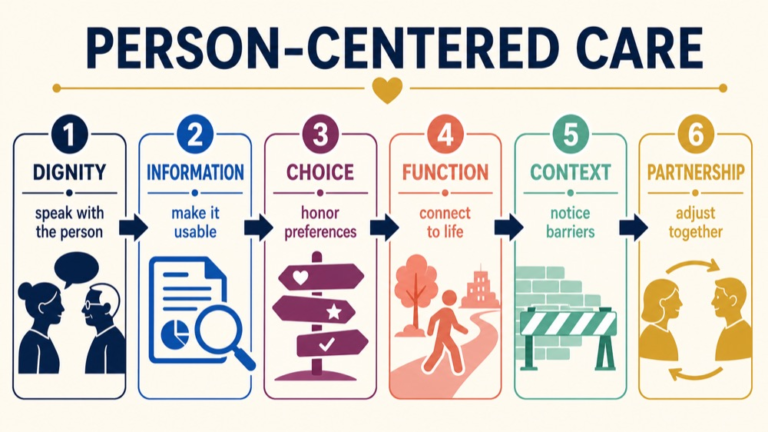
Dignity
The person is addressed directly, respected as an active participant, and recognized as more than a diagnosis or score.
How is the person’s voice present?
Information
Assessment, intervention, choices, uncertainty, and progress are shared in a form the person can use.
What information supports a meaningful decision?
Choice
Preferences, values, culture, identity, goals, and acceptable supports influence the plan and its revision.
What matters to this person?
Functional goals
Goals connect communication or swallowing abilities to activities, relationships, roles, health, and participation.
What life situation should become more accessible?
Context
Partners, language, environment, sensory load, resources, and social conditions affect performance and options.
What helps or blocks participation?
Partnership
The clinician, person, care partners, and team share information, reflect, and adjust the plan over time.
How will the plan stay responsive?
These domains interact, but they should remain distinguishable. A learner may show strength in one context and need support in another. A study map organizes the next observation; it does not answer every assessment question or establish a universal treatment, goal, or legal conclusion.
Keep the first pass descriptive and close to the communication event. Note the task, response, partner, setting, timing, available support, language or mode, and consequence for participation. This gives the learner a stable record to compare across tasks and prevents a familiar term from doing too much explanatory work before the evidence has been separated.
For Praxis-style review, a vignette may include several true details but ask for one best interpretation or next step. The strongest answer usually respects the task, identifies the relevant function or boundary, checks the most important missing information, and avoids treating one performance sample or policy phrase as the whole profile.
Map person-centered care
For study purposes, describe the communication relationship before naming a disorder, judging a partner, selecting a goal, or deciding that a task is within scope. Record what the person understood, expressed, initiated, repaired, coordinated, or participated in. Then note whether the task was familiar, how much context was shared, and which support changed the response.
Voice and dignity: speak with the person, invite their communication mode, and avoid reducing them to a disorder label.
Information: make assessment results, options, risks, uncertainties, and progress understandable and usable.
Choice: include values, culture, identity, preferences, acceptable supports, and the person’s right to participate at their chosen level.
Function: connect impairment evidence to daily activities, relationships, roles, health, learning, work, and community participation.
Context: identify partners, language, environment, social determinants, sensory conditions, and access factors that shape the decision.
Partnership: revisit goals and strategies as the person’s needs, routines, priorities, support system, or context changes.
A strong description is specific enough that another learner could picture the event. Instead of writing “the communication is impaired” or “the clinician can do this,” describe the demand, observable response, language or mode, partner, context, competence or access condition, and result. This protects clinical reasoning from labels that are broader than the evidence.
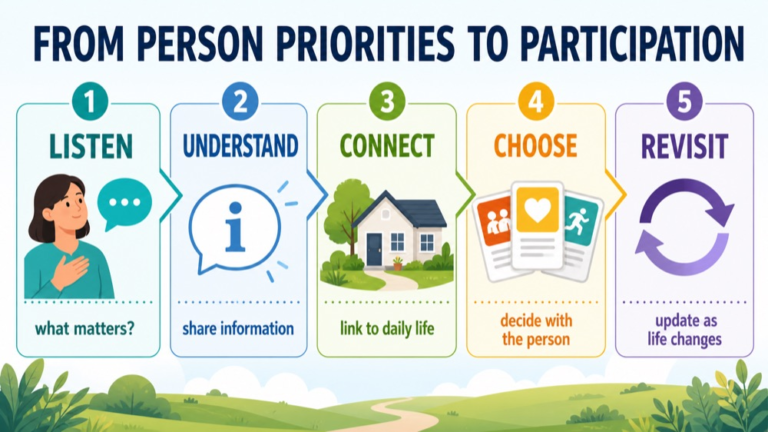
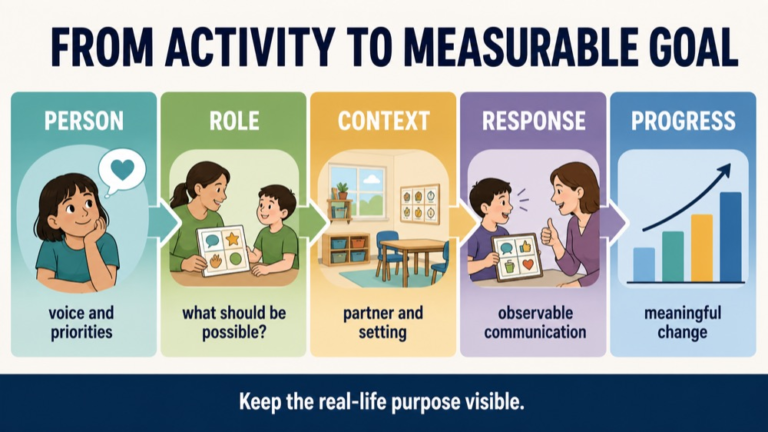
From person priorities to participation
Context changes what communication and professional decisions require. A direct question, long explanation, group exchange, classroom task, health-care interaction, family story, noisy routine, supervised procedure, or referral decision places different demands on processing, language, memory, hearing, access, partner behavior, competence, and regulation. Language experience, visual information, fatigue, health literacy, and the opportunity to request clarification should be part of the observation.
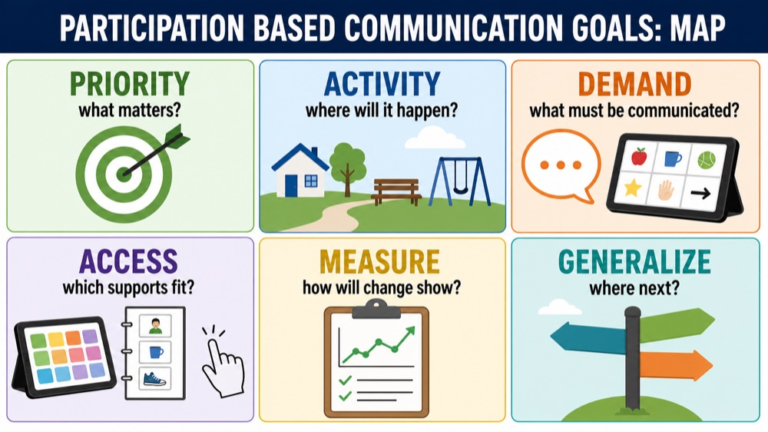
A person may value being understood by friends, communicating during medical visits, participating in class, telling stories with family, or making choices during meals. A test score can contribute evidence, but it does not by itself tell the clinician which activity matters most or which support is acceptable. Person-centered reasoning links the assessment to that lived priority and keeps the person involved in choosing how progress will be recognized.
Observation layer
Example question
Task
What did the person or clinician need to understand, express, organize, coordinate, decide, or provide?
Language and access
Which language, dialect, mode, hearing condition, tool, support, or communication partner was available?
Context and responsibility
Who was involved, what did they know, and which role, policy, ethical, or environmental factor mattered?
Participation and safety
What meaningful routine, role, outcome, or risk became easier or harder because of the pattern?
Context is not an afterthought added once a label has been selected. It is part of the question itself. If performance or decision quality changes with a quieter room, extra processing time, a familiar partner, a different language or mode, an interpreter, visual information, supervision, collaboration, a changed task, or a changed routine, that change is useful evidence about access and demand. It does not identify a cause by itself, but it tells you which conditions should be carried into the next observation.
Apply person-centered reasoning
When a Praxis-style scenario or clinical discussion presents person centered care speech pathology, use a disciplined sequence. The goal is to select the next clinical question or action that matches the evidence, the person’s priorities, the communication context, and the relevant professional boundary.
Define the task, language, mode, communication purpose, or service responsibility in plain language.
Identify the relevant domain: language, access, partner, participation, assessment, competence, collaboration, ethics, or regulation.
Separate observation from interpretation and write down what remains unknown.
Check history, exposure, dialect, culture, identity, interpreter access, environment, sensory load, memory, task familiarity, training, supervision, and local requirements as relevant.
Choose the assessment, collaboration, accommodation, goal, training, referral, or documentation step that answers the specific question.
State the boundary of the conclusion and keep the person’s safety, autonomy, access, and participation visible.
A person may value being understood by friends, communicating during medical visits, participating in class, telling stories with family, or making choices during meals. A test score can contribute evidence, but it does not by itself tell the clinician which activity matters most or which support is acceptable. Person-centered reasoning links the assessment to that lived priority and keeps the person involved in choosing how progress will be recognized. In a learning answer, the decisive evidence is usually the relationship among the task, the observed pattern, the context, and the next needed information—not a single isolated behavior, score, label, or broad permission statement.
Common study mistakes
Calling a plan person-centered because it uses a friendly tone while the person has no meaningful choice.
Talking about the person to a care partner as if the person were not present or capable of participation.
Writing goals from a diagnosis or impairment score without identifying the activity or role that matters.
Assuming independence is the only acceptable outcome and dismissing useful partners, technology, or accommodations.
Ignoring language, culture, identity, hearing, vision, cognition, motor access, sensory load, or social conditions.
Sharing information in a format the person cannot understand or use for a decision.
Treating the first plan as fixed when the person’s life, preferences, support system, or context changes.
Using the person’s stated priority as decoration rather than letting it change assessment, goals, or supports.
Most of these mistakes come from replacing a multidomain question with a fast label. Correct the habit by returning to the same sequence: describe, separate, contextualize, ask what is missing, and choose a proportionate next step. A short rationale can make the habit visible: identify the evidence, name the uncertainty, and explain why the selected next step fits the person, setting, and responsibility.
Build a quick review map
Use this compact map when reviewing a missed question, lecture note, or clinical vignette:
Step 1: Name the person’s priority, preferred participation, communication mode, and meaningful context.
Step 2: Share assessment and intervention information in an accessible form and invite the person’s interpretation.
Step 3: Connect the clinical evidence to activity, relationships, roles, health, learning, work, or community life.
Step 4: Include care partners and team members at the level the person wants and the situation requires.
Step 5: Select supports and measures that fit values, culture, language, access, and the real routine.
Step 6: Revisit the partnership when the person’s priorities, environment, support, or response changes.
Then write one transfer sentence: “When I see this pattern, I will first check ___ because ___.” The sentence should identify a decision rule, not repeat a definition. Revisit it after a delay and test whether you can apply the rule to a different task, age group, partner, language, setting, or professional responsibility.
Sources and next steps
person centered care speech pathology is best learned as a context-sensitive pattern across communication, access, identity, function, participation, competence, and professional judgment. Use the current authority pages to refine the concept, then return to practice scenarios that require you to explain what the evidence supports and what it leaves open.
Family-Centered Practice in Speech Pathology: Partnership and Everyday Routines
family centered practice speech pathology is easier to study when it is treated as a connected clinical reasoning problem rather than a label to memorize. Family-centered practice in speech pathology treats families as knowledgeable partners in planning, delivering, and evaluating services. It asks how communication and feeding or swallowing support can fit real routines, honor culture and priorities, build caregiver confidence, and remain responsive to the child or adult rather than turning family participation into a checklist.
This learning guide is written for SLP students and other learners reviewing clinical concepts. It organizes observation, access, assessment, function, and professional judgment; it does not make an individualized diagnosis or replace current professional guidance. Interpretation depends on the person, task, language, culture, health, access, partner, context, and communication goals.
What family-centered practice in speech pathology includes
Begin by separating the concept into domains. A learner who can name the domains is less likely to collapse language, access, partner, participation, competence, regulation, and clinical judgment into one explanation. The useful unit of analysis is the task: what the person was asked to understand, express, organize, coordinate, remember, or communicate, with whom, under which conditions, and with what support.
Domain or system
What to notice
Question to carry forward
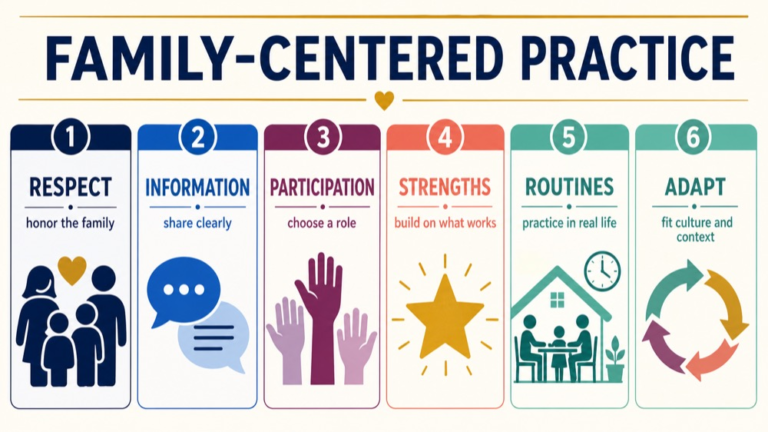
Respect and dignity
The clinician honors family perspectives, values, cultural backgrounds, relationships, and the person’s own voice.
What does the family know and value?
Information sharing
Information about assessment, intervention, options, and progress is timely, understandable, and usable.
What does the family need to decide or participate?
Participation
Families choose how and when to participate in decision-making, routines, coaching, practice, and review.
What level of participation fits this family?
Strengths and resources
The plan starts with what the child, adult, family, and community already do well and can build on.
What strengths can carry the next step?
Coaching and routines
Caregivers practice strategies in everyday activities where communication, feeding, or swallowing actually occurs.
Where will the strategy matter outside the clinic?
Individualization
Culture, language, access, time, social conditions, family structure, and changing priorities shape service delivery.
What should be adapted rather than assumed?
These domains interact, but they should remain distinguishable. A learner may show strength in one context and need support in another. A study map organizes the next observation; it does not answer every assessment question or establish a universal treatment, goal, or legal conclusion.
Keep the first pass descriptive and close to the communication event. Note the task, response, partner, setting, timing, available support, language or mode, and consequence for participation. This gives the learner a stable record to compare across tasks and prevents a familiar term from doing too much explanatory work before the evidence has been separated.
For Praxis-style review, a vignette may include several true details but ask for one best interpretation or next step. The strongest answer usually respects the task, identifies the relevant function or boundary, checks the most important missing information, and avoids treating one performance sample or policy phrase as the whole profile.
Map family-centered practice
For study purposes, describe the communication relationship before naming a disorder, judging a partner, selecting a goal, or deciding that a task is within scope. Record what the person understood, expressed, initiated, repaired, coordinated, or participated in. Then note whether the task was familiar, how much context was shared, and which support changed the response.
Partnership: ask about family knowledge, priorities, routines, language, culture, concerns, strengths, and desired outcomes.
Information: share assessment and intervention information in an accessible way and invite questions, disagreement, and revision.
Participation: offer meaningful choices about focus, practice, coaching, decision-making, and communication with the team.
Strengths: build on the person’s and family’s resources rather than framing the family only through deficits or compliance.
Routines: connect strategies to meals, play, school, work, family conversation, community activities, and other real contexts.
Adaptation: adjust for language, culture, access, time, social determinants, caregiver capacity, and changes in family priorities.
A strong description is specific enough that another learner could picture the event. Instead of writing “the communication is impaired” or “the clinician can do this,” describe the demand, observable response, language or mode, partner, context, competence or access condition, and result. This protects clinical reasoning from labels that are broader than the evidence.
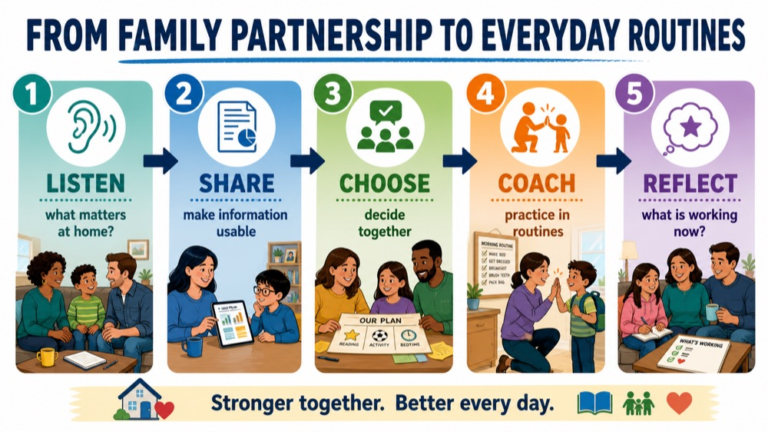
From family partnership to everyday routines
Context changes what communication and professional decisions require. A direct question, long explanation, group exchange, classroom task, health-care interaction, family story, noisy routine, supervised procedure, or referral decision places different demands on processing, language, memory, hearing, access, partner behavior, competence, and regulation. Language experience, visual information, fatigue, health literacy, and the opportunity to request clarification should be part of the observation.
A caregiver may know which routines create the best opportunities for communication, which supports a child accepts, or which cultural expectations shape interaction. In early intervention, coaching may help caregivers build confidence and use strategies within daily routines; in other settings, family-centered practice may mean shared planning, accessible information, advocacy, or coordination. The correct level of family involvement should be meaningful and chosen, not assumed to look the same for everyone.
Observation layer
Example question
Task
What did the person or clinician need to understand, express, organize, coordinate, decide, or provide?
Language and access
Which language, dialect, mode, hearing condition, tool, support, or communication partner was available?
Context and responsibility
Who was involved, what did they know, and which role, policy, ethical, or environmental factor mattered?
Participation and safety
What meaningful routine, role, outcome, or risk became easier or harder because of the pattern?
Context is not an afterthought added once a label has been selected. It is part of the question itself. If performance or decision quality changes with a quieter room, extra processing time, a familiar partner, a different language or mode, an interpreter, visual information, supervision, collaboration, a changed task, or a changed routine, that change is useful evidence about access and demand. It does not identify a cause by itself, but it tells you which conditions should be carried into the next observation.
Apply family-centered reasoning
When a Praxis-style scenario or clinical discussion presents family centered practice speech pathology, use a disciplined sequence. The goal is to select the next clinical question or action that matches the evidence, the person’s priorities, the communication context, and the relevant professional boundary.
Define the task, language, mode, communication purpose, or service responsibility in plain language.
Identify the relevant domain: language, access, partner, participation, assessment, competence, collaboration, ethics, or regulation.
Separate observation from interpretation and write down what remains unknown.
Check history, exposure, dialect, culture, identity, interpreter access, environment, sensory load, memory, task familiarity, training, supervision, and local requirements as relevant.
Choose the assessment, collaboration, accommodation, goal, training, referral, or documentation step that answers the specific question.
State the boundary of the conclusion and keep the person’s safety, autonomy, access, and participation visible.
A caregiver may know which routines create the best opportunities for communication, which supports a child accepts, or which cultural expectations shape interaction. In early intervention, coaching may help caregivers build confidence and use strategies within daily routines; in other settings, family-centered practice may mean shared planning, accessible information, advocacy, or coordination. The correct level of family involvement should be meaningful and chosen, not assumed to look the same for everyone. In a learning answer, the decisive evidence is usually the relationship among the task, the observed pattern, the context, and the next needed information—not a single isolated behavior, score, label, or broad permission statement.
Common study mistakes
Treating family-centered practice as asking families to carry out a clinician’s plan without shared decisions.
Ignoring the person’s own preferences by speaking only to a parent or caregiver.
Giving information without checking language, literacy, communication access, understanding, or practical usability.
Focusing on family deficits or compliance instead of strengths, resources, culture, and priorities.
Teaching a strategy in the clinic without connecting it to the family’s everyday routines.
Assuming one family structure, communication style, language, or level of participation fits every case.
Treating coaching as a replacement for direct service when the person’s needs require another mix of supports.
Measuring caregiver activity without asking whether the person’s meaningful participation or access changed.
Most of these mistakes come from replacing a multidomain question with a fast label. Correct the habit by returning to the same sequence: describe, separate, contextualize, ask what is missing, and choose a proportionate next step. A short rationale can make the habit visible: identify the evidence, name the uncertainty, and explain why the selected next step fits the person, setting, and responsibility.
Build a quick review map
Use this compact map when reviewing a missed question, lecture note, or clinical vignette:
Step 1: Identify the person’s and family’s priorities, strengths, routines, culture, language, and concerns.
Step 2: Share information in an accessible format and check what the family understands and wants.
Step 3: Choose a meaningful participation role for the family without assigning a one-size-fits-all level of involvement.
Step 4: Connect strategies to everyday routines and provide coaching, practice, reflection, or direct support as appropriate.
Step 5: Adapt for time, access, social conditions, caregiver capacity, family structure, and changing priorities.
Step 6: Review whether the plan is useful, respectful, sustainable, and connected to the person’s outcomes.
Then write one transfer sentence: “When I see this pattern, I will first check ___ because ___.” The sentence should identify a decision rule, not repeat a definition. Revisit it after a delay and test whether you can apply the rule to a different task, age group, partner, language, setting, or professional responsibility.
Sources and next steps
family centered practice speech pathology is best learned as a context-sensitive pattern across communication, access, identity, function, participation, competence, and professional judgment. Use the current authority pages to refine the concept, then return to practice scenarios that require you to explain what the evidence supports and what it leaves open.
Interprofessional Collaboration in Speech Pathology: Team Roles and Communication
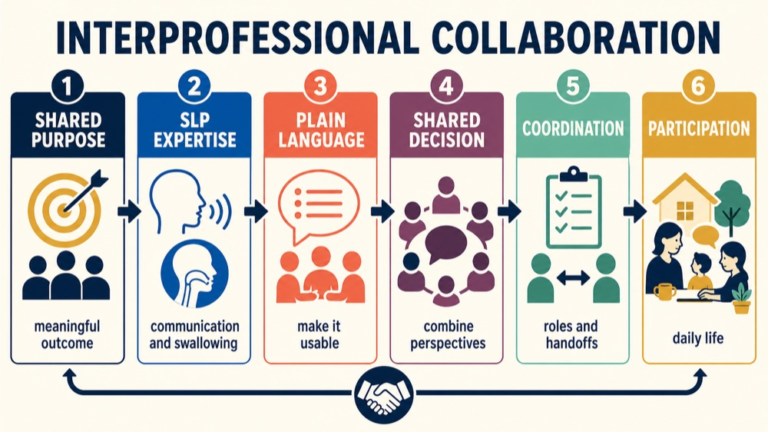
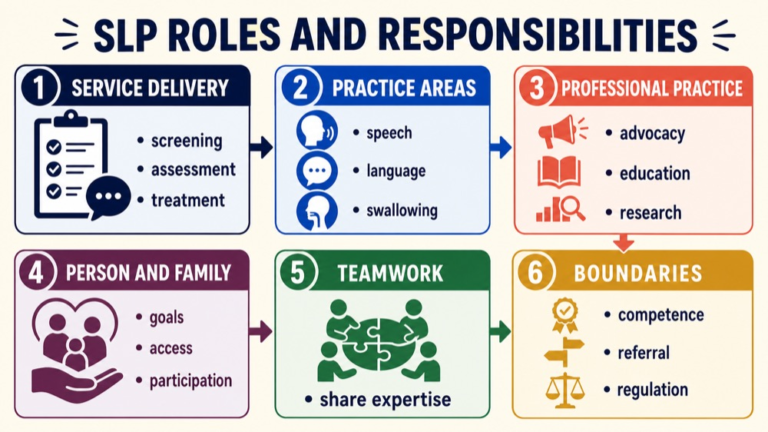
interprofessional collaboration speech pathology is easier to study when it is treated as a connected clinical reasoning problem rather than a label to memorize. Interprofessional collaboration in speech pathology is a shared approach to assessment, intervention, communication, and care planning. The SLP contributes specialized knowledge while explaining it in plain language, listening to other disciplines, and connecting recommendations to the person’s participation, safety, and priorities.
This learning guide is written for SLP students and other learners reviewing clinical concepts. It organizes observation, access, assessment, function, and professional judgment; it does not make an individualized diagnosis or replace current professional guidance. Interpretation depends on the person, task, language, culture, health, access, partner, context, and communication goals.
What interprofessional collaboration in speech pathology includes
Begin by separating the concept into domains. A learner who can name the domains is less likely to collapse language, access, partner, participation, competence, regulation, and clinical judgment into one explanation. The useful unit of analysis is the task: what the person was asked to understand, express, organize, coordinate, remember, or communicate, with whom, under which conditions, and with what support.
Domain or system
What to notice
Question to carry forward
Shared purpose
The team organizes around the person, student, family, or community need rather than around professional titles.
What meaningful outcome is the team trying to support?
SLP expertise
The SLP explains communication, cognition, voice, fluency, hearing, feeding, swallowing, language, and access in context.
What does the SLP add to this question?
Plain language
Technical terms are defined or replaced with examples so teammates and families can use the information.
Would another discipline and the family understand this?
Shared decisions
Assessment, treatment, accommodations, and referrals are informed by several perspectives and relevant evidence.
Who needs to contribute before the decision?
Coordination
Roles, handoffs, communication channels, documentation, supervision, and follow-up reduce gaps in care.
Who will do what, when, and how will the team know?
Participation
The plan connects professional actions to communication, learning, work, relationships, health, safety, or community life.
What will become more accessible in daily life?
These domains interact, but they should remain distinguishable. A learner may show strength in one context and need support in another. A study map organizes the next observation; it does not answer every assessment question or establish a universal treatment, goal, or legal conclusion.
Keep the first pass descriptive and close to the communication event. Note the task, response, partner, setting, timing, available support, language or mode, and consequence for participation. This gives the learner a stable record to compare across tasks and prevents a familiar term from doing too much explanatory work before the evidence has been separated.
For Praxis-style review, a vignette may include several true details but ask for one best interpretation or next step. The strongest answer usually respects the task, identifies the relevant function or boundary, checks the most important missing information, and avoids treating one performance sample or policy phrase as the whole profile.
Map interprofessional collaboration
For study purposes, describe the communication relationship before naming a disorder, judging a partner, selecting a goal, or deciding that a task is within scope. Record what the person understood, expressed, initiated, repaired, coordinated, or participated in. Then note whether the task was familiar, how much context was shared, and which support changed the response.
Purpose: name the person’s functional need, shared goal, role, or participation problem before listing services.
Expertise: explain what SLP knowledge contributes and identify what another discipline or family member knows that the SLP does not.
Language: define acronyms, use practical examples, and adapt communication for the team’s and family’s preferred language and access.
Decision: combine assessment evidence, clinical judgment, person and family priorities, and the perspectives of relevant disciplines.
Coordination: clarify roles, handoffs, supervision, documentation, follow-up, and how disagreements or new information will be handled.
Participation: connect the plan to classroom, home, work, health care, relationships, safety, and community routines.
A strong description is specific enough that another learner could picture the event. Instead of writing “the communication is impaired” or “the clinician can do this,” describe the demand, observable response, language or mode, partner, context, competence or access condition, and result. This protects clinical reasoning from labels that are broader than the evidence.
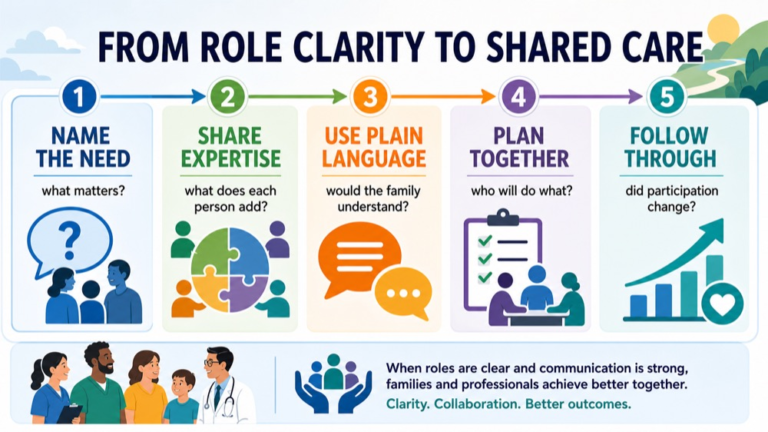
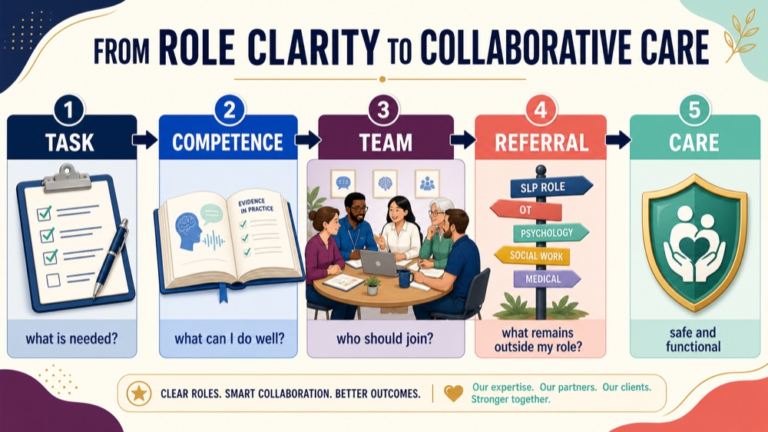
From role clarity to shared care
Context changes what communication and professional decisions require. A direct question, long explanation, group exchange, classroom task, health-care interaction, family story, noisy routine, supervised procedure, or referral decision places different demands on processing, language, memory, hearing, access, partner behavior, competence, and regulation. Language experience, visual information, fatigue, health literacy, and the opportunity to request clarification should be part of the observation.
An SLP may be the only communication specialist on a team that includes educators, physicians, nurses, occupational therapists, psychologists, social workers, interpreters, caregivers, and the person receiving services. A strong contribution is neither a long list of jargon nor silence. It is a clear explanation of the communication question, a practical example, an invitation for other perspectives, and a plan that assigns responsibilities around a meaningful outcome.
Observation layer
Example question
Task
What did the person or clinician need to understand, express, organize, coordinate, decide, or provide?
Language and access
Which language, dialect, mode, hearing condition, tool, support, or communication partner was available?
Context and responsibility
Who was involved, what did they know, and which role, policy, ethical, or environmental factor mattered?
Participation and safety
What meaningful routine, role, outcome, or risk became easier or harder because of the pattern?
Context is not an afterthought added once a label has been selected. It is part of the question itself. If performance or decision quality changes with a quieter room, extra processing time, a familiar partner, a different language or mode, an interpreter, visual information, supervision, collaboration, a changed task, or a changed routine, that change is useful evidence about access and demand. It does not identify a cause by itself, but it tells you which conditions should be carried into the next observation.
Apply interprofessional reasoning
When a Praxis-style scenario or clinical discussion presents interprofessional collaboration speech pathology, use a disciplined sequence. The goal is to select the next clinical question or action that matches the evidence, the person’s priorities, the communication context, and the relevant professional boundary.
Define the task, language, mode, communication purpose, or service responsibility in plain language.
Identify the relevant domain: language, access, partner, participation, assessment, competence, collaboration, ethics, or regulation.
Separate observation from interpretation and write down what remains unknown.
Check history, exposure, dialect, culture, identity, interpreter access, environment, sensory load, memory, task familiarity, training, supervision, and local requirements as relevant.
Choose the assessment, collaboration, accommodation, goal, training, referral, or documentation step that answers the specific question.
State the boundary of the conclusion and keep the person’s safety, autonomy, access, and participation visible.
An SLP may be the only communication specialist on a team that includes educators, physicians, nurses, occupational therapists, psychologists, social workers, interpreters, caregivers, and the person receiving services. A strong contribution is neither a long list of jargon nor silence. It is a clear explanation of the communication question, a practical example, an invitation for other perspectives, and a plan that assigns responsibilities around a meaningful outcome. In a learning answer, the decisive evidence is usually the relationship among the task, the observed pattern, the context, and the next needed information—not a single isolated behavior, score, label, or broad permission statement.
Common study mistakes
Listing what an SLP does without explaining how that expertise helps the person or team.
Using acronyms and technical terms that other disciplines or families cannot use in practice.
Treating collaboration as agreement before each discipline has contributed relevant evidence.
Leaving the person, family, interpreter, or care partner out of a decision that affects daily life.
Assuming the SLP should lead every communication-related decision regardless of competence or setting.
Failing to define handoffs, documentation, supervision, follow-up, or responsibility for the next step.
Presenting a referral as rejection instead of coordinating the expertise needed for safe care.
Measuring team activity without checking whether participation or functional access changed.
Most of these mistakes come from replacing a multidomain question with a fast label. Correct the habit by returning to the same sequence: describe, separate, contextualize, ask what is missing, and choose a proportionate next step. A short rationale can make the habit visible: identify the evidence, name the uncertainty, and explain why the selected next step fits the person, setting, and responsibility.
Build a quick review map
Use this compact map when reviewing a missed question, lecture note, or clinical vignette:
Step 1: Name the person’s meaningful outcome and the communication question.
Step 2: Describe the SLP contribution and the expertise other team members or family bring.
Step 3: Translate technical language into a practical example or observable routine.
Step 4: Combine evidence, professional reasoning, lived experience, and relevant preferences.
Step 6: Check whether the plan supports participation, access, safety, and the person’s priorities.
Then write one transfer sentence: “When I see this pattern, I will first check ___ because ___.” The sentence should identify a decision rule, not repeat a definition. Revisit it after a delay and test whether you can apply the rule to a different task, age group, partner, language, setting, or professional responsibility.
Sources and next steps
interprofessional collaboration speech pathology is best learned as a context-sensitive pattern across communication, access, identity, function, participation, competence, and professional judgment. Use the current authority pages to refine the concept, then return to practice scenarios that require you to explain what the evidence supports and what it leaves open.
Documentation in Speech-Language Pathology: Purpose, Content, and Clinical Reasoning
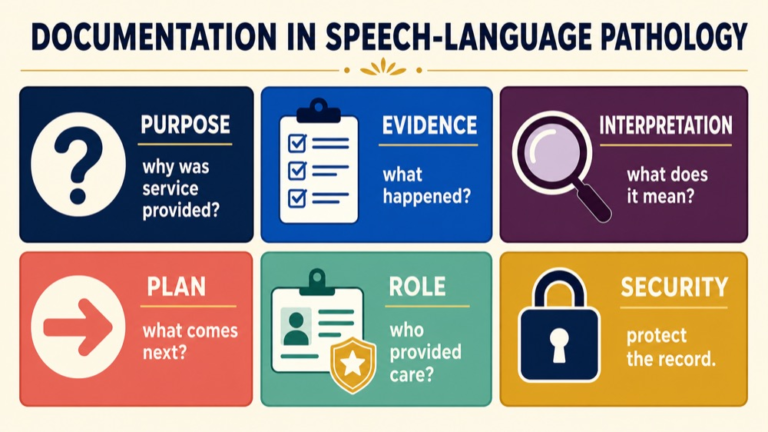
documentation in speech language pathology is easier to study when it is treated as a connected clinical reasoning problem rather than a label to memorize. Documentation in speech-language pathology communicates what happened, why the service was provided, what the person did, how the clinician responded, and what the next decision should be. Strong notes connect evidence to functional goals and outcomes while respecting the different requirements of evaluations, treatment notes, schools, health care, telepractice, payers, and local policy.
This learning guide is written for SLP students and other learners reviewing clinical concepts. It organizes observation, access, assessment, function, and professional judgment; it does not make an individualized diagnosis or replace current professional guidance. Interpretation depends on the person, task, language, culture, health, access, partner, context, and communication goals.
What documentation in speech-language pathology does
Begin by separating the concept into domains. A learner who can name the domains is less likely to collapse language, access, partner, participation, competence, regulation, and clinical judgment into one explanation. The useful unit of analysis is the task: what the person was asked to understand, express, organize, coordinate, remember, or communicate, with whom, under which conditions, and with what support.
Domain or system
What to notice
Question to carry forward
Clinical communication
The record helps clinicians, families, teams, and payers understand the diagnosis, service, response, plan, and outcome.
What does the next reader need to know?
Medical or functional necessity
Documentation should show why the service requires SLP knowledge and how it relates to meaningful function and care.
Why was this service appropriate?
Observation and data
Record the task, response, conditions, support, cueing, partner, mode, data source, and relevant barriers or facilitators.
What evidence supports the interpretation?
Goals and outcomes
Connect treatment or assessment to functional goals, projected outcomes, change, and the person’s meaningful priorities.
What changed and why does it matter?
Role and signature
Credentials, role, supervision, cosignature, setting, time, and service model may matter for the validity and use of the record.
Who provided and attested to the service?
Local requirements
ASHA does not prescribe one universal format; state, federal, payer, school, facility, and employer rules may add requirements.
Which current rule governs this record?
These domains interact, but they should remain distinguishable. A learner may show strength in one context and need support in another. A study map organizes the next observation; it does not answer every assessment question or establish a universal treatment, goal, or legal conclusion.
Keep the first pass descriptive and close to the communication event. Note the task, response, partner, setting, timing, available support, language or mode, and consequence for participation. This gives the learner a stable record to compare across tasks and prevents a familiar term from doing too much explanatory work before the evidence has been separated.
For Praxis-style review, a vignette may include several true details but ask for one best interpretation or next step. The strongest answer usually respects the task, identifies the relevant function or boundary, checks the most important missing information, and avoids treating one performance sample or policy phrase as the whole profile.
Map documentation in speech-language pathology
For study purposes, describe the communication relationship before naming a disorder, judging a partner, selecting a goal, or deciding that a task is within scope. Record what the person understood, expressed, initiated, repaired, coordinated, or participated in. Then note whether the task was familiar, how much context was shared, and which support changed the response.
Purpose: state the referral, service, clinical question, functional need, or decision the documentation addresses.
Evidence: record observable responses, task demands, language or mode, partner, setting, assistance, data source, and relevant barriers.
Interpretation: explain what the evidence supports, what remains uncertain, and how it relates to the person’s goals or outcome.
Plan: identify the next assessment, treatment, collaboration, accommodation, referral, monitoring, or discharge decision.
Role: use the appropriate title, credentials, supervision, cosignature, location, timing, and service model for the setting.
Security: keep the legal record accurate, current, accessible to authorized readers, and protected from inappropriate disclosure.
A strong description is specific enough that another learner could picture the event. Instead of writing “the communication is impaired” or “the clinician can do this,” describe the demand, observable response, language or mode, partner, context, competence or access condition, and result. This protects clinical reasoning from labels that are broader than the evidence.
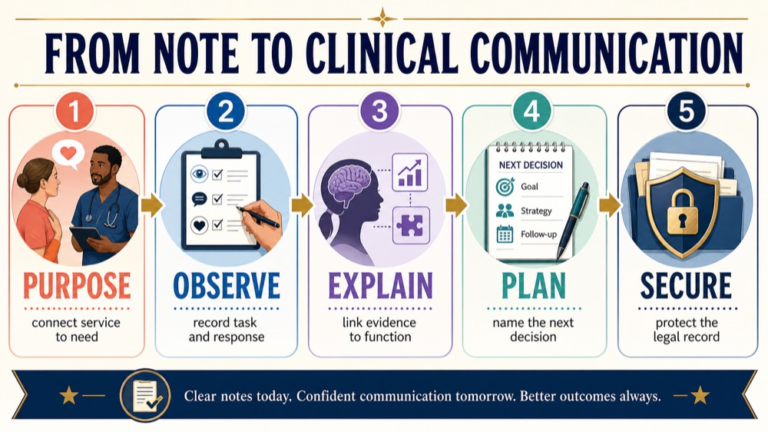
From note to clinical communication
Context changes what communication and professional decisions require. A direct question, long explanation, group exchange, classroom task, health-care interaction, family story, noisy routine, supervised procedure, or referral decision places different demands on processing, language, memory, hearing, access, partner behavior, competence, and regulation. Language experience, visual information, fatigue, health literacy, and the opportunity to request clarification should be part of the observation.
An evaluation report and a daily treatment note should not look identical because they answer different questions. An evaluation may explain referral, history, methods, diagnosis, prognosis, and plan. A treatment note may show the session task, response, support, data, clinical reasoning, and next step. In either case, a useful record gives another qualified reader enough context to understand the service and its relevance without turning the note into a vague list of activities.
Observation layer
Example question
Task
What did the person or clinician need to understand, express, organize, coordinate, decide, or provide?
Language and access
Which language, dialect, mode, hearing condition, tool, support, or communication partner was available?
Context and responsibility
Who was involved, what did they know, and which role, policy, ethical, or environmental factor mattered?
Participation and safety
What meaningful routine, role, outcome, or risk became easier or harder because of the pattern?
Context is not an afterthought added once a label has been selected. It is part of the question itself. If performance or decision quality changes with a quieter room, extra processing time, a familiar partner, a different language or mode, an interpreter, visual information, supervision, collaboration, a changed task, or a changed routine, that change is useful evidence about access and demand. It does not identify a cause by itself, but it tells you which conditions should be carried into the next observation.
Apply documentation reasoning
When a Praxis-style scenario or clinical discussion presents documentation in speech language pathology, use a disciplined sequence. The goal is to select the next clinical question or action that matches the evidence, the person’s priorities, the communication context, and the relevant professional boundary.
Define the task, language, mode, communication purpose, or service responsibility in plain language.
Identify the relevant domain: language, access, partner, participation, assessment, competence, collaboration, ethics, or regulation.
Separate observation from interpretation and write down what remains unknown.
Check history, exposure, dialect, culture, identity, interpreter access, environment, sensory load, memory, task familiarity, training, supervision, and local requirements as relevant.
Choose the assessment, collaboration, accommodation, goal, training, referral, or documentation step that answers the specific question.
State the boundary of the conclusion and keep the person’s safety, autonomy, access, and participation visible.
An evaluation report and a daily treatment note should not look identical because they answer different questions. An evaluation may explain referral, history, methods, diagnosis, prognosis, and plan. A treatment note may show the session task, response, support, data, clinical reasoning, and next step. In either case, a useful record gives another qualified reader enough context to understand the service and its relevance without turning the note into a vague list of activities. In a learning answer, the decisive evidence is usually the relationship among the task, the observed pattern, the context, and the next needed information—not a single isolated behavior, score, label, or broad permission statement.
Common study mistakes
Writing a list of activities without stating the clinical purpose or functional relevance.
Recording percentages without the task, opportunity, support, communication mode, or data source.
Using labels such as improved or tolerated without describing the observable response and context.
Copying a template that does not fit the evaluation, treatment, school, health care, telepractice, or payer context.
Ignoring barriers, facilitators, partner behavior, language, culture, access, or the person’s priorities.
Failing to show how the interpretation supports the next clinical or collaborative decision.
Signing or cosigning without checking the role, credentials, supervision, and local requirement.
Treating documentation as a private memory aid rather than a secure legal and clinical record.
Most of these mistakes come from replacing a multidomain question with a fast label. Correct the habit by returning to the same sequence: describe, separate, contextualize, ask what is missing, and choose a proportionate next step. A short rationale can make the habit visible: identify the evidence, name the uncertainty, and explain why the selected next step fits the person, setting, and responsibility.
Build a quick review map
Use this compact map when reviewing a missed question, lecture note, or clinical vignette:
Step 1: State the purpose, referral question, service, and functional need.
Step 2: Record observable evidence with task, context, mode, partner, support, and data details.
Step 3: Explain what the evidence supports, what remains unknown, and why it matters.
Step 4: Connect the record to goals, outcomes, participation, safety, and the next decision.
Step 5: Check role, credentials, timing, setting, supervision, signatures, privacy, and local requirements.
Step 6: Read the note as the next qualified team member: could they understand and act on it?
Then write one transfer sentence: “When I see this pattern, I will first check ___ because ___.” The sentence should identify a decision rule, not repeat a definition. Revisit it after a delay and test whether you can apply the rule to a different task, age group, partner, language, setting, or professional responsibility.
Sources and next steps
documentation in speech language pathology is best learned as a context-sensitive pattern across communication, access, identity, function, participation, competence, and professional judgment. Use the current authority pages to refine the concept, then return to practice scenarios that require you to explain what the evidence supports and what it leaves open.
Confidentiality in Speech Pathology: Privacy, Records, and Disclosure
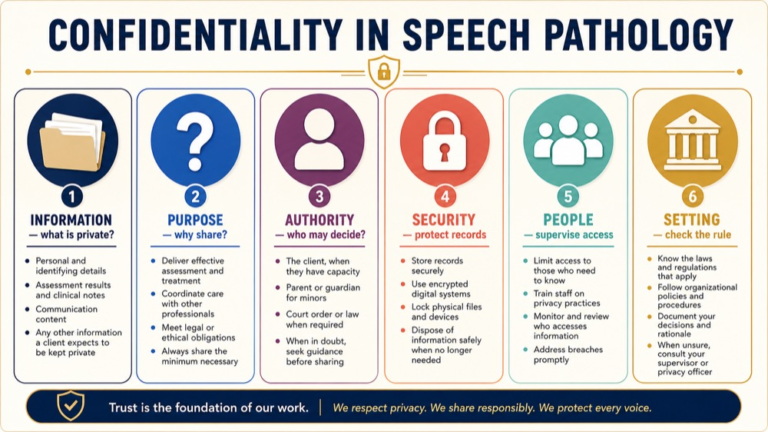
confidentiality in speech pathology is easier to study when it is treated as a connected clinical reasoning problem rather than a label to memorize. Confidentiality in speech pathology protects information shared during assessment, treatment, consultation, payment, research, and education. SLP learners need to distinguish private information from authorized disclosure, identify who may access or release a record, and account for the security responsibilities of clinicians, students, assistants, supervisors, and support staff.
This learning guide is written for SLP students and other learners reviewing clinical concepts. It organizes observation, access, assessment, function, and professional judgment; it does not make an individualized diagnosis or replace current professional guidance. Interpretation depends on the person, task, language, culture, health, access, partner, context, and communication goals.
What confidentiality in speech pathology protects
Begin by separating the concept into domains. A learner who can name the domains is less likely to collapse language, access, partner, participation, competence, regulation, and clinical judgment into one explanation. The useful unit of analysis is the task: what the person was asked to understand, express, organize, coordinate, remember, or communicate, with whom, under which conditions, and with what support.
Domain or system
What to notice
Question to carry forward
Information
Evaluations, plans, therapy, conversations, consultations, records, images, recordings, and payment details may contain sensitive information.
What information is being discussed or shared?
Access
Access should be limited to people who are authorized or need the information for the professional purpose and applicable requirements.
Who is allowed to see or use it?
Disclosure
Sharing with another professional, family member, researcher, payer, or public audience may require authorization or another valid basis.
Students, assistants, supervisors, and support staff also need clear expectations and oversight for privacy and records.
Who else has come into possession of the information?
Setting
School, health care, private practice, research, telepractice, and payer contexts may add different requirements.
Which current rule or policy applies here?
These domains interact, but they should remain distinguishable. A learner may show strength in one context and need support in another. A study map organizes the next observation; it does not answer every assessment question or establish a universal treatment, goal, or legal conclusion.
Keep the first pass descriptive and close to the communication event. Note the task, response, partner, setting, timing, available support, language or mode, and consequence for participation. This gives the learner a stable record to compare across tasks and prevents a familiar term from doing too much explanatory work before the evidence has been separated.
For Praxis-style review, a vignette may include several true details but ask for one best interpretation or next step. The strongest answer usually respects the task, identifies the relevant function or boundary, checks the most important missing information, and avoids treating one performance sample or policy phrase as the whole profile.
Map confidentiality in speech pathology
For study purposes, describe the communication relationship before naming a disorder, judging a partner, selecting a goal, or deciding that a task is within scope. Record what the person understood, expressed, initiated, repaired, coordinated, or participated in. Then note whether the task was familiar, how much context was shared, and which support changed the response.
Information: identify the client or patient detail, record, image, voice, conversation, or result that could reveal personal information.
Purpose: state why access or disclosure is being considered and whether the purpose matches the original professional context.
Authority: identify the person or representative who can authorize release and check the applicable legal or policy basis.
Security: protect paper and electronic records, devices, conversations, transport, storage, passwords, backups, and disposal.
People: include clinicians, students, assistants, supervisors, billing staff, researchers, interpreters, and other personnel in privacy planning.
Response: pause an uncertain disclosure, seek guidance, document the decision, and follow the most protective applicable requirement.
A strong description is specific enough that another learner could picture the event. Instead of writing “the communication is impaired” or “the clinician can do this,” describe the demand, observable response, language or mode, partner, context, competence or access condition, and result. This protects clinical reasoning from labels that are broader than the evidence.
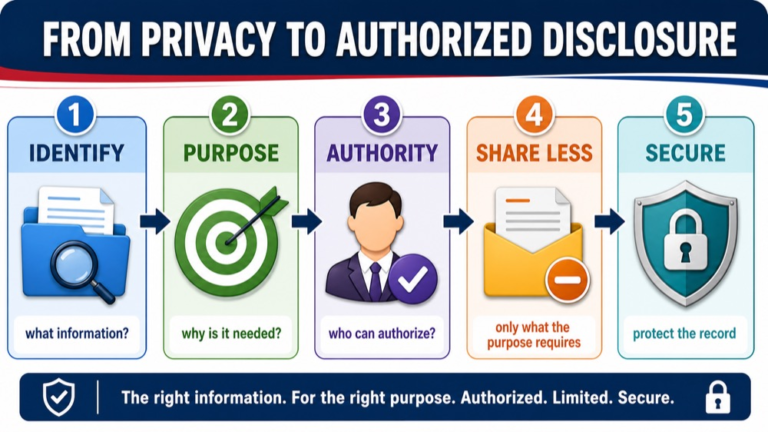
From privacy to authorized disclosure
Context changes what communication and professional decisions require. A direct question, long explanation, group exchange, classroom task, health-care interaction, family story, noisy routine, supervised procedure, or referral decision places different demands on processing, language, memory, hearing, access, partner behavior, competence, and regulation. Language experience, visual information, fatigue, health literacy, and the opportunity to request clarification should be part of the observation.
A student may want to discuss a case in a public area, a clinician may receive a request from another professional, a family member may ask for information, or a therapy recording may be considered for teaching. The answer depends on the information, purpose, authority, setting, security, and current rule. Privacy is not only about a data system; it also includes conversations, paper notes, images, recordings, and what a professional chooses to repeat.
Observation layer
Example question
Task
What did the person or clinician need to understand, express, organize, coordinate, decide, or provide?
Language and access
Which language, dialect, mode, hearing condition, tool, support, or communication partner was available?
Context and responsibility
Who was involved, what did they know, and which role, policy, ethical, or environmental factor mattered?
Participation and safety
What meaningful routine, role, outcome, or risk became easier or harder because of the pattern?
Context is not an afterthought added once a label has been selected. It is part of the question itself. If performance or decision quality changes with a quieter room, extra processing time, a familiar partner, a different language or mode, an interpreter, visual information, supervision, collaboration, a changed task, or a changed routine, that change is useful evidence about access and demand. It does not identify a cause by itself, but it tells you which conditions should be carried into the next observation.
Apply confidentiality reasoning
When a Praxis-style scenario or clinical discussion presents confidentiality in speech pathology, use a disciplined sequence. The goal is to select the next clinical question or action that matches the evidence, the person’s priorities, the communication context, and the relevant professional boundary.
Define the task, language, mode, communication purpose, or service responsibility in plain language.
Identify the relevant domain: language, access, partner, participation, assessment, competence, collaboration, ethics, or regulation.
Separate observation from interpretation and write down what remains unknown.
Check history, exposure, dialect, culture, identity, interpreter access, environment, sensory load, memory, task familiarity, training, supervision, and local requirements as relevant.
Choose the assessment, collaboration, accommodation, goal, training, referral, or documentation step that answers the specific question.
State the boundary of the conclusion and keep the person’s safety, autonomy, access, and participation visible.
A student may want to discuss a case in a public area, a clinician may receive a request from another professional, a family member may ask for information, or a therapy recording may be considered for teaching. The answer depends on the information, purpose, authority, setting, security, and current rule. Privacy is not only about a data system; it also includes conversations, paper notes, images, recordings, and what a professional chooses to repeat. In a learning answer, the decisive evidence is usually the relationship among the task, the observed pattern, the context, and the next needed information—not a single isolated behavior, score, label, or broad permission statement.
Common study mistakes
Assuming a helpful purpose automatically makes a disclosure authorized.
Discussing an identifiable case in a hallway, elevator, classroom, online forum, or unsecured message.
Leaving records, devices, screenshots, recordings, or printed notes accessible to unauthorized people.
Assuming students, assistants, interpreters, or support staff are outside the confidentiality responsibility.
Failing to identify who has authority to authorize release for a child or adult with a representative.
Sharing more information than the professional purpose requires.
Treating a verbal request as enough without checking policy, law, authorization, or documentation.
Ignoring the stricter or more specific requirement when laws, policies, ethics, payers, and facilities overlap.
Most of these mistakes come from replacing a multidomain question with a fast label. Correct the habit by returning to the same sequence: describe, separate, contextualize, ask what is missing, and choose a proportionate next step. A short rationale can make the habit visible: identify the evidence, name the uncertainty, and explain why the selected next step fits the person, setting, and responsibility.
Build a quick review map
Use this compact map when reviewing a missed question, lecture note, or clinical vignette:
Step 1: Identify the information, people, purpose, and setting involved.
Step 2: Check whether the proposed access or disclosure is authorized and necessary.
Step 3: Verify the person or representative with authority and the required form or process.
Step 4: Protect the record, device, conversation, image, recording, transmission, and disposal pathway.
Step 5: Consult the current policy, law, supervisor, privacy officer, or ethics resource when uncertain.
Step 6: Document the decision and share only what the authorized professional purpose requires.
Then write one transfer sentence: “When I see this pattern, I will first check ___ because ___.” The sentence should identify a decision rule, not repeat a definition. Revisit it after a delay and test whether you can apply the rule to a different task, age group, partner, language, setting, or professional responsibility.
Sources and next steps
confidentiality in speech pathology is best learned as a context-sensitive pattern across communication, access, identity, function, participation, competence, and professional judgment. Use the current authority pages to refine the concept, then return to practice scenarios that require you to explain what the evidence supports and what it leaves open.
Informed Consent in Speech Pathology: What SLP Students Should Know
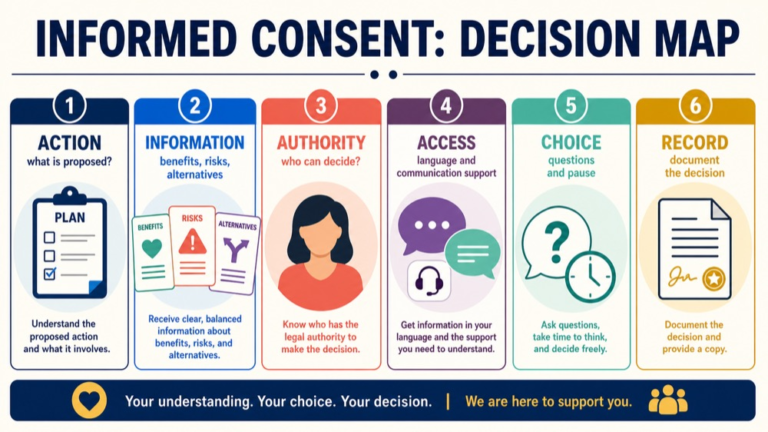
informed consent speech pathology is easier to study when it is treated as a connected clinical reasoning problem rather than a label to memorize. Informed consent in speech pathology is a communication process, not just a signature. The person served, parent, guardian, or other authorized decision-maker needs understandable information about the proposed action, expected outcomes, meaningful risks, alternatives, and the opportunity to ask questions or decline as allowed by applicable requirements.
This learning guide is written for SLP students and other learners reviewing clinical concepts. It organizes observation, access, assessment, function, and professional judgment; it does not make an individualized diagnosis or replace current professional guidance. Interpretation depends on the person, task, language, culture, health, access, partner, context, and communication goals.
What informed consent in speech pathology requires
Begin by separating the concept into domains. A learner who can name the domains is less likely to collapse language, access, partner, participation, competence, regulation, and clinical judgment into one explanation. The useful unit of analysis is the task: what the person was asked to understand, express, organize, coordinate, remember, or communicate, with whom, under which conditions, and with what support.
Domain or system
What to notice
Question to carry forward
Proposed action
Explain what assessment, treatment, research, technology, recording, disclosure, or service change is being considered.
What exactly is the person being asked to authorize?
Adequate information
Use accessible language and include expected outcomes, meaningful risks, limits, alternatives, and relevant practical details.
What information is needed for an informed choice?
Decision authority
The person served or legally authorized representative may have different roles depending on age, capacity, custody, policy, and law.
Who has authority in this situation?
Understanding and choice
Invite questions, check understanding, respect preferences, and avoid pressure or misleading certainty.
Can the person make a meaningful choice?
Documentation
Record the discussion, decision, people involved, questions, limits, and any setting-specific requirement for written consent.
What must be documented and when?
Ongoing process
Consent may need revisiting when the plan, technology, risk, purpose, participants, or information use changes.
What changed since the original conversation?
These domains interact, but they should remain distinguishable. A learner may show strength in one context and need support in another. A study map organizes the next observation; it does not answer every assessment question or establish a universal treatment, goal, or legal conclusion.
Keep the first pass descriptive and close to the communication event. Note the task, response, partner, setting, timing, available support, language or mode, and consequence for participation. This gives the learner a stable record to compare across tasks and prevents a familiar term from doing too much explanatory work before the evidence has been separated.
For Praxis-style review, a vignette may include several true details but ask for one best interpretation or next step. The strongest answer usually respects the task, identifies the relevant function or boundary, checks the most important missing information, and avoids treating one performance sample or policy phrase as the whole profile.
Map informed consent in speech pathology
For study purposes, describe the communication relationship before naming a disorder, judging a partner, selecting a goal, or deciding that a task is within scope. Record what the person understood, expressed, initiated, repaired, coordinated, or participated in. Then note whether the task was familiar, how much context was shared, and which support changed the response.
Action: define the assessment, treatment, recording, disclosure, research activity, technology, or change being proposed.
Authority: verify who can authorize the action under the applicable age, capacity, custody, policy, and legal context.
Access: use language, literacy, communication mode, interpreter, hearing, vision, cognitive, and cultural supports that make the discussion usable.
Choice: allow questions, disagreement, refusal, revision, or a pause when the context permits, without treating a signature as proof of understanding.
Record: document the decision, discussion, participants, questions, limits, and the requirement that triggered verbal or written consent.
A strong description is specific enough that another learner could picture the event. Instead of writing “the communication is impaired” or “the clinician can do this,” describe the demand, observable response, language or mode, partner, context, competence or access condition, and result. This protects clinical reasoning from labels that are broader than the evidence.
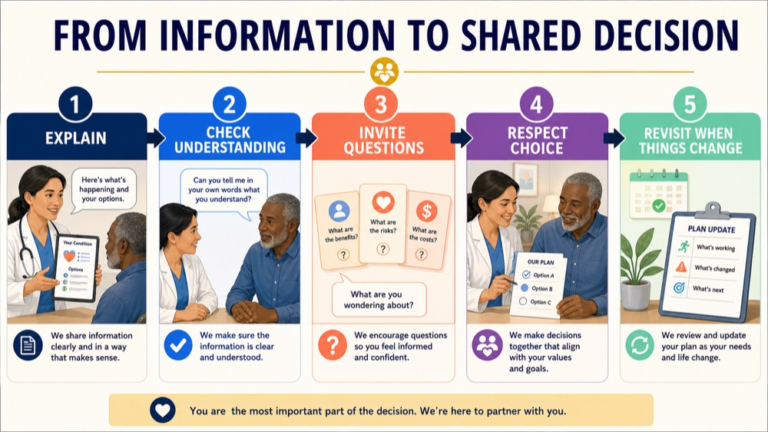
From information to shared decision
Context changes what communication and professional decisions require. A direct question, long explanation, group exchange, classroom task, health-care interaction, family story, noisy routine, supervised procedure, or referral decision places different demands on processing, language, memory, hearing, access, partner behavior, competence, and regulation. Language experience, visual information, fatigue, health literacy, and the opportunity to request clarification should be part of the observation.
A clinic may be starting an evaluation, a school team may be considering a service, a clinician may want to record a session, or a telepractice visit may introduce new privacy and technology questions. The consent question changes with the proposed action and the setting. A signed form can be important evidence, but a responsible process also requires understandable communication, appropriate decision authority, and attention to what has changed.
Observation layer
Example question
Task
What did the person or clinician need to understand, express, organize, coordinate, decide, or provide?
Language and access
Which language, dialect, mode, hearing condition, tool, support, or communication partner was available?
Context and responsibility
Who was involved, what did they know, and which role, policy, ethical, or environmental factor mattered?
Participation and safety
What meaningful routine, role, outcome, or risk became easier or harder because of the pattern?
Context is not an afterthought added once a label has been selected. It is part of the question itself. If performance or decision quality changes with a quieter room, extra processing time, a familiar partner, a different language or mode, an interpreter, visual information, supervision, collaboration, a changed task, or a changed routine, that change is useful evidence about access and demand. It does not identify a cause by itself, but it tells you which conditions should be carried into the next observation.
Apply informed-consent reasoning
When a Praxis-style scenario or clinical discussion presents informed consent speech pathology, use a disciplined sequence. The goal is to select the next clinical question or action that matches the evidence, the person’s priorities, the communication context, and the relevant professional boundary.
Define the task, language, mode, communication purpose, or service responsibility in plain language.
Identify the relevant domain: language, access, partner, participation, assessment, competence, collaboration, ethics, or regulation.
Separate observation from interpretation and write down what remains unknown.
Check history, exposure, dialect, culture, identity, interpreter access, environment, sensory load, memory, task familiarity, training, supervision, and local requirements as relevant.
Choose the assessment, collaboration, accommodation, goal, training, referral, or documentation step that answers the specific question.
State the boundary of the conclusion and keep the person’s safety, autonomy, access, and participation visible.
A clinic may be starting an evaluation, a school team may be considering a service, a clinician may want to record a session, or a telepractice visit may introduce new privacy and technology questions. The consent question changes with the proposed action and the setting. A signed form can be important evidence, but a responsible process also requires understandable communication, appropriate decision authority, and attention to what has changed. In a learning answer, the decisive evidence is usually the relationship among the task, the observed pattern, the context, and the next needed information—not a single isolated behavior, score, label, or broad permission statement.
Common study mistakes
Treating informed consent as a signature collected before the real conversation happens.
Using technical language without checking whether the person or representative understands the decision.
Leaving out meaningful risks, alternatives, limits, privacy implications, or the possibility of declining.
Assuming the nearest family member automatically has authority to authorize disclosure or treatment.
Ignoring language, literacy, communication mode, hearing, vision, culture, or interpreter access.
Failing to revisit consent when the purpose, technology, participants, risk, or information use changes.
Documenting only that consent was obtained and not what was explained, asked, decided, or limited.
Giving a universal legal answer without checking current state, setting, policy, and case-specific requirements.
Most of these mistakes come from replacing a multidomain question with a fast label. Correct the habit by returning to the same sequence: describe, separate, contextualize, ask what is missing, and choose a proportionate next step. A short rationale can make the habit visible: identify the evidence, name the uncertainty, and explain why the selected next step fits the person, setting, and responsibility.
Build a quick review map
Use this compact map when reviewing a missed question, lecture note, or clinical vignette:
Step 1: Name the exact proposed action and why it is being considered.
Step 2: List the information needed for a meaningful decision, including outcomes, risks, alternatives, and limits.
Step 3: Identify the person or representative with decision authority in this setting.
Step 4: Adapt the discussion for language, literacy, mode, access, culture, and communication support.
Step 5: Invite questions and record the decision, participants, boundaries, and setting-specific requirement.
Step 6: Revisit consent when the purpose, plan, technology, risk, or information use changes.
Then write one transfer sentence: “When I see this pattern, I will first check ___ because ___.” The sentence should identify a decision rule, not repeat a definition. Revisit it after a delay and test whether you can apply the rule to a different task, age group, partner, language, setting, or professional responsibility.
Sources and next steps
informed consent speech pathology is best learned as a context-sensitive pattern across communication, access, identity, function, participation, competence, and professional judgment. Use the current authority pages to refine the concept, then return to practice scenarios that require you to explain what the evidence supports and what it leaves open.
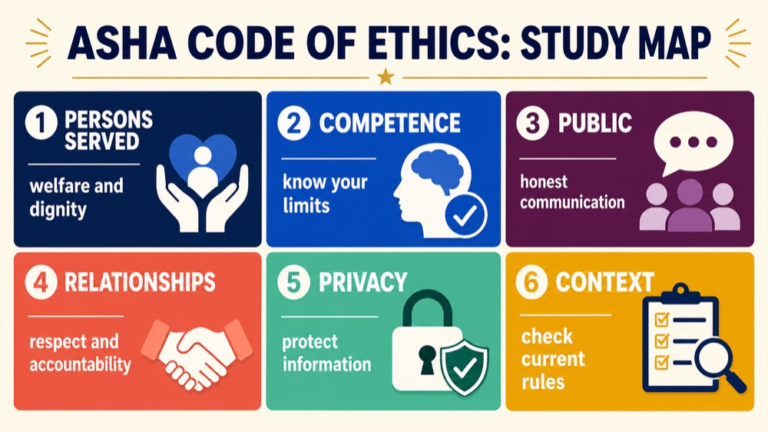
ASHA Code of Ethics: Principles, Rules, and Clinical Reasoning
asha code of ethics is easier to study when it is treated as a connected clinical reasoning problem rather than a label to memorize. The ASHA Code of Ethics gives SLP learners a framework for responsibilities to people served, professional competence, the public, research participants, and professional relationships. Exam questions often test whether you can identify the ethical duty, separate it from a setting-specific rule, and choose a response that protects welfare, honesty, privacy, access, and professional accountability.
This learning guide is written for SLP students and other learners reviewing clinical concepts. It organizes observation, access, assessment, function, and professional judgment; it does not make an individualized diagnosis or replace current professional guidance. Interpretation depends on the person, task, language, culture, health, access, partner, context, and communication goals.
What the ASHA Code of Ethics organizes
Begin by separating the concept into domains. A learner who can name the domains is less likely to collapse language, access, partner, participation, competence, regulation, and clinical judgment into one explanation. The useful unit of analysis is the task: what the person was asked to understand, express, organize, coordinate, remember, or communicate, with whom, under which conditions, and with what support.
Domain or system
What to notice
Question to carry forward
Persons served
Welfare, dignity, access, informed decision-making, and protection from harm remain central to professional conduct.
Who may be affected and what responsibility is primary?
Competence
Professionals recognize the limits of education, training, experience, supervision, and continuing development.
Is the action within this person’s competence?
Public responsibility
Professionals communicate honestly, avoid misrepresentation, and protect public trust in the professions.
What statement or action could mislead the public?
Professional relationships
Colleagues, supervisees, students, assistants, and other professionals deserve respectful, accountable interactions.
Which relationship or responsibility is involved?
Privacy and consent
Information, records, images, and disclosures require attention to confidentiality, authorization, and applicable rules.
What permission and privacy boundary applies?
Context
The Code guides judgment but does not replace current law, licensure, employer, payer, school, facility, or policy requirements.
What additional rule must be checked?
These domains interact, but they should remain distinguishable. A learner may show strength in one context and need support in another. A study map organizes the next observation; it does not answer every assessment question or establish a universal treatment, goal, or legal conclusion.
Keep the first pass descriptive and close to the communication event. Note the task, response, partner, setting, timing, available support, language or mode, and consequence for participation. This gives the learner a stable record to compare across tasks and prevents a familiar term from doing too much explanatory work before the evidence has been separated.
For Praxis-style review, a vignette may include several true details but ask for one best interpretation or next step. The strongest answer usually respects the task, identifies the relevant function or boundary, checks the most important missing information, and avoids treating one performance sample or policy phrase as the whole profile.
Map the ASHA Code of Ethics
For study purposes, describe the communication relationship before naming a disorder, judging a partner, selecting a goal, or deciding that a task is within scope. Record what the person understood, expressed, initiated, repaired, coordinated, or participated in. Then note whether the task was familiar, how much context was shared, and which support changed the response.
Principle I: start with responsibility to persons served and research participants, including welfare, dignity, access, and privacy.
Principle II: check professional competence, honest representation of skills, supervision, training, and continuing development.
Principle III: consider responsibility to the public, truthful communication, public trust, and protection from misleading claims.
Principle IV: consider professional relationships, respectful collaboration, conflicts, supervision, and accountability.
Consent and privacy: identify the person with authority, the information involved, the purpose of disclosure, and the applicable policy or law.
Decision: state the ethical concern, gather the missing facts, consult the right resource, document the process, and choose a proportionate response.
A strong description is specific enough that another learner could picture the event. Instead of writing “the communication is impaired” or “the clinician can do this,” describe the demand, observable response, language or mode, partner, context, competence or access condition, and result. This protects clinical reasoning from labels that are broader than the evidence.
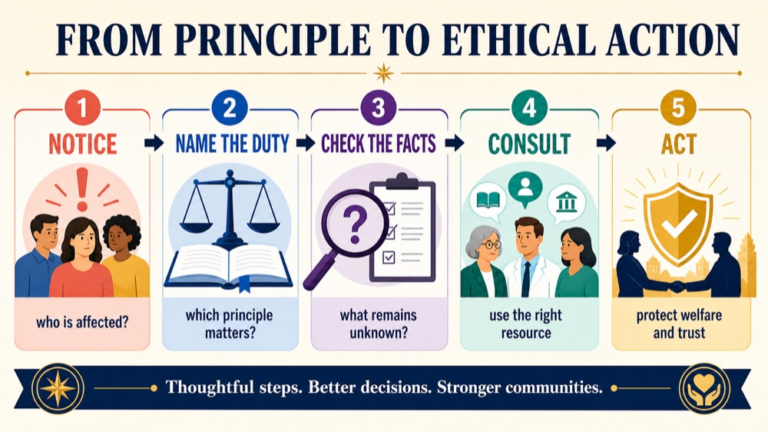
From principle to ethical action
Context changes what communication and professional decisions require. A direct question, long explanation, group exchange, classroom task, health-care interaction, family story, noisy routine, supervised procedure, or referral decision places different demands on processing, language, memory, hearing, access, partner behavior, competence, and regulation. Language experience, visual information, fatigue, health literacy, and the opportunity to request clarification should be part of the observation.
A student may notice a colleague sharing identifiable information, a clinician practicing beyond preparation, a public claim that exaggerates a therapy result, or a disagreement about a professional relationship. The best answer is rarely a slogan. First identify who is served, what information or conduct is involved, which principle or rule is implicated, what facts remain unknown, and what consultation or protective action is appropriate.
Observation layer
Example question
Task
What did the person or clinician need to understand, express, organize, coordinate, decide, or provide?
Language and access
Which language, dialect, mode, hearing condition, tool, support, or communication partner was available?
Context and responsibility
Who was involved, what did they know, and which role, policy, ethical, or environmental factor mattered?
Participation and safety
What meaningful routine, role, outcome, or risk became easier or harder because of the pattern?
Context is not an afterthought added once a label has been selected. It is part of the question itself. If performance or decision quality changes with a quieter room, extra processing time, a familiar partner, a different language or mode, an interpreter, visual information, supervision, collaboration, a changed task, or a changed routine, that change is useful evidence about access and demand. It does not identify a cause by itself, but it tells you which conditions should be carried into the next observation.
Apply Code of Ethics reasoning
When a Praxis-style scenario or clinical discussion presents asha code of ethics, use a disciplined sequence. The goal is to select the next clinical question or action that matches the evidence, the person’s priorities, the communication context, and the relevant professional boundary.
Define the task, language, mode, communication purpose, or service responsibility in plain language.
Identify the relevant domain: language, access, partner, participation, assessment, competence, collaboration, ethics, or regulation.
Separate observation from interpretation and write down what remains unknown.
Check history, exposure, dialect, culture, identity, interpreter access, environment, sensory load, memory, task familiarity, training, supervision, and local requirements as relevant.
Choose the assessment, collaboration, accommodation, goal, training, referral, or documentation step that answers the specific question.
State the boundary of the conclusion and keep the person’s safety, autonomy, access, and participation visible.
A student may notice a colleague sharing identifiable information, a clinician practicing beyond preparation, a public claim that exaggerates a therapy result, or a disagreement about a professional relationship. The best answer is rarely a slogan. First identify who is served, what information or conduct is involved, which principle or rule is implicated, what facts remain unknown, and what consultation or protective action is appropriate. In a learning answer, the decisive evidence is usually the relationship among the task, the observed pattern, the context, and the next needed information—not a single isolated behavior, score, label, or broad permission statement.
Common study mistakes
Memorizing a principle name without connecting it to the facts of the scenario.
Treating the Code as a substitute for current law, licensure, payer, employer, school, or facility policy.
Ignoring competence and assuming good intentions make an unfamiliar task acceptable.
Overlooking privacy, consent, record security, or the identity of the person authorized to decide.
Choosing public confrontation or punishment before gathering facts and using the appropriate process.
Accepting marketing or outcome language that is technically vague or likely to mislead.
Reducing ethics to a single client-facing rule and ignoring professional relationships and public trust.
Giving a legal conclusion when the scenario requires ethical analysis and consultation.
Most of these mistakes come from replacing a multidomain question with a fast label. Correct the habit by returning to the same sequence: describe, separate, contextualize, ask what is missing, and choose a proportionate next step. A short rationale can make the habit visible: identify the evidence, name the uncertainty, and explain why the selected next step fits the person, setting, and responsibility.
Build a quick review map
Use this compact map when reviewing a missed question, lecture note, or clinical vignette:
Step 1: Identify the person served, the professional conduct, and the possible harm or responsibility.
Step 2: Map the facts to the relevant ethical principle, rule, or terminology.
Step 3: Separate the Code from state law, setting policy, payer rules, and other requirements.
Step 4: Check competence, consent, privacy, documentation, supervision, and conflicts as relevant.
Step 5: Gather missing facts and consult an appropriate supervisor, policy, or ethics resource.
Step 6: Choose a respectful, proportionate, documented response that protects welfare and trust.
Then write one transfer sentence: “When I see this pattern, I will first check ___ because ___.” The sentence should identify a decision rule, not repeat a definition. Revisit it after a delay and test whether you can apply the rule to a different task, age group, partner, language, setting, or professional responsibility.
Sources and next steps
asha code of ethics is best learned as a context-sensitive pattern across communication, access, identity, function, participation, competence, and professional judgment. Use the current authority pages to refine the concept, then return to practice scenarios that require you to explain what the evidence supports and what it leaves open.
SLP Roles and Responsibilities: Scope, Competence, and Teamwork
slp roles and responsibilities is easier to study when it is treated as a connected clinical reasoning problem rather than a label to memorize. SLP roles and responsibilities extend beyond naming treatment techniques. They include service delivery, counseling, prevention, screening, assessment, treatment, collaboration, advocacy, education, supervision, research, and leadership. Strong Praxis reasoning matches the role to the person, task, setting, competence, and professional boundary.
This learning guide is written for SLP students and other learners reviewing clinical concepts. It organizes observation, access, assessment, function, and professional judgment; it does not make an individualized diagnosis or replace current professional guidance. Interpretation depends on the person, task, language, culture, health, access, partner, context, and communication goals.
What SLP roles and responsibilities include
Begin by separating the concept into domains. A learner who can name the domains is less likely to collapse language, access, partner, participation, competence, regulation, and clinical judgment into one explanation. The useful unit of analysis is the task: what the person was asked to understand, express, organize, coordinate, remember, or communicate, with whom, under which conditions, and with what support.
Domain or system
What to notice
Question to carry forward
Service delivery
Collaboration, counseling, prevention, screening, assessment, treatment, technology, and systems work may all be part of service delivery.
What service activity is involved?
Practice areas
Speech, fluency, language, cognition, voice, resonance, hearing, feeding, swallowing, literacy, and related needs may intersect.
Which knowledge area does the task require?
Professional practice
Advocacy, outreach, supervision, education, research, administration, and leadership extend beyond one therapy session.
Is this a clinical or professional-practice responsibility?
Person-centered care
The person, family, culture, language, preferences, participation, health, and communication context shape responsible care.
What outcome matters to the person?
Teamwork
SLPs explain their expertise, contribute to shared decisions, use plain language, and coordinate with other professionals.
Who needs to contribute to the next decision?
Boundary
Competence, supervision, referral, licensure, payer, employer, school, facility, privacy, and ethics shape what can happen.
What requirement or limit must be checked?
These domains interact, but they should remain distinguishable. A learner may show strength in one context and need support in another. A study map organizes the next observation; it does not answer every assessment question or establish a universal treatment, goal, or legal conclusion.
Keep the first pass descriptive and close to the communication event. Note the task, response, partner, setting, timing, available support, language or mode, and consequence for participation. This gives the learner a stable record to compare across tasks and prevents a familiar term from doing too much explanatory work before the evidence has been separated.
For Praxis-style review, a vignette may include several true details but ask for one best interpretation or next step. The strongest answer usually respects the task, identifies the relevant function or boundary, checks the most important missing information, and avoids treating one performance sample or policy phrase as the whole profile.
Map SLP roles and responsibilities
For study purposes, describe the communication relationship before naming a disorder, judging a partner, selecting a goal, or deciding that a task is within scope. Record what the person understood, expressed, initiated, repaired, coordinated, or participated in. Then note whether the task was familiar, how much context was shared, and which support changed the response.
Service: identify whether the task involves screening, assessment, treatment, counseling, prevention, technology, collaboration, or systems work.
Practice area: connect the need to speech, fluency, language, cognition, voice, resonance, hearing, feeding, swallowing, literacy, or related function.
Professional role: recognize advocacy, outreach, supervision, education, research, administration, and leadership responsibilities.
Person and family: keep the person’s priorities, language, culture, identity, health, access, safety, and participation visible.
Team: describe the SLP contribution in plain language and coordinate with professionals, families, educators, interpreters, and support personnel.
A strong description is specific enough that another learner could picture the event. Instead of writing “the communication is impaired” or “the clinician can do this,” describe the demand, observable response, language or mode, partner, context, competence or access condition, and result. This protects clinical reasoning from labels that are broader than the evidence.
From role clarity to collaborative care
Context changes what communication and professional decisions require. A direct question, long explanation, group exchange, classroom task, health-care interaction, family story, noisy routine, supervised procedure, or referral decision places different demands on processing, language, memory, hearing, access, partner behavior, competence, and regulation. Language experience, visual information, fatigue, health literacy, and the opportunity to request clarification should be part of the observation.
An SLP may be asked to explain a communication concern to a teacher, participate in an interdisciplinary assessment, support a family’s decision, document a clinical encounter, or identify when another professional should lead a specialized task. These are connected responsibilities, but the correct action depends on the person’s need, the SLP’s preparation, the setting, and the current rules that govern the work.
Observation layer
Example question
Task
What did the person or clinician need to understand, express, organize, coordinate, decide, or provide?
Language and access
Which language, dialect, mode, hearing condition, tool, support, or communication partner was available?
Context and responsibility
Who was involved, what did they know, and which role, policy, ethical, or environmental factor mattered?
Participation and safety
What meaningful routine, role, outcome, or risk became easier or harder because of the pattern?
Context is not an afterthought added once a label has been selected. It is part of the question itself. If performance or decision quality changes with a quieter room, extra processing time, a familiar partner, a different language or mode, an interpreter, visual information, supervision, collaboration, a changed task, or a changed routine, that change is useful evidence about access and demand. It does not identify a cause by itself, but it tells you which conditions should be carried into the next observation.
Apply role-and-responsibility reasoning
When a Praxis-style scenario or clinical discussion presents slp roles and responsibilities, use a disciplined sequence. The goal is to select the next clinical question or action that matches the evidence, the person’s priorities, the communication context, and the relevant professional boundary.
Define the task, language, mode, communication purpose, or service responsibility in plain language.
Identify the relevant domain: language, access, partner, participation, assessment, competence, collaboration, ethics, or regulation.
Separate observation from interpretation and write down what remains unknown.
Check history, exposure, dialect, culture, identity, interpreter access, environment, sensory load, memory, task familiarity, training, supervision, and local requirements as relevant.
Choose the assessment, collaboration, accommodation, goal, training, referral, or documentation step that answers the specific question.
State the boundary of the conclusion and keep the person’s safety, autonomy, access, and participation visible.
An SLP may be asked to explain a communication concern to a teacher, participate in an interdisciplinary assessment, support a family’s decision, document a clinical encounter, or identify when another professional should lead a specialized task. These are connected responsibilities, but the correct action depends on the person’s need, the SLP’s preparation, the setting, and the current rules that govern the work. In a learning answer, the decisive evidence is usually the relationship among the task, the observed pattern, the context, and the next needed information—not a single isolated behavior, score, label, or broad permission statement.
Common study mistakes
Reducing the SLP role to articulation treatment or one narrow therapy technique.
Listing a profession-wide scope as if every individual SLP were competent in every specialty.
Ignoring counseling, prevention, screening, collaboration, advocacy, education, research, or leadership.
Describing services without connecting them to the person’s goals, function, safety, or participation.
Assuming teamwork means the SLP can transfer responsibility without checking competence or oversight.
Confusing a screening role with diagnosis, treatment, or an independent interpretation.
Treating referral as failure instead of a way to protect quality, safety, and person-centered care.
Most of these mistakes come from replacing a multidomain question with a fast label. Correct the habit by returning to the same sequence: describe, separate, contextualize, ask what is missing, and choose a proportionate next step. A short rationale can make the habit visible: identify the evidence, name the uncertainty, and explain why the selected next step fits the person, setting, and responsibility.
Build a quick review map
Use this compact map when reviewing a missed question, lecture note, or clinical vignette:
Step 1: Name the person’s communication or swallowing need and the service activity involved.
Step 2: Map the task to a practice area, service domain, or professional-practice domain.
Step 3: Check the SLP’s education, training, experience, supervision, and task-specific competence.
Step 4: Identify the person, family, team, support, referral, consent, privacy, and documentation needs.
Step 5: Verify current state, payer, employer, school, facility, and ethical requirements.
Step 6: Choose the action that protects access, safety, quality, autonomy, and participation.
Then write one transfer sentence: “When I see this pattern, I will first check ___ because ___.” The sentence should identify a decision rule, not repeat a definition. Revisit it after a delay and test whether you can apply the rule to a different task, age group, partner, language, setting, or professional responsibility.
Sources and next steps
slp roles and responsibilities is best learned as a context-sensitive pattern across communication, access, identity, function, participation, competence, and professional judgment. Use the current authority pages to refine the concept, then return to practice scenarios that require you to explain what the evidence supports and what it leaves open.
Scope of Practice in Speech-Language Pathology: Roles, Competence, and Collaboration
scope of practice speech language pathology is easier to study when it is treated as a connected clinical reasoning problem rather than a label to memorize. Scope of practice in speech-language pathology describes the breadth of professional work, including communication and swallowing across the lifespan, service delivery, professional practice, competence, collaboration, and advocacy. Praxis reasoning requires distinguishing what belongs to the profession from what an individual is competent, authorized, and prepared to do in a specific setting.
This learning guide is written for SLP students and other learners reviewing clinical concepts. It organizes observation, access, assessment, function, and professional judgment; it does not make an individualized diagnosis or replace current professional guidance. Interpretation depends on the person, task, language, culture, health, access, partner, context, and communication goals.
What scope of practice in speech-language pathology covers
Begin by separating the concept into domains. A learner who can name the domains is less likely to collapse language, access, partner, participation, competence, regulation, and clinical judgment into one explanation. The useful unit of analysis is the task: what the person was asked to understand, express, organize, coordinate, remember, or communicate, with whom, under which conditions, and with what support.
Domain or system
What to notice
Question to carry forward
Service domains
Collaboration, counseling, prevention, screening, assessment, treatment, modalities, and population or systems work frame service delivery.
Which service activity and communication need are involved?
Practice areas
Speech, fluency, language, cognition, voice, resonance, hearing, feeding, swallowing, literacy, and related areas may intersect.
What knowledge and skill area does this task require?
Professional domains
Advocacy, outreach, supervision, education, research, administration, and leadership extend beyond a single treatment session.
Is this a clinical service or a professional-practice responsibility?
Competence
Education, training, mentorship, supervision, experience, continuing development, and self-assessment define an individual’s competence.
Can this practitioner perform the task safely and well?
Collaboration and referral
SLPs collaborate with professionals, families, and communities and refer when another expertise or service is needed.
Who should contribute to or lead the next decision?
Regulation and ethics
State licensure, credentialing, payer, employer, school, facility, privacy, and ethical requirements also shape practice.
What local or legal requirement must be checked?
These domains interact, but they should remain distinguishable. A learner may show strength in one context and need support in another. A study map organizes the next observation; it does not answer every assessment question or establish a universal treatment, goal, or legal conclusion.
Keep the first pass descriptive and close to the communication event. Note the task, response, partner, setting, timing, available support, language or mode, and consequence for participation. This gives the learner a stable record to compare across tasks and prevents a familiar term from doing too much explanatory work before the evidence has been separated.
For Praxis-style review, a vignette may include several true details but ask for one best interpretation or next step. The strongest answer usually respects the task, identifies the relevant function or boundary, checks the most important missing information, and avoids treating one performance sample or policy phrase as the whole profile.
Map SLP scope of practice
For study purposes, describe the communication relationship before naming a disorder, judging a partner, selecting a goal, or deciding that a task is within scope. Record what the person understood, expressed, initiated, repaired, coordinated, or participated in. Then note whether the task was familiar, how much context was shared, and which support changed the response.
Service delivery: recognize collaboration, counseling, prevention, screening, assessment, treatment, technology, and systems work.
Practice area: connect the task to speech, fluency, language, cognition, voice, resonance, hearing, feeding, swallowing, or literacy.
Collaboration: include the person, family, educators, health professionals, interpreters, support personnel, and other specialists.
Referral and boundaries: distinguish screening from diagnosis, support from independent interpretation, and collaboration from delegation.
Regulation and ethics: verify state, payer, employer, school, facility, privacy, consent, and professional requirements before action.
A strong description is specific enough that another learner could picture the event. Instead of writing “the communication is impaired” or “the clinician can do this,” describe the demand, observable response, language or mode, partner, context, competence or access condition, and result. This protects clinical reasoning from labels that are broader than the evidence.
From competence to collaborative care
Context changes what communication and professional decisions require. A direct question, long explanation, group exchange, classroom task, health-care interaction, family story, noisy routine, supervised procedure, or referral decision places different demands on processing, language, memory, hearing, access, partner behavior, competence, and regulation. Language experience, visual information, fatigue, health literacy, and the opportunity to request clarification should be part of the observation.
An SLP may have broad professional training but still lack competence in a specialized procedure, population, technology, or setting. A task may also require collaboration with audiology, medicine, education, occupational therapy, psychology, interpreters, or other professionals. The safest exam answer identifies the service and the person’s need, checks competence and applicable requirements, and uses collaboration or referral when the evidence exceeds the clinician’s preparation or authority.
Observation layer
Example question
Task
What did the person or clinician need to understand, express, organize, coordinate, decide, or provide?
Language and access
Which language, dialect, mode, hearing condition, tool, support, or communication partner was available?
Context and responsibility
Who was involved, what did they know, and which role, policy, ethical, or environmental factor mattered?
Participation and safety
What meaningful routine, role, outcome, or risk became easier or harder because of the pattern?
Context is not an afterthought added once a label has been selected. It is part of the question itself. If performance or decision quality changes with a quieter room, extra processing time, a familiar partner, a different language or mode, an interpreter, visual information, supervision, collaboration, a changed task, or a changed routine, that change is useful evidence about access and demand. It does not identify a cause by itself, but it tells you which conditions should be carried into the next observation.
Apply scope-of-practice reasoning
When a Praxis-style scenario or clinical discussion presents scope of practice speech language pathology, use a disciplined sequence. The goal is to select the next clinical question or action that matches the evidence, the person’s priorities, the communication context, and the relevant professional boundary.
Define the task, language, mode, communication purpose, or service responsibility in plain language.
Identify the relevant domain: language, access, partner, participation, assessment, competence, collaboration, ethics, or regulation.
Separate observation from interpretation and write down what remains unknown.
Check history, exposure, dialect, culture, identity, interpreter access, environment, sensory load, memory, task familiarity, training, supervision, and local requirements as relevant.
Choose the assessment, collaboration, accommodation, goal, training, referral, or documentation step that answers the specific question.
State the boundary of the conclusion and keep the person’s safety, autonomy, access, and participation visible.
An SLP may have broad professional training but still lack competence in a specialized procedure, population, technology, or setting. A task may also require collaboration with audiology, medicine, education, occupational therapy, psychology, interpreters, or other professionals. The safest exam answer identifies the service and the person’s need, checks competence and applicable requirements, and uses collaboration or referral when the evidence exceeds the clinician’s preparation or authority. In a learning answer, the decisive evidence is usually the relationship among the task, the observed pattern, the context, and the next needed information—not a single isolated behavior, score, label, or broad permission statement.
Common study mistakes
Treating a profession-wide scope document as proof that every individual SLP is competent in every task.
Confusing the SLP’s scope with state licensure, payer policy, employer policy, school requirements, or facility rules.
Calling a screening result a diagnosis or delegating an interpretive decision to support personnel without proper oversight.
Ignoring competence, supervision, continuing development, self-assessment, and the limits of training.
Assuming collaboration removes the SLP’s responsibility for the parts of service they provide.
Treating referrals as failure instead of an appropriate way to protect safety, quality, and person-centered care.
Listing practice areas without connecting them to the person, task, function, communication, or swallowing need.
Giving a legal or regulatory conclusion without checking the current jurisdiction and setting-specific requirement.
Most of these mistakes come from replacing a multidomain question with a fast label. Correct the habit by returning to the same sequence: describe, separate, contextualize, ask what is missing, and choose a proportionate next step. A short rationale can make the habit visible: identify the evidence, name the uncertainty, and explain why the selected next step fits the person, setting, and responsibility.
Build a quick review map
Use this compact map when reviewing a missed question, lecture note, or clinical vignette:
Step 1: Name the person’s communication or swallowing need and the service activity involved.
Step 2: Map the task to a practice area, service domain, or professional-practice domain.
Step 3: Check the individual clinician’s education, training, experience, supervision, and competence.
Step 5: Verify current state, payer, employer, school, facility, and ethical requirements.
Step 6: Choose the action that protects access, safety, quality, autonomy, and functional participation.
Then write one transfer sentence: “When I see this pattern, I will first check ___ because ___.” The sentence should identify a decision rule, not repeat a definition. Revisit it after a delay and test whether you can apply the rule to a different task, age group, partner, language, setting, or professional responsibility.
Sources and next steps
scope of practice speech language pathology is best learned as a context-sensitive pattern across communication, access, identity, function, participation, competence, and professional judgment. Use the current authority pages to refine the concept, then return to practice scenarios that require you to explain what the evidence supports and what it leaves open.
Participation-Based Communication Goals: From Function to Action
participation based communication goals is easier to study when it is treated as a connected clinical reasoning problem rather than a label to memorize. Participation based communication goals connect a person’s priorities to meaningful activities and roles. A strong goal describes what the person wants or needs to do, with whom, in which context, using which communication supports, and how progress will be observed without hiding the person’s voice behind a decontextualized score.
This learning guide is written for SLP students and other learners reviewing clinical concepts. It organizes observation, access, assessment, function, and professional judgment; it does not make an individualized diagnosis or replace current professional guidance. Interpretation depends on the person, task, language, culture, health, access, partner, context, and communication goals.
What participation based communication goals include
Begin by separating the concept into domains. A learner who can name the domains is less likely to collapse language, access, partner, participation, competence, regulation, and clinical judgment into one explanation. The useful unit of analysis is the task: what the person was asked to understand, express, organize, coordinate, remember, or communicate, with whom, under which conditions, and with what support.
Domain or system
What to notice
Question to carry forward
Meaningful activity
The goal begins with a real routine, relationship, role, or life situation that matters to the person.
What activity or role should become more accessible?
Person priority
The person and family identify values, preferences, identity, interests, and outcomes that make the goal meaningful.
Whose goal is it and why does it matter?
Communication demand
The activity may require initiating, understanding, expressing, repairing, negotiating, remembering, or using multiple modes.
What communication does the activity actually require?
Environment and partners
Listeners, routines, tools, noise, time, attitudes, and accommodations can facilitate or restrict participation.
Which support or barrier belongs in the plan?
Observable measure
A useful measure specifies the response, context, support, criterion, and data source while preserving meaning.
How will change be observed in the routine?
Generalization
Progress should travel beyond practice tasks to people, places, topics, demands, and future roles.
Where should the skill or strategy be used next?
These domains interact, but they should remain distinguishable. A learner may show strength in one context and need support in another. A study map organizes the next observation; it does not answer every assessment question or establish a universal treatment, goal, or legal conclusion.
Keep the first pass descriptive and close to the communication event. Note the task, response, partner, setting, timing, available support, language or mode, and consequence for participation. This gives the learner a stable record to compare across tasks and prevents a familiar term from doing too much explanatory work before the evidence has been separated.
For Praxis-style review, a vignette may include several true details but ask for one best interpretation or next step. The strongest answer usually respects the task, identifies the relevant function or boundary, checks the most important missing information, and avoids treating one performance sample or policy phrase as the whole profile.
Map participation based communication goals
For study purposes, describe the communication relationship before naming a disorder, judging a partner, selecting a goal, or deciding that a task is within scope. Record what the person understood, expressed, initiated, repaired, coordinated, or participated in. Then note whether the task was familiar, how much context was shared, and which support changed the response.
Priority: begin with the person’s and family’s meaningful activity, role, relationship, identity, and desired participation.
Demand: break the routine into understanding, expression, initiation, turn-taking, repair, memory, literacy, and decision demands.
Access: include speech, AAC, signs, gestures, writing, visual supports, interpreters, technology, and partner strategies as appropriate.
Environment: document physical, social, attitudinal, temporal, linguistic, and sensory factors that enable or block participation.
Measurement: specify the response, context, assistance, opportunity, criterion, and meaningful data source without reducing the person to a percentage.
Generalization: plan practice and observation across familiar and unfamiliar partners, settings, topics, and changing demands.
A strong description is specific enough that another learner could picture the event. Instead of writing “the communication is impaired” or “the clinician can do this,” describe the demand, observable response, language or mode, partner, context, competence or access condition, and result. This protects clinical reasoning from labels that are broader than the evidence.
From activity to measurable goal
Context changes what communication and professional decisions require. A direct question, long explanation, group exchange, classroom task, health-care interaction, family story, noisy routine, supervised procedure, or referral decision places different demands on processing, language, memory, hearing, access, partner behavior, competence, and regulation. Language experience, visual information, fatigue, health literacy, and the opportunity to request clarification should be part of the observation.
A goal such as “improve pragmatic language” names a broad area but does not show the activity or role the person wants to access. A participation-based goal might describe joining a club, contributing an idea during a family planning conversation, communicating a health concern, asking for clarification in class, or using a multimodal system to participate with friends. The measure should make progress observable while keeping the real-life purpose in view.
Observation layer
Example question
Task
What did the person or clinician need to understand, express, organize, coordinate, decide, or provide?
Language and access
Which language, dialect, mode, hearing condition, tool, support, or communication partner was available?
Context and responsibility
Who was involved, what did they know, and which role, policy, ethical, or environmental factor mattered?
Participation and safety
What meaningful routine, role, outcome, or risk became easier or harder because of the pattern?
Context is not an afterthought added once a label has been selected. It is part of the question itself. If performance or decision quality changes with a quieter room, extra processing time, a familiar partner, a different language or mode, an interpreter, visual information, supervision, collaboration, a changed task, or a changed routine, that change is useful evidence about access and demand. It does not identify a cause by itself, but it tells you which conditions should be carried into the next observation.
Apply goal-setting reasoning
When a Praxis-style scenario or clinical discussion presents participation based communication goals, use a disciplined sequence. The goal is to select the next clinical question or action that matches the evidence, the person’s priorities, the communication context, and the relevant professional boundary.
Define the task, language, mode, communication purpose, or service responsibility in plain language.
Identify the relevant domain: language, access, partner, participation, assessment, competence, collaboration, ethics, or regulation.
Separate observation from interpretation and write down what remains unknown.
Check history, exposure, dialect, culture, identity, interpreter access, environment, sensory load, memory, task familiarity, training, supervision, and local requirements as relevant.
Choose the assessment, collaboration, accommodation, goal, training, referral, or documentation step that answers the specific question.
State the boundary of the conclusion and keep the person’s safety, autonomy, access, and participation visible.
A goal such as “improve pragmatic language” names a broad area but does not show the activity or role the person wants to access. A participation-based goal might describe joining a club, contributing an idea during a family planning conversation, communicating a health concern, asking for clarification in class, or using a multimodal system to participate with friends. The measure should make progress observable while keeping the real-life purpose in view. In a learning answer, the decisive evidence is usually the relationship among the task, the observed pattern, the context, and the next needed information—not a single isolated behavior, score, label, or broad permission statement.
Common study mistakes
Writing goals from a disorder label without identifying a meaningful activity, role, relationship, or person priority.
Using vague verbs such as improve, increase, or understand without describing an observable communication response.
Measuring a decontextualized clinic task and calling it participation progress.
Leaving out communication mode, partner, environmental support, language, culture, or access conditions.
Writing a goal for the clinician or caregiver rather than for the person’s communication and participation.
Treating independence as the only valid outcome and ignoring helpful partners, tools, accommodations, and teamwork.
Choosing a percentage criterion that is precise but unrelated to the activity’s actual success.
Failing to plan how progress will generalize across people, places, topics, roles, and future routines.
Most of these mistakes come from replacing a multidomain question with a fast label. Correct the habit by returning to the same sequence: describe, separate, contextualize, ask what is missing, and choose a proportionate next step. A short rationale can make the habit visible: identify the evidence, name the uncertainty, and explain why the selected next step fits the person, setting, and responsibility.
Build a quick review map
Use this compact map when reviewing a missed question, lecture note, or clinical vignette:
Step 1: Name the person’s meaningful activity, role, relationship, and priority.
Step 2: Describe the communication demand and the modes or supports available.
Step 4: Write an observable response with a context, support level, criterion, and data source.
Step 5: Check that the measure reflects meaningful participation rather than task completion alone.
Step 6: Plan generalization and revisit the goal with the person and family as priorities change.
Then write one transfer sentence: “When I see this pattern, I will first check ___ because ___.” The sentence should identify a decision rule, not repeat a definition. Revisit it after a delay and test whether you can apply the rule to a different task, age group, partner, language, setting, or professional responsibility.
Sources and next steps
participation based communication goals is best learned as a context-sensitive pattern across communication, access, identity, function, participation, competence, and professional judgment. Use the current authority pages to refine the concept, then return to practice scenarios that require you to explain what the evidence supports and what it leaves open.
Start with asha icf social communication, asha aac, ets 5331 study companion. These sources support the learning frame; they do not replace current topic-specific guidance, an individualized evaluation, or applicable state and setting requirements.