Service Delivery Models in Speech Pathology: Match the Mode to the Need
service delivery models speech pathology is easier to study when it is treated as a connected clinical reasoning problem rather than a label to memorize. Service delivery models in speech pathology describe how services are organized: who participates, where the work occurs, how often and how intensely it happens, and how providers collaborate. The central exam and clinical reasoning point is that no single model is best for every person. Patient or student needs, functional outcomes, clinical appropriateness, evidence, communication access, and applicable payment or setting constraints should drive the decision.
This learning guide is written for SLP students and other learners reviewing clinical concepts. It organizes observation, access, assessment, function, and professional judgment; it does not make an individualized diagnosis or replace current professional guidance. Interpretation depends on the person, task, language, culture, health, access, partner, context, and communication goals.
What service delivery models in speech pathology include
Begin by separating the concept into domains. A learner who can name the domains is less likely to collapse language, access, partner, participation, competence, regulation, and clinical judgment into one explanation. The useful unit of analysis is the task: what the person was asked to understand, express, organize, coordinate, remember, or communicate, with whom, under which conditions, and with what support.
Domain or system
What to notice
Question to carry forward
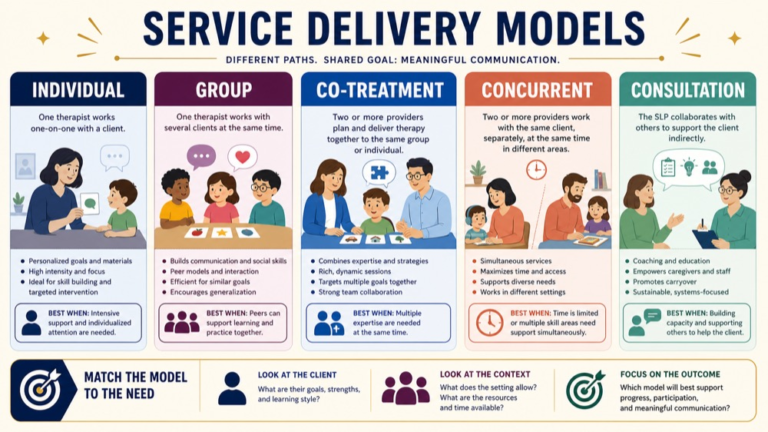
Individual
One clinician works directly with one person, allowing focused practice, individualized pacing, and close observation when that fits the goal.
What benefit requires individual attention in this case?
Group
Several people receive services together when goals, communication needs, compatibility, and the setting make the group clinically appropriate.
What shared goal and interaction benefit justify this group?
Co-treatment
Two disciplines coordinate services when their complementary expertise supports a functional outcome and roles remain clear.
What outcome is improved by the coordinated expertise?
Concurrent
A clinician works with more than one person at the same time under applicable rules, with individualized rationale and attention to safety and participation.
What makes this arrangement clinically appropriate rather than merely efficient?
Setting and dosage
Location, frequency, intensity, duration, schedule, and task structure can change as the person’s needs and performance change.
Which variable should change to support access or generalization?
Functional outcome
The model should connect to communication, learning, health, work, relationships, independence, safety, or another meaningful participation result.
How will the model change real-world participation?
These domains interact, but they should remain distinguishable. A learner may show strength in one context and need support in another. A study map organizes the next observation; it does not answer every assessment question or establish a universal treatment, goal, or legal conclusion.
Keep the first pass descriptive and close to the communication event. Note the task, response, partner, setting, timing, available support, language or mode, and consequence for participation. This gives the learner a stable record to compare across tasks and prevents a familiar term from doing too much explanatory work before the evidence has been separated.
For Praxis-style review, a vignette may include several true details but ask for one best interpretation or next step. The strongest answer usually respects the task, identifies the relevant function or boundary, checks the most important missing information, and avoids treating one performance sample or policy phrase as the whole profile.
Map service delivery models in speech pathology
For study purposes, describe the communication relationship before naming a disorder, judging a partner, selecting a goal, or deciding that a task is within scope. Record what the person understood, expressed, initiated, repaired, coordinated, or participated in. Then note whether the task was familiar, how much context was shared, and which support changed the response.
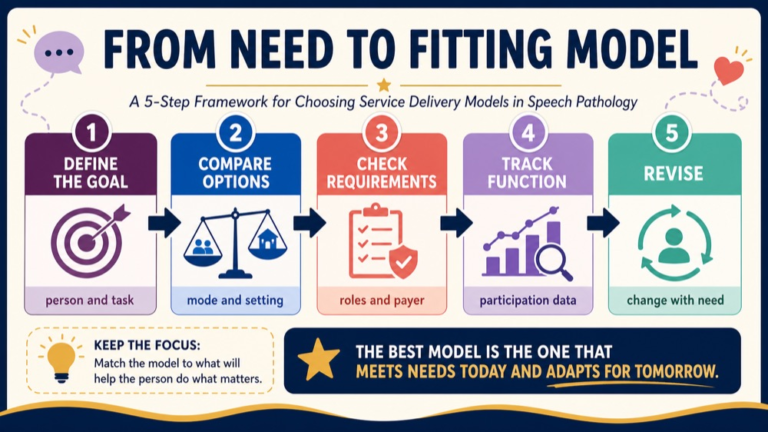
Need: define the person’s goal, communication partner, task, diagnosis or difference, participation context, and clinical risk.
Mode: compare individual, group, co-treatment, concurrent, consultation, classroom, telepractice, and other options without assuming a default.
Dosage: consider frequency, intensity, duration, schedule, and progression, then connect each choice to the person’s response and target.
Setting: ask whether the therapy room, classroom, home, workplace, community, health-care unit, or online environment supports generalization and access.
Team and payer: clarify roles, communication, documentation, consent, coding, reimbursement, supervision, and local requirements.
Outcome and revision: collect functional evidence and change the model when the person’s needs, progress, access, or participation changes.
A strong description is specific enough that another learner could picture the event. Instead of writing “the communication is impaired” or “the clinician can do this,” describe the demand, observable response, language or mode, partner, context, competence or access condition, and result. This protects clinical reasoning from labels that are broader than the evidence.
From clinical need to a fitting service model
Context changes what communication and professional decisions require. A direct question, long explanation, group exchange, classroom task, health-care interaction, family story, noisy routine, supervised procedure, or referral decision places different demands on processing, language, memory, hearing, access, partner behavior, competence, and regulation. Language experience, visual information, fatigue, health literacy, and the opportunity to request clarification should be part of the observation.
A student who needs to learn a new narrative structure may benefit from a focused lesson, while a student who needs to use that structure during classroom discussion may need collaborative or classroom-based support. An adult may need individual swallowing assessment but later benefit from coordinated care with nursing, dietetics, or another discipline. The model is not selected because one format is fashionable or easy to schedule; it is selected because the format, dose, setting, provider roles, and functional outcome fit the evidence and requirements.
Observation layer
Example question
Task
What did the person or clinician need to understand, express, organize, coordinate, decide, or provide?
Language and access
Which language, dialect, mode, hearing condition, tool, support, or communication partner was available?
Context and responsibility
Who was involved, what did they know, and which role, policy, ethical, or environmental factor mattered?
Participation and safety
What meaningful routine, role, outcome, or risk became easier or harder because of the pattern?
Context is not an afterthought added once a label has been selected. It is part of the question itself. If performance or decision quality changes with a quieter room, extra processing time, a familiar partner, a different language or mode, an interpreter, visual information, supervision, collaboration, a changed task, or a changed routine, that change is useful evidence about access and demand. It does not identify a cause by itself, but it tells you which conditions should be carried into the next observation.
Apply service-delivery reasoning
When a Praxis-style scenario or clinical discussion presents service delivery models speech pathology, use a disciplined sequence. The goal is to select the next clinical question or action that matches the evidence, the person’s priorities, the communication context, and the relevant professional boundary.
Define the task, language, mode, communication purpose, or service responsibility in plain language.
Identify the relevant domain: language, access, partner, participation, assessment, competence, collaboration, ethics, or regulation.
Separate observation from interpretation and write down what remains unknown.
Check history, exposure, dialect, culture, identity, interpreter access, environment, sensory load, memory, task familiarity, training, supervision, and local requirements as relevant.
Choose the assessment, collaboration, accommodation, goal, training, referral, or documentation step that answers the specific question.
State the boundary of the conclusion and keep the person’s safety, autonomy, access, and participation visible.
A student who needs to learn a new narrative structure may benefit from a focused lesson, while a student who needs to use that structure during classroom discussion may need collaborative or classroom-based support. An adult may need individual swallowing assessment but later benefit from coordinated care with nursing, dietetics, or another discipline. The model is not selected because one format is fashionable or easy to schedule; it is selected because the format, dose, setting, provider roles, and functional outcome fit the evidence and requirements. In a learning answer, the decisive evidence is usually the relationship among the task, the observed pattern, the context, and the next needed information—not a single isolated behavior, score, label, or broad permission statement.
Common study mistakes
Treating individual therapy as automatically superior or group therapy as automatically less intensive or less individualized.
Choosing a group because it fills a schedule without checking goal compatibility, safety, communication access, or expected benefit.
Calling two providers a co-treatment team without defining complementary roles, shared outcomes, documentation, and clinical rationale.
Using concurrent care to solve an operational problem while overlooking individual needs, payer rules, privacy, and the quality of interaction.
Changing frequency, duration, location, or intensity without connecting the change to data, goals, participation, and the governing plan.
Measuring success by minutes delivered or attendance alone instead of functional response and generalization.
Assuming one model must remain fixed even when the person’s needs, context, access, or progress has changed.
Ignoring the difference between clinical judgment and permission under a payer, school, facility, licensure, or employer rule.
Most of these mistakes come from replacing a multidomain question with a fast label. Correct the habit by returning to the same sequence: describe, separate, contextualize, ask what is missing, and choose a proportionate next step. A short rationale can make the habit visible: identify the evidence, name the uncertainty, and explain why the selected next step fits the person, setting, and responsibility.
Build a quick review map
Use this compact map when reviewing a missed question, lecture note, or clinical vignette:
Step 1: State the functional goal, person, partners, task, setting, access needs, and risk.
Step 2: List the service modes that could address the goal and the specific benefit or limitation of each.
Step 3: Choose the mode, setting, provider roles, and dosage that are clinically justified by the person’s evidence.
Step 4: Check collaboration, consent, documentation, coding, payer, school, facility, supervision, and local requirements.
Step 5: Predict how the selected model should change participation or safety and choose data to observe that change.
Step 6: Revisit the model as the person progresses, struggles, generalizes, or encounters a changed context.
Then write one transfer sentence: “When I see this pattern, I will first check ___ because ___.” The sentence should identify a decision rule, not repeat a definition. Revisit it after a delay and test whether you can apply the rule to a different task, age group, partner, language, setting, or professional responsibility.
Sources and next steps
service delivery models speech pathology is best learned as a context-sensitive pattern across communication, access, identity, function, participation, competence, and professional judgment. Use the current authority pages to refine the concept, then return to practice scenarios that require you to explain what the evidence supports and what it leaves open.
Telepractice in Speech-Language Pathology: Access, Quality, and Clinical Fit
telepractice in speech language pathology is easier to study when it is treated as a connected clinical reasoning problem rather than a label to memorize. Telepractice in speech-language pathology is a way to deliver screening, assessment, intervention, consultation, or education through telecommunications and internet technology. It is not a shortcut around clinical reasoning. The SLP still has to determine whether the person, task, technology, environment, partner support, privacy conditions, and jurisdiction make the service appropriate and comparable in quality to an in-person option.
This learning guide is written for SLP students and other learners reviewing clinical concepts. It organizes observation, access, assessment, function, and professional judgment; it does not make an individualized diagnosis or replace current professional guidance. Interpretation depends on the person, task, language, culture, health, access, partner, context, and communication goals.
What telepractice in speech-language pathology includes
Begin by separating the concept into domains. A learner who can name the domains is less likely to collapse language, access, partner, participation, competence, regulation, and clinical judgment into one explanation. The useful unit of analysis is the task: what the person was asked to understand, express, organize, coordinate, remember, or communicate, with whom, under which conditions, and with what support.
Domain or system
What to notice
Question to carry forward
Mode
Telepractice may be synchronous, asynchronous, hybrid, or combined with in-person services depending on the clinical purpose.
Which format actually supports this person and task?
Appropriateness
Client goals, comfort, technology access, communication mode, sensory and cognitive demands, safety, and available support affect fit.
Can the person participate meaningfully under these conditions?
Quality
The service should meet the same professional standard and address the same clinical purpose as an appropriate in-person alternative.
What evidence shows the selected mode is effective and usable here?
Access
Device, bandwidth, hearing, vision, language, literacy, AAC, positioning, facilitator, and environment can enable or block participation.
What support or barrier changes the interaction?
Privacy and consent
The clinician and organization must consider confidentiality, informed consent, platform security, location, records, and communication with care partners.
Who can hear, see, record, or receive this information?
Authorization
Licensure, compact privilege, payer, school, employer, facility, and local requirements can apply to both clinician and client location.
Which current rule must be checked before service begins?
These domains interact, but they should remain distinguishable. A learner may show strength in one context and need support in another. A study map organizes the next observation; it does not answer every assessment question or establish a universal treatment, goal, or legal conclusion.
Keep the first pass descriptive and close to the communication event. Note the task, response, partner, setting, timing, available support, language or mode, and consequence for participation. This gives the learner a stable record to compare across tasks and prevents a familiar term from doing too much explanatory work before the evidence has been separated.
For Praxis-style review, a vignette may include several true details but ask for one best interpretation or next step. The strongest answer usually respects the task, identifies the relevant function or boundary, checks the most important missing information, and avoids treating one performance sample or policy phrase as the whole profile.
Map telepractice in speech-language pathology
For study purposes, describe the communication relationship before naming a disorder, judging a partner, selecting a goal, or deciding that a task is within scope. Record what the person understood, expressed, initiated, repaired, coordinated, or participated in. Then note whether the task was familiar, how much context was shared, and which support changed the response.
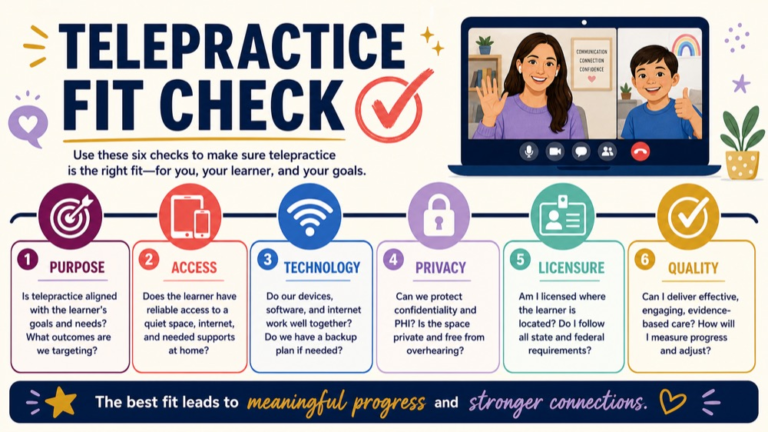
Purpose: define whether the encounter is screening, assessment, intervention, consultation, education, monitoring, or another service.
Person and task: consider communication mode, hearing and vision, cognition, motor access, comfort, health, language, attention, and the demands of the task.
Technology: test the platform, audio, video, device, connectivity, materials, privacy controls, and backup plan before relying on them.
Facilitation: decide whether an on-site facilitator or care partner is needed, what that person may do, and how independence and privacy will be protected.
Quality and data: compare performance and participation under the selected mode, document barriers, and adjust the service rather than assuming the technology is neutral.
Requirements: check clinician and client location, licensure or compact status, consent, payer, school, employer, facility, accessibility, and emergency procedures.
A strong description is specific enough that another learner could picture the event. Instead of writing “the communication is impaired” or “the clinician can do this,” describe the demand, observable response, language or mode, partner, context, competence or access condition, and result. This protects clinical reasoning from labels that are broader than the evidence.
From access check to comparable care
Context changes what communication and professional decisions require. A direct question, long explanation, group exchange, classroom task, health-care interaction, family story, noisy routine, supervised procedure, or referral decision places different demands on processing, language, memory, hearing, access, partner behavior, competence, and regulation. Language experience, visual information, fatigue, health literacy, and the opportunity to request clarification should be part of the observation.
A child may engage well in a video game but struggle when the microphone clips final consonants or the facilitator gives too many prompts. An adult may have reliable internet but no private place for a health conversation. A telepractice decision therefore cannot be based on the presence of a device alone. The clinician should identify the task, check whether the mode permits valid observation and participation, reduce avoidable barriers, protect privacy, and reassess whether the service remains appropriate when the context changes.
Observation layer
Example question
Task
What did the person or clinician need to understand, express, organize, coordinate, decide, or provide?
Language and access
Which language, dialect, mode, hearing condition, tool, support, or communication partner was available?
Context and responsibility
Who was involved, what did they know, and which role, policy, ethical, or environmental factor mattered?
Participation and safety
What meaningful routine, role, outcome, or risk became easier or harder because of the pattern?
Context is not an afterthought added once a label has been selected. It is part of the question itself. If performance or decision quality changes with a quieter room, extra processing time, a familiar partner, a different language or mode, an interpreter, visual information, supervision, collaboration, a changed task, or a changed routine, that change is useful evidence about access and demand. It does not identify a cause by itself, but it tells you which conditions should be carried into the next observation.
Apply telepractice reasoning
When a Praxis-style scenario or clinical discussion presents telepractice in speech language pathology, use a disciplined sequence. The goal is to select the next clinical question or action that matches the evidence, the person’s priorities, the communication context, and the relevant professional boundary.
Define the task, language, mode, communication purpose, or service responsibility in plain language.
Identify the relevant domain: language, access, partner, participation, assessment, competence, collaboration, ethics, or regulation.
Separate observation from interpretation and write down what remains unknown.
Check history, exposure, dialect, culture, identity, interpreter access, environment, sensory load, memory, task familiarity, training, supervision, and local requirements as relevant.
Choose the assessment, collaboration, accommodation, goal, training, referral, or documentation step that answers the specific question.
State the boundary of the conclusion and keep the person’s safety, autonomy, access, and participation visible.
A child may engage well in a video game but struggle when the microphone clips final consonants or the facilitator gives too many prompts. An adult may have reliable internet but no private place for a health conversation. A telepractice decision therefore cannot be based on the presence of a device alone. The clinician should identify the task, check whether the mode permits valid observation and participation, reduce avoidable barriers, protect privacy, and reassess whether the service remains appropriate when the context changes. In a learning answer, the decisive evidence is usually the relationship among the task, the observed pattern, the context, and the next needed information—not a single isolated behavior, score, label, or broad permission statement.
Common study mistakes
Treating telepractice as automatically equivalent to in-person care without checking the person, task, technology, access, and safety conditions.
Assuming that a working camera and microphone prove valid assessment or effective intervention.
Ignoring the client’s location, clinician’s location, licensure, compact privilege, payer, school, employer, or facility rules.
Using a family member or facilitator without clarifying role, consent, confidentiality, training, and the person’s communication preferences.
Failing to plan for connection loss, platform failure, emergency location, privacy changes, or a need to switch modes.
Confusing participation in a preferred online activity with evidence that every telepractice task is accessible.
Using the same materials, screen layout, timing, prompting, or group format online without checking how the medium changes the demand.
Assuming a remote service is ethical because it is convenient for the provider, even when it is not usable or safe for the person.
Most of these mistakes come from replacing a multidomain question with a fast label. Correct the habit by returning to the same sequence: describe, separate, contextualize, ask what is missing, and choose a proportionate next step. A short rationale can make the habit visible: identify the evidence, name the uncertainty, and explain why the selected next step fits the person, setting, and responsibility.
Build a quick review map
Use this compact map when reviewing a missed question, lecture note, or clinical vignette:
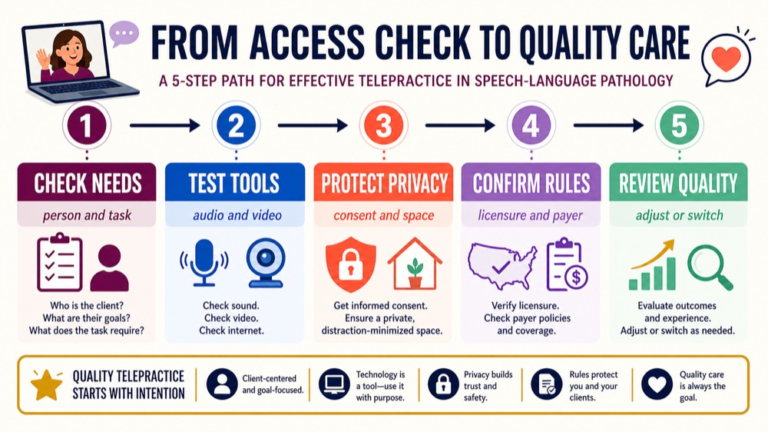
Step 1: Name the service purpose, person, communication mode, task, setting, and desired participation outcome.
Step 3: Determine whether the person can participate and whether the selected mode supports valid clinical observation or treatment.
Step 4: Confirm consent, licensure or compact status, payer, school, employer, facility, accessibility, and emergency requirements.
Step 5: Use a backup or alternate mode when barriers compromise quality, safety, privacy, or meaningful participation.
Step 6: Document the rationale, supports, observed response, limitations, and conditions for revisiting the decision.
Then write one transfer sentence: “When I see this pattern, I will first check ___ because ___.” The sentence should identify a decision rule, not repeat a definition. Revisit it after a delay and test whether you can apply the rule to a different task, age group, partner, language, setting, or professional responsibility.
Sources and next steps
telepractice in speech language pathology is best learned as a context-sensitive pattern across communication, access, identity, function, participation, competence, and professional judgment. Use the current authority pages to refine the concept, then return to practice scenarios that require you to explain what the evidence supports and what it leaves open.
Supervision in Speech-Language Pathology: Competence, Feedback, and Client Welfare
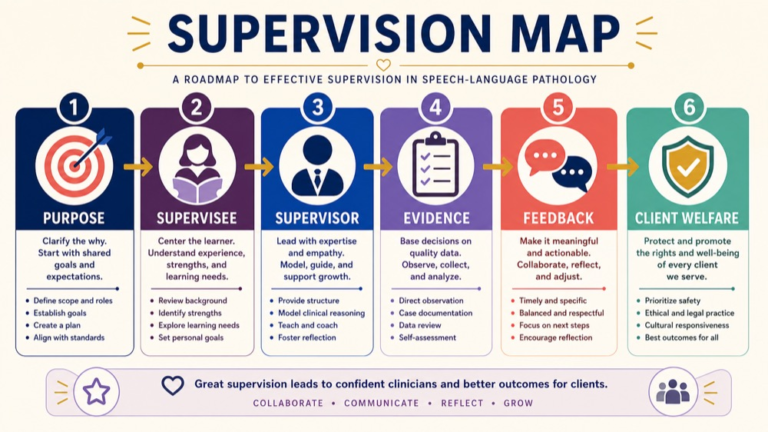
supervision in speech language pathology is easier to study when it is treated as a connected clinical reasoning problem rather than a label to memorize. Supervision in speech-language pathology is a structured, collaborative process that supports the supervisee’s growth while protecting the quality and safety of services. It is more than watching a session or signing a form. Effective supervision connects the learner’s knowledge, skill, judgment, and self-evaluation to the client’s needs, the task, the setting, and the requirements governing the role.
This learning guide is written for SLP students and other learners reviewing clinical concepts. It organizes observation, access, assessment, function, and professional judgment; it does not make an individualized diagnosis or replace current professional guidance. Interpretation depends on the person, task, language, culture, health, access, partner, context, and communication goals.
What supervision in speech-language pathology includes
Begin by separating the concept into domains. A learner who can name the domains is less likely to collapse language, access, partner, participation, competence, regulation, and clinical judgment into one explanation. The useful unit of analysis is the task: what the person was asked to understand, express, organize, coordinate, remember, or communicate, with whom, under which conditions, and with what support.
Domain or system
What to notice
Question to carry forward
Purpose
Supervision supports professional growth, clinical reasoning, self-analysis, self-evaluation, problem solving, and quality service to the person served.
What learning or client-welfare purpose does this supervisory action serve?
Supervisee
The learner’s knowledge, experience, competence, expectations, goals, and developmental needs shape the supervision plan.
What does this supervisee know, do, and still need to practice?
Supervisor
The supervisor needs relevant clinical and supervisory competence, preparation, accountability, and awareness of power and responsibility.
Is the supervisor prepared and authorized for this role?
Observation and data
Direct observation, records, work samples, client response, and structured discussion make feedback specific rather than impressionistic.
What evidence supports the feedback or next teaching step?
Relationship
Respectful communication, shared goals, feedback, reflection, and appropriate challenge create a working relationship that supports learning.
How can the relationship increase independent thinking rather than dependence?
Client welfare
Supervision must be commensurate with competence and risk so that the person served receives ethical, effective, and appropriately supported care.
What level and type of oversight protects the client here?
These domains interact, but they should remain distinguishable. A learner may show strength in one context and need support in another. A study map organizes the next observation; it does not answer every assessment question or establish a universal treatment, goal, or legal conclusion.
Keep the first pass descriptive and close to the communication event. Note the task, response, partner, setting, timing, available support, language or mode, and consequence for participation. This gives the learner a stable record to compare across tasks and prevents a familiar term from doing too much explanatory work before the evidence has been separated.
For Praxis-style review, a vignette may include several true details but ask for one best interpretation or next step. The strongest answer usually respects the task, identifies the relevant function or boundary, checks the most important missing information, and avoids treating one performance sample or policy phrase as the whole profile.
Map supervision in speech-language pathology
For study purposes, describe the communication relationship before naming a disorder, judging a partner, selecting a goal, or deciding that a task is within scope. Record what the person understood, expressed, initiated, repaired, coordinated, or participated in. Then note whether the task was familiar, how much context was shared, and which support changed the response.
Role: distinguish clinical supervision and education from program administration, scheduling, or general workplace management.
Competence: consider the supervisee’s knowledge, skill, judgment, self-awareness, and readiness for the specific task—not only a title or completed course.
Evidence: collect observations, records, work samples, client responses, questions, and self-evaluation before deciding what feedback is needed.
Relationship: establish goals, expectations, communication routines, psychological safety, appropriate challenge, and a plan for resolving disagreement.
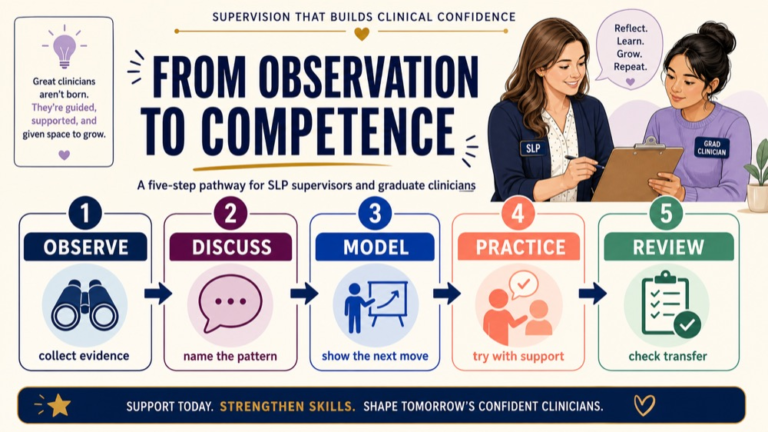
Teaching: use modeling, guided practice, questioning, feedback, reflection, and problem solving so the supervisee can transfer learning to a new case.
Accountability: document the plan, supervision provided, feedback, decisions, concerns, supports, and changes required by the role and setting.
A strong description is specific enough that another learner could picture the event. Instead of writing “the communication is impaired” or “the clinician can do this,” describe the demand, observable response, language or mode, partner, context, competence or access condition, and result. This protects clinical reasoning from labels that are broader than the evidence.
From observation to supported competence
Context changes what communication and professional decisions require. A direct question, long explanation, group exchange, classroom task, health-care interaction, family story, noisy routine, supervised procedure, or referral decision places different demands on processing, language, memory, hearing, access, partner behavior, competence, and regulation. Language experience, visual information, fatigue, health literacy, and the opportunity to request clarification should be part of the observation.
A graduate clinician may perform a familiar task well with a supportive client but need more direct supervision when the case is medically complex, culturally unfamiliar, high risk, or outside recent experience. A supervisor should not infer competence from one smooth session. The better response is to examine the task, observe performance, ask the supervisee to explain the reasoning, compare the plan with the client’s needs, and adjust the type or amount of support. Supervision is developmental, but the client’s welfare is not postponed until the learner feels confident.
Observation layer
Example question
Task
What did the person or clinician need to understand, express, organize, coordinate, decide, or provide?
Language and access
Which language, dialect, mode, hearing condition, tool, support, or communication partner was available?
Context and responsibility
Who was involved, what did they know, and which role, policy, ethical, or environmental factor mattered?
Participation and safety
What meaningful routine, role, outcome, or risk became easier or harder because of the pattern?
Context is not an afterthought added once a label has been selected. It is part of the question itself. If performance or decision quality changes with a quieter room, extra processing time, a familiar partner, a different language or mode, an interpreter, visual information, supervision, collaboration, a changed task, or a changed routine, that change is useful evidence about access and demand. It does not identify a cause by itself, but it tells you which conditions should be carried into the next observation.
Apply supervision reasoning
When a Praxis-style scenario or clinical discussion presents supervision in speech language pathology, use a disciplined sequence. The goal is to select the next clinical question or action that matches the evidence, the person’s priorities, the communication context, and the relevant professional boundary.
Define the task, language, mode, communication purpose, or service responsibility in plain language.
Identify the relevant domain: language, access, partner, participation, assessment, competence, collaboration, ethics, or regulation.
Separate observation from interpretation and write down what remains unknown.
Check history, exposure, dialect, culture, identity, interpreter access, environment, sensory load, memory, task familiarity, training, supervision, and local requirements as relevant.
Choose the assessment, collaboration, accommodation, goal, training, referral, or documentation step that answers the specific question.
State the boundary of the conclusion and keep the person’s safety, autonomy, access, and participation visible.
A graduate clinician may perform a familiar task well with a supportive client but need more direct supervision when the case is medically complex, culturally unfamiliar, high risk, or outside recent experience. A supervisor should not infer competence from one smooth session. The better response is to examine the task, observe performance, ask the supervisee to explain the reasoning, compare the plan with the client’s needs, and adjust the type or amount of support. Supervision is developmental, but the client’s welfare is not postponed until the learner feels confident. In a learning answer, the decisive evidence is usually the relationship among the task, the observed pattern, the context, and the next needed information—not a single isolated behavior, score, label, or broad permission statement.
Common study mistakes
Treating supervision as a signature, attendance requirement, or one-way evaluation rather than a collaborative teaching process.
Using the same amount and style of supervision for every supervisee, task, client, setting, or risk level.
Giving global feedback such as “be more confident” without direct evidence, a specific behavior, and a usable next step.
Allowing the supervisor to dominate problem solving so that the supervisee never practices self-analysis or independent reasoning.
Assuming a strong technical skill in one area proves competence for a new population, procedure, setting, or professional responsibility.
Ignoring power, culture, language, disability, communication access, or the supervisee’s opportunity to ask questions and disagree respectfully.
Documenting a conclusion without documenting the observation, support, feedback, client impact, and follow-up plan.
Confusing current certification or a job title with authorization to supervise every role or task under every jurisdictional rule.
Most of these mistakes come from replacing a multidomain question with a fast label. Correct the habit by returning to the same sequence: describe, separate, contextualize, ask what is missing, and choose a proportionate next step. A short rationale can make the habit visible: identify the evidence, name the uncertainty, and explain why the selected next step fits the person, setting, and responsibility.
Build a quick review map
Use this compact map when reviewing a missed question, lecture note, or clinical vignette:
Step 1: Name the supervisee, client or student, task, setting, risk, and professional responsibility.
Step 2: Separate the supervisee’s knowledge, skill, judgment, and self-evaluation from the supervisor’s impression.
Step 3: Collect direct or indirect evidence that is relevant to the task and client outcome.
Step 4: Choose a proportionate teaching and oversight method, including observation, modeling, feedback, consultation, or referral.
Step 5: Invite the supervisee to explain, self-evaluate, problem solve, and identify the next practice target.
Step 6: Document the plan and confirm that the level of supervision protects client welfare and meets current requirements.
Then write one transfer sentence: “When I see this pattern, I will first check ___ because ___.” The sentence should identify a decision rule, not repeat a definition. Revisit it after a delay and test whether you can apply the rule to a different task, age group, partner, language, setting, or professional responsibility.
Sources and next steps
supervision in speech language pathology is best learned as a context-sensitive pattern across communication, access, identity, function, participation, competence, and professional judgment. Use the current authority pages to refine the concept, then return to practice scenarios that require you to explain what the evidence supports and what it leaves open.
Professional Boundaries in Speech Pathology: Ethics, Scope, and Continuity
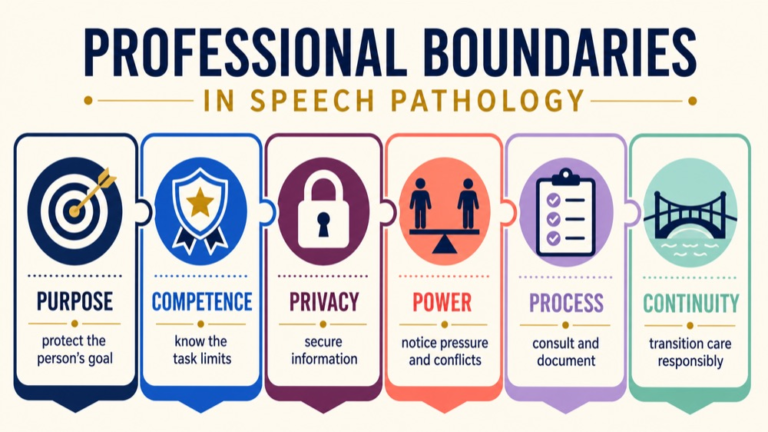
professional boundaries speech pathology is easier to study when it is treated as a connected clinical reasoning problem rather than a label to memorize. Professional boundaries in speech pathology protect the person served, the clinician, the team, and the integrity of care. They help an SLP distinguish a supportive professional relationship from a personal or conflicting one, keep services within competence and authority, protect privacy, manage communication and gifts or contact thoughtfully, and maintain continuity when a service relationship changes.
This learning guide is written for SLP students and other learners reviewing clinical concepts. It organizes observation, access, assessment, function, and professional judgment; it does not make an individualized diagnosis or replace current professional guidance. Interpretation depends on the person, task, language, culture, health, access, partner, context, and communication goals.
What professional boundaries in speech pathology include
Begin by separating the concept into domains. A learner who can name the domains is less likely to collapse language, access, partner, participation, competence, regulation, and clinical judgment into one explanation. The useful unit of analysis is the task: what the person was asked to understand, express, organize, coordinate, remember, or communicate, with whom, under which conditions, and with what support.
Domain or system
What to notice
Question to carry forward
Role and purpose
The relationship is organized around the person’s communication, swallowing, learning, health, participation, or research purpose—not the clinician’s personal needs.
Whose welfare and goal should guide this interaction?
Competence and scope
The clinician accepts tasks that fit education, training, experience, supervision, competence, authorization, and the setting.
Can I provide this service safely and responsibly?
Relationship and power
Trust, dependency, age, vulnerability, access to resources, gifts, favors, dual roles, and personal contact can affect choice and fairness.
Could this interaction create pressure or a conflict?
Privacy and communication
Records, conversations, social contact, technology, teaching examples, and public communication require careful confidentiality and purpose.
Who should receive this information and why?
Professional relationships
Supervision, collaboration, referral, disagreement, feedback, and complaints should preserve dignity and avoid retaliation or abuse of authority.
What process protects the person and the profession?
Transition and continuity
Ending or changing services requires notice, documentation, alternatives, referrals, and attention to safety and welfare.
How will care continue if this relationship changes?
These domains interact, but they should remain distinguishable. A learner may show strength in one context and need support in another. A study map organizes the next observation; it does not answer every assessment question or establish a universal treatment, goal, or legal conclusion.
Keep the first pass descriptive and close to the communication event. Note the task, response, partner, setting, timing, available support, language or mode, and consequence for participation. This gives the learner a stable record to compare across tasks and prevents a familiar term from doing too much explanatory work before the evidence has been separated.
For Praxis-style review, a vignette may include several true details but ask for one best interpretation or next step. The strongest answer usually respects the task, identifies the relevant function or boundary, checks the most important missing information, and avoids treating one performance sample or policy phrase as the whole profile.
Map professional boundaries in speech pathology
For study purposes, describe the communication relationship before naming a disorder, judging a partner, selecting a goal, or deciding that a task is within scope. Record what the person understood, expressed, initiated, repaired, coordinated, or participated in. Then note whether the task was familiar, how much context was shared, and which support changed the response.
Purpose: keep decisions tied to the person’s welfare, communication or swallowing need, participation, safety, and authorized service goal.
Competence: check education, training, experience, supervision, self-assessment, continuing development, and the task-specific boundary.
Power: notice dependency, vulnerability, gifts, favors, dual roles, personal contact, financial interests, and any pressure on choice.
Privacy: protect conversations, records, devices, images, recordings, social communication, teaching examples, and disclosures.
Process: use respectful supervision, collaboration, consultation, referral, documentation, and complaint pathways rather than personal retaliation.
Continuity: give reasonable notice, arrange alternatives, complete records, and transition care when services end or the relationship changes.
A strong description is specific enough that another learner could picture the event. Instead of writing “the communication is impaired” or “the clinician can do this,” describe the demand, observable response, language or mode, partner, context, competence or access condition, and result. This protects clinical reasoning from labels that are broader than the evidence.
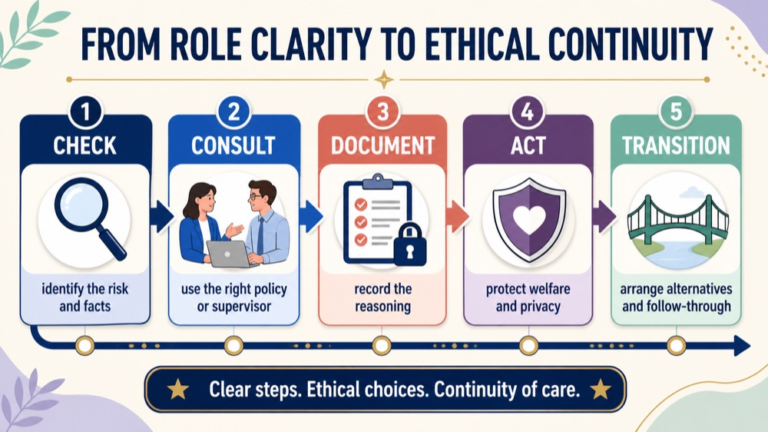
From role clarity to ethical continuity
Context changes what communication and professional decisions require. A direct question, long explanation, group exchange, classroom task, health-care interaction, family story, noisy routine, supervised procedure, or referral decision places different demands on processing, language, memory, hearing, access, partner behavior, competence, and regulation. Language experience, visual information, fatigue, health literacy, and the opportunity to request clarification should be part of the observation.
A boundary question rarely turns on one isolated label. A gift, personal message, social-media contact, dual relationship, public conversation, unfamiliar procedure, disagreement, or service termination must be considered with the person’s vulnerability, power, purpose, privacy, competence, setting, and applicable requirements. The safest exam response identifies the risk, gathers missing facts, consults the appropriate policy or supervisor, documents the reasoning, and chooses the action that protects welfare and continuity.
Observation layer
Example question
Task
What did the person or clinician need to understand, express, organize, coordinate, decide, or provide?
Language and access
Which language, dialect, mode, hearing condition, tool, support, or communication partner was available?
Context and responsibility
Who was involved, what did they know, and which role, policy, ethical, or environmental factor mattered?
Participation and safety
What meaningful routine, role, outcome, or risk became easier or harder because of the pattern?
Context is not an afterthought added once a label has been selected. It is part of the question itself. If performance or decision quality changes with a quieter room, extra processing time, a familiar partner, a different language or mode, an interpreter, visual information, supervision, collaboration, a changed task, or a changed routine, that change is useful evidence about access and demand. It does not identify a cause by itself, but it tells you which conditions should be carried into the next observation.
Apply professional-boundary reasoning
When a Praxis-style scenario or clinical discussion presents professional boundaries speech pathology, use a disciplined sequence. The goal is to select the next clinical question or action that matches the evidence, the person’s priorities, the communication context, and the relevant professional boundary.
Define the task, language, mode, communication purpose, or service responsibility in plain language.
Identify the relevant domain: language, access, partner, participation, assessment, competence, collaboration, ethics, or regulation.
Separate observation from interpretation and write down what remains unknown.
Check history, exposure, dialect, culture, identity, interpreter access, environment, sensory load, memory, task familiarity, training, supervision, and local requirements as relevant.
Choose the assessment, collaboration, accommodation, goal, training, referral, or documentation step that answers the specific question.
State the boundary of the conclusion and keep the person’s safety, autonomy, access, and participation visible.
A boundary question rarely turns on one isolated label. A gift, personal message, social-media contact, dual relationship, public conversation, unfamiliar procedure, disagreement, or service termination must be considered with the person’s vulnerability, power, purpose, privacy, competence, setting, and applicable requirements. The safest exam response identifies the risk, gathers missing facts, consults the appropriate policy or supervisor, documents the reasoning, and chooses the action that protects welfare and continuity. In a learning answer, the decisive evidence is usually the relationship among the task, the observed pattern, the context, and the next needed information—not a single isolated behavior, score, label, or broad permission statement.
Common study mistakes
Memorizing an absolute boundary rule without asking what the relationship, setting, power, purpose, and risk involve.
Using a personal relationship, gift, favor, or outside contact in a way that pressures choice or benefits the clinician.
Discussing an identifiable person, record, or clinical situation in a public or unsecured channel.
Accepting a task outside competence because the clinician has a broad professional title or good intentions.
Assuming collaboration or delegation removes the responsible clinician’s duty to supervise, document, or protect welfare.
Handling conflict, complaints, or employment changes through retaliation, public criticism, obstruction, or abandonment.
Ending services without notice, alternatives, referral, documentation, or a plan for continuity when those steps are possible.
Giving a legal conclusion without checking the current code, state rule, employer policy, school or facility requirement, and facts.
Most of these mistakes come from replacing a multidomain question with a fast label. Correct the habit by returning to the same sequence: describe, separate, contextualize, ask what is missing, and choose a proportionate next step. A short rationale can make the habit visible: identify the evidence, name the uncertainty, and explain why the selected next step fits the person, setting, and responsibility.
Build a quick review map
Use this compact map when reviewing a missed question, lecture note, or clinical vignette:
Step 1: Name the person served, professional purpose, relationship, setting, power difference, and possible harm.
Step 2: Check competence, scope, authorization, supervision, privacy, consent, conflicts, and relevant professional duties.
Step 3: Separate the observed facts from the ethical interpretation and list what remains unknown.
Step 4: Consult the current Code, policy, supervisor, ethics resource, privacy lead, or other appropriate professional process.
Step 5: Choose a respectful, proportionate, documented action that protects welfare, autonomy, privacy, and professional trust.
Step 6: If services change, provide reasonable notice, alternatives, referrals, records, and a continuity plan as required by the context.
Then write one transfer sentence: “When I see this pattern, I will first check ___ because ___.” The sentence should identify a decision rule, not repeat a definition. Revisit it after a delay and test whether you can apply the rule to a different task, age group, partner, language, setting, or professional responsibility.
Sources and next steps
professional boundaries speech pathology is best learned as a context-sensitive pattern across communication, access, identity, function, participation, competence, and professional judgment. Use the current authority pages to refine the concept, then return to practice scenarios that require you to explain what the evidence supports and what it leaves open.
Counseling in Speech-Language Pathology: Education, Adjustment, and Referral
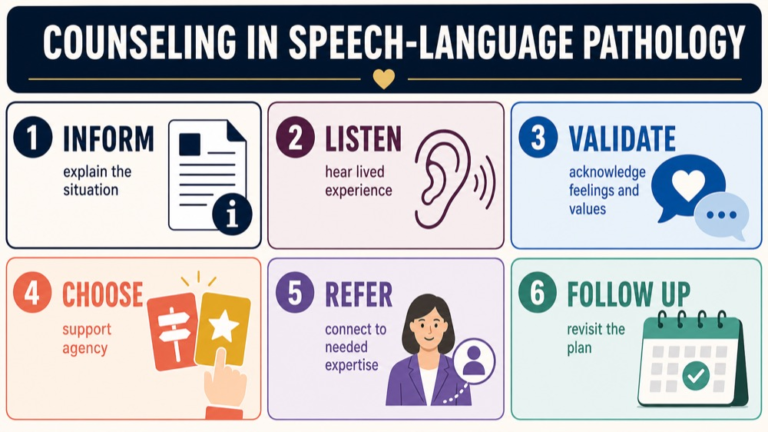
counseling in speech language pathology is easier to study when it is treated as a connected clinical reasoning problem rather than a label to memorize. Counseling in speech-language pathology is part of person-centered service. It includes sharing understandable information about communication, cognition, swallowing, hearing, or related situations and supporting people as they process lived experience, choices, feelings, and changes in daily life. SLP counseling requires empathy and self-awareness while staying within competence and referring when mental-health needs exceed the SLP role.
This learning guide is written for SLP students and other learners reviewing clinical concepts. It organizes observation, access, assessment, function, and professional judgment; it does not make an individualized diagnosis or replace current professional guidance. Interpretation depends on the person, task, language, culture, health, access, partner, context, and communication goals.
What counseling in speech-language pathology includes
Begin by separating the concept into domains. A learner who can name the domains is less likely to collapse language, access, partner, participation, competence, regulation, and clinical judgment into one explanation. The useful unit of analysis is the task: what the person was asked to understand, express, organize, coordinate, remember, or communicate, with whom, under which conditions, and with what support.
Domain or system
What to notice
Question to carry forward
Informational counseling
The clinician explains the condition, assessment, intervention, prognosis, options, resources, and practical next steps in usable language.
What information does the person need for a decision?
Personal adjustment
The clinician listens to feelings, thoughts, beliefs, identity, loss, uncertainty, and the lived impact of a communication or swallowing situation.
What experience is the person trying to process?
Relationship
Respect, empathy, privacy, autonomy, nonverbal communication, and shared decision-making shape the therapeutic encounter.
How is the relationship supporting agency and choice?
Cultural responsiveness
Beliefs about diagnosis, disability, treatment, family roles, health, and communication may differ and should be explored rather than corrected by assumption.
What perspective or value must be understood?
Boundary and referral
SLPs counsel within their training and refer to mental-health or other professionals when the need exceeds SLP scope or competence.
What expertise or support is needed next?
Ongoing communication
Counseling is woven through greetings, education, assessment, treatment, follow-up, and transitions rather than isolated in one conversation.
How will the person’s understanding and choices be revisited?
These domains interact, but they should remain distinguishable. A learner may show strength in one context and need support in another. A study map organizes the next observation; it does not answer every assessment question or establish a universal treatment, goal, or legal conclusion.
Keep the first pass descriptive and close to the communication event. Note the task, response, partner, setting, timing, available support, language or mode, and consequence for participation. This gives the learner a stable record to compare across tasks and prevents a familiar term from doing too much explanatory work before the evidence has been separated.
For Praxis-style review, a vignette may include several true details but ask for one best interpretation or next step. The strongest answer usually respects the task, identifies the relevant function or boundary, checks the most important missing information, and avoids treating one performance sample or policy phrase as the whole profile.
Map counseling in speech-language pathology
For study purposes, describe the communication relationship before naming a disorder, judging a partner, selecting a goal, or deciding that a task is within scope. Record what the person understood, expressed, initiated, repaired, coordinated, or participated in. Then note whether the task was familiar, how much context was shared, and which support changed the response.
Information: explain the communication, cognition, swallowing, hearing, or related situation, options, outcomes, and resources clearly.
Adjustment: listen for feelings, beliefs, identity, uncertainty, loss, stigma, coping, and the impact on daily routines and relationships.
Agency: invite questions, choices, disagreement, self-advocacy, and the person’s interpretation rather than directing compliance.
Relationship: attend to privacy, dignity, tone, seating, eye contact, personal space, touch, and the presence or role of care partners.
Culture: provide information in preferred language or mode and explore cultural, family, and individual perspectives on the situation and plan.
Boundary: recognize limits of SLP training and make a timely, respectful referral or consultation when another professional is needed.
A strong description is specific enough that another learner could picture the event. Instead of writing “the communication is impaired” or “the clinician can do this,” describe the demand, observable response, language or mode, partner, context, competence or access condition, and result. This protects clinical reasoning from labels that are broader than the evidence.
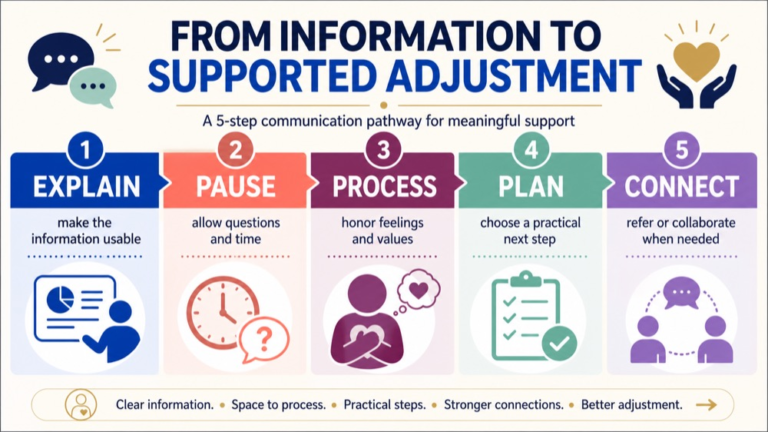
From information to supported adjustment
Context changes what communication and professional decisions require. A direct question, long explanation, group exchange, classroom task, health-care interaction, family story, noisy routine, supervised procedure, or referral decision places different demands on processing, language, memory, hearing, access, partner behavior, competence, and regulation. Language experience, visual information, fatigue, health literacy, and the opportunity to request clarification should be part of the observation.
A person may need both clear information about an evaluation and support processing what a communication difference means for work, school, relationships, identity, or daily routines. Informational counseling and personal-adjustment counseling can occur together, but the SLP should not present empathy as mental-health treatment or diagnose a psychological disorder. Strong reasoning names the person’s need, provides appropriate education, checks choice and understanding, and recognizes when referral is the safest next step.
Observation layer
Example question
Task
What did the person or clinician need to understand, express, organize, coordinate, decide, or provide?
Language and access
Which language, dialect, mode, hearing condition, tool, support, or communication partner was available?
Context and responsibility
Who was involved, what did they know, and which role, policy, ethical, or environmental factor mattered?
Participation and safety
What meaningful routine, role, outcome, or risk became easier or harder because of the pattern?
Context is not an afterthought added once a label has been selected. It is part of the question itself. If performance or decision quality changes with a quieter room, extra processing time, a familiar partner, a different language or mode, an interpreter, visual information, supervision, collaboration, a changed task, or a changed routine, that change is useful evidence about access and demand. It does not identify a cause by itself, but it tells you which conditions should be carried into the next observation.
Apply counseling reasoning
When a Praxis-style scenario or clinical discussion presents counseling in speech language pathology, use a disciplined sequence. The goal is to select the next clinical question or action that matches the evidence, the person’s priorities, the communication context, and the relevant professional boundary.
Define the task, language, mode, communication purpose, or service responsibility in plain language.
Identify the relevant domain: language, access, partner, participation, assessment, competence, collaboration, ethics, or regulation.
Separate observation from interpretation and write down what remains unknown.
Check history, exposure, dialect, culture, identity, interpreter access, environment, sensory load, memory, task familiarity, training, supervision, and local requirements as relevant.
Choose the assessment, collaboration, accommodation, goal, training, referral, or documentation step that answers the specific question.
State the boundary of the conclusion and keep the person’s safety, autonomy, access, and participation visible.
A person may need both clear information about an evaluation and support processing what a communication difference means for work, school, relationships, identity, or daily routines. Informational counseling and personal-adjustment counseling can occur together, but the SLP should not present empathy as mental-health treatment or diagnose a psychological disorder. Strong reasoning names the person’s need, provides appropriate education, checks choice and understanding, and recognizes when referral is the safest next step. In a learning answer, the decisive evidence is usually the relationship among the task, the observed pattern, the context, and the next needed information—not a single isolated behavior, score, label, or broad permission statement.
Common study mistakes
Treating counseling as a one-time lecture or a signed handout instead of an ongoing person-centered process.
Confusing informational counseling with psychotherapy, psychological diagnosis, or treatment outside SLP scope.
Giving accurate information in a way the person cannot understand, use, question, or connect to their life.
Using directive, infantilizing, dismissive, or overly cheerful language that reduces agency or hides uncertainty.
Ignoring nonverbal communication, privacy, seating, personal space, touch, or the person’s preferred care-partner role.
Assuming one cultural, family, disability, or emotional response is the correct response to a diagnosis or plan.
Continuing to manage a mental-health concern independently when referral, consultation, supervision, or crisis support is indicated.
Treating referral as rejection instead of explaining the reason and coordinating a respectful next step.
Most of these mistakes come from replacing a multidomain question with a fast label. Correct the habit by returning to the same sequence: describe, separate, contextualize, ask what is missing, and choose a proportionate next step. A short rationale can make the habit visible: identify the evidence, name the uncertainty, and explain why the selected next step fits the person, setting, and responsibility.
Build a quick review map
Use this compact map when reviewing a missed question, lecture note, or clinical vignette:
Step 1: Identify whether the immediate need is information, adjustment, shared decision-making, communication access, or referral.
Step 2: Explain the situation, options, outcomes, uncertainty, and resources in the person’s preferred language or mode.
Step 3: Listen for feelings, beliefs, identity, values, family dynamics, and the impact on meaningful participation.
Step 4: Protect dignity, autonomy, privacy, nonverbal access, and the person’s chosen level of care-partner involvement.
Step 5: Check SLP competence and distinguish counseling from mental-health diagnosis or treatment.
Step 6: Refer or collaborate when another professional is needed, and explain the transition without stigma or blame.
Then write one transfer sentence: “When I see this pattern, I will first check ___ because ___.” The sentence should identify a decision rule, not repeat a definition. Revisit it after a delay and test whether you can apply the rule to a different task, age group, partner, language, setting, or professional responsibility.
Sources and next steps
counseling in speech language pathology is best learned as a context-sensitive pattern across communication, access, identity, function, participation, competence, and professional judgment. Use the current authority pages to refine the concept, then return to practice scenarios that require you to explain what the evidence supports and what it leaves open.
Access and Equity in Communication Care: Removing Barriers
access and equity in communication care is easier to study when it is treated as a connected clinical reasoning problem rather than a label to memorize. Access and equity in communication care means identifying and reducing barriers that prevent a person from understanding, expressing, deciding, participating, or receiving services. SLP reasoning must look beyond a person’s performance to the language, mode, partner, environment, workflow, technology, policy, and social conditions that make communication easier or harder.
This learning guide is written for SLP students and other learners reviewing clinical concepts. It organizes observation, access, assessment, function, and professional judgment; it does not make an individualized diagnosis or replace current professional guidance. Interpretation depends on the person, task, language, culture, health, access, partner, context, and communication goals.
What access and equity in communication care require
Begin by separating the concept into domains. A learner who can name the domains is less likely to collapse language, access, partner, participation, competence, regulation, and clinical judgment into one explanation. The useful unit of analysis is the task: what the person was asked to understand, express, organize, coordinate, remember, or communicate, with whom, under which conditions, and with what support.
Domain or system
What to notice
Question to carry forward
Communication need
The person’s preferred language, dialect, mode, hearing, vision, cognition, literacy, and message purpose shape access.
What does this person need in order to communicate here?
Environment
Noise, lighting, positioning, time, privacy, physical layout, turn-taking, and social expectations can create barriers.
Which feature of the setting is blocking access?
Partner and team
Listeners, clinicians, educators, interpreters, care partners, and staff may need shared strategies and role clarity.
Who needs to change the interaction or system?
Language and culture
Language access, dialect, culture, identity, trust, history, and community knowledge affect assessment and service use.
Is the service understandable and respectful?
System design
Forms, referrals, scheduling, portals, policies, staffing, technology, and handoffs can distribute access unevenly.
What system process needs redesign?
Equitable outcome
The goal is meaningful opportunity, autonomy, safety, and participation—not identical treatment regardless of need.
What access or participation outcome should improve?
These domains interact, but they should remain distinguishable. A learner may show strength in one context and need support in another. A study map organizes the next observation; it does not answer every assessment question or establish a universal treatment, goal, or legal conclusion.
Keep the first pass descriptive and close to the communication event. Note the task, response, partner, setting, timing, available support, language or mode, and consequence for participation. This gives the learner a stable record to compare across tasks and prevents a familiar term from doing too much explanatory work before the evidence has been separated.
For Praxis-style review, a vignette may include several true details but ask for one best interpretation or next step. The strongest answer usually respects the task, identifies the relevant function or boundary, checks the most important missing information, and avoids treating one performance sample or policy phrase as the whole profile.
Map access and equity in communication care
For study purposes, describe the communication relationship before naming a disorder, judging a partner, selecting a goal, or deciding that a task is within scope. Record what the person understood, expressed, initiated, repaired, coordinated, or participated in. Then note whether the task was familiar, how much context was shared, and which support changed the response.
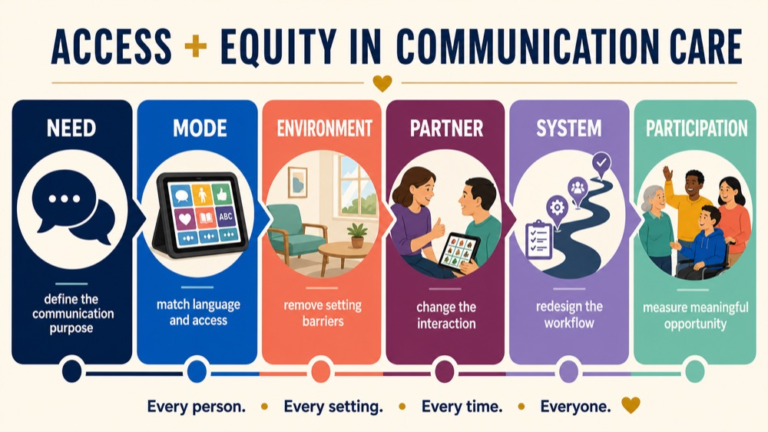
Need: describe the person’s message, mode, language, partner, task, and participation purpose before selecting a support.
Barrier: separate person characteristics from environmental, interactional, communication, technological, and organizational barriers.
Accommodation: choose supports such as plain language, visual information, interpreter access, AAC, extra time, positioning, or partner training when they fit the task.
Equity: distinguish equal treatment from equitable access and ask whether the same process creates unequal opportunity or burden.
Implementation: assign responsibility, resources, training, workflow, documentation, and follow-up so an accommodation is usable rather than merely promised.
Participation: measure whether the person can communicate, decide, learn, work, receive care, self-advocate, and participate more reliably.
A strong description is specific enough that another learner could picture the event. Instead of writing “the communication is impaired” or “the clinician can do this,” describe the demand, observable response, language or mode, partner, context, competence or access condition, and result. This protects clinical reasoning from labels that are broader than the evidence.
From communication barrier to equitable participation
Context changes what communication and professional decisions require. A direct question, long explanation, group exchange, classroom task, health-care interaction, family story, noisy routine, supervised procedure, or referral decision places different demands on processing, language, memory, hearing, access, partner behavior, competence, and regulation. Language experience, visual information, fatigue, health literacy, and the opportunity to request clarification should be part of the observation.
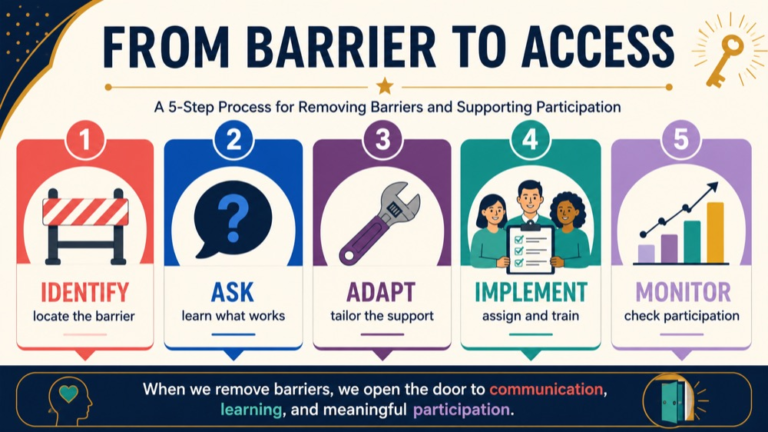
A person may be described as “not participating” when the real barrier is an inaccessible form, unfamiliar language, noisy room, rushed appointment, missing interpreter, unavailable AAC, poor positioning, or a partner who answers for them. Access-and-equity reasoning does not assume that one accommodation solves every problem. It identifies the demand, asks the person what works, changes the environment or interaction, and checks whether the support actually changes participation.
Observation layer
Example question
Task
What did the person or clinician need to understand, express, organize, coordinate, decide, or provide?
Language and access
Which language, dialect, mode, hearing condition, tool, support, or communication partner was available?
Context and responsibility
Who was involved, what did they know, and which role, policy, ethical, or environmental factor mattered?
Participation and safety
What meaningful routine, role, outcome, or risk became easier or harder because of the pattern?
Context is not an afterthought added once a label has been selected. It is part of the question itself. If performance or decision quality changes with a quieter room, extra processing time, a familiar partner, a different language or mode, an interpreter, visual information, supervision, collaboration, a changed task, or a changed routine, that change is useful evidence about access and demand. It does not identify a cause by itself, but it tells you which conditions should be carried into the next observation.
Apply access-and-equity reasoning
When a Praxis-style scenario or clinical discussion presents access and equity in communication care, use a disciplined sequence. The goal is to select the next clinical question or action that matches the evidence, the person’s priorities, the communication context, and the relevant professional boundary.
Define the task, language, mode, communication purpose, or service responsibility in plain language.
Identify the relevant domain: language, access, partner, participation, assessment, competence, collaboration, ethics, or regulation.
Separate observation from interpretation and write down what remains unknown.
Check history, exposure, dialect, culture, identity, interpreter access, environment, sensory load, memory, task familiarity, training, supervision, and local requirements as relevant.
Choose the assessment, collaboration, accommodation, goal, training, referral, or documentation step that answers the specific question.
State the boundary of the conclusion and keep the person’s safety, autonomy, access, and participation visible.
A person may be described as “not participating” when the real barrier is an inaccessible form, unfamiliar language, noisy room, rushed appointment, missing interpreter, unavailable AAC, poor positioning, or a partner who answers for them. Access-and-equity reasoning does not assume that one accommodation solves every problem. It identifies the demand, asks the person what works, changes the environment or interaction, and checks whether the support actually changes participation. In a learning answer, the decisive evidence is usually the relationship among the task, the observed pattern, the context, and the next needed information—not a single isolated behavior, score, label, or broad permission statement.
Common study mistakes
Treating access as a courtesy added after assessment instead of a condition for valid communication and participation.
Assuming the same materials, time, language, device, or room setup is fair because it is offered to everyone.
Locating every barrier inside the person while ignoring system design, partner behavior, policy, and environment.
Providing a device, interpreter, or form without checking whether it matches the person’s mode, language, task, and preferences.
Confusing equality of process with equity of opportunity or outcome.
Failing to assign who will arrange, fund, train, document, and maintain an access support.
Measuring attendance or compliance instead of communication access, autonomy, safety, and meaningful participation.
Calling a plan equitable without asking the person and community whether it is usable, respectful, and sustainable.
Most of these mistakes come from replacing a multidomain question with a fast label. Correct the habit by returning to the same sequence: describe, separate, contextualize, ask what is missing, and choose a proportionate next step. A short rationale can make the habit visible: identify the evidence, name the uncertainty, and explain why the selected next step fits the person, setting, and responsibility.
Build a quick review map
Use this compact map when reviewing a missed question, lecture note, or clinical vignette:
Step 1: Define the person’s communication need, mode, language, partner, task, and meaningful participation goal.
Step 2: List person, interaction, environmental, technology, workflow, and policy barriers separately.
Step 3: Ask the person and relevant partners which supports are effective, acceptable, and available.
Step 4: Choose an equitable adjustment and name who will implement, monitor, and revise it.
Step 5: Check language, culture, identity, privacy, consent, safety, and local accessibility requirements.
Step 6: Measure whether access changed the person’s ability to communicate, decide, receive care, learn, work, or participate.
Then write one transfer sentence: “When I see this pattern, I will first check ___ because ___.” The sentence should identify a decision rule, not repeat a definition. Revisit it after a delay and test whether you can apply the rule to a different task, age group, partner, language, setting, or professional responsibility.
Sources and next steps
access and equity in communication care is best learned as a context-sensitive pattern across communication, access, identity, function, participation, competence, and professional judgment. Use the current authority pages to refine the concept, then return to practice scenarios that require you to explain what the evidence supports and what it leaves open.
Health Literacy in Speech Pathology: Clear Information and Safer Participation
health literacy speech pathology is easier to study when it is treated as a connected clinical reasoning problem rather than a label to memorize. Health literacy in speech pathology is the ability to find, understand, and use reliable health information and services, supported by communication that is clear, accessible, and usable. The responsibility is shared: the person brings experience and preferences, while clinicians and organizations must reduce unnecessary complexity, support questions, and make decisions easier to navigate.
This learning guide is written for SLP students and other learners reviewing clinical concepts. It organizes observation, access, assessment, function, and professional judgment; it does not make an individualized diagnosis or replace current professional guidance. Interpretation depends on the person, task, language, culture, health, access, partner, context, and communication goals.
What health literacy in speech pathology includes
Begin by separating the concept into domains. A learner who can name the domains is less likely to collapse language, access, partner, participation, competence, regulation, and clinical judgment into one explanation. The useful unit of analysis is the task: what the person was asked to understand, express, organize, coordinate, remember, or communicate, with whom, under which conditions, and with what support.
Domain or system
What to notice
Question to carry forward
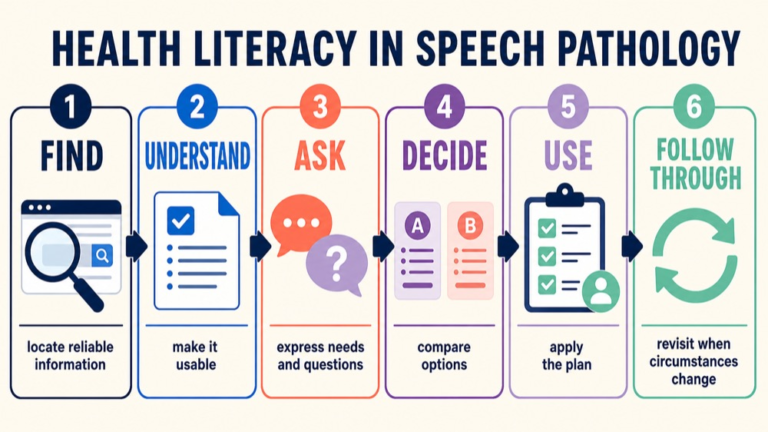
Find
The person can locate the right information, service, professional, tool, or instruction when it is needed.
Where would the person go to get reliable help?
Understand
Language, format, hearing, vision, cognition, stress, prior knowledge, and communication access affect comprehension.
What makes this information usable for this person?
Use
The person can apply information to ask questions, compare options, follow a plan, give consent, or respond to a health need.
What decision or action should the information support?
Shared responsibility
Health systems, clinicians, teams, and materials shape how easy it is to access and use information.
What complexity belongs to the system rather than the person?
Context
Energy, pain, emotion, language, literacy, numeracy, trust, culture, social conditions, and setting can change health-literacy demands.
Which condition is changing performance right now?
Participation and safety
Usable information supports autonomy, informed consent, care decisions, treatment participation, and safer communication.
What meaningful health action should become more accessible?
These domains interact, but they should remain distinguishable. A learner may show strength in one context and need support in another. A study map organizes the next observation; it does not answer every assessment question or establish a universal treatment, goal, or legal conclusion.
Keep the first pass descriptive and close to the communication event. Note the task, response, partner, setting, timing, available support, language or mode, and consequence for participation. This gives the learner a stable record to compare across tasks and prevents a familiar term from doing too much explanatory work before the evidence has been separated.
For Praxis-style review, a vignette may include several true details but ask for one best interpretation or next step. The strongest answer usually respects the task, identifies the relevant function or boundary, checks the most important missing information, and avoids treating one performance sample or policy phrase as the whole profile.
Map health literacy in speech pathology
For study purposes, describe the communication relationship before naming a disorder, judging a partner, selecting a goal, or deciding that a task is within scope. Record what the person understood, expressed, initiated, repaired, coordinated, or participated in. Then note whether the task was familiar, how much context was shared, and which support changed the response.
Purpose: state the health question, service, choice, instruction, or risk the person needs to understand or act on.
Access: adapt language, format, mode, hearing and vision supports, literacy demands, numeracy, interpreter access, and technology.
Clarity: use plain language, concrete examples, meaningful headings, teach-back or another appropriate understanding check, and limited jargon.
Questions: invite the person to ask, express needs, compare options, identify uncertainty, and request clarification or support.
Shared work: improve the organization, form, handoff, portal, conversation, and team process rather than locating every barrier in the person.
Outcome: check whether information changed a meaningful decision, consent process, care routine, self-advocacy action, or safety behavior.
A strong description is specific enough that another learner could picture the event. Instead of writing “the communication is impaired” or “the clinician can do this,” describe the demand, observable response, language or mode, partner, context, competence or access condition, and result. This protects clinical reasoning from labels that are broader than the evidence.
From clear information to safer participation
Context changes what communication and professional decisions require. A direct question, long explanation, group exchange, classroom task, health-care interaction, family story, noisy routine, supervised procedure, or referral decision places different demands on processing, language, memory, hearing, access, partner behavior, competence, and regulation. Language experience, visual information, fatigue, health literacy, and the opportunity to request clarification should be part of the observation.
A patient may understand a familiar conversation but struggle with a rushed discharge explanation, medication schedule, consent form, or patient portal. A family member may appear to follow instructions while not having a chance to ask questions or explain what will happen at home. Health-literacy reasoning changes the question from “Does this person understand?” to “What information, support, format, partner, time, and environment would let this person make and use the decision?”
Observation layer
Example question
Task
What did the person or clinician need to understand, express, organize, coordinate, decide, or provide?
Language and access
Which language, dialect, mode, hearing condition, tool, support, or communication partner was available?
Context and responsibility
Who was involved, what did they know, and which role, policy, ethical, or environmental factor mattered?
Participation and safety
What meaningful routine, role, outcome, or risk became easier or harder because of the pattern?
Context is not an afterthought added once a label has been selected. It is part of the question itself. If performance or decision quality changes with a quieter room, extra processing time, a familiar partner, a different language or mode, an interpreter, visual information, supervision, collaboration, a changed task, or a changed routine, that change is useful evidence about access and demand. It does not identify a cause by itself, but it tells you which conditions should be carried into the next observation.
Apply health-literacy reasoning
When a Praxis-style scenario or clinical discussion presents health literacy speech pathology, use a disciplined sequence. The goal is to select the next clinical question or action that matches the evidence, the person’s priorities, the communication context, and the relevant professional boundary.
Define the task, language, mode, communication purpose, or service responsibility in plain language.
Identify the relevant domain: language, access, partner, participation, assessment, competence, collaboration, ethics, or regulation.
Separate observation from interpretation and write down what remains unknown.
Check history, exposure, dialect, culture, identity, interpreter access, environment, sensory load, memory, task familiarity, training, supervision, and local requirements as relevant.
Choose the assessment, collaboration, accommodation, goal, training, referral, or documentation step that answers the specific question.
State the boundary of the conclusion and keep the person’s safety, autonomy, access, and participation visible.
A patient may understand a familiar conversation but struggle with a rushed discharge explanation, medication schedule, consent form, or patient portal. A family member may appear to follow instructions while not having a chance to ask questions or explain what will happen at home. Health-literacy reasoning changes the question from “Does this person understand?” to “What information, support, format, partner, time, and environment would let this person make and use the decision?” In a learning answer, the decisive evidence is usually the relationship among the task, the observed pattern, the context, and the next needed information—not a single isolated behavior, score, label, or broad permission statement.
Common study mistakes
Treating health literacy as a fixed trait or a synonym for reading level.
Blaming the person for misunderstanding a complex form, rushed explanation, or inaccessible system.
Using jargon, long sentences, unexplained numbers, or abstract risk language without checking usability.
Assuming a nod, signature, or silence proves understanding, consent, or readiness to follow a plan.
Giving information without explaining the decision, action, alternative, or question it is meant to support.
Measuring recall in a quiet teaching task and generalizing it to a complex real-world health interaction.
Treating an SLP’s communication support as a substitute for the medical, legal, or professional expertise required by the decision.
Most of these mistakes come from replacing a multidomain question with a fast label. Correct the habit by returning to the same sequence: describe, separate, contextualize, ask what is missing, and choose a proportionate next step. A short rationale can make the habit visible: identify the evidence, name the uncertainty, and explain why the selected next step fits the person, setting, and responsibility.
Build a quick review map
Use this compact map when reviewing a missed question, lecture note, or clinical vignette:
Step 1: Name the health decision, information, service, instruction, risk, or consent question.
Step 2: Identify the language, mode, literacy, numeracy, sensory, cognitive, emotional, and technology demands.
Step 3: Make the information clear, concrete, organized, accessible, and relevant to the person’s priority.
Step 4: Invite questions and use an appropriate understanding check without turning it into a blame-focused test.
Step 5: Change the system, document, handoff, partner behavior, or environment when it creates avoidable complexity.
Step 6: Check whether the person can use the information for a meaningful, safe, and authorized next action.
Then write one transfer sentence: “When I see this pattern, I will first check ___ because ___.” The sentence should identify a decision rule, not repeat a definition. Revisit it after a delay and test whether you can apply the rule to a different task, age group, partner, language, setting, or professional responsibility.
Sources and next steps
health literacy speech pathology is best learned as a context-sensitive pattern across communication, access, identity, function, participation, competence, and professional judgment. Use the current authority pages to refine the concept, then return to practice scenarios that require you to explain what the evidence supports and what it leaves open.
Start with asha health literacy, asha counseling, ets 5331 study companion. These sources support the learning frame; they do not replace current topic-specific guidance, an individualized evaluation, or applicable state and setting requirements.
Cultural Humility in Speech Pathology: Reflection, Partnership, and Bias
cultural humility in speech pathology is easier to study when it is treated as a connected clinical reasoning problem rather than a label to memorize. Cultural humility in speech pathology is an ongoing practice of examining one’s own assumptions, recognizing what one does not know, listening to the person and community, and adapting assessment or intervention to the communication context. It is not a certificate that makes a clinician an expert in another culture; it is a disciplined way to make bias, uncertainty, partnership, and access visible.
This learning guide is written for SLP students and other learners reviewing clinical concepts. It organizes observation, access, assessment, function, and professional judgment; it does not make an individualized diagnosis or replace current professional guidance. Interpretation depends on the person, task, language, culture, health, access, partner, context, and communication goals.
What cultural humility in speech pathology means
Begin by separating the concept into domains. A learner who can name the domains is less likely to collapse language, access, partner, participation, competence, regulation, and clinical judgment into one explanation. The useful unit of analysis is the task: what the person was asked to understand, express, organize, coordinate, remember, or communicate, with whom, under which conditions, and with what support.
Domain or system
What to notice
Question to carry forward
Self-awareness
The clinician examines personal beliefs, cultural identities, expectations, power, and habits that may shape the encounter.
What am I assuming, and how might it affect my interpretation?
Humility
The clinician treats cultural understanding as ongoing learning and remains open to correction rather than claiming mastery.
What do I need to ask instead of presume?
Communication context
Language, dialect, identity, family roles, community, history, and setting influence how communication is used and understood.
What context gives this behavior meaning?
Assessment access
Materials, norms, interview questions, interpreter use, scheduling, environment, and task familiarity can create or reduce bias.
Is the method accessible and appropriate for this person?
Partnership
The person, family, community, interpreter, and team contribute knowledge about priorities, routines, values, and acceptable supports.
Whose knowledge is missing from the decision?
Responsive action
The clinician adapts questions, materials, goals, communication, referral, and follow-up while documenting limits and uncertainty.
What should change in the next step?
These domains interact, but they should remain distinguishable. A learner may show strength in one context and need support in another. A study map organizes the next observation; it does not answer every assessment question or establish a universal treatment, goal, or legal conclusion.
Keep the first pass descriptive and close to the communication event. Note the task, response, partner, setting, timing, available support, language or mode, and consequence for participation. This gives the learner a stable record to compare across tasks and prevents a familiar term from doing too much explanatory work before the evidence has been separated.
For Praxis-style review, a vignette may include several true details but ask for one best interpretation or next step. The strongest answer usually respects the task, identifies the relevant function or boundary, checks the most important missing information, and avoids treating one performance sample or policy phrase as the whole profile.
Map cultural humility in speech pathology
For study purposes, describe the communication relationship before naming a disorder, judging a partner, selecting a goal, or deciding that a task is within scope. Record what the person understood, expressed, initiated, repaired, coordinated, or participated in. Then note whether the task was familiar, how much context was shared, and which support changed the response.
Reflection: name the assumptions, expectations, identities, power relationships, and professional habits that may influence the encounter.
Listening: use open-ended questions and invite the person’s and family’s description of communication, disability, health, identity, and goals.
Context: consider language, dialect, culture, community, history, family roles, setting, access, and familiarity with the task.
Assessment: examine whether materials, norms, interview methods, interpreters, timing, and environment support a fair interpretation.
Partnership: collaborate with the person, family, community, interpreter, cultural broker, educators, and other professionals as appropriate.
Action: adapt the plan, explain uncertainty, seek consultation, and connect decisions to meaningful participation rather than assumptions.
A strong description is specific enough that another learner could picture the event. Instead of writing “the communication is impaired” or “the clinician can do this,” describe the demand, observable response, language or mode, partner, context, competence or access condition, and result. This protects clinical reasoning from labels that are broader than the evidence.
From reflection to responsive care
Context changes what communication and professional decisions require. A direct question, long explanation, group exchange, classroom task, health-care interaction, family story, noisy routine, supervised procedure, or referral decision places different demands on processing, language, memory, hearing, access, partner behavior, competence, and regulation. Language experience, visual information, fatigue, health literacy, and the opportunity to request clarification should be part of the observation.
A clinician may hear a family describe disability, independence, eye contact, therapy, communication modes, or acceptable support in a way that differs from the clinician’s own expectations. A culturally humble response does not automatically accept every explanation as a diagnosis or reject it as irrelevant. It asks open questions, checks how language and culture shape the interaction, separates observed communication from the clinician’s interpretation, and chooses methods that give the person a meaningful opportunity to show what they know and do.
Observation layer
Example question
Task
What did the person or clinician need to understand, express, organize, coordinate, decide, or provide?
Language and access
Which language, dialect, mode, hearing condition, tool, support, or communication partner was available?
Context and responsibility
Who was involved, what did they know, and which role, policy, ethical, or environmental factor mattered?
Participation and safety
What meaningful routine, role, outcome, or risk became easier or harder because of the pattern?
Context is not an afterthought added once a label has been selected. It is part of the question itself. If performance or decision quality changes with a quieter room, extra processing time, a familiar partner, a different language or mode, an interpreter, visual information, supervision, collaboration, a changed task, or a changed routine, that change is useful evidence about access and demand. It does not identify a cause by itself, but it tells you which conditions should be carried into the next observation.
Apply cultural humility reasoning
When a Praxis-style scenario or clinical discussion presents cultural humility in speech pathology, use a disciplined sequence. The goal is to select the next clinical question or action that matches the evidence, the person’s priorities, the communication context, and the relevant professional boundary.
Define the task, language, mode, communication purpose, or service responsibility in plain language.
Identify the relevant domain: language, access, partner, participation, assessment, competence, collaboration, ethics, or regulation.
Separate observation from interpretation and write down what remains unknown.
Check history, exposure, dialect, culture, identity, interpreter access, environment, sensory load, memory, task familiarity, training, supervision, and local requirements as relevant.
Choose the assessment, collaboration, accommodation, goal, training, referral, or documentation step that answers the specific question.
State the boundary of the conclusion and keep the person’s safety, autonomy, access, and participation visible.
A clinician may hear a family describe disability, independence, eye contact, therapy, communication modes, or acceptable support in a way that differs from the clinician’s own expectations. A culturally humble response does not automatically accept every explanation as a diagnosis or reject it as irrelevant. It asks open questions, checks how language and culture shape the interaction, separates observed communication from the clinician’s interpretation, and chooses methods that give the person a meaningful opportunity to show what they know and do. In a learning answer, the decisive evidence is usually the relationship among the task, the observed pattern, the context, and the next needed information—not a single isolated behavior, score, label, or broad permission statement.
Common study mistakes
Treating cultural humility as a finished skill or a list of facts about another group.
Reducing culture to race or ethnicity while ignoring language, dialect, identity, disability, religion, family, community, and history.
Using one English-only test or unfamiliar task as if it represented the person’s whole communication profile.
Assuming the clinician’s preferred eye contact, turn-taking, independence, or treatment goal is universally appropriate.
Asking closed questions that force the person or family into categories that do not fit their experience.
Treating an interpreter, family member, or cultural broker as a substitute for the clinician’s own reflection and responsibility.
Calling a material culturally responsive because it contains diverse pictures without checking its language, meaning, access, or context.
Writing a confident cultural explanation without stating what was observed, what was reported, and what remains unknown.
Most of these mistakes come from replacing a multidomain question with a fast label. Correct the habit by returning to the same sequence: describe, separate, contextualize, ask what is missing, and choose a proportionate next step. A short rationale can make the habit visible: identify the evidence, name the uncertainty, and explain why the selected next step fits the person, setting, and responsibility.
Build a quick review map
Use this compact map when reviewing a missed question, lecture note, or clinical vignette:
Step 1: Identify the communication task, person, partner, language or mode, setting, and decision at stake.
Step 2: Write down the assumption or bias that could distort observation, assessment, or interaction.
Step 3: Ask open-ended questions about the person’s values, identity, routines, community, history, and communication priorities.
Step 4: Check assessment access, materials, norms, interpreter or broker support, timing, environment, and task familiarity.
Step 5: Combine person and family knowledge with professional evidence while keeping uncertainty visible.
Step 6: Choose a responsive next step and explain how it protects dignity, access, fairness, and participation.
Then write one transfer sentence: “When I see this pattern, I will first check ___ because ___.” The sentence should identify a decision rule, not repeat a definition. Revisit it after a delay and test whether you can apply the rule to a different task, age group, partner, language, setting, or professional responsibility.
Sources and next steps
cultural humility in speech pathology is best learned as a context-sensitive pattern across communication, access, identity, function, participation, competence, and professional judgment. Use the current authority pages to refine the concept, then return to practice scenarios that require you to explain what the evidence supports and what it leaves open.
Clinical Reasoning in Speech-Language Pathology: Evidence, Context, and Next Steps
clinical reasoning in speech language pathology is easier to study when it is treated as a connected clinical reasoning problem rather than a label to memorize. Clinical reasoning in speech-language pathology is the process of turning a communication or swallowing question into a defensible next step. It involves describing the task, considering the person and context, integrating evidence and values, making a working interpretation, choosing an action, and checking whether the result changes what should happen next.
This learning guide is written for SLP students and other learners reviewing clinical concepts. It organizes observation, access, assessment, function, and professional judgment; it does not make an individualized diagnosis or replace current professional guidance. Interpretation depends on the person, task, language, culture, health, access, partner, context, and communication goals.
What clinical reasoning in speech-language pathology includes
Begin by separating the concept into domains. A learner who can name the domains is less likely to collapse language, access, partner, participation, competence, regulation, and clinical judgment into one explanation. The useful unit of analysis is the task: what the person was asked to understand, express, organize, coordinate, remember, or communicate, with whom, under which conditions, and with what support.
Domain or system
What to notice
Question to carry forward
Question
A focused question identifies the person, communication or swallowing need, task, decision, and meaningful outcome.
What decision needs to be made?
Context
Language, culture, partner, environment, health, access, history, demand, and participation shape the evidence.
What conditions change the pattern?
Evidence
Assessment data, observations, research, interviews, reports, and person or family perspectives contribute different information.
What does each evidence source add?
Interpretation
A working hypothesis explains the pattern while keeping alternative explanations and uncertainty visible.
What fits and what remains open?
Action
Assessment, intervention, accommodation, collaboration, referral, documentation, or monitoring should answer the question.
Which next step is proportionate?
Reflection
Response and participation data help the clinician test, refine, or revise the working interpretation and plan.
What did we learn after acting?
These domains interact, but they should remain distinguishable. A learner may show strength in one context and need support in another. A study map organizes the next observation; it does not answer every assessment question or establish a universal treatment, goal, or legal conclusion.
Keep the first pass descriptive and close to the communication event. Note the task, response, partner, setting, timing, available support, language or mode, and consequence for participation. This gives the learner a stable record to compare across tasks and prevents a familiar term from doing too much explanatory work before the evidence has been separated.
For Praxis-style review, a vignette may include several true details but ask for one best interpretation or next step. The strongest answer usually respects the task, identifies the relevant function or boundary, checks the most important missing information, and avoids treating one performance sample or policy phrase as the whole profile.
Map clinical reasoning
For study purposes, describe the communication relationship before naming a disorder, judging a partner, selecting a goal, or deciding that a task is within scope. Record what the person understood, expressed, initiated, repaired, coordinated, or participated in. Then note whether the task was familiar, how much context was shared, and which support changed the response.
Question: define the communication or swallowing decision and the outcome that matters to the person.
Evidence: combine assessment data, observations, reports, research, interviews, and person or family perspectives.
Hypothesis: state a working interpretation and name alternative explanations or missing evidence.
Action: choose an assessment, intervention, accommodation, collaboration, referral, documentation, or monitoring step.
Reflection: review response, function, participation, safety, and new information before keeping or revising the plan.
A strong description is specific enough that another learner could picture the event. Instead of writing “the communication is impaired” or “the clinician can do this,” describe the demand, observable response, language or mode, partner, context, competence or access condition, and result. This protects clinical reasoning from labels that are broader than the evidence.
From question to next step
Context changes what communication and professional decisions require. A direct question, long explanation, group exchange, classroom task, health-care interaction, family story, noisy routine, supervised procedure, or referral decision places different demands on processing, language, memory, hearing, access, partner behavior, competence, and regulation. Language experience, visual information, fatigue, health literacy, and the opportunity to request clarification should be part of the observation.
A child may perform differently in a one-to-one task, classroom group, home routine, or conversation with an unfamiliar adult. An adult may communicate effectively with a familiar partner but need support in a health-care interaction. Clinical reasoning does not force those observations into a single label before examining demand and context. It asks what the evidence supports, what remains uncertain, and which next action will provide useful information while protecting function and participation.
Observation layer
Example question
Task
What did the person or clinician need to understand, express, organize, coordinate, decide, or provide?
Language and access
Which language, dialect, mode, hearing condition, tool, support, or communication partner was available?
Context and responsibility
Who was involved, what did they know, and which role, policy, ethical, or environmental factor mattered?
Participation and safety
What meaningful routine, role, outcome, or risk became easier or harder because of the pattern?
Context is not an afterthought added once a label has been selected. It is part of the question itself. If performance or decision quality changes with a quieter room, extra processing time, a familiar partner, a different language or mode, an interpreter, visual information, supervision, collaboration, a changed task, or a changed routine, that change is useful evidence about access and demand. It does not identify a cause by itself, but it tells you which conditions should be carried into the next observation.
Apply clinical-reasoning steps
When a Praxis-style scenario or clinical discussion presents clinical reasoning in speech language pathology, use a disciplined sequence. The goal is to select the next clinical question or action that matches the evidence, the person’s priorities, the communication context, and the relevant professional boundary.
Define the task, language, mode, communication purpose, or service responsibility in plain language.
Identify the relevant domain: language, access, partner, participation, assessment, competence, collaboration, ethics, or regulation.
Separate observation from interpretation and write down what remains unknown.
Check history, exposure, dialect, culture, identity, interpreter access, environment, sensory load, memory, task familiarity, training, supervision, and local requirements as relevant.
Choose the assessment, collaboration, accommodation, goal, training, referral, or documentation step that answers the specific question.
State the boundary of the conclusion and keep the person’s safety, autonomy, access, and participation visible.
A child may perform differently in a one-to-one task, classroom group, home routine, or conversation with an unfamiliar adult. An adult may communicate effectively with a familiar partner but need support in a health-care interaction. Clinical reasoning does not force those observations into a single label before examining demand and context. It asks what the evidence supports, what remains uncertain, and which next action will provide useful information while protecting function and participation. In a learning answer, the decisive evidence is usually the relationship among the task, the observed pattern, the context, and the next needed information—not a single isolated behavior, score, label, or broad permission statement.
Common study mistakes
Jumping from one observation to a final diagnosis or treatment decision without describing the context.
Choosing an impressive test or intervention before defining the clinical question and meaningful outcome.
Treating a score, report, or research article as more important than all other relevant evidence.
Writing a hypothesis as certainty and failing to identify alternatives or missing information.
Selecting a next step that produces data but does not answer the decision the person or team faces.
Failing to use response and participation data to revise an ineffective or poorly matched plan.
Confusing clinical reasoning with intuition that cannot be explained, checked, or discussed with the team.
Most of these mistakes come from replacing a multidomain question with a fast label. Correct the habit by returning to the same sequence: describe, separate, contextualize, ask what is missing, and choose a proportionate next step. A short rationale can make the habit visible: identify the evidence, name the uncertainty, and explain why the selected next step fits the person, setting, and responsibility.
Build a quick review map
Use this compact map when reviewing a missed question, lecture note, or clinical vignette:
Step 1: State the person’s decision, communication need, context, and meaningful outcome.
Step 2: Separate the task, response, partner, environment, language, access, history, and demand.
Step 3: Combine internal data, external evidence, professional expertise, and person or family values.
Step 4: Write a working interpretation with alternatives, uncertainty, and the evidence still needed.
Step 5: Choose a proportionate next step that can answer the question and support participation.
Step 6: Review the response and update the hypothesis, goal, referral, or plan.
Then write one transfer sentence: “When I see this pattern, I will first check ___ because ___.” The sentence should identify a decision rule, not repeat a definition. Revisit it after a delay and test whether you can apply the rule to a different task, age group, partner, language, setting, or professional responsibility.
Sources and next steps
clinical reasoning in speech language pathology is best learned as a context-sensitive pattern across communication, access, identity, function, participation, competence, and professional judgment. Use the current authority pages to refine the concept, then return to practice scenarios that require you to explain what the evidence supports and what it leaves open.
Evidence-Based Practice in Speech Pathology: Evidence, Expertise, and Values
evidence based practice speech pathology is easier to study when it is treated as a connected clinical reasoning problem rather than a label to memorize. Evidence-based practice in speech pathology integrates the best available external and internal evidence, clinical expertise and critical reasoning, and the perspectives of the client, patient, or caregiver. It is a disciplined decision process: ask a focused question, find and appraise relevant information, combine it with individual data and values, and monitor what happens.
This learning guide is written for SLP students and other learners reviewing clinical concepts. It organizes observation, access, assessment, function, and professional judgment; it does not make an individualized diagnosis or replace current professional guidance. Interpretation depends on the person, task, language, culture, health, access, partner, context, and communication goals.
What evidence-based practice in speech pathology includes
Begin by separating the concept into domains. A learner who can name the domains is less likely to collapse language, access, partner, participation, competence, regulation, and clinical judgment into one explanation. The useful unit of analysis is the task: what the person was asked to understand, express, organize, coordinate, remember, or communicate, with whom, under which conditions, and with what support.
Domain or system
What to notice
Question to carry forward
External evidence
Research literature, systematic reviews, evidence maps, guidelines, and other relevant sources inform the question.
What does the current external evidence say?
Internal evidence
Data and observations from the individual, task, setting, response, and outcome add case-specific information.
What is happening for this person?
Clinical expertise
Training, experience, judgment, and critical reasoning help interpret evidence and adapt it to the context.
How does the evidence fit this decision?
Client perspectives
Values, preferences, culture, priorities, expectations, and acceptable tradeoffs shape the plan.
What matters and what is acceptable?
Appraisal
Quality, relevance, fit, limitations, generalization, risk, and feasibility affect how evidence should be weighted.
How trustworthy and applicable is it?
Monitoring
The clinician tracks response, function, participation, adverse effects, and new information and updates the plan.
What will we learn after acting?
These domains interact, but they should remain distinguishable. A learner may show strength in one context and need support in another. A study map organizes the next observation; it does not answer every assessment question or establish a universal treatment, goal, or legal conclusion.
Keep the first pass descriptive and close to the communication event. Note the task, response, partner, setting, timing, available support, language or mode, and consequence for participation. This gives the learner a stable record to compare across tasks and prevents a familiar term from doing too much explanatory work before the evidence has been separated.
For Praxis-style review, a vignette may include several true details but ask for one best interpretation or next step. The strongest answer usually respects the task, identifies the relevant function or boundary, checks the most important missing information, and avoids treating one performance sample or policy phrase as the whole profile.
Map evidence-based practice
For study purposes, describe the communication relationship before naming a disorder, judging a partner, selecting a goal, or deciding that a task is within scope. Record what the person understood, expressed, initiated, repaired, coordinated, or participated in. Then note whether the task was familiar, how much context was shared, and which support changed the response.
Ask: turn the concern into a focused clinical question with a person, communication need, intervention or decision, and outcome.
Find: use relevant research, evidence maps, practice guidance, internal data, observations, and lived experience.
Integrate: combine external evidence, internal evidence, professional expertise, critical reasoning, and client or caregiver values.
Act: select a proportionate assessment, intervention, accommodation, consultation, or monitoring step.
Reflect: review the response, function, participation, safety, and new evidence, then revise the decision when needed.
A strong description is specific enough that another learner could picture the event. Instead of writing “the communication is impaired” or “the clinician can do this,” describe the demand, observable response, language or mode, partner, context, competence or access condition, and result. This protects clinical reasoning from labels that are broader than the evidence.
From evidence to clinical decision
Context changes what communication and professional decisions require. A direct question, long explanation, group exchange, classroom task, health-care interaction, family story, noisy routine, supervised procedure, or referral decision places different demands on processing, language, memory, hearing, access, partner behavior, competence, and regulation. Language experience, visual information, fatigue, health literacy, and the opportunity to request clarification should be part of the observation.
A study may show that an approach has evidence in one population or task, but the clinician still needs to ask whether it fits this person’s communication profile, language, culture, goals, resources, and setting. A lack of a perfect study does not make reasoning optional; it makes the limits, uncertainty, individual data, and shared decision process more important to describe.
Observation layer
Example question
Task
What did the person or clinician need to understand, express, organize, coordinate, decide, or provide?
Language and access
Which language, dialect, mode, hearing condition, tool, support, or communication partner was available?
Context and responsibility
Who was involved, what did they know, and which role, policy, ethical, or environmental factor mattered?
Participation and safety
What meaningful routine, role, outcome, or risk became easier or harder because of the pattern?
Context is not an afterthought added once a label has been selected. It is part of the question itself. If performance or decision quality changes with a quieter room, extra processing time, a familiar partner, a different language or mode, an interpreter, visual information, supervision, collaboration, a changed task, or a changed routine, that change is useful evidence about access and demand. It does not identify a cause by itself, but it tells you which conditions should be carried into the next observation.
Apply EBP reasoning
When a Praxis-style scenario or clinical discussion presents evidence based practice speech pathology, use a disciplined sequence. The goal is to select the next clinical question or action that matches the evidence, the person’s priorities, the communication context, and the relevant professional boundary.
Define the task, language, mode, communication purpose, or service responsibility in plain language.
Identify the relevant domain: language, access, partner, participation, assessment, competence, collaboration, ethics, or regulation.
Separate observation from interpretation and write down what remains unknown.
Check history, exposure, dialect, culture, identity, interpreter access, environment, sensory load, memory, task familiarity, training, supervision, and local requirements as relevant.
Choose the assessment, collaboration, accommodation, goal, training, referral, or documentation step that answers the specific question.
State the boundary of the conclusion and keep the person’s safety, autonomy, access, and participation visible.
A study may show that an approach has evidence in one population or task, but the clinician still needs to ask whether it fits this person’s communication profile, language, culture, goals, resources, and setting. A lack of a perfect study does not make reasoning optional; it makes the limits, uncertainty, individual data, and shared decision process more important to describe. In a learning answer, the decisive evidence is usually the relationship among the task, the observed pattern, the context, and the next needed information—not a single isolated behavior, score, label, or broad permission statement.
Common study mistakes
Treating one published study, authority figure, product, or popular technique as the whole evidence base.
Confusing evidence-based practice with a fixed protocol that ignores the person and setting.
Using clinical experience as proof without examining data, alternatives, bias, or limits of generalization.
Ignoring client or caregiver values because the research question appears more objective.
Applying evidence from a different population, language, task, or outcome without checking fit.
Searching for evidence without forming a focused clinical question.
Failing to monitor response, participation, risk, or new information after choosing an approach.
Using the phrase evidence based as a marketing label without explaining the evidence and its boundaries.
Most of these mistakes come from replacing a multidomain question with a fast label. Correct the habit by returning to the same sequence: describe, separate, contextualize, ask what is missing, and choose a proportionate next step. A short rationale can make the habit visible: identify the evidence, name the uncertainty, and explain why the selected next step fits the person, setting, and responsibility.
Build a quick review map
Use this compact map when reviewing a missed question, lecture note, or clinical vignette:
Step 1: Write a focused question that names the person, need, choice, and meaningful outcome.
Step 2: Gather external evidence, internal data, clinical observations, and client or caregiver perspectives.
Step 4: Integrate the evidence with professional expertise, critical reasoning, and the person’s values.
Step 5: Choose a proportionate action and make the uncertainty or boundary visible.
Step 6: Monitor function, participation, response, safety, and new evidence, then revise the plan.
Then write one transfer sentence: “When I see this pattern, I will first check ___ because ___.” The sentence should identify a decision rule, not repeat a definition. Revisit it after a delay and test whether you can apply the rule to a different task, age group, partner, language, setting, or professional responsibility.
Sources and next steps
evidence based practice speech pathology is best learned as a context-sensitive pattern across communication, access, identity, function, participation, competence, and professional judgment. Use the current authority pages to refine the concept, then return to practice scenarios that require you to explain what the evidence supports and what it leaves open.
Start with asha ebp, asha scope of practice, ets 5331 study companion. These sources support the learning frame; they do not replace current topic-specific guidance, an individualized evaluation, or applicable state and setting requirements.