Risk Factors for Communication Disorders: Contributors, Context, and Monitoring
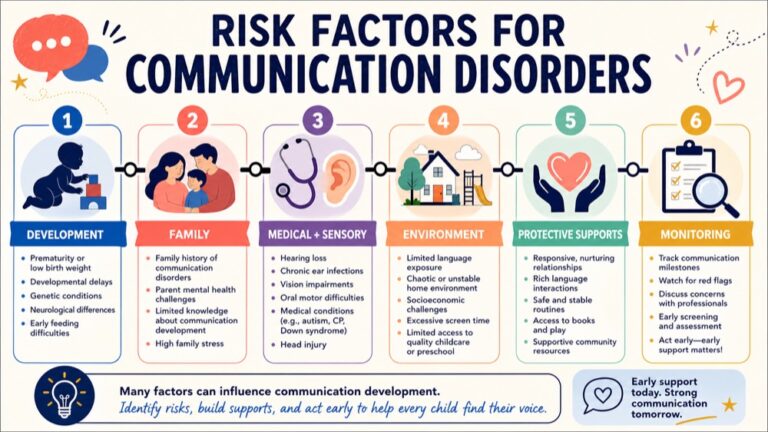
risk factors for communication disorders is easier to study when it is treated as a connected clinical reasoning problem rather than a label to memorize. Risk factors for communication disorders are characteristics, exposures, conditions, or contexts associated with a greater likelihood of a communication concern. They are not diagnoses and are not deterministic explanations. SLP reasoning asks how several factors interact, whether the evidence is correlational or causal, what protective supports are present, and whether monitoring or assessment is needed for this person in this context.
This learning guide is written for SLP students and other learners reviewing clinical concepts. It organizes observation, access, assessment, function, and professional judgment; it does not make an individualized diagnosis or replace current professional guidance. Interpretation depends on the person, task, language, culture, health, access, partner, context, and communication goals.
What risk factors for communication disorders include
Begin by separating the concept into domains. A learner who can name the domains is less likely to collapse language, access, partner, participation, competence, regulation, and clinical judgment into one explanation. The useful unit of analysis is the task: what the person was asked to understand, express, organize, coordinate, remember, or communicate, with whom, under which conditions, and with what support.
Domain or system
What to notice
Question to carry forward
Developmental factors
Developmental history, early communication patterns, motor development, hearing, cognition, and learning context may shape concern and monitoring.
What pattern has been observed over time?
Family and genetic factors
Family history and related developmental or medical patterns can increase concern without determining an individual outcome.
What family history adds context, and what does it not prove?
Medical and sensory factors
Prematurity, hearing, neurologic events, chronic conditions, medications, and sensory access may affect communication or assessment.
Which medical or access factor needs confirmation or referral?
Environment and social determinants
Resources, housing, nutrition, stress, language access, education, discrimination, and opportunity influence development and participation.
Which contextual barrier or support is affecting opportunity?
Protective supports
Responsive partners, access to language, early support, inclusive routines, health care, and stable opportunities can change the pathway.
What strengths or supports should be protected?
Monitoring and assessment
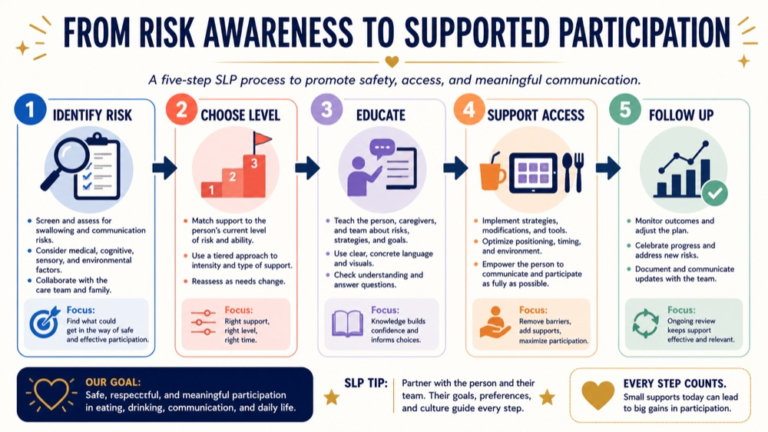
Risk recognition guides questions, follow-up, prevention, or comprehensive assessment rather than assigning a label from risk alone.
What is the proportionate next step?
These domains interact, but they should remain distinguishable. A learner may show strength in one context and need support in another. A study map organizes the next observation; it does not answer every assessment question or establish a universal treatment, goal, or legal conclusion.
Keep the first pass descriptive and close to the communication event. Note the task, response, partner, setting, timing, available support, language or mode, and consequence for participation. This gives the learner a stable record to compare across tasks and prevents a familiar term from doing too much explanatory work before the evidence has been separated.
For Praxis-style review, a vignette may include several true details but ask for one best interpretation or next step. The strongest answer usually respects the task, identifies the relevant function or boundary, checks the most important missing information, and avoids treating one performance sample or policy phrase as the whole profile.
Map risk factors for communication disorders
For study purposes, describe the communication relationship before naming a disorder, judging a partner, selecting a goal, or deciding that a task is within scope. Record what the person understood, expressed, initiated, repaired, coordinated, or participated in. Then note whether the task was familiar, how much context was shared, and which support changed the response.
Child or person factors: describe development, communication, motor, sensory, cognitive, medical, and functional history.
Family factors: ask about family history, concerns, priorities, languages, routines, supports, and changes over time.
Health and access: check hearing, vision, neurologic or medical conditions, nutrition, sleep, technology, and other access conditions as relevant.
Environment: include language opportunity, education, housing, stress, resources, social determinants, discrimination, and communication partners.
Association: distinguish a factor associated with a higher likelihood from a proven cause for this individual.
Action: decide whether prevention, monitoring, screening, comprehensive assessment, referral, or environmental support fits the evidence.
A strong description is specific enough that another learner could picture the event. Instead of writing “the communication is impaired” or “the clinician can do this,” describe the demand, observable response, language or mode, partner, context, competence or access condition, and result. This protects clinical reasoning from labels that are broader than the evidence.
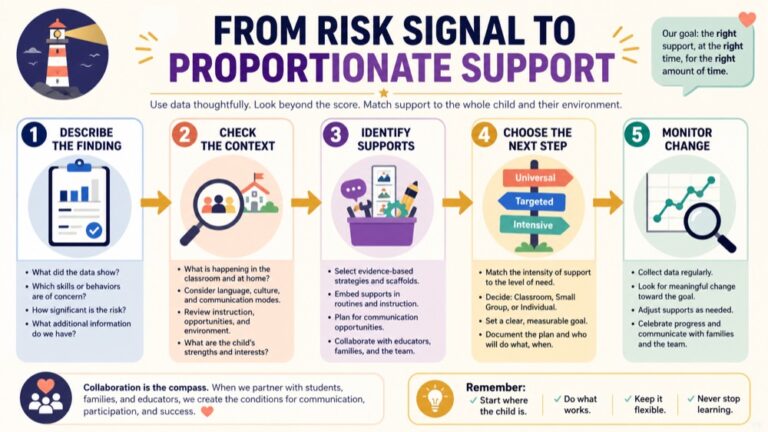
From risk signal to proportionate support
Context changes what communication and professional decisions require. A direct question, long explanation, group exchange, classroom task, health-care interaction, family story, noisy routine, supervised procedure, or referral decision places different demands on processing, language, memory, hearing, access, partner behavior, competence, and regulation. Language experience, visual information, fatigue, health literacy, and the opportunity to request clarification should be part of the observation.
A child may have a family history of language difficulty, a history of prematurity, limited access to hearing care, and a school environment that does not yet provide language support. Those facts deserve attention, but they do not independently establish a disorder. The clinician still needs to examine the child’s communication across relevant languages and routines, include family priorities, and identify supports that change access. Risk-factor reasoning is strongest when it leads to a better question and earlier support rather than a deterministic label.
Observation layer
Example question
Task
What did the person or clinician need to understand, express, organize, coordinate, decide, or provide?
Language and access
Which language, dialect, mode, hearing condition, tool, support, or communication partner was available?
Context and responsibility
Who was involved, what did they know, and which role, policy, ethical, or environmental factor mattered?
Participation and safety
What meaningful routine, role, outcome, or risk became easier or harder because of the pattern?
Context is not an afterthought added once a label has been selected. It is part of the question itself. If performance or decision quality changes with a quieter room, extra processing time, a familiar partner, a different language or mode, an interpreter, visual information, supervision, collaboration, a changed task, or a changed routine, that change is useful evidence about access and demand. It does not identify a cause by itself, but it tells you which conditions should be carried into the next observation.
Apply risk-factor reasoning
When a Praxis-style scenario or clinical discussion presents risk factors for communication disorders, use a disciplined sequence. The goal is to select the next clinical question or action that matches the evidence, the person’s priorities, the communication context, and the relevant professional boundary.
Define the task, language, mode, communication purpose, or service responsibility in plain language.
Identify the relevant domain: language, access, partner, participation, assessment, competence, collaboration, ethics, or regulation.
Separate observation from interpretation and write down what remains unknown.
Check history, exposure, dialect, culture, identity, interpreter access, environment, sensory load, memory, task familiarity, training, supervision, and local requirements as relevant.
Choose the assessment, collaboration, accommodation, goal, training, referral, or documentation step that answers the specific question.
State the boundary of the conclusion and keep the person’s safety, autonomy, access, and participation visible.
A child may have a family history of language difficulty, a history of prematurity, limited access to hearing care, and a school environment that does not yet provide language support. Those facts deserve attention, but they do not independently establish a disorder. The clinician still needs to examine the child’s communication across relevant languages and routines, include family priorities, and identify supports that change access. Risk-factor reasoning is strongest when it leads to a better question and earlier support rather than a deterministic label. In a learning answer, the decisive evidence is usually the relationship among the task, the observed pattern, the context, and the next needed information—not a single isolated behavior, score, label, or broad permission statement.
Common study mistakes
Treating a risk factor as proof that a communication disorder is present.
Assuming correlation establishes a single cause for one person’s communication profile.
Listing biological factors while ignoring language opportunity, social determinants, access, discrimination, and responsive support.
Treating bilingualism, dialect, poverty, disability, or family identity as a deficit rather than examining access and context carefully.
Using a risk list without asking whether the factor is present, measured accurately, timely, and relevant to the concern.
Ignoring protective factors, strengths, caregiver observations, and the person’s own communication priorities.
Skipping hearing, medical, developmental, or other referral questions because a language explanation seems convenient.
Failing to monitor a person over time when several risks or changing concerns make one snapshot insufficient.
Most of these mistakes come from replacing a multidomain question with a fast label. Correct the habit by returning to the same sequence: describe, separate, contextualize, ask what is missing, and choose a proportionate next step. A short rationale can make the habit visible: identify the evidence, name the uncertainty, and explain why the selected next step fits the person, setting, and responsibility.
Build a quick review map
Use this compact map when reviewing a missed question, lecture note, or clinical vignette:
Step 1: Separate observed communication findings from background risk and protective factors.
Step 2: Group factors into developmental, family, medical, sensory, environmental, social, and access domains.
Step 3: Ask whether the evidence shows association, a plausible mechanism, or a confirmed cause—and for whom.
Step 4: Include language, dialect, culture, family priorities, strengths, supports, and opportunity to communicate.
Step 5: Choose monitoring, screening, assessment, referral, prevention, or environmental change that matches the concern.
Step 6: State what the risk profile suggests, what it does not establish, and when the plan should be revisited.
Then write one transfer sentence: “When I see this pattern, I will first check ___ because ___.” The sentence should identify a decision rule, not repeat a definition. Revisit it after a delay and test whether you can apply the rule to a different task, age group, partner, language, setting, or professional responsibility.
Sources and next steps
risk factors for communication disorders is best learned as a context-sensitive pattern across communication, access, identity, function, participation, competence, and professional judgment. Use the current authority pages to refine the concept, then return to practice scenarios that require you to explain what the evidence supports and what it leaves open.
Prevalence and Incidence in Communication Disorders: Population Thinking
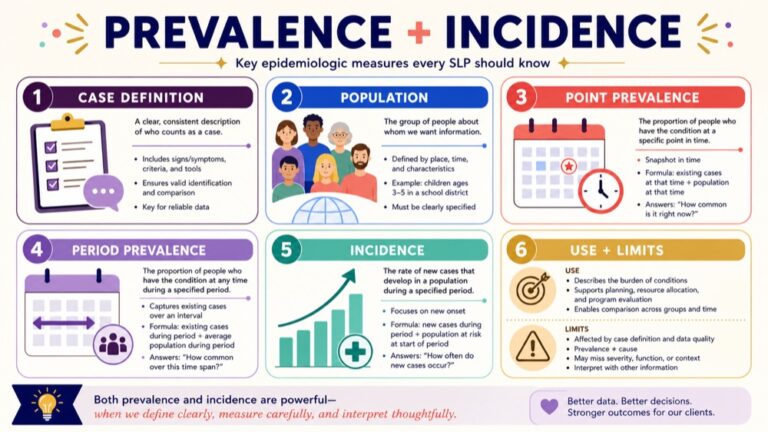
prevalence and incidence in communication disorders is easier to study when it is treated as a connected clinical reasoning problem rather than a label to memorize. Prevalence and incidence in communication disorders are population-level concepts that describe how common a defined condition is and how many new cases occur over a specified period. SLP learners need to keep the denominator, case definition, time window, ascertainment method, and population visible. These numbers can inform prevention, service planning, and disparities research, but they do not diagnose one person or predict one person’s course.
This learning guide is written for SLP students and other learners reviewing clinical concepts. It organizes observation, access, assessment, function, and professional judgment; it does not make an individualized diagnosis or replace current professional guidance. Interpretation depends on the person, task, language, culture, health, access, partner, context, and communication goals.
What prevalence and incidence in communication disorders mean
Begin by separating the concept into domains. A learner who can name the domains is less likely to collapse language, access, partner, participation, competence, regulation, and clinical judgment into one explanation. The useful unit of analysis is the task: what the person was asked to understand, express, organize, coordinate, remember, or communicate, with whom, under which conditions, and with what support.
Domain or system
What to notice
Question to carry forward
Case definition
The estimate depends on how a communication disorder, symptom, threshold, or service need is defined and measured.
What exactly counts as a case?
Population
Age, setting, geography, language, access, diagnosis pathway, and inclusion criteria define who is represented.
Who is included in the denominator and who is missing?
Point prevalence
Point prevalence describes the proportion of a population with the defined condition at a particular point in time.
How common is the condition at this specified moment?
Period prevalence
Period prevalence describes the proportion with the condition at any time during a stated interval.
How common was the condition during this time window?
Incidence
Incidence describes new cases during a period among a population at risk, with the exact rate depending on denominator and follow-up.
How many new cases arose during observation?
Use and limits
Population estimates can guide prevention, workforce, access, and research priorities but cannot replace individual assessment.
What planning decision can this estimate inform—and what can it not tell us?
These domains interact, but they should remain distinguishable. A learner may show strength in one context and need support in another. A study map organizes the next observation; it does not answer every assessment question or establish a universal treatment, goal, or legal conclusion.
Keep the first pass descriptive and close to the communication event. Note the task, response, partner, setting, timing, available support, language or mode, and consequence for participation. This gives the learner a stable record to compare across tasks and prevents a familiar term from doing too much explanatory work before the evidence has been separated.
For Praxis-style review, a vignette may include several true details but ask for one best interpretation or next step. The strongest answer usually respects the task, identifies the relevant function or boundary, checks the most important missing information, and avoids treating one performance sample or policy phrase as the whole profile.
Map prevalence and incidence in communication disorders
For study purposes, describe the communication relationship before naming a disorder, judging a partner, selecting a goal, or deciding that a task is within scope. Record what the person understood, expressed, initiated, repaired, coordinated, or participated in. Then note whether the task was familiar, how much context was shared, and which support changed the response.
Case definition: write the disorder, symptom, service need, or threshold that makes someone count in the estimate.
Denominator: identify the population at risk, the age and setting, and who was excluded or not reached.
Time: distinguish a point snapshot, a period window, a follow-up interval, and a new-case incidence measure.
Ascertainment: ask how cases were identified through records, screening, self-report, referral, survey, or research assessment.
Bias and comparison: consider under-identification, access, language, sampling, diagnostic practice, survival, and changing definitions.
Application: connect the estimate to prevention, service capacity, equity, research, or policy planning without turning it into an individual conclusion.
A strong description is specific enough that another learner could picture the event. Instead of writing “the communication is impaired” or “the clinician can do this,” describe the demand, observable response, language or mode, partner, context, competence or access condition, and result. This protects clinical reasoning from labels that are broader than the evidence.
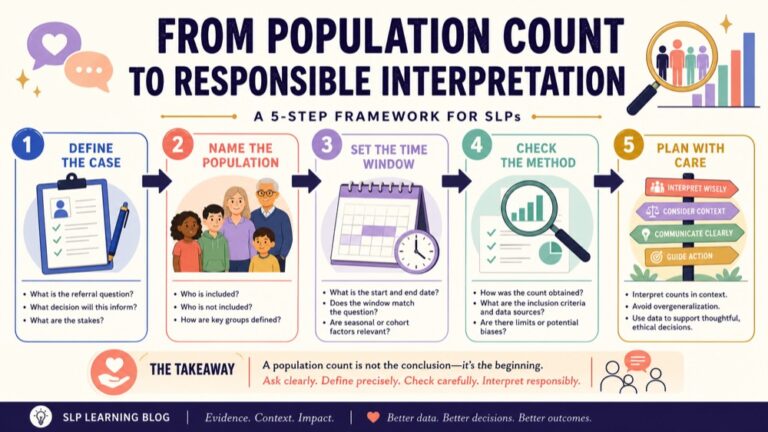
From population count to responsible interpretation
Context changes what communication and professional decisions require. A direct question, long explanation, group exchange, classroom task, health-care interaction, family story, noisy routine, supervised procedure, or referral decision places different demands on processing, language, memory, hearing, access, partner behavior, competence, and regulation. Language experience, visual information, fatigue, health literacy, and the opportunity to request clarification should be part of the observation.
A school district may report the proportion of enrolled students identified with a communication disorder during one school year. That figure reflects the district’s enrollment, referral pathways, eligibility rules, documentation, and case definition. It may not represent children who were not referred, students outside the district, people with limited access to evaluation, or communication differences that were not captured by the process. A population estimate is useful for planning only when the learner asks what population and time period produced it.
Observation layer
Example question
Task
What did the person or clinician need to understand, express, organize, coordinate, decide, or provide?
Language and access
Which language, dialect, mode, hearing condition, tool, support, or communication partner was available?
Context and responsibility
Who was involved, what did they know, and which role, policy, ethical, or environmental factor mattered?
Participation and safety
What meaningful routine, role, outcome, or risk became easier or harder because of the pattern?
Context is not an afterthought added once a label has been selected. It is part of the question itself. If performance or decision quality changes with a quieter room, extra processing time, a familiar partner, a different language or mode, an interpreter, visual information, supervision, collaboration, a changed task, or a changed routine, that change is useful evidence about access and demand. It does not identify a cause by itself, but it tells you which conditions should be carried into the next observation.
Apply epidemiology reasoning
When a Praxis-style scenario or clinical discussion presents prevalence and incidence in communication disorders, use a disciplined sequence. The goal is to select the next clinical question or action that matches the evidence, the person’s priorities, the communication context, and the relevant professional boundary.
Define the task, language, mode, communication purpose, or service responsibility in plain language.
Identify the relevant domain: language, access, partner, participation, assessment, competence, collaboration, ethics, or regulation.
Separate observation from interpretation and write down what remains unknown.
Check history, exposure, dialect, culture, identity, interpreter access, environment, sensory load, memory, task familiarity, training, supervision, and local requirements as relevant.
Choose the assessment, collaboration, accommodation, goal, training, referral, or documentation step that answers the specific question.
State the boundary of the conclusion and keep the person’s safety, autonomy, access, and participation visible.
A school district may report the proportion of enrolled students identified with a communication disorder during one school year. That figure reflects the district’s enrollment, referral pathways, eligibility rules, documentation, and case definition. It may not represent children who were not referred, students outside the district, people with limited access to evaluation, or communication differences that were not captured by the process. A population estimate is useful for planning only when the learner asks what population and time period produced it. In a learning answer, the decisive evidence is usually the relationship among the task, the observed pattern, the context, and the next needed information—not a single isolated behavior, score, label, or broad permission statement.
Common study mistakes
Using prevalence and incidence as interchangeable words for the same population count.
Comparing two estimates without checking whether the case definitions, populations, time windows, and methods match.
Assuming a larger percentage shows that the underlying disorder became more common rather than considering ascertainment or definition changes.
Treating a service-use rate as the same thing as the prevalence of a communication disorder.
Ignoring people who were not referred, screened, diagnosed, documented, or able to access the system.
Using a population estimate to label an individual or predict an individual’s response, need, or prognosis.
Forgetting that language, dialect, culture, age, setting, and measurement alter who is counted.
Reporting a number without the denominator, time window, uncertainty, case definition, or source.
Most of these mistakes come from replacing a multidomain question with a fast label. Correct the habit by returning to the same sequence: describe, separate, contextualize, ask what is missing, and choose a proportionate next step. A short rationale can make the habit visible: identify the evidence, name the uncertainty, and explain why the selected next step fits the person, setting, and responsibility.
Build a quick review map
Use this compact map when reviewing a missed question, lecture note, or clinical vignette:
Step 1: Name the case definition, population, denominator, setting, and data source.
Step 2: Identify whether the estimate is point prevalence, period prevalence, cumulative incidence, or an incidence rate.
Step 3: Check the time window, follow-up, sampling, referral pathway, and who may be missing.
Step 4: Separate a disorder estimate from service use, screening positives, referrals, and individual clinical findings.
Step 5: Use the number for population planning, prevention, access, or research—not individual diagnosis.
Step 6: State the estimate’s uncertainty and the specific planning question it can inform.
Then write one transfer sentence: “When I see this pattern, I will first check ___ because ___.” The sentence should identify a decision rule, not repeat a definition. Revisit it after a delay and test whether you can apply the rule to a different task, age group, partner, language, setting, or professional responsibility.
Sources and next steps
prevalence and incidence in communication disorders is best learned as a context-sensitive pattern across communication, access, identity, function, participation, competence, and professional judgment. Use the current authority pages to refine the concept, then return to practice scenarios that require you to explain what the evidence supports and what it leaves open.
Sensitivity and Specificity in Assessment: SLP Screening Logic
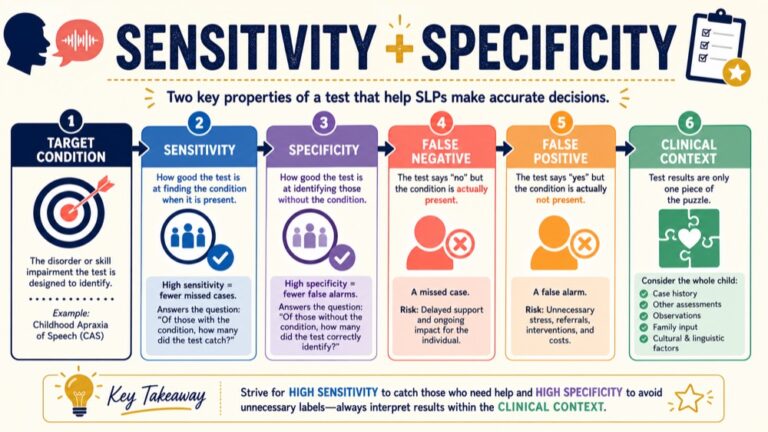
sensitivity and specificity in assessment is easier to study when it is treated as a connected clinical reasoning problem rather than a label to memorize. Sensitivity and specificity in assessment answer different questions about how a measure identifies a condition or pattern. Sensitivity concerns how well a procedure detects people who meet the target definition, while specificity concerns how well it stays negative for people who do not. SLP learners need both concepts, plus false-positive and false-negative consequences, because a screening result is not the same as a diagnosis.
This learning guide is written for SLP students and other learners reviewing clinical concepts. It organizes observation, access, assessment, function, and professional judgment; it does not make an individualized diagnosis or replace current professional guidance. Interpretation depends on the person, task, language, culture, health, access, partner, context, and communication goals.
What sensitivity and specificity in assessment mean
Begin by separating the concept into domains. A learner who can name the domains is less likely to collapse language, access, partner, participation, competence, regulation, and clinical judgment into one explanation. The useful unit of analysis is the task: what the person was asked to understand, express, organize, coordinate, remember, or communicate, with whom, under which conditions, and with what support.
Domain or system
What to notice
Question to carry forward
Target condition
The measure needs a defined condition, pattern, or decision target before sensitivity or specificity can be interpreted.
What counts as the condition in this study or screening context?
Sensitivity
Sensitivity is the proportion of people with the target condition who receive a positive result under the stated method and threshold.
How many relevant cases could this screen detect?
Specificity
Specificity is the proportion of people without the target condition who receive a negative result under the stated method and threshold.
How well could this screen avoid flagging people without the target?
False negative
A person with the target condition receives a negative result, so a reassuring screen may miss a person who needs more assessment.
What concern would be missed if the screen were negative?
False positive
A person without the target condition receives a positive result, so a positive screen may lead to unnecessary concern or referral.
What extra assessment is needed before interpreting the positive result?
Clinical context
Prevalence, language, dialect, culture, setting, threshold, consequences, and the reason for screening affect how a result should be used.
What action is proportionate to this result and context?
These domains interact, but they should remain distinguishable. A learner may show strength in one context and need support in another. A study map organizes the next observation; it does not answer every assessment question or establish a universal treatment, goal, or legal conclusion.
Keep the first pass descriptive and close to the communication event. Note the task, response, partner, setting, timing, available support, language or mode, and consequence for participation. This gives the learner a stable record to compare across tasks and prevents a familiar term from doing too much explanatory work before the evidence has been separated.
For Praxis-style review, a vignette may include several true details but ask for one best interpretation or next step. The strongest answer usually respects the task, identifies the relevant function or boundary, checks the most important missing information, and avoids treating one performance sample or policy phrase as the whole profile.
Map sensitivity and specificity in assessment
For study purposes, describe the communication relationship before naming a disorder, judging a partner, selecting a goal, or deciding that a task is within scope. Record what the person understood, expressed, initiated, repaired, coordinated, or participated in. Then note whether the task was familiar, how much context was shared, and which support changed the response.
Target: define the disorder, pattern, risk, or decision the measure is intended to identify before discussing accuracy.
Sensitivity: ask how often the procedure is positive among people who meet the target definition under the stated conditions.
Specificity: ask how often the procedure is negative among people who do not meet the target definition under the stated conditions.
Error: connect false negatives and false positives to the harm, cost, delay, anxiety, referral, or missed-support consequence in this setting.
Context: check prevalence, sample, language, dialect, culture, age, severity, setting, threshold, and how the measure was administered.
Next step: use the result to decide whether to monitor, gather more information, refer, or complete a comprehensive assessment—not to skip reasoning.
A strong description is specific enough that another learner could picture the event. Instead of writing “the communication is impaired” or “the clinician can do this,” describe the demand, observable response, language or mode, partner, context, competence or access condition, and result. This protects clinical reasoning from labels that are broader than the evidence.
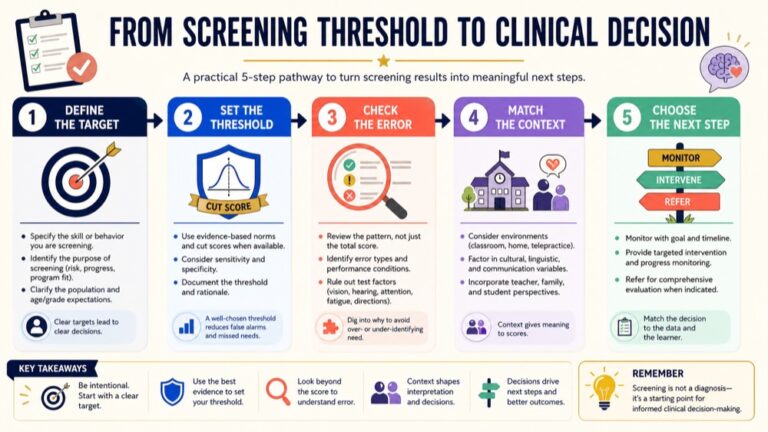
From screening threshold to clinical decision
Context changes what communication and professional decisions require. A direct question, long explanation, group exchange, classroom task, health-care interaction, family story, noisy routine, supervised procedure, or referral decision places different demands on processing, language, memory, hearing, access, partner behavior, competence, and regulation. Language experience, visual information, fatigue, health literacy, and the opportunity to request clarification should be part of the observation.
A screening tool may be designed to identify children who need a fuller speech-language evaluation. A negative result can be useful when the tool has appropriate sensitivity for the target question, but it does not erase a strong caregiver concern, a communication pattern outside the test, or a mismatch between the normative sample and the child’s language or dialect. A positive result can justify further assessment without proving a disorder. The clinical meaning depends on the target, the population, the consequences of error, and the next available step.
Observation layer
Example question
Task
What did the person or clinician need to understand, express, organize, coordinate, decide, or provide?
Language and access
Which language, dialect, mode, hearing condition, tool, support, or communication partner was available?
Context and responsibility
Who was involved, what did they know, and which role, policy, ethical, or environmental factor mattered?
Participation and safety
What meaningful routine, role, outcome, or risk became easier or harder because of the pattern?
Context is not an afterthought added once a label has been selected. It is part of the question itself. If performance or decision quality changes with a quieter room, extra processing time, a familiar partner, a different language or mode, an interpreter, visual information, supervision, collaboration, a changed task, or a changed routine, that change is useful evidence about access and demand. It does not identify a cause by itself, but it tells you which conditions should be carried into the next observation.
Apply sensitivity and specificity reasoning
When a Praxis-style scenario or clinical discussion presents sensitivity and specificity in assessment, use a disciplined sequence. The goal is to select the next clinical question or action that matches the evidence, the person’s priorities, the communication context, and the relevant professional boundary.
Define the task, language, mode, communication purpose, or service responsibility in plain language.
Identify the relevant domain: language, access, partner, participation, assessment, competence, collaboration, ethics, or regulation.
Separate observation from interpretation and write down what remains unknown.
Check history, exposure, dialect, culture, identity, interpreter access, environment, sensory load, memory, task familiarity, training, supervision, and local requirements as relevant.
Choose the assessment, collaboration, accommodation, goal, training, referral, or documentation step that answers the specific question.
State the boundary of the conclusion and keep the person’s safety, autonomy, access, and participation visible.
A screening tool may be designed to identify children who need a fuller speech-language evaluation. A negative result can be useful when the tool has appropriate sensitivity for the target question, but it does not erase a strong caregiver concern, a communication pattern outside the test, or a mismatch between the normative sample and the child’s language or dialect. A positive result can justify further assessment without proving a disorder. The clinical meaning depends on the target, the population, the consequences of error, and the next available step. In a learning answer, the decisive evidence is usually the relationship among the task, the observed pattern, the context, and the next needed information—not a single isolated behavior, score, label, or broad permission statement.
Common study mistakes
Treating sensitivity and specificity as synonyms or remembering one as simply the opposite of the other.
Assuming a highly sensitive screen is automatically the best tool for every decision, population, or setting.
Calling a positive screening result a diagnosis or treating a negative result as proof that no concern exists.
Ignoring false-negative consequences when the cost of missing a communication or swallowing concern is high.
Ignoring false-positive consequences such as unnecessary referral, anxiety, labeling, or use of limited assessment resources.
Forgetting that prevalence, sample selection, threshold, language, dialect, culture, age, and severity change interpretation.
Using sensitivity and specificity from one population or purpose as if they transfer unchanged to another.
Choosing a threshold by memorized number without asking what action the result is meant to support.
Most of these mistakes come from replacing a multidomain question with a fast label. Correct the habit by returning to the same sequence: describe, separate, contextualize, ask what is missing, and choose a proportionate next step. A short rationale can make the habit visible: identify the evidence, name the uncertainty, and explain why the selected next step fits the person, setting, and responsibility.
Build a quick review map
Use this compact map when reviewing a missed question, lecture note, or clinical vignette:
Step 1: Define the target condition, population, setting, measure, threshold, and intended action.
Step 2: Separate sensitivity, specificity, false negatives, and false positives in plain language.
Step 3: Ask which error matters more for the decision and what consequence follows from each error.
Step 5: Treat screening as a decision about further information, referral, or monitoring rather than a diagnosis.
Step 6: State the narrow conclusion the result supports and the evidence that is still missing.
Then write one transfer sentence: “When I see this pattern, I will first check ___ because ___.” The sentence should identify a decision rule, not repeat a definition. Revisit it after a delay and test whether you can apply the rule to a different task, age group, partner, language, setting, or professional responsibility.
Sources and next steps
sensitivity and specificity in assessment is best learned as a context-sensitive pattern across communication, access, identity, function, participation, competence, and professional judgment. Use the current authority pages to refine the concept, then return to practice scenarios that require you to explain what the evidence supports and what it leaves open.
Validity and Reliability in Speech Pathology: Trust the Measure, Then Check the Fit
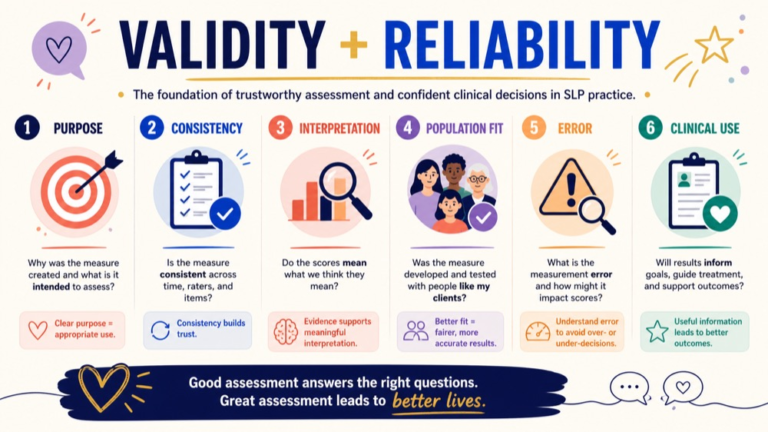
validity and reliability in speech pathology is easier to study when it is treated as a connected clinical reasoning problem rather than a label to memorize. Validity and reliability in speech pathology describe different but connected questions about measurement. Reliability asks how consistently a tool, rater, or procedure produces results under specified conditions. Validity asks whether the evidence supports the intended interpretation and use for a particular construct, population, and decision. A measure can be consistent without measuring the right thing, and a valid interpretation still requires attention to error, context, language, culture, and clinical purpose.
This learning guide is written for SLP students and other learners reviewing clinical concepts. It organizes observation, access, assessment, function, and professional judgment; it does not make an individualized diagnosis or replace current professional guidance. Interpretation depends on the person, task, language, culture, health, access, partner, context, and communication goals.
What validity and reliability in speech pathology include
Begin by separating the concept into domains. A learner who can name the domains is less likely to collapse language, access, partner, participation, competence, regulation, and clinical judgment into one explanation. The useful unit of analysis is the task: what the person was asked to understand, express, organize, coordinate, remember, or communicate, with whom, under which conditions, and with what support.
Domain or system
What to notice
Question to carry forward
Reliability
Consistency of scores or observations across raters, occasions, items, forms, or repeated procedures under stated conditions.
How stable or reproducible is the result?
Validity
Evidence supporting an interpretation or use of scores for a construct, population, purpose, and decision—not a permanent label attached to a test.
What interpretation and use are justified?
Construct
The skill, ability, behavior, symptom, participation feature, or clinical concept the measure is intended to represent.
What is actually being measured?
Population and context
Age, language, dialect, culture, hearing, cognition, severity, setting, familiarity, and values affect interpretation and fit.
Does the evidence match this person and context?
Error and sensitivity
Measurement error, rater disagreement, floor or ceiling effects, responsiveness, and meaningful change affect decisions over time.
How much change is meaningful versus noise?
Clinical use
A tool should be selected for the clinical question and integrated with interview, observation, dynamic information, and other data.
What decision will this measure inform?
These domains interact, but they should remain distinguishable. A learner may show strength in one context and need support in another. A study map organizes the next observation; it does not answer every assessment question or establish a universal treatment, goal, or legal conclusion.
Keep the first pass descriptive and close to the communication event. Note the task, response, partner, setting, timing, available support, language or mode, and consequence for participation. This gives the learner a stable record to compare across tasks and prevents a familiar term from doing too much explanatory work before the evidence has been separated.
For Praxis-style review, a vignette may include several true details but ask for one best interpretation or next step. The strongest answer usually respects the task, identifies the relevant function or boundary, checks the most important missing information, and avoids treating one performance sample or policy phrase as the whole profile.
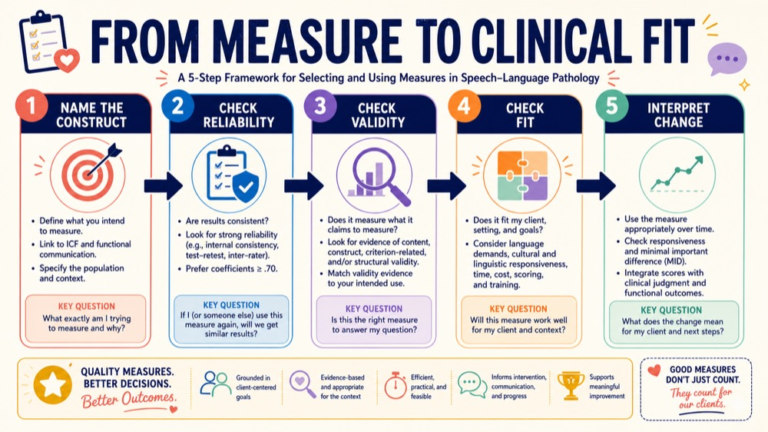
Map validity and reliability in speech pathology
For study purposes, describe the communication relationship before naming a disorder, judging a partner, selecting a goal, or deciding that a task is within scope. Record what the person understood, expressed, initiated, repaired, coordinated, or participated in. Then note whether the task was familiar, how much context was shared, and which support changed the response.
Purpose: state whether the measure is being used for screening, description, diagnosis support, baseline, progress, outcome, eligibility, or another decision.
Reliability: check the type of consistency reported, the raters or occasions, the conditions, and the amount of error.
Validity: identify the construct, interpretation, use, population, comparison, and evidence supporting the claim.
Fit: compare the tool’s language, norms, culture, sensory and cognitive demands, severity range, and setting with the person.
Change: consider responsiveness, minimal important change, floor or ceiling effects, practice effects, and whether a score difference matters functionally.
Integration: combine the measure with interview, observation, language history, dynamic information, participation, and other relevant data.
A strong description is specific enough that another learner could picture the event. Instead of writing “the communication is impaired” or “the clinician can do this,” describe the demand, observable response, language or mode, partner, context, competence or access condition, and result. This protects clinical reasoning from labels that are broader than the evidence.
From measurement quality to clinical fit
Context changes what communication and professional decisions require. A direct question, long explanation, group exchange, classroom task, health-care interaction, family story, noisy routine, supervised procedure, or referral decision places different demands on processing, language, memory, hearing, access, partner behavior, competence, and regulation. Language experience, visual information, fatigue, health literacy, and the opportunity to request clarification should be part of the observation.
A standardized assessment can have strong reliability and validity evidence for a defined population and purpose while still being a poor fit for a person who does not share the test’s language, dialect, cultural experience, sensory access, or task familiarity. A highly consistent rater can repeatedly record the wrong feature. A score change can reflect measurement error rather than meaningful functional progress. The exam-safe question is not “Is this test valid?” in the abstract; it is “What interpretation and use are supported here, for this person, under these conditions?”
Observation layer
Example question
Task
What did the person or clinician need to understand, express, organize, coordinate, decide, or provide?
Language and access
Which language, dialect, mode, hearing condition, tool, support, or communication partner was available?
Context and responsibility
Who was involved, what did they know, and which role, policy, ethical, or environmental factor mattered?
Participation and safety
What meaningful routine, role, outcome, or risk became easier or harder because of the pattern?
Context is not an afterthought added once a label has been selected. It is part of the question itself. If performance or decision quality changes with a quieter room, extra processing time, a familiar partner, a different language or mode, an interpreter, visual information, supervision, collaboration, a changed task, or a changed routine, that change is useful evidence about access and demand. It does not identify a cause by itself, but it tells you which conditions should be carried into the next observation.
Apply measurement reasoning
When a Praxis-style scenario or clinical discussion presents validity and reliability in speech pathology, use a disciplined sequence. The goal is to select the next clinical question or action that matches the evidence, the person’s priorities, the communication context, and the relevant professional boundary.
Define the task, language, mode, communication purpose, or service responsibility in plain language.
Identify the relevant domain: language, access, partner, participation, assessment, competence, collaboration, ethics, or regulation.
Separate observation from interpretation and write down what remains unknown.
Check history, exposure, dialect, culture, identity, interpreter access, environment, sensory load, memory, task familiarity, training, supervision, and local requirements as relevant.
Choose the assessment, collaboration, accommodation, goal, training, referral, or documentation step that answers the specific question.
State the boundary of the conclusion and keep the person’s safety, autonomy, access, and participation visible.
A standardized assessment can have strong reliability and validity evidence for a defined population and purpose while still being a poor fit for a person who does not share the test’s language, dialect, cultural experience, sensory access, or task familiarity. A highly consistent rater can repeatedly record the wrong feature. A score change can reflect measurement error rather than meaningful functional progress. The exam-safe question is not “Is this test valid?” in the abstract; it is “What interpretation and use are supported here, for this person, under these conditions?” In a learning answer, the decisive evidence is usually the relationship among the task, the observed pattern, the context, and the next needed information—not a single isolated behavior, score, label, or broad permission statement.
Common study mistakes
Using reliability and validity as synonyms or treating one as proof of the other.
Saying a test is valid without naming the construct, interpretation, use, population, and decision.
Assuming a standardized score is fair or interpretable when language, dialect, culture, hearing, cognition, or task familiarity differs.
Treating a high correlation, a significant result, or a consistent rater as complete evidence of clinical usefulness.
Interpreting a small score change as meaningful without considering measurement error, responsiveness, floor, or ceiling effects.
Using one score as a diagnosis, eligibility decision, or complete description instead of integrating multiple data sources.
Confusing norm-referenced comparison with criterion-referenced performance or with functional participation.
Choosing a tool because it is familiar or convenient rather than because it answers the clinical question and fits the person.
Most of these mistakes come from replacing a multidomain question with a fast label. Correct the habit by returning to the same sequence: describe, separate, contextualize, ask what is missing, and choose a proportionate next step. A short rationale can make the habit visible: identify the evidence, name the uncertainty, and explain why the selected next step fits the person, setting, and responsibility.
Build a quick review map
Use this compact map when reviewing a missed question, lecture note, or clinical vignette:
Step 1: Name the clinical purpose, construct, person, setting, and decision the measure is meant to inform.
Step 2: Separate reliability evidence from validity evidence and identify the specific type of each.
Step 3: Check population, language, dialect, culture, sensory and cognitive demands, severity, norms, and context.
Step 4: Consider measurement error, rater or occasion effects, responsiveness, practice effects, floor, ceiling, and meaningful change.
Step 5: Use the measure alongside interview, observation, dynamic information, and participation evidence.
Step 6: State the narrow conclusion supported by the evidence and the limits on interpretation or generalization.
Then write one transfer sentence: “When I see this pattern, I will first check ___ because ___.” The sentence should identify a decision rule, not repeat a definition. Revisit it after a delay and test whether you can apply the rule to a different task, age group, partner, language, setting, or professional responsibility.
Sources and next steps
validity and reliability in speech pathology is best learned as a context-sensitive pattern across communication, access, identity, function, participation, competence, and professional judgment. Use the current authority pages to refine the concept, then return to practice scenarios that require you to explain what the evidence supports and what it leaves open.
Research Methods for Speech-Language Pathology: Questions, Evidence, and Appraisal
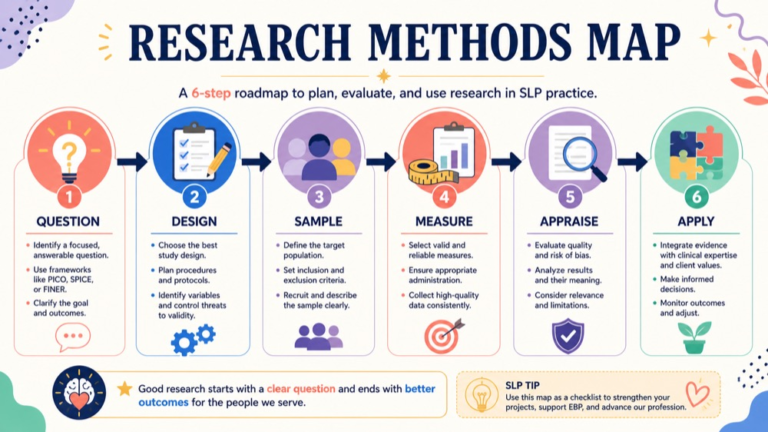
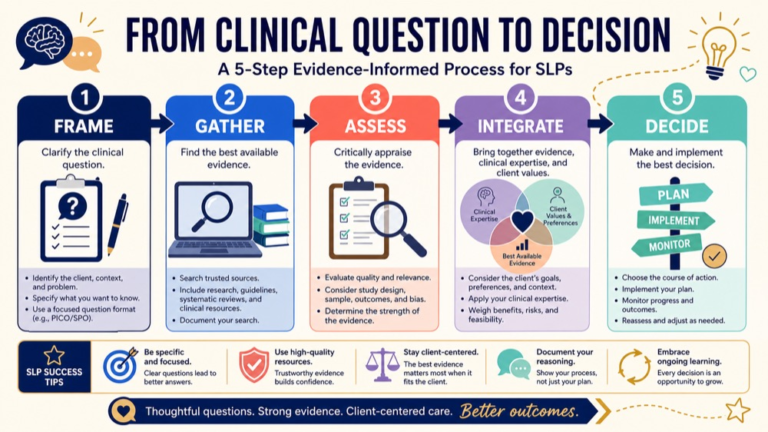
research methods for speech language pathology is easier to study when it is treated as a connected clinical reasoning problem rather than a label to memorize. Research methods for speech-language pathology are the tools used to ask answerable questions, collect and interpret evidence, and connect findings to clinical decisions. Praxis-style review is easier when the learner separates the research question, design, sample, measures, comparison, analysis, bias, applicability, and decision. Evidence-based practice then integrates external research, internal client data, clinical expertise, and the person’s values rather than treating one study as an automatic answer.
This learning guide is written for SLP students and other learners reviewing clinical concepts. It organizes observation, access, assessment, function, and professional judgment; it does not make an individualized diagnosis or replace current professional guidance. Interpretation depends on the person, task, language, culture, health, access, partner, context, and communication goals.
What research methods for speech-language pathology include
Begin by separating the concept into domains. A learner who can name the domains is less likely to collapse language, access, partner, participation, competence, regulation, and clinical judgment into one explanation. The useful unit of analysis is the task: what the person was asked to understand, express, organize, coordinate, remember, or communicate, with whom, under which conditions, and with what support.
Domain or system
What to notice
Question to carry forward
Question
A focused question identifies the population, communication or swallowing concern, intervention or exposure, comparison, and outcome when those elements fit.
What exactly is being asked and for whom?
Design
Experimental, quasi-experimental, observational, qualitative, survey, case, single-case, review, and other designs answer different questions.
What kind of evidence can this design support?
Sample and context
Participants, recruitment, inclusion criteria, setting, language, culture, severity, and attrition affect interpretation and transfer.
Who was studied and how similar are they to the person or group of interest?
Measurement
Operational definitions, tools, reliability, validity, fidelity, outcomes, and timing determine what was actually measured.
Does the measure represent the construct and decision?
Bias and uncertainty
Selection, measurement, expectation, missing data, confounding, reporting, and implementation issues can alter the result.
What could make the estimate or interpretation less certain?
Application
External evidence must be integrated with internal data, clinical expertise, person or caregiver perspectives, access, values, and context.
What decision is justified for this person or setting?
These domains interact, but they should remain distinguishable. A learner may show strength in one context and need support in another. A study map organizes the next observation; it does not answer every assessment question or establish a universal treatment, goal, or legal conclusion.
Keep the first pass descriptive and close to the communication event. Note the task, response, partner, setting, timing, available support, language or mode, and consequence for participation. This gives the learner a stable record to compare across tasks and prevents a familiar term from doing too much explanatory work before the evidence has been separated.
For Praxis-style review, a vignette may include several true details but ask for one best interpretation or next step. The strongest answer usually respects the task, identifies the relevant function or boundary, checks the most important missing information, and avoids treating one performance sample or policy phrase as the whole profile.
Map research methods for speech-language pathology
For study purposes, describe the communication relationship before naming a disorder, judging a partner, selecting a goal, or deciding that a task is within scope. Record what the person understood, expressed, initiated, repaired, coordinated, or participated in. Then note whether the task was familiar, how much context was shared, and which support changed the response.
Frame: turn a broad interest into a question with a defined population, concern, action, comparison, and outcome.
Design: match experimental, observational, qualitative, survey, single-case, or review design to the claim the study needs to support.
Sample: inspect recruitment, eligibility, size, attrition, language, culture, severity, setting, and similarity to the target population.
Measure: identify the construct, operational definition, tool, reliability, validity, fidelity, timing, and meaningful outcome.
Appraise: examine bias, confounding, comparison, missing data, analysis, precision, limitations, and whether the conclusion matches the data.
Integrate: combine external evidence with internal client data, clinical expertise, values, access, culture, and a specific clinical decision.
A strong description is specific enough that another learner could picture the event. Instead of writing “the communication is impaired” or “the clinician can do this,” describe the demand, observable response, language or mode, partner, context, competence or access condition, and result. This protects clinical reasoning from labels that are broader than the evidence.
From clinical question to evidence-informed decision
Context changes what communication and professional decisions require. A direct question, long explanation, group exchange, classroom task, health-care interaction, family story, noisy routine, supervised procedure, or referral decision places different demands on processing, language, memory, hearing, access, partner behavior, competence, and regulation. Language experience, visual information, fatigue, health literacy, and the opportunity to request clarification should be part of the observation.
A study may report that an intervention group changed more than a comparison group, but the learner still needs to ask who participated, how outcomes were measured, whether the groups were comparable, how much data were missing, and whether the intervention can be delivered in the new setting. A small case study can provide useful descriptive insight without supporting the same causal claim as a controlled experiment. Research-methods reasoning protects the clinician from both overtrusting and dismissing evidence.
Observation layer
Example question
Task
What did the person or clinician need to understand, express, organize, coordinate, decide, or provide?
Language and access
Which language, dialect, mode, hearing condition, tool, support, or communication partner was available?
Context and responsibility
Who was involved, what did they know, and which role, policy, ethical, or environmental factor mattered?
Participation and safety
What meaningful routine, role, outcome, or risk became easier or harder because of the pattern?
Context is not an afterthought added once a label has been selected. It is part of the question itself. If performance or decision quality changes with a quieter room, extra processing time, a familiar partner, a different language or mode, an interpreter, visual information, supervision, collaboration, a changed task, or a changed routine, that change is useful evidence about access and demand. It does not identify a cause by itself, but it tells you which conditions should be carried into the next observation.
Apply research-methods reasoning
When a Praxis-style scenario or clinical discussion presents research methods for speech language pathology, use a disciplined sequence. The goal is to select the next clinical question or action that matches the evidence, the person’s priorities, the communication context, and the relevant professional boundary.
Define the task, language, mode, communication purpose, or service responsibility in plain language.
Identify the relevant domain: language, access, partner, participation, assessment, competence, collaboration, ethics, or regulation.
Separate observation from interpretation and write down what remains unknown.
Check history, exposure, dialect, culture, identity, interpreter access, environment, sensory load, memory, task familiarity, training, supervision, and local requirements as relevant.
Choose the assessment, collaboration, accommodation, goal, training, referral, or documentation step that answers the specific question.
State the boundary of the conclusion and keep the person’s safety, autonomy, access, and participation visible.
A study may report that an intervention group changed more than a comparison group, but the learner still needs to ask who participated, how outcomes were measured, whether the groups were comparable, how much data were missing, and whether the intervention can be delivered in the new setting. A small case study can provide useful descriptive insight without supporting the same causal claim as a controlled experiment. Research-methods reasoning protects the clinician from both overtrusting and dismissing evidence. In a learning answer, the decisive evidence is usually the relationship among the task, the observed pattern, the context, and the next needed information—not a single isolated behavior, score, label, or broad permission statement.
Common study mistakes
Choosing a research design by name without first identifying the question and the claim the study needs to support.
Assuming a larger sample automatically removes selection bias, measurement error, confounding, or limited applicability.
Treating statistical significance as the same as clinical importance, meaningful participation, or a useful individual outcome.
Ignoring who was excluded, who dropped out, which language or setting was studied, and whether the result transfers.
Calling a measure valid without asking which construct, population, comparison, and purpose the validity evidence addresses.
Confusing internal clinical data with external research evidence or treating clinician opinion as a substitute for appraisal.
Using an evidence map or abstract as if it were the full study, guideline, systematic review, or applicable protocol.
Applying a group result to one person without integrating values, context, access, risk, preferences, and clinical judgment.
Most of these mistakes come from replacing a multidomain question with a fast label. Correct the habit by returning to the same sequence: describe, separate, contextualize, ask what is missing, and choose a proportionate next step. A short rationale can make the habit visible: identify the evidence, name the uncertainty, and explain why the selected next step fits the person, setting, and responsibility.
Build a quick review map
Use this compact map when reviewing a missed question, lecture note, or clinical vignette:
Step 1: Write the clinical or research question and identify the population, concern, action, comparison, and outcome.
Step 2: Name the design and state what kind of inference it can reasonably support.
Step 4: List likely bias, uncertainty, limitations, and the difference between statistical and functional meaning.
Step 5: Use ASHA evidence tools and the full source when appropriate, then integrate external and internal evidence.
Step 6: State the decision the evidence supports, the person or setting to which it applies, and what remains unknown.
Then write one transfer sentence: “When I see this pattern, I will first check ___ because ___.” The sentence should identify a decision rule, not repeat a definition. Revisit it after a delay and test whether you can apply the rule to a different task, age group, partner, language, setting, or professional responsibility.
Sources and next steps
research methods for speech language pathology is best learned as a context-sensitive pattern across communication, access, identity, function, participation, competence, and professional judgment. Use the current authority pages to refine the concept, then return to practice scenarios that require you to explain what the evidence supports and what it leaves open.
Advocacy in Communication Disorders: Access, Voice, and Systems Change
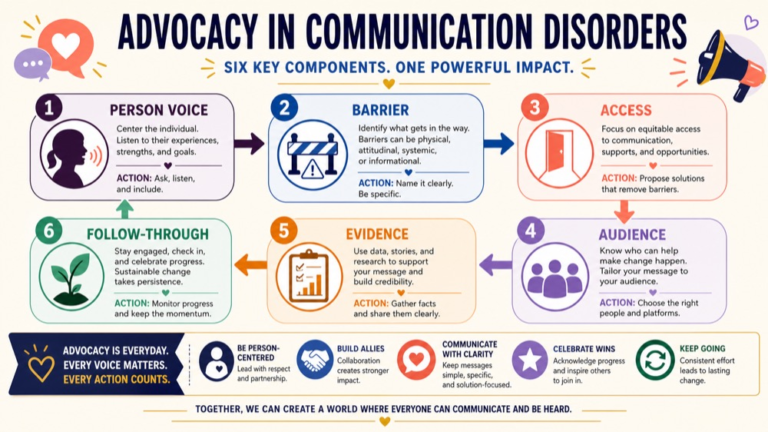
advocacy in communication disorders is easier to study when it is treated as a connected clinical reasoning problem rather than a label to memorize. Advocacy in communication disorders means helping people and communities obtain communication access, understand options, express preferences, participate in decisions, and influence the systems that shape services. It can occur during one clinical encounter, in a school or health-care team, through community education, or through organized policy work. Strong SLP reasoning keeps the affected person’s voice, the barrier, the evidence, the decision-maker, and the next action connected.
This learning guide is written for SLP students and other learners reviewing clinical concepts. It organizes observation, access, assessment, function, and professional judgment; it does not make an individualized diagnosis or replace current professional guidance. Interpretation depends on the person, task, language, culture, health, access, partner, context, and communication goals.
What advocacy in communication disorders includes
Begin by separating the concept into domains. A learner who can name the domains is less likely to collapse language, access, partner, participation, competence, regulation, and clinical judgment into one explanation. The useful unit of analysis is the task: what the person was asked to understand, express, organize, coordinate, remember, or communicate, with whom, under which conditions, and with what support.
Domain or system
What to notice
Question to carry forward
Person’s voice
The person’s language, mode, values, preferences, goals, consent, and right to participate are central to advocacy.
Who is affected and how will their voice guide the action?
Communication access
Supports may address language, dialect, AAC, hearing, vision, literacy, environment, partner behavior, technology, and time.
What barrier prevents the person from understanding or being heard?
Education and awareness
Clinicians can explain communication needs, services, rights, evidence, and practical supports to families, teams, and communities.
What information would make the next decision more usable?
Systems change
Advocacy may target a school, clinic, policy, workflow, reimbursement rule, community resource, or public understanding.
Which system or decision-maker controls the barrier?
Evidence and coalition
Stories, observations, data, professional knowledge, community expertise, and partner organizations can strengthen an advocacy case.
What evidence and relationships make the request credible?
Action and follow-up
A specific request, responsible person, timeline, communication channel, and follow-up plan make advocacy actionable.
What change is being requested and how will progress be checked?
These domains interact, but they should remain distinguishable. A learner may show strength in one context and need support in another. A study map organizes the next observation; it does not answer every assessment question or establish a universal treatment, goal, or legal conclusion.
Keep the first pass descriptive and close to the communication event. Note the task, response, partner, setting, timing, available support, language or mode, and consequence for participation. This gives the learner a stable record to compare across tasks and prevents a familiar term from doing too much explanatory work before the evidence has been separated.
For Praxis-style review, a vignette may include several true details but ask for one best interpretation or next step. The strongest answer usually respects the task, identifies the relevant function or boundary, checks the most important missing information, and avoids treating one performance sample or policy phrase as the whole profile.
Map advocacy in communication disorders
For study purposes, describe the communication relationship before naming a disorder, judging a partner, selecting a goal, or deciding that a task is within scope. Record what the person understood, expressed, initiated, repaired, coordinated, or participated in. Then note whether the task was familiar, how much context was shared, and which support changed the response.
Voice: identify the person’s preferred language, communication mode, priorities, consent, and role in the advocacy decision.
Barrier: describe the environmental, interactional, cultural, linguistic, technological, financial, policy, or attitudinal barrier rather than blaming the communicator.
Access: select a practical support or accommodation that matches the task, partner, setting, mode, and available resources.
Audience: identify the teacher, administrator, health team, payer, agency, legislator, community, or other decision-maker with authority over the barrier.
Evidence: combine person and community knowledge with observations, outcomes, research, policy, and professional expertise without overstating a claim.
Follow-through: make the request specific, document communication, build coalition, monitor the response, and revise the approach when needed.
A strong description is specific enough that another learner could picture the event. Instead of writing “the communication is impaired” or “the clinician can do this,” describe the demand, observable response, language or mode, partner, context, competence or access condition, and result. This protects clinical reasoning from labels that are broader than the evidence.
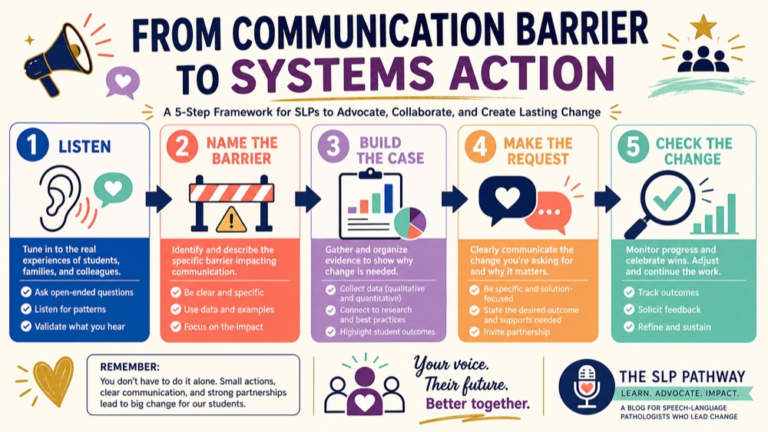
From communication barrier to systems action
Context changes what communication and professional decisions require. A direct question, long explanation, group exchange, classroom task, health-care interaction, family story, noisy routine, supervised procedure, or referral decision places different demands on processing, language, memory, hearing, access, partner behavior, competence, and regulation. Language experience, visual information, fatigue, health literacy, and the opportunity to request clarification should be part of the observation.
A family may need an interpreter and accessible written information to participate in an evaluation decision. A student may need a communication partner to wait, offer visual choices, and honor an AAC response rather than answering for them. A school SLP may also advocate for a service model, workload condition, or policy that affects many students. These are related but not identical actions. The best next step depends on who is affected, what barrier is present, who can change it, what evidence is available, and how the person’s consent and voice will be protected.
Observation layer
Example question
Task
What did the person or clinician need to understand, express, organize, coordinate, decide, or provide?
Language and access
Which language, dialect, mode, hearing condition, tool, support, or communication partner was available?
Context and responsibility
Who was involved, what did they know, and which role, policy, ethical, or environmental factor mattered?
Participation and safety
What meaningful routine, role, outcome, or risk became easier or harder because of the pattern?
Context is not an afterthought added once a label has been selected. It is part of the question itself. If performance or decision quality changes with a quieter room, extra processing time, a familiar partner, a different language or mode, an interpreter, visual information, supervision, collaboration, a changed task, or a changed routine, that change is useful evidence about access and demand. It does not identify a cause by itself, but it tells you which conditions should be carried into the next observation.
Apply advocacy reasoning
When a Praxis-style scenario or clinical discussion presents advocacy in communication disorders, use a disciplined sequence. The goal is to select the next clinical question or action that matches the evidence, the person’s priorities, the communication context, and the relevant professional boundary.
Define the task, language, mode, communication purpose, or service responsibility in plain language.
Identify the relevant domain: language, access, partner, participation, assessment, competence, collaboration, ethics, or regulation.
Separate observation from interpretation and write down what remains unknown.
Check history, exposure, dialect, culture, identity, interpreter access, environment, sensory load, memory, task familiarity, training, supervision, and local requirements as relevant.
Choose the assessment, collaboration, accommodation, goal, training, referral, or documentation step that answers the specific question.
State the boundary of the conclusion and keep the person’s safety, autonomy, access, and participation visible.
A family may need an interpreter and accessible written information to participate in an evaluation decision. A student may need a communication partner to wait, offer visual choices, and honor an AAC response rather than answering for them. A school SLP may also advocate for a service model, workload condition, or policy that affects many students. These are related but not identical actions. The best next step depends on who is affected, what barrier is present, who can change it, what evidence is available, and how the person’s consent and voice will be protected. In a learning answer, the decisive evidence is usually the relationship among the task, the observed pattern, the context, and the next needed information—not a single isolated behavior, score, label, or broad permission statement.
Common study mistakes
Speaking for a person without asking how they communicate, what they want, or how they want to participate.
Treating advocacy as persuasion alone instead of identifying a concrete communication or systems barrier and a responsible decision-maker.
Giving the same accommodation to everyone without matching it to language, mode, task, environment, culture, and preference.
Using one dramatic story as if it supports a general policy claim without checking data, context, and community perspective.
Confusing an SLP’s professional opinion with the authority to change a school, payer, facility, or public policy unilaterally.
Ignoring the difference between individual advocacy, family support, professional outreach, community education, and policy action.
Making a broad request with no responsible audience, specific change, timeline, communication channel, or follow-up.
Assuming an advocacy request has succeeded because it was submitted rather than checking access, implementation, and the person’s real experience.
Most of these mistakes come from replacing a multidomain question with a fast label. Correct the habit by returning to the same sequence: describe, separate, contextualize, ask what is missing, and choose a proportionate next step. A short rationale can make the habit visible: identify the evidence, name the uncertainty, and explain why the selected next step fits the person, setting, and responsibility.
Build a quick review map
Use this compact map when reviewing a missed question, lecture note, or clinical vignette:
Step 1: Name the person or community, communication need, barrier, goal, and consent or participation preference.
Step 2: Separate an individual accommodation from education, team advocacy, community outreach, and systems or policy change.
Step 3: Identify the audience or decision-maker with authority over the barrier.
Step 4: Choose evidence, partners, language, and communication supports that make the request credible and accessible.
Step 5: Write a specific request with an owner, timeline, implementation signal, and follow-up method.
Step 6: Check whether the change actually increases voice, access, autonomy, safety, participation, or service quality.
Then write one transfer sentence: “When I see this pattern, I will first check ___ because ___.” The sentence should identify a decision rule, not repeat a definition. Revisit it after a delay and test whether you can apply the rule to a different task, age group, partner, language, setting, or professional responsibility.
Sources and next steps
advocacy in communication disorders is best learned as a context-sensitive pattern across communication, access, identity, function, participation, competence, and professional judgment. Use the current authority pages to refine the concept, then return to practice scenarios that require you to explain what the evidence supports and what it leaves open.
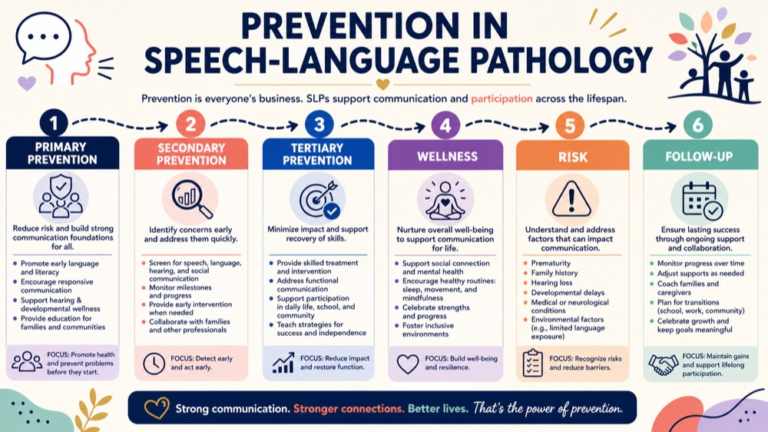
Prevention in Speech-Language Pathology: Primary, Secondary, and Tertiary Reasoning
prevention in speech language pathology is easier to study when it is treated as a connected clinical reasoning problem rather than a label to memorize. Prevention in speech-language pathology is broader than treating an established disorder. It includes activities that reduce risk, identify a problem early, limit the impact of an existing condition, support wellness, and protect communication, feeding, swallowing, and participation. Praxis-style questions often test whether the learner can distinguish primary, secondary, and tertiary prevention from screening, assessment, treatment, maintenance, and referral.
This learning guide is written for SLP students and other learners reviewing clinical concepts. It organizes observation, access, assessment, function, and professional judgment; it does not make an individualized diagnosis or replace current professional guidance. Interpretation depends on the person, task, language, culture, health, access, partner, context, and communication goals.
What prevention in speech-language pathology includes
Begin by separating the concept into domains. A learner who can name the domains is less likely to collapse language, access, partner, participation, competence, regulation, and clinical judgment into one explanation. The useful unit of analysis is the task: what the person was asked to understand, express, organize, coordinate, remember, or communicate, with whom, under which conditions, and with what support.
Domain or system
What to notice
Question to carry forward
Primary prevention
The aim is to reduce susceptibility or exposure before a communication, feeding, swallowing, or related disorder develops.
What risk or exposure can be changed before onset?
Secondary prevention
The aim is early detection and timely response so a problem can be identified or its progression or complications limited.
What sign or risk calls for screening, assessment, or early action?
Tertiary prevention
The aim is to reduce disability or impact from an existing disorder and support effective function and participation.
What support limits the impact of an established condition?
Wellness
Education and programs can support healthy communication, swallowing, participation, self-advocacy, and quality of life.
What strength or routine should be protected or supported?
Population and context
Prevention may occur with individuals, families, schools, health teams, workplaces, communities, or systems.
Who is at risk and where can the prevention action work?
Outcome and follow-up
Prevention plans need a purpose, accessible education, appropriate monitoring, referral, reassessment, or maintenance plan.
How will we know the risk or impact is being addressed?
These domains interact, but they should remain distinguishable. A learner may show strength in one context and need support in another. A study map organizes the next observation; it does not answer every assessment question or establish a universal treatment, goal, or legal conclusion.
Keep the first pass descriptive and close to the communication event. Note the task, response, partner, setting, timing, available support, language or mode, and consequence for participation. This gives the learner a stable record to compare across tasks and prevents a familiar term from doing too much explanatory work before the evidence has been separated.
For Praxis-style review, a vignette may include several true details but ask for one best interpretation or next step. The strongest answer usually respects the task, identifies the relevant function or boundary, checks the most important missing information, and avoids treating one performance sample or policy phrase as the whole profile.
Map prevention in speech-language pathology
For study purposes, describe the communication relationship before naming a disorder, judging a partner, selecting a goal, or deciding that a task is within scope. Record what the person understood, expressed, initiated, repaired, coordinated, or participated in. Then note whether the task was familiar, how much context was shared, and which support changed the response.
Risk: identify susceptibility, exposure, environmental barrier, health condition, developmental concern, or behavior linked to the prevention goal.
Level: decide whether the action is primary, secondary, or tertiary based on onset, detection, existing condition, and intended outcome.
Education: make information usable for the person, family, school, health team, or community and avoid blaming people for system-level risk.
Access: consider language, culture, literacy, hearing, vision, cognition, disability, resources, environment, and opportunity to act on the information.
Referral and monitoring: connect prevention to screening, assessment, treatment, follow-up, maintenance, or another professional when indicated.
Participation: link the prevention action to communication, feeding, swallowing, learning, work, health, safety, independence, and quality of life.
A strong description is specific enough that another learner could picture the event. Instead of writing “the communication is impaired” or “the clinician can do this,” describe the demand, observable response, language or mode, partner, context, competence or access condition, and result. This protects clinical reasoning from labels that are broader than the evidence.
From risk awareness to supported participation
Context changes what communication and professional decisions require. A direct question, long explanation, group exchange, classroom task, health-care interaction, family story, noisy routine, supervised procedure, or referral decision places different demands on processing, language, memory, hearing, access, partner behavior, competence, and regulation. Language experience, visual information, fatigue, health literacy, and the opportunity to request clarification should be part of the observation.
A school workshop that teaches families and educators to notice language-learning risk and seek timely evaluation can fit a secondary-prevention frame. Education that reduces exposure to a known risk before a problem develops is closer to primary prevention. Communication supports that reduce the impact of an established disorder and preserve participation fit tertiary prevention. The label depends on the starting condition and intended outcome, not simply on whether an SLP delivered the activity.
Observation layer
Example question
Task
What did the person or clinician need to understand, express, organize, coordinate, decide, or provide?
Language and access
Which language, dialect, mode, hearing condition, tool, support, or communication partner was available?
Context and responsibility
Who was involved, what did they know, and which role, policy, ethical, or environmental factor mattered?
Participation and safety
What meaningful routine, role, outcome, or risk became easier or harder because of the pattern?
Context is not an afterthought added once a label has been selected. It is part of the question itself. If performance or decision quality changes with a quieter room, extra processing time, a familiar partner, a different language or mode, an interpreter, visual information, supervision, collaboration, a changed task, or a changed routine, that change is useful evidence about access and demand. It does not identify a cause by itself, but it tells you which conditions should be carried into the next observation.
Apply prevention reasoning
When a Praxis-style scenario or clinical discussion presents prevention in speech language pathology, use a disciplined sequence. The goal is to select the next clinical question or action that matches the evidence, the person’s priorities, the communication context, and the relevant professional boundary.
Define the task, language, mode, communication purpose, or service responsibility in plain language.
Identify the relevant domain: language, access, partner, participation, assessment, competence, collaboration, ethics, or regulation.
Separate observation from interpretation and write down what remains unknown.
Check history, exposure, dialect, culture, identity, interpreter access, environment, sensory load, memory, task familiarity, training, supervision, and local requirements as relevant.
Choose the assessment, collaboration, accommodation, goal, training, referral, or documentation step that answers the specific question.
State the boundary of the conclusion and keep the person’s safety, autonomy, access, and participation visible.
A school workshop that teaches families and educators to notice language-learning risk and seek timely evaluation can fit a secondary-prevention frame. Education that reduces exposure to a known risk before a problem develops is closer to primary prevention. Communication supports that reduce the impact of an established disorder and preserve participation fit tertiary prevention. The label depends on the starting condition and intended outcome, not simply on whether an SLP delivered the activity. In a learning answer, the decisive evidence is usually the relationship among the task, the observed pattern, the context, and the next needed information—not a single isolated behavior, score, label, or broad permission statement.
Common study mistakes
Treating prevention as only public education and overlooking early detection, risk reduction, maintenance, and disability impact.
Calling every screening activity primary prevention even when the purpose is early identification of an existing concern.
Confusing treatment of a current disorder with primary prevention because the intervention might reduce future complications.
Using primary, secondary, and tertiary as a ranking of importance rather than as different starting conditions and goals.
Giving prevention education that is inaccessible, generic, culturally mismatched, or impossible for the person or community to act on.
Assuming prevention eliminates risk or guarantees a particular developmental, medical, communication, or swallowing outcome.
Failing to identify when prevention should lead to screening, comprehensive assessment, treatment, referral, or follow-up.
Measuring attendance or information delivery without checking whether risk, access, participation, or early response changed.
Most of these mistakes come from replacing a multidomain question with a fast label. Correct the habit by returning to the same sequence: describe, separate, contextualize, ask what is missing, and choose a proportionate next step. A short rationale can make the habit visible: identify the evidence, name the uncertainty, and explain why the selected next step fits the person, setting, and responsibility.
Build a quick review map
Use this compact map when reviewing a missed question, lecture note, or clinical vignette:
Step 1: Name the person or population, starting condition, risk, context, and desired outcome.
Step 2: Classify the action as primary, secondary, or tertiary based on onset, detection, or existing impact.
Step 3: Separate prevention from screening, assessment, treatment, maintenance, counseling, and referral while noting where they connect.
Step 4: Adapt information and supports to language, culture, access, resources, and the person’s ability to act.
Step 5: Choose monitoring, follow-up, referral, or outcome data that match the prevention purpose.
Step 6: Write one sentence explaining how the action supports communication, swallowing, health, safety, or participation.
Then write one transfer sentence: “When I see this pattern, I will first check ___ because ___.” The sentence should identify a decision rule, not repeat a definition. Revisit it after a delay and test whether you can apply the rule to a different task, age group, partner, language, setting, or professional responsibility.
Sources and next steps
prevention in speech language pathology is best learned as a context-sensitive pattern across communication, access, identity, function, participation, competence, and professional judgment. Use the current authority pages to refine the concept, then return to practice scenarios that require you to explain what the evidence supports and what it leaves open.
Outpatient Speech Therapy Service Delivery: Match the Model to the Need
outpatient speech therapy service delivery is easier to study when it is treated as a connected clinical reasoning problem rather than a label to memorize. Outpatient speech therapy service delivery is the organized way an SLP provides care in a clinic or related ambulatory setting. It includes more than choosing individual or group therapy. The clinician considers the person’s goals, communication or swallowing needs, access, safety, setting, dosage, provider roles, evidence, functional outcomes, documentation, and payer or facility constraints before selecting and revising a service model.
This learning guide is written for SLP students and other learners reviewing clinical concepts. It organizes observation, access, assessment, function, and professional judgment; it does not make an individualized diagnosis or replace current professional guidance. Interpretation depends on the person, task, language, culture, health, access, partner, context, and communication goals.
What outpatient speech therapy service delivery includes
Begin by separating the concept into domains. A learner who can name the domains is less likely to collapse language, access, partner, participation, competence, regulation, and clinical judgment into one explanation. The useful unit of analysis is the task: what the person was asked to understand, express, organize, coordinate, remember, or communicate, with whom, under which conditions, and with what support.
Domain or system
What to notice
Question to carry forward
Clinical question
The referral, patient priority, task, communication partner, and risk define what the service must accomplish.
What problem and functional outcome are being addressed?
Service mode
Individual, group, co-treatment, concurrent, consultation, and technology-supported options each create different opportunities and limits.
Which mode has a clinical rationale for this person?
Dosage
Frequency, intensity, duration, schedule, and progression should relate to goals, response, access, and the episode of care.
What dose is justified and how will it be revisited?
Setting and access
Clinic layout, transportation, language, hearing, vision, cognition, AAC, telepractice, and care-partner support affect participation.
What condition could make the planned service usable or unusable?
The model should connect to communication, swallowing, learning, work, relationships, health, independence, or another meaningful routine.
What change should be visible outside the therapy room?
These domains interact, but they should remain distinguishable. A learner may show strength in one context and need support in another. A study map organizes the next observation; it does not answer every assessment question or establish a universal treatment, goal, or legal conclusion.
Keep the first pass descriptive and close to the communication event. Note the task, response, partner, setting, timing, available support, language or mode, and consequence for participation. This gives the learner a stable record to compare across tasks and prevents a familiar term from doing too much explanatory work before the evidence has been separated.
For Praxis-style review, a vignette may include several true details but ask for one best interpretation or next step. The strongest answer usually respects the task, identifies the relevant function or boundary, checks the most important missing information, and avoids treating one performance sample or policy phrase as the whole profile.
Map outpatient speech therapy service delivery
For study purposes, describe the communication relationship before naming a disorder, judging a partner, selecting a goal, or deciding that a task is within scope. Record what the person understood, expressed, initiated, repaired, coordinated, or participated in. Then note whether the task was familiar, how much context was shared, and which support changed the response.
Purpose: state the referral question, person’s priority, task, communication or swallowing function, and meaningful outcome.
Mode: compare individual, group, co-treatment, concurrent, consultation, and telepractice options for this person rather than selecting a default.
Dosage: connect frequency, intensity, duration, schedule, and progression to the goal, response, risk, access, and episode of care.
Implementation: clarify provider roles, consent, documentation, coding, payer, facility, referral, and communication requirements.
Revision: collect functional data and change the mode, setting, or dosage when the person’s needs, progress, or context changes.
A strong description is specific enough that another learner could picture the event. Instead of writing “the communication is impaired” or “the clinician can do this,” describe the demand, observable response, language or mode, partner, context, competence or access condition, and result. This protects clinical reasoning from labels that are broader than the evidence.
From clinical need to a fitting outpatient model
Context changes what communication and professional decisions require. A direct question, long explanation, group exchange, classroom task, health-care interaction, family story, noisy routine, supervised procedure, or referral decision places different demands on processing, language, memory, hearing, access, partner behavior, competence, and regulation. Language experience, visual information, fatigue, health literacy, and the opportunity to request clarification should be part of the observation.
A person may need focused individual assessment at the start of an outpatient episode and later benefit from group practice or care-partner coaching to carry a strategy into daily life. Another person may need coordinated work with a second discipline because a shared functional task is more important than a profession-specific exercise. The format should follow the clinical question and the person’s response. A full schedule or familiar billing pattern does not by itself establish clinical appropriateness.
Observation layer
Example question
Task
What did the person or clinician need to understand, express, organize, coordinate, decide, or provide?
Language and access
Which language, dialect, mode, hearing condition, tool, support, or communication partner was available?
Context and responsibility
Who was involved, what did they know, and which role, policy, ethical, or environmental factor mattered?
Participation and safety
What meaningful routine, role, outcome, or risk became easier or harder because of the pattern?
Context is not an afterthought added once a label has been selected. It is part of the question itself. If performance or decision quality changes with a quieter room, extra processing time, a familiar partner, a different language or mode, an interpreter, visual information, supervision, collaboration, a changed task, or a changed routine, that change is useful evidence about access and demand. It does not identify a cause by itself, but it tells you which conditions should be carried into the next observation.
Apply outpatient service-delivery reasoning
When a Praxis-style scenario or clinical discussion presents outpatient speech therapy service delivery, use a disciplined sequence. The goal is to select the next clinical question or action that matches the evidence, the person’s priorities, the communication context, and the relevant professional boundary.
Define the task, language, mode, communication purpose, or service responsibility in plain language.
Identify the relevant domain: language, access, partner, participation, assessment, competence, collaboration, ethics, or regulation.
Separate observation from interpretation and write down what remains unknown.
Check history, exposure, dialect, culture, identity, interpreter access, environment, sensory load, memory, task familiarity, training, supervision, and local requirements as relevant.
Choose the assessment, collaboration, accommodation, goal, training, referral, or documentation step that answers the specific question.
State the boundary of the conclusion and keep the person’s safety, autonomy, access, and participation visible.
A person may need focused individual assessment at the start of an outpatient episode and later benefit from group practice or care-partner coaching to carry a strategy into daily life. Another person may need coordinated work with a second discipline because a shared functional task is more important than a profession-specific exercise. The format should follow the clinical question and the person’s response. A full schedule or familiar billing pattern does not by itself establish clinical appropriateness. In a learning answer, the decisive evidence is usually the relationship among the task, the observed pattern, the context, and the next needed information—not a single isolated behavior, score, label, or broad permission statement.
Common study mistakes
Treating individual therapy as automatically better or group therapy as automatically less individualized.
Choosing a mode because it fills the schedule without connecting the choice to patient need, access, safety, and outcome.
Changing frequency or duration without documenting the clinical reason, response, plan, and applicable requirement.
Calling a visit co-treatment without defining complementary roles, shared outcomes, communication, and documentation.
Ignoring transportation, language, communication mode, hearing, vision, cognition, technology, or care-partner barriers.
Measuring success by visits or minutes alone rather than functional change, participation, safety, and patient priorities.
Assuming a payer rule is a clinical recommendation or assuming clinical judgment overrides a current payer or facility rule.
Leaving the service model unchanged when the person has generalized, stalled, lost access, or entered a new phase of care.
Most of these mistakes come from replacing a multidomain question with a fast label. Correct the habit by returning to the same sequence: describe, separate, contextualize, ask what is missing, and choose a proportionate next step. A short rationale can make the habit visible: identify the evidence, name the uncertainty, and explain why the selected next step fits the person, setting, and responsibility.
Build a quick review map
Use this compact map when reviewing a missed question, lecture note, or clinical vignette:
Step 1: Name the outpatient setting, referral question, person, partners, functional task, and risk.
Step 2: List the service modes that could answer the clinical question and the benefit or limitation of each.
Step 3: Choose the mode, setting, provider roles, and dosage that fit the evidence and person’s priorities.
Step 5: Select functional data that can show whether the service changes participation, safety, or independence.
Step 6: Revisit the plan when performance, context, goals, resources, or episode-of-care needs change.
Then write one transfer sentence: “When I see this pattern, I will first check ___ because ___.” The sentence should identify a decision rule, not repeat a definition. Revisit it after a delay and test whether you can apply the rule to a different task, age group, partner, language, setting, or professional responsibility.
Sources and next steps
outpatient speech therapy service delivery is best learned as a context-sensitive pattern across communication, access, identity, function, participation, competence, and professional judgment. Use the current authority pages to refine the concept, then return to practice scenarios that require you to explain what the evidence supports and what it leaves open.
Medical Speech-Language Pathology: Communication, Cognition, Swallowing, and Safety
medical speech language pathology is easier to study when it is treated as a connected clinical reasoning problem rather than a label to memorize. Medical speech-language pathology applies SLP knowledge to health-care settings and patient priorities. Depending on the setting, the work may include screening, assessment, treatment, education, communication access, cognitive-communication support, swallowing and feeding care, patient safety, documentation, and interprofessional collaboration. The clinical reasoning is always tied to the person’s health context, function, risk, goals, consent, and the SLP’s competence and authority.
This learning guide is written for SLP students and other learners reviewing clinical concepts. It organizes observation, access, assessment, function, and professional judgment; it does not make an individualized diagnosis or replace current professional guidance. Interpretation depends on the person, task, language, culture, health, access, partner, context, and communication goals.
What medical speech-language pathology includes
Begin by separating the concept into domains. A learner who can name the domains is less likely to collapse language, access, partner, participation, competence, regulation, and clinical judgment into one explanation. The useful unit of analysis is the task: what the person was asked to understand, express, organize, coordinate, remember, or communicate, with whom, under which conditions, and with what support.
Domain or system
What to notice
Question to carry forward
Setting
Acute care, rehabilitation, skilled nursing, long-term care, outpatient, home health, pediatric, and other settings create different demands and workflows.
Which setting and phase of care shape the decision?
Communication
The SLP may address speech, language, cognition, voice, AAC, communication access, patient education, and care-partner interaction.
What communication function affects care, autonomy, or participation?
Swallowing and feeding
Evaluation and treatment require attention to safety, physiology, nutrition or hydration context, patient goals, and interprofessional coordination.
What evidence and risk make this the right next step?
Cognition
Attention, memory, executive functions, orientation, and cognitive-communication can affect consent, routines, learning, self-advocacy, and discharge planning.
Which functional health task is affected?
Team and access
Nurses, physicians, dietitians, occupational therapists, physical therapists, families, interpreters, and patients may share information and responsibilities.
Who needs a clear message, accommodation, or coordinated plan?
Safety and scope
Patient safety depends on clear communication, competent tasks, escalation, documentation, policy, and respect for professional and legal boundaries.
What must be clarified or escalated before acting?
These domains interact, but they should remain distinguishable. A learner may show strength in one context and need support in another. A study map organizes the next observation; it does not answer every assessment question or establish a universal treatment, goal, or legal conclusion.
Keep the first pass descriptive and close to the communication event. Note the task, response, partner, setting, timing, available support, language or mode, and consequence for participation. This gives the learner a stable record to compare across tasks and prevents a familiar term from doing too much explanatory work before the evidence has been separated.
For Praxis-style review, a vignette may include several true details but ask for one best interpretation or next step. The strongest answer usually respects the task, identifies the relevant function or boundary, checks the most important missing information, and avoids treating one performance sample or policy phrase as the whole profile.
Map medical speech-language pathology
For study purposes, describe the communication relationship before naming a disorder, judging a partner, selecting a goal, or deciding that a task is within scope. Record what the person understood, expressed, initiated, repaired, coordinated, or participated in. Then note whether the task was familiar, how much context was shared, and which support changed the response.
Health context: identify diagnosis, phase of care, precautions, medical stability, current orders, setting, and the reason for the referral.
Communication and cognition: link the observed pattern to a functional task such as communicating needs, following a routine, learning information, or making a supported choice.
Swallowing and feeding: consider the relevant history, safety indicators, patient goals, diet or nutrition context, and the expertise of the interprofessional team.
Access and health literacy: adapt language, mode, materials, interpreter support, hearing or vision access, and care-partner communication so information can be used.
Team and documentation: share concise, relevant findings, clarify responsibility, document clinical reasoning, and coordinate follow-up or transition.
Scope and safety: check competence, training, supervision, facility policy, state requirements, emergency procedures, and when another professional must be consulted.
A strong description is specific enough that another learner could picture the event. Instead of writing “the communication is impaired” or “the clinician can do this,” describe the demand, observable response, language or mode, partner, context, competence or access condition, and result. This protects clinical reasoning from labels that are broader than the evidence.
From patient needs to safer care
Context changes what communication and professional decisions require. A direct question, long explanation, group exchange, classroom task, health-care interaction, family story, noisy routine, supervised procedure, or referral decision places different demands on processing, language, memory, hearing, access, partner behavior, competence, and regulation. Language experience, visual information, fatigue, health literacy, and the opportunity to request clarification should be part of the observation.
A patient who cannot explain a symptom, remember a safety instruction, communicate a refusal, or coordinate a meal may need more than a score on a bedside task. Medical SLP reasoning asks what the patient needs to do in the current setting, which communication or swallowing function affects that task, what risks or supports are present, and which team members need to coordinate. A job title does not authorize every clinical support activity; the clinician must keep competence, training, policy, and patient safety visible.
Observation layer
Example question
Task
What did the person or clinician need to understand, express, organize, coordinate, decide, or provide?
Language and access
Which language, dialect, mode, hearing condition, tool, support, or communication partner was available?
Context and responsibility
Who was involved, what did they know, and which role, policy, ethical, or environmental factor mattered?
Participation and safety
What meaningful routine, role, outcome, or risk became easier or harder because of the pattern?
Context is not an afterthought added once a label has been selected. It is part of the question itself. If performance or decision quality changes with a quieter room, extra processing time, a familiar partner, a different language or mode, an interpreter, visual information, supervision, collaboration, a changed task, or a changed routine, that change is useful evidence about access and demand. It does not identify a cause by itself, but it tells you which conditions should be carried into the next observation.
Apply medical SLP reasoning
When a Praxis-style scenario or clinical discussion presents medical speech language pathology, use a disciplined sequence. The goal is to select the next clinical question or action that matches the evidence, the person’s priorities, the communication context, and the relevant professional boundary.
Define the task, language, mode, communication purpose, or service responsibility in plain language.
Identify the relevant domain: language, access, partner, participation, assessment, competence, collaboration, ethics, or regulation.
Separate observation from interpretation and write down what remains unknown.
Check history, exposure, dialect, culture, identity, interpreter access, environment, sensory load, memory, task familiarity, training, supervision, and local requirements as relevant.
Choose the assessment, collaboration, accommodation, goal, training, referral, or documentation step that answers the specific question.
State the boundary of the conclusion and keep the person’s safety, autonomy, access, and participation visible.
A patient who cannot explain a symptom, remember a safety instruction, communicate a refusal, or coordinate a meal may need more than a score on a bedside task. Medical SLP reasoning asks what the patient needs to do in the current setting, which communication or swallowing function affects that task, what risks or supports are present, and which team members need to coordinate. A job title does not authorize every clinical support activity; the clinician must keep competence, training, policy, and patient safety visible. In a learning answer, the decisive evidence is usually the relationship among the task, the observed pattern, the context, and the next needed information—not a single isolated behavior, score, label, or broad permission statement.
Common study mistakes
Reducing medical SLP to one setting, one age group, or one disorder area such as articulation or swallowing alone.
Choosing an assessment or intervention without first identifying the medical context, referral question, safety risk, patient goals, and current information.
Treating a screening result as a diagnosis or as a substitute for a complete, context-appropriate assessment.
Ignoring communication access, health literacy, interpreter needs, AAC, hearing, vision, cognition, fatigue, pain, or care-partner roles.
Making a diet, safety, discharge, or medical decision outside the SLP’s authority or without the required team and facility process.
Documenting isolated impairment language without connecting findings to function, participation, risk, care decisions, or measurable follow-up.
Assuming collaboration means every team member can perform every discipline-specific task or interpret every finding.
Failing to escalate a safety concern, clarify an order or policy, or arrange continuity when the patient’s needs change.
Most of these mistakes come from replacing a multidomain question with a fast label. Correct the habit by returning to the same sequence: describe, separate, contextualize, ask what is missing, and choose a proportionate next step. A short rationale can make the habit visible: identify the evidence, name the uncertainty, and explain why the selected next step fits the person, setting, and responsibility.
Build a quick review map
Use this compact map when reviewing a missed question, lecture note, or clinical vignette:
Step 1: Name the health-care setting, phase of care, referral question, patient priority, and immediate safety context.
Step 2: Identify the communication, cognitive, voice, AAC, feeding, or swallowing function that affects a real care task.
Step 3: Select the next assessment, treatment, education, access support, collaboration, or escalation step that matches the evidence.
Step 4: Check consent, language, communication mode, health literacy, care-partner role, privacy, and patient preferences.
Step 5: Confirm competence, training, supervision, facility policy, state requirements, and interdisciplinary responsibility.
Step 6: Document the functional rationale, response, risk, limitation, handoff, and follow-up or transition plan.
Then write one transfer sentence: “When I see this pattern, I will first check ___ because ___.” The sentence should identify a decision rule, not repeat a definition. Revisit it after a delay and test whether you can apply the rule to a different task, age group, partner, language, setting, or professional responsibility.
Sources and next steps
medical speech language pathology is best learned as a context-sensitive pattern across communication, access, identity, function, participation, competence, and professional judgment. Use the current authority pages to refine the concept, then return to practice scenarios that require you to explain what the evidence supports and what it leaves open.
School-Based Speech-Language Pathology: Services, Collaboration, and Student Access
school based speech language pathology is easier to study when it is treated as a connected clinical reasoning problem rather than a label to memorize. School-based speech-language pathology connects communication services to education, participation, and access to learning. The SLP is an education team member who may work in a therapy room, classroom, school activity, community setting, or through telepractice. The best model is not selected by habit alone; it is shaped by student need, the IEP and applicable law, the least restrictive environment, collaboration, progress, access, and the responsibilities of the school team.
This learning guide is written for SLP students and other learners reviewing clinical concepts. It organizes observation, access, assessment, function, and professional judgment; it does not make an individualized diagnosis or replace current professional guidance. Interpretation depends on the person, task, language, culture, health, access, partner, context, and communication goals.
What school-based speech-language pathology includes
Begin by separating the concept into domains. A learner who can name the domains is less likely to collapse language, access, partner, participation, competence, regulation, and clinical judgment into one explanation. The useful unit of analysis is the task: what the person was asked to understand, express, organize, coordinate, remember, or communicate, with whom, under which conditions, and with what support.
Domain or system
What to notice
Question to carry forward
Educational purpose
Services support communication, learning, participation, access to the curriculum, social functioning, and other documented educational needs.
What school activity or educational access is affected?
Student need
The student’s communication profile, goals, age, strengths, preferences, culture, language, and changing context shape the plan.
What does this student need to participate and learn?
Service setting
Services may occur in a therapy room, classroom, playground, lunchroom, vocational site, or another setting that fits the need.
Where can the target be taught and generalized?
Service model
Pull-out, classroom-based, collaborative, consultative, cyclical, block, burst, telepractice, and other models may be combined or revised.
Which model provides the right access and support now?
Team partnership
Teachers, families, students, SLPs, special educators, administrators, and other support personnel coordinate roles and strategies.
Who needs to know, model, practice, or monitor the strategy?
IEP and documentation
Frequency, type, duration, location, progress, and changes should be documented according to the IEP and applicable requirements.
Does the record reflect the individualized service actually needed?
These domains interact, but they should remain distinguishable. A learner may show strength in one context and need support in another. A study map organizes the next observation; it does not answer every assessment question or establish a universal treatment, goal, or legal conclusion.
Keep the first pass descriptive and close to the communication event. Note the task, response, partner, setting, timing, available support, language or mode, and consequence for participation. This gives the learner a stable record to compare across tasks and prevents a familiar term from doing too much explanatory work before the evidence has been separated.
For Praxis-style review, a vignette may include several true details but ask for one best interpretation or next step. The strongest answer usually respects the task, identifies the relevant function or boundary, checks the most important missing information, and avoids treating one performance sample or policy phrase as the whole profile.
Map school-based speech-language pathology
For study purposes, describe the communication relationship before naming a disorder, judging a partner, selecting a goal, or deciding that a task is within scope. Record what the person understood, expressed, initiated, repaired, coordinated, or participated in. Then note whether the task was familiar, how much context was shared, and which support changed the response.
Student and curriculum: connect communication needs to classroom demands, curriculum access, routines, relationships, and meaningful participation.
Eligibility and plan: keep eligibility, goals, services, frequency, duration, location, progress, and team decisions distinct from general therapy preferences.
Setting: compare resource-room, classroom, natural, community, telepractice, and other settings for access, instruction, practice, and generalization.
Collaboration: coordinate with students, families, teachers, special educators, administrators, and other support personnel without erasing role clarity.
Dosage and schedule: consider frequency, intensity, duration, cyclical, block, burst, or other schedules in relation to student response and school routines.
Workload and advocacy: distinguish a manageable workload from a raw caseload number and advocate for services that require SLP expertise and meet student needs.
A strong description is specific enough that another learner could picture the event. Instead of writing “the communication is impaired” or “the clinician can do this,” describe the demand, observable response, language or mode, partner, context, competence or access condition, and result. This protects clinical reasoning from labels that are broader than the evidence.
From student need to school participation
Context changes what communication and professional decisions require. A direct question, long explanation, group exchange, classroom task, health-care interaction, family story, noisy routine, supervised procedure, or referral decision places different demands on processing, language, memory, hearing, access, partner behavior, competence, and regulation. Language experience, visual information, fatigue, health literacy, and the opportunity to request clarification should be part of the observation.
A student may produce a target sound in a quiet therapy room but not use it during a fast classroom discussion. Another student may need direct instruction first and then teacher coaching or classroom practice to generalize language. A school-based SLP should not decide that one setting is always best. The relevant question is which combination of setting, dosage, provider, partner, and support gives this student a meaningful opportunity to meet the educational and communication goal while honoring the IEP and applicable requirements.
Observation layer
Example question
Task
What did the person or clinician need to understand, express, organize, coordinate, decide, or provide?
Language and access
Which language, dialect, mode, hearing condition, tool, support, or communication partner was available?
Context and responsibility
Who was involved, what did they know, and which role, policy, ethical, or environmental factor mattered?
Participation and safety
What meaningful routine, role, outcome, or risk became easier or harder because of the pattern?
Context is not an afterthought added once a label has been selected. It is part of the question itself. If performance or decision quality changes with a quieter room, extra processing time, a familiar partner, a different language or mode, an interpreter, visual information, supervision, collaboration, a changed task, or a changed routine, that change is useful evidence about access and demand. It does not identify a cause by itself, but it tells you which conditions should be carried into the next observation.
Apply school-based SLP reasoning
When a Praxis-style scenario or clinical discussion presents school based speech language pathology, use a disciplined sequence. The goal is to select the next clinical question or action that matches the evidence, the person’s priorities, the communication context, and the relevant professional boundary.
Define the task, language, mode, communication purpose, or service responsibility in plain language.
Identify the relevant domain: language, access, partner, participation, assessment, competence, collaboration, ethics, or regulation.
Separate observation from interpretation and write down what remains unknown.
Check history, exposure, dialect, culture, identity, interpreter access, environment, sensory load, memory, task familiarity, training, supervision, and local requirements as relevant.
Choose the assessment, collaboration, accommodation, goal, training, referral, or documentation step that answers the specific question.
State the boundary of the conclusion and keep the person’s safety, autonomy, access, and participation visible.
A student may produce a target sound in a quiet therapy room but not use it during a fast classroom discussion. Another student may need direct instruction first and then teacher coaching or classroom practice to generalize language. A school-based SLP should not decide that one setting is always best. The relevant question is which combination of setting, dosage, provider, partner, and support gives this student a meaningful opportunity to meet the educational and communication goal while honoring the IEP and applicable requirements. In a learning answer, the decisive evidence is usually the relationship among the task, the observed pattern, the context, and the next needed information—not a single isolated behavior, score, label, or broad permission statement.
Common study mistakes
Treating pull-out therapy as the only legitimate school service or classroom service as the only inclusive option.
Applying the same frequency, location, duration, or group arrangement to every student because it is convenient for the schedule.
Discussing school speech services without connecting them to the student’s educational participation, goals, and access needs.
Assuming consultation is indirect work with no clinical value or, conversely, providing consultation without a defined student outcome or follow-up.
Changing services informally without checking the IEP, team process, documentation, parent or student communication, and district or state requirements.
Confusing a large caseload with a complete workload analysis that includes collaboration, documentation, planning, supervision, and other essential activities.
Ignoring language, culture, dialect, disability identity, AAC, communication access, and family or student preferences.
Using a school-based service model to replace the expertise of other team members or to promise outcomes that the evidence does not support.
Most of these mistakes come from replacing a multidomain question with a fast label. Correct the habit by returning to the same sequence: describe, separate, contextualize, ask what is missing, and choose a proportionate next step. A short rationale can make the habit visible: identify the evidence, name the uncertainty, and explain why the selected next step fits the person, setting, and responsibility.
Build a quick review map
Use this compact map when reviewing a missed question, lecture note, or clinical vignette:
Step 1: Name the student, educational activity, communication goal, partners, access needs, and documented plan.
Step 2: Separate eligibility, IEP requirements, clinical reasoning, school routines, and scheduling pressures.
Step 3: Compare setting, provider, dosage, format, and collaboration options for access and generalization.
Step 4: Include the student, family, teacher, and relevant team members in a role-clear decision process.
Step 5: Document the service and progress in a way that matches the IEP and current local requirements.
Step 6: Revisit the model when the student’s needs, participation, progress, curriculum, or context changes.
Then write one transfer sentence: “When I see this pattern, I will first check ___ because ___.” The sentence should identify a decision rule, not repeat a definition. Revisit it after a delay and test whether you can apply the rule to a different task, age group, partner, language, setting, or professional responsibility.
Sources and next steps
school based speech language pathology is best learned as a context-sensitive pattern across communication, access, identity, function, participation, competence, and professional judgment. Use the current authority pages to refine the concept, then return to practice scenarios that require you to explain what the evidence supports and what it leaves open.