Screening Decision Rules: When to Monitor, Refer, or Assess
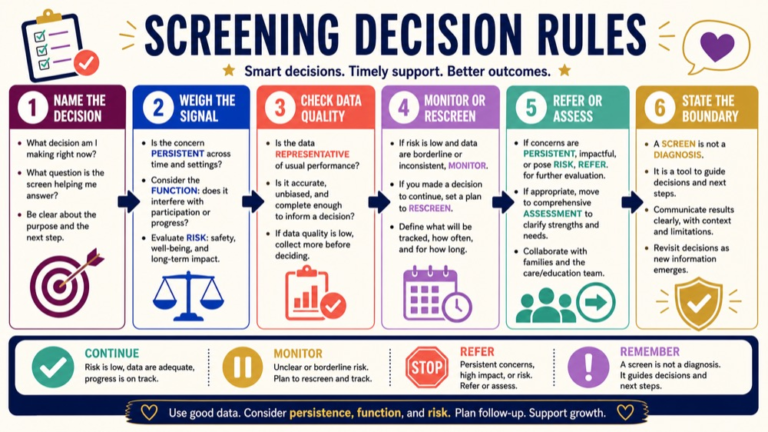
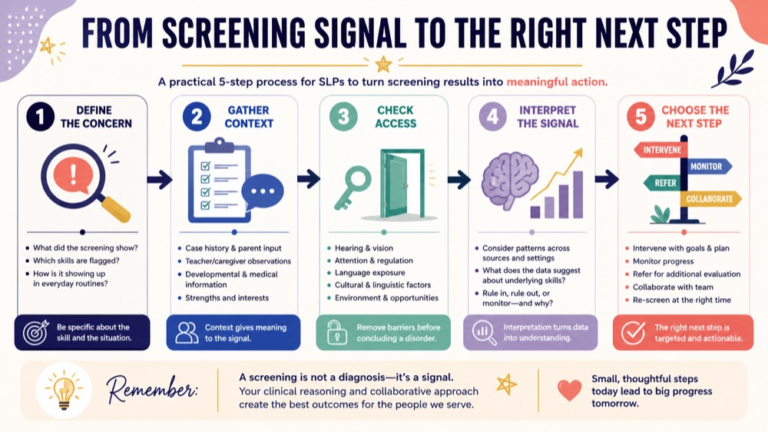
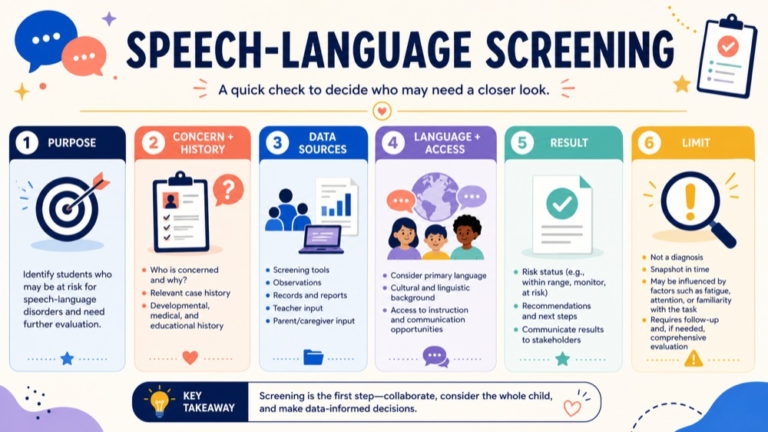
screening decision rules is easier to study when it is treated as a connected clinical reasoning problem rather than a label to memorize. Screening decision rules help translate a first-level result into a proportionate next step. The key choice is rarely simply pass or fail. SLP reasoning weighs the strength and quality of the signal, persistence, functional impact, risk, language and access, the person’s priorities, and what the screen was designed to answer. A result may support monitoring, rescreening, education, targeted support, comprehensive assessment, audiology, medical review, or another referral.
This learning guide is written for SLP students and other learners reviewing clinical concepts. It organizes observation, access, assessment, function, and professional judgment; it does not make an individualized diagnosis or replace current professional guidance. Interpretation depends on the person, task, language, culture, health, access, partner, context, and communication goals.
What screening decision rules are designed to do
Begin by separating the concept into domains. A learner who can name the domains is less likely to collapse language, access, partner, participation, competence, regulation, and clinical judgment into one explanation. The useful unit of analysis is the task: what the person was asked to understand, express, organize, coordinate, remember, or communicate, with whom, under which conditions, and with what support.
Domain or system
What to notice
Question to carry forward
Decision question
State what decision the screen must support before interpreting a score or observation.
What action are we deciding about?
Signal strength
Consider the pattern, consistency, severity of concern, participation effect, risk, and convergence across sources.
How strong and meaningful is the signal?
Data quality
Ask whether the method, language, access, setting, norms, supports, and task represented the person fairly.
Can this result be interpreted under these conditions?
Monitor or rescreen
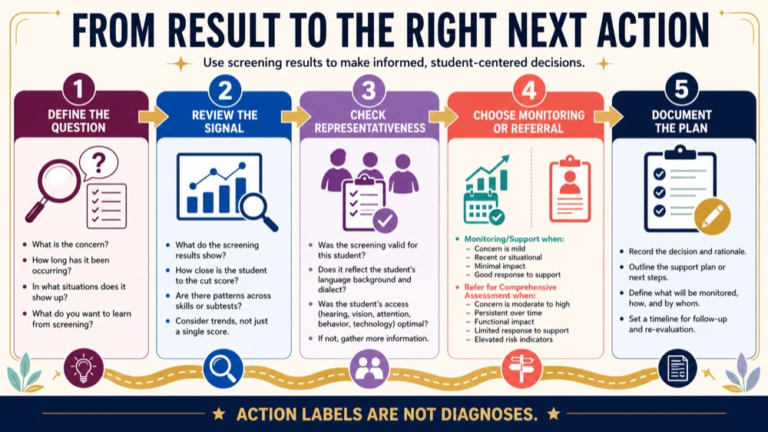
Monitoring may fit when concern is mild, the person is developing, access is adequate, and a clear follow-up interval and support plan exist.
What will be monitored, supported, and revisited?
Refer or assess
Persistent, functionally important, escalating, or high-risk concern may support comprehensive assessment or another referral.
What unanswered question requires a fuller evaluation?
Boundary
Pass, concern, and refer are action labels within a procedure; none automatically provides a diagnosis or complete profile.
What conclusion must not be made from this screen?
These domains interact, but they should remain distinguishable. A learner may show strength in one context and need support in another. A study map organizes the next observation; it does not answer every assessment question or establish a universal treatment, goal, or legal conclusion.
Keep the first pass descriptive and close to the communication event. Note the task, response, partner, setting, timing, available support, language or mode, and consequence for participation. This gives the learner a stable record to compare across tasks and prevents a familiar term from doing too much explanatory work before the evidence has been separated.
For Praxis-style review, a vignette may include several true details but ask for one best interpretation or next step. The strongest answer usually respects the task, identifies the relevant function or boundary, checks the most important missing information, and avoids treating one performance sample or policy phrase as the whole profile.
Map screening decision rules
For study purposes, describe the communication relationship before naming a disorder, judging a partner, selecting a goal, or deciding that a task is within scope. Record what the person understood, expressed, initiated, repaired, coordinated, or participated in. Then note whether the task was familiar, how much context was shared, and which support changed the response.
Decision: identify whether the result is meant to guide monitoring, rescreening, education, support, comprehensive assessment, or referral.
Signal: examine persistence, consistency, functional impact, risk, participation, caregiver or patient concern, and patterns across contexts.
Monitoring: define the skill, support, responsible person, timeline, data source, and trigger for changing the plan.
Referral: match the unanswered question to speech-language, audiology, medical, educational, feeding, swallowing, or other professional assessment.
Boundary: explain what the screen suggests and what it cannot determine about diagnosis, cause, severity, prognosis, or treatment.
A strong description is specific enough that another learner could picture the event. Instead of writing “the communication is impaired” or “the clinician can do this,” describe the demand, observable response, language or mode, partner, context, competence or access condition, and result. This protects clinical reasoning from labels that are broader than the evidence.
From result to monitoring, referral, or assessment
Context changes what communication and professional decisions require. A direct question, long explanation, group exchange, classroom task, health-care interaction, family story, noisy routine, supervised procedure, or referral decision places different demands on processing, language, memory, hearing, access, partner behavior, competence, and regulation. Language experience, visual information, fatigue, health literacy, and the opportunity to request clarification should be part of the observation.
A child with a mild expressive-language concern may pass a brief screen while a caregiver and teacher report persistent difficulty in daily routines. Another child may show a concern on a tool whose language background does not match the normative sample. A third person may have an acute change or safety risk that makes waiting inappropriate. The decision rule must therefore integrate the result with context, data quality, function, risk, and follow-up rather than applying one cutoff mechanically.
Observation layer
Example question
Task
What did the person or clinician need to understand, express, organize, coordinate, decide, or provide?
Language and access
Which language, dialect, mode, hearing condition, tool, support, or communication partner was available?
Context and responsibility
Who was involved, what did they know, and which role, policy, ethical, or environmental factor mattered?
Participation and safety
What meaningful routine, role, outcome, or risk became easier or harder because of the pattern?
Context is not an afterthought added once a label has been selected. It is part of the question itself. If performance or decision quality changes with a quieter room, extra processing time, a familiar partner, a different language or mode, an interpreter, visual information, supervision, collaboration, a changed task, or a changed routine, that change is useful evidence about access and demand. It does not identify a cause by itself, but it tells you which conditions should be carried into the next observation.
Apply screening decision rules
When a Praxis-style scenario or clinical discussion presents screening decision rules, use a disciplined sequence. The goal is to select the next clinical question or action that matches the evidence, the person’s priorities, the communication context, and the relevant professional boundary.
Define the task, language, mode, communication purpose, or service responsibility in plain language.
Identify the relevant domain: language, access, partner, participation, assessment, competence, collaboration, ethics, or regulation.
Separate observation from interpretation and write down what remains unknown.
Check history, exposure, dialect, culture, identity, interpreter access, environment, sensory load, memory, task familiarity, training, supervision, and local requirements as relevant.
Choose the assessment, collaboration, accommodation, goal, training, referral, or documentation step that answers the specific question.
State the boundary of the conclusion and keep the person’s safety, autonomy, access, and participation visible.
A child with a mild expressive-language concern may pass a brief screen while a caregiver and teacher report persistent difficulty in daily routines. Another child may show a concern on a tool whose language background does not match the normative sample. A third person may have an acute change or safety risk that makes waiting inappropriate. The decision rule must therefore integrate the result with context, data quality, function, risk, and follow-up rather than applying one cutoff mechanically. In a learning answer, the decisive evidence is usually the relationship among the task, the observed pattern, the context, and the next needed information—not a single isolated behavior, score, label, or broad permission statement.
Common study mistakes
Treating a screening cutoff as a universal diagnosis or as the only evidence that matters.
Using the word pass to dismiss a persistent functional concern or the word refer without explaining the unanswered question.
Ignoring the quality of the procedure, including language, dialect, culture, hearing, access, setting, norms, and supports.
Failing to distinguish mild uncertainty that can be monitored from persistent, high-risk, or functionally important concern that needs further evaluation.
Creating a monitoring plan without naming the target, support, responsible person, timeline, data source, or rescreening trigger.
Assuming a negative screen rules out every communication issue or a positive screen identifies one inevitable cause.
Delaying action when the pattern includes safety, sudden change, regression, medical concern, or meaningful participation impact.
Communicating a decision without making the limits and next step understandable to the person, family, or team.
Most of these mistakes come from replacing a multidomain question with a fast label. Correct the habit by returning to the same sequence: describe, separate, contextualize, ask what is missing, and choose a proportionate next step. A short rationale can make the habit visible: identify the evidence, name the uncertainty, and explain why the selected next step fits the person, setting, and responsibility.
Build a quick review map
Use this compact map when reviewing a missed question, lecture note, or clinical vignette:
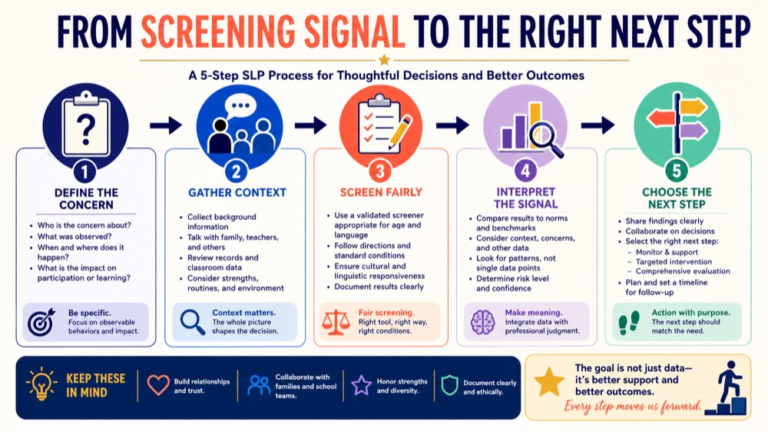
Step 1: Name the decision the screen is supposed to support.
Step 2: Assess signal strength through pattern, persistence, function, risk, and converging sources.
Step 3: Check whether the data are representative, accessible, and valid for this person and purpose.
Step 4: If monitoring, define the target, support, timeline, owner, and trigger for rescreening or referral.
Step 5: If referring, match the unanswered question to the appropriate comprehensive or professional assessment.
Step 6: State the boundary: an action label is not a diagnosis or complete profile.
Then write one transfer sentence: “When I see this pattern, I will first check ___ because ___.” The sentence should identify a decision rule, not repeat a definition. Revisit it after a delay and test whether you can apply the rule to a different task, age group, partner, language, setting, or professional responsibility.
Sources and next steps
screening decision rules is best learned as a context-sensitive pattern across communication, access, identity, function, participation, competence, and professional judgment. Use the current authority pages to refine the concept, then return to practice scenarios that require you to explain what the evidence supports and what it leaves open.
Screening Procedures in Speech-Language Pathology: A Practical Sequence
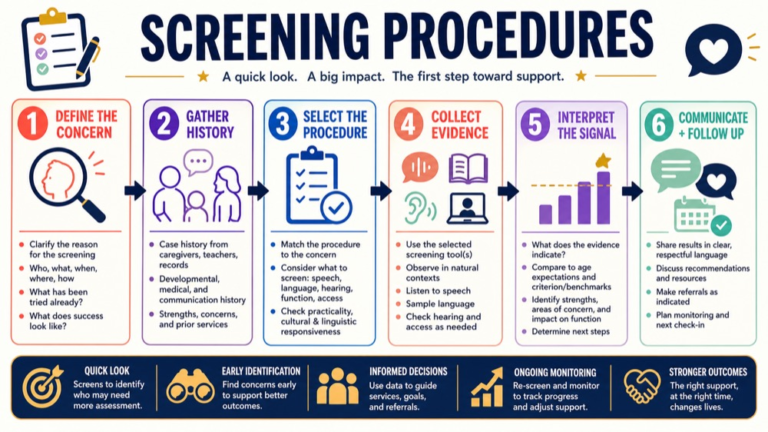
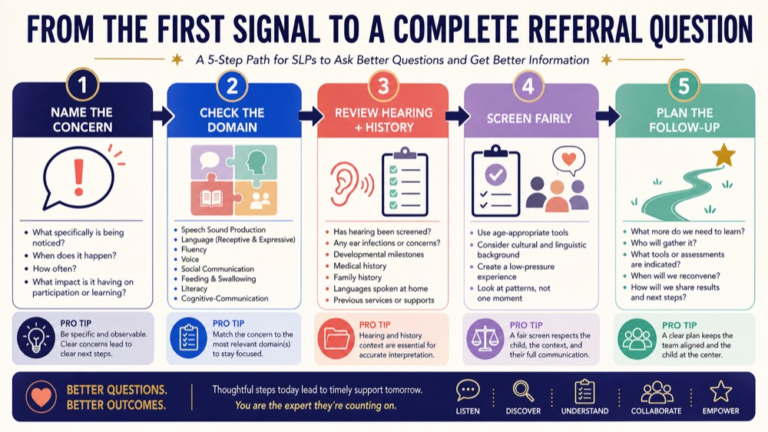
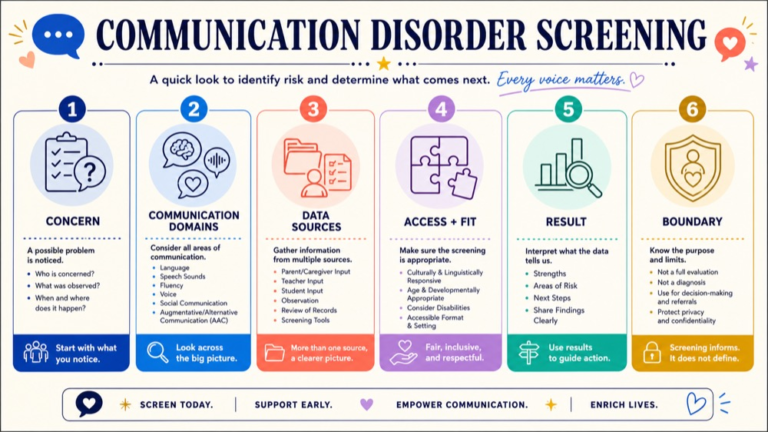
screening procedures speech language pathology is easier to study when it is treated as a connected clinical reasoning problem rather than a label to memorize. Screening procedures in speech-language pathology are easier to remember when they are organized as a clinical sequence instead of a list of isolated tasks. Define the concern, gather history and report, select a fair procedure, collect representative information, interpret the signal, and document the next step. The same sequence can look different across a preschool classroom, outpatient clinic, hospital, community program, or telepractice setting because the person, risk, access, and decision change.
This learning guide is written for SLP students and other learners reviewing clinical concepts. It organizes observation, access, assessment, function, and professional judgment; it does not make an individualized diagnosis or replace current professional guidance. Interpretation depends on the person, task, language, culture, health, access, partner, context, and communication goals.
The core sequence of screening procedures
Begin by separating the concept into domains. A learner who can name the domains is less likely to collapse language, access, partner, participation, competence, regulation, and clinical judgment into one explanation. The useful unit of analysis is the task: what the person was asked to understand, express, organize, coordinate, remember, or communicate, with whom, under which conditions, and with what support.
Domain or system
What to notice
Question to carry forward
Define the concern
Identify the communication domain, person, setting, concern, functional effect, and decision that led to screening.
What exactly is being noticed or asked?
Gather context
Use case history, interview, records, caregiver or teacher report, medical information, and natural routines to frame the concern.
What history changes the meaning of the signal?
Select a procedure
Choose direct interaction, observation, sample, formal screen, informal probe, hearing information, or a combination that fits the question.
Which procedure represents the target skill fairly?
Collect evidence
Record observable responses, conditions, supports, language or mode, partner, task, participation, and relevant safety or access factors.
What did the person actually show under these conditions?
Interpret
Separate the observed signal from the explanation and identify whether the evidence supports monitoring, support, referral, or further assessment.
What does the evidence support, and what does it leave open?
Communicate and follow up
Explain the result, limits, recommendation, responsible person, timeline, and conditions for rescreening or referral.
Who needs to act, and when will the plan be revisited?
These domains interact, but they should remain distinguishable. A learner may show strength in one context and need support in another. A study map organizes the next observation; it does not answer every assessment question or establish a universal treatment, goal, or legal conclusion.
Keep the first pass descriptive and close to the communication event. Note the task, response, partner, setting, timing, available support, language or mode, and consequence for participation. This gives the learner a stable record to compare across tasks and prevents a familiar term from doing too much explanatory work before the evidence has been separated.
For Praxis-style review, a vignette may include several true details but ask for one best interpretation or next step. The strongest answer usually respects the task, identifies the relevant function or boundary, checks the most important missing information, and avoids treating one performance sample or policy phrase as the whole profile.
Map screening procedures
For study purposes, describe the communication relationship before naming a disorder, judging a partner, selecting a goal, or deciding that a task is within scope. Record what the person understood, expressed, initiated, repaired, coordinated, or participated in. Then note whether the task was familiar, how much context was shared, and which support changed the response.
Referral question: name the speech, language, hearing, cognitive-communication, social-communication, feeding, swallowing, or participation concern.
History: review development, health, family and teacher report, prior services, language exposure, hearing, medical events, and the routine where the concern occurs.
Procedure: select a combination of observation, interview, sample, formal or informal task, record review, and hearing information that matches the decision.
Fairness: make the procedure accessible and responsive to language, dialect, culture, communication mode, sensory and motor needs, cognition, and context.
Evidence: record task demands, responses, supports, partners, conditions, participation, and uncertainty rather than only a total score.
Follow-up: choose monitoring, education, support, rescreening, comprehensive assessment, audiology, medical review, or team referral proportionately.
A strong description is specific enough that another learner could picture the event. Instead of writing “the communication is impaired” or “the clinician can do this,” describe the demand, observable response, language or mode, partner, context, competence or access condition, and result. This protects clinical reasoning from labels that are broader than the evidence.
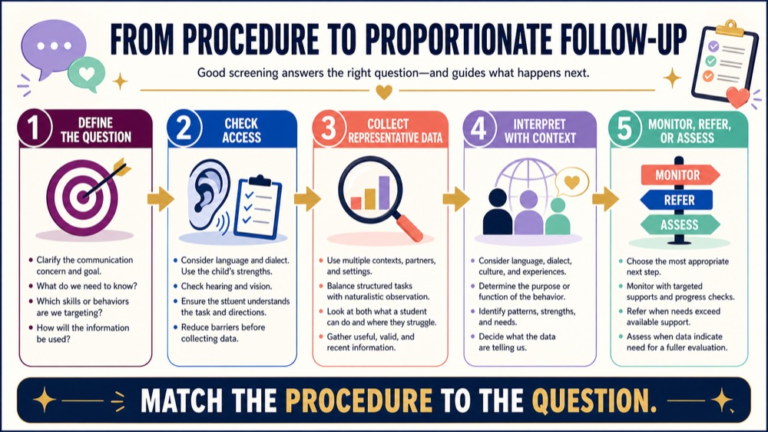
From procedure to proportionate follow-up
Context changes what communication and professional decisions require. A direct question, long explanation, group exchange, classroom task, health-care interaction, family story, noisy routine, supervised procedure, or referral decision places different demands on processing, language, memory, hearing, access, partner behavior, competence, and regulation. Language experience, visual information, fatigue, health literacy, and the opportunity to request clarification should be part of the observation.
A teacher may refer a child because speech is difficult to understand during group time, while a caregiver notices that the child communicates effectively during play at home. A screening procedure that uses only a quiet-room naming task may miss the participation question. Conversely, a natural observation may show a meaningful pattern but still leave the clinician needing a more focused speech or language assessment. The procedure should therefore be selected and interpreted in relation to the question, not treated as a universal recipe.
Observation layer
Example question
Task
What did the person or clinician need to understand, express, organize, coordinate, decide, or provide?
Language and access
Which language, dialect, mode, hearing condition, tool, support, or communication partner was available?
Context and responsibility
Who was involved, what did they know, and which role, policy, ethical, or environmental factor mattered?
Participation and safety
What meaningful routine, role, outcome, or risk became easier or harder because of the pattern?
Context is not an afterthought added once a label has been selected. It is part of the question itself. If performance or decision quality changes with a quieter room, extra processing time, a familiar partner, a different language or mode, an interpreter, visual information, supervision, collaboration, a changed task, or a changed routine, that change is useful evidence about access and demand. It does not identify a cause by itself, but it tells you which conditions should be carried into the next observation.
Apply screening-procedure reasoning
When a Praxis-style scenario or clinical discussion presents screening procedures speech language pathology, use a disciplined sequence. The goal is to select the next clinical question or action that matches the evidence, the person’s priorities, the communication context, and the relevant professional boundary.
Define the task, language, mode, communication purpose, or service responsibility in plain language.
Identify the relevant domain: language, access, partner, participation, assessment, competence, collaboration, ethics, or regulation.
Separate observation from interpretation and write down what remains unknown.
Check history, exposure, dialect, culture, identity, interpreter access, environment, sensory load, memory, task familiarity, training, supervision, and local requirements as relevant.
Choose the assessment, collaboration, accommodation, goal, training, referral, or documentation step that answers the specific question.
State the boundary of the conclusion and keep the person’s safety, autonomy, access, and participation visible.
A teacher may refer a child because speech is difficult to understand during group time, while a caregiver notices that the child communicates effectively during play at home. A screening procedure that uses only a quiet-room naming task may miss the participation question. Conversely, a natural observation may show a meaningful pattern but still leave the clinician needing a more focused speech or language assessment. The procedure should therefore be selected and interpreted in relation to the question, not treated as a universal recipe. In a learning answer, the decisive evidence is usually the relationship among the task, the observed pattern, the context, and the next needed information—not a single isolated behavior, score, label, or broad permission statement.
Common study mistakes
Starting with a familiar procedure before clarifying the referral question and functional concern.
Using one task or one setting as if it represented all communication partners, routines, languages, and participation demands.
Skipping case history, hearing information, records, caregiver or teacher report, or natural observation.
Failing to document the language, dialect, communication mode, supports, environment, fatigue, attention, and task familiarity.
Treating an observable screening signal as proof of a disorder, cause, severity, or prognosis.
Ignoring access barriers or interpreting a response as weakness when the procedure did not give a fair opportunity to respond.
Communicating only a result label without the rationale, limits, recommendation, responsible team member, or timeline.
Repeating the same procedure when the evidence calls for comprehensive assessment, audiology, medical review, or another referral.
Most of these mistakes come from replacing a multidomain question with a fast label. Correct the habit by returning to the same sequence: describe, separate, contextualize, ask what is missing, and choose a proportionate next step. A short rationale can make the habit visible: identify the evidence, name the uncertainty, and explain why the selected next step fits the person, setting, and responsibility.
Build a quick review map
Use this compact map when reviewing a missed question, lecture note, or clinical vignette:
Step 1: Define the concern, target domain, setting, person, and decision.
Step 3: Choose a procedure or combination that is appropriate, accessible, and representative.
Step 4: Record task, response, support, partner, language or mode, condition, and functional impact.
Step 5: Interpret the signal without converting it into a diagnosis or universal rule.
Step 6: Communicate the recommendation, boundary, responsible action, and follow-up trigger.
Then write one transfer sentence: “When I see this pattern, I will first check ___ because ___.” The sentence should identify a decision rule, not repeat a definition. Revisit it after a delay and test whether you can apply the rule to a different task, age group, partner, language, setting, or professional responsibility.
Sources and next steps
screening procedures speech language pathology is best learned as a context-sensitive pattern across communication, access, identity, function, participation, competence, and professional judgment. Use the current authority pages to refine the concept, then return to practice scenarios that require you to explain what the evidence supports and what it leaves open.
Developmental Screening for Speech and Language: What SLPs Look For
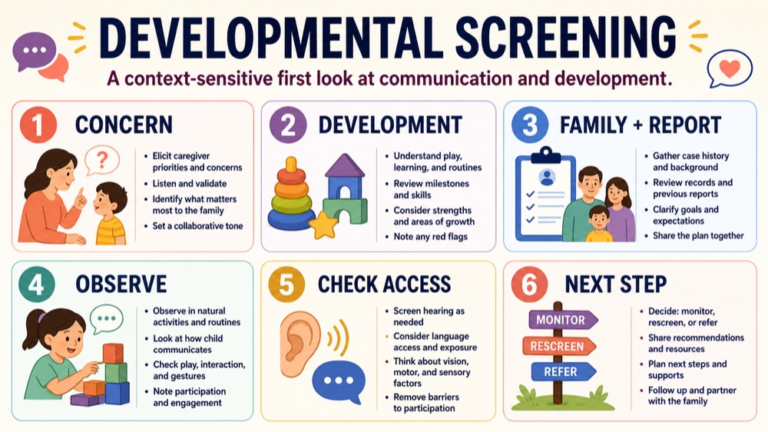
developmental screening speech language is easier to study when it is treated as a connected clinical reasoning problem rather than a label to memorize. Developmental screening for speech and language is a focused first look at whether an infant, toddler, or child may need additional information, support, monitoring, or comprehensive assessment. It is not a race to assign a label. A useful screen connects developmental expectations with family priorities, direct interaction, natural observation, hearing, language and dialect, culture, access, and the decision that the result must support.
This learning guide is written for SLP students and other learners reviewing clinical concepts. It organizes observation, access, assessment, function, and professional judgment; it does not make an individualized diagnosis or replace current professional guidance. Interpretation depends on the person, task, language, culture, health, access, partner, context, and communication goals.
What developmental screening for speech and language is for
Begin by separating the concept into domains. A learner who can name the domains is less likely to collapse language, access, partner, participation, competence, regulation, and clinical judgment into one explanation. The useful unit of analysis is the task: what the person was asked to understand, express, organize, coordinate, remember, or communicate, with whom, under which conditions, and with what support.
Domain or system
What to notice
Question to carry forward
Reason for concern
A concern may come from a caregiver, teacher, clinician, developmental history, participation change, or a routine that is not going as expected.
What prompted the screen, and whose priorities are represented?
Developmental context
Age, developmental history, play, interaction, learning opportunities, medical factors, and family routines shape the meaning of a communication observation.
Is the screen asking a developmentally appropriate question?
Information sources
Direct interaction, natural observation, caregiver or teacher interview, records, language samples, and professional- or parent-completed measures may contribute.
Which sources show the child’s typical communication?
Hearing and access
Hearing, vision, motor, sensory, cognitive, language, dialect, culture, and communication mode can change what a child is able to show.
Did the procedure give the child a fair way to respond?
Result
The result may support family education, monitoring, rescreening, early support, comprehensive assessment, audiology, or another referral.
What action is proportionate to the signal and uncertainty?
Boundary
A developmental screen indicates possible need for more information; it does not establish a diagnosis or predict one fixed outcome.
What remains unanswered after this first look?
These domains interact, but they should remain distinguishable. A learner may show strength in one context and need support in another. A study map organizes the next observation; it does not answer every assessment question or establish a universal treatment, goal, or legal conclusion.
Keep the first pass descriptive and close to the communication event. Note the task, response, partner, setting, timing, available support, language or mode, and consequence for participation. This gives the learner a stable record to compare across tasks and prevents a familiar term from doing too much explanatory work before the evidence has been separated.
For Praxis-style review, a vignette may include several true details but ask for one best interpretation or next step. The strongest answer usually respects the task, identifies the relevant function or boundary, checks the most important missing information, and avoids treating one performance sample or policy phrase as the whole profile.
Map developmental screening
For study purposes, describe the communication relationship before naming a disorder, judging a partner, selecting a goal, or deciding that a task is within scope. Record what the person understood, expressed, initiated, repaired, coordinated, or participated in. Then note whether the task was familiar, how much context was shared, and which support changed the response.
Question: define the developmental concern, communication domain, person, routines, language or mode, and decision the screen is meant to support.
Family: gather caregiver priorities, observations, routines, strengths, resources, and the child’s opportunities to communicate with familiar people.
Observation: use direct interaction, play, natural routines, and developmental observation to see how communication works outside one isolated task.
Access: consider hearing, vision, motor and sensory needs, language, dialect, culture, AAC, attention, fatigue, and task familiarity.
Evidence: combine report, observation, samples, records, and appropriate formal or informal measures rather than letting one score carry the whole decision.
Response: choose education, support, monitoring, rescreening, comprehensive assessment, audiology, medical review, or another referral as indicated.
A strong description is specific enough that another learner could picture the event. Instead of writing “the communication is impaired” or “the clinician can do this,” describe the demand, observable response, language or mode, partner, context, competence or access condition, and result. This protects clinical reasoning from labels that are broader than the evidence.
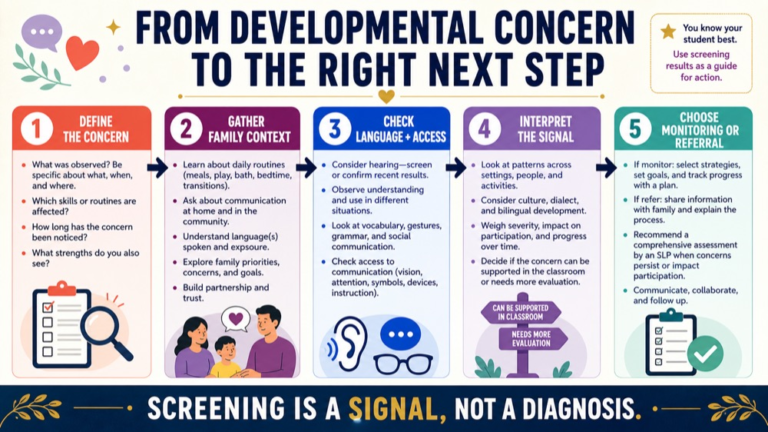
From developmental concern to the right next step
Context changes what communication and professional decisions require. A direct question, long explanation, group exchange, classroom task, health-care interaction, family story, noisy routine, supervised procedure, or referral decision places different demands on processing, language, memory, hearing, access, partner behavior, competence, and regulation. Language experience, visual information, fatigue, health literacy, and the opportunity to request clarification should be part of the observation.
A caregiver may report that a toddler uses few spoken words, a teacher may notice that a child rarely joins peer play, or a child may communicate differently with a familiar family member than in a clinic room. The screen should preserve that context. A brief task can add information, but it cannot replace observation of everyday interaction or a conversation about language exposure, hearing, development, and family priorities. If a screening procedure does not represent the child’s usual language, dialect, communication mode, or behavior, the result should be interpreted cautiously and the next step should address the missing information.
Observation layer
Example question
Task
What did the person or clinician need to understand, express, organize, coordinate, decide, or provide?
Language and access
Which language, dialect, mode, hearing condition, tool, support, or communication partner was available?
Context and responsibility
Who was involved, what did they know, and which role, policy, ethical, or environmental factor mattered?
Participation and safety
What meaningful routine, role, outcome, or risk became easier or harder because of the pattern?
Context is not an afterthought added once a label has been selected. It is part of the question itself. If performance or decision quality changes with a quieter room, extra processing time, a familiar partner, a different language or mode, an interpreter, visual information, supervision, collaboration, a changed task, or a changed routine, that change is useful evidence about access and demand. It does not identify a cause by itself, but it tells you which conditions should be carried into the next observation.
Apply developmental screening reasoning
When a Praxis-style scenario or clinical discussion presents developmental screening speech language, use a disciplined sequence. The goal is to select the next clinical question or action that matches the evidence, the person’s priorities, the communication context, and the relevant professional boundary.
Define the task, language, mode, communication purpose, or service responsibility in plain language.
Identify the relevant domain: language, access, partner, participation, assessment, competence, collaboration, ethics, or regulation.
Separate observation from interpretation and write down what remains unknown.
Check history, exposure, dialect, culture, identity, interpreter access, environment, sensory load, memory, task familiarity, training, supervision, and local requirements as relevant.
Choose the assessment, collaboration, accommodation, goal, training, referral, or documentation step that answers the specific question.
State the boundary of the conclusion and keep the person’s safety, autonomy, access, and participation visible.
A caregiver may report that a toddler uses few spoken words, a teacher may notice that a child rarely joins peer play, or a child may communicate differently with a familiar family member than in a clinic room. The screen should preserve that context. A brief task can add information, but it cannot replace observation of everyday interaction or a conversation about language exposure, hearing, development, and family priorities. If a screening procedure does not represent the child’s usual language, dialect, communication mode, or behavior, the result should be interpreted cautiously and the next step should address the missing information. In a learning answer, the decisive evidence is usually the relationship among the task, the observed pattern, the context, and the next needed information—not a single isolated behavior, score, label, or broad permission statement.
Common study mistakes
Treating developmental screening as a shortened diagnosis or as a prediction of the child’s fixed future.
Choosing a tool before defining the concern, age, setting, language, developmental question, and decision to be made.
Using one structured task instead of asking how the child communicates during play, routines, and interaction with familiar partners.
Ignoring hearing, language exposure, dialect, culture, access, sensory factors, motor differences, cognition, or family priorities.
Reporting a standard score when the tool’s normative sample or procedure does not fairly represent the child’s background or access.
Assuming a pass removes a concern or assuming a concern automatically establishes a disorder without additional evidence.
Failing to explain the result, monitoring plan, family supports, or referral options in an accessible way.
Waiting for a perfect score or repeating screening without a plan when persistent concern calls for comprehensive assessment or early support.
Most of these mistakes come from replacing a multidomain question with a fast label. Correct the habit by returning to the same sequence: describe, separate, contextualize, ask what is missing, and choose a proportionate next step. A short rationale can make the habit visible: identify the evidence, name the uncertainty, and explain why the selected next step fits the person, setting, and responsibility.
Build a quick review map
Use this compact map when reviewing a missed question, lecture note, or clinical vignette:
Step 1: Define the developmental concern, communication domain, setting, language or mode, and decision.
Step 2: Gather family report, developmental and medical history, direct interaction, natural observation, and relevant records.
Step 4: Use formal or informal tools only when their purpose, population, and procedure fit the question.
Step 5: Interpret the screen as evidence for support, monitoring, rescreening, assessment, or referral rather than as a diagnosis.
Step 6: Document what the screen answered, what it did not answer, and when the plan should be revisited.
Then write one transfer sentence: “When I see this pattern, I will first check ___ because ___.” The sentence should identify a decision rule, not repeat a definition. Revisit it after a delay and test whether you can apply the rule to a different task, age group, partner, language, setting, or professional responsibility.
Sources and next steps
developmental screening speech language is best learned as a context-sensitive pattern across communication, access, identity, function, participation, competence, and professional judgment. Use the current authority pages to refine the concept, then return to practice scenarios that require you to explain what the evidence supports and what it leaves open.
Hearing Screening for Speech-Language Concerns: Pass, Refer, and Follow Up
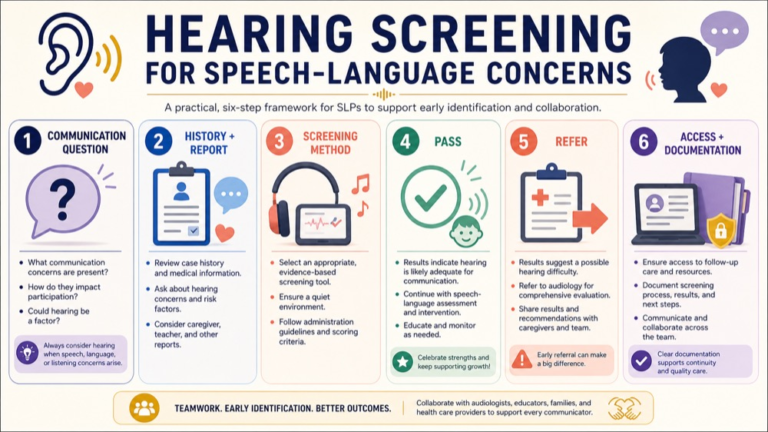
hearing screening for speech language is easier to study when it is treated as a connected clinical reasoning problem rather than a label to memorize. Hearing screening for speech language concerns matters because hearing access can affect how a person develops, understands, produces, and participates in communication. A screening result is not an audiologic diagnosis and does not by itself explain a speech or language profile. SLP reasoning connects the communication concern to hearing history, screening conditions, pass or refer interpretation, and timely audiology or medical follow-up when indicated.
This learning guide is written for SLP students and other learners reviewing clinical concepts. It organizes observation, access, assessment, function, and professional judgment; it does not make an individualized diagnosis or replace current professional guidance. Interpretation depends on the person, task, language, culture, health, access, partner, context, and communication goals.
What hearing screening for speech-language concerns means
Begin by separating the concept into domains. A learner who can name the domains is less likely to collapse language, access, partner, participation, competence, regulation, and clinical judgment into one explanation. The useful unit of analysis is the task: what the person was asked to understand, express, organize, coordinate, remember, or communicate, with whom, under which conditions, and with what support.
Domain or system
What to notice
Question to carry forward
Communication question
The concern may involve speech development, language learning, listening, classroom access, social communication, or a change after illness.
What communication pattern needs explanation or support?
History and report
Person or caregiver concerns, otologic history, medical events, noise, devices, and communication contexts frame screening.
What hearing or communication history changes the next step?
Screening method
Age and setting may involve case history, otoscopy, pure-tone screening, self-report, observation, or other approved procedures.
Is the method appropriate and administered under suitable conditions?
Pass
A pass indicates that the person met the screen’s criteria under the specified conditions; it does not explain every communication concern.
What concern remains even after this screening result?
Refer
A refer result indicates need for comprehensive audiologic assessment or other medical or communication follow-up as appropriate.
Who needs to receive the referral and what happens next?
Access and documentation
Noise, equipment, training, language, health literacy, devices, accommodations, result communication, and follow-up affect usefulness.
How will the person use and understand the result?
These domains interact, but they should remain distinguishable. A learner may show strength in one context and need support in another. A study map organizes the next observation; it does not answer every assessment question or establish a universal treatment, goal, or legal conclusion.
Keep the first pass descriptive and close to the communication event. Note the task, response, partner, setting, timing, available support, language or mode, and consequence for participation. This gives the learner a stable record to compare across tasks and prevents a familiar term from doing too much explanatory work before the evidence has been separated.
For Praxis-style review, a vignette may include several true details but ask for one best interpretation or next step. The strongest answer usually respects the task, identifies the relevant function or boundary, checks the most important missing information, and avoids treating one performance sample or policy phrase as the whole profile.
Map hearing screening for speech-language concerns
For study purposes, describe the communication relationship before naming a disorder, judging a partner, selecting a goal, or deciding that a task is within scope. Record what the person understood, expressed, initiated, repaired, coordinated, or participated in. Then note whether the task was familiar, how much context was shared, and which support changed the response.
Communication: describe the speech, language, listening, classroom, work, health, or participation concern without presuming its cause.
History: review onset, ear or medical history, family concern, noise, devices, language, setting, and change in function.
Method: match child or adult screening procedures, equipment, environment, training, and documentation to the setting and purpose.
Pass: interpret a pass as meeting this screen’s criterion under these conditions, not as a complete explanation of communication ability.
Refer: connect a refer result or continuing concern to comprehensive audiologic assessment, medical evaluation, or communication follow-up.
Access: communicate results in a health-literate, person-centered format and address devices, accommodations, language, and follow-through.
A strong description is specific enough that another learner could picture the event. Instead of writing “the communication is impaired” or “the clinician can do this,” describe the demand, observable response, language or mode, partner, context, competence or access condition, and result. This protects clinical reasoning from labels that are broader than the evidence.
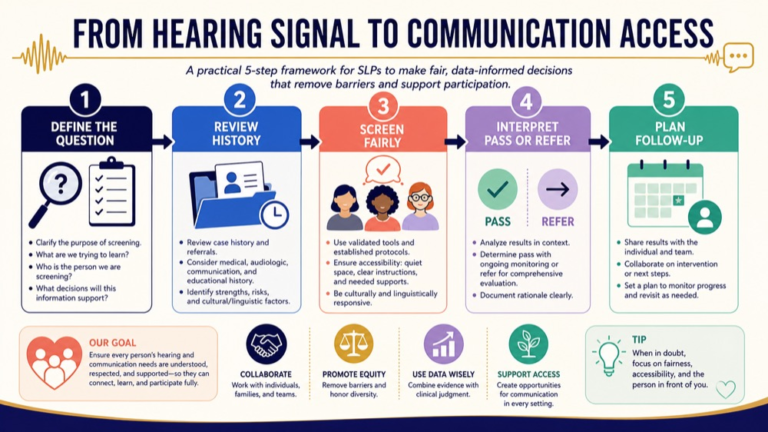
From hearing signal to communication access
Context changes what communication and professional decisions require. A direct question, long explanation, group exchange, classroom task, health-care interaction, family story, noisy routine, supervised procedure, or referral decision places different demands on processing, language, memory, hearing, access, partner behavior, competence, and regulation. Language experience, visual information, fatigue, health literacy, and the opportunity to request clarification should be part of the observation.
A child may pass a brief hearing screen but still have a communication concern that needs language or speech assessment, especially when the screen did not represent everyday listening or the concern is not explained by hearing alone. An adult with a refer result may need comprehensive audiologic assessment, counseling, medical review, or communication support. The SLP should not use a pass or refer label as a diagnosis; the result is one piece of the referral and access pathway.
Observation layer
Example question
Task
What did the person or clinician need to understand, express, organize, coordinate, decide, or provide?
Language and access
Which language, dialect, mode, hearing condition, tool, support, or communication partner was available?
Context and responsibility
Who was involved, what did they know, and which role, policy, ethical, or environmental factor mattered?
Participation and safety
What meaningful routine, role, outcome, or risk became easier or harder because of the pattern?
Context is not an afterthought added once a label has been selected. It is part of the question itself. If performance or decision quality changes with a quieter room, extra processing time, a familiar partner, a different language or mode, an interpreter, visual information, supervision, collaboration, a changed task, or a changed routine, that change is useful evidence about access and demand. It does not identify a cause by itself, but it tells you which conditions should be carried into the next observation.
Apply hearing-screening reasoning
When a Praxis-style scenario or clinical discussion presents hearing screening for speech language, use a disciplined sequence. The goal is to select the next clinical question or action that matches the evidence, the person’s priorities, the communication context, and the relevant professional boundary.
Define the task, language, mode, communication purpose, or service responsibility in plain language.
Identify the relevant domain: language, access, partner, participation, assessment, competence, collaboration, ethics, or regulation.
Separate observation from interpretation and write down what remains unknown.
Check history, exposure, dialect, culture, identity, interpreter access, environment, sensory load, memory, task familiarity, training, supervision, and local requirements as relevant.
Choose the assessment, collaboration, accommodation, goal, training, referral, or documentation step that answers the specific question.
State the boundary of the conclusion and keep the person’s safety, autonomy, access, and participation visible.
A child may pass a brief hearing screen but still have a communication concern that needs language or speech assessment, especially when the screen did not represent everyday listening or the concern is not explained by hearing alone. An adult with a refer result may need comprehensive audiologic assessment, counseling, medical review, or communication support. The SLP should not use a pass or refer label as a diagnosis; the result is one piece of the referral and access pathway. In a learning answer, the decisive evidence is usually the relationship among the task, the observed pattern, the context, and the next needed information—not a single isolated behavior, score, label, or broad permission statement.
Common study mistakes
Treating a hearing screen as a full audiologic evaluation or as proof of the cause of a communication disorder.
Assuming a pass means that listening access is sufficient across classrooms, groups, noise, devices, and daily routines.
Ignoring case history, otologic or medical concerns, devices, noise, language, cognition, attention, fatigue, or participation.
Using child and adult screening procedures interchangeably without checking the population, setting, equipment, and purpose.
Failing to refer a person with a refer result or continuing concern for comprehensive audiologic or medical follow-up.
Reporting a result without recording conditions, method, date, person, recommendation, and who received the information.
Assuming hearing loss explains every speech or language pattern or ignoring communication support while waiting for follow-up.
Providing results in a format that is not accessible or understandable to the person, family, or team.
Most of these mistakes come from replacing a multidomain question with a fast label. Correct the habit by returning to the same sequence: describe, separate, contextualize, ask what is missing, and choose a proportionate next step. A short rationale can make the habit visible: identify the evidence, name the uncertainty, and explain why the selected next step fits the person, setting, and responsibility.
Build a quick review map
Use this compact map when reviewing a missed question, lecture note, or clinical vignette:
Step 1: Define the communication question and identify what hearing information is needed.
Step 2: Review history, setting, devices, language, noise, medical factors, and the person’s own listening experience.
Step 3: Match the screening procedure and conditions to the child or adult population and decision.
Step 4: Interpret pass or refer narrowly and distinguish hearing screening from audiologic diagnosis.
Step 5: Arrange audiologic, medical, speech-language, educational, or access follow-up as indicated.
Step 6: Document and communicate the result, limitations, recommendation, and support plan in an accessible way.
Then write one transfer sentence: “When I see this pattern, I will first check ___ because ___.” The sentence should identify a decision rule, not repeat a definition. Revisit it after a delay and test whether you can apply the rule to a different task, age group, partner, language, setting, or professional responsibility.
Sources and next steps
hearing screening for speech language is best learned as a context-sensitive pattern across communication, access, identity, function, participation, competence, and professional judgment. Use the current authority pages to refine the concept, then return to practice scenarios that require you to explain what the evidence supports and what it leaves open.
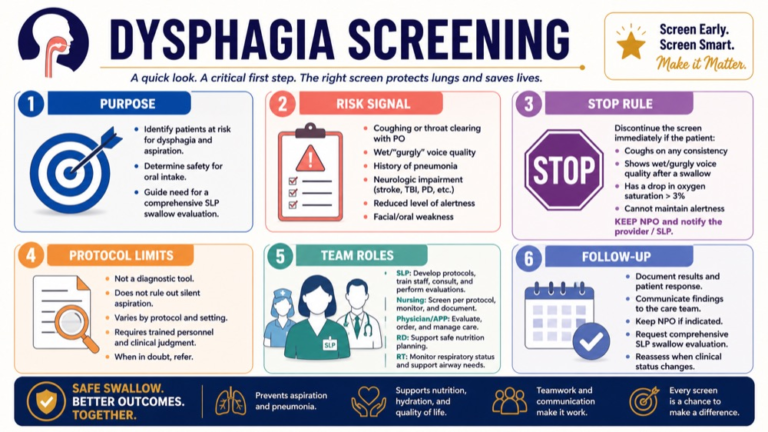
Dysphagia Screening: Risk Signals, Safety, and Comprehensive Follow-Up
dysphagia screening is easier to study when it is treated as a connected clinical reasoning problem rather than a label to memorize. Dysphagia screening is a quick risk-identification process used to decide whether a person may require comprehensive swallowing assessment and related nutrition or hydration support. It is purposefully different from a full assessment. SLP learners should recognize the clinical signs, know when the screen should stop, understand that bedside procedures have limits, and connect the result to timely interdisciplinary action rather than treating a screen as proof about aspiration or swallowing physiology.
This learning guide is written for SLP students and other learners reviewing clinical concepts. It organizes observation, access, assessment, function, and professional judgment; it does not make an individualized diagnosis or replace current professional guidance. Interpretation depends on the person, task, language, culture, health, access, partner, context, and communication goals.
What dysphagia screening is designed to do
Begin by separating the concept into domains. A learner who can name the domains is less likely to collapse language, access, partner, participation, competence, regulation, and clinical judgment into one explanation. The useful unit of analysis is the task: what the person was asked to understand, express, organize, coordinate, remember, or communicate, with whom, under which conditions, and with what support.
Domain or system
What to notice
Question to carry forward
Purpose
The screen quickly considers the likelihood of dysphagia and whether a full swallowing assessment or other referral is needed.
What decision must be made now?
Risk signal
History, alertness, secretion management, cough, voice change, trial swallow signs, respiratory status, or other findings may raise concern.
What combination of findings changes the risk?
Stop rule
When risk is identified, the screen may end and the person may need precautions and timely comprehensive evaluation according to the setting’s protocol.
Should the screen stop and the team be notified?
Protocol limits
No bedside screen should be treated as a universal confirmation of aspiration or a substitute for every diagnostic question.
What can this procedure not determine?
Interprofessional roles
Nursing, medicine, SLP, nutrition, and other team members may contribute to screening, referral, precautions, and program quality.
Who is responsible for each action and handoff?
Follow-up
Comprehensive clinical or instrumental assessment answers the question the screen could not answer and guides management.
What assessment or referral is needed next?
These domains interact, but they should remain distinguishable. A learner may show strength in one context and need support in another. A study map organizes the next observation; it does not answer every assessment question or establish a universal treatment, goal, or legal conclusion.
Keep the first pass descriptive and close to the communication event. Note the task, response, partner, setting, timing, available support, language or mode, and consequence for participation. This gives the learner a stable record to compare across tasks and prevents a familiar term from doing too much explanatory work before the evidence has been separated.
For Praxis-style review, a vignette may include several true details but ask for one best interpretation or next step. The strongest answer usually respects the task, identifies the relevant function or boundary, checks the most important missing information, and avoids treating one performance sample or policy phrase as the whole profile.
Map dysphagia screening
For study purposes, describe the communication relationship before naming a disorder, judging a partner, selecting a goal, or deciding that a task is within scope. Record what the person understood, expressed, initiated, repaired, coordinated, or participated in. Then note whether the task was familiar, how much context was shared, and which support changed the response.
Purpose: distinguish rapid risk identification from comprehensive swallowing assessment and from instrumental diagnosis.
Signs: review history, alertness, secretion management, cough, voice, respiratory status, oral motor or speech motor observations, and trial conditions as appropriate.
Safety: follow facility policy, timely escalation, precautions, nutrition and hydration pathways, and communication with the responsible team.
Limits: do not infer every aspect of aspiration, anatomy, physiology, or treatment suitability from a bedside screen alone.
Roles: clarify who screens, who trains, who validates competency, who receives the result, and who completes the full assessment.
Follow-up: connect the result to comprehensive clinical assessment, instrumental assessment, medical or nutrition referral, and documented recommendations.
A strong description is specific enough that another learner could picture the event. Instead of writing “the communication is impaired” or “the clinician can do this,” describe the demand, observable response, language or mode, partner, context, competence or access condition, and result. This protects clinical reasoning from labels that are broader than the evidence.
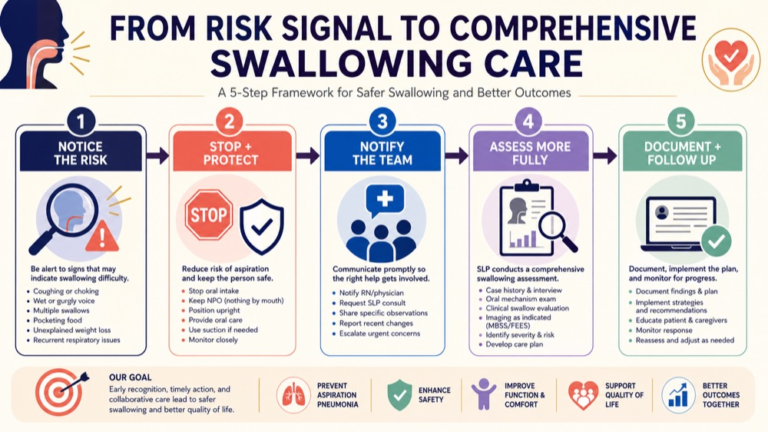
From risk signal to comprehensive swallowing care
Context changes what communication and professional decisions require. A direct question, long explanation, group exchange, classroom task, health-care interaction, family story, noisy routine, supervised procedure, or referral decision places different demands on processing, language, memory, hearing, access, partner behavior, competence, and regulation. Language experience, visual information, fatigue, health literacy, and the opportunity to request clarification should be part of the observation.
In an acute-care setting, a person after stroke may need a timely screen before oral intake or medication decisions. A nurse or physician may complete a facility-approved screen and refer to an SLP when risk is identified, or the SLP may be involved in a local screening program. If signs suggest increased risk, the screening process should not be stretched into a prolonged bedside test; the team should follow the safety and referral pathway. The full assessment answers questions that the screen was not designed to answer.
Observation layer
Example question
Task
What did the person or clinician need to understand, express, organize, coordinate, decide, or provide?
Language and access
Which language, dialect, mode, hearing condition, tool, support, or communication partner was available?
Context and responsibility
Who was involved, what did they know, and which role, policy, ethical, or environmental factor mattered?
Participation and safety
What meaningful routine, role, outcome, or risk became easier or harder because of the pattern?
Context is not an afterthought added once a label has been selected. It is part of the question itself. If performance or decision quality changes with a quieter room, extra processing time, a familiar partner, a different language or mode, an interpreter, visual information, supervision, collaboration, a changed task, or a changed routine, that change is useful evidence about access and demand. It does not identify a cause by itself, but it tells you which conditions should be carried into the next observation.
Apply dysphagia screening reasoning
When a Praxis-style scenario or clinical discussion presents dysphagia screening, use a disciplined sequence. The goal is to select the next clinical question or action that matches the evidence, the person’s priorities, the communication context, and the relevant professional boundary.
Define the task, language, mode, communication purpose, or service responsibility in plain language.
Identify the relevant domain: language, access, partner, participation, assessment, competence, collaboration, ethics, or regulation.
Separate observation from interpretation and write down what remains unknown.
Check history, exposure, dialect, culture, identity, interpreter access, environment, sensory load, memory, task familiarity, training, supervision, and local requirements as relevant.
Choose the assessment, collaboration, accommodation, goal, training, referral, or documentation step that answers the specific question.
State the boundary of the conclusion and keep the person’s safety, autonomy, access, and participation visible.
In an acute-care setting, a person after stroke may need a timely screen before oral intake or medication decisions. A nurse or physician may complete a facility-approved screen and refer to an SLP when risk is identified, or the SLP may be involved in a local screening program. If signs suggest increased risk, the screening process should not be stretched into a prolonged bedside test; the team should follow the safety and referral pathway. The full assessment answers questions that the screen was not designed to answer. In a learning answer, the decisive evidence is usually the relationship among the task, the observed pattern, the context, and the next needed information—not a single isolated behavior, score, label, or broad permission statement.
Common study mistakes
Calling a dysphagia screen a diagnostic swallowing evaluation or using it to answer a detailed physiologic question.
Treating a pass on one bedside procedure as proof that aspiration or dysphagia is absent in every context.
Ignoring alertness, secretion management, respiratory status, fatigue, positioning, history, medications, or communication access.
Continuing a screen after a risk signal instead of following the setting’s stop, safety, notification, and referral process.
Assuming one protocol, water test, or cutoff is preferred for every person, diagnosis, age, and setting.
Training staff without defining competency validation, supervision, documentation, escalation, and quality monitoring.
Failing to distinguish SLP, nursing, medical, nutrition, and other team responsibilities.
Delaying comprehensive or instrumental assessment because the screen result is being treated as the final answer.
Most of these mistakes come from replacing a multidomain question with a fast label. Correct the habit by returning to the same sequence: describe, separate, contextualize, ask what is missing, and choose a proportionate next step. A short rationale can make the habit visible: identify the evidence, name the uncertainty, and explain why the selected next step fits the person, setting, and responsibility.
Build a quick review map
Use this compact map when reviewing a missed question, lecture note, or clinical vignette:
Step 1: Define the immediate screening decision and distinguish it from the full swallowing question.
Step 2: Identify the risk signals and conditions that make the result more or less interpretable.
Step 3: Apply the stop, safety, notification, documentation, and referral pathway for the setting.
Step 4: State what the bedside screen can suggest and what it cannot confirm about aspiration or physiology.
Step 5: Clarify the interprofessional roles, training, competency, and handoff responsibilities.
Step 6: Select the comprehensive clinical, instrumental, medical, nutrition, or other follow-up that answers the unanswered question.
Then write one transfer sentence: “When I see this pattern, I will first check ___ because ___.” The sentence should identify a decision rule, not repeat a definition. Revisit it after a delay and test whether you can apply the rule to a different task, age group, partner, language, setting, or professional responsibility.
Sources and next steps
dysphagia screening is best learned as a context-sensitive pattern across communication, access, identity, function, participation, competence, and professional judgment. Use the current authority pages to refine the concept, then return to practice scenarios that require you to explain what the evidence supports and what it leaves open.
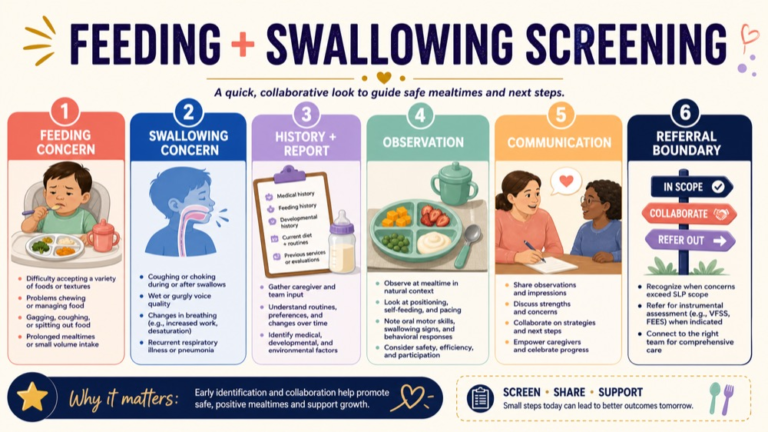
Feeding and Swallowing Screening: Signs, Context, and Referral
feeding and swallowing screening is easier to study when it is treated as a connected clinical reasoning problem rather than a label to memorize. Feeding and swallowing screening is a focused first step used to identify whether a person may need a comprehensive feeding or swallowing assessment or referral to another professional. It can include caregiver or patient interview, medical and developmental history, observation during a meal or snack, signs and symptoms, and standardized screening procedures. The screen should describe the concern and next step without pretending to characterize every part of feeding behavior or swallowing physiology.
This learning guide is written for SLP students and other learners reviewing clinical concepts. It organizes observation, access, assessment, function, and professional judgment; it does not make an individualized diagnosis or replace current professional guidance. Interpretation depends on the person, task, language, culture, health, access, partner, context, and communication goals.
What feeding and swallowing screening includes
Begin by separating the concept into domains. A learner who can name the domains is less likely to collapse language, access, partner, participation, competence, regulation, and clinical judgment into one explanation. The useful unit of analysis is the task: what the person was asked to understand, express, organize, coordinate, remember, or communicate, with whom, under which conditions, and with what support.
Domain or system
What to notice
Question to carry forward
Feeding concern
Food acceptance, selectivity, refusal, mealtime behavior, sensory response, positioning, dependence, and participation may be relevant.
What is happening around eating, drinking, or the mealtime routine?
Swallowing concern
Coughing, choking, wet voice, respiratory change, residue, fatigue, or other signs may raise concern for dysphagia.
What signs suggest the swallow may need further assessment?
History and report
Patient or caregiver report, medical history, development, medications, nutrition, hydration, and prior events frame the screen.
What risk and functional history should be checked?
Observation
A routine or planned meal, snack, oral intake, positioning, alertness, and environment can show context-specific signs.
What does the person do under real or planned mealtime conditions?
Communication
Results and recommendations should be communicated to the person, caregivers, and responsible team in an accessible format.
Who needs the information to support safety and participation?
Referral boundary
A positive risk signal may require comprehensive SLP assessment, medical or nutrition referral, or other team action.
What question does the full assessment need to answer?
These domains interact, but they should remain distinguishable. A learner may show strength in one context and need support in another. A study map organizes the next observation; it does not answer every assessment question or establish a universal treatment, goal, or legal conclusion.
Keep the first pass descriptive and close to the communication event. Note the task, response, partner, setting, timing, available support, language or mode, and consequence for participation. This gives the learner a stable record to compare across tasks and prevents a familiar term from doing too much explanatory work before the evidence has been separated.
For Praxis-style review, a vignette may include several true details but ask for one best interpretation or next step. The strongest answer usually respects the task, identifies the relevant function or boundary, checks the most important missing information, and avoids treating one performance sample or policy phrase as the whole profile.
Map feeding and swallowing screening
For study purposes, describe the communication relationship before naming a disorder, judging a partner, selecting a goal, or deciding that a task is within scope. Record what the person understood, expressed, initiated, repaired, coordinated, or participated in. Then note whether the task was familiar, how much context was shared, and which support changed the response.
Concern: separate feeding participation, food or liquid acceptance, mealtime behavior, and swallowing safety questions.
History: gather medical, developmental, nutrition, hydration, medication, respiratory, sensory, oral-motor, and caregiver information as relevant.
Observation: examine the person during a routine or planned meal or snack, including alertness, posture, positioning, environment, and fatigue.
Signs: record observable cough, choking, voice change, residue, respiratory change, refusal, stress, pacing, or other relevant pattern without overinterpreting one sign.
Team: communicate findings and recommendations to the person, caregiver, nurses, physicians, dietitians, educators, and other responsible team members as appropriate.
Next step: decide whether to monitor, modify access or support, complete comprehensive assessment, refer, or use an instrumental question when indicated.
A strong description is specific enough that another learner could picture the event. Instead of writing “the communication is impaired” or “the clinician can do this,” describe the demand, observable response, language or mode, partner, context, competence or access condition, and result. This protects clinical reasoning from labels that are broader than the evidence.
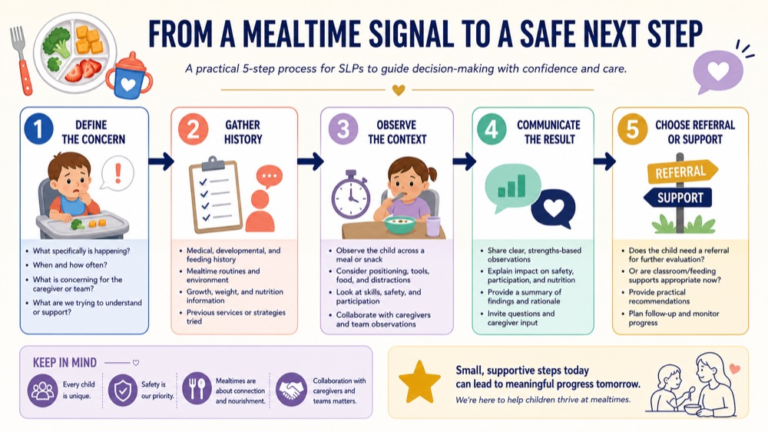
From a mealtime signal to a safe next step
Context changes what communication and professional decisions require. A direct question, long explanation, group exchange, classroom task, health-care interaction, family story, noisy routine, supervised procedure, or referral decision places different demands on processing, language, memory, hearing, access, partner behavior, competence, and regulation. Language experience, visual information, fatigue, health literacy, and the opportunity to request clarification should be part of the observation.
A child may have a narrow food range and high mealtime stress without the primary question being airway protection. Another person may eat a broad range but show coughing, wet vocal quality, fatigue, or respiratory changes that raise concern for dysphagia. A screening plan should identify the reason for concern, observe meaningful conditions, listen to the person or caregiver, and communicate a proportionate next step. It should not turn a brief meal observation into a full diagnosis of feeding or swallowing physiology.
Observation layer
Example question
Task
What did the person or clinician need to understand, express, organize, coordinate, decide, or provide?
Language and access
Which language, dialect, mode, hearing condition, tool, support, or communication partner was available?
Context and responsibility
Who was involved, what did they know, and which role, policy, ethical, or environmental factor mattered?
Participation and safety
What meaningful routine, role, outcome, or risk became easier or harder because of the pattern?
Context is not an afterthought added once a label has been selected. It is part of the question itself. If performance or decision quality changes with a quieter room, extra processing time, a familiar partner, a different language or mode, an interpreter, visual information, supervision, collaboration, a changed task, or a changed routine, that change is useful evidence about access and demand. It does not identify a cause by itself, but it tells you which conditions should be carried into the next observation.
Apply feeding and swallowing screening reasoning
When a Praxis-style scenario or clinical discussion presents feeding and swallowing screening, use a disciplined sequence. The goal is to select the next clinical question or action that matches the evidence, the person’s priorities, the communication context, and the relevant professional boundary.
Define the task, language, mode, communication purpose, or service responsibility in plain language.
Identify the relevant domain: language, access, partner, participation, assessment, competence, collaboration, ethics, or regulation.
Separate observation from interpretation and write down what remains unknown.
Check history, exposure, dialect, culture, identity, interpreter access, environment, sensory load, memory, task familiarity, training, supervision, and local requirements as relevant.
Choose the assessment, collaboration, accommodation, goal, training, referral, or documentation step that answers the specific question.
State the boundary of the conclusion and keep the person’s safety, autonomy, access, and participation visible.
A child may have a narrow food range and high mealtime stress without the primary question being airway protection. Another person may eat a broad range but show coughing, wet vocal quality, fatigue, or respiratory changes that raise concern for dysphagia. A screening plan should identify the reason for concern, observe meaningful conditions, listen to the person or caregiver, and communicate a proportionate next step. It should not turn a brief meal observation into a full diagnosis of feeding or swallowing physiology. In a learning answer, the decisive evidence is usually the relationship among the task, the observed pattern, the context, and the next needed information—not a single isolated behavior, score, label, or broad permission statement.
Common study mistakes
Using feeding and swallowing as if they were the same clinical question in every screen.
Treating one cough, refusal, food preference, or meal behavior as a complete explanation of the problem.
Ignoring medical history, respiratory status, nutrition, hydration, medications, positioning, alertness, fatigue, and environment.
Watching only the food or liquid and failing to observe the person’s communication, stress, participation, and caregiver interaction.
Calling screening a comprehensive swallowing assessment or inferring physiology that the procedure did not examine.
Providing recommendations without communicating results to the person, caregiver, or responsible team.
Assuming one pediatric or adult procedure transfers to every age, diagnosis, meal, culture, or setting.
Delaying referral or safety escalation when the risk signal requires more complete assessment or team action.
Most of these mistakes come from replacing a multidomain question with a fast label. Correct the habit by returning to the same sequence: describe, separate, contextualize, ask what is missing, and choose a proportionate next step. A short rationale can make the habit visible: identify the evidence, name the uncertainty, and explain why the selected next step fits the person, setting, and responsibility.
Build a quick review map
Use this compact map when reviewing a missed question, lecture note, or clinical vignette:
Step 1: Define whether the primary concern is feeding participation, swallowing safety, or both.
Step 2: Gather patient or caregiver report, history, health, nutrition, hydration, medication, and developmental context.
Step 3: Observe relevant mealtime conditions, including positioning, alertness, fatigue, environment, and communication.
Step 4: Describe signs and symptoms without turning one observation into a full physiologic conclusion.
Step 5: Communicate results and choose monitoring, support, comprehensive assessment, medical or nutrition referral, or other team action.
Step 6: Document what the screen answered, what it could not answer, and the safety or follow-up plan.
Then write one transfer sentence: “When I see this pattern, I will first check ___ because ___.” The sentence should identify a decision rule, not repeat a definition. Revisit it after a delay and test whether you can apply the rule to a different task, age group, partner, language, setting, or professional responsibility.
Sources and next steps
feeding and swallowing screening is best learned as a context-sensitive pattern across communication, access, identity, function, participation, competence, and professional judgment. Use the current authority pages to refine the concept, then return to practice scenarios that require you to explain what the evidence supports and what it leaves open.
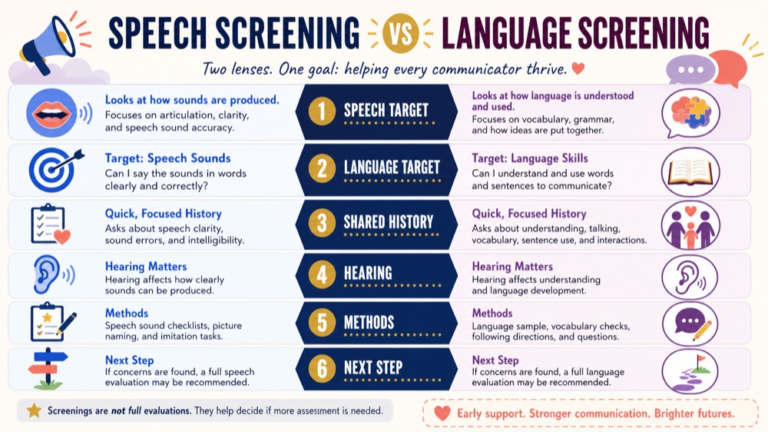
Speech Screening vs Language Screening: What Each One Examines
speech screening vs language screening is easier to study when it is treated as a connected clinical reasoning problem rather than a label to memorize. Speech screening vs language screening is a distinction about the target communication system, not a choice between two competing labels. Speech screening may focus on sound production, intelligibility, oral-motor or orofacial observations, and connected speech. Language screening may examine comprehension, expression, vocabulary, grammar, narrative, pragmatics, or communication in routines. The two areas can interact, so the referral question and the person’s full profile determine what should happen next.
This learning guide is written for SLP students and other learners reviewing clinical concepts. It organizes observation, access, assessment, function, and professional judgment; it does not make an individualized diagnosis or replace current professional guidance. Interpretation depends on the person, task, language, culture, health, access, partner, context, and communication goals.
Speech screening vs language screening: the core difference
Begin by separating the concept into domains. A learner who can name the domains is less likely to collapse language, access, partner, participation, competence, regulation, and clinical judgment into one explanation. The useful unit of analysis is the task: what the person was asked to understand, express, organize, coordinate, remember, or communicate, with whom, under which conditions, and with what support.
Domain or system
What to notice
Question to carry forward
Speech target
Speech-sound screening may examine individual sounds, connected speech, intelligibility, oral-motor function, and orofacial structure as relevant.
What is happening in speech production and how does it affect intelligibility?
Language target
Language screening may examine understanding, expression, vocabulary, grammar, narrative, pragmatics, and use across settings.
What does the person understand, express, organize, and communicate?
Shared history
Developmental, medical, family, educational, language, dialect, hearing, and participation history frames either screen.
What background changes the interpretation?
Hearing
Hearing access can affect speech and language performance and may call for hearing screening or audiologic referral.
Has hearing been considered before interpreting the communication signal?
Methods
Formal and informal procedures, observation, interview, samples, report, and natural-context data can complement each other.
Which method represents the skill and context of concern?
Next step
Results may lead to monitoring, education, speech or language assessment, audiology, medical referral, or team support.
What question remains after the screen?
These domains interact, but they should remain distinguishable. A learner may show strength in one context and need support in another. A study map organizes the next observation; it does not answer every assessment question or establish a universal treatment, goal, or legal conclusion.
Keep the first pass descriptive and close to the communication event. Note the task, response, partner, setting, timing, available support, language or mode, and consequence for participation. This gives the learner a stable record to compare across tasks and prevents a familiar term from doing too much explanatory work before the evidence has been separated.
For Praxis-style review, a vignette may include several true details but ask for one best interpretation or next step. The strongest answer usually respects the task, identifies the relevant function or boundary, checks the most important missing information, and avoids treating one performance sample or policy phrase as the whole profile.
Map speech screening vs language screening
For study purposes, describe the communication relationship before naming a disorder, judging a partner, selecting a goal, or deciding that a task is within scope. Record what the person understood, expressed, initiated, repaired, coordinated, or participated in. Then note whether the task was familiar, how much context was shared, and which support changed the response.
Speech: note sound patterns, connected-speech intelligibility, oral-motor or orofacial findings, prosody, and communication impact as relevant.
Language: note comprehension, expression, vocabulary, grammar, narrative, pragmatics, and the ability to communicate in meaningful routines.
Overlap: consider whether speech production affects the language sample or whether language demands affect the apparent speech performance.
History and hearing: review development, health, family and teacher concerns, languages, dialects, hearing access, and prior services.
Fair procedure: select language-matched, culturally responsive, age-appropriate formal or informal methods and natural observation.
Referral: decide whether to monitor, provide support, complete speech or language assessment, refer to audiology, or involve another professional.
A strong description is specific enough that another learner could picture the event. Instead of writing “the communication is impaired” or “the clinician can do this,” describe the demand, observable response, language or mode, partner, context, competence or access condition, and result. This protects clinical reasoning from labels that are broader than the evidence.
From the first signal to a complete referral question
Context changes what communication and professional decisions require. A direct question, long explanation, group exchange, classroom task, health-care interaction, family story, noisy routine, supervised procedure, or referral decision places different demands on processing, language, memory, hearing, access, partner behavior, competence, and regulation. Language experience, visual information, fatigue, health literacy, and the opportunity to request clarification should be part of the observation.
A child may be hard to understand because of a speech-sound pattern, but the same child may also have difficulty understanding directions or telling a story. Another child may have clear speech but struggle with vocabulary, grammar, or classroom language. A speech screen and a language screen can therefore point to different follow-up questions, and a hearing screen may matter for both. The best answer identifies the target skill, gathers the relevant context, and avoids using one screen as a substitute for the other.
Observation layer
Example question
Task
What did the person or clinician need to understand, express, organize, coordinate, decide, or provide?
Language and access
Which language, dialect, mode, hearing condition, tool, support, or communication partner was available?
Context and responsibility
Who was involved, what did they know, and which role, policy, ethical, or environmental factor mattered?
Participation and safety
What meaningful routine, role, outcome, or risk became easier or harder because of the pattern?
Context is not an afterthought added once a label has been selected. It is part of the question itself. If performance or decision quality changes with a quieter room, extra processing time, a familiar partner, a different language or mode, an interpreter, visual information, supervision, collaboration, a changed task, or a changed routine, that change is useful evidence about access and demand. It does not identify a cause by itself, but it tells you which conditions should be carried into the next observation.
Apply speech-versus-language reasoning
When a Praxis-style scenario or clinical discussion presents speech screening vs language screening, use a disciplined sequence. The goal is to select the next clinical question or action that matches the evidence, the person’s priorities, the communication context, and the relevant professional boundary.
Define the task, language, mode, communication purpose, or service responsibility in plain language.
Identify the relevant domain: language, access, partner, participation, assessment, competence, collaboration, ethics, or regulation.
Separate observation from interpretation and write down what remains unknown.
Check history, exposure, dialect, culture, identity, interpreter access, environment, sensory load, memory, task familiarity, training, supervision, and local requirements as relevant.
Choose the assessment, collaboration, accommodation, goal, training, referral, or documentation step that answers the specific question.
State the boundary of the conclusion and keep the person’s safety, autonomy, access, and participation visible.
A child may be hard to understand because of a speech-sound pattern, but the same child may also have difficulty understanding directions or telling a story. Another child may have clear speech but struggle with vocabulary, grammar, or classroom language. A speech screen and a language screen can therefore point to different follow-up questions, and a hearing screen may matter for both. The best answer identifies the target skill, gathers the relevant context, and avoids using one screen as a substitute for the other. In a learning answer, the decisive evidence is usually the relationship among the task, the observed pattern, the context, and the next needed information—not a single isolated behavior, score, label, or broad permission statement.
Common study mistakes
Treating speech screening and language screening as interchangeable procedures with the same target and interpretation.
Assuming clear articulation means language is intact or assuming unclear speech establishes a language disorder.
Ignoring how intelligibility affects the person’s ability to show language in a structured task or sample.
Skipping hearing questions because the referral was labeled speech or language rather than checking access.
Screening multilingual children only in English or interpreting dialectal patterns as disorder evidence.
Using a single score without describing the speech, language, partner, task, language, context, and functional impact.
Referring for a full assessment without telling the team whether the unanswered question is speech, language, hearing, or another domain.
Forgetting that screening indicates possible need for further assessment rather than establishing a diagnosis.
Most of these mistakes come from replacing a multidomain question with a fast label. Correct the habit by returning to the same sequence: describe, separate, contextualize, ask what is missing, and choose a proportionate next step. A short rationale can make the habit visible: identify the evidence, name the uncertainty, and explain why the selected next step fits the person, setting, and responsibility.
Build a quick review map
Use this compact map when reviewing a missed question, lecture note, or clinical vignette:
Step 1: Name the referral concern and decide whether the target is speech, language, hearing, or more than one domain.
Step 2: Describe the relevant speech-sound, intelligibility, comprehension, expression, narrative, pragmatic, or participation signal.
Step 3: Review development, health, family and teacher report, languages, dialects, hearing, and prior support.
Step 4: Select formal, informal, natural-context, and language-matched information that represents the target skill.
Step 5: Interpret the result as a referral or monitoring decision, not as a complete diagnosis.
Step 6: State the specific comprehensive assessment or collaboration question that remains.
Then write one transfer sentence: “When I see this pattern, I will first check ___ because ___.” The sentence should identify a decision rule, not repeat a definition. Revisit it after a delay and test whether you can apply the rule to a different task, age group, partner, language, setting, or professional responsibility.
Sources and next steps
speech screening vs language screening is best learned as a context-sensitive pattern across communication, access, identity, function, participation, competence, and professional judgment. Use the current authority pages to refine the concept, then return to practice scenarios that require you to explain what the evidence supports and what it leaves open.
Communication Disorder Screening: Signals, Context, and Next Steps
communication disorder screening is easier to study when it is treated as a connected clinical reasoning problem rather than a label to memorize. Communication disorder screening is a first-level process used to identify whether a person may need further information, support, referral, or comprehensive assessment. It can involve speech, language, hearing, cognitive communication, feeding, swallowing, natural observation, interview, report, and brief formal or informal procedures. The key SLP distinction is that screening organizes the next question; it does not diagnose the person or describe the whole communication profile.
This learning guide is written for SLP students and other learners reviewing clinical concepts. It organizes observation, access, assessment, function, and professional judgment; it does not make an individualized diagnosis or replace current professional guidance. Interpretation depends on the person, task, language, culture, health, access, partner, context, and communication goals.
What communication disorder screening is for
Begin by separating the concept into domains. A learner who can name the domains is less likely to collapse language, access, partner, participation, competence, regulation, and clinical judgment into one explanation. The useful unit of analysis is the task: what the person was asked to understand, express, organize, coordinate, remember, or communicate, with whom, under which conditions, and with what support.
Domain or system
What to notice
Question to carry forward
Concern
The reason for screening may be a person’s report, family or teacher concern, medical event, developmental pattern, participation change, or service question.
What prompted the screen and whose concern is represented?
Communication domains
Speech, language, hearing, cognitive communication, feeding, swallowing, voice, fluency, and social communication may require different signals.
Which domain is actually being screened?
Data sources
Interview, report, observation, natural routines, hearing information, samples, and brief tools contribute different evidence.
Which sources show the person’s communication in context?
Access and fit
Language, dialect, culture, hearing, vision, cognition, AAC, literacy, fatigue, and task familiarity affect the meaning of a response.
Is the procedure accessible and appropriate for this person?
Result
A screen may lead to education, monitoring, rescreening, referral, comprehensive assessment, audiology, medical review, or team support.
What action is proportionate to the signal and risk?
Boundary
Screening indicates possible need for more information; it does not establish a diagnosis or replace a full evaluation.
What important question remains unanswered?
These domains interact, but they should remain distinguishable. A learner may show strength in one context and need support in another. A study map organizes the next observation; it does not answer every assessment question or establish a universal treatment, goal, or legal conclusion.
Keep the first pass descriptive and close to the communication event. Note the task, response, partner, setting, timing, available support, language or mode, and consequence for participation. This gives the learner a stable record to compare across tasks and prevents a familiar term from doing too much explanatory work before the evidence has been separated.
For Praxis-style review, a vignette may include several true details but ask for one best interpretation or next step. The strongest answer usually respects the task, identifies the relevant function or boundary, checks the most important missing information, and avoids treating one performance sample or policy phrase as the whole profile.
Map communication disorder screening
For study purposes, describe the communication relationship before naming a disorder, judging a partner, selecting a goal, or deciding that a task is within scope. Record what the person understood, expressed, initiated, repaired, coordinated, or participated in. Then note whether the task was familiar, how much context was shared, and which support changed the response.
Question: define the person, concern, setting, communication mode, and decision the screen is meant to support.
Domains: separate speech, language, hearing, cognitive communication, feeding, swallowing, fluency, voice, and social-communication signals.
Sources: combine direct interaction, natural observation, interview, caregiver or teacher report, records, hearing information, and brief measures as appropriate.
Fit: consider language, dialect, culture, hearing, vision, cognition, AAC, literacy, fatigue, motor access, and task familiarity.
Response: choose education, support, monitoring, rescreening, referral, comprehensive assessment, audiology, medical review, or team action.
Boundary: write what the screen can suggest and what it cannot determine about diagnosis, severity, cause, or long-term outcome.
A strong description is specific enough that another learner could picture the event. Instead of writing “the communication is impaired” or “the clinician can do this,” describe the demand, observable response, language or mode, partner, context, competence or access condition, and result. This protects clinical reasoning from labels that are broader than the evidence.
From a screening signal to the right next step
Context changes what communication and professional decisions require. A direct question, long explanation, group exchange, classroom task, health-care interaction, family story, noisy routine, supervised procedure, or referral decision places different demands on processing, language, memory, hearing, access, partner behavior, competence, and regulation. Language experience, visual information, fatigue, health literacy, and the opportunity to request clarification should be part of the observation.
A preschool teacher may notice that a child is difficult to understand, a caregiver may report limited participation in family conversations, or a patient may show a new communication change after illness. The screening plan should match the concern and the setting. It may include direct interaction, observation, interviews, report, hearing questions, and brief procedures, but a screen cannot answer every assessment question. A negative result does not erase a strong concern when the method did not represent the person’s language, mode, context, or functional communication.
Observation layer
Example question
Task
What did the person or clinician need to understand, express, organize, coordinate, decide, or provide?
Language and access
Which language, dialect, mode, hearing condition, tool, support, or communication partner was available?
Context and responsibility
Who was involved, what did they know, and which role, policy, ethical, or environmental factor mattered?
Participation and safety
What meaningful routine, role, outcome, or risk became easier or harder because of the pattern?
Context is not an afterthought added once a label has been selected. It is part of the question itself. If performance or decision quality changes with a quieter room, extra processing time, a familiar partner, a different language or mode, an interpreter, visual information, supervision, collaboration, a changed task, or a changed routine, that change is useful evidence about access and demand. It does not identify a cause by itself, but it tells you which conditions should be carried into the next observation.
Apply communication screening reasoning
When a Praxis-style scenario or clinical discussion presents communication disorder screening, use a disciplined sequence. The goal is to select the next clinical question or action that matches the evidence, the person’s priorities, the communication context, and the relevant professional boundary.
Define the task, language, mode, communication purpose, or service responsibility in plain language.
Identify the relevant domain: language, access, partner, participation, assessment, competence, collaboration, ethics, or regulation.
Separate observation from interpretation and write down what remains unknown.
Check history, exposure, dialect, culture, identity, interpreter access, environment, sensory load, memory, task familiarity, training, supervision, and local requirements as relevant.
Choose the assessment, collaboration, accommodation, goal, training, referral, or documentation step that answers the specific question.
State the boundary of the conclusion and keep the person’s safety, autonomy, access, and participation visible.
A preschool teacher may notice that a child is difficult to understand, a caregiver may report limited participation in family conversations, or a patient may show a new communication change after illness. The screening plan should match the concern and the setting. It may include direct interaction, observation, interviews, report, hearing questions, and brief procedures, but a screen cannot answer every assessment question. A negative result does not erase a strong concern when the method did not represent the person’s language, mode, context, or functional communication. In a learning answer, the decisive evidence is usually the relationship among the task, the observed pattern, the context, and the next needed information—not a single isolated behavior, score, label, or broad permission statement.
Common study mistakes
Using the phrase communication disorder screening as if one tool could screen every communication domain equally well.
Calling a screening result a diagnosis or using it as a complete description of severity, cause, or participation.
Choosing a measure before defining the concern, target domain, person, language, setting, and next decision.
Using one structured task and assuming it represents natural communication across partners and routines.
Screening in a language or mode that does not give the person a fair opportunity to show what they know and do.
Failing to tell the person, family, teacher, or team what a result means and what follow-up is available.
Repeating screening without a plan when the evidence calls for comprehensive assessment or another referral.
Most of these mistakes come from replacing a multidomain question with a fast label. Correct the habit by returning to the same sequence: describe, separate, contextualize, ask what is missing, and choose a proportionate next step. A short rationale can make the habit visible: identify the evidence, name the uncertainty, and explain why the selected next step fits the person, setting, and responsibility.
Build a quick review map
Use this compact map when reviewing a missed question, lecture note, or clinical vignette:
Step 1: Define the concern, communication domain, person, setting, language or mode, and decision.
Step 2: Gather context through interview, report, observation, natural routines, records, and targeted procedures.
Step 3: Check language, dialect, culture, hearing, sensory, cognitive, motor, AAC, and access fit.
Step 4: Interpret the result as evidence about next steps rather than a diagnosis.
Step 5: Choose monitoring, support, rescreening, comprehensive assessment, audiology, medical review, or referral proportionately.
Step 6: Document what the screen answered, what it did not answer, and when the plan should be revisited.
Then write one transfer sentence: “When I see this pattern, I will first check ___ because ___.” The sentence should identify a decision rule, not repeat a definition. Revisit it after a delay and test whether you can apply the rule to a different task, age group, partner, language, setting, or professional responsibility.
Sources and next steps
communication disorder screening is best learned as a context-sensitive pattern across communication, access, identity, function, participation, competence, and professional judgment. Use the current authority pages to refine the concept, then return to practice scenarios that require you to explain what the evidence supports and what it leaves open.
Speech-Language Screening: Purpose, Data, and Next Steps
speech language screening is easier to study when it is treated as a connected clinical reasoning problem rather than a label to memorize. Speech language screening is a first-level process used to identify whether a person may need further speech, language, hearing, swallowing, cognitive-communication, or related assessment. It is not a diagnosis and it is not a complete description of severity or function. The strongest screening plan matches the concern, age, language, dialect, culture, communication mode, setting, and available next step, then explains how results will be acted on.
This learning guide is written for SLP students and other learners reviewing clinical concepts. It organizes observation, access, assessment, function, and professional judgment; it does not make an individualized diagnosis or replace current professional guidance. Interpretation depends on the person, task, language, culture, health, access, partner, context, and communication goals.
What speech language screening is for
Begin by separating the concept into domains. A learner who can name the domains is less likely to collapse language, access, partner, participation, competence, regulation, and clinical judgment into one explanation. The useful unit of analysis is the task: what the person was asked to understand, express, organize, coordinate, remember, or communicate, with whom, under which conditions, and with what support.
Domain or system
What to notice
Question to carry forward
Purpose
Screening identifies possible need for further assessment, monitoring, support, referral, or timely education.
What decision will this screening result inform?
Concern and history
Caregiver, teacher, person, medical, developmental, educational, and communication history frame what should be screened.
What prompted the screen and what does the person notice?
Data sources
Observation, interview, report, hearing screening, formal tools, informal tasks, samples, and natural routines can contribute.
Which sources represent the person’s communication in context?
Is the procedure accessible and appropriate for this person?
Result
A result may suggest monitoring, education, rescreening, comprehensive assessment, audiology, medical referral, or another service.
What is the proportionate response to the evidence?
Limit
Screening does not establish a diagnosis or replace a comprehensive, culturally and linguistically appropriate evaluation.
What question remains unanswered?
These domains interact, but they should remain distinguishable. A learner may show strength in one context and need support in another. A study map organizes the next observation; it does not answer every assessment question or establish a universal treatment, goal, or legal conclusion.
Keep the first pass descriptive and close to the communication event. Note the task, response, partner, setting, timing, available support, language or mode, and consequence for participation. This gives the learner a stable record to compare across tasks and prevents a familiar term from doing too much explanatory work before the evidence has been separated.
For Praxis-style review, a vignette may include several true details but ask for one best interpretation or next step. The strongest answer usually respects the task, identifies the relevant function or boundary, checks the most important missing information, and avoids treating one performance sample or policy phrase as the whole profile.
Map speech language screening
For study purposes, describe the communication relationship before naming a disorder, judging a partner, selecting a goal, or deciding that a task is within scope. Record what the person understood, expressed, initiated, repaired, coordinated, or participated in. Then note whether the task was familiar, how much context was shared, and which support changed the response.
Question: define the concern, person, context, communication mode, and decision the screen is meant to support.
Signals: include speech, language, hearing, cognitive-communication, swallowing, participation, partner, and functional observations as relevant.
Methods: combine direct interaction, natural observation, interview, report, formal measures, informal tasks, and samples when appropriate.
Access: conduct the screen in relevant language(s) and modes with attention to dialect, culture, sensory access, literacy, cognition, and technology.
Response: distinguish monitor, educate, rescreen, refer, and comprehensively assess; match the action to risk and evidence.
Boundary: state that screening indicates possible need for further information and does not by itself diagnose or characterize the full disorder.
A strong description is specific enough that another learner could picture the event. Instead of writing “the communication is impaired” or “the clinician can do this,” describe the demand, observable response, language or mode, partner, context, competence or access condition, and result. This protects clinical reasoning from labels that are broader than the evidence.
From screening signal to the right next step
Context changes what communication and professional decisions require. A direct question, long explanation, group exchange, classroom task, health-care interaction, family story, noisy routine, supervised procedure, or referral decision places different demands on processing, language, memory, hearing, access, partner behavior, competence, and regulation. Language experience, visual information, fatigue, health literacy, and the opportunity to request clarification should be part of the observation.
A teacher may raise concern about a student’s speech intelligibility, a caregiver may notice limited language in daily routines, or an adult may report a new communication change after illness. A useful screen gathers information that represents the relevant language and context, includes hearing or other referral questions when indicated, and produces a clear next step. If the person uses more than one language, a single English-only task may not answer the question. If a screen is negative but concern remains strong, the clinician should explain what the screen did and did not examine.
Observation layer
Example question
Task
What did the person or clinician need to understand, express, organize, coordinate, decide, or provide?
Language and access
Which language, dialect, mode, hearing condition, tool, support, or communication partner was available?
Context and responsibility
Who was involved, what did they know, and which role, policy, ethical, or environmental factor mattered?
Participation and safety
What meaningful routine, role, outcome, or risk became easier or harder because of the pattern?
Context is not an afterthought added once a label has been selected. It is part of the question itself. If performance or decision quality changes with a quieter room, extra processing time, a familiar partner, a different language or mode, an interpreter, visual information, supervision, collaboration, a changed task, or a changed routine, that change is useful evidence about access and demand. It does not identify a cause by itself, but it tells you which conditions should be carried into the next observation.
Apply speech language screening reasoning
When a Praxis-style scenario or clinical discussion presents speech language screening, use a disciplined sequence. The goal is to select the next clinical question or action that matches the evidence, the person’s priorities, the communication context, and the relevant professional boundary.
Define the task, language, mode, communication purpose, or service responsibility in plain language.
Identify the relevant domain: language, access, partner, participation, assessment, competence, collaboration, ethics, or regulation.
Separate observation from interpretation and write down what remains unknown.
Check history, exposure, dialect, culture, identity, interpreter access, environment, sensory load, memory, task familiarity, training, supervision, and local requirements as relevant.
Choose the assessment, collaboration, accommodation, goal, training, referral, or documentation step that answers the specific question.
State the boundary of the conclusion and keep the person’s safety, autonomy, access, and participation visible.
A teacher may raise concern about a student’s speech intelligibility, a caregiver may notice limited language in daily routines, or an adult may report a new communication change after illness. A useful screen gathers information that represents the relevant language and context, includes hearing or other referral questions when indicated, and produces a clear next step. If the person uses more than one language, a single English-only task may not answer the question. If a screen is negative but concern remains strong, the clinician should explain what the screen did and did not examine. In a learning answer, the decisive evidence is usually the relationship among the task, the observed pattern, the context, and the next needed information—not a single isolated behavior, score, label, or broad permission statement.
Common study mistakes
Calling a screening result a diagnosis or using it as a complete severity profile.
Choosing a screen because it is convenient without checking the person, language, dialect, culture, age, setting, or purpose.
Ignoring hearing, medical, developmental, cognitive, sensory, swallowing, or access factors that may change the next step.
Using one structured task and assuming it represents communication across natural routines and partners.
Screening multilingual people only in English and treating limited exposure or language difference as disorder evidence.
Failing to explain what a positive or negative result means and what follow-up is available.
Rescreening indefinitely when the pattern or risk calls for a comprehensive assessment or referral.
Reporting a score without the method, language, support, context, limitations, or decision it was intended to inform.
Most of these mistakes come from replacing a multidomain question with a fast label. Correct the habit by returning to the same sequence: describe, separate, contextualize, ask what is missing, and choose a proportionate next step. A short rationale can make the habit visible: identify the evidence, name the uncertainty, and explain why the selected next step fits the person, setting, and responsibility.
Build a quick review map
Use this compact map when reviewing a missed question, lecture note, or clinical vignette:
Step 1: Define the concern, person, language or mode, setting, history, and decision before selecting a screening procedure.
Step 2: Gather the appropriate mix of interview, observation, report, hearing, formal, informal, and natural-context data.
Step 3: Check cultural, linguistic, dialectal, sensory, cognitive, literacy, AAC, and access fit.
Step 4: Interpret a positive or negative result as evidence about next steps rather than as a diagnosis.
Step 5: Choose monitoring, rescreening, education, comprehensive assessment, audiology, medical referral, or another action proportionately.
Step 6: Document what the screen answered, what it did not answer, and when the plan should be revisited.
Then write one transfer sentence: “When I see this pattern, I will first check ___ because ___.” The sentence should identify a decision rule, not repeat a definition. Revisit it after a delay and test whether you can apply the rule to a different task, age group, partner, language, setting, or professional responsibility.
Sources and next steps
speech language screening is best learned as a context-sensitive pattern across communication, access, identity, function, participation, competence, and professional judgment. Use the current authority pages to refine the concept, then return to practice scenarios that require you to explain what the evidence supports and what it leaves open.
Prognosis and Natural History of Communication Disorders: Reasoning Over Time
prognosis and natural history of communication disorders is easier to study when it is treated as a connected clinical reasoning problem rather than a label to memorize. Prognosis and natural history of communication disorders are related but different ways to reason about change over time. Natural history asks what may happen without a particular intervention in a defined population and context. Prognosis is a reasoned expectation for an individual or group that uses current findings, history, evidence, risk and protective factors, response, access, and functional goals. Neither is a guarantee, and both should be updated as new information appears.
This learning guide is written for SLP students and other learners reviewing clinical concepts. It organizes observation, access, assessment, function, and professional judgment; it does not make an individualized diagnosis or replace current professional guidance. Interpretation depends on the person, task, language, culture, health, access, partner, context, and communication goals.
What prognosis and natural history mean
Begin by separating the concept into domains. A learner who can name the domains is less likely to collapse language, access, partner, participation, competence, regulation, and clinical judgment into one explanation. The useful unit of analysis is the task: what the person was asked to understand, express, organize, coordinate, remember, or communicate, with whom, under which conditions, and with what support.
Domain or system
What to notice
Question to carry forward
Natural history
The expected course or pattern of a condition in a defined population and context, often separated from the effect of a specific treatment.
What course has been observed or studied without this intervention?
Prognosis
A reasoned expectation about future function, participation, risk, or response for a person or group using the available evidence.
What outcome is reasonably expected for this person and why?
Prognostic factors
Age, severity, etiology, developmental history, co-occurring conditions, supports, access, baseline function, and response may affect expectations.
Which factors make the expectation more or less certain?
Treatment response
Change after intervention is evidence about response under those conditions; it is not the same as spontaneous change or the natural history.
What changed, under what support, and compared with what?
Functional outcome
Speech, language, cognition, swallowing, communication access, autonomy, relationships, education, work, health, and participation may matter more than one score.
Which future outcome is meaningful to the person?
Follow-up
Prognosis should be revisited with new data, changing goals, access, health, development, and response.
What evidence would change the expectation or plan?
These domains interact, but they should remain distinguishable. A learner may show strength in one context and need support in another. A study map organizes the next observation; it does not answer every assessment question or establish a universal treatment, goal, or legal conclusion.
Keep the first pass descriptive and close to the communication event. Note the task, response, partner, setting, timing, available support, language or mode, and consequence for participation. This gives the learner a stable record to compare across tasks and prevents a familiar term from doing too much explanatory work before the evidence has been separated.
For Praxis-style review, a vignette may include several true details but ask for one best interpretation or next step. The strongest answer usually respects the task, identifies the relevant function or boundary, checks the most important missing information, and avoids treating one performance sample or policy phrase as the whole profile.
Map prognosis and natural history of communication disorders
For study purposes, describe the communication relationship before naming a disorder, judging a partner, selecting a goal, or deciding that a task is within scope. Record what the person understood, expressed, initiated, repaired, coordinated, or participated in. Then note whether the task was familiar, how much context was shared, and which support changed the response.
Course: identify the condition, population, time period, context, and whether the question concerns natural history or treatment response.
Baseline: describe current communication, swallowing, cognition, participation, health, access, severity, and meaningful priorities.
Factors: weigh etiology, development, age, co-occurring conditions, family and environmental supports, opportunity, and risk.
Evidence: use current research, repeated person-level data, clinical expertise, and the person’s and family’s values together.
Uncertainty: state what is known, what is inferred, how wide the expectation is, and what could change it.
Follow-up: monitor function and participation, update prognosis, revise recommendations, and avoid turning an estimate into a promise.
A strong description is specific enough that another learner could picture the event. Instead of writing “the communication is impaired” or “the clinician can do this,” describe the demand, observable response, language or mode, partner, context, competence or access condition, and result. This protects clinical reasoning from labels that are broader than the evidence.
From current findings to a revisable expectation
Context changes what communication and professional decisions require. A direct question, long explanation, group exchange, classroom task, health-care interaction, family story, noisy routine, supervised procedure, or referral decision places different demands on processing, language, memory, hearing, access, partner behavior, competence, and regulation. Language experience, visual information, fatigue, health literacy, and the opportunity to request clarification should be part of the observation.
A child with late language emergence may have risk factors associated with later language or literacy difficulty, yet early language delay does not produce one inevitable outcome. A person recovering after neurologic injury may show a changing profile as health, practice, support, fatigue, and participation demands change. The SLP’s prognosis should explain the evidence and uncertainty, identify the outcomes that matter, and state what will be monitored. A statement such as “will recover” is less useful than a conditional expectation tied to current findings and a review plan.
Observation layer
Example question
Task
What did the person or clinician need to understand, express, organize, coordinate, decide, or provide?
Language and access
Which language, dialect, mode, hearing condition, tool, support, or communication partner was available?
Context and responsibility
Who was involved, what did they know, and which role, policy, ethical, or environmental factor mattered?
Participation and safety
What meaningful routine, role, outcome, or risk became easier or harder because of the pattern?
Context is not an afterthought added once a label has been selected. It is part of the question itself. If performance or decision quality changes with a quieter room, extra processing time, a familiar partner, a different language or mode, an interpreter, visual information, supervision, collaboration, a changed task, or a changed routine, that change is useful evidence about access and demand. It does not identify a cause by itself, but it tells you which conditions should be carried into the next observation.
Apply prognosis reasoning
When a Praxis-style scenario or clinical discussion presents prognosis and natural history of communication disorders, use a disciplined sequence. The goal is to select the next clinical question or action that matches the evidence, the person’s priorities, the communication context, and the relevant professional boundary.
Define the task, language, mode, communication purpose, or service responsibility in plain language.
Identify the relevant domain: language, access, partner, participation, assessment, competence, collaboration, ethics, or regulation.
Separate observation from interpretation and write down what remains unknown.
Check history, exposure, dialect, culture, identity, interpreter access, environment, sensory load, memory, task familiarity, training, supervision, and local requirements as relevant.
Choose the assessment, collaboration, accommodation, goal, training, referral, or documentation step that answers the specific question.
State the boundary of the conclusion and keep the person’s safety, autonomy, access, and participation visible.
A child with late language emergence may have risk factors associated with later language or literacy difficulty, yet early language delay does not produce one inevitable outcome. A person recovering after neurologic injury may show a changing profile as health, practice, support, fatigue, and participation demands change. The SLP’s prognosis should explain the evidence and uncertainty, identify the outcomes that matter, and state what will be monitored. A statement such as “will recover” is less useful than a conditional expectation tied to current findings and a review plan. In a learning answer, the decisive evidence is usually the relationship among the task, the observed pattern, the context, and the next needed information—not a single isolated behavior, score, label, or broad permission statement.
Common study mistakes
Using prognosis and natural history as interchangeable terms without identifying the treatment or context being considered.
Presenting a group average as a guaranteed individual outcome.
Confusing spontaneous change, maturation, treatment response, practice effects, and measurement variation.
Giving a prognosis from one score without considering history, etiology, severity, access, supports, function, and values.
Writing a pessimistic or optimistic label without describing uncertainty, conditions, and what evidence would change it.
Measuring prognosis only through impairment scores while ignoring communication access, autonomy, safety, roles, and participation.
Failing to update the expectation when health, development, response, environment, or goals change.
Treating a prognosis statement as a reason to stop assessment, support, referral, or shared decision-making.
Most of these mistakes come from replacing a multidomain question with a fast label. Correct the habit by returning to the same sequence: describe, separate, contextualize, ask what is missing, and choose a proportionate next step. A short rationale can make the habit visible: identify the evidence, name the uncertainty, and explain why the selected next step fits the person, setting, and responsibility.
Build a quick review map
Use this compact map when reviewing a missed question, lecture note, or clinical vignette:
Step 1: Define the condition, person, population, time frame, intervention context, and outcome of interest.
Step 2: Separate natural history from response to intervention and from measurement change.
Step 3: List baseline findings, prognostic factors, protective supports, barriers, and person priorities.
Step 4: Integrate current evidence, repeated data, clinical expertise, values, access, culture, and functional goals.
Step 5: State the expectation with uncertainty and the conditions under which it may change.
Step 6: Create a follow-up plan that can update prognosis and recommendations as the person’s course unfolds.
Then write one transfer sentence: “When I see this pattern, I will first check ___ because ___.” The sentence should identify a decision rule, not repeat a definition. Revisit it after a delay and test whether you can apply the rule to a different task, age group, partner, language, setting, or professional responsibility.
Sources and next steps
prognosis and natural history of communication disorders is best learned as a context-sensitive pattern across communication, access, identity, function, participation, competence, and professional judgment. Use the current authority pages to refine the concept, then return to practice scenarios that require you to explain what the evidence supports and what it leaves open.