Play-Based Assessment in Speech-Language Pathology: Meaningful Observation in Action
play based assessment speech language is easier to study when it is treated as a connected clinical reasoning problem rather than a label to memorize. Play-based assessment in speech-language pathology uses developmentally meaningful play or story activities to observe communication, speech, language, interaction, and learning in action. The activity should be intentional rather than merely entertaining: the SLP defines the question, creates opportunities to respond, records the partner and supports, and interprets the sample within its limits. Play can complement formal measures, caregiver report, and other evidence by showing how skills emerge in meaningful contexts.
This learning guide is written for SLP students and other learners reviewing clinical concepts. It organizes observation, access, assessment, function, and professional judgment; it does not make an individualized diagnosis or replace current professional guidance. Interpretation depends on the person, task, language, culture, health, access, partner, context, and communication goals.
What play-based assessment means
Begin by separating the concept into domains. A learner who can name the domains is less likely to collapse language, access, partner, participation, competence, regulation, and clinical judgment into one explanation. The useful unit of analysis is the task: what the person was asked to understand, express, organize, coordinate, remember, or communicate, with whom, under which conditions, and with what support.
Domain or system
What to notice
Question to carry forward
Meaningful activity
Play, pretend, books, games, and everyday routines can create natural opportunities for communication and speech-language behavior.
What activity is meaningful and developmentally appropriate?
Clinical question
The SLP chooses a question about comprehension, expression, speech, interaction, narrative, repair, or learning rather than observing everything at once.
What specific skill or pattern are we watching for?
Opportunity and demand
Materials, turns, choices, unexpected events, problem solving, and shared attention create different response opportunities.
What did the activity invite the child to understand or communicate?
Partner and support
Adult language, wait time, models, prompts, choices, visual information, and access tools influence what can be shown.
How did the partner and support shape the sample?
Variation across tasks
Speech and language performance may differ in labeling, conversation, narrative, pretend play, and connected communication.
Which patterns repeat across activities and which are task-specific?
Integration
Play observations are connected with history, caregiver report, formal measures, samples, hearing, and functional priorities.
What conclusion is justified across the evidence?
These domains interact, but they should remain distinguishable. A learner may show strength in one context and need support in another. A study map organizes the next observation; it does not answer every assessment question or establish a universal treatment, goal, or legal conclusion.
Keep the first pass descriptive and close to the communication event. Note the task, response, partner, setting, timing, available support, language or mode, and consequence for participation. This gives the learner a stable record to compare across tasks and prevents a familiar term from doing too much explanatory work before the evidence has been separated.
For Praxis-style review, a vignette may include several true details but ask for one best interpretation or next step. The strongest answer usually respects the task, identifies the relevant function or boundary, checks the most important missing information, and avoids treating one performance sample or policy phrase as the whole profile.
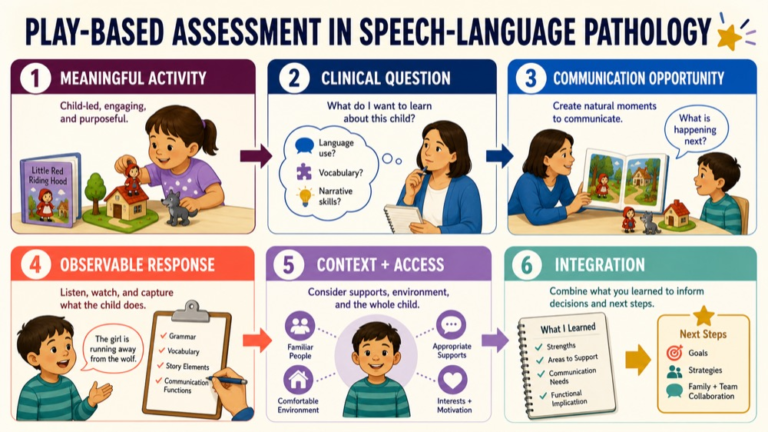
Map play-based assessment
For study purposes, describe the communication relationship before naming a disorder, judging a partner, selecting a goal, or deciding that a task is within scope. Record what the person understood, expressed, initiated, repaired, coordinated, or participated in. Then note whether the task was familiar, how much context was shared, and which support changed the response.
Activity: select play, books, pretend routines, games, or materials that are familiar enough to engage but useful for the question.
Question: identify the communication, speech, language, interaction, narrative, or learning pattern to observe.
Opportunity: arrange turns, choices, shared attention, problem solving, and communication temptations without forcing a response.
Response: record comprehension, expression, speech production, initiation, repair, flexibility, symbolic play, and partner interaction.
Integration: compare play evidence with formal, caregiver, teacher, observational, hearing, dynamic, and functional information.
A strong description is specific enough that another learner could picture the event. Instead of writing “the communication is impaired” or “the clinician can do this,” describe the demand, observable response, language or mode, partner, context, competence or access condition, and result. This protects clinical reasoning from labels that are broader than the evidence.
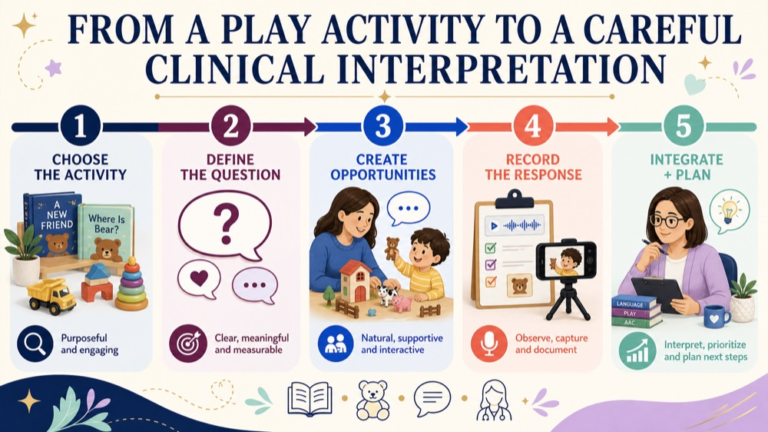
From a play activity to a careful clinical interpretation
Context changes what communication and professional decisions require. A direct question, long explanation, group exchange, classroom task, health-care interaction, family story, noisy routine, supervised procedure, or referral decision places different demands on processing, language, memory, hearing, access, partner behavior, competence, and regulation. Language experience, visual information, fatigue, health literacy, and the opportunity to request clarification should be part of the observation.
A child may label pictures accurately but use shorter or less organized language during pretend play, a story, or a conversation. Another child may communicate more when a familiar play routine provides shared attention and predictable turns. Play-based assessment helps the SLP see these relationships, but the activity must still be described: what materials were available, what the adult said, how much support was offered, which language or mode was used, and what the child actually did. The goal is a meaningful sample, not the belief that play automatically reveals every ability or cause.
Observation layer
Example question
Task
What did the person or clinician need to understand, express, organize, coordinate, decide, or provide?
Language and access
Which language, dialect, mode, hearing condition, tool, support, or communication partner was available?
Context and responsibility
Who was involved, what did they know, and which role, policy, ethical, or environmental factor mattered?
Participation and safety
What meaningful routine, role, outcome, or risk became easier or harder because of the pattern?
Context is not an afterthought added once a label has been selected. It is part of the question itself. If performance or decision quality changes with a quieter room, extra processing time, a familiar partner, a different language or mode, an interpreter, visual information, supervision, collaboration, a changed task, or a changed routine, that change is useful evidence about access and demand. It does not identify a cause by itself, but it tells you which conditions should be carried into the next observation.
Apply play-based reasoning
When a Praxis-style scenario or clinical discussion presents play based assessment speech language, use a disciplined sequence. The goal is to select the next clinical question or action that matches the evidence, the person’s priorities, the communication context, and the relevant professional boundary.
Define the task, language, mode, communication purpose, or service responsibility in plain language.
Identify the relevant domain: language, access, partner, participation, assessment, competence, collaboration, ethics, or regulation.
Separate observation from interpretation and write down what remains unknown.
Check history, exposure, dialect, culture, identity, interpreter access, environment, sensory load, memory, task familiarity, training, supervision, and local requirements as relevant.
Choose the assessment, collaboration, accommodation, goal, training, referral, or documentation step that answers the specific question.
State the boundary of the conclusion and keep the person’s safety, autonomy, access, and participation visible.
A child may label pictures accurately but use shorter or less organized language during pretend play, a story, or a conversation. Another child may communicate more when a familiar play routine provides shared attention and predictable turns. Play-based assessment helps the SLP see these relationships, but the activity must still be described: what materials were available, what the adult said, how much support was offered, which language or mode was used, and what the child actually did. The goal is a meaningful sample, not the belief that play automatically reveals every ability or cause. In a learning answer, the decisive evidence is usually the relationship among the task, the observed pattern, the context, and the next needed information—not a single isolated behavior, score, label, or broad permission statement.
Common study mistakes
Calling any enjoyable interaction play-based assessment without a focused question, planned opportunity, or documented observation.
Assuming play performance is automatically natural, representative, or free from adult language, materials, partner, and cultural influence.
Recording only vocabulary labels or speech errors and missing comprehension, narrative, interaction, repair, symbolic play, and meaning.
Using unfamiliar toys, pretend rules, or communication expectations without considering experience, culture, language, disability, or access.
Overprompting, leading, or correcting until the sample reflects the adult’s support more than the child’s independent response.
Generalizing one play routine to classroom learning, peer interaction, home communication, or formal test performance.
Treating a play-based sample as a replacement for every construct-specific or standardized assessment question.
Failing to include caregiver report, history, hearing, formal measures, samples, or functional context in the interpretation.
Most of these mistakes come from replacing a multidomain question with a fast label. Correct the habit by returning to the same sequence: describe, separate, contextualize, ask what is missing, and choose a proportionate next step. A short rationale can make the habit visible: identify the evidence, name the uncertainty, and explain why the selected next step fits the person, setting, and responsibility.
Build a quick review map
Use this compact map when reviewing a missed question, lecture note, or clinical vignette:
Step 1: Define the clinical question and choose an activity that creates meaningful, accessible opportunities to answer it.
Step 2: Plan the materials, partner language, turns, choices, supports, and observation targets before the activity begins.
Step 3: Record the child’s actual response, communication mode, speech-language pattern, and level of assistance.
Step 4: Check how familiarity, culture, language, sensory access, fatigue, partner behavior, and task structure shaped performance.
Step 5: Compare patterns across play, conversation, narrative, formal, caregiver, and functional evidence.
Step 6: Use the integrated pattern to guide the next assessment, support, collaboration, goal, or monitoring step.
Then write one transfer sentence: “When I see this pattern, I will first check ___ because ___.” The sentence should identify a decision rule, not repeat a definition. Revisit it after a delay and test whether you can apply the rule to a different task, age group, partner, language, setting, or professional responsibility.
Sources and next steps
play based assessment speech language is best learned as a context-sensitive pattern across communication, access, identity, function, participation, competence, and professional judgment. Use the current authority pages to refine the concept, then return to practice scenarios that require you to explain what the evidence supports and what it leaves open.
Curriculum-Based Assessment in Speech-Language Pathology: Demand, Performance, and Support
curriculum based assessment speech language is easier to study when it is treated as a connected clinical reasoning problem rather than a label to memorize. Curriculum-based assessment in speech-language pathology examines the language and literacy demands of actual learning tasks and compares those demands with the student’s observed performance and available support. It helps an SLP understand how communication affects access to instruction, but it is not simply a worksheet score. The clinician analyzes the task, observes the student, collaborates with the educational team, and connects findings to meaningful participation and support planning.
This learning guide is written for SLP students and other learners reviewing clinical concepts. It organizes observation, access, assessment, function, and professional judgment; it does not make an individualized diagnosis or replace current professional guidance. Interpretation depends on the person, task, language, culture, health, access, partner, context, and communication goals.
What curriculum-based assessment means
Begin by separating the concept into domains. A learner who can name the domains is less likely to collapse language, access, partner, participation, competence, regulation, and clinical judgment into one explanation. The useful unit of analysis is the task: what the person was asked to understand, express, organize, coordinate, remember, or communicate, with whom, under which conditions, and with what support.
Domain or system
What to notice
Question to carry forward
Curricular task
The assessment begins with an actual reading, writing, discussion, lesson, assignment, or classroom routine.
What learning activity is the student expected to access?
Language demand
The task may require vocabulary, grammar, narrative, explanation, inference, comprehension, discourse, literacy, or self-advocacy.
What language must the learner understand or produce?
Unaided observation
Observing how the student attempts the task without added assistance can show the starting relationship between demand and performance.
What happens before extra support is introduced?
Gap analysis
Compare task demands with the student’s response, strategy use, errors, strengths, and support needs.
Where is the mismatch, and what may reduce it?
Team perspective
Teachers, family, student, and other professionals add information about routines, progress, materials, and priorities.
How does the pattern appear across the school day?
What change would improve meaningful school participation?
These domains interact, but they should remain distinguishable. A learner may show strength in one context and need support in another. A study map organizes the next observation; it does not answer every assessment question or establish a universal treatment, goal, or legal conclusion.
Keep the first pass descriptive and close to the communication event. Note the task, response, partner, setting, timing, available support, language or mode, and consequence for participation. This gives the learner a stable record to compare across tasks and prevents a familiar term from doing too much explanatory work before the evidence has been separated.
For Praxis-style review, a vignette may include several true details but ask for one best interpretation or next step. The strongest answer usually respects the task, identifies the relevant function or boundary, checks the most important missing information, and avoids treating one performance sample or policy phrase as the whole profile.
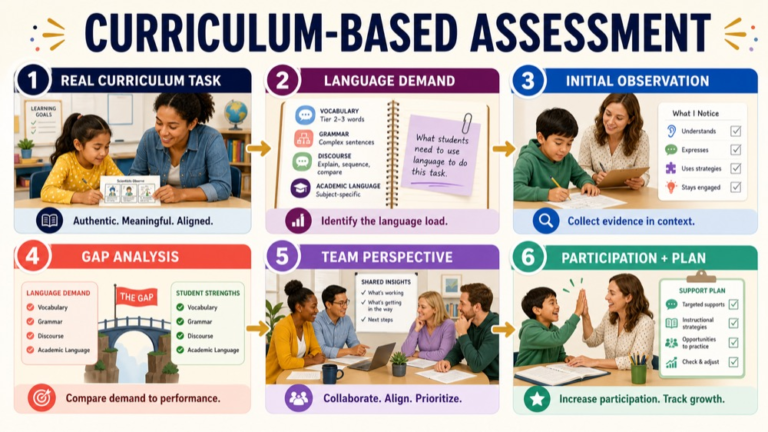
Map curriculum-based assessment
For study purposes, describe the communication relationship before naming a disorder, judging a partner, selecting a goal, or deciding that a task is within scope. Record what the person understood, expressed, initiated, repaired, coordinated, or participated in. Then note whether the task was familiar, how much context was shared, and which support changed the response.
Task: identify the lesson, assignment, text, discussion, routine, or activity that matters for participation.
Response: observe what the student understands, says, writes, reads, organizes, asks, repairs, and completes before added support.
Gap: compare the task demand with performance, strategies, materials, time, instructions, and access supports.
Collaboration: include student, teacher, family, and team perspectives on strengths, concerns, priorities, and feasible changes.
Plan: connect the analysis to classroom access, instruction, goals, accommodations, intervention, monitoring, and participation.
A strong description is specific enough that another learner could picture the event. Instead of writing “the communication is impaired” or “the clinician can do this,” describe the demand, observable response, language or mode, partner, context, competence or access condition, and result. This protects clinical reasoning from labels that are broader than the evidence.
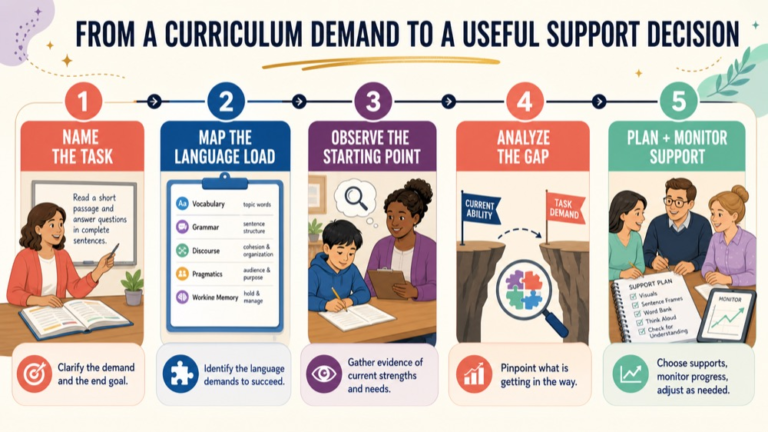
From a curriculum demand to a useful support decision
Context changes what communication and professional decisions require. A direct question, long explanation, group exchange, classroom task, health-care interaction, family story, noisy routine, supervised procedure, or referral decision places different demands on processing, language, memory, hearing, access, partner behavior, competence, and regulation. Language experience, visual information, fatigue, health literacy, and the opportunity to request clarification should be part of the observation.
A student may know the content of a science unit but struggle to understand dense directions, explain a sequence, infer from a text, organize a written response, or participate in a fast group discussion. Curriculum-based assessment makes the language demand visible and asks what happens when the student attempts the real task. The result can point toward explicit language teaching, changed materials, visual organization, partner support, additional processing time, or a need for more assessment. The purpose is not to label the classroom task as a test; it is to understand the interaction between instruction, language, and participation.
Observation layer
Example question
Task
What did the person or clinician need to understand, express, organize, coordinate, decide, or provide?
Language and access
Which language, dialect, mode, hearing condition, tool, support, or communication partner was available?
Context and responsibility
Who was involved, what did they know, and which role, policy, ethical, or environmental factor mattered?
Participation and safety
What meaningful routine, role, outcome, or risk became easier or harder because of the pattern?
Context is not an afterthought added once a label has been selected. It is part of the question itself. If performance or decision quality changes with a quieter room, extra processing time, a familiar partner, a different language or mode, an interpreter, visual information, supervision, collaboration, a changed task, or a changed routine, that change is useful evidence about access and demand. It does not identify a cause by itself, but it tells you which conditions should be carried into the next observation.
Apply curriculum-based reasoning
When a Praxis-style scenario or clinical discussion presents curriculum based assessment speech language, use a disciplined sequence. The goal is to select the next clinical question or action that matches the evidence, the person’s priorities, the communication context, and the relevant professional boundary.
Define the task, language, mode, communication purpose, or service responsibility in plain language.
Identify the relevant domain: language, access, partner, participation, assessment, competence, collaboration, ethics, or regulation.
Separate observation from interpretation and write down what remains unknown.
Check history, exposure, dialect, culture, identity, interpreter access, environment, sensory load, memory, task familiarity, training, supervision, and local requirements as relevant.
Choose the assessment, collaboration, accommodation, goal, training, referral, or documentation step that answers the specific question.
State the boundary of the conclusion and keep the person’s safety, autonomy, access, and participation visible.
A student may know the content of a science unit but struggle to understand dense directions, explain a sequence, infer from a text, organize a written response, or participate in a fast group discussion. Curriculum-based assessment makes the language demand visible and asks what happens when the student attempts the real task. The result can point toward explicit language teaching, changed materials, visual organization, partner support, additional processing time, or a need for more assessment. The purpose is not to label the classroom task as a test; it is to understand the interaction between instruction, language, and participation. In a learning answer, the decisive evidence is usually the relationship among the task, the observed pattern, the context, and the next needed information—not a single isolated behavior, score, label, or broad permission statement.
Common study mistakes
Treating a curriculum worksheet or classroom grade as a complete language assessment without analyzing the demand and conditions.
Focusing only on errors and missing the student’s content knowledge, strategies, strengths, communication mode, and participation.
Observing the student only after extensive adult help and losing the opportunity to describe the starting demand-response relationship.
Failing to separate language demands from reading, writing, attention, hearing, vision, motor, executive, instructional, or access demands.
Assuming one assignment represents every subject, genre, partner, teacher, language demand, and setting.
Ignoring the student’s, teacher’s, or family’s perspective on what matters and what support is feasible.
Using curriculum-based information to make a broad diagnosis or eligibility conclusion without other relevant evidence.
Failing to translate the gap analysis into a concrete support, collaboration, goal, accommodation, or monitoring plan.
Most of these mistakes come from replacing a multidomain question with a fast label. Correct the habit by returning to the same sequence: describe, separate, contextualize, ask what is missing, and choose a proportionate next step. A short rationale can make the habit visible: identify the evidence, name the uncertainty, and explain why the selected next step fits the person, setting, and responsibility.
Build a quick review map
Use this compact map when reviewing a missed question, lecture note, or clinical vignette:
Step 1: Name the real curriculum activity, participation goal, and decision the assessment should inform.
Step 2: Map the language, literacy, memory, social, motor, sensory, and instructional demands of the task.
Step 3: Observe the student’s initial response and document materials, directions, timing, partner, and available supports.
Step 4: Compare demand with performance, strategies, strengths, barriers, and the effect of a targeted support.
Step 5: Triangulate with student, teacher, family, formal, informal, and functional evidence.
Step 6: Choose the next support or assessment step that makes classroom participation more accessible and measurable.
Then write one transfer sentence: “When I see this pattern, I will first check ___ because ___.” The sentence should identify a decision rule, not repeat a definition. Revisit it after a delay and test whether you can apply the rule to a different task, age group, partner, language, setting, or professional responsibility.
Sources and next steps
curriculum based assessment speech language is best learned as a context-sensitive pattern across communication, access, identity, function, participation, competence, and professional judgment. Use the current authority pages to refine the concept, then return to practice scenarios that require you to explain what the evidence supports and what it leaves open.
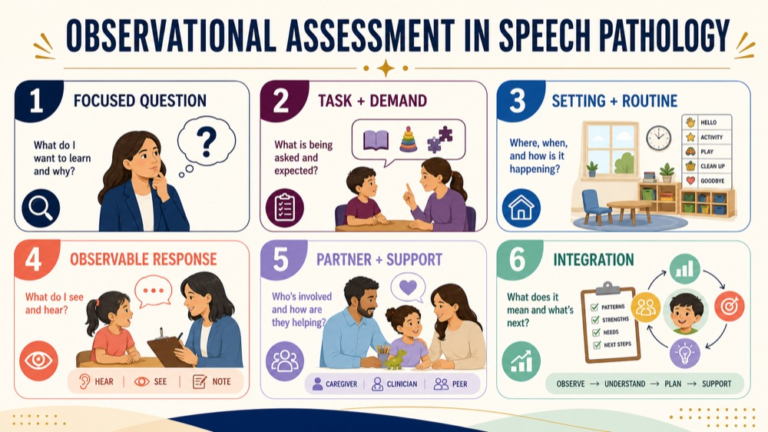
Observational Assessment in Speech Pathology: What to Notice and Record
observational assessment speech pathology is easier to study when it is treated as a connected clinical reasoning problem rather than a label to memorize. Observational assessment in speech pathology examines communication as it happens in a selected task, setting, routine, or interaction. The value is not simply watching; it is defining the clinical question, identifying the communication demand, recording the observable response and support, and interpreting the pattern within context. A useful observation can reveal strengths, barriers, partner effects, and participation needs while still requiring other evidence for a complete assessment.
This learning guide is written for SLP students and other learners reviewing clinical concepts. It organizes observation, access, assessment, function, and professional judgment; it does not make an individualized diagnosis or replace current professional guidance. Interpretation depends on the person, task, language, culture, health, access, partner, context, and communication goals.
What observational assessment means
Begin by separating the concept into domains. A learner who can name the domains is less likely to collapse language, access, partner, participation, competence, regulation, and clinical judgment into one explanation. The useful unit of analysis is the task: what the person was asked to understand, express, organize, coordinate, remember, or communicate, with whom, under which conditions, and with what support.
Domain or system
What to notice
Question to carry forward
Focused question
The observer decides what communication, speech, language, access, participation, or interaction question needs evidence.
What exactly are we trying to learn?
Task and demand
The activity places demands on listening, expression, memory, organization, repair, social communication, or speech production.
What did the person need to do in this moment?
Setting and routine
Clinical, classroom, home, work, community, play, and telepractice settings create different opportunities and barriers.
Where did the behavior occur, and how representative is it?
Observable response
Record what the person said, understood, initiated, repaired, produced, selected, or did, rather than inferring a hidden cause.
What was directly seen or heard?
Partner and support
Wait time, prompts, models, questions, AAC, visual information, interpreter access, and partner behavior affect the exchange.
What support was present and how did it change the response?
Integration
Observation is compared with report, formal measures, samples, history, dynamic response, and functional priorities.
What pattern is supported across sources?
These domains interact, but they should remain distinguishable. A learner may show strength in one context and need support in another. A study map organizes the next observation; it does not answer every assessment question or establish a universal treatment, goal, or legal conclusion.
Keep the first pass descriptive and close to the communication event. Note the task, response, partner, setting, timing, available support, language or mode, and consequence for participation. This gives the learner a stable record to compare across tasks and prevents a familiar term from doing too much explanatory work before the evidence has been separated.
For Praxis-style review, a vignette may include several true details but ask for one best interpretation or next step. The strongest answer usually respects the task, identifies the relevant function or boundary, checks the most important missing information, and avoids treating one performance sample or policy phrase as the whole profile.
Map observational assessment
For study purposes, describe the communication relationship before naming a disorder, judging a partner, selecting a goal, or deciding that a task is within scope. Record what the person understood, expressed, initiated, repaired, coordinated, or participated in. Then note whether the task was familiar, how much context was shared, and which support changed the response.
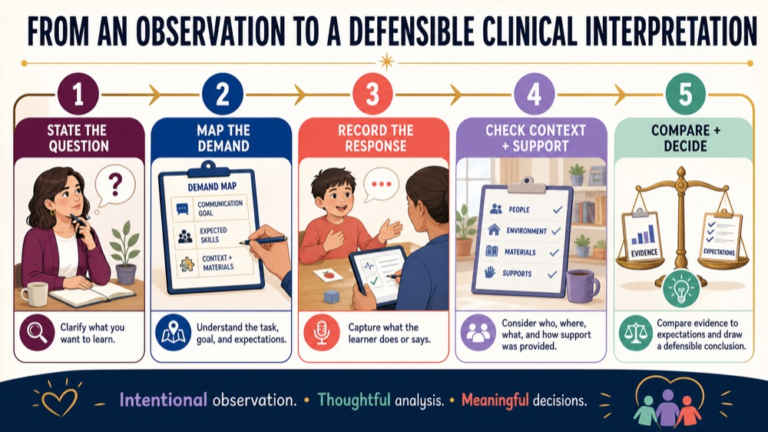
Question: state the communication or participation issue and the decision the observation should inform.
Demand: describe the message, language, speech, cognitive, social, literacy, memory, or motor demands of the activity.
Response: record observable initiation, comprehension, expression, speech production, repair, interaction, and participation.
Context: document setting, routine, partner, group size, noise, time, materials, language, culture, and task familiarity.
Support: identify cues, models, AAC, visual supports, wait time, interpreter access, accommodations, and partner strategies.
Integration: compare observations across tasks and with formal, informal, report-based, historical, and dynamic evidence.
A strong description is specific enough that another learner could picture the event. Instead of writing “the communication is impaired” or “the clinician can do this,” describe the demand, observable response, language or mode, partner, context, competence or access condition, and result. This protects clinical reasoning from labels that are broader than the evidence.
From an observation to a defensible clinical interpretation
Context changes what communication and professional decisions require. A direct question, long explanation, group exchange, classroom task, health-care interaction, family story, noisy routine, supervised procedure, or referral decision places different demands on processing, language, memory, hearing, access, partner behavior, competence, and regulation. Language experience, visual information, fatigue, health literacy, and the opportunity to request clarification should be part of the observation.
A classroom observation may show that a student understands a lesson but misses rapid multi-step directions during transitions. A home observation may show rich communication with a familiar caregiver but less repair with an unfamiliar partner. An adult may communicate effectively in a quiet clinic and struggle to explain a problem during a busy workplace exchange. These are not contradictory observations; they reveal how demand, partner, environment, access, and support shape performance. The SLP records the conditions so the observation can inform the next question without being overstated.
Observation layer
Example question
Task
What did the person or clinician need to understand, express, organize, coordinate, decide, or provide?
Language and access
Which language, dialect, mode, hearing condition, tool, support, or communication partner was available?
Context and responsibility
Who was involved, what did they know, and which role, policy, ethical, or environmental factor mattered?
Participation and safety
What meaningful routine, role, outcome, or risk became easier or harder because of the pattern?
Context is not an afterthought added once a label has been selected. It is part of the question itself. If performance or decision quality changes with a quieter room, extra processing time, a familiar partner, a different language or mode, an interpreter, visual information, supervision, collaboration, a changed task, or a changed routine, that change is useful evidence about access and demand. It does not identify a cause by itself, but it tells you which conditions should be carried into the next observation.
Apply observational-assessment reasoning
When a Praxis-style scenario or clinical discussion presents observational assessment speech pathology, use a disciplined sequence. The goal is to select the next clinical question or action that matches the evidence, the person’s priorities, the communication context, and the relevant professional boundary.
Define the task, language, mode, communication purpose, or service responsibility in plain language.
Identify the relevant domain: language, access, partner, participation, assessment, competence, collaboration, ethics, or regulation.
Separate observation from interpretation and write down what remains unknown.
Check history, exposure, dialect, culture, identity, interpreter access, environment, sensory load, memory, task familiarity, training, supervision, and local requirements as relevant.
Choose the assessment, collaboration, accommodation, goal, training, referral, or documentation step that answers the specific question.
State the boundary of the conclusion and keep the person’s safety, autonomy, access, and participation visible.
A classroom observation may show that a student understands a lesson but misses rapid multi-step directions during transitions. A home observation may show rich communication with a familiar caregiver but less repair with an unfamiliar partner. An adult may communicate effectively in a quiet clinic and struggle to explain a problem during a busy workplace exchange. These are not contradictory observations; they reveal how demand, partner, environment, access, and support shape performance. The SLP records the conditions so the observation can inform the next question without being overstated. In a learning answer, the decisive evidence is usually the relationship among the task, the observed pattern, the context, and the next needed information—not a single isolated behavior, score, label, or broad permission statement.
Common study mistakes
Watching without a focused question and collecting a general impression instead of decision-relevant evidence.
Writing judgments such as uncooperative, poor language, or inattentive without describing the observable response and task demand.
Observing only one familiar, quiet, or highly supported setting and generalizing to every routine or partner.
Ignoring partner questions, wait time, prompts, visual information, AAC, interpreter access, noise, timing, or materials.
Failing to distinguish an opportunity to communicate from a response that was actually available and observed.
Recording frequency or accuracy without noting meaning, repair, independence, support, participation, and consequence.
Treating one observation as a diagnosis, complete profile, or proof of cause, motivation, or prognosis.
Failing to compare observations with caregiver or teacher report, formal measures, samples, history, and other evidence.
Most of these mistakes come from replacing a multidomain question with a fast label. Correct the habit by returning to the same sequence: describe, separate, contextualize, ask what is missing, and choose a proportionate next step. A short rationale can make the habit visible: identify the evidence, name the uncertainty, and explain why the selected next step fits the person, setting, and responsibility.
Build a quick review map
Use this compact map when reviewing a missed question, lecture note, or clinical vignette:
Step 1: Name the question, routine, setting, communication partner, and decision before observing.
Step 2: Describe the task demand, opportunity, response mode, language, materials, and available supports.
Step 3: Record what was directly observed and separate it from the interpretation or hypothesis.
Step 4: Check how partner behavior, environment, access, familiarity, fatigue, and timing shaped performance.
Step 5: Compare observations across meaningful contexts and with reports, samples, formal, and dynamic data.
Step 6: Use the pattern to choose a proportionate next assessment, support, collaboration, referral, or monitoring step.
Then write one transfer sentence: “When I see this pattern, I will first check ___ because ___.” The sentence should identify a decision rule, not repeat a definition. Revisit it after a delay and test whether you can apply the rule to a different task, age group, partner, language, setting, or professional responsibility.
Sources and next steps
observational assessment speech pathology is best learned as a context-sensitive pattern across communication, access, identity, function, participation, competence, and professional judgment. Use the current authority pages to refine the concept, then return to practice scenarios that require you to explain what the evidence supports and what it leaves open.
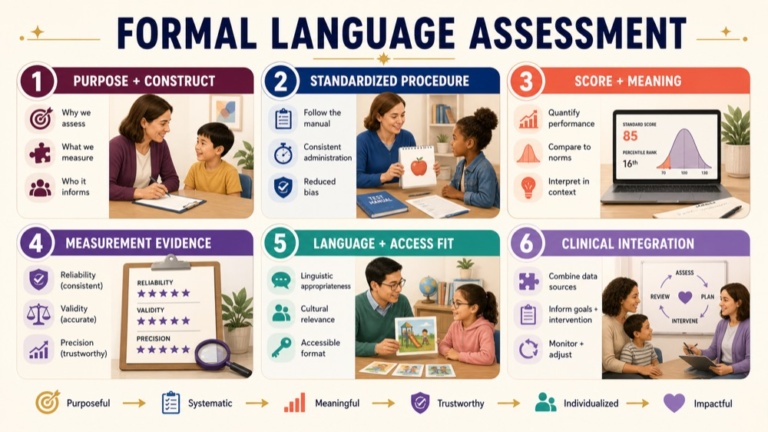
Formal Language Assessment: Structure, Fit, and Clinical Meaning
formal language assessment is easier to study when it is treated as a connected clinical reasoning problem rather than a label to memorize. Formal language assessment uses a planned procedure with stated materials, directions, response requirements, scoring, and interpretation rules. That structure can make evidence more consistent and comparable, but formal does not mean universally appropriate and a score does not interpret itself. SLP reasoning still checks the construct, purpose, language, culture, access, administration conditions, and how the result fits with observation, report, samples, and participation.
This learning guide is written for SLP students and other learners reviewing clinical concepts. It organizes observation, access, assessment, function, and professional judgment; it does not make an individualized diagnosis or replace current professional guidance. Interpretation depends on the person, task, language, culture, health, access, partner, context, and communication goals.
What formal language assessment means
Begin by separating the concept into domains. A learner who can name the domains is less likely to collapse language, access, partner, participation, competence, regulation, and clinical judgment into one explanation. The useful unit of analysis is the task: what the person was asked to understand, express, organize, coordinate, remember, or communicate, with whom, under which conditions, and with what support.
Domain or system
What to notice
Question to carry forward
Purpose and construct
The measure is designed to sample stated language knowledge or performance, such as comprehension, expression, vocabulary, grammar, narrative, or literacy-related language.
What question and construct does this procedure address?
Standardized procedure
Materials, directions, timing, response rules, and scoring follow the measure’s stated administration framework.
Were the conditions followed, and what changed?
Score and meaning
A score summarizes performance under the measure’s framework; it is not automatically a diagnosis, cause, or functional conclusion.
What does this score support and what does it leave open?
Measurement evidence
Reliability, validity, standard error, and normative information describe how the measure performs for specified uses and populations.
Which evidence applies to this person and decision?
Language and access fit
Language history, dialect, culture, hearing, cognition, motor access, sensory needs, familiarity, and accommodations affect interpretation.
Is the procedure accessible and representative enough for this purpose?
Clinical integration
Formal findings are interpreted with history, interviews, observation, samples, dynamic information, function, and priorities.
How does this result change the next step?
These domains interact, but they should remain distinguishable. A learner may show strength in one context and need support in another. A study map organizes the next observation; it does not answer every assessment question or establish a universal treatment, goal, or legal conclusion.
Keep the first pass descriptive and close to the communication event. Note the task, response, partner, setting, timing, available support, language or mode, and consequence for participation. This gives the learner a stable record to compare across tasks and prevents a familiar term from doing too much explanatory work before the evidence has been separated.
For Praxis-style review, a vignette may include several true details but ask for one best interpretation or next step. The strongest answer usually respects the task, identifies the relevant function or boundary, checks the most important missing information, and avoids treating one performance sample or policy phrase as the whole profile.
Map formal language assessment
For study purposes, describe the communication relationship before naming a disorder, judging a partner, selecting a goal, or deciding that a task is within scope. Record what the person understood, expressed, initiated, repaired, coordinated, or participated in. Then note whether the task was familiar, how much context was shared, and which support changed the response.
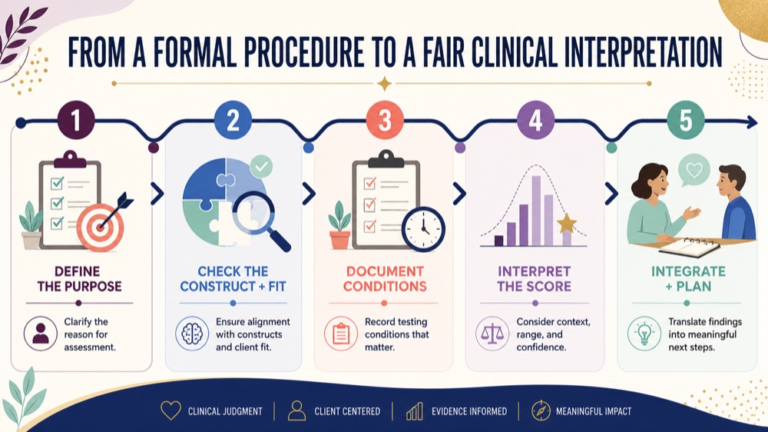
Purpose: name the referral question, communication domain, age or setting, and decision the formal measure is meant to inform.
Construct: identify the language skill sampled and distinguish it from broader communication, cognition, literacy, or participation.
Procedure: record materials, instructions, timing, response mode, scoring, interruptions, prompts, accommodations, and deviations.
Measurement: understand standard scores, percentiles, reliability, validity, and error without treating a metric as the whole person.
Fit: check language, dialect, culture, hearing, cognition, motor access, sensory needs, testing familiarity, and normative representation.
Integration: connect formal results with report, observation, language samples, dynamic response, function, and the next decision.
A strong description is specific enough that another learner could picture the event. Instead of writing “the communication is impaired” or “the clinician can do this,” describe the demand, observable response, language or mode, partner, context, competence or access condition, and result. This protects clinical reasoning from labels that are broader than the evidence.
From a formal procedure to a fair clinical interpretation
Context changes what communication and professional decisions require. A direct question, long explanation, group exchange, classroom task, health-care interaction, family story, noisy routine, supervised procedure, or referral decision places different demands on processing, language, memory, hearing, access, partner behavior, competence, and regulation. Language experience, visual information, fatigue, health literacy, and the opportunity to request clarification should be part of the observation.
A formal language assessment can provide a structured sample of a student’s comprehension or an adult’s language performance, but the meaning depends on the match among the person, the measure, and the question. A person may perform differently when the task is conversational, academic, work-related, multilingual, visually supported, or time pressured. An accommodation or change in procedure may be clinically appropriate while also changing what the score can mean. The SLP documents the condition, interprets the evidence within its limits, and uses complementary data to understand communication in daily life.
Observation layer
Example question
Task
What did the person or clinician need to understand, express, organize, coordinate, decide, or provide?
Language and access
Which language, dialect, mode, hearing condition, tool, support, or communication partner was available?
Context and responsibility
Who was involved, what did they know, and which role, policy, ethical, or environmental factor mattered?
Participation and safety
What meaningful routine, role, outcome, or risk became easier or harder because of the pattern?
Context is not an afterthought added once a label has been selected. It is part of the question itself. If performance or decision quality changes with a quieter room, extra processing time, a familiar partner, a different language or mode, an interpreter, visual information, supervision, collaboration, a changed task, or a changed routine, that change is useful evidence about access and demand. It does not identify a cause by itself, but it tells you which conditions should be carried into the next observation.
Apply formal-assessment reasoning
When a Praxis-style scenario or clinical discussion presents formal language assessment, use a disciplined sequence. The goal is to select the next clinical question or action that matches the evidence, the person’s priorities, the communication context, and the relevant professional boundary.
Define the task, language, mode, communication purpose, or service responsibility in plain language.
Identify the relevant domain: language, access, partner, participation, assessment, competence, collaboration, ethics, or regulation.
Separate observation from interpretation and write down what remains unknown.
Check history, exposure, dialect, culture, identity, interpreter access, environment, sensory load, memory, task familiarity, training, supervision, and local requirements as relevant.
Choose the assessment, collaboration, accommodation, goal, training, referral, or documentation step that answers the specific question.
State the boundary of the conclusion and keep the person’s safety, autonomy, access, and participation visible.
A formal language assessment can provide a structured sample of a student’s comprehension or an adult’s language performance, but the meaning depends on the match among the person, the measure, and the question. A person may perform differently when the task is conversational, academic, work-related, multilingual, visually supported, or time pressured. An accommodation or change in procedure may be clinically appropriate while also changing what the score can mean. The SLP documents the condition, interprets the evidence within its limits, and uses complementary data to understand communication in daily life. In a learning answer, the decisive evidence is usually the relationship among the task, the observed pattern, the context, and the next needed information—not a single isolated behavior, score, label, or broad permission statement.
Common study mistakes
Treating formal language assessment as synonymous with standardized assessment or assuming every formal task has the same scoring framework.
Choosing a measure because it is familiar without checking the construct, purpose, age, language, culture, access, or population fit.
Reporting a score without documenting administration conditions, accommodations, deviations, behavior, fatigue, or response mode.
Confusing percentile rank, standard score, age equivalent, raw score, or scaled score with percent correct, diagnosis, or severity.
Assuming reliability or validity evidence for one population and use applies unchanged to a different language, dialect, setting, or purpose.
Ignoring hearing, vision, cognition, motor access, sensory load, testing familiarity, interpreter needs, or language exposure.
Using a formal score to answer a functional participation question that the task did not sample.
Failing to combine formal findings with interviews, caregiver or teacher report, observation, samples, dynamic response, and priorities.
Most of these mistakes come from replacing a multidomain question with a fast label. Correct the habit by returning to the same sequence: describe, separate, contextualize, ask what is missing, and choose a proportionate next step. A short rationale can make the habit visible: identify the evidence, name the uncertainty, and explain why the selected next step fits the person, setting, and responsibility.
Build a quick review map
Use this compact map when reviewing a missed question, lecture note, or clinical vignette:
Step 1: Define the assessment purpose, construct, person, setting, and decision before reading the score.
Step 2: Check the stated administration and scoring conditions, then document any change, support, or interruption.
Step 3: Interpret measurement information only within the population, language, culture, access, and purpose it supports.
Step 4: Separate the score from diagnosis, cause, prognosis, participation, and treatment need.
Step 5: Integrate formal findings with report, observation, samples, dynamic information, and functional context.
Step 6: State what the formal procedure supports, what remains uncertain, and which next action answers the open question.
Then write one transfer sentence: “When I see this pattern, I will first check ___ because ___.” The sentence should identify a decision rule, not repeat a definition. Revisit it after a delay and test whether you can apply the rule to a different task, age group, partner, language, setting, or professional responsibility.
Sources and next steps
formal language assessment is best learned as a context-sensitive pattern across communication, access, identity, function, participation, competence, and professional judgment. Use the current authority pages to refine the concept, then return to practice scenarios that require you to explain what the evidence supports and what it leaves open.
Informal Language Assessment: Practical Data Beyond a Test Score
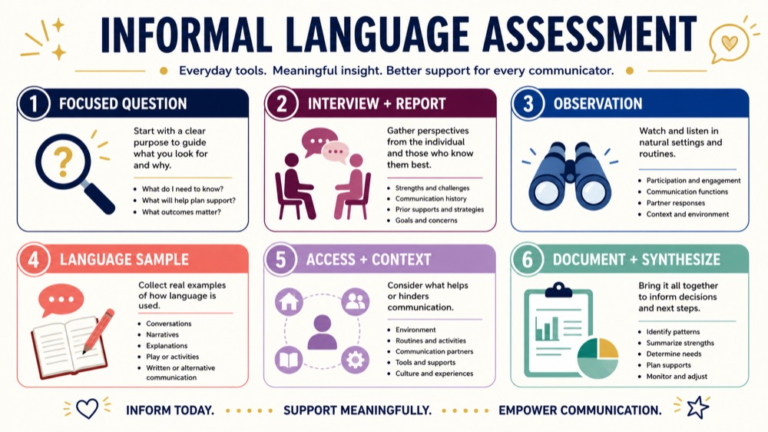
informal language assessment is easier to study when it is treated as a connected clinical reasoning problem rather than a label to memorize. Informal language assessment uses tailored activities and information sources to answer focused questions about how a person understands and uses language. It may include interview, observation, language samples, classroom or work materials, criterion probes, dynamic tasks, report measures, and analysis of communication in routines. Informal does not mean careless or unstructured. The SLP defines the question and conditions, collects useful evidence, documents what happened, and states what the information can and cannot support.
This learning guide is written for SLP students and other learners reviewing clinical concepts. It organizes observation, access, assessment, function, and professional judgment; it does not make an individualized diagnosis or replace current professional guidance. Interpretation depends on the person, task, language, culture, health, access, partner, context, and communication goals.
What informal language assessment can include
Begin by separating the concept into domains. A learner who can name the domains is less likely to collapse language, access, partner, participation, competence, regulation, and clinical judgment into one explanation. The useful unit of analysis is the task: what the person was asked to understand, express, organize, coordinate, remember, or communicate, with whom, under which conditions, and with what support.
Domain or system
What to notice
Question to carry forward
Focused question
Start with the language skill, context, participation demand, or decision that needs more information.
What do we need to learn?
Interview and report
Gather the person’s, family member’s, teacher’s, or partner’s description of language use, concerns, strengths, and routines.
How does language work outside the test room?
Observation and sample
Examine spontaneous or structured language in conversation, play, narrative, explanation, literacy, work, or classroom activity.
What patterns appear in meaningful communication?
Tailored probe
Use a criterion or task-specific activity to examine a defined skill, strategy, comprehension demand, or response to support.
What does this probe show under these conditions?
Language and access
Consider language history, dialect, culture, hearing, communication mode, materials, partner, and support when interpreting the data.
Is the task fair and representative?
Documentation and synthesis
Record context, method, response, analysis, limits, and how the result fits with formal and other evidence.
What conclusion or next step is justified?
These domains interact, but they should remain distinguishable. A learner may show strength in one context and need support in another. A study map organizes the next observation; it does not answer every assessment question or establish a universal treatment, goal, or legal conclusion.
Keep the first pass descriptive and close to the communication event. Note the task, response, partner, setting, timing, available support, language or mode, and consequence for participation. This gives the learner a stable record to compare across tasks and prevents a familiar term from doing too much explanatory work before the evidence has been separated.
For Praxis-style review, a vignette may include several true details but ask for one best interpretation or next step. The strongest answer usually respects the task, identifies the relevant function or boundary, checks the most important missing information, and avoids treating one performance sample or policy phrase as the whole profile.
Map informal language assessment
For study purposes, describe the communication relationship before naming a disorder, judging a partner, selecting a goal, or deciding that a task is within scope. Record what the person understood, expressed, initiated, repaired, coordinated, or participated in. Then note whether the task was familiar, how much context was shared, and which support changed the response.
Question: define the language, communication, participation, or planning issue the informal method should clarify.
Interview: gather strengths, concerns, language history, routines, priorities, strategies, and partner perspectives.
Observation: watch communication across tasks, settings, partners, materials, and support conditions.
Sample and probe: collect spontaneous language, narrative, conversation, curriculum, work, or focused criterion information.
Access: consider language, dialect, culture, hearing, communication mode, literacy, interpreter, task familiarity, and supports.
Synthesis: document what was observed, how it was analyzed, what is uncertain, and how it connects to other evidence and action.
A strong description is specific enough that another learner could picture the event. Instead of writing “the communication is impaired” or “the clinician can do this,” describe the demand, observable response, language or mode, partner, context, competence or access condition, and result. This protects clinical reasoning from labels that are broader than the evidence.
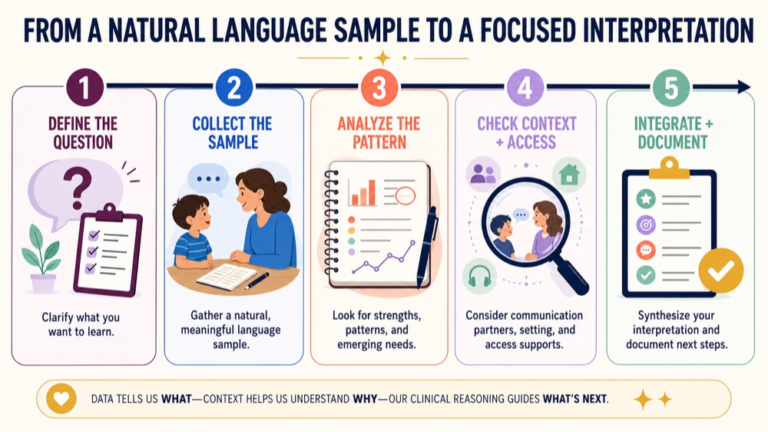
From a natural language sample to a focused interpretation
Context changes what communication and professional decisions require. A direct question, long explanation, group exchange, classroom task, health-care interaction, family story, noisy routine, supervised procedure, or referral decision places different demands on processing, language, memory, hearing, access, partner behavior, competence, and regulation. Language experience, visual information, fatigue, health literacy, and the opportunity to request clarification should be part of the observation.
A language sample may show how a child organizes a story, maintains a topic, uses grammar, or repairs a breakdown in a familiar activity. A classroom writing task may show language demands that a decontextualized test does not sample. A conversation with an adult may reveal communication strategies, word-finding workarounds, or differences between home and work. The SLP should state the activity, partner, prompts, language, support, analysis, and limitations. An informal method can be highly informative without pretending to have the norms or psychometric evidence of a standardized test.
Observation layer
Example question
Task
What did the person or clinician need to understand, express, organize, coordinate, decide, or provide?
Language and access
Which language, dialect, mode, hearing condition, tool, support, or communication partner was available?
Context and responsibility
Who was involved, what did they know, and which role, policy, ethical, or environmental factor mattered?
Participation and safety
What meaningful routine, role, outcome, or risk became easier or harder because of the pattern?
Context is not an afterthought added once a label has been selected. It is part of the question itself. If performance or decision quality changes with a quieter room, extra processing time, a familiar partner, a different language or mode, an interpreter, visual information, supervision, collaboration, a changed task, or a changed routine, that change is useful evidence about access and demand. It does not identify a cause by itself, but it tells you which conditions should be carried into the next observation.
Apply informal-assessment reasoning
When a Praxis-style scenario or clinical discussion presents informal language assessment, use a disciplined sequence. The goal is to select the next clinical question or action that matches the evidence, the person’s priorities, the communication context, and the relevant professional boundary.
Define the task, language, mode, communication purpose, or service responsibility in plain language.
Identify the relevant domain: language, access, partner, participation, assessment, competence, collaboration, ethics, or regulation.
Separate observation from interpretation and write down what remains unknown.
Check history, exposure, dialect, culture, identity, interpreter access, environment, sensory load, memory, task familiarity, training, supervision, and local requirements as relevant.
Choose the assessment, collaboration, accommodation, goal, training, referral, or documentation step that answers the specific question.
State the boundary of the conclusion and keep the person’s safety, autonomy, access, and participation visible.
A language sample may show how a child organizes a story, maintains a topic, uses grammar, or repairs a breakdown in a familiar activity. A classroom writing task may show language demands that a decontextualized test does not sample. A conversation with an adult may reveal communication strategies, word-finding workarounds, or differences between home and work. The SLP should state the activity, partner, prompts, language, support, analysis, and limitations. An informal method can be highly informative without pretending to have the norms or psychometric evidence of a standardized test. In a learning answer, the decisive evidence is usually the relationship among the task, the observed pattern, the context, and the next needed information—not a single isolated behavior, score, label, or broad permission statement.
Common study mistakes
Treating informal assessment as an unplanned conversation with no defined question, conditions, or documentation.
Calling a tailored probe standardized or implying that a small sample represents every language domain and context.
Ignoring language history, dialect, culture, hearing, communication mode, materials, partner, or access supports.
Collecting a language sample without recording task, context, prompts, partner, language, time, or analysis method.
Using only error counts and missing strengths, strategies, meaning, discourse, participation, and response to support.
Treating an observation in one familiar routine as a complete description of language ability.
Making a diagnosis or broad prognosis from informal data without integrating other relevant evidence.
Failing to explain how informal findings change the assessment, support, referral, goal, monitoring, or collaboration plan.
Most of these mistakes come from replacing a multidomain question with a fast label. Correct the habit by returning to the same sequence: describe, separate, contextualize, ask what is missing, and choose a proportionate next step. A short rationale can make the habit visible: identify the evidence, name the uncertainty, and explain why the selected next step fits the person, setting, and responsibility.
Build a quick review map
Use this compact map when reviewing a missed question, lecture note, or clinical vignette:
Step 1: State the focused language or participation question before choosing an informal activity.
Step 2: Document interview, observation, sample, probe, curriculum, or work context and the communication partners involved.
Step 3: Record language, dialect, mode, prompts, materials, access supports, and the response actually observed.
Step 4: Analyze patterns in meaning, form, use, strategy, participation, strengths, and response to support.
Step 5: Separate descriptive evidence from standardized scores, diagnosis, cause, prognosis, and eligibility conclusions.
Step 6: Integrate informal findings with formal, historical, functional, and dynamic evidence to plan the next step.
Then write one transfer sentence: “When I see this pattern, I will first check ___ because ___.” The sentence should identify a decision rule, not repeat a definition. Revisit it after a delay and test whether you can apply the rule to a different task, age group, partner, language, setting, or professional responsibility.
Sources and next steps
informal language assessment is best learned as a context-sensitive pattern across communication, access, identity, function, participation, competence, and professional judgment. Use the current authority pages to refine the concept, then return to practice scenarios that require you to explain what the evidence supports and what it leaves open.
Functional Assessment of Communication: From Skills to Daily Participation
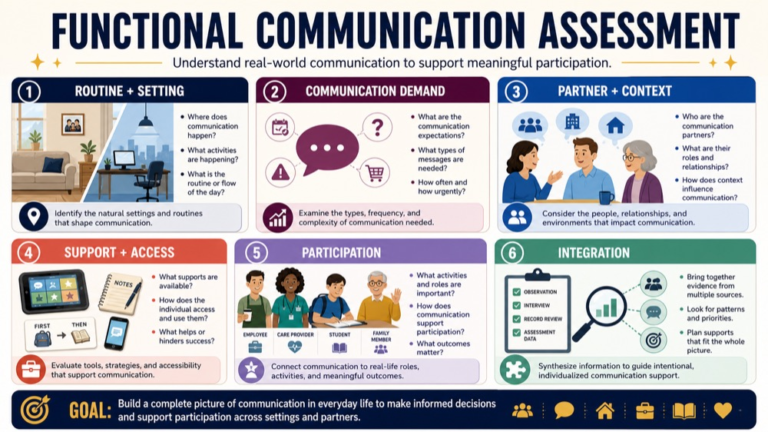
functional assessment communication is easier to study when it is treated as a connected clinical reasoning problem rather than a label to memorize. Functional assessment of communication asks how a person communicates in meaningful routines, with real partners, under real demands, and with the supports that make participation possible. It can include observation, samples, report, self-report, rating measures, contextual analysis, and structured tasks. Functional information does not replace every formal measure; it answers a different question. The SLP connects what the person can do with where communication breaks down, what helps, and which outcomes matter to the person and team.
This learning guide is written for SLP students and other learners reviewing clinical concepts. It organizes observation, access, assessment, function, and professional judgment; it does not make an individualized diagnosis or replace current professional guidance. Interpretation depends on the person, task, language, culture, health, access, partner, context, and communication goals.
What functional communication assessment looks at
Begin by separating the concept into domains. A learner who can name the domains is less likely to collapse language, access, partner, participation, competence, regulation, and clinical judgment into one explanation. The useful unit of analysis is the task: what the person was asked to understand, express, organize, coordinate, remember, or communicate, with whom, under which conditions, and with what support.
Domain or system
What to notice
Question to carry forward
Routine and setting
Observe communication at home, school, work, health care, community, or another meaningful environment.
Where does the communication demand occur?
Communication demand
Describe the message, listening, turn-taking, repair, literacy, memory, or problem-solving demand of the routine.
What does the person need to communicate here?
Partner and context
Consider familiar or unfamiliar partners, group size, noise, time, visual information, and partner behavior.
Who is involved, and what conditions shape performance?
Support and access
Record AAC, visual supports, extra time, cueing, communication strategies, interpreter support, and environmental changes.
What helps the person participate?
Participation
Connect communication performance to roles, relationships, learning, work, autonomy, safety, and quality of life.
What meaningful outcome is affected?
Integration
Combine functional findings with formal, informal, historical, and dynamic data to guide interpretation and planning.
How does the real-world pattern change the plan?
These domains interact, but they should remain distinguishable. A learner may show strength in one context and need support in another. A study map organizes the next observation; it does not answer every assessment question or establish a universal treatment, goal, or legal conclusion.
Keep the first pass descriptive and close to the communication event. Note the task, response, partner, setting, timing, available support, language or mode, and consequence for participation. This gives the learner a stable record to compare across tasks and prevents a familiar term from doing too much explanatory work before the evidence has been separated.
For Praxis-style review, a vignette may include several true details but ask for one best interpretation or next step. The strongest answer usually respects the task, identifies the relevant function or boundary, checks the most important missing information, and avoids treating one performance sample or policy phrase as the whole profile.
Map functional communication assessment
For study purposes, describe the communication relationship before naming a disorder, judging a partner, selecting a goal, or deciding that a task is within scope. Record what the person understood, expressed, initiated, repaired, coordinated, or participated in. Then note whether the task was familiar, how much context was shared, and which support changed the response.
Routine: identify the home, school, work, health-care, community, or relationship activity being examined.
Demand: describe the messages, language, listening, memory, literacy, social, motor, or problem-solving demands.
Partner: observe familiar and unfamiliar partners, group size, turn-taking, repair, wait time, and partner support.
Access: record communication mode, AAC, visual information, hearing, interpreter, cueing, environment, and accommodations.
Participation: connect performance to roles, autonomy, relationships, learning, work, safety, and personally meaningful outcomes.
Integration: compare functional evidence with formal measures, samples, reports, history, dynamic response, and the next action.
A strong description is specific enough that another learner could picture the event. Instead of writing “the communication is impaired” or “the clinician can do this,” describe the demand, observable response, language or mode, partner, context, competence or access condition, and result. This protects clinical reasoning from labels that are broader than the evidence.
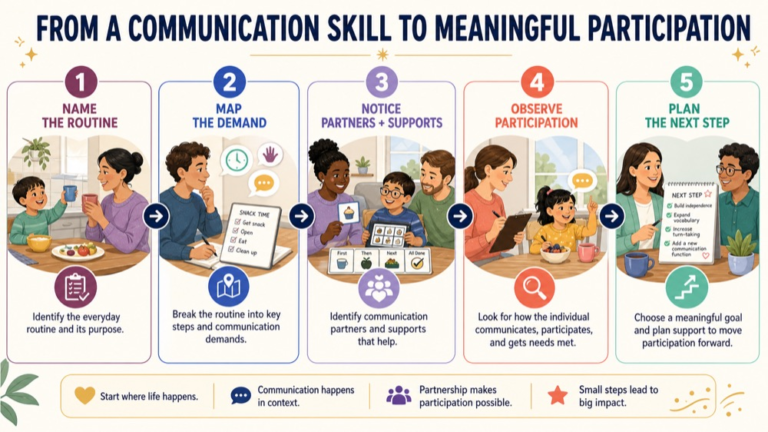
From a communication skill to meaningful participation
Context changes what communication and professional decisions require. A direct question, long explanation, group exchange, classroom task, health-care interaction, family story, noisy routine, supervised procedure, or referral decision places different demands on processing, language, memory, hearing, access, partner behavior, competence, and regulation. Language experience, visual information, fatigue, health literacy, and the opportunity to request clarification should be part of the observation.
A person may communicate effectively in a quiet one-to-one conversation but have difficulty joining a fast group discussion, making a phone call, explaining a problem at work, or asking for clarification in health care. A child may use language successfully during play with a familiar partner but need support for classroom directions and peer negotiation. Functional assessment makes these differences visible by describing the task, partner, support, and participation outcome. It does not mean that a naturalistic observation can answer every diagnostic question; it means the evaluation includes the communication life the person is trying to navigate.
Observation layer
Example question
Task
What did the person or clinician need to understand, express, organize, coordinate, decide, or provide?
Language and access
Which language, dialect, mode, hearing condition, tool, support, or communication partner was available?
Context and responsibility
Who was involved, what did they know, and which role, policy, ethical, or environmental factor mattered?
Participation and safety
What meaningful routine, role, outcome, or risk became easier or harder because of the pattern?
Context is not an afterthought added once a label has been selected. It is part of the question itself. If performance or decision quality changes with a quieter room, extra processing time, a familiar partner, a different language or mode, an interpreter, visual information, supervision, collaboration, a changed task, or a changed routine, that change is useful evidence about access and demand. It does not identify a cause by itself, but it tells you which conditions should be carried into the next observation.
Apply functional-assessment reasoning
When a Praxis-style scenario or clinical discussion presents functional assessment communication, use a disciplined sequence. The goal is to select the next clinical question or action that matches the evidence, the person’s priorities, the communication context, and the relevant professional boundary.
Define the task, language, mode, communication purpose, or service responsibility in plain language.
Identify the relevant domain: language, access, partner, participation, assessment, competence, collaboration, ethics, or regulation.
Separate observation from interpretation and write down what remains unknown.
Check history, exposure, dialect, culture, identity, interpreter access, environment, sensory load, memory, task familiarity, training, supervision, and local requirements as relevant.
Choose the assessment, collaboration, accommodation, goal, training, referral, or documentation step that answers the specific question.
State the boundary of the conclusion and keep the person’s safety, autonomy, access, and participation visible.
A person may communicate effectively in a quiet one-to-one conversation but have difficulty joining a fast group discussion, making a phone call, explaining a problem at work, or asking for clarification in health care. A child may use language successfully during play with a familiar partner but need support for classroom directions and peer negotiation. Functional assessment makes these differences visible by describing the task, partner, support, and participation outcome. It does not mean that a naturalistic observation can answer every diagnostic question; it means the evaluation includes the communication life the person is trying to navigate. In a learning answer, the decisive evidence is usually the relationship among the task, the observed pattern, the context, and the next needed information—not a single isolated behavior, score, label, or broad permission statement.
Common study mistakes
Defining functional communication as general friendliness or a single rating rather than observable performance in a meaningful task.
Observing only a preferred, quiet, or highly supported setting and assuming it represents all communication contexts.
Ignoring communication partners, group demands, noise, time pressure, visual access, health literacy, or partner behavior.
Recording what the person cannot do without documenting AAC, cues, environmental supports, strategies, or accommodations.
Treating functional assessment as a replacement for every formal or construct-specific measure.
Focusing on impairment labels while failing to connect findings to participation, autonomy, relationships, learning, work, or safety.
Using a functional observation to make a broad causal or diagnostic claim that the task cannot support.
Failing to ask the person and communication partners which outcomes and routines matter most.
Most of these mistakes come from replacing a multidomain question with a fast label. Correct the habit by returning to the same sequence: describe, separate, contextualize, ask what is missing, and choose a proportionate next step. A short rationale can make the habit visible: identify the evidence, name the uncertainty, and explain why the selected next step fits the person, setting, and responsibility.
Build a quick review map
Use this compact map when reviewing a missed question, lecture note, or clinical vignette:
Step 1: Name the meaningful routine, setting, communication partner, and decision being examined.
Step 2: Describe the communication demand, message, mode, context, support, and observable response.
Step 3: Compare familiar and unfamiliar partners, low and high demand situations, and relevant settings.
Step 4: Connect performance to participation, autonomy, relationships, learning, work, safety, and priorities.
Step 5: Integrate functional observations with formal, informal, report-based, historical, and dynamic information.
Step 6: Use the integrated pattern to choose supports, goals, referral, monitoring, or the next assessment question.
Then write one transfer sentence: “When I see this pattern, I will first check ___ because ___.” The sentence should identify a decision rule, not repeat a definition. Revisit it after a delay and test whether you can apply the rule to a different task, age group, partner, language, setting, or professional responsibility.
Sources and next steps
functional assessment communication is best learned as a context-sensitive pattern across communication, access, identity, function, participation, competence, and professional judgment. Use the current authority pages to refine the concept, then return to practice scenarios that require you to explain what the evidence supports and what it leaves open.
Dynamic Assessment in Speech-Language Pathology: Test, Teach, Retest
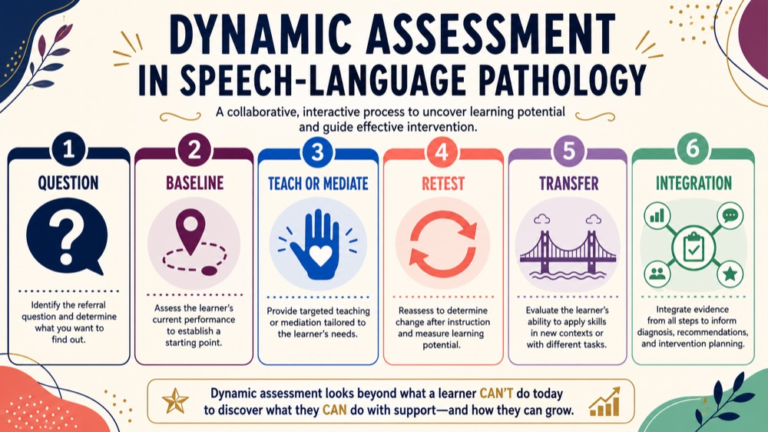
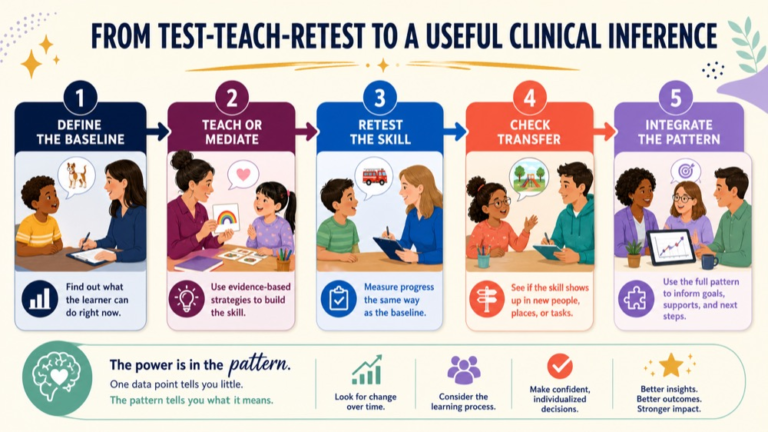
dynamic assessment speech language pathology is easier to study when it is treated as a connected clinical reasoning problem rather than a label to memorize. Dynamic assessment in speech-language pathology adds a learning-response question to assessment. Instead of describing only what a person does independently at one moment, the clinician may test a skill, provide teaching or graduated support, and retest to observe change, strategy use, or transfer. This can be especially useful when language difference, experience, access, or static test conditions make a single score difficult to interpret. Dynamic assessment is evidence to integrate, not a shortcut to a diagnosis.
This learning guide is written for SLP students and other learners reviewing clinical concepts. It organizes observation, access, assessment, function, and professional judgment; it does not make an individualized diagnosis or replace current professional guidance. Interpretation depends on the person, task, language, culture, health, access, partner, context, and communication goals.
What dynamic assessment adds
Begin by separating the concept into domains. A learner who can name the domains is less likely to collapse language, access, partner, participation, competence, regulation, and clinical judgment into one explanation. The useful unit of analysis is the task: what the person was asked to understand, express, organize, coordinate, remember, or communicate, with whom, under which conditions, and with what support.
Domain or system
What to notice
Question to carry forward
Baseline or test
Observe the current response to a defined task before teaching or support is added.
What can the person do under the starting conditions?
Teach or mediate
Provide an intentional explanation, model, cue, strategy, or graduated prompt and document it.
What support was offered, and how was it delivered?
Retest
Repeat or adapt the task to observe change, strategy use, independence, or response to support.
What changed after learning or mediation?
Learning response
Consider how much support was needed, how quickly the person learned, and whether the strategy was used.
What does the response suggest about access or learning potential?
Transfer
Examine whether a learned strategy carries to a new item, context, partner, language, or task.
Does the response generalize beyond the teaching moment?
Integration
Combine dynamic information with history, formal and informal measures, samples, observation, and function.
How does learning response change the interpretation or plan?
These domains interact, but they should remain distinguishable. A learner may show strength in one context and need support in another. A study map organizes the next observation; it does not answer every assessment question or establish a universal treatment, goal, or legal conclusion.
Keep the first pass descriptive and close to the communication event. Note the task, response, partner, setting, timing, available support, language or mode, and consequence for participation. This gives the learner a stable record to compare across tasks and prevents a familiar term from doing too much explanatory work before the evidence has been separated.
For Praxis-style review, a vignette may include several true details but ask for one best interpretation or next step. The strongest answer usually respects the task, identifies the relevant function or boundary, checks the most important missing information, and avoids treating one performance sample or policy phrase as the whole profile.
Map dynamic assessment in SLP
For study purposes, describe the communication relationship before naming a disorder, judging a partner, selecting a goal, or deciding that a task is within scope. Record what the person understood, expressed, initiated, repaired, coordinated, or participated in. Then note whether the task was familiar, how much context was shared, and which support changed the response.
Question: identify why a dynamic method is needed and which skill or learning response should be observed.
Baseline: define the task, materials, language, partner, support, response, and starting performance.
Mediation: state the teaching, model, cue, prompt hierarchy, feedback, or strategy used and its purpose.
Retest: compare performance, support level, accuracy, efficiency, strategy use, and independence after mediation.
Transfer: look for response on a new item, routine, language, partner, setting, or related task when appropriate.
Integration: interpret dynamic data with history, norms, samples, observation, language context, function, and uncertainty.
A strong description is specific enough that another learner could picture the event. Instead of writing “the communication is impaired” or “the clinician can do this,” describe the demand, observable response, language or mode, partner, context, competence or access condition, and result. This protects clinical reasoning from labels that are broader than the evidence.
From test-teach-retest to a useful clinical inference
Context changes what communication and professional decisions require. A direct question, long explanation, group exchange, classroom task, health-care interaction, family story, noisy routine, supervised procedure, or referral decision places different demands on processing, language, memory, hearing, access, partner behavior, competence, and regulation. Language experience, visual information, fatigue, health literacy, and the opportunity to request clarification should be part of the observation.
A multilingual learner may struggle with an unfamiliar language task but make a meaningful change after the clinician provides a clear model and opportunity to practice a target structure. An SLP may document the prompts required, the learner’s strategy use, and whether the change transfers to a new example. The result does not mean that one improvement rules out a disorder, and limited change does not establish one. It adds information about the person’s response to teaching under the selected conditions, which can guide the next assessment question and support planning.
Observation layer
Example question
Task
What did the person or clinician need to understand, express, organize, coordinate, decide, or provide?
Language and access
Which language, dialect, mode, hearing condition, tool, support, or communication partner was available?
Context and responsibility
Who was involved, what did they know, and which role, policy, ethical, or environmental factor mattered?
Participation and safety
What meaningful routine, role, outcome, or risk became easier or harder because of the pattern?
Context is not an afterthought added once a label has been selected. It is part of the question itself. If performance or decision quality changes with a quieter room, extra processing time, a familiar partner, a different language or mode, an interpreter, visual information, supervision, collaboration, a changed task, or a changed routine, that change is useful evidence about access and demand. It does not identify a cause by itself, but it tells you which conditions should be carried into the next observation.
Apply dynamic-assessment reasoning
When a Praxis-style scenario or clinical discussion presents dynamic assessment speech language pathology, use a disciplined sequence. The goal is to select the next clinical question or action that matches the evidence, the person’s priorities, the communication context, and the relevant professional boundary.
Define the task, language, mode, communication purpose, or service responsibility in plain language.
Identify the relevant domain: language, access, partner, participation, assessment, competence, collaboration, ethics, or regulation.
Separate observation from interpretation and write down what remains unknown.
Check history, exposure, dialect, culture, identity, interpreter access, environment, sensory load, memory, task familiarity, training, supervision, and local requirements as relevant.
Choose the assessment, collaboration, accommodation, goal, training, referral, or documentation step that answers the specific question.
State the boundary of the conclusion and keep the person’s safety, autonomy, access, and participation visible.
A multilingual learner may struggle with an unfamiliar language task but make a meaningful change after the clinician provides a clear model and opportunity to practice a target structure. An SLP may document the prompts required, the learner’s strategy use, and whether the change transfers to a new example. The result does not mean that one improvement rules out a disorder, and limited change does not establish one. It adds information about the person’s response to teaching under the selected conditions, which can guide the next assessment question and support planning. In a learning answer, the decisive evidence is usually the relationship among the task, the observed pattern, the context, and the next needed information—not a single isolated behavior, score, label, or broad permission statement.
Common study mistakes
Treating dynamic assessment as a single universal protocol instead of a structured question-and-response process.
Failing to define the baseline task, language, support, teaching, prompts, retest, and transfer conditions.
Calling one quick improvement proof of language difference or calling limited change proof of disorder.
Ignoring the quality of instruction, relationship, access, attention, fatigue, prior experience, or task familiarity.
Providing so much unplanned prompting that the result cannot be interpreted or compared.
Looking only at accuracy and missing independence, strategy use, efficiency, generalization, or partner support.
Using dynamic information without considering language, dialect, culture, interpreter access, or relevant languages.
Failing to integrate learning response with formal, informal, functional, historical, and observational evidence.
Most of these mistakes come from replacing a multidomain question with a fast label. Correct the habit by returning to the same sequence: describe, separate, contextualize, ask what is missing, and choose a proportionate next step. A short rationale can make the habit visible: identify the evidence, name the uncertainty, and explain why the selected next step fits the person, setting, and responsibility.
Build a quick review map
Use this compact map when reviewing a missed question, lecture note, or clinical vignette:
Step 1: Define the skill, baseline task, language, context, and reason for using a dynamic method.
Step 2: Document the teaching, model, cue, prompt hierarchy, feedback, and support provided.
Step 3: Compare the retest response with baseline without overstating what one change means.
Step 6: Use the pattern to guide assessment, support, collaboration, referral, monitoring, or the next question.
Then write one transfer sentence: “When I see this pattern, I will first check ___ because ___.” The sentence should identify a decision rule, not repeat a definition. Revisit it after a delay and test whether you can apply the rule to a different task, age group, partner, language, setting, or professional responsibility.
Sources and next steps
dynamic assessment speech language pathology is best learned as a context-sensitive pattern across communication, access, identity, function, participation, competence, and professional judgment. Use the current authority pages to refine the concept, then return to practice scenarios that require you to explain what the evidence supports and what it leaves open.
Criterion-Referenced Assessment: Measuring a Defined Communication Skill
criterion referenced assessment is easier to study when it is treated as a connected clinical reasoning problem rather than a label to memorize. Criterion-referenced assessment compares performance with a defined skill, criterion, or performance standard rather than ranking a person against a reference group. In SLP learning, it can make a question concrete: can the learner follow this direction, produce this target, use this strategy, or communicate this message under these conditions? The result still depends on the task, criterion, language, context, supports, and purpose, so criterion information should be interpreted with other evidence.
This learning guide is written for SLP students and other learners reviewing clinical concepts. It organizes observation, access, assessment, function, and professional judgment; it does not make an individualized diagnosis or replace current professional guidance. Interpretation depends on the person, task, language, culture, health, access, partner, context, and communication goals.
What criterion-referenced assessment means
Begin by separating the concept into domains. A learner who can name the domains is less likely to collapse language, access, partner, participation, competence, regulation, and clinical judgment into one explanation. The useful unit of analysis is the task: what the person was asked to understand, express, organize, coordinate, remember, or communicate, with whom, under which conditions, and with what support.
Domain or system
What to notice
Question to carry forward
Defined criterion
The assessment states the skill, behavior, response, or performance standard being examined.
What counts as demonstrating the skill?
Task and response
Items or activities show how the person performs the defined skill under specified conditions.
What did the person need to do and say?
Mastery information
The result can describe whether a criterion was met, partially met, or not yet demonstrated under the task conditions.
What level of performance was observed?
Context
Materials, cues, partners, language, setting, and task demands affect whether the result transfers to another situation.
Where does this performance apply?
Informal criterion probe
Clinicians can create focused probes for specific questions when the method and interpretation are documented.
What question does this probe answer?
Clinical integration
Criterion information is combined with history, observation, norms, samples, function, and response to support planning.
What does this performance change about the plan?
These domains interact, but they should remain distinguishable. A learner may show strength in one context and need support in another. A study map organizes the next observation; it does not answer every assessment question or establish a universal treatment, goal, or legal conclusion.
Keep the first pass descriptive and close to the communication event. Note the task, response, partner, setting, timing, available support, language or mode, and consequence for participation. This gives the learner a stable record to compare across tasks and prevents a familiar term from doing too much explanatory work before the evidence has been separated.
For Praxis-style review, a vignette may include several true details but ask for one best interpretation or next step. The strongest answer usually respects the task, identifies the relevant function or boundary, checks the most important missing information, and avoids treating one performance sample or policy phrase as the whole profile.
Map criterion-referenced assessment
For study purposes, describe the communication relationship before naming a disorder, judging a partner, selecting a goal, or deciding that a task is within scope. Record what the person understood, expressed, initiated, repaired, coordinated, or participated in. Then note whether the task was familiar, how much context was shared, and which support changed the response.
Criterion: define the skill, behavior, quality, accuracy, independence, or performance standard in observable terms.
Task: describe the materials, instructions, response, prompting, partner, language, setting, and support available.
Performance: record what was demonstrated, emerging, inconsistent, or not yet observed under the stated conditions.
Context: identify whether the skill is meaningful in routines, curriculum, work, health care, relationships, or community life.
Probe: use a targeted criterion procedure to answer a focused question rather than treating a homemade task as a full test.
Integration: connect criterion performance with history, report, observation, formal data, dynamic response, and next steps.
A strong description is specific enough that another learner could picture the event. Instead of writing “the communication is impaired” or “the clinician can do this,” describe the demand, observable response, language or mode, partner, context, competence or access condition, and result. This protects clinical reasoning from labels that are broader than the evidence.
From a criterion to a meaningful performance decision
Context changes what communication and professional decisions require. A direct question, long explanation, group exchange, classroom task, health-care interaction, family story, noisy routine, supervised procedure, or referral decision places different demands on processing, language, memory, hearing, access, partner behavior, competence, and regulation. Language experience, visual information, fatigue, health literacy, and the opportunity to request clarification should be part of the observation.
An SLP may use a criterion-referenced probe to examine whether a child follows a particular classroom direction with visual support, whether an adult uses a communication strategy during a workplace exchange, or whether a learner produces a target in words and connected speech. The result is meaningful only when the criterion and conditions are clear. Meeting the criterion in one structured task does not guarantee the same performance in a noisy group or unfamiliar routine, and not meeting it may signal a need to examine access, task demands, support, or another contributing factor.
Observation layer
Example question
Task
What did the person or clinician need to understand, express, organize, coordinate, decide, or provide?
Language and access
Which language, dialect, mode, hearing condition, tool, support, or communication partner was available?
Context and responsibility
Who was involved, what did they know, and which role, policy, ethical, or environmental factor mattered?
Participation and safety
What meaningful routine, role, outcome, or risk became easier or harder because of the pattern?
Context is not an afterthought added once a label has been selected. It is part of the question itself. If performance or decision quality changes with a quieter room, extra processing time, a familiar partner, a different language or mode, an interpreter, visual information, supervision, collaboration, a changed task, or a changed routine, that change is useful evidence about access and demand. It does not identify a cause by itself, but it tells you which conditions should be carried into the next observation.
Apply criterion-referenced reasoning
When a Praxis-style scenario or clinical discussion presents criterion referenced assessment, use a disciplined sequence. The goal is to select the next clinical question or action that matches the evidence, the person’s priorities, the communication context, and the relevant professional boundary.
Define the task, language, mode, communication purpose, or service responsibility in plain language.
Identify the relevant domain: language, access, partner, participation, assessment, competence, collaboration, ethics, or regulation.
Separate observation from interpretation and write down what remains unknown.
Check history, exposure, dialect, culture, identity, interpreter access, environment, sensory load, memory, task familiarity, training, supervision, and local requirements as relevant.
Choose the assessment, collaboration, accommodation, goal, training, referral, or documentation step that answers the specific question.
State the boundary of the conclusion and keep the person’s safety, autonomy, access, and participation visible.
An SLP may use a criterion-referenced probe to examine whether a child follows a particular classroom direction with visual support, whether an adult uses a communication strategy during a workplace exchange, or whether a learner produces a target in words and connected speech. The result is meaningful only when the criterion and conditions are clear. Meeting the criterion in one structured task does not guarantee the same performance in a noisy group or unfamiliar routine, and not meeting it may signal a need to examine access, task demands, support, or another contributing factor. In a learning answer, the decisive evidence is usually the relationship among the task, the observed pattern, the context, and the next needed information—not a single isolated behavior, score, label, or broad permission statement.
Common study mistakes
Confusing criterion-referenced performance with comparison to a norm group.
Writing a vague criterion such as ‘good language’ instead of defining the observable skill and conditions.
Treating one task result as proof of generalization across people, settings, materials, languages, or demands.
Changing prompts, cues, materials, or response requirements without documenting what the result represents.
Calling a criterion probe a standardized test or making psychometric claims that the method does not support.
Ignoring the person’s language, dialect, culture, communication mode, sensory access, or partner support.
Using mastery language without considering function, participation, priorities, and meaningful outcomes.
Failing to combine criterion information with reports, observation, samples, formal measures, or dynamic response.
Most of these mistakes come from replacing a multidomain question with a fast label. Correct the habit by returning to the same sequence: describe, separate, contextualize, ask what is missing, and choose a proportionate next step. A short rationale can make the habit visible: identify the evidence, name the uncertainty, and explain why the selected next step fits the person, setting, and responsibility.
Build a quick review map
Use this compact map when reviewing a missed question, lecture note, or clinical vignette:
Step 1: State the skill, performance criterion, task, materials, and response conditions.
Step 2: Record supports, prompts, language, partner, setting, timing, and what was actually observed.
Step 3: Distinguish performance on the task from generalization, diagnosis, prognosis, and participation.
Step 4: Check whether the criterion is meaningful, accessible, culturally and linguistically appropriate, and fair.
Step 5: Use additional sources to explain variability, strengths, needs, and response to support.
Step 6: Connect the criterion result to a goal, support, monitoring plan, referral, or next question.
Then write one transfer sentence: “When I see this pattern, I will first check ___ because ___.” The sentence should identify a decision rule, not repeat a definition. Revisit it after a delay and test whether you can apply the rule to a different task, age group, partner, language, setting, or professional responsibility.
Sources and next steps
criterion referenced assessment is best learned as a context-sensitive pattern across communication, access, identity, function, participation, competence, and professional judgment. Use the current authority pages to refine the concept, then return to practice scenarios that require you to explain what the evidence supports and what it leaves open.
Norm-Referenced Assessment: How SLPs Use Comparison Scores
norm referenced assessment is easier to study when it is treated as a connected clinical reasoning problem rather than a label to memorize. Norm-referenced assessment compares a person’s performance with a defined reference group under stated conditions. That comparison can help describe relative performance, but it is not the same as a diagnosis or a complete communication profile. SLP reasoning must check who was included in the normative sample, what construct was measured, whether the administration fit, and how language, dialect, culture, access, and context affect interpretation.
This learning guide is written for SLP students and other learners reviewing clinical concepts. It organizes observation, access, assessment, function, and professional judgment; it does not make an individualized diagnosis or replace current professional guidance. Interpretation depends on the person, task, language, culture, health, access, partner, context, and communication goals.
What norm-referenced assessment means
Begin by separating the concept into domains. A learner who can name the domains is less likely to collapse language, access, partner, participation, competence, regulation, and clinical judgment into one explanation. The useful unit of analysis is the task: what the person was asked to understand, express, organize, coordinate, remember, or communicate, with whom, under which conditions, and with what support.
Domain or system
What to notice
Question to carry forward
Reference group
The person’s performance is compared with a selected group described by the test’s normative information.
Who is represented in the comparison group?
Construct
The score describes performance on the tasks and skills the measure was designed to sample.
What does this assessment actually measure?
Score type
Percentiles, standard scores, scaled scores, or other metrics summarize performance relative to the test’s framework.
What does this number mean under these conditions?
Standardization
Consistent instructions, materials, administration, and scoring support the intended comparison.
Were the stated conditions followed or changed?
Normative fit
Age, language, dialect, culture, development, disability, hearing, and other characteristics affect whether comparison is appropriate.
Can this reference group fairly represent the person?
Clinical integration
Scores are interpreted with history, observation, samples, reports, function, and other relevant evidence.
What does the whole pattern support?
These domains interact, but they should remain distinguishable. A learner may show strength in one context and need support in another. A study map organizes the next observation; it does not answer every assessment question or establish a universal treatment, goal, or legal conclusion.
Keep the first pass descriptive and close to the communication event. Note the task, response, partner, setting, timing, available support, language or mode, and consequence for participation. This gives the learner a stable record to compare across tasks and prevents a familiar term from doing too much explanatory work before the evidence has been separated.
For Praxis-style review, a vignette may include several true details but ask for one best interpretation or next step. The strongest answer usually respects the task, identifies the relevant function or boundary, checks the most important missing information, and avoids treating one performance sample or policy phrase as the whole profile.
Map norm-referenced assessment
For study purposes, describe the communication relationship before naming a disorder, judging a partner, selecting a goal, or deciding that a task is within scope. Record what the person understood, expressed, initiated, repaired, coordinated, or participated in. Then note whether the task was familiar, how much context was shared, and which support changed the response.
Reference group: identify the population, age or grade, language, dialect, setting, and characteristics used for comparison.
Construct: name the speech, language, fluency, voice, cognition, literacy, or other skill the measure samples.
Score: distinguish percentile, standard, scaled, or descriptive information from a diagnosis or functional conclusion.
Fit: consider language history, dialect, culture, hearing, cognition, motor access, disability, and representation in the norms.
Integration: connect the comparison with observation, report, samples, dynamic information, participation, and the next decision.
A strong description is specific enough that another learner could picture the event. Instead of writing “the communication is impaired” or “the clinician can do this,” describe the demand, observable response, language or mode, partner, context, competence or access condition, and result. This protects clinical reasoning from labels that are broader than the evidence.
From a norm-referenced score to a fair interpretation
Context changes what communication and professional decisions require. A direct question, long explanation, group exchange, classroom task, health-care interaction, family story, noisy routine, supervised procedure, or referral decision places different demands on processing, language, memory, hearing, access, partner behavior, competence, and regulation. Language experience, visual information, fatigue, health literacy, and the opportunity to request clarification should be part of the observation.
A norm-referenced language score can be useful when its construct, reference group, administration, and purpose fit the person. The same score has a different interpretation when the person speaks another language, uses a dialect not represented in the norms, required an accommodation that changed the task, or was too fatigued to show typical performance. A score can describe one slice of performance while observation and language sampling show how communication works in routines. The comparison is evidence to integrate, not a replacement for the rest of the assessment.
Observation layer
Example question
Task
What did the person or clinician need to understand, express, organize, coordinate, decide, or provide?
Language and access
Which language, dialect, mode, hearing condition, tool, support, or communication partner was available?
Context and responsibility
Who was involved, what did they know, and which role, policy, ethical, or environmental factor mattered?
Participation and safety
What meaningful routine, role, outcome, or risk became easier or harder because of the pattern?
Context is not an afterthought added once a label has been selected. It is part of the question itself. If performance or decision quality changes with a quieter room, extra processing time, a familiar partner, a different language or mode, an interpreter, visual information, supervision, collaboration, a changed task, or a changed routine, that change is useful evidence about access and demand. It does not identify a cause by itself, but it tells you which conditions should be carried into the next observation.
Apply norm-referenced reasoning
When a Praxis-style scenario or clinical discussion presents norm referenced assessment, use a disciplined sequence. The goal is to select the next clinical question or action that matches the evidence, the person’s priorities, the communication context, and the relevant professional boundary.
Define the task, language, mode, communication purpose, or service responsibility in plain language.
Identify the relevant domain: language, access, partner, participation, assessment, competence, collaboration, ethics, or regulation.
Separate observation from interpretation and write down what remains unknown.
Check history, exposure, dialect, culture, identity, interpreter access, environment, sensory load, memory, task familiarity, training, supervision, and local requirements as relevant.
Choose the assessment, collaboration, accommodation, goal, training, referral, or documentation step that answers the specific question.
State the boundary of the conclusion and keep the person’s safety, autonomy, access, and participation visible.
A norm-referenced language score can be useful when its construct, reference group, administration, and purpose fit the person. The same score has a different interpretation when the person speaks another language, uses a dialect not represented in the norms, required an accommodation that changed the task, or was too fatigued to show typical performance. A score can describe one slice of performance while observation and language sampling show how communication works in routines. The comparison is evidence to integrate, not a replacement for the rest of the assessment. In a learning answer, the decisive evidence is usually the relationship among the task, the observed pattern, the context, and the next needed information—not a single isolated behavior, score, label, or broad permission statement.
Common study mistakes
Treating a norm-referenced score as a diagnosis, complete profile, or direct measure of everyday participation.
Failing to identify who was included in the normative sample and whether that group represents the person.
Ignoring language, dialect, culture, hearing, cognition, motor access, disability, health, or testing familiarity.
Reporting a score after changing instructions, stimuli, timing, response mode, or scoring without considering interpretation limits.
Confusing percentile rank with percent correct, skill mastery, clinical severity, or treatment need.
Assuming a high score rules out communication difficulty in a different task, setting, partner, or demand.
Using a single comparison score without observation, interview, reports, samples, functional evidence, or dynamic information.
Documenting the number but not the measure purpose, conditions, fit, limitations, functional meaning, or next step.
Most of these mistakes come from replacing a multidomain question with a fast label. Correct the habit by returning to the same sequence: describe, separate, contextualize, ask what is missing, and choose a proportionate next step. A short rationale can make the habit visible: identify the evidence, name the uncertainty, and explain why the selected next step fits the person, setting, and responsibility.
Build a quick review map
Use this compact map when reviewing a missed question, lecture note, or clinical vignette:
Step 1: Name the construct, purpose, and comparison group before interpreting the score.
Step 2: Check the normative sample, language, dialect, culture, age, development, and access fit.
Step 4: Separate relative comparison from diagnosis, mastery, cause, prognosis, and participation.
Step 5: Integrate the score with history, observation, samples, reports, dynamic data, and functional context.
Step 6: State what the score supports, what remains uncertain, and which next action is proportionate.
Then write one transfer sentence: “When I see this pattern, I will first check ___ because ___.” The sentence should identify a decision rule, not repeat a definition. Revisit it after a delay and test whether you can apply the rule to a different task, age group, partner, language, setting, or professional responsibility.
Sources and next steps
norm referenced assessment is best learned as a context-sensitive pattern across communication, access, identity, function, participation, competence, and professional judgment. Use the current authority pages to refine the concept, then return to practice scenarios that require you to explain what the evidence supports and what it leaves open.
Standardized Assessment in Speech-Language Pathology: What Scores Mean
standardized assessment speech language pathology is easier to study when it is treated as a connected clinical reasoning problem rather than a label to memorize. Standardized assessment in speech-language pathology uses consistent procedures, items or tasks, administration, and scoring so performance can be described in a defined way. That consistency is useful, but it does not make one score a complete picture of communication or automatically valid for every person. SLPs must distinguish norm-referenced from criterion-referenced information, check the fit of the normative sample and language, and integrate scores with history, observation, functional data, and professional reasoning.
This learning guide is written for SLP students and other learners reviewing clinical concepts. It organizes observation, access, assessment, function, and professional judgment; it does not make an individualized diagnosis or replace current professional guidance. Interpretation depends on the person, task, language, culture, health, access, partner, context, and communication goals.
What standardized assessment can tell you
Begin by separating the concept into domains. A learner who can name the domains is less likely to collapse language, access, partner, participation, competence, regulation, and clinical judgment into one explanation. The useful unit of analysis is the task: what the person was asked to understand, express, organize, coordinate, remember, or communicate, with whom, under which conditions, and with what support.
Domain or system
What to notice
Question to carry forward
Standardized procedure
Consistent administration and scoring make a defined task or construct more comparable across examinees or occasions.
What was held consistent, and for what purpose?
Norm-referenced measure
Performance is compared with a representative reference group under the test’s stated conditions.
Does the reference group represent this person?
Criterion-referenced measure
Performance is compared with a stated criterion, skill description, or performance standard.
What skill or criterion was demonstrated?
Psychometric evidence
Reliability, validity, sensitivity, specificity, and standardization describe evidence for specified uses and populations.
What does the evidence support in this context?
Access and fit
Language, dialect, culture, hearing, cognition, motor access, familiarity, accommodations, and modifications affect interpretation.
Can this result be interpreted as intended?
Clinical integration
Scores are combined with history, interview, report, observation, samples, dynamic tasks, function, and context.
What does the whole pattern support?
These domains interact, but they should remain distinguishable. A learner may show strength in one context and need support in another. A study map organizes the next observation; it does not answer every assessment question or establish a universal treatment, goal, or legal conclusion.
Keep the first pass descriptive and close to the communication event. Note the task, response, partner, setting, timing, available support, language or mode, and consequence for participation. This gives the learner a stable record to compare across tasks and prevents a familiar term from doing too much explanatory work before the evidence has been separated.
For Praxis-style review, a vignette may include several true details but ask for one best interpretation or next step. The strongest answer usually respects the task, identifies the relevant function or boundary, checks the most important missing information, and avoids treating one performance sample or policy phrase as the whole profile.
Map standardized assessment in SLP
For study purposes, describe the communication relationship before naming a disorder, judging a partner, selecting a goal, or deciding that a task is within scope. Record what the person understood, expressed, initiated, repaired, coordinated, or participated in. Then note whether the task was familiar, how much context was shared, and which support changed the response.
Definition: identify what was standardized—items, instructions, timing, responses, scoring, or comparison—and what was not.
Reference: distinguish norm-referenced comparison with a group from criterion-referenced comparison with a skill or standard.
Evidence: review reliability, validity, sensitivity, specificity, standardization, and the population and purpose studied.
Fit: check language, dialect, culture, norms, hearing, vision, cognition, motor access, testing familiarity, and supports.
Interpretation: distinguish a score or descriptive result from a diagnosis, functional profile, cause, prognosis, or recommendation.
Integration: connect standardized information with history, observation, samples, reports, dynamic assessment, function, and participation.
A strong description is specific enough that another learner could picture the event. Instead of writing “the communication is impaired” or “the clinician can do this,” describe the demand, observable response, language or mode, partner, context, competence or access condition, and result. This protects clinical reasoning from labels that are broader than the evidence.
From a standardized score to a defensible interpretation
Context changes what communication and professional decisions require. A direct question, long explanation, group exchange, classroom task, health-care interaction, family story, noisy routine, supervised procedure, or referral decision places different demands on processing, language, memory, hearing, access, partner behavior, competence, and regulation. Language experience, visual information, fatigue, health literacy, and the opportunity to request clarification should be part of the observation.
A standardized norm-referenced score can help compare a person’s performance with a reference group when the normative sample and administration fit. A criterion-referenced task can show whether a defined skill or criterion was demonstrated without requiring the person to rank against a norm group. Neither type answers every question about communication. If a person uses another language, a different dialect, or an accommodation that changes standardized conditions, the score may not support the same interpretation. Descriptive information may still be useful when its limits are clearly stated and it is integrated with other evidence.
Observation layer
Example question
Task
What did the person or clinician need to understand, express, organize, coordinate, decide, or provide?
Language and access
Which language, dialect, mode, hearing condition, tool, support, or communication partner was available?
Context and responsibility
Who was involved, what did they know, and which role, policy, ethical, or environmental factor mattered?
Participation and safety
What meaningful routine, role, outcome, or risk became easier or harder because of the pattern?
Context is not an afterthought added once a label has been selected. It is part of the question itself. If performance or decision quality changes with a quieter room, extra processing time, a familiar partner, a different language or mode, an interpreter, visual information, supervision, collaboration, a changed task, or a changed routine, that change is useful evidence about access and demand. It does not identify a cause by itself, but it tells you which conditions should be carried into the next observation.
Apply standardized-assessment reasoning
When a Praxis-style scenario or clinical discussion presents standardized assessment speech language pathology, use a disciplined sequence. The goal is to select the next clinical question or action that matches the evidence, the person’s priorities, the communication context, and the relevant professional boundary.
Define the task, language, mode, communication purpose, or service responsibility in plain language.
Identify the relevant domain: language, access, partner, participation, assessment, competence, collaboration, ethics, or regulation.
Separate observation from interpretation and write down what remains unknown.
Check history, exposure, dialect, culture, identity, interpreter access, environment, sensory load, memory, task familiarity, training, supervision, and local requirements as relevant.
Choose the assessment, collaboration, accommodation, goal, training, referral, or documentation step that answers the specific question.
State the boundary of the conclusion and keep the person’s safety, autonomy, access, and participation visible.
A standardized norm-referenced score can help compare a person’s performance with a reference group when the normative sample and administration fit. A criterion-referenced task can show whether a defined skill or criterion was demonstrated without requiring the person to rank against a norm group. Neither type answers every question about communication. If a person uses another language, a different dialect, or an accommodation that changes standardized conditions, the score may not support the same interpretation. Descriptive information may still be useful when its limits are clearly stated and it is integrated with other evidence. In a learning answer, the decisive evidence is usually the relationship among the task, the observed pattern, the context, and the next needed information—not a single isolated behavior, score, label, or broad permission statement.
Common study mistakes
Equating standardized with comprehensive, objective in every circumstance, or automatically more important than functional evidence.
Confusing norm-referenced comparison with criterion-referenced performance against a defined skill or standard.
Reporting a standard score when the person’s language, dialect, or other characteristics are not represented in the normative sample.
Ignoring accommodations, modifications, hearing, vision, cognition, motor access, fatigue, testing familiarity, or task conditions.
Treating reliability as proof of validity for a different person, population, construct, or clinical decision.
Using one score to explain cause, participation, prognosis, treatment response, or need for services without other evidence.
Assuming a low score proves disorder or a high score rules out meaningful communication difficulty in another context.
Documenting the number but not the test purpose, conditions, language, limits, functional meaning, or next step.
Most of these mistakes come from replacing a multidomain question with a fast label. Correct the habit by returning to the same sequence: describe, separate, contextualize, ask what is missing, and choose a proportionate next step. A short rationale can make the habit visible: identify the evidence, name the uncertainty, and explain why the selected next step fits the person, setting, and responsibility.
Build a quick review map
Use this compact map when reviewing a missed question, lecture note, or clinical vignette:
Step 1: Define what was standardized and what question the procedure was designed to answer.
Step 2: Identify whether the information is norm-referenced, criterion-referenced, or descriptive.
Step 4: Separate the result from diagnostic, functional, causal, prognostic, and service-eligibility conclusions.
Step 5: Integrate the result with history, observation, samples, reports, dynamic tasks, and meaningful participation.
Step 6: Document what the score supports, what remains uncertain, and what action follows.
Then write one transfer sentence: “When I see this pattern, I will first check ___ because ___.” The sentence should identify a decision rule, not repeat a definition. Revisit it after a delay and test whether you can apply the rule to a different task, age group, partner, language, setting, or professional responsibility.
Sources and next steps
standardized assessment speech language pathology is best learned as a context-sensitive pattern across communication, access, identity, function, participation, competence, and professional judgment. Use the current authority pages to refine the concept, then return to practice scenarios that require you to explain what the evidence supports and what it leaves open.