Apraxia vs Dysarthria Diagnosis: A Focused Motor-Speech Comparison
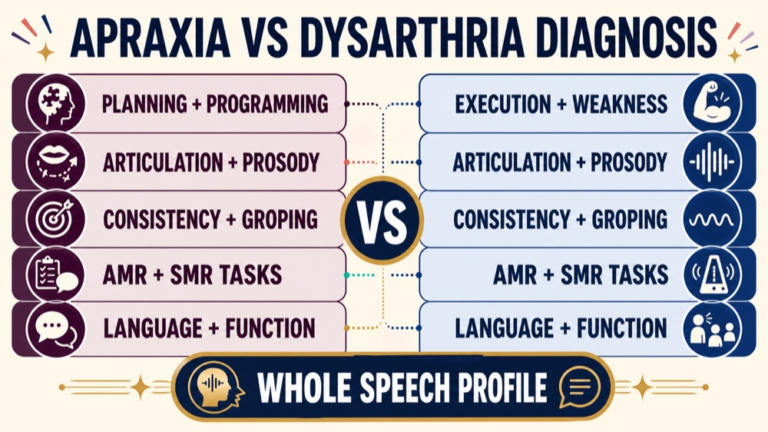
apraxia vs dysarthria diagnosis is easier to study when it is treated as a connected clinical reasoning problem rather than a label to memorize. Apraxia vs dysarthria diagnosis compares motor planning and programming evidence with speech execution and neuromuscular evidence while recognizing that the two profiles can co-occur. The SLP examines speech complexity, automatic and voluntary production, articulation, prosody, groping, segmentation, consistency, oral-motor findings, intelligibility, and functional communication. AMR and SMR tasks can contribute to the assessment, but the differential belongs to the whole pattern and its context rather than to one hallmark.
This learning guide is written for SLP students and other learners reviewing clinical concepts. It organizes observation, access, assessment, function, and professional judgment; it does not make an individualized diagnosis or replace current professional guidance. Interpretation depends on the person, task, language, culture, health, access, partner, context, and communication goals.
What apraxia vs dysarthria diagnosis means
Begin by separating the concept into domains. A learner who can name the domains is less likely to collapse language, access, partner, participation, competence, regulation, and clinical judgment into one explanation. The useful unit of analysis is the task: what the person was asked to understand, express, organize, coordinate, remember, or communicate, with whom, under which conditions, and with what support.
Domain or system
What to notice
Question to carry forward
Planning and programming
AOS concerns organizing speech movements, with effects that may change with novelty, complexity, imitation, repetition, and prosody.
What planning demand changes performance?
Execution and weakness
Dysarthria may involve weakness, abnormal tone, incoordination, or other execution features across speech subsystems.
What evidence points to execution rather than planning?
Articulation and prosody
Both profiles can affect articulation and prosody, so the pattern, task, and associated findings matter.
Which features overlap and which distinguish the profile?
Consistency and groping
Variable errors, articulatory groping, segmentation, and trial-to-trial change may add planning evidence, but none is sufficient alone.
What is stable, variable, and context-dependent?
AMR and SMR
Alternating and sequential motion tasks sample different demands and should be interpreted with connected and functional speech.
What does this task add to the broader profile?
Language and function
Aphasia, cognition, hearing, access, partner, intelligibility, and participation may shape the communication outcome.
What support and referral question follows the comparison?
These domains interact, but they should remain distinguishable. A learner may show strength in one context and need support in another. A study map organizes the next observation; it does not answer every assessment question or establish a universal treatment, goal, or legal conclusion.
Keep the first pass descriptive and close to the communication event. Note the task, response, partner, setting, timing, available support, language or mode, and consequence for participation. This gives the learner a stable record to compare across tasks and prevents a familiar term from doing too much explanatory work before the evidence has been separated.
For Praxis-style review, a vignette may include several true details but ask for one best interpretation or next step. The strongest answer usually respects the task, identifies the relevant function or boundary, checks the most important missing information, and avoids treating one performance sample or policy phrase as the whole profile.
Map apraxia versus dysarthria reasoning
For study purposes, describe the communication relationship before naming a disorder, judging a partner, selecting a goal, or deciding that a task is within scope. Record what the person understood, expressed, initiated, repaired, coordinated, or participated in. Then note whether the task was familiar, how much context was shared, and which support changed the response.
History: review onset, neurologic and medical context, communication change, prior disorders, partner report, and goals.
Execution: examine weakness, tone, range, speed, coordination, steadiness, posture, respiration, and related speech findings.
Planning: compare automatic, imitated, repeated, reading, novel, complex, and self-generated speech as appropriate.
Pattern: describe articulation, prosody, voicing, resonance, groping, segmentation, consistency, and change across trials.
Supporting tasks: use AMR, SMR, oral-motor, language, hearing, and cognitive information as supporting evidence, not isolated rules.
Function: connect the differential with intelligibility, comprehensibility, efficiency, AAC, partner support, participation, and referral.
A strong description is specific enough that another learner could picture the event. Instead of writing “the communication is impaired” or “the clinician can do this,” describe the demand, observable response, language or mode, partner, context, competence or access condition, and result. This protects clinical reasoning from labels that are broader than the evidence.
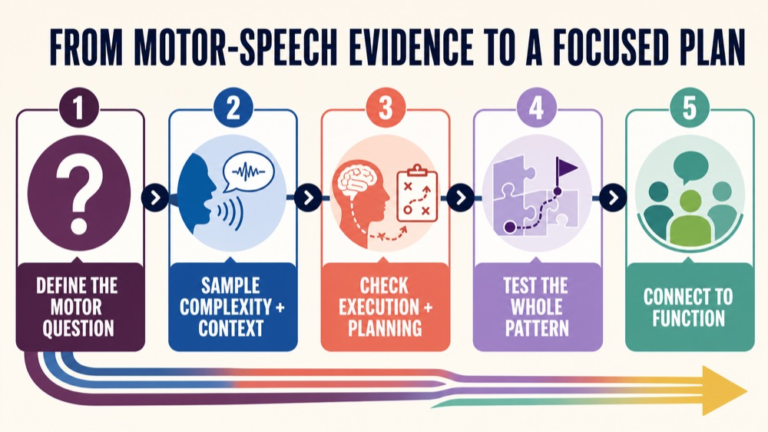
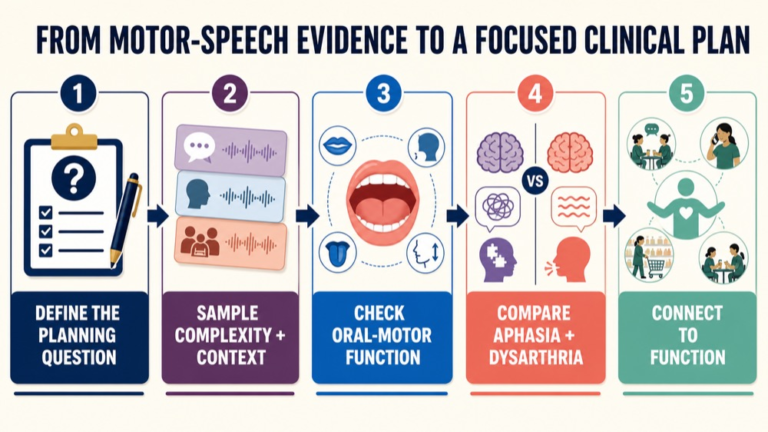
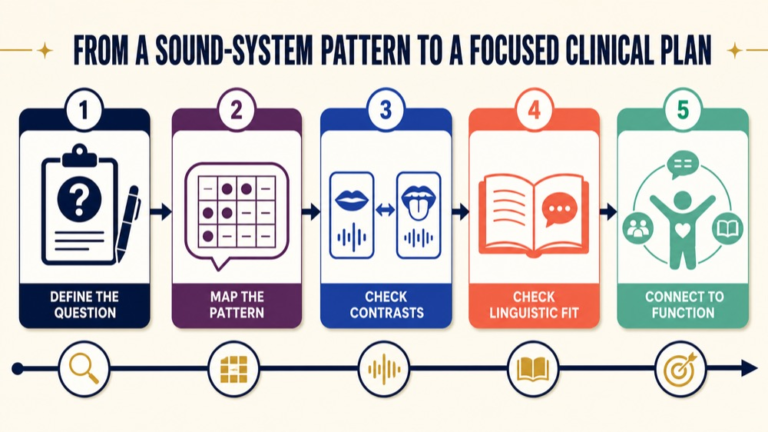
From motor-speech evidence to a focused clinical plan
Context changes what communication and professional decisions require. A direct question, long explanation, group exchange, classroom task, health-care interaction, family story, noisy routine, supervised procedure, or referral decision places different demands on processing, language, memory, hearing, access, partner behavior, competence, and regulation. Language experience, visual information, fatigue, health literacy, and the opportunity to request clarification should be part of the observation.
A person may produce a familiar automatic sequence more easily than a novel multisyllabic word, while another may show consistent weakness-related speech changes across tasks. A repeated word can also change because of language formulation, fatigue, cueing, hearing, or task familiarity. The useful comparison asks what happens as planning demand, complexity, modality, and support change, then checks whether the pattern aligns with oral-motor and speech-subsystem findings. AOS and dysarthria are not mutually exclusive labels, so the plan should remain responsive to co-occurring evidence.
Observation layer
Example question
Task
What did the person or clinician need to understand, express, organize, coordinate, decide, or provide?
Language and access
Which language, dialect, mode, hearing condition, tool, support, or communication partner was available?
Context and responsibility
Who was involved, what did they know, and which role, policy, ethical, or environmental factor mattered?
Participation and safety
What meaningful routine, role, outcome, or risk became easier or harder because of the pattern?
Context is not an afterthought added once a label has been selected. It is part of the question itself. If performance or decision quality changes with a quieter room, extra processing time, a familiar partner, a different language or mode, an interpreter, visual information, supervision, collaboration, a changed task, or a changed routine, that change is useful evidence about access and demand. It does not identify a cause by itself, but it tells you which conditions should be carried into the next observation.
Apply the motor-speech differential
When a Praxis-style scenario or clinical discussion presents apraxia vs dysarthria diagnosis, use a disciplined sequence. The goal is to select the next clinical question or action that matches the evidence, the person’s priorities, the communication context, and the relevant professional boundary.
Define the task, language, mode, communication purpose, or service responsibility in plain language.
Identify the relevant domain: language, access, partner, participation, assessment, competence, collaboration, ethics, or regulation.
Separate observation from interpretation and write down what remains unknown.
Check history, exposure, dialect, culture, identity, interpreter access, environment, sensory load, memory, task familiarity, training, supervision, and local requirements as relevant.
Choose the assessment, collaboration, accommodation, goal, training, referral, or documentation step that answers the specific question.
State the boundary of the conclusion and keep the person’s safety, autonomy, access, and participation visible.
A person may produce a familiar automatic sequence more easily than a novel multisyllabic word, while another may show consistent weakness-related speech changes across tasks. A repeated word can also change because of language formulation, fatigue, cueing, hearing, or task familiarity. The useful comparison asks what happens as planning demand, complexity, modality, and support change, then checks whether the pattern aligns with oral-motor and speech-subsystem findings. AOS and dysarthria are not mutually exclusive labels, so the plan should remain responsive to co-occurring evidence. In a learning answer, the decisive evidence is usually the relationship among the task, the observed pattern, the context, and the next needed information—not a single isolated behavior, score, label, or broad permission statement.
Common study mistakes
Treating any inconsistent speech sound error as apraxia or any imprecise articulation as dysarthria.
Using AMR or SMR results as an isolated diagnostic decision instead of supporting evidence within a motor-speech assessment.
Confusing planning and programming with weakness, incoordination, phonological organization, articulation, or language formulation.
Sampling only automatic speech or only a short word list and missing novelty, complexity, connected, and self-generated speech.
Ignoring prosody, groping, segmentation, voicing, resonance, rate, and trial-to-trial pattern.
Treating AOS and dysarthria as mutually exclusive when a person may show evidence of both.
Failing to link the comparison with intelligibility, partner support, function, referral, and the person’s communication priorities.
Most of these mistakes come from replacing a multidomain question with a fast label. Correct the habit by returning to the same sequence: describe, separate, contextualize, ask what is missing, and choose a proportionate next step. A short rationale can make the habit visible: identify the evidence, name the uncertainty, and explain why the selected next step fits the person, setting, and responsibility.
Build a quick review map
Use this compact map when reviewing a missed question, lecture note, or clinical vignette:
Step 1: Define the motor-speech question, onset, context, and functional communication priority.
Step 6: Choose the communication support, treatment direction, referral, collaboration, or monitoring step that fits the whole profile.
Then write one transfer sentence: “When I see this pattern, I will first check ___ because ___.” The sentence should identify a decision rule, not repeat a definition. Revisit it after a delay and test whether you can apply the rule to a different task, age group, partner, language, setting, or professional responsibility.
Sources and next steps
apraxia vs dysarthria diagnosis is best learned as a context-sensitive pattern across communication, access, identity, function, participation, competence, and professional judgment. Use the current authority pages to refine the concept, then return to practice scenarios that require you to explain what the evidence supports and what it leaves open.
Dysarthria Differential Diagnosis: Speech Subsystems and Related Profiles
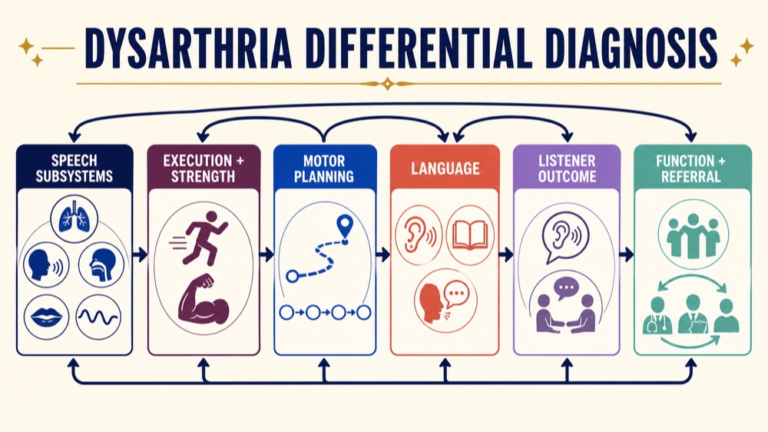
dysarthria differential diagnosis is easier to study when it is treated as a connected clinical reasoning problem rather than a label to memorize. Dysarthria differential diagnosis integrates respiration, phonation, resonance, articulation, prosody, speech samples, intelligibility, comprehensibility, language, cognition, swallowing, hearing, and function. The SLP asks whether the observed pattern reflects neuromotor speech execution, motor planning, language, another co-occurring factor, or several together. Perceptual features can guide the comparison, but the complete reasoning must include task conditions, history, listener access, communication priorities, and appropriate referral boundaries.
This learning guide is written for SLP students and other learners reviewing clinical concepts. It organizes observation, access, assessment, function, and professional judgment; it does not make an individualized diagnosis or replace current professional guidance. Interpretation depends on the person, task, language, culture, health, access, partner, context, and communication goals.
What dysarthria differential diagnosis means
Begin by separating the concept into domains. A learner who can name the domains is less likely to collapse language, access, partner, participation, competence, regulation, and clinical judgment into one explanation. The useful unit of analysis is the task: what the person was asked to understand, express, organize, coordinate, remember, or communicate, with whom, under which conditions, and with what support.
Domain or system
What to notice
Question to carry forward
Speech subsystems
Respiration, phonation, resonance, articulation, and prosody interact and may show different patterns.
Which subsystem evidence is present, and what is still unsampled?
Execution and strength
Weakness, tone, range, speed, coordination, and steadiness can contribute to dysarthric speech and require context.
What motor-execution evidence supports the speech pattern?
Planning and programming
Inconsistency, groping, segmentation, prosodic disruption, and complexity effects may raise an apraxia question.
Is the main concern execution, planning, or both?
Language
Aphasia affects language comprehension or expression, while dysarthria primarily affects speech production; co-occurrence is possible.
What evidence belongs to language rather than speech production?
Listener outcome
Intelligibility, comprehensibility, efficiency, naturalness, partner familiarity, context, and support describe functional impact.
Who understands the message, where, and with what support?
Integration and referral
The profile informs communication support, AAC, treatment, collaboration, monitoring, and referral for related questions.
What action matches the supported pattern?
These domains interact, but they should remain distinguishable. A learner may show strength in one context and need support in another. A study map organizes the next observation; it does not answer every assessment question or establish a universal treatment, goal, or legal conclusion.
Keep the first pass descriptive and close to the communication event. Note the task, response, partner, setting, timing, available support, language or mode, and consequence for participation. This gives the learner a stable record to compare across tasks and prevents a familiar term from doing too much explanatory work before the evidence has been separated.
For Praxis-style review, a vignette may include several true details but ask for one best interpretation or next step. The strongest answer usually respects the task, identifies the relevant function or boundary, checks the most important missing information, and avoids treating one performance sample or policy phrase as the whole profile.
Map dysarthria differential diagnosis
For study purposes, describe the communication relationship before naming a disorder, judging a partner, selecting a goal, or deciding that a task is within scope. Record what the person understood, expressed, initiated, repaired, coordinated, or participated in. Then note whether the task was familiar, how much context was shared, and which support changed the response.
History: review onset, course, medical and rehabilitation context, associated language, cognition, swallowing, hearing, medications, and goals.
Boundary: separate communication findings from medical etiology and identify when interprofessional referral or more evidence is needed.
A strong description is specific enough that another learner could picture the event. Instead of writing “the communication is impaired” or “the clinician can do this,” describe the demand, observable response, language or mode, partner, context, competence or access condition, and result. This protects clinical reasoning from labels that are broader than the evidence.
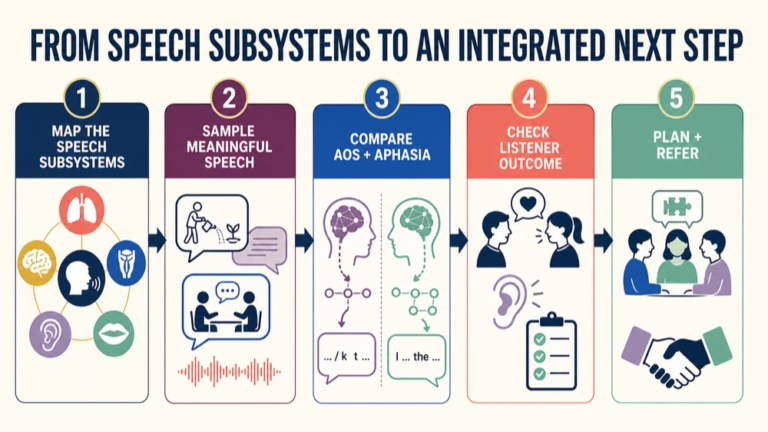
From speech subsystems to an integrated next step
Context changes what communication and professional decisions require. A direct question, long explanation, group exchange, classroom task, health-care interaction, family story, noisy routine, supervised procedure, or referral decision places different demands on processing, language, memory, hearing, access, partner behavior, competence, and regulation. Language experience, visual information, fatigue, health literacy, and the opportunity to request clarification should be part of the observation.
A speaker may be understood by a familiar partner in a quiet room but difficult to follow in a noisy group or during a long explanation. Reduced loudness, imprecise articulation, or altered prosody can arise within different profiles, and language formulation problems can be mistaken for speech production problems when the task is not examined closely. Comparing connected speech, language tasks, listener outcomes, and the effect of context makes the differential more useful than attaching a type from one perceptual feature.
Observation layer
Example question
Task
What did the person or clinician need to understand, express, organize, coordinate, decide, or provide?
Language and access
Which language, dialect, mode, hearing condition, tool, support, or communication partner was available?
Context and responsibility
Who was involved, what did they know, and which role, policy, ethical, or environmental factor mattered?
Participation and safety
What meaningful routine, role, outcome, or risk became easier or harder because of the pattern?
Context is not an afterthought added once a label has been selected. It is part of the question itself. If performance or decision quality changes with a quieter room, extra processing time, a familiar partner, a different language or mode, an interpreter, visual information, supervision, collaboration, a changed task, or a changed routine, that change is useful evidence about access and demand. It does not identify a cause by itself, but it tells you which conditions should be carried into the next observation.
Apply dysarthria differential reasoning
When a Praxis-style scenario or clinical discussion presents dysarthria differential diagnosis, use a disciplined sequence. The goal is to select the next clinical question or action that matches the evidence, the person’s priorities, the communication context, and the relevant professional boundary.
Define the task, language, mode, communication purpose, or service responsibility in plain language.
Identify the relevant domain: language, access, partner, participation, assessment, competence, collaboration, ethics, or regulation.
Separate observation from interpretation and write down what remains unknown.
Check history, exposure, dialect, culture, identity, interpreter access, environment, sensory load, memory, task familiarity, training, supervision, and local requirements as relevant.
Choose the assessment, collaboration, accommodation, goal, training, referral, or documentation step that answers the specific question.
State the boundary of the conclusion and keep the person’s safety, autonomy, access, and participation visible.
A speaker may be understood by a familiar partner in a quiet room but difficult to follow in a noisy group or during a long explanation. Reduced loudness, imprecise articulation, or altered prosody can arise within different profiles, and language formulation problems can be mistaken for speech production problems when the task is not examined closely. Comparing connected speech, language tasks, listener outcomes, and the effect of context makes the differential more useful than attaching a type from one perceptual feature. In a learning answer, the decisive evidence is usually the relationship among the task, the observed pattern, the context, and the next needed information—not a single isolated behavior, score, label, or broad permission statement.
Common study mistakes
Assigning a dysarthria type from one perceptual feature without mapping the speech subsystems and relevant history.
Treating a short speech sample, oral movement, or screen as the complete differential assessment.
Assuming familiar-listener success represents every partner, setting, communication demand, or participation outcome.
Ignoring dialect, accent, multilingual communication, culture, identity, and interpretation access when listening to speech.
Using communication findings to claim a medical etiology without appropriate collaboration or referral.
Most of these mistakes come from replacing a multidomain question with a fast label. Correct the habit by returning to the same sequence: describe, separate, contextualize, ask what is missing, and choose a proportionate next step. A short rationale can make the habit visible: identify the evidence, name the uncertainty, and explain why the selected next step fits the person, setting, and responsibility.
Build a quick review map
Use this compact map when reviewing a missed question, lecture note, or clinical vignette:
Step 1: Define the communication concern, onset, functional setting, listener, and decision.
Step 2: Map the five speech subsystems and select samples that answer the specific question.
Step 5: Separate a communication profile from an underlying medical explanation.
Step 6: Choose the support, AAC, referral, collaboration, treatment, or monitoring step that protects participation.
Then write one transfer sentence: “When I see this pattern, I will first check ___ because ___.” The sentence should identify a decision rule, not repeat a definition. Revisit it after a delay and test whether you can apply the rule to a different task, age group, partner, language, setting, or professional responsibility.
Sources and next steps
dysarthria differential diagnosis is best learned as a context-sensitive pattern across communication, access, identity, function, participation, competence, and professional judgment. Use the current authority pages to refine the concept, then return to practice scenarios that require you to explain what the evidence supports and what it leaves open.
Aphasia Differential Diagnosis: Separating Language from Related Communication Patterns
aphasia differential diagnosis is easier to study when it is treated as a connected clinical reasoning problem rather than a label to memorize. Aphasia differential diagnosis asks whether a communication pattern is best explained by an acquired language impairment, a co-occurring motor-speech disorder, cognitive-communication factors, hearing or access conditions, language difference, or a combination. The SLP samples spoken comprehension and expression, reading, writing, discourse, conversation, and supported communication as relevant. The decisive reasoning comes from the pattern across modalities and contexts rather than from one naming item or one conversational impression.
This learning guide is written for SLP students and other learners reviewing clinical concepts. It organizes observation, access, assessment, function, and professional judgment; it does not make an individualized diagnosis or replace current professional guidance. Interpretation depends on the person, task, language, culture, health, access, partner, context, and communication goals.
What aphasia differential diagnosis means
Begin by separating the concept into domains. A learner who can name the domains is less likely to collapse language, access, partner, participation, competence, regulation, and clinical judgment into one explanation. The useful unit of analysis is the task: what the person was asked to understand, express, organize, coordinate, remember, or communicate, with whom, under which conditions, and with what support.
Domain or system
What to notice
Question to carry forward
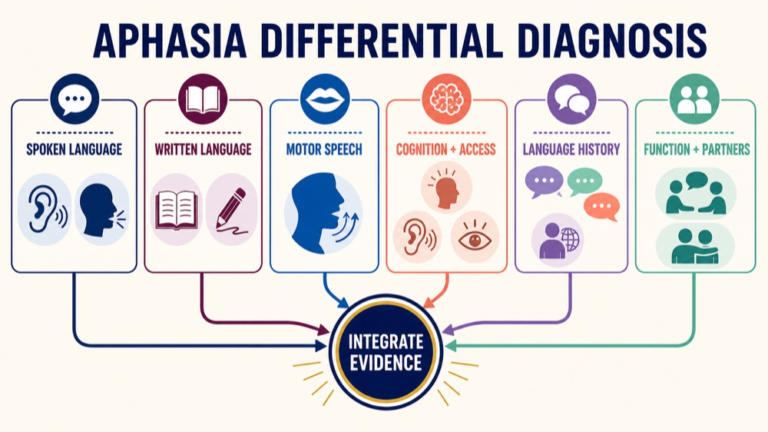
Spoken language
Naming, word retrieval, sentence formulation, repetition, discourse, and conversation sample expressive and receptive language in different ways.
What language process is changing?
Written language
Reading and writing can reveal language access and participation that spoken tasks do not fully sample.
Which written modality clarifies the question?
Motor speech
Dysarthria and apraxia may affect intelligibility or speech planning while language knowledge and comprehension require separate attention.
Is the breakdown in language, speech production, planning, or more than one domain?
Cognition and access
Attention, memory, executive demands, hearing, vision, fatigue, and communication access can change performance without being identical to aphasia.
Which conditions changed the response?
Language history
Multilingual use, dialect, literacy, culture, identity, and prior communication shape fair interpretation.
Is the observed difference unexpected within the person’s language profile?
Function and partners
Care-partner report, repair, supported conversation, and real-world participation show the communication impact.
What does the person need to communicate in daily life?
These domains interact, but they should remain distinguishable. A learner may show strength in one context and need support in another. A study map organizes the next observation; it does not answer every assessment question or establish a universal treatment, goal, or legal conclusion.
Keep the first pass descriptive and close to the communication event. Note the task, response, partner, setting, timing, available support, language or mode, and consequence for participation. This gives the learner a stable record to compare across tasks and prevents a familiar term from doing too much explanatory work before the evidence has been separated.
For Praxis-style review, a vignette may include several true details but ask for one best interpretation or next step. The strongest answer usually respects the task, identifies the relevant function or boundary, checks the most important missing information, and avoids treating one performance sample or policy phrase as the whole profile.
Map aphasia differential diagnosis
For study purposes, describe the communication relationship before naming a disorder, judging a partner, selecting a goal, or deciding that a task is within scope. Record what the person understood, expressed, initiated, repaired, coordinated, or participated in. Then note whether the task was familiar, how much context was shared, and which support changed the response.
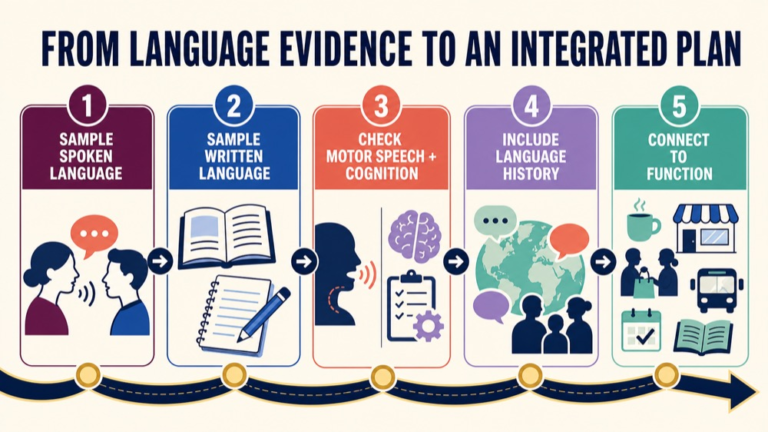
History: clarify onset, change, languages, literacy, education, medical context, prior communication, and current goals.
Language: sample spoken comprehension and expression, naming, discourse, repetition, reading, writing, and other meaningful modalities.
Motor speech: check intelligibility, prosody, articulation, planning, oral-motor findings, consistency, and task complexity as relevant.
Cognition and access: consider attention, memory, executive demand, hearing, vision, fatigue, sensory load, and communication supports.
Context: compare structured tasks, conversation, health-care communication, family routines, and partner-supported exchanges.
Integration: use the full pattern to describe aphasia, co-occurring concerns, uncertainty, referral, support, and participation needs.
A strong description is specific enough that another learner could picture the event. Instead of writing “the communication is impaired” or “the clinician can do this,” describe the demand, observable response, language or mode, partner, context, competence or access condition, and result. This protects clinical reasoning from labels that are broader than the evidence.
From language evidence to an integrated communication plan
Context changes what communication and professional decisions require. A direct question, long explanation, group exchange, classroom task, health-care interaction, family story, noisy routine, supervised procedure, or referral decision places different demands on processing, language, memory, hearing, access, partner behavior, competence, and regulation. Language experience, visual information, fatigue, health literacy, and the opportunity to request clarification should be part of the observation.
A person may struggle to name a pictured object but communicate its use with gesture, writing, or a partner-supported description. Another person may have clear language knowledge but reduced intelligibility because of dysarthria, or may produce effortful, segmented speech that raises a motor-planning question. A long health-care explanation may also expose attention or working-memory demand that a short comprehension item does not. The differential process keeps these observations connected while asking which evidence belongs to language and which requires another communication or professional lens.
Observation layer
Example question
Task
What did the person or clinician need to understand, express, organize, coordinate, decide, or provide?
Language and access
Which language, dialect, mode, hearing condition, tool, support, or communication partner was available?
Context and responsibility
Who was involved, what did they know, and which role, policy, ethical, or environmental factor mattered?
Participation and safety
What meaningful routine, role, outcome, or risk became easier or harder because of the pattern?
Context is not an afterthought added once a label has been selected. It is part of the question itself. If performance or decision quality changes with a quieter room, extra processing time, a familiar partner, a different language or mode, an interpreter, visual information, supervision, collaboration, a changed task, or a changed routine, that change is useful evidence about access and demand. It does not identify a cause by itself, but it tells you which conditions should be carried into the next observation.
Apply aphasia differential reasoning
When a Praxis-style scenario or clinical discussion presents aphasia differential diagnosis, use a disciplined sequence. The goal is to select the next clinical question or action that matches the evidence, the person’s priorities, the communication context, and the relevant professional boundary.
Define the task, language, mode, communication purpose, or service responsibility in plain language.
Identify the relevant domain: language, access, partner, participation, assessment, competence, collaboration, ethics, or regulation.
Separate observation from interpretation and write down what remains unknown.
Check history, exposure, dialect, culture, identity, interpreter access, environment, sensory load, memory, task familiarity, training, supervision, and local requirements as relevant.
Choose the assessment, collaboration, accommodation, goal, training, referral, or documentation step that answers the specific question.
State the boundary of the conclusion and keep the person’s safety, autonomy, access, and participation visible.
A person may struggle to name a pictured object but communicate its use with gesture, writing, or a partner-supported description. Another person may have clear language knowledge but reduced intelligibility because of dysarthria, or may produce effortful, segmented speech that raises a motor-planning question. A long health-care explanation may also expose attention or working-memory demand that a short comprehension item does not. The differential process keeps these observations connected while asking which evidence belongs to language and which requires another communication or professional lens. In a learning answer, the decisive evidence is usually the relationship among the task, the observed pattern, the context, and the next needed information—not a single isolated behavior, score, label, or broad permission statement.
Common study mistakes
Treating word-finding difficulty as enough evidence for aphasia without sampling comprehension, discourse, written language, and function.
Attributing every communication breakdown to aphasia while ignoring dysarthria, apraxia, cognition, hearing, vision, fatigue, and access.
Using one brief conversation or one standardized score as the full differential profile.
Testing only one language or literacy mode without documenting multilingual use, dialect, culture, interpreter access, and language history.
Confusing motor-speech intelligibility problems with language formulation or comprehension problems.
Assuming a language difference, accent, or culturally different discourse style is evidence of aphasia.
Using an aphasia label to make an independent medical prognosis or explain a neurologic cause beyond the communication evidence.
Failing to include the person’s communication goals, care partners, supported conversation, repair, and participation.
Most of these mistakes come from replacing a multidomain question with a fast label. Correct the habit by returning to the same sequence: describe, separate, contextualize, ask what is missing, and choose a proportionate next step. A short rationale can make the habit visible: identify the evidence, name the uncertainty, and explain why the selected next step fits the person, setting, and responsibility.
Build a quick review map
Use this compact map when reviewing a missed question, lecture note, or clinical vignette:
Step 1: Start with onset, language history, communication goals, partner needs, and meaningful settings.
Step 2: Sample spoken and written comprehension and expression, discourse, conversation, and supported communication as relevant.
Step 3: Separate language evidence from motor speech, cognition, hearing, vision, fatigue, and access factors.
Step 5: Compare structured findings with report, observation, samples, dynamic response, and functional participation.
Step 6: State whether the integrated evidence supports aphasia, a co-occurring pattern, an open question, or referral.
Then write one transfer sentence: “When I see this pattern, I will first check ___ because ___.” The sentence should identify a decision rule, not repeat a definition. Revisit it after a delay and test whether you can apply the rule to a different task, age group, partner, language, setting, or professional responsibility.
Sources and next steps
aphasia differential diagnosis is best learned as a context-sensitive pattern across communication, access, identity, function, participation, competence, and professional judgment. Use the current authority pages to refine the concept, then return to practice scenarios that require you to explain what the evidence supports and what it leaves open.
Differential Diagnosis in Speech-Language Pathology: Compare Patterns Fairly
differential diagnosis speech language pathology is easier to study when it is treated as a connected clinical reasoning problem rather than a label to memorize. Differential diagnosis in speech-language pathology is the disciplined process of comparing communication patterns, history, task conditions, and missing evidence so the SLP can describe or diagnose communication and swallowing disorders within scope. It separates screening from assessment, communication diagnosis from medical etiology, and a supported conclusion from a tempting label. Good differential reasoning integrates speech, language, cognition, fluency, voice, swallowing, hearing, culture, access, and participation rather than relying on one symptom.
This learning guide is written for SLP students and other learners reviewing clinical concepts. It organizes observation, access, assessment, function, and professional judgment; it does not make an individualized diagnosis or replace current professional guidance. Interpretation depends on the person, task, language, culture, health, access, partner, context, and communication goals.
What differential diagnosis means in SLP
Begin by separating the concept into domains. A learner who can name the domains is less likely to collapse language, access, partner, participation, competence, regulation, and clinical judgment into one explanation. The useful unit of analysis is the task: what the person was asked to understand, express, organize, coordinate, remember, or communicate, with whom, under which conditions, and with what support.
Domain or system
What to notice
Question to carry forward
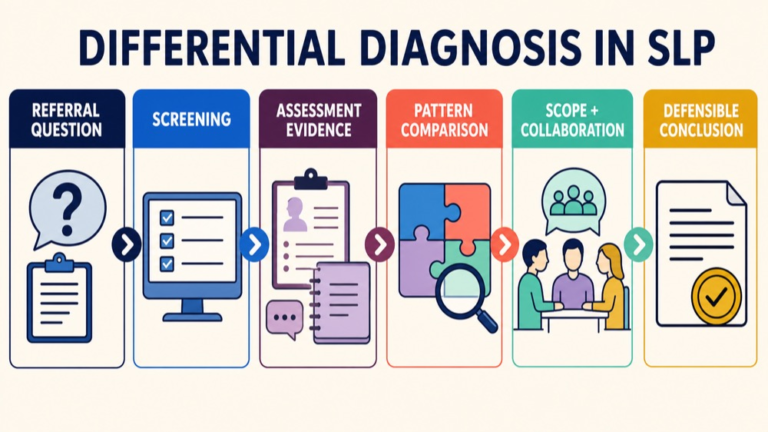
Referral question
The concern may involve speech, language, cognition, fluency, voice, swallowing, hearing, access, or participation.
What decision needs to be made?
Screening
A screen identifies whether more assessment or referral may be needed; it does not provide a full diagnosis.
What does the screen support next?
Assessment evidence
History, interviews, observation, samples, formal and informal measures, and functional tasks describe the pattern.
Which sources answer the question?
Pattern comparison
Compare features, context, onset, consistency, language, motor, cognition, hearing, and function across plausible explanations.
What fits, what conflicts, and what is missing?
Scope and collaboration
SLPs diagnose communication and swallowing disorders within competence and collaborate or refer for other questions.
Which professional or service must be involved?
Defensible conclusion
The result states supported findings, uncertainty, functional meaning, recommendations, and appropriate follow-up.
What can be concluded without overreach?
These domains interact, but they should remain distinguishable. A learner may show strength in one context and need support in another. A study map organizes the next observation; it does not answer every assessment question or establish a universal treatment, goal, or legal conclusion.
Keep the first pass descriptive and close to the communication event. Note the task, response, partner, setting, timing, available support, language or mode, and consequence for participation. This gives the learner a stable record to compare across tasks and prevents a familiar term from doing too much explanatory work before the evidence has been separated.
For Praxis-style review, a vignette may include several true details but ask for one best interpretation or next step. The strongest answer usually respects the task, identifies the relevant function or boundary, checks the most important missing information, and avoids treating one performance sample or policy phrase as the whole profile.
Map differential diagnosis in speech-language pathology
For study purposes, describe the communication relationship before naming a disorder, judging a partner, selecting a goal, or deciding that a task is within scope. Record what the person understood, expressed, initiated, repaired, coordinated, or participated in. Then note whether the task was familiar, how much context was shared, and which support changed the response.
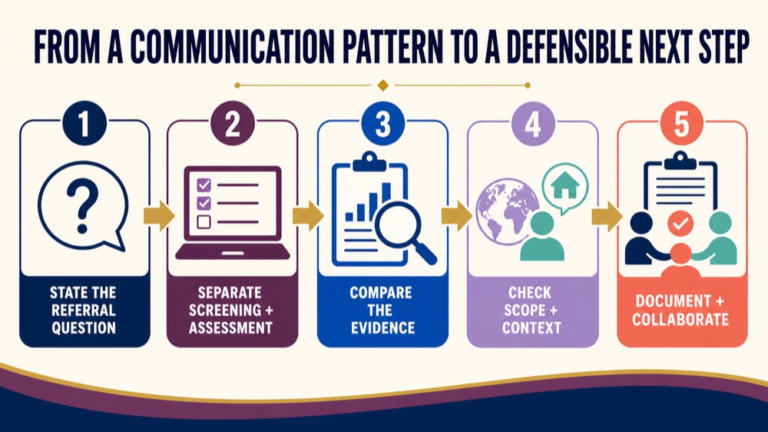
Question: define the referral concern, person, setting, communication activity, and decision the evaluation must inform.
Screening and assessment: separate a pass-or-refer screen from the evidence needed to characterize, diagnose, or plan.
Scope: distinguish communication or swallowing diagnosis from medical etiology, legal eligibility, payer rules, and another professional’s responsibility.
Integration: state supported findings, uncertainty, functional impact, collaboration, referral, safety, documentation, and the next question.
A strong description is specific enough that another learner could picture the event. Instead of writing “the communication is impaired” or “the clinician can do this,” describe the demand, observable response, language or mode, partner, context, competence or access condition, and result. This protects clinical reasoning from labels that are broader than the evidence.
From a communication pattern to a defensible next step
Context changes what communication and professional decisions require. A direct question, long explanation, group exchange, classroom task, health-care interaction, family story, noisy routine, supervised procedure, or referral decision places different demands on processing, language, memory, hearing, access, partner behavior, competence, and regulation. Language experience, visual information, fatigue, health literacy, and the opportunity to request clarification should be part of the observation.
A speaker with imprecise speech, pauses, word-finding difficulty, and reduced participation may have more than one relevant factor. The next step depends on onset, speech subsystems, language comprehension and expression, planning, cognition, hearing, context, and the person’s communication goals. A multilingual speaker may show a language difference that should not be treated as a disorder. A child may need a different comparison from an adult with an acquired condition. Differential diagnosis is therefore not a contest to select the fastest label; it is a transparent comparison of evidence and uncertainty within professional boundaries.
Observation layer
Example question
Task
What did the person or clinician need to understand, express, organize, coordinate, decide, or provide?
Language and access
Which language, dialect, mode, hearing condition, tool, support, or communication partner was available?
Context and responsibility
Who was involved, what did they know, and which role, policy, ethical, or environmental factor mattered?
Participation and safety
What meaningful routine, role, outcome, or risk became easier or harder because of the pattern?
Context is not an afterthought added once a label has been selected. It is part of the question itself. If performance or decision quality changes with a quieter room, extra processing time, a familiar partner, a different language or mode, an interpreter, visual information, supervision, collaboration, a changed task, or a changed routine, that change is useful evidence about access and demand. It does not identify a cause by itself, but it tells you which conditions should be carried into the next observation.
Apply differential-diagnosis reasoning
When a Praxis-style scenario or clinical discussion presents differential diagnosis speech language pathology, use a disciplined sequence. The goal is to select the next clinical question or action that matches the evidence, the person’s priorities, the communication context, and the relevant professional boundary.
Define the task, language, mode, communication purpose, or service responsibility in plain language.
Identify the relevant domain: language, access, partner, participation, assessment, competence, collaboration, ethics, or regulation.
Separate observation from interpretation and write down what remains unknown.
Check history, exposure, dialect, culture, identity, interpreter access, environment, sensory load, memory, task familiarity, training, supervision, and local requirements as relevant.
Choose the assessment, collaboration, accommodation, goal, training, referral, or documentation step that answers the specific question.
State the boundary of the conclusion and keep the person’s safety, autonomy, access, and participation visible.
A speaker with imprecise speech, pauses, word-finding difficulty, and reduced participation may have more than one relevant factor. The next step depends on onset, speech subsystems, language comprehension and expression, planning, cognition, hearing, context, and the person’s communication goals. A multilingual speaker may show a language difference that should not be treated as a disorder. A child may need a different comparison from an adult with an acquired condition. Differential diagnosis is therefore not a contest to select the fastest label; it is a transparent comparison of evidence and uncertainty within professional boundaries. In a learning answer, the decisive evidence is usually the relationship among the task, the observed pattern, the context, and the next needed information—not a single isolated behavior, score, label, or broad permission statement.
Common study mistakes
Treating a symptom, score, or familiar label as a diagnosis without defining the referral question and collecting complementary evidence.
Confusing screening, assessment, diagnosis, prognosis, treatment planning, eligibility, and medical diagnosis.
Comparing disorders by memorized hallmark signs while ignoring onset, co-occurrence, context, severity, variability, and functional impact.
Failing to distinguish aphasia, dysarthria, apraxia, cognitive-communication, speech sound, fluency, voice, hearing, and swallowing questions.
Interpreting language or pragmatic behavior without accounting for dialect, culture, multilingual development, identity, interpreter access, and norms.
Using an assessment procedure outside its construct or population fit and then treating the result as decisive.
Claiming a medical etiology, legal conclusion, or universal scope decision when the evidence and professional responsibility do not support it.
Failing to document uncertainty, missing information, collaboration, referral, consent, safety, functional impact, and the reason for the next step.
Most of these mistakes come from replacing a multidomain question with a fast label. Correct the habit by returning to the same sequence: describe, separate, contextualize, ask what is missing, and choose a proportionate next step. A short rationale can make the habit visible: identify the evidence, name the uncertainty, and explain why the selected next step fits the person, setting, and responsibility.
Build a quick review map
Use this compact map when reviewing a missed question, lecture note, or clinical vignette:
Step 1: State the referral question and separate screening, assessment, diagnosis, prognosis, and planning tasks.
Step 2: Map the relevant communication domains and compare history, symptoms, task performance, context, and co-occurring factors.
Step 3: Check language, dialect, culture, identity, access, hearing, vision, fatigue, health, familiarity, and support conditions.
Step 4: Use formal and informal measures, observation, interviews, samples, records, and functional evidence for the specific question.
Step 5: Decide what falls within SLP communication or swallowing scope and what needs interprofessional collaboration or referral.
Step 6: Write a conclusion that names evidence, uncertainty, functional impact, recommendations, and the next defensible action.
Then write one transfer sentence: “When I see this pattern, I will first check ___ because ___.” The sentence should identify a decision rule, not repeat a definition. Revisit it after a delay and test whether you can apply the rule to a different task, age group, partner, language, setting, or professional responsibility.
Sources and next steps
differential diagnosis speech language pathology is best learned as a context-sensitive pattern across communication, access, identity, function, participation, competence, and professional judgment. Use the current authority pages to refine the concept, then return to practice scenarios that require you to explain what the evidence supports and what it leaves open.
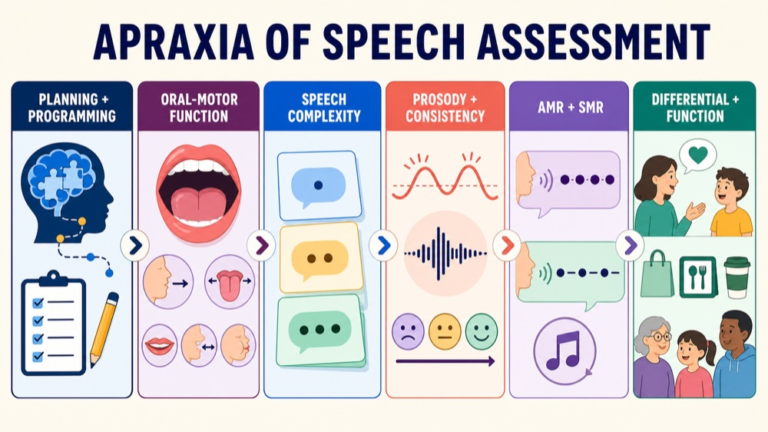
Apraxia of Speech Assessment: Planning, Programming, and Differential Reasoning
apraxia of speech assessment is easier to study when it is treated as a connected clinical reasoning problem rather than a label to memorize. Apraxia of speech assessment examines speech planning and programming alongside speech production, oral-motor structure and function, prosody, consistency, complexity, intelligibility, comprehensibility, and efficiency. The SLP compares automatic, imitated, repeated, and self-generated speech as appropriate while considering aphasia, dysarthria, hearing, vision, language, and context. AMR and SMR tasks can add evidence, but no single task or hallmark should carry the whole diagnostic conclusion.
This learning guide is written for SLP students and other learners reviewing clinical concepts. It organizes observation, access, assessment, function, and professional judgment; it does not make an individualized diagnosis or replace current professional guidance. Interpretation depends on the person, task, language, culture, health, access, partner, context, and communication goals.
What apraxia of speech assessment means
Begin by separating the concept into domains. A learner who can name the domains is less likely to collapse language, access, partner, participation, competence, regulation, and clinical judgment into one explanation. The useful unit of analysis is the task: what the person was asked to understand, express, organize, coordinate, remember, or communicate, with whom, under which conditions, and with what support.
Domain or system
What to notice
Question to carry forward
Planning and programming
AOS concerns the organization of phonetic and prosodic processes for speech, distinct from weakness-based execution questions.
What planning or programming demand is present?
Oral-motor structure and function
Structure, movement, strength, speed, range, steadiness, tone, accuracy, and coordination provide related but not identical evidence.
What does the oral and motor examination add?
Speech complexity
Words, syllables, phrases, sentences, reading, repetition, imitation, and spontaneous speech create different planning demands.
How does performance change with complexity and task?
Prosody and consistency
Stress, rate, voicing, resonance, articulation, groping, segmentation, and trial-to-trial variability help describe the speech pattern.
Which features are stable, variable, or context-dependent?
AMR and SMR
Alternating and sequential motion tasks can sample different planning and execution demands within a broader assessment.
What does this task contribute and what remains unknown?
Differential and function
AOS may co-occur with aphasia or dysarthria; findings must connect with intelligibility, participation, and referral.
Which explanation and next step fit the integrated pattern?
These domains interact, but they should remain distinguishable. A learner may show strength in one context and need support in another. A study map organizes the next observation; it does not answer every assessment question or establish a universal treatment, goal, or legal conclusion.
Keep the first pass descriptive and close to the communication event. Note the task, response, partner, setting, timing, available support, language or mode, and consequence for participation. This gives the learner a stable record to compare across tasks and prevents a familiar term from doing too much explanatory work before the evidence has been separated.
For Praxis-style review, a vignette may include several true details but ask for one best interpretation or next step. The strongest answer usually respects the task, identifies the relevant function or boundary, checks the most important missing information, and avoids treating one performance sample or policy phrase as the whole profile.
Map apraxia of speech assessment
For study purposes, describe the communication relationship before naming a disorder, judging a partner, selecting a goal, or deciding that a task is within scope. Record what the person understood, expressed, initiated, repaired, coordinated, or participated in. Then note whether the task was familiar, how much context was shared, and which support changed the response.
History: review onset, course, neurologic and medical context, prior motor or communication disorders, self-report, and communication goals.
Oral-motor: examine structure and function, movement accuracy, range, speed, tone, coordination, posture, hearing, vision, and access as relevant.
Speech tasks: compare automatic, imitated, repeated, reading, picture description, conversation, and self-generated speech across complexity.
Planning features: listen for inconsistency, groping, segmentation, prosody, stress, voicing, resonance, articulation, and trial-to-trial change.
Differential: consider aphasia, dysarthria, oral apraxia, hearing, language, cognition, motor execution, and task or context effects.
Function: connect intelligibility, comprehensibility, efficiency, partner support, AAC, participation, referral, and the person’s priorities.
A strong description is specific enough that another learner could picture the event. Instead of writing “the communication is impaired” or “the clinician can do this,” describe the demand, observable response, language or mode, partner, context, competence or access condition, and result. This protects clinical reasoning from labels that are broader than the evidence.
From motor-speech evidence to a focused clinical plan
Context changes what communication and professional decisions require. A direct question, long explanation, group exchange, classroom task, health-care interaction, family story, noisy routine, supervised procedure, or referral decision places different demands on processing, language, memory, hearing, access, partner behavior, competence, and regulation. Language experience, visual information, fatigue, health literacy, and the opportunity to request clarification should be part of the observation.
A person may produce a familiar automatic sequence more easily than a novel multisyllabic word, or may repeat a word differently across trials while also having language difficulty. Another person may show slow but rhythmic speech that raises a different motor question. AOS assessment needs enough variation in task, complexity, context, and response mode to examine planning and programming without mistaking every speech sound error for apraxia. The interpretation becomes stronger when speech, oral-motor, language, neurologic, hearing, and functional evidence are kept connected but not collapsed.
Observation layer
Example question
Task
What did the person or clinician need to understand, express, organize, coordinate, decide, or provide?
Language and access
Which language, dialect, mode, hearing condition, tool, support, or communication partner was available?
Context and responsibility
Who was involved, what did they know, and which role, policy, ethical, or environmental factor mattered?
Participation and safety
What meaningful routine, role, outcome, or risk became easier or harder because of the pattern?
Context is not an afterthought added once a label has been selected. It is part of the question itself. If performance or decision quality changes with a quieter room, extra processing time, a familiar partner, a different language or mode, an interpreter, visual information, supervision, collaboration, a changed task, or a changed routine, that change is useful evidence about access and demand. It does not identify a cause by itself, but it tells you which conditions should be carried into the next observation.
Apply apraxia-assessment reasoning
When a Praxis-style scenario or clinical discussion presents apraxia of speech assessment, use a disciplined sequence. The goal is to select the next clinical question or action that matches the evidence, the person’s priorities, the communication context, and the relevant professional boundary.
Define the task, language, mode, communication purpose, or service responsibility in plain language.
Identify the relevant domain: language, access, partner, participation, assessment, competence, collaboration, ethics, or regulation.
Separate observation from interpretation and write down what remains unknown.
Check history, exposure, dialect, culture, identity, interpreter access, environment, sensory load, memory, task familiarity, training, supervision, and local requirements as relevant.
Choose the assessment, collaboration, accommodation, goal, training, referral, or documentation step that answers the specific question.
State the boundary of the conclusion and keep the person’s safety, autonomy, access, and participation visible.
A person may produce a familiar automatic sequence more easily than a novel multisyllabic word, or may repeat a word differently across trials while also having language difficulty. Another person may show slow but rhythmic speech that raises a different motor question. AOS assessment needs enough variation in task, complexity, context, and response mode to examine planning and programming without mistaking every speech sound error for apraxia. The interpretation becomes stronger when speech, oral-motor, language, neurologic, hearing, and functional evidence are kept connected but not collapsed. In a learning answer, the decisive evidence is usually the relationship among the task, the observed pattern, the context, and the next needed information—not a single isolated behavior, score, label, or broad permission statement.
Common study mistakes
Treating any inconsistent speech sound error as apraxia of speech without assessing planning, programming, prosody, complexity, and context.
Using AMR or SMR performance as an isolated diagnostic test instead of one piece of a broader motor-speech assessment.
Confusing motor planning and programming with weakness, incoordination, phonological organization, articulation, or language formulation.
Sampling only automatic speech or only a short word list and missing novel, imitated, connected, and self-generated speech.
Assuming a person who can produce one sound or word can use the same plan in conversation, longer utterances, or a new context.
Interpreting a motor-speech pattern without considering language, dialect, culture, multilingual use, and communication partner needs.
Failing to connect the differential conclusion with intelligibility, comprehensibility, efficiency, participation, support, and referral.
Most of these mistakes come from replacing a multidomain question with a fast label. Correct the habit by returning to the same sequence: describe, separate, contextualize, ask what is missing, and choose a proportionate next step. A short rationale can make the habit visible: identify the evidence, name the uncertainty, and explain why the selected next step fits the person, setting, and responsibility.
Build a quick review map
Use this compact map when reviewing a missed question, lecture note, or clinical vignette:
Step 1: Define the motor-speech question, onset, communication goal, and relevant history.
Step 2: Sample speech and oral-motor performance across complexity, imitation, repetition, automaticity, and self-generated communication.
Step 3: Describe planning, programming, prosody, consistency, groping, articulation, voicing, and context rather than naming a hallmark alone.
Step 4: Check aphasia, dysarthria, oral apraxia, hearing, vision, cognition, fatigue, access, and language factors.
Step 5: Use AMR and SMR evidence within the full assessment and state what those tasks cannot establish alone.
Step 6: Connect the integrated pattern with communication support, referral, participation, and the person’s next meaningful goal.
Then write one transfer sentence: “When I see this pattern, I will first check ___ because ___.” The sentence should identify a decision rule, not repeat a definition. Revisit it after a delay and test whether you can apply the rule to a different task, age group, partner, language, setting, or professional responsibility.
Sources and next steps
apraxia of speech assessment is best learned as a context-sensitive pattern across communication, access, identity, function, participation, competence, and professional judgment. Use the current authority pages to refine the concept, then return to practice scenarios that require you to explain what the evidence supports and what it leaves open.
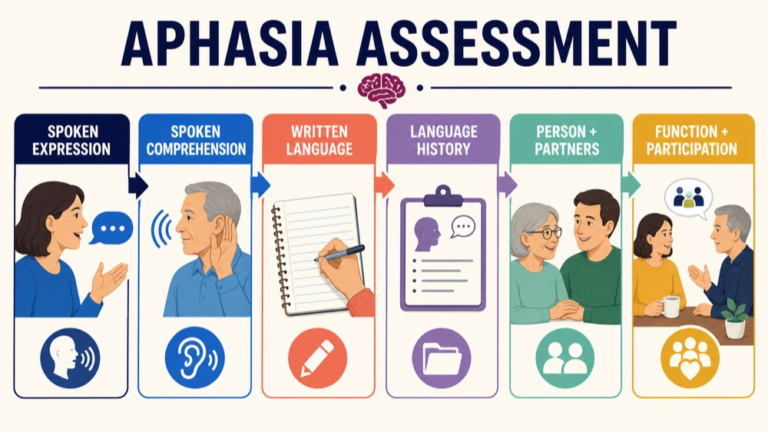
Aphasia Assessment: Spoken, Written, and Functional Language Evidence
aphasia assessment is easier to study when it is treated as a connected clinical reasoning problem rather than a label to memorize. Aphasia assessment examines acquired language changes across spoken expression, spoken comprehension, written expression, and reading comprehension while connecting the findings with the person’s goals and daily communication. The SLP considers history, language use, culture, communication partners, functional impact, and other communication systems. A language score is one source of evidence; the assessment should explain what the person can do, where communication breaks down, what support helps, and which questions need collaboration or referral.
This learning guide is written for SLP students and other learners reviewing clinical concepts. It organizes observation, access, assessment, function, and professional judgment; it does not make an individualized diagnosis or replace current professional guidance. Interpretation depends on the person, task, language, culture, health, access, partner, context, and communication goals.
What aphasia assessment means
Begin by separating the concept into domains. A learner who can name the domains is less likely to collapse language, access, partner, participation, competence, regulation, and clinical judgment into one explanation. The useful unit of analysis is the task: what the person was asked to understand, express, organize, coordinate, remember, or communicate, with whom, under which conditions, and with what support.
Domain or system
What to notice
Question to carry forward
Spoken expression
Naming, word retrieval, sentence formulation, discourse, repetition, and conversation can reveal different aspects of expressive language.
What does the person want to express, and where does formulation change?
Spoken comprehension
Understanding words, sentences, discourse, questions, and conversation requires attention to task, context, and support.
What message was available and what was understood?
Written language
Writing and reading can add evidence about language access and participation beyond spoken tasks.
Which written modalities matter to the person’s life?
History and language
Onset, medical history, premorbid language, multilingual use, education, identity, and communication routines shape interpretation.
What language history and change must be represented?
Function and partners
Self-report, care-partner perspective, repair, supported conversation, and participation show what communication means in context.
What helps the person communicate with important partners?
Integrated result
Assessment may describe characteristics, severity, functional impact, prognosis, recommendations, and referral needs.
What conclusion and next step fit the evidence?
These domains interact, but they should remain distinguishable. A learner may show strength in one context and need support in another. A study map organizes the next observation; it does not answer every assessment question or establish a universal treatment, goal, or legal conclusion.
Keep the first pass descriptive and close to the communication event. Note the task, response, partner, setting, timing, available support, language or mode, and consequence for participation. This gives the learner a stable record to compare across tasks and prevents a familiar term from doing too much explanatory work before the evidence has been separated.
For Praxis-style review, a vignette may include several true details but ask for one best interpretation or next step. The strongest answer usually respects the task, identifies the relevant function or boundary, checks the most important missing information, and avoids treating one performance sample or policy phrase as the whole profile.
Map aphasia assessment
For study purposes, describe the communication relationship before naming a disorder, judging a partner, selecting a goal, or deciding that a task is within scope. Record what the person understood, expressed, initiated, repaired, coordinated, or participated in. Then note whether the task was familiar, how much context was shared, and which support changed the response.
History: clarify onset, change, medical context, prior communication, languages, literacy, education, work, and current goals.
Expression: sample naming, repetition, sentence formulation, discourse, writing, gestures, drawing, AAC, and repair as relevant.
Comprehension: examine words, sentences, discourse, questions, written material, partner support, and the difference between task and daily understanding.
Context: document language, dialect, culture, hearing, vision, fatigue, motor access, partner, environment, and communication demand.
Function: ask about relationships, health care, work, learning, self-advocacy, identity, participation, confidence, and care-partner strategies.
Integration: distinguish aphasia from co-occurring dysarthria, apraxia, cognitive-communication, hearing, or other concerns and refer as needed.
A strong description is specific enough that another learner could picture the event. Instead of writing “the communication is impaired” or “the clinician can do this,” describe the demand, observable response, language or mode, partner, context, competence or access condition, and result. This protects clinical reasoning from labels that are broader than the evidence.
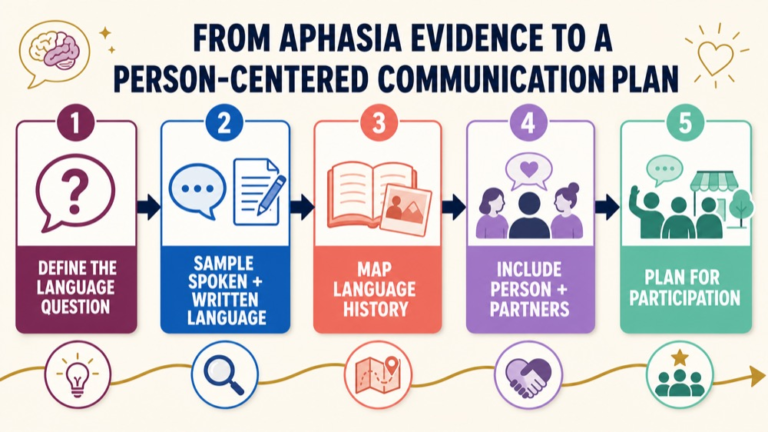
From aphasia evidence to a person-centered communication plan
Context changes what communication and professional decisions require. A direct question, long explanation, group exchange, classroom task, health-care interaction, family story, noisy routine, supervised procedure, or referral decision places different demands on processing, language, memory, hearing, access, partner behavior, competence, and regulation. Language experience, visual information, fatigue, health literacy, and the opportunity to request clarification should be part of the observation.
A person may retrieve a word during a picture task but struggle to explain a problem on the phone, or understand a short question but lose meaning in a long health-care conversation. Writing, gesture, drawing, communication books, and partner-supported conversation may reveal strengths that a spoken naming task misses. A multilingual person may use languages differently across family, work, and community settings. Aphasia assessment therefore combines structured language evidence with the person’s lived communication, care-partner knowledge, language history, and the tasks that matter most.
Observation layer
Example question
Task
What did the person or clinician need to understand, express, organize, coordinate, decide, or provide?
Language and access
Which language, dialect, mode, hearing condition, tool, support, or communication partner was available?
Context and responsibility
Who was involved, what did they know, and which role, policy, ethical, or environmental factor mattered?
Participation and safety
What meaningful routine, role, outcome, or risk became easier or harder because of the pattern?
Context is not an afterthought added once a label has been selected. It is part of the question itself. If performance or decision quality changes with a quieter room, extra processing time, a familiar partner, a different language or mode, an interpreter, visual information, supervision, collaboration, a changed task, or a changed routine, that change is useful evidence about access and demand. It does not identify a cause by itself, but it tells you which conditions should be carried into the next observation.
Apply aphasia-assessment reasoning
When a Praxis-style scenario or clinical discussion presents aphasia assessment, use a disciplined sequence. The goal is to select the next clinical question or action that matches the evidence, the person’s priorities, the communication context, and the relevant professional boundary.
Define the task, language, mode, communication purpose, or service responsibility in plain language.
Identify the relevant domain: language, access, partner, participation, assessment, competence, collaboration, ethics, or regulation.
Separate observation from interpretation and write down what remains unknown.
Check history, exposure, dialect, culture, identity, interpreter access, environment, sensory load, memory, task familiarity, training, supervision, and local requirements as relevant.
Choose the assessment, collaboration, accommodation, goal, training, referral, or documentation step that answers the specific question.
State the boundary of the conclusion and keep the person’s safety, autonomy, access, and participation visible.
A person may retrieve a word during a picture task but struggle to explain a problem on the phone, or understand a short question but lose meaning in a long health-care conversation. Writing, gesture, drawing, communication books, and partner-supported conversation may reveal strengths that a spoken naming task misses. A multilingual person may use languages differently across family, work, and community settings. Aphasia assessment therefore combines structured language evidence with the person’s lived communication, care-partner knowledge, language history, and the tasks that matter most. In a learning answer, the decisive evidence is usually the relationship among the task, the observed pattern, the context, and the next needed information—not a single isolated behavior, score, label, or broad permission statement.
Common study mistakes
Treating aphasia assessment as naming alone or using one language task as the complete language profile.
Ignoring spoken comprehension, written expression, reading, discourse, conversation, gesture, repair, and other meaningful communication modes.
Confusing a language impairment with cognitive impairment or assuming aphasia automatically explains every attention, memory, or behavior concern.
Testing only the dominant or easiest language without documenting language history, multilingual use, dialect, interpreter access, and daily needs.
Focusing on errors while missing strengths, self-advocacy, partner support, compensatory strategies, identity, and participation priorities.
Assuming a brief clinic task predicts phone calls, health-care conversations, work, family interaction, reading, writing, or community participation.
Using a score or label to make a medical prognosis or treatment decision without integrating history, function, and appropriate collaboration.
Failing to include the person and care partners in goals, interpretation, recommendations, referrals, and communication planning.
Most of these mistakes come from replacing a multidomain question with a fast label. Correct the habit by returning to the same sequence: describe, separate, contextualize, ask what is missing, and choose a proportionate next step. A short rationale can make the habit visible: identify the evidence, name the uncertainty, and explain why the selected next step fits the person, setting, and responsibility.
Build a quick review map
Use this compact map when reviewing a missed question, lecture note, or clinical vignette:
Step 1: Start with onset, language history, communication goals, care partners, and the settings that matter to the person.
Step 2: Sample spoken expression, comprehension, written language, discourse, conversation, and supported communication as relevant.
Step 3: Separate language evidence from attention, memory, motor speech, hearing, vision, and access factors.
Step 4: Interpret each task within language, culture, dialect, fatigue, partner, context, and participation conditions.
Step 5: Compare structured findings with self-report, care-partner report, observation, functional tasks, and other assessment sources.
Step 6: Choose a person-centered support, referral, collaboration, monitoring, or intervention direction that matches the evidence.
Then write one transfer sentence: “When I see this pattern, I will first check ___ because ___.” The sentence should identify a decision rule, not repeat a definition. Revisit it after a delay and test whether you can apply the rule to a different task, age group, partner, language, setting, or professional responsibility.
Sources and next steps
aphasia assessment is best learned as a context-sensitive pattern across communication, access, identity, function, participation, competence, and professional judgment. Use the current authority pages to refine the concept, then return to practice scenarios that require you to explain what the evidence supports and what it leaves open.
Cognitive Communication Assessment: Attention, Strategy, and Participation
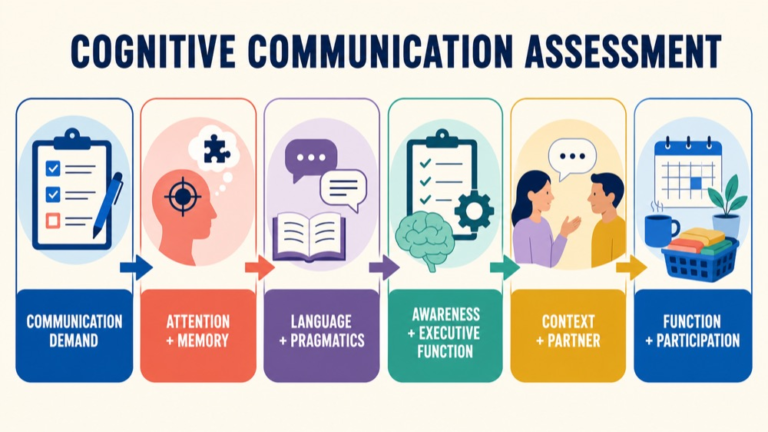
cognitive communication assessment is easier to study when it is treated as a connected clinical reasoning problem rather than a label to memorize. Cognitive communication assessment examines how cognition interacts with communication in meaningful tasks. The SLP may consider attention, memory, awareness, organization, executive function, pragmatics, language, problem solving, and partner support while asking what the person needs to do in daily life. It is not a stand-alone memory quiz: the meaning comes from the relationship among the task, observed communication, context, support, and participation.
This learning guide is written for SLP students and other learners reviewing clinical concepts. It organizes observation, access, assessment, function, and professional judgment; it does not make an individualized diagnosis or replace current professional guidance. Interpretation depends on the person, task, language, culture, health, access, partner, context, and communication goals.
What cognitive communication assessment means
Begin by separating the concept into domains. A learner who can name the domains is less likely to collapse language, access, partner, participation, competence, regulation, and clinical judgment into one explanation. The useful unit of analysis is the task: what the person was asked to understand, express, organize, coordinate, remember, or communicate, with whom, under which conditions, and with what support.
Domain or system
What to notice
Question to carry forward
Communication demand
A task may require attention, memory, organization, inference, problem solving, language, pragmatics, or self-monitoring.
What did the person need to understand or communicate?
Cognitive process
Attention, memory, awareness, initiation, flexibility, planning, and executive control can shape communication in different ways.
Which process is relevant to this task?
Language relationship
Language and cognition overlap but remain distinguishable; a language breakdown is not automatically a cognitive breakdown.
What evidence separates the domains?
Context and partner
Familiarity, noise, time, visual information, partner behavior, and routine change the opportunity to communicate.
Which conditions support or challenge performance?
Functional outcome
Communication is connected with learning, work, relationships, safety, self-advocacy, and participation.
What meaningful activity is affected?
Integration and referral
Observation, report, formal measures, dynamic response, and collaboration guide the next assessment or support.
What does the pattern support, and what remains open?
These domains interact, but they should remain distinguishable. A learner may show strength in one context and need support in another. A study map organizes the next observation; it does not answer every assessment question or establish a universal treatment, goal, or legal conclusion.
Keep the first pass descriptive and close to the communication event. Note the task, response, partner, setting, timing, available support, language or mode, and consequence for participation. This gives the learner a stable record to compare across tasks and prevents a familiar term from doing too much explanatory work before the evidence has been separated.
For Praxis-style review, a vignette may include several true details but ask for one best interpretation or next step. The strongest answer usually respects the task, identifies the relevant function or boundary, checks the most important missing information, and avoids treating one performance sample or policy phrase as the whole profile.
Map cognitive communication assessment
For study purposes, describe the communication relationship before naming a disorder, judging a partner, selecting a goal, or deciding that a task is within scope. Record what the person understood, expressed, initiated, repaired, coordinated, or participated in. Then note whether the task was familiar, how much context was shared, and which support changed the response.
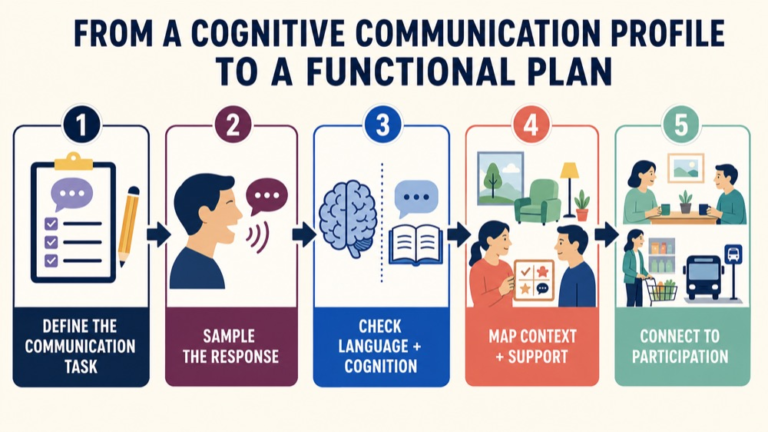
Question: define the communication task, participation concern, and decision the assessment should inform.
Cognition: examine attention, memory, awareness, initiation, organization, flexibility, planning, inhibition, and problem solving as relevant.
Language and pragmatics: distinguish comprehension, expression, discourse, inference, turn-taking, nonverbal cues, and social meaning from cognitive processes.
Context: document partner, setting, noise, time pressure, familiarity, language, visual information, fatigue, health, and available support.
Evidence: combine interview, self-report, care-partner report, observation, formal and informal measures, language samples, and functional tasks.
Integration: connect the pattern with participation, safety, autonomy, referral, collaboration, compensatory support, and the person’s goals.
A strong description is specific enough that another learner could picture the event. Instead of writing “the communication is impaired” or “the clinician can do this,” describe the demand, observable response, language or mode, partner, context, competence or access condition, and result. This protects clinical reasoning from labels that are broader than the evidence.
From a cognitive communication profile to a functional plan
Context changes what communication and professional decisions require. A direct question, long explanation, group exchange, classroom task, health-care interaction, family story, noisy routine, supervised procedure, or referral decision places different demands on processing, language, memory, hearing, access, partner behavior, competence, and regulation. Language experience, visual information, fatigue, health literacy, and the opportunity to request clarification should be part of the observation.
A person may recall information in a quiet conversation yet lose the thread during a rapid group exchange, or may understand a message but have difficulty organizing a response under time pressure. Another person may show a strong structured score while missing implied meaning, self-monitoring a breakdown, or asking for help in a busy routine. These patterns are not contradictions. They show why cognitive communication assessment keeps task, language, partner, environment, and participation visible instead of assigning the whole explanation to one score or label.
Observation layer
Example question
Task
What did the person or clinician need to understand, express, organize, coordinate, decide, or provide?
Language and access
Which language, dialect, mode, hearing condition, tool, support, or communication partner was available?
Context and responsibility
Who was involved, what did they know, and which role, policy, ethical, or environmental factor mattered?
Participation and safety
What meaningful routine, role, outcome, or risk became easier or harder because of the pattern?
Context is not an afterthought added once a label has been selected. It is part of the question itself. If performance or decision quality changes with a quieter room, extra processing time, a familiar partner, a different language or mode, an interpreter, visual information, supervision, collaboration, a changed task, or a changed routine, that change is useful evidence about access and demand. It does not identify a cause by itself, but it tells you which conditions should be carried into the next observation.
Apply cognitive-communication reasoning
When a Praxis-style scenario or clinical discussion presents cognitive communication assessment, use a disciplined sequence. The goal is to select the next clinical question or action that matches the evidence, the person’s priorities, the communication context, and the relevant professional boundary.
Define the task, language, mode, communication purpose, or service responsibility in plain language.
Identify the relevant domain: language, access, partner, participation, assessment, competence, collaboration, ethics, or regulation.
Separate observation from interpretation and write down what remains unknown.
Check history, exposure, dialect, culture, identity, interpreter access, environment, sensory load, memory, task familiarity, training, supervision, and local requirements as relevant.
Choose the assessment, collaboration, accommodation, goal, training, referral, or documentation step that answers the specific question.
State the boundary of the conclusion and keep the person’s safety, autonomy, access, and participation visible.
A person may recall information in a quiet conversation yet lose the thread during a rapid group exchange, or may understand a message but have difficulty organizing a response under time pressure. Another person may show a strong structured score while missing implied meaning, self-monitoring a breakdown, or asking for help in a busy routine. These patterns are not contradictions. They show why cognitive communication assessment keeps task, language, partner, environment, and participation visible instead of assigning the whole explanation to one score or label. In a learning answer, the decisive evidence is usually the relationship among the task, the observed pattern, the context, and the next needed information—not a single isolated behavior, score, label, or broad permission statement.
Common study mistakes
Reducing cognitive communication assessment to a memory or attention worksheet without examining communication in meaningful activity.
Treating language, cognition, pragmatics, and executive function as interchangeable labels rather than related but distinguishable domains.
Assuming one structured task represents communication in groups, work, school, health care, home, or community routines.
Ignoring awareness, self-report, partner report, initiation, repair, strategy use, and the person’s own communication priorities.
Interpreting culturally different pragmatic norms, eye contact, turn-taking, or narrative style as deficits without linguistic and cultural context.
Overlooking hearing, vision, fatigue, medication, motor access, language exposure, health, sensory load, and environmental demand.
Using a cognitive-communication observation to claim a medical etiology or a complete prognosis without appropriate collaboration.
Failing to connect findings with functional supports, safety, autonomy, participation, referral, and care-partner training.
Most of these mistakes come from replacing a multidomain question with a fast label. Correct the habit by returning to the same sequence: describe, separate, contextualize, ask what is missing, and choose a proportionate next step. A short rationale can make the habit visible: identify the evidence, name the uncertainty, and explain why the selected next step fits the person, setting, and responsibility.
Build a quick review map
Use this compact map when reviewing a missed question, lecture note, or clinical vignette:
Step 1: Define the real communication task and the meaningful participation concern.
Step 2: Separate the observed response from hypotheses about attention, memory, language, executive function, pragmatics, or awareness.
Step 3: Check partner, language, culture, access, fatigue, health, environment, familiarity, and support conditions.
Step 5: State what the evidence supports and which medical, neuropsychological, audiologic, or team question remains open.
Step 6: Choose the next support, referral, collaboration, compensatory strategy, or monitoring step that protects participation.
Then write one transfer sentence: “When I see this pattern, I will first check ___ because ___.” The sentence should identify a decision rule, not repeat a definition. Revisit it after a delay and test whether you can apply the rule to a different task, age group, partner, language, setting, or professional responsibility.
Sources and next steps
cognitive communication assessment is best learned as a context-sensitive pattern across communication, access, identity, function, participation, competence, and professional judgment. Use the current authority pages to refine the concept, then return to practice scenarios that require you to explain what the evidence supports and what it leaves open.
AAC Evaluation: Start With Communication, Access, and Participation
aac evaluation is easier to study when it is treated as a connected clinical reasoning problem rather than a label to memorize. AAC evaluation is a comprehensive process for understanding how a person communicates, what they want to communicate, where communication breaks down, and which supports may strengthen access and participation. The SLP considers case history, ecological inventory, self-report, communication partners, language, cognition, sensory and motor access, hearing, symbols, display or system features, trials, and follow-up. The evaluation is not a device-shopping exercise and does not require abandoning speech, gesture, writing, or other communication modes.
This learning guide is written for SLP students and other learners reviewing clinical concepts. It organizes observation, access, assessment, function, and professional judgment; it does not make an individualized diagnosis or replace current professional guidance. Interpretation depends on the person, task, language, culture, health, access, partner, context, and communication goals.
What AAC evaluation means
Begin by separating the concept into domains. A learner who can name the domains is less likely to collapse language, access, partner, participation, competence, regulation, and clinical judgment into one explanation. The useful unit of analysis is the task: what the person was asked to understand, express, organize, coordinate, remember, or communicate, with whom, under which conditions, and with what support.
Domain or system
What to notice
Question to carry forward
Communication purpose
The evaluation starts with messages, relationships, routines, decisions, preferences, self-advocacy, and participation outcomes.
What does the person need and want to communicate?
Ecological inventory
Home, school, work, health care, community, social, and technology contexts create different communication opportunities and barriers.
Where does communication need to work?
Person and partners
Self-report, family, care partners, teachers, employers, and other communication partners add perspectives on success, breakdown, goals, and support.
Whose priorities and routines must be represented?
Access and language
Vision, hearing, motor status, positioning, regulation, cognition, language, literacy, symbols, and access method shape system fit.
How can the person access and express messages?
Feature and system trials
Symbols, vocabulary, display, selection method, portability, voice or output, partner support, and task fit are tested in meaningful activities.
What works in the person’s real communication?
Implementation and follow-up
AAC success depends on communication partners, training, programming, technical support, modification, monitoring, and evolving needs.
How will the system remain useful over time?
These domains interact, but they should remain distinguishable. A learner may show strength in one context and need support in another. A study map organizes the next observation; it does not answer every assessment question or establish a universal treatment, goal, or legal conclusion.
Keep the first pass descriptive and close to the communication event. Note the task, response, partner, setting, timing, available support, language or mode, and consequence for participation. This gives the learner a stable record to compare across tasks and prevents a familiar term from doing too much explanatory work before the evidence has been separated.
For Praxis-style review, a vignette may include several true details but ask for one best interpretation or next step. The strongest answer usually respects the task, identifies the relevant function or boundary, checks the most important missing information, and avoids treating one performance sample or policy phrase as the whole profile.
Map AAC evaluation
For study purposes, describe the communication relationship before naming a disorder, judging a partner, selecting a goal, or deciding that a task is within scope. Record what the person understood, expressed, initiated, repaired, coordinated, or participated in. Then note whether the task was familiar, how much context was shared, and which support changed the response.
Ecology: observe communication across home, school, work, health care, community, social, and technology contexts.
Person and partners: gather self-report and partner perspectives on strengths, breakdowns, preferences, language, and support routines.
Access: examine vision, hearing, motor status, positioning, regulation, cognition, language, literacy, symbols, and selection method.
Trial: compare vocabulary, symbols, display, output, portability, access, partner strategies, and system features during real activities.
Follow-up: plan training, programming, technical support, modification, data, cultural and linguistic fit, and review as needs change.
A strong description is specific enough that another learner could picture the event. Instead of writing “the communication is impaired” or “the clinician can do this,” describe the demand, observable response, language or mode, partner, context, competence or access condition, and result. This protects clinical reasoning from labels that are broader than the evidence.
From communication needs to a fitted AAC plan
Context changes what communication and professional decisions require. A direct question, long explanation, group exchange, classroom task, health-care interaction, family story, noisy routine, supervised procedure, or referral decision places different demands on processing, language, memory, hearing, access, partner behavior, competence, and regulation. Language experience, visual information, fatigue, health literacy, and the opportunity to request clarification should be part of the observation.
A person may communicate successfully with a familiar partner at home but need a faster way to answer in class, request help at work, describe pain in health care, or participate in a group conversation. Another person may use speech, gesture, writing, signs, facial expression, and a device together. An AAC evaluation makes those modes visible and asks what support improves communication in each setting. A system that looks impressive in a clinic but cannot be reached, understood, carried, programmed, or supported in daily life is not a good fit. Trials and partner collaboration matter.
Observation layer
Example question
Task
What did the person or clinician need to understand, express, organize, coordinate, decide, or provide?
Language and access
Which language, dialect, mode, hearing condition, tool, support, or communication partner was available?
Context and responsibility
Who was involved, what did they know, and which role, policy, ethical, or environmental factor mattered?
Participation and safety
What meaningful routine, role, outcome, or risk became easier or harder because of the pattern?
Context is not an afterthought added once a label has been selected. It is part of the question itself. If performance or decision quality changes with a quieter room, extra processing time, a familiar partner, a different language or mode, an interpreter, visual information, supervision, collaboration, a changed task, or a changed routine, that change is useful evidence about access and demand. It does not identify a cause by itself, but it tells you which conditions should be carried into the next observation.
Apply AAC-evaluation reasoning
When a Praxis-style scenario or clinical discussion presents aac evaluation, use a disciplined sequence. The goal is to select the next clinical question or action that matches the evidence, the person’s priorities, the communication context, and the relevant professional boundary.
Define the task, language, mode, communication purpose, or service responsibility in plain language.
Identify the relevant domain: language, access, partner, participation, assessment, competence, collaboration, ethics, or regulation.
Separate observation from interpretation and write down what remains unknown.
Check history, exposure, dialect, culture, identity, interpreter access, environment, sensory load, memory, task familiarity, training, supervision, and local requirements as relevant.
Choose the assessment, collaboration, accommodation, goal, training, referral, or documentation step that answers the specific question.
State the boundary of the conclusion and keep the person’s safety, autonomy, access, and participation visible.
A person may communicate successfully with a familiar partner at home but need a faster way to answer in class, request help at work, describe pain in health care, or participate in a group conversation. Another person may use speech, gesture, writing, signs, facial expression, and a device together. An AAC evaluation makes those modes visible and asks what support improves communication in each setting. A system that looks impressive in a clinic but cannot be reached, understood, carried, programmed, or supported in daily life is not a good fit. Trials and partner collaboration matter. In a learning answer, the decisive evidence is usually the relationship among the task, the observed pattern, the context, and the next needed information—not a single isolated behavior, score, label, or broad permission statement.
Common study mistakes
Starting with a preferred device or app before defining the person’s messages, communication partners, routines, language, and participation needs.
Treating a single language, cognition, motor, or symbol task as sufficient evidence for a comprehensive AAC recommendation.
Ignoring communication that already works through speech, gesture, sign, writing, facial expression, partner interpretation, or other modes.
Choosing symbols or vocabulary without considering language, culture, identity, literacy, age, experience, context, and the person’s preferences.
Testing access in a quiet clinic but not observing positioning, fatigue, regulation, speed, noise, partner behavior, and real daily activities.
Failing to include the person and communication partners in decisions or assuming the clinician alone can predict system success.
Treating AAC as a one-time purchase instead of an ongoing process of programming, training, technical support, trial, modification, and follow-up.
Assuming AAC prevents speech or setting goals that measure device use without measuring meaningful communication, autonomy, and participation.
Most of these mistakes come from replacing a multidomain question with a fast label. Correct the habit by returning to the same sequence: describe, separate, contextualize, ask what is missing, and choose a proportionate next step. A short rationale can make the habit visible: identify the evidence, name the uncertainty, and explain why the selected next step fits the person, setting, and responsibility.
Build a quick review map
Use this compact map when reviewing a missed question, lecture note, or clinical vignette:
Step 1: Start with the person’s communication goals, messages, relationships, routines, identity, and participation priorities.
Step 2: Map communication opportunities and breakdowns across real home, school, work, health-care, community, and social contexts.
Step 3: Gather person and partner perspectives and document language, literacy, hearing, vision, motor, cognitive, sensory, and regulation factors.
Step 4: Trial symbols, vocabulary, access methods, display, output, portability, and partner supports during meaningful activities.
Step 5: Check cultural and linguistic fit, training, programming, technical support, privacy, autonomy, and safety.
Step 6: Create a follow-up plan that adapts the system as the person’s skills, contexts, partners, and goals change.
Then write one transfer sentence: “When I see this pattern, I will first check ___ because ___.” The sentence should identify a decision rule, not repeat a definition. Revisit it after a delay and test whether you can apply the rule to a different task, age group, partner, language, setting, or professional responsibility.
Sources and next steps
aac evaluation is best learned as a context-sensitive pattern across communication, access, identity, function, participation, competence, and professional judgment. Use the current authority pages to refine the concept, then return to practice scenarios that require you to explain what the evidence supports and what it leaves open.
Phonological Assessment: Understanding the Sound System Behind Speech Patterns
phonological assessment is easier to study when it is treated as a connected clinical reasoning problem rather than a label to memorize. Phonological assessment examines how a person’s sound system organizes speech, including the patterns, contrasts, and sound sequences used across words and contexts. It is broader than counting individual sound errors because the SLP asks how productions relate to one another, how the pattern affects intelligibility, and whether it is expected for the person’s language, dialect, age, and development. The assessment is integrated with articulation, hearing, language, oral mechanism, literacy, and participation evidence.
This learning guide is written for SLP students and other learners reviewing clinical concepts. It organizes observation, access, assessment, function, and professional judgment; it does not make an individualized diagnosis or replace current professional guidance. Interpretation depends on the person, task, language, culture, health, access, partner, context, and communication goals.
What phonological assessment means
Begin by separating the concept into domains. A learner who can name the domains is less likely to collapse language, access, partner, participation, competence, regulation, and clinical judgment into one explanation. The useful unit of analysis is the task: what the person was asked to understand, express, organize, coordinate, remember, or communicate, with whom, under which conditions, and with what support.
Domain or system
What to notice
Question to carry forward
Sound system
Phonology concerns the representations, contrasts, permissible sequences, and patterns that organize speech in a language.
How does the person’s system organize sounds?
Pattern across words
A pattern may appear across sound classes, word positions, clusters, syllables, stress patterns, or connected speech.
Where does the pattern occur and how broadly?
Contrast and meaning
The assessment considers whether sound differences collapse contrasts or change how listeners distinguish words and messages.
What does the pattern do to meaning and access?
Context and variability
Performance may change with word familiarity, imitation, spontaneous speech, complexity, attention, hearing, and communication partner.
How does the pattern change by task?
Linguistic fit
Phonological rules differ across languages and dialects, and transfer or multilingual development can shape productions.
Is the pattern expected in this linguistic system?
Function and literacy
Phonological findings are connected with intelligibility, participation, phonological awareness, literacy risk, and broader language evidence.
What meaningful outcome should guide the plan?
These domains interact, but they should remain distinguishable. A learner may show strength in one context and need support in another. A study map organizes the next observation; it does not answer every assessment question or establish a universal treatment, goal, or legal conclusion.
Keep the first pass descriptive and close to the communication event. Note the task, response, partner, setting, timing, available support, language or mode, and consequence for participation. This gives the learner a stable record to compare across tasks and prevents a familiar term from doing too much explanatory work before the evidence has been separated.
For Praxis-style review, a vignette may include several true details but ask for one best interpretation or next step. The strongest answer usually respects the task, identifies the relevant function or boundary, checks the most important missing information, and avoids treating one performance sample or policy phrase as the whole profile.
Map phonological assessment
For study purposes, describe the communication relationship before naming a disorder, judging a partner, selecting a goal, or deciding that a task is within scope. Record what the person understood, expressed, initiated, repaired, coordinated, or participated in. Then note whether the task was familiar, how much context was shared, and which support changed the response.
Question: define whether the concern is sound-system organization, intelligibility, literacy, developmental monitoring, or another communication decision.
Pattern: analyze sound classes, substitutions, omissions, additions, clusters, syllable structures, word positions, and contexts across samples.
Contrast: consider which sound contrasts are maintained, neutralized, or difficult for listeners to use in understanding words.
Variability: compare imitation, naming, words, connected speech, complexity, rate, familiarity, and communication conditions.
Linguistic fit: account for language, dialect, accent, multilingual development, phonemic inventory, transfer, and community expectations.
Integration: connect phonological evidence with articulation, hearing, language, literacy, intelligibility, function, reports, and planning.
A strong description is specific enough that another learner could picture the event. Instead of writing “the communication is impaired” or “the clinician can do this,” describe the demand, observable response, language or mode, partner, context, competence or access condition, and result. This protects clinical reasoning from labels that are broader than the evidence.
From a sound-system pattern to a focused clinical plan
Context changes what communication and professional decisions require. A direct question, long explanation, group exchange, classroom task, health-care interaction, family story, noisy routine, supervised procedure, or referral decision places different demands on processing, language, memory, hearing, access, partner behavior, competence, and regulation. Language experience, visual information, fatigue, health literacy, and the opportunity to request clarification should be part of the observation.
Two children may both substitute one sound for another, but the clinical meaning can differ. One may have a narrow pattern that affects a small set of words; another may use a broader pattern that reduces several contrasts and makes connected speech difficult to understand. A multilingual child’s productions may reflect transfer from another language rather than a disorder. Phonological assessment helps the SLP see the system behind the examples, while still checking the actual speech task, listener impact, hearing, language, and participation.
Observation layer
Example question
Task
What did the person or clinician need to understand, express, organize, coordinate, decide, or provide?
Language and access
Which language, dialect, mode, hearing condition, tool, support, or communication partner was available?
Context and responsibility
Who was involved, what did they know, and which role, policy, ethical, or environmental factor mattered?
Participation and safety
What meaningful routine, role, outcome, or risk became easier or harder because of the pattern?
Context is not an afterthought added once a label has been selected. It is part of the question itself. If performance or decision quality changes with a quieter room, extra processing time, a familiar partner, a different language or mode, an interpreter, visual information, supervision, collaboration, a changed task, or a changed routine, that change is useful evidence about access and demand. It does not identify a cause by itself, but it tells you which conditions should be carried into the next observation.
Apply phonological-assessment reasoning
When a Praxis-style scenario or clinical discussion presents phonological assessment, use a disciplined sequence. The goal is to select the next clinical question or action that matches the evidence, the person’s priorities, the communication context, and the relevant professional boundary.
Define the task, language, mode, communication purpose, or service responsibility in plain language.
Identify the relevant domain: language, access, partner, participation, assessment, competence, collaboration, ethics, or regulation.
Separate observation from interpretation and write down what remains unknown.
Check history, exposure, dialect, culture, identity, interpreter access, environment, sensory load, memory, task familiarity, training, supervision, and local requirements as relevant.
Choose the assessment, collaboration, accommodation, goal, training, referral, or documentation step that answers the specific question.
State the boundary of the conclusion and keep the person’s safety, autonomy, access, and participation visible.
Two children may both substitute one sound for another, but the clinical meaning can differ. One may have a narrow pattern that affects a small set of words; another may use a broader pattern that reduces several contrasts and makes connected speech difficult to understand. A multilingual child’s productions may reflect transfer from another language rather than a disorder. Phonological assessment helps the SLP see the system behind the examples, while still checking the actual speech task, listener impact, hearing, language, and participation. In a learning answer, the decisive evidence is usually the relationship among the task, the observed pattern, the context, and the next needed information—not a single isolated behavior, score, label, or broad permission statement.
Common study mistakes
Treating phonological assessment as a longer articulation checklist without analyzing patterns, contrasts, sound classes, and distribution.
Counting errors without asking whether the pattern changes word meaning, intelligibility, participation, or literacy access.
Assuming a pattern identified in imitation or single words will be identical in conversation, narrative, classroom, or family communication.
Using English-only expectations to interpret a multilingual speaker, dialect speaker, accent, or transfer pattern.
Confusing phonological organization with motor execution, articulation placement, hearing, resonance, language, or apraxia without differential evidence.
Ignoring inconsistency, complexity, stress, syllable structure, word position, and task effects on the observed pattern.
Treating a phonological pattern as a diagnosis or selecting a plan without assessing functional communication and related language or literacy evidence.
Failing to monitor how changes in the sound system affect listener access, confidence, classroom participation, and everyday communication.
Most of these mistakes come from replacing a multidomain question with a fast label. Correct the habit by returning to the same sequence: describe, separate, contextualize, ask what is missing, and choose a proportionate next step. A short rationale can make the habit visible: identify the evidence, name the uncertainty, and explain why the selected next step fits the person, setting, and responsibility.
Build a quick review map
Use this compact map when reviewing a missed question, lecture note, or clinical vignette:
Step 1: Define the sound-system question and select samples that reveal patterns across words, positions, contexts, and connected speech.
Step 3: Compare tasks and consider hearing, oral mechanism, motor production, language, cognition, literacy, and learning factors.
Step 4: Interpret the pattern within the person’s language, dialect, accent, multilingual development, and linguistic community.
Step 5: Integrate phonological evidence with articulation, language, literacy, intelligibility, reports, observation, and participation.
Step 6: Use the integrated pattern to choose monitoring, support, intervention, collaboration, or referral.
Then write one transfer sentence: “When I see this pattern, I will first check ___ because ___.” The sentence should identify a decision rule, not repeat a definition. Revisit it after a delay and test whether you can apply the rule to a different task, age group, partner, language, setting, or professional responsibility.
Sources and next steps
phonological assessment is best learned as a context-sensitive pattern across communication, access, identity, function, participation, competence, and professional judgment. Use the current authority pages to refine the concept, then return to practice scenarios that require you to explain what the evidence supports and what it leaves open.
Articulation Assessment: Speech Sound Production Across Words and Contexts
articulation assessment is easier to study when it is treated as a connected clinical reasoning problem rather than a label to memorize. Articulation assessment examines how a person produces individual speech sounds and sound sequences across words, positions, tasks, and connected speech. The SLP listens for the sound pattern, consistency, intelligibility, stimulability, oral and motor factors, hearing, language, dialect, and functional impact. Articulation is related to but not identical with phonological organization, motor speech, resonance, or language. A useful assessment explains what was sampled and how the pattern fits the person’s linguistic community and daily communication.
This learning guide is written for SLP students and other learners reviewing clinical concepts. It organizes observation, access, assessment, function, and professional judgment; it does not make an individualized diagnosis or replace current professional guidance. Interpretation depends on the person, task, language, culture, health, access, partner, context, and communication goals.
What articulation assessment means
Begin by separating the concept into domains. A learner who can name the domains is less likely to collapse language, access, partner, participation, competence, regulation, and clinical judgment into one explanation. The useful unit of analysis is the task: what the person was asked to understand, express, organize, coordinate, remember, or communicate, with whom, under which conditions, and with what support.
Domain or system
What to notice
Question to carry forward
Speech sound production
The assessment samples how particular sounds or sound sequences are produced and perceived in the person’s speech.
Which sounds and productions need to be understood?
Word position and context
Initial, medial, final, cluster, stress, vowel, word, phrase, and connected-speech contexts can produce different evidence.
Where does the production change?
Consistency and pattern
Consistency, substitutions, omissions, distortions, additions, and variability help describe the speech sound profile.
What pattern is stable or variable?
Oral, motor, and hearing factors
Orofacial structure, movement, hearing, motor production, language, and phonological representation may all affect speech sound performance.
What factors could contribute?
Linguistic fit
Age, language, dialect, accent, multilingual development, and community norms shape whether a production is expected or concerning.
Is this a difference or a disorder in context?
Functional integration
Speech sound findings are connected with intelligibility, literacy, participation, self-advocacy, reports, and other assessment evidence.
What decision or support matters next?
These domains interact, but they should remain distinguishable. A learner may show strength in one context and need support in another. A study map organizes the next observation; it does not answer every assessment question or establish a universal treatment, goal, or legal conclusion.
Keep the first pass descriptive and close to the communication event. Note the task, response, partner, setting, timing, available support, language or mode, and consequence for participation. This gives the learner a stable record to compare across tasks and prevents a familiar term from doing too much explanatory work before the evidence has been separated.
For Praxis-style review, a vignette may include several true details but ask for one best interpretation or next step. The strongest answer usually respects the task, identifies the relevant function or boundary, checks the most important missing information, and avoids treating one performance sample or policy phrase as the whole profile.
Map articulation assessment
For study purposes, describe the communication relationship before naming a disorder, judging a partner, selecting a goal, or deciding that a task is within scope. Record what the person understood, expressed, initiated, repaired, coordinated, or participated in. Then note whether the task was familiar, how much context was shared, and which support changed the response.
Question: define the sound, communication, intelligibility, literacy, participation, or referral concern before choosing tasks.
Production: sample relevant sounds and sequences in words, phrases, sentences, imitation, naming, and connected speech as appropriate.
Pattern: record sound class, word position, context, consistency, error type, stimulability, self-monitoring, and listener impact.
Contributors: consider hearing, oral mechanism, motor production, phonological representation, language, cognition, and learning history.
Linguistic fit: analyze the person’s languages and dialects, community rules, accent, transfer patterns, and developmental expectations.
Integration: connect articulation evidence with intelligibility, language and literacy, reports, observation, function, goals, and appropriate referral.
A strong description is specific enough that another learner could picture the event. Instead of writing “the communication is impaired” or “the clinician can do this,” describe the demand, observable response, language or mode, partner, context, competence or access condition, and result. This protects clinical reasoning from labels that are broader than the evidence.
From speech sound evidence to a fair articulation decision
Context changes what communication and professional decisions require. A direct question, long explanation, group exchange, classroom task, health-care interaction, family story, noisy routine, supervised procedure, or referral decision places different demands on processing, language, memory, hearing, access, partner behavior, competence, and regulation. Language experience, visual information, fatigue, health literacy, and the opportunity to request clarification should be part of the observation.
A child may produce a sound accurately in imitation but not in spontaneous conversation, or may be understood by family members yet difficult for unfamiliar listeners. A sound pattern that is expected in one language or dialect should not be labeled an error simply because it differs from a mainstream English expectation. Hearing history, oral structure, motor planning, phonological organization, language, and experience can also shape the pattern. Articulation assessment is strongest when the SLP listens across meaningful contexts and explains how each finding relates to the question.
Observation layer
Example question
Task
What did the person or clinician need to understand, express, organize, coordinate, decide, or provide?
Language and access
Which language, dialect, mode, hearing condition, tool, support, or communication partner was available?
Context and responsibility
Who was involved, what did they know, and which role, policy, ethical, or environmental factor mattered?
Participation and safety
What meaningful routine, role, outcome, or risk became easier or harder because of the pattern?
Context is not an afterthought added once a label has been selected. It is part of the question itself. If performance or decision quality changes with a quieter room, extra processing time, a familiar partner, a different language or mode, an interpreter, visual information, supervision, collaboration, a changed task, or a changed routine, that change is useful evidence about access and demand. It does not identify a cause by itself, but it tells you which conditions should be carried into the next observation.
Apply articulation-assessment reasoning
When a Praxis-style scenario or clinical discussion presents articulation assessment, use a disciplined sequence. The goal is to select the next clinical question or action that matches the evidence, the person’s priorities, the communication context, and the relevant professional boundary.
Define the task, language, mode, communication purpose, or service responsibility in plain language.
Identify the relevant domain: language, access, partner, participation, assessment, competence, collaboration, ethics, or regulation.
Separate observation from interpretation and write down what remains unknown.
Check history, exposure, dialect, culture, identity, interpreter access, environment, sensory load, memory, task familiarity, training, supervision, and local requirements as relevant.
Choose the assessment, collaboration, accommodation, goal, training, referral, or documentation step that answers the specific question.
State the boundary of the conclusion and keep the person’s safety, autonomy, access, and participation visible.
A child may produce a sound accurately in imitation but not in spontaneous conversation, or may be understood by family members yet difficult for unfamiliar listeners. A sound pattern that is expected in one language or dialect should not be labeled an error simply because it differs from a mainstream English expectation. Hearing history, oral structure, motor planning, phonological organization, language, and experience can also shape the pattern. Articulation assessment is strongest when the SLP listens across meaningful contexts and explains how each finding relates to the question. In a learning answer, the decisive evidence is usually the relationship among the task, the observed pattern, the context, and the next needed information—not a single isolated behavior, score, label, or broad permission statement.
Common study mistakes
Using a short word list as if it represents all speech sound production, connected speech, intelligibility, or participation.
Listing substitutions or omissions without recording word position, context, consistency, stimulability, listener impact, and language or dialect.
Treating an articulation error as a phonological pattern, motor speech sign, resonance disorder, or language problem without differential evidence.
Ignoring hearing, oral mechanism, motor production, language, cognition, literacy, attention, fatigue, or learning history.
Comparing a multilingual speaker or dialect speaker with a norm that does not represent their linguistic community or acquisition history.
Assuming accurate imitation means the same level of accuracy will appear in spontaneous speech, conversation, or academic language.
Treating intelligibility as a direct count of sound errors without asking who understands the person, where, and with what support.
Failing to connect the speech sound profile with functional goals, literacy monitoring, participation, family priorities, and appropriate referrals.
Most of these mistakes come from replacing a multidomain question with a fast label. Correct the habit by returning to the same sequence: describe, separate, contextualize, ask what is missing, and choose a proportionate next step. A short rationale can make the habit visible: identify the evidence, name the uncertainty, and explain why the selected next step fits the person, setting, and responsibility.
Build a quick review map
Use this compact map when reviewing a missed question, lecture note, or clinical vignette:
Step 1: Define the speech sound question and choose samples that include relevant words, positions, contexts, and connected speech.
Step 3: Consider hearing, oral structure, motor production, phonological representation, language, cognition, and learning factors.
Step 4: Check the person’s language, dialect, accent, multilingual development, and linguistic community before labeling a difference.
Step 5: Integrate speech sound evidence with intelligibility, language, literacy, reports, observation, and participation.
Step 6: Choose a proportionate next step for monitoring, support, intervention, collaboration, or referral.
Then write one transfer sentence: “When I see this pattern, I will first check ___ because ___.” The sentence should identify a decision rule, not repeat a definition. Revisit it after a delay and test whether you can apply the rule to a different task, age group, partner, language, setting, or professional responsibility.
Sources and next steps
articulation assessment is best learned as a context-sensitive pattern across communication, access, identity, function, participation, competence, and professional judgment. Use the current authority pages to refine the concept, then return to practice scenarios that require you to explain what the evidence supports and what it leaves open.