Praxis Speech-Language Pathology Exam Requirements: What to Check
Before you register, map the praxis speech language pathology exam requirements that apply to your actual goal. “Requirements” can mean several different things: which test a state or agency accepts, when a graduate student should take it, what ETS needs for registration and admission, what documents support an accommodation, how scores reach a credentialing body, or what a particular state requires for licensure. These are related questions, but they do not have one universal answer.
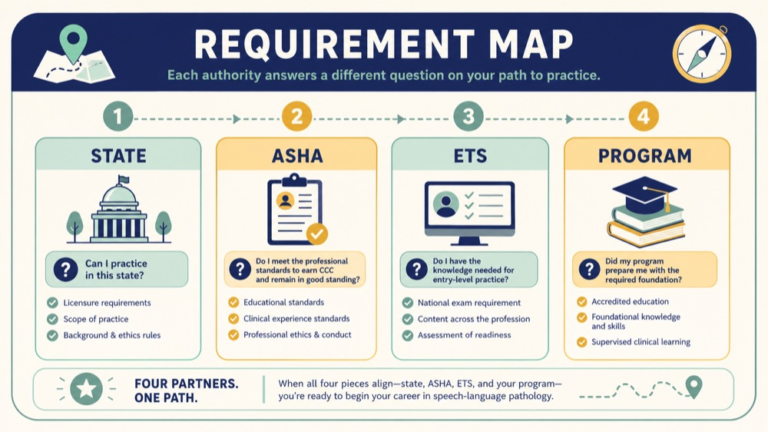
The safest approach is to separate the sources. ETS controls the test registration process and live appointment information. ASHA explains how the national examination fits into its certification standards. A state board, school agency, graduate program, or other responsible authority may add rules for the credential you are pursuing. A study guide can organize the questions, but it should not replace any of those authorities.
Separate the Four Meanings of “Requirements”
Start by naming the requirement you are trying to verify. This prevents a common mistake: reading an exam description and assuming it answers a licensure or certification question. The current ETS 5331 page describes the test’s scope, format, delivery, and administrative information. ASHA’s guidance places the exam within a broader certification pathway. Your state or agency decides what it will accept for its own credential.
Test selection: Which Praxis assessment or code does the responsible authority identify?
Readiness or timing: When should you register based on graduate coursework, clinical practicum, or an agency deadline?
Registration and admission: What account, appointment, payment, identification, and check-in steps apply?
Credential use: Where must the score be sent, what passing score applies, and how long is the result accepted?
Write your goal in one sentence before opening multiple tabs. For example: “I am preparing to meet my state school-credential requirement after completing my graduate program,” or “I am checking the exam step in an ASHA certification application.” That sentence determines which authority deserves the final say.
Check the State or Agency Rule First
State and agency requirements can differ. ASHA explains that the Praxis exam is used for ASHA certification and by state boards or agencies, but it also notes that each state determines the passing score it uses for professional licensure or teacher credentialing. A score that is acceptable for one purpose is not automatically the complete answer for another. Before paying for an appointment, locate the current page or office for the state or agency that will review your credential.
Look for the exact test name or code, the required score, the timing of the exam in the application process, score-reporting instructions, and any rule about how recent the result must be. Also check whether the agency wants the score sent directly from ETS, whether an institution code is required, and whether other coursework, supervised experience, or documentation is part of the same application. Do not infer a complete credential checklist from the Praxis page alone.
If your graduate program has a testing recommendation, compare it with the state or agency rule. Programs often help students plan the transition from coursework and practicum into clinical practice, while the credentialing authority determines what it will accept. When the sources appear inconsistent, ask the responsible office a specific question and keep the answer with the date and link you checked.
Your state or agency research note should capture:
The name of the credential or license you are pursuing.
The responsible board, department, school agency, or certification organization.
The accepted test name and code.
The passing score and scale, if the current rule publishes one.
When the exam must be completed in relation to the application.
Where scores must be sent and whether direct reporting is required.
How long a score remains acceptable for that credential.
Other non-exam requirements that must be completed separately.
Understand the ASHA Certification Context
ASHA describes the Speech-Language Pathology Praxis Examination (5331) as an integral component of its certification standards. The examination is administered by ETS, while ASHA’s Council for Clinical Certification in Audiology and Speech-Language Pathology is involved in certification standard setting and the final determination of the passing score for ASHA certification. That division of responsibility matters: ETS is the source for the appointment and testing process, while ASHA is the source for its certification pathway.
ASHA’s current guidance also connects eligibility to the broader certification process, including completion of graduate-level academic coursework and clinical practicum and program judgment about required knowledge and skills. It recommends that individuals consider registration and testing after completing those milestones or during an appropriate early-practice period, while also considering state licensing requirements. The practical lesson is to plan the exam in relation to your program and credential timeline rather than treating registration as an isolated purchase.
ASHA also explains that state passing scores can be higher or lower than the score used for ASHA certification. It notes that exam results submitted for initial certification must come directly to ASHA from ETS and that score-age rules apply. Because certification rules can be revised, use the linked ASHA page and current application instructions for the decision you need to make today.
Review ETS Registration and Admission Requirements
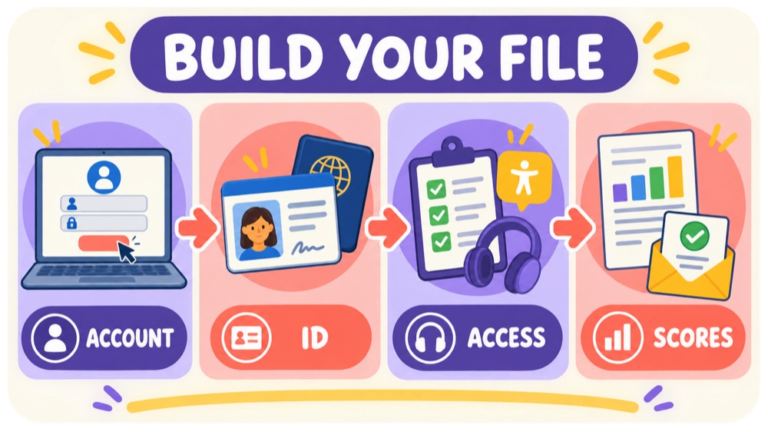
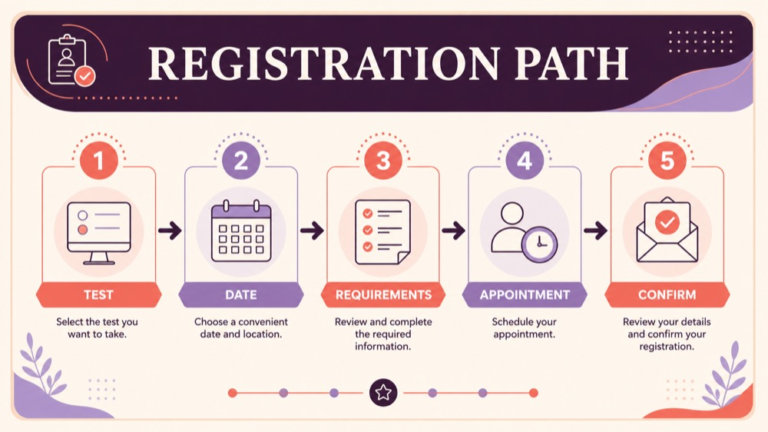
ETS’s registration flow begins with an account. The process then asks you to find the appropriate test, review availability, choose a test date and location or another available delivery option, review your cart and personal information, and enter payment information. The exact appointment information appears in the account and may change with availability. Save the confirmation after completion and read the appointment instructions again before test day.
Admission is a separate checkpoint from eligibility. A learner can be academically ready and still arrive without the identification or documentation required by the provider. The ETS Study Companion explains that computer test takers can expect to provide proper identification at a test center and can learn the interface before the testing time begins. Follow the current admission instructions for your specific appointment, including rules for personal items, security, and approved accommodations.
For accommodations, start early. ETS provides an accommodations process, and the registration page links to a request form. The documentation and review timeline may affect when you can schedule. Do not assume that a request is approved merely because it was submitted, and do not assume an approval applies to every delivery method or appointment. Keep the approval notice and appointment details together, and contact the responsible provider when the language is unclear.
Use the current ETS 5331 listing to confirm the test identity and format.
Create or access the Praxis account used for registration.
Review state or agency requirements before adding the test to the cart.
Check availability and choose a date that fits the credential timeline.
Review the delivery method and location shown in the account.
Confirm personal information before payment.
Read the current identification and check-in instructions.
Complete accommodation steps through the responsible ETS process when needed.
Save confirmation, score-recipient, and appointment information.
Use official appointment-management instructions for changes.
Plan for Score Use, Not Just Test Day
Requirements continue after the appointment. Decide which organization needs the result and whether the score must be sent directly from ETS. Check the receiving organization’s code and instructions against its current page. If you are applying for ASHA certification, review ASHA’s score-acceptability language and application window. If you are applying for a state credential, use that state’s rule instead of copying the ASHA rule.
Keep a small requirements file with the source page, the date checked, the exact wording that matters, and the action you still need to take. This is especially useful when your program, state, and certification organization use different terms for the same milestone. A screenshot can preserve context, but the link and date tell you when the information needs to be rechecked.
A useful file may contain:
Current ETS 5331 page and Study Companion.
Current ETS registration or appointment instructions.
Your state or agency testing and credential page.
ASHA certification guidance, if ASHA certification is your goal.
Program contact or graduate-office instructions.
Appointment confirmation and score-recipient details.
Accommodation approval or documentation instructions, if applicable.
A dated list of questions sent to an authority and the replies received.
Avoid Common Requirement Mistakes
The most expensive mistakes are often category mistakes. A learner sees “computer delivered” and assumes a particular room setup; sees a passing score and assumes it applies to every state; sees a graduate-program recommendation and assumes it is a legal deadline; or sees an old fee and treats it as a current total. The fix is simple but disciplined: label every fact with the authority that owns it and the date on which you checked it.
Another mistake is studying toward a broad identity rather than the current blueprint. ETS states that the 5331 test measures knowledge and its application across foundational knowledge, professional practice, and specialized areas. Use the current Study Companion and test page to understand the assessed scope, then use your coursework and practice to build the reasoning behind it. Do not seek purported official, recalled, or leaked test content; it is not a sound or authorized study boundary.
Do not use a competitor’s registration instructions as the final authority.
Do not assume ASHA and a state board use identical score rules.
Do not book before checking the credential timeline that matters to you.
Do not treat an accommodation request as an approval.
Do not carry an old date, fee, or center list into a new appointment.
Do not postpone score-recipient research until after the application deadline.
Do not confuse test readiness with completion of every credential requirement.
Do not replace source verification with a confident-sounding summary.
A Requirements Summary You Can Recheck
Use this sequence: identify the credential goal, check the responsible state or agency, confirm the accepted Praxis test, review ASHA guidance if certification is part of the plan, read the current ETS 5331 listing, complete registration and accommodation steps, prepare for admission, and document how the result will be used. Each step has a different owner. That is why a source map is more reliable than one universal checklist.
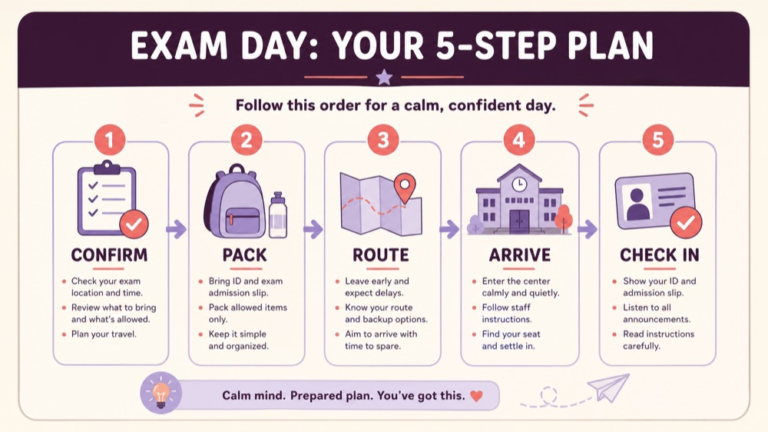
Use an slp praxis exam day checklist to turn a high-stakes morning into a sequence of small, verifiable decisions. The goal is not to create a superstition-heavy routine or promise a particular result. It is to make sure your appointment, documents, travel plan, equipment, energy, and pacing choices are aligned before the clock starts. ETS describes the Speech-Language Pathology Praxis 5331 as a computer-delivered selected-response test, and its live listing provides the current administrative details. Treat that listing and your ETS account as the source of truth for the appointment you actually booked.
A good checklist has two layers. The first layer confirms items controlled by ETS or the testing location: the selected test, appointment date and time, delivery method, location, identification requirements, and any approved accommodations. The second layer covers choices you control: what to pack, when to leave, how to handle uncertainty, and how to use the test interface. Keeping those layers separate helps you avoid spending the night before trying to memorize a rule that should have been checked in your account.
What an Exam Day Checklist Can and Cannot Do
An exam day checklist is a risk-control tool. It can reduce preventable friction, but it cannot change a registration record, guarantee a score, or replace a current policy. If a detail affects admission, payment, rescheduling, identification, or accommodations, verify it with ETS or the responsible testing provider. The checklist is strongest when it points you to the right place to confirm a fact.
It also helps you reserve mental energy for the exam itself. Graduate-level SLP preparation involves a wide range of knowledge, including assessment, intervention, professional practice, language, speech, hearing, cognition, and feeding and swallowing. On test day, your job is to apply what you know to the item in front of you. A prepared route and a simple pacing rule keep logistical questions from competing with that work.
Use the live ETS test page for the current 5331 format and administrative details.
Use your ETS account for the appointment record, location, date, time, and delivery choice.
Use the testing provider’s instructions for identification, check-in, prohibited items, and local procedures.
Use your approval documentation for accommodations rather than relying on memory or informal advice.
Use your own checklist for travel, sleep, food, water, and a backup plan.
Confirm Your Registration Details
Begin with the record that determines where and when you need to appear. ETS’s registration flow asks test takers to sign in or create an account, select a test, choose a date and location, review the cart, and complete payment. The current registration page also explains that appointment management, including rescheduling or cancellation questions, belongs in the related ETS process. Do not treat a search-result snippet, a social post, or an old screenshot as your appointment confirmation.
Open the account and compare the details line by line. Confirm that the registration is for Speech-Language Pathology 5331 rather than a similarly named assessment. Confirm the delivery method, because the current ETS 5331 page describes test-center and at-home options while availability can depend on the account and appointment. Confirm the local time shown for the appointment, the address if you selected a center, and the name spelling attached to the account. Save the confirmation in a place you can access without depending on a fragile browser tab.
If your program, state agency, or credentialing body has given you a deadline, write that deadline beside—not instead of—the ETS appointment information. A deadline is a reason to verify the plan early; it is not proof that every appointment or score-reporting step will fit automatically. ASHA explains that the Praxis exam is part of a broader certification pathway, while states can set their own credential rules. Keep the administrative goal visible, but use the responsible authority for the rule that applies to your situation.
Your first verification pass can be short:
Test name and code: Speech-Language Pathology 5331.
Appointment date and start time as displayed in the ETS account.
Delivery method: test center or at-home, if that option is actually confirmed.
Test-center name and full address, if applicable.
Approved accommodation details, if applicable.
Name and identification details that must match the admission instructions.
Any score-recipient or institution information you chose during registration.
Contact or support instructions to use if the appointment record is unclear.
Pack for the Appointment Without Overpacking
Testing locations may restrict what can enter the room, so the best bag is usually a small, deliberate bag rather than a mobile study desk. Follow the current admission and security instructions for your appointment. The ETS Study Companion explains that test takers should expect to provide proper identification at a test center and that the computer interface gives an opportunity to learn how to answer, skip, and return to questions before testing time begins. That means the checklist should protect the admission process and your focus, not encourage you to carry unapproved materials.
Prepare the night before. Put the items you are allowed to bring together, then check them against the live appointment instructions. If you need an item related to an accommodation, keep the approval record or required documentation accessible according to the provider’s instructions. If you are unsure about a permitted item, ask the responsible provider before test day instead of improvising at check-in.
A sensible preparation set may include:
The identification documents required for your appointment.
Your appointment confirmation or account reference, available offline if possible.
Directions, parking information, or transit notes for the selected location.
Contact details for the testing provider or support channel.
Glasses or other personally necessary items that comply with the rules.
A simple snack and water for before or after the appointment if the location permits them outside the room.
Layers that help you stay comfortable while respecting the center’s instructions.
Any approved accommodation documentation or required assistive item.
A backup payment or travel plan only where it is relevant to the appointment instructions.
Leave unnecessary study materials at home unless the location explicitly permits them. A last-minute flashcard stack can increase anxiety without improving recall. The better final review is a short list of reminders, followed by sleep and a predictable morning.
Plan Arrival and the Check-In Sequence
Work backward from the appointment start. Estimate the route at the time of day you will travel, then add time for parking, building entry, finding the room, and check-in. If the center is unfamiliar, look at the surrounding streets and entrance instructions in advance. If you are using public transportation, identify one reasonable alternative in case of a delay. The purpose of the buffer is not to arrive hours early and become tense; it is to avoid turning one small delay into a rushed admission decision.
Keep the first part of the morning boring. Eat a familiar meal if you normally eat before a long assessment. Set one alarm and one backup alarm. Put the phone on the setting required by the testing provider before entering the room. At check-in, listen to the instructions before asking a question. If a staff member directs you to a rule that differs from your assumption, pause and follow the current local procedure.
If the address, room, date, or identification requirement does not match what you expected, do not try to solve the discrepancy by guessing. Show the appointment record, ask the staff member what can be verified, and contact ETS support when the issue requires a registration decision. Document names, times, and instructions if a formal follow-up is needed. A calm record is more useful than an argument or a hurried attempt to start the exam.
Use a Simple Pacing Plan
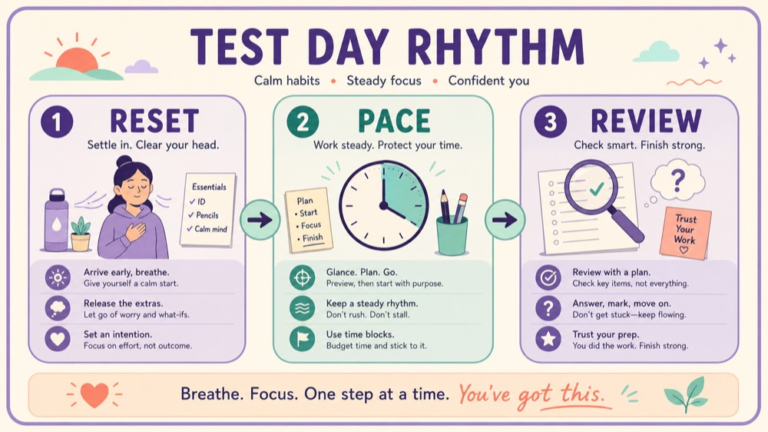
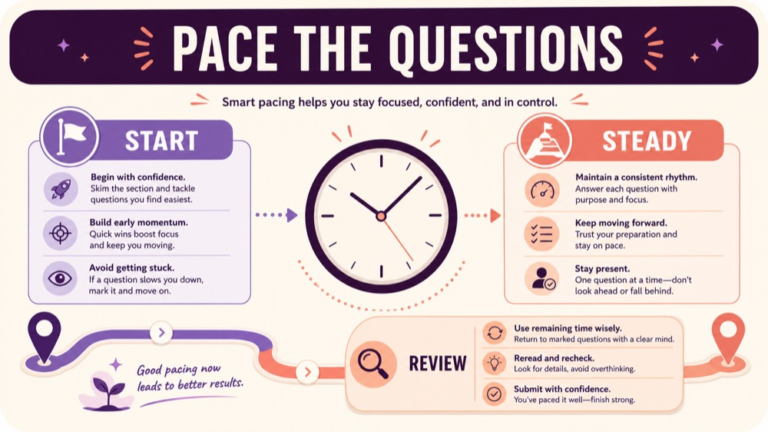
The current ETS 5331 listing states that the test has 132 selected-response questions and a 150-minute test length. Those are useful planning anchors, but they are not a promise that every item should take exactly the same amount of time. The rough division is a little more than one minute per question. Some items will be faster, while a difficult item may need a marked return rather than a long struggle.
Choose a pacing rule before the first item appears. For example, read the question carefully, identify what it asks, eliminate unsupported options, choose the best answer, and mark the item if a second look could help. The exact interface and review controls should be learned from the test instructions and tutorial available for your appointment. Your practice routine should make the process familiar enough that you can use it without narrating every step to yourself.
Use checkpoints instead of watching the clock after every question. A checkpoint asks whether you are broadly on track and whether you have left enough room for marked items. It is a steering signal, not a reason to panic. If you are ahead, use the extra margin to review uncertain items. If you are behind, shorten the time spent on any one question and make a reasoned selection before moving forward.
Start by reading the stem for the task, population, setting, and decision being tested.
Separate a question about best next step from a question about a definition or fact.
Eliminate options that conflict with the stated evidence, scope, or safety context.
Do not let one unfamiliar term consume the time needed for several answerable items.
Mark an item only when returning to it could realistically improve the decision.
Use the interface’s approved navigation and review features as explained before testing begins.
Keep your pace flexible when a passage or case requires careful reading.
Reserve a final review window for marked items and obvious misreads.
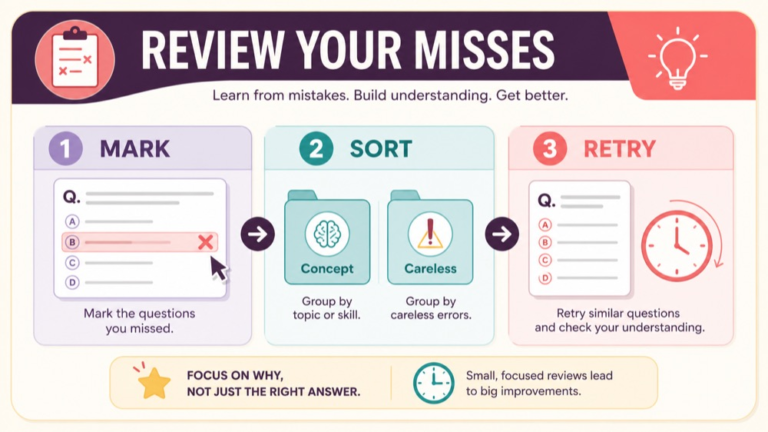
For practice, rehearse the same sequence with mixed-domain questions. After each set, record whether a miss came from knowledge, reading, reasoning, pacing, or a careless selection. That diagnosis of your process is more actionable than simply counting correct answers. It tells you what to change before the appointment.
Finish the Night Before and Morning Of
The final evening should close open loops. Check the appointment one more time, lay out permitted items, confirm the route, and set a realistic departure time. Then stop. A final hour of unfocused studying can make the morning harder, especially when it displaces sleep. If you want a review, choose a small set of high-yield reminders: common distinctions, professional-practice boundaries, and the reasoning steps you tend to skip.
On the morning itself, follow the sequence you prepared. Arrive with enough margin to think. Read the admission directions. Once the test begins, let the first few items establish your rhythm rather than treating them as a verdict about the entire exam. If anxiety rises, lower your shoulders, take one controlled breath, reread the question, and return to the task being asked.
After the appointment, write down only what you need for a next administrative step. Do not try to reconstruct every item from memory or seek claimed or remembered test content. ETS and ASHA materials are the appropriate references for policies, scores, and credentialing context. Your useful post-test information is whether a score report, score recipient, retake, or certification action needs follow-up.
A Printable Final Check
Use this short version when you are about to leave:
Appointment: correct test, date, time, delivery method, and location.
Account: confirmation accessible and name details reviewed.
Admission: identification and accommodation instructions confirmed.
Route: departure time, entrance, parking or transit, and backup identified.
Bag: only permitted essentials, with comfort items handled according to policy.
Body: familiar food, water plan, clothing layers, and reasonable sleep.
Mind: one pacing routine and one reset strategy.
Aftercare: know where to check official score or credentialing next steps.
How Many Questions Are on the SLP Praxis? A Planning Guide
how many questions are on the slp praxis is a useful planning question, but the answer should be tied to the current ETS listing rather than a permanent memory. At the time this article was checked, the current Speech-Language Pathology Praxis 5331 listing displayed 132 questions and a 150-minute testing time. Treat those details as a current snapshot: ETS can revise test information, and your live account and current test page should be checked before test day.
The count matters because it gives you a frame for pacing, practice sets, and review. It does not tell you which question will be difficult, guarantee a particular score, or replace the current content description. This guide shows how to verify the count, connect it with timing, and use practice evidence to build a calm plan without turning one number into a complete study strategy.
The current ETS listing checked for this guide displayed 132 questions for the Speech-Language Pathology Praxis 5331. Because question counts, time limits, formats, and other test details are administrative information, verify the live listing and account again when you register and before you test. A study article can explain how to use the information, but it should not freeze a changing policy as if it were timeless.
Fact or planning input
What it helps you do
What it cannot decide
Displayed question count
Estimate pacing and build representative practice blocks.
Which questions you will see or how hard they will feel.
Displayed testing time
Practice reading, deciding, and moving through a timed session.
Your individual score or readiness by itself.
Content domains
Organize retrieval and application across the exam scope.
A shortcut around learning the concepts.
Practice result
Identify patterns in knowledge and reasoning.
A promise about the live test or credential outcome.
This distinction is important for both SEO and study quality. A page that answers “how many” should answer it promptly, then add the context a learner needs to act responsibly. It should not bury the answer under unrelated product copy or present an old count without a verification note.
Read the Current ETS Test Information
Start with the current ETS Speech-Language Pathology 5331 listing. Look for the test title, code, displayed number of questions, testing time, delivery or appointment information, and links to any current preparation material. Read the page as a connected set of facts. A question count without a time, format, or scope frame is less useful than a short, current planning record.
Confirm the title and code. Make sure the page is for Speech-Language Pathology Praxis 5331 rather than a neighboring test or a third-party practice product.
Record the displayed count and time. Write down the values and the date you checked them. Add a note that they should be verified again before test day.
Review the format language. Determine whether the listing describes selected-response work or another displayed testing condition, then adapt practice to the current information.
Open the study companion. Use the ETS study companion to organize content review and domain coverage.
Separate current facts from study advice. ETS controls the test information; your study method is a planning choice that should respond to your own evidence.
The same habit helps with other questions that contain a number. If a page says “how many,” “how long,” “what score,” or “when,” ask whether the value is current, who owns it, and what decision it supports. That prevents a memorized number from becoming an unsupported claim in a study note or an answer explanation.
Connect Question Count With Time and Format
If the current listing continues to display 132 questions and 150 minutes, a simple average is about 1.14 minutes per question. That average is a planning frame, not a rule for every item. Some questions may take less time, some may require careful reading, and your movement through a real session will include transitions in attention. Use the average to practice pacing, then use error review to decide where your time is actually going.
A timed block should imitate the decision demands without pretending to reproduce the live exam. Mix topics, avoid arranging every item by the same concept, and make a note when you change an answer. Afterward, compare your pace with the quality of your reasoning. Fast work that relies on a guess and slow work that rereads every option point to different study needs.
Content frame: divide practice across the current domains instead of building a set from one comfortable topic.
Timing frame: use shorter sets first, then longer mixed blocks as your endurance develops.
Decision frame: mark questions that required comparison, referral reasoning, assessment selection, or professional judgment.
Review frame: protect time after practice to explain the correct choice and the distractors.
Verification frame: recheck the current ETS information if a practice source gives a conflicting count or time.
Use the Count to Plan Practice
A displayed count can help you choose the size of a study block. Early in preparation, a learner may use short sets to practice retrieval and explanation. Later, longer mixed sets can test whether the learner can shift among content domains without losing the question’s actual task. The goal is not to make every session exactly 132 items. The goal is to build enough variety and duration that the pacing frame becomes familiar.
For a long block, define the purpose before you start. One session may test content recall. Another may test clinical application. Another may focus on professional practice, ethics, or the ability to identify what evidence is missing. Labeling the purpose keeps the count from becoming the only measure of progress.
Use a simple record with four fields: item topic, decision requested, evidence used, and next review action. If you miss a question because you rushed the stem, the fix may be a reading routine. If you miss it because two options seemed plausible, the fix may be a comparison note. If you miss it because a current administrative fact was outdated, the fix is source verification rather than more flashcards.
Review Errors Instead of Chasing a Number
Question count is a useful constraint, but learning comes from what you do with the decisions inside the set. After a timed block, review correct guesses as well as incorrect answers. A correct answer supported by the wrong reason is unstable. Write a one-sentence rationale for the selected option and one sentence for the most attractive distractor. That practice turns a score report into a study decision.
Return to the current ETS scope when a practice explanation goes beyond what the test or source plan supports. For clinical topics, use appropriate professional sources and maintain boundaries around individual diagnosis or treatment. For credential questions, keep ASHA, program, state, and employer requirements distinct. The question count organizes time; it does not define professional scope.
Common Question-Count Mistakes
Quoting an old question count without checking the current ETS listing.
Treating the displayed count as a permanent promise about every future administration.
Dividing total minutes by questions and assuming every item should take exactly the average.
Using a practice score as proof of a live-test result or certification outcome.
Practicing only one content domain because it feels efficient.
Skipping explanations after a timed set because the count feels like the achievement.
Ignoring changed-answer patterns, reading speed, fatigue, or attention during review.
Confusing the Praxis count with the number of questions in a commercial practice product.
These mistakes reduce a useful planning input to a slogan. Correct the habit by writing the current source, the date checked, the decision the number supports, and the limit of the inference. That four-part note is compact enough to use in a study planner and strong enough to prevent accidental overstatement.
Quick Praxis Question-Count Review
Use this checklist when you revisit the question-count topic:
Current ETS title and 5331 code confirmed.
Displayed question count and testing time recorded with the check date.
Current scope and study companion reviewed.
Practice sets include both short retrieval blocks and longer mixed work.
Pacing is interpreted with reasoning quality, fatigue, and error patterns.
Conflicting numbers are resolved through the current ETS source.
Then write the transfer sentence: “The current count helps me plan ___, but I still need evidence about ___.” A good completion might mention pacing while leaving readiness, score outcome, and credential decisions open for the evidence that actually answers them.
Praxis Speech-Language Pathology Test Dates: Plan Your Window
praxis speech language pathology test dates are best understood as a planning window rather than a date to copy from an old calendar. The useful question is not only “What dates exist?” It is also “Which displayed appointment protects my deadline, gives me a realistic study runway, and fits the current testing conditions?” That shift makes date research more practical.
This guide shows how to plan around the current ETS account without promising a universal testing calendar. Appointment availability, delivery options, fees, rescheduling rules, score timing, and identification or accommodation requirements can change. Use this article to organize your decision, then verify the specific date and conditions in the live ETS process.
A displayed date answers one narrow question: an appointment may be available in the current ETS account. It does not by itself tell you that the date fits your graduate program, that a score will arrive before a receiving organization’s deadline, or that your preparation is complete. Those decisions require different evidence.
Start by separating the date, the deadline, and the readiness decision. The date is an appointment choice. The deadline is an external requirement or personal milestone. Readiness is a judgment about your preparation, energy, support needs, and ability to use the current exam scope. When these are written separately, you can see whether moving the date solves a real problem or merely makes the calendar look tidy.
Planning layer
Question
Current source
Availability
Which appointments are displayed for my account and preferred setting?
Live ETS account.
Deadline
When does a program, agency, or personal plan need the result?
Receiving organization or your documented plan.
Readiness
What preparation can I complete before the appointment?
Current ETS scope plus your study evidence.
Contingency
What will I do if the date, location, or circumstances change?
Current ETS change guidance and support channel.
Plan Praxis Speech-Language Pathology Test Dates Backward
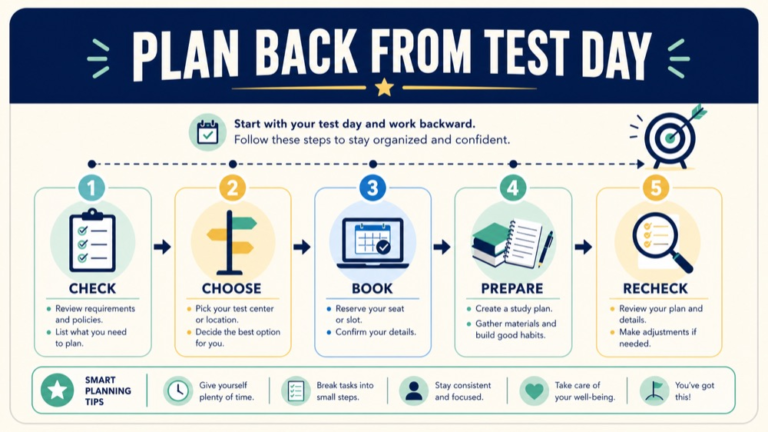
The ETS registration process provides the general path, but the planning work begins with your own deadline. Write the date that matters, then work backward through the steps that need time. Do not assume that a displayed appointment or a score report moves instantly through every receiving system.
Name the endpoint. Record the date by which a program, credential pathway, employer, or personal plan needs evidence of the result. If no external deadline exists, choose a study checkpoint that is meaningful and flexible.
Allow for processing. Check current ETS score and recipient information, then allow time for processing, questions, and the receiving organization to update its record.
Protect preparation. Reserve time for content retrieval, clinical reasoning, mixed practice, timed work, and error review. A date that leaves no room for learning may be a poor fit even when it is available.
Check personal conditions. Consider coursework, clinical responsibilities, work schedule, travel, health, fatigue, support needs, and the environment in which you will test.
Compare displayed appointments. Use the live account to compare dates, times, locations, and delivery settings. Record the option you are evaluating before you complete the transaction.
Choose and document. Save the appointment and the evidence behind the decision, including the deadline it protects and the remaining study runway.
This backward method avoids a common calendar trap: selecting a date because it appears soon, then discovering that the date conflicts with coursework or leaves no time to review mistakes. It also avoids the opposite trap of postponing without a learning reason. The point is not to make the window as early or as late as possible. The point is to make the tradeoff visible.
Check the Live ETS Window
Use the current ETS page to confirm the test identity and the account to confirm availability. A search result, an old shared spreadsheet, or a social post can help you know what to look for, but it cannot settle which appointments are available for you now. The account is also where current transaction details and remaining steps become visible.
Test identity: confirm Speech-Language Pathology Praxis 5331 before comparing dates.
Time zone: record the displayed time and the local time you will use for travel or preparation.
Location: check the center, address, arrival requirements, or displayed remote conditions.
Delivery setting: read the current instructions for the option you are considering.
Change language: note the current rescheduling, cancellation, or support path instead of relying on memory.
Confirmation: keep the number, appointment details, and any action that remains open after checkout.
Dates are also a useful prompt to revisit identity and support needs. If your name, identification, accommodation request, or account information needs attention, treat that as a separate task with its own lead time. The best date cannot repair an unresolved administrative mismatch.
Build Study Time Around the Selected Date
After choosing a date, convert the remaining time into study blocks rather than a single countdown. Begin with the current ETS scope and the study companion. Then alternate between knowledge retrieval and scenario application. A learner may recognize a definition but still need practice deciding which evidence, assessment step, treatment consideration, or professional boundary answers a question.
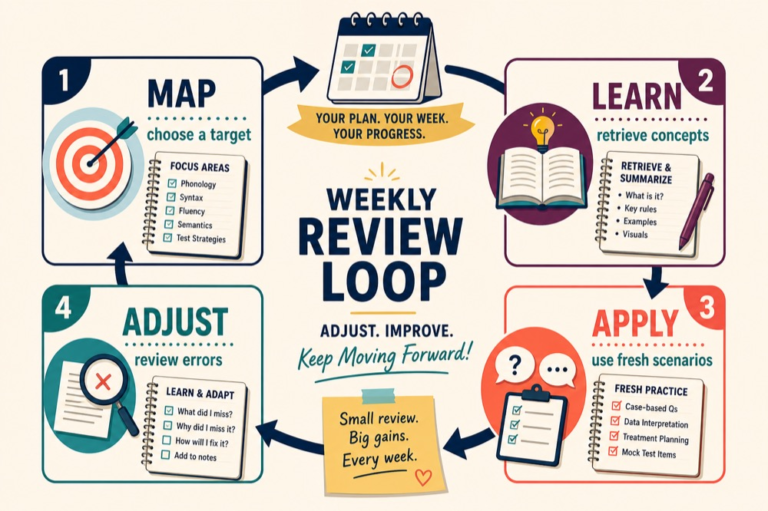
Use an error log that names more than the letter of a missed answer. Record the task, the clue that mattered, the assumption that pulled you away, the source or concept that clarifies it, and the next action. Revisit errors after a short interval and in a mixed order. That process reveals whether the issue is a missing fact, a comparison problem, an overread stem, or a time-management habit.
Protect a final logistics checkpoint. Confirm the current appointment, route or technical setup, identification, permitted materials, and any support instructions through the live source. Keep the checkpoint short enough that it does not displace substantive study, but specific enough that it reduces avoidable surprise.
Prepare for Change and Contingency Decisions
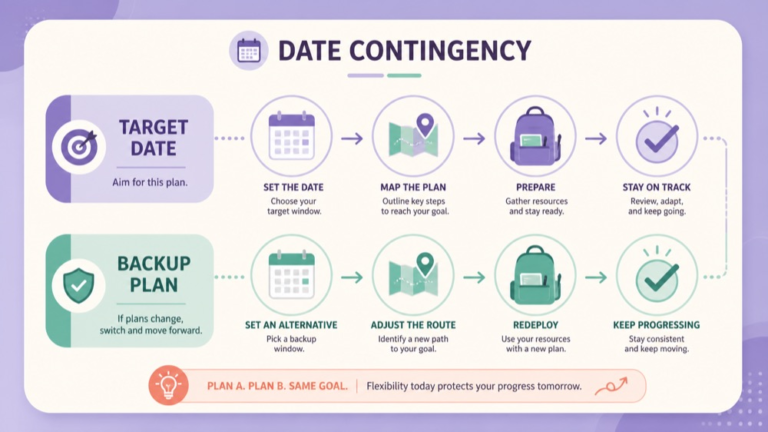
A date plan is stronger when it includes a response to change. A location may not fit after a schedule change. A displayed option may disappear. A personal or program deadline may move. The correct response depends on the current ETS rules and the fact that changed circumstances can affect preparation, score timing, and support needs.
Write three notes: what would make me reconsider the appointment, which source would I check, and how would I revise the study runway? This is not an invitation to worry about every possibility. It is a way to prevent a changed date from turning into an unstructured week. If you do change an appointment, save the new confirmation and update the study plan from the new evidence.
Common Test-Date Mistakes
Copying a date from an older page instead of checking live ETS availability.
Choosing an appointment without working backward from the score or application deadline.
Ignoring time zone, travel, arrival, room, or technical conditions.
Assuming a displayed date is reserved before the transaction confirms it.
Leaving no study runway for mixed practice and error review.
Using a date decision to answer a separate question about certification or licensure.
Forgetting to record the confirmation number and remaining action.
Changing the date without updating the preparation calendar and deadline assumptions.
The common thread is confusing a calendar entry with a complete plan. Correct the error by connecting the date to the endpoint, the evidence, the preparation work, and the live policy. A compact record is more useful than a long list of guessed dates.
Quick Date-Planning Review
Before you treat a Praxis date as workable, review this sequence:
Current ETS test identity and code checked.
Deadline and score-recipient timing written down.
Appointment availability, time zone, setting, and location verified in the account.
Coursework, clinical, work, travel, support, and energy conditions considered.
Study runway includes retrieval, application, timed work, and error review.
Confirmation and contingency note saved securely.
Then explain the date in one sentence: “I selected this window because it protects ___ while leaving time for ___, and I will verify ___ in the current ETS account.” That sentence is a practical test of whether the decision is based on evidence rather than calendar anxiety.
Sign Up for Praxis Speech-Language Pathology: A Clear 5331 Start
sign up for praxis speech language pathology sounds like one small task, but the phrase covers several decisions that can affect a learner’s timeline. You need to identify the correct Speech-Language Pathology Praxis 5331 test, compare the appointment with your program or credential deadline, enter information that matches your identification, and save the confirmation that proves what you selected. A calm sequence reduces avoidable administrative confusion.
This guide explains how to approach the sign-up process without treating a study article as a substitute for the current ETS account. It also separates registration from a passing score, ASHA certification, state licensure, and graduate-program requirements. The live ETS page and your account control current dates, fees, appointment availability, delivery options, change rules, and score-reporting details.
Registration is not just a click at the end of studying. The appointment can shape how much preparation time you have, when a score may be needed, and which logistics deserve attention first. At the same time, an appointment does not answer every question in the credential pathway. A learner can be correctly registered and still need to confirm a graduate-program timeline, score-recipient direction, certification step, or state process separately.
Before opening the payment screen, write down the decision you are trying to make. Are you trying to reserve an exam appointment, understand the current test, protect a deadline, or decide whether you are academically ready? If the answer is “all of these,” keep them in separate notes. That separation makes it easier to verify one fact at a time and prevents an old study-group message from being mistaken for a current ETS rule.
Decision
What it answers
Where to verify it
Test identity
Which Praxis title and code you are selecting.
Current ETS test listing and account.
Appointment
When, where, and in what displayed format you will test.
Live ETS availability after signing in.
Score use
Who needs the result and when.
Current recipient or program instructions.
Credential pathway
What else is needed beyond registration.
ASHA, program, and state sources as applicable.
Sign Up for Praxis Speech-Language Pathology: The Core Sequence
Use the ETS registration process as the administrative starting point, then rely on the current account for the actual transaction. The exact screens can change, so the useful skill is recognizing the order of decisions rather than memorizing a button location.
Identify the test. Search for Speech-Language Pathology and confirm the 5331 designation before choosing an appointment. Similar wording in a search field is not enough; the title and code should match the requirement you are trying to meet.
Check your timing. Compare your intended date with coursework, clinical-practicum timing, application deadlines, and the date a receiving organization expects a score. If you need an accommodation or a name correction, raise that issue early rather than treating checkout as the first place to solve it.
Review current availability. Look at the dates and locations shown in the account. A location search is an option list, not a completed reservation, and availability can differ by account, delivery format, and time.
Choose an appointment deliberately. Consider travel, arrival time, room or technology requirements, fatigue, and the study runway that remains. The earliest displayed appointment is not automatically the most workable one.
Enter matching information. Compare your account name and contact details with the identification and email access you expect to use. If the information does not align, pause and use the appropriate ETS support path.
Review the transaction. Read the test title, code, date, time zone, location, delivery setting, price shown, score-recipient choices, and change language before submitting. Time-sensitive details belong to the live transaction.
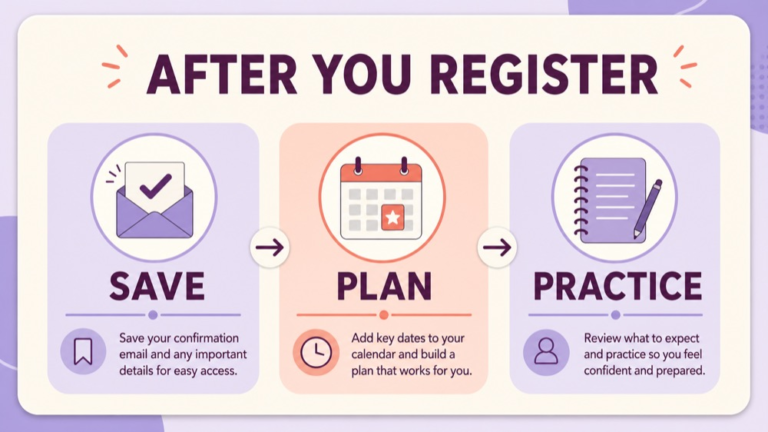
Save the confirmation. Keep the confirmation number, appointment details, account messages, and any remaining action in a secure place. A personal checklist can support memory, but the current ETS account and confirmation are the stronger records.
The sequence gives you a useful stopping rule. If the test identity is unclear, the appointment does not protect the deadline, the name does not match the expected identification, or a required support process is unresolved, do not rush simply because an appointment screen is open. Resolve the uncertainty through the responsible source and return to the transaction with a documented decision.
Check Timing, Identity, and Appointment Details
Good sign-up planning starts backward from the event that matters. That could be a graduate-program completion point, a credential application, an employer timeline, or a personal readiness target. The point is not to create a universal number of study days. The point is to identify the dependency that makes a date useful or risky for you.
Academic timing: note coursework and clinical-practicum milestones that your program associates with exam readiness.
Score timing: identify when the receiving program or organization wants a result, then allow room for processing and record updates.
Identity timing: resolve a legal-name change or document mismatch before the appointment becomes urgent.
Accommodation timing: read the current ETS process early if you need supported testing conditions.
Travel timing: plan the route, arrival buffer, parking, or the displayed technical and room requirements.
Study timing: decide how many sessions remain for content retrieval, application practice, error review, and a final logistics check.
Do not treat a fixed date from an old post as a current promise. Test-center inventory, appointment windows, policies, and displayed options can change. A page that helps you understand the process is useful, but the live ETS account should settle the specific choice. That habit is especially important when a question uses words such as “available,” “latest,” “fee,” “retake,” or “score release.”
Turn the Confirmation Into a Study Runway
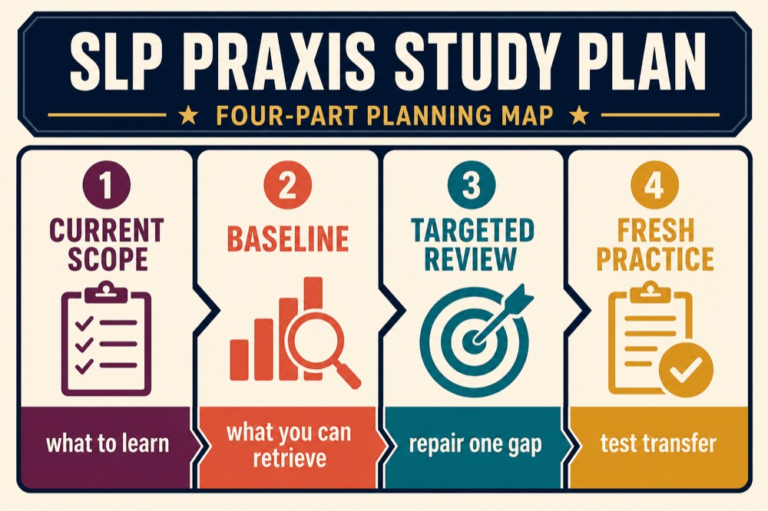
Once the appointment is confirmed, turn the administrative decision into a study plan that can be inspected. Start with the current ETS test listing and study companion, then divide preparation into retrieval, application, and review. Retrieval asks what you know. Application asks what you would do with a clinical or professional scenario. Review asks why a tempting alternative does not fit the evidence or the question’s scope.
A useful runway includes a first pass through the content domains, mixed practice that changes the order of topics, timed work that respects the appointment context, and an error log. The log should record the decision point, the evidence you missed, the reason your first answer looked attractive, and the rule you will use next time. A growing score alone does not explain which reasoning habit needs attention.
Use registration details to make the plan concrete without letting logistics dominate every session. Reserve a short checkpoint for the route or technical requirements, then return to studying. If your date changes, revise the plan rather than trying to preserve an outdated calendar. The purpose of the date is to organize preparation, not to create a false sense of certainty about what a future session will look like.
Separate Registration From Credential Decisions
Signing up for a test is one administrative event. A passing score is a result. ASHA certification, a clinical fellowship, graduate-program completion, and state licensure can involve additional requirements and different decision-makers. The ASHA exam-context guidance is useful for keeping those layers distinct, but it does not replace your program or state authority’s current instructions.
When a study question combines registration with eligibility, identify which part is actually being asked. If it asks how to reserve an appointment, start with ETS. If it asks what a score means for a credential, check the credential authority. If it asks when a learner should test, compare the program timeline, current guidance, and individual readiness rather than inventing a universal rule.
Common Sign-Up Mistakes
Searching for a familiar phrase without confirming the Speech-Language Pathology Praxis 5331 title and code.
Choosing the earliest displayed date without checking coursework, score timing, travel, or preparation needs.
Assuming a test-center search result is a reservation before the account confirms the transaction.
Entering a name that may not match the identification expected on test day.
Using an old fee, appointment rule, score code, or change policy as if it were current.
Confusing a registration confirmation with proof that certification or state licensure requirements are complete.
Saving only a screenshot and not keeping the confirmation number or account record.
Building a study schedule that ignores the appointment’s actual time, travel, or support requirements.
Each mistake is a version of the same problem: one piece of information is asked to answer a larger question than it can answer. Correct it by naming the decision, locating the responsible source, recording the current evidence, and noting what remains uncertain. That method is useful for the exam and for real clinical reasoning.
Quick Sign-Up Review
Before you finish the process, write a short record that another careful person could understand:
Test title and code checked against the current ETS listing.
Date, time zone, format, and location or displayed delivery setting recorded.
Name and contact information compared with expected identification and account access.
Deadline, score-recipient, accommodation, and support questions identified.
Confirmation number and remaining action saved securely.
Study runway connected to the current test scope and your available time.
Then ask one transfer question: Which detail would I verify again if ETS changed the account flow tomorrow? The answer should be the live source, not a remembered screenshot. For SLP Praxis preparation, practice separating current administrative facts from durable study habits so that your plan stays useful even when an appointment or policy changes.
Sources and Next Steps
Use the current ETS Speech-Language Pathology 5331 listing for live exam information, the ETS study companion for content-oriented preparation, and ASHA’s exam-context page for credential boundaries. These sources support the learning framework; they do not make an individual registration, score, certification, or licensure decision.
Cognition and Communication: Attention, Memory, and Participation
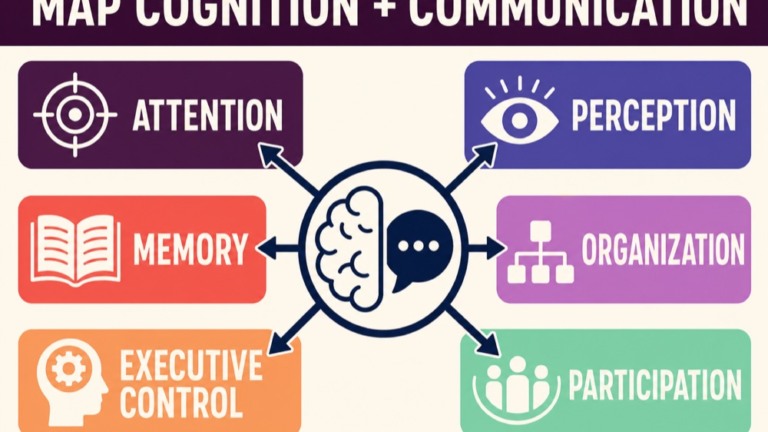
cognition and communication is easier to study when it is treated as a connected system rather than a single label. Cognition and communication are closely connected without being the same construct. A useful SLP study map asks how attention, perception, memory, organization, executive function, language, speech, and context shape the person’s ability to participate.
This learning guide is written for SLP students and other learners reviewing clinical concepts. It uses broad patterns to organize observation, not to make an individualized diagnosis or promise one outcome. Interpretation depends on the person, task, language, culture, hearing, access, health, context, and communication goals.
What cognition and communication includes
Begin by separating the concept into domains. A learner who can name the domains is less likely to collapse cognition, language, speech, auditory access, memory, attention, or participation questions into one explanation. The useful unit of analysis is the task: what the person was asked to understand, produce, remember, organize, coordinate, or communicate, with whom, under which conditions, and with what support.
Domain or system
What to notice
Question to carry forward
Attention and perception
The person selects, notices, and interprets relevant information from the environment and message.
What information was available, selected, missed, or misinterpreted?
Memory
Information may need to be encoded, held, retrieved, recognized, or used across a communication event.
Is the demand on learning, working memory, recall, recognition, or procedural support?
Organization
Ideas, materials, time, and message structure must be arranged so the person can act and communicate.
Where does the sequence or organization break down?
Executive control
Initiation, inhibition, shifting, planning, monitoring, and completion shape goal-directed communication.
Can the person start, adjust, monitor, and finish the task?
Language and speech
Cognitive demands interact with phonology, syntax, semantics, discourse, speech, reading, and writing.
Is the pattern cognitive, linguistic, motor, access-related, or mixed?
Participation
Communication is used in learning, work, relationships, self-advocacy, safety, and daily routines.
What meaningful activity changes because of the pattern?
These domains interact, but they should remain distinguishable. A learner may show strength in one task and need support in another. A study map organizes the next observation; it does not answer every assessment question or replace current professional guidance.
Keep the first pass descriptive and close to the communication event. Note the task, the response, the partner, the setting, the timing, the available support, and the consequence for participation. This gives the learner a stable record to compare across tasks and prevents a familiar term from doing too much explanatory work before the evidence has been separated.
For Praxis-style review, a vignette may include several true details but ask for one best interpretation or next step. The strongest answer usually respects the task, identifies the relevant function, checks the most important missing information, and avoids treating one performance sample as the whole profile.
Map cognition and communication
For study purposes, describe the system-function relationship before naming a disorder or subtype. Record what the person understood, produced, initiated, repaired, coordinated, or participated in. Then note whether the task was familiar, how much context was shared, and which support changed the response.
Attention: selecting, sustaining, dividing, and shifting focus across a communication event.
Perception: noticing and interpreting auditory, visual, spatial, and contextual information.
Memory: encoding, holding, retrieving, recognizing, sequencing, and applying information.
Organization: arranging ideas, materials, time, and message structure for a goal.
Executive control: initiating, inhibiting, planning, monitoring, shifting, and completing a task.
Participation: connecting cognitive-communication performance with education, work, relationships, safety, and daily life.
A strong description is specific enough that another learner could picture the event. Instead of writing “the system is weak,” describe the demand, the observable response, the partner, the context, and the result. This protects clinical reasoning from labels that are broader than the evidence.
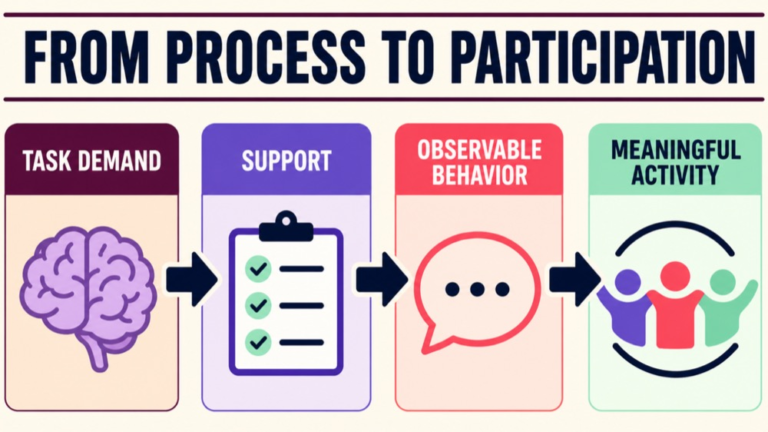
From process to participation
Context changes what communication requires. A naming task, a listening activity, a multi-step instruction, a narrative, a conversation, and a workplace exchange place different demands on processing, memory, attention, language, motor control, and partner support. Hearing access, fatigue, posture, visual supports, language experience, and the opportunity to request clarification should be part of the observation.
A person may communicate effectively in a familiar routine but lose track of a multi-step task, a fast conversation, or a noisy workplace exchange. That contrast does not identify one cause by itself. Compare the message, cognitive load, environmental support, fatigue, language, motor demands, and communication consequence before deciding what the next observation should clarify.
Observation layer
Example question
Task
What did the person need to understand, produce, organize, coordinate, or repair?
Function
Which cognitive, language, speech, auditory, motor, or access relationship was observable?
Access
Were hearing, visual, motor, sensory, language, respiratory, or environmental supports available?
Participation
What meaningful routine became easier or harder because of the pattern?
Context is not an afterthought added once a label has been selected. It is part of the question itself. If performance changes with a quieter room, extra processing time, a familiar partner, a different communication mode, a changed speaking rate, or a changed task, that change is useful evidence about access and demand. It does not identify a cause by itself, but it tells you which conditions should be carried into the next observation.
Apply the concept in clinical reasoning
When a Praxis-style scenario or clinical discussion presents cognition and communication, use a disciplined sequence. The goal is to select the next clinical question or action that matches the evidence, the person’s priorities, and the communication context.
Define the task in plain language.
Identify the domain or domains involved without assuming they are interchangeable.
Separate observation from interpretation and write down what remains unknown.
Check hearing, language experience, culture, communication mode, environment, partner support, alertness, respiration, memory, and task familiarity.
Choose the assessment, collaboration, or observation step that answers the specific question.
State the boundary of the conclusion and keep the person’s participation goal visible.
A person may communicate effectively in a familiar routine but lose track of a multi-step task, a fast conversation, or a noisy workplace exchange. That contrast does not identify one cause by itself. Compare the message, cognitive load, environmental support, fatigue, language, motor demands, and communication consequence before deciding what the next observation should clarify. In a learning answer, the decisive evidence is usually the relationship among the task, the observed pattern, and the next needed information—not a single isolated behavior or label.
Common study mistakes
Treating cognition as a single ability rather than a set of interacting processes.
Assuming a communication breakdown is cognitive without checking hearing, language, speech, access, and context.
Confusing attention, memory, organization, executive function, and language formulation.
Using performance in a structured task to predict every daily communication situation.
Ignoring fatigue, pain, medication, emotional status, environment, and task familiarity.
Describing a deficit without stating the participation consequence or the person’s priorities.
Treating a compensatory support as evidence that the underlying skill is absent.
Selecting a conclusion before identifying the most useful missing observation.
Most of these mistakes come from replacing a multidomain question with a fast label. Correct the habit by returning to the same sequence: describe, separate, contextualize, ask what is missing, and choose a proportionate next step. A short rationale can make the habit visible: identify the evidence, name the uncertainty, and explain why the selected next step fits both.
Build a quick review map
Use this compact map when reviewing a missed question, a lecture note, or a clinical vignette:
Step 1: Define the communication task, message, partner, setting, and participation goal.
Step 2: Separate attention, perception, memory, organization, executive control, language, and speech.
Step 4: Compare familiar and novel tasks, short and long messages, and structured and natural contexts.
Step 5: Describe the functional effect before assigning a broad cognitive label.
Step 6: Choose the next observation or collaboration that tests the specific uncertainty.
Then write one transfer sentence: “When I see this pattern, I will first check ___ because ___.” The sentence should identify a decision rule, not repeat a definition. Revisit it after a delay and test whether you can apply the rule to a different task, age group, or communication mode.
Sources and next steps
cognition and communication is best learned as a context-sensitive pattern across structure, function, access, and participation. Use the current authority pages to refine the concept, then return to practice scenarios that require you to explain what the evidence supports and what it leaves open.
Speech and Language Milestones: A Clinical Learning Guide
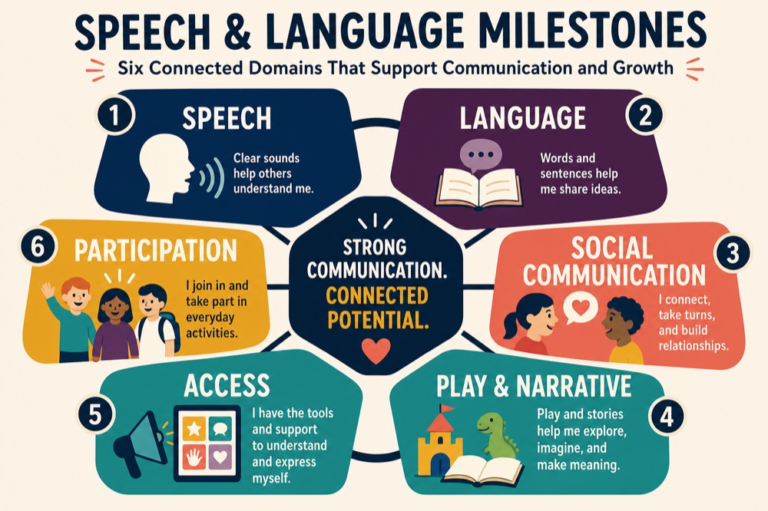
Speech and language milestones are useful when they help a learner notice communication patterns, ask better questions, and choose an appropriate next step. They become misleading when they are treated as a rigid checklist that predicts one child’s future or turns one missing skill into a diagnosis. A clinical view separates speech, language, social communication, play, hearing access, and participation, then considers how those domains work together in real routines.
This guide is written for SLP students, educators, caregivers, and learners reviewing core concepts. It uses broad patterns as orientation, not as deadlines. Development varies with opportunity, communication access, language experience, health, culture, context, and individual learning profile. When concern persists, the appropriate response is careful observation and qualified evaluation rather than a conclusion from a chart.
What milestones can and cannot tell you
A milestone is a broad description of a skill that may become visible within a developmental period. It is not a promise that every child will show the skill on the same day, in the same language, or in the same setting. Milestones help organize observation; they do not replace hearing information, developmental history, language sampling, family priorities, or a comprehensive evaluation when those are needed.
Useful for
Not sufficient for
Choosing what to observe next.
Assigning a diagnosis from one missing behavior.
Describing communication in routines.
Ranking a child against a rigid deadline.
Generating questions about access and participation.
Separating language difference from disorder without context.
Connecting a clinical concept to a real example.
Deciding a treatment plan without qualified assessment.
The word “typical” also needs care. A broad pattern can be common without being required, and a child can show an uneven profile without that pattern answering why it exists. Use the milestone as one piece of evidence and keep the question open until the context is understood.
Start by separating the communication domains
Speech and language overlap, but they are not interchangeable. Speech concerns the production and organization of sounds and spoken output. Language includes understanding and using words, sentences, meanings, and discourse. Social communication includes how a person uses communication with other people, adjusts to context, and shares attention or intent. Play can reveal opportunities for symbolic, narrative, and social language. Hearing and other access factors affect what communication is available to learn and use. Participation asks whether the person can engage in the routines that matter.
Speech: clarity, sound patterns, voice, and fluency in the communication mode used.
Receptive language: understanding words, sentences, questions, concepts, and relationships.
Expressive language: communicating ideas, needs, stories, and relationships through speech, sign, symbols, or other modes.
Social communication: using communication for interaction, repair, sharing, and adapting to a partner or context.
Play and narrative: using objects, actions, symbols, sequences, and stories to represent meaning.
Access and participation: hearing, vision, motor, sensory, partner, environmental, and communication supports that affect opportunity.
This separation prevents a common reasoning error: treating a speech production difference as if it automatically explained comprehension, or treating a small vocabulary sample as if it answered every question about social communication. Each domain deserves its own observation and then a connected interpretation.
Read broad patterns across early development
Early communication changes quickly, but it does not follow one perfectly linear path. Broad patterns may include attention to voices and faces, vocal or gestural communication, understanding familiar routines, intentional words or symbols, combining ideas, participating in play, telling or retelling events, and adjusting communication with different partners. The order and visibility of these behaviors can vary.
Broad period
What to notice
Question to carry forward
Early infancy
Orientation to sound, faces, interaction, and emerging vocal or body signals.
What captures attention, and how does the partner respond?
Later infancy
Reciprocal routines, gestures, varied vocal play, and shared attention.
How does the child signal intent and respond to another person?
Toddler period
Understanding familiar language, using words or other modes, combining meanings, and expanding play.
Is communication becoming more intentional across routines?
How does the child explain, negotiate, repair, and participate?
School-age development
Complex narratives, inferencing, vocabulary depth, classroom language, and social problem-solving.
Which communication demands are affecting learning or relationships?
These descriptions are orientation points, not a scorecard. A child may communicate effectively with gestures, signs, symbols, or a device while spoken language is emerging. A multilingual child may distribute vocabulary and functions across languages. Interpretation should include the full communication repertoire rather than counting only one language or one mode.
Look at the whole communication context
Milestones are most informative when paired with context. Ask who the communication partners are, what routines are familiar, what opportunities the child has had, which language or languages are used, and what supports make participation possible. Hearing access, device use, motor access, attention, regulation, and the communication environment can all affect what an observer sees.
Observe more than one routine, such as play, book sharing, meals, and transitions.
Note both understanding and expression.
Record gestures, facial expression, signs, symbols, and speech rather than speech alone.
Ask how communication changes with familiar and unfamiliar partners.
Consider whether the task gives the child a fair way to show the skill.
Document strengths and successful supports alongside areas of concern.
A strong description says what happened, in what context, with which support, and how consistently. “Did not talk during one clinic activity” is less informative than a pattern across routines that describes understanding, intentional communication, partner response, and access conditions.
When a pattern deserves closer attention
Closer attention is reasonable when concerns persist across settings, communication access is uncertain, a child loses skills, participation is becoming difficult, or the family and educators observe a consistent mismatch between demands and available communication. The next step is not to decide the cause from the milestone list. It is to gather appropriate history, hearing information when relevant, language samples, partner reports, and other evaluation evidence through qualified professionals.
For SLP learning, remember the difference between a referral question and a conclusion. “What should we assess to understand this pattern?” is a useful clinical question. “This one behavior establishes a disorder” is not a responsible inference. Multilingual development, disability, cultural communication style, access, and opportunity should be included in the interpretation.
Use milestones in clinical reasoning
When a practice scenario includes a milestone, identify what the milestone contributes and what remains unknown:
Name the communication domain: speech, receptive language, expressive language, social communication, play, access, or participation.
Describe the behavior in context rather than translating it immediately into a label.
Ask which additional information would change the interpretation.
Consider hearing, language exposure, communication mode, culture, and partner support.
Choose an assessment or collaboration step that answers the actual clinical question.
State the boundary of your conclusion and avoid overclaiming.
For example, if a child uses few spoken words but communicates through gestures and a device, the clinically important question is not simply “How many words?” It is how the child understands, initiates, combines modes, repairs communication, and participates across people and routines. The milestone framework helps you ask a better question; it does not supply the final answer.
Common interpretation mistakes
Using a single age chart as a rigid deadline.
Counting spoken words without observing comprehension or other communication modes.
Ignoring hearing access, partner support, or the communication environment.
Interpreting multilingual development through one language only.
Assuming speech clarity explains a language or social-communication pattern.
Reporting a deficit without documenting strengths and successful supports.
Turning a broad milestone into a diagnosis or treatment prescription.
Copying a public chart without checking its source and date.
For a current clinical learning path, use the ASHA Practice Portal and relevant ASHA Evidence Maps to extend the question into topic-specific evidence. The current NIDCD speech and language resource is useful for broad educational context. Keep the boundaries visible: milestones organize observation, while qualified assessment and current evidence guide individual decisions.
Sources and next steps
Speech and language milestones are most useful when they lead to careful observation, better questions, and communication access. They are not a rigid staircase. For SLP study, keep the domains distinct, connect each behavior to its context, and explain what the evidence supports—and what it does not.
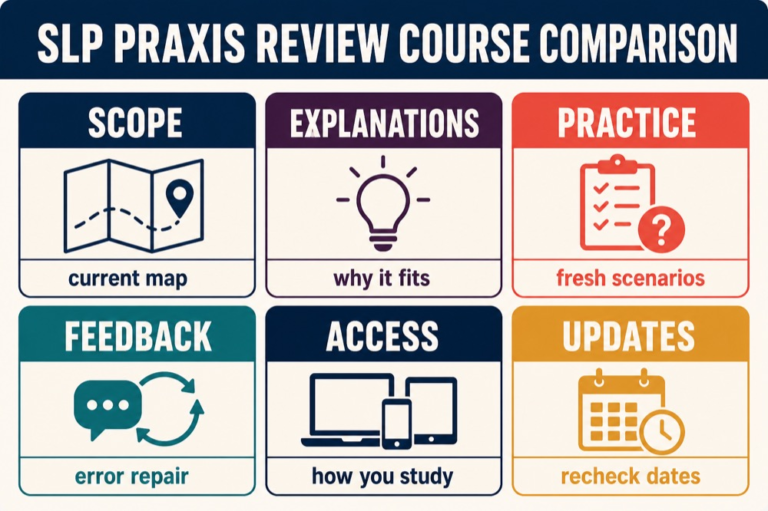
Choosing an slp praxis review course is a learning decision, not only a shopping decision. A course may give you structure, explanations, practice, deadlines, or support, but those features matter only when they solve the problem you actually have. The right question is not “Which course is most popular?” It is “What evidence do I need to produce next, and which format can help me produce it?”
Use the current ETS Speech-Language Pathology 5331 page to anchor scope and changing administration details. ASHA’s Praxis preparation guidance also supports matching preparation to the exam content and your knowledge in each area. This article does not rank named providers or repeat course claims. It gives you a practical way to compare self-study, a review course, and a hybrid plan.
Start with the learning problem, not the course name
Before comparing products, complete a short self-audit. Write down what is currently difficult and what would count as improvement. A learner who has not built a scope map needs organization and coverage. A learner who knows the terms but misses close scenarios needs explanation and decision practice. A learner who studies consistently but cannot keep a schedule may need accountability or a more structured sequence.
Coverage problem: I do not know what to study or how topics connect.
Concept problem: I recognize terms but cannot explain them without notes.
Distinction problem: I confuse nearby assessment, intervention, or professional choices.
Application problem: I understand the chapter but struggle with new scenarios.
Review problem: I complete practice but do not repair recurring errors.
Structure problem: I need a realistic sequence and checkpoints.
Support problem: I need a place to ask questions or receive feedback.
One course may help with several problems, but no format removes the need for active retrieval and error review. If you cannot name the problem, you may choose based on a polished sales page rather than educational fit.
What to evaluate in an SLP Praxis review course
Use the current ETS scope as the first test of coverage. Then evaluate how the course teaches and checks learning. A long video library may be less useful than a shorter sequence with clear explanations and fresh application. A large question count may be less useful than a smaller set with rationales that identify the decisive evidence and explain why a nearby alternative is less appropriate.
Criterion
Look for
Evidence to request or inspect
Warning sign
Scope coverage
Current source or blueprint mapping.
A dated outline showing what each module does.
Undated claims that one list covers everything.
Explanation quality
Definitions, examples, boundaries, and clinical reasoning.
A sample lesson or rationale that explains the decision.
Answer labels with little reasoning.
Practice quality
Original, varied prompts across focused and mixed practice.
A sample item and full explanation, not just a count.
Repetition without transfer.
Feedback
Rationale, error categories, office hours, or a support route.
Clear response time and what feedback includes.
“Support” with no process or boundary.
Access
Device, caption, download, schedule, and expiration details.
Current access and refund language.
Important restrictions hidden until checkout.
Updates
A visible method for reviewing scope and content changes.
Update date, version note, or change policy.
Fixed exam details with no recheck instruction.
Also inspect whether the format respects the difference between exam preparation and clinical truth. A course can teach an exam-relevant distinction, but professional concepts should still be grounded in current, credible sources. Avoid materials that present unsupported certainty, treat one observation as a diagnosis, or imply access to live test content.
Compare self-study, course, and hybrid prep
There is no universal winner among the three formats. The useful comparison is the amount of structure, explanation, feedback, and flexibility each format gives you relative to its cost and your current evidence.
Format
Often fits when
Strength to test
Risk to manage
Self-study
You can map scope, schedule sessions, and diagnose errors independently.
Flexibility and control over depth.
Unnoticed gaps or passive rereading.
Review course
You need a sequence, curated explanations, or external structure.
Organization and guided coverage.
Watching without retrieving or applying.
Hybrid
You want a structured spine but need targeted independent review.
Course structure plus personalized repair.
Paying for overlapping resources and creating overload.
The format should change your behavior. If self-study already produces a clear map and error log, a course may add little unless it fills a specific explanation or accountability gap. If independent study repeatedly stalls at organization or comparison, a structured course may be worth evaluating. If only two domains are weak, a hybrid approach may be more efficient than replacing everything.
Choose a format that matches your evidence
Use a simple decision path:
Can you identify the current scope and your weak areas? If not, prioritize a source-linked map or structured orientation.
Can you explain concepts but miss applied scenarios? Prioritize varied practice, comparisons, and complete rationales.
Do you know what to do but fail to follow a schedule? Prioritize a sequence, checkpoints, or accountability.
Are only a few domains unstable? Consider targeted self-study or a hybrid plan rather than maximum coverage.
Do you need feedback that a course does not provide? Check what questions, office hours, or review support actually includes.
Make the decision with a budget and an access check. Confirm the current price, payment terms, expiration, device requirements, captions, downloads, schedule, refund policy, and update policy on the provider’s current page. These details are product facts, not permanent truths, so save the date you checked them.
Questions to ask before you buy
Which current ETS source or blueprint does the course use, and when was it checked?
How are clinical concepts explained beyond a definition?
Are practice questions original, varied, and accompanied by full rationales?
Does feedback explain the deciding evidence and the tempting alternative?
Can I study asynchronously, live, or through a combination?
How long do I keep access, and what happens if the scope changes?
Are captions, transcripts, downloads, and mobile access available?
What support is included, and what response time should I expect?
What is the current refund or cancellation policy?
Which part of my self-audit will this course improve?
A sample lesson is often more informative than a large feature list. Look for whether the sample asks you to retrieve, compare, apply, and explain. A polished presentation is valuable, but the learning job is the deciding factor.
Make the course work after enrollment
Enrollment does not create learning automatically. Turn each module into an active cycle: preview the target, retrieve what you already know, study the explanation, answer a fresh prompt, record the error pattern, and schedule a return. Keep a separate list of current logistics to verify from ETS rather than treating a course slide as the final authority for changing details.
Write one question before opening a lesson.
Close the lesson and summarize the concept in plain language.
Complete practice without looking at the rationale first.
Record why the tempting alternative was less appropriate.
Revisit the concept in a new context after a gap.
Mix older and newer topics so that you must select the rule.
If you want a structured resource within that kind of system, you can review the SLP Study Center Complete Prep page. Match the current materials to the gap you identified rather than treating the product label as a complete plan.
Common course-selection mistakes
Choosing by question count instead of explanation quality.
Assuming the newest-looking design proves current scope coverage.
Buying several overlapping resources before completing a baseline.
Confusing watching a lesson with retrieving its content.
Using a course percentage as a universal score prediction.
Ignoring access, caption, expiration, or refund details.
Relying on an undated slide for current exam administration facts.
Accepting unsupported claims about live, recalled, or guaranteed content.
Sources and next steps
Review the current ETS Speech-Language Pathology 5331 page and ASHA’s Praxis preparation guidance before finalizing a study resource. The best slp praxis review course is the one whose current content, explanations, practice, access, and support solve the learning problem your own evidence has revealed.
If you are building an slp praxis study plan, begin with a learning system rather than a calendar copied from someone else. A useful plan connects the current ETS scope, your starting evidence, concept learning, clinical distinctions, original practice, error review, and the logistics you must verify. The number of study days matters, but the quality of the decisions inside those days matters more.
This guide gives you a flexible sequence for starting from scratch, returning after an uneven attempt, or moving beyond passive reading. It is not an official ETS schedule and it cannot predict an individual result. Use the current ETS Speech-Language Pathology 5331 page as the control point for changing scope and administration details, and use ASHA’s Praxis preparation guidance to keep the plan connected to the exam content and your own knowledge.
What a good study plan is designed to do
A plan is useful when it changes your next action. “Study assessment” is a topic label, not yet a task. “Explain the purpose of a selected assessment, identify the evidence it provides, compare it with a nearby choice, and answer a fresh scenario with a written rationale” is a task you can complete and review.
Build your plan around five outputs:
Coverage: a visible map of what the current scope asks you to learn.
Retrieval: the ability to explain important concepts without copying notes.
Distinction: the ability to separate plausible options by purpose, evidence, timing, or boundary.
Application: original practice that requires a decision in context.
Adjustment: an error log that tells you what to do next.
These outputs keep a plan from becoming a race through pages. A learner who reads quickly but cannot explain a concept has a retrieval problem. A learner who knows definitions but chooses a nearby distractor has a distinction or application problem. A learner who keeps repeating the same missed idea has a review-loop problem. The plan should identify the problem before assigning more material.
Start with a baseline and a current scope map
Before choosing a weekly target, record two kinds of evidence: the current source and your current performance. Save the ETS page or companion information you used, note the date you checked it, and then complete a modest original diagnostic set. The diagnostic is not a prediction; it is a way to find where your first study decision should begin.
Baseline question
What to record
What it changes
What does the current source cover?
Domain labels, task language, and items that can change.
The boundaries of your study map.
What can I retrieve?
Concepts you can explain without notes.
Which topics need active recall rather than rereading.
Where do I confuse choices?
Pairs of concepts or decisions that blur together.
Which comparison cards or scenarios to write.
Why do I miss items?
Knowledge, task-reading, application, timing, or careless errors.
The repair action for the next block.
What must I verify later?
Registration, delivery, score, or pathway details.
The date for a current-source recheck.
Keep the baseline small enough to review. For each uncertain or missed item, write the task the prompt asked, the evidence that mattered, the reason your choice was tempting, and the concept that should transfer to a new situation. A raw percentage without that explanation is too thin to design a study plan.
Turn each domain into a learning task
Use a four-part row for every major area in your map:
Know: What terms, principles, or patterns must be understood?
Distinguish: Which nearby idea, assessment, intervention, or professional choice could be confused with it?
Apply: What original scenario would require a decision?
Check: What evidence would show that the idea is becoming usable?
For example, a topic about assessment should not become a list of instruments. Ask what decision the assessment supports, what information it can and cannot provide, how context affects interpretation, and what a responsible next step would be. A topic about intervention should not become a collection of technique names. Ask how the goal, evidence, participation need, communication partner, and response to treatment affect the decision. The questions create clinical reasoning practice without turning the article into an official practice bank.
Use short notes with a boundary sentence. “This concept helps answer X; it does not by itself establish Y” is a useful pattern for avoiding overinterpretation. It also gives you a reason why a distractor may be less appropriate, which is more durable than memorizing a single answer.
Build retrieval and clinical-distinction practice
After a concept pass, close the book and retrieve. Write a plain-language definition, one example, one limitation, and one comparison. Then use a fresh prompt that does not reuse the wording of your notes. If you can answer only after looking at the explanation, mark the idea as developing rather than secure.
Use a two-minute recall before opening the reference.
Explain the deciding evidence in one sentence.
Compare the best answer with the closest alternative.
Return to the concept in a different client, setting, or task context.
Record whether the miss came from knowledge, retrieval, distinction, task reading, or timing.
Imagine an original scenario that includes a communication goal, a small amount of assessment evidence, and a professional constraint. The point is not to imitate a live test item. The point is to practice identifying the task, selecting the evidence that carries weight, and explaining why another plausible option answers a different question.
Use a weekly review loop that can adjust
A weekly plan should be a loop, not a promise that every week will look identical. Start each cycle by choosing one coverage target, one distinction target, one practice block, and one review block. End by looking at the error pattern and adjusting the next cycle.
Study block
Primary action
Evidence to save
Map
Review the current scope and choose a narrow target.
One completed map row and one source date.
Learn
Build concept notes with examples and boundaries.
A closed-book explanation.
Apply
Complete fresh scenarios or mixed questions.
Answer, rationale, and distractor comparison.
Repair
Revisit recurring errors in a new context.
Updated error category and next action.
Review
Mix older and newer topics with deliberate timing.
Trend notes, not a single promised score.
Use spaced review by returning to a concept after a gap, not by repeating it until it feels familiar in one sitting. Add mixed practice after focused review so that you must identify which concept applies. If timing causes rushed reading, practice the task-reading step separately before increasing the set size.
Choose resources by the job they do
Study guides, flashcards, videos, question sets, and courses are tools. Select them by the output you need, not by the strongest marketing label. A resource is a good fit when it gives you enough explanation to learn, enough variation to apply, and enough structure to review errors.
For scope: choose a current source-linked outline.
For concepts: choose explanations with examples and limitations.
For distinctions: choose comparisons and scenario rationales.
For retrieval: choose prompts that require a closed-book explanation.
For application: choose original questions with complete reasoning.
For adjustment: choose a place to record errors and revisit them.
If you want a structured preparation resource, you can review the SLP Study Center Complete Prep page and match its current materials to the job you need next. Treat any product as one part of your system, not as a replacement for checking the current ETS source or for reviewing your own reasoning.
Verify logistics and run a readiness check
Put current logistics on the plan early enough to act. Check the exact test identity, registration information, appointment or delivery details, identification and accommodation instructions, score reporting guidance, and the requirements of the state, agency, or pathway that will use the result. The current ETS page and your account control changing details; a saved screenshot or old study group message may not.
At the end of a cycle, ask:
Can I name the current source and the date I checked it?
Can I explain the main concepts without copying the notes?
Can I distinguish close options using decisive evidence?
Can I classify my most common error?
Have I repaired that error in a new context?
Do I know the next narrow study action?
If several answers are no, do not respond by adding every resource at once. Choose the smallest repair that will produce evidence: one comparison, one retrieval prompt, one fresh scenario, or one current logistics check.
Common study-plan mistakes
Watch for these patterns:
Copying another learner’s calendar without checking your own baseline.
Reading the blueprint once and never using it to choose a task.
Counting practice questions without reviewing the reasoning behind misses.
Studying only definitions while avoiding close-concept comparisons.
Turning a practice percentage into a predicted reported result.
Leaving current registration and test-day details until the final evening.
Changing resources whenever a topic feels difficult instead of diagnosing the gap.
Trying to cover everything every day and retaining little.
A strong slp praxis study plan is therefore a feedback system: map the current scope, diagnose your starting point, learn concepts with boundaries, practice decisions, repair errors, and recheck changing logistics. Keep the plan flexible enough to respond to evidence, and let the next study action be specific enough to complete.
If you are asking how is the praxis scored, you are probably trying to answer two different questions at once: what your performance means and what you should do next. Those questions are connected, but they are not identical. A score report is a result record; it is not a complete study diagnosis, a universal license rule, or a shortcut for predicting a future attempt.
The most useful way to understand Praxis scoring is to keep four ideas separate: the points earned on scored responses, the reported scale used by the assessment, the qualifying requirement attached to your pathway, and the study evidence you collect from practice. Once those layers are separated, score language becomes much less mysterious and your review plan becomes more specific.
What the question is really asking
Searchers often use the word score to mean several things. One person may want to know whether a practice set result is encouraging. Another may be looking at a score report and wondering how it was produced. A third may be checking whether a result meets a state, agency, or certification requirement. These are different decisions and require different evidence.
For Speech-Language Pathology Praxis 5331, start with the current ETS test page and the current requirement for the pathway that will use your result. ETS explains the scoring vocabulary and reporting process; the relevant state, agency, or certification body determines how a qualifying score is applied. ASHA can provide professional context, but a general article cannot replace the rule for your exact jurisdiction or pathway.
Scoring question: How were responses counted and reported?
Requirement question: What result does my pathway currently require?
Study question: Which concepts should I review before the next practice set?
Confusion usually begins when one answer is used as if it answered all three questions. A practice percentage may help with the third question, but it is not the answer to the first or second.
Three layers to keep separate
The phrase “my score” is easier to interpret when you name the layer you mean. The following comparison is a study framework, not a substitute for the current ETS explanation or a pathway-specific requirement.
Layer
What it describes
What it can help you decide
What it cannot establish by itself
Raw performance
The scored responses you answered correctly in a particular form or practice set.
Which items and concepts need review.
A universal reported score or a credential outcome.
Reported scale
The score format used to communicate performance for the assessment.
How to read the result in the reporting system.
A simple public conversion from any practice percentage.
Qualifying requirement
The threshold or rule used by a named state, agency, or pathway.
Which current rule you must verify before submitting a result.
A universal number that applies to every learner and jurisdiction.
Study evidence
Your pattern across original practice, timing, explanations, and repeated review.
How to allocate the next study block.
A prediction or guarantee of the next reported result.
This distinction matters because the same learner can have a strong practice percentage in one narrow topic and still have an uneven profile across the blueprint. Conversely, a single difficult practice set can expose a gap without defining the learner’s overall readiness. Treat each data point as evidence with a limited job.
From raw points to a reported score
In a selected-response assessment, a correct scored response contributes a raw point. That is the intuitive part. The reported result uses a scale that allows performance to be communicated in a standardized way. The scale is useful because a raw total on one form should not be treated as if it were automatically interchangeable with a raw total on another form.
That does not mean a learner can reverse-engineer a personal formula from a few practice results. The reported score is tied to the assessment and its scoring rules, while a commercial practice set has its own item pool, difficulty, explanations, and possible flaws. A practice set can approximate the decision-making experience you need to build; it cannot promise the number that will appear on a future report.
A helpful mental model is:
Count: What did I answer correctly on this set?
Interpret: What concept or reasoning pattern does that result represent?
Verify: Which current ETS or pathway rule applies to my real result?
For example, imagine a learner completes an original 40-item set and answers 30 items correctly. “30 out of 40” is a description of that set. It is useful for identifying missed topics, but it is not a claim that the learner would receive a particular Praxis scale result. The correct next step is to examine the ten misses, classify the reason for each miss, and compare the resulting study need with the current blueprint.
Why practice percentages do not convert cleanly
Practice percentages feel precise because they are easy to calculate. Their limitation is not arithmetic; it is comparability. A percentage depends on the set’s content mix, item wording, distractor quality, difficulty, timing, and scoring key. Two sets with the same percentage can represent very different learning situations.
Consider two original 20-item sets. On Set A, a learner misses four items because the terms were unfamiliar. On Set B, the learner misses four items after narrowing the choices correctly but overlooking a decisive clinical detail. The percentages match, but the instructional response should not. Set A may call for concept retrieval and vocabulary mapping. Set B may call for slower comparison of evidence, better attention to the task demand, and a second attempt with a written rationale.
Do not multiply a practice percentage by a guessed scale range.
Do not treat a difficult third-party set as a calibrated ETS form.
Do not use one timed score as the entire readiness picture.
Do not ignore the reason for a miss just because the answer key is available.
Use percentages as trend signals instead. If performance improves on comparable sets while your error categories narrow and your timing becomes steadier, that is useful evidence for study planning. It still deserves cautious interpretation, especially when the content mix changes.
How to turn a score report into a study decision
A score report can tell you what was reported. Your study process has to explain what to do with that information. Begin by recording the report date, test identity, score fields, recipient or pathway context, and the current requirement you are checking. Keep those administrative facts separate from your personal interpretation.
Then use a short evidence review:
Confirm the source. Read the current score-reporting language in your ETS account or the current ETS guidance for the relevant test.
Confirm the rule. Check the state, agency, or certification source that will actually use the result. Record the page date or revision information if provided.
Map the study evidence. Compare your practice error log with the blueprint domains and the explanations you trusted.
Choose one action. Select a narrow review target, such as assessment selection, intervention principles, professional practice, or another blueprint-aligned concept.
Recheck with retrieval. After review, answer a fresh set and explain why each distractor is less defensible.
This workflow protects you from two opposite errors. A learner who is disappointed by a result may study everything again without prioritization. A learner who is pleased by a result may stop checking the specific domain or reasoning pattern that remains fragile. A report is most useful when it leads to a concrete, limited next action.
Common scoring mistakes
Confusing a raw total with a reported scale
A raw total tells you how many scored responses contributed points in a particular context. It does not, by itself, explain the reported scale or the current qualifying rule. Use the current ETS explanation for the reporting vocabulary.
Using a universal passing number
Requirements can vary by state, agency, certification route, and effective policy. A number remembered from a study group or an older page may not be the rule that applies to you. Verify the exact pathway before you submit a score or make a timeline decision.
Reading a practice percentage as a prediction
A practice result is a sample of your preparation under specific conditions. Its best use is to reveal what to revisit, not to forecast a guaranteed outcome. Track several comparable samples and describe the limits of each.
Studying only the missed answer
Correct answers can also be guesses. For each item, record the deciding evidence, the tempting distractor, and the rule you want to transfer to a new scenario. This turns scoring information into learning rather than a simple tally.
A simple review loop
Use this loop after each practice block:
Sort items into secure, uncertain, and missed.
Label the reason: knowledge gap, task misread, distractor comparison, timing, or careless execution.
Write one transferable rule for every uncertain or missed item.
Review the source concept, then explain it without looking at the answer key.
Return to the same concept in a new context rather than repeating the exact item.
Record the next check date and the evidence you will use to judge improvement.
The loop is intentionally modest. A clear error category is more useful than a dramatic score claim. Over several blocks, you can see whether the same concept keeps returning, whether errors shift from knowledge to application, and whether timing is changing the quality of your decisions.
The short answer to how is the praxis scored is therefore: scored responses are counted within the assessment’s reporting system, but your study percentage and your pathway requirement are separate kinds of evidence. Keep those layers separate, verify current first-party rules, and use the score information to choose the next review action.