SLP Praxis Exam Blueprint: Turn the Domains Into a Study Map
slp praxis exam blueprint is the document that turns a broad SLP review project into a manageable map. It shows the major content domains and helps you decide where to spend study time. It does not tell you the wording of a future item, and it should not be used to predict a result from a single practice percentage.
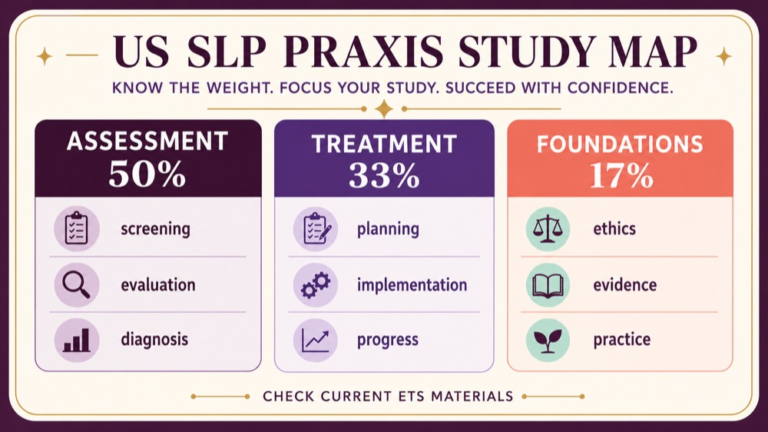
Use the current ETS Speech-Language Pathology Praxis 5331 page and Study Companion as your source of truth. In the materials checked for this guide, the blueprint grouped content into three broad areas: Screening, Assessment, Evaluation, and Diagnosis; Planning, Implementation, and Evaluation of Treatment; and Foundations and Professional Practice. The listed emphasis was approximately 50%, 33%, and 17%, respectively. Verify the current edition before building a long plan.
What the blueprint is for
A blueprint answers a scope question: which kinds of knowledge and professional decisions belong in the preparation plan? It helps you choose resources, balance domains, and notice when your studying has become too narrow. It is more useful than a random list of vocabulary because it connects topics to the work an SLP may need to understand.
Keep three ideas separate:
Domain: a broad area of the assessment, such as assessment or treatment.
Competency: a more specific ability within that domain, such as selecting information or interpreting a profile.
Practice task: an original question, case, chart, or explanation used to rehearse the competency.
Weight: the relative emphasis listed in the current test materials, not a guarantee about any one sitting.
This separation prevents two common problems. A learner may copy the domain headings without practicing the decisions hidden inside them, or may spend all week on a favorite topic because it feels familiar. The blueprint should guide both breadth and depth.
Read the three blueprint domains
The largest area in the current materials checked for this guide is Screening, Assessment, Evaluation, and Diagnosis. Study here includes choosing information, understanding measurement, integrating findings, and recognizing when a referral or additional evaluation matters. The domain is broader than memorizing test names.
Planning, Implementation, and Evaluation of Treatment focuses on how an SLP moves from findings to goals, intervention choices, implementation, progress monitoring, and adjustment. A strong study block connects a client profile to a functional target and a way to judge whether the plan is helping.
Foundations and Professional Practice provides the professional frame. It includes communication science and development, service delivery, ethics, evidence use, collaboration, and responsibilities that shape safe and effective care. Smaller listed emphasis does not make this domain optional; it makes efficient coverage important.
Blueprint area
Study question
Useful output
Screening, Assessment, Evaluation, and Diagnosis
What information supports the decision?
Assessment map with interpretation notes.
Planning, Implementation, and Evaluation of Treatment
What plan fits the profile and goal?
Goal, intervention, and progress-monitoring outline.
Foundations and Professional Practice
What professional frame guides the work?
Scope, ethics, collaboration, and evidence checklist.
Use blueprint emphasis to allocate study time
If the current percentages remain the same when you check the ETS materials, use them to set a starting allocation rather than a rigid promise. For example, a ten-hour week might begin with about five hours for assessment-related work, three hours for treatment planning and evaluation, and two hours for foundations and professional practice. Adjust after practice reveals a real weakness.
Do not measure study only by pages read. A useful allocation includes several kinds of work:
Concept building: learn the terminology, distinctions, and relationships.
Decision practice: apply the concept to an original scenario or selected-response exercise.
Explanation: state why the leading choice fits and why alternatives fall short.
Retrieval: recall the principle without looking at the note.
Correction: record the specific error and choose a targeted next step.
A heavier domain can receive more total time, but every domain still benefits from retrieval and application. If you are confident in assessment vocabulary but slow when comparing treatment choices, reallocate some time toward decision practice instead of repeating familiar reading.
Turn domains into decision skills
Write one observable skill under each domain. For assessment, that might be matching a referral question to information needed. For treatment, it might be linking a functional goal to an intervention and progress measure. For professional practice, it might be identifying the ethical or scope boundary that changes the next step.
Use a skill card with five fields:
Domain: which blueprint area does this belong to?
Situation: what client, setting, or professional context is present?
Task: what decision must be made?
Evidence: which detail supports or limits the decision?
Transfer rule: what principle should carry to a new case?
This format makes review more active. Instead of writing “study aphasia,” you can write “given a communication profile, distinguish the information needed for differential reasoning from the information needed for treatment planning.” That statement gives you a practice target and a way to judge whether your answer is supported.
Practice cross-domain reasoning
Real clinical decisions do not stay in separate boxes. A case may begin with a screening concern, move into evaluation, lead to a treatment plan, and require collaboration or referral. Use the blueprint domains as organizing labels, but include mixed practice after you understand the individual areas.
For a mixed case, ask:
What concern or referral question is being addressed?
What information is already available, and what is missing?
What assessment or interpretation step is justified by the evidence?
What functional goal or intervention direction follows from the profile?
What professional, safety, access, or collaboration boundary matters?
Keep these as study scenarios you create or obtain from a preparation resource. Do not represent a practice case as a live or remembered item. The transferable value is the sequence of reasoning, not a claim about what will appear.
Build a weekly blueprint map
A weekly map should be simple enough to use. Start with the current domain emphasis, then assign each study block one primary skill and one review action. Leave room for mixed practice because the final assessment may shift from one content area to another.
Block
Primary focus
Evidence of progress
Learn
One concept cluster from the blueprint.
Can explain it in plain language.
Apply
Original scenarios or preparation questions.
Can identify task, clue, and best-supported choice.
Retrieve
Closed-note recall across two domains.
Can rebuild the decision rule.
Audit
Error log and next-week adjustment.
Can name the gap and correction.
Rotate the primary focus across the three domains. A week that feels productive because it repeats one comfortable chapter may leave a large blind spot. Your map should make that imbalance visible before a full-length practice session exposes it.
Audit the blueprint with a review cycle
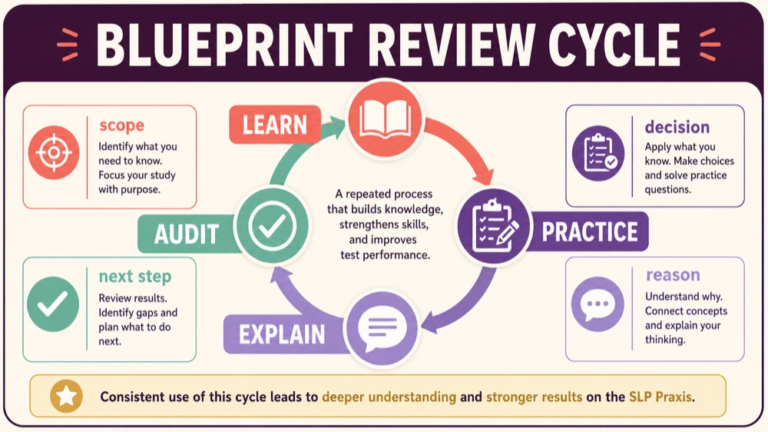
Use a four-part review cycle: learn, practice, explain, and audit. In the audit step, sort errors by domain and by reasoning type. You may discover that your content knowledge is adequate but your interpretation of task verbs is weak. That finding changes the next practice block more effectively than simply adding more notes.
Coverage check: have I touched every current domain?
Depth check: can I apply the principle to more than one context?
Evidence check: can I identify the decisive detail?
Transfer check: can I explain a rule without copying the example?
Timing check: can I use the reasoning routine within a timed set?
Source check: are changing administration facts verified on current ETS materials?
Repeat the audit after a mixed set and after a full-length simulation. The blueprint is most useful when it changes your next action. If the audit only produces a percentage, it has not yet become a study map.
Common blueprint mistakes
Treating the blueprint percentages as a prediction of exact item counts.
Studying the largest domain while ignoring the other two.
Memorizing headings without practicing decisions inside them.
Confusing a topic list with the current scope document.
Using an old Study Companion without checking the current ETS page.
Counting pages or flashcards instead of measuring application.
Keeping practice in isolated domains for too long.
Using a practice score as a direct estimate of a Praxis result.
The correction is to verify the current source, translate each domain into skills, schedule weighted but balanced practice, and review errors by cause. A blueprint can guide attention, but it cannot replace reasoning practice.
Blueprint checklist
Before you start the next study week, answer:
Which ETS blueprint edition and test page did I check?
What are the current broad domains?
What relative emphasis does the current material list?
What decision skill will I practice under each domain?
How will I include retrieval and application?
When will I run mixed-domain practice?
How will I classify errors?
What will make me change next week’s allocation?
The best use of the slp praxis exam blueprint is practical: let it set coverage and starting priorities, then let your error log refine the plan. Recheck the live ETS materials when your test date approaches.
Sources and next steps
Use the current ETS Speech-Language Pathology Praxis 5331 page for the live test description and administration information. Use the ETS Study Companion for blueprint scope and preparation context, and review ASHA’s Praxis information for certification context. Verify current materials before relying on percentages or test details.
slp praxis exam time limit is not just a number to memorize. It is a planning constraint that affects how you read, compare answer choices, decide when to move, and reserve attention for a later review. A calm pacing system gives each question an appropriate amount of attention without turning the clock into a second source of stress.
The current ETS Speech-Language Pathology Praxis 5331 page should control the live timing and delivery details. When this guide was checked, ETS listed 150 minutes and 132 questions, but administration information can change. Verify the current page and Study Companion before your appointment. The method in this guide remains useful if the listed numbers change.
What the time limit changes
Without a time limit, you can treat every question as an open-ended research problem. Under a timed selected-response assessment, the goal is different: make the best supported decision with the information available, then preserve enough time to finish the full set. That requires an explicit stopping rule for uncertainty.
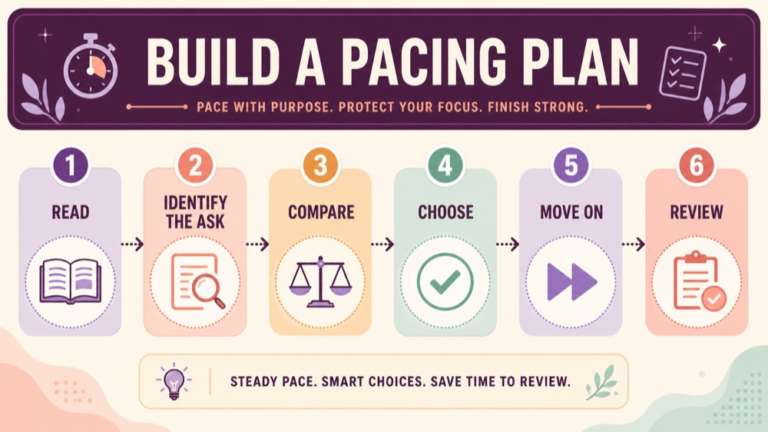
Think about the limit through four linked tasks:
Reading: identify the task verb and the details that change the answer.
Comparing: weigh plausible options against the same evidence.
Moving: recognize when more rereading is unlikely to improve the decision.
Reviewing: return to flagged or uncertain items only after the remaining work is protected.
A time limit does not mean rushing every item. It means allocating attention deliberately. Direct items may take less time; complex scenarios may take more. Your practice should show whether you are slow because of a knowledge gap, an option-comparison habit, a reading problem, or a tendency to seek certainty that the stem cannot provide.
Turn the time limit into checkpoints
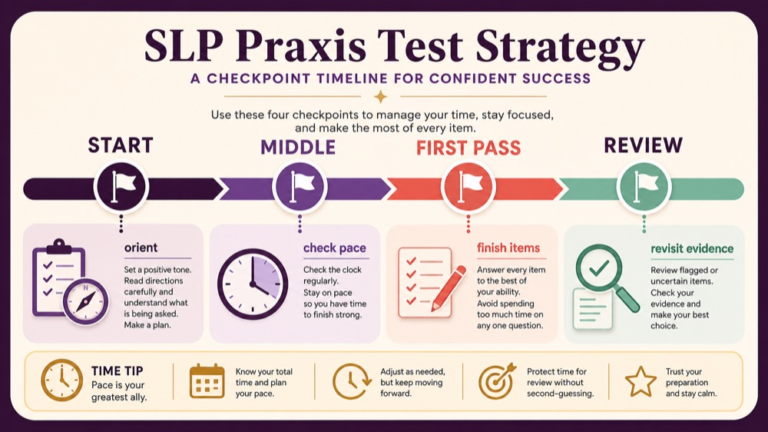
Convert the current ETS time into a few progress checkpoints. Avoid setting a separate alarm for every question, because that can interrupt reasoning. Instead, decide when you will look at the remaining time and attempted-question count. Your checkpoints should tell you whether you are on pace for a complete first pass and a realistic review window.
Checkpoint
What to check
What to do if you are behind
Early
Am I spending too long establishing the routine?
Use the stem-reading steps and reduce repeated rereading.
Middle
Are attempted items and time remaining compatible?
Apply the slow-item rule and continue with the next task.
Late first pass
How many items remain before review?
Finish unanswered items before revisiting low-value uncertainty.
Review
Which flagged items have a clear reason for reconsideration?
Review evidence, not feelings, and stop when the review window closes.
The exact minutes for a checkpoint depend on the current test length and your practice data. Use the live ETS page for the administration number, then test your plan in a full-length simulation. A checkpoint is useful only when it leads to a decision; staring at the clock without changing behavior adds pressure without information.
Use a flexible first pass
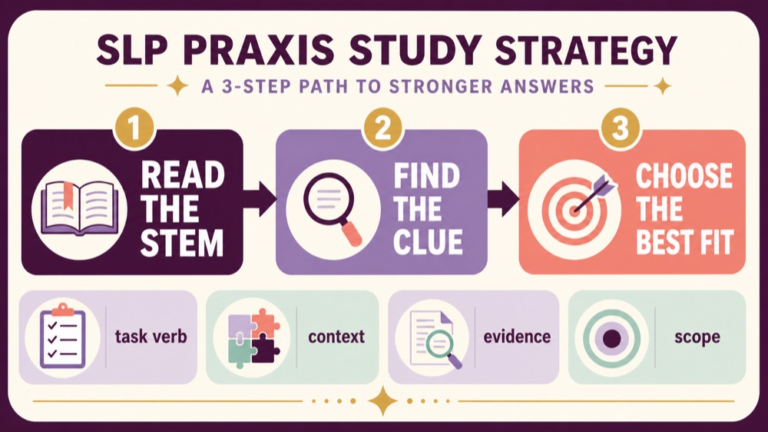
During a first pass, aim for complete and supported responses. Read the stem, identify the task, compare the options, and select the choice that best fits the evidence. If the item is difficult but the reasoning path is clear, give it the attention it needs. If you are cycling through the same sentence without gaining a new clue, use your stopping rule.
A flexible first pass can follow this sequence:
Orient: identify whether the item asks for an interpretation, priority, measure, goal, or action.
Filter: mark age, setting, safety, participation, and scope details.
Compare: explain why the leading choice answers the task better than the alternatives.
Commit: select the best supported answer and note it for review only if a specific concern remains.
Continue: move to the next item while your attention is still available.
Do not confuse a flexible first pass with careless speed. A fast answer based on a missed constraint is not efficient. The aim is to remove unproductive loops while preserving the short reasoning routine that catches decisive clues.
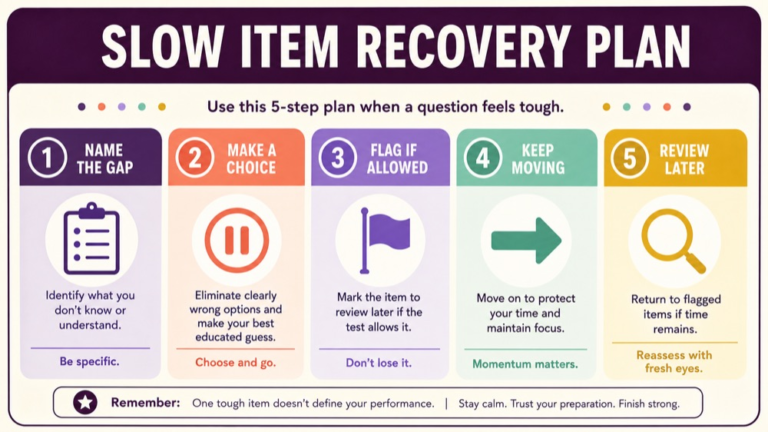
Build a recovery plan for slow items
Every timed practice session should include a recovery plan. Slow items happen for different reasons, and the response should match the cause. If you spend several minutes on a concept you do not know, rereading will not create the missing knowledge. If you know the concept but cannot choose between two options, write a one-sentence comparison and look for the stem detail that separates them.
Unknown concept: make the best supported choice, flag it if allowed, and record the topic for later study.
Dense stem: restate the task and remove details that do not change the decision.
Two plausible options: compare safety, sequence, fit, and evidence rather than choosing by tone.
Emotional spike: pause briefly, breathe, and return to the task verb and decisive clue.
Repeated rereading: set a stopping point and continue so one item does not control the whole session.
Practice the recovery plan before test day. A rule that exists only in your notes may disappear when the clock feels urgent. After each timed set, write down whether your slow items were caused by knowledge, task interpretation, evidence, comparison, or confidence. That classification gives your next study block a specific target.
Protect review time
Review time is not leftover time. It is a planned part of the session. Reserve a window only after you know how many items remain and whether any are unanswered. Review the items with a concrete reason first: a missed word, an overlooked safety detail, a misread number, or an option that needs one final comparison.
Be careful with answer changes. A second look is helpful when it adds evidence. It is less useful when it merely gives anxiety a new opportunity to replace a supported choice. For each flagged item, ask what changed in your reasoning. If nothing changed, the original decision may still be the better supported one.
The current testing interface determines which navigation or review tools are available. Learn the actual instructions at your appointment and do not assume that a feature from a practice platform behaves the same way on the live assessment.
Practice under the same constraint
Use the ETS Study Companion to select representative content areas, then schedule practice that includes both untimed learning and timed application. Untimed work helps you build accurate reasoning. Timed work shows whether the reasoning routine is efficient enough under a limit. You need both kinds of feedback.
Complete a short untimed set and write the evidence behind each choice.
Repeat a comparable set with a light time boundary.
Complete a mixed-domain set so you must identify the task before applying a strategy.
Run a full-length simulation using the current listed time and your checkpoint plan.
Review patterns and adjust one behavior for the next session.
Keep practice questions clearly labeled as original or preparation content. Do not treat a practice score as a direct conversion to a Praxis score, and do not use claims about live or remembered items as a study method. Practice is most valuable when it strengthens a transferable decision skill.
Common pacing errors
Using the same target seconds for every question regardless of complexity.
Checking the clock so often that it interrupts reading and comparison.
Spending review time on one uncertain item while other items remain unanswered.
Skipping the task verb and answering the topic instead of the question.
Changing answers without identifying new evidence.
Practicing only untimed questions and discovering a pacing problem late.
Assuming a slow item means the entire session is lost.
Building a plan around an old timing number without checking ETS.
Replace a vague goal such as “go faster” with a measurable adjustment. For example, record the number of repeated rereads, use a two-sentence comparison for close options, or check progress at two planned points. Small observable changes are easier to review and refine.
Time-limit checklist
Before your next timed block, write down:
What timing and question count does the current ETS page list today?
What is my first-pass checkpoint?
When will I check the middle of the session?
What is my rule for a slow or unfamiliar item?
How will I protect unanswered questions?
Which flagged items deserve review first?
What evidence must be present before I change an answer?
What pacing behavior will I analyze after the set?
The practical answer to the slp praxis exam time limit is a current source check plus a flexible operating plan. Know the live constraint, practice under it, and keep your attention on the reasoning task rather than on a rigid countdown.
Praxis SLP Selected Response Questions: A Reasoning Guide
praxis slp selected response questions are best approached as structured decisions. You are not only looking for a familiar term. You are reading a stem, identifying the problem it actually asks about, weighing the evidence, and selecting the response that fits the client, setting, goal, and professional context.
The current ETS Speech-Language Pathology Praxis 5331 page describes a computer-delivered, selected-response assessment. When this guide was checked, ETS listed 132 questions and 150 minutes, but administration details can change. Confirm the live ETS page and Study Companion before test day. The strategy below is designed to remain useful even when a number or interface detail changes.
What selected response means
Selected response is a response format, not a promise that each item tests simple memorization. A prompt may ask you to choose the best assessment step, the most appropriate treatment decision, the clearest interpretation, or the action that fits professional responsibilities. The answer choices may all sound reasonable until you connect them to the decisive detail in the stem.
Keep four layers separate while you study:
Format: you select from the choices presented in the current testing interface.
Content: the item may draw on speech, language, swallowing, hearing, cognition, or professional practice.
Reasoning: you match the best choice to the evidence and the task verb.
Boundary: you work from the current ETS scope and professional standards, not from rumors about test items.
This distinction helps explain why a large flashcard deck can still leave you unsure between two options. The missing skill may be comparison, prioritization, or interpretation rather than another isolated definition. Use the ETS Study Companion to map domains, then practice the decision behavior those domains require.
Read the stem before the options
Before looking for a keyword, identify the task. Words such as best next step, most appropriate, most likely explanation, and priority create different decision rules. A question about what to do first is not the same as a question about what could eventually be included in a full plan.
Use a short stem-reading routine:
Name the task: restate the question in plain language.
Locate the client: note age, communication profile, medical or educational setting, and participation need.
Mark the constraints: identify safety, consent, access, scope, time, or available-evidence limits.
Underline the change-maker: find the fact that separates a strong option from a merely plausible one.
Predict the direction: before reading all options, describe what a defensible response should accomplish.
Do not turn this routine into a reason to reread every sentence repeatedly. The purpose is to create a decision frame. If the stem gives a clear safety concern, that concern may carry more weight than a detail that is interesting but not action-changing. If the stem asks about a goal, keep the goal in view while you compare interventions.
Stem signal
Question to ask
Likely reasoning move
First or next
What must happen before later steps?
Prioritize sequence and prerequisites.
Best measure
What information is needed for this decision?
Match the measure to the referral question.
Most appropriate goal
What functional change is supported by the profile?
Connect the goal to participation and evidence.
Most likely explanation
Which pattern accounts for the full set of clues?
Compare the whole pattern, not one word.
Compare options with evidence
Once you understand the task, compare each choice against the same criteria. Avoid choosing an option because it contains the most technical language or because it resembles a sentence from your notes. A concise answer that directly solves the stated problem can be stronger than an elaborate answer that skips a prerequisite.
For each option, ask:
Does it answer the exact task verb?
Does it fit the client’s age, setting, and stated need?
Does it respect safety, consent, scope, and available information?
Does it represent a first step, an interpretation, or a later step accurately?
Would the choice still make sense if the decisive detail were removed?
The last question is useful because distractors often survive on a broad association. If an option feels correct only because the topic reminds you of it, check whether it uses the actual evidence. A strong option usually has a clear relationship to the stem rather than a loose relationship to the general subject.
When two choices remain, write one sentence for each: “This option fits because…” and “This option falls short because…”. The comparison exposes whether you are relying on evidence or preference. It also gives you a review note that is more useful than marking an answer simply right or wrong.
Handle clinical scenarios
Clinical scenario items can combine knowledge from more than one domain. An adult with a new communication change may require attention to medical history, cognitive-communication function, participation, and referral boundaries. A child’s school-based case may require you to integrate classroom access, language demands, family priorities, and educational context. The safest study habit is to identify what information is present and what information is missing.
Use this sequence for a scenario:
Define the concern: distinguish the reported complaint from the functional impact.
Check the context: identify who requested help, where the service occurs, and what decisions are in scope.
Look for risk: notice signs that call for safety action or additional evaluation before routine treatment.
Match the evidence: connect the observed pattern to an assessment or intervention choice.
Choose the narrowest defensible answer: avoid adding assumptions the stem does not provide.
These steps are study guidance, not a substitute for clinical supervision, local policy, or current ASHA resources. For exam preparation, the value is learning how to organize a case before selecting an option. A scenario does not require you to invent a diagnosis from one isolated clue.
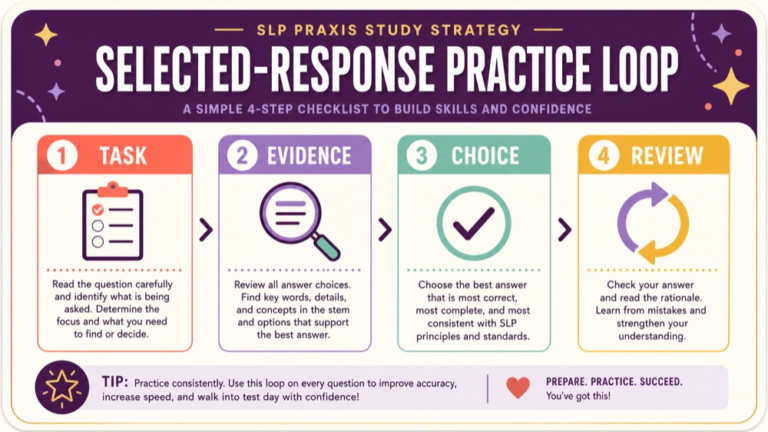
Build a selected-response practice loop
Practice works better when each item produces a reasoning record. Use the current ETS Study Companion to choose a domain, then complete a short set of original practice items. After each item, record the task verb, decisive clue, selected option, and reason the other options were weaker. This creates a feedback loop instead of a score-only routine.
Round one, untimed: focus on identifying the task and supporting evidence.
Round two, lightly timed: keep the same reasoning routine while reducing unnecessary rereading.
Round three, mixed: combine domains so you must identify the topic before applying the strategy.
Round four, review: revisit only the items whose reasoning record is incomplete or uncertain.
Label practice content honestly. Your own items and third-party preparation questions are study tools; they should not be described as live, remembered, or released test material. Review the explanation for the principle that transfers to a new scenario. If you only memorize the answer letter, the next wording change can remove the benefit.
Pace your decisions
The ETS page should control the current timing information. When this article was checked, the listed 150 minutes and 132 questions produced an average of a little more than one minute per displayed question. Treat that arithmetic as a planning reference, not a demand that every item take the same amount of time. Some stems are direct; others require a careful comparison.
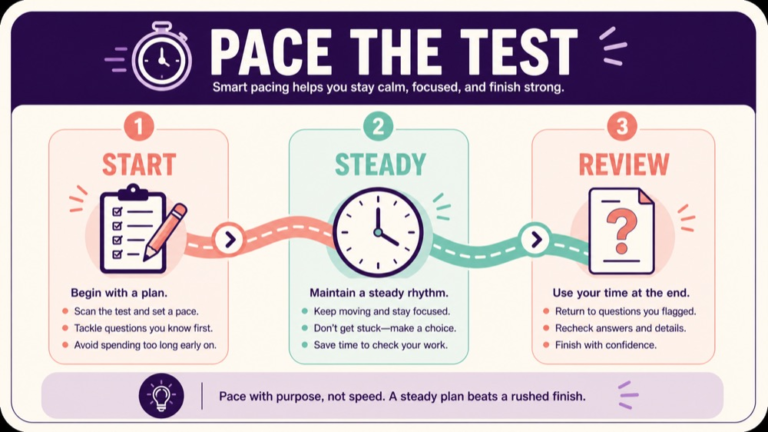
Set checkpoints rather than watching the clock after every sentence. At each checkpoint, ask whether your pace is creating enough time for later review and whether you are losing time to a repeated habit. If an item is consuming attention without adding evidence, make the best supported selection, flag it when the interface permits, and continue according to the current instructions.
In practice, track three numbers: items attempted, items needing review, and minutes remaining. A slow set may reflect unfamiliar content, weak stem reading, option-comparison difficulty, or anxiety. Each cause needs a different adjustment. More content review is useful for a knowledge gap; a timed comparison drill is more useful for a pacing gap.
Common mistakes to correct
Reading the choices first and forcing the stem to fit a preferred answer.
Choosing the most technical-sounding option without matching the task.
Ignoring age, setting, safety, or participation details.
Confusing a possible later action with the best first action.
Using one memorable association instead of the complete pattern.
Changing a supported answer because another option sounds more familiar.
Practicing only one domain and losing time when the topic changes.
Using a practice percentage as a direct prediction of a Praxis result.
Correct these one at a time. For your next set, choose one behavior to observe, such as marking the task verb before reading the options. Improvement is easier to measure when the intervention is specific.
Quick review checklist
Before a selected-response study block, confirm:
Which ETS blueprint domain am I practicing?
What task verbs will I watch for?
What evidence will I record after each item?
What is my rule for a question that takes too long?
When will I check attempted items and time remaining?
How will I label a knowledge, task, evidence, option, or pacing gap?
Will I review the principle rather than memorize an answer letter?
Have I separated original practice content from claims about the live assessment?
Good preparation for praxis slp selected response questions combines current format verification with repeatable reasoning. Use the ETS page for administration facts, the Study Companion for scope, ASHA resources for professional context, and your practice log for the habits that need work.
Sources and next steps
Review the current ETS Speech-Language Pathology Praxis 5331 page for the live selected-response format, question count, timing, delivery, and administration details. Use the ETS Study Companion to organize content areas, and read ASHA’s Praxis information for certification context. Recheck current sources before your appointment.
Speech Pathology Praxis Question Count: How to Plan Your Time
how many questions are on the speech pathology praxis is a current-fact question, not a number to copy from an old study post. The answer should come from the current ETS Speech-Language Pathology Praxis page, and the number should be read together with the listed testing time, selected-response format, and scoring notes.
At the time this guide was checked, ETS listed 132 questions and 150 minutes for Praxis 5331 and noted that some questions may not count toward a score. Those details can change. Use this article to understand how to verify the live information and turn it into a pacing plan, not as a substitute for the current ETS page or Study Companion.
Why question count needs context
A question count answers only one part of the test-taking problem. You also need to know how the questions are delivered, how much time is listed, what response behavior is expected, which content areas are sampled, and what current ETS materials say about scoring. A count without context can make a study plan too relaxed, too rushed, or focused on the wrong task.
Question count can also be confused with several different ideas:
Listed questions: the number shown on the current ETS test description.
Scored questions: the questions used in the score calculation under the current test design.
Practice questions: items in a preparation resource that may not match the live assessment.
Question topics: the knowledge and professional decisions represented across the blueprint.
These are not interchangeable. A practice set can contain more or fewer items than the live test. A question that appears in the test session may not be used in the score under the current ETS design. A count does not tell you whether the next task concerns assessment, intervention, professional responsibility, or another domain.
Verify the current count and timing
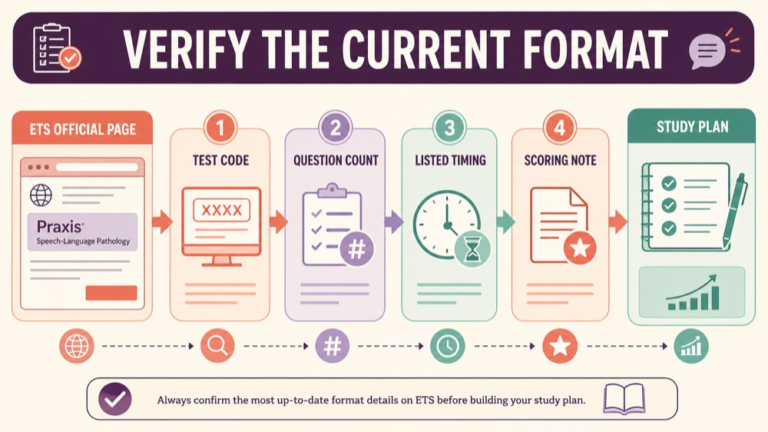
Begin with the current ETS Speech-Language Pathology Praxis 5331 page. Check the page title, test code, listed question count, timing, delivery information, and any note about scoring or unscored questions. Then compare the description with the current Study Companion. Record the date you checked if you are building a longer study plan.
Fact to verify
What to do with it
Test name and code
Make sure your notes describe the intended Speech-Language Pathology Praxis test.
Question count
Use it to design a timed practice block, not to predict a score by itself.
Listed timing
Use it to practice reading, deciding, and reviewing at a controlled pace.
Delivery
Prepare for the current test-center or at-home setting shown for your appointment.
Scoring note
Do not treat every displayed question as a simple scored-point calculation.
Blueprint and materials
Map the content areas and decisions you need to study.
Use the current page as the source of truth for changing administration facts. A third-party article can help you recognize the question, but it may have been written for an earlier version of the test. When two numbers conflict, do not average them. Check the current ETS page and the current Study Companion.
Read the scoring note carefully
ETS notes that some questions may not count toward a score. That statement is a reason to avoid a simplistic calculation such as one point per displayed question. It does not tell you which question is unscored or invite you to identify a special category during the test. For study purposes, focus on responding carefully to every task according to the current instructions.
The note also changes how you interpret practice results. If your practice set has a different number of items, its raw percentage is a description of that set, not a direct translation into a Praxis score. Use practice results to identify knowledge gaps, wording errors, pacing problems, and decision habits. Keep score interpretation tied to the current ETS information and the receiving organization’s requirements.
When you explain the question count to another student, include the boundary: the live ETS page currently lists the count and timing, but the design and scoring details must be verified before the appointment. That is more accurate than presenting a frozen number as a permanent rule.
Turn question count into pacing
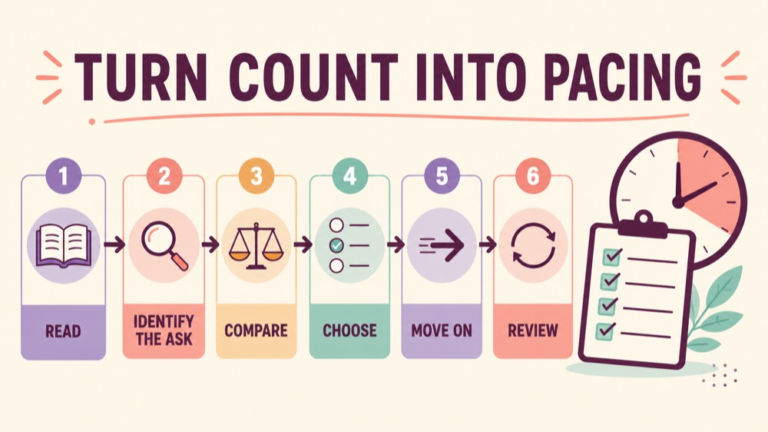
Use the listed count and time to establish a starting pace. The simple arithmetic can give you an approximate average, but it should not become a rigid rule for every task. Some questions will be faster, while others require careful comparison. Your pacing plan needs a checkpoint and a recovery strategy.
Read the task: identify what the question is asking before scanning for a familiar phrase.
Extract the decisive details: note the age, setting, goal, evidence, safety issue, and professional context that change the choice.
Compare the options: ask which response best answers the stem and fits the evidence.
Choose deliberately: make the best-supported selection rather than searching for certainty that the stem cannot provide.
Move on: use the current interface tools and instructions for an item that needs later review.
Check progress: compare time and remaining questions at planned points.
For a 150-minute session with 132 listed questions, the simple average is a little over a minute per displayed question. Treat that as a planning reference, not a promise that every question should take exactly the same time. Build timed practice that includes reading, option comparison, occasional flags, and a final review when the current interface allows it.
Analyze the cause of a slow item. Was the concept unfamiliar? Did the stem contain a decisive detail you missed? Did two options require a scope comparison? Did anxiety lead to repeated rereading? Each cause needs a different correction. More flashcards will not fix every pacing problem.
Practice the decision task
Question count is useful only when it changes how you practice. Use the current ETS Study Companion to identify the blueprint areas. For each study block, mix content review with short sets that require a reasoned choice. After each set, label the error:
Knowledge gap: I did not know the relevant concept or distinction.
Task gap: I answered a different question from the one the stem asked.
Evidence gap: I ignored an age, setting, goal, or safety detail.
Option gap: I could not compare two plausible responses.
Pacing gap: I spent too much time or rushed without a review rule.
Confidence gap: I changed a supported answer without new evidence.
Keep practice content clearly labeled as practice. Do not represent a preparation item as a live or remembered exam question. Do not use claims about leaked material or purported test content as a study method. The responsible focus is the reasoning skill and the source-grounded blueprint.
Common question-count mistakes
Quoting a question count without checking the current ETS page.
Confusing listed questions with scored questions.
Dividing time evenly and forcing every item into the same number of seconds.
Using a practice-set percentage as a direct prediction of a Praxis score.
Ignoring the test code while copying a number from another exam page.
Studying the count instead of the blueprint content and professional decisions.
Practicing untimed items and discovering the decision task is slow under pressure.
Treating a difficult question as a reason to abandon a controlled pacing plan.
The correction is simple: verify the source, read the note, plan a starting pace, practice the response task, and analyze errors. The number is a planning input, not the whole exam.
Quick count review
Before your next timed study block, answer these questions:
What count and timing does the current ETS page list today?
Did I verify the test name and code?
What does ETS say about questions that may not count toward a score?
What average pace will I use as a starting reference?
When will I check progress?
What is my rule for a question that takes too long?
How will I label mistakes after practice?
Which blueprint area needs the next focused review?
A good answer to how many questions are on the Speech-Language Pathology Praxis includes the current ETS number, the listed timing, the scoring boundary, and a reminder to verify before test day. Add your pacing plan only after you have identified the source-grounded facts.
Praxis SLP Exam Format: 5331 Timing and Question Types
praxis slp exam format is more than a question count. It includes how the test is delivered, what kind of response a test taker gives, how much time is listed, how the appointment is scheduled, and which current ETS materials define the assessment. Understanding those parts helps you choose a study method that matches the task.
This U.S.-focused guide uses the current ETS Speech-Language Pathology Praxis 5331 page and Study Companion as the authority for live exam facts. ETS can update dates, delivery options, fees, timing, or question information, so verify the current page before your appointment. The study strategies below are planning suggestions, not promises about a score.
What the Praxis SLP exam format includes
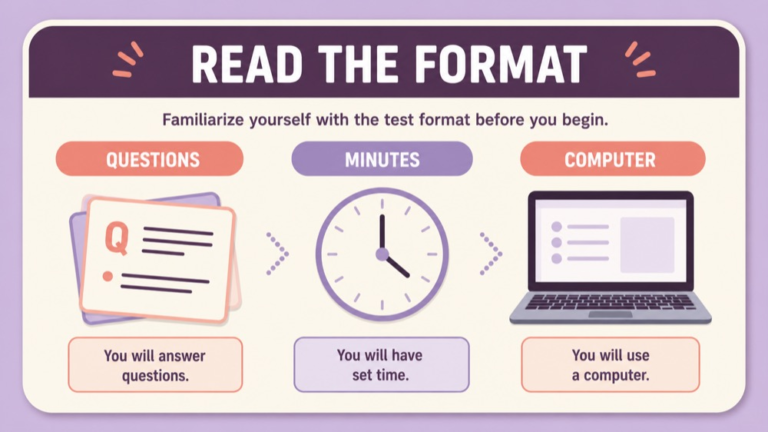
ETS currently describes the Speech-Language Pathology Praxis test as a computer-delivered selected-response assessment. The live test page currently lists 132 questions and 150 minutes, while also noting that some questions may not count toward a score. The page lists test-center and at-home delivery options when available and gives current administrative details. Treat those values as current-page facts to recheck, not permanent facts to copy forever.
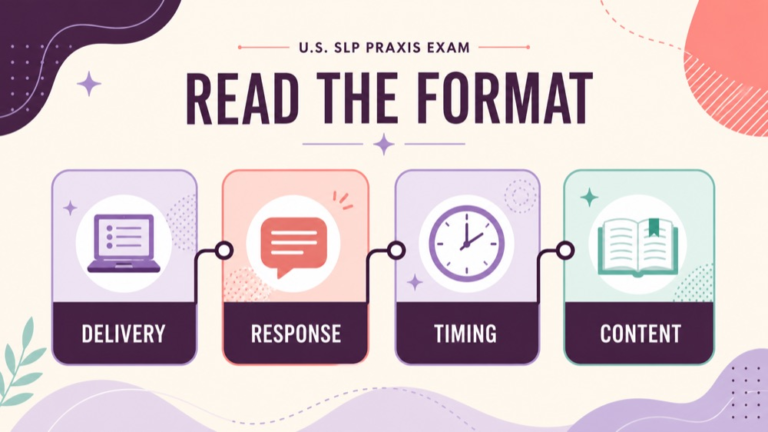
The format therefore has at least four layers:
Delivery: where and how the computer-based appointment takes place.
Response: how the test taker selects or enters the answer to the task.
Timing: the listed appointment or testing time and the pace required across the assessment.
Content: the knowledge areas and professional decisions described by current ETS materials.
These layers interact. A selected-response test still requires careful clinical reasoning. A familiar topic can take too long if you reread every option without a decision rule. A strong content outline does not remove the need to plan the appointment, interface, identification, and pacing details.
Read the format as a set of decisions
When you review the ETS page, turn each format fact into a practical question.
Format fact
Planning question
Computer delivery
Have I practiced reading and deciding on screen rather than depending on paper-only habits?
Selected response
Can I identify the task, compare options, and choose the best supported response?
Listed timing
What pace allows me to make a reasoned decision and keep moving?
Test center or at-home option
Which setting can I meet under the current ETS instructions?
Blueprint domains
Does my study plan cover the knowledge and professional decisions described by ETS?
Current-page updates
Which facts must I recheck before registration and test day?
This translation is useful because it prevents passive reading. Instead of memorizing that the test is computer delivered, practice the behaviors computer delivery requires: scrolling carefully, reading the entire stem, using the available interface features appropriately, and recording a pacing decision. Instead of memorizing a number, use the current number to plan a timed practice block.
Understand selected-response work
Selected-response questions present a task and response choices. The exact wording and item content on a live exam should not be invented or represented by a study article. Your preparation should focus on reading the construct, recognizing the evidence in the scenario, comparing each option with the question, and choosing the response that best fits the information provided.
Identify the ask: determine whether the question requests an assessment decision, interpretation, intervention principle, professional action, or another response.
Extract decisive evidence: mark the age, setting, communication or swallowing profile, safety issue, goal, and other details that change the answer.
Predict the direction: state what a defensible answer should accomplish before comparing the options.
Compare options: test each option against the stem, scope, evidence, and level of certainty.
Choose and move: select the best-supported response, note the reasoning for later review, and continue at a controlled pace.
The goal is not to find a magic word. A response can sound clinically familiar and still fail to answer the question asked. A response can be technically possible and still be premature if the stem asks for the first step. The format rewards attention to the task as well as knowledge of the topic.
Build a pacing plan
Use the current ETS timing to design practice, but avoid pretending that one pace fits every question. Some tasks will be quick; others require comparison. Your plan should include a starting pace, a checkpoint, and a recovery strategy if one item consumes too much attention.
Starting pace: begin with a calm reading routine and do not spend the first items proving that you are fast.
Decision checkpoint: periodically compare your progress with the current time and remaining work.
Flag strategy: if the interface permits, mark a genuinely uncertain task and return according to the current instructions.
Recovery rule: leave a difficult item after a reasoned attempt instead of allowing one question to control the whole session.
Final review: reserve enough time to review flagged items and check unanswered responses if the interface allows.
Practice pacing with the same behavior you want on test day. Read on screen, explain why the best option fits, and record whether the difficulty came from knowledge, wording, distractor comparison, or time pressure. Then change one variable in the next practice block. A timed score without an error explanation is less useful than a smaller practice set with clear reasoning.
Connect format to the blueprint
The format tells you how you will work; the blueprint tells you what knowledge the exam samples. ETS materials describe foundational, professional, and specialized knowledge across the content areas of the Speech-Language Pathology test. Use the current Study Companion to map those areas to your study resources and identify the decisions you need to explain.
Build a review matrix with four columns: domain, core concept, clinical decision, and evidence for the decision. For an assessment topic, that might mean distinguishing a screening purpose from a diagnostic evaluation. For a treatment topic, it might mean matching the intervention principle to the goal, client, context, and evidence. For professional topics, it might mean identifying the responsible next step and the limit of your role.
Keep the matrix current. If the ETS blueprint or Study Companion changes, update the study plan instead of assuming an older outline remains complete. The official source controls the test description; your notes should make it easier to apply the description.
Common format mistakes
Memorizing a question count or time value without checking the current ETS page.
Studying definitions only and ignoring the selected-response decision task.
Practicing only untimed items and discovering pacing pressure late.
Spending too long on one hard question because the topic feels important.
Using unverified claims about live or recalled exam content.
Ignoring the difference between a test center and at-home appointment setting.
Focusing on the format while neglecting the current ETS blueprint and Study Companion.
Treating one practice score as a permanent prediction of test performance.
Correct these habits by linking every format fact to an action. Recheck the live page, use timed practice, explain option comparisons, and study the blueprint. The format becomes useful when it changes how you prepare.
Quick format review
Use this review before a timed study session:
What does the current ETS page say about delivery and timing?
What response behavior does selected-response work require?
Which current blueprint areas need review?
What is my reading and decision routine for each task?
When will I check time and progress?
What will I do if one item takes too long?
How will I analyze errors after practice?
Which administrative fact must I recheck before test day?
A concise explanation of the Praxis SLP exam format should include current source verification, the selected-response nature of the task, the listed timing, delivery planning, and a realistic pacing method. Keep changing facts tied to ETS, and keep study strategy tied to your own evidence.
Praxis 5331 Eligibility: Program, State, and Registration Checks
praxis 5331 eligibility is not one universal checklist for every U.S. test taker. The word eligibility can refer to whether ETS lets you schedule an appointment, whether your program says you are ready, whether a state accepts the score for a particular purpose, or whether a certification pathway has additional requirements.
This guide separates those questions so you can verify each one with the organization that controls it. It uses current ETS and ASHA context for orientation, but it does not replace a university handbook, state rule, employer requirement, accommodation process, or current certification standard. Treat any missing detail as a question to confirm, not as permission to guess.
What Praxis 5331 eligibility means
ETS registration eligibility and professional eligibility are related but not identical. The ETS account answers questions about selecting and managing a test appointment. A university or clinical program may answer questions about coursework, clinical experiences, or when students are encouraged to test. A state or certification organization may answer how the score is used in a credential or license pathway.
ASHA identifies the Speech-Language Pathology Praxis exam as part of its certification process, but that context does not turn the exam into a complete certification checklist. Certification has multiple requirements, and state licensure or employment may add requirements. A student who asks, Can I register? may need ETS information. A student who asks, Will this score satisfy my next professional step? needs the current requirements of the receiving organization.
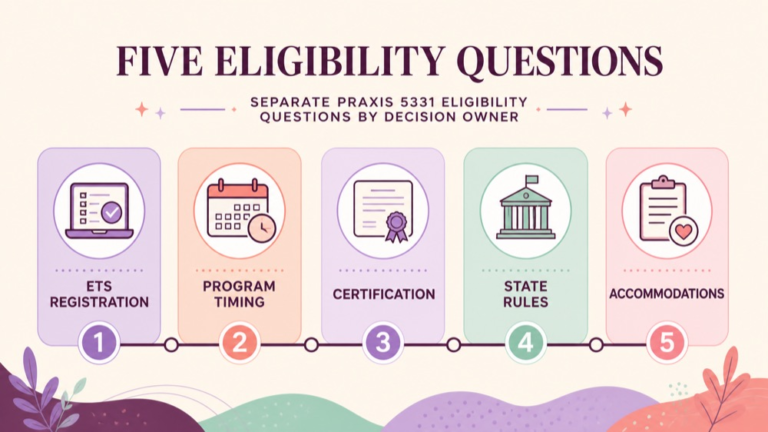
Appointment question: Can I create or manage an ETS registration for the test?
Program question: Does my university or clinical program expect a particular stage before testing?
Certification question: How does the exam fit into the current certification pathway?
State question: What does the applicable state or jurisdiction require for its purpose?
Employer question: Does an employer use the score or another document for hiring or onboarding?
Separate the five eligibility questions
Make a five-column note before searching. The note keeps the same word from spreading across unrelated decisions.
Question
Likely source
What to record
Can I register?
Current ETS test and registration pages
Test name, code, account steps, availability, payment, and appointment information.
When should I test?
University or clinical program
Program milestones, application timing, preparation expectations, and local advising.
How is the score used?
ASHA certification information and the receiving organization
Certification pathway, score-report process, and documents that may be required.
What does my state require?
Current state board or applicable jurisdiction
Rule, form, deadline, score use, and whether the rule applies to the intended purpose.
What support do I need?
Current ETS accommodation process and relevant program support
Documentation, request timing, and the approval status for the actual exam.
The source column is the important part. A study guide can explain the exam’s scope, but it is not automatically the controlling source for a state license. A classmate can share an experience, but that experience is not a current rule. A university advisor can explain program practice, but an advisor may not speak for ETS or a state board. Match the decision to the authority.
Use the right source for the right decision
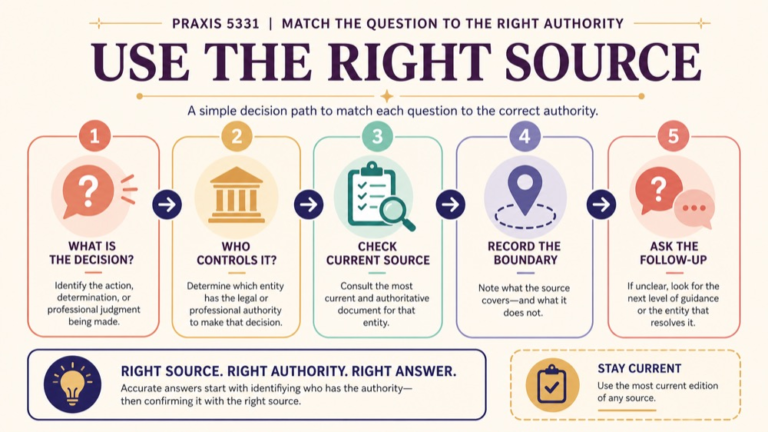
Use a source hierarchy that reflects the decision you are making. Start with the live ETS page for exam administration and registration. Use the current ASHA pages for certification context. Use your program for local academic timing. Use the applicable state or jurisdiction for licensure requirements. Use the accommodation process for documentation and approval questions.
Name the decision: write whether you are asking about an appointment, academic readiness, certification, licensure, employment, or accommodation.
Find the controlling organization: choose the source that can actually decide or publish that requirement.
Check the current version: record the page title and date you reviewed when the issue is time-sensitive.
Compare the wording: distinguish must, may, recommends, accepts, and applies to the purpose you have in mind.
Save a follow-up question: if the page is unclear, ask the organization directly and keep the answer with your planning record.
This process prevents a common error: turning a broad exam description into a promise about a professional outcome. It also supports better study decisions. If your uncertainty is about the test itself, read ETS material. If it is about the meaning of the score, read the receiving pathway. If it is about clinical readiness, speak with your program and use a preparation plan that fits your actual training.
Plan registration without overclaiming
Once you know which question you are asking, use the ETS registration process to inspect the current test listing, delivery options, availability, and transaction details. Confirm the name and code, appointment setting, identification plan, score recipients, and current policies. An open appointment does not answer whether the date fits your program or credential timeline.
Do not postpone every decision because the word eligibility feels large. Break it down. You may be able to verify appointment logistics today, ask your program about timing tomorrow, and check a state requirement separately. You can then write what is confirmed, what is pending, and what source will resolve the pending item.
Keep an evidence note:
Confirmed: a current ETS or organization page directly supports the statement.
Local: the statement comes from a program, advisor, employer, or jurisdiction-specific source.
Pending: the statement needs a current answer before you rely on it.
Not assumed: a rule from another person, state, exam, or year has not been transferred.
Accommodations and documentation
Accommodation planning should be treated as its own eligibility question. A prior classroom support or a university arrangement may inform the conversation, but it does not automatically establish what ETS will approve for a current Praxis appointment. Read the current ETS process, identify documentation needs, and allow the required time for review before choosing a plan.
Keep private records of requests and decisions. Do not put sensitive medical or disability information into a public study note, shared screenshot, or article comment. If your program has an accessibility office or testing coordinator, ask how its support connects with the ETS process, while keeping the source boundaries clear.
For exam preparation, plan the testing environment you are actually approved to use. Do not practice under a set of assumptions that differs from the current appointment. The goal is a prepared, compliant, and realistic test-day plan.
Common eligibility mistakes
Assuming every U.S. student follows the same eligibility path.
Confusing the ability to register with completion of certification or licensure requirements.
Using an old university email or forum post as the current state rule.
Assuming a passing-score statement applies to every jurisdiction or professional purpose.
Ignoring program timing because the ETS appointment page shows an open slot.
Transferring a classroom accommodation directly to the ETS exam without checking approval.
Failing to identify which organization controls the question being asked.
Presenting an uncertain policy detail as a guaranteed outcome.
The correction is a source-matching habit. Write the decision, name the organization, check the current page, record the boundary, and ask the unresolved question. This is more reliable than trying to memorize one universal eligibility paragraph.
Quick eligibility audit
Use this audit before you register or tell someone that you are eligible:
Have I written the exact decision I need to make?
Am I asking about ETS registration, program timing, certification, state use, employment, or accommodation?
Did I open the current source controlled by the relevant organization?
Did I check the test name and code on the current ETS page?
Did I separate a score requirement from a registration requirement?
Did I record the date or version of a time-sensitive rule?
Did I identify any missing documentation, approval, or deadline?
Can I explain what is confirmed and what still needs verification?
A strong answer to an exam-preparation question does not claim more than the evidence supports. It states the likely decision, names the source, and includes the next step. That is the same reasoning you can use when reviewing a Praxis scenario about administration, certification, or professional responsibility.
SLP Praxis 5331 Test Dates: How to Schedule and Adjust
slp praxis test dates are selected through the current ETS account rather than a universal calendar that applies to every test taker. A useful date is not simply the first open slot. It is a date that leaves enough time for preparation, fits the delivery setting, and protects the deadline by which a program, state, or certification pathway needs the score.
This U.S.-focused planning guide explains how to search live availability, compare center and at-home options, work backward from a score deadline, and review an appointment before you finalize it. Dates and policies can change, so confirm the current details in ETS before you register or change an appointment.
What test-date planning means
When students search for test dates, they are usually solving three linked problems: when they can take the exam, when they need the score, and which appointment setting is realistic. ETS controls the live appointment inventory. Your program, state, employer, or certification pathway may control the relevant score deadline. Your own schedule controls whether the selected date is workable.
Those three clocks should be written separately. A university application deadline is not the same thing as a test appointment date. A test date is not automatically the date a score becomes available. A listed opening is not useful if travel, identification, approved accommodations, or preparation time make the appointment unrealistic. Keeping the clocks separate prevents a date search from becoming false precision.
Availability clock: which dates and locations the live ETS account shows.
Preparation clock: how much time you need to study, practice pacing, and resolve logistics.
Score clock: when the receiving organization needs the result and how it describes its process.
Personal clock: school, clinical, work, health, travel, and family commitments around the appointment.
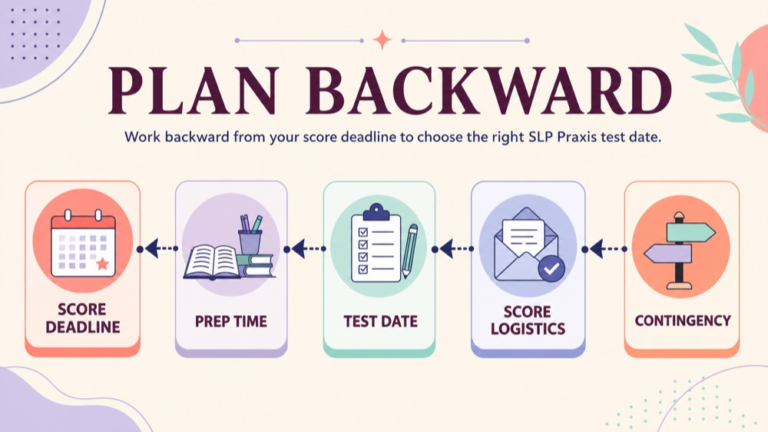
Plan backward from the score deadline
Start with the receiving organization, not the calendar grid. Identify the date by which the score must be received or documented, then work backward. Add time for registration, preparation, the appointment itself, any current ETS score-report information, and a contingency decision if the first plan changes. Do not invent a universal buffer; the right buffer depends on the specific pathway and the current information supplied by ETS and the receiving organization.
For example, a student applying to a graduate or professional pathway might need a score for a later review cycle, while another student might be aligning a score with a state or employment requirement. The word deadline can describe different events. Ask whether the organization wants a score report, a passing score, an official record, or another document, and ask which date controls.
Make a planning table before you search:
Planning item
Write down
Receiving organization
The program, state, employer, or certification pathway that needs the result.
Required event
The score report, application, credential step, or documentation that must be complete.
Target date
The date supplied by the current receiving organization, not a guess from an old forum post.
Latest comfortable test date
A personal planning date that leaves room for preparation and current score logistics.
Preferred options
Several dates, times, locations, or delivery methods that could work.
This table gives you a decision rule: search for an appointment that supports the required event and the preparation plan. If the dates shown do not fit, pause and clarify the deadline or contact the current ETS support channel rather than selecting a date solely because it is open.
Search live ETS availability
Use the current ETS registration path to find the Speech-Language Pathology Praxis test and search the appointment choices shown for your account. A public page can explain the process, but the live account is where you see the dates, locations, and options available for the transaction. Availability may vary by location, delivery type, and time of search.
Sign in to the correct ETS Praxis account.
Locate the current Speech-Language Pathology test and verify the test code.
Review the delivery choices displayed for your registration.
Search the locations or ZIP code relevant to your plan.
Compare several dates rather than stopping at the first open result.
Read the appointment summary for date, time, time zone, location, and delivery method.
Save the confirmation after registration and set reminders for later checks.
Search strategically. If a center is unavailable, consider another authorized location only if the travel and check-in plan are realistic. If an at-home option appears, read the current requirements and decide whether your workspace, equipment, and schedule support it. Do not infer availability from another person’s screenshot. The relevant inventory is the one the current account displays.
Compare the appointment options
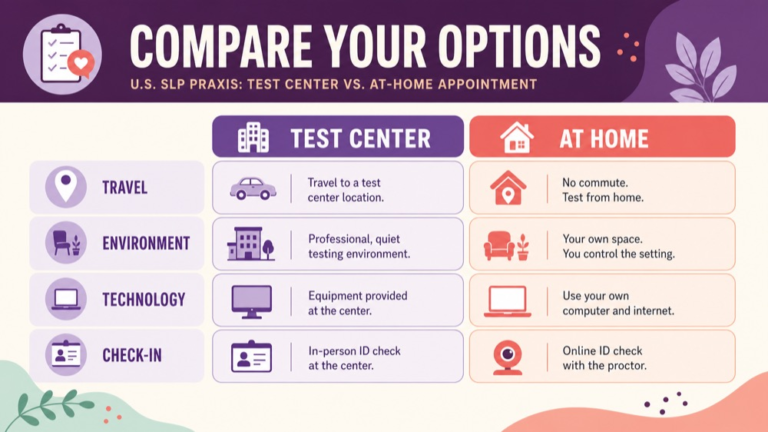
A test center and an at-home appointment can solve different logistical problems. A center may reduce the need to prepare a home testing environment but can add travel. An at-home appointment may reduce travel but place more responsibility on your room, equipment, internet connection, check-in, and environment. The correct comparison is practical, not ideological.
Factor
Test center question
At-home question
Travel
Can I reach the authorized location with enough time?
Can I be ready in the approved home setting without interruptions?
Environment
Have I reviewed the center instructions and identification expectations?
Can my room and surrounding conditions meet current ETS rules?
Technology
What does the center provide and what must I bring?
Does my equipment and connection meet the current at-home requirements?
Schedule
Can I manage travel and check-in at the selected time?
Can I reserve the full appointment window in a controlled setting?
Contingency
What is my plan if travel or weather changes?
What is my plan if the home environment or technology is not ready?
Read the current ETS instructions for the option you choose. Appointment labels, availability, and policies are not permanent content. If you need an accommodation, resolve the relevant process before treating a date as secure. A date that works on the calendar may still be a poor choice if the required support has not been confirmed.
Protect the appointment
After you register, keep the confirmation and review it again closer to the appointment. Confirm the location or at-home setting, time zone, name and identification plan, travel route or workspace, and any current check-in instruction. Keep reminders in a private calendar and do not share personal appointment details publicly.
If you need to change the date, read the current ETS appointment-management and policy information first. The ability to change, cancel, or reschedule may depend on timing and the specific transaction. Do not rely on an old rule or assume that another test’s policy applies to Praxis 5331.
Use the extra time before the appointment for focused study rather than endless date searching. Once a workable date is confirmed, build a study plan around the exam blueprint, practice pacing, and the skills you need to strengthen. The date search should serve preparation, not replace it.
Common date-planning mistakes
Treating a public calendar or another student’s screenshot as your personal availability.
Choosing the earliest date without checking the receiving organization’s score requirement.
Confusing the test date with the date a score is needed.
Ignoring time-zone, travel, check-in, or full appointment-window details.
Choosing at-home testing without reading current environment and equipment expectations.
Assuming a date remains available while you delay checkout.
Forgetting to record the confirmation and set a reminder to review it.
Changing an appointment based on an old cancellation or rescheduling rule.
These problems are preventable when you treat date planning as a small project. Write the deadline, search the live account, compare options, confirm logistics, and save the result. If a key fact is uncertain, mark it as a question and verify it through ETS or the receiving organization.
Quick date check
Before you choose an SLP Praxis test date, answer these questions:
What organization needs the score, and what event or deadline does it specify?
How much preparation time do I need for this exam and my current study stage?
Which live dates and settings appear in my ETS account?
Can I meet the center or at-home requirements for the chosen option?
Does the date fit my school, clinical, work, travel, and personal schedule?
Have I checked the current identification, accommodation, and appointment rules?
Did I save the confirmation and write down the next logistics task?
What is my evidence-based contingency if the selected plan changes?
The best date is the one you can support with current information and a realistic plan. Keep the live ETS page and the receiving organization’s instructions nearby, then move from scheduling into preparation with a clear calendar.
SLP Praxis 5331 Registration Steps: A U.S. Test-Taker Guide
slp praxis exam registration steps are easier to manage when you separate account setup, test selection, appointment availability, payment, identification, score recipients, and final confirmation. The registration task is administrative, but a small mistake can create avoidable stress close to an important exam date.
This U.S.-focused guide uses the current ETS registration workflow and the Praxis 5331 context described by ETS and ASHA. It is an educational planning aid, not a promise about a particular state license, university, testing appointment, fee, or accommodation decision. Recheck the live ETS account and current policy pages before you submit payment.
What registration does and does not decide
Registration creates a testing appointment with ETS. It does not, by itself, decide whether a student has completed a graduate program, meets a state requirement, qualifies for a particular credential, or should send scores to a specific agency. Those decisions belong to the current requirements of the relevant program, state, employer, or certification pathway.
ASHA describes the Speech-Language Pathology Praxis exam as part of the certification pathway, while states and other organizations may use their own rules. That distinction matters when you plan. A test taker may need to register before every school or state detail is finalized, but should know which score recipient, deadline, and documentation requirement applies to the intended pathway. If the question is about whether you can sit for the exam, read current ETS registration information. If the question is about whether a score satisfies a credential, read the current requirements of the organization receiving it.
ETS registration: creates or manages the appointment, delivery option, payment, and related test details.
Program planning: helps you decide when a score is needed and whether your preparation timeline is realistic.
Certification or state review: determines how a score may be used in a particular pathway.
Documentation planning: confirms the name, identification, accommodation, or score-report information required for the appointment.
Prepare before you start
Open the current ETS Praxis page for Speech-Language Pathology and the current registration instructions before you begin. Use the exam code shown on the live ETS page rather than relying on an old screenshot, saved browser tab, or a third-party study calendar. The exam page is also the place to confirm current delivery options, listed timing, and other details that may be updated.
Make a short planning sheet. Write the name that will appear on your identification, the date by which you need a score, the locations or at-home option you are considering, and the score recipients you may need. Keep the sheet limited to decisions you can verify. Do not copy an unverified fee, appointment rule, or score timeline from a discussion board into your final plan.
Before entering payment information, collect:
The exact ETS account login you intend to use.
The legal or approved identification name that must match the current ETS identification policy.
A realistic list of dates, times, and locations that fit your clinical, school, work, or travel schedule.
The current score-recipient information required by your program, state, or certification pathway.
Any accommodation documentation or request timeline that should be addressed before an appointment is selected.
A private place to review the confirmation email and appointment details after checkout.
This preparation is not busywork. It reduces the chance of selecting a date that conflicts with a clinical placement, entering a name that does not match identification, or forgetting a score recipient. It also gives you a clear point at which to pause and verify a question with ETS or the organization that needs the score.
The SLP Praxis registration sequence
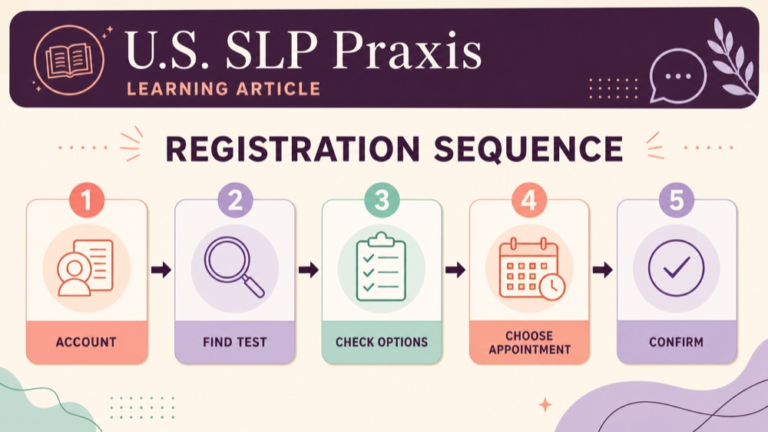
ETS presents registration as a sequence inside the Praxis account. The labels may change as the interface is updated, but the decision logic is straightforward: identify the test, inspect availability, choose the appointment, provide the requested information, pay, and save the confirmation.
Sign in or create an ETS account. Use an account you can access reliably. Avoid creating multiple accounts because you lost track of the first login.
Find the Speech-Language Pathology Praxis test. Confirm the exam name and code on the current ETS page before continuing.
Review available delivery choices. Depending on current availability and eligibility for the selected option, ETS may show a test center or at-home appointment path.
Search dates and locations. Enter the requested location information and compare the available appointments with your real schedule.
Select the appointment. Check the date, start time, time zone, delivery method, and location details before moving to the cart or payment step.
Enter personal and score-report information. Review spelling, contact details, and score recipients carefully.
Complete payment and confirmation. Save the confirmation details in a private place and review any follow-up instructions supplied by ETS.
Think of the sequence as a set of checkpoints rather than a race. After you choose an appointment, stop and read the summary. If the delivery method is wrong, the date is impractical, or the name does not match the required identification, correct the issue before final submission when the interface allows it. If the interface does not make the correction clear, use the current ETS support route rather than guessing.
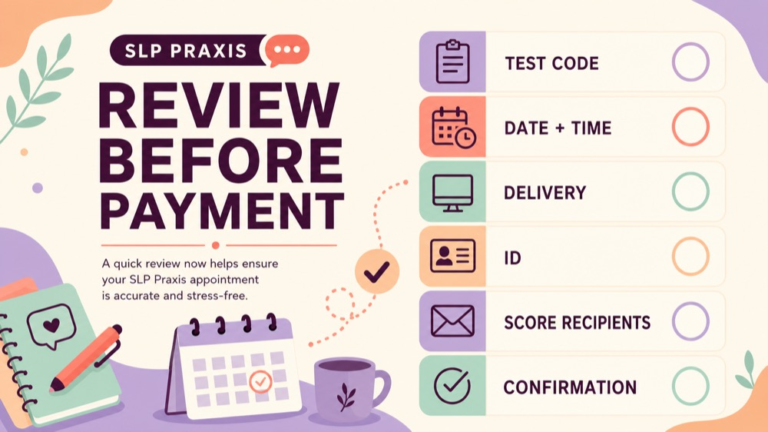
Review the appointment before you pay
The confirmation screen should answer the practical questions that affect test day. Read it line by line and compare it with your planning sheet. A test center appointment and an at-home appointment may have different environment, equipment, check-in, and identification expectations, so do not treat the two options as interchangeable.
Check
Question to ask
Why it matters
Test
Is this the current Speech-Language Pathology Praxis test and code?
A similar label or saved link can lead to the wrong registration path.
Date and time
Can I arrive or be ready at this time, including local time-zone details?
Travel, clinical work, and at-home readiness all depend on the appointment time.
Delivery
Did I select a center or at-home option that I can meet?
The required environment and check-in steps may differ.
Identification
Does my registration name align with the current ETS ID policy?
An administrative mismatch can become a test-day problem.
Scores
Are the intended recipients recorded correctly?
Score reporting decisions may affect later applications and deadlines.
Confirmation
Did I save the appointment number, location, and instructions privately?
The confirmation is the starting point for appointment management and preparation.
Fees and appointment policies are time-sensitive. The registration page or live account is the right place to confirm the amount charged, cancellation or change rules, and any deadlines. A study article can show you what to inspect, but it should not replace the transaction details shown for your account.
After registration
Registration is the beginning of logistics, not the end. Put the appointment date in a calendar and create a small sequence of reminders: confirm the delivery setting, review identification, check the route or at-home workspace, finish the study plan, and reread the current ETS instructions. Keep your confirmation private and accessible without depending on a single device.
If you need an accommodation, a name correction, a date change, or a delivery clarification, address it through the current ETS process as soon as you identify the issue. Do not assume that a general classroom accommodation, a prior test arrangement, or a university process automatically transfers to a new Praxis appointment. The request and approval process must be confirmed for the current exam.
Use the official ETS Study Companion to understand the assessment scope and interface expectations. Use ASHA resources to understand how the Praxis exam fits into the broader certification context. Keep those study and credential questions separate from the appointment transaction so that a change in one area does not cause you to overlook the other.
Common registration mistakes
Using an old exam code or a saved third-party link without checking the current ETS page.
Choosing a date before comparing it with school, clinical, work, travel, or score-report deadlines.
Assuming the closest test center is available without searching the live account.
Entering a name or contact detail without comparing it with current identification requirements.
Confusing a test registration question with a state, university, or ASHA certification requirement.
Skipping the confirmation review because the appointment appears in the cart.
Saving the confirmation only in a browser tab and not in a private, reliable location.
Waiting until the last moment to ask about accommodations, changes, or an appointment problem.
Each mistake comes from treating registration as a single click. A better habit is to make the workflow visible: verify the test, compare the appointment, check identity and recipients, confirm payment, and save the record. That approach is simple enough to repeat and specific enough to catch the errors that matter.
Quick registration checklist
Use this short version when you are ready to register:
Open the current ETS Speech-Language Pathology Praxis page.
Sign in to the correct ETS account or create one you can maintain.
Confirm the exam name and code.
Review the current delivery choices and live appointment availability.
Choose a date, time, location, or at-home setting that fits your actual schedule.
Check your name, contact details, identification plan, and score recipients.
Review the charge and the appointment summary before final submission.
Save the confirmation and set reminders for the next logistics and study tasks.
For a transfer exercise, explain each step in one sentence and state what source you would check if the interface or policy had changed. The goal is not to memorize a frozen screen. The goal is to know which decision belongs to ETS, which belongs to your program or state, and which belongs to your own study and test-day plan.
Praxis Speech-Language Pathology Test Center: Find and Plan
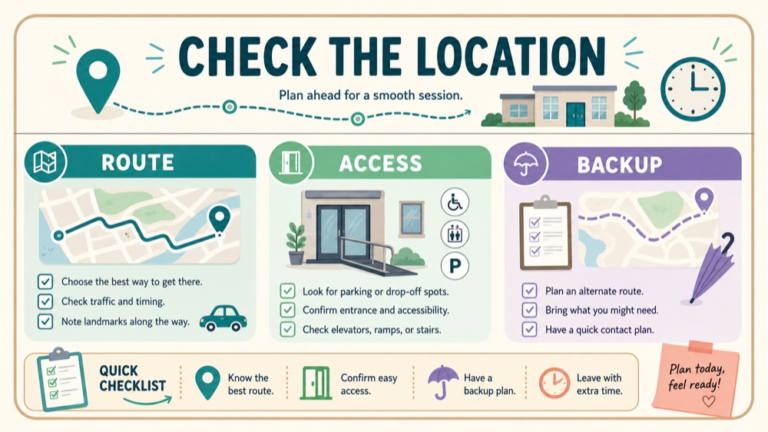
Finding a praxis speech language pathology test center is not just a matter of choosing the closest pin on a map. The useful location is one that is actually available for Speech-Language Pathology 5331, fits the date you need, can be reached with a reasonable plan, and works with the appointment and admission instructions attached to your ETS account. A center can look convenient in a general search and still be unavailable for your test or time window.
ETS says that Praxis tests are offered at authorized test centers and that test takers can view available centers and time slots during registration. Its current center page also explains that availability varies by exam, that some tests may follow seasonal schedules, and that the live search appears after you sign in and begin registration. Use the account-specific search as the final source for your appointment.
Use the ETS Test-Center Search
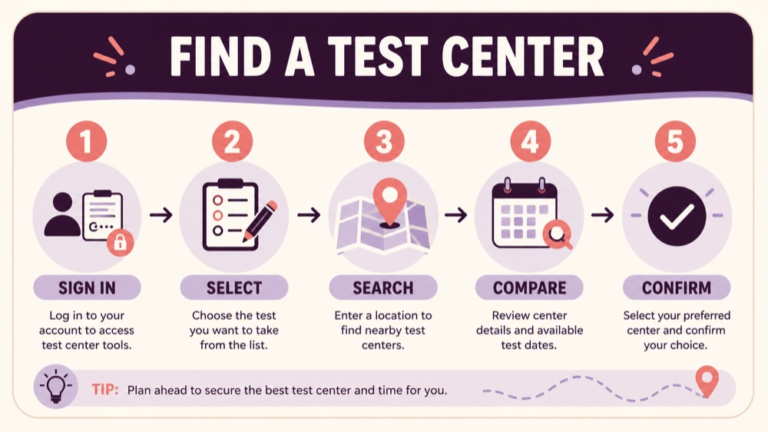
Start at the official ETS flow rather than a third-party list. Sign in to your Praxis account or create one, select the test associated with your licensure or credential goal, and continue to the scheduling page. ETS’s registration page describes a sequence that includes finding the test, reviewing availability, choosing a date and location, reviewing the cart, and entering payment information.
When the test-center option is available for your selected appointment, search by the location filters ETS provides. The current test-center page describes searching by city, ZIP code, or state, then viewing available locations and time slots. The results are not a permanent directory. They are tied to the selected test and the current scheduling flow, so record the result only after you have reviewed the actual appointment details.
Keep the test identity visible during this step. A general Praxis search may contain multiple subjects, and a center may offer some Praxis tests without offering Speech-Language Pathology 5331 at the time you need. Confirm the test name and code before comparing addresses. If the physical-center option does not appear, check whether the selected test, date, location, or delivery method affects the results and use ETS support when the account remains unclear.
Open the current ETS account and start the real registration flow.
Confirm the test is Speech-Language Pathology 5331.
Select the test-center delivery option when it is available.
Search by city, ZIP code, or state using the account’s filters.
Compare the live dates and time slots displayed for each center.
Review the address and appointment details before payment.
Save the confirmation after the center and time are selected.
Recheck the appointment before travel because availability can change.
Understand Availability and Appointment Windows
“There is a center nearby” and “there is a center with a usable appointment” are different statements. ETS notes that some Praxis tests are available year-round while others use a seasonal schedule, and that not every test is offered at every center or on every date. The account-specific results are therefore more important than a generic location directory.
If you need a particular deadline, search early enough to compare more than one reasonable location and time. A broader search radius may reveal options, but travel time and local access still matter. If you are scheduling around graduate coursework, clinical work, or a credential application, put the deadline beside the appointment window and leave room for changes according to the current ETS policies.
Do not treat a listed slot as a guarantee that every later step will remain unchanged. Complete the registration flow and save the confirmation. If you need to change the appointment, follow ETS’s current appointment-management instructions; do not rely on an informal cancellation rule from another learner.
Evaluate the Center Before Booking
Once the account shows possible centers, compare practical fit. A center that is ten minutes closer may be a poor choice if the route is unpredictable, parking is unclear, or the start time collides with a work obligation. The decision is not about finding a perfect room. It is about reducing avoidable uncertainty while preserving enough energy for the test.
Check the route at the likely travel time, not only at midday on a weekend. Look for the building entrance, parking or transit connection, and the amount of walking from the drop-off point. If weather, construction, or local events could affect the route, identify a second route or a second reasonable center when the account offers one. Keep the backup as a plan, not as an unconfirmed appointment.
For access needs, review the current provider instructions before selecting a center. The ETS Study Companion explains that test takers should expect proper identification at a test center. Accommodation approval and testing-location arrangements can involve additional steps, so contact the responsible provider before paying if your requirements are not reflected in the appointment record. A location decision should be based on confirmed access information rather than assumptions about a building.
Distance and realistic travel time from your starting point.
Parking, public transit, rideshare, or drop-off plan.
Building entrance and room-finding instructions.
Appointment start time in the local time zone.
Compatibility with your approved accommodation, if applicable.
Availability of a route or center backup without confusing it with a booking.
Time needed for identification and check-in.
A calm departure time with a reasonable buffer.
Book, Review, and Save the Confirmation
After choosing the best available option, review the entire cart and personal information. ETS’s registration flow includes a cart review and payment step. Confirm the test, date, time, delivery method, center, address, and any score-recipient or institution details before completing the transaction. Keep the confirmation in your account and in a second accessible format if the provider permits you to do so.
Use a two-person check only for accuracy, not for permission. A trusted person can read the date and address back to you, but the ETS account remains the authority. If your name, date, or location is wrong, use official appointment-management or support channels. Do not create a second registration to solve a question that should be clarified first.
Review the center again a few days before the appointment and once more before you leave. Rechecking is not a sign that you distrust the original booking; it is a way to catch a changed instruction, route problem, or forgotten detail. Keep the test-center address and support information available without relying on a last-minute search.
Plan the Test-Center Day
Separate the 150-minute 5331 testing length currently listed by ETS from the total appointment event. Travel, building entry, identification, security, and the computer tutorial are not the same as answering questions. Plan to arrive according to the provider’s current instructions and with enough margin for the route you actually have.
The Study Companion describes an opportunity to learn the computer interface before testing time begins, including answering, skipping, and returning to questions. Use that time to make the navigation familiar. The goal is to begin the testing clock with fewer interface questions competing for attention. Follow the local proctor’s directions if they differ from your assumption.
Pack lightly and follow the provider’s permitted-item rules. Identification is the priority. Other items such as food, water, notes, bags, or electronic devices may be handled outside the room or restricted. Check the current appointment instructions instead of copying a center policy from a different city.
Confirm the address and entrance before leaving.
Bring the identification required for the appointment.
Carry appointment details in an accessible format.
Use the route and departure buffer you planned.
Follow check-in, security, and storage directions.
Use the interface tutorial to practice approved navigation.
Ask staff before acting when an item or procedure is unclear.
Keep the post-appointment plan simple and documented.
Create a Backup Plan Without Creating Confusion
A backup plan should answer “What will I do if the route or center becomes difficult?” It should not invent a replacement appointment. Save one alternative route, the official support channel, and the current appointment-management page. If you need a different center or date, make that change through the account and confirm the new record before traveling.
Do not assume that a nearby center can take you as a walk-in, that a listed address has the same hours as the appointment, or that an at-home option is interchangeable with a center appointment. Each of those choices depends on the current ETS account and policies. A calm backup plan protects your decision-making; an unconfirmed assumption adds risk.
If a center issue occurs on test day, document what happened and ask the staff member what can be verified. Contact ETS when the issue concerns registration, appointment status, or a policy decision. Keep receipts or records when a formal follow-up may be needed, and avoid relying on a verbal promise that is not reflected in the account.
Quick Test-Center Checklist
Before you finalize the appointment, ask:
Is this definitely Speech-Language Pathology 5331?
Does the live ETS account show the desired date and time?
Is the delivery method clearly listed as a test center?
Have I reviewed the complete address and entrance plan?
Does the route work at the actual travel time?
Have I checked identification and accommodation instructions?
Have I saved the confirmation and official support path?
Do I have a realistic backup route or change procedure?
Praxis Speech-Language Pathology Exam Length: Timing and Pacing
When learners ask about praxis speech language pathology exam length, they usually need two answers: what the current ETS listing says, and how to use that information without turning the test into a frantic stopwatch exercise. ETS currently lists Speech-Language Pathology 5331 as a computer-delivered test with 132 selected-response questions and a 150-minute test length. Those details create a useful planning frame, but the live ETS page and your appointment instructions remain the authority for current administration.
Exam length is not only a number. It affects how you read a case, how long you can investigate one uncertain option, when you mark an item, and how much review margin you want. It also interacts with the test interface, check-in, approved accommodations, and any instructions that apply to your appointment. The goal is a flexible plan that protects careful reasoning while preventing one difficult item from consuming the session.
Read the Current ETS Format Carefully
The current ETS 5331 page lists three facts that belong together: 132 questions, selected-response format, and 150 minutes. It also identifies computer delivery. The 150 minutes refers to the listed test length, not necessarily every minute you spend traveling, checking in, reading instructions, or completing provider procedures. Treat the appointment as a larger event and the testing clock as the part you rehearse for.
ETS also notes that the test may contain questions that do not count toward the score. That is one reason not to try to reverse-engineer a score from the visible number of items or to decide that an unfamiliar question must be a trick. Answer the item using the information provided, follow the interface directions, and keep moving according to your pacing plan.
The ETS Study Companion adds useful context for computer testing. It explains that test takers can learn how to answer questions, skip questions, and return to skipped questions before testing time begins. Use that orientation as a chance to remove interface uncertainty. Your practice should include reading a question on screen, selecting an answer, marking a question when the platform allows it, and returning without losing the main task.
Current listed question count: 132 selected-response questions.
Current listed test length: 150 minutes.
Current listed delivery: computer delivered.
Current question type: selected response, with the test instructions controlling navigation.
Current caution: some questions may not count toward the score.
Current authority: the live ETS 5331 page and your appointment instructions.
Turn the Numbers Into Planning Math
A simple division gives 150 minutes divided by 132 questions, or about 1.14 minutes per question—roughly 68 seconds. This is an average planning figure, not an official time limit assigned to each item. Some questions will be quick; others may require a careful read of a clinical or professional-practice scenario. The value of the math is that it gives you a warning sign: if one question has absorbed several average intervals, mark it and protect the rest of the test.
Do not force every question into the same time box. A short definition may need only a few seconds after you recognize the concept. A case-based question may deserve more reading time because the population, setting, safety issue, or scope boundary changes the best answer. Your plan should allow that variation while using checkpoints to prevent drift.
One practical method is a three-pass rhythm:
Pass one: answer items for which the stem and options support a clear decision.
Pass two: return to marked items and use focused comparison rather than starting the whole problem over.
Pass three: scan for unanswered items, misread words, and avoidable selection errors.
The passes do not need to be equal in length. They are a mental model for moving forward, returning with purpose, and protecting a final check. If the interface uses a different navigation design or gives different instructions, follow the provider’s directions.
Use a Repeatable Question Workflow
Pacing improves when your reasoning has a stable order. Before looking for the attractive option, identify the task. Is the question asking for an assessment choice, an intervention priority, a professional responsibility, a definition, an interpretation, or the best next step? Then identify the population, setting, evidence, and constraints. Finally, compare the options against the task rather than against the most familiar phrase.
For SLP content, the same fact can lead to different actions depending on age, communication profile, medical status, participation goal, environment, and safety. A fast answer that skips those modifiers may be less useful than a slightly slower answer that reads the whole stem. Conversely, a long internal debate over an option unsupported by the stem is a pacing leak.
Use a short reset when you notice that you are rereading without gaining information. Put the question into your own words, cross out options that conflict with the stem, and choose the remaining answer that best matches the requested task. If two options remain plausible, note the distinction that separates them and move forward if the platform permits a later review.
Read the final question sentence so you know the decision being requested.
Underline mentally the population, setting, and time frame.
Look for safety, ethics, scope, and evidence modifiers.
Eliminate an option that answers a different question than the one asked.
Prefer the option supported by the complete stem, not one isolated keyword.
Mark uncertainty with a reason, such as “definition” or “best next step.”
Return to marked items with fresh comparison rather than emotional replay.
Use the final minutes to check completion and wording, not to invent new facts.
Build Checkpoints Without Creating Panic
Checkpoints should be broad. You might check after a meaningful group of items whether your pace is steady, whether too many questions are marked, and whether you have preserved review time. Avoid setting a rigid emotional rule such as “I must be at exactly this number.” The test contains different item types, and your reading speed will vary.
If you are moving slowly, make a deliberate adjustment. Shorten the next few item decisions, avoid rewriting the stem in your head, and mark only questions where a later return has a clear purpose. If you are moving quickly, use that margin to check whether you missed a negative word, selected an option before reading all choices, or overlooked a setting detail.
Practice this adjustment before test day. Take mixed-domain sets under a timer, then label each miss: knowledge gap, interpretation, careless reading, or time pressure. A learner who repeatedly loses time to long stems needs a different intervention from a learner who knows the content but changes correct answers without evidence. Use the label to choose the next practice action.
Separate Testing Time From Appointment Procedures
Do not assume that travel, identity verification, security procedures, tutorials, breaks, or accommodation arrangements are identical across delivery methods or centers. The current ETS listing and appointment instructions control your situation. Ask the provider before test day if you need a precise answer about breaks, food, water, personal items, or the effect of an approved accommodation on timing.
For a test-center appointment, plan your route and arrival buffer separately from the 150-minute testing figure. The ETS Study Companion describes proper identification at the center and an opportunity to learn the computer interface before testing time begins. Treat that orientation as preparation, not as a reason to arrive at the last possible minute. For an at-home appointment, verify the current equipment and room requirements in the instructions attached to your registration.
Confirm the delivery method in the live appointment record.
Read the current check-in and identification directions.
Verify how approved accommodations affect your appointment.
Ask about breaks and permitted items when the policy is unclear.
Plan travel or room setup as a separate task from question pacing.
Keep the provider’s support route available before the session.
Rehearse the Same Length You Will Manage
Use at least one practice session to rehearse sustained attention rather than only short quizzes. The point is not to predict your score. It is to learn how your attention changes, where you spend too long, and how you recover after a difficult item. Use the current ETS Study Companion for topic and format context, and use practice materials that clearly identify themselves as practice.
After the session, review the process before reviewing every answer. Record the time at which you began rushing, how many items you marked, whether you used the interface comfortably, and which question types caused slowdowns. Then review the content. A pacing problem may improve through a shorter decision routine, while a knowledge gap needs targeted learning and spaced retrieval.
In the final week, reduce novelty. Rehearse the first five minutes, your mark-and-return rule, your checkpoint language, and your final review. Make the test-day plan boring enough to follow under stress. If the live ETS page changes, update the plan to match the current instructions rather than protecting an old routine.
A Practical Answer to “How Long Is It?”
The current published frame is 132 selected-response questions in 150 minutes for the computer-delivered 5331 test. The practical answer is to average a little over a minute per question while preserving flexibility for reading-intensive items and a return pass. Keep the administrative event separate from the testing clock, verify current instructions, and practice a workflow that lets you make a reasoned decision, mark strategically, and continue.