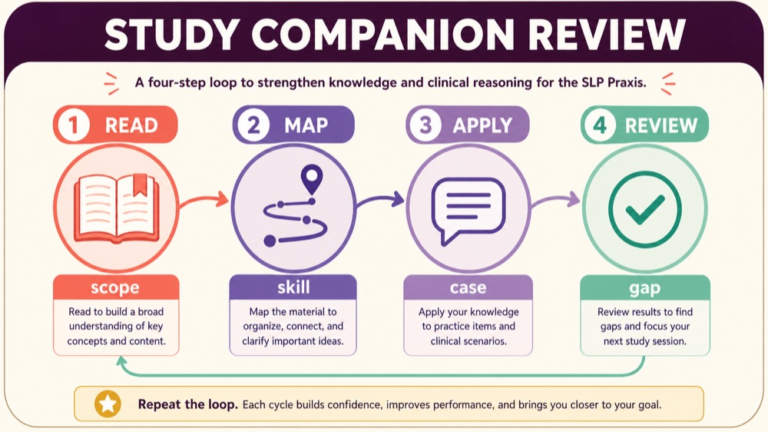
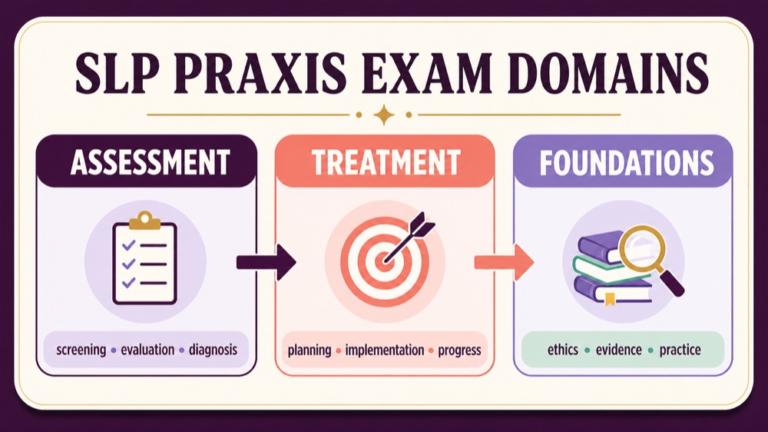
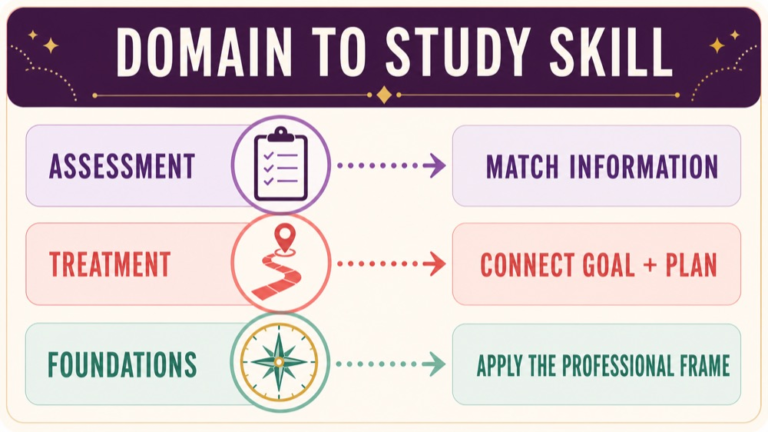
An slp praxis exam prep timeline should answer a practical question: what should you study, practice, and verify between today and the test date? The right calendar depends on your starting point, weekly capacity, coursework, clinical responsibilities, and the amount of time available. A plan copied from another student can be too dense, too light, or aimed at a different stage of training.
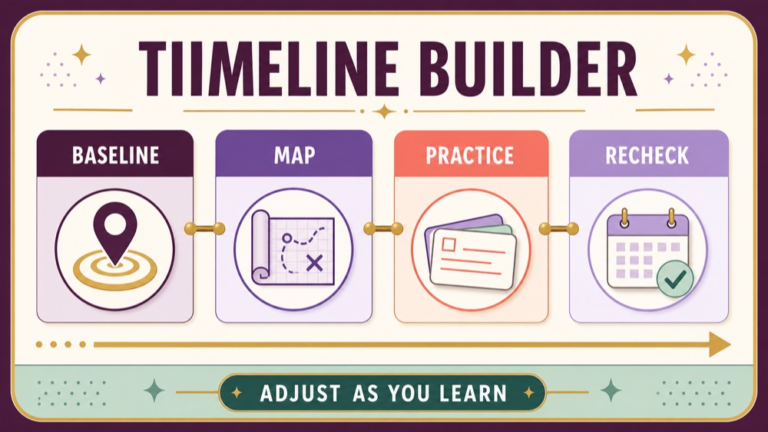
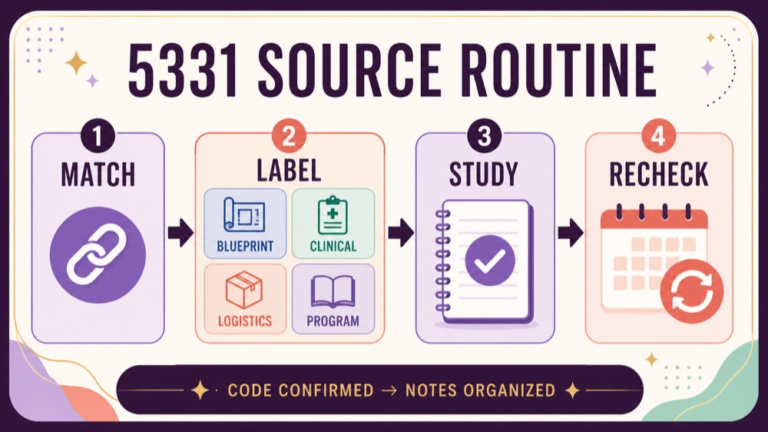
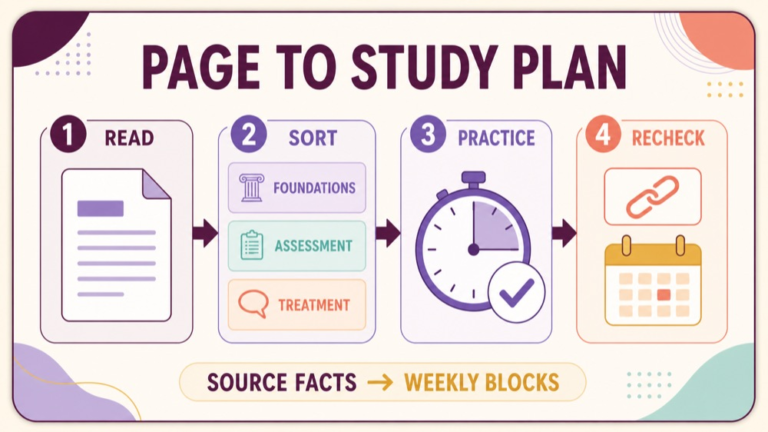
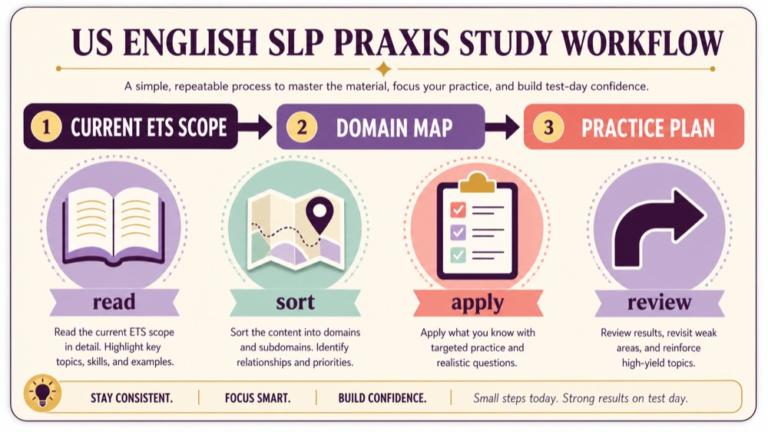
Use the current ETS Speech-Language Pathology 5331 page and Study Companion as the scope anchor. Then build a timeline with four repeating moves: establish a baseline, map the content, practice application, and recheck the plan. The four-, eight-, and twelve-week examples below are flexible frameworks for organizing work; they are not a required ETS schedule or a promise about a candidate’s result.
What an SLP Praxis exam prep timeline should do
A useful timeline turns a distant test date into decisions you can make this week. It identifies the current exam, divides the available runway into phases, assigns a small number of repeatable study actions, and includes checkpoints where you can change the plan. The calendar should make the next step visible without pretending that every learner needs the same number of days.
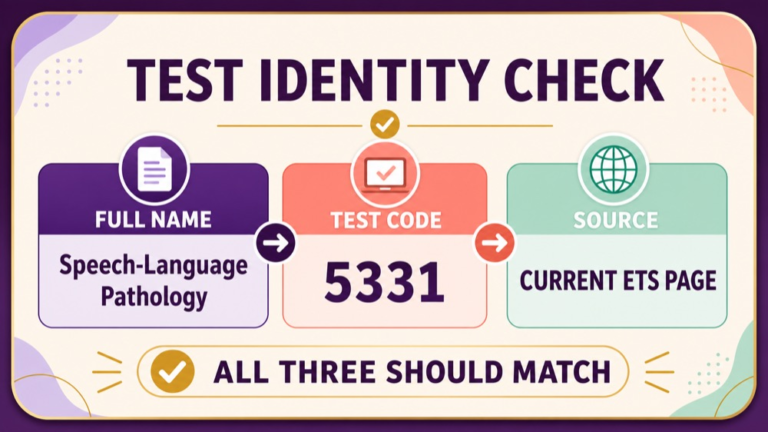
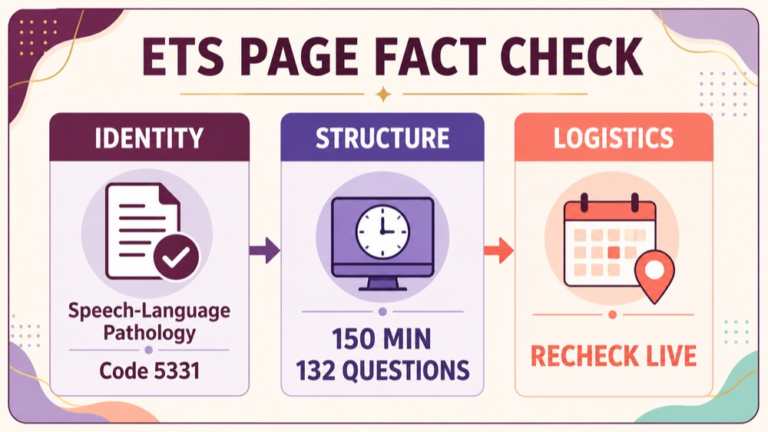
The current ETS page describes Speech-Language Pathology 5331 as a computer-delivered, selected-response test with 132 questions and a 150-minute test length. It also describes broad areas that span foundations, professional practice, and specialized knowledge across clinical settings. Use those official details to shape practice, while treating the calendar itself as your personal planning tool.
Scope: identify the current test code, content categories, and official source materials.
Runway: count the usable weeks between today and the confirmed appointment.
Capacity: estimate study blocks you can repeat during a normal week.
Evidence: use baseline work, error logs, and timed practice to adjust emphasis.
Recovery: leave room for sleep, clinical work, coursework, and a calm final review.
A calendar is doing its job when it helps you choose the next action and notice when the plan needs to change. It is not a score prediction. Keep the outcome question separate from the process question so a difficult practice set can inform your plan without rewriting your identity as a learner.
Start with your test date and constraints
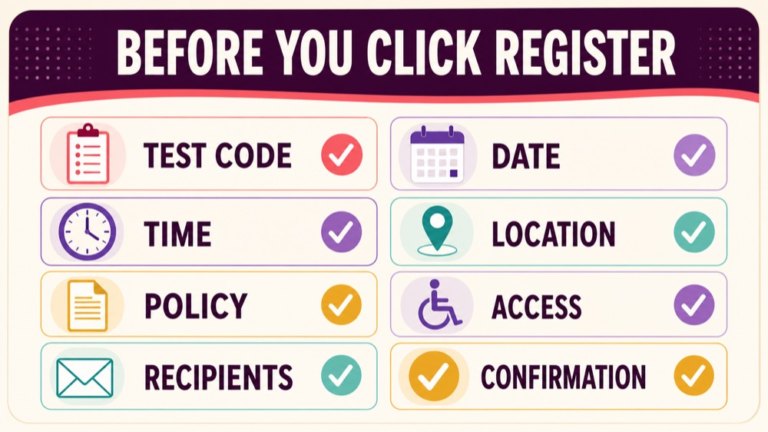
Before choosing a study length, confirm the appointment details in the current ETS account or registration flow. Record the test name and code, date, time, delivery method, location or at-home requirements, score-reporting date shown by ETS, and any deadline supplied by your program or licensing authority. If the date is not confirmed, build a provisional calendar and label it provisional.
Next, list the constraints that will change your weekly capacity. A graduate course load may make weekday evenings unreliable. Clinical placement may create long commute or documentation days. Work, caregiving, health, accommodations, travel, and family events can all change the number of high-quality study blocks available. A realistic plan counts usable attention, not only empty boxes on a calendar.
Planning input
Question to answer
Calendar decision
Appointment
What test date and delivery details are confirmed?
Set the final review and logistics checkpoints.
Deadline
When does a school, state, or agency need the result?
Leave room for its stated process and timing.
Capacity
How many focused blocks fit in an ordinary week?
Choose repeatable study sessions instead of idealized hours.
Baseline
What content and question types need the most work?
Weight the middle weeks without dropping the full map.
Energy
When are reading, cases, and timed work most useful?
Match task difficulty to the time of day and week.
If the appointment changes, recalculate the runway rather than trying to force the old calendar to fit. A timeline is a living plan connected to a real date, not a document that becomes more correct by remaining unchanged.
Choose the right timeline runway
There is no single official number of weeks that fits every SLP Praxis candidate. Choose a runway by comparing the available time with the amount of new learning, retrieval practice, application work, and review you need. A shorter runway can work as a focused refresh when the foundation is strong; a longer runway can reduce compression when you are balancing school or clinical work.
Use these frameworks as starting shapes, then adjust the block count to your actual capacity:
Runway
Best use as a framework
Suggested phases
Four weeks
Focused consolidation when the test date is close and the baseline is clear
Baseline and map; targeted repair; timed application; final recheck
Eight weeks
Balanced preparation with space to revisit weak categories
Baseline; content map; two repair cycles; mixed practice; final recheck
Twelve weeks
Lower weekly density or broader rebuilding from an uneven foundation
Orientation; foundations; professional practice; specialized application; mixed practice; final recheck
For a four-week runway, avoid turning every day into a full test. Use the first few sessions to discover priorities, the middle sessions to repair and apply, and the final days to rehearse the current format and close open logistics questions. For eight or twelve weeks, use recurring review so early material does not disappear while you work on later categories.
Choose shorter: when your baseline is strong, your test date is firm, and you can protect focused blocks.
Choose longer: when several categories need rebuilding or your weekly capacity is limited.
Choose flexible: when coursework, clinical placement, or an appointment change may affect the date.
Choose a reset: after a previous attempt when the new plan must be based on score information and error patterns.
Do not use another candidate’s timeline as evidence that your plan is too slow or too fast. Use your baseline, the current blueprint, and the practice evidence you collect.
Use week one for a baseline and map
The first week is for orientation, not for proving how much you can cram. Read the current ETS test page and Study Companion, confirm the test code, and create a one-page map of the content categories. Then complete a permitted diagnostic or mixed practice set under conditions that give you useful information. The point is to see where your decisions break down, not to assign a permanent label to the result.
Review the baseline by separating knowledge gaps from process gaps. A wrong answer can reflect a missing concept, a misread question, an attractive distractor, a failure to prioritize the referral question, or time pressure. Record the reason you think the answer went wrong and what evidence would have changed the decision. That log becomes more useful than a single percentage.
Confirm the current Speech-Language Pathology Praxis 5331 scope and format.
List the major content categories from the official source.
Complete a mixed, permitted baseline set without looking up answers midstream.
Mark each missed or uncertain item by concept, reasoning, wording, or pacing.
Choose the first two repair targets and one maintenance target.
Place the first study blocks and the next checkpoint on the calendar.
Keep the diagnostic work private enough that you can examine it honestly. A baseline is a planning instrument. It does not decide what you are capable of, and it does not replace the official score report or an organization-specific requirement.
Plan the middle weeks around application
The middle of the timeline is where reading becomes usable decision-making. Each study cycle should move from a focused concept review to original case application, then to explanation and correction. For example, after reviewing assessment principles, practice identifying the referral question, selecting relevant evidence, and rejecting options that solve a different problem.
Rotate across the current blueprint so that a strong category stays active while a weaker category receives more attention. The ETS Study Companion can anchor the topic map, while your own error log decides which distinctions deserve another pass. Use authoritative professional sources for concepts that need clarification, and note the source date when a rule or practice detail may change.
Repair block: study one defined concept and write a short explanation in your own words.
Application block: solve new cases that require selecting, prioritizing, or evaluating an action.
Retrieval block: close the notes and recall the decision rule or contrast.
Mixed block: combine categories so you practice switching contexts.
Correction block: update the error log with the decisive evidence.
Maintenance block: revisit a previously repaired category before it fades.
Use a topic label narrower than “study swallowing” or “review language.” A useful label names the decision, such as distinguishing an assessment purpose from a treatment goal or matching a communication support to the person and context. Narrow labels make it easier to tell whether a review session changed your reasoning.
Build a weekly study rhythm
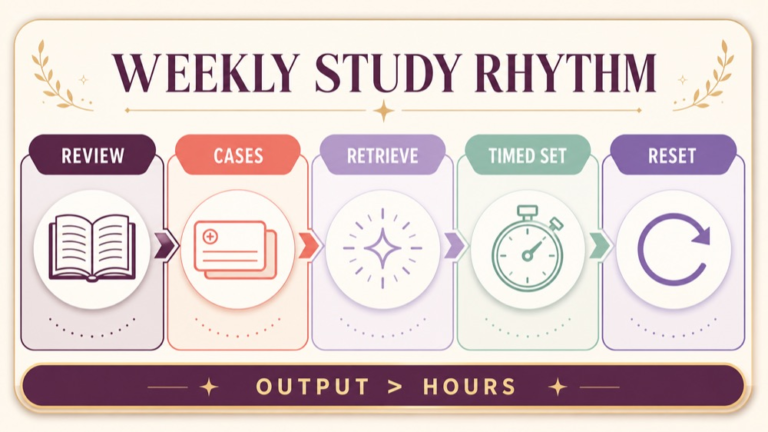
A weekly rhythm gives the timeline a repeatable operating pattern. The exact days can move around, but the functions should recur: learn or repair, apply, retrieve, practice under time, and reset. If you only read, you may not notice whether you can select the best answer in a new scenario. If you only take timed sets, you may collect errors without repairing the concepts underneath them.
Choose a number of blocks you can sustain. A block can be a short focused session or a longer protected period, depending on your schedule. Define the output before you start: a one-page comparison, a set of original case decisions, an error-log update, or a timed set followed by review. A visible output prevents “hours studied” from becoming the only measure of progress.
Weekly function
Example output
Evidence to review
Review
One concise concept map or contrast table
Can you explain the decision in plain language?
Cases
New scenarios with a written rationale
Did the evidence support the selected option?
Timed set
Timed questions followed by correction
Which errors came from pace or attention?
Retrieval
Closed-note recall or short teaching explanation
Can you retrieve the rule without the page open?
Reset
Next week’s priorities and one protected rest period
What should change based on the log?
Place the hardest reasoning work when your attention is usually highest. Use lighter retrieval, organization, or source checking during lower-energy windows. A plan that respects your energy can provide more useful practice than a plan that looks impressive but collapses after a few days.
Use practice evidence to adjust
Schedule a checkpoint at least once in the middle of the runway. Review the last several practice sessions, not only the latest score. Look for repeated categories, repeated distractor patterns, time clusters, and questions you changed from a supported answer to an unsupported one. Then update the next week’s emphasis.
Use a simple decision rule for adjustments: keep what is producing clearer reasoning, increase work on repeated errors, and reduce low-value repetition. If accuracy improves but timing remains tight, add shorter timed sets and review reading efficiency. If timing is comfortable but the same concept errors recur, return to the concept map and new applications. If the practice material does not resemble the current scope, change the material rather than blaming the learner.
Repeat concept errors: rebuild the distinction with an authoritative explanation and new cases.
Repeat wording errors: practice identifying the task, population, and decisive evidence before choosing.
Repeat pacing errors: use smaller timed blocks, then review why time was lost.
Repeat confidence errors: record the evidence that supports keeping or changing an answer.
Improving performance: maintain the repaired areas while adding mixed and transfer practice.
Do not change the entire plan after one difficult set. Ask whether the pattern repeats across enough work to justify a change. The timeline should respond to evidence while still preserving the full exam map.
Protect the final review window
The final phase is for integration and verification. Complete at least one realistic timed rehearsal with permitted material, then review the decisions and the process. Revisit the most important error patterns, not every page you have ever opened. Use the current ETS page for test details, the account for appointment information, and the score calendar or registration record for reporting-related timing.
Reduce novelty as the appointment approaches. A final review can include concise comparison sheets, mixed cases, retrieval prompts, and a short list of questions to confirm with ETS or your program. Keep sleep, meals, movement, and a practical test-day plan in the calendar. Recovery is part of the preparation sequence because tired practice produces noisy evidence.
Finish a timed rehearsal that matches the current test frame as closely as permitted.
Review the error log and select the few distinctions that still need attention.
Recheck the current ETS appointment, delivery, identification, and check-in information.
Confirm any accommodation, school, state, or certification documentation step.
Review the current score-reporting date shown for the test and save the account details.
Set a lighter final study block and a realistic bedtime or recovery plan.
The final review is not the moment to chase every possible topic. It is the moment to make your process stable, your sources current, and your next action clear.
Fit preparation around school and clinical work
Many SLP candidates prepare while completing graduate coursework, clinical practicum, or early professional responsibilities. Use the schedule you actually have. A busy week can still include a short retrieval block, one case-analysis block, and a weekend correction session. When a major assignment or placement week arrives, reduce volume while protecting contact with the blueprint.
Connect preparation to learning without assuming that every class or client experience maps directly to a test question. A clinical encounter can prompt a useful review of a concept, but the Praxis asks you to apply knowledge across settings and scenarios. Keep a boundary between patient information and study notes; do not place identifying details into a personal error log.
Choose two anchor blocks that stay protected most weeks.
Keep a small portable retrieval task for commutes or waiting periods when appropriate.
Use one weekly reset to move unfinished work instead of stacking guilt onto the next day.
Tell a supervisor, instructor, or household member which blocks are important when support is available.
Adjust the calendar after an unusually demanding week instead of doubling the next session.
If you need accommodations or have a health-related constraint, include the current ETS process and your support plan early. The timeline should fit the approved testing arrangement and the actual requirements of your pathway.
Avoid common timeline mistakes
Timeline problems are usually design problems that appear before the first study session. A candidate chooses a date without checking the reporting deadline, counts every calendar hour as study capacity, spends the first weeks making elaborate notes, or leaves all timed practice for the final weekend. Review these patterns before they become expensive.
Copying a six- or eight-week schedule without comparing it with your baseline.
Building the plan around ideal availability instead of a normal school or work week.
Reading the Study Companion once without turning categories into decisions and practice.
Using one broad topic label for an entire clinical area.
Taking practice sets without reviewing why the wrong options were attractive.
Adding more material after every difficult score instead of checking for a repeated pattern.
Skipping mixed practice because category-by-category work feels safer.
Leaving current appointment, accommodation, or score-reporting checks until test morning.
Removing rest because the calendar has fallen behind.
The repair is to shrink the next action, preserve a weekly rhythm, and use evidence at the next checkpoint. A timeline can be revised without being abandoned.
SLP Praxis exam prep timeline checklist
Before you start and at each checkpoint, confirm the following:
Is my Speech-Language Pathology Praxis test code and appointment date confirmed?
What score-reporting or application deadline must the plan respect?
Which current ETS source defines the scope and format I am studying?
How many focused blocks fit in a normal week rather than an ideal week?
What did my baseline reveal about knowledge, wording, pacing, and confidence?
Which two repair targets and one maintenance target come first?
Does each week include review, new application, retrieval, timed work, and correction?
When will I review the error log and change the next week’s emphasis?
Have I scheduled a final source, appointment, and recovery check?
Am I using current, permitted preparation material and protecting private information?
The best timeline is specific enough to guide the next block and flexible enough to reflect evidence. Start with the confirmed test and the current ETS scope, build a repeatable rhythm, and let practice review tell you where to spend the next part of the runway.
praxis slp score recipients are the institutions or agencies that should receive score information from ETS. Selecting them carefully matters because a graduate program, a state licensing office, an ASHA-related pathway, and an employer can have different instructions. The useful task is not to collect names from a forum; it is to match each recipient to the current code, pathway, and delivery requirement.
For Speech-Language Pathology Praxis 5331, start with the current ETS test identity and then use the live registration flow and current recipient-code list. ETS currently says up to four institutions or agencies can be selected during registration at no extra cost. This guide explains how to prepare, choose, verify, and follow up without assuming that one score-delivery route fits every candidate.
What Praxis SLP score recipients mean
A score recipient is the institution or agency you identify so ETS can send score information through its reporting process. The recipient is not automatically the same as the person who reminds you to take the exam, the school where you currently work, or the state where you live. It should be the organization whose current instructions tell you that it needs the Praxis result.
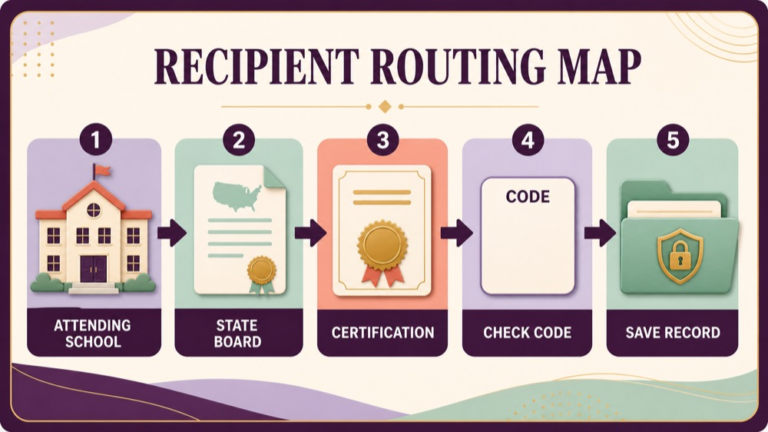
There are several possible roles in the routing process. Your attending institution may be the graduate program connected to your training. A designated recipient may be a state board, certification organization, school district, or another agency. A state may have an automatic reporting arrangement for some testing situations, while a different state or program may require you to select it directly. Keep these roles separate before you open the payment screen.
Attending institution: the training institution connected to the account or test record when the current instructions request it.
Designated recipient: an institution or agency you want ETS to receive the score report.
State or licensing agency: the office that evaluates a state-specific credential or license application.
Certification organization: an organization whose current pathway instructions may identify a specific recipient or document route.
Candidate record: the official report in your Praxis account that you should save and review yourself.
One organization can also play different roles depending on what the current form asks. Read the field label, not just the organization’s familiar name. If a program supplies a code or tells you to use an A-code or R-code, keep that instruction with your registration notes.
Make a recipient list before registration
Build the list before selecting an appointment. Ask your graduate program, state board, credentialing agency, and certification organization what they need, when they need it, and whether they want ETS to send the score directly. Write down the exact organization name, state, code, pathway, application deadline, and contact point. If an organization says that a candidate-uploaded report is acceptable, record that separately from a direct ETS-recipient request.
Do not let the four-recipient limit make the decision for you. Start with requirements, then rank the recipients by whether they are necessary for the application in front of you. A program may need your score for its own record, while a state board may need it for licensing. A future employer may ask for proof but may not be an ETS score recipient at all.
List field
Question to answer
Evidence to save
Organization
What is the full legal or published name?
Current instruction page or written message
Role
Is it an attending institution, state, agency, or other recipient?
Field label and pathway description
Code
Which current ETS code matches the organization?
ETS code list and account selection
Deadline
When must the organization receive or process the score?
Application page or contact confirmation
Delivery
Does the organization want ETS delivery, an upload, or both?
Receiving-office instructions
If an office does not answer a routing question, do not fill the gap with a code found in an old screenshot. Ask the office or ETS for the current instruction and note the date of the answer. Recipient codes and program contacts can change even when the test code remains the same.
Choose recipients during registration
During registration, confirm the test first, then work through the recipient fields slowly. The current ETS page identifies Speech-Language Pathology 5331 as the relevant test for this guide. Check the full test name and code before choosing a recipient, because a code list may serve more than one Audiology or Speech-Language Pathology test.
When the form asks for an attending institution, use the current school or training-program instruction. When it asks for designated score recipients, select the state, agency, or organization that supplied a current requirement. Check the code and name together. A correct-looking abbreviation attached to the wrong state or campus can route the report incorrectly.
Open the current ETS registration process and identify Speech-Language Pathology 5331.
Read each recipient field label, including any attending-institution field.
Compare the organization’s full name and state with your saved requirements.
Open the current ETS recipient-code list when a code is requested.
Check whether the code begins with A, R, or RA and whether that role fits the field.
Review the selected recipients before payment or final submission.
Save the final selection and confirmation details in a private record.
Use the recipient screen as a verification checkpoint, not as a search for the most familiar school name. If the exact organization does not appear, do not substitute a nearby campus or a similarly named board without confirmation. The current ETS page says codes are updated throughout the year and directs candidates to contact Customer Service when a code is missing.
Read attending-institution and recipient codes
The current ETS Audiology/Speech-Language Pathology code PDF explains the prefixes used in its list. Attending Institution codes are preceded by A, designated score-recipient codes by R, and RA codes may be used in either section. The PDF also says the list was last updated on January 22, 2025 and that codes are updated throughout the year. Treat the live PDF and account selection as the controlling sources.
In practice, the prefix is a clue about the field, not a reason to guess. If your program gives you a code, compare its name, campus, state, and role with the current list. If an organization appears with more than one code or the form offers a choice, ask the organization which entry it wants. Save the exact selection rather than writing only a shortened name.
A-code: review it in the attending-institution context described by the current ETS list.
R-code: review it as a designated score-recipient entry.
RA-code: confirm which registration field the current form permits it to serve.
Missing code: contact ETS Customer Service or the organization instead of inventing a code.
Updated list: record the PDF date and recheck it if your appointment is later.
Do not use the code list as proof that an organization has accepted your application. The list helps route score information; the receiving office still controls its application, matching, and document rules.
Check state, agency, and ASHA routing
State and certification routing can overlap, but they are not one requirement. ETS’s current Sending Your Scores page identifies states and territories with automatic score reporting to a teacher-credentialing agency. The same page says that if the state where you test differs from the state where you will apply, or if your state is not on the listed automatic-reporting list, you should select the state as a score recipient so a report can be sent to its teacher-credentialing agency.
That guidance does not answer every SLP licensing question. Check the current state board instructions for the state where you will apply, and ask whether the agency wants an ETS score report, a candidate copy, or another document. If your pathway involves ASHA certification, review the current ASHA registration and score-report instructions as well. A national certification route and a state license can require different records.
Routing question
Source to check
Reason for the check
Does my state receive scores automatically?
Current ETS Sending Your Scores page
Automatic reporting depends on the listed state or territory and testing situation.
Which state will evaluate my application?
That state board or agency
The test location and application state may differ.
What does my program need?
Graduate program or school office
Programs can set their own upload, deadline, or recipient instructions.
What does ASHA require for my pathway?
Current ASHA Praxis pages
Certification documentation is separate from state licensing documentation.
When two organizations give different directions, keep both instructions and ask the organization that owns the requirement to clarify. A score recipient selection should support an actual application, not merely create a larger list of destinations.
Understand free recipient changes
ETS currently says you can change your free score recipients at no cost up to three days before your test date. After that point, the current Sending Your Scores page directs candidates toward purchasing additional score reports for a fee. Check the live account and the current page for the timing tied to your appointment rather than counting backward from a general test calendar.
Put a recipient review date on your study calendar. Recheck the list after your program confirms its code, after a state application opens, and before the free-change window closes. If your appointment moves, recalculate the relevant deadline from the new appointment details shown by ETS.
Review recipients when you first create the appointment.
Compare codes with the current ETS PDF and the receiving office.
Recheck the state of application, not just the state where you plan to test.
Confirm whether a program needs an attending-institution selection.
Use the live account to make a permitted free change before the window closes.
Save the changed list and the account confirmation.
The most important record is not a memory that you selected “the school.” It is the exact organization, code, role, and confirmation shown in the current registration record.
Verify delivery after the score is reported
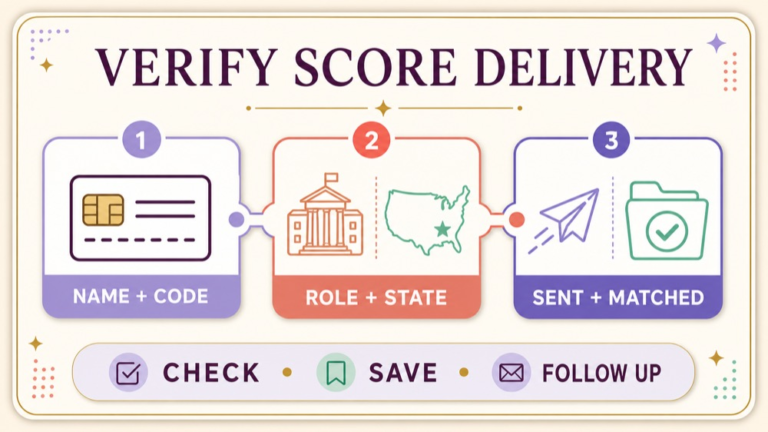
After the official score is posted, open the Score Reports page in your Praxis account and save the report. The current ETS Getting Your Scores page says the official report is posted in the account on the score-reporting date and that selected institutions or agencies also receive score information. Check your own report first, then follow the receiving organization’s process for confirming a match.
ETS’s score-reporting guidance calls the report sent to a selected institution or agency a Designated Institution Score Report. It can include the test-taker’s name, score, pass or no-pass information for designated recipients, background and educational information, and detailed content-category performance. Use only the information the receiving office requests, and protect personal details while uploading or emailing documents.
Open the official score report in your Praxis account.
Verify your name, test, code, test date, and score.
Compare the recipient list with the confirmation you saved.
Check the receiving organization’s account or application portal if it offers one.
Ask the office how long its matching process takes and what proof it accepts.
Keep the report, order confirmation, and follow-up message together.
Ask ETS about an account or delivery issue with a precise date and recipient code.
A recipient’s internal processing time is different from ETS’s act of sending score information. If a deadline is close, contact the receiving office early and explain the test date, report date, and recipient selected. Do not forward an entire personal record when a score page or official delivery is the requested item.
Order an additional score report carefully
If an organization was not selected during registration, first ask whether it needs an additional ETS report. The current ETS Sending Your Scores page says Praxis scores are valid for ten years and that additional score reports can be ordered during that period. It currently lists the additional report as nonrefundable and priced at $50 per score recipient.
Before checkout, confirm the recipient name and code, the reason the report is needed, the deadline, and whether the organization will match the delivery to your application. ETS describes online paths through the Praxis account, including a score-recipient option associated with the test. Keep the order confirmation, but remember that a payment receipt records the order and does not confirm that the receiving office has completed its own processing.
Ask the receiving organization for its current code and delivery instruction.
Check whether your existing candidate copy satisfies the request.
Confirm that the score is within the period in which ETS makes it available.
Review the current fee and nonrefundable language before paying.
Save the recipient, date, amount, and order confirmation.
Follow up with the receiving office using the information it asks for.
Do not purchase a report solely because a code appears in a list. The fee decision belongs after the receiving organization confirms its requirement and the exact destination is verified.
Keep a score-recipient record
Create one private record with the test code, appointment date, recipients, codes, role of each recipient, report date, application deadline, and follow-up status. A simple table can prevent repeated searches and makes it easier to explain a routing question to ETS or a licensing office.
Record
Example entry to capture
When to update
Test identity
Speech-Language Pathology Praxis 5331
Before registration
Recipient role
Attending institution, state agency, or designated organization
When the form asks for the field
Code
Exact A, R, or RA code shown in the current list
Before final submission
Confirmation
Account or appointment record and date saved
Immediately after registration or change
Delivery status
Report available, sent, matched, or question open
After the official score posts
Store the record securely and limit the personal information in any message to the minimum needed for support. Your score-recipient record should help you answer a question, not create a second copy of sensitive documents in many places.
Avoid common recipient mistakes
Recipient errors usually happen when a candidate mixes up roles, codes, states, or deadlines. A deliberate final review is faster than correcting an incorrect destination after the free-change window. Watch for these patterns:
Selecting a school because its name looks familiar without checking the current code.
Confusing an attending institution with a designated score recipient.
Choosing the state where the test occurs instead of the state that evaluates the application.
Assuming automatic reporting covers every state, school, or certification route.
Using an old recipient-code PDF without checking its update date.
Waiting until the appointment week to ask the program for its code.
Paying for an additional report before confirming that it is required.
Treating an order receipt as proof that the office has matched the report.
Sending more personal information than the receiving office requested.
The repair is consistent: name the organization’s role, verify the exact code, compare the destination with the current requirement, save the confirmation, and follow up after the official report posts. If a name or code is ambiguous, ask the organization or ETS rather than relying on a search result.
Praxis SLP score recipient checklist
Before you complete registration or buy an additional report, confirm each item below:
Did I select the correct Speech-Language Pathology Praxis test, code 5331?
Do I know whether each destination is an attending institution or a designated recipient?
Did I ask the school, state, agency, or certification organization for its current instruction?
Did I verify the exact name, state, campus, and code in the current ETS list?
Did I check whether automatic state reporting applies to my situation?
Did I review the free-recipient change window shown by ETS?
Did I save the final recipient list and appointment confirmation?
After the score posted, did I save the official report from my Praxis account?
Did I ask the receiving office how it confirms delivery or matches an application?
Before purchasing an additional report, did I verify the destination, fee, deadline, and requirement?
Good Praxis SLP score recipients planning is a small administrative skill with a clear payoff: the result has a verified route to the organization that needs it. Keep the current ETS pages and the receiving organization’s instructions together, and revisit them when an appointment, policy year, or application pathway changes.
praxis slp score reporting can feel confusing because several different events happen around the same test: you finish the administration, you may see an unofficial result, ETS posts an official score report, and a school, agency, or certification organization may receive a report separately. Checking those events in order makes it easier to know what information is final and what action belongs next.
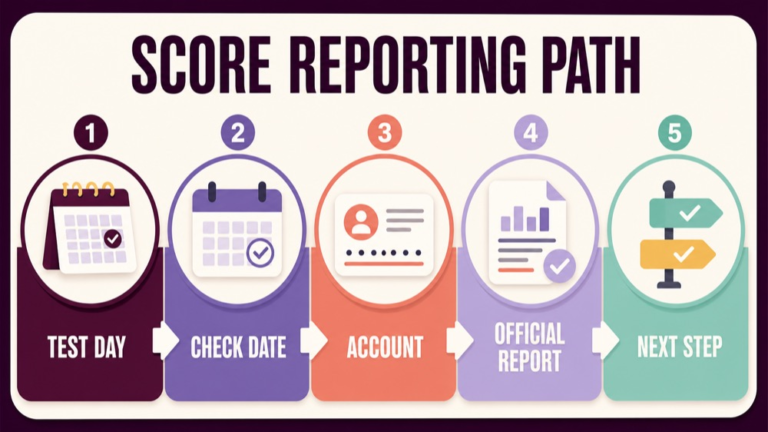
For the current Speech-Language Pathology Praxis 5331, ETS identifies the test as computer delivered with selected-response questions. ETS says official scores are posted in the Score Reports page of your Praxis account on the score reporting date, which varies by test type and delivery method. Use this guide as a checklist, then use the live ETS account and current policy pages for the date and terms that apply to your appointment.
What Praxis SLP score reporting includes
Score reporting is the handoff from a completed test to the information you and approved recipients can use. The handoff has a timing question, an access question, an interpretation question, and a delivery question. A clear record keeps those questions separate instead of treating a screenshot, an email, and an official report as interchangeable.
Start by recording the test date, delivery method, test code, and the score-reporting date shown in your registration or account. The current ETS score page says the report date varies by test type and delivery method, including at-home versus test-center appointments. If you cannot find a date or the account shows a status you do not understand, use ETS support rather than estimating from another candidate’s timeline.
Timing: identify the score-reporting date associated with your test and delivery method.
Access: open the Score Reports page in the Praxis account where the official report will be posted.
Interpretation: distinguish a possible unofficial result from the official report and from a raw answer count.
Recipients: confirm which institutions or agencies were selected and what your program or state requires.
Next action: decide whether you need to save the report, send it, ask a policy question, or revise your study plan.
This sequence is useful whether your result is above, near, or below a target. It creates a small evidence trail that you can revisit when a program asks for documentation or when you plan another attempt.
Find your official score report
According to the current ETS Getting Your Scores page, your official score report is posted in your Praxis account on the Score Reports page on the score reporting date. An email is used to notify you when it is available. Sign in through the official account route, open the Score Reports page, and look for the report connected to the correct test and date.
Save a copy for your records after you confirm that it is the official report. Use a private, secure location and avoid posting a report publicly because it can contain personal and educational information. If a school, licensing agency, or ASHA-related process needs documentation, follow that organization’s instructions for uploading or sending the report rather than forwarding more information than requested.
The report in your account is the central record for your own review, but delivery to another organization is a separate step. A recipient may receive score information through ETS while your program may also ask you to submit a document. Confirm both paths when a deadline depends on the result.
Question
Where to check
Record to keep
When should the score appear?
ETS score calendar and your Praxis account
Test date, delivery method, and listed reporting date
Where is the official report?
Praxis account, Score Reports page
Saved report and date accessed
Who receives it?
Registration record and current ETS recipient instructions
Recipient names, codes, or confirmation details
What target applies?
ASHA, state, agency, school, or employer
Current requirement and the source date
Use the score reporting calendar
ETS provides a score-calendar tool in the current Getting Your Scores page. Select the test, the test date, and the delivery method shown by the tool. The current page also notes that Praxis scores are reported on Tuesdays and Fridays, with a holiday moving the report to the following Tuesday or Friday. Treat those statements as calendar guidance, not as a substitute for the date returned for your own test.
Check the date in three places when the timing matters: the scheduling or registration screen, the pending-score card in your account, and the live ETS calendar. ETS says the pending score card appears on the Score Reports page. Cancelled or held tests do not appear in that Pending Scores section, so an absent card needs context; it is not enough evidence by itself to draw a conclusion.
Write down the exact test date and whether you tested at home or at a center.
Choose Speech-Language Pathology 5331 in the ETS score-calendar tool.
Compare the returned date with the pending-score information in your account.
Mark the date and time zone shown by ETS in your personal calendar.
Recheck the account on or after the listed date and look for the official Score Reports entry.
If the status is missing, held, or unclear, contact ETS through the official support route.
Do not promise a school or licensing office that a score will arrive on a date copied from a different test. Send the receiving organization the date shown for your appointment and ask how it handles a report that becomes available near its deadline.
Understand the unofficial score
The current ETS page says Praxis tests made up only of selected-response questions may offer an unofficial score at the end of the testing session. The current ETS test page identifies Speech-Language Pathology 5331 as selected-response, so a candidate may see an unofficial result after testing. ETS also says that an unofficial score is not provided in every case, and that its absence does not indicate a problem with the administration or cause a delay in the official score.
An unofficial result is useful as an immediate piece of information, but the official report is the record to use for formal reporting. Before viewing the unofficial result, the computer provides an option to report or cancel the score. ETS currently states that a reported score cannot be canceled, while a canceled score is not reported, cannot be reinstated, and does not receive a refund. Read the current screen carefully before choosing.
Do not treat the absence of an unofficial result as a diagnosis of a scoring problem.
Do not use a remembered unofficial result as a substitute for the official report.
Do not assume an unofficial result is an exact raw-percentage conversion.
Do not choose report or cancel without reading the current on-screen language.
Do save your test date and any permitted confirmation information for later comparison.
The most useful emotional response to an unofficial result is a pause. Record what ETS shows, then wait for the official Score Reports entry before sending a formal status to a school, state, or certification organization.
Check the details on your score report
When the official report is available, read the identification and administrative details before interpreting the number. Confirm that the report belongs to you, names the intended Speech-Language Pathology test, and is connected to the correct test date. Then note the reported score, any pass or no-pass information shown, and the content-category information that can guide review.
A score is not simply a percentage of questions correct. ASHA explains that raw points are based on the number of correct answers and that the scaled score is computed from the raw total in a way that adjusts for question difficulty. This is why you should use the score scale and interpretation shown by ETS or ASHA instead of converting a remembered number of correct answers into a guaranteed scaled result.
Use the following review order so that a strong emotion about the result does not hide a practical detail:
Identity: verify your name, test, code, and test date.
Score: record the official scaled score and the report date.
Performance information: note the content categories or diagnostic detail included in the report.
Target: compare the score with the requirement that actually applies to your pathway.
Delivery: confirm the intended recipients and whether the organization needs another document.
Action: save the report, ask a precise question, or build a targeted study review.
If the name, test, date, or score appears inconsistent with your records, stop before forwarding the document and contact ETS through its official score-support route. If the report is correct but a program interprets it differently from your understanding, ask that program for its written requirement and keep the answer with your records.
Read the ASHA passing-score context
ASHA’s current Praxis score page lists 162 as the passing score for Speech-Language Pathology 5331 for purposes of ASHA certification. That is a certification-context reference, not a universal rule for every state, school, employer, or licensing pathway. ETS’s current qualifying-score page says passing scores vary by state or agency and are not set by ETS.
Use a three-source check when you need to decide what your score means administratively: the official ETS report, the current ASHA certification information if ASHA certification is your pathway, and the current requirement from the state or agency that will evaluate your application. A graduate program may also have a separate internal deadline or documentation rule. Keep those requirements in separate fields in your checklist.
Source
Question it can answer
What it cannot replace
ETS official score report
What score ETS recorded for this test administration
A state or agency’s separate qualifying rule
ASHA Praxis score page
Current certification passing-score context
Individual advice about a candidate’s complete certification file
State or licensing agency
Which score and documentation the application requires
ETS’s official record of your test
School or employer
Its deadline, upload process, or internal requirement
A national certification or state rule
This separation prevents a common mistake: declaring a score sufficient because it matches one number while overlooking a different reporting deadline or an additional pathway requirement. The organization that owns the requirement should confirm the requirement.
Confirm who receives your scores
The current ETS score page says scores are sent to institutions or agencies selected during registration, with up to four choices at no extra cost. ETS also notes that some states or territories use automatic score reporting to a teacher-credentialing agency. Automatic reporting does not mean every organization on your personal application receives a copy, so compare the current recipient record with the instructions from the organization evaluating you.
Review recipients before a deadline rather than after a missing document is discovered. Confirm the full institution or agency name, the code if ETS displays one, the pathway or state, and whether the recipient wants an official ETS delivery or a candidate-uploaded report. Do not select a recipient based only on a similar abbreviation.
List the school or program that needs the score for its own record.
List the state or agency that evaluates the credential or license.
Check whether automatic state reporting applies to your testing situation.
Confirm any recipient change deadline shown in your ETS account.
Save the receipt or account confirmation after changing recipients.
Ask the receiving organization how it matches a score to your application.
ETS’s current Sending Your Scores page says free score-recipient changes can be made up to three days before the test date. It also explains that additional score reports can be purchased after that point. Use the live account and current page for the rule associated with your test, because recipient policies and fees can change.
Order an additional score report
If you need to send a score to an organization that was not selected, open the current ETS Sending Your Scores page and sign in to your Praxis account. ETS currently says Praxis scores are valid for ten years and that additional score reports can be ordered during that period. The page lists each additional report as nonrefundable and currently priced at $50 per score recipient.
Before paying, confirm that the recipient actually requires an additional ETS report and that you selected the correct organization or agency. Check whether the program has an internal code, a specific delivery method, or a deadline for matching the report to your application. A fee receipt shows that an order was placed; it does not by itself establish that the receiving office has processed the score.
Ask the organization for its current score-delivery instruction.
Sign in to the Praxis account through the official ETS route.
Locate the test and open the score-recipient or additional-report option.
Confirm the recipient name, code, and delivery details.
Review the current fee and nonrefundable language before checkout.
Save the order confirmation and follow up with the recipient if its process requires it.
Keep the official report, recipient order, and application receipt together. That small record is useful when a school, state office, or certification process asks when the score was sent.
Turn the report into a study decision
A score report can be an administrative document and a study-planning input at the same time. If you met the requirement, review the categories that still feel uncertain before moving on. If you did not meet the target, avoid replacing the entire plan with random practice. Use the category information, your error log, timing notes, and the current ETS Study Companion to identify the next few skills worth repairing.
The current ETS 5331 page describes foundations, professional practice, and specialized knowledge across practice areas that include screening and assessment, treatment, and treatment evaluation. Use that structure as a map rather than as a promise that a category score explains every error. A missed item can reflect knowledge, wording, prioritization, pacing, or a test-day process issue.
Clarify the target: write the exact score requirement and organization that supplied it.
Mark the report: record the official score, report date, and content-category information.
Review the blueprint: connect the weakest area to current source material.
Analyze decisions: log why a practice choice was attractive and what evidence should control next time.
Rehearse timing: use original practice scenarios and a timed block that matches the current exam frame.
Recheck logistics: review the live ETS appointment, score, and retake rules before scheduling anything new.
Keep preparation grounded in authorized resources and new case reasoning. A score report is not an invitation to search for remembered test content, and it does not reveal every question from an administration. The learning goal is to make accurate decisions on new scenarios across the blueprint.
Avoid common score-reporting mistakes
Most score-reporting errors are process errors rather than difficult calculations. A candidate sees an unofficial result and sends it as final, copies a reporting date from another test, compares the score with a target from the wrong pathway, or assumes a recipient has received a report because an order was placed. A short verification routine catches these problems.
Confusing an unofficial end-of-session result with the official Score Reports entry.
Assuming that no unofficial result means the test administration had a problem.
Using a Tuesday-or-Friday general pattern instead of the date returned for the appointment.
Converting an estimated raw count into an exact scaled score.
Using ASHA’s certification number as the answer for a different state or agency requirement.
Forgetting that a program may need its own recipient code or document process.
Paying for an additional report before confirming that the organization requires it.
Forwarding a score report with unnecessary personal information.
The fix is to name the evidence for each decision: ETS account for the official report, ETS calendar for the reporting date, current ASHA or agency page for the requirement, and the receiving organization for its document process. If the evidence conflicts, pause and ask the source owner to clarify.
Praxis SLP score reporting checklist
Use this final checklist after the Speech-Language Pathology Praxis and before you tell an organization that your score is complete:
Did I record the exact test date, delivery method, and test code?
Did I check the ETS score calendar for my test and date?
Did I open the official Score Reports page in my Praxis account?
Did I distinguish an unofficial result from the official report?
Did I verify my name, test, date, score, and report status?
Did I compare the result with the correct ASHA, state, agency, school, or employer requirement?
Did I confirm which recipients were selected and whether automatic reporting applies?
Did I ask the receiving organization whether it needs an additional report or upload?
Did I save the report and any score-recipient confirmation securely?
If I need another attempt, did I turn the score information into a focused study review?
When every answer has a source or a saved record, score reporting becomes a manageable handoff rather than a guessing exercise. Keep the live ETS pages bookmarked, because reporting dates, recipient instructions, fees, and policy language can change.
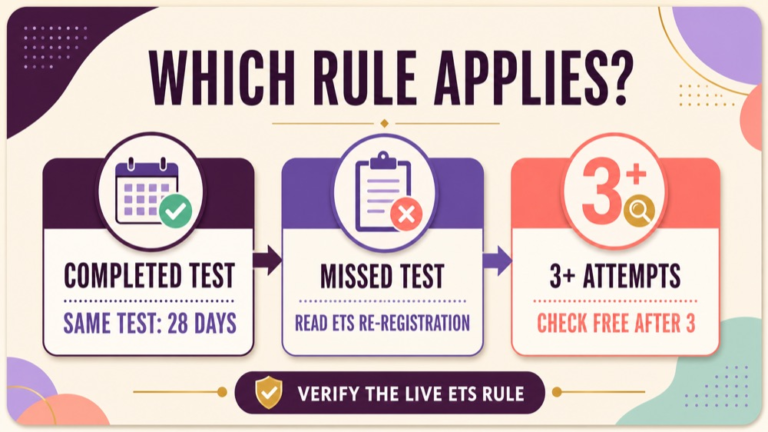
The praxis slp retake policy is easier to follow when you separate three situations: you completed the Speech-Language Pathology Praxis and want another attempt, you scheduled the test but did not take it, or you may qualify for a later Free After 3 benefit. Each situation has a different next step, so a single remembered rule can lead you in the wrong direction.
Current ETS materials state that the same Praxis test must be taken on a date at least 28 days after the previous test date. The current appointment page also describes a different re-registration path after a missed test, while the Free After 3 page lists separate eligibility conditions. This guide turns those policies into a verification routine and a focused study reset.
Start with the current ETS rule
Begin with the current ETS Manage Your Praxis Test Appointment page and the current Information Bulletin. The appointment page is written for practical actions such as rescheduling, canceling, missed-test re-registration, and retaking. The Bulletin gives the testing-year policy frame and warns that terms and fees can change, so both sources belong in your final check.
Confirm that your question concerns the Speech-Language Pathology Praxis, currently identified by ETS as test 5331. Then write down the date of the last test you actually took, the status of your score, and the deadline supplied by your program or licensing authority. A correct date calculation cannot replace those separate requirements.
Completed test: use the same-test retake rule and count forward from the previous test date.
Missed appointment: read the current re-registration instructions because the appointment page treats this differently from a completed attempt.
Score or policy question: use the current ETS source or contact ETS through its official support route.
Program deadline: verify the timing and score requirement with the organization receiving your result.
How the praxis slp retake policy works
For a completed attempt at the same Praxis test, ETS currently says the next test date must be at least 28 days after the previous test date. The appointment page gives the practical interpretation: you may register, but the new test date must fall 28 days or more after the last test date. Treat the date rule as a scheduling boundary, not as a suggestion about how quickly you should rebuild your study plan.
The current ETS page says the 28-day period applies even if you canceled your scores or did not perform as expected. The current Information Bulletin also explains that violating the restriction can lead to cancellation of the retest scores and loss of test fees. Because this is a policy with financial and score consequences, verify the live page before you pay for the next appointment.
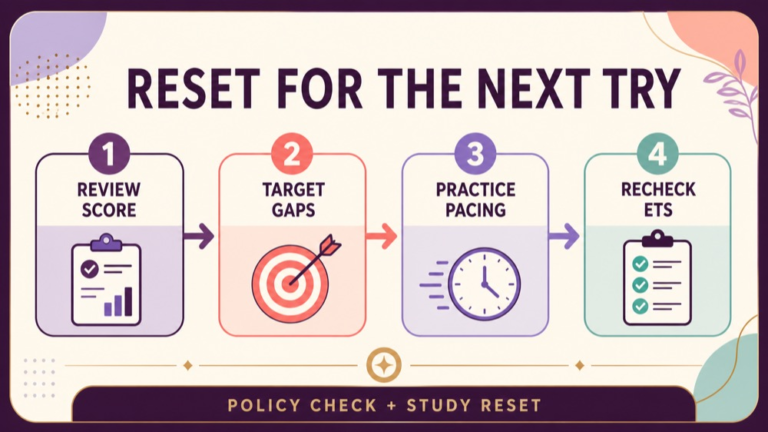
The waiting period can be productive if you divide it into recovery, targeted learning, and final verification. Recovery means reading the score report and reconstructing the test-day process. Targeted learning means reviewing specific domain or reasoning weaknesses. Final verification means checking the current policy, appointment details, and deadline before scheduling.
Make a retake decision map
Before you select a date, identify which branch describes what happened. The key question is whether you completed the test administration. If you did, the same-test 28-day rule applies. If you did not take the scheduled test, read the missed-test instructions instead. If you have taken the same test three or more times, review Free After 3 as a separate possibility rather than assuming it changes the basic scheduling rule.
Your situation
First source to read
Next record to make
Completed the SLP Praxis
ETS appointment page and Information Bulletin
Previous test date and earliest permitted test date
Scheduled but did not test
ETS missed-test re-registration instructions
Reason, appointment status, and the re-registration timing shown by ETS
Scores canceled
ETS retake and score policies
Score status and any notice connected to the cancellation
Three or more same-test registrations
ETS Free After 3 page and FAQ
Attempt dates, reported-score status, and eligibility window
Program deadline involved
Your school, state, or licensing authority
Required score, reporting date, and contact person
This map keeps policy branches visible. It also prevents a study conversation about motivation from replacing a logistics check. If the branch is unclear, pause and ask ETS or the organization that supplied the requirement before spending money on a new appointment.
Separate a missed test from a retake
The current ETS appointment page distinguishes a missed test from a completed retake. If you did not take the scheduled test, it says you can re-register for a new date without waiting for the 28-day retake period, subject to the timing and steps shown on the live page. The page currently describes re-registering and paying for a new appointment at least three business days after the original test date.
A missed appointment can have several causes, including a check-in issue or a technical problem. Keep the facts of what occurred, but do not assume that the cause automatically changes the policy. The current page says a formal complaint may also be available for certain test-day issues. Review the Bulletin and current support instructions before deciding whether to re-register, submit a complaint, or do both.
Confirm whether the scheduled test was actually administered.
Open the current ETS missed-test instructions.
Record the original appointment date and account status.
Note any technical, check-in, or appointment message received.
Check the current re-registration timing and payment steps.
Review the complaint route if the issue was a test-day problem.
Compare the new date with your program or licensing deadline.
Save the new confirmation and recheck the live instructions.
Check Free After 3 separately
ETS currently describes Free After 3 as a possible benefit for candidates who have taken the same Praxis test three times. The current page lists conditions including a first attempt on or after October 1, 2025, three or more registrations for the same test title, reported scores for those attempts, and being within five years of the date the third attempt’s scores were reported. These conditions are specific; a general feeling that you have tested several times is not enough to confirm eligibility.
The current Free After 3 page says that, after the third score has been reported for the same test code, an eligible next registration can receive an automatic price adjustment at checkout after scheduling. It also says a new voucher is needed for each retake and that vouchers are valid for six months. Read the current FAQ and account notices before relying on a benefit, because the live eligibility record and policy wording control.
Free After 3 does not erase the need for a study reset. A lower-cost or free attempt still deserves a plan based on score information, error patterns, timing, and the current blueprint. It also does not replace a separate state, program, or certification requirement.
Build a retake study reset
Use the waiting period to make a smaller and more precise plan. Start with a neutral review of the previous attempt: what topics felt familiar, where time pressure appeared, which question types created hesitation, and whether the issue was knowledge, interpretation, pacing, or test-day process. Then choose the next study actions from evidence rather than from the emotional intensity of the result.
Keep the major content categories in rotation. The current ETS Study Companion organizes Speech-Language Pathology content around foundations and professional practice; screening, assessment, evaluation, and diagnosis; and planning, implementation, and evaluation of treatment. A retake plan can weight the weakest area more heavily while still giving each category recurring review.
Score review: read the report and translate broad information into specific topic questions.
Error log: record the prompt, evidence noticed, selected option, and reason the choice changed or stayed.
Domain repair: revisit the weakest blueprint category with authoritative notes.
Case application: practice explaining why a choice fits the referral question and context.
Pacing rehearsal: use the current ETS timing and question-count frame for timed practice.
Process check: review identification, delivery, accommodations, or appointment details that affected the experience.
Recovery block: schedule rest and a return-to-study date instead of studying from panic.
Final source check: compare policy, deadline, and appointment details before booking.
Use score information with care
A score report can guide your next learning decision, but it does not explain every cause of performance. A broad category result may point you toward review, while your error log can reveal whether the underlying issue was a missing concept, a rushed reading, a distractor pattern, or an unfamiliar application. Use more than one piece of evidence before changing your entire study plan.
A retake is not a reason to chase remembered or unauthorized test content. Keep your practice grounded in the ETS Study Companion, current professional sources, original case reasoning, and permitted preparation materials. The goal is stronger transfer of knowledge and decision-making across new scenarios, not reconstruction of a prior administration.
If you use accommodations, review the approval letter and current ETS process as part of the reset. If the test format, delivery mode, or appointment setting will differ, add a process rehearsal. If an individual result raises a question about requirements, ask your program or licensing authority rather than inferring a rule from a score alone.
Schedule the next attempt
When you are ready to book, calculate the earliest permissible test date from the completed attempt, then compare it with the date you can realistically prepare. Confirm the full test name and code, current fee, delivery option, appointment availability, score-recipient instructions, and cancellation or rescheduling rules in the live ETS flow. The current Information Bulletin applies to the 2026–27 testing year and states that its fees and terms may change.
Save the confirmation and write down the next policy-check date. Reopen the current source before the final week, especially if the appointment was moved, an accommodation approval has an expiration, or the testing year has changed. A retake plan is complete only when the study calendar and the verified appointment details agree.
Common retake-policy mistakes
Counting 28 days from the wrong date instead of the previous completed test date.
Applying the completed-test rule to an appointment that was never taken.
Assuming canceled scores remove the waiting-period requirement.
Treating Free After 3 as automatic without checking its dates and same-test conditions.
Using an old Bulletin after a new testing-year policy has started.
Choosing a retake date before checking a program or licensing deadline.
Repeating the same study routine without reviewing the score and error pattern.
Booking from a search snippet instead of the live ETS account and policy pages.
The repair is straightforward: identify the branch, read the controlling ETS source, record the dates, verify the outside requirement, and then build a targeted reset. If a policy sentence or account status is unclear, ask the source owner before finalizing the appointment.
Quick retake checklist
Before you register for another Speech-Language Pathology Praxis attempt, confirm:
Did I actually complete the previous test administration?
What date does ETS list as the previous test date?
Does the 28-day same-test rule apply to my situation?
If I missed the test, did I follow the current re-registration instructions?
Have I checked Free After 3 separately if I may meet its conditions?
Does my program or licensing authority set a separate deadline or score requirement?
What evidence from my last attempt will shape the new study plan?
Have I rechecked the live ETS page, Bulletin, and appointment confirmation?
A retake is best handled as two linked projects: a policy check and a learning reset. ETS controls the dates and administrative rules; your score information and study evidence shape the preparation work. Keeping those roles separate makes the next decision clearer and reduces avoidable surprises.
praxis slp exam accommodations are easiest to manage when you treat them as an early planning track, not as a last-minute registration checkbox. The current ETS accommodations page explains how to request support, what kinds of documentation may be relevant, how review timing works, and when approval must be in place before scheduling. Your study plan can run alongside that process, but it should not replace it.
This guide is an organization tool for candidates preparing for the Speech-Language Pathology Praxis. It does not decide whether you qualify, which accommodation fits your circumstances, what documentation is sufficient, or whether ETS will grant a request. Use the current ETS instructions and your own approval letter as the controlling sources for an individual case.
Start with ETS
Open the current ETS Praxis accommodations page before collecting forms or choosing an appointment. The page describes the request process for test takers with disabilities or health-related needs and links to the current forms, documentation guidance, and related resources. Because forms and procedures can change, a saved copy of an older checklist should be treated as a starting note rather than the final instruction.
Also confirm the assessment you intend to take. The current ETS Speech-Language Pathology page identifies the Praxis test as Speech-Language Pathology, code 5331. Keep that identity beside your accommodations notes so the request, registration, and study calendar all point to the same assessment. The test code does not determine eligibility for accommodations; it simply helps prevent an exam-selection mismatch.
Current ETS page: use the live accommodations instructions as the process reference.
Assessment identity: confirm Speech-Language Pathology and test code 5331 in current ETS materials.
Program requirement: check your school, state, or licensing organization for separate deadlines or score rules.
Personal decision: discuss individual documentation or support questions with the appropriate qualified professional and ETS, not with a generic checklist.
Know what the process is for
An accommodation request asks ETS to review the support needed for a standardized testing setting. It is separate from requesting a study strategy, asking for a different exam, or changing the content being assessed. The request process has its own forms, documentation expectations, review steps, and registration directions.
That separation helps you make a realistic plan. You can study the Speech-Language Pathology blueprint while the request is under review, but you should avoid scheduling a computer-delivered Praxis test that depends on an accommodation before you receive the approval instructions. The current ETS page states that approval must be in place before scheduling with accommodations.
Some health-related needs involve items or conditions in the testing room, such as equipment, beverages, snacks, or additional or extended breaks. ETS directs test takers with those needs to follow the request procedures in the Bulletin Supplement. Do not assume that a center rule or a familiar support automatically covers a new request.
Build the accommodation request path
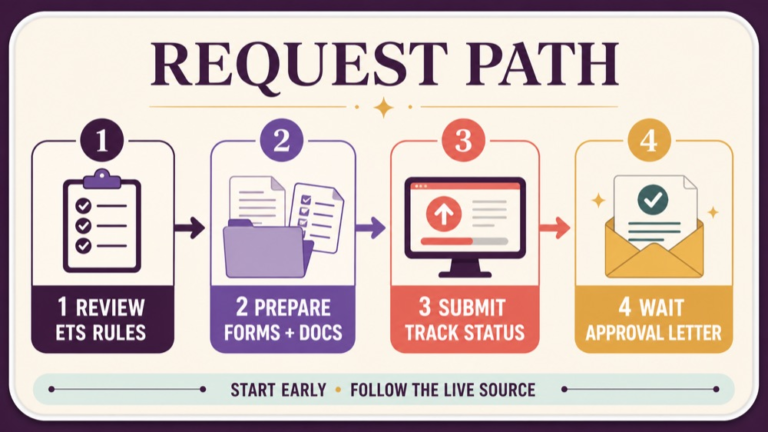
Use a simple path with a checkpoint at each stage: identify the test, open the current ETS accommodations page, review the available support categories, gather the required forms or documentation, submit the request through an available channel, track the response, and follow the approval letter before registration. The exact screen labels or form versions may change, so the path is a planning model rather than a replacement for ETS directions.
Stage
What to verify
Record to keep
Identify
Speech-Language Pathology Praxis and current code
Current ETS test-page URL and date checked
Review
Which ETS page, supplement, and form instructions apply
Links and current form names
Prepare
Required request information and supporting documentation, if applicable
Submission checklist without unnecessary private details
Submit
Online, email, or mail route described by ETS
Submission date and confirmation
Wait
Review status and any request for additional information
Secure correspondence record
Register
Approval letter directions and appointment requirements
Approval letter and final confirmation
Make the checklist specific enough to prevent omissions but restrained enough to protect privacy. Store personal medical information only where the official process requires it. This article does not need your diagnosis, documentation, password, payment information, or private correspondence.
Prepare information without guessing
The current ETS page describes online submission through a Praxis account and also provides email and mail routes with different document instructions. Read the route you plan to use from the live page. If you use email or mail, follow the current form list and send documents only to the destination ETS identifies. The page also warns test takers not to include credit card information on a registration form sent by email.
Documentation questions are individual. A form or letter that was accepted in one context may not answer a different request, and a previous approval may have an expiration or test-specific condition. If ETS asks for additional documentation, respond through the official instructions and note the date you sent the new material. A generic article cannot tell you what evidence will be sufficient for your situation.
Open the live ETS accommodations page and note the date checked.
Confirm the test name and current code in the ETS test materials.
Read the available-support list and the Bulletin Supplement links.
Identify the submission route that fits the current ETS instructions.
Gather only the forms and documentation the official process requests.
Keep a secure record of submission, correspondence, and any status message.
Watch for a request for additional information and follow its deadline.
Wait for the approval letter before scheduling an appointment that depends on support.
Track time and approval
ETS currently states that documentation review takes approximately four to six weeks after the request and complete paperwork have been received. If additional documentation is requested, the page says the review may take another two to four weeks from receipt of the new documentation. These are approximate process estimates, not a personal promise about when a decision will arrive.
Plan backward from the deadline that matters to you, then add room for questions, missing information, and appointment availability. If your program or licensing organization has a score deadline, verify that deadline with them. A study calendar can continue during the review, but an appointment date should be chosen only according to the current approval and registration instructions.
Use a small timeline with three dates: request submitted, follow-up or documentation due, and earliest practical registration check. Add the date you last read the live ETS page. This makes it easier to notice whether a saved instruction has become stale without putting private medical details into a shared calendar.
Read the approval letter
The approval letter is the bridge between the review decision and registration. ETS states that the letter confirms the approved accommodations and explains how to register for a test with them. Read every instruction before opening or finalizing an appointment, including any expiration, test-specific direction, scheduling channel, voucher, or center requirement described in the letter.
If you previously received accommodations from ETS and the approval is still current, the current page says you may be able to request the same support again without submitting disability documentation. If another standardized testing agency approved support for you, ETS describes a route for submitting the approval letter for review. The current page also notes that the result depends on appropriateness for the current test and test-security or construct considerations.
Some approved supports can be scheduled online through a Praxis account according to the current ETS page, including examples such as extended time, extended breaks, screen magnification, and selectable foreground and background colors. Your approval letter controls what applies to you. Do not use an example list as a substitute for the letter.
Plan study time around approved supports
Once the support and registration directions are clear, adapt practice to the approved testing conditions. If your approval includes additional time or breaks, rehearse how you will divide a timed set and when you will pause. If it changes screen presentation, use accessible study settings that resemble the approved environment when possible. The goal is familiarity with your permitted process, not an assumption that practice can predict an individual result.
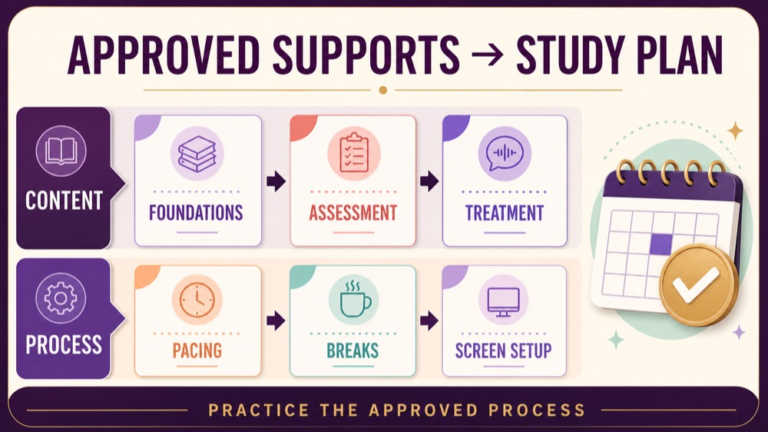
Keep two columns in your study plan: content and process. Content blocks rotate through foundations and professional practice, screening and assessment, and treatment planning and evaluation. Process blocks cover pacing, break decisions, screen setup, instructions, and the source-check routine. This structure keeps accommodations from being treated as an afterthought while preserving the same learning goals.
Content rotation: keep all major blueprint categories in the calendar.
Timing rehearsal: use the approved timing instructions when practicing.
Break plan: rehearse the approved break process instead of improvising on test day.
Screen setup: become comfortable with approved display settings before the appointment.
Instruction check: read the current ETS and approval-letter directions at the start of the final week.
Error review: study reasoning patterns, not only the number correct.
Contingency note: save the official support contact route for an unanswered question.
Final confirmation: compare the appointment with the approval letter and current instructions.
Separate accommodations from exam content
Accommodations change access conditions, not the need to learn the assessment content. Continue to review the ETS Study Companion and the current test page for scope and structure. Use ASHA or your program’s authoritative materials for professional context. Keep the accommodations file focused on process details so it does not become a second, confusing version of the exam blueprint.
This distinction also protects your privacy and your confidence. A request under review is an administrative process, not a measure of your clinical knowledge. A practice result is feedback about a study session, not a decision about whether a support request will be approved. Track each process with its own evidence and its own next action.
Common process mistakes
Waiting until the intended test date is close before reading the ETS accommodations page.
Scheduling a computer-delivered test before receiving the approval letter.
Using an old form or remembered timeline without checking the live source.
Assuming a prior approval automatically applies to a different test code or expired approval.
Sending unnecessary private information or payment details through an unapproved route.
Treating a list of examples as proof that a particular support will be approved.
Failing to record a request for additional documentation and its response date.
Practicing under conditions that do not resemble the approved process.
The repair is a dated, source-linked routine: read the current ETS page, confirm the assessment, follow the correct form route, keep a secure submission record, wait for the approval letter, and then register exactly as instructed. If a question remains unanswered, contact ETS through the official support information instead of filling the gap with a forum post or an old screenshot.
Quick accommodations checklist
Before you move from request planning to appointment planning, check these items:
Have I opened the current ETS accommodations page?
Did I confirm Speech-Language Pathology and code 5331?
Did I read the current Bulletin Supplement and linked form instructions?
Do I know which submission route and documents the live ETS page requires?
Did I record the submission date and keep correspondence securely?
Have I left time for review and a possible request for more documentation?
Did I receive and read the approval letter before scheduling?
Does my appointment confirmation match the approval letter and current ETS directions?
A calm accommodations plan is a sequence of verified decisions: start early, use the current ETS process, protect private information, track the review, and schedule only after the approval instructions are clear. You can keep studying throughout that sequence while letting ETS decide the administrative questions that belong to ETS.
Praxis Speech Language Pathology Test Code: Why 5331 Matters
The praxis speech language pathology test code is more than a number to memorize. In current ETS materials checked for this guide, the Speech-Language Pathology assessment is identified by code 5331. That code gives you a compact way to check whether a test page, study guide, registration choice, score instruction, and set of notes are all referring to the same assessment.
A code is useful only when you use it within the right boundary. It can help confirm exam identity, but it does not decide your eligibility, required score, state requirement, appointment availability, or readiness. This guide shows how to use 5331 as an identity check and how to keep code verification separate from the clinical learning work that follows.
What the test code identifies
A test code is an identifier attached to a particular assessment in the testing system. For this article, the current ETS Speech-Language Pathology page and the ETS Study Companion both identify the assessment as Speech-Language Pathology with test code 5331. When you see the full name and the code together, you have a stronger identity check than either a short label or a familiar acronym by itself.
This distinction matters because preparation products, course pages, flashcard sets, and older notes may use shorter names. Some resources may say SLP Praxis, Praxis SLP, or Speech Pathology Praxis without displaying the code. Those labels may be useful for discovery, but before you rely on a resource, compare its scope and source with the current ETS materials.
Full assessment name: Speech-Language Pathology in the current ETS materials.
Test code: 5331 in the current ETS test page and Study Companion checked for this guide.
Assessment role: a Praxis examination used within a broader professional and certification pathway.
Verification rule: confirm the full name and code together before treating a page as the right source.
Why a code check prevents confusion
Many exam-preparation errors begin with a near match. A learner saves a general Praxis page, opens a preparation product with a similar title, or copies a number from an older document without checking what the number represents. The problem is not that every near match is useless; the problem is that a near match can quietly change the scope, timing, content emphasis, or administrative instructions in your plan.
Use the code as a quick checkpoint whenever you switch sources. It is especially helpful when you move from a search result to an ETS page, from the ETS page to the Study Companion, from a study product to a registration screen, or from a program instruction to a personal calendar. A ten-second check can reveal that two resources are not describing the same object.
Use 5331 as an identity check
When a resource appears relevant, compare four pieces of information: the name, the code, the source owner, and the purpose of the page. The code is strongest when all four line up. An ETS page with Speech-Language Pathology and 5331 serves a different purpose from an ASHA certification explanation or an independent review course, even when each page uses the words Praxis and SLP.
Source or screen
What to compare
What the result means
ETS test page
Full name, code, format, timing, delivery, and current page details
Use as the primary exam identity and live logistics reference.
ETS Study Companion
Title, code, test-at-a-glance section, and study topics
Use to organize content review and understand the blueprint frame.
Registration flow
Selected test name and code before submission
Confirm that the appointment is tied to the intended assessment.
Study product
Stated coverage, source date, and connection to 5331
Decide whether it supports your plan; do not treat its label as the ETS title.
Program or licensing instruction
Required test, deadline, and score policy
Follow the issuing organization for your individual requirement.
If a resource displays a different code, pause before adding it to your core plan. Check the source date and the full title, then confirm the assessment with ETS or with the organization that directed you to take it. A mismatch is a reason to investigate, not a reason to guess.
How the code relates to the ETS page
The current ETS page lists Speech-Language Pathology as test 5331 and provides the page-level frame for the assessment. The same page currently lists computer delivery, selected-response questions, 150 minutes, and 132 questions. It also contains administrative details such as delivery choices and current purchasing information. Treat the code as the stable identity anchor while you separately recheck details that can change.
The ETS Study Companion adds another layer. Its test-at-a-glance section identifies code 5331, the same 150-minute and 132-question frame, and three broad content categories: foundations and professional practice; screening, assessment, evaluation, and diagnosis; and planning, implementation, and evaluation of treatment. The code links your study notes to the right companion, while the companion supplies the structure for those notes.
Do not infer more from the number than the sources state. Code 5331 does not tell you which state requirement applies, whether you qualify to test, what score your organization requires, or whether an appointment is available. Those questions belong to current ETS instructions and the organization responsible for your pathway.
Separate the test code from other numbers
A page can contain several numbers that serve different purposes. The test code identifies the assessment. A price identifies a current transaction detail. A question count describes the current page or companion frame. A score requirement belongs to a program, state board, or certification policy. A product number may identify a course or practice form. Put a label beside each number in your notes so they do not blend together.
Test code: use 5331 to identify the Speech-Language Pathology assessment in the cited ETS materials.
Question count: record the current source’s number for pacing practice, then recheck the source during an update.
Time limit: use the current source’s timing for a pacing rehearsal, not as a substitute for reading the live instructions.
Price: treat it as a changeable purchase detail and confirm it in the current ETS flow.
Score requirement: obtain it from the relevant program, state, or certification authority.
Appointment number: save it as a booking record and keep it separate from the test code.
Product or form number: check what the publisher says it identifies before using it as a study reference.
Source date: write down when you checked the page so an old note is easy to spot.
Turn the code into a study habit
Make code verification part of your source routine. At the start of a study session, write “Speech-Language Pathology — 5331” at the top of the page you are using. When you open a new resource, compare its title and stated coverage before you add notes. At the end of the session, keep the URL and the date checked beside the notes. This routine turns a single number into a practical guardrail.
The habit is most useful when your study folder grows. You may collect class notes, the Study Companion, practice explanations, program instructions, and registration reminders. A consistent identity line lets you sort these documents without pretending that they all have the same authority or purpose.
Open: start with the current ETS test page or the source named in your plan.
Match: compare the full test name and code 5331.
Label: mark the note as blueprint, clinical learning, logistics, or program requirement.
Study: use the source for the purpose it actually supports.
Record: save the source URL and date checked.
Flag: mark any price, availability, score, or policy detail for later verification.
Review: remove or update notes that no longer match the current source.
Recheck: repeat the identity check before registration and before final-week planning.
Connect 5331 to the blueprint
Once the assessment identity is secure, use the Study Companion to organize learning across the three broad categories. For foundations and professional practice, connect terminology to decisions involving ethics, documentation, evidence, collaboration, typical development, and culturally and linguistically appropriate services. For screening and assessment, connect the referral question to history, test selection, interpretation, and the limits of screening information.
For planning, implementation, and evaluation of treatment, connect assessment findings to priorities, goals, treatment details, progress monitoring, outcomes, and follow-up. The code does not teach these topics; it keeps your study materials pointed toward the intended assessment while you do the clinical reasoning work.
Use the category structure as a balance check. If every note in your folder is about one clinical area, the problem is not solved by writing 5331 at the top. You still need a balanced plan that rotates through foundations, assessment, and treatment, with time for application and review of uncertainty.
Use the code before registration
Before you begin or finalize registration, compare the current ETS test page with the selection shown in your account. Confirm the full name and code, then review the date, delivery mode, location or at-home requirements, identification instructions, price, and policies. These details are separate from the code and may change, so use the live ETS instructions for the final decision.
Also compare the appointment plan with the deadline supplied by your program or licensing authority. A correct test code does not make an appointment date workable if scores are needed by an earlier deadline. Keep the code, confirmation details, and receiving-organization instructions in one secure folder, but label each item by its purpose.
Common test-code mistakes
Searching only for “SLP Praxis” and accepting the first page without checking the full title.
Copying 5331 into notes without confirming that the surrounding page is current and authoritative.
Confusing an ETS preparation product or practice form with the assessment itself.
Using a score requirement from a different organization because it appears beside the same code.
Treating a current question count or price as a permanent meaning of the code.
Assuming the code answers an eligibility or accommodations question.
Leaving an old source in the study folder without recording its date checked.
Checking the code once and then skipping the final comparison at registration.
Correct these errors with a four-part reset: identify the source owner, compare the full title, confirm 5331 in current ETS materials, and label the remaining details by who controls them. That reset keeps a simple identifier useful without turning it into a shortcut for decisions it cannot answer.
Quick code checklist
Use these questions when a new resource, page, or instruction enters your preparation system:
Does the full title say Speech-Language Pathology?
Does the current ETS source show code 5331?
Am I looking at an assessment page, a Study Companion, a registration screen, or a product page?
Which facts on this page are stable study structure and which are changeable logistics?
Have I recorded the source URL and date checked?
Does my program or licensing authority provide a separate requirement?
Have I kept appointment details and score instructions separate from the test code?
Will I repeat the comparison before registration and final-week planning?
The practical value of 5331 is consistency. Use it to confirm the intended assessment, organize the right source materials, and notice mismatches early. Then let ETS control current exam logistics, the Study Companion shape your study map, ASHA provide certification context, and your own program or licensing authority define the requirement that applies to you.
ETS Speech Language Pathology Praxis: A Page Guide
ets speech language pathology praxis is a useful starting point when you need one reliable place to check what the assessment is, how it is delivered, and what to verify before you build a study calendar. The current ETS page identifies the Speech-Language Pathology test as 5331 and lists key details such as timing, question count, selected-response format, and computer delivery. Those details give your preparation a factual frame, but they should still be checked against the live page before test day.
This guide teaches you how to read the ETS page without treating every line as permanent. Separate test identity and blueprint information from prices, appointment availability, score-recipient rules, and registration policies. Then turn the stable information into a study map and use the changing information as a short pre-registration and pre-test checklist.
Start with the right source
Begin with the current ETS Speech-Language Pathology 5331 page rather than a search snippet, an old screenshot, or a study product description. Search results can help you find the page, but the live ETS page is the stronger reference for current administrative details. Open the page directly, note the date you checked it, and save the URL in your study notes.
Use the ETS Study Companion for a deeper view of the test-at-a-glance information and study topics. Use ASHA for the broader certification context and for understanding why the Praxis examination appears in the professional pathway. These sources answer different questions, so keeping them in separate notes prevents a registration detail from being mistaken for a clinical learning objective.
ETS test page: current exam identity, delivery details, timing, question count, and page-level purchasing or scheduling information.
ETS Study Companion: content categories, study topics, question-format orientation, planning suggestions, and score explanations.
ASHA Praxis information: certification context and the relationship between the examination and the broader professional process.
Your program or licensing authority: the requirement, deadline, or score policy that applies to your own pathway.
Read the page in layers
A quick page read becomes more useful when you move from identity to structure, then from structure to logistics. First confirm that the page is for Speech-Language Pathology and that the test code is 5331. Next record the test length, number of questions, format, and delivery method. Only after that should you review price, score recipients, test-center choices, at-home requirements, or preparation products.
This order matters because the first group describes what you are preparing to take, while the second group helps you decide when and where to take it. If you start with a price or a date, you may overlook a test-code mismatch. If you start with a prep-course offer, you may confuse a product feature with the assessment blueprint.
Build a source-of-truth snapshot
Make a one-page snapshot in your study folder. At the top, write the page title, test code, URL, and date checked. Under that, create two columns: current test facts and details to recheck. The first column can anchor your study plan; the second column should be revisited when you register, reschedule, or move into the final week.
Information group
What to record
How to use it
Test identity
Speech-Language Pathology and code 5331
Confirm every study resource and registration selection.
Format and timing
Selected response, computer delivered, 150 minutes, 132 questions on the current page
Design timed practice and pacing checks.
Content structure
Three broad categories in the Study Companion
Balance review across foundations, assessment, and treatment.
Changing logistics
Price, location, delivery availability, policies, and score-recipient details
Recheck before payment and before test day.
The snapshot is not a substitute for the source. Its purpose is to make source checking easier and to keep your study decisions visible. When the ETS page changes, update the snapshot instead of allowing several old notes to compete with the current information.
How to use the ETS speech language pathology praxis page
Use the page as a fact-checking hub, not as your entire study curriculum. The page can tell you what assessment you are looking at and can point you toward official preparation materials. It cannot replace deliberate review of the domains, clinical reasoning practice, or the requirements supplied by your program and licensing authority.
For each important line on the page, ask one of three questions: Does this tell me what the test measures? Does it tell me how the test is administered? Or does it tell me what I must verify before booking? Labeling the line this way creates a clean boundary between learning content and appointment logistics.
Confirm the page title and test code.
Record the current timing, question count, format, and delivery method.
Open the Study Companion and compare the high-level content structure.
Write down any current price or score-recipient information with the date checked.
Check your school, state, or licensing authority for its own requirement.
Build practice blocks from the content structure rather than from the page layout.
Reopen the live ETS pages before registration and before test day.
Keep your confirmation and source snapshot together in a secure study folder.
Separate the blueprint from logistics
The current ETS page reports 150 minutes and 132 questions, with selected-response questions delivered by computer. The Study Companion presents three broad content categories, each shown with an approximate one-third share: foundations and professional practice; screening, assessment, evaluation, and diagnosis; and planning, implementation, and evaluation of treatment. Use those categories as an organizing framework, not as a promise that every future form will look identical in every detail.
Logistics require a different kind of attention. The current page checked for this article lists a $146 test price, options for testing at home or at a test center, and four free score recipients. These are time-sensitive page details. Record them for planning, but verify them again in the live ETS flow because prices, availability, eligibility checks, and policies can change.
A useful note-taking pattern is to put a small label beside each fact: study, verify, or ask. Study facts become review tasks. Verify facts are checked again at a defined date. Ask facts are questions for ETS, your program, or your licensing authority when the published pages do not resolve your situation.
Turn page facts into a study plan
Once the page snapshot is complete, turn it into a calendar with three layers. The first layer is coverage: rotate through all three broad content categories. The second layer is application: use cases, tables, and short explanations to practice choosing the best next step. The third layer is pacing: complete timed sets that fit the current length and question-count frame, then review the reasoning behind missed or uncertain items.
Do not let a one-page overview dictate every hour of preparation. It is a map of the assessment, not a personalized diagnosis of your readiness. Your performance data, course feedback, and program guidance should help you decide which topics need more time. If a practice set exposes a weakness, add a targeted review block while keeping the other categories in rotation.
Week 1 or start point: read the ETS page and Study Companion, then mark familiar and unfamiliar domains.
Coverage block: review foundations and professional practice with emphasis on ethics, documentation, evidence, and collaboration.
Assessment block: practice linking referral questions, history, screening, evaluation, and differential reasoning to the available evidence.
Application block: explain why one action fits the case while nearby choices miss the stated purpose or context.
Timed block: use the current 150-minute and 132-question frame as a pacing rehearsal, then note where time was lost.
Source check: compare any uncertain administrative fact with the live ETS page rather than an old study note.
Final block: reduce new material, review error patterns, and confirm appointment instructions.
Map the three content categories
The first category, foundations and professional practice, is broader than memorizing terminology. Build notes about typical development, communication and swallowing factors, common disorders, ethics, culturally and linguistically appropriate service delivery, documentation, research methodology, and collaboration. When you review a topic, add the professional decision it supports and the context that could change the decision.
The second category covers screening, assessment, evaluation, and diagnosis. Practice matching the referral question to a reasonable information-gathering sequence. Ask what the history contributes, what a screening result can and cannot establish, when a more complete assessment is needed, and how anatomy, physiology, language, hearing, cognition, culture, and setting affect interpretation.
The third category focuses on planning, implementation, and evaluation of treatment. Organize it around priorities, measurable goals, treatment details, prognosis, communication of recommendations, progress monitoring, outcomes, and follow-up. A strong study note explains how the plan responds to assessment findings and how the clinician would revise it when the data do not support the original direction.
Use page details during practice
Page details are most useful when they shape a behavior you can observe. The 150-minute frame can prompt a pacing rehearsal. The selected-response format can prompt practice with eliminating choices and checking whether the chosen answer responds to the exact question. The three-category structure can reveal whether your practice calendar has neglected one major area.
After each timed block, record more than the score. Write down the question type, the evidence you noticed, the distractor that attracted you, the reason your first choice changed or stayed, and the time cost. This turns practice into a feedback loop. It also keeps a difficult result from becoming a vague judgment about your ability.
Keep administrative notes separate from clinical reasoning notes. A change in registration policy should update your logistics checklist; it should not cause you to rewrite your understanding of assessment or treatment. Likewise, a weak domain result should change your study schedule; it should not be treated as a prediction about your certification outcome.
Common reading errors
Using a search-result snippet as the final source for price, timing, or delivery information.
Confusing the test name with the name of an ETS preparation product.
Writing down the code without confirming that the full test title matches the required assessment.
Treating approximate content percentages as a guarantee about the exact distribution on every form.
Building a study calendar around a remembered policy from a different Praxis test.
Assuming an at-home appointment follows the same instructions as a test-center appointment.
Ignoring the requirements supplied by a state board, school, or other receiving organization.
Saving a page snapshot without recording the date checked or the link to the live source.
The fix is a dated source routine. Open the current ETS page, compare the page title and code, record the stable study facts, flag the changing logistics, and set a reminder for the next check. This small habit is more reliable than adding more unverified detail to a crowded study document.
Quick review checklist
Before you close the ETS page, confirm that you can answer these questions in your own notes:
What is the full name of the assessment I am preparing to take?
What test code is shown on the current ETS page?
What timing, question count, format, and delivery details should shape practice?
Which facts come from the ETS Study Companion rather than the product page?
What are the three broad content categories I need to rotate through?
Which logistics must be checked again before I register?
Which requirement comes from my program or licensing authority?
Where will I store the live links, date checked, and appointment confirmation?
The best use of the ETS page is a disciplined starting point: identify the assessment, establish a current fact base, build a balanced study plan, and revisit changeable details at the right time. That approach supports focused preparation without turning an administrative page into a substitute for professional learning.
ETS Praxis SLP Registration: Account, Date, and Test Setup
ets praxis slp registration involves more than selecting a date. You may need to create or confirm an ETS account, choose the correct Speech-Language Pathology Praxis test, review delivery and policy details, arrange any approved accommodations, and save the appointment confirmation. A careful sequence lowers the chance of booking the wrong test or discovering a missing detail too late.
Use the current ETS registration pages as the source of truth. Registration screens, fees, appointment availability, delivery choices, score-recipient rules, and rescheduling policies can change. This guide explains how to organize the process; it does not replace the instructions shown in your ETS account or the confirmation for your appointment.
Prepare before opening registration
Start with a short information folder. Keep the name you plan to use on the account, contact details, preferred testing window, program or licensing requirements, and any deadline that affects score reporting. Do not guess at a deadline; confirm it with the school, state board, or organization that will receive your score.
Also identify the test before you begin. The Speech-Language Pathology Praxis is associated with test code 5331 in current ETS materials checked for this guide, but verify the live test page and the selection shown in your account. A similar-sounding test or an old saved bookmark can create confusion.
Keep the preparation folder separate from sensitive credentials. Use a unique password and follow the security guidance in your ETS account. This article never needs your password, payment information, or application password.
Confirm your ETS account
If you already have an ETS account, sign in through the current ETS registration page and review the profile fields before starting a new appointment. Check spelling, email address, phone number, and any identity details required by the current process. If you cannot access an old account, use the official account-recovery route rather than creating several profiles.
If you are new to ETS registration, follow the current account-creation instructions. Read the field labels carefully and use information that matches your identification and program records where the instructions require it. The account is the place where appointment, payment, score, and support information may be connected, so accuracy matters.
Profile: review the name and contact information used by the current account.
Test: confirm the Speech-Language Pathology Praxis selection and code.
Location: compare your preferred test center or at-home option with availability.
Policies: read current cancellation, rescheduling, identification, and check-in instructions.
Records: know where confirmation and score-recipient information will appear.
Follow the registration path
Think of registration as a path with checkpoints rather than one long form. First confirm the account, then select the test, review the available date and delivery choices, enter required information, review the order, and save the confirmation. The labels may look different as ETS updates its interface, but the decision points remain useful.
Stage
What to verify
Useful record
Account
Profile and contact details are correct.
Account email and recovery method.
Test
Test name and code match your plan.
Test code 5331 if the live ETS page confirms it.
Appointment
Date, time, location, and delivery mode fit your needs.
Selected appointment details.
Review
Policies, price, and required fields are understood.
Order or review screen notes.
Confirmation
Booking is complete and instructions are available.
Confirmation number and email.
Pause at each stage if a field is unclear. An extra minute spent reading an instruction is usually more useful than correcting a wrong selection after payment or scheduling.
Choose the correct SLP Praxis test
Read the full test name instead of relying on the words “Praxis” or “SLP” alone. Confirm the code, testing purpose, and any description attached to the selection. Compare it with your program or certification instructions, but let the current ETS test page control the test’s administrative description.
Do not assume that a preparation course’s name is the same as the ETS test name. A course may cover several domains or use a marketing label. Registration should be tied to the actual assessment you have been told to take. If your school or licensing organization gave you a deadline or score requirement, keep that information beside the registration screen while you check the selection.
Review date, delivery, and policy details
Compare the appointment with your practical needs. Check the date, start time, time zone if shown, address or at-home requirements, check-in time, identification rules, and equipment or environment requirements. The current ETS registration and test-center pages should answer the live logistics questions.
Read the cancellation and rescheduling policy before you submit. Policies may distinguish between test-center and at-home appointments or set different deadlines. Do not build a plan around a remembered rule from another exam. Save the policy page or note the date you checked it, then recheck it as the appointment approaches.
Registration is also a good time to place the exam on your study calendar. Work backward from the date to schedule blueprint review, timed practice, and a final source check. Keep the calendar flexible enough to respond to appointment changes.
Handle accommodations and score recipients
If you need testing accommodations, begin with the current ETS accommodations process before choosing a date that depends on approval. Read the eligibility, documentation, submission, and timing instructions in the current source. Ask ETS directly when a policy question is not answered by the page. A general article cannot determine which accommodation applies to an individual.
Review score-recipient information with the same care. Confirm whether you need to select recipients during registration, whether there are limits or fees, and how your program or licensing organization wants the score sent. Use the current ETS account instructions and your receiving organization’s requirements rather than assuming an older process still applies.
Check the details before you submit
Before payment or final submission, read the review screen from top to bottom. Check the test name and code, date, time, location, delivery mode, contact information, accommodation status if applicable, price, and policies. A screenshot or saved PDF can help you compare the final screen with the confirmation, provided it does not expose sensitive payment information.
Is the test the Speech-Language Pathology Praxis you intended to select?
Does the code match the current ETS test page?
Does the date leave enough time for your program or licensing deadline?
Can you meet the center or at-home check-in requirements?
Did you read the current cancellation and rescheduling rules?
Have you followed the current accommodations process if you need it?
Are score-recipient details consistent with your organization’s instructions?
Do you know where the confirmation number and support link will be stored?
If any answer is unclear, stop and check the source or contact ETS support. The right time to resolve a registration question is before the appointment is finalized.
Save and recheck your confirmation
After submission, look for confirmation in the account and the email address associated with it. Save the confirmation number, appointment details, check-in instructions, and support contact in two secure places. Do not post the confirmation publicly or include unnecessary personal details in a study group.
Recheck the appointment after any account change and again before test day. Availability, instructions, or policies may be updated. Use the current ETS page and your own confirmation as the final reference.
Common registration errors
Choosing a test based on a short label without confirming the full name and code.
Creating a second account instead of using the account-recovery process.
Entering contact or identity information without checking the current field instructions.
Booking a date before checking a program or licensing deadline.
Assuming a test-center rule also applies to an at-home appointment.
Waiting until the appointment week to read accommodation instructions.
Skipping the cancellation and rescheduling policy.
Saving only an email and not checking the appointment inside the ETS account.
The correction is a short, dated verification routine. Read the current source, compare the selection, save the confirmation, and recheck the live instructions as the date approaches.
Registration checklist
Use this checklist before you finish ETS registration:
Do I have the correct test name and current code?
Is my ETS account profile accurate?
Which date and delivery option fit my requirements?
What current identification and check-in rules apply?
What are the cancellation and rescheduling deadlines?
Have I started the accommodations process early enough if needed?
How should the score be sent to my program or licensing organization?
Where are my confirmation and support details stored?
The useful answer to ets praxis slp registration is a verified process, not a copied list of old screens. Use the live ETS pages for current logistics and keep your study plan tied to the appointment you actually confirm.
SLP Praxis Official Study Companion: How to Use It
slp praxis official study companion is a practical starting point for building a source-grounded preparation plan. It can show the intended scope, broad domains, and preparation context more clearly than a collection of forum posts or disconnected flashcards. The most useful way to read it is active: extract the map, turn headings into skills, and practice decisions that fit the scope.
Use the current ETS Speech-Language Pathology Praxis 5331 page for live administration details. The linked ETS Study Companion is the document used for the scope discussion in this guide. Because documents and test information can be updated, check the live page and current PDF before your appointment. This article explains how to use the companion; it is not a substitute for reading the source yourself.
What the Study Companion does
A Study Companion helps define the territory. It can orient you to the test name and code, content scope, broad domains, preparation resources, and other information supplied by the test owner. It is most valuable when it changes your study decisions. A heading should lead to a note, a skill, and an application task.
Do not expect one document to answer every question. Separate the kinds of information you may find:
Scope: the content areas and domain language that organize review.
Administration: current timing, delivery, registration, and other appointment details that should be verified on the live ETS page.
Preparation: suggestions for becoming familiar with the assessment and planning work.
Professional context: concepts that should be checked against current ASHA standards and resources when they affect clinical reasoning.
This separation prevents an old saved PDF from becoming your only source for changing logistics. It also keeps the document in its proper role: a source for scope and preparation, not a promise about a particular sitting.
Read the document in the right order
Start with the cover, test title, code, and date or edition information. Then read the test overview and domain sections before diving into a list of resources. You want to understand what the document is describing before you decide how much time to spend on any one topic.
Use this first reading routine:
Identify: confirm that the document matches Speech-Language Pathology Praxis 5331.
Orient: note the format, broad scope, and any directions about preparation.
Mark: highlight domain headings, repeated decision verbs, and terms that need clarification.
Question: write down claims that need a current ETS or ASHA check.
Plan: turn each marked heading into one study output before opening another resource.
Do not highlight every sentence. Highlighting becomes useful when it helps you retrieve, compare, explain, or apply a concept later. A short margin note such as “match referral question to measure” is more actionable than a page covered in color.
Turn the companion into a study map
After the first reading, build a one-page map. The current materials checked for this guide describe three broad areas: Screening, Assessment, Evaluation, and Diagnosis; Planning, Implementation, and Evaluation of Treatment; and Foundations and Professional Practice. The Study Companion listed relative emphasis of approximately 50%, 33%, and 17% in the edition checked. Confirm the current document before assigning percentages.
Map field
What to record
Why it helps
Domain
The broad heading from the current companion.
Keeps resources organized.
Subskill
The decision or ability inside the heading.
Creates a practice target.
Source
Where the concept will be checked.
Separates evidence from memory.
Output
Map, explanation, case, or error note.
Makes progress observable.
If the relative emphasis is unchanged, use it as a starting allocation rather than a reason to ignore a smaller area. A ten-hour week might begin with five hours for assessment-related work, three for treatment planning and evaluation, and two for foundations and professional practice. Your error log should refine that allocation.
Translate scope into decision skills
A domain becomes useful when you can describe what you must do with the information. For assessment, a skill might be matching a referral question to the information needed. For treatment, it might be connecting a functional goal to an intervention and progress measure. For foundations, it might be applying an ethical, access, collaboration, or scope boundary.
For each heading, write a card with:
Situation: what person, setting, or concern is present?
Task: what decision is being requested?
Evidence: which detail supports or limits the choice?
Boundary: what safety, scope, access, or professional issue matters?
Transfer: how would the same principle look in another context?
That card turns reading into a study loop. You can use it to create an original scenario, compare options, or explain a decision in plain language. The goal is not to memorize the document’s wording; it is to understand the decision structure it points toward.
Use the companion for practice
Let the companion choose the subject of a practice block, but do not let it replace application. Read one scope section, close the document, recall the core idea, and apply it to an original case or a clearly labeled preparation question. Then explain why the leading choice fits and why the alternatives are weaker.
Choose one domain and one subskill.
Review the source and write a plain-language rule.
Create or select a short practice scenario.
Record task, evidence, choice, and rationale.
Return to the source only to correct a specific gap.
Keep practice content separate from claims about the live assessment. A preparation item may be useful without representing any released, remembered, or future test content. Focus on the skill that transfers.
Use a four-step companion review cycle
Repeat a simple cycle: read, map, apply, review. In the read step, identify the source-grounded scope. In map, write domain and subskill. In apply, practice a decision. In review, classify the error and choose the next activity. The cycle prevents a document from becoming a one-time download that never affects behavior.
Step
Question
Output
Read
What does the current source say?
Short source note.
Map
Where does it fit in the scope?
Domain-to-skill card.
Apply
Can I use the idea in a new case?
Reasoned practice response.
Review
What gap changes my next block?
Specific correction plan.
Use the cycle weekly and after a timed set. If the same error returns, change the practice task rather than rereading the same page. A concept may need a comparison, a case, or a retrieval prompt before it becomes usable.
Keep current facts separate
Create a small “verify before test day” list for facts that can change: registration steps, available delivery options, timing, question count, score reporting, and appointment rules. Keep the list dated. The Study Companion can provide preparation context, while the live ETS page should be checked for current administration information.
For clinical topics, use current ASHA standards and evidence resources when the decision involves professional responsibilities or practice boundaries. If a forum post conflicts with the current source, do not average the claims. Record the source and the date you checked it.
Common Study Companion mistakes
Downloading the PDF but never extracting a domain-to-skill map.
Using a saved edition without checking whether the live ETS page changed.
Treating broad headings as a complete study plan.
Highlighting pages instead of writing retrieval prompts.
Confusing scope guidance with a forecast of future item wording.
Studying only the largest domain and postponing professional practice.
Using a practice score as a direct translation of a Praxis result.
Copying an answer from a preparation source without learning the rationale.
The fix is a dated source check plus the read-map-apply-review cycle. Keep the document close, but make your study outputs do the work.
Study Companion checklist
Before your next study week, answer:
Does my PDF match the current test name and code?
What edition or date did I check?
What broad domains does it list?
What skill will I practice under each domain?
Which administration facts must I verify on the live ETS page?
What ASHA source will support professional context?
What practice output will show transfer?
What error will change my next study block?
The best use of the slp praxis official study companion is active and dated: read the scope, map it, apply it, and revisit current sources when logistics or professional guidance may have changed.
slp praxis exam domains give your preparation a structure. Instead of treating the Speech-Language Pathology Praxis as one giant list of facts, use the domains to sort concepts, clinical decisions, and professional responsibilities into a study map. The map is broad by design: it helps you plan coverage without pretending to forecast the wording of a future item.
The current ETS Speech-Language Pathology Praxis 5331 materials checked for this guide organize the content into three broad areas: Screening, Assessment, Evaluation, and Diagnosis; Planning, Implementation, and Evaluation of Treatment; and Foundations and Professional Practice. The Study Companion lists relative emphasis of approximately 50%, 33%, and 17%. Confirm the current ETS page and Study Companion before relying on the names or percentages.
Why the domains matter
A domain is a container for related decisions, not a chapter title to memorize. When you use it well, you can answer three planning questions: what should I learn, what should I practice, and how will I know the skill transfers to a new case? That makes review more active and exposes gaps earlier.
Keep these four ideas distinct:
Domain: the broad area named in the current ETS scope materials.
Subskill: a narrower ability within that area, such as interpreting findings or monitoring progress.
Scenario: a practice context in which the subskill is applied.
Weight: a relative planning signal, not an exact forecast of one test session.
A domain label also protects you from studying in isolated fragments. Assessment knowledge affects treatment planning. Professional responsibilities shape how assessment and treatment decisions are carried out. The goal is not to blur the categories; it is to understand their boundaries and the links between them.
Screening, assessment, evaluation, and diagnosis
This is the largest broad area in the current materials checked for this guide. Study it as a chain of information and decisions. Screening asks whether a concern needs more attention. Assessment and evaluation gather and interpret information. Diagnosis is a reasoned clinical conclusion within the available evidence and professional boundaries.
Useful study questions include:
What is the referral question, and what information would answer it?
Which observations or measures fit the person, setting, and purpose?
How do reliability, validity, sensitivity, specificity, and context affect interpretation?
How should multiple sources be integrated rather than read in isolation?
What additional information, referral, or collaboration is needed?
Do not reduce this domain to a list of standardized test names. A selected-response task may be asking you to match a measure to a decision, recognize a limitation, or interpret a pattern. Use the current ETS Study Companion for scope and ASHA resources for professional context when you build your notes.
Study layer
Example output
Screening
A decision rule for whether a concern warrants follow-up.
Assessment
A plan for collecting information tied to the referral question.
Evaluation
An integrated interpretation of findings and functional impact.
Diagnosis
A cautious, evidence-based conclusion within scope and context.
Planning, implementation, and evaluation of treatment
The treatment domain follows what happens after information has been gathered and interpreted. Preparation should connect a profile to functional goals, intervention choices, implementation details, collaboration, and progress monitoring. The words plan and evaluate matter: treatment is not just selecting a technique.
Build a treatment study frame around:
Need: what communication or swallowing participation problem matters to the person?
Goal: what observable, meaningful change is being targeted?
Approach: why does the intervention fit the profile and evidence?
Context: who will support practice and how will access be addressed?
Progress: what data will show whether the plan needs adjustment?
When you review treatment concepts, include the decision that comes before the technique. A cueing approach may be useful in one context and poorly matched in another. A goal may be measurable but still miss the client’s participation priority. Practice explaining the fit, not just naming the method.
Foundations and professional practice
Foundations and Professional Practice provides the frame for safe, ethical, evidence-informed work. Topics may include communication science and development, service delivery, collaboration, documentation, cultural and linguistic responsiveness, ethics, and professional responsibilities. The smaller relative emphasis listed in the current materials does not make it a topic to skip.
Study this domain through practical questions:
What professional responsibility shapes the decision?
How does the service setting affect collaboration and documentation?
What access or communication-partner issue needs attention?
How do evidence and client values inform a plan?
What action stays within the clinician’s role and available information?
Foundations can be easy to postpone because the topics feel less concrete than a disorder label. Make them concrete by connecting each principle to a short scenario. For example, study how informed consent, interpreter access, or supervision affects the next step in a case without inventing details the scenario does not provide.
See how the domains connect
Many useful practice cases move through more than one domain. A school referral may begin with screening, require evaluation, lead to a participation-focused goal, and involve collaboration with a family and team. An adult with a new communication change may require history, assessment, interpretation, referral awareness, treatment planning, and documentation.
Use a simple chain:
Question: what concern or decision starts the case?
Information: what must be gathered and interpreted?
Plan: what action fits the findings and goal?
Frame: what professional, access, safety, or collaboration issue matters?
Feedback: what evidence will guide the next adjustment?
This chain is a way to organize study, not a substitute for a full clinical process or supervision. Its value for exam preparation is that it keeps you from jumping straight from a symptom word to a technique without checking the question and the evidence.
Map each domain to a study skill
Turn every domain into an observable action. “Review assessment” is too vague to schedule or assess. “Match a referral question to the information needed, then explain one limitation” is specific. Use a domain-to-skill card:
Domain
Skill statement
Practice evidence
Assessment
Match information to the decision.
Reasoned assessment map.
Treatment
Connect profile, goal, approach, and progress measure.
Short plan with rationale.
Foundations
Apply professional and access boundaries to a case.
Next-step explanation.
After a practice item, write the domain, task verb, decisive clue, and transfer rule. If you cannot name the transfer rule, you may have remembered an answer without learning the concept. Use the gap to choose the next review activity.
Build a balanced domain plan
Use the current relative emphasis as a starting allocation. If you study ten hours in a week and the listed percentages remain unchanged, a reasonable first draft is about five hours for assessment-related work, three for treatment planning and evaluation, and two for foundations and professional practice. Then adjust based on your error log.
Each domain block should contain:
short concept review;
closed-note retrieval;
original or preparation practice;
an explanation of the best-supported choice;
a correction note for the next session.
Do not count only reading time. A domain is covered when you can recognize the task, use the evidence, and explain the decision in a new context. Keep a separate note for current administration facts and recheck them on the ETS page when your test date approaches.
Practice domain switching
Once you have studied each area separately, mix them. Complete one assessment interpretation, one treatment-planning decision, and one professional-practice scenario in the same session. The purpose is to practice identifying what kind of decision the prompt requires before selecting a response.
After the mixed set, sort errors by two labels: domain and reasoning type. A wrong answer may be an assessment knowledge gap, a treatment-fit problem, a professional-boundary problem, or a general reading or pacing issue. The two-label system tells you whether to return to content, decision practice, or test-taking behavior.
Common domain mistakes
Memorizing the domain names without learning the decisions inside them.
Treating the listed percentages as exact future item counts.
Studying assessment and treatment as if they never influence each other.
Leaving professional practice until the final day.
Using a disorder label as a shortcut for every clinical decision.
Measuring progress by pages or flashcards alone.
Using an old scope document without checking the current ETS materials.
Treating a practice score as a direct prediction of the Praxis result.
Fix the pattern with a current-source check, domain-to-skill cards, mixed practice, and an error log. The domains should change what you do next, not simply decorate a study calendar.
Domain review checklist
Before your next review week, answer:
What domain and subskill am I studying?
What task verb should I expect in my practice?
What evidence will support the choice?
What professional or access boundary might matter?
How will I apply the concept in a new context?
How will I balance domain emphasis with my own error data?
When will I run mixed-domain practice?
Which current ETS source will I recheck before test day?
The practical use of slp praxis exam domains is simple: organize scope, practice decisions, connect the areas, and let evidence from your study log refine the allocation. Keep the live ETS materials in control of changing facts.