SLP Praxis Practice Test With Rationales: Read the Why
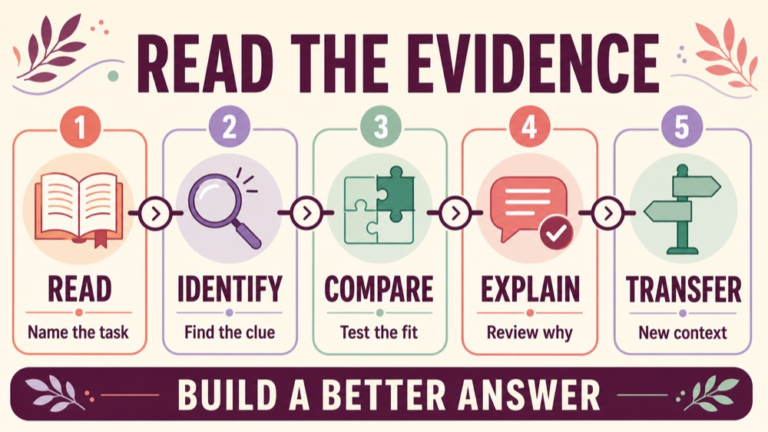
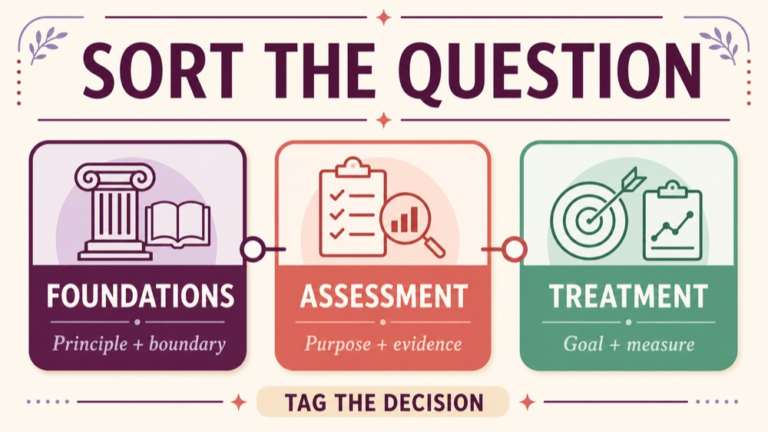
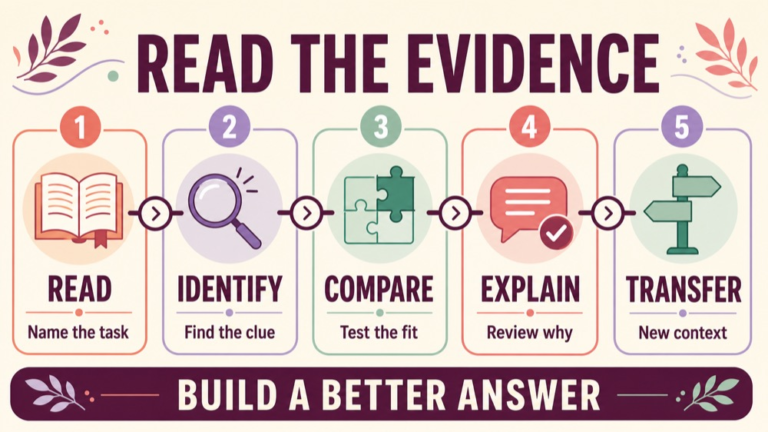
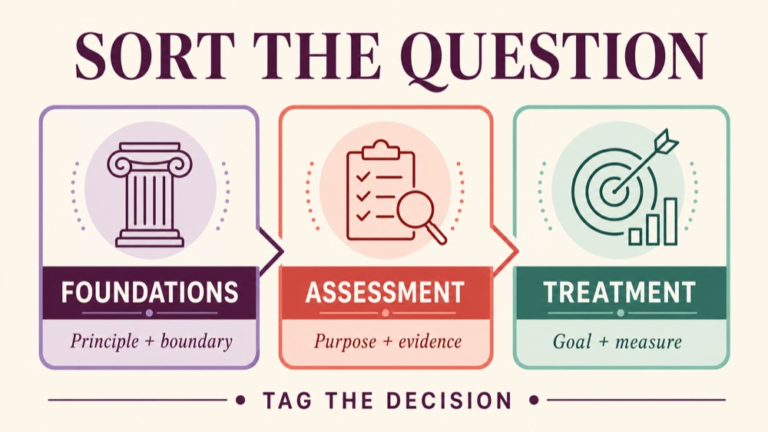
An slp praxis practice test with rationales is most useful when the rationale explains a decision rather than simply naming a key. Read the task, connect the relevant evidence to the choice, identify the closest mismatch, and write when the same rule would need to change.
The current ETS Speech-Language Pathology (5331) page describes a computer-delivered selected-response test with 132 questions and 150 minutes. Use the live ETS page and your account for changing details. ASHA preparation guidance also supports practice questions, timed work, and a plan shaped by individual strengths and weaknesses.
What a rationale should explain
A useful rationale connects the question task, the evidence in the stem, and the selected option. It also explains why the nearest alternative is weaker and identifies a boundary for the rule. Without those links, a rationale can become a sentence to recognize instead of a decision process to reuse.
Rationale part
Question to ask
What it teaches
Task
What action or interpretation was requested?
Defines the comparison.
Evidence
Which details change the decision?
Prioritizes relevant clues.
Fit
Why does the selected option answer the task?
Builds a decision rule.
Mismatch
Why is the closest option weaker?
Improves close-choice comparison.
Boundary
What changed detail could alter the choice?
Protects against overgeneralizing.
Read rationales as explanations of relationships, not as isolated facts. A rationale that says a step comes first should also tell you what information that step supplies and which later decision it supports. Those relationships are what you need when a new case changes the surface details.
Mark confidence beside your original answer. Stable confidence with a weak rationale can show a hidden shortcut. Uncertain confidence with a correct answer can show a rule that needs more transfer. Both deserve review before you increase practice volume or add a strict time condition.
Confirm the current 5331 source before reviewing rationales
Begin with the current ETS Speech-Language Pathology (5331) page. Use it to confirm subject identity, current delivery and timing information, broad content direction, question count, duration, and preparation links. The page currently lists 132 questions and 150 minutes for a computer-delivered selected-response exam, so date any administration note you keep.
Use the ETS practice-test page to identify current preparation options by subject. Read each resource description before deciding what role it should play. A practice question, a rationale review block, and a long simulation can provide different evidence about your preparation.
Verify the subject: confirm Speech-Language Pathology (5331).
Record the source: note provider, title, date, and format.
Label the condition: identify independent, supported, untimed, timed, or simulation work.
Separate logistics: use ETS for current delivery and appointment information.
Protect originality: use legitimate preparation material rather than purported secure content.
For planning principles, review ASHA’s Praxis preparation guidance. Keep preparation guidance distinct from current ETS administration facts. This separation helps you update a study note without accidentally treating a practice rationale as a changing test instruction.
Build a rationale-first study workflow
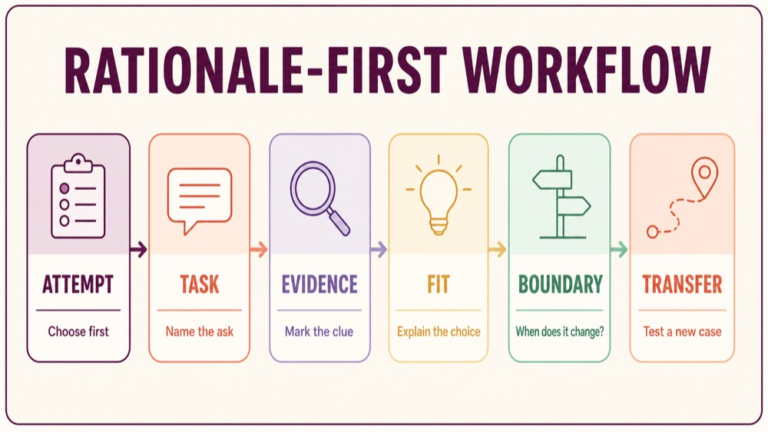
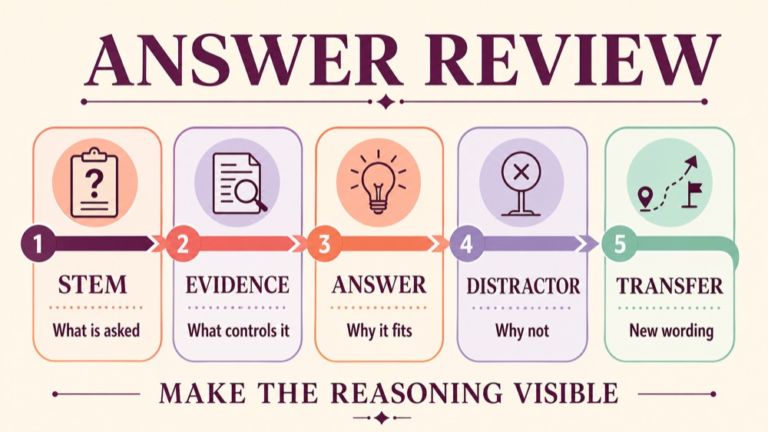
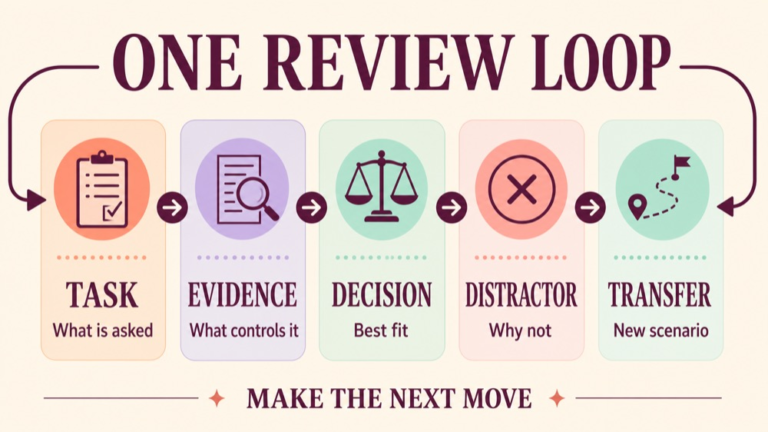
Set the review sequence before opening the answer key. Make an independent choice, state the task, mark the relevant evidence, read the rationale, compare the nearest distractor, and write a transfer question. The sequence turns passive answer checking into a small study workflow with visible steps.
Step
Action
Record
1. Attempt
Choose before looking at help.
Option and confidence.
2. Task
Restate what the stem requests.
One-sentence task.
3. Evidence
Mark the details that matter.
Relevant clue and relationship.
4. Rationale
Read why the key fits.
Rule in your own words.
5. Contrast
Explain the nearest mismatch.
Purpose, sequence, or evidence mismatch.
6. Transfer
Change one meaningful detail.
Fresh check question.
Use one primary learning purpose for a block. You may be studying assessment sequencing, treatment fit, professional practice, or interpretation. A focused purpose makes the rationale easier to evaluate because you know which relationship you are trying to understand.
Keep the record concise enough to repeat across several questions. A short rule with a boundary is more useful than a full page of copied explanation. Add detail only when it clarifies the evidence or shows why the closest alternative is weaker.
Save your first reasoning before reading the rationale
Your first response is the baseline for review. Record the selected option, confidence, task interpretation, and one supporting detail before opening the rationale. If you changed your answer while rereading, mark that change because it may point to task recognition, evidence selection, or decision confidence.
Baseline field
Example
Why it helps
Choice
Option C, uncertain.
Shows how strongly the answer was held.
Task
Choose information before selecting a measure.
Creates a comparison target.
Evidence
History detail creates the gap.
Shows what guided the decision.
Attraction
Option B named a familiar procedure.
Explains the distractor pull.
Do not replace the first note with the rationale. Put the updated understanding below it. The difference between the two versions can show whether you learned a missing fact, corrected the task, repaired a sequence error, or discovered that a related option had a narrower fit.
Label any reference support or peer discussion. A supported correction can teach a great deal, but it still needs a fresh independent check. Clear conditions make the rationale record more trustworthy and help you decide which practice format should follow.
Identify the task and the decision stage
Before asking why an answer is correct, ask what the stem wants you to choose. It may request an assessment action, the next information, a treatment response, an interpretation, or a professional practice decision. The same clinical fact can point to different answers depending on the task and stage.
Task family
Restatement frame
Rationale connection
Next information
What is unknown and could change the plan?
Key closes an information gap.
Assessment action
What should be done for this purpose?
Key fits the decision being measured.
Treatment action
What response fits the target and condition?
Key connects method to function.
Interpretation
What pattern is supported by the evidence?
Key stays within the details supplied.
Professional response
What action fits the role and concern?
Key matches responsibility and context.
A rationale should help you see why a true statement can still be the wrong response. If an option belongs to a later stage or answers a different verb, record that mismatch. This is one reason close distractors are educational: they show how a fact can be relevant without being the best fit for the task.
Underline task words when the stem is dense, but do not rely on a word in isolation. Connect the requested action to the population, goal, evidence, and sequence. That full relationship is more stable than a shortcut built from one signal word.
Connect evidence to option fit
Strong rationale reading asks which details change the decision and how they change it. Mark the relevant clue, then write the relationship between that clue and the selected option. If you cannot describe the relationship, the rationale may still be a sentence you recognize rather than a rule you can apply.
Evidence type
Question
Useful connection
Functional goal
What outcome is being considered?
Links the action to purpose.
Context
Where and with whom does the pattern occur?
Defines the condition of the choice.
Observed finding
What was directly described?
Separates observation from inference.
Missing detail
What remains unknown?
Guides the next information step.
Sequence cue
What has or has not happened yet?
Places the action in order.
Rewrite evidence in your own language rather than copying a phrase from the stem. “The classroom demand changes the communication context, so context information should guide the next step” is a reusable relationship. A list of words from the stem is harder to transfer.
When the rationale emphasizes a detail you ignored, ask what option that detail rules in or rules out. This keeps the review focused on decision impact. It also helps you avoid over-weighting a vivid symptom or familiar term that does not determine the requested action.
Find the closest distractor mismatch
After reading why the key fits, identify the option that could work in another context. Then name the mismatch that makes it weaker here. It may have the wrong purpose, sequence, population, evidence requirement, or scope. A precise mismatch turns the distractor into a study clue.
Purpose mismatch: the option addresses a related goal rather than the requested goal.
Sequence mismatch: the option belongs before or after the stage in the stem.
Evidence mismatch: the option assumes a detail the case did not establish.
Population mismatch: the option fits a different client or setting.
Scope mismatch: the option makes a broader claim than the evidence supports.
Write the comparison as a sentence. “The procedure is related, but the stem asks for information before the procedure is selected” is clearer than “the procedure is wrong.” The sentence preserves when the option might become relevant and why it does not win this comparison.
Review the closest distractor even when you selected the key. Correct answers can hide a weak comparison if you chose the right option for the wrong reason. The nearest alternative often reveals whether your rationale has a boundary or has become a broad shortcut.
Read a rationale for fit and boundaries
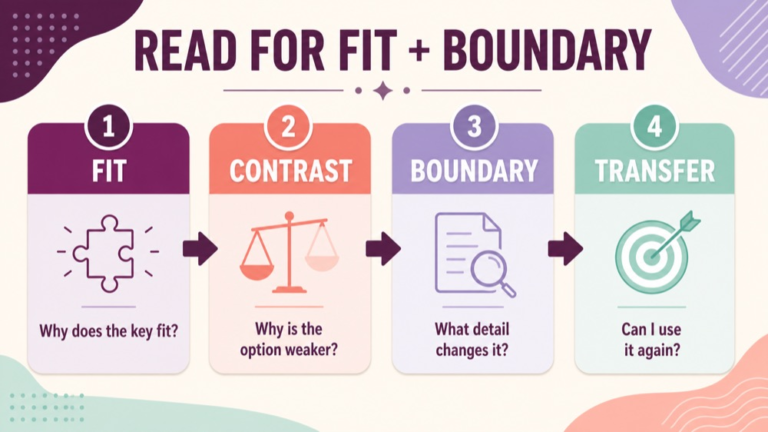
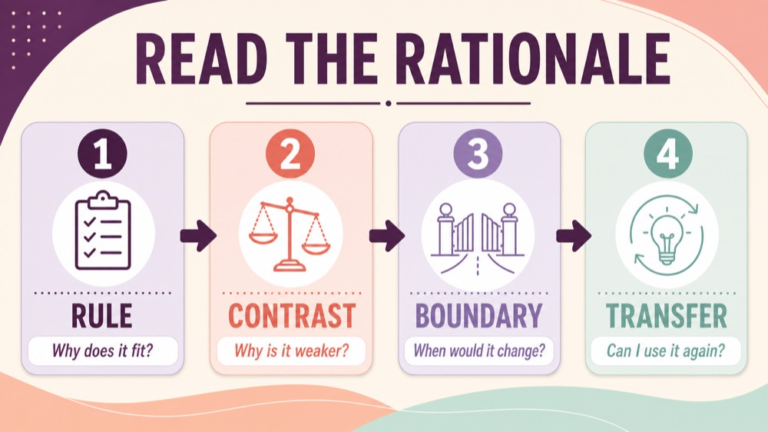
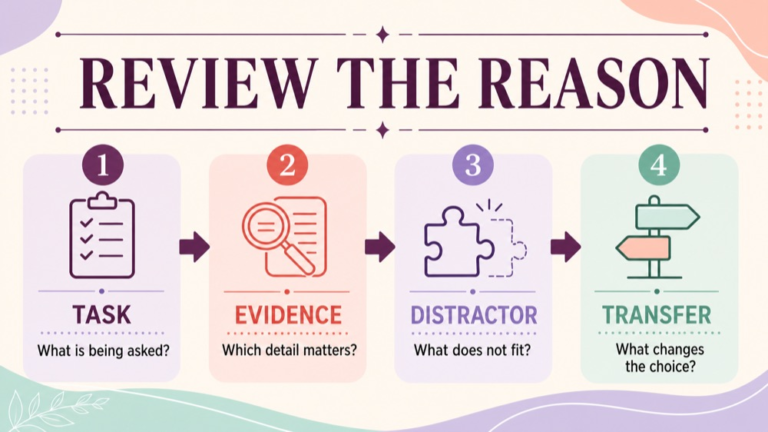
Use a four-part rationale reading pass: why the key fits, why the nearest option is weaker, what detail could change the choice, and how to test the rule on a fresh case. The fourth part matters because a rationale without a boundary can be over-applied to a different task.
Fit: connect the selected option to the task and evidence.
Contrast: name the nearest distractor’s mismatch.
Boundary: identify a changed detail that could alter the decision.
Transfer: write a new case or question that tests the rule.
For example, a rationale may support gathering context before choosing an assessment measure. The boundary is that once the relevant context is established, a different question may ask you to select the measure itself. The rule is about sequence and purpose, not a blanket preference for one action.
Close the rationale before writing the transfer prompt. If you can only repeat its wording, change the setting or functional goal and try again. A fresh case shows whether you understood the relationship among task, evidence, and option fit.
Try three original rationale-review questions
The following items are original educational examples created for this article. They are not copied from ETS and are not presented as secure test material. Answer first, then use the rationale to identify fit, closest mismatch, boundary, and transfer.
Question 1: Explain the purpose fit
Scenario: A child uses a communication device inconsistently across classroom activities. The stem asks what information should be gathered before choosing an implementation goal. Which response best fits the task?
A. Begin a device-use drill during every classroom activity.
B. Describe the activities, partners, access conditions, and communication opportunities in which use changes.
C. Select a diagnosis based on inconsistent device use alone.
D. Choose a familiar device feature without describing the classroom context.
Correct Answer: B. Why This Answer Is Correct: The question asks for information before an implementation goal is chosen. Activity, partner, access, and opportunity details describe the conditions that shape use. B addresses the information gap and creates a clearer basis for a functional goal.
Why the Other Options Are Wrong: A begins intervention before the context and goal are defined. C makes a broad interpretation from one behavior. D selects a feature before identifying the participation conditions. Each alternative may become relevant later, but B has the strongest fit for the stated first step.
Exam Trap: A treatment action can be reasonable in general and still be weak when the stem asks for information that should come first.
Question 2: Explain a sequence boundary
Scenario: A learner selects a treatment technique because it is associated with a target disorder, but the stem asks what should be confirmed before selecting the technique. Which review statement is most precise?
A. The technique is correct because it is commonly associated with the disorder.
B. The technique is premature because the stem asks for information that establishes target and functional fit first.
C. The technique and the information step are equal because both relate to treatment.
D. The information step is unnecessary when the disorder label is familiar.
Correct Answer: B. Why This Answer Is Correct: The task is about what should be confirmed before the technique is chosen. Target and functional fit provide the boundary for selecting an action. B explains why the associated technique is not the response to this stage, even if it could be considered later.
Why the Other Options Are Wrong: A treats association as sufficient evidence. C ignores the sequence requested by the stem. D assumes that a label supplies the functional information needed for the plan. B keeps the rationale tied to task, evidence, and order.
Exam Trap: A technique linked to a disorder does not remove the need to check the target, condition, and functional purpose described by the case.
Question 3: Explain a distractor boundary
Scenario: A question asks for the next step after a baseline has been gathered. One option proposes gathering the same baseline again, while another selects an action that uses the baseline to set a functional target. Which rationale is strongest?
A. Repeat the baseline because more information is useful in every situation.
B. Select the target-setting action because the stem says the baseline is already available and asks for the next step.
C. Choose either option because both involve assessment and planning.
D. Return to the beginning of the case whenever two options seem related.
Correct Answer: B. Why This Answer Is Correct: The stem establishes that baseline information is available and asks what follows. B uses the existing evidence to set a functional target. The repeated baseline may be appropriate if the information were incomplete, but the stated condition gives it a weaker fit here.
Why the Other Options Are Wrong: A ignores the condition that the baseline has already been gathered. C treats broad relevance as equal to sequence fit. D avoids the comparison instead of using the evidence supplied. B explains the boundary that makes the next action appropriate.
Exam Trap: An action that was appropriate earlier can become a distractor after the stem tells you that its information is already available.
Rewrite the rationale as an if-then rule
Convert the explanation into an if-then rule that includes a boundary. For example, “If the stem asks for information before selecting a measure, then identify the missing context that changes the measure choice; once that context is established, move to the measure decision.” The boundary prevents the rule from becoming a shortcut.
Rule part
Prompt
Example
If
What task and condition are present?
If the stem asks for the next information…
Then
What action addresses that task?
Then identify the missing context…
Because
What evidence connects them?
Because the context changes the choice…
Boundary
When would the action change?
Once the context is established…
Transfer
What fresh case can test it?
Change setting or target and re-answer.
A rule should be concise enough to recall and specific enough to compare. Avoid writing a broad slogan such as “assess before treatment.” Add the task, evidence, and condition that make the rule relevant. Those details are what allow you to distinguish a similar-looking case.
Keep the original rationale for reference, but use the rewritten rule in a fresh check. If the rule fails when a detail changes, decide whether the boundary was incomplete or the new case asks a different task. Updating the rule is part of learning, not evidence that the review failed.
Separate content retrieval from case application
A rationale can clarify a concept without repairing your ability to apply it. Test the difference by closing the explanation and stating the principle in plain language. Then apply it to a new case with changed details. If the concept is known but the choice changes incorrectly, the next repair should focus on application, sequence, or distractor comparison.
Pattern
What it suggests
Next block
Concept unavailable
Retrieval needs support.
Plain-language rule and delayed recall.
Concept known, case fit weak
Application needs practice.
Two contrastive fresh scenarios.
Right action, wrong stage
Sequence needs review.
Order steps with each purpose.
Related option wins
Distractor comparison needs precision.
Closest-option mismatch notes.
Rule works, pace slows
Process may be the variable.
Short light-timing comparison.
Use the rationale as evidence for your label, but keep the label provisional until a fresh item supports it. Several factors can contribute to one miss. Selecting the primary repair first makes it easier to see what changed in the next result.
Do not add a strict timer to every unresolved rationale. First make the rule reproducible. Then use a small timed block if the question is whether speed changes the quality of the comparison. Keeping the stages separate gives each result a clearer meaning.
Use rationales to plan a fresh check
Every reviewed rationale should end with a fresh check that changes the surface details while preserving the reasoning principle. Change the setting, population detail, functional goal, or sequence request in a controlled way. The change should require application rather than recognition of the original wording.
Keep the principle: preserve the relationship the rationale explained.
Change one detail: alter a setting, goal, condition, or stage.
Answer independently: record choice and confidence before help.
Compare again: explain the closest distractor mismatch.
Update the boundary: state when the rule changes.
A fresh check should be small enough to review completely. One or two well-designed cases can tell you more about transfer than a large block where explanations are skimmed. Keep the task, evidence, fit, mismatch, and boundary fields consistent across the original and fresh item.
Pair the two records instead of replacing the original. The pair shows whether your repair improved the decision itself, the explanation quality, the distractor comparison, or confidence. That pattern can guide the next study block more precisely than a raw percentage.
Add timing after rationale quality is stable
Timing is a separate condition from rationale learning. Once you can state why the key fits and why the nearest option is weaker, use a small timed block to see whether the clock changes rereading, task recognition, evidence selection, or commitment. Keep the same rationale template so the conditions remain comparable.
Stage
Condition
Compare
Rationale learning
Time open, answer key delayed.
Rule, evidence, mismatch, and boundary.
Fresh transfer
Changed case details, no clock.
Application and task fit.
Light timing
Small set with a flexible boundary.
Rereads, hesitation, and explanation quality.
Long practice
Use after a review plan exists.
Stamina and process patterns.
If the rationale is stable without a clock but weakens under light timing, record a process hypothesis. If the same reasoning problem appears in both conditions, keep the content, sequence, or application repair active. The comparison tells you whether time is the main variable or only one part of the pattern.
Do not use a long simulation to answer every question at once. A short, controlled timing block can show what changed while keeping the review manageable. Increase duration after the record shows a clear reason for doing so.
Avoid rationale-review traps
Reading the rationale before saving an independent first response.
Copying the explanation without identifying the task.
Recording the key but not the relevant evidence.
Ignoring the closest distractor because it is not the answer.
Turning one rationale into a broad rule without a boundary.
Repeating the original wording until recognition replaces transfer.
Changing source, content lane, and practice condition together.
Calling every miss a knowledge gap.
Calling every slow decision a pacing problem.
Using practice percentages as official score information.
Using a practice resource for changing appointment or administration details.
Studying purported secure content rather than legitimate preparation material.
The correction is a repeatable chain: answer first, identify the task, connect evidence to fit, explain the nearest mismatch, state the boundary, test a fresh case, and add timing only when the rationale is reproducible. Each step turns the rationale into an action.
Use this checklist with an slp praxis practice test with rationales:
Did I confirm Speech-Language Pathology (5331) through the current ETS page?
Did I record the practice source, date, and condition?
Did I make an independent first choice before reading the rationale?
Did I restate the task and decision stage?
Did I identify the evidence that changes the choice?
Did I explain why the selected option fits?
Did I explain why the closest distractor is weaker?
Did I rewrite the rationale with an appropriate boundary?
Did I separate retrieval, application, sequence, distractor, and process issues?
Did I test the rule with fresh wording?
Did I keep supported and independent results separate?
Did I add timing only after rationale quality was stable?
Did I keep practice evidence separate from official score and logistics claims?
A rationale is worth studying when it helps you make and explain a decision on a new case. Read for fit and boundaries, not just confirmation. Then use the fresh check to decide what should be repaired next.
SLP Praxis Practice Test With Explanations: How to Review
An slp praxis practice test with explanations can teach more than a score when the explanation is treated as a reasoning tool. Read the task, identify the evidence, compare the closest option, and rewrite the rationale in language you could use on a fresh case.
The current ETS Speech-Language Pathology (5331) page describes a computer-delivered selected-response test with 132 questions and 150 minutes. Use the live ETS page and your account for changing details. ASHA preparation guidance also supports practice questions, timed work, and a plan shaped by individual strengths and weaknesses.
What an explanation-led practice test should teach
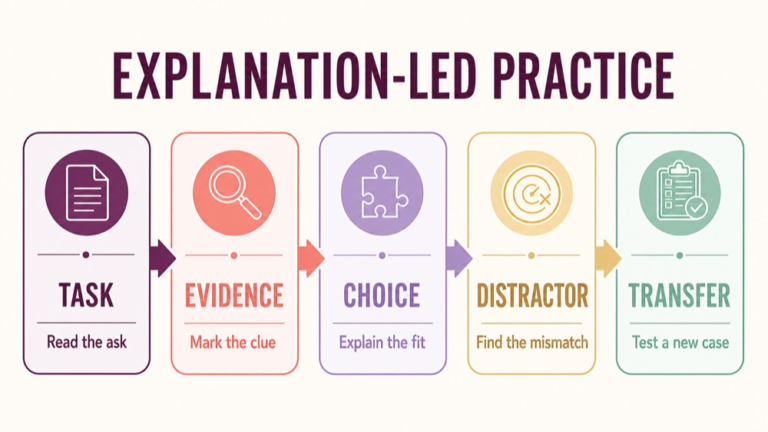
A practice set with explanations should help you see how a selected-response decision is built. The answer label is only one part of the record. The more useful parts are the task, the relevant evidence, the relationship between the evidence and the choice, and the reason the nearby options do not fit as well.
Explanation element
Question to ask
Study value
Task
What did the stem ask me to choose?
Prevents a true fact from answering the wrong question.
Evidence
Which detail changes the decision?
Separates meaningful clues from narrative detail.
Option fit
Why does the selected option address the task?
Builds a decision rule rather than answer memory.
Distractor mismatch
Why is the closest option weaker?
Improves comparison among plausible choices.
Transfer
What changed detail could change the choice?
Tests whether the rationale travels to a new case.
Explanations are most useful when they help you reproduce a choice, not when they simply confirm that the key was different. Write your first answer and reasoning before opening the explanation. That baseline lets you see whether the issue was content, task recognition, sequence, evidence selection, or distractor comparison.
Use a confidence label beside each answer. Stable confidence with a weak rationale deserves a transfer check. Uncertain confidence with a correct choice deserves a second explanation in your own words. Both patterns contain information that a score alone cannot show.
Confirm the current 5331 source before using a practice set
Begin with the current ETS Speech-Language Pathology (5331) page. Use it to confirm subject identity, current delivery and timing information, broad content direction, question count, duration, and preparation links. The page currently lists 132 questions and 150 minutes for a computer-delivered selected-response exam, so date your notes when you record those facts.
Use the ETS practice-test page to identify current preparation resources by subject. Read the description before deciding how to use a set. A sample item, an explanation-led learning block, and a longer simulation may support different parts of your preparation.
Verify the subject: confirm Speech-Language Pathology (5331).
Record the source: note provider, title, date, and format.
Label the role: mark learning, review, short timing, or simulation.
Separate administration facts: use ETS for current appointment and delivery information.
Protect originality: use legitimate preparation material rather than purported secure content.
For preparation principles, review ASHA’s Praxis preparation guidance. Keep preparation suggestions separate from changing ETS logistics. This source boundary makes your study notes easier to update and keeps a practice explanation from being treated as an administration instruction.
Make the explanation part of the practice design
Decide how you will use explanations before you begin. One approach is answer-first review: make an independent choice, write a rationale, then read the explanation. Another is teach-back review: read the explanation and close it, then state the rule and apply it to a changed detail. Both approaches can be useful when the condition is labeled.
Review mode
Sequence
Best use
Answer first
Choose, explain, then check.
Test independent reasoning.
Rationale first
Read, close, then teach back.
Learn a new decision rule.
Contrast review
Compare key and closest option.
Repair distractor confusion.
Transfer review
Change one detail and re-answer.
Test application beyond wording.
Choose one primary review mode for a block. If every question uses a different method, the record becomes difficult to interpret. Keep a secondary note for confidence or timing, but let the main condition answer one question about how explanations support your learning.
Prepare a simple explanation template: task, evidence, choice, closest distractor, and next check. The template should be fast enough to repeat and specific enough to expose a weak link. A consistent template also makes two different practice sources easier to compare.
Protect the first answer before reading the rationale
The first answer is your baseline, not a final judgment. Record the selected letter, confidence, and one sentence of reasoning before reviewing the explanation. If you changed an answer while rereading, record that change because it may point to task recognition or option-comparison friction.
First-pass note
Example
What it can reveal
Task
Choose the next information.
Whether the final sentence was understood.
Choice
Option B, uncertain.
How strongly the choice was held.
Evidence
Context creates the information gap.
Which clue guided the decision.
Attraction
Option C named a familiar measure.
Why the distractor pulled attention.
Do not erase the first reasoning after seeing the explanation. Put the updated rule underneath it. Comparing the two versions shows whether the explanation filled a missing concept, corrected a task mismatch, clarified sequence, or supplied a distractor distinction.
If you searched before answering, mark the session as reference-supported. That label does not make the work less useful; it tells you that a fresh item is needed to test independent transfer. Clear conditions keep your progress record honest.
Read the stem as a decision task
Before comparing options, identify the verb and stage of the decision. The stem may ask for an assessment step, the next information, a treatment action, an interpretation, or a professional response. Restate the task in your own words and keep it beside the options while reading the explanation.
Task family
Restatement frame
Explanation check
Assessment
What should be done for this purpose?
Does the rationale connect the action to the decision?
Next information
What remains unknown that changes the plan?
Does the key close the information gap?
Treatment
What action fits the target and condition?
Does the explanation mention functional fit?
Interpretation
What pattern is supported by the details?
Does the rationale stay within supplied evidence?
Professional practice
What response fits the role and concern?
Does the rationale match the responsibility?
A familiar term can make an option feel correct before the task is clear. Return that option to the restated question. If it answers a later stage, assumes missing information, or solves a related problem, record the mismatch rather than treating familiarity as evidence.
Explanation-led practice is especially helpful for dense stems because the rationale can show which details the item writer intended to matter. Use that information to improve your own evidence selection, but test the rule on fresh wording so the original paragraph does not become a cue.
Separate evidence from background detail
Clinical stems often include history, setting, communication demands, test behavior, and a requested decision. Not every detail carries equal weight for that decision. Mark the clue that changes the next action and explain why the other details remain background for this particular question.
Detail type
Review question
Useful note
Goal
What functional outcome is being considered?
Connects the decision to purpose.
Condition
Where or when does the pattern occur?
Defines context and fit.
Observed behavior
What was directly described?
Separates observation from inference.
Missing information
What is not yet known?
Guides the next step.
Distractor detail
Which fact is related but not decisive?
Prevents over-weighting a vivid clue.
Write the evidence as a relationship, not as a copied phrase. “The setting changes the communication demand, so context information should guide the next step” is more reusable than a list of nouns from the stem. The relationship can then be tested in a new scenario.
When an explanation emphasizes a detail you ignored, ask what decision that detail changes. This question turns the rationale into a clinical reasoning lesson rather than a line to memorize. It also helps distinguish relevant evidence from a memorable but non-decisive fact.
Compare the key with the closest distractor
Read the explanation for the selected option, then locate the option that could be reasonable in another context. Explain why the key fits this task more closely. Use a specific mismatch such as wrong purpose, wrong sequence, unsupported assumption, population mismatch, or excessive scope.
Wrong purpose: the option addresses a related goal rather than the requested goal.
Wrong sequence: the option belongs before or after the stage in the stem.
Missing evidence: the option assumes information the stem did not establish.
Population mismatch: the option fits another client or setting.
Scope mismatch: the option claims more than the details support.
Do not settle for “the explanation says B.” Write why B fits and why the nearest option is weaker. This practice protects you from choosing a related response simply because it sounds clinically sophisticated or uses a familiar term.
The closest distractor often reveals the actual reasoning problem. If it belongs to a later stage, review sequence. If it would fit after more information, review evidence. If it answers a different verb, review task recognition. The explanation becomes actionable when it points to one of those specific repairs.
Read the rationale in three passes
Use three passes so the explanation does not become passive reading. First, identify the decision rule. Second, compare the rule with the closest distractor. Third, apply the rule to a changed detail. This turns one explanation into a small learning cycle that can be repeated across content lanes.
Rule pass: state why the selected option fits the task and evidence.
Contrast pass: identify the exact mismatch in the closest distractor.
Transfer pass: name one changed detail that could alter the choice.
For example, an explanation may say that a particular next step is appropriate because the stem describes a missing baseline. Your rewrite should identify the missing baseline, connect it to the decision, and describe what new information would lead to a different step.
Close the explanation before writing the transfer sentence. If you can only repeat the original wording, the rule may still be tied to recognition. A new setting, target, communication partner, or sequence request can provide a manageable check without changing the entire topic.
Try three original explanation-led questions
The following items are original educational examples created for this article. They are not copied from ETS and are not presented as secure test material. Answer first, then use the explanation to record the task, evidence, closest distractor, and transfer check.
Question 1: Match the explanation to the task
Scenario: A student has difficulty following multi-step classroom directions, and the stem asks what information should be gathered before selecting a treatment target. Which response best fits the task?
A. Start a drill for repeating directions at a faster rate.
B. Identify the types of directions, supports, and classroom conditions in which breakdowns occur.
C. Assign a diagnosis based only on the reported difficulty.
D. Select a familiar language measure without clarifying the classroom demand.
Correct Answer: B. Why This Answer Is Correct: The stem asks for information before a target is selected. Direction type, supports, and classroom conditions describe the functional pattern and help define the next decision. B addresses the information gap instead of moving prematurely to treatment, diagnosis, or measurement.
Why the Other Options Are Wrong: A begins an intervention before the target is defined. C makes a broad interpretation from limited details. D chooses a tool before clarifying the purpose and context. Those options may belong to other stages, but B matches the requested first step and gives the explanation a clear sequence.
Exam Trap: A familiar treatment or measure can sound productive while still answering a later question than the stem asks.
Question 2: Use the closest distractor
Scenario: A question asks for the next assessment information needed to understand a communication breakdown. One option proposes a treatment technique, while another asks about communication partners and settings. Which explanation is strongest?
A. The technique is stronger because it produces an immediate activity.
B. The context question is stronger because it identifies the conditions that shape the breakdown before treatment is selected.
C. Both options are equally strong because both relate to clinical care.
D. The technique should be selected first so the context can be examined later.
Correct Answer: B. Why This Answer Is Correct: The requested task is to gather assessment information. Communication partners and settings can clarify the pattern and guide the next step. B fits the purpose and sequence. The treatment technique may become relevant later, but it does not answer the information-gathering task.
Why the Other Options Are Wrong: A confuses activity with evidence. C treats general relevance as equal fit. D reverses the sequence described by the stem. B explains why the closest distractor is related yet weaker: it skips the context information needed to choose an appropriate intervention.
Exam Trap: A related option is not equal to the key when it does not address the requested stage of reasoning.
Question 3: Transfer an explanation
Scenario: An explanation says that the next step should clarify a missing baseline before choosing treatment. Which changed detail would most directly test whether that rule transfers?
A. Change the color of the worksheet while keeping the same clinical information.
B. Change the setting and functional target while preserving the need for baseline information.
C. Repeat the original stem and select the same option immediately.
D. Replace the case with a vocabulary definition unrelated to treatment planning.
Correct Answer: B. Why This Answer Is Correct: A changed setting and functional target require the learner to apply the same baseline principle to new surface details. The decision relationship remains stable while the case changes, which tests transfer instead of simple recognition.
Why the Other Options Are Wrong: A changes a surface feature that does not affect the reasoning. C checks familiarity with the original wording. D tests a different task. B keeps the principle stable and changes the case details that should be considered when applying it.
Exam Trap: Transfer requires a meaningful change in the case while preserving the reasoning principle you intend to test.
Turn an explanation into a reusable rule
Rewrite each explanation in a compact format that includes the task, evidence, action, and boundary. The boundary is important because it tells you when the rule should not be used. A rule without a boundary can become a new shortcut that sends you toward the same kind of distractor.
Rule component
Example frame
Why it helps
Task
When the stem asks for the next information…
Defines the decision.
Evidence
Look for the missing detail that changes the plan…
Prioritizes the clue.
Action
Choose the step that closes that gap…
Connects evidence to choice.
Boundary
Do not jump to intervention without the needed context…
Protects sequence and scope.
Transfer
If the setting or goal changes, reassess the fit…
Supports new cases.
A useful rule should be short enough to recall and specific enough to guide a comparison. Avoid turning the explanation into a slogan such as “assess before treatment.” Add the condition that makes the rule relevant, because a selected-response item usually depends on the purpose, evidence, and sequence in the case.
Keep the original explanation nearby for reference, but use your rewrite for the fresh check. The difference between the two notes can show whether you understood the rationale or merely recognized its language. This is especially valuable when several options share similar clinical vocabulary.
Separate retrieval, application, and sequence
Explanation-led review can identify the type of learning that failed. If the concept was absent, use retrieval. If the concept was known but did not fit the case, use application. If the correct action was selected at the wrong stage, use sequence. If a related option won the comparison, use distractor analysis.
Pattern
Review question
Repair block
Retrieval
Could I state the principle without the options?
Plain-language rule and delayed recall.
Application
Could I use the principle with changed details?
Two contrastive fresh cases.
Sequence
Did I choose the right action at the right stage?
Order steps and explain each purpose.
Distractor
Why did the related option look stronger?
Closest-option mismatch notes.
Process
Did rereading or rushing change the choice?
Short block with a process record.
Use the explanation as evidence for the label, but keep the label provisional until a fresh check supports it. A missed answer can have more than one contributing factor. Selecting the primary repair first helps you learn which change made a difference.
When the explanation clarifies a fact but not the case fit, add an application example. When it clarifies the case fit but your answer was late, add a light timing condition after the reasoning is stable. This sequence prevents one format from being asked to solve every problem at once.
Test the rule with fresh wording
Use fresh wording after reading the explanation so you can test transfer. Keep the decision principle stable and change one meaningful case detail such as setting, population, communication demand, or requested stage. The change should require reasoning, not just spotting a repeated phrase.
Keep the principle: preserve the decision relationship from the explanation.
Change the surface: alter setting, goal, population detail, or sequence request.
Answer independently: record the choice and rationale before help.
Compare the distractor: name the mismatch in the closest alternative.
Update the rule: narrow it if the new case exposes a boundary.
Do not use a fresh item that changes every variable. A controlled change gives you a clearer answer about transfer. If the result changes, inspect whether the changed detail legitimately altered the decision or simply created an unrelated task.
Pair the fresh result with the original record. The pair can show whether the repair improved task recognition, evidence selection, distractor comparison, or confidence. That information is more useful for planning than repeatedly rereading the same explanation.
Add timing after the rationale is clear
Timing is a later practice condition when explanations are the main learning target. First make the decision rule and distractor comparison reproducible. Then use a short timed block with the same answer record to see whether the clock changes reading, evidence selection, or commitment.
Stage
Condition
What to inspect
Explanation learning
Time open and key delayed.
Rule, evidence, and boundary.
Fresh transfer
Changed details without a clock.
Application and distractor fit.
Light timing
Small block with a flexible boundary.
Rereads, hesitation, and answer changes.
Long practice
Use after a review plan exists.
Stamina and process patterns.
If the rationale is sound untimed but the decision changes under light timing, record a process hypothesis. If the same reasoning error appears under both conditions, keep the content or application repair active. Comparing the conditions makes the explanation more informative than a single speed-focused score.
Keep the same task and evidence fields across stages. The clock should be the variable you inspect, not a reason to discard the explanation record. A short comparison can show which part of the reasoning becomes fragile when attention is divided.
Avoid common explanation-review traps
Reading the explanation before making a first independent choice.
Saving the answer key without saving the original reasoning.
Copying a long rationale instead of rewriting the decision rule.
Ignoring the closest distractor because only the key feels important.
Treating every explanation as a fact list without identifying the task.
Repeating the same item until recognition replaces transfer.
Changing source, condition, and content lane at the same time.
Calling every wrong answer a content gap.
Calling every slow answer a pacing issue.
Using practice percentages as official score information.
Using a preparation page for changing appointment or administration details.
Studying purported secure content rather than legitimate preparation material.
The correction is a repeatable chain: answer first, identify the task, mark the evidence, compare the closest option, rewrite the explanation, apply it to a fresh case, and only then add a controlled time condition. Each step has a visible purpose and a reviewable result.
Use this checklist with an slp praxis practice test with explanations:
Did I confirm Speech-Language Pathology (5331) through the current ETS page?
Did I record the source, date, and practice role?
Did I make an independent first choice before reading the explanation?
Did I restate the task in my own words?
Did I identify the evidence that changed the decision?
Did I explain why the selected option fits?
Did I explain why the closest distractor is weaker?
Did I rewrite the rationale as a rule with a boundary?
Did I label retrieval, application, sequence, distractor, or process issues?
Did I test the rule with fresh wording?
Did I keep independent and supported conditions separate?
Did I add timing only after the rationale was reproducible?
Did I keep practice evidence separate from official score and logistics claims?
A practice test with explanations is most valuable when it leaves you with a decision rule you can use again. Read for the task and evidence, compare the nearest option, test the boundary with fresh wording, and let the next result guide the repair.
SLP Praxis Missed Questions Review: Turn Errors Into Study Actions
An slp praxis missed questions review should do more than collect wrong answers. It should show what the question asked, which evidence mattered, why the selected option looked attractive, and what small study action can test the pattern again.
The current ETS Speech-Language Pathology (5331) page describes a computer-delivered selected-response test with 132 questions and 150 minutes. Use the live ETS page and your account for changing details. ASHA preparation guidance also supports practice questions, timed work, and a plan shaped by individual strengths and weaknesses.
What missed-questions review should show
A missed item is a small record of a decision made under particular conditions. The useful question is not only whether the choice matched the key. Ask whether you misunderstood the task, missed a relevant clue, recalled the wrong principle, confused sequence, or selected a related option that belonged to another decision.
Review signal
What to capture
Why it matters
Task
The action requested by the stem.
Prevents a correct rule from being used on the wrong question.
Evidence
Details that changed the decision.
Separates relevant clues from background information.
Choice
Your option and confidence.
Shows whether the error was confident or tentative.
Distractor
The nearest alternative and its mismatch.
Reveals the comparison that broke down.
Condition
Untimed, timed, supported, or interrupted.
Links the error to the practice setting.
A missed question can point to a content gap, an application gap, a reading problem, or a process problem. Several labels can be present, but choose the primary one first. That decision keeps the next study block focused instead of sending you back to an entire textbook.
Review correct answers that felt uncertain as well. An answer that happened to land on the key can still expose a fragile rule. Marking uncertain correct answers gives you a fuller picture of what needs another check before you increase question volume or add time pressure.
Confirm the current 5331 source and the role of practice review
Start with the current ETS Speech-Language Pathology (5331) page. Use it to confirm the subject identity, current delivery and timing information, broad content direction, question count, duration, and preparation links. The page currently lists 132 questions and 150 minutes for a computer-delivered selected-response exam, so date your notes when you record those details.
Use the ETS practice-test page to locate current preparation options by subject. Read the resource description before deciding whether a set is useful for learning, review, or simulation. A practice bank can help you examine misses, but its results should remain labeled as practice evidence.
Verify the subject: confirm Speech-Language Pathology (5331).
Record the source: note provider, title, date, and format.
Label the condition: identify untimed, timed, open-reference, or independent work.
Separate administration facts: use ETS for current appointment and delivery details.
Protect originality: use legitimate preparation material rather than purported secure content.
For planning principles, review ASHA’s Praxis preparation guidance. Keep preparation guidance separate from the current ETS administration record. When a resource or logistics detail changes, a dated source note makes it easier to update the right part of your plan.
Build a missed-question review record
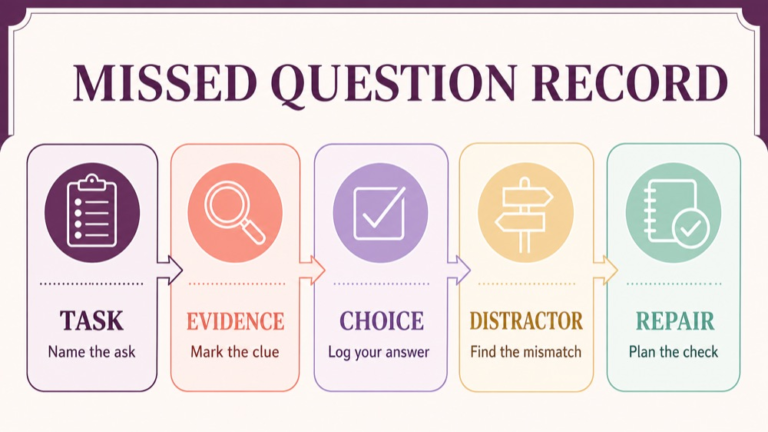
Use one row or one card for each missed or uncertain item. Begin with your first independent interpretation rather than the explanation you saw afterward. Record the question task, selected option, confidence, relevant evidence, closest distractor, and practice condition before writing a repair.
Field
Example
Review prompt
Question ID
Source and item number.
Can I find the item again?
Task
Choose the next assessment information.
Did my choice answer that task?
Evidence
Detail that creates the information gap.
Why does this detail matter?
My choice
Option C, uncertain.
What made it attractive?
Closest option
Option B, related but later.
What exact mismatch weakens it?
Repair
Compare three next-step stems.
What fresh check will follow?
Keep the record short enough to use repeatedly but detailed enough to show a decision rule. A note such as “I forgot assessment” is too broad to guide study. A note such as “I chose a measure before identifying the information gap requested by the stem” points to a specific repair.
Use a separate line for the answer key or explanation. This preserves the difference between what you initially reasoned and what you learned during review. The distinction is valuable because a supported correction and an independent correction require different follow-up conditions.
Label the error before choosing the repair
Labeling an error is an interpretation, not a permanent identity. Choose the label that best explains the evidence in this item, then test that explanation with a fresh example. If the new example points elsewhere, update the label instead of forcing every miss into the first category you chose.
Error label
Typical sign
First repair
Task mismatch
Your answer solves a different question.
Restate the final sentence before viewing options.
Content retrieval
The governing concept was unavailable.
Write a plain-language rule and contrast.
Application
You knew the concept but missed the case fit.
Compare two fresh cases with changed details.
Sequence
Your action belonged earlier or later.
Order the steps and state each purpose.
Distractor comparison
You saw relevance but missed the stronger fit.
Name the precise mismatch for the closest option.
Process
Rereading or rushing changed the decision.
Run a smaller block with a visible process note.
Use the stem and your first response as evidence for the label. Do not infer a broad content weakness from one unfamiliar term when the main failure was reading the requested sequence. Conversely, do not call a repeated concept miss a pacing issue simply because it happened in a timed set.
When two labels compete, choose a primary label and write a secondary hypothesis. The next repair should be designed to distinguish them. This turns review into a small experiment that can improve the quality of your next practice block.
Separate knowledge gaps from decision errors
A knowledge gap means the principle or term was not available when you needed it. A decision error means the relevant knowledge was present but was used on the wrong task, in the wrong sequence, or with the wrong evidence. Untimed review is helpful because it gives you enough room to test which explanation fits.
Question to ask
If the answer is yes
What to do next
Could I explain the concept after a brief cue?
The issue may be application or recognition.
Use a new case with a changed target.
Did I read the final task sentence correctly?
The issue may be task recognition.
Practice restating stems before options.
Did I know the steps but place them out of order?
The issue may be sequence.
Build a before-and-after step comparison.
Did I choose a related answer without comparing fit?
The issue may be distractor analysis.
Explain the nearest mismatch in one sentence.
Did the error appear only after a long block?
The issue may include process or stamina.
Compare a shorter condition before changing content.
Use a small retrieval check before opening a broad review resource. State the concept in your own words, give one contrast, and apply it to a plain scenario. If that route works, the next step is likely application or task recognition rather than more definition copying.
Clinical reasoning questions often reward a fit among population, goal, evidence, and sequence. A correct fact can still lead to a weak choice when one of those relationships is missing. Write the relationship that failed so your repair targets the connection rather than the vocabulary alone.
Reconstruct the stem task
Before reviewing an answer key, cover the options and write what the question asks you to choose. It may request the next information, the most appropriate assessment step, a treatment action, an interpretation, or a professional practice response. Naming the task reduces the chance that a familiar option will define the question for you.
Task type
Restatement frame
Evidence check
Next information
What remains unknown that changes the plan?
Find the information gap.
Assessment action
What should be done for this purpose?
Link the action to the decision.
Treatment action
What response fits the target and condition?
Match action to functional need.
Interpretation
What pattern is supported by the details?
Stay within the evidence supplied.
Professional response
What action protects the relevant responsibility?
Identify the role, setting, and concern.
Compare your original choice with your task restatement. If the choice answered a different task, record a task mismatch even if the choice could be reasonable in another context. This prevents a broad clinical association from replacing the precise question being asked.
When the wording is dense, underline the verbs and timing words that define the action. Terms such as before, next, most appropriate, initial, or best supported can change the comparison. The goal is not to memorize signal words in isolation, but to connect them to the decision pathway described by the stem.
Compare the correct and closest option
After identifying the task, compare the selected answer with the closest alternative. Start with the evidence that supports the stronger fit. Then name the exact mismatch in the alternative: wrong purpose, wrong stage, unsupported assumption, population mismatch, or a response that is too broad for the stem.
Purpose mismatch: the option addresses a related goal rather than the requested one.
Sequence mismatch: the option belongs before or after the step in the stem.
Evidence mismatch: the option assumes information that was not established.
Population mismatch: the option fits a different client or context.
Scope mismatch: the option makes a larger claim than the available details support.
Use precise comparison language in the review record. “B is wrong” does not explain the decision. “B could be considered later, but the stem asks for information needed before selecting the measure” preserves the clinical relationship and gives you a rule to test with another item.
Reviewing the closest distractor is especially useful when the original miss felt obvious after seeing the key. The nearby option often shows what your mind prioritized: a familiar procedure, a true definition, a compelling symptom, or a later step that sounded productive.
Review the error before reviewing the answer
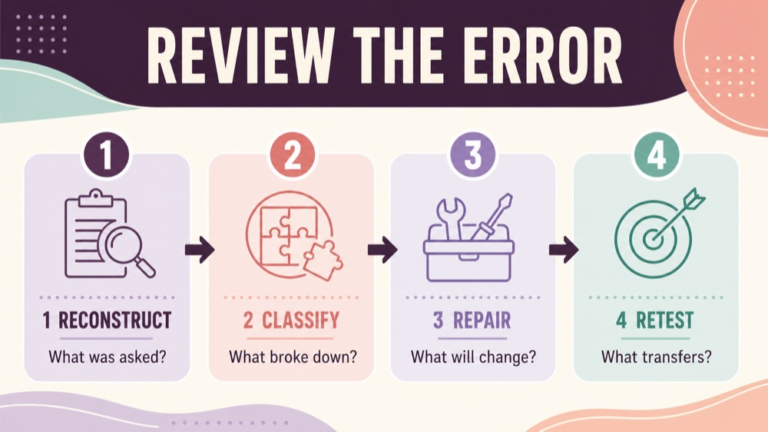
Use a two-pass review. On the first pass, reconstruct the task and evidence from memory without looking at the explanation. On the second pass, compare that reconstruction with the answer rationale and update the error label. This sequence protects the learning value of your first response.
First pass: write the task, evidence, choice, confidence, and closest distractor.
Rationale pass: identify what the explanation confirms or changes.
Mismatch pass: name the precise reason the alternative is weaker.
Repair pass: select a fresh practice action.
If you look at the key first, the explanation can feel familiar without showing whether you could reproduce it. A delayed rationale creates a clearer baseline. It also helps you distinguish an answer you learned from an answer you independently reasoned through.
Do not copy a long explanation into your notes when a short rule will do. Rewrite the reasoning in your own language, then add one changed detail that could alter the choice. That final step pushes the review toward transfer rather than recognition of the original item.
Try three original missed-question review items
The following items are original educational examples created for this article. They are not copied from ETS and are not presented as secure test material. For each one, answer first, then write the task, relevant evidence, closest distractor, and error label that would guide review.
Question 1: Review a task mismatch
Scenario: A client has reduced intelligibility in a noisy classroom, and the question asks what information should be gathered before selecting a treatment target. Which response best answers the requested task?
A. Begin a drill that increases speech rate during every session.
B. Ask about communication partners, classroom demands, and the situations in which breakdowns occur.
C. Select a diagnosis based on reduced intelligibility alone.
D. Choose a familiar measure without clarifying the functional context.
Correct Answer: B. Why This Answer Is Correct: The stem asks for information before selecting a target, so context and breakdown conditions are the needed evidence. B gathers details that can shape the target. The other choices move to intervention, diagnosis, or measurement before the information gap has been described.
Why the Other Options Are Wrong: A starts treatment without identifying the functional pattern. C makes a larger interpretation from limited information. D chooses a tool before clarifying its purpose. Each alternative may relate to clinical work, but B is the only response that matches the requested information-gathering step.
Exam Trap: A clinically familiar action can still miss the item when the stem asks what information should come before that action.
Question 2: Review a sequence error
Scenario: A learner chooses a treatment activity before confirming whether the client can recognize the target contrast. The review goal is to identify the error pattern. Which label is most precise?
A. Sequence mismatch because the proposed activity comes before the needed baseline information.
B. Stamina problem because the learner took too long to answer.
C. Pure vocabulary gap because every treatment activity was unfamiliar.
D. Distractor problem even though only one option was read carefully.
Correct Answer: A. Why This Answer Is Correct: The scenario gives a clear ordering problem: the learner selected an intervention before confirming information that would guide the target. A identifies the mismatch between the requested planning sequence and the proposed action.
Why the Other Options Are Wrong: B focuses on speed without evidence that time caused the choice. C assumes missing vocabulary rather than examining sequence. D names comparison failure even though the central issue is the order of information and action. A is the most specific label supported by the scenario.
Exam Trap: A slow answer is not automatically a pacing error; inspect the decision pathway before assigning a process label.
Question 3: Review a distractor mismatch
Scenario: The stem asks for the next piece of information needed to choose an assessment measure. One option names a useful measure, but another option identifies the missing history that determines which measure fits. Which review statement is strongest?
A. The measure wins because it is more concrete than a history question.
B. The history option fits because it addresses the information gap before the measure is selected.
C. Both options are equally strong because both are related to assessment.
D. The measure should be selected first so the history can be interpreted later.
Correct Answer: B. Why This Answer Is Correct: The task is to identify information needed before choosing a measure. The history option addresses that missing evidence and preserves the sequence described by the stem. The measure may become relevant later, but it does not answer the first decision.
Why the Other Options Are Wrong: A confuses concreteness with task fit. C treats general relevance as equal evidence. D reverses the sequence and assumes a tool can be selected without the information the stem says is needed. B explains both the evidence gap and the order of action.
Exam Trap: The closest distractor may be clinically related and still weaker because it skips the information needed to select it responsibly.
Turn one error into a two-part repair
A useful repair has a learning part and a checking part. The learning part changes the reasoning behavior that failed. The checking part uses fresh material to see whether the behavior transfers. Without the second part, a review note can sound convincing while remaining tied to the original wording.
Error pattern
Learning part
Checking part
Task mismatch
Restate five stems before viewing options.
Choose the action in three new stems.
Content retrieval
Write a rule and one contrast.
Recall it after a delay and apply it.
Sequence error
Order steps with each purpose.
Handle a case with one changed stage.
Distractor error
Classify the closest mismatch.
Explain a related option in a fresh item.
Process error
Use a small block with a process mark.
Compare pace and reasoning under light timing.
Keep the repair narrow. If your review identifies task mismatch, do not add a full content chapter, a new question bank, and a long simulation to the next session. Change the smallest variable that can answer whether task recognition improved.
Write the success signal before you begin. It might be a correct task restatement, a relevant evidence note, a sequence explanation, or a clear distractor mismatch. A visible signal makes it easier to decide whether to repeat the repair, adjust it, or move to a different condition.
Use error clusters without overgeneralizing
Clusters can reveal a pattern when the items share a decision type or condition. Five misses from one long session do not automatically represent one content weakness. Group items by content lane, task type, error label, and practice condition before deciding that a pattern deserves a larger study response.
Cluster dimension
Example
Question to ask
Content lane
Foundations, assessment, or treatment.
Is the issue concentrated in one lane?
Task type
Next step, interpretation, or measure.
Does the same task fail across lanes?
Error label
Sequence, retrieval, or distractor.
Does one reasoning behavior recur?
Condition
Untimed, timed, supported, or late session.
Does the condition change the pattern?
Look for repeated evidence before expanding the repair. A single unusual case can be useful, but it should remain a single-item note until a fresh check shows a related problem. This protects your study time from being redirected by one memorable question.
When a cluster appears, choose a representative item and a fresh comparison item. Review both with the same record. If the label holds across changed wording, the repair has stronger support. If it does not, keep the cluster narrow and revise the hypothesis.
Retest with fresh wording
Fresh wording is essential because recognition of a familiar explanation can imitate mastery. Change one or two details while keeping the decision principle stable. For example, change the setting, communication partner, functional goal, or sequence request without changing the reasoning rule you intend to test.
Keep the principle: preserve the decision relationship under review.
Change the surface: alter the population detail, setting, or wording.
Hide the original key: answer from the new stem before checking help.
Compare the record: look for the same task, evidence, and distractor behavior.
Update the label: keep, narrow, or replace the original error hypothesis.
Do not make the fresh check so different that it tests an unrelated skill. The goal is controlled transfer. A small change in surface details is often enough to show whether the reasoning is attached to the principle or to the remembered wording.
Record the fresh result beside the original item rather than replacing the first note. The pair shows whether your repair affected task recognition, evidence selection, distractor comparison, or confidence. That comparison can guide the next practice format more accurately than a new raw score.
Add timing only after review
Timing can be a useful later condition, but it can obscure the cause of an error when introduced too early. First make the reasoning route visible in an untimed or lightly supported review. Then use a small timed block to see whether speed changes the task, evidence, comparison, or confidence.
Stage
Condition
Review focus
Review
Time open, answer key delayed.
Task, evidence, and distractor reasoning.
Light timing
Small set with a flexible boundary.
Rereads, hesitation, and answer changes.
Mixed practice
Several lanes under one condition.
Transfer of the repair across topics.
Long run
Use after a review plan exists.
Stamina and pacing patterns.
If a timed miss disappears during untimed review, record a process hypothesis rather than declaring the content fixed. If the same miss appears in both conditions, content, application, or sequence deserves closer attention. Comparing conditions makes the next repair more informative.
Use a light clock for the first comparison. The purpose is to observe what changes, not to create a new pass-or-fail label. Keep the answer record the same across conditions so task and evidence notes remain comparable.
Keep practice records honest and private
Label whether each answer was independent, reference-supported, discussed with a peer, or reviewed after an explanation. This is not a judgment about the session. It is a condition note that prevents a supported correction from being mistaken for an independent result.
Independent: first choice and rationale made before help.
Reference-supported: a source clarified the concept after the first attempt.
Discussion-supported: another learner or instructor changed the reasoning path.
Fresh check: a changed item completed after the repair.
Keep personal study records free of confidential client information and do not copy purported secure test material into public notes. Use de-identified, original scenarios for review. For changing administration or appointment questions, return to the current ETS source rather than relying on a practice explanation.
Practice performance is evidence from a source under a condition; it is not an official scaled score. Keep the numbers useful for comparison within your plan, and avoid using one set of misses to make a broad claim about readiness.
Avoid common review traps
Saving only the answer key and losing your original reasoning.
Calling every miss a content gap without reading the task.
Calling every late miss a pacing issue without checking the same topic untimed.
Reviewing the obviously wrong options while skipping the closest distractor.
Copying an explanation instead of rewriting the decision rule.
Repeating the same item until familiarity replaces transfer.
Changing the source, condition, and study topic at the same time.
Building a large review plan from one unusual question.
Comparing independent and supported answers without condition labels.
Using practice percentages as official score information.
Using a preparation page for changing registration or delivery details.
Studying purported secure content rather than legitimate preparation material.
The correction is a visible chain: reconstruct the task, mark the evidence, compare the closest option, label the error, select a two-part repair, and retest with fresh wording. A missed-question review becomes useful when it produces a decision you can apply again.
SLP Praxis missed-questions review checklist
Use this checklist for an slp praxis missed questions review:
Did I confirm Speech-Language Pathology (5331) through the current ETS page?
Did I record the source, date, and practice condition?
Did I save my first choice before reading the explanation?
Did I restate the task in my own words?
Did I identify the evidence that changed the decision?
Did I record confidence and whether the answer was supported?
Did I compare the correct choice with the closest distractor?
Did I label the primary error pattern?
Did I separate retrieval from application and sequence?
Did I choose a learning action and a fresh checking action?
Did I look for a cluster across related items rather than one memorable miss?
Did I use fresh wording for the retest?
Did I add timing only after the reasoning route was visible?
Did I keep practice evidence separate from official score and logistics claims?
The goal of missed-question review is not to create a longer error list. It is to make each important miss specific enough to repair. Keep the record readable, test the repair under a new condition, and let repeated evidence decide what deserves more study.
Untimed SLP Praxis Practice Test: Learn the Reasoning
An untimed slp praxis practice test gives you room to see how you are thinking before the clock becomes another variable. It can reveal whether you understand the task, can identify the strongest evidence, and can explain why nearby options do not fit the scenario.
The current ETS Speech-Language Pathology (5331) page describes a computer-delivered selected-response test with 132 questions and 150 minutes. Use the live ETS page and your account for changing details. ASHA preparation guidance also points learners toward practice questions, timed work, and a plan shaped by individual strengths and weaknesses.
What an untimed SLP Praxis practice test can reveal
Untimed work is not a shortcut around exam preparation. It is a controlled way to inspect the decisions that a rushed session can hide. When the clock is removed, you can ask whether the stem task was understood, whether the selected evidence was relevant, and whether the explanation transfers to a new scenario.
Signal
What to record
Useful interpretation
Task recognition
How you restated the question.
Check whether the requested action was clear.
Evidence use
Details that changed the decision.
Separate relevant clues from background information.
Distractor analysis
Why each nearby option was weaker.
Test comparison rather than answer familiarity.
Confidence
Stable, uncertain, or unresolved.
Choose a follow-up that matches the uncertainty.
An untimed correct answer is useful when you can explain the route to it. If you needed repeated searching, copied a phrase, or chose a familiar term without connecting it to the task, label the result honestly. The label helps you design better practice without turning one percentage into a broad conclusion.
Use untimed practice to make a hidden step visible. That step might be identifying the assessment purpose, choosing a sequence, interpreting a clinical pattern, or deciding which information belongs in the next action. Once the step is visible, you can practice it in smaller blocks.
Confirm the current 5331 source before studying
Begin with the current ETS Speech-Language Pathology (5331) page. Use it to confirm the subject identity, current delivery and timing information, broad content direction, question count, duration, and preparation links. The page currently lists 132 questions and 150 minutes for a computer-delivered selected-response exam, so date your note because live details can change.
Use the ETS practice-test page to identify current resources by subject. Read each resource description before assigning it a role. A short sample, an untimed learning set, and a longer simulation can serve different purposes even when they use similar vocabulary.
Verify the subject: confirm Speech-Language Pathology (5331).
Record the source: note provider, title, date, and format.
Label the condition: distinguish untimed learning, short timed work, and simulation.
Separate logistics: use ETS for current administration and appointment information.
Protect originality: study legitimate preparation material rather than purported secure content.
For preparation principles, review ASHA’s Praxis preparation guidance. Keep its study recommendations separate from the current ETS administration record. Using each source for its stated role makes your notes easier to update when a resource or test detail changes.
Choose what untimed practice is supposed to teach
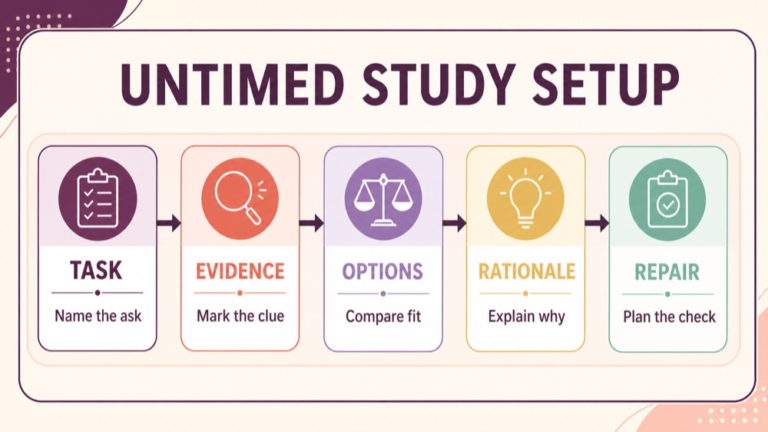
Write one learning purpose before opening the question set. You might be practicing how to identify the requested task, connect evidence to an assessment decision, sequence treatment planning, or compare two plausible options. An untimed session becomes easier to review when the purpose is specific enough to produce observable notes.
Learning purpose
Prompt to use
Evidence of progress
Task recognition
What action is the stem requesting?
A concise restatement before the options.
Evidence selection
Which detail changes the decision?
Relevant clue linked to a choice.
Sequence
What comes before the proposed action?
Order explained with a purpose.
Distractor comparison
Why is the nearest alternative weaker?
A specific mismatch, not a vague label.
Transfer
Would the reasoning survive changed details?
Fresh scenario handled without copying wording.
Choose one primary purpose and one secondary note. Trying to improve every reasoning behavior in one sitting can produce a busy record with no clear next move. A narrow purpose also makes it easier to compare two question sets from different sources.
Give yourself permission to pause for the reason, not for endless searching. If you need a reference, record what you checked and return to the stem. The goal is to learn which evidence supports the decision, not to collect an explanation that you cannot reproduce later.
Set up a clean untimed session
A useful untimed session has stable materials, a defined stopping point, and a record that separates independent reasoning from reference-supported learning. Put the source title and date at the top of the page. Hide answer explanations until you have written a first decision and a short rationale.
Session element
Suggested setup
Why it matters
Question range
One clinical lane or a small mixed set.
Keeps the learning purpose visible.
Answer record
Choice, confidence, evidence, and rationale.
Shows more than right or wrong.
Reference rule
Check after a first independent attempt.
Protects the baseline reasoning record.
Stopping point
End after a defined number or review block.
Prevents fatigue from blurring the notes.
Use a modest set when you are learning a decision type. A smaller set with complete explanations can be more informative than a large set where every answer receives only a quick mark. The appropriate size depends on the question source, your energy, and the repair you plan to run afterward.
Record the conditions honestly. If you searched before choosing, discussed the item with a peer, or saw an explanation that changed the route, use a separate label. That does not invalidate the session; it tells you which part of the reasoning is independent and which part still needs rehearsal.
Read the task before reading the distractors
Many selected-response stems include a clinical story, several details, and a final sentence that defines the requested action. Read for the task before allowing a familiar option to set the direction. Restate the requested action in your own words, then identify the evidence needed to support that action.
Stem task
Question to ask
Common repair
Choose an assessment step
What decision will the information support?
Link measure to purpose and missing evidence.
Choose a treatment action
What target and condition are described?
Connect action to functional need and cueing.
Interpret a finding
Which pattern is supported by the details?
Separate the finding from an unsupported label.
Choose next information
What remains unknown after the stem?
Prioritize the information that changes the plan.
The task sentence should control the comparison. If an option names a familiar test, technique, or diagnosis, place it back beside the requested action. Familiarity can make an option feel fluent without showing that it addresses the actual decision described in the stem.
When the task is unclear, write two possible restatements and compare them with the final sentence. If one restatement requires information the stem does not request, set it aside. This small pause can reduce later rereading because the comparison has a defined target.
Use an evidence-first answer record
For each item, record the selected option, one supporting detail, one reason the closest alternative is weaker, and your confidence. This format keeps the review anchored to the stem. It also makes an uncertain correct answer visible instead of allowing the answer key to end the learning process.
Field
Example note
Review question
Task
Choose the next assessment information.
Did my choice answer this task?
Evidence
Detail that changes the clinical decision.
Is the detail relevant or decorative?
Choice
Selected option plus confidence.
Was the confidence supported?
Closest distractor
Option that could fit another task.
What exact mismatch weakens it?
Next action
Fresh item, concept review, or sequence drill.
What will test the repair?
Keep the supporting detail concise but specific. A note such as “it sounds clinical” does not give you a reusable rationale. A note such as “the question asks for information before treatment, so this choice gathers the missing baseline” gives you a decision rule that can be tested with different wording.
Confidence is a learning signal rather than a grade. Stable confidence with a wrong answer may indicate a flawed rule. Uncertain confidence with a correct answer may indicate a rule that needs more transfer. Both patterns deserve a next action, though the action may differ.
Review all four options, not only the key
After checking the answer, return to the options and classify the mismatch for each distractor. It may belong to the wrong sequence, wrong population, wrong purpose, too broad a claim, or a detail that the stem never supplied. Naming the mismatch creates a more durable review note than copying the key.
Wrong task: the option could be reasonable for a different question.
Wrong sequence: the action belongs later or earlier in the process.
Missing evidence: the option assumes a detail that was not established.
Overreach: the option makes a larger claim than the stem supports.
Weak fit: the option is related but does not address the central decision.
Use one mismatch category per distractor when possible. If two categories apply, record the primary one first and explain the second in a sentence. The purpose is not to create a taxonomy for its own sake; it is to make your comparison language precise enough for a fresh item.
Review the closest distractor with extra care. The obviously unrelated choices rarely explain a difficult miss. The nearby option often reveals whether you confused purpose with procedure, finding with diagnosis, or a possible action with the next appropriate action.
Separate retrieval from clinical reasoning
Some items ask you to retrieve a concept, while others ask you to use a concept within a case. Untimed review can help you tell those tasks apart. If you knew the concept after a brief cue but could not apply it to the stem, your next block should include transfer. If the concept itself was missing, begin with focused retrieval before adding more cases.
Pattern
What it may suggest
Next study block
Concept absent
Term or principle was not available.
Short retrieval notes with self-explanation.
Concept known, application weak
Case details did not connect to the rule.
Contrast two fresh scenarios.
Application sound, confidence low
Reasoning works but feels unstable.
Repeat with changed wording and delayed review.
Reasoning sound, pace slow
Process is accurate but not yet efficient.
Add a small timed block after untimed confirmation.
Do not label every miss as a knowledge gap. A learner can know a definition and still choose the wrong action because the stem requested a different stage of the process. Write the task, evidence, and sequence before deciding which content needs review.
Likewise, do not treat a slow but accurate explanation as a failure. It is information about efficiency. First make the reasoning reproducible, then shorten the record to the few cues that support the same decision under a light time limit.
Review the reason for every option
A complete review moves from the question task to the relevant evidence, then to the selected option and its nearest distractor. Finish by naming the next study action. This path turns an answer explanation into a reusable process that can survive a new population, setting, or wording pattern.
Task pass: restate the requested decision in one sentence.
Evidence pass: underline the details that change the decision.
Option pass: explain the key and classify the closest distractors.
Transfer pass: write how a changed detail could change the choice.
Repair pass: select a fresh item or short concept drill.
For example, an assessment question may include a functional complaint, a brief history, and a request for the next information to gather. Your review should identify which detail creates the information gap, why the chosen step closes that gap, and why a later treatment decision is premature.
Review correct answers that felt uncertain. They can show where your reasoning was incomplete even though the choice matched the key. A short transfer item with changed details is a useful way to test whether the explanation belongs to the principle rather than to one familiar sentence.
Try three original untimed reasoning questions
The following items are original educational examples created for this article. They are not copied from ETS and are not presented as secure test material. Answer each one before reading the rationale, then record the task, evidence, closest distractor, and confidence.
Question 1: Identify the next information
Scenario: A client reports that speech is harder to understand during group conversation than during a quiet one-to-one exchange. The question asks what information should be gathered first to guide the next assessment step. Which response best matches that task?
A. Begin a treatment drill that increases speaking rate immediately.
B. Clarify the settings, communication partners, and breakdown patterns that occur in the group.
C. Select a diagnosis based only on the client’s report of reduced intelligibility.
D. Choose the most familiar speech measure without asking about the communication context.
Correct Answer: B. Why This Answer Is Correct: The task asks for information that clarifies when and how the communication breakdown occurs. Settings, partners, and patterns can shape the next assessment decision, while the other choices move to treatment, diagnosis, or measurement before the information gap is defined.
Why the Other Options Are Wrong: A begins treatment before the assessment purpose is established. C makes a label from limited information. D selects a measure because it is familiar rather than because it answers the stated question. B keeps the first step connected to context and observable breakdowns.
Exam Trap: A recognizable symptom does not by itself identify the next assessment step; match the response to the information the stem requests.
Question 2: Distinguish a principle from a procedure
Scenario: A learner can define a treatment principle but chooses a technique that does not match the stated functional target. During untimed review, what is the most useful next action?
A. Memorize the definition again without using a new case.
B. Compare two fresh cases that use the same principle with different functional targets.
C. Add a timer immediately so the learner has less time to choose.
D. Remove all treatment questions until confidence feels higher.
Correct Answer: B. Why This Answer Is Correct: The scenario shows retrieval of the principle but difficulty applying it to the target. Contrasting fresh cases keeps the principle stable while changing the functional details, which tests whether the learner can connect the action to the purpose.
Why the Other Options Are Wrong: A rehearses retrieval without repairing application. C adds pressure before the reasoning route is clear. D removes the decision type that needs transfer. B creates a focused comparison that can show which target detail changes the technique choice.
Exam Trap: Knowing a treatment term is different from selecting an action that fits the stated functional target and condition.
Question 3: Explain the closest distractor
Scenario: An answer choice is clinically related to the case but belongs to a later stage of planning than the stem requests. How should you record that option during review?
A. Mark it correct because it could be reasonable at some point.
B. Label it as a sequence mismatch and state which earlier decision the stem asks for.
C. Ignore it because only the correct answer needs an explanation.
D. Replace the stem with a different question that makes the option fit.
Correct Answer: B. Why This Answer Is Correct: A distractor can be related yet still fail the requested sequence. Naming the mismatch preserves the distinction between a possible later action and the next action supported by the stem. That distinction can transfer to new cases.
Why the Other Options Are Wrong: A confuses clinical relevance with task fit. C loses the reasoning clue contained in the nearest distractor. D changes the evidence instead of analyzing it. B records the precise reason the related option is weaker for this question.
Exam Trap: The option that sounds clinically sensible may still be wrong when it answers a later question than the stem asks.
Convert uncertainty into a study action
After review, choose one action that directly tests the uncertainty. A missing concept may need a short retrieval card and self-explanation. A sequence confusion may need a before-and-after comparison. A distractor problem may need two close options with explicit mismatch notes. An application problem may need fresh cases with changed details.
Uncertainty label
Targeted action
Fresh check
Definition unclear
Write a plain-language rule and one contrast.
Recall the rule after a delay.
Purpose unclear
Restate three stems before viewing options.
Choose the requested action.
Sequence unclear
Order steps and explain the information each adds.
Handle a changed scenario.
Distractor unclear
Classify the nearest mismatch.
Explain why a related choice is weaker.
Pace unclear
Run a short timed block after untimed review.
Keep the same reasoning record with a light clock.
Keep the next action small enough to finish and specific enough to inspect. “Study assessment” is too broad to show whether the repair worked. “Compare three next-step stems and name the missing information before viewing options” gives you a result that can be reviewed.
Use a fresh check rather than rereading the same explanation. New wording prevents familiarity from doing all the work. The change can be modest: switch the setting, alter one relevant detail, or ask for a different step in the same decision pathway.
Add the clock after the reasoning is visible
Untimed practice and timed practice are connected stages rather than competing identities. Begin with enough untimed work to describe the decision rule. Then introduce a light time boundary for a small block while keeping the same task, evidence, and distractor record. This shows whether efficiency changes the reasoning.
Stage
Condition
What to compare
Untimed learning
Time open, explanation delayed.
Task, evidence, and option rationale.
Light timing
Small set with a flexible checkpoint.
Rereads, hesitation, and explanation quality.
Mixed timed work
Different lanes under one short condition.
Whether the process transfers across content.
Long simulation
Use only after a clear review plan exists.
Stamina and pacing patterns.
Do not use a long simulation to diagnose every unresolved problem at once. If the untimed reasoning record is incomplete, a full clocked run can produce a large pile of ambiguous misses. Build the smallest comparison that answers the next question you have about your process.
When speed changes an answer, record what changed: task recognition, evidence selection, option comparison, or confidence. That note tells you whether the next session should return to untimed reasoning or continue with a smaller timed block.
Build a review ladder from simple to complex
A review ladder lets you move from recognition to transfer without jumping straight into the most demanding condition. Start with a plain concept, place it in a short stem, compare close options, and then use a mixed case that asks for a sequence or next action. Each rung should have a visible success signal.
Recall: state the principle in plain language.
Recognize: identify the relevant clue in a short stem.
Apply: select an action that fits the target and condition.
Contrast: explain why the closest distractor is weaker.
Transfer: solve a fresh case with changed details.
Time: repeat a small set with a measured boundary.
Move down one rung when the record shows that the previous rung is unstable. Move up when the explanation is reproducible, not merely when the answer happens to be correct. This approach keeps the study block aligned with the evidence you collected rather than with a vague feeling about readiness.
Keep the ladder flexible across the three broad content areas described by the current ETS material. A learner may need retrieval in foundations, transfer in assessment, and sequence practice in treatment planning. The same review structure can serve each lane while the examples and sources remain specific.
Use breaks and source labels responsibly
Record breaks, interruptions, reference checks, and discussions because they change the condition of an untimed session. These details do not make the session useless. They tell you whether the result represents independent reasoning, supported learning, or a blend that needs a second check.
Independent first pass: record the answer and rationale before checking help.
Reference-supported pass: note the source and the concept it clarified.
Peer discussion: write the reasoning you could reproduce alone.
Break or interruption: mark where the condition changed.
Fresh follow-up: test the repaired idea with changed wording.
Use the source label in your notes so you do not compare a supported answer with an independent answer as though they came from the same condition. A clean record makes progress easier to see and helps you choose the right next practice format.
For changing test administration information, use the responsible live source. Preparation pages and third-party practice products can support learning, but they should not replace current ETS instructions about registration, delivery, timing, or appointments.
Avoid common untimed practice traps
Removing the clock without choosing a learning purpose.
Searching for an explanation before making an independent first pass.
Recording only right or wrong and losing the rationale.
Copying the answer key without explaining the closest distractor.
Calling a sequence mismatch a missing concept.
Calling every slow decision a knowledge gap.
Repeating the same wording until familiarity replaces transfer.
Using one large session to repair several unrelated patterns.
Comparing supported and independent results without labeling the conditions.
Treating a practice percentage as an official scaled score.
Using a preparation page for changing appointment or administration details.
Studying purported secure content rather than legitimate preparation material.
The correction is a visible chain: name the task, record the evidence, compare the options, label the uncertainty, choose a small repair, and test that repair with fresh wording. Untimed practice becomes more valuable when each session leaves a clear next decision.
Untimed SLP Praxis practice-test checklist
Use this checklist with an untimed slp praxis practice test:
Did I confirm Speech-Language Pathology (5331) through the current ETS page?
Did I record the source, date, and practice condition?
Did I choose one primary learning purpose?
Did I restate the task before comparing options?
Did I record the evidence that changed my decision?
Did I explain why the closest distractor was weaker?
Did I label independent, reference-supported, and discussed answers?
Did I review uncertain correct answers?
Did I identify retrieval, application, sequence, or distractor uncertainty?
Did I choose a small repair action?
Did I test the repair with fresh wording or a changed detail?
Did I add time pressure only after the reasoning record was visible?
Did I keep practice evidence separate from official score and logistics claims?
The purpose of untimed work is not to stay away from pacing. It is to make the reasoning route clear enough that a later clocked block can test efficiency rather than confusion. Keep the record specific, repeat the repair with fresh material, and let the next condition answer one focused question.
Timed SLP Praxis Practice Test: Build a Pacing System
A timed slp praxis practice test is useful when the clock has a specific job. You may be testing pacing, reading, skip-and-return behavior, stamina, or how well you can explain a decision under time pressure. If all of those are mixed into one percentage, the result is harder to repair.
The current ETS Speech-Language Pathology (5331) page describes a computer-delivered selected-response test with 132 questions and 150 minutes. Use the live ETS page and your account for changing details. ASHA preparation guidance also encourages practice questions, timed work, and a plan based on individual strengths and weaknesses.
What a timed SLP Praxis practice test should show
A timed practice test should produce a process record as well as an answer record. Note where you reread, where you skipped, how often you changed an answer, when rushing began, and whether the pattern appeared in one lane or across the whole set.
Timing target
Evidence to record
Useful interpretation
Reading
Rereads and task restatements.
Check whether the stem task was clear.
Pacing
Checkpoints and items completed.
Identify where the plan drifted.
Triage
Skips, returns, and time spent on close choices.
Review decision rules.
Stamina
Late-session confidence and error pattern.
Separate fatigue from topic gaps.
Timing evidence is not the same as content evidence. A late error may reflect fatigue, a long stem, a difficult concept, or a combination. Record enough detail to test the most likely pattern in a smaller follow-up block.
Use confidence labels: stable, uncertain, rushed, skipped, or changed. A correct answer reached after a long struggle is different from a correct answer supported by a clear rationale. Keep the label beside the timing note so process and content remain visible.
Confirm the current 5331 source
Start with the current ETS Speech-Language Pathology (5331) page. Use it for subject identity, current delivery and timing information, broad content direction, question count, duration, and official preparation links. The page currently lists 132 questions and 150 minutes for a computer-delivered selected-response exam. Date your note because the live source controls changing details.
Use the ETS practice-test page to locate current options by subject. Read the resource description before using it as a timed practice test. A short drill, sample, or third-party bank may have a different job from a longer simulation.
Verify the subject: confirm Speech-Language Pathology (5331).
Record the source: save provider, title, date, and format.
Label the timing: distinguish learning mode, short timed mode, and simulation mode.
Separate official facts: use ETS for current administration and appointment information.
Protect originality: avoid purported live or confidential content.
For planning principles, review ASHA’s Praxis preparation guidance. Keep its study guidance separate from the current ETS timing and logistics record. Use each source for its stated role when you update your preparation notes.
Set the timing task before you start
Decide what the clock is meant to teach before you begin. A first timed block may test whether you can read the final task sentence and commit to an answer. A later block may test checkpoints or skip-and-return behavior. A long simulation may test stamina. Write the job at the top of the page.
Timing mode
What to practice
What to keep
Short clocked block
Task recognition and commitment.
Rereads, hesitation, and answer changes.
Mixed timed block
Switching among foundations, assessment, and treatment.
Lane, task, and checkpoint.
Long simulation
Stamina, pacing, and skip-and-return habits.
Late-session pattern and breaks.
Review block
Reasoning without a clock.
Evidence and distractor rationale.
Choose one primary timing target for a session. If you are trying to improve reading, do not change the source, environment, timer, and question mix at the same time. Stable conditions make it easier to interpret the next result.
Prepare a mark for uncertainty before the timer starts. It can be a star, a question mark, or a short note. The mark should be quick enough that it does not create a second timing problem.
Build a pacing record
Use a run sheet with beginning, middle, and end checkpoints. Record the planned checkpoint, actual position, skipped items, rereads, interruptions, and confidence trend. The record does not need to capture every second. It is a prompt for comparison, not a second timer.
Field
Example
Why it helps
Start condition
Timed, quiet space, explanations hidden.
Defines the session.
Checkpoint
Beginning, middle, end.
Shows drift.
Skip mark
Two items marked to return.
Shows triage behavior.
Reread note
Long stem reread twice.
Identifies reading friction.
Confidence
Stable early, rushed late.
Separates stamina from content.
Pair the run sheet with a reasoning log. For selected items, record lane, task, deciding evidence, answer confidence, closest distractor, and next check. The two records answer different questions and should not be collapsed.
Use checkpoints without chasing a perfect split
Checkpoints are reminders, not a promise that every section will take the same amount of time. A difficult stem may require more reading, while a familiar item may move quickly. Use checkpoints to notice drift and make a deliberate decision about the next block.
Choose two or three checkpoint moments before starting.
At each point, note progress and confidence without stopping for a full review.
If you are behind, identify whether the cause is reading, indecision, or content uncertainty.
Use the next item to test one process adjustment.
Record the effect after the session.
A useful checkpoint note says “spent too long comparing two options in assessment sequence” rather than “too slow.” The first note points to a repair: compare task and evidence, choose the closer fit, and return later if the rule permits.
Do not make the clock the only feedback. The goal is a process that supports accurate, explainable decisions. Speed without task recognition can create a different error pattern, so pair pace notes with a brief reasoning check.
Protect reading and task recognition
Many timing problems begin before the answer choices. If you misread “next,” “best,” “most appropriate,” or “initial,” you may spend time solving a different question. Use a short task-restatement habit.
Read the final sentence first enough to identify the requested action.
Read the stem for the evidence that controls that action.
Restate the task in a few words.
Choose the option that fits the task and evidence.
Mark uncertainty and move when your rule says to move.
Practice the habit untimed before using it in a longer session. A timing technique should reduce avoidable rereading while preserving attention to the evidence and the question’s requested action.
If your record shows repeated task misses, schedule a reading block rather than simply shortening the time per item. The repair is to recognize the question’s job, not to push the clock harder.
Use skip-and-return rules
A skip-and-return rule prevents one difficult item from consuming the time needed for several later decisions. Define the rule before the run. For example, you may mark an item when you cannot identify the deciding evidence after a deliberate reread, then return at a planned checkpoint.
Situation
Move
Record
Task is clear, answer is close
Compare the two strongest options and commit.
Distractor reason.
Task is unclear
Restate the final question and reread the evidence.
Reading cue.
Evidence is missing
Mark and move according to your rule.
Missing information.
Time is drifting
Use the checkpoint adjustment.
Process change.
Do not turn skipping into avoidance. The review record should show which items were returned to and what evidence changed your answer. If the same decision type is repeatedly skipped, add untimed repair work before the next long block.
Separate content lanes from clock behavior
Map each item to foundations and professional practice, assessment and evaluation, or treatment planning and evaluation. Then record the timing signal separately. This makes it possible to see whether a late error is concentrated in one lane or follows the clock across lanes.
Record layer
Examples
Follow-up
Content lane
Foundations, assessment, treatment.
Targeted concept or decision review.
Decision type
Retrieval, interpretation, sequence, measure.
Fresh item with changed wording.
Clock behavior
Reread, skip, rush, change.
Short process block.
Confidence
Stable, uncertain, unresolved.
Rationale and transfer check.
The current ETS page controls the official test facts. Your timing record controls what happened in your practice session. Keep the two records connected but distinct so later review has a clear source and condition.
Review the clock with the content
Review process first, then reasoning. Start by marking where pacing changed. Next, inspect representative items from before and after that change. Finally, decide whether the next repair should target timing, content, task recognition, or a combination.
Process pass: compare checkpoints, skips, rereads, and late-session behavior.
Content pass: tag lane, task, evidence, confidence, and distractor.
Repair pass: choose a short action and a fresh check.
For example, if late errors appear across all three lanes but explanations are clear during review, test pacing in a shorter timed block. If errors remain concentrated in assessment sequence even when the clock is comfortable, repair that decision type instead.
Review uncertain correct answers too. They may reveal a timing shortcut that happened to work once but is not yet transferable.
Try three original timing and reasoning questions
The following items are original study examples created for this article. They are not copied from ETS and are not presented as live test material. Answer before reading the rationale, then tag the content lane and the timing or reasoning issue.
Question 1: Respond to a pacing drift
Scenario: During a timed block, you spend several minutes comparing two close choices, then rush the next items. Which adjustment best protects the rest of the session?
A. Continue comparing until every uncertainty is removed.
B. Record the item for review, choose a clear return point, and move to the next task.
C. Guess on every remaining item without reading the task.
D. Add a second practice source during the same timed block.
Correct Answer: B. Why This Answer Is Correct: The issue is time allocation around one unresolved item. A defined mark-and-return rule protects later questions while preserving a chance to review the evidence.
Why the Other Options Are Wrong: A allows one item to control the remaining session. C removes task recognition and evidence review. D changes the session without addressing the process pattern. B matches the timing problem to a practical triage move.
Exam Trap: A difficult item can deserve review without receiving the entire block’s remaining time.
Question 2: Separate content from timing
Scenario: A learner misses assessment-sequence questions in both untimed and timed practice, while foundations errors appear only late in long sessions. What should the next plan include?
A. Treat every error as a stamina issue.
B. Repair assessment sequence as content and test foundations pacing in a shorter timed block.
C. Remove assessment questions from future practice.
D. Extend every session before reviewing the assessment reasoning.
Correct Answer: B. Why This Answer Is Correct: The assessment pattern appears across conditions, while the foundations pattern is linked to late-session behavior. Separating them creates two targeted repairs.
Why the Other Options Are Wrong: A collapses different evidence into one label. C removes the decision type that needs work. D increases duration before repairing the stable content pattern. B follows the conditions in the scenario.
Exam Trap: Compare the same decision type across conditions before deciding that the clock caused the error.
Question 3: Read the task before the choices
Scenario: A stem describes a communication concern and asks what information should be gathered before choosing a measure. Which habit best supports accurate timing?
A. Choose the most familiar measure as soon as it appears in the stem.
B. Restate the requested sequence, identify the missing evidence, and compare choices that address that task.
C. Read every option repeatedly before naming the question’s task.
D. Treat the first plausible option as the final response.
Correct Answer: B. Why This Answer Is Correct: Restating the requested sequence prevents a named measure from redirecting the task. Identifying missing evidence supports a focused comparison and reduces avoidable rereading.
Why the Other Options Are Wrong: A lets a familiar term replace the question’s purpose. C delays task recognition and can increase clock pressure. D commits before comparing evidence. B protects both reasoning and pacing.
Exam Trap: The quickest answer is not useful if it solves a different question from the one in the stem.
Repair a pacing pattern
Match the repair to the pattern:
Pattern
Repair block
Fresh evidence
Long rereads
Practice task restatement with short stems.
Fewer rereads without task misses.
Long comparison
Use a two-choice evidence comparison and move rule.
Decision plus distractor note.
Late rushing
Use checkpoints in a shorter timed block.
Stable process near the end.
Lane-specific misses
Repair the content decision untimed.
Fresh scenario under comfortable timing.
Choose one primary repair for the next session and keep the comparison condition stable. A small improvement that you can explain is more useful than a dramatic change with several variables.
Use breaks and stamina as recorded conditions
Record planned and unplanned breaks, interruptions, device changes, and the point at which concentration shifted. A break can be part of a practice design or a source of variation. The note lets you interpret the result instead of guessing.
Planned break: record when it occurred and how you resumed.
Interruption: record the cause and the affected block.
Late-session change: record confidence, pace, and lane pattern.
Recovery: record whether a shorter follow-up block changed the pattern.
Use a manageable block when the goal is process practice. Schedule a longer run when you have a specific stamina question and a way to review it afterward.
Keep practice results separate from official scores
A practice percentage is evidence from one source under one set of conditions. Keep it separate from official score reporting, passing requirements, licensing decisions, or appointment rules. Use the live responsible source for those external questions.
The current ETS page lists 132 questions and 150 minutes, but that fact does not make every timed resource equivalent to the official test. Record the source and conditions of your own session. Use that note when comparing later blocks.
Avoid timed practice-test traps
Using a timer without deciding what skill it is meant to test.
Chasing a rigid split instead of recording where the process drifted.
Spending an entire block on one close choice.
Skipping without a return rule or review mark.
Calling every late error a content gap.
Calling every content gap a timing issue.
Changing source, environment, timer, and question mix at the same time.
Using a practice percentage as an official scaled score.
Relying on a practice page for changing appointment information.
Copying purported live or confidential content into public notes.
The correction is a visible record: define the timing job, use checkpoints, mark uncertainty, separate clock behavior from content, and schedule a fresh check for the repair.
Timed SLP Praxis practice-test checklist
Use this checklist with a timed slp praxis practice test:
Did I confirm the Speech-Language Pathology (5331) subject through the current ETS page?
Did I label the source and format?
Did I choose one primary timing target?
Did I record checkpoints and progress?
Did I mark skips, returns, rereads, interruptions, and answer changes?
Did I tag lane and decision type?
Did I separate timing evidence from content evidence?
Did I review uncertain correct answers?
Did I choose a short repair block?
Did I test the repair with fresh wording or a stable comparison condition?
Did I keep practice evidence separate from official score and logistics claims?
A timed SLP Praxis practice test should leave you with a clearer process, not just a faster feeling. The useful result is the pattern you can describe and the next check you can run.
Full Length SLP Praxis Practice Test: Plan the 5331 Run
A full length slp praxis practice test is useful when you know what you are trying to observe. It can show how content knowledge, clinical reasoning, pacing, attention, and review habits interact across a long session. It cannot tell you what to do next unless you record the conditions and analyze the pattern behind the result.
The current ETS Speech-Language Pathology (5331) page describes a computer-delivered selected-response test with 132 questions and 150 minutes. Use the live ETS page and your account for changing details. ASHA preparation guidance also encourages practice questions, timed work, and a plan based on individual strengths and weaknesses.
What a full-length SLP Praxis practice test can show
A long practice session can answer a process question that a short quiz cannot: how does your approach behave when questions accumulate and the three broad content lanes are mixed? The result is most useful when you decide in advance whether you are measuring stamina, pacing, content retrieval, transfer, or a combination.
Practice target
Evidence to record
Interpretation to avoid
Content
Lane and decision type for missed items.
Assuming a total score identifies every gap.
Transfer
Rationale quality on changed scenarios.
Equating familiar wording with application.
Pacing
Checkpoints, skips, rereads, and answer changes.
Calling every late error a knowledge gap.
Stamina
Confidence and process across the session.
Calling fatigue evidence about one topic.
Full-length does not mean that every resource mirrors the official exam. A long bank may use different item writing, explanations, navigation, or timing. Treat it as a structured rehearsal and describe its limits. Its value comes from the question it helps you answer, not from the label alone.
Use confidence labels with the result. Stable means you selected and explained the answer. Uncertain means you were correct but the rationale was thin or recognition carried the choice. Unresolved includes incorrect, skipped, or rushed work that needs a specific repair.
Confirm the current 5331 boundary
Start with the current ETS Speech-Language Pathology (5331) page. Use it for the subject identity, current delivery and timing information, broad content direction, question count, duration, and official preparation links. The page currently lists 132 questions and 150 minutes for a computer-delivered selected-response exam. Date your note because the live source controls changing details.
Use the ETS practice-test page to locate current practice options by subject. Read the resource description before calling it full-length. A sample, topic drill, practice test, and simulation may have different jobs and conditions.
Verify the subject: confirm Speech-Language Pathology (5331).
Record the source: save provider, title, date, and format.
Check the scope: identify which broad decisions the material represents.
Separate official facts: use the current ETS source for administration and changing logistics.
Protect originality: avoid purported live or confidential content.
For planning ideas, review ASHA’s Praxis preparation guidance. Keep its preparation guidance distinct from current ETS administration facts. Use the two sources for their separate jobs when you update your study record.
Plan the full-length run before you begin
Write a run plan before the timer starts. Choose the source, date, start time, timer, environment, breaks, permitted materials, tracking method, and review rule. Decide whether explanations will remain hidden until the run ends. These details determine what your result can tell you.
Plan field
Choice to record
Why it matters
Source
Named practice set and version or date.
Lets you compare like with like.
Timer
Learning, timed, or simulation mode.
Defines the meaning of the percentage.
Space
Desk, device, notifications, and interruptions.
Explains process changes.
Breaks
Planned pause and return point.
Separates fatigue from topic difficulty.
Record
Uncertain marks, skips, and checkpoints.
Preserves reasoning and pacing evidence.
A full-length run is often best after you have completed at least one smaller lane-based cycle. If the content is still unfamiliar, a long session can mix concept gaps with fatigue and make the result difficult to act on. Use a shorter block first when you need to learn how a resource is written.
Prepare the record before starting. A simple sheet can have columns for item, lane, decision, confidence, and review note. If you cannot tag every item during a timed run, use a small mark for uncertain answers and complete the detailed log after the session.
Choose a source and label its role
Not every practice source needs to play the same role. Use an official practice option when you want to understand how the responsible provider describes the subject. Use a third-party bank for additional original practice when its explanations and limits are clear. Use a short drill for one decision type rather than asking it to simulate the entire exam.
Source role
Best use
Record its limit
Current ETS page
Subject, scope, format, and changing details.
It is a source page, not your personal result.
Official practice option
Review responsible-source sample material and format.
Check its current description and access terms.
Third-party bank
Add original questions and explanations.
Provider scope, writing style, and conditions.
Targeted drill
Repair one concept or decision type.
Short format does not measure full-session stamina.
Label a question set honestly in your notes. “Full-length practice session using a third-party bank” is more useful than a bare “mock exam” label because it preserves what happened. If a source makes a claim about current administration, verify that claim through the live responsible source before relying on it.
Map the three broad content lanes
Organize the run around three broad lanes that follow the current 5331 content direction: foundations and professional practice; screening, assessment, evaluation, and diagnosis; and planning, implementation, and evaluation of treatment. Questions can overlap, so record the primary lane and add a secondary note when it clarifies the error.
Lane
Decision prompts
Evidence to capture
Foundations
What principle, role, or boundary applies?
Concept, contrast, and context.
Assessment
What information or sequence supports the purpose?
Referral question, evidence, and missing detail.
Treatment
What plan fits the goal and how is change observed?
Target, activity, support, and measure.
Tag the decision inside the lane: retrieval, interpretation, sequence, planning, or measurement. A full-length result that contains many retrieval items and few sequence items may still be useful, but it has a coverage limit you should state.
Use the map to plan the next review block. Add missing decision types instead of simply adding more familiar questions. This makes the next run more informative and gives you a reason to change the next question mix deliberately.
Record foundations patterns
Foundations items may ask about terminology, underlying knowledge, professional role, communication context, or a boundary. Review the contrast in the stem and the context in which the principle is being applied.
Restate the concept without copying an answer choice.
Identify the boundary or setting detail that matters.
Explain why the selected option fits the task.
Explain why the closest option is less fit here.
Write a changed example for transfer.
Use a narrow repair label. “Review foundations” is broad; “explain the principle and its boundary in two new settings” tells you what to do. A narrow task is easier to complete and compare on the next run.
Record assessment patterns
Assessment questions become clearer when you name the referral purpose before reading the choices. Separate what the stem establishes from what remains missing, then decide whether the requested action concerns screening, evaluation, measure selection, interpretation, or sequence.
Assessment note
Question to ask
Repair idea
Purpose
What decision should the information support?
Rewrite the referral question.
Context
Where and with whom does performance matter?
Add a changed setting.
Evidence
Which fact controls the next step?
Underline and explain it.
Sequence
What information should come before the choice?
Order a fresh scenario.
A named measure can distract you from a question about purpose or sequence. Tag the action word first. Then explain what evidence supports the choice and what fact would make a different option appropriate.
Record treatment patterns
Treatment questions can be reviewed as a chain: functional goal, activity, support, and outcome. If one link is missing, a choice may sound useful without answering the question asked.
Link
Review prompt
Evidence
Goal
What meaningful behavior should change?
Target and functional context.
Activity
How does practice address the target?
Demand and rationale.
Support
What cue, partner, or setting matters?
Conditions of performance.
Outcome
What observation will show change?
Measure, criterion, and time.
Compare activity data with functional outcome data. A drill count can describe process, while a workplace or classroom observation may better match a functional goal. The correct review depends on the task in the stem and the evidence it supplies.
Review the run before taking another
Use three review passes before scheduling another full-length session. Start with process, move to reasoning, and finish with action. This order prevents a late-session fatigue pattern from swallowing the content information you need.
Process pass: review checkpoints, breaks, skips, rereads, answer changes, and interruptions.
Reasoning pass: choose repeated misses and uncertain correct answers for task, evidence, answer, distractor, and boundary analysis.
Action pass: choose two or three repairs and create fresh checks with changed wording.
Prioritize patterns, not isolated drama. Repeated errors in assessment sequence or treatment measurement deserve more attention than one unusual miss. Also prioritize decision types missing from your coverage map. That keeps review tied to repeated evidence and clear study choices.
A review is complete when it changes the next study action. If you cannot state what will be practiced, under what conditions, and how you will check it, keep analyzing before taking another long run.
Try three original full-length practice examples
The following items are original study examples created for this article. They are not copied from ETS and are not presented as live test material. Answer each item first, then record its lane, task, evidence, distractor, and transfer check.
Question 1: Keep the sequence evidence-based
Scenario: A referral describes reduced participation in group discussion but gives no information about communication partners, classroom demands, or when the difficulty occurs. What is the strongest next move?
A. Select a treatment activity before clarifying the participation demand.
B. Gather context about the communication demand and referral purpose before choosing the next assessment step.
C. Choose a familiar measure and interpret it without the missing context.
D. Treat the referral phrase as a complete performance description.
Correct Answer: B. Why This Answer Is Correct: The missing context can change the purpose, sequence, and interpretation of assessment. Clarifying the demand and referral purpose gives the next step a stronger evidence base.
Why the Other Options Are Wrong: A moves to treatment before the concern is sufficiently described. C discounts information that can affect measure choice. D treats a broad label as a functional description. B matches the requested sequence to the evidence still needed.
Exam Trap: A familiar measure does not replace the referral question and context needed to understand performance.
Question 2: Connect the outcome to the goal
Scenario: The goal is for a client to use a communication strategy during a workplace conversation. Which outcome record best matches that goal?
A. Count isolated drills completed in the therapy room.
B. Observe strategy use during a relevant conversation and record a defined performance measure.
C. Record worksheet completion without describing the target behavior.
D. Track a different skill because it is easier to score.
Correct Answer: B. Why This Answer Is Correct: The observation occurs in a context related to the functional goal and records the target behavior. It connects the outcome to the communication demand.
Why the Other Options Are Wrong: A and C measure activity or completion without directly observing the functional target. D gives scoring convenience priority over alignment. B links observation to the stated goal.
Exam Trap: An activity count may be process information, but it does not automatically show meaningful functional change.
Question 3: Interpret a late-session pattern
Scenario: A learner is accurate early in a full-length run, then makes rushed errors late in the session while explanations remain strong during review. What should the next study action test first?
A. Add a new content source before recording the late-session pattern.
B. Practice checkpoints, pacing, and a move-on rule in a shorter timed block.
C. Treat every late error as evidence of a new concept gap.
D. Remove mixed questions from future practice.
Correct Answer: B. Why This Answer Is Correct: The pattern points toward process or stamina under the recorded conditions, while strong explanations during review suggest a separate content question. A shorter timed block can test pacing behavior without adding an unrelated resource.
Why the Other Options Are Wrong: A adds a source before testing the observed pattern. C makes a broad content conclusion from late-session behavior. D removes the switching skill the run was meant to observe. B targets the process evidence directly.
Exam Trap: Timing patterns need their own test. Do not turn every late-session error into a content diagnosis.
Interpret section results with care
Use section results as signals, not verdicts. Compare accuracy, confidence, rationale quality, and process by lane. A lane with a lower percentage may contain harder decision types, fewer represented items, or a late-session position. The record should show which explanation fits the evidence.
Pattern
What it may suggest
Next check
Low lane result, clear rationale
Retrieval may need strengthening.
Concept retrieval without notes.
Correct, thin rationale
Recognition may exceed transfer.
Changed scenario after a delay.
Late rushing across lanes
Pacing or stamina deserves a process check.
Short timed block with checkpoints.
One decision type absent
Coverage is incomplete for that task.
Targeted fresh questions.
Keep a practice percentage separate from official score information, passing requirements, or licensing decisions. Use the live responsible source for external requirements. A full-length practice result describes one session under one set of conditions.
Separate stamina from content
The current ETS page lists 132 questions and 150 minutes. Use that official scale to understand the exam context, then label your own run conditions. If your session includes an unplanned interruption, visible explanations, or a different interface, record it instead of hiding it.
Content evidence: lane, task, deciding fact, and rationale.
Process evidence: checkpoint, skip, reread, answer change, and interruption.
Stamina evidence: confidence and error pattern across the session.
Transfer evidence: performance on fresh wording after a delay.
When the next action is process practice, use a manageable block. When it is a content repair, return to the relevant lane. A longer session is not a universal repair for either issue.
Build the next run from repeated patterns
Use the first run to choose the next run’s purpose. Keep some conditions stable when you want a comparison, and change conditions deliberately when you want adaptation practice.
Select two or three repeated patterns.
Assign each pattern a content, transfer, or process repair.
Write fresh items or scenarios for the repair.
Keep source or timing stable when comparison matters.
Define what improved reasoning will look like before starting.
Do not schedule another full-length session simply because the first percentage felt uncomfortable. Schedule it when the review record shows what you want to observe and the repair block has had a chance to work.
Avoid full-length practice-test traps
Assuming every long question set mirrors the official exam experience.
Using a resource without confirming Speech-Language Pathology (5331) alignment.
Ignoring source, date, format, timer, environment, breaks, or interruptions.
Reading explanations during a measured run without labeling the change.
Using one percentage to explain content, transfer, pacing, and stamina together.
Counting uncertain correct answers as stable evidence.
Using a practice result as an official scaled score.
Relying on a practice page for changing appointment requirements.
Copying purported live or confidential content into public notes.
Repeating a full run before repairing the pattern it exposed.
The correction is a clear sequence: define the purpose, label the conditions, map the lanes, review process and reasoning separately, then build the next check from repeated evidence.
Full-length SLP Praxis practice-test checklist
Use this checklist before and after a full length slp praxis practice test:
Did I confirm the Speech-Language Pathology (5331) subject through the current ETS page?
Did I label the source and its role?
Did I define whether the run measures learning, timing, transfer, stamina, or comparison?
Did I record timer, space, breaks, materials, and interruptions?
Did I mark uncertain, skipped, rushed, and changed answers?
Did I tag lane and decision type?
Did I record the evidence that controlled important choices?
Did I compare the closest distractor?
Did I separate process patterns from content patterns?
Did I choose two or three repairs?
Did I test the repair with fresh wording?
Did I keep practice evidence separate from official score and logistics claims?
A full-length SLP Praxis practice test is most useful when it leaves you with a clearer next move. The number matters less than the pattern it represents and the quality of the repair you test afterward.
Continue your preparation:Explore the SLP Study Center learning resources after you have completed the run record and chosen the next repair. Keep that action visible so the next session has a clear comparison point.
SLP Praxis Mock Exam: Build a Full Practice Run
An slp praxis mock exam should answer a practical question about your preparation: can you sustain a defined process while switching among the current Speech-Language Pathology (5331) study areas? A useful mock run is more than a long list of questions. It has labeled conditions, a review record, and a plan for what to repair next.
The current ETS Speech-Language Pathology (5331) page describes a computer-delivered selected-response test with 132 questions and 150 minutes. Use the live ETS page and your account for changing details. ASHA preparation guidance also encourages candidates to use practice questions, timed work, and strengths and weaknesses to shape preparation.
What an SLP Praxis mock exam should measure
A full practice run can measure several behaviors at once: content retrieval, scenario interpretation, choice comparison, pacing, focus, and review habits. Because those behaviors overlap, write down the purpose before you begin. The purpose tells you what evidence to keep after the clock stops.
Mock-run purpose
Evidence to collect
Follow-up question
Content check
Correctness by broad lane and decision type.
Which concepts need repair?
Application check
Performance on changed clinical scenarios.
Can I explain the evidence?
Process check
Rereads, skips, answer changes, and checkpoints.
Where did the process slow down?
Stamina check
Accuracy and confidence across the run.
What changed late in the session?
A mock exam is not automatically realistic because it is long. Realism depends on the source, item quality, format, timing, environment, and review method. A shorter, carefully labeled practice block can answer a narrow question more clearly than a long set with unknown conditions.
Use three result labels: stable, uncertain, and unresolved. Stable means you selected and explained the answer. Uncertain means the answer was right but the rationale was thin. Unresolved includes an incorrect, skipped, or rushed item that still needs a repair action.
Confirm the current 5331 boundary
Begin with the current ETS Speech-Language Pathology (5331) page. Use it for subject identity, current format information, broad content direction, question count, duration, and official preparation links. The page currently lists 132 questions and 150 minutes for a computer-delivered selected-response exam. Date your note because changing details belong to the live source.
Use the ETS practice-test page to look for current practice options by subject. Read each description so you know whether a resource is a sample, targeted drill, practice test, or longer simulation. A third-party mock exam may help with rehearsal, but its label does not turn its result into an official score.
Verify the subject: confirm Speech-Language Pathology (5331).
Record the source: note provider, title, date, and format.
Check the scope: identify which broad decisions the set represents.
Separate claims: distinguish study advice from current ETS administration information.
Protect originality: avoid purported live or confidential exam material.
For study planning, review ASHA’s Praxis preparation guidance. It can help you decide how practice questions, timed work, and topic-area strengths and weaknesses fit into your plan.
Design the mock-exam conditions before you start
Write the conditions on the first page of your record. Include the source, date, start and end time, timer, environment, breaks, permitted materials, interruptions, and whether explanations were visible during the run. These labels make the result interpretable.
Condition
Decision to make
Why record it
Source
Which question set will I use?
Different sets represent different tasks.
Timer
Will this be learning, timed, or simulation mode?
Sets the meaning of the result.
Environment
Where will I work and what can interrupt?
Explains process changes.
Breaks
How will I pause and resume?
Separates stamina from content.
Review rule
When will I record uncertainty?
Prevents answer explanations from altering the run.
Use a full-length run only when you have a reason to test stamina or process. If you are still learning the content, a long run can produce an unhelpful mixture of concept gaps and fatigue. Start with lane-based blocks, repair the largest patterns, and then schedule a longer run.
Prepare the materials before the clock starts. Keep a simple mark for uncertain items, a place to record skipped item numbers, and a page for process notes. Do not interrupt a measured block to build the tracking system while you are already solving questions.
Build a mock-exam record
Use a two-part record: a run sheet and an error log. The run sheet captures conditions and checkpoints. The error log captures lane, task, evidence, confidence, distractor, and repair.
Run-sheet field
Example
Error-log field
Example
Checkpoint
Beginning, middle, end.
Lane
Assessment.
Process
Skipped two, returned once.
Task
Choose next information.
Condition
Timed, one interruption.
Evidence
Referral purpose and context.
Confidence
Stable or uncertain.
Repair
Fresh sequence scenarios.
Mark an item as uncertain when you guessed, eliminated options without a rationale, changed the answer after rereading, or could not explain the closest distractor. This creates a more useful record than simply counting correct answers.
At the end of the run, group items by pattern. A pattern might be “assessment sequence under missing context,” “treatment measure not aligned with the goal,” or “rushed foundation items late in the block.” Specific patterns make the next study action clear.
Map the three broad content lanes
Use three broad containers that follow the current 5331 direction: foundations and professional practice; screening, assessment, evaluation, and diagnosis; and planning, implementation, and evaluation of treatment. Treat them as organizing lanes rather than rigid boundaries. Some questions will overlap.
Lane
Core question
Evidence to record
Foundations
What principle, role, or boundary applies?
Concept, context, and professional rationale.
Assessment
What information or sequence supports the purpose?
Referral question, missing detail, and interpretation.
Treatment
What plan fits the goal and how is change observed?
Target, activity, support, and measure.
Tag the decision type inside each lane. Retrieval, interpretation, sequence, planning, and measurement are different jobs. If a mock run contains many retrieval items but few sequence or measurement items, note the coverage limit before interpreting the result.
Use the lane map to balance the next run. Add fresh items for a thin decision type, not simply more items that use familiar wording. This turns a long practice session into a planned sample of the reasoning you want to rehearse.
Use foundations items to check principles
Foundations questions can ask about concepts, professional roles, communication context, or boundaries. Read for the contrast in the stem. Then check whether the answer applies to the setting and task described.
Restate the principle without using the choices.
Name the context or boundary that matters.
Compare the selected choice with the closest alternative.
Write a changed example for later transfer.
A good foundations review note is compact: principle, boundary, example, and distractor. If your note says only “review terminology,” narrow it to an action such as explaining a term in two settings or distinguishing it from a related concept.
Watch for polished options that answer a different question. A definition may be accurate but not answer a next-step prompt. An elaborate plan may move beyond a question asking for a principle. Match the scope of the answer to the task.
Use assessment items to check sequence
Assessment questions benefit from a purpose-first read. Identify the referral question, the information already available, and the missing detail that could change the next step. Then decide whether the item is asking about screening, evaluation, measure selection, interpretation, or follow-up.
Read first
Ask
Review signal
Purpose
What decision should the information support?
The selected choice addresses a different job.
Context
Where does the performance matter?
The choice ignores setting or partner.
Known facts
What does the stem establish?
The choice repeats a fact without using it.
Missing facts
What could change the sequence?
The choice jumps to a conclusion.
A test or measure named in a stem can attract attention without being the requested answer. Tag the action word first. Then explain what the evidence supports and what additional information would make the closest alternative more fit.
For transfer, change the referral purpose, setting, or communication demand. Keep the underlying reasoning task the same. This shows whether the sequence is available beyond one memorized wording.
Use treatment items to check alignment
Treatment questions can be reviewed as a chain: functional goal, activity, support, and outcome. Ask what meaningful performance should change and whether the answer includes a way to observe that change.
Element
Review question
Record
Goal
What functional behavior is targeted?
Behavior and context.
Activity
How does the activity address the target?
Practice demand and rationale.
Support
What cue, partner, or environment matters?
Conditions and assistance.
Outcome
What observation shows change?
Measure and time point.
If a choice measures worksheet completion or drill count, compare it with the functional goal. Process data can be useful, but it may not answer an item asking about meaningful performance. The review note should show that distinction.
Change the communication partner or setting in a fresh scenario. Decide which part of the chain should change and which part should remain stable. That exercise makes the plan more flexible than a memorized activity-answer pair.
Review a mock exam in stages
Review in three passes so fatigue does not decide what you learn. First, capture the run pattern. Second, analyze high-value errors and uncertain answers. Third, build a repair and transfer schedule.
Pass two: reasoning: select representative misses and write task, evidence, answer, distractor, and boundary.
Pass three: action: choose two or three repair tasks and write fresh scenarios for a later check.
Do not review every item with the same depth. Prioritize repeated patterns, uncertain correct answers, and errors that represent a decision type missing from your current study plan. A single unusual miss may be less useful than a repeated sequence error.
Use the review record to decide whether the next session should be content, transfer, or process practice. This keeps the mock exam from becoming a ritual with no change in the next run.
Try three original mock-exam questions
The following items are original study examples created for this article. They are not copied from ETS and are not presented as live test material. Answer before reading each rationale, then tag the lane, task, deciding evidence, and closest distractor.
Question 1: Choose the first assessment move
Scenario: A referral reports difficulty in group discussion, but it gives no information about the communication partners, classroom demand, or when the difficulty occurs. What is the strongest first move?
A. Select a treatment activity before clarifying the participation demand.
B. Gather context about the communication demand and referral purpose before choosing the next assessment step.
C. Choose a familiar measure and treat the missing context as a separate issue.
D. Use the referral phrase as a complete description of performance.
Correct Answer: B. Why This Answer Is Correct: The missing context can change the purpose, sequence, and interpretation of assessment. Clarifying the demand and referral purpose gives the next step a stronger evidence base.
Why the Other Options Are Wrong: A moves to treatment too soon. C discounts information that can affect measure choice. D treats a broad phrase as a functional description. B matches the task to the missing evidence.
Exam Trap: A familiar measure does not replace the referral question and context needed to understand performance.
Question 2: Match measurement to treatment
Scenario: The goal is for a client to use a communication strategy during a workplace conversation. Which outcome record best matches the goal?
A. Count isolated drills completed in the therapy room.
B. Observe strategy use during a relevant conversation and record a defined performance measure.
C. Count worksheets without describing the target behavior.
D. Track a different skill because it is easier to score.
Correct Answer: B. Why This Answer Is Correct: The observation occurs in a context related to the functional goal and records the target behavior. It links treatment, context, and outcome.
Why the Other Options Are Wrong: A and C measure activity or completion without directly observing the functional target. D gives scoring convenience priority over alignment. B matches the outcome to the stated goal.
Exam Trap: An activity count may be process information, but it does not automatically show meaningful functional change.
Question 3: Interpret an uncertain mock result
Scenario: A learner gets many items correct but cannot explain why the closest alternative is weaker on a changed scenario. What is the best next action?
A. Repeat the same items until the percentage rises.
B. Record the deciding evidence, compare the distractor, and answer a fresh scenario after a delay.
C. Treat the result as evidence of flexible application.
D. Remove clinical scenarios from the next run.
Correct Answer: B. Why This Answer Is Correct: The unresolved issue is explanation and transfer, not simple answer recognition. A fresh scenario tests whether the principle can be used when wording and context change.
Why the Other Options Are Wrong: A increases familiarity with the same items. C makes a broad conclusion from a narrow result. D removes the evidence needed to check application. B targets the missing skill directly.
Exam Trap: Correct answers without a defensible explanation deserve an uncertain label until fresh wording confirms the reasoning.
Interpret the result without overreading it
Read a mock result as a pattern under defined conditions. Compare lane labels, decision types, confidence, timing, and explanation quality. A percentage can be one field in the record, but it should not replace the record.
Pattern
Possible interpretation
Next evidence
Low score, clear explanations
Content retrieval may need strengthening.
Concept cards and retrieval checks.
Correct but uncertain
Recognition may be ahead of transfer.
Changed scenarios and distractor review.
Early accuracy, late rushing
Process or stamina may need practice.
Checkpoint and pacing notes.
One lane consistently thin
Coverage or study allocation may be uneven.
Targeted lane block and fresh check.
Keep practice evidence separate from official score information, passing rules, or licensing requirements. Use current ETS and responsible authorities for those decisions. A mock exam tells you what happened in that practice run; it does not settle every external requirement.
Use timing and breaks as separate skills
The current ETS page lists 132 questions and 150 minutes. Use that official scale to understand the test context, then label your own timing blocks precisely. Learning mode, short timed mode, and a long simulation are different practice measurements.
Learning mode: pause to read rationales and update notes.
Timed mode: protect the clock and record skips, rereads, and answer changes.
Stamina mode: observe attention and process across a longer run.
Transfer mode: use fresh wording after a delay.
Breaks are part of the process record. Note when you paused, what changed after resuming, and whether the break was planned or forced. This lets you distinguish fatigue from a content gap.
If timing is the problem, practice the process with a smaller set before repeating a full mock run. If content is the problem, repair the concept before increasing duration. A longer session does not repair an unexamined reasoning gap by itself.
Rebuild the next mock run from patterns
Use the error log to design the next run. Select a small number of repairs and choose question types that can test them.
Choose two or three repeated patterns.
Assign each pattern a content, transfer, or process repair.
Write a fresh check with changed wording or context.
Decide which conditions should remain stable for comparison.
Record what would count as improved reasoning before starting.
Keep one variable stable when you want a clean comparison. If you change the source, timing, environment, and question mix at once, a later result may be difficult to interpret. Change conditions deliberately when the goal is to practice adaptation.
A strong next run is not simply harder. It is better aligned with the last run’s evidence. It should give you a fair chance to see whether a specific repair changed the reasoning or process.
Avoid common mock-exam traps
Calling any long question set a realistic simulation without recording its format and conditions.
Using a generic resource without confirming Speech-Language Pathology (5331) alignment.
Reading explanations during a measured block without labeling the interruption.
Counting uncertain correct answers as stable evidence.
Interpreting item count as broad content coverage.
Repeating familiar wording and calling the result transfer.
Using a practice percentage as an official scaled score.
Using a practice page as the authority for changing appointment rules.
Copying purported live or confidential questions into public notes.
Repeating a full run before repairing the pattern it exposed.
The correction is simple: define the job, label the conditions, map the lanes, review the evidence, and rebuild the next run from repeated patterns. This makes a mock exam a learning instrument rather than a one-time number.
SLP Praxis mock-exam checklist
Use this checklist before and after an slp praxis mock exam:
Did I confirm the Speech-Language Pathology (5331) subject through the current ETS page?
Did I label the source, date, format, and intended practice job?
Did I record timer, environment, breaks, materials, and interruptions?
Did I mark uncertain, skipped, rushed, and changed answers?
Did I tag broad lane and decision type?
Did I record the evidence that controlled important choices?
Did I compare the closest distractor?
Did I separate process patterns from content patterns?
Did I choose two or three repair actions?
Did I write fresh transfer checks?
Did I keep practice evidence separate from official score and logistics claims?
The goal of an SLP Praxis mock exam is not to produce a dramatic percentage. It is to show how your reasoning and process behaved under a defined practice condition, then make the next study run more precise.
Praxis SLP questions are easier to learn from when you use a repeatable reading method. Instead of asking only whether an answer was right, ask what the item wanted you to decide, which evidence mattered, and why the closest alternative was less fit for that context.
The current ETS Speech-Language Pathology (5331) page describes a computer-delivered selected-response test with 132 questions and 150 minutes. Use the live ETS page and your account for changing details. ASHA preparation guidance also recommends practice questions, topic-area review, timed work, and a plan based on your strengths and weaknesses.
Why a method matters for Praxis SLP questions
A question bank is a set of observations, not a complete explanation of your preparation. A result can reflect concept knowledge, familiarity with wording, ability to interpret a scenario, pacing, or a mixture of those factors. A consistent method helps you separate them.
What you notice
Question to ask
Record to keep
Correct answer
Could I explain the choice from the stem?
Deciding evidence and confidence.
Incorrect answer
Was the issue concept, task, evidence, or process?
One repair action.
Changed answer
What did rereading reveal?
Reading cue or task wording.
Close distractors
What makes one option more fit here?
Contrast between two choices.
Use a practice set for the job it can support. A short set may reveal a terminology or decision gap. A longer block may let you rehearse pacing and review behavior. Neither needs to carry conclusions outside its conditions.
Confidence deserves its own label. “Confident correct” is different from “correct by elimination” or “correct after changing the answer.” Those records can look identical in a percentage but need different follow-up work.
Confirm the current 5331 source
Start with the current ETS Speech-Language Pathology (5331) page. Use it to confirm the subject identity, current delivery and timing information, broad content direction, and official preparation links. The page currently lists 132 questions and 150 minutes for a computer-delivered selected-response exam. Date your source note because details can change.
Search results may mix official study materials with commercial banks, flashcards, sample questions, university guides, and short quizzes. Read what each resource says it is designed to do. The appearance of a resource in search does not settle the accuracy or scope of every explanation.
Check the subject: confirm Speech-Language Pathology (5331), not another Praxis subject.
Label the format: note whether the resource is a bank, sample, drill, quiz, or simulation.
Read the rationale: check whether the explanation addresses the selected choice and the closest alternative.
Record the scope: note which broad decisions appear and which are not represented.
Separate logistics: use the current ETS source for appointment, delivery, identification, and changing administrative details.
Protect originality: use original learning examples and avoid purported live or confidential content.
Use a three-step read for every Praxis SLP question
Use three passes: read the task, identify the evidence, compare the choices. This is short enough for a timed block and detailed enough for later review.
Read the task: circle the action word in your own notes: identify, interpret, choose, sequence, evaluate, or measure.
Identify the evidence: underline the setting, goal, performance detail, time course, or missing information that controls the decision.
Compare the choices: select the option that fits the task and evidence, then test it against the closest alternative.
Do not add a fourth task that the stem did not request. If the item asks what information to gather first, do not leap to a treatment plan. If it asks which outcome matches a functional goal, do not choose a measure only because its name is familiar.
After the set, add a transfer line. Change one detail in the scenario and ask whether the answer should remain the same. If the answer changes, name the changed evidence. If it remains the same, explain which principle carried across.
Sort questions by decision, not by topic word
Clinical vocabulary can make an item look more specific than it is. A question may mention a test, a treatment activity, a classroom, or a communication partner while actually asking for sequence, interpretation, or a professional boundary. Tag the decision first.
Decision label
Useful prompt
Typical evidence
Principle
What idea or boundary controls the response?
Definition, contrast, role, and context.
Assessment sequence
What should be clarified or gathered for the stated purpose?
Referral question, missing information, and order.
Interpretation
What does the described pattern support?
Performance, history, setting, and limits.
Treatment plan
What plan fits the target and context?
Goal, activity, support, and implementation.
Measurement
What observation shows meaningful change?
Functional behavior, criterion, and time point.
Use a primary label and, when helpful, a secondary label. An assessment question can require a foundation distinction. A treatment question can require measurement reasoning. The purpose of the labels is to explain the reasoning, not to force every item into a single box.
When you finish a set, compare the distribution of decision labels with your study plan. If your practice contains many principle items but few measurement or sequence items, add a targeted block. Do not assume a total question count describes the range of decisions.
Build a fast question record
Use one line per important item. A compact record prevents you from rereading the entire bank and gives you a clear next action.
Field
Example
Purpose
Task
Choose the next assessment step.
Defines the job.
Lane
Assessment and evaluation.
Shows the content container.
Evidence
Referral purpose and missing context.
Supports the choice.
Confidence
Correct but uncertain.
Flags fragile recognition.
Closest alternative
Why it would fit in another context.
Builds contrast.
Next check
Changed setting, same task.
Tests transfer.
Classify the reason for a miss in plain language:
Concept gap: the principle or distinction was not available.
Task miss: the stem asked for a different action than the one you answered.
Evidence miss: a controlling detail was overlooked or over-weighted.
Distractor pull: a plausible option was not compared with the selected choice.
Process issue: timing, rereading, interruption, or answer-change behavior affected the result.
These are study labels, not clinical conclusions. Their value is practical: they help you choose an appropriate repair instead of sending every error into a broad “review more” list.
Handle foundations and professional-practice items
Foundations items may test terminology, underlying knowledge, communication context, professional role, or a boundary. Read for the distinction the stem is making. Then ask whether the answer applies to the setting and role described.
State the concept without using the answer choices.
Identify the condition or boundary that matters.
Compare the selected answer with the closest alternative.
Write one example in a different context.
If your note says “study foundations,” make it more actionable. Write “distinguish the principle from its tempting shortcut in two settings” or “explain the term, its boundary, and one example without notes.” A narrow task is easier to complete and verify.
Watch for answers that sound polished but do not address the requested action. If the stem asks for the principle, an elaborate plan may move past the evidence. If it asks for the next step, a definition may be true but incomplete for the question.
Handle assessment and evaluation items
Begin assessment questions with the referral purpose. Ask what decision the information should support, what is already known, and what missing detail could change the sequence. Then distinguish among screening, evaluation, measure selection, interpretation, and follow-up.
Read first
Ask
Review signal
Purpose
What decision is needed?
The answer addresses a different decision.
Context
Where does performance matter?
The answer ignores the setting or partner.
Known evidence
What does the stem already establish?
The answer repeats a fact without using it.
Missing evidence
What could change the next step?
The answer assumes a conclusion too early.
A measure named in a stem is not automatically the answer. The question may be testing why the measure is appropriate, what should happen before it, or how its result should be interpreted. Tag the action requested by the stem and explain what evidence supports it.
For a transfer check, alter the referral purpose or setting while keeping the core reasoning visible. This shows whether you can apply the sequence instead of recalling a familiar order.
Handle treatment and measurement items
Treatment questions are easier to compare when you connect the goal, activity, support, and outcome. Ask what functional performance is expected to change and whether the answer gives a way to observe that change.
Element
Question
Evidence
Goal
What meaningful behavior is targeted?
Functional context and target.
Activity
How does the activity address the target?
Practice demand and rationale.
Support
What cue, partner, or setting shapes performance?
Conditions of the plan.
Outcome
What observation shows change?
Measure, criterion, and time point.
When a choice measures worksheet completion or drill count, ask whether it also observes the functional goal. Process data can be useful, but it may not answer a question about meaningful performance. The distinction is often the reason one option is stronger than another.
Create a new scenario by changing the partner, setting, level of support, or communication demand. Then decide which element should change. A transfer task keeps you focused on the relationship among goal, intervention, and observation.
Review the evidence behind each answer
Answer review should make the evidence visible. Use the sequence task, evidence, answer, distractor, boundary. The boundary is the detail that could make another option appropriate in a different context.
Task: write the question’s requested action.
Evidence: record the stem detail that carries the decision.
Answer: explain why the selected choice fits both.
Distractor: name the closest alternative and its missing fit.
Boundary: state what context change could alter the response.
Use this method for correct answers as well as misses. Correct answers reached by recognition may still need a transfer check. Correct answers with a clear rationale can be marked as more stable, while a new scenario may reveal a boundary you had not noticed.
Keep the rationale proportional. A short item may need three sentences; a concept gap may need a definition, contrast, example, and source note. The target is an explanation you can use again, not a copied answer key.
Try three original Praxis SLP questions
The following questions are original study examples created for this article. They are not copied from ETS and are not presented as live test material. Answer before reading the rationale, then identify the task, lane, deciding evidence, and closest distractor.
Question 1: Clarify the assessment task
Scenario: A referral says that a student has difficulty participating in class discussion, but it does not describe the student’s communication partners, classroom demands, or when the difficulty occurs. What is the strongest next move?
A. Select a treatment activity before clarifying the participation demand.
B. Gather context about the communication demand and referral purpose before choosing the next assessment step.
C. Choose a familiar measure and interpret the result without the missing context.
D. Treat the referral label as a detailed description of the performance pattern.
Correct Answer: B. Why This Answer Is Correct: The missing context may change the purpose, sequence, and interpretation of assessment. Clarifying the demand and referral purpose makes the next information-gathering step more useful.
Why the Other Options Are Wrong: A moves into treatment too soon. C discounts information that can affect measure choice and interpretation. D treats a broad label as a complete functional description. B matches the task to the evidence that is still needed.
Exam Trap: A familiar measure does not replace the referral question and the context needed to understand performance.
Question 2: Align the outcome with the goal
Scenario: A client’s goal is to use a communication strategy during a workplace conversation. Which outcome record best matches the goal?
A. Count isolated drills completed in the therapy room.
B. Observe strategy use during a relevant conversation and record a defined performance measure.
C. Record worksheet completion without describing the target behavior.
D. Track a different skill because it is easier to score.
Correct Answer: B. Why This Answer Is Correct: The observation occurs in a context related to the functional goal and records the target behavior. It links the outcome to the communication demand.
Why the Other Options Are Wrong: A and C measure activity or completion without directly observing the functional target. D gives scoring convenience priority over goal alignment. B keeps the goal and observation connected.
Exam Trap: An easy activity count may be useful process information, but it does not replace an outcome measure aligned with the functional goal.
Question 3: Repair answer recognition
Scenario: You choose a foundations answer correctly but explain it only by saying that it is “the best clinical option.” What should you do next?
A. Memorize the answer letter and start a larger question set.
B. Restate the task, name the controlling principle, and compare the closest alternative in the stated context.
C. Remove the item because the answer was correct.
D. Treat the general phrase as a sufficient rationale.
Correct Answer: B. Why This Answer Is Correct: The answer mark is not the unresolved issue; the explanation is. Task, principle, and distractor comparison show whether the choice came from the stem rather than from a general phrase.
Why the Other Options Are Wrong: A strengthens recognition without testing explanation. C discards useful evidence about a fragile skill. D accepts a vague statement without matching it to the question. B creates a clear repair and transfer task.
Exam Trap: Professional-sounding wording is not evidence until it is tied to the exact task and context.
Turn errors into fresh practice
Choose the repair from the error label and connect it to the next fresh practice check. Use the label to decide whether you need retrieval, comparison, explanation, or a process rehearsal before you open another resource or change the study plan.
Error label
Repair
Fresh check
Concept gap
Write a definition, contrast, boundary, and example.
Retrieve without notes.
Task miss
Restate the question before reading choices.
Use a different action word.
Evidence miss
Underline facts that support or limit each option.
Change one fact and reassess.
Distractor pull
Compare the two closest choices.
Defend why one is less fit.
Process issue
Run a short block with a clear skip rule.
Compare pacing and reread notes.
Select two or three priority patterns for the next cycle. A broad list can create activity without showing which skill changed. Make each repair observable: “explain why the closest alternative is weaker in three changed scenarios” is clearer than “review assessment.”
Use a delay before transfer when possible. Immediate repetition can show memory for the explanation. Fresh wording later gives stronger evidence about application.
Use timing without misreading the result
The current ETS page lists 132 questions and 150 minutes. Use that official scale to understand the exam context, then label smaller practice blocks honestly. Untimed explanation work, a short clocked set, and a longer simulation measure different behaviors.
Learning mode: pause to study explanations and update the question record.
Timed mode: protect the clock and record skips, rereads, interruptions, and answer changes.
Transfer mode: use new wording after a delay.
Coverage mode: count decision labels and lane representation.
Keep a practice percentage separate from an official score or a licensing requirement. A local result reflects one source under one set of conditions. Use the current responsible source for official reporting and changing requirements.
If timing is the issue, make the next action process-specific. Practice reading the final task sentence, set a move-on rule, or rehearse returning to marked items. If a content gap is the issue, repair the concept before extending the clock.
Avoid common Praxis SLP question traps
Using a generic question bank without checking Speech-Language Pathology (5331) alignment.
Choosing the most familiar clinical term instead of answering the requested task.
Counting question volume without tagging decision types.
Treating an uncertain correct answer as fully secure.
Repeating identical wording and calling recognition transfer.
Accepting a polished rationale that does not identify the deciding evidence.
Using a practice percentage as an official scaled result.
Relying on a practice page for changing appointment or identification requirements.
Copying purported live or confidential content into public notes.
Adding another resource before testing the repair from the previous set.
The fix is a small loop: identify the task, find the evidence, compare the closest alternative, label the boundary, and write a fresh check. That loop keeps practice focused on reasoning.
Praxis SLP questions checklist
Use this checklist with a set of Praxis SLP questions:
Did I confirm the Speech-Language Pathology (5331) subject through the current ETS page?
Did I identify the resource format and its intended study job?
Did I restate the task before choosing an answer?
Did I sort the item into a primary decision label?
Did I record the evidence that controlled the choice?
Did I label my confidence separately from correctness?
Did I compare the closest distractor?
Did I record timing, environment, breaks, and interruptions?
Did I classify the miss as concept, task, evidence, distractor, or process?
Did I choose a small repair action?
Did I test the repair with changed wording after a delay?
Did I keep practice evidence separate from official score and logistics claims?
The purpose of Praxis SLP questions is not to collect answer letters. It is to build a record of decisions you can explain, boundaries you can recognize, and fresh scenarios you can handle when the wording changes.
Speech Language Pathology Praxis Practice Questions: Reason It Out
Speech language pathology praxis practice questions are most valuable when you use them to practice decisions, not just answer recognition. A strong question record shows what the stem asked, which evidence controlled the choice, why the closest alternative was weaker, and how you will test the same principle with new wording.
The current ETS Speech-Language Pathology (5331) page describes a computer-delivered selected-response test with 132 questions and 150 minutes. Use the live ETS page and your account for changing details. ASHA’s preparation guidance also points candidates toward practice questions, topic-area review, timed work, and a plan built around individual strengths and weaknesses.
What these practice questions are meant to teach
Question banks can support several different skills. One item may check retrieval of a concept, another may ask you to interpret a pattern, and a third may ask you to choose a sequence or measure. If you record all three as one undifferentiated score, you lose the information that tells you what to study next.
Question job
What the stem may ask
Review note
Retrieve
Recognize a definition, distinction, or professional principle.
Write the principle and one boundary.
Interpret
Use client, setting, history, or performance evidence.
Underline the fact that changed the choice.
Sequence
Choose what information or action should come next.
Name the purpose before naming the step.
Measure
Match a goal or question to an observation or outcome.
Connect the measure to the functional target.
Transfer
Apply the same idea in a changed scenario.
Write a new stem after reviewing the answer.
Before you start a set, choose its job. An untimed concept set can help you learn the language. A short timed set can show how reading and triage behave under a clock. A mixed set can show whether you can switch among lanes. Each result is useful when its conditions and purpose stay visible.
Use confidence labels as well as answer labels. “Correct and explained,” “correct but uncertain,” “incorrect with a clear misconception,” and “rushed or misread” are different records. They call for different repairs, so keep them separate in your notes.
Confirm the current 5331 boundary
Use the current ETS Speech-Language Pathology (5331) page as the control point for the subject identity, current format information, broad content scope, and official preparation links. The page currently lists 132 questions and 150 minutes for a computer-delivered selected-response exam. Date the source note because details and resource availability can change.
Search results for practice questions can combine official material, commercial study products, flashcards, university guides, sample questions, and short quizzes. A result page can show search intent, but it does not make every answer explanation equally authoritative. Read the resource description and keep its role clear.
Confirm the subject: verify that the set is intended for Speech-Language Pathology (5331).
Identify the format: label it as a question bank, sample, drill, quiz, or longer simulation.
Check the explanation: see whether it explains the selected answer and the closest alternatives.
Map the task: record whether the item asks for a principle, interpretation, sequence, plan, or measure.
Mark the boundary: separate study advice from current ETS or appointment information.
Protect originality: avoid purported live or confidential content and use original learning examples.
ASHA’s Praxis preparation guidance can help you think about preparation materials, practice questions, timing, and topic-area strengths and weaknesses. Use that guidance for planning, and use the live ETS source for current test identity and changing logistics.
Sort practice questions by the decision they ask
Sort each question by the decision requested rather than the most noticeable clinical noun. A stem may mention a treatment activity while asking which assessment information should be gathered first. Another may mention a measure while asking whether the outcome matches a functional goal. The requested decision is the most useful organizing label.
Decision tag
Prompt to ask yourself
Evidence to capture
Principle
What concept or boundary controls the choice?
Definition, contrast, role, or context.
Assessment sequence
What information is needed for the stated purpose?
Referral question, missing detail, and order.
Interpretation
What does the described pattern support?
Performance, history, setting, and limitations.
Treatment plan
What action fits the target and context?
Goal, support, activity, and implementation.
Outcome measure
What observation would show meaningful change?
Functional behavior, criterion, and time point.
Give an item more than one tag when the reasoning genuinely crosses lanes. For example, an assessment item may require a foundations distinction about scope or communication access. Record the primary task first and add a secondary tag only when it helps explain the error.
After a set, count decision types instead of relying on the total number of questions. If a bank contains many principle-retrieval items and few sequence items, it may be useful for one study block while leaving another skill untested. That is a coverage observation, not a judgment about the resource’s entire value.
Build a question log that shows reasoning
A question log should be quick enough to maintain and detailed enough to guide repair. Use one row per important item, including uncertain correct answers. Record the source and date, the primary lane, the requested task, the deciding evidence, your confidence, and the next check.
Log field
Example entry
Why it helps
Source and date
Question bank, 2026-09-02
Preserves the conditions of the result.
Lane
Assessment and evaluation
Shows where a pattern is forming.
Task
Choose information to gather before measure selection.
Prevents topic labels from hiding the job.
Deciding evidence
Referral purpose and missing functional context.
Connects the answer to the stem.
Confidence
Uncertain correct
Flags recognition that needs transfer.
Next check
Changed setting, same reasoning task.
Creates an observable follow-up.
For a missed item, write the error in one of four ways: concept gap, task misread, evidence miss, or process issue. These categories are not diagnoses; they are practical labels for choosing the next action. A concept gap may need a short explanation. A task misread may need stem restatement. An evidence miss may need comparison of two plausible choices. A process issue may need a small timed block.
Keep the answer letter out of the first line of your review. Start by restating the question in your own words and naming the evidence. Then compare the selected answer with the closest alternative. This order makes your reasoning visible before familiarity with the answer key takes over.
Read foundations and professional-practice questions
Foundations questions often use a definition, contrast, professional role, communication context, or underlying principle. The distractors may use words that sound responsible but apply a familiar idea to the wrong setting. Read for the boundary that controls the principle.
Restate the concept: say what the item is testing without copying an option.
Find the boundary: identify the setting, role, client need, or missing condition.
Compare the contrast: explain how the closest alternative differs.
Create a transfer: change one context detail and predict what would change.
If your note says only “I need to study ethics” or “review terminology,” it is too broad to guide a next session. Narrow it to a decision: distinguish the professional responsibility from the shortcut in two new settings, or explain the concept with a contrast and an example. Specific actions produce clearer evidence.
Do not let professional-sounding wording substitute for a reason. Ask which phrase in the stem supports the answer and whether the option addresses the requested task. If the question asks for a next step, a definition alone may not answer it. If it asks for a principle, an elaborate plan may move beyond the evidence.
Read assessment and evaluation questions
Assessment and evaluation questions benefit from a purpose-first read. Name the referral question, identify the information already available, and list the missing detail that could change the next step. Then decide whether the stem is asking about screening, additional information, measure selection, interpretation, or sequence.
Read first
Question to write down
Common review signal
Purpose
What decision should the information support?
Answer choice does not address the stated purpose.
Context
Where and with whom does performance matter?
Choice ignores setting or communication demand.
Evidence
What is known and what remains missing?
Choice assumes an unsupported conclusion.
Sequence
What step is useful at this point?
Choice jumps ahead to a later decision.
A test name in the stem can be a distractor if the actual task is to identify purpose or order. Tag the task that the question requests. When reviewing an answer, write what additional information would make the closest alternative fit in a different context. This turns distractor analysis into a clinical reasoning exercise.
Use new wording after a delay. Repeating the same question immediately can show recognition of the explanation rather than application of the reasoning. Change the referral purpose, setting, or missing detail while keeping the core decision type visible.
Read treatment and outcome questions
Treatment questions become easier to review when you connect four elements: functional goal, intervention activity, support or context, and observation of change. An attractive activity is not enough if it does not match the target or the way performance will be observed.
Element
Review question
Note to keep
Functional goal
What meaningful behavior is expected to change?
Target and context.
Activity
How does the activity address that behavior?
Practice demand and rationale.
Support
What cue, partner, or environment is part of the plan?
Conditions that shape performance.
Outcome
What observation will show progress or a needed adjustment?
Measure and time point.
When you miss an outcome question, check whether the answer measures the stated goal or merely counts an easier activity. When you miss an intervention question, check whether the option has a clear connection to the target. These checks keep your review focused on alignment rather than on how familiar the activity sounds.
Write one changed scenario for every difficult treatment item. Alter the communication partner, setting, level of support, or functional demand. Then decide whether the goal, activity, or observation should change. The task is to carry the reasoning into the new context, not to preserve the original answer by habit.
Try three original Speech Language Pathology practice questions
The following items are original study examples created for this article. They are not copied from ETS and are not presented as live test material. Answer each one before reading the rationale. Then record the decision tag, the evidence, and the closest distractor.
Question 1: Identify the requested assessment task
Scenario: A school referral describes reduced participation in group discussion. The note gives no information about communication partners, classroom demands, or when the difficulty occurs. What is the most useful next reasoning move?
A. Choose a treatment activity before clarifying the participation demand.
B. Gather context about the communication demand and referral purpose before selecting the next assessment step.
C. Select a familiar measure and treat the missing context as a separate issue.
D. Assume the referral phrase describes the performance pattern with enough detail.
Correct Answer: B. Why This Answer Is Correct: The missing classroom and communication-partner information can change the referral purpose, assessment sequence, and interpretation. Clarifying the demand and purpose gives the next step a defensible basis.
Why the Other Options Are Wrong: A moves to treatment before the performance concern is sufficiently described. C chooses a measure without resolving information that could affect its use. D treats a broad referral phrase as a complete functional description. B fits the evidence and the sequence requested.
Exam Trap: A familiar measure is not a substitute for a clear referral question and the context needed to interpret performance.
Question 2: Match an outcome to the functional goal
Scenario: The goal is for a client to use a target communication strategy during a workplace conversation. Which outcome record best matches that goal?
A. Count the number of isolated drills completed in the therapy room.
B. Observe strategy use during a relevant conversation and record a defined performance measure.
C. Record worksheet completion without describing the target behavior.
D. Select a different skill because it is easier to score consistently.
Correct Answer: B. Why This Answer Is Correct: The observation occurs in a context related to the functional goal and records the target behavior. It gives the clinician information about whether the strategy is being used where it matters.
Why the Other Options Are Wrong: A and C measure activity or completion without directly observing the functional target. D gives scoring convenience priority over goal alignment. B connects the outcome record to the stated communication demand.
Exam Trap: A convenient activity count may be useful process information, but it does not replace an outcome measure aligned with the functional goal.
Question 3: Repair a weak rationale
Scenario: You choose an answer correctly but explain it only by saying that it is “the best clinical option.” What should you do next?
A. Memorize the answer letter and continue to a larger bank.
B. Restate the task, name the controlling evidence, and compare the closest alternative in the stated context.
C. Remove the item because the answer was already correct.
D. Treat the general phrase as a sufficient explanation.
Correct Answer: B. Why This Answer Is Correct: The answer mark is not the unresolved issue; the explanation is. Task, evidence, and distractor comparison reveal whether the choice is supported by the stem rather than by a vague professional phrase.
Why the Other Options Are Wrong: A strengthens recognition without testing explanation. C discards useful information about an uncertain skill. D accepts a general label without matching it to the question. B creates a clear repair and a fresh basis for transfer.
Exam Trap: A phrase can sound professional while providing no evidence. Tie the rationale to the exact decision requested.
Use an answer-rationale record
After answering, use a short answer-rationale record instead of copying the answer key. The record should preserve the reasoning that you can reuse on a new question.
Stem task: rewrite the question in one sentence.
Deciding evidence: quote or paraphrase the detail that controls the choice.
Selected answer: state the choice and why it fits the task.
Closest distractor: explain why it is less fit in this context.
Boundary: name the fact or setting change that could alter the answer.
Transfer check: write a new scenario and answer it after a delay.
Keep explanations proportional to the item. A two- or three-sentence rationale is often enough when it identifies the task, evidence, and distractor distinction. A longer note is useful when the item exposes a concept gap or a source conflict. The goal is a reusable explanation, not a transcript of every thought.
Compare your rationale with the source explanation, but keep the source’s limits visible. If a rationale makes a claim that conflicts with current ETS scope or authoritative clinical guidance, flag the issue for verification instead of silently adding it to your notes. A question bank can prompt investigation without deciding every broader claim.
Convert wrong answers into fresh checks
A missed question is useful when it leads to a concrete repair. Choose the repair based on the kind of miss:
Miss type
Repair task
Fresh check
Concept
Write a definition, contrast, boundary, and example.
Retrieve it without notes.
Task
Restate the question before viewing choices.
Answer a stem with a different verb.
Evidence
Underline facts that support or limit each option.
Change one fact and reassess.
Distractor
Explain the closest alternative’s missing fit.
Defend the choice aloud.
Process
Practice a short block with a skip and return rule.
Compare reading and pacing notes.
Limit the next repair list. Select two or three priority patterns, assign one action to each, and schedule a fresh check. Opening another question bank before testing the repair can create more data without improving the underlying skill.
Use spaced transfer. A fresh scenario immediately after review can still benefit from the explanation’s memory trace. A later scenario with changed wording, context, or decision demand gives stronger evidence that the principle is available for use.
Mix question types without losing the lane
Mixed practice should increase useful switching, not blur every error together. Start with one lane, then mix two decision types, and later add a third lane. Keep the lane and task tags in the log so that a mixed-set result remains interpretable.
Stage
Mix
What to watch
Build
One lane, one decision type.
Concept accuracy and explanation.
Connect
Two lanes with a shared decision type.
Whether evidence changes the action.
Switch
Three lanes in a short mixed set.
Task recognition before answer selection.
Simulate
Longer set with recorded conditions.
Stamina, pacing, skips, and review behavior.
For example, compare an assessment-sequencing question with a treatment-measurement question. Both may ask what comes next, but the evidence differs. The assessment item may depend on referral purpose and missing information. The treatment item may depend on functional goal and outcome alignment. Tagging both as “next step” without the lane would hide that difference.
Keep timing and source labels visible
The current ETS page lists 132 questions and 150 minutes. Use that official information to understand the test’s scale, but label smaller practice sessions by their own conditions. Untimed review, a 20-minute question block, and a longer simulation do not measure the same behavior.
Learning mode: pause to study explanations and connect the item to a concept.
Timed mode: protect the clock and record skips, rereads, and interruptions.
Transfer mode: use fresh wording after a delay.
Coverage mode: tag lanes and decision types regardless of percentage.
Keep practice percentages separate from official scores, passing requirements, or licensing decisions. A local result is evidence from one source under one set of conditions. Use the official responsible source for current reporting and requirement questions.
Record source, date, mode, environment, breaks, permitted materials, and interruptions. If you investigate an answer during the session, mark that block as learning mode or note the interruption. Honest labels make your progress record more useful.
Avoid practice-question traps
Check for these patterns before you treat a question-bank result as a broad study conclusion:
Using a generic Praxis bank without confirming Speech-Language Pathology (5331) alignment.
Counting questions without tagging the decisions they represent.
Choosing an answer because a clinical noun sounds familiar while missing the requested task.
Marking uncertain correct answers as secure without reviewing the rationale.
Repeating identical wording and calling recognition transfer.
Letting a practice explanation replace the current ETS source for changing logistics.
Converting a provider’s percentage into an official scaled score.
Copying purported live or confidential items into public content.
Adding more resources before completing a repair action.
The correction is a small repeatable loop: verify the subject, label the task, capture the evidence, compare the closest distractor, and schedule fresh wording. This lets a question set support preparation without asking it to prove more than it can show.
Speech Language Pathology Praxis practice-questions checklist
Use this checklist with a set of speech language pathology praxis practice questions:
Did I verify the Speech-Language Pathology (5331) subject through the current ETS page?
Did I label the source as a bank, sample, drill, quiz, or simulation?
Did I identify the task the stem requested?
Did I sort the item into a primary lane and decision type?
Did I record the evidence that controlled the answer?
Did I distinguish confident correct from uncertain correct?
Did I explain why the closest alternative was less fit?
Did I label timing, environment, breaks, and interruptions?
Did I classify the miss as concept, task, evidence, distractor, or process?
Did I choose a small, observable repair action?
Did I test the repair with fresh wording after a delay?
Did I keep practice evidence separate from official score and logistics claims?
The goal is not to collect the largest number of questions. The goal is to make each question answer a useful preparation question: what decision did I practice, what evidence did I use, what alternative did I reject, and what will I test next?
Speech Language Pathology Praxis Practice Test: 3-Lane Study Plan
A speech language pathology praxis practice test is easier to use when every question belongs to a learning job. A short set can help you recognize a principle, interpret evidence, or practice choosing the next clinical move. It becomes less useful when one percentage is treated as a complete picture of readiness.
The current ETS Speech-Language Pathology (5331) page describes a computer-delivered selected-response test with 132 questions and 150 minutes. Use the live ETS page and your account for changing details. ASHA preparation guidance also recommends using the content areas, practice questions, timed work, and personal strengths and weaknesses to shape a preparation plan.
What a Speech Language Pathology Praxis practice test should train
A practice test should give you more than a right-or-wrong result. It should let you identify the task in the stem, locate the evidence that controls the choice, compare plausible alternatives, and explain how the same principle would work in a changed scenario. Those four moves are useful whether the question focuses on foundations, assessment, treatment, or professional practice.
Practice job
What to capture
Useful follow-up
Recognize
The principle, term, or professional boundary the item targets.
State it in plain language and add a boundary.
Interpret
The client, setting, performance, or time-course detail that changes the choice.
Underline the deciding evidence.
Choose
The action requested by the question, such as sequence, measure, or plan.
Explain why the closest option is less fit.
Transfer
How the principle would behave in a new scenario.
Write one altered stem and answer it later.
Use the practice set as a diagnostic conversation with yourself. If you selected an answer from recognition but could not defend it, mark the item as uncertain correct. If you changed an answer after rereading the task, record the reading issue separately from the content issue. A useful record keeps your next study block small enough to complete and specific enough to check.
Start with the current 5331 boundary
Begin with the current ETS Speech-Language Pathology (5331) page. Use it to confirm the subject identity, the current delivery and timing information, the broad content boundary, and the official preparation links. The live page is the control point for facts that can change, so date your note when you review it.
The current page lists a computer-delivered selected-response exam with 132 questions and 150 minutes. That information helps you understand the scale of a timed block, but it does not tell you that every third-party practice set mirrors the official experience. A quiz, a topic drill, a commercial simulation, and an official practice option may serve different learning jobs.
Confirm the subject: make sure the material is for Speech-Language Pathology (5331), not a different Praxis subject.
Read the source label: note whether the resource is a sample, quiz, drill, full-length simulation, or study guide.
Map the decisions: tag what the items ask you to define, interpret, sequence, select, or evaluate.
Inspect explanations: see whether the rationale addresses the answer and the closest alternatives.
Record the limits: write down what the set does not represent before looking at the percentage.
Keep content original: use original study examples and avoid purported live or confidential material.
This boundary check keeps a practice resource in the right role. It can support preparation without becoming a substitute for the current responsible source or a claim about an official score.
Build three study lanes from the current 5331 scope
Organize your practice into three broad lanes that follow the current 5331 content direction: foundations and professional reasoning; screening, assessment, evaluation, and diagnosis; and treatment planning, implementation, and evaluation. The lanes are study containers, not a promise that every question belongs to only one category. Tag overlap when a stem requires more than one kind of thinking.
Study lane
Core question
Practice evidence
Foundations and professional reasoning
What principle, role, boundary, or communication decision is relevant?
Accurate concept, context, and professional rationale.
Assessment and evaluation
What information or sequence best answers the referral question?
Purpose, evidence, measure choice, and interpretation.
Treatment and measurement
What plan fits the goal, and how will change be observed?
Functional goal, intervention logic, support, and outcome measure.
Give each lane a visible notebook page or digital section. For every item, record the lane, the decision type, your confidence, and one sentence explaining the deciding evidence. A lane with many correct answers but little explanation is not yet a stable lane. It needs a transfer check before you increase the set size.
Use this simple rotation when a study session has three blocks:
Block one: learn or retrieve one principle from the selected lane.
Block two: answer a small set that asks for the lane’s characteristic decisions.
Block three: answer a fresh mixed item and explain the transfer.
The rotation prevents a practice test from becoming a string of disconnected percentages. Each item adds either a confirmed skill, a gap to repair, or a question about how the source represents the current boundary.
Lane one: foundations and professional reasoning
Foundations work is not limited to memorizing terms. A strong item may ask you to apply a concept to a setting, distinguish a professional responsibility from a convenient shortcut, or identify the communication detail that changes an appropriate next step. When you review this lane, write the principle and the boundary together.
Review prompt
Evidence to look for
Transfer exercise
What concept is being tested?
Definition, function, context, or contrast in the stem.
Explain it to a peer without using the answer choices.
What boundary matters?
Setting, role, consent, client need, or missing information.
Change one boundary and predict the effect.
Why is the choice fit?
Specific stem detail rather than familiar wording.
Defend the answer in two sentences.
For a missed foundations item, avoid copying a long explanation into your notes. Write a compact card with the principle, a contrast, and a small example. Then create a second example in a different setting. That second example is the part that tests whether the idea has become usable knowledge.
Professional reasoning also benefits from a “not enough information” check. Some answer choices sound responsible but skip a needed fact. If the stem withholds a detail that controls the decision, say what you would gather or clarify. This does not mean choosing uncertainty for its own sake; it means matching the action to the evidence actually supplied.
Lane two: assessment and evaluation decisions
Assessment items often become clearer when you name the referral question before you look at the choices. Ask whether the stem is asking about screening, additional evaluation, measure selection, interpretation, or a sequence of information gathering. Then identify the evidence that makes one step more useful at that point.
Name the purpose: what decision should the information support?
Check the context: consider age, setting, communication needs, history, and the performance pattern described.
Separate known from missing: list the evidence already available and the detail that could change the next step.
Choose the next useful action: select the option that answers the stated purpose with the information given.
Explain the alternative: identify what would make the closest option appropriate in a different situation.
A practice item can mention a test or measure without making that measure the correct answer. The question may instead be asking about sequence, purpose, or interpretation. Tag the requested decision, not the most memorable noun in the stem. This small habit reduces distractor pull and gives you better data about what your practice set actually covers.
For each assessment item, add a confidence label: confident correct, uncertain correct, incorrect, skipped, or rushed. Review uncertain correct items with the same care as incorrect items because the answer may have come from a fragile pattern. A fresh scenario with a changed referral question is a better follow-up than immediate repetition of the same stem.
Lane three: treatment planning and measurement
Treatment questions usually become more manageable when you connect the intervention to a functional goal and an observable measure. Read for the target, the context in which the skill matters, the supports available, and the information needed to decide whether the plan is helping.
Treatment element
Review question
Evidence to record
Goal
What meaningful performance is expected to change?
Functional target and measurable behavior.
Intervention
Why does this activity address the target?
Mechanism, cueing, practice context, or support.
Generalization
Where should the skill carry over?
Partner, setting, task, or communication demand.
Outcome
What observation would show progress or a needed change?
Measure, time point, criterion, or client report.
When you miss a treatment item, draw a short chain: goal, activity, support, observation. If one link is missing, the answer may sound plausible while failing to address the question. Rewrite the stem with a different goal and decide which link should change. That transfer task reveals whether you understand the plan or only recognize the wording.
Keep clinical reasoning separate from unsupported promises. A practice explanation should state what the evidence in the stem supports and what would need more information. Clear limits make your notes safer and make distractor review more precise.
Review each practice lane with the same decision loop
Use one review loop across all three lanes so that your records remain comparable. The loop is task, evidence, decision, distractor, transfer. It takes longer than circling an answer, but it turns a practice test into a reusable learning record.
Task: restate what the question asks you to decide.
Evidence: identify the detail or principle that carries the choice.
Decision: state why the selected answer fits the task and evidence.
Distractor: explain why the closest alternative is weaker for this question.
Transfer: create a changed scenario and predict whether the same choice remains fit.
Use a two-column note when time is tight. In the left column write “question asks” and “evidence says.” In the right column write “best fit,” “closest alternative,” and “new scenario.” This format keeps the reasoning visible without requiring a full essay for every item.
Apply the loop differently by lane. In foundations, the evidence may be a definition or professional boundary. In assessment, it may be the referral purpose and missing information. In treatment, it may be the functional goal and outcome measure. The structure stays stable while the evidence changes.
Try three original practice questions
The following questions are original study examples created for this article. They are not copied from ETS and are not presented as live test material. Answer each one before reading the rationale, then tag its study lane and write the evidence that controlled your choice.
Question 1: Choose the assessment sequence
Scenario: A referral describes a communication concern, but the available note does not explain the person’s daily communication demands or the setting in which the difficulty occurs. What is the strongest first planning move?
A. Select a treatment activity before clarifying the functional concern.
B. Gather context about the communication demand and referral purpose before choosing the next assessment step.
C. Choose the most familiar measure because the missing context will not affect interpretation.
D. Treat the referral label as a complete description of the performance problem.
Correct Answer: B. Why This Answer Is Correct: The stem highlights missing context that could change the assessment purpose and interpretation. Gathering the communication demand and referral purpose creates a better basis for deciding what information is useful next.
Why the Other Options Are Wrong: A moves to treatment without clarifying the problem. C discounts information that can affect measure choice and interpretation. D confuses a referral label with a complete functional description. B matches the requested sequence to the evidence available.
Exam Trap: Do not let a familiar measure or label replace the referral question and the context needed to interpret performance.
Question 2: Match a treatment plan to a goal
Scenario: A learner’s goal is to use a target communication skill during a classroom discussion. Which review note best connects the intervention to measurement?
A. Practice the skill in isolation and record only whether the learner completed the drill.
B. Practice with discussion supports, observe use during a relevant exchange, and record a defined performance measure.
C. Increase the number of worksheets without identifying the functional behavior.
D. Select an outcome measure that tracks a different skill because it is easier to score.
Correct Answer: B. Why This Answer Is Correct: The plan connects practice to the classroom discussion demand and identifies an observation that can show performance. It keeps the goal, support, context, and measure in the same reasoning chain.
Why the Other Options Are Wrong: A may show drill completion without showing the functional target. C increases activity without specifying the behavior or outcome. D makes scoring convenience more important than alignment. B is the option that links treatment and measurement to the stated goal.
Exam Trap: A measurable activity is not automatically a meaningful outcome. Check whether the observation matches the functional goal.
Question 3: Explain the closest alternative
Scenario: You choose an answer correctly on a foundations item, but your explanation only says that it is the “best practice.” What is the most useful repair?
A. Memorize the answer letter and move to a larger set.
B. Rewrite the task, identify the controlling principle, and state why the closest alternative does not fit the stated context.
C. Remove the item from the record because the answer was correct.
D. Treat the explanation as complete because the phrase sounds professional.
Correct Answer: B. Why This Answer Is Correct: The weak point is the explanation, not the answer mark. Restating the task, naming the principle, and comparing the closest alternative tests whether the choice is supported by reasoning rather than a general phrase.
Why the Other Options Are Wrong: A builds recognition without explanation. C discards useful information about a fragile skill. D accepts a vague justification without matching it to the stem. B creates an observable repair and a stronger record.
Exam Trap: Professional-sounding language is not evidence. Tie the answer to the exact task and context in the stem.
Use timing and mixed practice with purpose
The ETS page currently lists 132 questions and 150 minutes. Use that information to understand the official scale, then design smaller practice blocks with clearly labeled purposes. A 15-minute concept check, a 30-minute mixed block, and a longer simulation are not interchangeable measurements.
Session label
What it measures
What to record
Untimed learning
Concept retrieval and explanation.
Notes used, uncertainty, and distractor reasoning.
Short timed block
Reading, triage, and commitment under a modest clock.
Time checkpoints, skips, rereads, and rushed items.
Mixed transfer block
Switching among the three lanes.
Lane changes, task recognition, and fresh-scenario performance.
Long simulation
Stamina and process across a larger set.
Conditions, interruptions, pacing pattern, and review plan.
Do not use timing to hide a content gap. If a timed block exposes a missed concept, return to the lane record and repair the concept before making the next block longer. If the concepts are sound but the process is inconsistent, practice the process with a small set and a move-on rule.
Mixed practice is most useful after each lane has a basic record. Start by mixing two lanes, identify the task before choosing, and then add the third. The goal is not to make every session difficult; it is to learn which decision rule should be carried into the next context.
Separate practice patterns from official score information
A practice percentage is local evidence from one source under one set of conditions. Keep it separate from official score reporting, passing requirements, or licensing decisions. A higher percentage can reflect learning, repeated exposure, easier wording, or improved pacing; a lower percentage can reflect a new decision type or a more demanding context.
Use a practice dashboard with four fields: source and date, conditions, lane and decision tags, and next action. Add confidence so that a correct answer reached by guessing does not look identical to a correct answer supported by an explanation. This makes the trend more informative than a single number.
Practice result: what happened in this set.
Learning interpretation: what the errors and explanations suggest.
Fresh check: how you will test the interpretation with changed wording.
Official boundary: which current ETS or responsible authority page must be checked separately.
If a provider uses a score label, record the label as the provider’s own measurement and read its conditions. Do not convert it into an official scaled result without responsible-source support. This separation protects both your study decisions and your interpretation of current requirements.
Verify logistics separately
Registration, appointment, delivery, identification, accommodations, score reporting, and preparation-resource availability belong in a dated logistics note. Practice content can help you rehearse decisions, but it should not be the only source for an administrative choice that may change.
Confirm the exact Speech-Language Pathology (5331) subject and code in the current ETS source.
Check the current delivery and appointment instructions that apply to your account.
Review identification, arrival, and test-day requirements through the responsible source.
Record accommodation steps through the relevant official channel when needed.
Keep practice notes separate from score reporting and state or employer requirements.
Set a recheck date for details that can change before your appointment.
The ETS practice-test page can help you locate current practice options by subject. It is still useful to read each product or resource description so you know whether you are opening a sample, a drill, or a longer simulation. Your three-lane notes should describe what the resource actually did.
Avoid three-lane practice mistakes
Before you expand a question set, check whether one of these habits is distorting the result:
Using a generic Praxis resource without confirming Speech-Language Pathology (5331) alignment.
Calling a large item count broad coverage without tagging the decisions represented.
Putting every clinical scenario in the treatment lane even when it asks about assessment sequence.
Counting uncertain correct answers as fully secure without reviewing the rationale.
Repeating the same wording and calling the result transfer evidence.
Extending the timer when the real issue is a missing concept or unclear task.
Using a practice percentage as an official scaled score or licensing conclusion.
Relying on a practice page for changing appointment or identification rules.
Copying proprietary or purported live content into public notes or articles.
Adding another resource before completing the repair action from the last set.
The fix is a disciplined sequence: verify the current boundary, tag the lane and task, capture the evidence, review the closest alternative, and schedule a fresh check. That sequence makes each practice session answer a useful question about preparation.
Speech Language Pathology Praxis practice-test checklist
Use this checklist before and after a speech language pathology praxis practice test session:
Did I confirm the Speech-Language Pathology (5331) identity through the current ETS page?
Did I label the resource as a sample, drill, quiz, practice test, or simulation?
Did I sort each important item into a study lane?
Did I identify the task the question requested?
Did I record the evidence that controlled the choice?
Did I separate confident correct from uncertain correct answers?
Did I explain why the closest alternative was weaker?
Did I record timing, interruptions, rereads, and skips?
Did I turn each priority gap into one observable repair action?
Did I write at least one fresh scenario for transfer?
Did I keep practice evidence separate from official score and logistics claims?
A strong practice session does not need to make one percentage carry every conclusion. It needs to show which lane was practiced, what evidence supported the result, where the explanation was thin, and what fresh check comes next. That record is more useful than a number without a plan.