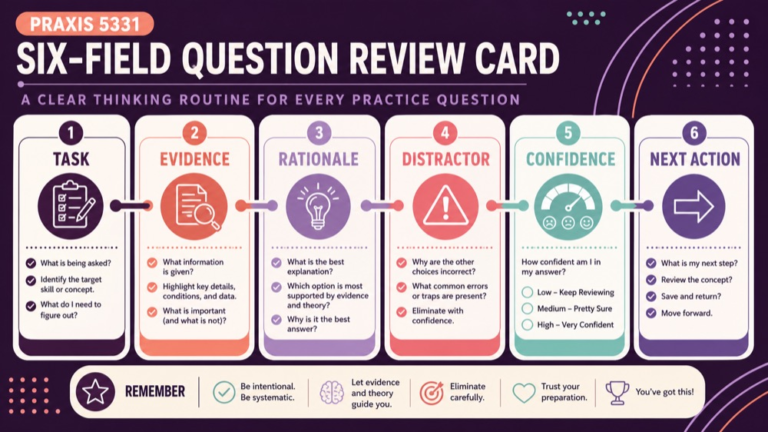
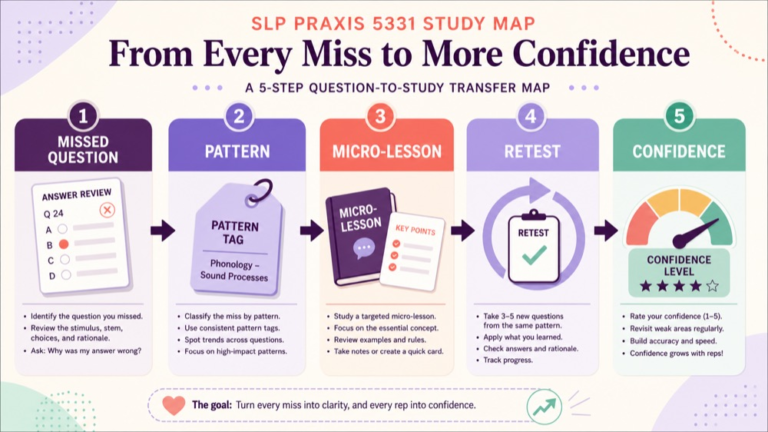
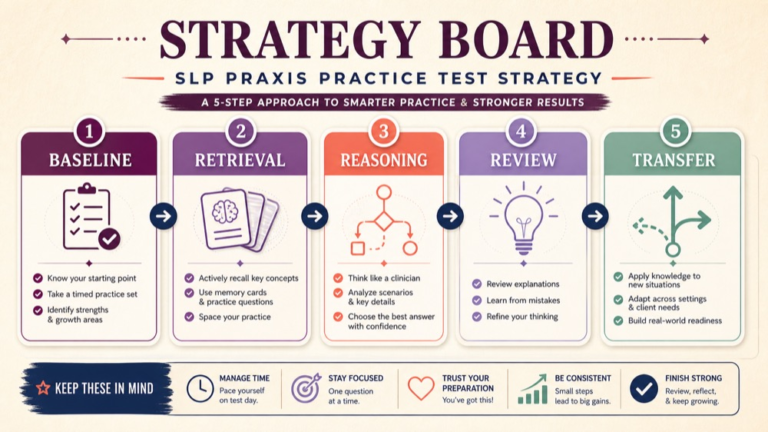
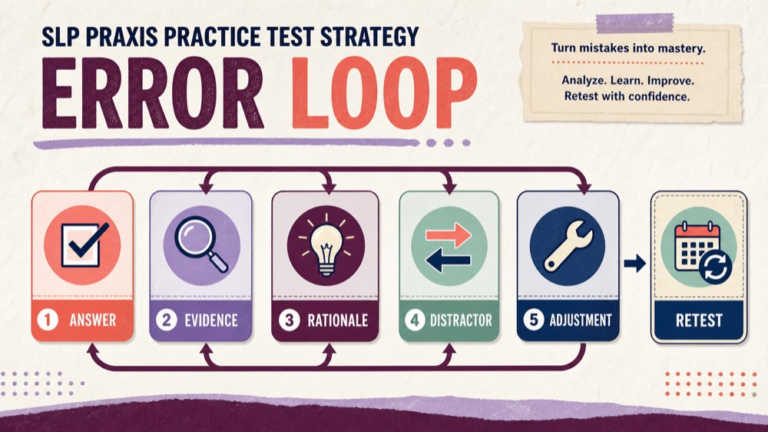
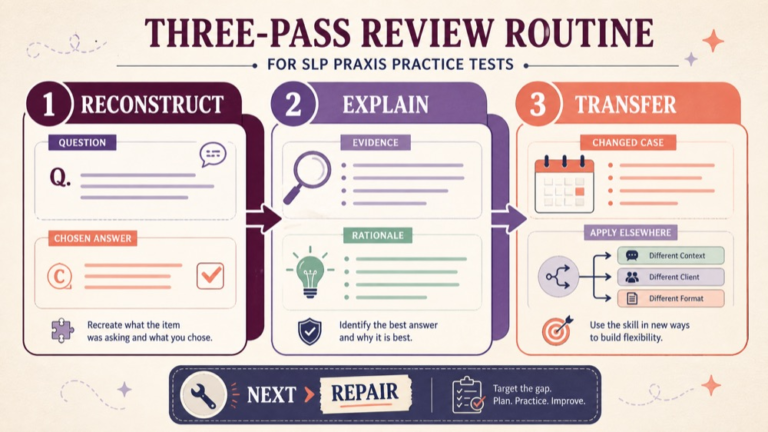
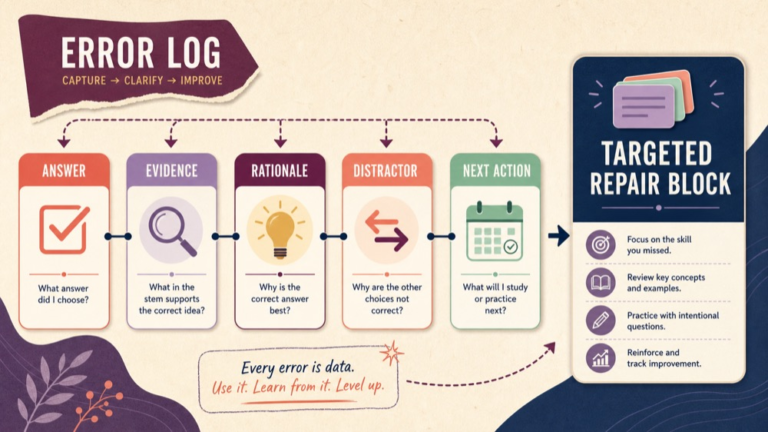
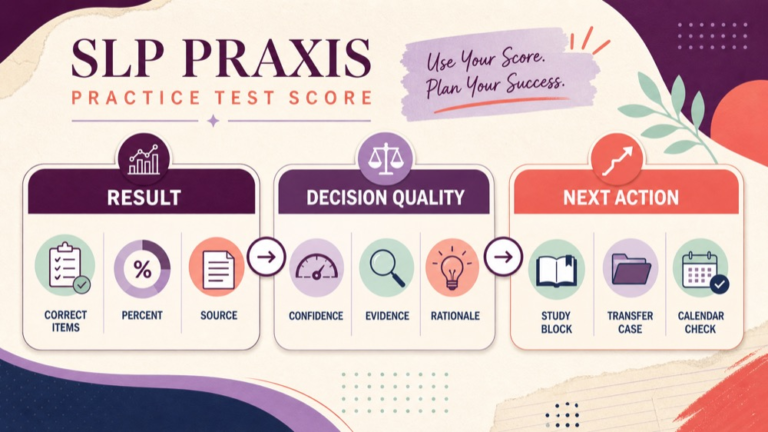
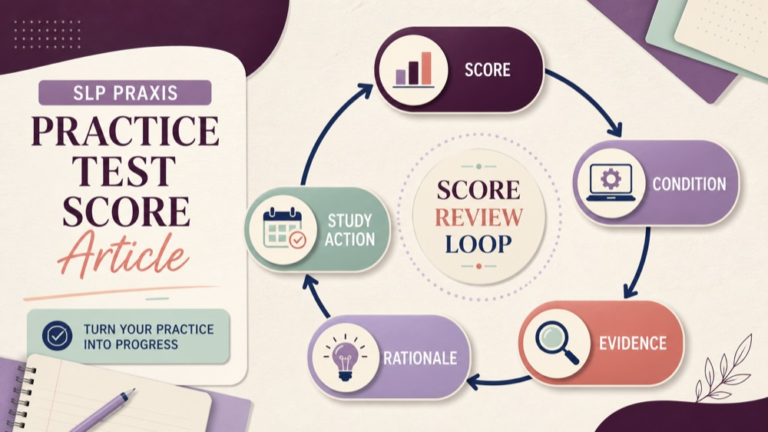
Fluency Disorders Praxis Practice Questions: Reasoning Map
Fluency disorders Praxis practice questions are easier to reason through when you separate the speech behavior from its impact, context, and requested clinical action. A stem may describe repetitions, prolongations, blocks, rapid or irregular speech, avoidance, or communication frustration. The decisive clue is often what the question asks you to assess, explain, plan, or monitor.
ASHA’s Stuttering, Cluttering, and Fluency Practice Portal frames fluency as continuity, smoothness, rate, and effort in speech production. It also distinguishes stuttering and cluttering while emphasizing that people can experience social, academic, vocational, emotional, and functional effects. Use the live ASHA and ETS pages for changing information, then use the original review system below to organize your practice.
What fluency questions are testing
A fluency item may ask you to identify a speech behavior, select a screening or assessment step, interpret a pattern, choose a functional treatment priority, or evaluate change. The word fluency is only the topic label. The final action tells you whether the answer should describe evidence, explain a distinction, plan a next step, or define a measure.
Question task
What to locate
Review output
Identify a behavior
Type, frequency, duration, rate, effort, or related behavior
Behavior note
Choose assessment
Missing speech, self-report, context, or impact evidence
Next information step
Interpret a pattern
Converging data across tasks and settings
Cautious interpretation
Plan support
Speaker priority, communication goal, and setting
Functional plan
Monitor change
Observable behavior, participation, and return condition
Outcome measure
Start by rewriting the request in plain language. If the stem asks what should be assessed next, a fluency technique may be relevant later but may not answer the current question. If the stem asks about functional impact, a count of disfluencies alone may be too narrow.
Use the case details that change the decision. A speech sample, a self-report, a family observation, a classroom presentation, a workplace call, and a response to support each answer a different question. Do not let one familiar term replace the complete evidence pattern.
Anchor review to the ASHA 5331 scope
ASHA’s current Speech-Language Pathology 5331 content page organizes broad exam areas around foundations and professional practice, screening, assessment, evaluation and diagnosis, and planning, implementation and evaluation of treatment. Fluency questions can therefore test knowledge of speech behaviors, assessment sequence, impact, collaboration, treatment planning, or progress evaluation.
5331 lens
Fluency question example
Study tag
Foundations
What speech behavior or fluency concept is described?
Definition and distinction
Screening and assessment
What information should be gathered next?
Evidence and context
Diagnosis and interpretation
What conclusion does the pattern support?
Boundary and uncertainty
Treatment planning
What priority and activity fit the person?
Function and collaboration
Treatment evaluation
How should progress be checked?
Measure and setting
Map the question to one primary lens before reviewing answer choices. A case can contain several relevant facts, but the requested action still has a stage. This prevents a treatment idea from winning a question that is asking for an assessment procedure.
Use ASHA for clinical framing and ETS for current exam logistics. Practice resources may use different labels or groupings, so translate their wording into the broad 5331 lens rather than memorizing a competitor’s page structure.
Separate speech behavior from fluency impact
ASHA describes a fluency disorder as an interruption in speech flow that can affect communication effectiveness, efficiency, and willingness to speak. This means that a review answer should distinguish what can be observed from what the speaker or communication partner experiences. Both parts can matter, and the question may emphasize one.
Evidence layer
Questions to ask
Example note
Speech behavior
What happens in the speech stream?
Sound repetitions or silent blocks occur.
Physical response
Is there tension or a related movement?
Effort rises during some moments.
Internal response
What does the speaker report or anticipate?
Speaking situations are avoided.
Listener response
How do other people react?
Turn-taking becomes rushed or uncomfortable.
Participation
What communication activity is affected?
Class discussion or phone use is limited.
A lower visible frequency does not by itself describe lower impact. Covert strategies can reduce what an observer hears while increasing word substitution, avoidance, or internal effort. When a question includes self-report or participation details, treat those details as evidence rather than decoration.
Do not make the reverse mistake either. One difficult speaking moment does not establish a broad fluency disorder. Review duration, variability, settings, speech behaviors, speaker perspective, and functional consequences before choosing a conclusion.
Compare stuttering and cluttering clues
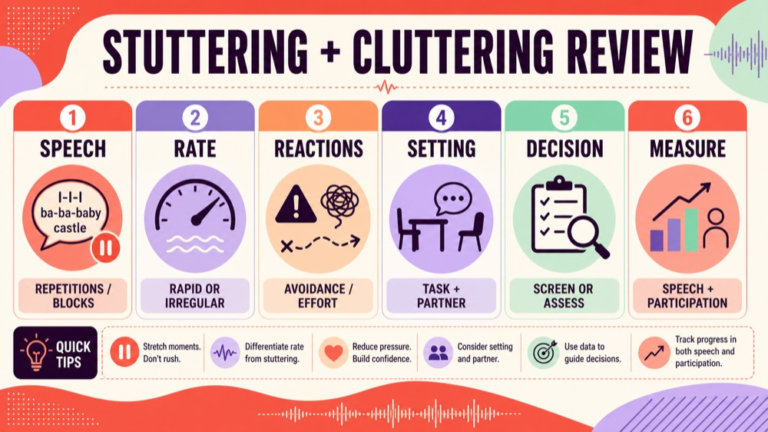
Stuttering and cluttering can overlap, but practice questions often provide a pattern that points you toward the most relevant comparison. Stuttering-like disfluencies may include sound or syllable repetitions, prolongations, blocks, and excess physical tension. Cluttering can involve a perceived rapid or irregular rate, many nonstuttering-like disfluencies, irregular pauses, over-coarticulated speech, and reduced clarity.
Clue cluster
What to examine
Reasoning caution
Stuttering-like moments
Repetitions, prolongations, blocks, tension, and reactions
Look across tasks and speaker experience.
Cluttering-like pattern
Rate, irregular pauses, revisions, and over-coarticulation
Perceived rate and intelligibility also matter.
Overlap
Whether both patterns appear in the same speaker
Do not force one label from one excerpt.
Context change
What increases or decreases the behavior?
Variability is part of the evidence.
Clinical question
What decision does the stem request?
Answer the task, not only the label.
Rate alone is not enough to explain every rapid-sounding sample. Ask whether speech is irregular, whether pauses or syllable boundaries are difficult to follow, whether the speaker notices the problem, and whether listener understanding changes. These details help distinguish a useful assessment question from a premature label.
Keep a comparison note with three fields: observed pattern, missing evidence, and requested action. This keeps a real definition from becoming an overconfident diagnosis shortcut.
Read overt, covert, and related behaviors
ASHA’s fluency guidance describes overt stuttering as openly observable and covert stuttering as involving attempts to hide or conceal stuttering through avoidance or escape. Related behaviors can include physical movements, facial changes, unexpected sounds, word substitutions, fillers, circumlocution, or other efforts that change the speaking event.
Mark overt behavior when the speech interruption is directly observable in the sample.
Mark covert behavior when the speaker reports concealment, avoidance, or substitution that hides the expected word or sound.
Mark secondary behavior when a movement or sound accompanies a moment of stuttering without assuming its intent.
Mark escape behavior when the action occurs during a moment and appears intended to end it.
Mark avoidance behavior when the action occurs before the expected moment and changes what the speaker chooses to say.
Ask the speaker how the behavior feels and what communication goal was affected.
Timing and intent matter. A blink, filler, or word change cannot be classified responsibly from appearance alone. The same visible action may be related, avoidant, or an escape behavior depending on when it occurs and what the speaker is trying to do.
For practice, annotate the sample without judging the speaker. Record the observable event, then add speaker report and setting information when supplied. A good answer preserves the distinction between description and interpretation.
Choose assessment evidence across contexts
ASHA notes that fluency symptoms can vary by environment and that comprehensive evaluation should include speech samples across situations and tasks, self-report, reactions, and adverse impact. The correct assessment answer therefore often broadens the evidence rather than relying on one clinic conversation or one numerical count.
Evidence source
What it can add
Review caution
Background and onset
History, change over time, family or prior treatment information
History guides assessment but does not replace current data.
Speech samples
Type, frequency, duration, rate, intelligibility, and variability
Sample task, partner, and context.
Self-report
Anticipation, effort, avoidance, goals, and communication experience
Do not infer internal experience without asking.
Partner or caregiver report
Variability and participation across daily settings
Connect report to observed activities.
Functional observation
Communication effectiveness in school, work, home, or community
Define the demand and available support.
Response to support
What changes with pausing, rate adjustment, or another agreed support
Use alongside the complete pattern.
If the question asks for a comprehensive fluency assessment, choose an answer that samples relevant speech behaviors and the speaker’s experience across meaningful contexts. A single isolated task may miss variability or covert impact.
If the question asks for one narrow feature, stay narrow. For example, a question about rapid and irregular speech may need rate, pausing, intelligibility, and related behaviors, while a question about participation may prioritize self-report and real-world observation.
Include speaker, listener, and setting impact
Fluency questions often become difficult when a learner treats impact as an optional extra. A person may report frustration, reduced willingness to speak, or avoidance even when the clinic sample contains few overt moments. Another speaker may show frequent disfluency without wanting the clinician to make fluency the only goal.
Context field
Question to ask
Study note
Speaker priority
What communication change matters to the person?
Use the person’s goal to frame planning.
Listener response
What reactions affect the interaction?
Consider education and advocacy needs.
Setting
Where is communication difficult or successful?
Sample more than one relevant demand.
Participation
Which activity is limited?
Describe the task, partner, and consequence.
Support
What helps access or confidence?
Record the condition and response.
Use functional language in your review note. Instead of writing that the speaker has poor fluency, write that the speaker avoids a presentation, uses substitutions during phone calls, or reports effort when answering in a group. The second description gives the next decision something concrete to address.
ASHA identifies counseling, education, collaboration, advocacy, and functional outcomes as part of the SLP role. A practice answer that includes the speaker’s priorities and communication participation is often more complete than an answer focused only on speech counts.
Consider language and cultural context
Fluency assessment should be culturally and linguistically relevant. A multilingual speaker may show different fluency patterns across languages or speaking situations, and awareness of stuttering or cluttering can vary across individuals and cultures. The practice question may be testing whether you gather language history and collaborate with appropriate partners before interpreting a difference.
Record which languages are used, understood, and produced and how often each is used.
Ask where the fluency concern was noticed and which partners or tasks were involved.
Distinguish language-encoding difficulty, second-language learning, and fluency behaviors in the context supplied.
Use qualified collaboration or interpretation when the clinician lacks the language access needed for fair assessment.
Connect the concern to communication participation rather than assuming that one language sample represents every setting.
Do not treat a difference from a monolingual comparison as sufficient evidence of a fluency disorder. The responsible answer adds language exposure, dialect, speaker perspective, and functional context before making a broader interpretation.
Keep the same boundary when reading a question about culture or listener expectations. Cultural communication norms can affect how a behavior is noticed and described, but the answer still needs evidence about the speaker’s own experience and communication goals.
Map a fluency question from evidence to plan
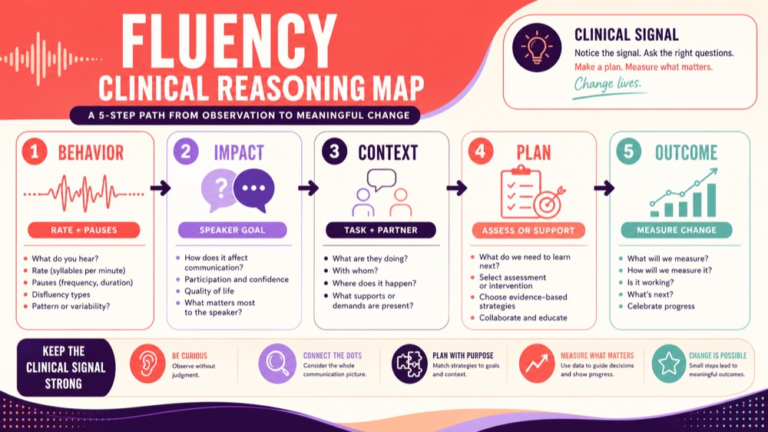
Use a five-field map for fluency questions: speech evidence, speaker impact, context, plan, and outcome. Start with what was observed or reported, connect it to the communication activity, choose the next stage-appropriate action, and define how the result will be checked.
Map field
Prompt
Example review note
Speech evidence
What behavior or pattern is present?
Repetitions increase during group speaking.
Impact
What does the speaker or partner experience?
The speaker avoids volunteering.
Context
Where, with whom, and for what purpose?
Class discussion with peer listeners.
Plan
What action fits the question and stage?
Gather samples and speaker priorities.
Outcome
How will change be observed?
Participation with a defined support condition.
The map protects against two common errors. One is jumping from a visible behavior to a broad diagnosis. The other is choosing a technique without knowing what the speaker wants to change. If evidence or impact is missing, the plan may be to gather it before selecting an intervention target.
Change one field for transfer practice. Keep the behavior the same but change the setting, partner, or participation goal, then state whether the assessment, support, or outcome measure should change. This turns a memorized rationale into flexible reasoning.
Use a behavior-impact-context review board
A review board separates what happened in speech from what it means for the speaker and what decision the case supports. Place the observable behavior in the first column, then add speaker response, listener or setting context, clinical stage, and measurement. This structure is useful when a stem contains several competing clues.
Board column
Write
Check
Behavior
Type, rate, pauses, effort, or related actions
What was directly observed?
Speaker impact
Feelings, anticipation, avoidance, or communication goal
What did the speaker report?
Context
Partner, task, language, setting, and listener response
Where does the pattern change?
Decision
Screen, assess, interpret, plan, or monitor
What does the final request ask?
Measure
Observable speech or participation result
What return condition will be checked?
Use the board after answering a mixed set. Group misses by behavior identification, assessment sequence, speaker impact, cultural context, treatment planning, or outcome evaluation. The group with the most misses becomes the next small study block.
Keep your notes in your own words. The board is a reasoning tool, not a place to reproduce flashcard wording, screenshots, or protected question-bank material. A concise behavior-impact-context summary is enough to create an original transfer item.
Question 1: fluency screening and assessment
Question 1: A school-age child shows sound repetitions and occasional blocks during a brief clinic conversation. The caregiver reports that the child avoids answering in class, but the practice item provides no information about speaking in other settings, the child’s reactions, or the pattern over time. Which next step best adds responsible fluency evidence?
A. Count the disfluencies in the brief conversation and treat that count as the complete clinical picture.
B. Gather speech samples across relevant tasks and settings while asking about the child’s and caregiver’s observations, reactions, and communication priorities.
C. Tell the child to slow down and end the assessment once the speech sounds smoother.
D. Conclude that the child has no fluency concern because the conversation was short.
Correct Answer: B. The case already includes observable behaviors and a participation concern, but important context and speaker-experience evidence are missing. Samples across meaningful tasks plus child and caregiver perspectives can clarify variability, impact, and the next stage-appropriate decision.
Why the Other Options Are Wrong: A narrows the assessment to one count and ignores participation. C gives a technique before the missing evidence and priorities are understood. D treats a brief sample as representative without examining settings, reactions, or change over time.
Exam Trap: A fluency assessment is not reduced to the number of disfluencies in one conversation. When the stem supplies impact or variability clues, include them in the assessment plan.
Question 2: covert fluency impact
Question 2: A college student reports avoiding class presentations and substituting words before speaking, yet produces few overt stuttering-like moments during a relaxed clinic interview. Which interpretation and assessment action best fit the information?
A. Assume that the low clinic frequency means the communication impact is negligible.
B. Explore the student’s self-report and avoidance, then sample speech in relevant tasks or settings to examine overt and covert features.
C. Diagnose a separate language disorder from word substitutions without additional context.
D. Remove presentations from the student’s goals because avoidance means the task is not clinically relevant.
Correct Answer: B. The student’s report is direct evidence about communication experience, and a relaxed interview may not reproduce the demand that triggers avoidance. A broader assessment can examine speech behavior, context, internal response, and participation without treating one sample as the whole picture.
Why the Other Options Are Wrong: A confuses fewer observable moments with lower impact. C assigns a broad interpretation to one behavior without checking intent, context, or the fluency pattern. D removes a stated participation concern instead of using it to guide assessment and planning.
Exam Trap: Covert strategies can hide the behavior an observer expects to count. When a speaker reports avoidance or substitution, assess the experience and relevant contexts rather than dismissing it.
Question 3: cluttering features and planning
Question 3: An adult’s conversation is perceived as rapid and difficult to follow. The sample includes irregular pauses, revisions, collapsed syllables, and reduced intelligibility, but the case does not yet describe the speaker’s awareness or goals. Which next review action is most appropriate?
A. Label the pattern from the perceived rate alone and skip further context.
B. Examine rate, pausing, speech clarity, related disfluencies, speaker perspective, and functional communication needs before selecting a plan.
C. Treat every rapid speech sample as stuttering and focus only on sound repetitions.
D. Choose a fixed speech-rate target without identifying the communication setting or desired outcome.
Correct Answer: B. The cluster suggests a fluency question involving rate, irregularity, intelligibility, and related behaviors, but the missing speaker perspective and functional context still matter. A complete review supports a plan that is connected to the person’s communication needs and measurable outcome.
Why the Other Options Are Wrong: A makes perceived rate a diagnosis shortcut. C ignores the pattern described and narrows the review to a different behavior cluster. D selects a target before knowing the setting, the speaker’s priority, or how change will be evaluated.
Exam Trap: Do not let one salient clue, such as rapid speech, replace the full pattern. Read the associated behaviors and the unanswered context questions before choosing the next action.
Review common fluency distractors
Fluency distractors often contain a true term placed at the wrong stage or stripped of context. A speech count may be relevant but insufficient for impact. A technique may be useful but premature. A rapid rate may be a clue but not a complete interpretation. Identify the mismatch rather than simply memorizing the correct letter.
Distractor pattern
Why it attracts attention
Review test
Single-count shortcut
The number feels objective
What contexts and impacts are missing?
Clinic-only sample
The setting is easy to control
Would the behavior vary elsewhere?
Technique too early
The action sounds practical
Are priorities and evidence established?
Rate-only label
Rapid speech is memorable
What pauses, clarity, and related behaviors appear?
Speaker-experience omission
Internal impact is less visible
What does the person report or avoid?
Write the nearest distractor mismatch in one sentence. It might ignore covert impact, confuse screening with comprehensive assessment, choose an intervention before clarifying the goal, or treat a language or cultural difference as fluency evidence without context.
Then state the decisive clue in your own words. The best rationale explains why the selected answer fits the requested stage, evidence pattern, and speaker priority.
Build a fluency practice block
Use a small block that mixes definitions, assessment, interpretation, planning, and evaluation. Include stuttering-like behaviors, cluttering-like features, speaker impact, context variability, multilingual considerations, and collaboration when the question supports them.
Block part
Example prompt
Review product
Behavior
Which speech feature is described?
Observable behavior note
Assessment
What evidence should be gathered next?
Source and setting plan
Impact
What communication activity is affected?
Speaker-priority note
Planning
What action fits the goal and stage?
Functional rationale
Evaluation
How will change be monitored?
Measure and return condition
Boundary
What conclusion is not supported yet?
Caution statement
Keep the block small enough to review eight to fifteen questions carefully. For each item, record the requested action, the evidence that controls the decision, the closest distractor, and the missing information that would change your answer.
Create one transfer prompt after the block. Change the speaking partner, task, language, setting, or support and explain which evidence or outcome field must be updated. Transfer practice checks whether you understood the reasoning instead of recognizing familiar wording.
Track reasoning and confidence
A fluency tracker should record the source, date, question task, original answer, confidence, behavior pattern, context, speaker impact, closest distractor, and next action. These fields make a score more useful because they show whether the miss came from definition, evidence selection, interpretation, planning, or evaluation.
Tracker field
Prompt
Example
Requested action
What did the item ask me to do?
Choose the next assessment step.
Behavior
What was observed or reported?
Blocks and word avoidance in class.
Context
Where does the pattern appear?
Presentation with peer listeners.
Confidence
How certain was I before feedback?
Two choices remained.
Distractor
Why was the nearest option weaker?
It used one clinic count only.
Next action
What will I practice?
Compare impact evidence across settings.
Review high-confidence misses and low-confidence correct answers. A correct letter without a rationale may reflect recognition, while a confident miss may reveal a rule that needs to be rebuilt from the case evidence and the requested action.
Use the ASHA Practice Portal when a fluency concept needs clarification, and keep exam-administration details tied to the current ETS page. The study tracker supports learning; it does not replace professional judgment or individualized assessment.
Fluency disorders Praxis practice questions checklist
Use this checklist for each small fluency-disorders practice set.
I identified whether the item asked for behavior identification, screening, assessment, interpretation, treatment planning, or monitoring.
I mapped the item to a broad 5331 lens and wrote the final request in my own words.
I separated observable speech behavior from speaker impact, listener response, and participation.
I compared stuttering-like and cluttering-like clues without forcing a label from one excerpt.
I looked for overt, covert, secondary, avoidance, or escape behaviors and considered timing and intent.
I selected evidence across relevant tasks, settings, partners, and communication demands.
I included self-report and caregiver or partner information when the case supports it.
I considered language exposure, dialect, cultural context, and qualified collaboration.
I explained why the selected answer fits the stage and the evidence.
I named the closest distractor and its specific mismatch.
I wrote the rationale in my own words without copying protected source material.
I created one changed-context transfer prompt.
I specified an observable speech or participation outcome and return condition.
I rechecked changing exam and professional information with the responsible source.
The checklist keeps fluency questions connected to evidence, speaker priorities, and function. The goal is not to assign a broad label from one behavior or count. The goal is to explain what the case supports, what remains unclear, what action fits, and how the result will be checked.
Use the live ETS Speech-Language Pathology 5331 page for current exam identity and administration information, and the ETS practice-test selector for current preparation options. Read each resource’s access terms and do not treat third-party flashcards as official exam material.
For a structured preparation path, see the SLP Study Center Complete Prep resource. On your next study block, answer a small mixed fluency set, build three behavior-impact-context cards, and create one changed-setting transfer question with a measurable review outcome.
Language Disorders Praxis Practice Questions: Study Map
Language disorders Praxis practice questions become more useful when each answer is tied to a language dimension, an evidence source, a functional context, and a next clinical decision. Instead of memorizing a list of terms, ask whether the item is testing comprehension, expression, language form, meaning, use, assessment selection, intervention planning, or outcome monitoring.
ASHA’s Speech-Language Pathology (5331) content page includes receptive and expressive language in both assessment and treatment topics. ASHA’s Spoken Language Disorders Practice Portal supplies a professional frame for language assessment, intervention, collaboration, and culturally responsive service delivery. Use the live ETS and ASHA pages for changing exam or professional information, and use the original review system below to organize practice.
What language-disorder questions are testing
A language item may ask you to identify the skill, choose an assessment procedure, interpret a case, prioritize an intervention, or select an outcome measure. The topic label is only the doorway. The final request tells you whether the item wants information, interpretation, a goal, an activity, or an evaluation step.
Question task
What to locate
Review output
Identify a skill
Comprehension, expression, form, meaning, or use
Language-dimension note
Choose assessment
Missing evidence and appropriate data source
Next information step
Interpret performance
Pattern across tasks and contexts
Evidence-based statement
Plan treatment
Functional goal and support level
Goal or activity rationale
Evaluate progress
Measure, setting, and return point
Monitoring plan
Start the review by writing the requested action in your own words. If the item asks what should be assessed next, an intervention activity may be reasonable later but still fail the current task. If the item asks for a functional goal, a test label alone may not answer the question.
Use the evidence supplied by the case. A score, a language sample, a caregiver report, a classroom observation, and a response to support each answer a different question. Do not give one data source more authority than the item makes relevant.
Anchor review to the ASHA 5331 scope
ASHA’s 5331 content page organizes the exam into foundations and professional practice, screening assessment evaluation and diagnosis, and planning implementation and evaluation of treatment. Receptive and expressive language appear within assessment procedures and treatment topics, while a case may also involve development, etiology, documentation, collaboration, or culturally responsive service delivery.
5331 lens
Language question example
Study tag
Foundations
Typical language performance or communication factors
Knowledge and context
Assessment
What language evidence should be gathered?
Data source and sequence
Diagnosis
What interpretation is supported?
Pattern boundary
Treatment planning
What goal or activity fits the need?
Function and implementation
Treatment evaluation
How should progress be monitored?
Measure and outcome
Use the live ASHA and ETS pages for current content and administration information. A practice resource may use different headings, so map its label to the broad lens in your tracker. The map helps you see whether a miss came from language knowledge, assessment sequence, functional reasoning, or treatment evaluation.
Do not assume that every language question is a vocabulary question. Receptive and expressive language can involve phonology, morphology, syntax, semantics, pragmatics, and communication across listening and speaking. Read the case for the dimension and requested decision.
Define the language dimension before answering
ASHA describes language as a communication system that can involve comprehension and use across spoken, written, and signed modalities. For the spoken-language questions in this study set, identify whether the case emphasizes understanding, formulation, language form, meaning, social use, or the interaction among them.
Mark receptive language when the case centers on understanding messages or directions.
Mark expressive language when the case centers on formulating words, phrases, or narratives.
Mark morphology or syntax when word endings or sentence structure control the task.
Mark semantics when vocabulary, concepts, or relationships carry the decision.
Mark pragmatics when language use changes with a partner, purpose, or context.
Mark literacy or another modality when the item explicitly expands beyond spoken language.
Dimension
Question to ask
Example review note
Receptive
What does the person understand?
Needs support for multi-step directions.
Expressive
How does the person formulate language?
Uses short phrases during conversation.
Form
How are words and sentences built?
Sentence structure varies by task.
Meaning
What concepts or relationships are expressed?
Word knowledge affects explanation.
Use
How does language serve the interaction?
Repair is difficult with a partner.
Keep the dimension connected to the task. A child can show difficulty with several dimensions, but the practice question may ask you to isolate one for assessment or planning. The best review note names the dimension and the evidence that supports it.
Read the task before the language label
Language questions can use broad labels such as language disorder, developmental language, vocabulary, or grammar. Those labels do not replace the final request. Read the action word and then summarize the case in one sentence that includes the goal, context, and stage.
Action word
Review prompt
Common wrong turn
Assess
What information is missing?
Choosing an activity too early
Identify
What pattern is described?
Adding facts not in the case
Prioritize
Which need matters first?
Picking the easiest skill
Recommend
What fits the goal and context?
Ignoring setting or partner
Monitor
How will progress be checked?
Using a vague outcome
Record your first answer and confidence before reading the rationale. Then compare the option you chose with the closest distractor. A familiar language term can still appear in an answer that is too early, too broad, or poorly matched to the requested action.
Use the smallest number of case details that changes the decision. That might be phrase length, comprehension under a condition, narrative organization, caregiver concern, classroom demand, or response to a support.
Choose assessment evidence with purpose
An assessment question should be reviewed by asking what uncertainty the next step will reduce. Case history, language sampling, observation, standardized measures, dynamic assessment, hearing information, and collaboration can contribute different kinds of evidence. Choose the source that matches the question and the person’s context.
Evidence source
Useful question
Review caution
Case history
What developmental, medical, educational, or language factors matter?
History guides the plan but does not replace direct data.
Language sample
How is language used in connected communication?
Consider task, partner, and context.
Observation
What happens in a natural activity?
Describe the demand and support.
Standardized measure
What skill does the tool sample?
Check appropriateness and interpretation.
Dynamic assessment
How does performance respond to teaching or support?
Use it with other evidence.
Collaboration
What do caregivers, teachers, or partners observe?
Connect reports to the functional goal.
When a question asks about phrase length, for example, a connected language sample may provide more relevant information than a task that only measures naming. When a question asks about response to support, a teaching-and-retest format may be more informative than a single score.
Do not turn one assessment tool into a universal answer. The best choice depends on what the stem has already established, what remains unclear, and how the information will be used.
Review receptive language questions
Receptive language questions focus on understanding words, concepts, sentences, directions, narratives, or interactional messages. Look for the level of support, the length or complexity of the input, the response expected, and the context in which understanding matters.
Receptive clue
Review question
Possible next step
Single-step versus multi-step
Does complexity change performance?
Sample direction following across levels
Vocabulary in context
Does meaning change by topic?
Check comprehension and use in context
Story understanding
Can the listener identify key relationships?
Use narrative comprehension prompts
Classroom demand
Which instruction features create difficulty?
Observe and modify the task
Support response
Does visual or verbal support change access?
Document the support and response
Separate comprehension from performance on a task that also requires memory, attention, motor response, or a specific cultural experience. The question may ask you to gather more information rather than assign the difficulty to language alone.
Use a review sentence that includes input, response, and context. For example, the learner follows a short direction with visual support but loses the sequence when the instruction includes more steps. That sentence points toward a targeted assessment question.
Review expressive language questions
Expressive language questions focus on how a person selects and organizes words, phrases, sentences, narratives, or messages. Note whether the issue concerns vocabulary, grammar, sentence length, story structure, word retrieval, or communication repair.
Expressive clue
Review question
Useful evidence
Phrase length
How long and varied are spontaneous utterances?
Language sample across activities
Grammar
Which forms are used or omitted?
Connected speech and elicited probes
Vocabulary
Can words be retrieved and used flexibly?
Naming plus contextual use
Narrative
Are events and relationships organized?
Story retell or personal narrative
Repair
Can the speaker clarify a message?
Conversation with a communication partner
Phrase length is best reviewed in relation to the task that produced it. A single imitation response does not describe spontaneous language use. A naming score does not settle narrative organization. Match the data source to the claim the question asks you to make.
When the item names a functional goal, include the listener and setting in your review. An expressive language activity should connect to what the person needs to communicate, not only to the form that is easiest to count.
Use language samples and functional context
Language sampling and observation help connect a practice question to communication outside a test page. Record who was speaking, what the task required, what support was available, and whether the person could participate or repair a breakdown. Those fields keep the interpretation grounded.
Context field
Question to ask
Why it matters
Partner
Who was listening or responding?
Language demand changes with the partner.
Purpose
Why did the person need to communicate?
Connects data to function.
Task
What had to be understood or expressed?
Defines the language demand.
Support
What cue or visual was available?
Shows response to access.
Repair
Could the person clarify or request help?
Shows functional communication.
Setting
Where did the sample occur?
Supports transfer planning.
A language sample can show how skills operate together. A practice answer should still respect the question’s scope. If the item asks for one next assessment step, do not turn the response into a complete diagnostic protocol.
Use a changed-context prompt after review. Keep the language target stable while changing the partner, activity, topic, or support. Then ask which evidence or goal would need to be updated.
Consider multilingual and dialect context
A language difference is not the same as a disorder. ASHA’s Spoken Language Disorders Practice Portal points clinicians toward culturally responsive service delivery, collaboration, and attention to the languages used by the person. In a practice question, look for language exposure, dialect, interpreter or cultural broker needs, assessment language, and functional impact.
Context clue
Review question
Responsible study note
Home language
Which language systems are used?
Gather relevant language history.
Dialect
Is the feature expected in the dialect?
Do not treat difference as sufficient evidence.
Assessment language
Does the tool sample the person’s skills fairly?
Check validity and access.
Partner support
Who can contribute accurate communication information?
Plan collaboration or interpretation.
Functional concern
What participation outcome is affected?
Keep the goal person-centered.
Do not infer a broad language disorder from performance in one unfamiliar language without the context the case requires. The best answer may be to gather information across languages, collaborate with an appropriately qualified partner, or use a procedure that helps distinguish language difference from disorder.
For exam review, write the boundary rather than a slogan: interpret language performance in the relevant linguistic and functional context, then choose assessment or support that fits the evidence.
Map a language question from evidence to plan
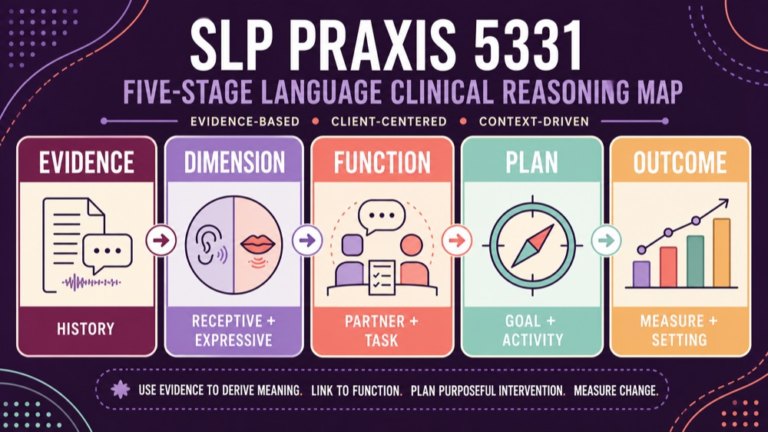
Use a five-field map for language questions: evidence, language dimension, function, plan, and outcome. Start with what the person understands or expresses, identify the dimension involved, connect it to the communication demand, select the next action, and decide how progress will be monitored.
Map field
Prompt
Example note
Evidence
What data does the case provide?
Directions are missed as steps increase.
Dimension
What language process is involved?
Receptive understanding of sequence.
Function
Where does the difficulty matter?
Classroom routines and home tasks.
Plan
What step fits the question and stage?
Sample comprehension under varied demands.
Outcome
How will the change be checked?
Independent response in a relevant activity.
The map prevents a vocabulary label from becoming the whole answer. If the case lacks context, the plan may be additional assessment. If the goal is functional participation, the outcome should include an activity or partner that reflects that goal.
Change one meaningful detail for transfer practice. Change the language, partner, task complexity, or support, then state which map field changes and why. This is a concise way to practice clinical reasoning without copying a question source.
Use a receptive-expressive review board
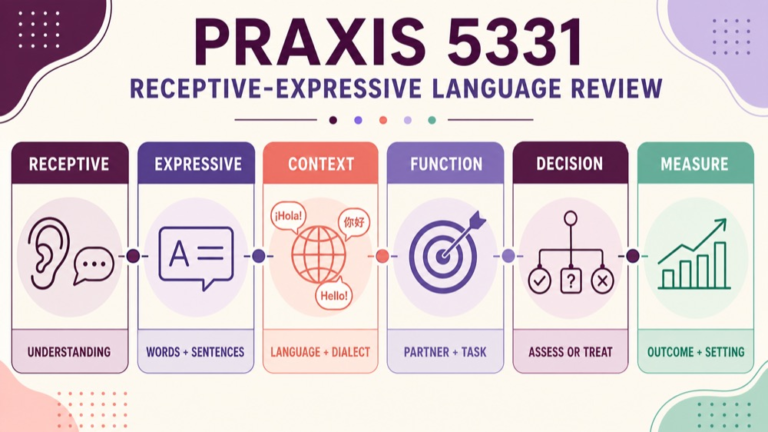
A review board separates what the case says from what you infer and what you plan. Put receptive evidence and expressive evidence in the first columns, add context and function, then choose a decision and a measure. This structure is useful when a question includes more than one language behavior.
Board column
Write
Check
Receptive
Understanding of words, concepts, sentences, or directions
What input and support were present?
Expressive
Words, phrases, grammar, narratives, or repair
What communication output was required?
Context
Language, dialect, partner, task, and setting
Is the interpretation fair and relevant?
Function
Participation goal and communication consequence
What matters to the person?
Decision
Assessment, goal, intervention, or outcome
Does it answer the final request?
Measure
Observable result and return condition
How will progress be checked?
Use the board after a mixed practice block. Group misses by dimension, evidence source, context, treatment planning, or evaluation. Then select one repair group for the next study session.
Keep the board in your own words and do not reproduce protected question text or screenshots. A paraphrased case, a language dimension, an evidence note, and an original transfer prompt are enough for active review.
Question 1: assessment and phrase length
Question 1: A child uses short spontaneous utterances during play, but the practice set provides no information about connected language outside a naming task. The item asks which procedure would best add information about phrase length in functional language use.
A. Complete only a divergent naming task with pictured objects.
B. Collect and analyze a language sample during an appropriate connected communication activity.
C. Use an isolated speech-sound imitation task as the primary language measure.
D. Choose a treatment activity before gathering more expressive-language data.
Correct Answer: B. A connected language sample can show the length and variety of spontaneous utterances in context. The review should still record the activity, partner, supports, and analysis method because those details affect interpretation.
Why the Other Options Are Wrong: A may sample naming but does not directly answer the question about spontaneous phrase length. C targets a different domain. D moves to treatment before the missing expressive-language evidence is gathered.
Exam Trap: A task that produces words is not automatically a measure of connected language. Match the procedure to the language behavior named in the question.
Question 2: functional treatment planning
Question 2: A student follows classroom directions when a visual checklist is available but misses the sequence during a routine without the checklist. The stated goal is more independent participation in classroom routines. Which review action best fits?
A. Remove the classroom goal and practice unrelated single-word naming.
B. Plan graded practice of the direction sequence in relevant routines while monitoring support and independence.
C. Conclude that the student cannot understand directions in any setting.
D. Measure only vocabulary size because all direction-following problems are vocabulary problems.
Correct Answer: B. The case shows a difference between supported and less-supported performance in a functional context. A graded plan can preserve access while examining whether independent participation increases.
Why the Other Options Are Wrong: A removes the stated functional goal. C generalizes from one condition to every setting. D narrows the problem to vocabulary without evidence. The best option connects activity, support, and outcome to the classroom routine.
Exam Trap: A support can reveal access needs rather than settle the underlying interpretation. Review what changes when the support is present and how the goal is defined.
Question 3: multilingual assessment context
Question 3: A multilingual child uses fewer English words in a school sample than expected by a monolingual comparison, but the case gives no information about the child’s home language, exposure, or communication in that language. Which next step is most responsible?
A. Label a language disorder from the English sample alone.
B. Gather language history and appropriate information across the child’s communication systems, using qualified collaboration when needed.
C. Treat the English vocabulary count as a complete measure of overall language ability.
D. Skip assessment because multilingual children cannot have language needs.
Correct Answer: B. The case lacks linguistic and functional context needed for fair interpretation. Gathering relevant history and information across the child’s communication systems supports a more responsible assessment decision.
Why the Other Options Are Wrong: A and C treat one language sample as a complete picture. D makes an unsupported conclusion in the opposite direction. The best response adds context and collaboration before interpretation.
Exam Trap: A difference from a monolingual comparison is not enough by itself. Check language exposure, dialect, assessment access, and functional communication before assigning a disorder interpretation.
Review common language-question distractors
Language distractors often use a real term in the wrong task, context, or stage. A naming task may be relevant to vocabulary but not to spontaneous phrase length. A grammar activity may be useful but not the answer when the question asks for receptive comprehension. A functional support may help access without settling the diagnosis.
Distractor pattern
Why it attracts attention
Review test
Familiar assessment
The tool name is easy to recall
Does it sample the requested skill?
Single-language shortcut
The score looks concrete
What language context is missing?
Premature treatment
The activity sounds practical
Has the assessment question been answered?
Broad conclusion
It simplifies a complex case
What evidence limits the claim?
Vague goal
It sounds supportive
What person, task, and outcome are named?
Write the closest distractor mismatch in one sentence. The option is weaker because it measures naming instead of connected language, ignores the learner’s linguistic context, or chooses an activity without defining the functional outcome. Specific language turns a missed item into a reusable rule.
Use the final request as the last filter. If the question asks what should be assessed, do not choose a treatment activity just because it might be useful later.
Build a language practice block
Use a small block that mixes language dimensions and question tasks. Include receptive, expressive, form, meaning, use, assessment, treatment planning, and outcome monitoring when the resource provides those categories. Review every item with the evidence-to-plan map.
Block part
Example question
Review product
Receptive
What input or support changes understanding?
Evidence and context note
Expressive
What data show language formulation?
Sample choice
Form
Which grammar feature is described?
Dimension and example
Meaning
How does vocabulary affect the task?
Functional connection
Use
What communication purpose matters?
Partner and setting
Plan
What activity fits the goal and stage?
Goal and measure
Keep the block small enough to review eight to fifteen questions carefully. A short set with clear rationales can reveal whether the problem is language knowledge, evidence selection, context, treatment sequencing, or outcome definition.
Create one changed-case prompt after the block. Change the partner, language, setting, support, or task complexity and explain which answer field changes. This supports transfer beyond the original wording.
Track reasoning and confidence
A language-question tracker should include the source, date, original answer, confidence, requested action, language dimension, evidence, closest distractor, and next step. These fields make a score more interpretable and help you choose a targeted study block.
Tracker field
Prompt
Example
Task
What did the item ask me to do?
Choose the next assessment procedure.
Dimension
What language process is central?
Expressive phrase length.
Evidence
Which clue controls?
Spontaneous language is not sampled.
Confidence
How certain was I before feedback?
Low, two choices remained.
Distractor
Why was the nearest choice weaker?
It measured naming instead of connected use.
Next action
What will I practice?
Three assessment-source comparisons.
Review high-confidence misses and low-confidence correct answers. A correct letter without a rationale may reflect recognition, while a confident miss may reveal a language rule that needs to be rebuilt from the case evidence.
Use ASHA’s Practice Portal as a professional reference point when a clinical concept is unclear, and keep individual case decisions tied to the information supplied. The practice card teaches reasoning; it does not replace appropriate professional judgment.
Language disorders Praxis practice questions checklist
Use this checklist for each small language-disorders practice set.
I identified whether the item asked for assessment, interpretation, treatment, or monitoring.
I mapped the case to a 5331 lens and noted the language dimension.
I separated receptive, expressive, form, meaning, and use clues when relevant.
I recorded the evidence source: history, sample, observation, measure, dynamic response, or collaboration.
I connected the language behavior to a partner, task, setting, or participation goal.
I considered language exposure, dialect, assessment language, and qualified collaboration.
I explained why the best option fits the stage and the stated request.
I named the closest distractor and its specific mismatch.
I wrote the rationale in my own words without copying protected source material.
I reviewed high-confidence misses and low-confidence correct answers.
I created one changed-context transfer prompt.
I specified an observable outcome and return condition.
I used clear, compressed images and lazy loading on the study page.
I rechecked changing exam and professional information with the responsible source.
The checklist keeps language questions connected to evidence and function. Your goal is not to assign a broad label from one phrase or score. Your goal is to explain what the case supports, what information is missing, what action fits, and how the result would be checked.
For a structured preparation path, see the SLP Study Center Complete Prep resource. On your next study block, choose one language dimension, complete a small mixed set, build three evidence-to-plan cards, and test one changed context.
Speech Sound Disorders Praxis Practice Questions: Review
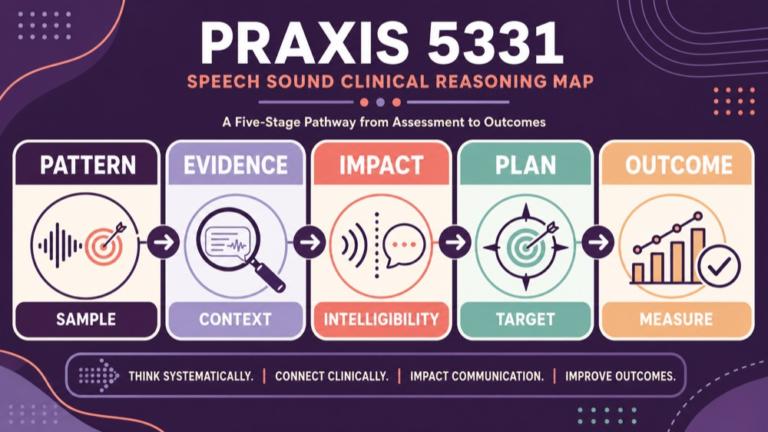
Speech sound disorders Praxis practice questions are easier to use when you organize them around a clinical decision rather than a list of terms. Ask what the speech pattern is, what evidence supports the interpretation, how the concern affects communication, which next step fits the stage, and how an outcome would be checked. That sequence turns a selected-response item into a compact reasoning exercise.
ASHA’s Speech-Language Pathology (5331) content page includes speech sound production within the treatment topics and places it inside a broader exam that also covers foundations, assessment, diagnosis, treatment planning, and evaluation. ASHA’s Speech Sound Disorders: Articulation and Phonology Practice Portal provides the clinical frame for the distinctions and treatment phases below. Use the live ETS and ASHA pages for changing exam or professional information.
What speech sound questions are testing
Speech sound questions may test content knowledge, but many also test how you move from a case detail to a responsible clinical decision. The item may ask you to identify a pattern, choose the next assessment step, prioritize a target, select a treatment phase, or evaluate progress. Start by naming the action in the final request.
Question task
What to locate
Review output
Identify a pattern
Distribution, consistency, and sound class
Pattern statement
Choose assessment
Missing evidence and context
Next information step
Prioritize a target
Stimulability, impact, and client factors
Target rationale
Choose treatment phase
Current production level and carryover
Phase decision
Evaluate progress
Measure, setting, and outcome
Monitoring plan
A strong review note says what the stem supplied, what it did not supply, and why the chosen answer fits the stage. That prevents a familiar treatment label from pulling you past an unanswered assessment question.
Keep clinical reasoning separate from memorized developmental lists. A question can include an age or sound detail, but the answer may depend on intelligibility, context, consistency, stimulability, or the stated goal. Read the whole case before choosing a rule.
Anchor review to the ASHA 5331 scope
The ASHA 5331 content page groups the exam into foundations and professional practice, screening assessment evaluation and diagnosis, and planning implementation and evaluation of treatment. Speech sound production appears within the treatment topics, but a speech sound item can draw on more than one category.
5331 lens
Speech sound question example
Study tag
Foundations
Typical performance, communication factors, or development
Knowledge and context
Assessment
What information should be gathered?
Evidence and sequence
Diagnosis
What pattern is supported by the data?
Interpretation boundary
Treatment planning
What target or phase fits now?
Goal and implementation
Treatment evaluation
How should progress be monitored?
Measure and outcome
Use the live ASHA and ETS pages for current scope and administration details. Your practice set may use a different label or order, so map the resource’s topic to the broad lens in your tracker. This makes review transferable across study sources.
Do not assume a question is only about articulation because one sound is named. Look for the decision being requested. A single consonant can appear in an assessment, target selection, generalization, or culturally responsive service question.
Record the lens beside every important miss. The lens gives you a better next action than a vague note that says speech sounds were difficult.
Distinguish articulation, phonology, and motor cues
ASHA describes speech sound disorders as difficulties involving perception, motor production, phonological representation, or phonotactic rules, and notes that one child can show more than one error type. A practice question may ask you to distinguish a sound-specific production issue from a broader pattern or from a motor or neurological concern.
Review lens
Case clue to examine
Do not skip
Articulation
Specific sound production and placement
Context and stimulability
Phonology
Pattern across sounds or word positions
Distribution and contrast
Perception
Ability to hear or distinguish contrasts
Hearing and access considerations
Motor production
Movement, consistency, and speech control
Relevant history and differential scope
Phonotactics
Permissible sound sequences in the language
Language and dialect context
Use the information actually supplied. If the stem gives only a single production sample, be cautious about a broad conclusion. If it gives a repeated pattern across contexts, that distribution may carry more weight. If it mentions neurological or structural factors, identify whether the question is asking you to use a different clinical frame.
On a practice card, write the clue that separates the top two interpretations. That clue may be consistency, sound class, word position, perceptual access, or the presence of a relevant condition. The comparison is often more valuable than the label alone.
Start with the assessment question
When a speech sound item asks what to do next, begin with the missing evidence. Ask whether the case includes a speech sample, hearing information, language or dialect context, stimulability, intelligibility, functional impact, and relevant history. Then choose the next step that reduces the uncertainty named in the stem.
Evidence area
Question to ask
Why it can matter
Speech sample
What errors occur and where?
Shows distribution and patterns
Hearing
Is auditory access relevant?
Supports interpretation of sound learning
Stimulability
Can the sound be elicited with support?
Informs target planning
Intelligibility
How does the issue affect listeners?
Connects data to function
Context
Does performance change by task or setting?
Shows functional demands
Language and dialect
Is the pattern expected in the speaker’s system?
Protects fair interpretation
A distractor may sound clinically sophisticated but still be premature if the key assessment information is missing. Your review should name the missing evidence and explain why the chosen step comes before treatment or a broad conclusion.
Use a sequence sentence: first gather the information that resolves the question, then interpret the pattern, then select targets or intervention. Some items will provide enough data to move farther down that sequence; do not move ahead simply because a treatment name is familiar.
Collect speech sample and context
A speech sound practice question becomes clearer when you separate the sample from the context in which it was collected. Note whether the data came from imitation, single words, connected speech, conversation, reading, or a structured task. Also note the communication partner, language or dialect, and demands of the setting when the stem provides them.
Sample detail
Review prompt
Possible interpretation
Task
What did the speaker have to do?
Task demand may affect production
Position
Where does the sound occur?
Distribution can narrow patterns
Consistency
Does the error repeat?
Helps separate pattern types
Support
Was a model or cue available?
Shows response to support
Listener
Who needs to understand the message?
Connects to function
Language system
What linguistic context applies?
Protects difference from disorder
Do not write a practice answer that assumes every sample represents every speaking situation. A structured word list and connected conversation can reveal different demands. If the question asks about functional communication, look for data beyond a single elicited response.
When an item omits a key sample detail, treat the omission as part of the reasoning. The best answer may be a targeted next assessment step rather than a diagnosis or treatment choice.
Use intelligibility and functional impact
Speech sound questions often include an impact clue. The issue may affect listener understanding, classroom participation, workplace communication, peer interaction, or confidence in a specific context. Link the data to the stated functional goal instead of ranking targets by a memorized list alone.
Impact clue
Question to ask
Study implication
Reduced listener understanding
Which errors affect the message most?
Connect target selection to intelligibility
Context-specific difficulty
Where does the breakdown occur?
Plan functional sampling
Participation concern
What activity is limited?
Choose a meaningful outcome
Family or client priority
What matters to the person?
Include person-centered factors
Improved structured production
Does carryover occur?
Check generalization
Use the impact clue to compare two plausible answers. One option may focus on a sound that is easy to elicit, while another addresses a pattern with a larger effect on intelligibility. The better answer depends on the case details and the question’s goal.
Keep the functional target specific. Instead of writing improve communication, describe the listener, task, setting, or message outcome that the item names. Specific language makes the next assessment or treatment step easier to justify.
Consider multilingual and dialect context
A clinically responsible review asks whether a speech pattern is consistent with the speaker’s language or dialect before labeling it disordered. ASHA’s Practice Portal includes multilingual considerations and emphasizes culturally and linguistically appropriate service delivery. In a practice item, look for the language system, exposure history, and comparison standard supplied by the stem.
Context field
Review question
Responsible action
Language exposure
Which languages does the person use?
Gather relevant history
Dialect
Is the feature expected in the dialect?
Do not equate difference with disorder
Assessment language
Was the tool appropriate for the speaker?
Check validity and access
Interpreter or collaborator
What support improves communication?
Plan collaboration
Functional impact
What is the actual participation concern?
Keep the goal person-centered
Do not make a broad judgment from an unfamiliar form alone. The practice answer should identify the information needed to interpret the pattern fairly and to distinguish language difference, dialect variation, and disorder-related difficulty.
For exam review, write the boundary in your own words: compare speech to the relevant linguistic system and use appropriate evidence before assigning a disorder interpretation. This is a clinical reasoning principle, not a shortcut for every case.
Choose targets with evidence
Target selection can involve relevance to the client and family, stimulability, visibility, severity, and impact on intelligibility. In a question, the best target is the one that fits the information and goal provided, not merely the sound that appears most familiar in a study list.
Target factor
Prompt
How to use it in review
Client relevance
Does the target matter in daily communication?
Connect to participation
Stimulability
Can support elicit a closer production?
Consider learning readiness
Impact
Which error affects intelligibility?
Prioritize functional benefit
Visibility
Can the articulatory movement be seen?
Consider cueing access
Pattern structure
Does the target address a broader pattern?
Use phonological reasoning
Client factors
What age, severity, setting, and preferences matter?
Individualize the plan
If the stem gives a clear target-selection factor, use it. If it gives several, rank them according to the goal and clinical stage. A target can be useful for one client and less suitable for another because the surrounding evidence changes.
Review a target question by writing why the nearest distractor is less fitting. It may ignore intelligibility, disregard stimulability, or select a target without addressing the named functional concern.
Plan establishment, generalization, and maintenance
ASHA describes treatment for speech sound disorders as moving through establishment, generalization, and maintenance. Establishment focuses on eliciting and stabilizing the target, generalization supports carryover at increasingly challenging levels, and maintenance supports durable, more automatic production with self-monitoring and self-correction. Use the case stage to select the phase.
Phase
Case signal
Review action
Establishment
Target production is not stable with support
Choose elicitation and stabilization work
Generalization
Target is present in structured practice but not broader use
Increase linguistic or contextual challenge
Maintenance
Production needs automaticity and self-monitoring
Check durability and self-correction
Evaluation
Progress claim lacks a defined measure
Specify outcome and context
Do not jump to generalization when the target is not yet established, and do not call structured accuracy maintenance without evidence of stability over time and context. The question’s stage and outcome language should control the choice.
Record what would count as progress. It may be accuracy in a defined context, listener understanding, carryover into conversation, or successful self-correction. A measure should match the goal and the phase being tested.
Map a speech sound question from pattern to plan
Use a five-part map when a question moves from speech sample to intervention. First name the observed pattern, then identify the evidence that supports the interpretation, connect it to intelligibility or participation, choose a target or next assessment step, and name how you would check the result.
Map field
Prompt
Example note
Pattern
What happens across sounds or contexts?
Final consonants are omitted in connected speech.
Evidence
Which data support the pattern?
Sample includes words and conversation.
Impact
What communication outcome is affected?
Listeners miss word endings.
Plan
What step fits the stage?
Choose a target and structured practice.
Outcome
How will change be checked?
Sample carryover in a relevant setting.
The map keeps the answer tied to the case. If the stem gives only a screening observation, the plan may be additional assessment. If it gives established target production with limited carryover, the plan may focus on generalization. The same topic can produce different answers at different stages.
Use a single changed detail to practice transfer. Change the setting, listener, word position, or level of support, then ask whether the answer should change. Explain which field in the map was affected.
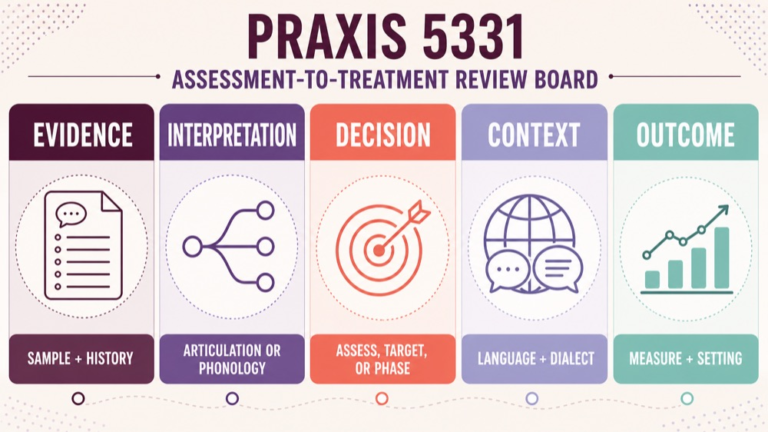
Use an assessment-to-treatment review board
A review board helps you sort speech sound questions by the kind of reasoning they require. Put the case evidence on the left, the clinical decision in the center, and the outcome check on the right. Add a context note so the board does not treat a decontextualized sound list as the whole case.
Board column
Write
Check
Evidence
Sample, pattern, context, and relevant history
Is the data sufficient?
Interpretation
Articulation, phonology, perception, or motor lens
What supports the lens?
Decision
Assessment, target, phase, or measure
Does it answer the task?
Context
Language, dialect, listener, and setting
Is interpretation fair?
Outcome
Measure and return condition
Can the change be checked?
Use the board after a mixed question set. Group misses by evidence, interpretation, decision, context, or outcome. Then choose the next practice block from the group with the clearest repeated need.
Keep the board original and concise. It should capture your reasoning without reproducing protected question text or screenshots from a paid resource.
Question 1: assessment and pattern
Question 1: A child produces several consonants accurately in single words but omits final consonants in connected speech, and listeners often miss the ends of words. The question asks what review conclusion is best supported before choosing treatment.
A. The single-word sample settles the concern, so connected speech is not needed.
B. The connected-speech pattern and intelligibility impact should be examined as part of the assessment and treatment decision.
C. Begin maintenance work because any accurate single-word production indicates stable carryover.
D. Choose the most visible sound without considering the stated listener impact.
Correct Answer: B. The case includes a difference between structured single words and connected speech plus a listener impact. The review should preserve both the pattern and the functional consequence before selecting a phase or target.
Why the Other Options Are Wrong: A removes the context where the concern appears. C confuses isolated production with carryover and maintenance. D ignores the functional evidence. The best conclusion uses the broader sample and the stated impact.
Exam Trap: Structured accuracy can look stronger than functional communication. Check the speaking context and listener outcome before assigning a treatment phase.
Question 2: treatment sequence
Question 2: A learner can produce a target sound with a clinician cue during structured trials but does not use it in phrases or conversation. Which treatment-phase reasoning best fits?
A. Focus on generalization and gradually increase linguistic or contextual challenge while monitoring carryover.
B. Label the sound maintenance-ready because it appeared once with support.
C. Stop measuring production because a single supported response is enough evidence.
D. Remove the target from practice because structured success cannot guide planning.
Correct Answer: A. The target appears established with support but has not yet generalized to broader levels. The review should connect the phase to carryover and increase challenge in a planned way.
Why the Other Options Are Wrong: B treats one supported response as durable automatic production. C removes the outcome information needed to guide treatment. D discards useful evidence. The phase decision follows the difference between structured production and broader use.
Exam Trap: Establishment, generalization, and maintenance describe different treatment stages. Match the phase to the level and stability of production described.
Question 3: dialect and ethical reasoning
Question 3: A multilingual client uses a sound pattern that differs from the clinician’s expected form, but the case does not describe the client’s languages, dialect, exposure, or functional impact. Which next step is most responsible?
A. Label the pattern disordered because it differs from the clinician’s familiar form.
B. Gather relevant language and dialect information and examine functional communication before interpreting the pattern.
C. Begin a target drill based only on the unfamiliar sound.
D. Ignore the pattern and skip any assessment because difference is never relevant.
Correct Answer: B. The case lacks information needed for a fair interpretation. Relevant language, dialect, exposure, and functional data should be considered before assigning a disorder interpretation or treatment target.
Why the Other Options Are Wrong: A and C treat difference as sufficient evidence. D goes too far in the opposite direction by ruling out assessment. The responsible action gathers context and connects decisions to functional impact.
Exam Trap: The absence of context is itself a clue. A sound difference cannot be interpreted responsibly without considering the speaker’s linguistic system and communication needs.
Review common speech sound distractors
Speech sound distractors often contain a true clinical phrase placed in the wrong stage, context, or scope. Review the closest alternative instead of labeling it simply wrong. Ask whether it ignores the language system, skips assessment, chooses a target without impact data, or confuses establishment with generalization.
Distractor pattern
Why it attracts attention
How to test it
Familiar treatment
The name is easy to recognize
Check stage and goal
Single data point
One accurate response seems decisive
Check context and repetition
Developmental shortcut
A memorized age fact feels efficient
Read the functional case
Dialect assumption
Clinician norm is treated as universal
Check linguistic context
Outcome omission
Action sounds reasonable
Ask how progress is measured
Write the mismatch in one sentence. The closest choice is weaker because it applies a generalization activity before the target is stable, or because it interprets a difference without language and dialect context. That sentence becomes a reusable rule for the next set.
Use the question’s requested action as the final filter. If it asks for the next assessment step, a treatment target may be clinically reasonable later but still fail the task now.
Build a speech sound practice block
Use a small practice block with mixed task types. Include one pattern-identification item, one assessment item, one target-selection item, one treatment-phase item, and one outcome-monitoring item. Review each item by the same pattern-to-plan map.
Block part
Example prompt
Review product
Pattern
What error distribution is described?
Pattern statement
Assessment
What evidence is missing?
Next information step
Target
Which factor supports selection?
Target rationale
Phase
Is production established or generalized?
Phase explanation
Outcome
What would you measure next?
Outcome and context
Keep the block short enough to review carefully. Eight to fifteen questions can reveal whether the difficulty is a content gap, a sequence problem, or a context-reading issue. Increase volume after your explanations become specific.
Use new or original changed cases for transfer. Repeating the same letter can show recall, but it does not show whether you can use the pattern-to-plan reasoning when the setting or goal changes.
Track the reasoning, not only the letter
A speech sound review tracker should include the original answer, confidence, task, key evidence, clinical lens, closest distractor, and next action. Add the source and date. These fields let you see whether repeated misses come from content, assessment sequence, functional context, treatment phase, or outcome selection.
Tracker field
Question
Example
Task
What did the item ask?
Choose the next treatment phase.
Evidence
Which clue controlled?
Target appears only with cueing.
Lens
What clinical frame applies?
Establishment versus generalization.
Distractor
Why was the nearest choice weaker?
It treated one response as carryover.
Next action
What will I practice?
Five phase-comparison items.
Review high-confidence misses and low-confidence correct answers. A correct letter without a rationale can hide a fragile association, while a confident miss can reveal a rule that needs to be rebuilt from the evidence.
Keep source verification visible when a clinical fact is unclear. ASHA’s Practice Portal provides a useful reference boundary, but individual cases still require appropriate professional judgment and context.
Speech sound disorders Praxis practice questions checklist
Use this checklist for each small set.
I identified the requested action before looking for a familiar treatment name.
I mapped the item to a 5331 lens: foundations, assessment, diagnosis, treatment, or evaluation.
I recorded the speech sample, context, and relevant history supplied by the stem.
I distinguished articulation, phonology, perception, motor, and phonotactic clues when relevant.
I checked hearing, language, dialect, and access context before interpreting a pattern.
I connected target selection to impact, stimulability, relevance, and client factors.
I matched establishment, generalization, or maintenance to the production stage.
I named the closest distractor and the exact reason it was weaker.
I connected the decision to intelligibility, participation, or the stated functional goal.
I named how progress would be measured and in what context.
I reviewed high-confidence misses and low-confidence correct answers.
I wrote the rationale in my own words without copying protected source material.
I created one changed-case transfer prompt.
I used clear, compressed images and lazy loading on the study page.
The checklist keeps speech sound questions anchored to evidence and function. Your goal is not to memorize a single treatment word for every sound. Your goal is to explain why the selected action fits the pattern, stage, context, and outcome.
For a structured preparation path, see the SLP Study Center Complete Prep resource. On your next session, choose one speech sound lens, complete a small mixed block, write three pattern-to-plan cards, and test one changed context.
SLP Praxis Practice Test for First-Time Test Takers
For a first-time test taker, an slp praxis practice test for first time test takers should do more than produce a percentage. It should make the screen, the question rhythm, the flagging routine, and the review process less unfamiliar. A well-labeled rehearsal gives you information about what to study and how to use the time you have.
The current ETS Speech-Language Pathology (5331) page describes a computer-delivered selected-response exam with 132 questions and 150 minutes. Use the live ETS page for changing test information. ASHA preparation guidance points learners toward preparation materials, practice questions, and study plans shaped by strengths and weaknesses. This guide focuses on the first full rehearsal: what to set up, what to record, and what to do after the final item.
What first-time test takers need from practice
The first rehearsal has several jobs, and you can separate them across sessions. You need to become familiar with the question screen, understand how the provider presents explanations, notice how long reading and comparison take, and identify a small number of study targets. Trying to measure all of those in one uncontrolled run makes the result difficult to use.
Need
Practice signal
Useful record
Interface familiarity
Where to select, flag, and return
Screen workflow note
Task recognition
What the final request asks you to do
One-sentence restatement
Content retrieval
Which concepts are available without notes
Domain and confidence
Option comparison
Why the closest distractor is weaker
Mismatch sentence
Pacing
Where time accumulates
Reading, decision, and return time
Endurance
What changes later in the block
Fatigue and accuracy note
A first-time test taker can have solid clinical knowledge and still need practice with the selected-response workflow. Conversely, someone can move quickly while lacking a rationale for the choice. Separate those observations so your study plan does not treat every difficulty as the same kind of weakness.
Use a practice test as a rehearsal for decisions, not as a prediction tool. The source, question style, length, and explanation quality can vary across resources. Record the source and condition before comparing one result with another.
Write one question for the session. For example: Can I read the request, identify the controlling evidence, and flag a difficult item without losing the block rhythm? A specific question gives your first run a useful finish line.
Confirm the current 5331 reference
Before you rehearse, confirm that your preparation material is aimed at the current Speech-Language Pathology (5331) exam. ETS is the responsible source for current test identity, listed format, question count, duration, and changing administration information. Use the live ETS page when a detail affects your plan.
Source
First-time use
Record
ETS 5331 page
Confirm subject, format, and current overview
Page title and access date
ETS practice selector
Locate current preparation options
Resource name and access terms
ASHA preparation guidance
Shape study around content and weaknesses
Chosen study targets
Practice provider
Run questions and read explanations
Provider, set, and condition
Do not merge an older guide’s timing note with the current source without checking the difference. Administration details can change, and a practice provider may intentionally use a different length or clock. Put the source date beside every detail you expect to revisit.
Keep the official reference separate from your personal rehearsal method. ETS can define the current exam information; your practice session can define a flag rule, review card, or study schedule. Clear boundaries make the article and your tracker easier to trust.
If you are scheduling the live test, use the responsible registration and test-day information rather than a practice blog. This guide is about rehearsal and preparation; it is not a substitute for current administration instructions.
Choose the purpose of the first rehearsal
First-time test takers often need a low-pressure orientation before they need a score. Decide whether your first session is interface orientation, a content baseline, a pacing rehearsal, or a full simulation. You can use the same question source for more than one purpose as long as each condition is labeled.
Purpose
Condition
Output
Orientation
Short set, untimed, workflow notes
Screen and navigation routine
Baseline
Independent mixed block
Domain and confidence profile
Learning
Untimed with rationale review
Concept and decision cards
Pacing
Short timed block with flagging
Time and return notes
Simulation
Longer block under planned conditions
Endurance and workflow record
If the screen itself is unfamiliar, begin with orientation. Learn where the answer choices appear, how the practice tool displays explanations, and how you will record a flagged item. You can then repeat the routine under an independent condition.
If your main concern is content, use a mixed baseline and save the original responses. If your main concern is time, wait until you know the review routine well enough to tell a pacing issue from a content issue.
Write the purpose at the top of the tracker. That single line prevents a short learning set from being judged by the same standard as a full rehearsal.
Learn the practice interface before timing
Interface practice is not wasted time. A first-time test taker can lose attention by searching for a flag button, scrolling through a long stem, or forgetting where an explanation appears. Use a short set to make those actions deliberate before adding a demanding clock.
Interface action
Rehearsal prompt
Record
Read the stem
Where is the final request?
Task word
Select an option
Can I record the first decision?
Answer and confidence
Flag an item
What makes this item worth returning to?
Flag reason
Move forward
Can I keep the next item separate?
Transition habit
Return
Can I find the flagged item quickly?
Return order
Review feedback
Where is the rationale and source note?
Review location
Use a small block and say the routine quietly if that helps: read, decide, flag when needed, move, return, review. The words are not a script for the live test; they are a way to make the workflow visible while you learn it.
Do not time navigation practice too tightly. The goal is to reduce screen friction so later timed work measures reading and decision behavior more clearly.
Set up a first-time test simulation
Set up a first-time simulation with enough structure to learn from it. Choose a source, define the block length, decide whether notes are open, set the clock if timing is part of the purpose, and place your tracker nearby. Write down planned breaks and likely interruptions before you begin.
Simulation field
Example
Why record it
Source
Provider and set name
Defines item style
Length
20, 40, or longer block
Defines sample size
Support
Closed notes or listed support
Defines interpretation
Timing
Untimed, light timed, or timed
Separates pace from knowledge
Breaks
Planned pause and reason
Shows endurance context
Review
Same-day or later answer review
Preserves the workflow
For a first full rehearsal, choose a time when you can finish the planned block and review at least the most informative items. A shorter complete cycle is more useful than a long session that ends before you record what the result means.
Keep the source’s terms in view. If the provider lists a different time or number of items, use that information for the practice condition and keep the live ETS reference separate. The point is to understand your response process, not to make every resource look identical.
Use one screen or one notebook for the tracker so you do not interrupt the block to reconstruct it later.
Record the condition before starting
A practice result needs context. Note the date, source, block length, support, timing, environment, fatigue, and purpose before the first item. If a condition changes during the block, write the change instead of hiding it.
Condition
What to note
Interpretation question
Materials
Notes, textbook, calculator, or none
What support was available?
Environment
Quiet room, noise, interruptions
What competed for attention?
Time
Clock, pauses, and return window
Where did pace change?
Answer state
First choice, changed choice, blank
What caused movement?
Confidence
High, medium, low before feedback
Was confidence calibrated?
Fatigue
Fresh, moderate, tired
What changed late?
Record confidence before opening the answer explanation. Otherwise, the explanation can overwrite your memory of how certain the original decision felt. That distinction is particularly useful for first-time test takers because unfamiliarity can look like a content gap.
Use the condition to decide what the result can support. A notes-open block can teach retrieval paths, while a closed-notes block can show independent recall. Both can be valuable when labeled correctly.
Use a flag-and-return routine
Flagging protects the rhythm of a selected-response block. Mark an item when the task is unclear, two choices remain plausible, a fact check would take too long, or the time cost is growing. Then move forward and return according to the window you planned.
Flag reason
Immediate action
Later review
Unclear task
Reread the final request once
Write the task word
Two plausible choices
Choose the best current option
Compare fit and sequence
Missing fact
Make a provisional choice
Verify the concept
Time-heavy stem
Record and move on
Check reading behavior
Answer changed
Save both choices
Identify the controlling clue
Do not treat a flag as a personal weakness. It is a workflow tool that gives you permission to protect the rest of the block. Review the reason for the flag later so you can tell whether the repair is content, task reading, comparison, or pacing.
Use a consistent return order. Start with items where one reread or one comparison can settle the choice, then spend deeper review time on items that require a separate source check. This keeps the review window organized.
Review each choice with a clear question
After the block, review the answers that were wrong, guessed, changed, or difficult to explain. Begin with the task, then the decisive evidence, then the best option and closest distractor. A good explanation connects the choice to the details of the stem.
Review field
Prompt for a first-time test taker
Output
Task
What did the item ask me to choose?
One-sentence restatement
Evidence
Which detail controlled the decision?
One clue in own words
Best fit
Why did the correct option respond now?
Rationale sentence
Closest distractor
Why was the tempting alternative weaker here?
Mismatch sentence
Transfer
What changed detail would test the rule?
New-case prompt
Next action
What will I practice next?
Small block and date
Write the review in your own words. If a provider explanation uses a fact that needs clarification, mark the question and verify it with an appropriate professional or official source before you turn it into a general rule.
Review correct answers with low confidence as well as wrong answers. A first-time test taker may recognize a familiar phrase without understanding the boundary between options. Confidence and rationale quality help locate that hidden work.
Create a first-time test-taker workflow
A first-time workflow can be simple: read, decide, flag, move, return, review, transfer. Use the same sequence across short blocks and longer rehearsals. Consistency reduces the number of decisions you must invent while you are learning the content.
Stage
Action
Finish signal
Read
Find the final request and key conditions
Task is restated
Decide
Choose using evidence and fit
Option recorded
Flag
Mark time-heavy or uncertain items
Reason recorded
Move
Continue to the next item
Block rhythm protected
Return
Revisit flagged items in a set order
Choice finalized
Review
Explain answer and distractor
Rationale card complete
Transfer
Change one meaningful case detail
New prompt answered
Keep the workflow separate from any provider’s exact interface. Buttons and labels can vary, but the decision sequence travels across platforms. Practice the behavior you control: task recognition, evidence selection, comparison, flagging, and review.
Use a short verbal or written cue at the top of your tracker. The cue should be brief enough to remember and specific enough to protect the process. For example: task, clue, fit, flag, return.
Build a personal pacing profile
The listed ETS 5331 page gives current reference information about question count and duration; use that live source for updates. Your practice profile should measure where your own time goes. Track reading, decision, flagging, return, and late-block fatigue separately.
Pacing signal
What it may indicate
Practice repair
Long first reads
Task or condition is hard to identify
Write one-sentence summaries
Long comparisons
Closest distractor boundary is unclear
Use a five-lens comparison
Many flags
Content or confidence needs work
Review the flag reasons
Few flags and rushed ending
Time control is weak
Set checkpoints and return window
Late accuracy drop
Endurance or fatigue affects process
Use longer gradual blocks
Do not chase speed in isolation. A faster block with weak task summaries may need a deliberate reading repair. A slower block with accurate explanations may need short timed repetitions. Choose the repair from the behavior you recorded.
Use a checkpoint during longer work. Note the item range, time remaining, and number of flags. The checkpoint makes it easier to see whether your pace changes gradually or after one time-heavy item.
Question 1: reading the request
Question 1: A first-time test taker reads a practice item, recognizes the clinical topic, and immediately chooses an option without identifying whether the prompt asks for assessment, treatment, or the next information step. Which review action is most useful?
A. Choose the option with the most technical vocabulary.
B. Restate the final request, mark the controlling clue, and compare the choices against that exact task.
C. Skip the explanation because recognizing the topic is enough.
D. Change the answer whenever a choice contains a familiar term.
Correct Answer: B. Topic recognition is only the beginning. The final request and the controlling clue determine what the answer must do, so the review should preserve that sequence.
Why the Other Options Are Wrong: A and D use wording familiarity as a shortcut. C removes the opportunity to learn the decision boundary. The useful action makes the task visible before comparing choices.
Exam Trap: A familiar clinical topic can hide a different requested action. Read the final request before treating the topic label as the answer path.
Question 2: rehearsing the condition
Question 2: A learner completes a long practice set with notes open, several unscheduled pauses, and no record of confidence or time. What is the best interpretation of the result?
A. It is a clean measure of independent performance.
B. It is a supported learning session that should be labeled, followed by a shorter independent block with condition notes.
C. It has no value because practice with support cannot teach anything.
D. It should be compared directly with a controlled timed simulation.
Correct Answer: B. The session can reveal concepts and questions worth reviewing, but open notes and interruptions change what the score means. Labeling it and adding a cleaner comparison protects interpretation.
Why the Other Options Are Wrong: A and D ignore the support and pauses. C dismisses learning information that can still guide study. The best response preserves the session as evidence while choosing a clearer next condition.
Exam Trap: A long set can look like a simulation even when the condition is different. Record support, timing, and interruptions before comparing results.
Question 3: reviewing a practice source
Question 3: A first-time test taker finds answer screenshots from a paid practice resource and wants to place them in a public study folder for classmates. Which action best supports responsible preparation?
A. Share the screenshots because the intent is educational.
B. Use an authorized access path, write original paraphrases, and build new changed-case practice from the concept.
C. Crop out the provider name and share the remaining images.
D. Share only the answer letters from the screenshots.
Correct Answer: B. Authorized access and original study notes keep the learning purpose while avoiding redistribution of protected resource material. New cases can test the reasoning without copying the source.
Why the Other Options Are Wrong: A assumes educational intent resolves the permission question. C removes attribution but not reproduction. D can still distribute material derived from the resource. The responsible option follows the access terms and creates original practice.
Exam Trap: A classroom or public folder does not define permission by itself. Check the source terms and use paraphrase plus new cases for shared learning.
Use untimed work for learning
Untimed work is useful when a first-time test taker is still learning how to read the request, find evidence, compare choices, and understand rationales. The absence of a clock lets you inspect the decision without adding a pacing variable.
Untimed goal
Prompt
Later bridge
Task recognition
What action is requested?
Short timed stem reads
Evidence
Which clue controls?
One-clue notes under time
Comparison
Why is the closest choice weaker?
Two-option timed contrast
Retrieval
Can I explain without notes?
Closed-notes mini-block
Transfer
What detail could change the answer?
New-context item
Label untimed work as learning, not as a failed simulation. Use it to build the decision cards that later support timed work. A first-time test taker benefits from knowing what a careful answer process looks like before compressing it.
Keep the review concise. A task sentence, evidence note, distractor mismatch, and next prompt can teach more than copying a long explanation into a notebook.
Add timed blocks without rushing
When the workflow feels familiar, add a clock to short blocks. Keep the task and evidence routine intact while you observe how much time the clock changes. Use a flag-and-return rule rather than forcing every item to be solved in one uninterrupted pass.
Timed step
Practice design
Record
Light timed
Short mixed block
Halfway checkpoint
Timed focus
One domain with close distractors
Comparison time
Timed mixed
Neighboring topics and flags
Return order
Longer rehearsal
Planned breaks and fatigue note
Late-block process
Do not compensate for a slow first block by removing review. The review explains whether the time problem came from reading, indecision, missing content, or a weak return routine. Keep enough time to capture that information.
Turn the first rehearsal into a study plan
Finish the first rehearsal by choosing the next action. Combine score, confidence, domain, task type, flag reason, and pacing note. Then choose one short study block with a clear completion rule.
Pattern
Next study block
Finish line
High-confidence misses
Closest-distractor comparison
Five mismatch sentences
Low-confidence correct answers
Closed-notes rationale retrieval
Explain three decisions
Domain cluster
Focused concept and case block
One rule plus three applications
Slow reading
Task-and-condition summaries
Ten concise summaries
Rushed ending
Short timed blocks with checkpoints
Use flag-and-return twice
Write the next block before you close the results. A plan that says study more is too broad to start. A plan that names the pattern, block size, condition, output, and return date is easy to test.
Choose one meaningful change for the next session. Move from notes-open to closed notes, untimed to light timed, one domain to mixed, or familiar setting to changed setting. One change makes the new result easier to interpret.
Repeat with a new question context
Repeating the same set can show memory for the items, but a first-time test taker also needs evidence that the reasoning transfers. Use a new question or an original changed-case prompt after reviewing the first result. Change one meaningful detail at a time.
Changed detail
What it tests
Question to ask
Setting
Context transfer
Which evidence now matters?
Goal
Functional alignment
Does the best option change?
Stage
Sequence
What belongs at this point?
Partner
Communication demand
What support is relevant?
Time condition
Workflow and pacing
Can I flag and return?
Space the retest. Review the explanation in the first session, retrieve the rule later without notes, and apply it in a mixed block after that. Hide the old answer until your new response is recorded.
SLP Praxis practice test for first-time test takers checklist
Use this checklist for your first rehearsal and the sessions that follow.
I checked the live ETS 5331 reference and recorded the access date.
I chose a practice source with clear subject, explanation, and access information.
I wrote one purpose for the session before starting.
I recorded source, length, support, timing, breaks, environment, and fatigue.
I learned the interface before adding a demanding clock.
I saved my original answer and confidence before reading feedback.
I used a flag-and-return rule for time-heavy or uncertain items.
I reviewed the task, evidence, best fit, and closest distractor.
I wrote personal paraphrases instead of copying protected text or screenshots.
I tagged repeated patterns by domain and decision skill.
I chose one small next block with a completion rule.
I changed one meaningful variable in the retest.
I tracked reading, decision, return, and late-block time separately.
I used responsive, compressed images and lazy loading on the study page.
The first practice test should leave you with a clearer process, not just a number. Record what the session can support, repair one visible pattern, and rehearse that repair in new context. That sequence gives first-time test takers a practical path toward longer work.
Sources and next steps
Use the live ETS Speech-Language Pathology (5331) page for current exam identity, selected-response format, duration, question count, and changing test information. Use the ETS practice-test selector to locate current preparation options and read each resource’s access terms.
Use ASHA Praxis preparation guidance when organizing practice around exam content and strengths and weaknesses. The rehearsal setup, workflow, tracker, and practice questions in this article are original educational guidance. Verify changing details on the live responsible source.
For a structured preparation path, see the SLP Study Center Complete Prep resource. For your next session, choose one purpose, record the condition, complete a manageable block, and review the decisions that will shape your next study action.
SLP Praxis Practice Test for Beginners: Start Here
Starting an slp praxis practice test for beginners can feel like opening a very large file with no obvious first page. The solution is to make the first test small, labeled, and reviewable. You do not need to know every topic before you begin. You need a calm condition, a record of what happened, and a plan for turning the result into the next study action.
The current ETS Speech-Language Pathology (5331) page describes a computer-delivered selected-response exam with 132 questions and 150 minutes. Use the live ETS page for changing test information. ASHA preparation guidance supports using the exam content and your strengths and weaknesses to shape preparation. This guide translates that starting point into a beginner-friendly first test and first week.
What a first practice test can tell you
A first practice test is a starting measurement, not a verdict. It can show which topics feel familiar, which question tasks feel confusing, how confidence compares with results, and where reading time disappears. Those observations are more useful when you record the conditions under which they appeared.
First-test question
What to notice
Useful record
What felt familiar?
Topics answered with a clear rationale
Domain and confidence
What felt confusing?
Stem, term, sequence, or choice comparison
Repair category
What took time?
Reading, deciding, or returning
Pacing note
What changed?
Answers changed after rereading
Original and final choice
What needs a source check?
Unclear clinical or professional fact
Question and responsible source
Expect an uneven first result. A broad exam reaches across several areas, and a beginner may have strong knowledge in one domain but little recent retrieval in another. A mixed score does not tell you which action to take until you sort the items by reason.
Use the first test to learn how the resource is written. Practice providers can differ in length, wording, explanations, and topic labels. Record the provider and set so you do not compare a short supported quiz with a timed mixed block as though they were the same event.
Start with a study question such as, Can I identify the task and controlling clue in a mixed set? That question gives the first session a manageable finish line.
Check the current 5331 reference
Before choosing a practice set, confirm that you are studying for the current Speech-Language Pathology (5331) exam. ETS is the responsible source for current test identity, administration information, format, question count, duration, and preparation links. Use the live page when details matter, because logistics and resource listings may change.
Reference
Beginner use
What to record
ETS 5331 page
Confirm the exam and current overview
Page title and access date
ETS practice selector
Find subject-specific preparation options
Resource and terms
ASHA preparation guidance
Shape content-based study planning
Strengths and weaknesses
Practice provider
Use questions and explanations
Provider, set, and license status
Keep current exam facts separate from beginner advice. The live ETS page can tell you the listed format and duration; it cannot determine whether your first session should be ten or twenty questions. That choice belongs to your starting condition and review time.
Do not build a plan from a search snippet alone. Use the responsible page for changing details and label third-party resources according to what they provide. A clear source note helps you understand what your practice result does and does not represent.
If you encounter a different number or time in an older guide, do not blend the two versions into one rule. Note the discrepancy and recheck the current source before changing your tracker.
Choose a beginner-friendly practice source
A beginner-friendly source makes the question purpose, answer explanation, and access condition clear. It does not have to promise an easy experience. It should give you enough information to complete a small block and enough explanation to review what happened.
Source feature
Beginner question
Why it helps
Subject match
Does it identify SLP or 5331?
Protects relevance
Answer review
Does it explain why choices fit or fail?
Supports learning
Flexible length
Can I start with a short block?
Protects review time
Clear access
Do I understand the terms?
Supports responsible use
Topic labels
Can I sort results by domain?
Guides the next block
New practice
Can I test a changed case later?
Checks transfer
Use the ETS practice-test selector to identify current options, then read the resource details before beginning. A free item set may be helpful for a first look, while a structured product may provide a larger explanation system. Choose based on the work you need the resource to do.
Do not collect several practice banks before you have reviewed one small set. More questions can create more noise when your process is still forming. Start with one resource, learn your review routine, and add another source only when you can interpret the conditions.
Keep your own notes in an original format. A paraphrased concept, a decision rule, and a changed-case prompt are enough to preserve learning without copying protected question text or redistributing screenshots.
Set up your first beginner practice test
Set up the first session so the test measures a useful starting point. Choose a quiet window, gather the allowed materials, open one set, and decide whether the purpose is orientation or independent baseline work. Write the condition before answering the first item.
Setup field
Beginner entry
Reason
Purpose
Orientation, baseline, or learning
Defines interpretation
Set size
10–20 questions
Leaves room for review
Timing
Untimed or light timed
Separates knowledge from pace
Support
Closed notes or listed support
Preserves condition
Confidence
High, medium, or low before feedback
Shows calibration
Environment
Location, interruptions, and fatigue
Explains context
If you are completely new to the subject or the testing interface, call the first session orientation. Learn where to read the stem, select an answer, flag an item, and return to a review list. If you already know the interface, use the same short size as an independent baseline.
Keep the first block small enough to finish the review on the same day. A beginner can learn more from ten carefully reviewed items than from a full run followed by no explanation work. The first goal is a repeatable routine.
Save the original responses before opening rationales. Mark whether each response was certain, uncertain, or a guess. Those labels give the review a useful starting point.
Use a small first block
A small first block reduces the chance that fatigue will hide the reason for an error. Ten to twenty mixed questions can introduce the style, reveal a few topic signals, and leave enough time to examine the choices. Increase the block only after you can complete the review process consistently.
Block size
Good beginner purpose
Review output
5–10 items
Learn the interface and note task types
Task words and questions
10–20 items
Build a first mixed profile
Domain and confidence tags
20–40 items
Practice a focused topic slice
Rationale cards
40+ items
Later endurance or mixed practice
Pacing and fatigue notes
Do not confuse a short set with low effort. A useful review asks what the stem requested, which clue controlled the decision, why one option fit, and why the closest alternative was weaker. That work can take longer than answering the item.
Use a timer for the whole block when you want a pacing observation, but do not force full exam speed on the first learning session. You can add timing after the task and rationale routine becomes familiar.
End the block with one sentence: I need to learn more about content, question task, sequencing, or pacing. That sentence tells you what to do next.
Record confidence before feedback
Confidence helps beginners separate knowledge from recognition. Before checking the answer, mark high when you could defend the choice, medium when two options remain plausible, and low when the selection is a guess. Use the same definitions across sessions.
Result and confidence
What it may suggest
Beginner response
Wrong, high
A rule felt reliable but was mismatched
Compare the closest choice
Wrong, low
Content or clue was missing
Build a short concept card
Correct, low
Recognition or guessing may have helped
Explain without notes
Correct, high
Process is becoming stable
Check a changed case
Changed answer
Rereading shifted the decision
Record the controlling clue
Do not treat low confidence as failure. It tells you where an explanation, retrieval prompt, or additional example can make the next decision clearer. Beginners need permission to record uncertainty honestly because it makes study time easier to target.
Review confidence after the rationale, not only the score. A beginner may select the right letter for an unhelpful reason. If you cannot explain the closest distractor, keep the item in the review group even when the score was correct.
Use one simple tracker rather than several apps. A date, source, condition, result, confidence, domain, and next action are enough to begin.
Map topics without panic
After the first block, sort items into broad content areas and decision skills. The list may include foundations, assessment, diagnosis, treatment, communication, swallowing, fluency, hearing, development, or professional practice, depending on the source. Keep the labels broad at first and add detail only when a repeated pattern appears.
Write the resource topic label and your broader domain label.
Mark the question task: identify, choose, prioritize, compare, or apply.
Record the clue that should have controlled the choice.
Note whether the problem was content, sequence, context, or pacing.
Choose one next action that can be completed in a short block.
Keep the number of items in the sample beside the pattern.
Beginner pattern
Likely next step
Evidence of progress
Many unfamiliar terms
Vocabulary and concept retrieval
Own-word definitions
Known topic, wrong task
Read the final request first
Accurate task restatements
Two choices remain
Use a fit and sequence comparison
Closest-distractor reason
Good accuracy, slow pace
Short timed reading block
Flag and return notes
Mixed misses across settings
Changed-case practice
Transfer explanation
A first sample can suggest a pattern without defining your ability. Keep the item count visible and look for repetition before assigning a large study project. One confusing question may need one source check rather than a new textbook.
Use your profile to choose a narrow next block. Beginners often benefit from fixing one process at a time: reading the task, marking evidence, comparing choices, or recalling a concept. A narrow target is easier to practice and observe.
Review the task and the closest choice
Answer explanations become useful when they show why the best option fits the requested action and why the closest distractor does not. Start with your original response, rewrite the task in your own words, and identify the smallest clue that changed the decision.
Review prompt
Beginner note
Why it matters
What is being asked?
One sentence with the action word
Prevents a related answer
What is the key evidence?
One controlling case detail
Links stem to choice
Why does the best option fit?
Task, stage, goal, and context
Builds a rule
Why is the closest option weaker?
One specific mismatch
Sharpens comparison
What will I do next?
Lesson, retrieval, or new case
Creates an action
Write the rationale in your own words rather than copying the provider explanation. If the explanation uses a clinical fact you do not understand, record the question and check an appropriate professional or official source before turning it into a study rule.
Review the four answer choices as a set. A distractor can be a reasonable action in a different stage or setting. The key is to describe why it is less fitting for the details in the stem, not to label it as universally bad.
Keep the review card short enough to use again. The purpose is to make the decision visible and retrievable, not to create a second copy of the resource.
Build a beginner pacing routine
Pacing can be practiced in small steps. The current ETS 5331 page lists 132 questions and 150 minutes; use the live page for current information. That average is a planning reference, not a requirement to spend the same amount of time on every item.
Pacing step
Beginner behavior
Practice format
Read
Identify the final request before options
Untimed stem summaries
Decide
Compare the best two options
Short focused block
Flag
Mark unclear or time-heavy items
Light timed block
Return
Use a planned review window
Timed mini-simulation
Check
Protect time for unanswered items
Longer mixed block
Begin with a light clock rather than a full simulation. For example, set a block time, record when you reach the halfway point, and note how many items you flagged. This gives you pacing information without turning the first lesson into an endurance test.
Use a flag-and-return rule. If the task is unclear, two choices remain plausible, or a source check would take too long, mark the item and continue. Practice returning later instead of letting one question determine the rhythm of the block.
Review accuracy and pace together. If your speed rises while your task restatements disappear, slow down enough to protect the decision process. A useful routine makes the next item easier to approach.
Use a beginner-friendly first-week loop
A first week can follow a simple loop: orient, answer a small baseline, review, study one repair, practice a changed case, and return to a mixed block. The loop gives beginners a clear sequence without requiring a full-length test every day.
Day or session
Focus
Finish line
1
Confirm source and learn the interface
Complete five to ten items
2
Review task, evidence, and choices
Create three rationale cards
3
Study one repeated domain or skill
Explain one rule in your own words
4
Answer changed-case items
Complete one transfer check
5
Use a light timed block
Record pace and flag behavior
6 or 7
Take a new mixed mini-set
Choose the next repair
Adjust the days to your schedule. The order matters more than the calendar: start with orientation, preserve original responses, review the decisions, target one pattern, add a clock, and then check the pattern in new items.
Do not use the week to chase a perfect percentage. Use it to learn how you work. A beginner who can explain three decisions and identify the next topic has a better planning signal than a beginner who completed a long set but cannot locate the source of the misses.
Keep the visual study page light as well. Use clear, compressed images with intrinsic dimensions and lazy loading for body visuals so the page remains quick while the learner reads questions and notes.
Question 1: choosing the first condition
Question 1: A learner has never used a Praxis-style online question set and wants to begin preparing for Speech-Language Pathology (5331). Which first session gives the clearest starting information?
A. Complete a full-length timed set while checking notes after every item.
B. Complete a small mixed set, record the source and support condition, and save answers before reading explanations.
C. Read every available study guide before answering any question.
D. Choose one answer pattern at random so the first score stays low.
Correct Answer: B. A small mixed set introduces the interface and question style while preserving enough review time. Recording support and saving original answers make the result easier to interpret.
Why the Other Options Are Wrong: A mixes orientation, measurement, and explanation into one condition. C postpones useful evidence about how the learner approaches questions. D removes the learning value of the session. The beginner-friendly option starts small and records context.
Exam Trap: A first practice session does not need to imitate every condition at once. Match the test condition to the purpose you wrote before beginning.
Question 2: reading a beginner score
Question 2: A beginner earns 70% on a short mixed practice block, but most correct answers were low-confidence guesses and the learner cannot explain the closest distractor. What is the best next action?
A. Treat the percentage as proof that no further review is needed.
B. Review the low-confidence items, rewrite the task and evidence, and practice a few changed cases.
C. Take a much longer timed set immediately without recording confidence.
D. Delete all correct items from the tracker.
Correct Answer: B. The score does not describe the quality of the reasoning by itself. Low confidence and weak distractor explanations identify a useful review target before increasing length or speed.
Why the Other Options Are Wrong: A ignores the uncertainty behind the correct letters. C adds fatigue before the process is clear. D removes information about calibration. The best next step turns uncertain results into rationale and transfer practice.
Exam Trap: A correct letter can come from recognition or guessing. Record confidence and explanation quality so the review sees more than the percentage.
Question 3: using practice material responsibly
Question 3: A beginner finds a paid practice set in a group chat and wants to upload the screenshots to a shared public folder for easier studying. Which action is most responsible?
A. Upload the images because the folder is for education.
B. Use an authorized access path, write personal paraphrases, and create original changed-case practice.
C. Crop out the provider name before sharing the same screenshots.
D. Share only the answer letters from the images.
Correct Answer: B. Authorized access and original notes preserve the learning goal without redistributing protected material. A changed-case prompt can test the concept without copying the source.
Why the Other Options Are Wrong: A assumes educational intent settles the permission question. C removes attribution but not reproduction. D can still distribute material derived from the paid set. The responsible action respects the resource terms and keeps the new study asset original.
Exam Trap: A private or student-focused location does not automatically define sharing permission. Check the source terms and build your own review cards.
Study one domain at a time
Once the first profile is clear, choose one domain or one decision skill for focused practice. Beginners often gain more from a narrow, explainable block than from jumping between every topic in one evening. Keep a neighboring topic in reserve for a later mixed check.
Target
Focused activity
Completion rule
Vocabulary
Define terms in your own words
Explain five terms without notes
Sequence
Order case actions and justify stage
Explain three choices
Context
Change setting or partner in a case
State what evidence changes
Comparison
Name why the nearest distractor is weaker
Write five mismatch sentences
Retrieval
Answer before opening notes
Recall one rule next day
Use the practice resource’s topic labels as a starting point, but add your own repair tag. The same domain can contain content and process mistakes. A stable tag helps you choose the right activity next time.
Keep the focused block short enough to review. Eight to fifteen items can be sufficient when each important miss becomes a rationale card or a changed-case prompt. More volume can wait until the routine is stable.
Move from untimed to timed work
Untimed work is useful for learning the task, evidence, sequence, and rationale. Timed work is useful for practicing the same decisions with a clock and a return routine. Move between conditions gradually so you know what changed.
Step
Condition
Question to answer
1
Untimed, closed notes
Can I identify the task and evidence?
2
Untimed, explanation review
Can I explain the closest choice?
3
Light timed, short block
Can I keep the routine with a clock?
4
Timed, mixed block
Can I flag and return?
5
Longer simulation
Can I manage pace and fatigue?
Do not interpret a timed miss as pure content weakness. Note whether the answer changed because you rushed, skipped a detail, or ran out of time. That distinction selects the next repair.
Use the same review card across conditions. When the structure stays stable, you can compare whether the problem was knowledge, reading, confidence, or timing.
Use explanations as teaching tools
Explanations are most useful when they teach a decision boundary. Ask what the item wanted, which evidence controlled, why the best option fit, why the closest option was weaker, and what changed case would test the rule. This turns passive reading into active review.
Explanation step
Beginner prompt
Output
Restate
What action is requested?
One-sentence task
Locate
Which clue matters most?
Evidence phrase
Compare
Why is the nearest choice weaker?
Mismatch sentence
Transfer
What detail could change the answer?
New-case prompt
Retrieve
Can I explain it tomorrow?
Return check
Use responsible sources for facts that shape clinical understanding. If an explanation conflicts with your course material or seems incomplete, note the uncertainty and verify it before writing a broad rule. The goal is a reliable learning record, not a confident sentence built on a guess.
Keep the provider wording out of your personal study asset when a paraphrase will do. Your own task summary, rule, and new example give you a more active way to retrieve the concept.
Repeat with new contexts
A beginner needs both repetition and variation. Repetition builds familiarity with the process; variation tests whether the process works when the setting, goal, communication partner, or stage changes. Use a new item or an original changed-case prompt after reviewing the first answer.
Variation
What it tests
Review question
Setting
Context transfer
Which evidence changes?
Goal
Functional alignment
Does the best option change?
Stage
Sequence
What belongs now?
Partner
Communication demands
What support is relevant?
Time condition
Pacing and workflow
Can I flag and return?
Change one meaningful feature at a time. If every detail changes, a beginner may not know which clue controlled the answer. A focused variation makes the learning signal easier to read.
Space the return. Review the rationale in the first session, retrieve the rule without notes later, and apply it in a mixed block after that. Keep the original answer hidden until the new response is recorded.
SLP Praxis practice test for beginners checklist
Use this checklist before, during, and after the first few practice sessions.
I checked the current ETS 5331 page and recorded the access date.
I chose a source that identifies the subject and explains its access terms.
I wrote one purpose for the block: orientation, baseline, learning, pacing, or retest.
I recorded set length, timing, support, environment, and interruptions.
I saved original answers and confidence before checking feedback.
I tagged each important item by domain and decision skill.
I reviewed the task, evidence, best fit, and closest distractor.
I wrote rationales in my own words.
I created one changed-case prompt from a repeated pattern.
I used a small block before attempting longer endurance work.
I practiced a flag-and-return routine before full simulation.
I scheduled a next study action with a clear finish line.
I kept personal notes separate from copied or shared source material.
I used responsive, compressed images and lazy loading on the study page.
The checklist keeps the first test friendly without making it passive. You are learning the exam content, the question process, and your own study conditions at the same time. Keep the next action small enough to complete and specific enough to review.
Sources and next steps
Use the live ETS Speech-Language Pathology (5331) page for current exam identity, selected-response format, duration, question count, and changing test information. Use the ETS practice-test selector to locate current preparation options and read each resource’s access terms.
Use ASHA Praxis preparation guidance when organizing a beginner plan around exam content and strengths and weaknesses. The setup routine, first-week loop, trackers, and practice questions in this article are original educational guidance. Verify changing details on the live responsible source.
For a structured preparation path, see the SLP Study Center Complete Prep resource. For your first session, choose one small mixed block, write the condition, preserve your original answers, and review three decisions before choosing the next study action.
How to Use SLP Praxis Practice Tests: A Study Plan
Learning how to use slp praxis practice tests starts with giving every test a job. One practice test can establish a baseline, a short domain set can teach a concept, a timed block can reveal pacing, and a later mixed set can check transfer. Treating every test as a score-only event creates a pile of numbers without a clear next move.
The current ETS Speech-Language Pathology (5331) page describes a computer-delivered selected-response exam with 132 questions and 150 minutes. Use the live ETS page for changing test information. ASHA preparation guidance recommends using exam content, preparation materials, practice questions, and strengths and weaknesses to shape study. The plan below turns those principles into a repeatable cycle.
What practice tests are for
A practice test is useful when it answers a study question. You may want to know whether the broad blueprint feels familiar, whether a domain needs a focused lesson, whether reading speed is affecting decisions, or whether a rule transfers to a changed case. Name that purpose before opening the test so the result has a clear interpretation.
Purpose
Best test format
Useful output
Baseline
Mixed set under ordinary conditions
Domain, confidence, and pacing profile
Learning
Short untimed domain block
Rationale and concept notes
Application
Changed-case questions
Transfer decision
Pacing
Timed block with a visible clock
Time per item and flagging habits
Simulation
Full-length practice run
Endurance and process notes
Retest
New mixed set after review
Evidence that the repair travels
The purpose changes what you record. For a baseline, capture the condition before you begin. For a learning block, write why each option fits or fails. For a simulation, note fatigue, breaks, pacing, and unanswered items. A score without those conditions is difficult to compare later.
Use practice tests to make study decisions, not to forecast an official result. A commercial set, a class set, an original item set, and an ETS resource can differ in wording and scope. Label the source, keep claims proportional, and verify changing exam details with the responsible source.
Check the current exam reference first
Before building a plan, confirm the current Speech-Language Pathology (5331) reference. ETS is the source for current test identity, administration information, format, question count, and duration. The ETS practice-test selector helps you locate current preparation options, while each provider controls the terms and content of its own resource.
Reference
Use it for
Record in your plan
ETS 5331 page
Current exam details and preparation links
Access date and page title
ETS practice selector
Subject-specific preparation options
Resource name and access terms
ASHA preparation page
Study planning and practice guidance
Strengths, weaknesses, and chosen actions
Study resource
Questions and explanations
Provider, set, and license status
Do not build your entire pacing plan from an old screenshot or a remembered number. Exam information can change, and practice resources may use a different item count or time setting. Put the date beside any administration note so you know when to recheck it.
Keep official information separate from your personal method. The exam page does not tell you which review card to use, and a commercial resource does not define the live test. Your plan can connect those pieces without presenting a study preference as an exam rule.
Use the current content outline to organize your domains. If a resource labels a topic differently, map it to the broader content area in your tracker and keep the original resource label in a note. This makes your results easier to compare across providers.
Choose a baseline test condition
A baseline is most useful when the condition is recorded and repeatable. Choose a mixed practice set that touches several domains, then decide whether the first run is untimed, lightly timed, or timed. If you are starting after a long gap, untimed work can reveal knowledge and reading patterns before a clock adds a second problem.
Baseline field
Example entry
Why it matters
Source
Provider, set, or original item bank
Different sets make different claims
Length
20, 40, or full-length block
Shows scope of the sample
Timing
Untimed, light timed, or timed
Separates knowledge from pace
Support
Closed notes or reference allowed
Defines the result condition
Confidence
High, medium, or low before feedback
Shows calibration
Fatigue
Fresh, moderate, or tired
Explains performance context
Answer independently before reading explanations when the goal is measurement. Mark an answer as correct, incorrect, guessed, or changed. If you use notes or pause frequently, record that support instead of treating the result as a clean baseline.
Choose a manageable first block. A 20-item set can show patterns without consuming the entire study session, and a longer set can come later when you need endurance information. The right baseline is large enough to reveal a pattern and small enough to review carefully.
Save the raw result before correcting it. Your first answer, confidence, and time are study evidence. Once you read the explanation, you cannot recreate that exact starting condition from memory.
Build a domain starting profile
After the baseline, sort results by domain and by decision behavior. A wrong answer may reflect missing content, a missed task word, weak evidence selection, poor sequencing, or an overconfident distractor choice. Use both dimensions so your next block addresses the reason for the error rather than only the topic label.
Record the content domain named by the resource or your own map.
Mark whether the answer was correct, incorrect, guessed, or changed.
Rate confidence before feedback with one consistent scale.
Write the controlling clue or note that you missed.
Name the closest distractor and its mismatch.
Choose a small repair action for the next study block.
Profile pattern
Likely study need
Next test design
Low score, low confidence
Build the concept and vocabulary
Short untimed lesson block
Low score, high confidence
Check the decision rule
Contrast and changed-case items
High score, low confidence
Strengthen rationale retrieval
Explain before checking notes
High score, slow pace
Practice reading and flagging
Short timed mixed block
Domain cluster of misses
Target the repeated concept
Focused domain set
Do not let one percentage decide the profile. Look for repeated patterns across at least a few items, and keep the sample size visible. A small set can suggest a study question without establishing a broad conclusion.
Use confidence to find hidden work. Correct answers with low confidence may need a rationale card, while incorrect answers with high confidence may need a changed case that tests the rule. This profile is more actionable than a single total score.
Keep one short note about what worked. If you read the final request first, flagged uncertain items, or used a domain checklist successfully, preserve that habit in the next block.
Set a realistic pacing target
Pacing should support careful reading and a complete response process. The current ETS page lists 132 questions and 150 minutes; use the live page for current information. As a planning reference, that works out to a little over one minute per question on average, but an average is not a command to spend identical time on every item.
Pacing note
What to measure
Study response
Reading time
Time before choosing an option
Practice stem summaries
Decision time
Time comparing the final choices
Use a two-option comparison
Flagged time
Items sent to a review list
Set a return rule
Transition time
Time lost between items
Use a consistent click-and-note routine
End-of-block time
Time left for review
Protect a final check window
Measure your own block rather than chasing a universal pace. A learner who reads slowly but reaches a stable rationale may need reading practice, while a learner who moves quickly and changes answers repeatedly may need a deliberate comparison routine. Both are pacing issues with different repairs.
Use a simple flag rule. Mark an item when the stem is unclear, two choices remain plausible, or the decision requires a fact check. Then move on and return according to the block plan. Do not let one difficult item consume the time meant for several answerable items.
Review pacing together with accuracy. Faster work is not useful if the controlling evidence disappears. The goal is a repeatable process that leaves enough time to answer, flag, and check the set.
Use one question set for one purpose
Before a practice block begins, write one sentence describing its job. A set can be used for retrieval, application, pacing, review, or simulation, but trying to measure all five at once makes the result harder to understand. You can use the same broad resource across several sessions when the conditions and questions are labeled clearly.
Session purpose
Instruction before starting
Record after finishing
Retrieve
Answer before notes
Confidence and recall gap
Apply
Explain the changed case
Rule transfer
Review
Read rationale and compare choices
Repair card
Pace
Use a clock and flag rule
Time by item group
Simulate
Match the planned conditions
Endurance and workflow
Write the purpose on the first line of your tracker. When you return to the result, you will know whether a low score indicates content work, a timing problem, or a condition that included too much support.
Separate answer collection from answer teaching. In a retrieval block, collect the original responses first and review later. In a learning block, it is reasonable to check a rationale immediately, but label that session as explanation-led rather than comparing it with an independent test.
Use a new set or a changed case when you want evidence of transfer. Repeating the identical item can show recall, but it does not tell you whether the reasoning works when the surface details change.
Build a practice-test study ladder
A study ladder gives practice tests a sequence. Begin with a baseline, move to one targeted repair, add a changed-case check, then use timed work and a later mixed retest. The ladder keeps you from jumping straight from one score to another without repairing the decision process in between.
Ladder rung
Question it answers
Completion evidence
1. Baseline
What is visible under this condition?
Source, score, confidence, and timing record
2. Repair
What concept or process needs work?
Own-word rule and example
3. Transfer
Does the rule work after one detail changes?
Changed-case explanation
4. Pace
Can I use the rule with a clock?
Flag and return notes
5. Retest
Does the pattern hold in a mixed set?
New-item rationale
Stay on a rung long enough to collect evidence, but do not wait for a perfect feeling. One focused repair block and one transfer check can be enough to move toward timed practice. If the same pattern returns, step back to the repair rung and simplify the concept.
Use different questions for the retest when possible. A new item with a changed setting or goal is more informative than remembering the earlier letter. Keep the old card for comparison, not as the answer key for the new block.
The ladder also protects motivation. Every rung has a visible finish line: record, explain, transfer, pace, or retest. That makes a large exam feel like a set of manageable study decisions.
Run a domain-focused block
Use domain-focused practice after the baseline identifies a repeated need. Select a small topic slice, write the decision rule you want to test, and choose a block size that leaves time for review. For example, you might focus on distinguishing assessment sequencing from treatment selection, then deliberately include cases with similar vocabulary.
Block element
Example
Why include it
Target
Assessment sequence
Defines the content and skill
Contrast
Clarification versus intervention
Creates a decision boundary
Set size
8–15 items
Leaves time for explanation
Output
Three rationale cards
Turns answers into study material
Transfer
One changed setting
Checks application
Do not isolate the domain so completely that every item announces its topic. After a short focused block, mix in one or two neighboring topics and ask whether you can recognize the tested skill without a heading. This protects transfer into a mixed practice test.
Keep the review narrow. Choose the missed concept, the controlling clue, and the next action. If a question opens a large textbook topic, record it for a separate lesson rather than letting one explanation consume the block.
Use the same domain tag in your tracker across providers. The wording can vary, but a stable tag lets you see whether a pattern belongs to content, sequence, context, or pacing.
Review answer choices and rationales
Answer review should explain the relationship between the task, evidence, and option. First record what you selected and how confident you were. Then identify the best option, the closest distractor, and the specific mismatch. A rationale that only says one choice is correct does not teach the boundary between choices.
Review field
Prompt
Example output
Task
What exactly was requested?
Choose the next information step.
Evidence
Which clue controlled?
Performance changed by setting.
Best fit
Why does this option respond now?
It clarifies the named uncertainty.
Closest distractor
What could make it tempting?
It is useful later but premature now.
Next action
What will I do with the rule?
Practice two changed settings.
Use official or professional sources to check clinical facts that matter to understanding. The practice question and rationale can be original, while the factual basis should be responsibly verified. Record the source and date when a claim may change or when the explanation does not settle your uncertainty.
Review correct answers that were guesses and incorrect answers that felt certain. Confidence adds information about calibration. A repeated high-confidence miss may call for a decision-boundary exercise, while a repeated low-confidence correct answer may call for retrieval practice.
Keep personal notes in your own words and do not reproduce protected question text or screenshots. A paraphrased stem, concept rule, distractor mismatch, and changed-case prompt are enough to build a useful review card.
Turn test results into a next-block plan
A test result becomes useful when it selects the next block. Combine domain, answer status, confidence, and pacing into one short decision. For example, a cluster of high-confidence misses in a treatment sequence under ordinary timing calls for sequence review and changed-case items, not simply another full-length test.
Observed pattern
Next block
Finish line
Missed one concept repeatedly
Short lesson plus eight focused items
Explain the rule and one contrast
Correct but uncertain
Retrieval cards without notes
Give a rationale from memory
Accurate but slow
Two timed mini-blocks
Use the flag and return rule
Fast with many changes
Deliberate stem-and-choice routine
Record why an answer changed
Mixed domain misses
New mixed set with domain tags
Identify the repair pattern
Write the next block before the score fades from attention. Include the target, set size, condition, review output, and return date. A plan that says study more is difficult to start and impossible to audit.
Use a small completion rule. You may finish when you can explain three missed items, transfer one rule to a changed case, or complete two short timed blocks with a stable flag routine. Completion is evidence of a study action, not a promise about a future score.
Let the next test change one meaningful variable. Move from untimed to timed, from one domain to mixed, or from familiar examples to a changed setting. Changing one variable makes it easier to interpret what the new result means.
Question 1: baseline interpretation
Question 1: A learner completes a mixed SLP Praxis practice set with notes open, records a high percentage, and does not mark confidence or time. What is the best use of this result?
A. Treat the percentage as a direct forecast of the official result.
B. Record it as a supported baseline and run a later independent block with confidence and timing notes.
C. Stop studying because the result settles every domain.
D. Discard the result because supported practice has no learning value.
Correct Answer: B. The result can still show which material felt familiar, but open notes and missing condition data limit its interpretation. A later independent block with the same recording fields creates a more useful comparison.
Why the Other Options Are Wrong: A overstates what one supported percentage can tell you. C treats a broad sample as complete evidence. D ignores the learning value of explanation-led work. The right review preserves the result and labels its condition.
Exam Trap: A high percentage can look precise while the testing condition remains unclear. In your study tracker, record support and confidence before comparing results.
Question 2: pacing and flagged items
Question 2: During a timed practice block, a learner spends several minutes on one uncertain item and then rushes through the final questions. Which next action best targets the pacing problem?
A. Spend even longer on the next uncertain item to make the decision certain.
B. Use a flag-and-return rule, record the time point, and practice short timed blocks before another full simulation.
C. Remove all difficult questions from future practice.
D. Choose the longest answer choice whenever the clock is low.
Correct Answer: B. The issue is not simply difficulty; it is the decision to let one item consume time needed for the rest of the block. A flag-and-return routine can be practiced in shorter blocks before endurance work.
Why the Other Options Are Wrong: A repeats the time leak. C removes the very decisions that need practice. D substitutes a wording shortcut for evidence and task fit. The useful repair preserves difficult items while controlling the return process.
Exam Trap: Pacing is a workflow skill as well as a reading skill. Review where time disappeared and what rule would have protected the remaining questions.
Question 3: responsible practice-source use
Question 3: A student wants to combine a paid practice provider’s full question set with a classmate’s shared answer screenshots in one public study folder. Which action best supports responsible preparation?
A. Upload the screenshots because the folder is intended for students.
B. Use the provider through its authorized access, keep private notes in original wording, and share only material permitted by the terms.
C. Remove the provider name and post the screenshots as personal study notes.
D. Post only the answer letters so the source text is not visible.
Correct Answer: B. The study plan can include licensed practice, personal paraphrases, and original changed-case items without redistributing protected material. Source boundaries are part of responsible practice.
Why the Other Options Are Wrong: A assumes a student purpose resolves permission. C removes attribution but does not change reproduction. D can still redistribute material derived from the provider. The responsible option keeps access and notes within the source terms.
Exam Trap: A convenient folder does not decide whether sharing is permitted. Review the resource terms and create original study prompts instead of copying the source.
Use a timed full-length simulation
A full-length simulation is a later rung in the plan, not the only form of practice. Use it after you have a pacing routine, a flag rule, and a way to review missed items. Match the intended condition as closely as your study environment allows, then record interruptions and fatigue instead of hiding them.
Simulation note
Record
Why it helps
Start condition
Time, location, materials
Shows preparation context
Clock checkpoints
Item range and remaining time
Shows pace changes
Flag count
Items deferred and returned
Shows workflow
Breaks
Planned and unplanned
Explains time and fatigue
End review
Unanswered, changed, and uncertain
Creates the next block
Do not review every item with equal depth after a full run. Start with high-confidence misses, repeated domain errors, and items that consumed unusual time. Then sample confident correct answers to check whether the rationale was sound.
Use the simulation to test process, not to imitate an official score report. Practice resources can differ from the live exam. Your most useful output is a set of specific study actions and pacing observations.
Leave recovery time after the simulation. Endurance information is valuable only if you can distinguish fatigue from an unlearned concept and then choose a manageable repair.
Use untimed mode for learning
Untimed practice is appropriate when the goal is to understand the task, locate evidence, compare options, and rewrite a rationale. Removing the clock can make the decision boundary visible. It should not become the only condition if you also need to practice screen workflow and pacing.
Untimed behavior
Useful question
Later timed bridge
Read twice
What wording changed the task?
One deliberate first read
Use notes
Which concept did I retrieve?
Recall before checking
Compare choices
Why is the nearest option weaker?
Two-option contrast under time
Write a rationale
What rule transfers?
One-sentence rationale
Study a topic
What is the decision boundary?
Mixed neighboring topics
Label untimed work honestly in the tracker. It is a learning condition, not a failed simulation. When the rule becomes clearer, move one variable at a time toward timed work.
Use brief notes rather than a complete textbook rewrite. The practice question should lead to a concept card, an example, a distractor mismatch, and a next retrieval prompt. This keeps the learning block connected to future test conditions.
Schedule repeats without memorizing
Repeating a practice test can be useful for checking process, but an identical score can be inflated by remembering the items. Space the return and add new questions, changed cases, or a mixed neighboring domain. The goal is to see whether the reasoning remains available outside the original set.
Return stage
Use
Evidence to collect
Same session
Read the rationale and repair the card
Task, evidence, and distractor
Next study day
Retrieve the rule without notes
Own-word explanation
Later week
Answer a changed-case item
Transfer decision
Next mixed block
Use the rule among neighboring topics
Recognition and application
Later simulation
Recheck pacing and endurance
Workflow notes
Keep old answers hidden during a retest. If you need to review the original explanation, do it after your new response is recorded. This preserves the difference between recognition and retrieval.
Do not force a retest before the repair is understood. A quick repeat can show whether you remember the letter, while a spaced changed-case check tells you whether the rule is usable.
Keep a lightweight score tracker
A tracker should be easy enough to maintain after every block. Use one row per session and add a small number of item-level notes for the most informative questions. Too many fields can turn the tracker into a second assignment, while too few fields make the result hard to interpret.
Column
Example
Use
Date and source
Provider, set, and access date
Compare like with like
Purpose
Baseline, learning, pace, or simulation
Interpret the result
Condition
Timing, support, and interruptions
Preserve context
Result
Correct, wrong, guessed, changed
Find calibration patterns
Domain tag
Content area and repair type
Choose the next block
Next action
Eight items plus one transfer case
Create a finish line
Use a simple score for the purpose of the session. A percentage can summarize a block, but it cannot replace the condition, confidence, and domain notes. Keep the raw count so you can see whether a percentage came from a small or large set.
Track trend lines cautiously. A change may reflect different resource difficulty, a new condition, fatigue, or a familiar repeated set. Your notes explain the number and help you choose the next test purpose.
How to use SLP Praxis practice tests checklist
Use this checklist before and after each practice block.
I checked the current ETS 5331 reference and recorded the access date.
I named one purpose: baseline, learning, application, pacing, simulation, or retest.
I recorded the source, set length, timing, support, and interruptions.
I wrote my original answer and confidence before checking feedback.
I tagged the domain and the decision skill behind each important miss.
I reviewed the task, decisive evidence, best fit, and closest distractor.
I used a flag-and-return rule during timed work.
I separated repeated-item recall from new-item transfer.
I chose one repair action for the next study block.
I set a small completion rule and return date.
I kept personal notes in my own words.
I respected provider access and sharing terms.
I used lightweight, responsive images and lazy loading on the study page.
I rechecked changing exam information with the responsible source.
The checklist keeps practice tests connected to learning. You do not need to take a full-length test every day. You need a cycle that records the condition, explains the decisions, repairs one pattern, and checks that pattern in a new context.
Sources and next steps
Use the live ETS Speech-Language Pathology (5331) page for current exam identity, selected-response format, duration, question count, and changing test information. Use the ETS practice-test selector to identify current preparation options and read the terms of each resource.
Use ASHA Praxis preparation guidance when organizing practice around exam content and strengths and weaknesses. The study ladder, tracker, and practice questions in this article are original educational guidance. Verify changing details on the live responsible source.
For a structured preparation path, see the SLP Study Center Complete Prep resource. For your next session, choose one purpose, run one manageable block, review the most informative items, and schedule the next rung before you close the tracker.
How to Review SLP Praxis Practice Questions: A Method
Learning how to review slp praxis practice questions is different from checking the answer key. A useful item review reconstructs what the stem asked, identifies the evidence that controlled the decision, explains why the best option fit, and names why the closest distractor was weaker. It ends with one transfer prompt or study action.
The current ETS Speech-Language Pathology (5331) page describes a computer-delivered selected-response exam with 132 questions and 150 minutes. Use the live ETS page for changing test information. ASHA preparation guidance supports practice questions and plans shaped by strengths and weaknesses; the item-level method below gives you a repeatable way to use each question as study evidence.
What item-level review should produce
An item-level review should produce a usable decision rule, not only a corrected answer. The rule might tell you to clarify the goal before choosing a measure, to consider setting when performance changes, or to compare the closest distractor by stage and scope. A useful rule can be tested in another question with a changed detail.
Review output
Question
Example record
Task
What did the stem ask?
Choose the next information step.
Skill
What decision was being tested?
Assessment sequencing.
Evidence
Which clue controlled?
Performance differs by setting.
Rationale
Why does the best option fit?
It reduces the named uncertainty.
Distractor
Why is the closest option weaker?
It chooses action before clarification.
Transfer
Where else can I use the rule?
Changed communication setting.
Review wrong answers, guesses, and correct answers that you cannot explain. A correct letter can still rest on a fragile recognition pattern. Adding confidence and rationale quality to your item review reveals which decisions deserve another look.
Keep the process proportional. A short practice block does not require a long essay for every item. Use a compact card for routine items and a fuller note for a high-confidence miss, a repeated pattern, or a concept that remains unclear after explanation.
End with an action that can be observed. Write five new items in which the setting changes, explain the closest distractor, or retrieve the concept tomorrow without notes. The action makes the review more than a retrospective comment.
Confirm the question source and condition
Before reviewing an item, record where it came from and how you answered it. The source may be an official preparation product, a commercial study guide, a classroom set, or an original practice item. The condition may be independent, explanation-led, timed, untimed, or supported. These details affect what the review can tell you.
Condition field
Examples
Why record it
Source
Provider, set, or original item.
Item style and explanation differ.
Mode
Independent or supported.
Feedback changes interpretation.
Timing
Untimed, light timed, or timed.
Pace can affect reading.
Notes
Brief scratch notes or full reference.
Shows available support.
Result
Correct, wrong, or changed answer.
Defines the review priority.
Confidence
High, medium, or low.
Reveals hidden uncertainty.
Confirm that the practice material is relevant to Speech-Language Pathology (5331) or label it as broader SLP review. Do not attach a precise claim about the live exam to a resource whose purpose and scope are unclear.
If the resource permits a personal export, save only what you need. Otherwise, paraphrase the case and record the concept in your own words. A good review card preserves your reasoning without reproducing protected question text or redistributing screenshots.
When the explanation seems incomplete, mark the uncertainty instead of writing a confident rule. Verify the underlying concept with a responsible professional or official source, then update the card with the source and date.
Read the stem before the options
Start the review with the stem, not the correct answer. Read the final request and identify its action word: choose, identify, determine, prioritize, gather, recommend, or explain. Then summarize the case in a short sentence that includes the goal, context, and stage when they matter.
Stem feature
Review prompt
Why it matters
Final request
What must I choose now?
Prevents answering a related question.
Goal
What outcome is named?
Connects choice to function.
Context
Where and with whom?
Shows transfer demands.
Stage
What is already known?
Protects sequence.
Contrast
What changes across conditions?
Identifies controlling evidence.
If you start with the answer key, your memory can rewrite the original decision. Record your chosen letter and confidence first when the practice condition was independent. Then review why the decision moved toward or away from the correct option.
Use a one-sentence task restatement. For example, the item asks what information would clarify a setting-specific communication concern. This sentence gives you a reference point for evaluating every option.
Do not highlight every phrase. Mark the smallest set of details that changes the decision. A single setting contrast or stage cue can be more useful than a page full of color.
Identify the tested skill
After restating the task, name the decision skill. The topic may be assessment, treatment, anatomy, language development, fluency, swallowing, hearing, or professional practice, but the question can test a narrower action. Naming the skill helps you choose the right repair.
Skill category
Item-level question
Repair type
Task recognition
Did I answer the requested action?
Read the final request.
Evidence selection
Which clue should control?
Mark one decisive detail.
Sequence
What belongs at this stage?
Order the steps.
Clinical application
Does the choice fit goal and context?
Use a changed case.
Option comparison
Why is one better than another?
Name the mismatch.
Professional judgment
What boundary or collaboration matters?
Verify the responsible source.
Use the skill category in the review card even when you also record a content domain. A miss in assessment may be a sequence issue, while a miss in treatment may be a transfer issue. The topic tells you where the item lives; the skill tells you what to practice.
If you cannot name the skill, compare the options and ask what relationship separates them. The answer may involve a measure versus an intervention, acquisition versus generalization, or current evidence versus an assumption.
Keep categories stable across sessions. A consistent tag system makes it possible to notice repeated behaviors and choose a study block that addresses the pattern.
Mark the decisive evidence
Evidence is the detail that gives one option more weight than the others. It can be a setting, a communication partner, a developmental stage, a symptom pattern, a safety concern, a stated goal, or a professional constraint. Write the evidence in your own words and connect it directly to the chosen option.
Evidence type
Question to ask
Example relationship
Setting
Where does the problem occur?
Clinic success does not settle workplace use.
Goal
What outcome is named?
Participation guides functional measurement.
Stage
What has been established?
Clarify information before selecting treatment.
Pattern
What changes across tasks?
Context may be part of the concern.
Boundary
What action is permitted or responsible?
Use legitimate study access.
One decisive clue is enough for most cards. If several clues matter, rank them. Which detail would make you change the answer? That detail belongs at the top of the evidence field.
Compare your original evidence with the rationale. You may have noticed a clue but given it too little weight. That is different from failing to see it. The distinction tells you whether to practice evidence ranking or basic case reading.
Use a changed-case prompt to check the evidence boundary. Ask what would happen if the setting, goal, or stage changed. The answer should change only when the controlling evidence changes.
Compare options by fit and sequence
Reviewing the correct option is only half the work. Compare it with the closest distractor using task fit, evidence fit, sequence, context, and scope. A distractor may be appropriate in another situation while still being weaker for the item in front of you.
Comparison lens
Correct option
Closest distractor
Task fit
Answers the exact request.
Answers a related request.
Evidence fit
Uses the controlling clue.
Ignores or overweights a clue.
Sequence
Fits the current stage.
Comes too early or too late.
Context
Matches goal and setting.
Uses an easier unrelated setting.
Scope
Stays within the stated role.
Overreaches or skips needed collaboration.
Write the mismatch as a complete sentence. The closest option is weaker because it chooses an intervention before the uncertainty is clarified. The closest option is weaker because it measures clinic accuracy when the goal is workplace participation. Specific language creates a reusable decision rule.
If the item is content-heavy, also ask whether the distractor uses a true statement in the wrong context. This is a common source of uncertainty in selected-response questions. A true fact can still fail the task if its timing, purpose, or setting does not fit.
Do not use answer length, technical vocabulary, or a familiar phrase as your comparison method. Return to the requested action and the evidence that the stem supplied.
Use confidence to prioritize review
Confidence makes the review queue more intelligent. High-confidence misses deserve close attention because an incorrect rule felt reliable. Low-confidence correct answers deserve a brief check because the result may have come from guessing or recognition. Medium-confidence answers can be reviewed when they match a repeated pattern.
Result
Confidence
Review priority
Wrong
High
High: inspect the rule and evidence.
Wrong
Low
Medium: identify the missing knowledge or clue.
Correct
Low
Medium: verify the rationale and transfer.
Correct
High
Light: confirm the evidence and move on.
Changed answer
Any
High: record what changed the decision.
Use a simple confidence scale before feedback. High can mean you could defend the choice, medium can mean two options remain plausible, and low can mean the answer is a guess. Define the scale once and use it consistently.
Review confidence calibration across a block. If high-confidence misses cluster around one task type, prioritize that task. If low-confidence correct answers become more explainable after review, the strategy is building a more stable process.
Do not punish uncertainty. Uncertainty is information about where a rationale, source check, or changed-case practice can help. The goal is to make the next decision clearer.
Rewrite the rationale in your own words
A rationale should connect the task, evidence, and option. Rewrite it as a short explanation that you could use to teach the decision to a study partner. Then add one sentence about the closest distractor. The rewrite shows whether you understand the boundary or are only repeating the provider’s wording.
Rationale part
Prompt
Useful sentence starter
Task
What was requested?
The item asks for…
Evidence
What controls the decision?
The key clue is…
Fit
Why does the answer respond?
This option fits because…
Distractor
Why is the alternative weaker?
The closest choice misses…
Transfer
What change could alter the answer?
If the setting changed…
Keep the rewrite accurate and concise. If you need a long paragraph to defend the answer, the decision boundary may not be clear. Return to the stem, find the controlling clue, and ask which option answers the exact request at the stated stage.
Use source verification for concepts that affect clinical understanding. The item review can be original while the clinical fact is checked against an appropriate professional or official source. Record the source date for facts that can change.
Turn the rewrite into a retrieval prompt. Cover the answer and ask what the setting contrast, goal, or stage would require. This creates a small study tool from one reviewed question without copying the original resource.
Use the six-field question review card
The six-field card gives each practice question a compact review path: task, tested skill, evidence, answer, closest distractor, and next action. Add confidence and condition as small header fields. Use the card after independent answering or while reviewing an explanation-led block.
Card field
Write
Finish when
Task
Exact request in your words.
The action is clear.
Tested skill
Sequence, evidence, application, or boundary.
The repair category is named.
Evidence
Controlling clue.
The clue connects to the choice.
Answer
Best option and confidence.
Original decision is recorded.
Distractor
Closest alternative and mismatch.
The weakness is specific.
Next action
Study block or transfer prompt.
A return check is scheduled.
Use one card for a routine item and a fuller card for a repeated or high-confidence error. A six-field structure is enough to keep the reasoning visible without making review too slow to sustain across a practice set.
Place the answer and confidence before the rationale when the condition was independent. Place the source and date at the top. These small habits preserve the difference between what you originally knew and what the explanation supplied.
Review a stack of cards by tested skill. If several cards say sequence, build a sequence block. If several say context, create changed-setting cases. The card creates the raw material for a targeted study plan.
Build a question-to-study transfer map
A transfer map connects one reviewed item to the next study experience. Start with the original decision, write the rule, change one meaningful case feature, and choose a small practice block. Finish by scheduling when you will revisit the result.
Map step
Prompt
Example output
Original item
What decision did I make?
Selected a next information step.
Rule
Why did the best option fit?
Clarify the uncertainty before acting.
Changed case
What feature will vary?
School setting instead of home.
Practice block
How will I test the rule?
Five new case questions.
Return check
When will I review it?
Next study day.
Change one feature at a time. If you change the client, setting, goal, and stage together, the result may not reveal which detail controlled the answer. A focused changed case tests transfer more clearly.
Use the map for content and process. A content map may move from a concept definition to a case application. A process map may move from a missed task phrase to five items that require naming the requested stage. A screen map may move from long notes to a brief timed block.
Keep the map separate from the original question text. Your own paraphrase, rule, and changed case are enough to practice the reasoning. This also gives you a clean personal study asset that does not depend on sharing protected material.
Question 1: reviewing a context clue
Question 1: A practice item describes a student who follows directions accurately during a quiet individual task but misses parts of directions during noisy group work. The question asks what information should be gathered before selecting the next evaluation step. Which review conclusion best fits?
A. The quiet task settles the issue, so the group setting can be ignored.
B. The setting contrast is decisive, so performance should be compared under relevant quiet and group demands.
C. Treatment should begin before the group demand is examined.
D. The correct choice should be the option with the most technical vocabulary.
Correct Answer: B. The stem supplies a meaningful contrast between individual and group conditions. Reviewing the item should preserve that evidence and connect it to the requested information-gathering step before choosing an intervention or dismissing the functional concern.
Why the Other Options Are Wrong: A removes the group evidence. C selects treatment before clarifying the evaluation question. D uses wording as a shortcut instead of task and evidence fit. The best review note names the setting contrast and the next information step.
Exam Trap: A successful performance in one condition can pull attention away from the condition where the concern appears. In review, write the context contrast before you compare the options.
Question 2: reviewing a treatment goal
Question 2: A client uses a communication strategy during a structured clinic drill but does not use it during workplace meetings. The stated goal is participation in meetings. Which review action best tests whether the treatment reasoning transfers?
A. Repeat only the clinic drill and remove the workplace goal.
B. Create a workplace-like practice case and measure strategy use in the functional setting.
C. Decide that the strategy is ineffective in every context.
D. Add more clinic repetitions without changing the setting.
Correct Answer: B. The review should connect the strategy to the stated participation goal and examine the setting where the goal matters. A workplace-like case can reveal partner, task, or environmental demands that are not present in the clinic drill.
Why the Other Options Are Wrong: A and D repeat the condition that already showed limited transfer. C makes a broad conclusion from a setting difference. The correct action changes the relevant context while keeping the functional goal visible.
Exam Trap: Acquisition and generalization are different review targets. When the stem names a participation setting, include that setting in the transfer check.
Question 3: reviewing a study boundary
Question 3: A learner wants to share screenshots from a paid practice resource in a private class folder because the explanations are useful. Which review action best supports responsible preparation?
A. Upload the screenshots because the folder has limited access.
B. Paraphrase the concept in a personal review card and use licensed access for the resource.
C. Remove the provider name and upload the same images.
D. Share only the answer letters from the screenshots.
Correct Answer: B. A personal paraphrase, an original transfer case, and licensed access preserve the learning function without reproducing or redistributing protected material. The review card can capture the reasoning boundary without copying the resource.
Why the Other Options Are Wrong: A treats privacy as permission. C removes attribution but does not resolve reproduction. D still shares material derived from the paid resource. The responsible action keeps the review original and uses an authorized access path.
Exam Trap: The convenience of a digital folder does not decide the permission question. Review the proposed study action for source boundaries as well as learning value.
Review right answers and uncertain choices
Do not limit item review to incorrect letters. A correct answer chosen with low confidence, a changed answer, or an answer selected from a familiar phrase can reveal a weak process. Add a light card so you can verify the evidence and build confidence from explanation rather than luck.
Correct-answer signal
Card question
Next move
Low confidence
What evidence supports the answer?
Write the decisive clue.
Changed answer
What caused the change?
Record the new evidence.
Familiar wording
Would a changed case alter the choice?
Create a transfer item.
Fast selection
Did I read the final request?
Repeat a deliberate read.
Unclear rationale
Can I explain the closest distractor?
Verify and rewrite.
This approach keeps the review balanced. A score can stay stable while the quality of your explanations improves. That is useful evidence because it shows that your decisions are becoming more defensible, not merely more familiar.
Use a smaller amount of detail for well-explained high-confidence correct items. The goal is to protect review time for the choices that can teach you the most about task, evidence, and transfer.
Group questions by repair pattern
After creating individual cards, group them by the repair they require. The groups may include task recognition, evidence selection, sequence, content retrieval, application, distractor comparison, transfer, or screen workflow. Grouping helps you choose the next block without rereading every card from the beginning.
Repair group
Practice design
Completion evidence
Task recognition
Name the request before options.
Five task restatements.
Evidence selection
Mark one controlling clue.
Clue-to-answer link.
Sequence
Order stages in new cases.
Stage justification.
Content retrieval
Explain the rule before notes.
Own-word explanation.
Application
Change setting or goal.
New-case decision.
Distractor comparison
Name the closest mismatch.
Specific elimination reason.
Choose one group for the next study block. A broad card stack can make you feel behind, while one repair group gives you a manageable target. Keep the remaining cards visible but do not try to fix every category at once.
Use the original cards to choose the difficulty of the new block. Start close to the original decision, then add one changed feature. If the transfer result is weak, simplify the change and rebuild the rule before increasing volume.
Schedule spaced item review
Return to reviewed items across time. The first review checks explanation. A later review checks retrieval. A third review checks transfer. Spacing the same reasoning pattern prevents the answer card from becoming a one-session memory and gives you more information about what remains usable.
Return point
Question
Record
Same session
Can I state the rationale?
Rule and distractor.
Next day
Can I retrieve the rule without notes?
Own-word recall.
Later week
Can I apply it to a changed case?
Transfer result.
Next cycle
Does it hold in a mixed set?
Task and domain tag.
Do not reread the full explanation before every return. Attempt the task, evidence, and rule first. Then check the card for accuracy. The attempt gives you a better view of what remained available.
Use a simple calendar or study tracker. Mark the card’s repair group, return date, and transfer result. A small schedule is easier to maintain than a large spaced-repetition system that requires constant data entry.
Use a short review session
An item-level review session can be short and focused. Choose a small set of cards, complete the six fields, group the repairs, and schedule the next check. The session should end with a decision about the next practice block rather than an endless search for more questions.
Minute 1: label the source, condition, and review purpose.
Minutes 2–5: reconstruct the task, tested skill, evidence, answer, and confidence.
Minutes 6–10: compare the correct option with the closest distractor.
Minutes 11–15: rewrite the rationale and create one changed case.
Minutes 16–20: group cards, choose a repair block, and schedule a return.
Adjust the clock to your schedule. The important sequence is reconstruct, explain, transfer, and act. If a concept requires deeper reading, place that source review in a separate block so the item card remains clear.
Keep your study screen light. Use compressed, appropriately sized visuals and lazy-load body images on the page so the online review itself does not create unnecessary browser delay. The page should support attention for the questions and notes.
How to review SLP Praxis practice questions checklist
Use this checklist for each question or small batch.
I recorded the source, set, date, item count, and 5331 relevance.
I labeled independent, supported, timed, untimed, or explanation-led conditions.
I recorded my original answer and confidence before checking feedback.
I restated the final request in my own words.
I named the tested skill or repair category.
I identified the smallest decisive evidence clue.
I explained why the best option fit the task, stage, goal, and context.
I explained why the closest distractor was weaker.
I reviewed high-confidence misses and low-confidence correct answers.
I rewrote the rationale without copying protected resource text.
I created one changed-case transfer prompt.
I chose one next block with a completion rule.
I scheduled a return check.
I checked changing exam information against the live responsible source.
The checklist keeps item review active and practical. You do not need to create a long essay for every question. You need enough information to see the decision, repair the rule, and test it again in a new context.
Sources and next steps
Use the live ETS Speech-Language Pathology (5331) page for current exam identity, selected-response format, duration, question count, and changing test information. Use the ETS practice-test selector to identify current preparation options and read the terms of each resource.
Use ASHA Praxis preparation guidance when organizing practice questions around strengths and weaknesses. The review method in this article is original educational guidance: reconstruct the task, identify evidence, compare the closest distractor, rewrite the rationale, and test one transfer case.
For a structured preparation path, see the SLP Study Center Complete Prep resource. The next time you finish a practice set, choose one question card, one repair group, and one changed case. That small chain is enough to turn an answer key into a study decision.
SLP Praxis Practice Test Strategy: Build a Better Plan
An slp praxis practice test strategy should tell you what to do before, during, and after a practice set. Start with a baseline, choose a skill to build, use active retrieval and clinical reasoning, review rationales, and then change one part of the plan based on evidence. More questions are not automatically a better strategy when the review process is missing.
The current ETS Speech-Language Pathology (5331) page describes a computer-delivered selected-response exam with 132 questions and 150 minutes. Use the live ETS page for changing test information. ASHA preparation guidance supports a plan shaped by your strengths and weaknesses, while the system below gives you a practical way to turn that guidance into repeatable study decisions.
What a practice-test strategy should solve
A strategy is a sequence of choices, not a collection of motivational phrases. It should help you decide what to practice, how to answer, when to review, and how to use the result. If the plan only says take more tests, it leaves the most important decisions undefined and makes it difficult to learn from a miss.
Strategy question
Useful decision
Evidence to save
What is the goal?
Recall, reasoning, transfer, pacing, or review.
Purpose label.
What is the baseline?
Current performance under a named condition.
Raw result and error pattern.
What should change?
One task, content, or workflow behavior.
Target repair.
How will I practice?
Short block, mixed set, or timed rehearsal.
Mode and item count.
How will I know?
A changed case or comparable retest.
Transfer result.
Choose a primary strategy goal for each block. A content-learning block can include explanations, while an independent benchmark should delay feedback. A pacing block should record where time accumulates, while a transfer block should change the case setting or goal. Matching the mode to the goal makes the result easier to interpret.
Build the strategy around the decisions the question asks you to make. SLP Praxis preparation can involve foundations, assessment, diagnosis, treatment, professional practice, and clinical application. The strategy should move you from recognition to evidence-based option comparison instead of encouraging a single memorized phrase.
Use a small number of repeatable rules. A plan that requires ten different apps, color codes, and daily measurements may look organized but can compete with study time. A source, a question block, an error log, and a scheduled review can support a strong cycle when you use them consistently.
Start with the current source and purpose
Begin with the current ETS Speech-Language Pathology (5331) page. Use it to verify the subject, current format, question count, duration, and preparation links. The page currently lists 132 questions and 150 minutes for a computer-delivered selected-response exam, but administration details belong to the live source and should be checked again near your test date.
Confirm the subject: label the material as Speech-Language Pathology (5331) or broader SLP review.
State the purpose: choose learning, independent retrieval, clinical reasoning, transfer, pacing, or simulation.
Set the review rule: decide whether explanations are immediate, batched, or delayed.
Record the condition: write source, item count, device, timing, and support.
Keep the source boundary: use ETS for current test information and legitimate preparation access for study material.
This first step prevents a common strategy error: using an online resource for a purpose it was not designed to measure. A short quiz can teach a concept. It may not tell you how you will work through a long mixed set under a time condition.
Build a baseline before choosing tactics
A baseline is a clearly labeled practice observation before you change the plan. It does not need to be a full-length test. Choose a manageable set, answer under a defined condition, record the result, and tag each miss or uncertainty. The baseline gives you a starting point for deciding which strategy layer deserves attention.
Baseline field
Example
Why it matters
Items
30 mixed selected-response items.
Shows the sample size.
Mode
Independent, delayed review.
Shows the support level.
Result
Correct items and percentage.
Provides a local signal.
Confidence
High, medium, or low per item.
Shows hidden uncertainty.
Errors
Task, evidence, content, sequence, or distractor.
Points to the repair.
Timing
Untimed or light timed.
Separates pace from knowledge.
Do not choose a tactic because it is popular or because one result feels uncomfortable. Look for repeated evidence. If the baseline shows that you know the content but miss the requested stage, a task-reading and sequence strategy may be more useful than more notes. If you cannot explain the core concept, focused retrieval and source review deserve priority.
Use confidence as a second baseline. High-confidence misses can reveal an overbroad rule. Low-confidence correct answers can show that you are guessing. Tracking both prevents the percentage from hiding the stability of the underlying process.
Repeat the baseline only when you can keep the source, item count, mode, and review rule reasonably stable. A different source or topic mix can be valuable, but label it as a separate observation instead of forcing it into one trend line.
Use active retrieval for content
Active retrieval means attempting to produce an answer or explanation before looking at the source. For SLP study, that can include defining a concept in your own words, sorting a clinical sequence, predicting the best measure, or explaining why a distractor is weaker. The attempt exposes what you can use, not only what looks familiar on a page.
Retrieval task
Prompt
Useful check
Definition
What does the concept mean?
Plain-language explanation.
Contrast
How are two options different?
Decision boundary.
Sequence
What comes before the next action?
Stage and purpose.
Application
Where would the rule change?
Changed case.
Distractor
Why is the closest option weaker?
Specific mismatch.
Use short retrieval prompts before opening a rationale or textbook. If your explanation is incomplete, mark the missing piece. Then verify it with a responsible source and rewrite the rule in your own words. This creates a link between the attempted answer and the correction.
Alternate retrieval formats. A spoken explanation may reveal a gap that a recognition quiz hides. A quick handwritten sequence may show whether you can order the steps. A selected-response block then tests whether you can apply the rule when plausible distractors are present.
Do not turn retrieval into a demand for perfect wording. The goal is an accurate, usable relationship between the task, evidence, and action. If you can state the concept plainly and use it in a changed case, the strategy is producing useful evidence.
Use clinical reasoning for case items
Clinical case questions often become easier to review when you separate the case from the answer choices. First identify the stated goal, setting, stage, and communication concern. Then ask what information is available, what uncertainty remains, and what the question is requesting. Only after that should you compare the options.
Reasoning layer
Question
Common strategy error
Goal
What outcome or participation need is named?
Replacing it with an easier clinic target.
Context
Where and with whom does performance occur?
Ignoring setting differences.
Stage
What has already been established?
Choosing a later action too early.
Evidence
Which detail changes the decision?
Choosing by topic alone.
Action
What does the item ask you to choose now?
Listing every possible action.
Use a task-and-evidence sentence before options. For example, the task is the next information step; the evidence is performance changes across settings. This sentence makes the decision target visible and reduces the pull of an attractive intervention that does not answer the request.
When reviewing a clinical case, identify the closest distractor rather than only the obviously wrong options. The closest choice often shares the same topic but misses the goal, stage, or context. Naming that mismatch gives you a portable reasoning rule.
Practice transfer by changing one feature of the case. If the best answer changes, explain the new evidence. If it remains the same, explain what stayed controlling. A strategy that survives a changed case is more useful than a phrase memorized from one item.
Distribute practice across the week
Distributed practice gives you multiple opportunities to retrieve and apply a rule across time. Instead of putting every topic into one long weekend block, assign short focused sessions and return to the same decision pattern later. The schedule should leave room for review, sleep, and adjustment rather than filling every available hour with new questions.
Day type
Primary work
Evidence to carry forward
Learn
Focused concept retrieval.
Rule and example.
Apply
Case-based selected response.
Evidence and option comparison.
Review
Rationales and error tags.
Repair action.
Transfer
Changed setting or goal.
What changed and why.
Time
Light-timed block.
Pacing friction.
Return to difficult material after a gap rather than rereading it immediately until it feels smooth. A later retrieval attempt tells you whether the rule remained available. If it did not, shorten the content set, add an explanation, or create a better transfer prompt.
Distribute topics as well as formats. A week can include a focused foundation block, an assessment sequence block, a treatment transfer block, and a mixed set. Keep the error log categories consistent so you can see whether the same process issue appears across domains.
Use a realistic weekly volume. A smaller number of reviewed items can provide more strategy evidence than a large unreviewed set. The plan should protect the time needed to explain answers and write the next action.
Move from single-domain to mixed sets
Focused sets are useful for learning a pattern. Mixed sets are useful for practicing selection when the topic is not announced in advance. Move between them deliberately. If you start with only mixed questions, a content gap and a switching problem may look identical. If you stay with one topic too long, you may not practice recognizing which reasoning frame the new item requires.
Set type
Best use
Review question
Single concept
Build a new rule.
Can I explain the rule?
Single domain
Practice related decisions.
What evidence separates options?
Two-domain blend
Practice controlled switching.
What task category is this?
Mixed set
Practice recognition and selection.
What is requested now?
Changed-case set
Test transfer.
What detail changes the answer?
Use a progression that matches your baseline. Start with a focused set when the rule is new, blend two nearby topics when the rule is becoming usable, and add mixed sets once you can explain the decisions. The exact item count can vary; the strategy logic should remain visible.
Review the switching errors separately. If you choose a treatment action for an assessment question, the problem may be category recognition rather than missing treatment knowledge. Add a short task-identification warm-up before the next mixed block.
Keep the mixed set honest. Do not preview the topic labels if your goal is to practice recognizing the task, but do record the labels afterward for review. This creates a useful separation between answering and analyzing.
Schedule explanations and rationales
Rationales should be scheduled as part of the strategy, not treated as optional cleanup. An explanation can clarify why one option fits and why the closest alternative fails. Your job is to convert that explanation into a rule, a changed case, and a future question to ask yourself.
Review moment
Best use
Output
After one item
Learn a new concept.
Short rule and example.
After a small batch
Compare related decisions.
Pattern across items.
After the set
Protect independent retrieval.
Error log and priority.
Next day
Retrieve the repair.
Recall without the source.
Later in the week
Test transfer.
Changed case and result.
When the resource supplies immediate feedback, decide whether that matches your purpose. Immediate feedback is useful for teaching. For an independent baseline, record the answer first and wait to open the explanation until the block ends. Do not mix these conditions without labeling them.
Rewrite the rationale in plain language. A useful version identifies the task, the controlling evidence, and the reason the distractor is weaker. If the rationale does not explain the clinical boundary, verify the concept with a responsible source and note the remaining uncertainty.
Use explanations to create retrieval prompts. Instead of rereading why the next evaluation step fits, ask yourself what detail would make a different step appropriate. The prompt turns passive review into strategy practice.
Build a strategy board
A strategy board keeps the plan visible without making it complicated. Use five connected areas: baseline, retrieval, reasoning, review, and transfer. Each area should have one action and one piece of evidence. The board can be a page in a notebook, a simple document, or a small spreadsheet.
Board area
Action
Evidence
Baseline
Complete a labeled practice block.
Result, confidence, and error tags.
Retrieval
Produce the rule before checking.
Own-word explanation.
Reasoning
Connect task, evidence, and option.
Closest distractor mismatch.
Review
Study the repeated repair.
Focused block completion.
Transfer
Change one case feature.
New answer and reason.
Put the current priority at the top of the board. If the main issue is sequence, do not fill the board with unrelated vocabulary tasks. If the issue is screen fatigue, write the setup change and its test condition. The board should make the next useful action obvious.
Keep a separate source area for current ETS and ASHA links. This prevents study observations from being mixed with changing administrative facts. A strategy board is a learning tool, not a substitute for the official information used for registration or score decisions.
Review the board once or twice per week. Remove completed actions, keep the rules that transferred, and replace vague goals with a new checkable block. A board that never changes is a schedule, not an evidence-informed strategy.
Use an error loop to adjust the plan
Use an error loop when a practice result does not tell you what to do next. Start with the answer you selected, identify the evidence, explain the rationale, compare the distractor, and choose one adjustment. Then retest the adjustment in new or changed items.
Loop step
Prompt
Adjustment example
Answer
What did I choose and how confident was I?
Record the original decision.
Evidence
Which detail should control?
Mark setting, goal, or stage.
Rationale
Why does the best option fit?
Write a rule in your own words.
Distractor
Why is the closest option weaker?
Name the mismatch.
Adjustment
What will I change next?
Choose a small repair block.
Use the loop for repeated errors, not just isolated discomfort. One difficult item may be ambiguous or outside the strength of the source. A repeated pattern across several items deserves a strategy change. Record the number of observations so the response stays proportional.
Adjust one variable at a time when possible. Change the reading routine, not the source and the timing and the device all in the same block. A single change makes it easier to identify what helped or what still needs work.
Finish the loop with a return date. For example, review the sequence today, answer five new cases tomorrow, and use one changed case later in the week. The return date keeps the strategy moving from insight to evidence.
Question 1: strategy and baseline data
Question 1: A learner completes one mixed online practice set and misses several items, but the learner did not record confidence, timing, or the exact task in each stem. Which strategy step should come first?
A. Add a much larger question bank without changing the record.
B. Complete a clearly labeled baseline block that records task, confidence, condition, and error type.
C. Choose a new study method because the first percentage was uncomfortable.
D. Memorize every answer letter from the completed set.
Correct Answer: B. A labeled baseline supplies the information needed to choose a strategy. Without task, confidence, condition, and error data, the learner cannot tell whether the misses reflect content, sequencing, distractor comparison, timing, or the online setup.
Why the Other Options Are Wrong: A increases volume without improving the evidence record. C makes a broad change from one incomplete observation. D encourages answer recognition without clinical reasoning. The baseline step creates a more useful starting point.
Exam Trap: A practice result is easier to use when the condition is visible. When the prompt describes missing context around a score, choose the step that makes the next decision measurable.
Question 2: strategy and retrieval practice
Question 2: A learner can recognize a definition in notes but cannot explain it when a case changes the communication setting. Which practice strategy best addresses the problem?
A. Reread the same definition until it feels familiar.
B. Retrieve the concept in own words, apply it to a changed case, and review the rationale.
C. Remove all case questions and study definitions only.
D. Use the answer key before attempting each new item.
Correct Answer: B. Own-word retrieval followed by a changed-case application tests whether the concept can guide a decision beyond recognition. Rationale review can then correct the rule and clarify the boundary between the best option and its distractor.
Why the Other Options Are Wrong: A may strengthen familiarity without showing usable retrieval. C removes the application that exposed the gap. D replaces retrieval with support before the decision. The better strategy links recall, application, and explanation.
Exam Trap: Distinguish recognizing information from producing and applying it. If the item gives a transfer problem, choose a strategy that requires retrieval before feedback and use in a new context.
Question 3: strategy and source boundaries
Question 3: A study group suggests sharing screenshots from a paid preparation course so everyone can use the rationales. Which strategy choice best protects a legitimate study plan?
A. Upload the screenshots because the group is small.
B. Use licensed access and create original paraphrases or self-written transfer cases.
C. Remove the provider name and distribute the screenshots.
D. Share the screenshots only after changing the file name.
Correct Answer: B. Licensed access and original notes preserve the learning function without redistributing protected material. A self-written transfer case can test the same reasoning boundary while keeping the study strategy legitimate.
Why the Other Options Are Wrong: A treats group size as permission. C removes attribution but does not resolve reproduction. D changes a label rather than the underlying use. The responsible strategy keeps preparation useful and respects the resource boundary.
Exam Trap: Online convenience does not remove professional and licensing considerations. When the strategy involves sharing material, identify whether the proposed action is authorized before choosing it.
Protect focus and manage digital distractions
An online strategy can fail because the study environment keeps changing. Before a block, decide whether you are working independently, using a permitted reference, reviewing immediately, or practicing delayed recall. Close unrelated tabs, silence nonessential alerts, and record interruptions that affect the result.
Distraction signal
Strategy response
Record
Notifications
Silence or move the device.
Whether an alert occurred.
Open references
Define the support condition before starting.
Reference used or not.
Long notes
Limit notes to task, clue, confidence.
Note method.
Browser friction
Test the platform and controls first.
Technical issue.
Fatigue
Use a planned break or smaller block.
Time of day and break.
Do not use a focus tactic as a substitute for a content decision. If the concept is missing, a quiet desk will not supply it. If the content is strong but scrolling breaks your reading, a browser or screen adjustment may be the correct next experiment.
Keep the environment comfortable and accessible. Record text size, device, and any adjustment used for comparable sessions. A consistent setup is not about copying a testing appointment; it is about knowing which conditions shaped your practice evidence.
Use one visible start cue and one end cue. Write the purpose before the first item, then close the block with an error-log review. This boundary keeps online study from stretching into unfocused browsing.
Add timed practice as a later layer
Timing is one part of a strategy, not the entire strategy. Add light timing after you can read the task, identify the evidence, and compare options without needing constant support. A timer should expose a pacing behavior you can change, such as lengthy notes or repeated reconsideration.
Pacing issue
Likely cause
Strategy adjustment
Slow stem reading
Task is not identified early.
Read the final request and mark the clue.
Slow comparison
Closest distractor lacks a mismatch.
Write one reason it is weaker.
Slow recall
Concept is not retrievable.
Use a focused retrieval block.
Slow notes
Recording is too detailed.
Use three short phrases.
Late fatigue
Block length exceeds the current condition.
Use smaller blocks and planned pauses.
Protect reading quality while you build pace. Skipping the final request can make a set faster while preserving the same error. Shorten the block, use a gentle time cue, and check whether the core reasoning routine remains intact.
Record whether the timer was visible, when you paused, and where the delay occurred. The time number is more useful when connected to a behavior. It can then guide a focused experiment instead of creating generalized worry.
Use longer rehearsals after several shorter blocks produce complete review notes. A long session can test attention and workflow, but it should not be the first response to an unexplained low result.
Adjust the strategy with evidence
Strategy adjustment works best as a small experiment. State the pattern, select one change, choose a comparable block, and define what you will inspect afterward. This keeps the plan flexible without making every session a completely different test.
Observed pattern
One strategy change
What to compare
High-confidence task misses
Restate the final request before options.
Task tags and rationale quality.
Content recall gap
Use retrieval before source review.
Own-word explanation.
Setting-transfer gap
Practice a changed case.
Evidence that changes the choice.
Distractor confusion
Name one closest mismatch.
Comparison time and accuracy.
Screen fatigue
Shorten the block or adjust setup.
Late-block errors and pace.
Compare behavior as well as percentage. If a percentage changes but you still cannot explain the rationale, the strategy may be creating familiarity rather than flexible reasoning. If the percentage stays similar while the explanation becomes clearer, the plan may be building a useful foundation.
Use a return condition for each experiment. Keep the source and item length similar when testing a process change. If the variable is a different case setting, keep the answer routine and review rule stable. Clear experiments make the next adjustment easier.
Do not abandon a strategy after one difficult block. Check the condition, the sample size, the item mix, and the review quality. A small outlier can be information, but it should not automatically replace a plan that has not been observed consistently.
Build a seven-day strategy plan
A seven-day plan can combine baseline, retrieval, clinical reasoning, mixed practice, and review without making every session a full test. Use the sequence as a framework and adjust the item count to your schedule. Keep the purpose and evidence fields consistent.
Day 1: verify the current ETS source, define the purpose, and complete a labeled baseline block.
Day 2: use active retrieval for the strongest repeated content or sequence gap.
Day 3: answer a focused case set and review the task, evidence, rationale, and distractor.
Day 4: create changed cases that test transfer across settings, goals, or communication partners.
Day 5: use a two-domain or mixed block to practice identifying the task category.
Day 6: add light timing if the reading routine is stable and record the pacing friction.
Day 7: repeat a comparable baseline block and adjust one strategy variable for the next cycle.
Reserve enough time for rationales. If a set takes the whole session and leaves no review, reduce the item count. A plan that ends with an error category and next action gives you a stronger base for the following day.
Keep current administration notes separate from the strategy board. The official source tells you about the test; your tracker tells you how one chosen practice condition went. Both matter, but they answer different questions.
At the end of the week, choose one stable element and one variable for the next cycle. For example, keep the answer routine and device stable while changing the case context. This makes transfer visible and keeps the plan manageable.
SLP Praxis practice test strategy checklist
Use this checklist before and after each strategy block.
I confirmed the material is relevant to Speech-Language Pathology (5331) or labeled it as broader SLP study.
I stated the purpose: learning, retrieval, reasoning, transfer, pacing, or review.
I recorded source, item count, device, timing, support, and feedback timing.
I set a baseline or connected the block to a clearly labeled prior observation.
I attempted retrieval before opening the explanation when the purpose required independent work.
I identified the task, decisive evidence, stage, goal, and context.
I explained why the best option fit and why the closest distractor was weaker.
I tagged the error as task, evidence, content, sequence, distractor, transfer, screen, or pacing.
I chose one small strategy adjustment rather than changing every variable at once.
I created a changed case or transfer prompt.
I scheduled a return check with a completion rule.
I verified changing administration information with the responsible official source.
I used legitimate material and did not redistribute protected questions or screenshots.
A checklist makes the strategy repeatable without making it rigid. Use the same core routine, then let the evidence decide whether the next emphasis should be retrieval, clinical reasoning, mixed selection, screen workflow, or timing.
Use ASHA Praxis preparation guidance when building a plan around strengths and weaknesses. The strategy in this article is original educational guidance: label the condition, retrieve before feedback when appropriate, connect task to evidence, review the closest distractor, and test one adjustment in a changed case.
For a structured preparation path, see the SLP Study Center Complete Prep resource. Start your next block with one purpose, one source, one measurable repair, and enough review time to turn the result into the next decision.
SLP Praxis Practice Test Review: Fix Missed Answers
An slp praxis practice test review should explain what happened in each uncertain decision and what you will do next. Checking the percentage is only the first layer. A strong review revisits the task, identifies the decisive evidence, compares the rationale with the closest distractor, and assigns one targeted repair.
The current ETS Speech-Language Pathology (5331) page describes a computer-delivered selected-response exam with 132 questions and 150 minutes. Use the live ETS page for changing test information. ASHA preparation guidance supports practice questions and study planning shaped by strengths and weaknesses, while the review method below is an original way to organize your own learning evidence.
What review should do
Review has a different job from answering. Answering asks you to commit to one option under a stated condition. Review asks why that option fit or failed, which detail controlled the decision, and what future case would test the rule. Keeping these jobs separate helps you learn from a miss without turning the explanation into a passive reading exercise.
Review job
Question to ask
Useful output
Reconstruct
What was the item asking?
Task restatement.
Locate evidence
Which detail should control?
One decisive clue.
Explain
Why does the best option fit?
Reusable rule.
Compare
Why is the closest distractor weaker?
Mismatch statement.
Transfer
Where else should the rule apply?
Changed case.
Act
What should I practice next?
Small repair block.
A review note is complete when it changes what you will do, not when it merely repeats the answer letter. If you cannot write a next action, the explanation may still be too broad. Narrow it to a task type, a sequence step, an evidence clue, or a screen habit that can be tested in new items.
Review the decisions that were wrong, uncertain, or correct for a weak reason. High-confidence misses can expose an overgeneralized rule. Low-confidence correct answers can reveal recognition without explanation. Both belong in a useful SLP Praxis practice test review because both influence how stable your reasoning will be in a new case.
Confirm what was reviewed
Before analyzing a result, write down the source, set name, date, item count, and mode. A practice set might be a short quiz, a case-based group, a timed block, or a longer rehearsal. The review plan should match the mode. Immediate feedback can support learning, while delayed feedback gives you a cleaner record of independent commitment.
Field
Example
Why it matters
Source
Provider and set title.
Item style can differ.
Length
25 items.
Fatigue and coverage change.
Mode
Independent, delayed review.
Support affects interpretation.
Timing
Untimed or light timed.
Pace is a separate signal.
Support
Notes, reference, or none.
Shows the study condition.
Interruptions
Connection or attention break.
Explains unusual results.
Check that the set actually matches the Speech-Language Pathology (5331) subject or label it as general SLP review. Do not use an unrelated practice set to make a precise claim about a 5331 result. Source fit is part of review quality.
If a resource displays a percentage, readiness color, or provider-created score, record the label exactly as supplied. Do not convert it into an official score without a responsible source. Your review can evaluate the learning evidence while keeping administrative and score-reporting information in its own field.
Keep original notes rather than reproducing protected questions. Paraphrase the case, record the concept, and create your own transfer example. This preserves the reasoning work and keeps a private study log separate from unauthorized redistribution.
Use current source-controlled practice wisely
Start with the current ETS Speech-Language Pathology (5331) page when you need to verify the subject, current format, question count, duration, or preparation links. The page currently lists 132 selected-response questions and 150 minutes for the computer-delivered exam. Confirm live details again when your test date approaches.
Use the ETS practice-test selector to identify current options. The live ETS Form 1 page describes a Speech-Language Pathology practice product with timing and feedback features. Read the product details and terms before deciding whether the resource is best for learning, pacing, or a longer rehearsal.
ASHA’s Praxis preparation guidance can help you organize practice around strengths and weaknesses. Keep the roles of the sources distinct: ETS is the place to verify changing test information, while a preparation resource supplies a study experience that you still need to review critically.
Label the source: record provider, set, access date, and link.
Label the purpose: identify learning, independent decision practice, pacing, or simulation.
Label the feedback: note whether rationales were immediate or delayed.
Label the result: separate correct items, percentage, domain pattern, and any provider label.
Label the boundary: keep official administration information connected to ETS and certification information connected to the responsible organization.
This source check makes the review more honest. It lets you ask whether an error came from the material, the process, the condition, or a missing concept instead of assigning every miss to a broad lack of knowledge.
Review in three passes
A three-pass review keeps the first explanation from doing all the work. Pass one reconstructs your independent decision. Pass two examines evidence, rationale, and distractors. Pass three creates a changed case or a small action that tests the rule. The sequence is short enough to repeat and detailed enough to produce a useful record.
Pass
Main question
Record
Pass 1: decision
What did I see and choose?
Task, answer, confidence.
Pass 2: explanation
What makes one option fit?
Evidence, rationale, mismatch.
Pass 3: transfer
Can I use the rule in a new case?
Changed detail and result.
Do not open the rationale before you record your original answer when the block was independent. The first note captures your actual decision path. If you start with the explanation, it becomes difficult to tell whether the issue was knowledge, evidence selection, or a reading shortcut.
Use the third pass even when the answer was correct. Change one feature of the case, such as setting, communication partner, stage, or stated goal. If the answer changes, explain why. If it stays the same, state which evidence remained controlling.
Review in batches when the set is long. A batch of five to ten items can preserve the decision context without making the process exhausting. Keep the same review rule for the whole batch so comparisons remain meaningful.
Start with task and evidence
Many review errors begin because the learner remembers the topic but not the exact request. A stem may mention assessment, treatment, ethics, or anatomy while asking for a narrower decision such as the next information step, the best functional measure, or the most appropriate response at a particular stage. Restate the final request before analyzing the options.
Task phrase
Review prompt
Common mismatch
Best next step
What should happen now?
Choosing a later action.
Most useful information
What would reduce uncertainty?
Selecting intervention first.
Most appropriate
Appropriate for this client and context?
Choosing a general answer.
Primary concern
Which issue controls the decision?
Listing every possible issue.
Functional goal
Where does participation matter?
Using only a clinic measure.
Then identify the decisive evidence. It may be a setting contrast, a developmental stage, a communication goal, a safety detail, a pattern across tasks, or a professional boundary. Write one clue rather than copying the entire stem. This makes the review fast and preserves the reasoning relationship.
When the topic is familiar but the answer was wrong, compare your remembered topic with the stated task. You may have answered a different question that the stem could have asked. That is a process repair, not necessarily a request for a new textbook.
Use the task and evidence pair to compare your choice with the correct option. A correct answer is stronger when it fits both. An option that sounds clinically reasonable but ignores the requested stage or evidence is a distractor, even if it could be considered in another context.
Compare rationale and distractors
Rationales are most useful when they explain the decision boundary. Ask what makes the correct option better for this task, at this stage, with this evidence. Then ask what makes the closest distractor weaker. The mismatch may involve timing, scope, setting, measurement purpose, functional relevance, or an unsupported assumption.
Comparison lens
Correct-option prompt
Distractor prompt
Task fit
Does it answer the final request?
Does it answer a related request instead?
Evidence fit
Does it use the decisive detail?
Does it ignore or overread a clue?
Sequence
Is it appropriate now?
Is it too early or too late?
Context
Does it match the setting and goal?
Does it use an easier but irrelevant setting?
Scope
Does it stay within the stated role?
Does it overreach or skip collaboration?
Avoid writing the distractor was wrong because it is wrong. Name the mismatch. For example, a choice may be less appropriate because it selects treatment before the evaluation question is clear, measures a clinic task instead of a participation goal, or assumes that one successful condition represents every setting.
If the provider rationale is brief, use a responsible clinical source to verify the underlying concept. Do not let a thin explanation become your only rule for a high-stakes clinical topic. Write the source you checked and keep your own item analysis clearly separate from the source’s wording.
When two options remain plausible, record what additional fact would change the decision. This is a valuable review skill because many clinical questions are sensitive to goal, stage, environment, and available evidence. A changed-case note makes the boundary visible.
Separate content from process errors
Not every missed practice question requires broad content review. First classify the error. A process error may involve missing the task, overlooking a contrast, choosing a later step, or rushing the screen. A content error may involve not knowing a concept or being unable to explain why the correct option fits. The repair depends on the category.
Error category
Signal in the review
Repair
Task reading
You answered a related question.
Restate the final request first.
Evidence selection
You missed the controlling clue.
Mark one decisive detail.
Sequence
You chose an appropriate action too early.
Order the stages.
Content recall
You cannot explain the concept.
Review a focused source.
Distractor comparison
You know the topic but cannot choose.
Write the closest mismatch.
Transfer
The rule worked only in the original setting.
Use a changed case.
Screen or timing
Scrolling or pace changed the choice.
Adjust the online condition.
Use one primary category per row, with a secondary note when necessary. Too many labels can become another form of avoidance. Choose the category that most directly explains why the selected option displaced the better one.
Review repeated categories across the whole block. If five errors share task reading, a larger mixed set may add noise. If one concept remains unclear after the task is correctly restated, focused content work is more appropriate.
Keep the language specific but nonjudgmental. The log is not a record of being careless or bad at a topic. It is a map of a decision behavior that can be observed, rehearsed, and checked again.
Analyze timing and screen friction
Online review should account for the condition under which the answer was produced. A slow answer may reflect careful reasoning, excessive note taking, or a confusing interface. A fast miss may reflect efficient recognition or a skipped final request. Time is useful only when paired with the behavior that created it.
Timing observation
Review question
Next experiment
Long stem read
Did I locate the task early?
Read the final request, then scan for evidence.
Long option comparison
Did I name a mismatch?
Eliminate the closest distractor in one phrase.
Long recall pause
Is the concept missing?
Tag content for a focused review.
Slow typing
Are notes larger than the decision?
Use task, clue, confidence.
Late fatigue
Did attention change across the block?
Use smaller blocks or a planned pause.
Record screen size, zoom, browser, and interruptions when they affect the session. Accessibility settings belong in the record too. This information helps you decide whether the next repair should target a content concept or the study environment.
Do not turn a time review into a race. If a faster approach skips evidence, the number does not represent a better process. Reduce the set size, keep the reading sequence, and use light timing only after the decision routine is stable.
When reviewing a long practice block, mark where your pace changed. The first half may show content work, while the final portion shows screen fatigue. A single overall average can hide that difference.
Build a three-pass review routine
Use the following routine after each manageable online block. It gives every uncertain item a path from independent decision to explanation and transfer. The routine can be completed on paper or in a simple digital tracker; the tool matters less than keeping the order consistent.
Pass 1, reconstruct: write the task, your answer, and your confidence before opening feedback.
Pass 2, explain: write the decisive evidence, the rationale for the best option, and the mismatch for the closest distractor.
Pass 3, transfer: change one case feature and state whether the rule stays the same or changes.
Assign the repair: choose one focused study or timing action with a clear completion rule.
Schedule the return: decide when you will review the repair and retest it.
Use the routine on high-confidence misses first. They often deserve closer attention because the incorrect rule felt reliable. Next, review guessed correct answers. If you cannot explain why the choice fit, place it in the log even though the percentage counted it as correct.
Keep the transfer case original and brief. Change a workplace meeting to a classroom discussion, a structured drill to a functional interaction, or a quiet task to a competing-speaker condition. The goal is to test the decision boundary, not to reproduce a commercial item.
At the end of the routine, write one sentence that you can use before the next item. For example, when the stem asks what to gather next, clarify the uncertainty before selecting an intervention. A compact rule is easier to carry into a new set than a paragraph of copied explanation.
Use an error log to choose the next repair
An error log turns review into a sequence of study actions. Use five core columns: answer, evidence, rationale, distractor, and next action. Add a condition field when timing, device, or support influenced the result. Review the log by pattern instead of by the order of the original test.
Column
What to write
Completion test
Answer
Choice and confidence before feedback.
Original decision is visible.
Evidence
Controlling clue or missed detail.
One fact is named.
Rationale
Why the best option fits.
Rule connects task and evidence.
Distractor
Closest alternative and mismatch.
Weakness is specific.
Next action
Small study or setup experiment.
Action has a finish line.
Group the next actions into a short repair block. For task-reading errors, use new items and name the final request before considering options. For content errors, review one source and create a transfer example. For screen errors, stabilize the workspace and repeat a similar block.
Do not let the log become an archive with no return date. Add a planned check such as five new items on Friday or one changed case after the concept review. The next check gives you evidence about whether the repair changed the behavior.
Protect privacy and licensing while recording. Use original paraphrases and avoid entering patient identifiers or copying protected question text. An ethical review system can still capture the reasoning that matters for your study.
Question 1: reviewing an evaluation decision
Question 1: During an SLP practice test review, a learner chose a treatment activity because a child had difficulty answering questions. The item actually asked what information should be gathered next, and the stem showed different performance at home and school. Which review note is most useful?
A. I missed treatment knowledge, so I should read every treatment chapter.
B. I answered a treatment question instead of the next-information question; I should compare the two settings before choosing an evaluation step.
C. The answer was difficult because both settings are irrelevant to question answering.
D. I should choose the longest option next time because it may include both settings.
Correct Answer: B. The review note identifies a task mismatch and preserves the setting contrast as evidence. It also points to a focused repair: restate what information is needed and compare the relevant conditions before selecting a treatment action.
Why the Other Options Are Wrong: A expands the study task without evidence that treatment content caused the miss. C discards the central contrast in the stem. D uses answer length as a shortcut rather than examining task fit. The best note explains the decision error and names a checkable next action.
Exam Trap: A familiar clinical topic can distract you from the verb in the question. In review, write the requested action before deciding whether the error was content, sequence, or task reading.
Question 2: reviewing a treatment decision
Question 2: A learner selected more repetitions of a structured speech strategy because the client was accurate in the clinic. The stem stated that the goal was using the strategy during workplace meetings, where performance remained inconsistent. Which review action best tests the reasoning?
A. Repeat the same clinic drill and ignore the workplace setting.
B. Create a changed case that varies the communication setting and measure strategy use in a workplace-like interaction.
C. Remove the functional goal from the error log because the clinic result was positive.
D. Conclude that the strategy cannot work in any setting.
Correct Answer: B. The relevant review action examines generalization by changing the setting while keeping the functional goal visible. It tests whether the learner can connect treatment planning to participation rather than treating clinic accuracy as the entire decision.
Why the Other Options Are Wrong: A repeats the condition that already supplied the misleading confidence. C removes the evidence that defines the goal. D makes a broad conclusion from one context difference. The better action uses a changed case to examine transfer.
Exam Trap: Do not confuse acquisition with functional use. When the stem gives a setting-specific participation goal, the review should include a setting-specific measure or practice condition.
Question 3: reviewing a professional-practice decision
Question 3: During review, a learner finds that a commercial practice resource has a helpful explanation and considers uploading screenshots to a private class folder. Which review conclusion best supports responsible study?
A. Copying is acceptable because only classmates can see the folder.
B. I can paraphrase the concept in my own log and use licensed access rather than redistribute screenshots.
C. Removing the provider name makes the screenshots original.
D. Sharing only the answer letters avoids distributing the resource.
Correct Answer: B. A private folder does not establish permission to reproduce or redistribute commercial material. An original paraphrase, a self-created transfer case, and licensed access preserve the study value without sharing protected content.
Why the Other Options Are Wrong: A treats privacy as permission. C removes attribution but does not resolve reproduction. D still distributes material derived from the resource. The responsible option preserves learning while respecting the source boundary.
Exam Trap: Review includes professional judgment, not only clinical content. When the study method itself creates a boundary question, choose an action that keeps preparation legitimate.
Review correct but uncertain answers
Correct answers can hide an unstable process. If you selected the answer with low confidence, guessed between two options, or recognized a familiar phrase without explaining the evidence, place the item in a light-review category. The goal is not to lower your result; it is to find reasoning that may not transfer yet.
Correct-but-uncertain signal
Review prompt
Action
Guess between two options
What separated them?
Write one mismatch.
Recognized wording
What evidence supports it?
Paraphrase the rule.
Changed answer
What new evidence changed my choice?
Record the reason.
Fast answer
Did I read the final request?
Repeat with a deliberate read.
Unclear rationale
Can I explain it independently?
Verify a focused source.
Use a different case to check the rule. If the same reasoning applies after the setting or goal changes, your confidence may be growing from an explainable process. If the answer changes, write the condition that caused the change.
Do not spend equal time on every correct item. Use confidence and rationale quality to prioritize. A confident, well-explained answer can move through review quickly, while a guessed answer deserves a short evidence check even when the percentage includes it as correct.
Build a targeted repair block
Once the error log is grouped, create the smallest block that can test the pattern. The block should have a target behavior, a defined number of items, a condition, and a review rule. This prevents a broad reaction to one score and gives you a clear way to decide whether the repair helped.
Pattern
Repair block
Evidence to save
Task mismatch
Restate the final request in five new items.
Task phrase before options.
Evidence miss
Mark one controlling clue per case.
Clue and answer link.
Sequence error
Order the next information and action steps.
Why the stage matters.
Content gap
Review one focused concept, then answer new items.
Rule and transfer case.
Distractor issue
Explain the closest mismatch in each item.
Specific comparison.
Pacing issue
Use a smaller light-timed block.
Where time accumulated.
Set a completion rule that measures the behavior, not only the percentage. For example, finish when you have named the requested information before options in five items and explained the closest distractor in each. The percentage can still be recorded, but the repair target remains visible.
Use a source that fits the repair. A clinical concept gap may require a focused reference. A process gap needs new practice items. A screen-friction gap needs a stable setup. Matching resource to error prevents unnecessary volume.
Schedule the block while the error category is clear. Waiting too long can make the repair vague, while rushing into another full test can bury the pattern. A small, deliberate block is a useful bridge between review and the next benchmark.
Retest with changed cases
Retesting the exact same item can show memory, but a changed case provides better evidence about transfer. Change one meaningful feature while keeping the decision task visible. The feature may be setting, age, communication partner, goal, stage, support level, or timing condition.
Stable element
Changed element
Transfer question
Task: next information
Setting.
Does the information need change?
Functional goal
Communication partner.
Does the measure remain relevant?
Clinical stage
Available evidence.
Is the next step still justified?
Answer routine
Item domain.
Does the process travel across topics?
Review rule
Light timing.
Does pace change the reading?
Write the changed detail before you answer. Afterward, compare the original and changed cases. If the best option differs, explain the new controlling evidence. If it remains the same, state what stayed stable and why.
A changed-case retest should not be so different that it measures a new topic. Keep the conceptual relationship close enough to test the repair. The purpose is to see whether your rule has become flexible, not to create another unrelated challenge.
Use retest results to choose the next cycle. Strong transfer may support a mixed block. Weak transfer suggests another focused explanation and a simpler changed case. Either result is useful when the condition and decision rule are recorded.
Plan a review week
A review week can move from reconstruction to explanation, repair, and transfer. It does not require a full-length practice test every day. Use manageable blocks and reserve time for analysis. The plan below keeps the score secondary to the behavior you are trying to strengthen.
Day 1: choose a source, label the mode, and complete a short independent baseline.
Day 2: review high-confidence misses using task, evidence, rationale, and distractor notes.
Day 3: group errors and complete one focused repair block.
Day 4: review correct-but-uncertain answers and create changed cases.
Day 5: retest the strongest repair with a new item set.
Day 6: use a light-timed block if pacing or screen friction is part of the pattern.
Day 7: repeat the baseline condition and compare the review evidence with the first session.
Keep the review workload realistic. If a longer block leaves no time for rationales, a shorter block may provide better learning evidence. If fatigue is the pattern, record the time of day and break plan rather than treating the tired result as a pure content measure.
At the end of the week, choose one priority and one follow-up condition. Keep source-linked official facts separate from your local practice observations. The review week is for shaping your preparation process, not for inventing a score conversion or a universal readiness rule.
SLP Praxis practice test review checklist
Use this checklist after each manageable practice block.
I recorded the source, set, date, item count, and 5331 relevance.
I labeled the mode, timing, feedback timing, device, and support.
I recorded my original answer and confidence before opening the rationale.
I restated the exact task in my own words.
I identified the decisive evidence or missed clue.
I explained why the best option fit the task, stage, and context.
I explained why the closest distractor was weaker.
I classified the error as task, evidence, content, sequence, distractor, transfer, screen, or pacing.
I reviewed high-confidence misses.
I reviewed correct answers that were guesses or weakly explained.
I created one changed case or transfer prompt.
I chose one next block with a completion rule and return date.
I protected private information and did not reproduce protected resource content.
I checked changing exam information on the live responsible source.
The checklist keeps review active and contained. You do not need to rewrite an entire textbook after every set. You need a clear task, one controlling clue, a defensible rationale, a distractor mismatch, and a next action you will actually test.
Use ASHA Praxis preparation guidance when organizing practice around strengths and weaknesses. The review routine in this article is original educational guidance: label your condition, reconstruct the decision, compare evidence and distractors, and test one repair in a changed case.
For a structured preparation path, see the SLP Study Center Complete Prep resource. Next time you finish an online set, spend the first review pass on what the question asked, the second on why the answer fit, and the third on what you will do with the rule in a new case.
SLP Praxis Practice Test Score: Track It Wisely
An slp praxis practice test score can help you decide what to study next, but the number needs context. Record whether the session was a learning block, an independent set, or a longer timed rehearsal. Then pair accuracy with confidence, pacing, domain pattern, and rationale quality. A score is a starting signal for review, not a promise about a future result.
The current ETS Speech-Language Pathology (5331) page describes a computer-delivered selected-response exam with 132 questions and 150 minutes. Score requirements and administrative details can change, and ETS notes that passing scores may vary by state or agency. Use the live ETS and ASHA pages for current requirements that apply to your path.
What a practice test score can tell you
A practice score summarizes performance on one set of items under one set of rules. It can help you notice a pattern, such as repeated misses on treatment sequencing or a drop in accuracy after a long screen session. It cannot, by itself, explain the cause of the pattern or reproduce every feature of a live administration.
Score signal
What it may show
What to add
Percent correct
Performance on this item set.
Source, difficulty, and condition.
Confidence
How certain each decision felt.
High-confidence misses.
Pacing
Where time accumulated.
Reading, recall, or comparison note.
Domain pattern
Where errors cluster.
Content and task tags.
Rationale quality
Whether the rule is usable.
Transfer example.
Think of the number as a dashboard light. A low result may invite a content review, but it may also reflect an unfamiliar format, unclear explanations, screen fatigue, or an unplanned open-reference condition. A higher result can still contain high-confidence misses that deserve attention. The explanation behind the score matters more than the score alone.
Use the same score language every time. Write raw correct, percent correct, scaled score if the provider supplies one, and target requirement as separate fields. This prevents a raw percentage from being mistaken for an official scaled score or a practice benchmark from being treated as a state requirement.
Confirm which score you are reading
Online resources may display several numbers. A result might be the number correct, a percentage, a category percentage, a provider-created readiness label, or a scaled score. Before comparing two results, identify what each number represents and whether the item set, form, and timing condition are comparable.
Label
Meaning to verify
Safe comparison
Raw correct
Number of scored items answered correctly.
Compare only with the same scored-item basis.
Percent correct
Correct items divided by scored items.
Use for a local practice trend.
Scaled score
Provider-reported score on its reporting scale.
Use the provider’s explanation and form context.
Domain result
Performance within a topic grouping.
Use to choose a review priority.
Readiness label
A resource’s own interpretation.
Read its definition before relying on it.
If a practice platform reports a readiness color or pass-like label, treat it as a feature of that platform. Ask what item pool, scoring rule, and target it uses. A branded label is not automatically the same as an official score report.
Save a screenshot or export of the result for your own record only when the resource permits it. Otherwise, write a short original summary. The point is to preserve your study evidence without copying protected question content or sharing material outside its allowed use.
When a number is unclear, do not fill the gap with an assumption. Find the provider’s scoring explanation or ask the responsible organization. A clear note that says percentage reported by practice platform is better than a falsely precise conversion.
Check current 5331 scoring information
For current test identity and format, begin with the ETS Speech-Language Pathology (5331) page. It currently lists 132 questions and 150 minutes for the computer-delivered selected-response exam. Use the live page when your administration date is near because delivery and scheduling details can change.
For score reporting and passing-score boundaries, read the ETS scores page. ETS states that passing scores vary by state or agency, so do not copy a single number into a general study article as if it applied to every candidate. Check the state, licensing, school, or certification requirement that actually governs your path.
The ASHA Praxis scores page provides certification-related score information and currently lists a Speech-Language Pathology (5331) entry. Use it together with the applicable requirement and confirm the live page before making a registration or readiness decision.
Identify the authority: use ETS for current test and score-reporting information.
Identify the requirement: check the state, agency, or certification path that applies to you.
Record the date: score pages and requirements should be treated as time-sensitive.
Separate practice data: keep a provider percentage in your study tracker, not in the official requirement field.
Link the source: save the responsible page beside the number you are using.
This source discipline protects you from a frequent score mistake: using a remembered passing number while ignoring the current requirement or the difference between a practice set and an official report.
Separate raw correct from scaled score
Raw correct and scaled score answer different questions. Raw correct tells you how many items on a particular scored set you answered correctly. A percentage expresses that result relative to the number of scored items. A scaled score is a reported value created under the testing program’s scoring system. Do not assume that one fixed raw percentage maps to one fixed scaled score on every form or provider.
Number
Use it for
Do not use it for
Correct items
Checking a local item-level result.
Claiming an official score.
Percent correct
Comparing similar practice blocks.
Replacing a state requirement.
Scaled result
Reading an official or provider report as defined.
Reverse-engineering without a source.
Target score
Planning toward a stated requirement.
Assuming it is identical everywhere.
For a local practice trend, calculate percentage consistently. Use the same denominator rule and record whether unanswered, experimental, or unscored items were included. If the provider changes the item pool or scoring display, begin a new comparison line rather than blending incompatible results.
When you need to understand an official score report, use the explanation supplied by ETS or the relevant certification organization. The practice tracker can show what happened in your study session; it should not invent an official conversion table.
This distinction also improves motivation. If your percentage moves, you have evidence that your performance on that practice condition changed. You still need the error log to know whether the change came from stronger content, better task reading, a different item mix, or more familiar material.
Compare your score with your target carefully
A target is useful only when you know whose target it is. It may be a state requirement, an agency requirement, a certification-related requirement, a personal practice goal, or a provider-created benchmark. Put the source and date next to the target so an old number does not quietly guide a current decision.
Target type
Source to check
Study use
State or agency requirement
Current responsible authority.
Administrative planning.
Certification information
Current certification organization page.
Credential planning.
Practice benchmark
Practice provider definition.
Local study signal.
Personal goal
Your schedule and error history.
Motivation and pacing.
Trend goal
Your consistent tracker.
Measure a repair over time.
Compare like with like. A ten-item teaching quiz should not be placed beside a long delayed-review block as if their percentages had the same meaning. If you do keep both, label them by mode and use each for its intended purpose.
Do not use a target to erase the reasoning evidence. A result above a personal benchmark can still contain a high-confidence clinical error. A result below a benchmark can reveal that your task routine is sound while one content domain needs focused review.
When the target is unclear, pause the administrative comparison and continue with local learning analysis. You can still classify errors, review rationales, and plan a repair while you verify the current requirement from the responsible source.
Record the condition behind each score
Every practice score should have a condition label. Record the number of items, source, content mix, device, review timing, timing rule, outside support, and interruptions. The record does not need to be complicated; it needs enough detail to explain why two results may not be comparable.
Condition field
Example entry
Why it matters
Source
Provider and set name.
Item style and explanation may differ.
Mode
Independent, learning, or timed.
Support changes the meaning.
Length
20-item mixed block.
Attention and fatigue vary.
Review
Delayed until the block ended.
Feedback timing affects decisions.
Device
Laptop, comfortable zoom.
Screen friction can affect pace.
Interruption
One ten-minute connection issue.
Context belongs in interpretation.
Use a consistent template. The goal is not to track every detail of your day, but to preserve the variables most likely to affect reading, attention, and review. A short note such as independent, 30 mixed items, delayed review, laptop, no outside support is already more informative than a bare percentage.
If you changed several conditions, call the result exploratory. Do not force it into the main trend line. Exploratory sessions can be useful for testing a new browser, note method, or break plan, but they should be labeled so they do not distort the comparison.
Over time, the condition record can reveal a practical issue. If accuracy drops only after long screen blocks, your next action may involve fatigue management and block design. If accuracy stays low across short supported sets, a focused content review may deserve priority.
Use percent correct for diagnosis, not prediction
Use a practice percentage to ask better questions about your study process. Which item types were missed? Did confidence match accuracy? Did the error occur before or after a timing cue? Could you explain the correct option and the closest distractor after feedback? These questions turn a number into information you can act on.
Pattern
Interpretive question
Possible next block
High percentage, weak rationale
Was the answer recognized rather than reasoned?
Explain choices without answer labels.
Lower percentage, strong rationale
Is one domain carrying most misses?
Review that domain with new items.
Fast and inaccurate
Did screen scanning skip the task?
Restate the final request.
Slow and accurate
Where did comparison expand?
Practice closest-distractor elimination.
Unstable scores
Did source or condition change?
Repeat a stable baseline block.
This is a diagnostic use of study evidence, not a clinical diagnosis and not a prediction of an official result. Keep the claim narrow: the session suggests a study behavior to test. Then test that behavior with new, legitimately accessed items and record whether the pattern changes.
Review both wrong and right answers. A wrong answer identifies an outcome, while a correct answer with low confidence may expose an unstable rule. Write one sentence for the rationale and one sentence for the distractor that was closest.
Do not chase a higher percentage by selecting only familiar topics. A balanced trend is more informative when the source and mode are clearly labeled. Mix targeted repair blocks with periodic varied sets so you can see whether a rule transfers outside the original topic.
Read domain patterns
Domain results can help you choose where to spend study time, but labels differ by resource. A provider may group items by foundations, assessment, treatment, or a narrower topic map. Use the grouping supplied by that resource and do not assume that its category percentages are an exact copy of the live exam blueprint.
Domain signal
Follow-up question
Review focus
Foundations cluster
Is the gap vocabulary or professional reasoning?
Define the rule and apply it.
Assessment cluster
Did you choose the next information step?
Sequence evidence and evaluation.
Treatment cluster
Did the plan match the goal and context?
Connect action to function.
Mixed-domain misses
Is switching between topics the friction?
Use a short mixed block.
One-topic spike
Was the item count too small?
Repeat before changing the plan.
Look for repeated reasoning patterns inside a domain. For example, assessment misses may all involve choosing a test before clarifying the referral question. Treatment misses may involve selecting a drill without considering transfer. The domain tells you where to look; the item-level rationale tells you what to repair.
Use a minimum amount of evidence before changing your whole plan. One small set can be noisy. Repeat the same category with a different, legitimate source or a new item block and compare the error tags. A stable pattern deserves a stronger response than a single outlier.
Build a three-part score dashboard
A useful score dashboard has three connected views: the result, the decision quality, and the next action. The result can be raw correct or percentage. Decision quality includes confidence, evidence, and rationale. The next action states what you will practice and what changed case or condition will test the repair.
Dashboard view
Fields
Example question
Result
Items, correct, percentage, source.
What happened in this set?
Decision quality
Confidence, evidence, rationale.
Could I explain the choice?
Condition
Mode, time, device, interruptions.
What shaped the result?
Pattern
Domain and error tag.
What repeats?
Action
Next block and transfer check.
What will I test next?
Keep the dashboard on one page or one spreadsheet row per session. Do not make the tracker so elaborate that you stop using it. A few consistent fields create a better trend than a detailed system used only once.
Review the dashboard at the end of the week, not after every single item. Item-level review belongs in the error log. The dashboard is for seeing whether the same repair appears across sessions and whether the practice condition is becoming more stable.
Use color sparingly if you build a visual tracker. A color can mark a review priority, but it should not imitate an official pass/fail badge. Let the written rationale and source link carry the meaning.
Review missed and guessed items
Score review should include every miss and every guessed correct answer that you cannot explain. Use a five-column loop: answer, evidence, rationale, distractor, and next action. This format keeps the review focused on the relationship between the task and the selected option.
Review column
Write
Why it belongs
Answer
Letter, result, and confidence.
Shows the original decision.
Evidence
Decisive case detail or missing clue.
Protects careful reading.
Rationale
Why the best option fits.
Creates a reusable rule.
Distractor
Closest alternative and mismatch.
Improves comparison.
Next action
Small study or timing experiment.
Creates follow-through.
Start with high-confidence misses when you have limited time. They may reveal an overgeneralized rule or a tendency to choose an attractive intervention before identifying the task. Follow with low-confidence correct answers so that you do not mistake recognition for stable reasoning.
Write the rationale in your own words and protect the resource boundary. A score review is not a reason to reproduce commercial questions in a shared folder. Paraphrase the concept, create your own changed case, and use licensed access when you need to revisit the original explanation.
Finish each row with a measurable repair. Instead of study assessment, write answer five new assessment items by naming the requested information before comparing options. The next session then has a purpose that can be checked without depending on the original item.
Question 1: score interpretation
Question 1: A learner completes a 20-item online practice set with 16 correct answers. The set was untimed, explanations were opened after each item, and two answers were changed after reading the rationales. What is the most appropriate interpretation?
A. The 80% result is an official scaled score.
B. The result is a learning-mode percentage that should be labeled with its support condition.
C. The result establishes that the learner will meet every current requirement.
D. The result should be compared directly with a delayed-review timed block.
Correct Answer: B. The learner can record 16 of 20 correct, or 80%, but the set included immediate explanation access and answer changes. It is useful evidence from a supported learning condition, not an official scaled score or a directly comparable timed benchmark.
Why the Other Options Are Wrong: A confuses a local percentage with a reported scaled score. C turns one supported result into a broad future claim. D ignores the difference in mode and timing. The correct interpretation preserves the number while keeping its condition visible.
Exam Trap: Look for the condition behind the number. If feedback or answer changes occurred, label the result as learning evidence before using it in a trend comparison.
Question 2: score review and study action
Question 2: A learner’s practice percentage is stable across three mixed sets, but most high-confidence misses involve choosing treatment before clarifying the functional communication goal. Which next action is most useful?
A. Take larger mixed sets without reviewing the missed decisions.
B. Build a short original block that asks for the goal or next information before treatment selection.
C. Change the target requirement because the percentage did not rise immediately.
D. Remove all treatment items from future practice.
Correct Answer: B. The repeated high-confidence pattern identifies a specific reasoning repair. A focused block can rehearse goal clarification and sequence, then use changed cases to check transfer. The stable percentage alone does not tell you to increase volume or remove a domain.
Why the Other Options Are Wrong: A adds volume without addressing the repeated cause. C changes an administrative or personal target instead of the reasoning process. D removes useful practice rather than repairing the treatment-selection sequence. Each alternative avoids the evidence in the error log.
Exam Trap: A score trend is less actionable than a repeated error tag. When the same decision pattern appears, choose the smallest new practice block that tests that pattern.
Question 3: score requirement source
Question 3: A learner finds a practice article that says one SLP Praxis passing number applies to everyone. The learner is preparing in a state with its own licensing process. What should the learner do first?
A. Use the article’s number because it is easier to remember.
B. Verify the current requirement with the responsible state, agency, certification, or official score source.
C. Convert the practice percentage into that number using a fixed formula.
D. Treat a high practice percentage as permission to skip official score research.
Correct Answer: B. ETS states that passing scores can vary by state or agency, so the learner should verify the requirement that governs the actual path. A practice percentage and an official score requirement should remain separate until the responsible source defines their relationship.
Why the Other Options Are Wrong: A repeats an unverified generalization. C invents a fixed conversion that may not reflect the testing program’s reporting method. D uses practice performance to replace administrative research. The source check comes before a readiness conclusion.
Exam Trap: When a question names a state or agency context, prefer the current responsible source over a generic remembered number. The source boundary is part of the decision.
Decide what to study next
Choose the next study action from the strongest pattern, not from the most alarming number. If the score is low because the item format is unfamiliar, begin with task reading and rationale review. If the score is adequate but confidence is poor, practice explaining decisions. If one domain repeatedly carries misses, build a focused block before returning to mixed work.
Evidence
Priority
Next action
Repeated task mismatch
Reading sequence.
Restate the final request in new items.
Repeated content gap
Focused knowledge.
Review one source and create a transfer case.
Repeated sequence error
Clinical reasoning order.
Sort assessment, interpretation, and action.
Distractor confusion
Option comparison.
Explain the closest mismatch.
Timing friction
Screen workflow.
Use a smaller timed block with brief notes.
Set a completion rule for the next block. Five items with five written evidence clues may be more useful than fifty items with no review. A completion rule gives the score work a clear boundary and keeps the study plan realistic for the week.
After the repair, use a changed case. Change the setting, goal, communication partner, or stage while keeping the reasoning relationship visible. If you can apply the rule to the changed detail, the repair is becoming more flexible than a memorized answer.
Use score trends across weeks
A trend needs repeated comparable observations. Choose a baseline mode, source type, item length, and review rule, then keep those stable for a short cycle. You can add exploratory sessions, but label them separately. This creates a main line for comparison without wasting the information from different study experiments.
Trend question
Keep stable
Change intentionally
Did the repair help?
Source type and item count.
Error pattern targeted.
Did pacing change?
Reading routine and device.
Light time cue.
Did transfer hold?
Answer and review method.
Case setting or goal.
Did confidence become accurate?
Confidence scale.
New item set.
Did fatigue matter?
Block length and break plan.
Time of day.
Review the direction and the explanation together. A percentage can rise because the topics became familiar, while a stable error tag remains. A percentage can dip on a harder set while your rationale quality improves. The trend is more useful when it includes the behavior you intended to change.
Use rolling notes rather than a single dramatic comparison. Three or four clearly labeled sessions can show a pattern that one high or low result cannot. If the source or format changes, begin a separate line and explain the reason.
Build a score review meeting
If you study with a partner, tutor, or cohort, use the score review to discuss decisions rather than compete over percentages. Bring the condition label, the score fields, two high-confidence misses, two low-confidence correct answers, and one next action. This keeps the conversation concrete and protects different learners from being reduced to one number.
State the condition: name source, item count, mode, timing, and support.
Share the result: report raw correct and percentage, and label any provider-specific score.
Show the pattern: identify domain, task, sequence, or screen-friction errors.
Explain the rationale: describe the best answer and closest distractor in your own words.
Choose the repair: agree on one small block and one transfer check.
Set the return point: decide when the new evidence will be reviewed.
A review partner should ask what the question demanded and what evidence controlled the choice. The conversation should not turn into an attempt to reconstruct protected questions or exchange unauthorized screenshots. Original paraphrases and legitimate resources are enough to discuss the reasoning.
After the meeting, write one sentence that captures the rule you will carry forward. Then complete the action while the decision is still specific. A score discussion without a follow-up block becomes another form of passive review.
Build a seven-day score review plan
A one-week score plan can combine measurement with repair. Keep the first day for source and condition checks, the middle days for targeted reasoning, and the final day for a comparable review block. The plan should generate evidence about one change, not force a new benchmark every day.
Day 1: verify the current score requirement source and define the baseline condition.
Day 2: complete a short independent set and record raw correct, percentage, confidence, and errors.
Day 3: review high-confidence misses and write the rule behind each repair.
Day 4: complete a focused block on the strongest repeated task or domain pattern.
Day 5: use changed cases to test whether the rule transfers.
Day 6: complete a light-timed block if pacing is part of the concern.
Day 7: repeat the baseline condition and compare the rationale pattern, not only the percentage.
Adjust the workload to your schedule and energy. A shorter block with complete review is still valid study evidence when it is labeled clearly. If the score changes, ask which condition changed and whether the error log supports the interpretation.
At the end of the week, select one priority for the next cycle. Keep the current official requirement in its own source-linked field, and keep practice observations in the study dashboard. This simple separation prevents the tracker from becoming an unofficial score report.
SLP Praxis practice test score checklist
Use this checklist whenever you record an online practice result.
I identified the resource, set, date, and Speech-Language Pathology (5331) relevance.
I recorded raw correct and percentage separately.
I labeled any provider-created scaled score or readiness label.
I wrote the mode: learning, independent, delayed review, timed, or simulation.
I recorded item count, device, review timing, and interruptions.
I recorded confidence before checking explanations.
I reviewed high-confidence misses and low-confidence correct answers.
I tagged errors by task, evidence, content, sequence, distractor, screen, or pacing.
I explained the correct answer and the closest distractor in my own words.
I chose one small next block with a completion rule.
I planned one changed-case transfer check.
I verified current score requirements with the responsible official source.
The checklist keeps a score in its proper role. It can point toward a better study decision, but it should not replace the official requirement, a source-linked score report, or an honest review of how the answers were produced.
Sources and next steps
Use the live ETS Speech-Language Pathology (5331) page for current exam identity, format, duration, question count, and preparation links. Use the ETS scores page for score-reporting information and the reminder that passing scores can vary by state or agency.
Use the current ASHA Praxis scores page for certification-related score information, and consult ASHA preparation guidance when building practice around strengths and weaknesses. Verify the live pages before relying on a score requirement or administration detail.
Next, choose one legitimate practice set, record its condition, complete the block, and review the score with an error log. For a structured preparation path, see the SLP Study Center Complete Prep resource. Keep the official score requirement separate from your practice trend, and let the trend guide one specific study action.