Speech Pathology Praxis Free Questions: 5331 Study Set
speech pathology praxis free questions can be useful when “free” means accessible, original practice material that helps you explain decisions—not a promise of a score or a substitute for current exam information. The strongest free set gives you a scenario, plausible choices, a rationale, a distractor analysis, and a way to apply the rule to a changed context.
Use the current ASHA Speech-Language Pathology 5331 content page to frame the study domains and the live ETS 5331 page for current exam identity and administrative information. The ASHA Practice Portal adds topic-specific clinical context. The questions, rationales, evidence maps, and checklist below are original learning material, separate from live test material and not individualized clinical advice.
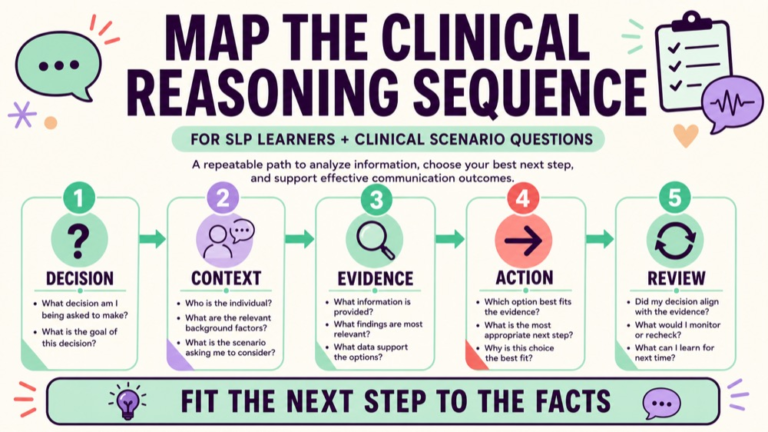
Free practice is most valuable when it reveals how you reason. Use each question to name the decision verb, mark the decisive clue, compare choices, check language and access, respect safety and professional boundaries, and write the next review. Recheck live sources whenever a detail about the exam or professional practice may have changed.
What speech pathology Praxis free questions can do for your study
A free question is not automatically a good question. Its study value comes from the reasoning it makes visible. A useful item asks you to select an action from evidence, then gives you enough explanation to see why the selected choice fits better than the alternatives. That process builds a review record that is more useful than a list of answer letters.
Study purpose
What to practice
Useful output
Foundations
Identify the communication, health, development, learning, or participation concept that frames the case.
A concise concept statement.
Evaluation
Define the referral concern, choose representative evidence, and interpret limits without expanding the conclusion.
A question-to-measure match.
Treatment
Connect a target, cue, activity, partner, and outcome to the person’s functional goal.
A supported action with a reason.
Professional practice
Notice consent, privacy, competence, supervision, collaboration, and documentation boundaries.
A safe sequence or handoff.
Access and culture
Check language, dialect, communication mode, hearing, environment, culture, and partner conditions.
An accessible interpretation or next step.
Transfer
Change one variable and decide whether the same answer still fits.
A rule that survives new wording.
Rotate the purpose of your practice. A learner who completes only familiar assessment vocabulary may feel comfortable while missing treatment transfer, communication access, safety, or professional sequencing. A small set can cover several purposes when every rationale connects the technical decision to the person, activity, setting, and next step.
Start with the current 5331 frame
Begin by checking the current source frame rather than treating an old outline as permanent. The ASHA 5331 content page and ETS 5331 page are the practical starting points for confirming the exam identity, content context, and current preparation links. Use those sources for date-sensitive notes, then use topic-specific ASHA guidance for clinical concepts.
Do not confuse a search result or a competitor’s free quiz with an authoritative specification. Search results can show that learners want free practice questions, but they do not establish clinical truth, current scoring information, or professional requirements. Read the source plan behind your study note and record the checked date when you save an administrative fact.
The practice set on this page is designed to train decisions across evaluation, treatment, professional practice, foundations, and access. It does not claim to reproduce a live test or predict what an individual will encounter. The durable skill is explaining the evidence and the boundary that support an answer.
Choose free questions by decision type
Classify each item by the action it asks you to take. “Assess,” “interpret,” “treat,” “refer,” “monitor,” “document,” and “collaborate” require different answer shapes, even when the topic vocabulary overlaps. Mark the verb before looking for the most familiar technical term in the choices.
Decision type
Look for
Common mismatch
Clarify
A precise referral question, goal, concern, or missing history.
Jumping to a tool before defining the need.
Assess
Representative evidence, accessible conditions, measure fit, and interpretation limits.
Treating one structured result as the whole picture.
Interpret
A conclusion proportional to the evidence, context, and measurement limits.
Using a broad label when the case supports a narrower observation.
Treat
A functional goal, target, support, activity, partner, and outcome.
Choosing an exercise with no connection to participation.
Refer or hand off
Safety, urgency, scope, role, communication, and continuity.
Continuing a task after the scenario gives a stop clue.
Monitor
A defined outcome, time point, condition, and reason to adapt.
Collecting data without a decision rule.
Collaborate
The person’s priorities, team roles, communication, and shared plan.
Assuming one professional owns every decision.
When two choices sound reasonable, return to the verb and the sequence. The better answer usually addresses the requested decision at the appropriate level, includes the most relevant evidence, and respects the boundary stated in the scenario.
Check the quality of a free question set
Before spending hours with a free bank, inspect its structure. A page that supplies many short prompts but no rationales may provide recognition practice without showing how to reason. A page with dramatic wording or unsupported certainty may create habits that do not transfer to careful clinical decision-making.
Quality check
Ask yourself
Study response
Source boundary
Does the page distinguish original educational items from current testing information?
Keep the exercise clearly labeled as original practice.
Specific stem
Does the scenario include a person, activity, context, evidence, and decision?
Prefer a decision that can be defended from the details.
Balanced choices
Are the options plausible without relying on trick wording or an extreme claim?
Compare fit, evidence, sequence, access, and safety.
Complete rationale
Does the explanation address the best answer and the distractors?
Write the missing step or mismatch for each alternative.
Functional relevance
Does the question connect a clinical action to participation or communication?
Name what changes for the person, partner, or activity.
Current context
Are date-sensitive exam details linked to current ETS or ASHA pages?
Recheck live sources before updating notes.
Transfer prompt
Can one variable be changed without rewriting the whole case?
Use a changed setting, partner, support, or decision verb.
Also check whether the source clearly separates education from clinical care. Practice examples can teach a decision pattern, but they do not establish an individual diagnosis, treatment plan, scope-of-practice answer, or legal requirement. Keep local policy, supervision, informed consent, and current professional guidance in view when a scenario depends on them.
Read the scenario before scanning the choices
Choices are written to sound attractive. A familiar word can pull you toward an answer before you have identified the task. Read the scenario once for the overall situation and once for the details. Write a short spine with the person, activity, setting, partner, language or mode, evidence, decision, and urgency.
Stem field
Question to ask
Why it matters
Person
Who is communicating, learning, eating, working, or receiving care?
Avoid assuming a profile that the case does not provide.
Activity
What does the person need, want, or need support to do?
Function keeps the answer connected to daily life.
Context
Where, with whom, in what language or mode, and under what demands?
Context can change opportunity and interpretation.
Evidence
What is reported, observed, measured, or changed with support?
Use the evidence actually present in the stem.
Decision
Is the item asking you to clarify, assess, interpret, treat, refer, document, or monitor?
The verb controls the type of answer.
Boundary
Is there a safety, consent, privacy, competence, or local-process clue?
A boundary can change the order of action.
Do not invent absent facts. If the case does not state hearing history, language history, consent, or a safety procedure, note that the missing information may guide the next step. You can identify uncertainty without filling it with an assumption. That distinction keeps the rationale tied to what the scenario actually supports.
Separate evidence from an attractive distractor
Most distractors are not random. They often represent a real action placed at the wrong time, a correct concept applied to the wrong context, a narrow result treated as a broad conclusion, or a support removed before its function is understood. Label the mismatch instead of merely calling the choice wrong.
Fit: Does the choice answer the question that was asked?
Evidence: Which fact in the stem supports or weakens it?
Sequence: Is this action appropriate now, or does another step come first?
Access: Does the choice give the person a fair way to communicate or demonstrate the skill?
Function: Does it connect to the person’s activity and priority?
Boundary: Does it respect safety, consent, privacy, competence, and collaboration?
When a choice sounds technically impressive, ask whether it is proportionate. Free questions are excellent opportunities to practice restraint: state what the evidence supports, what it leaves open, and what you would check before making a larger decision.
Keep language, access, and function in the frame
Communication performance is shaped by the conditions in which it is observed. Read for language history, dialect, culture, mode, hearing, vision, motor access, technology, partner behavior, noise, fatigue, health, and task demands when the case includes them. These details can change what the result means and which next step is reasonable.
The ASHA Multilingual Service Delivery resource supports attention to language history, exposure, use, dialect, access, and collaboration. The ASHA Cultural Responsiveness resource supports reflective and person-centered interaction. Use current topic guidance rather than turning one study shortcut into a universal rule.
Ask whether the person had an accessible way to understand the directions.
Separate a language or communication difference from a disorder conclusion.
Keep the person’s goals, preferences, language, culture, and partner visible.
Connect a measure to the activity in which the person needs to communicate.
Notice whether support changes opportunity, effort, accuracy, or participation.
Pause for a safety, consent, privacy, competence, supervision, or handoff clue.
Context is not an optional paragraph after the answer. It is part of deciding which evidence is representative and which action is proportionate. If the options ignore an important access condition, that omission may be the reason the choice is weak.
Write a rationale that transfers
After choosing, write a rationale without copying the page’s wording. Explain the decision, the decisive clue, the fit of the best answer, the weakness of each distractor, the boundary of the evidence, and the condition you would change for transfer. A rationale can be concise while still showing the reasoning chain.
Rationale part
Sentence starter
Quality check
Decision
The question asks me to…
Did I answer the requested action rather than a nearby topic?
Decisive clue
The most important detail is…
Did I quote or accurately paraphrase a case fact?
Fit
The selected option fits because…
Did I connect the clue to the action?
Distractors
The other choices are weaker because…
Did I identify a sequence, evidence, access, or boundary problem?
Limit
This result does not establish…
Did I avoid a broad conclusion from a narrow observation?
Transfer
If the setting or support changed…
Can I state what I would reconsider next?
Use a “because” sentence to connect evidence to action: “Because performance changes when the partner and setting change, the next step should examine the communication demand before a broad conclusion.” If you cannot write that connection, the item deserves another review even if the selected letter was correct.
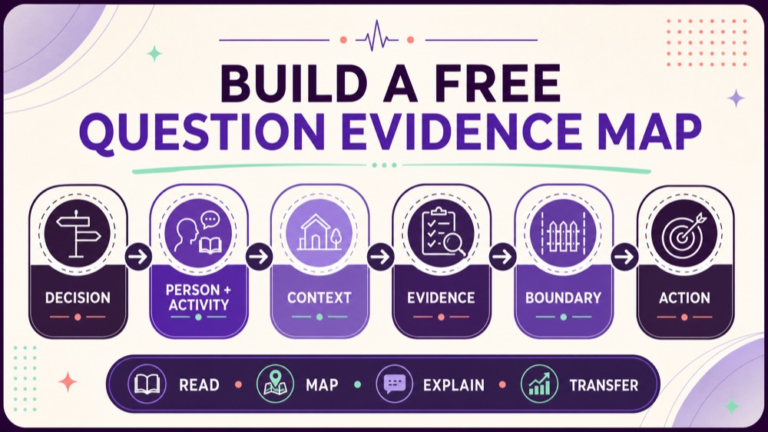
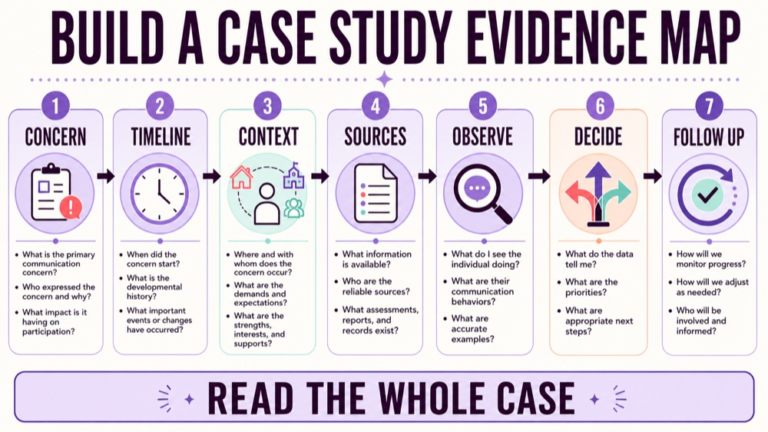
Build a Free Question Evidence Map
The evidence map turns a free question into a compact reasoning record. Put the decision at the center, then connect the person, activity, context, evidence, boundary, and next step. The map is helpful when an item feels familiar but the answer choices differ by sequence or by the amount of conclusion they claim.
Map node
Write one line
Example prompt
Decision
The action the item requests.
Am I clarifying, assessing, treating, referring, or monitoring?
Person and activity
Who needs what communication outcome?
What activity or priority is named?
Context
Language, mode, partner, setting, support, and time.
What condition changes performance or access?
Evidence
Report, observation, measure, response, or missing information.
What does the case actually show?
Boundary
Safety, consent, privacy, competence, or local process.
What must happen before the next step?
Action
The proportionate next move and what it will answer.
Why is this choice the best fit now?
Keep the map small. Its purpose is to make the reasoning visible before you reopen the answer key. On the second pass, cover the original choices and use the map to state your answer. On the third pass, change one node and see what needs to change.
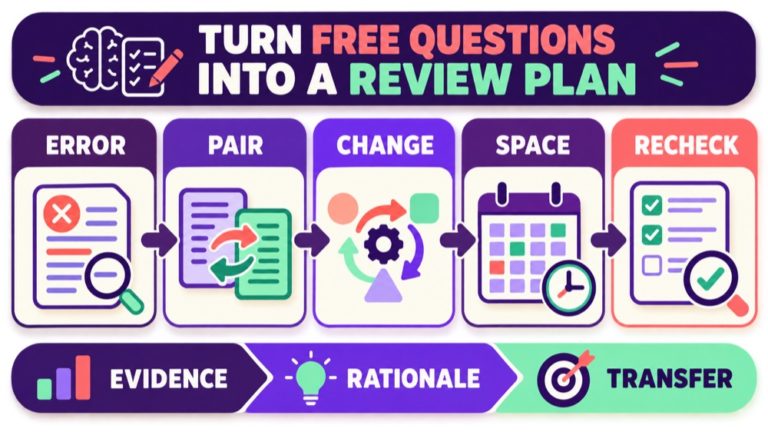
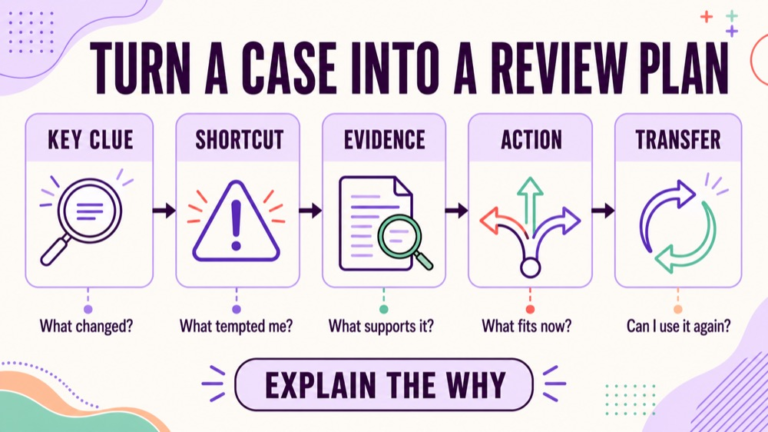
Turn Free Questions Into a Review Plan
A free question becomes a review plan when it tells you what to do next. Record whether the miss came from reading, evidence, access, sequence, function, professional boundaries, transfer, or confidence. Then choose a paired item or changed scenario that targets that category rather than rereading an entire textbook chapter.
Result
Next review
Evidence of improvement
Wrong answer, clear confidence
Rebuild the stem spine and identify the missed clue.
You can explain the distractor that pulled you away.
Right answer, weak rationale
Write the evidence-to-action sentence and name the limit.
You can defend the answer without the letter.
Right answer, low confidence
Compare the best choice with the strongest distractor.
You can state why technical wording does not control fit.
Miss caused by context
Create a paired case with a changed language, partner, setting, or mode.
You preserve access checks in the revised answer.
Miss caused by sequence
Put clarify, assess, act, monitor, and handoff on a timeline.
You identify the proportionate next action.
Miss caused by transfer
Change one variable while keeping the core evidence stable.
You can explain what changes and what stays consistent.
Do not turn a review log into a judgment about your ability. It is a map of decisions under particular conditions. The goal is to make the next study action specific enough that you can observe a change in reasoning.
Question 1: an evaluation decision
Practice Question 1. A preschool teacher reports that a child uses short phrases during play but becomes difficult to understand during a fast group routine. The teacher asks for a broad language score before the clinician has reviewed hearing, language exposure, or the activity demands. What is the best next step?
A. Choose the broadest available test immediately because a score is the fastest way to answer the referral.
B. Conclude from the teacher’s report that the child has a global language disorder.
C. Clarify the communication concern, review language and hearing context, observe representative routines, and select evidence that answers the refined question.
D. Use the quiet play sample as the final description because it provides the cleanest testing condition.
Correct Answer: C. The contrast between play and a fast group routine is the decisive clue. A careful next step defines what the teacher needs to know and examines language history, hearing, partner demands, rate, noise, and representative activity before selecting a measure or making a broad interpretation.
Why the Other Options Are Wrong: A starts with a tool before the question is clear. B turns one report into a global conclusion. D treats a less demanding context as the full functional picture. C uses context and evidence to choose proportionate evaluation steps.
Exam Trap: A request for a score does not replace a defined referral question. Look for the condition under which communication changes.
Question 2: a treatment decision
Practice Question 2. An adult produces a speech target more accurately in structured drills with a visual cue, yet still avoids introducing themself during work meetings. Which response best connects the practice result to a functional treatment plan?
A. Count the drill accuracy as evidence that the meeting goal is complete.
B. Remove every visual cue at once so the next session measures unaided performance only.
C. Keep the useful cue while adding supported meeting practice, tracking cueing and effort, and monitoring target performance together with participation.
D. Replace the communication goal with a new target without examining the meeting activity.
Correct Answer: C. The structured gain is relevant, but the unchanged work participation shows that transfer conditions still need attention. The plan can preserve an effective support while introducing the listener, setting, timing, and participation demands that matter to the adult’s goal.
Why the Other Options Are Wrong: A treats a narrow drill measure as the entire outcome. B removes support before learning how it helps and how it might be faded. D changes the target without solving the named activity. C connects target, support, practice, and function.
Exam Trap: A support can be part of effective treatment. Compare performance, effort, cueing, and participation instead of treating independence as the only useful outcome.
Question 3: a professional-practice decision
Practice Question 3. During a facility-approved swallowing screen, a patient becomes less alert and develops a new vocal change after a trial. The local process requires the screen to stop and the team to be notified. What is the best professional-practice response?
A. Continue with additional trials so the clinician can collect a fuller screen result.
B. Record the earlier trial as the final result and continue the meal as planned.
C. Stop under the local process, communicate the change, document the conditions and response, and arrange qualified follow-up for the broader question.
D. Ask an untrained support person to finish the trials while the clinician completes other work.
Correct Answer: C. The change in alertness and voice is safety-relevant information within the stated process. Stopping, communicating, documenting, and arranging qualified follow-up respects the local boundary and preserves continuity without turning a screen into a broader evaluation.
Why the Other Options Are Wrong: A ignores the stop instruction. B treats earlier performance as final after conditions changed. D transfers a safety-sensitive task without appropriate competence or oversight. C follows the stated sequence and keeps the handoff visible.
Exam Trap: When a stop rule is part of the scenario, the item is testing sequence and communication. More observations are not automatically a better answer.
Question 4: a communication-access decision
Practice Question 4. A bilingual student understands a classroom lesson in the home language but gives brief answers in English during a monolingual task. The record lacks a language history and the teacher is unsure whether the student understood the directions. What should guide the next step?
A. Interpret the brief English answers as sufficient evidence of a language disorder.
B. Repeat the same English task with more difficult vocabulary to obtain a clearer result.
C. Gather language history, clarify the student’s strongest languages and communication opportunities, confirm accessible directions, and use appropriate bilingual or collaborative assessment planning.
D. Exclude the home language from the evaluation because the classroom instruction is in English.
Correct Answer: C. The missing language history and uncertain direction access limit interpretation. A defensible next step examines the student’s languages, exposure, use, dialect and cultural context, then plans assessment with appropriate resources and collaboration rather than treating English output alone as the construct.
Why the Other Options Are Wrong: A makes a broad interpretation from a limited condition. B increases task difficulty without repairing access. D removes information needed to understand communication across contexts. C protects valid interpretation and participation.
Exam Trap: Language of instruction is one context, not a complete description of language ability. Ask whether the task gave the student a fair way to show the skill.
Use missed free questions as a study map
Missed questions are useful when you classify them accurately. “I need to study evaluation” is broad; “I missed the difference between a referral question and a test selection” points to a repair. Choose one error category, write the missing reasoning sentence, and find a new item that changes the wording but preserves the same decision.
Error category
What happened
Repair for the next session
Missed the verb
Answered an assessment question with a treatment action, or a monitoring question with a conclusion.
Underline the action word before reviewing the content.
Missed context
Treated language, mode, hearing, partner, noise, fatigue, or culture as background detail.
Write how the condition changes access or interpretation.
Overread one measure
Treated a structured result as the complete functional picture.
Add a representative activity and outcome.
Jumped the sequence
Selected a later intervention or broad conclusion before clarifying the question or safety.
Write the safest proportionate next step.
Ignored boundaries
Forgot consent, privacy, competence, supervision, handoff, or local process.
Add the role and continuity requirement.
Changed too much
Created a new case so different that the original rule could not be tested.
Change one variable and hold the evidence steady.
Lucky answer
Selected the best choice but could not explain why it fit.
Rewrite the rationale in your own words.
Confidence drift
Changed a defensible choice because another option sounded more technical.
Return to the decisive clue and compare fit.
After several sessions, look for patterns across domains. Repeated access errors may call for language and communication-mode review. Repeated sequence errors may call for a decision timeline. Repeated confidence errors may call for slower comparison of evidence rather than more question volume.
Build a seven-day free-question plan
A seven-day cycle creates variety without making a permanent claim about exam weighting. Use a small number of original questions each day and spend enough time on rationales and transfer. Adjust the sequence to the current ASHA content frame and your own error categories.
Day 1: clarify referral questions, goals, and the difference between a concern and a decision.
Day 2: review language, dialect, culture, mode, hearing, and accessible directions.
Day 3: connect treatment targets, cues, activities, partners, and outcomes.
Day 4: practice screening, safety signals, stop rules, referral, and handoff.
Day 5: review professional practice, consent, privacy, competence, supervision, and collaboration.
Day 6: solve a cross-domain scenario with one changed context variable.
Day 7: revisit misses, low-confidence answers, and rationales without looking at the original key.
Use the live ETS and ASHA sources when you update administrative or professional notes. Use your free-question log to decide which topic deserves another item. The plan is a study structure, not a forecast of the exam’s question distribution or an outcome claim.
Free-question review checklist
Run this checklist before closing a session. It keeps the free resource focused on reasoning, access, function, and responsible source use.
Did I identify the decision verb before comparing options?
Did I name the person, activity, setting, partner, language or mode, and urgency?
Did I mark the decisive clue or contrast?
Did I separate report, observation, measure, interpretation, and action?
Did I check whether the task was accessible and representative?
Did I keep language, dialect, culture, hearing, environment, and support visible?
Did I notice safety, consent, privacy, competence, supervision, and handoff boundaries?
Did I explain why the selected answer fits this case?
Did I explain why each distractor is weaker for this case?
Did I state what the evidence does not establish?
Did I change one variable to practice transfer?
Did I record an error category and schedule delayed review?
Did I recheck current ETS or ASHA pages for date-sensitive details?
If the answer was correct but the explanation was vague, keep it in the review set. Recognition can arrive before reasoning is stable. A clear evidence sentence and a changed-case answer are better signs of progress than a streak alone.
For current preparation-resource context, check the ETS practice-test page. The questions, choices, rationales, evidence maps, and checklists here are original educational material, separate from live test material. Recheck current sources before relying on an administrative, scoring, professional, state, school, agency, or facility requirement.
For your next session, choose one question from the set, write the six-node evidence map, compare the strongest distractor, and change one context variable. Then schedule a delayed review and record the rule in your own words.
SLP Praxis 5331 Practice Question of the Day: Daily Review Loop
slp praxis 5331 practice question of the day works best as a small, repeatable learning routine. One original question can train several skills: identifying the decision verb, locating the decisive clue, checking language and access, comparing answer choices, explaining the rationale, and applying the rule to a changed scenario. The goal is not to create pressure around a daily streak; it is to make reasoning visible and reviewable.
Use the current ASHA Speech-Language Pathology 5331 content page for the professional study frame and the live ETS 5331 page for current exam identity and administrative details. The ASHA Practice Portal provides topic-specific clinical context. The question set, rationales, maps, and checklists below are original learning material, separate from live test material and not individualized clinical advice.
Because test information can change, use this page for a durable review loop rather than a frozen daily calendar or a promise about score outcomes. Pair current source checking with clinical reasoning: define the question, use the evidence, respect access and safety, and explain what you would review next.
What the SLP Praxis 5331 practice question of the day can teach
A daily question is small enough to complete consistently, but it should still contain enough information to practice reasoning. The useful unit is not “I got the letter right.” It is “I can explain which decision the stem asked for, which clue mattered, why the answer fits, why the alternatives fail, and how the rule changes when the context changes.”
Daily stage
What to do
Output
Preview
Name the decision verb and predict which evidence should matter.
A one-sentence purpose before seeing the answer.
Read
Mark person, activity, setting, partner, language or mode, time course, and urgency.
A concise scenario spine.
Choose
Compare options for decision fit, evidence fit, access, safety, and sequence.
One best answer with a reason.
Explain
State why the selected option fits and why each distractor is weaker.
A transferable rule, not a letter.
Apply
Change one fact or context variable and solve a paired version.
Evidence that the rule transfers.
Schedule
Record the error category and set a short review date.
A targeted next question.
Choose original questions that span assessment, treatment, professional practice, communication access, safety, and functional participation. Avoid using one domain as a substitute for the whole exam frame. A short question can still ask you to integrate multiple domains when the case includes language, partner, setting, or role details.
Build a small daily question routine
Keep the routine short enough to repeat and structured enough to produce evidence. A useful session can take ten to twenty minutes, depending on the question and the depth of the rationale. If you have more time, add a paired scenario instead of racing through more answer letters.
Preview: read the title or topic and predict the decision you may need to make.
Answer: read the stem once for the big picture, then reread for the person, activity, context, and boundary.
Commit: choose an answer before reading the rationale, and mark your confidence.
Explain: write the evidence for the best option and the error in each distractor.
Transfer: change one variable such as language, partner, setting, support, urgency, or decision type.
Schedule: record the error category and set a later review.
On a busy day, complete the answer and one-sentence rationale. On a longer study day, complete the full loop. Consistency matters because spaced retrieval gives you repeated opportunities to recognize the same reasoning rule in different wording.
Read the stem before the options
Answer choices can pull your attention toward familiar vocabulary. Read the stem first and write a compact scenario spine: person, activity, setting, partner, time course, evidence, decision, and urgency. Then look at the options. This makes it easier to notice when a choice repeats a technical word but does not fit the actual task.
Stem field
Question to ask
Why it matters
Person
Who is communicating, eating, learning, working, or receiving care?
Strengths, priorities, health, and access vary by person.
Activity
What does the person need or want to do?
The functional goal controls the outcome.
Setting
Where and with whom does the pattern occur?
Noise, partner, routine, and demand can change performance.
Evidence
What is reported, observed, measured, or changed with support?
The answer must stay within the evidence.
Decision
What does the question ask you to clarify, assess, interpret, treat, refer, or monitor?
The verb determines the answer type.
Boundary
Is there an access, safety, competence, consent, privacy, or local-process clue?
The boundary may change the sequence.
Do not add facts that the stem does not provide. If the case does not include hearing history, language history, or a safety protocol, you can identify that missing information as a reason for the next step, but you should not invent its result.
Mark the decisive clue
Not every detail in a question carries the same weight. A decisive clue often appears as a contrast: better in quiet than in noise, accurate with a cue but not in conversation, different across languages, changed after a health event, or risky after a new condition. It may also be a professional boundary: the procedure is outside competence, the person has not consented, or the local process requires a stop.
Clue category
Examples
Next reasoning move
Decision verb
Clarify, screen, assess, interpret, treat, refer, document, or monitor.
What is the item asking you to do?
Functional target
Communication, swallowing, learning, work, care, safety, or participation activity.
History, report, observation, measure, response to support, outcome, or policy.
What does the source actually show?
Boundary
Measurement limit, safety signal, competence, privacy, consent, or local requirement.
What must stay visible?
Next step
Assessment, support, treatment, collaboration, referral, documentation, or review.
What action is proportionate now?
Underline the contrast and write “because” after it. For example: “The student performs differently in noise because the next step must examine hearing and classroom access.” Or: “The target improves with a cue but participation does not because practice needs transfer conditions and outcome data.” The word “because” forces you to connect the fact to the action.
Explain the answer instead of memorizing a letter
A rationale should answer four questions: What decision is being made? Which fact makes the selected option fit? Why do the alternatives fail for this case? What rule transfers to a new case? The explanation can be brief, but it should be specific enough that you could recognize the rule without seeing the original wording.
Rationale part
Sentence starter
Quality check
Decision
The question is asking for…
Did I answer the requested verb?
Evidence
The decisive clue is…
Did I use a fact from the stem?
Fit
The best option fits because…
Did I connect evidence to action?
Distractors
The other options are weaker because…
Did I name the missing or unsafe step?
Boundary
This does not establish…
Did I avoid a broad conclusion?
Transfer
If the context changed to…, I would…
Can I apply the rule again?
Use “correct but lucky” as an error label when your answer was right but your rationale was weak. That label is not a criticism; it is a prompt to revisit the evidence and write a rule. It helps distinguish recognition from durable understanding.
Use error categories to plan tomorrow
Do not respond to a missed item by rereading everything. Identify the error category, then choose the next review that targets it. A learner may miss a treatment question because the activity was not identified, or miss an assessment question because a language-access condition was ignored. The domain name alone is not specific enough.
Error category
What happened
Tomorrow’s repair
Question reading
Answered a different verb or missed the requested decision.
Underline the action word before reviewing content.
Evidence
Ignored a condition, report, score limit, or contrast in the stem.
Write the decisive clue and what it supports.
Access
Treated language, mode, hearing, environment, or partner as background.
Ask how the person could show the skill.
Sequence
Chose a later treatment or conclusion before clarification or safety.
Place the action in the correct order.
Function
Selected a narrow task without connecting it to participation.
Name the activity and outcome.
Professional boundary
Ignored consent, privacy, competence, supervision, or handoff.
State the role and continuity requirement.
Transfer
Could explain the original wording but not a changed case.
Change one variable and solve again.
Confidence
Changed a defensible answer because of vague doubt.
Record evidence for and against each option.
Use a small rotation: question reading, evidence, access, sequence, function, professional boundary, transfer, and confidence. After several days, look for repeated categories. That pattern is more actionable than a single daily percentage.
Keep access, safety, and professional context visible
Daily practice should not train you to ignore context. Check language, dialect, culture, communication mode, hearing, vision, motor access, technology, partner, environment, health, fatigue, consent, privacy, competence, supervision, and local protocol when the scenario includes them.
Ask whether the person had an accessible way to show the skill.
Separate a communication difference or access barrier from a disorder conclusion.
Keep the person’s goal, preference, language, culture, and partner visible.
Pause for a safety clue or local stop rule.
Check role, competence, consent, privacy, supervision, and handoff needs.
Document what the scenario supports and what remains uncertain.
These checks are not extra points added after the answer. They are part of selecting the answer that best fits the case.
Use spaced review and transfer
Return to a missed or low-confidence question after a delay. On the second attempt, cover the rationale and solve it from the evidence. On the third attempt, change one variable. Spacing and transfer tell you whether the reasoning rule is usable beyond the original phrasing.
Review the original item after one day without looking at the answer.
Explain the decisive clue and the strongest distractor.
Change one context variable and write the new best next step.
Review again after several days and compare your confidence.
Move the rule into a different domain, such as assessment to treatment or treatment to professional handoff.
For date-sensitive exam facts, use the live ETS and ASHA pages each time you update the note. For durable reasoning rules, keep the wording general enough to survive a change in format or administrative detail.
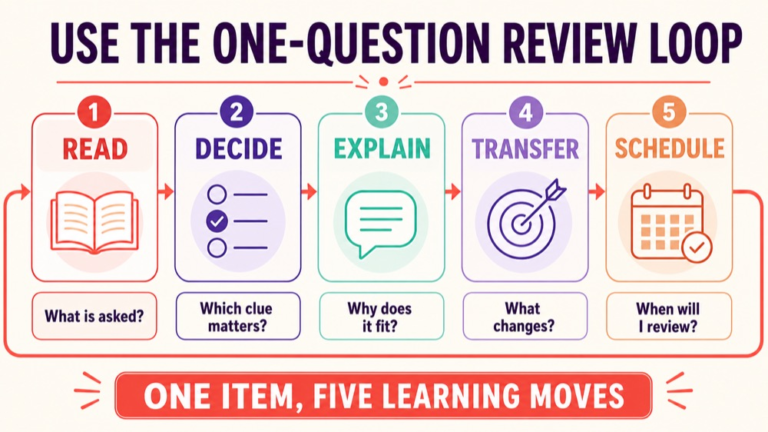
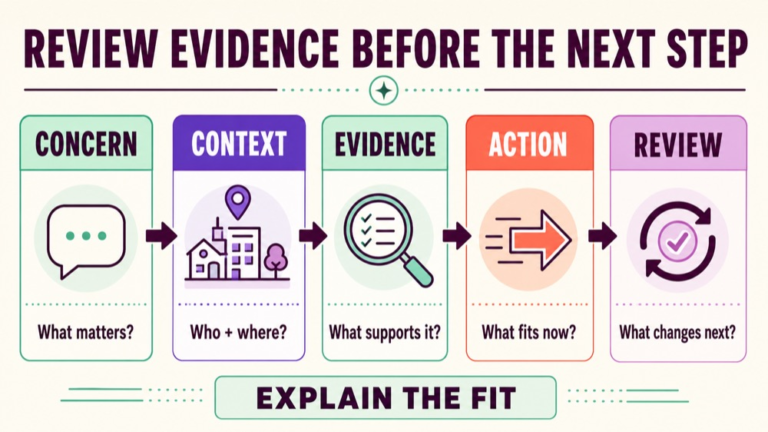
Use the One-Question Review Loop
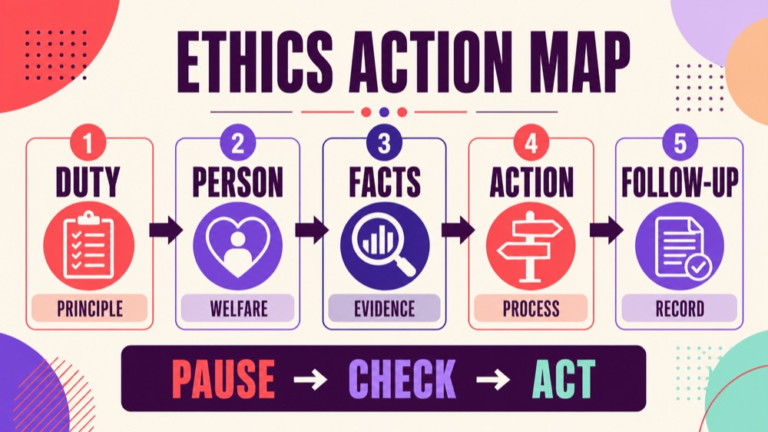
Use the loop shown in the map: read, decide, explain, transfer, and schedule. Add the person, activity, context, and boundary to your notes when the question includes them. A daily item becomes a useful snapshot of your study process—not a prediction of a reported exam result.
Loop step
Write
Result
Read
Decision verb and scenario spine.
A clear question.
Decide
Answer and confidence before rationale.
A committed choice.
Explain
Evidence, fit, distractor error, boundary.
A defensible rationale.
Transfer
One changed variable and revised action.
A portable rule.
Schedule
Error category and review date.
A targeted next session.
If you cannot complete the transfer step, return to the context. Often the missing element is language, partner, setting, support level, urgency, or decision verb.
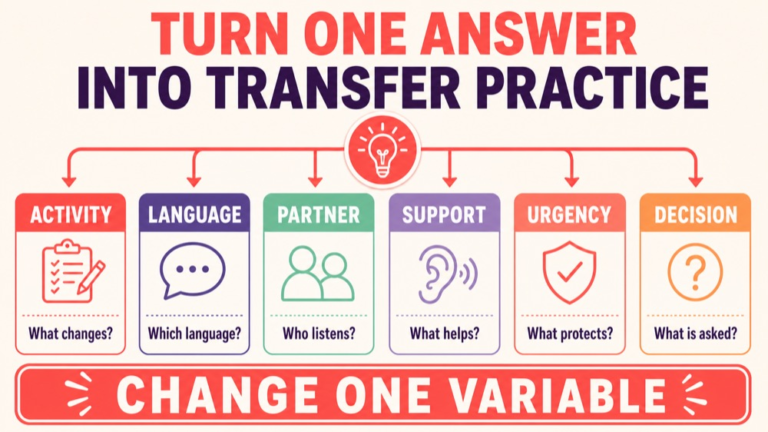
Turn One Answer Into Transfer Practice
One answer can generate several new questions. Change the activity, language, partner, setting, support, health condition, or professional role. Keep the core evidence stable when you want to study context; change the decision verb when you want to study sequence.
Change one field
New question
What you learn
Activity
What if the same skill is needed for work rather than class?
How function changes the outcome.
Language
What if the person’s strongest language is not the language of the task?
How access changes interpretation.
Partner
What if the listener is unfamiliar or needs training?
How partner conditions affect transfer.
Support
What if a visual cue or device is available?
How support changes opportunity and data.
Urgency
What if a safety signal appears during the task?
How sequence and handoff change.
Decision verb
What if the question changes from assess to treat?
How the same evidence serves a new decision.
Write the answer in your own words. Do not try to manufacture a harder or more dramatic scenario. The point is to practice how evidence and context alter the action.
Question 1: a daily assessment decision
Practice Question 1. A child follows a short direction in a quiet room but misses multi-step directions during a noisy classroom transition. The teacher requests “a language test today.” What is the best daily-practice answer to the next-step question?
A. Administer the longest language test immediately because the teacher requested it.
B. Conclude that the child has a receptive-language disorder from the classroom report.
C. Clarify the classroom demand, review hearing and language context, observe the routine, and select targeted assessment or access supports that answer the refined question.
D. Use the quiet-room direction task as the final decision because it is easier to control.
Correct Answer: C. The contrast between quiet individual work and noisy multi-step directions is the decisive clue. The next step should clarify the construct and examine hearing, language load, visual support, partner behavior, and classroom conditions before a broad conclusion or test choice.
Why the Other Options Are Wrong: A follows the requested tool before defining the question. B turns a context-sensitive report into a global conclusion. D uses the least representative condition as the final answer. C uses the clue to choose proportionate evidence and support.
Exam Trap: The request for a test is not the same as a clearly defined assessment question. Find the condition that changes performance.
Question 2: a daily treatment decision
Practice Question 2. An adult’s speech target is more accurate during structured practice with a visual cue, but the adult still avoids phone calls at work. Which daily-review answer best links treatment data to the functional goal?
A. Count the structured accuracy gain as evidence that the work goal has been met.
B. Remove the visual cue immediately so the next session measures independence only.
C. Add supported practice for relevant phone tasks and listeners, record cueing and effort, and monitor both target performance and work participation.
D. Replace the work goal with a different speech target without reviewing the phone activity.
Correct Answer: C. The structured gain is useful, but the unchanged phone participation shows that the functional outcome and conditions still need attention. The plan can keep an effective visual support while adding meaningful practice and recording the factors that guide adaptation.
Why the Other Options Are Wrong: A treats a narrow measure as the entire outcome. B removes access before checking how support can be adapted or faded. D changes the target without resolving the activity named in the goal. C connects target, support, practice, and participation.
Exam Trap: A correct answer can include both keeping a support and adding a harder transfer condition. Do not confuse support with failure.
Question 3: a daily professional-practice decision
Practice Question 3. During a facility-approved swallowing screen, the patient becomes less alert and develops a new vocal change after a trial. The local process requires the screen to stop and the team to be notified. Which answer best reflects professional reasoning?
A. Continue with more trials so the clinician can reach a detailed physiologic conclusion.
B. Record the earlier trial as the final result and continue the meal.
C. Stop under the local process, communicate the change, document conditions and response, and arrange qualified comprehensive follow-up.
D. Ask an untrained support person to complete the remaining trials.
Correct Answer: C. The new alertness and vocal change are risk information within the stated process. The safe next step is to stop, communicate, document, and connect the patient to the qualified follow-up that answers the larger question.
Why the Other Options Are Wrong: A ignores the stop instruction and expands a screen into a different evaluation. B treats earlier performance as the final result after conditions changed. D transfers a safety-sensitive task without appropriate competence or oversight. C follows the process and protects continuity.
Exam Trap: When a daily item includes a local stop rule, it is testing sequence and handoff, not how many extra observations you can collect.
Review common daily-practice shortcuts
Short routines can create shortcuts if you only count completion. Use the table to notice what to repair.
Shortcut
Why it feels efficient
Repair
Streak over reasoning
A completed question feels like progress.
Require one evidence sentence and one transfer sentence.
Letter memory
The correct option is easy to recognize later.
Cover the answer and reconstruct the rule.
Speed over reading
More items fit into the session.
Slow down for the decision verb and decisive clue.
Score chasing
A percentage gives a simple trend.
Track error categories, confidence, and transfer.
One domain only
Familiar content builds comfort.
Rotate assessment, treatment, access, safety, and professional practice.
Rationale copying
The explanation is already written.
Write the reason in your own words first.
No changed case
The original answer feels mastered.
Change one context variable.
Current-fact drift
An old note stays convenient.
Recheck live ASHA and ETS pages when updating dates or format.
A daily question is successful when it strengthens the quality of your next decision, not only when it adds one more completed item.
Build a seven-day question cycle
A weekly cycle can organize variety without making a permanent claim about the exam. Adjust it to your schedule and current blueprint review.
Day 1: assessment purpose, referral question, and measure fit.
Day 2: language, culture, communication mode, hearing, or access.
Day 3: treatment goal, method, cueing, and functional outcome.
Day 4: screening, safety, stop rules, and referral.
Day 5: professional practice, consent, privacy, competence, and collaboration.
Day 6: a cross-domain scenario with a changed context.
Day 7: delayed review of misses, low-confidence answers, and transfer rules.
Use the current ASHA and ETS source pages to decide which content needs more attention. The rotation is a study structure, not a claim about domain weighting or test item distribution.
Track the daily loop
Use a compact table or note with one row per question. Include the decision, decisive clue, answer, confidence, error category, and transfer result.
Field
Example
Why keep it
Decision
Choose assessment evidence for a classroom concern.
Keeps the question specific.
Clue
Performance changes between quiet and noisy settings.
Shows why context matters.
Answer
Clarify, review access, observe, then select targeted evidence.
Records the action in your own words.
Confidence
54% before rationale; 88% after explanation.
Shows recognition versus certainty.
Error category
Evidence and access.
Targets the next review.
Transfer
Changed the partner and kept the access check.
Tests portability.
Review date
Three days later.
Creates spacing.
Review correct but low-confidence answers and incorrect answers that felt easy. Both can reveal a study need. Keep the note focused on reasoning, not self-judgment.
Practice question of the day checklist
Use this checklist before closing the daily session. It is a study aid, not a substitute for current ASHA guidance, ETS information, local requirements, supervision, or individualized clinical judgment.
Did I identify the decision verb?
Did I name the person, activity, setting, partner, language or mode, and urgency?
Did I mark the decisive clue or contrast?
Did I separate observation, report, measure, interpretation, and action?
Did I check communication access, language, culture, hearing, environment, and support?
Did I notice safety, consent, privacy, competence, supervision, or handoff boundaries?
Did I explain why the best option fits the evidence?
Did I explain why each distractor is weaker for this case?
Did I state what the answer does not establish?
Did I change one variable and practice transfer?
Did I record the error category and schedule spaced review?
Did I use current sources for any date-sensitive exam or professional detail?
The daily loop is: read, decide, explain, transfer, schedule. Keep it small enough to repeat and specific enough to teach you something. Treat each response as a study snapshot: it shows how you handled one item under one set of conditions, and it gives you a reason to choose the next review rather than a reason to make a broad judgment about your preparation.
For current preparation-resource context, use the live ETS practice-test page. The questions, rationales, maps, and checklists here are original educational material, separate from live test material. Recheck live sources before relying on an administrative, scoring, or professional requirement.
For your next session, choose one missed question, write its evidence sentence, change one context variable, and solve the paired version. Then add the rule to your review log.
SLP Praxis 5331 Domain Practice Questions: Blueprint Map
slp praxis 5331 domain practice questions help you study the SLP Praxis 5331 content frame without reducing it to a list of isolated labels. A domain tells you which lane of knowledge to review; the scenario still requires you to identify the person, task, evidence, context, decision, and follow-up. The best answer connects the domain to the action the question actually asks for.
Use the current ASHA Speech-Language Pathology 5331 content page for the current professional study frame and the live ETS 5331 page for current test identity and administrative details. The ASHA Practice Portal supplies topic-specific clinical context. The questions, rationales, maps, and checklists below are original learning material, separate from live test material and not individualized clinical advice.
Because exam sources and administrative details can change, this guide does not freeze a question count, percentage allocation, or date-sensitive format as a permanent fact. Instead, it teaches a durable way to use the current source and reason through domain-based clinical scenarios.
A domain review becomes useful when it ends in a decision you can explain. For each topic, identify the person or population, the construct, the evidence, the access conditions, and the professional responsibility. Then ask what the clinician should do with the information: gather more evidence, provide support, begin or adapt treatment, communicate with the team, refer, document, or monitor. This keeps your practice set aligned with clinical reasoning rather than simple word matching.
Use the current source for the boundary and the case for the application. If a scenario changes the language, setting, partner, communication mode, health status, or decision purpose, reconsider the evidence and action instead of repeating the same answer. That habit is useful for exam preparation and for responsible learning beyond the test.
What SLP Praxis 5331 domain practice questions are testing
Domain questions may ask you to recognize assessment, diagnosis, treatment, professional practice, counseling, collaboration, prevention, or participation content. Recognition is only the first step. You must connect the content area to the evidence and decision in the stem.
Domain lane
Typical evidence or action
Question to ask
Assessment and evaluation
Referral purpose, history, observation, measure selection, language access, interpretation, and functional integration.
What evidence answers the assessment decision?
Diagnosis and differential reasoning
Converging patterns, alternatives, context, and limits of a single score or behavior.
What does the evidence support, and what remains open?
Treatment and intervention
Goal, target, method, support, practice conditions, outcomes, and adaptation.
Why does this action fit the person and activity?
Counseling and collaboration
Shared decisions, communication access, partner roles, values, referrals, and continuity.
Who needs information, support, or a defined role?
Professional practice
Competence, ethics, documentation, consent, privacy, supervision, advocacy, and scope.
What boundary or responsibility controls the action?
Prevention and participation
Access, education, environmental support, health literacy, and meaningful communication or swallowing routines.
How can the plan support function and reduce barriers?
Do not assume that one scenario belongs to one domain. A multilingual assessment case can test assessment, access, evidence-based practice, and professional collaboration. A treatment case can test goal setting, outcome measurement, counseling, cultural responsiveness, and documentation. A swallowing case can test screening, safety, referral, scope, and interprofessional communication.
Mark the decision verb before you mark the domain. “Which is the best next step?” may require an assessment action even if the stem mentions treatment. “Which interpretation is most appropriate?” may require validity and language-access reasoning even if the domain label is diagnosis. The requested action controls the answer.
Use the current blueprint as a study map
The current ASHA and ETS pages should be your source of truth for the test identity and current content frame. Use the blueprint to organize study time and identify content relationships, not to memorize stale operational details copied from an old preparation page.
Study field
What it means
How to use it
Domain name
The broad content area named by the blueprint or question.
Use it to select a knowledge lane, not to answer the case by itself.
Construct
The skill, behavior, clinical process, or professional responsibility being examined.
Define what must be described or decided.
Evidence
The history, observation, measure, report, source, or outcome in the stem.
Judge fit, quality, access, and limits.
Decision
The action requested: clarify, assess, interpret, treat, refer, document, or monitor.
Choose the answer that solves this decision.
Context
Person, language, culture, partner, setting, health, mode, safety, and time course.
Explain why the best answer may change by condition.
Transfer
A new scenario with a different domain, person, or activity.
Apply the rule without memorizing the original wording.
A good study map has three layers. The first layer is the domain name. The second is the clinical or professional construct inside that domain. The third is the decision a scenario asks you to make. For example, “assessment” becomes “select evidence for a classroom communication question,” and “professional practice” becomes “protect safety and competence during a handoff.”
When you review the current blueprint, write down the source URL and date you checked. If a later version changes wording, update the study map rather than treating the old phrase as a permanent rule. This is especially important for test administration, registration, scoring, and delivery information.
Separate domain labels from clinical decisions
A domain label is not a diagnosis, recommendation, or answer. It is a location on the study map. The clinical decision requires additional reasoning: what happened, under which conditions, what evidence is available, and what action is proportionate.
Label
Too-fast conclusion
Better question
Assessment
Use the longest battery.
Which evidence answers the referral and represents the person?
Diagnosis
One score supplies the label.
What converging evidence and alternatives must be considered?
Treatment
Choose the technique named in the lecture.
Which goal, target, support, practice condition, and outcome fit?
Professional practice
Follow a broad permission statement.
What competence, consent, privacy, supervision, and local rule apply?
Counseling
Give advice quickly.
What information, adjustment, choice, and referral support the person?
Prevention
Use one universal handout.
Which audience, access need, environment, and routine should the support fit?
Use “domain → construct → decision” as a three-word margin note. If you cannot state the construct or decision, you are not yet ready to judge the answer choices.
Build cross-domain links
The most useful domain study is relational. Practice how one domain supplies information or a boundary for another. This prepares you for scenarios that move from assessment to treatment, from access to interpretation, or from a clinical observation to a professional handoff.
Connection
What the link means
Practice question
Assessment → treatment
Assessment identifies target, strengths, barriers, and functional goal.
Treatment plan uses the evidence and monitors meaningful response.
Access → interpretation
Language, dialect, mode, hearing, and environment shape opportunity to respond.
Interpret the sample within those conditions.
Treatment → outcome
Practice conditions and cueing affect the response.
Track skill, participation, support, preference, and safety.
Professional practice → action
Competence, consent, privacy, supervision, and local requirements constrain the plan.
Document role, communication, and handoff.
Prevention → participation
Education and environmental support can change access to communication or swallowing routines.
Connect system support to the person’s activity.
Evidence → review
New information or an outcome may refine the working interpretation.
State what would make you adapt or refer.
For each link, write a short example. Assessment identifies that a student follows directions in quiet but not in a group; treatment may include accessible direction formats and practice in the classroom; professional practice requires clear collaboration and documentation; outcome review checks participation. The domains are distinct, but the case decision crosses them.
Choose a primary domain from the current source.
Name the construct inside that domain.
Add one adjacent domain that changes the interpretation or action.
Write the evidence that connects them.
State the action and the outcome or review point.
This exercise keeps “domain practice” from becoming trivia. You are learning how the content areas work together in a scenario.
Match evidence to the domain being tested
Evidence must fit both the domain and the decision. A report can frame an assessment question. A formal measure can provide structured evidence. A natural observation can connect the finding to participation. A treatment response can show that a support changes access. A professional document can show role, consent, communication, or continuity.
Evidence
Useful for
Boundary
History and report
Referral clarification, time course, priorities, language, health, hearing, routines, and partner perspective.
A report needs task and context before it becomes a clinical interpretation.
Formal measure
Structured sampling of a named construct under defined conditions.
A score does not answer a different construct or erase access limits.
Natural observation
Functional communication, swallowing, participation, partner interaction, and environmental demand.
Describe the routine, support, and consequence.
Dynamic change
Response to a cue, model, device, language-access adjustment, or environmental change.
A response to support informs planning but is not the whole profile.
Treatment outcome
Skill, activity, participation, safety, effort, preference, and partner response over time.
Track conditions and support so the change is interpretable.
Professional record
Documentation, consent, supervision, referral, handoff, and decision accountability.
Follow current law, policy, role, and setting requirements.
When a question asks for interpretation, explain the evidence and the limit. When it asks for action, explain how the evidence changes the plan. When it asks for professional responsibility, explain the role, communication, competence, and continuity boundary.
Keep language, culture, and access visible
Domain questions often hide access in the details. Language history, dialect, culture, communication mode, hearing, vision, motor output, device use, literacy, health literacy, environmental noise, and partner behavior can change what a score or observation means.
The ASHA Multilingual Service Delivery resource supports attention to language history, exposure, use, dialect, language access, and appropriate collaboration. The ASHA Cultural Responsiveness resource supports reflective and accessible interaction. Use these resources to refine the reasoning, not to apply a rigid checklist.
Identify the languages, dialects, modes, partners, and routines relevant to the scenario.
Check whether the method’s instructions, materials, response demands, and reference frame fit the person.
Use accessible communication and qualified collaboration when needed.
Document adaptations and state how they affect interpretation.
Include the person’s priorities, culture, preferences, and participation outcome.
Separate communication difference or access barrier from evidence of disorder.
If changing the language, mode, partner, or setting changes the result, treat that as evidence about context and access. Do not erase the difference by averaging it away or treating one condition as the only valid one.
Use professional practice across domains
Professional-practice reasoning is not a separate box that appears only in ethics questions. It shapes assessment, treatment, counseling, collaboration, prevention, documentation, and referral. Keep competence, consent, privacy, supervision, scope, access, safety, and applicable local requirements in view.
Professional field
Question to ask
Action to show
Competence
Does the clinician have the education, training, experience, and supervision for this action?
Consult, supervise, refer, or continue within competence.
Consent and autonomy
Does the person understand the purpose, participants, choices, and relevant burdens or risks?
Communicate accessibly and support shared decisions.
Privacy
Who needs the information, for what purpose, and through which authorized channel?
Protect records and share only what is appropriate.
Safety
Is there a risk clue or stop condition in the setting’s process?
Pause, notify, document, and follow qualified follow-up.
Collaboration
Which team member or partner has the role or information needed?
Define the question, handoff, communication, and continuity.
Documentation
Can another professional understand the evidence, action, limit, and next step?
Record conditions, response, rationale, and review.
For live professional decisions, verify current ASHA guidance, state law, payer rules, employer, school, facility, and program requirements. A practice page can teach the boundary but cannot replace the governing requirement for a particular setting.
Handle changing exam and source details
Exam identity, registration, delivery, scoring, and study resources can change. Use the live ETS page for current administration information and the current ASHA page for the professional content frame. Keep date-sensitive facts separate from durable clinical reasoning principles.
Confirm the test name and code on the current ETS page.
Record the access date and note any stated version or update.
Use the current ASHA 5331 content frame to organize domain review.
Do not transfer a number, date, score, question count, or rule from another test or old page.
For state or agency requirements, verify the responsible jurisdiction or agency separately.
Use original practice questions to test reasoning, not to imply access to live test content.
This habit is part of professional study. Source checking is not a distraction from clinical reasoning; it is how you keep the study plan accurate while preserving the reasoning rules that remain useful across updates.
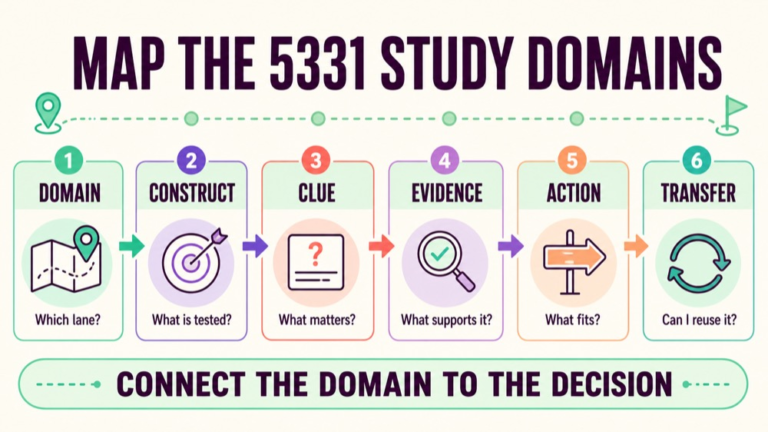
Map the 5331 Study Domains
Use this map to build a domain review session. Start with the current source label, name the construct, write one case clue, choose the decision, and add the connected domain or professional boundary. End with a transfer question.
Map step
Margin prompt
Output
1. Domain
Which current content lane is involved?
Assessment, treatment, professional practice, or another lane.
2. Construct
What skill or responsibility is actually being tested?
A precise clinical or professional target.
3. Clue
Which fact in the scenario carries the most weight?
Context, evidence, risk, access, or outcome clue.
4. Decision
What action or interpretation is requested?
The task verb and next step.
5. Link
Which adjacent domain changes the answer?
Access, function, treatment, safety, collaboration, or ethics.
6. Transfer
What changes if the setting or person changes?
A portable reasoning rule.
Do not memorize the map as a fixed sequence for every item. Use it as a way to expose the reasoning field that an option may be skipping.
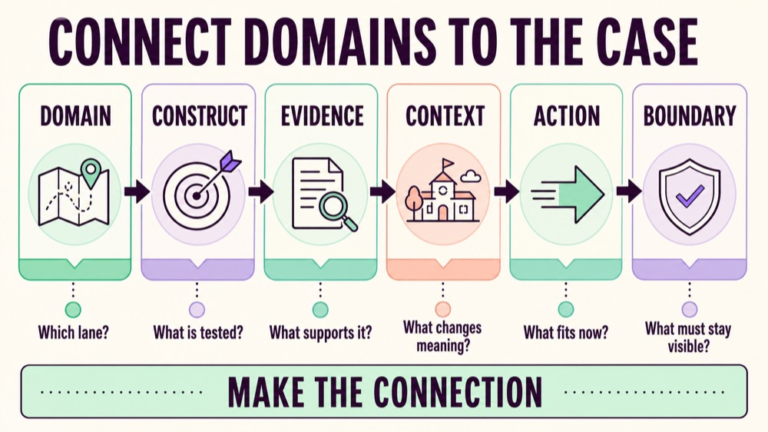
Connect Domains to the Case
A case is solved when the domain label becomes a decision. Use a five-card board: domain, construct, evidence, context, and action. Add a sixth card for the boundary or review point whenever the scenario involves safety, access, competence, or changing outcomes.
Board card
Write down
Check
Domain
The content lane named by the current study frame.
Am I using the current source rather than an old label?
Construct
The skill, process, or responsibility in the stem.
What exactly needs to be understood?
Evidence
Report, history, observation, measure, response, or outcome.
What does the source support?
Context
Person, language, mode, partner, setting, health, culture, and access.
What changes interpretation or opportunity?
Action
Assess, interpret, treat, support, refer, document, or monitor.
Which option fits the decision?
Boundary
Safety, competence, consent, privacy, local rule, or review trigger.
What must remain visible?
After the board, explain one option in two sentences: “This fits the domain because ___. It fits the case because ___.” Then add: “It does not claim ___; I would review ___.” That practice turns recognition into a defensible rationale.
Question 1: assessment domain and measure fit
Practice Question 1. A student misses multi-step classroom directions but follows short directions in a quiet room with a visual cue. The referral asks which assessment information is needed before selecting support. Which option best reflects the assessment domain?
A. Choose a broad language label based on the classroom report and begin treatment immediately.
B. Administer a familiar test without reviewing hearing, language history, task demands, or the group setting.
C. Clarify the direction and participation demands, review hearing and language context, observe the relevant routine, and select evidence that matches the refined question.
D. Use the quiet-room response as the sole measure because it is easier to control.
Correct Answer: C. The assessment domain is about defining the decision and selecting evidence that represents the relevant construct and conditions. The contrast between quiet individual work and noisy group work makes hearing access, language load, visual support, partner behavior, and environmental demand important to review before a broad interpretation.
Why the Other Options Are Wrong: A jumps from a report to a label and skips assessment reasoning. B chooses a tool before defining its purpose and fit. D uses the easiest sample rather than the activity that prompted concern. C connects referral, context, access, observation, and measure selection.
Exam Trap: The domain label does not replace the decision. Ask what information the assessment must provide and which conditions shape the sample.
Question 2: treatment domain and functional outcome
Practice Question 2. An adult wants to participate more effectively in weekly work meetings. In structured practice, the adult organizes a short update with a visual outline, but conversation with unfamiliar coworkers remains difficult. Which answer best connects the treatment domain to an outcome?
A. Keep the same structured drill and record the visual-outline response as generalization.
B. Remove the outline immediately so the next session measures unsupported performance only.
C. Practice meeting updates with varied topics, listeners, and support levels while monitoring message organization, participation, and cueing needs.
D. Replace the functional goal with a broad speech goal because the structured task improved.
Correct Answer: C. Treatment reasoning links the functional goal to a measurable target, practice conditions, support, and outcome. The visual outline may be an effective access support, while varied listeners and topics provide information about transfer. Tracking participation and cueing prevents a structured gain from standing in for the work goal.
Why the Other Options Are Wrong: A confuses a supported structured response with transfer. B removes an access route before checking how it can be adapted or faded. D changes the goal without using the functional information in the scenario. C keeps the activity, support, variability, and outcome connected.
Exam Trap: Treatment questions often include a real improvement that does not yet answer the person’s functional goal. Look for the missing context and outcome.
Question 3: professional-practice domain and safety
Practice Question 3. A clinician is asked to complete a swallowing procedure outside the clinician’s current training. The patient has a new safety concern, and the facility requires notification and qualified follow-up. Which response best reflects the professional-practice domain?
A. Complete the procedure anyway because the clinician is generally familiar with swallowing care.
B. Ask an untrained assistant to perform the procedure while the clinician documents the result.
C. Stay within current competence, follow the facility safety pathway, notify the responsible team, and arrange qualified supervision, consultation, referral, or follow-up.
D. Avoid documenting the concern until a specialist has provided a final interpretation.
Correct Answer: C. Professional practice includes competence, safety, role clarity, supervision, communication, documentation, and continuity. The scenario supplies both a competence boundary and a safety pathway. The responsible action is to follow the protocol, communicate the concern, document the facts and limit, and connect the patient to qualified follow-up.
Why the Other Options Are Wrong: A treats general familiarity as current competence for a specific procedure and risk. B transfers a safety-sensitive task without appropriate training or oversight. D delays documentation of the observed concern and weakens continuity. C respects the professional boundary while still moving the case forward.
Exam Trap: When a question combines risk and competence, the answer must handle both. Referral or supervision is a responsible action when paired with communication and continuity.
Review common domain-question distractors
Domain distractors often repeat a source word but miss the decision. Use the table to identify the shortcut.
Pattern
Why it sounds right
Correction
Domain keyword matching
The answer repeats a word from the stem.
Check the decision, evidence, and function behind the word.
Static blueprint memory
A memorized list feels safer than reasoning.
Use the current source and apply the domain to the case.
Domain equals diagnosis
The domain label sounds like a conclusion.
Separate content area, construct, evidence, and interpretation.
One-domain tunnel vision
The question seems to belong to one lane.
Notice cross-domain assessment, treatment, access, and professional links.
Technical action without fit
A known procedure or technique sounds sophisticated.
Match method and action to purpose, person, and setting.
Exam detail over clinical clue
A number or format fact is memorable.
Use current ETS information and focus on the asked decision.
Caution without action
Avoiding overclaiming feels responsible.
State a clear proportionate next step and boundary.
Action without review
The answer sounds complete after the first decision.
Name the outcome, handoff, or monitoring point.
When two choices remain, compare domain fit, construct fit, evidence fit, access fit, professional fit, and review fit. The strongest answer usually links more of those fields with fewer unsupported assumptions.
Build a domain practice block
Build each study block around relationships rather than isolated memorization. Use one assessment item, one treatment item, one professional-practice item, and one cross-domain item. Check the current ASHA and ETS pages before adding date-sensitive notes.
Choose one current domain label and write its source URL and access date.
Translate the label into a construct and decision.
Write a short scenario with one access or context variable.
List two evidence sources and one important limitation.
Write four original answer choices with one best fit.
Explain the correct choice and the error in each distractor.
Add one connected domain that would change or constrain the action.
Change one variable and solve the item again.
Use a domain log with columns for label, construct, clue, evidence, action, boundary, and transfer. A blank column tells you where your study plan needs more work.
Track domain errors and confidence
Record the type of error instead of only the domain name. You may know the assessment label but miss language access, or know the treatment label but miss the outcome. Specific error labels make review more efficient.
Log field
Example entry
What it reveals
Domain
Treatment and intervention
Which content lane was active.
Construct
Functional communication in work meetings
What the question really examined.
Decisive clue
Structured gain with unfamiliar-listener difficulty
Whether transfer was noticed.
Error type
Supported response treated as generalization
Which shortcut needs repair.
Boundary
Track cueing, listener, topic, and participation
What keeps the conclusion calibrated.
Confidence
61% before rationale, 92% after explanation
Whether the rule transfers.
Next review
Rewrite with a different partner and setting
How to apply the domain again.
Review correct but low-confidence choices. Explain the domain, construct, evidence, action, and boundary without looking back at the answer. This helps distinguish recognition from usable reasoning.
Domain practice questions checklist
Use this checklist before choosing an answer. It is a study aid, not a replacement for current ASHA or ETS information, local requirements, supervision, or individualized clinical judgment.
Did I check the current ASHA or ETS source for the date-sensitive part of the question?
Did I identify the domain without treating it as the answer?
Did I define the construct and decision verb?
Did I use the evidence and context rather than only a repeated keyword?
Did I consider language, dialect, culture, mode, hearing, motor access, technology, partner, and environment?
Did I match assessment evidence to the question and treatment choices to function?
Did I notice safety, competence, consent, privacy, supervision, collaboration, and local requirements?
Did I connect adjacent domains when the scenario crosses content areas?
Did I explain why each distractor is out of sequence, poorly fitted, inaccessible, unsafe, or unsupported?
Did I state the boundary and review point?
Did I keep original practice material separate from live test material?
Did I record the reasoning error so the next study block is targeted?
The durable sequence is: current source, domain, construct, clue, evidence, context, decision, boundary, transfer.
For current preparation-resource context, use the live ETS practice-test page. Recheck the live sources before relying on exam format, score, registration, state, agency, or professional requirements. The maps, questions, rationales, and checklists here are original educational material.
For your next review, choose one domain and write a paired item: keep the clinical facts but change the decision from assessment to treatment, or from treatment to professional handoff. Explain why the answer must change with the question.
Speech-Language Pathology Clinical Scenario Questions: Decision Practice
speech language pathology clinical scenario questions are designed to test how you move from a crowded clinical vignette to one defensible next decision. First identify whether the scenario is asking you to clarify, screen, assess, interpret, treat, support, refer, document, or monitor. Then sort the clues by communication domain, access, urgency, function, and professional responsibility.
The current ASHA Speech-Language Pathology 5331 content page provides a professional study frame that includes screening, assessment, treatment, evidence-based practice, and professional practice. The ASHA Practice Portal supplies topic-specific clinical context, while the current ETS 5331 page supplies exam identity and changing administrative context. The scenarios, answer choices, rationales, and visual maps below are original learning material, separate from live test material and not individualized clinical advice.
Good scenario reasoning is not a hunt for one dramatic symptom. It is a disciplined sequence that keeps the person, task, language, mode, partner, setting, safety, competence, and follow-up visible. An answer can be cautious and still decisive when it names the action that best reduces uncertainty or protects the person now.
What speech language pathology clinical scenario questions are testing
A clinical scenario question may look like a diagnosis question, but the tested task can be different. The stem may ask for the next assessment step, the best treatment plan, the safest response, the most appropriate referral, or the meaning of a result under certain conditions. Read the task verb and then organize the scenario around it.
Scenario task
Clue to locate
Reasoning output
Identify
What communication, swallowing, access, or professional issue is described?
State the concern without adding a label.
Screen
Is the question whether further evaluation or referral may be needed?
Choose a brief risk or next-step process.
Assess
What construct, activity, or condition needs a fuller description?
Select evidence that represents the decision.
Interpret
What do the score, observation, report, or response to support mean here?
Separate evidence from a broad conclusion.
Treat or support
Which target, goal, method, cue, partner, or environmental change fits?
Connect the action to function and outcome.
Refer or collaborate
Which question, safety issue, or role exceeds the current evidence or competence?
Make a clear, timely, documented handoff.
Monitor
What outcome or new information will guide the next decision?
Name the review point and adaptation rule.
Several answer choices may be compatible with good care in a different situation. For example, a language sample, standardized measure, partner training, visual support, referral, or treatment activity can all be useful, but their fit depends on the question. The best answer is the one that matches the information given, the decision requested, and the sequence of responsible action.
Before reading the options, write a short “scenario spine”: person, activity, setting, change or concern, evidence, decision, and review. This keeps an attractive but premature label from controlling your answer.
Name the decision type first
Start by asking what the clinician or team must decide now. “What is the diagnosis?” may not be the scenario’s real task. It could be “Should the screen stop?”, “What evidence is needed to understand the classroom difficulty?”, “Which mode supports the work activity?”, or “How should the treatment plan change when structured accuracy improves but participation does not?”
Decision verb
What it asks you to do
Common mistake
Clarify
Turn a broad report into an observable question about task, context, and impact.
Accepting the referral label as the construct.
Screen
Use a focused procedure to decide whether further evaluation or action may be needed.
Treating a screen as a complete evaluation.
Assess
Select and integrate evidence that describes the relevant skill, activity, or condition.
Choosing a familiar tool without checking fit.
Interpret
Explain what data support, what they do not support, and what context shaped them.
Turning one score into a broad conclusion.
Treat
Connect goal, target, method, access, practice, and outcome.
Starting with a technique name.
Refer
Define the question another professional or team member should address.
Handing off without communication or continuity.
Monitor
Compare meaningful outcomes and decide whether to continue, adapt, or investigate.
Collecting data without a review rule.
When a scenario includes both an immediate and a later decision, separate them. A patient may need an immediate safety response and a later comprehensive evaluation. A student may need an access change now and a fuller assessment after hearing and language history are reviewed. Choosing the later action should not delay the immediate one.
Sort clues by domain and urgency
After naming the decision, classify the clues. A domain clue identifies the communication or professional area. An access clue tells you whether the person could show the skill under the given conditions. An urgency clue changes order or safety. A functional clue explains why the decision matters.
Clue type
Examples
Question to carry forward
Communication pattern
Speech, language, fluency, voice, cognition, social communication, or AAC behavior.
What skill or activity is observable?
Access condition
Hearing, vision, motor response, device, language, dialect, literacy, environment, or partner support.
School, work, home, care, relationships, participation, or communication of basic needs.
Why does the decision matter?
Professional process
Consent, privacy, competence, supervision, documentation, collaboration, or local requirements.
Which role and boundary apply?
Outcome clue
Change with cueing, task, partner, setting, treatment, or time.
What should be measured or reviewed next?
Do not treat all clues as equal, and do not erase a clue because it does not fit your first hypothesis. If a patient’s alertness changes, that may affect safety before a detailed interpretation. If a multilingual student performs differently across languages and partners, that may affect method selection before a broad conclusion. If a device enables communication, that may affect the response mode and the functional plan.
Circle the decision verb.
Underline the activity, partner, setting, language, and mode.
Mark any change in time, health, alertness, fatigue, hearing, environment, or support.
Separate the observed response from the label used by a report.
Identify the evidence or action that would most directly answer the decision.
This sorting habit turns a long vignette into a manageable grid. It also protects against a common test-taking error: choosing the answer linked to the most memorable term instead of the answer linked to the decisive condition.
Match the method to the scenario
Once the scenario question is clear, choose a method that can answer it. The method can be an interview, observation, screening procedure, formal measure, language sample, dynamic probe, treatment data review, team consultation, or referral. Explain why the method fits and what it cannot establish.
Scenario need
Method direction
Fit check
Referral clarification
Vague label or broad concern.
Interview, task analysis, and context-specific observation.
Screening
Need for a rapid risk or referral decision.
An approved, purpose-matched screening process with clear follow-up.
Comprehensive assessment
Need to characterize a communication or swallowing profile.
Multiple appropriate sources, measures, observations, and collaboration.
Functional assessment
Need to understand participation in a real routine.
Natural observation, partner report, activity analysis, and accessible sampling.
Treatment review
Need to decide whether a plan is working or should change.
Comparable outcome data with support, task, and partner conditions documented.
Safety or referral
Risk, urgent change, or question outside the current role.
Stop or escalate according to protocol, communicate, document, and follow up.
A method can be valid for its intended use and still be a poor choice for the scenario in front of you. Check construct, population, language, dialect, response mode, administration, environment, burden, and functional relevance. If the scenario changes one of those conditions, the answer may need to change.
When a formal score and a natural sample disagree, do not force them into one number. Ask whether they represent different constructs, tasks, partners, languages, support levels, or time points. The disagreement can be a clue about access, transfer, fatigue, or the need for further assessment.
Use context to interpret performance
Performance is a relationship between a person and a task under conditions. Record what the person was asked to do, which response route was available, who the partner was, how much support was provided, and what the consequence was. The same person can show different performance in a quiet clinic, a group classroom, a work meeting, a family routine, or a medical setting.
Context variable
How it may shape the sample
Reasoning response
Language or dialect
Familiarity, exposure, vocabulary, syntax, discourse, or dialect features affect the task.
Gather history, use responsive methods, and state interpretation limits.
Separate knowledge from output route and honor effective modes.
Partner
Prompts, wait time, familiarity, expectations, and interaction style change opportunity.
Describe partner support and include relevant partners in planning.
Environment
Noise, visual load, distance, time pressure, routine, and group demands change access.
Observe or adapt the setting that matters.
Health and fatigue
Alertness, pain, medications, respiration, nutrition, hydration, and endurance change performance.
Check urgency, safety, timing, and comparability.
Task demand
A drill, conversation, explanation, meal, or work task requires different skills.
Match the construct and outcome to the activity.
Context is not a reason to dismiss a difficult performance. It tells you how to interpret it and what to do next. A student who misses directions in noise may need both access support and targeted assessment. An adult who communicates with a device may need support for one work activity while also needing speech-motor assessment. A patient with a risk signal may need a safety response before a complete profile can be collected.
Move from assessment evidence to action
Do not stop at a score or observation. Ask what the evidence changes. A useful conclusion links the result to function, access, safety, treatment, referral, or monitoring. If the evidence is incomplete, choose the next source that can reduce the most important uncertainty.
Describe: state the performance and conditions without a global label.
Interpret: identify the construct or concern the evidence may address.
Bound: name language, access, measurement, context, or role limits.
Act: select support, treatment, referral, collaboration, documentation, or monitoring.
Review: define the outcome or new information that will guide the next decision.
For treatment scenarios, use the chain goal → target → method → support → practice condition → outcome. For assessment scenarios, use decision → construct → method → access and validity → functional action. For safety scenarios, use signal → stop or precaution → notification → documentation → qualified follow-up.
The best answer is often the one that makes the chain visible. A technique without a target is incomplete. A score without a decision is incomplete. A referral without a question or handoff is incomplete. A precaution without communication and documentation is incomplete.
Account for language, culture, and access
Clinical scenarios can hide the decisive fact in language history, dialect, culture, communication mode, hearing, vision, motor access, technology, health literacy, or partner support. Ask whether the scenario gave the person a fair way to show knowledge and participate in the task.
The ASHA Multilingual Service Delivery resource supports attention to language history, exposure, use, dialect, appropriate assessment, and language access. The ASHA Cultural Responsiveness resource supports reflective, accessible, person-centered practice. These resources do not create a single translation rule or a universal cultural checklist.
Identify which languages, dialects, modes, and partners are relevant to the scenario.
Check whether the method’s instructions, norms, response demands, and materials fit the person.
Use an interpreter or qualified collaborator when needed and define the communication role.
Document accommodations, adaptations, supports, and interpretation limits.
Include the person’s priorities, values, routines, and preferred communication route.
Separate a difference or access barrier from evidence of a communication disorder.
Access can change the evidence and the action. If the answer choice removes an effective communication mode, ignores a needed hearing check, or treats a dialectal pattern as a deficit, examine it carefully. If an option adapts the route while preserving the meaningful goal, it may better fit the scenario.
Protect safety, scope, and handoffs
Safety and professional process are part of scenario reasoning. A new risk sign, reduced alertness, sudden communication change, inability to communicate basic needs, privacy issue, consent issue, or question outside competence can change the correct sequence. Follow the relevant setting protocol and involve the responsible team.
Scope includes education, training, experience, supervision, competence, setting, and person risk. Collaboration strengthens care when roles and communication are clear. It does not mean that responsibility disappears after a referral. State what was observed, why the handoff is needed, what should happen next, and how continuity will be maintained.
Scenario boundary
Reasoning action
Documentation focus
Safety signal
Stop, modify, or escalate according to the protocol.
Condition, response, notification, precaution, and follow-up.
Communication access
Provide or request an accessible route before interpreting the response.
Mode, support, partner, accommodation, and effect.
Role or competence
Consult, supervise, refer, or seek training as appropriate.
Question, responsibility, oversight, and handoff.
Consent and privacy
Explain purpose, participants, information use, and choices.
Consent process, communication, and privacy boundary.
Local requirement
Verify current law, payer, employer, school, facility, or agency rule.
Source, date, decision, and unresolved question.
A practice question can teach the pattern, but a live decision requires current guidance and local requirements. Do not use an educational scenario as a substitute for a complete assessment, clinical protocol, or individualized professional judgment.
Sort a Clinical Scenario by Decision
Use this visual sequence when a scenario contains several domains at once. Begin with the decision verb, then sort the person, task, setting, and access conditions. Place the evidence under observation, report, measure, or response to support. End with the action and review point.
Map step
Margin prompt
Question to ask
1. Decision
Clarify, screen, assess, interpret, treat, refer, or monitor?
What does the question actually ask?
2. Scenario
Who, what activity, where, with whom, and when?
Which context changes the meaning?
3. Clues
Domain, access, urgency, function, and professional process.
Which clue is decisive rather than merely vivid?
4. Evidence
What is observed, reported, measured, or changed with support?
What does each source support?
5. Action
What is proportionate now, and what needs follow-up?
Does the choice protect fit, safety, and continuity?
Try a one-variable contrast. Keep the same communication pattern but change the setting. Keep the same score but change the language history. Keep the same treatment response but change the support level. Keep the same safety sign but change the local protocol. Explain why the best action changes or remains stable.
From Scenario Clue to Safe Action
Use this second map for the “what next?” part of the scenario. A clue becomes useful when it changes an action. Sort it into access, assessment, treatment, safety, collaboration, or follow-up, then write the boundary that keeps the decision responsible.
Scenario clue
Possible next action
Boundary to keep visible
Performance changes with support
Record the support, compare conditions, and plan access or fading.
Supported performance is not the same field as unsupported performance.
Reports disagree
Clarify tasks and settings, then gather comparable evidence.
Do not choose one perspective without checking context.
Formal score is low
Review construct, language, administration, and functional relevance.
One score does not answer every decision.
Risk or alertness changes
Follow stop, notification, precaution, and referral procedures.
Do not stretch a screen into a different evaluation.
Question exceeds role
Consult or refer with a defined question and continuity plan.
Role clarity and documentation still matter.
Treatment outcome is mixed
Inspect goal, target, cueing, practice condition, partner, and outcome.
A narrow gain may not represent participation transfer.
After choosing an answer, complete the sentence: “This option fits because ___; it does not claim ___; I would review ___ next.” That is a compact way to practice both action and evidence boundaries.
Question 1: hearing access and classroom communication
Practice Question 1. A student follows spoken directions in a quiet therapy room but frequently misses instructions during noisy classroom transitions. The student’s teacher reports inconsistent listening, and the student has not had a recent hearing review. Which next step best fits the scenario?
A. Conclude that the student has a receptive-language disorder based on classroom performance.
B. Repeat the quiet-room direction task until the student reaches a passing percentage.
C. Clarify the classroom communication demands, review hearing and language history, observe relevant routines, and select targeted assessment or access supports based on the refined question.
D. Tell the teacher to speak louder and close the communication referral.
Correct Answer: C. The performance contrast points to a context-sensitive question involving noise, hearing access, language load, partner behavior, and classroom demands. A targeted history and observation can guide the next assessment or support. The scenario does not provide enough information for a broad language conclusion, and a louder voice alone does not answer the referral.
Why the Other Options Are Wrong: A turns one setting-specific pattern into a global label. B keeps the task that may not represent the concern and treats a percentage as the main decision. D may change access in one moment but does not check hearing, clarify the task, or determine whether more assessment is needed. C uses the contrast as the evidence clue.
Exam Trap: When a communication pattern changes with noise or distance, look for hearing and access reasoning before treating the pattern as a language conclusion.
Question 2: motor speech, language, and functional evidence
Practice Question 2. An adult after a neurologic event has imprecise speech during a three-minute conversation. The adult uses accurate gestures and a text-to-speech device to explain a work task, but the referral asks whether the adult has a “language problem.” Which response best demonstrates scenario reasoning?
A. Use the conversational speech sample alone to decide that language is impaired.
B. Require speech-only responses so the profile can be compared with a standardized format.
C. Separate speech-motor clarity from language formulation and functional communication, then assess the work task across accessible modes and relevant partners.
D. Ignore the speech sample because the device and gestures are available.
Correct Answer: C. The scenario contains information about speech clarity, language use, motor access, communication mode, and work participation. The next step is to clarify which construct the referral concerns and sample the work activity with accessible modes. Functional success does not erase a speech concern, and imprecise speech does not establish a broad language interpretation by itself.
Why the Other Options Are Wrong: A confuses speech output with the entire language profile. B removes an effective access route and changes the functional question. D discards relevant information about speech clarity and possible support needs. C separates constructs and connects assessment to the person’s work goal.
Exam Trap: A scenario can include a real motor-speech difficulty and effective multimodal communication at the same time. Keep the constructs separate and assess the activity that matters.
Question 3: swallowing risk and professional action
Practice Question 3. During a facility-approved swallowing screen, a patient becomes drowsy and develops a new wet vocal quality after a trial. The local protocol says to stop the screen and notify the responsible team. What is the best next action?
A. Continue with additional trials to decide whether aspiration is present.
B. Record the earlier successful trial as the final result and continue the meal.
C. Stop according to the protocol, communicate the change, document the conditions and response, and arrange the appropriate comprehensive follow-up.
D. Ask a support person without screening competency to complete the remaining trials.
Correct Answer: C. The changed alertness and vocal quality are risk information within the stated protocol. The screen should not be expanded into a full physiologic evaluation, and an earlier trial does not erase a later change. The appropriate action protects safety, communicates the result, records the screen’s limit, and connects the patient to the next qualified evaluation or team process.
Why the Other Options Are Wrong: A ignores the stop instruction and asks a brief screen to answer a broader question. B treats earlier performance as the final result despite changed conditions. D transfers a safety-sensitive task without appropriate competence and oversight. C follows the scenario’s safety and handoff requirements.
Exam Trap: A safety clue changes the sequence. Follow the stated stop and notification process before trying to collect more detail.
Review common scenario distractors
Scenario distractors often contain a true action that is missing the current decision, context, or professional boundary. Use the table to identify the shortcut.
Distractor pattern
Why it sounds plausible
Correction
Diagnosis before description
The label appears to solve the case quickly.
Describe the pattern and decision first.
Tool before purpose
A familiar test or technique is easy to recall.
Match the method to the scenario question.
Pass means no concern
A single result sounds final.
Interpret the result under its conditions and remaining concern.
One context represents all contexts
The sample is convenient and clear.
Compare the activity, partner, setting, language, and support.
More data without a plan
Additional testing sounds rigorous.
Collect evidence that can change the decision.
Support equals independence
The person completed the task with help.
Record cue level and plan for access and transfer.
Referral as abandonment
The clinician feels pressure to answer alone.
Use collaboration and continuity to protect care.
Urgency ignored
The question is framed as a routine test item.
Follow safety and notification steps before lower-priority analysis.
When two answers seem reasonable, compare them on decision fit, evidence fit, access fit, safety and role fit, and follow-up fit. An answer that sounds more certain is not automatically stronger. An answer that is more cautious is not automatically better if it fails to provide a useful action. Choose the option with the clearest relationship between the clues and the next step.
Build a clinical-scenario practice block
Practice one scenario from each major decision type: clarify a referral, screen for risk, choose assessment evidence, interpret a result, plan treatment, respond to a safety clue, and coordinate a handoff. Rotate speech, language, fluency, voice, cognition, AAC, feeding, swallowing, hearing access, and professional-practice topics.
Circle the question verb.
Write the person, activity, setting, partner, language or mode, and time course.
Sort the clues into communication, access, urgency, function, and professional process.
Write the most important missing fact and why it matters.
Label each answer choice by its action and sequence.
Choose the option that best fits the evidence and boundary.
Explain why the other options overreach, skip a step, remove access, or ignore safety.
Write the review point or outcome that would change the plan.
Use a short rationale format: “The scenario asks for ___. The decisive clue is ___. Therefore ___ is the best next step because ___. The remaining limit is ___.” This keeps the reasoning explicit without copying the answer key.
Track scenario decisions and confidence
Record the clue that drove your answer and the shortcut you avoided. Track low-confidence correct answers as well as misses. A correct letter without a transferable explanation may not hold when the setting, language, partner, or decision changes.
Log field
Example entry
What it reveals
Decision verb
Assess the classroom communication concern.
Whether the scenario task was identified.
Decisive clue
Quiet-room success contrasted with noisy transition difficulty.
Whether access and setting were noticed.
Missing fact
Recent hearing information and classroom task details.
What should be checked next.
Action
Review history, observe, and choose targeted measures or supports.
Whether the answer is proportionate.
Shortcut
Referral label treated as a global language conclusion.
Which reasoning habit needs repair.
Confidence
57% before rationale, 90% after explaining the contrast.
Whether the rule is explicit.
Review trigger
The plan changes when the communication mode or setting changes.
How to transfer the rule.
Build a personal list of decision rules: identify the task under the label; compare conditions; match method to purpose; keep access visible; respond to safety in sequence; connect treatment to function; and document handoffs. These rules travel across clinical domains.
Clinical-scenario questions checklist
Use this checklist before selecting an answer. It is a study aid, not a replacement for current ASHA guidance, local policy, supervision, applicable law, or individualized clinical judgment.
Did I identify the question verb and decision type?
Did I define the person’s activity, partner, setting, language, mode, and priority?
Did I separate an observed behavior from the referral label or interpretation?
Did I sort clues by communication domain, access, urgency, function, and professional process?
Did I choose a method that fits the construct and decision?
Did I interpret a score or report within language, administration, measurement, and context limits?
Did I connect treatment choices to goal, target, support, practice, and outcome?
Did I recognize stop conditions, safety signals, consent, privacy, competence, supervision, and referral needs?
Did I include the person’s priorities and an accessible communication route?
Did I explain why the alternatives are out of sequence, too broad, inaccessible, unsafe, or unsupported?
Did I state what new fact or outcome would change the plan?
Did I keep this original practice material separate from live test material and individual clinical advice?
The core sequence is: name the decision, sort the clues, check access and urgency, match the evidence, act proportionately, and review.
For current preparation-resource context, use the live ETS practice-test page. The scenarios, answer choices, rationales, maps, and checklists on this page are original educational material. Recheck live sources before relying on exam administration details, state or agency requirements, clinical policy, or a professional decision.
For your next review, take one scenario and change one variable: setting, language, partner, communication mode, alertness, or decision type. Explain which clue changes, which action changes, and which part of the plan remains stable.
Speech-Language Pathology Case Study Questions: Reasoning Guide
speech language pathology case study questions become much easier when you read the case as a timeline of decisions instead of a pile of symptoms, scores, and reports. Identify why the person came to attention, what activity or safety issue matters, which conditions change performance, and what the team must decide next. Then separate facts from interpretations and choose evidence that can answer the specific question.
The current ASHA Speech-Language Pathology 5331 content page provides a study frame that includes screening, assessment, treatment, evidence-based practice, professional practice, and culturally and linguistically responsive service. The ASHA Practice Portal provides topic-specific clinical context, and the live ETS Speech-Language Pathology 5331 page provides current exam identity. The cases, answer choices, rationales, and maps here are original learning material, separate from live test material and not individualized clinical advice.
A good case-study answer does not invent missing facts. It uses the facts that are present, names the most important uncertainty, protects access and safety, and selects a proportionate next step. This approach works across speech, language, fluency, voice, cognition, AAC, feeding, swallowing, hearing access, and professional-practice scenarios.
What speech language pathology case study questions are testing
Case-study questions test whether you can organize information and make a defensible decision. The case may contain a referral label, a time course, several informants, a formal score, a natural observation, a treatment response, a safety clue, or a professional boundary. Do not give all details equal weight. Sort them by the decision they help you make.
Case field
Question to locate
Reasoning output
Presenting concern
What activity, change, risk, or participation issue prompted the referral?
State the decision in concrete terms.
Time course
When did the pattern begin, change, fluctuate, or become meaningful?
Use onset and change to set priority and urgency.
Context
Where, with whom, under which task demands, and with what supports does it occur?
Compare conditions before assigning meaning.
Strengths
What does the person do successfully, and which modes or partners support that performance?
Use strengths to plan access and next evidence.
Constraints
What health, hearing, motor, language, cultural, environmental, or professional factors limit interpretation?
Name the boundary rather than hiding it.
Decision point
What must the clinician or team decide now, and what information will guide the decision?
Choose a proportionate next step.
Follow-up
What outcome or new information will cause review, adaptation, or referral?
Make the plan learn from the case.
Notice the difference between a case detail and a case conclusion. “Misses directions in group work” is a detail. “Has a language disorder” is a conclusion that requires evidence and context. “Uses a visual cue” is a detail. “Is independent” is a conclusion that depends on support level, task, partner, and outcome. Strong options preserve those distinctions.
Answer choices may be written in polished clinical language. Translate each choice into an action: gather history, observe, measure, interpret, support, treat, refer, document, or monitor. Then check whether the action is in the right sequence for the question. A technically reasonable action can still be a poor answer if it comes before the case has been clarified.
Read the case as a timeline
Start by locating change over time. Ask what was present before, what changed, what remains stable, and whether the pattern is variable across tasks or settings. A new change may affect urgency and referral. A longstanding pattern may call for developmental, educational, environmental, or participation context. A variable pattern may make conditions and supports especially important.
Before: What was the person doing, using, or participating in before the concern?
Change: What event, demand, setting, health factor, or communication partner made the concern visible?
Now: Which performance, activity, safety, or support need is present today?
Compare: Under what conditions does the pattern become easier or harder?
Decide: What must be assessed, supported, treated, referred, or monitored next?
Timeline reasoning prevents a common error: treating the most recent event as the only explanation. Recent onset can matter, but so can prior communication history, language experience, hearing, access, health, education, medication, fatigue, or partner change. The best answer uses the time course to choose the next question rather than writing a complete story from one date.
When the case asks for priority, look for the detail that changes safety, access, or the decision’s consequences. A swallowing risk, sudden communication change, inability to communicate basic needs, or missing language access may come before a lower-urgency measurement question. State the immediate action and the follow-up rather than ignoring the priority clue.
Separate facts, interpretations, and priorities
Use a three-column note. In the fact column, write what was observed or reported with the task and conditions. In the interpretation column, list plausible explanations or meanings. In the priority column, write what needs attention first and why. This small structure helps you keep an informative report from becoming a premature conclusion.
Column
Example
How to use it
Fact
The adult follows short written steps for a familiar medication routine.
Preserve the task, format, and support.
Report
A family member describes the adult as confused during appointment planning.
Translate the label into specific tasks and conditions.
Interpretation
Appointment management may add memory, language, sequencing, technology, and partner demands.
Keep plausible contributors open.
Priority
Determine what support is needed for the next appointment while including the adult’s priorities.
Choose the immediate functional decision.
Review
Check whether the support improves successful scheduling and attendance.
Make the plan measurable and revisable.
Do not turn a report into a diagnosis, and do not dismiss a report because it uses imprecise language. Reports are useful when you ask what the observer saw, when it happened, who was involved, and what consequence followed. The answer choice that refines a vague report is often stronger than the choice that accepts or rejects it wholesale.
Rank the decision before choosing a method
Case questions commonly tempt you to choose a familiar test or intervention before defining the decision. Reverse that order. Name the decision, specify the construct or activity, then select evidence that can answer it. A measure that is excellent for one purpose may not fit another language, person, setting, or task.
Decision type
Evidence direction
Question to protect fit
Screening
Brief information that helps decide who needs further evaluation or support.
Is the output a risk or referral decision rather than a full profile?
Evaluation
Multiple sources that describe the relevant communication or swallowing profile.
Does the evidence represent the person, language, access, and activity?
Treatment planning
Baseline, target, functional goal, support, response pattern, and preferences.
Will the data guide a specific and meaningful plan?
Progress review
Comparable observations across time, conditions, partners, and outcomes.
Did the conditions remain interpretable, and what changed?
Referral or collaboration
Information that defines the question another professional or team member should address.
Is the handoff clear, timely, accessible, and within role?
Safety response
Immediate observation, protocol, notification, precaution, and follow-up.
Does the risk clue change the order of actions?
A case may require more than one decision. For example, a patient may need an immediate safety response and later a comprehensive assessment. A student may need an access support now and a fuller evaluation after relevant history is gathered. Separate the decisions so the answer does not make a later question block a necessary immediate action.
Integrate conflicting information
Conflicting reports are often the most useful part of a case. They may show that the activity, language, partner, environment, cueing, fatigue, or stakes changed. Do not resolve the conflict by picking the report that sounds most clinical or most confident. Compare what each source observed and decide what additional evidence would explain the difference.
Source
What it may add
Question to ask
Case history
Onset, development, health, hearing, language use, prior services, routines, and person or family priorities.
Frames the case and points to questions that need direct evidence.
Report
Teacher, caregiver, patient, nurse, physician, partner, or other observer description.
Shows what happens across settings and perspectives; check the task behind the label.
Direct observation
A relevant speech, language, fluency, voice, AAC, feeding, swallowing, or participation activity.
Shows performance under named conditions.
Formal measure
A method chosen for construct, population, language, access, response demand, and purpose.
Provides structured evidence within its administration limits.
Functional sample
Conversation, classroom work, meeting, meal, home routine, or other meaningful activity.
Connects skill and support to participation.
Response to support
A change in cue, visual, partner behavior, task structure, mode, or environment.
Shows what support changes access; it does not settle the entire explanation.
Outcome data
Change in skill, activity, safety, effort, preference, or partner success over time.
Guides continuation, adaptation, or another question.
Use convergence and contrast. Convergence occurs when different sources describe a similar pattern under comparable conditions. Contrast occurs when the pattern changes by context. Both are valuable. Convergence can support a focused interpretation; contrast can identify access needs, task demands, partner supports, or a reason to examine more than one setting.
If a formal score conflicts with functional performance, inspect the construct and response demand. If a caregiver report conflicts with a clinic sample, examine routine, familiarity, fatigue, partner behavior, and communication mode. If a treatment score improves but participation does not, check cueing, generalization, listener, task purpose, and opportunity. The reasoning move is to investigate the difference, not erase it.
Use language, culture, and access as case data
A case is incomplete when language history, dialect, communication mode, hearing, vision, motor access, technology, health literacy, or cultural context is missing from an interpretation that depends on them. Ask which languages and modes are used across routines, who the relevant partners are, and whether the assessment or treatment conditions let the person show knowledge and participate.
The ASHA Multilingual Service Delivery resource supports attention to language history, exposure, use, dialect, access, and appropriate collaboration. The ASHA Cultural Responsiveness resource supports reflective, accessible, person-centered interaction. Neither resource turns a translated task, a cultural checklist, or one language sample into a universal conclusion.
Record languages, dialects, modes, literacy experiences, and communication partners across relevant routines.
Check whether the case task adds unfamiliar vocabulary, literacy, motor, hearing, technology, or cultural demands.
Invite the person’s priorities and explain choices in an accessible form that supports shared decision-making.
Use qualified language-access collaboration when needed and document how it shaped the process.
Interpret scores and observations within administration, norming, response, language, and context limits.
Separate a communication difference or access barrier from evidence of a communication disorder.
A strong case answer does not treat access as a courtesy after assessment. Access can change the evidence and the person’s opportunity to participate. If performance changes when the format, partner, language, device, or environment changes, carry that fact into the next decision.
Connect the case to assessment and treatment
Assessment and treatment decisions should be connected. Assessment identifies the target, context, strengths, barriers, and decision need. Treatment uses that information to select a goal, method, support, practice condition, and outcome. A case-study answer that jumps from a label to a technique without this chain is incomplete.
Link
Case question
Plan output
Activity
What does the person need or want to do?
Functional goal and meaningful partner or routine.
Target
Which observed skill or barrier affects the activity?
Specific baseline and reason for selection.
Method
What evidence-based approach fits the target and context?
Intervention, practice conditions, and rationale.
Support
What cue, mode, partner, environmental change, or adaptation helps?
Access plan and support level.
Outcome
What skill, participation, safety, effort, preference, or partner result matters?
Data and review point.
Adaptation
What would make you continue, change, consult, or refer?
Decision rule for the next session or handoff.
Do not treat a structured gain as proof that the functional goal has been met. Record the conditions that made the response possible and then examine whether the skill transfers to relevant partners, settings, and tasks. At the same time, do not discard a useful support because it is visible. A supported response can show an effective access route and provide information for a plan.
Protect safety, scope, and communication
Some case studies are testing professional process more than a clinical label. Look for safety risk, consent, privacy, competence, supervision, communication access, role clarity, and the need for referral. If a local protocol provides a stop condition, follow it. If the question exceeds the current role or evidence, communicate the boundary and involve the appropriate person or team.
Name the safety or professional issue without exaggerating the evidence.
Pause, modify, or stop the activity when the stated protocol or risk requires it.
Communicate the observation and next action to the responsible person in an accessible format.
Use qualified collaboration or referral for the question that exceeds the current role or competence.
Document the conditions, response, decision, handoff, limitation, and follow-up.
In real practice, consult current ASHA guidance and applicable state, payer, employer, school, facility, and law requirements. Case-study practice teaches a reasoning sequence; it does not replace local policy, supervision, or individualized judgment.
Build a Case Study Evidence Map
Use this map when a case contains more details than you can hold in working memory. Start with the activity or risk, place the timeline next, add person and access information, then sort evidence by source and condition. End with the decision the evidence needs to support. The map helps you avoid letting one vivid detail control the answer.
Map step
Write in the margin
Check before choosing
1. Activity or risk
What matters to the person or what requires immediate attention?
Write one sentence under the map: “The current evidence supports ___, but I still need ___ before deciding ___.” That sentence gives uncertainty a practical role and makes it easier to explain why one option fits better than another.
Turn a Case Study Into a Review Plan
After answering a case, turn it into a review plan. Record the key clue, the tempting shortcut, the evidence that defeated the shortcut, and the transferable rule. This is more useful than copying the correct letter because it preserves the reasoning structure for a new case.
Review field
Example prompt
Transfer question
Key clue
Which contrast, time point, report, or risk changed the decision?
Would I notice the clue in a new topic?
Tempting shortcut
Did I choose a label, score, long battery, or technique too early?
What wording pulls me toward the shortcut?
Decisive evidence
Which fact or missing fact determines the next step?
How could the evidence be gathered fairly?
Access check
Which language, mode, partner, setting, or support affects interpretation?
What would change if the conditions changed?
Transfer rule
When I see this pattern, I will first check ___ because ___.
Can I apply the rule without copying the case wording?
Use a second pass to change one variable. Keep the same report but change the language history. Keep the same score but change the functional goal. Keep the same treatment response but change the cue level. Keep the same safety sign but change the protocol. Explain why the action should or should not change.
Question 1: timeline and assessment priority
Practice Question 1. A first-grade student is referred because the student “cannot tell stories.” A teacher reports short answers during whole-group discussion. A caregiver reports detailed stories during play at home. The student uses two languages across settings, and no language history has been collected. Which next step best fits the case?
A. Administer an English narrative test immediately and use the score to select a broad language goal.
B. Assume the home report is more accurate and close the school referral without further observation.
C. Clarify the story demands and languages across settings, collect relevant observations and history, and select responsive narrative evidence before making a broad interpretation.
D. Ask the caregiver to use only English at home so the school sample will be easier to compare.
Correct Answer: C. The reports describe different activities, partners, languages, and contexts. The next step is to clarify the case and obtain evidence that represents the relevant communication demands. A responsive process can examine narrative organization, language experience, classroom participation, and supports without treating one English sample as the whole profile.
Why the Other Options Are Wrong: A selects a measure before checking language history and may confuse performance in one language with a broad narrative conclusion. B dismisses a meaningful school concern simply because the child communicates well in another context. D removes a home language and does not create a valid comparison. C keeps both reports visible and identifies the evidence needed to answer the referral.
Exam Trap: Case-study questions often place two apparently conflicting reports together. The contrast is a reason to examine language, task, partner, and setting—not a reason to choose one informant automatically.
Question 2: conflicting reports and functional context
Practice Question 2. An adult who had a recent neurologic event communicates basic needs with speech, gesture, and a text-to-speech device. A family member reports “confusion,” while the adult follows a familiar medication routine when information is presented in short written steps. The referral asks whether the adult needs support for managing appointments. What is the most useful reasoning move?
A. Use the family member’s word “confusion” as the primary diagnosis and avoid asking the adult for input.
B. Test only decontextualized memory tasks because appointment management is a functional outcome.
C. Define the appointment tasks, compare communication modes and support conditions, gather the adult’s priorities and partner report, and assess the specific cognitive-communication demands.
D. Recommend that the family manage all appointments permanently before examining the adult’s current abilities and preferences.
Correct Answer: C. The referral names a functional activity, so the assessment should examine the steps, information, partners, modes, and supports involved in appointment management. The family report is relevant, but it should be translated into observable tasks and considered with the adult’s perspective and direct performance. Comparing supported and less-supported conditions can guide a useful plan.
Why the Other Options Are Wrong: A turns a broad report into a conclusion and removes the adult from shared decision-making. B may sample one construct but does not represent the appointment activity. D transfers responsibility before checking what support, mode, and level of assistance would be appropriate. C matches the assessment to the activity and preserves autonomy and access.
Exam Trap: When a case includes a broad label such as confusion, look for the functional task underneath it. The strongest answer makes the task measurable and includes the person’s communication access and priorities.
Question 3: treatment data and adaptation
Practice Question 3. During treatment, a client’s accuracy on a structured speech target improves with a visual cue, but the client’s participation in phone calls has not changed. The clinician has recorded target accuracy but not cue level, listener, call purpose, or client-reported effort. Which next step is most appropriate?
A. Continue the same structured practice because the accuracy percentage increased.
B. Stop treatment because the structured target and phone participation do not match.
C. Review the functional goal and baseline, add supported phone-call practice with relevant conditions, record cueing and listener factors, and monitor both target performance and participation.
D. Remove the visual cue so the next accuracy score will represent independence.
Correct Answer: C. The data show a possible transfer gap and incomplete documentation of the conditions that shaped performance. The plan can preserve a useful visual cue while adding practice that represents the phone activity, listener, purpose, and support needs. Monitoring both target accuracy and participation helps the clinician decide what to adapt next.
Why the Other Options Are Wrong: A treats a structured gain as the complete outcome and does not address the stated activity. B discards information that may be useful instead of adapting practice. D removes an access support before checking whether it enables meaningful participation. C uses the discrepancy as evidence for a better treatment plan.
Exam Trap: A case can contain a real improvement and a real unmet goal at the same time. Do not force one measure to stand in for the whole outcome; inspect the conditions and add the missing functional data.
Review common case-study distractors
Case-study distractors often use a true clinical idea at the wrong time or with the wrong evidence. Name the error before you judge the wording.
Pattern
Why it sounds attractive
Correction
First detail wins
The first symptom or score feels like the central clue.
Read the whole timeline and identify the decision.
Label equals construct
A referral phrase sounds specific.
Translate the phrase into an observable task and evidence need.
Most tests is best
A larger battery sounds careful.
Choose methods that answer the case question.
One report is enough
A confident informant sounds definitive.
Compare the activity, setting, partner, and perspective.
Low score explains everything
Numbers feel objective.
Check language, access, construct, context, and functional evidence.
Technique before target
A familiar intervention is easy to remember.
Name the target, goal, support, and outcome first.
Referral ends responsibility
Another professional may be needed.
Communicate, document, and coordinate the handoff.
No decision after data
Collecting information feels productive.
State how the evidence will change the plan.
When two options both seem plausible, score them against fit: decision fit, evidence fit, access fit, safety and role fit, and follow-up fit. The best answer usually connects the most fields with the fewest unsupported assumptions. A choice that is cautious but offers no next action may be incomplete; a choice that is decisive but ignores missing context may overreach.
Build a case-study practice block
Use cases from different domains so the reasoning rule does not become tied to one diagnosis or vocabulary set. Mix developmental, adult, medical, school, outpatient, and professional-practice scenarios. For each case, practice reading the timeline before the options.
Underline the presenting concern, activity, risk, and decision verb.
Write the timeline: before, change, now, and conditions of variability.
List the person’s strengths, language, mode, partners, access, and priorities.
Sort each fact into report, observation, measure, response to support, or outcome.
Write the most important missing information and why it could change the plan.
Choose the next assessment, support, treatment, referral, documentation, or monitoring step.
Explain why each distractor is too broad, too early, inaccessible, unsafe, or unsupported.
Change one case variable and solve it again without reusing the original wording.
Keep an answer rationale to three sentences: “The case shows ___. The decisive context or evidence is ___. Therefore, the next step is ___, while ___ remains to be checked.” This format is short enough for timed review and detailed enough to reveal a reasoning gap.
Track case reasoning and confidence
Record the decision and the reason behind it. A confidence score is useful only when paired with the clue you used and the uncertainty you noticed. Review items you answered correctly for the wrong reason because a lucky selection may not transfer.
Log field
Example entry
What it reveals
Decision
Choose responsive narrative evidence for a school referral.
Whether the question was defined.
Timeline
School group discussion differs from detailed bilingual home play.
Whether change by context was noticed.
Missing information
Language history and task demands across settings.
What should be checked next.
Action
Clarify, observe, gather history, and select responsive evidence.
Whether the plan matches the case.
Distractor
One English score treated as a global conclusion.
Which shortcut to repair.
Confidence
48% before rationale, 86% after explaining the contrast.
Whether the rule is becoming explicit.
Review trigger
The answer changes when language and partner conditions change.
When to revisit the plan.
Build a small library of transfer rules: define the activity before the label; compare reports by task and context; treat support level as data; match measure to decision; pause for safety; and document how the evidence led to the next action. These rules are portable across case topics.
Case-study questions checklist
Use this checklist before committing to an answer. It is a study aid, not a substitute for current professional guidance, applicable law, supervision, local policy, or individualized clinical judgment.
Did I identify the person’s activity, priority, risk, partner, and decision?
Did I read the timeline instead of treating the newest or loudest detail as the whole case?
Did I separate direct observation, report, interpretation, and conclusion?
Did I compare performance across language, dialect, mode, partner, setting, time, and support?
Did I choose evidence that answers the decision rather than the longest or most familiar method?
Did I interpret formal scores within construct, administration, language, and access limits?
Did I connect treatment choices to a functional goal, target, support, practice condition, and outcome?
Did I recognize safety, consent, privacy, competence, supervision, and referral boundaries?
Did I include the person’s priorities and communicate the plan accessibly?
Did I document what the current evidence supports and what remains unknown?
Did I state what new information or outcome would change the plan?
Did I explain why each alternative fails for the facts in the case?
The core sequence is simple to remember: timeline, task, context, evidence, decision, review. Use it to make a case manageable without pretending that a short vignette contains more certainty than it does.
For current preparation-resource context, use the live ETS practice-test page. The cases, answer choices, rationales, maps, and checklists on this page are original educational material. Recheck live sources before relying on exam administration details, state or agency requirements, clinical policy, or a professional decision.
For your next review, take one case and write two versions of the plan: one for the current setting and one after changing the language, partner, or access condition. Explain which evidence changes, which action remains, and what outcome would trigger another review.
speech pathology clinical reasoning questions are easiest to solve when you treat the stem as a decision problem rather than a vocabulary quiz. Start with the person, the activity, the setting, and the decision that the result must support. Then separate what was observed from what you are inferring, check the conditions that shaped the sample, and choose an assessment, support, treatment, collaboration, or referral step that fits the evidence.
The current ASHA Speech-Language Pathology 5331 content page places assessment, treatment, evidence-based practice, professional practice, and culturally and linguistically responsive service within the study frame. The ASHA Practice Portal supplies topic-specific clinical context, while the live ETS Speech-Language Pathology 5331 page supplies current exam identity. The questions, rationales, maps, and checklists below are original learning material, separate from live test material and not individualized clinical advice.
Clinical reasoning is not guessing the hidden diagnosis from one clue. It is a repeatable way to organize evidence, make uncertainty useful, protect communication access and safety, and explain why the next step is proportionate. The best answer often includes an action that gathers or uses the most decisive missing information.
What speech pathology clinical reasoning questions are testing
Clinical reasoning questions may involve speech, language, fluency, voice, cognition, social communication, AAC, feeding, swallowing, hearing access, or professional practice. The topic changes, but the reasoning work is similar: identify the decision, locate the strongest evidence, account for the person and context, and choose an action that can be defended.
Reasoning field
What to locate in the stem
Study output
Referral or concern
What prompted the question, who noticed it, and which activity or safety issue matters?
Restate the decision in observable, functional terms.
Which facts change how the performance should be understood?
Observation
What the person did, said, understood, initiated, repaired, tolerated, or participated in under named conditions.
What is directly supported by the sample?
Interpretation
A cautious explanation that connects converging evidence while identifying what remains uncertain.
What conclusion is proportionate to the data?
Action
Assessment, support, treatment, collaboration, referral, documentation, or monitoring that answers the current need.
What is the next responsible step?
Review
New information or outcome data that could confirm, refine, or change the plan.
How will the decision be revisited?
Several options may contain a clinically familiar idea. A cue, standardized test, caregiver report, treatment activity, referral, or safety precaution can be appropriate in one context and poorly matched in another. Read the verbs in the question: identify, screen, evaluate, interpret, treat, refer, document, counsel, or monitor. The verb tells you what kind of answer the stem is seeking.
Also mark the details that limit a conclusion. A multilingual learner, a person using AAC, an adult with fluctuating alertness, a child in a noisy classroom, or a patient with a swallowing risk may require different access and safety reasoning. These details are not decoration. They determine which evidence is interpretable and who should be involved.
Start with the person and the decision
Before looking at the answer choices, rewrite the referral in one sentence. Include who the person is, what activity or concern matters, where the difficulty appears, and what decision the team needs to make. “Does this person have a disorder?” is usually too broad. “What communication support would help this person participate in morning handoff with familiar and unfamiliar partners?” is closer to a usable decision question.
Stem detail
Clarifying question
Why it matters
Person
What strengths, modes, preferences, history, language, and health factors are named?
The same task may require different access or support for different people.
Activity
What does the person need or want to do in daily life, school, work, or care?
Function keeps the answer tied to a meaningful outcome.
Setting
With whom, under what demands, and with which environmental supports does the pattern occur?
Performance can change with noise, partner, time, routine, or task structure.
Decision
What will the result be used to decide now?
The decision determines whether screening, evaluation, treatment, referral, or monitoring is proportionate.
Urgency
Is there a safety, health, access, or time-sensitive concern?
Immediate risk or access needs change the order of actions.
Do not let a referral label choose the construct for you. “Attention,” “behavior,” “articulation,” “memory,” and “swallowing” can describe a concern without explaining its source or the precise task. Translate the label into observable performance and then decide which information would distinguish plausible explanations.
When the stem asks for the best next step, prefer the answer that resolves the decision efficiently and responsibly. That may be a targeted history, a communication-access adjustment, a natural observation, a language-matched assessment, a treatment change, a team consultation, or a referral. A broad action with no connection to the stated concern is weaker than a focused action that uses the details provided.
Separate observation from interpretation
Clinical reasoning becomes clearer when you make two columns. In the first, record what happened under named conditions. In the second, record the interpretation you are considering and what evidence would make it more or less plausible. This prevents a conclusion from being smuggled into the description.
Layer
Example wording
Boundary
Observation
The student followed a one-step direction in a quiet room and missed a multi-step direction during group work.
Describe task, setting, support, and response.
Possible explanation
Language load, working-memory demand, hearing access, partner behavior, or group noise may contribute.
Keep alternatives open until relevant evidence is gathered.
Functional impact
The student misses classroom instructions and needs repeated clarification.
Connect the pattern to participation and support needs.
Next evidence
Observe the routine, review hearing and language history, and compare accessible instruction formats.
Choose information that can change the decision.
Calibrated conclusion
The current sample suggests a context-sensitive difficulty that needs targeted assessment and support.
State what the evidence supports and what remains unknown.
Words such as “suggests,” “under these conditions,” “is consistent with,” and “additional information is needed” are not evasive when they accurately describe the evidence. They allow the clinician or learner to make a useful decision without treating a single sample as the whole person.
For multiple-choice questions, inspect options that leap from one observation to a global label. Also inspect options that avoid interpretation entirely by collecting unrelated data. The strongest option usually describes the next evidence or action that narrows the uncertainty while respecting the person’s goal and access.
Use a hypothesis-and-evidence loop
A useful reasoning loop is: describe, hypothesize, test, integrate, act, and review. A hypothesis in this context is a working explanation that guides the next observation; it is not a final label. The loop can be used for an assessment vignette, a treatment decision, or a professional-practice scenario.
Describe. Write the task, response, partner, setting, language or mode, available support, and meaningful consequence.
Hypothesize. List two or three plausible contributors without ranking one from a single clue.
Test. Select an observation, measure, interview, collaboration, or access change that distinguishes the possibilities.
Integrate. Compare formal data, natural performance, report, history, and the person’s own priorities.
Act. Choose the support, treatment, referral, documentation, or monitoring step that follows from the evidence.
Review. State what outcome or new fact would lead you to adapt the plan.
Questions often reward the option that completes a missing part of this loop. If a choice names an intervention before the target is clear, it skips description. If it recommends a broad conclusion from one low score, it skips integration. If it gives a referral with no handoff or safety plan, it skips action planning. If it records data without a review point, it skips learning from the outcome.
Use the loop under time pressure by writing six short labels in the margin: D-H-T-I-A-R. Then place each answer choice under the label it addresses. The option that is technically true but belongs to a later or different step may not be the best answer to the question being asked.
Check language, culture, and communication access
Language and access are part of the evidence, not a final add-on. Review language history, exposure, use, dialect, communication mode, hearing, vision, motor access, technology, health literacy, cultural context, and the person’s preferred partners. When an interpreter or other collaborator is needed, plan the role and communication process rather than treating the person’s language as an obstacle.
The ASHA Multilingual Service Delivery resource supports a language- and dialect-responsive process. The ASHA Cultural Responsiveness resource supports ongoing reflection, accessible interaction, and attention to the person’s context. These sources do not turn one translated task or cultural checklist into a universal interpretation.
Ask which languages, dialects, modes, and communication partners the person uses across routines.
Check whether the task samples the skill the question names or adds an unfamiliar language, literacy, motor, hearing, or cultural demand.
Use accessible directions, response options, materials, and communication supports so the person can show what they know.
Interpret scores and observations within their language, norming, administration, and context limits.
Invite the person and relevant family or team members to identify meaningful routines, priorities, and barriers.
Document adaptations, collaboration, interpretation limits, and the reason the selected method fits the decision.
A low performance in one language or response mode may be important, but its meaning depends on the question and the evidence around it. Likewise, an accurate response in a structured task may not describe participation in a busy routine. Avoid both extremes: do not treat a language difference as a disorder, and do not discard a communication concern simply because the person uses more than one language or mode.
Choose proportionate assessment evidence
Assessment evidence should be selected for the decision, not for its prestige or length. A screening procedure, a comprehensive evaluation, a progress measure, a language sample, a caregiver interview, a dynamic probe, and a natural observation serve different purposes. The best answer makes the purpose explicit and acknowledges what the method cannot answer.
Evidence source
Useful role
Interpretive question
History and report
Onset, change, priorities, routines, health, language experience, hearing, devices, and partner observations.
Use it to frame the question, not to replace direct evidence.
Natural observation
Communication or swallowing in a meaningful setting with the relevant task, partner, and supports.
Use it to connect skill to activity and participation.
Formal measure
A tool or procedure selected for its construct, population, language, response demands, and decision purpose.
Interpret the score within administration and validity limits.
Dynamic probe
A structured change in cue, model, task, or support followed by an observation of response.
Use the response to plan support; do not treat one probe as a complete profile.
Team evidence
Information from educators, caregivers, nurses, physicians, audiology, interpreters, or other relevant partners.
Clarify roles, consent, communication channels, and the question each source can answer.
Outcome evidence
Change in skill, activity, participation, safety, effort, preference, or partner support over time.
Use it to adapt the plan and document the reason for the change.
Reliability and validity are related to use. A measure may produce consistent scores yet still be a poor fit for a different population, language, construct, or decision. A natural observation may be highly relevant to participation yet require careful description of context and support. Strong reasoning integrates different forms of evidence instead of using one type as a shortcut.
When results disagree, investigate the disagreement. Check the construct, response demand, language, hearing, fatigue, motivation, environment, partner, timing, and measurement conditions. The answer is rarely to average unlike observations without explaining their differences. Variation can reveal which conditions support or constrain performance.
Connect treatment choices to function
Treatment reasoning begins with the person’s goal and the activity that matters. Then identify the target, select an intervention that fits the target and evidence, plan access and cueing, practice under meaningful conditions, and monitor response. A technique name alone does not explain why the plan is appropriate.
Treatment field
Question to ask
What to document
Goal
What activity, partner, role, or participation outcome matters to the person?
Person-centered priority and functional context.
Target
What observed skill or barrier is connected to that activity?
Baseline, response, and reason for selecting the target.
Method
Which intervention and practice conditions fit the target, evidence, and preferences?
Materials, task, dose description as appropriate, and rationale.
Support
What cue, device, partner, environmental change, or access support helps the person participate?
Type and level of support plus a plan for adaptation.
Outcome
Which skill, activity, safety, effort, preference, or partner outcome will guide the next decision?
Conditions, response, interpretation, limitation, and review date.
Look for transfer. A gain in a structured drill may be useful but may not answer whether the person can use the skill in conversation, class, work, home, or care. A cue may enable participation without representing independence. A strong answer keeps the support available while measuring how it affects access and planning thoughtful changes.
Protect safety, scope, and collaboration
Some questions contain a safety or professional-boundary clue. Treat that clue as part of the decision. In feeding and swallowing, a risk signal may require the setting’s stop, notification, precaution, and referral process. In a communication-access question, a barrier may call for an accommodation or collaboration before a test conclusion. In supervision or documentation, the answer should match competence, oversight, privacy, consent, and current requirements.
Scope is not just a list of practice areas. It includes the clinician’s education, training, experience, supervision, current competence, setting, and the needs and risk of the person served. Collaboration can strengthen care, but it does not erase role clarity or documentation. When an option expands beyond competence, transfers an interpretive decision without appropriate oversight, or ignores a safety handoff, treat it as a serious distractor.
Name the immediate risk or boundary in plain language.
Pause or modify the activity when the setting’s safety process requires it.
Notify the responsible person or team and communicate the information accessibly.
Refer or collaborate for the question that exceeds the current role or evidence.
Document the observation, action, communication, limitation, and follow-up.
Use current ASHA guidance and applicable state, payer, employer, school, facility, and law requirements for real decisions. Praxis preparation can teach the reasoning pattern, but a practice page cannot replace a local policy, an individualized assessment, or professional judgment.
Map the Clinical Reasoning Sequence
Use this five-part map when an item feels crowded with details. First name the decision. Next identify the person, task, language or mode, and context. Then separate observation from interpretation, choose the evidence or action that addresses the question, and state how you will review the result. The map helps you resist a vivid but low-value clue.
Map step
Margin note
Distractor to question
1. Decision
What must be decided now?
Is this answer solving a different problem?
2. Context
Who, where, with whom, in which language or mode?
Did the option ignore access or setting?
3. Evidence
What is observed and what remains unknown?
Did the option leap from one clue?
4. Action
What proportionate next step uses the evidence?
Is the action too broad, too narrow, or out of sequence?
5. Review
What outcome or new fact changes the plan?
Does the option end without monitoring?
Practice the map with one-variable changes. Keep the communication pattern but change the language history. Keep the score but change the functional decision. Keep the treatment target but change the partner and setting. If the changed fact affects access, validity, safety, or transfer, the best answer should change with it.
Review Evidence Before the Next Step
This review board is useful after you answer an item. Fill one card for the concern, one for the person and context, one for the evidence, one for the action, and one for the review point. If a choice has a convincing technique but no target, a precise score but no decision, or a referral with no handoff, identify the missing card.
Review card
Write down
Question it answers
Concern
The activity, change, risk, or professional question.
Why is this decision needed?
Person and context
Strengths, priorities, language, mode, partner, health, setting, and access.
Whose experience and conditions are represented?
Evidence
History, observation, measure, report, probe, team input, and limitation.
What does the evidence actually support?
Action
Assessment, support, treatment, referral, collaboration, or documentation.
What is proportionate and useful now?
Review
Outcome, new information, responsible person, and timing.
How will the plan be adjusted?
A review board makes your rationale visible. It also helps distinguish a wrong answer from an incomplete answer. An option may name a legitimate procedure but still be weaker because it ignores language access, fails to answer the stated decision, or makes a conclusion beyond the available evidence.
Question 1: referral, context, and next evidence
Practice Question 1. A middle-school student is referred because the student “does not follow directions.” In a quiet individual activity, the student follows short directions with a visual cue. During a noisy group project, the student misses multi-step directions and watches peers before starting. Which next step best demonstrates clinical reasoning?
A. Conclude that the student has a broad receptive-language disorder based on the teacher’s referral wording.
B. Administer the longest available language battery without observing the group-project demands.
C. Clarify the direction types and classroom demands, review hearing and language history, observe the routine, and compare accessible instruction conditions before selecting targeted measures.
D. Tell the teacher to give visual cues in all situations and close the referral because the student responds to a cue.
Correct Answer: C. The contrast between short directions in a quiet setting and multi-step directions in noise narrows the question but does not determine its cause. The next plan should examine language load, hearing access, working-memory demand, visual support, partner behavior, and environmental conditions. Targeted observation and history can guide a proportionate assessment.
Why the Other Options Are Wrong: A turns a referral label into a global conclusion. B may gather information but does not first define the construct or represent the meaningful context. D may be a useful support, but it does not answer why the difficulty occurs or whether further assessment is needed. C uses the facts to refine the decision and protect interpretation.
Exam Trap: When performance changes by task and setting, do not select the answer that treats the referral phrase or the easiest sample as the whole profile. The context contrast is the clue.
Question 2: language history and interpretation
Practice Question 2. A multilingual adult receives a low score on an English naming task. The clinician has not collected language history, does not know which languages the adult uses at work and home, and has not asked whether the response format is accessible. What is the most responsible next reasoning move?
A. Treat the low score as sufficient evidence of a language disorder and begin treatment for naming.
B. Disregard all communication concerns because multilingual adults cannot be assessed fairly.
C. Gather language and communication history, examine the task and response demands, use appropriate language-access collaboration, and integrate additional evidence before making a broad interpretation.
D. Translate the item list informally and report the translated result as if it had the original measure’s norms.
Correct Answer: C. The score describes performance under a particular language and task condition, but missing language history and access information limit its interpretation. A responsive process gathers context, chooses appropriate methods, and considers functional communication across relevant routines.
Why the Other Options Are Wrong: A overgeneralizes one task and skips construct and language-experience questions. B confuses the need for responsive methods with an inability to assess. D assumes an informal translation preserves the measure’s meaning, administration, and reference frame. C protects access and calibrated interpretation while keeping the communication concern visible.
Exam Trap: When language history is missing, the best answer usually improves the assessment process and states the score’s limits. It neither accepts nor discards one result automatically.
Question 3: safety, scope, and follow-up
Practice Question 3. During a brief feeding and swallowing screen in a medical setting, a patient becomes less alert and shows a new change in vocal quality after a trial. The local protocol requires the screen to stop and the team to be notified. Which action best fits the information?
A. Continue with more trials until the clinician can decide whether the patient has a specific swallowing disorder.
B. Record a pass because the patient completed earlier trials without a visible problem.
C. Stop according to the protocol, communicate the change to the responsible team, document the conditions and response, and arrange the appropriate comprehensive follow-up.
D. Ask an untrained support person to finish the screen while the clinician moves to another patient.
Correct Answer: C. The change in alertness and vocal quality is a risk signal within the stated protocol. The screen is not the place to stretch a rapid risk-identification process into a full physiologic evaluation. The appropriate next step protects safety, communicates the result, records the limitation, and connects the patient to the responsible follow-up process.
Why the Other Options Are Wrong: A continues after a stated stop condition and asks a screen to answer a broader question. B ignores the changed condition and treats earlier performance as the final result. D transfers a safety-sensitive task without appropriate competence and oversight. C follows the local pathway and makes the boundary visible.
Exam Trap: A safety clue changes the order of operations. Stop, communicate, document, and refer or evaluate according to the setting’s process before seeking a more detailed explanation.
Review common clinical reasoning distractors
Distractors are often built from a true statement placed in the wrong sequence or detached from the person and decision. Use the table below to name the shortcut before you choose.
Distractor pattern
Why it sounds persuasive
Reasoning correction
The longest test battery
More data sound more thorough.
Define the decision, then select evidence that can answer it.
The first label
A diagnostic-sounding label feels efficient.
Describe the observed pattern and check alternatives before naming a conclusion.
One score
A number appears objective and easy to compare.
Review construct, language, access, conditions, and functional relevance.
A familiar technique
A known intervention or cue is easy to recall.
Match the action to the person’s goal, target, response, and setting.
A single informant
One report may be detailed and urgent.
Compare perspectives and observe the task that matters.
A universal rule
A simple rule reduces uncertainty.
State the boundary and verify current setting or jurisdiction requirements.
More certainty in the wording
Strong language sounds confident.
Use calibrated language that fits the evidence and names the next check.
No follow-up plan
The answer seems finished after a recommendation.
Specify monitoring, communication, documentation, and a review point.
When two options both sound reasonable, compare them on four questions: Which one answers the stated decision? Which one accounts for access and context? Which one stays within the evidence and role? Which one includes a useful review or follow-up point? The stronger answer usually has the better fit across all four, not merely the more technical wording.
Do not confuse caution with inaction. A calibrated answer can still recommend a clear action: observe the relevant task, adjust access, gather history, select a targeted measure, pause a risky procedure, consult a qualified colleague, begin a functional support, or schedule a review. The boundary tells you how to act responsibly; it does not remove the need to act.
Build a clinical reasoning practice block
A focused practice block should mix domains and decision verbs. Complete one referral question, one assessment-interpretation question, one treatment question, one safety question, and one professional-practice question. After selecting an answer, explain the evidence rather than memorizing the letter.
Underline the person, activity, setting, partner, language or mode, and urgency clue.
Rewrite the stem as one decision sentence.
Separate direct observation from possible explanation.
Label each option as assessment, support, treatment, referral, documentation, or monitoring.
Use the D-H-T-I-A-R loop to find the missing reasoning step.
Write why each distractor is out of sequence, too broad, inaccessible, unsafe, or unsupported.
State one fact that would change your answer and one outcome that would trigger review.
Complete the three original questions on this page again after a delay.
Use contrast pairs to build transfer. Keep the same score but change the language history. Keep the same speech pattern but change the activity. Keep the same swallowing sign but change alertness and protocol context. Keep the same treatment target but change the partner and environment. These controlled changes force you to explain why the next step changes.
Track reasoning errors and confidence
A useful error log records the decision and the reasoning failure, not only the correct answer. Mark whether you missed the referral question, the construct, the language or access condition, the safety boundary, the evidence limit, the role, or the follow-up plan.
Log field
Example entry
What it reveals
Decision
Choose the next evidence for a context-sensitive direction concern.
Whether the task was defined.
Strong clue
Performance changed between quiet individual work and noisy group work.
Whether the meaningful contrast was noticed.
Missing fact
Hearing and language history are incomplete.
Which uncertainty should be reduced.
Chosen action
Observe, review history, and select targeted measures.
Whether the action matches the question.
Error type
Referral label treated as a diagnosis.
Which shortcut to repair.
Confidence
52% before rationale, 89% after explaining the evidence.
Whether the rule transfers beyond one item.
Review trigger
Different results across an accessible and inaccessible condition.
When the plan should be revisited.
Review correct but low-confidence answers too. Say what the evidence supports, what it cannot establish, and which next fact would change the plan. That three-part explanation builds a more durable reasoning skill than counting correct letters.
Clinical reasoning checklist
Use this checklist before committing to an answer. It is a study aid and does not replace current professional guidance, applicable law, supervision, local policy, or individualized clinical judgment.
Did I identify the person’s activity, priority, partner, and participation or safety concern?
Did I define the decision instead of accepting the referral label as the construct?
Did I separate observation from interpretation and list the most relevant alternatives?
Did I check language, dialect, culture, communication mode, hearing, motor access, technology, and health literacy?
Did I select evidence that can answer the decision rather than the longest or most familiar procedure?
Did I interpret formal scores within construct, administration, validity, and context limits?
Did I connect treatment choices to a functional goal, target, support, practice condition, and outcome?
Did I recognize a safety clue, stop condition, scope boundary, consent issue, or need for collaboration?
Did I communicate and document the relevant observation, action, limitation, and handoff?
Did I state what new information or outcome would cause a review or adaptation?
Did I explain why the alternatives fail for the facts in the stem?
Did I avoid presenting this original practice material as live test content or individualized clinical advice?
If you can answer those questions consistently, you are practicing the central sequence: define, contextualize, observe, interpret cautiously, act proportionately, and review.
For current preparation-resource context, use the live ETS practice-test page. These maps, questions, rationales, and checklists are original educational material. Recheck the live sources before relying on exam administration details, state or agency requirements, or a clinical policy.
For your next review, choose one case and write two explanations: one sentence describing the evidence and one sentence describing the next responsible action. Then change one context variable and explain what should change in the plan. That exercise turns clinical reasoning from a test-taking shortcut into a transferable professional habit.
Treatment Praxis Practice Questions: Goal-to-Action Map
treatment praxis practice questions are easier to reason through when you connect the person’s functional goal to a measurable target, a supported intervention choice, and a plan for checking response. A treatment stem may mention goals, cueing, intensity, counseling, generalization, collaboration, or progress data. The best answer explains why the action fits this person, task, setting, and current evidence.
The current ASHA Speech-Language Pathology 5331 content page places treatment, evidence-based practice, counseling, collaboration, culturally and linguistically appropriate service delivery, documentation, and client advocacy within the professional study frame. Use the relevant ASHA Practice Portal topic and the live ETS practice-test page for current context. The maps, rationales, and A-D items below are original study material and do not reproduce live test content.
What treatment Praxis practice questions are testing
Treatment items ask you to move from assessment evidence to a responsible plan. The stem may describe a speech sound target, language activity, fluency participation goal, voice need, motor-speech profile, AAC system, cognitive-communication task, feeding or swallowing concern, or counseling decision. Identify the target, the person’s priority, the context, and the evidence that supports the intervention choice.
Treatment task
Clue to locate
Reasoning output
Goal selection
Activity, partner, communication demand, safety need, and person preference
Functional target
Intervention fit
Mechanism, skill, response pattern, evidence, and context
Purposeful method
Support level
Cue, model, prompt, visual, device, partner, or environmental change
Accessible entry point
Practice design
Repetitions, variability, feedback, task difficulty, and meaningful use
Learning opportunity
Outcome monitoring
Observable change, participation, safety, independence, and generalization
Adaptation decision
Professional process
Consent, culture, collaboration, scope, documentation, and referral
Responsible care
Rewrite a vague intervention request into a treatment question. “Which therapy is best?” becomes “Which supported activity addresses the assessed barrier and helps the person participate in the named routine?” “How many trials?” becomes “What practice conditions are feasible, safe, and sufficient to observe a meaningful response?” The new question makes the clinical reasoning visible.
Look for the facts that alter the answer: the person’s goal, response mode, baseline, fatigue, hearing, language, partner, risk, prior response, and available support. A method may be useful in one context but poorly matched to another. Treatment reasoning is a fit problem, not a popularity contest.
Start with the functional treatment question
A treatment plan begins with what the person wants or needs to do. Name the activity, partner, environment, barrier, and desired participation. Then decide which skill or support is a reasonable target. This order prevents an isolated drill from becoming the goal and keeps treatment connected to the person’s life.
Planning field
Question to ask
Why it matters
Activity
What communication, learning, eating, or safety activity matters?
Defines the outcome
Partner
With whom does the activity occur?
Shapes support and practice
Barrier
Which observed skill or condition limits success?
Identifies the treatment target
Strength
What strategy, mode, or support already works?
Builds from capability
Priority
What does the person want changed first?
Supports participation and consent
Measure
What observable response will show a useful change?
Guides monitoring
A functional question can still lead to impairment-level practice when that practice helps the person reach the activity. The key is to explain the link. A speech sound drill, word-retrieval strategy, respiratory task, AAC symbol set, or swallowing exercise should have a clear relation to the person’s goal and the conditions in which the skill will be used.
Write measurable person-centered goals
A useful goal names the behavior, condition, support, and criterion that matter to the decision. It should be understandable to the person and team, meaningful in context, and open to revision. Avoid goals that describe only a clinician’s activity, such as “will receive therapy,” without stating what the person will do or what participation will change.
Goal element
Example question
Quality check
Behavior
What will the person say, understand, select, produce, or use?
Is it observable?
Condition
In what task, routine, partner, or environment?
Is the context meaningful?
Support
What cue, device, visual, or partner help is allowed?
Is access included?
Criterion
What level or pattern will count as useful progress?
Can it be measured?
Time and review
When will the team examine response and revise the goal?
Is follow-up planned?
Do not confuse a numerical criterion with a meaningful goal. A percentage can be useful when the task and conditions are clear, but it does not replace a functional outcome or the person’s priorities. In a question, look for an answer that balances measurable data with access, generalization, safety, and participation.
Match intervention to the target
Intervention selection should follow the assessed target and the reason it matters. For speech sound work, examine the sound pattern, word context, intelligibility, and communication goal. For language, consider comprehension, expression, vocabulary, syntax, discourse, literacy, and partner demands. For motor speech, voice, fluency, AAC, cognition, or swallowing, match the method to the relevant subsystem, response, and safety context.
Target question
Evidence to connect
Plan direction
What skill is limited?
Assessment data, observation, report, and strengths
Define the target precisely
What mechanism or process matters?
Pattern, task demand, access, and response condition
Select a compatible method
What activity is affected?
Partner, setting, routine, and participation barrier
Embed meaningful practice
What risk or burden exists?
Fatigue, safety, frustration, privacy, or opportunity cost
Adjust and monitor
What will show response?
Baseline and repeatable functional or skill data
Define a review point
Be cautious with a choice that names a familiar technique but never connects it to the assessed need. The correct treatment answer is not necessarily the newest, hardest, or most intensive option. It is the option with a defensible fit that can be implemented, monitored, and revised with the person and team.
Select cues and supports
Cues and supports open access to a target while the learner practices a new response. Choose them deliberately. A visual cue, model, gesture, written keyword, tactile support, device, partner strategy, or environmental change may help, but the support should match the barrier and be faded or adapted when independence is the goal.
Support
When it may help
Question to monitor
Model
The person needs an example of the target response
Can the response be produced after the model?
Visual
Written, pictured, signed, or symbol information supports access
Does the visual support the intended task?
Choice set
Open retrieval or initiation creates too much demand
Can choices expand over time?
Partner cue
Daily communication depends on a trained partner
Does the partner use the strategy consistently?
Environmental change
Noise, layout, pace, or materials create a barrier
Does the change carry into the routine?
Do not treat cueing as failure. A supported response provides information about access and learning. At the same time, do not report a highly cued response as independent performance. Record the level and type of support so the plan can target both successful communication and growing autonomy.
Plan practice and feedback
Practice design includes task selection, repetition, variability, feedback, timing, rest, and meaning. Start at a level that allows a useful response, then adjust the demand. Feedback should tell the learner what helped and how to use the response, not merely signal right or wrong. The choice between immediate and delayed feedback depends on the learner, target, task, and purpose.
Define the target and the activity in plain language.
Choose a starting condition that allows access and safety.
Provide a cue or model that matches the barrier.
Vary people, materials, words, or contexts when transfer matters.
Give feedback that supports the next attempt and the learner’s strategy.
Record the response, support level, fatigue, and functional relevance.
A long drill is not automatically a strong treatment plan. Ask what the practice prepares the person to do outside the therapy task. If the goal is conversation, practice should eventually include conversation demands; if the goal is classroom participation, include the relevant directions, partner, pace, and support.
Consider dose, intensity, and feasibility
Questions about dose and intensity require context. Consider task difficulty, frequency, duration, fatigue, health, safety, motivation, scheduling, caregiver or partner capacity, and the person’s access to practice outside the session. Avoid inventing a universal dose from a single vignette. Select a feasible starting plan, monitor response, and revise using data.
Planning factor
Question to ask
Responsible adjustment
Frequency
How often can meaningful practice occur?
Align with routine and resources
Duration
How long can the person participate with quality?
Use rest and shorter sets when needed
Difficulty
Is the task easy enough for success and hard enough to learn?
Grade the demand
Intensity
What does intensity mean for this target and person?
Define it instead of assuming
Feasibility
Can the person, partner, and setting carry out the plan?
Adapt materials and supports
Response
What data will show whether the plan is helping?
Set a review point
When a stem highlights fatigue, pain, limited attendance, or a high-burden plan, the best answer usually adjusts the plan while protecting the goal. A plan that cannot be implemented cannot be evaluated fairly.
Support generalization and maintenance
Generalization means using a learned response beyond the exact practice condition; maintenance means retaining it over time. Plan for transfer instead of waiting for it to appear. Change the partner, activity, materials, setting, pace, or level of support in a controlled way, then monitor whether the person can use the skill meaningfully.
Transfer variable
Practice question
Plan direction
Partner
Can the person use the response with more than the clinician?
Train and vary partners
Activity
Does the skill work during a meaningful routine?
Embed functional tasks
Materials
Does performance depend on one practiced item?
Vary examples and content
Setting
What environmental demands change outside therapy?
Practice relevant conditions
Support
What happens when cues are reduced or changed?
Fade or replace support carefully
Time
Does the response remain available later?
Schedule maintenance checks
Do not interpret a strong therapy-room response as proof of functional transfer. It is encouraging evidence that should guide the next observation. The most useful answer identifies how to test transfer and how the person or partner can continue the strategy in daily life.
Use functional and outcome data
Progress data should help the team decide whether to continue, adapt, pause, or change the plan. Collect information that is repeatable and meaningful: target response, support level, communication breakdowns, participation, safety, effort, partner success, and person-reported value. A single better or worse session needs context.
Data type
What it tells you
Use in treatment reasoning
Skill data
Response under defined practice conditions
Adjust task or cueing
Functional data
Communication or participation in a real activity
Check transfer
Support data
Type and amount of assistance required
Plan fading or access
Person report
Preference, effort, confidence, burden, and meaningful change
Refine priorities
Partner report
Carryover, opportunity, and environmental barriers
Change the support system
Safety data
Signs that require caution, referral, or a different provider
Protect welfare
Use the data to ask a focused question. If the skill is stronger with a model but not in conversation, examine transfer and cue fading. If the score is stable but the person reports easier participation, include both findings. If the person is fatigued or unsafe, change the plan before chasing a numerical target.
Adapt treatment to language and culture
Treatment should be understandable, relevant, and accessible across the person’s languages, dialects, communication modes, routines, and cultural context. Select words, examples, partners, and materials that fit the person’s experience. If the clinician lacks needed linguistic or cultural knowledge, seek qualified collaboration rather than treating one language or cultural routine as the default.
Review the current ASHA Cultural Responsiveness resource and Multilingual Service Delivery resource when a question highlights language access. The ethical treatment answer preserves the target while adapting the route to it. A dialectal feature should not be selected as a treatment target simply because it differs from the clinician’s variety.
Include communication partners and team members
Many treatment outcomes depend on partners, teachers, family members, aides, nurses, physicians, or other professionals. Define each role, obtain appropriate consent, protect privacy, and train partners on the strategy they can realistically use. Collaboration should expand access and continuity, not shift responsibility without support or oversight.
Partner role
What to clarify
Plan output
Person served
Goal, preference, mode, consent, and feedback
Shared decision
Family or support
Routine, opportunity, language, burden, and priorities
Feasible carryover
Educator or employer
Task demand, accommodation, timing, and privacy
Context support
Assistant or student
Training, scope, supervision, and documentation
Accountable implementation
Interprofessional team
Role, referral question, safety, and communication channel
Coordinated plan
In a question, avoid the choice that assumes the partner can carry out a complex strategy without training or that shares information without authorization. The stronger answer explains the task, demonstrates the support, checks understanding, and establishes follow-up.
Protect safety, consent, and autonomy
Treatment choices should respect the person’s right to understand, participate, accept, modify, or decline as permitted by the setting. Explain the proposed activity, meaningful benefits and burdens, alternatives, privacy considerations, and relevant safety limits. Revisit consent when the plan, technology, risk, participants, or purpose changes.
Safety does not mean removing every challenge or deciding for the person. It means identifying foreseeable risk, selecting appropriate precautions, monitoring response, and consulting or referring when the concern exceeds the clinician’s role. A question that includes a red flag usually rewards the answer that pauses the routine and uses the appropriate safety pathway.
Choose evidence responsibly
Evidence-based treatment integrates research, clinical expertise, and the person’s values, goals, culture, access, and context. A study can inform a choice without dictating a universal protocol. Check the population, target, comparison, outcome, setting, dosage description, limitations, and fit with the person in the stem.
Evidence lens
Question to ask
Practice implication
Target
Does the evidence address the skill or activity in question?
Choose a relevant method
Population
How similar are participants to the person and context?
Calibrate transfer
Outcome
Was meaningful function measured or only a narrow task?
Track the needed outcome
Fit
Can the person access and tolerate the approach?
Adapt implementation
Uncertainty
What limitations should shape the recommendation?
Use cautious language
Document the treatment decision
Document the goal, baseline, intervention, support, response, person or partner participation, safety consideration, and next plan. A useful note lets another professional understand why the method was selected and what the data mean. Record conditions and cueing so a later change is interpretable.
State the activity and target connected to the person’s goal.
Describe the method, materials, conditions, support, and duration.
Record observable response and the level of assistance.
Note preference, fatigue, safety, communication access, and partner participation.
Interpret the result with its limitation and functional meaning.
Set the next practice, referral, monitoring, or review step.
Map a treatment question to an action plan
Use a five-step treatment map when the answer choices mix goals, techniques, cues, and outcomes. Define the activity, name the target, choose a supportable method, practice under meaningful conditions, and monitor the response. This keeps the intervention tied to the person instead of to a technique name.
Map step
Margin question
Common error
Activity
What does the person need or want to do?
Starting with a drill
Target
Which observed skill or barrier limits that activity?
Choosing a global goal
Method
What intervention and support fit the target?
Using a favorite technique automatically
Practice
How will access, variability, feedback, and transfer be planned?
Practicing one narrow condition
Monitor
What data will guide continuation or adaptation?
Ending without a review point
Use a treatment review board
A treatment review board helps you compare a plan with the facts. Fill cards for goal, target, method, support, and outcome. If a choice mentions a technique but leaves the person’s goal or measurement blank, treat it as incomplete until the missing connection is supplied.
Board card
Write down
Ask yourself
Goal
Activity, partner, priority, and participation outcome
Why does this matter to the person?
Target
Observed skill, barrier, strength, and baseline
What exactly is being changed?
Method
Intervention, evidence, materials, and conditions
Does the approach fit the target?
Support
Cue, mode, device, partner, environment, and fading plan
Can the person access the task?
Outcome
Skill, function, safety, preference, and review date
What will guide the next decision?
Question 1: goal and intervention fit
Practice Question 1. An adult wants to participate more successfully in weekly team meetings. Assessment shows that the adult can formulate short messages but loses the main point when explaining a multi-step update. Which treatment plan best matches the goal?
A. Practice isolated word repetition without connecting it to explanations or meeting demands.
B. Choose a broad speech goal without observing the meeting routine.
C. Practice organizing and delivering a short meeting update with a visual outline, then vary topics and partners while monitoring message clarity and support needs.
D. Require the adult to memorize a fixed script for every possible meeting.
Correct Answer: C. The plan connects the assessed discourse barrier to the person’s participation goal, provides an access support, and includes variation for transfer. It also creates observable data about clarity and cueing.
Why the Other Options Are Wrong: A is not linked to the reported activity. B names a goal without defining the task or evidence. D may help one rehearsed situation but does not support flexible communication across meetings. C matches target, context, support, and outcome.
Exam Trap: A technique or script can sound organized while missing the participation demand. Choose the answer that explains how practice will transfer to the person’s stated activity.
Question 2: cueing and generalization
Practice Question 2. A child uses an AAC device to request a preferred activity when the clinician points to the correct symbol. The child does not initiate requests with a caregiver at home. What is the best next treatment action?
A. Remove the device because independent requests have not appeared.
B. Continue pointing to the same symbol in therapy and record the skill as generalized.
C. Train the caregiver in a consistent partner strategy, practice across motivating routines, and monitor the type and amount of cueing as support is adjusted.
D. Add many new symbols before examining the current access and partner conditions.
Correct Answer: C. The child’s supported response shows a starting point, but the home-context barrier requires partner training, meaningful routines, and data on cueing and transfer. The device remains an available communication mode while the support plan is strengthened.
Why the Other Options Are Wrong: A removes an access route without addressing the reason for limited initiation. B confuses a cued therapy response with generalization. D changes the system before checking the current routine and partner support. C addresses access, partner behavior, motivation, and transfer.
Exam Trap: A cue is data, not evidence of independence. When carryover is limited, look for partner training and varied functional practice before discarding the method.
Question 3: progress data and adaptation
Practice Question 3. A client’s speech sound accuracy is higher in structured words, but intelligibility during conversation has remained unchanged. The current plan uses only repeated word drills. What is the most appropriate next step?
A. Continue the same drills indefinitely because structured accuracy has increased.
B. Stop treatment because the structured measure changed but conversation did not.
C. Review the goal and baseline, add connected-speech practice with relevant partners and contexts, and monitor both target production and functional intelligibility.
D. Replace the goal with a different speech sound without reviewing the conversation data.
Correct Answer: C. The data suggest a transfer gap. The plan should preserve useful structured practice while adding the communication conditions that matter and monitoring both skill and participation outcomes.
Why the Other Options Are Wrong: A treats a narrow gain as the whole outcome. B discards useful progress instead of adapting the plan. D changes the target without explaining the functional barrier. C uses the data to refine practice and measure generalization.
Exam Trap: When one measure changes and the functional outcome does not, look for a mismatch in practice conditions, support, partner, or outcome—not an automatic pass or stop decision.
Review common treatment distractors
Treatment distractors often name a real technique but detach it from the goal, context, or measurement. They may confuse high effort with useful intensity, structured accuracy with generalization, or a clinician preference with person-centered care. Identify the missing treatment field before selecting an answer.
Distractor pattern
Why it sounds attractive
Correction
Favorite technique first
The method is familiar
Start with target and activity
Drill equals function
Structured data are easy to collect
Plan transfer and participation
More intensity always helps
Effort sounds like commitment
Check feasibility, safety, and response
Prompted equals independent
The response was correct
Record support and plan fading
One goal fits everyone
A template feels efficient
Use person-centered priorities
Research dictates protocol
Evidence sounds definitive
Check population, target, fit, and limits
Referral ends treatment
Another professional may be needed
Coordinate continuity and next steps
Score replaces preference
Numbers appear objective
Include person report and meaningful outcomes
Build a treatment practice block
A focused treatment block should mix goal writing, intervention fit, cueing, practice design, transfer, progress data, and professional process. Use cases from speech, language, fluency, voice, motor speech, AAC, cognition, feeding, and swallowing while keeping the same reasoning sequence.
Underline the person’s goal, activity, partner, and setting.
Write the assessed target and baseline in one sentence.
Label each choice as goal, method, support, monitoring, or referral.
Complete the three original questions on this page without reading the rationales.
Explain which treatment field each distractor leaves incomplete.
Write one transfer condition and one safety or feasibility check.
End with the data that would guide continuation or adaptation.
Use contrast pairs. Keep the same target but change the activity. Keep the same method but change the communication mode. Keep the same accuracy gain but remove functional transfer. Explain why the plan should change when the decision or context changes.
Track treatment reasoning and confidence
Record the goal, target, method, support, response, and next decision rather than only the answer letter. If you miss an item, label the problem: goal mismatch, evidence fit, cueing, generalization, safety, consent, feasibility, or outcome monitoring.
Log field
Example entry
What it reveals
Goal
Participate in weekly team updates
Whether the person’s activity stayed visible
Target
Organize a multi-step explanation
Whether the skill was precise
Method
Visual outline plus varied meeting simulations
Whether the intervention fits
Support
Written keywords, then reduced cueing
Whether access and independence were tracked
Outcome
Message clarity with familiar and new partners
Whether transfer was measured
Distractor type
Drill equals function
Which shortcut to avoid
Confidence
58% before rationale, 91% after explanation
Where review transfers
Treatment Praxis practice questions checklist
Use this checklist before submitting an answer. It is a study aid, not a substitute for current ASHA guidance, applicable law, consent, supervision, facility policy, or individualized clinical judgment.
Did I identify the person’s activity, partner, priority, and participation outcome?
Did I connect the treatment target to assessment evidence and a clear baseline?
Did I select a method that fits the target, response pattern, language, mode, and context?
Did I plan cues, supports, access, partner training, and a responsible fading approach?
Did I consider practice conditions, variability, feedback, rest, feasibility, and motivation?
Did I avoid inventing a universal dose or treating effort as the only outcome?
Did I plan for generalization, maintenance, and meaningful real-world use?
Did I track both skill data and functional or person-reported outcomes?
Did I include language, dialect, culture, communication mode, and partner context?
Did I protect safety, consent, autonomy, privacy, competence, and continuity?
Did I document the method, support, response, limitation, and next review step?
Did I explain why each distractor is incomplete for the facts given?
For current preparation context, use the live ETS practice-test page and ETS Speech-Language Pathology 5331 page. This page’s maps, rationales, and A-D questions are original educational material, separate from the live ETS test, and not individualized clinical advice.
For your next review, choose one functional goal and write two treatment plans: one for structured practice and one for transfer. State the support, the data, and the condition that would make you adapt the plan. That exercise turns technique recognition into treatment reasoning.
Assessment Praxis Practice Questions: Evidence-to-Decision Map
assessment praxis practice questions become more manageable when you identify the referral question, choose evidence that can answer it, and interpret the result in the person’s communication context. A strong assessment answer is not simply the longest test battery or the most familiar score. It connects purpose, measure, language, access, observation, clinical reasoning, and a usable next step.
The current ASHA Speech-Language Pathology 5331 content page provides the professional study frame for screening, assessment, evaluation, diagnosis, culturally and linguistically appropriate service delivery, and evidence-based practice. Use the relevant ASHA Practice Portal topic and the live ETS practice-test page for current context. The maps, rationales, and A-D items on this page are original educational material and do not reproduce live test content.
What assessment Praxis practice questions are testing
Assessment items ask you to select evidence that answers a stated purpose. The stem may involve a screening decision, a diagnostic question, a treatment baseline, a progress check, a school participation concern, a swallowing safety concern, or a communication-access problem. First identify the decision; then judge whether the method, sample, score, or observation is fit for that decision.
Assessment task
Clue to locate
Reasoning output
Referral question
Who is asking, what decision is needed, and what activity is affected?
Focused purpose
Measure selection
Construct, population, language, setting, response mode, and burden
Purposeful method
Validity
Whether the evidence supports the intended interpretation in this context
Calibrated meaning
Reliability
Consistency across raters, occasions, items, or scoring conditions
Confidence in measurement
Integration
Test data, observation, history, report, interview, and contextual information
Converging profile
Function
Participation, communication partners, routines, safety, and environmental support
Actionable conclusion
Rewrite a broad referral into a question that can be answered. “Does this student have a language problem?” might become “How does the student understand and express curriculum language in the instructional context, and what support is needed?” “Is swallowing safe?” might become “Which observed conditions, signs, and instrumental questions require the next level of evaluation?” The revised version prevents an unfocused battery.
Pay attention to what the stem withholds. A missing language history, unclear hearing status, unfamiliar response mode, poor task access, or absent functional context can limit interpretation. The best answer often adds a targeted history, observation, collaboration, or adaptation before treating a single score as the conclusion.
Turn the referral into an assessment question
A referral is a starting point, not a diagnosis. Identify the person’s age or role, the communication activity that prompted concern, the setting, the informant, the time course, and the decision the team needs to make. Then decide whether the next step is screening, evaluation, monitoring, consultation, referral, or an immediate safety response.
Referral detail
Question to ask
Why it matters
Concern
What changed or what activity is difficult?
Defines the problem in functional terms
Context
Where, with whom, and under what demands does it occur?
Shows whether performance varies by situation
Time course
Is it new, longstanding, variable, or associated with another change?
Guides urgency and comparison
Informant
Who observed the concern and what do they need to know?
Separates reports and decision roles
Decision
What action will the result support?
Prevents collecting data without a use
Do not make the referral sound more specific than the evidence allows. A teacher’s concern about “attention” may involve comprehension, language processing, hearing access, task design, fatigue, or classroom communication. A family’s report of “not talking” may require information about gestures, signs, AAC, languages, partners, and routines. Good assessment reasoning expands the question just enough to find the relevant evidence.
Match the measure to the decision
Choose a method based on the construct and decision, not on whether the tool is familiar or easy to administer. Ask what the measure samples, how the response is produced, what population and language it represents, and whether the score or observation can guide the action under consideration.
Decision
Useful evidence direction
Question to protect fit
Screening
Brief, sensitive information that identifies who needs a fuller evaluation
Is this tool designed for a first-pass decision?
Diagnosis
Multiple sources that describe the relevant communication profile and alternatives
Does the evidence support the interpretation in this person?
Baseline
Observable performance under conditions tied to the planned goal or activity
Can the baseline be revisited meaningfully?
Progress
Repeated or comparable measures plus functional change and support conditions
Did the method and context remain interpretable?
Referral
Findings that identify a concern requiring another professional or setting
What question is outside the current role?
A measure can be technically strong and still be a poor choice for a particular decision. A decontextualized naming task may not answer a question about classroom discourse. A single speech sample may not answer a question about swallowing physiology. A parent report may be essential for routines but should be integrated with other evidence when the decision requires direct observation.
Check validity, reliability, and precision
Validity concerns the interpretation and use of evidence; reliability concerns consistency; precision concerns the expected amount of measurement uncertainty. These concepts interact. A score can be consistent without representing the intended construct, and a valid measure can still contain enough uncertainty that a small difference should not drive a major decision.
Measurement lens
Question
Interpretive caution
Construct validity
Does the task represent the skill or behavior named in the referral?
Do not rename a task as a broader ability
Content validity
Does the sample cover the relevant forms, contexts, or items?
A narrow sample may miss important variation
Criterion relation
How does the result relate to the decision or external outcome?
Association does not settle individual meaning
Reliability
Would similar conditions yield reasonably similar observations?
Check rater, occasion, item, and context effects
Precision
How much uncertainty surrounds the observed result?
Interpret small changes cautiously
Look for clues about administration, scoring, rater agreement, sample size, environmental noise, fatigue, and response access. If the stem highlights a meaningful limitation, the answer should acknowledge it and add evidence that addresses the limitation. Simply repeating the same measure under the same problem does not necessarily increase interpretive strength.
Interpret standardized scores in context
Standardized scores compare performance with a reference group under defined procedures. They can organize information, but the score does not replace the referral question, functional observation, language history, or professional judgment. Identify the score type, reference frame, confidence or error information when supplied, and the decision the score is being used to support.
Before interpreting a low or high result, ask whether the person had access to the instructions, response mode, hearing, vision, language, dialect, motor response, attention, and familiarity required by the task. Then determine whether the norm group and construct fit the person and the decision. A score can be reportable without being sufficient for a broad conclusion.
Name what the score measures and what it does not measure.
Check the reference group and administration conditions.
Consider standard error, confidence information, and meaningful change.
Compare the result with observation, history, report, and functional performance.
Describe limitations before making a recommendation.
Use language- and dialect-responsive reasoning
Language and dialect are part of assessment validity. Determine which languages and varieties the person uses, how much exposure they have had, which contexts are meaningful, and how the method handles multilingual or dialectal performance. A difference from the test’s reference variety is not automatically a disorder, and a language-access problem is not the same as a missing skill.
Language factor
Assessment question
Responsible action
Exposure
Where, when, and with whom has the person used each language or variety?
Collect a detailed language history
Task language
Does the language of directions and items match the decision?
Adapt or choose appropriate methods
Dialect
Could a community form be scored as an error?
Use language-specific interpretation
Interpreter
Is qualified language support available and prepared for the task?
Plan roles and document limits
Cross-language pattern
Does the observation occur across relevant languages or modes?
Seek appropriate comparison evidence
Review the current ASHA Cultural Responsiveness resource and relevant multilingual guidance when a stem raises language, culture, or bias. The answer should preserve access to assessment while explaining what can and cannot be concluded from the available sample.
Include communication access and participation
Assessment must be accessible enough for the person to show what they know and can do. Consider AAC, sign, gesture, visual supports, hearing technology, interpreter support, alternative response formats, extra processing time, positioning, fatigue, and environmental noise. An accommodation or support may change the method while making the assessment more valid for the intended question.
Access area
Possible barrier
Assessment response
Input
Directions are not audible, visible, signed, or understandable
Provide an appropriate accessible format
Output
Speech is the only accepted response even though another mode is available
Allow the relevant communication mode
Environment
Noise, lighting, seating, or partner behavior changes participation
Modify and record conditions
Processing
Speed or time pressure masks the target skill
Consider timing and task demand
Function
Scores do not show the activity that prompted referral
Add contextual observation
Participation data show why a finding matters. Ask who the communication partner is, what the task requires, what support is already available, and what barrier prevents successful communication. The assessment conclusion should not confuse an inaccessible test condition with a global inability to communicate.
Combine formal and informal evidence
Formal tests, criterion-referenced probes, language samples, conversation, caregiver report, teacher report, records, observation, and dynamic tasks answer different questions. Use them as complementary sources. The aim is not to collect every possible measure; it is to compare evidence that converges on the decision and to investigate meaningful disagreement.
Source
Strength
Question it may answer
Standardized measure
Structured comparison and consistent scoring
How does performance compare under defined conditions?
Criterion probe
Direct sampling of a specified behavior or skill
Can the person perform the target under selected conditions?
Language sample
Connected communication and discourse context
How is language used across messages and partners?
Observation
Real activity, supports, barriers, and participation
What happens in the routine that prompted referral?
Report or interview
History, change over time, priorities, and daily impact
What does the person and support network notice?
When sources disagree, do not average them into a vague middle. Ask whether the construct, setting, partner, support, language, time, or response format changed. The disagreement may reveal variability that matters clinically, or it may show that one source is poorly aligned with the referral question.
Use observation and caregiver report
Observation and caregiver report are evidence, not merely background decoration. Observe the activity, partner, cueing, environment, and outcome that matter to the referral. Treat reports as a perspective that can guide questions and reveal change over time; compare them with direct data when the decision requires a performance estimate.
Ask the observer for concrete examples rather than only a global label. “He does not understand” becomes “Which directions, topics, partners, or routines create difficulty, and what support helps?” “She cannot communicate at home” becomes “Which modes, partners, situations, and successful messages are present?” Specific examples improve the next assessment step.
Separate screening from diagnosis
A screening process identifies whether more information may be needed. A diagnostic evaluation integrates evidence to address a broader clinical or educational question. Screening results can support referral, monitoring, or immediate communication with the team, but they should not be presented as a complete profile when the method was designed only for a brief first pass.
Feature
Screening
Diagnostic evaluation
Purpose
Identify possible concern or need for fuller review
Describe and interpret a specific communication profile
Depth
Brief and focused
Multiple sources and targeted follow-up
Output
Pass, refer, monitor, or gather more information
Calibrated findings and recommendations
Uncertainty
False positives and false negatives matter
Validity, reliability, and context shape interpretation
Next step
Referral, evaluation, support, or repeat screen
Plan, consultation, monitoring, or service decision
Read the verb in the question carefully. “What should happen after a failed screen?” is different from “Which finding supports a diagnosis?” and different again from “Which next measure answers the unanswered question?” The method and the recommended action should match the task.
Reason through dynamic assessment
Dynamic assessment adds a teach or mediate phase to examine learning potential, responsiveness, strategy use, and the effect of support. It is especially useful when a static task does not separate limited opportunity, language experience, or unfamiliarity from a persistent difficulty. Record the mediation rather than reporting only the retest result.
Phase
What to examine
Useful record
Test
Independent performance under the initial conditions
Baseline behavior and support
Teach
Type, amount, and sequence of mediation needed
Responsiveness and strategy
Retest
Change under comparable or intentionally varied conditions
Transfer and remaining need
Interpret
What the response suggests about learning and access
Calibrated conclusion
Plan
Which support, observation, or referral should follow
Actionable next step
A large change after one cue does not automatically settle every question, and a small change does not establish that learning is impossible. Examine the type of support, the target, the response mode, the opportunity to practice, and whether the change transfers to a meaningful activity.
Consider hearing, motor, and contextual factors
Assessment performance reflects more than the target communication construct. Hearing status, vision, motor access, fatigue, medication effects, pain, attention, positioning, technology, partner behavior, and task familiarity may influence what is observed. Identify which factor is a possible confound and choose the next evidence that can clarify it.
Factor
How it may affect the sample
Next reasoning move
Hearing access
Audibility, speech perception, or listening effort changes responses
Verify hearing information and communication conditions
Motor access
Speech, writing, pointing, or device use limits output
Separate knowledge from response method
Fatigue or pain
Performance changes across time or task length
Record timing and compare conditions
Environment
Noise, partner support, or routine changes participation
Observe the relevant setting
Technology
Device, microphone, software, or access method interrupts communication
Check system and provide an alternate route
The best assessment answer is often the one that acknowledges the confound and protects the next decision. Do not discard the observation; explain its conditions and obtain the evidence needed to interpret it responsibly.
Connect findings to function
A useful assessment explains what the finding means for communication, learning, work, relationships, safety, or participation. Start with the person’s activity and partner, then describe the skill or barrier that affects it. A score or label without a functional connection does not tell the team what should happen next.
Functional field
Question to answer
Example output
Activity
What communication task is important?
Following a classroom explanation
Partner
Who is communicating and what support is available?
Teacher, peer, visual schedule
Barrier
Which observed skill or condition limits participation?
Difficulty retaining multi-step directions
Strength
What does the person use successfully?
Gesture, key words, and repetition
Action
What support, referral, or follow-up fits the evidence?
Accessible directions and targeted review
Function is not a reason to ignore measurement quality. It is the context that tells you why the measure was selected and how the result should be used. Strong answers connect the construct, the observed conditions, and the person’s real communication goal.
Write a calibrated assessment conclusion
A calibrated conclusion states the evidence, interpretation, limitation, and next step. Use language such as “the available sample suggests,” “performance was observed under,” or “additional information is needed to determine.” Avoid turning one task into a global statement about the person or using a diagnostic label when the question asks for a screening or descriptive result.
State the referral question and the activities that matter.
Summarize the most relevant converging observations.
Explain the conditions, supports, and limitations of the evidence.
Separate an observed skill from an interpretation about cause.
Recommend the next assessment, support, referral, or monitoring step.
Tell the person and team how the finding relates to participation.
When the evidence is mixed, make the uncertainty useful. Say which fact would reduce it: a language sample, hearing check, interpreter-supported observation, repeated measure, caregiver interview, dynamic task, or interprofessional referral. An unresolved question is not a failed conclusion when the next step is specific and responsible.
Map an assessment question to decisive evidence
Use a five-step map to keep an assessment answer proportional. Name the decision, identify the construct, choose the method, check access and validity, and translate the result into a functional next step. This prevents a familiar test or attractive score from taking over the entire reasoning process.
Map step
Margin question
Common error
Decision
What will the result be used to decide?
Collecting data without a purpose
Construct
What skill, behavior, or context must be described?
Calling a narrow task a global ability
Method
Which measure or observation samples that construct?
Using the most familiar tool automatically
Fit
Are language, dialect, access, reliability, and validity adequate?
Ignoring conditions and reference limits
Action
What support, referral, or follow-up follows?
Ending with a score and no plan
Practice the map with contrast cases. Keep the referral question but change the response mode. Keep the measure but change the language history. Keep the score but change the functional concern. If the changed fact affects validity or action, your answer should reflect that fact rather than repeat the original conclusion.
Use an assessment review board
A review board helps you compare evidence before choosing an answer. Fill cards for purpose, person, measure, context, and action. On each card, write one fact and one question. If a choice skips a card, it may be incomplete even if it mentions a technically correct assessment term.
Board card
Write down
Ask yourself
Purpose
Referral question and decision needed
What must the assessment answer?
Person
Language, communication mode, history, strengths, and priorities
Whose performance and perspective are represented?
Measure
Construct, task, score, observation, or report
Does the method fit the question?
Context
Setting, partner, support, access, time, and limitation
What conditions shaped the result?
Action
Recommendation, referral, support, or follow-up
How will the team use the evidence?
This board is a study device, not a replacement for a complete assessment or current professional guidance. Under time pressure, run the cards mentally and choose the option that answers the referral question with the least unsupported leap.
Question 1: referral question and measure selection
Practice Question 1. A teacher refers a student because the student “does not understand directions.” The student follows one-step directions in a quiet room but misses longer classroom directions during group work. What is the best next assessment action?
A. Administer the longest available standardized language battery without collecting more information.
B. Conclude that the student has a global language disorder based on the classroom report.
C. Clarify the direction types and classroom demands, observe the relevant routine, compare language and access conditions, and select targeted measures that answer the refined question.
D. Tell the teacher to repeat every direction and close the referral without assessment.
Correct Answer: C. The contrast between quiet one-step performance and group-work difficulty narrows the question but does not settle its cause. Observation, history, access review, and targeted measures can distinguish language load, memory, hearing, attention, partner, and environmental demands.
Why the Other Options Are Wrong: A gathers broad data without first defining the decision. B turns one report into a global conclusion. D may offer a useful support but does not answer why the difficulty occurs or whether more evaluation is needed. C matches the method to the referral.
Exam Trap: A referral label is not the construct. Look for the performance contrast and the setting details that tell you what evidence should be gathered next.
Question 2: language context and interpretation
Practice Question 2. A multilingual student receives a low score on an English vocabulary measure. The evaluator has not collected the student’s language history and does not know whether the tested words are familiar in the student’s educational or home experiences. What is the most responsible interpretation?
A. Treat the score as sufficient evidence of a language disorder.
B. Disregard all assessment because multilingual students cannot be evaluated.
C. Gather language exposure and dialect information, use appropriate language-access methods, interpret the score within its limits, and integrate additional evidence before making a broad conclusion.
D. Translate the word list informally and use the translated score as a direct comparison.
Correct Answer: C. The score may describe performance under the tested conditions, but missing language history limits the interpretation. A responsive process gathers context, chooses appropriate methods, and integrates evidence rather than treating an English vocabulary score as a complete profile.
Why the Other Options Are Wrong: A ignores construct and language-experience limits. B confuses the need for responsive assessment with an inability to assess. D assumes informal translation preserves the original measure’s meaning and norms. C protects validity, access, and calibrated interpretation.
Exam Trap: When language history is missing, the answer is usually to improve the assessment process and interpret cautiously, not to accept or discard one score automatically.
Question 3: validity and functional follow-up
Practice Question 3. An adult performs below expectation on a written naming task but communicates effectively with speech, gesture, and a text-to-speech device during work routines. The referral asks whether communication support is needed at work. Which next step best fits the evidence?
A. Use the written naming score as the sole basis for a global communication conclusion.
B. Ignore the score because functional communication is present.
C. Examine the construct and response demands of the written task, observe work communication, and determine whether support is needed for specific activities and partners.
D. Require the adult to use speech only so the assessment remains standardized.
Correct Answer: C. The written task and functional communication sample may be describing different constructs or access conditions. The next assessment should connect the referral to work activities, communication modes, partners, and the precise barrier.
Why the Other Options Are Wrong: A overgeneralizes a narrow score. B discards potentially relevant information instead of interpreting it. D removes an effective communication mode and changes the question. C integrates formal and functional evidence.
Exam Trap: A valid observation can still answer the wrong question. Always compare the response demand with the activity named in the referral.
Review common assessment distractors
Assessment distractors often substitute a familiar method for a purposeful one. They may turn a screen into a diagnosis, a score into a person, a language difference into a deficit, or a functional observation into an excuse to ignore measurement. Name the missing assessment field before choosing an answer.
Distractor pattern
Why it sounds attractive
Correction
Longest battery wins
More tests appear more thorough
Match measures to the decision
Score equals diagnosis
Numbers look objective
Check construct, context, and converging evidence
Screen equals evaluation
The result creates a clear label
Use the output that the method supports
English score equals language profile
One language is easiest to administer
Gather language history and access context
Report replaces observation
It is quick and familiar
Use concrete examples and compare sources
Functional data replace all measures
Real-life communication is important
Use function to guide and interpret measurement
Repeat the same flawed task
Repetition appears to add certainty
Address the limitation or choose another source
Label before question
A diagnosis feels like a useful endpoint
Start with purpose and evidence
Use “right tool, wrong decision” as a note when an option describes a legitimate measure but not the correct next step. This distinction is especially useful for questions that include a score, a referral label, or an impressive test name.
Build an assessment practice block
A focused assessment block should rotate through referral questions, measure selection, interpretation, and functional follow-up. Mix formal-test scenarios with language samples, observation, caregiver report, dynamic assessment, hearing or access questions, and cases where data disagree.
Write the referral question in one sentence before reading answer choices.
Label each choice as screening, evaluation, diagnosis, monitoring, referral, or support.
Mark the construct, language, mode, setting, and access demand in the stem.
Complete the three original questions on this page without looking at rationales.
Explain each wrong option using “right tool, wrong decision” when it fits.
Write one missing fact that would change the conclusion.
Finish with a functional next step and a documentation sentence.
Use one-variable contrasts to make the reasoning transferable. Keep the same low score but change the language history. Keep the same classroom concern but change the hearing access. Keep the same communication profile but change the decision from screening to treatment planning. The method should follow the decision.
Track assessment reasoning and confidence
Record the decision, construct, evidence, limitation, and action behind your answer. A confidence score alone does not show what you know. When you miss an item, identify whether the problem was referral interpretation, validity, language context, score meaning, access, or functional integration.
Log field
Example entry
What it reveals
Decision
Choose the next evaluation step
Whether the question was defined
Construct
Following multi-step classroom directions
Whether the target was specific
Evidence
Quiet-room probe plus group-work observation
Whether methods match context
Limitation
Noise and language load not yet separated
What remains uncertain
Action
Observe, clarify, and use targeted measures
Whether evidence became a plan
Distractor type
Longest battery wins
Which shortcut to avoid
Confidence
55% before rationale, 88% after explanation
Where review transfers
Revisit correct but low-confidence answers. Explain why a score is useful, why it is limited, and what evidence would change the interpretation. That three-part routine strengthens assessment judgment across topics.
Assessment Praxis practice questions checklist
Use this checklist before submitting an answer. It is a study aid, not a substitute for current ASHA guidance, applicable law, setting policy, supervision, or a complete individual evaluation.
Did I state the referral question and the decision the result must support?
Did I identify the person’s communication activity, partner, setting, and priorities?
Did I match the method to the construct rather than choosing the longest or most familiar tool?
Did I distinguish screening, evaluation, diagnosis, monitoring, referral, and support?
Did I consider validity, reliability, precision, administration conditions, and measurement limits?
Did I check language, dialect, culture, interpreter use, and communication mode?
Did I protect hearing, vision, motor, technology, environmental, fatigue, and processing access?
Did I integrate formal measures with observation, report, history, and functional communication?
Did I investigate disagreement among data instead of averaging it away?
Did I connect the finding to participation and a concrete next action?
Did I use calibrated language instead of making a global conclusion from one task?
Did I explain why each distractor fails for the facts given?
If you can use the checklist consistently, you are practicing the central assessment sequence: define the decision, sample the construct, make access possible, evaluate measurement fit, integrate context, and choose a useful next step.
For current preparation-resource context, use the live ETS practice-test page and the current ETS Speech-Language Pathology 5331 page. This article’s maps, questions, rationales, and checklists are original educational material. They are separate from the live ETS test and are not individualized clinical advice.
For your next review, choose one referral question and write three possible evidence sources. Remove one source by changing the language, access, setting, or decision, then explain why the best assessment plan changes. This makes measure selection a reasoning skill rather than a list to memorize.
ethics speech language pathology praxis questions are easiest to solve when you connect a professional duty to the person affected, the facts that are known, and the next responsible action. An ethics stem may involve privacy, consent, competence, supervision, public communication, documentation, conflicts of interest, research, or access. The strongest answer is usually the one that protects welfare and preserves an accountable process.
The current ASHA Speech-Language Pathology 5331 content page places professional practice topics such as ethics, collaboration, documentation, culturally and linguistically appropriate service delivery, advocacy, legislation, and evidence-based practice within the study frame. The ASHA Code of Ethics, applicable law, setting policy, and current ETS 5331 information remain the sources to check for real decisions and changing exam context. The maps and A-D questions on this page are original study material, not reproduced test content.
What ethics speech-language pathology Praxis questions are testing
Ethics questions test professional judgment under constraints. The stem may describe a well-intentioned clinician who wants to help quickly, a supervisor who asks for a shortcut, a family member who requests information, or a colleague whose public statement is too broad. Your task is to identify the duty before deciding which action feels most convenient.
Ethics task
Clue to locate
Reasoning output
Welfare
Safety, dignity, access, burden, foreseeable harm, and the person’s interests
Protective first action
Competence
Education, training, experience, supervision, tools, and role boundaries
Supported scope decision
Privacy
Information, authorization, purpose, recipient, channel, and security
Appropriate disclosure path
Consent
Proposed action, understandable information, decision authority, questions, and choice
Meaningful participation
Public responsibility
Truthful claims, credentials, conflicts, billing, and professional trust
Accurate representation
Relationships
Supervision, delegation, collaboration, disagreement, and accountability
Respectful process
Rewrite the stem as a responsibility sentence. For example, “A volunteer wants the report” becomes “The clinician must determine whether this person is authorized to receive this information.” “The clinic lacks a specialist” becomes “The clinician must protect the client while finding consultation, referral, or an in-scope bridge.” This rewrite keeps the ethical question visible.
Watch for details that change the answer: whether the information is identifiable, whether consent was informed, whether there is immediate risk, whether the clinician has task-specific competence, whether supervision is available, whether a statement is public, and which setting rule or law applies. Ethics reasoning is fact-sensitive, so do not answer from a single keyword alone.
Anchor ethics review to ASHA 5331
The 5331 professional-practice frame is broader than memorizing a list of prohibited behaviors. It asks you to connect ethics with service delivery, counseling, collaboration, documentation, cultural responsiveness, advocacy, legislation, evidence, and the professional role. An ethics decision affects how a service is offered, explained, recorded, supervised, and followed through.
5331 connection
Ethics question
Study tag
Service delivery
Can the person access a service that is appropriate, understandable, and within the clinician’s role?
Welfare and access
Documentation
Does the record accurately describe what happened, what was decided, and what remains uncertain?
Accountability
Collaboration
Are roles, privacy boundaries, consent, and communication channels clear?
Professional relationships
Cultural responsiveness
Could language, dialect, culture, disability, or bias affect the process or conclusion?
Fairness
Advocacy
What barrier limits the person’s participation, choice, safety, or communication access?
Client-centered duty
Evidence
Are claims calibrated to the evidence, context, person, and known limitations?
Honesty
Use ASHA’s current Code of Ethics as a framework for professional conduct, then check the setting-specific requirements that govern the scenario. A school, health-care facility, private practice, research project, telepractice arrangement, payer, or state licensing board may impose additional procedures. The correct study answer recognizes the ethical duty without pretending that one page resolves every legal question.
Separate principles, rules, and setting requirements
Principles express the underlying professional responsibility, while rules describe more specific minimally acceptable or unacceptable conduct. A question may give you enough detail to identify the principle but not enough detail to decide a legal outcome. Make that distinction explicit: name the ethical concern, identify the conduct, and then state what fact or policy must be checked.
Layer
What it contributes
How to use it in a stem
Principle
The broad duty, such as welfare, competence, public responsibility, or professional relationships
Identify the value at stake
Rule
A specific boundary or expectation that clarifies acceptable conduct
Match the behavior to the relevant standard
Law or regulation
A jurisdictional requirement that may control consent, privacy, reporting, or licensure
Check the current authority
Setting policy
An employer, school, facility, payer, or research procedure
Follow the local process while preserving professional duty
Consultation
Guidance when facts are incomplete, risks conflict, or the boundary is uncertain
Ask the right supervisor, compliance resource, or ethics office
A tempting distractor often names a true value but skips the required process. “Protect privacy” is incomplete if the choice does not check authorization or the secure channel. “Help the client” is incomplete if it ignores competence. “Follow policy” is incomplete if the policy appears to create an access barrier and the clinician has an appropriate advocacy or escalation path.
Use welfare as the first decision filter
When choices conflict, begin with the person served and the foreseeable effect of each option. Consider safety, dignity, autonomy, communication access, burden, delay, privacy, and continuity. Welfare does not mean selecting the fastest intervention or removing every challenge; it means choosing a responsible process that reduces avoidable harm and respects the person’s interests.
Ethical welfare reasoning also includes people who participate in research, education, supervision, or consultation. Ask who receives the service, whose information is involved, who may be affected by the decision, and whose voice is missing. Then identify the smallest protective step that can happen now while the larger question is reviewed.
Identify the person or group served and the activity that matters to them.
List the foreseeable benefit, burden, safety concern, privacy risk, and access barrier.
Check whether the person can understand, participate in, or decline the proposed action.
Choose an immediate step that protects welfare while preserving options.
Document the reasoning, consultation, communication, and follow-up.
Work within competence and scope
Professional scope describes the activities associated with a profession; individual competence asks whether this clinician has the education, training, experience, supervision, and current preparation needed for this task. Ethics questions frequently use a capable clinician in one area who is asked to perform a specialized activity outside current preparation. Good intentions do not remove that boundary.
Competence clue
Question to ask
Responsible direction
Training
Has the clinician learned the knowledge and procedure needed for this task?
Seek education before independent service
Experience
Has the skill been used with this person, context, and level of complexity?
Use consultation and graded support
Supervision
Is an appropriately qualified supervisor available and actually involved?
Clarify oversight and document it
Specialization
Would another professional or service be better equipped?
Coordinate referral without abandoning the person
Change
Has evidence, technology, policy, or the client’s needs changed?
Update preparation and reassess the plan
Look for an answer that combines transparency with a bridge. The clinician can explain the limit, obtain consultation, arrange a qualified referral, provide an in-scope interim service, and communicate the follow-up plan. A simple refusal may leave the person without support; independent practice without preparation may create a larger risk.
Protect confidentiality and privacy
Privacy questions require more than noticing that a family member or colleague has a helpful purpose. Identify what information is involved, who wants it, why it is requested, what authorization or other basis applies, and how the information will be transferred or stored. Use the minimum appropriate disclosure under the governing requirement rather than treating a broad request as permission to share a full record.
Privacy field
Decision question
Study response
Information
Could the report, image, recording, message, or conversation identify a person?
Name the protected content
Recipient
Who is requesting access, and what is that person’s role?
Verify identity and authority
Purpose
Does the stated purpose match the professional need and permission?
Clarify the reason
Channel
Is the device, platform, room, or transmission process appropriate?
Use a secure approved path
Amount
What information is necessary for the stated purpose?
Limit the disclosure
Record
What was requested, shared, declined, or escalated?
Document the decision
Do not confuse collaboration with unrestricted disclosure. A team may need shared information for coordinated care, but the clinician still needs role clarity, authorization, secure communication, and a relevant purpose. Students, assistants, interpreters, researchers, billing staff, and supervisors also need clear privacy expectations appropriate to their role.
Make informed consent meaningful
Informed consent is a communication process. The person served or authorized decision-maker should receive understandable information about the proposed assessment, treatment, recording, disclosure, research activity, or service change. The conversation should address purpose, expected outcomes, meaningful risks, alternatives, limits, privacy implications, and the opportunity to ask questions or decline as allowed by the setting.
Accessibility is part of the process. Consider language, literacy, hearing, vision, cognition, communication mode, culture, interpreter use, and the person’s preferred way to participate. A signature can be one record of the process, but it does not replace explanation, understanding, appropriate authority, and a chance to make a meaningful choice.
Name exactly what the person is being asked to authorize.
Explain the purpose, options, expected outcomes, meaningful risks, and relevant limits.
Verify who has decision authority for this person and setting.
Adapt the discussion so the person can receive and express information.
Invite questions, record the decision, and revisit consent when the plan changes.
Recognize conflicts and honest representation
A conflict of interest can arise when personal, financial, institutional, family, research, or professional incentives could affect judgment or could reasonably appear to affect it. The exam task is not always to label a person as unethical. First identify the competing interests, disclose or manage the conflict through the appropriate process, protect the person served, and keep decisions tied to documented needs and relevant evidence.
Conflict clue
Risk
Responsible response
Financial incentive
A recommendation may benefit the clinician, clinic, vendor, or referrer
Disclose, follow policy, and use person-centered criteria
Dual relationship
Personal connection may influence boundaries or access
Clarify roles and seek consultation
Marketing claim
Outcome, credential, or service language may mislead the public
Use accurate, supportable wording
Research role
Recruitment, consent, data, and professional authority may overlap
Separate roles and follow approved procedures
Referral pressure
A payer, physician, school, or employer may push a predetermined answer
State the evidence and protect independent judgment
Honest representation includes credentials, training, outcomes, service limits, affiliations, and the difference between an educational resource and an individualized clinical service. Avoid language that promises a result, hides uncertainty, or suggests expertise that has not been established. When a claim is public, the responsibility extends to protecting public trust in the profession.
Document ethical reasoning
Documentation makes a professional decision traceable. A useful entry records relevant facts, the person’s preferences or authorization, the concern that required judgment, the consultation or policy reviewed, the action taken, the limitation, and the follow-up. Do not turn the record into speculation or a personal argument. Write what was observed, communicated, decided, and planned.
Record field
What to capture
Quality check
Facts
Relevant event, request, setting, participants, and information available at the time
Could another professional follow the sequence?
Duty
Welfare, privacy, consent, competence, public responsibility, or relationship concern
Is the ethical issue named?
Communication
Explanation, questions, preferences, authorization, disagreement, or refusal
Is the person’s voice visible?
Consultation
Supervisor, policy, compliance resource, ethics office, or other appropriate guidance
Was the right pathway used?
Action
Disclosure, pause, referral, adaptation, correction, escalation, or in-scope bridge
Is the next step concrete?
Follow-up
Responsible person, timing, review point, and changed information
Can continuity occur?
Avoid documenting only “ethical concern discussed.” That phrase does not tell the next clinician what happened or why the plan changed. Avoid writing a definitive legal conclusion when the facts require consultation. A calibrated record can state the concern, the current action, the uncertainty, and the authority that will be checked.
Provide culturally responsive service
Ethical reasoning includes language, dialect, culture, identity, disability, communication mode, family structure, and the person’s lived context. A procedure that is convenient for the clinic may not provide fair access or valid information for every client. Ask what supports communication, what the person values, and what assumptions could distort assessment, counseling, recommendations, or consent.
Context clue
Ethics question
Action direction
Language
Is the person receiving and expressing information in an accessible language or mode?
Arrange qualified language support
Dialect
Could a difference be interpreted as a deficit against the wrong variety?
Use appropriate linguistic context
Materials
Do examples, instructions, and response demands fit the person’s experience?
Adapt and document the process
Interpreter
Are role, privacy, accuracy, and communication boundaries clear?
Prepare and collaborate appropriately
Preference
What outcome and communication routine matter to the person and family?
Include shared decision making
Do not treat cultural responsiveness as avoiding evaluation or lowering the quality of evidence. The ethical move is to support access to the process, interpret findings with appropriate caution, seek expertise when needed, and connect recommendations to meaningful participation. Review the current ASHA Cultural Responsiveness resource when the stem highlights language, culture, or bias.
Handle supervision, delegation, and referral
Supervision questions test responsibility at more than one level. The supervisor needs to match tasks, training, oversight, feedback, and documentation to the supervisee’s role and competence. The person receiving service still needs safe, appropriate care. Delegation is not a transfer of accountability that allows the supervising clinician to stop monitoring the plan.
Scenario
Question to ask
Responsible action
Student activity
What is the student prepared to do and what oversight is required?
Set and document supervision
Assistant task
Is the task appropriate for the assistant’s role and current training?
Use the approved supervision plan
New clinician
Which skills need support, review, or a gradual increase in independence?
Provide feedback and consultation
Specialized need
Would another professional lead a part of assessment or service?
Refer and coordinate care
Urgent need
What safe action can occur now while qualified support is arranged?
Offer an in-scope bridge and follow up
The best answer often includes both a limit and a continuity plan. Explain the boundary, seek appropriate supervision or consultation, refer when needed, and tell the person what happens next. “Do it anyway” ignores competence; “send them away” ignores continuity; “pretend it was supervised” violates honest representation.
Apply ethics to billing and access
Billing and access scenarios can feel administrative, but they still affect welfare, honesty, privacy, and fairness. A clinician should not document a service that did not occur, select a misleading code to obtain payment, hide a material limitation, or let a payer’s process erase the person’s communication need. At the same time, the clinician should work through the correct billing, authorization, appeal, or referral pathway.
Separate three questions: what service occurred, what the current rule allows, and what access barrier remains. Record the service accurately, communicate with the appropriate payer or administrator, obtain guidance when the requirement is unclear, and advocate through the available process. Do not solve a reimbursement problem by changing the clinical record or promising coverage.
Describe the service, duration, purpose, and response accurately.
Check authorization, coding, documentation, and payer requirements.
Protect private information during billing communication.
Explain options and limitations to the person in understandable language.
Use an appeal, accommodation, referral, or escalation pathway when appropriate.
Document the barrier, communication, decision, and follow-up.
Use research and public communication responsibly
Ethics applies to research participants, classroom teaching, presentations, social media, websites, and marketing. Describe evidence with its population, design, outcome, context, limitations, and uncertainty. A single study, testimonial, or attractive graphic should not be presented as a universal promise. Protect participant privacy and follow the required review, consent, data, and authorship processes.
Communication setting
Ethical checkpoint
Safer wording direction
Website
Are credentials, services, outcomes, and limits represented accurately?
Use clear supportable claims
Presentation
Are sources, contributors, examples, and limitations acknowledged?
Separate evidence from interpretation
Social media
Could a story, image, or comment identify a person or imply an individual service?
Remove identifiers and protect boundaries
Research
Are consent, privacy, recruitment, data handling, and oversight addressed?
Follow the approved process
Teaching
Are examples fictionalized or authorized, and are students told the limits?
Label original cases and uncertainty
When an answer choice uses a strong outcome phrase, ask what evidence supports it and what a reasonable reader would infer. Ethical public communication is not vague communication; it is precise communication that tells the audience what is known, what is uncertain, and what the service can and cannot promise.
Identify the right consultation pathway
Consultation is a professional action, not a sign that the clinician has failed. The right resource depends on the concern. A supervisor may clarify competence or supervision; a privacy or compliance officer may clarify disclosure; an interpreter coordinator may support language access; a licensing board may address jurisdiction; an ethics office may provide professional guidance; and a facility policy may control workflow.
Uncertainty
First consultation direction
What to bring
Competence
Qualified supervisor, mentor, or specialty consultant
Training, task, client need, and proposed support
Privacy
Privacy officer, compliance resource, or responsible administrator
Information, recipient, purpose, authorization, and channel
Consent
Supervisor, policy lead, or appropriate legal and institutional resource
Action, authority, access support, and setting
Billing
Payer, compliance, or administrative pathway
Service record, code question, and access impact
Ethical conduct
Current ASHA ethics resource or designated professional process
Relevant facts, steps already taken, and unresolved concern
Before consulting, protect privacy and share only what is necessary. State the question neutrally, distinguish facts from assumptions, identify the immediate risk, and record the guidance received. If a stem asks what to do first, the answer may be to pause an unsafe action and obtain the appropriate consultation rather than to make a final determination alone.
Map an ethics dilemma to a responsible action
Use a five-field map when a vignette contains several competing values. Start with the governing principle, keep the person visible, separate known facts from assumptions, choose the next action within the clinician’s role, and name the follow-up. This structure converts a broad ethical concern into a sequence that can be evaluated.
Map field
Margin question
Common error
Principle
Which duty or professional responsibility is most central?
Choosing convenience before responsibility
Person
Who needs welfare, access, privacy, choice, or protection?
Discussing the team while losing the client
Facts
What is authorized, documented, observed, and uncertain?
Filling gaps with assumptions
Action
What can the clinician do now, and who should be involved?
Skipping the immediate protective step
Follow-up
What communication, record, consultation, referral, or review is next?
Ending with advice and no continuity
Practice the map with one-variable contrasts. Keep the request the same but change the recipient’s authorization; keep the competence gap the same but add qualified supervision; keep the public claim the same but add a clear evidence limitation. The best answer should respond to the changed fact rather than to the emotional tone of the vignette.
Use an ethics principle and action review board
A review board is a compact way to slow down a rapid answer. Fill one card for welfare, consent, privacy, competence, and honesty. For each card, write the relevant fact, the risk, the action that protects the person, and the process that makes the decision accountable. If one card is blank, that may be the missing issue in the stem.
Board card
Write down
Ask yourself
Welfare
Benefit, burden, safety, dignity, and participation concern
What protects the person first?
Consent
Proposed action, authority, information, questions, and choice
Can the person make a meaningful decision?
Privacy
Information, recipient, purpose, authorization, channel, and amount
What disclosure is appropriate?
Competence
Training, experience, supervision, referral, and role boundary
Who can take the next task safely?
Honesty
Credential, claim, conflict, record, evidence, and uncertainty
What must be stated accurately?
Do not treat the board as a substitute for current policy or professional consultation. It is a study device that helps you identify the question before you choose the answer. On a timed item, you can run the five cards mentally, then select the option that includes the necessary protection and process without adding unsupported facts.
Question 1: privacy and authorized disclosure
Practice Question 1. An SLP receives a message from a volunteer who says they are helping a student and asks for the student’s evaluation summary. The volunteer is not listed in the record as a member of the educational team, and the message does not include authorization to release information. What is the most responsible next step?
A. Send the complete summary because the volunteer’s purpose appears helpful.
B. Ask the volunteer to forward the request to any family member who can confirm the student’s name.
C. Pause the disclosure, verify the volunteer’s role and authorization through the appropriate process, and share only information permitted for the documented purpose.
D. Post a general summary in the shared group so everyone can decide whether it is relevant.
Correct Answer: C. The request has a potentially helpful purpose, but the recipient’s role and authority are not established. The clinician should protect privacy, verify the relevant process, clarify the purpose, and limit any permitted disclosure to what is appropriate.
Why the Other Options Are Wrong: A treats helpful intent as permission and shares more information than the facts support. B adds an informal confirmation step without verifying the governing authorization. D creates a broad disclosure and removes control over the record. C addresses identity, role, authority, purpose, and amount of information.
Exam Trap: Collaboration does not equal unrestricted disclosure. When the recipient is not clearly part of the authorized team, look for verification and minimum-necessary sharing before any information is released.
Question 2: competence and delegation
Practice Question 2. A clinic asks an SLP assistant to administer a specialized assessment that the assistant has never been trained to use. The supervising SLP is scheduled at another site and will not be available for the appointment. Which response best protects the client and follows responsible supervision?
A. Have the assistant administer the assessment because the clinic needs the results quickly.
B. Cancel the client’s care indefinitely and give no explanation.
C. Stop the unsupported assignment, clarify the assistant’s role and preparation, arrange qualified supervision or referral, and communicate an appropriate next step to the client.
D. Tell the assistant to use the assessment but describe the result as informally collected data.
Correct Answer: C. The task is outside the assistant’s current preparation and lacks available supervision. The responsible response protects the client, clarifies the role, arranges appropriate qualified support, and preserves continuity through communication and follow-up.
Why the Other Options Are Wrong: A prioritizes speed over competence and oversight. B abandons the client without exploring a safe alternative. D changes the label without fixing the unsupported administration. C addresses training, supervision, referral, transparency, and continuity.
Exam Trap: The word “assistant” does not answer the question by itself. Match the task to training, supervision, role, setting requirements, and the client’s needs; then look for a boundary plus a bridge.
Question 3: conflict of interest and public claims
Practice Question 3. An SLP is offered a payment by a device vendor for posting a message that says the vendor’s communication product is the best choice for every client with a communication disability. The SLP has not reviewed evidence for all populations and would not disclose the payment. What is the most responsible response?
A. Publish the message because the product may help some people.
B. Publish the message but replace “every client” with “many clients” without mentioning the payment.
C. Decline or revise the claim through an appropriate disclosure and review process, represent the evidence and limits accurately, and disclose the financial relationship if the communication proceeds.
D. Ask a colleague to publish it so the conflict is no longer attached to the SLP’s account.
Correct Answer: C. The proposed statement is broad, unsupported by the described review, and connected to an undisclosed financial interest. Honest public communication requires accurate claims, appropriate disclosure, and management of the conflict.
Why the Other Options Are Wrong: A ignores the universal claim and financial incentive. B softens one word but still hides the conflict and does not establish evidence. D transfers the appearance of the conflict rather than managing it. C addresses accuracy, limits, disclosure, and professional trust.
Exam Trap: A small wording change does not make an unsupported endorsement responsible. Check both the content of the claim and the relationship that could influence or appear to influence it.
Review common ethics distractors
Ethics distractors often take a genuine professional value and turn it into an incomplete shortcut. A choice may sound compassionate while ignoring consent, sound collaborative while ignoring privacy, or sound cautious while abandoning the client. Name the missing process before you decide that an answer is responsible.
Distractor pattern
Why it sounds attractive
Correction
Helpful purpose overrides privacy
The request appears to benefit the person
Verify authority, purpose, channel, and amount
Good intention overrides competence
The clinician wants to prevent delay
Seek supervision, consultation, or referral
Signature equals consent
The form creates a visible record
Check explanation, understanding, authority, and choice
Referral ends responsibility
It avoids unsupported practice
Coordinate and provide an appropriate bridge
Public confidence replaces evidence
Strong claims sound persuasive
State support, limits, and uncertainty accurately
Policy replaces advocacy
Following the rule feels safest
Use the proper access and escalation process
Confrontation solves conflict
It creates an immediate show of action
Gather facts and use a proportionate process
Silence protects everyone
It avoids an uncomfortable conversation
Address risk through consultation and documentation
Use the label “right value, incomplete process” in your notes. That label helps you remember why a distractor is not enough without treating the entire option as unrelated. In timed review, ask which one responsibility the choice protects and which one it leaves exposed.
Build an ethics practice block
A focused ethics block should mix recognition, sequencing, and explanation. Start with the ASHA framework and the setting in the stem. Then complete original vignettes that change one variable at a time: recipient authorization, available supervision, language support, financial relationship, public audience, or immediacy of risk.
Draw five columns labeled welfare, consent, privacy, competence, and honesty.
Sort ten prompts by the primary duty before reading the answer choices.
For each prompt, write the missing fact that would change the decision.
Complete the three original questions on this page without looking at the rationales.
Explain the wrong options using the “right value, incomplete process” label.
Write one next step that preserves client continuity.
Check the current ASHA Code of Ethics and setting policy for any live professional decision.
Use contrast pairs to prevent memorized slogans. Keep the same privacy request but change the recipient’s documented authority. Keep the same specialized task but add qualified supervision. Keep the same marketing claim but remove the financial relationship and add population-specific evidence. Your reasoning should change only when the governing facts change.
Track ethics reasoning and confidence
Record the duty and action that led to your answer, not only the letter. This makes it easier to see whether you missed authorization, role, access, evidence, or follow-up. A confidence score is useful when it is paired with a reason, such as “I recognized privacy but was unsure about the consultation pathway.”
Log field
Example entry
What it reveals
Primary duty
Privacy and authorized disclosure
Whether the governing concern was identified
Person affected
Student and authorized caregiver
Whether the client stayed visible
Missing fact
Volunteer role and release authority
What should be verified next
Action
Pause, verify, and limit the disclosure
Whether the principle became concrete
Consultation
Supervisor or privacy process
Whether the right pathway was selected
Distractor type
Helpful purpose overrides privacy
Which shortcut to avoid
Confidence
60% before rationale, 90% after explanation
Where review improves transfer
Revisit low-confidence items even when correct. Write one sentence for the ethical duty, one for the protective action, and one for the follow-up. This turns a question review into a reusable professional reasoning routine instead of a one-time answer check.
Use this checklist before submitting an answer. It is a study aid, not a substitute for the current ASHA Code of Ethics, applicable law, licensing requirements, facility policy, supervision, or professional consultation.
Did I identify the person served, the professional conduct, and the primary ethical duty?
Did I consider welfare, safety, dignity, access, autonomy, and foreseeable burden?
Did I check privacy, authorization, purpose, secure channel, and appropriate amount of information?
Did I make consent specific, understandable, accessible, and connected to decision authority?
Did I match the task to education, training, experience, competence, supervision, and scope?
Did I identify whether a referral, consultation, or in-scope bridge protects continuity?
Did I consider language, dialect, culture, disability, interpreter use, and communication mode?
Did I look for a financial, personal, institutional, research, or referral conflict?
Did I separate a professional principle from setting policy, law, payer, and licensure questions?
Did I represent credentials, evidence, outcomes, uncertainty, and limitations honestly?
Did I choose a record and follow-up that make the decision traceable?
Did I explain why every distractor is incomplete for the facts given?
If you can run the checklist consistently, you are practicing the central ethics sequence: identify the duty, protect the person, make participation possible, stay within role, communicate honestly, document the process, and follow through.
Sources and next steps
For the professional-practice frame, review ASHA’s Speech-Language Pathology 5331 content page. For the ethical framework, read the current ASHA Code of Ethics, which describes principles and rules related to persons served, competence, public responsibility, and professional relationships. The ASHA Ethics Resources page can guide questions about ethics processes and current resources.
This page’s maps, rationales, and A-D practice questions are original educational material. They are separate from the live ETS test and do not reproduce test material. They are not individualized legal or clinical advice. For a real ethical dilemma, protect privacy, consult the appropriate supervisor or resource, check current requirements, document the process, and follow through with the person served.
For your next review, complete one timed case using principle → person → facts → action → follow-up. Then change one fact, such as authorization, supervision, language access, or financial relationship, and explain why the responsible response changes or stays the same.
Professional Practice Praxis Questions: Ethics and Service Map
professional practice praxis questions are easier to solve when you identify the responsibility being tested, the person affected, and the action that protects quality service. A stem may involve ethics, documentation, collaboration, cultural responsiveness, consent, advocacy, reimbursement, research, or supervision. The strongest answer connects the professional principle to a concrete decision instead of choosing the most convenient response.
A professional practice item may ask you to protect a client’s welfare, maintain confidentiality, obtain consent, document a service, work with an interpreter, address a conflict of interest, refer to another professional, communicate a recommendation, or evaluate evidence. The most polite or fastest option is not automatically the best one. Identify the duty, the risk, the people involved, and the action that is within the clinician’s responsibility.
Question task
Evidence to locate
Review output
Ethics
Welfare, competence, honesty, privacy, conflict, and potential harm
Responsible action
Documentation
Service, purpose, data, conditions, response, recommendation, and limitation
Accurate record
Collaboration
Shared goal, role, communication channel, and referral boundary
Coordinated plan
Cultural responsiveness
Language, culture, interpreter, materials, access, and bias
Fair service process
Advocacy
Client rights, access barrier, policy, and appropriate action
Supported participation
Rewrite the stem as a responsibility sentence before reading the choices. “What should the clinician do first?” is different from “Which principle is involved?” and different again from “What should be documented?” This step prevents a good long-term idea from replacing the immediate action the case requires.
Look for details that change the answer: whether the person is a child or adult, whether consent is informed, whether information is private, whether the clinician is competent, whether a qualified interpreter is available, whether a supervisor is involved, whether there is immediate risk, and which law, policy, or professional standard governs the setting.
Anchor review to the ASHA 5331 scope
The ASHA 5331 professional practice framework includes wellness and prevention, culturally and linguistically appropriate service delivery, counseling, collaboration and teaming, documentation, ethics, legislation and client advocacy, and research methodology and evidence-based practice. These topics are connected to clinical decisions across screening, assessment, treatment, and follow-up.
5331 lens
Professional practice question example
Study tag
Welfare
Which action protects the person’s interests and reduces foreseeable harm?
Principle and risk
Access
What language, cultural, disability, or communication support is needed?
Equity and inclusion
Team practice
Who needs to be involved and what is each role?
Collaboration
Documentation
What facts, decisions, limitations, and follow-up belong in the record?
Accuracy and continuity
Evidence
How should research and clinical judgment inform the service?
Reasoned practice
Advocacy
What barrier prevents the person from accessing appropriate care?
Client rights
Map each item to one primary lens even when several principles appear. A family’s request may involve privacy, consent, cultural expectations, and team communication, but the question may ask specifically how to share information. The requested action and the facts about authorization decide the answer.
Use ASHA for professional and clinical principles and ETS for current exam information. This page provides original practice material rather than reproducing live test content. When a scenario depends on state law or facility policy, the answer should acknowledge the relevant governing process instead of inventing a universal rule.
Apply client welfare and ethical reasoning
Ethical reasoning begins by identifying who may be affected, what harm or benefit is possible, what responsibility applies, and what action is proportionate. Client welfare includes safe and competent service, honest communication, respect, privacy, access, and attention to the person’s goals. A professional practice question may hide the central issue inside a scheduling, documentation, billing, or team conflict.
Reasoning step
Question to ask
Study output
Identify people
Who receives service and who else is affected?
Stakeholder map
Identify duty
What ethical, legal, policy, or scope responsibility applies?
Governing principle
Identify risk
What could harm welfare, privacy, access, or trust?
Risk boundary
Identify action
What can the clinician do now and who should be consulted?
First step
Document
What facts and follow-up make the decision transparent?
Record and continuity
Do not let a friendly intention excuse an unsafe or unauthorized action. Sharing information to help may still require consent. Avoiding a difficult conversation may preserve short-term comfort while leaving a barrier unaddressed. The strongest answer protects welfare and follows a process that can be explained and documented.
Protect confidentiality, consent, and autonomy
Confidentiality concerns how private information is handled. Consent concerns whether a person or authorized decision-maker understands and agrees to a service or disclosure. Autonomy concerns the person’s opportunity to participate in decisions, express preferences, and receive information in an accessible form. Practice questions may test the difference between these ideas.
Issue
Question to ask
Responsible response
Privacy
Who is authorized to receive the information and through which channel?
Share only through the appropriate process.
Consent
Does the person understand the purpose, risks, choices, and next steps?
Explain and obtain appropriate agreement.
Autonomy
How can the person communicate a preference or refusal?
Provide accessible participation.
Records
What belongs in the clinical record and who may access it?
Document accurately and protect the record.
Conflict
What happens when family, payer, team, or client priorities differ?
Clarify rights, policy, and shared decision making.
A distractor often assumes that a family member, teacher, supervisor, or colleague can receive all information simply because they are involved. Check the authorization, setting, role, and minimum necessary information. If the person has a communication or literacy barrier, accessible explanation and support are part of meaningful consent.
Document services and clinical decisions
Documentation should allow another authorized professional to understand what happened, why it happened, what the person did, what support was provided, and what comes next. Include relevant data, conditions, clinical interpretation, recommendations, communication with the team, and limitations. Avoid unsupported claims, copied language that does not describe the session, or vague statements that cannot guide follow-up.
Documentation field
Question to answer
Quality check
Purpose
Why was the service or contact completed?
Reason is clear.
Conditions
What setting, materials, language, supports, and duration mattered?
Interpretation has context.
Performance
What did the person say, do, or tolerate?
Data are observable.
Clinical decision
What does the evidence support and what remains uncertain?
Interpretation is calibrated.
Plan
What recommendation, referral, follow-up, or modification is next?
Continuity is possible.
When a question asks what to document, choose information that supports care, accountability, and continuity. Do not add irrelevant private details, erase a limitation, or record a conclusion that the data do not support. A concise, accurate record is more useful than a long note with no decision logic.
Communicate clearly with clients and families
Professional communication includes explaining findings, options, recommendations, uncertainty, and follow-up in a way the person can use. Adapt the message to language, literacy, hearing, vision, cognition, culture, and communication mode. Check understanding through teach-back or another accessible method when appropriate. Counseling is not the same as making a decision for the person.
Communication goal
What to include
Practice filter
Explain findings
Strengths, needs, conditions, and limitations in plain language
Could the person use this explanation?
Discuss options
Benefits, burdens, alternatives, and uncertainty
Is choice visible?
Give a recommendation
Action, reason, setting, and whom to contact
Is it actionable?
Address disagreement
Listen, clarify goals, explain evidence, and use policy
Is the person respected?
Check understanding
Accessible response opportunity and follow-up
Was communication received?
A professional practice item may offer a choice that uses complex jargon or assumes agreement. Prefer the response that makes the information accessible, invites questions, and records the person’s preferences. Clear communication supports shared decisions without promising outcomes the clinician cannot guarantee.
Collaborate and use referral pathways
Collaboration means communicating relevant information, clarifying roles, listening to other expertise, and keeping the person’s goal visible. Referral is appropriate when a question exceeds the clinician’s competence, scope, equipment, or setting. The SLP still contributes relevant communication information and coordinates follow-up rather than simply passing the case away.
Situation
Collaboration question
Reasoning move
Hearing concern
Who can evaluate hearing under appropriate conditions?
Coordinate audiologic information.
Medical change
Which provider or setting process addresses urgency?
Communicate promptly and document.
Language access
Who can provide qualified interpretation or translation?
Arrange appropriate support.
School or work need
Which partners can observe and support the real context?
Plan across settings.
Competence limit
Who can provide supervision, consultation, or specialized service?
Protect the person and continue coordination.
Do not confuse collaboration with asking everyone to make the same decision or with disclosing information without authorization. Identify the purpose, share relevant information through the proper channel, and document the action. The person or authorized decision-maker should remain part of the process whenever appropriate.
Provide culturally and linguistically responsive services
Culturally responsive practice asks how language, culture, identity, values, family structure, communication style, and community context influence service delivery. The clinician selects appropriate materials, explains procedures accessibly, recognizes possible bias, documents limitations, and uses consultation or referral when needed. Cultural responsiveness applies to assessment, diagnosis, treatment, counseling, and discharge.
Service field
Question to ask
Responsible action
History
What languages, dialects, routines, and communication partners matter?
Gather a complete background.
Materials
Do tasks and examples fit the person’s language and culture?
Adapt or choose appropriate materials.
Interpretation
Could difference, exposure, or bias affect the conclusion?
Interpret cautiously and document limits.
Recommendations
Can the person and family use the plan in their routine?
Make service practical and respectful.
Referral
What expertise is needed to provide fair service?
Use consultation or referral.
A practice question may use a low score or an unfamiliar communication behavior to test whether you recognize a cultural-linguistic factor. The correct answer does not ignore the concern. It gathers appropriate evidence, uses qualified support, and separates difference, access, and disorder as carefully as the available information allows.
Use interpreters and language-access support
When the clinician and client do not share the language needed for a service, qualified interpretation can support history, instructions, counseling, assessment, and recommendations. Plan the interaction, explain roles, protect privacy, speak directly to the client, and document the language support and any limitation. A bilingual family member may be important to the person but may not provide the same privacy, accuracy, or role clarity as a qualified interpreter.
Identify the client’s preferred language and communication mode.
Arrange qualified interpretation or translation through the appropriate channel.
Brief the interpreter about purpose, terminology, privacy, and turn-taking.
Speak to the person rather than directing the whole interaction to the interpreter.
Debrief and document what support was used and what remains uncertain.
Do not treat interpretation as a courtesy added after the clinical decision. It affects the quality of the history, consent, assessment instructions, counseling, and recommendation. If appropriate language access cannot be arranged, the clinician should identify the limitation and use the responsible process rather than pretending the service was fully equivalent.
Match service delivery to context
Service delivery may occur in a clinic, school, hospital, home, workplace, community, or through telepractice. The setting changes privacy, equipment, access, scheduling, partner participation, documentation, emergency procedures, licensure, and reimbursement. A professional practice question may test whether you identify the context-specific responsibility before choosing a service model.
Context
Question to ask
Practice consideration
School
How does the communication need affect educational participation?
Coordinate with the educational team and family.
Healthcare
What medical, safety, privacy, and documentation procedures apply?
Use the interprofessional pathway.
Home
What routines, caregivers, equipment, and resources are available?
Plan for feasible daily use.
Workplace
What communication tasks and accommodations matter to the worker?
Respect privacy and role boundaries.
Telepractice
What location, technology, consent, privacy, and licensure issues apply?
Verify current requirements and access.
Choose the answer that matches the setting rather than applying one service model everywhere. If the question includes technology, check whether the person can access the platform and whether the professional has appropriate training and authorization. Context is part of competence.
Understand advocacy and client rights
Advocacy supports a person’s access to communication, education, healthcare, participation, and informed choices. It may involve explaining rights, requesting an accommodation, coordinating a referral, challenging a barrier, or helping the person express a preference. Advocacy should be grounded in the person’s goals and the relevant policy or law.
Barrier
Advocacy question
Action direction
Communication access
Can the person receive and express information in an accessible mode?
Request appropriate support.
Language access
Is the person receiving service in a language they can use?
Arrange qualified language support.
Participation
What activity or role is being limited?
Connect recommendations to the activity.
System barrier
Which policy, team, or decision-maker can address it?
Use the proper escalation path.
Self-advocacy
How can the person state a preference or request support?
Teach and honor communication access.
Advocacy does not mean making an unsupported demand or bypassing due process. Look for the option that identifies the barrier, includes the person, documents the concern, and uses an appropriate channel. A good answer preserves dignity while moving the practical issue forward.
Use research and evidence responsibly
Evidence-based practice combines research evidence, clinical expertise, and the person’s values, culture, preferences, and context. Professional practice questions may ask you to judge a study design, interpret evidence, explain a limitation, or select a treatment based on more than habit. Research informs a decision; it does not remove the need for clinical judgment and person-centered planning.
Evidence lens
Question to ask
Responsible use
Question
What clinical or service decision needs evidence?
Define the decision first.
Design
What population, comparison, measure, and setting were studied?
Check transferability.
Quality
What bias, limitation, or uncertainty affects the result?
Calibrate the conclusion.
Person
How do preference, culture, access, and burden affect fit?
Individualize implementation.
Outcome
What change matters and how will it be measured?
Monitor and modify.
A distractor may treat one research result as a universal instruction or dismiss research because experience feels sufficient. Choose the answer that identifies the question, evaluates the evidence, considers fit, and uses progress data to refine the service.
Recognize supervision and competence boundaries
Competence includes education, training, experience, current knowledge, supervision, and the ability to recognize when consultation or referral is needed. A clinician should not represent a level of skill, credential, or service that is not accurate. Supervision and collaboration should be matched to the person’s needs and the task’s complexity.
Boundary clue
Question to ask
Best action
New procedure
Has the clinician received appropriate training and supervision?
Seek guidance before independent use.
Specialized need
Is another clinician or service better equipped?
Consult or refer while coordinating care.
Student or assistant role
What requires supervision and who is responsible?
Follow the supervision plan and document.
Credential question
Is the title or service represented accurately?
Use truthful professional communication.
Changing evidence
What current source or training is needed?
Update knowledge and practice.
The strongest answer protects the person without abandoning the service. It names the knowledge gap, seeks appropriate supervision or consultation, explains the next step, and documents the decision. “I have done this before” is not the same as current competence for every person or setting.
Map a practice dilemma to a responsible action
Use the first visual map as a five-step sequence: principle, person, facts, action, and follow-up. Start with the governing responsibility, identify who is affected, separate known facts from assumptions, choose the immediate action that protects welfare and access, and define what should be documented or revisited. This sequence works across ethics, documentation, collaboration, advocacy, and evidence questions.
Map step
Margin question
Common error
Principle
What ethical, legal, scope, or policy duty applies?
Choosing convenience before responsibility.
Person
Who needs access, choice, privacy, or protection?
Discussing the team while losing the client.
Facts
What is known, authorized, documented, and uncertain?
Filling evidence gaps with assumptions.
Action
What can be done now and who should be involved?
Skipping the immediate step.
Follow-up
What record, referral, education, or review is needed?
Ending with advice and no continuity.
Write the chain principle → person → facts → action → follow-up beside each item. If an option protects one value by violating another, check whether a more complete process addresses both. Good professional reasoning is transparent and proportionate.
Use a professional practice review board
The second visual is a review board with five fields: welfare, access, role, record, and next step. Place the case facts into the fields and label each as known, authorized, or missing. The board helps you notice when an answer sounds helpful but ignores privacy, competence, language access, documentation, or the person’s right to participate.
Board field
Write down
Use it to ask
Welfare
Potential benefit, harm, safety, and dignity issue
What protects the person?
Access
Language, culture, disability, technology, or accommodation need
What makes service usable and fair?
Role
Scope, competence, supervision, team, and referral boundary
Who can take the next action?
Record
Facts, consent, communication, limitations, and decisions
What supports continuity?
Next step
Action, education, referral, escalation, or review date
What happens now?
If the board has a missing authorization, language support, or competence field, choose the answer that clarifies it before proceeding. If the board is complete and the question asks for a response, use the person’s welfare and the governing process to compare the choices.
Question 1: confidentiality and collaboration
Practice Question 1. A teacher asks an SLP to email a student’s detailed evaluation report to a volunteer who will help with an after-school activity. The student’s caregiver has authorized communication with the school team, but the volunteer is not listed in the authorization. What is the best next action?
A. Email the entire report because the volunteer is helping the student.
B. Refuse to support the activity and end communication with the school.
C. Clarify the volunteer’s role and authorization, share only appropriate information through the setting’s privacy process, and document the communication decision.
D. Ask the volunteer to promise not to repeat the information and then send the report.
Correct Answer: C. The request involves a useful collaboration goal but an unresolved authorization and minimum-information question. The clinician should clarify the role, follow the setting’s privacy process, share only information appropriate to the authorized purpose, and document the decision. Collaboration does not eliminate confidentiality responsibilities.
Why the Other Options Are Wrong: A shares a detailed report without establishing authorization or need. B abandons a potentially helpful activity instead of solving the privacy issue. D relies on an informal promise rather than the governing process. C protects privacy while preserving appropriate collaboration.
Exam Trap: A helpful purpose does not answer who may receive private information. Look for the missing authorization and the need to match the amount of information to the role.
Question 2: cultural and linguistic responsiveness
Practice Question 2. A multilingual child receives a low score on an English language measure. The referral note does not describe home-language development, dialect, English exposure, or the use of an interpreter. Which professional practice response is best?
A. Report the score as a complete diagnosis because standardized numbers are objective.
B. Repeat the same English measure until the score is higher.
C. Gather a fuller language and cultural history, arrange appropriate language support, and interpret the result with additional relevant evidence.
D. Avoid assessment because multilingual children cannot receive speech-language services.
Correct Answer: C. The score is one data point and the note omits information needed for fair interpretation. The clinician should gather language history, consider dialect and exposure, use qualified language support, and integrate functional evidence before forming a conclusion or plan.
Why the Other Options Are Wrong: A treats an English score as a complete diagnosis without context. B adds repetition without solving the validity problem. D denies service instead of adapting the process. C addresses access, cultural-linguistic factors, and responsible interpretation.
Exam Trap: When the stem highlights missing language background, the key issue is service validity and responsiveness. Do not confuse an assessment limitation with an inability to serve the person.
Question 3: competence and referral
Practice Question 3. A clinician is asked to provide a specialized service that was not included in training and is not covered by current supervision. The client has an urgent functional need, and no qualified provider is immediately available in the clinic. What is the most responsible response?
A. Provide the specialized service independently because the client needs help.
B. Tell the client that no service is possible and provide no follow-up.
C. Explain the competence limitation, seek appropriate consultation or supervision, coordinate a qualified referral or interim support within scope, and document the plan.
D. Represent the service as supervised even though no supervisor is involved.
Correct Answer: C. The client’s need matters, but urgency does not make unsupported practice appropriate. The clinician should be transparent about the boundary, seek consultation or supervision, coordinate a qualified referral or safe interim support within scope, and document communication and follow-up.
Why the Other Options Are Wrong: A risks service outside competence. B abandons the client and misses available coordination. D misrepresents the service and the supervision arrangement. C protects welfare while continuing to help through responsible channels.
Exam Trap: The best answer often includes both a boundary and a bridge. Look for transparent communication, consultation or referral, an interim action within scope, and follow-up rather than a simple yes or no.
Review common professional practice distractors
Professional practice distractors often turn a real value into an incomplete shortcut. They may confuse kindness with consent, collaboration with unrestricted disclosure, cultural responsiveness with avoiding assessment, or advocacy with bypassing policy. Name the missing responsibility before selecting an answer.
Distractor pattern
Why it sounds attractive
Correction
Helpful purpose overrides privacy
The request appears beneficial.
Check authorization, role, channel, and amount of information.
Score overrides context
The number feels objective.
Consider language, culture, access, construct, and limitation.
Referral ends responsibility
It avoids practicing outside scope.
Coordinate, document, and provide an appropriate bridge.
Kindness replaces consent
It reduces conflict in the moment.
Explain options and support informed participation.
Policy replaces advocacy
It seems safer to do nothing.
Identify the barrier and use the proper escalation path.
Research replaces judgment
It sounds evidence-based.
Check person, context, evidence limits, and outcome.
Use “right value, incomplete process” as a review label. A choice may mention privacy, culture, safety, or competence and still miss the concrete next action that protects the person.
Build a professional practice block
A focused practice block should mix principle recognition with case sequencing. Start with the 5331 list, then work through vignettes that change the client, setting, language, role, or authorization. Finish by explaining why the distractors are incomplete rather than merely memorizing the preferred letter.
Draw five columns labeled welfare, access, role, record, and next step.
Sort ten prompts into ethics, documentation, collaboration, culture, advocacy, evidence, or competence.
Complete the three original questions on this page before reading the rationales.
Write one privacy case that changes only the authorized recipient.
Write one language-access case that changes only the available support.
Check current ASHA and ETS pages for professional and exam information before final review.
Use contrast cases to practice judgment. Keep the same request but change consent; keep the same score but change language background; keep the same competence gap but change whether supervision is available. Your answer should change when the governing facts change.
Track professional reasoning and confidence
Record the responsibility and the action that led to your answer, not only the letter. A choice can sound respectful or practical while ignoring privacy, access, competence, or documentation. A reasoning log shows which professional practice field you missed.
Log field
Example entry
What it reveals
Primary duty
Confidentiality and authorized disclosure
Whether you identified the governing principle.
Person affected
Student and authorized caregiver
Whether the client remained visible.
Missing fact
Volunteer authorization and role
What should be clarified next.
Action
Use privacy process and share appropriate information
Whether the principle became concrete.
Distractor type
Helpful purpose overrides privacy
Which shortcut to avoid next time.
Confidence
65% before rationale, 90% after explanation
Where review improves transfer.
Revisit low-confidence items even when correct. Write one sentence for the governing duty and one sentence for the process that protects the person. This builds professional reasoning that transfers across settings and topics.
Professional Practice Praxis questions checklist
Use this checklist before submitting an answer. It is a study aid, not a substitute for the current ASHA Code of Ethics, applicable law, facility policy, supervision, or professional consultation.
Did I identify the professional duty, risk, or principle being tested?
Did I keep the client, patient, student, family, or participant visible in the decision?
Did I check privacy, authorization, consent, autonomy, and accessible communication?
Did I consider language, culture, dialect, interpreter use, disability, and service access?
Did I match the action to competence, scope, supervision, and referral boundaries?
Did I choose documentation that is accurate, relevant, observable, and useful for continuity?
Did I clarify team roles, communication channels, and follow-up?
Did I connect advocacy to the person’s rights and an appropriate process?
Did I evaluate evidence with its population, design, limitations, and person-context fit?
Did I explain why each distractor is incomplete or irresponsible for this case?
If you can use the checklist consistently, you are practicing the core professional sequence: identify the duty, protect the person, make access possible, stay within role, document the decision, and follow through with the team.
This page’s maps, rationales, and A-D practice questions are original educational material. They are separate from the live ETS test and do not reproduce test material. They are not individualized legal or clinical advice. Use the current ASHA Code of Ethics, applicable law, facility policy, and professional consultation for real decisions.
For your next review, complete one timed case using the five-field board: principle → person → facts → action → follow-up. Then change one variable, such as authorization, language support, supervision, or setting, and explain why the best professional response changes or stays the same.