Praxis Scaled Score Explained: Read the Number in Context
praxis scaled score explained can refer to a report in an account, a preliminary display, a current requirement, or a personal practice result. A scaled score is a provider-reported result field, while a qualifying requirement belongs to the relevant state, agency, or certifying authority. Do not convert a homemade practice percentage into a reported score. This guide keeps those pieces separate so a source-based fact is not confused with a study estimate or a pathway decision.
Administrative details can change. Add a checked date to your notes, use the responsible organization for a conflict, and treat the examples here as educational guidance rather than an individual certification, licensure, employment, or clinical decision.
What praxis scaled score explained means
The first step is to name the object you are trying to find or understand. A score report is a record connected to an administration. A preliminary display, when provided, is a different kind of information. A practice percentage is a study observation. A qualifying score is a requirement applied by the organization that uses the result.
Object
Question it answers
Best next check
Account report
What result is displayed for this administration?
Open the current score-report area.
Timing notice
When does the provider say the report should be available?
Check the test-specific date or instructions.
Practice result
How did I perform under this study condition?
Review the set, errors, and confidence.
Qualifying rule
What score or status does this pathway use?
Check the responsible state, agency, or authority.
Next action
What should I verify or practice now?
Write one dated step.
These objects may appear together in a search result or conversation, but they should not be merged into one sentence. A clear article answers the reader’s immediate question and then shows which source owns the next fact.
Start with the current ETS source
Use the ETS test-taker and score-reporting pages for current instructions about locating a report, reading timing language, and understanding the fields shown to a test taker or recipient. Reopen the page when you register, receive a report, or plan another attempt.
Record the page title and URL.
Write the date you checked it.
Confirm the test name and number.
Separate account access from a score requirement.
Note whether a statement is about timing, reporting, or qualification.
Save a specific question if the page does not answer it.
Use the responsible organization for pathway conflicts.
Recheck before relying on a time-sensitive detail.
Search snippets, discussion posts, and old screenshots can help you formulate a question, but they should not replace the current page that owns the information. A dated source trail makes your notes easier to correct.
Confirm the exam and reporting pathway
Match the result to the full exam identity before you interpret it. For SLP learners, confirm whether the record names Speech-Language Pathology 5331 and whether the result is being used for certification, state licensure, a school process, employment, or another agency workflow.
Different organizations can ask for different receipt or documentation steps. The test provider can explain its report, while the state, agency, program, employer, or certifying authority explains how the result is used in its own process. Keep both lines in your worksheet.
Identity check
Why it matters
Write down
Exam
Similar labels can refer to different tests.
Full name and number.
Administration
Date and delivery details affect timing context.
Test date and report date.
Pathway
The receiving organization may set the qualifying rule.
State, agency, program, or authority.
Recipient
A selected recipient does not describe every requirement.
Recipient and receipt question.
Source
A current rule can replace an old note.
URL, owner, and checked date.
Read the result field by field
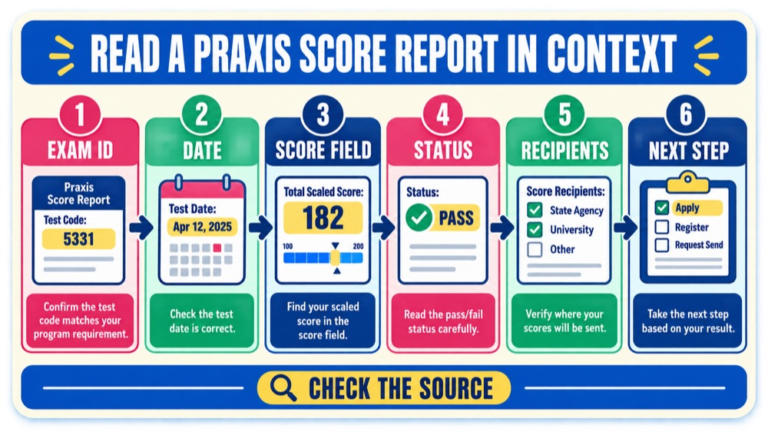
Read the report from the identity line through the status and recipient context before focusing on the number. Look for the administration date, score or scores, explanatory language, and detailed content-category information when those fields are provided.
Confirm the name and exam code.
Confirm the date connected to the result.
Identify the score field and provider wording.
Read any status or pass/no-pass context.
Check the recipient or transmission line.
Separate category performance from the pathway decision.
Save the record according to the applicable privacy policy.
Write questions beside the field rather than editing the record.
A report can document an important result while leaving a pathway question unanswered. That is normal: the receiving organization may still need an application, documentation, fee, background check, supervised practice, or another requirement outside the report.
Separate a report from a practice signal
A practice set is created under a particular mix, time limit, environment, and review method. Its percentage can help you plan study, but it is not the same field as a provider-reported score. Keep the test-result record and preparation record in separate sections.
When you review practice data, add the condition. Note whether you were timed, whether the set covered mixed domains, whether you reviewed explanations, and whether misses came from content, pacing, context, access, function, or sequence. This makes the signal useful without turning it into a forecast.
Note
Meaning
Do next
Report displayed
A source-based result field.
Read provider wording and pathway context.
Practice percentage
Performance under one study condition.
Classify errors and choose a repair.
Low confidence
Uncertainty even when an answer was selected.
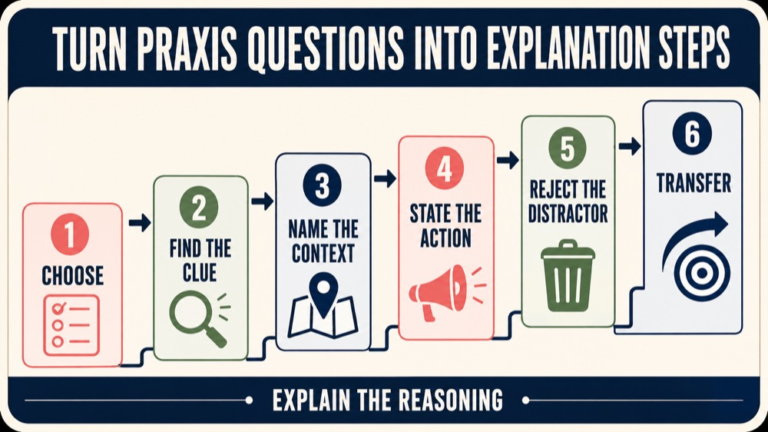
Write the evidence-to-action explanation.
Old screenshot
A record with unknown currency or context.
Recheck the current source.
Friend’s number
Another person’s result or pathway.
Do not substitute it for your process.
Check timing and status language
Timing pages often use conditional language because availability can depend on the selected test, administration, delivery method, calendar, and account process. Use the current ETS page for the specific test rather than converting a general anecdote into a deadline.
Read “pending,” “preliminary,” “available,” “reported,” and “received” as separate status questions. If a source does not define a status, record the word exactly and ask the provider or receiving organization what it means for your next step.
Check the current score-date tool or account instructions.
Use the test-specific date when one is displayed.
Distinguish notification from the report itself.
Do not treat a pending card as a result.
Confirm when a recipient can access or process the record.
Plan with a buffer for an application or deadline.
Match the result to the organization using it
ETS can describe report fields and general score context, but a state, agency, program, employer, or certifying authority may determine the qualifying rule or receipt process. Write the exact organization and pathway beside your result note.
For current passing-score context, use the ETS passing-score page and then follow the selected state or agency’s current instructions. For clinical study context, the ASHA Practice Portal can support topic review; it does not replace an administrative rule.
Question
Source to start with
Record
Where is the report?
ETS test-taker instructions.
Account area and access date.
What does the field mean?
ETS score-reporting explanation.
Field name and wording.
What score is used?
State, agency, or certifying authority.
Pathway and current rule.
Was it received?
The named recipient or program.
Receipt or processing step.
What should I study?
Your practice log plus current clinical sources.
Error category and next repair.
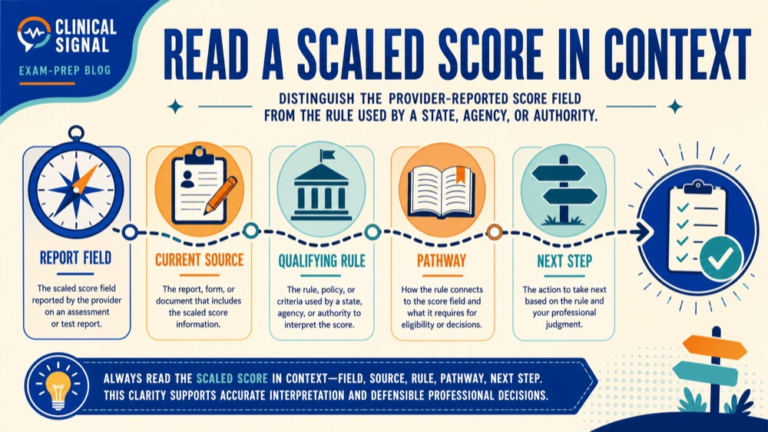
READ A SCALED SCORE IN CONTEXT
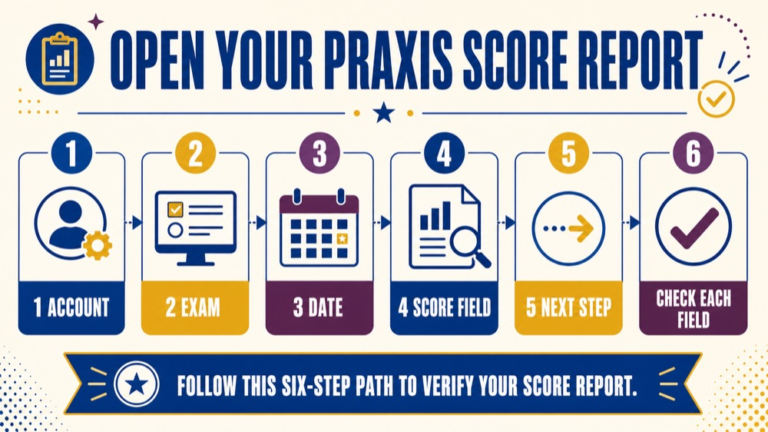
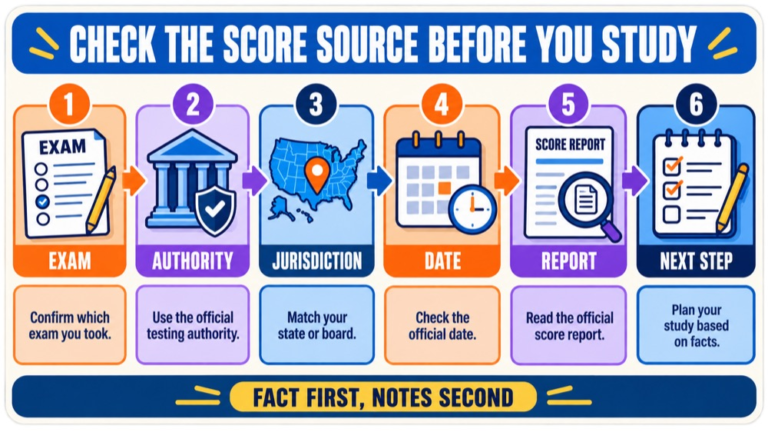
Use the first map to move from a vague result question to a traceable field. Start with exam identity, check the source, locate the report or calendar, and write the exact item that remains unclear. This prevents a search result from doing the work of a current source.
If the reader’s question is about a score, keep the provider-reported field separate from any study estimate. If the question is about a deadline, use the test-specific timing source and leave room for the receiving organization’s processing step.
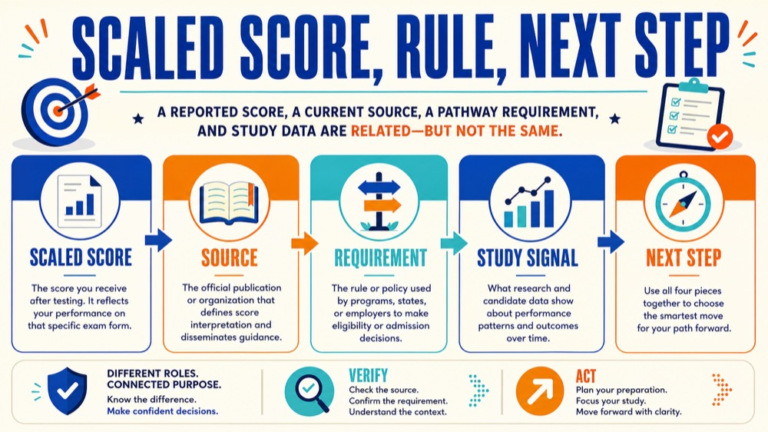
SCALED SCORE, RULE, NEXT STEP
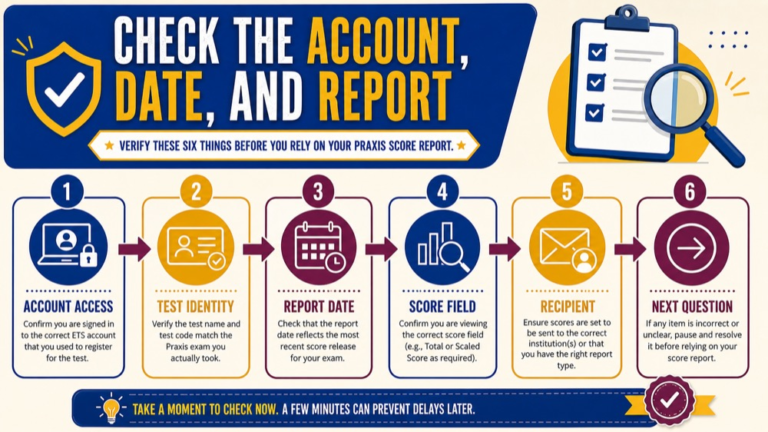
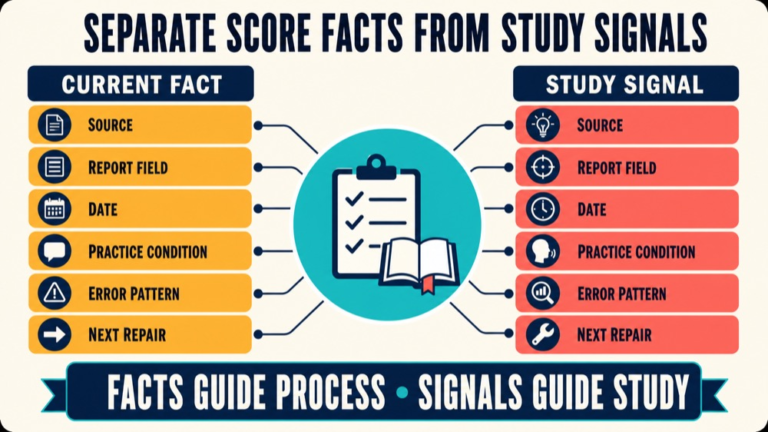
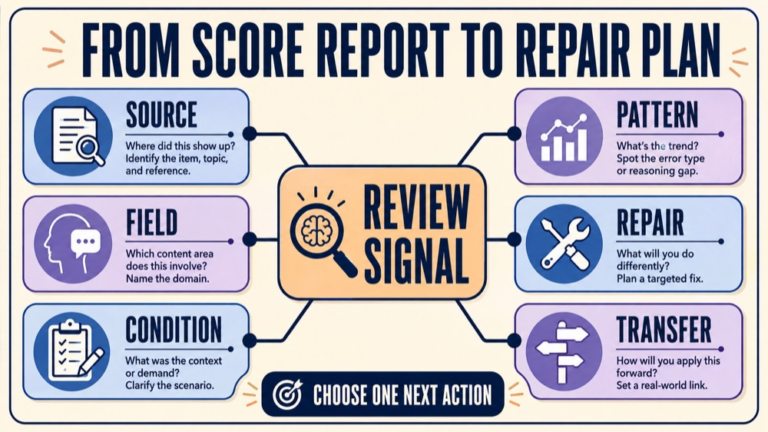
The second map turns a verified result into a next action. A source fact can lead to a report check; a practice pattern can lead to a focused review; a pathway question can lead to a direct message to the responsible organization.
FACT: cite the current page.
FIELD: name what the report displays.
PATH: identify who uses the result.
SIGNAL: record the practice condition and pattern.
REPAIR: choose one study change.
FOLLOW-UP: set a date to verify or review.
Use the result to choose a study action
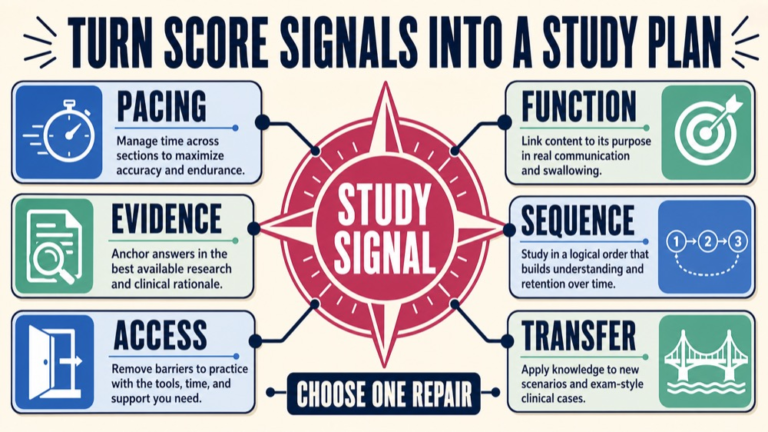
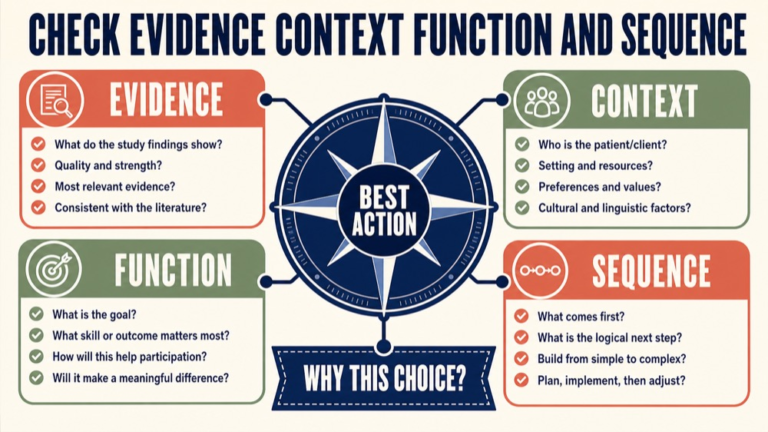
Once the administrative question is settled, return to the reasoning behind your practice work. Identify whether misses involve evidence, context, access, function, pacing, professional sequence, or transfer. Then choose a small repair that can be checked in the next session.
Describe: state what happened under the condition.
Classify: name the primary error pattern.
Repair: select one resource or practice change.
Transfer: change one context variable after a delay.
Compare: review the explanation, not only the percentage.
For language, cultural, and communication-access context, consult the ASHA Cultural Responsiveness resource when it is relevant to the case. Add language history, mode, partner, environment, and function to the reasoning record rather than treating them as decorative details.
Common mistakes to avoid
Most result confusion comes from moving a statement from one context to another. Check these common mistakes before you email a score or mark a task complete:
Using a search snippet instead of the current source.
Confusing a notification with the account report.
Comparing a practice percentage with a reported scaled score.
Applying another candidate’s date or qualifying rule.
Reading a status word without checking its definition.
Assuming one recipient’s process covers every pathway.
Posting private score information when a direct channel is available.
Changing every study resource after one result without classifying the miss.
A precise question is more useful than a broad worry. Include the exam identity, date, field, pathway, source checked, and the exact ambiguity you need resolved.
Keep access, privacy, and function visible
Give yourself a fair study condition. Consider language, dialect, communication mode, hearing, vision, motor access, technology, fatigue, noise, scheduling, and environment when you compare practice results. If a barrier changes the condition, record it before drawing a study conclusion.
Protect private score records and use the communication channel named by the responsible organization. In clinical examples, connect reasoning to activity and participation while keeping the example educational and within professional boundaries.
Quick verification checklist
Before relying on a result for a deadline or pathway, confirm:
Exam name and number match the intended test.
Administration and reporting dates are recorded.
Current ETS account or timing instructions were checked.
Score, status, and recipient fields were read separately.
Practice data are stored separately from the report.
State, agency, program, employer, or certifying authority is named.
Current qualifying or receipt instructions are linked.
Private information is shared only through an appropriate channel.
One unresolved question is written in plain language.
One study repair and a follow-up date are scheduled.
Questions to take to the source
Use these questions when the page or report does not settle the issue:
Which exam and code does this result describe?
Which date controls the report or process?
Where is the current report located?
What does the displayed status mean?
Which score field should the recipient use?
Who sets the qualifying rule for this pathway?
Has the intended recipient received or processed the result?
What should happen if two public sources differ?
Which detail is a study signal rather than an administrative fact?
For language and cultural context, review the ASHA Cultural Responsiveness resource. Recheck current state, agency, employer, school, program, facility, and professional requirements before relying on an administrative detail.
Next, write the exam identity, source URL, field or question, pathway, and one dated action. Keep the verified fact and the study signal in separate lines.
do praxis scores ever come early can refer to a report in an account, a preliminary display, a current requirement, or a personal practice result. Do not build a deadline around anecdotes. Check the current ETS timing language and account status for the specific test, then plan as if the published date is the reliable planning point. This guide keeps those pieces separate so a source-based fact is not confused with a study estimate or a pathway decision.
Administrative details can change. Add a checked date to your notes, use the responsible organization for a conflict, and treat the examples here as educational guidance rather than an individual certification, licensure, employment, or clinical decision.
What do praxis scores ever come early means
The first step is to name the object you are trying to find or understand. A score report is a record connected to an administration. A preliminary display, when provided, is a different kind of information. A practice percentage is a study observation. A qualifying score is a requirement applied by the organization that uses the result.
Object
Question it answers
Best next check
Account report
What result is displayed for this administration?
Open the current score-report area.
Timing notice
When does the provider say the report should be available?
Check the test-specific date or instructions.
Practice result
How did I perform under this study condition?
Review the set, errors, and confidence.
Qualifying rule
What score or status does this pathway use?
Check the responsible state, agency, or authority.
Next action
What should I verify or practice now?
Write one dated step.
These objects may appear together in a search result or conversation, but they should not be merged into one sentence. A clear article answers the reader’s immediate question and then shows which source owns the next fact.
Start with the current ETS source
Use the ETS test-taker and score-reporting pages for current instructions about locating a report, reading timing language, and understanding the fields shown to a test taker or recipient. Reopen the page when you register, receive a report, or plan another attempt.
Record the page title and URL.
Write the date you checked it.
Confirm the test name and number.
Separate account access from a score requirement.
Note whether a statement is about timing, reporting, or qualification.
Save a specific question if the page does not answer it.
Use the responsible organization for pathway conflicts.
Recheck before relying on a time-sensitive detail.
Search snippets, discussion posts, and old screenshots can help you formulate a question, but they should not replace the current page that owns the information. A dated source trail makes your notes easier to correct.
Confirm the exam and reporting pathway
Match the result to the full exam identity before you interpret it. For SLP learners, confirm whether the record names Speech-Language Pathology 5331 and whether the result is being used for certification, state licensure, a school process, employment, or another agency workflow.
Different organizations can ask for different receipt or documentation steps. The test provider can explain its report, while the state, agency, program, employer, or certifying authority explains how the result is used in its own process. Keep both lines in your worksheet.
Identity check
Why it matters
Write down
Exam
Similar labels can refer to different tests.
Full name and number.
Administration
Date and delivery details affect timing context.
Test date and report date.
Pathway
The receiving organization may set the qualifying rule.
State, agency, program, or authority.
Recipient
A selected recipient does not describe every requirement.
Recipient and receipt question.
Source
A current rule can replace an old note.
URL, owner, and checked date.
Read the result field by field
Read the report from the identity line through the status and recipient context before focusing on the number. Look for the administration date, score or scores, explanatory language, and detailed content-category information when those fields are provided.
Confirm the name and exam code.
Confirm the date connected to the result.
Identify the score field and provider wording.
Read any status or pass/no-pass context.
Check the recipient or transmission line.
Separate category performance from the pathway decision.
Save the record according to the applicable privacy policy.
Write questions beside the field rather than editing the record.
A report can document an important result while leaving a pathway question unanswered. That is normal: the receiving organization may still need an application, documentation, fee, background check, supervised practice, or another requirement outside the report.
Separate a report from a practice signal
A practice set is created under a particular mix, time limit, environment, and review method. Its percentage can help you plan study, but it is not the same field as a provider-reported score. Keep the test-result record and preparation record in separate sections.
When you review practice data, add the condition. Note whether you were timed, whether the set covered mixed domains, whether you reviewed explanations, and whether misses came from content, pacing, context, access, function, or sequence. This makes the signal useful without turning it into a forecast.
Note
Meaning
Do next
Report displayed
A source-based result field.
Read provider wording and pathway context.
Practice percentage
Performance under one study condition.
Classify errors and choose a repair.
Low confidence
Uncertainty even when an answer was selected.
Write the evidence-to-action explanation.
Old screenshot
A record with unknown currency or context.
Recheck the current source.
Friend’s number
Another person’s result or pathway.
Do not substitute it for your process.
Check timing and status language
Timing pages often use conditional language because availability can depend on the selected test, administration, delivery method, calendar, and account process. Use the current ETS page for the specific test rather than converting a general anecdote into a deadline.
Read “pending,” “preliminary,” “available,” “reported,” and “received” as separate status questions. If a source does not define a status, record the word exactly and ask the provider or receiving organization what it means for your next step.
Check the current score-date tool or account instructions.
Use the test-specific date when one is displayed.
Distinguish notification from the report itself.
Do not treat a pending card as a result.
Confirm when a recipient can access or process the record.
Plan with a buffer for an application or deadline.
Match the result to the organization using it
ETS can describe report fields and general score context, but a state, agency, program, employer, or certifying authority may determine the qualifying rule or receipt process. Write the exact organization and pathway beside your result note.
For current passing-score context, use the ETS passing-score page and then follow the selected state or agency’s current instructions. For clinical study context, the ASHA Practice Portal can support topic review; it does not replace an administrative rule.
Question
Source to start with
Record
Where is the report?
ETS test-taker instructions.
Account area and access date.
What does the field mean?
ETS score-reporting explanation.
Field name and wording.
What score is used?
State, agency, or certifying authority.
Pathway and current rule.
Was it received?
The named recipient or program.
Receipt or processing step.
What should I study?
Your practice log plus current clinical sources.
Error category and next repair.
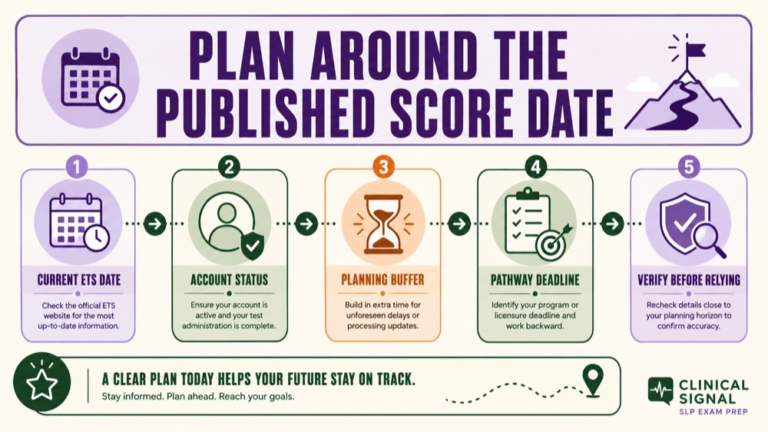
PLAN AROUND THE PUBLISHED SCORE DATE
Use the first map to move from a vague result question to a traceable field. Start with exam identity, check the source, locate the report or calendar, and write the exact item that remains unclear. This prevents a search result from doing the work of a current source.
If the reader’s question is about a score, keep the provider-reported field separate from any study estimate. If the question is about a deadline, use the test-specific timing source and leave room for the receiving organization’s processing step.
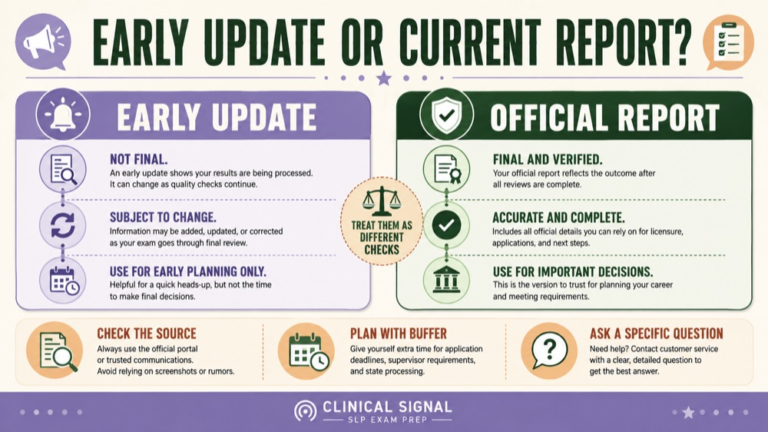
EARLY UPDATE OR CURRENT REPORT?
The second map turns a verified result into a next action. A source fact can lead to a report check; a practice pattern can lead to a focused review; a pathway question can lead to a direct message to the responsible organization.
FACT: cite the current page.
FIELD: name what the report displays.
PATH: identify who uses the result.
SIGNAL: record the practice condition and pattern.
REPAIR: choose one study change.
FOLLOW-UP: set a date to verify or review.
Use the result to choose a study action
Once the administrative question is settled, return to the reasoning behind your practice work. Identify whether misses involve evidence, context, access, function, pacing, professional sequence, or transfer. Then choose a small repair that can be checked in the next session.
Describe: state what happened under the condition.
Classify: name the primary error pattern.
Repair: select one resource or practice change.
Transfer: change one context variable after a delay.
Compare: review the explanation, not only the percentage.
For language, cultural, and communication-access context, consult the ASHA Cultural Responsiveness resource when it is relevant to the case. Add language history, mode, partner, environment, and function to the reasoning record rather than treating them as decorative details.
Common mistakes to avoid
Most result confusion comes from moving a statement from one context to another. Check these common mistakes before you email a score or mark a task complete:
Using a search snippet instead of the current source.
Confusing a notification with the account report.
Comparing a practice percentage with a reported scaled score.
Applying another candidate’s date or qualifying rule.
Reading a status word without checking its definition.
Assuming one recipient’s process covers every pathway.
Posting private score information when a direct channel is available.
Changing every study resource after one result without classifying the miss.
A precise question is more useful than a broad worry. Include the exam identity, date, field, pathway, source checked, and the exact ambiguity you need resolved.
Keep access, privacy, and function visible
Give yourself a fair study condition. Consider language, dialect, communication mode, hearing, vision, motor access, technology, fatigue, noise, scheduling, and environment when you compare practice results. If a barrier changes the condition, record it before drawing a study conclusion.
Protect private score records and use the communication channel named by the responsible organization. In clinical examples, connect reasoning to activity and participation while keeping the example educational and within professional boundaries.
Quick verification checklist
Before relying on a result for a deadline or pathway, confirm:
Exam name and number match the intended test.
Administration and reporting dates are recorded.
Current ETS account or timing instructions were checked.
Score, status, and recipient fields were read separately.
Practice data are stored separately from the report.
State, agency, program, employer, or certifying authority is named.
Current qualifying or receipt instructions are linked.
Private information is shared only through an appropriate channel.
One unresolved question is written in plain language.
One study repair and a follow-up date are scheduled.
Questions to take to the source
Use these questions when the page or report does not settle the issue:
Which exam and code does this result describe?
Which date controls the report or process?
Where is the current report located?
What does the displayed status mean?
Which score field should the recipient use?
Who sets the qualifying rule for this pathway?
Has the intended recipient received or processed the result?
What should happen if two public sources differ?
Which detail is a study signal rather than an administrative fact?
For language and cultural context, review the ASHA Cultural Responsiveness resource. Recheck current state, agency, employer, school, program, facility, and professional requirements before relying on an administrative detail.
Next, write the exam identity, source URL, field or question, pathway, and one dated action. Keep the verified fact and the study signal in separate lines.
How Do I Get My Praxis Scores? A Step-by-Step Check
how do i get my praxis scores can refer to a report in an account, a preliminary display, a current requirement, or a personal practice result. Use the current ETS test-taker instructions to locate the score-report area in the Praxis account, then confirm the report date, exam identity, displayed fields, and any recipient step. This guide keeps those pieces separate so a source-based fact is not confused with a study estimate or a pathway decision.
Administrative details can change. Add a checked date to your notes, use the responsible organization for a conflict, and treat the examples here as educational guidance rather than an individual certification, licensure, employment, or clinical decision.
What how do i get my praxis scores means
The first step is to name the object you are trying to find or understand. A score report is a record connected to an administration. A preliminary display, when provided, is a different kind of information. A practice percentage is a study observation. A qualifying score is a requirement applied by the organization that uses the result.
Object
Question it answers
Best next check
Account report
What result is displayed for this administration?
Open the current score-report area.
Timing notice
When does the provider say the report should be available?
Check the test-specific date or instructions.
Practice result
How did I perform under this study condition?
Review the set, errors, and confidence.
Qualifying rule
What score or status does this pathway use?
Check the responsible state, agency, or authority.
Next action
What should I verify or practice now?
Write one dated step.
These objects may appear together in a search result or conversation, but they should not be merged into one sentence. A clear article answers the reader’s immediate question and then shows which source owns the next fact.
Start with the current ETS source
Use the ETS test-taker and score-reporting pages for current instructions about locating a report, reading timing language, and understanding the fields shown to a test taker or recipient. Reopen the page when you register, receive a report, or plan another attempt.
Record the page title and URL.
Write the date you checked it.
Confirm the test name and number.
Separate account access from a score requirement.
Note whether a statement is about timing, reporting, or qualification.
Save a specific question if the page does not answer it.
Use the responsible organization for pathway conflicts.
Recheck before relying on a time-sensitive detail.
Search snippets, discussion posts, and old screenshots can help you formulate a question, but they should not replace the current page that owns the information. A dated source trail makes your notes easier to correct.
Confirm the exam and reporting pathway
Match the result to the full exam identity before you interpret it. For SLP learners, confirm whether the record names Speech-Language Pathology 5331 and whether the result is being used for certification, state licensure, a school process, employment, or another agency workflow.
Different organizations can ask for different receipt or documentation steps. The test provider can explain its report, while the state, agency, program, employer, or certifying authority explains how the result is used in its own process. Keep both lines in your worksheet.
Identity check
Why it matters
Write down
Exam
Similar labels can refer to different tests.
Full name and number.
Administration
Date and delivery details affect timing context.
Test date and report date.
Pathway
The receiving organization may set the qualifying rule.
State, agency, program, or authority.
Recipient
A selected recipient does not describe every requirement.
Recipient and receipt question.
Source
A current rule can replace an old note.
URL, owner, and checked date.
Read the result field by field
Read the report from the identity line through the status and recipient context before focusing on the number. Look for the administration date, score or scores, explanatory language, and detailed content-category information when those fields are provided.
Confirm the name and exam code.
Confirm the date connected to the result.
Identify the score field and provider wording.
Read any status or pass/no-pass context.
Check the recipient or transmission line.
Separate category performance from the pathway decision.
Save the record according to the applicable privacy policy.
Write questions beside the field rather than editing the record.
A report can document an important result while leaving a pathway question unanswered. That is normal: the receiving organization may still need an application, documentation, fee, background check, supervised practice, or another requirement outside the report.
Separate a report from a practice signal
A practice set is created under a particular mix, time limit, environment, and review method. Its percentage can help you plan study, but it is not the same field as a provider-reported score. Keep the test-result record and preparation record in separate sections.
When you review practice data, add the condition. Note whether you were timed, whether the set covered mixed domains, whether you reviewed explanations, and whether misses came from content, pacing, context, access, function, or sequence. This makes the signal useful without turning it into a forecast.
Note
Meaning
Do next
Report displayed
A source-based result field.
Read provider wording and pathway context.
Practice percentage
Performance under one study condition.
Classify errors and choose a repair.
Low confidence
Uncertainty even when an answer was selected.
Write the evidence-to-action explanation.
Old screenshot
A record with unknown currency or context.
Recheck the current source.
Friend’s number
Another person’s result or pathway.
Do not substitute it for your process.
Check timing and status language
Timing pages often use conditional language because availability can depend on the selected test, administration, delivery method, calendar, and account process. Use the current ETS page for the specific test rather than converting a general anecdote into a deadline.
Read “pending,” “preliminary,” “available,” “reported,” and “received” as separate status questions. If a source does not define a status, record the word exactly and ask the provider or receiving organization what it means for your next step.
Check the current score-date tool or account instructions.
Use the test-specific date when one is displayed.
Distinguish notification from the report itself.
Do not treat a pending card as a result.
Confirm when a recipient can access or process the record.
Plan with a buffer for an application or deadline.
Match the result to the organization using it
ETS can describe report fields and general score context, but a state, agency, program, employer, or certifying authority may determine the qualifying rule or receipt process. Write the exact organization and pathway beside your result note.
For current passing-score context, use the ETS passing-score page and then follow the selected state or agency’s current instructions. For clinical study context, the ASHA Practice Portal can support topic review; it does not replace an administrative rule.
Question
Source to start with
Record
Where is the report?
ETS test-taker instructions.
Account area and access date.
What does the field mean?
ETS score-reporting explanation.
Field name and wording.
What score is used?
State, agency, or certifying authority.
Pathway and current rule.
Was it received?
The named recipient or program.
Receipt or processing step.
What should I study?
Your practice log plus current clinical sources.
Error category and next repair.
OPEN YOUR PRAXIS SCORE REPORT
Use the first map to move from a vague result question to a traceable field. Start with exam identity, check the source, locate the report or calendar, and write the exact item that remains unclear. This prevents a search result from doing the work of a current source.
If the reader’s question is about a score, keep the provider-reported field separate from any study estimate. If the question is about a deadline, use the test-specific timing source and leave room for the receiving organization’s processing step.
CHECK THE ACCOUNT, DATE, AND REPORT
The second map turns a verified result into a next action. A source fact can lead to a report check; a practice pattern can lead to a focused review; a pathway question can lead to a direct message to the responsible organization.
FACT: cite the current page.
FIELD: name what the report displays.
PATH: identify who uses the result.
SIGNAL: record the practice condition and pattern.
REPAIR: choose one study change.
FOLLOW-UP: set a date to verify or review.
Use the result to choose a study action
Once the administrative question is settled, return to the reasoning behind your practice work. Identify whether misses involve evidence, context, access, function, pacing, professional sequence, or transfer. Then choose a small repair that can be checked in the next session.
Describe: state what happened under the condition.
Classify: name the primary error pattern.
Repair: select one resource or practice change.
Transfer: change one context variable after a delay.
Compare: review the explanation, not only the percentage.
For language, cultural, and communication-access context, consult the ASHA Cultural Responsiveness resource when it is relevant to the case. Add language history, mode, partner, environment, and function to the reasoning record rather than treating them as decorative details.
Common mistakes to avoid
Most result confusion comes from moving a statement from one context to another. Check these common mistakes before you email a score or mark a task complete:
Using a search snippet instead of the current source.
Confusing a notification with the account report.
Comparing a practice percentage with a reported scaled score.
Applying another candidate’s date or qualifying rule.
Reading a status word without checking its definition.
Assuming one recipient’s process covers every pathway.
Posting private score information when a direct channel is available.
Changing every study resource after one result without classifying the miss.
A precise question is more useful than a broad worry. Include the exam identity, date, field, pathway, source checked, and the exact ambiguity you need resolved.
Keep access, privacy, and function visible
Give yourself a fair study condition. Consider language, dialect, communication mode, hearing, vision, motor access, technology, fatigue, noise, scheduling, and environment when you compare practice results. If a barrier changes the condition, record it before drawing a study conclusion.
Protect private score records and use the communication channel named by the responsible organization. In clinical examples, connect reasoning to activity and participation while keeping the example educational and within professional boundaries.
Quick verification checklist
Before relying on a result for a deadline or pathway, confirm:
Exam name and number match the intended test.
Administration and reporting dates are recorded.
Current ETS account or timing instructions were checked.
Score, status, and recipient fields were read separately.
Practice data are stored separately from the report.
State, agency, program, employer, or certifying authority is named.
Current qualifying or receipt instructions are linked.
Private information is shared only through an appropriate channel.
One unresolved question is written in plain language.
One study repair and a follow-up date are scheduled.
Questions to take to the source
Use these questions when the page or report does not settle the issue:
Which exam and code does this result describe?
Which date controls the report or process?
Where is the current report located?
What does the displayed status mean?
Which score field should the recipient use?
Who sets the qualifying rule for this pathway?
Has the intended recipient received or processed the result?
What should happen if two public sources differ?
Which detail is a study signal rather than an administrative fact?
For language and cultural context, review the ASHA Cultural Responsiveness resource. Recheck current state, agency, employer, school, program, facility, and professional requirements before relying on an administrative detail.
Next, write the exam identity, source URL, field or question, pathway, and one dated action. Keep the verified fact and the study signal in separate lines.
Praxis Score Release Dates: How to Check the Current Calendar
praxis score release dates can refer to a report in an account, a preliminary display, a current requirement, or a personal practice result. Use the current ETS score-date or account information for the specific test and delivery method. Treat a date as a source-based planning point, not a universal interval for every administration. This guide keeps those pieces separate so a source-based fact is not confused with a study estimate or a pathway decision.
Administrative details can change. Add a checked date to your notes, use the responsible organization for a conflict, and treat the examples here as educational guidance rather than an individual certification, licensure, employment, or clinical decision.
What praxis score release dates means
The first step is to name the object you are trying to find or understand. A score report is a record connected to an administration. A preliminary display, when provided, is a different kind of information. A practice percentage is a study observation. A qualifying score is a requirement applied by the organization that uses the result.
Object
Question it answers
Best next check
Account report
What result is displayed for this administration?
Open the current score-report area.
Timing notice
When does the provider say the report should be available?
Check the test-specific date or instructions.
Practice result
How did I perform under this study condition?
Review the set, errors, and confidence.
Qualifying rule
What score or status does this pathway use?
Check the responsible state, agency, or authority.
Next action
What should I verify or practice now?
Write one dated step.
These objects may appear together in a search result or conversation, but they should not be merged into one sentence. A clear article answers the reader’s immediate question and then shows which source owns the next fact.
Start with the current ETS source
Use the ETS test-taker and score-reporting pages for current instructions about locating a report, reading timing language, and understanding the fields shown to a test taker or recipient. Reopen the page when you register, receive a report, or plan another attempt.
Record the page title and URL.
Write the date you checked it.
Confirm the test name and number.
Separate account access from a score requirement.
Note whether a statement is about timing, reporting, or qualification.
Save a specific question if the page does not answer it.
Use the responsible organization for pathway conflicts.
Recheck before relying on a time-sensitive detail.
Search snippets, discussion posts, and old screenshots can help you formulate a question, but they should not replace the current page that owns the information. A dated source trail makes your notes easier to correct.
Confirm the exam and reporting pathway
Match the result to the full exam identity before you interpret it. For SLP learners, confirm whether the record names Speech-Language Pathology 5331 and whether the result is being used for certification, state licensure, a school process, employment, or another agency workflow.
Different organizations can ask for different receipt or documentation steps. The test provider can explain its report, while the state, agency, program, employer, or certifying authority explains how the result is used in its own process. Keep both lines in your worksheet.
Identity check
Why it matters
Write down
Exam
Similar labels can refer to different tests.
Full name and number.
Administration
Date and delivery details affect timing context.
Test date and report date.
Pathway
The receiving organization may set the qualifying rule.
State, agency, program, or authority.
Recipient
A selected recipient does not describe every requirement.
Recipient and receipt question.
Source
A current rule can replace an old note.
URL, owner, and checked date.
Read the result field by field
Read the report from the identity line through the status and recipient context before focusing on the number. Look for the administration date, score or scores, explanatory language, and detailed content-category information when those fields are provided.
Confirm the name and exam code.
Confirm the date connected to the result.
Identify the score field and provider wording.
Read any status or pass/no-pass context.
Check the recipient or transmission line.
Separate category performance from the pathway decision.
Save the record according to the applicable privacy policy.
Write questions beside the field rather than editing the record.
A report can document an important result while leaving a pathway question unanswered. That is normal: the receiving organization may still need an application, documentation, fee, background check, supervised practice, or another requirement outside the report.
Separate a report from a practice signal
A practice set is created under a particular mix, time limit, environment, and review method. Its percentage can help you plan study, but it is not the same field as a provider-reported score. Keep the test-result record and preparation record in separate sections.
When you review practice data, add the condition. Note whether you were timed, whether the set covered mixed domains, whether you reviewed explanations, and whether misses came from content, pacing, context, access, function, or sequence. This makes the signal useful without turning it into a forecast.
Note
Meaning
Do next
Report displayed
A source-based result field.
Read provider wording and pathway context.
Practice percentage
Performance under one study condition.
Classify errors and choose a repair.
Low confidence
Uncertainty even when an answer was selected.
Write the evidence-to-action explanation.
Old screenshot
A record with unknown currency or context.
Recheck the current source.
Friend’s number
Another person’s result or pathway.
Do not substitute it for your process.
Check timing and status language
Timing pages often use conditional language because availability can depend on the selected test, administration, delivery method, calendar, and account process. Use the current ETS page for the specific test rather than converting a general anecdote into a deadline.
Read “pending,” “preliminary,” “available,” “reported,” and “received” as separate status questions. If a source does not define a status, record the word exactly and ask the provider or receiving organization what it means for your next step.
Check the current score-date tool or account instructions.
Use the test-specific date when one is displayed.
Distinguish notification from the report itself.
Do not treat a pending card as a result.
Confirm when a recipient can access or process the record.
Plan with a buffer for an application or deadline.
Match the result to the organization using it
ETS can describe report fields and general score context, but a state, agency, program, employer, or certifying authority may determine the qualifying rule or receipt process. Write the exact organization and pathway beside your result note.
For current passing-score context, use the ETS passing-score page and then follow the selected state or agency’s current instructions. For clinical study context, the ASHA Practice Portal can support topic review; it does not replace an administrative rule.
Question
Source to start with
Record
Where is the report?
ETS test-taker instructions.
Account area and access date.
What does the field mean?
ETS score-reporting explanation.
Field name and wording.
What score is used?
State, agency, or certifying authority.
Pathway and current rule.
Was it received?
The named recipient or program.
Receipt or processing step.
What should I study?
Your practice log plus current clinical sources.
Error category and next repair.
READ THE SCORE RELEASE CALENDAR
Use the first map to move from a vague result question to a traceable field. Start with exam identity, check the source, locate the report or calendar, and write the exact item that remains unclear. This prevents a search result from doing the work of a current source.
If the reader’s question is about a score, keep the provider-reported field separate from any study estimate. If the question is about a deadline, use the test-specific timing source and leave room for the receiving organization’s processing step.
FROM TEST DATE TO SCORE REPORT
The second map turns a verified result into a next action. A source fact can lead to a report check; a practice pattern can lead to a focused review; a pathway question can lead to a direct message to the responsible organization.
FACT: cite the current page.
FIELD: name what the report displays.
PATH: identify who uses the result.
SIGNAL: record the practice condition and pattern.
REPAIR: choose one study change.
FOLLOW-UP: set a date to verify or review.
Use the result to choose a study action
Once the administrative question is settled, return to the reasoning behind your practice work. Identify whether misses involve evidence, context, access, function, pacing, professional sequence, or transfer. Then choose a small repair that can be checked in the next session.
Describe: state what happened under the condition.
Classify: name the primary error pattern.
Repair: select one resource or practice change.
Transfer: change one context variable after a delay.
Compare: review the explanation, not only the percentage.
For language, cultural, and communication-access context, consult the ASHA Cultural Responsiveness resource when it is relevant to the case. Add language history, mode, partner, environment, and function to the reasoning record rather than treating them as decorative details.
Common mistakes to avoid
Most result confusion comes from moving a statement from one context to another. Check these common mistakes before you email a score or mark a task complete:
Using a search snippet instead of the current source.
Confusing a notification with the account report.
Comparing a practice percentage with a reported scaled score.
Applying another candidate’s date or qualifying rule.
Reading a status word without checking its definition.
Assuming one recipient’s process covers every pathway.
Posting private score information when a direct channel is available.
Changing every study resource after one result without classifying the miss.
A precise question is more useful than a broad worry. Include the exam identity, date, field, pathway, source checked, and the exact ambiguity you need resolved.
Keep access, privacy, and function visible
Give yourself a fair study condition. Consider language, dialect, communication mode, hearing, vision, motor access, technology, fatigue, noise, scheduling, and environment when you compare practice results. If a barrier changes the condition, record it before drawing a study conclusion.
Protect private score records and use the communication channel named by the responsible organization. In clinical examples, connect reasoning to activity and participation while keeping the example educational and within professional boundaries.
Quick verification checklist
Before relying on a result for a deadline or pathway, confirm:
Exam name and number match the intended test.
Administration and reporting dates are recorded.
Current ETS account or timing instructions were checked.
Score, status, and recipient fields were read separately.
Practice data are stored separately from the report.
State, agency, program, employer, or certifying authority is named.
Current qualifying or receipt instructions are linked.
Private information is shared only through an appropriate channel.
One unresolved question is written in plain language.
One study repair and a follow-up date are scheduled.
Questions to take to the source
Use these questions when the page or report does not settle the issue:
Which exam and code does this result describe?
Which date controls the report or process?
Where is the current report located?
What does the displayed status mean?
Which score field should the recipient use?
Who sets the qualifying rule for this pathway?
Has the intended recipient received or processed the result?
What should happen if two public sources differ?
Which detail is a study signal rather than an administrative fact?
For language and cultural context, review the ASHA Cultural Responsiveness resource. Recheck current state, agency, employer, school, program, facility, and professional requirements before relying on an administrative detail.
Next, write the exam identity, source URL, field or question, pathway, and one dated action. Keep the verified fact and the study signal in separate lines.
praxis exam results can refer to a report in an account, a preliminary display, a current requirement, or a personal practice result. A result should be matched to the right exam, date, score field, recipient, and pathway. If a result is unclear, ask the responsible source a specific question instead of guessing. This guide keeps those pieces separate so a source-based fact is not confused with a study estimate or a pathway decision.
Administrative details can change. Add a checked date to your notes, use the responsible organization for a conflict, and treat the examples here as educational guidance rather than an individual certification, licensure, employment, or clinical decision.
What praxis exam results means
The first step is to name the object you are trying to find or understand. A score report is a record connected to an administration. A preliminary display, when provided, is a different kind of information. A practice percentage is a study observation. A qualifying score is a requirement applied by the organization that uses the result.
Object
Question it answers
Best next check
Account report
What result is displayed for this administration?
Open the current score-report area.
Timing notice
When does the provider say the report should be available?
Check the test-specific date or instructions.
Practice result
How did I perform under this study condition?
Review the set, errors, and confidence.
Qualifying rule
What score or status does this pathway use?
Check the responsible state, agency, or authority.
Next action
What should I verify or practice now?
Write one dated step.
These objects may appear together in a search result or conversation, but they should not be merged into one sentence. A clear article answers the reader’s immediate question and then shows which source owns the next fact.
Start with the current ETS source
Use the ETS test-taker and score-reporting pages for current instructions about locating a report, reading timing language, and understanding the fields shown to a test taker or recipient. Reopen the page when you register, receive a report, or plan another attempt.
Record the page title and URL.
Write the date you checked it.
Confirm the test name and number.
Separate account access from a score requirement.
Note whether a statement is about timing, reporting, or qualification.
Save a specific question if the page does not answer it.
Use the responsible organization for pathway conflicts.
Recheck before relying on a time-sensitive detail.
Search snippets, discussion posts, and old screenshots can help you formulate a question, but they should not replace the current page that owns the information. A dated source trail makes your notes easier to correct.
Confirm the exam and reporting pathway
Match the result to the full exam identity before you interpret it. For SLP learners, confirm whether the record names Speech-Language Pathology 5331 and whether the result is being used for certification, state licensure, a school process, employment, or another agency workflow.
Different organizations can ask for different receipt or documentation steps. The test provider can explain its report, while the state, agency, program, employer, or certifying authority explains how the result is used in its own process. Keep both lines in your worksheet.
Identity check
Why it matters
Write down
Exam
Similar labels can refer to different tests.
Full name and number.
Administration
Date and delivery details affect timing context.
Test date and report date.
Pathway
The receiving organization may set the qualifying rule.
State, agency, program, or authority.
Recipient
A selected recipient does not describe every requirement.
Recipient and receipt question.
Source
A current rule can replace an old note.
URL, owner, and checked date.
Read the result field by field
Read the report from the identity line through the status and recipient context before focusing on the number. Look for the administration date, score or scores, explanatory language, and detailed content-category information when those fields are provided.
Confirm the name and exam code.
Confirm the date connected to the result.
Identify the score field and provider wording.
Read any status or pass/no-pass context.
Check the recipient or transmission line.
Separate category performance from the pathway decision.
Save the record according to the applicable privacy policy.
Write questions beside the field rather than editing the record.
A report can document an important result while leaving a pathway question unanswered. That is normal: the receiving organization may still need an application, documentation, fee, background check, supervised practice, or another requirement outside the report.
Separate a report from a practice signal
A practice set is created under a particular mix, time limit, environment, and review method. Its percentage can help you plan study, but it is not the same field as a provider-reported score. Keep the test-result record and preparation record in separate sections.
When you review practice data, add the condition. Note whether you were timed, whether the set covered mixed domains, whether you reviewed explanations, and whether misses came from content, pacing, context, access, function, or sequence. This makes the signal useful without turning it into a forecast.
Note
Meaning
Do next
Report displayed
A source-based result field.
Read provider wording and pathway context.
Practice percentage
Performance under one study condition.
Classify errors and choose a repair.
Low confidence
Uncertainty even when an answer was selected.
Write the evidence-to-action explanation.
Old screenshot
A record with unknown currency or context.
Recheck the current source.
Friend’s number
Another person’s result or pathway.
Do not substitute it for your process.
Check timing and status language
Timing pages often use conditional language because availability can depend on the selected test, administration, delivery method, calendar, and account process. Use the current ETS page for the specific test rather than converting a general anecdote into a deadline.
Read “pending,” “preliminary,” “available,” “reported,” and “received” as separate status questions. If a source does not define a status, record the word exactly and ask the provider or receiving organization what it means for your next step.
Check the current score-date tool or account instructions.
Use the test-specific date when one is displayed.
Distinguish notification from the report itself.
Do not treat a pending card as a result.
Confirm when a recipient can access or process the record.
Plan with a buffer for an application or deadline.
Match the result to the organization using it
ETS can describe report fields and general score context, but a state, agency, program, employer, or certifying authority may determine the qualifying rule or receipt process. Write the exact organization and pathway beside your result note.
For current passing-score context, use the ETS passing-score page and then follow the selected state or agency’s current instructions. For clinical study context, the ASHA Practice Portal can support topic review; it does not replace an administrative rule.
Question
Source to start with
Record
Where is the report?
ETS test-taker instructions.
Account area and access date.
What does the field mean?
ETS score-reporting explanation.
Field name and wording.
What score is used?
State, agency, or certifying authority.
Pathway and current rule.
Was it received?
The named recipient or program.
Receipt or processing step.
What should I study?
Your practice log plus current clinical sources.
Error category and next repair.
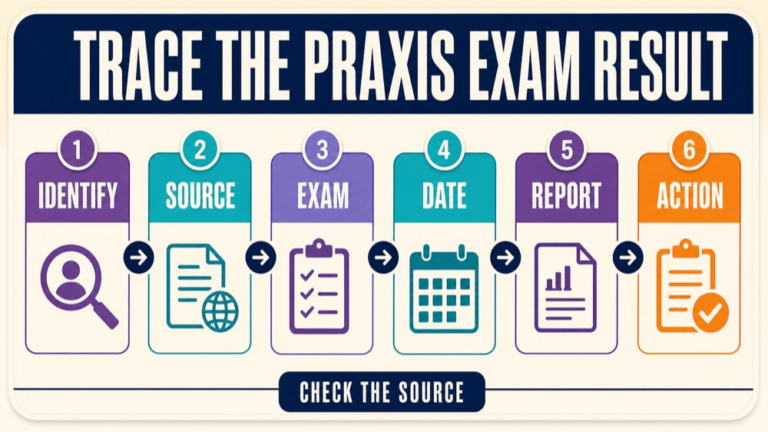
TRACE THE PRAXIS EXAM RESULT
Use the first map to move from a vague result question to a traceable field. Start with exam identity, check the source, locate the report or calendar, and write the exact item that remains unclear. This prevents a search result from doing the work of a current source.
If the reader’s question is about a score, keep the provider-reported field separate from any study estimate. If the question is about a deadline, use the test-specific timing source and leave room for the receiving organization’s processing step.
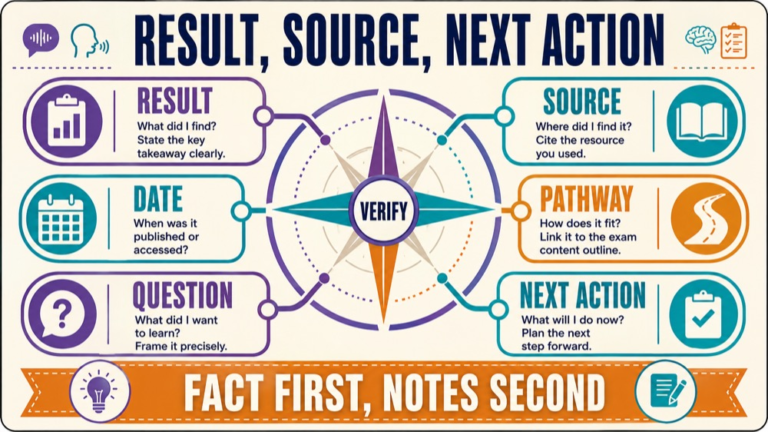
RESULT, SOURCE, NEXT ACTION
The second map turns a verified result into a next action. A source fact can lead to a report check; a practice pattern can lead to a focused review; a pathway question can lead to a direct message to the responsible organization.
FACT: cite the current page.
FIELD: name what the report displays.
PATH: identify who uses the result.
SIGNAL: record the practice condition and pattern.
REPAIR: choose one study change.
FOLLOW-UP: set a date to verify or review.
Use the result to choose a study action
Once the administrative question is settled, return to the reasoning behind your practice work. Identify whether misses involve evidence, context, access, function, pacing, professional sequence, or transfer. Then choose a small repair that can be checked in the next session.
Describe: state what happened under the condition.
Classify: name the primary error pattern.
Repair: select one resource or practice change.
Transfer: change one context variable after a delay.
Compare: review the explanation, not only the percentage.
For language, cultural, and communication-access context, consult the ASHA Cultural Responsiveness resource when it is relevant to the case. Add language history, mode, partner, environment, and function to the reasoning record rather than treating them as decorative details.
Common mistakes to avoid
Most result confusion comes from moving a statement from one context to another. Check these common mistakes before you email a score or mark a task complete:
Using a search snippet instead of the current source.
Confusing a notification with the account report.
Comparing a practice percentage with a reported scaled score.
Applying another candidate’s date or qualifying rule.
Reading a status word without checking its definition.
Assuming one recipient’s process covers every pathway.
Posting private score information when a direct channel is available.
Changing every study resource after one result without classifying the miss.
A precise question is more useful than a broad worry. Include the exam identity, date, field, pathway, source checked, and the exact ambiguity you need resolved.
Keep access, privacy, and function visible
Give yourself a fair study condition. Consider language, dialect, communication mode, hearing, vision, motor access, technology, fatigue, noise, scheduling, and environment when you compare practice results. If a barrier changes the condition, record it before drawing a study conclusion.
Protect private score records and use the communication channel named by the responsible organization. In clinical examples, connect reasoning to activity and participation while keeping the example educational and within professional boundaries.
Quick verification checklist
Before relying on a result for a deadline or pathway, confirm:
Exam name and number match the intended test.
Administration and reporting dates are recorded.
Current ETS account or timing instructions were checked.
Score, status, and recipient fields were read separately.
Practice data are stored separately from the report.
State, agency, program, employer, or certifying authority is named.
Current qualifying or receipt instructions are linked.
Private information is shared only through an appropriate channel.
One unresolved question is written in plain language.
One study repair and a follow-up date are scheduled.
Questions to take to the source
Use these questions when the page or report does not settle the issue:
Which exam and code does this result describe?
Which date controls the report or process?
Where is the current report located?
What does the displayed status mean?
Which score field should the recipient use?
Who sets the qualifying rule for this pathway?
Has the intended recipient received or processed the result?
What should happen if two public sources differ?
Which detail is a study signal rather than an administrative fact?
For language and cultural context, review the ASHA Cultural Responsiveness resource. Recheck current state, agency, employer, school, program, facility, and professional requirements before relying on an administrative detail.
Next, write the exam identity, source URL, field or question, pathway, and one dated action. Keep the verified fact and the study signal in separate lines.
Praxis Test Results: Where to Find and Verify Them
praxis test results can refer to a report in an account, a preliminary display, a current requirement, or a personal practice result. Start by confirming the exam identity and report location, then read the result with the current process that will use it. Keep practice results in a separate study log. This guide keeps those pieces separate so a source-based fact is not confused with a study estimate or a pathway decision.
Administrative details can change. Add a checked date to your notes, use the responsible organization for a conflict, and treat the examples here as educational guidance rather than an individual certification, licensure, employment, or clinical decision.
What praxis test results means
The first step is to name the object you are trying to find or understand. A score report is a record connected to an administration. A preliminary display, when provided, is a different kind of information. A practice percentage is a study observation. A qualifying score is a requirement applied by the organization that uses the result.
Object
Question it answers
Best next check
Account report
What result is displayed for this administration?
Open the current score-report area.
Timing notice
When does the provider say the report should be available?
Check the test-specific date or instructions.
Practice result
How did I perform under this study condition?
Review the set, errors, and confidence.
Qualifying rule
What score or status does this pathway use?
Check the responsible state, agency, or authority.
Next action
What should I verify or practice now?
Write one dated step.
These objects may appear together in a search result or conversation, but they should not be merged into one sentence. A clear article answers the reader’s immediate question and then shows which source owns the next fact.
Start with the current ETS source
Use the ETS test-taker and score-reporting pages for current instructions about locating a report, reading timing language, and understanding the fields shown to a test taker or recipient. Reopen the page when you register, receive a report, or plan another attempt.
Record the page title and URL.
Write the date you checked it.
Confirm the test name and number.
Separate account access from a score requirement.
Note whether a statement is about timing, reporting, or qualification.
Save a specific question if the page does not answer it.
Use the responsible organization for pathway conflicts.
Recheck before relying on a time-sensitive detail.
Search snippets, discussion posts, and old screenshots can help you formulate a question, but they should not replace the current page that owns the information. A dated source trail makes your notes easier to correct.
Confirm the exam and reporting pathway
Match the result to the full exam identity before you interpret it. For SLP learners, confirm whether the record names Speech-Language Pathology 5331 and whether the result is being used for certification, state licensure, a school process, employment, or another agency workflow.
Different organizations can ask for different receipt or documentation steps. The test provider can explain its report, while the state, agency, program, employer, or certifying authority explains how the result is used in its own process. Keep both lines in your worksheet.
Identity check
Why it matters
Write down
Exam
Similar labels can refer to different tests.
Full name and number.
Administration
Date and delivery details affect timing context.
Test date and report date.
Pathway
The receiving organization may set the qualifying rule.
State, agency, program, or authority.
Recipient
A selected recipient does not describe every requirement.
Recipient and receipt question.
Source
A current rule can replace an old note.
URL, owner, and checked date.
Read the result field by field
Read the report from the identity line through the status and recipient context before focusing on the number. Look for the administration date, score or scores, explanatory language, and detailed content-category information when those fields are provided.
Confirm the name and exam code.
Confirm the date connected to the result.
Identify the score field and provider wording.
Read any status or pass/no-pass context.
Check the recipient or transmission line.
Separate category performance from the pathway decision.
Save the record according to the applicable privacy policy.
Write questions beside the field rather than editing the record.
A report can document an important result while leaving a pathway question unanswered. That is normal: the receiving organization may still need an application, documentation, fee, background check, supervised practice, or another requirement outside the report.
Separate a report from a practice signal
A practice set is created under a particular mix, time limit, environment, and review method. Its percentage can help you plan study, but it is not the same field as a provider-reported score. Keep the test-result record and preparation record in separate sections.
When you review practice data, add the condition. Note whether you were timed, whether the set covered mixed domains, whether you reviewed explanations, and whether misses came from content, pacing, context, access, function, or sequence. This makes the signal useful without turning it into a forecast.
Note
Meaning
Do next
Report displayed
A source-based result field.
Read provider wording and pathway context.
Practice percentage
Performance under one study condition.
Classify errors and choose a repair.
Low confidence
Uncertainty even when an answer was selected.
Write the evidence-to-action explanation.
Old screenshot
A record with unknown currency or context.
Recheck the current source.
Friend’s number
Another person’s result or pathway.
Do not substitute it for your process.
Check timing and status language
Timing pages often use conditional language because availability can depend on the selected test, administration, delivery method, calendar, and account process. Use the current ETS page for the specific test rather than converting a general anecdote into a deadline.
Read “pending,” “preliminary,” “available,” “reported,” and “received” as separate status questions. If a source does not define a status, record the word exactly and ask the provider or receiving organization what it means for your next step.
Check the current score-date tool or account instructions.
Use the test-specific date when one is displayed.
Distinguish notification from the report itself.
Do not treat a pending card as a result.
Confirm when a recipient can access or process the record.
Plan with a buffer for an application or deadline.
Match the result to the organization using it
ETS can describe report fields and general score context, but a state, agency, program, employer, or certifying authority may determine the qualifying rule or receipt process. Write the exact organization and pathway beside your result note.
For current passing-score context, use the ETS passing-score page and then follow the selected state or agency’s current instructions. For clinical study context, the ASHA Practice Portal can support topic review; it does not replace an administrative rule.
Question
Source to start with
Record
Where is the report?
ETS test-taker instructions.
Account area and access date.
What does the field mean?
ETS score-reporting explanation.
Field name and wording.
What score is used?
State, agency, or certifying authority.
Pathway and current rule.
Was it received?
The named recipient or program.
Receipt or processing step.
What should I study?
Your practice log plus current clinical sources.
Error category and next repair.
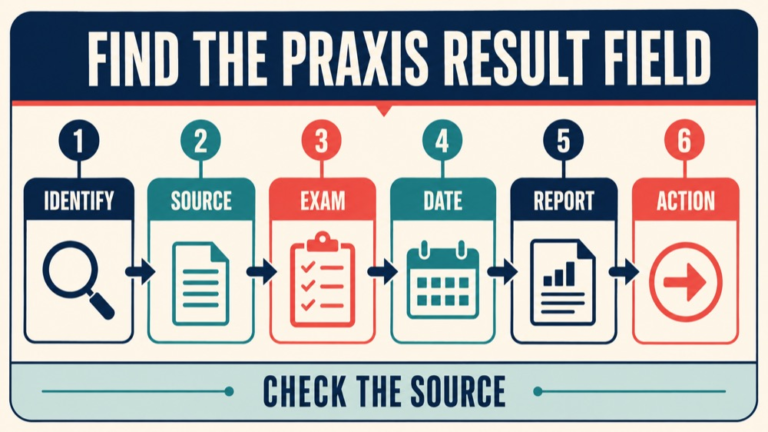
FIND THE PRAXIS RESULT FIELD
Use the first map to move from a vague result question to a traceable field. Start with exam identity, check the source, locate the report or calendar, and write the exact item that remains unclear. This prevents a search result from doing the work of a current source.
If the reader’s question is about a score, keep the provider-reported field separate from any study estimate. If the question is about a deadline, use the test-specific timing source and leave room for the receiving organization’s processing step.
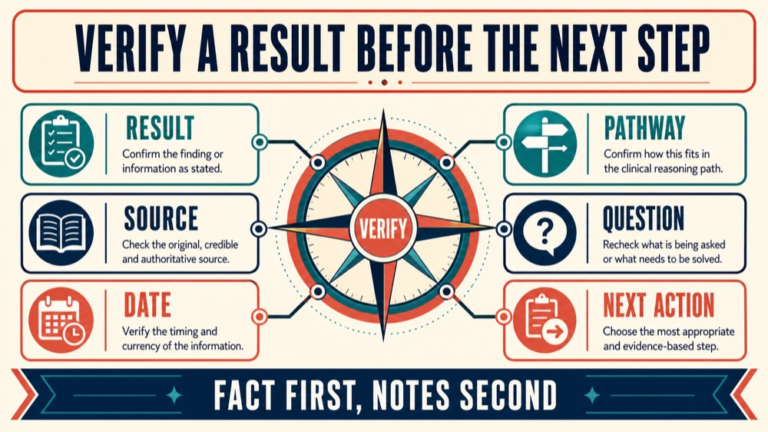
VERIFY A RESULT BEFORE THE NEXT STEP
The second map turns a verified result into a next action. A source fact can lead to a report check; a practice pattern can lead to a focused review; a pathway question can lead to a direct message to the responsible organization.
FACT: cite the current page.
FIELD: name what the report displays.
PATH: identify who uses the result.
SIGNAL: record the practice condition and pattern.
REPAIR: choose one study change.
FOLLOW-UP: set a date to verify or review.
Use the result to choose a study action
Once the administrative question is settled, return to the reasoning behind your practice work. Identify whether misses involve evidence, context, access, function, pacing, professional sequence, or transfer. Then choose a small repair that can be checked in the next session.
Describe: state what happened under the condition.
Classify: name the primary error pattern.
Repair: select one resource or practice change.
Transfer: change one context variable after a delay.
Compare: review the explanation, not only the percentage.
For language, cultural, and communication-access context, consult the ASHA Cultural Responsiveness resource when it is relevant to the case. Add language history, mode, partner, environment, and function to the reasoning record rather than treating them as decorative details.
Common mistakes to avoid
Most result confusion comes from moving a statement from one context to another. Check these common mistakes before you email a score or mark a task complete:
Using a search snippet instead of the current source.
Confusing a notification with the account report.
Comparing a practice percentage with a reported scaled score.
Applying another candidate’s date or qualifying rule.
Reading a status word without checking its definition.
Assuming one recipient’s process covers every pathway.
Posting private score information when a direct channel is available.
Changing every study resource after one result without classifying the miss.
A precise question is more useful than a broad worry. Include the exam identity, date, field, pathway, source checked, and the exact ambiguity you need resolved.
Keep access, privacy, and function visible
Give yourself a fair study condition. Consider language, dialect, communication mode, hearing, vision, motor access, technology, fatigue, noise, scheduling, and environment when you compare practice results. If a barrier changes the condition, record it before drawing a study conclusion.
Protect private score records and use the communication channel named by the responsible organization. In clinical examples, connect reasoning to activity and participation while keeping the example educational and within professional boundaries.
Quick verification checklist
Before relying on a result for a deadline or pathway, confirm:
Exam name and number match the intended test.
Administration and reporting dates are recorded.
Current ETS account or timing instructions were checked.
Score, status, and recipient fields were read separately.
Practice data are stored separately from the report.
State, agency, program, employer, or certifying authority is named.
Current qualifying or receipt instructions are linked.
Private information is shared only through an appropriate channel.
One unresolved question is written in plain language.
One study repair and a follow-up date are scheduled.
Questions to take to the source
Use these questions when the page or report does not settle the issue:
Which exam and code does this result describe?
Which date controls the report or process?
Where is the current report located?
What does the displayed status mean?
Which score field should the recipient use?
Who sets the qualifying rule for this pathway?
Has the intended recipient received or processed the result?
What should happen if two public sources differ?
Which detail is a study signal rather than an administrative fact?
For language and cultural context, review the ASHA Cultural Responsiveness resource. Recheck current state, agency, employer, school, program, facility, and professional requirements before relying on an administrative detail.
Next, write the exam identity, source URL, field or question, pathway, and one dated action. Keep the verified fact and the study signal in separate lines.
Speech Language Pathology Praxis Passing Score: Verify, Interpret, Prepare
speech language pathology praxis passing score is easiest to understand when you separate four things: the current public requirement, the score-report fields, a practice result, and your next preparation action. A speech language pathology Praxis passing score belongs in a source-checking workflow. The current requirement, a score report, a practice result, and a study goal answer different questions, so combining them can create avoidable confusion. Build a simple score-check routine that protects against stale details and uses your own result as a study signal without treating it as a credential forecast.
This guide explains a process for reading score information and planning review. It does not replace the source that sets a current requirement, and it does not predict a credential result. Keep clinical examples educational and separate from an individual person’s diagnosis, treatment, or legal situation.
What speech language pathology praxis passing score means
A search for a passing score can be asking several different questions. One reader may want the current minimum for a named exam. Another may be comparing a score report with a state or employer process. A third may be asking how a practice result should change study time. Identify which question you are answering before you copy a number into your notes.
Item
What it answers
Where to check
Current requirement
What score or condition applies to the relevant process?
The current authority or jurisdiction source.
Score report
What did the report display for this administration?
The report and its explanatory fields.
Practice result
How did I perform under one study condition?
Your timed set and review log.
Study target
What should I practice next?
Your pattern of errors, confidence, and transfer.
Professional process
What must be submitted or confirmed next?
The program, state, employer, or agency instructions.
These categories can inform one another without being interchangeable. A practice percentage is not the same field as a reported scaled score, and a current requirement may belong to a different process than the one you first had in mind.
Separate current score facts from study notes
Create two columns in your notebook. Put source-based facts on the left with a URL and checked date. Put your interpretation and study response on the right. This prevents a personal estimate or an old screenshot from becoming an unmarked administrative claim.
Write the exact exam name and number.
Record the source URL and the date you checked it.
Copy only the field or statement you need.
Mark whether the note concerns registration, scoring, reporting, or licensure.
Keep practice percentages in a separate section.
Label uncertainty instead of filling it with an assumption.
Set a reminder to recheck details before an application or retake.
Ask the responsible program or agency when its process controls the next step.
Source hygiene is part of preparation. A study plan can be excellent and still be built on the wrong requirement if the note was never dated or if a general search result was treated as the controlling source.
Start with the exam and jurisdiction
Confirm that the page you are reading names the relevant speech-language pathology exam and the process you need. The exam provider may explain score reporting, while a state board, graduate program, employer, or agency may define how a score is used in its own workflow.
Do not assume that a number copied from another candidate’s timeline applies to your situation. Check the institution, jurisdiction, credential stage, and date. If two sources appear to differ, record the conflict and contact the responsible authority rather than averaging the numbers.
Check
Why it matters
Note
Exam identity
Similar names can refer to different tests or versions.
Write the full name and number.
Process
Testing, reporting, certification, and licensure are different steps.
Name the step you are checking.
Jurisdiction
A local requirement may add its own instruction.
Link the responsible board or program.
Date
Administrative details can change.
Add a checked date and review trigger.
Contact
A source conflict needs a responsible answer.
Record who should confirm it.
Read a score report as a set of fields
Read the report from top to bottom before interpreting one number. Look for exam identity, administration date, reported score, status language, score recipients, and any explanatory notes. Use the provider’s own definitions for fields that have a technical meaning.
Then ask what the report does not tell you. It may not explain every reasoning error, the context in which a practice item was missed, or which study resource will help next. Use your own review log for those questions.
Confirm the name and number of the exam.
Confirm the administration or reporting date.
Identify the displayed score field.
Read surrounding notes and status language.
Check where a report was sent or must be sent.
Save a private copy according to the applicable policy.
Write questions beside the field instead of editing the report.
Use the provider or responsible agency for clarification.
Use scaled-score language carefully
Scaled-score language describes how a provider reports performance; it should not be treated as a simple conversion from the percentage on a homemade practice set. Different question sets, conditions, and scoring systems can make direct comparisons misleading.
When you explain a result, name the source and the limit: “This practice set showed…” is different from “My report displayed…”. If you need a current passing requirement, go back to the current source instead of inferring it from a practice percentage or a discussion post.
Statement
Safer interpretation
My practice percentage changed.
The study condition or reasoning pattern changed; review the log.
My report shows a scaled score.
Read the provider’s explanation and the process that uses it.
A friend used a different target.
Their exam, date, or jurisdiction may differ.
One result was lower.
Classify the conditions and errors before changing everything.
The source is unclear.
Pause the administrative conclusion and verify it.
Look for patterns without overreading one result
A score signal becomes more useful when you add conditions. Record whether the set was timed, whether you reviewed explanations, which domains were sampled, and whether you answered with high or low confidence. A single result can start a question; a pattern across comparable sessions can guide a more focused repair.
Compare like with like when checking timing.
Separate content misses from reading or pacing misses.
Review correct but low-confidence answers.
Notice whether context and access details were included.
Track the closest distractor and why it lost.
Change one study variable at a time when possible.
Return after a delay to test retention.
Use a changed-context item to test transfer.
Keep the tone descriptive. “I missed several items involving sequence under time pressure” leads to a different action than “I am not ready.” The first statement contains an observable repair target; the second is too broad to guide the next session.
Connect score signals to clinical reasoning
Score review is strongest when it returns to the reasoning underneath a question. Ask whether the item required you to clarify, assess, interpret, treat, monitor, refer, document, or collaborate. Then identify the person, activity, evidence, context, access condition, and professional boundary.
The goal is not to attach a clinical label to a percentage. The goal is to know which evidence-to-action relationship needs more practice and which source can support that review.
VERIFY THE CURRENT PRAXIS SCORE REQUIREMENT
Use the first map whenever a score page, report, or search result leaves you unsure. Follow the sequence from source and exam identity to report field, process, and next verification. Keep your own study interpretation in a separate lane so it cannot silently replace the current requirement.
Map step
Write
Output
Source
URL, owner, and checked date.
A traceable fact.
Exam
Full name and number.
The right frame.
Report
Field and displayed wording.
A precise observation.
Process
Testing, certification, licensure, or employer step.
The responsible workflow.
Question
What remains unclear?
A focused clarification.
Review
What study action follows?
A dated next step.
This workflow is deliberately small. It is easier to repeat before registration, after receiving a report, and when updating a study guide that contains administrative language.
SEPARATE SCORE FACTS FROM STUDY SIGNALS
The second map separates a score fact from a study signal. A current source answers what the process requires; your log answers what happened under your practice condition; the repair plan answers what you will do next.
FACT: cite the current source.
FIELD: quote or describe the report field.
CONDITION: record timing, content mix, and environment.
PATTERN: classify repeated errors and confidence.
REPAIR: choose one targeted study change.
TRANSFER: solve a changed-context item later.
Do not let the study signal become a forecast. It is a planning input that should be revisited when the condition or the source changes.
Build the next study cycle
Choose the next cycle from the strongest pattern in your notes. If pacing is the issue, use checkpoints and a return rule. If evidence reading is weak, require an evidence-to-action sentence. If access and function disappear, add those fields before looking at the options.
Review: select a small mixed set.
Record: mark confidence, clue, distractor, and boundary.
Repair: choose one category and one resource.
Transfer: change one context detail after a delay.
Compare: review the reasoning record across sessions.
Keep the next action concrete and dated. “Study more” is not a useful plan. “Review evidence and context errors for 30 minutes, then solve three changed-context items on Friday” gives you a condition you can inspect.
Decide what to verify before a retake
Before changing a test date or planning a retake, verify the current provider and responsible-program information. Check registration, reporting, score-recipient, timing, and local process details directly. Then examine whether your preparation plan addresses the pattern you recorded.
If a score report is unclear, preserve the report and ask a specific question. Include the field name, the date, and the process you are trying to complete. Avoid posting private score information in a public study group when a direct channel is available.
Protect access and professional context
Score preparation should remain accessible. Consider language, disability access, technology, hearing, vision, fatigue, environment, and scheduling when you evaluate your own study conditions. A result collected under a barrier may need a better condition before it becomes a useful comparison.
Keep professional boundaries visible in clinical examples. A study article can teach evidence, context, function, safety, consent, privacy, competence, supervision, and handoff without making a claim about one person’s care or one jurisdiction’s complete process.
Score-check worksheet
Copy this compact worksheet into your notes:
Exam name and number:
Source URL and checked date:
Process or jurisdiction being checked:
Score-report field I am reading:
Exact question I still have:
Practice condition and content mix:
Most common error category:
Lowest-confidence correct pattern:
One targeted repair:
One changed-context transfer prompt:
Next review date:
Complete the source fields first and the study fields second. That order makes it clear which statements are current facts and which are your own preparation decisions.
Common questions to take to the source
Use these questions to guide a source check:
Which exam and number does this requirement name?
Which process uses the score?
Who owns the current requirement?
What date was the page or document checked?
What does each score-report field mean?
Where should a report be sent?
What changes if the jurisdiction or program is different?
What should I do if two public sources conflict?
Which part is a study signal rather than an administrative fact?
For language and cultural context, review the ASHA Multilingual Service Delivery and ASHA Cultural Responsiveness resources. Recheck current state, program, employer, agency, school, facility, and professional requirements before relying on an administrative detail.
Next, complete the worksheet, verify the current source, classify one score signal, and schedule one targeted repair with a changed-context review.
Passing Score Praxis Speech Language Pathology: A Current-Source Guide
passing score praxis speech language pathology is easiest to understand when you separate four things: the current public requirement, the score-report fields, a practice result, and your next preparation action. Passing score Praxis speech language pathology questions often mix a reported scaled score, a jurisdiction requirement, and a learner’s own target. Treat those as related but different facts, then document which source supports each one. Use a current-source workflow to check the requirement, understand what the report says, and turn uncertainty into a practical preparation plan.
This guide explains a process for reading score information and planning review. It does not replace the source that sets a current requirement, and it does not predict a credential result. Keep clinical examples educational and separate from an individual person’s diagnosis, treatment, or legal situation.
What passing score praxis speech language pathology means
A search for a passing score can be asking several different questions. One reader may want the current minimum for a named exam. Another may be comparing a score report with a state or employer process. A third may be asking how a practice result should change study time. Identify which question you are answering before you copy a number into your notes.
Item
What it answers
Where to check
Current requirement
What score or condition applies to the relevant process?
The current authority or jurisdiction source.
Score report
What did the report display for this administration?
The report and its explanatory fields.
Practice result
How did I perform under one study condition?
Your timed set and review log.
Study target
What should I practice next?
Your pattern of errors, confidence, and transfer.
Professional process
What must be submitted or confirmed next?
The program, state, employer, or agency instructions.
These categories can inform one another without being interchangeable. A practice percentage is not the same field as a reported scaled score, and a current requirement may belong to a different process than the one you first had in mind.
Separate current score facts from study notes
Create two columns in your notebook. Put source-based facts on the left with a URL and checked date. Put your interpretation and study response on the right. This prevents a personal estimate or an old screenshot from becoming an unmarked administrative claim.
Write the exact exam name and number.
Record the source URL and the date you checked it.
Copy only the field or statement you need.
Mark whether the note concerns registration, scoring, reporting, or licensure.
Keep practice percentages in a separate section.
Label uncertainty instead of filling it with an assumption.
Set a reminder to recheck details before an application or retake.
Ask the responsible program or agency when its process controls the next step.
Source hygiene is part of preparation. A study plan can be excellent and still be built on the wrong requirement if the note was never dated or if a general search result was treated as the controlling source.
Start with the exam and jurisdiction
Confirm that the page you are reading names the relevant speech-language pathology exam and the process you need. The exam provider may explain score reporting, while a state board, graduate program, employer, or agency may define how a score is used in its own workflow.
Do not assume that a number copied from another candidate’s timeline applies to your situation. Check the institution, jurisdiction, credential stage, and date. If two sources appear to differ, record the conflict and contact the responsible authority rather than averaging the numbers.
Check
Why it matters
Note
Exam identity
Similar names can refer to different tests or versions.
Write the full name and number.
Process
Testing, reporting, certification, and licensure are different steps.
Name the step you are checking.
Jurisdiction
A local requirement may add its own instruction.
Link the responsible board or program.
Date
Administrative details can change.
Add a checked date and review trigger.
Contact
A source conflict needs a responsible answer.
Record who should confirm it.
Read a score report as a set of fields
Read the report from top to bottom before interpreting one number. Look for exam identity, administration date, reported score, status language, score recipients, and any explanatory notes. Use the provider’s own definitions for fields that have a technical meaning.
Then ask what the report does not tell you. It may not explain every reasoning error, the context in which a practice item was missed, or which study resource will help next. Use your own review log for those questions.
Confirm the name and number of the exam.
Confirm the administration or reporting date.
Identify the displayed score field.
Read surrounding notes and status language.
Check where a report was sent or must be sent.
Save a private copy according to the applicable policy.
Write questions beside the field instead of editing the report.
Use the provider or responsible agency for clarification.
Use scaled-score language carefully
Scaled-score language describes how a provider reports performance; it should not be treated as a simple conversion from the percentage on a homemade practice set. Different question sets, conditions, and scoring systems can make direct comparisons misleading.
When you explain a result, name the source and the limit: “This practice set showed…” is different from “My report displayed…”. If you need a current passing requirement, go back to the current source instead of inferring it from a practice percentage or a discussion post.
Statement
Safer interpretation
My practice percentage changed.
The study condition or reasoning pattern changed; review the log.
My report shows a scaled score.
Read the provider’s explanation and the process that uses it.
A friend used a different target.
Their exam, date, or jurisdiction may differ.
One result was lower.
Classify the conditions and errors before changing everything.
The source is unclear.
Pause the administrative conclusion and verify it.
Look for patterns without overreading one result
A score signal becomes more useful when you add conditions. Record whether the set was timed, whether you reviewed explanations, which domains were sampled, and whether you answered with high or low confidence. A single result can start a question; a pattern across comparable sessions can guide a more focused repair.
Compare like with like when checking timing.
Separate content misses from reading or pacing misses.
Review correct but low-confidence answers.
Notice whether context and access details were included.
Track the closest distractor and why it lost.
Change one study variable at a time when possible.
Return after a delay to test retention.
Use a changed-context item to test transfer.
Keep the tone descriptive. “I missed several items involving sequence under time pressure” leads to a different action than “I am not ready.” The first statement contains an observable repair target; the second is too broad to guide the next session.
Connect score signals to clinical reasoning
Score review is strongest when it returns to the reasoning underneath a question. Ask whether the item required you to clarify, assess, interpret, treat, monitor, refer, document, or collaborate. Then identify the person, activity, evidence, context, access condition, and professional boundary.
The goal is not to attach a clinical label to a percentage. The goal is to know which evidence-to-action relationship needs more practice and which source can support that review.
CHECK THE SCORE SOURCE BEFORE YOU STUDY
Use the first map whenever a score page, report, or search result leaves you unsure. Follow the sequence from source and exam identity to report field, process, and next verification. Keep your own study interpretation in a separate lane so it cannot silently replace the current requirement.
Map step
Write
Output
Source
URL, owner, and checked date.
A traceable fact.
Exam
Full name and number.
The right frame.
Report
Field and displayed wording.
A precise observation.
Process
Testing, certification, licensure, or employer step.
The responsible workflow.
Question
What remains unclear?
A focused clarification.
Review
What study action follows?
A dated next step.
This workflow is deliberately small. It is easier to repeat before registration, after receiving a report, and when updating a study guide that contains administrative language.
FROM SCORE REPORT TO REPAIR PLAN
The second map separates a score fact from a study signal. A current source answers what the process requires; your log answers what happened under your practice condition; the repair plan answers what you will do next.
FACT: cite the current source.
FIELD: quote or describe the report field.
CONDITION: record timing, content mix, and environment.
PATTERN: classify repeated errors and confidence.
REPAIR: choose one targeted study change.
TRANSFER: solve a changed-context item later.
Do not let the study signal become a forecast. It is a planning input that should be revisited when the condition or the source changes.
Build the next study cycle
Choose the next cycle from the strongest pattern in your notes. If pacing is the issue, use checkpoints and a return rule. If evidence reading is weak, require an evidence-to-action sentence. If access and function disappear, add those fields before looking at the options.
Review: select a small mixed set.
Record: mark confidence, clue, distractor, and boundary.
Repair: choose one category and one resource.
Transfer: change one context detail after a delay.
Compare: review the reasoning record across sessions.
Keep the next action concrete and dated. “Study more” is not a useful plan. “Review evidence and context errors for 30 minutes, then solve three changed-context items on Friday” gives you a condition you can inspect.
Decide what to verify before a retake
Before changing a test date or planning a retake, verify the current provider and responsible-program information. Check registration, reporting, score-recipient, timing, and local process details directly. Then examine whether your preparation plan addresses the pattern you recorded.
If a score report is unclear, preserve the report and ask a specific question. Include the field name, the date, and the process you are trying to complete. Avoid posting private score information in a public study group when a direct channel is available.
Protect access and professional context
Score preparation should remain accessible. Consider language, disability access, technology, hearing, vision, fatigue, environment, and scheduling when you evaluate your own study conditions. A result collected under a barrier may need a better condition before it becomes a useful comparison.
Keep professional boundaries visible in clinical examples. A study article can teach evidence, context, function, safety, consent, privacy, competence, supervision, and handoff without making a claim about one person’s care or one jurisdiction’s complete process.
Score-check worksheet
Copy this compact worksheet into your notes:
Exam name and number:
Source URL and checked date:
Process or jurisdiction being checked:
Score-report field I am reading:
Exact question I still have:
Practice condition and content mix:
Most common error category:
Lowest-confidence correct pattern:
One targeted repair:
One changed-context transfer prompt:
Next review date:
Complete the source fields first and the study fields second. That order makes it clear which statements are current facts and which are your own preparation decisions.
Common questions to take to the source
Use these questions to guide a source check:
Which exam and number does this requirement name?
Which process uses the score?
Who owns the current requirement?
What date was the page or document checked?
What does each score-report field mean?
Where should a report be sent?
What changes if the jurisdiction or program is different?
What should I do if two public sources conflict?
Which part is a study signal rather than an administrative fact?
For language and cultural context, review the ASHA Multilingual Service Delivery and ASHA Cultural Responsiveness resources. Recheck current state, program, employer, agency, school, facility, and professional requirements before relying on an administrative detail.
Next, complete the worksheet, verify the current source, classify one score signal, and schedule one targeted repair with a changed-context review.
Passing Score for SLP Praxis: How to Read the Requirement
passing score for slp praxis is easiest to understand when you separate four things: the current public requirement, the score-report fields, a practice result, and your next preparation action. The passing score for SLP Praxis is a current requirement to verify, not a number to memorize from an old study post. A useful review keeps the source, test version, jurisdiction, score report, and personal preparation plan in separate boxes. Learn how to check the current passing-score information, interpret a score report carefully, and use the result to choose a focused study action.
This guide explains a process for reading score information and planning review. It does not replace the source that sets a current requirement, and it does not predict a credential result. Keep clinical examples educational and separate from an individual person’s diagnosis, treatment, or legal situation.
What passing score for slp praxis means
A search for a passing score can be asking several different questions. One reader may want the current minimum for a named exam. Another may be comparing a score report with a state or employer process. A third may be asking how a practice result should change study time. Identify which question you are answering before you copy a number into your notes.
Item
What it answers
Where to check
Current requirement
What score or condition applies to the relevant process?
The current authority or jurisdiction source.
Score report
What did the report display for this administration?
The report and its explanatory fields.
Practice result
How did I perform under one study condition?
Your timed set and review log.
Study target
What should I practice next?
Your pattern of errors, confidence, and transfer.
Professional process
What must be submitted or confirmed next?
The program, state, employer, or agency instructions.
These categories can inform one another without being interchangeable. A practice percentage is not the same field as a reported scaled score, and a current requirement may belong to a different process than the one you first had in mind.
Separate current score facts from study notes
Create two columns in your notebook. Put source-based facts on the left with a URL and checked date. Put your interpretation and study response on the right. This prevents a personal estimate or an old screenshot from becoming an unmarked administrative claim.
Write the exact exam name and number.
Record the source URL and the date you checked it.
Copy only the field or statement you need.
Mark whether the note concerns registration, scoring, reporting, or licensure.
Keep practice percentages in a separate section.
Label uncertainty instead of filling it with an assumption.
Set a reminder to recheck details before an application or retake.
Ask the responsible program or agency when its process controls the next step.
Source hygiene is part of preparation. A study plan can be excellent and still be built on the wrong requirement if the note was never dated or if a general search result was treated as the controlling source.
Start with the exam and jurisdiction
Confirm that the page you are reading names the relevant speech-language pathology exam and the process you need. The exam provider may explain score reporting, while a state board, graduate program, employer, or agency may define how a score is used in its own workflow.
Do not assume that a number copied from another candidate’s timeline applies to your situation. Check the institution, jurisdiction, credential stage, and date. If two sources appear to differ, record the conflict and contact the responsible authority rather than averaging the numbers.
Check
Why it matters
Note
Exam identity
Similar names can refer to different tests or versions.
Write the full name and number.
Process
Testing, reporting, certification, and licensure are different steps.
Name the step you are checking.
Jurisdiction
A local requirement may add its own instruction.
Link the responsible board or program.
Date
Administrative details can change.
Add a checked date and review trigger.
Contact
A source conflict needs a responsible answer.
Record who should confirm it.
Read a score report as a set of fields
Read the report from top to bottom before interpreting one number. Look for exam identity, administration date, reported score, status language, score recipients, and any explanatory notes. Use the provider’s own definitions for fields that have a technical meaning.
Then ask what the report does not tell you. It may not explain every reasoning error, the context in which a practice item was missed, or which study resource will help next. Use your own review log for those questions.
Confirm the name and number of the exam.
Confirm the administration or reporting date.
Identify the displayed score field.
Read surrounding notes and status language.
Check where a report was sent or must be sent.
Save a private copy according to the applicable policy.
Write questions beside the field instead of editing the report.
Use the provider or responsible agency for clarification.
Use scaled-score language carefully
Scaled-score language describes how a provider reports performance; it should not be treated as a simple conversion from the percentage on a homemade practice set. Different question sets, conditions, and scoring systems can make direct comparisons misleading.
When you explain a result, name the source and the limit: “This practice set showed…” is different from “My report displayed…”. If you need a current passing requirement, go back to the current source instead of inferring it from a practice percentage or a discussion post.
Statement
Safer interpretation
My practice percentage changed.
The study condition or reasoning pattern changed; review the log.
My report shows a scaled score.
Read the provider’s explanation and the process that uses it.
A friend used a different target.
Their exam, date, or jurisdiction may differ.
One result was lower.
Classify the conditions and errors before changing everything.
The source is unclear.
Pause the administrative conclusion and verify it.
Look for patterns without overreading one result
A score signal becomes more useful when you add conditions. Record whether the set was timed, whether you reviewed explanations, which domains were sampled, and whether you answered with high or low confidence. A single result can start a question; a pattern across comparable sessions can guide a more focused repair.
Compare like with like when checking timing.
Separate content misses from reading or pacing misses.
Review correct but low-confidence answers.
Notice whether context and access details were included.
Track the closest distractor and why it lost.
Change one study variable at a time when possible.
Return after a delay to test retention.
Use a changed-context item to test transfer.
Keep the tone descriptive. “I missed several items involving sequence under time pressure” leads to a different action than “I am not ready.” The first statement contains an observable repair target; the second is too broad to guide the next session.
Connect score signals to clinical reasoning
Score review is strongest when it returns to the reasoning underneath a question. Ask whether the item required you to clarify, assess, interpret, treat, monitor, refer, document, or collaborate. Then identify the person, activity, evidence, context, access condition, and professional boundary.
The goal is not to attach a clinical label to a percentage. The goal is to know which evidence-to-action relationship needs more practice and which source can support that review.
READ A PRAXIS SCORE REPORT IN CONTEXT
Use the first map whenever a score page, report, or search result leaves you unsure. Follow the sequence from source and exam identity to report field, process, and next verification. Keep your own study interpretation in a separate lane so it cannot silently replace the current requirement.
Map step
Write
Output
Source
URL, owner, and checked date.
A traceable fact.
Exam
Full name and number.
The right frame.
Report
Field and displayed wording.
A precise observation.
Process
Testing, certification, licensure, or employer step.
The responsible workflow.
Question
What remains unclear?
A focused clarification.
Review
What study action follows?
A dated next step.
This workflow is deliberately small. It is easier to repeat before registration, after receiving a report, and when updating a study guide that contains administrative language.
TURN SCORE SIGNALS INTO A STUDY PLAN
The second map separates a score fact from a study signal. A current source answers what the process requires; your log answers what happened under your practice condition; the repair plan answers what you will do next.
FACT: cite the current source.
FIELD: quote or describe the report field.
CONDITION: record timing, content mix, and environment.
PATTERN: classify repeated errors and confidence.
REPAIR: choose one targeted study change.
TRANSFER: solve a changed-context item later.
Do not let the study signal become a forecast. It is a planning input that should be revisited when the condition or the source changes.
Build the next study cycle
Choose the next cycle from the strongest pattern in your notes. If pacing is the issue, use checkpoints and a return rule. If evidence reading is weak, require an evidence-to-action sentence. If access and function disappear, add those fields before looking at the options.
Review: select a small mixed set.
Record: mark confidence, clue, distractor, and boundary.
Repair: choose one category and one resource.
Transfer: change one context detail after a delay.
Compare: review the reasoning record across sessions.
Keep the next action concrete and dated. “Study more” is not a useful plan. “Review evidence and context errors for 30 minutes, then solve three changed-context items on Friday” gives you a condition you can inspect.
Decide what to verify before a retake
Before changing a test date or planning a retake, verify the current provider and responsible-program information. Check registration, reporting, score-recipient, timing, and local process details directly. Then examine whether your preparation plan addresses the pattern you recorded.
If a score report is unclear, preserve the report and ask a specific question. Include the field name, the date, and the process you are trying to complete. Avoid posting private score information in a public study group when a direct channel is available.
Protect access and professional context
Score preparation should remain accessible. Consider language, disability access, technology, hearing, vision, fatigue, environment, and scheduling when you evaluate your own study conditions. A result collected under a barrier may need a better condition before it becomes a useful comparison.
Keep professional boundaries visible in clinical examples. A study article can teach evidence, context, function, safety, consent, privacy, competence, supervision, and handoff without making a claim about one person’s care or one jurisdiction’s complete process.
Score-check worksheet
Copy this compact worksheet into your notes:
Exam name and number:
Source URL and checked date:
Process or jurisdiction being checked:
Score-report field I am reading:
Exact question I still have:
Practice condition and content mix:
Most common error category:
Lowest-confidence correct pattern:
One targeted repair:
One changed-context transfer prompt:
Next review date:
Complete the source fields first and the study fields second. That order makes it clear which statements are current facts and which are your own preparation decisions.
Common questions to take to the source
Use these questions to guide a source check:
Which exam and number does this requirement name?
Which process uses the score?
Who owns the current requirement?
What date was the page or document checked?
What does each score-report field mean?
Where should a report be sent?
What changes if the jurisdiction or program is different?
What should I do if two public sources conflict?
Which part is a study signal rather than an administrative fact?
For language and cultural context, review the ASHA Multilingual Service Delivery and ASHA Cultural Responsiveness resources. Recheck current state, program, employer, agency, school, facility, and professional requirements before relying on an administrative detail.
Next, complete the worksheet, verify the current source, classify one score signal, and schedule one targeted repair with a changed-context review.
Speech Language Pathology Praxis Questions With Explanations: A Study System
speech language pathology praxis questions with explanations can be more than a recall drill. Build a speech language pathology Praxis questions-with-explanations routine that turns each item into a compact evidence map, a distractor comparison, and a delayed transfer prompt. Explanations are useful when they expose the reasoning path from clue to action. A long explanation is not automatically strong; the key is whether it identifies the requested decision, the controlling evidence, the relevant context, and the boundary around the action.
Use the current ASHA Speech-Language Pathology 5331 content page for the study frame and the live ETS 5331 page for current exam context. The ASHA Practice Portal provides clinical topic context. All questions, explanations, and maps below are original educational material, separate from live test material and not individualized clinical advice.
Write the purpose of the session before you begin. You may be checking timing, content switching, explanation quality, access reasoning, functional transfer, or professional sequence. A defined purpose makes the review actionable and tells you which notes deserve attention when the clock stops.
What speech language pathology praxis questions with explanations should teach
Each item should represent a decision rather than a vocabulary contest. Identify the person, activity, context, evidence, and professional boundary. Then ask whether the selected answer is proportionate to what the stem actually gives you.
Signal
Question
Study record
Decision
What action does the stem request?
Underline clarify, assess, treat, monitor, refer, or document.
Evidence
Which detail changes the choice?
Write one evidence-to-action sentence.
Context
What affects access or interpretation?
Record language, mode, partner, setting, and support.
Function
What activity or participation outcome matters?
Name the person’s real-world task.
Boundary
What must happen first or be handed off?
Note safety, consent, privacy, competence, or local process.
Transfer
What changes if one variable moves?
Write a paired prompt for delayed review.
This record helps you separate a content gap from a reading or process gap. A missed item may come from pacing, a missed contrast, an inaccessible condition, an answer at the wrong level, or a sequence error. Those problems need different repairs.
Define the outcome before the clock
Choose one observable outcome for the session. For a timed run, the outcome might be a stable checkpoint and a completed rationale block. For explanation practice, it might be a one-sentence bridge from the controlling clue to the action.
Keep the score, confidence, and explanation separate. A score can tell you what happened under one condition. Confidence can show uncertainty. The explanation shows whether you can defend the choice and recognize what would change it.
Set: select a mixed group of original questions.
Condition: define time, environment, tools, and breaks.
Record: mark answer, confidence, clue, and return items.
Review: compare the best option with the closest alternative.
Transfer: change one variable and solve again later.
Use current 5331 public sources
Use the ASHA content page and ETS page when you write notes about current exam context, preparation resources, or administrative details. Add a checked date to details that may change, and revisit the source before relying on them.
Keep original practice content clearly labeled and separate from restricted live-test material. A useful study page teaches how to inspect evidence and choose an action; it does not imply access to protected questions or a credential result.
Build a balanced question set
Mix evaluation, treatment, foundations, communication access, safety, and professional practice. Vary the requested verb so you must decide whether to clarify, assess, interpret, act, monitor, refer, document, or collaborate. This keeps the set focused on decisions rather than repeated recognition of one familiar format.
Lane
Typical decision
Review lens
Evaluation
What information or measure belongs next?
Validity, access, history, and representative conditions.
Treatment
What update fits the response and goal?
Cueing, target, partner, activity, and outcome.
Foundations
Which concept explains the pattern?
Mechanism, contrast, and limits of inference.
Access
What condition affects opportunity?
Language, dialect, mode, hearing, environment, and support.
Safety
What changes the order?
Stop rule, escalation, communication, and follow-up.
Professional
What protects the person and process?
Consent, privacy, competence, supervision, and handoff.
Use enough variety to make switching visible, but not so much that the review becomes vague. The right set is one you can finish, explain, and revisit with a changed condition. Keep the mix stable for several sessions so comparisons remain meaningful.
Read every stem for decision and context
Start with the action word, then locate the person, activity, setting, evidence, and boundary. This prevents a familiar technical phrase from becoming the answer before you have read the conditions around it. It also makes the closest distractor easier to evaluate on the same terms.
Person: who is communicating and what matters to them?
Activity: what task, partner, or participation outcome is named?
Condition: where, when, and with what supports did the response occur?
Evidence: what contrast, response, limitation, or missing detail controls the choice?
Boundary: what must happen first, be communicated, or be handed off?
If a detail is missing, treat that absence as information. A proportionate answer may gather history, clarify the concern, observe another condition, or confirm a local process before making a broader decision. State what you need to know and why it would change the next action.
Audit evidence and distractors
After choosing, identify the closest distractor and name its mismatch. It may be a reasonable action at the wrong time, an unsupported conclusion, a choice that ignores context, or a step outside the role described.
Does the answer match the verb?
Does it use the controlling clue?
Does it account for language, dialect, culture, mode, hearing, partner, and setting?
Does it connect to the person’s activity and participation?
Does it put safety, consent, privacy, competence, and follow-up in order?
Does it stay within the information and authority supplied?
Write “fits because” and “misses because” for the two closest choices. This makes the explanation portable when a later item changes one word or condition, and it shows whether the original decision depended on evidence, context, timing, or professional sequence.
Check access, function, and sequence
Access is part of interpretation. Language history, dialect, communication mode, hearing, vision, motor access, technology, fatigue, noise, partner behavior, and response format can change the opportunity to show a skill. Name the condition rather than treating it as background detail after the answer has been chosen.
Function is the bridge from a structured result to a person’s life. Notice whether a cue, strategy, or measure changes effort, accuracy, message success, partner understanding, activity completion, or participation. Then state what you would monitor next.
Sequence is the final check. Clarification, safety, consent, and communication may come before measurement or treatment. When the case gives a local process, make the process visible in the rationale and explain what information or handoff follows.
TURN PRAXIS QUESTIONS INTO EXPLANATION STEPS
Use the first map to design the session before you begin. The question set, timer, evidence log, context check, and review block should work together. If the intended outcome is explanation quality, reserve enough time to defend the choice after the timed run.
Build step
Write down
Why it matters
Purpose
Timing, explanation, access, or transfer.
Keeps the session interpretable.
Mix
Domains and decision verbs.
Makes switching visible.
Condition
Time, setting, tools, and breaks.
Makes comparisons fair.
Log
Answer, confidence, clue, distractor, and boundary.
Turns a result into feedback.
Review
Protected explanation time.
Reveals the reason behind the choice.
Transfer
One changed variable.
Tests whether reasoning travels.
Keep the build lightweight enough to repeat. A reliable routine creates more useful comparisons than a complicated plan that appears once and disappears. Choose a format you can use on both a strong day and a tired study day.
CHECK EVIDENCE CONTEXT FUNCTION AND SEQUENCE
The second map is the explanation routine: decision fit, evidence fit, context fit, and sequence fit. Use it for missed and low-confidence correct answers. Recognition without an explanation is a cue to review, not a final study signal.
Check
Prompt
Repair
Decision fit
What action did the stem request?
Rewrite the verb and answer.
Evidence fit
Which clue changed the choice?
Circle the contrast or limitation.
Context fit
What condition affects access or interpretation?
Add person, partner, mode, or setting.
Sequence fit
Is this the right action now?
Put clarify, act, communicate, and follow up in order.
Finish with a paired prompt: change one variable, predict what should change, and explain why the rest of the reasoning stays stable. This final comparison turns a single answer into a small test of transfer.
Question 1: an evaluation decision
Practice Question 1. A child performs well on a language task with visual supports but has difficulty following spoken directions during a noisy activity. Which explanation best handles the contrast? After choosing, record the condition that made the decision difficult so the explanation stays tied to the case.
A. The supported task shows that the noisy activity cannot be relevant.
B. The noisy activity establishes a broad disorder without further clarification.
C. The conditions differ, so the explanation should examine access, language, hearing, partner, noise, and representative evidence before interpreting the pattern.
D. The visual supports should be removed before any context is gathered.
Correct Answer: C. The explanation uses the contrast as information. It keeps access and context visible and avoids treating one controlled task or one challenging activity as the whole communication profile. Note the evidence-to-action link in your review log so you can reuse the reasoning when a context detail changes.
Why the Other Options Are Wrong: A and B overextend one observation. D removes a support before understanding it. C explains why the next evidence should represent the concern fairly. Compare the closest alternative by decision, evidence, context, and sequence rather than by technical vocabulary alone.
Exam Trap: An explanation should account for the condition under which a response occurred, not just name the response. Add one short transfer prompt after the review to check whether the rule travels beyond this wording.
Question 2: a functional treatment decision
Practice Question 2. A person uses a trained script successfully in practice but avoids initiating a request with an unfamiliar listener. Which next step best connects explanation to function? After choosing, record the condition that made the decision difficult so the explanation stays tied to the case.
A. Treat the practice script as the completed participation goal.
B. Add supported practice with unfamiliar listeners and track initiation, repair, cueing, and participation.
C. Discard the script because the person needed support.
D. Move to a different impairment target without testing the request activity.
Correct Answer: B. The script is evidence that a support may help, while the unfamiliar listener exposes a transfer condition. The next step should practice and measure the request activity with an appropriate support plan. Note the evidence-to-action link in your review log so you can reuse the reasoning when a context detail changes.
Why the Other Options Are Wrong: A confuses practice success with participation. C removes a possible access route. D leaves the named activity unresolved. B connects the explanation to a functional experiment. Compare the closest alternative by decision, evidence, context, and sequence rather than by technical vocabulary alone.
Exam Trap: A useful explanation makes the bridge to the person’s activity visible even when a structured task went well. Add one short transfer prompt after the review to check whether the rule travels beyond this wording.
Question 3: a professional-practice decision
Practice Question 3. An item states that a local process requires a screening task to stop after a new safety change. What should the explanation emphasize? After choosing, record the condition that made the decision difficult so the explanation stays tied to the case.
A. Why collecting more trials is the most complete option.
B. Why earlier performance remains sufficient after the change.
C. Why stopping, communicating, documenting, and arranging qualified follow-up come before completing the original plan.
D. Why an untrained helper can continue while the clinician finishes the record.
Correct Answer: C. The new condition activates the process boundary. The explanation should make the order and handoff explicit rather than treating completion as the priority. Note the evidence-to-action link in your review log so you can reuse the reasoning when a context detail changes.
Why the Other Options Are Wrong: A and B ignore the changed condition. D ignores competence and authorization. C explains the sequence the case gives you. Compare the closest alternative by decision, evidence, context, and sequence rather than by technical vocabulary alone.
Exam Trap: Do not bury the safety sequence under a technical explanation of the screening task. Add one short transfer prompt after the review to check whether the rule travels beyond this wording.
Classify errors before changing resources
Give each miss one primary category before you choose a repair. This protects you from replacing every resource when the real problem is one reading habit or one missing context check.
Category
Signal
Repair
Pacing
The last items or review block collapse.
Use checkpoints and a return rule.
Verb
The explanation answers a neighboring action.
Underline clarify, assess, treat, monitor, refer, or document.
Evidence
A contrast or limitation was missed.
Write the controlling clue and implication.
Access
Language, mode, partner, or setting disappears.
Add access to the first read.
Function
The answer ends at a score or drill.
Name the activity and participation outcome.
Sequence
A reasonable action is premature.
Write what must come before it.
Boundary
Safety, consent, privacy, or competence is absent.
Add communication and handoff.
Transfer
The rule fails after one variable changes.
Solve a paired case later.
Review patterns across multiple sessions. A repeated category is stronger evidence for a study change than one isolated miss.
Repeat with delayed transfer
Return to a question after a delay and change one variable: partner, setting, language, support, urgency, response mode, or activity. Solve the new version before looking at the first rationale.
Write the original decision and controlling clue.
Change one condition only.
Predict what stays stable and what changes.
Explain the new action, context, and boundary.
Compare both cases and schedule a later check.
Delayed transfer helps you learn a relationship instead of memorizing a phrase. Keep the variation small enough that you can see which variable did the work.
Study checklist
Before closing the session, confirm that you have:
Checked current ASHA and ETS context.
Defined one observable session outcome.
Set the question mix, time boundary, environment, and review block.
Identified person, activity, decision verb, evidence, and boundary.
Accounted for access and function when relevant.
Compared the selected answer with the closest distractor.
Classified each miss and chosen one targeted repair.
Written one evidence-to-action sentence.
Created one changed-variable transfer prompt.
Scheduled delayed review.
The checklist is complete when it produces a next action. If you have only a score, return to the log and add the clue, distractor, boundary, and repair.
Use the ETS practice-test page for current preparation-resource context. The questions, answers, explanations, and maps here are original educational material separate from live test content. Recheck current state, employer, school, agency, facility, professional, and administrative requirements before relying on them.
Next, run one mixed set, write a rationale for the closest distractor, classify one miss, and solve a paired case after a delay.