Conversation Analysis in Speech Pathology: Turns, Repair, and Participation
conversation analysis speech pathology is easier to study when it is treated as a connected clinical reasoning problem rather than a label to memorize. Conversation analysis in speech pathology examines how communication unfolds between people over a sequence of turns. The SLP can study initiation, response timing, topic maintenance, questions, repair, confirmation, breakdown, partner behavior, and the effect of context on participation. It is more than counting how often someone talks. The analyst describes the interactional event, preserves the person’s communication mode and intent, and connects the pattern to meaningful goals and supports.
This learning guide is written for SLP students and other learners reviewing clinical concepts. It organizes observation, access, assessment, function, and professional judgment; it does not make an individualized diagnosis or replace current professional guidance. Interpretation depends on the person, task, language, culture, health, access, partner, context, and communication goals.
What conversation analysis examines
Begin by separating the concept into domains. A learner who can name the domains is less likely to collapse language, access, partner, participation, competence, regulation, and clinical judgment into one explanation. The useful unit of analysis is the task: what the person was asked to understand, express, organize, coordinate, remember, or communicate, with whom, under which conditions, and with what support.
Domain or system
What to notice
Question to carry forward
Interactional sequence
A turn is understood in relation to what came before and what happens next, including how a partner responds.
What sequence is unfolding?
Initiation and turn-taking
Communication may begin through speech, gesture, AAC, eye gaze, writing, or another mode and may require coordinated turns.
Who initiates, and how are turns shared?
Response and timing
Wait time, overlap, latency, topic knowledge, processing, and partner expectations affect whether a response is available.
What made the response easy or difficult?
Repair
Clarification, repetition, confirmation, rephrasing, gesture, AAC, and partner adjustment can restore a shared message.
How is a breakdown recognized and repaired?
Topic and organization
Topic choice, maintenance, shift, elaboration, question type, and listener knowledge shape the conversation.
Can the partners build and follow a shared topic?
Participation and integration
Conversation patterns are connected with relationships, autonomy, work, school, health, identity, and other assessment evidence.
What meaningful participation is affected?
These domains interact, but they should remain distinguishable. A learner may show strength in one context and need support in another. A study map organizes the next observation; it does not answer every assessment question or establish a universal treatment, goal, or legal conclusion.
Keep the first pass descriptive and close to the communication event. Note the task, response, partner, setting, timing, available support, language or mode, and consequence for participation. This gives the learner a stable record to compare across tasks and prevents a familiar term from doing too much explanatory work before the evidence has been separated.
For Praxis-style review, a vignette may include several true details but ask for one best interpretation or next step. The strongest answer usually respects the task, identifies the relevant function or boundary, checks the most important missing information, and avoids treating one performance sample or policy phrase as the whole profile.
Map conversation analysis
For study purposes, describe the communication relationship before naming a disorder, judging a partner, selecting a goal, or deciding that a task is within scope. Record what the person understood, expressed, initiated, repaired, coordinated, or participated in. Then note whether the task was familiar, how much context was shared, and which support changed the response.
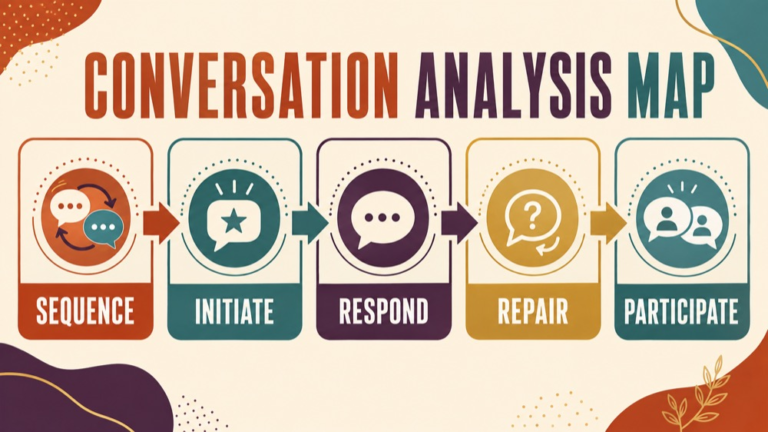
Sequence: examine what the speaker or partner did before, during, and after each relevant turn.
Initiation: record how a person starts, requests, comments, asks, selects, or shifts topics across communication modes.
Function: connect interaction patterns with relationships, learning, work, health, autonomy, self-advocacy, and support planning.
A strong description is specific enough that another learner could picture the event. Instead of writing “the communication is impaired” or “the clinician can do this,” describe the demand, observable response, language or mode, partner, context, competence or access condition, and result. This protects clinical reasoning from labels that are broader than the evidence.
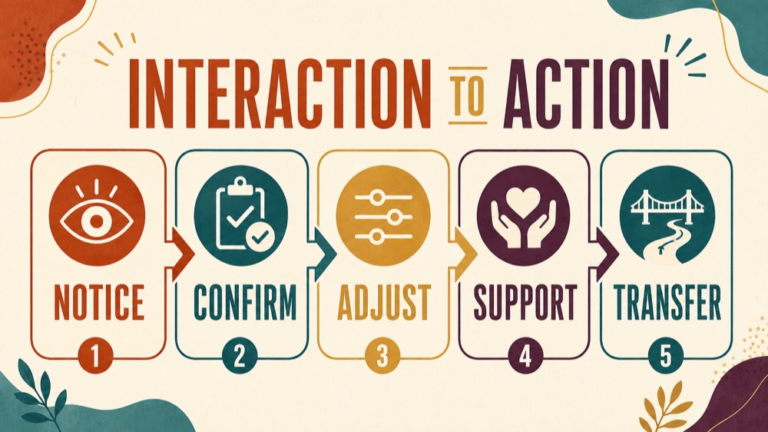
From a conversation sample to a meaningful clinical decision
Context changes what communication and professional decisions require. A direct question, long explanation, group exchange, classroom task, health-care interaction, family story, noisy routine, supervised procedure, or referral decision places different demands on processing, language, memory, hearing, access, partner behavior, competence, and regulation. Language experience, visual information, fatigue, health literacy, and the opportunity to request clarification should be part of the observation.
A person may answer direct questions but rarely initiate a topic, or may speak at length yet miss a partner’s repair signal. A conversation can also look different when the partner knows the person well, waits longer, understands the communication mode, or shares the topic. A clinician who studies only the individual’s turns may miss the interactional contribution of the partner and setting. Conversation analysis keeps the sequence visible: what was communicated, how it was interpreted, how repair happened, and which environmental or partner change could make participation more reliable.
Observation layer
Example question
Task
What did the person or clinician need to understand, express, organize, coordinate, decide, or provide?
Language and access
Which language, dialect, mode, hearing condition, tool, support, or communication partner was available?
Context and responsibility
Who was involved, what did they know, and which role, policy, ethical, or environmental factor mattered?
Participation and safety
What meaningful routine, role, outcome, or risk became easier or harder because of the pattern?
Context is not an afterthought added once a label has been selected. It is part of the question itself. If performance or decision quality changes with a quieter room, extra processing time, a familiar partner, a different language or mode, an interpreter, visual information, supervision, collaboration, a changed task, or a changed routine, that change is useful evidence about access and demand. It does not identify a cause by itself, but it tells you which conditions should be carried into the next observation.
Apply conversation-analysis reasoning
When a Praxis-style scenario or clinical discussion presents conversation analysis speech pathology, use a disciplined sequence. The goal is to select the next clinical question or action that matches the evidence, the person’s priorities, the communication context, and the relevant professional boundary.
Define the task, language, mode, communication purpose, or service responsibility in plain language.
Identify the relevant domain: language, access, partner, participation, assessment, competence, collaboration, ethics, or regulation.
Separate observation from interpretation and write down what remains unknown.
Check history, exposure, dialect, culture, identity, interpreter access, environment, sensory load, memory, task familiarity, training, supervision, and local requirements as relevant.
Choose the assessment, collaboration, accommodation, goal, training, referral, or documentation step that answers the specific question.
State the boundary of the conclusion and keep the person’s safety, autonomy, access, and participation visible.
A person may answer direct questions but rarely initiate a topic, or may speak at length yet miss a partner’s repair signal. A conversation can also look different when the partner knows the person well, waits longer, understands the communication mode, or shares the topic. A clinician who studies only the individual’s turns may miss the interactional contribution of the partner and setting. Conversation analysis keeps the sequence visible: what was communicated, how it was interpreted, how repair happened, and which environmental or partner change could make participation more reliable. In a learning answer, the decisive evidence is usually the relationship among the task, the observed pattern, the context, and the next needed information—not a single isolated behavior, score, label, or broad permission statement.
Common study mistakes
Reducing conversation analysis to talk time, number of words, or frequency of questions without examining sequences and meaning.
Treating a partner’s interpretation as proof that the person’s message was understood without checking confirmation or repair.
Ignoring AAC, gesture, writing, facial expression, eye gaze, silence, timing, and other meaningful communication modes.
Blaming the person for breakdown without examining listener knowledge, wait time, question type, noise, topic, or partner behavior.
Observing only a scripted clinician interview and generalizing to family, peer, classroom, workplace, or community conversation.
Labeling a turn irrelevant or inappropriate without clarifying the shared topic, cultural style, relationship, or communication goal.
Treating one conversation as a complete social communication or language profile.
Failing to translate the interactional pattern into partner support, access, participation, goal, collaboration, or monitoring.
Most of these mistakes come from replacing a multidomain question with a fast label. Correct the habit by returning to the same sequence: describe, separate, contextualize, ask what is missing, and choose a proportionate next step. A short rationale can make the habit visible: identify the evidence, name the uncertainty, and explain why the selected next step fits the person, setting, and responsibility.
Build a quick review map
Use this compact map when reviewing a missed question, lecture note, or clinical vignette:
Step 1: State the interactional question, partners, routine, communication modes, and meaningful outcome.
Step 5: Compare conversation patterns across partners and with formal, narrative, sample, report, observation, and functional evidence.
Step 6: Choose the next partner strategy, access support, assessment, goal, referral, collaboration, or monitoring step.
Then write one transfer sentence: “When I see this pattern, I will first check ___ because ___.” The sentence should identify a decision rule, not repeat a definition. Revisit it after a delay and test whether you can apply the rule to a different task, age group, partner, language, setting, or professional responsibility.
Sources and next steps
conversation analysis speech pathology is best learned as a context-sensitive pattern across communication, access, identity, function, participation, competence, and professional judgment. Use the current authority pages to refine the concept, then return to practice scenarios that require you to explain what the evidence supports and what it leaves open.
Narrative Language Assessment: Story Structure, Language, and Meaning
narrative language assessment is easier to study when it is treated as a connected clinical reasoning problem rather than a label to memorize. Narrative language assessment examines how a person understands, retells, generates, and organizes stories or personal accounts. It can reveal vocabulary, grammar, sentence complexity, sequencing, causal links, coherence, perspective, and the ability to connect events for a listener. A careful assessment distinguishes macrostructure from microstructure, considers the demands of the prompt and the person’s language and culture, and integrates narrative evidence with other communication data.
This learning guide is written for SLP students and other learners reviewing clinical concepts. It organizes observation, access, assessment, function, and professional judgment; it does not make an individualized diagnosis or replace current professional guidance. Interpretation depends on the person, task, language, culture, health, access, partner, context, and communication goals.
What narrative language assessment looks at
Begin by separating the concept into domains. A learner who can name the domains is less likely to collapse language, access, partner, participation, competence, regulation, and clinical judgment into one explanation. The useful unit of analysis is the task: what the person was asked to understand, express, organize, coordinate, remember, or communicate, with whom, under which conditions, and with what support.
Domain or system
What to notice
Question to carry forward
Narrative task
Retell, story generation, picture sequence, personal narrative, or story comprehension tasks elicit different kinds of evidence.
What does the task ask the person to do?
Macrostructure
Characters, setting, initiating event, problem, plan, actions, consequences, resolution, and overall organization describe the story as a whole.
How is the story organized and connected?
Microstructure
Vocabulary, grammar, sentence complexity, cohesive devices, elaboration, and temporal or causal language add detail.
How does the speaker build each message?
Coherence and perspective
The listener needs enough information, clear reference, logical relationships, and a perspective that makes the story understandable.
Can the listener follow the message and why it matters?
Language and culture
Narrative traditions, language structure, dialect, lived experience, familiarity, and cultural expectations affect how stories are told.
Is the prompt and interpretation a fair fit?
Integrated evidence
Narrative performance is interpreted with conversation, language samples, formal measures, reports, observation, and functional priorities.
What pattern is supported across communication contexts?
These domains interact, but they should remain distinguishable. A learner may show strength in one context and need support in another. A study map organizes the next observation; it does not answer every assessment question or establish a universal treatment, goal, or legal conclusion.
Keep the first pass descriptive and close to the communication event. Note the task, response, partner, setting, timing, available support, language or mode, and consequence for participation. This gives the learner a stable record to compare across tasks and prevents a familiar term from doing too much explanatory work before the evidence has been separated.
For Praxis-style review, a vignette may include several true details but ask for one best interpretation or next step. The strongest answer usually respects the task, identifies the relevant function or boundary, checks the most important missing information, and avoids treating one performance sample or policy phrase as the whole profile.
Map narrative language assessment
For study purposes, describe the communication relationship before naming a disorder, judging a partner, selecting a goal, or deciding that a task is within scope. Record what the person understood, expressed, initiated, repaired, coordinated, or participated in. Then note whether the task was familiar, how much context was shared, and which support changed the response.
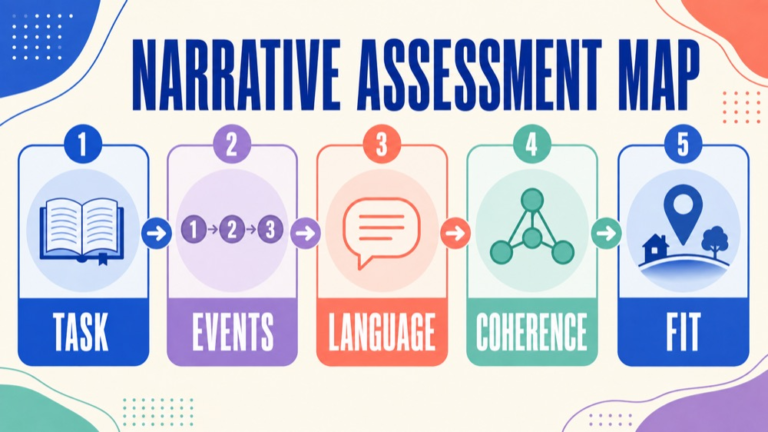
Task: distinguish comprehension, retell, story generation, picture sequence, fictional, personal, and procedural narrative demands.
Macrostructure: examine organization, characters, settings, events, causal relationships, problem solving, and resolution.
Microstructure: examine vocabulary, grammar, sentence complexity, cohesion, elaboration, and temporal or causal marking.
Coherence: consider reference, main ideas, listener knowledge, topic maintenance, perspective, and whether the story makes sense.
Integration: connect narrative evidence with conversation, samples, formal and informal measures, reports, observation, and function.
A strong description is specific enough that another learner could picture the event. Instead of writing “the communication is impaired” or “the clinician can do this,” describe the demand, observable response, language or mode, partner, context, competence or access condition, and result. This protects clinical reasoning from labels that are broader than the evidence.
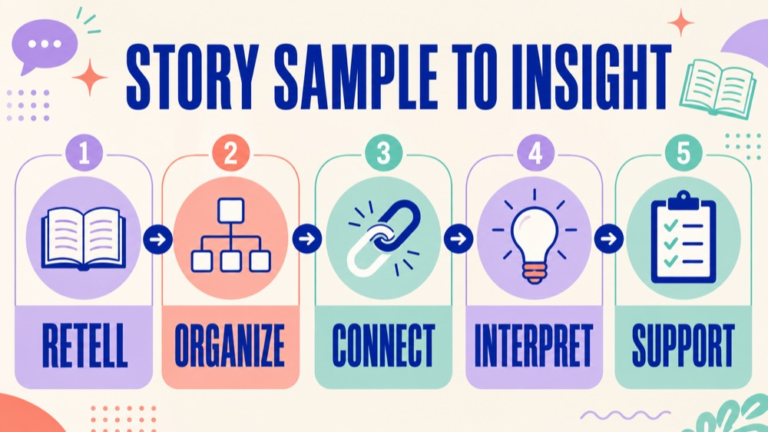
From a narrative sample to a fair clinical interpretation
Context changes what communication and professional decisions require. A direct question, long explanation, group exchange, classroom task, health-care interaction, family story, noisy routine, supervised procedure, or referral decision places different demands on processing, language, memory, hearing, access, partner behavior, competence, and regulation. Language experience, visual information, fatigue, health literacy, and the opportunity to request clarification should be part of the observation.
A story retell with pictures can show whether a child remembers and organizes key events, while an open-ended story generation task may place greater demands on planning, language formulation, and perspective. An adolescent’s personal narrative can reveal how they explain experiences to a listener, but it also depends on memory, privacy, lived experience, and comfort with the topic. Narrative assessment is strongest when the SLP explains the prompt, analyzes the whole story and its language details, and recognizes that narrative conventions vary across languages and communities. A story sample is evidence about a task, not a complete measure of the person.
Observation layer
Example question
Task
What did the person or clinician need to understand, express, organize, coordinate, decide, or provide?
Language and access
Which language, dialect, mode, hearing condition, tool, support, or communication partner was available?
Context and responsibility
Who was involved, what did they know, and which role, policy, ethical, or environmental factor mattered?
Participation and safety
What meaningful routine, role, outcome, or risk became easier or harder because of the pattern?
Context is not an afterthought added once a label has been selected. It is part of the question itself. If performance or decision quality changes with a quieter room, extra processing time, a familiar partner, a different language or mode, an interpreter, visual information, supervision, collaboration, a changed task, or a changed routine, that change is useful evidence about access and demand. It does not identify a cause by itself, but it tells you which conditions should be carried into the next observation.
Apply narrative-assessment reasoning
When a Praxis-style scenario or clinical discussion presents narrative language assessment, use a disciplined sequence. The goal is to select the next clinical question or action that matches the evidence, the person’s priorities, the communication context, and the relevant professional boundary.
Define the task, language, mode, communication purpose, or service responsibility in plain language.
Identify the relevant domain: language, access, partner, participation, assessment, competence, collaboration, ethics, or regulation.
Separate observation from interpretation and write down what remains unknown.
Check history, exposure, dialect, culture, identity, interpreter access, environment, sensory load, memory, task familiarity, training, supervision, and local requirements as relevant.
Choose the assessment, collaboration, accommodation, goal, training, referral, or documentation step that answers the specific question.
State the boundary of the conclusion and keep the person’s safety, autonomy, access, and participation visible.
A story retell with pictures can show whether a child remembers and organizes key events, while an open-ended story generation task may place greater demands on planning, language formulation, and perspective. An adolescent’s personal narrative can reveal how they explain experiences to a listener, but it also depends on memory, privacy, lived experience, and comfort with the topic. Narrative assessment is strongest when the SLP explains the prompt, analyzes the whole story and its language details, and recognizes that narrative conventions vary across languages and communities. A story sample is evidence about a task, not a complete measure of the person. In a learning answer, the decisive evidence is usually the relationship among the task, the observed pattern, the context, and the next needed information—not a single isolated behavior, score, label, or broad permission statement.
Common study mistakes
Treating narrative assessment as a single story grammar checklist that applies unchanged across languages, cultures, ages, and discourse purposes.
Confusing narrative comprehension, retell, story generation, personal narrative, and picture description as interchangeable tasks.
Counting included story elements while missing coherence, listener needs, causal meaning, perspective, and the person’s strengths.
Ignoring vocabulary, grammar, sentence complexity, cohesion, language structure, dialect, and communication mode.
Using prompts that are unfamiliar, culturally narrow, emotionally unsafe, visually inaccessible, or too difficult for the question.
Treating a strong retell as direct evidence of spontaneous storytelling or a weak generation task as direct evidence of a broad language disorder.
Comparing narratives collected with different prompts, pictures, support levels, languages, or coding rules as if they were equivalent.
Failing to connect narrative patterns with conversation, language samples, academic or work demands, family report, and participation.
Most of these mistakes come from replacing a multidomain question with a fast label. Correct the habit by returning to the same sequence: describe, separate, contextualize, ask what is missing, and choose a proportionate next step. A short rationale can make the habit visible: identify the evidence, name the uncertainty, and explain why the selected next step fits the person, setting, and responsibility.
Build a quick review map
Use this compact map when reviewing a missed question, lecture note, or clinical vignette:
Step 1: Define whether the question concerns narrative comprehension, retell, generation, personal experience, or another discourse purpose.
Step 2: Document the prompt, pictures, story familiarity, language, partner, support, timing, and response mode.
Step 4: Check cultural and linguistic fit, lived experience, access, privacy, and whether the task is fair for the person.
Step 5: Compare narrative evidence with conversation, language samples, formal measures, reports, observation, and function.
Step 6: Use the integrated pattern to choose instruction, intervention targets, support, referral, goal, or monitoring.
Then write one transfer sentence: “When I see this pattern, I will first check ___ because ___.” The sentence should identify a decision rule, not repeat a definition. Revisit it after a delay and test whether you can apply the rule to a different task, age group, partner, language, setting, or professional responsibility.
Sources and next steps
narrative language assessment is best learned as a context-sensitive pattern across communication, access, identity, function, participation, competence, and professional judgment. Use the current authority pages to refine the concept, then return to practice scenarios that require you to explain what the evidence supports and what it leaves open.
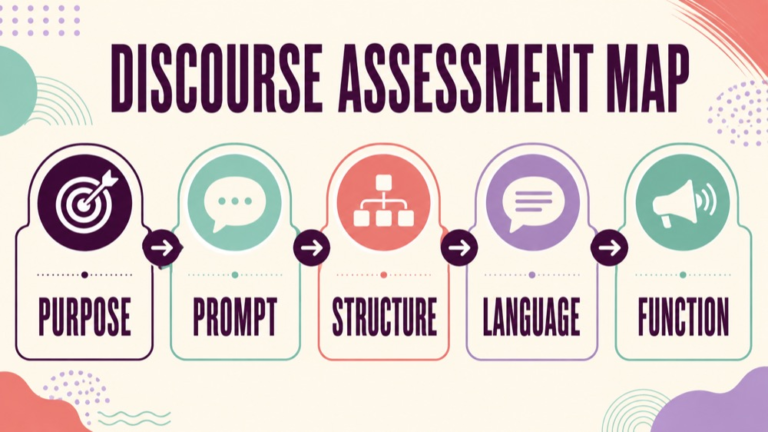
Discourse Assessment in Speech-Language Pathology: Connected Language in Context
discourse assessment speech language pathology is easier to study when it is treated as a connected clinical reasoning problem rather than a label to memorize. Discourse assessment in speech-language pathology examines connected language rather than isolated words or single sentences. Conversation, narrative, procedural, and expository tasks can reveal how a person organizes ideas, maintains a topic, connects information, explains relationships, and adapts to a listener. Because discourse performance changes with the elicitation method, topic, partner, and context, the SLP documents the task and interprets macrostructure, microstructure, and function together.
This learning guide is written for SLP students and other learners reviewing clinical concepts. It organizes observation, access, assessment, function, and professional judgment; it does not make an individualized diagnosis or replace current professional guidance. Interpretation depends on the person, task, language, culture, health, access, partner, context, and communication goals.
What discourse assessment examines
Begin by separating the concept into domains. A learner who can name the domains is less likely to collapse language, access, partner, participation, competence, regulation, and clinical judgment into one explanation. The useful unit of analysis is the task: what the person was asked to understand, express, organize, coordinate, remember, or communicate, with whom, under which conditions, and with what support.
Domain or system
What to notice
Question to carry forward
Discourse purpose
Conversation, storytelling, procedure, explanation, and exposition place different demands on connected language.
Which discourse type matches the question?
Elicitation method
Pictures, personal topics, retell, questions, demonstrations, or natural conversation shape the sample that is produced.
How was the sample elicited?
Macrostructure
Global organization, main ideas, story or procedure structure, coherence, and relationships among parts describe the whole discourse.
How does the speaker organize the message?
Microstructure
Vocabulary, grammar, sentence complexity, cohesion, fluency, propositional content, and other local features add detail.
What language forms carry the message?
Partner and context
Listener knowledge, topic familiarity, time, support, culture, language, and setting influence connected communication.
What conditions shaped the discourse?
Functional integration
Discourse findings are connected with participation, self-advocacy, academic or work demands, history, and other assessment evidence.
What meaningful decision does this sample inform?
These domains interact, but they should remain distinguishable. A learner may show strength in one context and need support in another. A study map organizes the next observation; it does not answer every assessment question or establish a universal treatment, goal, or legal conclusion.
Keep the first pass descriptive and close to the communication event. Note the task, response, partner, setting, timing, available support, language or mode, and consequence for participation. This gives the learner a stable record to compare across tasks and prevents a familiar term from doing too much explanatory work before the evidence has been separated.
For Praxis-style review, a vignette may include several true details but ask for one best interpretation or next step. The strongest answer usually respects the task, identifies the relevant function or boundary, checks the most important missing information, and avoids treating one performance sample or policy phrase as the whole profile.
Map discourse assessment
For study purposes, describe the communication relationship before naming a disorder, judging a partner, selecting a goal, or deciding that a task is within scope. Record what the person understood, expressed, initiated, repaired, coordinated, or participated in. Then note whether the task was familiar, how much context was shared, and which support changed the response.
Discourse type: distinguish conversation, narrative, procedural, expository, and other connected-language tasks.
Elicitation: record prompt, topic, pictures, retell or generation format, partner, instructions, time, and support.
Macrostructure: examine organization, main concepts, story or procedure elements, coherence, cohesion, and perspective.
Microstructure: examine vocabulary, grammar, sentence structure, elaboration, fluency, propositions, and local cohesion.
Integration: connect discourse patterns with formal, informal, conversational, functional, historical, and participation evidence.
A strong description is specific enough that another learner could picture the event. Instead of writing “the communication is impaired” or “the clinician can do this,” describe the demand, observable response, language or mode, partner, context, competence or access condition, and result. This protects clinical reasoning from labels that are broader than the evidence.
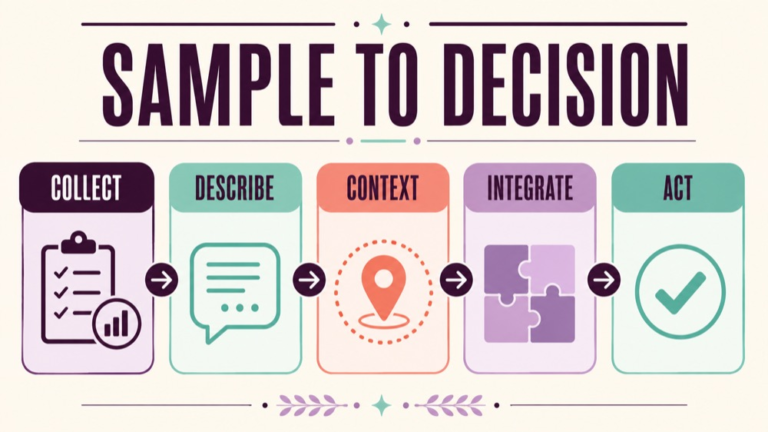
From a discourse sample to a functional interpretation
Context changes what communication and professional decisions require. A direct question, long explanation, group exchange, classroom task, health-care interaction, family story, noisy routine, supervised procedure, or referral decision places different demands on processing, language, memory, hearing, access, partner behavior, competence, and regulation. Language experience, visual information, fatigue, health literacy, and the opportunity to request clarification should be part of the observation.
An adult may produce more information during a familiar conversation than during a formal picture description, while a child may tell a stronger story with a retell prompt than with an open-ended request to generate a narrative. A procedural explanation can reveal sequencing and audience awareness that a personal story does not. These differences are not nuisance variation; they are part of the task. Discourse assessment becomes more useful when the SLP chooses a sample that matches the question, describes the elicitation, analyzes both global organization and local language, and avoids generalizing one discourse type to other communication settings.
Observation layer
Example question
Task
What did the person or clinician need to understand, express, organize, coordinate, decide, or provide?
Language and access
Which language, dialect, mode, hearing condition, tool, support, or communication partner was available?
Context and responsibility
Who was involved, what did they know, and which role, policy, ethical, or environmental factor mattered?
Participation and safety
What meaningful routine, role, outcome, or risk became easier or harder because of the pattern?
Context is not an afterthought added once a label has been selected. It is part of the question itself. If performance or decision quality changes with a quieter room, extra processing time, a familiar partner, a different language or mode, an interpreter, visual information, supervision, collaboration, a changed task, or a changed routine, that change is useful evidence about access and demand. It does not identify a cause by itself, but it tells you which conditions should be carried into the next observation.
Apply discourse-assessment reasoning
When a Praxis-style scenario or clinical discussion presents discourse assessment speech language pathology, use a disciplined sequence. The goal is to select the next clinical question or action that matches the evidence, the person’s priorities, the communication context, and the relevant professional boundary.
Define the task, language, mode, communication purpose, or service responsibility in plain language.
Identify the relevant domain: language, access, partner, participation, assessment, competence, collaboration, ethics, or regulation.
Separate observation from interpretation and write down what remains unknown.
Check history, exposure, dialect, culture, identity, interpreter access, environment, sensory load, memory, task familiarity, training, supervision, and local requirements as relevant.
Choose the assessment, collaboration, accommodation, goal, training, referral, or documentation step that answers the specific question.
State the boundary of the conclusion and keep the person’s safety, autonomy, access, and participation visible.
An adult may produce more information during a familiar conversation than during a formal picture description, while a child may tell a stronger story with a retell prompt than with an open-ended request to generate a narrative. A procedural explanation can reveal sequencing and audience awareness that a personal story does not. These differences are not nuisance variation; they are part of the task. Discourse assessment becomes more useful when the SLP chooses a sample that matches the question, describes the elicitation, analyzes both global organization and local language, and avoids generalizing one discourse type to other communication settings. In a learning answer, the decisive evidence is usually the relationship among the task, the observed pattern, the context, and the next needed information—not a single isolated behavior, score, label, or broad permission statement.
Common study mistakes
Treating discourse assessment as one fixed task instead of distinguishing conversation, narrative, procedure, exposition, and other types.
Comparing samples without documenting prompt, topic, pictures, retell or generation format, partner, language, timing, and support.
Counting grammar or vocabulary errors while ignoring coherence, main ideas, organization, audience, meaning, and participation.
Using a story grammar framework as if it represents different cultures, discourse traditions, languages, ages, and personal narratives in the same way.
Assuming a strong performance in one elicitation method automatically represents connected language across contexts.
Ignoring hearing, cognition, memory, fatigue, topic knowledge, language exposure, literacy, and communication access.
Treating one discourse sample as a diagnosis or as a direct measure of everyday communication without contextual evidence.
Failing to connect discourse findings to academic, vocational, social, health-care, self-advocacy, or family participation.
Most of these mistakes come from replacing a multidomain question with a fast label. Correct the habit by returning to the same sequence: describe, separate, contextualize, ask what is missing, and choose a proportionate next step. A short rationale can make the habit visible: identify the evidence, name the uncertainty, and explain why the selected next step fits the person, setting, and responsibility.
Build a quick review map
Use this compact map when reviewing a missed question, lecture note, or clinical vignette:
Step 1: Define the discourse question and select a discourse type that can provide relevant evidence.
Step 2: Document the prompt, topic, partner, language, mode, materials, timing, and support.
Step 3: Analyze global organization and coherence together with local vocabulary, grammar, cohesion, and fluency.
Step 4: Check how culture, language, experience, hearing, cognition, access, and task familiarity shaped the sample.
Step 5: Compare discourse patterns across tasks and with formal, informal, conversation, history, and functional evidence.
Step 6: State the proportionate next step for support, goal setting, referral, collaboration, or monitoring.
Then write one transfer sentence: “When I see this pattern, I will first check ___ because ___.” The sentence should identify a decision rule, not repeat a definition. Revisit it after a delay and test whether you can apply the rule to a different task, age group, partner, language, setting, or professional responsibility.
Sources and next steps
discourse assessment speech language pathology is best learned as a context-sensitive pattern across communication, access, identity, function, participation, competence, and professional judgment. Use the current authority pages to refine the concept, then return to practice scenarios that require you to explain what the evidence supports and what it leaves open.
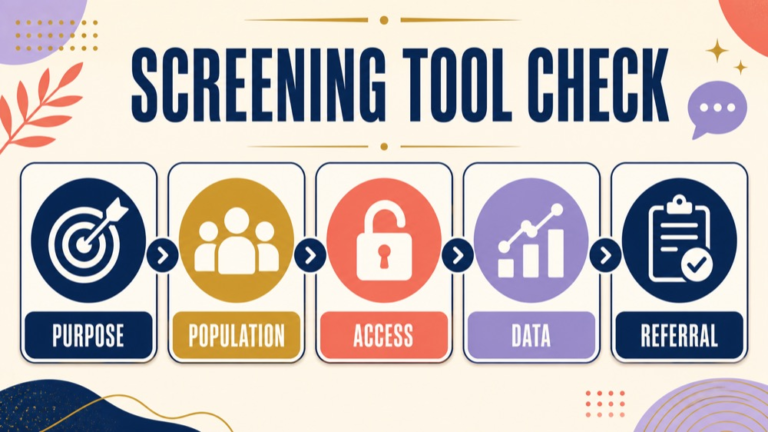
Screening Tools in Speech-Language Pathology: How to Choose Fairly
screening tools speech language pathology is easier to study when it is treated as a connected clinical reasoning problem rather than a label to memorize. Screening tools in speech-language pathology are useful only when the tool, the person, the clinical question, and the next decision fit together. A named checklist or brief measure is not automatically the best choice because it is familiar or easy to score. SLP learners should compare standardized and informal methods, examine language and cultural fit, consider hearing and access, and interpret a result within the limits of the tool and the setting.
This learning guide is written for SLP students and other learners reviewing clinical concepts. It organizes observation, access, assessment, function, and professional judgment; it does not make an individualized diagnosis or replace current professional guidance. Interpretation depends on the person, task, language, culture, health, access, partner, context, and communication goals.
What a screening tool is meant to answer
Begin by separating the concept into domains. A learner who can name the domains is less likely to collapse language, access, partner, participation, competence, regulation, and clinical judgment into one explanation. The useful unit of analysis is the task: what the person was asked to understand, express, organize, coordinate, remember, or communicate, with whom, under which conditions, and with what support.
Domain or system
What to notice
Question to carry forward
Clinical question
The tool should be selected after the concern, target domain, person, setting, and decision have been described.
What question must this tool help answer?
Purpose
A screen is designed to identify possible need for further information or evaluation, not to provide a complete diagnosis or treatment plan.
Is this instrument being used for its intended purpose?
Evidence quality
Reliability, validity, sensitivity, specificity, normative information, and administration requirements help describe what a tool can and cannot support.
What evidence applies to this person and this use?
Language and culture
Language, dialect, cultural experience, literacy, communication mode, and normative sample affect whether a response is fairly interpreted.
Does this procedure give the person an equitable opportunity to show the skill?
Complementary data
Interview, report, observation, language samples, records, hearing information, and informal probes can add context that a tool score cannot show.
What other evidence is needed to understand the result?
Decision
Results may lead to monitoring, rescreening, support, comprehensive assessment, audiology, medical review, or another referral.
What proportionate action follows from the evidence?
These domains interact, but they should remain distinguishable. A learner may show strength in one context and need support in another. A study map organizes the next observation; it does not answer every assessment question or establish a universal treatment, goal, or legal conclusion.
Keep the first pass descriptive and close to the communication event. Note the task, response, partner, setting, timing, available support, language or mode, and consequence for participation. This gives the learner a stable record to compare across tasks and prevents a familiar term from doing too much explanatory work before the evidence has been separated.
For Praxis-style review, a vignette may include several true details but ask for one best interpretation or next step. The strongest answer usually respects the task, identifies the relevant function or boundary, checks the most important missing information, and avoids treating one performance sample or policy phrase as the whole profile.
Map screening tool selection
For study purposes, describe the communication relationship before naming a disorder, judging a partner, selecting a goal, or deciding that a task is within scope. Record what the person understood, expressed, initiated, repaired, coordinated, or participated in. Then note whether the task was familiar, how much context was shared, and which support changed the response.
Purpose: name whether the tool screens speech sounds, spoken language, hearing-related concern, social communication, cognition, or another defined domain.
Person: check age, developmental or medical context, communication mode, hearing, sensory and motor access, attention, fatigue, and prior experience.
Evidence: review reliability, validity, sensitivity, specificity, norms, criteria, administration, scoring, and the limits of the available evidence.
Language and culture: consider language history, dialect, cultural experience, bilingual or multilingual development, and whether an interpreter or adaptation is needed.
Context: add caregiver or teacher report, direct observation, natural routines, records, samples, and informal information that represent the actual concern.
Interpretation: use the result to guide monitoring, rescreening, support, referral, or comprehensive assessment rather than letting a score become the diagnosis.
A strong description is specific enough that another learner could picture the event. Instead of writing “the communication is impaired” or “the clinician can do this,” describe the demand, observable response, language or mode, partner, context, competence or access condition, and result. This protects clinical reasoning from labels that are broader than the evidence.
From tool choice to a fair screening decision
Context changes what communication and professional decisions require. A direct question, long explanation, group exchange, classroom task, health-care interaction, family story, noisy routine, supervised procedure, or referral decision places different demands on processing, language, memory, hearing, access, partner behavior, competence, and regulation. Language experience, visual information, fatigue, health literacy, and the opportunity to request clarification should be part of the observation.
A school team may ask for a quick language screen, but the best tool depends on whether the concern is vocabulary, following directions, narrative, speech sounds, hearing, or participation in classroom routines. A preschool measure with an English normative sample may not be appropriate for a multilingual child without additional language and contextual evidence. An informal observation may be highly useful for describing function but may not support the same inference as a standardized screening measure. The correct choice is therefore a reasoning decision, not a contest to remember the most tool names.
Observation layer
Example question
Task
What did the person or clinician need to understand, express, organize, coordinate, decide, or provide?
Language and access
Which language, dialect, mode, hearing condition, tool, support, or communication partner was available?
Context and responsibility
Who was involved, what did they know, and which role, policy, ethical, or environmental factor mattered?
Participation and safety
What meaningful routine, role, outcome, or risk became easier or harder because of the pattern?
Context is not an afterthought added once a label has been selected. It is part of the question itself. If performance or decision quality changes with a quieter room, extra processing time, a familiar partner, a different language or mode, an interpreter, visual information, supervision, collaboration, a changed task, or a changed routine, that change is useful evidence about access and demand. It does not identify a cause by itself, but it tells you which conditions should be carried into the next observation.
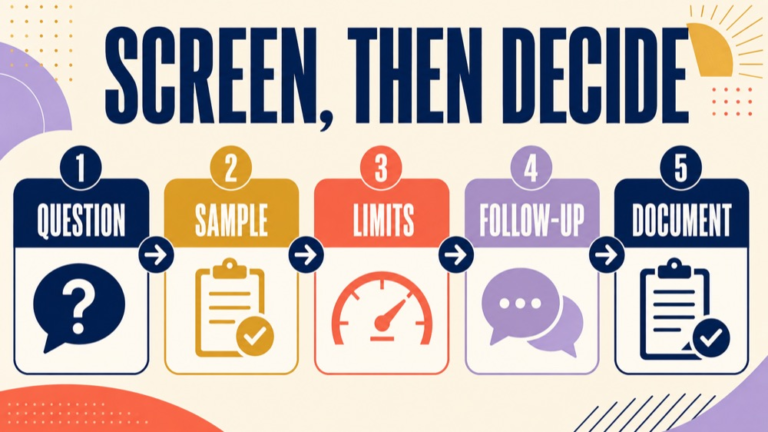
Apply screening-tool reasoning
When a Praxis-style scenario or clinical discussion presents screening tools speech language pathology, use a disciplined sequence. The goal is to select the next clinical question or action that matches the evidence, the person’s priorities, the communication context, and the relevant professional boundary.
Define the task, language, mode, communication purpose, or service responsibility in plain language.
Identify the relevant domain: language, access, partner, participation, assessment, competence, collaboration, ethics, or regulation.
Separate observation from interpretation and write down what remains unknown.
Check history, exposure, dialect, culture, identity, interpreter access, environment, sensory load, memory, task familiarity, training, supervision, and local requirements as relevant.
Choose the assessment, collaboration, accommodation, goal, training, referral, or documentation step that answers the specific question.
State the boundary of the conclusion and keep the person’s safety, autonomy, access, and participation visible.
A school team may ask for a quick language screen, but the best tool depends on whether the concern is vocabulary, following directions, narrative, speech sounds, hearing, or participation in classroom routines. A preschool measure with an English normative sample may not be appropriate for a multilingual child without additional language and contextual evidence. An informal observation may be highly useful for describing function but may not support the same inference as a standardized screening measure. The correct choice is therefore a reasoning decision, not a contest to remember the most tool names. In a learning answer, the decisive evidence is usually the relationship among the task, the observed pattern, the context, and the next needed information—not a single isolated behavior, score, label, or broad permission statement.
Common study mistakes
Selecting a screening tool because it is popular, short, or available without first defining the clinical question.
Treating reliability or validity evidence as proof that the tool is appropriate for every person, language, age, or setting.
Confusing a screening score with a diagnosis, severity estimate, prognosis, or complete description of communication.
Ignoring the normative sample, language, dialect, culture, hearing, access, literacy, or administration conditions.
Using a standardized tool as the only evidence when report, observation, records, or a language sample would change interpretation.
Calling an informal observation invalid simply because it is not standardized or treating it as equivalent to a norm-referenced score.
Failing to document adaptations, supports, conditions, scoring limits, and the reason for selecting the procedure.
Choosing a tool that produces a number but does not answer the next decision the person, family, or team actually needs to make.
Most of these mistakes come from replacing a multidomain question with a fast label. Correct the habit by returning to the same sequence: describe, separate, contextualize, ask what is missing, and choose a proportionate next step. A short rationale can make the habit visible: identify the evidence, name the uncertainty, and explain why the selected next step fits the person, setting, and responsibility.
Build a quick review map
Use this compact map when reviewing a missed question, lecture note, or clinical vignette:
Step 1: Define the target domain and decision before looking for a tool.
Step 2: Check the tool’s purpose, population, evidence, administration, scoring, and interpretation limits.
Step 3: Match language, dialect, culture, hearing, communication mode, access, and developmental context.
Step 4: Add report, observation, samples, records, and informal information when they represent the concern more fairly.
Step 5: Interpret the result as one part of a monitoring, referral, support, or assessment decision.
Step 6: Document why the tool fit, what adaptations were made, and what unanswered question remains.
Then write one transfer sentence: “When I see this pattern, I will first check ___ because ___.” The sentence should identify a decision rule, not repeat a definition. Revisit it after a delay and test whether you can apply the rule to a different task, age group, partner, language, setting, or professional responsibility.
Sources and next steps
screening tools speech language pathology is best learned as a context-sensitive pattern across communication, access, identity, function, participation, competence, and professional judgment. Use the current authority pages to refine the concept, then return to practice scenarios that require you to explain what the evidence supports and what it leaves open.
Functional Communication: Meaning, Context, and Participation
functional communication is easier to study when it is treated as a connected clinical reasoning problem rather than a label to memorize. Functional communication asks what a person can communicate, with whom, under which conditions, and for what meaningful purpose. It includes speech, signs, gestures, writing, AAC, facial expression, and multimodal communication when those modes help the person express needs, ideas, relationships, choices, and self-advocacy.
This learning guide is written for SLP students and other learners reviewing clinical concepts. It organizes observation, access, assessment, function, and professional judgment; it does not make an individualized diagnosis or replace current professional guidance. Interpretation depends on the person, task, language, culture, health, access, partner, context, and communication goals.
What functional communication means in practice
Begin by separating the concept into domains. A learner who can name the domains is less likely to collapse language, access, partner, participation, competence, regulation, and clinical judgment into one explanation. The useful unit of analysis is the task: what the person was asked to understand, express, organize, coordinate, remember, or communicate, with whom, under which conditions, and with what support.
Domain or system
What to notice
Question to carry forward
Message purpose
Requests, choices, comments, questions, stories, feelings, social connection, repair, and safety messages have different demands.
What does the person need to communicate here?
Communication modes
Speech, signs, gestures, writing, pictures, AAC, facial expression, and combined modes may all carry meaning.
Which mode is available, reliable, and preferred for this message?
Demand
Familiar routines, unfamiliar partners, noise, group conversation, time pressure, memory, and complex topics change the load.
What makes this situation low or high demand?
Partner
Listener knowledge, wait time, repair, visual support, interpretation, and partner expectations affect successful exchange.
What does the partner know and what support is needed?
Environment
Positioning, lighting, noise, access to tools, privacy, transportation, and social attitudes can enable or block communication.
Which environmental factor should change?
Outcome
Functional success is shown through meaningful messages, autonomy, relationships, learning, health care, work, and participation.
What real-life change will count as improvement?
These domains interact, but they should remain distinguishable. A learner may show strength in one context and need support in another. A study map organizes the next observation; it does not answer every assessment question or establish a universal treatment, goal, or legal conclusion.
Keep the first pass descriptive and close to the communication event. Note the task, response, partner, setting, timing, available support, language or mode, and consequence for participation. This gives the learner a stable record to compare across tasks and prevents a familiar term from doing too much explanatory work before the evidence has been separated.
For Praxis-style review, a vignette may include several true details but ask for one best interpretation or next step. The strongest answer usually respects the task, identifies the relevant function or boundary, checks the most important missing information, and avoids treating one performance sample or policy phrase as the whole profile.
Map functional communication
For study purposes, describe the communication relationship before naming a disorder, judging a partner, selecting a goal, or deciding that a task is within scope. Record what the person understood, expressed, initiated, repaired, coordinated, or participated in. Then note whether the task was familiar, how much context was shared, and which support changed the response.
Purpose: identify whether the person is requesting, commenting, questioning, narrating, repairing, connecting, choosing, or advocating.
Modes: count all meaningful communication modes and note whether the person can combine or shift modes across situations.
Demand: compare familiar and unfamiliar partners, routine and novel tasks, quiet and noisy settings, and simple and complex messages.
Partner: document listener knowledge, wait time, confirmation, modeling, repair, visual support, and assumptions.
Environment: identify changes in noise, lighting, positioning, privacy, time, materials, access, transportation, and social expectations.
Outcome: connect the observation to daily communication, autonomy, relationships, education, work, health, safety, and quality of life.
A strong description is specific enough that another learner could picture the event. Instead of writing “the communication is impaired” or “the clinician can do this,” describe the demand, observable response, language or mode, partner, context, competence or access condition, and result. This protects clinical reasoning from labels that are broader than the evidence.
From message access to participation
Context changes what communication and professional decisions require. A direct question, long explanation, group exchange, classroom task, health-care interaction, family story, noisy routine, supervised procedure, or referral decision places different demands on processing, language, memory, hearing, access, partner behavior, competence, and regulation. Language experience, visual information, fatigue, health literacy, and the opportunity to request clarification should be part of the observation.
A person may communicate a request independently in a familiar routine but need support to tell a story, participate in a group, communicate with an unfamiliar listener, or explain a health concern. That difference is not a contradiction; it shows how demand, partner, environment, message complexity, mode, and support interact. Functional communication reasoning keeps the meaningful activity visible instead of reducing success to a clinic score or one preferred mode.
Observation layer
Example question
Task
What did the person or clinician need to understand, express, organize, coordinate, decide, or provide?
Language and access
Which language, dialect, mode, hearing condition, tool, support, or communication partner was available?
Context and responsibility
Who was involved, what did they know, and which role, policy, ethical, or environmental factor mattered?
Participation and safety
What meaningful routine, role, outcome, or risk became easier or harder because of the pattern?
Context is not an afterthought added once a label has been selected. It is part of the question itself. If performance or decision quality changes with a quieter room, extra processing time, a familiar partner, a different language or mode, an interpreter, visual information, supervision, collaboration, a changed task, or a changed routine, that change is useful evidence about access and demand. It does not identify a cause by itself, but it tells you which conditions should be carried into the next observation.
Apply functional communication reasoning
When a Praxis-style scenario or clinical discussion presents functional communication, use a disciplined sequence. The goal is to select the next clinical question or action that matches the evidence, the person’s priorities, the communication context, and the relevant professional boundary.
Define the task, language, mode, communication purpose, or service responsibility in plain language.
Identify the relevant domain: language, access, partner, participation, assessment, competence, collaboration, ethics, or regulation.
Separate observation from interpretation and write down what remains unknown.
Check history, exposure, dialect, culture, identity, interpreter access, environment, sensory load, memory, task familiarity, training, supervision, and local requirements as relevant.
Choose the assessment, collaboration, accommodation, goal, training, referral, or documentation step that answers the specific question.
State the boundary of the conclusion and keep the person’s safety, autonomy, access, and participation visible.
A person may communicate a request independently in a familiar routine but need support to tell a story, participate in a group, communicate with an unfamiliar listener, or explain a health concern. That difference is not a contradiction; it shows how demand, partner, environment, message complexity, mode, and support interact. Functional communication reasoning keeps the meaningful activity visible instead of reducing success to a clinic score or one preferred mode. In a learning answer, the decisive evidence is usually the relationship among the task, the observed pattern, the context, and the next needed information—not a single isolated behavior, score, label, or broad permission statement.
Common study mistakes
Defining communication as speech only and excluding signs, gestures, writing, AAC, or multimodal messages.
Measuring requests only and ignoring comments, questions, stories, relationships, feelings, repair, and self-advocacy.
Calling a person functional because a partner can guess the message without confirmation.
Testing low-demand routines and generalizing performance to unfamiliar partners or high-demand settings.
Ignoring environmental barriers such as noise, positioning, time pressure, lighting, or inaccessible materials.
Choosing an impairment target without identifying the daily communication outcome it is meant to support.
Confusing independence with refusal of appropriate partner support or communication technology.
Recording percentages without describing message meaning, context, partner, support, and participation.
Most of these mistakes come from replacing a multidomain question with a fast label. Correct the habit by returning to the same sequence: describe, separate, contextualize, ask what is missing, and choose a proportionate next step. A short rationale can make the habit visible: identify the evidence, name the uncertainty, and explain why the selected next step fits the person, setting, and responsibility.
Build a quick review map
Use this compact map when reviewing a missed question, lecture note, or clinical vignette:
Step 1: Name the message purpose, mode, partner, setting, and meaningful activity.
Step 2: Compare low- and high-demand situations and document what changes performance.
Step 3: Include speech, signs, gestures, writing, AAC, and other meaningful modes.
Step 4: Identify partner and environmental supports that make access more reliable without taking over.
Step 6: Write the next step as a functional change in a real communication routine.
Then write one transfer sentence: “When I see this pattern, I will first check ___ because ___.” The sentence should identify a decision rule, not repeat a definition. Revisit it after a delay and test whether you can apply the rule to a different task, age group, partner, language, setting, or professional responsibility.
Sources and next steps
functional communication is best learned as a context-sensitive pattern across communication, access, identity, function, participation, competence, and professional judgment. Use the current authority pages to refine the concept, then return to practice scenarios that require you to explain what the evidence supports and what it leaves open.
Cognitive Communication Disorder: Attention, Memory, Executive Function, and Participation
cognitive communication disorder is easier to study when it is treated as a connected system rather than a single label. Cognitive communication disorder describes communication changes associated with disruptions in cognition. For SLP exam review, connect attention, perception, memory, organization, executive function, language, speech, reading, writing, social communication, and daily participation without collapsing them into one score.
This learning guide is written for SLP students and other learners reviewing clinical concepts. It uses broad patterns to organize observation, not to make an individualized diagnosis or promise one outcome. Interpretation depends on the person, task, language, culture, hearing, access, health, context, and communication goals.
What cognitive communication disorder includes
Begin by separating the concept into domains. A learner who can name the domains is less likely to collapse cognition, language, speech, auditory access, memory, attention, or participation questions into one explanation. The useful unit of analysis is the task: what the person was asked to understand, produce, remember, organize, coordinate, or communicate, with whom, under which conditions, and with what support.
Domain or system
What to notice
Question to carry forward
Attention and perception
Selecting, sustaining, shifting, and interpreting relevant information affects listening, speaking, reading, and interaction.
What information was available, selected, missed, or misinterpreted?
Memory and learning
Encoding, working memory, retrieval, recognition, and learning influence instructions, conversations, and routines.
Is the demand on noticing, holding, retrieving, recognizing, or using information?
Organization and sequencing
Ideas, materials, time, steps, narratives, and messages must be organized toward a goal.
Where does the sequence, structure, or completion break down?
Executive function
Initiation, inhibition, planning, shifting, monitoring, self-regulation, and problem solving shape communication.
Can the person start, adjust, monitor, and finish the task?
Language and speech
Cognitive-communication changes may coexist with aphasia, dysarthria, apraxia, hearing, or language-access differences.
What should be separated before attributing the pattern to cognition?
Functional communication
Effects may appear in learning, work, relationships, self-advocacy, safety, and activities of daily living.
Which meaningful routine should guide assessment and intervention?
These domains interact, but they should remain distinguishable. A learner may show strength in one task and need support in another. A study map organizes the next observation; it does not answer every assessment question or replace current professional guidance.
Keep the first pass descriptive and close to the communication event. Note the task, the response, the partner, the setting, the timing, the available support, and the consequence for participation. This gives the learner a stable record to compare across tasks and prevents a familiar term from doing too much explanatory work before the evidence has been separated.
For Praxis-style review, a vignette may include several true details but ask for one best interpretation or next step. The strongest answer usually respects the task, identifies the relevant function, checks the most important missing information, and avoids treating one performance sample as the whole profile.
Map cognitive communication disorder
For study purposes, describe the system-function relationship before naming a disorder or subtype. Record what the person understood, produced, initiated, repaired, coordinated, or participated in. Then note whether the task was familiar, how much context was shared, and which support changed the response.
Attention and perception: select, sustain, shift, and interpret information across communication tasks.
Memory and learning: encode, hold, retrieve, recognize, and apply information in meaningful routines.
Organization and sequencing: arrange ideas, materials, time, narratives, and steps toward a goal.
Language and speech: distinguish cognitive-communication changes from aphasia, dysarthria, apraxia, hearing, and language-access factors.
Functional communication: connect the assessment to learning, work, relationships, safety, independence, and self-advocacy.
A strong description is specific enough that another learner could picture the event. Instead of writing “the system is weak,” describe the demand, the observable response, the partner, the context, and the result. This protects clinical reasoning from labels that are broader than the evidence.
From cognitive process to participation
Context changes what communication requires. A naming task, a listening activity, a multi-step instruction, a narrative, a conversation, and a workplace exchange place different demands on processing, memory, attention, language, motor control, and partner support. Hearing access, fatigue, posture, visual supports, language experience, and the opportunity to request clarification should be part of the observation.
A person may communicate effectively in a familiar routine but lose track of a multi-step instruction, miss the gist of a conversation, or fail to repair a message in a busy environment. The same behavior can reflect different interactions among cognition, language, hearing, motor speech, fatigue, medication, emotion, and task demands. Study the observable communication event, the person’s goals, and the support that changes participation before naming a broad disorder.
Observation layer
Example question
Task
What did the person need to understand, produce, organize, coordinate, or repair?
Function
Which cognitive, language, speech, auditory, motor, or access relationship was observable?
Access
Were hearing, visual, motor, sensory, language, respiratory, or environmental supports available?
Participation
What meaningful routine became easier or harder because of the pattern?
Context is not an afterthought added once a label has been selected. It is part of the question itself. If performance changes with a quieter room, extra processing time, a familiar partner, a different communication mode, a changed speaking rate, or a changed task, that change is useful evidence about access and demand. It does not identify a cause by itself, but it tells you which conditions should be carried into the next observation.
Apply the concept in clinical reasoning
When a Praxis-style scenario or clinical discussion presents cognitive communication disorder, use a disciplined sequence. The goal is to select the next clinical question or action that matches the evidence, the person’s priorities, and the communication context.
Define the task in plain language.
Identify the domain or domains involved without assuming they are interchangeable.
Separate observation from interpretation and write down what remains unknown.
Check hearing, language experience, culture, communication mode, environment, partner support, alertness, respiration, memory, and task familiarity.
Choose the assessment, collaboration, or observation step that answers the specific question.
State the boundary of the conclusion and keep the person’s participation goal visible.
A person may communicate effectively in a familiar routine but lose track of a multi-step instruction, miss the gist of a conversation, or fail to repair a message in a busy environment. The same behavior can reflect different interactions among cognition, language, hearing, motor speech, fatigue, medication, emotion, and task demands. Study the observable communication event, the person’s goals, and the support that changes participation before naming a broad disorder. In a learning answer, the decisive evidence is usually the relationship among the task, the observed pattern, and the next needed information—not a single isolated behavior or label.
Common study mistakes
Treating cognitive communication disorder as one global ability or one test score.
Assuming a communication breakdown is cognitive without checking hearing, language, speech, access, and context.
Confusing attention, memory, organization, executive function, language formulation, and motor speech.
Using structured task performance to predict every classroom, workplace, social, or community situation.
Overlooking reading, writing, pragmatics, discourse, AAC, partner behavior, and self-advocacy.
Describing a deficit without connecting it to a meaningful activity or participation goal.
Choosing a restorative or compensatory strategy before the functional barrier is defined.
Most of these mistakes come from replacing a multidomain question with a fast label. Correct the habit by returning to the same sequence: describe, separate, contextualize, ask what is missing, and choose a proportionate next step. A short rationale can make the habit visible: identify the evidence, name the uncertainty, and explain why the selected next step fits both.
Build a quick review map
Use this compact map when reviewing a missed question, a lecture note, or a clinical vignette:
Step 1: Define the communication task, message, partner, setting, and participation goal.
Step 2: Separate attention, perception, memory, organization, executive function, language, speech, and access.
Step 3: Compare structured tasks with natural routines, discourse, learning, work, and social communication.
Step 4: Check hearing, vision, language background, motor speech, fatigue, mood, medication, and environment.
Step 5: Describe what support changes performance and what barrier remains.
Step 6: Choose the next assessment, collaboration, or strategy that matches the person’s real-world goal.
Then write one transfer sentence: “When I see this pattern, I will first check ___ because ___.” The sentence should identify a decision rule, not repeat a definition. Revisit it after a delay and test whether you can apply the rule to a different task, age group, or communication mode.
Sources and next steps
cognitive communication disorder is best learned as a context-sensitive pattern across structure, function, access, and participation. Use the current authority pages to refine the concept, then return to practice scenarios that require you to explain what the evidence supports and what it leaves open.
Start with asha tbi adults, asha rhd, ets 5331 study companion. These sources support the learning frame; they do not replace current topic-specific guidance or an individualized evaluation.
Attention and Communication: Selection, Shifting, and Listening
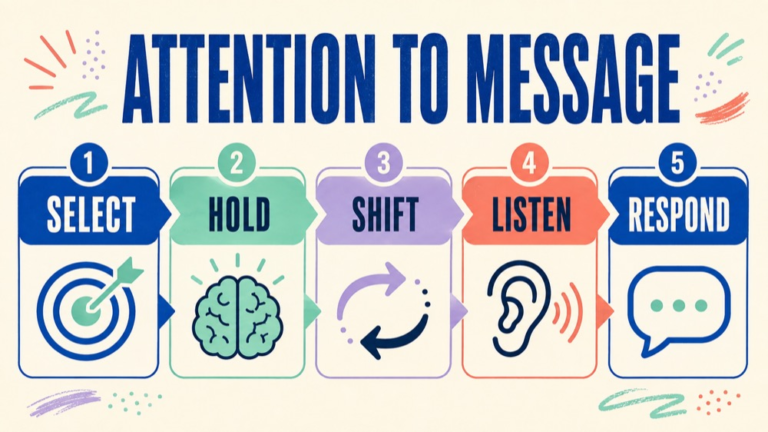
attention and communication is easier to study when it is treated as a connected system rather than a single label. Attention and communication are linked whenever a person must select a speaker, sustain a message, shift with a topic, divide resources, or return after a distraction. Study the demand and the support rather than treating attention as a yes-or-no trait.
This learning guide is written for SLP students and other learners reviewing clinical concepts. It uses broad patterns to organize observation, not to make an individualized diagnosis or promise one outcome. Interpretation depends on the person, task, language, culture, hearing, access, health, context, and communication goals.
What attention and communication includes
Begin by separating the concept into domains. A learner who can name the domains is less likely to collapse cognition, language, speech, auditory access, memory, attention, or participation questions into one explanation. The useful unit of analysis is the task: what the person was asked to understand, produce, remember, organize, coordinate, or communicate, with whom, under which conditions, and with what support.
Domain or system
What to notice
Question to carry forward
Selective attention
Relevant speech, visual information, or task cues are selected while competing information is managed.
What must be selected, and what competing signal or detail interferes?
Sustained attention
Focus is maintained long enough to follow, produce, or complete the communication task.
Does performance change with time, length, fatigue, or repetition?
Shifting attention
The person moves between speakers, topics, rules, locations, or task steps.
What happens when the task or conversational partner changes?
Divided demands
Listening, note-taking, planning, movement, and self-monitoring may compete for resources.
Which two demands must be managed at the same time?
Listening and language
Attention interacts with auditory access, decoding, vocabulary, syntax, inference, and memory.
Is the breakdown in selection, signal access, language, memory, or the interaction?
Participation and repair
Clarification, repetition, visual support, and environmental changes can keep communication active.
Which support helps the person return to the message and participate?
These domains interact, but they should remain distinguishable. A learner may show strength in one task and need support in another. A study map organizes the next observation; it does not answer every assessment question or replace current professional guidance.
Keep the first pass descriptive and close to the communication event. Note the task, the response, the partner, the setting, the timing, the available support, and the consequence for participation. This gives the learner a stable record to compare across tasks and prevents a familiar term from doing too much explanatory work before the evidence has been separated.
For Praxis-style review, a vignette may include several true details but ask for one best interpretation or next step. The strongest answer usually respects the task, identifies the relevant function, checks the most important missing information, and avoids treating one performance sample as the whole profile.
Map attention and communication
For study purposes, describe the system-function relationship before naming a disorder or subtype. Record what the person understood, produced, initiated, repaired, coordinated, or participated in. Then note whether the task was familiar, how much context was shared, and which support changed the response.
Selection: directing focus toward the relevant speaker, signal, visual cue, or task detail.
Sustained attention: maintaining focus across a message, activity, lesson, conversation, or work routine.
Shifting: moving attention when the speaker, topic, rule, location, or task step changes.
Divided attention: managing two or more communication, cognitive, motor, or environmental demands.
Listening-language interaction: connecting selected sound with phonology, words, sentences, meaning, and memory.
Repair and participation: using clarification, repetition, visuals, pacing, and environmental support.
A strong description is specific enough that another learner could picture the event. Instead of writing “the system is weak,” describe the demand, the observable response, the partner, the context, and the result. This protects clinical reasoning from labels that are broader than the evidence.
From focus to participation
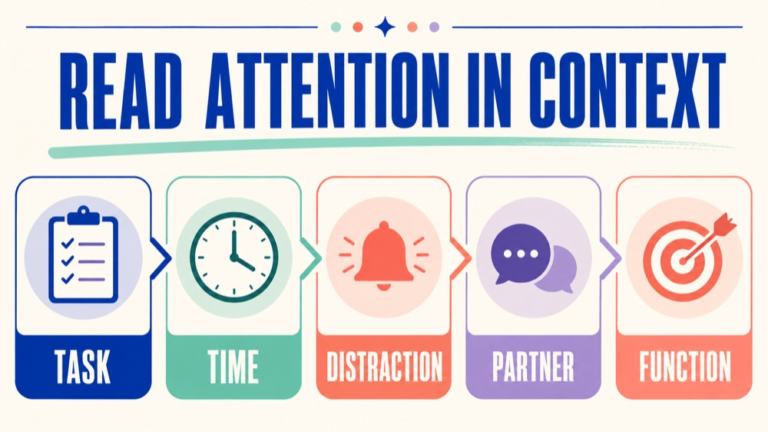
Context changes what communication requires. A naming task, a listening activity, a multi-step instruction, a narrative, a conversation, and a workplace exchange place different demands on processing, memory, attention, language, motor control, and partner support. Hearing access, fatigue, posture, visual supports, language experience, and the opportunity to request clarification should be part of the observation.
A listener may follow one speaker in quiet but lose the thread when speech is fast, competing talk is present, or a task requires note-taking. Another person may sustain a familiar routine but miss a shift in topic or instruction. These patterns are useful clues about demand and support, not isolated explanations. Change one relevant condition at a time and describe what improves, what remains difficult, and what the person needs to participate.
Observation layer
Example question
Task
What did the person need to understand, produce, organize, coordinate, or repair?
Function
Which cognitive, language, speech, auditory, motor, or access relationship was observable?
Access
Were hearing, visual, motor, sensory, language, respiratory, or environmental supports available?
Participation
What meaningful routine became easier or harder because of the pattern?
Context is not an afterthought added once a label has been selected. It is part of the question itself. If performance changes with a quieter room, extra processing time, a familiar partner, a different communication mode, a changed speaking rate, or a changed task, that change is useful evidence about access and demand. It does not identify a cause by itself, but it tells you which conditions should be carried into the next observation.
Apply the concept in clinical reasoning
When a Praxis-style scenario or clinical discussion presents attention and communication, use a disciplined sequence. The goal is to select the next clinical question or action that matches the evidence, the person’s priorities, and the communication context.
Define the task in plain language.
Identify the domain or domains involved without assuming they are interchangeable.
Separate observation from interpretation and write down what remains unknown.
Check hearing, language experience, culture, communication mode, environment, partner support, alertness, respiration, memory, and task familiarity.
Choose the assessment, collaboration, or observation step that answers the specific question.
State the boundary of the conclusion and keep the person’s participation goal visible.
A listener may follow one speaker in quiet but lose the thread when speech is fast, competing talk is present, or a task requires note-taking. Another person may sustain a familiar routine but miss a shift in topic or instruction. These patterns are useful clues about demand and support, not isolated explanations. Change one relevant condition at a time and describe what improves, what remains difficult, and what the person needs to participate. In a learning answer, the decisive evidence is usually the relationship among the task, the observed pattern, and the next needed information—not a single isolated behavior or label.
Common study mistakes
Treating attention as a single capacity instead of selection, sustained focus, shifting, and divided demands.
Assuming an attention problem without checking hearing, language, memory, sleep, fatigue, and room acoustics.
Confusing missed information with failure to understand information that was accessed.
Using quiet one-to-one performance to predict group, classroom, work, or community listening.
Overlooking multilingual learning, culture, communication mode, and familiarity.
Describing inattention without identifying the message, goal, and functional consequence.
Recommending a support before identifying which attention demand it changes.
Most of these mistakes come from replacing a multidomain question with a fast label. Correct the habit by returning to the same sequence: describe, separate, contextualize, ask what is missing, and choose a proportionate next step. A short rationale can make the habit visible: identify the evidence, name the uncertainty, and explain why the selected next step fits both.
Build a quick review map
Use this compact map when reviewing a missed question, a lecture note, or a clinical vignette:
Step 1: Describe the signal, speaker, listener, setting, task, and participation goal.
Step 2: Separate selection, sustained attention, shifting, divided demands, language, and memory.
Step 3: Compare quiet and noise, slow and fast speech, short and long messages, and one and multiple speakers.
Step 5: Record repair, clarification, pacing, and environmental supports that change performance.
Step 6: Choose the next observation or referral that matches the specific attention question.
Then write one transfer sentence: “When I see this pattern, I will first check ___ because ___.” The sentence should identify a decision rule, not repeat a definition. Revisit it after a delay and test whether you can apply the rule to a different task, age group, or communication mode.
Sources and next steps
attention and communication is best learned as a context-sensitive pattern across structure, function, access, and participation. Use the current authority pages to refine the concept, then return to practice scenarios that require you to explain what the evidence supports and what it leaves open.
Start with asha executive function, asha tbi adults, asha capd. These sources support the learning frame; they do not replace current topic-specific guidance or an individualized evaluation.
SLP Praxis Study Plan for Working Professionals: Build Around Real Constraints
slp praxis study plan for working professionals is most useful when it supports a specific preparation decision. An SLP Praxis study plan for working professionals should fit real work demands and protect attention. Use a few repeatable blocks, clear outputs, and evidence-based adjustments. This article is written for working SLP professionals and adult learners with limited or changing preparation time. It focuses on a constraint-aware plan for professionals who need preparation to coexist with work and life and keeps current source facts, clinical learning, practice evidence, and personal planning in separate lanes.
A schedule is a working hypothesis about how you will use time, attention, and feedback. It should be adjustable without losing the thread of what you were trying to learn. Start with the current ETS Speech-Language Pathology 5331 page for exam-context boundaries and the ASHA Praxis preparation page for preparation framing. The ASHA Practice Portal can add clinical depth, but a study resource should not be treated as the owner of a changing administrative detail.
Resource offerings, exam processes, and professional requirements can change. Record the source owner and checked date, protect private account or score information, and treat the examples here as educational planning guidance rather than an individual certification, licensure, employment, or clinical decision.
What this plan or resource is meant to solve
A preparation plan or study resource has several possible jobs: it can orient you to scope, deepen a concept, create retrieval, support case application, provide feedback, or make a routine more accessible. Trouble begins when every source is expected to do every job without a clear handoff. Decide what matters in the current phase before you decide whether to add, keep, or pause a resource.
For slp praxis study plan for working professionals, the useful unit is an observable output. That output may be a definition you can state, a contrast you can explain, a case decision you can defend, a short review block you can complete, or a delayed prompt you can solve after the original wording is gone. A page count, a long schedule, or a feeling of familiarity does not explain what to do next.
Layer
What it includes
Decision it supports
Anchor
Current ETS and ASHA context
Keeps scope and preparation notes tied to an owner.
Target
One domain or reasoning task
Defines what the block is meant to improve.
Block
Retrieval, application, or explanation
Creates a condition that produces evidence.
Repair
A targeted change after review
Makes the next session more useful than a reset.
Transfer
A later task with one changed variable
Checks whether the idea travels beyond first exposure.
Keep these layers visible in your notes. A source can be strong for one layer and limited for another. That is a reason to assign it a narrow role, use its output, and return to the responsible source when the question changes.
Start with the current 5331 context
Begin with the current ETS Speech-Language Pathology 5331 context. It gives you a provider-owned starting point for the test identity and preparation materials. Use ASHA preparation and clinical resources for their stated roles, then return to the responsible organization when a process, scope, or current requirement matters.
Save the page title, owner, URL, and date checked.
Separate exam context from a personal study recommendation.
Mark which notes are durable clinical learning and which may change.
Keep 5331 terminology consistent across the map or schedule.
Use a preparation resource as one input, not as a forecast of an individual result.
Link clinical topic notes to the professional source that explains them.
Write an unresolved issue as a question instead of filling the gap with a guess.
Recheck a link before changing a public or time-sensitive statement.
This source trail makes later editing safer. If a page changes, you can update the current-detail note without discarding the concept map, retrieval prompts, or personal error analysis. It also helps a tutor, mentor, or study partner tell a source question from a planning choice.
Name the gap before choosing a method
Use a small baseline or a recent study record to name the gap. Separate a missing concept from a reading issue, an evidence-weighting issue, a pacing issue, a format barrier, or a context variable that you overlooked. This classification keeps the next action proportional to the signal.
1. Name constraints: Include work hours, commute, care, sleep, access, and recovery before selecting blocks.
2. Choose anchors: Protect the most reliable weekly focus window for deeper application.
3. Use small returns: Keep retrieval and error review available in shorter windows.
4. Test conditions: Record how fatigue, timing, and environment shaped the signal.
5. Adjust: Move the plan toward the tasks that change the next decision.
Do not make the plan fragile by assigning every gap a new tool. Start with the smallest change that could clarify the issue. If the next session shows a different pattern, keep the record and change one part of the workflow. A deliberate pause can also be informative: it may show that a resource duplicates an existing job or that the study question was too broad.
Build the core workflow
Build the routine around an opening question, a production task, a feedback step, and a closing action. The amount of time can vary. The structure matters because it turns exposure into information about what you can retrieve, compare, apply, and explain.
Workflow point
Prompt
Output to keep
Open
What should this block improve?
One target and a stopping point.
Retrieve
What can I state with the source closed?
Definition, contrast, sequence, or evidence chain.
Apply
What changes in a new case?
Person, context, function, and next action.
Review
Why did the closest alternative feel plausible?
A categorized gap and targeted repair.
Close
When will I check this again?
A dated delayed or changed-context prompt.
For this article’s focus, use the workflow as a control panel. The goal is a routine that makes the next decision clearer without turning preparation into an uninspectable pile of material. If the output is weak, narrow the task before adding more reading. If it is fluent but does not survive a changed case, add application and transfer.
PLAN AROUND REAL WORK CONSTRAINTS
The first visual summarizes the article-specific move: plan around real work constraints. Use it as a planning card, not as a replacement for source checking or a full explanation. Start at the target, move through the evidence or study action, and finish with the output you will keep.
A visual is useful when it reduces a decision to visible relationships. If it tells you only to read more, add the missing verb: retrieve, compare, apply, explain, repair, or transfer. That final verb makes the image part of a workflow rather than a decorative reminder.
Name the target before opening the resource.
Choose one output that can be checked.
Keep the source owner beside a current-detail note.
Change one case or context variable after the first pass.
Record confidence separately from correctness.
Explain the closest alternative in your own words.
Schedule a delayed return to the same concept.
Use the result to choose the next study block.
FOCUS, RECOVER, TRANSFER
The second visual turns a study signal into a next action: focus, recover, transfer. Use it after a chapter, case, practice set, conversation, or schedule review. Preserve the difference between what the source said, what you produced, what condition shaped the result, and what you will test next.
Signal
Possible meaning
Next check
Can define, cannot distinguish
The neighboring concept needs work.
Write a two-column contrast and retrieve it later.
Recognizes wording, misses case
Application or context weighting needs work.
Change person, setting, partner, or function.
Correct but uncertain
Recall is available but not stable.
Use delayed retrieval without the original cue.
Misses under time
Pacing, reading, attention, or access may be involved.
Repeat a defined condition and log the reason.
Rationale remains unclear
The source or question may need verification.
Return to the owner and write the unresolved question.
Do not use a visual, practice total, or tutoring conversation as a claim about a reported score or credential outcome. Its purpose is narrower: collect evidence and make the next study action specific.
Turn practice into evidence
Track conditions, not just impressions. A result can look different when the task is timed, mixed, open-resource, repeated, verbal, written, completed late, or interrupted by fatigue. The condition does not erase the signal; it tells you what the signal represents.
Record the date and type of task or block.
Note whether the work was timed or untimed.
Mark confidence before checking the explanation.
Write the evidence detail that drove the choice.
Name the closest alternative and why it was tempting.
Classify the gap as knowledge, reading, reasoning, pacing, or access.
Write one repair rather than rewriting the whole system.
Schedule a follow-up under a changed condition.
A total may be one trend, but it cannot explain the trend by itself. Keep provider-reported results and administrative pathway information in a separate record. Your study log is for learning signals, and its value comes from details that make a signal actionable.
Use context and function to deepen review
Use a case to test whether content has become reasoning. Start with a familiar scenario and then change one variable: age, language, dialect, communication mode, hearing or vision access, partner, setting, task demand, or participation goal. Ask what evidence changes, what remains stable, and what action is proportionate to the information available.
Case layer
Question
Study output
Person
Who is communicating or participating?
Relevant history, priorities, strengths, and access.
Task
What does the person need or want to do?
Functional communication, swallowing, safety, or participation goal.
Environment
What partner, setting, or access condition matters?
Context variable that changes interpretation.
Evidence
What is observed, measured, or still missing?
Fact, limitation, and unresolved question.
Action
What is the next defensible step?
Assessment, explanation, intervention, collaboration, or referral frame.
When a resource provides a case, ask what it leaves out. When you write your own case, avoid private or identifying information. The goal is to practice relationships among evidence, person, context, function, and action without presenting a study example as an individual clinical plan.
Keep source ownership visible
Keep source ownership visible. The ETS 5331 page and preparation resources have one role; ASHA preparation and clinical pages have another; a commercial book or course describes its own organization and offerings; a state, agency, school, employer, or facility may own a separate requirement. A useful note names who should settle the question.
Use ETS for current test-context and provider-material questions.
Use ASHA preparation pages for their stated professional preparation context.
Use the ASHA Practice Portal to deepen relevant clinical topics.
Use a book, course, card deck, or tutor according to the job it performs.
Do not infer a current process from a chapter written for a prior context.
Do not turn a practice explanation into a provider-reported fact.
Ask a qualified professional when a clinical example exceeds educational study scope.
Recheck receiving-organization requirements before relying on a pathway detail.
This boundary work is part of good SLP reasoning. It keeps preparation accurate without asking one resource to speak for every organization. It also protects readers from treating a persuasive product description or familiar phrase as the final authority for a time-sensitive issue.
Make the routine usable
A plan is usable when it accounts for access and recovery. Consider text size, audio, visual structure, captions, screen-reader compatibility, noise, lighting, breaks, language support, technology, and the time of day. If a format creates an avoidable barrier, record that as part of the condition instead of treating it as a personal failure.
Clinical learning also benefits from keeping language, culture, communication mode, and participation visible. The ASHA Cultural Responsiveness resource can support reflection when a case includes relevant language or cultural context. A study tool should help you reason with the person’s context rather than flattening it into a label.
Choose the reading, audio, or visual format that supports the task.
Set breaks before attention drops.
Record when environment or technology changed the condition.
Separate language access from content knowledge in the error log.
Include communication partners and participation demands in cases.
Protect private account, score, workplace, and patient information.
Use a sustainable pace before interpreting a long session.
Document limitations before making a broad conclusion.
Adjust without starting over
Adjust one part of the system at a time when the evidence changes. The plan may need a new source, a smaller task, a changed case, a different time condition, a clearer explanation, or a more accessible format. Keeping the previous record lets you see whether the adjustment helped.
Current signal
First adjustment
Evidence to seek
Too much content
Reduce the block to one output
Can you retrieve or explain it with the page closed?
Uneven week
Protect one anchor block and one return
Did the concept receive a second look?
Unclear miss
Classify the gap before adding material
Was it knowledge, reading, reasoning, pacing, or access?
Low stamina
Shorten the session but keep the output
Did the condition change the signal?
No transfer
Change one context variable
Does the principle still guide the choice?
Resource and schedule decisions can be reversible. Test a small section, record the output, and pause a tool if it does not change a decision. A smaller system that you can inspect is often easier to update than a large system whose roles are unclear.
A practical checklist
Use this checklist before you call the current plan or resource choice ready:
The plan names the current ETS 5331 source and date checked.
Every block has one domain, one output, and one stopping point.
Reading is followed by retrieval, application, explanation, or transfer.
Practice notes include timing, format, confidence, and error category.
The next repair is small enough to test in the next block.
The schedule contains a delayed review instead of only first exposure.
Language, culture, access, fatigue, and environment are considered when relevant.
A change in the plan is linked to evidence rather than a single mood or result.
The checklist does not promise a particular result. It makes missing pieces visible and gives you a clean record to discuss with an instructor, supervisor, tutor, mentor, or study partner.
Questions for the next study block
Ask the following before the next block:
What exact question should this resource, schedule, or session answer?
Which source owns the fact, process, or professional boundary?
What will I produce with the page closed?
Which neighboring concept or close alternative needs comparison?
What person, language, access, setting, or function variable will I change?
How will I record confidence and error category?
What evidence would make me narrow, pause, or replace the current approach?
When will I perform the delayed transfer check?
What belongs in a private note rather than a shared study file?
What is the smallest next action I can complete and inspect?
These questions keep preparation grounded in decisions. They help distinguish a need for more content from a need for retrieval, case reasoning, source checking, support, pacing, or a more usable condition.
For clinical depth, consult the ASHA Practice Portal and the ASHA Cultural Responsiveness resource when relevant. Recheck current state, agency, school, employer, facility, and receiving-organization requirements before relying on a pathway detail.
Next, write the resource job or schedule target, practice condition, evidence signal, repair, and delayed check in separate lines. That small record turns slp praxis study plan for working professionals from a search phrase into a study system you can inspect and update.
SLP Praxis Study Schedule for Students: Fit Real Coursework
slp praxis study schedule for students is most useful when it supports a specific preparation decision. An SLP Praxis study schedule for students has to coexist with classes, clinical placements, assignments, and changing energy. Use small outputs and let evidence guide the deeper blocks. This article is written for students balancing classes, practica, study groups, and the rest of a demanding training week. It focuses on a student-compatible schedule that links coursework to deliberate Praxis review without duplicating every reading and keeps current source facts, clinical learning, practice evidence, and personal planning in separate lanes.
A schedule is a working hypothesis about how you will use time, attention, and feedback. It should be adjustable without losing the thread of what you were trying to learn. Start with the current ETS Speech-Language Pathology 5331 page for exam-context boundaries and the ASHA Praxis preparation page for preparation framing. The ASHA Practice Portal can add clinical depth, but a study resource should not be treated as the owner of a changing administrative detail.
Resource offerings, exam processes, and professional requirements can change. Record the source owner and checked date, protect private account or score information, and treat the examples here as educational planning guidance rather than an individual certification, licensure, employment, or clinical decision.
What this plan or resource is meant to solve
A preparation plan or study resource has several possible jobs: it can orient you to scope, deepen a concept, create retrieval, support case application, provide feedback, or make a routine more accessible. Trouble begins when every source is expected to do every job without a clear handoff. Decide what matters in the current phase before you decide whether to add, keep, or pause a resource.
For slp praxis study schedule for students, the useful unit is an observable output. That output may be a definition you can state, a contrast you can explain, a case decision you can defend, a short review block you can complete, or a delayed prompt you can solve after the original wording is gone. A page count, a long schedule, or a feeling of familiarity does not explain what to do next.
Layer
What it includes
Decision it supports
Anchor
Current ETS and ASHA context
Keeps scope and preparation notes tied to an owner.
Target
One domain or reasoning task
Defines what the block is meant to improve.
Block
Retrieval, application, or explanation
Creates a condition that produces evidence.
Repair
A targeted change after review
Makes the next session more useful than a reset.
Transfer
A later task with one changed variable
Checks whether the idea travels beyond first exposure.
Keep these layers visible in your notes. A source can be strong for one layer and limited for another. That is a reason to assign it a narrow role, use its output, and return to the responsible source when the question changes.
Start with the current 5331 context
Begin with the current ETS Speech-Language Pathology 5331 context. It gives you a provider-owned starting point for the test identity and preparation materials. Use ASHA preparation and clinical resources for their stated roles, then return to the responsible organization when a process, scope, or current requirement matters.
Save the page title, owner, URL, and date checked.
Separate exam context from a personal study recommendation.
Mark which notes are durable clinical learning and which may change.
Keep 5331 terminology consistent across the map or schedule.
Use a preparation resource as one input, not as a forecast of an individual result.
Link clinical topic notes to the professional source that explains them.
Write an unresolved issue as a question instead of filling the gap with a guess.
Recheck a link before changing a public or time-sensitive statement.
This source trail makes later editing safer. If a page changes, you can update the current-detail note without discarding the concept map, retrieval prompts, or personal error analysis. It also helps a tutor, mentor, or study partner tell a source question from a planning choice.
Name the gap before choosing a method
Use a small baseline or a recent study record to name the gap. Separate a missing concept from a reading issue, an evidence-weighting issue, a pacing issue, a format barrier, or a context variable that you overlooked. This classification keeps the next action proportional to the signal.
1. Map the term: Mark fixed academic, clinical, work, and recovery commitments first.
2. Link carefully: Use coursework as a cue for review without assuming the class covers every study need.
3. Retrieve: Use short closed-book prompts between deeper blocks.
4. Mix: Add changed cases and professional-practice questions across the week.
5. Protect: Keep one buffer block for repair, access, and schedule changes.
Do not make the plan fragile by assigning every gap a new tool. Start with the smallest change that could clarify the issue. If the next session shows a different pattern, keep the record and change one part of the workflow. A deliberate pause can also be informative: it may show that a resource duplicates an existing job or that the study question was too broad.
Build the core workflow
Build the routine around an opening question, a production task, a feedback step, and a closing action. The amount of time can vary. The structure matters because it turns exposure into information about what you can retrieve, compare, apply, and explain.
Workflow point
Prompt
Output to keep
Open
What should this block improve?
One target and a stopping point.
Retrieve
What can I state with the source closed?
Definition, contrast, sequence, or evidence chain.
Apply
What changes in a new case?
Person, context, function, and next action.
Review
Why did the closest alternative feel plausible?
A categorized gap and targeted repair.
Close
When will I check this again?
A dated delayed or changed-context prompt.
For this article’s focus, use the workflow as a control panel. The goal is a routine that makes the next decision clearer without turning preparation into an uninspectable pile of material. If the output is weak, narrow the task before adding more reading. If it is fluent but does not survive a changed case, add application and transfer.
FIT PRAXIS REVIEW AROUND SCHOOL
The first visual summarizes the article-specific move: fit praxis review around school. Use it as a planning card, not as a replacement for source checking or a full explanation. Start at the target, move through the evidence or study action, and finish with the output you will keep.
A visual is useful when it reduces a decision to visible relationships. If it tells you only to read more, add the missing verb: retrieve, compare, apply, explain, repair, or transfer. That final verb makes the image part of a workflow rather than a decorative reminder.
Name the target before opening the resource.
Choose one output that can be checked.
Keep the source owner beside a current-detail note.
Change one case or context variable after the first pass.
Record confidence separately from correctness.
Explain the closest alternative in your own words.
Schedule a delayed return to the same concept.
Use the result to choose the next study block.
COURSEWORK TO RETRIEVAL
The second visual turns a study signal into a next action: coursework to retrieval. Use it after a chapter, case, practice set, conversation, or schedule review. Preserve the difference between what the source said, what you produced, what condition shaped the result, and what you will test next.
Signal
Possible meaning
Next check
Can define, cannot distinguish
The neighboring concept needs work.
Write a two-column contrast and retrieve it later.
Recognizes wording, misses case
Application or context weighting needs work.
Change person, setting, partner, or function.
Correct but uncertain
Recall is available but not stable.
Use delayed retrieval without the original cue.
Misses under time
Pacing, reading, attention, or access may be involved.
Repeat a defined condition and log the reason.
Rationale remains unclear
The source or question may need verification.
Return to the owner and write the unresolved question.
Do not use a visual, practice total, or tutoring conversation as a claim about a reported score or credential outcome. Its purpose is narrower: collect evidence and make the next study action specific.
Turn practice into evidence
Track conditions, not just impressions. A result can look different when the task is timed, mixed, open-resource, repeated, verbal, written, completed late, or interrupted by fatigue. The condition does not erase the signal; it tells you what the signal represents.
Record the date and type of task or block.
Note whether the work was timed or untimed.
Mark confidence before checking the explanation.
Write the evidence detail that drove the choice.
Name the closest alternative and why it was tempting.
Classify the gap as knowledge, reading, reasoning, pacing, or access.
Write one repair rather than rewriting the whole system.
Schedule a follow-up under a changed condition.
A total may be one trend, but it cannot explain the trend by itself. Keep provider-reported results and administrative pathway information in a separate record. Your study log is for learning signals, and its value comes from details that make a signal actionable.
Use context and function to deepen review
Use a case to test whether content has become reasoning. Start with a familiar scenario and then change one variable: age, language, dialect, communication mode, hearing or vision access, partner, setting, task demand, or participation goal. Ask what evidence changes, what remains stable, and what action is proportionate to the information available.
Case layer
Question
Study output
Person
Who is communicating or participating?
Relevant history, priorities, strengths, and access.
Task
What does the person need or want to do?
Functional communication, swallowing, safety, or participation goal.
Environment
What partner, setting, or access condition matters?
Context variable that changes interpretation.
Evidence
What is observed, measured, or still missing?
Fact, limitation, and unresolved question.
Action
What is the next defensible step?
Assessment, explanation, intervention, collaboration, or referral frame.
When a resource provides a case, ask what it leaves out. When you write your own case, avoid private or identifying information. The goal is to practice relationships among evidence, person, context, function, and action without presenting a study example as an individual clinical plan.
Keep source ownership visible
Keep source ownership visible. The ETS 5331 page and preparation resources have one role; ASHA preparation and clinical pages have another; a commercial book or course describes its own organization and offerings; a state, agency, school, employer, or facility may own a separate requirement. A useful note names who should settle the question.
Use ETS for current test-context and provider-material questions.
Use ASHA preparation pages for their stated professional preparation context.
Use the ASHA Practice Portal to deepen relevant clinical topics.
Use a book, course, card deck, or tutor according to the job it performs.
Do not infer a current process from a chapter written for a prior context.
Do not turn a practice explanation into a provider-reported fact.
Ask a qualified professional when a clinical example exceeds educational study scope.
Recheck receiving-organization requirements before relying on a pathway detail.
This boundary work is part of good SLP reasoning. It keeps preparation accurate without asking one resource to speak for every organization. It also protects readers from treating a persuasive product description or familiar phrase as the final authority for a time-sensitive issue.
Make the routine usable
A plan is usable when it accounts for access and recovery. Consider text size, audio, visual structure, captions, screen-reader compatibility, noise, lighting, breaks, language support, technology, and the time of day. If a format creates an avoidable barrier, record that as part of the condition instead of treating it as a personal failure.
Clinical learning also benefits from keeping language, culture, communication mode, and participation visible. The ASHA Cultural Responsiveness resource can support reflection when a case includes relevant language or cultural context. A study tool should help you reason with the person’s context rather than flattening it into a label.
Choose the reading, audio, or visual format that supports the task.
Set breaks before attention drops.
Record when environment or technology changed the condition.
Separate language access from content knowledge in the error log.
Include communication partners and participation demands in cases.
Protect private account, score, workplace, and patient information.
Use a sustainable pace before interpreting a long session.
Document limitations before making a broad conclusion.
Adjust without starting over
Adjust one part of the system at a time when the evidence changes. The plan may need a new source, a smaller task, a changed case, a different time condition, a clearer explanation, or a more accessible format. Keeping the previous record lets you see whether the adjustment helped.
Current signal
First adjustment
Evidence to seek
Too much content
Reduce the block to one output
Can you retrieve or explain it with the page closed?
Uneven week
Protect one anchor block and one return
Did the concept receive a second look?
Unclear miss
Classify the gap before adding material
Was it knowledge, reading, reasoning, pacing, or access?
Low stamina
Shorten the session but keep the output
Did the condition change the signal?
No transfer
Change one context variable
Does the principle still guide the choice?
Resource and schedule decisions can be reversible. Test a small section, record the output, and pause a tool if it does not change a decision. A smaller system that you can inspect is often easier to update than a large system whose roles are unclear.
A practical checklist
Use this checklist before you call the current plan or resource choice ready:
The plan names the current ETS 5331 source and date checked.
Every block has one domain, one output, and one stopping point.
Reading is followed by retrieval, application, explanation, or transfer.
Practice notes include timing, format, confidence, and error category.
The next repair is small enough to test in the next block.
The schedule contains a delayed review instead of only first exposure.
Language, culture, access, fatigue, and environment are considered when relevant.
A change in the plan is linked to evidence rather than a single mood or result.
The checklist does not promise a particular result. It makes missing pieces visible and gives you a clean record to discuss with an instructor, supervisor, tutor, mentor, or study partner.
Questions for the next study block
Ask the following before the next block:
What exact question should this resource, schedule, or session answer?
Which source owns the fact, process, or professional boundary?
What will I produce with the page closed?
Which neighboring concept or close alternative needs comparison?
What person, language, access, setting, or function variable will I change?
How will I record confidence and error category?
What evidence would make me narrow, pause, or replace the current approach?
When will I perform the delayed transfer check?
What belongs in a private note rather than a shared study file?
What is the smallest next action I can complete and inspect?
These questions keep preparation grounded in decisions. They help distinguish a need for more content from a need for retrieval, case reasoning, source checking, support, pacing, or a more usable condition.
For clinical depth, consult the ASHA Practice Portal and the ASHA Cultural Responsiveness resource when relevant. Recheck current state, agency, school, employer, facility, and receiving-organization requirements before relying on a pathway detail.
Next, write the resource job or schedule target, practice condition, evidence signal, repair, and delayed check in separate lines. That small record turns slp praxis study schedule for students from a search phrase into a study system you can inspect and update.
SLP Praxis Preparation Timeline: Turn Milestones Into Actions
slp praxis preparation timeline is most useful when it supports a specific preparation decision. An SLP Praxis preparation timeline is more useful when each milestone has an action, an evidence signal, and a source to recheck instead of serving as a list of dates. This article is written for learners who need to coordinate preparation steps with a changing calendar. It focuses on a milestone-to-action timeline that separates administration from learning work and keeps current source facts, clinical learning, practice evidence, and personal planning in separate lanes.
A schedule is a working hypothesis about how you will use time, attention, and feedback. It should be adjustable without losing the thread of what you were trying to learn. Start with the current ETS Speech-Language Pathology 5331 page for exam-context boundaries and the ASHA Praxis preparation page for preparation framing. The ASHA Practice Portal can add clinical depth, but a study resource should not be treated as the owner of a changing administrative detail.
Resource offerings, exam processes, and professional requirements can change. Record the source owner and checked date, protect private account or score information, and treat the examples here as educational planning guidance rather than an individual certification, licensure, employment, or clinical decision.
What this plan or resource is meant to solve
A preparation plan or study resource has several possible jobs: it can orient you to scope, deepen a concept, create retrieval, support case application, provide feedback, or make a routine more accessible. Trouble begins when every source is expected to do every job without a clear handoff. Decide what matters in the current phase before you decide whether to add, keep, or pause a resource.
For slp praxis preparation timeline, the useful unit is an observable output. That output may be a definition you can state, a contrast you can explain, a case decision you can defend, a short review block you can complete, or a delayed prompt you can solve after the original wording is gone. A page count, a long schedule, or a feeling of familiarity does not explain what to do next.
Layer
What it includes
Decision it supports
Anchor
Current ETS and ASHA context
Keeps scope and preparation notes tied to an owner.
Target
One domain or reasoning task
Defines what the block is meant to improve.
Block
Retrieval, application, or explanation
Creates a condition that produces evidence.
Repair
A targeted change after review
Makes the next session more useful than a reset.
Transfer
A later task with one changed variable
Checks whether the idea travels beyond first exposure.
Keep these layers visible in your notes. A source can be strong for one layer and limited for another. That is a reason to assign it a narrow role, use its output, and return to the responsible source when the question changes.
Start with the current 5331 context
Begin with the current ETS Speech-Language Pathology 5331 context. It gives you a provider-owned starting point for the test identity and preparation materials. Use ASHA preparation and clinical resources for their stated roles, then return to the responsible organization when a process, scope, or current requirement matters.
Save the page title, owner, URL, and date checked.
Separate exam context from a personal study recommendation.
Mark which notes are durable clinical learning and which may change.
Keep 5331 terminology consistent across the map or schedule.
Use a preparation resource as one input, not as a forecast of an individual result.
Link clinical topic notes to the professional source that explains them.
Write an unresolved issue as a question instead of filling the gap with a guess.
Recheck a link before changing a public or time-sensitive statement.
This source trail makes later editing safer. If a page changes, you can update the current-detail note without discarding the concept map, retrieval prompts, or personal error analysis. It also helps a tutor, mentor, or study partner tell a source question from a planning choice.
Name the gap before choosing a method
Use a small baseline or a recent study record to name the gap. Separate a missing concept from a reading issue, an evidence-weighting issue, a pacing issue, a format barrier, or a context variable that you overlooked. This classification keeps the next action proportional to the signal.
1. Confirm context: Check current provider and receiving-organization details from responsible pages.
2. Map scope: Turn the 5331 context into domains, distinctions, and reasoning tasks.
3. Build practice: Add retrieval, cases, explanations, and error review to the calendar.
4. Recheck: Use milestones to inspect gaps rather than simply advance the date.
5. Consolidate: Protect transfer, access, recovery, and final source checks.
Do not make the plan fragile by assigning every gap a new tool. Start with the smallest change that could clarify the issue. If the next session shows a different pattern, keep the record and change one part of the workflow. A deliberate pause can also be informative: it may show that a resource duplicates an existing job or that the study question was too broad.
Build the core workflow
Build the routine around an opening question, a production task, a feedback step, and a closing action. The amount of time can vary. The structure matters because it turns exposure into information about what you can retrieve, compare, apply, and explain.
Workflow point
Prompt
Output to keep
Open
What should this block improve?
One target and a stopping point.
Retrieve
What can I state with the source closed?
Definition, contrast, sequence, or evidence chain.
Apply
What changes in a new case?
Person, context, function, and next action.
Review
Why did the closest alternative feel plausible?
A categorized gap and targeted repair.
Close
When will I check this again?
A dated delayed or changed-context prompt.
For this article’s focus, use the workflow as a control panel. The goal is a routine that makes the next decision clearer without turning preparation into an uninspectable pile of material. If the output is weak, narrow the task before adding more reading. If it is fluent but does not survive a changed case, add application and transfer.
TURN MILESTONES INTO ACTIONS
The first visual summarizes the article-specific move: turn milestones into actions. Use it as a planning card, not as a replacement for source checking or a full explanation. Start at the target, move through the evidence or study action, and finish with the output you will keep.
A visual is useful when it reduces a decision to visible relationships. If it tells you only to read more, add the missing verb: retrieve, compare, apply, explain, repair, or transfer. That final verb makes the image part of a workflow rather than a decorative reminder.
Name the target before opening the resource.
Choose one output that can be checked.
Keep the source owner beside a current-detail note.
Change one case or context variable after the first pass.
Record confidence separately from correctness.
Explain the closest alternative in your own words.
Schedule a delayed return to the same concept.
Use the result to choose the next study block.
TIMELINE, SIGNAL, NEXT
The second visual turns a study signal into a next action: timeline, signal, next. Use it after a chapter, case, practice set, conversation, or schedule review. Preserve the difference between what the source said, what you produced, what condition shaped the result, and what you will test next.
Signal
Possible meaning
Next check
Can define, cannot distinguish
The neighboring concept needs work.
Write a two-column contrast and retrieve it later.
Recognizes wording, misses case
Application or context weighting needs work.
Change person, setting, partner, or function.
Correct but uncertain
Recall is available but not stable.
Use delayed retrieval without the original cue.
Misses under time
Pacing, reading, attention, or access may be involved.
Repeat a defined condition and log the reason.
Rationale remains unclear
The source or question may need verification.
Return to the owner and write the unresolved question.
Do not use a visual, practice total, or tutoring conversation as a claim about a reported score or credential outcome. Its purpose is narrower: collect evidence and make the next study action specific.
Turn practice into evidence
Track conditions, not just impressions. A result can look different when the task is timed, mixed, open-resource, repeated, verbal, written, completed late, or interrupted by fatigue. The condition does not erase the signal; it tells you what the signal represents.
Record the date and type of task or block.
Note whether the work was timed or untimed.
Mark confidence before checking the explanation.
Write the evidence detail that drove the choice.
Name the closest alternative and why it was tempting.
Classify the gap as knowledge, reading, reasoning, pacing, or access.
Write one repair rather than rewriting the whole system.
Schedule a follow-up under a changed condition.
A total may be one trend, but it cannot explain the trend by itself. Keep provider-reported results and administrative pathway information in a separate record. Your study log is for learning signals, and its value comes from details that make a signal actionable.
Use context and function to deepen review
Use a case to test whether content has become reasoning. Start with a familiar scenario and then change one variable: age, language, dialect, communication mode, hearing or vision access, partner, setting, task demand, or participation goal. Ask what evidence changes, what remains stable, and what action is proportionate to the information available.
Case layer
Question
Study output
Person
Who is communicating or participating?
Relevant history, priorities, strengths, and access.
Task
What does the person need or want to do?
Functional communication, swallowing, safety, or participation goal.
Environment
What partner, setting, or access condition matters?
Context variable that changes interpretation.
Evidence
What is observed, measured, or still missing?
Fact, limitation, and unresolved question.
Action
What is the next defensible step?
Assessment, explanation, intervention, collaboration, or referral frame.
When a resource provides a case, ask what it leaves out. When you write your own case, avoid private or identifying information. The goal is to practice relationships among evidence, person, context, function, and action without presenting a study example as an individual clinical plan.
Keep source ownership visible
Keep source ownership visible. The ETS 5331 page and preparation resources have one role; ASHA preparation and clinical pages have another; a commercial book or course describes its own organization and offerings; a state, agency, school, employer, or facility may own a separate requirement. A useful note names who should settle the question.
Use ETS for current test-context and provider-material questions.
Use ASHA preparation pages for their stated professional preparation context.
Use the ASHA Practice Portal to deepen relevant clinical topics.
Use a book, course, card deck, or tutor according to the job it performs.
Do not infer a current process from a chapter written for a prior context.
Do not turn a practice explanation into a provider-reported fact.
Ask a qualified professional when a clinical example exceeds educational study scope.
Recheck receiving-organization requirements before relying on a pathway detail.
This boundary work is part of good SLP reasoning. It keeps preparation accurate without asking one resource to speak for every organization. It also protects readers from treating a persuasive product description or familiar phrase as the final authority for a time-sensitive issue.
Make the routine usable
A plan is usable when it accounts for access and recovery. Consider text size, audio, visual structure, captions, screen-reader compatibility, noise, lighting, breaks, language support, technology, and the time of day. If a format creates an avoidable barrier, record that as part of the condition instead of treating it as a personal failure.
Clinical learning also benefits from keeping language, culture, communication mode, and participation visible. The ASHA Cultural Responsiveness resource can support reflection when a case includes relevant language or cultural context. A study tool should help you reason with the person’s context rather than flattening it into a label.
Choose the reading, audio, or visual format that supports the task.
Set breaks before attention drops.
Record when environment or technology changed the condition.
Separate language access from content knowledge in the error log.
Include communication partners and participation demands in cases.
Protect private account, score, workplace, and patient information.
Use a sustainable pace before interpreting a long session.
Document limitations before making a broad conclusion.
Adjust without starting over
Adjust one part of the system at a time when the evidence changes. The plan may need a new source, a smaller task, a changed case, a different time condition, a clearer explanation, or a more accessible format. Keeping the previous record lets you see whether the adjustment helped.
Current signal
First adjustment
Evidence to seek
Too much content
Reduce the block to one output
Can you retrieve or explain it with the page closed?
Uneven week
Protect one anchor block and one return
Did the concept receive a second look?
Unclear miss
Classify the gap before adding material
Was it knowledge, reading, reasoning, pacing, or access?
Low stamina
Shorten the session but keep the output
Did the condition change the signal?
No transfer
Change one context variable
Does the principle still guide the choice?
Resource and schedule decisions can be reversible. Test a small section, record the output, and pause a tool if it does not change a decision. A smaller system that you can inspect is often easier to update than a large system whose roles are unclear.
A practical checklist
Use this checklist before you call the current plan or resource choice ready:
The plan names the current ETS 5331 source and date checked.
Every block has one domain, one output, and one stopping point.
Reading is followed by retrieval, application, explanation, or transfer.
Practice notes include timing, format, confidence, and error category.
The next repair is small enough to test in the next block.
The schedule contains a delayed review instead of only first exposure.
Language, culture, access, fatigue, and environment are considered when relevant.
A change in the plan is linked to evidence rather than a single mood or result.
The checklist does not promise a particular result. It makes missing pieces visible and gives you a clean record to discuss with an instructor, supervisor, tutor, mentor, or study partner.
Questions for the next study block
Ask the following before the next block:
What exact question should this resource, schedule, or session answer?
Which source owns the fact, process, or professional boundary?
What will I produce with the page closed?
Which neighboring concept or close alternative needs comparison?
What person, language, access, setting, or function variable will I change?
How will I record confidence and error category?
What evidence would make me narrow, pause, or replace the current approach?
When will I perform the delayed transfer check?
What belongs in a private note rather than a shared study file?
What is the smallest next action I can complete and inspect?
These questions keep preparation grounded in decisions. They help distinguish a need for more content from a need for retrieval, case reasoning, source checking, support, pacing, or a more usable condition.
For clinical depth, consult the ASHA Practice Portal and the ASHA Cultural Responsiveness resource when relevant. Recheck current state, agency, school, employer, facility, and receiving-organization requirements before relying on a pathway detail.
Next, write the resource job or schedule target, practice condition, evidence signal, repair, and delayed check in separate lines. That small record turns slp praxis preparation timeline from a search phrase into a study system you can inspect and update.