assessment praxis practice questions become more manageable when you identify the referral question, choose evidence that can answer it, and interpret the result in the person’s communication context. A strong assessment answer is not simply the longest test battery or the most familiar score. It connects purpose, measure, language, access, observation, clinical reasoning, and a usable next step.
The current ASHA Speech-Language Pathology 5331 content page provides the professional study frame for screening, assessment, evaluation, diagnosis, culturally and linguistically appropriate service delivery, and evidence-based practice. Use the relevant ASHA Practice Portal topic and the live ETS practice-test page for current context. The maps, rationales, and A-D items on this page are original educational material and do not reproduce live test content.
What assessment Praxis practice questions are testing
Assessment items ask you to select evidence that answers a stated purpose. The stem may involve a screening decision, a diagnostic question, a treatment baseline, a progress check, a school participation concern, a swallowing safety concern, or a communication-access problem. First identify the decision; then judge whether the method, sample, score, or observation is fit for that decision.
| Assessment task | Clue to locate | Reasoning output |
|---|---|---|
| Referral question | Who is asking, what decision is needed, and what activity is affected? | Focused purpose |
| Measure selection | Construct, population, language, setting, response mode, and burden | Purposeful method |
| Validity | Whether the evidence supports the intended interpretation in this context | Calibrated meaning |
| Reliability | Consistency across raters, occasions, items, or scoring conditions | Confidence in measurement |
| Integration | Test data, observation, history, report, interview, and contextual information | Converging profile |
| Function | Participation, communication partners, routines, safety, and environmental support | Actionable conclusion |
Rewrite a broad referral into a question that can be answered. “Does this student have a language problem?” might become “How does the student understand and express curriculum language in the instructional context, and what support is needed?” “Is swallowing safe?” might become “Which observed conditions, signs, and instrumental questions require the next level of evaluation?” The revised version prevents an unfocused battery.
Pay attention to what the stem withholds. A missing language history, unclear hearing status, unfamiliar response mode, poor task access, or absent functional context can limit interpretation. The best answer often adds a targeted history, observation, collaboration, or adaptation before treating a single score as the conclusion.
Turn the referral into an assessment question
A referral is a starting point, not a diagnosis. Identify the person’s age or role, the communication activity that prompted concern, the setting, the informant, the time course, and the decision the team needs to make. Then decide whether the next step is screening, evaluation, monitoring, consultation, referral, or an immediate safety response.
| Referral detail | Question to ask | Why it matters |
|---|---|---|
| Concern | What changed or what activity is difficult? | Defines the problem in functional terms |
| Context | Where, with whom, and under what demands does it occur? | Shows whether performance varies by situation |
| Time course | Is it new, longstanding, variable, or associated with another change? | Guides urgency and comparison |
| Informant | Who observed the concern and what do they need to know? | Separates reports and decision roles |
| Decision | What action will the result support? | Prevents collecting data without a use |
Do not make the referral sound more specific than the evidence allows. A teacher’s concern about “attention” may involve comprehension, language processing, hearing access, task design, fatigue, or classroom communication. A family’s report of “not talking” may require information about gestures, signs, AAC, languages, partners, and routines. Good assessment reasoning expands the question just enough to find the relevant evidence.
Match the measure to the decision
Choose a method based on the construct and decision, not on whether the tool is familiar or easy to administer. Ask what the measure samples, how the response is produced, what population and language it represents, and whether the score or observation can guide the action under consideration.
| Decision | Useful evidence direction | Question to protect fit |
|---|---|---|
| Screening | Brief, sensitive information that identifies who needs a fuller evaluation | Is this tool designed for a first-pass decision? |
| Diagnosis | Multiple sources that describe the relevant communication profile and alternatives | Does the evidence support the interpretation in this person? |
| Baseline | Observable performance under conditions tied to the planned goal or activity | Can the baseline be revisited meaningfully? |
| Progress | Repeated or comparable measures plus functional change and support conditions | Did the method and context remain interpretable? |
| Referral | Findings that identify a concern requiring another professional or setting | What question is outside the current role? |
A measure can be technically strong and still be a poor choice for a particular decision. A decontextualized naming task may not answer a question about classroom discourse. A single speech sample may not answer a question about swallowing physiology. A parent report may be essential for routines but should be integrated with other evidence when the decision requires direct observation.
Check validity, reliability, and precision
Validity concerns the interpretation and use of evidence; reliability concerns consistency; precision concerns the expected amount of measurement uncertainty. These concepts interact. A score can be consistent without representing the intended construct, and a valid measure can still contain enough uncertainty that a small difference should not drive a major decision.
| Measurement lens | Question | Interpretive caution |
|---|---|---|
| Construct validity | Does the task represent the skill or behavior named in the referral? | Do not rename a task as a broader ability |
| Content validity | Does the sample cover the relevant forms, contexts, or items? | A narrow sample may miss important variation |
| Criterion relation | How does the result relate to the decision or external outcome? | Association does not settle individual meaning |
| Reliability | Would similar conditions yield reasonably similar observations? | Check rater, occasion, item, and context effects |
| Precision | How much uncertainty surrounds the observed result? | Interpret small changes cautiously |
Look for clues about administration, scoring, rater agreement, sample size, environmental noise, fatigue, and response access. If the stem highlights a meaningful limitation, the answer should acknowledge it and add evidence that addresses the limitation. Simply repeating the same measure under the same problem does not necessarily increase interpretive strength.
Interpret standardized scores in context
Standardized scores compare performance with a reference group under defined procedures. They can organize information, but the score does not replace the referral question, functional observation, language history, or professional judgment. Identify the score type, reference frame, confidence or error information when supplied, and the decision the score is being used to support.
Before interpreting a low or high result, ask whether the person had access to the instructions, response mode, hearing, vision, language, dialect, motor response, attention, and familiarity required by the task. Then determine whether the norm group and construct fit the person and the decision. A score can be reportable without being sufficient for a broad conclusion.
- Name what the score measures and what it does not measure.
- Check the reference group and administration conditions.
- Consider standard error, confidence information, and meaningful change.
- Compare the result with observation, history, report, and functional performance.
- Describe limitations before making a recommendation.
Use language- and dialect-responsive reasoning
Language and dialect are part of assessment validity. Determine which languages and varieties the person uses, how much exposure they have had, which contexts are meaningful, and how the method handles multilingual or dialectal performance. A difference from the test’s reference variety is not automatically a disorder, and a language-access problem is not the same as a missing skill.
| Language factor | Assessment question | Responsible action |
|---|---|---|
| Exposure | Where, when, and with whom has the person used each language or variety? | Collect a detailed language history |
| Task language | Does the language of directions and items match the decision? | Adapt or choose appropriate methods |
| Dialect | Could a community form be scored as an error? | Use language-specific interpretation |
| Interpreter | Is qualified language support available and prepared for the task? | Plan roles and document limits |
| Cross-language pattern | Does the observation occur across relevant languages or modes? | Seek appropriate comparison evidence |
Review the current ASHA Cultural Responsiveness resource and relevant multilingual guidance when a stem raises language, culture, or bias. The answer should preserve access to assessment while explaining what can and cannot be concluded from the available sample.
Include communication access and participation
Assessment must be accessible enough for the person to show what they know and can do. Consider AAC, sign, gesture, visual supports, hearing technology, interpreter support, alternative response formats, extra processing time, positioning, fatigue, and environmental noise. An accommodation or support may change the method while making the assessment more valid for the intended question.
| Access area | Possible barrier | Assessment response |
|---|---|---|
| Input | Directions are not audible, visible, signed, or understandable | Provide an appropriate accessible format |
| Output | Speech is the only accepted response even though another mode is available | Allow the relevant communication mode |
| Environment | Noise, lighting, seating, or partner behavior changes participation | Modify and record conditions |
| Processing | Speed or time pressure masks the target skill | Consider timing and task demand |
| Function | Scores do not show the activity that prompted referral | Add contextual observation |
Participation data show why a finding matters. Ask who the communication partner is, what the task requires, what support is already available, and what barrier prevents successful communication. The assessment conclusion should not confuse an inaccessible test condition with a global inability to communicate.
Combine formal and informal evidence
Formal tests, criterion-referenced probes, language samples, conversation, caregiver report, teacher report, records, observation, and dynamic tasks answer different questions. Use them as complementary sources. The aim is not to collect every possible measure; it is to compare evidence that converges on the decision and to investigate meaningful disagreement.
| Source | Strength | Question it may answer |
|---|---|---|
| Standardized measure | Structured comparison and consistent scoring | How does performance compare under defined conditions? |
| Criterion probe | Direct sampling of a specified behavior or skill | Can the person perform the target under selected conditions? |
| Language sample | Connected communication and discourse context | How is language used across messages and partners? |
| Observation | Real activity, supports, barriers, and participation | What happens in the routine that prompted referral? |
| Report or interview | History, change over time, priorities, and daily impact | What does the person and support network notice? |
When sources disagree, do not average them into a vague middle. Ask whether the construct, setting, partner, support, language, time, or response format changed. The disagreement may reveal variability that matters clinically, or it may show that one source is poorly aligned with the referral question.
Use observation and caregiver report
Observation and caregiver report are evidence, not merely background decoration. Observe the activity, partner, cueing, environment, and outcome that matter to the referral. Treat reports as a perspective that can guide questions and reveal change over time; compare them with direct data when the decision requires a performance estimate.
Ask the observer for concrete examples rather than only a global label. “He does not understand” becomes “Which directions, topics, partners, or routines create difficulty, and what support helps?” “She cannot communicate at home” becomes “Which modes, partners, situations, and successful messages are present?” Specific examples improve the next assessment step.
Separate screening from diagnosis
A screening process identifies whether more information may be needed. A diagnostic evaluation integrates evidence to address a broader clinical or educational question. Screening results can support referral, monitoring, or immediate communication with the team, but they should not be presented as a complete profile when the method was designed only for a brief first pass.
| Feature | Screening | Diagnostic evaluation |
|---|---|---|
| Purpose | Identify possible concern or need for fuller review | Describe and interpret a specific communication profile |
| Depth | Brief and focused | Multiple sources and targeted follow-up |
| Output | Pass, refer, monitor, or gather more information | Calibrated findings and recommendations |
| Uncertainty | False positives and false negatives matter | Validity, reliability, and context shape interpretation |
| Next step | Referral, evaluation, support, or repeat screen | Plan, consultation, monitoring, or service decision |
Read the verb in the question carefully. “What should happen after a failed screen?” is different from “Which finding supports a diagnosis?” and different again from “Which next measure answers the unanswered question?” The method and the recommended action should match the task.
Reason through dynamic assessment
Dynamic assessment adds a teach or mediate phase to examine learning potential, responsiveness, strategy use, and the effect of support. It is especially useful when a static task does not separate limited opportunity, language experience, or unfamiliarity from a persistent difficulty. Record the mediation rather than reporting only the retest result.
| Phase | What to examine | Useful record |
|---|---|---|
| Test | Independent performance under the initial conditions | Baseline behavior and support |
| Teach | Type, amount, and sequence of mediation needed | Responsiveness and strategy |
| Retest | Change under comparable or intentionally varied conditions | Transfer and remaining need |
| Interpret | What the response suggests about learning and access | Calibrated conclusion |
| Plan | Which support, observation, or referral should follow | Actionable next step |
A large change after one cue does not automatically settle every question, and a small change does not establish that learning is impossible. Examine the type of support, the target, the response mode, the opportunity to practice, and whether the change transfers to a meaningful activity.
Consider hearing, motor, and contextual factors
Assessment performance reflects more than the target communication construct. Hearing status, vision, motor access, fatigue, medication effects, pain, attention, positioning, technology, partner behavior, and task familiarity may influence what is observed. Identify which factor is a possible confound and choose the next evidence that can clarify it.
| Factor | How it may affect the sample | Next reasoning move |
|---|---|---|
| Hearing access | Audibility, speech perception, or listening effort changes responses | Verify hearing information and communication conditions |
| Motor access | Speech, writing, pointing, or device use limits output | Separate knowledge from response method |
| Fatigue or pain | Performance changes across time or task length | Record timing and compare conditions |
| Environment | Noise, partner support, or routine changes participation | Observe the relevant setting |
| Technology | Device, microphone, software, or access method interrupts communication | Check system and provide an alternate route |
The best assessment answer is often the one that acknowledges the confound and protects the next decision. Do not discard the observation; explain its conditions and obtain the evidence needed to interpret it responsibly.
Connect findings to function
A useful assessment explains what the finding means for communication, learning, work, relationships, safety, or participation. Start with the person’s activity and partner, then describe the skill or barrier that affects it. A score or label without a functional connection does not tell the team what should happen next.
| Functional field | Question to answer | Example output |
|---|---|---|
| Activity | What communication task is important? | Following a classroom explanation |
| Partner | Who is communicating and what support is available? | Teacher, peer, visual schedule |
| Barrier | Which observed skill or condition limits participation? | Difficulty retaining multi-step directions |
| Strength | What does the person use successfully? | Gesture, key words, and repetition |
| Action | What support, referral, or follow-up fits the evidence? | Accessible directions and targeted review |
Function is not a reason to ignore measurement quality. It is the context that tells you why the measure was selected and how the result should be used. Strong answers connect the construct, the observed conditions, and the person’s real communication goal.
Write a calibrated assessment conclusion
A calibrated conclusion states the evidence, interpretation, limitation, and next step. Use language such as “the available sample suggests,” “performance was observed under,” or “additional information is needed to determine.” Avoid turning one task into a global statement about the person or using a diagnostic label when the question asks for a screening or descriptive result.
- State the referral question and the activities that matter.
- Summarize the most relevant converging observations.
- Explain the conditions, supports, and limitations of the evidence.
- Separate an observed skill from an interpretation about cause.
- Recommend the next assessment, support, referral, or monitoring step.
- Tell the person and team how the finding relates to participation.
When the evidence is mixed, make the uncertainty useful. Say which fact would reduce it: a language sample, hearing check, interpreter-supported observation, repeated measure, caregiver interview, dynamic task, or interprofessional referral. An unresolved question is not a failed conclusion when the next step is specific and responsible.
Map an assessment question to decisive evidence
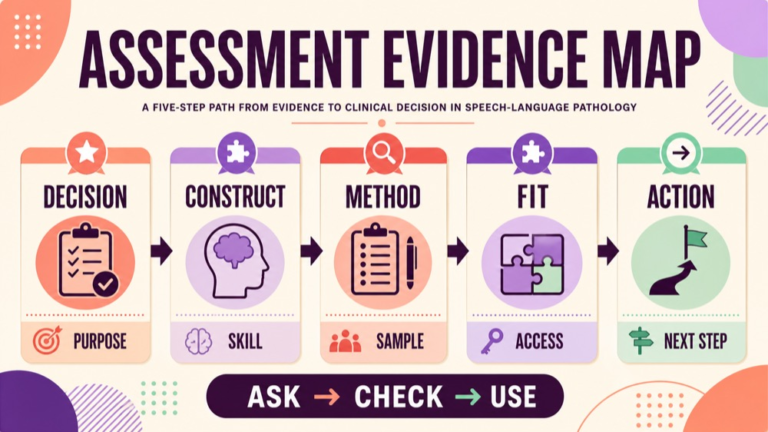
Use a five-step map to keep an assessment answer proportional. Name the decision, identify the construct, choose the method, check access and validity, and translate the result into a functional next step. This prevents a familiar test or attractive score from taking over the entire reasoning process.
| Map step | Margin question | Common error |
|---|---|---|
| Decision | What will the result be used to decide? | Collecting data without a purpose |
| Construct | What skill, behavior, or context must be described? | Calling a narrow task a global ability |
| Method | Which measure or observation samples that construct? | Using the most familiar tool automatically |
| Fit | Are language, dialect, access, reliability, and validity adequate? | Ignoring conditions and reference limits |
| Action | What support, referral, or follow-up follows? | Ending with a score and no plan |
Practice the map with contrast cases. Keep the referral question but change the response mode. Keep the measure but change the language history. Keep the score but change the functional concern. If the changed fact affects validity or action, your answer should reflect that fact rather than repeat the original conclusion.
Use an assessment review board
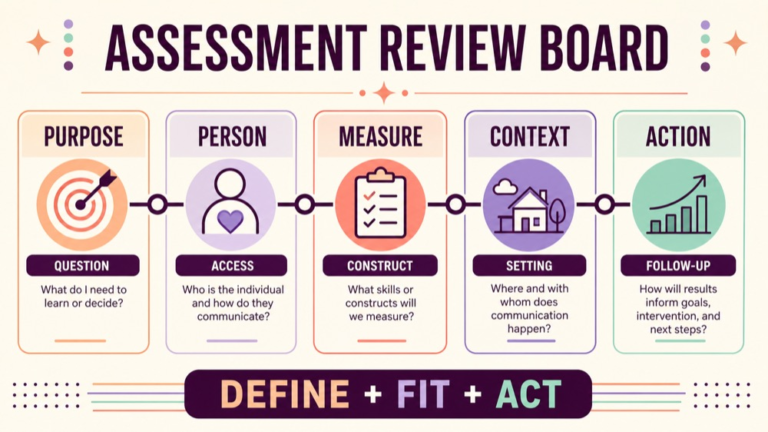
A review board helps you compare evidence before choosing an answer. Fill cards for purpose, person, measure, context, and action. On each card, write one fact and one question. If a choice skips a card, it may be incomplete even if it mentions a technically correct assessment term.
| Board card | Write down | Ask yourself |
|---|---|---|
| Purpose | Referral question and decision needed | What must the assessment answer? |
| Person | Language, communication mode, history, strengths, and priorities | Whose performance and perspective are represented? |
| Measure | Construct, task, score, observation, or report | Does the method fit the question? |
| Context | Setting, partner, support, access, time, and limitation | What conditions shaped the result? |
| Action | Recommendation, referral, support, or follow-up | How will the team use the evidence? |
This board is a study device, not a replacement for a complete assessment or current professional guidance. Under time pressure, run the cards mentally and choose the option that answers the referral question with the least unsupported leap.
Question 1: referral question and measure selection
Practice Question 1. A teacher refers a student because the student “does not understand directions.” The student follows one-step directions in a quiet room but misses longer classroom directions during group work. What is the best next assessment action?
A. Administer the longest available standardized language battery without collecting more information.
B. Conclude that the student has a global language disorder based on the classroom report.
C. Clarify the direction types and classroom demands, observe the relevant routine, compare language and access conditions, and select targeted measures that answer the refined question.
D. Tell the teacher to repeat every direction and close the referral without assessment.
Correct Answer: C. The contrast between quiet one-step performance and group-work difficulty narrows the question but does not settle its cause. Observation, history, access review, and targeted measures can distinguish language load, memory, hearing, attention, partner, and environmental demands.
Why the Other Options Are Wrong: A gathers broad data without first defining the decision. B turns one report into a global conclusion. D may offer a useful support but does not answer why the difficulty occurs or whether more evaluation is needed. C matches the method to the referral.
Exam Trap: A referral label is not the construct. Look for the performance contrast and the setting details that tell you what evidence should be gathered next.
Question 2: language context and interpretation
Practice Question 2. A multilingual student receives a low score on an English vocabulary measure. The evaluator has not collected the student’s language history and does not know whether the tested words are familiar in the student’s educational or home experiences. What is the most responsible interpretation?
A. Treat the score as sufficient evidence of a language disorder.
B. Disregard all assessment because multilingual students cannot be evaluated.
C. Gather language exposure and dialect information, use appropriate language-access methods, interpret the score within its limits, and integrate additional evidence before making a broad conclusion.
D. Translate the word list informally and use the translated score as a direct comparison.
Correct Answer: C. The score may describe performance under the tested conditions, but missing language history limits the interpretation. A responsive process gathers context, chooses appropriate methods, and integrates evidence rather than treating an English vocabulary score as a complete profile.
Why the Other Options Are Wrong: A ignores construct and language-experience limits. B confuses the need for responsive assessment with an inability to assess. D assumes informal translation preserves the original measure’s meaning and norms. C protects validity, access, and calibrated interpretation.
Exam Trap: When language history is missing, the answer is usually to improve the assessment process and interpret cautiously, not to accept or discard one score automatically.
Question 3: validity and functional follow-up
Practice Question 3. An adult performs below expectation on a written naming task but communicates effectively with speech, gesture, and a text-to-speech device during work routines. The referral asks whether communication support is needed at work. Which next step best fits the evidence?
A. Use the written naming score as the sole basis for a global communication conclusion.
B. Ignore the score because functional communication is present.
C. Examine the construct and response demands of the written task, observe work communication, and determine whether support is needed for specific activities and partners.
D. Require the adult to use speech only so the assessment remains standardized.
Correct Answer: C. The written task and functional communication sample may be describing different constructs or access conditions. The next assessment should connect the referral to work activities, communication modes, partners, and the precise barrier.
Why the Other Options Are Wrong: A overgeneralizes a narrow score. B discards potentially relevant information instead of interpreting it. D removes an effective communication mode and changes the question. C integrates formal and functional evidence.
Exam Trap: A valid observation can still answer the wrong question. Always compare the response demand with the activity named in the referral.
Review common assessment distractors
Assessment distractors often substitute a familiar method for a purposeful one. They may turn a screen into a diagnosis, a score into a person, a language difference into a deficit, or a functional observation into an excuse to ignore measurement. Name the missing assessment field before choosing an answer.
| Distractor pattern | Why it sounds attractive | Correction |
|---|---|---|
| Longest battery wins | More tests appear more thorough | Match measures to the decision |
| Score equals diagnosis | Numbers look objective | Check construct, context, and converging evidence |
| Screen equals evaluation | The result creates a clear label | Use the output that the method supports |
| English score equals language profile | One language is easiest to administer | Gather language history and access context |
| Report replaces observation | It is quick and familiar | Use concrete examples and compare sources |
| Functional data replace all measures | Real-life communication is important | Use function to guide and interpret measurement |
| Repeat the same flawed task | Repetition appears to add certainty | Address the limitation or choose another source |
| Label before question | A diagnosis feels like a useful endpoint | Start with purpose and evidence |
Use “right tool, wrong decision” as a note when an option describes a legitimate measure but not the correct next step. This distinction is especially useful for questions that include a score, a referral label, or an impressive test name.
Build an assessment practice block
A focused assessment block should rotate through referral questions, measure selection, interpretation, and functional follow-up. Mix formal-test scenarios with language samples, observation, caregiver report, dynamic assessment, hearing or access questions, and cases where data disagree.
- Write the referral question in one sentence before reading answer choices.
- Label each choice as screening, evaluation, diagnosis, monitoring, referral, or support.
- Mark the construct, language, mode, setting, and access demand in the stem.
- Complete the three original questions on this page without looking at rationales.
- Explain each wrong option using “right tool, wrong decision” when it fits.
- Write one missing fact that would change the conclusion.
- Finish with a functional next step and a documentation sentence.
Use one-variable contrasts to make the reasoning transferable. Keep the same low score but change the language history. Keep the same classroom concern but change the hearing access. Keep the same communication profile but change the decision from screening to treatment planning. The method should follow the decision.
Track assessment reasoning and confidence
Record the decision, construct, evidence, limitation, and action behind your answer. A confidence score alone does not show what you know. When you miss an item, identify whether the problem was referral interpretation, validity, language context, score meaning, access, or functional integration.
| Log field | Example entry | What it reveals |
|---|---|---|
| Decision | Choose the next evaluation step | Whether the question was defined |
| Construct | Following multi-step classroom directions | Whether the target was specific |
| Evidence | Quiet-room probe plus group-work observation | Whether methods match context |
| Limitation | Noise and language load not yet separated | What remains uncertain |
| Action | Observe, clarify, and use targeted measures | Whether evidence became a plan |
| Distractor type | Longest battery wins | Which shortcut to avoid |
| Confidence | 55% before rationale, 88% after explanation | Where review transfers |
Revisit correct but low-confidence answers. Explain why a score is useful, why it is limited, and what evidence would change the interpretation. That three-part routine strengthens assessment judgment across topics.
Assessment Praxis practice questions checklist
Use this checklist before submitting an answer. It is a study aid, not a substitute for current ASHA guidance, applicable law, setting policy, supervision, or a complete individual evaluation.
- Did I state the referral question and the decision the result must support?
- Did I identify the person’s communication activity, partner, setting, and priorities?
- Did I match the method to the construct rather than choosing the longest or most familiar tool?
- Did I distinguish screening, evaluation, diagnosis, monitoring, referral, and support?
- Did I consider validity, reliability, precision, administration conditions, and measurement limits?
- Did I check language, dialect, culture, interpreter use, and communication mode?
- Did I protect hearing, vision, motor, technology, environmental, fatigue, and processing access?
- Did I integrate formal measures with observation, report, history, and functional communication?
- Did I investigate disagreement among data instead of averaging it away?
- Did I connect the finding to participation and a concrete next action?
- Did I use calibrated language instead of making a global conclusion from one task?
- Did I explain why each distractor fails for the facts given?
If you can use the checklist consistently, you are practicing the central assessment sequence: define the decision, sample the construct, make access possible, evaluate measurement fit, integrate context, and choose a useful next step.
Sources and next steps
For the Praxis professional-practice study frame, review ASHA’s Speech-Language Pathology 5331 content page. For topic-specific clinical context, use the relevant ASHA Practice Portal guidance. For cultural and linguistic assessment decisions, review ASHA Cultural Responsiveness and Multilingual Service Delivery.
For current preparation-resource context, use the live ETS practice-test page and the current ETS Speech-Language Pathology 5331 page. This article’s maps, questions, rationales, and checklists are original educational material. They are separate from the live ETS test and are not individualized clinical advice.
For your next review, choose one referral question and write three possible evidence sources. Remove one source by changing the language, access, setting, or decision, then explain why the best assessment plan changes. This makes measure selection a reasoning skill rather than a list to memorize.
Continue your preparation: Explore the SLP Study Center learning resources.