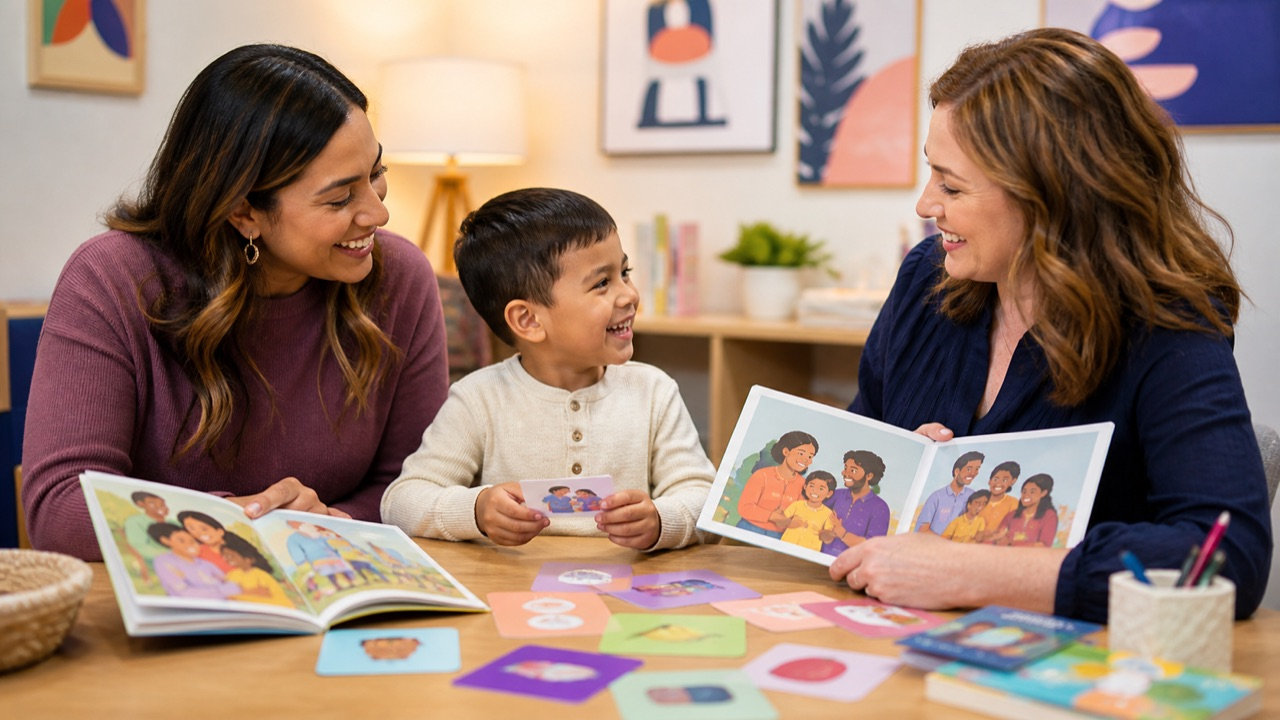
bilingual language development is easier to study when it is treated as a connected access and communication system rather than a single label. Bilingual language development is shaped by when, where, with whom, and why each language is used. SLP study requires a whole-language view that includes exposure, opportunities, proficiency, transfer, literacy, family goals, culture, and assessment in the languages that matter to the person.
This learning guide is written for SLP students and other learners reviewing clinical concepts. It uses broad patterns to organize observation, not to make an individualized diagnosis or promise one outcome. Interpretation depends on the person, task, language, culture, hearing, access, health, context, and communication goals.
What bilingual language development includes
Begin by separating the concept into domains. A learner who can name the domains is less likely to collapse hearing, language, culture, access, identity, partner, and participation questions into one explanation. The useful unit of analysis is the task: what the person was asked to understand, express, organize, coordinate, remember, or communicate, with whom, under which conditions, and with what support.
| Domain or system | What to notice | Question to carry forward |
|---|---|---|
| Exposure | Amount, quality, timing, and consistency of input influence development in each language. | What language experience has the person actually had? |
| Use and opportunity | A language may be understood more than spoken or used differently across home, school, work, and community. | Where and with whom is each language used? |
| Transfer | Features from one language can influence another as part of multilingual development and communication history. | Is the pattern expected for the languages or concerning across them? |
| Language profile | Vocabulary, grammar, discourse, speech, literacy, and comprehension may be distributed across languages. | What is the combined communication profile across languages? |
| Family and culture | Family values, identity, community, schooling, migration, and language goals shape communication choices. | Which language goals are meaningful to the person and family? |
| Assessment | Language sampling, interpreters, dynamic assessment, and language-specific knowledge help distinguish difference from disorder. | What evidence is needed in the relevant languages and contexts? |
These domains interact, but they should remain distinguishable. A learner may show strength in one task and need support in another. A study map organizes the next observation; it does not answer every assessment question or replace current professional guidance.
Keep the first pass descriptive and close to the communication event. Note the task, the response, the partner, the setting, the timing, the available support, and the consequence for participation. This gives the learner a stable record to compare across tasks and prevents a familiar term from doing too much explanatory work before the evidence has been separated.
For Praxis-style review, a vignette may include several true details but ask for one best interpretation or next step. The strongest answer usually respects the task, identifies the relevant function, checks the most important missing information, and avoids treating one performance sample as the whole profile.
Map bilingual language development
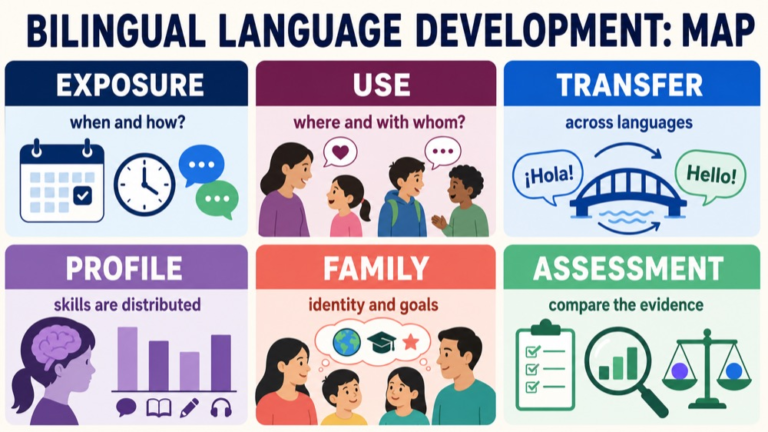
For study purposes, describe the communication relationship before naming a disorder, judging a modality, or selecting an assessment. Record what the person understood, expressed, initiated, repaired, coordinated, or participated in. Then note whether the task was familiar, how much context was shared, and which support changed the response.
- Exposure: document age of acquisition, amount, quality, contexts, partners, and changes in each language.
- Use and opportunity: compare home, school, work, community, formal, informal, spoken, signed, written, and digital communication.
- Transfer and variation: identify language-specific features before treating a cross-language pattern as a disorder.
- Combined profile: consider vocabulary, grammar, discourse, speech, literacy, comprehension, and strengths across languages.
- Family and identity: include heritage language, family relationships, cultural values, community, schooling, and language goals.
- Assessment and intervention: use language-matched or interpreter-supported methods, dynamic evidence, and functional contexts.
A strong description is specific enough that another learner could picture the event. Instead of writing “the communication is delayed,” describe the demand, the observable response, the language or mode, the partner, the context, and the result. This protects clinical reasoning from labels that are broader than the evidence.
From language experience to assessment
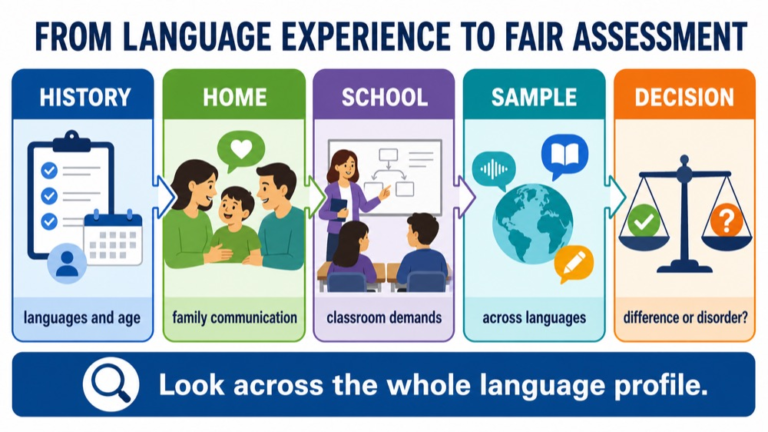
Context changes what communication requires. A direct question, a long explanation, a conversation, a classroom exchange, a workplace interaction, a family story, and a noisy routine place different demands on processing, language, memory, hearing, access, and partner support. Language experience, visual information, fatigue, health literacy, and the opportunity to request clarification should be part of the observation.
A child may know a concept in one language, use a school language for academic tasks, and use a heritage language for family stories. A word that is absent in one language may be present in another, while a language-specific grammar pattern may be expected. The strongest interpretation looks across languages and contexts instead of judging one language in isolation.
| Observation layer | Example question |
|---|---|
| Task | What did the person need to understand, express, organize, coordinate, or repair? |
| Language and access | Which language, dialect, mode, hearing condition, or support was available? |
| Partner and context | Who was involved, what did they know, and which norms or accommodations mattered? |
| Participation | What meaningful routine became easier or harder because of the pattern? |
Context is not an afterthought added once a label has been selected. It is part of the question itself. If performance changes with a quieter room, extra processing time, a familiar partner, a different language or mode, an interpreter, visual information, a changed task, or a changed routine, that change is useful evidence about access and demand. It does not identify a cause by itself, but it tells you which conditions should be carried into the next observation.
Apply the concept in clinical reasoning
When a Praxis-style scenario or clinical discussion presents bilingual language development, use a disciplined sequence. The goal is to select the next clinical question or action that matches the evidence, the person’s priorities, and the communication context.
- Define the task, language, mode, and communication purpose in plain language.
- Identify the hearing, language, cultural, access, partner, or participation domain involved.
- Separate observation from interpretation and write down what remains unknown.
- Check hearing, language exposure, dialect, culture, identity, interpreter access, environment, sensory load, memory, and task familiarity.
- Choose the assessment, collaboration, accommodation, or observation step that answers the specific question.
- State the boundary of the conclusion and keep the person’s participation goal visible.
A child may know a concept in one language, use a school language for academic tasks, and use a heritage language for family stories. A word that is absent in one language may be present in another, while a language-specific grammar pattern may be expected. The strongest interpretation looks across languages and contexts instead of judging one language in isolation. In a learning answer, the decisive evidence is usually the relationship among the task, the observed pattern, the access conditions, and the next needed information—not a single isolated behavior or label.
Common study mistakes
- Treating bilingualism or multilingualism as the cause of a communication disorder.
- Testing only English and interpreting limited English exposure as limited overall language.
- Ignoring language-specific grammar, vocabulary, speech patterns, and transfer.
- Assuming equal exposure, proficiency, use, or literacy across languages.
- Using family language loss as a treatment goal without discussing family values and identity.
- Relying on an untrained interpreter or bilingual helper as if interpreting expertise were unnecessary.
- Separating assessment from family, school, community, migration, and language history.
- Writing intervention goals in only one language when the person’s communication life is multilingual.
Most of these mistakes come from replacing a multidomain question with a fast label. Correct the habit by returning to the same sequence: describe, separate, contextualize, ask what is missing, and choose a proportionate next step. A short rationale can make the habit visible: identify the evidence, name the uncertainty, and explain why the selected next step fits both.
Build a quick review map
Use this compact map when reviewing a missed question, a lecture note, or a clinical vignette:
- Step 1: List languages, modes, age of acquisition, exposure, use, partners, and settings.
- Step 2: Separate language-specific patterns, transfer, dialect, opportunity, and possible disorder.
- Step 3: Combine evidence across languages, tasks, language samples, literacy, and dynamic assessment.
- Step 4: Include family identity, heritage language, culture, schooling, and communication priorities.
- Step 5: Use appropriate language-matched providers or trained interpreters and document the method.
- Step 6: Connect goals to the person’s real multilingual participation and relationships.
Then write one transfer sentence: “When I see this pattern, I will first check ___ because ___.” The sentence should identify a decision rule, not repeat a definition. Revisit it after a delay and test whether you can apply the rule to a different task, age group, partner, language, or communication mode.
Sources and next steps
bilingual language development is best learned as a context-sensitive pattern across communication, access, identity, function, and participation. Use the current authority pages to refine the concept, then return to practice scenarios that require you to explain what the evidence supports and what it leaves open.
Start with asha multilingual service delivery, asha cultural responsiveness. These sources support the learning frame; they do not replace current topic-specific guidance or an individualized evaluation.
Continue your preparation: Explore the SLP Study Center learning resources.