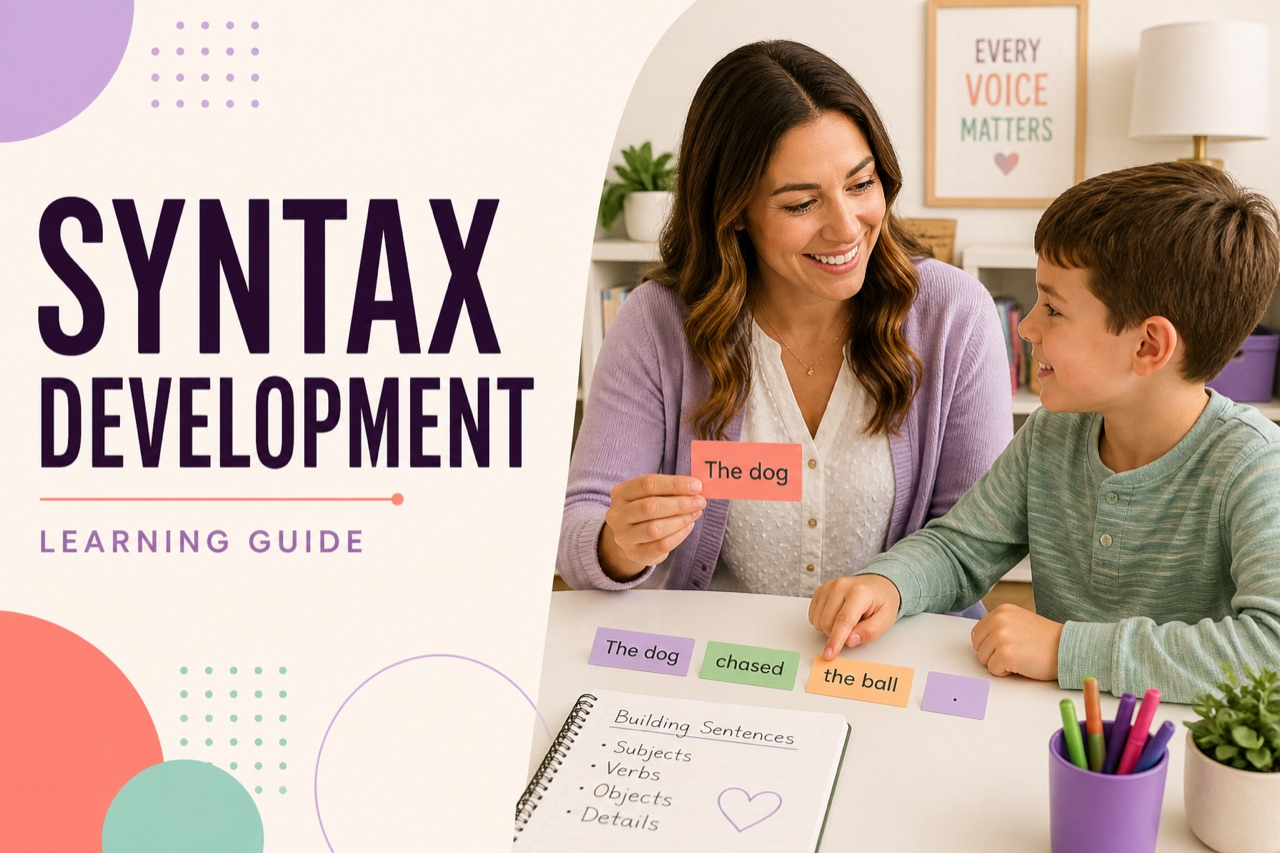
syntax development is easiest to study when it is treated as a connected pattern rather than a single checklist item. Syntax development is the growth of using and understanding sentence structure to organize meaning. It includes word order, function words, morphology, clause relationships, and the fit between a sentence and its purpose.
This learning guide is written for SLP students and other learners reviewing clinical concepts. It uses broad patterns to organize observation, not to make an individualized diagnosis or promise one outcome. Interpretation depends on language, culture, hearing, access, health, opportunity, context, task, and the person’s communication goals.
What syntax development includes
Begin by separating the concept into domains. A learner who can name the domains is less likely to collapse a sound, language, motor, access, or participation question into one explanation. The useful unit of analysis is the task: what the person was asked to understand, produce, remember, organize, or communicate, with whom, under which conditions, and with what support.
| Domain | What to notice | Question to carry forward |
|---|---|---|
| Word order | Arranging words and phrases so the listener or reader can identify relationships and roles. | Which relationships depend on the order of the words? |
| Morphosyntax | Using word forms, tense, agreement, plurality, pronouns, and function words to mark meaning. | Which form changes the interpretation of the sentence? |
| Clause structure | Combining ideas through coordination, subordination, relative clauses, conditionals, and embedding. | How many relationships must be held and integrated? |
| Comprehension | Understanding sentence structures during listening, reading, conversation, and classroom instruction. | Does production or comprehension carry the greater demand? |
| Use | Selecting sentence forms that fit the topic, audience, discourse, and communication mode. | Does the structure support the intended message? |
These domains interact, but they should remain distinguishable. A learner may show strength in one area and need support in another. A broad learning label organizes the next observation; it does not answer every assessment question.
Keep the first pass descriptive and close to the communication event. Note the message, the listener, the setting, the response format, the task demand, and the support that was available. This gives the learner a stable record to compare across tasks and prevents a familiar term from doing too much explanatory work before the evidence has been separated into observable parts.
For exam review, a vignette may include several true details but ask for one best next step. The strongest answer usually respects the task and the person’s participation, checks the most relevant missing information, and avoids treating one performance sample as the whole profile.
Map syntax development
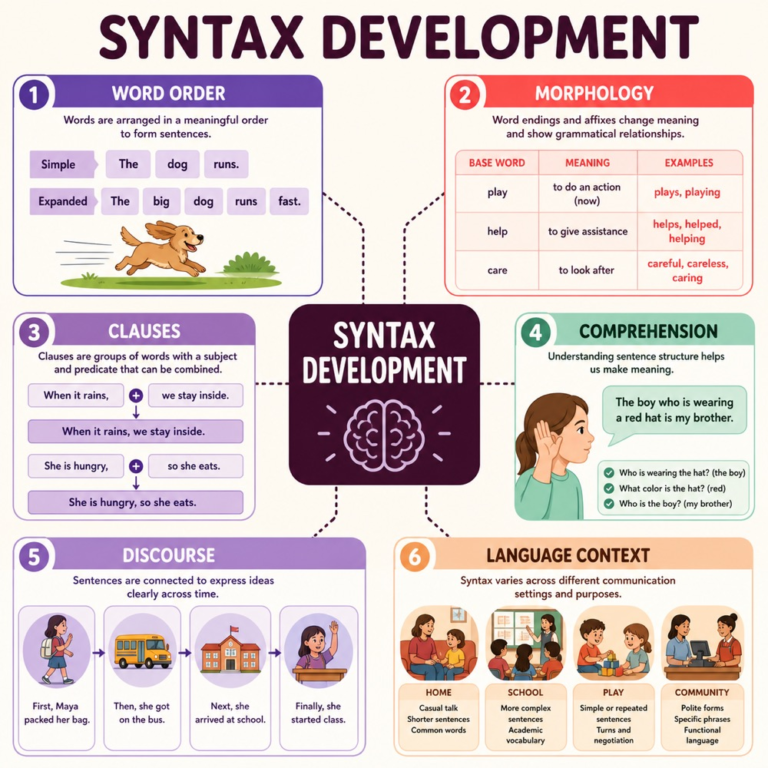
For study purposes, describe the pattern before naming a condition. Record what the person understood, produced, initiated, repaired, or participated in. Then note whether the task was familiar, how much context was shared, what communication mode was available, and which support changed the response.
- Basic sentence structure: using participants, actions, states, locations, and relationships in an organized clause.
- Function words and morphology: marking tense, agreement, number, pronouns, auxiliaries, articles, and other grammatical relations.
- Complex sentences: connecting clauses with coordination, subordination, relative clauses, conditionals, and causal language.
- Comprehension and interpretation: understanding how word order, negation, passive forms, and embedded clauses change meaning.
- Discourse and writing: using sentence variety, cohesion, and punctuation to build a connected message for a reader or listener.
- Language-specific context: interpreting syntax through the learner’s language, dialect, culture, modality, and communication purpose.
A strong description is specific enough that another learner could picture the event. Instead of writing “the skill is weak,” describe the demand, the observable response, the partner, the context, and the result. This protects clinical reasoning from labels that are broader than the evidence.
Read sentence structure in context
Context changes what communication requires. A quiet one-to-one task, a noisy group, a classroom explanation, a book-sharing routine, a peer exchange, and a work task can place different demands on the same underlying skills. Hearing access, fatigue, visual supports, partner rate, cultural expectations, language exposure, and the opportunity to request clarification should be part of the observation.
A learner may use simple sentences successfully in conversation but need more time for a passive sentence, embedded clause, or written explanation. The useful question is which structure and task demand changed, not whether the learner can or cannot do syntax in general.
| Observation layer | Example question |
|---|---|
| Task | What did the person need to understand, express, remember, organize, or repair? |
| Partner | Who was listening, and how did the partner respond or support the exchange? |
| Access | Were hearing, visual, motor, sensory, language, or environmental supports available? |
| Participation | What meaningful routine became easier or harder because of the pattern? |
Context is not an afterthought added once a label has been selected. It is part of the question itself. If performance changes with a quieter room, visual supports, extra processing time, a familiar partner, a different communication mode, or a changed task, that change is useful evidence about access and demand. It does not by itself identify a cause, but it tells you which conditions should be carried into the next observation.
Apply the concept in clinical reasoning
When a Praxis-style scenario or clinical discussion presents syntax development, use a disciplined sequence. The goal is to select the next clinical question or action that matches the evidence, the person’s priorities, and the communication context.
- Define the task in plain language.
- Identify the domain or domains involved without assuming they are interchangeable.
- Separate observation from interpretation and write down what remains unknown.
- Check hearing, language experience, culture, communication mode, environment, partner support, and task familiarity.
- Choose the assessment, collaboration, or observation step that answers the specific question.
- State the boundary of the conclusion and keep the person’s participation goal visible.
A learner may use simple sentences successfully in conversation but need more time for a passive sentence, embedded clause, or written explanation. The useful question is which structure and task demand changed, not whether the learner can or cannot do syntax in general. In a learning answer, the decisive evidence is usually the relationship among the task, the observed pattern, and the next needed information—not a single isolated behavior.
Common study mistakes
- Equating one grammatical form with the entire syntax system.
- Counting utterance length without examining sentence relationships and meaning.
- Ignoring comprehension while focusing only on spoken production.
- Treating dialect or multilingual grammar as an error against one variety.
- Using a complex sentence prompt without checking processing and background knowledge.
- Separating syntax from morphology, semantics, discourse, and writing.
- Assuming a correct imitation proves spontaneous use.
- Describing missing forms without noting which structures are already functional.
Most of these mistakes come from replacing a multidomain question with a fast label. Correct the habit by returning to the same sequence: describe, separate, contextualize, ask what is missing, and choose a proportionate next step. A short rationale can make the habit visible: identify the evidence, name the uncertainty, and explain why the selected next step fits both.
Build a quick review map
Use this compact map when reviewing a missed question, a lecture note, or a clinical vignette:
- Step 1: Identify the sentence relationship the task requires.
- Step 2: Separate word order, morphology, clause structure, and meaning.
- Step 3: Compare comprehension, imitation, supported production, and spontaneous use.
- Step 4: Check language variety, modality, processing time, and task familiarity.
- Step 5: Connect sentence structure to the discourse purpose.
- Step 6: Write the next focused observation rather than a global grammar label.
Then write one transfer sentence: “When I see this pattern, I will first check ___ because ___.” The sentence should identify a decision rule, not repeat a definition. Revisit it after a delay and test whether you can apply the rule to a different context or communication mode.
Sources and next steps
syntax development is best learned as a context-sensitive pattern across structure, function, access, and participation. Use the current authority pages to refine the concept, then return to practice scenarios that require you to explain what the evidence supports and what it leaves open.
Start with asha language in brief, asha spoken language, asha social components. These sources support the learning frame; they do not replace current topic-specific guidance or an individualized evaluation.
Continue your preparation: Explore the SLP Study Center learning resources.