Speech and language milestones are useful when they help a learner notice communication patterns, ask better questions, and choose an appropriate next step. They become misleading when they are treated as a rigid checklist that predicts one child’s future or turns one missing skill into a diagnosis. A clinical view separates speech, language, social communication, play, hearing access, and participation, then considers how those domains work together in real routines.
This guide is written for SLP students, educators, caregivers, and learners reviewing core concepts. It uses broad patterns as orientation, not as deadlines. Development varies with opportunity, communication access, language experience, health, culture, context, and individual learning profile. When concern persists, the appropriate response is careful observation and qualified evaluation rather than a conclusion from a chart.
What milestones can and cannot tell you
A milestone is a broad description of a skill that may become visible within a developmental period. It is not a promise that every child will show the skill on the same day, in the same language, or in the same setting. Milestones help organize observation; they do not replace hearing information, developmental history, language sampling, family priorities, or a comprehensive evaluation when those are needed.
| Useful for | Not sufficient for |
|---|---|
| Choosing what to observe next. | Assigning a diagnosis from one missing behavior. |
| Describing communication in routines. | Ranking a child against a rigid deadline. |
| Generating questions about access and participation. | Separating language difference from disorder without context. |
| Connecting a clinical concept to a real example. | Deciding a treatment plan without qualified assessment. |
The word “typical” also needs care. A broad pattern can be common without being required, and a child can show an uneven profile without that pattern answering why it exists. Use the milestone as one piece of evidence and keep the question open until the context is understood.
Start by separating the communication domains
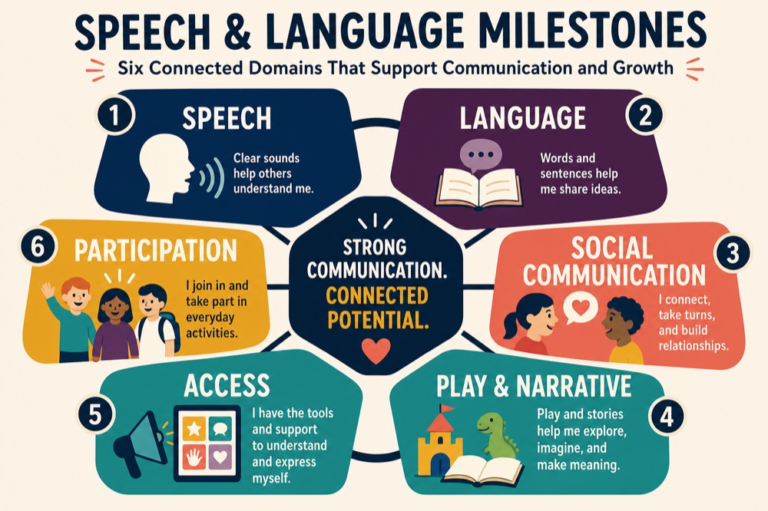
Speech and language overlap, but they are not interchangeable. Speech concerns the production and organization of sounds and spoken output. Language includes understanding and using words, sentences, meanings, and discourse. Social communication includes how a person uses communication with other people, adjusts to context, and shares attention or intent. Play can reveal opportunities for symbolic, narrative, and social language. Hearing and other access factors affect what communication is available to learn and use. Participation asks whether the person can engage in the routines that matter.
- Speech: clarity, sound patterns, voice, and fluency in the communication mode used.
- Receptive language: understanding words, sentences, questions, concepts, and relationships.
- Expressive language: communicating ideas, needs, stories, and relationships through speech, sign, symbols, or other modes.
- Social communication: using communication for interaction, repair, sharing, and adapting to a partner or context.
- Play and narrative: using objects, actions, symbols, sequences, and stories to represent meaning.
- Access and participation: hearing, vision, motor, sensory, partner, environmental, and communication supports that affect opportunity.
This separation prevents a common reasoning error: treating a speech production difference as if it automatically explained comprehension, or treating a small vocabulary sample as if it answered every question about social communication. Each domain deserves its own observation and then a connected interpretation.
Read broad patterns across early development
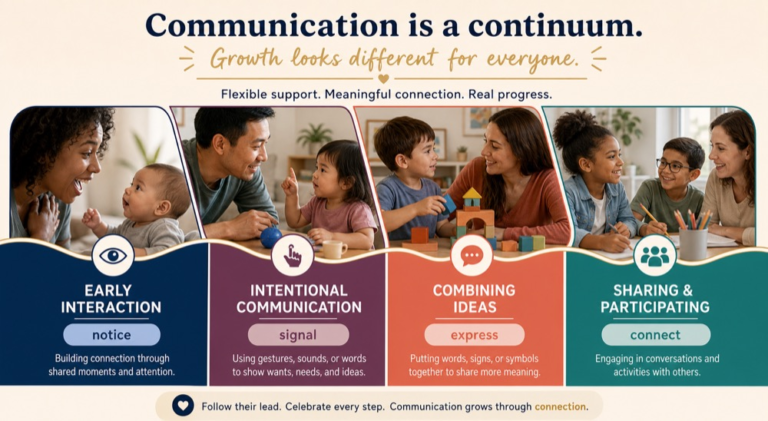
Early communication changes quickly, but it does not follow one perfectly linear path. Broad patterns may include attention to voices and faces, vocal or gestural communication, understanding familiar routines, intentional words or symbols, combining ideas, participating in play, telling or retelling events, and adjusting communication with different partners. The order and visibility of these behaviors can vary.
| Broad period | What to notice | Question to carry forward |
|---|---|---|
| Early infancy | Orientation to sound, faces, interaction, and emerging vocal or body signals. | What captures attention, and how does the partner respond? |
| Later infancy | Reciprocal routines, gestures, varied vocal play, and shared attention. | How does the child signal intent and respond to another person? |
| Toddler period | Understanding familiar language, using words or other modes, combining meanings, and expanding play. | Is communication becoming more intentional across routines? |
| Preschool period | Longer messages, questions, stories, peer interaction, sound development, and flexible language. | How does the child explain, negotiate, repair, and participate? |
| School-age development | Complex narratives, inferencing, vocabulary depth, classroom language, and social problem-solving. | Which communication demands are affecting learning or relationships? |
These descriptions are orientation points, not a scorecard. A child may communicate effectively with gestures, signs, symbols, or a device while spoken language is emerging. A multilingual child may distribute vocabulary and functions across languages. Interpretation should include the full communication repertoire rather than counting only one language or one mode.
Look at the whole communication context
Milestones are most informative when paired with context. Ask who the communication partners are, what routines are familiar, what opportunities the child has had, which language or languages are used, and what supports make participation possible. Hearing access, device use, motor access, attention, regulation, and the communication environment can all affect what an observer sees.
- Observe more than one routine, such as play, book sharing, meals, and transitions.
- Note both understanding and expression.
- Record gestures, facial expression, signs, symbols, and speech rather than speech alone.
- Ask how communication changes with familiar and unfamiliar partners.
- Consider whether the task gives the child a fair way to show the skill.
- Document strengths and successful supports alongside areas of concern.
A strong description says what happened, in what context, with which support, and how consistently. “Did not talk during one clinic activity” is less informative than a pattern across routines that describes understanding, intentional communication, partner response, and access conditions.
When a pattern deserves closer attention
Closer attention is reasonable when concerns persist across settings, communication access is uncertain, a child loses skills, participation is becoming difficult, or the family and educators observe a consistent mismatch between demands and available communication. The next step is not to decide the cause from the milestone list. It is to gather appropriate history, hearing information when relevant, language samples, partner reports, and other evaluation evidence through qualified professionals.
For SLP learning, remember the difference between a referral question and a conclusion. “What should we assess to understand this pattern?” is a useful clinical question. “This one behavior establishes a disorder” is not a responsible inference. Multilingual development, disability, cultural communication style, access, and opportunity should be included in the interpretation.
Use milestones in clinical reasoning
When a practice scenario includes a milestone, identify what the milestone contributes and what remains unknown:
- Name the communication domain: speech, receptive language, expressive language, social communication, play, access, or participation.
- Describe the behavior in context rather than translating it immediately into a label.
- Ask which additional information would change the interpretation.
- Consider hearing, language exposure, communication mode, culture, and partner support.
- Choose an assessment or collaboration step that answers the actual clinical question.
- State the boundary of your conclusion and avoid overclaiming.
For example, if a child uses few spoken words but communicates through gestures and a device, the clinically important question is not simply “How many words?” It is how the child understands, initiates, combines modes, repairs communication, and participates across people and routines. The milestone framework helps you ask a better question; it does not supply the final answer.
Common interpretation mistakes
- Using a single age chart as a rigid deadline.
- Counting spoken words without observing comprehension or other communication modes.
- Ignoring hearing access, partner support, or the communication environment.
- Interpreting multilingual development through one language only.
- Assuming speech clarity explains a language or social-communication pattern.
- Reporting a deficit without documenting strengths and successful supports.
- Turning a broad milestone into a diagnosis or treatment prescription.
- Copying a public chart without checking its source and date.
For a current clinical learning path, use the ASHA Practice Portal and relevant ASHA Evidence Maps to extend the question into topic-specific evidence. The current NIDCD speech and language resource is useful for broad educational context. Keep the boundaries visible: milestones organize observation, while qualified assessment and current evidence guide individual decisions.
Sources and next steps
Speech and language milestones are most useful when they lead to careful observation, better questions, and communication access. They are not a rigid staircase. For SLP study, keep the domains distinct, connect each behavior to its context, and explain what the evidence supports—and what it does not.
Continue your preparation: Explore the SLP Study Center learning resources.