Speech language development across the lifespan is broader than a list of first words or sound milestones. It includes how people acquire, organize, express, understand, and adapt communication from infancy through later life. A useful clinical view also asks whether a person can access communication, use it with other people, and participate in the routines that matter to them.
This guide uses broad age patterns as orientation points rather than rigid cutoffs. Speech, language, cognition-communication, hearing access, social communication, and functional participation overlap, but each lens asks a different question. One behavior can be meaningful without explaining the whole profile, and a developmental difference can have more than one possible contributor.
Table of Contents
- Speech language development across the lifespan: the framework
- A comparison map of related domains
- Broad patterns from infancy through later life
- One communication event, several clinical questions
- Common confusions that make age patterns misleading
- Context, multilingualism, and access
- Application to evaluation and participation
- Short SLP Praxis 5331 application
- Quick review
Speech language development across the lifespan: the framework
In a learning context, speech language development across the lifespan describes changing communication abilities and demands over time. Infants begin with early regulation, sound awareness, vocal exchange, and interaction. Children build spoken, signed, written, and multimodal language. Adolescents refine abstract language and social judgment. Adults adapt communication to work, relationships, health care, and community life. Later-life communication may include maintenance, accommodation, rehabilitation, or response to acquired change.
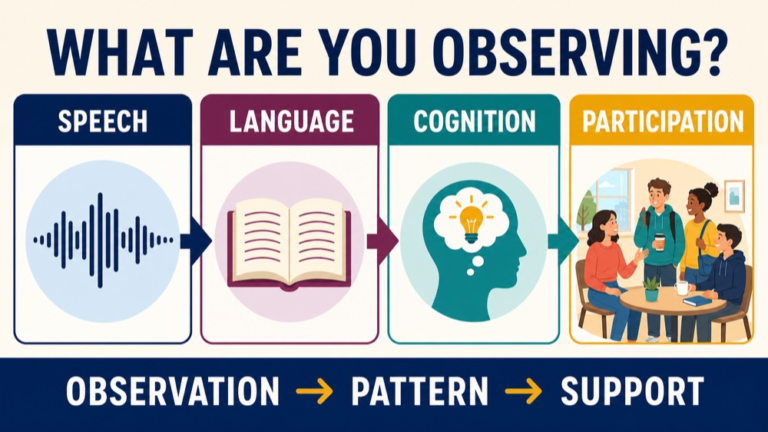
Speech refers to the production of spoken messages, including sound patterns, voice, and fluency. Language concerns meaning and the shared system used to understand and express it through speech, writing, signing, gestures, or other modes. A person can have a strong idea with speech that is difficult to understand, or clear speech with difficulty understanding a complex message. Keeping those questions separate prevents a visible behavior from standing in for the whole communication profile.
Cognition-communication describes cognitive processes as they operate in communication, such as attention, learning, memory, processing, organization, problem solving, and self-monitoring. Hearing access asks whether relevant speech and environmental information is available under the conditions in which communication occurs. Social communication asks how a person shares meaning with partners, including initiation, turn exchange, inference, topic management, repair, and adaptation. Functional participation asks what happens in real routines: joining a classroom discussion, completing a work task, managing a medical conversation, maintaining a relationship, or communicating a need safely.
- Developmental acquisition: new abilities emerge through interaction, learning, experience, and access to communication.
- Refinement: messages become more precise, efficient, flexible, and appropriate for different partners and settings.
- Adaptation: people use strategies, technology, partner support, or environmental changes when demands shift.
- Maintenance: familiar communication abilities are practiced and supported in meaningful activities.
- Change: a new pattern may reflect context, health, hearing, neurological, emotional, or other factors that require careful history.
- Participation: the practical outcome is not only what a person can do in a test, but whether communication supports valued activities.
The life-span lens therefore has two safeguards. It avoids reducing communication to early childhood checklists, and it avoids treating every later-life change as a simple consequence of age. Interpretation depends on the person, the communication mode, the setting, the partner, the time course, and the effect on participation.
A comparison map: related domains, different questions
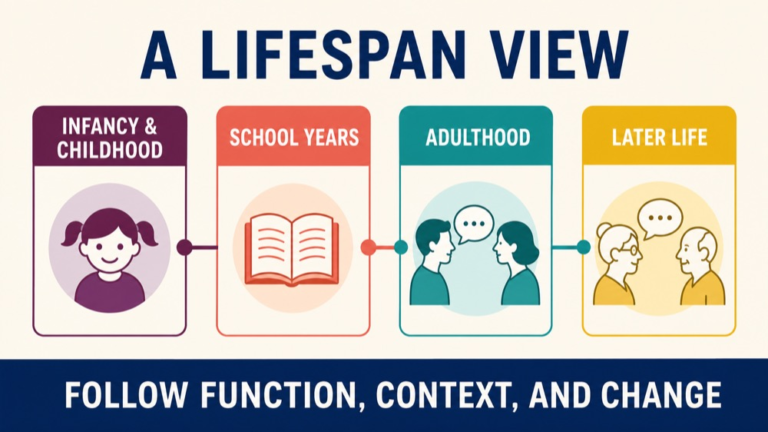
Clinical reasoning improves when an observation is first assigned to the question it can actually answer. The map below is not a set of isolated boxes. A hearing-access issue can affect language learning, a language difficulty can affect classroom participation, and cognitive-communication demands can make an otherwise familiar message harder to manage. The boundaries help organize follow-up rather than close the inquiry.
| Lens | Core question | Concrete observation | Important boundary |
|---|---|---|---|
| Speech | How is a spoken message produced? | Sound patterns, voice quality, rate, or fluency during conversation. | Speech clarity does not by itself describe vocabulary, comprehension, or social intent. |
| Language | What meaning is understood and expressed? | Following directions, choosing words, combining ideas, telling a story, or reading and writing. | Spoken output is one route for language; gestures, signs, writing, and AAC can also carry meaning. |
| Cognition-communication | How do cognitive processes support communication? | Holding a topic in mind, remembering instructions, organizing a narrative, or monitoring a breakdown. | A difficult task may reflect demand, fatigue, access, or context; it is not a direct measure of general ability. |
| Hearing access | What speech and sound information is available? | Understanding a speaker in quiet and noise, with or without visual or device support. | Responding to a familiar voice in one setting does not settle hearing status in every setting. |
| Social communication | How is meaning shared with a partner? | Initiating, taking turns, interpreting an implied message, changing topic, or repairing a misunderstanding. | Quietness, eye gaze, or talkativeness alone cannot explain social communication. |
| Functional participation | What can the person do in valued routines? | Joining play, learning in class, contributing at work, managing appointments, or staying connected. | Participation is shaped by the environment and partner supports as well as individual skills. |
Broad lifespan patterns from infancy through later life
Age bands make a life-span topic easier to study, but they can create false precision. The patterns below are broad guides assembled from the source boundaries in this article. They describe useful observations to consider, not a checklist that every person completes on one date. Individual pathways may be uneven, multilingual, multimodal, or shaped by hearing and other access conditions.
| Life period | Communication patterns to consider | Context and participation questions |
|---|---|---|
| Infancy and toddlerhood | Early attention to voices and sounds, vocal play, turn-taking, gestures, babbling, emerging words, comprehension of familiar routines, and growing intentional communication. | Does the infant have reliable access to communication? How do caregivers respond? What happens during play, transitions, books, and feeding? Are skills expanding, uneven, or changing? |
| Preschool and school age | Vocabulary, grammar, speech-sound patterns, intelligibility, narratives, questions, classroom language, early literacy, and increasingly flexible social communication. | Can the child follow instruction, explain an idea, learn from language, participate with peers, and repair a breakdown? Which supports make communication easier? |
| Adolescence | Abstract vocabulary, inferencing, perspective taking, expository and narrative discourse, metalinguistic awareness, self-advocacy, and communication across changing peer and academic settings. | Can the student shift register, interpret indirect language, organize a complex task, and communicate preferences or accommodations? Which demands are linguistic, cognitive, social, or environmental? |
| Adulthood | Communication is adapted for work, relationships, parenting, health care, community participation, literacy, multilingual settings, and specialized expertise. | What does the person need to explain, remember, negotiate, or understand? Are breakdowns linked to noise, time pressure, fatigue, unfamiliar partners, or a change from baseline? |
| Later life | People may continue to learn and communicate effectively while also experiencing changing hearing access, retrieval speed, processing demands, or the effects of acquired conditions. | Compare communication across meaningful routines and over time. Ask about hearing, health history, medication, fatigue, partner support, and a new loss of function without assigning a cause from age alone. |
For early development, NIDCD describes a progression from responses to voices and sounds toward babbling, gestures, words, combinations, stories, and increasingly understandable communication. Those examples are useful because they connect sound access, language, interaction, and daily routines. They still need to be interpreted with the person's communication mode, opportunities, and history in view.
Concrete example: one communication event, several clinical questions
Consider a preschool child describing a visit to a park. The child produces a long sequence of speech, uses gestures to show where an event occurred, names several objects, and becomes difficult for an unfamiliar listener to understand. The observation contains several possible study targets: speech intelligibility, language formulation, narrative organization, social communication, and the partner's ability to support the exchange. It does not answer all of those questions at once.
Now consider a teenager in a group project. The student understands the assignment and has strong content knowledge, but misses an implied change in the group's plan and needs the teacher to restate the next step. The relevant analysis might include language comprehension, executive organization, memory for instructions, social inference, hearing access in a noisy room, and the supports available. A single missed cue should be described before it is interpreted.
An adult may follow a one-to-one conversation in a quiet office but miss key details in a fast meeting with several speakers. That pattern raises questions about hearing access, visual information, processing demand, fatigue, and the communication environment. An older adult who has a new, persistent difficulty following familiar conversations or expressing previously easy ideas presents a different kind of question because change from baseline and functional impact matter. The example calls for appropriate professional evaluation, not a conclusion from one conversation.
- Describe the event: who spoke, what the task required, which language or mode was used, and where the breakdown occurred.
- Name the observable form: sound production, word choice, sentence structure, memory for steps, turn exchange, listening access, or participation.
- Identify the demand: noise, speed, abstraction, topic shift, unfamiliar partner, fatigue, visual load, or emotional pressure.
- Record the support: repetition, written information, gesture, captioning, device use, extra time, partner modeling, or a quieter setting.
- Describe the outcome: whether the person repaired the message, completed the activity, withdrew, or needed another route.
Common confusions that make age patterns misleading
Many errors occur because a visible communication behavior is treated as a shortcut for a broader construct. The following distinctions are useful for learners and for anyone reading a milestone chart.
- Speech is not language. A person may understand and formulate a message while producing speech that is hard to understand. Another person may speak clearly but struggle with comprehension, word finding, grammar, or discourse.
- Expressive output is not the whole language profile. Spoken words are only one source of evidence. Comprehension, gestures, signs, writing, AAC, imitation, and communication purpose also matter.
- Hearing access is not the same as attention. A person may listen well in one room and miss information in noise, from a distance, or without visual support. A hearing question deserves hearing-focused follow-up.
- Social communication is not a score for eye gaze or talkativeness. Look at how meaning is initiated, shared, interpreted, repaired, and adapted with partners across settings.
- Cognition-communication is not a direct measure of intelligence. Communication performance is affected by task structure, memory load, processing time, fatigue, language, hearing, and environmental support.
- A multilingual difference is not automatically a disorder. The whole language repertoire, exposure history, opportunities, and communication across languages must be considered.
- An age band is not a deadline. Use patterns over time and functional impact instead of treating one range as a pass-or-fail rule.
- Food preference is not the same question as swallowing safety. Mealtime selection, chewing, drinking, airway signs, comfort, and participation should be described separately.
Context, multilingualism, and access
Developmental descriptions are shaped by the language and communication environment. A multilingual child may distribute vocabulary and functions across languages, use code-switching, or show different levels of confidence with different partners. A learner who is developing an additional language may appear less expressive in that language while communicating richly in another. Interpretation should consider the entire repertoire rather than applying a monolingual expectation to one language sample.
The same principle applies to communication mode and hearing access. Deaf and hard-of-hearing people may use spoken language, sign language, written language, visual communication, AAC, or combinations of modes. The clinical question is whether the person has meaningful access to language and can participate in important routines, not whether one spoken-language pathway is the only acceptable route. ASHA's Practice Portal points learners toward topic-specific resources for hearing, multilingual service delivery, social communication, and other clinical questions.
Culture, dialect, accent, identity, family interaction style, and opportunity also shape what communication looks like. A difference from a classroom or clinic norm is not sufficient evidence of a disorder. Ask whether a pattern is shared within the person's linguistic or cultural community, whether it interferes with the person's goals, and whether the evaluator has enough relevant language and contextual information to interpret it responsibly.
- Which languages, dialects, modes, and communication partners are part of daily life?
- Where is communication easiest, and where does the breakdown occur?
- Does the pattern appear across languages or only in one learning context?
- What access supports are present, missing, or inconsistent?
- What strengths does the person use to understand, express, repair, and participate?
- Has the pattern changed over time, and what activities are affected?
Application to evaluation and participation
A strong evaluation begins with a meaningful concern and a clear communication question. The question might involve speech sound production, language learning, listening access, narrative organization, social inference, memory for instructions, or participation in a specific routine. The selected methods should match that question and the person's language, mode, age, cultural context, and communication environment.
- Define the concern in observable terms: describe what happens, where it happens, how often it appears, and who notices it.
- Separate the domains: distinguish speech, language, cognition-communication, hearing access, social communication, and participation before connecting them.
- Sample meaningful contexts: include conversation, learning, work, play, reading, health care, or another routine that reflects the person's goals.
- Consider access and language: account for hearing, devices, communication modes, multilingual experience, partner behavior, noise, speed, and visual information.
- Use converging evidence: combine history, observation, interview, appropriate measures, and collaboration rather than relying on one behavior.
- Plan for function: connect support to a real activity, such as explaining, remembering, joining, advocating, repairing, or understanding information.
- Monitor change: review whether communication and participation improve, remain stable, or change when the context or support changes.
Intervention planning follows the same logic. A clinician may work on a communication skill, change the environment, coach a partner, add a visual or auditory support, or combine these approaches. The appropriate plan depends on evaluation findings, goals, consent, safety, professional scope, and the person's context. A general article can teach the reasoning framework, but it cannot determine an individualized service plan.
Functional participation is the bridge between domain knowledge and daily life. A student may need to explain a science idea, an employee may need to summarize a meeting, a parent may need to manage a child's appointment, and an older adult may need to understand medication instructions. The same underlying communication process can look different across those tasks, so assessment and support should be tied to the activity rather than to a decontextualized label.
Short SLP Praxis 5331 application
For SLP Praxis 5331 study, this topic is useful as a domain-separation and clinical-reasoning framework. Use the current ETS Speech-Language Pathology 5331 page and applicable current blueprint for exam scope and logistics. This article intentionally avoids changing test specifications and does not reproduce a test item.
When a developmental or lifespan scenario appears, work through the evidence in this order:
- Identify the primary construct: Is the stem mainly about speech, language, cognition-communication, hearing, social communication, or functional participation?
- Find the decisive evidence: Which behavior, time pattern, access condition, or task demand actually supports the answer?
- Separate what is known from what is missing: Do not infer hearing status, diagnosis, or cause from one observation when the stem has not provided that information.
- Choose the action that matches the question: A hearing concern, a language sample, a communication-partner observation, and a participation support answer address different problems.
- Check the boundary: Broad milestones organize reasoning, but they do not establish a fixed outcome or a label from one sign.
Original study scenario, written for this guide and not from an exam: An older adult who previously managed familiar conversations now needs repeated explanations during a routine appointment and has difficulty organizing a short message. The best first reasoning move is to describe the change from baseline, examine hearing and communication conditions, gather relevant history, and consider appropriate professional evaluation. The scenario does not identify a cause or diagnosis by itself. The teaching point is to connect time course, access, cognition-communication, and participation instead of selecting an age-based shortcut.
Quick review: questions to carry forward
Use this checklist when reviewing a developmental resource, discussing a communication concern, or studying a clinical scenario. The goal is not to memorize a rigid staircase. The goal is to ask a more precise question and connect the evidence to participation.
- What communication domain is the observation actually describing?
- What does the person understand, express, produce, access, or do with a partner?
- Which language, mode, setting, partner, and task demand are involved?
- Is the pattern new, longstanding, uneven, or changing from the person's own baseline?
- Could hearing access, fatigue, noise, memory load, culture, or multilingual experience change the observation?
- What support helps the person communicate or participate?
- What information is still missing before a clinical conclusion could be considered?
- Would the next step involve hearing-focused follow-up, speech-language evaluation, broader history, environmental support, or collaboration?
- Does the explanation avoid treating one behavior or age range as diagnostic by itself?
- For exam study, does the selected answer match the decisive evidence and the scope of the question?
If you want to organize this framework into a broader review routine, you can explore the SLP Study Center Complete Prep page and decide whether it fits your own study plan. Keep the current ETS page and the linked authoritative clinical resources as the basis for changing exam and practice guidance.
References and source boundaries
The following links support the article's teaching boundaries. Recheck them before publication or before using this page to make a registration, evaluation, or service decision.
- NIDCD: Speech and Language Developmental Milestones — definitions, early developmental observations, hearing-access context, and public guidance on seeking appropriate evaluation.
- ASHA Practice Portal — evidence-oriented clinical and professional topic resources for speech-language pathology and audiology.
- Language Development across the Life Span — the research packet's lifespan evidence lead; this article uses it for broad framing rather than unverified age norms.
- ETS Speech-Language Pathology 5331 — current exam page to consult for changing scope and logistics.